


Community hub
Recent from talks
Contribute something
Nothing was collected or created yet.
Pressure washing
View on Wikipedia
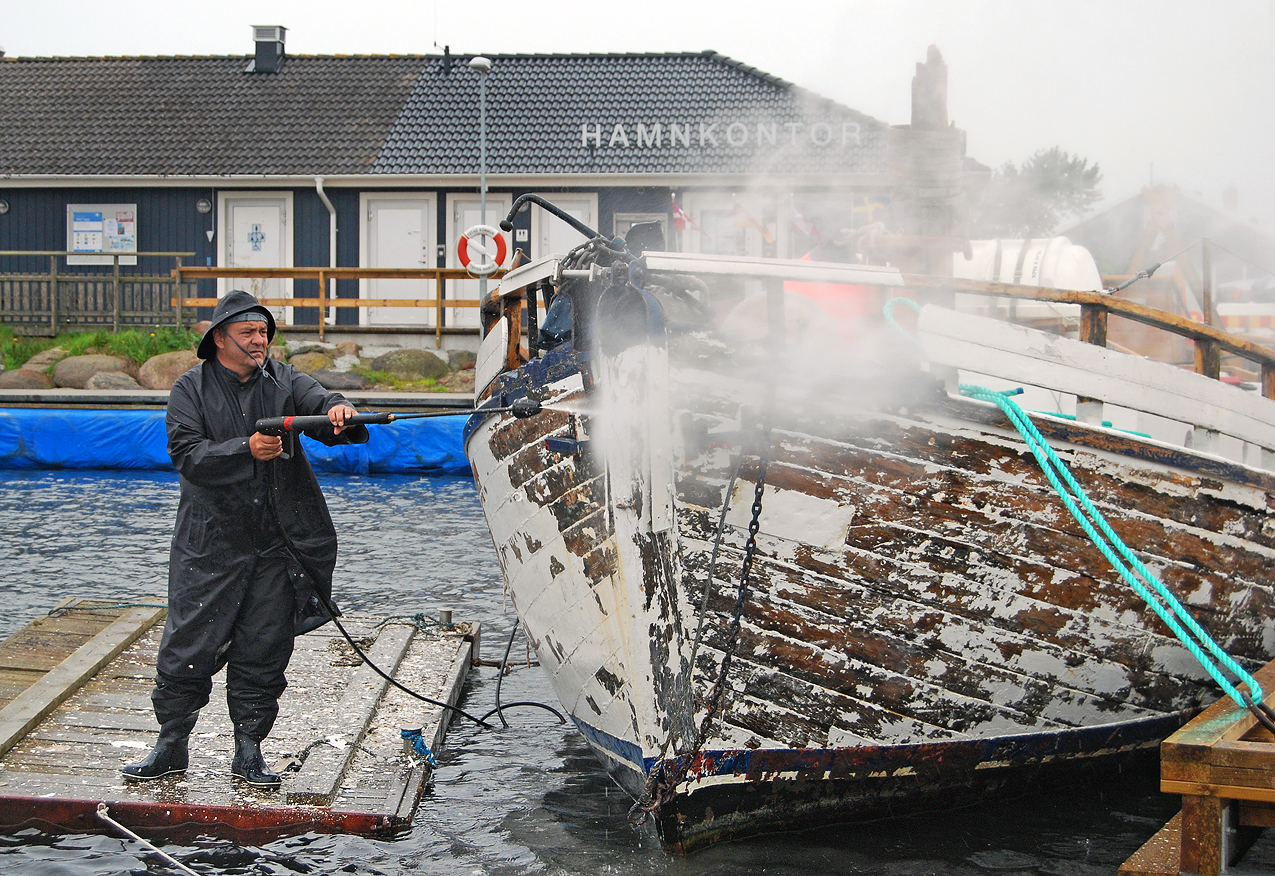
Pressure washing or power washing is the use of high-pressure water spray to remove loose paint, mold, grime, dust, mud, and dirt from surfaces and objects such as buildings, vehicles and concrete surfaces. The volume of a mechanical pressure washer is expressed in gallons or liters per minute,[1] often designed into the pump and not variable. The pressure, expressed in pounds per square inch, pascals, or bar, is designed into the pump but can be varied by adjusting the unloader valve or using specialized nozzle tips. Machines that produce pressures from 750 to 30,000 psi (5 to 200 MPa) or more are available.
The terms pressure washing and power washing are used interchangeably in many scenarios, and there is some debate as to whether they are actually different processes.
An industrial pressure washing surface cleaner is a tool consisting of two to four high-pressure jets on a rotating bar that swivels when water flows. Some systems involve a wheeled circular shroud which is moved along the surface which protects the user from spray and debris. This action creates a uniform cleaning pattern that can clean flat surfaces at a rapid rate. Many low-cost household/consumer grade systems typically use a single orifice which cannot be adjusted for spray pattern.
Hydro-jet cleaning is a more powerful form of power washing, employed to remove buildup and debris in tanks and lines.[2]
Areas of use
[edit]Pressure washing is employed by businesses and homeowners to reduce allergies, minimize hazards, and improve aesthetics. A pressure washer is used to clean residential surfaces such as gutters, roofs, decks, paved areas, siding, cladding, and windows. They are also used to clean commercial surfaces such as office buildings, churches, schools, hospitals, and other large buildings.[3]
Equipment
[edit]

There are 2 main types of pressure washers. Hot water pressure washers and cold water pressure washers. Each have their own purpose.[4] Hot water pressure washers are best for washing flatwork (concrete driveways, walkways, etc.) that can have grease or oil residue. They are best to use when cleaning parking garages, drive-throughs and gas stations. Hot water is achieved with the use of a burner unit. Hot water helps emulsify grease and oil on surfaces and helping to remove it quicker. Cold water machines are most commonly used to wash residential areas. Siding, gutters, roofs, decks, and windows can all be cleaned effectively with the use of a cold water pressure washer.
Surface cleaners are pressure wash tools that facilitate the even cleaning of larger flat surface areas. There are many models available that attach to the end of a pressure washer wand. A surface cleaner has a disc shaped housing covering a rotating bar with a nozzle at each end. In use, the high pressure water is split into two steams which emerge through nozzles at the ends of the bar, directing the jets against the surface to be cleaned and inducing rotation of the bar. When the unit is moved over the surface the rotating jets clean a swathe a little smaller than the circular cover, which confines splashback and reduces noise. Larger models may have casters to maintain clearance and allow easy control of movement over reasonably smooth surfaces. Smaller versions may rely on a ring of plastic bristles for the same purpose.[5] The water enters the surface cleaner through a trigger gun at the top of the handle bar, travels through a hose, the swivel, and the bar ending up passing through specifically sized nozzles to spray the surface and remove dirt and grime.
Nozzles
[edit]Pressure washer nozzles alter the direction of flow and velocity of the water. Nozzles allow users to reach a greater distance or apply more pressure to a difficult-to-clean surface. Nozzles are color-coded for easy identification, with black nozzles covering the widest degree (65°) and red nozzles covering the least (0°). Great care should be taken when using a 0° nozzle as it can cause injury to both the user and passersby, as well as damage to surfaces.[6] Nozzles are sized based on the flow rate (GPM) and delivery pressure (PSI) of the machine.[7]
High-pressure water jetting
[edit]High-pressure water jetting, also called hydrojetting, is a variation in which the pressure can be significantly higher (up to 1,400 bars (20,000 psi)) than consumer models, and is sufficiently hazardous that special precautions are necessary for acceptable safety. High-pressure water jetting also has applications in cutting a wide range of materials with very low heat input or dust production, and can be effective underwater.[8][9]
Some advantages of this technology for use in the oil and gas production industry are that it has a low fire and explosion hazard and the waste products are relatively easy to dispose of. It is used for cleaning tanks, pipes, sieves, filters and heat exchangers, for removal of coatings, corrosion products, scale, old paint, burned materials, biological fouling, and many insoluble substances, with little or no damage to the substrate when the appropriate pressure is used. These procedures can be done above and under water.[10]
See also
[edit]- Briggs & Stratton – American manufacturing company
- Kärcher – German cleaning equipment and systems company
- Nilfisk – Danish cleaning equipment company
- Reverse graffiti – Method of creating images on surfaces by removing dirt
- Washdown
References
[edit]- ^ "PRESSURE WASHER PSI VS GPM: WHAT'S MORE IMPORTANT?". Pro Tools Review. Retrieved 2023-11-01.
- ^ Blaxter & Russell; J. H. S. Blaxter; Frederick S. Russell (1984). Advances in Marine Biology, Volume 21. Academic Press. p. 33. ISBN 0-12-026121-9.
- ^ Robison, Jeff (2023-06-21). "Signs Your Commercial Building Needs Pressure Washing". Retrieved 2023-10-27.
- ^ "Which Pressure Washer is Right for You? Hot Water Pressure Washer vs. Cold Water". Mi-T-M Blog. 2022-10-08. Retrieved 2023-10-27.
- ^ "The Best Pressure Washer Surface Cleaners Tested in 2023". Bob Vila. 2021-05-28. Retrieved 2023-10-27.
- ^ "Pressure Washer Safety". cdc.gov. Retrieved 2021-02-23.
- ^ "Nozzle Chart – ENVIROSPEC". envirospec.com. Retrieved 2023-10-27.
- ^ "About High-pressure Water Jetting Systems and Their Applications". www.bestline.co.za. Retrieved 26 February 2024.
- ^ "High pressure hydrojetting catalogue 2018" (PDF). pressurejet.com. Retrieved 27 January 2014.
- ^ "High pressure water jetting in the oil and gas industry" (PDF). s1.kaercher-media.com. Retrieved 26 February 2024.
Further reading
[edit]- Steel Structures Painting Council (1995), Surface Preparation and Cleaning of Steel and Other Hard Materials by High- and Ultrahigh-Pressure Water Jetting Prior to Recoating. Pittsburgh, PA. SSPC
- U.S. Water Jet Technology Association, Recommended Practices for the Use of Manually Operated High-Pressure Water Jetting Equipment, St. Louis, MO: US Water Jet Technology Association, 1987


Pressure washing
View on GrokipediaFundamentals
Definition and Principles
Pressure washing is the use of high-pressure water spray to remove loose paint, mold, grime, dust, mud, dirt, and other contaminants from surfaces such as buildings, vehicles, concrete, and pavement.[8] This method relies on the forceful application of water to clean without excessive abrasion, distinguishing it from chemical or manual scrubbing techniques. It is commonly employed for both aesthetic restoration and maintenance to prevent degradation from accumulated debris. The origins of pressure washing trace back to the 1920s, evolving from industrial steam cleaning applications. In 1926, Frank W. Ofeldt II invented the first steam pressure washer while working for a Pennsylvania company that produced gas-fired heaters and whisky stills; during Prohibition, he adapted the device to efficiently clean grease and residue from equipment using high-pressure steam.[9] By the mid-20th century, advancements in pump technology, such as uniflow piston designs introduced in the 1960s, expanded its use beyond industrial settings to residential and commercial cleaning.[9] At its core, pressure washing operates on principles of water pressure and volume. Pressure is measured in pounds per square inch (PSI), indicating the force exerted by the water stream, while flow rate is quantified in gallons per minute (GPM), representing the volume of water delivered. The overall cleaning power is assessed through cleaning units (CU), computed as the product of PSI and GPM, providing a standardized metric for comparing equipment effectiveness.[1] On the surface, the high-pressure water interacts with contaminants through mechanical impingement, where the direct impact delivers kinetic energy to break bonds; shear stress, generated by the tangential flow of water parallel to the surface, which erodes loosely adhered materials; and cavitation in high-velocity conditions, where vapor bubbles form, expand, and collapse to produce microjets and shock waves that enhance dislodgement.[10] These mechanisms collectively ensure efficient removal while minimizing surface damage when properly calibrated.Physics of High-Pressure Cleaning
High-pressure cleaning relies on fundamental principles of fluid dynamics to generate effective cleaning streams. Bernoulli's principle governs the acceleration of water through the nozzle, where a decrease in cross-sectional area converts static pressure into kinetic energy, resulting in higher exit velocity and a corresponding drop in pressure at the nozzle outlet.[11] This velocity increase is essential for the jet's penetrating power, as the water exits at speeds typically ranging from 80 to 200 m/s, enabling it to dislodge contaminants from surfaces.[12] The power delivered by the cleaning stream quantifies the system's energy output and is calculated using the formula , where is in horsepower, pressure is in pounds per square inch (PSI), and flow rate is in gallons per minute (GPM).[13] This equation derives from the conservation of energy in fluid systems, accounting for the work done by the pressurized flow; for example, a typical pressure washer operating at 3000 PSI and 4 GPM yields approximately 7 horsepower, illustrating the scale of energy transfer required for effective cleaning. In high-velocity jets, cavitation plays a critical role in surface cleaning through erosive mechanisms. Cavitation bubbles form when local static pressure falls below the vapor pressure of water, often due to the rapid acceleration near the nozzle or within the jet core. Upon encountering higher pressure regions, these bubbles collapse violently, generating micro-jets with speeds up to several hundred meters per second that impinge on the target surface, causing localized erosion and removal of adhered materials. This process is particularly effective at pressures around 16 MPa, where bubble collapse produces dynamic pressures sufficient to detach fouling without excessive substrate damage. The cleaning efficacy can be further quantified by the impact force exerted by the jet, given by the equation , where is the water density (approximately 1000 kg/m³), is the jet's cross-sectional area, and is the jet velocity.[14] This force represents the momentum transfer upon impact with a surface, assuming normal incidence and full stagnation; for instance, at a velocity of 100 m/s and a nozzle area of 1 mm², the force exceeds 10 N, sufficient to remove tough residues like paint or rust from metals.[12] The formula highlights how velocity squared dominates the cleaning action, emphasizing the importance of nozzle design in maximizing for targeted materials.[14]Equipment and Components
Pumps and Pressure Systems
Pressure washing systems rely on specialized pumps to generate the high-pressure water flow essential for effective cleaning. These pumps convert mechanical energy from an electric motor or gas engine into hydraulic pressure, typically ranging from 1,000 to 4,000 pounds per square inch (PSI), enabling the removal of dirt, grime, and coatings from surfaces.[15] The primary types of pumps used in pressure washing include axial, radial (often in axial-radial configurations), and triplex plunger designs. Axial pumps, common in residential and light-duty units, feature a rotating shaft connected directly to the engine or motor, where a wobble plate or cam mechanism drives multiple pistons to draw in and expel water axially along the pump's length.[16] These pumps are compact and cost-effective but operate at fixed high speeds, leading to faster wear on seals and components during prolonged use. Radial pumps, sometimes integrated as axial-radial hybrids, employ a twin-piston setup to move water radially outward, offering oil-free operation and reduced maintenance in entry-level models.[17] Triplex plunger pumps, favored for commercial and industrial applications, use a crankshaft and connecting rods to reciprocate three ceramic or stainless steel plungers within cylinders, providing smoother flow with minimal pulsation and superior durability for heavy-duty tasks.[18] Electric-powered systems, driven by induction motors, suit stationary or indoor setups due to quieter operation and consistent power, while gas-powered variants, using horizontal or vertical engines, offer greater portability and higher output for mobile operations.[19] Pressure generation in these pumps occurs through the rapid reciprocation of pistons or impellers that compress and accelerate water. In triplex plunger models, the crankshaft's rotation forces the plungers to create intermittent high-pressure pulses, achieving 1,000–4,000 PSI by confining water in sealed chambers and expelling it via check valves.[15] Axial and radial pumps generate pressure via cam-driven or impeller action, where the rotating assembly alternately draws water into cylinders and forces it out under mechanical force, though they typically max out at lower PSI compared to triplex designs. Unloader valves play a critical role in regulation by sensing downstream pressure spikes—such as when the spray gun trigger is released—and diverting excess flow to a bypass loop, maintaining safe operating levels and preventing pump damage from over-pressurization.[20] Capacity in pressure washing pumps is measured by gallons per minute (GPM), with typical ranges of 1.5–5 GPM balancing pressure and flow for most applications; higher GPM supports faster cleaning over large areas, while PSI determines impact force. Durability is influenced by construction materials, such as brass manifolds for corrosion resistance in standard environments or stainless steel heads (e.g., 304 or 316 grades) for exposure to harsh chemicals and saltwater, extending service life in demanding conditions.[15] Triplex pumps are significantly more durable than axial types, often lasting 5–10 times longer with proper maintenance due to robust components like ceramic plungers.[16] System integration ensures reliable operation through components like water inlet filters and bypass mechanisms. Inlet filters, typically 80-mesh screens in brass or composite housings, remove debris from the water supply to protect pump internals from abrasion and clogging.[21] Bypass loops, activated by the unloader valve, recirculate water from the pump outlet back to the inlet or a holding tank during idle periods, dissipating heat and preventing dry running or thermal damage to seals and oil.[22] To further protect against damage from insufficient water supply (dry running), some pressure washer models incorporate sensors, indicators, warning lights, fault codes, or automatic shut-off mechanisms. These features detect low water flow and activate protective responses. For example, the Sealey PW2400 includes a red flashing water shortage warning light that stops the motor if the water supply is inadequate or unstable.[23] In Kärcher HDS series models, such as the HDS 6/12 C, a single blink of the fault light indicates water shortage or a leak in the high-pressure system.[24] Such protective features are model-specific and not universal across all pressure washers; leakage detection is typically separate from water shortage indicators rather than combined into a single universal system.Hoses, Guns, and Accessories
Pressure washing systems rely on high-quality hoses to deliver water from the pump to the spray gun under high pressure. These hoses are typically constructed from durable materials such as reinforced rubber or thermoplastic to withstand the rigors of high-pressure applications. Reinforced rubber hoses provide flexibility and resistance to abrasion, while thermoplastic options offer lighter weight and corrosion resistance for extended use. Common lengths range from 25 to 100 feet, allowing operators to reach distant or elevated surfaces without excessive mobility constraints. Hoses are rated for working pressures between 3,000 and 8,000 PSI, with burst ratings often exceeding 7,500 PSI to ensure safety during operation.[25][26][27] Trigger guns serve as the primary control mechanism in pressure washing setups, enabling operators to activate and direct the high-pressure stream. These guns feature ergonomic designs with contoured handles and multiple grip zones to reduce hand fatigue during prolonged use, accommodating both right- and left-handed operators. Quick-connect fittings facilitate easy attachment of hoses, wands, and nozzles, enhancing workflow efficiency. The most common high-pressure thread is M22 (M22 x 1.5 metric parallel thread), typically used for trigger gun inlets (female M22) and lance connections. 1/4 NPT (tapered pipe thread) is sometimes used in US brands for pump outlets, hoses, or lower-pressure connections. These thread types are different and not directly compatible without adapters, which are widely available. Trigger guns usually have M22 female inlet; outlets are often quick connect or M22 male. Lances typically connect via M22 or quick connect; nozzles are usually 1/4" quick connect (standard industry plug/socket), though some threaded nozzles exist (rarely 1/4 NPT).[28][29][30][31] Safety features, such as lock-off triggers and automatic shut-off mechanisms that engage if the gun is dropped, prevent accidental discharge and minimize injury risks. Additionally, lightweight pull triggers with smooth action further improve user comfort and control. Short trigger gun attachments, commonly known as short guns or stubby guns, are compact, ergonomic spray guns designed to replace standard longer wands. They provide enhanced control, reduced operator fatigue, and easier access to tight spaces such as wheel arches or vehicle underbodies. These attachments typically handle pressures up to 5,000 PSI, feature stainless steel or brass construction, swivel fittings to prevent hose kinks, quick-connect outlets for nozzles or foam cannons, and safety locks. They are popular upgrades for car detailing and professional/commercial pressure washing.[32][33] A variety of accessories extend the functionality of pressure washing equipment for specialized tasks. Surface cleaners, equipped with rotating spray bars and wheels, efficiently clean large flat areas like driveways and decks by distributing pressure evenly across a 14- to 20-inch diameter path, reducing streaking and operator effort. Extension wands, available in lengths up to 24 feet, allow access to high or hard-to-reach surfaces such as roofs and gutters without ladders, often featuring telescoping or sectional designs for adjustability. Foam cannons attach to the gun to mix and apply soap solutions, generating thick foam that clings to surfaces for better pre-treatment in applications like vehicle washing. These accessories typically use quick-connect systems for seamless integration.[34][35][36] Compatibility between hoses and the overall system is crucial to maintain optimal performance and minimize pressure loss. Hose diameters commonly range from 1/4 inch to 3/8 inch, with selection based on the pump's flow rate (GPM) and pressure output; for instance, pumps exceeding 4 GPM require 3/8-inch hoses to handle higher volumes without significant friction losses, which can reduce pressure by up to 40% in smaller diameters over long runs. Matching these specifications to the pump ensures efficient water delivery, as undersized hoses lead to turbulence and diminished cleaning power at the nozzle.[37][38]Nozzles and Spray Patterns
Nozzle Types
Pressure washing nozzles are essential components that direct and control the high-pressure water stream, with standard designs featuring color-coded orifices to indicate spray angles for quick identification. The most common color codes include red for 0° pinpoint streams, yellow for 15° narrow wedges, green for 25° wide wedges, white for 40° wide fans, and black for low-pressure soap and chemical application nozzles. The black low-pressure nozzle is required for effective chemical siphoning, as it reduces back pressure sufficiently to allow the downstream chemical injector to draw detergents from the siphon pickup tube and mix them into the water stream; higher-pressure nozzles prevent proper chemical draw due to excessive back pressure.[39][40][41] Nozzles are typically constructed from brass or stainless steel to ensure durability and resistance to corrosion under high-pressure conditions. Brass offers a cost-effective option suitable for general cold-water applications, while stainless steel provides superior longevity, particularly in environments involving chemicals or hot water. Orifice sizes, denoted numerically such as 2.0 to 6.5, regulate water flow rates; smaller sizes (e.g., 2.0) restrict flow for higher pressure in low-GPM systems, whereas larger sizes (e.g., 6.5) accommodate higher gallons-per-minute (GPM) outputs for broader coverage.[42][43][44] Connection systems for nozzles have evolved from traditional threaded designs to quick-connect mechanisms, which facilitate rapid swaps without tools and became widely adopted in the 1990s to improve efficiency during operations. The predominant connection for nozzles is the 1/4" quick connect (standard industry plug/socket), allowing easy and tool-free attachment to lances or wands. Quick-connect nozzles often integrate the color-coding directly into the fittings. Threaded nozzles exist but are less common; when threaded, they rarely use 1/4 NPT (tapered pipe thread). Upstream components such as lances typically connect to trigger guns via M22 (M22 x 1.5 metric parallel thread), which is the most common high-pressure thread in pressure washers, often used for trigger gun inlets (female M22) and lance connections. Adapters are widely available to connect components with different thread types or to convert between threaded and quick-connect systems. Threaded variants, such as MEG-style nozzles made from stainless steel, remain common for specialized or high-durability setups.[45][39] Durability of nozzles is influenced by material choice and exposure to abrasive contaminants like sand or minerals in the water supply, which can erode the orifice over time and reduce pressure efficiency. Stainless steel nozzles generally exhibit better wear resistance than brass in abrasive conditions, with replacement recommended after 400–500 hours of commercial use or annually for residential applications to maintain performance.[42][46][47]| Color | Spray Angle | Typical Use Description |
|---|---|---|
| Red | 0° | Pinpoint stream for intense cleaning |
| Yellow | 15° | Narrow wedge for targeted stripping |
| Green | 25° | Wide wedge for general surface cleaning |
| White | 40° | Wide fan for broad rinsing |
| Black | Low-pressure | Low-pressure soap and chemical application for proper injector draw and low-impact dispersion |