


Community hub
Recent from talks
Contribute something
Nothing was collected or created yet.
Mathematical proof
View on Wikipedia | This article needs additional citations for verification. (February 2025) |

A mathematical proof is a deductive argument for a mathematical statement, showing that the stated assumptions logically guarantee the conclusion. The argument may use other previously established statements, such as theorems; but every proof can, in principle, be constructed using only certain basic or original assumptions known as axioms,[2][3][4] along with the accepted rules of inference. Proofs are examples of exhaustive deductive reasoning that establish logical certainty, to be distinguished from empirical arguments or non-exhaustive inductive reasoning that establish "reasonable expectation". Presenting many cases in which the statement holds is not enough for a proof, which must demonstrate that the statement is true in all possible cases. A proposition that has not been proved but is believed to be true is known as a conjecture, or a hypothesis if frequently used as an assumption for further mathematical work.
Proofs employ logic expressed in mathematical symbols, along with natural language that usually admits some ambiguity. In most mathematical literature, proofs are written in terms of rigorous informal logic. Purely formal proofs, written fully in symbolic language without the involvement of natural language, are considered in proof theory. The distinction between formal and informal proofs has led to much examination of current and historical mathematical practice, quasi-empiricism in mathematics, and so-called folk mathematics, oral traditions in the mainstream mathematical community or in other cultures. The philosophy of mathematics is concerned with the role of language and logic in proofs, and mathematics as a language.
History and etymology
[edit]The word proof derives from the Latin probare 'to test'; related words include English probe, probation, and probability, as well as Spanish probar 'to taste' (sometimes 'to touch' or 'to test'),[5] Italian provare 'to try', and German probieren 'to try'. The legal term probity means authority or credibility, the power of testimony to prove facts when given by persons of reputation or status.[6]
Plausibility arguments using heuristic devices such as pictures and analogies preceded strict mathematical proof.[7] It is likely that the idea of demonstrating a conclusion first arose in connection with geometry, which originated in practical problems of land measurement.[8] The development of mathematical proof is primarily the product of ancient Greek mathematics, and one of its greatest achievements.[9] Thales (624–546 BCE) and Hippocrates of Chios (c. 470–410 BCE) gave some of the first known proofs of theorems in geometry. Eudoxus (408–355 BCE) and Theaetetus (417–369 BCE) formulated theorems but did not prove them. Aristotle (384–322 BCE) said definitions should describe the concept being defined in terms of other concepts already known.
Mathematical proof was revolutionized by Euclid (300 BCE), who introduced the axiomatic method still in use today. It starts with undefined terms and axioms, propositions concerning the undefined terms which are assumed to be self-evidently true (from Greek axios 'something worthy'). From this basis, the method proves theorems using deductive logic. Euclid's Elements was read by anyone who was considered educated in the West until the middle of the 20th century.[10] In addition to theorems of geometry, such as the Pythagorean theorem, the Elements also covers number theory, including a proof that the square root of two is irrational and a proof that there are infinitely many prime numbers.
Further advances also took place in medieval Islamic mathematics. In the 10th century, the Iraqi mathematician Al-Hashimi worked with numbers as such, called "lines" but not necessarily considered as measurements of geometric objects, to prove algebraic propositions concerning multiplication, division, etc., including the existence of irrational numbers.[11] An inductive proof for arithmetic progressions was introduced in the Al-Fakhri (1000) by Al-Karaji, who used it to prove the binomial theorem and properties of Pascal's triangle.
Modern proof theory treats proofs as inductively defined data structures, not requiring an assumption that axioms are "true" in any sense. This allows parallel mathematical theories as formal models of a given intuitive concept, based on alternate sets of axioms, for example axiomatic set theory and non-Euclidean geometry.
Nature and purpose
[edit]As practiced, a proof is expressed in natural language and is a rigorous argument intended to convince the audience of the truth of a statement. The standard of rigor is not absolute and has varied throughout history. A proof can be presented differently depending on the intended audience. To gain acceptance, a proof has to meet communal standards of rigor; an argument considered vague or incomplete may be rejected.
The concept of proof is formalized in the field of mathematical logic.[12] A formal proof is written in a formal language instead of natural language. A formal proof is a sequence of formulas in a formal language, starting with an assumption, and with each subsequent formula a logical consequence of the preceding ones. This definition makes the concept of proof amenable to study. Indeed, the field of proof theory studies formal proofs and their properties, the most famous and surprising being that almost all axiomatic systems can generate certain undecidable statements not provable within the system.
The definition of a formal proof is intended to capture the concept of proofs as written in the practice of mathematics. The soundness of this definition amounts to the belief that a published proof can, in principle, be converted into a formal proof. However, outside the field of automated proof assistants, this is rarely done in practice. A classic question in philosophy asks whether mathematical proofs are analytic or synthetic. Kant, who introduced the analytic–synthetic distinction, believed mathematical proofs are synthetic, whereas Quine argued in his 1951 "Two Dogmas of Empiricism" that such a distinction is untenable.[13]
Proofs may be admired for their mathematical beauty. The mathematician Paul Erdős was known for describing proofs which he found to be particularly elegant as coming from "The Book", a hypothetical tome containing the most beautiful method(s) of proving each theorem. The book Proofs from THE BOOK, published in 2003, is devoted to presenting 32 proofs its editors find particularly pleasing.
Methods of proof
[edit]Direct proof
[edit]In direct proof, the conclusion is established by logically combining the axioms, definitions, and earlier theorems.[14] For example, direct proof can be used to prove that the sum of two even integers is always even:
- Consider two even integers x and y. Since they are even, they can be written as x = 2a and y = 2b, respectively, for some integers a and b. Then the sum is x + y = 2a + 2b = 2(a+b). Therefore x+y has 2 as a factor and, by definition, is even. Hence, the sum of any two even integers is even.
This proof uses the definition of even integers, the integer properties of closure under addition and multiplication, and the distributive property.
Proof by mathematical induction
[edit]Despite its name, mathematical induction is a method of deduction, not a form of inductive reasoning. In proof by mathematical induction, a single "base case" is proved, and an "induction rule" is proved that establishes that any arbitrary case implies the next case. Since in principle the induction rule can be applied repeatedly (starting from the proved base case), it follows that all (usually infinitely many) cases are provable.[15] This avoids having to prove each case individually. A variant of mathematical induction is proof by infinite descent, which can be used, for example, to prove the irrationality of the square root of two.
A common application of proof by mathematical induction is to prove that a property known to hold for one number holds for all natural numbers:[16] Let N = {1, 2, 3, 4, ...} be the set of natural numbers, and let P(n) be a mathematical statement involving the natural number n belonging to N such that
- (i) P(1) is true, i.e., P(n) is true for n = 1.
- (ii) P(n+1) is true whenever P(n) is true, i.e., P(n) is true implies that P(n+1) is true.
- Then P(n) is true for all natural numbers n.
For example, we can prove by induction that all positive integers of the form 2n − 1 are odd. Let P(n) represent "2n − 1 is odd":
- (i) For n = 1, 2n − 1 = 2(1) − 1 = 1, and 1 is odd, since it leaves a remainder of 1 when divided by 2. Thus P(1) is true.
- (ii) For any n, if 2n − 1 is odd (P(n)), then (2n − 1) + 2 must also be odd, because adding 2 to an odd number results in an odd number. But (2n − 1) + 2 = 2n + 1 = 2(n+1) − 1, so 2(n+1) − 1 is odd (P(n+1)). So P(n) implies P(n+1).
- Thus 2n − 1 is odd, for all positive integers n.
The shorter phrase "proof by induction" is often used instead of "proof by mathematical induction".[17]
Proof by contraposition
[edit]Proof by contraposition infers the statement "if p then q" by establishing the logically equivalent contrapositive statement: "if not q then not p".
For example, contraposition can be used to establish that, given an integer , if is even, then is even:


- Suppose is not even. Then is odd. The product of two odd numbers is odd, hence is odd. Thus is not even. Thus, if is even, the supposition must be false, so has to be even.

Proof by contradiction
[edit]In proof by contradiction, also known by the Latin phrase reductio ad absurdum (by reduction to the absurd), it is shown that if some statement is assumed true, a logical contradiction occurs, hence the statement must be false. A famous example involves the proof that is an irrational number:

- Suppose that were a rational number. Then it could be written in lowest terms as where a and b are non-zero integers with no common factor. Thus, . Squaring both sides yields 2b2 = a2. Since the expression on the left is an integer multiple of 2, the right expression is by definition divisible by 2. That is, a2 is even, which implies that a must also be even, as seen in the proposition above (in #Proof by contraposition). So we can write a = 2c, where c is also an integer. Substitution into the original equation yields 2b2 = (2c)2 = 4c2. Dividing both sides by 2 yields b2 = 2c2. But then, by the same argument as before, 2 divides b2, so b must be even. However, if a and b are both even, they have 2 as a common factor. This contradicts our previous statement that a and b have no common factor, so we must conclude that is an irrational number.


To paraphrase: if one could write as a fraction, this fraction could never be written in lowest terms, since 2 could always be factored from numerator and denominator.
Proof by construction
[edit]Proof by construction, or proof by example, is the construction of a concrete example with a property to show that something having that property exists. Joseph Liouville, for instance, proved the existence of transcendental numbers by constructing an explicit example. It can also be used to construct a counterexample to disprove a proposition that all elements have a certain property.
Proof by exhaustion
[edit]In proof by exhaustion, the conclusion is established by dividing it into a finite number of cases and proving each one separately. The number of cases sometimes can become very large. For example, the first proof of the four color theorem was a proof by exhaustion with 1,936 cases. This proof was controversial because the majority of the cases were checked by a computer program, not by hand.[18]
Closed chain inference
[edit]A closed chain inference shows that a collection of statements are pairwise equivalent.
In order to prove that the statements are each pairwise equivalent, proofs are given for the implications , , , and .[19][20]


The pairwise equivalence of the statements then results from the transitivity of the material conditional.
Probabilistic proof
[edit]A probabilistic proof is one in which an example is shown to exist, with certainty, by using methods of probability theory. Probabilistic proof, like proof by construction, is one of many ways to prove existence theorems.
In the probabilistic method, one seeks an object having a given property, starting with a large set of candidates. One assigns a certain probability for each candidate to be chosen, and then proves that there is a non-zero probability that a chosen candidate will have the desired property. This does not specify which candidates have the property, but the probability could not be positive without at least one.
A probabilistic proof is not to be confused with an argument that a theorem is 'probably' true, a 'plausibility argument'. The work toward the Collatz conjecture shows how far plausibility is from genuine proof, as does the disproof of the Mertens conjecture. While most mathematicians do not think that probabilistic evidence for the properties of a given object counts as a genuine mathematical proof, a few mathematicians and philosophers have argued that at least some types of probabilistic evidence (such as Rabin's probabilistic algorithm for testing primality) are as good as genuine mathematical proofs.[21][22]
Combinatorial proof
[edit]A combinatorial proof establishes the equivalence of different expressions by showing that they count the same object in different ways. Often a bijection between two sets is used to show that the expressions for their two sizes are equal. Alternatively, a double counting argument provides two different expressions for the size of a single set, again showing that the two expressions are equal.
Nonconstructive proof
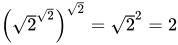
[edit]A nonconstructive proof establishes that a mathematical object with a certain property exists—without explaining how such an object can be found. Often, this takes the form of a proof by contradiction in which the nonexistence of the object is proved to be impossible. In contrast, a constructive proof establishes that a particular object exists by providing a method of finding it. The following famous example of a nonconstructive proof shows that there exist two irrational numbers a and b such that is a rational number. This proof uses that is irrational (an easy proof is known since Euclid), but not that is irrational (this is true, but the proof is not elementary).


- Either is a rational number and we are done (take ), or is irrational so we can write and . This then gives , which is thus a rational number of the form



Statistical proofs in pure mathematics
[edit]The expression "statistical proof" may be used technically or colloquially in areas of pure mathematics, such as involving cryptography, chaotic series, and probabilistic number theory or analytic number theory.[23][24][25] It is less commonly used to refer to a mathematical proof in the branch of mathematics known as mathematical statistics. See also the "Statistical proof using data" section below.
Computer-assisted proofs
[edit]Until the twentieth century it was assumed that any proof could, in principle, be checked by a competent mathematician to confirm its validity.[7] However, computers are now used both to prove theorems and to carry out calculations that are too long for any human or team of humans to check; the first proof of the four color theorem is an example of a computer-assisted proof. Some mathematicians are concerned that the possibility of an error in a computer program or a run-time error in its calculations calls the validity of such computer-assisted proofs into question. In practice, the chances of an error invalidating a computer-assisted proof can be reduced by incorporating redundancy and self-checks into calculations, and by developing multiple independent approaches and programs. Errors can never be completely ruled out in case of verification of a proof by humans either, especially if the proof contains natural language and requires deep mathematical insight to uncover the potential hidden assumptions and fallacies involved.
Undecidable statements
[edit]A statement that is neither provable nor disprovable from a set of axioms is called undecidable (from those axioms). One example is the parallel postulate, which is neither provable nor refutable from the remaining axioms of Euclidean geometry.
Mathematicians have shown there are many statements that are neither provable nor disprovable in Zermelo–Fraenkel set theory with the axiom of choice (ZFC), the standard system of set theory in mathematics (assuming that ZFC is consistent); see List of statements undecidable in ZFC.
Gödel's (first) incompleteness theorem shows that many axiom systems of mathematical interest will have undecidable statements.
Heuristic mathematics and experimental mathematics
[edit]While early mathematicians such as Eudoxus of Cnidus did not use proofs, from Euclid to the foundational mathematics developments of the late 19th and 20th centuries, proofs were an essential part of mathematics.[26] With the increase in computing power in the 1960s, significant work began to be done investigating mathematical objects beyond the proof-theorem framework,[27] in experimental mathematics. Early pioneers of these methods intended the work ultimately to be resolved into a classical proof-theorem framework, e.g. the early development of fractal geometry,[28] which was ultimately so resolved.
Related concepts
[edit]Visual proof
[edit]Elementary proof
[edit]Two-column proof
[edit]
A particular way of organizing a proof using two parallel columns is often used as a mathematical exercise in elementary geometry classes in the United States.[29] The proof is written as a series of lines in two columns. In each line, the left-hand column contains a proposition, while the right-hand column contains a brief explanation of how the corresponding proposition in the left-hand column is either an axiom, a hypothesis, or can be logically derived from previous propositions. The left-hand column is typically headed "Statements" and the right-hand column is typically headed "Reasons".[30]
Statistical proof using data
[edit]Inductive logic proofs and Bayesian analysis
[edit]Proofs as mental objects
[edit]Ending a proof
[edit]Sometimes, the abbreviation "Q.E.D." is written to indicate the end of a proof. This abbreviation stands for "quod erat demonstrandum", which is Latin for "that which was to be demonstrated". A more common alternative is to use a square or a rectangle, such as □ or ∎, known as a "tombstone" or "Halmos" after its eponym Paul Halmos. Often, "which was to be shown" is verbally stated when writing "QED", "□", or "∎" during an oral presentation. Unicode explicitly provides the "end of proof" character, U+220E (∎) (220E(hex) = 8718(dec)).
See also
[edit]

References
[edit]- ^ Bill Casselman. "One of the Oldest Extant Diagrams from Euclid". University of British Columbia. Retrieved September 26, 2008.
- ^ Clapham, C. & Nicholson, J.N. The Concise Oxford Dictionary of Mathematics, Fourth edition.
A statement whose truth is either to be taken as self-evident or to be assumed. Certain areas of mathematics involve choosing a set of axioms and discovering what results can be derived from them, providing proofs for the theorems that are obtained.
- ^ Cupillari, Antonella (2005) [2001]. The Nuts and Bolts of Proofs: An Introduction to Mathematical Proofs (Third ed.). Academic Press. p. 3. ISBN 978-0-12-088509-1.
- ^ Gossett, Eric (July 2009). Discrete Mathematics with Proof. John Wiley & Sons. p. 86. ISBN 978-0470457931.
Definition 3.1. Proof: An Informal Definition
- ^ "proof" New Shorter Oxford English Dictionary, 1993, OUP, Oxford.
- ^ Hacking, Ian (1984) [1975]. The Emergence of Probability: A Philosophical Study of Early Ideas about Probability, Induction and Statistical Inference. Cambridge University Press. ISBN 978-0-521-31803-7.
- ^ a b The History and Concept of Mathematical Proof, Steven G. Krantz. 1. February 5, 2007
- ^ Kneale, William; Kneale, Martha (May 1985) [1962]. The development of logic (New ed.). Oxford University Press. p. 3. ISBN 978-0-19-824773-9.
- ^ Moutsios-Rentzos, Andreas; Spyrou, Panagiotis (February 2015). "The genesis of proof in ancient Greece The pedagogical implications of a Husserlian reading". Archive ouverte HAL. Retrieved October 20, 2019.
- ^ Eves, Howard W. (January 1990) [1962]. An Introduction to the History of Mathematics (Saunders Series) (6th ed.). Cengage. p. 141. ISBN 978-0030295584.
No work, except The Bible, has been more widely used...
- ^ Matvievskaya, Galina (1987), "The Theory of Quadratic Irrationals in Medieval Oriental Mathematics", Annals of the New York Academy of Sciences, 500 (1): 253–277 [260], Bibcode:1987NYASA.500..253M, doi:10.1111/j.1749-6632.1987.tb37206.x, S2CID 121416910
- ^ Buss, Samuel R. (1998), "An introduction to proof theory", in Buss, Samuel R. (ed.), Handbook of Proof Theory, Studies in Logic and the Foundations of Mathematics, vol. 137, Elsevier, pp. 1–78, ISBN 978-0-08-053318-6. See in particular p. 3: "The study of Proof Theory is traditionally motivated by the problem of formalizing mathematical proofs; the original formulation of first-order logic by Frege [1879] was the first successful step in this direction."
- ^ Quine, Willard Van Orman (1961). "Two Dogmas of Empiricism" (PDF). Universität Zürich – Theologische Fakultät. p. 12. Retrieved October 20, 2019.
- ^ Cupillari, p. 20.
- ^ Cupillari, p. 46.
- ^ Examples of simple proofs by mathematical induction for all natural numbers
- ^ Proof by induction Archived February 18, 2012, at the Wayback Machine, University of Warwick Glossary of Mathematical Terminology
- ^ See Four color theorem#Simplification and verification.
- ^ Plaue, Matthias; Scherfner, Mike (February 11, 2019). Mathematik für das Bachelorstudium I: Grundlagen und Grundzüge der linearen Algebra und Analysis [Mathematics for the Bachelor's degree I: Fundamentals and basics of linear algebra and analysis] (in German). Springer-Verlag. p. 26. ISBN 978-3-662-58352-4.
- ^ Struckmann, Werner; Wätjen, Dietmar (October 20, 2016). Mathematik für Informatiker: Grundlagen und Anwendungen [Mathematics for Computer Scientists: Fundamentals and Applications] (in German). Springer-Verlag. p. 28. ISBN 978-3-662-49870-5.
- ^ Davis, Philip J. (1972), "Fidelity in Mathematical Discourse: Is One and One Really Two?" American Mathematical Monthly 79:252–63.
- ^ Fallis, Don (1997), "The Epistemic Status of Probabilistic Proof." Journal of Philosophy 94:165–86.
- ^ "in number theory and commutative algebra... in particular the statistical proof of the lemma." [1]
- ^ "Whether constant π (i.e., pi) is normal is a confusing problem without any strict theoretical demonstration except for some statistical proof"" (Derogatory use.)[2]
- ^ "these observations suggest a statistical proof of Goldbach's conjecture with very quickly vanishing probability of failure for large E" [3]
- ^ Mumford, David B.; Series, Caroline; Wright, David (2002). Indra's Pearls: The Vision of Felix Klein. Cambridge University Press. ISBN 978-0-521-35253-6.
What to do with the pictures? Two thoughts surfaced: the first was that they were unpublishable in the standard way, there were no theorems only very suggestive pictures. They furnished convincing evidence for many conjectures and lures to further exploration, but theorems were coins of the realm and the conventions of that day dictated that journals only published theorems.
- ^ "A Note on the History of Fractals". Archived from the original on February 15, 2009.
Mandelbrot, working at the IBM Research Laboratory, did some computer simulations for these sets on the reasonable assumption that, if you wanted to prove something, it might be helpful to know the answer ahead of time.
- ^ Lesmoir-Gordon, Nigel (2000). Introducing Fractal Geometry. Icon Books. ISBN 978-1-84046-123-7.
...brought home again to Benoit [Mandelbrot] that there was a 'mathematics of the eye', that visualization of a problem was as valid a method as any for finding a solution. Amazingly, he found himself alone with this conjecture. The teaching of mathematics in France was dominated by a handful of dogmatic mathematicians hiding behind the pseudonym 'Bourbaki'...
- ^ Herbst, Patricio G. (2002). "Establishing a Custom of Proving in American School Geometry: Evolution of the Two-Column Proof in the Early Twentieth Century" (PDF). Educational Studies in Mathematics. 49 (3): 283–312. doi:10.1023/A:1020264906740. hdl:2027.42/42653. S2CID 23084607.
- ^ Dr. Fisher Burns. "Introduction to the Two-Column Proof". onemathematicalcat.org. Retrieved October 15, 2009.
Further reading
[edit]- Pólya, G. (1954), Mathematics and Plausible Reasoning, Princeton University Press, hdl:2027/mdp.39015008206248, ISBN 9780691080055
{{citation}}: ISBN / Date incompatibility (help). - Fallis, Don (2002), "What Do Mathematicians Want? Probabilistic Proofs and the Epistemic Goals of Mathematicians", Logique et Analyse, 45: 373–88.
- Franklin, J.; Daoud, A. (2011), Proof in Mathematics: An Introduction, Kew Books, ISBN 978-0-646-54509-7.
- Gold, Bonnie; Simons, Rogers A. (2008). Proof and Other Dilemmas: Mathematics and Philosophy. MAA.
- Solow, D. (2004), How to Read and Do Proofs: An Introduction to Mathematical Thought Processes, Wiley, ISBN 978-0-471-68058-1.
- Velleman, D. (2006), How to Prove It: A Structured Approach, Cambridge University Press, ISBN 978-0-521-67599-4.
- Hammack, Richard (2018), Book of Proof, Richard Hammack, ISBN 978-0-9894721-3-5.
External links
[edit]

 Media related to Mathematical proof at Wikimedia Commons
- Proofs in Mathematics: Simple, Charming and Fallacious
- A lesson about proofs, in a course from Wikiversity

| General | |||||||||
|---|---|---|---|---|---|---|---|---|---|
| Theorems (list) and paradoxes | |||||||||
| Logics |
| ||||||||
| Set theory |
| ||||||||
| Formal systems (list), language and syntax |
| ||||||||
| Proof theory | |||||||||
| Model theory | |||||||||
| Computability theory | |||||||||
| Related | |||||||||
| Major fields |
| ||||
|---|---|---|---|---|---|
| Foundations | |||||
| Lists |
| ||||


| Authority control databases: National |
|---|

Mathematical proof
View on GrokipediaFundamentals
Definition and Nature
In formal logic, a mathematical proof is a finite sequence of well-formed formulas such that each formula is either an axiom of the formal system, a previously established theorem, or logically follows from preceding formulas via specified rules of inference, with the final formula being the statement to be proved.[11] However, in mathematical practice, proofs are generally informal logical arguments presented in natural language, which are accepted by the mathematical community as rigorous and capable of being formalized if required. This informal nature allows for human insight while maintaining deductive validity.[12] Central to the nature of mathematical proofs is their use of deductive reasoning, wherein the truth of the conclusion is guaranteed by the truth of the premises if the inference rules are sound.[11] Proofs demand rigor, meaning every step must be explicitly justified and free from gaps or ambiguities, adhering to the standards of the relevant mathematical community to achieve logical certainty.[13] Additionally, proofs exhibit universality, establishing the truth of a statement for all instances within its scope, rather than merely for observed cases, thereby providing an a priori foundation independent of empirical testing.[6] The formal structure of a proof typically begins with premises—such as axioms or prior theorems—and proceeds through applications of inference rules, like modus ponens (from and , infer ), to reach the conclusion.[14] A simple illustrative example is the categorical syllogism: "All humans are mortal" (major premise), "Socrates is a human" (minor premise), therefore "Socrates is mortal" (conclusion), where the inference follows deductively from the premises without additional assumptions.[11] Mathematical proofs differ fundamentally from non-proofs, such as empirical verification or intuitive arguments, in that they prioritize discovery and establishment of universal truth over mere checking of examples; while empirical methods induce generalizations from data that remain provisional, proofs deliver conclusive logical necessity.[12] This distinction underscores proofs' role in axiomatic systems, where they build cumulative knowledge through unassailable deduction.[15]Purpose and Role in Mathematics
Mathematical proofs serve as the cornerstone of mathematical rigor, primarily by establishing the truth of statements beyond reasonable doubt through deductive reasoning from accepted premises. This process ensures that theorems are not merely conjectures but irrefutable conclusions, allowing mathematicians to build upon them with confidence. Beyond pure mathematics, proofs provide a reliable foundation for applied sciences, where mathematical models underpin fields like physics, engineering, and computer science by verifying the validity of underlying principles. For instance, proofs in number theory have direct implications for cryptography, securing digital communications.[16][3] In axiomatic systems, proofs play a pivotal role by deriving new theorems from a set of foundational axioms, thereby constructing coherent and interconnected theories. This methodical progression ensures logical consistency within the system, while efforts toward secure foundations—such as those explored in Hilbert's program, which aimed to establish the consistency of mathematics through finitary methods—though Gödel's incompleteness theorems demonstrated that formal systems capable of arithmetic are inherently incomplete and cannot prove their own consistency. Proofs thus maintain the integrity of mathematical structures, preventing contradictions and enabling the expansion of knowledge within defined boundaries.[14] Philosophically, mathematical proofs offer a unique guarantee of certainty in pure mathematics, contrasting with the provisional nature of empirical knowledge in the sciences, where theories remain subject to falsification. This deductive certainty ties directly to epistemology, as proofs embody justified true belief, providing an ideal model for knowledge acquisition that emphasizes logical necessity over probabilistic inference. In epistemology, proofs underscore the reliability of mathematical truth, influencing broader debates on how certainty is attained in abstract domains.[17][14] Within the mathematical community, proofs function as a shared currency for validation, facilitating peer review and collective advancement by subjecting claims to rigorous scrutiny. The resolution of Fermat's Last Theorem by Andrew Wiles in 1995 exemplifies this impact, as its proof not only settled a centuries-old conjecture but also spurred developments in elliptic curves and modular forms, reshaping algebraic number theory and inspiring collaborative efforts across the field. However, proofs also present challenges, particularly the burden of establishing truth for open problems like the Riemann Hypothesis, where partial results—such as verified cases or conditional theorems—offer valuable insights despite incomplete resolutions, sustaining progress amid unresolved uncertainties.[18][19][14]Historical Development
Etymology and Ancient Origins
The term "proof" in the context of mathematics originates from the Latin proba, meaning a test or trial, which entered Middle English around 1200 CE via Old French preuve, evolving to denote a rigorous demonstration establishing absolute certainty, in contrast to the probabilistic connotations of its linguistic relative "probable."[20] The roots of mathematical justification trace back to ancient Mesopotamia, where Babylonian clay tablets from approximately 1800 BCE, such as those in the Old Babylonian period, record algebraic procedures and geometric solutions with step-by-step explanations that function as early forms of verification, including methods for solving quadratic equations and computing areas. In parallel, ancient Egyptian mathematics, exemplified by the Rhind Papyrus (c. 1650 BCE), presents geometric problems with practical justifications, such as calculating the areas of fields and volumes of granaries using empirical rules derived from surveying techniques. While these traditions were often supported by empirical evidence or practical calculations, modern scholarship has identified elements of deductive justification and proof-like arguments in both Mesopotamian and Egyptian works.[21][22][23] In ancient India, the Sulba Sutras (c. 800–200 BCE) provided geometric constructions and justifications for theorems, including proofs of the Pythagorean theorem and approximations for square roots, contributing to early deductive geometry in the context of Vedic altar construction. Similarly, ancient Chinese mathematics, as seen in texts like the Zhoubi Suanjing (c. 1st century BCE), included proof-like arguments and systematic verifications for astronomical and geometric problems.[24][25] Greek thinkers formalized these ideas into deductive proofs during the classical period. Thales of Miletus (c. 624–546 BCE) pioneered geometric demonstrations, proving properties like the equality of base angles in isosceles triangles through logical deduction from observed equalities. The Pythagorean school (c. 6th–5th century BCE) extended this to number theory and geometry, emphasizing proofs based on harmony and proportion. Euclid's Elements (c. 300 BCE) synthesized these advancements into a comprehensive axiomatic framework, starting from undefined terms and postulates to derive theorems, including Proposition 20 in Book IX, which proves the infinitude of prime numbers by assuming a finite set and deriving a contradiction via their product plus one. These ancient developments arose from utilitarian demands, including Egyptian land remeasurement after annual Nile inundations and Babylonian astronomical calculations for calendars and predictions, laying the groundwork for proofs as tools bridging empirical observation and abstract reasoning.[21][22]Medieval and Early Modern Advances
During the Islamic Golden Age, scholars preserved and expanded ancient Greek proof methods while innovating in algebra and geometry. Muhammad ibn Musa al-Khwarizmi's treatise Al-Kitab al-mukhtasar fi hisab al-jabr wa-l-muqabala, composed around 820 CE, introduced systematic algebraic proofs grounded in geometric constructions to solve quadratic equations, marking a foundational shift toward balancing equations through completion and reduction techniques.[26] Building on this, Omar Khayyam advanced proof rigor in his Treatise on Demonstrations of Problems of Algebra (1070), where he classified cubic equations and provided geometric solutions by intersecting conic sections, such as parabolas and circles, to find positive roots without algebraic symbolism.[27] These works emphasized deductive verification through visual and spatial arguments, influencing subsequent Islamic mathematics. In parallel, Ibn al-Haytham (Alhazen) integrated proofs into experimental science, particularly in optics and mechanics. In his Book of Optics (c. 1021), he employed axiomatic deductions and empirical tests to prove principles like the rectilinear propagation of light and the intromission theory of vision, establishing experimentation as a standard for validating optical proofs.[28] He also analyzed projectile motion mechanistically, using geometric proofs to demonstrate that bodies move perpetually unless acted upon by external forces, prefiguring inertial concepts.[29] In medieval Europe, the transmission of Aristotelian logic via Boethius's translations laid the groundwork for scholastic rigor in proofs. Boethius (c. 480–524 CE) rendered Aristotle's Categories, De interpretatione, and Prior Analytics into Latin, providing the core texts for logica vetus that scholastic thinkers used to refine deductive structures in theological and mathematical arguments.[30] Scholastic logicians, such as those at the University of Paris, extended this by developing supposition theory and modal syllogistics, which enhanced the precision of proofs by clarifying term meanings and necessities, thereby influencing early mathematical demonstrations in works on proportions and statics.[31] Early modern advancements synthesized these traditions into new proof paradigms. René Descartes's La Géométrie (1637) fused algebra with geometry, enabling proofs of curve properties through coordinate equations, such as representing conics algebraically to solve construction problems deductively.[32] Pierre de Fermat, in marginal notes and correspondence, pioneered induction-like arguments via infinite descent, as in his proofs of properties of sums of powers and Diophantine equations, where assuming a minimal counterexample leads to contradiction.[33] Precursors to symbolic logic emerged, notably Ramon Llull's Ars Magna (c. 1274), a combinatorial system using rotating disks to generate deductive proofs across disciplines, anticipating formal mechanization of reasoning.[34] The period culminated in groundwork for calculus proofs lacking full rigor. Isaac Newton and Gottfried Wilhelm Leibniz independently developed fluxional and differential methods in the 1670s–1680s, using infinitesimal approximations to prove tangents and areas—such as Newton's lemma on ultimate ratios for limits—without axiomatic foundations, relying instead on geometric intuition and series expansions.[35]19th and 20th Century Developments
In the 19th century, mathematicians sought to establish greater rigor in proofs, particularly in the foundations of analysis, moving away from intuitive notions toward precise definitions. Augustin-Louis Cauchy introduced a formal approach to limits and continuity in his 1821 work Cours d'analyse de l'École Royale Polytechnique, where he defined the limit of a function using inequalities involving arbitrarily small increments, laying the groundwork for what would later be refined into the epsilon-delta formalism. This epsilon-delta definition, which quantifies how close the function values must remain to the limit for inputs sufficiently near a point, was further formalized by Karl Weierstrass in 1861, providing a strict logical framework that eliminated reliance on infinitesimals and ensured proofs in calculus were airtight. These developments addressed ambiguities in earlier treatments, such as those by Euler and Lagrange, and became the standard for rigorous proofs in real analysis. Parallel to these advances, the late 19th century saw the emergence of set theory and formal logic, which revolutionized the structure of mathematical proofs. Georg Cantor developed transfinite numbers in a series of papers starting in the 1870s, including his 1874 proof that the real numbers form an uncountable set larger than the countable set of rationals, using a diagonal argument to demonstrate the existence of infinities of different cardinalities. This work required novel proof techniques to handle infinite sets, influencing subsequent foundational inquiries. In 1879, Gottlob Frege published Begriffsschrift, introducing a symbolic notation and formal system for logic that modeled proofs as sequences of inferences from axioms, treating mathematics as a branch of pure logic and enabling the derivation of arithmetic theorems through strict deduction. The 20th century brought ambitious programs to secure the foundations of mathematics through metamathematical proofs of consistency, though these efforts revealed profound limitations. David Hilbert outlined his program in 1900 during his address to the International Congress of Mathematicians in Paris, proposing to formalize all of mathematics in axiomatic systems and prove their consistency using finitistic methods, aiming to resolve paradoxes and ensure the reliability of proofs. However, Kurt Gödel's incompleteness theorems, published in 1931, demonstrated that in any consistent formal system capable of expressing basic arithmetic, there exist true statements that cannot be proved within the system, and the consistency of the system cannot be proved finitistically, undermining Hilbert's full ambitions and shifting focus toward the inherent limits of formal proofs. Significant milestones in proof techniques emerged later in the century, including computer-assisted verifications that expanded the scope of what could be rigorously established. In 1976, Kenneth Appel and Wolfgang Haken proved the Four Color Theorem, stating that any planar map can be colored with at most four colors such that no adjacent regions share the same color, by reducing the problem to checking 1,936 configurations via exhaustive computer search, marking an early landmark in automated proof methods. More recently, Grigori Perelman resolved the Poincaré conjecture in 2002–2003 through three preprints employing Ricci flow, a differential geometry technique, proving that every simply connected, closed 3-manifold is homeomorphic to the 3-sphere and thereby confirming a century-old hypothesis central to topology. These developments catalyzed the rise of proof theory as a distinct subfield of mathematical logic, dedicated to analyzing the structure, complexity, and limitations of proofs within formal systems, profoundly influencing the foundations of mathematics by integrating syntactic and semantic perspectives on deduction.Core Methods of Proof
Direct Proof
A direct proof is a method in mathematics where one assumes the hypothesis of a statement to be true and then uses a sequence of logical deductions, based on definitions, axioms, and previously established theorems, to arrive at the conclusion without additional assumptions or detours.[36] This approach is particularly suited for proving conditional statements of the form "if , then ," by starting with and demonstrating that necessarily follows.[37] Unlike indirect methods, direct proofs proceed in a forward manner, chaining implications straightforwardly from premises to the result.[38] The typical steps in constructing a direct proof begin with clearly stating the given hypothesis and any relevant definitions. From there, one applies algebraic manipulations, logical equivalences, or inequality properties step by step, ensuring each deduction is justified by a known theorem or axiom. The process concludes when the desired statement is reached, often verifying the final equality or inequality holds under the assumptions.[39] For instance, when proving properties of integers, definitions of even and odd numbers are invoked early to facilitate the deductions.[40] A classic example of a direct proof is demonstrating that the sum of two odd integers is even. Let and be arbitrary odd integers. By definition, there exist integers and such that and . Then, which is the form of an even integer since is an integer. Thus, is even.[36] Direct proofs offer strengths in their simplicity and transparency, as the logical path from assumptions to conclusion is explicit and easy to verify, making them ideal for establishing algebraic identities or basic properties.[41] This method's straightforward nature minimizes opportunities for error in routine deductions, particularly in elementary number theory or inequality proofs. As an illustration involving inequalities, consider proving that if , then . Since 1 > 0 and the real numbers satisfy the property that adding a positive number to both sides of an inequality preserves the direction, it follows that , or equivalently . This basic application highlights how direct proofs leverage fundamental axioms of ordered fields.[42]Proof by Contraposition
Proof by contraposition is a method used to establish the validity of an implication by instead proving its logically equivalent contrapositive . This equivalence holds in propositional logic because both statements share the same truth table: they are false only when is true and is false, and true in all other cases.[43][44] To apply this technique, first identify the original implication and form its contrapositive by negating both the antecedent and consequent and reversing their order. Then, assume the negation of the consequent () as the hypothesis and derive the negation of the antecedent () through a direct proof. Since the contrapositive is logically equivalent to the original statement, establishing confirms .[45][46] A classic example illustrates this process: consider the statement "For all integers , if is even, then is even." The contrapositive is "For all integers , if is odd, then is odd." To prove the contrapositive, assume is odd, so for some integer . Then, which is odd, as it equals twice an integer plus one. Thus, the contrapositive holds, proving the original statement.[47] This method is particularly advantageous when the direct proof of is challenging, but assuming naturally leads to , such as in proofs involving inequalities where the "reverse" direction simplifies the reasoning.[48] For instance, to show that if , then , the contrapositive—if , then —can be easier to verify using properties of squares.[49] A common pitfall arises when applying contraposition to biconditionals (), as the technique is designed solely for one-way implications; for biconditionals, both the implication and its converse must be proved separately, since the contrapositive equivalence applies only to conditionals.[50][51]Proof by Contradiction
Proof by contradiction, also known as reductio ad absurdum, is a method to establish the truth of a statement by assuming its negation and deriving a logical impossibility or falsehood, such as , thereby concluding that must hold.[52] This approach relies on the principle of classical logic that a statement and its negation cannot both be true, so if leads to an absurdity, then is true.[53] This technique has ancient origins, notably employed by Euclid in his Elements around 300 BCE to prove the infinitude of primes. Euclid assumed a finite list of all primes , formed the number , and observed that must have a prime factor not in the list, contradicting the assumption of finiteness.[54] Such proofs demonstrate how assuming a limited set leads to an entity outside that set, forcing the conclusion of unboundedness.[55] The standard steps in a proof by contradiction are: (1) clearly state the negation of the proposition to be proved; (2) derive consequences from this assumption using valid logical deductions and known theorems; (3) reach a statement that contradicts an established truth or leads to an outright falsehood.[56] The contradiction invalidates the initial assumption, affirming the original statement. This method is particularly useful when direct proofs are elusive but the negation simplifies to a manageable absurdity.[57] A classic example is the proof that is irrational. Assume, for contradiction, that is rational, so where and are integers with no common factors (i.e., in lowest terms) and . Squaring both sides gives , so . Thus, is even, implying is even (since if were odd, would be odd). Let for some integer ; then , so or . Similarly, even implies even. But then and share the factor 2, contradicting the lowest-terms assumption. Therefore, is irrational.[58] Proofs by contradiction are non-constructive, as they verify existence or truth without providing an explicit construction or example, merely showing that the alternative is impossible.[59] This limitation means they do not offer direct evidence or methods for finding solutions, unlike constructive proofs. Proof by contradiction differs from proof by contraposition, another indirect technique, in that it targets general statements rather than implications.[60]Inductive and Constructive Methods
Proof by Mathematical Induction
Proof by mathematical induction is a fundamental technique for establishing that a property holds for all natural numbers, relying on the well-ordered structure of the natural numbers. The principle states that to prove a statement for all natural numbers , it suffices to verify the base case and then show that if holds for some , then also holds.[61] This method leverages the inductive nature of the natural numbers, ensuring the property propagates from the base to all subsequent values.[62] There are two primary variants: weak induction and strong induction. In weak induction, the inductive hypothesis assumes only to prove , which is sufficient for many recursive relations.[63] Strong induction, in contrast, assumes holds for all to prove , providing a broader hypothesis that is useful when the proof for depends on multiple prior cases.[64] Both forms are equivalent in power due to the well-ordering of the naturals, but strong induction often simplifies proofs involving cumulative dependencies.[65] A classic example is proving that the sum of the first natural numbers equals . Let be the statement . For the base case , , which holds. Assume : . For , add to both sides: , verifying . By induction, holds for all .[66] In general form, mathematical induction proves by establishing a base case (often or ) and the inductive step .[67] This ensures the truth of cascades through the infinite sequence of natural numbers. Applications abound in analyzing sequences and proving inequalities. For sequences, induction verifies closed-form formulas, such as those for arithmetic or geometric series, by confirming the base and recursive addition.[68] For inequalities, it establishes bounds like for all : base , ; assume for , then since .[69] Such proofs underpin results in number theory, combinatorics, and algorithm analysis.[70]Proof by Construction
A proof by construction is a method in mathematics employed to establish the existence of an element satisfying a given property by explicitly exhibiting such an element or providing an algorithmic procedure to generate it. This approach directly addresses existential statements of the form by constructing a specific for which the predicate holds, thereby verifying the claim through tangible evidence rather than indirect reasoning.[71] Such proofs are foundational in various branches of mathematics, offering clarity and enabling further analysis of the constructed object. A prominent example is the Vitali set, introduced by Giuseppe Vitali in 1905 to demonstrate the existence of a non-Lebesgue measurable subset of the real numbers. The construction proceeds by partitioning the interval into equivalence classes where two numbers are equivalent if their difference is rational, then selecting one representative from each class to form the set; this explicit selection yields a set whose measure cannot be consistently defined under Lebesgue's theory. Vitali's method highlights how construction can reveal pathological objects that challenge intuitive notions of measurement while relying on the axiom of choice for the selection process.[72] The strengths of proof by construction lie in its provision of concrete, inspectable evidence that not only affirms existence but also facilitates applications and extensions. In geometry, this method is exemplified by the classical construction of an equilateral triangle given a line segment using a compass and straightedge, as detailed in Proposition 1 of Book I of Euclid's Elements (circa 300 BCE): starting from segment , arcs centered at and with radius intersect at point , forming with all sides equal. This technique underscores the method's utility in synthetic geometry, where the constructed figure directly proves the possibility of the configuration.[73] In contrast to nonconstructive proofs, which assert existence without specifying the object—often via probabilistic arguments or the axiom of choice alone—proof by construction exhibits the entity explicitly, enhancing verifiability and often yielding algorithmic insights. Historically, David Hilbert's 1900 address at the International Congress of Mathematicians, where he outlined 23 influential problems, included several that sought constructive or algorithmic solutions, such as explicit decision procedures for solving Diophantine equations (Problem 10) or geometric realizations, thereby shaping 20th-century mathematical priorities toward explicitness and computability.[74]Proof by Exhaustion
Proof by exhaustion, also known as proof by cases or case analysis, is a method of mathematical proof that involves dividing the domain of a statement into a finite number of mutually exclusive and collectively exhaustive cases, then verifying the statement holds for each case individually. Unlike induction, which generalizes over infinite sets via recursive steps, or construction, which builds specific objects, exhaustion verifies all possibilities in finite discrete settings.[39] This approach ensures completeness because the cases cover all possibilities without overlap, making it particularly suitable for discrete or finite settings where enumeration is feasible.[75] The technique relies on rigorous partitioning, often based on properties like parity, congruence classes, or bounded parameters, to reduce the problem to manageable subproblems. Historically, proof by exhaustion appears in ancient Greek mathematics, notably in Euclid's Elements, where case analysis based on odd and even numbers is employed in Book IX to establish properties of integers. For instance, in Proposition IX.30, Euclid proves that if an odd number measures an even number, it also measures half of the even number by considering cases involving the parity of the divisors and their multiples.[76] Such classifications allowed Euclid to handle arithmetic statements systematically without modern algebraic notation, demonstrating the method's early utility in number theory.[77] A classic example in discrete mathematics is proving that the square of any integer is congruent to 0 or 1 modulo 4. Consider two cases: if is even, then for some integer , so ; if is odd, then , so . These cases exhaust all integers, confirming the result.[75] This proof by exhaustion underpins further results, such as the impossibility of expressing a sum of two squares as another square in certain forms, and highlights the method's role in modular arithmetic. In the context of Diophantine equations, proof by exhaustion has been applied in early verifications related to Fermat's Last Theorem (FLT), which states there are no positive integer solutions to for . For small exponents greater than 2, such as (proved by Euler using factorization in the ring of integers adjoined with a cube root of unity, involving case analysis) and (proved by Fermat using infinite descent with modular cases), methods included exhaustive checks on factorizations or constraints modulo certain numbers. More precisely, proofs for exponents up to 7 were developed in the 19th century, often involving such case analysis.[78] A variant of case analysis appears in proofs of inequalities, such as the arithmetic mean-geometric mean (AM-GM) inequality for two non-negative real numbers and . One approach considers cases: if , equality holds; if , rearrange to show via the non-negativity of , which expands directly; the symmetric case follows similarly. This exhaustive partitioning ensures the inequality is verified across all possibilities.[79] Despite its rigor, proof by exhaustion has limitations: it is only applicable when the number of cases is finite and manageable, as in parameterized or discrete domains, and becomes inefficient or impractical for large finite sets, where computational assistance may be needed.[80] For instance, while effective for modular constraints in early FLT proofs, scaling to all requires more advanced methods. This finite-case focus distinguishes it from proof by mathematical induction, which can be viewed as a limiting form for exhaustively verifying up to an arbitrary but finite before generalizing.[75]Specialized Proof Techniques
Probabilistic Proof
A probabilistic proof, also known as the probabilistic method, is a nonconstructive technique in mathematics that uses probability theory to establish the existence of certain objects or configurations satisfying specified properties, without explicitly constructing them.[81] The core idea is to consider a random object from a suitable probability space and demonstrate that the probability of it possessing the desired property is positive; since the probability measure is non-zero, such an object must exist.[81] This approach, pioneered by Paul Erdős, has become a cornerstone in combinatorics and related fields, often yielding existential results that are difficult or impossible to obtain through direct enumeration or algebraic methods.[81] A seminal example is Erdős's 1947 application to Ramsey numbers, which quantify the minimal size guaranteeing monochromatic cliques in edge-colored complete graphs. To bound the Ramsey number from below, Erdős considered a random 2-coloring of the edges of the complete graph on vertices and showed that the probability of existing a monochromatic clique of size is less than 1, implying that there exists a coloring without such cliques.[81] This probabilistic argument established for , providing the first non-trivial lower bounds and demonstrating the power of randomness in extremal graph theory.[81] Key techniques in probabilistic proofs include expectation arguments, which compute the expected value of an indicator random variable for the property and use linearity of expectation to bound probabilities, and union bounds, which estimate the probability of the union of "bad" events to show it is less than 1.[81] For scenarios involving many dependent bad events, the Lovász Local Lemma provides a refined tool: if each bad event has small probability and depends on only a limited number of others, then the probability that none occur is positive.[81] Introduced by Erdős and Lovász in 1975, this lemma has enabled proofs of existence for hypergraph colorings and other structures where simple union bounds fail.[81] Applications abound in combinatorics and graph theory, such as proving the existence of expander graphs—sparse graphs with strong connectivity properties used in coding theory and network design. Using the probabilistic method, one can show that a random -regular graph on vertices is an expander with high probability for fixed and large , establishing the existence of families of such graphs with expansion constant bounded away from zero. Unlike constructive proofs, probabilistic proofs establish "there exists" via randomness without providing an algorithm to find the object, though they overlap with nonconstructive methods in emphasizing existence over explicit description.[81]Combinatorial Proof
A combinatorial proof establishes the equality of two expressions by demonstrating that they count the same finite set in different ways, often through a bijection or double counting argument.[82] This approach is particularly useful for identities involving binomial coefficients or other enumerative quantities, where one side represents a direct count and the other a partitioned or alternative enumeration.[83] A classic example is the proof of the binomial theorem identity , which arises from expanding . Consider a set with elements. The right side, , counts the total number of subsets of , as each element can either be included or excluded independently. The left side counts the same collection by partitioning the subsets according to their sizes: there are exactly subsets of size , for each from 0 to , and summing over yields the total. This double counting confirms the equality without algebraic expansion.[83][84] Another illustrative case is the identity , a fundamental relation in the binomial theorem and Pascal's triangle. To prove it combinatorially, suppose we wish to choose elements from a set of elements, labeled through . Fix element : the subsets including correspond to choosing the remaining elements from the first , numbering ; those excluding correspond to choosing all from the first , numbering . Adding these cases exhausts all possibilities, equaling the direct count . This bijection highlights the recursive structure underlying Pascal's triangle.[85] Combinatorial proofs offer advantages in intuition and simplicity, often providing a visual or narrative interpretation that bypasses lengthy algebraic manipulations, thereby deepening conceptual understanding.[86] Historically, such techniques trace back to Leonhard Euler's work on partition identities in the 18th century, where equalities like the number of partitions of into distinct parts equaling those into odd parts were later established via explicit bijections, transforming generating function arguments into direct combinatorial correspondences.[87]Nonconstructive Proof
A nonconstructive proof establishes the existence of a mathematical object, such as a solution to an equation or a member of a set satisfying a property, without providing an explicit construction, example, or algorithm to produce it.[88] These proofs often rely on indirect methods like contradiction or counting arguments, such as the pigeonhole principle, to assert that the object must exist under the given assumptions.[89] For instance, the pigeonhole principle can prove that in any group of 13 people, at least two share the same birth month by showing that assigning 12 months to 13 individuals forces a duplication, though it identifies neither the individuals nor the specific month.[90] A seminal example is Georg Cantor's diagonal argument from 1891, which demonstrates the uncountability of the real numbers.[91] Cantor assumed the reals could be enumerated in a countable list and then described a new real number that differs from the nth digit of the nth real in the list, ensuring it is not in the enumeration and yielding a contradiction.[92] This nonconstructive approach proves the existence of uncountably many reals without explicitly listing or constructing the differing number beyond the diagonal method itself. Philosophically, nonconstructive proofs have faced criticism from intuitionism, founded by L.E.J. Brouwer in the early 20th century. Brouwer argued that such proofs lack genuine mathematical insight because they do not arise from finite mental constructions and often depend on the law of excluded middle, which he rejected as inapplicable to infinite domains.[93] In intuitionistic mathematics, existence claims require constructive verification, rendering many classical nonconstructive results invalid or incomplete.[94] Nonconstructive proofs find key applications in set theory, where Cantor's techniques established the hierarchy of infinite cardinalities without enumerating sets.[91] In topology, they underpin results like Brouwer's fixed-point theorem (1911), which asserts that every continuous map from a closed ball in Euclidean space to itself has a fixed point; standard proofs use algebraic topology tools such as degree or homology, which are inherently nonconstructive and do not yield the fixed point explicitly.[95] In contrast to constructive proofs that build the object step-by-step, nonconstructive methods excel in proving broad existential statements or impossibilities efficiently, especially in abstract settings where explicit construction is infeasible.[93]Computational and Statistical Approaches
Computer-Assisted Proofs
Computer-assisted proofs involve the use of computational tools to verify or discover mathematical proofs, often by automating tedious case analyses or formal verification processes that would be impractical for humans alone. The pioneering example occurred in 1976 with the proof of the Four Color Theorem by Kenneth Appel and Wolfgang Haken, who employed a computer program to check over 1,200 specific configurations, marking the first major theorem proven with significant machine assistance. This approach built on exhaustive enumeration but scaled it via algorithms, reducing human error in verification while raising questions about the proof's accessibility. Key methods in computer-assisted proofs include automated theorem proving systems, which use formal logic to construct or verify proofs step-by-step, and exhaustive case checking, where software systematically evaluates all possible instances within a finite domain. Prominent tools for automated theorem proving are Coq, a proof assistant based on the Calculus of Inductive Constructions that allows users to write mathematical statements and proofs in a functional programming language, and Isabelle, an interactive theorem prover supporting higher-order logic for verifying complex systems. These systems ensure proofs are machine-checkable, providing a higher standard of rigor than traditional pen-and-paper methods, though they require expertise in formal languages. A landmark application is Thomas Hales' 1998 proof of the Kepler conjecture, which states that the densest packing of spheres in three-dimensional space is achieved by the face-centered cubic lattice; the proof relied on computational analysis of approximately 5,000 cases, generating 3 gigabytes of data that confirmed the optimal density of π/(3√2) through inequality checks. Challenges in such proofs include verifying the correctness of the underlying software and ensuring reproducibility, as initial implementations may contain subtle bugs. The Flyspeck project, completed in 2014, addressed this by fully formalizing Hales' proof in the Isabelle theorem prover, rigorously checking every step and confirming the conjecture without relying on unchecked code. Looking ahead, AI-assisted proofs are advancing through enhanced theorem provers like Lean, an open-source system that integrates with machine learning to suggest proof tactics and automate routine steps, facilitating collaborative formalization of mathematics. In the 2020s, neural theorem proving has emerged as a promising direction, with models trained on large corpora of formal proofs to generate novel derivations, as demonstrated in systems that achieve competitive performance on benchmark problems in set theory and algebra. For instance, in 2024, Google DeepMind's AlphaProof and AlphaGeometry systems achieved silver-medal standard performance at the International Mathematical Olympiad, solving complex problems in advanced mathematics.[96] These developments extend the scope of computer-assisted proofs, potentially enabling breakthroughs in areas like combinatorics and geometry.Statistical Proofs in Pure Mathematics
Statistical proofs in pure mathematics leverage statistical principles, such as random sampling and concentration phenomena, to establish rigorous bounds within deterministic proofs, particularly for properties of infinite or high-dimensional structures. Unlike heuristic simulations, these approaches incorporate probabilistic tools to guarantee error control, transforming approximate behaviors into exact conclusions. For instance, Monte Carlo methods approximate integrals central to proofs involving limits or continuous objects, where random sampling estimates expectations while concentration inequalities bound the deviation, ensuring the approximation supports a full proof.[97] A prominent application occurs in the analysis of random graphs, where concentration inequalities like Chernoff bounds quantify how closely graph properties align with their expected values under random edge selections. In the Erdős–Rényi model, these bounds prove that the number of edges or degrees deviates from the mean by at most a small multiple of the standard deviation with overwhelming probability, enabling deductions about connectivity thresholds or component sizes that hold deterministically across graph classes. This technique underpins results on the phase transition for giant components, where statistical control over fluctuations yields precise structural guarantees.[98][99] The law of large numbers further supports asymptotic proofs by affirming that averages over expansive sets converge to their expectations, a cornerstone for limit behaviors in pure settings.[100] In number theory, this manifests in probabilistic models of prime distributions, such as Cramér's framework, which heuristically treats integers near as randomly "prime" with probability ; the law ensures that gap statistics approximate Poisson-like distributions, suggesting maximal prime gaps of , though this remains a conjecture. Statistical convergence integrated with sieve methods has contributed to rigorous unconditional upper bounds on gaps, such as , improving on earlier results. These statistical proofs distinguish themselves through their emphasis on verifiable certainty via explicit bounds, avoiding reliance on empirical evidence alone. Post-2000 advancements have deepened the fusion of such tools with the probabilistic method, yielding deterministic outcomes from statistical insights in combinatorics and analytic number theory, as seen in enhanced derandomization techniques for graph algorithms and refined gap estimates.[98]Closed Chain Inference
Closed chain inference is a proof technique employed to demonstrate the logical equivalence of multiple statements by establishing a cycle of one-way implications among them. Rather than proving bidirectional equivalence for every pair, which can lead to redundancy, the method involves showing that each statement implies the next in a sequence that loops back to the first, thereby implying full mutual equivalence. For three statements , , and , this means proving , , and ; the transitivity of implication then ensures . This approach simplifies proofs when individual implications are straightforward but direct equivalences are not. In algebraic structures, closed chain inference facilitates resolving interdependencies, such as in the proof of the fundamental theorem of Galois theory. Here, the bijection between intermediate fields of a Galois extension and closed subgroups of the Galois group is established through a cycle of implications involving fixed fields and normal closures: the fixed field of a normal subgroup is normal, the normal closure of a field is the fixed field of its Galois group, and these operations are mutually inverse on the respective lattices. This cyclic validation confirms the lattice isomorphism without separate pairwise proofs. The technique finds applications in category theory for verifying equivalences between categories, where adjoint functors are shown to yield natural isomorphisms via a closed chain: the unit and counit satisfy and , closing the cycle to prove and . It also helps avoid infinite regress in foundational arguments by providing a finite loop of justifications that mutually support each other. However, closed chain inference carries risks of apparent circularity if the proofs of the implications inadvertently rely on the overall equivalence rather than independent reasoning; careful construction ensures global consistency across the chain without begging the question. In modern contexts, such as homotopy type theory developed in the 2010s, closed chain inference supports foundational proofs of type equivalences, where cyclic implications validate univalence axioms linking paths to isomorphisms in synthetic homotopy.Limitations and Philosophical Aspects
Undecidable Statements
In mathematical logic, an undecidable statement is one that cannot be proved true or false within a given formal system using its axioms and rules of inference, assuming the system is consistent. Such statements reveal inherent limitations in formal axiomatic systems, particularly those capable of expressing basic arithmetic. The existence of undecidable statements implies that no single formal system can capture all mathematical truths, forcing mathematicians to either accept them as axioms or seek stronger systems, which in turn may introduce new undecidables. Kurt Gödel's first incompleteness theorem, published in 1931, establishes that in any consistent formal system powerful enough to describe the arithmetic of natural numbers—such as Peano arithmetic—there exist statements that are true but cannot be proved within the system. The theorem constructs such a statement via a self-referential sentence, akin to "This statement is unprovable," which, if provable, would lead to a contradiction, and if unprovable, is true but outside the system's reach. Gödel's second incompleteness theorem further shows that such a system cannot prove its own consistency, underscoring the recursive barriers to complete formalization. Prominent examples illustrate these theorems' impact. The continuum hypothesis, which posits that there is no set whose cardinality is strictly between that of the integers and the real numbers, was shown by Kurt Gödel in 1940 to be consistent with the Zermelo-Fraenkel set theory with the axiom of choice (ZFC), meaning it leads to no contradictions if assumed true.[101] Paul Cohen extended this in 1963 by proving its independence from ZFC: the hypothesis can also be consistently assumed false using forcing techniques, rendering it undecidable within standard set theory.[102] Another example is Goodstein's theorem, which states that every Goodstein sequence—defined by iteratively replacing hereditary base-b notations with higher bases while subtracting 1—eventually reaches zero despite appearing to grow indefinitely. Laurence Kirby and Jeff Paris demonstrated in 1982 that this theorem, though true in the standard model of natural numbers, is unprovable in Peano arithmetic due to its reliance on transfinite ordinals beyond the system's inductive strength.[103] These results highlight the limits of formal proofs and the pivotal role of axioms in determining decidability: changing axioms can render previously undecidable statements provable, but at the cost of introducing new ones, as per Gödel's framework. In practice, mathematicians often adopt large cardinal axioms or other extensions to ZFC to resolve such independences, though this shifts rather than eliminates undecidability. The implications extend to computational verification, where undecidable statements preclude algorithmic methods for distinguishing truth from falsehood in sufficiently expressive systems. David Hilbert's Entscheidungsproblem, posed in 1928 as part of his program for the foundations of mathematics, sought a general algorithm to determine the truth of any mathematical statement in first-order logic. Alan Turing resolved this negatively in 1936 by showing its undecidability through the halting problem: no algorithm exists to decide whether a Turing machine halts on a given input, and this mirrors the inability to mechanize validity checks in predicate logic. Turing's proof, via reduction to the unsolvability of the halting problem, demonstrated that effective procedures cannot universally resolve logical entailment, shattering Hilbert's dream of complete formal mechanization.[104][104] Philosophically, undecidable statements fuel debates on the nature of mathematical truth versus provability. Gödel himself argued that true but unprovable statements exist independently of formal systems, supporting a platonist view where mathematical objects inhabit an objective reality accessible via intuition, beyond mechanical proof. In contrast, constructivists, influenced by L.E.J. Brouwer, reject non-constructive existence proofs and emphasize provability as the criterion of truth, viewing undecidability as a call to refine constructive methods rather than accept platonic absolutes. These perspectives underscore ongoing tensions between realism and formalism in mathematics.[105]Heuristic and Experimental Mathematics
Heuristic methods in mathematics involve intuitive arguments, pattern recognition, or probabilistic reasoning that suggest the truth of a statement without providing a rigorous proof, often serving as a guide for formal verification. These approaches rely on observed patterns or empirical data to form conjectures, which may later be substantiated through deductive methods. For instance, numerical computations have provided strong heuristic support for the Riemann Hypothesis by verifying that the first billions of non-trivial zeros of the Riemann zeta function lie on the critical line Re(s) = 1/2. Experimental mathematics extends these heuristics by using computational tools to generate and test conjectures through simulations, visualizations, and large-scale data analysis, transforming mathematics into an empirical science akin to physics. A seminal example is the discovery of the moonshine conjecture in 1978, when John McKay noticed a numerical coincidence between the dimension of the smallest non-trivial irreducible representation of the Monster group (196,883) and the first non-constant term in the q-expansion of the j-invariant (196,884 = 196,883 + 1), prompting deeper investigation into unexpected connections between group theory and modular forms.[106] This conjecture, formalized by John Conway and Simon Norton in 1979, was eventually proved by Richard Borcherds in 1992 using vertex operator algebras, illustrating how experimental observations can uncover profound structures. Another landmark in experimental mathematics is the Birch and Swinnerton-Dyer conjecture, formulated in the early 1960s after Bryan Birch and Peter Swinnerton-Dyer used the EDSAC computer at Cambridge to compute the number of rational points on various elliptic curves and analyze the behavior of their L-functions near s=1.[107] These calculations revealed a correlation between the rank of the elliptic curve's Mordell-Weil group and the order of the zero of the L-function at s=1, leading to the conjecture that the analytic rank equals the algebraic rank, supported by extensive computational evidence since then. Key tools in experimental mathematics include software for pattern recognition and simulations, such as Mathematica, which enables rapid prototyping of conjectures through symbolic computation, numerical integration, and graphical exploration. For example, Mathematica has facilitated discoveries in number theory by automating the search for integer relations and visualizing fractal-like behaviors in dynamical systems, accelerating the generation of plausible hypotheses. Despite their value, heuristic and experimental methods are not substitutes for proofs and can occasionally mislead; Euler's sum-of-powers conjecture, which posited that at least n nth powers are needed to sum to an nth power for n > 2, stood unchallenged for nearly two centuries until L. J. Lander and T. R. Parkin found a counterexample in 1966 using computational search: .[108] This case underscores the risk of overgeneralizing from limited data, as the counterexample required checking numbers up to around 10^{10}, beyond manual computation. In the 2020s, artificial intelligence has enhanced experimental mathematics by automating conjecture generation, as seen in the Ramanujan Machine project, which uses algorithms to discover continued fraction expressions and other formulas for fundamental constants like π and e, yielding dozens of new identities since 2021.[109] These AI-driven tools build on traditional heuristics by systematically exploring vast parameter spaces, fostering discoveries that might otherwise evade human intuition.Related Concepts and Formats
Visual Proof
A visual proof in mathematics relies on diagrams, geometric figures, or pictorial representations to demonstrate the equality of quantities or the truth of a statement, often by rearrangement or spatial arrangement that makes the logical connection evident without extensive verbal or symbolic argumentation.[110] These proofs leverage geometric intuition to validate theorems, such as showing that two configurations occupy the same area or volume, thereby establishing equivalence.[111] For instance, a classic rearrangement proof of the Pythagorean theorem arranges four right triangles and a square to form two larger squares of equal area, visually confirming that the sum of the areas of the squares on the legs equals the area on the hypotenuse.[112] Historical examples of visual proofs appear in ancient Indian mathematics, where geometric diagrams were used to illustrate theorems in texts like the Lilavati by Bhaskara II (12th century), including a simple rearrangement for the Pythagorean theorem that employs minimal inscription to convey the result.[113] Earlier Vedic traditions, as reflected in the Sulba Sutras (circa 800–200 BCE), incorporated visual geometric constructions for altar designs, demonstrating principles like the Pythagorean theorem through diagrammatic approximations and rearrangements, though formalized proofs emerged later.[114] In modern discrete geometry, visual proofs continue this tradition, such as Fisk's diagrammatic argument for Chvátal's art gallery theorem, which uses spatial partitioning to show that floor plans with n vertices can be guarded by at most ⌊n/3⌋ vertices without algebraic computation.[110] A prominent example is the visual proof of the formula for the sum of the first n natural numbers, depicted by arranging dots or unit squares into a triangular array and pairing it with a rotated copy to form a rectangle of dimensions n by (n+1), whose area directly yields the formula. This approach highlights the triangular numbers' structure through symmetry and rearrangement, providing an intuitive grasp of the summation.[115] Visual proofs offer significant advantages in accessibility, allowing learners to grasp complex equalities through intuitive spatial reasoning rather than abstract symbols, thereby fostering deeper conceptual understanding.[116] They aid intuition by bridging formal mathematics with everyday visual perception, often inspiring subsequent rigorous derivations and enhancing pedagogical effectiveness in discrete and geometric contexts.[110] However, visual proofs face critiques for lacking full rigor, as diagrams may overlook edge cases, assume continuity in discrete settings, or rely on unstated assumptions about scaling and congruence, necessitating formal verification to ensure universality.[117] For example, rearrangement visuals can appear convincing yet fail if infinitesimal gaps or overlaps are not addressed analytically, highlighting their role as heuristic aids rather than standalone proofs.[118]Elementary Proof
In mathematics, particularly in fields like number theory, an elementary proof refers to a demonstration of a theorem that relies solely on basic arithmetic, algebraic manipulations, inequalities, and techniques such as mathematical induction, while deliberately avoiding advanced tools like complex analysis or functional equations.[119][120] This approach prioritizes simplicity in individual steps, ensuring the argument remains self-contained and verifiable using only real numbers and elementary functions, rather than invoking deep theorems or esoteric machinery.[121] Such proofs often leverage combinatorial identities or estimates derived from binomial coefficients to bound quantities, making them suitable for pedagogical purposes without requiring specialized graduate-level knowledge.[122] The primary goals of constructing elementary proofs include achieving elegance through concise and insightful arguments, as well as enhancing accessibility for teaching and broader dissemination of results.[123] These proofs serve educational aims by illustrating core mathematical principles in action, fostering deeper intuition among learners who might otherwise be deterred by analytic complexity. Historically, the value placed on elementary methods has led to prestigious recognitions, such as the American Mathematical Society's Cole Prize in Number Theory, awarded to Paul Erdős in 1951 for his contributions to elementary approaches in analytic number theory, including the prime number theorem.[124] Efforts to find elementary proofs for profound conjectures, such as properties of the zeros of the Riemann zeta function, underscore this pursuit, though no such proof has yet been achieved despite the Clay Mathematics Institute's $1 million Millennium Prize for resolving the Riemann hypothesis in general. A seminal example is Paul Erdős's 1932 proof of Bertrand's postulate, which asserts that for any integer , there exists at least one prime satisfying .[122] Originally proved by Pafnuty Chebyshev in 1850 using analytic estimates involving integrals and the Euler-Maclaurin formula, Erdős's version eliminates all calculus by centering on the central binomial coefficient for suitable . He derives bounds via inequalities like (Stirling's approximation in elementary form) and analyzes the prime factors dividing products of these coefficients to show a prime must lie in the desired interval.[122] This proof exemplifies the characteristics of elementary methods: induction over intervals, multiplicative properties of primes, and sharp inequalities to control error terms, all without transcendentals or infinite series. The impact of elementary proofs lies in their ability to democratize advanced mathematics, contrasting sharply with "heavy" proofs that depend on intricate theoretical frameworks and thus limit comprehension to experts.[123] By reducing barriers to entry, these proofs encourage wider participation in research and education, as seen in the elementary treatment of the prime number theorem by Erdős and Atle Selberg in 1949, which revealed unexpected connections within arithmetic without analytic continuation. Ultimately, they promote a view of mathematics as interconnected through simple ideas, inspiring ongoing quests for such arguments in unresolved problems and enhancing the field's overall accessibility.[123]Two-Column Proof
The two-column proof is a structured format commonly used in mathematics education to present logical arguments in a clear, step-by-step manner. In this format, the left column contains a series of statements that form the logical progression of the proof, while the right column provides the justifications or reasons for each statement, such as axioms, definitions, previously proven theorems, or given information. This tabular arrangement visually separates the "what" from the "why," facilitating a systematic breakdown of deductive reasoning. This proof style is particularly prevalent in high school geometry curricula, where it helps students develop skills in logical clarity and precision by explicitly linking each assertion to its supporting evidence. By requiring justifications at every step, the format encourages learners to identify and articulate the foundational elements of a proof, such as postulates or congruence criteria, thereby promoting a deeper understanding of geometric relationships. It is often introduced early in geometry courses to build foundational proof-writing abilities before transitioning to more narrative or informal styles. A representative example of a two-column proof is the demonstration of triangle congruence using the Side-Angle-Side (SAS) postulate. Consider proving that triangles ABC and DEF are congruent given AB = DE, angle B = angle E, and BC = EF. The proof proceeds as follows:| Statements | Justifications |
|---|---|
| AB = DE | Given |
| ∠B = ∠E | Given |
| BC = EF | Given |
| △ABC ≅ △DEF | SAS Postulate |
Proof Presentation and Closure
Inductive Logic Proofs and Bayesian Analysis
Inductive logic in mathematics refers to the process of generalizing from a finite set of specific examples to broader conclusions about an infinite domain, a form of non-deductive reasoning that yields probabilistic support rather than certainty. Unlike deductive proofs, which establish universal truth through logical entailment, inductive logic relies on patterns observed in empirical or computational data to infer likely general principles, acknowledging the possibility of counterexamples beyond the examined cases. This approach is essential in areas where full deductive proof remains elusive, allowing mathematicians to build confidence in conjectures through accumulated evidence.[125] Bayesian analysis formalizes inductive logic by modeling belief updating as a probabilistic process, where a prior probability assigned to a conjecture is revised using Bayes' theorem upon encountering new evidence, such as verified instances or counterexample absences. In this framework, the posterior probability reflects how data adjusts initial skepticism or optimism about a statement's truth, providing a quantitative measure of evidential strength. For instance, if a prior probability for a conjecture is low due to its complexity, extensive confirmatory data can substantially elevate it, though never to absolute certainty without deduction. This method integrates seamlessly with experimental mathematics, where computational tools generate the evidence needed for updates.[126][127] Applications of these techniques appear prominently in the validation of long-standing conjectures, where inductive evidence assesses plausibility and guides deductive efforts. In experimental mathematics, Bayesian updating supports heuristic investigations by quantifying how numerical checks bolster or undermine hypotheses, often in tandem with broader inductive generalizations. A notable example is the Goldbach conjecture, stating that every even integer greater than 2 can be expressed as the sum of two primes; its empirical verification for all even numbers up to via distributed computing provides robust inductive support, which Bayesian confirmation theory interprets as significantly raising the conjecture's posterior probability from an initial prior, enhancing belief in its validity despite lacking a full proof.[128] While powerful for exploration and interim assessment, inductive logic proofs and Bayesian analysis distinctly supplement deductive proofs by offering evidential degrees of belief rather than logical necessity, ensuring they do not substitute for the rigor required in formal mathematics.[125]Proofs as Mental Objects
In cognitive psychology, mathematical proofs are conceptualized as abstract mental constructs that mathematicians build and manipulate internally to establish logical connections between axioms and theorems. These constructs often begin as intuitive sketches in the mind, where informal reasoning precedes formalization, allowing for the discovery of novel results. For instance, intuition serves as a guiding force in the initial stages of proof development, enabling mathematicians to identify promising pathways before rigorous verification. This process highlights proofs not merely as written artifacts but as dynamic cognitive structures that evolve through mental experimentation.[129] Psychological research draws on Gestalt theory to explain moments of insight in proof construction, where the sudden reconfiguration of problem elements leads to a coherent whole. Max Wertheimer's work on productive thinking illustrates how mathematical insights arise from holistic perceptual reorganizations rather than piecemeal analysis, akin to solving visual puzzles that reveal underlying structures.[130] Similarly, Henri Poincaré described "aha" moments as emerging from subconscious incubation, where conscious efforts on a problem yield to unconscious processing, culminating in illumination during mundane activities like boarding a bus. These eureka effects underscore the non-linear nature of proof discovery, blending deliberate work with latent mental synthesis.[131] Neuroscience studies using brain imaging techniques, such as EEG, reveal that validating a mathematical proof involves heightened activity in regions associated with pattern recognition and logical integration. During proof evaluation, neural patterns indicate rapid detection of structural consistencies, with frontal and parietal areas activating to confirm deductive validity against invalid arguments. This suggests that proofs are mentally validated through distributed brain networks that prioritize relational patterns over isolated computations, aligning with broader theories of cognition as pattern-based processing.[132] The implications for education emphasize teaching proofs as versatile thinking tools to foster deeper mathematical understanding and reduce cognitive barriers. By framing proofs as instruments for exploring ideas rather than mere exercises in formalism, instructors can enhance students' problem-solving confidence. However, proof anxiety—characterized by fear of rigor and failure in justification—poses a significant hurdle, often stemming from inadequate transitions from computational tasks to abstract argumentation. Addressing this through scaffolded activities has shown to mitigate avoidance behaviors and improve engagement.[133] Philosophically, proofs function as shared mental models within the mathematical community, enabling collective verification and refinement of knowledge. These models transcend individual cognition, serving as communal scaffolds that align diverse intuitions into consensus, as seen in dialogic approaches to proof development where refutations refine shared conceptual frameworks. This communal aspect ensures proofs' enduring role in advancing mathematical discourse beyond solitary invention.[12]Ending a Proof
In mathematical writing, proofs conventionally conclude with a marker that signals the argument's completion and reaffirms the theorem or statement being established. The most traditional such marker is the abbreviation Q.E.D., standing for the Latin phrase quod erat demonstrandum, meaning "which was to be demonstrated." This phrase originates from the Greek hóper édei deîxai used by Euclid to end propositions in his Elements, and its Latin form was adopted by medieval translators, with the abbreviation Q.E.D. first appearing in Baruch Spinoza's Ethics (1677). To avoid abrupt endings, authors often precede Q.E.D. by restating or deriving the conclusion explicitly, such as "Therefore, the desired result holds," ensuring the logical closure is evident and the proof's completeness is underscored [134]. An alternative to the textual Q.E.D. is the tombstone symbol (or its filled variant ), a typographical mark placed at the right margin to denote the proof's end without verbal flourish. This symbol, also known as the Halmos symbol, was popularized by American mathematician Paul Halmos in the mid-20th century as a concise visual cue, though he noted it predated his use; it gained widespread adoption in journals for its non-intrusive placement, especially after displayed equations or lists [135]. Other verbal alternatives include phrases like "thus" or "hence," which integrate the conclusion into the final sentence, e.g., "Hence, for all ," followed optionally by a symbol; in some formats like two-column proofs, the marker aligns with the final statement for clarity [136]. In modern digital composition, particularly with LaTeX, the\qed command automates the placement of the QED symbol (defaulting to ) at the end of a proof environment, facilitating consistent formatting in documents and ensuring the marker appears flush right even in complex layouts [137]. Variations exist in symbol preference across publications, with some retaining Q.E.D. or textual endings and others favoring the tombstone for brevity. Etiquette in proof closure emphasizes verifying completeness—no unaddressed cases or assumptions remain—before marking the end; corollaries, as immediate consequences, typically follow the main proof without separate markers, maintaining narrative flow [134].