


Community hub
Recent from talks
Contribute something
Nothing was collected or created yet.
Tea Party movement
View on Wikipedia

The Tea Party movement was an American fiscally conservative political movement within the Republican Party that began in 2007, catapulted into the mainstream by Congressman Ron Paul's presidential campaign.[1] The movement expanded in response to the policies of Democratic President Barack Obama[2][3] and was a major factor in the 2010 wave election[4][5] in which Republicans gained 63 House seats[6] and took control of the U.S. House of Representatives.[7]
Participants in the movement called for lower taxes and for a reduction of the national debt and federal budget deficit through decreased government spending.[8][9] The movement supported small-government principles[10][11] and opposed the Affordable Care Act (also known as Obamacare), President Obama's signature health care legislation.[12][13] The Tea Party movement has been described as both a popular constitutional movement[14] and as an "astroturf movement" purporting to be spontaneous and grassroots, but alleged to have been influenced by outside interests.[15][16] The movement was composed of a mixture of libertarian,[17] right-wing populist,[18] and conservative activism.[19] It sponsored multiple protests and supported various political candidates since 2009.[20][21][22] The movement took its name from the December 1773 Boston Tea Party, a watershed event in the American Revolution, with some movement adherents using Revolutionary era costumes.[23]
The Tea Party movement was popularly launched following a February 19, 2009, call by CNBC reporter Rick Santelli on the floor of the Chicago Mercantile Exchange for a "tea party".[24][25] On February 20, 2009, The Nationwide Tea Party Coalition also helped launch the Tea Party movement via a conference call attended by around 50 conservative activists.[26][27][better source needed] Supporters of the movement subsequently had a major impact on the internal politics of the Republican Party. While the Tea Party was not a political party in the strict sense, research published in 2016 suggests that members of the Tea Party Caucus voted like a right-wing third party in Congress.[28] A major force behind the movement was Americans for Prosperity (AFP), a conservative political advocacy group founded by businessman and political activist David Koch.[29]
By 2016, Politico wrote that the Tea Party movement had died; however, it also said that this was in part because some of its ideas had been absorbed by the mainstream Republican Party.[30] CNBC reported in 2019 that the conservative wing of the Republican Party "has basically shed the tea party moniker".[31]
Agenda
[edit]| Part of a series on |
| Conservatism in the United States |
|---|
 |


| Part of a series on |
| Libertarianism in the United States |
|---|
 |

The Tea Party movement focuses on a significant reduction in the size and scope of the government.[10] The movement advocates a national economy operating without government oversight.[32] Movement goals include limiting the size of the federal government, reducing government spending, lowering the national debt and opposing tax increases.[33]
To this end, Tea Party groups have protested the Troubled Asset Relief Program (TARP), stimulus programs such as Barack Obama's American Recovery and Reinvestment Act of 2009 (ARRA, commonly referred to as the Stimulus or The Recovery Act), cap and trade environmental regulations, health care reform such as the Patient Protection and Affordable Care Act (PPACA, also known simply as the Affordable Care Act or "Obamacare") and perceived attacks by the federal government on their 1st, 2nd, 4th and 10th Amendment rights.[34]
Tea Party groups have also voiced support for right to work legislation as well as tighter border security and opposed amnesty for illegal immigrants.[35][36] On the federal health care reform law, they began to work at the state level to nullify the law, after the Republican Party lost seats in Congress and the Presidency in the 2012 elections.[37][38]
They mobilized locally against the United Nations Agenda 21.[37][39] They have protested the IRS for controversial treatment of groups with "tea party" in their names.[40] They have formed Super PACs to support candidates sympathetic to their goals and have opposed what they call the "Republican establishment" candidates.
The Tea Party does not have a single uniform agenda. The decentralized character of the Tea Party, with its lack of formal structure or hierarchy, allows each autonomous group to set its own priorities and goals. Goals may conflict, and priorities will often differ between groups. Many Tea Party organizers see this as a strength rather than a weakness; decentralization has helped to immunize the Tea Party against co-opting by outside entities and corruption from within.[41]
Even though the groups participating in the movement have a wide range of different goals, the Tea Party places its view of the Constitution at the center of its reform agenda.[33][42][43] It urges the return of government as intended by some of the Founding Fathers. It also seeks to teach its view of the Constitution and other founding documents.[41] Scholars have described its interpretation variously as originalist, popular,[44] or a unique combination of the two.[42][45] Reliance on the Constitution is selective and inconsistent. Adherents cite it, yet do so more as a cultural reference rather than out of commitment to the text, which they seek to alter.[46][47][48]
Two constitutional amendments have been targeted by some in the movement for full or partial repeal: the 16th that allows an income tax, and the 17th that requires popular election of senators. There has also been support for a proposed Repeal Amendment, which would enable a two-thirds majority of the states to repeal federal laws, and a Balanced Budget Amendment, to limit deficit spending.[33]
The Tea Party has sought to avoid placing emphasis on traditional conservative social issues. National Tea Party organizations, such as the Tea Party Patriots and FreedomWorks, have expressed concern that engaging in social issues would be divisive.[41] Instead, they have sought to have activists focus their efforts away from social issues and focus on economic and limited government issues.[49][50][51] Still, many groups like Glenn Beck's 9/12 Tea Parties, TeaParty.org, the Iowa Tea Party and Delaware Patriot Organizations do act on social issues such as abortion, gun control, prayer in schools, and illegal immigration.[49][50][52]
One attempt at forming a list of what Tea Partiers wanted Congress to do resulted in the Contract from America. It was a legislative agenda created by conservative activist Ryan Hecker with the assistance of Dick Armey of FreedomWorks. Armey had co-written with Newt Gingrich the previous Contract with America released by the Republican Party during the 1994 midterm elections. One thousand agenda ideas that had been submitted were narrowed down to twenty-one non-social issues. Participants then voted in an online campaign in which they were asked to select their favorite policy planks. The results were released as a ten-point Tea Party platform.[53][54] The Contract from America was met with some support within the Republican Party, but it was not broadly embraced by GOP leadership, which released its own 'Pledge to America'.[54]
In the aftermath of the 2012 American elections, some Tea Party activists have taken up more traditionally populist ideological viewpoints on issues that are distinct from general conservative views. Examples are various Tea Party demonstrators sometimes coming out in favor of U.S. immigration reform as well as for raising the U.S. minimum wage.[55] [dead link]
Foreign policy
[edit]Historian and writer Walter Russell Mead analyzes the foreign policy views of the Tea Party movement in a 2011 essay published in Foreign Affairs. Mead says that Jacksonian populists, such as the Tea Party, combine a belief in American exceptionalism and its role in the world with skepticism of American's "ability to create a liberal world order". When necessary, they favor "total war" and unconditional surrender over "limited wars for limited goals". Mead identifies two main trends, one personified by former Texas Congressman Ron Paul and the other by former Governor of Alaska Sarah Palin. "Paulites" have a Jeffersonian approach that seeks, if possible, to avoid foreign military involvement. "Palinites", while seeking to avoid being drawn into unnecessary conflicts, favor a more aggressive response to maintaining America's primacy in international relations. Mead says that both groups share a distaste for "liberal internationalism".[56]
Some Tea Party-affiliated Republicans, such as Michele Bachmann, Jeff Duncan, Connie Mack IV, Jeff Flake, Tim Scott, Joe Walsh, Allen West, and Jason Chaffetz, voted for progressive Congressman Dennis Kucinich's resolution to withdraw U.S. military personnel from Libya.[57] In the Senate, three Tea Party-backed Republicans, Jim DeMint, Mike Lee and Michael Crapo, voted to limit foreign aid to Libya, Pakistan and Egypt.[58] Tea Partiers in both houses of Congress have shown a willingness to cut foreign aid. Most leading figures within the Tea Party both within and outside Congress opposed military intervention in Syria.[59][60]
Organization
[edit]The Tea Party movement is composed of a loose affiliation of national and local groups that determine their own platforms and agendas without central leadership. The Tea Party movement has both been cited as an example of grassroots political activity and has also been described as an example of corporate-funded activity made to appear as spontaneous community action, a practice known as "astroturfing".[61][62][63][64][65][66] Other observers see the organization as having its grassroots element "amplified by the right-wing media", supported by elite funding.[46][67]
The Tea Party movement is not a national political party; polls show that most Tea Partiers consider themselves to be Republicans[68][69] and the movement's supporters have tended to endorse Republican candidates.[70] Commentators, including Gallup editor-in-chief Frank Newport, have suggested that the movement is not a new political group but simply a re-branding of traditional Republican candidates and policies.[68][71][72] An October 2010 Washington Post canvass of local Tea Party organizers found 87% saying "dissatisfaction with mainstream Republican Party leaders" was "an important factor in the support the group has received so far".[73]
Tea Party activists have expressed support for Republican politicians Sarah Palin, Dick Armey, Michele Bachmann, Marco Rubio, and Ted Cruz.[citation needed] In July 2010, Bachmann formed the Tea Party Congressional Caucus;[74] however, since July 16, 2012, the caucus has been defunct.[75] An article in Politico reported that many Tea Party activists were skeptical of the caucus, seeing it as an effort by the Republican Party to hijack the movement. Utah congressman Jason Chaffetz refused to join the caucus, saying
Structure and formality are the exact opposite of what the Tea Party is, and if there is an attempt to put structure and formality around it, or to co-opt it by Washington, D.C., it's going to take away from the free-flowing nature of the true Tea Party movement.[76]
Etymology
[edit]The name "Tea Party" is a reference to the Boston Tea Party, an incident on December 16, 1773, where American colonists in Boston threw numerous chests of tea taken from ships in the city harbor into the sea in protest over the British Parliament's Tea Act. The event was one of the first in a series that led to the United States Declaration of Independence and the American Revolution that gave birth to American independence.[77] Some commentators have referred to the Tea in "Tea Party" as the backronym "Taxed Enough Already", though this did not appear until months after the first nationwide protests.[78]
History
[edit]Background
[edit]
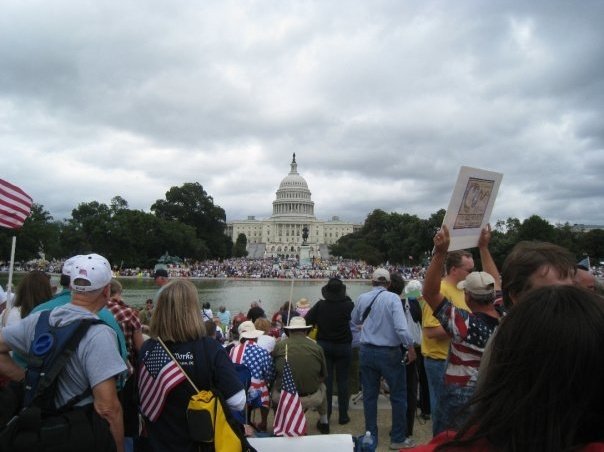
References to the Boston Tea Party were part of Tax Day protests held in the 1990s and before.[23][80][81][82] In 1984, David H. Koch and Charles G. Koch of Koch Industries founded Citizens for a Sound Economy (CSE), a conservative political group whose self-described mission was "to fight for less government, lower taxes, and less regulation." Congressman Ron Paul was appointed as the first chairman of the organization. The CSE lobbied for policies favorable to corporations, particularly tobacco companies.[83]
In 2002, a Tea Party website was designed and published by the CSE at the web address www.usteaparty.com, and stated "our US Tea Party is a national event, hosted continuously online and open to all Americans who feel our taxes are too high and the tax code is too complicated."[84][85] The site did not take off at the time.[86] In 2003, Dick Armey became the chairman of CSE after retiring from Congress.[87]
In 2004, Citizens for a Sound Economy split into FreedomWorks for 501c4 advocacy activity and the Americans for Prosperity Foundation. Dick Armey stayed as chairman of FreedomWorks, while David Koch stayed as Chairman of the Americans for Prosperity Foundation. The two organizations would become key players in the Tea Party movement from 2009 onward.[88][89] Americans for Prosperity and FreedomWorks were "probably the leading partners" in the September 2009 Taxpayer March on Washington, also known as the "9/12 Tea Party", according to The Guardian.[90]
Commentaries on origin
[edit]Fox News Channel commentator Juan Williams has said that the Tea Party movement emerged from the "ashes" of Ron Paul's 2008 presidential primary campaign.[91] Ron Paul has stated that its origin was on December 16, 2007, when supporters held a 24-hour record breaking, "moneybomb" fundraising event on the Boston Tea Party's 234th anniversary,[92] but that others, including Republicans, took over and changed some of the movement's core beliefs.[93][94]
Writing for Slate.com, Dave Weigel has argued in concurrence that, in his view, the "first modern Tea Party events occurred in December 2007, long before Barack Obama took office, and they were organized by supporters of Rep. Ron Paul," with the movement expanding and gaining prominence in 2009.[72] Barack Obama took office in January 2009. Journalist Joshua Green has stated in The Atlantic that while Ron Paul is not the Tea Party's founder or its culturally resonant figure, he has become the "intellectual godfather" of the movement since many now agree with his long-held beliefs.[95]
Journalist Jane Mayer has said that the Koch brothers were essential in funding and strengthening the movement, through groups such as Americans for Prosperity.[89] In 2013, a study published in the journal Tobacco Control concluded that organizations within the movement were connected with non-profit organizations that the tobacco industry and other corporate interests worked with and provided funding for,[84][96] including the group Citizens for a Sound Economy.[97] Al Gore cited the study and said that the connections between "market fundamentalists", the tobacco industry and the Tea Party could be traced to a 1971 memo from tobacco lawyer Lewis F. Powell, Jr. who advocated more political power for corporations. Gore said that the Tea Party is an extension of this political strategy "to promote corporate profit at the expense of the public good."[98]
Former governor of Alaska and vice presidential candidate Sarah Palin, keynoting a Tea Party Tax Day protest at the state capital in Madison, Wisconsin on April 15, 2011, reflected on the origins of the Tea Party movement and credited President Barack Obama, saying "And speaking of President Obama, I think we ought to pay tribute to him today at this Tax Day Tea Party because really he's the inspiration for why we're here today. That's right. The Tea Party Movement wouldn't exist without Barack Obama."[99][100]
Charles Homans of The New York Times said that the Tea Party arose in response to the "unpopularity of the George W. Bush administration", which caused "a moment of crisis for the Republican Party."[101]
Early local protest events
[edit]On January 24, 2009, Trevor Leach, chairman of the Young Americans for Liberty in New York State, organized the Binghamton Tea Party, to protest obesity taxes proposed by New York Governor David Paterson and call for fiscal responsibility on the part of the government.[102] The protestors emptied bottles of soda into the Susquehanna River, and several of them wore Native American headdresses in imitation of the colonists which participated in the Boston Tea Party, some of whom disguised themselves as Native Americans.[103]
Some of the protests were partially in response to several federal laws: the Bush administration's Emergency Economic Stabilization Act of 2008,[104] and the Obama administration's economic stimulus package the American Recovery and Reinvestment Act of 2009[105] and healthcare reform legislation.[12]
New York Times journalist Kate Zernike reported that leaders within the Tea Party credit Seattle blogger and conservative activist Keli Carender with organizing the first Tea Party in February 2009, although the term "Tea Party" was not used.[106] Other articles, written by Chris Good of The Atlantic and NPR's Martin Kaste, credit Carender as "one of the first" Tea Party organizers[107] and state that she "organized some of the earliest Tea Party-style protests".[108]
Carender first organized what she called a "Porkulus Protest" in Seattle on Presidents Day, February 16, the day before President Barack Obama signed the stimulus bill into law.[109] Carender said she did it without support from outside groups or city officials. "I just got fed up and planned it." Carender said 120 people participated. "Which is amazing for the bluest of blue cities I live in, and on only four days notice! This was due to me spending the entire four days calling and emailing every person, think tank, policy center, university professors (that were sympathetic), etc. in town, and not stopping until the day came."[106][110]
Contacted by Carender, Steve Beren promoted the event on his blog four days before the protest[111] and agreed to be a speaker at the rally.[112] Carender also contacted conservative author and Fox News Channel contributor Michelle Malkin, and asked her to publicize the rally on her blog, which Malkin did the day before the event.[113] The following day, the Colorado branch of Americans for Prosperity held a protest at the Colorado Capitol, also promoted by Malkin.[114] Carender held a second protest on February 27, 2009, reporting "We more than doubled our attendance at this one."[106]
First national protests and the birth of national movement
[edit]
On February 18, 2009, the one-month-old Obama administration announced the Homeowners Affordability and Stability Plan, an economic recovery plan to help homeowners avoid foreclosure by refinancing mortgages in the wake of the Great Recession. The next day, CNBC business news editor Rick Santelli criticized the Plan in a live broadcast from the floor of the Chicago Mercantile Exchange. He said that those plans were "promoting bad behavior" by "subsidizing losers' mortgages". He suggested holding a tea party for traders to gather and dump the derivatives in the Chicago River on July 1. "President Obama, are you listening?" he asked.[115][116][117][118][119] A number of the floor traders around him cheered on his proposal, to the amusement of the hosts in the studio. Santelli's "rant" became a viral video after being featured on the Drudge Report.[120]
Beth McGrath of The New Yorker and Kate Zernike of The New York Times report that this where the Tea Party movement was first inspired to coalesce under the collective banner of "Tea Party".[106][115] Santelli's remarks "set the fuse to the modern anti-Obama Tea Party movement," according to journalist Lee Fang.[121] About 10 hours after Santelli's remarks, reTeaParty.com was bought to coordinate Tea Parties scheduled for Independence Day and, as of March 4, was reported to be receiving 11,000 visitors a day.[122]
Within hours, the conservative political advocacy group Americans for Prosperity registered the domain name "TaxDayTeaParty.com", and launched a website calling for protests against Obama.[121] Overnight, websites such as "ChicagoTeaParty.com", registered in August 2008 by Chicagoan Zack Christenson, radio producer for conservative talk show host Milt Rosenberg, were live within 12 hours.[122] By the next day, guests on Fox News had already begun to mention this new "Tea Party".[123] As reported by The Huffington Post, a Facebook page was developed on February 20 calling for Tea Party protests across the country.[124]
A "Nationwide Chicago Tea Party" protest was coordinated across more than 40 different cities for February 27, 2009, establishing the first national modern Tea Party protest.[125][126] The movement has been supported nationally by at least 12 prominent individuals and their associated organizations.[127] Fox News called many of the protests in 2009 "FNC Tax Day Tea Parties" which it promoted on air and sent speakers to.[128][129] This was to include then-host Glenn Beck, though Fox came to discourage him from attending later events.[130]
Health care bill
[edit]Opposition to the Patient Protection and Affordable Care Act (PPACA) has been consistent within the Tea Party movement.[12] The scheme has often been referred to as 'Obamacare' by critics, but was soon adopted as well by many of its advocates, including President Obama. This has been an aspect of an overall anti-government message throughout Tea Party rhetoric that includes opposition to gun control measures and to federal spending increases.[55]
Activism by Tea Party people against the major health-care reform law from 2009 to 2014 has, according to the Kansas City Star, focused on pushing for Congressional victories so that a repeal measure would pass both houses and that President Obama's veto could be overridden. Some conservative public officials and commentators such as columnist Ramesh Ponnuru have criticized these views as completely unrealistic with the chances of overriding a Presidential veto being slim, with Ponnuru stating that "If you have in 2017 a Republican government... and it doesn't get rid of Obamacare, then I think that is a huge political disaster".[55]
U.S. elections
[edit]

Aside from rallies, some groups affiliated with the Tea Party movement began to focus on getting out the vote and ground game efforts on behalf of candidates supportive of their agenda starting in the 2010 elections.
In the 2010 midterm elections, The New York Times identified 138 candidates for Congress with significant Tea Party support, and reported that all of them were running as Republicans—of whom 129 were running for the House and 9 for the Senate.[131] A poll by The Wall Street Journal and NBC News in mid October showed 35% of likely voters were Tea-party supporters, and they favored the Republicans by 84% to 10%.[132] The first Tea Party affiliated candidate to be elected into office is believed to be Dean Murray, a Long Island businessman, who won a special election for a New York State Assembly seat in February 2010.[133]
According to statistics on an NBC blog, overall, 32% of the candidates that were backed by the Tea Party or identified themselves as Tea Party participants won election in 2010. Tea Party supported candidates won 5 of 10 Senate races (50%) contested, and 40 of 130 House races (31%) contested.[134] In the primaries for Colorado, Nevada and Delaware the Tea-party backed Senate Republican nominees defeated "establishment" Republicans that had been expected to win their respective Senate races, but went on to lose in the general election to their Democratic opponents.[135] The movement played a major role in the 2010 wave election[4][5] in which Republicans gained 63 House seats[6] and took control of the U.S. House of Representatives.[7]
The Tea Party is generally associated with the Republican Party.[136] Most politicians with the "Tea Party brand" have run as Republicans. In recent elections in the 2010s, Republican primaries have been the site of competitions between the more conservative, Tea Party wing of the party and the more moderate, establishment wing of the party. The Tea Party has incorporated various conservative internal factions of the Republican Party to become a major force within the party.[137][138]
Tea Party candidates were less successful in the 2012 election, winning four of 16 Senate races contested, and losing approximately 20% of the seats in the House that had been gained in 2010. Tea Party Caucus founder Michele Bachmann was re-elected to the House by a narrow margin.[139]
A May 2014 Kansas City Star article remarked about the Tea Party movement post-2012, "Tea party candidates are often inexperienced and sometimes underfunded. More traditional Republicans—hungry for a win—are emphasizing electability over philosophy, particularly after high-profile losses in 2012. Some in the GOP have made that strategy explicit."[55]
In June 2014, Tea Party favorite Dave Brat unseated the sitting GOP House Majority Leader Eric Cantor. Brat had previously been known as an economist and a professor at Randolph–Macon College, running a grassroots conservative campaign that espoused greater fiscal restraint and his Milton Friedman-based viewpoints.[140] Brat has since won the seat by a comfortable margin until losing his reelection in 2018.
In November 2014, Tim Scott became the first African-American member of the U.S. Senate from the South since the reconstruction era, winning the South Carolina seat formerly held by Jim DeMint in a special election.[141]
In the 2014 elections in Texas, the Tea Party made large gains, with numerous Tea Party favorites being elected into office, including Dan Patrick as Lieutenant Governor[142][143] and Ken Paxton as Attorney General,[142][144] in addition to numerous other candidates.[144]
In the 2015 Kentucky gubernatorial election, Matt Bevin, a Tea Party favorite who challenged Mitch McConnell in the Republican primary in the 2014 Kentucky Senate election,[145] won with over 52% of the vote, despite fears that he was too extreme for the state.[146][147][148] Bevin is the second Republican in 44 years to be Governor of Kentucky.[146]
IRS controversy
[edit]
In May 2013, the Associated Press and The New York Times reported that the Internal Revenue Service (IRS) flagged Tea Party groups and other conservative groups for review of their applications for tax-exempt status during the 2012 election. This led to both political and public condemnation of the agency, and triggered multiple investigations.[149]
Some groups were asked for donor lists, which is usually a violation of IRS policy. Groups were also asked for details about family members and about their postings on social networking sites. Lois Lerner, head of the IRS division that oversees tax-exempt groups, apologized on behalf of the IRS and stated, "That was wrong. That was absolutely incorrect, it was insensitive and it was inappropriate."[150][151] Testifying before Congress in March 2012, IRS Commissioner Douglas Shulman denied that the groups were being targeted based on their political views.[150][151]
Senator Orrin Hatch of Utah, the ranking Republican on the Senate Finance Committee, rejected the apology as insufficient, demanding "ironclad guarantees from the I.R.S. that it will adopt significant protocols to ensure this kind of harassment of groups that have a constitutional right to express their own views never happens again."[151]
The resulting Senate subcommittee report ultimately found there had been "no bias", though Republican committeemembers filed a dissenting report.[152] According to the Treasury Inspector General for Tax Administration, 18% of the conservative groups that had Tea Party or other related terms in their names flagged for extra scrutiny by the IRS had no evidence of political activity.[153] Michael Hiltzik, writing in the Los Angeles Times, stated that evidence put forth in the House report indicated the IRS had been struggling to apply complicated new rules to nonprofits that may have been involved in political activity, and had also flagged liberal-sounding groups.[154] Of all the groups flagged, the only one to lose tax exempt status was a group that trains Democratic women to run for office.[155]
After a two-year investigation, the Justice Department announced in October 2015 that "We found no evidence that any IRS official acted based on political, discriminatory, corrupt, or other inappropriate motives that would support a criminal prosecution."[156]
On October 25, 2017, the Trump Administration settled with a Consent Order for the case Linchpins of Liberty v. United States; the IRS consented to express "its sincere apology" for singling out the plaintiff for aggressive scrutiny, stating, "The IRS admits that its treatment of Plaintiffs during the tax-exempt determinations process, including screening their applications based on their names or policy positions, subjecting those applications to heightened scrutiny and inordinate delays, and demanding of some Plaintiffs' information that TIGTA determined was unnecessary to the agency's determination of their tax-exempt status, was wrong. For such treatment, the IRS expresses its sincere apology." That same month, the Treasury Department's inspector general reported that the I.R.S. had also targeted liberal groups, flagging organization names with terms that included "Progressive" and "Occupy".[157][158]
Role in the 2016 presidential election
[edit]
The presidential candidate Donald Trump praised the Tea Party movement throughout his 2016 campaign.[159] In August 2015, he told a Tea Party gathering in Nashville that "The tea party people are incredible people. These are people who work hard and love the country and they get beat up all the time by the media."[159] In a January 2016 CNN poll at the beginning of the 2016 Republican primary, Trump led all Republican candidates modestly among self-identified Tea Party voters with 37 percent supporting Trump and 34 percent supporting Ted Cruz.[160]
Several commentators, including Jonathan Chait,[161] Jenny Beth Martin,[162][163] and Sarah Palin, argued that the Tea Party played a key role in the election of Donald Trump as the Republican Party presidential nominee, and eventually as U.S. president, and that Trump's election was even the culmination of the Tea Party and anti-establishment dissatisfaction associated with it. Martin stated after the election that "with the victory of Donald Trump, the values and principles that gave rise to the tea party movement in 2009 are finally gaining the top seat of power in the White House."[163]
On the other hand, other commentators, including Paul H. Jossey,[164] a conservative campaign finance attorney, and Jim Geraghty of the conservative National Review,[165] believed that the Tea Party to be dead or in decline. Jossey, for example, argued that the Tea Party "began as an organic, policy-driven grass-roots movement" but was ultimately "drained of its vitality and resources by national political action committees that dunned the movement's true believers endlessly for money to support its candidates and causes."[164]
Decline
[edit]Tea Party activities began to decline in 2010.[166][167] According to Harvard professor Theda Skocpol, the number of Tea Party chapters across the country slipped from about 1,000 to 600 between 2009 and 2012, but that this is still "a very good survival rate." Mostly, Tea Party organizations are said to have shifted away from national demonstrations to local issues.[166] A shift in the operational approach used by the Tea Party has also affected the movement's visibility, with chapters placing more emphasis on the mechanics of policy and getting candidates elected rather than staging public events.[168][169]
The Tea Party's involvement in the 2012 GOP presidential primaries was minimal, owing to divisions over whom to endorse as well as a lack of enthusiasm for all the candidates.[167] However, the 2012 GOP ticket did have an influence on the Tea Party: following the selection of Paul Ryan as Mitt Romney's vice-presidential running mate, The New York Times declared that the once-fringe of the conservative coalition, Tea Party lawmakers are now "indisputably at the core of the modern Republican Party."[170]
Though the Tea Party has had a large influence on the Republican Party, it has attracted major criticism by public figures within the Republican coalition as well. Then-Speaker of the House John Boehner particularly condemned many Tea Party-connected politicians for their behavior during the 2013 U.S. debt ceiling crisis. "I think they're misleading their followers," Boehner was publicly quoted as saying, "They're pushing our members in places where they don't want to be, and frankly I just think that they've lost all credibility." In the words of The Kansas City Star, Boehner "stamped out Tea Party resistance to extending the debt ceiling."[55]
One 2013 survey found that, in political terms, 20 percent of self-identified Republicans stated that they considered themselves as part of the Tea Party movement.[171] By 2016, Politico noted that the Tea Party movement was essentially completely dead; however, the article noted that the movement seemed to die in part because some of its ideas had been absorbed by the mainstream Republican Party.[30] By 2019, it was reported that the conservative wing of the Republican Party "has basically shed the Tea Party moniker."[31]
Multiple sources identified remnants of the Tea Party movement as being among the participants of the January 6 United States Capitol attack in 2021.[172]
Dr. Geoffrey Kabaservice argued in 2020 that the Tea Party's "characteristic mistrust of norms was evident from the beginning in its embrace of birtherism, the racist conspiracy theory that claimed without evidence that Obama was secretly a foreign-born Muslim and ineligible for the presidency. Social media accelerated the spread of such conspiratorial beliefs, which further dissolved trust in established institutions and objective truth...the Tea Party never really died; its energies were reactivated with the presidential campaign of Donald Trump."[173]
Composition
[edit]
Demographics
[edit]Several polls have been conducted on the demographics of the movement. Though the various polls sometimes turn up slightly different results, they tend to show that Tea Party supporters tend more likely than Americans overall, to be white, male, married, older than 45, regularly attending religious services, conservative, and to be more wealthy and have more education.[174][175][176][177][178] Polling by Galllup found that from 2010 to 2014, between 21% and 32% of people identified as supporters of the movement, while between 21% and 30% identified as opponents of the movement.[179] Most Republicans and 20% of Democrats support the movement according to one Washington Post–ABC News poll.[180]
According to The Atlantic, the three main groups that provide guidance and organization for the protests, FreedomWorks, dontGO, and Americans for Prosperity, state that the demonstrations are an organic movement.[181] Conservative political strategist Tim Phillips, now head of Americans for Prosperity, has remarked that the Republican Party is "too disorganized and unsure of itself to pull this off".[182]
The Christian Science Monitor has reported that Tea Party activists "have been called neo-Klansmen and knuckle-dragging hillbillies", adding that "demonizing tea party activists tends to energize the Democrats' left-of-center base" and that "polls suggest that tea party activists are not only more mainstream than many critics suggest",[183] but that a majority of them are women, not angry white men.[183][184][185] The article quoted Juan Williams as saying that the Tea Party's opposition to health reform was based on self-interest rather than racism.[183]
A Gallup poll conducted in March 2010 found that—other than gender, income and politics—self-described Tea Party members were demographically similar to the population as a whole.[186]
When surveying supporters or participants of the Tea Party movement, polls have shown that they are, to a very great extent, more likely to be registered Republicans, have a favorable opinion of the Republican Party, and have an unfavorable opinion of the Democratic Party.[178][187][188] The Bloomberg National Poll of adults 18 and over showed that 40% of Tea Party supporters are 55 or older, compared with 32% of all poll respondents; 79% are white, 61% are men and 44% identify as "born-again Christians",[189] compared with 75%,[190] 48.5%,[191] and 34%[192] for the general population, respectively.
According to Susan Page and Naomi Jagoda of USA Today in 2010, the Tea Party was more "a frustrated state of mind" than "a classic political movement".[193] Tea party participants "are more likely to be married and a bit older than the nation as a whole".[193] They are predominantly white, but other groups make up just under one-fourth of their ranks.[193] They believe that the federal government has become too large and powerful.[193] Surveys of Republican primary voters in the South in 2012 show that Tea Party supporters were not driven by racial animosity. Instead there was a strong positive relationship with religious evangelicalism. Tea Party supporters were older, male, poorer, more ideologically conservative, and more partisan than their fellow Republicans.[194]
Each of those factors is associated among Republicans with being more racially conservative. Using multiple regression techniques and a very large sample of N=100,000 the authors hold all the background factors statistically constant. When that happens, the tea party Republicans and other Republicans are practically identical on racial issues.[195] In contrast, a 2015 study found that racial resentment was one of the strongest predictors for Tea Party Movement membership.[196]
Polling of supporters
[edit]An October 2010 Washington Post canvass of local Tea Party organizers found 99% said "concern about the economy" was an "important factor".[73] Various polls have also probed Tea Party supporters for their views on a variety of political and controversial issues. On the question of whether they think their own income taxes this year are fair, 52% of Tea Party supporters told pollsters for CBS/New York Times that they were, versus 62% in the general population (including Tea Party supporters).[187] A Bloomberg News poll found that Tea Partiers are not against increased government action in all cases. "The ideas that find nearly universal agreement among Tea Party supporters are rather vague," says J. Ann Selzer, the pollster who created the survey. "You would think any idea that involves more government action would be anathema, and that is just not the case."
In advance of a new edition of their book American Grace, political scientists David E. Campbell of Notre Dame and Robert D. Putnam of Harvard published in a New York Times opinion the results of their research into the political attitudes and background of Tea Party supporters. Using a pre-Tea Party poll in 2006 and going back to the same respondents in 2011, they found the supporters to be not "nonpartisan political neophytes" as often described, but largely "overwhelmingly partisan Republicans" who were politically active prior to the Tea Party. The survey found Tea Party supporters "no more likely than anyone else" to have suffered hardship during the 2007–2010 recession. Additionally, the respondents were more concerned about "putting God in government" than with trying to shrink government.[197][198]
The 2010 midterm elections demonstrated considerable skepticism within the Tea Party movement with respect to the dangers and the reality of global warming. A New York Times/CBS News Poll during the election revealed that only a small percentage of Tea Party supporters considered global warming a serious problem, much less than the portion of the general public that does. The Tea Party is strongly opposed to government-imposed limits on carbon dioxide emissions as part of emissions trading legislation to encourage use of fuels that emit less carbon dioxide.[199] An example is the movement's support of California Proposition 23, which would suspend AB32, the Global Warming Solutions Act of 2006.[200] The proposition failed to pass, with less than 40% voting in favor.[201]
Many[quantify] of the movement's participants favored stricter measures against illegal immigration.[202]
Polls found that just 7% of Tea Party supporters approve of how Obama is doing his job compared to 50% (as of April 2010) of the general public,[187][needs update] and that roughly 77% of supporters had voted for Obama's Republican opponent, John McCain in 2008.[177][178]
A University of Washington poll of 1,695 registered voters in the state of Washington reported that 73% of Tea Party supporters disapprove of Obama's policy of engaging with Muslim countries, 88% approve of the controversial Arizona immigration law enacted in 2010 that requires police to question people they suspect are illegal immigrants for proof of legal status, 54% feel that immigration is changing the culture in the U.S. for the worse, 82% do not believe that gay and lesbian couples should have the legal right to marry, and that about 52% believe that "[c]ompared to the size of the group, lesbians and gays have too much political power".[203][204][205]
Leadership
[edit].jpg)
The movement has been supported nationally by prominent individuals and organizations.[206][207]
Individuals
[edit].jpg)
An October 2010 Washington Post canvass of 647 local Tea Party organizers asked "which national figure best represents your groups?" and got the following responses: no one 34%, Sarah Palin 14%, Glenn Beck 7%, Jim DeMint 6%, Ron Paul 6%, Michele Bachmann 4%.[73]
The success of candidates popular within the Tea Party movement has boosted Palin's visibility.[208] Rasmussen and Schoen (2010) conclude that "She is the symbolic leader of the movement, and more than anyone else has helped to shape it."[209]
In June 2008, Congressman Ron Paul announced his non-profit organization called Campaign for Liberty as a way of continuing the grassroots support involved in Ron Paul's 2007–2008 presidential run.[citation needed] This announcement corresponded with the suspension of his campaign.[citation needed]
In July 2010, Bachmann formed the House congressional Tea Party Caucus. This congressional caucus, which Bachmann chaired, is devoted to the Tea Party's stated principles of "fiscal responsibility, adherence to the Constitution, and limited government".[210] As of March 31, 2011, the caucus consisted of 62 Republican representatives.[75] Rep. Jason Chaffetz and Melissa Clouthier have accused them of trying to hijack or co-opt the grassroots Tea Party Movement.[211]
Organizations
[edit]Note: the self-reported membership numbers below are several years old.
- Tea Party Patriots, an organization with more than 1,000 affiliated groups across the nation[212] that proclaims itself to be the "Official Home of the Tea Party Movement".[213]
- Americans for Prosperity, an organization founded by David H. Koch in 2003, and led by Tim Phillips. The group has over 1 million members in 500 local affiliates and led protests against health care reform in 2009.[206]
- FreedomWorks, an organization led by Matt Kibbe. The group has over 1 million members in 500 local affiliates. It makes local and national candidate endorsements.[206]
- Tea Party Express, a national bus tour run by Our Country Deserves Better PAC, itself a conservative political action committee created by Sacramento-based Republican consulting firm Russo, Marsh, and Associates.[214][215][216]
FreedomWorks, Americans for Prosperity, and DontGo, a free market political activist non-profit group, were guiding the Tea Party movement in April 2009, according to The Atlantic.[181] Americans for Prosperity and FreedomWorks were "probably the leading partners" in the September 2009 Taxpayer March on Washington, also known as the 9/12 Tea Party, according to The Guardian.[90]
- Tea Party Review
In 2011 the movement launched a monthly magazine, the Tea Party Review.[217]
- For-profit businesses
- Tea Party Nation, which sponsored the National Tea Party Convention that was criticized for its $549 ticket price[218][219][220][221] and because Palin was apparently paid $100,000 for her appearance (which she put towards SarahPAC[222]).[223]
- Informal organizations and coalitions
- The National Tea Party Federation, formed on April 8, 2010, by several leaders in the Tea Party movement to help spread its message and to respond to critics with a quick, unified response.[224]
- The Nationwide Tea Party Coalition, a loose national coalition of several dozen local tea party groups.[225]
- Student movement
- Tea Party Students organized the 1st National Tea Party Students Conference, which was hosted by Tea Party Patriots at its American Policy Summit in Phoenix on February 25–27, 2011. The conference included sessions with Campus Reform, Students For Liberty, Young America's Foundation, and Young Americans for Liberty.[226]
Other influential organizations include Americans for Limited Government, the training organization American Majority, the Our Country Deserves Better political action committee, and Glenn Beck's 9-12 Project, according to the National Journal in February 2010.[207]
Fundraising
[edit]
Sarah Palin headlined four "Liberty at the Ballot Box" bus tours, to raise money for candidates and the Tea Party Express. One of the tours visited 30 towns and covered 3,000 miles.[227] Following the formation of the Tea Party Caucus, Michele Bachmann raised $10 million for a political action committee, MichelePAC, and sent funds to the campaigns of Sharron Angle, Christine O'Donnell, Rand Paul, and Marco Rubio.[228] In September 2010, the Tea Party Patriots announced it had received a $1,000,000 donation from an anonymous donor.[229]
Support of Koch brothers
[edit]In an August 2010, article in The New Yorker, Jane Mayer asserted that the brothers David H. Koch and Charles G. Koch and Koch Industries provided financial support to one of the organizations that became part of the Tea Party movement through Americans for Prosperity.[230][231] The AFP's "Hot Air Tour" was organized to fight against taxes on carbon use and the activation of a cap and trade program.[232] A Koch Industries company spokesperson issued a 2010 statement saying "No funding has been provided by Koch companies, the Koch foundation, or Charles Koch or David Koch specifically to support the tea parties".[233]
Public opinion
[edit]2010 polling
[edit]In March 2010, a USA Today/Gallup poll found that 28% of those surveyed considered themselves supporters of the Tea Party movement, 26% opponents, and 46% neither.[234] These figures remained stable to January 2011, but public opinion changed by August 2011. In January 2011, a USA Today/Gallup poll found that approximately 70% of adults, including approximately 9 out of 10 Republicans, felt Republican leaders in Congress should give consideration to Tea Party movement ideas.[235] In August 2011, 42% of registered voters, but only 12% of Republicans, said Tea Party endorsement would be a "negative" and that they would be "less likely" to vote for such a candidate.[236]
In April 2010, a Gallup Poll found that 47% of Americans had an unfavorable image of the Tea Party movement, with 33% having a favorable opinion.[237] A 2011 opinion survey by political scientists David E. Campbell and Robert D. Putnam found the Tea Party ranked at the bottom of a list of "two dozen" American "religious, political, and racial groups" in terms of favorability—"even less liked than Muslims and atheists."[198][238] In November 2011, The New York Times cited opinion polls showing that support for the Tea Party had "fallen sharply even in places considered Tea Party strongholds." It quoted pollster Andrew Kohut speculating that the Tea Party position in Congress was perceived as "too extreme and not willing to compromise".[239]
A CBS News/New York Times poll in September 2010 showed 19% of respondents supported the movement, 63% did not, and 16% said they did not know. In the same poll, 29% had an unfavorable view of the Tea Party, compared to 23% with a favorable view.[240] The same poll retaken in August 2011 found that 20% of respondents had a favorable view of the Tea Party and 40% had an unfavorable view.[241] A CNN/ORC poll taken September 23–25, 2011 found that the favorable/unfavorable ratio was 28% versus 53%.[242]
An NBC News/Wall Street Journal poll in September 2010 found 27% considered themselves Tea Party supporters. 42% said the Tea Party has been good for the U.S. political system; 18% called it a bad thing. Those with an unfavorable view of the Tea Party outnumbered those with a favorable view 36–30%. In comparison, the Democratic Party was viewed unfavorably by a 42–37% margin, and the Republican Party by 43–31%.[243]
A poll conducted by the Quinnipiac University Polling Institute in March 2010 found that 13% of national adults identified themselves as part of the Tea Party movement but that the Tea Party had a positive opinion by a 28–23% margin with 49% who did not know enough about the group to form an opinion.[178] A similar poll conducted by the Winston Group in April 2010 found that 17% of American registered voters considered themselves part of the Tea Party movement.[188]
After debt-ceiling crisis
[edit]After the mid-2011 debt ceiling crisis, polls became more unfavorable to the Tea Party.[244][245] According to a Gallup poll, 28% of adults disapproved of the Tea Party compared to 25% approving, and noted that "[t]he national Tea Party movement appears to have lost some ground in popular support after the blistering debate over raising the nation's debt ceiling in which Tea Party Republicans... fought any compromise on taxes and spending".[244] Similarly, a Pew poll found that 29% of respondents thought Congressional Tea Party supporters had a negative effect compared to 22% thinking it was a positive effect. It noted that "[t]he new poll also finds that those who followed the debt ceiling debate very closely have more negative views about the impact of the Tea Party than those who followed the issue less closely."[245] A CNN/ORC poll put disapproval at 51% with a 31% approval.[246]
2012 polling
[edit]A Rasmussen Reports poll conducted in April 2012 showed 44% of likely U.S. voters held at least a somewhat favorable view of Tea Party activists, while 49% share an unfavorable opinion of them. When asked if the Tea Party movement would help or hurt Republicans in the 2012 elections, 53% of Republicans said they see the Tea Party as a political plus.[247]
2013 and 2014 polling
[edit]In October 2013, Rasmussen Reports research found as many respondents (42%) identify with the Tea Party as with President Obama. However, while 30% of those polled viewed the movement favorably, 50% were unfavorable; in addition, 34% considered the movement a force for good while 43% considered them bad for the nation. On major national issues, 77% of Democrats said their views were closest to Obama's; in contrast, 76% of Republicans and 51% of unaffiliated voters identified closely with the Tea Party.[248]
Other survey data from this period has shown that past trends of partisan divides about the Tea Party remained. For example, a Pew Research Center poll from October 2013 reported that 69% of Democrats had an unfavorable view of the movement, in contrast to 49% of independents and 27% of Republicans.[249] A CNN/ORC poll also conducted October 2013 generally showed that 28% of Americans were favorable to the Tea party while 56% were unfavorable.[250] In an AP/GfK survey from January 2014, 27% of respondents stated that they considered themselves a Tea Party supporter in comparison to 67% that said that they did not.[249]
Symbols
[edit]

Beginning in 2009, the Gadsden flag became widely used as a symbol by Tea Party protesters nationwide.[251][252] It was also displayed by members of Congress at Tea Party rallies.[253] Some lawmakers dubbed it a political symbol due to the Tea Party connection[252] and the political nature of Tea Party supporters.[254]
The Second Revolution flag gained national attention on January 19, 2010.[255] It is a version of the Betsy Ross flag with a Roman numeral "II" in the center of the circle of 13 stars symbolizing a second revolution in America.[256] The Second Revolution flag has been called synonymous with Tea Party causes and events.[257]
"Teabagger"
[edit]Some participants of the movement adopted the term as a verb, and a few others referred to themselves as "teabaggers".[258][259] News media and progressive commentators outside the movement began to use the term mockingly and derisively, alluding to the sexual connotation of the term when referring to Tea Party protesters. The first pejorative use of the term was in 2007 by Indiana Democratic Party Communications Director Jennifer Wagner.[260]
The use of the double entendre evolved from Tea Party protest sites encouraging readers to "Tea bag the fools in DC" to the political left adopting the term for derogatory jokes.[259][261][262] It has been used by several media outlets to humorously refer to Tea Party-affiliated protestors.[263] Some conservatives have advocated that the non-vulgar meaning of the word be reclaimed.[259] Grant Barrett, co-host of the A Way with Words radio program, has listed teabagger as a 2009 buzzword meaning, "a derogatory name for attendees of Tea Parties, probably coined in allusion to a sexual practice".[264]
Commentary by the Obama administration
[edit]On April 29, 2009, Obama commented on the Tea Party protests during a townhall meeting in Arnold, Missouri:
Let me just remind them that I am happy to have a serious conversation about how we are going to cut our health care costs down over the long term, how we're going to stabilize Social Security. Claire McCaskill and I are working diligently to do basically a thorough audit of federal spending. But let's not play games and pretend that the reason is because of the recovery act, because that's just a fraction of the overall problem that we've got. We are going to have to tighten our belts, but we're going to have to do it in an intelligent way. And we've got to make sure that the people who are helped are working American families, and we're not suddenly saying that the way to do this is to eliminate programs that help ordinary people and give more tax cuts to the wealthy. We tried that formula for eight years. It did not work. And I don't intend to go back to it.[265][266]
On April 15, 2010, Obama noted the passage of 25 different tax cuts over the past year, including tax cuts for 95% of working Americans. He then remarked, "So I've been a little amused over the last couple of days where people have been having these rallies about taxes. You would think they would be saying thank you. That's what you'd think."[267][268]
On September 20, 2010, at a townhall discussion sponsored by CNBC, Obama said healthy skepticism about government and spending was good, but it was not enough to just say "Get control of spending", and he challenged the Tea Party movement to get specific about how they would cut government debt and spending:
And so the challenge, I think, for the Tea Party movement is to identify specifically what would you do. It's not enough just to say, get control of spending. I think it's important for you to say, I'm willing to cut veterans' benefits, or I'm willing to cut Medicare or Social Security benefits, or I'm willing to see these taxes go up. What you can't do—which is what I've been hearing a lot from the other side—is say we're going to control government spending, we're going to propose $4 trillion of additional tax cuts, and that magically somehow things are going to work.[269][270]
Media coverage
[edit]
U.S. News & World Report reported that the nature of the coverage of the protests has become part of the story.[271] On CNN's Situation Room, journalist Howard Kurtz commented that "much of the media seems to have chosen sides". He says that Fox News portrayed the protests "as a big story, CNN as a modest story, and MSNBC as a great story to make fun of. And for most major newspapers, it's a nonstory".[271] There were reports that the movement had been actively promoted by the Fox News Channel.[272][273]
According to Fairness and Accuracy in Reporting, a progressive media watchdog, there is a disparity between large coverage of the Tea Party movement and minimal coverage of larger movements. In 2009, the major Tea Party protests were quoted twice as often as the National Equality March despite a much lower turnout.[274] In 2010, a Tea Party protest was covered 59 times as much as the US Social Forum (177 Tea Party mentions versus 3 for Social Forum) despite the attendance of the latter being 25 times as much (600 Tea Party attendees versus at least 15,000 for Social Forum).[275]
In April 2010, responding to a question from the media watchdog group Media Matters posed the previous week, Rupert Murdoch, the chief executive of News Corporation, which owns Fox News, said, "I don't think we should be supporting the Tea Party or any other party." That same week, Fox News canceled an appearance by Sean Hannity at a Cincinnati Tea Party rally.[276]
Following the September 12 Taxpayer March on Washington, Fox News said it was the only cable news outlet to cover the emerging protests and took out full-page ads in The Washington Post, the New York Post, and The Wall Street Journal with a prominent headline reading, "How did ABC, CBS, NBC, MSNBC, and CNN miss this story?"[277] CNN news anchor Rick Sanchez disputed Fox's assertion, pointing to various coverage of the event.[278][279][280] CNN, NBC, CBS, MSNBC, and CBS Radio News provided various forms of live coverage of the rally in Washington throughout the day on Saturday, including the lead story on CBS Evening News.[278][280][281][282]
James Rainey of the Los Angeles Times said that MSNBC's attacks on the tea parties paled compared to Fox's support, but that MSNBC personalities Keith Olbermann, Rachel Maddow and Chris Matthews were hardly subtle in disparaging the movement.[283] Howard Kurtz has said that, "These [FOX] hosts said little or nothing about the huge deficits run up by President Bush, but Barack Obama's budget and tax plans have driven them to tea. On the other hand, CNN and MSNBC may have dropped the ball by all but ignoring the protests."[284]
In the January/February 2012 issue of Foreign Affairs, Francis Fukuyama stated that the Tea Party is supporting "politicians who serve the interests of precisely those financiers and corporate elites they claim to despise" and inequality while comparing and contrasting it with the occupy movement.[285][286]
Tea Party's views of media coverage
[edit]In October 2010, a survey conducted by The Washington Post found that the majority of local Tea Party organizers consider the media coverage of their groups to be fair. Seventy-six percent of the local organizers said media coverage has been fair, while 23 percent have said coverage was unfair. This was based on responses from all 647 local Tea Party organizers the Post was able to contact and verify, from a list of more than 1,400 possible groups identified.[287]
Perceptions of the Tea Party
[edit]
The movement has been called a mixture of conservative,[19] libertarian,[17] and populist[18] activists. As stated before, opinions in terms of the U.S. major political parties play a large role in terms of attitudes about the Tea Party movement, with one study finding that 20% of self-identified Republicans personally view themselves as part of the Tea Party.[171]
The movement has sponsored protests and supported political candidates circa 2009.[20][21][22] Since the movement's inception, in the late 2000s, left wing groups have accused the party of racism and intolerance.[288][289] Left leaning opponents have cited various incidents as evidence that the movement is, in their opinion, propelled by various forms of bigotry.[288][289] Supporters say the incidents are isolated acts attributable to a small fringe that is not representative of the movement.[288][289] Accusations that the news media are biased either for or against the movement are common, while polls and surveys have been faced with issues regarding the population surveyed, and the meaningfulness of poll results from disparate groups.[290]
Although the Tea Party has a libertarian element in terms of some issue convictions, most American libertarians do not support the movement enough to identify with it. A 2013 survey by the Public Religion Research Institute (PRRI) found that 61% of identified libertarians stated they did not consider themselves part of the tea party. This split exists due to the strong Christian right influence in the movement, which puts the majority of the tea party movement at direct odds against libertarians on issues such as the war on drugs (with the aforementioned survey finding that 71% of libertarians support legalizing marijuana).[171] Some libertarian leaning supporters have grown increasingly annoyed by the influx of religious social issues into the movement. Many in the movement would prefer the complex social issues such as homosexuality, abortion, and religion to be left out of the discussion, while instead increasing the focus on limited government and states' rights.[citation needed]
According to a review in Publishers Weekly published in 2012, professor Ronald P. Formisano in The Tea Party: A Brief History provides an "even-handed perspective on and clarifying misconceptions about America's recent political phenomenon" since "party supporters are not isolated zealots, and may, like other Americans, only want to gain control over their destinies". Professor Formisano sees underlying social roots and draws a parallel between the tea party movement and past support for independent candidate Ross Perot.[291]
The final round of debate before voting on the health care bill was marked with vandalism and widespread threats of violence to at least ten Democratic lawmakers across the country, which created public relations problems for the fledgeling Tea Party movement. On March 22, 2010, in what the New York Times called "potentially the most dangerous of many acts of violence and threats against supporters of the bill," a Lynchburg, Virginia Tea Party organizer and the Danville, Virginia Tea Party Chairman both posted the home address of Representative Tom Perriello's brother (mistakenly believing it was the Congressman's address) on their websites, and encouraged readers to "drop by" to express their anger against Representative Perriello's vote in favor of the healthcare bill. The following day, after smelling gas in his house, a severed gas line that connected to a propane tank was discovered on Perriello's brother's screened-in porch. Local police and FBI investigators determined that it was intentionally cut as an act of vandalism. Perriello's brother also received a threatening letter referencing the legislation. Attorney General Ken Cuccinelli stated that posting a home address on a website and encouraging people to visit is "an appalling approach. It's not civil discourse, it's an invitation to intimidation and it's totally unacceptable." Leaders of the Tea Party movement tried to contain the public relations damage by denouncing the violent acts and distancing themselves from those behind the acts. One Tea Party website issued a response saying the Tea Party member's action of posting the address "was not requested, sanctioned or endorsed by the Lynchburg Tea Party". The director of the Northern Colorado Tea Party said, "Although many are frustrated by the passage of such controversial legislation, threats are absolutely not acceptable in any form, to any lawmaker, of any party."[292]
In early July 2010, the North Iowa Tea Party (NITP) posted a billboard showing a photo of Adolf Hitler with the heading "National Socialism", one of Barack Obama with the heading "Democrat Socialism", and one of Vladimir Lenin with the heading "Marxist Socialism", all three marked with the word "change" and the statement "Radical leaders prey on the fearful and naive". It received sharp criticism, including some from other Tea Party activists. NITP co-founder Bob Johnson acknowledged the anti-socialist message may have gotten lost amid the fascist and communist images. Following a request from the NITP, the billboard was removed on July 14.[293]
See also
[edit]- Coffee Party USA, a progressive alternative to the Tea Party started in 2010, opposing corporate personhood rather than taxes
- Conservatism in the United States
- Donald Trump presidential campaign, 2016
- Election denial movement in the United States
- Indivisible movement, a progressive alternative to the Tea Party started in 2016
- Radical right
- United Kingdom Independence Party, third largest political party in the U.K. by popular vote in 2015, considered by some people as the British version of the Tea Party.[294]
References
[edit]- ^ Sanneh, Kelefa (February 19, 2012). "Party Crasher". The New Yorker. ISSN 0028-792X. Retrieved December 28, 2024.
- ^ "Tea Party Protesters March on Washington". ABC News. September 12, 2009.
- ^ "GOP breaks may stem from party resistance to all things Obama". PBS NewsHour. March 5, 2016.
- ^ a b Blake, Aaron (February 1, 2016). "The GOP's 'tea party' Class of 2010 is heading for the exits -- fast/". Washington Post.
- ^ a b Akin, Stephanie (September 26, 2018). "Tea Party Pioneer Says Democrats Can't Match That Wave". Roll Call.
- ^ a b Peoples, Steve (December 8, 2010). "Final House Race Decided; GOP Net Gain: 63 Seats". Roll Call.
- ^ a b Harris, Paul; MacAskill, Ewen (November 3, 2010). "US midterm election results herald new political era as Republicans take House". The Guardian.
- ^ Gallup: Tea Party's top concerns are debt, size of government The Hill, July 5, 2010
- ^ Somashekhar, Sandhya (September 12, 2010). Tea Party DC March: "Tea party activists march on Capitol Hill". The Washington Post. Retrieved November 5, 2011.
- ^ a b Good, Chris (October 6, 2010). "On Social Issues, Tea Partiers Are Not Libertarians". The Atlantic. Retrieved September 25, 2018.
- ^ Jonsson, Patrik (November 15, 2010). "Tea party groups push GOP to quit culture wars, focus on deficit". Christian Science Monitor. Retrieved September 25, 2018.
- ^ a b c McMorris-Santoro, Evan (April 5, 2010). "The Town Hall Dog That Didn't Bite". Talking Points Memo. Archived from the original on June 9, 2010. Retrieved April 19, 2015.
- ^ Cohen, Tom (February 27, 2014). "5 years later, here's how the tea party changed politics". CNN.
- ^ Somin, Ilya (May 26, 2011). "The Tea Party Movement and Popular Constitutionalism". Northwestern University Law Review. Rochester, NY. SSRN 1853645.
- ^ Monbiot, George (October 25, 2010). "The Tea Party movement: deluded and inspired by billionaires". The Guardian. ISSN 0261-3077.
- ^ Nesbit, Jeff (April 5, 2016). "The Secret Origins of the Tea Party". Time.
- ^ a b Ekins, Emily (September 26, 2011). "Is Half the Tea Party Libertarian?". Reason. Archived from the original on May 11, 2012. Retrieved July 16, 2012.
Kirby, David; Ekins, Emily McClintock (August 6, 2012). "Libertarian Roots of the Tea Party". Cato. Archived from the original on December 4, 2018. Retrieved June 9, 2019.{{cite journal}}: Cite journal requires|journal=(help) - ^ a b Halloran, Liz (February 5, 2010). "What's Behind The New Populism?". NPR. Archived from the original on July 29, 2018. Retrieved June 9, 2019.
Barstow, David (February 16, 2010). "Tea Party Lights Fuse for Rebellion on Right". The New York Times. Archived from the original on March 2, 2017. Retrieved June 9, 2019.
Fineman, Howard (April 6, 2010). "Party Time". Newsweek. Archived from the original on July 13, 2011. Retrieved June 9, 2019. - ^ a b Pauline Arrillaga (April 14, 2014). "Tea Party 2012: A Look At The Conservative Movement's Last Three Years". Huffington Post. Archived from the original on April 17, 2012. Retrieved June 9, 2019.
Michelle Boorstein (October 5, 2010). "Tea party, religious right often overlap, poll shows". The Washington Post. Archived from the original on April 7, 2019. Retrieved June 9, 2019.
Peter Wallsten; Danny Yadron (September 29, 2010). "Tea-Party Movement Gathers Strength". The Wall Street Journal. Archived from the original on September 13, 2018. Retrieved June 9, 2019. - ^ a b Servatius, David (March 6, 2009). "Anti-tax-and-spend group throws "tea party" at Capitol". Deseret News. Archived from the original on June 13, 2009. Retrieved June 16, 2009.
- ^ a b "Anger Management". The Economist. March 5, 2009. Archived from the original on May 10, 2009. Retrieved April 25, 2010.
- ^ a b Tapscott, Mark (March 19, 2009). "Tea parties are flash crowds Obama should fear". The San Francisco Examiner. Archived from the original on April 19, 2009. Retrieved June 16, 2009.
- ^ a b "Boston Tea Party Is Protest Template". UPI. April 20, 2008.
- ^ Etheridge, Eric (February 20, 2009). "Rick Santelli: Tea Party Time". New York Times: Opinionator.
- ^ Pallasch, Abdon M. (September 19, 2010). "'Best 5 minutes of my life'; His '09 CNBC rant against mortgage bailouts for 'losers' ignited the Tea Party movement". Chicago Sun-Times. p. A4.
- ^ "Tea Party: Palin's Pet, Or Is There More To It Underneath". April 15, 2014. Archived from the original on April 15, 2014.
- ^ "Founding Mothers and Fathers of the Tea Party Movement," by Michael Patrick Leahy Archived January 23, 2017, at the Wayback Machine, retrieved November 10, 2016.
- ^ Ragusa, Jordan; Gaspar, Anthony (2016). "Where's the Tea Party? An Examination of the Tea Party's Voting Behavior in the House of Representatives". Political Research Quarterly. 69 (2): 361–372. doi:10.1177/1065912916640901. S2CID 156591086.
- ^ "Americans for Prosperity". FactCheck.org. June 16, 2014. Retrieved November 3, 2015.
- ^ a b "How We Killed the Tea Party". Politico. August 14, 2016.
- ^ a b Belvedere, Matthew J. (March 15, 2019). "'It's their turn' – former GOP House Speaker John Boehner says Democrats are having their own tea party-like moment". CNBC.
- ^ "Economic Freedom". teapartypatriots.org. Tea Party Patriots. June 6, 2014.
- ^ a b c Price Foley, Elizabeth (Spring 2011). "Sovereignty, Rebalanced: The Tea Party and Constitutional Amendments". Tennessee Law Review. 78 (3): 751–64. SSRN 1904656.
- Elizabeth Price Foley, law professor at Florida International University College of Law, writing on the Tea Party's proclamations regarding the Constitution, observed: "Tea Party opposition to bailouts, stimulus packages and health-care reform is reflected in various proposals to amend the Constitution, including proposals to require a balanced budget, repeal the Sixteenth and Seventeenth Amendments, and give states a veto power over federal laws (the so-called Repeal Amendment)."
- ^ Zernike, Kate (2010). Boiling Mad: Inside Tea Party America. Macmillan Publishers. pp. 65–66. ISBN 9781429982726.
- Kate Zernike, a national correspondent for The New York Times, wrote: "It could be hard to define a Tea Party agenda; to some extent it depended on where you were. In the Northeast, groups mobilized against high taxes; in the Southwest, illegal immigration. Some Tea Partiers were clearer about what they didn't want than what they did. But the shared ideology—whether for young libertarians who came to the movement through Ron Paul or older 9/12ers who came to it through Glenn Beck—was the belief that a strict interpretation of the Constitution was the solution to government grown wild. [...] By getting back to what the founders intended, they believed they could right what was wrong with the country. Where in the Constitution, they asked, does it say that the federal government was supposed to run banks? Or car companies? Where does it say that people have to purchase health insurance? Was it so much to ask that officials honor the document they swear an oath to uphold?"
- ^ Staff writer (July 5, 2013). "Tea Party groups ramp up fight against immigration bill, as August recess looms". Fox News.
- ^ Woodruff, Betsy (June 20, 2013). "Tea Party – vs – Immigration Reform". National Review.
- ^ a b Gabriel, Trip (December 25, 2012). "Clout Diminished, Tea Party Turns to Narrower Issues". The New York Times.
- ^ Rauch, Jonathan (March 2, 2011). "The Tea Party's Next Move". National Journal. Archived from the original on September 28, 2013.
- ^ Carey, Nick (October 15, 2012). "Tea Party versus Agenda 21: Saving the U.S. or just irking it?". Reuters. Archived from the original on September 24, 2015. Retrieved July 2, 2017.
- ^ Ballhaus, Rebecca (June 19, 2013). "Tea Party Protesters Rally Against IRS, Government". Wall Street Journal.
- ^ a b c Rauch, Jonathan (March 2, 2011). "Group Think: Inside the Tea Party's Collective Brain". National Journal.
- ^ a b Schmidt, Christopher W. (Fall 2011). "The Tea Party and the Constitution" (PDF). Hastings Constitutional Law Quarterly. 39 (1): 193–252. SSRN 2218595. Archived from the original (PDF) on June 17, 2015. Also available via heinonline.
- ^ Liptak, Adam (March 13, 2010). "Tea-ing Up the Constitution". New York Times.
- ^ Somin, Ilya (2011). "The Tea Party Movement and Popular Constitutionalism". Northwestern University Law Review Colloquy. Pdf.
- ^ Zietlow, Rebecca E. (April 2012). "Popular Originalism? The Tea Party Movement and Constitutional Theory". Florida Law Review. 64 (2): 483–512. Pdf.
- Rebecca E. Zietlow, law professor at the University of Toledo College of Law, characterizes the Tea Party's constitutional position as a combination of two schools of thought: "originalism" and "popular constitutionalism."
- "Tea Party activists have invoked the Constitution as the foundation of their conservative political philosophy. These activists are engaged in 'popular originalism,' using popular constitutionalism—constitutional interpretation outside of the courts—to invoke originalism as interpretive method."
- Rebecca E. Zietlow, law professor at the University of Toledo College of Law, characterizes the Tea Party's constitutional position as a combination of two schools of thought: "originalism" and "popular constitutionalism."
- ^ a b Skocpol, Theda; Williamson, Vanessa (2012). The Tea Party and the Remaking of Republican Conservatism. Oxford University Press. pp. 50–51. ISBN 978-0-19-983263-7.
- ^ Zernike, Kate (2010). Boiling Mad: Inside Tea Party America. Macmillan Publishers. pp. 67–68. ISBN 978-1429982726.
- ^ See also:
- Perrin, Andrew J.; Tepper, Stephen J.; Caren, Neal; Morris, Sally (May 2011). "Cultures of the Tea Party". Contexts. 10 (2): 74–75. doi:10.1177/1536504211408945.
- Ryan, James E. (November 2011). "Laying Claim to the Constitution: The Promise of New Textualism". Virginia Law Review. 97 (7): 1549–1550. JSTOR 41307888. Archived from the original on March 15, 2017. Retrieved March 15, 2017.
- Formisano, Ronald (2012). The Tea Party: A Brief History. The Johns Hopkins University Press. p. 52.
- ^ a b Associated Press (January 28, 2010). "Tea Partiers shaking up races across country". KTVB News. Archived from the original on February 21, 2014.
- ^ a b Zernike, Kate (March 12, 2010). "Tea Party Avoids Divisive Social Issues". The New York Times. Retrieved February 5, 2014.
- ^ Jonsson, Patrik (November 15, 2010). "Tea party groups push GOP to quit culture wars, focus on deficit". Christian Science Monitor. Retrieved September 25, 2018.
- ^ Schumacher Cohen, Julie (April 19, 2012). "The Role of Religion (or Not) in the Tea Party Movement: Current Debates & The Anti-Federalists". Concept (student magazine). Vol. 35. Villanova University. Retrieved February 5, 2014.
- ^ Davis, Teddy (February 9, 2010). "Tea Party Activists Craft 'Contract from America'". ABC News. American Broadcasting Company. Retrieved September 18, 2010.
- ^ a b Davis, Teddy (April 15, 2010). "Tea Party Activists Unveil 'Contract from America'". ABC News. Retrieved June 7, 2011.
- ^ a b c d e Helling, Dave (May 17, 2014). "Tea party says it is winning the message war despite losing election battles". Kansas City Star. Archived from the original on May 21, 2014. Retrieved May 18, 2014.
- ^ Mead, Walter Russell (March–April 2011). "The Tea Party and American Foreign Policy: What Populism Means for Globalism". Foreign Affairs. pp. 28–44.
- ^ "H.Con.Res. 51: Directing the President, pursuant to section 5(c) of the War ... (On the Resolution)". GovTrack.us. Retrieved November 8, 2012.
- ^ "S. 3576: A bill to provide limitations on United States assistance, and ... (On Passage of the Bill)". GovTrack.us. Retrieved November 8, 2012.
- ^ McLaughlin, Seth (September 10, 2013). "Tea party-linked lawmakers shun strike on Syria". Washington Times.
- ^ Pecquet, Julian (August 31, 2013). "Tea Party takes lead on Syria". The Hill. Retrieved August 10, 2014.
- ^ Formisano 2012, p. 8
- ^ Krugman, Paul (April 12, 2009). "Tea Parties Forever". The New York Times. Retrieved April 24, 2010.
- ^ Hannity, Sean (March 2, 2010). "Pelosi Backpedals on Tea Partiers". Hannity's America. FOX News Network.
- ^ Pelosi: Tea parties are part of an 'astroturf' campaign by 'some of the wealthiest people in America.' Archived May 15, 2011, at the Wayback Machine ThinkProgress, April 15, 2009. Retrieved January 28, 2011.
- ^ Rasmussen, Scott W.; Schoen, Doug (September 14, 2010). Mad As Hell: How the Tea Party Movement Is Fundamentally Remaking Our Two-Party System. Harper. pp. 132–136. ISBN 978-0061995231.
- ^ Monbiot, George (October 25, 2010). "The Tea Party movement: deluded and inspired by billionaires". The Guardian. ISSN 0261-3077. Retrieved July 15, 2014.
- ^ Ventura, Elbert (January 11, 2012). "The Tea Party Paradox: A democratic movement that is anti-democratic at heart". Columbia Journalism Review.
- ^ a b "Tea Party Supporters Overlap Republican Base". Gallup Poll. July 2, 2010. Retrieved November 24, 2010.
- ^ "The Fix – Tea Party = Republican party?". The Washington Post. The Washington Post. July 6, 2010. Archived from the original on August 11, 2011. Retrieved November 24, 2010.
- ^ Rasmussen, Scott; Schoen, Doug (2010). Mad As Hell: How the Tea Party Movement Is Fundamentally Remaking Our Two-Party System. HarperCollins. p. 12. ISBN 978-0061995231.
- ^ The GOP Takes its Tea; Los Angeles Times; July 25, 2010
- ^ a b Five Myths About the Tea Party Slate; August 9, 2010
- ^ a b c Tea Party canvass results, Category: "What They Believe" A Party Face Washington Post October 24, 2010. Retrieved January 28, 2011.
- ^ Sherman, Jake (July 16, 2010). "Bachmann forms Tea Party Caucus". Politico. Retrieved August 4, 2010.
- ^ a b "Members of the Tea Party Caucus". Bachmann.house.gov. Archived from the original on October 5, 2011. Retrieved August 4, 2011.
- ^ Vogel, Kenneth P. (August 2, 2010). "Tea party vs. Tea Party Caucus". Politico. Retrieved September 13, 2010.
- ^ Lepore, Jill (2010). The Whites of Their Eyes: The Tea Party's Revolution and the Battle over American History. Princeton University Press. pp. 77–79. ISBN 978-0691150277.
- ^ Schroeder, Anne (April 8, 2009). "T.E.A. = Taxed Enough Already". Politico.com. Retrieved August 1, 2011.
- ^ Young, Shoemaker, pp. 183–185.
- ^ "Smith refuses to defend tax proposition". Boca Raton News. Associated Press. July 14, 1983. Retrieved April 23, 2010.
- ^ "Demonstrators hurl tea bags in bid against raising taxes". Victoria Advocate. Associated Press. July 23, 1991. Retrieved April 23, 2010.
- ^ "'Tea Party' Protests Taxation, But Don't Expect A Revolution". October 20, 1991. Archived from the original (Fee required) on January 23, 2017. Retrieved April 23, 2010.
- ^ "The Koch Brothers' Covert Ops". The New Yorker. August 23, 2010.
- ^ a b Fallin, Amanda; Grana, Rachel; Glantz, Stanton A. (February 8, 2013). "'To quarterback behind the scenes, third-party efforts': the tobacco industry and the Tea Party". Tobacco Control. 23 (4): 322–331. doi:10.1136/tobaccocontrol-2012-050815. PMC 3740007. PMID 23396417.
- ^ Jarvis, Brooke (February 13, 2013). "Big Tobacco's Tea Party Ties Exposed". Rolling Stone. Retrieved May 30, 2015.
- ^ Mullins, Luke. "Armey in Exile". Washingtonian. Retrieved June 26, 2013.
- ^ "Dick Armey to lead Citizens for a Sound Economy". January 8, 2003. Archived from the original on March 8, 2009.
- ^ Pilkington, Ed (October 13, 2010). "Americans For Prosperity sponsors Tea Party workshop". The Guardian. London. Retrieved September 11, 2011.
- ^ a b Mayer, Jane (August 30, 2010). "Covert Operations". The New Yorker. Retrieved September 11, 2011.
- ^ a b Pilkington, Ed (September 18, 2009). "Republicans steal Barack Obama's internet campaigning tricks". The Guardian. London. Retrieved April 5, 2015.
- ^ Williams, Juan (May 10, 2011). "The Surprising Rise of Rep. Ron Paul". Fox News. Archived from the original on May 13, 2011.
- ^ Vogel, Kenneth P. (December 17, 2007). "Money bomb': Ron Paul raises $6 million in 24-hour period". USA Today.
- ^ "Top 10 Questions Ron Paul Answered During an Online Q&A". LewRockwell.com. August 24, 2013. Retrieved June 12, 2014.
The Tea Party was actually started during the Ron Paul presidential campaign in 2007 when there was a spontaneous moneybomb that was done on the anniversary of the original tea party.
- ^ Levenson, Michael (December 16, 2007). "Ron Paul raises millions in today's Boston Tea Party event". Boston Globe. Retrieved June 12, 2014.
- ^ Green, Joshua (October 5, 2010). "The Tea Party's Brain". The Atlantic. Retrieved August 1, 2011.
- ^ Fernandez, Elizabeth (February 8, 2013). "Study: Tea Party Organizations Have Ties To Tobacco Industry Dating Back To 1980s". University of California San Francisco.
- ^ DeMelle, Brendan (February 11, 2013). "Study Confirms Tea Party Was Created by Big Tobacco and Billionaire Koch Brothers". Huffington Post. Retrieved March 25, 2015.
- ^ Gore, Al (February 13, 2013). "False Spontaneity of the Tea Party". Huffington Post. Retrieved February 15, 2013.
- ^ Lessin, Tia and Deal, Carl (2013). Citizen Koch (Motion picture).
- ^ Staff writer (April 16, 2011). "Palin to GOP: 'Fight Like a Girl'". Fox News. Archived from the original on April 17, 2015. Retrieved April 17, 2015.
- ^ Homans, Charles; Peterson, Mark (July 19, 2022). "How 'Stop the Steal' Captured the American Right". The New York Times. ISSN 0362-4331. Retrieved July 19, 2022.
- ^ Moyet, William (January 25, 2009). "Tax critics speak out at 'Binghamton Tea Party'". Press & Sun-Bulletin. Retrieved August 17, 2018.
- ^ St. Clair, Neil (January 24, 2009). "A 'tea party' to protest Paterson's taxes". YNN Central New York. Retrieved December 14, 2015 Archived October 17, 2013, at the Wayback Machine
- ^ Barnes, Tom (March 8, 2009). "Harrisburg Tea Party protests ongoing bailout". Local/State. Post-Gazette.com. Retrieved April 9, 2010.
- ^ Seleny, Jeff (September 12, 2009). "Thousands Rally in Capital to Protest Big Government". The New York Times. Retrieved September 28, 2009.
- ^ a b c d Zernike, Kate (February 27, 2010). "Unlikely Activist Who Got to the Tea Party Early". The New York Times. Retrieved September 7, 2011.
But leaders of the Tea Party movement credit her with being the first
- ^ Good, Chris (February 4, 2010). "Is Palin's Tea Party Speech A Mistake? Tea Partiers Have Mixed Opinions". The Atlantic. Retrieved April 25, 2010.
Keli Carender, 30, of Seattle, who is credited with hosting one of the first ever Tea Party protests in February 2009, before the movement really got started.
- ^ Kaste, Martin (February 2, 2010). "Tea Party Star Leads Movement On Her Own Terms". National Public Radio. Retrieved April 25, 2010.
Keli Carender ... organized some of the earliest Tea Party-style protests—before they were even called Tea Party protests
- ^ "Video: Dozens Gather At 'Porkulus' Protest". Seattle: KIRO-TV. February 16, 2009. Archived from the original (Video) on April 25, 2009. Retrieved March 29, 2009.
- ^ "Meet Keli Carender, Tea Party organizer in Seattle, Washington". TaxDayTeaParty.com. March 15, 2009. Archived from the original on April 30, 2009. Retrieved September 7, 2011.
- ^ Beren, Steve (February 12, 2009). "Seattle protest against Obama stimulus plan!". TCUnation.com. Archived from the original on March 22, 2012. Retrieved September 10, 2011.
- ^ Carender, Keri (February 12, 2009). "Protest Update". Redistributing Knowledge. Retrieved September 11, 2011.
- ^ Malkin, Michelle (February 15, 2009). "Taxpayer revolt: Porkulus protest in Seattle, Obama to sign theft act in Denver". MichelleMalkin.com. Retrieved September 11, 2011.
- ^ Malkin, Michelle (February 16, 2009). "From the Boston Tea Party to your neighborhood pork protest". MichelleMalkin.com. Retrieved September 11, 2011.
- ^ a b McGrath, Ben (February 1, 2010). "The Movement: The Rise of Tea Party Activism". The New Yorker. Retrieved March 30, 2010.
- ^ Montopoli, Brian (April 15, 2009). "Tax Day Brings Out "Tea Party" Protesters Protests Planned Across Country Against Government Taxation And Spending As Some Question Whether Movement Has Been Co-Opted". CBS News. Archived from the original on April 18, 2009. Retrieved April 23, 2010.
- ^ "Rick Santelli's Shout Heard Round the World". CNBC. February 22, 2009. Archived from the original on June 10, 2011. Retrieved April 23, 2010.
- ^ Santelli, Rick (March 2, 2009). "Rick Santelli: I Want to Set the Record Straight". CNBC. Retrieved April 23, 2009.
- ^ Rosenthal, Phil (February 23, 2009). "Rant raises profile of CNBC on-air personality Rick Santelli". Chicago Tribune. Retrieved April 23, 2010.
- ^ Rosenthal, Phil (February 22, 2009). "Rant by CNBC's Rick Santelli puts pundit at odds with Obama administration". Chicago Tribune. Archived from the original on October 22, 2010. Retrieved October 23, 2010.
- ^ a b Fang, Lee (2013). The Machine: A Field Guide to the Resurgent Right. The New Press. p. 27. ISBN 978-1595586391.
- ^ a b Last, Jonathan V. (March 4, 2009). "Opposition To The Foreclosure Bailout Rises". Weekly Standard (reprinted by CBS News.com). Archived from the original on March 5, 2009. Retrieved April 25, 2010.
- ^ "Worst Case Scenario No. 3". Fox News. February 20, 2009. Retrieved April 23, 2010.
- ^ Hamsher, Jane (April 15, 2009). "A Teabagger Timeline: Koch, Coors, Newt, Dick Armey There From The Start". Huffington Post. Retrieved April 23, 2010.
- ^ Berger, Judson (April 9, 2009). "Modern-Day Tea Parties Give Taxpayers Chance to Scream for Better Representation". Fox News. Retrieved April 23, 2010.
- ^ Roesgen, Andy (February 27, 2009). "Protestors Gather for Self-Styled Tea Party". myFoxChicago.com. Archived from the original on March 2, 2009. Retrieved February 27, 2009.
- ^ "12 Tea Party leaders to watch" Archived May 21, 2013, at the Wayback Machine, National Journal, February 4, 2010
- ^ "Beck says you can "celebrate with Fox News" at any of four "FNC Tax Day Tea Parties"". Media Matters for America. Archived from the original on August 17, 2009. Retrieved September 9, 2011.
- ^ "Online efforts boost Tax Day 'tea parties'". The Washington Times.
- ^ Common Nonsense: Glenn Beck and the Triumph of Ignorance By Alexander Zaitchik, p.244
- ^ Zernike, Kate (October 14, 2010). "Tea Party Set to Win Enough Races for Wide Influence". The New York Times.
- ^ Weisman, Jonathan (October 20, 2010). "GOP in Lead in Final Lap". Wall Street Journal.
- ^ Andrew, Malcolm (February 18, 2010). "Dean Murray, first elected Tea Party activist, joins N.Y. Legislature Monday". Los Angeles Times. Retrieved July 11, 2010.
- ^ Moe, Alexandra (November 3, 2010). "Just 32% of Tea Party candidates win". NBC News (first read). Retrieved April 29, 2013.
- ^ Jacobson, Gary C. Barack Obama, the Tea Party, and the 2010 Midterm Elections. San Diego: University of California. p. 3. Archived from the original (PDF) on December 2, 2018. Retrieved March 15, 2017.
- ^ Newport, Frank (July 2, 2010). "Tea Party Supporters Overlap Republican Base". Gallup. Retrieved June 6, 2014.
- ^ Abramowitz, Alan I. (November 14, 2013). "The Republican establishment versus The Tea Party". University of Virginia Center for Politics. Retrieved June 6, 2014.
- ^ Tam Cho, Wendy K.; Gimpel, James G.; Shaw, Daron R. (April 2012). "The Tea Party Movement and the geography of collective action". Quarterly Journal of Political Science. 7 (2): 105–133. CiteSeerX 10.1.1.471.251. doi:10.1561/100.00011051.
- ^ See:
- Gray, Ian (November 7, 2012). "Tea Party Election Results: Conservative Movement Of 2010 Takes Pounding In 2012". Huffington Post. Retrieved April 29, 2013.
- Hartfield, Elizabeth (June 27, 2012). "Tea Party Candidates Losing Steam in 2012". ABC News. ABC. Retrieved April 29, 2013.
- Dwoskin, Elizabeth (November 7, 2012). "Has the Tea Party Lost Its Mojo?". Businessweek. Retrieved April 29, 2013.
- Dbug (December 29, 2012). "What Happened to The Tea Party in the 2012 Election?". Daily Kos. Retrieved June 1, 2013.
- ^ Barrabi, Thomas (June 11, 2014). "Who Is David Brat? A Look At The Economics Professor Who Toppled Eric Cantor". International Business Times. Retrieved June 25, 2014.
- ^ "SC elects black GOP congressman; 1st since 2003". The Washington Post. The Associated Press. November 2, 2010. Retrieved July 29, 2011.
- ^ a b Fernandez, Manny (May 27, 2014). "Lieutenant Governor Loses Texas Runoff as Tea Party Holds Sway". The New York Times. Retrieved April 2, 2015.
- ^ Koppel, Nathan (January 21, 2015). "Texas Lt. Gov. Dan Patrick Moves Quickly to Advance Conservative Agenda". The Wall Street Journal. Retrieved April 2, 2015.
- ^ a b Grissom, Brandi (May 28, 2014). "Tea Party Conservatives Win Top GOP Runoff Contests". Texas Tribune. Retrieved April 2, 2015.
- ^ Trinko, Katrina (July 29, 2013). "Kentucky's Ted Cruz?". National Review. Retrieved November 5, 2015.
- ^ a b Stolberg, Sheryl Gay (October 30, 2015). "G.O.P. Eyes Kentucky Governorship, but Candidate Is Making the Party Sweat". The New York Times.
- ^ Stolberg, Sheryl Gay (November 4, 2015). "Kentucky's Next Governor, Matt Bevin, Rode In on Outsider Status". The New York Times.
- ^ Stolberg, Sheryl Gay; Blinder, Alan (November 3, 2015). "Matt Bevin, Republican, Wins Governor's Race in Kentucky". The New York Times.
- ^ Altman, Alex (May 14, 2013). "The Real IRS Scandal". Time. Retrieved May 14, 2013.
- ^ a b Ohlemacher, Stephen. IRS Apologizes For Targeting Conservative Groups. Archived June 7, 2013, at the Wayback Machine Associated Press, May 10, 2013.
- ^ a b c Weisman, Jonathan. "I.R.S. Apologizes to Tea Party Groups Over Audits of Applications for Tax Exemption." The New York Times, May 10, 2013.
- ^ Korte, Gregory (September 5, 2014). "Senate Subcommittee: No political bias in IRS targeting". USA Today. Retrieved April 5, 2015.
- ^ Keith, Tamara (June 20, 2013). "4 Facts You Might Not Have Known About the IRS Scandal". NPR. Retrieved April 5, 2015.
- ^ Hiltzik, Michael (December 24, 2014). "Issa's big dud: No White House connection to IRS 'scandal'". Los Angeles Times. Retrieved April 3, 2015.
- ^ Bykowicz, Julie; Salant, Jonathan D. (May 14, 2013). "IRS Sent Same Letter to Democrats That Fed Tea Party Row". Bloomberg News. Retrieved May 30, 2015.
- ^ Perez, Evan. "DOJ Closes IRS investigation with no charges". CNN. Retrieved October 24, 2015.
- ^ Justice Department Settles With Tea Party Groups After I.R.S. Scrutiny; Emile Cochrane; New York Times; October 26, 2017
- ^ Overby, Peter (October 27, 2017). "IRS Apologizes For Aggressive Scrutiny Of Conservative Groups". NPR.
- ^ a b "Donald Trump courts tea party at Nashville straw poll," By MJ Lee, CNN, August 29, 2015, retrieved December 1, 2016.
- ^ "CNN/ORC Donald Trump Poll: Donald Trump dominates GOP field at 41%," by Jennifer Agiesta, CNN, January 26, 2016, retrieved December 1, 2016.
- ^ Chait, Jonathan (May 19, 2016). "Donald Trump Hasn't Killed the Tea Party. He Is the Tea Party". New York. Retrieved December 7, 2016.
- ^ Martin, Jenny Beth (November 12, 2016). "How the Tea Party Helped Trump Win the Election". Fox News. Retrieved December 7, 2016.
- ^ a b Martin, Jenny Beth (November 19, 2016). "The Tea Party Movement Is Alive and Well – And We Saw Trump Coming". Politico Magazine. Retrieved December 7, 2016.
- ^ a b Paul H. Jossey, How We Killed the Tea Party, Politico Magazine (August 14, 2016).
- ^ Jim Geraghty, The Death of the Tea Party, National Review (January 19, 2016).
- ^ a b "Tea Party 2012: A Look At The Conservative Movement's Last Three Years". The Huffington Post. April 14, 2012. Archived from the original on April 17, 2012. Retrieved December 12, 2019.
- ^ a b "Tea Party 'Is Dead': How the Movement Fizzled in 2012's GOP Primaries". The Daily Beast. February 2, 2012.
- ^ "How tea party and its unlikely allies nixed Atlanta's transit tax". The Christian Science Monitor. Boston. August 1, 2012. Retrieved August 8, 2012.
- ^ Tea party evolves, achieves state policy victories[dead link] NBC News. August 12, 2012. Retrieved August 13, 2012.
- ^ "Ryan Brings the Tea Party to the Ticket". The New York Times. August 12, 2012. Retrieved August 13, 2012.
- ^ a b c "Libertarians: Don't call us tea partyers; survey finds blocs often clash". The Washington Times. Archived from the original on January 28, 2016. Retrieved June 9, 2019.
- ^ Multiple sources:
- Yousef, Odette (January 9, 2021). "The Bizarre Outfits At The Capitol Weren't Just Costumes. They Were A Message". WBEZ. Archived from the original on January 11, 2021. Retrieved January 12, 2021.
- Neilson, Susie; McFall-Johnsen, Morgan (January 6, 2021). "Several groups of extremists stormed the Capitol on Wednesday. Here are some of the most notable individuals, symbols, and groups". The Business Insider. Archived from the original on January 7, 2021. Retrieved January 8, 2021.
- Adkins, Laura E.; Burack, Emily (January 7, 2021). "Hate on display: A guide to the symbols and signs on display at the Capitol insurrection". J. The Jewish News of Northern California. Jewish Telegraphic Agency. Archived from the original on January 8, 2021. Retrieved January 8, 2021.
- "'Second revolution begins': Armed right-wing groups celebrate Capitol attack". Yahoo! News. January 7, 2021. Archived from the original on January 7, 2021. Retrieved January 7, 2021.
- Read, Richard; Hennessy-Fisk, Molly; Chabria, Anita (January 8, 2021). "Far-right extremists want to attack more capitols, but are divided after D.C. riot". Los Angeles Times. Archived from the original on January 8, 2021. Retrieved January 8, 2021.
- Yancey-Bragg, N'dea; Bacon, John; Carless, Will; Miller, Ryan W. (January 6, 2021). "Pro-Trump rioters breach Capitol, forcing lockdown; one person shot; Pence evacuated, Senate chamber cleared out". USA Today. Archived from the original on January 6, 2021. Retrieved January 6, 2021.
- Sales, Ben (January 6, 2021). "Fears as Trump supporters, including anti-Semitic groups, rally in Washington". The Times of Israel. ISSN 0040-7909. Archived from the original on January 6, 2021. Retrieved January 24, 2021.
- Ibrahim, Nur (January 6, 2021). "Was the Confederate Flag Raised at the U.S. Capitol in Washington, D.C.?". Snopes.com. Archived from the original on January 6, 2021. Retrieved January 24, 2021.
- Biesecker, Michael; Kunzelman, Michael; Flaccus, Gillian; Mustian, Jim (January 10, 2021). "Records show fervent Trump fans fueled US Capitol takeover". Associated Press. Archived from the original on January 11, 2021. Retrieved January 11, 2021.
The insurrectionist mob that showed up at the president's behest and stormed the U.S. Capitol was overwhelmingly made up of longtime Trump supporters, including Republican Party officials, GOP political donors, far-right militants, white supremacists, members of the military and adherents of the QAnon myth that the government is secretly controlled by a cabal of Satan-worshiping pedophile cannibals. Records show that some were heavily armed and included convicted criminals, such as a Florida man recently released from prison for attempted murder.
- Jelten, Tom. "Militant Christian Nationalists Remain A Potent Force, Even After The Capitol Riot". NPR.org. Retrieved February 7, 2021.
- Makuch, Ben (January 7, 2021). "Neo-Nazis Boast About Participation In Capitol Hill Invasion". Vice. Archived from the original on January 8, 2021. Retrieved January 8, 2021.
- Devine, Curt; Griffin, Drew (February 4, 2021). "Leaders of the anti-vaccine movement used 'Stop the Steal' crusade to advance their own conspiracy theories". CNN. Retrieved February 5, 2021.
- Satija, Neena (January 12, 2021). "'I do regret being there': Simone Gold, noted hydroxychloroquine advocate, was inside the Capitol during the riot". The Washington Post. ISSN 0190-8286. Archived from the original on January 12, 2021. Retrieved January 12, 2021.
- Dazio, Stefanie (January 19, 2021). "Capitol photos, videos lead to California doctor's arrest". abcnews.go.com. ABC News. Archived from the original on January 21, 2021. Retrieved January 21, 2021.
- "Enrique Tarrio, the Cuban-American leader of the far-right 'Proud Boys'". January 6, 2021. Archived from the original on January 6, 2021. Retrieved January 7, 2021.
- "Was the Confederate Flag Raised at the U.S. Capitol in Washington, D.C.?". Snopes. January 6, 2021. Archived from the original on January 6, 2021. Retrieved January 7, 2021.
- "Chaos ensues as Trump supporters storm Capitol, thwart Biden confirmation". January 6, 2021. Retrieved January 7, 2021.
- Fitz-Gibbon, Jorge (January 7, 2021). "Neo-Nazis among protesters who stormed US Capitol". Retrieved January 7, 2021.
- "Here are the Donors to Tea Party Group that Helped Organize Pre-Riot Rally". The Intercept. January 13, 2021. Retrieved February 19, 2021.
- Mallory Simon; Sara Sidner (January 9, 2021). "Decoding the extremist symbols and groups at the Capitol Hill insurrection". CNN. Photo illustrations by Priya Krishnakumar.
- Barrett, Devlin; Hsu, Spencer S. (January 18, 2021). "FBI moves on alleged members of extremist groups Oath Keepers, Three Percenters". The Washington Post. Archived from the original on February 11, 2021. Retrieved January 19, 2021.
- Jonsson, Patrik (January 14, 2021). "Capitol assault: Why did police show up on both sides of 'thin blue line'?". Christian Science Monitor.
- Barrett, Malachi (January 7, 2021). "Far-right activist who encouraged U.S. Capitol occupation also organized 'stop the steal' rally in Michigan". MLive.com. Retrieved April 16, 2021.
- "White Supremacists Among Those Who Stormed the U.S. Capitol, Live Streamed From Inside". Haaretz. Associated Press. January 9, 2021. Retrieved April 16, 2021.
- ^ Geoffrey Kabaservice, "The forever grievance: Conservatives have traded periodic revolts for a permanent revolution" The Washington Post Dec. 4, 2020.
- ^ Zernike, Kate; Megan Thee-Brenan (April 15, 2010). "Poll Finds Tea Party Backers Wealthier and More Educated". The New York Times. Archived from the original on April 19, 2010. Retrieved August 23, 2025.
- ^ National Survey of Tea Party Supporters New York Times/CBS News Poll; April 14, 2010
- ^ U.S. Census Bureau. "Data Set: 2008 American Community Survey 1-Year Estimates". Survey: American Community Survey. Retrieved April 24, 2010.
- ^ a b Vogel, Kenneth P. (March 23, 2010). "Poll: Tea Partiers Like GOP". Politico. Archived from the original on March 29, 2010. Retrieved April 24, 2010.
- ^ a b c d "Tea Party Could Hurt GOP In Congressional Races, Quinnipiac University National Poll Finds; Dems Trail 2-Way Races, But Win If Tea Party Runs" (Press release). Quinnipiac University. March 24, 2010. Archived from the original on August 9, 2010. Retrieved September 9, 2010.
- ^ "Tea Party Movement | Gallup Historical Trends". Gallup.com. Archived from the original on August 8, 2014. Retrieved August 10, 2014.
- ^ Fuller, Jaime (January 28, 2014). "What shutdown? New poll shows tea party support remains steady". The Washington Post. Archived from the original on September 20, 2014. Retrieved August 23, 2025.
- ^ a b Good, Chris (April 13, 2000). "The Tea Party Movement: Who's In Charge?". The Atlantic. Retrieved April 24, 2010.
- ^ Oneal, Michael; Janet Hook (April 16, 2009). "Anti-Obama rebellion poses risk for the GOP". Chicago Tribune. Archived from the original on November 4, 2010. Retrieved April 25, 2010.
- ^ a b c Patrik Jonsson, "Amid harsh criticisms, 'tea party' slips into the mainstream" Christian Science Monitor, April 3, 2010.
- ^ Vogel, Kenneth P. (March 26, 2010). "Face of the tea party is female". Politico. Retrieved October 7, 2013.
- ^ Geraghty, Jim (March 24, 2010). "The Tea Party Movement Has More Women Than Men?". National Review. Archived from the original on June 18, 2010. Retrieved October 7, 2013.
- ^ "Tea Partiers Are Fairly Mainstream in Their Demographics". Gallup.com. April 5, 2010. Retrieved July 27, 2010.
- ^ a b c "CBS/NY Times Poll: National Survey of Tea Party Supporters". The New York Times. April 12, 2010. Retrieved April 24, 2010.
- ^ a b Miller, Sean (April 4, 2010), "Survey: Four in 10 Tea Party members are Democrats or independents", archived from the original on January 11, 2011, retrieved February 11, 2011
- ^ Przybyla, Heidi (March 26, 2010). "Tea Party Advocates Who Scorn Socialism Want a Government Job". Bloomberg News. Retrieved March 28, 2010.
- ^ This number includes White Hispanic and Latino Americans. Excluding these, this category comprises 65.4%: B02001. "Race – Universe: Total Population" . 2008 American Community Survey 1-Year Estimates. United States Census Bureau. Retrieved December 8, 2009, and B03002. "Hispanic or Latino origin by race – Universe: Total population" . 2008 American Community Survey 1-Year Estimates. United States Census Bureau. Retrieved December 8, 2009
- ^ "United States". The World Factbook. CIA. Retrieved February 16, 2010.
- ^ Barry A. Kosmin and Ariela Keysar (2009) "American Religious Identification Survey (ARIS) 2008" Archived April 7, 2009, at the Wayback Machine Trinity College, Hartford, Connecticut, USA; Retrieved April 1, 2009 (PDF)
- ^ a b c d Page Susan; Jagoda Naomi (July 1, 2010). "What is the Tea Party? A growing state of mind". USA Today.
- ^ M. V. Hood, III, Quentin Kidd, and Irwin L. Morris, "Tea leaves and Southern politics: Explaining Tea Party support in the region." Social Science Quarterly 96.4 (2015): 923-940.
- ^ M. V. Hood, III, Quentin Kidd, and Irwin L. Morris, "Tea leaves and Southern politics: Explaining Tea Party support in the region." Social Science Quarterly 96.4 (2015): 923-940, especially p 934.
- ^ Tope, Daniel; Pickett, Justin T.; Chiricos, Ted (2015). "Anti-minority attitudes and Tea Party Movement membership". Social Science Research. 51: 322–337. doi:10.1016/j.ssresearch.2014.09.006. PMID 25769870.
- ^ Campbell, David E. & Putnam, Robert D. (August 16, 2011). "Crashing the Tea Party". The New York Times. Retrieved August 17, 2011.
- ^ a b David E. Campbell, Robert D. Putnam, "God and Caesar in America" Foreign Affairs, March–April 2012, pp. 34–43, p. 38
- ^ John M. Broder "Climate Change Doubt Is Tea Party Article of Faith" The New York Times, October 20, 2010, retrieved October 21, 2010
- ^ "California tea party activists work to pass Proposition 23". San Jose Mercury News. October 4, 2010. Archived March 15, 2012, at the Wayback Machine
- ^ "U.S. Congress District 36" Archived November 5, 2010, at the Wayback Machine. California Secretary of State. May 17, 2011.
- ^ "'Tea party' groups plan Arizona rally against illegal immigration", The Washington Post, August 11, 2010
- ^ "More Than Half Of Tea Party Supporters Say Gays And Lesbians Have Too Much Political Power (POLL)". The Huffington Post. June 2, 2010. Retrieved July 1, 2010.
- ^ Garber, Andrew (June 1, 2010). "New poll looks at tea party views toward minorities". Seattletimes.nwsource.com. Retrieved February 23, 2012.
- ^ Matt Barreto; Christopher Parker. "May 2010 Washington Poll" (PDF). Washingtonpoll.org. University of Washington Institute for the Study of Ethnicity, Race and Sexuality. Archived from the original (PDF) on August 19, 2015. Retrieved August 28, 2015.
- ^ a b c "The top national players in the tea party". The Washington Post. September 26, 2010. Retrieved April 17, 2015.
- ^ a b Snow Hopkins, Christopher; Mahanta, Siddhartha; Poulson, Theresa (February 4, 2010). "12 Tea Party Players To Watch". National Journal. Archived from the original on May 21, 2013. Retrieved April 17, 2015.
- ^ "One Republican who is not on any ticket is stealing the national spotlight: Sarah Palin" according to Huma Khan and Alexander Pepper, Sarah Palin's Endorsements Pack a Punch ABC News, June 24, 2010
- ^ Scott Rasmussen and Doug Schoen Mad As Hell (2010) p. 154
- ^ Michele Bachmann Plans To Form Tea Party Caucus In Congress. Huffington Post; July 16, 2010
- ^ Kenneth P. Vogel "Tea party vs. Tea Party Caucus". Politico; August 2, 2010.
- ^ "Find Your Local Tea Party". Tea Party Patriots. April 15, 2010. Archived from the original on February 11, 2010. Retrieved July 27, 2010.
- ^ "Official Home of the American Tea Party Movement". Tea Party Patriots. Archived from the original on July 22, 2010. Retrieved July 27, 2010.
- ^ Brant-Zawadzki, Alex (January 14, 2010). "Tea Party Convention Loses Main Sponsor". Huffington Post. Retrieved April 23, 2010.
- ^ Roth, Zachery (December 28, 2009). "Majority Of Tea Party Group's Spending Went To GOP Firm That Created It". TPMMuckraker. Archived from the original on February 29, 2012. Retrieved February 22, 2010.
- ^ Foster, Rick (January 4, 2010). "On board the Tea Party Express". The Sun Chronicle. Attleboro, Massachusetts. Retrieved April 23, 2010.
- ^ Bouie, Jamelle (June 6, 2011). "Tea Party Crasher". The American Prospect. Retrieved April 3, 2019.
- ^ Jonsson, Patrik (January 30, 2010). "Why the Tea Party Convention is tea-tering on the edge". The Christian Science Monitor. Retrieved April 23, 2010.
- ^ Diaz, Kevin (January 26, 2010). "Palin, Bachmann Tea Party sessions closed to press". StarTribune.com. Retrieved April 23, 2010.
- ^ Zernike, Kate (January 26, 2010). "Tea Party Disputes Take Toll on Convention". The New York Times. Retrieved April 1, 2010.
- ^ Montanaro, Domenico (January 15, 2010). "Tea Partying for profit?". MSNBC. Archived from the original on January 19, 2010. Retrieved April 23, 2010.
- ^ Patrik Jonsson (February 3, 2010). "As others bolt, Sarah Palin stands by 'tea party' convention". Csmonitor.com. Retrieved August 1, 2011.
- ^ "Palin prête pour une révolution". February 20, 2010. Archived from the original on July 10, 2012. Retrieved April 23, 2010.
- ^ Hennessey, Kathleen (April 8, 2010). "Tea parties form a federation, but don't call them organized". Los Angeles Times. Retrieved April 23, 2010.
- ^ "Nationwide Tea Party Coalition | Plug into the Tea Party Movement Ecosystem". nationwidechicagoteaparty.com. Retrieved May 15, 2013.
- ^ "Student Tea Partyers head to Phoenix, face challenges". Thecollegefix.com. February 25, 2011. Retrieved February 23, 2012.
- ^ Pilkington, Ed (October 19, 2010). "Palin stirs Tea Party troops with call to recapture principles of Ronald Reagan: Activists start two-week tour ahead of midterm poll: Key Democrats targeted amid attack on 'socialism'". The Guardian. p. 18.
- ^ Hoppin, Jason (October 22, 2010). "Bachmann's MichelePAC has $10 million, shared with local conservatives, 'tea party' hopefuls". Saint Paul Pioneer Press.
- ^ Tea Party Patriots to Hand Out $1 million for November Election Spending Bloomberg, September 21, 2010
- ^ Mayer, Jane (August 30, 2010). "Covert Operations". The New Yorker. Condé Nast. Retrieved January 31, 2011.
- ^ Zernike, Kate (October 19, 2010). "Secretive Republican Donors Are Planning Ahead". The New York Times.
- ^ Rasmussen, Scott; Schoen, Doug (2010). Mad As Hell. p. 150
- ^ Mayer, Jane (August 26, 2010). "The Brothers Koch: Rich, Political And Playing To Win". Fresh Air. NPR.
- ^ Saad, Lydia (April 5, 2010), "Tea Partiers Are Fairly Mainstream in Their Demographics", Gallup Poll, archived from the original on February 3, 2011, retrieved February 6, 2011
- ^ Saad, Lydia (January 31, 2011). "Americans Believe GOP Should Consider Tea Party Ideas". Gallup Poll. Archived from the original on August 6, 2017. Retrieved June 9, 2019.
- ^ USA Today/Gallup (August 4–7, 2011). "Democrats Enjoy Slight Edge on 2012 Congressional Ballot". Gallup. Archived from the original on August 24, 2011. Retrieved August 22, 2011.
- ^ In U.S., Negative Views of the Tea Party Rise to New High Archived July 16, 2017, at the Wayback Machine gallup.com| April 28, 2011
- ^ Doug Thompson (August 19, 2011). "Tea party more unpopular than atheists and Muslims". Capitol Hill Blue. Archived from the original on October 15, 2018. Retrieved June 9, 2019.
- ^ "Support for Tea Party Falls in Strongholds, Polls Show" Archived July 19, 2018, at the Wayback Machine, New York Times, Kate Zernike, November 29, 2011
- ^ Condon, Stephanie (September 20, 2010), "Tea Party Supported by One in Five in New CBS News/NYT Poll", CBS News, archived from the original on January 19, 2011, retrieved February 8, 2011
- ^ New York Times/CBS News (August 2–3, 2011). "Poll". The New York Times. Archived from the original on August 22, 2011. Retrieved August 22, 2011.
- ^ Connelly, Joel (September 27, 2011). "Poll: Thumbs down to Tea Party". seattlepi.com. Archived from the original on September 30, 2011. Retrieved June 9, 2019.
- ^ Murray, Mark (September 28, 2010), "Poll: Battle for Congress tightens between parties", NBC News, retrieved February 8, 2011[dead link]
- ^ a b Tea Party Sparks More Antipathy Than Passion Archived January 7, 2017, at the Wayback Machine, Gallup
- ^ a b Views of Tea Party Supporters in Congress Grow More Negative Archived March 22, 2019, at the Wayback Machine, Pew
- ^ August 9th CNN/ORC Poll Archived February 6, 2019, at the Wayback Machine, CNN
- ^ "53% of Republicans See Tea Party As Political Plus; 32% of Democrats Say Same of Occupy", Rasmussen Reports, April 4, 2012, archived from the original on June 9, 2012, retrieved June 9, 2012
- ^ "42% Identify with Obama Politically, 42% with the Tea Party". Rasmussen Reports. October 29, 2013. Archived from the original on April 13, 2019. Retrieved June 9, 2019.
- ^ a b Bowman, Karlyn; Marsico, Jennifer (February 24, 2014). "As The Tea Party Turns Five, It Looks A Lot Like The Conservative Base". Forbes.com. Retrieved May 19, 2014.
- ^ "CNN/ORC poll" (PDF). October 22, 2013. Archived (PDF) from the original on November 4, 2013. Retrieved May 18, 2014.
- ^ See
- Staff writer (May 26, 2010). "Gadsden flag denied over State Capitol". WTNH. New Haven, Connecticut: Nexstar. Archived from the original on January 13, 2011. Retrieved January 23, 2011.
- Hayes, Ted (May 27, 2010). "'Tea Party' flag rankles some". East Bay Newspapers. Archived from the original on June 11, 2010. Retrieved September 7, 2011.
- Scocca, Tom (June 13, 2010). "Flag daze". The Boston Globe. Retrieved August 2, 2010.
- ^ a b Macedo, Diane (April 7, 2010). "Connecticut Marines Fight for 'Don't Tread on Me' Flag Display". Fox News. Retrieved August 2, 2010.
- ^ "Gadsden Flags Flying Off the Shelves in Support of the Tea Party Tax Protest" (Press release). Marketwire. April 16, 2009. Archived from the original on August 14, 2009. Retrieved July 7, 2009.
- ^ "Tea Party flag will not fly at Connecticut Capitol". NECN. April 8, 2010. Retrieved August 2, 2010.
- ^ Colmes, Alan (January 20, 2010). "Flag Calling For 'Second Revolution' Distributed At Scott Brown Victory Party (blog)". Liberaland. Alan Colmes. Archived from the original on July 27, 2011. Retrieved August 1, 2011.
- ^ Abel, David (April 15, 2010). "Tea party rally generates plenty of criticism, opposing views". The Boston Globe.
- ^ Shulkin, Jeremy (June 3, 2010). "Is this town big enough for the Tea Party and the Grand Old Party?". Worcester Magazine. Archived from the original on June 2, 2011. Retrieved April 10, 2011.
- ^ Weigel, David (November 10, 2009). "The Slur That Must Not Be Named". The Washington Independent. Archived from the original on June 6, 2013. Retrieved June 6, 2013.
- ^ a b c "The evolution of the word 'tea bagger'". The Week. May 5, 2010. Retrieved June 6, 2013.
- ^ Wagner, Jennifer (July 27, 2007). "Stay Vigilant: Taxpayers Plan To Teabag Broad Ripple Canal On Saturday". Archived from the original on January 23, 2017.
- ^ Weigel, David (February 27, 2009). "Scenes from the New American Tea Party". The Washington Independent. Archived from the original on September 16, 2010. Retrieved June 6, 2013.
- ^ Koppelman, Alex (April 14, 2009). "Your guide to teabagging". Salon.com. Retrieved June 6, 2013.
- ^ "Cable Anchors, Guests Use Tea Parties as Platform for Frat House Humor". FOX News. April 7, 2010. Archived from the original on September 15, 2010. Retrieved September 9, 2010.
- ^ Leibovich, Mark; Grant Barrett (December 19, 2009). "The Buzzwords of 2009". The New York Times. Retrieved June 6, 2013.
- ^ Obama's 100 Days Townhall in Missouri Real Clear Politics; April 29, 2009.
- ^ Obama responds to tea party movement CNN Political Ticker; April 29, 2009
- ^ Travers, Karen; Rachel Martin (April 15, 2010). "Obama at Democratic Fundraiser: Tea Partiers Should Be Thanking Him for Tax Cuts". Political Punch. ABC News. Archived from the original on April 19, 2010. Retrieved April 23, 2010.
- ^ "Remarks by the President at DNC Reception, April 15, 2010" Archived February 16, 2017, at the Wayback Machine (Transcript). White House Press Office. April 16, 2010.
- ^ Obama to Tea Party: 'What would you do?' USA Today; September 20, 2010
- ^ President Obama's Townhall with CNBC John Harwood Archived March 6, 2016, at the Wayback Machine Scribd Transcript; September 20, 2010
- ^ a b "Tea Party Rallies Protest Obama Policies". U.S. News & World Report. April 16, 2009. Archived from the original on May 3, 2010. Retrieved April 24, 2010.
- ^ Calderone, Michael (April 15, 2009). "Fox teas up a tempest". POLITICO.
- ^ Good, Chris (April 10, 2009). "More Tea Party Symbiotics: Fox News". The Atlantic.
- ^ Hollar, Julie (December 2009). "National Equality vs. Tea Party". Extra!.
- ^ Hollar, Julie (September 2010). "Tea Party vs. U.S. Social Forum". Extra!.
- ^ Stelter, Brian (April 16, 2010). "Fox Canceled Hannity's Attendance at Tea Party's Tax Day Rally in Cincinnati". The New York Times.
- ^ Krakauer, Steve (September 21, 2009). "Internal Fox News Email Addresses "Standards" After 9/12 Flap". Mediaite. Retrieved April 24, 2010.
- ^ a b "Networks respond to false Fox ad". CNN. September 18, 2009. Archived from the original on March 16, 2010. Retrieved April 24, 2010.
- ^ Calderone, Michael (September 18, 2009). "WaPo defends running Fox ad". Politico. Retrieved April 24, 2010.
- ^ a b Ariens, Chris (September 18, 2009). "In Full Page Ad, Fox Asks Where Were Other Media on 9/12. The Answer: They Were There". MediaBistro.com. Archived from the original on June 6, 2011. Retrieved April 24, 2010.
- ^ "Fox News, Your Facts Are Wrong: CNN's Rick Sanchez takes FOX News" (Video). CNN. September 18, 2009. Retrieved April 24, 2010.
- ^ Linkins, Jason (September 18, 2009). "Fox News Newspaper Ad Makes False Claims About Tea Party Coverage". Huffington Post. USA. Retrieved April 24, 2010.
- ^ Rainey, James (April 15, 2009). "Fox News, MSNBC prejudge 'tea parties'". Los Angeles Times. Retrieved April 24, 2010.
- ^ Kurtz, Howard (September 18, 2009). "Fox News Ad Draws Protests". The Washington Post. Retrieved May 24, 2010.
- ^ Fukuyama, Francis (January 1, 2012). "The Future of History; Can Liberal Democracy Survive the Decline of the Middle Class?". Foreignaffairs.com. Retrieved February 23, 2012.
{{cite magazine}}: Cite magazine requires|magazine=(help) - ^ "Francis Fukuyama on the decline of the middle class – PNHP's Official Blog". Pnhp.org. January 6, 2012. Retrieved February 23, 2012.
- ^ Gardner, Amy "Tea party groups say media have been fair, survey finds", The Washington Post, October 26, 2010. Retrieved January 20, 2011.
- ^ a b c Are Tea Partiers Racist? Archived August 8, 2012, at the Wayback Machine; Newsweek; April 25, 2010
- ^ a b c Tea party leaders anxious about extremists; NBCNews.com; April 15, 2010
- ^ Judis, John B. (June 2, 2010). "The Tea Party Movement Isn't Racist". New Republic. Archived from the original on July 14, 2014. Retrieved August 10, 2014.
- ^ Publishers Weekly Reviewed on: 02/06/2012 Archived August 15, 2018, at the Wayback Machine The Tea Party: A Brief History (Ronald P. Formisano, The Johns Hopkins University Press; 2012)
- ^
See:
- Kumar, Anita (March 24, 2010). "FBI investigating cut gas line at Perriello's brother's home". The Washington Post. Archived from the original on January 23, 2017. Retrieved June 9, 2019.
- Cooper, Michael (March 25, 2010). "Accusations Fly Between Parties Over Threats and Vandalism". The New York Times. Archived from the original on June 8, 2019. Retrieved June 9, 2019.
- McNeill, Brian (March 24, 2010). "Severed gas line found at home of Perriello brother". The Daily Progress. Charlottesville, Virginia. Archived from the original on March 29, 2010. Retrieved May 10, 2010.
- Barr, Andy (March 25, 2010). "Tom Perriello gas line 'intentionally cut'". Politico. Archived from the original on June 10, 2015. Retrieved June 9, 2019.
- Barr, Andy (March 22, 2010). "Tea partiers told to 'drop by' Tom Perriello's home". Politico. Archived from the original on June 10, 2015. Retrieved June 9, 2019.
- ^
See:
- Associated Press (July 14, 2010), "Iowa billboard linking Obama, Hitler removed", NBC News, retrieved June 7, 2011
- Meredith, Luke (July 13, 2010). "Iowa Tea Party Billboard Compares Obama To Hitler, Lenin". The Huffington Post. Archived from the original on July 15, 2010.
- Hirschfeld Davis, Julie (November 16, 2010). "Iowa Tea Party Billboard Compares Obama To Hitler, Lenin". The Huffington Post. Archived from the original on November 19, 2010.
- ^ Nico Hines (April 30, 2014). "Is Britain's Tea Party Turning Politics Upside Down?". The Daily Beast. Retrieved November 12, 2015.
Further reading
[edit]- Agarwal, Sheetal D., et al. "Grassroots organizing in the digital age: Considering values and technology in Tea Party and Occupy Wall Street." Information, Communication & Society 17.3 (2014): 326–341.
- Armey, Dick (2010). Give Us Liberty: A Tea Party Manifesto. New York: HarperCollins Publishers. ISBN 978-0062015877.
- Avlon, John; Foreword by Tina Brown (2010). Wingnuts: How the Lunatic Fringe is Hijacking America. Beast Books. ISBN 978-0984295111.
- Blum, Rachel M. (2020). How the Tea Party Captured the GOP: Insurgent Factions in American Politics. University of Chicago Press.
- Crossman, W. Henry, and Ronald B. Rapoport. (2021) "From Tea Party to Trump Party." (Ray Bliss Institute, University of Akron) online
- Deckman, M. (2016). Tea Party women: Mama Grizzlies, grassroots leaders, and the changing face of the American right (New York University Press).
- Eastland-Underwood, Jessica. (2021) "What was the original intent? The Tea Party movement, the Founding Fathers, and the American welfare state." Journal of Political Ideologies (2021): 1-19.
- Foley, Elizabeth Price. The Tea Party: Three Principles (Cambridge University Press; 2012) 238 pages. Identifies three core principles that bind the Tea Party movement: limited government, unapologetic U.S. sovereignty, and constitutional originalism; looks at how they apply to issues, especially immigration, health-care reform, internationalism, and the War on Terror.
- Fried, Amy, and Douglas B. Harris. "Chapter Five. "We're All Mad Here": The Tea Party and the Obama Era." in At War with Government (Columbia University Press, 2021) pp. 122-160.
- Horwitz, Robert B. America's right: anti-establishment conservatism from Goldwater to the Tea Party (2013).
- Johnson, Kirk A. African American Tea Party Supporters: Explaining a Political Phenomenon (Lexington Books, 2019.
- Kabaservice, Geoffrey. Rule and Ruin: The Downfall of Moderation and the Destruction of the Republican Party, From Eisenhower to the Tea Party (2012) scholarly history excerpt and text search
- Leahy, Michael (2012). Covenant of Liberty: The Ideological Origins of the Tea Party Movement. New York: HarperCollins Publishers. ISBN 978-0062066336.
- Lepore, Jill (2010). The Whites of Their Eyes: The Tea Party's Revolution and the Battle over American History. Princeton, NJ: Princeton University Press. ISBN 978-1400836963.
- O'Hara, John M.; Foreword by Michelle Malkin (2010). A New American Tea Party: The Counterrevolution Against Bailouts, Handouts, Reckless Spending, and More Taxes. Hoboken, NJ: John Wiley & Sons. ISBN 978-0470567982.
- Paul, Rand (2011). The Tea Party Goes to Washington. Center Street. ISBN 978-1455503117.
- Perrin, Andrew J., et al. "Political and Cultural Dimensions of Tea Party Support, 2009–2012." Sociological Quarterly (2014) 55#4 pp: 625–652. online
- Rasmussen, Scott; Schoen, Doug (2010). Mad As Hell: How the Tea Party Movement Is Fundamentally Remaking Our Two-Party System. Harper. ISBN 978-0061995231.
- Rosenthalm Lawrence, and Christine Trost, eds. (2012) Steep: The Precipitous Rise of the Tea Party (U of California Press) pp: 295-211.
- Rouse, Stella M., Charles Hunt, and Kristen Essel. (2022) "Growing Tea With Subnational Roots: Tea Party Affiliation, Factionalism, and GOP Politics in State Legislatures." American Politics Research 50.2 (2022): 242-254.
- Skocpol, Theda; Williamson, Vanessa (2012). The Tea Party and the Remaking of Republican Conservatism. Oxford University Press. ISBN 978-0199832637.
- Sparks, H. (2014). "Mama grizzlies and the guardians of the Republic: the Democratic and Intersectional politics of anger in the Tea party movement" New Political Science 37 (1), 1–23. doi:10.1080/07393148.2014.945252
- Van Dyke, Nella, and David S. Meyer, eds. Understanding the Tea Party Movement (The Mobilization Series on Social Movements, Protest, and Culture) (2014)
- Zernike, Kate (2010). Boiling Mad: Inside Tea Party America. Times Books. ISBN 978-0805093483.
External links
[edit] Definitions from Wiktionary
 Media from Commons
 News from Wikinews
 Quotations from Wikiquote
 Data from Wikidata


- Collected news and coverage at Fox News
- Collected news and coverage at The New York Times
- Collected news and coverage at The Guardian
- Tea Party Movement at History News Network at George Mason University

| Issues | | |
|---|---|---|
| History | ||
| People |
| |
| Organizations | ||
| Related topics | ||
| |||||||||||||||||||
| |||||||||||||||||||
| |||||||||||||||||||

First presidency of Donald Trump (2017–2021) | |||||||||||
|---|---|---|---|---|---|---|---|---|---|---|---|
| |||||||||||
| General |
| ||||||||||
| Events |
| ||||||||||
| Policies |
| ||||||||||
| Protests |
| ||||||||||
| Related |
| ||||||||||
| International | |
|---|---|
| National | |
| Other | |

Tea Party movement
View on GrokipediaOrigins and Principles
Historical Roots and Etymology
The Tea Party movement derives its name from the Boston Tea Party, a pivotal protest on December 16, 1773, when members of the Sons of Liberty disguised as Mohawk Indians boarded three British ships in Boston Harbor and dumped 342 chests of tea—valued at approximately £10,000—into the water to oppose the British Tea Act of May 1773, which granted the East India Company a monopoly on tea sales in the colonies while maintaining the tax on tea imports, symbolizing "taxation without representation."[13][14] This event escalated tensions leading to the American Revolution, embodying colonial resistance to centralized authority and fiscal imposition without consent.[15] The adoption of the "Tea Party" moniker in the contemporary context invokes this revolutionary symbolism to critique modern government expansion, particularly excessive taxation, deficit spending, and regulatory overreach, framing such policies as akin to monarchical tyranny.[16] Participants and organizers explicitly linked their cause to the Founding era's principles of limited government and economic liberty, drawing parallels between 18th-century British parliamentary acts and 21st-century federal fiscal policies.[4] Historically, the movement's ideological roots trace to Enlightenment influences on the American founders, including John Locke's emphasis on natural rights and consent of the governed, which informed the Declaration of Independence's rejection of unaccountable rule. Tea Party rhetoric often references these origins, positioning grassroots fiscal conservatism as a direct inheritance from revolutionary republicanism rather than a novel invention.[17]Core Ideological Tenets
The Tea Party movement's core ideological tenets emphasized fiscal conservatism, limited government intervention, and strict adherence to the U.S. Constitution as interpreted through originalism. Activists prioritized reducing federal spending, eliminating budget deficits, and opposing tax hikes, viewing unchecked government expansion as a threat to individual liberty and economic prosperity. These principles emerged in response to policies like the 2009 American Recovery and Reinvestment Act, which added approximately $831 billion to the national debt, prompting grassroots demands for accountability.[18] Central to the movement was the advocacy for a balanced federal budget and restoration of fiscal discipline, encapsulated in the 2010 Contract from America—a grassroots-drafted platform that received input from over 70,000 online participants and outlined priorities such as demanding a balanced budget, enacting fundamental tax reform to simplify the code and lower rates, and restoring fiscal sanity by cutting spending.[19][20] The document explicitly rejected cap-and-trade legislation as an energy tax that would burden consumers and businesses, reflecting a commitment to free-market economics over regulatory approaches to environmental policy.[19] Constitutional fidelity formed another pillar, with proponents insisting on protecting the document's original meaning against judicial activism and executive overreach, including calls to prohibit earmarks as unconstitutional pork-barrel spending and to repeal the Health Care and Education Reconciliation Act of 2010, seen as an unconstitutional expansion of federal power.[3][19] This originalist stance aligned with broader libertarian-leaning skepticism of centralized authority, favoring states' rights and personal responsibility over welfare-state expansions.[21] While primarily economic in focus, the tenets also intersected with opposition to government bailouts and crony capitalism, as demonstrated by early protests against the Troubled Asset Relief Program enacted in October 2008, which injected $700 billion into financial institutions without sufficient oversight.[11] Tea Party groups like Tea Party Patriots explicitly promoted free markets, limited government, and fiscal responsibility as foundational values, distinguishing the movement from traditional party politics by emphasizing bottom-up reform over elite-driven agendas.[21]Fiscal Conservatism and Anti-Big Government Stance
The Tea Party movement's fiscal conservatism centered on demands for immediate reductions in federal spending to curb the national debt, which stood at approximately $10.6 trillion in early 2009 amid the financial crisis. Participants protested the Troubled Asset Relief Program (TARP), enacted in October 2008 under President George W. Bush for $700 billion to bail out financial institutions, and the subsequent $787 billion American Recovery and Reinvestment Act signed by President Barack Obama in February 2009, arguing these measures represented reckless expansion of government deficits without addressing underlying economic inefficiencies.[22][23][24] Core to this stance was advocacy for constitutionally limited government and free-market principles, with groups like Tea Party Patriots emphasizing fiscal responsibility as a foundational tenet to prevent bureaucratic overreach and preserve individual liberties. Tea Party activists called for lower taxes, viewing high taxation as punitive and detrimental to economic growth, and opposed regulatory expansions that they claimed stifled entrepreneurship. They frequently invoked the Contract From America, a 2010 pledge supported by movement affiliates, which included provisions for a balanced budget amendment to the U.S. Constitution and caps on federal spending at 20% of GDP.[21][23][25] In practice, this ideology manifested during the 2011 debt ceiling crisis, where Tea Party-backed House Republicans, newly elected in the 2010 midterms, conditioned approval of a debt limit increase from $14.3 trillion on enforceable spending cuts. Their insistence led to the Budget Control Act of 2011, which raised the ceiling by $2.1 trillion while mandating $917 billion in discretionary spending reductions over a decade, plus potential additional cuts via a congressional supercommittee. This standoff highlighted the movement's willingness to risk default to enforce fiscal discipline, prioritizing long-term debt reduction over short-term political accommodation.[26][27][25] The anti-big government ethos extended to critiques of entitlement programs and federal agencies, with demands for structural reforms to Social Security and Medicare to achieve solvency without tax increases, reflecting a belief that unchecked entitlements drove unsustainable borrowing. While critics from establishment perspectives labeled these positions intransigent, proponents argued they restored accountability, as evidenced by the movement's role in shifting Republican platforms toward deficit hawkishness post-2010.[23][25]Organizational Development
Grassroots Formation and Structure
The Tea Party movement emerged as a decentralized grassroots phenomenon, originating from spontaneous citizen protests against perceived excessive federal spending and taxation following the 2008 financial crisis. Initial organizing efforts crystallized around April 15, 2009, Tax Day, when demonstrations occurred in over 750 cities across the United States, drawing participants concerned with fiscal irresponsibility.[4] These early events lacked centralized coordination, relying instead on local initiative, online forums, and word-of-mouth mobilization among ordinary citizens frustrated with government bailouts and stimulus packages. The movement's structure emphasized local autonomy, with no formal national hierarchy or binding leadership, enabling rapid proliferation but also contributing to ideological and strategic diversity among affiliates. By late 2009, an estimated 1,400 local Tea Party groups had formed, operating independently to host town halls, rallies, and advocacy efforts tailored to community concerns.[2] Umbrella organizations, such as Tea Party Patriots co-founded by Jenny Beth Martin in November 2009, emerged to facilitate resource sharing, training, and communication without imposing top-down control, preserving the bottom-up ethos.[28] This loose federation model distinguished the Tea Party from traditional political parties or advocacy groups, fostering resilience against co-optation while complicating unified action on national issues. Participants viewed the absence of rigid structure as a strength, mirroring the movement's distrust of centralized authority and aligning with principles of limited government.[29] By 2010, the network had expanded to approximately 850 to 1,000 active local chapters, amplifying grassroots influence in midterm elections through volunteer-driven campaigns.[30]Key Leaders and Affiliated Groups
The Tea Party movement operated without a formal hierarchical leadership, instead featuring a loose array of spokespeople, organizers, and media figures who amplified its fiscal conservative and limited-government messages. Sarah Palin, former Alaska governor and 2008 Republican vice presidential nominee, became a prominent unofficial spokesperson after resigning her office on July 3, 2009; she headlined numerous Tea Party rallies, including the February 6, 2010, event in Nashville, Tennessee, and endorsed candidates aligned with the movement's principles during the 2010 midterm elections.[31] Glenn Beck, a Fox News commentator, served as a de facto leader by launching the 9/12 Project in March 2009 to evoke founding principles of fiscal responsibility and personal accountability, and organizing large-scale events such as the August 28, 2010, Restoring Honor rally at the Lincoln Memorial, which drew over 87,000 attendees including many Tea Party supporters.[31] Other influential figures included Dick Armey, former House Majority Leader, who as chairman of FreedomWorks from 2006 to 2012 provided logistical and training support for Tea Party protests and candidate recruitment starting in early 2009, helping to mobilize thousands for events like the September 12, 2009, Taxpayer March on Washington.[32] Jenny Beth Martin co-founded Tea Party Patriots in late 2008, which grew to coordinate over 3,000 local groups by 2010, focusing on grassroots activism against the Affordable Care Act and federal spending.[33] Affiliated organizations played key roles in sustaining the movement's activities, though the Tea Party emphasized independence from establishment influences. FreedomWorks, a libertarian-leaning advocacy group, offered resources for over 300 Tea Party-affiliated events in 2009 alone and endorsed candidates in primaries.[32] Americans for Prosperity, funded partly by the Koch brothers' network, sponsored workshops and protests, including a July 2009 event in Colorado that drew 300 participants protesting cap-and-trade legislation, and invested millions in voter outreach aligned with Tea Party priorities.[34] Tea Party Express, launched in 2009, organized national bus tours raising over $6 million for Republican candidates by the 2010 elections.[35] These groups, while providing infrastructure, faced criticism from within the movement for top-down influences, yet empirical evidence shows their support correlated with the surge in local activism and electoral gains, such as the election of 56 Tea Party-backed House candidates in November 2010.[36] Prominent politicians emerging from or strongly supported by the Tea Party included Rand Paul, who won Kentucky's U.S. Senate seat on November 2, 2010, with 56% of the vote after campaigning on auditing the Federal Reserve and reducing government size, and Marco Rubio, who secured Florida's Senate race with 49% amid Tea Party mobilization against establishment figures.[37] Ted Cruz, elected to the Senate from Texas in 2012, credited Tea Party grassroots for his primary victory over Lieutenant Governor David Dewhurst, defeating him 57% to 43% in the July 31 runoff.[36] These figures embodied the movement's push for insurgent conservatism but operated more as beneficiaries than central directors of its decentralized structure.Funding Sources and Independence Claims
The Tea Party movement's affiliated organizations, such as Tea Party Patriots and FreedomWorks, publicly emphasized grassroots funding through small individual donations to underscore their independence from establishment politics. Tea Party Patriots, a key nonprofit group, reported revenues of approximately $9.6 million in recent filings, with claims of reliance on widespread citizen contributions rather than centralized control.[38] Similarly, FreedomWorks, which provided organizational support for Tea Party events, positioned itself as amplifying decentralized activism funded by sympathetic donors aligned with limited-government principles.[39] However, financial disclosures and investigations revealed substantial backing from elite donors, including billionaires, which fueled debates over the movement's autonomy. Americans for Prosperity (AFP), closely tied to the Koch brothers' network, channeled millions into Tea Party-aligned activities, with Koch Industries contributing over $5 million to related political efforts between 1990 and 2010, primarily supporting Republican causes.[40] FreedomWorks received funding from oil industry sources and undisclosed large donors, enabling it to spend around $20 million on advertisements via its super PAC in the 2012 cycle.[39] Hacked internal documents from Tea Party Patriots in 2021 exposed billionaire support, contradicting assertions of a purely volunteer-driven base and showing a donor database far smaller than the group's claimed 3 million members.[41] Critics, including left-leaning outlets, labeled the movement "astroturf"—manufactured grassroots—citing early orchestration by AFP and FreedomWorks to mobilize protests following Rick Santelli's 2009 CNBC rant, with corporate interests like tobacco and energy sectors providing seed money through groups like Citizens for a Sound Economy, a Koch-founded entity.[17][42] Proponents countered that while initial infrastructure came from donors, the movement's rapid spread to thousands of local chapters demonstrated organic growth, as evidenced by independent polling showing broad public resonance with fiscal conservatism independent of elite prompting.[43] This tension highlights a hybrid reality: elite funding amplified but did not wholly fabricate the populist surge, as local groups often operated with minimal top-down direction despite shared ideological alignment.[44]Historical Trajectory
Pre-2009 Precursors and Catalysts
The subprime mortgage crisis, which intensified in 2007 with widespread defaults on high-risk loans, precipitated a broader financial meltdown by late 2008, eroding public confidence in regulatory oversight and fiscal policy.[45] This turmoil prompted Congress to pass the Emergency Economic Stabilization Act on October 3, 2008, establishing the Troubled Asset Relief Program (TARP) with $700 billion to bail out banks and other institutions deemed "too big to fail."[46] A majority of House Republicans opposed the bill, decrying it as an unprecedented federal intrusion into private markets and a moral hazard rewarding irresponsible behavior, with initial rejection on September 29, 2008, reflecting deep conservative unease over expanding government authority amid rising deficits.[47] [48] This backlash against TARP under a Republican administration marked a pivotal catalyst, highlighting intra-party fractures over fiscal conservatism and setting the stage for organized resistance to further interventions. Concurrently, U.S. Representative Ron Paul's libertarian-leaning 2008 Republican presidential bid mobilized grassroots opposition to unchecked federal spending, the Federal Reserve's monetary policies, and overseas military engagements, raising over $35 million primarily from small individual donations by June 2008.[49] Paul's campaign emphasized auditing and potentially ending the Fed, returning to sound money principles, and slashing the federal budget, attracting disaffected voters critical of both parties' contributions to the national debt, which had doubled to approximately $10 trillion during the Bush era due to tax cuts, wars, and entitlement expansions like Medicare Part D.[50] A notable event was Paul's December 16, 2007, money bomb rally on the anniversary of the Boston Tea Party, which underscored anti-tax symbolism and drew parallels to colonial resistance against overreach, fostering networks that transitioned into post-election advocacy groups like Campaign for Liberty.[51] These elements—economic instability, bailout resentment, and Paul's ideological mobilization—intersected with the Republican Party's 2008 electoral defeats, amplifying preexisting fiscal hawk sentiments within conservative circles.[52] Polling in late 2008 showed growing voter frustration with government size and debt, with Gallup surveys indicating 55% of Americans viewing the economy as the top issue amid fears of impending stimulus under the incoming Obama administration.[49] This confluence of grievances provided the ideological and organizational precursors for the spontaneous protests that erupted in early 2009, channeling long-simmering demands for limited government into a cohesive movement.2009 Emergence and Initial Protests
The Tea Party movement coalesced in early 2009 as a grassroots response to the Obama administration's economic policies, including the $787 billion American Recovery and Reinvestment Act signed into law on February 17, 2009, and proposals for mortgage bailouts amid the financial crisis. A catalytic event occurred on February 19, 2009, during a live CNBC broadcast from the Chicago Mercantile Exchange floor, where correspondent Rick Santelli lambasted government efforts to subsidize homeowners who had defaulted on mortgages, arguing it punished fiscal responsibility while rewarding delinquency. Santelli explicitly invoked the Boston Tea Party, declaring, "We're thinking of having a Chicago tea party in July. All you capitalists that want to show up to Lake Michigan, I'm gonna start organizing," thereby framing contemporary fiscal grievances in revolutionary terms.[53][54][55] Santelli's remarks, which amassed millions of online views within days, spurred spontaneous organizing through blogs, social media, and conservative networks, leading to the first wave of tea party protests on February 27, 2009, in roughly 40 cities nationwide. These early gatherings focused on opposition to stimulus spending and calls for reduced government intervention, drawing modest crowds of local activists who distributed tea bags as symbols of protest. Participants emphasized adherence to constitutional limits on federal power and rejection of what they viewed as redistributive policies exacerbating national debt, projected to rise sharply under new spending initiatives.[56][57] Momentum built toward the federal income tax filing deadline, culminating in coordinated Tax Day protests on April 15, 2009, across more than 750 locations in all 50 states, from major cities like Washington, D.C., and Boston to smaller towns. Attendance estimates varied by site, with over 1,000 participants marching in Montgomery, Alabama, and comparable turnouts in places like Cincinnati, Ohio, where demonstrators waved signs decrying "taxation without representation" and paths toward socialism. Rallies featured speeches against ballooning deficits—then exceeding $1.7 trillion for fiscal year 2009—and demands for fiscal austerity, organized largely by ad hoc citizen groups with minimal central coordination, though amplified by conservative media coverage. These events marked the movement's transition from online outrage to visible public action, highlighting widespread discontent with perceived expansions of federal authority.[58][59][60]2010 Electoral Surge
The 2010 midterm elections, held on November 2, resulted in substantial Republican gains, with the party securing control of the House of Representatives for the first time since 1994 by netting 63 seats, expanding from 178 to 242 members.[61] In the Senate, Republicans gained 6 seats but fell short of a majority, moving from 41 to 47 seats.[62] These outcomes reflected widespread voter dissatisfaction with Democratic-led policies, including the 2009 American Recovery and Reinvestment Act stimulus package and the March 2010 Affordable Care Act, which Tea Party activists framed as emblematic of excessive federal spending and overreach.[63] Tea Party involvement was instrumental in reshaping Republican primaries, where grassroots-backed challengers unseated or pressured establishment figures deemed too moderate on fiscal issues.[64] Organizations like the Tea Party Patriots and FreedomWorks endorsed candidates emphasizing debt reduction, tax cuts, and constitutional limits on government, leading to victories in competitive races. A Brigham Young University analysis indicated that Tea Party presence in districts correlated with increased Republican vote shares, primarily through heightened mobilization of conservative-leaning voters rather than shifts among independents.[65] Key Senate successes for Tea Party-aligned candidates included Marco Rubio's win in Florida over Governor Charlie Crist and Democrat Kendrick Meek, Rand Paul's upset in Kentucky against Democrat Jack Conway, Pat Toomey's victory in Pennsylvania defeating Democrat Joe Sestak, and Mike Lee's triumph in Utah ousting incumbent Republican Robert Bennett in the primary before prevailing generally.[66] These four seats flipped from Democratic or independent control, directly attributing to the movement's focus on outsider candidacies. In the House, approximately 50 freshmen Republicans elected that year received significant Tea Party support, contributing to a wave that targeted vulnerable Democratic incumbents in districts with growing fiscal conservative sentiment.[67] While some Tea Party nominees faltered in general elections—such as Christine O'Donnell in Delaware and Sharron Angle in Nevada, where splits in the conservative vote aided Democrats—the movement's broader impact lay in energizing turnout among Republicans opposed to expansionary fiscal policies.[66] Studies of protest activity, including Tea Party rallies from 2009 onward, showed localized effects on voter engagement, with attendance correlating to higher participation rates in subsequent elections.[8] This surge not only delivered legislative leverage but also embedded Tea Party priorities into the incoming Republican majority's agenda, setting the stage for subsequent battles over spending and debt limits.Post-2010 Challenges and Debt Ceiling Battles
Following the 2010 midterm elections, which delivered Republicans control of the House of Representatives with a net gain of 63 seats—many secured through Tea Party-backed challengers—the movement grappled with integrating its insurgent energy into established party structures.[65] Internal tensions arose as approximately 87 freshman Republicans, a significant portion aligned with Tea Party fiscal demands, clashed with GOP leadership over compromising on spending pledges amid Democratic Senate and White House opposition.[68] Tea Party groups threatened primary challenges against incumbents perceived as insufficiently committed to deficit reduction, amplifying pressure on Speaker John Boehner but straining party unity.[69] The 2011 debt ceiling crisis epitomized these challenges, as the statutory limit of $14.3 trillion loomed by August 2, prompting Tea Party Republicans—numbering around 50 in the informal House caucus—to demand spending cuts matching or exceeding any borrowing increase, rejecting unconditional hikes that had historically passed with bipartisan support.[70] Early proposals like "Cut, Cap, and Balance" sought constitutional spending limits and $2.5 trillion in reductions but stalled in the Democrat-controlled Senate.[71] Boehner's alternative plan for $2 trillion in cuts failed a House vote on July 31, 2011 (245-189), with 66 Republicans opposing it for lacking deeper austerity and risking future tax hikes, forcing reliance on a Senate maneuver by Minority Leader Mitch McConnell to shift responsibility to President Obama.[72] The resulting Budget Control Act of 2011, enacted August 2, raised the debt limit by up to $2.4 trillion in phases—initially $400 billion tied to $917 billion in discretionary spending caps over 10 years, followed by a $1.2 trillion increase contingent on a failed supercommittee deficit plan, triggering sequestration cuts—and averted default but drew Tea Party ire as a superficial fix perpetuating borrowing without structural reforms like entitlement overhauls.[73] Movement leaders and activists decried it as a "deal but not a solution," vowing electoral retribution against supporters and viewing it as leadership capitulation despite achieving the first mandatory spending restraints since the 1990s.[74][75] These battles underscored the Tea Party's success in elevating fiscal hawks' demands—yielding $2.1 trillion in projected savings but exposing the limits of minority leverage in a divided government—while fostering perceptions of GOP dysfunction that prompted S&P's August 5 downgrade of U.S. debt from AAA to AA+, citing legislative gridlock over long-term fiscal policy.[76] Fractures persisted, with libertarian-leaning Tea Partiers prioritizing debt reduction over short-term risks and others decrying insufficient confrontation, yet the episode solidified the movement's role in enforcing party discipline on spending, even as mainstream outlets framed it as reckless brinkmanship.[77][70]Influence on 2016 Election and Trump Era
The Tea Party movement's anti-establishment fervor and distrust of political elites helped lay the groundwork for Donald Trump's 2016 Republican primary victory, as its supporters sought outsiders challenging the GOP status quo.[78] A decade after the movement's peak, its former adherents constituted a significant portion of Trump's most dedicated Republican backers, with surveys showing higher enthusiasm for his policies among those identifying with Tea Party principles.[79] While some Tea Party-favored candidates like Ted Cruz competed in the primaries, Trump's populist appeals on immigration, trade, and government waste overlapped with the movement's grievances against federal overreach, drawing crossover support.[80] Prominent Tea Party figures bolstered Trump's campaign through endorsements, including Sarah Palin's January 19, 2016, speech in Iowa, where she criticized establishment Republicans and praised Trump's outsider status, energizing grassroots activists.[81] This alignment reflected a broader transition, as the movement's focus on fiscal restraint and cultural preservation found echoes in Trump's rhetoric, despite his less orthodox conservative record.[82] In the Trump administration from 2017 to 2021, Tea Party influence persisted through congressional allies like the House Freedom Caucus, which pressured for deregulation and the 2017 Tax Cuts and Jobs Act, reducing corporate rates from 35% to 21% and individual brackets, aligning with the movement's tax reduction goals.[83] However, rising deficits under Trump, with federal debt increasing by $7.8 trillion, drew criticism from fiscal hawks within the movement for contradicting austerity pledges.[84] The Tea Party's organizational energy largely merged into the MAGA framework, evolving from strict fiscal conservatism toward broader populism, though core groups maintained advocacy against spending bills.[85]Trajectory from 2020 Onward
The Tea Party movement experienced significant decline as an independent grassroots entity after 2020, with major affiliated organizations facing operational challenges amid shifting conservative priorities. FreedomWorks, a prominent libertarian group central to Tea Party mobilization, announced its shutdown in May 2024, citing a sharp drop in fundraising that reflected waning donor interest in traditional fiscal conservatism separate from broader populist agendas. Local Tea Party groups, which once numbered in the thousands during peak activity, largely ceased regular meetings by the early 2020s, as documented in analyses of protest data showing a fade in organized events post-2015. This contraction aligned with the movement's absorption into the Republican Party's mainstream, where its anti-establishment ethos merged with Trump-era populism rather than sustaining distinct protests against government spending or debt. Despite organizational erosion, elements of Tea Party ideology persisted through affiliated networks and policy advocacy. Tea Party Patriots, one of the last major groups, remained active into 2025, launching campaigns against perceived election vulnerabilities like noncitizen voting and urging congressional Republicans to align with Trump administration priorities on border security. Figures associated with the movement, such as members of the House Freedom Caucus—who absorbed many former Tea Party Caucus adherents—continued exerting influence on fiscal restraint, though surveys indicated only about half of congressional Republicans consistently prioritized limited-government positions on taxes and spending by 2024. The movement's opposition to COVID-19 lockdowns in 2020 echoed earlier anti-overreach themes, with informal coalitions of conservative leaders, including Tea Party veterans, promoting demonstrations against stay-at-home orders. By mid-decade, the Tea Party's legacy manifested more as ideological residue within the GOP than as a vibrant insurgency, contributing to primary challenges against perceived moderates but lacking the mass mobilizations of its 2009-2010 heyday. This trajectory underscored a causal shift: initial fiscal purism yielded to electoral pragmatism under Trump, diluting pure Tea Party demands for debt reduction amid rising national deficits exceeding $34 trillion by 2025. Analysts noted that while the movement's disruption of establishment Republicans endured indirectly, its distinct identity had effectively ended, supplanted by broader "America First" coalitions.Demographics and Support Base
Voter Profiles and Polling Insights
Tea Party supporters were predominantly white, with 89% identifying as Caucasian according to a 2012 CBS News poll of self-identified adherents.[86] This demographic skew was consistent across multiple surveys, including those showing low non-white participation, such as only 1% black identifiers in the same CBS data.[86] They also skewed male, married, and older, with a typical profile of individuals over age 45, often described as middle-class Christians in contemporaneous analyses.[87] [1] In terms of socioeconomic status, supporters exhibited higher income and education levels than the national average. A 2010 New York Times/CBS News poll found Tea Party backers wealthier and more educated than the general public, with no greater fear of downward mobility despite economic concerns driving the movement.[88] [89] Gallup's 2010 analysis similarly indicated mainstream demographics overall, though with a conservative and Republican tilt, including comparable employment rates but elevated postsecondary attainment.[90] Pew Research in 2013 corroborated that Tea Party-aligned Republicans had superior income and education profiles relative to non-aligned GOP members.[91] Polling on self-identification revealed peak support around the movement's 2009-2010 surge, with 28% of U.S. adults claiming Tea Party affiliation in a March 2010 USA Today/Gallup survey.[90] This figure hovered at 26% by November 2010 per another Gallup poll, reflecting widespread visibility amid midterm elections.[92] Support eroded over time, dropping to 24% nationally by October 2014 in Gallup tracking, and among Republicans, from 42% in early 2014 to 32% by May per CBS News.[93] [94] Favorability ratings followed a parallel decline, reaching a low of 30% overall in late 2013 Gallup polling, with only 58% of Republicans viewing the movement positively—down from earlier highs.[95] Pew's October 2013 survey pegged unfavorable views at 49%, particularly among moderate Republicans (only 27% favorable), signaling internal GOP divisions.[91] These trends aligned with the movement's focus on fiscal restraint and limited government, as self-identified supporters consistently prioritized deficit reduction and tax cuts in issue-based polls from the era.[92]Ideological Diversity Within the Movement
The Tea Party movement, while cohesive in its advocacy for fiscal restraint, reduced government spending, and opposition to policies such as the 2008 financial bailouts and the Affordable Care Act, encompassed a spectrum of ideologies ranging from libertarianism to traditional conservatism. Core tenets emphasized limited federal government, adherence to constitutional principles, and free-market economics, but participants varied in their emphasis on social issues, foreign policy, and the role of cultural institutions. This diversity stemmed from grassroots origins, attracting individuals disillusioned with both major parties' establishment wings.[50][96] Libertarian influences were prominent, particularly through figures like Ron Paul, whose 2008 and 2012 presidential campaigns mobilized supporters skeptical of foreign interventions, central banking, and drug prohibition. Surveys indicated that about 26% of Tea Party identifiers held libertarian views, prioritizing individual liberty over collective social mandates, with many fiscally conservative but socially tolerant on issues like same-sex marriage or marijuana legalization. This faction often critiqued neoconservative foreign policy and surveillance state expansions, aligning with paleolibertarian critiques of crony capitalism. In contrast, a subset integrated evangelical social conservatism, advocating restrictions on abortion and immigration, though fiscal priorities typically superseded social agendas in movement rhetoric and protests.[97][50][98] Populist and anti-establishment sentiments bridged these divides, fostering unity against perceived elite corruption in Washington, D.C., regardless of specific policy nuances. Polling from 2010 showed Tea Party sympathizers viewed as conservative by 21% of voters and very conservative by 20%, yet internal composition included independents and former Democrats focused narrowly on economic liberty rather than comprehensive cultural conservatism. This ideological breadth enabled broad coalitions in primaries but also sowed tensions, as libertarian-leaning activists challenged both big-government Republicans and social purity tests within the GOP.[99][100]Electoral and Policy Impacts
Primary Challenges to Establishment Republicans
The Tea Party movement launched targeted primary challenges against Republican incumbents and establishment-backed candidates perceived as tolerant of excessive government spending and insufficiently adherent to constitutional conservatism. These efforts intensified during the 2010 midterm primaries, focusing on figures who had endorsed the 2008 Troubled Asset Relief Program (TARP) or similar interventions. Activists argued such support betrayed core Republican principles of fiscal restraint, mobilizing voters through local organizing and national endorsements from groups like FreedomWorks and the Club for Growth.[101] A prominent example occurred in Utah on May 8, 2010, when state GOP convention delegates denied renomination to three-term Senator Bob Bennett, who garnered just 27% in the first ballot round, failing to advance alongside challenger Mike Lee. Bennett's backing of TARP and the 2009 stimulus package drew ire from Tea Party-aligned delegates, who viewed these as expansions of federal overreach. Mike Lee, a constitutional lawyer and Tea Party favorite, secured the nomination and went on to win the general election.[102][103] In Kentucky's U.S. Senate Republican primary on May 18, 2010, Rand Paul defeated Trey Grayson, the establishment choice supported by Senate Minority Leader Mitch McConnell, with 59% of the vote to Grayson's 35%. Paul's campaign emphasized libertarian-leaning fiscal conservatism and opposition to bailouts, resonating with Tea Party voters disillusioned by Washington's spending habits. This upset highlighted the movement's capacity to eclipse party insiders in open-seat contests.[104][105] Delaware provided another shock on September 14, 2010, as Christine O'Donnell, a Tea Party activist, ousted moderate nine-term Representative Mike Castle in the Senate primary, 53% to 47%. Castle's centrist record, including votes for cap-and-trade legislation, positioned him as emblematic of the complacency the movement sought to uproot. Though O'Donnell lost the general election, her victory forced the GOP to confront internal demands for ideological purity.[106][107] The 2012 cycle saw continued success in Texas, where Ted Cruz overcame Lieutenant Governor David Dewhurst in the U.S. Senate Republican runoff on July 31, 2012, capturing 57% after placing second in the May primary. Dewhurst, a longtime establishment figure with self-funding advantages, was criticized for insufficient opposition to Obama-era policies; Cruz's Tea Party-backed campaign stressed balanced budgets and deregulation. Cruz's general election win further entrenched the movement's influence.[108][109] These primary triumphs, while not universally translating to general election victories, compelled establishment Republicans to recalibrate toward Tea Party priorities, evidenced by increased emphasis on debt reduction and spending cuts in subsequent party platforms. The challenges exposed fractures within the GOP, with Tea Party successes in approximately a dozen high-profile Senate and House races in 2010 alone signaling a grassroots-driven realignment.[110]Legislative Achievements and Blockades
The Tea Party movement exerted significant influence on legislative processes primarily through its bloc of Republican lawmakers in Congress, particularly after the 2010 midterm elections that delivered 63 new House seats and six Senate seats to fiscal conservatives aligned with the movement.[11] These members, often organized informally through the Tea Party Caucus, prioritized blocking expansions of federal spending and debt while demanding deep cuts, leveraging procedural tools like debt ceiling votes and continuing resolutions to force concessions.[12] This approach yielded mixed results: targeted spending restraints in some cases, but frequent impasses that risked government shutdowns or defaults without fully reversing prior Democratic initiatives like the Affordable Care Act.[76] A key achievement was the Budget Control Act of 2011, enacted amid the debt ceiling crisis where Tea Party-aligned Republicans refused to raise the limit without enforceable spending reductions. The Act capped discretionary spending at $917 billion below prior projections over the following decade and established a "supercommittee" mechanism that, upon failure to agree on further cuts, triggered automatic sequestration reducing an additional $1.2 trillion across defense and non-defense programs from 2013 to 2021.[111] These measures slowed federal spending growth, with sequestration alone enforcing approximately $85 billion in annual cuts starting in fiscal year 2013, fulfilling the movement's demand to prioritize fiscal restraint over deficit financing.[112] Tea Party advocates hailed it as a partial victory for shifting the debate from revenue increases to outlay reductions, though critics argued it exempted entitlements and allowed long-term debt to rise.[76] In terms of blockades, Tea Party lawmakers repeatedly stalled or derailed bipartisan compromises on budgets and appropriations, most notably precipitating the 16-day government shutdown from October 1 to 17, 2013. House Republicans, urged by Tea Party figures like Senator Ted Cruz, conditioned a continuing resolution on defunding the Affordable Care Act, leading to the lapse of non-essential federal operations and furloughs for over 800,000 workers at a cost of $24 billion to the economy.[113] The effort failed to extract ACA concessions from the Democratic Senate and White House, but it amplified opposition to the law's implementation and pressured subsequent funding bills to exclude full Obamacare subsidies.[114] Similar tactics delayed debt ceiling hikes in 2011 and 2013, extracting promises of future austerity, though they often resulted in short-term market volatility and internal GOP divisions without achieving wholesale policy reversals.[115] Overall, while the movement's intransigence blocked unchecked expansions—such as averting a "grand bargain" that might have included tax hikes—these strategies prioritized ideological purity over legislative passage rates, contributing to historically low productivity in the 112th and 113th Congresses, where fewer than 100 bills became law annually.[116] Tea Party influence waned post-2014 as pragmatists regained ground, but it entrenched demands for balanced budgets and debt limits in GOP platforms, influencing later reforms like the 2015 reconciliation process for tax cuts under President Trump.[11]Long-Term Shifts in GOP Priorities
The Tea Party movement entrenched fiscal conservatism as a cornerstone of Republican priorities, emphasizing reductions in federal spending, opposition to deficit-financed expansions, and skepticism toward entitlement growth. Emerging in 2009 amid concerns over the Troubled Asset Relief Program and the American Recovery and Reinvestment Act, the movement's activists pressured GOP leaders to prioritize debt reduction, influencing the party's 2010 platform to advocate for constitutional limits on spending and balanced budgets. By 2012, Tea Party-backed candidates had secured over 50 House seats, shifting congressional Republicans toward demanding spending cuts in exchange for debt ceiling increases, a stance that persisted through multiple crises, including the 2011 Budget Control Act which capped discretionary spending at $1.047 trillion for fiscal year 2013.[11][117] This fiscal hawkishness manifested in long-term GOP resistance to unchecked borrowing, with Tea Party factions in Congress, such as the House Freedom Caucus formed in 2015, blocking omnibus spending bills unless tied to reforms like repealing parts of the Affordable Care Act. Data from the period shows that districts with strong Tea Party activity saw Republican voters prioritize economic conservatism, contributing to a 10-15 percentage point rightward shift in GOP primary electorates by the mid-2010s. However, the movement's influence waned in practice as the party under President Trump in 2017 passed the Tax Cuts and Jobs Act, which reduced revenues by an estimated $1.5 trillion over a decade without corresponding spending cuts, highlighting a divergence where rhetorical commitment to austerity coexisted with deficit growth exceeding $3 trillion annually by 2020.[118][119][120] Beyond fiscal policy, the Tea Party accelerated a broader realignment in GOP priorities toward anti-establishment populism, diminishing emphasis on traditional free-trade orthodoxy and foreign interventionism in favor of domestic protectionism and immigration restriction. Figures like Senators Rand Paul and Ted Cruz, elected with Tea Party support in 2010, advocated non-interventionist stances, influencing the party's 2016 platform to criticize multilateral trade deals and prioritize border security, shifts echoed in Trump's candidacy which drew from the movement's grassroots energy. Polling from 2015 indicated that 51% of Republicans viewed the Tea Party as distinct yet aligned, fostering ongoing primary challenges that ousted moderates like House Majority Leader Eric Cantor in 2014, thereby entrenching ideological purity tests on issues like opposition to amnesty. Yet, by 2024, GOP fiscal rhetoric had softened on entitlements, with fewer calls for Medicare or Social Security reforms amid rising national debt surpassing $34 trillion, suggesting the movement's legacy as a catalyst for short-term insurgencies rather than sustained structural change.[91][121][122]Controversies and Debates
IRS Scrutiny and Government Overreach Claims
In early 2010, the Internal Revenue Service (IRS) began applying heightened scrutiny to applications for tax-exempt status under section 501(c)(4) from organizations using terms such as "Tea Party," "Patriots," or "9/12," as part of a "Be On the Lookout" (BOLO) list developed by IRS staff in Cincinnati to manage a surge in applications following the Citizens United decision.[123] This process involved extensive additional questioning on donor lists, political activities, and protest participation, resulting in significant delays; for instance, between 2010 and 2012, no new Tea Party-affiliated groups received approval despite hundreds of pending applications.[124] A 2013 audit by the Treasury Inspector General for Tax Administration (TIGTA) confirmed that the IRS used inappropriate criteria, leading to inefficient processing and the selection of cases based on ideological keywords, though it noted the practice originated from low-level employees overwhelmed by volume rather than explicit directives from Washington.[125] On May 10, 2013, Lois Lerner, director of the IRS Exempt Organizations Division, publicly apologized during an American Bar Association conference for the agency's use of such criteria, acknowledging that approximately 75 groups with "Tea Party" or similar names had been singled out for extra review, though she described it as a bureaucratic error not driven by political motivation.[126] Congressional investigations, including by the House Oversight Committee, revealed that IRS officials had provided misleading testimony to Congress about the absence of targeting, and while some progressive groups were also flagged under broader criteria, conservative applications faced disproportionate delays and invasive inquiries.[127][124] Tea Party advocates framed the scandal as a prime example of government overreach, asserting it demonstrated the Obama administration's weaponization of federal agencies to stifle conservative dissent and infringe on First Amendment rights, with groups like True the Vote and Linchpins of Liberty filing lawsuits alleging unconstitutional discrimination.[128] These claims gained traction amid revelations of Lerner invoking the Fifth Amendment during testimony and the destruction of emails, fueling accusations of a cover-up.[123] In 2017, the IRS settled multiple lawsuits with Tea Party organizations, issuing formal apologies and paying settlements totaling over $3.5 million, without admitting liability, which proponents cited as validation of their overreach narrative despite the lack of criminal prosecutions.Accusations of Extremism and Racial Undertones
Critics from Democratic politicians, mainstream media outlets, and organizations such as the NAACP leveled accusations of extremism and racial undertones against the Tea Party movement shortly after its emergence in 2009, often framing its opposition to the Affordable Care Act and federal spending as veiled racism or radicalism. For instance, during a March 20, 2010, protest outside the U.S. Capitol against health care legislation, Representatives John Lewis, Emanuel Cleaver, and Andre Carson reported hearing the n-word hurled at them multiple times amid a crowd of demonstrators, with Cleaver claiming he was spat upon; however, no video footage corroborated the slurs despite numerous cameras present, and Tea Party representatives contested the accounts, with one protester admitting to a single slur but denying any organized racial targeting.[129][130] These claims gained traction through resolutions and reports from advocacy groups; the NAACP passed a July 2010 resolution condemning "racist elements" within the Tea Party for allegedly providing a platform to bigots, followed by an October report asserting the movement was "permeated with concerns about race" and had attracted anti-Semites and extremists, though the organization later softened its stance amid pushback for lacking systemic evidence.[131][132] Similar portrayals appeared in media coverage of isolated rally signs depicting Obama in racially caricatured imagery, such as a witch doctor costume, which opponents cited as indicative of broader animus, though such visuals were not representative of the movement's organized messaging focused on fiscal conservatism.[133] Accusations of extremism often centered on rhetorical flourishes, such as Nevada Senate candidate Sharron Angle's 2010 reference to "Second Amendment remedies" against perceived government overreach, or calls for Obama's impeachment by figures like Glenn Beck, which critics likened to incitement despite lacking any record of Tea Party-linked violence comparable to left-wing protests of the era.[134] Polling data, however, revealed that Tea Party supporters' views on race aligned more closely with general Republican sentiments than with fringe extremism; a 2010 University of Arkansas survey found 73% of Tea Partiers believed discrimination against whites was as significant a problem as against blacks, compared to 30% of the general public, while 56% acknowledged anti-black discrimination—lower than the national 71% but not outlier levels of denial.[87] A 2012 CBS News analysis showed Tea Partiers were less likely than average Americans (35% vs. 52%) to attribute challenges faced by blacks to discrimination, instead emphasizing cultural factors, a perspective shared with broader conservative ideology rather than unique racial hostility.[86] Longitudinal studies offered mixed interpretations, with some academic work, such as a 2013 PLOS One analysis, concluding that Tea Party identification correlated more strongly with anti-government ideology and partisanship than with elevated racial prejudice, as changes in self-identification tracked policy views over time without disproportionate rises in symbolic racism measures.[135] Other research, like a 2016 Stanford study invoking "racial threat" theory, suggested support stemmed from perceived status erosion among whites amid demographic shifts, but this relied on contested frameworks equating policy opposition—such as to welfare expansion—with implicit bias, often overlooking the movement's explicit emphasis on universal fiscal restraint affecting all taxpayers.[136] Empirical surveys consistently showed Tea Partiers as predominantly white (89% in 2010 polls) and middle-class, with higher education levels, but their racial attitudes mirrored Republican baselines, differing from Democrats primarily in skepticism toward race-based explanations for socioeconomic disparities, a divide rooted in causal attributions favoring individual agency over structural factors.[87][137] These accusations, frequently amplified by left-leaning institutions despite limited verifiable incidents, served to delegitimize the movement's policy critiques, though they did not prevent its influence on GOP primaries.Media Bias and Portrayal Disputes
Mainstream media coverage of the Tea Party movement from 2009 onward frequently emphasized allegations of extremism, racism, and astroturf organization, prompting disputes from movement participants who argued such portrayals distorted their focus on fiscal conservatism and limited government.[138] An analysis by the Media Research Center of ABC, CBS, and NBC evening news coverage during the movement's formative months in early 2009 identified 67% of evaluative statements as negative, compared to 20% positive, with networks highlighting purported corporate backing and fringe elements over policy critiques of government spending.[138] Supporters countered that this reflected a broader institutional bias in left-leaning outlets, which underreported peaceful rallies—such as the April 15, 2009, tax day protests attended by tens of thousands nationwide—while amplifying isolated inflammatory signs or rhetoric from unrepresentative attendees.[139] Accusations of racial undertones gained prominence after a March 20, 2010, rally outside the Capitol, where Democratic Representatives John Lewis, Emanuel Cleaver, and Andre Carson reported hearing racial epithets including the N-word; however, video footage reviewed by FactCheck.org and others found no audible confirmation of slurs and disputed claims of spitting on Cleaver, attributing some perceptions to crowd density rather than intentional acts.[140] The NAACP's July 2010 resolution condemned the Tea Party for providing a platform to racists, citing rally signage and statements from figures like Mark Williams, whom the National Tea Party Federation expelled in July 2010 for inflammatory emails comparing progressives to a "new KKK."[132][141] Black Tea Party members, including those from groups like Tea Party Patriots, disputed these characterizations as smears by infiltrators or media exaggeration, noting surveys such as a 2010 University of Washington study finding no higher racial resentment among Tea Party identifiers compared to general Republicans.[142] Framing differences across outlets underscored portrayal disputes, with MSNBC coverage in 2009-2010 portraying the movement as ideologically extreme and tightly aligned with Republican elites—contrasting self-framing by Tea Party groups emphasizing anti-establishment populism—while Fox News provided favorable visibility that correlated with increased local mobilization.[143] Critics within the movement, including leaders like Jenny Beth Martin, argued that terms like "teabaggers"—a slur with vulgar connotations popularized in outlets such as The New York Times and CNN—belittled participants and echoed tactics used against prior conservative activism, ignoring empirical polling data from Pew Research in 2010 showing 24% of Americans sympathizing with Tea Party goals, predominantly on economic grounds rather than social extremism.[144] These contentions persisted, as movement adherents cited selective emphasis on outliers, such as birther claims by a minority, over majority concerns with the 2008-2009 bailouts and stimulus packages exceeding $1 trillion in combined costs.[145]Internal Fractures and Purity Tests
The Tea Party movement, while unified in opposition to expansive government and fiscal profligacy, harbored internal fractures stemming from ideological variances between its libertarian-leaning fiscal absolutists—who prioritized non-interventionism in foreign policy and skepticism toward social conservatism—and traditional conservatives emphasizing cultural and national security issues. A 2012 Cato Institute analysis identified "tea party conservatives" as distinct from libertarians, with the former often self-identifying as moderate or conservative rather than libertarian, leading to tensions over issues like immigration and military spending where libertarians advocated restraint while conservatives favored robustness. These differences occasionally surfaced in candidate endorsements, as libertarian groups like those aligned with Ron Paul critiqued mainstream Tea Party support for interventionist policies.[12][146] Organizational discord exacerbated these rifts, most notably in the December 2012 schism at FreedomWorks, a key Tea Party advocacy group, where co-founder and former House Majority Leader Dick Armey resigned amid a power struggle with president Matt Kibbe over strategic direction and a disputed book deal. Armey, who received an $8 million consulting payout upon departure, accused Kibbe of shifting the group toward personality-driven activism at the expense of principled fiscal conservatism, while Kibbe's allies portrayed Armey's exit as a failed internal coup. This split, occurring just after the 2012 elections, underscored leadership battles that weakened coordinated efforts and fueled perceptions of infighting among donors and activists.[147][148] Purity tests emerged as a core mechanism for enforcing orthodoxy, with Tea Party-affiliated organizations like Club for Growth and the Senate Conservatives Fund imposing stringent criteria on fiscal voting records and opposition to compromise, often targeting incumbent Republicans in primaries for perceived deviations such as support for earmarks or debt ceiling increases. In the 2010 midterm cycle, these tests propelled insurgent victories, including Rand Paul's defeat of establishment-backed Trey Grayson in Kentucky's Senate primary on May 18, 2010, and Sharron Angle's upset of Sue Lowden in Nevada, though some candidates faltered in generals due to overzealous rhetoric. Such demands intensified during fiscal crises; in the 2013 government shutdown from October 1 to 16, approximately 80 House Republicans aligned with Tea Party principles refused to vote for a clean continuing resolution, prioritizing defunding Obamacare over party unity, which pitted them against Speaker John Boehner and exposed fractures with moderates wary of electoral backlash.[107][149][150]Public Reception and Cultural Symbols
Evolving Polls and Opinion Shifts
Initial public opinion polls following the Tea Party's emergence in 2009 reflected a mix of enthusiasm and skepticism, with self-identified support reaching 26% of Americans by November 2010 according to Gallup, alongside 27% opposition and the rest neutral.[92] Among Republicans, support was notably higher, with 55% expressing backing in a contemporaneous CBS/New York Times poll.[121] Favorability peaked around the 2010 midterm elections, coinciding with the movement's mobilization against the Affordable Care Act and federal spending, though overall national views remained polarized, with unfavorable ratings climbing from 40% to 47% between March 2010 and 2011 per Gallup data.[151] By the mid-2010s, polls indicated a marked decline in broad appeal. Gallup reported Tea Party support stabilizing at 24% in October 2014, down from higher levels in 2010, before falling further to a record low of 17% by October 2015.[93][152] Pew Research similarly documented eroding favorability, with only 27% of moderate and liberal Republicans viewing the movement positively by October 2013, a 19-point drop from June of that year, and overall agreement among GOP identifiers falling from 48% in March 2010 to 33% in April 2014.[91][94] This shift aligned with perceptions of internal GOP conflicts and government shutdowns, such as the 2013 episode, which Gallup linked to dipping favorability.[95] Longer-term analyses confirm the trajectory of waning explicit support post-2010, with a 2024 study of public opinion data from 2010-2011 highlighting a peak in November 2010 followed by sustained decline, influenced partly by question wording variations across surveys.[153] Despite the drop in branded favorability, the movement's core fiscal conservative priorities—opposition to tax increases and debt—retained influence within Republican ranks, as evidenced by persistent self-identification rates among conservatives even as the "Tea Party" label faded.[154] Polling fluctuations also reflected partisan divides, with Democrats consistently unfavorable (often over 60%) and independents mirroring national ambivalence.[155]| Date | Pollster | Favorable/Support % (National) | Notes |
|---|---|---|---|
| Nov 2010 | Gallup | 26% supporters | Peak support period; 55% among Republicans (CBS/NYT).[92][121] |
| Oct 2013 | Pew | Declining among moderates | 27% favorable among moderate/liberal Republicans.[91] |
| Oct 2014 | Gallup | 24% supporters | Stable but down from 2010 highs.[93] |
| Oct 2015 | Gallup | 17% supporters | Lowest recorded level.[152] |