Hubbry Logo
Tandyr nanTandyr nanMain
Open search
Tandyr nan
Community hub
Tandyr nan
logo
8 pages, 0 posts
0 subscribers
Be the first to start a discussion here.
Tandyr nan
Tandyr nan
from Wikipedia
Tandyr nan
TypeTandoor bread
Place of origin
  •   Media: Tandyr nan

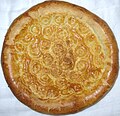
Tandyr nan is a type of Central Asian bread[1][2] cooked in a vertical clay oven, the tandyr or tandoor. It is circular and leavened with yeast, and typically has a crisp golden surface. They are often decorated by stamping patterns on the dough, and can be topped with ingredients like sesame seeds, nigella seeds, or thinly sliced onion.[3]

Preparation

[edit]

Large tandyr ovens used to bake nan as well as cook meat are typically located outdoors. Unlike Indian tandoor ovens, in Central Asia the tandyr can be used in a vertical or horizontal position, although the bread is always baked in the fashion of a vertical oven, with the bread stuck onto the inner walls of the oven.[1] The leavening can derive from sourdough starter, as is traditional, or from brewers yeast.[1] Several filled variants of the bread exist, such as Uyghur gosh nan and Turkmen atli nan. Bakers of nan are called nonvoys.[4]

Designs

[edit]

Nan is often decorated with a central design in the shape of a circle consisting of patterned dots. This design is created with a stamp known in Uzbekistan as a chekich or in Turkmenistan or by Uyghurs in Xinjiang as durtlik.[1][4] In addition to giving each bakery's nan a distinct design, the holes created by the chekich allow steam to rise from the flattened interior part of the nan. A radial pattern of slashes or dots can also be added with a bosma, a tool often made with reused bicycle spokes.[1][3] Other bakers may use a chekich several times on the surface of their nan.[3] Nan for festive occasions may have more elaborate designs or color added. Nan for engagements is often colored pink and yellow.[3][4]

Cultural significance

[edit]

In Uzbek culture, non has great cultural importance and is used in many ceremonies marking phases of life. Newborn babies have non placed under their heads to symbolize long life, and toddlers learning to walk have non placed between their legs to signify wishes of a blessed journey through life. Non is an essential wedding food, and on the day of the wedding, a bride and groom take bites of a non each, and finish it the following morning for their first breakfast as husband and wife. A similar tradition is also done when a son leaves for military service or to work or study abroad: the son will take bites of two non and they will be dried and hung on the ceiling until he returns.[3][4]

Non is treated as an important object, and should not be placed on the ground or cut with a knife (it is almost always broken by hand). If non is dropped, it should be placed on a wall or in a tree for birds, and the phrase aysh Allah (God's bread) is spoken aloud.[3]

Names

[edit]
  • Kazakh, Kyrgyz: nan (нан), tandyr nan (тандыр нан)
  • Tajik: non (нон)
  • Turkmen: tamdyr çörek
  • Uyghur: nan (نان), tonur nan (تونۇر نان)
  • Uzbek: non, tandir non
  • Chinese: náng (; )
  • Russian: lepyoshka (лепёшка), tadyrnaya lepyoshka (тандырная лепёшка)

Varieties

[edit]

Obi non

[edit]

Obi non or lepyoshka (лепёшка, "flatbread"), is a kind of flatbread in Afghan, Tajik and Uzbek cuisine. It is shaped like a disc and thicker than naan. Obi non are baked in clay ovens called tandyr.[5][6]

Tohax

[edit]

Tohax (тоқаш/toqash, токоч, توغاچ, Тоғач, Samarqand noni/Самарқанд нони), also known as toqach or toghach, is a type of tandyr bread consumed within the Xinjiang Uyghur Autonomous Region[7] of China, as well as in many regions of Central Asia (Kazakhstan, Kyrgyzstan, Uzbekistan).[8]

[edit]

See also

[edit]

References

[edit]
Revisions and contributorsEdit on WikipediaRead on Wikipedia
from Grokipedia
Tandyr nan is a traditional leavened originating from , baked in a vertical clay known as a tandyr, which produces a circular approximately 20-30 cm in diameter with a crispy, golden-brown crust and a soft, chewy interior. The origins of tandyr nan trace back to ancient baking techniques over 5,000 years old, with the oven first documented in around 2700 BCE and the term "non" deriving from Persian words for wheat-flour leavened bread, spreading through the , , and the via trade and migration. It is particularly associated with the cuisines of , , , , , and the region of , where regional variations like obi non (Uzbek) or tohax (Kazakh) reflect local adaptations in density, flavorings, and decorations. Preparation involves kneading a simple dough of wheat flour, water, salt, yeast, and sometimes milk or butter, allowing it to rise before dividing into rounds about 1-2 cm thick, which are then stamped with patterns using a chekich tool to create decorative motifs and release steam for even baking. The shaped dough is pressed onto the preheated inner walls of the tandyr oven, which reaches temperatures around 315°C, and bakes for a few minutes, imparting a slightly smoky aroma and char spots. Variations may include toppings like sesame or nigella seeds, or fillings such as onions in certain styles like patyr from Samarkand. In Central Asian cultures, tandyr nan holds profound significance as a and symbol of , sustenance, and respect, often torn by hand rather than cut with a knife to honor its sacred status, and featured in daily meals, rituals such as weddings and newborn blessings, and communal gatherings. Uzbek proverbs underscore its cultural weight, equating respect for the with respect for , while in it embodies nomadic heritage and is commonly offered to guests. It is typically served warm with butter, tea, or as an accompaniment to dishes like , plov, or , reinforcing its role in both everyday nourishment and festive traditions.

Overview

Definition and characteristics

Tandyr nan is a traditional leavened originating from , particularly associated with countries such as , , , , , and in . It is prepared using a wheat-based that undergoes , setting it apart from unleavened breads common in the region. The bread is traditionally baked in a vertical clay oven called a tandyr, which imparts distinctive qualities to its final form. Physically, tandyr nan typically takes a circular, disk-shaped form, measuring approximately 20-30 cm in diameter and 2-3 in thickness, with a slightly depressed or hollow center that creates a raised rim around the edges. Its exterior develops a golden-brown crust, often featuring subtle char spots and intricate decorative patterns stamped into the before . The texture contrasts a crispy outer layer with a soft, airy, and chewy interior, achieved through the high-heat environment of the tandyr oven. This combination results in a that is both structurally firm and pleasantly yielding when torn by hand. Traditional preparations of tandyr nan rely on plant-based ingredients such as , , salt, and , though variations may include products like or . It is commonly served fresh and warm, emphasizing its role as an everyday accompaniment that highlights the simplicity and versatility of Central Asian culinary traditions.

Etymology and names

The name "tandyr nan" derives from two key linguistic elements central to Central Asian culinary traditions: "tandyr," referring to the distinctive clay oven, and "nan," denoting bread. The term "tandyr" represents a regional adaptation in of the Persian "tanur," which originates from the ancient Akkadian word "tinuru," meaning "oven" or "furnace," dating back over 5,000 years to Mesopotamian civilizations. This evolution underscores the oven's transmission from settled Persian societies to nomadic Turkic and Mongolian groups across . Meanwhile, "nan" (or "non") traces directly to , where it has signified bread since at least the Sasanian era in the CE, and even extended idiomatically to mean "to eat" in Middle Persian expressions like "nān xwardan." Regional variations in naming reflect the bread's cultural diffusion throughout , influenced by local languages and historical interactions along trade routes such as the . In , it is commonly known as obi non, emphasizing its baking on the hearth (with "obi" alluding to the fireside or base and "non" for bread). Turkmen speakers call it tamdyr çörek, where "tamdyr" echoes the and "çörek" is a Turkic term for bread or baked goods. Under Russian influence in the Soviet era, the name lepyoshka became widespread across , , and other areas, evoking a flat, stamped loaf. These names illustrate exchanges, blending Persian roots with Turkic and Mongolian nomadic adaptations, as the bread's terminology evolved with migrations and settled communities in the steppes and oases.

History

Origins

The baking traditions underlying tandyr nan trace back to ancient Central Asia, closely linked to the practices of early Indo-Iranian peoples who migrated into the region and adopted clay oven technologies from Persian and Near Eastern origins. These nomadic groups, precursors to later settled communities, utilized simple clay ovens known as tandyr or tanur—derived from the Akkadian term tinūru for mud ovens—to produce unleavened or lightly leavened flatbreads that were highly portable for pastoral lifestyles. The ovens themselves trace their roots to innovations dating back approximately 5,000 years, with cylindrical designs sunk into the earth and heated by wood or dung, facilitating the of wheat-based breads essential for daily sustenance. The spread of these baking practices was amplified by exchanges along the , where tandyr-like ovens facilitated the preparation of durable flatbreads for traders and travelers crossing . Archaeological evidence from sites in and supports this continuity, including cylindrical clay tandyrs discovered at Paykend near , radiocarbon-dated to the 9th–12th centuries CE, which contained grains indicative of production akin to tandyr nan. These finds highlight the oven's role in urban and caravan contexts, reflecting adaptations of ancient techniques to regional and trade networks. Following the Islamic conquests in the 8th century CE, tandyr nan developed into a staple among settled communities in , integrating leavening influenced by Persian methods and becoming a central element of daily diets in areas like and . This evolution marked a shift from purely nomadic portability to communal baking in bazaars and households, underscoring the bread's enduring adaptation to cultural and environmental changes in the region.

Spread and evolution

The dissemination of tandyr nan across Eurasia began with ancient trade routes, particularly the , which facilitated the exchange of culinary practices from through to regions like in . Archaeological evidence indicates that clay oven baking, central to tandyr nan production, originated over 5,000 years ago in and spread eastward via nomadic migrations and merchant caravans, adapting to local tastes while maintaining its core method. Russian imperial and subsequent Soviet influences extended its reach, introducing tandyr nan to urban centers in , , and , where it was rebranded as lepyoshka—a Russian term for flatbreads—and integrated into state-supported food systems across the Central Asian republics. In , Uyghur communities adopted the bread as nang, baking it in vertical tandoors transported along the from Indian traders around the (130 BCE), blending it with local nomadic diets for portability during long journeys. This adaptation reflected centuries of cultural exchange, with the oven's arrival enabling naan-like breads to sustain caravans and later become a daily staple in and other oases. During the 19th and 20th centuries, urbanization in transformed tandyr nan production, as growing cities like and saw the rise of commercial tandyr bakeries that scaled output for markets while rural households preserved artisanal home baking traditions using family ovens. Soviet policies standardized lepyoshka in collective farms and urban bakeries, emphasizing uniform yeast-leavened recipes to support industrial , yet regional patterns persisted in decorations and oven techniques. Post-colonial independence in the 1990s prompted further evolutions, with bakers incorporating local flours like barley in arid Kazakh steppes or adjusting leavening for milder climates in , enhancing resilience amid economic shifts. In recent decades, tandyr nan has experienced revival among Central Asian diaspora communities in and , where immigrants from and operate specialized bakeries in cities like New York and , recreating traditional recipes to foster and introduce the bread to global palates. These efforts, often tied to markets and festivals, emphasize authentic tandyr ovens to counter homogenization, drawing on Soviet-era lepyoshka familiarity among Russian-speaking expatriates.

Preparation

Ingredients

The primary ingredients for tandyr nan, a traditional Central Asian flatbread, are wheat flour, water, salt, and a leavening agent such as yeast or sourdough starter. Wheat flour serves as the foundational component, providing the structure and chewiness essential to the bread's texture; high-gluten varieties derived from hard local wheats, common in regions like Uzbekistan and Kyrgyzstan, are preferred for their ability to form a strong, elastic dough that adheres well to the tandyr oven walls during baking. Water hydrates the flour to develop gluten, while salt enhances flavor and strengthens the dough by tightening the protein network, typically comprising 0.4-2.5% of the flour weight. Yeast or sourdough starter introduces fermentation for leavening, allowing the dough to rise over 8-12 hours in traditional preparations; commercial yeast is used at 0.02-1.6% (dry or fresh basis), with sourdough preferred in household settings for its natural acidity and extended proofing time. A standard ratio for the basic dough is approximately 500 g of flour to 300 ml of (about 60% hydration), adjusted slightly for regional preferences in dough stiffness. Variations in ingredient quality reflect local availability and tradition, with Central Asian hard wheats imparting a distinctive chewiness due to their higher protein content (27-30% wet in first-grade ). Occasional non-core additions, such as or seeds, may be incorporated for subtle flavor and texture, particularly in Uzbek styles, but these are not essential to the plain . The basic formulation remains all-natural and vegan, eschewing , fats, or to emphasize the bread's reliance on the tandyr's intense heat for flavor development, though optional inclusions like oil (up to 6%) or (up to 24%) appear in some Kyrgyz or festive variants for added richness.

Baking process

The baking process for tandyr nan begins with dough preparation, where the ingredients are mixed into a cohesive mass and kneaded vigorously for 10-15 minutes to develop gluten structure, ensuring the dough achieves elasticity suitable for adhesion in the oven. This step is crucial for the bread's texture, as insufficient kneading can result in a dense crumb. Following kneading, the dough is covered and allowed to rest for fermentation, typically 4-12 hours at room temperature, during which yeast activity produces carbon dioxide and enhances flavor through natural leavening. Once fermented, the is divided into equal portions and shaped into balls, which are then flattened by hand into thin disks approximately 20-25 cm in diameter, with a slightly thicker rim to promote even baking. These disks are lightly moistened with on one side to facilitate , then pressed firmly against the inner walls of the preheated , a cylindrical clay structure fired with wood to reach temperatures of 400-500°C, where radiant from the walls cooks the rapidly. The generated from the not only helps the stick to the hot clay surface, preventing it from falling, but also contributes to crust formation by maintaining moisture during the initial baking phase, resulting in a crisp exterior. Baking occurs in 2-5 minutes per , depending on and thickness, with the puffing slightly as it bakes and developing characteristic blisters and char marks from direct contact with the oven walls. Removal requires skill to avoid dislodging the prematurely; bakers use a hooked metal tool or long-handled peel to gently lift and extract the finished nan, ensuring it detaches cleanly without tearing. The tandyr's construction as a vertical clay , often insulated and fueled by wood or , allows for efficient retention and multiple batches, but demands expertise to manage the intense conditions and prevent loaves from slipping.

Designs and decoration

Tandyr nan features intricate designs imprinted on the surface prior to , primarily using a tool known as the chekich, which consists of a wooden fitted with metal pins or a metal stamp to create perforated patterns. These stamps are pressed into the central area of the flattened to form geometric or floral motifs, such as single flower centers or rows of indentations, enhancing both the bread's appearance and its performance. In some cases, a complementary tool called the bosma—a simpler stamp often made from repurposed metal spokes—is used to add radial or spoke-like lines around the edges, completing the decorative scheme. The primary technique involves docking the with the chekich after shaping but before applying a light brushing of oil or milk-water mixture, which helps the patterns adhere and promotes even adhesion to the tandyr oven walls during . Common motifs include floral centers in Tashkent-style and more elaborate rows of perforations in Khorezm varieties, achieved by multiple presses of the tool to ensure depth without tearing the . These designs not only serve aesthetic purposes but also fulfill practical functions: the perforations act as vents to release , preventing excessive bubbling or uneven rising that could cause the to detach from the oven walls or cook inconsistently. Over time, these patterns have evolved from purely utilitarian piercings to more artistic expressions, incorporating seeds like or along the edges for added texture and visual appeal. Design variations in tandyr nan are often region-specific or family-specific, with patterns passed down through generations as markers of local identity or individual bakers. For instance, non typically displays a lighter, single central motif suited to its thicker, softer form, while Khorezm bread favors flatter profiles with linear rows that emphasize crispiness. In urban settings like or , denser breads may incorporate denser perforations to suit their darker crusts, reflecting adaptations to local oven conditions and types. These distinctive imprints allow consumers to identify the origin or maker of the bread, turning decoration into a subtle form of branding within communities.

Varieties

Obi non

Obi non is the quintessential Uzbek variety of tandyr nan, distinguished by its hearth-style baking and robust form, typically measuring several centimeters in thickness with a pronounced shallow depression in the center that creates a hollow appearance. This leavened features a denser, heavier crust compared to thinner regional variants, contributing to its chewy texture and ability to hold up as a staple alongside hearty dishes. Often topped with or seeds for added flavor and visual appeal, obi non is traditionally baked in community ovens known as obi, where high heat—reaching around 315°C—produces a golden, smoky exterior while keeping the interior soft. Preparation of obi non emphasizes a longer fermentation process using sourdough starter, often prepared the night before and allowing the dough to rise for several hours, which develops its characteristic denser texture and subtle tangy flavor. The dough, primarily composed of wheat flour, water, salt, and yeast or sourdough, is kneaded, stamped with intricate patterns using tools like the chekich for decoration and even baking, then proofed briefly before being adhered to the walls of the preheated tandoor. This method, common in regions like Samarkand and Tashkent, results in variations: Samarkand obi non tends to be denser and darker-crusted, ideal for gifting, while Tashkent versions are lighter and more chewy, frequently sprinkled with nigella seeds. The name "obi non" derives from the hearth oven tradition central to its production, reflecting its deep roots in Uzbek daily life. As an integral element of Uzbek culinary heritage, obi non plays a key role in communal feasts, particularly those featuring plov, where it is torn by hand and used to scoop the rice . Its versatility extends to pairing with soups, cheeses, and salads.

Tohax

Tohax is a thinner, crispier variety of tandyr nan, typically 1-2 cm thick, that is particularly popular in and among Kazakh communities. This flatbread reflects influences from Chinese-Muslim adaptations in the Uyghur region, where it integrates with local baking traditions while maintaining Central Asian roots. Distinguished by its decorative patterns using tools like the chekich and emphasis on uniformity, tohax often features a smaller of 20-30 cm, facilitating quicker in the tandyr . Preparation centers on a shorter of 2-4 hours and prioritizes the natural flavor through basic ingredients like , , salt, and , without additional additives. Well-suited to nomadic diets due to its portability and ease of production in mobile tandyr , tohax serves as a staple for Kazakh herders and Uyghur communities alike.

Other regional variations

In , tandyr nan exhibits numerous local adaptations that incorporate subtle differences in dough composition and flavor profiles to suit regional tastes and availability. These home-baked loaves maintain the characteristic crisp exterior and soft interior while reflecting nomadic influences on portability and simplicity. Turkmen tamdyr çörek represents a distinctive of tandyr-baked , typically featuring savory inclusions such as onions or to impart a flavorful twist that complements meat-based dishes. This variation uses a yeast-leavened , baked vertically in the tamdyr oven to achieve a golden, textured crust. The incorporation of local underscores the bread's role as a versatile staple in Turkmen meals. In , non—often referred to as noni tandoori—closely resembles obi non but tends to be flatter and chewier, with a pronounced crust achieved through high-heat tandyr , and is frequently topped with or black seeds for added aroma and crunch, though seeds appear in some festive preparations. This style draws heavily from Persian culinary traditions, evident in the use of simple bases enriched occasionally with , , or herbs like onions for variety, resulting in a that is both everyday essential and symbolically sacred. Tajik non is marked with intricate patterns using a chekich stamp, emphasizing communal practices. Across these regions, adaptations of tandyr nan often mirror local , such as the substitution of for in mountainous areas of and , where thrives in high-altitude terrains and yields a denser, more nutritious loaf suited to harsh climates. In urban settings, particularly in cities like and , traditional tandyr baking has evolved with the use of modern home ovens to replicate the bread's texture, allowing families to maintain cultural practices without specialized clay ovens while adjusting recipes for convenience. These changes preserve the bread's centrality in daily life without compromising its leavened, circular form.

Cultural significance

Role in daily life and cuisine

Tandyr nan functions as a in Central Asian households, integral to daily meals across countries like , , and , where it is consumed fresh at , , and , particularly in rural areas. It is typically torn into pieces by hand—never cut with a out of respect—and shared communally during gatherings, serving as a versatile accompaniment to hearty soups such as shorpo, meat-based dishes like plov or kebabs, and , which together form the core of everyday . This practice underscores its role in fostering social bonds and providing a practical base for sopping up sauces and broths. Nutritionally, tandyr nan delivers primary carbohydrates from , offering sustained energy and acting as a fundamental source of calories in diets that rely heavily on grains, especially in rural communities where access to diverse foods may be limited. Its simple composition—primarily , water, , and salt—ensures it remains an affordable, filling element that supports physical labor-intensive lifestyles common in the region. In terms of economic and social structure, tandyr nan is commonly baked in neighborhood tandyr houses or communal clay ovens operated by local bakers, who fire up the ovens daily to produce hundreds of loaves for surrounding residents, ensuring widespread access to warm, fresh without individual households needing their own equipment. This communal model not only keeps costs low but also promotes freshness, as deliveries occur via or on foot shortly after , strengthening ties through shared reliance on these local hubs. Due to its optimal texture and flavor lasting only a few hours after removal from the tandyr, tandyr nan is prioritized for immediate consumption to avoid staleness; any remnants are repurposed to minimize waste, often crumbled into soups for added bulk or fed to livestock, reflecting a practical approach to resource conservation in daily routines.

Traditions and symbolism

In Central Asian cultures, particularly among Uzbeks and Kyrgyz, the round shape of tandyr nan symbolizes unity, life, and the sun, reflecting communal harmony and the cyclical nature of existence. The bread's circular form, achieved through baking in a vertical clay tandyr oven, evokes prosperity and familial bonds, with decorative patterns often embossed to represent solar motifs and blessings for abundance. Breaking tandyr nan by hand, rather than cutting it, signifies , , and , a deeply embedded in social interactions. This act is central to welcoming guests, who are traditionally offered with salt as a of goodwill and inclusion into the community. In rituals, such as placing the bread under a newborn's head for or between a child's legs to bless their life's path, it embodies protective and auspicious meanings. Tandyr nan holds a prominent role in life-cycle events and festivals, including weddings, celebrations, and funerals, where it is baked specially to mark transitions and communal gatherings. At engagements and weddings, pairs of colored loaves are broken and shared to seal alliances, while the bride and groom bite into loaves together, and an elder woman holds bread over the 's head while reciting blessings from the Qur’an. For , the spring festival, and funerals, the bread is distributed to honor renewal, remembrance, and shared mourning, reinforcing social ties. Women often lead the home baking of tandyr nan as a cultural rite, preserving recipes and techniques passed down through generations, though professional tandyr bakeries are typically male-dominated. This practice fosters intergenerational knowledge and strengthens household identity, with women also playing key roles in ritual preparations. Communal in neighborhood tandyr ovens or during builds neighborhood ties, as collaborate to produce and share loaves, promoting solidarity and collective identity. Patterns stamped on the , created with wooden chekich tools, convey heritage, regional styles, and wishes for blessings like and , distinguishing one household's bread from another's. In 2024, recognized tandir craftsmanship and bread baking traditions—sharing the vertical clay oven central to tandyr nan—as part of UNESCO's Representative List of the of Humanity, underscoring the regional importance of these practices.

References

Add your contribution
Related Hubs
User Avatar
No comments yet.