

Vatican Library
View on Wikipedia
Key Information


 |
| This article is part of a series on |
| Vatican City |
|---|

The Vatican Apostolic Library (Latin: Bibliotheca Apostolica Vaticana, Italian: Biblioteca Apostolica Vaticana), more commonly known as the Vatican Library or informally as the Vat,[1] is the library of the Holy See, located in Vatican City, and is the city-state's national library. It was formally established by Pope Sixtus IV on June 15, 1475, by the papal bull Ad decorem militantis ecclesiae[2], although it is much older. It is one of the oldest libraries in the world and contains one of the most significant collections of historical texts. It has 75,000 codices from throughout history, as well as 1.1 million printed books, which include some 8,500 incunabula.[3]
The Vatican Library is a research library for history, law, philosophy, science, and theology. The Vatican Library is open to anyone who can document their qualifications and research needs. Photocopies for private study of pages from books published between 1801 and 1990 can be requested in person or by mail.
Pope Nicholas V (1447–1455) envisioned a new Rome, with extensive public works to lure pilgrims and scholars to the city to begin its transformation. Nicolas wanted to create a "public library" for Rome that was meant to be seen as an institution for humanist scholarship. His death prevented him from carrying out his plan, but his successor Pope Sixtus IV (1471–1484) established what is now known as the Vatican Library.
In March 2014, the Vatican Library began an initial four-year project of digitising its collection of manuscripts, to be made available online.
The Vatican Apostolic Archive was separated from the library at the beginning of the 17th century; it contains another 150,000 items.
Historical periods
[edit]Scholars have traditionally divided the history of the library into five periods: Pre-Lateran, Lateran, Avignon, Pre-Vatican and Vatican.[4]
Pre-Lateran
[edit]The Pre-Lateran period, comprising the initial days of the library, dating from the earliest days of the Church. Only a handful of volumes survive from this period, though some are very significant.
At the Lateran
[edit]The Lateran era began when the library moved to the Lateran Palace and lasted until the end of the 13th century and the reign of Pope Boniface VIII, who died in 1303, by which time he possessed one of the most notable collections of illuminated manuscripts in Europe. However, in that year, the Lateran Palace was burnt and the collection plundered by Philip IV of France.[5]
At Avignon
[edit]The Avignon period was during the Avignon Papacy, when seven successive popes resided in Avignon, France. This period saw great growth in book collection and record-keeping by the popes in Avignon, between the death of Boniface and the 1370s when the papacy returned to Rome.
Prior to establishment at the Vatican
[edit]The Pre-Vatican period ranged from about 1370 to 1447. The library was scattered during this time, with parts in Rome, Avignon, and elsewhere. Pope Eugenius IV possessed 340 books by the time of his death.[6]
At the Vatican
[edit]In 1451, bibliophile Pope Nicholas V sought to establish a public library at the Vatican, in part to re-establish Rome as a destination for scholarship.[7][8] Nicholas combined some 350 Greek, Latin and Hebrew codices inherited from his predecessors with his own collection and extensive acquisitions, among them manuscripts from the imperial Library of Constantinople. Pope Nicholas also expanded his collection by employing Italian and Byzantine scholars to translate the Greek classics into Latin for his library.[8] The knowledgeable pope already encouraged the inclusion of pagan classics.[1] Nicolas was important in saving many of the Greek works and writings during this time period that he had collected while traveling and acquired from others.
In 1455, the collection had grown to 1200 books, of which 400 were in Greek.[9]
Nicholas died in 1455. In 1475 his successor Pope Sixtus IV founded the Palatine Library.[8] During his papacy, acquisitions were made in "theology, philosophy and artistic literature".[5] The number of manuscripts is variously counted as 3,500 in 1475[5] or 2,527 in 1481, when librarians Bartolomeo Platina and Pietro Demetrio Guazzelli produced a signed listing.[10][11][12] At the time it was the largest collection of books in the Western world.[9]
Pope Julius II commissioned the expansion of the building.[8] Around 1587, Pope Sixtus V commissioned the architect Domenico Fontana to construct a new building for the library, which is still used today. After this, it became known as the Vatican Library.[8]
During the Counter-Reformation, access to the library's collections was limited following the introduction of the Index of banned books. Scholars' access to the library was restricted, particularly Protestant scholars. Restrictions were lifted during the course of the 17th century, and Pope Leo XIII was to formally reopen the library to scholars in 1883.[7][8]
In 1756, the priest Antonio Piaggio, curator of ancient manuscripts at the Library used a machine he had invented[13] to unroll the first Herculaneum papyri, an operation which took him months.[14]
In 1809, Napoleon Bonaparte arrested Pope Pius VII and had the contents of the library seized and removed to Paris. They were returned in 1817, three years after Napoleon's defeat and abdication.[8]
The library's first major revitalization project took place in the period between the two World Wars at the instigation of Pope Pius XI, himself a scholar and former librarian, with the cooperation of librarians from around the world. Until this point in time, while it had drawn on the expertise of numerous experts, the Vatican Library was dangerously lacking in organization and its junior librarians were undertrained.[15] Foreign researchers, particularly Americans, noticed how inadequate the facilities were for such an important collection. Several American organizations, including the American Library Association and the Carnegie Endowment for International Peace, offered to assist in implementing a modern cataloguing system.[16] Along with this, librarians from the Vatican Library were invited to visit several libraries in the United States to receive training on the functioning of a modern library. They visited the Library of Congress, and libraries in Princeton, Philadelphia, Baltimore, Pittsburg, Chicago, Champaign, Toronto, and Ann Arbor. Once back in Rome, a reorganization plan was implemented. The main goals were to create a summary index by author of each manuscript, and likewise a catalogue for the incunabula. Once the project was completed, the Vatican Library was one of the most modern in all of Europe. This joint effort highlighted the importance of international relationships in the field of librarianship and led to the founding in 1929 of the International Federation of Library Associations, still at work.[15]
In 1992 the library had almost 2 million catalogued items.[7]
Among a number of thefts from the Library committed in modern times, in 1995 art history teacher Anthony Melnikas from Ohio State University stole three leaves from a medieval manuscript once owned by Francesco Petrarch.[17][18] One of the stolen leaves contains an exquisite miniature of a farmer threshing grain. A fourth leaf from an unknown source was also discovered in his possession by U.S. Customs agents. Melnikas was trying to sell the pages to an art dealer, who then alerted the library director.[18]
Location and building
[edit]
The library is located inside the Vatican Palace, and the entrance is through the Belvedere Courtyard.[19] When Pope Sixtus V (1585–1590) commissioned the expansion and the new building of the Vatican Library, he had a three-story wing built right across Bramante's Cortile del Belvedere, thus bisecting it and changing Bramante's work significantly.[1] At the bottom of a grand staircase a large statue of Hippolytus decorates the La Galea entrance hall.[20]
In the first semi-basement there is a papyrus room and a storage area for manuscripts.[20] The first floor houses the restoration laboratory, and the photographic archives are on the second floor.[20]
The library has 42 kilometres (26 mi) of shelving.[21]
The library closed for renovations on 17 July 2007[22] and reopened on 20 September 2010.[23] The three-year, 9 million euro renovation involved the complete shut down of the library to install climate controlled rooms.[24]
Architecture and art
[edit]In the Sala di Consultazione or main reference room of the Vatican Library looms a statue of St Thomas Aquinas (c. 1910), sculpted by Cesare Aureli. A second version of this statue (c. 1930) stands under the entrance portico of the Pontifical University of St Thomas Aquinas, Angelicum.[a][26]
-
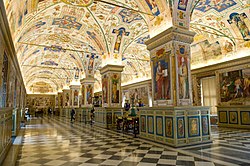 The Sistine Hall of the Vatican Library
 -
 Golden Rose stored in the Vatican Library
 -
 Ceiling fresco of the Sistine Hall (photograph by Jean-Pol Grandmont)
.jpg)

.jpg)
Library organization
[edit]Catalogue
[edit]The collection was originally organized through notebooks used to index the manuscripts. As the collection grew to more than a few thousand, shelf lists were used.[8] The first modern catalogue system was put in place under Father Franz Ehrle between 1927 and 1939, using the Library of Congress card catalogue system. Ehrle also set up the first program to take photographs of important works or rare works.[8] The library catalogue was further updated by Rev. Leonard E. Boyle when it was computerized in the early 1990s.[8]
Reading and lending
[edit]
Historically, during the Renaissance era, most books were not shelved but stored in wooden benches, which had tables attached to them. Each bench was dedicated to a specific topic. The books were chained to these benches, and if a reader took out a book, the chain remained attached to it. Until the early 17th century, academics were also allowed to borrow books. For important books, the pope himself would issue a reminder slip.[8] Privileges to use the library could be withdrawn for breaking the house rules, for instance by climbing over the tables. Most famously Pico Della Mirandola lost the right to use the library when he published a book on theology that the Papal curia did not approve of.[27] In the 1760s, a bill issued by Clement XIII heavily restricted access to the library's holdings.[1]
The Vatican Library can be accessed by 200 scholars at a time,[28] and it sees 4,000 to 5,000 scholars a year, mostly academics doing post-graduate research.[24]
Collections
[edit]
While the Vatican Library has always included Bibles, canon law texts, and theological works, it specialized from the beginning in secular books. Its collection of Greek and Latin classics was at the center of the revival of classical culture during the Renaissance.[9] The oldest documents in the library date back to the first century.[21]
The library was founded primarily as a manuscript library, a fact reflected in the comparatively high ratio of manuscripts to printed works in its collection. Such printed books as have made their way into the collection are intended solely to facilitate the study of the much larger collection of manuscripts.[29]
The collection also includes 330,000 Greek, Roman, and papal coins and medals.[7]
Every year about 6,000 new books are acquired.[7]
The library was enriched by several bequests and acquisitions over the centuries.
In 1623, in thanks for the adroit political maneuvers of Pope Gregory XV that had sustained him in his contests with Protestant candidates for the post of Elector, the hereditary Palatine Library of Heidelberg, containing about 3,500 manuscripts, was given to the Holy See by Maximilian I, Duke of Bavaria. He had just acquired it as loot in the Thirty Years' War. A token 39 of the Heidelberg manuscripts were sent to Paris in 1797 and were returned to Heidelberg at the Peace of Paris in 1815. A gift of 852 others was made in 1816 by Pope Pius VII to the University of Heidelberg. Aside from these cases, the Palatine Library remains in the Vatican Library to this day.
In 1657, the manuscripts of the Dukes of Urbino were acquired. In 1661, the Greek scholar Leo Allatius was made librarian.
Queen Christina of Sweden's important library (mostly amassed by her generals as loot from Habsburg Prague and German cities during the Thirty Years' War) was purchased on her death in 1689 by Pope Alexander VIII. It represented, for all practical purposes, the entire royal library of Sweden at the time. Had it remained where it was in Stockholm, it would all have been lost in the destruction of the royal palace by fire in 1697.
Among the most famous holdings of the library is the Codex Vaticanus Graecus 1209, the oldest known nearly complete manuscript of the Bible. The Secret History of Procopius was discovered in the library and published in 1623.
Pope Clement XI sent scholars into the Orient to bring back manuscripts, and is generally regarded as the founder of the library's Oriental section.[8]
A School of library science is associated with the Vatican Library.
In 1959, the Vatican Film Library was established.[30] This is not to be confused with the Knights of Columbus Vatican Film Library, which was established in 1953 at Saint Louis University in St. Louis, Missouri.
The library has a large collection of texts related to Hinduism, with the oldest editions dating to 1819.[31]
During the library's restoration between 2007 and 2010, all of the 70,000 volumes in the library were tagged with electronic chips to prevent theft.[24]
Manuscripts
[edit]

Notable manuscripts in the library include:
Manuscripts relating to Christianity
[edit]- Codex Vaticanus Graecus 1209, one of the oldest extant Bibles in Greek language
- Barberini Gospels
- Gelasian Sacramentary, one of the oldest books on Christian liturgy
- Joshua Roll
- Lorsch Gospels, an illuminated gospel book written and illustrated from 778 to 820, which is spread up between various museums. The carved ivory rear cover and the Gospels of Luke and John are kept in the Vatican Library
- Menologion of Basil II[32]
- Vatican Croatian Prayer Book
- Three fragments of the Old Saxon Genesis and one fragment of Heliand comprise the Palatinus Latinus 1447[33]
- Libri Carolini
Classic Greek and Latin texts
[edit]- Vergilius Vaticanus
- Vergilius Romanus
- Vergilius Augusteus, four leaves are at the Vatican Library with three leaves at Berlin State Library[34]
- Codex Vaticanus Ottobonianus Latinus 1829, an important 14th-century manuscript of Catullus' poems
- Codex Vaticanus Latinus 3868, a 9th-century facsimile of Terence's comedies[35]
- Parts of Euclid's Elements, most notable Book I, Proposition 47, one of the oldest Greek texts on the Pythagorean Theorem[1]
Medieval Greek and Latin texts
[edit]- Codex Vaticano Rossi 215, fragments of the Rossi Codex[36]
- Vaticanus Graecus 1001, the original manuscript of the Secret History[37]
- De arte venandi cum avibus, a Latin treatise on falconry in the format of a two-column parchment codex of 111 folios written in the 1240s
Others
[edit]- Codex Borgia, an extensive Mesoamerican manuscript that depicts mythology and foundational rituals in the hieroglyphic texts and iconography made of animal skins
- Codex Vat. Arabo 368, the sole manuscript of the Hadith Bayad wa Riyad, an Arabic love story[38]
- Codex Vaticanus 3738, the Codex Ríos,[39] an accordion folded Italian translation of a Spanish colonial-era manuscript, with copies of the Aztec paintings from the original Codex Telleriano-Remensis, believed to be written by the Dominican friar Ríos in 1566
- Borgiani Siriaci 175, a manuscript scroll of the Diwan Abatur, a Mandaean text[40]
Qurans
[edit]The library contains over 100 Quran manuscripts from various collections, cataloged by the Italian Jewish linguist Giorgio Levi Della Vida: Vaticani arabi 73; Borgiani arabi 25; Barberiniani orientali 11; Rossiani 2. The largest manuscript in the library, Vat. Ar. 1484, measures 540x420mm. The smallest, Vat. Ar. 924, is a circle of 45mm diameter preserved in an octagonal case.[41]
Digitization projects
[edit]In 2012, plans were announced to digitize, in collaboration with the Bodleian Library, a million pages of material from the Vatican Library.
On 20 March 2014, the Holy See announced that NTT Data Corporation and the library had concluded an agreement to digitize approximately 3,000 of the library's manuscripts within four years.[42] NTT is donating the equipment and technicians, estimated to be worth 18 million euros.[43] It noted that there is the possibility of subsequently digitizing another 79,000 of the library's holdings. These will be high-definition images available on the library's Internet site. Storage for the holdings will be on a three petabyte server provided by EMC.[44] It is expected that the initial phase will take four years.[45]
DigiVatLib is the name of the Vatican Library's digital library service. It provides free access to the Vatican Library's digitized collections of manuscripts and incunabula.[46]
The scanning of documents is impacted by the material used to produce the texts. Books using gold and silver in the illuminations require special scanning equipment.[28] Digital copies are being served using the CIFS protocol, from network-attached storage hardware by Dell EMC.[21]
Gallery of holdings
[edit]-
 Gospel of Matthew in Persian, the first Persian manuscript to enter the Vatican Library
 -
 Manuscript page with the five-voice "Kyrie" of the Missa Virgo Parens Christi by Jacques Barbireau
 -
 Mappamondo Borgiano, also known as "Tavola di Velletri", consisting of two copper tablets (1430)
 -
 Month of May from in the Chronography of 354 by the 4th century calligrapher Filocalus
 -
 Anton Raphael Mengs, The Triumph of History over Time (Allegory of the Museum Clementinum), ceiling fresco in the Camera dei Papiri, Vatican Library
 -
 Illumination from the legend of Saint Emeric of Hungary, c. 1335
 -
 Battle between David and Goliath, Book of Psalms, c. 1059
 -
 The ivory panels from the back cover of Codex Aureus of Lorsch
.jpg)


,_ceiling_fresco_in_the_Camera_dei_Papiri,_Vatican_Library,_1772_-_M0tty.jpg)


Related libraries
[edit]Vatican Apostolic Archive
[edit]The Vatican Apostolic Archive, located in Vatican City, is the central archive for all of the acts promulgated by the Holy See, as well as the state papers, correspondence, papal account books,[47] and many other documents which the church has accumulated over the centuries. In the 17th century, under the orders of Pope Paul V, the Archives were separated from the Vatican Library, where scholars had some very limited access to them, and remained absolutely closed to outsiders until 1881, when Pope Leo XIII opened them to researchers, more than a thousand of whom now examine its documents each year.[48]
Vatican Film Library
[edit]The Vatican Film Library in St. Louis, Missouri is the only collection, outside the Vatican itself, of microfilms of more than 37,000 works from the Biblioteca Apostolica Vaticana, the Vatican Library in Europe. It is located in the Pius XII Library on the campus of Saint Louis University.[49] The library was created by Lowrie J. Daly (1914–2000), with funding from the Knights of Columbus.[50] The goal was to make Vatican and other documents more available to researchers in North America.[51]
Microfilming of Vatican manuscripts began in 1951, and according to the library's website, was the largest microfilming project that had been undertaken up to that date.[52] The library opened in 1953, and moved to the St. Louis University campus, in the Pius XII Memorial Library, in 1959. The first librarian was Charles J. Ermatinger, who served until 2000. As of 2007[update], the library has microfilmed versions of over 37,000 manuscripts, with material in Greek, Latin, Arabic, Hebrew and Ethiopic, as well as several more common Western European languages. There are reproductions of many works from the Biblioteca Palatina and Biblioteca Cicognara at the Vatican, as well as Papal letter registers from the Archivio Segreto Vaticano (Vatican Secret Archives) from the 9th to 16th centuries, in the series Registra Vaticana and Registra Supplicationium.[53]
Staff
[edit]The nominal head of the library has often over the centuries been made a cardinal and hence given the title Cardinal Librarian.[8] The effective directors, often distinguished scholars, were in an earlier period called "Custodians.[8] After the reopening of the library in 1883, Pope Leo XIII changed the title to Prefect.[8][54][55]
The library currently has some 80 staff who work in five departments: manuscripts and archival collections, printed books/drawings, acquisitions/cataloguing, coin collections/museums and restoration/photography.[7]
List of librarians
[edit](P) Indicates time spent as pro-librarian, that is acting librarian, often a librarian who is not a cardinal.[56]
| Name | Lifetime | Title | Duration as librarian[57][58] |
|---|---|---|---|
| Marcello Cervini | 1501–1555 | Bibliothecarius I | 24 May 1550–9 April 1555 |
| Roberto de' Nobili | 1541–1559 | Bibliothecarius II | 1555–18 January 1559 |
| Alfonso Carafa | 1540–1565 | Bibliothecarius III | 1559–29 August 1565 |
| Marcantonio da Mula | 1506–1572 | Bibliothecarius IV | 1565–17 March 1572[59] |
| Guglielmo Sirleto | 1514–1585 | Bibliothecarius V | 18 March 1572–16 October 1585 |
| Antonio Carafa | 1538–1591 | Bibliothecarius VI | 16 October 1585–13 January 1591 |
| Marco Antonio Colonna | 1523 ca.–1597 | Bibliothecarius VII | 1591–13 March 1597 |
| Cesare Baronio | 1538–1607 | Bibliothecarius VIII | May 1597–30 June 1607[60] |
| Ludovico de Torres | 1552–1609 | Bibliothecarius IX | 4 July 1607–8 July 1609 |
| Scipione Borghese Caffarelli | 1576–1633 | Bibliothecarius X | 11 June 1609–17 February 1618[61] |
| Scipione Cobelluzzi | 1564–1626 | Bibliothecarius XI | 17 February 1618–29 June 1626 |
| Francesco Barberini | 1597–1679 | Bibliothecarius XII | 1 July 1626–13 December 1633 |
| Antonio Barberini | 1569–1646 | Bibliothecarius XIII | 13 December 1633–11 September 1646 |
| Orazio Giustiniani | 1580–1649 | Bibliothecarius XIV | 25 September 1646–25 July 1649 |
| Luigi Capponi | 1583–1659 | Bibliothecarius XV | 4 August 1649–6 April 1659 |
| Flavio Chigi | 1631–1693 | Bibliothecarius XVI | 21 June 1659–19 September 1681[62] |
| Lorenzo Brancati | 1612–1693 | Bibliothecarius XVII | 19 September 1681–30 November 1693 |
| Girolamo Casanate | 1620–1700 | Bibliothecarius XVIII | 2 December 1693–3 March 1700 |
| Enrico Noris | 1631–1704 | Bibliothecarius XIX | 26 March 1700–23 February 1704 |
| Benedetto Pamphili | 1653–1730 | Bibliothecarius XX | 26 February 1704–22 March 1730 |
| Angelo Maria Querini | 1680–1755 | Bibliothecarius XXI | 4 September 1730–6 January 1755 |
| Domenico Passionei | 1682–1761 | Bibliothecarius XXII | 10 July 1741–12 January 1755(P) 12 January 1755–5 July 1761 |
| Alessandro Albani | 1692–1779 | Bibliothecarius XXIII | 12 August 1761–11 December 1779 |
| Francesco Saverio de Zelada | 1717–1801 | Bibliothecarius XXIV | 15 December 1779–29 December 1801 |
| Luigi Valenti Gonzaga | 1725–1808 | Bibliothecarius XXV | 12 January 1802–29 December 1808 |
| Giulio Maria della Somaglia | 1744–1830 | Bibliothecarius XXVI | 26 January 1827–2 April 1830 |
| Giuseppe Albani | 1750–1834 | Bibliothecarius XXVII | 23 April 1830–3 December 1834 |
| Luigi Lambruschini | 1776–1854 | Bibliothecarius XXVIII | 11 December 1834–27 June 1853 |
| Angelo Mai | 1782–1854 | Bibliothecarius XXIX | 27 June 1853–9 September 1854 |
| Antonio Tosti | 1776–1866 | Bibliothecarius XXX | 13 January 1860–20 March 1866 |
| Jean Baptiste François Pitra | 1812–1889 | Bibliothecarius XXXI | 19 January 1869–9 February 1889[63] |
| Placido Maria Schiaffino | 1829–1889 | Bibliothecarius XXXII | 20 February 1889–23 September 1889 |
| Alfonso Capecelatro | 1824–1912 | Bibliothecarius XXXIII | 29 August 1890–14 November 1912[64] |
| Mariano Rampolla del Tindaro | 1843–1913 | Bibliothecarius XXXIV | 26 November 1912–16 December 1913 |
| Francesco di Paola Cassetta | 1841–1919 | Bibliothecarius XXXV | 3 January 1914–23 March 1919 |
| Aidan [Francis Neil] Gasquet | 1845–1929 | Bibliothecarius XXXVI | 9 May 1919–5 April 1929 |
| Franz Ehrle | 1845–1934 | Bibliothecarius XXXVII | 17 April 1929–31 March 1934 |
| Giovanni Mercati | 1866–1957 | Bibliothecarius XXXVIII | 18 June 1936–23 August 1957 |
| Eugène Tisserant | 1884–1972 | Bibliothecarius XXXIX | 14 September 1957–27 March 1971 |
| Antonio Samoré | 1905–1983 | Bibliothecarius XL | 25 January 1974–3 February 1983 |
| Alfons Maria Stickler | 1910–2007 | Bibliothecarius XLI | 7 September 1983–27 May 1985(P) 27 May 1985–1 July 1988 |
| Antonio María Javierre Ortas | 1921–2007 | Bibliothecarius XLII | 1 July 1988–24 January 1992 |
| Luigi Poggi | 1917–2010[65] | Bibliothecarius XLIII | 9 April 1992–29 November 1994(P) 29 November 1994–25 November 1997 |
| Jorge María Mejía | 1923–2014 | Bibliothecarius XLIV | 7 March 1998–24 November 2003 |
| Jean-Louis Tauran | 1943–2018 | Bibliothecarius XLV | 24 November 2003–25 June 2007 |
| Raffaele Farina | 1933– | Bibliothecarius XLVI | 25 June 2007–9 June 2012 |
| Jean-Louis Bruguès | 1943– | Bibliothecarius XLVII | 26 June 2012–1 September 2018 |
| José Tolentino de Mendonça | 1965– | Bibliothecarius XLVIII | 1 September 2018–26 September 2022 |
| Angelo Vincenzo Zani | 1950– | Bibliothecarius XLIX | 26 September 2022–28 March 2025 |
| Giovanni Cesare Pagazzi | 1965– | 28 March 2025– |
See also
[edit]Notes
[edit]- ^ This sculpture is described in the following words: "S. Tommaso seduto, nella sinistra tiene il libro della Summa theologica, mentre stende la destra in atto di proteggere la scienza cristiana. Quindi non siede sulla cattedra di dottore, ma sul trono di sovrano protettore; stende il braccio a rassicurare, non a dimostrare. Ha in testa il dottorale berretto, e conservando il suo tipo tradizionale, rivela nel volto e nell'atteggiamento l'uomo profondamente dotto. L'autore non ha avuto da ispirarsi in altr'opera che esistesse sul soggetto, quindi ha dovuto, può dirsi, creare questo tipo, ed è riuscito originale e felice nella sua creazione."[25]
References
[edit]- ^ a b c d e Mendelsohn, Daniel (3 January 2011). "God's Librarians". The New Yorker. Vol. 86, no. 42. p. 24. ISSN 0028-792X. Archived from the original on 8 August 2014. Retrieved 3 August 2014.
- ^ "Origins of the Library", Vatican Library website, February 14, 2004
- ^ "The Vatican Library Goes Online and Digitizes Tens of Thousands of Manuscripts, Books, Coins, and More". Open Culture. 6 January 2020. Archived from the original on 22 April 2022. Retrieved 5 April 2022.
- ^ Strayer, Joseph, ed. (1989). Dictionary of the Middle Ages. Scribner. ISBN 0684190737.
- ^ a b c Wiegand, Wayne A.; Davis, Donald G., eds. (1994). Encyclopedia of Library History. New York: Garland. p. 653. ISBN 0824057872.
- ^ Mycue, David (1981). "Founder of the Vatican Library: Nicholas V or Sixtus IV?". The Journal of Library History. 16 (1). University of Texas Press: 121–133. JSTOR 25541179. Archived from the original on 14 February 2022. Retrieved 7 October 2020.
- ^ a b c d e f Bloom, Ocker. "The Vatican Library and its History". Ibiblio. Archived from the original on 10 February 2014. Retrieved 1 August 2014.
- ^ a b c d e f g h i j k l m n o Meert, Deborah. "A History of the Vatican Library". capping.slis.ualberta.ca. University of Alberta. Archived from the original on 8 December 2013. Retrieved 31 July 2014.
- ^ a b c "The Library of Congress: Rome Reborn: The Vatican Library & Renaissance Culture - The Vatican Library - The City Reborn: How the City Came Back to Life". Library of Congress. Retrieved 2 August 2014.
- ^ Clark, John Willis (1899). On the Vatican Library of Sixtus IV.
- ^ Zabughin, Vladimiro (1909). Giulio Pomponio Leto: saggio critico, Volume 1.
- ^ Müntz, Eugène (1886). La Bibliothèque Du Vatican Au Xvie Siècle.
- ^ Giacomo Castrucci (1856). "Tesoro letterario di Ercolano, ossia, La reale officina dei papiri ercolanesi".
- ^ "Herculaneum Papyri in the National Library in Naples". The Phraser. 2015. Archived from the original on 18 October 2017. Retrieved 17 October 2017.
- ^ a b Vincenti, Raffaella (2020). "The Vatican Library and the IFLA between 1928 and 1929". Journal of Education for Library and Information Science. 61 (3): 308–318. doi:10.3138/jelis.61.3.2020-0019. ISSN 0748-5786. S2CID 225396835. Archived from the original on 25 October 2022. Retrieved 28 November 2022.
- ^ Patrick Valentine (2010). "The Vatican Library and the Carnegie Endowment for International Peace: The History, Impact, and Influence of Their Collaboration (1927–1947)". Libraries & the Cultural Record. 45 (4): 503–504. doi:10.1353/lac.2010.0025. ISSN 1932-9555. S2CID 162118890. Archived from the original on 10 March 2024. Retrieved 28 November 2022.
- ^ HONAN, WILLIAM H. (30 May 1995). "Teacher Tied to Stolen Manuscript Pages Faced Prior Ethics Questions, Colleagues Say". The New York Times. Archived from the original on 11 August 2014. Retrieved 1 August 2014.
- ^ a b MONTALBANO, WILLIAM D. (25 May 1995). "U.S. Scholar Suspected in Theft of Manuscript Pages". Los Angeles Times. Archived from the original on 12 August 2014. Retrieved 1 August 2014.
- ^ "Vatican Apostolic Library". Vaticanstate.va. Archived from the original on 18 August 2017. Retrieved 28 July 2014.
- ^ a b c "The Pope's Visit to the Vatican Library". L'Osservatore Romano. 19 December 2010. Archived from the original on 8 August 2014. Retrieved 5 April 2022.
- ^ a b c Del Nibletto, Paolo (6 May 2014). "The Vatican Library CIO's sacred mission: To digitize everything". itworldcanada.com. IT World Canada. Archived from the original on 10 March 2024. Retrieved 28 July 2014.
- ^ Willey, David (17 July 2007). "Vatican Library closure irks scholars". BBC News. Archived from the original on 26 August 2007. Retrieved 17 July 2007.
- ^ "Vatican Library Homepage". Archived from the original on 19 November 2018. Retrieved 13 September 2010.
- ^ a b c Winfield, Nicole (15 November 2010). "Vatican library reopens after 3-year restoration". NBC News. Archived from the original on 28 July 2014. Retrieved 28 July 2014.
- ^ Hendrix, John (2003). History and culture in Italy. University Press of America. ISBN 9780761826286. Archived from the original on 10 March 2024. Retrieved 9 September 2012.
- ^ Vaticana, Biblioteca Apostolica (1893). Nel giubileo episcopale di Leone XIII. omaggio della Biblioteca vaticana XIX febbraio anno MDCCCXCIII. Archived from the original on 10 March 2024. Retrieved 9 September 2012.
- ^ "The Library of Congress: Rome Reborn: The Vatican Library & Renaissance Culture - The Vatican Library - A Library Takes Shape: Books, Benches, and Borrowers". Library of Congress. Retrieved 2 August 2014.
- ^ a b Taylor, Lesley Ciarula (2 May 2013). "Digitizing history: 82,000-manuscript collection Vatican Library goes online". Toronto Star. Archived from the original on 2 April 2015. Retrieved 28 July 2014.
- ^ "The Vatican Palace, as a Scientific Institute". Catholic Encyclopedia. New Advent. Archived from the original on 4 February 2012. Retrieved 2 August 2014.
- ^ "Statute of the Vatican Film Library". vatican.va. Archived from the original on 3 June 2014. Retrieved 28 July 2014.
- ^ "Vatican Library carries extensive collection of ancient Hindu scriptures". eurasia review. 29 June 2014. Archived from the original on 28 July 2014. Retrieved 28 July 2014.
- ^ John W. Wohlfarth (1 September 2001). Elysium. AuthorHouse. p. 128. ISBN 978-0-7596-5406-8.
- ^ John M. Jeep (2001). Medieval Germany: An Encyclopedia. Psychology Press. p. 57. ISBN 978-0-8240-7644-3.
- ^ Vergilius Augusteus : vollst. Faks.-Ausg. im Originalformat : Codex Vaticanus Latinus 3256 d. Biblioteca apostolica vaticana u. Codex Latinus fol. 416 d. Staatsbibliothek Preußischer Kulturbesitz. University of Wisconsin Madison Libraries. 1976. Archived from the original on 3 May 2015. Retrieved 29 July 2014.
{{cite book}}:|website=ignored (help) - ^ C. R. Dodwell (2000). Anglo-Saxon Gestures and the Roman Stage. Cambridge University Press. p. 3. ISBN 978-0-521-66188-1.
- ^ Christopher Kleinhenz (8 January 2004). Medieval Italy: An Encyclopedia. Routledge. p. 136. ISBN 978-1-135-94880-1.
- ^ Charney, Noah (16 November 2011). "Vatican Mysteries: What's So Secret about Procopius' "Secret History?"". Blouinartinfo. Louise Blouin Media. Archived from the original on 22 February 2014. Retrieved 28 July 2014.
- ^ D’Ottone, Arianna (2010). "Il manoscritto Vaticano arabo 368: Hadith Bayad wa Riyad. Il codice, il testo, le immagini". Rivista di Storia della Miniatura (in Italian). 14. Centro Di: 55. Archived from the original on 16 February 2022. Retrieved 25 July 2014.
- ^ "FAMSI - Akademische Druck - u. Verlagsanstalt - Graz - Codex Vaticanus 3738". Akademische Druck - u. Verlagsanstalt - Graz CODICES. FAMSI. Archived from the original on 18 June 2023. Retrieved 29 July 2014.
- ^ Van Rompay, Sandi (2010). "The Tree Šatrin and its Place in Mandaean Art". ARAM Periodical. 22: 183–207. doi:10.2143/ARAM.22.0.2131037. Archived from the original on 22 June 2023. Retrieved 22 June 2023.
- ^ Gozeler, Ezra (2017). "A Study on Qurʾān Manuscripts in the Vatican Library in terms of Physical and Content Features". Cumhuriyet Flahiyat Dergisi-Cumhuriyet Theology Journal. 21 (3). Archived from the original on 5 May 2020. Retrieved 5 April 2022.
- ^ McKenna, Josephine (20 March 2014). "Vatican library plans to digitise 82,000 of its most valuable manuscripts". The Daily Telegraph. Archived from the original on 24 March 2014. Retrieved 23 March 2014.
- ^ Denti, Antonio (20 March 2014). "Vatican library will digitize its archives and put them online". Reuters. Archived from the original on 12 March 2016. Retrieved 28 July 2014.
- ^ Greiner, Lynn (23 July 2014). "Storage giant EMC looks to ease concerns about Flash technology". Financial Post.com. Archived from the original on 9 August 2014. Retrieved 28 July 2014.
- ^ Denti, Antonio (20 March 2014). "Vatican library will digitize its archives and put them online". Reuters. Archived from the original on 12 March 2016. Retrieved 1 August 2014.
- ^ "DigiVatLib". digi.vatlib.it. Archived from the original on 19 June 2017. Retrieved 17 January 2017.
- ^ von Pastor, Ludwig Freiherr (1906). The History of the Popes: From the Close of the Middle Ages. Drawn from the Secret Archives of the Vatican and Other Original Sources, Volume 3. Trübner & Company Ltd. p. 31. Retrieved 28 July 2014.
papal account books.
- ^ "Table of Admittances to the Vatican Secret Archives in the Last Years". Archived from the original on 6 May 2011.
- ^ "Knights of Columbus Vatican Film Library - Home Page". slu.edu. Archived from the original on 14 August 2017. Retrieved 13 November 2007.
- ^ "LOWRIE J. DALY, S.J., MEMORIAL LECTURE ON MANUSCRIPT STUDIES". Libraries at Saint Louis University. Saint Louis University. Archived from the original on 30 July 2014. Retrieved 29 July 2014.
- ^ C. Krohn, Ernst (June 1957). "Notes Second Series, Vol. 14, No. 3". Notes. 14 (3). Music Library Association: 317–324. doi:10.2307/891821. JSTOR 891821.
- ^ "Kentucky New Era - Aug 14, 1954". Kentucky New Era. 14 August 1954. Archived from the original on 15 February 2022. Retrieved 30 July 2014.
- ^ "Vatican Archives Papal Library Registers". Saint Louis University. Archived from the original on 19 November 2022. Retrieved 5 April 2022.
- ^ "Government | Sito ufficiale dell'Archivio Segreto Vaticano – Città del Vaticano". Archiviosegretovaticano.va. Archived from the original on 8 January 2014. Retrieved 7 October 2013.
- ^ "BAV - Biblioteca Apostolica Vaticana". Vaticanlibrary.va. Archived from the original on 30 July 2013. Retrieved 7 October 2013.
- ^ Guruge, Anura. "Replacement For Cardinal Farina As The Archivist; Cardinal Antonelli's Replacement, Vincenzo Paglia, Immediately A Cardinalabili". Popes and Papacy. Archived from the original on 11 August 2014. Retrieved 2 August 2014.
- ^ "Vatican Library History". Vaticanlibrary.va. Archived from the original on 5 May 2010. Retrieved 7 October 2013.
- ^ "Vatican Apostolic Library - Institute Connected with the Holy See". GCatholic.org. Archived from the original on 23 October 2013. Retrieved 7 October 2013.
- ^ "Cardinals of the Holy Roman Church - Consistory of February 26, 1561 (II)". 5 August 2006. Archived from the original on 14 December 2017. Retrieved 10 July 2013.
- ^ "Cardinals of the Holy Roman Church - Consistory of September June 5, 1596 (II)". 15 April 2007. Archived from the original on 9 January 2018. Retrieved 7 October 2013.
- ^ "Cardinals of the Holy Roman Church - Consistory of July 18, 1605 (I)". Archived from the original on 23 May 2017. Retrieved 7 October 2013.
- ^ "Cardinals of the Holy Roman Church - Consistory of April 9, 1657 (I)". Archived from the original on 31 March 2013. Retrieved 7 October 2013.
- ^ "Cardinals of the Holy Roman Church - Consistory of March 16, 1863 (XIII)". Archived from the original on 15 October 2013. Retrieved 7 October 2013.
- ^ "Cardinals of the Holy Roman Church - Consistory of July 27, 1885 (VIII)". Archived from the original on 5 October 2013. Retrieved 7 October 2013.
- ^ "Cardinals of the Holy Roman Church - Luigi Poggi". Archived from the original on 31 December 2013. Retrieved 7 October 2013.
Works cited
[edit]- Cardinals of the Holy Roman Church - Miranda, Salvador. "The Cardinals of the Holy Roman Church". Florida International University Libraries. Archived from the original on 30 October 2011. Retrieved 28 July 2014.
Further reading
[edit]- Hanson, James Christian Meinich. "Cataloguing Rules of the Vatican Library." Library Quarterly 1 (January 3, 1931): 340–46.
- Rome Reborn: The Vatican Library & Renaissance Culture, an online exhibition from the Library of Congress.
- Vatican to digitize Apostolic Library of 1.6 million volumes for general perusal, PCWorld.com, 29 October 2002. A joint effort between the Vatican and Hewlett-Packard.
- Vincenti, R. (2024). Navigating the Vatican Library repositories. IFLA Journal, 50(4), 798–809.
External links
[edit]
- Official website
- Vatican Library old home page, with online catalog search
- History of the Vatican Library, from the Library's site
- Treasures of the Vatican Library Exposed via The European Library
- Toward On-line, worldwide access to Vatican Library materials (1996). A collaborative effort (pioneered by Fr. Leonard Boyle OP Prefect of the Vatican Library) between the Vatican Library and IBM, the primary goal of which is to "provide access via the Internet to some of the Library's most valuable manuscripts, printed books, and other sources to a scholarly community around the world."
- Knights of Columbus Vatican Film Library. Saint Louis University library that focuses on the collection of the Vatican Library.
- "The Secret History of Art" by Noah Charney on the Vatican Library and Procopius. An article by art historian Noah Charney about the Vatican Library and its famous manuscript, Historia Arcana by Procopius.
- The Vatican: spirit and art of Christian Rome, a book from The Metropolitan Museum of Art Libraries (fully available online as PDF), which contains material on the library (p. 280–290)
| History | |||||||||||
|---|---|---|---|---|---|---|---|---|---|---|---|
| Geography |
| ||||||||||
| Politics |
| ||||||||||
| Economy |
| ||||||||||
| Culture |
| ||||||||||
| Sports | |||||||||||
| History Timeline Ecclesiastical Legal |
| ||||||||||||
|---|---|---|---|---|---|---|---|---|---|---|---|---|---|
| Theology Bible Tradition Catechism |
| ||||||||||||
| Philosophy | |||||||||||||
| Saints | |||||||||||||
| Organisation Hierarchy Canon law Laity Precedence By country |
| ||||||||||||
| Culture | |||||||||||||
| Media | |||||||||||||
| Religious orders, institutes, societies |
| ||||||||||||
| Associations of the faithful | |||||||||||||
| Charities | |||||||||||||


Vatican Library
View on GrokipediaHistory
Origins and early collections
The origins of the Vatican Library trace back to the early Christian era, with evidence of a papal collection known as the Scrinium of the Roman Church emerging from the fourth century onward. This institution functioned dually as a library and archive, preserving ecclesiastical documents, theological texts, and administrative records essential for the governance of the Church. The first documented allusion to a structured papal library appears during the pontificate of Pope Julius I (337–352), who instructed clergy to consult its holdings for resolving legal disputes not covered by civil law. By 649, the Scrinium played a key role in the Lateran Council, where its contents—including Latin and Greek manuscripts—were referenced in proceedings to affirm orthodox doctrines against heresies. Housed primarily at the Lateran Palace, the early collection emphasized authoritative patristic works and scriptural codices, reflecting the Church's need for a repository of symbolic and practical knowledge amid the transition from Roman antiquity to the medieval period.[3][4] The title of Bibliothecarius, denoting a dedicated librarian, first appears in 784 under Pope Adrian I, when Theophylact was appointed to oversee the collections. During the medieval period, the papal library at the Lateran grew to include works on canon law, liturgy, and history, but it faced significant disruptions. By the mid-thirteenth century, holdings were dispersed due to political upheavals, with Pope Boniface VIII (1294–1303) compiling an inventory of approximately 443 codices before transferring them to Perugia and Assisi amid conflicts; many were later moved to Avignon during the papal residence there (1309–1377), resulting in losses and fragmentation. Remnants of these early collections, including medieval manuscripts, were recovered in the nineteenth century and integrated into the Vatican holdings under Pope Leo XIII in 1891. This era's collections laid foundational precedents for preservation, though their scattered nature limited scholarly access until the Renaissance revival.[1]Lateran and Avignon periods
The papal library during the Lateran period was primarily housed in the Lateran Palace in Rome, serving as the central repository for ecclesiastical documents, theological works, and legal texts from at least the early medieval era.[5] This collection evolved from the scrinium sanctum, an early archive tied to papal administration, and by the 13th century, it included significant holdings amid frequent relocations due to political instability.[5] A key milestone occurred in 1295 when Pope Boniface VIII commissioned the first comprehensive inventory following his election, documenting approximately 443 codices, predominantly in Latin, focused on canon law, patristic writings, and biblical commentaries.[6] This catalog, preserved in later scholarly editions, highlighted the library's role in supporting curial activities but also revealed vulnerabilities to dispersal during papal travels, such as to Perugia in 1300.[5] The onset of the Avignon Papacy in 1309 marked a major shift, as Pope Clement V relocated the papal court—and its library—to Avignon, France, transporting the Lateran collections via wagon amid the era's turmoil.[5] Under subsequent popes, the library experienced rapid expansion through systematic acquisitions, including the papal right of spoils, which allowed confiscation of books from deceased clerics' estates, and direct purchases from European markets.[5] Pope John XXII (r. 1316–1334), a former professor of law, aggressively built the collection, amassing theological and juridical manuscripts to centralize papal authority, while Benedict XII (r. 1334–1342) formalized its administration by appointing dedicated librarians.[5] Clement VI (r. 1342–1352) further enhanced it by integrating spaces within the newly expanded Palais des Papes and continuing acquisitions, with inventories documenting growth to approximately 2,000 volumes by 1369 and including a small number of Greek texts.[7] The library's fortunes waned with the Western Schism (1378–1417), as rival popes in Rome and Avignon divided holdings, leading to partial returns to Rome under Gregory XI in 1377 but widespread dispersal of manuscripts through sales, gifts, and losses.[5] Inventories from 1339 and later, such as those compiled during the schism, document this fragmentation, with many codices scattered across European collections.[5] Remnants of the Avignon library persisted, influencing later Vatican acquisitions; for instance, the 1891 incorporation of the Borghese collection recovered several dispersed Avignon-era manuscripts, underscoring the period's lasting impact on papal bibliographic heritage.[8]Establishment at the Vatican
The modern Vatican Library traces its establishment to the mid-15th century, following the return of the papal court from Avignon to Rome in 1377, during a period of cultural revival under the Renaissance popes. Pope Nicholas V (r. 1447–1455), a humanist scholar himself, is regarded as the founder of the contemporary institution. He consolidated approximately 350 Greek, Latin, and Hebrew codices inherited from his predecessors into a unified collection, which he actively expanded through acquisitions and copying efforts, growing it to around 1,200 manuscripts by the time of his death in 1455.[1][9] Nicholas V envisioned the library as a resource for scholars, issuing a brief on April 30, 1451, that emphasized its purpose "pro communi doctorum virorum commodo" (for the common convenience of learned men), and he planned its housing near St. Peter's Basilica to promote accessibility and the advancement of knowledge.[10][11] The formal institutionalization of the library at the Vatican occurred under Pope Sixtus IV (r. 1471–1484), who built upon Nicholas V's foundations to create a structured, publicly oriented repository. On June 15, 1475, Sixtus IV promulgated the papal bull Ad decorem militantis Ecclesiae ("For the adornment of the Church militant"), which officially established the Biblioteca Apostolica Vaticana as a permanent institution dedicated to preserving and disseminating sacred and secular knowledge for the benefit of the Church and scholarship.[1][12] This bull provided for dedicated funding, appointed Bartolomeo Platina as the first prefect (librarian), and outlined regulations for the library's administration, including protections against the alienation of its holdings.[11][10] Under Sixtus IV, the library was physically established in refurbished spaces on the ground floor of the Vatican Palace, accessible from the Cortile dei Pappagalli and facing the Cortile del Belvedere. The initial setup divided the collection into four specialized rooms: the Bibliotheca Latina for Latin works, Bibliotheca Graeca for Greek texts, Bibliotheca Secreta for confidential or rare items, and Bibliotheca Pontificia for papal documents, with the latter added in 1481.[1][11] The collection, which stood at 2,527 manuscripts in 1475, expanded to 3,498 by 1481 through systematic acquisitions, restorations, and commissions to copyists, marking the library's emergence as a cornerstone of Renaissance humanism and ecclesiastical patronage.[1] These early developments solidified the Vatican Library's role as a guarded yet scholarly treasure, distinct from the papal archives, and set the stage for its enduring legacy.[12]Modern era and expansions
In the nineteenth century, the Vatican Library faced significant disruptions due to French invasions in 1798–1799 and 1809, during which parts of its collections, including the numismatic holdings, were transferred to Paris, though most were returned after the Congress of Vienna in 1815.[1] The Cicognara collection of art and antiquity books, acquired in 1824 under Pope Leo XII, further enriched the holdings in the early nineteenth century. Under Pope Leo XIII (r. 1878–1903), the library underwent modernization efforts, including the opening of a new Reading Room for Printed Books in 1892, which featured open shelves for accessible volumes, and the establishment of a Restoration Laboratory in 1900 to preserve its holdings.[1] Leo XIII also initiated the Studi e Testi series in 1900 for scholarly publications.[1] The twentieth century brought further growth and challenges. During World War II, the library closed from July 13, 1943, to October 2, 1944, and temporarily housed endangered collections, such as those from Montecassino Abbey, to protect them from destruction.[1] Major acquisitions included the Barberini Library in 1902 (over 11,000 manuscripts and 36,000 printed books), the Propaganda Fide collection (including the Borgiano manuscripts) in the same year, the Chigi collection in 1923, the Ferrajoli collection of 30,000 autographs in 1926, and the Federico Patetta collection in 1945.[1] Under Pope Pius XI (r. 1922–1939), former stables were converted into stacks for printed books in 1927, significantly increasing storage capacity.[1] In the 1950s, most manuscripts were microfilmed, with copies stored at the Pius XII Memorial Library in St. Louis for safekeeping.[1] The 1980s saw infrastructural advancements, including new manuscript stacks funded by the German Episcopal Conference in 1982–1984 and the introduction of electronic cataloging by Prefect Leonard E. Boyle (1984–1997).[1] By 2002, a new Periodicals Reading Room was opened to enhance research facilities.[1] Entering the twenty-first century, the Vatican Library has emphasized digitization and preservation to broaden global access while addressing space constraints. The DigiVatLib project, launched in 2010 in partnership with NTT Data and Stanford University Libraries (funded by the Andrew W. Mellon Foundation), aims to digitize all 80,000 manuscripts, producing high-resolution images for long-term preservation and online availability via the International Image Interoperability Framework (IIIF).[13] As of August 2024, over 707 manuscripts had been newly digitized in the preceding months, adding 243,823 images, with ongoing efforts including thematic pathways for medieval manuscripts.[13] In May 2025, an agreement with Colnaghi Foundation initiated the restoration and digitization of more than 80,000 ancient manuscripts, underscoring the library's commitment to conserving its core holdings amid modern scholarly demands.[14] To accommodate growing collections and improve preservation, Pope Francis issued a chirograph on October 29, 2024, authorizing the expansion of the Vatican Apostolic Library (along with the Apostolic Archive) by relocating portions of its assets to the Pontifical Roman Major Seminary building on extraterritorial Vatican property adjacent to St. John Lateran Basilica in Rome.[15] This move addresses insufficient space within Vatican City, enhances management efficiency, and increases the availability of the library's heritage for researchers, marking a significant infrastructural adaptation in the modern era.[15]Location and facilities
Current site and layout
The Vatican Apostolic Library is situated within Vatican City, housed in the Apostolic Palace at Cortile del Belvedere, 00120 Città del Vaticano. Its primary entrance is accessed via the Belvedere Courtyard, connecting to the grand entrance staircase that leads into the main structure. The library occupies a dedicated building complex originally constructed between 1587 and 1589 under Pope Sixtus V, designed by architect Domenico Fontana, which spans the area between the Cortile del Belvedere and the adjacent Library Courtyard (Cortile della Biblioteca). This historic edifice remains the core of the library's physical layout today, integrating Renaissance architecture with later expansions to accommodate its vast collections.[1] At the heart of the layout is the Salone Sistino, or Sistine Hall, a monumental barrel-vaulted reading room measuring 70 meters long and 15 meters wide, divided into two naves by six piers under a barrel-vaulted ceiling. The hall features large windows along the north and south walls for natural illumination and is adorned with frescoes depicting scenes of scholarship, libraries, and ecclesiastical councils, created by artists including Cesare Nebbia and Giovanni Guerra. Surrounding the piers and walls are original wooden book presses, approximately 7 feet high and 2 feet deep, where many volumes were historically chained for security; these have been adapted for modern use. Below the main level, semi-basement areas house specialized collections, such as papyri, while upper levels include administrative offices and conservation workshops.[1] The library's storage layout has evolved with 20th-century additions to manage its holdings efficiently. In 1927, former stables in the Cortile del Belvedere were converted into stacks for printed books, providing climate-controlled shelving across multiple floors. Further expansion occurred between 1982 and 1984 with the construction of underground stacks beneath the internal courtyard, dedicated primarily to manuscripts and rare materials, ensuring preservation through advanced environmental controls. In June 2025, a five-year project began for the restoration and reorganization of the library's storage facilities to improve preservation conditions.[16] A Periodicals Reading Room, opened in 2002, occupies a dedicated space for contemporary journals and serials, equipped with digital access stations.[1] Public and exhibition areas enhance accessibility without disrupting scholarly work. The Permanent Exposition Hall, inaugurated by Pope Francis on November 5, 2021, consists of two interconnected rooms located just off the top of the grand entrance staircase; it displays select treasures and rotating exhibits like "Tutti. Umanità in cammino," fostering cultural dialogue. Adjacent is the Kirk Kerkorian Exhibition Hall, a modern venue for temporary shows, such as "The Book and the Spirit" (2024), which highlights illuminated manuscripts and artistic bindings. These spaces are designed for broader public engagement, separate from the restricted research zones.[17][18]Architecture and artistic elements
The Vatican Library's current building was constructed between 1587 and 1589 under the patronage of Pope Sixtus V, who commissioned Swiss-Italian architect Domenico Fontana to design a dedicated structure to house the growing collections.[1] Positioned along the monumental stairway linking the Cortile del Belvedere and the Cortile della Biblioteca, the edifice exemplifies late Renaissance architecture with its elongated, multi-level layout integrated into the Vatican Palace complex, emphasizing functionality for scholarly access while incorporating grand ceremonial spaces.[1] Fontana's design prioritized durability and illumination, featuring robust stone facades and strategic window placements to light the interiors, reflecting the era's blend of practical utility and symbolic grandeur in papal commissions.[1] At the heart of the building lies the Salone Sistino, the principal reading hall on the upper floor, renowned for its basilica-inspired architecture spanning 70 meters in length and 15 meters in width, divided into two naves by columns supporting a barrel-vaulted ceiling.[1] This vast space, completed in 1589, accommodates long wooden shelves lining the walls to hold thousands of volumes, with reading desks arranged to facilitate scholarly work under natural light from clerestory windows. The hall's artistic centerpiece is an expansive fresco cycle covering the walls and ceiling, executed between 1588 and 1590 by a team of over fifteen painters led by Cesare Nebbia and Giovanni Guerra, at Sixtus V's directive to celebrate ecclesiastical and intellectual heritage. These frescoes depict key moments in Church history, including ecumenical councils such as the Council of Nicaea (325 AD), alongside scenes of ancient libraries, scholars at work, and allegorical representations of knowledge, forming one of the largest non-ecclesiastical fresco programs of the Renaissance and underscoring the library's role as a bastion of Catholic learning. The library's earlier iterations under Sixtus IV (r. 1471–1484) featured four specialized rooms—the Bibliotheca Latina, Graeca, Secreta, and Pontificia—adorned with frescoes by prominent artists to evoke the intellectual vitality of the collections.[1] A notable surviving example is the fresco Sixtus IV Appoints Bartolomeo Platina Prefect of the Vatican Library (ca. 1477) by Melozzo da Forlì, originally from one of these rooms and now in the Vatican Pinacoteca, which portrays the pope bestowing authority on the librarian amid a gathering of cardinals and scholars, symbolizing the institution's foundational patronage.[19] Subsequent enhancements, such as an oil-on-canvas painting by Pietro Facchetti (ca. 1588) in the Sistine Hall depicting library scenes, further enriched the interiors, blending architectural symmetry with vivid artistic narratives that glorify the preservation of sacred and classical texts.[1]Organization and operations
Administrative structure
The Vatican Apostolic Library is governed by a hierarchical administrative structure appointed by the Holy See, with the Librarian of the Holy Roman Church serving as the highest authority, directly responsible to the Pope. The current Librarian is His Excellency Msgr. Giovanni Cesare Pagazzi, who oversees the overall direction and policies of the institution.[20] The Prefect, currently Don Mauro Mantovani, S.D.B., manages daily operations, including collection management, research support, and staff coordination, acting as the chief executive under the Librarian.[20] Assisting the Prefect is the Vice Prefect, Rev. Don Giacomo Cardinali, who handles deputy duties such as scholarly oversight and specific departmental supervision.[20] In October 2024, Pope Francis issued a chirograph expanding the Vatican Apostolic Library and the Vatican Apostolic Archive to enhance preservation and accessibility. This initiative reallocates space at the Pontifical Roman Major Seminary of Saint John Lateran and establishes a new Commission, comprising representatives from the Secretariat of State, the Archive, and the Library, to oversee the categorization and relocation of documents.[2] A key consultative body is the Library Council, presided over by the Librarian and comprising the Prefect, Vice Prefect, Directors of the Departments, the Secretary, and the Bursar. This council advises on major decisions, including strategic planning, budget allocation, and preservation initiatives, ensuring collaborative governance across administrative functions.[20] The Library's operations are organized into three primary departments: the Manuscript Department, which preserves and catalogs ancient codices and archival materials; the Printed Books Department, responsible for incunabula, rare prints, and modern publications; and the Numismatic Department, managing coins, medals, and related artifacts.[21][22][23] Each department is led by a Director who reports to the Prefect and participates in the Council. Supporting these are specialized offices, including the Restoration Laboratory for conservation efforts, the Photographic Laboratory for imaging services, the Data Processing Center for digitization, and the School of Library Science for training staff in archival techniques.[24] The Secretary handles administrative correspondence and records, while the Bursar manages financial affairs, procurement, and funding from the Holy See and donors.[20] This structure emphasizes scholarly integrity and preservation, with all appointments reflecting expertise in theology, history, or library science, and ultimate authority residing with the Pontiff to align the Library's mission with the Catholic Church's objectives.[20]Cataloguing and inventories
The cataloguing of the Vatican Library's collections has evolved over centuries, reflecting the institution's growth from a Renaissance repository to a modern research library. In the late 15th century, under Librarian Bartolomeo Platina, a handwritten catalogue was compiled in 1481, listing approximately 3,500 entries and representing the largest collection in the Western world at the time.[25] This early effort organized materials primarily by subject, with books often chained to benches (banchi) for security, as documented in a 1518 inventory by L. Parmenio that grouped holdings thematically.[26] During the 16th century, under Pope Paul III, an index was developed around 1530 that remained in use until 1620, though Counter-Reformation censorship led to the expurgation of certain works, affecting inventory accuracy.[27] By the 17th and 18th centuries, handwritten inventories and indices proliferated, often acquired alongside purchased collections, while printed catalogues emerged as a major advancement. The first comprehensive printed catalogue for manuscripts was produced by Stefano Assemani in the 18th century, focusing on Oriental holdings.[21] Under Pope Leo XIII (1878–1903), a systematic program of scholarly cataloguing began, resulting in ongoing series of printed volumes that describe the diverse manuscript collections; this initiative continues today through the library's publications.[21] For printed books, separate catalogues existed for individual collections until the 1920s, when a unified "modern" general card catalogue was established in 1928, following the 1931 publication of the library's first cataloguing rules (Norme per il catalogo degli stampati), with the last edition in 1949.[28] In the 20th century, cataloguing shifted toward standardization and technology. A mid-century "Bishop card catalogue," compiled by William Warner Bishop, provided detailed descriptions of Latin manuscripts and was later digitized as the foundation for the current electronic system.[21] The printed books catalogue, initially a dictionary-style card system (integrating author, title, and subject in one sequence using Latin forms for names and texts), was digitized in 1985 using GEAC8000 software, adopting AACR2 rules with local adaptations, MARC21 format, and ISBD punctuation.[28] By 1994, with support from IBM and the Carnegie Endowment, the full card catalogue was converted to digital form, enabling integration into the URBS network of Rome's research libraries in the early 1990s; in 2002, the library transitioned to an independent RFID-based system with Z39.50 protocol for interoperability.[28] In May 2025, the Vatican Library entered an agreement with the Colnaghi Foundation to restore and digitize the remaining approximately 50,000 manuscripts, aiming to complete the digitization of the full collection of 80,000 codices.[29] Today, the Vatican Library maintains a centralized electronic catalogue accessible via its online portal, covering manuscripts, printed books, and other holdings, with data from printed catalogues integrated into digitized manuscript descriptions.[28] For manuscripts, not all collections have modern printed catalogues, but extensive scholarly inventories appear in the "Studi e Testi" series, and the DigiVatLib platform provides open access to digitized inventories and over 30,000 digitized codices (out of a total collection of approximately 80,000), as of 2025.[21][13] This hybrid system—combining historical indices, typewritten inventories from the 20th century, and digital tools—supports researchers while preserving the library's centuries-old organizational diversity.[21]Access policies and services
Access to the Vatican Apostolic Library is restricted to qualified researchers and scholars, including those with appropriate academic qualifications or relevant scientific publications, university teachers and researchers, and graduate students pursuing doctoral dissertations.[30] Exceptional access may be granted to undergraduates only if they demonstrate a specific need for unique materials held exclusively in the Library.[30] High school students and most undergraduates are not permitted entry, as the institution is dedicated exclusively to advanced research.[31] To gain admission, applicants must submit a formal request to the Admissions Office, providing a valid identification document (such as a passport or national ID card with address), which is temporarily held at the Sant’Anna Police Office during the visit.[32] Researchers are required to include a letter of introduction from an academic institution or a reference attesting to their scholarly credentials, while graduate students must provide a letter of surety from their dissertation supervisor outlining the research project.[30] Upon approval, a reader's pass is issued: an annual pass valid from issuance until the Library's next annual closure, or a short-term pass for a predetermined number of days.[30] The pass is strictly personal and non-transferable, serving as identification within the Library and granting entry through Porta Sant’Anna into Vatican City State; loss or theft must be reported immediately to the Admissions Office with a police report.[32] The Library operates from Monday to Friday, 9:00 a.m. to 5:20 p.m., excluding public holidays and annual closures (September 15, 2025, to July 31, 2026, for the current period), with the Admissions Office available Monday to Friday from 9:00 a.m. to noon and additionally on Tuesdays and Thursdays from 3:00 p.m. to 4:00 p.m.[32] Readers must adhere to strict conduct rules in the reading rooms, including no photography, filming, or use of personal devices for reproduction; only pencils are permitted for note-taking, and bags or prohibited items like ink or scissors are not allowed.[32] Materials are consulted in situ only, with no loans; daily limits include up to five manuscripts and five reserved printed books, or six from open shelves.[32] Staff provide assistance in locating materials, and special equipment such as Wood’s lamps for examination is available upon request.[32] Reproduction services are managed through the Rights and Reproductions Office, allowing readers to request photographic copies of manuscripts, printed books, and other holdings for private study or professional use via online forms.[33] Requests require pre-approval, advance payment, and compliance with international copyright laws; high-resolution files or special techniques like multispectral imaging for palimpsests are handled by the Photographic Laboratory using advanced equipment such as Nikon cameras and i2S scanners.[34] Photocopies are limited to 150 pages per year per reader, purchasable via prepaid coupons, or readers may use approved personal devices under supervision; no reproduction of materials less than 10 years old is permitted.[32] Many digitized items, including manuscripts and incunabula, are freely accessible online through the DigiVatLib platform in IIIF format, supporting thematic pathways and virtual exhibitions without physical access.[18] Inventories and indexes of collections are also available digitally for remote consultation.[18]Collections
Manuscripts
The Vatican Library's manuscript collection, housed primarily in the Manuscript Section, comprises approximately 80,000 codices and volumes, forming one of the world's most significant repositories of ancient and medieval written heritage.[21] This collection encompasses a diverse array of materials, including literary, historical, theological, scientific, and artistic works, reflecting the Library's role as a universal "asylum and refuge for all those products of human culture which are beautiful and worthy of preservation."[21] Established through papal initiatives over five centuries, it integrates open collections subject to ongoing growth—such as the Vaticani latini, with 15,371 items—and closed historical collections acquired en bloc, preserving the integrity of entire libraries from donors like princes and scholars.[35] The formation of the manuscript holdings began with the Library's founding in 1475 under Pope Sixtus IV, who emphasized the gathering of codices from antiquity and the Middle Ages to embody Christian humanism.[1] Subsequent popes expanded it through purchases, donations, and confiscations, notably incorporating the Palatini collection from Heidelberg University in 1623, the Urbinate library of Federico da Montefeltro in 1657, and Queen Christina of Sweden's Reginensi manuscripts in 1690.[35] These acquisitions, totaling over 100 distinct series, span languages including Latin, Greek, Hebrew, Arabic, Coptic, and Oriental scripts, with materials ranging from papyrus fragments and palimpsests to illuminated Byzantine and Renaissance volumes.[36] The collection's "catholic" scope—universal rather than exclusively ecclesiastical—encompasses classical pagan texts alongside Christian scriptures, underscoring its value for interdisciplinary scholarship in literature, law, art, and science.[21] Key types within the collection include early biblical codices, patristic writings, classical literature, and specialized holdings like musical manuscripts and autographs from the 16th to 20th centuries.[21] Oriental and Eastern Christian manuscripts form a substantial subset, with series such as the Borgiani armeni and etiopici preserving texts from Armenian, Syriac, and Ethiopian traditions.[36] Illuminated manuscripts, prized for their artistic merit, feature Byzantine miniatures and High Medieval masterpieces, often adorned with gold leaf and vibrant pigments that highlight the fusion of text and visual narrative.[21] Among the most renowned items is the Codex Vaticanus (Vat. gr. 1209), a fourth-century uncial manuscript of the Greek Bible, containing nearly the complete Septuagint and New Testament, making it a cornerstone for textual criticism and biblical studies due to its age and textual purity.[36] Another highlight is the Vergilius Vaticanus (Vat. lat. 3225), a late antique illustrated codex from around 400 CE, preserving fragments of Virgil's Aeneid and Georgics with 50 surviving miniatures that offer rare insights into Roman book illustration and the transmission of classical poetry.[37] Late antique treasures also include a third-century papyrus codex of St. Peter's epistles, one of the earliest witnesses to New Testament texts, and High Medieval works such as Gospel books with elaborate illuminations from papal family collections.[38] These exemplars illustrate the collection's depth, serving as primary sources for understanding cultural exchanges across the Mediterranean world from antiquity to the Renaissance.[35]Incunabula and printed books
The printed books collection of the Vatican Apostolic Library encompasses approximately 1,600,000 volumes, with a predominant focus on old and rare editions that support scholarly research in fields such as theology, history, and classical studies.[39] This vast holdings include tens of thousands of sixteenth-century books, many cataloged through collaborative projects like EDIT16, the census of Italian printed books maintained by the Istituto Centrale per il Catalogo Unico (ICCU).[39] The collection also features large numbers of seventeenth- and eighteenth-century works, particularly from closed fonds such as the Barberini and Chigi libraries, which were acquired through papal donations and noble family bequests.[39] A cornerstone of the printed books is the incunabula collection, comprising over 8,600 volumes produced before 1501, making it one of the premier assemblages of early European printing worldwide.[39] These incunabula originated in the library's foundational period under Pope Nicholas V (1447–1455), who initiated the accumulation of printed materials alongside manuscripts to foster humanistic scholarship, with significant expansion occurring after the formal establishment in 1475 by Pope Sixtus IV.[40] Key acquisitions included gifts from popes, cardinals, and families like the Medici and Farnese, enriching the holdings with works from major printing centers such as Venice, Basel, and Rome.[41] Notable examples include the Barberini copy of the Gutenberg Bible, a vellum edition from the 1450s that exemplifies the transition from manuscript to print culture, though its early provenance remains obscure.[42] The incunabula and broader printed books are managed by the Rare Books Section, which employs rigorous cataloging standards, including the Descriptive Cataloging of Rare Books (DCRB), Resource Description and Access (RDA), and MARC21 extensions to document physical features, provenance marks, and marginal annotations.[43] Approximately 40% of the nearly 9,000 rare printed items, including incunabula, have been analytically cataloged to date, emphasizing their historical and artistic value.[43] Digitization efforts, such as the Polonsky Foundation project, have made 766 incunabula accessible online via DigiVatLib, allowing global researchers to study high-resolution images without handling fragile originals.[44] These resources, organized by fonds like Inc.Chig. and Vat.lat., highlight the collection's role in preserving the intellectual legacy of the Renaissance and Reformation eras.[44]Other holdings
The Vatican Apostolic Library maintains diverse collections beyond its renowned manuscripts and printed books, encompassing graphic arts, numismatics, and art objects that illuminate art history, papal legacy, and global topography. These holdings, preserved in specialized departments, include engravings, drawings, photographs, maps, coins, medals, and decorative items, reflecting centuries of acquisitions through papal patronage, donations, and scholarly exchanges.[45][46][47] The Prints Cabinet, established in 1773 and formalized by Pope Pius VI in 1785, houses an extensive array of graphic materials, including engravings, loose prints, drawings, photographs, and printing plates, distinct from bound volumes. This department preserves approximately 71,500 prints across various formats, such as the Stampe I series with 13,500 items and Stampe V with 19,000, including the Fondo Antico's 15,000 prints organized in 161 volumes featuring works by Old Masters and 19th-century artists. The Geographic Prints Collection, an ongoing assembly, comprises around 1,700 maps and topographic engravings, with notable examples like Leonardo Bufalini's 1551 map of Rome, offering insights into historical cartography and urban development. Complementing these are over 1,300 copperplates, including 100 from the Basilica of Santa Maria Maggiore and 400 from the Borghese family, alongside a drawings collection featuring reproductions like Tommaso Minardi's Last Judgment and original works by Francesco Messina. The photographic holdings, over 200,000 in number, document papal history from Pius IX to John Paul II, capturing Vatican events and broader Church activities.[1] Smaller subcollections enrich this ensemble, such as the Ashby bequest of about 7,000 prints and drawings focused on Roman antiquities, the Gismondi group's 2,500 engravings and 300 drawings of ancient Rome, and the Bartolini set of 100 graphic works. Relocated in 1932 under Pope Pius XI and expanded by scholars like Franz Ehrle and Lamberto Donati, the Prints Cabinet serves as a vital resource for studies in art, topography, and ecclesiastical history.[45][45][45] The Numismatic Cabinet, or Medagliere, safeguards a comprehensive array of monetary and commemorative artifacts, totaling approximately 300,000 pieces, including ancient coins, pontifical medals, plaques, seals, tablets, engraved stones, and casts in sulfur and plaster. This department maintains official papal coinage and medals, tracing monetary history from antiquity through the modern era, and supports research in numismatics, economics, and iconography. Digitization efforts have made over 700 items accessible online, highlighting collections like Greco-Roman coins and medals from pontificates such as Alexander VI and VII.[46][48][49] Additionally, the Art Objects collection inventories paintings, sculptures, furniture, and miscellaneous decorative items acquired over time, cataloged separately as BAVOA to preserve their cultural and historical value within the library's custodial framework. These objects, often linked to papal residences or donations, provide tangible context to the library's textual and graphic heritage, though specifics on quantities remain integrated into broader inventories rather than standalone metrics.[47][47]Misconceptions and rumors
The Vatican Apostolic Library has long been the subject of persistent rumors and urban legends claiming that it houses a vast collection of pornography, erotica, or forbidden obscene materials, often exaggerated as containing tens of thousands of volumes confiscated by the Church over centuries and kept secret. Such claims are unfounded and have been repeatedly debunked by fact-checking sources and Vatican statements. No credible evidence supports the existence of a significant hidden erotic or pornographic collection within the Library. The rumor appears to be a myth, with the world's largest such collection actually residing at the Kinsey Institute in Indiana. The myth likely originated from mid-20th-century exaggerations, fueled by the Vatican's historical role in censorship via the Index Librorum Prohibitorum and the confiscation of prohibited books—though these materials were typically destroyed rather than preserved in large quantities. The restricted access to the Library and the secretive nature of Vatican institutions have contributed to ongoing speculation. While the Vatican has tangential historical connections to erotic art—such as the 1516–1517 frescoes by Raphael in the Stufetta del Bibbiena (a private bathroom in the papal apartments depicting mythological erotic scenes) and legends that Giulio Romano drew explicit sexual "postures" in the Vatican around 1524 (supposedly inspiring the banned book I Modi)—these are isolated artistic incidents in palatial spaces, not part of the Library's scholarly holdings. The Library itself focuses on theological, historical, scientific, and cultural manuscripts and books.Digitization and preservation
Digitization projects
The Vatican Library's digitization initiatives began in earnest in 2010 with an initial project aimed at creating high-fidelity digital copies of its manuscript collection to ensure long-term preservation, reduce physical handling of originals, and catalog the approximately 80% of holdings that remained uncataloged at the time.[50] This phase involved developing infrastructure for storing up to 10 petabytes of data using the FITS (Flexible Image Transport System) standard, in collaboration with Italian institutions including the National Institute for Astrophysics (INAF), the International Astronomical Union (IAU), DB Seret S.r.l., and the University of Udine.[50] The effort established a long-term digital preservation (LTDP) schema and produced "digital originals" for scholarly dissemination, laying the groundwork for broader access without compromising the artifacts.[50] A landmark collaboration followed in 2012 with the Bodleian Libraries at the University of Oxford, funded by the Polonsky Foundation, which digitized 1.5 million pages from Greek, Hebrew, Latin manuscripts, and incunabula between 2012 and 2017.[51] This project prioritized culturally significant texts, making them freely available online through integrated platforms and emphasizing interoperability for research.[52] In 2014, the library partnered with NTT DATA to accelerate manuscript digitization using the AMLAD (Archiving Manuscripts by Leveraging Authentication of Digital assets) system, initially targeting 3,000 codices over four years as part of the overarching goal to digitize the full collection of over 80,000 manuscripts.[53] By 2024, this partnership had expanded to include advanced features like 3D scanning of structures such as the Gregorian Tower and Web3/NFT technologies for exclusive digital access to select collections, enhancing global outreach while ensuring archival integrity.[54][55] The DigiVatLib portal, launched in 2014 and powered by NTT DATA in cooperation with Stanford University Libraries (funded by the Andrew W. Mellon Foundation), serves as the primary online repository for these efforts, focusing on medieval and humanistic manuscripts with high-resolution imaging compliant with the International Image Interoperability Framework (IIIF).[13] As of November 2025, it hosts 30,150 digitized codices comprising millions of images.[13] In 2025, additional manuscripts continued to be digitized, with ongoing releases contributing to this total. Thematic pathways, such as those for medieval manuscripts introduced in 2024, facilitate curated exploration.[13] In May 2022, the library initiated a current digital preservation project centered on refining FITS-based repositories for sustainability, incorporating the PREMIS standard for metadata and open-source software developed in partnership with the Central Institute for the Union Catalogue of Italian Libraries (ICCU), the Institute for Computer Applications in Cultural Heritage (ICAR), the European Space Agency (ESA), and the Italian Standardization Body (UNI).[56] This ongoing phase addresses seven core requirements for data homogeneity, validation, and semantic enrichment, with tools available on GitHub for community contributions.[56] Complementing these, a June 2025 agreement with the Colnaghi Foundation, supported by the Association of Patrons of the Vatican Apostolic Library and the Factum Foundation, launched the Codex initiative to restore and digitize over 80,000 manuscripts using advanced non-contact technologies like the Selene scanning system, alongside renovating the library's archives section.[16][57] Recent integrations of AI and robotics, as explored in 2025 collaborations, further automate imaging processes to handle fragile volumes efficiently.[58] These projects collectively aim to complete full digitization by safeguarding cultural heritage for universal access while advancing preservation standards.[56]Conservation and restoration
The Conservation Workshop of the Vatican Apostolic Library, one of the oldest such facilities in the world, was established around 1890 under Pope Leo XIII, largely through the efforts of Cardinal Franz Ehrle, who emphasized scientific approaches to preservation.[59] Its origins trace back further to 1475, when Pope Sixtus IV appointed Bartolomeo Platina as the library's first custodian with responsibilities for maintenance, and to 1555, when Pope Paul IV formalized the restorer's role by appointing Niccolò Fery to mend paper, replace fastenings, and apply patches to books.[59] A pivotal moment came in 1898, when Ehrle organized an international conference at St. Gall Abbey, Switzerland, which marked the beginning of modern restoration practices by focusing on the scientific study of damage causes in historical materials.[59] Since 1936, the workshop has been located beneath the Chiaramonti Museum, with a major refurbishment in 2008 that doubled its space to enhance operations.[59] It expanded further during the library's 2007–2010 renovation, incorporating new air conditioning systems, dustproof flooring, and dedicated areas to support artifact preservation and restoration activities tied to digitization efforts.[60] The workshop's primary mandate is to safeguard the library's collections—manuscripts, incunabula, printed books, and bindings—from physical, chemical, and biological degradation, applying techniques deemed most suitable by ongoing research.[61] All interventions are documented digitally, a practice initiated in 1920, ensuring reversibility and minimal impact on the originals.[59] Preventive conservation measures include regular dust removal, disinfestation using anoxic chambers introduced in 2000, and the installation of climate-controlled storage stacks in 1983 to mitigate environmental risks.[59] Restorative work adheres to principles of minimal intervention, integrating archaeological analysis to inform repairs on parchment and paper supports; notable historical innovations include Antonio Piaggio's 1753 invention of equipment for unrolling papyrus scrolls, which set a precedent for delicate handling.[59] The workshop also maintains storage facilities and collaborates with the library's commissions to prioritize restorations, often in preparation for or following digitization to protect items during handling.[61] Key restoration projects have been supported by philanthropy, such as the 2016–2019 collaboration with Japanese institutions to conserve select manuscripts over three years, and international partnerships including the restoration of Arabic manuscripts funded by the King Hamad Global Centre for Peaceful Dialogue and Development, the 416 Fulvio Orsini codices backed by the Domenico Napoleone Orsini Foundation, and 70 Barberini Archive codices sponsored by the Jean-Philippe Hottinguer Foundation.[62][60] These efforts, alongside broader digitization initiatives that have made 30,150 of the library's 80,000 manuscripts available online as of November 2025, underscore the workshop's role in balancing physical preservation with global accessibility.[60][63]Related institutions
Vatican Apostolic Archives
The Vatican Apostolic Archives, formerly known as the Vatican Secret Archives, serves as the central repository of the Holy See, preserving documents related to the governance of the Universal Church from the 8th century to the present.[64] Established to support the Roman Pontiff and the Holy See in their activities, it also facilitates research for qualified scholars worldwide, regardless of creed or nationality.[64] The institution houses over 600 archival fonds, encompassing papal registers, diplomatic correspondence, and administrative records, stored across approximately 85 kilometers of shelving, including a secure underground vault known as the "Bunker" in the Cortile della Pigna.[64][12] Founded in 1611 by Pope Paul V, the Archives originated from the consolidation of documents drawn from the Apostolic Chamber, the archives of Castel Sant’Angelo, and notably, registers and volumes from the Vatican Apostolic Library itself.[65][66] Paul V appointed Michele Lonigo as its first prefect and constructed the Novum Archivum within the Apostolic Palace to centralize these materials.[65] Initially linked administratively to the Vatican Apostolic Library, with Baldassarre Ansidei serving as custodian in 1612, the Archives gained autonomy in 1630 under Pope Urban VIII.[65] The term "Vatican Secret Archives" emerged in 1646 during the tenure of Prefect Costanzo Centofiorini, reflecting its private nature as the Pope's personal archive.[65] In 2019, Pope Francis renamed it the Vatican Apostolic Archives with an apostolic letter issued motu proprio dated October 22, 2019, emphasizing its apostolic mission and dispelling misconceptions of secrecy.[66] The Archives' historical ties to the Vatican Apostolic Library underscore their parallel development as custodians of ecclesiastical heritage, though they diverged in focus and scope.[67] While the Library emphasizes manuscripts, printed books, and cultural artifacts for scholarly research in fields like philology and theology, the Archives prioritize official acts and governance documents of the Holy See.[12] Both institutions, formalized during the Renaissance and Baroque periods, embody the Holy See's commitment to preserving knowledge and promoting human development, often collaborating in digitization and conservation efforts.[12] For instance, the Archives' foundational transfer of materials from the Library in 1611 highlights their intertwined origins, yet the Archives evolved into a distinct entity dedicated to administrative and diplomatic records.[65][66] Significant events shaped the Archives' trajectory, including the Napoleonic seizure of approximately 3,239 cases of documents in 1810, many of which were returned to Rome between 1815 and 1817 after losses and dispersals.[65] Pope Leo XIII opened the Archives to international scholars in 1881, establishing regulated access by 1884, which transformed it into a global research center.[65] Today, access remains free for qualified researchers to documents up to the pontificate of Pius XII (ending 1958), with later materials, such as those from the Second Vatican Council (1962–1965), available under specific conditions.[64] The Archives continue to expand, with modern additions including 20th-century fonds, and underwent structural enhancements in 1980 to accommodate growth.[65]Vatican School of Library Science
The Vatican School of Library Science, known in Italian as the Scuola Vaticana di Biblioteconomia, was established in 1934 by Pope Pius XI to train professional librarians capable of organizing, preserving, and valorizing library materials, particularly in ecclesiastical contexts while adhering to modern standards.[68] The initiative was influenced by a 1928 cataloging expedition led by North American librarians, which highlighted the need for systematic approaches to the Vatican's vast collections.[69] The first course commenced on November 13, 1934, with an inaugural lecture by Cardinal Eugène Tisserant, emphasizing the preservation and appreciation of ancient library holdings.[70] From its inception, the school admitted both clerical and lay students, reflecting a commitment to broad accessibility.[71] In its early years, the program focused on core skills like cataloging and classification, drawing from U.S. library traditions, with initial enrollment of 33 students expanding to 82 by 1938–1939.[70] Key milestones include the 1931 publication of Norme per il catalogo degli stampati, which standardized printed book cataloging, and curriculum expansions in 1938–1939 to incorporate bibliography and book history, increasing annual lectures to 75 hours.[70] The school relocated multiple times for expansion: first to a dedicated site inaugurated by Pope Pius XII in 1941, then to the Cortile del Belvedere in 1977–1978, Palazzo San Paolo in 2002–2003, and most recently to Via della Conciliazione 7 in November 2023, inaugurated by Cardinal Pietro Parolin.[70][68] Under leaders like Prefect Giovanni Mercati and later Paul Canart, the curriculum evolved in the 1980s to integrate international standards, automation, and digital tools, addressing retirements and technological shifts.[69] By 1999, annual enrollment was capped at 48 students to enhance quality, and in 2018, the program aligned with the Bologna Process—joined by the Holy See in 2003—offering a two-year diploma equivalent to 120 ECTS credits for international recognition.[68][70] The current two-year program runs from October to May, emphasizing a balance between historical scholarship and technical proficiency, with mandatory attendance (allowing no more than eight absences) and full-day sessions from 9:00 a.m. to 5:30 p.m.[69][72] It comprises eight core courses: Bibliography and Documentation, Bibliology, Digital Library, The Ancient, Medieval, and Modern Manuscript Book, General Organization and Library Services, Principles and Methods of Book Conservation and Restoration, History of Libraries, and Theory and Techniques of Cataloging and Classification.[72][71] Teaching combines theoretical lectures on Mondays, practical exercises and labs on Mondays and Tuesdays, guest conferences, and study visits to institutions like the Vatican Apostolic Archive.[72] Students must complete a 300-hour internship—often within the Vatican Library—as the basis for a dissertation, followed by written and oral exams in June or September sessions (up to four attempts over two years).[69][72] Enrollment, limited to about 30 students annually (primarily lay individuals from Italy, Europe, Latin America, and beyond), opens from February 15 to May 31 via an online form, requiring academic credentials and a school card for access.[68][73] Graduates receive a state-recognized diploma, preparing them for roles in cultural heritage management, with recent surveys highlighting needs for enhanced digital technology, legal training, and soft skills like teamwork.[72][69] Leadership includes Director Don Mauro Mantovani, a priest and scholar, and Vice Director Antonio Manfredi, overseeing a faculty of Vatican Library specialists and external experts who teach specialized modules.[74] Notable past contributors, such as Leonard E. Boyle, advanced paleography and conservation integration, underscoring the school's role in safeguarding the Vatican's collections amid digital transitions.[70] As of 2025, the school continues to evolve; enrollments for the 2025–2027 biennium closed on May 31, 2025, fostering international collaboration in library science.[75]Staff and leadership
Prefects and directors
The role of the Prefect of the Vatican Apostolic Library has evolved significantly since its formal establishment in 1475, when Pope Sixtus IV appointed Bartolomeo Platina (known as "Platina") as the first Prefect to oversee the newly organized collection of manuscripts and printed works.[76] Initially focused on custodianship and scholarly access under the Cardinal Librarian, the position emphasized preservation and cataloging amid the library's growth during the Renaissance. Over centuries, Prefects have balanced administrative duties with scholarly contributions, adapting to technological advances and institutional reforms while reporting to the Cardinal Archivist and Librarian of the Holy Roman Church.[20] In the modern era, the Prefect serves as the library's chief executive, managing operations, staff, and conservation efforts, distinct from the ceremonial Cardinal Librarian role established more prominently in the 19th century under Pope Leo XIII.[1] Key Prefects have driven modernization, including cataloging reforms and digitization initiatives. For instance, Alfons Maria Stickler, S.D.B., as Prefect from 1971 to 1983, initiated underground storage facilities to protect collections from environmental risks.[77] Subsequent Prefects continued this trajectory of innovation and accessibility:| Prefect | Tenure | Key Contributions |
|---|---|---|
| Leonard E. Boyle, O.P. | 1984–1997 | Replaced manual cataloging with electronic systems, enhancing research access; promoted international scholarly collaborations and microfilming projects, including those stored at St. Louis University. Dismissed amid administrative tensions but recognized for opening the library to global researchers.[1][78] |
| Raffaele Farina, S.D.B. | 1997–2007 | Oversaw ongoing catalog modernization and preparatory work for major renovations; later served concurrently as Cardinal Librarian until 2012, bridging administrative and curatorial roles.[79][80] |
| Cesare Pasini | 2007–2023 | Directed the comprehensive three-year renovation (2007–2010), including climate-controlled storage and restoration of reading rooms; advanced digitization partnerships, such as with NTT DATA to scan over 80,000 pages annually, making rare manuscripts publicly accessible online.[81][82][53] |
| Mauro Mantovani, S.D.B. | 2023–present | Appointed by Pope Francis, emphasizing philosophical and theological integration in library programs; continues digitization efforts and fosters interdisciplinary collaborations, including with the Vatican School of Library Science.[81][82][83] |