


Community hub
Recent from talks
Contribute something
Nothing was collected or created yet.
Ashoka
View on Wikipedia
Key Information


| Maurya Empire (322–180 BCE) | ||||||||||||||||||||
|---|---|---|---|---|---|---|---|---|---|---|---|---|---|---|---|---|---|---|---|---|
|
||||||||||||||||||||


Ashoka, also known as Asoka or Aśoka (/əˈʃoʊkə/[7] ə-SHOH-kə; Sanskrit: [ɐˈɕoːkɐ], IAST: Aśoka; c. 304 – 232 BCE), popularly known as Ashoka the Great, was Emperor of Magadha[8] from c. 268 BCE until his death, and the third ruler from the Mauryan dynasty. His empire covered a large part of the Indian subcontinent, stretching from present-day Afghanistan in the west to present-day Bangladesh in the east, with its capital at Pataliputra. A patron of Buddhism, he is credited with an important role in the spread of Buddhism across ancient Asia.
The Edicts of Ashoka state that during his eighth regnal year (c. 260 BCE), he conquered Kalinga after a brutal war. Ashoka subsequently devoted himself to the propagation of "dhamma" or righteous conduct, the major theme of the edicts. Ashoka's edicts suggest that a few years after the Kalinga War, he was gradually drawn towards Buddhism. The Buddhist legends credit Ashoka with establishing a large number of stupas, patronising the Third Buddhist council, supporting Buddhist missionaries, and making generous donations to the sangha.
Ashoka's existence as a historical emperor had almost been forgotten, but since the decipherment in the 19th century of sources written in the Brahmi script, Ashoka holds a reputation as one of the greatest Indian emperors. The State Emblem of the modern Republic of India is an adaptation of the Lion Capital of Ashoka. Ashoka's wheel, the Ashoka Chakra, is adopted at the centre of the National Flag of India.
Sources of information
[edit]Information about Ashoka comes from his inscriptions, other inscriptions that mention him or are possibly from his reign, and ancient literature, especially Buddhist texts.[9] These sources often contradict each other, although various historians have attempted to correlate their testimony.[10]

Inscriptions
[edit]Ashoka's inscriptions are the earliest self-representations of imperial power in the Indian subcontinent.[11] However, these inscriptions are focused mainly on the topic of dhamma, and provide little information regarding other aspects of the Maurya state or society.[10] Even on the topic of dhamma, the content of these inscriptions cannot be taken at face value. In the words of American academic John S. Strong, it is sometimes helpful to think of Ashoka's messages as propaganda by a politician whose aim is to present a favourable image of himself and his administration, rather than record historical facts.[12]
A small number of other inscriptions also provide some information about Ashoka.[10] For example, he finds a mention in the 2nd century Junagadh rock inscription of Rudradaman.[13] An inscription discovered at Sirkap mentions a lost word beginning with "Priyadari", which is theorised to be Ashoka's title "Priyadarshi" since it has been written in Aramaic of 3rd century BCE, although this is not certain.[14] Some other inscriptions, such as the Sohgaura copper plate inscription and the Mahasthan inscription, have been tentatively dated to Ashoka's period by some scholars, although others contest this.[15]
Buddhist legends
[edit]Much of the information about Ashoka comes from Buddhist legends, which present him as a great, ideal emperor.[16] These legends appear in texts that are not contemporary to Ashoka and were composed by Buddhist authors, who used various stories to illustrate the impact of their faith on Ashoka. This makes it necessary to exercise caution while relying on them for historical information.[17] Among modern scholars, opinions range from downright dismissal of these legends as mythological to acceptance of all historical portions that seem plausible.[18]
The Buddhist legends about Ashoka exist in several languages, including Sanskrit, Pali, Tibetan, Chinese, Burmese, Khmer, Sinhala, Thai, Lao, and Khotanese. All these legends can be traced to two primary traditions:[19]
- the North Indian tradition preserved in the Sanskrit-language texts such as Divyavadana (including its constituent Ashokavadana); and Chinese sources such as A-yü wang chuan and A-yü wang ching.[19]
- the Sri Lankan tradition preserved in Pali-language texts, such as Dipavamsa, Mahavamsa, Vamsatthapakasini (a commentary on Mahavamsa), Buddhaghosha's commentary on the Vinaya, and Samanta-pasadika.[13][19]
There are several significant differences between the two traditions. For example, the Sri Lankan tradition emphasizes Ashoka's role in convening the Third Buddhist council, and his dispatch of several missionaries to distant regions, including his son Mahinda to Sri Lanka.[19] However, the North Indian tradition makes no mention of these events. It describes other events not found in the Sri Lankan tradition, such as a story about another son named Kunala.[20]
Even while narrating the common stories, the two traditions diverge in several ways. For example, both Ashokavadana and Mahavamsa mention that Ashoka's empress Tishyarakshita had the Bodhi Tree destroyed. In Ashokavadana, the empress manages to have the tree healed after she realises her mistake. In the Mahavamsa, she permanently destroys the tree, but only after a branch of the tree has been transplanted in Sri Lanka.[21] In another story, both the texts describe Ashoka's unsuccessful attempts to collect a relic of Gautama Buddha from Ramagrama. In Ashokavadana, he fails to do so because he cannot match the devotion of the Nāgas who hold the relic; however, in the Mahavamsa, he fails to do so because the Buddha had destined the relic to be enshrined by King Dutthagamani of Sri Lanka.[22] Using such stories, the Mahavamsa glorifies Sri Lanka as the new preserve of Buddhism.[23]
.jpg)
Other sources
[edit]Numismatic, sculptural, and archaeological evidence supplements research on Ashoka.[24] Ashoka's name appears in the lists of Mauryan emperors in the various Puranas. However, these texts do not provide further details about him, as their Brahmanical authors were not patronized by the Mauryans.[25] Other texts, such as the Arthashastra and Indica of Megasthenes, which provide general information about the Maurya period, can also be used to make inferences about Ashoka's reign.[26] However, the Arthashastra is a normative text that focuses on an ideal rather than a historical state, and its dating to the Mauryan period is a subject of debate. The Indica is a lost work, and only parts of it survive in the form of paraphrases in later writings.[10]
The 12th-century text Rajatarangini mentions a Kashmiri king Ashoka of Gonandiya dynasty who built several stupas: some scholars, such as Aurel Stein, have identified this king with the Maurya emperor Ashoka; others, such as Ananda W. P. Guruge dismiss this identification as inaccurate.[27]
Alternative interpretation of the epigraphic evidence
[edit] | This section relies largely or entirely upon a single source. (January 2023) |
 | This section has been flagged as possibly containing fringe theories without giving appropriate weight to mainstream views. (March 2025) |

 : Major Rock Edicts
 : Major Pillar Edicts
 : Minor Rock Edicts
 : Minor Pillar Edicts
For Christopher I. Beckwith — whose theories are not accepted by mainstream scholarship — Ashoka, whose name only appears in the Minor Rock Edicts, is not the same as king Piyadasi, or Devanampiya Piyadasi (i.e. "Beloved of the Gods Piyadasi", "Beloved of the Gods" being a fairly widespread title for "King"), who is named as the author of the Major Pillar Edicts and the Major Rock Edicts.[28]
Beckwith suggests that Piyadasi was living in the 3rd century BCE, was probably the son of Chandragupta Maurya known to the Greeks as Amitrochates, and only advocated for piety ("Dharma") in his Major Pillar Edicts and Major Rock Edicts, without ever mentioning Buddhism, the Buddha, or the Sangha (the single notable exception is the 7th Edict of the Major Pillar Edicts which does mention the Sangha, but is now considered to have been faked by Beckwith).[28] Also, the geographical spread of his inscription shows that Piyadasi ruled a vast Empire, contiguous with the Seleucid Empire in the West.[28]
On the contrary, for Beckwith, Ashoka was a later king of the 1st–2nd century CE, whose name only appears explicitly in the Minor Rock Edicts and allusively in the Minor Pillar Edicts, and who does mention the Buddha and the Sangha, explicitly promoting Buddhism.[28] The name "Priyadarsi" does occur in two of the minor edicts (Gujarra and Bairat), but Beckwith again considers them as later fabrications.[28] The minor inscriptions cover a very different and much smaller geographical area, clustering in Central India.[28] According to Beckwith, the inscriptions of this later Ashoka were typical of the later forms of "normative Buddhism", which are well attested from inscriptions and Gandhari manuscripts dated to the turn of the millennium, and around the time of the Kushan Empire.[28] The quality of the inscriptions of this Ashoka is significantly lower than the quality of the inscriptions of the earlier Piyadasi.[28]
However, many of Beckwith's methodologies and interpretations concerning early Buddhism, inscriptions, and archaeological sites have been criticized by other scholars, such as Johannes Bronkhorst and Osmund Bopearachchi.[29][30] According to Patrick Olivelle, Beckwith's theory is "an outlier and no mainstream Ashokan scholar would subscribe to that view."[31]
Names and titles
[edit]


The name "A-shoka" literally means "without sorrow". According to an Ashokavadana legend, his mother gave him this name because his birth removed her sorrows.[32]
The name Priyadasi is associated with Ashoka in the 3rd–4th century CE Dipavamsa.[33][34] The term literally means "he who regards amiably", or "of gracious mien" (Sanskrit: Priya-darshi). It may have been a regnal name adopted by Ashoka.[35][36] A version of this name is used for Ashoka in Greek-language inscriptions: βασιλεὺς Πιοδασσης ("Basileus Piodassēs").[36]
Ashoka's inscriptions mention his title Devanampiya (Sanskrit: Devanampriya, "Beloved of the Gods"). The identification of Devanampiya and Ashoka as the same person is established by the Maski and Gujarra inscriptions, which use both these terms for the king.[37][38] The title was adopted by other kings, including the contemporary king Devanampiya Tissa of Anuradhapura and Ashoka's descendant Dasharatha Maurya.[39]
Date
[edit]
The exact date of Ashoka's birth is not certain, as the extant contemporary Indian texts did not record such details. It is known that he lived in the 3rd century BCE, as his inscriptions mention several contemporary rulers whose dates are known with more certainty, such as Antiochus II Theos, Ptolemy II Philadelphus, Antigonus II Gonatas, Magas of Cyrene, and Alexander (of Epirus or Corinth).[40] Thus, Ashoka must have been born sometime in the late 4th century BCE or early 3rd century BCE (c. 304 BCE),[41] and ascended the throne around 269-268 BCE.[40]


Ancestry
[edit]Ashoka's own inscriptions are fairly detailed but make no mention of his ancestors.[42] Other sources, such as the Puranas and the Mahavamsa state that his father was the Mauryan emperor Bindusara, and his grandfather was Chandragupta – the founder of the Empire.[43] The Ashokavadana also names his father as Bindusara, but traces his ancestry to Buddha's contemporary king Bimbisara, through Ajatashatru, Udayin, Munda, Kakavarnin, Sahalin, Tulakuchi, Mahamandala, Prasenajit, and Nanda.[44] The 16th century Tibetan monk Taranatha, whose account is a distorted version of the earlier traditions,[26] describes Ashoka as son of king Nemita of Champarana from the daughter of a merchant.[45]
Ashokavadana states that Ashoka's mother was the daughter of a Brahmin from Champa, and was prophesied to marry a king. Accordingly, her father took her to Pataliputra, where she became Bindusara's chief empress.[46] The Ashokavadana does not mention her by name,[47] although other legends provide different names for her.[48] For example, the Asokavadanamala calls her Subhadrangi.[49][50] The Vamsatthapakasini or Mahavamsa-tika, a commentary on Mahavamsa, calls her "Dharma" ("Dhamma" in Pali), and states that she belonged to the Moriya Kshatriya clan.[50] A Divyavadana legend calls her Janapada-kalyani;[51] according to scholar Ananda W. P. Guruge, this is not a name, but an epithet.[49]
According to the 2nd-century historian Appian, Chandragupta entered into a marital alliance with the Greek ruler Seleucus I Nicator, which has led to speculation that either Chandragupta or his son Bindusara married a Greek princess. However, there is no evidence that Ashoka's mother or grandmother was Greek, and most historians have dismissed the idea.[52]
As a prince
[edit]Ashoka's own inscriptions do not describe his early life, and much of the information on this topic comes from apocryphal legends written hundreds of years after him.[53] While these legends include obviously fictitious details such as narratives of Ashoka's past lives, they have some plausible historical information about Ashoka's period.[53][51]
According to the Ashokavadana, when Ashoka was young, his father hated him for his rough and unappealing skin. One day, Bindusara, his father, asked the ascetic Pingala-vatsajiva to determine which of his sons was worthy of being his successor. He asked all the princes to assemble at the Garden of the Golden Pavilion on the ascetic's advice. Ashoka was reluctant to go because his father disliked him, but his mother convinced him to do so. When minister Radhagupta saw Ashoka leaving the capital for the Garden, he offered to provide the prince with an imperial elephant for the travel.[54] At the Garden, Pingala-vatsajiva examined the princes and realised that Ashoka would be the next emperor. To avoid annoying Bindusara, the ascetic refused to name the successor. Instead, he said that one who had the best mount, seat, drink, vessel and food would be the next king; each time, Ashoka declared that he met the criterion. Later, he told Ashoka's mother that her son would be the next emperor, and on her advice, left the empire to avoid Bindusara's wrath.[55]
While legends suggest that Bindusara disliked Ashoka's ugly appearance, they also state that Bindusara gave him important responsibilities, such as suppressing a revolt in Takshashila (according to north Indian tradition) and governing Ujjain (according to Sri Lankan tradition). This suggests that Bindusara was impressed by the other qualities of the prince.[56] Another possibility is that he sent Ashoka to distant regions to keep him away from the imperial capital.[57]
Rebellion at Taxila
[edit]
According to the Ashokavadana, Bindusara dispatched prince Ashoka to suppress a rebellion in the city of Takshashila[58] (present-day Bhir Mound[59] in Pakistan). This episode is not mentioned in the Sri Lankan tradition, which instead states that Bindusara sent Ashoka to govern Ujjain. Two other Buddhist texts – Ashoka-sutra and Kunala-sutra – state that Bindusara appointed Ashoka as a viceroy in Gandhara (where Takshashila was located), not Ujjain.[56]
The Ashokavadana states that Bindusara provided Ashoka with a fourfold-army (comprising cavalry, elephants, chariots and infantry) but refused to provide any weapons for this army. Ashoka declared that weapons would appear before him if he was worthy of being an emperor, and then, the deities emerged from the earth and provided weapons to the army. When Ashoka reached Takshashila, the citizens welcomed him and told him that their rebellion was only against the evil ministers, not the emperor. Sometime later, Ashoka was similarly welcomed in the Khasa territory and the gods declared that he would go on to conquer the whole earth.[58]
Takshashila was a prosperous and geopolitically influential city, and historical evidence proves that by Ashoka's time, it was well-connected to the Mauryan capital Pataliputra by the Uttarapatha trade route.[60] However, no extant contemporary source mentions the Takshashila rebellion, and none of Ashoka's records state that he ever visited the city.[61] That said, the historicity of the legend about Ashoka's involvement in the Takshashila rebellion may be corroborated by an Aramaic-language inscription discovered at Sirkap near Taxila. The inscription includes a name that begins with the letters "prydr", and most scholars restore it as "Priyadarshi", which was the title of Ashoka.[56] Another evidence of Ashoka's connection to the city may be the name of the Dharmarajika Stupa near Taxila; the name suggests that it was built by Ashoka ("Dharma-raja").[62]
The story about the deities miraculously bringing weapons to Ashoka may be the text's way of deifying Ashoka; or indicating that Bindusara – who disliked Ashoka – wanted him to fail in Takshashila.[63]
Viceroy of Ujjain
[edit]According to the Mahavamsa, Bindusara appointed Ashoka as the Viceroy of Avantirastra (present day Ujjain district),[56] which was an important administrative and commercial province in central India.[64] This tradition is corroborated by the Saru Maru inscription discovered in central India; this inscription states that he visited the place as a prince.[65] Ashoka's own rock edict mentions the presence of a prince viceroy at Ujjain during his reign,[66] which further supports the tradition that he himself served as a viceroy at Ujjain.[67]

Pataliputra was connected to Ujjain by multiple routes in Ashoka's time, and on the way, Ashoka entourage may have encamped at Rupnath, where his inscription has been found.[68]
According to the Sri Lankan tradition, Ashoka visited Vidisha, where he fell in love with a beautiful woman on his way to Ujjain. According to the Dipamvamsa and Mahamvamsa, the woman was Devi – the daughter of a merchant. According to the Mahabodhi-vamsa, she was Vidisha-Mahadevi and belonged to the Shakya clan of Gautama Buddha. The Buddhist chroniclers may have fabricated the Shakya connection to connect Ashoka's family to Buddha.[69] The Buddhist texts allude to her being a Buddhist in her later years but do not describe her conversion to Buddhism. Therefore, it is likely that she was already a Buddhist when she met Ashoka.[70]
The Mahavamsa states that Devi gave birth to Ashoka's son Mahinda in Ujjain, and two years later, to a daughter named Sanghamitta.[71] According to the Mahavamsa, Ashoka's son Mahinda was ordained at the age of 20 years, during the sixth year of Ashoka's reign. That means Mahinda must have been 14 years old when Ashoka ascended the throne. Even if Mahinda was born when Ashoka was as young as 20 years old, Ashoka must have ascended the throne at 34 years, which means he must have served as a viceroy for several years.[72]
Ascension to the throne
[edit]Legends suggest that Ashoka was not the crown prince, and his ascension on the throne was disputed.[73]
Ashokavadana states that Bindusara's eldest son Susima once slapped a bald minister on his head in jest. The minister worried that after ascending the throne, Susima may jokingly hurt him with a sword. Therefore, he instigated five hundred ministers to support Ashoka's claim to the throne when the time came, noting that Ashoka was predicted to become a chakravartin (universal ruler).[74] Sometime later, Takshashila rebelled again, and Bindusara dispatched Susima to curb the rebellion. Shortly after, Bindusara fell ill and was expected to die soon. Susima was still in Takshashila, having been unsuccessful in suppressing the rebellion. Bindusara recalled him to the capital and asked Ashoka to march to Takshashila.[75] However, the ministers told him that Ashoka was ill and suggested that he temporarily install Ashoka on the throne until Susmia's return from Takshashila.[74] When Bindusara refused to do so, Ashoka declared that if the throne were rightfully his, the gods would crown him as the next emperor. At that instance, the gods did so, Bindusara died, and Ashoka's authority extended to the entire world, including the Yaksha territory located above the earth and the Naga territory located below the earth.[75] When Susima returned to the capital, Ashoka's newly appointed prime minister Radhagupta tricked him into a pit of charcoal. Susima died a painful death, and his general Bhadrayudha became a Buddhist monk.[76]

The Mahavamsa states that when Bindusara fell sick, Ashoka returned to Pataliputra from Ujjain and gained control of the capital. After his father's death, Ashoka had his eldest brother killed and ascended the throne.[70] The text also states that Ashoka killed ninety-nine of his half-brothers, including Sumana.[66] The Dipavamsa states that he killed a hundred of his brothers and was crowned four years later.[74] The Vamsatthapakasini adds that an Ajivika ascetic had predicted this massacre based on the interpretation of a dream of Ashoka's mother.[79] According to these accounts, only Ashoka's uterine brother Tissa was spared.[80] Other sources name the surviving brother Vitashoka, Vigatashoka, Sudatta (So-ta-to in A-yi-uang-chuan), or Sugatra (Siu-ka-tu-lu in Fen-pie-kung-te-hun).[80]
The figures such as 99 and 100 are exaggerated and seem to be a way of stating that Ashoka killed several of his brothers.[74] Taranatha states that Ashoka, who was an illegitimate son of his predecessor, killed six legitimate princes to ascend the throne.[45] It is possible that Ashoka was not the rightful heir to the throne and killed a brother (or brothers) to acquire the throne. However, the Buddhist sources have exaggerated the story, in their attempts to portray him as evil before his conversion to Buddhism. Ashoka's Rock Edict No. 5 mentions officers whose duties include supervising the welfare of "the families of his brothers, sisters, and other relatives". This suggests that more than one of his brothers survived his ascension. However, some scholars oppose this suggestion, arguing that the inscription talks only about the families of his brothers, not the brothers themselves.[80]
Date of ascension
[edit]According to the Sri Lankan texts Mahavamsa and the Dipavamsa, Ashoka ascended the throne 218 years after the death of Gautama Buddha and ruled for 37 years.[81] The date of the Buddha's death is itself a matter of debate,[82] and the North Indian tradition states that Ashoka ruled a hundred years after the Buddha's death, which has led to further debates about the date.[20]
Assuming that the Sri Lankan tradition is correct, and assuming that the Buddha died in 483 BCE – a date proposed by several scholars – Ashoka must have ascended the throne in 265 BCE.[82] The Puranas state that Ashoka's father Bindusara reigned for 25 years, not 28 years as specified in the Sri Lankan tradition.[43] If this is true, Ashoka's ascension can be dated three years earlier, to 268 BCE. Alternatively, if the Sri Lankan tradition is correct, but if we assume that the Buddha died in 486 BCE (a date supported by the Cantonese Dotted Record), Ashoka's ascension can be dated to 268 BCE.[82] The Mahavamsa states that Ashoka consecrated himself as the emperor four years after becoming a sovereign. This interregnum can be explained assuming that he fought a war of succession with other sons of Bindusara during these four years.[83]
The Ashokavadana contains a story about Ashoka's minister Yashas hiding the sun with his hand. Professor P. H. L. Eggermont theorised that this story was a reference to a partial solar eclipse that was seen in northern India on 4 May 249 BCE.[84] According to the Ashokavadana, Ashoka went on a pilgrimage to various Buddhist sites sometime after this eclipse. Ashoka's Rummindei pillar inscription states that he visited Lumbini during his 21st regnal year. Assuming this visit was a part of the pilgrimage described in the text, and assuming that Ashoka visited Lumbini around 1–2 years after the solar eclipse, the ascension date of 268–269 BCE seems more likely.[82][40] However, this theory is not universally accepted. For example, according to John S. Strong, the event described in the Ashokavadana has nothing to do with chronology, and Eggermont's interpretation grossly ignores the literary and religious context of the legend.[85]
Reign before Buddhist influence
[edit]Both Sri Lankan and North Indian traditions assert that Ashoka was a violent person before Buddhism.[86] Taranatha also states that Ashoka was initially called "Kamashoka" because he spent many years in pleasurable pursuits (kama); he was then called "Chandashoka" ("Ashoka the fierce") because he spent some years performing evil deeds; and finally, he came to be known as Dhammashoka ("Ashoka the righteous") after his conversion to Buddhism.[87]
The Ashokavadana also calls him "Chandashoka", and describes several of his cruel acts:[88]
- The ministers who had helped him ascend the throne started treating him with contempt after his ascension. To test their loyalty, Ashoka gave them the absurd order of cutting down every flower-and fruit-bearing tree. When they failed to carry out this order, Ashoka personally cut off the heads of 500 ministers.[88]
- One day, during a stroll at a park, Ashoka and his concubines came across a beautiful Ashoka tree. The sight put him in an amorous mood, but the women did not enjoy caressing his rough skin. Sometime later, when Ashoka fell asleep, the resentful women chopped the flowers and the branches of his namesake tree. After Ashoka woke up, he burnt 500 of his concubines to death as punishment.[89]
- Alarmed by the king's involvement in such massacres, prime minister Radha-Gupta proposed hiring an executioner to carry out future mass killings to leave the king unsullied. Girika, a Magadha village boy who boasted that he could execute the whole of Jambudvipa, was hired for the purpose. He came to be known as Chandagirika ("Girika the fierce"), and on his request, Ashoka built a jail in Pataliputra.[89] Called Ashoka's Hell, the jail looked pleasant from the outside, but inside it, Girika brutally tortured the prisoners.[90]
The 5th-century Chinese traveller Faxian states that Ashoka personally visited the underworld to study torture methods there and then invented his methods. The 7th-century traveller Xuanzang claims to have seen a pillar marking the site of Ashoka's "Hell".[87]
The Mahavamsa also briefly alludes to Ashoka's cruelty, stating that Ashoka was earlier called Chandashoka because of his evil deeds but came to be called Dharmashoka because of his pious acts after his conversion to Buddhism.[91] However, unlike the north Indian tradition, the Sri Lankan texts do not mention any specific evil deeds performed by Ashoka, except his killing of 99 of his brothers.[86]
Such descriptions of Ashoka as an evil person before his conversion to Buddhism appear to be a fabrication of the Buddhist authors,[87] who attempted to present the change that Buddhism brought to him as a miracle.[86] In an attempt to dramatise this change, such legends exaggerate Ashoka's past wickedness and his piousness after the conversion.[92]
Kalinga war and conversion to Buddhism
[edit].jpg)
Ashoka's inscriptions mention that he conquered the Kalinga region during his 8th regnal year: the destruction caused during the war made him repent violence, and in the subsequent years, he was drawn towards Buddhism.[94] Edict 13 of the Edicts of Ashoka Rock Inscriptions expresses the great remorse the king felt after observing the destruction of Kalinga:
Directly after the Kalingas had been annexed, began His Sacred Majesty's zealous protection of the Law of Piety, his love of that Law, and his inculcation of that Law. Thence arises the remorse of His Sacred Majesty for having conquered the Kalingas because the conquest of a country previously unconquered involves the slaughter, death, and carrying away captive of the people. That is a matter of profound sorrow and regret to His Sacred Majesty.[95]
On the other hand, the Sri Lankan tradition suggests that Ashoka was already a devoted Buddhist by his 8th regnal year, converted to Buddhism during his 4th regnal year, and constructed 84,000 viharas during his 5th–7th regnal years.[94] The Buddhist legends make no mention of the Kalinga campaign.[96]
Based on Sri Lankan tradition, some scholars, such as Eggermont, believe Ashoka converted to Buddhism before the Kalinga war.[97] Critics of this theory argue that if Ashoka were already a Buddhist, he would not have waged the violent Kalinga War. Eggermont explains this anomaly by theorising that Ashoka had his own interpretation of the "Middle Way".[98]
Some earlier writers believed that Ashoka dramatically converted to Buddhism after seeing the suffering caused by the war since his Major Rock Edict 13 states that he became closer to the dhamma after the annexation of Kalinga.[96] However, even if Ashoka converted to Buddhism after the war, epigraphic evidence suggests that his conversion was a gradual process rather than a dramatic event.[96] For example, in a Minor Rock Edict issued during his 13th regnal year (five years after the Kalinga campaign), he states that he had been an upasaka (lay Buddhist) for more than two and a half years, but did not make much progress; in the past year, he was drawn closer to the sangha and became a more ardent follower.[96]
Kalinga war
[edit]According to Ashoka's Major Rock Edict 13, he conquered Kalinga 8 years after ascending to the throne. The edict states that during his conquest of Kalinga, 100,000 men and animals were killed in action; many times that number "perished"; and 150,000 men and animals were carried away from Kalinga as captives. Ashoka states that the repentance of these sufferings caused him to devote himself to the practice and propagation of dharma.[99] He proclaims that he now considered the slaughter, death and deportation caused during the conquest of a country painful and deplorable; and that he considered the suffering caused to the religious people and householders even more deplorable.[99]
This edict has been inscribed at several places, including Erragudi, Girnar, Kalsi, Maneshra, Shahbazgarhi and Kandahar.[100] However, it is omitted in Ashoka's inscriptions found in the Kalinga region, where the Rock Edicts 13 and 14 have been replaced by two separate edicts that make no mention of Ashoka's remorse. It is possible that Ashoka did not consider it politically appropriate to make such a confession to the people of Kalinga.[101] Another possibility is the Kalinga war and its consequences, as described in Ashoka's rock edicts, are "more imaginary than real". This description is meant to impress those far removed from the scene, thus unable to verify its accuracy.[102]
Ancient sources do not mention any other military activity of Ashoka, although the 16th-century writer Taranatha claims that Ashoka conquered the entire Jambudvipa.[97]
First contact with Buddhism
[edit]Different sources give different accounts of Ashoka's conversion to Buddhism.[87]
According to Sri Lankan tradition, Ashoka's father, Bindusara, was a devotee of Brahmanism, and his mother Dharma was a devotee of Ajivikas.[103] The Samantapasadika states that Ashoka followed non-Buddhist sects during the first three years of his reign.[104] The Sri Lankan texts add that Ashoka was not happy with the behaviour of the Brahmins who received his alms daily. His courtiers produced some Ajivika and Nigantha teachers before him, but these also failed to impress him.[105]
The Dipavamsa states that Ashoka invited several non-Buddhist religious leaders to his palace and bestowed great gifts upon them in the hope that they would answer a question posed by the king. The text does not state what the question was but mentions that none of the invitees were able to answer it.[106] One day, Ashoka saw a young Buddhist monk called Nigrodha (or Nyagrodha), who was looking for alms on a road in Pataliputra.[106] He was the king's nephew, although the king was not aware of this:[107] he was a posthumous son of Ashoka's eldest brother Sumana, whom Ashoka had killed during the conflict for the throne.[108] Ashoka was impressed by Nigrodha's tranquil and fearless appearance, and asked him to teach him his faith. In response, Nigrodha offered him a sermon on appamada (earnestness).[106] Impressed by the sermon, Ashoka offered Nigrodha 400,000 silver coins and 8 daily portions of rice.[109] The king became a Buddhist upasaka, and started visiting the Kukkutarama shrine at Pataliputra. At the temple, he met the Buddhist monk Moggaliputta Tissa, and became more devoted to the Buddhist faith.[105] The veracity of this story is not certain.[109] This legend about Ashoka's search for a worthy teacher may be aimed at explaining why Ashoka did not adopt Jainism, another major contemporary faith that advocates non-violence and compassion. The legend suggests that Ashoka was not attracted to Buddhism because he was looking for such a faith; instead, he was in search of a competent spiritual teacher.[110] The Sri Lankan tradition adds that during his sixth regnal year, Ashoka's son Mahinda became a Buddhist monk, and his daughter became a Buddhist nun.[111]
A story in Divyavadana attributes Ashoka's conversion to the Buddhist monk Samudra, who was an ex-merchant from Shravasti. According to this account, Samudra was imprisoned in Ashoka's "Hell", but saved himself using his miraculous powers. When Ashoka heard about this, he visited the monk, and was further impressed by a series of miracles performed by the monk. He then became a Buddhist.[112] A story in the Ashokavadana states that Samudra was a merchant's son, and was a 12-year-old boy when he met Ashoka; this account seems to be influenced by the Nigrodha story.[97]
The A-yu-wang-chuan states that a 7-year-old Buddhist converted Ashoka. Another story claims that the young boy ate 500 Brahmanas who were harassing Ashoka for being interested in Buddhism; these Brahmanas later miraculously turned into Buddhist bhikkus at the Kukkutarama monastery, which Ashoka visited.[112]
Several Buddhist establishments existed in various parts of India by the time of Ashoka's ascension. It is not clear which branch of the Buddhist sangha influenced him, but the one at his capital Pataliputra is a good candidate.[113] Another good candidate is the one at Mahabodhi: the Major Rock Edict 8 records his visit to the Bodhi Tree – the place of Buddha's enlightenment at Mahabodhi – after his tenth regnal year, and the minor rock edict issued during his 13th regnal year suggests that he had become a Buddhist around the same time.[96][113]
Reign after Buddhist influence
[edit]Construction of stupas and temples
[edit]
Both Mahavamsa and Ashokavadana state that Ashoka constructed 84,000 stupas or viharas.[114] According to the Mahavamsa, this activity took place during his fifth–seventh regnal years.[111]
The Ashokavadana states that Ashoka collected seven out of the eight relics of Gautama Buddha, and had their portions kept in 84,000 boxes made of gold, silver, cat's eye, and crystal. He ordered the construction of 84,000 stupas throughout the earth, in towns that had a population of 100,000 or more. He told Elder Yashas, a monk at the Kukkutarama monastery, that he wanted these stupas to be completed on the same day. Yashas stated that he would signal the completion time by eclipsing the sun with his hand. When he did so, the 84,000 stupas were completed at once.[22]


The Mahavamsa states that Ashoka ordered construction of 84,000 viharas (monasteries) rather than the stupas to house the relics.[118] Like Ashokavadana, the Mahavamsa describes Ashoka's collection of the relics, but does not mention this episode in the context of the construction activities.[118] It states that Ashoka decided to construct the 84,000 viharas when Moggaliputta Tissa told him that there were 84,000 sections of the Buddha's Dharma.[119] Ashoka himself began the construction of the Ashokarama vihara, and ordered subordinate kings to build the other viharas. Ashokarama was completed by the miraculous power of Thera Indagutta, and the news about the completion of the 84,000 viharas arrived from various cities on the same day.[22]
The construction of following stupas and viharas is credited to Ashoka:[citation needed]
- Sanchi, Madhya Pradesh, India
- Dhamek Stupa, Sarnath, Uttar Pradesh, India
- Mahabodhi Temple, Bihar, India
- Barabar Caves, Bihar, India
- Nalanda Mahavihara (some portions like Sariputta Stupa), Bihar, India
- Takshashila University (some portions like Dharmarajika Stupa and Kunala Stupa), Takshashila, Pakistan
- Bhir Mound (reconstructed), Takshashila, Pakistan
- Bharhut stupa, Madhya Pradesh, India
- Deorkothar Stupa, Madhya Pradesh, India
- Butkara Stupa, Swat, Pakistan
- Sannati Stupa, Karnataka, India
- Mir Rukun Stupa, Nawabshah, Pakistan
Propagation of Dharma
[edit]Ashoka's rock edicts suggest that during his eighth–ninth regnal years, he made a pilgrimage to the Bodhi Tree, started propagating dharma, and performed social welfare activities. The welfare activities included establishment of medical treatment facilities for humans and animals; plantation of medicinal herbs; and digging of wells and plantation of trees along the roads. These activities were conducted in the neighbouring kingdoms, including those of the Cholas, the Pandyas, the Satiyaputras, Tamraparni, the Greek kingdom of Antiyoka.[120]
The edicts also state that during his tenth–eleventh regnal years, Ashoka became closer to the Buddhist sangha, and went on a tour of the empire that lasted for at least 256 days.[120]
By his 12th regnal year, Ashoka had started inscribing edicts to propagate dharma, having ordered his officers (rajjukas and pradesikas) to tour their jurisdictions every five years for inspection and for preaching dharma. By the next year, he had set up the post of the dharma-mahamatra.[120]
During his 14th regnal year, he commissioned the enlargement of the stupa of Buddha Kanakamuni.[120]
Third Buddhist Council
[edit]The Sri Lankan tradition presents a greater role for Ashoka in the Buddhist community.[19] In this tradition, Ashoka starts feeding monks on a large scale. His lavish patronage to the state patronage leads to many fake monks joining the sangha. The true Buddhist monks refuse to co-operate with these fake monks, and therefore, no uposatha ceremony is held for seven years. The king attempts to eradicate the fake monks, but during this attempt, an over-zealous minister ends up killing some real monks. The king then invites the elder monk Moggaliputta-Tissa, to help him expel non-Buddhists from the monastery founded by him at Pataliputra.[107] 60,000 monks (bhikkhus) convicted of being heretical are de-frocked in the ensuing process.[19] The uposatha ceremony is then held, and Tissa subsequently organises the Third Buddhist council,[121] during the 17th regnal year of Ashoka.[122] Tissa compiles Kathavatthu, a text that reaffirms Theravadin orthodoxy on several points.[121]
The North Indian tradition makes no mention of these events, which has led to doubts about the historicity of the Third Buddhist council.[20]
.jpg)
Richard Gombrich argues that the non-corroboration of this story by inscriptional evidence cannot be used to dismiss it as completely unhistorical, as several of Ashoka's inscriptions may have been lost.[121] Gombrich also argues that Asohka's inscriptions prove that he was interested in maintaining the "unanimity and purity" of the Sangha.[123] For example, in his Minor Rock Edict 3, Ashoka recommends the members of the Sangha to study certain texts (most of which remain unidentified). Similarly, in an inscription found at Sanchi, Sarnath, and Kosam, Ashoka mandates that the dissident members of the sangha should be expelled, and expresses his desire to the Sangha remain united and flourish.[124][125]
The 8th century Buddhist pilgrim Yijing records another story about Ashoka's involvement in the Buddhist sangha. According to this story, the earlier king Bimbisara, who was a contemporary of the Gautama Buddha, once saw 18 fragments of a cloth and a stick in a dream. The Buddha interpreted the dream to mean that his philosophy would be divided into 18 schools after his death, and predicted that a king called Ashoka would unite these schools over a hundred years later.[79]
Buddhist missions
[edit]In the Sri Lankan tradition, Moggaliputta-Tissa – who is patronised by Ashoka – sends out nine Buddhist missions to spread Buddhism in the "border areas" in c. 250 BCE. This tradition does not credit Ashoka directly with sending these missions. Each mission comprises five monks, and is headed by an elder.[126] To Sri Lanka, he sent his own son Mahinda, accompanied by four other Theras – Itthiya, Uttiya, Sambala and Bhaddasala.[19] Next, with Moggaliputta-Tissa's help, Ashoka sent Buddhist missionaries to distant regions such as Kashmir, Gandhara, Himalayas, the land of the Yonas (Greeks), Maharashtra, Suvannabhumi, and Sri Lanka.[19]
The Sri Lankan tradition dates these missions to Ashoka's 18th regnal year, naming the following missionaries:[120]
- Mahinda to Sri Lanka
- Majjhantika to Kashmir and Gandhara
- Mahadeva to Mahisa-mandala (possibly modern Mysore region)
- Rakkhita to Vanavasa
- Dhammarakkhita the Greek to Aparantaka (western India)
- Maha-dhamma-rakkhita to Maharashtra
- Maharakkhita to the Greek country
- Majjhima to the Himalayas
- Soṇa and Uttara to Suvaṇṇabhūmi (possibly Lower Burma and Thailand)
The tradition adds that during his 19th regnal year, Ashoka's daughter Sanghamitta went to Sri Lanka to establish an order of nuns, taking a sapling of the sacred Bodhi Tree with her.[126][122]
The North Indian tradition makes no mention of these events.[20] Ashoka's own inscriptions also appear to omit any mention of these events, recording only one of his activities during this period: in his 19th regnal year, he donated the Khalatika Cave to ascetics to provide them a shelter during the rainy season. Ashoka's Pillar Edicts suggest that during the next year, he made pilgrimage to Lumbini – the place of Buddha's birth, and to the stupa of the Buddha Kanakamuni.[122]
The Rock Edict XIII states that Ashoka's won a "dhamma victory" by sending messengers to five kings and several other kingdoms. Whether these missions correspond to the Buddhist missions recorded in the Buddhist chronicles is debated.[127] Indologist Etienne Lamotte argues that the "dhamma" missionaries mentioned in Ashoka's inscriptions were probably not Buddhist monks, as this "dhamma" was not same as "Buddhism".[128] Moreover, the lists of destinations of the missions and the dates of the missions mentioned in the inscriptions do not tally the ones mentioned in the Buddhist legends.[129]
Other scholars, such as Erich Frauwallner and Richard Gombrich, believe that the missions mentioned in the Sri Lankan tradition are historical.[129] According to these scholars, a part of this story is corroborated by archaeological evidence: the Vinaya Nidana mentions names of five monks, who are said to have gone to the Himalayan region; three of these names have been found inscribed on relic caskets found at Bhilsa (near Vidisha). These caskets have been dated to the early 2nd century BCE, and the inscription states that the monks are of the Himalayan school.[126] The missions may have set out from Vidisha in central India, as the caskets were discovered there, and as Mahinda is said to have stayed there for a month before setting out for Sri Lanka.[130]
According to Gombrich, the mission may have included representatives of other religions, and thus, Lamotte's objection about "dhamma" is not valid. The Buddhist chroniclers may have decided not to mention these non-Buddhists, so as not to sideline Buddhism.[131] Frauwallner and Gombrich also believe that Ashoka was directly responsible for the missions, since only a resourceful ruler could have sponsored such activities. The Sri Lankan chronicles, which belong to the Theravada school, exaggerate the role of the Theravadin monk Moggaliputta-Tissa in order to glorify their sect.[131]
Some historians argue that Buddhism became a major religion because of Ashoka's royal patronage.[132] However, epigraphic evidence suggests that the spread of Buddhism in north-western India and Deccan region was less because of Ashoka's missions, and more because of merchants, traders, landowners and the artisan guilds who supported Buddhist establishments.[133]
Violence after conversion
[edit]According to the 5th century Buddhist legend Ashokavadana, Ashoka resorted to violence even after converting to Buddhism. For example:[134]
- He slowly tortured Chandagirika to death in the "hell" prison.[134]
- He ordered a massacre of 18,000 heretics for a misdeed of one.[134]
- He launched a pogrom against the Jains, announcing a bounty on the head of any heretic; this resulted in the beheading of his own brother – Vitashoka.[134]
According to the Ashokavadana, a non-Buddhist in Pundravardhana drew a picture showing the Buddha bowing at the feet of the Nirgrantha leader Jnatiputra. The term nirgrantha ("free from bonds") was originally used for a pre-Jaina ascetic order, but later came to be used for Jaina monks.[135] "Jnatiputra" is identified with Mahavira, 24th Tirthankara of Jainism. The legend states that on complaint from a Buddhist devotee, Ashoka issued an order to arrest the non-Buddhist artist, and subsequently, another order to kill all the Ajivikas in Pundravardhana. Around 18,000 followers of the Ajivika sect were executed as a result of this order.[136][137] Sometime later, another Nirgrantha follower in Pataliputra drew a similar picture. Ashoka burnt him and his entire family alive in their house.[137] He also announced an award of one dinara to anyone who brought him the head of a Nirgrantha heretic. According to Ashokavadana, as a result of this order, his own brother was mistaken for a heretic and killed by a cowherd.[136] Ashoka realised his mistake, and withdrew the order.[135]
These stories of persecutions of rival sects by Ashoka appear to be fabrications arising out of sectarian propaganda.[137][138][139] Additionally, these stories do not appear in the Jain texts, such as the Parishishtaparvan or Theravali, which mention Ashoka.[140][141]
Family
[edit]


Consorts
[edit]Various sources mention five consorts of Ashoka: Devi (or Vedisa-Mahadevi-Shakyakumari), Asandhimitra, Padmavati, Karuvaki and Tishyarakshita.[143]
Karuvaki is the only queen of Ashoka known from his own inscriptions: she is mentioned in an edict inscribed on a pillar at Allahabad. The inscription names her as the mother of prince Tivara, and orders the imperial officers (mahamattas) to record her religious and charitable donations.[83] According to one theory, Tishyarakshita was the regnal name of Kaurvaki.[83]
According to the Mahavamsa, Ashoka's chief empress was Asandhimitta, who died four years before him.[83] It states that she was born as Ashoka's empress because in a previous life, she directed a pratyekabuddha to a honey merchant (who was later reborn as Ashoka).[144] Some later texts also state that she additionally gave the pratyekabuddha a piece of cloth made by her.[145] These texts include the Dasavatthuppakarana, the so-called Cambodian or Extended Mahavamsa (possibly from 9th–10th centuries), and the Trai Bhumi Katha (15th century).[145] These texts narrate another story: one day, Ashoka mocked Asandhamitta was enjoying a tasty piece of sugarcane without having earned it through her karma. Asandhamitta replied that all her enjoyments resulted from merit resulting from her own karma. Ashoka then challenged her to prove this by procuring 60,000 robes as an offering for monks.[145] At night, the guardian gods informed her about her past gift to the pratyekabuddha, and next day, she was able to miraculously procure the 60,000 robes. An impressed Ashoka makes her his favourite empress, and even offers to make her a sovereign ruler. Asandhamitta refuses the offer, but still invokes the jealousy of Ashoka's 16,000 other women. Ashoka proves her superiority by having 16,000 identical cakes baked with his imperial seal hidden in only one of them. Each wife is asked to choose a cake, and only Asandhamitta gets the one with the imperial seal.[146] The Trai Bhumi Katha claims that it was Asandhamitta who encouraged her husband to become a Buddhist, and to construct 84,000 stupas and 84,000 viharas.[147]
According to Mahavamsa, after Asandhamitta's death, Tissarakkha became the chief empress.[83] The Ashokavadana does not mention Asandhamitta at all, but does mention Tissarakkha as Tishyarakshita.[148] The Divyavadana mentions another empress called Padmavati, who was the mother of the crown-prince Kunala.[83]
As mentioned above, according to the Sri Lankan tradition, Ashoka fell in love with Devi (or Vidisha-Mahadevi), as a prince in central India.[69] After Ashoka's ascension to the throne, Devi chose to remain at Vidisha than move to the imperial capital Pataliputra. According to the Mahavmsa, Ashoka's chief empress was Asandhamitta, not Devi: the text does not talk of any connection between the two women, so it is unlikely that Asandhamitta was another name for Devi.[149] The Sri Lankan tradition uses the word samvasa to describe the relationship between Ashoka and Devi, which modern scholars variously interpret as sexual relations outside marriage, or co-habitation as a married couple.[150] Those who argue that Ashoka did not marry Devi argue that their theory is corroborated by the fact that Devi did not become Ashoka's chief empress in Pataliputra after his ascension.[67] The Dipavamsa refers to two children of Ashoka and Devi – Mahinda and Sanghamitta.[151]
Sons
[edit]Tivara, the fourth son of Ashoka and Karuvaki, is the only of Ashoka's sons to be mentioned by name in the inscriptions.[83]
According to North Indian tradition, Ashoka had a second son named Kunala.[20] Kunala had a son named Samprati.[83]
The Sri Lankan tradition mentions a son called Mahinda, who was sent to Sri Lanka as a Buddhist missionary; this son is not mentioned at all in the North Indian tradition.[19] The Chinese pilgrim Xuanzang states that Mahinda was Ashoka's younger brother (Vitashoka or Vigatashoka) rather than his illegitimate son.[152]
The Divyavadana mentions the crown-prince Kunala alias Dharmavivardhana, who was a second son of Ashoka and empress Padmavati. According to Faxian, Dharmavivardhana was appointed as the governor of Gandhara.[83]
The Rajatarangini mentions Jalauka as a third son of Ashoka.[83]
Daughters
[edit]According to Sri Lankan tradition, Ashoka had a daughter named Sanghamitta, who became a Bhikkhunī.[111] A section of historians, such as Romila Thapar, doubt the historicity of Sanghamitta, based on the following points:[153]
- The name "Sanghamitta", which literally means the friend of the Buddhist order (sangha), is unusual, and the story of her going to Ceylon so that the Ceylonese queen could be ordained appears to be an exaggeration.[149]
- The Mahavamsa states that she married Ashoka's nephew Agnibrahma, and the couple had a son named Sumana. The contemporary laws regarding exogamy would have forbidden such a marriage between first cousins.[152]
- According to the Mahavamsa, she was 18 years old when she was ordained as a nun.[149] The narrative suggests that she was married two years earlier, and that her husband as well as her child were ordained. It is unlikely that she would have been allowed to become a nun with such a young child.[152]
Another source mentions that Ashoka had a daughter named Charumati, who married a kshatriya named Devapala.[83]
Brothers
[edit]According to the Ashokavadana, Ashoka had an elder half-brother named Susima.[44]
- According to Sri Lankan tradition, this brother was Tissa, who initially lived a luxurious life, without worrying about the world. To teach him a lesson, Ashoka put him on the throne for a few days, then accused him of being an usurper, and sentenced him to die after seven days. During these seven days, Tissa realised that the Buddhist monks gave up pleasure because they were aware of the eventuality of death. He then left the palace, and became an arhat.[80]
- The Theragatha commentary calls this brother Vitashoka. According to this legend, one day, Vitashoka saw a grey hair on his head, and realised that he had become old. He then retired to a monastery, and became an arhat.[135]
- Faxian calls the younger brother Mahendra, and states that Ashoka shamed him for his immoral behaviour. The brother then retired to a dark cave, where he meditated, and became an arhat. Ashoka invited him to return to the family, but he preferred to live alone on a hill. So, Ashoka had a hill built for him within Pataliputra.[135]
- The Ashoka-vadana states that Ashoka's brother was mistaken for a non-Buddhist Jain, and killed during a massacre of the Jains ordered by Ashoka.[135]
Imperial extent
[edit]The extent of the territory controlled by Ashoka's predecessors is not certain, but it is possible that the empire of his grandfather Chandragupta extended across northern India from the western coast (Arabian Sea) to the eastern coast (Bay of Bengal) covering nearly two-thirds of the Indian subcontinent. Bindusara and Ashoka seem to have extended the empire southwards.[154] The distribution of Ashoka's inscriptions suggests that his empire included almost the entire Indian subcontinent, except its southernmost parts. The Rock Edicts 2 and 13 suggest that these southernmost parts were controlled by the Cholas, the Pandyas, the Keralaputras, and the Satiyaputras. In the north-west, Ashoka's empire extended into Afghanistan, to the east of the Seleucid Empire ruled by Antiochus II.[2] The capital of Ashoka's empire was Pataliputra in the Magadha region.[154]
Religion and philosophy
[edit]Relationship with Buddhism
[edit]
The Buddhist legends state that Ashoka converted to Buddhism,[155] although this has been debated by a section of scholars.[156] The Minor Rock Edict 1 leaves no doubt that Ashoka was a follower of Buddhism. In this edict, he calls himself an upasaka (a lay follower of Buddhism) and a sakya (i.e. Buddhist, after Gautama Buddha's title Shakya-Muni).[157] This and several other edicts are evidence of his Buddhist affiliation:[158]
- In his Minor Rock Edict 1, Ashoka adds that he did not make much progress for a year after becoming an upasaka, but then, he "went to" the Sangha, and made more progress. It is not certain what "going to" the Sangha means – the Buddhist tradition that he lived with monks may be an exaggeration, but it clearly means that Ashoka was drawn closer to Buddhism.[159]
- In his Minor Rock Edict 3, he calls himself an upasaka, and records his faith in the Buddha and the Sangha.[160][161]
- In the Major Rock Edict 8, he records his visit to Sambodhi (the sacred Bodhi Tree at Bodh Gaya), ten years after his coronation.[161]
- In the Lumbini (Rumminidei) inscription, he records his visit to the Buddha's birthplace, and declares his reverence for the Buddha and the sangha.[85]
- In the Nigalisagar inscription, he records his doubling in size of a stupa dedicated to a former Buddha, and his visit to the site for worship.[124]
- Some of his inscriptions reflect his interest in maintaining the Buddhist sangha.[124]
- The Saru Maru inscription states that Ashoka dispatched the message while travelling to Upunita-vihara in Manema-desha. Although the identity of the destination is not certain, it was obviously a Buddhist monastery (vihara).[162]
Other religions
[edit]A legend in the Buddhist text Vamsatthapakasini states that an Ajivika ascetic invited to interpret a dream of Ashoka's mother had predicted that he would patronise Buddhism and destroy 96 heretical sects.[79] However, such assertions are directly contradicted by Ashoka's own inscriptions. Ashoka's edicts, such as the Rock Edicts 6, 7, and 12, emphasise tolerance of all sects.[163] Similarly, in his Rock Edict 12, Ashoka honours people of all faiths.[164] In his inscriptions, Ashoka dedicates caves to non-Buddhist ascetics, and repeatedly states that both Brahmins and shramanas deserved respect. He also tells people "not to denigrate other sects, but to inform themselves about them".[159]
In fact, there is no evidence that Buddhism was a state religion under Ashoka.[165] None of Ashoka's extant edicts record his direct donations to the Buddhists. One inscription records donations by his Queen Karuvaki, while the emperor is known to have donated the Barabar Caves to the Ajivikas.[166] There are some indirect references to his donations to Buddhists. For example, the Nigalisagar Pillar inscription records his enlargement of the Konakamana stupa.[167] Similarly, the Lumbini (Rumminidei) inscription states that he exempted the village of Buddha's birth from the land tax, and reduced the revenue tax to one-eighth.[168]
Ashoka appointed the dhamma-mahamatta officers, whose duties included the welfare of various religious sects, including the Buddhist sangha, Brahmins, Ajivikas, and Nirgranthas. The Rock Edicts 8 and 12, and the Pillar Edict 7, mandate donations to all religious sects.[169]
Ashoka's Minor Rock Edict 1 contains the phrase "amissā devā". According to one interpretation, the term "amissā" derives from the word "amṛṣa" ("false"), and thus, the phrase is a reference to Ashoka's belief in "true" and "false" gods. However, it is more likely that the term derives from the word "amiśra" ("not mingled"), and the phrase refers to celestial beings who did not mingle with humans. The inscription claims that the righteousness generated by adoption of dhamma by the humans attracted even the celestial gods who did not mingle with humans.[170]
Dharma
[edit]Ashoka's various inscriptions suggest that he devoted himself to the propagation of "Dharma" (Pali: Dhamma), a term that refers to the teachings of Gautama Buddha in the Buddhist circles.[171] However, Ashoka's own inscriptions do not mention Buddhist doctrines such as the Four Noble Truths or Nirvana.[85] The word "Dharma" has various connotations in the Indian religions, and can be generally translated as "law, duty, or righteousness".[171] In the Kandahar inscriptions of Ashoka, the word "Dharma" has been translated as eusebeia (Greek) and qsyt (Aramaic), which further suggests that his "Dharma" meant something more generic than Buddhism.[156]
The inscriptions suggest that for Ashoka, Dharma meant "a moral polity of active social concern, religious tolerance, ecological awareness, the observance of common ethical precepts, and the renunciation of war."[171] For example:
- Abolition of the death penalty (Pillar Edict IV)[159]
- Plantation of banyan trees and mango groves, and construction of resthouses and wells, every 800 metres (1⁄2 mile) along the roads. (Pillar Edict 7).[164]
- Restriction on killing of animals in the imperial kitchen (Rock Edict 1);[164] the number of animals killed was limited to two peacocks and a deer daily, and in future, even these animals were not to be killed.[159]
- Provision of medical facilities for humans and animals (Rock Edict 2).[164]
- Encouragement of obedience to parents, "generosity toward priests and ascetics, and frugality in spending" (Rock Edict 3).[164]
- He "commissions officers to work for the welfare and happiness of the poor and aged" (Rock Edict 5)[164]
- Promotion of "the welfare of all beings so as to pay off his debt to living creatures and to work for their happiness in this world and the next." (Rock Edict 6)[164]
Modern scholars have variously understood this dhamma as a Buddhist lay ethic, a set of politico-moral ideas, a "sort of universal religion", or as an Ashokan innovation. On the other hand, it has also been interpreted as an essentially political ideology that sought to knit together a vast and diverse empire.[11]
Ashoka instituted a new category of officers called the dhamma-mahamattas, who were tasked with the welfare of the aged, the infirm, the women and children, and various religious sects. They were also sent on diplomatic missions to the Hellenistic kingdoms of west Asia, in order to propagate the dhamma.[169]
Historically, the image of Ashoka in the global Buddhist circles was based on legends (such as those mentioned in the Ashokavadana) rather than his rock edicts. This was because the Brahmi script in which these edicts were written was forgotten soon and remained undeciphered until its study by James Prinsep in the 19th century.[172] The writings of the Chinese Buddhist pilgrims such as Faxian and Xuanzang suggest that Ashoka's inscriptions mark the important sites associated with Gautama Buddha. These writers attribute Buddhism-related content to Ashoka's edicts, but this content does not match with the actual text of the inscriptions as determined by modern scholars after the decipherment of the Brahmi script. It is likely that the script was forgotten by the time of Faxian, who probably relied on local guides; these guides may have made up some Buddhism-related interpretations to gratify him, or may have themselves relied on faulty translations based on oral traditions. Xuanzang may have encountered a similar situation, or may have taken the supposed content of the inscriptions from Faxian's writings.[173] This theory is corroborated by the fact that some Brahmin scholars are known to have similarly come up with a fanciful interpretation of Ashoka pillar inscriptions, when requested to decipher them by the 14th century Muslim Tughlaq emperor Firuz Shah Tughlaq. According to Shams-i Siraj's Tarikh-i Firoz Shahi, after the king had these pillar transported from Topra and Mirat to Delhi as war trophies, these Brahmins told him that the inscriptions prophesied that nobody would be able to remove the pillars except a king named Firuz. Moreover, by this time, there were local traditions that attributed the erection of these pillars to the legendary hero Bhima.[174]
According to scholars such as Richard Gombrich, Ashoka's dharma shows Buddhist influence. For example, the Kalinga Separate Edict I seems to be inspired by Buddha's Advice to Sigala and his other sermons.[159]
Animal welfare
[edit]Ashoka's rock edicts declare that injuring living things is not good, and no animal should be slaughtered for sacrifice.[175] However, he did not prohibit common cattle slaughter or beef eating.[176]
He imposed a ban on killing of "all four-footed creatures that are neither useful nor edible", and of specific animal species including several birds, certain types of fish and bulls among others. He also banned killing of female goats, sheep and pigs that were nursing their young; as well as their young up to the age of six months. He also banned killing of all fish and castration of animals during certain periods such as Chaturmasa and Uposatha.[177][178]
Ashoka also abolished the imperial hunting of animals and restricted the slaying of animals for food in the imperial residence.[179] Because he banned hunting, created many veterinary clinics and eliminated meat eating on many holidays, the Mauryan Empire under Ashoka has been described as "one of the very few instances in world history of a government treating its animals as citizens who are as deserving of its protection as the human residents".[180]
As Ashoka's edicts forbade both the killing of wild animals and the destruction of forests, he is seen by some modern environmental historians as an early embodiment of that environmental ethos.[181][182]
Foreign relations
[edit]
It is well known that Ashoka sent dütas or emissaries to convey messages or letters, written or oral (rather both), to various people. The VIth Rock Edict about "oral orders" reveals this. It was later confirmed that it was not unusual to add oral messages to written ones, and the content of Ashoka's messages can be inferred likewise from the XIIIth Rock Edict: They were meant to spread his dhammavijaya, which he considered the highest victory and which he wished to propagate everywhere (including far beyond India). There is obvious and undeniable trace of cultural contact through the adoption of the Kharosthi script, and the idea of installing inscriptions might have travelled with this script, as Achaemenid influence is seen in some of the formulations used by Ashoka in his inscriptions. This indicates to us that Ashoka was indeed in contact with other cultures, and was an active part in mingling and spreading new cultural ideas beyond his own immediate walls.[185]
Hellenistic world
[edit]In his rock edicts, Ashoka states that he had encouraged the transmission of Buddhism to the Hellenistic kingdoms to the west and that the Greeks in his dominion were converts to Buddhism and recipients of his envoys:
Now it is conquest by Dhamma that Beloved-of-the-Gods considers to be the best conquest. And it (conquest by Dhamma) has been won here, on the borders, even six hundred yojanas away, where the Greek king Antiochos rules, beyond there where the four kings named Ptolemy, Antigonos, Magas and Alexander rule, likewise in the south among the Cholas, the Pandyas, and as far as Tamraparni. Here in the king's domain among the Greeks, the Kambojas, the Nabhakas, the Nabhapamktis, the Bhojas, the Pitinikas, the Andhras and the Palidas, everywhere people are following Beloved-of-the-Gods' instructions in Dhamma. Even where Beloved-of-the-Gods' envoys have not been, these people too, having heard of the practice of Dhamma and the ordinances and instructions in Dhamma given by Beloved-of-the-Gods, are following it and will continue to do so.
— Edicts of Ashoka, Rock Edict (S. Dhammika)[186]
It is possible, but not certain, that Ashoka received letters from Greek rulers and was acquainted with the Hellenistic royal orders in the same way as he perhaps knew of the inscriptions of the Achaemenid kings, given the presence of ambassadors of Hellenistic kings in India (as well as the dütas sent by Ashoka himself).[185] Dionysius is reported to have been such a Greek ambassador at the court of Ashoka, sent by Ptolemy II Philadelphus,[187] who himself is mentioned in the Edicts of Ashoka as a recipient of the Buddhist proselytism of Ashoka. Some Hellenistic philosophers, such as Hegesias of Cyrene, who probably lived under the rule of King Magas, one of the supposed recipients of Buddhist emissaries from Ashoka, are sometimes thought to have been influenced by Buddhist teachings.[188]
The Greeks in India even seem to have played an active role in the propagation of Buddhism, as some of the emissaries of Ashoka, such as Dharmaraksita, are described in Pali sources as leading Greek (Yona) Buddhist monks, active in spreading Buddhism (the Mahavamsa, XII).[189]
Some Greeks (Yavana) may have played an administrative role in the territories ruled by Ashoka. The Girnar inscription of Rudradaman records that during the rule of Ashoka, a Yavana Governor was in charge in the area of Girnar, Gujarat, mentioning his role in the construction of a water reservoir.[190]
It is thought that Ashoka's palace at Patna was modelled after the Achaemenid palace of Persepolis.[191]
Legends about past lives
[edit].jpg)
Buddhist legends mention stories about Ashoka's past lives. According to a Mahavamsa story, Ashoka, Nigrodha and Devnampiya Tissa were brothers in a previous life. In that life, a pratyekabuddha was looking for honey to cure another, sick pratyekabuddha. A woman directed him to a honey shop owned by the three brothers. Ashoka generously donated honey to the pratyekabuddha, and wished to become the sovereign ruler of Jambudvipa for this act of merit.[192] The woman wished to become his queen, and was reborn as Ashoka's wife Asandhamitta.[144] Later Pali texts credit her with an additional act of merit: she gifted the pratyekabuddha a piece of cloth made by her. These texts include the Dasavatthuppakarana, the so-called Cambodian or Extended Mahavamsa (possibly from 9th to 10th centuries), and the Trai Bhumi Katha (15th century).[145]
According to an Ashokavadana story, Ashoka was born as Jaya in a prominent family of Rajagriha. When he was a little boy, he gave the Gautama Buddha dirt imagining it to be food. The Buddha approved of the donation, and Jaya declared that he would become a king by this act of merit. The text also state that Jaya's companion Vijaya was reborn as Ashoka's prime-minister Radhagupta.[193] In the later life, the Buddhist monk Upagupta tells Ashoka that his rough skin was caused by the impure gift of dirt in the previous life.[134] Some later texts repeat this story, without mentioning the negative implications of gifting dirt; these texts include Kumaralata's Kalpana-manditika, Aryashura's Jataka-mala, and the Maha-karma-vibhaga. The Chinese writer Pao Ch'eng's Shih chia ju lai ying hua lu asserts that an insignificant act like gifting dirt could not have been meritorious enough to cause Ashoka's future greatness. Instead, the text claims that in another past life, Ashoka commissioned a large number of Buddha statues as a king, and this act of merit caused him to become a great emperor in the next life.[194]
The 14th century Pali-language fairy tale Dasavatthuppakarana (possibly from c. 14th century) combines the stories about the merchant's gift of honey, and the boy's gift of dirt. It narrates a slightly different version of the Mahavamsa story, stating that it took place before the birth of the Gautama Buddha. It then states that the merchant was reborn as the boy who gifted dirt to the Buddha; however, in this case, the Buddha gave the dirt to Ānanda, his attendant, to create plaster from the dirt, which was used repair cracks in the monastery walls.[195]
Last years
[edit]Tissarakkha as the empress
[edit]Ashoka's last dated inscription - the Pillar Edict 4 is from his 26th regnal year.[122] The only source of information about Ashoka's later years are the Buddhist legends. The Sri Lankan tradition states that Ashoka's empress Asandhamitta died during his 29th regnal year, and in his 32nd regnal year, his wife Tissarakkha was given the title of empress.[122]
Both Mahavamsa and Ashokavadana state that Ashoka extended favours and attention to the Bodhi Tree, and a jealous Tissarakkha mistook "Bodhi" to be a mistress of Ashoka. She then used black magic to make the tree wither.[196] According to the Ashokavadana, she hired a sorceress to do the job, and when Ashoka explained that "Bodhi" was the name of a tree, she had the sorceress heal the tree.[197] According to the Mahavamsa, she completely destroyed the tree,[198] during Ashoka's 34th regnal year.[122]
The Ashokavadana states that Tissarakkha (called "Tishyarakshita" here) made sexual advances towards Ashoka's son Kunala, but Kunala rejected her. Subsequently, Ashoka granted Tissarakkha emperorship for seven days, and during this period, she tortured and blinded Kunala.[148] Ashoka then threatened to "tear out her eyes, rip open her body with sharp rakes, impale her alive on a spit, cut off her nose with a saw, cut out her tongue with a razor." Kunala regained his eyesight miraculously, and pleaded for mercy for the empress, but Ashoka had her executed.[196] Kshemendra's Avadana-kalpa-lata also narrates this legend, but seeks to improve Ashoka's image by stating that he forgave the empress after Kunala regained his eyesight.[199]
Death
[edit]According to the Sri Lankan tradition, Ashoka died during his 37th regnal year,[122] which suggests that he died around 232 BCE.[200]
According to the Ashokavadana, the emperor fell severely ill during his last days. He started using state funds to make donations to the Buddhist sangha, prompting his ministers to deny him access to the state treasury. Ashoka then started donating his personal possessions, but was similarly restricted from doing so. On his deathbed, his only possession was the half of a myrobalan fruit, which he offered to the sangha as his final donation.[201] Such legends encourage generous donations to the sangha and highlight the role of the emperorship in supporting the Buddhist faith.[51]
Legend states that during his cremation, his body burned for seven days and nights.[202]
Archaeological remains
[edit]Architecture
[edit]Besides the various stupas attributed to Ashoka, the pillars erected by him survive at various places in the Indian subcontinent.
Ashoka is often credited with the beginning of stone architecture in India, dedicated to Buddhism, possibly following the introduction of stone-building techniques by the Greeks after Alexander the Great.[203] Before Ashoka's time, buildings were probably built in non-permanent material, such as wood, bamboo or thatch.[203][204] Ashoka may have rebuilt his palace in Pataliputra by replacing wooden material by stone,[205] and may also have used the help of foreign craftmen.[206] Ashoka also innovated by using the permanent qualities of stone for his written edicts, as well as his pillars with Buddhist symbolism.
-

-
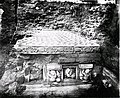 The Diamond throne at the Mahabodhi Temple, attributed to Ashoka
 -
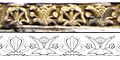 Front frieze of the Diamond throne
 -
 Mauryan ringstone, with standing goddess. Northwest Pakistan. 3rd century BCE. British Museum
 -
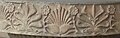 Rampurva bull capital, detail of the abacus, with two "flame palmettes" framing a lotus surrounded by small rosette flowers.


Symbols
[edit]

Ashokan capitals were highly realistic and used a characteristic polished finish, Mauryan polish, giving a shiny appearance to the stone surface.[207] Lion Capital of Ashoka, the capital of one of the pillars erected by Ashoka features a carving of a spoked wheel, known as the Ashoka Chakra. This wheel represents the wheel of Dhamma set in motion by the Gautama Buddha, and appears on the flag of modern India. This capital also features sculptures of lions, which appear on the seal of India.[154]
Inscriptions and rock-edicts
[edit]

The edicts of Ashoka are a collection of 33 inscriptions on the Pillars of Ashoka, as well as boulders and cave walls, issued during his reign.[207] These inscriptions are dispersed throughout modern-day Pakistan and India, and represent the first tangible evidence of Buddhism. The edicts describe in detail the first wide expansion of Buddhism through the sponsorship of one of the most powerful kings of Indian history, offering more information about Ashoka's proselytism, moral precepts, religious precepts and his notions of social and animal welfare.[209]
Before Ashoka, the royal communications appear to have been written on perishable materials such as palm leaves, birch barks, cotton cloth, and possibly wooden boards. While Ashoka's administration would have continued to use these materials, Ashoka also had his messages inscribed on rock edicts.[210] Ashoka probably got the idea of putting up these inscriptions from the neighbouring Achaemenid empire.[159] It is likely that Ashoka's messages were also inscribed on more perishable materials, such as wood, and sent to various parts of the empire. None of these records survive now.[14]
Scholars are still attempting to analyse both the expressed and implied political ideas of the Edicts (particularly in regard to imperial vision), and make inferences pertaining to how that vision was grappling with problems and political realities of a "virtually subcontinental, and culturally and economically highly variegated, 3rd century BCE Indian empire.[10] Nonetheless, it remains clear that Ashoka's Inscriptions represent the earliest corpus of royal inscriptions in the Indian subcontinent, and therefore prove to be a very important innovation in royal practices."[209]
Most of Ashoka's inscriptions are written in a mixture of various Prakrit dialects, in the Brahmi script.[211]
Several of Ashoka's inscriptions appear to have been set up near towns, on important routes, and at places of religious significance.[212] Many of the inscriptions have been discovered in hills, rock shelters, and places of local significance.[213] Various theories have been put forward about why Ashoka or his officials chose such places, including that they were centres of megalithic cultures,[214] were regarded as sacred spots in Ashoka's time, or that their physical grandeur may be symbolic of spiritual dominance.[215] Ashoka's inscriptions have not been found at major cities of the Maurya empire, such as Pataliputra, Vidisha, Ujjayini, and Taxila. [213] It is possible that many of these inscriptions are lost; the 7th century Chinese pilgrim Xuanzang refers to some of Ashoka's pillar edicts, which have not been discovered by modern researchers.[212]
It appears that Ashoka dispatched every message to his provincial governors, who in turn, relayed it to various officials in their territory.[216] For example, the Minor Rock Edict 1 appears in several versions at multiple places: all the versions state that Ashoka issued the proclamation while on a tour, having spent 256 days on tour. The number 256 indicates that the message was dispatched simultaneously to various places.[217] Three versions of a message, found at edicts in the neighbouring places in Karnataka (Brahmagiri, Siddapura, and Jatinga-Rameshwara), were sent from the southern province's capital Suvarnagiri to various places. All three versions contain the same message, preceded by an initial greeting from the arya-putra (presumably Ashoka's son and the provincial governor) and the mahamatras (officials) in Suvarnagiri.[216]
Coinage
[edit]The caduceus appears as a symbol of the punch-marked coins of the Maurya Empire in India, in the 3rd–2nd century BCE. Numismatic research suggests that this symbol was the symbol of Emperor Ashoka, his personal "Mudra".[218] This symbol was not used on the pre-Mauryan punch-marked coins, but only on coins of the Maurya period, together with the three arched-hill symbol, the "peacock on the hill", the triskelis and the Taxila mark.[219]
-
 Caduceus symbol on a Maurya-era punch-marked coin
 -
![A punch-marked coin attributed to Ashoka[220]](//upload.wikimedia.org/wikipedia/commons/thumb/1/1b/India_Mauryan_emperor_Ashoka_Punch-marked_Coin.jpg/250px-India_Mauryan_emperor_Ashoka_Punch-marked_Coin.jpg) A punch-marked coin attributed to Ashoka[220]
A punch-marked coin attributed to Ashoka[220] -
 A Maurya-era silver coin of 1 karshapana, possibly from Ashoka's period, workshop of Mathura. Obverse: Symbols including a sun and an animal Reverse: Symbol Dimensions: 13.92 x 11.75 mm Weight: 3.4 g.

![A punch-marked coin attributed to Ashoka[220]](https://en.wikipedia.org/wiki/File:India_Mauryan_emperor_Ashoka_Punch-marked_Coin.jpg)
.jpg)
Modern scholarship
[edit]Rediscovery
[edit]Ashoka had almost been forgotten until the 19th century when James Prinsep contributed in the revelation of historical sources. After deciphering the Brahmi script, Prinsep had originally identified the "Priyadasi" of the inscriptions he found with the King of Ceylon Devanampiya Tissa. However, in 1837, George Turnour discovered an important Sri Lankan manuscript (Dipavamsa, or "Island Chronicle" ) associating Piyadasi with Ashoka:
Two hundred and eighteen years after the beatitude of the Buddha, was the inauguration of Piyadassi, .... who, the grandson of Chandragupta, and the son of Bindusara, was at the time Governor of Ujjayani.

Since then, the association of "Devanampriya Priyadarsin" with Ashoka was confirmed through various inscriptions, and especially confirmed in the Minor Rock Edict inscription discovered in Maski, directly associating Ashoka with his regnal title Devanampriya ("Beloved-of-the-Gods"):[221][222]
[A proclamation] of Devanampriya Asoka.
Two and a half years [and somewhat more] (have passed) since I am a Buddha-Sakya.
[A year and] somewhat more (has passed) [since] I have visited the Samgha and have shown zeal.
Those gods who formerly had been unmingled (with men) in Jambudvipa, have how become mingled (with them).
This object can be reached even by a lowly (person) who is devoted to morality.
One must not think thus, – (viz.) that only an exalted (person) may reach this.
Both the lowly and the exalted must be told : "If you act thus, this matter (will be) prosperous and of long duration, and will thus progress to one and a half.[223]
— Maski Minor Rock Edict of Ashoka.
Another important historian was British archaeologist John Hubert Marshall, who was director-general of the Archaeological Survey of India. His main interests were Sanchi and Sarnath, in addition to Harappa and Mohenjodaro. Sir Alexander Cunningham, a British archaeologist and army engineer, and often known as the father of the Archaeological Survey of India, unveiled heritage sites like the Bharhut Stupa, Sarnath, Sanchi, and the Mahabodhi Temple. Mortimer Wheeler, a British archaeologist, also exposed Ashokan historical sources, especially the Taxila.[citation needed]
Perceptions and historiography
[edit]The use of Buddhist sources in reconstructing the life of Ashoka has had a strong influence on perceptions of Ashoka, as well as the interpretations of his edicts. Building on traditional accounts, early scholars regarded Ashoka as a primarily Buddhist monarch who underwent a conversion from the Vedic religion to Buddhism and was actively engaged in sponsoring and supporting the Buddhist monastic institution. Some scholars have tended to question this assessment. Thapar writes about Ashoka that "We need to see him both as a statesman in the context of inheriting and sustaining an empire in a particular historical period, and as a person with a strong commitment to changing society through what might be called the propagation of social ethics."[224] The only source of information not attributable to Buddhist sources are the Ashokan Edicts, and these do not explicitly state that Ashoka was a Buddhist. In his edicts, Ashoka expresses support for all the major religions of his time: Buddhism, Brahmanism, Jainism, and Ajivikaism, and his edicts addressed to the population at large (there are some addressed specifically to Buddhists; this is not the case for the other religions) generally focus on moral themes members of all the religions would accept. For example, Amartya Sen writes, "The Indian Emperor Ashoka in the third century BCE presented many political inscriptions in favor of tolerance and individual freedom, both as a part of state policy and in the relation of different people to each other".[225]
However, the edicts alone strongly indicate that he was a Buddhist. In one edict he belittles rituals, and he banned Vedic animal sacrifices; these strongly suggest that he at least did not look to the Vedic tradition for guidance. Furthermore, many edicts are expressed to Buddhists alone; in one, Ashoka declares himself to be an "upasaka", and in another he demonstrates a close familiarity with Buddhist texts. He erected rock pillars at Buddhist holy sites, but did not do so for the sites of other religions. He also used the word "dhamma" to refer to qualities of the heart that underlie moral action; this was an exclusively Buddhist use of the word. However, he used the word more in the spirit than as a strict code of conduct. Thapar writes, "His dhamma did not derive from divine inspiration, even if its observance promised heaven. It was more in keeping with the ethic conditioned by the logic of given situations. His logic of Dhamma was intended to influence the conduct of categories of people, in relation to each other. Especially where they involved unequal relationships."[224] Finally, he promotes ideals that correspond to the first three steps of the Buddha's graduated discourse.[226]
Much of the knowledge about Ashoka comes from the several inscriptions that he had carved on pillars and rocks throughout the empire. All his inscriptions present him as compassionate and loving. In the Kalinga rock edits, he addresses his people as his "children" and mentions that as a father he desires their good.[227]
Impact of pacifism
[edit]After Ashoka's death, the Maurya dynasty declined rapidly. The various Puranas provide different details about Ashoka's successors, but all agree that they had relatively short reigns. The empire seems to have weakened, fragmented, and suffered an invasion from the Bactrian Greeks.[142]
Some historians, such as H. C. Raychaudhuri, have argued that Ashoka's pacifism undermined the "military backbone" of the Maurya empire. Others, such as Thapar, have suggested that the extent and impact of his pacifism have been "grossly exaggerated".[228]
In art, film and literature
[edit] | This section includes a list of general references, but it lacks sufficient corresponding inline citations. (June 2024) |

- Ashoka the Great is a fictional biography of the emperor, which was originally written in Dutch in the form of a trilogy by Wytze Keuning in 1937–1947.
- Jaishankar Prasad composed Ashoka ki Chinta (Ashoka's Anxiety), a poem that portrays Ashoka's feelings during the war on Kalinga.
- Ashoka, a 1922 Indian silent historical film about the emperor produced by Madan Theatres.[229]
- The Nine Unknown, a 1923 novel by Talbot Mundy about the "Nine Unknown Men", a fictional secret society founded by Ashoka.
- Samrat Ashok, a 1928 Indian silent film by Bhagwati Prasad Mishra.[229]
- Ashok Kumar (1941) is an Indian Tamil-language film directed by Raja Chandrasekhar. The film stars V. Nagayya as Ashoka.
- Samrat Ashok is a 1947 Indian Hindi-language film by K.B. Lall.[230]
- Uttar-Priyadarshi (The Final Beatitude), a verse-play written by poet Agyeya depicting his redemption, was adapted to stage in 1996 by theatre director, Ratan Thiyam and has since been performed in many parts of the world.[231][232]
- In 1973, Amar Chitra Katha released a graphic novel based on the life of Ashoka.
- In Piers Anthony's series of space opera novels, the main character mentions Ashoka as a model for administrators to strive for.
- Samrat Ashok is a 1992 Indian Telugu-language film about the emperor by N. T. Rama Rao with Rao also playing the titular role.[230]
- Aśoka is a 2001 epic Indian historical drama film directed and co-written by Santosh Sivan. The film stars Shah Rukh Khan as Ashoka.
- In 2002, Mason Jennings released the song "Emperor Ashoka" on his Living in the Moment EP. It is based on the life of Ashoka.
- In 2013, Christopher C. Doyle released his debut novel, The Mahabharata Secret, in which he wrote about Ashoka hiding a dangerous secret for the well-being of India.
- 2014's The Emperor's Riddles, a fiction mystery thriller novel by Satyarth Nayak, traces the evolution of Ashoka and his esoteric legend of the Nine Unknown Men.
- In 2015, Chakravartin Ashoka Samrat, a television serial by Ashok Banker, based on the life of Ashoka, began airing on Colors TV where Siddharth Nigam and Mohit Raina played the role of Ashoka.
- Bharatvarsh is an Indian television historical documentary series, hosted by actor-director Anupam Kher on Hindi news channel ABP News. The series stars Aham Sharma as Ashoka.[233]
- In 2024, Pracchand Ashok, a television serial by Ekta Kapoor, based on the love life of the Ashoka, began airing on Colors TV where Adnan Khan played the role of Ashoka.[234]
- Civilization features Ashoka as a playable leader for India, being replaced by Gandhi in later iterations of the series.[235]
See also
[edit]Notes
[edit]- ^ The North Indian sources indicate Subhadrangi as the name of Ashoka's mother, while the Sri Lankan sources mention her as Dharma.
References
[edit]- ^ Lahiri 2015, pp. 295–296.
- ^ a b c d e f g Singh 2017, p. 162.
- ^ a b Singh 2008, p. 331.
- ^ Strong, John S. (2002–2003). Faure, Bernard (ed.). "Aśoka's Wives and the Ambiguities of Buddhist Kingship". Cahiers d'Extrême-Asie. 13. Paris: École française d'Extrême-Orient: 35–54. doi:10.3406/asie.2002.1176. eISSN 2117-6272. JSTOR 44167352. Archived from the original on 8 August 2021. Retrieved 8 August 2021.
- ^ Lahiri 2015, p. 219.
- ^ Peter Fibiger Bang, Christopher Bayly (2021). The Oxford World History Of Empire Volume Two The History Of Empires. p. 208.
Aśoka placed Buddhism side by side with Brahmanism, Jainism, and the Ajivikas in his edicts and stressed that his dhamma was not the doctrine of one religion but was universal.
- ^ Bollard, John K., ed. (1998). Pronouncing dictionary of proper names: pronunciations for more than 28,000 proper names, selected for currency, frequency, or difficulty of pronunciation (2nd ed.). Detroit, MI: Omnigraphics. p. 87. ISBN 978-0-7808-0098-4.
- ^ Manish Rannjan (19 August 2023). Indian Art & Culture Book in English: Exploring Heritage and Tradition. Prabhat Prakashan. p. 161. ISBN 978-93-5521-694-6.
The Bhatru inscription confirms Emperor Ashoka's acceptance of Buddhism, and in it Ashoka describes himself as the emperor of Magadha.
- ^ Thapar 1961, pp. 5–8.
- ^ a b c d e Singh 2012, p. 132.
- ^ a b Singh 2012, p. 131.
- ^ Strong 1995, p. 141.
- ^ a b Thapar 1961, p. 8.
- ^ a b Thapar 1961, p. 7.
- ^ Thapar 1961, pp. 7–8.
- ^ Singh 2008, pp. 331–332.
- ^ Thapar 1961, pp. 8–9.
- ^ Strong 1989, p. 12.
- ^ a b c d e f g h i Strong 1995, p. 143.
- ^ a b c d e Strong 1995, p. 144.
- ^ Strong 1995, pp. 152–154.
- ^ a b c Strong 1995, p. 155.
- ^ Strong 1995, pp. 154–157.
- ^ Thapar 1961, p. 11.
- ^ Thapar 1995, p. 15.
- ^ a b Thapar 1961, p. 9.
- ^ Guruge 1995b, pp. 185–188.
- ^ a b c d e f g h i Beckwith, Christopher I. (2017). Greek Buddha: Pyrrho's Encounter with Early Buddhism in Central Asia. Princeton University Press. pp. 226–250. ISBN 978-0-691-17632-1. Archived from the original on 14 May 2020. Retrieved 31 January 2020.
- ^ Bopearachchi, Osmund (2016). "Review of C.I. Beckwith, Greek Buddha". Ancient West & East. 15: 341-342. Archived from the original on 26 March 2023. Retrieved 4 September 2019.
- ^ Bronkhorst, Johannes (2016). How the Brahmins Won. Brill. pp. 483–489. doi:10.1163/9789004315518_016. Archived from the original on 24 April 2022. Retrieved 4 September 2019.
- ^ Olivelle, Patrick (2024). Ashoka: Portrait of a Philosopher King. Yale University Press. p. xxviii. ISBN 978-0-300-27000-6.
- ^ Strong 1989, p. 205.
- ^ a b Allen 2012, p. 79.
- ^ The Dîpavaṃsa: An Ancient Buddhist Historical Record. Williams and Norgate. 1879. pp. 147–148.
- ^ Thapar 1961, pp. 226–227.
- ^ a b Sircar, D. C. (1979). Asokan studies. p. 113.
- ^ Strong 1989, p. 11.
- ^ Lahiri 2015, p. 129.
- ^ Thapar 1961, p. 226.
- ^ a b c Lahiri 2015, p. 25.
- ^ Lahiri 2015, p. 24.
- ^ Lahiri 2015, p. 26.
- ^ a b Thapar 1961, p. 13.
- ^ a b Strong 1989, p. 204.
- ^ a b Thapar 1961, pp. 25–26.
- ^ Strong 1989, pp. 204–205.
- ^ Lahiri 2015, p. 323:"In the Ashokavadana, Ashoka's mother is not named."
- ^ Lahiri 2015, p. 31.
- ^ a b Guruge 1993, p. 19.
- ^ a b Mookerji 1995, p. 2.
- ^ a b c Singh 2008, p. 332.
- ^ Thapar 1961, p. 20.
- ^ a b Lahiri 2015, p. 27.
- ^ Strong 1989, p. 206.
- ^ Strong 1989, p. 207.
- ^ a b c d Thapar 1961, p. 21.
- ^ Lahiri 2015, p. 65.
- ^ a b Strong 1989, p. 208.
- ^ Lahiri 2015, p. 66.
- ^ Lahiri 2015, p. 70.
- ^ Lahiri 2015, p. 66-67.
- ^ Lahiri 2015, p. 68.
- ^ Lahiri 2015, p. 67.
- ^ Lahiri 2015, pp. 89–90.
- ^ Allen 2012, p. 154.
- ^ a b Guruge 1993, p. 28.
- ^ a b Lahiri 2015, p. 98.
- ^ Lahiri 2015, pp. 94–95.
- ^ a b Thapar 1961, pp. 22–23.
- ^ a b Lahiri 2015, p. 101.
- ^ Lahiri 2015, p. 97.
- ^ Thapar 1961, pp. 24–25.
- ^ Thapar 1961, p. 25.
- ^ a b c d Lahiri 2015, p. 102.
- ^ a b Strong 1989, p. 209.
- ^ Strong 1989, p. 210.
- ^ Allen 2012, p. 15: "Only fragments were found of the Wheel of the Moral Law, which the four lions had originally supported."
- ^ "Lion Capital of Ashoka At Sarnath Archaeological Museum Near Varanasi India". YouTube. 27 October 2018. Archived from the original on 15 July 2022. Retrieved 16 July 2022.
- ^ a b c Thapar 1961, p. 26.
- ^ a b c d Thapar 1961, p. 27.
- ^ Thapar 1961, pp. 13–14.
- ^ a b c d Thapar 1961, p. 14.
- ^ a b c d e f g h i j k Thapar 1961, p. 30.
- ^ Strong 1989, pp. 12–13.
- ^ a b c Strong 1989, p. 13.
- ^ a b c Guruge 1995, p. 46.
- ^ a b c d Thapar 1961, p. 29.
- ^ a b Lahiri 2015, p. 105.
- ^ a b Lahiri 2015, p. 106.
- ^ Lahiri 2015, pp. 106–107.
- ^ Lahiri 2015, p. 107.
- ^ Charles Drekmeier (1962). Kingship and Community in Early India. Stanford University Press. pp. 173. ISBN 978-0-8047-0114-3. Retrieved 30 October 2012.
{{cite book}}: ISBN / Date incompatibility (help) - ^ Indian Archaeology 1997–98 (PDF). ASI. p. Plate 72. Archived (PDF) from the original on 22 January 2020. Retrieved 22 January 2020.
- ^ a b Guruge 1995, pp. 49–50.
- ^ Smith, Vincent (1920). . Oxford: Clarendon Press. p. 185 – via Wikisource.
- ^ a b c d e Thapar 1995, p. 18.
- ^ a b c Thapar 1961, p. 36.
- ^ Thapar 1961, p. 33.
- ^ a b Guruge 1995, p. 38.
- ^ Guruge 1995, p. 37.
- ^ Thapar 1995, pp. 30–31.
- ^ Guruge 1995, p. 56.
- ^ Guruge 1995, p. 42.
- ^ Guruge 1995, p. 43.
- ^ a b Guruge 1995, p. 47.
- ^ a b c Lahiri 2015, p. 109.
- ^ a b Gombrich 1995, p. 7.
- ^ Thapar 1961, p. 34.
- ^ a b Lahiri 2015, p. 110.
- ^ Lahiri 2015, p. 108.
- ^ a b c Guruge 1995, p. 49.
- ^ a b Thapar 1961, p. 35.
- ^ a b Lahiri 2015, p. 135.
- ^ Strong 1995, pp. 154–155.
- ^ Mahâbodhi, Cunningham p.4ff
- ^ Allen 2012.
- ^ "Ashoka did build the Diamond Throne at Bodh Gaya to stand in for the Buddha and to mark the place of his enlightenment" in Ching, Francis D. K.; Jarzombek, Mark M.; Prakash, Vikramaditya (23 March 2017). A Global History of Architecture. John Wiley & Sons. p. 570. ISBN 978-1-118-98160-3. Archived from the original on 23 May 2021. Retrieved 7 March 2021.
- ^ a b Strong 1995, p. 158.
- ^ Strong 1995, p. 159.
- ^ a b c d e Guruge 1995, p. 50.
- ^ a b c Gombrich 1995, p. 8.
- ^ a b c d e f g Guruge 1995, p. 51.
- ^ Gombrich 1995, pp. 8–9.
- ^ a b c Gombrich 1995, p. 5.
- ^ Guruge 1995, p. 45.
- ^ a b c Gombrich 1995, p. 10.
- ^ Gombrich 1995, p. 6.
- ^ Gombrich 1995, pp. 10–11.
- ^ a b Gombrich 1995, p. 11.
- ^ Gombrich 1995, pp. 11–12.
- ^ a b Gombrich 1995, p. 12.
- ^ Thapar 1995, p. 32.
- ^ Thapar 1995, p. 36.
- ^ a b c d e Strong 1995, p. 149.
- ^ a b c d e Thapar 1961, p. 28.
- ^ a b Strong 1989, p. 232.
- ^ a b c Beni Madhab Barua (5 May 2010). The Ajivikas. General Books. pp. 68–69. ISBN 978-1-152-74433-2. Retrieved 30 October 2012.
- ^ Steven L. Danver (22 December 2010). Popular Controversies in World History: Investigating History's Intriguing Questions: Investigating History's Intriguing Questions. ABC-CLIO. p. 99. ISBN 978-1-59884-078-0. Archived from the original on 3 January 2014. Retrieved 23 May 2013.
- ^ Le Phuoc (March 2010). Buddhist Architecture. Grafikol. p. 32. ISBN 978-0-9844043-0-8. Archived from the original on 31 December 2013. Retrieved 23 May 2013.
- ^ Parishtaparvan.
- ^ Journal Of Indian Asiatic Society. 1872. p. 154.
- ^ a b c Singh 2008, p. 333.
- ^ Mookerji 1995, p. 9.
- ^ a b Strong 1995, pp. 146–147.
- ^ a b c d Strong 1995, p. 166.
- ^ Strong 1995, p. 167.
- ^ Strong 1995, pp. 167–168.
- ^ a b Strong 1995, p. 151.
- ^ a b c Thapar 1961, p. 23.
- ^ Lahiri 2015, p. 97-98.
- ^ Thapar 1961, p. 22.
- ^ a b c Thapar 1961, p. 24.
- ^ Thapar 1961, pp. 23–24.
- ^ a b c Gombrich 1995, p. 1.
- ^ Strong 1989, p. 15.
- ^ a b Strong 1995, p. 142.
- ^ Lahiri 2015, p. 134.
- ^ Guruge 1995, pp. 43–44.
- ^ a b c d e f Gombrich 1995, p. 3.
- ^ Thapar 1995, pp. 19–20.
- ^ a b Guruge 1995, p. 44.
- ^ Lahiri 2015, p. 157.
- ^ Thapar 1995, p. 29.
- ^ a b c d e f g Strong 1989, p. 4.
- ^ Thapar 1961, p. 37.
- ^ Thapar 1995, p. 19.
- ^ Thapar 1995, pp. 20–21.
- ^ Thapar 1995, p. 20.
- ^ a b Thapar 1995, p. 31.
- ^ Thapar 1995, pp. 21–22.
- ^ a b c Strong 1989, pp. 3–4.
- ^ Strong 1989, p. 5.
- ^ Strong 1989, pp. 6–9.
- ^ Strong 1989, pp. 9–10.
- ^ Fitzgerald 2004, p. 120.
- ^ Simoons, Frederick J. (1994). Eat Not This Flesh: Food Avoidances from Prehistory to the Present (2nd ed.). Madison: University of Wisconsin Press. p. 108. ISBN 978-0-299-14254-4. Archived from the original on 14 February 2017. Retrieved 13 February 2016.
- ^ "The Edicts of King Asoka". Translated by Dhammika, Ven. S. Buddhist Publication Society. 1994. Archived from the original on 10 May 2016.
- ^ D.R. Bhandarkar, R. G. Bhandarkar (2000). Asoka. Asian Educational Services. pp. 314–315. ISBN 9788120613331. Archived from the original on 26 April 2016. Retrieved 17 December 2015.
- ^ Gerald Irving A. Dare Draper; Michael A. Meyer; H. McCoubrey (1998). Reflections on Law and Armed Conflicts: The Selected Works on the Laws of War by the Late Professor Colonel G.I.A.D. Draper, Obe. Martinus Nijhoff Publishers. p. 44. ISBN 978-90-411-0557-8. Archived from the original on 14 May 2013. Retrieved 30 October 2012.
- ^ Phelps, Norm (2007). The Longest Struggle: Animal Advocacy from Pythagoras to Peta. Lantern Books. ISBN 978-1590561065.
- ^ Elverskog, Johan (2020). The Buddha's Footprint: An Environmental History of Asia. Philadelphia: University of Pennsylvania Press. p. 56. ISBN 978-0-8122-5183-8.
The imperial edicts of Asoka echo this commodity view of trees. In Pillar Edict V, Asoka decreed that "forests must not be burned without reason." The Buddhist community took this mandate further by declaring that in order to protect forests from such conflagrations monks were allowed to set counterfires
- ^ Fisher, Michael (2018). An Environmental History of India: From Earliest Times to the Twenty-First Century. Cambridge and London: Cambridge University Press. p. 72. doi:10.1017/9781316276044. ISBN 9781316276044.: "Following the Buddha’s message, he banned Brahminic Vedic animal sacrifices in his capital (although he evidently lacked the administrative control to stop them outside of it). Overall, Ashoka’s edicts proclaim his compassion for animals, perhaps motivated by an environmental ethic (in addition to his revenue or administrative goals). Consequently, today many environmentalists evoke Ashoka as an ancient Indian exemplar."
- ^ Kosmin 2014, p. 57.
- ^ Thomas Mc Evilly, The shape of ancient thought, Allworth Press, New York, 2002, p. 368
- ^ a b Oskar von Hinüber (2010). "Did Hellenistic Kings Send Letters to Aśoka?". Journal of the American Oriental Society. 130 (2). Freiburg: 262–265.
- ^ The Edicts of King Ashoka: an English rendering by Ven. S. Dhammika Archived 10 May 2016 at the Wayback Machine. Access to Insight: Readings in Theravāda Buddhism. Retrieved 1 September 2011.
- ^ "Pliny the Elder, "The Natural History", 6, 21". Archived from the original on 28 July 2013.
- ^ Preus, Anthony (2015). Historical Dictionary of Ancient Greek Philosophy. Rowman & Littlefield Publishers. p. 184. ISBN 978-1-4422-4639-3. Archived from the original on 4 November 2020. Retrieved 18 June 2017.
- ^ Full text of the Mahavamsa Click chapter XII Archived 5 September 2006 at the Wayback Machine
- ^ The Idea of Ancient India: Essays on Religion, Politics, and Archaeology by Upinder Singh p.18 Archived 29 December 2019 at the Wayback Machine
- ^ De la Croix, Horst; Tansey, Richard G.; Kirkpatrick, Diane (1991). Gardner's Art Through the Ages (9th ed.). Thomson/Wadsworth. p. 428. ISBN 0-15-503769-2.
- ^ Strong 1995, p. 146.
- ^ Strong 1995, p. 147.
- ^ Strong 1995, p. 163.
- ^ Strong 1995, p. 163-165.
- ^ a b Strong 1995, p. 152.
- ^ Strong 1995, pp. 152–153.
- ^ Strong 1995, p. 153.
- ^ Strong 1995, p. 165.
- ^ Kosmin 2014, p. 36.
- ^ Strong 1989, p. 18.
- ^ Strong, John (2007). Relics of the Buddha. Motilal Banarsidass Publishers. p. 149. ISBN 978-81-208-3139-1. Archived from the original on 8 May 2016. Retrieved 15 November 2015.
- ^ a b Introduction to Indian Architecture Bindia Thapar, Tuttle Publishing, 2012, p.21 Archived 29 December 2019 at the Wayback Machine "Ashoka used the knowledge of stone craft to begin the tradition of stone architecture in India, dedicated to Buddhism."
- ^ Kleiner, Fred S. (5 January 2009). Gardner's Art through the Ages: Non-Western Perspectives, Fred S. Kleiner, Cengage Learning, 2009, p14. Cengage Learning. ISBN 9780495573678. Archived from the original on 26 December 2019. Retrieved 17 June 2017.
- ^ Mookerji 1995, p. 96.
- ^ "Ashoka was known to be a great builder who may have even imported craftsmen from abroad to build royal monuments." Monuments, Power and Poverty in India: From Ashoka to the Raj, A. S. Bhalla, I.B.Tauris, 2015 p.18 [1] Archived 26 December 2019 at the Wayback Machine
- ^ a b Irwin, John (1973). "'Aśokan' Pillars: A Reassessment of the Evidence". The Burlington Magazine. 115 (848): 706–720. JSTOR 877526.
- ^ Reference: India: The Ancient Past p. 113, Burjor Avari, Routledge, ISBN 0-415-35615-6
- ^ a b Singh 2012.
- ^ Lahiri 2015, pp. 120–121.
- ^ Lahiri 2015, p. 126.
- ^ a b Thapar 1961, p. 6.
- ^ a b Lahiri 2015, p. 143.
- ^ Thapar 1995, p. 23.
- ^ Lahiri 2015, pp. 143–157.
- ^ a b Lahiri 2015, p. 127.
- ^ Lahiri 2015, p. 133.
- ^ Indian Numismatics, Damodar Dharmanand Kosambi, Orient Blackswan, 1981, p.73 [2] Archived 15 December 2019 at the Wayback Machine
- ^ Malwa Through the Ages, from the Earliest Times to 1305 A.D, Kailash Chand Jain, Motilal Banarsidass Publ., 1972, p.134 [3] Archived 24 December 2019 at the Wayback Machine
- ^ Mitchiner, Michael (1978). Oriental Coins & Their Values: The Ancient and Classical World 600 B.C. - A.D. 650. Hawkins Publications. p. 544. ISBN 978-0-9041731-6-1.
- ^ The Cambridge Shorter History of India. CUP Archive. p. 42. Archived from the original on 25 December 2019. Retrieved 13 July 2018.
- ^ Gupta, Subhadra Sen (2009). Ashoka. Penguin UK. p. 13. ISBN 9788184758078. Archived from the original on 31 December 2019. Retrieved 13 July 2018.
- ^ Hultzsch 1925, p. 174–175.
- ^ a b Thapar, Romila (13 November 2009). "Ashoka – A Retrospective". Economic and Political Weekly. 44 (45): 31–37.
- ^ Sen, Amartya (Summer 1998). "Universal Truths and the Westernizing Illusion". Harvard International Review. 20 (3): 40–43.
- ^ Richard Robinson, Willard Johnson, and Thanissaro Bhikkhu, Buddhist Religions, fifth ed., Wadsworth 2005, page 59.
- ^ The Edicts of King Ashoka Archived 28 March 2014 at the Wayback Machine, English translation (1993) by Ven. S. Dhammika. ISBN 955-24-0104-6. Retrieved 21 February 2009
- ^ Singh 2012, p. 131, 143.
- ^ a b R. K. Verma (2000). Filmography: Silent Cinema, 1913-1934. M. Verma. p. 150. ISBN 978-81-7525-224-0. Archived from the original on 2 October 2021. Retrieved 5 February 2021.
- ^ a b Ashish Rajadhyaksha; Paul Willemen (10 July 2014). Encyclopedia of Indian Cinema. Taylor & Francis. p. 43. ISBN 978-1-135-94325-7. Archived from the original on 10 March 2022. Retrieved 10 February 2021.
- ^ Jefferson, Margo (27 October 2000). "Next Wave Festival Review; In Stirring Ritual Steps, Past and Present Unfold". The New York Times. Archived from the original on 31 July 2022. Retrieved 16 November 2018.
- ^ Renouf, Renee (December 2000). "Review: Uttarpriyadarshi". Balletco. Archived from the original on 5 February 2012.
- ^ "'Bharatvarsh' – ABP News brings a captivating saga of legendary Indians with Anupam Kher". 19 August 2016. Archived from the original on 26 August 2016.
- ^ Adnan Khan and Mallika Singh to play Samrat Ashok & Kaurawkee in Ekta Kapoor's new historical drama series 'Pracchand Ashok'
- ^ Oloman, Jordan (26 August 2024). "Civilization 7 is making bold changes to a familiar formula". Polygon. Retrieved 27 August 2024.
Works cited
[edit]- Allen, Charles (2012). Ashoka: The Search for India's Lost Emperor. Hachette. ISBN 978-1-408-70388-5.
- Fitzgerald, James L., ed. (2004). The Mahabharata. Vol. 7. The University of Chicago Press. ISBN 0-226-25250-7.
- Gombrich, Richard (1995). "Aśoka – The Great Upāsaka". In Anuradha Seneviratna (ed.). King Aśoka and Buddhism: Historical and Literary Studies. Buddhist Publication Society. ISBN 978-955-24-0065-0.
- Guruge, Ananda W. P. (1993). Aśoka, the Righteous: A Definitive Biography. Central Cultural Fund. ISBN 978-955-9226-00-0.
- Guruge, Ananda W. P. (1995). "Emperor Aśoka and Buddhism: Unresolved Discrepancies between Buddhist Tradition & Aśokan Inscriptions". In Anuradha Seneviratna (ed.). King Aśoka and Buddhism: Historical and Literary Studies. Buddhist Publication Society. ISBN 978-955-24-0065-0.
- Guruge, Ananda W. P. (1995b). "Emperor Aśoka's Place in History: A Review of Prevalent Opinions". In Anuradha Seneviratna (ed.). King Aśoka and Buddhism: Historical and Literary Studies. Buddhist Publication Society. ISBN 978-955-24-0065-0.
- Hultzsch, E. (1925). Inscriptions of Asoka: New Edition. Government of India.
- Kosmin, Paul J. (2014). The Land of the Elephant Kings: Space, Territory, and Ideology in Seleucid Empire. Harvard University Press. ISBN 978-0-674-72882-0.
- Lahiri, Nayanjot (2015). Ashoka in Ancient India. Harvard University Press. ISBN 978-0674057777.
- Mookerji, Radhakumud (1995) [First published 1928; 3rd revised edition published in 1962]. Aśoka (3rd revised ed.). Delhi: Motilal Banarsidass. ISBN 978-81-208-0582-8.
- Singh, Upinder (2008). A history of ancient and early medieval India : from the Stone Age to the 12th century. New Delhi: Pearson Education. ISBN 978-81-317-1120-0.
- Singh, Upinder (2012). "Governing the State and the Self: Political Philosophy and Practice in the Edicts of Aśoka". South Asian Studies. 28 (2). University of Delhi: 131–145. doi:10.1080/02666030.2012.725581. S2CID 143362618.
- Singh, Upinder (2017). Political Violence in Ancient India. Harvard University Press. ISBN 978-0-674-97527-9.
- Strong, John S. (1989). The Legend of King Aśoka: A Study and Translation of the Aśokāvadāna. Motilal Banarsidass. ISBN 978-81-208-0616-0.
- Strong, John S. (1995). "Images of Aśoka: Some Indian and Sri Lankan Legends and their Development". In Anuradha Seneviratna (ed.). King Aśoka and Buddhism: Historical and Literary Studies. Buddhist Publication Society. ISBN 978-955-24-0065-0.
- Thapar, Romila (1961). Aśoka and the Decline of the Mauryas. Oxford University Press. OCLC 736554.
- Thapar, Romila (1995). "Aśoka and Buddhism as Reflected in the Aśokan Edicts". In Anuradha Seneviratna (ed.). King Aśoka and Buddhism: Historical and Literary Studies. Buddhist Publication Society. ISBN 978-955-24-0065-0.
Further reading
[edit]- Bentley, Jerry (1993). Old World Encounters: Cross-Cultural Contacts and Exchanges in Pre-Modern Times. New York: Oxford University Press. ISBN 978-0-19-507640-0.
- Falk, Harry (2006). Aśokan Sites and Artefacts: A Source-book with Bibliography. Von Zabern. ISBN 978-3-8053-3712-0.
- MacPhail, James Merry (1918). Asoka. London: Oxford University Press.
- Nikam, N. A.; McKeon, Richard (1959). The Edicts of Aśoka. Chicago: University of Chicago Press.
- Olivelle, Patrick (2024). Ashoka: Portrait of a Philosopher King. New Haven: Yale University Press. ISBN 978-0-300-27490-5.
- Olivelle, Patrick; Leoshko, Janice; Ray, Himanshu Prabha (2012). Reimagining Asoka: Memory and History. Oxford University Press India. ISBN 978-0-19-807800-5.
- Sen, Colleen Taylor (2022). Ashoka and the Mauraya Dynasty: the history and legacy of ancient India's greatest empire. Dynasties. London: Reaktion Books. ISBN 978-1-78914-596-0.
- Rongxi, Li (1993). The Biographical Scripture of King Aśoka: Translated from the Chinese of Saṃghapāla. Numata Center for Buddhist Translation and Research. ISBN 978-0-9625618-4-9.
- Thapar, Romila (2015) [1961]. Aśoka and the Decline of the Mauryas (3rd ed.). Oxford University Press. ISBN 978-0-19-807724-4. OCLC 964509329.
External links
[edit]
 Media related to Ashoka at Wikimedia Commons
- BBC Radio 4: Sunil Khilnani, Incarnations: Ashoka.
- BBC Radio 4: Melvyn Bragg with Richard Gombrich et al., In Our Time, Ashoka the Great.


.svg)


.png)


Ashoka
View on GrokipediaSources of Information
Epigraphic Evidence
The epigraphic corpus of Ashoka comprises over 30 inscriptions, primarily the Edicts of Ashoka, engraved between approximately 260 BCE and 232 BCE, the 8th to 26th regnal years following his coronation. These texts, issued in Prakrit using Brahmi script in central and eastern regions, and Kharoshthi in the northwest, articulate policies of moral governance termed dhamma, emphasizing non-violence, tolerance, and ethical conduct without doctrinal Buddhist exclusivity. Inscriptions in Greek and Aramaic appear in the Hellenistic-influenced northwest, adapting content for Yona (Greek) and local audiences, as seen in the bilingual Kandahar edict from the 10th regnal year promoting piety and restraint in animal slaughter.[6][2][7] Minor Rock Edicts, the earliest group dated to the 11th and 12th regnal years, number around 15 primary sites with variants, located mainly in central India such as Maski, Gujjara, and Bairat, where Ashoka declares his Buddhist commitment two and a half years into rule and outlines personal practices like pilgrimages and almsgiving. These concise texts, often on boulders, precede broader proclamations and reveal a gradual embrace of Buddhist ethics post-Kalinga conquest remorse. Major Rock Edicts consist of 14 sequential inscriptions at seven locations including Girnar, Dhauli, and Shahbazgarhi, plus two separate Kalinga edicts at Dhauli and Jaugada addressing provincial administration; they detail dhamma's pillars like respect for elders, restraint in rituals, and welfare measures, with Edict 13 referencing the Kalinga War's 100,000+ deaths as catalyst for ethical reform.[8][9][3] Pillar Edicts, inscribed on monolithic sandstone columns up to 50 feet tall and weighing 50 tons, include seven major edicts at sites like Delhi-Topra, Allahabad, and Sarnath, reiterating dhamma principles with additions on royal tours and forest conservation; capitals feature animal motifs like lions or bulls, symbolizing imperial authority. Minor Pillar Edicts and cave inscriptions at Barabar and Nagarjuni hills extend directives to Buddhist monastic communities, such as the Schism Edict prohibiting doctrinal splits. Aramaic inscriptions at Taxila and Laghman further evidence administrative outreach in frontier zones. Overall, these edicts' distribution—from Kandahar to Bangladesh—maps Mauryan territorial control, with strategic placement on trade routes and rock formations for visibility, underscoring Ashoka's intent for moral propagation over territorial expansion.[2][4][10]Literary Traditions
The principal literary accounts of Ashoka emanate from Buddhist traditions, composed centuries after his death and characterized by hagiographic elements that emphasize his conversion to Buddhism and patronage of the faith. The Ashokavadana, a Sanskrit text embedded within the broader Divyavadana compilation, narrates Ashoka's youth marked by cruelty—including the construction of a "hell" for torturing subjects—his remorse following the Kalinga conquest around 261 BCE, and subsequent acts of piety such as relic distribution and stupa-building across his empire. Likely redacted between the 1st and 2nd centuries CE, this work interweaves verifiable historical motifs, like Ashoka's edicts promoting dhamma, with miraculous legends, such as divine interventions and Ashoka's temporary descent to a hellish realm for prior sins, reflecting sectarian efforts to model ideal Buddhist rulership rather than unvarnished biography.[11][12] Pali chronicles from Sri Lanka, including the Mahavamsa (circa 5th-6th century CE) and its predecessor Dipavamsa, extend this portrayal by detailing Ashoka's convening of the Third Buddhist Council at Pataliputra around 250 BCE to purify the sangha from schismatic influences, as well as his sponsorship of missionary expeditions, notably to Sri Lanka under the monk Mahinda, identified as Ashoka's son or nephew. These texts align partially with Ashoka's own inscriptions attesting to missionary dispatches—such as to the Hellenistic kingdoms and Sri Lanka—but exaggerate his devotion, claiming he erected 84,000 stupas and viharas to honor Buddha's relics, a figure symbolic of doctrinal enumeration rather than literal enumeration. Composed in a Theravada milieu distant from the Mauryan heartland, these accounts prioritize lineage validation for Sri Lankan Buddhism over empirical precision, occasionally contradicting each other on familial details.[13][14] Jain literary traditions, by contrast, marginalize Ashoka, with primary focus on his grandfather Chandragupta Maurya (r. circa 321-297 BCE) as a Jain adherent who abdicated for asceticism under Bhadrabahu I amid a 12-year famine circa 297 BCE. Later medieval compilations like Hemachandra's Parishishtaparvan (12th century CE) reference Mauryan succession but attribute no transformative religious role to Ashoka, portraying the dynasty's non-violence ethos as inherent to Jain principles predating his reign rather than a personal pivot. This reticence may stem from doctrinal emphasis on ahimsa as timeless, avoiding glorification of a ruler later canonized in rival Buddhist narratives, though no Jain sources record persecutions by Ashoka akin to those alleged against Ajivikas in Buddhist texts.[15] Hindu Puranic genealogies, such as those in the Vishnu Purana and Bhagavata Purana (compiled 4th-10th centuries CE), enumerate Ashoka within Mauryan king lists—typically assigning him a reign of 36 or 37 years—but furnish no substantive anecdotes, treating him as a standard monarch in a dharmic framework without allusion to Buddhist conversion or Kalinga remorse. These terse entries prioritize cyclical dynastic patterns over individualized biography, reflecting a brahmanical historiographic style less invested in Ashoka's persona than in upholding varna order.[16]Archaeological Corroboration
Archaeological excavations at Pataliputra, the Mauryan capital near modern Patna, have uncovered substantial remains from the 3rd century BCE, including a hypostyle hall with sockets for approximately 80 wooden pillars arranged in 15 rows, reflecting advanced urban planning and imperial scale consistent with Ashoka's era (c. 268–232 BCE).[17] Recent efforts by the Archaeological Survey of India (ASI) at Kumhrar continue to expose portions of this assembly hall, linked to Mauryan palace complexes and corroborated by ancient accounts of the city's vast wooden architecture.[18] These structures, featuring polished stone elements and terracotta artifacts, align with the material culture of the Mauryan peak under Ashoka, distinct from earlier or later phases.[19] The Barabar Caves in Bihar, among India's oldest surviving rock-cut monuments, date to the mid-3rd century BCE and exemplify Mauryan technical prowess in granite excavation, with interiors polished to a mirror-like finish over 11 meters deep.[20] Four caves on Barabar Hill—Karna Chaupar, Lomas Rishi, Sudama, and Visvakarma—feature precise barrel-vaulted chambers and arched entrances mimicking wooden prototypes, constructed during Ashoka's reign as patronage to the Ajivika ascetics.[21] This architectural innovation corroborates evidence of Mauryan sponsorship of diverse ascetic communities, extending beyond Buddhism. Buddhist sites expanded under Mauryan influence provide further material evidence of Ashoka's era. At Sanchi in Madhya Pradesh, the Great Stupa's core and early railings date to the 3rd century BCE, with Mauryan-era gateways featuring carved motifs of elephants and yakshis, indicating royal endowment for relic veneration.[22] Excavations reveal schist and sandstone elements from this period, aligning with the proliferation of stupas across the empire during Ashoka's time.[23] , as the most reliable primary sources, dating paleographically to the mid-3rd century BCE and providing direct insight into his dhamma policy without later embellishment.[3] These edicts, first deciphered by James Prinsep in the 1830s-1840s, consistently self-identify the author as Devanampiya Piyadasi ("Beloved of the Gods, He Who Looks On With Pity"), linking them unequivocally to Ashoka via explicit name mentions in minor edicts like Maski and Gujarra.[26] However, debates persist over interpretive biases in reading the edicts' promotion of moral precepts—such as non-violence, tolerance, and welfare—as either a secular ethical framework or a veiled endorsement of Buddhist doctrine, with some arguing the latter due to Ashoka's explicit support for Buddhist sangha activities in edicts like the Bairat.[27] In contrast, literary traditions such as the Ashokavadana (composed around the 2nd century CE in Sanskrit) and accounts in the Sri Lankan Mahavamsa (5th century CE) are viewed skeptically by historians for their hagiographic nature, blending verifiable events with legendary accretions to idealize Ashoka as a paradigmatic Buddhist ruler.[28] For instance, the Ashokavadana depicts Ashoka's pre-conversion cruelty—including alleged mass executions and fratricide—culminating in remorse after the Kalinga War, elements absent from the edicts themselves, which instead emphasize forward-looking ethical governance without personal biography.[29] Scholars like those analyzing these texts note that such narratives likely served to propagate Buddhist legitimacy centuries later, introducing causal inconsistencies; the edicts mention Kalinga only in terms of post-conquest welfare, not explicit regret, suggesting literary amplification for didactic purposes.[30] Further contention arises from the selective silence in epigraphic sources on Ashoka's military expansions or dynastic struggles, prompting debates on whether the edicts represent authentic policy reflection or propagandistic self-fashioning to project a reformed image amid imperial consolidation.[31] Buddhist textual biases, rooted in monastic authorship, systematically elevate Ashoka's patronage—such as stupa constructions and missionary dispatches—to mythic status, unsubstantiated by contemporary non-Indian records like Hellenistic chronicles, which omit any trace of Buddhist missions to the West despite edict claims.[31] Archaeological corroboration remains sparse, with sites like Taxila yielding Aramaic inscriptions attributable to Ashoka but no broader material empire-wide validation, fueling arguments that over-reliance on biased literary sources risks conflating folklore with history.[10]Chronology and Dating
Proposed Dates of Reign
The scholarly consensus dates Ashoka's reign from circa 268 BCE to 232 BCE, yielding a duration of approximately 36–37 years as indicated in some edicts and literary accounts.[1][32] This chronology derives from the regnal dating system in Ashoka's inscriptions, where events like the Kalinga War are placed in his eighth year post-coronation, followed by edicts issued in subsequent years.[33] The primary anchor for this dating is Major Rock Edict 13, which records the dispatch of dharma emissaries to neighboring realms, explicitly naming five contemporary Hellenistic kings: Antiochus (identified as Antiochus II Theos, ruler of the Seleucid Empire from 261–246 BCE), Ptolemy (likely Ptolemy II Philadelphus of Egypt, r. 285–246 BCE), Antigonus (Gonatas of Macedon, r. 277–239 BCE), Magas (of Cyrene, r. ca. 300–258 BCE), and Alexander (II of Epirus, r. 272–255/242 BCE).[34][35] The edict's issuance, estimated at 10–13 years into Ashoka's reign, aligns precisely with the overlapping tenures of these rulers in the mid-third century BCE, providing an independent Greco-Roman historical cross-reference that overrides less precise indigenous textual chronologies.[34] Minor variations in proposed dates arise from reconciling Ashoka's succession with his predecessors. Puranic texts attribute 25 years to Bindusara's reign following Chandragupta Maurya's 24–25 years (starting ca. 321 BCE after Alexander's campaigns), suggesting Bindusara's death around 273–272 BCE and Ashoka's contested accession shortly thereafter, potentially delayed by fratricidal conflicts until ca. 269–268 BCE.[33] Some analyses adjust for a five-year discrepancy in embassy timings or regnal overlaps, proposing 269–233 BCE or 273–236 BCE, but these remain within a narrow range without altering the third-century BCE framework.[36] Revisionist proposals shifting Ashoka earlier (e.g., accession ca. 285–280 BCE) to accommodate extended timelines for pre-Mauryan events or Buddhist traditions have been advanced but lack support from the epigraphic-Greek synchronization, relying instead on reinterpretations of generational spans in Puranas or Mahavamsa that introduce inconsistencies with attested Hellenistic regnal data.[35] The mid-third-century dating prevails due to its empirical grounding in multilingual inscriptions verifiable against external king lists.Key Historical Anchors
Ashoka's inscriptions, inscribed primarily on rocks and pillars across his empire, serve as the primary anchors for his chronology, with events dated relative to his consecration as emperor in regnal year 0.[37] These edicts, written in Prakrit using Brahmi script (and other scripts in frontier areas), detail key milestones without providing absolute dates, necessitating correlation with external historical synchronisms for approximate BCE equivalents.[38] Scholarly estimates place the consecration around 269–268 BCE, yielding a reign endpoint circa 232 BCE.[39] The eighth regnal year marks the conquest of Kalinga, as recounted in Major Rock Edict XIII, where Ashoka quantifies the war's toll: approximately 100,000 killed, 150,000 deported, and many more perishing indirectly, leading to his professed remorse and pivot to ethical governance via Dhamma.[37] This event, estimated at 261–260 BCE, represents the last major military campaign and the catalyst for Ashoka's patronage of Buddhism and moral edicts.[39] Subsequent years record escalations in Dhamma propagation: year 10 saw initial Minor Rock Edicts proclaiming visits to Buddhist sites and moral precepts; year 13 elaborated on Kalinga's aftermath and conquests' futility; and year 17 documented the dispatch of missionary envoys, including his son or brother Mahinda to Sri Lanka, alongside a schism-resolving council at Pataliputra akin to the traditionally dated Third Buddhist Council.[38] [39] Later anchors include year 20's pillar edicts reinforcing Dhamma policies and year 26's reference to a major almsgiving, after which inscriptions cease, aligning with Ashoka's death around 232 BCE.[38] These regnal markers, corroborated by archaeological distributions of edicts from Afghanistan to Odisha, underscore a shift from expansionist warfare to administrative and doctrinal outreach, though absolute dating remains approximate due to variances in proposed accession timelines.[40]| Regnal Year | Approx. BCE Date | Key Event |
|---|---|---|
| 0 | 269–268 | Consecration as emperor[38] |
| 8 | 261–260 | Kalinga War and conquest[39] [37] |
| 10 | 259 | Issuance of Minor Rock Edicts; early Dhamma propagation[38] |
| 13 | 256 | Major Rock Edicts on moral remorse and policy[37] |
| 17 | 252–251 | Missionary dispatches and council at Pataliputra[39] |
| 26+ | c. 232 | Final edicts; death[38] |
Origins and Early Life
Ancestry and Family
Ashoka was the grandson of Chandragupta Maurya, founder of the Mauryan Empire, who established the dynasty by overthrowing the Nanda rulers around 322 BCE, as recorded in texts like the Arthashastra attributed to Chanakya and later Puranic accounts. His father was Bindusara, who succeeded Chandragupta and expanded the empire southward, ruling approximately from 297 BCE to 273 BCE according to Puranic chronologies that list his reign as 25–28 years.[41] Ashoka's mother is named Subhadrangi (also called Dharma or Dhamma in some traditions) in North Indian Buddhist sources such as the Divyavadana, portraying her as a Brahmin woman from Vidisa who rose from humble origins to become one of Bindusara's queens; Sri Lankan chronicles like the Mahavamsa similarly describe her as the daughter of a Brahmin from Champa near Pataliputra.[41] These accounts, composed centuries after Ashoka's time (primarily 4th–5th centuries CE), emphasize her low-caste background to highlight Ashoka's non-royal maternal lineage, potentially serving narrative purposes in Buddhist hagiography rather than strict historicity, as no contemporary epigraphic evidence confirms her identity or status.[42] Bindusara reportedly had multiple wives—up to 16 according to some legends—and fathered numerous sons, with Buddhist texts like the Pali scriptures claiming 101 male heirs, of whom Ashoka was one of the younger; modern historians regard the figure as exaggerated, estimating instead a handful of rivals including elder half-brother Susima, designated crown prince and viceroy of Taxila.[41] /07:_Ancient_India/7.04:_Ashoka_the_Great) Other named siblings include Vitashoka (or Vigatashoka), but details derive from the same late literary traditions, lacking corroboration from Ashoka's own edicts, which omit personal family references.[42]Youthful Exploits and Viceroyalties
During his father's reign, Ashoka served in provincial administrative roles that highlighted his emerging capabilities as a governor and military leader. Traditional accounts in Buddhist texts, such as the Mahāvaṃsa and Dīpavaṃsa, record that Bindusara appointed Ashoka as viceroy of the Avanti region, centered at Ujjain, likely in the late 280s BCE when Ashoka was in his late teens or early twenties.[43] While stationed there, he reportedly met and married Devi, a woman from Vidisha described variably as the daughter of a local merchant or Brahmin, with whom he had two children, Mahinda and Sanghamitta; this union is noted in the Mahāvaṃsa and later Sinhalese traditions as an early exposure to Buddhist influences through Devi's family.[44] These sources, compiled centuries after the events (c. 5th–10th centuries CE), emphasize Ashoka's administrative competence in managing a key western province bordering trade routes and potential unrest, though no contemporary inscriptions confirm the appointment directly.[45] A pivotal youthful exploit involved quelling unrest in the northwest. The Aśokāvadāna, a 2nd-century CE Sanskrit Buddhist text, describes a revolt in Taxila (modern-day Pakistan) during Bindusara's rule, around 280–275 BCE, prompted by dissatisfaction with local officials or imperial policies; crown prince Susima initially failed to suppress it, leading Bindusara to dispatch Ashoka from Ujjain.[46] Ashoka succeeded in restoring order, reportedly by integrating into the local population disguised as a commoner before deploying forces, minimizing bloodshed according to some variants, though the narrative portrays his methods as decisive and effective in reasserting Mauryan control over this strategic frontier city near Gandhara and Indo-Greek influences.[44] Following this, he was installed as viceroy of Taxila, overseeing a region vital for military recruitment and oversight of northwestern satrapies.[43] A fragmented Aramaic inscription from Taxila, dated to the Mauryan era, references a "Devanampiya" (possibly "Beloved of the Gods," Ashoka's later title), providing indirect archaeological corroboration of high-level Mauryan presence, though not explicitly linking to Ashoka's tenure.[46] These viceroyalties underscored Ashoka's reliability in handling provincial governance and suppression of dissent, qualities that positioned him amid fraternal rivalries for succession. The accounts, drawn primarily from hagiographic Buddhist literature aimed at glorifying Ashoka's later piety, lack epigraphic verification from the period but align with the Mauryan administrative model of princely governors in distant territories, as inferred from later edicts describing similar structures under Ashoka's own rule.[1] Scholarly consensus views the Taxila episode as historically plausible, given Taxila's recurrent instability and the need for capable deputies in Bindusara's expansionist policies.[45]Path to the Throne
Fratricide and Succession Struggles
Upon the death of Bindusara around 273 BCE, a violent succession crisis erupted within the Mauryan court, as Ashoka was not the designated heir-apparent and faced competition from multiple brothers.[47] [48] This period of interregnum, lasting approximately four years from 273 to 269 BCE, involved intense fratricidal conflicts among Bindusara's sons, reflecting the absence of clear primogeniture rules in Mauryan succession and the imperative for a single ruler to maintain imperial cohesion.[49] Buddhist literary traditions, particularly the Ashokavadana and Divyavadana—composed centuries after Ashoka's reign—portray him as systematically eliminating up to 99 half-brothers to seize the throne, sparing only one full brother, such as Vitashoka or Tissa, while defeating the crown prince Susima in direct confrontation.[50] [51] These accounts, echoed in Sri Lankan chronicles like the Mahavamsa, emphasize Ashoka's initial ruthlessness, including acts of torture and execution, to underscore his later Buddhist transformation from tyrant to moral ruler.[48] [50] However, the exaggerated figures of slain siblings lack corroboration in Ashoka's own edicts or contemporary records, and modern historians regard them as hyperbolic embellishments in hagiographic texts designed to glorify his redemption, though a core of violent rivalry against key competitors like Susima remains plausible given the empire's scale and dynastic precedents.[51] [52] Ashoka's victory was facilitated by alliances, including support from the minister Radhagupta, who reportedly switched allegiance during the power vacuum and aided in quelling opposition.[49] By 269 or 268 BCE, Ashoka had consolidated control over Pataliputra, emerging as undisputed emperor after purging rivals and loyalists, a pattern consistent with the causal dynamics of ancient imperial successions where eliminating threats ensured stability amid vast territories and diverse factions.[47] [52] The absence of self-referential details in Ashoka's inscriptions about this phase suggests deliberate omission, prioritizing his post-conversion dharma narrative over past brutalities.[51]Consolidation of Power
Following Bindusara's death around 272 BCE, Ashoka emerged victorious from a protracted succession struggle among the Mauryan princes, which some accounts date to lasting four years before his formal coronation circa 268 BCE.[53] Traditional narratives, primarily from later Buddhist texts such as the Ashokavadana, portray this phase as involving systematic elimination of rivals, including the killing of multiple brothers—figures ranging from several to an exaggerated 99—to preempt challenges to his authority.[5] [51] These sources, composed centuries after the events with hagiographic intent to contrast Ashoka's early ferocity against his later Buddhist piety, likely inflate the scale for moral emphasis, though archaeological and numismatic continuity from Bindusara's era supports a turbulent transition without direct evidence of mass fratricide.[5] Ashoka's immediate post-accession efforts focused on quelling internal dissent and asserting dominance over provincial satrapies, building on his prior experience suppressing uprisings in Taxila and Ujjain as viceroy.[54] Historical reconstructions indicate he deployed military force to crush potential rebellions in the empire's fringes, consolidating central control from Pataliputra and preventing fragmentation akin to that under weaker predecessors.[55] This ruthless approach, documented in cross-tradition accounts (Buddhist, Jain, and Brahmanical), earned him the moniker Chanda Ashoka ("fierce Ashoka"), reflecting a governance style prioritizing stability through intimidation over consensus.[5] [51] Administrative measures complemented these coercive tactics, including the fortification of the capital and expansion of the espionage network inherited from Chandragupta Maurya, which monitored provincial governors and forest tribes for disloyalty.[56] By circa 265 BCE, Ashoka had stabilized the core Gangetic heartland, enabling subsequent expansions; coinage reforms and uniform edicts in Prakrit Brahmi script later underscored this unified authority, though issued post-consolidation.[41] The absence of contemporary inscriptions detailing these early struggles—unlike Ashoka's later dhamma edicts—highlights reliance on textual traditions prone to embellishment, yet the empire's rapid projection of power under his rule corroborates effective, if brutal, centralization.[5]Military Conquests and Empire Building
Campaigns Prior to Kalinga
Upon ascending the throne circa 268 BCE, Ashoka inherited a vast Mauryan Empire that already encompassed much of northern and central India, from the northwest frontiers near modern Afghanistan to the Deccan plateau, largely due to the expansions under Chandragupta Maurya and Bindusara.[1] Historical records, primarily Ashoka's own edicts, provide scant details on specific military engagements during the initial years of his reign, suggesting a period of consolidation rather than major offensive campaigns.[57] The empire's administrative machinery, including provincial viceroyalties in key regions like Taxila and Ujjain, appears to have been leveraged to maintain order without documented large-scale warfare.[58] Buddhist textual traditions, such as the Ashokavadana, portray Ashoka as actively suppressing internal dissent and frontier unrest early in his rule, building on his prior experience quelling a revolt in Taxila during Bindusara's reign around 280 BCE, where he served as viceroy and restored control through decisive military action.[59] These accounts describe him employing ruthless tactics to secure loyalty, including against potential rivals or rebellious satraps, but they are hagiographic in nature, intended to dramatize his pre-conversion ferocity against the backdrop of later Buddhist piety, and find no direct support in Ashoka's inscriptions.[60] Archaeological and epigraphic evidence, including minor rock edicts, indicates ongoing imperial oversight of peripheral areas like Gandhara and the western satrapies, potentially involving skirmishes with tribal groups, yet without explicit references to conquests by force prior to Kalinga.[5] Scholars note that any pre-Kalinga military efforts likely focused on stabilizing inherited borders, such as countering incursions in the northwest or integrating southern tributaries, rather than territorial aggrandizement, as the edicts later contrast the violent annexation of Kalinga with "conquests by Dharma" elsewhere.[33] This phase underscores Ashoka's strategic inheritance of an overextended domain, where administrative efficiency and viceregal appointments proved sufficient for control until the push eastward circa 261 BCE.[42]The Kalinga War
The Kalinga War occurred in the eighth year of Ashoka's reign, circa 261 BCE, marking the final major military conquest of the Mauryan Empire under his rule.[61] Kalinga, an independent kingdom situated along the eastern seaboard of the Indian subcontinent (corresponding to parts of modern-day Odisha and northern Andhra Pradesh), had previously resisted Mauryan expansion during the time of Ashoka's father, Bindusara, making its subjugation a strategic priority to secure maritime trade routes and consolidate control over the eastern frontier.[62] Ashoka mobilized a large army for the campaign, though specific details of the conflict's tactics, duration, or key battles remain sparse due to the absence of contemporaneous non-Mauryan records.[63] The Mauryan forces ultimately prevailed, annexing Kalinga into the empire, but at immense human cost as self-reported in Ashoka's Major Rock Edict XIII. The edict states that 100,000 individuals were slain, 150,000 were deported from their lands, and many times that number perished indirectly from associated hardships such as famine, disease, or exposure.[61] These figures, inscribed on pillars and rocks across the empire in Prakrit using the Brahmi script, represent the primary evidentiary basis for the war's scale, though their precision is inherently limited by reliance on the victor's administrative tallies and potential rhetorical emphasis to underscore the event's gravity. No independent archaeological or textual corroboration from Kalinga sources exists to verify the exact numbers, highlighting the edicts' status as a unilateral royal proclamation rather than neutral historiography.[64] The conquest integrated Kalinga's resources and ports into Mauryan administration, extending imperial oversight to vital coastal areas previously outside direct control. However, the war's ferocity—evident in the edict's enumeration of deportations and ancillary deaths—distinguished it from prior campaigns, with Ashoka himself later attributing profound personal and policy shifts to its aftermath, though the military operation itself conformed to standard imperial expansionist patterns of the era.[61] Subsequent edicts at sites like Dhauli in former Kalinga territory reflect efforts to propagate moral governance in the newly subdued region, underscoring the war's role in prompting administrative adaptations.[37]Territorial Extent and Administration
Ashoka's empire attained its greatest territorial scope after the annexation of Kalinga circa 261 BCE, incorporating much of the Indian subcontinent from the northwestern Hindu Kush regions—such as Gandhara and the areas around Taxila—to the eastern seaboard including Bengal and Odisha, and southward to the northern Deccan plateau encompassing parts of modern-day Andhra Pradesh and Karnataka. [65] The core Magadhan heartland centered on Pataliputra served as the administrative nucleus, with archaeological evidence from edicts distributed across these regions confirming direct imperial control. [3] However, the empire's southern frontiers halted short of full incorporation of independent kingdoms; Rock Edict 2 delineates neighboring polities including the Cholas, Pandyas, Satiyaputras, and Keralaputras as far as Tamraparni (Sri Lanka), where Ashoka extended moral influence through emissaries rather than conquest. [3] In the northwest, borders abutted Hellenistic realms under Antiochus II and his neighbors, with Aramaic and Greek inscriptions at Kandahar attesting to administrative outreach to Yona (Greek) and Kamboja populations, though without extending into core Seleucid territories beyond the Hindu Kush. [3] Rock Edict 13 further records Dhamma's propagation reaching "everywhere" among Greeks, Kambojas, Nabhakas, and Andhras, indicating cultural sway over peripheral ethnic groups without formal annexation. [3] Administratively, the empire operated as a centralized monarchy with Pataliputra as the imperial capital, subdivided into at least four major provinces: Taxila governing the northwest, Ujjain the western Malwa region, Tosali the eastern Kalinga territory, and Suvarnagiri the southern Deccan, each typically under a viceroy or royal prince (kumara) to maintain loyalty and local oversight. [66] Ashoka's edicts reference these viceregal seats, as in the Kalinga Edict where princes at Ujjayini and Takhasila (Taxila) dispatched officials for provincial inspections. [3] A hierarchical bureaucracy supported governance, featuring officials such as yuktas for coordination, rajjukas for rural revenue collection, justice, and welfare distribution across vast populations, and pradesikas for periodic inspections every five years to enforce Dhamma principles and resolve petitions uniformly. [3] Circa 256 BCE, thirteen years post-coronation, Ashoka instituted dhamma-mahamatras—specialized officers tasked with promoting ethical conduct, inter-sect tolerance, prisoner welfare, and happiness among all social strata, extending their duties even to border peoples and non-subjects like Greeks and Kambojas. [3] These appointees reported directly to the emperor, bypassing routine channels to prioritize moral administration over punitive measures, as evidenced in Edict 5's emphasis on their role in fostering devotion to Dhamma across diverse religions and regions. [3]Conversion to Buddhism
Pre-War Religious Inclinations
Prior to the Kalinga War circa 260 BCE, Ashoka's religious inclinations remain obscure due to the absence of contemporary records detailing his personal beliefs, with information largely drawn from later Buddhist chronicles and inferences from Mauryan dynastic patterns.[29] Chandragupta Maurya, Ashoka's grandfather, adopted Jainism late in life under the guidance of the monk Bhadrabahu, while his father Bindusara favored the Ajivika sect, an ascetic tradition emphasizing determinism and non-violence in conduct but distinct from both Jainism and Buddhism.[67] These familial affiliations suggest Ashoka, as a prince and viceroy in regions like Taxila and Ujjain, likely adhered to or tolerated heterodox sramana traditions alongside Vedic practices prevalent in the empire, though no direct evidence confirms devout adherence to any single faith.[68] Buddhist texts such as the Dipavamsa and Mahavamsa portray pre-war Ashoka as initially indifferent or antagonistic toward Buddhism, depicting him as a ruthless ruler who persecuted monks and built a notorious "Ashoka's Hell" prison for torture, only later encountering the faith through his nephew or a monk named Nigrodha.[69] These accounts, composed centuries after his reign (Dipavamsa circa 3rd-4th century CE), emphasize a stark transformation but may reflect hagiographic exaggeration to highlight Buddhism's redemptive power rather than historical fidelity.[70] Scholarly analysis, including that of Indologist A.L. Basham, notes that while Ashoka's edicts imply a pre-war phase of conquest-oriented rule without evident Buddhist influence, some traditions claim an early conversion in his fourth regnal year (circa 264 BCE), predating Kalinga by about four years.[29] [71] This early conversion narrative, supported by Sri Lankan chronicles, posits Ashoka's exposure to Buddhist teachings during a period of illness or reflection, leading to monastic patronage before the war's remorse deepened his commitment.[72] However, Ashoka's own Rock Edict 13, inscribed post-war, describes the Kalinga conquest's devastation—over 100,000 deaths and 150,000 deportations—as prompting a pivot toward "Dharma" (ethical conquest), a broad ethical and moral policy applicable across multiple Indian traditions, including Buddhist, Jain, and Vedic elements, rather than being synonymous with exclusive adherence to Buddhism, suggesting the conflict catalyzed a profound religious shift rather than mere continuation of prior leanings.[73] The discrepancy arises from the chronicles' potential alignment with Theravada agendas to claim Ashoka's patronage, contrasting with the edicts' emphasis on war-induced remorse; thus, pre-war inclinations appear more aligned with pragmatic royal support for multiple sects than exclusive Buddhist devotion.[74] Jain traditions alternatively assert Ashoka's early affinity for their faith, citing edicts promoting non-violence and animal welfare, though these policies postdate Kalinga and lack pre-war attestation.[75] Overall, evidence points to a syncretic or nominal engagement with sramana and Brahmanical elements, without the fervent proselytism characterizing his later reign.[76]The Turning Point: Remorse or Politics?
The Kalinga War, fought circa 261 BCE in the eighth year of Ashoka's reign, resulted in approximately 100,000 deaths, 150,000 deportations, and additional fatalities from related hardships, as detailed in Major Rock Edict XIII.[3] In this edict, Ashoka expresses personal remorse, stating that the conquest, though successful, led him to a profound regret over the human suffering inflicted, prompting a shift toward prioritizing "conquest by Dharma" over territorial expansion.[77] He describes how the annexation of Kalinga stirred in him "a strong inclination towards the Dhamma, a love for the Dhamma and for instruction in Dhamma," framing the event as a pivotal moral awakening that extended compassion to all subjects as his "children," irrespective of conquest.[64] However, the authenticity of this remorse as the primary driver of Ashoka's deepened Buddhist commitment remains debated among historians, with evidence suggesting prior religious inclinations. Minor Rock Edicts, issued around the tenth to thirteenth regnal years (circa 258–255 BCE), indicate Ashoka had embraced Buddhism as a lay follower more than two and a half years after his coronation, predating the Kalinga campaign by several years and involving early stupa visits and moral exhortations.[78] This timeline implies Kalinga did not initiate his conversion but intensified an existing affiliation, potentially serving as a catalyst for public propagation rather than a sudden personal transformation.[73] Scholars questioning purely remorse-driven motives highlight political pragmatism, arguing that Ashoka's Dharma policies—emphasizing ethical governance, tolerance, and welfare—provided a unifying ideology for a vast, multi-ethnic empire facing integration challenges post-conquest.[79] The edicts' propagandistic style, inscribed across the realm to broadcast moral authority, suggests strategic use to legitimize rule and mitigate unrest from brutal expansions, rather than unadulterated contrition.[80] Furthermore, Ashoka's post-Kalinga administration retained coercive elements, including military deployments against "rebellious" forest tribes and capital punishments, undermining claims of wholesale renunciation of violence and indicating remorse coexisted with realpolitik.[78] Primary evidence from the edicts themselves, as the most direct contemporary accounts, privileges Ashoka's self-reported internal shift, yet their royal authorship invites scrutiny for possible idealization to project benevolent kingship.[3] Later Buddhist texts, such as the Ashokavadana, embellish the narrative with dramatic remorse scenes but lack independent corroboration and reflect sectarian agendas centuries after the events.[79] Absent non-Indian contemporary records, causal inference leans toward a blend: genuine ethical reflection amplified by political utility, aligning with first-principles incentives for rulers to pair moral rhetoric with administrative stability in expansive domains.[81]Authenticity and Debates
The authenticity of Ashoka's conversion to Buddhism and the remorse following the Kalinga War have been subjects of historiographical debate, primarily drawing from his own edicts as primary sources. In Major Rock Edict 13, Ashoka expresses profound regret over the war's casualties—approximately 100,000 killed and 150,000 deported—stating that the conquest's suffering led him to seek conquest by Dharma instead of arms, marking a pivot toward ethical governance.[29] This narrative, echoed in later Buddhist texts like the Ashokavadana, portrays a sincere spiritual transformation, with scholars such as A.L. Basham arguing that Ashoka's personal faith solidified as Buddhism around or after the war circa 261 BCE.[29] However, evidence from Minor Rock Edicts, such as those at Maski and Gujarra, indicates Ashoka publicly identified as a Buddhist lay devotee (upasaka) for over two and a half years by the time of their issuance, placing his initial commitment around 264 BCE—prior to the Kalinga War dated to his eighth regnal year (circa 262 BCE).[73] Sri Lankan chronicles like the Mahavamsa further suggest conversion in his third or fourth regnal year after initial patronage of other sects, implying the war did not initiate but may have intensified his engagement.[5] These timelines challenge the causal link between Kalinga and conversion, with no contemporary Buddhist texts directly tying the two events. Critics argue the conversion served political ends rather than pure remorse, positing Ashoka leveraged Buddhism to legitimize his throne after alleged fratricide and to secure alliances with the sangha against rivals favoring Jainism or Ajivikism during succession struggles.[5] The edicts' self-promotional tone, lacking independent corroboration, raises questions of propaganda to project a pious image, especially as Dharma—Ashoka's propagated policy—encompassed broad moral principles like tolerance and non-violence applicable across sects, rather than exclusive Buddhist doctrine.[29] He continued supporting Brahmanism, Jainism, and Ajivikism, banning only certain Vedic animal sacrifices, which some interpret as pragmatic ecumenism over doctrinal zeal.[5] Further skepticism arises from Ashoka's post-conversion use of force, as edicts reference "chastisement" (danda) against disobedient forest tribes and the Ashokavadana recounts executions of 18,000 Ajivikas and Jains, contradicting a complete renunciation of violence.[5] While edicts emphasize remorse and welfare, these elements suggest Dharma functioned as a tool for imperial stability and administrative ethics, not an abrupt pacifist overhaul, with the Kalinga narrative possibly exaggerated for legitimacy in a multi-sect empire.[5]Policies Under Dharma
Definition and Propagation of Dharma
Ashoka's concept of Dharma (rendered as Dhamma in Prakrit inscriptions) represented a practical ethical framework aimed at fostering social harmony and moral order, distinct from sectarian Buddhist doctrine though influenced by it. In his edicts, Ashoka described Dhamma as consisting of "little evil, much good, kindness, generosity, truthfulness and purity," emphasizing restraint, non-violence (ahimsa), and respect for all forms of life.[3] This definition drew from broader Indic traditions of duty and cosmic order but was adapted for imperial governance, promoting universal virtues like obedience to parents, generosity toward ascetics and the poor, and courteous treatment of slaves and servants, without mandating adherence to any specific religious ritual or creed.[2] The propagation of Dharma began post-Kalinga War around 261 BCE, with Ashoka shifting from military conquests to "conquest by Dharma" (Dharma-vijaya), as outlined in Major Rock Edict XIII, where he expressed remorse over the war's casualties—estimated at 100,000 killed and 150,000 deported—and resolved to extend ethical influence abroad instead.[3] He disseminated these principles through over 30 inscriptions on rocks and pillars erected across his empire from modern-day Afghanistan to Bangladesh, inscribed in Prakrit using Brahmi script, and in Greek and Aramaic for border regions like Kandahar and Taxila to ensure accessibility to diverse linguistic groups.[2] These edicts, dated between approximately 260 and 232 BCE, served as public proclamations detailing Dharma's tenets and the king's personal adherence, such as abstaining from animal sacrifices and limiting meat consumption in royal kitchens. To institutionalize propagation, Ashoka appointed Dhamma-mahamattas (officers of Dharma), a specialized bureaucracy tasked with teaching ethical precepts, resolving disputes, and overseeing welfare in remote areas, including oversight of women, outlying regions, and foreign realms.[82] He also dispatched emissaries carrying Dharma messages to Hellenistic rulers like Antiochus II of Syria, Ptolemy II of Egypt, Antigonus Gonatas of Macedonia, Magas of Cyrene, and Alexander II of Epirus, as recorded in Rock Edict XIII, alongside missions to South Indian kingdoms such as Chola, Pandya, and Ceylon.[3] Domestically, royal tours and oral instructions by officials reinforced these efforts, with Ashoka claiming in Minor Rock Edict I that his initiatives had led to widespread moral improvement within his realm.[82] This multifaceted approach—combining inscriptional permanence, administrative enforcement, and diplomatic outreach—aimed at voluntary ethical adoption rather than coercion, though edicts note continued use of state authority to curb vices like animal killing.[2]Religious Policies and Toleration
Ashoka's religious policies emphasized the propagation of Dharma, a ethical framework promoting non-violence, compassion, and moral restraint, while explicitly advocating toleration among diverse sects. In Major Rock Edict 12, issued around 257 BCE, Ashoka declared his honor for all religious groups, including ascetics and householders, through gifts and respect, but prioritized the growth of each sect's core doctrines via mutual restraint in speech to avoid disparaging others.[61] This edict underscored that true advancement of any sect required not denigration of rivals but self-control and learning from others, reflecting a pragmatic approach to social harmony amid India's pluralistic religious landscape of Buddhism, Jainism, Ajivika, and Vedic traditions.[3] Complementing this, Major Rock Edict 7, dated circa 260 BCE, expressed Ashoka's desire for all sects to reside freely throughout his realm and for adherents to study the doctrines of rival groups, fostering informed respect rather than isolationism.[3] He appointed Dharma Mahamatras, special officers tasked with promoting Dharma across sects, ensuring the welfare of monks, nuns, Brahmins, and laypeople devoted to ethical living, and intervening to protect vulnerable groups from injustice.[82] These officials also oversaw moral instruction and monitored compliance with Dharma principles, extending state oversight to religious communities without mandating conversion.[83] Despite favoritism toward Buddhism—evident in stupa constructions, relic distributions, and missionary dispatches—Ashoka's edicts record grants and honors to non-Buddhist sects, including Vedic Brahmins, indicating material support beyond rhetoric.[58] However, policies restricting animal sacrifices at state ceremonies, proclaimed in Rock Edict 1 around 258 BCE, curtailed certain Vedic rituals, framing such measures as extensions of Dharma's non-violence ethic rather than targeted persecution.[3] Later Buddhist texts like the Ashokavadana allege episodes of violence against Ajivikas and Jains, but these lack corroboration in Ashoka's inscriptions and may reflect sectarian embellishments, casting doubt on claims of systemic intolerance.[2] Overall, Ashoka's framework achieved a degree of religious pluralism unprecedented in ancient empires, prioritizing ethical convergence over doctrinal uniformity, though enforced through imperial Dharma that aligned closely with Buddhist precepts.[27] This policy contributed to the empire's stability by mitigating sectarian conflicts, as evidenced by the edicts' widespread dissemination in Prakrit, Greek, and Aramaic to reach diverse populations.[84]Social and Ethical Reforms
Ashoka implemented social and ethical reforms centered on non-violence (ahimsa), welfare provisions, and moral conduct, as detailed in his rock and pillar edicts issued from approximately 258 BCE onward. These measures aimed to curb ritual violence and promote humane treatment across society, reflecting a shift from pre-war practices of extensive animal slaughter. In Major Rock Edict I, he banned animal sacrifices at ceremonies and limited royal kitchen killings, reducing daily animal deaths from hundreds of thousands to just three species (two peacocks and a deer), with plans for further elimination.[3][85] Animal welfare formed a core component, with protections extended to diverse species. Edicts prohibited the killing of creatures such as parrots, ducks, geese, bats, turtles, squirrels, monkeys, and rhinoceroses, alongside bans on practices like castration, branding, and emasculation without cause.[86][87] Major Rock Edict II mandated veterinary and human medical facilities stocked with herbs, roots, and fruits, while ordering the planting of banyan and rose-apple trees for shade and medicinal groves along travel routes.[88] These initiatives marked early state-sponsored environmental and health measures, prioritizing causal links between ethical restraint and societal well-being over ritual traditions.[89] Reforms also addressed interpersonal ethics and social hierarchies. Major Rock Edict V urged proper treatment of slaves, servants, and dependents, emphasizing liberality and restraint from harm.[3] Edicts promoted familial duties, including obedience to parents, respect for elders, teachers, friends, ascetics, and Brahmins, alongside generosity toward relatives and restraint in speech and bodily actions.[3] Such precepts discouraged ostentation in ceremonies and festivals, favoring moral self-control over excess, though enforcement relied on officials like dhamma-mahamattas to propagate rather than coerce adherence.[85] These policies, grounded in observable reductions in violence, sought to foster empirical improvements in social harmony without mandating religious conversion.[90]Continued Use of Force
Despite his public remorse over the Kalinga War's casualties, estimated at over 100,000 killed and 150,000 deported, Ashoka's edicts reveal that he retained coercive authority to maintain imperial order, particularly against peripheral unrest.[3] In Major Rock Edict XIII, he advocated prioritizing "conquest by Dhamma" over military expansion but qualified that any unavoidable force should involve "forbearance and light punishment," implying the army's ongoing role in enforcement rather than dissolution.[3] This edict, inscribed around 258 BCE, targeted frontier regions and instructed officials to promote ethical compliance while reserving chastisement (choda) for persistent defiance, as seen in directives to forest tribes to heed Dhamma messengers or face corrective measures.[77] Administrative records in the edicts underscore Ashoka's use of graduated force for internal stability, with rajukas (provincial officers) empowered to punish offenses mildly but firmly, extending to tribal groups labeled as "unconquered" (ativatika).[3] Pillar Edict IV, dated circa 250 BCE, reinforces this by urging officers to act paternalistically toward subjects, including through restrained coercion to prevent rebellion, without evidence of demilitarization.[3] Such policies reflect causal priorities of deterrence over pacifism, as unchecked disorder could undermine the centralized Mauryan fiscal and territorial control, which relied on tribute from subdued peripheries. Historical texts like the Ashokavadana attribute to Ashoka the suppression of post-ascension unrest, including a reported handling of Taxila disturbances during his reign, though primary epigraphic evidence prioritizes edictal warnings over detailed campaigns. No major offensive wars are recorded after Kalinga (circa 261 BCE), yet the persistence of military infrastructure—evidenced by edicts referencing elephants, troops, and arsenals repurposed for Dhamma processions—indicates force as a backstop to moral governance, aligning with pragmatic realism in sustaining a vast empire spanning over 5 million square kilometers.[3] This duality challenges hagiographic portrayals of absolute non-violence, as Ashoka's framework privileged ethical persuasion where feasible but tolerated compulsion to avert systemic collapse.Administrative Innovations
Centralized Bureaucracy
Ashoka's administration featured a highly centralized bureaucracy centered at Pataliputra, the Mauryan capital, where the emperor held supreme authority over governance, revenue, and military affairs.[91] [92] This structure ensured uniform policy enforcement across the vast empire, with the king supported by a council of ministers (mantriparishad) and specialized superintendents (adhyakshas) overseeing departments such as agriculture, trade, and mines.[91] [93] To promote Dharma, Ashoka introduced Dharma Mahamatras, a cadre of officials tasked with ethical oversight, welfare distribution, and propagating moral principles in provinces and among diverse groups, including monks, nuns, and the laity.[94] These officers, distinct from regular revenue or judicial functionaries, were appointed around the 11th year of his reign (circa 257 BCE) and reported directly to the emperor, bypassing local hierarchies to enforce centralized moral standards.[3] Their duties extended to protecting vulnerable castes and ensuring impartial justice, as outlined in Rock Edict V.[3] The empire was divided into four to five major provinces, such as Taxila in the northwest and Tosali in the east, each governed by royal princes (kumara or arya-putra) to maintain loyalty and facilitate direct imperial control.[95] [91] Below provinces lay districts (aharas) managed by pradesikas and local villages under gopa and sthanika officials responsible for tax collection and law enforcement.[91] A network of spies (gudhapurushas) provided surveillance, reporting irregularities to the center and reinforcing central authority against provincial autonomy.[93] This bureaucratic framework, while efficient for resource mobilization and infrastructure projects, relied on espionage and royal appointees to counter potential fragmentation, reflecting Ashoka's adaptation of inherited Mauryan systems toward ethical centralization rather than mere fiscal control.[96] [97]Economic and Welfare Measures
Ashoka's welfare initiatives, as detailed in his inscriptions, emphasized public health and environmental provisions to support the populace and facilitate travel. In Major Rock Edict II, issued around 257 BCE, he proclaimed the establishment of medical treatment facilities for humans and animals across his domains, including the importation and cultivation of necessary medicinal herbs, roots, and fruit-bearing plants where they were scarce.[77][3] These measures extended to regions like the territories of the Cholas, Pandyas, Satiyaputras, and Keralaputras in southern India, demonstrating a centralized effort to address health needs empire-wide.[77] To enhance mobility and sustenance, Ashoka mandated the construction of wells, the planting of shade trees such as banyans, and the development of rest houses along major roads, benefiting both people and livestock.[3][98] Pillar inscriptions further reinforce this commitment, noting similar plantings of fruit trees like mangoes for travelers' use, reflecting a policy aimed at reducing hardship during journeys and promoting ethical resource management under Dharma.[3] These public works were integrated into his administrative tours, where officials oversaw their implementation alongside moral instruction.[99] Economically, Ashoka's reign sustained the Mauryan system's reliance on land revenue taxation, which funded these welfare projects, hospitals, and infrastructure without evidence of radical fiscal overhauls.[94] His edicts do not detail trade regulations or monetary reforms but imply state support for agricultural productivity through welfare enhancements like animal care, which preserved draft animals essential for farming and transport.[94] Policies restricting animal sacrifices and promoting non-violence indirectly influenced resource allocation, prioritizing sustainable use over exploitative practices, though quantitative impacts on trade volumes remain unrecorded in primary sources.[3]Infrastructure and Public Works
Ashoka implemented extensive public works aimed at enhancing welfare and connectivity across his empire, as detailed in his rock and pillar edicts inscribed primarily between 258 and 250 BCE. These initiatives included the digging of wells, planting of shade trees such as banyan and mango, and construction of rest houses at intervals of approximately eight kilometers along major roads, benefiting both humans and animals.[3] Such measures facilitated travel and trade while promoting environmental and humanitarian considerations, extending even to frontier regions and conquered territories.[2] In Rock Edict 2, Ashoka proclaimed the establishment of medical facilities for humans and livestock throughout his domains, supplemented by the importation and cultivation of medicinal herbs where they were absent.[99] These efforts represented a systematic application of state resources to public health, contrasting with prior emphases on military infrastructure under his Mauryan predecessors.[3] Archaeological evidence, including edicts at sites like Junagadh and Kalsi, corroborates the widespread implementation of these policies.[100] Ashoka's architectural contributions included the erection of monolithic pillars, often topped with animal capitals like the lion at Sarnath, which served both as edict bearers and symbolic markers of imperial authority. At least six major pillars survive, such as those at Vaishali and Lauriya-Nandangarh, crafted from polished sandstone and standing up to 15 meters tall.[100] He also expanded Buddhist stupas and constructed monasteries (viharas), renovating sites like Sanchi and Bharhut, as referenced in his inscriptions and later traditions attributing to him the increase in such structures from prior scarcity.[101] These projects, while aligned with his promotion of Dharma, drew on state patronage to foster religious and communal infrastructure.[3] Additionally, Ashoka granted caves at Barabar Hills to the Ajivika ascetics, inscribing dedications that highlight his policy of religious toleration extending to non-Buddhist sects. This patronage of rock-cut architecture exemplifies early Mauryan advancements in engineering, featuring precise polishing techniques. Overall, these works underscore a shift toward welfare-oriented governance, verifiable through epigraphic evidence rather than solely hagiographic accounts.[101]Foreign Relations
Hellenistic Interactions
Ashoka's interactions with Hellenistic kingdoms occurred primarily through diplomatic missions aimed at propagating the principles of Dharma, as detailed in his Major Rock Edict 13, inscribed around 258 BCE. In this edict, Ashoka records dispatching dhamma-mahamattas—moral envoys—to the Greek (Yona) populations within his empire and to neighboring rulers, emphasizing non-violence, ethical conduct, and welfare over conquest.[3] These efforts extended beyond his borders to the court of Antiochus II Theos of the Seleucid Empire, whose realms bordered Mauryan territories in the northwest, and further to Ptolemy II Philadelphus of Egypt, Antigonus II Gonatas of Macedon, Magas of Cyrene, and Alexander II of Epirus.[37][34] The edict explicitly states that these messengers carried Ashoka's directives on Dharma to the subjects of these kings, marking an early instance of ideological diplomacy rather than territorial expansion or military alliance.[3] While no Hellenistic records confirm the receipt of these envoys, the specificity of naming contemporary rulers—whose reigns overlapped in the mid-3rd century BCE—suggests genuine outreach, possibly building on prior Mauryan-Seleucid contacts established under Chandragupta Maurya and continued under Bindusara, Ashoka's father.[102] Reciprocal Greek embassies to Ashoka's court are not directly attested, though Ptolemy II sent Dionysius as an ambassador to the Mauryan empire during this era, potentially overlapping with Ashoka's reign.[103] In the northwestern fringes of his empire, such as Arachosia (modern Kandahar) and Gandhara, Ashoka adapted his inscriptions to local linguistic contexts, producing bilingual edicts in Greek and Aramaic around 260 BCE to address Greek-speaking (Yavana) settlers from Alexander's campaigns and Achaemenid administrative legacies.[104][7] These inscriptions, including moral exhortations against ritual animal sacrifices and promotion of Dharma, reflect pragmatic engagement with Hellenistic cultural elements in conquered or administered Greek-influenced regions, rather than broader cultural assimilation.[3] Aramaic versions found at sites like Taxila and Laghman further underscore this multilingual approach in areas with lingering Persian and emerging Greek influences.[105]Missionary Activities
Ashoka's edicts describe the dispatch of dhamma messengers—officials tasked with promoting ethical principles such as non-violence, respect for life, and moral governance—to foreign territories as part of a "dhamma-vijaya," or conquest through righteousness, contrasting with prior military expansions. Major Rock Edict 13, inscribed circa 260–250 BCE, explicitly names five Hellenistic monarchs as recipients: Antiochus II Theos of the Seleucid Empire, Ptolemy II Philadelphus of Egypt, Antigonus II Gonatas of Macedon, Magas of Cyrene, and Alexander II of Epirus. These envoys were instructed to convey Ashoka's teachings orally, emphasizing welfare measures and moral reform over territorial gain.[3][37] The same edict extends to neighboring groups like the Yonas (Indo-Greeks), Kambojas, and regions as far south as the Cholas, Pandyas, and Tamraparni (Sri Lanka), where inhabitants reportedly adhered to these principles. Major Rock Edict 2 further details the role of dhamma mahamatras in inspecting frontier areas and propagating these ideas, with missions active by the 11th year of Ashoka's reign (circa 259 BCE). No surviving records from the Hellenistic recipients corroborate the missions' arrival or effects, indicating they likely had negligible long-term influence amid cultural and religious differences, though they represent an early instance of cross-cultural ethical diplomacy.[3][77] Sri Lankan Buddhist traditions, recorded in the Mahavamsa and Dipavamsa chronicles compiled between the 4th and 5th centuries CE, attribute a dedicated mission to Ashoka's children: his son Mahinda (Mahendra) and daughter Sanghamitta, dispatched around 250 BCE to convert King Devanampiya Tissa during the king's hunt near Mihintale. Mahinda ordained the king and elites, establishing monastic centers, while Sanghamitta carried a Bodhi tree sapling from Bodh Gaya, planting it at Anuradhapura. These accounts, shaped by later Theravada agendas to legitimize Sinhalese Buddhism, align with archaeological evidence of early stupas and inscriptions at sites like Anuradhapura, supporting Buddhism's entrenchment by the 2nd century BCE, though pre-existing trade contacts may have facilitated prior exposure.[106][107] Later traditions claim additional missions to Suvarnabhumi (possibly Myanmar or Thailand), led by monks like Sona and Uttara, but these lack edictal support or contemporary traces, appearing in post-Ashokan texts and likely reflecting retrospective Indian influence on Southeast Asian Buddhism centuries later.[108]Personal Life and Family
Consorts
Ashoka's consorts are attested primarily through later Buddhist texts, which blend historical elements with hagiographic embellishments to underscore his conversion to Buddhism and patronage of the faith; contemporary inscriptions offer only fragmentary details, limiting verifiable knowledge. The edicts themselves name just one consort, Karuvaki, described in a Minor Pillar Edict (likely from Topra or Allahabad) as the "Second Queen" and mother of Prince Tivara, who jointly donated 100,000 cash coins to women mendicants, Brahmins, and ascetics affiliated with the queen's residence.[109] This inscription, dated to around Ashoka's 11th regnal year (circa 257 BCE), represents the sole primary epigraphic evidence of a consort's identity and activities, portraying her role in charitable acts aligned with emerging dharmic welfare.[109] Subsequent Buddhist sources, such as the Divyavadana (composed 3rd–4th century CE) and Sri Lankan chronicles like the Mahavamsa (5th century CE), enumerate additional consorts but lack corroboration from Ashoka's era and serve didactic purposes in monastic traditions rather than strict biography. These texts identify Devi (also Vedisa-Mahadevi), a merchant's daughter from Vidisha, as Ashoka's first wife and mother of sons Mahinda and daughter Sanghamitra; she is credited with exposing Ashoka to Buddhist teachings prior to the Kalinga War, though no edicts confirm her existence or influence. Asandhimitra appears as the childless chief empress who supported Ashoka post-conversion until her death; Padmavati as mother of the viceroy Kunala; and Tishyaraksha (or Tissarakkha) as the final queen, depicted in jealous intrigues leading to Kunala's blinding and her own execution—narratives emphasizing moral contrasts in kingship but dismissed by modern historians as legendary accretions without archaeological or inscriptional support.[110] [42] [111] The scarcity of evidence reflects the edicts' focus on public policy over personal matters, while the Buddhist accounts, emerging centuries later amid sectarian competition, prioritize Ashoka's saintly image over factual precision, rendering consort details more symbolic of dharmic ideals than reliable genealogy.[110] [42]Offspring and Succession Issues
Ashoka fathered multiple children with various consorts, though precise numbers and parentage remain uncertain due to reliance on later Buddhist and Jain texts rather than contemporary inscriptions. Traditional accounts, such as those in the Ashokavadana and Divyavadana, identify Mahinda (also known as Mahendra) and Sanghamitta as children of his first consort Devi; Mahinda became a prominent Buddhist missionary dispatched to Sri Lanka around 250 BCE, while Sanghamitta accompanied him and played a key role in establishing the nun's order there.[112] Other sons include Kunala, often described as a favored heir, and possibly Tivala (or Tivara), with daughters such as Charumati mentioned in some traditions.[113] These texts, composed centuries after Ashoka's reign (c. 268–232 BCE), blend historical elements with hagiographic narratives, lacking corroboration from Ashoka's own edicts, which omit personal family details.[114] Succession issues arose prominently with Kunala, whom Ashoka appointed viceroy of Taxila (Takshashila) and designated as presumptive heir after dispatching Mahinda abroad. According to the Ashokavadana, Kunala was blinded on the orders of Ashoka's later consort Tishyaraksha (or Tissarakkha), motivated by jealousy over Ashoka's lingering affection for Kunala's mother (variously identified as Padmavati, a merchant's daughter, or Devi). The plot involved a forged royal decree exploiting Kunala's trust, resulting in his eyes being gouged out; upon discovery, Ashoka reportedly ordered Tishyaraksha's execution by having her eyes torn out or torn apart by dogs. This incident, dated to the later years of Ashoka's rule, disqualified Kunala from the throne due to his disability and led to his exile or marginalization, though some accounts claim a partial miraculous restoration of sight.[115][116][48] Ultimately, Ashoka was succeeded not by Kunala but by his grandson Dasharatha around 232 BCE, who ruled for approximately eight years before being followed by Samprati (Kunala's son). Dasharatha, possibly the son of Tivala or a nephew of Kunala, inherited a centralized but weakening empire, as evidenced by his own cave inscriptions at Nagarjuni Hills granting territories to Ajivika ascetics. This non-linear succession reflects Mauryan patterns of intrigue and non-primogeniture, akin to Ashoka's own contested rise against half-brothers, though Puranic king lists vary and sometimes conflate or omit Kunala entirely, underscoring the fragmentary historical record.[117][48][114]Decline and Death
Later Years and Internal Conflicts
In his later years, Ashoka intensified his patronage of Buddhism, convening the Third Buddhist Council around 250 BCE at Pataliputra under the presidency of Moggaliputta Tissa to address doctrinal disputes and expel monks adhering to heretical views.[118] This assembly aimed to purify the Sangha by compiling texts such as the Kathavatthu to refute schismatic doctrines, reflecting concerns over internal divisions within the Buddhist order.[118] Ashoka's Schism Edicts, inscribed on pillar edicts at sites like Sarnath and Allahabad, demonstrate his direct intervention in monastic affairs, prohibiting schisms and mandating expulsion for those attempting to divide the Sangha, with local officials tasked to enforce unity.[119] These measures indicate ongoing internal religious conflicts that threatened the cohesion of Buddhist institutions, which Ashoka sought to resolve through state authority rather than purely ecclesiastical means.[119] Traditional Buddhist narratives, such as those in the Ashokavadana, describe familial strife, including the alleged blinding of Ashoka's son Kunala—viceroy of Taxila—through a forged order attributed to jealousy by consort Tishyarakshita, leading to her execution upon discovery.[120] However, these accounts, composed centuries later, lack corroboration from Ashoka's contemporary edicts, which omit personal family details, suggesting they may embellish succession-related tensions. Epigraphic evidence points to Kunala's nominal rule in Gandhara, while Ashoka's successor in Magadha was likely Dasharatha, possibly a grandson, implying unresolved dynastic ambiguities without recorded violent conflicts during Ashoka's lifetime.[121][121] No primary inscriptions document widespread political rebellions or economic collapse in Ashoka's final years (c. 240–232 BCE), though later edicts show moderated royal largesse, potentially signaling fiscal prudence amid sustained administrative demands.[58] Claims of empire disintegration from internal rebellions and family squabbles during this period rely on interpretive traditions rather than direct evidence, with major fragmentation occurring post-mortem.[58]Death and Immediate Aftermath
Ashoka died of natural causes circa 232 BCE in Pataliputra after reigning for approximately 37 years.[122][123] No contemporary records detail the precise circumstances of his death, though later Buddhist legends attribute his final years to diminished royal authority stemming from lavish charitable distributions that strained state finances, a claim lacking epigraphic corroboration.[114] He was immediately succeeded by his grandson Dasharatha Maurya, who ruled the core eastern territories of Magadha from Pataliputra for about eight years until circa 224 BCE.[121][117] Dasharatha's reign is attested by his own rock inscriptions at the Nagarjuni caves, where he donated shelters to Ajivika ascetics and identified himself explicitly as the grandson of Ashoka via the son Tivala.[121] Epigraphic evidence suggests the vast empire fragmented shortly after Ashoka's death, with western provinces possibly falling under the influence of other relatives, such as the tradition of Kunala (Ashoka's blinded son) governing Gandhara, though this remains unverified beyond later texts.[121] The immediate aftermath saw no large-scale revolts but marked the onset of decentralization, as provincial governors and feudatories began asserting greater autonomy amid weakened central oversight and succession disputes among Ashoka's numerous progeny.[58] Dasharatha's brief rule maintained administrative continuity in the heartland but failed to replicate Ashoka's unifying authority, setting the stage for fiscal pressures and military disengagement that eroded Mauryan cohesion within decades.[114]Legacy in Material Culture
Inscriptions and Edicts
Ashoka's inscriptions, known as edicts, consist of over thirty engraved proclamations primarily in Prakrit using the Brahmi script, with some in Kharosthi, Greek, and Aramaic, dating to the mid-3rd century BCE. These edicts, inscribed on rocks, pillars, and cave walls across the Indian subcontinent from modern-day Afghanistan to Bangladesh, serve as the chief primary sources for understanding his administrative policies and promotion of dhamma, a moral and ethical framework emphasizing non-violence, tolerance, and welfare. Unlike earlier Indian rulers who left no such records, Ashoka's edicts reflect a deliberate effort to disseminate governance principles directly to subjects, bypassing intermediaries.[124][3] The edicts are categorized into rock, pillar, and cave types, with rock edicts being the most widespread at 31 known sites. Major Rock Edicts comprise 14 principal inscriptions, often found in sets at locations such as Girnar in Gujarat, Dhauli and Jaugada in Odisha, and Shahbazgarhi and Mansehra in Pakistan, detailing Ashoka's remorse over the Kalinga War, commitments to ethical conduct, environmental protection, and inter-sectarian harmony. For instance, the 13th Major Rock Edict describes his missionary dispatches to Hellenistic rulers and emphasizes conquest by dhamma over arms. Minor Rock Edicts, shorter and more personal, appear at 15 sites including Maski and Gujjara, where Ashoka identifies himself explicitly as "Devanampiya Piyadasi," revealing his name and early adoption of Buddhist practices around 260 BCE.[125][3][124] Pillar Edicts, inscribed on monolithic sandstone pillars topped with animal capitals, number seven major examples at sites like Delhi-Topra, Allahabad, and Lauriya Nandangarh, appending to rock edicts with edicts I-VII focusing on dhamma's definition, rejection of ritualism, and administrative tours. Minor Pillar Edicts, including the Schism Edict at Sarnath and Allahabad warning against Buddhist schisms, and the Queen's Edict on charitable donations, were added later around 250 BCE. Bilingual inscriptions in the northwest, such as the Kandahar Greek-Aramaic edict, adapt dhamma principles for local audiences, evidencing Ashoka's outreach to diverse linguistic groups. Cave inscriptions at Barabar and Nagarjuni hills grant facilities to Ajivika ascetics, illustrating pragmatic religious patronage despite his Buddhist leanings.[3][126][124] These edicts' authenticity is affirmed by epigraphic consistency, paleographic dating to Ashoka's era (circa 268-232 BCE), and archaeological context, though interpretations of dhamma vary, with some scholars viewing it as a syncretic ethic rather than strictly Buddhist doctrine. Their distribution correlates with Mauryan road networks, suggesting strategic placement for maximum dissemination, and they provide empirical evidence of centralized imperial communication unprecedented in ancient India.[61][127][128]Monuments and Symbols
Ashoka's most prominent monuments are the monolithic pillars constructed from Chunar sandstone, polished to a high luster and erected at key locations across his empire, often near Buddhist pilgrimage sites. These shafts, measuring 12 to 15 meters in height and weighing up to 50 tons each, typically feature bell-shaped bases and inverted lotus capitals topped with zoomorphic sculptures. Of the approximately 20 known pillars, 19 survive in whole or fragment, with seven bearing Ashoka's edicts in Brahmi script promoting ethical governance and Buddhist principles.[4][129] The sculptural capitals symbolize imperial power and the universal reach of Dharma. The Sarnath pillar's capital depicts four Asiatic lions seated back-to-back atop an abacus adorned with Dharma Chakras (wheels) and reliefs of elephants, bulls, horses, and lions, interpreted as guardians of the cardinal directions or allusions to the Buddha's life events. Similarly, the Lauriya Nandangarh capital shows a single lion, emblematic of royal strength and protective sovereignty, while elephant capitals at Sankissa and elephant motifs elsewhere evoke auspiciousness and the Buddha's conception. These animal emblems, influenced by Achaemenid Persian prototypes but adapted to indigenous motifs, underscore Ashoka's synthesis of imperial authority with moral propagation.[130][131][4] Ashoka's inscriptions record his erection of stupas to enshrine Buddha relics, redistributed from earlier structures, fostering relic worship and monastic centers. Archaeological evidence links Mauryan polishing and additions to sites like Sanchi, where the Great Stupa's hemispherical dome and vedika (railing) exhibit 3rd-century BCE imperial craftsmanship, and Vaishali, with relic deposits confirmed by excavations. Later texts exaggerate this to 84,000 stupas, a figure symbolizing the Buddha's 84,000 dharmas rather than a literal count, as contemporary records and digs verify only select examples tied to Ashoka's reign.[132]Coinage and Art
The Mauryan coinage under Ashoka adhered to the established punch-marked silver karshapana standard, with coins weighing approximately 3.4 grams and bearing incused symbols such as suns, six-armed motifs, arched hills, and occasionally wheeled emblems or figures like helmeted soldiers, without any portraits, names, or dates attributing them directly to the emperor.[133] [134] This system, a continuation of pre-Mauryan Magadhan practices, emphasized functionality for trade and taxation across the vast empire rather than propagandistic imagery, with an estimated silver content of 50-54 grains per coin to maintain trust in imperial currency.[135] Some symbols, including early wheel motifs potentially evoking the Dharma Chakra, aligned with Ashoka's Buddhist patronage, though no numismatic reforms or innovations are verifiably tied to his reign.[136] Mauryan art under Ashoka represented an imperial shift from perishable wood and brick to monumental polished stone, drawing on Achaemenid Persian techniques for surface finish and structural precision, as seen in the freestanding pillars erected to proclaim edicts and symbolize dharmic authority.[137] [138] These pillars, quarried from Chunar sandstone and featuring bell-shaped bases, octagonal shafts up to 12 meters tall, and inverted lotus capitals, culminated in zoomorphic sculptures such as the four back-to-back lions at Sarnath (circa 250 BCE), rendered with dynamic realism and abacus reliefs of animals and wheels denoting cosmic order.[4] Ashoka's commissions extended to rock-cut caves like those at Barabar, hewn with mirror-like polish for ascetic communities, and the expansion of stupas—reportedly 84,000 in number—to encase Buddhist relics, transitioning earthen mounds into durable hemispherical stone structures with harmika and toranas foreshadowing narrative relief art.[139] Contemporary representations avoided direct anthropomorphic depictions of Ashoka, prioritizing aniconic symbols of rulership and dharma over personal iconography, a restraint consistent with early Buddhist conventions against idolizing figures; later reliefs, such as the 1st-century BCE panel at Kanaganahalli portraying the emperor with royal flywhisk bearers, reflect retrospective idealization rather than his era's artistic norms.[140] This patronage fostered a courtly style of grandeur and polish, evident in palace ruins at Pataliputra with carved capitals of addorsed geese or lotuses, underscoring Ashoka's role in standardizing stone masonry for enduring moral and imperial messaging across diverse regions.[141]Historiographical Perspectives
Traditional Buddhist Narratives
In traditional Buddhist accounts, such as the Ashokavadana and the Mahavamsa, Ashoka is portrayed as a monarch of extreme contrasts, initially embodying ruthless ambition before undergoing a dramatic conversion to Buddhism that reshaped his rule. These texts, composed centuries after his reign, emphasize his birth as the son of Bindusara and Subhadrangini (also called Dharma), positioning him within the Mauryan dynasty amid claims of divine portents foretelling his future piety.[41] His early life is depicted as marked by cruelty; as viceroy of Ujjain and Taxila, he suppressed rebellions with brutal efficiency, earning the epithet Chanda-Ashoka ("Fierce Ashoka") for acts including the construction of a torture chamber dubbed "Ashoka's Hell," where inmates suffered inventive torments before execution.[78] Accession to the throne around 273 BCE followed a fratricidal war in which he purportedly eliminated 99 brothers, sparing only his full brother Tissa (or Vitashoka), through stratagems like imprisonment and combat.[41] The pivotal transformation occurs in these legends via remorse over the Kalinga War's carnage—with over 150,000 captives and more than 10,000 slain on the battlefield, plus many dying from starvation and disease—prompting Ashoka to encounter the novice monk Nigrodha during a procession.[41] Nigrodha's exposition of Buddhist doctrine, particularly impermanence and non-attachment, leads to Ashoka's private ordination and public patronage, rebranding him Dhamma-Ashoka ("Righteous Ashoka").[13] Yet the narratives retain elements of post-conversion violence, such as ordering the massacre of 18,000 Ajivikas in Pundravardhana for circulating a prophecy of his downfall,[78] and burning 500 concubines alive after they disrespected a Buddhist relic.[142] These episodes underscore a hagiographic tension between unrelenting karma and redemptive merit. Ashoka's Buddhist devotion manifests in grandiose acts of sponsorship: redistributing Buddha relics into 84,000 stupas and viharas across his realm to honor the Dhamma's 84,000 teachings, and convening the Third Buddhist Council at Pataliputra around 250 BCE under Moggaliputta Tissa to purge doctrinal impurities and compile the canon.[13] [41] Missions dispatched post-council evangelized nine regions, including Kashmir-Gandhara (yielding 80,000 converts), the Himalayas, and Suvarnabhumi; the Mahavamsa details his son Mahinda's voyage to Sri Lanka, where supernatural feats like levitation aided conversions of King Devanampiyatissa and thousands more, followed by daughter Sanghamitta transplanting a Bodhi tree sapling and ordaining nuns.[13] Later legends in the Ashokavadana describe failed relic excavations at Ramagrama stupa due to naga guardians, symbolizing humility before sacred limits. His death around 232 BCE is framed as a culmination of merit, with final endowments to the Sangha amid familial strife, including the earlier blinding of son Kunala due to his stepmother's jealousy.[41] These accounts, while legendary, served to model ideal kingship as dharmic stewardship, blending historical kernels with moral exempla.[13]Modern Reassessments
Modern scholarship has increasingly emphasized the primacy of Ashoka's own edicts as the most reliable primary sources for assessing his reign, contrasting them with later Buddhist legends that portray him as a near-saintly figure transformed by remorse after the Kalinga War of circa 261 BCE. These edicts, inscribed in Prakrit, Greek, Aramaic, and other languages across his empire, reveal a ruler promoting dhamma—a policy of ethical governance stressing non-violence, tolerance, welfare measures like medical facilities and road-building, and respect for diverse sects—without explicit endorsement of Buddhist doctrine as supreme.[143] Historians note that Buddhist texts, composed centuries later, exhibit hagiographic tendencies, exaggerating Ashoka's piety and omitting evidence of continued military and punitive actions mentioned in the edicts themselves, such as the deployment of royal officers to enforce moral norms.[30] This distinction underscores a reassessment viewing Ashoka less as a devout convert and more as a pragmatic sovereign using dhamma to consolidate a vast, heterogeneous empire amid administrative challenges.[144] Debates persist on the nature of Ashoka's engagement with Buddhism, with evidence from his inscriptions indicating familiarity with the faith as early as his fourth regnal year (circa 264 BCE), predating Kalinga and challenging the traditional narrative of a post-conquest epiphany driven by battlefield horrors.[5] Rock Edict 13 expresses regret for Kalinga's toll—estimated at 100,000 deaths and 150,000 deportations—but frames it within broader dhamma advocacy rather than personal renunciation of violence, as he continued conquests in the west and maintained a standing army.[145] Scholars argue this suggests political motivations, such as aligning with Buddhist monastic networks for legitimacy during succession struggles, rather than ideological pacifism; his support for Buddhist missions abroad, including to Sri Lanka around 250 BCE, coexisted with patronage of Brahmanical, Jain, and Ajivika traditions.[146] Critics of romanticized views highlight that dhamma functioned as a secular ethic adaptable to imperial needs, not a Buddhist theocracy, evidenced by its absence of core doctrines like the Four Noble Truths.[147] Archaeological findings reinforce this empirical pivot, with over 30 major edicts and pillars unearthed since the 19th century—deciphered by James Prinsep in 1837—providing datable inscriptions that eclipse legendary accounts in credibility, as the latter lack contemporary corroboration and reflect sectarian agendas.[148] Sites like Sanchi and Bharhut stupas, built under Ashoka circa 250 BCE, show Buddhist architectural patronage but also syncretic elements blending local cults, suggesting dhamma's role in cultural integration rather than doctrinal imposition.[149] Reassessments question the empire's uniformity, noting sparse Mauryan artifacts beyond core regions indicate decentralized control reliant on local elites, not total centralization as legends imply. Some analyses link dhamma's emphasis on restraint to post-Kalinga fiscal strains, but reject causal claims of imperial decline solely to ahimsa, attributing fragmentation after Ashoka's death in 232 BCE to overextension and weak successors, evidenced by successor Brihadratha's assassination in 185 BCE.[150] Contemporary historiography, influenced by 20th-century nationalist lenses, has reassessed Ashoka as a model of ethical statecraft amid biases in earlier colonial dismissals of him as a "feeble" ruler, yet cautions against anachronistic projections of modern secularism onto his policies.[143] Works like Nayanjot Lahiri's 2015 biography integrate edicts with numismatic and epigraphic data to portray a complex administrator balancing conquest's legacies with welfare innovations, such as animal hospitals and shade trees along trade routes spanning 5,000 kilometers.[151] Persistent controversies include the edicts' authorship—attributed to Ashoka via the epithet Devanampiya Piyadasi ("Beloved of the Gods, He Who Regards Men Favorably")—and their Greek-Aramaic versions in northwest frontiers, highlighting multicultural outreach but also enforcement via dhamma-mahamattas (moral officers) who monitored compliance, implying coercive undertones absent in idealized narratives.[74] Overall, these views privilege causal analysis of dhamma as a stabilizing mechanism in a multi-ethnic realm, wary of overreliance on biased religious sources that inflate Ashoka's role in Buddhism's spread while downplaying his strategic continuities with Mauryan militarism.[152]Controversies and Criticisms
Ashoka's proclaimed shift to non-violence after the Kalinga War of circa 262 BCE, which resulted in approximately 100,000 deaths and 150,000 deportations according to his own Rock Edict XIII, has been scrutinized for its completeness, as his edicts maintain references to punitive measures and do not document any disbandment of the imperial army, indicating sustained coercive capacity for governance.[78] The Buddhist text Ashokavadana attributes to him post-conversion atrocities, including the mass burning of 18,000 Ajivikas in Bengal and incentives for decapitating Jains, acts that contradict the dhamma's emphasis on restraint but are dismissed by some scholars as later sectarian exaggerations rather than verifiable history.[74][78] Debates persist over whether Ashoka's conversion to Buddhism was a genuine moral pivot triggered by Kalinga or a pre-existing affiliation exploited for political legitimacy, with Sri Lankan Pali chronicles suggesting gradual adherence before the war and edicts like the Minor Pillar Edicts revealing efforts to purify the Buddhist sangha, prioritizing doctrinal unity over broader ecumenism.[74] Critics argue his dhamma policy—promoting ethical conduct, tolerance of sects (Rock Edict XII), and bans on animal sacrifices (Rock Edict I)—functioned as state propaganda to rehabilitate his image after ruthless succession struggles, including the alleged elimination of numerous siblings, rather than a consistent ethical framework.[74][78] Ashoka's religious stance draws criticism for selective toleration, as while edicts advocate respect for diverse ascetics and Brahmans (Rock Edict VII), his identification as a Buddhist lay follower and dispatch of missions to Hellenistic rulers and Sri Lanka evince favoritism toward Buddhism, potentially undermining Vedic rituals and rival philosophies like Ajivikism through indirect pressure.[27][27] Modern scholarly assessments reject anachronistic portrayals of Ashoka as a secularist prototype, arguing that dhamma embodied Buddhist-inflected moral hegemony—stressing ahimsa and self-control—rather than neutral pluralism, with contemporary claims of "principled distance" from religion ignoring its role in imperial cohesion.[27] The policy's long-term effects invite criticism for hastening Mauryan decline, as the pivot toward moral suasion and welfare (e.g., medical facilities and road networks) may have eroded military readiness, enabling provincial revolts and fragmentation within decades of Ashoka's death around 232 BCE, a vulnerability absent in prior expansionist phases.[153] Buddhist narratives, while elevating Ashoka as a chakravartin ideal, embed these tensions through hagiographic redemption arcs that acknowledge pre-dhamma cruelty, prompting reassessments that privilege edicts' self-serving rhetoric over uncritical acceptance of later legends shaped by monastic agendas.[74]References
- https://en.wikisource.org/wiki/Asoka_-_the_Buddhist_Emperor_of_India/Chapter_1