


Community hub
Recent from talks
Contribute something
Nothing was collected or created yet.
Central Java
View on Wikipedia
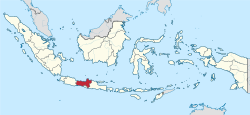
Central Java (Indonesian: Jawa Tengah, Javanese: ꦗꦮꦶꦩꦢꦾ, romanized: Jawi Tengah) is a province of Indonesia, located in the middle of the island of Java. Its administrative capital is Semarang. It is bordered by West Java in the west, the Indian Ocean and the Special Region of Yogyakarta in the south, East Java in the east, and the Java Sea in the north. It has a total area of 33,750.37 km2, with a population of 36,516,035 at the 2020 Census[8] making it the third-most populous province in both Java and Indonesia after West Java and East Java. The official population estimate in mid-2024 was 37,892,280 (comprising 19,037,740 males and 18,854,540 females).[2] The province also includes a number of offshore islands, including the island of Nusakambangan in the south (close to the border of West Java), and the Karimun Jawa Islands in the Java Sea.
Key Information


Central Java is also a cultural concept that includes the Yogyakarta Special Region, in turn including the city of Yogyakarta; however, administratively that city and its surrounding regencies have formed a separate special region (equivalent to a province) since the country's independence, and is administered separately. Although known as the "heart" of Javanese culture, there are several other non-Javanese ethnic groups, such as the Sundanese on the border with West Java. Chinese Indonesians, Arab Indonesians, and Indian Indonesians are also scattered throughout the province.
The province has been inhabited by humans since the prehistoric-era. Remains of a Homo erectus, known as "Java Man", were found along the banks of the Bengawan Solo, and date back to 1.7 million years ago.[9] What is present-day Central Java was once under the control of several Hindu-Buddhist kingdoms, Islamic sultanates, and the Dutch East Indies colonial government. Central Java was also the centre of the Indonesian independence movement. As the majority of modern-day Indonesians are of Javanese descent, both Central Java and East Java have a major impact on Indonesia's social, political, and economic life.
History
[edit]Prehistoric era
[edit]
Java has been inhabited by humans or their ancestors (hominina) since prehistoric times. In Central Java and the adjacent territories in East Java remains known as "Java Man" were discovered in the 1890s by the Dutch anatomist and geologist Eugène Dubois. It belongs to the species Homo erectus,[10] and are believed to be about 1.7 million years old.[10] The Sangiran site is an important prehistoric site on Java.
Around 40,000 years ago, Australoid peoples related to modern Australian Aboriginals and Melanesians settled in Central Java. They were assimilated or replaced by Mongoloid Austronesians by about 3,000 BC, who brought technologies of pottery, outrigger canoes, the bow and arrow, and introduced domesticated pigs, fowls, and dogs. They also introduced cultivated rice and millet.[11]
Hindu-Buddhist and Islamic era
[edit]
Recorded history began in what is now Central Java in the 7th century AD. The writing, as well as Hinduism and Buddhism, were brought by the Indians from South Asia, at the time of Central Java was a centre of power in Java. In 664 AD, the Chinese monk Hui-neng visited the Javanese port city he called Hēlíng (訶陵) or Ho-ling, where he translated various Buddhist scriptures into Chinese with the assistance of the Javanese Buddhist monk Jñānabhadra. It is not precisely known what is meant by the name Hēlíng. It used to be considered the Chinese transcription of Kalinga but it is now most commonly thought of as a rendering of the name Areng. Hēlíng is believed to be located somewhere between Semarang and Jepara.
The first dated inscription in Central Java was the Canggal from 732 AD. This inscription, from Kedu, is written in Sanskrit in Pallava script. It is written that a Shaivite king named Sri Sanjaya established a kingdom called Mataram. Under the reign of Sanjaya's dynasty, several monuments such as the Prambanan temple complex were built. At the same time, a competing dynasty Sailendra arose, adhering to Buddhism and built the Borobudur temple. After 820 AD, there was no more mention of the Hēlíng in Chinese records. Coinciding with the overthrow of the Sailendras by the Sanjayas who restored Shaivism as the dominant religion. In the middle of the 10th century, however, the centre of power moved to eastern Java. Raden Wijaya founded the Majapahit Empire, and reaching its peak during the reign of Hayam Wuruk. The kingdom claimed sovereignty over the entire Indonesian archipelago, although direct control tended to be limited to Java, Bali and Madura. Gajah Mada was a military leader during this time, who led numerous territorial conquests. The kingdoms in Java had previously based their power on agriculture, but Majapahit had succeeded in seizing ports and shipping lanes, in a bid to become the first commercial empire on Java. The empire suffered a setback after the death of Hayam Wuruk and the entry of Islam into the archipelago.
In the late 16th century, Islam had surpassed Hinduism and Buddhism as the dominant religion in Java. The emergence of Islamic kingdoms in Java is also inseparable from the role of Walisongo. At first, the spread of Islam was quick and was accepted by ordinary people, until the entrance of da'wah and it was carried out by the rulers of the island. The Sultanate of Demak was the first recorded Islamic kingdom in Java, first led by one of the descendants of the Majapahit emperor Raden Patah, who converted to Islam. During this period, Islamic kingdoms began to develop from Pajang, Surakarta, Yogyakarta, Cirebon, and Banten. Another Islamic kingdom, the Sultanate of Mataram, grew into a dominant force in the central and eastern Java. The cities of Surabaya and Cirebon were subdued by Mataram. Only the Mataram and Banten Sultanates remained after the Dutch arrived in the early 17th century. Some Islamic kingdoms in Java can still be found in several regions, such as Surakarta (with two kingdoms of Kasunanan and Mangkunegaran), and Yogyakarta with the Yogyakarta Sultanate and Pakualaman.
Dutch colonial rule
[edit]
By the late 16th century, European traders began to frequent central Javanese ports. The Dutch established a presence in the region through the East India Company. Following the fall of Demak to Mataram under the reign of Sultan Agung, Mataram was able to conquer almost all of Java by the 17th century, but internal disputes and Dutch intervention forced it to cede more land to the Dutch. These cessions led to several partitions of Mataram. The first was after the 1755 Treaty of Giyanti, which divided the kingdom in two, the Sultanates of Surakarta and Yogyakarta. Surakarta was divided again with the establishment of the Mangkunegaran following the 1757 Treaty of Salatiga.
During the Napoleonic Wars, Central Java as a Dutch colony was taken over by the British. In 1813, the Sultanate of Yogyakarta was divided with the establishment of the Pakualaman. Following the departure of the British, the Dutch returned as stipulated in the Congress of Vienna. The Java War between 1825 and 1830 ravaged Central Java, which resulted in a consolidation of the Dutch power. The power and the territories of the already divided Mataram were greatly reduced. After the war, the Netherlands enforced the Cultivation System which was linked to famines and epidemics in the 1840s, first in Cirebon and then Central Java, as cash crops such as indigo and sugar had to be grown instead of rice.
In the 1900s, the predecessor of the modern Central Java was created, named Gouvernement van Midden-Java. Before 1905, central Java consisted of 5 gewesten (regions) namely Semarang, Rembang, Kedu, Banyumas, and Pekalongan. Surakarta was still an independent vorstenland (autonomous region) which stood alone and consisted of two regions, Surakarta and Mangkunegaran, as well as Yogyakarta. Each gewest consisted of districts. At that time, the Rembang Gewest also included Regentschap Tubanand Regentschap Bojonegoro. After the enactment of the 1905 Decentralisatie Besluit (Decentralisation Decision), the governor was given autonomy and a regional Council was formed. In addition, autonomous gemeente (municipal) was formed, Pekalongan, Tegal, Semarang, Salatiga, and Magelang. In 1930, the province was designated as an autonomous region with a provinciale raad (provincial council). The province consists of several residenties (residencies), covering several regentschap (districts), divided into several kawedanan (districts). Central Java consisted of 5 residences: Pekalongan, Jepara-Rembang, Semarang, Banyumas, and Kedu.
Independence and contemporary era
[edit]On 1 March 1942, the Imperial Japanese Army landed on Java, and the following week, the Dutch East Indies surrendered to Japan. During Japanese rule, Java and Madura were placed under the Japanese 16th Army. Many who lived in areas considered important to the war effort experienced torture, sex slavery, arbitrary arrest and execution, and other war crimes. Thousands of people were taken away as forced labourers (romusha) for Japanese military projects, including the Burma-Siam and Saketi-Bayah railways, and suffered or died as a result of ill-treatment and starvation. A later UN report stated that four million people died in Indonesia as a result of the Japanese occupation.[12] About 2.4 million people died in Java from famine during 1944–45.[13]

Following the surrender of Japan, Indonesia proclaimed its independence on 17 August 1945. The final stages of warfare were initiated in October when, under the terms of their surrender, the Japanese tried to re-establish the authority they relinquished to the Indonesians in towns and cities. The fiercest fighting involving the Indonesian pemuda and the Japanese was in Semarang. Six days later, British forces began to occupy the city, after which retreating Indonesian Republican forces retaliated by killing between 130 and 300 Japanese prisoners. Five hundred Japanese and 2,000 Indonesians had been killed, and the Japanese had almost captured the city when British forces arrived.[14]
The province of Central Java was formed on 15 August 1950, excluding Yogyakarta but including Surakarta.[15] There has been no significant changes in the administrative division of the province ever since. In the aftermath of the 30 September Movement in 1965, an anti-communist purge took place in Central Java, in which the army and community vigilante groups killed Communists and leftists, both actual and alleged. Others were interned in concentration camps, the most infamous of which was on the isle of Buru in Maluku, first used as a place of political exile by the Dutch. Some were executed years later, but most were released in 1979[16] In 1998, near the downfall of Suharto, anti-Chinese violence broke out in Surakarta (Solo) and surrounding areas, in which Chinese property and other buildings were burnt down. The following year, public buildings in Surakarta were burnt by supporters of Megawati Sukarnoputri after Indonesia's parliament chose Abdurrahman Wahid instead of Megawati for the presidency.
The 2006 Yogyakarta earthquake in the south and Yogyakarta devastated many buildings and caused thousands of deaths and more than 37,000 injuries.
Geography
[edit]

According to the slope level of land in Central Java, 38% of the land has a slope of 0–2%, 31% has a slope of 2–15%, 19% has a slope of 15–40%, and the remaining 12% has a slope of more than 40%.
The northern coastal region of Central Java has a narrow lowland. In the Brebes area, it is 40 km wide from the coast, while in Semarang, it is only 4 km wide. This plain continues with the depression of Semarang-Rembang in the east. Mount Muria at the end of the Ice Age (around 10,000 years BC) was a separate island from Java, which eventually fused because of alluvial deposits from flowing rivers.[17] The city of Demak during the era of the Demak Sultanate was on the edge of the sea and became a thriving port. This sedimentation process is still ongoing on the coast of Semarang.[18]
In the south of the area are the Northern Cretaceous Mountains and the Kendeng Mountains, which are limestone mountains stretching from the east of Semarang from the Southwest end of Pati then east to the Lamongan and Bojonegoro in East Java.

The main range of mountains in Central Java is the North and South Serayu Mountains. The North forms a mountain chain that connects the Bogor range in West Java with the Kendeng Mountains in the east. The width of this mountain range is around 30–50 km; on the western end there is Mount Slamet, which is the highest mountain in Central Java as well as the second-highest mountain in Java, and the eastern part is the Dieng Plateau with peaks of Mount Prahu and Mount Ungaran. Between the series of North and South Serayu Mountains are separated by the Serayu Depression which stretches from Majenang in the Cilacap Regency, Purwokerto, to Wonosobo. East of this depression is the Sindoro and Sumbing volcano, and the east again (Magelang and Temanggung areas) is a continuation of depression which limits Mount Merapi and Mount Merbabu.
The Southern Serayu Mountains are part of the South Central Java Basin located in the southern part of the province. This mandala is a geoantiklin that extends from west to east along 100 kilometres and is divided into two parts separated by the Jatilawang valley, namely the western and eastern regions. The western part is formed by Mount Kabanaran (360 m) and can be described as having the same elevation as the Bandung Depression Zone in West Java or as a new structural element in Central Java. This section is separated from the Bogor Zone by the Majenang Depression.
The eastern part was built by the Ajibarang anticline (narrow anticline) which was cut by the Serayu River stream. In the east of Banyumas, the anticline developed into an anticlinorium with a width reaching 30 km in the Lukulo area (south of Banjarnegara-Midangan) or often called the Kebumen Tinggi. At the very eastern end of Mandala, the South Serayu Mountains are formed by the dome of the Kulonprogo Mountains (1022 m), which is located between Purworejo and the Progo River.
The area of the south coast of Central Java also has a narrow lowland, with a width of 10–25 km. In addition, there are South Gombong Karst Areas. Sloping hills stretch parallel to the coast, from Yogyakarta to Cilacap. East of Yogyakarta is a limestone mountain area that extends to the southern coast of East Java.
Hydrology
[edit]
The rivers that empty into the Java Sea include the Bengawan Solo River, Kali Pemali, Kali Comal, and Kali Bodri, while the ones that empty into the Indian Ocean include Serayu River, Bogowonto River, Luk Ulo River and Progo River. Bengawan Solo is the longest river on the island of Java (572 km); has a spring in the Sewu Mountains (Wonogiri Regency), this river flows to the north, crosses the City of Surakarta, and finally goes to East Java and empties into the Gresik area (near Surabaya).
Among the main reservoirs (lakes) in Central Java are Gunung Rowo Lake (Pati Regency), Gajahmungkur Reservoir (Wonogiri Regency), Kedungombo Reservoir (Boyolali and Sragen Regency), Rawa Pening Lake (Semarang Regency), Cacaban Reservoir (Tegal Regency), Malahayu Reservoir (Brebes Regency), Wadaslintang Reservoir (border of Kebumen Regency and Wonosobo Regency), Gembong Reservoir (Pati Regency), Sempor Reservoir (Kebumen Regency) and Mrica Reservoir (Banjarnegara Regency).
Climate
[edit]The average temperature in Central Java is between 18–28 °C (64–82 °F) and the relative humidity varies between 73% and 94%.[15] While the humidity is high in most low-lying parts of the province, it drops significantly in the upper mountains.[15] The highest average annual rainfall of 3,990 mm with 195 rainy days was recorded in Salatiga.[15]
Government and Administrative divisions
[edit]
On the eve of the World War II in 1942, Central Java was subdivided into seven residencies (Dutch: residentie or plural residenties, Javanese karésiḍènan or karésidhènan) which corresponded more or less with the main regions of this area. These residencies were:
| Residency | Containing present-day Regencies and Cities |
Population mid 2024[2] |
|---|---|---|
| Banjoemas | Cilacap, Banyumas, Purbalingga and Banjarnegara | 5,969,680 |
| Kedoe | Kebumen, Purworejo, Wonosobo, Magelang and Temanggung plus City of Magelang |
5,409,070 |
| Gouvernement Jogjakarta | Kulon Progo, Bantul, Gunungkidal and Slemen plus City of Yogyakarta |
3,759,500 |
| Gouvernement Soerakarta | Boyolali, Klaten, Sukoharjo, Wonogiri, Karanganyar and Sragen plus City of Surakarta |
6,883,160 |
| Djapara-Rembang | Grobogan, Blora, Rembang, Pati, Kudus and Jepara | 6,566,620 |
| Semarang | Demak, Semarang and Kendal plus Cities of Salatiga and Semarang |
5,317,650 |
| Pekalongan | Batang, Pekalongan, Pemalang, Tegal and Brebes plus Cities of Pekalongan and Tegal |
7,746,210 |
The Southeastern (Solo) area (or Gouvernement Soerakarta) used to be the Surakarta Sunanate until the monarchy was unrecognized by the Indonesian government. However, after the local elections in 1957, the role of these residencies were reduced in significance until they finally disappeared.[19] The only major boundary change since the creation of the province took place on 14 June 1965, when a new Batang Regency was formed from the eastern half of Pekalongan Regency.
Today, Central Java (excluding Special Region of Yogyakarta, which is the former Gouvernement Jogjakarta) is divided into 29 regencies (kabupaten) and six cities (kota, previously kotamadya and kota pradja), the latter being independent of any regency. These contemporary regencies and cities can further be subdivided into 565 districts (kecamatan). These districts are further divided into 7,804 rural villages (desa) and 764 urban villages (kelurahan).[15]
Central Java regencies and cities
[edit]| Code | Coat of arms | Name | Capital | Area (km2)[20] |
Population (mid 2024)[21] |
Level 3 | Level 4 | Location map | ||||
|---|---|---|---|---|---|---|---|---|---|---|---|---|
#33.
|
SNI | English | Bahasa Indonesia | Javanese (Hanacaraka) | Dis. | UV | RV | |||||
01
|
CLP
|

|
Cilacap Regency | Kabupaten Cilacap | ꦕꦶꦭꦕꦥ꧀ | Cilacap | 2,323.93 | 2,059,748 | 24 | 15 | 269 | 
|
02
|
PWT
|

|
Banyumas Regency | Kabupaten Banyumas | ꦧꦚꦸꦩꦱ꧀ | Purwokerto | 1,391.15 | 1,868,446 | 27 | 30 | 301 | 
|
03
|
PBG
|

|
Purbalingga Regency | Kabupaten Purbalingga | ꦥꦸꦂꦧꦭꦶꦁꦒ | Purbalingga | 805.76 | 1,057,750 | 18 | 15 | 224 | 
|
04
|
BNR
|
.svg)
|
Banjarnegara Regency | Kabupaten Banjarnegara | ꦧꦚ꧀ꦗꦂꦤꦼꦒꦫ | Banjarnegara | 1,144.90 | 1,071,977 | 20 | 12 | 266 | 
|
05
|
KBM
|

|
Kebumen Regency | Kabupaten Kebumen | ꦏꦼꦧꦸꦩꦺꦤ꧀ | Kebumen | 1,334.10 | 1,446,833 | 26 | 11 | 449 | 
|
06
|
PWR
|

|
Purworejo Regency | Kabupaten Purworejo | ꦥꦸꦂꦮꦉꦗ | Purworejo | 1,081.97 | 809,651 | 16 | 25 | 469 | 
|
07
|
WSB
|

|
Wonosobo Regency | Kabupaten Wonosobo | ꦮꦤꦱꦧ | Wonosobo | 1,011.62 | 945,955 | 15 | 29 | 236 | 
|
08
|
MKD
|

|
Magelang Regency | Kabupaten Magelang | ꦩꦒꦼꦭꦁ | Mungkid | 1,129.98 | 1,345,662 | 21 | 5 | 367 | 
|
09
|
BYL
|

|
Boyolali Regency | Kabupaten Boyolali | ꦧꦺꦴꦪꦭꦭꦶ | Boyolali | 1,096.59 | 1,114,070 | 22 | 6 | 261 | 
|
10
|
KLN
|

|
Klaten Regency | Kabupaten Klaten | ꦏ꧀ꦭꦛꦺꦤ꧀ | Klaten | 701.50 | 1,302,648 | 26 | 10 | 391 | 
|
11
|
SKH
|

|
Sukoharjo Regency | Kabupaten Sukoharjo | ꦱꦸꦏꦲꦂꦗ | Sukoharjo | 493.53 | 916,472 | 12 | 17 | 150 | 
|
12
|
WNG
|

|
Wonogiri Regency | Kabupaten Wonogiri | ꦮꦤꦒꦶꦫꦶ | Wonogiri | 1,905.75 | 1,057,495 | 25 | 43 | 251 | 
|
13
|
KRG
|

|
Karanganyar Regency | Kabupaten Karanganyar | ꦏꦫꦔꦚꦂ | Karanganyar | 803.05 | 953,696 | 17 | 15 | 162 | 
|
14
|
SGN
|

|
Sragen Regency | Kabupaten Sragen | ꦯꦿꦒꦺꦤ꧀ | Sragen | 994.57 | 1,023,538 | 20 | 12 | 196 | 
|
15
|
PWD
|

|
Grobogan Regency | Kabupaten Grobogan | ꦒꦿꦺꦴꦧꦺꦴꦒꦤ꧀ | Purwodadi | 2,023.85 | 1,520,974 | 19 | 7 | 273 | 
|
16
|
BLA
|

|
Blora Regency | Kabupaten Blora | ꦨ꧀ꦭꦺꦴꦫ | Blora | 1,957.29 | 927,961 | 16 | 24 | 271 | 
|
17
|
RBG
|

|
Rembang Regency | Kabupaten Rembang | ꦉꦩ꧀ꦧꦁ | Rembang | 1,037.54 | 665,501 | 14 | 7 | 287 | 
|
18
|
PTI
|

|
Pati Regency | Kabupaten Pati | ꦥꦛꦶ | Pati | 1,572.90 | 1,385,904 | 21 | 5 | 401 | 
|
19
|
KDS
|

|
Kudus Regency | Kabupaten Kudus | ꦏꦸꦢꦸꦱ꧀ | Kudus | 447.45 | 877,821 | 9 | 9 | 123 | 
|
20
|
JPA
|

|
Jepara Regency | Kabupaten Jepara | ꦗꦼꦥꦫ | Jepara | 1,020.25 | 1,283,687 | 16 | 11 | 184 | 
|
21
|
DMK
|

|
Demak Regency | Kabupaten Demak | ꦢꦼꦩꦏ꧀ | Demak | 977.77 | 1,254,204 | 14 | 6 | 243 | 
|
22
|
UNR
|

|
Semarang Regency | Kabupaten Semarang | ꦱꦼꦩꦫꦁ | Ungaran | 1,019.27 | 1,088,729 | 19 | 27 | 208 | 
|
23
|
TMG
|

|
Temanggung Regency | Kabupaten Temanggung | ꦠꦼꦩꦔ꧀ꦒꦸꦁ | Temanggung | 864.83 | 822,880 | 20 | 23 | 266 | 
|
24
|
KDL
|
.svg)
|
Kendal Regency | Kabupaten Kendal | ꦏꦼꦟ꧀ꦝꦭ꧀ | Kendal | 1,008.12 | 1,094,214 | 20 | 20 | 266 | 
|
25
|
BTG
|

|
Batang Regency | Kabupaten Batang | ꦨꦠꦁ | Batang | 857.27 | 855,878 | 15 | 9 | 239 | 
|
26
|
KJN
|

|
Pekalongan Regency | Kabupaten Pekalongan | ꦥꦏꦭꦺꦴꦔꦤ꧀ | Kajen | 892.91 | 1,034,241 | 19 | 13 | 272 | 
|
27
|
PML
|

|
Pemalang Regency | Kabupaten Pemalang | ꦥꦼꦩꦭꦁ | Pemalang | 1.137.41 | 1,601,007 | 14 | 12 | 212 | 
|
28
|
SLW
|

|
Tegal Regency | Kabupaten Tegal | ꦠꦼꦒꦭ꧀ | Slawi | 983.90 | 1,745,278 | 18 | 6 | 281 | 
|
29
|
BBS
|

|
Brebes Regency | Kabupaten Brebes | ꦧꦽꦧꦼꦱ꧀ | Brebes | 1,742.81 | 2,066,426 | 17 | 5 | 292 | 
|
71
|
MGG
|

|
Magelang City | Kota Magelang | ꦩꦒꦼꦭꦁ | — | 18.56 | 128,709 | 3 | 17 | — | 
|
72
|
SKT
|

|
Surakarta City | Kota Surakarta | ꦯꦸꦫꦏꦂꦡ | — | 46.72 | 589,242 | 5 | 51 | — | 
|
73
|
SLT
|

|
Salatiga City | Kota Salatiga | ꦯꦭꦠꦶꦒ | — | 54.98 | 198,971 | 4 | 23 | — | 
|
74
|
SMG
|

|
Semarang City | Kota Semarang | ꦯꦼꦩꦫꦁ | — | 370.00 | 1,702,379 | 16 | 177 | — | 
|
75
|
PKL
|

|
Pekalongan City | Kota Pekalongan | ꦥꦏꦭꦺꦴꦔꦤ꧀ | — | 46.20 | 318,221 | 4 | 27 | — | 
|
76
|
TGL
|

|
Tegal City | Kota Tegal | ꦠꦼꦒꦭ꧀ | — | 39.08 | 294,477 | 4 | 27 | — | 
|
Note: The regencies now appear in the formal order prescribed by the Indonesian Central Statistics Board (Badan Pusat Statistik), as indicated by the regional codes (Kode Wilayah).
Central Java electoral districts
[edit]The province comprises 10 of Indonesia's 84 national electoral districts to elect members to the House of Representatives.[22] The province's 77 elected members are comprised as follows:
| Electoral District | Regency and City | No of seats |
|---|---|---|
| Central Java I | 8 | |
| Central Java II | 7 | |
| Central Java III | 9 | |
| Central Java IV | 7 | |
| Central Java V | 8 | |
| Central Java VI | 8 | |
| Central Java VII | 7 | |
| Central Java VIII | 8 | |
| Central Java IX | 8 | |
| Central Java X | 7 |
Demographics
[edit]As of the 2010 census, Central Java's population stood at 32.38 million, barely increasing from 2000, compared with the 1990 census when the population was 28 million.[23] This reflected an increase of approximately 13.5% in 20 years. At the 2020 Census the population was 36,516,035, and the official estimate for mid 2024 was 37,892,280.[2] Birthrates had not plunged between 2000 and 2010, instead losses due to domestic outmigration on 2010 figures, reversed themselves in 2020 with pandemic back to kampung influence.
The three biggest regencies in terms of population are: Brebes, Cilacap and Banyumas. Together they make up approximately 16% of the province's population. Major urban population centres include Greater Semarang, Greater Surakarta and the Brebes-Tegal-Slawi area in the northwest of the province.
Religion
[edit]| Religions | Total |
|---|---|
| Islam | 37,273,804 |
| Protestant | 593,139 |
| Roman Catholic | 342,347 |
| Buddhism | 49,987 |
| Hinduism | 14,045 |
| Kejawen | 6,262 |
| Confucianism | 1,303 |
| Overall | 38,280,887 |
- Islam (97.4%)
- Protestantism (1.55%)
- Roman Catholic (0.89%)
- Buddhism (0.13%)
- Hinduism (0.04%)
- Kejawen (0.02%)
- Confucianism (0.00%)
Although the overwhelming majority of Javanese are Muslims, many also profess indigenous Javanese beliefs. Clifford Geertz, in his book about the religion of Java, made a distinction between the so-called santri Javanese and abangan Javanese.[24] He considered the former as orthodox Muslims and the latter as nominal Muslims that devote more energy to indigenous traditions.
Dutch Protestants were active in missionary activities and were rather successful. The Dutch Catholic Jesuit missionary, F.G.C. van Lith also achieved some success, especially in areas around the central-southern parts of Central Java and Yogyakarta at the beginning of the 20th century,[25] and is buried at the Jesuit necropolis at Muntilan.
Following the upheavals in 1965–66, religious identification of citizens became compulsory, and there has been a renaissance of Buddhism and Hinduism since then. As one has to choose a religion out of the five official religions in Indonesia; i.e. Islam, Protestantism, Catholicism, Hinduism, and Buddhism, the latter two became alternatives for people who did not want to be Muslims or Christians. Confucianism is also common among Chinese Indonesians. In the post-Suharto era, it is recognised as an official religion along with the aforementioned five.
-
 The Demak Great Mosque, built in the 15th century.
 -
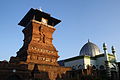 Menara Kudus Mosque, one of the oldest mosques in Indonesia.
 -
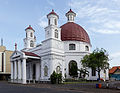 Blenduk Church, Semarang. Built in 1753, it is the oldest church in the province.
 -

-
 Statue of Buddha Vihara Buddhagaya Watugong, Semarang


.jpg)

Ethnicity
[edit]At approximately 98%, Javanese people form the overwhelming majority of the population, and a minority of the Sundanese people.[26] Central Java is known as the centre of Javanese culture. The cities of Surakarta and Yogyakarta are the centres of the Javanese royal palace that still stands today.
Significant minority ethnic groups include the Chinese Indonesians. They usually reside in urban areas, although they are also found in rural areas. In general, they primarily work in trade and services. Many speak the Javanese language with sufficient fluency as they have lived alongside the Javanese. One can feel the strong influence in Semarang and the town of Lasem in Rembang Regency, which is on the northeastern tip of Central Java. Even Lasem is nicknamed Le petit chinois or the Small Chinese City. The urban areas that are densely populated by Chinese Indonesians are called pecinan, which means "Chinatown". Additionally, in several major cities, the Arab-Indonesian community can also be found. Similar to the Chinese community, they are usually engaged in trade and services.
In areas bordering the province of West Java, there are Sundanese people and Sundanese culture, especially in the Cilacap, Brebes, and Banyumas regions. Sundanese toponyms are common in these regions such as Dayeuhluhur in Cilacap, Ciputih and Citimbang in Brebes and even Cilongok as far away in Banyumas.[27] In the interior of Blora, which borders East Java, there is an isolated Samin community, the case of which is almost the same as the Baduy people in Banten.
Language
[edit]
Although Indonesian is the official language, people mostly speak Javanese as their daily language. The Solo-Jogja dialect or the Mataram dialect is considered as the standard Javanese Language.
Additionally, there are a number of Javanese dialects but in general, it consists of two, namely kulonan and timuran. The former is spoken in the western part of Central Java, consisting of the Banyumasan dialects and Tegal dialects (also called Basa Ngapak). They are quite different in pronunciation from the standard Javanese. The latter dialect is spoken in the eastern part of the province, including the Mataram dialect (Solo-Jogja), Semarang dialect, and the Pati dialect. Between the borders of the two dialects, Javanese is spoken with a mixture of both dialects; these areas are Pekalongan and the Kedu Plain, which composes Magelang and Temanggung.
Sundanese language
[edit]Some parts of the districts of Brebes and Cilacap speak Sundanese, the western part of Central Java is the border between the Javanese people and Sundanese people worlds in the western of Java.[28]
Culture
[edit]Central Java is considered to be the heart of the Javanese culture. The ideal conduct and moral of the courts (such as politeness, nobility and grace) has a tremendous influence on the people. They are known as soft-spoken, very polite, extremely class-conscious, apathetic, down-to-earth, etc. These stereotypes form what most non-Javanese see as the "Javanese Culture", when in fact, not all Javanese behave in such manner as most Javanese are far from the court culture.[29]
Mapping the Javanese cultures
[edit]The Javanese cultural area can be divided into three distinct main regions: Western, Central, and Eastern Javanese culture or in their Javanese names as Ngapak, Kejawèn and Arèk. The boundaries of these cultural regions coincide with the isoglosses of the Javanese dialects. Cultural areas west of Dieng Plateau, Pekalongan, and Kebumen regencies are considered Ngapak whereas the border of the eastern cultural areas or Arèk lies in East Java. Consequently, culturally, Central Java consists of two cultures, while the Central Javanese Culture proper is not entirely confined to Central Java.[29]
Creative arts
[edit]Architecture
[edit].png)
The architecture of Central Java is characterised by the juxtaposition of the old and the new and a wide variety of architectural styles, the legacy of many successive influences from the Indian subcontinent, the Middle East, China, and Europe. In particular, northern coastal cities such as Semarang, Tegal, and Pekalongan can boast European colonial architecture. The European and Chinese influence can be seen in Semarang's temple of Sam Poo Kong dedicated to Zheng He and the Domed Church built in 1753. The latter is the second-oldest church in Java and the oldest in Central Java. In the former capital of Surakarta, there are also several European architectures.
Central Java also has some notable religious buildings. The Borobudur and the Prambanan temple complexes are among the largest Buddhist and Hindu structures in the world. In general, a characteristic Javanese mosque does not have a dome as its roof but a Meru-like roof which is reminiscent of a Hindu or Buddhist temple. The tower of the famous Mosque of Kudus resembles a Hindu-Javanese or Balinese temple more than a traditional Middle Eastern mosque.
Batik
[edit]
Central Java is famous and well known for its exquisite batik, a generic wax-resist dyeing technique used on textiles. There are different styles of batik motifs. A centre of batik production is in Pekalongan. Other centres include Surakarta and Yogyakarta. Batik in Pekalongan style, which represent gaya pesisir (or coastal style), is different from the one in Surakarta and Yogyakarta that represent batik from the heartland of Java (gaya kejawèn).[30]
Dance
[edit]
One can even see the court influences in the art forms. The dances of the courts of Java are usually slow and graceful with no excessive gestures. The people followed this approach, and as a result, slow-paced and graceful movements can even be found in folk dances throughout Central Java, though with some exceptions. One can enjoy the beauty of Central Javanese dances in "Kamajaya-Kamaratih" or "Karonsih", usually performed in a traditional Javanese wedding.
Theatre
[edit]There are several kinds of Central Javanese theatre and performing arts. The most well-known is the Javanese wayang theatre, which has several types. These are wayang kulit, wayang klitik, wayang beber, wayang golek, and wayang wong. Wayang kulit are shadow puppets theatre with leather puppets. The stories are loosely based on the Mahabharata and Ramayana cycles. Wayang klitik are puppets theatre with flat wooden puppets. The stories are based on Panji stories. Panji was a native Javanese princes who embarked a 'journeys of desire'.[31] Wayang beber is scroll theatre, and it involves "performing" scenes of a story elaborately drawn and painted on rolled sheets. Wayang golek consists of three-dimensional wooden puppets. The narrative can be based on anything, but usually are drawn from Islamic heroic ones. Finally, wayang wong is wayang theatre involving live figures, actors who are performing a play. The narrative, however, must be based on the Mahabharata or the Ramayana.
In addition to wayang, there is another form of theatre called ketoprak. It is a staged play by actors accompanied by Javanese gamelan. The narrative is free but cannot be based on Mahabharata or Ramayana.
Music
[edit]
Central Javanese music is almost synonymous with gamelan. It is a musical ensemble typically featuring a variety of instruments such as metallophones, xylophones, drums, gongs, bamboo flutes, bowed and plucked strings. Vocalists may also be included. The term refers more to the set of instruments than the players of those instruments. A gamelan as a set of instruments is a distinct entity, built and tuned to stay together. Instruments from different gamelan are not interchangeable. However, gamelan is not typically Central Javanese as it is also known elsewhere.
Contemporary Javanese pop music is called campursari. It is a fusion between gamelan and Western instruments, much like kroncong. Usually, the lyrics are in Javanese, though not always. One notable singer is Didi Kempot, born in Sragen, north of Surakarta. He mostly sings in Javanese.
Literature
[edit]It can be argued that Javanese literature started in Central Java. The oldest-known literary work in the Javanese language is the inscription of Sivagrha from Kedu Plain. This inscription, which is from 856 AD, is written as a kakawin or Javanese poetry with Indian metres.[32] The oldest of narrative poems, Kakawin Ramayana, which tells the well-known story of Ramayana, is believed to have come from Central Java. It can be safely assumed that this kakawin were written in the central Java region in the 9th century.[33]
After the shift of Javanese power to eastern Java, it had been quiet from Central Java for several centuries concerning Javanese literature until the 16th century. At this time, the centre of power was shifted back to Central Java. The oldest work written in modern Javanese language concerning Islam is the so-called "Book of Bonang" or also "The Admonitions of Seh Bari". This work is extant in just one manuscript, now kept in the University of Leiden as codex Orientalis 1928. It is assumed that this manuscript originates from Tuban, in eastern Java and was taken to the Netherlands after 1598.[34] However, this work is attributed to Sunan Bonang, one of the nine Javanese saints who spread Islam in Java and Sunan Bonang came from Bonang, a place in Demak Regency, Central Java. It can be argued that this work marked the beginning of Islamic literature in the region.
However, the pinnacle of Central Javanese literature was created at the courts of the kings of Mataram in Kartasura and later in Surakarta and Yogyakarta that are mostly attributed to the Yasadipura family. The most famous member of this family is Rangga Warsita who lived in the 19th century. He is the best-known of all Javanese writers and also one of the most prolific. He is also known as bujangga panutup or "the last court poet".
Following independence, the Javanese language as a medium was pushed to the background. Still, one of the greatest contemporary Indonesian authors, Pramoedya Ananta Toer was born in 1925 in Blora. He was an author of novels, short stories, essays, polemics, and histories of his homeland and its people. A well-regarded writer in the West, his outspoken and often politically charged writings faced censorship at home. He faced extrajudicial punishment for opposing the policies of both President Sukarno and Suharto. During imprisonment and house arrest, he became a cause célèbre for advocates of freedom of expression and human rights. In his works, he writes much about life and social problems in Java.
Cuisine
[edit]Rice is the staple food of Central Java. In addition to rice, dried cassava, known locally as gaplèk, also serve as a staple food. Javanese food tends to taste sweet. Cooked and stewed vegetables, usually in coconut milk (santen in Javanese) are prevalent. Raw vegetable, which is popular in West Java, is less prevalent in Central Java.
Saltwater fish, both fresh and dried are common, especially among coastal areas. Freshwater fish is not popular in Central Java, unlike in West Java, except perhaps for catfish known locally as lélé. It is usually fried and served with chilli condiment (sambal) and raw vegetables.
Chicken, mutton and beef are common meat. Certain parts of the population also eat dog meat, known by its euphemism daging jamu (literally "traditional medicine meat").
Tofu and tempe serve as the standard replacement to fish and meat. Famous dishes in Central Java include gudeg (sweet stew of jackfruit) and sayur lodeh (vegetables cooked in coconut milk).
Besides the aforementioned tofu, there is a strong Chinese influence in numerous dishes. Some examples of Sino-Javanese food include noodles, bakso (meatballs), lumpia, soto etc. The widespread use of sweet soybeans sauce (kecap manis) in the Javanese cuisine can also be attributed to the Chinese influence.


Transportation
[edit]
Central Java is connected to the Trans-Java Toll Road which currently runs from Merak in Banten to Probolinggo (planned: Banyuwangi), East-Java. Within the province the toll road starts at Brebes, continuing via Semarang then turn southeast to Surakarta until east of Sragen. Along the north coast east of Semarang, the North Coast Road (Jalur Pantai Utara or Jalur Pantura) is the main road. Losari, the Central Javanese gate at the western border on the northern coast, could be reached from Jakarta in 4 hours drive. On the southern coast, there is also a national way which run from Kroya at the Sundanese-Javanese border, through Yogyakarta to Surakarta and then to Surabaya via Kertosono in East Java. There is furthermore a direct connection from Tegal to Purwokerto and from Semarang to Yogyakarta and Surakarta.
Central Java was the province that first introduced a railway line in Indonesia. The very first line began in 1873 between Semarang and Yogyakarta by a private company,[35] but this route is now no longer used. Today there are five lines in Central Java: the northern line which runs from Jakarta via Semarang to Surabaya. Then there is the southern line from Kroya through Yogyakarta and Surakarta to Surabaya. There is also a train service between Semarang and Surakarta and a service between Kroya and Cirebon. At last there is a route between Surakarta and Wonogiri. The line between Kutoarjo and Surakarta, the line from Cirebon to Purwokerto up to Kroya and the entire north coast line (since 2014) are double-track,[36] while second tracks from Surakarta to Kertosono (towards Surabaya) and Purwokerto-Kroya-Kutoarjo are under construction of which the latter will be finished in 2019 .[37] Other lines are single-track.
On the northern coast Central Java is served by 8 harbours. The main port is Tanjung Mas in Semarang, other harbours are located in Brebes, Tegal, Pekalongan, Batang, Jepara, Juwana and Rembang. The southern coast is mainly served by the port Tanjung Intan in Cilacap.[38]
Finally on mainland Central Java there are five commercial airports. There is one additional commercial airport on the Karimunjawa isles. The airports on the mainland are: Adisumarmo International Airport in Surakarta, Jenderal Ahmad Yani International Airport in Semarang, Ngloram Airport in Cepu, Blora, General Sudirman Airport in Purbalingga and Tunggul Wulung Airport in Cilacap. Karimunjawa is served by Dewadaru Airport.
-
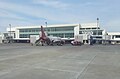 Ahmad Yani International Airport in Semarang
 -
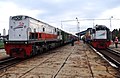 Trains in Kroya Station, Cilacap Regency
 -
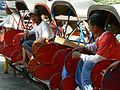 Becak lining up in Surakarta street
 -
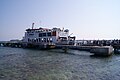 Port of Karimun Jawa


Economy
[edit]- Service (38.9%)
- Manufacturing (33.9%)
- Other Industrial (13.6%)
- Agriculture (13.5%)
GDP in the province of Central Java was estimated to be around $US 98 billion in 2010, with a per capita income of around $US 3,300. Economic growth in the province is quite rapid and GDP is forecast to reach $US 180 billion by 2015. The poverty rate of its people is 13% and will be decreased below 6%.[40]
Agriculture
[edit]
Much of Central Java is a fertile agricultural region. The primary food crop is wet rice. An elaborate irrigation network of canals, dams, aqueducts, and reservoirs has greatly contributed to Central Java's the rice-growing capacity over the centuries. In 2001, productivity of rice was 5,022 kilograms/ha, mostly provided from irrigated paddy field (± 98%). Klaten Regency had the highest productivity with 5525 kilograms/ha.[41]
Other crops, also mostly grown in lowland areas on small peasant landholdings, are corn (maize), cassava, peanuts (groundnuts), soybeans, and sweet potatoes. Terraced hillslopes and irrigated paddy fields are familiar features of the landscape. Kapok, sesame, vegetables, bananas, mangoes, durian fruits, citrus fruits, and vegetable oils are produced for local consumption. Tea, coffee, tobacco, rubber, sugarcane and kapok; and coconuts are exported. Several of these cash crops at a time are usually grown on large family estates. Livestock, especially water buffalo, is raised primarily for use as draft animals. Salted and dried fish are imported.[41][42]
Education
[edit]


Central Java is home to such notable state universities, which are:
- Diponegoro University
- Semarang State Polytechnic
- Semarang State University
- Sebelas Maret University
- Jenderal Soedirman University
- Walisongo State Islamic University
- Surakarta Institute of Indonesian Arts
- Muhammadiyah University of Surakarta
- Tidar University
The Military Academy (Akademi Militer) is located in Magelang Regency while the Police Academy (Akademi Kepolisian) is located in Semarang.
For foreign students requiring language training Salatiga has been a location for generations of students attending courses.
Tourism
[edit]

There are several tourism sites in Central Java. Semarang itself has many old buildings: Puri Maerokoco and the Indonesian Record Museum are located in this city.
Borobudur, which is one of the UNESCO World Cultural Heritage sites of Indonesia, is also located in this province, in the Magelang Regency. Candi Mendut and Candi Pawon can also be found near the Borobudur temple complex.
Candi Prambanan, on the border of Klaten regency and Yogyakarta is the biggest complex of Hindu temples. It is also a UNESCO World Cultural Heritage Site. There are several temples in the region around the Dieng Plateau. These date from before the era of the ancient Mataram.
The Palace of the Sunan Kraton Surakarta and Pura Mangkunegaran, are located in Surakarta, while the Grojogan Sewu waterfall is located in Karanganyar Regency. Several Majapahit temples and Sangiran museum are also located in Central Java.
Coat of arms and symbols
[edit]The motto of Central Java is Prasetya Ulah Sakti Bhakti Praja. This is a Javanese phrase meaning "A vow of devotion with all might to the country". The coat of arms of Central Java depicts a legendary flask, Kundi Amerta or Cupu Manik, formed in a pentagon representing Pancasila. In the centre of the emblem stands a sharp bamboo spike (representing the fight for independence, and it has 8 sections which represent Indonesia's month of Independence) with a golden five-pointed star (representing faith in God), superimposed on the black profile of a candi (temple) with seven stupas, while the middle stupa is the biggest. This candi is reminiscent of the Borobudur. Under the candi wavy outlines of waters are visible. Behind the candi two golden mountain tops are visible.
These twin mountains represents the unity between the people and their government. The emblem shows a green sky above the candi. Above, the shield is adorned with a red and white ribbon, the colours of the Indonesian flag. Lining the left and right sides of the shield are respectively stalk of rice (17 of them, representing Indonesia's day of Independence) and cotton flowers (5 of them, each one is 4-petaled, representing Indonesia's year of Independence). At the bottom, the shield is adorned with a golden red ribbon. On the ribbon the name "Central Java" (Jawa Tengah) is inscribed in black. The floral symbol of the province is the Michelia alba, while the provincial fauna is Oriolus chinensis.
Further reading
[edit]- Tourist (printed information)
- Backshall, S. et al. (1999) Indonesia, The rough guide London ISBN 1-85828-429-5. Central Java – pp. 153–231
- Cribb, Robert (2000) Historical Atlas of Indonesia London: Curzon Press
- Dalton. B. (1980s) Indonesia Handbook various editions – Central Java.
- Geertz, C. (1960) The Religion of Java University Of Chicago Press 1976 paperback: ISBN 0-226-28510-3
- Hatley, Ron et al. (1984) Other Javas: away from the kraton Clayton: Monash University
- Vaisutis. Justine et al. (2007) Indonesia Eighth edition. Lonely Planet Publications Pty Ltd, Footscray, Victoria ISBN 978-1-74104-435-5
Notable people
[edit]See also
[edit]References
[edit]- ^ Museum Kepresidenan (12 September 2018). "Sejarah Wilayah Indonesia". Museum Kepresidenan RI Balai Kirti. Ministry of Education and Culture. Archived from the original on 29 January 2020. Retrieved 29 January 2020.
- ^ a b c d Badan Pusat Statistik, Jakarta, 28 February 2025, Provinsi Jawa Tengah Dalam Angka 2025 (Katalog-BPS 1102001.33)
- ^ a b "Kewarganegaraan, Suku Bangsa, Agama, Bahasa, 2010 (PDF)" (PDF). Archived from the original (PDF) on 12 July 2017. Retrieved 15 March 2019.
- ^ a b c "ArcGIS Web Application". Archived from the original on 5 July 2022. Retrieved 14 October 2022.
- ^ Badan Pusat Statistik (2023). "Produk Domestik Regional Bruto (Milyar Rupiah), 2020–2022" (in Indonesian). Jakarta: Badan Pusat Statistik.
- ^ Badan Pembangunan Nasional (2023). "Capaian Indikator Utama Pembangunan" (in Indonesian). Jakarta: Badan Pembangunan Nasional.
- ^ "Indeks Pembangunan Manusia 2024" (in Indonesian). Statistics Indonesia. 2024. Retrieved 15 November 2024.
- ^ Badan Pusat Statistik, Jakarta, 2021.
- ^ Cited in Whitten, T.; Soeriaatmadja, R.E.; Suraya, A.A. (1996). The Ecology of Java and Bali. Hong Kong: Periplus Editions Ltd. pp. 309–312:
Pope, G. (1988). "Recent advances in far eastern paleoanthropology". Annual Review of Anthropology. 17: 43–77. doi:10.1146/annurev.an.17.100188.000355.
Pope, G. (15 August 1983). "Evidence on the Age of the Asian Hominidae". Proceedings of the National Academy of Sciences of the United States of America. 80 (16): 4988–4992. Bibcode:1983PNAS...80.4988P. doi:10.1073/pnas.80.16.4988. PMC 384173. PMID 6410399.
de Vos, J.P.; Sondaar, P.Y. (9 December 1994). "Dating hominid sites in Indonesia" (PDF). Science Magazine. 266 (16): 4988–4992. Bibcode:1994Sci...266.1726D. doi:10.1126/science.7992059. Archived (PDF) from the original on 29 September 2009. Retrieved 14 March 2019. - ^ a b "Java man (extinct hominid)". Encyclopædia Britannica. Archived from the original on 11 September 2007. Retrieved 10 December 2013.
- ^ Robert Cribb, Historical Atlas of Indonesia (2000:30)
- ^ Cited in: Dower, John W. War Without Mercy: Race and Power in the Pacific War (1986; Pantheon; ISBN 0-394-75172-8).
- ^ Van der Eng, Pierre (2008) 'Food Supply in Java during War and Decolonisation, 1940–1950.' MPRA Paper No. 8852. pp. 35–38. [1] Archived 3 November 2018 at the Wayback Machine
- ^ Ricklefs 1991, p. 216.
- ^ a b c d e [2] Archived 29 June 2006 at the Wayback Machine
- ^ Robert Cribb, Historical Atlas of Indonesia (2000:170–171).
- ^ Sunarto (2006). "Geomorphological Development of the Muria Palaeostrait in Relation to the Morphodynamics of the Wulan Delta, Central Java". Indonesian Journal of Geography.
- ^ hermes (4 November 2018). "Semarang is sinking – 'all has become sea' for its tiny neighbour". The Straits Times. Archived from the original on 4 November 2018. Retrieved 14 March 2019.
- ^ Robert Cribb, Historical Atlas of Indonesia (2000:165)
- ^ "Keputusan Menteri Dalam Negeri Nomor 100.1.1-6117 Tahun 2022 tentang Pemberian dan Pemutakhiran Kode, Data Wilayah Administrasi Pemerintahan, dan Pulau" (PDF). Kementerian Dalam Negeri. Retrieved 21 January 2025.
- ^ "Agregat Jumlah Penduduk per Kabupaten/Kota Tahun 2024". Satu Data Pemerintahan Dalam Negeri. 19 December 2024. Retrieved 21 January 2025.
- ^ Law No. 7/2017 (UU No. 7 Tahun 2017) as amended by Government Regulation in Lieu of Law No. 1/2022 and Regulation of General Elections Commission No. 6/2023.
- ^ Kamus Besar Bahasa Indonesia (1997:1249)
- ^ Clifford Geertz, The Religion of Java (1976:121–131), paperback edition
- ^ "Van Lith dan Muntilan "Bethlehem van Java"". Kompas (in Indonesian). Archived from the original on 19 June 2006.
- ^ Indonesia's Population: Ethnicity and Religion in a Changing Political Landscape. Institute of Southeast Asian Studies. 2003.
- ^ Sundanese toponyms often begins with the morpheme ci-, which means "river" or "water" "Archived copy" (PDF). Archived from the original (PDF) on 14 June 2007. Retrieved 26 April 2007.
{{cite web}}: CS1 maint: archived copy as title (link). Dayeuh is a Sundanese word which means region, q.v. F.S. Eringa Soendaas-Nederlands woordenboek (1984) - ^ Priyadi, Sugeng (2002). Banyumas, antara Jawa dan Sunda (in Indonesian). Penerbit Mimbar. ISBN 9789759036188.
- ^ a b Hatley, R., Schiller, J., Lucas, A., Martin-Schiller, B., (1984). "Mapping cultural regions of Java" in: Other Javas away from the kraton. pp. 1–32.
- ^ Ron Hatley, Mapping the Javanese cultures (1984:10–11)
- ^ Vickers, Adrian (2005). Journeys of Desire: A Study of the Balinese Text Malat. Leiden: KITLV. ISBN 9789067181372.
- ^ De Casparis, "A Metrical Old Javanese Inscription Dated 865 A.D." in Prasasti Indonesia II (1956:280–330)
- ^ Zoetmulder, Petrus Josephus (1974). Kalangwan: a survey of old Javanese literature. Martinus Nijhoff. p. 231.
- ^ Drewes, G.W.J. (1969). The Admonitions of Seh Bari. Brill. pp. 1–2. ISBN 978-90-04-24793-2.
- ^ Robert Cribb, Historical Atlas of Indonesia (2000:140)
- ^ "Double track for Trans-Java line to be operational in March". Archived from the original on 19 January 2019. Retrieved 19 January 2019.
- ^ "Pembangunan rel ganda Purwokerto-Kroya mencapai 97,73 persen" [Construction second track Purokerto-Kroya reaches 97.73%] (in Indonesian). 15 January 2019. Archived from the original on 20 January 2019. Retrieved 19 January 2019.
- ^ "Perhubungan" (in Malay). Archived from the original on 13 April 2007.
- ^ "Provinsi Jawa Tengah Dalam Angka 2023". Statistics Indonesia. Retrieved 22 September 2023.
- ^ SAID : ANGKA KEMISKINAN DI JAWA TENGAH HARUS DITURUNKAN. Archived 6 April 2018 at the Wayback Machine. siaran nasional.com (diakses 20 February 2018)
- ^ a b [3] Archived 5 March 2007 at the Wayback Machine
- ^ "Encyclopædia Britannica". Britannica.com. Retrieved 10 December 2013.
Bibliography
[edit]- Ricklefs, M.C. (1991). A History of Modern Indonesia Since c. 1300. San Francisco: Stanford University Press. ISBN 1349227005.
External links
[edit]
- Official website (in Indonesian)
 Central Java travel guide from Wikivoyage
- Media Online

Places adjacent to Central Java | |
|---|---|


Regencies and cities of Central Java | ||
|---|---|---|
Capital: Semarang | ||
| Regencies |  | |
| Cities | ||
| Sumatra |  | |
|---|---|---|
| Java | ||
| Lesser Sunda Islands | ||
| Kalimantan | ||
| Sulawesi | ||
| Maluku Islands | ||
| Western New Guinea | ||
| Former provinces |
| |
| National | |
|---|---|
| Geographic | |
| Other | |

Central Java
View on GrokipediaHistory
Etymology
The name Jawa Tengah, rendered in English as Central Java, directly reflects the province's geographical position in the central portion of Java island, between West Java to the west and East Java to the east.[6] This descriptive nomenclature was formalized during the Dutch colonial period, when the administrative region encompassing Semarang, Pekalongan, Kedu, Banyumas, and Yogyakarta residencies was designated as Midden Java (Dutch for Middle Java) by 1905, evolving into the modern province upon Indonesian independence.[7] The root term Jawa for the island has uncertain origins but is commonly traced to ancient Sanskrit chronicles referencing Yavadvipa (or Javadvipa), where dvipa means "island" and yava denotes barley or a similar grain, suggesting a fertile land associated with grain cultivation.[8] Alternative Javanese traditions, such as those in the Babad Pajajaran chronicle, link Jawa to a primordial cereal plant that served as a staple for early inhabitants, emphasizing the island's agricultural heritage.[9] Some accounts propose derivation from the jáwa tree (Alstonia scholaris), prevalent in the region and used in traditional rituals, though the Sanskrit etymology predominates in historical linguistics due to early Indian cultural influences evident in inscriptions from the 4th century CE onward. Historically, Jawa has also connoted the cultural core of the island, often synonymous with the central highlands where Mataram and subsequent kingdoms flourished, distinguishing it from peripheral Sundanese or Madurese areas.[10]Prehistoric Era
The Sangiran Early Man Site, situated approximately 15 kilometers north of Surakarta in Central Java, Indonesia, spans an area of about 5,600 hectares across Sragen and Karanganyar regencies and represents one of the world's richest sources of early hominin fossils.[11] This UNESCO World Heritage Site has produced over 50 Homo erectus specimens, including skull fragments and postcranial remains, primarily from Pleistocene deposits.[12] The site's volcanic ash layers and sedimentary formations preserve evidence of early human activity in Southeast Asia, with tools such as choppers and flakes associated with the fossils indicating rudimentary stone tool use.[13] Radiometric dating places the earliest hominin presence at Sangiran around 1.3 million years ago, with the site's formations divided into the older Sangiran layer (1.92–1.58 million years ago) and the younger Bapang layer (1.58–1.0 million years ago).[14] [13] Key discoveries include Sangiran 17, a well-preserved adult male skull dated to 1.2 million years ago, unearthed in 1969, which exhibits robust features typical of early Homo erectus, such as a low cranial vault and prominent brow ridges.[15] Initial systematic excavations began in the 1930s under Dutch paleoanthropologist Ralph von Koenigswald, building on earlier surveys by Eugène Dubois in 1883, though significant fossil yields occurred post-1936 through local and international efforts.[12] Evidence from Sangiran's open-air Pleistocene sites suggests Homo erectus adapted to diverse environments, including river valleys and volcanic terrains, with faunal assemblages indicating coexistence with megafauna like elephants and bovids.[16] Later prehistoric phases, potentially extending into the Neolithic, are attested by scattered sites in regions like Purbalingga Regency, where 15 locations yielding artifacts from Paleolithic to Neolithic periods were identified in 2009, though these remain less extensively studied compared to the Paleolithic record.[17] The concentration of early human evidence in Central Java underscores its role as a key migration corridor for hominins dispersing from Africa via island Southeast Asia during the Pleistocene.[18]Hindu-Buddhist Kingdoms
The Hindu-Buddhist kingdoms in Central Java centered on the Mataram Kingdom, which flourished from approximately the 8th to the 10th centuries CE, establishing political and cultural dominance in the fertile plains around the Kedu region.[19] This era marked the arrival and adaptation of Indian religious and architectural influences, leading to the construction of grand temple complexes that served as centers of worship, royal legitimacy, and pilgrimage.[19] The kingdom's rulers patronized both Hinduism and Mahayana Buddhism, fostering a syncretic tradition evidenced by bilingual inscriptions and shared territorial control.[20] The Sailendra dynasty, known for its Buddhist orientation, held power in Central Java from the late 7th to the 9th century, overseeing the construction of Borobudur Temple between the late 8th and early 9th centuries during the reign of kings like Samaratungga.[4] Borobudur, the world's largest Buddhist monument, comprises nine stacked platforms with over 2,600 relief panels and 500 Buddha statues, symbolizing the path to enlightenment and constructed using approximately 2 million cubic feet of volcanic stone.[4] In parallel, the rival or allied Sanjaya dynasty promoted Shaivism, commissioning Prambanan Temple in the mid-9th century under Rakai Pikatan, around 840-850 CE, as a complex dedicated to the Trimurti with towering shrines exceeding 47 meters in height.[21] These dynasties likely intermarried and alternated rule, as indicated by inscriptions like the Canggal stone of 732 CE, which records Sanjaya's founding of a Shiva temple.[19] The Mataram Kingdom's prosperity derived from intensive wet-rice agriculture in the volcanic soils of Central Java, supporting a population capable of mobilizing labor for monumental projects and maintaining a centralized state with hydraulic engineering feats like reservoirs and canals.[19] Trade connections with India and China facilitated cultural exchange, though inscriptions suggest internal conflicts and external pressures from Srivijaya in Sumatra.[20] By the late 10th century, around 929-1006 CE, the kingdom's center shifted eastward to regions now in East Java, possibly due to repeated volcanic eruptions from Mount Merapi or political instability, leading to the abandonment of major Central Java sites.[19] This transition marked the decline of Central Java's Hindu-Buddhist heartland, though its architectural legacy endured, influencing subsequent Javanese kingdoms.[4]Islamic Sultanates and Mataram
The transition from Hindu-Buddhist kingdoms to Islamic rule in Java accelerated after the Majapahit Empire's fragmentation in the late 15th century, with coastal polities adopting Islam through Muslim traders. The Demak Sultanate, founded in the first half of the 16th century along Java's northern coast, emerged as the premier Islamic state, leveraging its rich harbors to propagate Islam across the island and establishing dominance over interior regions previously held by Majapahit successors.[22] Demak's influence extended through military campaigns and the wali songo (nine saints), who facilitated peaceful conversions, marking it as the cradle of Javanese Islam with the construction of the island's oldest extant mosque.[22] Demak's decline by mid-century, amid internal strife following the death of its ruler Trenggana in 1546, led to the brief ascendancy of the Pajang Sultanate (c. 1568–1587), which shifted the center of power eastward and inland while maintaining Islamic governance but failing to consolidate lasting control.[23] Pajang's vassal in the Mataram region of Central Java, initially under Ki Ageng Pemanahan, gained autonomy under his son Sutawijaya (styled Panembahan Senopati), who around 1584–1587 orchestrated the sultanate's independence by defeating and absorbing Pajang, thereby founding the Mataram Sultanate with its core territories in present-day Yogyakarta and surrounding Central Javanese plains.[23][24] Senopati's rule focused on unifying Central and eastern Java, though early expansions were limited, establishing Mataram as an agrarian inland power contrasting Demak's maritime orientation.[23] Mataram's apogee occurred under Sultan Agung Hanyokrokusumo (r. 1613–1645), the third sultan, who militarized the state through conquests subduing northern ports like Tuban and Surabaya by 1625, incorporating Madura Island, and extending suzerainty over most of Java excluding Dutch-held Batavia.[23] Agung's campaigns included failed sieges of Batavia in 1628 and 1629, aimed at expelling the VOC, alongside a declared holy war against Balinese Hindu kingdoms, blending Javanese mysticism with orthodox Islam.[23] Culturally, he promulgated the Saka calendar's adaptation to the Islamic lunar cycle in 1633, fusing Hindu-Javanese and Muslim elements, and relocated the capital to Plered to centralize authority in fertile Central Javanese heartlands.[23] This era solidified Mataram's theocratic monarchy, with the sultan revered as a semi-divine figure, underpinning its dominance until internal rebellions and succession crises post-1645 precipitated decline, culminating in Dutch interventions and the 1755 Treaty of Giyanti dividing it into Yogyakarta and Surakarta sultanates.[23]Dutch Colonial Rule
The Dutch East India Company (VOC) established influence in Central Java primarily through alliances and interventions in the Mataram Sultanate's internal affairs starting in the 17th century. Sultan Agung's failed sieges of Batavia in 1628–29 marked early hostilities, after which Mataram rulers increasingly relied on VOC military support; Amangkurat I requested aid against rebels in 1671, fleeing to VOC territories upon his death in 1677, while his successor Amangkurat II ceded the Priangan Districts and granted trade monopolies.[25] The VOC capitalized on Mataram's succession disputes to expand control. During the First Javanese War of Succession (1704–08), it backed Pakubuwana I's ascension in exchange for fort-building rights and rice supplies; the Second War (1719–23) saw similar concessions to install Amangkurat IV. The decisive Third War (1746–55) ended with the Treaty of Giyanti on February 13, 1755, dividing Mataram into the vassal Surakarta Sultanate under Pakubuwana III and Yogyakarta Sultanate under Hamengkubuwono I, with the Dutch securing territories, tribute, and oversight of foreign relations, effectively dismantling Mataram's sovereignty.[25][26] After the VOC's dissolution in 1799 and resumption of direct Dutch governance post-British interregnum (1811–16), resistance persisted until the Java War of 1825–30. Sparked by Prince Diponegoro—eldest son of the Yogyakarta sultan—over Dutch infrastructure projects desecrating sacred sites and broader land encroachments, the guerrilla uprising drew support from peasants and religious leaders across Central Java. It inflicted heavy losses, with roughly 200,000 Javanese deaths, before Diponegoro's capture and exile in 1830, after which the sultanates' domains were further curtailed, confirming Dutch military supremacy.[27] Economic exploitation intensified under the Cultivation System, enacted in 1830 by Governor-General Johannes van den Bosch to offset colonial deficits following the Napoleonic Wars. In Central Java's fertile residencies such as Semarang and Pekalongan, peasants were compelled to devote portions of land and labor—typically one-fifth—to cash crops like sugar, coffee, and indigo, delivered to the state at below-market prices; this boosted Dutch revenues to 19–32% of national income through the 1830s–60s but diverted resources from rice production, triggering shortages, famines, and epidemics amid Java's population surge from 7 million in 1830 to 16.2 million by 1870.[27][28] The system's dismantlement began in the early 1860s via agrarian laws permitting private land leases, transitioning toward liberal economic policies while local regents had amassed wealth through enforced quotas and corruption.[27]Japanese Occupation and Independence Struggle
The Japanese forces invaded the Dutch East Indies in early 1942, rapidly conquering Java, including Central Java, by March 1942 following the swift capitulation of Dutch defenses without significant resistance.[29][30] The 16th Japanese Army administered Java and Madura, implementing a military governance structure that prioritized resource extraction and labor mobilization for the war effort, dividing the island into three occupation districts with Semarang serving as a key administrative hub in Central Java.[31] Economic policies under occupation led to severe shortages, as rice production was redirected to feed Japanese troops and urban populations, exacerbating famine conditions across Java; in Central Java, this contributed to widespread malnutrition and social unrest by 1944-1945.[32] A hallmark of the occupation was the romusha system of forced labor, under which approximately 2.6 million Javanese, including many from Central Java's rural areas, were conscripted by late 1944 for infrastructure projects, military fortifications, and overseas deployments such as the Burma-Siam Railway, resulting in death rates estimated at 10-20% due to brutal conditions, disease, and malnutrition.[33][34] Japanese authorities initially tolerated limited nationalist organizations to undermine Dutch influence, fostering groups like Putera in Central Java, but suppressed them amid growing resistance, including underground networks in Semarang and Yogyakarta that prepared pemuda (youth militants) for post-occupation action.[32] The occupation eroded European prestige, galvanizing anti-colonial sentiment, though Japanese repression—enforced by the Kempeitai military police—claimed thousands of lives through executions and torture, particularly targeting suspected dissidents in urban centers like Pekalongan.[29][35] Following Japan's surrender on August 15, 1945, and the proclamation of Indonesian independence by Sukarno and Hatta on August 17 in Jakarta, a power vacuum emerged in Central Java as Japanese troops awaited Allied disarmament; local pemuda seized administrative control in cities like Semarang and Yogyakarta, clashing with lingering Japanese forces reluctant to relinquish authority.[29][36] In early October 1945, confrontations escalated, including the killing of Republican pemuda by Japanese military police in Pekalongan on October 3 and skirmishes in Semarang, where Indonesian fighters targeted Japanese and Dutch internees, marking the onset of organized resistance amid British-Indian troops' arrival to oversee the surrender.[36] As Dutch forces, backed by British logistics, sought to reimpose colonial rule from late 1945, Central Java became a republican stronghold; Yogyakarta emerged as the de facto capital after the 1946 Dutch assault on Jakarta, hosting the republican government and military command under General Sudirman, who coordinated guerrilla operations from the region's interior.[37] The Indonesian National Revolution in Central Java intensified through 1947-1949, with Dutch "police actions"—the first in July-August 1947 and the second in December 1948-January 1949—aiming to dismantle republican control but instead isolating Dutch forces in coastal enclaves while guerrillas disrupted supply lines in the highlands around Mount Merapi and Solo.[38] Key engagements included the Battle of Ambarawa in October-November 1945, where republican forces under Sudirman repelled Allied-backed Dutch and Japanese remnants, inflicting significant casualties and securing Central Java's interior for sustained resistance.[36] By 1949, international pressure, including U.S. threats to withhold Marshall Plan aid, compelled Dutch recognition of sovereignty on December 27, 1949, with Central Java's republican holdouts pivotal in negotiations; the struggle resulted in an estimated 100,000-200,000 Indonesian deaths, underscoring the region's role in achieving federal independence arrangements.[38][39]Post-Independence Development and Reforms
Following Indonesia's proclamation of independence on August 17, 1945, Central Java faced immediate economic disruptions from the ongoing revolution against Dutch forces and internal political instability under President Sukarno, resulting in hyperinflation exceeding 600% annually by the mid-1960s and stagnant per capita income levels around $70.[40] Agricultural output in the province, dominated by rice and cash crops like sugar, suffered from disrupted irrigation systems and labor shortages, with rice production per hectare remaining below 2 tons until stabilization efforts post-1966.[41] The 1960 Basic Agrarian Law (Undang-Undang Pokok Agraria No. 5/1960) sought to cap landholdings at 15 hectares for wet rice fields and redistribute excess to landless peasants, targeting over 1 million hectares nationally, but in land-scarce Central Java, where average holdings were under 1 hectare, redistribution affected less than 5% of arable land by 1965 due to resistance from landlords and incomplete surveys.[42] Peasant mobilizations, often led by the Communist Party of Indonesia (PKI) through groups like the Barisan Tani Indonesia, intensified in rural Central Java, advocating crop-sharing ratios up to 60:40 in favor of tenants, but these efforts triggered violent clashes and contributed to the 1965-1966 anti-communist purges that eliminated PKI influence and halted radical reforms.[43][44] Under Suharto's New Order regime from 1966, Central Java benefited from macroeconomic stabilization and the Repelita five-year development plans, which prioritized agriculture via high-yield rice varieties, fertilizers, and expanded irrigation, boosting provincial rice yields to over 4 tons per hectare by the 1980s and aiding national self-sufficiency achieved in 1984.[45] Industrialization gained momentum, with Semarang emerging as a hub for textiles, food processing, and light manufacturing; by Repelita V (1983-1988), the sector's export orientation contributed to Central Java's manufacturing output growing at annual rates exceeding 10%, supported by coastal infrastructure like Tanjung Emas port expansions.[46] Infrastructure reforms included road networks lengthening by over 20% province-wide during the 1970s-1980s, facilitating commodity transport from inland areas like Solo to ports, though uneven distribution favored urban corridors and exacerbated rural-urban disparities.[47] Post-Suharto reforms after 1998 introduced decentralization via Laws No. 22/1999 and No. 25/1999, granting Central Java greater fiscal autonomy over local revenues, which spurred investments in regional education and health but also led to inconsistent implementation amid the 1997-1998 Asian financial crisis that contracted provincial GDP by up to 15%.[48] By the 2000s, agricultural diversification into horticulture and small-scale industry clusters in districts like Banyumas supported recovery, with poverty rates declining from 25% in 2000 to under 12% by 2020 through targeted provincial programs, though challenges like informal land tenure persisted from incomplete 1960s reforms.[49]Geography
Topography and Geology
The geology of Central Java is dominated by volcanic processes driven by the subduction of the Indo-Australian Plate beneath the Eurasian Plate, forming part of the Sunda volcanic arc. This tectonic regime has resulted in the development of a Quaternary volcanic chain that constitutes the province's topographic backbone, with crustal blocks accreted during the Cretaceous contributing to the underlying structure. Seismic studies reveal a complex upper crust with variations in shear-wave velocity, indicative of sedimentary basins like the Kendeng and interactions between volcanic edifices and fault systems such as the Opak fault.[50][51] Topographically, Central Java features a narrow northern coastal lowland giving way to the folded Kendeng Mountains, a karstic range of Miocene limestone anticlines stretching northeast-southwest, which serve as critical aquifers and expose thick sedimentary sequences up to 1,000 meters. Southward, the landscape rises into the central highlands, including the Dieng Plateau—a 14 by 6 kilometer volcanic depression at elevations exceeding 2,100 meters, hosting the Dieng Volcanic Complex with over 20 Pleistocene-to-Holocene craters, cones, and a liquid-dominated geothermal system associated with northwest-southeast trending structures.[52][53][54] Prominent stratovolcanoes punctuate this highland, including Mount Slamet (3,428 meters), the province's highest peak and an active andesitic edifice with historical eruptions; twin volcanoes Mount Sindoro (3,365 meters) and Mount Sumbing (3,371 meters); Mount Merbabu (3,145 meters); and the persistently active Mount Merapi (2,911 meters), a basaltic-andesitic complex exemplifying subduction-related magmatism. These volcanoes, aligned along thrust faults, exhibit northward migration patterns linked to slab dynamics and produce fertile volcanic soils, though they pose ongoing hazards from eruptions and lahars. The southern margins include rugged terrains transitioning to coastal plains, with geothermal manifestations at sites like Dieng underscoring the region's hydrothermal activity.[55][56]Hydrology and Climate
Central Java's hydrology is dominated by several major river systems that originate from volcanic highlands and flow toward the northern Java Sea coast. The Bengawan Solo River, the longest in Java at approximately 600 km, traverses the province from its source in the Sewu Mountains, supporting irrigation, transportation, and fisheries while prone to seasonal flooding.[57] The Serayu River, another key waterway in the western region, drains the southern slopes of volcanoes like Slamet, contributing to agricultural productivity in rice paddies and contributing to sediment deposition in coastal areas.[58] These rivers form part of Java's extensive basin network, influenced by monsoon patterns and upstream deforestation, which exacerbate erosion and siltation in reservoirs.[59] Significant surface water bodies include Rawa Pening, a large shallow lake and reservoir in the Semarang Regency area, used for hydropower generation, irrigation, and flood control, though it faces sedimentation and eutrophication challenges from agricultural runoff.[60] Groundwater resources are substantial in alluvial plains but increasingly stressed by overexploitation for urban and industrial needs, leading to subsidence in cities like Semarang.[58] The province exhibits a tropical monsoon climate (Köppen Am), characterized by high humidity and two distinct seasons: a wet period from November to April driven by northwest monsoons, and a drier phase from May to October. Annual rainfall averages 2,000–3,000 mm, with peaks up to 433 mm in January–February in lowland areas, while rainy days number around 196 per year.[61] [62] Mean annual temperatures range from 25–28°C, with diurnal variations more pronounced in upland regions near volcanoes, where elevations above 1,000 m can lower averages by 5–10°C due to orographic effects.[63] Climate variability, including intensified droughts and floods linked to El Niño–Southern Oscillation cycles, impacts water availability, as evidenced by SPEI analyses showing recurrent dry spells in eastern Java basins extending into Central Java.[64]Natural Resources and Environmental Challenges
Central Java's natural resources are dominated by agriculture, leveraging fertile volcanic soils to produce staple crops. In 2024, the province's rice harvest area reached 1.55 million hectares, yielding an estimated 8.83 million tons of dry milled grain, though this marked a decline from previous years due to reduced harvested area.[65] Other crops such as corn and soybeans contribute significantly, with districts like Grobogan leading in output, including 848,912 tons of rice representing 43.9% of the province's production.[66] Fisheries resources include marine catches from the Java Sea, which accounts for 31% of Indonesia's national marine fisheries production, featuring species like milkfish and shrimp particularly in areas such as Kendal and Jepara.[67] [68] Inland aquaculture, including rice-fish systems, supplements output, with potential for expanded processing and exports of products like milkfish.[69] Mineral resources are limited but include iron sand deposits and non-metallics like limestone used in cement production; a lithium deposit was identified in Bledug Kuwu in December 2024 with concentrations up to 1,000 PPM, offering potential for future extraction.[70] [71] Environmental challenges stem primarily from the province's geology and human pressures. Active stratovolcanoes such as Mount Merapi, Indonesia's most eruptive, and Mount Slamet generate frequent hazards including pyroclastic flows, lava avalanches, and lahars; Merapi's 2021 activity produced extended lava flows, while Slamet erupted in 2014 with lava and gas emissions.[72] [73] Deforestation, exacerbated by agricultural expansion and urbanization, has reduced forest cover on volcanic slopes, increasing risks of soil erosion, landslides, and intensified flooding during heavy rains.[74] [75] Coastal northern areas face recurrent flooding, worsened by land subsidence, river sedimentation, and upstream deforestation, with urbanization in basins like those near Semarang amplifying vulnerability.[76] Water and air pollution from industrial activities and waste further strain ecosystems, contributing to habitat degradation in wetlands and marine areas, though specific provincial data on emission levels remains limited compared to national trends.[77]
Demographics
Population Dynamics and Ethnicity
As of 2023, Central Java's population stood at 37,540,962 inhabitants, according to official statistics from the Central Java Provincial Bureau of Statistics (BPS Jateng).[78] Projections indicate growth to approximately 38.2 million by 2025, reflecting a deceleration in expansion compared to prior decades.[79] The annual population growth rate has averaged 0.67% in recent years, lower than the national average of around 1.1%, attributable to declining fertility rates—now below replacement level at roughly 1.9 children per woman—and net out-migration to urban centers like Jakarta or overseas employment opportunities. [80] This slowdown contrasts with the 1.17% annual growth recorded between 2010 and 2020, driven then by momentum from earlier high birth rates and internal rural-to-urban shifts.[80] Population density remains among Indonesia's highest, exceeding 1,000 people per square kilometer province-wide, with concentrations in fertile northern plains and around cities like Semarang (over 3,000 per km² in urban cores). Urbanization has accelerated, transforming rural regencies into peri-urban zones; by 2020, urban dwellers comprised about 57% of the population, up from 44% in 2010, fueled by industrial job pull in manufacturing hubs and agricultural mechanization reducing rural labor needs.[81] This trend manifests in ribbon and concentric urban sprawl patterns, particularly along Semarang-Yogyakarta-Surakarta corridors, straining infrastructure amid uneven service provision.[82] Ethnically, Central Java is overwhelmingly homogeneous, with Javanese comprising the vast majority—estimated at over 97% of residents—rooted in the province's historical role as the Javanese cultural heartland.[83] Small minorities include Chinese Indonesians (concentrated in urban trade enclaves like Semarang, numbering in the tens of thousands), as well as scattered Arab and Indian descendants from colonial-era commerce; these groups total under 2% collectively and maintain distinct economic niches despite assimilation pressures.[84] Indigenous non-Javanese groups, such as Sundanese in border areas or Baduy outliers, are negligible, with migration reinforcing Javanese dominance rather than diversifying it. This ethnic uniformity underpins social cohesion but also contributes to insular cultural practices, with limited inter-ethnic intermarriage documented in census-linked studies.[85]Religious Composition and Practices
As of 2024, Muslims constitute 98.4% of Central Java's population, totaling approximately 37.3 million adherents out of a provincial total exceeding 37.8 million residents, according to data from Indonesia's Ministry of Religious Affairs.[86] This dominance reflects historical Islamization processes dating to the 15th century, when coastal trading ports like Demak adopted Sunni Islam via networks from Gujarat and the Malabar Coast, gradually supplanting Hindu-Buddhist kingdoms inland.[87] The remaining 1.6% comprises Christians (primarily Protestant and Catholic, concentrated in urban centers like Semarang and Surakarta), Buddhists, Hindus, Confucians, and nominal followers of indigenous animist traditions, with no single minority exceeding 1% province-wide based on proportional extrapolations from national surveys adjusted for regional patterns.[88] Islamic practices in Central Java exhibit a spectrum from orthodox santri adherence—emphasizing strict observance of the five pillars, Quranic recitation, and sharia-influenced community norms—to syncretic abangan variants blending Islam with pre-Islamic Javanese mysticism (kejawen), where rituals prioritize harmony with ancestral spirits and natural forces over literalist theology.[89] A hallmark is the slametan, a communal feast held for lifecycle events like births, weddings, or harvests, featuring Islamic prayers (doa) alongside offerings to spirits, gamelan music, and wayang shadow puppet performances symbolizing cosmic balance; this rite, rooted in 16th-century Mataram Sultanate customs, underscores causal linkages between ritual reciprocity and prosperity in agrarian society. Recent decades have seen a shift toward shari'ah-centric identities, driven by urban migration, pesantren (Islamic boarding schools) expansion, and influences from national organizations like Nahdlatul Ulama, which claims over 90 million members nationwide and promotes tolerant nuansawi (nuanced) jurisprudence adapted to local contexts.[89] Daily practices include widespread sholat (prayer) at mosques, with Friday jumu'ah gatherings reinforcing social cohesion, though rural observance often integrates animist taboos against disrupting rice field spirits during planting seasons. Minority religious communities maintain distinct practices amid the Muslim majority, facing occasional tensions over proselytization bans under Indonesia's 1965 Blasphemy Law, which prioritizes Pancasila state ideology requiring belief in one God.[88] Protestants and Catholics, numbering in the low hundreds of thousands, conduct services in churches like Semarang's Blenduk Protestant Church (built 1753), emphasizing Bible study and hymns influenced by Dutch colonial legacies, with growth tied to Chinese-Indonesian and urban middle-class conversions. Buddhists, fewer than 0.5%, center rituals around heritage sites like Borobudur (a 9th-century Mahayana temple), practicing meditation and merit-making ceremonies that draw international pilgrims but serve a small local sangha focused on Theravada or Mahayana sutra recitation. Hindus and Confucians, each under 0.2%, observe temple-based puja or ancestral veneration, often among ethnic Indian or Chinese descendants, while indigenous kejawen adherents—officially classified under "other beliefs"—conduct private selamatan-like rites invoking danyang (guardian spirits) at keramat (sacred) graves, evading formal recognition to avoid marginalization. These groups' persistence highlights Java's layered religious ecology, where empirical tolerance coexists with majority pressures for assimilation.[87]Languages and Dialects
The official language throughout Indonesia, including Central Java, is Indonesian (Bahasa Indonesia), which serves as the medium of instruction in schools, the language of administration, and the primary vehicle for mass media and inter-ethnic communication.[90] Despite this, Javanese functions as the mother tongue for approximately 97-99% of Central Java's population, reflecting the province's ethnic homogeneity where Javanese people predominate.[91] This linguistic pattern underscores Javanese's role in everyday rural and familial interactions, though proficiency in Indonesian is near-universal due to national education policies mandating its use from primary school onward. Javanese in Central Java manifests in multiple dialects, broadly grouped into five major varieties: the Solo-Yogyakarta (Mataram) dialect, which forms the basis of standardized literary and formal Javanese; the Pekalongan dialect in the north-central coastal areas; the Wonosobo dialect in the highlands; the Banyumas dialect in the southwest, known for its more egalitarian and less stratified speech registers compared to eastern varieties; and the Tegal-Brebes dialect along the northern coast and western border.[92] These dialects differ primarily in phonetics (e.g., vowel shifts and consonant softening), lexicon, and the application of Javanese's intricate speech levels (ngoko for informal, krama for polite contexts), with the Mataram dialect exerting cultural prestige due to its association with historical Javanese courts in Yogyakarta and Surakarta. Dialect boundaries often align with regency divisions, such as Banyumasan extending across Banyumas, Cilacap, and Purbalingga regencies. In western border regions like Brebes Regency, Javanese dialects exhibit substrate influences from adjacent Sundanese, resulting in hybrid phonological traits such as altered vowel harmony and lexical borrowings, though Sundanese speakers remain a small minority overall.[93] Urbanization and media exposure have promoted convergence toward standard Javanese and Indonesian in cities like Semarang, but rural dialectal distinctiveness persists, with over 80 million Javanese speakers province-wide contributing to the language's vitality amid broader national trends of informal code-switching.[94]Government and Politics
Administrative Structure and Divisions
Central Java Province operates under Indonesia's unitary presidential system, with executive authority vested in an elected governor and deputy governor serving five-year terms. The governor oversees provincial administration, policy implementation, and coordination with regencies and cities, supported by a secretariat and various departments. The provincial legislature, known as the Dewan Perwakilan Rakyat Daerah (DPRD) Provinsi Jawa Tengah, handles legislative functions including budgeting and oversight.[95] Ahmad Luthfi, elected alongside deputy Taj Yasin Maimoen in the November 27, 2024, gubernatorial election with approximately 59% of the vote, assumed office as governor in early 2025 following official confirmation.[96][97] The provincial government comprises a Sekretariat Daerah for administrative coordination, a DPRD secretariat, an inspectorate for auditing, 23 Type A departments (dinas) covering sectors such as education, health, and public works, five regional agencies (badan), and one liaison body.[95] Regencies and cities function as second-level autonomous regions, each headed by a bupati (regent) or wali kota (mayor) elected similarly, managing local affairs like infrastructure and services under provincial oversight. The provincial capital is Semarang, which doubles as an autonomous city.[98] Central Java is subdivided into 29 regencies (kabupaten) and 6 cities (kota), totaling 35 second-tier administrative units as of 2023. These divisions handle localized governance, with regencies typically rural-focused and cities urban-oriented. Below is a list of the divisions:| Type | Name |
|---|---|
| Regencies | Banjarnegara, Banyumas, Batang, Blora, Boyolali, Brebes, Cilacap, Demak, Grobogan, Jepara, Karanganyar, Kebumen, Kendal, Klaten, Kudus, Magelang, Pati, Pekalongan, Pemalang, Purbalingga, Purworejo, Rembang, Semarang, Sragen, Sukoharjo, Tegal, Temanggung, Wonogiri, Wonosobo |
| Cities | Magelang, Pekalongan, Salatiga, Semarang, Surakarta, Tegal |
Governance Mechanisms and Corruption Issues
The provincial government of Central Java operates within Indonesia's unitary republic framework, with executive authority vested in an elected governor and vice governor serving five-year terms through direct regional head elections (Pilkada) introduced in 2005 to promote democratic accountability and reduce elite capture in appointments.[102] The governor oversees regional departments for sectors like education, health, and infrastructure, supported by a provincial secretariat, while legislative functions are handled by the Central Java Provincial People's Representative Council (DPRD Provinsi Jawa Tengah), comprising 120 members elected proportionally from political parties to approve budgets, ordinances, and oversight of executive actions.[103] Subordinate to the province are 33 regencies (kabupaten) and 6 cities (kota), each governed by directly elected bupati (regents) or mayors with analogous local councils (DPRD kabupaten/kota), empowered under Law No. 23/2014 on Regional Government to manage local services amid fiscal transfers from the central government totaling IDR 32.7 trillion for Central Java in 2023.[104] Corruption undermines these mechanisms, particularly in procurement, land allocation, and infrastructure projects at regency levels, where weak oversight and patronage networks facilitate bribery and collusion, as evidenced by Indonesia's national Corruption Perceptions Index score of 34/100 in 2023, reflecting entrenched local graft.[105] The Corruption Eradication Commission (KPK) plays a central role in probing high-profile cases, such as the August 2025 investigation into Pati Regency's regent for alleged irregularities in a state railway project and unauthorized tax hikes causing public losses exceeding IDR 100 billion, highlighting vulnerabilities in local fiscal decision-making.[106] From 2020 to 2024, Central Java reported multiple KPK-handled convictions involving regency officials, including those in Semarang and Pekalongan for embezzlement in health fund allocations during the COVID-19 pandemic, with state losses totaling over IDR 50 billion across documented instances.[107] Efforts to mitigate corruption include e-government platforms for transparent permitting and budgeting, which studies attribute to a 20-30% reduction in petty graft opportunities in Central Java's bureaucracies since 2018, positioning the province as a leader in KPK's regional integrity rankings.[108] However, KPK's effectiveness has waned post-2019 law revisions, with fewer proactive investigations and rising case backlogs—nationally 364 corruption prosecutions in 2024 yielding IDR 279.9 trillion in potential losses—exacerbating impunity at provincial tiers where political interference hampers enforcement.[109][110] These issues stem from decentralized fiscal incentives clashing with inadequate audits, underscoring the need for stronger inter-agency coordination beyond KPK's narrowed mandate.Electoral Politics and Recent Unrest
Central Java's provincial elections follow Indonesia's direct regional head elections (pilkada), where governors and vice governors are chosen by popular vote for five-year terms, requiring candidates to secure at least 20% of DPRD seats or 25% of the vote from supporting parties.[96] The province's 35 regencies and cities elect regents and mayors similarly, with voting managed by the General Elections Commission (KPU) using open-list proportional representation for legislative bodies. Historically a stronghold for the Indonesian Democratic Party of Struggle (PDI-P), Central Java's politics reflect national dynamics, including patronage networks and coalition-building among parties like Gerindra, Golkar, and PDI-P.[111] [112] The 2024 gubernatorial election on November 27 pitted Ahmad Luthfi Taj Yasin, backed by President Prabowo Subianto's coalition including Gerindra and Golkar, against Andika Perkasa, supported by PDI-P. Quick counts showed Luthfi securing approximately 59% of votes, overturning PDI-P's long dominance in the Javanese heartland.[96] [97] Official KPU results confirmed the victory, though Andika's team filed a dispute with the Constitutional Court on January 9, 2025, alleging irregularities without overturning the outcome. PDI-P leader Megawati Soekarnoputri attributed the loss to misuse of state apparatus, highlighting tensions in coalition politics post-Prabowo's national win.[113] [114] Recent unrest in Central Java ties into nationwide protests erupting in 2025 against Prabowo's policies, with origins in the province's Pati Regency where demonstrations began over tax hikes and budget cuts. Protests escalated in February-March 2025, focusing on economic grievances like reduced subsidies and MP housing allowances exceeding IDR 20 million monthly, sparking violence in areas including Pati.[115] A third wave in Pati protested local tax policies, resulting in clashes and property damage. Authorities detained over 3,000 nationwide, including in Central Java, amid accusations of arbitrary arrests by groups like Human Rights Watch.[116] These events reflect broader discontent with fiscal tightening, though they subsided by mid-2025 after government concessions like ministerial reshuffles.[117]Economy
Economic Overview and Growth Trends
Central Java's economy, quantified by Gross Regional Domestic Product (GRDP), plays a significant role in Indonesia's national output, contributing approximately 8.86% to the country's GDP in 2023, down from higher shares in prior decades primarily due to slower expansion in manufacturing relative to other provinces.[118] The structure features services as the largest sector, encompassing trade, transportation, and tourism; followed by industry, dominated by manufacturing in textiles, food processing, and electronics; and agriculture, including rice, cassava, and fisheries, which remains vital for employment despite comprising a smaller GDP share.[119] In Q3 2023, GRDP at current prices reached IDR 428.6 trillion, reflecting a base for subsequent expansions.[120] Economic growth has maintained resilience amid national trends, with year-on-year rates hovering around 5% in recent periods. In Q1 2024, GRDP expanded by 4.97%, accelerating from the prior quarter, driven by processing industries and government administration.[121] This momentum continued into 2025, with Q1 growth at 4.96% year-on-year, where agriculture emerged as the top contributor, followed by manufacturing and construction.[122] By Q2 2025, growth strengthened to 5.28% year-on-year and 1.87% quarter-on-quarter, outpacing Java Island's overall 5.24% and aligning closely with Indonesia's national 5.12%, supported by robust household consumption and export-oriented manufacturing.[123][124] These trends indicate a recovery from pandemic-era slowdowns, though challenges persist, including a relative decline in manufacturing's GRDP share, which fell alongside the province's national contribution from 9.08% in 2010 to 8.86% in 2023, attributed to competitive shifts toward eastern Indonesia and infrastructure bottlenecks.[119] Quarterly data from BPS underscores quarterly-to-quarter volatility, with Q3 2024 growth at 4.93% year-on-year and 1.05% quarter-on-quarter, highlighting dependence on seasonal agriculture and policy-driven investments.[125] Overall, Central Java's performance mirrors Indonesia's commodity-driven and consumption-led model, with potential for sustained 5% growth if industrial relocation and digital services expand.[124]Agriculture, Manufacturing, and Trade
Central Java's agriculture sector supports a large portion of the provincial workforce and contributes to national food production, with over 4.17 million farmers in 2023, the majority operating small-scale holdings under 0.5 hectares. Rice remains the dominant crop, with a harvested area of 1.64 million hectares in 2023, though this marked a decline amid challenges like land conversion and climatic factors. The province is also a leading producer of shallots, particularly in Brebes Regency, which yielded 289,496 tons that year, comprising 60.52% of Central Java's total shallot output and underscoring its role as Indonesia's primary shallot hub. Other key crops include corn, cassava, soybeans, peanuts, tobacco, and sugarcane, with production targets for these commodities showing planned increases through 2025 to bolster output amid rising demand. The sector recorded a 15.24% production growth in early 2025, positioning it as the top driver of provincial economic expansion during that period. Manufacturing dominates Central Java's economy, accounting for 32.75% of gross regional domestic product (GRDP) in 2023, a slight decline from 34.52% in 2010 amid broader deindustrialization trends. The sector benefits from industrial parks like Kendal, attracting investment in labor-intensive industries such as textiles and apparel, which represent 56% of manufacturing investments, alongside furniture, garments, footwear, and food processing. Light manufacturing prevails due to the province's skilled labor pool and proximity to ports like Semarang, though agglomeration effects have supported efficiency gains while overall contribution to national GDP highlights regional vulnerabilities to global competition. In 2023, manufacturing propelled GRDP growth to 4.98%, reinforcing its role as a key economic engine despite decelerating shares. Trade activities reflect Central Java's export-oriented manufacturing base but persistent imbalances, with imports consistently exceeding exports. In December 2023, provincial exports reached US$881.86 million, primarily comprising textiles, apparel, footwear, and furniture destined for markets like the United States, Japan, and China, while imports totaled US$1,254.86 million, driven by machinery, raw materials, and intermediate goods. Monthly figures, such as US$955.46 million in exports for May 2023, indicate annual volumes in the range of US$10-12 billion, yielding trade deficits that strain local balances but support industrial inputs. Key partners align with Indonesia's broader patterns, with non-oil processing exports emphasizing value-added goods vulnerable to global demand fluctuations.Poverty, Inequality, and Corruption's Economic Impact
In Central Java, the poverty rate stood at 10.77% in 2023, affecting approximately 3.79 million residents out of a provincial population exceeding 36 million, with the absolute number declining to 3.70 million by March 2024—a reduction of 87,170 individuals driven by targeted social programs and economic recovery post-pandemic.[126][127] This persistent poverty hampers economic output by limiting labor force participation and productivity, as impoverished households allocate resources toward subsistence rather than investment in skills or entrepreneurship, resulting in forgone GDP contributions estimated at several percentage points in similar Indonesian contexts.[128] Income inequality in the province, measured by the Gini coefficient, hovered at 0.3888 in 2023 before easing to 0.379 in 2024, reflecting moderate disparities exacerbated by urban-rural divides and uneven sectoral growth in manufacturing hubs like Semarang versus agrarian interiors.[129] Such inequality distorts economic efficiency by concentrating wealth among a small elite, reducing aggregate demand from lower-income groups and widening gaps in access to credit and markets, which econometric analyses link to slower poverty reduction rates—each 0.01 Gini increase correlating with 0.5-1% higher poverty persistence in provincial panels.[130][129] Corruption, pervasive at provincial levels with Central Java's local governance often cited for bureaucratic graft in procurement and land dealings, imposes direct economic costs equivalent to 1-2% of regional GDP annually through diverted public funds and heightened business risks.[108][131] Empirical studies reveal a nonlinear drag on growth: below a corruption threshold (proxied by perception indices under 40/100, akin to Indonesia's national score), higher graft erodes investor confidence and public infrastructure quality, amplifying poverty by 10-15% via elite capture of aid and subsidies, while inequality rises as rents accrue to connected insiders rather than broad-based development.[131][132] In Central Java, this manifests in stalled industrial projects and inefficient agricultural subsidies, where corrupt allocation favors politically aligned firms, perpetuating a cycle of low growth (averaging 4-5% pre-2023) and entrenched rural underdevelopment.[133][134]Investments, Foreign Ties, and Development Initiatives
Central Java has attracted significant foreign direct investment through designated special economic zones, particularly the Batang Industrial Special Economic Zone (KEK Batang), inaugurated on March 21, 2025, by President Prabowo Subianto, with a targeted investment of US$45.6 billion aimed at fostering manufacturing and job creation.[135] [136] As of early 2025, the zone had secured IDR 17.95 trillion (approximately US$1.14 billion) in commitments, generating 7,000 jobs and hosting 27 tenant companies focused on sectors like petrochemicals, energy, and electric vehicle batteries.[137] Provincial investment realizations in 2024 exceeded annual targets, concentrated in northern coastal industrial areas including Batang, Kendal, Semarang, and Demak, contributing to Central Java's role in Java Island's capture of about 45.8% of Indonesia's national foreign investment in 2024, valued at US$27.5 billion.[138] [5] Foreign economic ties have deepened, notably with China, which views Central Java as a strategic hub for industrial expansion; the Batang zone's designation as a special economic area has facilitated Chinese partnerships in manufacturing and infrastructure upgrades to enhance export-oriented production.[137] [139] Investments from Malaysia, such as Thong Guan's US$7 million commitment to the Batang estate in March 2025 for tissue manufacturing, underscore diversification beyond China, while national-level ties with the United States and European Union provide broader trade frameworks that indirectly support provincial inflows through improved logistics and market access.[140] [141] These partnerships prioritize sectors like green manufacturing, aligning with Indonesia's push for foreign capital in value-added industries amid global supply chain shifts. Development initiatives emphasize sustainable industrialization and energy transition, with Central Java committing to become a national center for clean energy and green industry by accelerating renewable sources to meet a 21.32% mix target by 2025, though progress stood at 18.58% as of 2024.[142] [143] Priority actions include policy reforms for green incentives, grid enhancements for renewables, and SME integration into zones like Batang and Kendal, where special economic benefits such as tax holidays have spurred local economic spillovers, including employment and ancillary services.[143] [144] Infrastructure projects, including expansions in the Trans-Java toll road network, complement these efforts by improving connectivity to ports like Semarang, facilitating export growth and reducing logistics costs for foreign-backed ventures.[145]Culture
Javanese Cultural Spectrum and Traditions
Javanese culture in Central Java exhibits a syncretic spectrum blending pre-Islamic animist, Hindu-Buddhist, and later Islamic elements, with Kejawen representing a pervasive mystical tradition emphasizing harmony, inner cultivation, and ancestral spirits rather than formalized doctrine.[146] This cultural framework, rooted in agrarian village life and courtly refinement, distinguishes Central Java's priyayi (aristocratic) ethos—characterized by refined etiquette and esoteric knowledge—from more orthodox Islamic santri communities and syncretic abangan folk practices, fostering social cohesion through rituals that prioritize communal balance over doctrinal purity.[147] Kejawen practices, such as meditative ascetism and offerings to guardian spirits, persist in rural and urban settings, adapting to Islamic nominalism while preserving indigenous cosmology, as evidenced by their integration into daily decision-making and lifecycle events.[148] Central to Javanese traditions is the slametan, a communal feast ritual marking births, marriages, harvests, and deaths, where participants share symbolic foods like tumpeng (cone-shaped rice) to invoke protection from misfortune and affirm social bonds.[149] Held in homes or village halls, these events feature prayers led by a host or kyai (spiritual guide), blending Islamic salutations with pre-Islamic invocations, and underscore causal beliefs in ritual efficacy for averting calamity, with participation rates remaining high in Central Javanese regencies like Yogyakarta and Solo as of recent ethnographic surveys.[150] Variations occur regionally: coastal areas incorporate more maritime motifs, while inland Mataram heartlands emphasize courtly hierarchy, reflecting adaptations to local ecology and historical sultanates.[151] Performing arts form another pillar, with gamelan ensembles—comprising bronze metallophones, gongs, and drums—orchestrating ceremonies and narratives since at least the 2nd century CE in Central Javanese palaces.[152] These idiomatic cycles, tuned in slendro and pelog scales, evoke layered philosophical meanings of order and chaos, accompanying wayang kulit shadow puppetry where a dalang (puppeteer) manipulates leather figures to recount Mahabharata or Ramayana epics, imparting moral lessons on duty and fate.[153] UNESCO recognizes wayang kulit for its role in transmitting ethical values, with Central Java's Yogyakarta style preserving intricate rod-puppet techniques documented in 10th-century reliefs.[154] Visual traditions include batik, a wax-resist dyeing technique yielding intricate motifs on cloth, classified in Central Java into coastal (vibrant, free-form), royal (sober parang patterns symbolizing power), and village styles, with production centered in Pekalongan and Solo since the 19th century.[155] Inscribed by UNESCO in 2009 as intangible heritage, batik's empirical craftsmanship—using canting tools for molten wax application—supports economic self-reliance while encoding symbolic geometries tied to Kejawen cosmology, such as kawung (palm fruit) denoting fertility and purity.[156] These elements collectively sustain a cultural continuum, resilient against modernization due to their embedded role in identity formation and social reciprocity.[157]Visual and Performing Arts
Central Java's visual arts tradition centers on batik, a labor-intensive wax-resist dyeing process applied to cotton or silk fabrics, yielding intricate motifs that reflect Javanese cosmology, nature, and daily life. Major production hubs include Pekalongan, renowned for its vibrant coastal styles featuring free-form floral, bird, and marine patterns developed through trade influences since the 1800s, and Surakarta (Solo), where inland court batik emphasizes refined parang (knife and kawung (palm fruit) designs reserved historically for royalty. These techniques involve multiple canting (wax pens) applications and dye baths, with natural indigo and soga (brown) dyes traditionally used, though synthetic alternatives have increased output in modern workshops. Artisans in these regions produce over 10 million meters of batik annually, supporting local economies while preserving motifs codified in royal edicts from the Mataram Sultanate era.[158] Wayang puppet craftsmanship also constitutes a key visual art form, with dalang (puppeteers) and carvers in Solo fashioning flat, painted leather figures from water buffalo hide, detailed with gold leaf, lacquer, and symbolic proportions denoting character hierarchy—heroic figures elongated and refined, demons squat and grotesque. These puppets, numbering up to 200 per set, encode ethical narratives drawn from Hindu epics, with carving precision requiring years of apprenticeship.[159] Performing arts in Central Java revolve around gamelan ensembles, wayang kulit shadow theater, and classical court dances, primarily sustained in Surakarta's kraton (palaces) and Semarang's cultural venues. Gamelan degung or slendro-pelog tuned metallophones, gongs, and drums form the sonic backbone, with ensembles of 20-30 musicians producing cyclical colotomic structures that synchronize breath-like rhythms for ritual and entertainment. Wayang kulit performances, lasting 7-9 hours overnight, deploy these puppets behind a glowing screen (kelir), narrated and voiced by a single dalang who manipulates figures to improvise moral lessons from the Mahabharata or indigenous Panji tales, a practice UNESCO recognized as intangible heritage in 2003 for its oral mastery and community role.[160][161] Classical dances like bedhaya ketawang exemplify refined aesthetics, performed by ensembles of nine female dancers in Solo's Kasunanan Palace, executing slow, angular ngeseh movements symbolizing spiritual harmony, accompanied by soft irama wilangan gamelan beats. Wayang wong, a masked dance-drama variant, enacts puppet stories with human performers in batik-clad costumes mimicking wayang poses, staged nightly at venues like Sriwedari Theater in Solo since the 19th century to adapt epics for live audiences. These forms, rooted in 16th-century Mataram courts, emphasize harmony (selaras) over individual expression, with transmission via guru-murid lineages countering modern dilutions from tourism commercialization.[162][163]Literature, Cuisine, and Daily Life
Javanese literature in Central Java encompasses a rich tradition of classical and modern works, primarily developed in the courts of Surakarta (Solo) and Yogyakarta during the Mataram Sultanate and later periods. Old Javanese (Kawi) literature from the central Javanese era, prior to 930 AD, includes the Kakawin Ramayana, an adaptation of the Hindu epic that reflects local Buddhist-Hindu influences.[164] Later, in the 19th century, the Serat Wedhatama by Mangkunegara IV of Surakarta emphasized ethical and philosophical teachings in metered verse (tembang), promoting harmony and self-control as core Javanese values.[165] Historical chronicles like the Babad Tanah Jawi, documenting Mataram's genealogy and events from the 16th to 19th centuries, were preserved in palace manuscripts, underscoring the role of kraton (royal courts) as literary centers.[166] Central Javanese cuisine features mildly sweet and less spicy flavors compared to eastern variants, relying on staples like rice, coconut milk, and fermented soybeans, with influences from palace kitchens in Solo and Semarang. Iconic dishes include gudeg, a slow-cooked jackfruit stew sweetened with palm sugar and served with krecek (crispy cow skin) and sambal, originating from Yogyakarta but widely consumed across the province.[167] Tempeh mendoan, thinly sliced fermented tempeh fried lightly in batter from the Banyumas region, highlights local soybean fermentation techniques dating back centuries.[168] Nasi liwet, steamed rice cooked with coconut milk, bay leaves, and lemongrass, often accompanied by shredded chicken or eggs, reflects everyday Solo palace fare prepared for communal feasts.[168] Daily life in Central Java revolves around extended family structures and agrarian routines, with over 70% of the population engaged in farming rice, cassava, and sugarcane in rural areas as of 2020 census data. Families emphasize rukun (social harmony) through gotong royong (mutual assistance) in village tasks like harvesting, while slametan rituals—feasts marking life events with offerings to ancestors—blend Islamic practices with pre-Islamic animist elements.[169] Urban dwellers in Semarang and Solo balance modern employment in trade or manufacturing with traditional obligations, such as filial piety and deference to elders, often living multigenerally to pool resources amid economic pressures. Religious observance, predominantly Sunni Islam since the 16th century, structures daily prayers and fasting, yet syncretic Kejawen beliefs influence herbal medicine and spiritual consultations.[170] Community ties foster low-conflict interactions, with women managing household economies through market vending of snacks like getuk (cassava cake).[171]Infrastructure and Transportation
Road, Rail, and Air Networks
Central Java's road network encompasses national, provincial, and district-level roads, with provincial roads totaling 1,518 km as reported in 2017 data from state government responsibility metrics. National roads within the province span 247.91 km, achieving a road stability level of 99.03% as of recent assessments. These arteries include segments of the Trans-Java Toll Road, which enhance connectivity between major urban centers like Semarang and Surakarta, supporting freight and passenger movement amid growing vehicle ownership and economic activity. Road conditions vary by district, with ongoing maintenance efforts prioritizing stability, though local roads often face challenges from high traffic volumes and seasonal flooding.[172][173] The rail infrastructure in Central Java forms a critical segment of PT Kereta Api Indonesia's (KAI) Java network, utilizing 1,067 mm Cape gauge tracks for both passenger and freight services. Major lines traverse the province, connecting Semarang (via stations like Tawang and Poncol) to Surakarta and extending toward Yogyakarta and eastern Java, with historical origins tracing to the first Indonesian railway line operational in Central Java on August 10, 1867. KAI operates commuter, intercity, and long-distance trains, contributing to the national total of approximately 277 million passengers in 2022, though province-specific ridership data reflects heavy reliance on these routes for urban commuting and regional travel. Electrification remains limited, with most services diesel-powered, and recent developments include double-tracking to alleviate bottlenecks.[174][175] Air transport is anchored by Jenderal Ahmad Yani Airport (SRG) in Semarang, the province's primary gateway, which handled 2,432,511 passengers in recent annual figures before transitioning to domestic-only operations in 2024 alongside Adi Soemarmo Airport in Boyolali. Total commercial air embarkations from Central Java airports reached 140,756 in December 2023 and 134,676 in December 2024, indicating sustained demand despite a slight decline, with pre-pandemic international traffic at Ahmad Yani peaking near 230,000 passengers in 2019. Secondary facilities like Adi Soemarmo support regional flights, but overall capacity constraints and the shift to domestic status have redirected international routes to nearby hubs, impacting direct connectivity.[176][177][178]Ports, Energy, and Recent Expansions
The principal seaport in Central Java is Tanjung Emas in Semarang, which serves as a key gateway for inter-island and international trade, handling general cargo, containers, and bulk commodities with an annual throughput exceeding 700,000 TEUs as of recent years.[179] Supporting ports include those in Cilacap, Tegal, and Brebes, primarily facilitating regional shipping and industrial logistics tied to local manufacturing and energy sectors. Cilacap Port, adjacent to Pertamina's major refinery, accommodates oil and gas imports, including plans for a floating storage and regasification unit (FSRU) to handle up to 1.6 million tonnes per annum of liquefied natural gas (LNG).[180] Central Java's energy infrastructure relies on a mix of thermal power plants and nascent renewables, with the 1,900 MW coal-fired Central Java Power Project in Batang operational since the mid-2010s providing baseload electricity amid Indonesia's coal-dependent grid. The province hosts Pertamina's Cilacap Refinery, one of Indonesia's largest integrated facilities with a capacity of 348,000 barrels per day, processing crude into fuels and petrochemicals while pursuing upgrades for higher-efficiency operations. Renewables constitute about 6% of the province's generation capacity, dominated by hydropower and limited geothermal sources, though untapped potential includes 197.96 GWp in solar photovoltaic and significant hydropower resources.[181][182][142] Recent expansions emphasize capacity enhancement and sustainability transitions. At Tanjung Emas, Pelindo and partners are investing in terminal extensions, equipment upgrades including 11 automated rubber-tyred gantry cranes, and infrastructure to boost container handling to 1.2 million TEUs annually by 2029, driven by 9-10% yearly throughput growth.[179][183] Cilacap Refinery advancements include a small-scale LNG regasification unit and processing of used cooking oil into 6,000 barrels per day of hydrotreated vegetable oil for sustainable aviation fuel, despite setbacks like a February 2025 fire that was quickly contained without halting output.[184][185][186] In energy, Central Java has pledged no new fossil fuel plants, targeting a green investment roadmap for 2025-2035 with US$8.26 billion in renewables potential, positioning the province as Indonesia's clean energy hub through solar, hydro, and geothermal developments.[142][187] These initiatives align with national RUPTL plans for 10.6 GW of new renewable capacity by 2025, supported by grid interconnectors and policy shifts away from coal.[188]Education and Human Development
Educational System and Institutions
The educational system in Central Java adheres to Indonesia's national framework, which structures formal education into primary (six years, ages 6-12), junior secondary (three years, ages 13-15), senior secondary (three years, ages 16-18), and tertiary levels, with the first nine years compulsory and provided free at public schools under the Ministry of Education, Culture, Research, and Technology.[189] Public institutions dominate at primary and secondary levels, supplemented by private and religious schools, with curricula emphasizing national standards in subjects like Indonesian language, mathematics, science, and civics, alongside local Javanese cultural elements in some regions.[190] Primary education in Central Java enrolls over 1.39 million students as of 2023, with gross enrollment rates surpassing 99% for ages 7-12, reflecting near-universal access driven by government mandates and infrastructure expansion. [191] Junior secondary enrollment stands at approximately 1.2 million students, though net rates hover around 79-80%, indicating drop-offs due to economic pressures and rural-urban disparities.[192] [193] Senior secondary levels see further declines, with gross rates around 70-80%, as students pursue vocational tracks or enter the workforce amid varying school quality and teacher shortages in remote areas.[191] Provincial data from Statistics Indonesia highlight urban centers like Semarang achieving higher participation, while rural regencies lag, prompting targeted interventions like scholarships and infrastructure investments.[194] Higher education institutions in Central Java include prominent public universities that anchor regional knowledge production. Diponegoro University in Semarang, founded in 1957 as the province's oldest higher learning entity, operates 11 faculties covering engineering, medicine, economics, and law, serving tens of thousands of students with a focus on research in marine sciences and public health.[195] [196] Sebelas Maret University in Surakarta, established in 1976, encompasses 13 faculties including teacher training, agriculture, and cultural studies, emphasizing interdisciplinary programs tied to Javanese heritage and international collaborations.[197] Jenderal Soedirman University in Purwokerto, initiated in 1963, features 12 faculties and postgraduate offerings in fields like fisheries, animal husbandry, and economics, supporting rural development through applied research.[198] Private institutions, such as Universitas Islam Sultan Agung in Semarang, provide alternatives with Islamic-integrated curricula, collectively enrolling over 200,000 tertiary students province-wide as of recent estimates, though access remains constrained by funding and entrance competition.[190]Literacy, Skills, and Challenges
In Central Java, the literacy rate for the population aged 15-59 years reached 98.84% in 2024, reflecting sustained government efforts through national surveys and community programs, though this figure applies primarily to working-age adults and masks variations by age and location.[199] For the broader population aged 15 and over, approximately one in 20 residents remains illiterate, with higher rates among elderly women in rural areas due to historical access barriers and limited formal schooling opportunities.[200] These disparities contribute to Central Java's education component in the Human Development Index (HDI), where the province's overall HDI stood at 73.39 in 2023, up 0.59 points from the prior year, driven partly by improvements in mean and expected years of schooling but constrained by uneven quality.[201] Skills development focuses on vocational training to align workforce capabilities with Central Java's economy, which includes manufacturing, agriculture, and textiles. Programs such as community vocational training centers, supported by the International Labour Organization, emphasize practical skills like digital literacy, sewing, and technical trades to enhance employability, particularly in rural madrasahs and villages.[202] Vocational education in institutions like madrasah aliyah integrates hands-on training to prepare students for local industries, addressing gaps where general secondary education often fails to meet employer demands for specialized competencies.[203] However, persistent mismatches persist, with youth unemployment linked to inadequate preparation for modern sectors like automation and exports. Key challenges include low learning proficiency, geographic inequities, and social factors impeding access. Only about 60% of primary school children meet national reading benchmarks, and fewer than 25% achieve mathematics standards, signaling foundational skill deficits exacerbated by teacher shortages and outdated curricula.[204] Rural-urban divides amplify issues, with economic barriers, insufficient early childhood infrastructure, and child marriage disproportionately affecting girls' continuation in schooling—cases where community pressures lead to early dropout and lost opportunities.[205] [206] In rural high schools, students face internal hurdles like low motivation, self-confidence deficits, and interference from local dialects, underscoring the need for targeted interventions beyond enrollment gains.[207]Tourism and Cultural Heritage
Major Sites and Attractions
Borobudur Temple, located in Magelang Regency, stands as the world's largest Buddhist temple, constructed between the 8th and 9th centuries CE by the Sailendra dynasty. This monumental structure comprises nine stacked platforms—six square and three circular—topped by a central dome, built from over 2 million blocks of andesite stone and featuring 2,672 relief panels depicting Buddhist teachings along with 504 Buddha statues. Designated a UNESCO World Heritage Site in 1991, it symbolizes the pinnacle of Mahayana Buddhist architecture in Indonesia and draws over 4 million visitors annually for its intricate carvings and panoramic views.[4][208] The Sangiran Early Man Site, approximately 15 kilometers north of Surakarta in Sragen Regency, spans 5,600 hectares and represents one of the most significant paleoanthropological discoveries globally, with excavations uncovering fossils of Homo erectus dating back 1.5 to 0.7 million years, including the iconic "Java Man" remains first identified in 1891. Covering an area of about 56 square kilometers, the site has yielded skeletal remains from over 70 individuals, offering empirical evidence of early hominid evolution in Southeast Asia and inscribed as a UNESCO World Heritage Site in 1996.[11] Dieng Plateau, situated at elevations exceeding 2,000 meters across Banjarnegara and Wonosobo Regencies, preserves the oldest known Hindu temples in Java, such as the 7th-8th century Arjuna Temple Complex, amid a volcanic landscape featuring active craters like Sikidang, which emits sulfuric gases, and Telaga Warna, a lake whose colors shift due to algal blooms and mineral deposits influenced by sunlight and weather. This highland area, part of an ancient caldera, supports tourism through trekking, temple visits, and observation of geothermal phenomena, with temperatures often dropping to 10°C, attracting visitors seeking cultural and natural contrasts to lowland Java.[209] The Karimunjawa Islands, an archipelago of 27 coral-fringed isles administered by Jepara Regency approximately 80 kilometers offshore in the Java Sea, constitute a national marine park renowned for biodiversity including over 200 fish species and protected reefs, supporting snorkeling, diving, and beach activities on sites like Barakuda Beach. Encompassing 1,500 hectares of land and extensive surrounding waters, the islands serve as a conservation area prohibiting destructive fishing practices since 1998, providing a less crowded alternative to Bali's coastal tourism.[210] In urban centers, Semarang's Lawang Sewu complex, constructed between 1904 and 1924 as the headquarters of the Dutch East Indies railway company, exemplifies colonial architecture with its thousand-door design and underground tunnels, now functioning as a museum and cultural venue despite historical associations with wartime atrocities. Surakarta's Keraton Kasunanan, established in 1745 as the seat of the Surakarta Sultanate, preserves Javanese royal artifacts, gamelan orchestras, and traditional dances, reflecting the province's enduring monarchical heritage amid modern development.[211]Tourism Economy and Sustainability Issues
The tourism sector plays a vital role in Central Java's economy, with its contribution to the province's Gross Regional Domestic Product (GRDP) showing an upward trend from 7.91% in baseline assessments to higher recent levels, driven by attractions such as Borobudur Temple.[212] In 2024, Borobudur attracted approximately 1.3 million visitors, falling short of the 1.5 million target but underscoring its draw for both domestic and international tourists, which bolsters employment in hospitality, guiding, and ancillary services.[213] This influx supports regional income, though studies indicate uneven distribution, potentially exacerbating income inequality across districts.[214] Sustainability challenges arise from tourism's expansion, particularly overtourism at heritage sites like Borobudur, where high visitor volumes threaten the temple's fragile stone structure through erosion and wear, prompting government-imposed daily caps that reduced local business revenues by up to 80% in affected areas.[215] [216] In coastal and marine destinations such as Karimunjawa National Park, unregulated diving and boat traffic contribute to coral reef degradation, compounded by pollution from waste disposal and overfishing linked to tourism demand.[217] Infrastructure development for tourism has also led to habitat loss and deforestation in rural zones, straining local ecosystems and water resources.[218] Efforts to address these issues include zoning restrictions and promotion of ecotourism models, such as in rural reservoirs like Kedung Ombo, where strategies emphasize diversified livelihoods to build resilience against environmental pressures.[219] However, persistent gaps in waste management and community adaptive capacity hinder long-term viability, with research highlighting the need for integrated governance to balance economic gains with ecological preservation.[220] [221]