Dissolution of Czechoslovakia
Main page
2138332

Dissolution of Czechoslovakia

logo
Community Hub0 subscribers
Read side by side
from Wikipedia

Dissolution of Czechoslovakia
"Velvet Divorce"
Part of the aftermath of the Revolutions of 1989
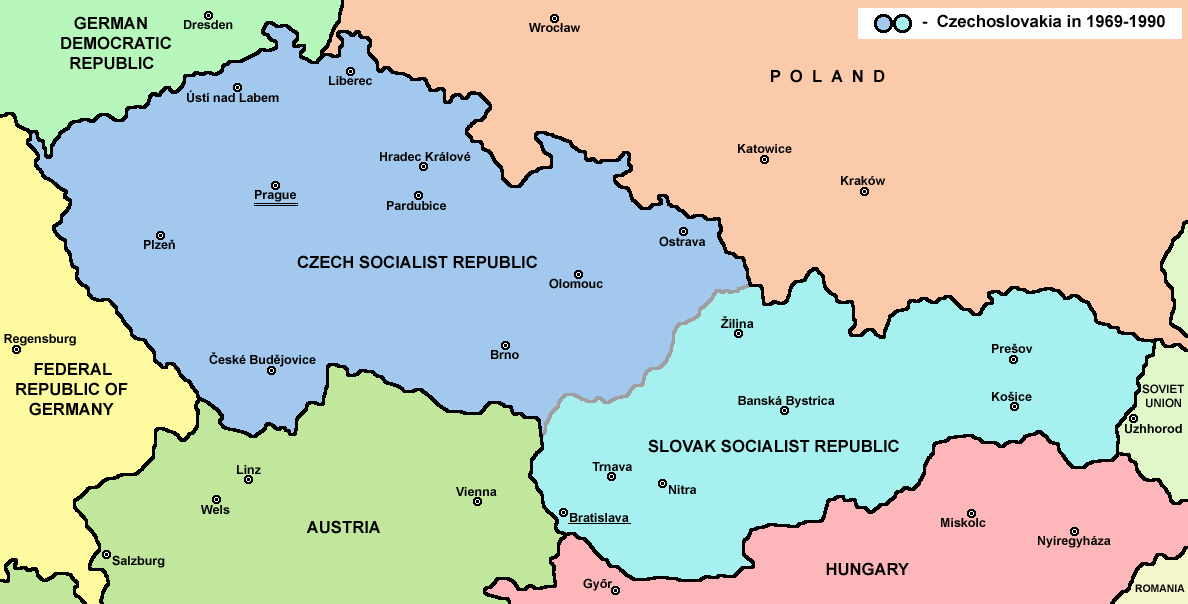
Czechoslovakia between 1968 (Constitutional Law of Federation) and 1989 (Velvet Revolution)
Date17 July 1992 – 31 December 1992
(5 months and 2 weeks)
Location
Outcome

The dissolution of Czechoslovakia,[1] which took effect on 31 December 1992, was the self-determined partition of the federal republic of Czechoslovakia into the independent countries of the Czech Republic and Slovakia. Both mirrored the Czech Socialist Republic and the Slovak Socialist Republic, which had been created in 1969 as the constituent states of the Czechoslovak Socialist Republic until the end of 1989.

It is sometimes known as the Velvet Divorce, a reference to the bloodless Velvet Revolution of 1989, which had led to the end of the rule of the Communist Party of Czechoslovakia.

Background

[edit]

Czechoslovakia was created with the dissolution of Austria-Hungary at the end of World War I. In 1918, a meeting took place in the American city of Pittsburgh, at which the future Czechoslovak President Tomáš Garrigue Masaryk and other Czech and Slovak representatives signed the Pittsburgh Agreement, which promised a common state consisting of two equal nations: Slovaks and Czechs. However, the Czechoslovak Constitution of 1920 specified a single "Czechoslovak nation".

In subsequent years, there were political tensions in the new country between Czechoslovakists and those seeking greater autonomy for the Slovaks in particular. In March 1939, with pressure from Adolf Hitler, the First Slovak Republic was created as a satellite state of Germany with limited sovereignty. The alignment with the Soviet Union after World War II oversaw the reunification into the Third Czechoslovak Republic.

In 1968, the Constitutional Law of Federation reinstated an official federal structure of the 1917 type, but during the Normalization Period in the 1970s, Gustáv Husák, despite being a Slovak himself, returned most control to Prague. That approach encouraged a regrowth of Slovak separatism after the fall of communism.

Partition into two entities

[edit]
Map indicating locations of Czech Republic and Slovakia

Czech Republic

Slovakia

By 1991, the Czech Republic's GDP per capita was some 20% higher than Slovakia's. Transfer payments from the Czech budget to Slovakia, which had been the rule in the past, were stopped in January 1991.

Many Czechs and Slovaks desired the continued existence of a federal Czechoslovakia. However, the politicians of leading Slovak parties in Parliament, notably the Slovak National Party, would stand to benefit politically if the country were split in two, and advocated a looser form of complete independence and sovereignty.[2] For a few years, political parties re-emerged, but Czech parties had little or no presence in Slovakia and vice versa. To have a functioning state, the government demanded continued control from Prague, but Slovaks continued to ask for decentralisation.[3]

In 1992, the Czech Republic elected Václav Klaus and others, who demanded either an even tighter federation ("viable federation") or two independent states. Vladimír Mečiar and other leading Slovak politicians wanted a kind of confederation. Both sides opened frequent and intense negotiations in June. On 17 July, the Slovak parliament adopted the declaration of independence of the Slovak nation. Six days later, Klaus and Mečiar agreed to secede Czechoslovakia into two separate states at a meeting in Bratislava. Czechoslovak President Václav Havel resigned, rather than oversee the secession, which he had opposed.[4] In a September 1992 opinion poll, only 37% of Slovaks and 36% of Czechs favoured dissolution.[5]

The goal of negotiations switched to achieving a peaceful division. Peaceful division was prioritized as the process ran in parallel with the violent breakup of Yugoslavia (another formerly socialist, Slavic federal state created after the dissolution of Austria-Hungary).[6] On 13 November, the Federal Assembly passed Constitution Act 541, which settled the division of property between the Czech lands and Slovakia.[7] With Constitution Act 542, passed on 25 November, they agreed to the secession of Czechoslovakia into two entities as of 31 December 1992.[7]

The partition occurred without violence and so was thus said to be "velvet", much like the "Velvet Revolution", which had preceded it and had been accomplished by massive peaceful demonstrations and actions. In contrast, other post-communist breakups (such as the Soviet Union and Yugoslavia) involved violent conflict. Czechoslovakia is the only former Eastern Bloc state that had an entirely peaceful breakup. In the following years, as Slovakia's economy struggled, Slovaks began to describe the dissolution as a "sandpaper divorce".[8]

Causes

[edit]

A number of reasons have been given for the dissolution of Czechoslovakia, with the main debates focusing on whether dissolution was inevitable or whether dissolution occurred in conjunction with or even in contrast to the events that occurred between the Velvet Revolution of 1989 and the end of the joined state in 1992.[9]

Those who argue from the inevitability stance tend to point to the differences between the two nations, which date back to the Austro-Hungarian Empire, and to other issues. There are differences between the Czechs and Slovaks, such as problems with the shared state during communism, the success of the state in the Czech lands, its failure in the Slovak lands that still resulted in the adoption of communism since the Czechs were more influential in the running of the state than Slovaks, and the 1968 constitution with its minority veto.[10]

Those who argue that events between 1989 and 1992 led to the dissolution point to international factors such as the breakaway of the Soviet satellite nations, the lack of unified media between the Czech Republic and Slovakia, and most importantly the actions of the political leaders of both nations like the disagreements between Prime Ministers Klaus and Mečiar.[11][12]

[edit]

National symbols

[edit]

Since the coat of arms of Czechoslovakia was a composition of those of the historic geographic areas forming the country, each republic simply kept its own symbol: the Czechs the lion and the Slovaks the double cross. The same principle was applied to the two-part bilingual Czechoslovak national anthem that comprised two separate pieces of music, the Czech stanza Kde domov můj and the Slovak stanza Nad Tatrou sa blýska. Disputes occurred only with respect to the Czechoslovak flag. During the 1992 negotiations on the details of dissolution of Czechoslovakia, as demanded by Vladimír Mečiar and Václav Klaus, a clause forbidding the use of the state symbols of Czechoslovakia by its successor states was inserted into the constitutional law on the dissolution of Czechoslovakia.[13]

From 1990 to 1992, the red and white flag of Bohemia (differing only slightly from the Polish flag by proportion and tone) officially served as the flag of the Czech Republic. Eventually, after a search for new symbols, the Czech Republic unilaterally decided to ignore the aforementioned law and to keep the Czechoslovak flag, with an altered meaning.[14] Slovakia, meanwhile, adopted its traditional flag; however, just before independence, on 3 September 1992, the coat of arms was added in order to prevent confusion with the similar flags of Russia and Slovenia.

Territory

[edit]

The national territory was divided along the existing internal borders, but the border was not clearly defined at some points and, in some areas, the border cut across streets, access roads and communities that had coexisted for centuries. The most serious issues occurred around the following areas:

  • U Sabotů or Šance (cs:Šance (Vrbovce)) – historically part of Moravia, awarded to Slovakia in 1997
  • Sidonie or Sidónia (cs:Sidonie) – historically part of Hungary (which contained all present-day Slovak territory until 1918), awarded to the Czech Republic in 1997
  • Kasárna (cs:Kasárna (Makov)) recreational area – historically Moravian, disputed between Moravia and Hungary since the 16th century, formally part of Hungary since 1734; accessible by car only from the Czech side until early 2000s; remained in Slovakia despite heavy objections from the mostly-Czech property owners, whose real estate effectively fell into a foreign country.

The new countries were able to solve the difficulties via mutual negotiations, financial compensation and then an international treaty covering the border modifications.[15]

People living or owning property in the border area, however, continued to experience practical problems until both new countries entered the Schengen Agreement Area in 2007, rendering the border less significant.

Division of national property

[edit]

Most federal assets were divided in a ratio of two to one, the approximate ratio between the Czech and Slovak population in Czechoslovakia, including army equipment, rail and airliner infrastructure. Some minor disputes, such as gold reserves stored in Prague and federal know-how valuation, lasted for a few years after the dissolution.

Currency division

[edit]
100 korun československých with Czech stamp in 1993

Initially, the old Czechoslovak currency, the Czechoslovak koruna, remained in use by both countries. Czech fears of an economic loss caused the adoption of two national currencies as early as 8 February 1993. On 2 February 1993 Act No. 60/1993 Coll. came in effect in the Czech Republic to create a separate currency that was already envisaged in the Czech Constitution and in Act No. 6/1993 Coll. that created the Czech National Bank which issued a new Czech currency by stamping Czechoslovak banknotes. The stamps had already been prepared in secret in 1992 after the decision about the dissolution of Czechoslovakia. In December 1992 some of the reserve banknotes started to be stamped in the selected banks[clarification needed] in secret.[16] From 8 February to 12 February old banknotes of 100, 500 and 1,000 Kčs (Czechoslovak crowns) were exchanged for the stamped ones in the Czech Republic and a new 200 Kč banknote was introduced.[17] Each person over 15 could exchange banknotes up to 4,000 crowns, and minors below 15 years of age up to 1,000 crowns. Banknotes of lower denominations and coins remained until new ones were printed and minted. Banks in the Czech Republic converted all money on 8 February 1993 from Kčs to Kč. In Slovakia stamps were also applied on banknotes, and a new 10 SK coin was introduced.[18] At the beginning, the currencies could be exchanged at par, but later the value of the Slovak koruna was usually lower than that of the Czech koruna (in 2004, around 25–27% lower). On 2 August 1993, both currencies were distinguished by different stamps that were first affixed to and then printed on old Czechoslovak koruna banknotes.[19] New Czech and Slovak coins replaced old ones during 1993.

On 1 January 2009, Slovakia adopted the euro as its currency, with a conversion rate of 30.126 SK/€, and the €2 commemorative coin for 2009, Slovakia's first, featured the 20th anniversary of the Velvet Revolution in remembrance of the common struggle of the Czechoslovaks for democracy.[20] By a quirk of fate, the welcoming speech on the behalf of the European Union on the occasion of Slovakia's entry to the eurozone was delivered by Mirek Topolánek, the prime minister of the presiding country, the Czech Republic, naturally in his native language, but the other guest speakers used English. The Czech Republic continues to use the Czech koruna, or crown.

International law

[edit]

Neither the Czech nor Slovak republics sought recognition as the sole successor state to Czechoslovakia. This can be contrasted to the dissolution of the Soviet Union, when the Russian Federation was recognized as successor state not only to the Russian SFSR but also to the Soviet Union itself, and also contrasts with the dissolution of Yugoslavia, where the rump Federal Republic of Yugoslavia, dominated by Serbia and encompassing only it and Montenegro, unsuccessfully demanded recognition as the sole successor to the Socialist Federative Republic of Yugoslavia, even though the four remaining ex-Yugoslav states, now independent, collectively encompassed around three-fifths of former Yugoslavia, both in population and in territory. Therefore, Czechoslovakia's membership in the United Nations ceased upon the dissolution of the country, but on 19 January 1993, the Czech Republic and Slovakia were admitted as new, separate states.[21]

With respect to other international treaties, the Czechs and the Slovaks agreed to honour the treaty obligations of Czechoslovakia. The Slovaks transmitted a letter to the Secretary General of the United Nations on 19 May 1993, to express their intent to remain a party to all treaties signed and ratified by Czechoslovakia and to ratify treaties signed but not ratified before dissolution of Czechoslovakia. The letter acknowledged that under international law, all treaties signed and ratified by Czechoslovakia would remain in force. For example, both countries are recognized as signatories of the Antarctic Treaty from the date that Czechoslovakia had signed the agreement in 1962.

Both countries have ratified the Vienna Convention on Succession of States in respect of Treaties, and it was not a factor in the dissolution of Czechoslovakia since it did not come into force until 1996.

Aftermath

[edit]

Economy

[edit]

The dissolution had some negative impact on the two economies, especially in 1993, as traditional links were severed to accommodate the bureaucracy of international trade, but the impact was considerably less than expected by many people.[citation needed]

A customs union between the Czech Republic and Slovakia remained in place from the dissolution until 1 May 2004, when both countries entered the European Union (EU).[citation needed]

Many Czechs hoped that dissolution would quickly start an era of high economic growth in the Czech Republic, which no longer had to sponsor the "less-developed Slovakia". Similarly, others looked forward to an independent unexploited Slovakia that might become a new "economic tiger".[citation needed]

According to The Prague Post, "Slovak GDP reached 95 percent of the Czech GDP, and it is likely to draw level with it. The Slovak gross national product (GNP), which includes citizens' incomes abroad and deducts the money multinational companies move out of the country, is higher than the Czech one. Old-age pensions are more or less at the same level in both countries, and the consumption per capita is slightly higher in Slovakia. However, salaries are 10 percent lower on average in Slovakia than in the Czech Republic".[22]

However, Martin Filko, the head of the Institute of Financial Policy of the Slovak Finance Ministry, pointed out that Slovakia is among the EU countries whose salaries form the lowest portion of their GDP. In other words, some of people's incomes come from sources other than their main employment, which reduces the real difference between the Czech and the Slovak salaries.[citation needed]

Until 2005, the GDPs of the two countries were growing at a similar rate. However, from 2005 to 2008, the Slovak economy grew faster than the Czech economy.[citation needed]

Citizenship

[edit]

Since federalisation in 1968, Czechoslovakia had divided citizenship, either of the Czech Socialist Republic or of the Slovak Socialist Republic, the word Socialist being dropped from both names shortly after the Velvet Revolution. That distinction, however, had little effect on citizens' life. On 1 January 1993, all Czechoslovak citizens automatically became citizens either of the Czech Republic or the Slovak Republic, based on their previous citizenship, permanent residence address, birthplace, family ties, job and other criteria. Additionally, people had one year's time to claim the other citizenship under certain conditions.[23][24]

Slovak legislation allowed dual citizenship until 2010, when it was abolished under the Citizenship Act.[25] Only a handful of people have exercised that right, but its significance is lessened by both nations' membership in the EU as the freedom of movement for workers, a policy that guarantees EU citizens the right to work and to live anywhere in the Union. In the case of movement between the Czech Republic and Slovakia, the policy took effect from 2004.

By contrast, the Czech Republic has prohibited dual citizenship for naturalized citizens and requires them to give up existing citizenship(s) prior to receiving citizenship of the Czech Republic. That requirement can be waived only if giving up an existing citizenship might put the applicant or their relatives in danger of persecution in their homeland, which was not the case of applicants from Slovakia. That situation changed with the new Citizenship Act of 2013 (186/2013 Sb.), in force since 1 January 2014.[26] However, most Slovak citizens are still unable to become dual citizens of both the Czech Republic and Slovakia since they automatically lose Slovak citizenship upon voluntarily acquiring another one (see previous paragraph). Exempt from that law are only Slovak citizens who obtain a foreign citizenship by virtue of marriage with a foreign national. Some Slovak politicians[who?] have speculated in the media[example needed] about softening the Citizenship Act, but no change has yet materialised as of January 2015.

Citizens of both countries were allowed to cross the border using an ID card instead of a passport and were allowed to work anywhere without the need to obtain an official permit. Border checks were completely removed on 21 December 2007, when both countries joined the Schengen Agreement.

Under the current European regulations, citizens of either country are entitled to the diplomatic protection of any other EU country and so both have been considering merging their embassies, together with nations of the Visegrád Group, to reduce costs.[27]

Roma people

[edit]

One of the problems not solved during dissolution was the question of a large number of Romani living in the Czech Republic born and officially registered in today's Slovakia. Most of them did not re-register their official place of stay during the months before dissolution and so the question of their citizenship was left open. The 1992 Czech Nationality Act allowed a grant of automatic citizenship only to those who were born on Czech territory. For others, the right to citizenship required proof of a five-year period of residence, an "unobjectionable" criminal record, significant fees and a complicated bureaucratic process, which reportedly excluded a rather large percentage of Roma.[28]

The Slovak government did not want to grant citizenship to nonresidents. Significant numbers of Roma living in Czech orphanages did not have their legal status clarified and were released from care as adult noncitizens without any right to work or live in the Czech Republic.[29] Under pressure from the European Union, the Czech government made amendments to its nationality law in 1999 and 2003, which effectively solved the problem, but compensation has not been provided to those rendered stateless in 1992.[28]

Language contacts

[edit]

In the former Czechoslovakia, the first television channel was a federal one, and the Czech and Slovak languages were used in equal ratios in the television news there, but foreign films and television series were almost exclusively dubbed into Czech, for example. That and the great similarity of the two languages made almost all people of both nations passively bilingual: they could understand but not necessarily speak the other language. After the dissolution in 1990s, the new television channels in the Czech Republic practically stopped using Slovak, and young Czech people now have a much lower understanding of Slovak. Also, the number of Slovak-language books and newspapers sold in the Czech Republic dropped drastically. The Czech television news, however, started to reintroduce Slovak-language coverage from Slovakia and Slovak television (STV2) rebroadcasts the Czech television newscast Události ČT daily, ten minutes after midnight.

On the public Radio and Television of Slovakia, it is common to have at least one daily newscast from the Czech Republic during prime time news. Furthermore, many programmes on Slovak television channels are still dubbed into Czech, some films in cinemas are subtitled in Czech and there are far more Czech-language books and periodicals on the market than there were before the dissolution. The major boost for the language interchange has come from private television channel providers like CS Link (Czech Republic) and Sky Link (Slovakia) that offer Slovak channels in the Czech Republic and vice versa. Additionally, several channels, regardless of their national origin, offer programs both in Czech and Slovak (CSFilm, TV Barrandov) or even mix like TV Nova's Nova Sport coverage of the English Premier League. New impulses to mutual contacts coming via television are also common shows like the Intelligence Test of Nations, Czechoslovakia's Got Talent, and Masked Singer[30] broadcast by PRIMA and TV JOJ, and Czecho-Slovak SuperStar, the latter being the first international edition of the Pop Idol song contest broadcast by TV Nova and Markíza (both owned by CME), which also organized joint versions of MasterChef and The Voice in 2012. Also, the New Year's Eve Program for 2009 was prepared and broadcast jointly by ČT and STV and for 2010 by the Czech TV PRIMA and the Slovak TV JOJ, this time even including the singing of the Czechoslovak national anthem.

Young Slovak people still have the same knowledge of Czech as their predecessors, if not better.[citation needed] In Slovakia, Czech may still be used automatically in all judicial proceedings, and all documents written in Czech are acknowledged by Slovak authorities and vice versa. Further, the Slovak Official Language Act, passed in 2009, reconfirmed the right of Czechs to use their language in all official communication when dealing with Slovak authorities although it explicitly limited the use of Czech in Slovakia to persons with Czech as their mother tongue. The same is true about using Slovak in the Czech Republic under the Administration Procedure Act of 2004.[31] Gustáv Slamečka, a Slovak citizen who was the Czech transport minister (2009–2010), used Slovak exclusively during his official communication.

Sport

[edit]

The official breakup occurred right in the middle of the 1993 World Junior Ice Hockey Championships, which took place in Sweden. The team representing Czechoslovakia was renamed "Czech–Slovak" on 1 January. In international ice hockey tournaments, the Czech Republic took over Czechoslovakia's place in the A-groups, and Slovakia had to start in the lower divisions.[32][33][34][35]

During the FIS Nordic World Ski Championships 1993 in Falun, Sweden, the ski jumping team competed as a combined Czech–Slovak team in the team large hill event and won silver. The team had been selected before the dissolution. Jaroslav Sakala won two medals in the individual hill events for the Czech Republic at those games along with his silver in the team event.

In their qualifying section for the 1994 FIFA World Cup, the Czechoslovakia national football team competed under the name RCS, which stood for "Representation of Czechs and Slovaks". In their last game as "Representation of Czechs and Slovaks", the team failed to qualify after it got only a draw in its final match against Belgium, a match that it had to win to qualify.[36] It was afterward that it was officially split up into Czech and Slovak national teams, with both being declared successors to Czechoslovakia.[37][38][39][40][41]

The mutual encounters between the national teams of both countries in many sports are followed by most of the populations, and the number of players and coaches active in the other republic is significant. Martin Lipták, a Slovak handball coach, successfully led the Czech national team to the EHF 2010 Handball European Championship in Austria.[42] A Slovak team under his coaching, Tatran Prešov, won the Czech national league in 2008 and 2009.[43] Czech ice hockey coach Vladimír Vůjtek led the Slovak national team to the silver medal at the 2012 IIHF World Championship, having beaten the Czech team in the semifinals.

Several sports have featured a common league, and discussions about having a common football or ice hockey league continue.[44]

The road cyclist Ján Svorada earned Slovak citizenship in 1993. In 1994, he became the first Slovak rider ever to win a Tour de France stage. Two years later, he earned Czech citizenship, and he became the first Czech rider ever to win another Tour de France stage in 1998.

Telecommunications

[edit]

The two successor states continued to use the country code +42 until February 1997,[45] when it was replaced by two separate codes: +420 for the Czech Republic[46] and +421 for Slovakia.[47] Since then, telephone calls between both countries have required international dialing.[48]

Legacy

[edit]

Referendum controversy

[edit]

Soon after the dissolution, public satisfaction was relatively low, with large portions of the population on both sides of the border protesting the fact that the dissolution of the common state was not put to a vote, as described by politologist Lubomír Kopeček of Masaryk University. A March 1993 study conducted by Martin Bútora and his wife Zora indicated that in case of a referendum about 50% of the population would've voted against the dissolution of the state with only about 30% in favour of the dissolution.[49]

Former Slovak Minister of Culture Marek Maďarič, pointed out, in January 2023, that the dissolution without a referendum reflected the historic practice and a tradition of constitutional stately affairs decided without a referendum in Czechoslovak history. Namely, both the formation of the First Czechoslovak Republic from the rubbles of Austria-Hungary in 1918 as well as the reunion of the Protectorate and Slovak State to form a Third Republic in 1945 after the conclusion of the World War II were achieved without a referendum, solely through the pursuit of political representatives of the era.[50]

Public polling

[edit]

Public perception of the dissolution has not changed much, with a December 2017 poll showing that just 42% of Czechs and 40% of Slovaks agree with what happened (compared to 36% and 37% in 1992, respectively). Surveys from 2010 showed that the majority of the population of Prague (Czechs) still considers the division of the country a mistake;[51] similarly, the general representative survey in Slovakia (from 2008)[52] showed that society is still divided in opinion on the dissolution, with 47% favouring the dissolution and 44% considering it a mistake. A 2023 poll from the Czech republic has shown that 50% of Czechs consider the dissolution a correct decision, 39% consider it wrong and 11% are neutral or undecided.[53]

Reactionary movements

[edit]

In 2015, a Slovak movement called "Czechoslovakia 2018" was established to try to get a referendum by 2018. Its leader, Ladislav Zelinka, said that he had received thousands of emails and calls from supporters, but it was unable to reach the necessary 350,000 petition signatures. The younger generations of both countries are largely indifferent to the issue since they never experienced the previous period themselves, and older generations are more focused on present issues such as immigration and favour their own separate nationalism.[54]

Governmental cooperation

[edit]

Political influences between the countries are minimal, but social democrats tend to cooperate very closely on regional and European topics in recent years. Furthermore, it has become customary that the elected presidents pay their first and last official foreign visits during their term to the other republic of the former Czechoslovakia. Appointed foreign ministers tend to follow that unwritten rule. On 29 October 2012, to commemorate Czechoslovakia's declaration of independence, which occurred on 28 October 1918, the Czech and the Slovak governments held, for the first time, a joint cabinet meeting in the communities of Trenčín and Uherské Hradiště, near the common border.[55]

Military cooperation

[edit]

Peacekeeping troops stationed in the former Yugoslavia were put under joint command on several occasions. For example, from 2002 to July 2005, the Czech Armed Forces joined with the Armed Forces of the Slovak Republic to form a joint Czech–Slovak KFOR battalion in Kosovo, which contributed to the Multinational Brigade CENTRE.[56]

Trade and tourism

[edit]

Trade relations were re-established and stabilised, and the Czech Republic continues to be Slovakia's most important business partner.[citation needed] After a short interruption, Slovakia's resorts in the Carpathian mountains, especially High Tatras and Low Tatras are again the destination of a growing number of Czech tourists.

Commemorations

[edit]

Following the death of the last Czechoslovak (and the first Czech) president, Václav Havel, on 18 December 2011, both the Czech Republic and Slovakia observed a day of national mourning. During the funeral mass in Prague's St. Vitus Cathedral, prayers were recited in an equal ratio in Czech and Slovak.

Continued use of name

[edit]

Some companies and organizations established in former Czechoslovakia, such as the bank Československá obchodní banka, the political parties KDU-ČSL and SPR–RSČ, and the Czechoslovak Hussite Church have continued to use the Czechoslovak name after the state's dissolution.

See also

[edit]

References

[edit]
[edit]
Revisions and contributorsEdit on WikipediaRead on Wikipedia
from Grokipedia
The Dissolution of Czechoslovakia, known as the Velvet Divorce, was the negotiated and peaceful partition of the federal republic into the independent Czech Republic and Slovak Republic, effective 1 January 1993.[1] This separation followed the 1989 Velvet Revolution, which ended four decades of communist governance, but soon revealed underlying frictions including economic imbalances— with the Czech regions favoring aggressive market liberalization while Slovakia sought a more gradual approach—and divergent national priorities amplified by the 1992 parliamentary elections.[2][1] A resulting federal deadlock prompted Czech Prime Minister Václav Klaus and Slovak Prime Minister Vladimír Mečiar to bypass broader consultation, finalizing the split via an 26 August 1992 agreement that dissolved shared institutions without violence or economic disruption, despite contemporaneous public opinion surveys showing most citizens in both republics preferred retaining the federation and would likely have rejected dissolution in a referendum.[2][1] The elite-led process, absent popular mobilization or conflict, stands as a rare instance of voluntary state dissolution in modern Europe, enabling the successor states to integrate into Western institutions like NATO and the EU while sustaining close bilateral ties.[1]

Historical Background

Pre-Communist Ethnic Dynamics

The establishment of Czechoslovakia on 28 October 1918 united ethnic Czechs and Slovaks from the dissolving Austro-Hungarian Empire, driven by shared opposition to Habsburg rule and aspirations for self-determination amid World War I's aftermath.[3] Yet, pre-existing disparities shaped early dynamics: Czech lands (Bohemia, Moravia, and Austrian Silesia) featured advanced industry, higher urbanization, and a 1921 population of roughly 10 million, with Czechs comprising 67.5% ethnically.[4] Slovakia, suppressed under Hungarian administration since 1867, lagged in development as an agrarian region with about 3 million residents, 65.1% Slovak, and only 2.4% Czech settlers.[4] [5] Linguistic distinctions—Czech and Slovak as closely related but mutually non-identical West Slavic tongues—reinforced separate identities, with Slovak preserving rural dialects amid prior Magyarization efforts.[6] Religious divergences further entrenched cultural separation, with Slovaks maintaining stronger Catholic adherence (70.9% Roman Catholic in 1921, alongside significant Greek Catholic and Lutheran minorities) tied to folk traditions and clerical influence, contrasting Czech lands' nominal Catholicism (82% Roman Catholic) amid rising secularism, Hussite revivalism (7.3% by 1930), and anti-clerical sentiments rooted in historical conflicts like the Defenestration of Prague.[4] [5] Prague's centralist constitution of 1920 prioritized unitary governance, sidelining Slovak calls for autonomy promised in the 1918 Pittsburgh Agreement, which had envisioned federal elements but yielded to Czech-led assimilationist policies favoring economic integration over regional equity.[6] This bred grievances over underrepresentation, with Slovaks viewing Czech officials and capital inflows as eroding local control, evidenced by persistent autonomist agitation from parties like the Slovak People's Party under Andrej Hlinka, which garnered strong rural support by demanding devolution.[7] [6] Interwar tensions escalated as economic imbalances—Czech industrial output dwarfing Slovak agriculture—fueled perceptions of exploitation, despite shared Slavic heritage.[6] The Munich Agreement of 30 September 1938, ceding Sudeten German territories to Germany, weakened Prague's authority, prompting the Žilina Declaration on 6 October 1938, where Slovak leaders proclaimed autonomy and sidelined Czech influence in local governance.[3] [6] Facing further German pressure and the occupation of Czech lands on 15 March 1939, Slovakia's assembly declared full independence the prior day, 14 March, under President Jozef Tiso, reflecting autonomist momentum that exposed the fragility of enforced unity amid unresolved ethnic asymmetries.[3] These pre-communist fractures, rooted in divergent historical trajectories rather than fabricated harmony, underscored how centralism amplified rather than mitigated resentments.[6]

Communist Federalization and Its Failures

Following the Prague Spring reforms initiated in January 1968 under Communist Party leader Alexander Dubček, the Czechoslovak regime moved toward federalization to address long-standing Slovak demands for greater autonomy amid liberalization efforts. On October 27, 1968, the National Assembly passed Constitutional Law No. 143/1968, establishing the Czech Socialist Republic and Slovak Socialist Republic as equal constituent entities within a federal framework, effective January 1, 1969.[8] This structure nominally divided competencies, with the federal government retaining control over foreign policy, defense, and monetary matters, while republics gained authority over education, culture, and some economic planning.[9] The Soviet-led Warsaw Pact invasion on August 20, 1968, involving over 200,000 troops and 2,000 tanks, preempted full implementation by crushing the reformist agenda and installing a regime of "normalization" under Gustáv Husák from 1969 onward.[10] [11] Federal institutions persisted on paper, but real power remained centralized in Prague through the Communist Party's hierarchical control, which purged reformers and suppressed expressions of Slovak nationalism as deviations from proletarian internationalism. This nominal federalism failed to deliver substantive devolution, as Slovak republican organs lacked independent fiscal or executive authority, entrenching grievances over perceived Czech dominance despite ideological commitments to socialist unity.[12] Economically, the federal structure exacerbated rather than resolved imbalances, with Slovakia's heavy reliance on state-directed industrialization—focusing on arms, metallurgy, and energy—yielding lower productivity and output per capita compared to the more diversified Czech regions. In the late 1980s, Slovak per capita income lagged behind Czech levels by approximately 20-25%, sustained by inter-republican transfers that funneled Czech-generated surpluses southward, fostering Slovak dependency and Czech frustration without addressing root causes like inefficient central planning.[13] These dynamics, driven by communist prioritization of aggregate output over regional equity, bottled up ethnic tensions by ignoring the causal primacy of national identities and localized incentives, setting the stage for post-1989 demands for genuine separation.[14]

Velvet Revolution and Initial Federal Reforms

The Velvet Revolution commenced on November 17, 1989, triggered by student demonstrations in Prague against the communist regime, escalating into widespread peaceful protests and a general strike that pressured the government.[15] By November 28, 1989, the Communist Party leadership had resigned, enabling the formation of an anti-communist government by December 10, 1989.[15] Václav Havel, a leading dissident and playwright who coordinated opposition efforts through Civic Forum, was elected president of Czechoslovakia on December 29, 1989, by the Federal Assembly, marking the transition to democratic rule while maintaining the federal structure inherited from the 1968 constitutional reforms.[16] In the immediate aftermath, the euphoria of regime change overshadowed ethnic tensions, with Havel's unifying rhetoric and commitment to federalism temporarily preserving the state amid shared goals of democratization and decommunization.[17] The first post-communist elections on June 8–9, 1990, exposed nascent regional divergences, as Civic Forum secured 49.5% of the vote in Czech lands, advocating rapid democratic and economic transformation, while its Slovak counterpart, Public Against Violence (VPN), won 29.4% in Slovakia, reflecting more cautious support for federal continuity but underlying grievances over historical centralization.[18][19] These results empowered Czech Premier Petr Pithart and Slovak figures like Vladimír Mečiar and Marian Čalfa, yet Slovak voters' lower enthusiasm for aggressive reforms signaled dissatisfaction with the federation's imbalance, where Czech-dominated institutions had long prioritized Prague's interests.[20] Václav Klaus, appointed Finance Minister in December 1989, drove Czech-led economic liberalization from early 1990, including plans for voucher privatization and the removal of price controls on most consumer goods by January 1991, aiming to dismantle central planning swiftly.[21] This approach clashed with Slovak preferences for slower paces, as VPN leaders expressed concerns over potential regional dislocations.[22] Initial efforts in 1990 to amend the 1968 federal constitution, intended to clarify power-sharing between Prague, the republics, and federal bodies, faltered due to irreconcilable demands—Czechs favoring centralized economic authority for reforms, Slovaks seeking greater autonomy—highlighting the federation's fragility against divergent national priorities.[14] These early bargaining impasses, rooted in mismatched aspirations for state organization, foreshadowed the structure's unsustainability without deeper reconfiguration.[14]

Underlying Causes

Economic Imbalances Between Regions

In the years immediately preceding the 1993 dissolution, the Czech Lands demonstrated markedly higher economic output and productivity compared to Slovakia, with GDP per capita in the Czech regions exceeding that of Slovakia by approximately 20-25% as of 1991-1992, reflecting longstanding structural divergences amplified by post-communist transition shocks.[23] This gap stemmed from the Czech economy's greater diversification into machinery, engineering, and light manufacturing—sectors with inherent adaptability to market liberalization and Western export orientations—contrasting with Slovakia's heavier reliance on state-directed armaments, metallurgy, and raw material processing industries, which proved brittle amid the abrupt termination of subsidized Comecon trade networks in 1991.[24][25] Federal fiscal mechanisms exacerbated these imbalances by channeling disproportionate resources from the more prosperous Czech areas to underwrite Slovak infrastructure and industrial development, effectively imposing a net transfer burden estimated at around 0.7% of Czechoslovakia's overall GDP annually in the early 1990s, as calculated by contemporary OECD assessments.[25] Czech taxpayers shouldered a heavier effective load through centralized tax collections and redistribution, funding projects like heavy industry expansions in eastern Slovakia that prioritized political equalization over economic efficiency during the communist era, yet failed to bridge underlying productivity deficits once price controls and subsidies were dismantled starting in 1991.[26] These transfers, while intended to foster parity, instead perpetuated dependency and resentment, as empirical indicators—such as industrial output per worker and export competitiveness—revealed persistent Czech advantages rooted in pre-1948 industrialization legacies and skilled labor concentrations, rather than any equitable federal partnership.[27] The post-Velvet Revolution liberalization exposed these fissures acutely: Slovakia's heavy sector contracted sharply due to uncompetitiveness in open markets, with unemployment surging to over 10% by 1992 in Slovak regions versus under 5% in Czech ones, underscoring how artificial unity had obscured, rather than mitigated, regionally specific vulnerabilities.[28] From a causal standpoint, the imbalances were not merely conjunctural but structural, driven by geographic endowments, historical investment patterns, and mismatched industrial specializations that federal subsidies temporarily veiled without addressing root inefficiencies in resource allocation.[29] Dissolution thus enabled disentanglement, permitting market signals to guide specialization unhindered by redistributive mandates that had strained Czech fiscal contributions without yielding commensurate Slovak convergence.[25]

Political and Nationalist Divergences

In the aftermath of the Velvet Revolution, Czech and Slovak political elites developed divergent visions for the federation's future, with Czech leaders prioritizing swift market reforms and a streamlined central authority, while Slovak counterparts emphasized national autonomy to address longstanding grievances of peripheral status. Václav Klaus, heading the Civic Democratic Party (ODS), advocated a "viable federation" that would enable rapid privatization and liberalization unhindered by regional vetoes, reflecting a liberal emphasis on individual economic agency over collective state structures.[30] In contrast, Vladimir Mečiar's Movement for a Democratic Slovakia (HZDS) campaigned on populist nationalism, demanding Slovak sovereignty within a loose confederation or full separation if unmet, framing federal ties as perpetuating Czech dominance in policy and culture.[31] These positions stemmed from ethnic self-interests: Czechs sought to jettison perceived drags on reform, while Slovaks invoked historical marginalization, including suppressed linguistic rights and underrepresentation in Prague-centric governance.[32] The federal parliamentary elections of June 5–6, 1992, intensified these rifts, as ODS captured 29.7% of the Czech vote and HZDS 37.0% in Slovakia, empowering leaders to escalate sovereignty rhetoric.[2] Mečiar's platform leveraged resurgent Slovak nationalism—rooted in precedents like the 1939–1945 wartime Slovak state and interwar autonomy demands—to mobilize support against federal economic policies viewed as Czech-imposed, despite shared Slavic heritage. Klaus, meanwhile, pragmatically shifted from federal loyalty to accepting dissolution, arguing that incompatible national priorities rendered unity untenable without coercion.[31] This elite polarization eroded cohesion, as negotiations pivoted from reform to partition, bypassing broader consensus. Public sentiment underscored the disconnect between leadership and populace, with polls revealing limited enthusiasm for outright independence amid perceptions of cultural dilution. An April 1992 survey by Bratislava's Center for Social Analysis found only 17% of Slovaks favored an independent state, though support for enhanced autonomy or confederation climbed higher, driven by nationalist narratives of historical subjugation.[33] By September 1992, backing for dissolution reached approximately 37% among Slovaks, yet majorities still preferred some form of union, highlighting how political maneuvering, not mass demand, propelled the split.[34] Proponents hailed the outcome as a peaceful realization of self-determination, aligning with causal ethnic divergences that made sustained federation improbable; detractors, however, contend nationalism artificially amplified divisions in a state with functional binational precedents, prioritizing parochial gains over empirical unity benefits evidenced by low secessionist fervor.[35]

Institutional Weaknesses in Federal Structure

The bicameral Federal Assembly, established under the 1968 constitutional framework, featured a House of the People apportioned proportionally to population and a House of the Nations providing equal representation—75 deputies from each republic—irrespective of demographic disparities.[36] With Czechs comprising roughly two-thirds of Czechoslovakia's 15.6 million inhabitants in 1991 (approximately 10 million versus 5 million Slovaks), this parity endowed the minority Slovak republic with disproportionate influence, enabling routine vetoes on legislation requiring dual-chamber approval and thereby engendering chronic legislative paralysis.[37][36] Such design flaws, rooted in a nominal federalism that prioritized ethnic balance over efficient governance, systematically incentivized obstruction over compromise, as minority interests could indefinitely block majority-backed policies without reciprocal accountability.[38] Reform efforts in 1991, including proposed drafts for restructured power-sharing arrangements, repeatedly collapsed amid disputes over diluting these veto mechanisms, as Slovak demands for enhanced autonomy clashed with Czech preferences for centralized fiscal and foreign policy authority.[14] These failures exemplified how ethnic veto points, embedded in the assembly's architecture, transformed routine disagreements into existential standoffs, rendering federal decision-making untenable and eroding incentives for intra-state cooperation.[38] Empirical evidence from the period shows federal outputs dwindling, with key economic stabilization laws stalling due to Slovak obstructions, underscoring the system's bias toward deadlock in a democratizing context.[36] From a causal standpoint, the communist legacy exacerbated these institutional frailties: the 1968 federation had served primarily as a facade for party-directed centralism, suppressing pluralistic bargaining under one-party rule, which ill-prepared the structure for post-1989 democratic competition where ethnic parties mobilized distinct constituencies.[39] Transitioning to adversarial politics without overhauling veto-prone features thus amplified centrifugal pressures, as top-down coercion yielded to voluntary association, rendering coerced unity unsustainable and dissolution the rational exit from perpetual impasse.[38][36]

Path to Dissolution

Key Negotiations and Political Maneuvering

Following the parliamentary elections of June 5–6, 1992, which delivered strong mandates to the Civic Democratic Party (ODS) under Václav Klaus in the Czech lands and the Movement for a Democratic Slovakia (HZDS) led by Vladimír Mečiar in Slovakia, bilateral negotiations commenced between the two party leaders on the federation's structure.[38] On June 8, Klaus and Mečiar met in Brno to discuss government formation, with HZDS advocating an economic community over a unified state.[40] These talks continued on June 17 in Prague and June 20 in Bratislava, yielding agreements on parity representation in a federal government and a constitutional deadline of September 30, 1992, reflecting the parties' prioritization of regional autonomy amid federal deadlock.[40][38] The discussions, conducted primarily through closed-door elite channels with minimal public involvement, accelerated after Klaus's appointment as Czech prime minister on July 2, 1992, and Mečiar's as Slovak prime minister on June 24, 1992.[38][40] President Václav Havel opposed the trajectory, urging a referendum to gauge public sentiment, but his efforts proved ineffective against the momentum of ODS and HZDS national agendas; Havel resigned on July 20, 1992, refusing to preside over dissolution.[41] On July 23, Klaus and Mečiar formalized procedures for separation, bypassing broader consultation in favor of rapid pragmatism.[42] By October 6, 1992, in Jihlava, the leaders endorsed direct state disintegration effective January 1, 1993, as a pragmatic alternative to stalled confederation proposals—often termed a "third way" that avoided both tight federation and loose association while sidestepping a popular vote.[40][38] This elite-driven speed, insulated from public scrutiny, enabled a non-violent outcome despite September 1992 polls showing only 36% of Czechs and 37% of Slovaks favoring dissolution, with majorities preferring unity.[35][43] The ODS-HZDS dynamic underscored how party-specific nationalist priorities overrode federal cohesion, culminating in agreements that deferred divisive issues to later asset divisions.[38]

Federal Assembly Votes and Agreements

On November 25, 1992, the Federal Assembly passed Constitution Act 542, formally approving the dissolution of Czechoslovakia and establishing the separation effective January 1, 1993.[44] The legislation followed two prior failed voting attempts earlier that month, with final passage occurring by a margin of only two or three votes, highlighting the fragility of elite consensus in the bicameral body.[45] In the Chamber of the People, the amendment received 183 votes in favor, 30 against, and 55 abstentions out of 200 members.[44] The agreements embedded in the act outlined transitional timelines, including the immediate cessation of federal authority post-December 31, 1992, and mechanisms for provisional governance during the handover.[42] These provisions emphasized continuity in state functions to prevent disruptions, such as joint handling of foreign debt and military assets until division, contributing to the process's reputation for averting potential ethnic violence seen elsewhere in post-communist transitions.[44] Nonetheless, the rapid legislative finalization drew criticism for its perceived hastiness, as it bypassed broader public consultation and proceeded without a nationwide referendum, prioritizing parliamentary efficiency over mass democratic input.[45] The dissolution of Czechoslovakia proceeded without a nationwide referendum, despite public opinion polls indicating significant opposition to separation. In September 1992, a survey revealed that only 37% of Slovaks and 36% of Czechs supported dissolution, implying 63-64% opposition across both republics.[2] Multiple polls from 1989 to 1993 similarly showed majorities in both regions favoring preservation of the federation, with support for splitting rarely exceeding 40%.[35] President Václav Havel repeatedly advocated for a binding referendum as the ethical means to resolve the federation's future. On June 22, 1992, Havel urged Czechs and Slovaks to decide the issue through a joint vote, arguing it was the only moral solution amid escalating elite negotiations.[46] Earlier, in March 1991, he pressed for such a vote to counter rising Slovak separatism, emphasizing direct democratic input over parliamentary maneuvers.[47] Despite these calls and the existence of constitutional provisions for referendums, no such plebiscite occurred, as Federal Assembly leaders opted for legislative approval on November 25, 1992.[48] Political elites, including Czech Prime Minister Václav Klaus and Slovak Prime Minister Vladimír Mečiar, bypassed popular consultation primarily to expedite resolution amid institutional deadlock, fearing a referendum would reject separation and prolong uncertainty. This elitist approach prioritized negotiators' agreement on asset division and state continuity over broader ratification, as polls suggested a likely pro-unity outcome that could undermine their preferred paths—rapid market reforms in the Czech lands versus slower, protectionist policies in Slovakia.[49][1] Proponents of forgoing a referendum contended it would enhance efficiency by avoiding potential vetoes from unified public sentiment, enabling tailored governance in each successor state without federal compromise. Critics, however, argued this circumvented sovereign expression, eroding the dissolution's democratic legitimacy given empirical evidence of Czech-Slovak preference for unity, as reflected in consistent polling data showing shared identity and economic interdependence outweighed by elite-driven nationalism.[2][50] The absence of direct voter input thus highlighted a causal disconnect between top-down expediency and bottom-up consensus, with no mechanism to test separation's viability against sustained federal support.[51]

Formal Dissolution Mechanics

The dissolution of Czechoslovakia proceeded under the framework of the 1960 Constitution of the Czechoslovak Socialist Republic, as amended following the federalization reforms of 1968, which vested the Federal Assembly with authority to enact constitutional laws altering the state's structure. In 1992, this enabled the passage of targeted constitutional acts adapting the existing legal order to the federation's extinction without requiring a full constitutional overhaul or popular referendum, thereby framing the process as a consensual transformation rather than unilateral secession. This approach prioritized legal continuity, positioning the Czech Republic and Slovak Republic as joint successor states inheriting the federation's international obligations and domestic legal continuity to avert disruptions in governance and treaty adherence.[52] Pivotal legislation included the Federal Assembly's adoption on November 25, 1992, of Constitutional Law No. 542/1992 Coll., which formalized the intent to conclude the federation's existence effective December 31, 1992, by a narrow vote of 183 in favor, 30 against, and 55 abstentions. This act delineated procedural mechanisms for the transition, including the devolution of federal competencies to the republics while preserving the unity of the legal system until the cutoff date, thus minimizing administrative vacuums. Complementary measures, such as the November 13, 1992, Constitution Act No. 541/1992 Coll. on foundational principles, further supported the framework by outlining interim governance arrangements, though primary emphasis remained on the extinction clause to ensure both entities emerged as sovereign continuants under international law.[44][49] The republics reinforced this federal-level framework through their national assemblies: the Slovak National Council enacted sovereignty declarations aligning with the dissolution timeline as early as June 1992, while both adopted independent constitutions—the Slovak on September 1, 1992, and the Czech on December 16, 1992—effective January 1, 1993, explicitly referencing continuity from the prior federal order. This bilateral legislative synchronization avoided secessionary precedents, reflecting a pragmatic evolution of statehood grounded in parliamentary consensus rather than revolutionary rupture, with the overall mechanism designed to sustain institutional stability amid political divergence.[53][54]

Territorial and Symbolic Divisions

The territorial division followed the established internal boundaries between the Czech Socialist Republic and the Slovak Socialist Republic, which had been formalized during the 1968-1969 federalization of Czechoslovakia, resulting in a straightforward partition without enclaves, irredentist claims, or major disputes.[55] This demarcation aligned with long-standing historical distinctions between the Czech lands—comprising Bohemia, Moravia, and Czech Silesia—and Slovakia, encompassing approximately 78,866 square kilometers for the Czech Republic and 49,035 square kilometers for Slovakia upon dissolution.[52] Minor adjustments to border villages, involving territorial exchanges and compensations for displaced residents, were negotiated and implemented in 1993, underscoring the pragmatic and cooperative nature of the process.[56] Symbolic elements were partitioned with equal efficiency by late 1992. The Czech Republic adopted a national flag on September 17, 1992, consisting of a white-red bicolour with a blue isosceles triangle based on the left edge, derived from historical Bohemian designs and the former federal flag minus its coat of arms.[57] Slovakia established its flag earlier, on March 1, 1990, featuring horizontal white, blue, and red stripes with a double cross on the central blue band, symbolizing its distinct patrimony.[58] For anthems, the former composite state anthem was split: the Czech Republic retained the first stanza of "Kde domov můj," composed in 1834 with music by František Škroup, while Slovakia adopted "Nad Tatrou sa blýska," an 1844 folk-derived melody by Janko Matúška, augmented with an additional stanza in 1993 to affirm its independence.[57][59] National holidays were divided to reflect each state's unique historical milestones, with the Czech Republic designating September 28 as St. Wenceslas Day and Slovakia establishing September 1 for the Slovak National Uprising, though both initially observed January 1, 1993, as a day of state formation amid shared reflections on their 74-year union.[42] This approach preserved elements of common heritage, as both nations continued to recognize joint historical narratives, including the 1918 founding and 1989 Velvet Revolution, in early post-dissolution cultural and educational frameworks without contention.[49] The absence of symbolic conflicts highlighted the underlying realism driving the dissolution, prioritizing functional separation over ideological or emotive assertions. The dissolution of Czechoslovakia on January 1, 1993, resulted in the Czech Republic and the Slovak Republic being recognized as successor states under international law, with both admitted to the United Nations simultaneously on January 19, 1993, thereby ensuring continuity of Czechoslovakia's membership without interruption or contestation.[52] This succession adhered to principles outlined in the 1978 Vienna Convention on Succession of States in Respect of Treaties, which posits that treaties of the predecessor state generally continue in force for successor states unless otherwise agreed or specified, though Czechoslovakia had signed but not ratified the convention; in practice, both new states explicitly assumed obligations under Czechoslovakia's existing multilateral and bilateral treaties, averting any legal vacuum.[60] International organizations and states extended rapid diplomatic recognition to both entities, with the United States acknowledging them on the day of dissolution, January 1, 1993, and no major powers imposing sanctions or raising territorial disputes.[61] Czechoslovakia's prior associations with the European Communities facilitated seamless transitions for the successors in trade and cooperation frameworks, while NATO and other bodies acknowledged the split without procedural disruptions, underscoring the stability of the process.[62] This absence of conflict or legal challenges reinforced the principle of state sovereignty in voluntary dissolutions, as the partition proceeded without external interference or recognition delays that have plagued other breakups. The event marked a rare empirical success in peaceful state dissolution, paralleling only the 1905 separation of Norway from Sweden as a modern precedent where a union ended amicably through negotiation, without violence, referenda mandates, or international arbitration leading to chaos.[30] In contrast to post-colonial or ethnically driven partitions, the Czech-Slovak case demonstrated that mutual elite consensus and institutional continuity could uphold global norms of sovereignty and treaty obligations, preventing the proliferation of unrecognized entities or frozen conflicts observed elsewhere.[63]

Resource and Institutional Division

Economic Assets, Debt, and Currency Split

![Provisional 100 Czechoslovak koruna note, 1993][float-right] The division of Czechoslovakia's external debt and movable financial assets, including gold reserves, followed a 2:1 ratio corresponding to the population distribution between the Czech lands (approximately 10.3 million) and Slovakia (approximately 5.3 million).[45][64] At the end of 1991, Czechoslovakia's foreign debt stood at about $9.4 billion, which was apportioned accordingly, with the Czech Republic assuming roughly two-thirds of the liability.[65] Gold reserves, primarily held in Prague, were similarly divided, though minor disputes arose over specific allocations, ultimately resolved through negotiation without derailing the process.[66] This formula aimed for equity in fiscal burdens, countering initial apprehensions of economic conflict, as the agreements prevented any defaults on international obligations and ensured continuity in servicing the debt.[64] Regarding currency, the Czechoslovak koruna remained the common legal tender in both successor states immediately following the dissolution on January 1, 1993, facilitating a transitional dual circulation period.[67] This arrangement lasted until February 8, 1993, when the Slovak koruna was introduced at a 1:1 parity with the Czech koruna, with banknotes initially stamped to distinguish them and later replaced by distinct issues.[68] [67] The Czech Republic continued using the koruna, rebranded as such, while Slovakia's new currency enabled independent monetary policy from that date onward. Negotiations on the split emphasized minimizing disruptions, achieving a orderly separation that avoided hyperinflation or capital flight, though the process highlighted the Czech side's retention of a larger share of overall state assets due to the geographic concentration of industrial and financial holdings.[67][45]

Military, Infrastructure, and Administrative Handover

The Czechoslovak People's Army was divided between the successor states on January 1, 1993, in a 2:1 ratio favoring the Czech Republic, reflecting the approximate population proportions of the two republics.[69][70] Military equipment, including approximately 957 tanks allocated to the Czech side under this formula, was apportioned accordingly, with personnel reassigned based on residency or preference.[71] Military bases underwent reassignment without notable resistance or conflict, as units were relocated to align with the new national boundaries, facilitating a smooth transition to the Army of the Czech Republic and the Armed Forces of the Slovak Republic.[72] Czechoslovakia maintained its nuclear-free status throughout the process, as neither successor state inherited or pursued nuclear capabilities, consistent with prior disarmament commitments.[73] Infrastructure assets, such as railways and telecommunications networks, were divided primarily on a territorial basis to minimize operational disruptions. The Czechoslovak State Railways were succeeded by national operators—České dráhy in the Czech Republic and Železnice Slovenskej republiky in Slovakia—established in January 1993, with track and rolling stock handed over according to geographic location and usage patterns established by federal law approved in November 1992.[74][75] Telecommunications infrastructure followed a similar model, with the federal network split into Cesky Telecom for the Czech lands and its Slovak counterpart, ensuring continuity of service through territorial allocation rather than complex reapportionment.[76] This approach resulted in negligible interruptions, as cross-border operations were preserved via interim agreements pending full nationalization.[52] Federal administrative structures were terminated effective January 1, 1993, with civil servants reassigned to the ministries and agencies of the Czech Republic or Slovakia based on domicile, expertise, and mutual consent, preserving service continuity and pension rights.[52] The process emphasized pragmatic handover over partisan considerations, as federal legislation outlined the transfer of administrative functions without mandating mass redundancies, allowing most employees to transition seamlessly into national bureaucracies.[38] Public administration in areas like customs and border control adapted rapidly, with joint protocols ensuring operational stability during the initial months post-dissolution.[49]

Intellectual Property and International Obligations

The intellectual property rights established under the federal Czechoslovak system prior to January 1, 1993, including patents, utility models, industrial designs, and trademarks granted by the Federal Office for Inventions, continued in force within the territories of both successor states without interruption.[77][78] Each republic established its own national industrial property office—the Czech Industrial Property Office and the Slovak Industrial Property Office—to handle new applications and administration from 1993 onward, ensuring territorial continuity while allowing for independent development of IP regimes.[78] For certain federal-level or jointly held intangible assets, such as state-owned patents with cross-republic applications, administration was initially coordinated through bilateral agreements to avoid disputes, reflecting a pragmatic approach that minimized fragmentation of cooperative technological frameworks.[79] Regarding international obligations, both the Czech Republic and the Slovak Republic succeeded seamlessly to Czechoslovakia's memberships in major multilateral institutions, with no contested claims or lapses in status.[52] Membership in the International Monetary Fund and initial continuity in World Bank relations were transferred effective January 1, 1993, followed by formal World Bank membership on January 15, 1993; similarly, accession to the General Agreement on Tariffs and Trade (GATT, predecessor to the WTO) occurred in 1993 for both states without any gap in application of trade commitments from the original Czechoslovak membership dating to 1947.[80][81][82] Succession to the United Nations occurred on January 19, 1993, and extended to intellectual property bodies like the World Intellectual Property Organization, preserving Czechoslovakia's treaty positions and avoiding the need for renegotiation.[52][79] This uncontested process, underpinned by pre-dissolution federal agreements, resulted in negligible litigation over obligations, enabling both states to maintain global economic integration with minimal disruption.[52]

Immediate Post-Dissolution Effects

Political Stabilizations in Successor States

In the Czech Republic, political continuity was maintained under Prime Minister Václav Klaus of the Civic Democratic Party (ODS), whose government emphasized rapid liberalization and market-oriented reforms following the June 1992 federal elections that precipitated the split.[83] Klaus's administration, formed from the pre-dissolution parliamentary majority, prioritized fiscal conservatism and privatization, fostering a period of relative calm in the initial years.[84] Václav Havel, who had resigned as federal president in July 1992 amid the federation's collapse, was elected as the Czech Republic's first president by the Chamber of Deputies and Senate on January 26, 1993, securing 109 votes in a joint session of the 200-member body.[85] Havel's symbolic role underscored institutional stability, with his presidency bridging the transition without major disruptions to governance structures. In Slovakia, Vladimír Mečiar's Movement for a Democratic Slovakia (HZDS) dominated the post-dissolution landscape, forming a coalition government after the 1992 elections and retaining power through 1994 polls, marked by centralization of authority, media influence, and selective amnesties that drew international criticism for semi-authoritarian tendencies.[86] Mečiar's rule centralized executive power and marginalized opposition, yet avoided outright dictatorship due to electoral competition and external pressures, maintaining basic democratic forms until his ouster in the 1998 elections. This elite-driven consolidation contrasted with the Czech path but similarly relied on inherited parliamentary frameworks from the federal era. Both successor states demonstrated empirical stability, with no large-scale protests, ethnic violence, or institutional breakdowns recorded in the immediate aftermath, as public opinion polls and contemporary accounts reflected acceptance of the elite-negotiated separation despite initial opposition to dissolution among majorities in both populations.[1] The absence of unrest—contrasting sharply with violent partitions elsewhere—validated the "velvet divorce" as a low-conflict elite bargain, attributable to shared democratic norms, economic interdependence, and minimal irredentist claims between Czechs and Slovaks.[49] This stabilization enabled focus on internal reforms rather than conflict resolution, though Slovakia's governance evoked concerns over democratic backsliding absent in the Czech case.[87]

Social Cohesion and Public Sentiments

Public opinion polls in the months preceding the dissolution revealed subdued enthusiasm for separation, with majorities in both republics favoring the preservation of the federation. A nationwide survey in September 1992 found that only 36 percent of Czechs and 37 percent of Slovaks supported dissolution, underscoring a prevailing sentiment of ambivalence rather than fervent nationalism.[88] Earlier polls, such as those from mid-1992, indicated even lower backing among Slovaks, with no more than 20 percent endorsing separatism.[89] These findings highlighted that the split, driven primarily by political elites, lacked broad grassroots momentum and proceeded amid public resignation, without a referendum to gauge direct consent.[35] The immediate aftermath on January 1, 1993, saw no outbreaks of violence or significant social unrest, distinguishing the event from contemporaneous ethnic conflicts elsewhere in post-communist Europe.[69] Inter-ethnic relations remained stable, with negligible migration across the new border; residents of mixed Czech-Slovak heritage largely retained their places of residence without forced relocations.[1] Binational families navigated citizenship determinations through administrative processes, avoiding acrimonious separations, as dual options were permitted initially to accommodate personal ties.[90] Cultural affinities facilitated social continuity, mitigating potential fractures in public sentiment. The mutual intelligibility of Czech and Slovak languages preserved everyday communications, while shared media broadcasts—such as Czech television programs receivable in Slovakia—sustained informational and entertainment links in the short term.[2] Surveys shortly after the split captured higher economic apprehension among Slovaks than Czechs, yet this translated into pragmatic adaptation rather than divisive protests, reflecting underlying cohesion forged by decades of federal coexistence.[34] Overall, the populace exhibited stoic acceptance, prioritizing stability over ideological rupture.

Short-Term Disruptions and Adaptations

The establishment of a customs union via treaty signed on October 29, 1992, and effective from January 1, 1993, preserved tariff-free trade between the Czech Republic and Slovakia, averting major barriers despite the new state border spanning approximately 250 kilometers.[91] Initial border arrangements required no passports at the 17 principal crossings, with the remaining 350 interconnecting roads maintaining open access to limit disruptions to cross-border commuting and commerce.[69] Though some procedural delays emerged in customs processing for non-exempt goods, these were addressed through subsequent bilateral protocols in 1993, ensuring rapid normalization of flows that had previously accounted for over 30% of each republic's external trade.[92] Bilateral trade volume fell by about 25% in 1993 amid transitional uncertainties but rebounded within the year, underscoring the union's stabilizing role.[93] Economic indicators reflected negligible aggregate disruption; the Czech Republic's GDP expanded by 0.1% in 1993 following a -3.3% contraction in 1992 from post-communist reforms, with growth accelerating to 2.9% in 1994.[94] Slovakia recorded 1.9% GDP growth in 1993 after a -6.7% drop in 1992, rebounding to 6.2% the next year, attributable in part to the dissolution's completion amid ongoing privatization.[95] These dips, under 2% deviation from trend projections absent separation, contrasted with fears of deeper recession and paled against Yugoslavia's contemporaneous GDP collapse exceeding 20% annually amid civil war.[92] Citizenship adaptations mitigated personal disruptions for the roughly 300,000 ethnic minorities near borders; default assignment followed residence, but declarations allowed opting for the other republic's citizenship until mid-1993, with simplified naturalization paths for kin ties.[96] Though initial laws precluded automatic dual Czech-Slovak nationality—prompting some 10,000-15,000 applications for switches—the policy evolved to permit it by the late 1990s in both states, accommodating familial and regional loyalties without mass displacement.[97] Overall, these measures ensured the Velvet Divorce's short-term frictions remained administrative rather than existential, with surveys indicating over 70% public approval for the split by early 1993.[69]

Long-Term Economic Outcomes

Growth Trajectories and Regional Disparities

Following the dissolution of Czechoslovakia on January 1, 1993, the Czech Republic's economy demonstrated resilience with annual GDP growth averaging around 2.5% from 1993 to 2000, including peaks of 6.4% in 1995 and 5% in 1997, amid voucher privatization and industrial restructuring that facilitated quicker recovery from the early transition recession.[98][99] In contrast, Slovakia experienced initial stagnation, with average annual growth of approximately 1.6% over the same period, marked by contractions of -3.7% in 1993 and -2.8% in 1994, attributable to political instability under the Mečiar government and slower structural adjustments.[100][95] This disparity reflected differing initial policy emphases, with the Czechs prioritizing rapid market liberalization while Slovakia maintained more interventionist measures initially. By the early 2000s, trajectories converged as Slovakia implemented aggressive reforms post-1998, achieving average annual GDP growth exceeding 5% through 2007, fueled by flat tax introduction, labor deregulation, and FDI inflows into automotive manufacturing, earning it the moniker "Tatra Tiger."[101][23] EU accession in 2004 amplified benefits for both, providing access to single market trade and cohesion funds that supported infrastructure and export-oriented growth; nonetheless, the Czech Republic retained a per capita GDP edge of about 21% over Slovakia in 2023 ($31,707 versus $26,148 in nominal terms).[102] The dissolution's causal impact lay in enabling policy autonomy, allowing Slovakia to pivot from protectionism to export-led liberalization without federal constraints, as evidenced by its manufacturing export surge from 40% of GDP in 1993 to over 80% by 2010.[92] This outcome challenges assertions—often advanced in certain academic and media analyses presuming inherent subsidization benefits from unity—that separation inherently impaired the less-developed partner's prosperity; instead, empirical convergence data indicate that tailored, domestically driven reforms outperformed hypothetical unified frameworks, where Czech-Slovak fiscal tensions had already strained cohesion pre-1993.[103][23]

Trade Shifts and EU Integration Benefits

Following the dissolution, bilateral trade between the Czech Republic and Slovakia initially contracted by approximately 20-30% in 1993 due to administrative disruptions but rebounded swiftly, stabilizing at levels where it comprised roughly 25-30% of Slovakia's total trade and 10-12% of the Czech Republic's through the 1990s, driven by complementary industrial structures in machinery and vehicles.[104][105] This interdependence persisted via intra-industry exchanges, with the Czech Republic maintaining a trade surplus equivalent to about 2-3% of Czechoslovakia's pre-split GDP in early years.[106] Free trade arrangements, formalized through bilateral pacts like the 1993 agreements on economic partnership and continued tariff-free access under successor state protocols, minimized barriers and preserved supply chain integration without requiring political union.[91] Sovereign status expedited distinct paths to Euro-Atlantic integration, with the Czech Republic acceding to NATO in 1999 and both countries to the EU in 2004, unlocking single market benefits that amplified bilateral flows by embedding them in broader regional networks.[107] This separation enabled tailored reforms: the Czech Republic's early voucher privatization drew FDI inflows reaching 5-6% of GDP annually in the mid-1990s, while Slovakia's post-2003 flat tax and labor flexibilization attracted manufacturing investments, elevating FDI to over 10% of GDP in peak years like 2007.[108] Empirical data show these gains stemmed from independent credibility signals to investors, as Slovakia's FDI stock per capita surpassed the Czech Republic's by the late 2000s despite starting from a lower base.[109] Analyses favoring the split emphasize policy autonomy's causal role in FDI surges, arguing that unified governance would have constrained Slovakia's aggressive incentives, which channeled over 70% of post-2000 FDI into export-oriented autos, offsetting smaller domestic scale via EU access.[110] Counterarguments highlight potential scale losses in procurement and R&D, estimating unified bargaining could have amplified FDI by 10-15% through larger market signaling, though post-dissolution data reveal no sustained divergence in trade intensity metrics, with bilateral ties evolving resiliently under EU rules.[111] Overall, interdependence endured, as evidenced by shared value chains where disruptions proved transient against integration gains.[112]

Critiques of Subsidization Narratives

Narratives claiming substantial net subsidization from the Czech lands to Slovakia during the final years of Czechoslovakia have faced scrutiny for exaggerating the fiscal imbalances while downplaying the reciprocal advantages of economic integration. Czech political figures, including Finance Minister Václav Klaus, contended that federal budget mechanisms effectively channeled resources to Slovakia, fostering perceptions of subsidization amid the republic's higher per capita GDP (approximately 20% above Slovakia's by 1991). However, analyses indicate these transfers were not dominant drivers of the joint economy, as inter-republic trade and shared industrial chains—such as Slovakia's exports to Czech markets—generated mutual efficiencies that exceeded isolated fiscal flows.[26][65] Critiques emphasize that post-dissolution outcomes refute dependency arguments, with Slovakia achieving rapid catch-up growth through independent policy choices rather than sustained unity. From a 1993 baseline where Slovak GDP per capita stood at 62% of the Czech level, Slovakia narrowed the gap via reforms implemented after 1998 under Prime Minister Mikuláš Dzurinda, including a flat 19% tax rate, labor market deregulation, and incentives attracting foreign direct investment, which propelled average annual GDP growth exceeding 4% in the early 2000s. These measures, unencumbered by federal compromises, enabled Slovakia to outperform the Czech Republic in growth rates during key periods, such as post-2009, underscoring that separation facilitated causal adaptations over hypothetical subsidy retention.[113][108] Reflections marking the 30th anniversary of the 1993 dissolution in 2023 reinforce that self-determination yielded net economic positives, countering subsidization-centric views that portrayed division as inherently disruptive. Both successor states experienced minimal short-term trade shocks due to pre-agreed continuity mechanisms, and Slovakia's integration into EU structures post-2004 amplified gains from tailored competitiveness strategies, with GDP per capita approaching parity with the Czech Republic by the 2020s. Proponents of this critique, drawing on empirical trajectories, argue that overreliance on inter-regional transfers would have stifled innovation, as evidenced by the absence of regression in either state and their joint status among Central Europe's higher performers, attributing success to decentralized governance over centralized redistribution.[92][30]

Social and Cultural Ramifications

Language Policies and Cultural Divergence

Following the dissolution of Czechoslovakia on January 1, 1993, both successor states designated their respective languages as official state languages, marking a shift from the federal-era bilingual framework to monolingual national policies. In Slovakia, the Law on the State Language, enacted in 1995, mandated the use of Slovak in official communications and media, including requirements for dubbing foreign and cross-border content into Slovak for audiences under 12 years old.[114] This reflected efforts to standardize and protect Slovak amid historical concerns over linguistic assimilation during the joint state. Czechia adopted a more liberal approach initially, with less stringent enforcement, though both nations prioritized national language promotion in education and public life to foster distinct identities.[115] Media practices underwent significant changes, contributing to reduced cross-linguistic exposure. Pre-1993, federal broadcasting alternated Czech and Slovak content, enabling widespread semi-communication through mutual intelligibility. Post-dissolution, Czech media sharply curtailed Slovak-language programming, with new television channels largely excluding it from prime-time slots, while Slovak media continued to air substantial Czech content without dubbing or subtitling.[116] In Slovakia, the 1995 language law led to incidents such as the 2005 withdrawal of the undubbed Czech puppet series Spejbl and Hurvinek from public television after three days, enforcing dubbing for children's programs to prioritize Slovak usage.[114] These shifts, driven by nationalistic standardization rather than linguistic incompatibility—given the languages' 92-95% mutual intelligibility among young adults—accelerated cultural separation by limiting passive exposure.[117] Bilingualism declined notably among younger generations, particularly Czech youth, due to monolingual schooling and diminished media contact. In 2009, approximately 90% of Czechs aged 15 and older retained passive knowledge of Slovak from federal-era immersion, but this proficiency was lowest among those born after 1993, who encountered far less Slovak in daily life.[116] Slovak youth, benefiting from ongoing Czech media consumption, maintained stronger comprehension of Czech, creating an asymmetry in cross-understanding.[115] Educational policies reinforced this by emphasizing national languages exclusively, with minimal reciprocal instruction, eroding the practical bilingualism that once bridged the dialect continuum between the West Slavic tongues. Despite these trends, a shared literary heritage endured, with works by authors like Karel Čapek and Ladislav Novomeský remaining accessible across borders due to lexical overlap exceeding 94%.[115] Nationalism post-1993 hastened divergence through neologisms and purist reforms—Slovakia adopting softer phonetics and simpler grammar variants—but empirical limits of mutual intelligibility preserved underlying unity, tempering full separation.[117]

Minority Issues, Including Roma Communities

The dissolution of Czechoslovakia exacerbated challenges for ethnic minorities, particularly the Roma community, which comprised an estimated 300,000 to 500,000 individuals across the federal state prior to 1993, with many having migrated from Slovakia to the Czech lands during the communist era for industrial jobs.[118][119] In the Czech Republic, the 1993 citizenship law required approximately 150,000 Roma—often those with ties to Slovakia—to apply anew for citizenship, imposing hurdles like proof of permanent residence, language exams, and renunciation of prior citizenship, leading to thousands becoming stateless or retaining only Slovak citizenship despite lifelong residence in Czech territory.[120][121] This disproportionately affected Roma due to their higher rates of internal migration, administrative hurdles, and lower literacy, resulting in an estimated 20,000 to 25,000 denials by the mid-1990s, barring them from voting, property ownership, and social benefits.[122][123] In Slovakia, where the majority of Roma resided (official figures around 80,000 to 100,000, though underreported), poverty rates soared post-split, with over 80% of Roma living below the poverty line by the late 1990s compared to 20-30% in the federal era, driven by deindustrialization in eastern regions and persistent segregation.[124][125] Discrimination reports surged, including evictions from housing and barriers to employment, with Roma unemployment exceeding 90% in some communities by 1997, contrasting with the communist period's forced integration policies that, while coercive, provided nominal employment and suppressed overt prejudice.[126][127] Czech authorities further compounded issues by expelling over 700 "Slovak" Roma—predominantly ethnic Roma—in 1995-1996 under readmission agreements, citing criminality but often targeting entire families amid rising anti-Roma sentiment.[128] Emigration spiked among Roma in the 1990s, with thousands fleeing to Western Europe for asylum; for instance, Czech Roma asylum applications in Germany and the UK rose sharply from 1997 onward, citing violence and exclusion, though many claims were rejected as economic migration rather than persecution.[129] Post-split targeted policies, such as Slovakia's Roma Concept in 1999 and Czech integration programs, yielded mixed results: while some improved education access, systemic biases in schools and housing perpetuated cycles of poverty, with segregation rates increasing to 30-40% in Roma settlements by the early 2000s.[127][130] Unlike the federal era's blanket suppression—which hid but did not resolve Roma marginalization—the division enabled national-level reforms but also localized prejudices, hindering broader integration as economic disparities between states amplified Roma vulnerabilities in the poorer Slovak context.[131][121]

Impacts on Sports, Media, and Everyday Contacts

The dissolution of Czechoslovakia prompted the immediate separation of unified sports teams into distinct Czech and Slovak national squads. Czechoslovakia's last joint Olympic appearance occurred at the 1992 Winter Games in Albertville and the 1992 Summer Games in Barcelona, after which the split on January 1, 1993, required independent entries starting with the 1994 Winter Olympics in Lillehammer. There, Slovakia earned its inaugural medal—a bronze in biathlon—while the Czech Republic focused on rebuilding programs in traditional strengths like ice hockey and athletics. Both nations subsequently recorded successes reflecting their shared sporting heritage: the Czech Republic claimed Olympic ice hockey gold at Nagano 1998 and multiple medals in subsequent Games, and Slovakia secured hockey bronzes at Vancouver 2010 and Sochi 2014, alongside consistent performances in wrestling and canoeing. The transition involved dividing federal sports associations and assets, yet bilateral cooperation in training and youth development persisted informally, mitigating disruptions in elite-level preparation. In media, the end of federal structures dismantled joint broadcasting institutions that had operated bilingually in Czech and Slovak. The Czechoslovak Television (ČST), established as a federal entity, was partitioned into Czech Television (Česká televize) and Slovak Television (Slovenská televize) effective January 1, 1993, alongside the dissolution of the Federal Broadcasting Committee. Federal radio services similarly fragmented into national counterparts, ending unified programming schedules that alternated languages equally and promoted shared content. This shift fostered distinct media ecosystems tailored to each republic's linguistic and cultural priorities, with rapid privatization introducing commercial outlets like Nova TV in Czechia by 1994. Despite the divide, linguistic proximity enabled ongoing cross-border reception of television and radio signals, preserving informal exposure to neighboring content and sustaining cultural overlap in entertainment and news consumption.[132][133] Everyday contacts between Czechs and Slovaks exhibited gradual divergence, tempered by enduring personal and regional ties. Familial networks, forged during the unified era, continued to facilitate visits and social exchanges, particularly in adjacent areas like Moravian Slovakia, where residents reported minimal disruption to routines despite the border formalities until Schengen accession in 2007. Intermarriages, which accounted for a notable share of unions pre-1993 due to internal mobility, declined in the 1990s as residential patterns nationalized and identity affiliations sharpened, though exact figures varied by region. Tourism flows persisted robustly, with Czechs drawn to Slovak Tatra Mountains and spas, and Slovaks to Prague's historic sites, underpinning casual interactions independent of political structures. Trade-dependent business travel further maintained professional encounters, reflecting pragmatic continuity in bilateral exchanges.[134][135]

Controversies and Debates

Legitimacy of Elite-Driven Separation

The dissolution of Czechoslovakia was orchestrated primarily by Czech Prime Minister Václav Klaus and Slovak Prime Minister Vladimír Mečiar through bilateral negotiations in late 1992, bypassing a national referendum despite constitutional provisions allowing public input on territorial integrity.[136][38] This elite-led process culminated in agreements on asset division and state succession formalized by federal and republican parliaments, with separation effective January 1, 1993.[50] Public opinion data from 1992 consistently revealed limited enthusiasm for outright separation; a September poll indicated only 36% of Czechs and 37% of Slovaks favored dissolution, while earlier surveys showed majorities preferring a reformed federation.[137][43] Proponents of the split's legitimacy, including Klaus himself, emphasized its efficiency in resolving inter-republican gridlock over fiscal transfers and political representation without resort to violence or prolonged instability, portraying it as a pragmatic exercise of self-determination by sovereign entities.[138] This view aligns with institutional analyses framing the event as a voluntary secession enabled by post-communist liberalization, where elite consensus averted the ethnic conflicts seen elsewhere in the region.[36] Critics, however, argue the process eroded democratic accountability, as it privileged partisan leaders' agendas over empirical public sentiment, with polls underscoring widespread ambivalence or opposition—active support for immediate separation hovered below 25% in some contemporaneous surveys focused on unconditional independence.[139] Such critiques highlight causal risks of top-down dissolution, including diminished civic trust in institutions, evidenced by subsequent Slovak political volatility under Mečiar's authoritarian tendencies.[140] Negotiations briefly entertained counterfactuals like a looser confederation to preserve economic ties and joint foreign policy, but these were rejected by Klaus's Civic Democratic Party as insufficiently decentralizing and by Mečiar's Movement for a Democratic Slovakia as failing to deliver full autonomy.[50][141] This dismissal reflected deeper incompatibilities in visions of statehood, with Czech preferences for market-oriented unitarism clashing against Slovak demands for parity, ultimately favoring partition over hybrid arrangements despite lacking broad electoral mandates for either path.[142] Empirical assessments of these debates underscore the tension between elite efficacy and popular sovereignty, with the absence of plebiscites amplifying perceptions of procedural illegitimacy in retrospect.[49]

Economic and Opportunity Costs

The dissolution entailed immediate economic disruptions, including the abrupt end of the common currency union in February 1993, which triggered capital flight from Slovakia and a temporary collapse of the koruna after just six weeks.[92] This separation devalued the Slovak koruna by approximately 10 percent mid-year, exacerbating inflation that reached 33 percent in Slovakia for 1993, compared to lower rates in the Czech Republic.[143][144] Trade between the two states contracted sharply, with Slovak exports to the Czech Republic falling 25 percent and imports declining 39 percent in 1993, contributing to a trade deficit and broader output contraction.[143] Slovakia's GDP declined by 3.7 percent that year, reflecting recessionary pressures from these frictions, while the Czech Republic experienced a milder 1 percent drop post-separation.[145] Labor market dislocations amplified these costs, particularly in Slovakia, where unemployment surged to 14.4 percent by late 1993 and persisted at 10-15 percent throughout the decade, driven by the loss of federal fiscal transfers equivalent to 7 percent of GDP and the need to restructure heavy industries previously integrated across republics.[143][28] In contrast, the Czech Republic sustained low unemployment averaging 2.8 percent from 1990 to 1994, underscoring regional disparities exacerbated by the split rather than solely transitional reforms.[146] The dissolution also imposed restructuring burdens, including severance payments and social assistance that widened fiscal deficits to around 4 percent of GDP in 1994-1995 for Slovakia, as public sector redundancies from duplicated federal institutions strained budgets without offsetting scale efficiencies.[143] These tangible costs challenged narratives of a costless partition, as the separation forfeited unified bargaining leverage in early post-communist trade negotiations and privatization deals, where a single larger entity might have secured better terms amid Eastern Europe's market upheavals.[92] While both states navigated the split without outright collapse, the initial output losses and persistent Slovak lags—such as real incomes not recovering to 1989 levels until 2007—highlighted opportunity costs in foregone internal market cohesion and shared infrastructure investments. The need to replicate administrative, banking, and diplomatic functions further elevated per capita public expenditures, diverting resources from productive investments during a critical transition phase.[92]

Alternative Scenarios and Counterfactuals

A national referendum on the dissolution of Czechoslovakia in 1992 would likely have preserved the federation, given contemporary opinion polls indicating limited support for separation. Surveys conducted in September 1992 revealed that only 37% of Slovaks and 36% of Czechs favored outright dissolution, implying a slim majority opposed to it across the combined population.[43] Additional polling in the months leading up to the split consistently showed a preference for maintaining some form of union, with public sentiment prioritizing economic stability and shared institutions over independence amid post-communist transition uncertainties.[43] The absence of such a vote, driven by elite negotiations between Czech Premier Václav Klaus and Slovak Premier Vladimír Mečiar, bypassed grassroots preferences, potentially averting the split if democratic mechanisms had prevailed. Proposals for a looser confederation, modeled on structures like the Benelux economic union, represented another viable alternative to full separation. Negotiations in 1992 explored a confederated arrangement where Czech and Slovak entities would retain sovereignty in domestic affairs while coordinating foreign policy, defense, and economic integration—mirroring Benelux's customs union and policy harmonization without deep political merger.[147] However, irreconcilable differences emerged: Czech leaders advocated a tighter federation with centralized fiscal powers, while Slovak demands for parity and veto rights clashed with this vision, leading to impasse.[148] A Benelux-style pact, emphasizing voluntary cooperation over mandatory unity, might have sustained cross-border ties without the administrative disruptions of partition, leveraging the nations' geographic proximity and economic complementarity. Counterfactual analyses highlight how Czechoslovakia's ethnic homogeneity facilitated peaceful outcomes absent in parallel cases like Yugoslavia, where dissolution devolved into violence. Czechs and Slovaks, sharing West Slavic linguistic roots with high mutual intelligibility (over 90% lexical similarity) and a history of coexistence without irredentist claims or religious schisms, lacked the deep cleavages—such as Orthodox-Catholic-Muslim divides in Yugoslavia—that fueled ethnic mobilization and atrocities.[149] This affinity suggests that a preserved federation could have endured through pragmatic federalism, avoiding the utopian overreach of multi-ethnic Yugoslav socialism, which suppressed nationalism only to unleash it catastrophically post-1989.[150] In contrast, the realism of nationalism—prioritizing culturally aligned polities over imposed unity—aligns with the low-conflict split observed, implying that alternatives like confederation would hinge on mutual trust rather than coercive structures prone to failure in diverse federations.[151]

Enduring Legacy

Bilateral Cooperation and Relations

Following the dissolution, the Czech Republic and Slovakia established diplomatic relations on January 1, 1993, and maintained continuity in several pre-existing treaties, including the bilateral investment treaty originally signed with Czechoslovakia, which ensured investor protections across the new border.[152] Their shared 265-kilometer border has seen no territorial disputes or irredentist claims since independence, facilitating seamless cross-border movement.[153] Both nations acceded to the Schengen Area on December 21, 2007, eliminating routine border checks and promoting free movement of people and goods, which bolstered economic interdependence.[154][155] In the military domain, cooperation has persisted through NATO membership since 1999 and bilateral defense pacts, such as the 2024 declaration on protecting Slovak airspace involving Czech forces and a memorandum deepening defense industry ties.[156][157] Tourism has flourished, with Czechs comprising a major share of visitors to Slovakia and vice versa, reflecting strong people-to-people ties; for instance, pre-pandemic data showed Slovaks among the top nationalities visiting Czechia.[158] On the 30th anniversary of the split in 2023, reflections highlighted the "good divorce" as Europe's most successful breakup, with both populations expressing high mutual regard and contentment with separate paths while coordinating on EU policies.[159][135] This enduring amity underscores empirical resilience in bilateral relations despite initial separation.[153]

Lessons for Nationalism and Federalism

The dissolution of Czechoslovakia empirically demonstrated the viability of ethnic self-determination, as both successor states achieved political stability and economic prosperity post-1993 without the ethnic tensions that plagued the federal arrangement. The Czech Republic maintained its lead in per capita GDP among former Eastern Bloc nations, while Slovakia experienced rapid growth through export-oriented industrialization, with both countries integrating successfully into the European Union by 2004 and NATO by 1999.[23][160] This outcome contrasted with the federal system's instability, where asymmetric economic development—Czech regions contributing disproportionately to federal subsidies—and cultural divergences fueled Slovak resentment, rendering power-sharing institutions ineffective at sustaining unity.[36] Forced multi-ethnic federations, as in Czechoslovakia, reveal inherent fragilities when cultural and historical affinities diverge, prioritizing imposed structures over organic national cohesion. Slovak nationalism persisted despite post-1968 federal reforms, as institutional accommodations failed to address underlying dualism between the more industrialized Czech lands and agrarian Slovakia, leading to partisan polarization and eventual elite negotiations for partition.[49][38] Critiques of multiculturalism, often downplayed in academic analyses favoring supranational integration, underscore that causal drivers of state stability lie in ethnic homogeneity rather than engineered diversity; the Velvet Divorce's peaceful execution affirmed that suppressing national aspirations invites inefficiency, whereas separation aligned governance with distinct identities, yielding higher trust and policy efficacy.[36] The case offers a model for movements in Scotland and Catalonia, illustrating that negotiated secession can avert violence through pragmatic elite agreements on asset division and citizenship continuity, even amid economic interdependence.[92] However, it warns against elite capture overriding public sentiment, as surveys from 1992 indicated two-thirds opposition to dissolution, yet leaders like Václav Klaus and Vladimír Mečiar prioritized political expediency, bypassing referenda and highlighting risks of top-down nationalism fragmenting viable unions without broad legitimacy.[161][38] This underscores federalism's potential when asymmetries are minimal but its peril in masking irreconcilable national divergences.

Contemporary Reflections and Polling Data

A 2023 poll commissioned by Czech and Slovak public television broadcasters and conducted by the agency Median found that 47% of Czechs and 62% of Slovaks regarded the dissolution as the correct decision, with 48% of Czechs expressing a negative view.[159][2] These figures reflect persistent ambivalence among Czechs but stronger endorsement in Slovakia, where economic and political autonomy has been credited with fostering national development without widespread calls for reversal.[159] Polling data debunks notions of dominant nostalgia or regret, as no majority in either country supports reunification; instead, surveys underscore acceptance of the split's outcomes, including enhanced sovereignty that enabled distinct paths to EU and NATO integration.[162] By 2025, contemporary analyses continue to highlight these causal advantages, portraying the separation as a model of pragmatic divergence that prioritized stability over forced unity, with bilateral ties remaining robust despite occasional dips in mutual perceptions.[153][163]

References

User Avatar
No comments yet.