Hubbry Logo
ElectronicsElectronicsMain
Open search
Electronics
Community hub
Electronics
logo
8 pages, 0 posts
0 subscribers
Be the first to start a discussion here.
Electronics
Electronics
from Wikipedia
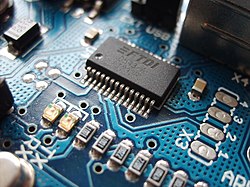
Modern surface-mount electronic components on a printed circuit board, with a large integrated circuit at the top

Electronics is a scientific and engineering discipline that studies and applies the principles of physics to design, create, and operate devices that manipulate electrons and other electrically charged particles. It is a subfield of physics[1][2] and electrical engineering which uses active devices such as transistors, diodes, and integrated circuits to control and amplify the flow of electric current and to convert it from one form to another, such as from alternating current (AC) to direct current (DC) or from analog signals to digital signals. Electronics is often contrasted with electrical power engineering, which focuses on generation, transmission, and distribution of electric power rather than signal processing or device level control.[3]

Electronic devices have significantly influenced the development of many aspects of modern society, such as telecommunications, entertainment, education, health care, industry, and security. The main driving force behind the advancement of electronics is the semiconductor industry, which continually produces ever-more sophisticated electronic devices and circuits in response to global demand. The semiconductor industry is one of the global economy's largest and most profitable industries, with annual revenues exceeding $481 billion in 2018. The electronics industry also encompasses other branches that rely on electronic devices and systems, such as e-commerce,[citation needed] which generated over $29 trillion in online sales in 2017. Practical electronic systems commonly combine analog and digital techniques, using analog front ends with digital processing.[4]

History and development

[edit]
One of the earliest Audion radio receivers, constructed by De Forest in 1914

Karl Ferdinand Braun's development of the crystal detector, the first semiconductor device, in 1874 and the identification of the electron in 1897 by Sir Joseph John Thomson, along with the subsequent invention of the vacuum tube which could amplify and rectify small electrical signals, inaugurated the field of electronics and the electron age.[5][6] Practical applications started with the invention of the diode by Ambrose Fleming and the triode by Lee De Forest in the early 1900s, which made the detection of small electrical voltages, such as radio signals from a radio antenna, practicable. Thermionic vacuum tubes enabled reliable amplification and detection, making long-distance telephony, broadcast radio, and early television feasible by 1920s-1930s.[7]

Vacuum tubes (thermionic valves) were the first active electronic components which controlled current flow by influencing the flow of individual electrons, and enabled the construction of equipment that used current amplification and rectification to give us radio, television, radar, long-distance telephony and much more. The early growth of electronics was rapid, and by the 1920s, commercial radio broadcasting and telecommunications were becoming widespread and electronic amplifiers were being used in such diverse applications as long-distance telephony and the music recording industry.[8]

The next big technological step took several decades to appear, when the first working point-contact transistor was invented by John Bardeen and Walter Houser Brattain at Bell Labs in 1947.[9] The 1947 point contact transistor showed that semiconductors could replace many tube functions with lower power and size.[10] However, vacuum tubes continued to play a leading role in the field of microwave and high power transmission as well as television receivers until the middle of the 1980s.[11] Since then, solid-state devices have all but completely taken over. Vacuum tubes are still used in some specialist applications such as high power RF amplifiers, cathode-ray tubes, specialist audio equipment, guitar amplifiers and some microwave devices.

In April 1955, the IBM 608 was the first IBM product to use transistor circuits without any vacuum tubes and is believed to be the first all-transistorized calculator to be manufactured for the commercial market.[12][13] The 608 contained more than 3,000 germanium transistors. Thomas J. Watson Jr. ordered all future IBM products to use transistors in their design. From that time on transistors were almost exclusively used for computer logic circuits and peripheral devices. However, early junction transistors were relatively bulky devices that were difficult to manufacture on a mass-production basis, which limited them to a number of specialised applications.[14]

The MOSFET was invented at Bell Labs between 1955 and 1960.[15][16][17][18][19][20] It was the first truly compact transistor that could be miniaturised and mass-produced for a wide range of uses.[14] The MOSFET became the most widely used device in VLSI, enabling compact, low power circuits.[21] Its advantages include high scalability,[22] affordability,[23] low power consumption, and high density.[24] The MOSFET's scalability and cost made it dominant in modern electronics.[25] It revolutionized the electronics industry,[26][27] becoming the most widely used electronic device in the world.[28][29] The MOSFET is the basic element in most modern electronic equipment.[30][31] As the complexity of circuits grew, problems arose.[32] One problem was the size of the circuit. A complex circuit like a computer was dependent on speed. If the components were large, the wires interconnecting them must be long. The electric signals took time to go through the circuit, thus slowing the computer.[32] The invention of the integrated circuit by Jack Kilby and Robert Noyce solved this problem by making all the components and the chip out of the same block (monolith) of semiconductor material. The circuits could be made smaller, and the manufacturing process could be automated. This led to the idea of integrating all components on a single-crystal silicon wafer, which led to small-scale integration (SSI) in the early 1960s, and then medium-scale integration (MSI) in the late 1960s, followed by VLSI. In 2008, billion-transistor processors became commercially available.[33] Integrated circuits put many components on one chip, shortening interconnects and increase speed.[25]

Subfields

[edit]

Devices and components

[edit]
Various electronic components

An electronic component is any component, either active or passive, in an electronic system or electronic device. Components are connected together, usually by being soldered to a printed circuit board (PCB), to create an electronic circuit with a particular function. Components may be packaged singly, or in more complex groups as integrated circuits. Passive electronic components are capacitors, inductors, resistors, whilst active components are such as semiconductor devices; transistors and thyristors, which control current flow at electron level.[34]

Types of circuits

[edit]

Electronic circuit functions can be divided into two function groups: analog and digital. A particular device may consist of circuitry that has either or a mix of the two types. Analog circuits are becoming less common, as many of their functions are being digitized.

Analog circuits

[edit]

Analog circuits use a continuous range of voltage or current for signal processing, as opposed to the discrete levels used in digital circuits. Analog circuits were common throughout an electronic device in the early years in devices such as radio receivers and transmitters. Analog electronic computers were valuable for solving problems with continuous variables until digital processing advanced.

As semiconductor technology developed, many of the functions of analog circuits were taken over by digital circuits, and modern circuits that are entirely analog are less common; their functions being replaced by hybrid approach which, for instance, uses analog circuits at the front end of a device receiving an analog signal, and then use digital processing using microprocessor techniques thereafter.

Sometimes it may be difficult to classify some circuits that have elements of both linear and non-linear operation. An example is the voltage comparator which receives a continuous range of voltage but only outputs one of two levels as in a digital circuit. Similarly, an overdriven transistor amplifier can take on the characteristics of a controlled switch, having essentially two levels of output.

Analog circuits are still widely used for signal amplification, such as in the entertainment industry, and conditioning signals from analog sensors, such as in industrial measurement and control.

Digital circuits

[edit]

Digital circuits are electric circuits based on discrete voltage levels. Digital circuits use Boolean algebra and are the basis of all digital computers and microprocessor devices. They range from simple logic gates to large integrated circuits, employing millions of such gates.

Digital circuits use a binary system with two voltage levels labelled "0" and "1" to indicated logical status. Often logic "0" will be a lower voltage and referred to as "Low" while logic "1" is referred to as "High". However, some systems use the reverse definition ("0" is "High") or are current based. Quite often the logic designer may reverse these definitions from one circuit to the next as they see fit to facilitate their design. The definition of the levels as "0" or "1" is arbitrary.[35]

Ternary (with three states) logic has been studied, and some prototype computers made, but have not gained any significant practical acceptance.[36] Universally, Computers and Digital signal processors are constructed with digital circuits using Transistors such as MOSFETs in the electronic logic gates to generate binary states.

A selection of logic gates, used extensively in digital electronics

Highly integrated devices:

Design

[edit]

Electronic systems design deals with the multi-disciplinary design issues of complex electronic devices and systems, such as mobile phones and computers. The subject covers a broad spectrum, from the design and development of an electronic system (new product development) to assuring its proper function, service life and disposal.[37] Electronic systems design is therefore the process of defining and developing complex electronic devices to satisfy specified requirements of the user.

Due to the complex nature of electronics theory, laboratory experimentation is an important part of the development of electronic devices. These experiments are used to test or verify the engineer's design and detect errors. Historically, electronics labs have consisted of electronics devices and equipment located in a physical space, although in more recent years the trend has been towards electronics lab simulation software, such as CircuitLogix, Multisim, and PSpice.

Computer-aided design

[edit]

Today's electronics engineers have the ability to design circuits using premanufactured building blocks such as power supplies, semiconductors (i.e. semiconductor devices, such as transistors), and integrated circuits. Electronic design automation software programs include schematic capture programs and printed circuit board design programs. Popular names in the EDA software world are NI Multisim, Cadence (ORCAD), EAGLE PCB[38] and Schematic, Mentor (PADS PCB and LOGIC Schematic), Altium (Protel), LabCentre Electronics (Proteus), gEDA, KiCad and many others.

Negative qualities

[edit]

Thermal management

[edit]

Heat generated by electronic circuitry must be dissipated to prevent immediate failure and improve long term reliability. Heat dissipation is mostly achieved by passive conduction/convection. Means to achieve greater dissipation include heat sinks and fans for air cooling, and other forms of computer cooling such as water cooling. These techniques use convection, conduction, and radiation of heat energy.

Noise

[edit]

Electronic noise is defined[39] as unwanted disturbances superposed on a useful signal that tend to obscure its information content. Noise is not the same as signal distortion caused by a circuit. Noise is associated with all electronic circuits. Noise may be electromagnetically or thermally generated, which can be decreased by lowering the operating temperature of the circuit. Other types of noise, such as shot noise cannot be removed as they are due to limitations in physical properties.

Packaging methods

[edit]
Through-hole devices mounted on the circuit board of a mid-1980s home computer. Axial-lead devices are at upper left, while blue radial-lead capacitors are at upper right.

Many different methods of connecting components have been used over the years. For instance, early electronics often used point to point wiring with components attached to wooden breadboards to construct circuits. Cordwood construction and wire wrap were other methods used. Most modern-day electronics now use printed circuit boards made of materials such as FR-4 and FR-2. Modern PCBs are usually FR-4 epoxy boards with through hole or surface mount parts.[40] Electrical components are generally mounted to PCBs using through-hole or surface mount.

Health and environmental concerns associated with electronics assembly have gained increased attention in recent years.

Industry

[edit]

The electronics industry consists of various branches. The central driving force behind the entire electronics industry is the semiconductor industry,[41] which has annual sales of over $481 billion as of 2018.[42] The largest industry sector is e-commerce,[citation needed] which generated over $29 trillion in 2017.[43] The most widely manufactured electronic device is the metal-oxide-semiconductor field-effect transistor (MOSFET), with an estimated 13 sextillion MOSFETs having been manufactured between 1960 and 2018.[44] In the 1960s, U.S. manufacturers were unable to compete with Japanese companies such as Sony and Hitachi who could produce high-quality goods at lower prices. By the 1980s, however, U.S. manufacturers became the world leaders in semiconductor development and assembly.[45]

However, during the 1990s and subsequently, the industry shifted overwhelmingly to East Asia (a process begun with the initial movement of microchip mass-production there in the 1970s), as plentiful, cheap labor, and increasing technological sophistication, became widely available there.[46][47]

Over three decades, the United States' global share of semiconductor manufacturing capacity fell, from 37% in 1990, to 12% in 2022.[47] America's pre-eminent semiconductor manufacturer, Intel Corporation, fell far behind its subcontractor Taiwan Semiconductor Manufacturing Company (TSMC) in manufacturing technology.[46]

By that time, Taiwan had become the world's leading source of advanced semiconductors[47][46]—followed by South Korea, the United States, Japan, Singapore, and China.[47][46]

Important semiconductor industry facilities (which often are subsidiaries of a leading producer based elsewhere) also exist in Europe (notably the Netherlands), Southeast Asia, South America, and Israel.[46]

See also

[edit]

References

[edit]

Further reading

[edit]
[edit]
Revisions and contributorsEdit on WikipediaRead on Wikipedia
from Grokipedia
Electronics is a branch of physics and technology concerned with the emission, behavior, and effects of electrons in devices such as vacuum tubes, transistors, and semiconductors, enabling the control and manipulation of electrical signals for amplification, switching, and processing. This field distinguishes itself from broader electrical engineering by focusing on active components that introduce gain or directionality to current flow, rather than mere power distribution or passive conduction. Emerging in the early 20th century with inventions like the audion vacuum tube triode in 1907, which facilitated signal amplification for radio, electronics advanced dramatically with the 1947 invention of the point-contact transistor at Bell Laboratories by John Bardeen, Walter Brattain, and William Shockley, replacing bulky tubes with compact solid-state alternatives and catalyzing the development of integrated circuits, microprocessors, and digital systems. These milestones underpin contemporary applications in computing, telecommunications, and consumer devices, governed by principles such as Ohm's law, semiconductor doping, and Boolean logic for circuit design and operation.

Fundamentals

Definition and Principles

Electronics is the scientific discipline and engineering field that studies and applies the controlled flow of electrons or other charge carriers through materials, particularly semiconductors, to perform functions such as , amplification, and switching in circuits and devices. This control exploits the behavior of electrons in response to , enabling the manipulation of or at low power levels, distinct from electrical power systems focused on generation and high-power distribution. At its core, electronic principles derive from the movement of charged particles, primarily electrons, constituting II, measured in as the rate of charge flow (approximately 6.24×10186.24 \times 10^{18} electrons per second per ). This flow is driven by voltage VV, the difference in volts that impels electrons from higher to lower potential, opposed by resistance RR in ohms, which quantifies a material's impedance to current due to collisions and scattering. , V=IRV = IR, empirically established by Georg Simon Ohm in 1827, governs linear ohmic conductors under constant temperature and describes the proportional relationship, applicable to resistors and many circuit elements. Semiconductors underpin modern electronics, exhibiting conductivity intermediate between conductors (e.g., , with abundant free electrons) and insulators (e.g., ), due to a valence band of about 1 in materials like , allowing thermal excitation of electrons to a conduction band. Doping introduces impurities— for n-type (donor electrons) or for p-type (acceptor holes, effective positive carriers)—enabling precise control of carrier concentration and majority type, facilitating p-n junctions for rectification and action. Carrier transport occurs via drift (field-directed) and (concentration-gradient), with principles extending to via and for reactive effects in AC circuits. These mechanisms, analyzed via conservation laws like Kirchhoff's voltage and current rules, form the causal basis for circuit analysis and device operation.

Key Physical Phenomena

Electronics fundamentally depends on the directed flow of electric charge carriers, primarily electrons, through solid materials under applied electric fields. In metallic conductors, conduction arises from the drift of free electrons, with current density JJ related to the electric field EE by J=σEJ = \sigma E, where σ\sigma is conductivity; this linear relationship underpins Ohm's law, V=IRV = IR, valid for ohmic materials at constant temperature. Resistivity ρ=1/σ\rho = 1/\sigma varies with material properties, such as copper's ρ1.68×10⁸\rho \approx 1.68 \times 10^{-8} Ω·m at 20°C, enabling low-loss interconnects in circuits. Semiconductors, central to modern electronics, exhibit conduction via both in the conduction band and (absence of ) in the valence band, governed by band theory where a small bandgap EgE_g (e.g., 1.12 eV for at 300 K) allows thermal excitation of carriers. Doping introduces impurities—n-type with donor atoms adding , p-type with acceptors creating —modulating carrier concentration and enabling control of conductivity over orders of magnitude, unlike fixed values in metals. Carrier transport combines drift (field-driven) and (concentration-gradient-driven) currents, described by the drift- equations, with total current J=q(μnnE+Dnn)+q(μppEDpp)J = q(\mu_n n E + D_n \nabla n) + q(\mu_p p E - D_p \nabla p), where qq is charge, μ\mu mobility, DD coefficient, nn , and pp density. At p-n junctions, a critical emerges: of majority carriers across the interface creates a space-charge with a built-in potential barrier Vbi(kT/q)ln(NAND/ni2)V_{bi} \approx (kT/q) \ln(N_A N_D / n_i^2), where NA,NDN_A, N_D are doping concentrations and nin_i intrinsic carrier density, balancing drift and at equilibrium and enabling unidirectional current flow under forward bias (exceeding VbiV_{bi}) while blocking reverse bias, foundational to and transistors. Semiconductors deviate from strict due to voltage-dependent carrier injection and recombination, yielding nonlinear I-V characteristics essential for amplification and switching. Capacitive and inductive phenomena arise from charge accumulation and linkage, respectively: capacitance C=ϵA/dC = \epsilon A / d stores (1/2)CV2(1/2)CV^2 in , while LL opposes current changes via V=LdI/dtV = L dI/dt, both quantized in circuit analysis but rooted in . These effects, combined with quantum tunneling in thin barriers (e.g., in tunnel diodes, where current flows against potential via wavefunction overlap), extend electronics beyond classical limits, though practical devices prioritize drift-diffusion regimes for reliability.

History

Early Innovations

In 1883, observed , known as the Edison effect, during experiments with incandescent lamps, where electrons were emitted from a heated filament toward a positively charged plate in a . This phenomenon provided the foundational mechanism for controlling electron flow in evacuated glass envelopes but was not immediately applied to practical devices. British physicist developed the first practical , the or , patented on November 16, 1904. The device featured a heated and , allowing unidirectional current flow for rectifying alternating signals into , primarily for detecting radio waves in early communication systems. American inventor advanced this in 1906 by introducing a between the and , creating the or , which enabled amplification of weak electrical signals. The grid's voltage modulated flow, allowing voltage gain up to several hundred times, essential for audio and amplification in the first electronic receivers and transmitters. These innovations shifted electronics from passive components like coherers and crystals to active devices capable of , underpinning the growth of and by the 1910s.

Transistor and Solid-State Breakthroughs

The invention of the at Bell Laboratories marked a pivotal shift from vacuum tube-based electronics to solid-state devices, enabling amplification and switching without the fragility, high power consumption, and large size of tubes. On December 23, 1947, physicists and Walter Brattain demonstrated the first using a crystal with two closely spaced gold foil contacts, achieving signal amplification of up to 100 times at audio frequencies. This device operated by injecting and collecting charge carriers across a thin surface layer, leveraging properties discovered earlier in the decade, such as the p-n junction identified by Russell Ohl in 1940. Theoretical advancements followed rapidly, as , motivated by the point-contact device's limitations like instability and low power handling, conceived the (BJT) structure on January 23, 1948. The BJT consisted of three alternating layers of p-type and n-type material—typically —forming emitter, base, and collector regions, allowing controlled current flow through the bulk material rather than surface effects. Practical fabrication of grown-junction transistors occurred by 1951, using alloying or rate-growing techniques to create reliable p-n junctions, which supported higher power and frequency performance. The term "," blending "transfer" and "," was coined in May 1948 by engineer John Pierce to describe these amplifying resistors. Early transistor applications demonstrated their superiority over vacuum tubes in reliability and efficiency, though initial costs were high—around $8 per unit in 1950s production, dropping with scale. The first commercial uses included hearing aids in 1952, benefiting from the 's low power draw and compact size compared to tube-based equivalents. In , transistors debuted in 1952 for multifrequency tone generators in No. 5 crossbar switches, reducing equipment size and heat generation. By the mid-, pocket-sized radios, such as the Regency TR-1 released in 1954, proliferated, using four to six germanium transistors to replace bulky tube circuits and enable portable . These breakthroughs catalyzed the solid-state revolution, as transistors eliminated the filament burnout and warm-up times of tubes, paving the way for denser circuitry and lower operating voltages around 1-10 volts versus tubes' hundreds. ' 1952 licensing of transistor technology to 16 firms for royalties spurred industrial adoption, though early germanium devices suffered from temperature sensitivity and contamination issues, prompting a shift to by the late 1950s for better stability. The trio's work earned Bardeen, Brattain, and Shockley the 1956 , recognizing the transistor's foundational role in modern electronics despite initial skepticism about its practicality.

Microelectronics Expansion

The invention of the marked the onset of microelectronics expansion, enabling the fabrication of multiple transistors and components on a single substrate. In September 1958, at demonstrated the first , a monolithic device containing several components etched into a slab, addressing the "tyranny of numbers" in interconnecting discrete parts. Independently, at developed a silicon-based monolithic in 1959, building on the planar process to allow high-volume manufacturing through and techniques. These advancements facilitated rapid and cost reduction in electronic systems. By 1964, General Microelectronics produced the first commercial MOS integrated circuit, a 120-transistor , shifting from bipolar to metal-oxide-semiconductor technology for lower power and higher density. , in 1965, observed that the number of transistors on an would double annually, a trend driven by improvements in and materials, which became known as and guided industry scaling for decades. The 1970s saw the rise of very-large-scale integration (VLSI), where MOS chips integrated thousands to hundreds of thousands of transistors, enabling complex functions like microprocessors. Intel's 4004, released on November 15, 1971, was the first single-chip microprocessor with 2,300 transistors, initially designed for a but pivotal in embedding power into diverse applications from appliances to instruments. This era's causal driver was the synergy of refinements—such as finer line widths and oxide isolation—yielding exponential performance gains while reducing size and power, fundamentally transforming electronics from bulky assemblies to compact, reliable modules.

Contemporary Advances (1980s-2025)

The 1980s saw the transition from medium-scale to very-large-scale integration in semiconductors, enabling complex systems on single chips and driving the personal computing revolution. The IBM Personal Computer, introduced on August 12, 1981, utilized the Intel 8088 microprocessor with 29,000 transistors, establishing open architecture standards that spurred industry growth. Complementary metal-oxide-semiconductor (CMOS) processes became dominant due to their energy efficiency, powering early portable devices like the Epson HX-20 laptop announced in 1981. In 1982, Sony and Philips launched the compact disc (CD), employing laser-based optical readout for digital audio storage, which sold over 200 million units by decade's end. Toshiba developed NAND flash memory in 1984, providing erasable non-volatile storage essential for later devices. The 1990s accelerated with feature sizes shrinking below 1 micrometer, alongside the rise of reduced instruction set computing (RISC) architectures for higher . Intel's processor, released in 1993, incorporated 3.1 million transistors and superscalar design, boosting clock speeds toward 1 GHz by 2000. The universal serial bus (USB) standard, finalized in 1996, simplified peripheral connectivity, replacing proprietary interfaces in . Digital signal processors advanced , enabling DVD players introduced in 1996 with 4.7 GB capacity per side. Global sales grew from $40 billion in 1990 to over $200 billion by 2000, fueled by demands. Into the 2000s, multi-core processors emerged to sustain performance amid physical scaling limits, with AMD's in 2003 and Intel's Core Duo in 2006 integrating dual cores. Solid-state drives (SSDs) based on NAND flash proliferated post-2006, offering speeds up to 100 times faster than hard disk drives. Apple's , unveiled in 2007, integrated capacitive touchscreens, ARM-based processors, and accelerometers, catalyzing the era with annual shipments exceeding 1 billion units by 2013. Organic light-emitting diode () displays gained traction for superior contrast, featured in consumer TVs by 2007. The 2010s introduced three-dimensional transistor structures like FinFETs, adopted by Intel in 2011 for 22 nm nodes, enhancing current density and reducing leakage. Internet of Things (IoT) devices exploded, with embedded systems in sensors and wearables leveraging low-power wide-area networks. 5G wireless standards, standardized in 2017, enabled data rates up to 20 Gbps through massive MIMO and mmWave bands. By 2019, extreme ultraviolet (EUV) lithography allowed sub-7 nm fabrication, critical for high-performance computing. From 2020 to 2025, hardware specialized, with tensor processing units (TPUs) from since 2016 and NVIDIA's A100 GPU in 2020 optimizing matrix operations for , driving expansions. architectures modularized designs, as in AMD's processors from 2017, improving yields at 5 nm and below. Global revenue reached $686 billion in June 2025, propelled by AI demand despite constraints. prototypes, such as IBM's 433-qubit Osprey in 2022, demonstrated error-corrected gates, though scalable fault-tolerance remains elusive. These advances underscore causal drivers like exponential transistor density per —reaching over 100 billion per chip—and economic incentives for efficiency in power-constrained applications.

Components

Passive Elements

Passive electronic components are circuit elements that do not require an external to operate and cannot amplify electrical signals; instead, they manage energy by dissipating it as heat, storing it temporarily, or releasing it without gain. These components, including resistors, capacitors, and inductors, form the foundational building blocks of electronic circuits, enabling functions such as , voltage division, , and signal filtering. Unlike active components like transistors, which can control or amplify signals using supplied power, passive elements respond linearly to applied voltages and currents, adhering to principles derived from and electromagnetic theory. Resistors oppose the flow of , converting excess electrical energy into heat via , with resistance values typically measured in ohms (Ω). Their primary functions include limiting current to protect other components, dividing voltages in potential dividers, and setting bias levels in circuits; for instance, a 1 kΩ resistor can drop voltage proportionally to current per (V = IR). Common materials include carbon composition for high-pulse tolerance, thin-film or thick-film for precision, and wirewound for high-power applications up to several kilowatts. Capacitors store electrical energy in an between two conductive plates separated by a material, with quantified in farads (F), though practical values range from picofarads to microfarads. They block (DC) while passing (AC), facilitating applications like smoothing voltage ripples in power supplies, coupling signals between stages, and forming timing elements in RC circuits with time constants τ = RC. Types include for high-frequency stability, electrolytic for large in polarized setups (up to thousands of microfarads at low voltages), and film capacitors for low-loss audio filtering. Inductors, or coils, store energy in a generated by current flow through wire windings, opposing changes in current via self-induced as described by Faraday's (V = L di/dt, where L is in henries). In circuits, they filter high frequencies in low-pass setups, store energy in switched-mode power supplies, and create in LC tanks for tuning radio frequencies. Air-core inductors suit high-frequency RF, while ferrite-core versions enhance low-frequency performance but may introduce losses from . Transformers, though sometimes grouped separately, function as passive mutual inductors to step up or down AC voltages via , essential in power distribution since their invention in the for efficient long-distance transmission. Passive networks combining these elements, such as RLC filters, shape frequency responses predictably without amplification, underpinning . Limitations include parasitics like in inductors or in capacitors, which affect high-frequency behavior and require careful selection for specific tolerances and ratings.

Active Elements

Active elements, or active components, are electronic devices that require an external to operate and can amplify signals, control current flow, or generate electrical power within a circuit. They differ from passive elements by providing gain or injecting energy, enabling functions such as switching, , and rectification beyond mere or dissipation. This capability stems from their or vacuum-based structures, which allow manipulation of electron flow under applied . Vacuum tubes, among the earliest active elements, consist of sealed glass envelopes containing electrodes in a vacuum to control electron emission from a heated cathode. The triode vacuum tube, patented by Lee de Forest in 1907, features a grid electrode that modulates current between cathode and anode, enabling voltage amplification with gains up to 100 in early designs. Widely used in radio receivers and amplifiers until the mid-20th century, vacuum tubes operated at high voltages (hundreds of volts) and dissipated significant heat, limiting their efficiency to around 50% in power applications. Their decline began with the advent of solid-state alternatives due to fragility, size, and power consumption issues. Semiconductor diodes serve as fundamental active elements by permitting current flow in one direction when forward-biased, with a typical of 0.7 V for types at . While lacking inherent amplification, diodes control signals through rectification or switching, as in Zener diodes that maintain at breakdown levels from 2.4 V to over 200 V. Tunnel diodes, exhibiting , enable high-frequency oscillation up to 100 GHz, making them suitable for applications despite limited commercial adoption post-1960s. Transistors, the cornerstone of modern active elements, were invented in 1947 at Bell Laboratories by John Bardeen, Walter Brattain, and William Shockley, revolutionizing electronics with their compact size and low power needs. Bipolar junction transistors (BJTs) amplify via current gain (beta factor typically 100-300), while field-effect transistors (FETs), including MOSFETs, offer high input impedance exceeding 10^12 ohms and voltage-controlled operation. MOSFETs dominate integrated circuits, with gate lengths scaled to 3 nm by 2023 in commercial chips, enabling switching speeds in picoseconds and power efficiencies over 90% in logic gates. Other active elements include integrated circuits combining multiple transistors, such as operational amplifiers with open-loop gains of 10^5 to 10^6, and thyristors like silicon-controlled rectifiers (SCRs) that latch conduction at currents from milliamps to kiloamps for . These devices underpin amplification in audio systems, switching in digital logic, and regulation in power supplies, with reliability metrics showing exceeding 10^6 hours in implementations.

Integrated and Advanced Devices

Integrated circuits (ICs), also known as microchips, are assemblies of interconnected electronic components—such as transistors, resistors, and capacitors—fabricated on a single substrate, enabling compact and efficient circuitry. This integration reduces size, cost, and power consumption compared to discrete components while improving reliability. The first functional IC prototype, containing multiple passive and active elements, was demonstrated by at on September 12, 1958. Independently, at developed a silicon-based monolithic IC in 1959, utilizing the planar diffusion process for scalable manufacturing. ICs are categorized by function into analog, digital, and mixed-signal types. Analog ICs process continuous signals for applications like amplification and filtering, exemplified by operational amplifiers. Digital ICs manage binary logic states using gates and flip-flops, forming the basis for microprocessors and . Mixed-signal ICs integrate both domains, such as analog-to-digital converters (ADCs) that interface real-world signals with digital . Fabrication occurs through processes including , , and , layering conductive, insulating, and semiconducting materials on a to create circuits with billions of transistors in modern devices. Advancements in IC scaling adhere to Moore's law, originally observed by Gordon Moore in 1965, stating that the number of transistors per IC approximately doubles every two years, driving exponential increases in performance and density. This has enabled very-large-scale integration (VLSI) with over 100 million transistors by the 2000s and system-on-chip (SoC) designs incorporating processors, memory, and peripherals on one die. Beyond traditional silicon ICs, advanced devices include microelectromechanical systems (MEMS), which combine mechanical structures like sensors and actuators with electronic circuitry on the same substrate for applications in accelerometers and microphones. Optoelectronic integrated circuits (OEICs) merge photonic elements, such as lasers and photodetectors, with electronics for high-speed data transmission in fiber optics. These developments continue to push limits in miniaturization, with 3D stacking and novel materials addressing planar scaling challenges.

Circuits

Analog Systems

Analog electronic systems consist of circuits designed to process continuous signals that vary smoothly over time, such as voltage or current representing physical phenomena like sound or light intensity. These systems operate on principles of linear signal manipulation, where output is a proportional function of input, governed by fundamental laws including Ohm's law (V = IR) and Kirchhoff's laws for current and voltage conservation in networks. Unlike digital systems, which discretize signals into binary states for noise immunity and logic operations, analog systems directly interface with real-world continuous phenomena but are vulnerable to noise, distortion, and component tolerances that can degrade signal fidelity. Core components in analog systems include passive elements—resistors for , capacitors for and timing, and inductors for interaction—and active elements like bipolar junction transistors (BJTs) or field-effect transistors (FETs) for amplification, alongside diodes for rectification. Operational amplifiers (op-amps), integrated circuits providing high gain and feedback control, serve as building blocks for many functions; for instance, the μA741 op-amp, introduced by Fairchild in 1968, features a typical of 100,000 and of 0.5 V/μs. Circuits rely on feedback mechanisms, either negative for stabilization (e.g., reducing in amplifiers) or positive for oscillation, to achieve desired transfer functions. Amplifiers form a foundational class, boosting signal while ideally preserving ; classes include Class A for low-distortion linear operation (efficiency ~25%) and Class B for higher efficiency (~78.5%) in push-pull configurations, though prone to . Voltage amplifiers, such as common-emitter BJT stages with gains up to β (current gain, often 100-300), and power amplifiers for audio output (e.g., delivering 50W into 8Ω loads) exemplify this. Filters selectively attenuate or pass frequency bands, implemented passively via RC (cutoff f_c = 1/(2πRC)) or RLC networks for resonant responses (Q factor determining sharpness), or actively with op-amps for tunability without inductors; a first-order low-pass RC filter rolls off at -20 dB/decade beyond cutoff. High-pass, band-pass, and notch variants enable signal conditioning, as in anti-aliasing before digitization. Oscillators generate self-sustaining periodic signals via and frequency-selective networks; RC types like the (frequency f = 1/(2πRC), distortion <1% with proper amplitude stabilization) suit audio ranges, while LC oscillators (e.g., Colpitts, f ≈ 1/(2π√(LC))) provide stability for RF up to GHz. , quantified as (e.g., -100 /Hz at 10 kHz offset), limits precision in applications like clocks. Modulators and demodulators handle signal translation, such as amplitude modulation (AM) circuits multiplying carrier (e.g., 1 MHz) by baseband via diode mixers, enabling radio transmission; phase-locked loops (PLLs) synchronize outputs to inputs with loop bandwidths tuned for capture range (e.g., ±100 kHz). These systems underpin applications like audio processing and sensor interfaces, where linearity metrics like total harmonic distortion (THD <0.1% in high-fidelity amps) ensure fidelity.

Digital Systems

Digital systems comprise electronic circuits that operate on discrete signal levels, typically binary states representing logic 0 (low voltage, often near 0 V) and logic 1 (high voltage, such as 5 V in early systems or 3.3 V in modern ones), enabling reliable noise-immune processing over analog systems. These circuits implement , where variables assume true (1) or false (0) values, and operations like conjunction (AND), disjunction (OR), and (NOT) define logical functions. Claude Shannon's 1937 master's established the direct mapping of to electromechanical switching circuits using relays, proving that complex logical expressions could be synthesized from basic switches, laying the groundwork for scalable digital design. The core components of digital systems are logic gates, electronic devices that perform primitive Boolean operations on one or more inputs to produce a single output. Basic gates include the inverter (NOT, inverting input), buffer (non-inverting), AND (output 1 only if all inputs 1), OR (output 1 if any input 1), NAND (AND followed by NOT), NOR (OR followed by NOT), XOR (exclusive OR, 1 if odd number of 1s), and XNOR (1 if even number of 1s). Gates are constructed from transistors; early implementations used diode-transistor logic (DTL) in the late 1950s, followed by transistor-transistor logic (TTL) standardized in the 1960s with voltage levels of 0-0.8 V for low and 2-5 V for high, offering propagation delays around 10 ns. Modern systems predominantly employ complementary metal-oxide-semiconductor (CMOS) technology, which consumes power primarily during switching (static power near zero), enabling billions of gates on chips with supply voltages as low as 0.8 V and delays under 1 ns. Digital systems are categorized into combinational and sequential circuits. Combinational circuits generate outputs solely from current inputs without , exemplified by (e.g., full adder summing three bits with carry-in to produce sum and carry-out) and multiplexers (selecting one of multiple inputs based on control lines), where output timing is immediate modulo gate delays. Sequential circuits incorporate elements like flip-flops (e.g., D-type latching data on clock edge) and depend on both inputs and prior states, facilitated by clocks (periodic signals, often 1-5 GHz in processors) to synchronize state changes and avoid race conditions. Examples include counters (incrementing binary values per clock) and shift registers (serial-to-parallel data conversion), forming the basis for finite state machines (FSMs) that model behaviors with defined transitions. Advanced digital systems integrate vast arrays of into microprocessors, central units executing instructions via arithmetic-logic units (ALUs) for operations like (e.g., 64-bit integers) and control units managing fetch-decode-execute cycles. The , released in 1971, marked the first single-chip with 2300 transistors operating at 740 kHz, evolving to modern multi-core processors with over 100 billion transistors at GHz speeds. These enable applications in (e.g., von Neumann architectures with separate program/data memory), embedded control (e.g., FSMs in traffic lights sequencing states), and (e.g., digital filters approximating analog via discrete-time transforms). Reliability stems from and error-correcting codes, countering bit-flip errors estimated at 10^-15 per bit-hour in .

Hybrid and Specialized Circuits

Hybrid integrated circuits (HICs) assemble individual devices, such as transistors and diodes, with passive components like resistors and capacitors on a shared insulating substrate, often or thin-film materials, to form compact electronic modules. This approach emerged in the late through U.S. Army Signal Corps programs, with RCA as prime contractor, developing hybrid microcircuits as dense assemblies of components to achieve and reliability beyond early monolithic designs. By 1964, hybrid microcircuits attained peak production volumes for and applications, leveraging techniques like thick-film printing for resistors and wire-bonding for connections. Unlike purely monolithic integrated circuits, HICs enable inclusion of elements impractical for single-chip fabrication, such as high-value capacitors, inductors, or discrete crystals, yielding advantages in performance customization and thermal management. Types of HICs include thick-film hybrids, which use screen-printed conductive and resistive pastes fired onto substrates for cost-effective production, and thin-film hybrids employing vacuum-deposited metal layers for precise, high-frequency applications. Multi-chip modules (MCMs), an evolution of hybrids, stack or arrange multiple bare dies with interconnects, reducing parasitics in high-speed systems; for instance, MCMs have supported and electronics since the 1970s by integrating disparate technologies like ICs with gallium arsenide devices. These circuits excel in environments demanding ruggedness, with hermetic sealing against moisture and vibration, as seen in automotive ignition modules operational since the , where failure rates under cycling remain below 1% over 10-year lifespans due to compatibility. Specialized circuits extend hybrid principles to domain-specific needs, such as mixed-signal designs that merge analog front-ends for with digital on a single die or module, minimizing noise interference in applications like audio codecs introduced in consumer devices by the . Radio-frequency (RF) circuits, often hybrid or monolithic RFICs, handle frequencies above 100 MHz using tuned inductors and matching networks; for example, RFICs in processes since 2000 integrate power amplifiers and mixers, achieving 20-30 dBm output power with efficiencies up to 40% in base stations. Power circuits, specialized for conversion, employ hybrid assemblies of MOSFETs, diodes, and magnetics in DC-DC converters, delivering currents over 100 A at voltages up to 48 V while maintaining efficiencies exceeding 95% through low-resistance paths and isolated substrates, as verified in industrial motor drives. These configurations prioritize causal factors like and heat dissipation, enabling reliable operation in constrained spaces without compromising on verifiable metrics such as signal-to-noise ratios above 80 dB in mixed-signal hybrids.

Design and Engineering

Methodologies and Tools

Electronics design methodologies systematically translate conceptual requirements into functional hardware, emphasizing iterative refinement based on constraints like power, speed, and area. Analog circuit typically employs top-down methodologies, where high-level system specifications—such as bandwidth and gain—are partitioned into modular blocks like amplifiers and filters before detailed transistor-level , or bottom-up approaches that integrate verified subcircuits to meet overall targets. Digital methodologies, by contrast, leverage abstraction levels from behavioral descriptions to (RTL) coding, enabling automated synthesis into logic gates and interconnects, with floorplanning strategies optimizing block placement to minimize signal delays and power dissipation. Mixed-signal designs require co-simulation-aware partitioning to mitigate interface mismatches between continuous analog signals and discrete digital logic. Electronic design automation (EDA) tools form the core infrastructure, automating , generation, and layout to handle complexity exceeding manual feasibility. Commercial suites like support hierarchical analog design with parametric optimization, while tools excel in digital synthesis and physical verification, processing designs with billions of transistors as seen in modern SoCs. For (PCB) layout, integrates 3D modeling and analysis, reducing through automated algorithms compliant with standards like IPC-2221. Open-source alternatives, such as , provide accessible schematic entry and Gerber file export for prototyping, though they lack advanced parasitic extraction compared to proprietary systems. Prototyping methodologies incorporate rapid iteration using field-programmable gate arrays (FPGAs) for digital validation, allowing reconfiguration via tools like to test RTL code pre-ASIC commitment, with reconfiguration times under seconds for designs up to 10 million gates. Hardware description languages underpin these processes: , standardized in IEEE 1364-2005, supports event-driven simulation for timing verification, while (IEEE 1076-2008) emphasizes strong typing for safety-critical applications like aerospace electronics. System-level tools, including requirements traceability matrices, ensure methodologies align with empirical validation, such as decoupling capacitor placement to stabilize voltage rails at 1-10 nF per IC pin.

Simulation and Verification

Simulation in electronics engineering employs mathematical models to predict the behavior of circuits and systems prior to physical fabrication, enabling analysis of electrical characteristics such as voltage, current, and timing under various conditions. This process originated in the early 1950s with computer-aided analysis of linear circuits using electromechanical relays and digital computers, evolving to handle nonlinear and transient responses by the 1970s. SPICE (Simulation Program with Integrated Circuit Emphasis), developed at the University of California, Berkeley in 1973, established a foundational framework for analog circuit simulation by solving nodal equations through numerical methods like Newton-Raphson iteration, supporting DC, AC, and transient analyses. Derivatives such as HSPICE, commercialized around 1981, extended these capabilities for high-precision integrated circuit modeling, becoming a standard in industry for verifying transistor-level designs. For digital circuits, simulation relies on hardware description languages (HDLs) like , introduced in 1984, and , standardized in 1987, to describe logic at (RTL) or gate level, with event-driven simulators processing signal changes over time. Tools such as those based on HILO from 1981 represent early RTL simulation advancements, allowing functional verification through testbenches that apply input vectors and check outputs against expected results. Verification methods include directed testing, where specific scenarios are scripted to exercise design corners; constrained-random testing, generating diverse inputs within defined parameters to uncover edge cases; and , using mathematical proofs to exhaustively check properties like equivalence between RTL and gate-level netlists without simulation waveforms. These approaches ensure functional correctness, with particularly effective for critical paths in safety-sensitive applications, though computationally intensive for large designs exceeding millions of gates. Mixed-signal simulation integrates analog and digital domains, often via standardized interfaces like , to model interactions in systems-on-chip (SoCs), addressing challenges such as and analog-digital interfaces. By iterating designs virtually, reduces prototyping iterations; for instance, identifying or timing violations pre-fabrication avoids costly silicon respins, where tape-outs can exceed $1 million per revision in advanced nodes. Verification complements through emulation on hardware platforms for real-time testing of billion-gate designs and equivalence checking to confirm post-synthesis fidelity, collectively minimizing time-to-market by up to 50% in complex projects while enhancing reliability through early detection of defects that physical testing might overlook.

Scaling and Optimization

Scaling in electronics design primarily involves reducing the physical dimensions of transistors and interconnects in integrated circuits to increase component density, enhance performance, and reduce power consumption per operation, as originally observed in , which posits that the number of transistors on a chip doubles approximately every two years at constant cost. This scaling has driven exponential improvements in computing power since the 1960s, but by October 2025, traditional planar scaling faces physical limits, with experts like Stanford's Mark Horowitz declaring "basically over" due to diminishing returns from and materials constraints. Forecasts indicate a plateau between 2030 and 2040 without breakthroughs like gate-all-around (GAA) transistors or novel materials, as transistor sizes approach atomic scales, exacerbating quantum tunneling and variability. Optimization techniques complement scaling by targeting power, performance, and area (PPA) trade-offs in very-large-scale integration (VLSI) designs. Common methods include , which disables clocks to inactive circuit blocks to cut dynamic power; , which powers down unused modules via sleep transistors; and dynamic voltage and (DVFS), which adjusts supply voltage and clock speed based on workload to minimize energy use without sacrificing functionality. In analog and mixed-signal circuits, symbolic optimization uses mathematical models to tune parameters like bias currents and capacitances for minimal distortion and maximal bandwidth. Advanced (EDA) tools employ for placement and routing, achieving up to 75% power savings in 2nm GAA nanosheet processes by predicting congestion and optimizing wire lengths. Challenges in scaling and optimization arise from process variations and thermal effects, where shrinking features increases leakage currents and electromigration risks, necessitating adaptive body biasing and multi-threshold CMOS (MTCMOS) to balance speed and standby power. For instance, in low-power VLSI architectures, learning-based methods integrate voltage scaling with transistor sizing to handle variability, reducing power by 20-30% in sub-5nm nodes compared to static designs. Empirical data from industry reports show that while AI-driven demand accelerates fab investments—projected at $1 trillion through 2030—scaling barriers like high costs and talent shortages limit widespread adoption of advanced nodes below 2nm. These techniques, grounded in causal relationships between geometry, materials, and electrical behavior, enable continued progress despite Moore's Law slowdown, prioritizing verifiable metrics like gate delay reduction and energy per operation over unsubstantiated projections.

Applications

Computing and Information Processing

Electronics forms the foundation of and information processing by enabling the manipulation of through digital circuits composed of transistors acting as switches. These circuits implement operations, allowing computers to perform arithmetic, logical decisions, and essential for processing information. The shift from analog to digital electronics in the mid-20th century provided reliability, , and speed unattainable with mechanical or vacuum-tube systems. The , demonstrated on December 23, 1947, by , Walter Brattain, and at Bell Laboratories, marked a pivotal advancement by replacing fragile vacuum tubes with solid-state devices capable of amplification and switching at lower power and higher reliability. This innovation reduced computer size and heat generation, facilitating the transition from room-sized machines like , completed in 1945 and using 18,000 vacuum tubes, to more practical systems. Transistors enabled the dense packing of components, directly contributing to exponential increases in computational density observed in subsequent decades. Integrated circuits, pioneered in 1958 by at and at , integrated multiple transistors, resistors, and capacitors onto a single substrate, revolutionizing and cost-efficiency. In , ICs serve as microprocessors, memory units, and logic arrays, performing functions such as signal amplification, , and arithmetic operations within devices like central processing units (CPUs). This integration allowed for the , the first single-chip microprocessor released in November 1971, which contained 2,300 transistors and operated at 740 kHz, enabling programmable computation on a scale previously limited to custom hardware. Digital information processing relies on logic gates—basic elements like , and NOT gates constructed from transistors—that combine to form complex structures such as adders, multiplexers, and flip-flops for . These gates process binary inputs ( or 1, representing low or high voltage states) to execute algorithms, with billions integrated in modern CPUs for tasks ranging from data encoding to inference. Memory technologies, including (DRAM) using capacitor-transistor pairs and non-volatile with floating-gate transistors, store processed information electronically, enabling persistent data handling critical to computing applications. Advances in these electronic components continue to drive computational power, bounded by physical limits like quantum tunneling in nanoscale transistors.

Communications and Sensing

Electronics underpins communication systems through components that generate, modulate, amplify, and detect signals representing information. Transmitters encode data onto carrier waves via techniques such as (AM), introduced commercially in the 1920s, or (FM), patented by Edwin Armstrong in 1933, to enable efficient transmission over airwaves or cables. Receivers employ demodulators to extract the original signal, with filters isolating specific frequencies to reduce interference. The audion triode vacuum tube, invented by in 1906, marked a pivotal advancement by providing the first practical electronic amplification, allowing weak radio signals to be strengthened for detection and enabling long-distance wireless telephony and . This device facilitated the growth of radio communication, with the first transatlantic radio transmission achieved by in 1901 using earlier spark-gap technology, but amplified systems proliferated after 1906. By the mid-20th century, transistors, invented at Bell Laboratories in 1947, replaced vacuum tubes due to their smaller size, lower power consumption, and reliability, transforming communication hardware into compact integrated circuits. In sensing applications, electronics converts physical phenomena into measurable electrical outputs using transducers such as photodiodes, which generate current proportional to incident light via the photovoltaic effect in semiconductors like silicon, enabling applications from cameras to optical fiber receivers. Piezoelectric sensors produce voltage in response to mechanical stress, used in accelerometers for vibration detection since the 1950s. Radar systems exemplify integrated communications and sensing, where electronics transmits microwave pulses and processes echoes to determine range and velocity, with pulse radar developed during World War II reaching operational use by 1940 for aircraft detection. Contemporary developments include in software-defined radios, which use field-programmable gate arrays (FPGAs) to adaptively handle modulation schemes like (OFDM) in networks deployed starting in 2019, achieving data rates up to 20 Gbps under optimal conditions. For sensing, (MEMS) integrate mechanical elements with electronics on chips, powering inertial sensors in smartphones since the early for motion tracking. These technologies rely on causal principles of wave propagation and material responses, with empirical validation through measurements like signal-to-noise ratios exceeding 30 dB in high-fidelity systems.

Power and Control Systems

Power electronics encompasses the application of to the control and conversion of electrical power, enabling efficient management of flow in devices ranging from consumer gadgets to industrial machinery. This field relies on switches like MOSFETs and IGBTs to achieve high-efficiency power processing, contrasting with dissipative linear methods that convert excess energy to heat. Typical efficiencies in power conversion circuits exceed 80%, far surpassing the 50-60% of linear alternatives, due to minimized conduction losses through rapid switching. Central to power systems are switch-mode power supplies (SMPS), which regulate output voltage by pulsing input power at high frequencies, often 20-100 kHz, via topologies such as buck, boost, or flyback converters. These circuits maintain stable DC output despite input fluctuations by adjusting duty cycles, achieving efficiencies of 85-95% under optimal loads through minimized transformer size and reduced thermal dissipation. Voltage regulators, integral to these systems, include linear types for low-noise precision (e.g., low-dropout variants operating with minimal headroom) and switching types for higher power handling, with integrated circuits like the LM309 marking early advancements in compact regulation since 1969. Control systems integrate feedback mechanisms to ensure precise operation, employing sensors for real-time monitoring of parameters like current or voltage, controllers for decision-making, and actuators for adjustments. (PWM) serves as a core technique, varying pulse duration to control average power delivery, enabling applications such as motor speed in drives or dimming in LED circuits with duty cycles from 0-100%. Closed-loop configurations, often using PID algorithms implemented in microcontrollers, correct deviations by comparing sensed outputs against references, enhancing stability in dynamic environments like inverters.

Emerging Domains

Quantum electronics leverages quantum mechanical effects, such as superposition and entanglement, to develop devices surpassing classical limits in computation and sensing. Research into quantum dots and superconducting circuits has advanced since the 2010s, with prototypes achieving qubit coherence times exceeding 100 microseconds by 2023, enabling potential applications in unbreakable and ultra-precise measurements. Companies like reported scaling to over 100 s in systems by 2023, though error rates remain a challenge requiring hybrid classical-quantum architectures. Neuromorphic electronics mimics neural structures using analog or spiking circuits to process with brain-like , targeting reductions in power consumption for AI tasks by orders of magnitude compared to von Neumann architectures. Developments include memristor-based synapses and flexible neuromorphic transistors demonstrated in prototypes by 2024, supporting event-driven computing for edge devices in and prosthetics. These systems emulate , with studies showing energy efficiencies up to 1000 times better than digital GPUs for , as validated in implementations since 2018. Flexible electronics integrates circuits on bendable substrates like polymers or , facilitating wearable sensors and conformable interfaces for biomedical and IoT applications. Advances in and have yielded stretchable displays and transistors with mobilities approaching 10 cm²/V·s by 2024, enabling integration into textiles for real-time health monitoring. Fabrication techniques, including , have scaled production, with market projections estimating growth to $50 billion by 2028 driven by demands in human-machine interfaces. These domains intersect in hybrid systems, such as flexible neuromorphic sensors for , addressing limitations of rigid in dynamic environments.

Challenges

Thermal and Electrical Limits

In electronic devices, thermal limits arise primarily from , where electrical power dissipation P=I2[R](/page/R)P = I^2 [R](/page/R) generates that must be dissipated to prevent performance degradation or failure. Semiconductor junction temperatures are typically constrained to a maximum of 150–175°C to avoid accelerated carrier mobility reduction, shifts, and reliability issues like . For instance, silicon-based power MOSFETs often specify a maximum of 175°C, beyond which leakage currents increase exponentially, leading to self-heating that further exacerbates the problem. Thermal resistance metrics, such as junction-to-case thermal resistance RθJCR_{\theta JC}, quantify heat flow from the active device region to the package exterior, with values around 0.5–2°C/W for many integrated circuits, dictating the need for effective heat sinks or to maintain safe operating points. As scaling continues under , power density in chips has risen dramatically, often exceeding 100 W/cm² in high-performance processors, outpacing traditional cooling methods and contributing to "" where portions of the die must be powered down to manage . All consumed electrical power in logic circuits ultimately converts to via resistive losses and switching inefficiencies, with self-heating effects becoming pronounced in FinFET and GAAFET structures, where localized temperatures can rise by tens of degrees under high current densities. Empirical data from device simulations show that exceeding these thermal envelopes reduces mean time to failure (MTTF) by orders of magnitude, as Arrhenius models predict reliability halving roughly every 10°C increase above nominal limits. Electrical limits complement thermal constraints, with voltage breakdown occurring when electric fields exceed material dielectric strengths, such as approximately 10 MV/cm in silicon dioxide gate dielectrics, triggering avalanche multiplication or tunneling that destroys insulating barriers. In power devices, safe operating areas (SOAs) are bounded by breakdown voltages, often 600–1200 V for silicon IGBTs, beyond which catastrophic failure ensues due to impact ionization. Current density limits, typically capped at 1–10 MA/cm² in interconnects to mitigate electromigration—the atomic diffusion driven by momentum transfer from electrons—further restrict performance; copper nano-interconnects, for example, exhibit electromigration voids above 2 × 10^7 A/cm², leading to open circuits and reduced lifetime. These limits scale inversely with feature size, as narrower lines amplify current densities, necessitating wider metals or barriers like Co caps to extend MTTF to decades under Black's equation, which models failure time as exponentially dependent on current density and temperature. Interplay between thermal and electrical limits manifests in phenomena like electrothermal runaway, where localized heating from high currents lowers resistivity, increasing power dissipation in a feedback loop. In advanced nodes, thresholds drop due to effects in polycrystalline metals, with studies showing failure acceleration at densities exceeding design rules by 20–50%. Mitigation strategies, including redundant vias and current crowding avoidance, are essential but constrained by area overhead, underscoring fundamental physics: electron-phonon scattering and atomic drift impose irreducible barriers absent breakthroughs in materials like or 2D semiconductors, which still face unproven for high-volume production.

Noise and Interference

Noise in electronic circuits arises primarily from random fluctuations in charge carriers, manifesting as thermal noise due to the thermal agitation of electrons in conductors, which generates a root-mean-square voltage proportional to the square root of the resistance, , and bandwidth, as described by the Johnson-Nyquist formula vn=4kTRΔfv_n = \sqrt{4kTR\Delta f}
Add your contribution
Related Hubs
User Avatar
No comments yet.