Hubbry Logo
GoldsmithGoldsmithMain
Open search
Goldsmith
Community hub
Goldsmith
logo
8 pages, 0 posts
0 subscribers
Be the first to start a discussion here.
Goldsmith
Goldsmith
from Wikipedia
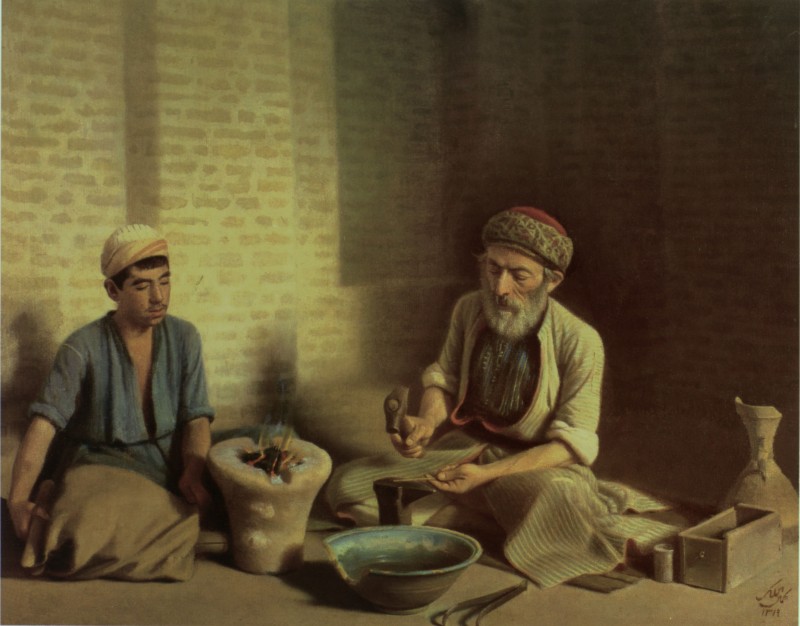
The Baqdadi goldsmith by Kamal-ol-molk

A goldsmith is a metalworker who specializes in working with gold and other precious metals. Modern goldsmiths mainly specialize in jewelry-making but historically, they have also made silverware, platters, goblets, decorative and serviceable utensils, and ceremonial or religious items.

Goldsmiths must be skilled in forming metal through filing, soldering, sawing, forging, casting, and polishing. The trade has very often included jewelry-making skills, as well as the very similar skills of the silversmith. Traditionally, these skills had been passed along through apprenticeships; more recently jewelry arts schools, specializing in teaching goldsmithing and a multitude of skills falling under the jewelry arts umbrella, are available. Many universities and junior colleges also offer goldsmithing, silversmithing, and metal arts fabrication as a part of their fine arts curriculum.

Gold

[edit]

Compared to other metals, gold is malleable, ductile, rare, and it is the only solid metallic element with a yellow color. It may easily be melted, fused, and cast without the problems of oxides and gas that are problematic with other metals such as bronzes, for example. It is fairly easy to "pressure weld", wherein, similarly to clay, two small pieces may be pounded together to make one larger piece. Gold is classified as a noble metal—because it does not react with most elements. It usually is found in its native form, lasting indefinitely without oxidization and tarnishing.

History

[edit]
A goldsmith workshop during the mid-seventeenth century

Gold has been worked by humans in all cultures where the metal is available, either indigenously or imported, and the history of these activities is extensive. Superbly made objects from the ancient cultures of Africa, Asia, Europe, India, North America, Mesoamerica, and South America grace museums and collections throughout the world. The Copper Age Varna culture (Bulgaria) from the 5th millennium BC is credited with the earliest found instances of gold metallurgy.[1][2] The associated Varna Necropolis treasure contains the oldest golden jewellery in the world with an approximate age of over 6,000 years.[3][4]

Aztec father teaches his son to cast gold

Some pieces date back thousands of years and were made using many techniques that still are used by modern goldsmiths. Techniques developed by some of those goldsmiths achieved a skill level that was lost and remained beyond the skills of those who followed, even to modern times.[5] Researchers attempting to uncover the chemical techniques used by ancient artisans have remarked that their findings confirm that "the high level of competence reached by the artists and craftsmen of these ancient periods who produced objects of an artistic quality that could not be bettered in ancient times and has not yet been reached in modern ones."[6][dubiousdiscuss]

In medieval Europe goldsmiths were organized into guilds and usually were one of the most important and wealthiest of the guilds in a city. The guild kept records of members and the marks they used on their products. These records, when they survive, are very useful to historians. Goldsmiths often acted as bankers, since they dealt in gold and had sufficient security for the safe storage of valuable items, though they were usually restrained from lending at interest, which was regarded as usury. In the Middle Ages, goldsmithing normally included silversmithing as well, but the brass workers and workers in other base metals normally were members of a separate guild, since the trades were not allowed to overlap. Many jewelers also were goldsmiths.

A Brahmin goldsmith from Goa, 16th century India

The Sunar caste is one of the oldest communities in goldsmithing in India, whose superb gold artworks were displayed at The Great Exhibition of 1851 in London. In India, 'Daivadnya Brahmins', Vishwakarma (Viswabrahmins, Acharis) 'Sunar' are the goldsmith castes.

The printmaking technique of engraving developed among goldsmiths in Germany around 1430, who had long used the technique on their metal pieces. The notable engravers of the fifteenth century were either goldsmiths, such as Master E. S., or the sons of goldsmiths, such as Martin Schongauer and Albrecht Dürer.

Contemporary goldsmithing

[edit]
Modern goldsmith at work

A goldsmith might have a wide array of skills and knowledge at their disposal. Gold, being the most malleable metal of all, offers unique opportunities for the worker. In today's world a wide variety of other metals, especially platinum alloys, also may be used frequently. 24 karat is pure gold and historically, was known as fine gold.[7]

Because it is so soft, however, 24 karat gold is rarely used. It is usually alloyed to make it stronger and to create different colors. Depending on the metals used to create the alloy, the color can change.

The goldsmith will use a variety of tools and machinery, including the rolling mill, the drawplate, and perhaps, swage blocks and other forming tools to make the metal into shapes needed to build the intended piece. Then parts are fabricated through a wide variety of processes and assembled by soldering. It is a testament to the history and evolution of the trade that those skills have reached an extremely high level of attainment and skill over time. A fine goldsmith can and will work to a tolerance approaching that of precision machinery, but largely using only his eyes and hand tools. Quite often the goldsmith's job involves the making of mountings for gemstones, in which case they often are referred to as jewelers.

'Jeweller', however, is a term mostly reserved for a person who deals in jewellery (buys and sells) and not to be confused with a goldsmith, silversmith, gemologist, diamond cutter, and diamond setters. A 'jobbing jeweller' is the term for a jeweller who undertakes a small basic amount of jewellery repair and alteration.

Notable goldsmiths

[edit]
[edit]

See also

[edit]

References

[edit]
[edit]
Revisions and contributorsEdit on WikipediaRead on Wikipedia
from Grokipedia
A goldsmith is a skilled who specializes in the design, fabrication, repair, and sale of jewelry, ornamental objects, and functional items crafted from and other precious metals such as silver, , and . These professionals employ traditional and modern techniques to shape, engrave, cast, and set gemstones into their creations, often producing items of both aesthetic and cultural significance. Historically, goldsmiths also functioned as early bankers and moneylenders, leveraging their expertise in handling precious metals to store wealth and issue notes of , a practice that contributed to the origins of modern banking in medieval . The profession traces its roots to ancient civilizations, with evidence of goldworking appearing as early as 4000 BCE in and other Near Eastern regions, and later in and the Indus Valley around the 3rd millennium BCE, where artisans used native to fashion beads, ornaments, and ceremonial artifacts. In medieval , goldsmiths formed influential guilds, such as London's Goldsmiths' Company, chartered in 1327, which regulated quality through hallmarking and assaying to ensure the purity of and silver wares. These guilds not only standardized craftsmanship but also wielded economic power, overseeing trade and protecting members' interests. Today, goldsmithing blends artisanal heritage with contemporary innovation, incorporating tools like laser welding and while preserving techniques such as and work that have endured for millennia. Goldsmiths continue to play a vital role in cultural preservation, with their output ranging from jewelry to historical replicas, often certified by organizations like the to maintain ethical sourcing and sustainability standards.

Definition and Role

Overview of the Profession

A goldsmith is a specializing in the manipulation of and other precious metals to craft jewelry, ornaments, vessels, and other decorative objects, employing techniques such as , , and to shape the metal into functional and aesthetic forms. These professionals undertake core responsibilities that encompass the full lifecycle of gold items, including initial conceptualization, fabrication through and molding, meticulous repair of damaged pieces, and appraisal to assess value and authenticity. Additionally, goldsmiths source raw materials, collaborate closely with clients to meet requirements, and ensure the integrity of the final product through measures. Historically, goldsmiths played a pivotal economic role beyond craftsmanship, later evolving into proto-bankers by safeguarding deposits of gold and issuing receipts that facilitated lending and trade. This dual function positioned them as key intermediaries in medieval and early modern financial systems, where their secure vaults and reputation for handling precious metals underpinned emerging banking practices in urban centers like . In various societies, goldsmiths have symbolized luxury and elevated social status, as their creations—adorned with intricate details—served as markers of wealth and prestige among elites. Their contributions extended to profound cultural and spiritual domains, producing religious artifacts such as chalices and reliquaries that embodied divine reverence and were central to liturgical practices in churches and temples. Royal commissions further highlighted their prestige, with monarchs and nobility commissioning elaborate pieces like crowns and scepters to assert authority and legacy, thereby embedding goldsmithing within the fabric of power and piety. The profession originated with solitary craftsmen honing their skills in independent workshops but transitioned in medieval to a structured, guild-based that fostered collaboration, standardized training through apprenticeships, and protected members' interests against . These guilds, emerging as early as the fourteenth century, ranked among the wealthiest and most influential associations in European cities, regulating practices to maintain high standards and . This evolution not only professionalized goldsmithing but also amplified its societal impact by integrating it into broader artisanal networks. Goldsmithing differs from silversmithing primarily in the materials and the resulting emphasis on value and scale of production. While both crafts involve working with precious metals, goldsmiths specialize in , which commands a significantly higher than silver, leading to a focus on smaller, highly intricate pieces such as jewelry rather than larger hollowware like trays or typically produced by silversmiths. This intrinsic worth of gold also necessitates stricter purity standards, with hallmarks indicating karat levels such as 24-karat for pure gold, compared to sterling silver's 92.5% purity mark, ensuring authenticity and minimizing in high-value items. In contrast to general jewelry making, goldsmithing emphasizes specialized handcrafting, repair, and deep knowledge of gold metallurgy to create and maintain fine, custom pieces often without extensive gem integration. Goldsmiths are trained artisans who forge and shape gold directly, prioritizing the metal's properties for durable, wearable art, whereas jewelers may handle a broader range of materials, including base metals or mass-produced components, and focus more on assembly, sales, or gem setting rather than metallurgical expertise. Goldsmithing shares historical roots with watchmaking and gunsmithing but differs in its focus on ornamental, wearable objects rather than functional mechanisms like timepieces or firearms. While goldsmiths may apply decorative elements to watch cases or firearm components, their work remains aesthetic and adornment-oriented, unlike the in watchmaking for movement calibration or the structural reinforcements in gunsmithing for safety and performance. Overlaps occur in shared techniques, where goldsmiths' skills in intricate surface decoration can inform similar ornamental detailing on watches or gun stocks. Historically, legal and guild distinctions reinforced goldsmithing's unique status through regulations enforcing gold-specific assays and trademarks. The , chartered in 1327 by King Edward III, was granted authority to oversee trade standards, including mandatory assays for purity and the application of hallmarks at Goldsmiths' Hall starting in 1478. A 1363 required goldsmiths to strike unique maker's marks on their wares alongside the company's leopard's head crown for , distinguishing authentic pieces and preventing substandard imitations, a more rigorously applied to due to its elevated economic stakes compared to other metals. These guild-enforced practices, evolving from a 1300 statute under Edward I, established goldsmithing as a regulated focused on verifiable quality and .

Materials

Properties of Gold

Gold exhibits exceptional physical properties that render it particularly suitable for goldsmithing, where precise shaping and durability are essential. It is the most malleable and ductile metal, allowing it to be hammered into extremely thin sheets known as , typically around 0.1 micrometers in thickness, without fracturing. Pure has a high of 19.3 grams per cubic centimeter, contributing to its substantial weight in crafted pieces, and it demonstrates remarkable resistance to and , preserving its appearance over centuries. Chemically, gold is classified as a due to its inertness, resisting reactions with oxygen, most acids, and other common environmental agents, which ensures the enduring luster of gold artifacts in jewelry and decorative work. This nobility stems from gold's stable , but it can be dissolved by , a mixture of nitric and hydrochloric acids, highlighting a rare vulnerability exploited in refining processes. Optically, pure displays a distinctive yellow hue resulting from its selective absorption of blue light in the , while reflecting red and wavelengths effectively. Its high reflectivity, especially in the range, enhances its aesthetic appeal and functional use in reflective surfaces, though trace impurities can alter the tone—for instance, introduces a reddish cast, as seen in rose gold variants. Economically, gold's value is underpinned by its , with an average concentration of only about 0.004 parts per million in the , making extraction challenging and supplies limited. Historically, this rarity positioned as a standard for and a in monetary systems, from ancient coins to modern central bank reserves. Current spot prices, which fluctuate around thousands of dollars per , are influenced by factors such as global output, jewelry and industrial demand, investment flows during economic uncertainty, and central bank policies.

Alloys and Alternative Materials

In goldsmithing, alloys are essential for enhancing the workability and longevity of in jewelry and decorative objects. The karat system measures purity, where 24 karats represents pure , and lower karats indicate alloys with other metals; for instance, 18-karat consists of 75% alloyed with metals like or silver to increase hardness. These alloys address 's inherent softness, which, while enabling detailed craftsmanship, renders pure unsuitable for everyday wear by making it prone to scratches and deformation. Alloying serves multiple purposes beyond durability, including achieving varied colors and reducing material costs without compromising aesthetic appeal. Copper imparts a reddish hue to rose gold, while higher silver content creates green gold, a pale greenish alloy prized for its unique tone in certain cultural traditions. White gold, a popular variant, typically comprises 75% gold alloyed with , , or to produce a silvery finish; nickel-based versions enhance whiteness but may cause skin reactions, prompting the use of hypoallergenic , which constitutes 12-15% in some 18-karat formulations. Overall, these combinations allow goldsmiths to balance purity, strength, and visual diversity while keeping production economical through lower gold content in alloys. To ensure authenticity and , international hallmarking standards employ marks denoting content in parts per thousand. The 750 mark signifies 18-karat (750 parts per 1,000), a common standard under conventions like the Vienna Convention on the Control of Goods Bearing the Hallmark, adopted by multiple countries for cross-border . Similarly, 585 indicates 14-karat , with offices verifying compliance through standardized testing to prevent misrepresentation. These systems, enforced globally, include sponsor's marks, date letters, and symbols alongside indicators. For high-end pieces, alternatives like and offer substitutes with comparable luster, density, and resistance to tarnish, often used in settings requiring superior durability. , alloyed with or , provides exceptional strength for intricate designs, while —lighter and more affordable—mirrors platinum's resistance without needing plating, as seen in white gold alternatives. In the post-2020 era, ethical sourcing has driven adoption of recycled , which reuses post-consumer scrap to minimize environmental impact from , and lab-grown alternatives for associated gems, addressing concerns over and labor practices in traditional extraction. Organizations like the promote responsible sourcing certifications to verify these sustainable options.

Techniques and Tools

Traditional Methods

Traditional goldsmithing relies on manual processes to shape and join , leveraging its exceptional malleability to form wire and sheet from . Wire drawing involves heating a and pulling it through a series of holes in a drawplate, gradually reducing its diameter to create uniform wires used in or structural elements. Sheet rolling, typically done by repeatedly passing or hammering the gold between flat surfaces, produces thin, even sheets for further fabrication. secures components using alloys with lower melting points than gold; hard solders, containing more silver or , are used for strong structural joints, while easy solders with higher gold content allow for delicate work, both applied with fluxes to prevent oxidation during torch heating. achieves a lustrous finish through progressive abrasion, starting with coarse files or and finishing with soft cloths and Tripoli or rouge compounds to highlight the metal's natural sheen. Forming techniques transform flat into three-dimensional objects using . Raising begins with a flat sheet secured over a stake or , then hammered incrementally from the center outward to stretch and curve it into hollow forms like bowls or boxes, relying on controlled strikes to avoid cracking. Chasing and repoussé create decorative ; repoussé pushes designs from the reverse side using punches and a soft pitch bed to support the metal, raising motifs like figures or patterns, while chasing refines or incises details from the front with specialized tools for crisp lines and textures. Casting methods enable complex shapes beyond hammering. The lost-wax process starts with a detailed model from , encasing it in to form a mold, then heating to melt out the wax, creating a cavity; molten is poured into this void, and after cooling, the mold is broken to reveal the casting, which is then cleaned and finished. adds intricate surface detail using burins—sharp, hand-held steel tools—held at an angle to incise lines, patterns, or lettering directly into the gold, often for or ornamental enhancement. Assembly and finishing integrate elements securely. Riveting joins pieces by hammering thin gold wire or tabs through aligned holes, then flattening the ends to form cold mechanical bonds without heat. Cloisonné enameling involves soldering fine gold wires onto a base to form cells or compartments, filling them with colored enamel paste, firing to fuse the vitreous material, and grinding smooth for a vibrant, durable inlay. Stone setting secures gems using prong or bezel methods; prongs are tapered gold wires bent over the stone's girdle and crimped to hold it exposed, while bezels encircle the stone with a continuous gold rim folded inward to protect and mount it firmly.

Modern Tools and Innovations

In contemporary goldsmithing, powered tools have significantly enhanced efficiency and precision by automating labor-intensive processes traditionally performed manually. Rolling mills, often equipped with electric motors, allow goldsmiths to uniformly reduce the thickness of metal sheets and wires with consistent pressure, minimizing physical effort and enabling the production of thinner, more intricate components for jewelry designs. Motorized drawplates, integrated into benchtop drawing machines, facilitate the pulling of gold wire through progressively smaller dies, achieving finer gauges essential for filigree and chain work while reducing operator fatigue. Ultrasonic cleaners utilize high-frequency sound waves in a liquid medium to remove contaminants, polishing residues, and oxidation from intricate gold pieces without mechanical abrasion, preserving surface details on settings and engravings. Laser welders, such as compact benchtop models operating at peak powers up to 60W, enable seamless joins on gold components by focusing a concentrated beam to fuse metals at the molecular level, eliminating the need for filler materials and allowing repairs on delicate structures like earring posts or ring shanks. Digital innovations have revolutionized the design and prototyping phases of goldsmithing, integrating computational modeling to streamline workflows and reduce material waste. (CAD) software like Rhino, with its NURBS-based modeling capabilities, and specialized plugins such as MatrixGold, provide goldsmiths with parametric tools to create precise 3D models of rings, pendants, and settings, incorporating proportions and prong placements directly in the digital environment. These tools support iterative modifications, enabling rapid visualization of custom designs before physical production. Emerging AI tools, as of 2025, further assist in generating personalized designs through algorithms. Complementary technologies, using resins or waxes, produce accurate prototypes and investment molds from these CAD files, allowing for with reduced gold loss compared to traditional carving methods and facilitating on-demand adjustments to fit client specifications. Advanced materials processing techniques have expanded the aesthetic and functional possibilities for goldsmiths through controlled deposition and machining. Electroplating applies thin layers of gold (typically 0.5–2 microns) onto base metals or alloys via an electrolytic bath, enhancing corrosion resistance and achieving a uniform luster on complex geometries like filigree or textured surfaces without the expense of solid gold construction. CNC (computer numerical control) engraving machines, guided by CAD data, execute intricate patterns such as personalized motifs or hallmarks on gold surfaces with micron-level accuracy, using rotating tools or lasers to etch depths as fine as 0.1 mm, which would be time-prohibitive by hand. Sustainability technologies address environmental concerns in goldsmithing by optimizing resource use and complying with post-2010 regulations on and emissions. casting systems create a low-pressure environment during the pouring of molten into molds, minimizing and metal loss while enabling high material recovery, and inert gases like prevent oxidation, reducing the need for post-casting refinishing. Integrated systems, mandated by frameworks such as the Responsible Council's Code of Practices (2024/2025), incorporate on-site and chemical recovery units in workshops to reclaim scraps and plating solutions, cutting and aligning with EU directives on recovery that took effect in the early 2010s.

Historical Development

Ancient and Medieval Periods

The origins of goldsmithing trace back to the era in southeastern Europe, with the in yielding the world's oldest processed artifacts, dated to approximately 4600–4200 BCE. These over 3,000 items, including hammered beads, rings, and scepter-like appliqués, represent early cold-working techniques such as flattening and perforating native , often buried with high-status individuals to signify social hierarchy. By the third millennium BCE, ancient Egyptian goldsmiths had mastered , a technique involving the fusion of minute spheres—typically 0.1 to 1 mm in —to a surface without visible joints, creating textured motifs on pectorals, diadems, and amulets. This method, adapted from Mesopotamian innovations around 2500 BCE, relied on high-temperature and was extensively used in royal tombs like those at , where 's symbolic association with eternity and the divine elevated its craftsmanship. In , particularly from the 6th century BCE onward, emerged as a hallmark technique, where fine wires (0.2–0.5 mm thick) were twisted, looped, and soldered into openwork patterns resembling lace, adorning earrings, necklaces, and hair ornaments. Hellenistic examples, such as those from , combined with for dynamic, floral designs that emphasized lightness and intricacy. Roman goldsmiths, building on these foundations, perfected repoussé by the 1st century BCE, hammering thin sheets (often 0.1–0.3 mm) from the reverse over pitch-coated molds to raise relief scenes on masks, phalerae, and tableware, then refining the front with chasing tools for sharp details. The (4th–15th centuries CE) advanced goldsmithing for ecclesiastical purposes, producing reliquaries like enameled gold crosses and caskets that housed saintly remains, using techniques such as —where gold cells (cloisons) contained vitreous enamels fired at 700–800°C—and borders to evoke heavenly radiance. These objects, exemplified by 9th-century pectoral crosses, integrated Christian with imperial patronage, influencing Western . In 12th-century , the formation of goldsmith guilds formalized the profession amid growing urban trade, with London's Goldsmiths' Company emerging after a 1180 royal fine for unlicensed activity under Henry II, establishing assay offices to test purity via touchstones and acid. Paris saw similar organization by the mid-12th century, where guilds enforced standards through wardens who marked pieces with leopard-head stamps, preventing in a market flooded by church commissions. Medieval Gothic goldwork, from the 13th century, featured in cathedral adornments like the intricate wire frames on reliquaries and monstrances at and , mimicking architectural with soldered gold scrolls and bosses to frame gems and enamels, symbolizing spiritual elevation. During the (8th–13th centuries), ( or gold inlay) flourished in centers like and Cordoba, where artisans etched patterns into iron or bronze bases and hammered gold foil into grooves, creating arabesque-decorated sword hilts and astrolabes that blended functionality with . Asian parallels include early Chinese cloisonné on from the (late 13th–14th centuries), where thin gold wires formed cells filled with translucent enamels and fired, as seen in imperial censers, though precursors in Tang-era (7th–9th centuries) gilding suggest gradual adoption for ritual vessels.

Renaissance to Industrial Era

The marked a pivotal era for goldsmithing, with Italian masters pioneering advancements in that incorporated linear perspective to achieve greater depth and realism in decorative motifs. Florentine goldsmiths, building on techniques—where incised designs were filled with a black sulfur alloy—began producing intaglio prints that served as models for jewelry and metalwork, influencing the dissemination of artistic ideas across . Goldsmiths like Baccio Baldini exemplified this fusion of craft and , creating engraved plates that enhanced the precision and narrative complexity of gold objects. In , under , court goldsmiths elevated jewelry to symbols of royal opulence, with jewelers such as Jean Pitau recutting large gems like the into more brilliant forms for the crown jewels, integrating advanced with ornate gold settings to reflect the grandeur of Versailles. The king's patronage extended to silver furnishings and enameled pieces, commissioning works that blended goldsmithing with to embody absolutist splendor. The Baroque period saw goldsmithing flourish in European courts through elaborate chasing techniques, where hammered textures created dynamic surfaces on gold and silver objects, evoking movement and drama in line with the era's theatrical aesthetic. Artisans in and produced chased reliquaries and adorned with scrolling motifs, often commissioned for and aristocratic patrons to convey power and . Transitioning into the style of the early , goldsmiths refined these methods to incorporate intricate gem settings, paving the way for precursors to later opulent designs like those of Fabergé by emphasizing playful and colorful stone inlays in brooches and snuffboxes favored by courts in and . This integration of gems with delicately chased goldwork highlighted a shift toward lighter, more intimate luxury items, reflecting the refined tastes of the Enlightenment aristocracy. By the late , neoclassical influences brought a return to and in goldsmithing, inspired by archaeological discoveries of and Roman artifacts, resulting in clean-lined pieces that prioritized form over ornamentation. Goldsmiths such as Luigi Valadier in crafted cameos and mounts using gold with minimal chasing, often setting classical motifs in gold frames for elite collectors, while English artisans like Paul Storr produced restrained silver and gold services echoing Pompeian elegance. This aesthetic persisted into the early before yielding to Victorian exuberance, where transformed the craft through steam-powered rolling mills and stamping machines, enabling the replication of intricate designs like and on a larger scale for a burgeoning . Colonial expansions and gold rushes profoundly shaped goldsmithing's material and technical landscape during this period. The 1849 California dramatically increased global supply, with production surging from negligible amounts to over 2 million ounces annually by , lowering prices and making raw more accessible for jewelers while spurring innovations in refining for alloying. Concurrently, European colonial trade disseminated goldsmithing techniques to the and ; in , Spanish artisans introduced chasing and enameling to indigenous workshops, blending them with local motifs in religious objects, while in , transpacific exchanges via ports like integrated European filigree methods into Chinese and Indian goldwork, as seen in silver chocolatières adapted for exotic markets. These exchanges not only expanded supply chains but also hybridized styles, influencing global goldsmithing until the onset of full industrialization.

Contemporary Goldsmithing

Current Practices and Markets

Modern goldsmithing workshops vary widely in scale and focus, ranging from intimate studios to integrated factory operations. Bespoke studios, often operated by individual artisans or small teams, emphasize handcrafted custom pieces using a blend of traditional techniques and digital tools like (CAD) software for prototyping. These setups prioritize personalization, with lead times of 1–2 weeks for prototypes and 2–6 weeks for final production, catering to clients seeking unique jewelry. In contrast, factory integrations employ automated systems such as CNC machining, , and protocols to facilitate high-volume , enabling efficient scaling for broader distribution. The divide between custom and ready-to-wear jewelry shapes these workflows: custom production involves small-batch or one-off creations with intricate details like complex stone settings, allowing for client-specific modifications but demanding higher skill and time investment. lines, produced in factories, focus on standardized designs for retail consistency, incorporating sustainable materials like recycled to meet market demands. This dichotomy supports both artisanal expression and commercial viability in the 2020s. Market dynamics in the 2020s underscore luxury branding, ethical certifications, and digital expansion. Iconic brands like integrate ethical sourcing into their luxury portfolios, ensuring gold and diamonds are conflict-free and community-supportive through rigorous audits. The Responsible Jewellery Council (RJC), with over 2,000 members since its 2005 founding, enforces standards for traceable and responsible handling via its Chain-of-Custody protocol, promoting and across the industry. has accelerated post-2010, with online sales comprising 32.7% of global jewelry revenue by 2025, fueled by platforms enabling virtual try-ons and models; the sector is projected to expand from $46.1 billion in 2024 to $129 billion by 2032. Global practices reflect regional strengths and adaptations. In and , artisanal traditions dominate, with Thailand leveraging post-pandemic ingenuity in design and to sustain its position as a key exporter, producing intricate pieces through skilled labor-intensive methods. , a leading global jewelry hub with its gems and jewelry sector contributing approximately 7% to GDP and around 10% of merchandise exports as of 2025, emphasizes handcrafted work blending cultural motifs with modern output. , conversely, advances high-tech goldsmithing via CAD, , and precision automation, evolving traditional craftsmanship into efficient, innovative production for luxury markets. in the has propelled prices upward by over 50% year-over-year, reaching $4,000 per ounce in October 2025 amid economic uncertainty, prompting jewelers to raise retail prices, optimize supply chains, and explore alternatives like 10k or to maintain . Key challenges include counterfeiting and pressures. (XRF) analysis serves as a primary detection tool, non-destructively measuring elemental composition to verify purity, identify contaminants, and expose plating on fakes, enabling rapid authentication in trade and retail. initiatives, such as Fairtrade , address by ensuring fair wages, health protections, and environmental safeguards for small-scale producers, with traceable sourcing options like the Goldsmith Registration Scheme allowing jewelers to use under 500g annually while upholding standards audited by FLOCERT. These practices, adopted by 78% of U.S. consumers prioritizing in 2025, enhance industry trust and loyalty.

Education and Training

Aspiring goldsmiths often begin their careers through models, which emphasize hands-on under experienced practitioners. In , particularly , the traditional lasts approximately 3.5 years and combines practical training in a with theoretical instruction at vocational schools, covering skills such as sawing, filing, , and . This is part of the broader German framework, where apprentices receive a modest salary while learning , , and drafting. To advance to , known as the qualification, candidates must complete additional 1-2 years of specialized training and pass a rigorous examination assessing practical craftsmanship, , , and abilities, a process rooted in the Skilled Crafts Sector Act. Historically, such apprenticeships in extended 5-7 years, focusing on progressive skill-building from basic support tasks to creating a masterwork piece. Formal education programs provide structured alternatives or complements to apprenticeships, offering degrees in jewelry design that integrate artistic, technical, and scientific principles. The () offers a Jewelry Design & Technology diploma program, which teaches fundamental concepts, digital rendering with software like , CAD/CAM skills using and , jewelry engineering for durability, and manufacturing processes such as and . Similarly, the Royal College of Art's MA in Jewellery & Metal is a one-year full-time program that explores metallurgy's innovative potential across the periodic table and incorporates CAD alongside traditional methods to develop interdisciplinary practices in art, , and science. These programs equip students with knowledge of metal properties and , essential for modern goldsmithing. Certification through professional bodies validates expertise and ensures adherence to industry standards, including hallmarks for metal purity. Jewelers of America administers the Bench Professional Certification Program, established in 1997, with levels ranging from (requiring about one year of experience) to , involving written exams on repair techniques and practical tests on tasks like and stone setting. Hallmarks, mandatory in many regions for verifying content, are overseen by offices and professional guilds, while certifications like those from Jewelers of America enhance credibility in repair and fabrication. Since 2020, online courses have proliferated to supplement training, with platforms like At The Bench providing over 1,700 video tutorials and live workshops on techniques such as stone setting, , and repairs, accessible via annual subscriptions for flexible learning. Skill progression in goldsmithing typically advances from foundational bench work to specialized applications, with integrated protocols addressing occupational hazards. Beginners master basics like measuring and marking metal, using jeweler's saws for shaping, basic filing, torch , , and introductory stone setting, emphasizing precise tool handling. Intermediate and advanced stages build toward complex techniques, including and prong stone setting, texturing with hammers, , wax sculpting for , and multi-metal fabrication, fostering problem-solving and creative . Throughout, covers risks from chemical fluxes used in , which can release harmful fumes like that irritate lungs, as well as acids, solvents, and acids causing irritation; proper ventilation, protective equipment, and material substitution are standard to mitigate burns, , and long-term exposure.

Notable Goldsmiths

Historical Figures

One of the earliest known named goldsmiths from was Amenemhat, a royal artisan dedicated to the god during the 18th Dynasty around 1400 BCE. His tomb, discovered in 2017 near , contained mummies of himself and his wife Amenhotep, along with artifacts reflecting his role in crafting precious items for divine and royal patronage, highlighting the specialized status of goldsmiths in Egyptian society where they transformed gold into symbols of immortality and power. In the medieval period, Nicholas of Verdun (c. 1130–1205) emerged as a preeminent goldsmith and enamellist in the Mosan region, renowned for his intricate metalwork that bridged Romanesque and Gothic styles. His masterpiece, the (c. 1181–1220) in , features gilded copper panels with champlevé enamel depicting biblical scenes, demonstrating advanced techniques in repoussé and that influenced ecclesiastical patronage across . During the , (1500–1571), a Florentine goldsmith, sculptor, and author, revolutionized casting methods through his innovative use of lost-wax techniques, as detailed in his Vita (1558–1566), which provides rare insights into the craft's processes. Cellini's gold masterpieces, such as the golden salt cellar (Saliera, 1540–1543) commissioned by , incorporated intricate enameling and figural motifs, setting standards for Mannerist jewelry that emphasized artistic individualism and royal commissions. His writings and works promoted hallmarks as guarantees of quality, shaping regulations in and beyond. His contemporary, (1497/8–1543), though primarily a painter, contributed significantly as a designer for goldsmiths at the Tudor court, creating patterns for jewelry, badges, and tableware seen in portraits like those of (1537). These designs, often featuring symbolic motifs in gold and enamel, elevated the role of illustrative patronage in English goldsmithing, influencing the integration of portraiture with . In the , (1846–1920), head of the in St. Petersburg, transformed goldsmithing through his workshop's mastery of enameling and micro-mosaics, producing over 50 Imperial Easter eggs for the Russian tsars starting in 1885. These jeweled objets d'art, such as the Hen Egg (1885) with its gold and enamel shell revealing hidden surprises, exemplified Fabergé's fusion of historical revivalism and technical innovation, which bolstered the prestige of court goldsmiths and inspired international luxury markets. René Lalique (1860–1945), a French goldsmith pivotal in the movement, shifted the craft toward organic forms by incorporating unconventional materials like horn and alongside gold, as seen in his nature-inspired pendants and tiaras exhibited at the 1900 Paris Exposition. His designs, such as the "" corsage ornament (c. 1897–1898) in gold, enamel, and , challenged traditional by appealing to a broader artistic elite, influencing hallmarks that denoted innovative alloys and forward-thinking aesthetics in early 20th-century jewelry.

Contemporary Practitioners

Shaun Leane, born in 1969 in , is a British goldsmith renowned for his structural jewelry designs that incorporate (CAD) to create innovative, sculptural forms blending and . His collaboration with in the 1990s introduced bold, architectural pieces to runway jewelry, pushing boundaries with materials like silver and to evoke emotion and movement. Leane's work, including the 2021 Visionary Collection, continues to explore perforative and iconic motifs, earning him the Outstanding Contribution to the Industry award at the Jewellery Awards. Wallace Chan, born in 1956 in , , and based in , fuses Eastern and Western goldsmithing techniques through his pioneering innovations in gem carving and light manipulation. Starting as a sculptor at age 16, Chan developed the Wallace Cut in 1987—a multi-angle intaglio method using modified dental drills—to achieve three-dimensional depth in gemstones, integrating traditional Chinese motifs with modern . His pieces, such as the 2024 "Half a Century" acquired by the , exemplify this East-West synthesis, treating jewelry as wearable sculpture that captures and refracts light dynamically. Elsa Peretti (1940–2021), an Italian designer who joined in 1974, revolutionized industry standards with her organic, body-conforming gold designs like the cuff and Open Heart pendant, which emphasized simplicity and wearability. Her biomorphic forms drew from nature and personal experience, influencing modern luxury jewelry by prioritizing comfort and timeless appeal over ornate tradition. Post-2010, sustainable innovators like Lionel T. Dean have advanced goldsmithing through ; his 2015 Precious collection used direct metal in 18-carat gold to produce intricate, lightweight pieces, reducing material waste and enabling complex geometries unattainable by traditional casting. Contemporary goldsmiths push boundaries in wearable art by creating pieces that function as both adornment and sculpture, often commissioned for celebrities—such as Leane's 2019 engagement ring for Princess Beatrice—and featured in museum collections like the Brooklyn Museum's 2024 Solid Gold exhibition, which showcases over 500 gold works including modern jewelry by international designers. Chan's international exhibitions and Peretti's archival pieces at institutions highlight this shift toward art-world integration, where gold serves as a medium for cultural commentary and innovation. A notable trend in contemporary goldsmithing is the increasing gender diversity, with women comprising a growing share of practitioners and leaders amid industry efforts toward equality. Designers like Bibi van der Velden, born in New York and trained in fine arts in , lead this movement through ethical lines using recycled 18-karat fairtrade gold, sustainably sourced diamonds from , and unconventional materials like scarab beetle wings to create narrative, eco-conscious pieces. Her Amsterdam-based brand, founded in 2005, exemplifies how female-led innovation addresses environmental concerns while expanding creative expression in the field.

References

Add your contribution
Related Hubs
User Avatar
No comments yet.