


Community hub
Recent from talks
Contribute something
Nothing was collected or created yet.
List of comics creators
View on Wikipedia

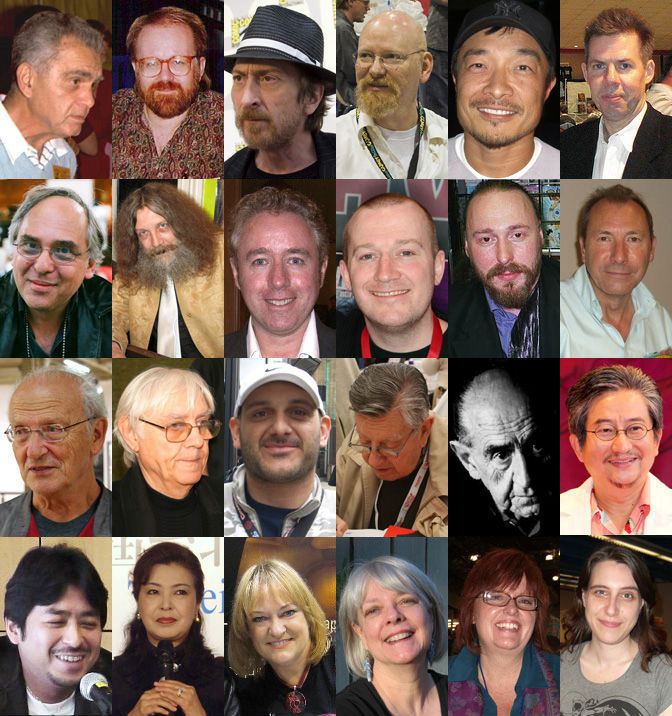
2. Art Spiegelman, Alan Moore, Mark Millar, Garth Ennis, Warren Ellis, David Lloyd.
3. Jean "Moebius" Giraud, Milo Manara, Simone Bianchi, Francisco Solano López, Alberto Breccia, Go Nagai.
4. Kazuki Takahashi, Riyoko Ikeda, Wendy Pini, Louise Simonson, Gail Simone, Valerie D'Orazio.
This is a list of comics creators. Although comics have different formats, this list mainly focuses on comic book and graphic novel creators. However, some creators of comic strips are also found here, as are some of the early innovators of the art form.
The list is sorted by the country of origin of the authors, although they may have published, or now be resident in other countries.
Argentina
[edit]- Horacio Altuna - (El Loco Chavez)
- Ricardo Barreiro - (As de Pique, El Eternauta, Bárbara)
- Roberto Battaglia - (Don Pascual)[1]
- Oscar Blotta - (Ventajita)[2]
- Alberto Breccia (born in Uruguay) - (Mort Cinder, El Eternauta)
- Enrique Breccia - (La Vida del Che, Swamp Thing)
- Maitena Burundarena - (Flo, Mujeres Alteradas, Superadas)
- Alberto Cognigni - (Negrazón and Chaveta)[3]
- Copi - (La Femme Assise, Les Poulets N'ont Pas de Chaise)
- Guillermo Divito - (Bombolo, Pochita Morfoni, El Doctor Merengue, Fulmine, Fallutelli, Divito Girls)[4]
- Cristian Dzwonik - (Gaturro)
- Eduardo Ferro - (Don Pitazo, Asserín y Pan Rallado, Langostino, Bólido, Tara Service, Pandora, Pampa Barbara, Chapaleo, continued El Fantasma Benito), dies at age 93.[5]
- Roberto Fontanarrosa
- Nestor Gonzalez Fossat - (Jimmy y su Pupilo, Aventuras de Menucho, Firulete y Retacón, Goyito y Goyita)[6]
- Arnoldo Franchoni, aka Francho - (Cándido, Album De Familia, Camotito, Historias De Cinco Guitas, Los Tres Malditos, made comics for Cracked and Mad)[7]
- Marcelo Frusin - (Hellblazer, Loveless)
- Juan Gimenez
- Arturo Lanteri - (Les Aventuras de Negro Raúl, Don Pancho Talero and Anacleto).[8]
- Liniers - (Macanudo)
- Carlos Loiseau, aka Caloi - (Clemente)[9]
- Francisco Solano López - (El Eternauta, Janus Stark)
- Jorge Lucas
- Domingo Roberto Mandrafina - (Spaghetti Brothers)
- Adolfo Mazzone - (Piantadino)
- Guillermo Mordillo
- José Antonio Muñoz - (Alack Sinner)
- Fabian Nicieza - (Deadpool)
- Héctor Germán Oesterheld - (El Sargento Kirk, El Eternauta, Mort Cinder)
- Ariel Olivetti - (Daredevil, X-Man)
- Lino Palacio - (Ramona, Don Fulgencio)[10]
- Quino - (Mafalda)
- Dante Quinterno - (Patoruzú)
- Eduardo Risso - (100 Bullets)
- Carlos Sampayo - (Alack Sinner)
- Juan Sasturain
- Ernesto García Seijas - (El Negro Blanco)
- Fernando Sendra - (Yo, Matías)
- Hector Torino - (Don Nicola, Pascualín, Barrabás, Pepinucho, Coliflor, Mudini), died at age 78.[11]
- Carlos Trillo - (El Loco Chavez, El Negro Blanco, Cybersix, Spaghetti Brothers)
- Juan Zanotto - (Yor, Bárbara)
Australia
[edit]Belgium
[edit](bande dessinée, BD, strip (verhaal))
A–M
[edit]- Edouard Aidans - (Bob Binn, Tounga, Marc Franval)
- Frans Antonis - (assisted on Bessy) [12]
- Dino Attanasio, Belgian of Italian descent - (Signor Spaghetti, Bob Morane, continued Modeste et Pompon)
- Jo-El Azara - (Taka Takata)
- Serge Baeken [13]
- Guy Bara - (Max l'Explorateur)
- Batem - (continued Marsupilami)
- Bédu - (Le P'tit Prof, Les Psy) [14]
- Arthur Berckmans, also known as "Berck" - (Sammy, Strapontin)
- Karel Biddeloo - (continued De Rode Ridder) [15]
- Bom - (scripted Broussaille, Julie, Claire, Cécile) [16]
- Tom Borremans - (Principiële Peter, Sociaal Incapabele Michiel) [17]
- Jan Bosschaert - (Pest in 't Paleis, Sam, De Geverniste Vernepelingskes, Jaguar)
- Tom Bouden - (Flikkerzicht, Paniek in Stripland, continued De Lustige Kapoentjes)
- Karel Boumans - (assisted Suske en Wiske, Jommeke, continued De Lustige Kapoentjes) [18]
- Nic Broca - (The Snorks, continued Spirou et Fantasio) [19]
- Jeff Broeckx - (Waterland, Dag en Heidi, continued Bessy) [20]
- Jean-Marie Brouyère - (scripted Archie Cash, L'Épervier Bleu) [21]
- Jan Bucquoy - (several erotic parodies)
- Buth - (Thomas Pips, Vader Kapoen Vertelt) [22]
- Randall Caesar [23]
- Charel Cambré - (celebrity comics, Albert & Co, Jump, Amoras, continued Suske en Wiske, rebooted Spirou et Fantasio) [24]
- Roger Camille, also known as Kiko - (Foufi)
- Eva Cardon, aka Ephameron - (Us Two, Together) [25]
- Francis Carin - (Victor Sackville) [26]
- Raoul Cauvin - (scripted Les Tuniques Bleues, Les Femmes en Blanc, Pierre Tombal, Agent 212, Cédric, Cupidon, Natacha, Pauvre Lampil, Les Psy)
- Thierry Cayman - (Sylvain de Rochefort, S.T.A.R., worked on Jhen) [27]
- Jean-Michel Charlier - (co-creator of Buck Danny, Barbe-Rouge and Blueberry)
- Fernand Cheneval - (born in Switzerland, later moved to Belgium) (founder of Heroïc Albums) [28]
- May Claerhout (made comics for the magazine Ohee, notable for being the first Flemish female comics artist) [29]
- Rik Clément - (Dees Dubbel, Jan Knap, Ridder Reinhart) [30]
- Antoinette Collin - (Les Naufragés de l'Escalator, Christobald) [31]
- Didier Comès - (L'Ombre du Corbeau)
- Conz - (Toen Ik Nog Baas Van De Wereld Was, De Tweede Kus) [32]
- François Craenhals - (Pom et Teddy, Rémy et Ghislaine, Le Chevalier Ardent)
- Cram - (De Weyfelaers, Jan Pech) [33]
- Crisse (Didier Chrispeels) - (L' Épée de Cristal, Kookaburra, Petit d'homme, Luuna)
- Luc Cromheecke - (Roboboy, Plunk)
- Nine Culliford - (colorist of The Smurfs)
- Thierry Culliford - (scripted Germain et nous..., continued The Smurfs) [34]
- Paul Cuvelier - (Corentin, Epoxy)
- Dany (Daniel Henrotin) - (Olivier Rameau, Histoire Sans Héros, Red Ears)
- Jeroen De Coninck - (continued The Smurfs) [35]
- Lucien De Gieter - (Papyrus)
- Bob de Groot - (Léonard, Robin Dubois)
- Danny De Haes - (Harry Humus) [36]
- Luk De Maeyer - (Lotje) [37]
- Bob de Moor - (Cori, de Scheepsjongen, Barelli, Johan en Stefan, Monsieur Tric, Nonkel Zigomar, Snoe en Snolleke)
- Johan De Moor - (La Vache, Gaspard de la Nuit, continued Quick et Flupke)
- Pieter De Poortere - (Boerke, aka Dickie) [38]
- Bruno De Roover - (assisted on Suske en Wiske) [39]
- Eduard De Rop - (De Geschiedenis van Sleenovia, assisted on Suske en Wiske, Jerom) [40]
- Eric De Rop - (Schanulleke, Bloemlezing, assisted on Suske en Wiske) [41]
- Shamisa Debroey - (Verdwaald) [42]
- Charles Degotte - (Flagada, Les Motards) [43]
- Paul Deliège - (Bobo)
- Yvan Delporte - (scriptwriter for various comics in Spirou)
- Renaat Demoen - (several realistic comics for the magazine Zonneland)
- Christian Denayer - (Alain Chevallier, Wayne Shelton, Les Casseurs (later retitled Al et Brock))[44]
- Filip Denis - (Tintin in Switzerland) [45]
- Vincent Deporter - (a.k.a. Vince Deporter, Mike Deporter) - (Roméo, comics adaptations of SpongeBob SquarePants)
- Baudouin De Duve - (Tintin in Thailand)
- Steven De Rie - (assisted on Urbanus) [46]
- Stephen Desberg - (Billy the Cat)
- Jacques Devos - (Génial Olivier)
- Didgé - (Monsieur Édouard, continued Red Ears) [47]
- Fernand Dineur - (Tif et Tondu)
- Bruno Di Sano - (continued Red Ears) [48]
- Draner
- Erwin Drèze - (Les Aventures de Louis Valmont)
- Frédéric duBus - (political satire comics) [49]
- André-Paul Duchâteau - (scripted Ric Hochet)
- Kim Duchateau - (Esther Verkest)
- Jean Dufaux - (Jessica Blandy)
- Blanche Dumoulin (made comics for Spirou and was the wife of Rob-Vel).[50]
- Dupa - (Cubitus)
- Steven Dupré - (Sarah en Robin)
- Yves Duval - (scriptwriter for Tintin) [51]
- Marianne Duvivier[52]
- Serge Ernst - (Clins d'Oeil, William Lapoire, Zapping Generation) [53]
- Evany - (assisted Hergé) [54]
- Brecht Evens [55]
- Leo Fabri - (Marjolein) [56]
- Ferry - (Ian Kalendine) [57]
- René Follet - (Les Zingari, Yvan Zourine, Steve Severin, Terreur) [58]
- Gérald Forton - (Kim Devil, He-Man newspaper comic, continued Bob Morane) [59]
- Francis - (Marc Lebut et son Voisin) [60]
- Philippe Francq - (Largo Winch)
- Frank, aka Frank Pé - (Broussaille, Zoo)
- André Franquin - (Gaston, Modeste et Pompon, Marsupilami, Idées Noires, continued Spirou et Fantasio)
- Franz (Franz Drapper) - (Jugurtha) [61]
- Patryck de Froidmont - (Dingument Vôtre)
- Fred and Liliane Funcken (Le Chevalier Blanc, realistic historical comics for the magazine Tintin) [62]
- Edgar Gastmans - (Willeke, assisted on Jommeke and Zilverpijl) [63]
- Bruno Gazzotti - (continued Soda, assisted on Le Petit Spirou, co-created Seuls) [64]
- André Geerts - (Jojo)
- Paul Geerts - (continued Suske en Wiske)
- Jonas Geirnaert - (Kabouter Wesley)
- Philippe Geluck - (Le Chat)
- Serge Gennaux - (L'Homme aux Phylactères, Les Télé-Graphistes, Les Émissions Impossibles) [65]
- Géri - (Mr. Magellan, Skblllz) [66]
- Benoît Gillain - (Bonux Boy) [67]
- Henri Gillain - (scriptwriter for Spirou)
- François Gilson - (Mélusine)
- Glem - (Les Voraces) [68]
- Dominique Goblet - (Faire semblant c'est mentir)
- Godi - (L'Élève Ducobu) [69]
- Eugeen Goossens - (assisted on Jerom, Suske en Wiske and Robert en Bertrand) [70]
- Ray Goossens - (Reynaert de Vos, Tijl Uilenspiegel (sometimes called Tijl en Lamme), Ouwe Taaie, Mr. Snor, Snops, Tsjoem) [71]
- Gos (Roland Goossens) - (La Scrameustache) [72]
- Got (Gommaar Timmermans) - (Fideel de Fluwelen Ridder, Jonas en de Wonderwinkel, De Nieuwe Ark, Weber) [73]
- Jean Graton - (Michel Vaillant)
- Greg (Michel Regnier) - (Achille Talon, scripted Bernard Prince, Comanche, Luc Orient and Bruno Brazil)
- Hachel - (Benjamin) [74]
- Marc Hardy - (Pierre Tombal, Lolo et Sucette) [75]
- René Hausman - (Saki et Zunie)
- Antoon Heckenrath - (De Wonderlijke Reis van Jan Knap, Urasjima de Vissersjongen, In De Greep van de Octopus) [76]
- Marc Henniquiau - (assisted on The Adventures of Alix) [77]
- Herbert, Belgian comics artist (Docteur Gladstone, worked on L'oncle Paul).[78]
- Hergé - (The Adventures of Tintin, Quick and Flupke, Jo, Zette et Jocko)
- François-Joseph Herman - (assisted on Suske en Wiske) [79]
- Hermann - (Bernard Prince, Comanche, Jeremiah)
- Cédric Hervan - (worked on The Adventures of Alix) [80]
- Serge Honorez - (scripted ...Germain et Nous...)
- Jeanne and Laure Hovine (Nic et Nac), notable for being the first Belgian female comics artists.[81]
- Victor Hubinon - (Buck Danny)
- Hugoké - (Belgman) [82]
- Daniel Hulet - (Pharaoh)
- Hurey - (Jan Heibel, continued De Lustige Kapoentjes) [83]
- Ilah - (Cordelia)
- Edgar P. Jacobs - (Le Rayon U, Blake and Mortimer)
- Paul Jamin, also known as Alidor and Alfred Gérard - (Ernest Lecrac)
- Frédéric Jannin - (...Germain et nous...) [84]
- Janry, (Jean-Richard Geurts) - (continued Spirou et Fantasio, co-created Le Petit Spirou)
- Jeroen Janssen - (Muzungu, Sluipend Gif in Rwanda, Bakamé, Doel) [85]
- Mark Janssen - (Drab Drabbers) [86]
- Jean-Pol - (Kramikske, Annie en Peter, assisted and continued Sammy) [87]
- Jem - (Les Malheurs de Charlie) [88]
- Jeroom - (Tettenman, Reetman, Joske het debiele ei, Het Knuffelbos)
- Jidéhem - (Sophie)
- Jijé - (Blondin et Cirage, Spirou et Fantasio, Jerry Spring)
- Kamagurka - (Bert, scriptwriter of Cowboy Henk)[89]
- Peter Koeken - (assisted on Robert en Bertrand, Jerom and De Kiekeboes) [90]
- Octave Joly - (scripted Les Belles Histories de L'Oncle Paul) [91]
- Daniel Kox - (Agent 212)
- Jean-Marc Krings - (Les Informaticiens, Fanny K.) [92]
- Lambil - (Pauvre Lambil, continued Les Tuniques Bleues)
- Laudec (born in Italy, lives in Belgium) - (Cédric)
- Jacques Laudy - (David Balfour[93])
- Walter Laureysens - (assisted on Bessy) [94]
- Lectrr - (Lars) [95]
- Marc Legendre - (Biebel, script writer of Sam and Amoras)
- Pascal Lefèvre - (Berlin, scripted O Dierbaar Vlaanderen...) [96]
- Hec Leemans - (Brian Howell, Bakelandt, Circus Maximus, F.C. De Kampioenen) [97]
- Roger Leloup - (Yoko Tsuno)
- Hugo Leyers, aka Hug - (Met de Neus en Co op Stap) [98]
- Philippe Liégeois (Turk) - (Léonard, Robin Dubois)
- Leo Loedts - (De Familie Nopjes) [99]
- Willy Linthout - (Urbanus, Years of the Elephant)
- Joseph Loeckx (Jo-El Azara) - (Taka Takata)
- Raymond Macherot - (Clifton, Chlorophylle, Sibylline)
- Malik - (Archie Cash, Cupidon) [100]
- Maurice Maréchal - (Prudence Petitpas)
- Marvano (Mark van Oppen) - (Forever War)
- Hugo Matthysen - (Boerke Kevin) [101]
- Bob Mau - (Kari Lente) [102]
- Merho - (De Kiekeboes)
- Ever Meulen - (Piet Peuk, Balthasar de Groene Steenvreter)
- Erik Meynen - (Van Rossem, comics about Belgian politicians)
- Midam - (Kid Paddle)
- Mitacq (Michel Tacq) (La Patrouille des Castors)
- Mister Kit - (many comics about aviation) [103]
- Mittéï - (Bonaventure, continued Modeste et Pompon)
- Luk Moerman, aka Baixinho - (De Papevreters - De Popebusters) [104]
- Luc Morjaeu - (Biep en Zwiep, continued Suske en Wiske)
- Morris (Maurice de Bevere) - (Lucky Luke)
- Mythic - (Rubine) [105]
N–Z
- Nix - (Kinky & Cosy) [106]
- Nonkel Fons - (wrote comics for Catholic children's magazines like Zonneland, Zonnestraal, Zonnekind and Doremi) [107]
- Jef Nys - (Jommeke, Met Langteen en Schommelbuik Voorwaarts)
- Eddy Paape - (Luc Orient, Marc Dacier)
- Olivier Pâques - (assisted on Loïs) [108]
- Frank Pé - (Broussaile)
- Guy Peellaert - (Les Aventures de Jodelle, Pravda)
- Benoît Peeters - (Les Cités Obscures)
- Peyo (Pierre Culliford) - (Smurfs, Johan and Peewit, Poussy, Benoit Brisefer)
- Picha - (comic book adaptations of his animated features[109])
- Pil - (Meneerke Peeters) [110]
- Pink (Eugeen Hermans) - (Suske en Blackske, Flipke en de Rakkers) [111]
- Pirana - (Mevrouw Dallemans) [112]
- Arthur Piroton - (Jess Long)
- Jean Pleyers - (Giovani, co-creator of Jhen and Khéos) [113]
- Ploeg - (Prosper) [114]
- Sylvain Polfliet - (Brian Howell) [115]
- Pom - (Piet Pienter en Bert Bibber)
- Ptiluc - (Pacush Blues, Rats)
- Punt - (De Perfesser) [116]
- Peter Quirijnen - (assisted on Suske en Wiske) [117]
- Erika Raven - (Ripley, Erika) [118]
- Renaud (Renaud Denauw) - (Jessica Blandy) [119]
- Roba - (Boule et Bill, La Ribambelle)
- Félicien Rops - (M. Coremans Au Tir National) [120]
- Rosy - (Tif et Tondu, Bobo)
- Eddy Ryssack - (Brammetje Bram, Opa) [121]
- Louis Salvérius - (Les Tuniques Bleues)
- Jacques Sandron - (Godaille et Godasse) [122]
- Bart Schoofs - (God en Klein Pierken, scripted Kinky & Cosy) [123]
- Olivier Schrauwen [124]
- François Schuiten - (Les Cités Obscures)
- Christophe Simon - (continued Lefranc and The Adventures of Alix) [125]
- Herr Seele - (Cowboy Henk)
- Frank Sels - (Zilverpijl, assisted on De Rode Ridder and Bessy) [126]
- Yves Sente - (Blake and Mortimer, Thorgal)
- Pierre Seron - (Les Petits Hommes)
- Raoul Servais - (Pol en Piet)[127]
- Sidney (Paul Ramboux) - (Julie, Claire, Cécile) [128]
- Sirius - (L'Épervier Bleu, Les Timour) [129]
- Marc Sleen - (The Adventures of Nero, Piet Fluwijn en Bolleke, De Lustige Kapoentjes, Doris Dobbel, Oktaaf Keunink, De Ronde van Frankrijk)
- Benoît Sokal - (Inspector Canardo)
- Simon Spruyt - (De Bamburgers) [130]
- Dirk Stallaert - (Nino, Plankgas en Plastronneke, Mieleke Melleke Mol, Pakkeman en Poulet, assisted on The Adventures of Nero, De Kiekeboes, Suske en Wiske)
- Jean-Philippe Stassen - (Le Bar du Vieux Français) [131]
- Stedho - (Red Ryder) [132]
- René Sterne - (Adler)
- Caryl Strzelecki [133]
- Stuf - (Passe-moi l'Ciel)[134]
- Wim Swerts - (various celebrity comics) [135]
- Yves Swolfs - (Durango)
- André Taymans - (Caroline Baldwin) [136]
- Piet Tibos - (De Avonturen van Sebedeus en zijn Ploeg) [137]
- Maurice Tillieux - (Gil Jourdan)
- Tonet Timmermans [138]
- Tome (Philippe Vandevelde) - (continued Spirou et Fantasio, co-created Le Petit Spirou, creator of Soda)
- Touïs - (Le Sergent Laterreur) [139]
- Urbanus - (script writer for Urbanus, Mieleke Melleke Mol, Plankgas en Plastronneke, De Geverniste Vernepelingskes)
- Steve Van Bael - (Iris, various celebrity comics) [140]
- Fritz Van den Heuvel - (Bob De Kerpel, scripted De Bamburgers) [141]
- Walter Van Gasse - (assisted on Suske en Wiske) [142]
- Jean Van Hamme - (Histoire Sans Héros, Thorgal, XIII, Largo Winch)
- Thierry Van Hasselt [143]
- Patrick Van Lierde - (assisted on Bessy and Jommeke) [144]
- Jacques Van Melkebeke - (Les Nouvelles Aventures du Baron de Crac[145])
- George Van Raemdonck - (Bulletje en Boonestaak)
- Ron van Riet - (Zwik en Zwak, continued Robert en Bertrand, assisted on Bessy) [146]
- Katrien Van Schuylenbergh (Oh Dierbaar Vlaanderen..., Merel) [147]
- William Vance - (XIII, Bob Morane, Bruno Brazil)
- Maarten Vande Wiele - (I Love/Hate Paris, Abba Zoekt Frida) [148]
- Erik Vandemeulebroucke - (assisted Willy Vandersteen, Karel Verschuere and Rolf Kauka) [149]
- Willy Vandersteen - (Suske en Wiske, De Rode Ridder, Bessy, De Familie Snoek, Robert en Bertrand, De Geuzen)
- Judith Vanistendael - (Dance By The Light of The Moon) [150]
- Marc Verhaegen - (Senne en Sanne, continued Suske en Wiske)
- Dan Verlinden, aka Dan (assisted on Le Petit Spirou, continued Soda) [151]
- Karel Verschuere - (Zilverpijl, assisted on De Rode Ridder, Bessy) [152]
- François Walthéry - (Natacha, Le Vieux Bleu)
- Luc Warnant - (Soda) [153]
- Marc Wasterlain - (Docteur Poche, Jeannette Pointu) [154]
- Jan Waterschoot - (Johnny De Weesjongen) [155]
- Albert Weinberg - (Dan Cooper) [156]
- Michel Weyland - (Aria)[157]
- Will (Willy Maltaite) - (continued Tif et Tondu)
- Yslaire (Bernard Hislaire) - (Bidouille et Violette, Sambre) [158]
- Zak - (made a few political comics in the 1980s before becoming a one-panel cartoonist [159])
- Zidrou - (scripted L'Élève Ducobu, Tamara, Margot et Oscar Pluche) [160]
Brazil
[edit]- Angelo Agostini - (As Aventuras de Nhô Quim)
- Rafael Albuquerque - (Tune 8, worked on Blue Beetle)
- Walmir Amaral - (Disney comics, continued Aventuras do Anjo, worked on O Vingador, Zhor, O Atlanta, Zorro, Alex e Cris, The Phantom and Mandrake the Magician)
- Angeli - (Chiclete com Banana)
- Érica Awano - (worked on Holy Avenger)
- Daniel Azulay - (Capitão Sol, Capitão Cipó, comics based on his own TV show Turma do Lambe-Lambe)
- Gabriel Bá - (The Umbrella Academy, Casanova, Daytripper)
- Ely Barbosa - (Turma da Fofura, Turma do Cacá)
- Eddy Barrows - (worked for DC Comics)
- Julia Bax - (Princesse Caraboo)
- Ed Benes - (worked for DC Comics)
- Joe Bennett - (worked for DC Comics and Marvel Comics)
- Danilo Beyruth - (Necronauta, Astronauta – Magnetar)
- Glauco Villas Boas - (Geraldão)
- Gustavo Borges - (A Entediante Vida de Morte Crens, Edgar, Pétalas, Escolhas)
- Renato Canini - (Dr. Fraud, Kactus Kid, Tibica, Zé Candango, Disney comics) [161]
- Sergio Cariello - (worked for Marvel Comics, DC Comics)
- J. Carlos - (Lamparina, Juquinha, Almofadinha & Melindrosa)
- Paulo Caruso - (Avenida Brasil)
- Marcelo Cassaro - (Holy Avenger)
- Mario Cau - (Terapia)
- Fabio Coala - (O Monstro, Perfeição)
- Flavio Colin - (comics based on Brazilian folklore, horror comics)
- Eugenio Colonnese - (Mirza, A Mulher-Vampira, O Morto do Pântano)
- Jayme Cortez - (Os 2 Amigos)
- Jefferson Costa - (Kiss Me, Judas, La Dansarina)
- Roger Cruz - (worked for Marvel Comics)
- Marcelo D'Salete - (Noite Luz, Encruzilhada, Cumbe, Angola Janga)
- Getulio Delphim - (drew celebrity comics based on TV series)
- Mike Deodato - (worked for DC Comics, Marvel Comics)
- André Diniz - (Subversivos, Fawcett, Morro de Favela, Olimpo Tropical)
- Gustavo Duarte - (Có!, Taxi, Monstros!, Birds, worked for Marvel Comics and DC Comics)
- Laudo Ferreira Jr. - (graphic novels based on Coffin Joe films, Olimpo Tropical, Yeshuah)
- Paulo Fukue - (Pabeyma, Tarun, Super Heros, worked on Senninha)
- Roberto Fukue - (Disney comics, worked on Senninha)
- Raquel Gompy - (Nérd e Sua Turma, Pluma, A Gata)[162]
- Fernando Gonsales - (Níguel Nàusea) [163]
- Rafael Grampá - (Mesmo Delivery, worked for DC Comics)
- Jack Herbert - (worked for DC Comics)
- Waldyr Igayara de Souza - (Dugan Duck)
- Fernando Ikoma - (Fikom)
- Adão Iturrusgarai - (Los 3 Amigos, Aline, Rocky & Hudson)
- Laerte - (Piratas do Tietê)
- Ana Luiza Koehler - (Awrah)
- Léo (Trent, Kenya, Worlds of Aldebaran, Betelgeuse, Antares)
- Sérgio Lima - (Disney comics)
- Ju Loyola - (contributed to Combo Rangers)
- Henrique Magalhães - (Maria)
- Gedeone Malagola - (Ralo Negro, Hydroman, Homem Lua)
- Primaggio Mantovi - (Sacarrolha, Dr. Zôo, O Veterinário) [164]
- Felipe Marcantonio - (XDragoon)
- Messias de Mello - (newspaper comics based on literary classics)
- Fábio Moon - (Casanova)
- Álvaro de Moya - (Disney comics)
- João Batista Queiroz - (Zuzuca)
- Ota - (Relatório Ota, A Garota Bipolar, scripted horror comics for Spektro)
- Péricles - (O Amingo da Onça)
- Bianca Pinheiro - (Bear, Meu Pai é Um Homem da Montanha, Alho-Poró, Mônica - Força)
- Ivan Reis - (worked for Marvel Comics, DC Comics)
- Marcello Quintanilha - (Fealdade de Fabiono Gorila)
- Al Rio - (worked for Marvel Comics, DC Comics)
- Franco de Rosa - (Chucrutz, Capitão Caatinga)
- Luke Ross - (worked for Marvel Comics)
- Luiz Sá - (Reco-Reco, Bolão e Azeitona)
- Ivan Saidenberg - (Disney comics)
- Cláudio Seto - (Maria Erótica, O Samurai)
- Julio Shimamoto - (Capitão 7, Musashi I, Musashi II)
- Renato Silva - (A Garra Cinzenta)
- Flavio Soares - (A Vida com Logan, As Aventuras do MorsaMan, Meninos e Drag ões, A Lei de Murhpy)
- Mauricio de Sousa - (Turma da Mônica (Monica and Friends, Turma do Chico Bento (Chuck Billy 'n' Folks), Turma da Tina (Tina's Pals), Turma do Penadinho (Bug-a-Booo), Turma da Mata (Lionel's Kingdom), Piteco (The Cavern Clan, Horacio's World, Papa Capim (Monica, O Astronauta (Bubbly the Astronaut)
- Marcio Takara - (worked for Marvel Comics, Disney comics)
- André Vazzios - (Uiara e os Filhos do Eco)
- Germana Viana - (Lizzie Bordello e as Piratas do Espaço, As Empoderadas)
- Omar Viñole - (Coelho Nero)
- Alain Voss - (Anarcity, Zensetos)
- Fábio Yabu - (Combo Rangers)
- Carlos Zéfiro - (drew erotic comics)
- Ziraldo - (O Menino Maluquinho, Turma do Pererê)
Bolivia
[edit]- Gaspar (Oscar Barbery Suarez) - (El Duende y su Camarilla) [165]
Canada
[edit]Chile
[edit]- Máximo Carvajal - (Dr. Mortis, Black Sloane)
- Alejandro Jodorowsky - (Anibal 5, Fabulas pánicas, Los insoportables Brobolla, The Incal, The Technopriests, Metabarons)
- Leo - (Macabeo, Teodoro) [166]
- Themo Lobos - (Mampato, Cucalón)
- Pepo (Condorito)
- Gabriel Rodriguez - (Locke & Key)
- Edmundo Searle
- Vicar - (Locutín, Hipólito y Camilo, Quevedo, Paquita, Huaso Ramón)
China
[edit]- Benjamin Zhang Bin (Seven Swords, Sky Doll)
- Chao Yat
- Li Chi-Tak (Black Mask)
- Lee Chi Ching (Sun Zi's Tactics, Records of the Three Kingdoms)
- Daxiong
- Fung Chin Pang (Confidential Assassination Troop)
- Feng Zikai (Zikai Manhua, Hu Sheng Hua Ji)
- Khoo Fuk-lung (Saint)
- Steve Gan (Star-Lord, Skull the Slayer)
- Huang Yao (Niubizi)
- Lau Wan-kit (Feel 100%)
- Nicky Lee (Youth Gone Wild, The One)
- Alice Meichi Li
- Yishan Li
- Alice Mak (McMug, McDull)
- Chan Mou (Unhuman, The Ravages of Time)
- Jenny Pat
- Andy Seto (Cyber Weapon Z)
- Te Wei (The Proud General)
- Tsai Chih Chung (The Drunken Swordsman)
- Ma Wing-shing (Fung Wan, Chinese Hero)
- Alfonso Wong (Old Master Q)
- Wong Yuk-long (Oriental Heroes, Weapons of the Gods)
- Ye Qianyu (Mr. Wang)
- Zhang Leping (Sanmao)
- Zhang Xiaobai (Si loin et si proche)
Colombia
[edit]- Oscar Sierra Quintero, aka Oki [167]
Costa Rica
[edit]- Félix Arburola Bustos (continued Tricolín)[168]
- Franco Céspedes (worked on Star Mage)[169]
- Carlos Enrique Figueroa (Tricolín)[170]
- Fernando Zeledón Guzmán – (La Semana en Serio)[171]
- Hugo Díaz Jiménez – (Las Fisgonas de Paso Ancho)[172]
- Dan Mora[173]
- Francisco Munguía – (Pantys)[174]
- Iván & Andrés Ramírez Ortiz – (founders of the comics magazines Revista Fotocopia and Ultracomics, creators of Buscongo, Jairo el Soñador, Mente y Máquina)[175]
- Rodicab – (Desafíos, Leyendas de u Sabanero)[176]
- Juan Díaz Rodriguez – (Glupy)[177]
- Carlos Alvarado Salazar – (Carlos Pincel)[178]
- John Timms – (worked on Harley Quinn)[179]
- Noé Solano Vargas – (Candelario)[180]
Côte d'Ivoire
[edit]Croatia
[edit]Cuba
[edit]Denmark
[edit](tegneserie, plural form: tegneserier)
- Flemming Andersen (Disney comics)
- Sussi Bech (Nofret, Aida Nur, Eks Libris, Ørsted)
- Frederik Bramming (Frederik, Chas, Motorskatten) [183]
- Helge Hall Jensen (Hilarius Petersens Radiooplevelser Bulder og Bum + Minus, Storebroer og Lillebror, Kjukken i Fritiden, Hans og Grete, Nullerten)[184]
- Carla Hansen and Vilhelm Hansen (Rasmus Klump)
- Rune T. Kidde (Blomstrende Spaghetti)
- Teddy Kristiansen (artist on Grendel projects)
- Frank Madsen (Eks Libris, Kurt Dunder, Jim Spaceborn)
- Peter Madsen (Valhalla)
- Henning Dahl Mikkelsen (Mik) (Ferd'nand)
- Freddy Milton
- Anders Morgenthaler (Wumo)
- Robert Storm Petersen (Peter og Ping)
- Peter Snejbjerg (Lords of Misrule, Starman)
- Jakob Martin Strid (Strid)
- Mikael Wulff (Wumo)
El Salvador
[edit]- Edmundo Anchietta López [185]
Finland
[edit](sarjakuvat)
- Läjä Äijälä
- Matti Hagelberg
- Ilkka Heilä - (B. Virtanen)
- Petri Hiltunen - (Lauly yön Lapsista, Väinämöisen Paluu)
- Tuuli Hypén - (Nanna)
- Jouko Innanen - (Into, Herra Kaaranen)
- Lars Jansson - (ghost artist/writer of the Moomins in later years)
- Tove Jansson - (Moomins)
- Pertti Jarla - (Fingerpori)
- Arja Kajermo - (Tuula)
- Sami Kivelä - (Abbott, Machine Gun Wizards, Undone by Blood, Realm War - Age of Darknes, created celebrity comic about the rock band Lordi)
- Tarmo Koivisto (Mämmilä, Pääkaupunki)
- Kari Korhonen - (Disney comics) [186]
- Karoliina Korhonen - (Finnish Nightmares)
- Kati Kovács - (Vihreä rapsodia, Karuselli, Miestennielijäksi sirkukseen, Onnen lahjat)
- Mauri Kunnas
- Kivi Larmola
- Kaisa Leka - (I Am Not Those Feet, Your Name is Krishangi)
- Kari Leppänen (Achilles Wiggen, worked on The Phantom)
- Tommi Liimatta
- Rosa Liksom
- Samuli Lintula - (Dark Side of the Horse)
- Klaus Nordling (assisted on The Spirit) [187]
- Kalervo Palsa
- Milla Paloniemi - (Kiroileva siili)
- Ville Ranta
- Minna Sundberg - (A Redtail's Dream, Stand Still, Stay Silent, Lovely People)
- Katja Tukiainen
- Juba Tuomola (Viivi ja Wagner)
- Juha Vuorma - (Kaapuveikko) [188]
- Wallu - (Lämsänperäläiset, Punaniska)
France
[edit](bande dessinée, BD)
A–M
[edit]- Achdé - (CRS=Détresse, continued Lucky Luke)
- Peggy Adam - (Luchadoras)
- Philippe Adamov - (Les Eaux de Mortelune, L'Impératrice Rouge, La Malédiction de Zener, Dakota)
- Alexis - (Timoléon, Cinémastock, Superdupont, Al Crane, Le Transperceneige)
- Algésiras - (Wendigo, Candélabres)
- Amandine - (Mistinguette)[189]
- Diego Aranega - (Focu)
- Claude Auclair - (Simon du Fleuve)
- Virginie Augustin (Monsieur Désire?)
- François Avril - (Soirs de Paris)
- Philippe Aymond - (Lady S.)
- Pénélope Bagieu - (My Quite Fascinating Life, Exquisite Corpse, Joséphine)
- Nicolas Barral - (Baker Street)
- Vincent Batignole - (Gloomcookie)
- Edmond Baudoin - (Le Premier Voyage, Couma Acò, Éloge de la Poussière)
- David B. - (L'Ascension du Haut Mal)
- François Bel - (Pat et Moune, Pompon Rouge)
- Ted Benoit - (continued Blake and Mortimer)
- Charles Berberian - (Monsieur Jean)
- Philippe Bercovici - (Les Femmes en Blanc, Le Boss, Eva en Adam)
- Bertall - (Défauts des Enfants) [190]
- André Bertrand - (La Retour de la Colonne Durutti) [191]
- Georges Bess - (Le Lama Blanc, Anibal Cinq, Juan Solo, Péma Ling)
- Faustin Betbeder - (made one-shot comics)
- Enki Bilal - (Nikopol Trilogy)
- Christian Binet - (Bidochon)
- Christophe Blain - (Dungeon, Isaac Le Pirate, Quai d'Orsay)
- Michel Blanc-Dumont - (Jonathan Cartland)
- Blexbolex - (L'Imagier des Gens, Saisons, Romance)
- Bruno Blum - (comics about famous rock artists)
- Frédéric Boilet - (Le Rayon Vert, Tôkyô Est Mon Jardin)
- François Boucq - (Les Leçons du Professeur Bourremou, Jérôme Moucherot, Face de Lune, Les Aventures de la Mort et de Lao-Tseu, Bouncer)
- Claire Bouilhac - (Francis Blaireau Farceur )
- Boulet - (Raghnarok, worked on Dungeon)
- François Bourgeon - (Les Passagers du Vent)
- Jean-François Bournazel - (Tintin vs. Batman) [192]
- Émile Bravo - (Épatantes aventures de Jules)
- Claire Bretécher - (Cellulite, Les Frustrés, Agrippine)
- Philippe Briones - (made stories for Marvel Comics, DC Comics)
- Paul and Gaëtan Brizzi - (La Cavale du Dr Destouches)
- Roger Brunel - (drew pornographic parodies of famous comic series) [193]
- Jean de Brunhoff - (Babar the elephant)
- Max Cabanes - (Colin Maillard)
- Cabu - (Le Grand Duduche, worked for Hara-Kiri, Charlie Hebdo)
- Edmond-François Calvo - (La Bête est Mort) [194]
- Thierry Capezzone - (H.C. Andersen Junior)
- Caran d'Ache - (made prototypical comics) [195]
- Caza - (L' Âge d'Ombre)
- Florence Cestac - (Harry Mickson, Les Déblok, Cestac Pour Les Grands)
- Jean Cézard - (Arthur le fantôme justicier)
- Christophe Chabouté - (Alone, The Park Bench)
- Yves Chaland - (The Adventures of Freddy Lombard)
- Gilles Chaillet - (Vasco, Les Aventures d'Idéfix, assisted on The Adventures of Alix)
- Charb - (Maurice et Patapon, worked for Charlie Hebdo)
- Chaval
- André Chéret - (Rahan)
- Églantine Chesneau - (12 301 Jours Avec Ma Mamie)
- Pierre Christin - (scripted Valérian et Laureline)
- Christopher (Christopher Longé) - (Contes Inachèves de David Watts, Les Filles)
- Nicole Claveloux - (Les Trèfles de Longue-Oreille)
- Serge Clerc - (Captain Futur, Phil Perfect, Sam Blanc)
- Émile Cohl - (various one-shot comics)
- Olivier Coipel - (House of M, Legion of Super-Heroes, Thor)
- Didier Conrad - (Jason, Les Innomables, continued Astérix)
- Didier Convard - (Chats)
- François Corteggiani - (Disney comics, scripted Pif le Chien, De Silence et de Sang, La Jeunesse de Blueberry)
- Patrick Cothias - (scripted Les Septs Vies de L'Épervier, Coline Maillard)
- Christophe, AKA Georges Colomb - (La Famille Fenouillard)
- Daphné Collignon - (Flora et les Étoiles Filantes)
- Colonel Moutarde - (Le Meilleur de Moi, Grenadine et Mentalo, La BD des Filles, Maïa)
- Didier Conrad - (Les Innommables, continued Astérix)
- François Corteggiani – (worked on Pif le chien, Young Blueberry)
- Étienne Davodeau - (Les Ignorants)
- Ludovic Debeurme - (Lucille)
- Nicolas de Crécy - (Foligatto, Léon la Came)
- Marc Cuadrado - (Parker & Badger)[196]
- François Dermaut - (Les Chemins de Malefosse)
- Bernadette Després - (Tom-Tom and Nana)
- Isabelle Dethan - (Mémoire de Sable)
- Alain Dodier - (Gully, Jérôme K. Jérôme Bloche)[197]
- Gustave Doré - (Les Travaux d'Hercule, Trois Artistes Incompris et Mécontents, Histoire Pittoresque de la Sainte Russie)
- Philippe Druillet - (Lone Sloane)
- Philippe Dupuy - (Monsieur Jean)
- Lucie Durbiano - (Les Super Super)
- Marie Duval - (Ally Sloper)
- Édika - (Pom-Pom-Pidou-Waah, Bronsky Proko, Clarke Gaybeul)
- Yacine Elghorri - (Gunman, Bestial, Factory)
- Fabcaro - (Zaï Zaï Zaï Zaï)
- Nathalie Ferlut - (Ether Glister)
- Jean-Yves Ferri - (Le Retour à la Terre, continued Astérix)
- Floc'h - (Le Dossier Harding Une Trilogie Anglaise, Une Vie de Rêve)
- F'Murr (Richard Peyzaret) - (Le Génie des alpages)
- Jean-Claude Forest - (Barbarella)
- Jean-Claude Fournier - (continued Spirou et Fantasio)
- Stephan Franck
- Sylvain Frécon - (comics based on Oggy and the Cockroaches)
- François Marcela-Froideval - (scripted Black Moon Chronicles)
- Louis Forton - (Les Pieds Nickelés)
- Fred (Frédéric Aristidès) - (Philémon)
- Gébé - (L'An 01)[198]
- Henri Gerbault - (made one-shot comics)
- Gervy - (Pat'Apouf) [199]
- Jean-Pierre Gibrat - (Goudard, Mattéo)
- Paul Gillon - (Les naufragés du temps)
- Jean Giraud, also known as Gir and Moebius - (Blueberry, Arzach, L'Incal)
- Christian Godard - (Martin Milan, scripted The Vagabond of Limbo)
- Annie Goetzinger - (Félina, Aurore, La Demoiselle de la Légion d'honneur, Agence Hardy)
- René Goscinny - (scripted Astérix, Oumpah-pah, Le Petit Nicolas, Iznogoud)
- Yves Got - (Le Baron Noir)
- Marcel Gotlib - (Gai-Luron, Rubrique-à-Brac, Les Dingodossiers, Hamster Jovial, Superdupont)
- Jean Graton - (Michel Vaillant)
- Virginie Greiner - (Secrets)
- Stephanie Hans - (co-created Die)
- Éric Hérenguel - (Balade au bout du monde, Krän)
- Chéri Hérouard - (made one-shot comics)
- Loo Hui Phang - (Prestige de l'Uniforme)
- Richard Isanove - (penciller for The Dark Tower: The Gunslinger Born)
- Marie Jaffredo (Yuan: journal d'une adoption)
- Pierre Joubert - (published in children's comic magazines)
- Pascal Jousellin - (Imbattable) [200]
- Gustave-Henri Jossot - (various one-shot comics)
- André Juillard - (Bohémond de Saint Gilles, Arno, Les Sept Vies de l'Epervier, Plume Aux Vents)
- Yves Ker Ambrun - (HB-Scott, Gaspard le Lézard, Flippo & Punkina, Schnecksnyder)
- Kerascoët - (Beauté, Miss Pas Touche)
- Patrice Killoffer - (continued Fantômette)
- Michel Koeniguer - (Bushido, Eightball Hunter, Bomb Road, Misty Mission)
- Claude Lacroix, A.K.A. Alias (Yann Le Migrateur, Fariboles Sidérales, scripted Cyann)
- Pierre Lacroix (continued Bibi Fricotin)
- Emmanuel Larcenet - (La Vie est Courte, Bill Baoud, Les Cosmonautes du Futur, Le Combat Ordinaire, The Road)
- Oriane Lassus - (Le Meilleurissime Repaire de la Terre, Quoi de plus normal qu'infliger la vie?)
- Gérard Lauzier - (Michel Choupon)
- Étienne Lécroart - (Oupus)
- Roger Lécureux - (scripted Les Pionniers de l'Espérance, Rahan)
- Olivier Ledroit - (Black Moon Chronicles)
- Jean Leguay - (Kebra, Keubla, Gazoline)
- Serge Lehman - (The Chimera Brigade)
- Emmanuel Lepage - (Névé, Muchacho, La Lune est Blanche, Un Printemps à Tchernobyl, Voyage aux Îles de la Désolation)
- Samantha Leriche-Gionet - (Boumeries)
- Maximilien Le Roy - (Nietzsche, se créer liberté, Thoreau: A Sublime Life)
- Georges Lévis (Jean Sidobre, Sylvia) - (Liz et Beth, Les Perles de l'Amour)
- Serge Lindier - (Alan)
- Jacques Lob - (Ténébrax, Superdupont, Submerman, scripted Snowpiercer)
- Jean-Marc Lofficier - ('Marvel Comics, DC Comics)
- Régis Loisel - (La Quête de l'oiseau du temps)
- Lortac - (various one-shot comics)
- Jacques de Loustal - (various one-shot comics)
- Bruno Madaule - (Les Zinzinventeurs, Eglantine et Diégo, Les Givres, Les Blagues Suisses, Helmout)
- Bruno Maïorana - (Garulfo)
- Makyo - (Jérôme K. Jérôme Bloche, La Balade au Bout du Monde)
- Pat Mallet - (Les Petits Hommes Vertes, Pegg le Robot, Xing & Xot, Zoum) [201]
- Lisa Mandel (Nini Patalo)
- Nikita Mandryka - (Le Concombre Masqué)
- Richard Marazano - (Cuervos)
- Frank Margerin - (Lucien, Simone et Léon)
- Marijac - (Jules Barigoule, Jim Boum, Les Trois Mousquetaires du Maquis, scripted Colonel X)
- Jul Maroh - (Blue Is The Warmest Color)
- Jacques Martin - (The Adventures of Alix, Lefranc)
- Jean-Luc Masbou - (De Cape et de Crocs)
- Aude Massot - (Une Saison à l'ONU, Au Coeur de la Diplomatie Mondiale)
- Jean-Christophe Menu - (Meder, Plates-bandes)
- Metaphrog - (Louis)
- Jean-Claude Mézières - (Valérian et Laureline)
- Mezzo - (King of the Flies)
- Denise Millet - (Pic et Pik)
- Jean-François Miniac - (comics based on Agatha Christie)
- Marion Montaigne - (Tu Mourras Moins Bête)
- Chantal Montellier - (Andy Gang, Julie Bristol)
- Catel Muller - (Les Papooses, Top Linotte)
N–Z
- Fabrice Neaud - (Journal)
- Nicolas Nemiri - (Je Suis Morte, Hyper L'Hyppo)
- Aurélie Neyret - (Les Carnets de Cerise)
- Jacques Nicolaou - (continued Pif le Chien and Placid et Muzo)
- Norma - (Capitaine Apache, Hazel & Ogan)
- O'Galop - (made one-shot comics)
- Vincent Paronnaud - (mostly one-shot comics)
- Cyril Pedrosa - (Ring Circus, Shaolin Moussaka, Trois Ombres)
- Benoît Peeters - (Les Cités Obscures)
- René Pellos - (Futuropolis, Durga Rani, continued Les Pieds Nickelés)
- Nancy Peña - (Le Chat du Kimono, Médée, Madame)
- Jean-Claude Pertuzé - (Les Chants de Pyrène)
- Jean-Louis Pesch - (Bec-en-Fer, continued Les Pieds Nickelés and Sylvain et Sylvette)
- René Pétillon - (Jack Palmer, Le Baron Noir)
- Georges Pichard - (Ténébrax, Paulette, Submerman, Blanche Epiphanie)
- Émile-Joseph Pinchon - (Bécassine)
- Raymond Poïvet - (Les Pionniers de l'Espérance)
- Jean-Michel Ponzio - (Genetiks, The Chimpanzee Complex)
- Pozla - (Monkey Bizness)
- Léo Quievreux - (Immersion trilogy)
- Benjamin Rabier - (Gideon the duck)
- Pascal Regnauld - (continued Inspector Canardo)[202]
- Jean-Marc Reiser - (worked for Hara-Kiri, Charlie Hebdo)
- Paul Renaud - (Cavewoman)
- Benjamin Renner - (Le Grand Méchant Renard)
- Sandrine Revel - (Grand Silence)
- Antoine Revoy - (ANIMUS)
- David Revoy - (Pepper&Carrot)
- Anouk Ricard - (Anna et Froga, Comissaire Toumi, Galaxie Chérie)
- Rob-Vel, A.K.A. François Robert Velter - (Spirou)
- André Roche - (made advertising comics for Kinder Surprise)
- Jean-Marc Rochette - (Snowpiercer)
- Michel Rodrigue - (Doggyguard, continued Clifton and Comanche)
- Théa Rojzman - (La Réconciliation, Émilie Voit Quelqu'un)
- Rosalys - (Workaholic)
- Horst Rosenthal - (Mickey au Camp de Gurs)
- Stephane Roux - (worked for Marvel Comics, DC Comics and Semic Comics)
- Jacqueline Rivière - (scripted Bécassine)
- Alain Saint-Ogan - (Zig et Puce)
- Guy Sajer (Dimitri) - (scripted Jean Valhardi, drew Harald le Viking, Goutatou et Dorochaux, Le Goulag)
- Mathieu Sapin - (Akissi, Gérard)
- Riad Sattouf - (The Arab of the Future)
- Johanna Schipper (known as "Johanna") – (Nos âmes sauvages)
- Jean-Jacques Sempé - (Le Petit Nicolas)
- Joann Sfar - (Donjon, The Rabbi's Cat)
- Benoist Simmat - (scripted Robert Parker: Les Sept Pêchés Capiteux)
- Anne Simon (comics) - (Perséphone aux enfers)
- Audrey Spiry - (L'Expédition)
- Roxanne Starr - (letterer for various comics)
- Philippe Sternis - (Snark Saga, Mouche)
- Jean Tabary - (Iznogoud, Richard et Charlie, Grabadu et Gabaliouchtou, Totoche, Corinne et Jeannot, Valentin Le Vagabond)
- Nicolas Tabary - (continued Iznogoud)
- Jacques Tardi - (Adèle Blanc-Sec, It Was the War of the Trenches, Nestor Burma)
- Didier Tarquin - (Lanfeust of Troy)
- Jacques Terpant - (Sept Cavaliers, Les Royaumes de Borée)
- Jean Teulé - (Le Magasin des Suicides)
- Tibet - (Chick Bill, Ric Hochet)
- Béatrice Tillier - (Fée et tendres automates)
- Annette Tison - (co-creator of Barbapapa)
- Roland Topor - (worked for Hara-Kiri)
- Ed Tourriol - (Mixman, Urban Rivals)
- Lewis Trondheim - (La Mouche, Kaput & Zösky, The Spiffy Adventures of McConey)
- Albert Uderzo - (Astérix, Oumpah-pah, Tanguy et Laverdure)
- Vanyda - (L' Immeuble d'en Face (The Building Opposite)
- Laurent Verron - (Le Maltais, Odilon Verjus)[203]
- Martin Veyron - (Bernard Lermite, L'Amour Propre)
- Bastien Vivès - (Pour l'empire, Polina)
- Alain Voss - (Heilman, Adrénaline, Anarcity, Zensetos)
- Chloé Wary - (Saison des roses)
- Claire Wendling - (Les Lumières de l'Amalou)
- Georges Wolinski - (worked for Hara-Kiri, Charlie Hebdo, scripted Paulette by Georges Pichard)
- Yann - (scripted Les Innomables, Lolo et Sucette, Sambre, Freddy Lombard, Marsupilami)
- Édith Zha - (Les Femmes et l'Amour Homosexuel, La Main Verte)
- Édouard François Zier - (continued Bécassine)
Germany
[edit](der Comic, plural form: die Comics)
- Andreas - (Rork)
- Mali Beinhorn - (co-creator of Mike, der Taschengeldexperte)
- Reinhard Beuthien - (Lilli)
- Brösel - (Werner)[204]
- Werner Büsch - (co-creator of Mike, der Taschengeldexperte)
- Wilhelm Busch - (Max und Moritz)[205]
- Gus Dirks - (born in Germany, later moved to the U.S.A) (Bugville)
- Rudolph Dirks - (born in Germany, later moved to the U.S.A.) (Katzenjammer Kids, later retitled The Captain and the Kids)
- Marko Djurdjević
- Lothar Dräger - (Abrafaxe)
- Lyonel Feininger (born in Germany, later moved to the U.S.A.) - (The Kin-der-Kids, Wee Willie Winkie's World)
- Anke Feuchtenberger
- Aisha Franz - (Alien)
- Wolfgang J. Fuchs - (scriptwriter of Berry der Plantagenbär and Quark)
- David Füleki - (Entoman, Delfinium Prints, 78 Tage auf der Straße des Hasses)
- Cornelia Geppert - (continued Abrafaxe)
- Anike Hage - (Gothic Sports)
- Hannes Hegen - (Mosaik)
- Heinrich Hoffmann - (Der Struwwelpeter)[206]
- Jamiri - (Jan-Michael Richter)[207]
- Dieter Kalenbach - (Turi und Tolk)
- Katz & Goldt - (Stephan Katz and Max Goldt)
- Rolf Kauka - (Fix and Foxi)[208]
- Roland Kohlsaat - (Jimmy das Gummipferd, later retitled Julios Abenteuerliche Reisen)
- Ralf König - (Kondom des Grauens, Der Bewegte Man)[209]
- Isabel Kreitz - (Die Sache mit Sorge/Stalin's Spy in Tokyo)[210]
- Anke Kuhl - (Lehmriese lebt, Manno! Alles genau so in echt passiert) [211]
- Levin Kurio (Horrorschocker, Captain Berlin, Zombieman, Koma Comix)
- Loriot - (Wahre Geschichten Erlogen von Loriot, Reinhold das Nashorn)
- Harry Messerschmidt - (Xunni, der Redaktionsgeist) [212]
- Walter Moers - (Das kleine Arschloch, Der alte Sack, Adolf, die Nazisau, Captain Bluebear)[213]
- Willy Moese - (Bogomil, Klaus und Choko)
- Otto Nückel - (Destiny)
- Erich Ohser (also known as "E.O. Plauen") - (Vater und Sohn)[214]
- Martin Perscheid - (Perscheids Abgründe)[215]
- Bernd Pfarr - (Sondermann)
- Chlodwig Poth - (Mein Progressiver Alltag)
- Peter Puck - (Rudi)
- Heinz Rammelt - (Der Insel der Ferianer, Chi-Chi)
- Carl Reinhardt - (Meister Lapp und sein Lehrjunge Pips)
- Reinhold Reitberger - (Wally und die Comics, co-creator of Berry the Plantagen-Bär)
- Ernest Riebe (born in Germany, later moved to the U.S.A.) - (Mr. Block)
- Lona Rietschel - (co-creator of Die Abrafaxe)
- Manfred Schmidt - (Nick Knatterton)
- Bernd Schmucker - (Nettmann)
- Simon Schwartz -
- Matthias Schultheiss - (Bell's Theorem)
- Axel Schumacher - (High Speed)
- Harald Siepermann - (Alfred Jodocus Kwak)
- Jimmy Stepanoff
- Klaus Voormann - (Revolver 50. Birth of an Icon) [216]
- Barbara Yelin - (But I Live)
Greece
[edit](το κόμικ/κόμικς, plural form: τα κόμικς)
Hungary
[edit]- Attila Dargay - (Kajla)
- Nándor Honti, aka Bit - (Nagyapó Mozgószínháza, Tréfás Természetrajz, Séta Álomországban) [217]
- Pál Pusztai - (Jucika)
- Lívia Rusz - (Mac, Cocofifi)
- Zoltan Varga - (Batmanus, Dállász)[218]
Iceland
[edit]Iran
[edit]Ireland
[edit]- Paddy Brennan - (General Jumbo)
- Peter Bruce - (The Druid, scripted De Goeroe) [223]
- Bob Byrne - (Mr. Amperduke)
- Michael Carroll - (wrote stories for Judge Dredd and DeMarco, P.I.)
- Maeve Clancy
- Malachy Coney - (Third World War, Holy Cross, Major Power and Spunky, worked on The Darkness)
- Davy Francis - (Cowpat County, Greedy Gorb, Anger)
- William St. John Glenn - (Oscar, Dorothea)
- P. J. Holden - (worked on Rogue Trooper, Judge Dredd, The 86ers and Johnny Woo)
- Gerry Hunt - (In Dublin City, Streets of Dublin, Blood Upon the Rose)
- Debbie Jenkinson - (Remorse)
- Clíodhna Lyons
- John McCrea - (The Demon, Hitman worked on Judge Dredd)
- Tomm Moore - (An Sclábhaí, An Teachtaire, The Secret of Kells)
- Dermot Power - (worked on Judge Dredd, Digitek and Sláine)
- Barry Reynolds - (An Táin)
- Declan Shalvey - (Hero Killers, Injection, worked on Thunderbolts and Northlanders)
- Elizabeth Shaw - (Sonntagmorgen)
- Will Simpson - (Hellblazer)
- Will Sliney - (Celtic Warrior: The Legend of Cú Chulainn)
- William St. John Glenn
- Terry Willers - (Tich,General Nitt and his Barmy Army, Georgie's Germs, worked on Tom Poes and De Goeroe)
- Jack Butler Yeats - (Chubb-Lock Holmes)
India
[edit]- Enver Ahmed - (Chandu)
- Jayanto Banerjee - (Gardhab Das)
- Neelabh Banerjee - (Gardhab Das, Dubyaman)
- Sarnath Banerjee - (Corridor)
- Yusuf Lien aka Yusuf Bangalorewala
- Baby - (Dinkan)
- Samit Basu
- Jitendra Bedi - (Bankelal)
- Chittaprosad Bhattacharya
- Rohan Chakravarty - (Green Humour)
- Nikhil Chaudhary (environmentalist)
- Tushar Chatterjee - ( Sokher Goyenda Nishith Roy )
- Mayukh Chowdhury - (Sankhar Naam Char , Agantuk ,Khape Dhaka Tarbari )
- Sean D'mello - (Mapui)
- Narayan Debnath - (Handa Bhonda, Bantul the Great, Nonte Phonte, Bahadur Beral )
- Dilip Das - ('Chuno Puti, Khude Baigganik Yuge Yuge )
- Bimal Das - Sadashib
- Luis Fernandes - (Kalia the Crow)
- B. M. Gafoor - (Kunjamman, Tintumon)
- Arjun Gaind
- Ashraf Ghori
- Kaveri Gopalakrishnan - (Thuppariyum Sambu)
- Gopulu
- Aditi Gupta - (Menstrupedia Comic)
- Manoj Gupta - (Bhokal)
- Sanjay Gupta - (Bhokal)
- Vasant Halbe - (Shikari Shambu)
- Jeyaraj
- Papindar Juneja - (Bankelal)
- Dilip Kadam - (Mahabharata)
- Jeevan Kang - (Spider-Man: India, The Sadhu, Seven Brothers)
- Naresh Kumar
- Sumit Kumar
- Tarun Kumar Wahi - (Doga, Paramanu, Bheriya)
- R. K. Laxman - (The Common Man, You Said It)
- Yusuf Lien - (worked on Amar Chitra Katha)
- Harvinder Mankkar - (Motu Patlu)
- P. K. Manthri
- George Mathen - (Halahala)
- N. M. Mohan - (scripted Mayavi, Soothran and Luttappi)
- Simi Muhamma - (continued Soothran)
- Pratap Mullick - (worked on Amar Chitra Katha)
- Bharath Murthy - (The Vanished Path)
- Madhavan Namboothiri (scripted Soothran)
- Vineet Nair - (Mapui)
- Ajit Ninan - (Detective Moochwala)
- Manjula Padmanabhan - (Doubletalk)
- Anant Pai - (Amar Chitra Katha)
- S. D. Phadnis
- Gaman Palem
- Amruta Patil - (Kari, Adi Parva: Churning of the Ocean, Sauptik: Blood and Flowers, Aranyaka: Book of the Forest)
- Tuhin Paul - (Menstrupedia Comic)
- Naren Ray
- Atanu Roy - (illustrated the joke pages in Target)
- Malik Sajad
- Malik Sajad - (Munnu - A Boy from Kashmir)
- Kaushik Saha - ( Tintin and the Art Mafia ) realistic Tintin comic as a tribute to Herge'
- Samuel (cartoonist) - (Babuji, Garib)
- Orijit Sen
- Deepak Sharma - (Odayan)
- Pran Kumar Sharma (Chacha Chaudhary, Pinki, Billoo)
- Sharad Sharma
- Prakash Shetty - (Kitoo)
- Abhisek Singh - (Ramayan 3392 A.D., India Authentic)
- Parismita Singh - (The Hotel at the End of the World)
- Anupam Sinha - (Super Commando Dhruva, Nagraj, Shakti)
- Abid Surti (Bahadur)
- Kruttika Susarla
- Shweta Taneja - (The Skull Rosary, Krishna: Defender of Dharma)
- Toms (cartoonist) - (Boban and Molly)
- Ram V (The Many Deaths of Laila Starr, Rare Flavours, Detective Comics)
- C. M. Vitankar - (worked on Amar Chitra Katha)
- Ram Waeerkar - (Suppandi, Pyarelal, Choru and Joru)
Indonesia
[edit]- Dwi Koendoro - (Panji Koming, Legenda Sawung Kampret) [224]
- Yohanes Surya - (Archi & Meidy)
Israel
[edit]Italy
[edit](fumetto, plural form: fumetti)
- Giancarlo Alessandrini - (Allan Quatermain, Mister No, Rosco & Sonny, Martin Mystère, Ken Parker)
- Francesco Tullio Altan - (Pimpa, Ada)
- Sandro Angiolini - (Isabella, Vartan)
- Bruno Angoletta - (Marmittone, Sor Calogero Sorbara, Ermete Centarbe, Romolino & Romoletto)
- Dino Attanasio (born in Italy, spent most of his career in Belgium) - (Signor Spaghetti, Bob Morane)
- Vincenzo Baggioli - (Dick Fulmine)
- Renzo Barbieri - (Zora la Vampira)
- Dino Battaglia - (L'Ispettore Coke, Gargantua e Pantagruel)
- Massimo Belardinelli - (2000 AD, Ace Trucking Co., Sláine (comics))
- Giancarlo Berardi - (Ken Parker, Julia)
- Alessandro Bignamini
- Carlo Bisi - (Sor Pampurio)
- Paolo Bisi - (Larry Yuma)
- Gian Luigi Bonelli - (Tex Willer)
- Sergio Bonelli - (Zagor, Mister No)
- Bonvi - (Sturmtruppen, Nick Carter, Cattivik, Marzolino Tarantola)
- Carlo Boscarato - (Larry Yuma)
- Luciano Bottaro - (Pepito, Baldo, Whisky & Gogo, Pon Pon)
- Anna Brandoli - (La Strega)
- Max Bunker (Luciano Secchi) - (Kriminal, Satanik, Gesebel, Maxmagnus, Alan Ford, Milady 3000)
- Guido Buzzelli - (Zil Zelub)
- Antonio Canale - (Amok)
- Giovan Battista Carpi - (Paperinik, Geppo, Nonna Abelarda)
- Alfredo Castelli - (Gli Aristocratici, Martin Mystère, Zona X, Zio Boris)
- Claudio Castellini - (Dylan Dog)
- Giorgio Cavazzano - (Disney comics)
- Leone Cimpellin - (Jonny Logan, Maxmagnus, Plutos, Red Carson, Papero grosso e Fiorello, Gibernetta, Carletto Sprint, Tribunzio, Gigi Bizz, Gianni & Rob-8, Gelsomino, Tam Tam, Nero Fumo, Tom Patapom, Tchak)
- Guido Crepax - (Valentina)
- Gianni De Luca - (Commissario Spada)
- Fabrizio Dori (Gauguin: The Other World, Il dio vagabondo, Il figlio di Pan)
- Paolo Eleuteri Serpieri - (Druuna)
- EsseGesse - (Captain Miki,Il Grande Blek, Comandante Mark, Kinowa, Alan Mistero)
- Gallieno Ferri - (Zagor, Mister No)
- Leone Frollo - (Biancaneve)
- Aurelio Galleppini - (Tex Willer)
- Gino Gavioli - (Vita Da Cani, Paco y Monolito, Sempronio, Il Lupo e l'Agnello, Orlando lo Strambo)
- Vittorio Giardino - (Max Fridman, Little Ego)
- Alberto Giolitti
- Gipi (Gianni Pacinotti)
- Angela Giussani & Luciana Giussani - (Diabolik)
- Benito Jacovitti - (Cocco Bill, Zorry Kid)
- Lino Landolfi - (Procopio)
- Tanino Liberatore - (RanXerox)
- Enzo Magni - (Pantera Bionda)
- Magnus (Roberto Raviola) - Alan Ford, Kriminal, Satanik, Lo Sconosciuto, Necron)
- Milo Manara - (Giuseppe Bergman)
- Guido Martina - (L'Inferno di Topolino)
- Corrado Mastantuono - (Disney comics)
- Massimo Mattioli - (Pinky, Squeak the Mouse)
- Lorenzo Mattotti - (Fires)
- Michele Medda - (Nathan Never, Legs Weaver)
- Attilio Micheluzzi - (Petra Chérie)
- Ivo Milazzo - (Ken Parker)
- Graziano Origa
- Leo Ortolani - (Rat-man, Venerdì 12)
- Toni Pagot - (Calimero)
- Andrea Pazienza - (Massimo Zanardi)
- Carlo Peroni - (Gianconiglio, Zio Boris, Nerofumo, Paciocco, Ispettore Perogatt)
- Paolo Piffarerio - (Viva l'Italia, Maschera Nera, El Gringo, Alan Ford)
- Hugo Pratt - (Corto Maltese, Ernie Pike, Sergeant Kirk, Asso di Picche)
- Roberto Raviola - (Alan Ford, Kriminal, Satanik, Lo Sconosciuto, Necron)
- Giorgio Rebuffi - (Tiramolla, Trottolino, Pugacioff)
- Valentina Romeo - (Jonathan Steele, Nathan Never, Dylan Dog)
- Antonio Rubino - (Quadratino, Italino)
- Romano Scarpa - (Disney comics)
- Tiziano Sclavi - (Dylan Dog)
- Filippo Scòzzari
- Antonio Serra - (Nathan Never)
- Silver - (Lupo Alberto, continued Cattivik, Nick Carter)
- Guido Silvestri - (Lupo Alberto)
- Ferdinando Tacconi - (Gli Aristocratici, Dylan Dog, Nick Raider)
- Stefano Tamburini - (RanXerox)
- Antonio Terenghi - (Pedrito el Drito, Tarzanetto)
- Sergio Tofano - (Signor Bonaventura)
- Marcello Toninelli - (Zagor)
- Sergio Toppi - (Collezionista)
- Davide Toffolo - (Fandango)
- Sergio Zaniboni - (Diabolik)
- Juan Zanotto - (Henga, el cazador, Bárbara)
Japan
[edit](manga) see List of manga artists
Kenya
[edit]Lebanon
[edit]Macedonia
[edit]Malaysia
[edit]Malta
[edit]Mexico
[edit]- Oscar Alvarado - (Penumbra)
- Sergio Aragonés - (born in Spain, later moved to Mexico) - (Groo the Wanderer, worked for Mad Magazine)
- Román Arámbula - (worked on Mickey Mouse)
- Santiago Cohen - (Angelitos)
- Oscar González Guerrero - (Zor y Los Invencibles, Hermelinda Linda)
- Modesto Vázquez González - (Kalimán)
- Leopoldo Jasso - (Cerdotado)
- José Ladrönn - (worked for Marvel Comics)
- Oscar González Loyo - (Karmatrón y los Transformables)
- Jorge Molina - (Spider-Geddon)
- Rafael Cutberto Navarro Huerta - (Kalimán)
- Daniel Pérez - (El Arsenal)
- Humberto Ramos - [worked for Marvel Comics)
- Rius - (Cuba for Beginners)
- Horacio Sandoval
- Jorge Tovar - (El Nieto del Ahuizotle, El Nahual)
- Sixto Valencia Burgos - (Memín Pinguín)
- Gabriel Vargas - (Los Superlocos, La Familia Burrón)
- Yolanda Vargas Dulché - (writer, Memín Pinguín, El Pecado de Oyuki)
- Andrew Zermeño - (Don Sotaco, Don Coyote, El Patroncito)
Netherlands
[edit](strip, stripverhaal, plural forms: strips, stripverhalen)
- Ben Abas - (Spot Morton, Lex Brand, Martin Evans) [225]
- Henk Backer - (Yoebje en Achmed, Tripje en Liezebertha) [226]
- Johnn Bakker - (Dan Blook, Dan Teal, De Keizerkraker) [227]
- Raymond Bär van Hemmersweil - (Wipperoen) [228]
- Merel Barends - [229]
- Ton Beek - (Birre Beer) [230]
- Jos Beekman - (Disney comics) [231]
- René Bergmans - (SfinX) [232]
- Teun Berserik - (Geheim Agent Pang) [233]
- Eelke de Blouw and Tjarko Evenboer - (Evert Kwok)
- Theo van den Boogaard - (Ans en Hans Krijgen de Kans, Sjef van Oekel)
- Wilma van den Bosch - (Prinses Aster, Disney comics) [234]
- Andries Brandt - (Holle Pinkel, Horre, Harm en Hella, Aafje Anders, Tina en Debbie, Roel Dijkstra) [235]
- Dick Briel - (Professor Palmboom)
- Herman Brood - (Vaste Prik) [236]
- Piet Broos (Jan Pierewiet, Brom, Ping en Ming, Slimpie, e.a., Ali Baba) [237]
- Carry Brugman - (Joris Jofel, De Partners, Disney comics) [238]
- Dik Bruynesteyn - (Appie Happie) [239]
- Harry Buckinx - (Titul, Titula) [240]
- David Bueno de Mesquita - (De Geschiedenis van Gulzigen Tobias, Billie Ritchie en Zijn Ezel) [241]
- Bert Bus - (Olaf Noord, Theban, de eerste wereldreiziger, Cliff Rendall, Stef Ardoba, Malorix, Russ Bender, Archie the Robot) [242]
- Remco Campert[243]
- Aart Clerkx - (Jan Tit, Jan en Wim) [244]
- Arnold Clerkx - (Ling Khi Tong) [245]
- Larie Cook [246]
- Robbert Damen - (Guardian, Prinses Simone) [247]
- Margreet de Heer - (Discoveries in Comics, Stella, Mijntje) [248]
- Phiny Dick - (Miezelientjee, Olle Kapoen, Birre Beer)
- Eppo Doeve - (Het Mannetje Bagatel, Kleine Isar, de Vierde Koning) [249]
- Guido van Driel - (Toen we van de Duitsers Verloren) [250]
- Toon van Driel - (F.C. Knudde)
- Jean Dulieu - (Paulus the woodgnome)
- Uco Egmond - (Eppo, Het Bordenvolkje, Junior & Co) [251]
- Jan Dirk van Exter - (Rikki de Visser, Brommy & Tommy) [252]
- Jan Feith - (Geschiedenis des Vaderlands) [253]
- Flip Fermin - (Robur en Pennekamp) [254]
- Albert Funke Küpper - (continued Snuffelgraag en Knagelijntje) [255]
- Frans Funke Küpper - (Kobus Knol en Thijs Slof) [256]
- Theo Funke Küpper - (De Verstrooide Professor) [257]
- Joop Geesink - (Rick de Kikker, Loeki de Leeuw) [258]
- Bastiaan Geleijnse - (Fokke en sukke)
- Evert Geradts - (co-founder of the magazine Tante Leny Presenteert, creator of the series Moe Koe, Jan Zeiloor, Karel Kater, De Muziekbuurters, Henk Hond, Mynga & Ramzy, Disney comics) [259]
- Maarten Gerritsen - (Bruno de Bever, De Rampier, Disney comics, continued Jan, Jans en de Kinderen) [260]
- Frits Godhelp - (Bas en van der Pluim, Disney comics) [261]
- Floor de Goede - (Do You Know Flo?) [262]
- Hans van Gorkom - (Hikkie) [263]
- Dorith Graef - (Blunder Bennie, Nena's Vlog) [264]
- Erik de Graaf - (Verzamelde Herinneringen) [265]
- Henk Groeneveld - (Opa) [266]
- Sander Gulien - (Disney comics) [267]
- Gummbah - (Deirdre, Braaf Varken) [268]
- Rick de Haas - (De Stoepjes) [269]
- Jan van Haasteren - (Baron van Tast, Aafje Anders, Erik en Opa) [270]
- Albert Hahn - (made comics for De Notenkraker) [271]
- Joost Halbertsma [272]
- Eelco Harmsen van Beek - (Flipje van Tiel, comics based on Noddy) [273]
- Fritzi Harmsen van Beek - (continued Flipje van Tiel) [274]
- Maaike Hartjes - (Maaike's Dagboek) [275]
- Lo Hartog van Banda - (wrote scripts for Tom Poes, Panda, Eric de Noorman)
- Frans Hasselaar - (Hogwashed, Max, Veertigers, Beterman) [276]
- Fred de Heij, A.K.A. Emiel Jansens - (Marloes, Fanny, Pulpman) [277]
- Eric Heuvel - (January Jones, Bud Broadway) [278]
- Mau Heymans - (Disney comics)
- Daniël, aka Daan, Hoeksema - (De Neef van Prikkebeen) [279]
- Gerrie Hondius - (Ansje Tweedehansje)
- Boy ten Hove - (Piet en Puk, Jan Klaas) [280]
- Milan Hulsing [281]
- W.G. Van de Hulst - (In de Soete Suikerbol) [282]
- Gerrit de Jager - (De Familie Doorzon, Roel en zijn beestenboel, Liefde en Geluk, Zusje)
- Maarten Janssens - (Banjer, Disney comics) [283]
- Daan Jippes - (Bernard Voorzichtig, Disney comics, made some Lucky Luke stories)
- Aimée de Jongh - (Snippers, De Terugkeer van de Wespendief) [284]
- Eddie de Jong - (Heinz)
- Leendert Jordaan - (Een Leven in Karikatuur) [285]
- Fred Julsing - (Ukkie, Witte's Dagboek) [286]
- Henk Kabos - (Tekko Taks) [287]
- Henricus Kannegieter - (made various history comics) [288]
- Patty Klein - (wrote for Noortje, Eppo, Disney comics, Hanna-Barbera comics, Schanulleke) [289]
- J.H. Koeleman, Jr. - (Pinkie Pienter) [290]
- Richard Klokkers - (assisted on comics by Marten Toonder) [291]
- Ben van 't Klooster - (Filo Flop, Fiedeflier, worked for Marten Toonder) [292]
- Yiri T. Kohl - (Bijlmer Boys) [293]
- Hanco Kolk - (Gilles de Geus, S1NGLE, Meccano)
- Rie Kooyman - (Hoki en Poki) [294]
- Hein de Kort - (Jean-Pierre, Pardon, Lul, Dirk en Desiree)
- Hein Kray [295]
- Hans G. Kresse - (Eric de Noorman, Erwin de Noorman)
- Erik Kriek - (Gutsman)
- Robert van der Kroft - (Claire, continued Sjors en Sjimmie)
- Jan Kruis - (Jan, Jans en de Kinderen, continued Sjors en Sjimmie)
- Henk Kuijpers - (Franka)
- Jaap Lamberton - (continued Panda) [296]
- Lamelos - (Kaasheld en Poephoofd) [297]
- Yuri Landman - (Je Mag Alles Met Me Doen) [298]
- Freddie Langeler - (Flipje van Tiel) [299]
- Jeroen de Leijer - (Eefje Wentelteefje) [300]
- Wim Lensen - (Sim en Pans, Professor Eureka, worked for Marten Toonder) [301]
- Gerard Leever, aka Gleever - (Oktoknopie, Suus & Sas, Gleever's Dagboek)
- Jan Linse - [302]
- Martin Lodewijk - (Agent 327, Johnny Goodbye)
- Co Loerakker - (Van Nul tot Nu, Wondege Wereld) [303]
- Willy Lohmann - (Kraaienhove, Marco Silvester, drew comics for the Dutch version of Mad Magazine) [304]
- Rein van Looy - (Dick Parker) [305]
- Jan Lutz - (Wilko, de Zoon van de Roofridder) [306]
- Peter Lutz - (Witje en Gitje, Prikkebeen Junior) [307]
- Dick Maas - (Mug en Zifter) [308]
- Maia Matches (born in Canada, later moved to the Netherlands) - (Ruby Riveter, Bitch) [309]
- Dick Matena - (De Argonautjes, Grote Pyr, Ridder Roodhart, comics adaptations of classic literary novels)
- Alfred Mazure - (Dick Bos)
- Georges Mazure - (Myra van Dijk, Jacqueline, Maja knapt het wel op, Dolf Staal, Mignon, Paula, continued Spot Morton and Horre, Harm en Hella) [310]
- Frenk Meeuwsen - (Zen Zonder Meester) [311]
- Peter Mes - (B.B. Persfotograaf) [312]
- Ellen Meske - (De Wilde Vaart van de Vlotter, Merik de Meeuw) [313]
- Wim Meuldijk - (Sneeuwvlok de Eskimo, Ketelbinkie)
- Otto Milo [314]
- Norbert Mirani - (Disney comics, Sesame Street comics) [315]
- Henk van Munster - (Happy voor Kids) [316]
- Michel Nadorp - (Max, Disney comics) [317]
- Ray Nicholson - (assistant to F.C. Knudde) [318]
- Bram Ohm - (Dikkie Dapper) [319]
- Francine Oomen - (Hoe Overleef Ik..., Oomen Stroomt Over) [320]
- Ruben Oppenheimer - (political satire comics) [321]
- Minck Oosterveer - (Storm, Nicky Saxx, Zodiak, Jack Pott, Claudia Brücken) [322]
- Aloys Oosterwijk - (Willem's Wereld)
- Hans van Oudenaarden - (Bob Evers, Rhonda, Puppy From Hell) [323]
- Floris Oudshoorn - (Swamp Thing) [324]
- Coco Ouwerkerk - (Acception) [325]
- Lex Overeijnder - (comics version of De Fabeltjeskrant) [326]
- Rob Phielix - (Quint en Co, Sam Sam, Neef Leo, Dolfje Weerwolfje, continued Jan, Jans en de Kinderen, Disney comics) [327]
- Anton Pieck - (text comics for Zonneschijn) [328]
- Jan-Roman Pikula - (Disney comics)
- Wilbert Plijnaar - (continued Sjors en Sjimmie, worked on Claire)
- Remco Polman - (Vera en Victor, Floris van Dondermonde) [329]
- Peter Pontiac - (Kraut Biografiek, Requiem Fortissimo)
- Georges Van Raemdonck (born in Belgium, worked for the Dutch press) - (Bulletje en Boonestaak)
- Siem Praamsma - (Jochem Jofel, worked for Marten Toonder) [330]
- Wil Raymakers - (Boes) [331]
- Jan van Reek - (Wipperoen) [332]
- Mark Retera - (DirkJan)
- Jasper Rietman - (Exodus) [333]
- Joost Rietveld - (Kareltje) [334]
- Willem Ritstier - (De Familie Best, Bartje, Harry Lipwitts, Gaaibaai, De Familie Iks, Soeperman, Zodiak, Nicky Saxx, Stanley, Anders, Flip) [335]
- Henk Rotgans - (Jop, Joep en... Jippie, Snuffelgraag en Knagelijntje, Pietje Pluis en Jantje Joppe) [336]
- Gerrit Rotman - (Snuffelgraag en Knagelijntje, Mijnheer Pimpelmans) [337]
- Marnix Rueb - (Haagse Harry) [338]
- Marcel Ruijters - (comics based on medieval themes) [339]
- Martin Ruijters - (Toestanden in Suriname, De Iconoclast) [340]
- Lae Schäfer - [341]
- Flip van der Schalie - (Bollie Bof) [342]
- Marc Scherbateyev - (Nudiske) [343]
- Willy Schermelé - (Winkie) [344]
- Bas Schuddeboom - (Krijn Zwaan) [345]
- Ed van Schuijlenburg - (Disney comics, Hanna-Barbera comics) [346]
- Eric Schreurs - (Joop Klepzeiker)
- Theo Seesing - (Complot in Rotterdam, een platenfeuilleton) [347]
- Ger Sligte - (Mieke Meijer, Bertje Branie) [348]
- Peter de Smet - (De Generaal)
- Mark Smeets [349]
- Ton Smits - (Karel Kwiek) [350]
- Henk Sprenger - (Piloot Storm, Kick Wilstra) [351]
- Gerrit Stapel - (Otto van Irtin, Huon de Neveling, continued Arman & Ilva) [352]
- Jeroen Steehouwer - (Katja, Pelle, Puppy) [353]
- Jan Steeman - (Roel Dijkstra, Noortje)
- Lucas Steeman - (continued Noortje) [354]
- Theo Steeman - (Joachim en Iris, Witte's Dagboek, Grijpstra en de Gier) [355]
- Wim Stevenhagen - (co-creator of De Familie Doorzon and Roel en Zijn Beestenboel).
- Barbara Stok - (Barbaraal)
- Olaf Stoop - (Roza's Lotgevallen) [356]
- Gerard van Straaten [357]
- Peter van Straaten - (Vader & Zoon)
- Ruud Straatman - (Pien en Peer, Simon Spitsmuis, Royaal Modaal) [358]
- Pax Steen - (Klompertje Klomp) [359]
- Joost Swarte - (Katoen en Pinbal, Jopo de Pojo)
- Ton van Tast [360]
- Paul Teng - (De Vrienden van Igor Steiner)
- Thé Tjong-Khing - (Iris, Arman & Ilva)
- Tommy A. - (Een Hondenleven, De Sprookjes van Prins Kat) [361]
- Marten Toonder - (Tom Poes, Oliver B. Bumble, Panda, Kappie)
- Eiso Toonder - (De Goeroe) [362]
- René Uilenbroek - (Koos de Supporter, Soeperman, Stanley) [363]
- Bob van den Born - (Professor Pi) [364]
- Jan-Dirk van Exter - (Brommy & Tommy) [252]
- Leo van Noppen - (Preut, Ben Nul) [365]
- Jean-Marc van Tol - (Fokke & Sukke)
- Gerben Valkema - (Elsje (in English: Lizzy), Tommy, worked on Jan, Jans en de Kinderen) [366]
- Erik Varekamp - (Agent Orange)
- Henri van de Velde - (Het avontuur van Haverstok met den koffer van Verweegen en Kok) [367]
- Jaap Vegter - (De Moderne Wereld) [368]
- Alexander VerHuell - (Zijn er zoo, Zoo zijn er) [369]
- Jaap Vermeij - (Winny de Wilde) [370]
- Cor Versteeg - (Julius Hofnar) [371]
- Michiel Van de Vijver - (Max, Charlie, continued Jan, Jans en de Kinderen, wrote Neef Leo) [372]
- Dick Vlottes - (Minter en Hinter, comics version of De Fabeltjeskrant, Hanna-Barbera comics, Disney comics) [373]
- Carol Voges - (De Avonturen van Pa Pinkelman, Tup en Joep)
- Ben van Voorn - (worked for Marten Toonder) [374]
- Jan Van der Voo - (Ketelbinkie, comics based on Pipo de Clown)
- Peter Vos - (Sylvester en Sebastiaan) [376]
- Toby Vos, aka Neeltje Vos [377]
- Jan Vriends - (Janjaap, Cowboy John, Roos, Tina) [378]
- Gé Wasco - (Apenootjes) [379]
- Cees van de Weert - (worked for Marten Toonder) [380]
- Jan Wesseling - (Marion) [381]
- Ben Westervoorde - (De Muziekbuurters, Yvonne de Amazone, biographical graphic novel about André Hazes) [382]
- Jan Wiegman [383]
- Peter Wienk - (Nikkie, continued the Noddy comic) [384]
- Wim van Wieringen - (Simpelman) [385]
- Piet Wijn - (Douwe Dabbert, Holle Pinkel, Frank, de Vliegende Hollander)
- Roelof Wijtsma - (Arin, revived Roel Dijkstra) [386]
- Henriette Willebeek le Mair - (redrew Der Struwwelpeter) [387]
- Willem - (several political satirical comics) [388]
- René Windig - (Heinz)
- Peter de Wit - (Sigmund, De Familie Fortuin, Burkababes, De Familie Fortuin, S1NGLE)
- Alex de Wolf - (Mops and Family) [389]
- Piet Worm - (Professor Zegellak) [390]
- Pieter Zandvliet[391]
- Piet Zeeman - (wrote for Sjors en Sjimmie, Disney comics, Looney Tunes comics) [392]
New Zealand
[edit]- Avis Acres - (Twink and Wink, The Twinkle Twins, Hutu and Kawa)
- Celia Allison - (Cecily)
- Murray Ball - (Footrot Flats)
- Maurice Bramley - (Panel By Panel, drew war comics for Horwitz Publications)
- Debra Boyask - (made comics for Funtime)
- Grant Buist - (Jitterati, Brunswick)
- Mirranda Burton - (Hidden)
- Giselle Clarkson - (The Flood, Biscuits and Slices of New Zealand, Lestwee Forgetum)
- Jason Conlan - (On the Mat, Mister J and the Pirates)
- Noel Cook - (Kokey Koala)
- Helen Courtney - (made comics for Broadsheet)
- Martin Emond - (Accident Man)
- Scott Gray - (wrote for Uncanny X-Men: First Class)
- Dylan Horrocks - (Hicksville, scripted Batgirl)
- Robyn E. Kenealy - (Steve Rogers' American Captain)
- John Kent - (Varoomshka)
- Chris Knox - (Max Media)
- Roger Langridge - (Fred the Clown, Smithson)
- Sarah Laing - (Mansfield and Me)
- Jared Lane - (Progress)
- Tim Molloy - (Life on Earth, It Shines and Shakes and Laughs, Mr. Unpronounceable Adventures, Zombies on Ramsay Street)
- Indira Neville - (Nice Gravy)
- Kay O'Neill - (Princess Princess, The Tea Dragon Society)
- Craig Phillips - (Finchç, Giants, Trolls, Witches, Beasts: Ten Tales from the Deep Dark Woods)
- Eric Resetar - (Crash Carson of the Future, Crash O'Kane, An All Black on Mars)
- Ant Sang - (Filth The Dharma Punks, Shaolin Burning)
- Darren Schroeder - (Mopy)
- Burton Silver - (Bogor)
- Colin Wilson - (worked on Judge Dredd and La Jeunesse de Blueberry, Du Plomb Dans La Tête)
- Jem Yoshioka - (Circuits and Veins)
Nigeria
[edit]Norway
[edit](tegneserie, plural form: tegneserier)
- Håkon Aasnes - (Seidel og Tobram, Vi på Eiketun, Annika, Gråtass, Olsenbanden, Disney comics, continued Smørbukk and Nr. 91 Stomperud)
- Sverre Årnes - (Olsenbanden)
- Kaare Bratung - (Dagros, Baldrian, Professoren, Se og les)
- Tore Deinboll - (Den evige ilds land, Petter Framgutt)
- Noor Eckhoff - (Blør for drakta)
- Mads Eriksen - (M, Gnom)
- Martin Ernsten - (Sult)
- Malin Falch - (Nordlys)
- Anna Fiske - (Rabbel)
- Lars Fiske - (Matje, Olaf G., Kanon)
- Flis, A.K.A. Øyvind Sagåsen - (Radio Gaga)
- Torunn Grønbekk
- Karine Haaland - (Piray)
- Jorunn Hanto-Haugse - (Reveland, Reform 94, Skulen)
- Odd Harrong - Bokholder Blidberg, Harrongs Komikk, Blidberg og Stribert, Kjakan, Jumbo, Samegutten Anti, Knokkelmannen, Den Usynlige Mannen[394]
- Jason
- Steffen Kverneland - (Peer Grynt, Rotta Rolf, Ynglinge Saga, Trikkekondukktøren, Olaf G., Kanon)
- Arild Midthun - (Patrick & Co, Sirkus)
- Bjørn Morisse - (Glåmrik)
- Tor Morisse
- Lise Myhre - (Nemi)
- Knut Nærum - (Bloid)
- Alf Næsheim - (Disney comics)
- Christopher Nielsen - (To Trøtte Typer)
- Jens R. Nilssen - (Smørbukk, Vangsgutane)
- Mikael Noguchi - (Drabant)
- Terje Nordberg - (Truls og Trine, Reodor og Teodor, Troll)
- Frode Øverli - (Pondus, A-laget, Deep Shit Junkies, Birger-Egil, Riskhospitalet)
- Bjørn Ousland - (Solruns Saga, Mumle Gåsegg, Soria Moria slott, Grimsborken)
- Ragnar Pedersen - (Amøbene)
- Tore Bernitz Pedersen - (Doktor Fantastisk)
- Siri Pettersen - (Anti-Klimaks, Kråkene)
- Hariton Pushwagner - (Soft City, continued Doktor Fantastisk)
- Øystein Runde - (Futen, De Fire Store)
- Inga Sætre - (Møkkajentene, Fallteknikk)
- Solveig Muren Sanden - (Tuss og Troll, continued Smørbukk)
- Hanne Sigbjørnsen, A.K.A. Tegnehanne - (Tegnehanne)
- Inga Sætre - (Møkkajentene: Pøh)
- Karstein Volle - (Fakta fra verden)
- Kristian B. Walters - (Pervo-Kris)
Paraguay
[edit]Philippines
[edit]Poland
[edit]- Tadeusz Baranowski
- Elisabeth Brozowska - (Josephine) [395]
- Henryk Chmielewski
- Janusz Christa
- Tomasz Kołodziejczak
- Maciej Parowski
- Szarlota Pawel
- Grzegorz Rosiński - (Thorgal, The Great Power of the Chninkel)
- Jerzy Skarżyński
- Przemysław Truściński
Portugal
[edit](BD, Banda Desenhada, Histórias em Quadradinhos)
- María Alcobre [396]
- Eduardo Teixeira Coelho
- Francisco Augusto Nogueira da Silva [397]
- Rafael Bordalo Pinheiro
- Carlos Roque - (Malaquias, Angélique, Wladimyr)[398]
- Rocha Vieira - (Fitas de Juca e Zeca, As Proezas de Necas e Tonecas) [399]
Romania
[edit](Bandă desenată)
- Pompiliu Dumitrescu
- György Györfi-Deák
- Sandu Florea - (Galbar)
- Ion Popescu-Gopo
- Puiu Manu
- Lívia Rusz - (Mac, Cocofifi)
- Eugen Taru - (Barbăcot)
Russia
[edit](комикс)
- Bogdan - (Nika) [400]
- Vera Brosgol
- Svetlana Chmakova - (The Adventures of CG, Chasing Rainbows, Nightschool, Awkward, Dramacon)
- Natalia Devova - (Exlibrium)
- Alina Erofeeva - (Exlibrium)
- Artyom Gabrelyanov - (writer of Major Grom, Demonslayer)
- Eric Gnoeff (also holds U.S. nationality) - (Rectum Errrectum, Further Adventures of Young Jeffrey Dahmer) [401]
- Anton Gudim [402]
- Janos Janecki - (Tuckered) [403]
- Vyacheslav Kotyonochkin - (Nu, Pogodi!)
- Anatol Kovarsky [404]
- Vincent Krassousky, A.K.A. Vica - (Vica)
- Sergei Kravchenko - (The Adventures of Captain Fibber) [405]
- Đorđe Lobačev (also held Yugoslavian nationality) - (Biberče, Hurricane Comes to the Rescue)
- Dmitry Moor
- Marina Privalova - (Exlibrium)
- Sergej Repiov - (Staraja Skazka, A.K.A. Old Tale) [406]
- Anatoliy Reznikov - (Leopold the Cat) [407]
- Andrey Rodin - (Exlibrium)
- Ivan Semenov - (Karandash, Petia Ryzhik) [408]
- Andrey Snegiryov - (Whirly Tales) [409]
- Konstantin Tarasov - (Exlibrium, Major Grom)
- Yulia Zhuravlyova - (Exlibrium, Major Grom)
- Zahar - (Choob) [410]
Serbia
[edit](стрип or strip, plural form: стрипови or stripovi)
- Dobrica Erić
- Aleksa Gajić
- Borivoje Grbić
- R. M. Guéra (pen name of Rajko Milošević)
- Zoran Janjetov
- Branislav Kerac (aka H. M. Baker)
- Boban Knežević
- Milan Konjević
- Dražen Kovačević
- Petar Meseldžija
- Zlatko Milenković - (Samo Strip) [411]
- Jovan Nikolić
- Darko Perović
- Vujadin Radovanović
- Momčilo Rajin
- Gradimir Smudja
- Zoran Stefanović
- Rade Tovladijac
- Zoran Tucić
- Jugoslav Vlahović
- Dobrosav Živković
- Aleksandar Zograf (pen name of Saša Rakezić)
- Zdravko Zupan
Singapore
[edit]Slovenia
[edit]South Africa
[edit]- Conrad Botes - (Die Foster Bende) [412]
- Andrew Cramer - (The Lil' Five, Week Daze) [413]
- Jarred Cramer - (Juvies, Super-Dud) [414]
- Danie Cronje - (Meester) [415]
- Joe Daly - (Scrublands)
- Stephen Francis - (Madam & Eve)
- Ben Geldenhuys - (Cottonstar)
- T. O. Honiball - (Oom Kaspaas, Jakkals en Wolf, Adoonse van die Magaliesberge)
- Victor Ivanoff - (Kalie die Kuiken, Jors voer die Oorlog)
- Anton Kannemeyer, AKA Joe Dog - (Bitterkomix, Zeke and the Mine Snake, Pappa in Afrika)
- Deon de Lange - (Gofu, Tomica)
- David Covas Lourenco - (Tomica)
- Danelle Malan - (Cottonstar)
- Andy Mason - (The Big Chullum, Sloppy)
- Hugh McClelland - (Beelzebub Jones, Dan Doofer, Sunshine Falls, Jimpy, Jimmy Gimmicks) [416]
- Karl Mostert - (The Lil' Five)
- Mogorosi Motshumi - (Sloppy, 360 Degrees) [417]
- Jeremy Nell - (Urban Trash, Ditwits) [418]
- Daniël du Plessis - (Jorik Jakkals) [419]
- Rico Schacherl - (Madam & Eve)
- Ivan Semevsky - (Kolletjie) [420]
- Themba Siwela - (Majimbos) [421]
- Karlien de Villiers - (My Mother Was A Beautiful Woman)
- W.O. Wilson - (The Richleigh Family, The Wish Twins, Madge the Magician's Daughter) [422]
- Zapiro[423]
South Korea
[edit]Spain
[edit](cómics, historietas, tebeos)
- Enrique Sánchez Abulí - (scripted Torpedo)
- Daniel Acuña - (worked for Marvel Comics and DC Comics)
- David Aja - (worked for Marvel Comics)
- Ambrós - (Capitán Trueno, El Caballero Fantasma, La Nava del Tiempo)
- Lola Anglada -
- Sergio Aragonés - (born in Spain, later moved to Mexico and the U.S.) - (Drawn-Out-Marginals and A Mad Look at... (in Mad Magazine), Groo the Wanderer)
- Man Arenas
- José Cabrero Arnal - (Pif le chien, Placid et Muzo)
- Rafael Aura León - (worked for Eerie, Creepy and Vampirella)
- Alfonso Azpiri - (Lorna, Mot) [424]
- Carmen Barbará - (Mary Noticias)
- Ruma Barbero - (Marcianaes)
- Manuel Bartual - (Morón el Pollastre, Álex, Con Amigos Como Estos)
- Toni Batllori - (Ninots)
- José Beá - (Sir Leo, worked for Eerie, Creepy and Vampirella)
- Benejam - (Melitón Pérez, La Familia Ulises, Eustaquio Morcillón y Babalí)
- Luis Bermejo - (worked for Eerie, Creepy and Vampirella)
- Jordi Bernet - (Torpedo, Jonah Hex, Sarvan, Kraken, Cicca Dum-Dum, Clara de noche, continued Doña Urraca)
- Luis Bermejo
- Carla Berrocal - (El Brujo, Todas Putas)
- Jesús Blasco - (Cuto, Capitán Trueno, Anita Diminuta, Los Guerilleros)
- Sergio Bleda - (La Novia y la Ladrona, Melrose Pleasure, Hot Rockets, El Hijo de Kim)
- Jaime Brocal Remohí - (worked for Eerie and Creepy)
- Boixcar - (Hazañas Bélicas)
- Enric Bug - (The Speed Kills, Rockabilly de Verano)
- Joaquín Buigas (scripted La Familia Ulises)
- Raulo Cáceres - (comics for Warren Publishing and Wetcomix)
- Purita Campos - (Patty's World, also known as Esther y su Mundo, co-creator of Gina) [425]
- Juan José Carbó - (Don Homobono, Robustiano Fortachón, El Penado 113, Plácido Guerra, Tonet, Ivanchito, )
- Calpurnio - (El Bueno de Cuttlas, Proyecto X, Mundo Plasma)
- Edgar Cantero
- Jaume Capdevila
- Ceesepe - (Slober) [426]
- Joaquín Cera - ( Pafman, Dr. Pacostein, Los Xunguis)
- Guillermo Cifré - (El Repùorter Tribulete, Don Furcio Buscabollos, Civilón, Garabatos, Pepe Despiste, Cepillo Chivátez, Don Tele)
- Raúl Cimas - (scripted Demasiada Pasión por Lo Suyo)
- Anabel Colazo - (El cristal imposible, Teen Wolf, Nimio, Encuentros cercanos, Paranoidland, No mires atrás, Espada).
- Carlos Conti - (El Loco Carioco, Mi Tío Magdaleno, Apolino Tarúguez, Hombre de Negocios, La Vida Adormilada de Morfeo Pérez, Don Alirón y La Ciencia Ficcíon, Doctor No y su Ayudante Sí)
- Joan Cornellà
- Cristina Durán Costell - (Una Posibilidad entre Mil, Boja per tu, El Bote de Mermelada)
- Carlos Cruz González - (worked on Sergeant Kirk, Dan Dare and Phantom)
- Fernando Dagnino Guerra - (worked for DC Comics)
- Juan Díaz Canales - (scripted Blacksad)
- Edmond - (Jan Europa, Supernova, Doctor Impossible)
- Enrich - (El Caco Bonifacio, Montse, Amiga de los Animales, Totáinez, Don Inocencio, Don Toribio, el Conserje)
- Mauro Entrialgo - (Herminio Bolaextra, El Demonio Rojo, Ángel Sefija)
- José Escobar Saliente - (Zipi y Zape, Carpanta, Tres Pelos y Kid Pantera, Doña Tula, Suegra, Filomeno y su taxi Genovevo, Don Óptimo y Don Pésimo, Plim, El Magno, Terre y Moto)
- Esegé - (Neronius, Tito Sidecar, Pomponius Triponum, Don Pyme, Parsley)
- Carlos Ezquerra - (Judge Dredd, Strontium Dog, Just a Pilgrim, The Stainless Steel Rat)
- Fer - (Puti-Club, Historias Fermosas)
- Fernando Fernández - (Mosca, comics for Eerie and Vampirella)
- César Ferioli - (Disney comics)
- Pascal Ferry - (worked for Marvel Comics, DC Comics)
- Alfons Figueras - (Aspirino y Colodión, Topolino, el Último Héroe)
- Alfonso Font - (Historias Negras)
- Manel Fontdevila - (Para ti, Que Eres Joven, La Parejita S.A.)
- Carlos Freixas - ("Pistol" Jim)
- Víctor de la Fuente - (Haxtur, Amargo, Haggarth, Los Gringos)
- Rosa Galcerán - (Katy)
- Miguel Gallardo - (Makoki)
- Blas Gallego - (Dolly, Ben & Katie)
- José Luis García-López (born in Spain, later moved to Argentina and the United States) - (worked for DC Comics)
- Luis García Mozos - (Chroniques de l'Innomé, worked for Eerie, Creepy)
- Carlos Giménez - (El Gringo, Delta 99, Dani Futuro, Paracuellos, Dossieres Mystère, Érase una vez el futuro, Los Profesionales, Historias de sexo y chapuza)
- Esther González - Miss Pad Thai.[427]
- José González - (worked on Vampirella)
- Gosset - (Les Presentamos a Berta, Hug, el Troglodita, Facundo da la vuelta al mundo, Domingón, Roquita, Carpeto Veto, Burrus and Sapiens)
- Carlos Grangel - (worked on Fix und Foxi, Disney comics)
- Juanjo Guarnido - (Blacksad) [428]
- Francisco Ibáñez Talavera - (Mortadelo y Filemon, 13, Rue del Percebe, El botones Sacarino, Rompetechos, Pepe Gotera y Otilio, Chicha, Tato y Clodoveo)
- Jan - (Superlópez, Pulgarcito)
- Oscar Jimenez - (worked for DC Comics and Marvel Comics)
- Jorge - (Doña Urraca, Melindro Gutiérrez, El Vagabundo Mostacho, Leovigildo Viruta, Tallarín López, Orlando Cucala, Sisebuto, Detective Astuto, Margarita Gutiérrez, Doña Filo)
- Lluís Juste de Nin
- Kano - (worked for Marvel Comics)
- K-Hito - (Gutiérrez, Macaco, Currinche, Don Turulato)
- Jordi Lafebre - (El Mundo de Judy, Les Beaux Étés)
- David Lafuente - (Phénix, Kabur, worked for Marvel Comics)
- Angeles Felices Lancina - (worked for the Dutch girls' magazine Tina)
- José Ramón Larraz - (scripted Paul Foran)
- Salvador Larroca - (made comics for Marvel Comics)
- Jorge Longarón - (Arsénico Lupin, Friday Foster)
- David López - (worked for DC Comics)
- Joan March - (El Mini Rey, Tranqui y Tronco, Ruperto, Calixto y Damián, Ataúlfo y Gedeón, La Familia Potosi, Don Meñique, Maxtron, Todos Estamos Locos, Los Peláez)
- Rafael Marín - (scripted for Marvel Comics)
- Marcos Martín - (worked for Marvel Comics, DC Comics)
- Miguel Ángel Martín - (Psychopathia Sexualis, Cyberfreak, Brian the Brain)
- Esteban Maroto - (Trinca, Dax the Warrior)
- Francisco Martín Morales - (Pilícleto, Casimiro el Caco, La Monocloaca)
- Félix Mas - (drew comics for Creepy and Vampirella)
- Max - (Peter Pank)
- Jesús Merino - (worked for DC Comics)
- Miguel Mihura - (made pantomime comics)
- Ana Miralles - (Eva Médusa, Djinn)
- Isidro Monés - (Götterdämmerung, made comics for Creepy, Eerie and Vampirella)
- Albert Monteys - (Mondo Lirondo, Paco's Bar, Tato, Con Moto y Sin Contrato, Para ti, Que Eres Joven, Carlito's Fax)
- Victor Mora - (scripted El Capitán Trueno, El Jabato, Dani Futuro, El Cosaco Verde, El Corsario de Hierro, Chroniques de l'innomé)
- Sergio S. Morán - (¡Eh, tío!, El Vosqué)
- Arturo Moreno - (León y Arpón, Cuqui, Pinky Trotamundos, Ciclonín, Jacin Too)
- Pepe Moreno - (worked for DC Comics)
- Victor Moscoso (born in Spain, later moved to the U.S.)
- Luis García Mozos - (Vampirella)
- José Luis Munuera - (Nävis, continued Spirou et Fantasio)
- Ken Niimura - (I Kill Giants)
- Ana Oncina - (Croqueta y empanadilla)
- Cris Ortega - (Forgotten)
- Francisco Ortega Orozco - (co-creator of Gina) [429]
- José Ortiz - (Hombre, Jack el Destripador, Morgan, Burton & Cyb)
- Carlos Pacheco - (Arrowsmith, worked for Marvel Comics, DC Comics)
- Antonio Palacios - (Mac Coy, Garin) [430]
- Andrés Palomino - (Las Crónicas PSN)
- Pepita Pardell - (made comics for Ediciones Toray)
- Fernando Pasarin - (worked for DC Comics)
- Maria Pascual Alberich - (Rosas Blancas, Sissi)
- José Peñarroya - (Don Pío, Gordito Relleno, Don Berrinche, La Familia Pi, Floripondia Piripi, Pepe, el Hincha, Pitagorín)
- Laura Pérez Vernetti - (Macande, Sarà Servito, Las Mil y una Noches, Amores Locos, El Briallación del Gato Negro)
- Picanyol - (Ot el bruixot)
- Carlos Pino - (worked on Ro-Busters, Judge Dredd)
- Miguelanxo Prado - (Trazo de Tiza)
- Moderna de Pueblo (pseudonym of Raquel Córcoles) - (Soy de Pueblo, Cooltureta)
- Javier Pulido - (worked for DC Comics, Marvel Comics)
- Raf - (El Zorro, Gumersindo Borrego, Levy Berzotas, Cantinflas, Doña Lío Portapartes, Don Pelmazo Bla, bla, bla, El Capitán Aparejo, Doña Tecla Bisturín, Manolón, Conductor de Camión, Sir Tim O'Theo, Mirlowe y Violeta, Zomby el Gato, La Fragate Capadora)
- Juan Carlos Ramis - (Dirty Pig, Alfalfo Romeo, Estrellito Castro, Sporty, Doctor Burillo, Los Xunquis)
- Jesus Redondo - (worked on El Capitán Trueno)
- Raquel Riba - (Lola Vendetta)
- Emma Ríos - (Mirror, Pretty Deadly)
- Paco Roca - (Arrugas)
- Javier Rodríguez - (Paraíso, Punk Rock Bar, Tenebro, Comprobando la Realidad, Crononautas, worked for DC Comics and Marvel Comics)
- Arturo Rojas de la Cámara - (Cucharito, Nabucondonosor, Gedeon, El Genio Eustaquio, Agente 7-7 a la Izquierda, Don Percebe y Basilio, Anibal)
- Enrique Badía Romero - (Modesty Blaise, AXA)
- Jordi Badía Romero - (worked for Fleetway Publications and DC Thomson)
- Romeu - (Miguelito)
- Juan José Ryp - (Black Summer, No Hero)
- Armando Salas - (Adan, Jauja y Colas, Merlina, Don Teleneco)
- Leopoldo Sánchez - (Bogey)
- José Sanchis Grau - (Pumby, Robín Robot, El Soldadito Pepe, worked on The Phantom)
- Víctor Santos - (Los Reyes Elfos, Pulp Héroes)
- Martz Schmidt - (Pinocho, Don Danubio, Personaje Influyente, El Doctor Cataplasma, Troglodito, El Profesor Tragacanto y su Clase que es de Espanto, La Pandilla Cu-Cux Plaf, El Sherrif Chiquito, Deliranta Rococó, continued Doña Urraca)
- Vicente Segrelles - (El Mercenario)
- Antonio Segura - (scripted Hombre, Orka, Bogey, Sarvan, Kraken, Eva Medusa, Jack el Destripador, Burton & Cyb)
- Fermín Solís
- Manfred Sommer - (Frank Cappa, El Lobo Solitario, Polux, El Tigre) [431]
- Trini Tinturé – (Emma es encantadora)
- Ramon Torrents - (drew comics for Creepy and Eerie)
- Daniel Torres - (Rocco Vargas, Tom)
- Asisko Urmeneta - (Eusklabo Alaiak, AztiHitza: Xahoren Biografikoa)
- Angel Unzueta - (worked for DC Comics, Marvel Comics)
- Eduardo Vañó Pastor - (Roberto Alcázar y Pedrín, Bob Tayler and Ray Charles, Corazón de Acro, Milton de Corsair)
- Vanyo - (worked on Judge Dredd)
- Alberto Vázquez - (Freda, Pscionautas, El Evangelio de Judas, Psiconautas (Birdboy))
- Manuel Vázquez Gallego - (Las hermanas Gilda, Anacleto, agente secreto, La familia Cebolleta)
- Bernardo Vergara - (Urbano, Harry Pórrez, Los Ilegales, Piso Para Quatro)
- Laura Pérez Vernetti[432]
- Joan Vizcarra
- Joaquín Xaudaró
- Xuasus - (worked on Judge Hershey, Teenage Mutant Ninja Turtles)
Sweden
[edit](tecknad serie)
- Lena Ackebo
- Max Andersson
- Rune Andréasson - (Bamse, Pellefant)
- Jan Berglin
- Torsten Bjarre - (Flygsoldat 113 Bom, Lilla Fridolf, Oscar) [433]
- Inger Edelfeldt - (Hondjuret) [434]
- Nils Egerbrandt - (Frisk och Rask)
- Måns Gahrton - (Agent Annorlunda, Eva & Adam)
- Simon Gärdenfors
- Ester Gill - (Lillans Morgongröt, Den Egenkära Gunilla, Sara) [435]
- Rolf Gohs
- Lars Hillersberg
- Oscar Jacobsson - (Adamson)
- Mats Jonsson
- Martin Kellerman - (Rocky)
- Gösta Knutsson - (Pelle Svanslös)
- Gunnar Krantz
- Carl Larsson
- Bruno Liljefors
- David Liljemark
- Joakim Lindengren
- Ulf Lundkvist
- Jan Lööf - (Felix)
- Bia Melin - (continued Agust och Lotta) [436]
- Coco Moodysson - (Coco Platina Titan, Never Goodnight)
- Lars Mortimer - (Bobo)
- David Nessle
- Jenny Nyström
- O.A. (a.k.a. Oskar Andersson) - (Mannen Som Gör Vad Som Faller Honom In, Urhunden) [437]
- Mikael Oskarsson
- Rudolf Petersson - (91:an)
- Elov Persson - (Kronblom, Agust och Lotta) [438]
- Gunnar Persson - (Gus, Herr Larsson, Ur Klackamo Dagbok, continued Kronblom, scripted Flygsoldat 113 Bom,Konstapel Knut and Frisk och Rask) [439]
- Ingvar Persson - (Frid och Fröjd, continued Agust och Lotta) [440]
- Jonas Persson - (continued Kronblom) [441]
- Joakim Pirinen - (Socker-Conny)
- Rit-Ola (a.k.a. Jan-Erik Garland)
- Jan Romare - (Pyton, Himlens änglar, Ur Igelkotten Huberts Dagbok, Gorilla Gusten, Mullvalden Malte, Ugglan Urban)
- Inger and Lasse Sandberg
- Semitjov, Eugen - (Allan Kämpe)
- Johan Tobias Sergel
- Gunila Stierngranat - (Lila Lena och Jon Blund, Lille Göran och Jon Blund, Lasseman och Hans Vänner, Snövit, Morfars Barndomsminnen, Eva-Maria och Ingegegerd) [442]
- Cecilia Torudd
- Bertil Wilhelmsson - (Uncas, Swedish versions of The Phantom) [443]
Switzerland
[edit]- Alain Auderset - (Willy Grunch, Marcel, ROBI)
- Patrick Chappatte
- Fernand Cheneval - (born in Switzerland, later moved to Belgium) (founder of Heroïc Albums) [28]
- Cosey - (Jonathan, À La Recherche de Peter Pan)
- Derib - (Yakari, Buddy Longway, Celui Qui Est Né Deux Fois, Red Road)
- Job - (Yakari)
- Robert Lips - (Globi)
- Enrico Marini - (Gipsy, Le Scorpion)
- Rafael Morales - (assistant of Jacques Martin)
- Frederik Peeters - (Blue Pills, Pachyderme, Lupus, RG, Koma, Sandcastle, Aâma)
- Gérald Poussin - (Buddy et Flappo)
- Laurence Suhner - (Rastapanique, Zozo Zata, Éclats d'Âme, Le Secret de Chimneys, Dame Jeanne, Eclipse, Le Chaman, Confidences)
- Rodolphe Töpffer - (Histoire de Mr. Vieux Bois)
- Valp (Valentine Pasche) - (Lock, Ashrel)
- Hansrudi Wäscher - (Sigurd, Akim, Tibor)
- Pierre Wazem - (La Fin Du Monde)
- Zep - (Titeuf)
Taiwan
[edit]Thailand
[edit]- Chai Rachawat - (Phuyai Ma kap Thung Ma Moen)
- Ongart Chaicharncheep - (Hua Taeng Mo) [444]
- Phot Chaiya - [445]
- Duang Chang Chatree [446]
- Prayoon Chanyavongs - (Sooklek)
- Dtohn - (Zen, The Farmer Man) [447]
- Veerachai Duangpla - (The Story Begins With..., Blackboy)
- Aehk Ga Chohng - (Dtam Ruaat a Wa Gaa, Tthook Khohn Roht) [448]
- Arifen Hazanee, aka Aareefaehn Hasaanee, aka Moo Ninja - (The Flowergirl and Mr. Clumsy, Ramavatar, Ruampol kon Rakorn) [449]
- Hem Vejakorn
- Jakraphan Huaypetch - (Flyff, Super Dunker) [450]
- Prema Jatukanyaprateep - (Bokbig)
- Phohn Khaao Soht [451]
- Montri Khumruen - (Ogre King) [452]
- Khun - (Lord Suriya) [453]
- Khun So [454]
- Phadung Kraisri - (Fai Sohn Saaep Sai, Noohin, Koonamin) [455]
- Krit [456]
- Kuad - (Khaabprajam Amchet, Sai lub chon air) [457]
- Jamnuun Leksohmthit [458]
- Soophala Maehnahkohm - (Willy the Chicken) [459]
- Payut Ngaokrachang
- Ottanoi - [460]
- Watthana Petrasuwan [461]
- Suchart Phromrungrot - (The Funny Kingdom) [462]
- Raphi Phuwong [463]
- Wisut Ponnimit - (Mamuang)
- Pungpomprompancha [464]
- Pakdee Saentaweesuk - (Pangpond) [465]
- Mangohk Sarohp - (Killer, Gene) [466]
- Raatluuhr Suaang - (Seuung ha Dam, Jaawm Kha Mang Waeht) [467]
- Supot Anawatkochakorn, aka Supot A - (Apaimanee Saga) [468]
- Vithit Utsahajit
- Wacharapon - [469]
- Panuwat Wattananukul - (EXEcutional) [470]
- Yoot Tha Phuum - (Three, Chat) [471]
Turkey
[edit]- Oğuz Aral
- Mahmud A. Asrar
- Deniz Camp
- Yıldıray Çınar
- Cem Şeker - (Buruşuklar, Serengeti Marjinalleri and Tomurcuk) [472]
United Kingdom
[edit]- Nick Abadzis – (Laika)
- Martin Aitchison – (Luck of the Legion)
- Barry Appleby – (The Gambols)
- Barrie Appleby – (Roger the Dodger, Cuddles and Dimples, Pirates of the Caribeano)
- Mabel Lucie Attwell – (Wot A Life) [473]
- Nigel Auchterlounie – (Comics in The Dandy)
- Bruce Bairnsfather – (Old Bill)
- Julius Stafford Baker II – (The Bruin Boys (aka Tiger Tim), Casey Court) [474]
- Julius Stafford Baker III – (continued Tiger Tim) [475]
- Edgar Henry Banger, aka Harry Banger – (Koko the Pup, Chubb and Tubb, Skitt the Kat, Stoogie, Dilly Duckling, Boney Prince Charlie, Dudley Dudd the Dud Detective, Slicksure the Famous Secret Agent, Tornado Tom, What Price Glory) [476]
- Clive Barker – (Ectokid, Hokum & Hex, Hyperkind, Saint Sinner)
- Les Barton – (Billy Bunter)
- Leo Baxendale – (The Bash Street Kids, Minnie the Minx, The Three Bears, Sweeny Toddler, Eagle Eye, Junior Spy, Grimley Fiendish)
- Glen Baxter
- William Giles Baxter – (continued Ally Sloper) [477]
- Gabrielle Bell – (Lucky)
- Gordon Bell – (Pup Parade, Spoofer McGraw)
- Steve Bell – (If)
- Frank Bellamy – (Fraser of Africa, Heros the Spartan, Garth, continued Dan Dare)
- Hannah Berry – (Britten and Brülightly, Adamtine, Vox Pop, LiveStock, Premeditations).[478]
- Alfred Bestall – (continued Rupert Bear) [479]
- Basil Blackaller – (creator of Hairy Dan, Ace O' Hara, Captain Falcon, continued Pansy Potter)
- Nick Brennan – (Blinky, Crazy for Daisy)
- Bertie Brown – (comics based on Charlie Chaplin and other celebrities, Jessie Boy, Smiler and Smudge) [480]
- Mark Buckingham – (Miracleman)
- Sid Burgon – (Bookworm, Joker, Ivor Lott and Tony Broke)
- Mike Butterworth – (Trigan Empire)
- Eddie Campbell – (Bacchus, From Hell)
- Mike Carey – (Lucifer)
- Reg Carter – (Big Eggo)
- S.J. Cash – (various funny animal comics)
- C.H. Chapman – (Billy Bunter)
- Derek Chittock – (Bennie, Barley Bottom) [481]
- Chris Claremont – ( The Uncanny X-Men)
- Simon Coleby – (Midnighter, Wildstorm: Armageddon)
- E. George Cowan – (Robot Archie)
- Joe Colquhoun – (Roy of the Rovers)
- Dennis Collins – (The Perishers) [482]
- Phil Corbett – (continued Korky the Cat)
- James Crighton – (Korky the Cat)
- Glenn Dakin – (Paris, The Man of Plaster, Sinister Romance, Mr. Day and Mr. Night, Greenhouse Warriors, The Man From Cancer)
- Reginald Ben Davis – (Jill Crusoe, Castaway) [483]
- Roland Davies – (Come On, Steve, Sparks and Flash, Roddy the Road Scout) [484]
- Wilbur Dawbarn – (Comics for The Dandy)
- Mike Dawson – (Freddie & Me, Ace-Face, Gagaboo!)
- Henry Louis Diamond – (Mikey Midge the Merry Midget, Bertie Bounce the Bonny Bounder)[485]
- Frank Dickens – (Bristow)
- Karl Dixon – (Ollie Fliptrik, Secret Agent Sally)
- Cecil Langley Doughty - (Dick Turpin) for Thriller Comics Library
- Maurice Dodd – (The Perishers) [486]
- Harold C. Earnshaw – (The Pater) [487]
- Jack Edward Oliver – (Master Mind, Cliff Hanger, Vid Kid)
- Phil Elliott – (Greenhouse Warriors, Mr. Night, The Man from Cancer, The Suttons, A Tale from Gimbley, Blite)
- Warren Ellis – (Transmetropolitan, The Authority)
- Garth Ennis – (Preacher)
- Robin and Lawrence Etherington – (Monkey Nuts, Baggage, Yore!)
- Garen Ewing – (The Rainbow Orchid)
- Glenn Fabry – (Hellblazer, Sláine)
- Andy Fanton – (comics for The Dandy, The Astonishing Adventures of Lord Likely, The Carotty Kid)
- Bert Felstead – (Leo the Friendly Lion, Little Joe) [488]
- Charles Folkard – (Teddy Tail) [489]
- Harry Folkard – (Billy Bimbo and Peter Porker, continued Teddy Tail) [490]
- Herbert Sidney Foxwell – (The Bunty Boys, continued Tiger Tim and Teddy Tail) [491]
- Evelyn Flinders – (The Silent Three)
- Tome Frame – (2000 AD)
- Neil Gaiman – (co-creator of The Sandman)
- John Geering – (Bananaman, Puss 'n' Boots, Smudge)
- Dave Gibbons – (Watchmen)
- Denis Gifford – (Streamline)
- William St. John Glenn – (Oscar, Dorothea, Ballyscunnion, continued Teddy Tail) [492]
- Barry Glennard – (comics for The Beano)
- Chick Gordon – (Spadger Isle, Bamboo Town) [493]
- Jack Gordon – (worked for The Beano, among other magazines) [494]
- Bernard Graddon - (Just Jake)
- Charles Grigg – (continued Korky the Cat)
- Paul Grist – (Kane, Jack Staff)
- David Gudgeon – (continued Korky the Cat)
- Frank Hampson – (Dan Dare)
- Harry Hanan – (Louie) [495]
- Harry Hargreaves – (Pansy Potter, The Hayseeds)[496]
- Ken H. Harrison – (Skookum School, Spookum Skool, Skookum School, Robbie Rebel)
- Harry Helmsley – (made comics for Ally Sloper's Own Magazine and Ovaltiney's Own Comic) [497]
- Jamie Hewlett – (Tank Girl, co-creator of Gorillaz)
- Mike Higgs
- Bert Hill – (Charlie Chuckle, Barnacle Ben, the Breezy Buccaneer, Freddie Freewheel the Tramp Cyclist, Sammy Spry, Frolics in the Far West, Tommy Trot the Tudor Tramp, Harry Coe, P.C. Copperclock the Desert Cop, Willie Scribble the Pavement Artist, Lil and Lena) [498]
- Bert Hill (different artist than the above) – (Louis & Louise and various girls' comics for DC Thomson and IPC) [499]
- Harry Hill – (writer of Harry Hill's Real Life Adventures in TV Land)
- Henry George Hine – (Mr. Crindle's Rapid Career Upon Town) [500]
- Jim Holdaway – (Modesty Blaise, continued Romeo Brown)
- Tim Hunkin – (The Rudiments of Wisdom)
- Anthony Hutchings – (Beastenders) [501]
- Gordon Hutchings – (Num Num and his Funny Family, continued Gulliver Guinea-Pig) [502]
- Roger Hutchings – (Disney comics) [503]
- Tony Hutchings – (comics for nursery rhyme magazines) [504]
- Paul Jenkins (Hellblazer, The Spectacular Spider-Man, The Sentry)
- Jock
- Sydney Jordan – (Jeff Hawke)
- Malcolm Judge – (Colonel Crackpot's Circus, The Numskulls, Billy Whizz, Ball Boy)
- Ted Kearon – (Robot Archie)
- Bertram Lamb – (Pip, Squeak and Wilfred)
- G. Larkman – (made several gag comics for Amalgamated Press and Target Books) [505]
- David Law – (Dennis the Menace and Gnasher, Beryl the Peril, Corporal Clott)
- Don Lawrence – (Trigan Empire, Storm)
- Tony Lee – (writer for Marvel Comics)
- Alfred Leete – (Schmidt the Spy, Bosch) [506]
- Peter Maddocks - (Four D. Jones, Nr. 10, Penny Crayon)
- Arthur Martin – (continued Billy Bunter and Casey Court) [507]
- Malky McCormick – (The Big Yin) [508]
- Dave McKean – (co-author of Arkham Asylum: A Serious House on Serious Earth, Signal to Noise, The Tragical Comedy or Comical Tragedy of Mr. Punch, Cages, Celluloid)
- Mike McMahon – (ABC Warriors, The V.C.s)
- Kieran Meehan - (Pros & Cons)
- Philip Mendoza – (The Man You'd Like to Kick, Princess Petal, Gulliver Guinea-Pig, Katie Country Mouse, Winifred and Stephanie) [509]
- Metaphrog – (Louis)
- Trevor Metcalfe – (Sweet Tooth, Junior Rotter, Birdman and Chicken)
- Bill Mevin – (Wee Sporty, comics based on Doctor Who, The Soapremes, continued The Perishers) [510]
- Mark Millar – (writer of Marvel's Ultimate X-Men, The Ultimates)
- Peter Milligan – (writer on Shade, the Changing Man and X-Statix)
- Pat Mills – (2000 AD)
- Frank Minnitt – (continued Billy Bunter)
- Alan Moore – (writer of Watchmen, V for Vendetta, Swamp Thing, The League of Extraordinary Gentlemen)
- Steve Moore (1949–2014)
- Allan Morley (Keyhole Kate, Hungry Horace, Freddy the Fearless Fly)
- Grant Morrison – (The Invisibles; writer of Animal Man, JLA)
- Dave Mostyn – (Strange Hill ("The Dandy" version))
- Vic Neill – (Tim Traveller, The McTickles, Wee Ben Nevis, Plug)
- Robert Nixon – (Ivy the Terrible, The 12½p Buytonic Boy, continued Korky the Cat)
- Gary Northfield – (Derek the Sheep)
- Peter O'Donnell – (writer Modesty Blaise, continued Romeo Brown)
- Kevin O'Neill – (Marshal Law, Nemesis the Warlock, The League of Extraordinary Gentlemen)
- David Parkins – (continued Billy Whizz, Fred's Bed)
- Nigel Parkinson – (Olaff the Madlander)
- Reg Parlett – (continued Billy Bunter; created Mustapha Million, Bonehead, Disappearing Trix, Kid Gloves, It's a Nice Life, Fright School, Beastenders)
- Tom Paterson – (Calamity James, School Belle)
- Charlie Pease, aka A.T Pease – (Buck an' Nero, Mighty Monk, Plum and Duff, Dickie Duffer, Sally Sunshine and Her Shadow, Artie the Autograph Hunter, continued Billy Bunter and Casey Court) [511]
- H.E. Pease – (Professor Jolly and his Magic Brolly, Cas of Cosnem's College, Tich the Tiny Tec) [512]
- Frank S. Pepper – (Roy of the Rovers)
- Nick Percival – (Legends: The Enchanted)
- S.K. Perkins, British comics artist (Spadger's XI, The Adventures of Elsie, Winnie and Johnny, Smiler the Sweeper) [513]
- Jim Petrie – (Fatty Fudge)
- Sean Phillips – (Criminal, Incognito, Marvel Zombies)
- Alan Philpott - (Robot Archie) [514]
- Woodrow Phoenix – (Sumo Family, Pants Ant, Where's it at, Sugar Kat?)
- Frank Quitely (born 1968)
- Arthur Potts – (Pickles, continued Teddy Tail) [515]
- Ken Reid – (Roger the Dodger, Jonah, Faceache)
- Frank Richards (pseudonym of Charles Hamilton) – (Billy Bunter)
- John Ridgway – (Young Marvelman)
- Andy Riley – (The Book of Bunny Suicides)
- Bill Ritchie – (Smiffy, Baby Crockett)
- John Rushby – (Team Toxic)
- James Dale Robinson – (writer of Starman, Leave It to Chance)
- Duncan Scott – (Stripz, Colin the Vet)
- Ronald Searle – (St Trinian's School)
- Liam Sharp – (Testament)
- Posy Simmonds – (Gemma Bovery, Tamara Drewe)
- Lew Stringer - (Tom Thug, Pete and His Pimple, Combat Colin, Suburban Satanists, Derek the Troll)
- George Studdy – (Bonzo the dog)
- David Sutherland – (Totally Gross Germs, Rasher)
- Kev F. Sutherland – (writer-artist of The Beano)
- Bryan Talbot – (The Adventures of Luther Arkwright, Heart of Empire, Dotter of Her Father's Eyes)
- Mabel Francis Taylor – (The Little Sparrowkins, continued Jungle Jinks) [516]
- Norman Thelwell – (Chicko, Penelope and Kipper) [517]
- Bill Tidy – (The Fosdyke Saga, The Cloggies, Kegbuster, Dr. Whittle, Grimbledon Down) [518]
- Trog (real name: Wally Fawkes) – (Flook)
- Mary Tourtel – (Rupert Bear)
- Jim Turnbull – (continued Freddie the Frog, Teddy Toad) [519]
- Amby Vaingankar - AmbyComics, also known as Gotta Sketch 'Em All.[520]
- Kev Walker – (continued Judge Dredd)
- Arnold Warden – (Snowdrop's Zoo, Tuffy and his Magic Tail).[521]
- Dudley D. Watkins – (Biffo the Bear, Oor Wullie, The Broons, Jimmy and his Magic Patch, Morgyn the Mighty, Mickey the Monkey)
- John Millar Watt – (Pop) [522]
- Mike Western – (Billy's Boots)
- Arthur White – (Jungle Jinks, Fun on Board the Mary Anne, Tom Bowline, Rupert the Chick) [523]
- Alexander Williams - (Queen's Counsel, A.K.A. King's Counsel)
- John Willie – (Sweet Gwendoline)
- Barry Windsor-Smith – (Conan the Barbarian, Rune)
- Peter Woolcock – (Freddie the Frog, The Merry Tales of Mimi and Marny, continued Tiger Tim) [524]
- Reg Wootton – (Sporting Sam)
- David Wright - Carol Day
- Bert Wymer – (continued Tiger Tim) [525]
United States
[edit]Uruguay
[edit]- Eduardo Barreto – (worked for DC Comics)
- Richard Bennett Lamas – (worked for Marvel Comics)
- Alberto Breccia – (Mort Cinder, El Eternauta, Sherlock Time, Vida del Che, Evita, vida y obra de Eva Perón, continued Ernie Pike)
- Diego Jourdan – (worked on DC Thomson comic series like Ivy the Terrible and Oor Wullie)
- Jorge Lucas – (El Cazador de Aventuras, worked for Marvel Comics)
- Julio E. Suárez – (Peloduro)
- Tabaré – (Diogenes y el Linyera, El Romancero del Eustaquio, Vida Interior, Don Chipote de Pampa, El Cacique Paja Brava, Bicherío, Bosquivia)[526]
Vietnam
[edit]- Tak Bui - (PC and Pixel, Cheap Thrills Cuisine) [527]
- Đào Hải - (Tý Quậy)
- Lê Linh - (Thần đồng Đất Việt)
- Hoang Nguyen - (worked for Marvel Comics, Dark Horse Comics) [528]
- Nguyễn Hùng Lân - (Dũng sĩ Hesman)
- Nguyễn Tài cùng - (Linda Kiều)
- Kim Khánh - (Trạng Quỳnh – Trạng Quỷnh)
- Lê Văn Nghĩa - (Linda Kiều)
- Phan Thị Giao Chi - (Mai Mơ và Chi Li)
See also
[edit]Sources
[edit]- ^ "Roberto Battaglia". lambiek.net. Retrieved May 11, 2020.
- ^ "Oscar Blotta". lambiek.net. Retrieved May 11, 2020.
- ^ "Alberto Cognigni". lambiek.net.
- ^ "Guillermo Divito". lambiek.net.
- ^ "Eduardo Ferro". lambiek.net.
- ^ "Nestor Gonzalez Fossat". lambiek.net. Retrieved November 14, 2019.
- ^ "Francho". lambiek.net.
- ^ "Arturo Lanteri". lambiek.net. Retrieved November 14, 2019.
- ^ "Caloi". lambiek.net. Retrieved May 11, 2020.
- ^ "Lino Palacio". lambiek.net.
- ^ "Hector Torino". lambiek.net.
- ^ "Frans Anthonis". lambiek.net. Retrieved November 14, 2019.
- ^ "Serge Baeken". lambiek.net. Retrieved November 14, 2019.
- ^ "Bédu". lambiek.net. Retrieved November 14, 2019.
- ^ "Karel Biddeloo". lambiek.net. Retrieved November 14, 2019.
- ^ "Bom". lambiek.net. Retrieved November 14, 2019.
- ^ "Tom Borremans". lambiek.net. Retrieved November 14, 2019.
- ^ "Karel Boumans". lambiek.net. Retrieved November 14, 2019.
- ^ "Nic Broca". lambiek.net. Retrieved November 14, 2019.
- ^ "Jeff Broeckx". lambiek.net. Retrieved November 14, 2019.
- ^ "Jean-Marie Brouyère". lambiek.net. Retrieved November 14, 2019.
- ^ "Buth". lambiek.net. Retrieved November 14, 2019.
- ^ "Randall.C". lambiek.net. Retrieved November 14, 2019.
- ^ "Charel Cambré". lambiek.net. Retrieved November 14, 2019.
- ^ "Eva Cardon". lambiek.net. Retrieved November 14, 2019.
- ^ "Francis Carin". lambiek.net. Retrieved November 14, 2019.
- ^ "Thierry Cayman". lambiek.net. Retrieved November 14, 2019.
- ^ a b "Fernand Cheneval". lambiek.net. Retrieved November 14, 2019.
- ^ "May Claerhout | Lambiek Comiclopedia". Lambiek.net. Retrieved 2018-09-16.
- ^ "Rik Clément". lambiek.net. Retrieved November 14, 2019.
- ^ "Antoinette Collin". lambiek.net. Retrieved November 14, 2019.
- ^ "Conz". lambiek.net. Retrieved November 14, 2019.
- ^ "Cram". lambiek.net. Retrieved November 14, 2019.
- ^ "Thierry Culliford". lambiek.net. Retrieved November 14, 2019.
- ^ "Jeroen De Coninck". lambiek.net. Retrieved November 14, 2019.
- ^ "Danny De Haes". lambiek.net. Retrieved November 14, 2019.
- ^ "Luk De Maeyer". lambiek.net. Retrieved May 30, 2023.
- ^ "Pieter De Poortere". lambiek.net. Retrieved November 14, 2019.
- ^ "Bruno De Roover". lambiek.net. Retrieved November 14, 2019.
- ^ "Eduard De Rop". lambiek.net. Retrieved November 14, 2019.
- ^ "Eric De Rop". lambiek.net. Retrieved November 14, 2019.
- ^ "Shamisa Debroey". lambiek.net. Retrieved November 14, 2019.
- ^ "Charles Degotte". lambiek.net. Retrieved November 14, 2019.
- ^ "Christian Denayer". lambiek.net. Retrieved November 14, 2019.
- ^ "Filip Denis". lambiek.net. Retrieved November 14, 2019.
- ^ "Steven De Rie". lambiek.net. Retrieved November 14, 2019.
- ^ "Didgé". lambiek.net. Retrieved November 14, 2019.
- ^ "Bruno Di Sano". lambiek.net. Retrieved November 14, 2019.
- ^ "Frédéric duBus". lambiek.net. Retrieved November 14, 2019.
- ^ "Davine (Blanche Dumoulin) | Lambiek Comiclopedia". Lambiek.net. Retrieved 2018-09-16.
- ^ "Yves Duval". lambiek.net. Retrieved November 14, 2019.
- ^ "Marianne Duvivier". Lambiek Comiclopedia.
- ^ "Serge Ernst". lambiek.net. Retrieved November 14, 2019.
- ^ "Evany". lambiek.net. Retrieved November 14, 2019.
- ^ "Brecht Evens". lambiek.net. Retrieved November 14, 2019.
- ^ "Leo Fabri". lambiek.net. Retrieved November 14, 2019.
- ^ "Ferry". lambiek.net. Retrieved November 14, 2019.
- ^ "René Follet". lambiek.net. Retrieved November 14, 2019.
- ^ "Gérald Forton". lambiek.net. Retrieved November 14, 2019.
- ^ "Francis". lambiek.net. Retrieved November 14, 2019.
- ^ "Franz". lambiek.net. Retrieved November 14, 2019.
- ^ "Fred and Liliane Funcken | Lambiek Comiclopedia". Lambiek.net. Retrieved 2018-09-16.
- ^ "Edgard Gastmans". lambiek.net. Retrieved November 14, 2019.
- ^ "Bruno Gazzotti". lambiek.net. Retrieved November 14, 2019.
- ^ "Serge Gennaux". lambiek.net. Retrieved November 14, 2019.
- ^ "Géri". lambiek.net. Retrieved November 14, 2019.
- ^ "Benoît Gillain". lambiek.net. Retrieved November 14, 2019.
- ^ "Glem". lambiek.net. Retrieved November 14, 2019.
- ^ "Bernard Godi". lambiek.net. Retrieved November 14, 2019.
- ^ "Eugeen Goossens". lambiek.net. Retrieved November 14, 2019.
- ^ "Ray Goossens". lambiek.net. Retrieved November 14, 2019.
- ^ "Gos". lambiek.net. Retrieved November 14, 2019.
- ^ "GoT". lambiek.net. Retrieved November 14, 2019.
- ^ "Hachel". lambiek.net. Retrieved November 14, 2019.
- ^ "Marc Hardy". lambiek.net. Retrieved November 14, 2019.
- ^ "Antoon Herckenrath". lambiek.net. Retrieved November 14, 2019.
- ^ "Marc Henniquiau". lambiek.net. Retrieved November 14, 2019.
- ^ "Herbert". lambiek.net. Retrieved November 14, 2019.
- ^ "François-Joseph Herman". lambiek.net. Retrieved November 14, 2019.
- ^ "Cédric Hervan". lambiek.net. Retrieved November 14, 2019.
- ^ "Jeanne Hovine | Lambiek Comiclopedia". Lambiek.net. Retrieved 2018-09-16.
- ^ "Hugo De Kempeneer". lambiek.net. Retrieved November 14, 2019.
- ^ "Hurey". lambiek.net. Retrieved November 14, 2019.
- ^ "Frédéric Jannin". lambiek.net. Retrieved November 14, 2019.
- ^ "Jeroen Janssen". lambiek.net. Retrieved November 14, 2019.
- ^ "Mark Janssen". lambiek.net. Retrieved November 14, 2019.
- ^ "Jean-Pol". lambiek.net. Retrieved November 14, 2019.
- ^ "Jem". lambiek.net. Retrieved November 14, 2019.
- ^ "Kamagurka". lambiek.net. Retrieved November 14, 2019.
- ^ "Peter Koeken". lambiek.net. Retrieved November 14, 2019.
- ^ "Octave Joly". lambiek.net. Retrieved November 14, 2019.
- ^ "Jean-Marc Krings". lambiek.net. Retrieved November 14, 2019.
- ^ "Jacques Laudy". lambiek.net. Retrieved November 14, 2019.
- ^ "Walter Laureysens". lambiek.net. Retrieved November 14, 2019.
- ^ "Lectrr". lambiek.net. Retrieved November 14, 2019.
- ^ "Pascal Lefèvre". lambiek.net. Retrieved November 14, 2019.
- ^ "Hec Leemans". lambiek.net. Retrieved November 14, 2019.
- ^ "Hugo Leyers". lambiek.net. Retrieved November 14, 2019.
- ^ "Leo Loedts". lambiek.net. Retrieved November 14, 2019.
- ^ "Malik". lambiek.net. Retrieved November 14, 2019.
- ^ "Hugo Matthysen". lambiek.net. Retrieved November 14, 2019.
- ^ "Bob Mau". lambiek.net. Retrieved November 14, 2019.
- ^ "Mister Kit". lambiek.net. Retrieved November 14, 2019.
- ^ "Luk Moerman". lambiek.net. Retrieved November 14, 2019.
- ^ "Mythic". lambiek.net. Retrieved November 14, 2019.
- ^ "Nix". lambiek.net. Retrieved November 14, 2019.
- ^ "Nonkel Fons". lambiek.net. Retrieved November 14, 2019.
- ^ "Olivier Pâques". lambiek.net. Retrieved November 14, 2019.
- ^ "Picha". lambiek.net. Retrieved November 14, 2019.
- ^ "Pil". lambiek.net. Retrieved November 14, 2019.
- ^ "Pink". lambiek.net. Retrieved November 14, 2019.
- ^ "Pirana". lambiek.net. Retrieved November 14, 2019.
- ^ "Jean Pleyers". lambiek.net. Retrieved November 14, 2019.
- ^ "Ploeg". lambiek.net. Retrieved November 14, 2019.
- ^ "Sylvain Polfliet". lambiek.net. Retrieved November 14, 2019.
- ^ "Jan van der Aa". lambiek.net. Retrieved November 14, 2019.
- ^ "Peter Quirijnen". lambiek.net. Retrieved November 14, 2019.
- ^ "Erika Raven". lambiek.net. Retrieved November 14, 2019.
- ^ "Renaud". lambiek.net. Retrieved November 14, 2019.
- ^ "Félicien Rops". lambiek.net. Retrieved November 14, 2019.
- ^ "Eddy Ryssack". lambiek.net. Retrieved November 14, 2019.
- ^ "Jacques Sandron". lambiek.net. Retrieved November 14, 2019.
- ^ "Bart Schoofs". lambiek.net. Retrieved November 14, 2019.
- ^ "Olivier Schrauwen". lambiek.net. Retrieved November 14, 2019.
- ^ "Christophe Simon". lambiek.net. Retrieved November 14, 2019.
- ^ "Frank Sels". lambiek.net. Retrieved November 14, 2019.
- ^ "Raoul Servais". lambiek.net. Retrieved November 14, 2019.
- ^ "Sidney". lambiek.net. Retrieved November 14, 2019.
- ^ "Sirius". lambiek.net. Retrieved November 14, 2019.
- ^ "Simon Spruyt". lambiek.net. Retrieved November 14, 2019.
- ^ "Jean-Philippe Stassen". lambiek.net. Retrieved November 14, 2019.
- ^ "Stedho". lambiek.net. Retrieved November 14, 2019.
- ^ "Caryl Strzelecki". lambiek.net. Retrieved November 14, 2019.
- ^ "Stuf". lambiek.net. Retrieved November 14, 2019.
- ^ "Wim Swerts". lambiek.net. Retrieved November 14, 2019.
- ^ "André Taymans". lambiek.net. Retrieved November 14, 2019.
- ^ "Piet Tibos". lambiek.net. Retrieved Apr 23, 2020.
- ^ "Tonet Timmermans | Lambiek Comiclopedia". Lambiek.net. 2016-11-07. Retrieved 2018-09-16.
- ^ "Touïs". lambiek.net. Retrieved November 14, 2019.
- ^ "Steve Van Bael". lambiek.net. Retrieved November 14, 2019.
- ^ "Fritz Van Den Heuvel". lambiek.net. Retrieved November 14, 2019.
- ^ "Walter Van Gasse". lambiek.net. Retrieved November 14, 2019.
- ^ "Thierry Van Hasselt". lambiek.net. Retrieved November 14, 2019.
- ^ "Patrick Van Lierde". lambiek.net. Retrieved November 14, 2019.
- ^ "Jacques Van Melkebeke". lambiek.net. Retrieved November 14, 2019.
- ^ "Ron Van Riet". lambiek.net. Retrieved November 14, 2019.
- ^ "Katrien Van Schuylenbergh". lambiek.net. Retrieved November 14, 2019.
- ^ "Maarten Vande Wiele". lambiek.net. Retrieved November 14, 2019.
- ^ "Erik Vandemeulebroucke". lambiek.net. Retrieved November 14, 2019.
- ^ "Judith Vanistendael". lambiek.net. Retrieved November 14, 2019.
- ^ "Dan Verlinden". lambiek.net. Retrieved November 14, 2019.
- ^ "Karel Verschuere". lambiek.net. Retrieved November 14, 2019.
- ^ "Luc Warnant". lambiek.net. Retrieved November 14, 2019.
- ^ "Marc Wasterlain". lambiek.net. Retrieved November 14, 2019.
- ^ "Jan Waterschoot". lambiek.net. Retrieved November 14, 2019.
- ^ "Albert Weinberg". lambiek.net. Retrieved November 14, 2019.
- ^ "Michel Weyland". lambiek.net. Retrieved November 14, 2019.
- ^ "Bernard Hislaire". lambiek.net. Retrieved November 14, 2019.
- ^ "Zak". lambiek.net. Retrieved November 14, 2019.
- ^ "Zidrou". lambiek.net. Retrieved November 14, 2019.
- ^ "Renato Canini". lambiek.net. Retrieved November 14, 2019.
- ^ "Raquel Gompy". lambiek.net. Retrieved September 11, 2024.
- ^ "Fernando Gonsales". lambiek.net. Retrieved September 11, 2024.
- ^ "Primaggio Mantovi". lambiek.net. Retrieved November 14, 2019.
- ^ "Gaspar". lambiek.net. Retrieved September 8, 2024.
- ^ "Leo".
- ^ "Oscar Sierra Quintero". lambiek.net. Retrieved November 14, 2019.
- ^ "Félix Arburola Bustos". lambiek.net. Retrieved November 14, 2019.
- ^ "Franco Céspedes". lambiek.net. Retrieved November 14, 2019.
- ^ "Carlos Enrique Figueroa". lambiek.net. Retrieved November 14, 2019.
- ^ "Fernando Zeledón Guzmán". lambiek.net. Retrieved November 14, 2019.
- ^ "Hugo Díaz Jiménez". lambiek.net. Retrieved November 14, 2019.
- ^ "Dan Mora". lambiek.net. Retrieved November 14, 2019.
- ^ "Francisco Munguía". lambiek.net. Retrieved November 14, 2019.
- ^ "Iván & Andrés Ramírez Ortiz". lambiek.net. Retrieved November 14, 2019.
- ^ "Rodicab". lambiek.net. Retrieved November 14, 2019.
- ^ "Juan Díaz Rodriguez". lambiek.net. Retrieved November 14, 2019.
- ^ "Carlos Alvarado Salazar". lambiek.net. Retrieved November 14, 2019.
- ^ "John Timms". lambiek.net. Retrieved November 14, 2019.
- ^ "Noé Solano Vargas". lambiek.net. Retrieved November 14, 2019.
- ^ "Gilbert Groud". lambiek.net. Retrieved November 14, 2019.
- ^ "Tom Bunk". lambiek.net.
- ^ "Frederik Bramming". lambiek.net. Retrieved November 14, 2019.
- ^ "Helge Hall". lambiek.net. Retrieved Apr 23, 2020.
- ^ "Edmundo Anchietta López". lambiek.net. Retrieved November 14, 2019.
- ^ "Kari Korhonen".
- ^ "Klaus Nordling". lambiek.net.
- ^ "Juha Vuorma".
- ^ "Amandine". lambiek.net. Retrieved 7 February 2024.
- ^ "André Bertrand". lambiek.net. Retrieved January 19, 2025.
- ^ "André Bertrand". lambiek.net. Retrieved January 19, 2025.
- ^ "Jean-François Bournazel". lambiek.net. Retrieved January 19, 2025.
- ^ "Roger Brunel". lambiek.net. Retrieved 19 January 2025.
- ^ "Edmond-François Calvo". lambiek.net. Retrieved January 19, 2025.
- ^ "Caran d'Ache". lambiek.net. Retrieved January 19, 2025.
- ^ "Marc Cuadrado". lambiek.net. Retrieved July 26, 2024.
- ^ "Alain Dodier". lambiek.net. Retrieved November 14, 2019.
- ^ "Gébé". lambiek.net. Retrieved Apr 23, 2020.
- ^ "Gervy".
- ^ "Pascal Jousselin". lambiek.net. Retrieved January 19, 2025.
- ^ "Patrick Mallet". lambiek.net. Retrieved January 19, 2025.
- ^ "Pascal Regnauld". lambiek.net. Retrieved June 7, 2021.
- ^ "Laurent Verron". lambiek.net. Retrieved Apr 23, 2020.
- ^ "Brösel". lambiek.net. Retrieved November 14, 2019.
- ^ "Wilhelm Busch". lambiek.net. Retrieved November 14, 2019.
- ^ "Dr. Heinrich Hoffmann". lambiek.net. Retrieved November 14, 2019.
- ^ "Jamiri". lambiek.net. Retrieved November 14, 2019.
- ^ "Rolf Kauka". lambiek.net. Retrieved November 14, 2019.
- ^ "Ralf König". lambiek.net. Retrieved November 14, 2019.
- ^ "Items and Comic books in store from: Isabel Kreitz". www.lambiek.net. Retrieved 2024-09-01.
- ^ "Anke Kühl". lambiek.net. Retrieved April 28, 2024.
- ^ "Harry Messerschmidt". lambiek.net. Retrieved April 28, 2024.
- ^ "Walter Moers". lambiek.net. Retrieved November 14, 2019.
- ^ "E. O. Plauen". lambiek.net. Retrieved November 14, 2019.
- ^ "Martin Perscheid". lambiek.net. Retrieved April 28, 2024.
- ^ "Klaus Voormann". lambiek.net. Retrieved November 14, 2019.
- ^ "Nándor Honti". lambiek.net. Retrieved Apr 23, 2020.
- ^ "Zoltán Varga". lambiek.net. Retrieved Apr 23, 2020.
- ^ "Petur Bjarnason". lambiek.net.
- ^ "Helgi Thorgils Fridjónsson". lambiek.net.
- ^ "Bjarni Hinriksson". lambiek.net.
- ^ "Ingi Jensson". lambiek.net.
- ^ "Peter Bruce".
- ^ "Dwi Koendoro". lambiek.net. Retrieved November 14, 2019.
- ^ "Ben Abas". lambiek.net. Retrieved November 14, 2019.
- ^ "Henk Backer". lambiek.net. Retrieved November 14, 2019.
- ^ "Johnn Bakker". lambiek.net. Retrieved November 14, 2019.
- ^ "Raymond Bär van Hemmersweil". lambiek.net. Retrieved November 14, 2019.
- ^ "Merel Barends". lambiek.net. Retrieved July 28, 2021.
- ^ "Ton Beek". lambiek.net. Retrieved November 14, 2019.
- ^ "Jos Beekman". lambiek.net. Retrieved November 14, 2019.
- ^ "René Bergmans". lambiek.net. Retrieved November 14, 2019.
- ^ "Teun Berserik". lambiek.net. Retrieved May 30, 2023.
- ^ "Wilma van den Bosch". lambiek.net. Retrieved November 14, 2019.
- ^ "Andries Brandt". lambiek.net. Retrieved November 14, 2019.
- ^ "Herman Brood". lambiek.net. Retrieved November 14, 2019.
- ^ "Piet Broos". www.lambiek.net. Retrieved November 14, 2019.
- ^ "Carry Brugman". lambiek.net. Retrieved November 14, 2019.
- ^ "Dik Bruynesteyn". lambiek.net. Retrieved November 14, 2019.
- ^ "Harry Buckinx". lambiek.net. Retrieved November 14, 2019.
- ^ "David Bueno de Mesquita". lambiek.net. Retrieved November 14, 2019.
- ^ "Bert Bus". lambiek.net. Retrieved November 14, 2019.
- ^ "Remco Campert". lambiek.net. Retrieved November 14, 2019.
- ^ "Aart Clerkx". lambiek.net. Retrieved November 14, 2019.
- ^ "Arnold H. Clerkx". lambiek.net. Retrieved November 14, 2019.
- ^ "Larie Cook". lambiek.net. Retrieved July 28, 2021.
- ^ "Robbert Damen". lambiek.net. Retrieved November 14, 2019.
- ^ "Margreet de Heer". lambiek.net. Retrieved November 14, 2019.
- ^ "Eppo Doeve". lambiek.net. Retrieved November 14, 2019.
- ^ "Guido van Driel". lambiek.net. Retrieved November 14, 2019.
- ^ "Uco Egmond". lambiek.net. Retrieved November 14, 2019.
- ^ a b "Jan Dirk van Exter". lambiek.net. Retrieved November 14, 2019.
- ^ "Jan Feith". lambiek.net. Retrieved November 14, 2019.
- ^ "Flip Fermin". lambiek.net. Retrieved November 14, 2019.
- ^ "Albert Funke Küpper". lambiek.net. Retrieved November 14, 2019.
- ^ "Frans Funke Küpper". lambiek.net. Retrieved November 14, 2019.
- ^ "Theo Funke Küpper". lambiek.net. Retrieved November 14, 2019.
- ^ "Joop Geesink". lambiek.net. Retrieved November 14, 2019.
- ^ "Evert Geradts". lambiek.net. Retrieved November 14, 2019.
- ^ "Maarten Gerritsen". lambiek.net. Retrieved November 14, 2019.
- ^ "Frits Godhelp". lambiek.net. Retrieved November 14, 2019.
- ^ "Floor de Goede". lambiek.net. Retrieved November 14, 2019.
- ^ "Hans van Gorkom". lambiek.net. Retrieved November 14, 2019.
- ^ "Dorith Graef". lambiek.net. Retrieved November 14, 2019.
- ^ "Erik de Graaf". lambiek.net. Retrieved November 14, 2019.
- ^ "Henk Groeneveld". lambiek.net. Retrieved May 9, 2025.
- ^ "Sander Gulien". lambiek.net. Retrieved November 14, 2019.
- ^ "Gummbah". lambiek.net. Retrieved July 28, 2021.
- ^ "Rick de Haas". lambiek.net. Retrieved May 30, 2023.
- ^ "Jan van Haasteren". lambiek.net. Retrieved November 14, 2019.
- ^ "Albert Hahn". lambiek.net. Retrieved November 14, 2019.
- ^ "Joost Halbertsma". lambiek.net. Retrieved November 14, 2019.
- ^ "Eelco Harmsen van Beek". lambiek.net. Retrieved November 14, 2019.
- ^ "Fritzi Harmsen van Beek". lambiek.net. Retrieved November 14, 2019.
- ^ "Maaike Hartjes". lambiek.net. Retrieved November 14, 2019.
- ^ "Frans Hasselaar". lambiek.net. Retrieved November 14, 2019.
- ^ "Fred de Heij". lambiek.net. Retrieved May 30, 2023.
- ^ "Eric Heuvel". lambiek.net. Retrieved November 14, 2019.
- ^ "Daniël Hoeksema". lambiek.net. Retrieved November 14, 2019.
- ^ "Boy ten Hove". lambiek.net. Retrieved November 14, 2019.
- ^ "Milan Hulsing". lambiek.net. Retrieved November 14, 2019.
- ^ "W. G. van de Hulst Jr". lambiek.net. Retrieved November 14, 2019.
- ^ "Maarten Janssens". lambiek.net. Retrieved November 14, 2019.
- ^ "Aimée de Jongh". lambiek.net. Retrieved November 14, 2019.
- ^ "Leendert Jordaan". lambiek.net. Retrieved November 14, 2019.
- ^ "Fred Julsing Jr". lambiek.net. Retrieved November 14, 2019.
- ^ "Henk Kabos". lambiek.net. Retrieved November 14, 2019.
- ^ "Henricus Kannegieter". lambiek.net. Retrieved November 14, 2019.
- ^ "Patty Klein". lambiek.net. Retrieved November 14, 2019.
- ^ "J. H. Koeleman jr". lambiek.net. Retrieved November 14, 2019.
- ^ "Richard Klokkers". lambiek.net. Retrieved November 14, 2019.
- ^ "Ben van 't Klooster". lambiek.net. Retrieved November 14, 2019.
- ^ "Yiri Kohl". lambiek.net. Retrieved July 28, 2021.
- ^ "Rie Kooyman". lambiek.net. Retrieved November 14, 2019.
- ^ "Hein Kray". lambiek.net. Retrieved November 14, 2019.
- ^ "Jaap Lamberton". lambiek.net. Retrieved November 14, 2019.
- ^ "Lamelos". lambiek.net. Retrieved November 14, 2019.
- ^ "Yuri Landman". lambiek.net. Retrieved November 14, 2019.
- ^ "Freddie Langeler". lambiek.net. Retrieved November 14, 2019.
- ^ "Jeroen de Leijer". lambiek.net. Retrieved July 28, 2021.
- ^ "Wim Lensen". lambiek.net. Retrieved November 14, 2019.
- ^ "Jan Linse". lambiek.net. Retrieved November 14, 2019.
- ^ "Co Loerakker". lambiek.net. Retrieved November 14, 2019.
- ^ "Willy Lohmann". lambiek.net. Retrieved November 14, 2019.
- ^ "Rein van Looy". lambiek.net. Retrieved November 14, 2019.
- ^ "Jan Lutz". lambiek.net. Retrieved November 14, 2019.
- ^ "Peter Lutz". lambiek.net. Retrieved November 14, 2019.
- ^ "Dick Maas". lambiek.net. Retrieved November 14, 2019.
- ^ "Maia Matches". lambiek.net. Retrieved July 28, 2021.
- ^ "Georges Mazure". lambiek.net. Retrieved November 14, 2019.
- ^ "Frenk Meeuwsen". lambiek.net. Retrieved November 14, 2019.
- ^ "Peter Mes". lambiek.net. Retrieved November 14, 2019.
- ^ "Ellen Meske". lambiek.net. Retrieved November 14, 2019.
- ^ "Otto Milo". lambiek.net. Retrieved November 14, 2019.
- ^ "Norbert Mirani". lambiek.net. Retrieved November 14, 2019.
- ^ "Henk van Munster". lambiek.net. Retrieved November 14, 2019.
- ^ "Michel Nadorp". lambiek.net. Retrieved November 14, 2019.
- ^ "Ray Nicholson". lambiek.net. Retrieved November 14, 2019.
- ^ "Bram Ohm". lambiek.net. Retrieved November 14, 2019.
- ^ "Francine Oomen". lambiek.net. Retrieved November 14, 2019.
- ^ "Ruben L. Oppenheimer". lambiek.net. Retrieved November 14, 2019.
- ^ "Minck Oosterveer". lambiek.net. Retrieved November 14, 2019.
- ^ "Hans van Oudenaarden". lambiek.net. Retrieved November 14, 2019.
- ^ "Floris Oudshoorn". lambiek.net. Retrieved November 14, 2019.
- ^ "Coco Ouwerkerk". lambiek.net. Retrieved November 14, 2019.
- ^ "Lex Overeijnder". lambiek.net. Retrieved November 14, 2019.
- ^ "Rob Phielix". lambiek.net. Retrieved November 14, 2019.
- ^ "Anton Pieck". lambiek.net. Retrieved November 14, 2019.
- ^ "Remco Polman". lambiek.net. Retrieved November 14, 2019.
- ^ "Siem Praamsma". lambiek.net. Retrieved November 14, 2019.
- ^ "Wil Raymakers". lambiek.net. Retrieved November 14, 2019.
- ^ "Jan van Reek". lambiek.net. Retrieved November 14, 2019.
- ^ "Jasper Rietman". lambiek.net. Retrieved November 14, 2019.
- ^ "Joost Rietveld". lambiek.net. Retrieved November 14, 2019.
- ^ "Willem Ritstier". lambiek.net. Retrieved November 14, 2019.
- ^ "Henk J. Rotgans". lambiek.net. Retrieved November 14, 2019.
- ^ "Gerrit Rotman". lambiek.net. Retrieved July 28, 2021.
- ^ "Marnix Rueb". lambiek.net. Retrieved March 1, 2024.
- ^ "Marcel Ruijters". lambiek.net. Retrieved November 14, 2019.
- ^ "Martin Ruijters". lambiek.net. Retrieved November 14, 2019.
- ^ "Lae Schäfer". lambiek.net. Retrieved July 28, 2021.
- ^ "Flip van der Schalie". lambiek.net. Retrieved November 14, 2019.
- ^ "Marc Scherbateyev". lambiek.net. Retrieved November 14, 2019.
- ^ "Willy Schermelé". lambiek.net. Retrieved November 14, 2019.
- ^ "Bas Schuddeboom". lambiek.net. Retrieved November 14, 2019.
- ^ "Ed van Schuijlenburg". lambiek.net. Retrieved November 14, 2019.
- ^ "Theo Seesing". lambiek.net. Retrieved November 14, 2019.
- ^ "Ger Sligte". lambiek.net. Retrieved November 14, 2019.
- ^ "Mark Smeets". lambiek.net. Retrieved November 14, 2019.
- ^ "Ton Smits". lambiek.net. Retrieved November 14, 2019.
- ^ "Henk Sprenger". lambiek.net. Retrieved November 14, 2019.
- ^ "Gerrit Stapel". lambiek.net. Retrieved November 14, 2019.
- ^ "Jeroen Steehouwer". lambiek.net. Retrieved November 14, 2019.
- ^ "Lucas Steeman". lambiek.net. Retrieved November 14, 2019.
- ^ "Theo Steeman". lambiek.net. Retrieved November 14, 2019.
- ^ "Robert Olaf Stoop". lambiek.net. Retrieved November 14, 2019.
- ^ "Gerard van Straaten". lambiek.net. Retrieved November 14, 2019.
- ^ "Ruud Straatman". lambiek.net. Retrieved November 14, 2019.
- ^ "Pax Steen". lambiek.net. Retrieved November 14, 2019.
- ^ "Ton van Tast". lambiek.net. Retrieved November 14, 2019.
- ^ "Tommy A." lambiek.net. Retrieved July 28, 2021.
- ^ "Eiso Toonder". lambiek.net. Retrieved November 14, 2019.
- ^ "René Uilenbroek". lambiek.net. Retrieved November 14, 2019.
- ^ "Bob van den Born". lambiek.net. Retrieved November 14, 2019.
- ^ "Leo van Noppen". lambiek.net. Retrieved November 14, 2019.
- ^ "Gerben Valkema". lambiek.net. Retrieved November 14, 2019.
- ^ "Henri van de Velde". lambiek.net. Retrieved November 14, 2019.
- ^ "Jaap Vegter". lambiek.net. Retrieved November 14, 2019.
- ^ "Alexander VerHuell". lambiek.net. Retrieved November 14, 2019.
- ^ "Jaap Vermeij". lambiek.net. Retrieved November 14, 2019.
- ^ "Corver". lambiek.net. Retrieved May 30, 2023.
- ^ "Michiel van de Vijver". lambiek.net. Retrieved November 14, 2019.
- ^ "Dick Vlottes". lambiek.net. Retrieved November 14, 2019.
- ^ "Ben van Voorn". lambiek.net. Retrieved November 14, 2019.
- ^ "Jan van der Voo". lambiek.net. Retrieved November 14, 2019.
- ^ "Peter Vos". lambiek.net. Retrieved November 14, 2019.
- ^ "Toby Vos". lambiek.net. Retrieved November 14, 2019.
- ^ "Jan Vriends". lambiek.net. Retrieved November 14, 2019.
- ^ "Ge Wasco". lambiek.net. Retrieved November 14, 2019.
- ^ "Cees van de Weert". lambiek.net. Retrieved November 14, 2019.
- ^ "Jan Wesseling". lambiek.net. Retrieved November 14, 2019.
- ^ "Ben Westervoorde". lambiek.net. Retrieved November 14, 2019.
- ^ "Jan Wiegman". lambiek.net. Retrieved November 14, 2019.
- ^ "Peter Wienk". lambiek.net. Retrieved November 14, 2019.
- ^ "Wim van Wieringen". lambiek.net. Retrieved November 14, 2019.
- ^ "Roelof Wijtsma". lambiek.net. Retrieved November 14, 2019.
- ^ "Henriëtte Willebeek Le Mair". lambiek.net. Retrieved November 14, 2019.
- ^ "Willem". lambiek.net. Retrieved November 14, 2019.
- ^ "Alex de Wolf". lambiek.net. Retrieved November 14, 2019.
- ^ "Piet Worm". lambiek.net. Retrieved November 14, 2019.
- ^ "Pieter Zandvliet". lambiek.net. Retrieved November 14, 2019.
- ^ "Piet Zeeman". lambiek.net. Retrieved November 14, 2019.
- ^ "Lemi Ghariokwu". lambiek.net. Retrieved November 14, 2019.
- ^ "Odd Harrong". lambiek.net. Retrieved November 14, 2019.
- ^ "Elisabeth Brozowska". lambiek.net. Retrieved November 14, 2019.
- ^ "María Alcobre". lambiek.net.
- ^ "Francisco Augusto Nogueira da Silva". lambiek.net.
- ^ "Carlos Roque". lambiek.net.
- ^ "Rocha Vieira". lambiek.net. Retrieved 27 February 2021.
- ^ "Bogdan".
- ^ "Eric Gnoeff".
- ^ "Anton Gudim".
- ^ "Janos Janecki".
- ^ "Anatol Kovarsky".
- ^ "Sergei Kravchenko".
- ^ "Sergej Repiov".
- ^ "Anatoly Reznikov".
- ^ "Ivan Semenov".
- ^ "Andrey Snegiryov".
- ^ "Zahar".
- ^ "Zlatko Milenković". lambiek.net. Retrieved Apr 23, 2020.
- ^ "Conrad Botes". lambiek.net. Retrieved 23 November 2024.
- ^ "Andrew Cramer". lambiek.net. Retrieved 23 November 2024.
- ^ "Jarred Cramer". lambiek.net. Retrieved 23 November 2024.
- ^ "Danie Cronje". lambiek.net. Retrieved 23 November 2024.
- ^ "Hugh McClelland". lambiek.net. Retrieved 23 November 2024.
- ^ "Mogorosi Motshumi". lambiek.net. Retrieved 23 November 2024.
- ^ "Jeremy Nell". lambiek.net. Retrieved 23 November 2024.
- ^ "Daniël du Plessis". lambiek.net. Retrieved 23 November 2024.
- ^ "Ivan Semevsky". lambiek.net. Retrieved 23 November 2024.
- ^ "Themba Siwela". lambiek.net. Retrieved 23 November 2024.
- ^ "W.O. Wilson". lambiek.net. Retrieved 23 November 2024.
- ^ "Zapiro". lambiek.net. Retrieved 23 November 2024.
- ^ "Alfonso Azpiri". lambiek.net. Retrieved Apr 23, 2020.
- ^ "Purita Campos". lambiek.net. Retrieved Apr 23, 2020.
- ^ "Ceesepe". lambiek.net. Retrieved Apr 23, 2020.
- ^ "Esther González".
- ^ "Juanjo Guarnido". lambiek.net. Retrieved Apr 23, 2020.
- ^ "Francisco Ortega Orozco". lambiek.net. Retrieved Apr 23, 2020.
- ^ "Antonio Palacios". lambiek.net. Retrieved 22 February 2021.
- ^ "Manfred Sommer". lambiek.net. Retrieved Apr 23, 2020.
- ^ "Laura Pérez Vernetti". lambiek.net. Retrieved Apr 23, 2020.
- ^ "Torsten Bjarre". lambiek.net. Retrieved November 14, 2019.
- ^ "Inger Edelfeldt". lambiek.net. Retrieved November 14, 2019.
- ^ "Ester Gill". lambiek.net. Retrieved November 14, 2019.
- ^ "Bia Melin". lambiek.net. Retrieved November 14, 2019.
- ^ "Oskar Andersson". lambiek.net. Retrieved November 14, 2019.
- ^ "Elov Persson". lambiek.net. Retrieved November 14, 2019.
- ^ "Gunnar Persson". lambiek.net. Retrieved November 14, 2019.
- ^ "Ingvar Persson". lambiek.net. Retrieved November 14, 2019.
- ^ "Jonas Persson". lambiek.net. Retrieved November 14, 2019.
- ^ "Gunila Stierngranat". lambiek.net. Retrieved November 14, 2019.
- ^ "Bertil Wilhelmsson". lambiek.net. Retrieved November 14, 2019.
- ^ "Ongart Chaicharncheep". lambiek.net. Retrieved Apr 28, 2021.
- ^ "Phot Chaiya". lambiek.net. Retrieved Apr 28, 2021.
- ^ "Duan Chang Chatree". lambiek.net. Retrieved Apr 23, 2021.
- ^ "Dtohn". lambiek.net. Retrieved Apr 28, 2021.
- ^ "Aehk Ga Chohng". lambiek.net. Retrieved Apr 28, 2021.
- ^ "Aareefaehn Hasaanee". lambiek.net. Retrieved Apr 28, 2021.
- ^ "Jakraphan Huaypetch". lambiek.net. Retrieved Apr 28, 2021.
- ^ "Phohn Khaao Soht". lambiek.net. Retrieved Apr 28, 2020.
- ^ "Montri Khumruen". lambiek.net. Retrieved Apr 28, 2021.
- ^ "Khun". lambiek.net. Retrieved Apr 28, 2021.
- ^ "Khun So". lambiek.net. Retrieved Apr 28, 2021.
- ^ "Kraisri Phadung". lambiek.net. Retrieved Apr 28, 2021.
- ^ "Krit". lambiek.net. Retrieved Apr 28, 2021.
- ^ "Kuad". lambiek.net. Retrieved Apr 28, 2021.
- ^ "Jamnuun Leksohmthit". lambiek.net. Retrieved Apr 28, 2021.
- ^ "Soophala Maehnahkohm". lambiek.net. Retrieved Apr 28, 2021.
- ^ "Ottanoi". lambiek.net. Retrieved Apr 28, 2021.
- ^ "Watthana Petrasuwan". lambiek.net. Retrieved Apr 28, 2021.
- ^ "Suchart Phromrungrot". lambiek.net. Retrieved Apr 28, 2021.
- ^ "Raphi Phuwong". lambiek.net. Retrieved Apr 28, 2021.
- ^ "Pungpomprompancha". lambiek.net. Retrieved Apr 28, 2021.
- ^ "Pakdee Saentaweesuk". lambiek.net. Retrieved Apr 28, 2021.
- ^ "Mangohk Sarohp". lambiek.net. Retrieved Apr 28, 2021.
- ^ "Suaang Raatluuhr". lambiek.net. Retrieved Apr 28, 2021.
- ^ "Supot-A". lambiek.net. Retrieved Apr 28, 2021.
- ^ "Wacharapon". lambiek.net. Retrieved Apr 28, 2021.
- ^ "Panuwat Wattananukul". lambiek.net. Retrieved Apr 28, 2021.
- ^ "Khun". lambiek.net. Retrieved Apr 28, 2021.
- ^ "Cem Şeker". lambiek.net. Retrieved Apr 23, 2020.
- ^ "Mabel Lucie Attwell". lambiek.net. Retrieved November 14, 2019.
- ^ "Julius Stafford Baker (II)". lambiek.net. Retrieved November 14, 2019.
- ^ "Julius Stafford Baker (III)". lambiek.net. Retrieved November 14, 2019.
- ^ "Harry Banger". lambiek.net. Retrieved November 14, 2019.
- ^ "William G. Baxter". lambiek.net. Retrieved November 14, 2019.
- ^ "Hannah Berry". lambiek.net. Retrieved November 14, 2019.
- ^ "Alfred Bestall". lambiek.net. Retrieved February 26, 2021.
- ^ "Bertie Brown". lambiek.net. Retrieved November 14, 2019.
- ^ "Derek Chittock". lambiek.net. Retrieved November 14, 2019.
- ^ "Dennis Collins". lambiek.net. Retrieved November 14, 2019.
- ^ "Reginald Ben Davis". lambiek.net. Retrieved Apr 23, 2020.
- ^ "Roland Davies". lambiek.net. Retrieved November 14, 2019.
- ^ "H. Louis Diamond". lambiek.net. Retrieved November 14, 2019.
- ^ "Maurice Dodd". lambiek.net. Retrieved November 14, 2019.
- ^ "Harold C. Earnshaw". lambiek.net. Retrieved November 14, 2019.
- ^ "Bert Felstead". lambiek.net. Retrieved November 14, 2019.
- ^ "Charles James Folkard". lambiek.net. Retrieved November 14, 2019.
- ^ "Harry Folkard". lambiek.net. Retrieved November 14, 2019.
- ^ "Herbert Sydney Foxwell". lambiek.net. Retrieved November 14, 2019.
- ^ "Bill Glenn". lambiek.net. Retrieved November 14, 2019.
- ^ "Chick Gordon". lambiek.net. Retrieved November 14, 2019.
- ^ "Jack Gordon". lambiek.net. Retrieved November 14, 2019.
- ^ "Harry Hanan". lambiek.net.
- ^ "Harry Hargreaves". lambiek.net. Retrieved November 14, 2019.
- ^ "Harry Hemsley". lambiek.net. Retrieved November 14, 2019.
- ^ "Bert Hill (I)". lambiek.net. Retrieved November 14, 2019.
- ^ "Bert Hill (II)". lambiek.net. Retrieved November 14, 2019.
- ^ "Henry George Hine". lambiek.net. Retrieved Apr 23, 2020.
- ^ "Anthony Hutchings". lambiek.net. Retrieved November 14, 2019.
- ^ "Gordon Hutchings". lambiek.net. Retrieved November 14, 2019.
- ^ "Roger Hutchings". lambiek.net. Retrieved November 14, 2019.
- ^ "Tony Hutchings". lambiek.net. Retrieved November 14, 2019.
- ^ "G. Larkman". lambiek.net. Retrieved November 14, 2019.
- ^ "Alfred Leete". lambiek.net. Retrieved November 14, 2019.
- ^ "Arthur Martin". lambiek.net. Retrieved November 14, 2019.
- ^ "Malky McCormick". lambiek.net. Retrieved November 14, 2019.
- ^ "Philip Mendoza". lambiek.net. Retrieved November 14, 2019.
- ^ "Bill Mevin". lambiek.net. Retrieved November 14, 2019.
- ^ "Charlie Pease". lambiek.net. Retrieved November 14, 2019.
- ^ "H.E. Pease". lambiek.net. Retrieved November 14, 2019.
- ^ "S. K. Perkins". lambiek.net. Retrieved November 14, 2019.
- ^ "Alan Philpott". lambiek.net. Retrieved 18 December 2023.
- ^ "Arthur Potts". lambiek.net. Retrieved November 14, 2019.
- ^ "Mabel F. Taylor". lambiek.net. Retrieved November 14, 2019.
- ^ "Norman Thelwell". lambiek.net. Retrieved 17 August 2023.
- ^ "Bill Tidy". lambiek.net. Retrieved 12 March 2023.
- ^ "Jim Turnbull". lambiek.net. Retrieved November 14, 2019.
- ^ "Amby Vaingankar".
- ^ "Arnold Warden". lambiek.net. Retrieved November 14, 2019.
- ^ "John Millar Watt". lambiek.net. Retrieved November 14, 2019.
- ^ "Arthur White". lambiek.net. Retrieved November 14, 2019.
- ^ "Peter Woolcock". lambiek.net. Retrieved November 14, 2019.
- ^ "Bert Wymer". lambiek.net. Retrieved November 14, 2019.
- ^ "Tabaré". lambiek.net. Retrieved 16 July 2023.
- ^ "Bui Tak". lambiek.net. Retrieved 23 November 2024.
- ^ "Hoang Nguyen". lambiek.net. Retrieved 23 November 2024.
"Aart Clerkx." Lambiek.net. N.p., 01 Jan. 1970. Web. 15 May 2019.
"Alain Dodier." Lambiek.net. N.p., 01 Jan. 1970. Web. 14 May 2019.
"Albert Funke Küpper." Lambiek.net. N.p., 01 Jan. 1970. Web. 15 May 2019.
"Antoon Herckenrath." Lambiek.net. N.p., 01 Jan. 1970. Web. 14 May 2019.
"Arnold H. Clerkx." Lambiek.net. N.p., 01 Jan. 1970. Web. 15 May 2019.
"Arturo Lanteri." Lambiek.net. N.p., 01 Jan. 1970. Web. 14 May 2019.
"Brösel." Lambiek.net. N.p., 01 Jan. 1970. Web. 14 May 2019.
"Carry Brugman." Lambiek.net. N.p., 01 Jan. 1970. Web. 15 May 2019.
"Comiclopedia - Illustrated Artist Compendium." Lambiek.net. N.p., n.d. Web. 14 May 2019.
"Dik Bruynesteyn." Lambiek.net. N.p., 01 Jan. 1970. Web. 15 May 2019.
"Dr. Heinrich Hoffmann." Lambiek.net. N.p., 01 Jan. 1970. Web. 15 May 2019.
"E. O. Plauen." Lambiek.net. N.p., n.d. Web. 15 May 2019.
"Evert Geradts." Lambiek.net. N.p., 01 Jan. 1970. Web. 15 May 2019.
"Flip Fermin." Lambiek.net. N.p., 01 Jan. 1970. Web. 15 May 2019.
"Floor De Goede." Lambiek.net. N.p., 01 Jan. 1970. Web. 15 May 2019.
"Frans Funke Küpper." Lambiek.net. N.p., 01 Jan. 1970. Web. 15 May 2019.
"Frederik Bramming." Lambiek.net. N.p., 01 Jan. 1970. Web. 14 May 2019.
"Frits Godhelp." Lambiek.net. N.p., 01 Jan. 1970. Web. 15 May 2019.
"GoT." Lambiek.net. N.p., 01 Jan. 1970. Web. 14 May 2019.
"Guido Van Driel." Lambiek.net. N.p., 01 Jan. 1970. Web. 15 May 2019.
"Harry Buckinx." Lambiek.net. N.p., 01 Jan. 1970. Web. 15 May 2019.
"Henk Backer." Lambiek.net. N.p., 01 Jan. 1970. Web. 15 May 2019.
"Jacques Laudy." Lambiek.net. N.p., 01 Jan. 1970. Web. 14 May 2019.
"Jacques Van Melkebeke." Lambiek.net. N.p., 01 Jan. 1970. Web. 14 May 2019.
"Jamiri." Lambiek.net. N.p., n.d. Web. 15 May 2019.
"Jan Dirk Van Exter." Lambiek.net. N.p., 01 Jan. 1970. Web. 15 May 2019.
"Jan Feith." Lambiek.net. N.p., 01 Jan. 1970. Web. 15 May 2019.
"Joop Geesink." Lambiek.net. N.p., 01 Jan. 1970. Web. 15 May 2019.
"Kamagurka." Lambiek.net. N.p., 01 Jan. 1970. Web. 14 May 2019.
Knudde, Kjell. "David Bueno De Mesquita." Lambiek.net. N.p., 01 Jan. 1970. Web. 15 May 2019.
Knudde, Kjell. "Eppo Doeve." Lambiek.net. N.p., 01 Jan. 1970. Web. 15 May 2019.
Knudde, Kjell. "Herman Brood." Lambiek.net. N.p., 01 Jan. 1970. Web. 15 May 2019.
Knudde, Kjell. "Klaus Voormann." Lambiek.net. N.p., 01 Jan. 1970. Web. 15 May 2019.
Knudde, Kjell. "Remco Campert." Lambiek.net. N.p., 01 Jan. 1970. Web. 15 May 2019.
"Maarten Gerritsen." Lambiek.net. N.p., 01 Jan. 1970. Web. 15 May 2019.
MAGNERON, Philippe. "Bedetheque - BD, Manga, Comics." BDGest RSS. N.p., n.d. Web. 14 May 2019.
"Margreet De Heer." Lambiek.net. N.p., 01 Jan. 1970. Web. 15 May 2019.
"Michel Weyland." Lambiek.net. N.p., 01 Jan. 1970. Web. 14 May 2019.
"Nestor Gonzalez Fossat." Lambiek.net. N.p., 01 Jan. 1970. Web. 14 May 2019.
"Picha." Lambiek.net. N.p., 01 Jan. 1970. Web. 14 May 2019.
"Piet Broos." Stripwinkel Lambiek. N.p., n.d. Web. 15 May 2019.
"Primaggio Mantovi." Lambiek.net. N.p., 01 Jan. 1970. Web. 14 May 2019.
"Ralf König." Lambiek.net. N.p., 01 Jan. 1970. Web. 15 May 2019.
"Raoul Servais." Lambiek.net. N.p., 01 Jan. 1970. Web. 14 May 2019.
"Ray Goossens." Lambiek.net. N.p., 01 Jan. 1970. Web. 14 May 2019.
"Raymond Bär Van Hemmersweil." Lambiek.net. N.p., 01 Jan. 1970. Web. 15 May 2019.
Schuddeboom, Bas, and Kjell Knudde. "Johnn Bakker." Lambiek.net. N.p., 01 Jan. 1970. Web. 15 May 2019.
Schuddeboom, Bas. "Andries Brandt." Lambiek.net. N.p., 01 Jan. 1970. Web. 15 May 2019.
Schuddeboom, Bas. "Ben Abas." Lambiek.net. N.p., 01 Jan. 1970. Web. 15 May 2019.
Schuddeboom, Bas. "Bert Bus." Lambiek.net. N.p., 01 Jan. 1970. Web. 15 May 2019.
Schuddeboom, Bas. "Jos Beekman." Lambiek.net. N.p., 01 Jan. 1970. Web. 15 May 2019.
Schuddeboom, Bas. "René Bergmans." Lambiek.net. N.p., 01 Jan. 1970. Web. 15 May 2019.
Schuddeboom, Bas. "Robbert Damen." Lambiek.net. N.p., 01 Jan. 1970. Web. 15 May 2019.
Schuddeboom, Bas. "Rolf Kauka." Lambiek.net. N.p., 01 Jan. 1970. Web. 15 May 2019.
Schuddeboom, Bas. "Ruben L. Oppenheimer." Lambiek.net. N.p., 01 Jan. 1970. Web. 15 May 2019.
Schuddeboom, Bas. "Wilma Van Den Bosch." Lambiek.net. N.p., 01 Jan. 1970. Web. 15 May 2019.
"Theo Funke Küpper." Lambiek.net. N.p., 01 Jan. 1970. Web. 15 May 2019.
"Ton Beek." Lambiek.net. N.p., 01 Jan. 1970. Web. 15 May 2019.
"Uco Egmond." Lambiek.net. N.p., 01 Jan. 1970. Web. 15 May 2019.
"Walter Moers." Lambiek.net. N.p., 01 Jan. 1970. Web. 15 May 2019.
"Wilhelm Busch." Lambiek.net. N.p., 01 Jan. 1970. Web. 14 May 2019.
External links
[edit]- Lambiek Comiclopedia (biographical articles)
- Bédéthèque - database of French language
| Formats | |||||||||||
|---|---|---|---|---|---|---|---|---|---|---|---|
| Techniques | |||||||||||
| Creators |
| ||||||||||
| History | |||||||||||
| Comics studies and narratology |
| ||||||||||
| By country |
| ||||||||||
| Lists |
| ||||||||||
| Collections and museums |
| ||||||||||
| Schools | |||||||||||
| Organizations |
| ||||||||||


List of comics creators
View on GrokipediaAfrica
Côte d'Ivoire
The development of comics in Côte d'Ivoire emerged prominently in the post-independence era following 1960, drawing heavily on the traditions of French bande dessinée due to the country's colonial history and linguistic ties to Francophone Africa.[9] During the 1960s and 1970s, under President Félix Houphouët-Boigny's "Ivorian miracle" of economic stability and urbanization, early comic works began incorporating local urban life, cultural hybridity, and social commentary, often published abroad owing to limited domestic infrastructure.[9] By the late 1990s, satirical journals like Gbich!, founded in 1999, marked a shift toward homegrown francophone publications blending humor, political critique, and graphic storytelling to address contemporary Ivorian realities.[10] This evolution emphasized pioneers who fused Western comic formats with Ivorian folklore, nouchi slang, and themes of modernity versus tradition, contributing to the broader francophone African comics scene.[9] Notable creators from Côte d'Ivoire include Marguerite Abouet (born 1971 in Abidjan), a writer whose works capture everyday life in 1970s-1980s Abidjan.[11] Her seminal series Aya de Yopougon (six volumes, 2005-2010, illustrated by French artist Clément Oubrerie and published by Gallimard Jeunesse) follows young women navigating love, ambition, and family in the Yopougon neighborhood, earning the 2006 Angoulême Festival Best Newcomer award as the first for an African creator.[9] Abouet also penned the children's spinoff Akissi (three volumes, 2010-2012, illustrated by Mathieu Sapin), blending folklore-inspired adventures with Ivorian childhood experiences, and co-authored Délices d’Afrique (2012) on culinary culture.[12] Another key figure is Lassan Zohoré (born 1970s, Abidjan), a cartoonist and co-founder of Gbich!, the pioneering Ivorian satirical journal that debuted in 1999 alongside Illary Simplice.[13] As its publishing director, Zohoré contributes biting political cartoons and bande dessinée strips critiquing corruption and social issues, establishing Gbich! as a weekly staple with a circulation reflecting growing local demand for indigenous graphic satire.[10] Bourahima Zongo, known by his pen name Ib Zongo (born 1981 in Tanda), is a scenarist and editor who blends local folklore with educational graphic narratives.[14] Collaborating with artists from Côte d'Ivoire and neighboring countries, Zongo has produced comics like those featured in Goethe-Institut exhibitions, using the medium to teach languages and promote cultural exchange, often drawing on northeastern Ivorian traditions.[15] His multifaceted approach underscores the role of Ivorian creators in expanding francophone comics beyond entertainment to social tools.[16]Kenya
Kenyan comics have emerged as a vital medium for political and social commentary, often blending satire with local cultural elements to critique issues like corruption and inequality. Originating in newspaper strips during the post-independence era, the scene evolved from the 1980s onward, with publications like the Pichadithi series by Kenway Publications retelling African folk-tales in Swahili to preserve tribal narratives and educate youth.[17] This period marked a shift toward indigenized storytelling, incorporating motifs from Kenyan ethnic groups such as the Luo and Kikuyu legends, illustrated by pioneers like Terry Hirst, who adapted Western comic styles to local contexts.[18] By the 1990s, political cartoons gained prominence in dailies like the Daily Nation, using humor to challenge authoritarianism amid Kenya's multi-party transition.[19] In the 21st century, Kenyan comics transitioned to digital formats, leveraging social media and apps for wider reach, as seen in initiatives like Shujaaz, a youth-focused series in Sheng (a Swahili-English hybrid) that addresses health and social issues through relatable characters.[20] Groups such as Avandu Vosi have further advanced this evolution, producing webcomics that integrate tribal motifs and folklore into modern narratives, often shared on platforms like Instagram and Webtoon.[21] This digital shift has amplified voices in political satire, echoing pan-African themes of resistance seen in neighboring regions. A prominent figure is Godfrey Mwampembwa, known as Gado, born in 1969 in Tanzania but based in Kenya since the 1980s. As the most syndicated political cartoonist in East Africa, Gado has worked as the Daily Nation's house cartoonist since 1992, producing daily strips that sharply critique corruption, electoral violence, and governance failures, such as depictions of leaders entangled in scandals at State House (Ikulu in Swahili).[22] His work, awarded the Prince Claus Prize in 2007 for its impact on freedom of expression, often uses exaggerated tribal attire and Swahili idioms to highlight ethnic tensions and power abuses, influencing public discourse during events like the 2007 post-election crisis. Gado also co-founded Buni Media, producing satirical content like the puppet show XYZ Show since 2009, extending comics' reach into animation.[23] Another key creator is Edward Gicheri Gitau (1930–2016), renowned for the Swahili comic strip Juha Kalulu ("Silly Hare"), which ran for over 60 years from the 1950s in newspapers like Taifa Leo and Baraza.[24] Gitau's strips featured anthropomorphic animals drawing from East African folklore, integrating Kikuyu and coastal tribal motifs to satirize everyday social vices like greed and folly, making complex moral lessons accessible in Swahili.[25] His self-taught style, influenced by early newspaper illustrations, helped establish Swahili as a core language in Kenyan comics, fostering cultural identity amid urbanization.[26] Contemporary artists like Paul Kelemba (Maddo) continue this tradition, with his self-titled strip since the 1980s poking fun at Kenyan politics and urban life through exaggerated characters rooted in local customs.[27] Maddo's work, published in the Sunday Nation, often weaves in tribal elements like Maasai warrior archetypes to comment on corruption and inequality, bridging print and digital eras via online archives.[28]Nigeria
Nigerian comics have evolved significantly since the 1970s, when early publications like Wale Adenuga's Ikebe Super and Super Story introduced satirical and humorous narratives through print formats, laying the groundwork for local storytelling traditions.[29] These initial efforts transitioned into more structured superhero and fantasy genres by the 1980s and 1990s, influenced by global comics but increasingly incorporating African folklore and social commentary. The digital era accelerated this growth in the 2010s, with webcomics and online platforms enabling wider distribution and fostering Afrocentric superhero narratives that blend mythology, futurism, and contemporary issues. Modern publishers like Comic Republic, founded in 2014 by Jide Martin, have pioneered digital-first releases such as Guardian Prime and Eru, creating universes of Nigerian heroes in genres ranging from horror to science fiction.[30][31] Prominent creators have driven this rise, emphasizing Afrocentric themes in webcomics and print series. Roye Okupe (born 1985), founder of YouNeek Studios in 2012, exemplifies this through his Malika: Warrior Queen series, first self-published digitally in 2015 and later released in print by Dark Horse Comics starting in 2021. The narrative follows a fictional 15th-century queen in a futuristic West African kingdom, exploring themes of African futurism, empowerment, and historical mythology inspired by figures like Queen Amina of Zazzau.[32] Other key figures include Ayodele Elegba, creator of Strike Guard and founder of Spoof Animation, who integrates superhero tropes with Nigerian urban life via webcomics; and Martin Okonkwo of Epoch Comics, whose Aegis and Moon Dust series promote Afro-futurism through tales of cosmic guardians and post-apocalyptic survival.[30] Ibrahim Ganiyu (Sir GAI), through ICStudios, produces Dark Edge and June XII, drawing on political history and mentorship to nurture emerging talent in web-based formats.[30] The visual styles of Nigerian comics often reflect Nollywood's influence, with dynamic paneling and dramatic expressions mirroring the fast-paced, expressive cinematography of Nigerian films. Creators like Kelechi Isaac Nwaogwugwu, an artist for Comic Republic's Amadioha #1 (2019), incorporate these elements in superhero stories featuring single fathers confronting supernatural threats, blending folklore with cinematic flair to enhance emotional depth and accessibility.[33] This synergy has elevated webcomics as a medium for cultural export, with platforms hosting series that resonate across West Africa through shared motifs like ancestral spirits and communal heroism.[34]South Africa
South African comics have roots in the mid-20th century, emerging as a medium for social commentary amid the apartheid regime. In the 1950s, Drum magazine served as a pivotal platform for black urban culture and resistance, featuring political cartoons and comic strips that critiqued racial oppression. Artist Bill Papas contributed significantly during this era, creating the comic strip "Goombi - Private Detective" for Drum in 1956, which blended humor with subtle anti-apartheid satire while working as an artist-reporter for the publication from 1952 to 1958.[35][36] These early works laid the groundwork for comics as tools of protest, influencing later creators who used the form to challenge systemic inequality. During the height of apartheid in the 1980s, comics evolved into explicit vehicles for dissent, often produced underground to evade censorship. Mogorosi Motshumi, a key figure in the Black Consciousness Movement, created the "Sloppy" strip for the anti-apartheid magazine Learn and Teach in the 1980s and 1990s, using humor to depict the struggles of black South Africans under oppression; he was imprisoned for two weeks in 1980 as a dissident.[37] Motshumi's later graphic memoir The Initiation (2015), the first by a black South African, explored personal experiences of apartheid-era violence and identity formation.[37] Post-1994, with the end of apartheid, South African comics shifted toward multicultural narratives, reflecting democratic transitions and lingering social issues like racial reconciliation and personal identity. A hallmark of this post-apartheid era is the satirical magazine Bitterkomix, founded in 1992 by bilingual (English and Afrikaans) creators Conrad Botes (born 1969) and Anton Kannemeyer, which targeted Afrikaner conservatism and the absurdities of the transitioning society through crude, provocative illustrations.[38][39] Botes, known for his abusive and cutting style, co-edited the series, which ran intermittently until the present and was compiled in The Big Bad Bitterkomix Handbook (2009), challenging entrenched racial stereotypes and post-apartheid hypocrisies.[40] This underground publication jolted the establishment, blending surrealism with political bite to interrogate white guilt and national identity in the new democracy.[41] Contemporary South African comics continue to address pressing issues such as HIV/AIDS and cultural identity, often through educational and narrative-driven works. Projects like the AmaQhawe Family photocomics series, developed in the 2000s by interdisciplinary teams, use cartoon narratives to mediate social representations of HIV/AIDS, promoting prevention and stigma reduction among youth in townships. These efforts highlight the medium's role in public health discourse, with stories emphasizing family dynamics and personal agency in a multicultural context. Surrealist creator Joe Daly (born 1979), raised in Cape Town, exemplifies modern innovation with his graphic novels, including the Dungeon Quest trilogy (Book 1, 2010; Book 2, 2012; Book 3, 2016), which parodies role-playing games like Dungeons & Dragons through hallucinatory tales of slacker protagonists navigating absurd quests and existential themes.[42] Daly's work earned the Special Jury Prize at the 2010 Angoulême International Comics Festival for Dungeon Quest Book 1, underscoring its impact on global surreal comics while rooted in South African introspection.Asia
China
Chinese manhua, the term for Chinese comics, emerged in the early 20th century as a blend of traditional ink painting and Western cartoon influences, with creators pioneering serialized illustrations that commented on social issues. Feng Zikai (1898–1975) is widely regarded as the founder of modern manhua, introducing the form through his "essays-in-pictures" in the 1920s.[43] His works, such as those published in the Literature Weekly in 1925 under the title "Zikai's Cartoons," featured gentle, humanistic sketches of everyday life, children, and Buddhist themes, marking a shift from classical Chinese art to accessible narrative comics.[44] Zikai's influence extended to education and literature, as he combined visual storytelling with essays to critique societal norms during the Republican era.[45] In the 1930s, Shanghai became the epicenter of manhua production, where urban serialization flourished amid political turmoil and cultural modernization. The Shanghai Manhua Society, founded in 1927 by Feng Zikai and ten other artists, launched the influential magazine Shanghai Sketch in 1928, which ran for two years and showcased satirical and modernist works addressing war, inequality, and daily life.[46] Key figures included Ye Qianyu (1907–1997), co-founder of the society and creator of the serialized comic Mr. Wang, which humorously depicted a middle-class everyman navigating Shanghai's chaos from 1928 onward.[47] Another prominent creator was Zhang Leping (1910–1992), whose iconic character Sanmao, a street urchin first appearing in 1935, symbolized poverty and orphanhood during the Sino-Japanese War; the series evolved into over 800 episodes by the 1960s, blending pathos with social critique.[48] These serials, published in periodicals like Modern Sketch, numbered around 17 manhua magazines between 1934 and 1937, fostering a vibrant scene that influenced later East Asian comic styles.[49] Following the establishment of the People's Republic in 1949, manhua shifted toward socialist realism, serving as a tool for ideological education through state-sponsored publications. The magazine Manhua, published from 1950 to 1960, produced 164 issues featuring nearly 3,000 pages of propaganda comics that promoted collective labor, anti-imperialism, and Maoist ideals, with artists adhering to orthodox styles emphasizing heroic workers and peasants.[50] Lianhuanhua, or picture-story books, became a dominant format for mass dissemination, illustrating historical and revolutionary narratives to build national unity.[51] During the Cultural Revolution (1966–1976), creators produced caricature posters targeting political enemies, with Weng Rulan (born 1944), a young Red Guard and student at the Central Academy of Fine Arts, gaining prominence for her 1967 work A Crowd of Clowns, a satirical depiction of 39 purged officials like Liu Shaoqi and Deng Xiaoping as a grotesque parade.[52] Her posters, distributed widely by Red Guard groups, exemplified the era's use of manhua for factional struggle and ideological fervor.[53] In the reform era after 1978, manhua diversified, evolving into digital webcomics on platforms like Bilibili, where creators produce serialized vertical-scroll works blending fantasy, wuxia, and slice-of-life genres for a young audience. Contemporary artists such as Zheng Jianhe (active since the 2000s), co-creator of Feng Shen Ji (2006–present), have revitalized mythological tales through dynamic action sequences, adapting ancient legends like the Investiture of the Gods into 182 chapters across three parts that explore themes of destiny and rebellion.[54] Bilibili's webtoon ecosystem, hosting millions of user-generated episodes, supports creators like those behind titles such as Heaven Official's Blessing (manhua adaptation 2018–ongoing), which has amassed billions of views by fusing xianxia romance with intricate world-building.[55] As of 2025, manhua continues to innovate with AI-assisted tools enhancing production on platforms like Bilibili, enabling faster serialization and global collaborations. This shift reflects manhua's adaptation to online serialization, prioritizing rapid updates and fan interaction over traditional print constraints.[56]India
Indian comics have a rich tradition rooted in adaptations of mythology, history, and social commentary, with creators often drawing from diverse cultural narratives to educate and entertain across print and digital platforms.[57] The medium evolved significantly from the 1970s, when educational series emphasized moral and historical lessons through serialized stories, transitioning to contemporary graphic novels that explore urban alienation and personal introspection. A pivotal figure in this landscape is Anant Pai (1929–2011), an educationalist and publisher who founded Amar Chitra Katha in 1967 to popularize Indian epics, folklore, and biographies for young readers.[58] Under his guidance, the series produced over 400 titles by the early 21st century, featuring adaptations of tales from the Ramayana, Mahabharata, and lives of figures like Shivaji and Rani Lakshmibai, often illustrated in a vibrant, accessible style that blended text and imagery.[59] Pai's work, initially self-published after his tenure at Indrajal Comics, emphasized cultural preservation amid post-independence identity formation, selling millions of copies and influencing subsequent generations of creators.[60] The 1970s marked a boom in educational comics, with publishers like Pai's imprint leading the way in mythological retellings, while Hindi-language series from Diamond Comics introduced adventure strips that addressed everyday heroism.[61] This era's focus on didactic content gave way in the 1990s and 2000s to more experimental forms, culminating in graphic novels that tackled social issues like urban displacement. A landmark example is Sarnath Banerjee's Corridor (2004), India's first graphic novel published by a major house, which weaves interconnected stories of Delhi residents through a mix of ink drawings, photographs, and nonlinear narrative to critique modern isolation and colonial legacies.[62] Indian comics creators have embraced multilingualism to reach broader audiences, with prominent figures working in Hindi, Tamil, and regional dialects to infuse local idioms into visual storytelling. In Hindi, Pran Kumar Sharma (1933–2014) created enduring characters like Chacha Chaudhary in 1971, a street-smart elder whose adventures in Diamond Comics publications highlighted ingenuity and social justice, spanning thousands of strips and over 50 comic books.[63] Tamil creators, such as those associated with Muthu Comics since the 1970s, adapted international tales into regional formats, while modern artists like Rajiv Eipe contribute bilingual works blending Tamil folklore with global influences in digital series.[64] Satirical themes, including reflections on partition history, appear in the works of other creators. Other notable creators include Orijit Sen, whose The River of Stories (1994) pioneered ecological themes in Indian graphic narratives, and Appupen, known for digital Aamaatra series exploring surreal social critiques since the 2000s.[65] These artists continue to expand the medium, adapting mythological tropes to address contemporary issues like inequality and identity in both print anthologies and online platforms.[66]Indonesia
Indonesian comics, known locally as komik, trace their origins to the Dutch colonial era, when early works like Si Put On (1936) by Kho Wen Gie emerged as subtle forms of resistance against colonial rule, often published in newspapers and featuring caricatured social commentary.[67] Following independence in 1945, the medium evolved into a distinctly national art form, with post-independence publications emphasizing local themes and fostering the growth of domestic studios such as Elex Media Komputindo, established in 1985 as a key publisher of both imported manga and original Indonesian titles. This period marked a shift from colonial influences to self-published serials that integrated indigenous storytelling, particularly adaptations of Javanese epics, amid a creative boom in the 1960s and 1970s that saw comics become a popular medium for youth before facing market challenges in the 1980s.[67] A defining feature of Indonesian komik has been the adaptation of local epics, notably through the integration of Javanese wayang kulit (shadow puppetry) aesthetics, where stylized figures from Hindu-Javanese tales like the Mahabharata and Ramayana are reimagined in sequential art. R.A. Kosasih (1919–2012), often called the father of Indonesian comics, pioneered this fusion in works such as Sri Asih (1954), Indonesia's first superhero story, which blended modern elements like urban settings with traditional wayang kulit character designs, including ornate costumes and exaggerated features drawn from shadow puppet traditions.[67] Other creators, including Teguh Santosa, further adapted wayang epics by visualizing puppet-like protagonists in dynamic narratives, preserving cultural motifs while appealing to post-independence audiences seeking national identity in popular media.[68] This approach not only revived ancient folklore but also influenced later wayang manga hybrids by artists like Is Yuniarto and Hendranto Pratama Putra, who since the late 2000s have modernized these tales for contemporary readers.[69] The horror genre gained prominence in Indonesian komik during the 1970s and 1980s, coinciding with a publication surge driven by local studios and reflecting archipelago folklore involving spirits and supernatural vengeance, akin to broader Southeast Asian motifs of ghostly retribution seen in Thai tales. Ganes T.H. (1935–1995), a leading figure in this era, born in Banten and trained at the Akademi Seni Rupa Indonesia, rose to fame with horror-infused adventure series like Si Buta dari Gua Hantu (The Blind Man from the Ghost Cave, 1968), featuring a vengeful warrior blinded in a haunted cavern and battling demonic forces in serialized tales that captivated readers through the 1980s.[70] His Si Jampang (1960s), centered on a Betawi folk hero confronting spectral threats in urban Jakarta, further exemplified this blend of horror and local epic elements, with over a dozen volumes published amid the decade's output of more than twenty horror titles, many drawing on Sundanese and Javanese ghost lore before market saturation led to a decline.[71] Ganes's dynamic paneling and historical details in these works not only documented Betawi culture but also established horror komik as a staple, influencing adaptations like the 1971 film of Si Buta.[70]Iran
Iranian comics, known locally as majalleh-e komik, emerged in the mid-20th century, drawing from Western influences while incorporating Persian storytelling traditions such as simultaneous narrative panels seen in historical miniature paintings. In the 1970s, prior to the 1979 Islamic Revolution, the medium flourished with satirical works that critiqued social and political issues, often published in newspapers and magazines to reflect the era's growing dissent against the Pahlavi regime.[72] Following the revolution, comics faced severe restrictions; a ban from 1980 to the early 1990s halted production due to anti-Western policies, after which revival occurred under strict Islamic guidelines, limiting content to approved themes like religious narratives, fantasy adaptations of ancient literature, realism depicting everyday life, and stories glorifying the Iran-Iraq War (1980-1988).[72][73] This shift transformed the medium from bold pre-revolutionary satire into censored works that navigated political repression, often using allegory to address revolutionary ideals and societal constraints. Prominent among contemporary Iranian comics creators is Mana Neyestani (born 1973), an illustrator and cartoonist whose satirical drawings have challenged authoritarianism, leading to his exile. Neyestani began his career in 1990, contributing political cartoons to magazines like the government-affiliated Iran, where his work often employed humor to expose ethnic tensions and state control.[74] In 2006, a cartoon he illustrated for Ham-Mihan magazine—depicting a cockroach speaking in Azeri and saying "Mommy"—sparked riots among Azerbaijani communities, resulting in his arrest, two months of solitary confinement, and eventual flight to Turkey and Canada in 2010.[74] His graphic novel An Iranian Metamorphosis (2015), a Kafkaesque account of his imprisonment, details the psychological toll of censorship and has been praised for illuminating the perils faced by artists under the Islamic Republic.[75] Iranian creators in exile have produced bilingual (Farsi and English) graphic novels that confront gender inequality and political oppression, bypassing domestic restrictions to reach global audiences. Marjane Satrapi (born 1969), an Iranian-French artist, exemplifies this through her seminal Persepolis series (2000-2003), originally published in French and widely translated, which chronicles her childhood amid the revolution and war, highlighting women's rights and the regime's fundamentalist policies.[76] Satrapi's later work, Woman, Life, Freedom (2024), a collaborative graphic anthology, documents the 2022 protests sparked by Mahsa Amini's death, using stark black-and-white illustrations to amplify voices on gender-based violence and revolutionary resistance.[76] These exile-driven narratives underscore the medium's role in preserving literary dissent against ongoing censorship in Iran.[77]Israel
Israeli comics, often referred to as simurim in Hebrew, emerged prominently in the 1980s through an underground scene that addressed themes of national identity, geopolitical conflict, and the Jewish diaspora. This movement began with self-published works by artists like Dudu Geva and Yifat Doron, who used satire and personal narratives to critique Israeli society amid the Lebanon War and intifada periods. By the 1990s, the scene evolved into more structured publications, with creators exploring the complexities of life in a contested region, including military service and cultural displacement. The transition from underground simurim to mainstream recognition accelerated in the 2000s, supported by publishers such as Actus Tragicus, founded in 1996 by Itzik the Israeli Cartoonist (Itzik Zabary), which specialized in alternative graphic novels and translations. Actus Tragicus played a key role in promoting Hebrew-language works that delved into intimate portrayals of Israeli life, including the collective ethos of kibbutzim and the psychological toll of conflict. This publisher helped elevate comics from niche zines to internationally acclaimed literature, fostering a generation of artists who blended autobiographical elements with broader socio-political commentary. Rutu Modan (born 1966) is a leading figure in this evolution, known for her graphic novel Exit Wounds (2007), which examines father-son estrangement against the backdrop of a suicide bombing in Tel Aviv. The work, originally serialized in Hebrew before its English translation by Drawn & Quarterly, received critical acclaim for its nuanced depiction of grief and reconciliation in a divided society, earning an Eisner Award nomination in 2008 and a selection as one of The New York Times' best books of the year. Modan's style, characterized by clean lines and subtle humor, has influenced subsequent Israeli creators by humanizing the Israeli-Palestinian conflict without overt didacticism. Asaf Hanuka (born 1969) exemplifies the focus on kibbutz life and personal introspection in Hebrew-language comics, with works like Pizzeria Kamikaze (2003) and The Divine (2013, co-created with his brother Tomer Hanuka). His stories often portray the mundane routines of communal living on kibbutzim while weaving in surreal elements of existential unease and historical trauma, drawing from his own upbringing in such environments. Hanuka's contributions, published through outlets like Actus Tragicus, have garnered international attention, including an Eisner nomination for The Divine in 2014, highlighting how Israeli comics use everyday settings to unpack themes of isolation and resilience. Other notable creators include Miriam Libicki, whose Jobnik!: An American Girl's Tales from Israel's Army (2008) offers a diasporic perspective on mandatory military service, blending memoir with cultural observation to explore identity formation among immigrants. This work, self-published initially before wider distribution, underscores the role of female voices in Israeli comics, addressing gender dynamics in a militarized society. Collectively, these artists have positioned Israeli comics as a vital medium for processing collective memory and individual diaspora experiences, with ongoing influence seen in festivals like the Tel Aviv Comic Con.Japan
Japanese manga creators have profoundly shaped the global comics landscape through serialized storytelling in magazines and tankōbon volumes, emphasizing dynamic panel layouts, character-driven narratives, and genre diversity that spans adventure, romance, and introspection. The industry's roots trace back to post-World War II innovations, where creators adapted Western influences like Disney animation into distinctly Japanese forms, fostering a multibillion-dollar market that exports cultural phenomena worldwide.[78] Pioneers established techniques such as cinematic framing and limited animation principles, enabling mass production and accessibility via weekly publications.[79] Osamu Tezuka (1928–1989), revered as the "God of Manga," revolutionized the medium with his prolific output exceeding 700 works, blending science fiction, humanism, and moral philosophy in stories that critiqued society and technology. His seminal series Astro Boy (Tetsuwan Atomu), debuting as a manga in 1952, introduced the iconic robot boy Astro as a symbol of postwar optimism and ethical dilemmas, serializing in outlets like Shōnen and achieving international acclaim through translations and adaptations. Tezuka's influence extended to founding studios like Mushi Production, where he pioneered TV animation, and his emphasis on detailed backgrounds and expressive characters set standards for subsequent generations.[80][79][81] Manga's evolution from the 1940s onward reflects Japan's socioeconomic shifts, beginning with post-WWII children's comics that evolved into gekiga—a more realistic, dramatic style emerging in 1957, targeting adult readers with gritty, socially conscious tales by artists like Yoshihiro Tatsumi. This maturation paralleled the rise of dedicated magazines, culminating in the 2020s with digital platforms like the Shonen Jump app, launched by Viz Media in 2012 as a subscription service delivering simulpub chapters from Japan, expanding access to over 20,000 titles and boosting global readership amid declining print circulation.[82][83][84] Unique to Japanese creators are genres like seinen (for young adult males) and josei (for adult women), which delve into mature themes of relationships, career struggles, and psychological depth, often serialized in magazines like Big Comic or Feel Young. Rumiko Takahashi (born 1957), one of the most commercially successful mangaka, exemplifies this with over 230 million copies sold worldwide across series blending romance, fantasy, and comedy, such as Urusei Yatsura (1978–1987) and Inuyasha (1996–2008), which incorporate elements appealing to broader demographics beyond traditional shōnen audiences. Her narrative style, featuring strong female leads and witty humor, has garnered awards like the Shogakukan Manga Award and influenced cross-cultural appeal in translations.[85][86]Lebanon
Lebanese comics have emerged as a vital medium for exploring the country's civil war (1975–1990) and its lingering impacts on cultural identity, particularly through memoirs that capture childhood experiences amid sectarian divides and sieges. In the early 2000s, a revival occurred as creators who lived through the war as children formed collectives and published works, often from the diaspora, to process trauma and challenge taboos around violence and division. This scene gained momentum with the founding of Samandal in 2007, a Beirut-based collective that fostered alternative comics addressing personal and political themes, including sectarianism, through experimental formats.[87] A prominent figure is Zeina Abirached (born 1981 in Beirut), whose graphic memoirs draw directly from her experiences during the 1980s. Her debut work, A Game for Swallows: To Die, To Leave, To Return (originally published in French as Le jeu des hirondelles in 2007), portrays a single afternoon in 1984 when Beirut was bisected by the Green Line, with East Beirut designated for Christians and West for Muslims, under constant threat from snipers and shelling. Abirached, who moved to Paris in 2004 to study and publish after limited opportunities in Lebanon, uses black-and-white illustrations and a non-linear structure to evoke the confined domestic life and familial bonds that sustained her during the siege, blending humor and poignancy to humanize the conflict. Her later works, such as I Remember Beirut (2014), continue this focus on war's psychological scars, establishing her as a key voice in Lebanese graphic literature.[88][89][90] The 2000s diaspora played a crucial role in amplifying these narratives, as many Lebanese creators relocated to Europe, particularly France, enabling publications that bridged local and global audiences. Bilingual works in Arabic and French became common, allowing artists to confront sectarianism—Lebanon's entrenched confessional system—without direct censorship risks at home. For instance, Samandal's issues often feature multilingual stories that critique religious divisions and post-war identity, as seen in the 2010 legal charges against its editors for "inciting sectarian strife" over content deemed provocative. Creators like Lena Merhej, a Samandal co-founder based in Beirut, produce bilingual pieces such as "Lebanese Recipes for Revenge" (2010), which satirizes cultural and sectarian tensions through absurd, hybrid narratives blending folklore and modern critique. Similarly, Mazen Kerbaj (born 1975), who splits time between Beirut and Paris, addresses war memory and identity in bilingual collections like Bibi (2009), using minimalist drawings to explore displacement and resilience amid Lebanon's fractured society. These diaspora-driven efforts have sustained the medium, influencing broader Middle Eastern graphic storytelling on conflict themes.[87][91][92][93]Malaysia
Malaysian comics, known locally as komik Malaysia, emerged during the British colonial era in the 1950s with satirical single-panel cartoons in newspapers, often critiquing colonial policies and social issues in Bahasa Malaysia.[94] These early works laid the foundation for a vibrant industry that evolved through post-independence publications in the 1960s and 1970s, featuring adventure stories and humor reflecting rural life and national identity. By the 1980s and 1990s, comics expanded into graphic novels and serialized strips in magazines, blending local folklore with everyday satire. In the 21st century, the medium shifted toward digital formats, with webcomics gaining popularity on platforms like Webtoon and social media, allowing creators to reach global audiences while addressing contemporary themes such as urbanization and multiculturalism.[95] A pivotal figure in Malaysian comics is Datuk Mohammad Nor Khalid, better known as Lat (born March 5, 1951), a national icon and National Artist of Malaysia awarded in 2019 for his contributions to visual arts.[96] Lat began his career at age 13, publishing cartoons in magazines like Majallah Filem and Movie News, and rose to prominence with editorial cartoons in Berita Harian during the 1970s. His seminal work, Kampung Boy (1979), is an autobiographical graphic novel depicting a young Muslim boy's life in rural Perak, capturing the joys and challenges of kampung existence with gentle humor and detailed illustrations of Malaysian traditions. The book sold out its initial print run of 60,000 copies within months and has been translated into multiple languages, including English, Japanese, and Arabic, establishing Lat as an international ambassador for Malaysian culture.[97] It was adapted into an animated series in 1999 and continues to influence modern storytelling, earning accolades like the 2001 Cultural Medallion from Singapore. Lat's oeuvre, spanning over 20 books, often features humorous social commentary on Malaysian society, promoting racial harmony through depictions of Malay, Chinese, and Indian interactions in everyday settings.[96] Other notable creators contribute to the multicultural essence of Malaysian comics, producing works in Bahasa Malaysia that weave together Malay, Chinese, and Indian cultural elements through satire and slice-of-life narratives. For instance, cartoonist Zulkiflee Anwar Ulhaque, known as Zunar (born 1958), uses bold political cartoons to critique governance and social inequalities, often incorporating diverse ethnic perspectives to highlight unity amid diversity; his collections like Garis Hitam (2005) have faced censorship but garnered international recognition, including the 2011 Fukuoka Asian Culture Prize. Similarly, Eddie See Teo, a prominent artist for the Chinese-Malaysian community, created Ge Mei Lia (1997), a long-running series renamed Upin & Ipin-inspired works that blend Hokkien dialect with universal family humor, appealing across ethnic lines and emphasizing positive values like education and community. These creators exemplify the genre's role in fostering cultural dialogue, distinct from neighboring Southeast Asian traditions by focusing on rural-multicultural satire rather than urban sci-fi.[98]Singapore
Singaporean comics creators have contributed to a vibrant local scene that blends urban futurism, multicultural narratives, and reflections on national identity, often navigating government sensitivities around political content. Emerging in the late 1980s amid a push for local storytelling, Singapore's comics initially appeared in short-lived titles like Pluto Boy and Mr. Kiasu, which captured the kiasu (fear of losing out) culture of a rapidly modernizing city-state.[99] [100] Independent zines from the 1980s and 1990s provided underground platforms for experimental works, fostering a DIY ethos that evolved into organized events like the annual Singapore Original Comics Festival (SGOCF), launched in the mid-2010s to showcase homegrown talent and position Singapore as a regional comics hub.[101] [99] A pivotal figure is Sonny Liew (born September 26, 1974), a Malaysian-born artist who relocated to Singapore as a child and became a citizen in 2012. Liew's works, including the Eisner Award-winning graphic novel The Art of Charlie Chan Hock Chye (2015, Epigram Books; 2016, Pantheon Books), exemplify urban futurism through its fictional biography of a cartoonist chronicling Singapore's post-war history, blending real and imagined political events in a densely illustrated, metatextual style.[102] [103] The book, which weaves multiculturalism into its portrayal of Singapore's ethnic diversity and colonial legacies, sparked controversy when the National Arts Council withdrew a S$8,000 publication grant, citing depictions of sensitive topics like Malaysian communists and Jehovah's Witnesses; publishers were advised to revise these elements, though the book was not formally banned and proceeded to international acclaim, winning three Eisner Awards in 2017 for Best Writer/Artist, Best Publication Design, and Best Reality-Based Work.[104] [103] Liew's earlier collaborations, such as Malinky Robot (2002-2009), further explore futuristic urban isolation in a Singaporean context.[102] Government-endorsed graphic novels have promoted national themes, with creators producing works in English and Malay that highlight multiculturalism, such as Johnny Lau's Mr. Kiasu series (1990s onward), which humorously depicts everyday Singaporean life across ethnic lines in a bustling, high-tech urban environment.[99] Similarly, artists like Yeo Hui Xuan have crafted stories in multiple languages addressing inter-ethnic harmony and modern city pressures, contributing to festivals like SGOCF that feature government-supported panels on these topics.[105] This evolution from zine-driven experimentation to state-backed initiatives underscores Singapore comics' role in articulating a forward-looking, pluralistic identity.[99]South Korea
South Korean manhwa, the general term for Korean comics, emerged in the early 20th century amid Japanese colonial rule from 1910 to 1945, where it was heavily influenced by Japanese manga styles and often served as a medium for propaganda by colonial authorities or subtle resistance by Korean artists.[106] Post-liberation in 1945, manhwa evolved through political turmoil and censorship under authoritarian regimes, focusing on social commentary and serialized stories in newspapers and magazines during the 1950s to 1980s. The digital revolution in the early 2000s transformed the industry, with platforms like Naver introducing webtoons—vertically scrolling comics optimized for mobile reading—in 2004, leading to explosive growth in the 2010s as Naver Webtoon became dominant, amassing approximately 160 million global monthly active users as of 2024.[107][108] A pivotal figure in this digital shift is Jeon Geuk-jin (born April 25, 1968), the writer behind the influential action series The Breaker, which debuted in 2007 on Naver Webtoon and pioneered the vertical-scroll format for dynamic martial arts sequences tailored to smartphone screens. Co-created with illustrator Park Jin-hwan, The Breaker follows a bullied high school student drawn into the secretive world of Murim martial artists, blending intense fight choreography with themes of personal growth and clan rivalries across its sequels New Waves (2010) and Eternal Force (2022). Jeon, who began his career in the 1990s with print manhwa, adapted to webtoon serialization to reach wider audiences, contributing to the genre's emphasis on fast-paced, episodic storytelling that sustains daily updates and fan engagement.[109] South Korean webtoons stand out for their innovative integration of romance and action genres, often led by female creators who infuse personal and cultural nuances, including subtle nods to K-pop's emphasis on visual aesthetics and emotional depth. For instance, Yaongyi (born April 24, 1991), a former model turned artist, crafted the blockbuster romance True Beauty (2011–2022), exploring beauty standards, self-acceptance, and high school drama through protagonist Jugyeong Lim's makeup transformations and love triangle, which resonated globally and inspired a 2020 live-action drama. Similarly, Maanchwee has excelled in action-romance hybrids like A Girl Who Sees Smells (2014), where a protagonist with synesthesia aids crime investigations, merging supernatural elements with heartfelt relationships to highlight female agency in high-stakes narratives. These works reflect broader webtoon trends, paralleling digital manga evolutions in Japan toward mobile-first consumption.[110][111]Taiwan
Taiwanese comics, known as manhua, have evolved significantly since the imposition of martial law in 1949, when strict censorship under Kuomintang (KMT) rule suppressed local narratives and enforced Sinocentric themes in favor of anti-communist propaganda and an "imagined China." During this period (1949–1987), creators faced rigorous reviews by bodies like the National Institute for Compilation and Translation, with submissions plummeting from 2,844 in 1967 to just 410 by 1976 due to bans on "undesirable" content, including political allegory or references to Japanese colonial rule. Martial arts fantasies dominated, often set in vague historical contexts to evade scrutiny, while rental comics thrived in underground markets with 2,000–3,000 stores producing 20–30 volumes monthly in the 1960s "Golden Age." Creators like Liu Hsing-chin produced works such as Great Auntie and Brother Asan (1959), exploring Hakka identity within permissible cultural bounds, and Niu Ge's Big Sister Niu (1953–1956) incorporated anti-communist cartoons that aligned with state ideology. Yeh Hung-chia contributed martial arts tales like Chu-ke Ssu-lang Battles the Demon Party (1958), blending adventure with nationalistic undertones. The lifting of martial law on December 4, 1987, and Taiwan's democratization in the 1990s marked a pivotal shift, transforming manhua from a marginalized medium to a vibrant indie scene that embraced local identity, democratic transitions, and cross-strait tensions.[112] Publishers like Tongli launched magazines such as Weekend Comics (1989), fostering original works amid a surge in licensed imports post-1992 copyright reforms. This era saw creators addressing suppressed histories, including indigenous resistance and colonial legacies, often in Mandarin or Hokkien-inflected narratives that highlighted Taiwan's distinct cultural position amid ongoing cross-strait relations.[113] Chen Uen, a seminal figure, advanced historical realism in Heroes of the Eastern Zhou and Crest of the Royal Family (post-1987), using dynamic angles to depict identity and democratic ideals. Jen Cheng-hua's Sea of Devil (post-1987) delved into themes of self-discovery and political change, while Chiu Jo-lung's Comics Bale: The Wushe Incident (1990) graphically recounted indigenous uprisings against Japanese rule, reclaiming Taiwan's multifaceted history. In the post-1990s indie landscape, manhua increasingly tackled social issues, including LGBTQ+ representation and personal identity, bolstered by initiatives like the 2009 Creative Comic Collection that legitimized alternative voices. AKRU's Scrolls of a Northern City (2010) vividly reconstructed 1930s Taipei life, emphasizing local urban identity and everyday resilience. Monday Recover's A Beautiful Tale of Flowers (2022) portrays a lesbian romance set in the Japanese colonial era, offering poignant LGBTQ+ narratives that reflect Taiwan's progressive social shifts since the 2010s. These works, often self-published or via indie platforms, underscore manhua's role in processing democratic freedoms and cross-strait complexities, with creators like Zhu De-yong continuing to explore personal and national introspection. Taiwanese manhua maintains ties to broader Chinese cultural traditions while asserting a unique island-specific lens.Thailand
Thai comics, known locally as lak lak, have a vibrant tradition of creators who specialize in serialized formats drawing from folklore and horror genres, often blending supernatural elements with social commentary. These works frequently incorporate Thai cultural motifs, including Theravada Buddhist concepts of karma and moral retribution, to explore themes of justice and the afterlife. Pioneering artists emerged in the mid-20th century, adapting local legends into narrative strips that captivated readers across social classes.[114] The history of Thai lak lak gained momentum in the 1960s through newspaper strips in publications like Thai Rath, where serialized adventures reflected everyday life and emerging urban anxieties. Chai Rachawat, a prominent cartoonist, contributed long-running series such as Thung Ma Moen, a village-based narrative serialized in Thai Rath that captured rural Thai society and folklore-inspired tales, becoming one of the most recognized works in the medium. By the 1970s, the genre exploded with affordable "one-baht" horror comics, serialized in pocket-sized anthologies that popularized ghost stories rooted in Thai folklore, such as vengeful spirits (phi) and karmic punishments, amid societal upheavals like political coups and the Vietnam War's influence. These low-cost publications, produced in massive volumes from the mid-1970s to the 1990s, emphasized serialized horror arcs that warned of supernatural consequences for moral failings, often infused with Theravada Buddhist motifs of rebirth and ethical balance.[115][114][116] In the 1980s, horror serialization peaked, with creators producing episodic tales of folklore entities like ogresses and haunted landscapes, achieving widespread popularity among working-class readers for their thrilling, cautionary narratives. Prayoon Chanyawongse (1914–2010), dubbed the "king of Thai comics," laid foundational influences through his earlier cartoon likay style—serialized folkloric adventures blending theater-like dialogue with visual storytelling—that inspired later horror creators by integrating Thai legends with reader-interactive elements. Supot Anawatkochakorn (born 1951) stands out for his epic Apaimanee Saga, a multi-volume serialized adaptation of the classic Thai folklore poem Phra Aphai Mani by Sunthorn Phu, featuring mythical sea adventures and supernatural beings; first published in the 1980s, it became the first Thai comic translated into French in 2004, highlighting global interest in Thai mythic narratives.[114][117][118] Transitioning to the modern era, Thai creators have shifted to digital platforms and apps like Comico and Line Webtoon, where serialized folklore-horror hybrids continue to thrive. Wisut Ponnimit (born 1976), a multifaceted cartoonist and illustrator known as "Tum," debuted in 2003 with whimsical yet introspective works like the Mamuang series, which subtly weave everyday Thai life with fantastical elements reminiscent of Buddhist philosophical undertones on happiness and impermanence. His serialized illustrations and animations, often shared via apps and exhibitions, represent a contemporary evolution of lak lak, bridging traditional motifs with global manga influences while maintaining a focus on cultural introspection. Other notable modern creators include Jakraphan Huaypetch (pen name Ton), whose 2009 award-winning The Killer Pass serialized action-horror with folklore ghosts, earning a Gold at the International Manga Awards. This digital surge has revitalized the medium, allowing creators to serialize folklore-inspired stories to international audiences while preserving horror's role in exploring Thai supernatural beliefs.[114]Turkey
Turkish comics, known as çizgi roman, trace their origins to satirical cartoons in the late Ottoman Empire, evolving into a vibrant medium blending European influences with local storytelling that often reflects Anatolian history and social commentary. The modern era began in the 1930s with the introduction of comic strips in newspapers like Cumhuriyet, where artists pioneered narrative balloons and serialized adventures inspired by American imports such as Mickey Mouse.[119][120] Pioneering figures like Cemal Nadir Güler, dubbed the "Father of Turkish Comics," created enduring characters such as Amcabey in the 1930s, satirizing everyday life and politics while establishing the foundations of local cartooning in children's magazines and dailies.[120][121] Other early contributors included Ramiz Gökçe with Tombul Teyze ile Sıska Dayı and Sururi Gümen with Can Baba, which popularized humorous family tales amid the Republic's cultural shifts.[119] The post-1980 military coup era marked a surge in satirical works, as humor magazines like Gırgır (launched 1972) faced censorship but fostered sharp political critique, training a new generation of artists who addressed authoritarianism through exaggerated depictions of power.[122][119] Oğuz Aral, a key figure in this period, developed satirical strips like Hayk Mammer (1956 onward) and led Gırgır, which was temporarily banned after the coup for its bold cartoons insulting national symbols; his influence extended to mentoring talents who continued in outlets like Liman and LeMan.[122][123] Notable Turkish comics creators include:- Suat Yalaz (1934–2020): Creator of the iconic Karaoğlan series (1963–1980s), a historical adventure drawing on Ottoman-era warrior tales, adapted into films and TV as early as 1962, emphasizing themes of heroism across Eurasia.[124]
- Suat Özkan (born circa 1970s): A satirical cartoonist trained under Oğuz Aral, contributing to Gırgır, Fırt, Limon, and LeMan since the 1990s, known for humorous strips on contemporary social absurdities.[125]
- Ratip Tahir Burak (1903–1980): A versatile caricaturist and strip artist active from the 1920s to 1960s, illustrating for newspapers like Akşam and blending journalism with adventure comics tied to Republican ideals.[126]
- Turhan Selçuk (1922–2010): Renowned for political satire in Cumhuriyet from 1941, his Abdülcanbaz series (1953) critiqued bureaucracy and foreign policy, earning international acclaim for minimalist style.[127]
- Galip Tekin (1957–2017): A 1980s innovator in horror and fantasy, contributing to Gırgır and creating Karaoğlan-inspired works like Karaoğlan: Fatihin Fedaisi, while addressing post-coup societal fears through dark narratives.[128]
- Ilban Ertem (born 1956): Emerging in the 1980s via Gırgır, known for Kısmet and graphic novels exploring urban alienation, later collaborating on international projects.[129]
- Yıldıray Çınar (born 1972): A modern adapter of Turkish folklore, co-creating Karabasan (2003) and working on U.S. titles like Noble Causes, linking Ottoman motifs to global superhero genres.[119]
Vietnam
Vietnamese comics, known as truyện tranh, originated during the French colonial period in the early 20th century, appearing in newspapers and serialized albums as a medium for entertainment, education, and subtle propaganda against colonial rule.[132] These early works often blended local folklore with Western influences, fostering a nascent industry that emphasized anti-colonial narratives through visual storytelling. By the late 1960s and into the 1970s, truyện tranh flourished in South Vietnam, particularly in Saigon, where creators produced children's comics that highlighted heroic tales and moral lessons amid wartime turmoil.[132] Following national reunification in 1975, the genre faced suppression under socialist policies, limiting production to state-approved educational content. The Đổi Mới economic reforms of 1986 sparked a revival, enabling greater creative freedom and the influx of international styles like Japanese manga, which inspired hybrid forms blending local history with global aesthetics.[132] This era saw the rise of independent publishers and crowdfunding platforms, transforming truyện tranh into a vibrant indie scene that explores socialist legacies, war impacts, and contemporary social issues.[133] A pivotal figure in early anti-colonial visual propaganda was painter Nguyễn Sáng (1923–1988), whose works from the 1940s to the 1970s supported Vietnam's independence struggles through posters and illustrations that depicted revolutionary fervor and national unity.[134] Trained at the École des Beaux-Arts de l'Indochine, Sáng created the first postage stamp for independent Vietnam in 1945, featuring a portrait of Hồ Chí Minh, which served as an iconic propaganda tool to rally public support during the resistance against French forces.[135] His posters from the 1950s, produced during campaigns like Cao-Bac-Lang, portrayed soldiers and peasants in heroic compositions, emphasizing socialist ideals and anti-imperialist themes that influenced later truyện tranh narratives.[134] Sáng's lacquer and oil works extended into the 1970s, capturing the Vietnam War's human cost and contributing to a visual language of resilience that resonated in sequential art forms.[136] In the post-Đổi Mới period, creators like Võ Hùng Kiệt (pen name ViVi, active 1950s–1970s) bridged wartime and modern eras with children's comics such as Tuổi Hoa and Kim Đồng – The Little Hero, which serialized tales of bravery and patriotism in Saigon-based publications.[132] Hùng Lân emerged as a leading artist in the 1980s–1990s, adapting Vietnamese fairy tales into accessible truyện tranh like Toét and Xe and Cô Tiên Xanh, which popularized the medium among youth while incorporating moral and cultural education.[132] Contemporary indie creators have revitalized truyện tranh by addressing war legacies, including the effects of Agent Orange. Lê Linh, co-creator of the long-running historical series Thần Đồng Đất Việt (over 120 volumes since 2002), draws on Vietnam's past to craft adventure narratives set in ancient times, blending folklore with educational themes to engage young readers in a post-reform society.[132] Similarly, Nguyễn Thành Phong has produced poignant works like Orange, a Vietnamese-language comic that examines the intergenerational trauma of Agent Orange exposure through personal stories of affected families, highlighting ongoing environmental and health impacts from the war.[137] These efforts, supported by platforms like Comicola founded by Nguyễn Khánh Dương, have elevated truyện tranh as a tool for social commentary, with series like Long Thần Tướng achieving crowdfunding success and international recognition.[133]Europe
Belgium: A–M
Belgian comics creators whose surnames begin with letters A through M, predominantly francophone artists from Wallonia, played a foundational role in the bande dessinée industry during the mid-20th century. Specializing in the ligne claire style—characterized by clean lines, precise details, and balanced compositions—these creators developed adventure series that blended realism, historical accuracy, and imaginative narratives, often serialized in influential magazines like Le Journal de Tintin and Spirou. Their contributions extended the Studio Hergé's legacy of global album production, fostering an industry that emphasized high-quality hardcover editions and international translations. Many of these artists innovated within adventure genres, incorporating elements of science fiction, Westerns, and fantasy, while achieving sales figures that underscore their cultural impact, such as over 300 million copies for Lucky Luke and approximately 25 million albums for The Smurfs comics.[138][139][140] Paul Cuvelier (1923–1978) was a pioneering Belgian artist whose adventure series Corentin (1946–1973) featured a young shipwrecked protagonist in exotic, historically inspired settings, showcasing ligne claire's potential for dynamic action and anatomical precision.[141] Trained at the Mons Academy of Fine Arts, Cuvelier contributed to Tintin magazine from its inception, creating additional series like Wapi (1962–1966), a Native American adventure, and the medieval tale Flamme d’Argent (1960–1963), which highlighted his refined, etching-like style influenced by 19th-century illustrators.[141] His innovative focus on sensual, elegant characters influenced later bande dessinée creators, including Tibet and Jean Graton, and marked a shift toward more mature themes in Belgian comics, as seen in the erotic graphic novel Epoxy (1968).[141] Pierre Culliford (1928–1992), known as Peyo, created the whimsical adventure-fantasy series Johan et Pirlouit (1946–2001), introducing the iconic The Smurfs (1958–present) as spin-off characters in a medieval European world filled with magic and satire.[139] A co-founder of the Marcinelle School style, Peyo's clean, rounded lines and accessible humor made his works family-oriented staples in Spirou, with The Smurfs comics selling around 25 million albums worldwide and inspiring cross-media adaptations.[139] His other series, such as Benoît Brisefer (1960–2011), a super-strong boy in everyday adventures, demonstrated innovative layering of social commentary and surreal elements, influencing artists like Walthéry and expanding bande dessinée's appeal to younger audiences.[139] Bob de Moor (1921–1992) exemplified ligne claire mastery as a core member of Studio Hergé, assisting on The Adventures of Tintin while developing his own adventure series Barelli (1950–1978), which followed a sophisticated detective through globe-trotting mysteries with meticulous architectural details.[142] A bilingual Walloon artist, de Moor created Corbeaux et Corneilles (1968–1972), a historical aviation saga, and contributed to Tintin magazine for decades, blending realistic backgrounds with fluid action sequences inspired by cinema.[142] His technical precision and narrative efficiency influenced the Belgian album format's emphasis on visual storytelling, helping establish bande dessinée as a respected art form beyond humor.[142] André Franquin (1924–1997) transformed the adventure series Spirou et Fantasio (1946–1969) with inventive plots involving gadgets, villains like Zorglub, and the mischievous Marsupilami creature, elevating it to a cornerstone of bande dessinée through his tenure at Spirou magazine.[143] As a leader of the Marcinelle School, Franquin's bouncy, expressive linework—combining cartoonish joy with technical accuracy—appeared in over 50 albums, including the gag-filled Gaston Lagaffe (1957–1991), which satirized office life and sold millions in Europe.[143] His innovations in character design and dark humor, as in Idées Noires (1977–1983), influenced global creators and solidified adventure comics' blend of whimsy and depth in the Walloon tradition.[143] Joseph Gillain (1914–1980), known as Jijé, was a seminal figure who launched Spirou et Fantasio (1938–1951) as the magazine's flagship adventure series, featuring journalistic exploits with realistic Western influences that set the template for Franco-Belgian serials.[144] A mentor to Franquin, Morris, and others at Spirou, Jijé's dynamic, "Atomic style"—evolving from caricatural to modern realism—shone in Jerry Spring (1954–1977), a non-stereotypical Western with socio-political depth, and biographical comics like Don Bosco (1941).[144] His contributions to the Marcinelle School and comprehensive reprints (Tout Jijé, 18 volumes) underscore his role in professionalizing bande dessinée, with works translated widely and inspiring genres like Blueberry.[144] Edgar P. Jacobs (1904–1987) crafted the science fiction adventure Blake and Mortimer (1946–present), pitting British intelligence agents against espionage and supernatural threats in meticulously researched, noir-infused narratives serialized in Tintin.[145] A former opera singer turned illustrator, Jacobs's atmospheric ligne claire style—emphasizing detailed urban and scientific elements—produced 11 albums that pioneered European sci-fi comics, with later volumes by successors like Juillard maintaining sales of 400,000–600,000 copies per release.[145] His standalone Le Rayon U (1943) and influence on thriller subgenres elevated bande dessinée's literary ambitions, inspiring parodies and adaptations.[145] Raymond Macherot (1924–2008) specialized in anthropomorphic adventure with socio-political undertones in Chlorophylle (1954–1963), where animal characters navigated rural intrigues in a poetic, ligne claire framework for Tintin magazine.[146] Influenced by nature and artists like Caniff, Macherot's cynical humor and first female-led series like Sibylline (1965–1990) in Spirou advanced funny animal tropes in bande dessinée, with works continued by collaborators like Dupa.[146] His satirical edge and environmental themes contributed to the genre's diversity, impacting European creators in adventure and humor hybrids.[146] Maurice De Bevere (1923–2001), known as Morris, originated the Western parody Lucky Luke (1946–present), depicting a quick-draw cowboy outpacing bandits in satirical tales that critiqued American frontier myths, serialized initially in Spirou and later as albums.[138] A master of ligne claire with cinematographic pacing, Morris's series—collaborating with Goscinny on 35 albums—has sold over 300 million copies across 30 languages, rivaling global bande dessinée successes.[138][147] His pop culture integrations and historical authenticity influenced adventure comics' commercial model, including films and games.[138] Jacques Laudy (1907–1993) contributed historical adventures like Hassan et Kaddour (1948–1962) to Tintin, employing a painterly ligne claire variant with experimental layouts and rectangular speech balloons for epic tales spanning eras.[148] From an artistic family, Laudy's classical training informed series such as Les Quatre Fils Aymon (1946–1947), blending medieval lore with detailed global settings, and he mentored Jacobs early on.[148] His formal innovations and 1974 Prix Saint-Michel award highlighted Walloon creators' elevation of bande dessinée toward fine art.[148]Belgium: N–Z
The Belgian comics scene from N to Z highlights a vibrant array of contemporary creators, many emerging post-1970s, who have pushed bande dessinée toward experimental forms, graphic novels, and interdisciplinary works blending architecture, autobiography, and surrealism. Centered in bilingual hubs like Brussels, these artists often navigate French and Dutch influences, producing works that reflect the city's multicultural comic heritage and innovate on traditional styles through detailed world-building and narrative depth.[149][150]- Netch (born 1985): A Brussels-based artist who graduated from the École Supérieure des Arts Saint-Luc in Liège in 2011, Netch began with self-published works and contributions to magazines like Jade and Spirou; he is known for humorous series such as Bulbox (2014–), featuring quirky animal protagonists in absurd adventures, and Placid et Muzo (2015–) with writer François Corteggiani, emphasizing dynamic, cartoonish visuals in contemporary children's comics.[151]
- François Schuiten (born 1956): Born in Brussels to architect parents, Schuiten debuted at 16 in Pilote and co-founded the fanzine Go; his seminal collaboration with Benoît Peeters on Les Cités Obscures (1983–), a surreal architectural fantasy series published by Casterman, exemplifies post-1970s innovation with intricate, dreamlike cityscapes influenced by Kafka and Magritte, earning international acclaim for elevating bande dessinée to fine art. He contributed bilingual murals to Brussels' Comic Book Route, such as Le Passage/De Doorgang (1995), bridging French and Dutch audiences.[149]
- Olivier Schrauwen (born 1977): Trained in animation at Ghent's Academy of Art and comics at Sint-Lukas in Brussels, Schrauwen's experimental style evokes early 20th-century newspaper strips while exploring surreal, introspective themes; key works include the autobiographical My Boy (2006), winner of the Debuutprijs van de Stad Turnhout, and Arsène Schrauwen (2014), a hallucinatory travelogue blending humor and unease, influencing a new generation of Belgian indie creators through publishers like Fantagraphics.[152]
- Yves Sente (born 1964): A Brussels native with a background in political science, Sente joined Dargaud in 1991 and rose as a prolific scriptwriter for graphic novels, revitalizing classic series post-1970s with intricate plots; notable contributions include scripts for Blake and Mortimer (e.g., The Secret of the Swordfish, 2007–), Thorgal (The Shelter, 2008–), and original thrillers like XIII Mystery, emphasizing geopolitical intrigue and character depth in bilingual editions for European markets.[153][154]
- Judith Vanistendael (born 1974): From Leuven but based in Brussels' Molenbeek district, where she teaches at LUCA School of Arts, Vanistendael draws from influences like Satrapi and Sfar to craft intimate, watercolor graphic novels; her bilingual works, translated into French, English, and others, include the autobiographical Dance by the Light of the Moon (2009), nominated at Angoulême, and When David Lost His Voice (2012), a poignant cancer memoir nominated for Eisner Awards, contributing to Brussels' contemporary scene with murals like Couleur Café (2009).[150]
- Pascal J. Zanon (1943–2017): A Brussels-born artist of Italian descent, Zanon specialized in realistic historical illustrations before focusing on comics; his signature series Harry Dickson (1986–2015), adapting Jean Ray's pulp novels in ligne claire style akin to Hergé, spanned 11 albums with collaborators like Christian Vanderhaeghe, blending detective noir with fantastical elements in Dargaud publications.[155]
- Zidrou (born 1962, as Benoît Drousie): From Anderlecht near Brussels, Zidrou transitioned from teaching to scripting for Spirou in 1991, excelling in versatile graphic novels that mix humor and drama; post-1970s highlights include family thrillers like Lydie (2010, with Jordi Lafebre) and Les Folies Bergère (2012, with Francis Porcel), often featuring bilingual French-Dutch editions and exploring everyday life's absurdities through emotional depth.[156]
Croatia
Croatian comics emerged as a distinct field during the Yugoslav era, with agencies like Strip Art Features, founded in 1971 in Sarajevo, promoting regional artists through international syndication and fostering a vibrant scene of humor and adventure strips.[157] Following Croatia's independence in 1991, the 1990s saw a shift toward political satire and war commentary, as creators used the medium to process the Balkan conflicts, often in Croatian-language works that critiqued nationalism, bureaucracy, and societal upheaval.[158] These comics drew on local pop culture elements, blending parody with historical revisionism to engage younger audiences amid the turmoil.[158] In the 2000s, as Croatia pursued EU integration, publications aligned with broader European standards, emphasizing authorial voices and international collaboration through anthologies that explored satire and fantasy.[159] Magazines like Komikaze, launched in 2002 in Zagreb, revived the underground legacy with punkish, psychedelic styles addressing post-war themes and regional identity, gaining recognition at festivals such as Angoulême.[159] This era highlighted fantasy influences akin to broader Slavic traditions, while maintaining a focus on satirical reflections of Balkan realities.[159] Notable Croatian comics creators from this period include:- Darko Macan (born 1966): A prolific writer and artist known for collaborations on mainstream titles and original works like wordless narratives that subtly critique post-independence society; his scripts often weave fantasy elements with social observation.[160]
- Igor Hofbauer (born 1974): Creator of graphic novels such as Mister Morgen and Prison Stories, featuring dark, grotesque satire on urban life and authority, reflecting post-war Croatian experiences through visionary, expressionist styles.[161]
- Julio Radilović (professional name Jules): A veteran artist active since the 1950s, known for adventure and historical comics like Neznanac (1952), blending realism with global settings in early Croatian publications.[162]
- Stjepan Šejić (born 1972): Renowned for fantasy series like Ravine and Death Vigil, which incorporate post-conflict themes of resilience, while his satirical undertones address identity in a divided region.[163]
Denmark
Danish comics emerged in the 19th century through satirical illustrations in periodicals that critiqued society and politics, laying the foundation for the country's humorous strip tradition. Magazines like the Danish Punch, published from 1873 to 1894, featured caricatures and witty commentary modeled after the British original, influencing early cartoonists to blend visual humor with social observation. This period marked the initial integration of comics-like elements into print media, evolving from standalone drawings to sequential narratives by the early 20th century.[164] By the mid-20th century, Danish comics diversified into adventure and humor genres, but the 1980s underground scene brought experimental works amid a boom driven by imported Franco-Belgian titles like Asterix and Lucky Luke. Independent creators produced alternative zines and self-published books, exploring personal and subversive themes outside mainstream publishing. In 1988, cartoonist Frank Madsen (born 1962) founded the Danske Tegneserieskabere association to support professionals, fostering growth from niche to recognized art form; Madsen himself is renowned for the Kurt Dunder children's adventure series, blending humor with moral tales in over a dozen graphic novels.[165][166] The modern era highlights experimental graphic novels and award-winning humorous strips, with the Pingprisen—revived in 2012 as Denmark's premier comics award—celebrating innovations since its original run from 1986 to 1996. Winners like Rune Ryberg (born 1979) for his 2015 youth comic Gigant, a fantastical tale of giants with loose, colorful animation-influenced art, exemplify bold storytelling; Ryberg's works often feature wordless sequences emphasizing emotional depth. Signe Parkins (born 1979) earned the 2018 Pingprisen for Tusindfryd, a blossoming narrative of personal growth through vibrant, introspective illustrations that capture everyday joys.[167][168][169] Contemporary Danish comics frequently incorporate hygge—the cultural ethos of coziness and contentment—into themes of intimate, warm human connections, distinguishing them with gentle humor over high-stakes drama. Creators like Søren Glosimodt Mosdal (born 1972) explore historical and personal narratives in graphic novels such as the award-nominated W or the War, using meticulous linework to evoke reflective comfort amid turmoil. This evolution from satirical roots to hygge-infused experiments underscores Denmark's contributions to global comics, prioritizing emotional resonance and visual poetry.[170][169]Finland
Finnish comics emerged in the 1920s with political cartoons in newspapers, reflecting societal debates and satire amid the young republic's challenges.[171] By the mid-20th century, the medium diversified into adventure strips and humorous series, influenced by international styles but rooted in national introspection and folklore. Tove Jansson's Moomin series, debuting in 1945, marked a turning point, blending whimsical tales of hippo-like creatures in a fantastical valley with themes of nature, family, and existential quietude drawn from Scandinavian myths.[172] The strip ran from 1945 to 1975, first in Finnish publications and later syndicated internationally, achieving over 200 million books sold worldwide across novels, picture books, and comics.[172] Adaptations include television series aired in 120 countries, from a 1959 German puppet show to the 2019 animated Moominvalley.[173] The 1970s and 1980s saw a surge in satirical and autobiographical works, with creators like Timo Mäkelä producing political cartoons that critiqued authority through dark humor.[171] Independent publishing grew in the 1990s, fostering graphic novels that explored Finnish identity, often with bilingual Finnish-Swedish elements due to the country's linguistic duality. By the 2010s, the indie scene thrived through festivals like the annual Helsinki Comics Festival, established in 1979 but peaking in scale with international guests, and the Oulu Comics Festival, launched in 2012 to showcase emerging talents.[174][175] These events highlighted over 100 graphic novels translated abroad since 2000, emphasizing mythic introspection over action-oriented narratives.[171] Notable Finnish comics creators include:- Tove Jansson (1914–2001): Swedish-speaking Finn who created the Moomin universe, starting with the 1945 novel The Moomins and the Great Flood and evolving into comics strips published in Ny Tid and Garm before global syndication. Her works, totaling nine novels and over 100 comic stories, incorporate national epic elements like harmony with nature and subtle dark humor in tales of loss and resilience, selling over 200 million copies and inspiring merchandise with €680 million annual retail value.[172][176]
- Ville Ranta (b. 1978): Self-taught artist known for bilingual graphic novels in Finnish and Swedish, often depicting nature's harsh beauty and personal myths with dark, introspective humor. Debuted with Sade (2003), a 288-page tale of a rain-soaked town, followed by Kajaani (2008), a reimagining of Finnish cultural history through fragmented narratives; his works have been translated into French, German, and Swedish, earning international acclaim at festivals like Angoulême.[177][178]
- Mauri Kunnas (b. 1950): Prolific illustrator of children's comics blending Finnish folklore with humor, such as The Canine Kalevala (1992), an adaptation of the national epic Kalevala featuring dog protagonists in epic quests; his over 40 books emphasize cultural heritage and light-hearted satire, translated into 16 languages.[179]
- Tiitu Takalo (b. 1980): Focuses on autobiographical and social comics with nature motifs, like Minä, Mikko ja Annikki (2014), which weaves urban life with environmental themes such as mold-infested homes and communal resistance; her bilingual works appear in Finnish and Swedish editions, contributing to the indie wave.[180]
- Kari Korhonen (b. 1938): Veteran creator of Disney comics, co-developing Donny Duck and The McDuck Journals for international markets, infusing Finnish wit into adventure stories; active since the 1960s, with hundreds of stories emphasizing clever problem-solving rooted in everyday realism.[181]
France: A–M
French comics, or bande dessinée, emerged as a distinct art form in the early 20th century, drawing initial influences from Belgian creators and the clear-line (ligne claire) style pioneered by Hergé, which emphasized precise outlines and minimal shading to create dynamic adventure narratives.[182] This imported aesthetic blended with French satirical traditions, fostering works that explored historical, philosophical, and social themes through humor and visual clarity. The 1959 launch of Pilote magazine marked a pivotal moment, providing a platform for innovative storytelling that elevated comics from children's entertainment to adult-oriented literature, with circulation peaking at over 300,000 copies weekly in the 1960s.[183] The Angoulême International Comics Festival, founded in 1972, further solidified France's leadership in the medium by honoring creators and showcasing bande dessinée's cultural impact, attracting over 200,000 visitors annually by the 1980s and awarding the Grand Prix to influential artists like Jean Giraud in 1986.[184] This era produced foundational figures whose adventure series and philosophical explorations, often serialized in Pilote, defined French comics' global legacy.A
- Alexis (Sylvain Cordurié, b. 1968): A prolific writer and artist known for science fiction and fantasy series like Skal du Nord (2005–), blending Nordic mythology with adventure themes in detailed, atmospheric illustrations.
- Albert Uderzo (1927–2020): Co-creator and illustrator of Astérix (1959–) with René Goscinny, Uderzo's expressive, ligne claire-inspired art depicted Gaulish resistance against Romans through humorous historical satire, contributing to the series' over 380 million copies sold worldwide.[185]
B
- Enki Bilal (b. 1951): Renowned for dystopian science fiction like the Nikopol Trilogy (1980–1992), Bilal's painterly style explores philosophical themes of identity, politics, and immortality, influenced by his Yugoslavian roots and serialized in Pilote.[186]
- Claire Bretécher (1940–2020): A pioneering female cartoonist whose satirical series Les Frustrés (1971–) critiqued bourgeois life and gender roles with sharp, minimalist lines, earning her the Angoulême Grand Prix in 1984 for advancing social commentary in bande dessinée.
C
- Cabu (Jean Cabut, 1938–2015): A caricaturist and comic artist famous for Le Grand Duduche (1966–), using whimsical, exaggerated figures to satirize French society and youth culture, with works published in Pilote and later Charlie Hebdo.
- Pierre Christin (b. 1938): Screenwriter for adventure series like Valérian et Laureline (1967–2010) with Jean-Claude Mézières, incorporating philosophical sci-fi elements on ecology and colonialism, influencing films like The Fifth Element.
G
- René Goscinny (1926–1977): Editor of Pilote and co-creator of Astérix, Goscinny's witty scripts infused adventure comics with historical parody and wordplay, also scripting Lucky Luke (1955–1977) and Iznogoud (1962–), shaping humor as a bande dessinée cornerstone.[187]
- Jean Giraud (Moebius, 1938–2012): Under the pseudonym Moebius, he crafted philosophical sci-fi like Arzach (1975) and The Incal (1980–1988), evolving from Western adventures in Blueberry (1963–) to surreal, metaphysical narratives that impacted global filmmakers like Ridley Scott.
- Marcel Gotlib (1934–2012): Humorist behind Rubrique-à-Brac (1968–1973) in Pilote, Gotlib's absurd, philosophical gags deconstructed comic tropes, later founding the satirical magazine L'Écho des Savanes (1972) to push bande dessinée's boundaries.[188]
France: N–Z
The creators whose surnames begin with letters N through Z have played a pivotal role in the maturation of French bande dessinée since the 1990s, shifting toward auteur-driven graphic novels that emphasize personal narratives, fantasy, and social commentary, often achieving widespread international distribution through translations and adaptations. This era marked a departure from earlier serialized adventures toward standalone albums that blend artistic innovation with literary depth, reflecting broader cultural trends in France where comics are recognized as the "ninth art." Many of these works have been showcased at global events like the Angoulême International Comics Festival, the world's largest dedicated to the medium, fostering exports to markets in Europe, North America, and beyond, with thousands of international rights deals annually supporting the industry's growth to over 8,000 titles published yearly by the 2020s.[189][190][191][192] Nikita Mandryka (1940–2021) was a trailblazing figure in French underground comics, renowned for his satirical series Le Concombre Masqué (The Masked Cucumber), which debuted in 1967 and parodied superhero tropes through absurd, psychedelic adventures, influencing the adult-oriented shift in bande dessinée during the 1970s. His work, published in magazines like Pilote, exemplified the era's experimental spirit and later inspired adaptations, including a planned 1990s animated series.[193] Fabrice Neaud (born 1968) is a key proponent of autobiographical graphic novels, with his ongoing Journal series (starting 1996) chronicling personal struggles with identity, sexuality, and the indie comics scene in meticulous, introspective detail across over 700 pages, establishing him as a pioneer of confessional bande dessinée in the 1990s. His self-published works through Ego Comme X have been translated into English and featured at international festivals, contributing to the global rise of French memoir comics.[194][195] Olivier Ledroit (born 1969) excels in dark fantasy illustration, co-creating Les Chroniques de la Lune Noire (Black Moon Chronicles, 1989–2015) with Pierre Dubois, a sprawling epic of medieval intrigue and gothic horror that sold millions and pioneered the "BD gothique" subgenre, with English editions exported via Soleil Productions. His detailed, atmospheric art has also graced role-playing games and international anthologies, enhancing France's fantasy comics footprint abroad.[196] Cyril Pedrosa (born 1972) transitioned from Disney animation to auteur graphic novels, with Trois Ombres (Three Shadows, 2008) earning acclaim for its poignant exploration of loss and folklore, translated into over a dozen languages and nominated for Eisner Awards, exemplifying the 2000s export boom of introspective French albums. Works like Portugal (2017) further blend family drama and lush visuals, gaining fans at festivals worldwide.[197][198] Joann Sfar (born 1971) is a versatile auteur whose philosophical graphic novels, such as Le Chat du Rabbin (The Rabbi's Cat, 2002–2006), fuse Jewish mysticism, humor, and historical reflection, achieving global success with film adaptations and translations into 20 languages, underscoring the international appeal of contemporary French storytelling. His prolific output, including over 100 albums, has been honored at Angoulême and influenced cross-cultural comics dialogues.[199][200] Lewis Trondheim (born 1964) co-founded the influential publisher L'Association in 1990, revolutionizing indie bande dessinée with experimental series like Donjon (Dungeon, 1998–), a collaborative fantasy epic co-created with Joann Sfar that spans dozens of volumes and has been exported to English markets by NBM, blending parody and intricate world-building. His autobiographical Approximate Continuum Comics (2006) further exemplifies the shift to personal, innovative albums celebrated at international venues.[201][202] Jean Van Hamme (born 1939) scripted landmark adventure sagas like XIII (1984–) and Thorgal (1977–), which evolved into complex, cinematic graphic novels with global sales exceeding 11 million copies each, adapted into films and video games, highlighting the 1990s–2020s commercialization of French comics abroad. His narrative style, blending thriller elements with historical depth, has influenced international creators and secured multiple Angoulême awards.[203] Zep (born 1967) created the blockbuster Titeuf series (1992–), a humorous chronicle of preadolescent life that has sold over 20 million copies worldwide, spawning films and merchandise while exporting French youth culture through translations into 25 languages. His later works, like A Story of Men (2017), shift to mature themes, reinforcing bande dessinée's versatility in global markets.[204] Catherine Meurisse (born 1980) represents the rising feminist perspective in French comics, with graphic novels like La Légèreté (Lightness, 2016) documenting her recovery as a Charlie Hebdo survivor and reflections on artistic freedom, earning praise for blending reportage and memoir in a style that has been translated internationally and exhibited at major festivals. Her contributions, including illustrations for Charlie Hebdo since 2000, underscore women's increasing prominence in the medium's contemporary evolution.[205][206]Germany
German comics trace their origins to the 19th century, with Wilhelm Busch (1832–1908) emerging as a pioneering figure through his satirical picture stories. Busch's most influential work, Max und Moritz (1865), depicted the mischievous antics of two boys in a sequence of illustrated panels accompanied by rhyming verse, establishing an early template for sequential narrative art that blended humor and social commentary.[207] This format not only targeted children as a key audience for comics but also impacted global strip traditions, inspiring American creators like Rudolph Dirks, whose The Katzenjammer Kids (1897) directly echoed Busch's style and themes.[208] Busch's contributions, rooted in expressionist satire, laid foundational elements for the medium's development in Germany and beyond.[209] The trajectory of German comics faced severe interruptions during the Nazi era, when such literature was outright banned as "smut and trash" deemed incompatible with regime ideology.[210] Post-World War II, the medium struggled amid cultural reconstruction, with comics often blamed for youth illiteracy and moral decay, leading to further censorship in the 1950s. By the 1960s and into the 1970s, an underground comix scene began to flourish, challenging societal norms through provocative, countercultural narratives. Ralf König (born 1960), a prominent figure in this movement, debuted in the late 1970s with Schwulcomix, a series of strips exploring gay life, relationships, and stereotypes with frank humor and eroticism.[211] König's works, such as Der bewegte Mann (1989), advanced LGBTQ+ representation in German comics, blending satire with personal coming-out stories to promote emancipation amid conservative backlash.[212] In the late 20th century, Berlin emerged as a hub for alternative comics addressing the complexities of German reunification in 1990. Creators like Anke Feuchtenberger, active in the post-Wall collective PGH Glühende Zukunft formed in 1989, produced introspective graphic narratives that interrogated East-West divides through feminist and autobiographical lenses.[213] Feuchtenberger's Die Hälfte des Lebens (1996) and subsequent works captured the disorientation of unification, using shadowy, expressive illustrations to explore identity, gender, and societal transition in a divided-then-reunited Berlin. This scene revitalized German graphic novels, fostering a new avant-garde that engaged with historical trauma and cultural fusion.[214]Greece
Greek comics creators emerged from a tradition of satirical illustration in the early 20th century, evolving through political cartoons that critiqued society and power structures. Pioneers like Athanasios Iatridis contributed foundational works in caricature collections, blending humor with social commentary during the interwar period. By the mid-20th century, the medium expanded with translations of international strips, including early adaptations of Mandrake the Magician, which introduced magical heroes to Greek audiences and inspired local storytelling. Creators such as Byron Aptosoglou advanced this by developing original characters like the titular hero in Little Hero (1953), a narrative emphasizing national resilience and adventure.[215][216] The military dictatorship (1967–1974) imposed strict censorship on publications, forcing creators to employ subtle double meanings and allegory to evade suppression while conveying resistance. Underground publications and imported comics provided outlets for veiled critique, with satire serving as a tool for dissent amid authoritarian control. Following the regime's collapse in 1974, comics burst into a post-dictatorship renaissance, transitioning from clandestine efforts to vibrant mainstream expression. Satirists like Mentis Bostantzoglou (known as Bost) exemplified this shift, producing informal, politically charged works that reflected the era's turbulent transition to democracy.[217][218] In the 2010s, Greece's severe economic crisis profoundly influenced creators, who channeled narratives of austerity, migration, and social upheaval into poignant graphic stories. Nikos Nikolaidis, collaborating with artist Kostas Fragiadakis, produced The Tetrakosaris (2016), a 70-page graphic novel dissecting the financial meltdown's human toll through introspective, crisis-driven plots. Other artists, such as Petros Christoulias, incorporated crisis themes into illustrations and comics, highlighting everyday struggles amid national debt debates. Despite economic hardships stifling publishing, the scene persisted, with creators like Ilias Kyriazis gaining international recognition for resilient, socially aware works.[219][220][221] Mythological adaptations remain a cornerstone for Greek creators, drawing on ancient heritage to explore heroism and identity in contemporary contexts. Works in Greek often reimagine gods and legends, such as those by international collaborators with local influences, though domestic talents like Giannis Milonogiannis infuse mythic elements into global superhero tales, bridging classical lore with modern action. This focus on mythic heroism distinguishes Greek output, emphasizing epic narratives over foreign imports.[222] The growth culminated in major events like Comicdom Con Athens, launched in 2006 as Greece's longest-running comics festival, and AthensCon from 2015, which transformed urban spaces into hubs for creators and fans. These conventions spotlighted underground-to-mainstream evolution, fostering mythological and crisis-themed exhibits while boosting visibility for talents amid the 2010s downturn.[223][224]Hungary
Hungarian comics emerged as a medium of subtle resistance during the communist era, particularly in the wake of the 1956 Revolution, when political cartoons critiqued Soviet intervention and expressed national defiance. These works, often circulated informally, captured the revolutionary spirit through satirical depictions of oppression, though many creators faced censorship or exile following the uprising's suppression.[225] Despite the regime's restrictions on Western influences, artists like György Gál revived the form in late 1956 by conceptualizing entertaining weekly magazines that blended humor with veiled social commentary, laying groundwork for comics as a tool of underground expression.[226] The 1970s marked a peak of underground activity, with samizdat publications serving as outlets for avant-garde resistance against state control. These self-published journals, produced in limited runs, incorporated graphic elements to evade censors and foster intellectual dissent, echoing broader Eastern Bloc efforts like satirical works in Poland. Creators navigated repression through experimental formats, blending visual art with political critique.[227] Dóra Maurer (born 1937), a pioneering conceptual artist and graphic designer, contributed significantly to this era's samizdat scene. Trained in printmaking, she edited a 1973 volume of the underground journal Szétfolyóirat, featuring international avant-garde influences and critiques of Hungarian cultural constraints, which highlighted her role in merging graphic experimentation with oppositional discourse. Her works from this period, including photographic series and structural drawings, incorporated sequential elements akin to comics, emphasizing perceptual shifts as a metaphor for societal displacement under communism. Maurer's involvement extended to informal artist groups like SUMUS, where she facilitated workshops and publications that preserved creative autonomy amid surveillance.[227][228] Following the 1989 transition to democracy and the advent of free press, Hungarian comics diversified, embracing folk tale adaptations to reclaim national heritage. Modern creators produced Hungarian-language versions of Sándor Petőfi's epic poem János Vitéz, transforming the 1844 narrative of a shepherd's fantastical journey into graphic formats that blended traditional motifs with contemporary visuals. These works, such as illustrated editions emphasizing themes of resilience and adventure, gained popularity in the post-communist cultural renaissance, serving as bridges between folklore and modern storytelling. Notable examples include adaptations that highlight the poem's satirical undertones on authority, reflecting ongoing interest in resistance narratives.[229]Iceland
Icelandic comics have seen a notable emergence in the early 2000s, centered in the Reykjavík scene, where creators drew influences from broader Nordic comic traditions while developing a distinct local voice through satire and cultural reflection. This period marked a shift from reliance on imported works to original productions, supported by institutions like the Reykjavík City Library's comics collection and events featuring international artists.[230] A key figure in this development is Hugleikur Dagsson (born 1977), an Icelandic cartoonist, writer, and comedian whose satirical works often explore themes of isolation and personal struggle amid the country's stark environment. Dagsson's minimalistic, black-humored strips, such as the anthropomorphic cat series Eineygði kötturinn Kisi (2005) and the provocative "Us" books—including Elskið okkur (Love Us, 2002) and Drepið okkur (Kill Us, 2003)—use dark comedy to address social taboos like depression and abuse, reflecting introspective isolation in a harsh climate.[231] His style prioritizes brevity, allowing rapid commentary on everyday absurdities, and has been published in anthologies like Blek and online platforms.[230] Distinct to Icelandic comics are works produced primarily in the Icelandic language, incorporating elements of local folklore such as huldufólk (elves or hidden people) and the nation's volcanic terrain as recurring motifs for environmental and mythical narratives. For instance, collaborative projects like the Elves at the Airport stories in the ÍMS 2020 Comic Anthology blend folklore with modern settings, while broader scene outputs evoke Iceland's dramatic landscapes in thematic explorations.[232]Ireland
Irish comics creators have contributed significantly to the medium, often drawing on themes of national identity, folklore, and historical trauma. The tradition traces back to the early 20th century with satirical publications that blended humor and social commentary, evolving into full comics by the 1930s amid Ireland's post-independence cultural revival. These works frequently incorporated Gaelic language elements and Celtic motifs, reflecting postcolonial narratives distinct from broader British Isles influences.[233] In the 1930s, Irish comics emerged from satirical magazines that critiqued politics and society. The Lepracaun Cartoon Monthly, founded in 1905 by cartoonist Thomas Fitzpatrick, continued into the early 1930s with sharp illustrations targeting Dublin's elite, clerics, and emerging labor movements, though it ceased in 1915; its legacy influenced later humor periodicals. Dublin Opinion, launched in 1922 and active through the 1930s, featured monthly cartoons by founders Charles E. Kelly and Arthur Booth, lampooning Irish Free State governance and economic woes in a style akin to British Punch but rooted in local satire. The decade's milestone was Greann (1934), Ireland's first dedicated comic book, published in Drogheda by 1916 Rising veteran Joseph Stanley; it included humorous strips in Irish Gaelic, promoting native language and culture against imported British comics.[234][235][236] Contemporary Irish creators often work internationally, with many based abroad yet infusing their stories with Celtic mythology and historical reflections, sometimes termed "exiles" for their global output. Will Sliney, born November 19, 1982, in Ballycotton, County Cork, exemplifies this diaspora talent. A self-taught artist who studied multimedia at Cork Institute of Technology, Sliney broke into British comics via 2000 AD, contributing to Judge Dredd stories in the Judge Dredd Megazine from 2019 onward, including arcs like "The Vigilant" revival. His style blends dynamic action with detailed urban dystopias, informed by Irish roots; he later joined Marvel Comics in 2012, penciling Spider-Man, Star Wars (co-creating the character Ren), and Fearless Defenders, while founding Pioneertown Productions for educational series like Draw with Will on Sky TV. Sliney's work on Image Comics titles, such as collaborations with fellow Irish creators, highlights the "exile" trend of Republic-based artists seeking U.S. publishers for broader reach.[237][238][239] Celtic mythology remains a core focus, with creators adapting ancient tales like those of the Ulster Cycle into graphic narratives. Jim Fitzpatrick, a Dublin-born artist active since the 1970s, pioneered Celtic-inspired comics through posters and books like The Book of Conquests (1978), visualizing gods such as the Dagda and Morrigan with intricate knotwork and vibrant colors drawn from Gaelic lore. Paul Bolger's Hound: Defender (2015) series reimagines the Cú Chulainn legend in a modern superhero context, emphasizing heroic bonds and mythological battles, published by Irish indie Dark Dog Comics. Atomic Diner Comics, a Dublin studio, produces Gaelic-infused series like Fionn mac Cumhaill: The Celtic Circle (2020) by writers Turlough Delaney and artists Kevin Keane, exploring Fianna warriors with authentic linguistic and cultural details to preserve oral traditions. These works prioritize conceptual depth over exhaustive retellings, using mythology to address themes of identity and resilience.[233][240][241] Stories tied to the Troubles era, while often overlapping with UK publications, feature Republic creators examining conflict's postcolonial echoes through allegory. Malachy Coney's contributions to British anthologies like 2000 AD include subtle nods to sectarian divides, but Irish-based efforts emphasize broader historical strife. Modern "exiles" at Image Comics, such as colorist Chris O'Halloran from Cork (who enhanced Ice Cream Man with atmospheric palettes evoking Irish melancholy) and writer Rory McConville (whose Judge Dredd scripts for 2000 AD inform his Image historical tales like Róisín Dubh), extend this by blending Troubles-inspired tension with fantasy.[242][243] Gaelic-infused works on the Great Famine highlight historical trauma, with Alan Nolan's adaptation of Black '47 (2021) as a graphic novel standing out. Nolan, a Dublin writer and artist known for children's series like Sam Hannigan, collaborated with illustrator Jason Browne to depict the 1847 famine's horrors—evictions, starvation, and emigration—using sparse dialogue in Irish phrases for authenticity, based on David Oliver's novel. This O'Brien Press publication uses stark black-and-white panels to convey scale, focusing on a family's survival amid one million deaths, establishing the famine's impact without exhaustive metrics. Nolan's approach underscores comics' role in reclaiming suppressed narratives, akin to his labor history graphic 1913: Larkin's Labour War.[244][245]Italy
Italian fumetti creators have made significant contributions to the global comics landscape, blending adventure, historical depth, and artistic innovation in works that span serialized strips to graphic novels. From the early 20th century onward, these artists developed a distinctive style influenced by Italy's cultural and political contexts, producing characters and narratives that explore themes of exploration, identity, and social critique. Notable figures like Hugo Pratt and Milo Manara exemplify this tradition, with their stories achieving international acclaim for their narrative sophistication and visual elegance.[246] The evolution of Italian comics began with the launch of Corriere dei Piccoli in 1908, a weekly supplement that introduced sequential narratives and recurring characters to a young audience, growing prominently in the 1920s through educational and entertaining strips amid rising fascist censorship. By the post-World War II era, the medium expanded with American influences, leading to the establishment of adventure genres in publications like L'Avventura. In the 1970s, Sergio Bonelli Editore solidified its dominance, building on its founder's 1940s efforts with the Audace imprint to produce serialized sagas such as Tex Willer (1948) and Zagor (1961), which emphasized chronological storytelling in a standard 100-page format and reached massive circulation.[247][247] Hugo Pratt (1927–1995), born in Rimini, Italy, stands as a pivotal figure in this evolution, renowned for his graphic novel Corto Maltese, first introduced in the 1967 story "Una Ballata del Mare Salato" published in Sgt. Kirk magazine. The series follows the titular Maltese sailor, born in 1887, on global voyages that intertwine historical events from World War I to the 1920s with mystical and dreamlike elements, reflecting Pratt's own travels across Europe, Africa, and South America. Pratt's meticulous research and fluid linework elevated fumetti to literary status, influencing creators worldwide.[246][248] A distinctive strand in Italian comics is the erotic-noir genre, exemplified by Milo Manara (born 1945 in Luson, Italy), who debuted in the late 1960s with pocket books like Genius (1969), drawing the first 22 issues of this erotic-noir series. Manara's works, such as Click (1984), published in Playmen magazine, explore themes of desire, hypocrisy, and transgression through sensual, narrative-driven art, maintaining artistic integrity amid explicit content and contributing to modern graphic journalism's boundary-pushing forms.[249][250]North Macedonia
North Macedonian comics have developed a distinct post-Yugoslav identity, particularly since the country's independence in 1991, with creators drawing on national folklore and historical narratives to assert cultural uniqueness amid regional ethnic tensions.[251] Following the dissolution of Yugoslavia, the 1990s saw the emergence of independent zines and self-published works that reflected themes of sovereignty and heritage, evolving into organized festivals and publications by the early 2000s.[252] This period marked a shift from Yugoslav-era collective publishing to localized efforts, including the formation of the Strip Center of Macedonia in Veles in 2002, which promotes domestic talent through workshops and international contests.[253] A key focus has been Macedonian-language adaptations of epic historical tales, emphasizing folklore figures and revolutionary struggles to foster national pride. For instance, Dragan Tashkovski and Mile Topuz created Tzar Samuil, the first published Macedonian comic on a historical theme, depicting the 11th-century ruler's resistance against Byzantine forces as a symbol of enduring resilience.[251] Similarly, Zoran Tanev's Miss Stone (1990s) portrays the early 20th-century American missionary's kidnapping during the Ilinden Uprising, blending adventure with revolutionary folklore in a luxury album format.[251] Other early contributors include Pande Jarevski, whose unpublished historical comic is considered among the genre's pioneers, and the team behind the unpublished Vara: The Stone of Love, an epic narrative rooted in ancient Macedonian lore.[251] Prominent creators have continued this tradition while exploring contemporary issues. Matej Bogdanovski (born 1979), a Skopje-based artist, published the underground comic Streetdog and Rat (Džukela i Pacof, 2021), which captures the urban zeitgeist of post-independence Skopje through satirical vignettes infused with local folklore elements like stray animals as metaphors for societal survival. Aleksandar Stevanov (born 1984), a researcher and author, co-created Ægri Somnia (2020) with Darko Bogdanov, incorporating historical manuscripts into dreamlike narratives that echo epic storytelling traditions.[254] Earlier figures like Dime Ivanov (Dimano), Aleksandar Sotirovski, Ljubomir Filipovski, Marjan Kamilovski, and Igor Toševski produced works in the 1990s and beyond, often adapting folklore motifs into strips published in regional anthologies.[252] Festivals have bolstered this scene since the 2000s, with the annual Strip Trip in Skopje—now in its third edition as of 2025—serving as North Macedonia's largest gathering for the ninth art, featuring exhibitions, workshops, and international guests to highlight post-Yugoslav creators.[255] In Veles, the Comic Center, led by promoter Tome Trajkov (born 1964) since 2006, hosts colonies and contests that encourage epic adaptations and zine-style experimentation, connecting local folklore to broader Balkan narratives without delving into Slavic dissidence detailed elsewhere.[256]Malta
Maltese comics have evolved from imported British publications during the colonial period to a vibrant local scene characterized by bilingual storytelling in Maltese and English, often blending humor with cultural and historical narratives. In the early 20th century, under British rule, comics were primarily translations of foreign strips, with the first notable local effort being Children's Own in the 1950s, which adapted English-language adventures into Maltese for young readers, fostering early bilingual accessibility.[257] This foundation laid the groundwork for indigenous creation, as newspapers began featuring satirical cartoons reflecting island life, influenced by the Mediterranean's multicultural heritage. By the mid-20th century, publications like Sagħtar emerged, targeting secondary school students with original strips that mixed humor and moral lessons, marking the shift toward homegrown content.[257] A pivotal figure in 20th-century Maltese comics is Ġorġ Mallia, a prolific cartoonist and author whose work spans humorous strips and political satire, often published in Maltese newspapers and magazines since the late 1970s. Mallia's creations, such as his ongoing comic series and editorial cartoons, capture everyday Maltese absurdities with witty, bilingual dialogue that resonates in both official languages, emphasizing cultural identity amid post-independence changes.[258] His contributions helped professionalize the medium, bridging colonial-era imports with modern expression. Similarly, Joe Sacco, born in Valletta in 1960, brought international acclaim to Maltese origins through his pioneering graphic journalism, starting with works like Palestine (1996), which use detailed, narrative-driven panels to explore historical conflicts, though his style leans more toward serious reportage than humor.[259] The transition to the 2000s indie era saw a surge in self-published works and events, catalyzed by the inaugural Malta Comic Con in 2010, which showcased local talent and fostered community-driven projects like anthologies and webcomics. Creators such as Peter Magro and Dean Fenech exemplify this growth; Magro's Il-Beżżul Bieżel (2023) collective produces printed humor strips infused with Maltese folklore, while Fenech's Apocalypse Rocked (2019) blends sci-fi with island motifs in English-Maltese hybrids.[260] This period highlights indie innovation, moving from newspaper gag panels to graphic novels that experiment with digital formats and international collaborations. Unique to Maltese comics are recurring themes of Mediterranean knights drawn from the Knights Hospitaller's legacy, as seen in historical tales that romanticize Malta's 16th-century sieges and chivalric past, adding epic layers to local humor and adventure strips.[257]Netherlands
Dutch comics, known locally as strips, emerged prominently in the interwar period of the 1930s through newspaper publications, featuring adventure strips aimed at children and families.[261] Early examples included serialized tales in dailies like De Telegraaf, blending local storytelling with influences from American and Belgian imports, setting the stage for a distinct Dutch tradition of whimsical and exploratory narratives.[262] By the post-World War II era, the medium flourished with the establishment of dedicated magazines, such as Pep in 1962, which showcased both indigenous creators and international works, fostering adventure strips and experimental forms that reflected Dutch cultural landscapes, including the flat polders of reclaimed land.[263] A pivotal figure in this development was Marten Toonder (1912–2005), whose Tom Poes (1941–1986) became an enduring icon of Dutch comics, comprising over 500 stories that blended adventure, satire, and philosophical musings in a fantastical world inspired by the Netherlands' pastoral polders.[264] Toonder's studio produced text-heavy, anthropomorphic tales featuring the clever cat Tom Poes and the bumbling bear Olivier B. Bommel, exploring themes of morality and society through episodic quests across Rommeland—a thinly veiled homage to Dutch lowlands.[265] His work not only dominated newspaper syndication but also influenced generations of creators, emphasizing narrative depth over visual spectacle in Dutch-language publications. The experimental side of Dutch comics gained traction in the 1970s with underground artists like Theo van den Boogaard (born 1948), who pioneered adult-oriented strips depicting urban and rural Dutch life, including polder settings in works such as Ans en Hans (1969 onward).[266] Van den Boogaard's raw, expressive style in Dutch-language series like Sjef van Oekel satirized everyday absurdities, from cityscapes to the watery expanses of the countryside, marking a shift toward personal and socially critical forms.[267] His contributions, often published in alternative magazines, bridged adventure traditions with avant-garde experimentation, highlighting the polder's role as a metaphor for Dutch resilience and isolation. Today, the scene thrives through events like the biennial Stripdagen Haarlem festival, held since 1992 in the historic city center, which celebrates Dutch creators' legacy with exhibitions, workshops, and markets focused on adventure and innovative strips.[268] This gathering underscores the evolution from 1930s newspaper origins to contemporary graphic novels, occasionally nodding to Flemish influences across the border in shared linguistic traditions.[269]Norway
Norwegian comics have developed a distinctive style emphasizing nature's quiet introspection and social realism, often through anthropomorphic characters and understated narratives that explore human emotions and everyday struggles. The scene emerged in the 1970s amid a growing alternative press and fan organizations, which fostered independent publications and laid the groundwork for later institutional support. Key groups included the Tegneserieakademiet founded in 1970 and the Bodø Comics Forum established in 1976, both promoting local creation and collection of comics beyond mainstream imports.[270] This alternative foundation evolved into broader events, such as the Oslo Comics Expo launched in 2007, which has since become a central hub for showcasing Norwegian talent and international influences.[271] A prominent figure in this landscape is Jason, the pen name of John Arne Sæterøy, born on May 16, 1965, in Molde, Norway. He began publishing at age 15 in the alternative magazine KonK and is renowned for his minimalist, ligne claire-inspired drawing style featuring anthropomorphic animals in silent, deadpan stories that delve into themes of loneliness, loss, and quiet social observation.[272] His graphic novel Hey, Wait... (2001), published by Fantagraphics, exemplifies this approach with its poignant tale of childhood friendship shattered by tragedy, influencing global alternative comics through its sparse dialogue and emotional depth.[273] Jason's works, often set against Nordic backdrops of isolation and nature, have earned international acclaim, including multiple Eisner Awards, and highlight Norway's contribution to introspective graphic storytelling.[274] Norwegian comics also incorporate unique linguistic and cultural elements, particularly through works in Bokmål and Nynorsk that address Sami heritage and identity. Creator Maren Uthaug, born in 1972 in Kautokeino to a Sami-Norwegian family, produces comics blending personal memoir and satire on indigenous experiences, such as her strip Ting jeg gjorde and the satirical history Once upon a time, there was a Sámi (2015), which uses Bokmål to explore Sami folklore and contemporary life in northern Norway. These narratives reflect social realism by grounding Sami cultural resilience in everyday realities, bridging Norway's linguistic diversity with themes of environmental connection and minority voices.[275]Poland
Polish comics emerged in the 1930s but faced significant state control during the communist era, beginning in the 1940s with propaganda works promoting socialist realism and anti-fascist themes. Publications like Świat Młodych serialized adventure strips such as Kajko i Kokosz by Janusz Christa, which subtly incorporated folklore while adhering to ideological guidelines. By the 1980s, the underground scene flourished with Komiks Polski, an independent magazine that showcased satirical and experimental works amid martial law, allowing creators to critique totalitarianism through veiled narratives. Wojciech Sedeń (born 1954) is a prominent Polish comics artist known for his parodies of the state-sponsored superhero series Kapitan Żbik, reimagining the character in WWII-themed stories that lampooned communist propaganda and police authority. His works, including Kapitan Żbik na tropie (1980s underground editions), used humor to highlight absurdities of the regime, gaining cult status in dissident circles. Sedeń's style blended Eastern European caricature with historical revisionism, influencing later Polish graphic novels. Artur Wabik has contributed to Polish-language comics addressing the Holocaust, notably through illustrated narratives in anthologies like Auschwitz w komiksie (2015), which depict survivor testimonies and camp experiences with stark, documentary realism. His series Dzieci Holocaustu (2020) focuses on child survivors' stories, emphasizing themes of memory and resistance in a post-communist context. Wabik's approach integrates archival photos and survivor interviews, making his works educational tools in Polish schools. Other notable creators include Janusz Christa (1933–2008), whose Kajko i Kokosz (starting 1969) became a cornerstone of Polish fantasy comics, blending Slavic mythology with adventure to subtly evade censorship. Bogusław Polch (1942–2009) co-created Lux Lyra (1975–1984), a science fiction epic serialized in Świat Młodych that explored dystopian futures as allegories for Polish realities. In the underground era, Marek Szysz (born 1956) produced satirical strips in Komiks Polski, critiquing consumerism and politics through absurd, Kafkaesque scenarios. These artists collectively shaped Polish comics as a medium for historical reflection and resistance.Portugal
Portuguese comics emerged in the 19th century through satirical illustrations in newspapers, with Raphael Bordalo Pinheiro pioneering the form in works like Apontamentos de Raphael Bordalo Pinheiro (1871), which blended humor and social commentary.[276] Under António de Oliveira Salazar's Estado Novo regime from the 1930s to 1974, strict censorship by the PIDE secret police suppressed critical content, channeling comics into nationalist propaganda that glorified Portugal's colonial past and Age of Discoveries.[276] Creators like Eduardo Teixeira Coelho produced adventure series such as Ragnar le Viking in magazines like O Mosquito (1936 onward), adapting foreign influences while adhering to regime-approved themes of heroism and empire.[276] Clandestine or exile-based works, including those from Portugal's African colonies, occasionally evaded controls to denounce oppression, as in Pepetela and Henrique Abranches' Against Slavery, for Freedom (pre-1974), which supported Angolan independence.[276] The Carnation Revolution of April 25, 1974, overthrew the dictatorship, dismantled censorship, and unleashed a surge in comics exploring decolonization, the Portuguese Colonial War (1961–1974), and post-imperial identity.[276] This era marked four phases of revolutionary-themed comics: immediate denunciation of the regime in the 1970s (e.g., Victor Mesquita's contributions to Visão magazine), exaltation of freedom in the 1980s, revivalism in the 1990s–2000s through historical retrospectives, and contemporary revisitation addressing lingering traumas.[276] Works like João Amaral and Miguel Peres' As cinzas da revolta focus on marginalized voices from the colonial conflicts, while Francisco Sousa Lobo's Gente Remota (2014) compiles veteran testimonies to confront the war's psychological scars and the rapid decolonization that followed the revolution.[276] These narratives often incorporate a fado-inspired melancholy, evoking saudade—a profound sense of nostalgic longing and loss—that mirrors Portugal's cultural introspection on its imperial decline.[276] The establishment of the Bedeteca de Lisboa in 1996 by the Lisbon City Hall transformed the landscape, creating Europe's first municipal comics library with over 20,000 volumes to archive, exhibit, and foster independent production.[277] Under directors like Marcos Farrajota, it supported the "indie" generation of the 1990s, hosting festivals and workshops that elevated Portuguese creators on the international stage, from early satirical artists like Carlos Botelho to modern voices addressing revolution and colonial legacies.[277] Luís Louro (born 1965, Lisbon) is a multifaceted comics creator, illustrator, and photographer whose career spans over 30 published works, beginning with his first strip scripted by António José in the 1980s.[278] Renowned for the satirical O Corvo series (starting 2007), Louro blends dark humor and social critique, often drawing on Portugal's historical upheavals; the work O Corvo de Arafat examines the independence wars through allegorical narratives of conflict and resistance in former colonies.[278] His sci-fi anthology Watchers (2010s) echoes themes of surveillance and melancholy reminiscent of post-revolutionary introspection, while adaptations like Alice na Cidade das Maravilhas infuse classic tales with contemporary Portuguese cultural nuances.[279] Louro's style, honored at events like the Amadora International Comics Festival, frequently evokes fado's emotional depth, portraying personal and national traumas from the Salazar era to decolonization.[280]Romania
Romanian comics emerged in the early 20th century but faced severe restrictions under the communist regime, limiting production to state-approved children's magazines and propaganda-laden historical strips that promoted nationalism and depicted foreigners as adversaries.[281] In the 1970s, underground comics were rare due to intense censorship, with creators resorting to subtle dissident expressions in official publications, such as satirical undertones in youth magazines like Lumina that critiqued socialist labor through humorous vignettes.[282] Post-1989, the fall of the Ceaușescu regime unleashed a creative boom, with independent publishers and festivals fostering autobiographical and experimental works that reflected on communist trauma.[283] Key events include the European Comics Salon in Bucharest, launched in 2013 as an annual gathering for local and international artists, and exhibitions like "77 Years of Romanian Comics" (2011-2012) at the Bucharest Municipal Museum, which showcased original works from the medium's history.[284][285] This post-revolutionary era also saw Romanian creators draw on national vampire folklore, particularly the strigoi—undead spirits from medieval lore believed to rise from graves and drain life energy— to explore themes of isolation and supernatural horror in comics. Adaptations of Bram Stoker's Dracula, rooted in Transylvanian myths, became prominent in Romanian-language works, blending folklore with modern narratives; for instance, Valentin Ionescu's Dracula in Comics (2024), published by the Brașov County History Museum, reinterprets the classic tale through sequential art that highlights regional undead legends like the moroi, a living vampire variant.[286] Among prominent figures, Sandu Florea (born June 28, 1946, in Ghelari, Romania) stands out as a pioneering artist who bridged local and international scenes. Trained as an architect, Florea began his career in 1968 contributing to the children's magazine Luminața with the series Păcală, a folkloric trickster tale, and later created the Western-themed Strămoșii with writer Radu Theodoru, marking the first Romanian comic in that genre.[287] Emigrating to the United States in 1980 amid political repression, he became a prolific inker for Marvel Comics, contributing to titles like X-Men: The End, Batman: Battle for the Cowl, and Buffy the Vampire Slayer, while also illustrating book covers and earning recognition at Eurocon awards for his science fiction art.[288] Florea's work often infused Romanian surrealism into American superhero narratives, reflecting dissident roots through themes of exile and resilience.[287] Other notable Romanian creators include Ion Popescu-Gopo (1923-1989), an animator and cartoonist whose satirical shorts like Scurtă istorie (1956) subtly critiqued bureaucracy under communism, influencing later comic strips; and Marin Iorda (born 1951), known for historical adventures in magazines like Cutezătorii during the 1970s, which navigated censorship by embedding mild social commentary.[289] Post-1989 talents such as Xenia Pamfil and Cristian Păcurariu contributed to independent anthologies, exploring autobiographical dissent and folklore-inspired horror, further enriching the medium's transition from underground constraints to festival-driven visibility.[290]Russia
Russian comics, known as komiks in the local parlance, trace their origins to the 17th-century lubok tradition, a form of woodblock-printed folk art that combined simple illustrations with rhymed text to narrate stories, moral tales, and satirical vignettes for the illiterate masses. These early prints, often produced in urban centers like Moscow and distributed at fairs, depicted everyday life, historical events, and humorous critiques of authority, serving as precursors to sequential storytelling in comics. By the 19th century, lubki evolved into more sophisticated illustrated broadsheets, influencing later graphic satire during the tsarist era.[291][292] During the Soviet period, comics faced ideological constraints, with official publications limited to children's magazines like Veselye Kartinki (Merry Pictures), which featured lighthearted adventures and educational content rather than Western-style superhero narratives. Satirical illustrations flourished in periodicals such as Krokodil, where artists lampooned capitalist excesses and, uniquely, poked gentle fun at the Soviet space race triumphs, portraying cosmonauts like Yuri Gagarin in whimsical scenarios that celebrated technological feats while subtly humanizing bureaucratic hurdles. Creators like Viktor Bogorad contributed to these space-themed satires, blending propaganda with humor in the 1960s and 1970s. Post-perestroika in the 1990s, the medium liberalized, leading to underground zines and international influences, but it was the 2000s that saw organized festivals in Moscow and St. Petersburg foster a professional scene.[293][294] The modern era is dominated by Bubble Comics, founded in 2011 by publisher Artyom Gabrelyanov, which established Russia's first shared superhero universe with original titles unconnected to Western franchises. This studio revolutionized the industry by producing monthly releases and adapting works for film, introducing characters that reflect contemporary Russian themes like urban vigilantism and espionage. Key titles include Major Grom, a gritty detective series, and Red Fury, centered on Nika Chaikina, a master thief turned secret agent who battles global threats with acrobatic prowess and high-tech gadgets; the series debuted in 2012 and exemplifies Bubble's blend of action and national identity.[295][296][297][298] Notable creators shaping this landscape include Andrey Snegiryov, a pioneering artist whose experimental works in the 1990s bridged Soviet illustration and modern komiks, often exploring dystopian and historical motifs. Misha Zaslavskiy, an influential illustrator and historian, has documented the medium's development while contributing to anthologies that highlight underground talent. Evgeniy Zhigunov, known for his dynamic panel layouts, has illustrated Bubble titles and independent graphic novels, emphasizing fluid action sequences inspired by global manga and American styles. These figures, alongside Gabrelyanov's entrepreneurial vision, have elevated Russian comics from niche hobby to a viable cultural export, with over 50 original titles by 2020 and growing international adaptations.[299][300]Serbia
Serbian comics creators have made significant contributions to the medium, particularly through works infused with Balkan humor and reflections on conflict, emerging from a tradition that blends local satire with international influences. The scene gained prominence in the post-Yugoslav era, where artists navigated political turmoil to produce poignant narratives.[301] During the 1990s, amid economic sanctions and the Kosovo War, creators turned to comics as a form of diary and resistance, capturing the absurdity and hardship of daily life under siege.[302] This period marked a shift toward introspective, humor-laced war stories, distinct from the broader Slavic fragmentation seen in neighboring regions like Croatia.[303] A pivotal moment came during the 1999 NATO bombing campaign, when artists documented the events through serialized strips and email dispatches, blending dark Balkan humor with raw reportage to humanize the chaos.[301] These works, often self-published or shared underground, highlighted the surreal resilience of ordinary Serbians amid airstrikes and isolation. The International Comics Festival in Belgrade, established in 2003 by the Student Cultural Center's Happy Gallery, became a central hub for showcasing such talent, hosting annual events with competitions, exhibitions, and international guests to foster the local scene.[304] Held each September, the festival has drawn over 2,500 participants from 60 countries by 2019, emphasizing experimental and thematic works rooted in regional experiences.[305] Zoran Janjetov (born June 23, 1961, in Subotica) stands as one of Serbia's most internationally acclaimed comics artists, known for his intricate linework and surreal narratives that infuse global sci-fi with subtle local twists drawn from Yugoslav cultural motifs.[306] Trained at the Academy of Arts in Novi Sad, he debuted at age 18 with short stories in magazines like Student and Yu Strip, before collaborating with Alejandro Jodorowsky on landmark series such as The Incal (coloring volumes for Moebius) and Before the Incal (1988–1994).[306] His early solo work, Bernard Panasonik (serialized 1982–1994 in Yu Strip and published as an album in 1990 by Bizzarta in Belgrade), exemplifies Balkan humor through bizarre, childlike characters and satirical dialogue, subverting cold dystopias with naive warmth inspired by Hergé and Disney.[307] Janjetov's style, blending illustration and design, earned him recognition at the 1986 Yugoslav Comics Festival and solidified his role as a bridge between Serbian underground scenes and worldwide publishing.[307] Aleksandar Zograf (born Saša Rakezić) exemplifies the war comics tradition, using stark, autobiographical strips to chronicle Serbia's turbulent 1990s with a mix of grim realism and ironic Balkan wit.[301] Debuting in 1986 in Serbian magazines, he gained global notice in the early 1990s via U.S. anthologies like Weirdo and Zero Zero.[301] During the NATO bombings, Zograf produced Bulletins from Serbia (1999), a collection of email correspondences and cartoons depicting life in Pančevo under threat, translated into multiple languages and praised for its intimate portrayal of fear and absurdity.[302] Earlier works like During the Days of Civil War (1992) and Life Under Sanctions (1994) employ dark humor to explore Yugoslav dissolution, while his surreal Dream Watcher (2001) delves into hypnagogic visions amid emotional strife.[301] Zograf's output, exceeding 1,000 pages in Vreme magazine since 2003, often draws from flea market finds for universal, poignant tales, earning collaborations with Robert Crumb and publication in 12 countries.[303] Serbian comics frequently appear in Cyrillic script, particularly in publications addressing Kosovo themes, where artists use the medium to reflect on historical and contemporary conflicts with nuanced, humorous lenses.[308] For instance, works in outlets like Politika and independent albums explore Kosovo's cultural significance through satirical strips, maintaining linguistic ties to Serbian heritage amid regional tensions.[309] This tradition underscores the medium's role in preserving identity, with creators like Zograf extending such explorations into broader war narratives.[310]Slovenia
Slovenian comics experienced a significant resurgence in the 1990s, particularly within the Ljubljana alternative scene, following the country's independence from Yugoslavia in 1991. The launch of the independent magazine Stripburger in 1992 by the [Strip Core](/page/Strip Core) collective marked a pivotal moment, providing a dedicated platform for local artists to publish experimental, satirical, and fantastical works in the Slovene language, often drawing on post-socialist themes of identity and freedom.[311][312] This period fostered a vibrant underground community, with creators exploring genres like fantasy and adventure, influenced by the unique Slovenian landscape, including the Karst region's subterranean wonders, though direct cave-themed narratives remained rare in the medium.[313] Key figures from this era include Zoran Smiljanić (born 1961), a member of the "third generation" of Slovenian comic artists who debuted in the magazine Mladina during the late 1980s and 1990s, known for his satirical strips and graphic novels blending dark humor with social commentary, such as his contributions to Stripburger anthologies.[314] Iztok Sitar (born 1962), active since 1984, emerged as a prominent voice in the Ljubljana scene with his debut comic "Who Killed the Comic Book?" and later works like Modesty Blaise adaptations, incorporating fantasy elements and intricate linework that captured the transitional cultural mood of the 1990s.[315][316] In the 2000s and beyond, the scene evolved with publishers like VigeVageKnjige focusing on graphic novels for young adults, emphasizing fantasy and horror. Eva Mlinar (born 1985), an illustrator and graphic designer based in Ljubljana, exemplifies this contemporary wave through her collaboration with writer Eva Mahkovic on Vinjete Straholjubca (The Bête Noire Vignettes, 2019), Slovenia's first original graphic novel, which weaves horror-fantasy vignettes with meticulous, atmospheric illustrations exploring psychological depths and otherworldly narratives.[317][318][319] This work earned the Slovenian Book of the Year award, highlighting the growing impact of Slovenian creators in blending local storytelling traditions with global graphic novel trends.[317] Other notable contributors include Tomaž Lavrič (born 1965), part of the mid-1980s "Mladina circle" that transitioned into the 1990s scene, renowned for his humorous adventure strips published in Stripburger and standalone albums featuring fantastical quests rooted in everyday Slovenian life.[320] Meanwhile, veteran Miki Muster (1926–2018), though active earlier, influenced the post-independence generation with his Disney-inspired fantasies like The Adventures of Laznik and Ježek, which incorporated Slovenian folklore and adventure motifs, achieving widespread popularity across former Yugoslav states.[321] These creators collectively represent Slovenia's niche yet influential comics output, centered on linguistic specificity and imaginative escapism.Spain
Spanish comics, known as tebeos, emerged prominently during the Spanish Civil War (1936–1939), where they served as tools for propaganda on both Republican and Nationalist sides, but the subsequent Franco dictatorship (1939–1975) imposed stringent censorship that shaped their development.[322] Under the regime's Press Law of 1938 and later regulations like the 1956 legislation, comics faced oversight from bodies such as the Junta Asesora de la Prensa Infantil, which enforced Catholic, nationalist values and banned subversive, violent, or regional-language content, leading to self-censorship and a boom in escapist humor publications from Barcelona publishers like Bruguera.[322] This era produced iconic satirical series that subtly critiqued society through characters like the starving Carpanta or the mischievous Zipi y Zape, while avoiding direct political confrontation.[322] Post-1975, with the transition to democracy, Spanish comics flourished, incorporating bolder themes and international influences, culminating in events like the Barcelona International Comic Fair, established in 1981 as a key platform for the genre's growth in Europe.[323] A pivotal figure in this landscape is Francisco Ibáñez (1936–2023), one of Spain's most prolific humorists, whose career spanned the dictatorship and beyond.[324] Born in Barcelona, Ibáñez began drawing at age 11 for Chicos magazine and turned professional in 1957 after working odd jobs, drawing inspiration from Bruguera artists, American slapstick, and Franco-Belgian comics like those of André Franquin.[324] His breakthrough series, Mortadelo y Filemón, debuted on January 20, 1958, in Pulgarcito #1394, featuring the bumbling secret agents Mortadelo and Filemón of the T.I.A. agency in absurd, gadget-filled adventures.[324] Under Franco's censorship, which prohibited depicting Spanish authorities as incompetent, Ibáñez set stories in France or the UK and avoided political or risqué elements; after 1975, the series evolved to include satire of real events and figures.[324] By his death, Mortadelo y Filemón had produced over 200 albums, becoming Spain's longest-running comic series with adaptations into films, TV animations, and video games, entertaining generations through its timeless physical comedy.[324] In the democratic era, Spanish creators like Paco Roca (born 1969) have used comics to confront the dictatorship's legacy, often producing bilingual works in Spanish and Catalan to reach broader audiences in regions like Valencia and Catalonia.[325] Roca, who debuted in 1994 with experimental pieces for La Cupula, gained acclaim for historical graphic novels such as Los surcos del azar (2013), which chronicles Spanish Republican exiles' struggles during World War II, and El invierno del dibujante (2011), depicting 1950s artists' resistance under censorship at Bruguera studios.[325] His recent exhibitions in 2025 explore Franco-era repression through personal and collective memory, warning against resurgent fascism by illustrating silenced traumas from the Civil War and dictatorship.[326] These works, blending meticulous research with empathetic storytelling, have earned international awards and underscore comics' role in Spain's ongoing historical reckoning.[327]Sweden
Swedish comics have a rich tradition that reflects the country's social democratic values, often incorporating themes of equality, community, and progressive ideals into narratives that span humor, adventure, and speculative fiction. Emerging in the early 20th century through satirical illustrations in humor magazines, the medium evolved significantly in the 1940s with the launch of dedicated comics anthologies that blended local talent with international influences, such as Disney imports, fostering a domestic industry centered on accessible, family-oriented stories.[328] By the late 20th century, Swedish creators gained international recognition for works emphasizing social commentary, culminating in events like the inaugural Stockholm Comic Con in 2014, which merged gaming and pop culture to showcase local artists and boost the scene's visibility.[329] Prominent among early humorists is Lars Mortimer (1946–2014), renowned for his whimsical strips like Hälge, featuring a self-absorbed moose evading hunters with deadpan melancholy, and Bobo, a lighthearted series that captured everyday Swedish life through simple, relatable gags published in newspapers and magazines from the 1990s onward.[330] Mortimer's work exemplifies the post-1940s shift toward serialized humor that resonated with social democratic notions of ordinary people's resilience and wit, appearing in outlets like Aftonbladet and influencing subsequent generations of cartoonists.[331] In the realm of social democracy, Rune Andréasson's *Bamse* (debuting 1966) stands as a cornerstone, portraying the world's strongest bear—a beekeeper who gains super strength from dunder-honung (thunder honey)—as a champion of equality and anti-racism, with storylines in the 1970s promoting class solidarity and internationalism that mirrored Sweden's welfare state ethos.[332] The series, published monthly since 1973 by Egmont, has sold millions of copies and educated generations on progressive values, including critiques of exploitation and advocacy for collective action, aligning closely with the ideological framework of Swedish social democracy during its peak influence.[333] Sci-fi has also thrived in Swedish comics, with Eugen Semitjov (1907–1970) pioneering the genre through Allan Kämpe (1937–1940s), an adventurous tale of a hero battling extraterrestrial threats in serialized magazine format, blending pulp excitement with early explorations of technology and human potential that anticipated post-war optimism.[334] Contemporary contributions include Simon Stålenhag (born 1984), whose retro-futuristic illustrations in works like Tales from the Loop (2014) depict dystopian Swedish countrysides invaded by malfunctioning robots and quantum anomalies, drawing from 1980s nostalgia to probe themes of isolation and environmental decay in a Nordic context.[335] Unique to Swedish-language comics are recurrent gender equality themes, often woven into feminist narratives that challenge patriarchal norms and celebrate women's agency. Liv Strömquist (born 1978), a leading voice since the early 2000s, uses biographical and historical vignettes in series like Fruit of Knowledge: The Story of the Vagina (2010) to dismantle myths around female sexuality and bodily autonomy, employing collage-style art to critique societal expectations in a manner that echoes Sweden's long-standing gender equity policies.[336] Similarly, creators like Nanna Johansson and Ester B. Nye address everyday misogyny and emotional labor through autobiographical strips, contributing to a vibrant feminist comics wave since the 2010s that has transformed the medium into a tool for norm-critical discourse.[337] These works, frequently self-published or issued by indie presses like Kolik Förlag, underscore Sweden's cultural emphasis on egalitarian storytelling, distinguishing its comics from more escapist traditions elsewhere.[338]Switzerland
Swiss comics have a rich history dating back to the 19th century, when Rodolphe Töpffer (1799–1846), a Genevan teacher and illustrator, pioneered the sequential narrative form in works like Histoire de M. Jabot (1833), establishing many conventions of modern comics through his blend of text and caricature.[339] By the 1950s, the medium evolved with the rise of multilingual zines and periodicals in Switzerland's four official languages—German, French, Italian, and Romansh—reflecting the country's linguistic diversity and fostering cross-regional appeal.[340] This period saw the emergence of underground and adventure comics, often published in French and German editions, which highlighted themes of Swiss neutrality and cultural precision amid post-war introspection. Contemporary Swiss comics continue this tradition, supported by events like the Multiverse Swiss Expo in Geneva, an annual pop culture festival featuring comics exhibitions, artist signings, and multilingual panels since 2021.[341] Notable Swiss creators often incorporate alpine motifs and themes of impartiality, drawing from the nation's mountainous landscapes and policy of neutrality in works published across languages. One seminal figure is Derib (born Claude de Ribaupierre, 8 October 1941 in La Tour-de-Peilz), a Franco-Swiss artist renowned for his detailed illustrations and environmental storytelling.[342] His most famous series, Yakari (1973–present), co-created with writer Job, follows a young Sioux boy in 19th-century North America, emphasizing harmony with nature and indigenous cultures through 40+ volumes translated into over 20 languages, including German and Italian editions that underscore Swiss multilingual precision.[342] Derib's earlier works, such as Buddy Longway (1972–1987), explore frontier life with a focus on personal ethics, mirroring Switzerland's neutral stance in global conflicts, and have sold millions worldwide.[343] Other prominent Swiss creators include Cosey (born Bernard Cosendai, 1950 in Lausanne), whose introspective adventure series like Jonathan (1982–present) blend Eastern philosophies with alpine-inspired journeys, often released in French and German to appeal to bilingual readers.[344] Political cartoonist Patrick Chappatte (born 1967 in Karachi, raised in Switzerland) addresses neutrality in editorial works for outlets like Le Temps and International New York Times, using sharp visuals to critique Switzerland's role in international affairs, as seen in his 2023 cartoon on the Ukraine conflict's impact on Swiss policy.[345] Zep (born Philippe Chappuis, 1957 in Sierre) created the bestselling Titeuf (1992–present), a humorous series on childhood that has been adapted into films and published in multiple languages, capturing Swiss cultural nuances with over 20 million copies sold.[340] These artists exemplify Switzerland's contribution to comics through precise, multilingual narratives that often evoke alpine tales of resilience and detachment.United Kingdom
The history of British comics creators traces its roots to the Victorian era, where the character Ally Sloper emerged as a pioneering figure in serialized illustration. Created by writer Charles H. Ross and later illustrated by Marie Duval, Ally Sloper first appeared in 1867 in the satirical magazine Judy, portraying a lazy, scheming everyman who dodged creditors and embodied working-class humor.[346] This strip evolved into the standalone publication Ally Sloper's Half Holiday in 1884, marking one of the earliest examples of a recurring comic character in Britain and influencing the development of narrative comics through its sequential panels and cultural merchandising.[346] By the early 20th century, such serials laid the groundwork for anthology formats that became a hallmark of British comics, emphasizing short, self-contained stories over ongoing American-style superhero arcs. This tradition culminated in the launch of 2000 AD in 1977, a groundbreaking weekly anthology comic published by IPC Magazines that shifted British comics toward bold, sci-fi narratives aimed at older readers. Conceived by editor Pat Mills as an antidote to the staid children's weeklies of the era, 2000 AD debuted with stories like Judge Dredd, blending dystopian satire, action, and punk-inspired rebellion, and quickly sold around 200,000 copies per issue in its early years.[347] The anthology format allowed for diverse, experimental tales across multiple creators, fostering an environment where writers and artists received prominent credits—a rarity in British publishing at the time—and serving as a launchpad for talents who would redefine the medium globally.[347] By the 1980s, amid Thatcher-era social tensions, 2000 AD evolved into a cultural touchstone, with its serialized strips exploring themes of authority and futurism that resonated beyond comics into film and games. Central to this evolution were creators like Neil Gaiman (born 1960), whose early work exemplified the anthology style's versatility in blending fantasy, horror, and literary depth. Gaiman's debut in 2000 AD in 1980 featured short sci-fi vignettes that mixed dread with wit, honing his approach to episodic storytelling seen later in series like The Sandman (1989–1996), which drew on British folklore for mature, interconnected narratives.[348] This anthology influence persisted in Gaiman's contributions to outlets like Miracleman and Hellblazer, where he prioritized thematic cohesion across standalone issues, distinguishing British comics' focus on intellectual provocation from more plot-driven formats elsewhere.[349] Alan Moore (born 1953) stands as a transformative figure in this lineage, beginning his career with 2000 AD scripts in 1980 before achieving international acclaim with Watchmen in 1986. Co-created with artist Dave Gibbons, Watchmen deconstructed the superhero genre by placing flawed, aging vigilantes in a realistic alternate 1980s America, unraveling myths of heroism through nonlinear plotting and moral ambiguity.[350] Moore has described the work as an intentional subversion, exploiting the genre's unchallenged tropes—like infallible justice—to expose their fascist undertones and psychological toll, with plot twists such as the revelation of Ozymandias's catastrophic scheme forcing readers to question narrative reliability.[350] Serialized as a 12-issue DC Comics limited series, Watchmen not only boosted British creators' visibility but also elevated comics' literary status, influencing subsequent works with its emphasis on philosophical inquiry over spectacle.[348]North America
Canada
Canadian comics emerged prominently during the 1940s amid the Second World War, when the War Exchange Conservation Act of 1940 restricted imports of non-essential goods, including American comic books, prompting the creation of domestic "Canadian Whites"—inexpensive, black-and-white publications produced by local publishers like Bell Features and Anglo-American Publishing.[351] This era highlighted an early Anglo-French linguistic and cultural divide in the medium: English-language comics drew heavily from U.S. superhero styles and appeared in national magazines, while French-language works were often serialized in Catholic youth periodicals such as Jeunesse Illustrée and emphasized moral or educational themes influenced by Franco-Belgian traditions.[351] The postwar lifting of import restrictions in 1946 led to a sharp decline in the industry, with many creators shifting to animation or illustration, though underground and alternative scenes began percolating in the 1970s. A revival in the late 1970s and 1980s bridged the divide somewhat, as English-Canadian creators like Dave Sim launched long-running independent series such as Cerebus (1977–2004), fostering a small press ecosystem in Toronto, while Quebec's Croc (1979–1995) and Safarir (1987–1995) popularized satirical humor in French.[351] Publisher Drawn & Quarterly, founded in 1991 in Montreal, played a pivotal role in elevating Canadian alternative comics internationally by championing bilingual and experimental works from creators across the country.[351] The Toronto Comic Arts Festival (TCAF), established in 2003 by Christopher Butcher and Peter Birkemoe as a free, non-commercial event at Trinity St. Paul's Centre, has since become a cornerstone of the scene, drawing over 28,000 attendees annually to showcase diverse creators and programming that emphasizes literary and artistic comics over mainstream superhero fare.[352][353] Chester Brown (born May 16, 1960, in Montreal, Quebec) is a prominent Canadian cartoonist renowned for his minimalist, autobiographical, and historical graphic novels that explore personal and societal taboos with unflinching detail.[354] Growing up in the suburb of Chateauguay, Brown was influenced by classic newspaper strips like Gasoline Alley and began self-publishing mini-comics in the late 1970s before gaining recognition through his surreal Ed the Happy Clown series (1983–1989), which blended horror and absurdity.[355] His later works shifted toward nonfiction, including The Playboy (1992–1997), a memoir of childhood obsession, and I Never Liked You (1994), delving into adolescent awkwardness.[354] Brown's Louis Riel: A Comic-Strip Biography (2003, Drawn & Quarterly), a meticulous 272-page graphic novel chronicling the life of Métis leader Louis Riel—who led rebellions against Canadian expansion in 1869 and 1885 before his execution for treason—earned Harvey Awards for Best Writer and Best Graphic Album of Original Work, praised for its innovative use of sparse dialogue, historical footnotes, and panel layouts to convey political complexity and human frailty.[356] The book reinvents the comic medium for biography, focusing on Riel's visions, trials, and role in Indigenous resistance without overt judgment, and remains a seminal work in Canadian graphic literature.[354] Recent Indigenous-led works, such as The 500 Years of Resistance Comic Book updated edition (2021) by Gord Hill, continue to address colonial legacies and sovereignty through graphic storytelling.[357] Indigenous Canadian comics creators have increasingly centered stories of cultural resilience, colonial impacts, and sovereignty, often incorporating bilingual formats to reach diverse audiences, including Inuktitut-English editions for Inuit communities.[358] Niigaanwewidam James Sinclair, an Anishinaabe (St. Peter's/Little Peguis) writer and associate professor at the University of Manitoba, contributed the story "Warrior Nation" to the anthology This Place: 150 Years Retold (2019, Portage & Main Press), a groundbreaking collection of 14 graphic narratives by Indigenous creators reinterpreting 150 years of Canadian history from Native perspectives, blending historical events like the North-West Rebellion with themes of survival and activism.[359] Sinclair's work emphasizes Anishinaabe viewpoints on treaty rights and resistance, illustrated by Andrew Lodwick, and highlights graphic storytelling as an ancient Indigenous form for reclaiming narratives.[360] Earlier examples include Polly Keeshig-Tobias's The Illustrated History of the Chippewas of Nawash (1996), an educational graphic history of Ojibwe heritage, while Inuit-focused bilingual comics like Super Shamou (1980s–1990s, Inuit Broadcasting Corporation) address social issues such as alcohol prevention through adventures of an Inuit superhero, published in Inuktitut, English, and French to promote cultural relevance and language preservation among youth.[351][361] These efforts underscore a growing emphasis on Indigenous-led graphics that challenge Eurocentric histories and foster community dialogue.Costa Rica
Costa Rican comics have developed a niche scene since the late 20th century, characterized by Spanish-language works that often explore environmental conservation, cultural myths, and social justice through satire and adventure narratives set in rainforests and local landscapes.[362] The medium gained momentum in the 1980s with newspaper strips and independent publications, evolving from early caricatures in satirical magazines to self-published zines in the late 1990s, particularly manga-influenced ones by young artists.[362] By the 2000s, annual events like Comic Con Costa Rica in San José have supported creators, workshops, and fan gatherings, highlighting tico (Costa Rican) talent amid a growing international presence.[363][364] Prominent among early contributors is Hugo Díaz Jiménez (active 1970s–1990s), whose weekly humor pages in the newspaper Pueblo used sharp political and social satire to critique inequality and governance, establishing comics as a tool for social justice commentary in Costa Rica.[365][362] Similarly, Víctor Cartín's late-1980s strip Viví la víbora addressed everyday social issues through relatable characters, reflecting urban and rural tensions in Costa Rican society.[362] Environmental themes feature prominently in the works of Oscar Sierra, who from 1984 to 1991 serialized Mitos y leyendas de Latinoamérica in La Nación and The Tico Times, adapting indigenous folklore into rainforest adventures that emphasize ecological harmony and cultural preservation.[362] This series, drawn in a dynamic illustrative style, introduced young readers to biodiversity narratives, influencing later eco-focused tico comics.[362] In the educational realm, Carlos Enrique Figueroa created the children's character Tricolín in 1972, using comic strips to teach science and civics with subtle environmental messages about Costa Rica's natural heritage, distributed through media ventures he founded.[366] Contemporary creators like Dan Mora (born Daniel Mora Chaves, 1987) blend local folklore with global superhero genres; his DC Comics illustrations, such as the Cadejos-inspired elements in Power Rangers and World's Finest, draw on Costa Rican legends to explore themes of cultural identity and protection of natural lore.[367][368] Ronald Díaz, known as Rodicab (born 1975), produces independent strips from Guanacaste that incorporate regional environmental motifs, self-publishing via local zines and contributing to social awareness on rural conservation.[369]Cuba
Following the 1959 Cuban Revolution, the comics industry underwent a profound transformation, aligning with the new socialist state's emphasis on nationalistic and ideological themes. Previously dominated by imported American publications, Cuban comics shifted to locally produced works that promoted anti-imperialism, revolutionary heroism, and the construction of the "new socialist man," fostering collective identity and community values through serialized stories in magazines like Zig-Zag and El Pionero. This era saw the establishment of state-supported publishers such as Casa Editora Abril, which disseminated Spanish-language historietas (comic strips) celebrating figures from Cuba's independence struggles and critiquing U.S. influence.[370] Prominent creators emerged during the 1960s Fidel Castro era, contributing cartoons and strips that reinforced revolutionary propaganda. Horacio Rodríguez Suría (1901–1975), for instance, served as a leading cartoonist for the Communist Party's Hoy newspaper post-1959, producing satirical illustrations alongside colleagues like Adigio Benítez and Felo Díaz Tejedor to support the regime's narratives on socialism and social justice. Similarly, Juan Padrón Blanco (1946–2020) debuted his iconic character Elpidio Valdés in 1969, portraying a 19th-century mambi guerrilla fighter resisting Spanish colonialism as a metaphor for ongoing revolutionary defiance; the series, published in Zig-Zag, became a cornerstone of Cuban popular culture, blending humor with patriotic education. Other works, such as Luis Wilson's José el Obrero (1961), depicted proletarian heroes embodying socialist labor ideals in youth-oriented publications.[371][372][370] The revolutionary focus also spurred exile and diaspora graphics, particularly among creators who fled to Miami in the early 1960s amid political repression. Antonio Prohías (1921–1998), a celebrated pre-revolution cartoonist who edited Carteles magazine, emigrated to Miami in 1960 after criticizing the regime; there, he continued producing Spanish-language works before relocating to New York, where his satirical Spy vs. Spy series for Mad magazine (1961–1987) subtly echoed Cold War tensions through wordless espionage gags. In Miami's Cuban exile community, independent presses like those documented in the Caridad Blanco Collection preserved and extended this tradition, publishing bilingual comics that reflected on socialism's impacts, personal exile narratives, and cultural resistance, often distributed through small-run pamphlets and community outlets into the 1980s. Creators like Virgilio Martínez Gainza further bridged the divide with satirical pieces such as Supertiñosa (1988), a parody of American superheroes lampooning imperialism while rooted in revolutionary aesthetics.[373][370]El Salvador
Salvadoran comics creators emerged prominently during the nation's civil war (1980–1992), often using graphic formats to document survivor experiences, disseminate political education, and preserve cultural narratives amid widespread displacement and violence. Many works began as simple pamphlets and cartoons produced by collectives to support guerrilla efforts and community awareness, evolving into more structured graphic novels and series after the Chapultepec Peace Accords of 1992, which ended the conflict and allowed for broader themes like reconciliation and migration. These creators, frequently operating in Spanish, highlight personal tales of survival, such as village massacres and forced exoduses, distinguishing Salvadoran comics from regional counterparts by their raw focus on insurgency-era trauma rather than mythological revivals seen elsewhere in Central America.[374] One pioneering figure is Edmundo Anchietta López (born 1958 in San Salvador), who began his career in the 1970s as a teenage illustrator for educational television before the war intensified. In the early 1980s, amid escalating conflict, he contributed to humor comics like De Oreja a Oreja and La Cabra en Patines (1985–1989), using lighthearted formats to subtly address social issues while working from El Salvador. Fleeing the violence, López relocated to Costa Rica around 1983, where he founded La Pluma Cómic in 2000 and illustrated children's stories in Tricolor magazine, incorporating Central American folklore to foster post-war cultural identity. His survivor perspective, shaped by the war's displacement of over a million people, infuses his work with themes of resilience, though he avoids direct graphic depictions of atrocities.[375] The collective Equipo Maíz, formed in 1983 during the height of the civil war, exemplifies guerrilla graphics through its text-comic pamphlets designed for popular education among rural communities and combatants. Cartoonists like Alfredo Burgos created subversive illustrations pairing plainspoken narratives with visuals to critique government repression and U.S. intervention, distributing materials that reached guerrilla fronts and exile networks. Post-1992, Equipo Maíz transitioned to peace-era publications, such as Los partidos políticos en El Salvador (1993), using comics to explain democratic reforms and ongoing social challenges, with over 100 titles produced to promote collective memory and human rights awareness. Their approach, blending satire and testimony, has influenced a generation of Salvadoran artists in addressing war legacies without overt militarism.[374][376] Contemporary creators continue this tradition with graphic novels centered on migration tales. Ernesto Saade (born in El Salvador, active since the 2020s), an architect-turned-cartoonist, drew from civil war survivor Miriam's oral history for Red Stones: A Graphic Account of the Salvadoran Civil War (2024), depicting the 1981 Red Stones massacre in Santa Marta village where guerrillas and civilians faced army reprisals, forcing mass displacement. Rendered in stark black-and-white panels, the book captures the human cost—estimated at 75,000 deaths nationwide—through intimate survivor vignettes, emphasizing women's roles in resistance and flight. Similarly, Carlos E. González's Una historia más (Just Another Story): Un relato gráfico de migración (2018) narrates a 19-year-old's perilous journey from El Salvador to the U.S. in the post-war era, hired by smugglers amid ongoing gang violence, using sequential art to evoke the isolation and hope of Spanish-speaking diaspora communities. These works underscore how comics serve as vehicles for unfiltered migration stories, often self-published to evade censorship.[377][378] Victor Noyola (born circa 1995), founder of Vintage Comics in Acajutla, represents post-peace innovation by creating El Salvador's first superhero, Iron Force (debut 2020s), a character inspired by national pride and war-era heroism but set in modern contexts. As director of the studio, Noyola collaborates with local illustrators on Spanish-language series that blend action with subtle nods to civil war survival, such as themes of community defense against corruption, distributed at events like Comic Con El Salvador to build a domestic industry. His efforts highlight the shift from wartime pamphlets to commercial comics, fostering youth engagement with Salvadoran identity.[379]Mexico
Mexican comics, known as historietas, emerged in the mid-1930s with the publication of digest-sized books that serialized imported American strips, marking the beginning of a vibrant industry targeted at working-class readers.[380] This Golden Age, spanning the 1940s and 1950s, saw the rise of adventure serials and adventure genres that reflected national themes, with titles like Paquín achieving massive circulation through daily and weekly editions.[381] By the 1960s, original Mexican creations gained prominence, including the superhero Kalimán, el Hombre Increíble, which debuted as a radio drama in 1963 before transitioning to comics in 1965, scripted by Rafael Cutberto Navarro and Modesto Vázquez González and illustrated by artists like Cristóbal Velasco.[382] The series, featuring a turbaned adventurer with hypnotic powers battling global threats, ran weekly until 1991 and sold over a million copies per issue at its peak, influencing Latin American pop culture through adaptations in film and radio.[383] A pivotal figure in this era was writer Yolanda Vargas Dulché (1939–2022), who created Memín Pinguín in 1943, drawing from her childhood experiences in Mexico City's Colonia Guerrero neighborhood.[384] Illustrated by Alberto Cabrera, the series followed the mischievous adventures of a young Black boy and his friends, achieving enormous commercial success with average sales of around two million copies per issue during its heyday and continuing publication into the 2000s.[385] However, Memín Pinguín has faced ongoing controversy for its exaggerated racial caricatures of Black characters, including large lips and wide eyes, which critics argue perpetuate stereotypes; this drew international backlash in 2005 when Mexico issued commemorative stamps featuring the character, prompting objections from the U.S. White House and debates over cultural insensitivity.[386] Despite such criticism, Vargas Dulché defended the work as affectionate and reflective of mid-20th-century Mexican society, and the series' popularity endured, with adaptations into telenovelas and reprints sustaining its legacy.[387] In contemporary Mexican comics, creators like Edgar Clément have revitalized indigenous narratives, incorporating Mesoamerican folklore such as nahuales—shapeshifting spirits from Nahuatl traditions—into modern graphic novels.[388] Clément's Los Perros Salvajes (2011–ongoing) explores posthuman themes intertwined with Day of the Dead motifs and indigenous revivals, blending elongated figures and folk beliefs from regions like Guerrero and Oaxaca to critique modernity's erasure of native enchantment. His earlier work Operación Bolívar (1999, republished 2022) reimagines colonial conquests through dystopian lenses, featuring Nahuatl linguistic elements and avatars that evoke ancestral rituals, including echoes of Day of the Dead celebrations as symbols of cultural persistence.[389] These efforts highlight a shift toward decolonial storytelling in Mexican historietas. The evolution from 1930s serials to today's scene is supported by events like the annual Pixelatl Festival in Guadalajara, founded in 2011 as a hub for Latin American creators in animation, comics, and videogames.[390] Held each September, the festival—now in its 14th edition as of 2025—features comic launches, workshops, and industry panels, fostering indigenous-infused works and drawing thousands to celebrate narratives like those of Clément while bridging historical adventure traditions with modern narco and cultural themes.[391]United States
The United States has produced the majority of influential comics creators, particularly in the superhero genre that dominates global pop culture, with innovations spanning from the Golden Age of the 1930s–1940s to the underground comix movement of the 1960s–1970s and the rise of creator-owned imprints in the 1990s.[392] American creators pioneered the medium's commercial structure through publishers like DC Comics and Marvel Comics, evolving from newsstand adventures to graphic novels and digital formats by the 2020s. This dominance is evident in the industry's economic scale, where U.S.-based superhero titles generated over $1 billion in annual revenue by the early 2010s, though representation of diverse ethnic voices remains incomplete, especially in post-2020 indie works addressing social issues.[393] The evolution began with the 1938 debut of Superman in Action Comics #1, created by writer Jerry Siegel and artist Joe Shuster, which introduced the archetypal superhero and sparked the Golden Age boom.[394] Post-World War II, the 1950s saw horror and war genres flourish under EC Comics, led by publisher William M. Gaines and editor Harvey Kurtzman, whose titles like Tales from the Crypt pushed boundaries until Senate hearings curtailed the industry in 1954.[395] The Silver Age revival in the 1960s, driven by Marvel's shared universe, gave way to underground comix in the counterculture era, exemplified by Robert Crumb's satirical Zap Comix (1968), challenging mainstream norms.[396] By 1992, artist-led Image Comics, founded by Todd McFarlane, Jim Lee, Rob Liefeld, Erik Larsen, Marc Silvestri, Jim Valentino, and Whilce Portacio, revolutionized creator rights, enabling independent superhero and genre works.[393] In the 2020s, indie graphic memoirs and diverse narratives, such as Ta-Nehisi Coates's Black Panther run (2016–2021), highlight ongoing efforts to address representation gaps, though ethnic minority creators like those of Asian, Latinx, and Indigenous descent are underrepresented relative to the industry's scale.[397] Key American comics creators include:- Jerry Siegel (1914–1996) and Joe Shuster (1914–1992): Co-creators of Superman, debuting in 1938, which defined the superhero archetype and sold millions, influencing countless adaptations.[394]
- Jack Kirby (1917–1994): Prolific artist and writer who co-created Captain America with Joe Simon in 1941 and, with Stan Lee, built the Marvel Universe in the 1960s, inventing characters like the Fantastic Four, Thor, and the Hulk across 1930s–1970s works.[398]
- Stan Lee (1922–2018): Marvel editor and writer who collaborated with artists like Kirby and Steve Ditko to launch the Silver Age, co-creating Spider-Man (1962), the X-Men (1963), and Iron Man (1963), emphasizing flawed heroes in interconnected stories.[399]
- Will Eisner (1917–2005): Creator of The Spirit (1940–1952), a pioneering crime comic strip, and author of graphic novels like A Contract with God (1978), which formalized the term "graphic novel" and elevated comics as literature.
- Harvey Kurtzman (1921–1993): Editor at EC Comics who launched MAD Magazine (1952), satirizing American culture through parody, and created war comics like Two-Fisted Tales (1950–1955) with realistic depictions.[395]
- William M. Gaines (1922–1992): Publisher of EC Comics, overseeing 1950s horror titles like Vault of Horror that sold up to 2 million copies monthly before the Comics Code restricted content.
- Steve Ditko (1923–2018): Co-creator of Spider-Man (1962) and sole creator of Doctor Strange (1963) for Marvel, known for surreal, Ayn Rand-influenced visuals in the Silver Age.
- Robert Crumb (born 1943): Leading underground comix artist, founder of Zap Comix (1968), whose raw, autobiographical works like Fritz the Cat critiqued consumerism and sexuality, selling underground editions in the hundreds of thousands.[396]
- Neal Adams (1941–2022): Revolutionary illustrator who modernized Batman in the 1970s with realistic anatomy and co-created the Green Lantern/Green Arrow social-issue series (1970), advocating for creators' rights.
- Todd McFarlane (born 1961): Co-founder of Image Comics (1992) and creator of Spawn (1992), which sold over 1.7 million copies of its first issue, emphasizing creator ownership in horror-superhero hybrids.[393]
- Jim Lee (born 1964): Image co-founder and artist on The WildC.A.T.s (1992), later co-publisher at DC, known for dynamic X-Men art in the 1990s that drove sales records.
- Ta-Nehisi Coates (born 1975): Writer of Black Panther (2016–2021), integrating Afrofuturism and political themes into superhero comics, boosting diversity discussions with sales exceeding 300,000 copies per issue.[397]