Main Street
Main Street
Main page
1081704

Main Street

logo
Community Hub0 subscribers
Read side by side
from Wikipedia
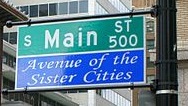
Sign for South Main Street, Tulsa, Oklahoma

Main Street is a metonym used to denote a primary retail street of a village, town or small city in many parts of the world. It is usually a focal point for shops and retailers in the central business district, and is most often used in reference to retailing, socializing, and the place to go to find "common" concerns.

The term is commonly used in Ireland, Scotland, the United States, and Canada, and less often in Australia and New Zealand. In the non-Scottish regions of the United Kingdom, the common description is High Street, though "Fore Street" or "Front Street" is commonplace in some parts. In Jamaica the term is Front Street. In the 1950s awareness about the 'main street' as a concept of its own importance emerged in the urban studies field, attaining the attention in the theoretical discussions of postmodern urban design, neo-traditional planning and meta-urbanism.[1]

In many places, the street name for such a street is actually "Main Street", though even where it isn't the actual name, "main street" is still used to describe the main thoroughfare of the central business district. The "Main Street of America" branding was used to promote U.S. Route 66 in its heyday.

American cultural usage

[edit]
A revitalized Main Street in Franklin, North Carolina

In the general sense, the term "Main Street" refers to a place of small-town traditional values, usually in contrast to big-city modernity. Social realists from 1870 to 1930 used the name as a symbol of stifling conformity.[2] Sherwood Anderson, for example, wrote Winesburg, Ohio: A Group of Tales of Ohio Small Town Life in 1919. The best-selling 1920 novel Main Street was a critique of small-town life by the American writer Sinclair Lewis. The locale was "Gopher Prairie," presented as an 'ideal type' of the Midwestern town, and the heroine, Carol Kennicott, was a more urbane, 'ideal-typical' Progressive.[3]

A traditional Main Street; Bastrop, Texas, featuring the small shops and old-fashioned architecture typical of rural towns

In North American media of later decades, "Main Street" represents the interests of everyday people and small business owners, in contrast with "Wall Street" (in the United States) or "Bay Street" (in Canada), symbolizing the interests of large national corporations. Thus, in the 1949 movie adaptation of On The Town, the song "When You Walk Down Main Street With Me" refers to small-town values and social life. Main Street Republicans, for example, see themselves as supporting those values as against urbane or "Wall Street" tendencies.

"Main Street" is part of the iconography of American life. For example, the Army and Air Force Exchange Service, the outfit that operates the PX and BX stores on military bases, chose the name "Main Street USA" for its food courts.

Main Street was a popular term during the economic crises in 2008 and 2009: the proposed bailout of U.S. financial system, the 2008 US presidential campaign, and debates. One widely reviewed book was Bailout: An Inside Account of How Washington Abandoned Main Street While Rescuing Wall Street (2012) by Neil Barofsky.

In small towns across the United States, Main Street is not only the major road running through town but the site of all street life, a place where townspeople hang out and watch the annual parades go by. A slang term popularized in the early 20th century, "main drag", is also used to refer to a town's main street.

Walt Disney

[edit]
Main Street, U.S.A. at Disneyland in 1957

Two Walt Disney Company theme parks, Disneyland in Anaheim, California, and the Magic Kingdom in the Walt Disney World Resort near Orlando, Florida, both have "Main Street, U.S.A." sections immediately at their front. These areas, which are designed to look like the main street of a small town, house gift shops, restaurants and various services, along with park offices on the second floors. While the architecture of these "streets" appears to be turn-of-the-20th-century, in fact these are decorative false-fronts on industrial-style buildings. Main Street, U.S.A. is also present at Disneyland Paris and Hong Kong Disneyland. At Tokyo Disneyland the area is named "World Bazaar," but has the same look as Main Street, albeit housed under a decorative glass roof for protection from Japan's unpredictable weather. At Shanghai Disneyland, the area is named "Mickey Ave," but also has the same style as Main Street.

Disney's design copied visual elements of small-town America seen in films by Frank Capra and others, in a deliberate attempt to capture the iconic symbolism of small-town America. Disney wanted to embed the values and memories associated with life in small towns into an entertainment experience for tourists.[4]

Preservation and Main Street

[edit]

Main Street America is a community revitalization program begun by the National Trust for Historic Preservation in the late 1970s. The core of the Main Street Approach is the revitalization of commercial districts via economic development and historic preservation. The Main Street Approach is a holistic approach to downtown and neighborhood commercial district revitalization based on the 4-point approach of design, promotion, economic vitality, and organization. Originally targeted at small, traditional downtowns, the program has expanded to include towns of various sizes, including neighborhood districts in several large urban centers.[5]

In many communities, a merchants' association or business improvement district serves a promotional role on behalf of the merchants of a downtown Main Street. Individual city governments also may engage in revitalization or historic preservation efforts to support a downtown core, either to make a community appear more attractive for tourism or to stem a flow of commerce out of the city into suburbs with shopping malls and cookie-cutter big box stores.

In the United States federal funds are allocated specifically for restoration of historic properties on the former U.S. Route 66, the main street of many roadside towns; this funding is administered by the US National Park Service.[6]

International use and equivalents

[edit]
  • Many small Canadian cities and towns have a thoroughfare named Main Street (or, in French, Rue principale); in other cases, the main street of the community has a name particular to that community. The phrase "a town where the main street is still called Main Street" is occasionally used as being synonymous with small-town values.
    • In Ottawa, main streets of various individual villages which had been annexed to the larger urban municipality bear names like "Manotick Main" or "Osgoode Main" to distinguish them from Smyth Road (which becomes "Main Street" in one small area southeast of downtown Ottawa) and from each other. The main street of centretown Ottawa is Bank Street.
    • In Toronto, Main Street is a mostly residential avenue in the East York district.[7][8][9] At one time it was the main street of the hamlet of East Toronto, which was annexed by the city of Toronto in 1908. It has kept its historic name, and evidence of its commercial origins can be seen in the stores at the corner of Main and Gerrard Streets. Toronto's main street is considered to be Yonge Street, which divides the city's latitudinal streets into east–west.
    • Saint Laurent Boulevard, which divides Montreal between east and west, is unofficially known as "the Main."
    • Main Street in Vancouver is a neighbourhood shopping street, near the dividing line between east and west side of town. However, the city's main city centre shopping street is Robson Street.
  • In Australia and New Zealand, smaller urban centres often have a main street. In some towns this street is officially designated Main Street or High Street; rarer variants include Main Road, Commercial Road, and Commerce Street. Often, though, the street is given a name peculiar to the town. For many small towns, the main street forms part of the principal road into, or through, the town. Large centres often have a central business district in which no one street is a clear focus for commercial activity, though for historical or cultural reasons there is often one street regarded as the city's "main street." Examples include Melbourne's Collins Street, Sydney's George Street, Adelaide's King William Street, Auckland's Queen Street, and Christchurch's Colombo Street.
  • In Ireland most towns have a "main street," and this is usually the term given colloquially (for example, in offering road directions), though the primary thoroughfare of cities are often named after a historical figure, e.g. O'Connell Street. A more recent phenomenon in the media and with younger people is the use of the term "high street" to describe typical or average street level fashion—likely due to advertising by various British retail multiples which began operating in Ireland during the "Celtic Tiger" years.
  • In the United Kingdom, the terms "Market Street" or "Market Place" are often used to designate the heart of a town or city,[citation needed] as is the more common "High Street" (with limited exception in Scotland where the term "Main Street" is used to describe the equivalent in smaller towns, and particularly in newer urban developments, or towns or cities across the whole of Britain which were not original market towns). High Street is often the name of a fairly busy street with small shops on either side, often in towns and villages.
  • In the Netherlands the Hoofdstraat is mostly one of the oldest streets in villages and towns. It's located in the old center and varying from very small pedestrian-only streets to wide four-lane roads.
Storgata in the small Norwegian town of Molde.
  • In Sweden and Norway, almost all towns and cities have their own main street, called Storgatan/Storgaten (literally, "The big street"). They are typically surrounded by stores and restaurants, and increasingly since the late 20th century, open for pedestrians only. A pedestrian street is called gågata/gågate (literally, "walkingstreet").
  • In Germany, the Hauptstraße (literally "Main Street") is a highly trafficked street. Hauptstraßen even have formal recognition in road construction guidelines, which specify the width of lanes, for example. The term chiefly refers to motorized traffic, whereas Einkaufsstraße (shopping street) or Fußgängerzone (pedestrian district) correspond better to the retail sense of a main street.
Corso Buenos Aires in Milan, Italy
  • In most Italian municipalities, the highway or another major route is called corso. There is no univocal definition of corso, even if it is generally applied only to municipal streets characterized by ancient traditions or a certain importance in the building physiognomy of the municipality.[10]
  • Jalan Besar ("Large Road" in Malay) is a common name used in Malaysia (and to a lesser extent, Singapore) for the main streets of older urban centres in the country. Such main streets were originally constructed during British colonisation of territories in present-day Malaysia and Singapore, and were named in English as "Main Street" or "Main Road," depending on the size and nature of the urban centre, and often are laid out as parts of major thoroughfares between larger towns and cities.
    • The independence of states that would form Malaysia and the introduction of Malay as the national language in 1967 led to extensive renaming of certain Main Streets or Main Roads to Jalan Besar in Malaysia the following decades. Large cities (such as state capitals) tend to forgo the use of "Main Street" or "Main Road" altogether, as commercial or transport activity may be concentrated along more than one street.
  • In South Africa, Main Road is the term used for the same concept as Main Street in the U.S. and High Street in the UK.
  • In Cambodia, the Main Road is between the rice fields and settlements.
  • In industrial engineering, "Main Street" is often used to describe a conveyor which transports the fundamental materials for producing objects to the automated construction site where the intended object will be assembled.

Main Street in Ireland

[edit]

Main Street is the place/road name used in many suburbs, towns, and villages in Ireland. For example, the OSI North Leinster Town Maps book lists sixteen Main Streets and only two High Streets in its thirty-town index of street names. Similarly, the OSI Dublin Street Guide, which covers all of Dublin City and County Dublin, lists twenty Main Streets and only two High Streets. Killarney and Galway are two of the few Irish towns in which the term High Street is used instead of Main Street. Recent and upcoming tranches of funding for Local Authority-led projects seek to help regenerate Main Streets, and town and city centres around Ireland under the URDF (Urban Regeneration Development Fund) and RRDF (Rural Regeneration Development Fund).

There were also earlier, 1990s to early 2000s, tax-incentive based initiatives, for private interests, for the refurbishments of buildings, and 'Living over the Shop' (LOTS) schemes, based along specified lengths of urban streets, under Village and Urban Renewal Schemes and that overall, sought the regeneration of main street Ireland. Some of these schemes may have suffered from sufficient lack of interest or impact due to for example, business owners insurance and security issues regarding separate occupiers above for LOTS projects, and general lack of finance and familiarity with residential projects and landlordism, and depressed interest of the general public in returning to town and village centre living in the modern era. These efforts specifically included the 'Town and Village Renewal Schemes' (financial grants of up to €100,000) and previous Town Renewal Scheme, 1999 and Urban Renewal Scheme.

There is also a recent pilot project(s) of funding for town centre improvements in (six) different rural Irish towns dispersed around the country, and for example, noting including various town/village rejuvenation projects in County Monaghan.[11]

The Town Renewal scheme, for example, was a 10-year tax relief incentive scheme for renovations or new builds that was to improve the 'Townscape' and 'Streetscape' of smaller Irish towns, through the physical improvements of buildings e.g. views building façades on 'main streets'.

The efforts of local governments (county councils, city councils, and the former town councils, until 2017) to improve 'main streets' centered around their Planning Departments and County Development Plans. These included shopfront design guides such as the "Shopfront Design Guide, 2001" and "Shopfront Design Guidelines for the O'Connell Street Area, 2003" of Dublin City Council, and the "Guide to Good Shopfronts." There are also for further examples; the "Guidelines for Shopfront Design in Bray, 2007" (and its earlier, shorter iteration of c.2000) of Bray Town Council, and the 2014 "Shopfront Design Guide" of South Dublin County Council. Kerry County Council also issued the quite comprehensive "Shopfront Design Guidelines and Policy" document in 2010, and for Kilkenny City the "Shopfronts and Advertising Signs Kilkenny Planning Information Booklet."

There have been previous concerns sometimes raised that tax incentives, or the more recent planning 'exemptions' have, or may lead to confusion regarding permissible, or recommended interventions in shopfronts, such as removal of shopfront elements or otherwise good quality, traditional shopfronts that are often a feature of main streets, and for example are beneficial in terms of tourism and 'Tidy Towns' efforts.

TV celebrity gardener and presenter Diarmuid Gavin hosted two series of programmes called 'Dirty Old Towns' from 2011 to 2013 on the national broadcaster RTÉ1 that often highlighted the poor physical state of main streets in some well known towns in Ireland and showcased improvements to buildings or gardens in the town centres on or near their main street.

In a similar stream, it has been noted in the past, e.g. in the UK by its national print media, that '24/7' full Pedestrianisation of town centres and main streets can lead to passive security issues and fear of use in night time hours.

Noting likely economic impacts of the COVID-19 emergency (as of April 2020) on funds and economy, some refinement and redirection of URDF, and RRDF monies also towards more generalised, and labour-intensive refurbishments of main street's buildings may also have visible tangible impacts. This could be in cooperation with Local Authorities, state agencies, and private owners (e.g. subsidised external fabric refurbishments of derelict/ semi-derelict terraced buildings), and potentially project-led led by in-house expertise from for example, the LDA (Land Development Agency), and local Architects/ County Councils, or Heritage Council/ OPW (Office of Public Works), etc. The Urban Institute of Ireland (based in UCD), and the School of Environment and Planning (in DIT) could also help in terms of academic basis, research and development.

A similar voluntary 'townscape' society or similar (like the Georgian Society and Tidy Towns), for the promotion and restoration of town and village centres, could also have similar potential for project initiating/ leading benefits, to also help link the National Planning Framework (National Spatial Strategy replacement), and National Development Plans aims, in a similar fashion to the aim promulgated by the URDF and RRDF rationale. This is noting for example, that a report (2016 Pobal HP Deprivation Index) published in November 2007 by Pobal (an intermediary organisation for funding from the Irish government and the EU) found that

'Small towns (1,000 – 5,000 people) have been the worst effected over the past ten years, being disproportionately hit by the recession and benefiting less from the recovery than the most urban and the most rural areas.'

List of streets named Main Street

[edit]

Canada

[edit]

Ireland

[edit]

United States

[edit]
  • U.S. Route 40, referred to as "Main Street of America" pre-WWII and post creation of the US route system
  • U.S. Route 66, referred to as "Main Street of America" post-WWII and pre-Interstate network completion
  • Pennsylvania Avenue, specifically the portion stretching from the White House to the United States Capitol, known as "America's Main Street"

By state, then city:

Gibraltar

[edit]
[edit]

See also

[edit]

References

[edit]

Further reading

[edit]
[edit]
Revisions and contributorsEdit on WikipediaRead on Wikipedia
from Grokipedia
Main Street denotes the primary commercial artery in numerous towns and small cities, especially across the United States, functioning as the core venue for retail establishments, professional services, and communal gatherings.[1] In economic parlance, it metaphorically embodies small-scale enterprises, grassroots commerce, and ordinary households, standing in opposition to Wall Street's domain of major financial entities and institutional investors.[2][3] Originating predominantly as a 19th-century fixture amid the expansion of American settlements, Main Streets proliferated as central hubs proximate to pivotal infrastructure such as railroads, fostering localized trade and urban cores with multi-story edifices accommodating ground-floor shops and upper-level residences or offices.[4] Their prominence waned post-World War II due to suburban migration, the advent of enclosed malls, and highway-centric development, which diverted consumer traffic and precipitated storefront vacancies and fiscal strain on municipal centers.[4] Revitalization initiatives, exemplified by the National Main Street Center established in 1977 under the National Trust for Historic Preservation, have since emphasized adaptive reuse of historic structures, boutique entrepreneurship, and pedestrian-oriented enhancements to counteract decay and reinvigorate these districts as viable economic anchors.[5] Such endeavors underscore Main Street's enduring archetype of resilient, community-embedded commerce, though empirical outcomes vary, with successes tied to factors like regional demographics and policy execution rather than uniform formulas.[6]

Definition and Etymology

Origins and Literal Meaning

The term "Main Street" refers to the principal or central street of a village, town, or small city, typically functioning as the primary retail and commercial artery. This literal designation emphasizes its role as the core pathway for local commerce, social interaction, and civic activity, distinguishing it from secondary or residential roads.[7] Etymologically, "main" derives from Old English mægen, connoting strength, power, or chief importance, evolving in Middle English to denote something principal or foremost. Combined with "street" (from Latin strata via, meaning paved way), the phrase "main street" first appears in English records in 1598, in John Florio's translation of Montaigne's essays, where it signifies the primary thoroughfare.[7] By the early 19th century, "Main Street" emerged as a proper noun for named roads in American settlements, with the earliest documented instance in 1810 describing a street in Chillicothe, Ohio. [8] In British English, the analogous term "High Street" predominates, with "high" similarly implying preeminence or elevation in status rather than physical height, dating to the 12th century for principal urban routes.[9] This parallels "Main Street" in non-English contexts, such as German Hauptstraße (main street) or Hungarian Főutca (principal street), underscoring a universal convention for identifying a settlement's foundational axis.[10]

Symbolic Evolution in American Context

In the early 20th century, the term "Main Street" gained symbolic prominence through Sinclair Lewis's 1920 novel Main Street, which satirized small-town American life as conformist, intellectually stagnant, and resistant to change, portraying the fictional Gopher Prairie as emblematic of broader provincial limitations.[11] [12] The novel's success elevated "Main Street" in cultural lexicon as a metonym for the perceived dullness and cultural insularity of rural and small-town America, challenging romanticized notions of village virtue prevalent in earlier literature.[13] By the 1930s, amid the Great Depression, the symbolism shifted toward representing the resilient core of American democracy and community solidarity, evoking everyday citizens' endurance against economic adversity rather than mere provincialism.[14] This evolution reflected a broader cultural pivot, where Main Street embodied authentic, grassroots values in contrast to urban elites or financial abstraction. Post-World War II, Walt Disney's Main Street, U.S.A. at Disneyland, opened on July 17, 1955, further idealized it as a nostalgic archetype of harmonious, pre-automotive small-town prosperity, blending historical facades with commercial optimism to export an aspirational vision of American normalcy.[14] In contemporary usage, particularly from the late 20th century onward, "Main Street" symbolizes local commerce, small business owners, and ordinary investors, often juxtaposed against "Wall Street" to highlight tensions between community-oriented economies and large-scale financial institutions.[3] This dichotomy, traceable to early 20th-century discussions of democratizing ownership but amplified during events like the 2008 financial crisis, underscores populist appeals in politics and media, positioning Main Street as the locus of tangible economic vitality and middle-class interests over speculative finance.[15] Despite physical declines in many actual main streets due to suburbanization and retail shifts, the symbol persists as a marker of cultural identity, occasionally critiqued for overlooking historical exclusions like racial sundown practices in small towns.[14]

Historical Development

Colonial and Early Republic Naming Practices

In colonial America, street naming practices emphasized functionality and descriptiveness, with the principal thoroughfare in many settlements designated as "Main Street" to signify its central role in commerce, travel, and community assembly. This approach drew from English precedents like "High Street" but adapted to colonial contexts where pragmatic labels aided navigation in nascent grids or linear plans along rivers and roads. For example, in Lexington, Massachusetts, founded in 1642 as a farming outpost, the primary road—now Massachusetts Avenue—was initially called Main Street, serving as the hub for local exchange and militia gatherings.[16] Such naming avoided elaborate honorifics in smaller towns, favoring utility over symbolism; in Yorktown, Virginia, a 1710 deed described the key street bounding properties as either "Broad Street" or Main Street, highlighting its width and prominence as the settlement's spine rather than a tribute to individuals.[17] Royal influences appeared in ports like Boston (King Street) or Philadelphia (named by William Penn in 1682 with tree and numbered streets), but descriptive terms like Main prevailed in rural and mid-sized locales to denote the main axis without monarchical overtones.[18] Following independence, Early Republic town planning (circa 1789–1820s) retained this descriptive convention amid westward expansion, integrating Main Street into grid systems as the core commercial artery, often intersecting numbered or directional streets. In Richmond, Virginia, Main Street's name endured post-Revolution because it was the literal main thoroughfare, bypassing renamings seen elsewhere (e.g., King to State) while new settlements like Buffalo, New York, formalized their wagon routes as Main Street by the early 1800s.[19] [20] This persistence reflected causal priorities of economic centrality over political revisionism, as founders prioritized identifiable hubs for trade in agrarian economies transitioning to market towns.[21]

19th-Century Growth and Urbanization

The expansion of the United States westward in the early 19th century, facilitated by the Land Ordinance of 1785 and subsequent surveying practices, standardized town layouts on rectangular grid systems, positioning Main Street as the primary commercial thoroughfare in new settlements.[22] These grids, often oriented to cardinal directions, featured Main Street running east-west or north-south as the central axis, with cross streets numbered or named sequentially, enabling efficient land division and speculative development amid population growth from 5.3 million in 1800 to 23.2 million by 1850.[23] In Midwestern and Western territories, such as those opened by the Louisiana Purchase in 1803, hundreds of county seats and trade centers were platted this way, with Main Street reserved for high-value commercial blocks to attract merchants and farmers.[24] Mid-century advancements in transportation, including canals completed by the 1840s and railroads expanding from 3,000 miles of track in 1840 to over 30,000 by 1860, spurred urbanization by linking rural hinterlands to urban markets, concentrating economic activity along Main Streets.[25] This infrastructure boom, coupled with immigration surges—adding over 4 million arrivals between 1840 and 1860—drove urban population shares from under 10% in the 1830s to 20% by 1860, transforming Main Streets into bustling hubs lined with general stores, banks, and workshops that serviced growing trade volumes.[26] In prototypical railroad towns like those in Illinois and Ohio, Main Street was frequently aligned parallel to tracks for depot access, fostering daily commerce as freight and passenger traffic multiplied local economies.[24] Post-Civil War industrialization accelerated this trend, with urban areas absorbing manufacturing relocation from rural sites; by 1900, the urban population reached 30 million, or 40% of the total, amid factory proliferation in cities and larger towns.[27] Main Streets adapted with infrastructural upgrades, including curbs and gravel or wooden sidewalks on major thoroughfares by the 1830s-1850s, evolving to brick paving and electric lighting by the 1880s-1890s to handle increased pedestrian and vehicular density from horse-drawn omnibuses and early streetcars.[28] In smaller municipalities, which comprised over 1,700 incorporated places with populations exceeding 2,500 by 1900, Main Street remained the unchallenged retail core, embodying the decentralized urban form distinct from denser European models, as commercial buildings—often two- to three-story structures with ground-floor shops—clustered to exploit foot traffic and proximity to civic institutions like courthouses.[29] This growth, however, introduced challenges such as overcrowding and rudimentary sanitation, with Main Streets bearing early strains of equine waste and unregulated vending before municipal reforms in the 1870s-1890s imposed grading and sewer extensions.[27] In the context of the American Old West and frontier expansion during the late 19th century (particularly the 1870s–1890s), "Main Street" was widely used to designate the central thoroughfare in boomtowns and cattle towns, even when it consisted of little more than a wide, unpaved dirt road. These streets, often 80–120 feet across to accommodate wagon turns, served as the primary artery for commerce, lined with saloons, general stores, banks, and false-front buildings. Despite remaining dirt (dusty in dry weather and muddy quagmires after rain, mixed with horse manure), they were routinely called "Main Street" or simply "the street" in everyday parlance and town planning. Notable examples include Deadwood, South Dakota's Main Street, a bustling dirt thoroughfare central to the Black Hills gold rush, and Tombstone, Arizona's Allen Street, the iconic main drag functioning identically despite its dirt surface. This naming reflected the pragmatic American tradition of prioritizing economic and social function over surfacing or grandeur, as seen in earlier Midwestern and railroad towns, and persisted until later municipal improvements brought gravel, boardwalks, or paving in maturing settlements.

20th-Century Expansion, Suburbanization, and Initial Decline

In the early decades of the 20th century, Main Streets in American towns expanded as centers of commercial activity, incorporating new retail forms like department stores and chain outlets amid rapid urbanization and the advent of automobiles. By the 1920s, these streets symbolized the consolidation of modern commerce, with architectural standardization—such as uniform facades and signage—fostering a sense of unified retail districts that drew pedestrian and early vehicular traffic. The period saw infrastructure investments, including street paving and electric lighting, which supported economic booms in small-town economies; for instance, many Main Streets hosted banks, theaters, and general stores that served as hubs for local trade until the Great Depression tempered growth.[14] Post-World War II suburbanization profoundly reshaped Main Streets by decentralizing commerce and population outward from urban cores. The GI Bill's home loan guarantees, coupled with the 1956 Interstate Highway Act, facilitated explosive suburban growth, with the suburban population rising from about 36 million in 1950 to over 70 million by 1970, drawing middle-class families and retailers away from downtowns.[30] Shopping malls and strip centers emerged in suburbs, offering free parking and air-conditioned environments tailored to automobile-dependent consumers, eroding the viability of walkable Main Street retail.[31] This shift precipitated the initial decline of Main Streets in the 1950s and 1960s, as downtown retail sales plummeted—city centers lost 77% of their market share between 1954 and 1977 amid "white flight" and urban renewal projects that often demolished historic blocks.[32] Vacant storefronts became common, with many towns witnessing the closure of family-owned businesses unable to compete with suburban chains; for example, traffic engineering widened Main Streets for cars, removing trees and disrupting pedestrian flow, further diminishing their appeal as social and economic anchors.[33] By the late 1960s, Main Streets symbolized obsolescence in the face of these structural changes, though some communities began early preservation efforts.[4]

Cultural Representations

Literary and Critical Depictions

Sinclair Lewis's novel Main Street, published in 1920, offers one of the most influential literary depictions of small-town American life, centering on the fictional Minnesota community of Gopher Prairie as a microcosm of midwestern provincialism. The narrative follows Carol Kennicott, a college-educated woman who marries a local physician and seeks to reform the town's aesthetics and social dynamics, only to confront entrenched complacency, conformity, and intellectual stagnation among its residents. Lewis draws from his own experiences in Sauk Centre, Minnesota, to portray Main Street not as a vibrant hub but as a symbol of dull routine and resistance to change, with local businesses and social clubs reinforcing mediocrity over innovation.[34][35] Critics have interpreted the novel's Main Street as an allegory for broader American cultural limitations, highlighting how small-town boosterism—embodied in figures like the town's real estate agents and club organizers—prioritizes superficial progress and groupthink over genuine advancement. Literary analyst Max J. Herzberg described it as fostering post-World War I American self-awareness by exposing the "village virus" of insularity that stifles individual ambition. The work's satire extends to gender dynamics, with Carol's frustrations underscoring the era's constraints on educated women, who are often relegated to domestic roles despite aspirations for urban-like sophistication.[36][37] In subsequent literary criticism, Main Street has been analyzed as a counterpoint to romanticized rural ideals, influencing portrayals in works like Sherwood Anderson's Winesburg, Ohio (1919), where similar Midwestern streets represent isolation and unspoken desires, though Lewis's explicit critique of commercial and social hypocrisy sets it apart. Later analyses, such as those in American Heritage, emphasize the novel's role in articulating frustrations with unbeautiful, frustrating small-town existence, contrasting it with desires for profundity and beauty that remain unfulfilled. This depiction contributed to a literary tradition viewing Main Street as a site of both communal identity and cultural critique, rather than unalloyed Americana nostalgia.[11][35]

Influence in Media, Film, and Entertainment

In American cinema, depictions of Main Street have historically emphasized its role as the communal core of small towns, showcasing parades, storefronts, and social gatherings to capture local identity and boosterism. From the 1910s through the 1930s, itinerant filmmakers produced thousands of short local films featuring Main Street scenes—such as business directories filmed from moving vehicles or staged events like fire drills and beauty contests—which served to document and promote municipal vitality amid rapid urbanization.[38] These non-professional productions, often screened in town theaters, numbered over 2,000 documented examples by the mid-1920s, influencing early audience expectations of cinematic realism tied to everyday American locales.[39] Hollywood's classical-era features amplified this archetype, positioning Main Street as a symbol of moral simplicity and collective resilience in contrast to big-city corruption. Films like It's a Wonderful Life (1946), directed by Frank Capra, center Bedford Falls' Main Street—complete with its Bailey Building & Loan, drugstore soda fountain, and holiday-treed thoroughfare—as the locus of neighborly salvation during economic hardship, drawing on post-World War II nostalgia for pre-Depression stability.[40] Similarly, Capra's Mr. Deeds Goes to Town (1936) uses rural Mandrake Falls' equivalent main drag to highlight populist virtue, with scenes of town meetings and quirky vendors reinforcing causal links between local commerce and civic harmony. Such portrayals, rooted in observable 19th- and early 20th-century town layouts, shaped viewer perceptions by prioritizing empirical markers of prosperity—like active sidewalks and family-owned shops—over emerging suburban sprawl.[41] Television extended this influence, with sitcoms and dramas idealizing Main Street as a stage for interpersonal ethics and low-stakes conflict resolution. The Andy Griffith Show (1960–1968), set in the fictional Mayberry, North Carolina, featured its courthouse square-cum-Main Street as a pedestrian-friendly hub for barbershop philosophizing and minimal policing, amassing 249 episodes that aired to 30–40 million weekly viewers and embedding the image of unhurried, self-regulating communities.[42] Later series like Gilmore Girls (2000–2007), centered on Stars Hollow's Main Street with its diner and indie bookstore, perpetuated walkable, quirky vitality, though critics note these constructs often diverge from data on real Main Streets' post-1950s retail vacancies exceeding 20% in many Midwest towns.[43] Entertainment formats, including musicals like Meet Me in St. Louis (1944), further mythologized turn-of-the-century Main Streets through trolley-lined promenades and festive trolleys, influencing stage revivals and theme park designs by evoking verifiable historical density patterns before automobile dominance.[44] Counter-narratives emerged in mid-century films critiquing conformity, as in Pleasantville (1998), where a monochromatic Main Street evolves to reveal suppressed desires beneath surface homogeneity, reflecting causal tensions between idealized media facades and socioeconomic stagnation observed in 1950s1970s case studies of declining retail corridors.[45] Overall, these representations have reinforced Main Street's cultural cachet as a proxy for grassroots authenticity, with empirical analysis showing over 90 small-town-set features released between 1930 and 1960 centering street-level commerce scenes.[46]

Walt Disney's Main Street, U.S.A. and Idealization

Main Street, U.S.A. serves as the gateway to Disneyland, which opened on July 17, 1955, in Anaheim, California, and embodies Walt Disney's vision of an idealized early 20th-century American small town.[47] The area draws inspiration from Disney's childhood experiences in Marceline, Missouri, where he lived from 1906 to 1911, evoking a nostalgic sense of community and prosperity rather than a precise historical replica.[48] Disney described it as "America at the turn of the century—the crossroads of an era," blending elements like gas lamps with emerging electric lights and horse-drawn carriages alongside automobiles to capture a transitional optimism.[49] The design employs architectural techniques such as forced perspective, where buildings taper narrower at the far end to appear taller and more expansive, enhancing the illusion of a welcoming, grand thoroughfare scaled for pedestrian comfort.[50] Structures feature Victorian and Colonial Revival styles with gingerbread detailing, ornate facades, and bustling storefronts offering confections, apparel, and souvenirs, all maintained in pristine condition to project perpetual vitality.[51] This curation omits urban decay, economic hardship, or social discord prevalent in many real Main Streets of the era, instead prioritizing a sanitized, family-centric atmosphere that reflects Disney's rose-tinted personal recollections over empirical urban realities.[52] Disney's conceptualization extended beyond mere entertainment, influencing broader perceptions of Main Street as a symbol of wholesome Americana; by 1955, amid post-World War II suburban flight and downtown stagnation, the attraction reacquainted visitors with walkable, human-scaled streetscapes, contrasting the automobile-dominated landscapes of mid-century America.[50] Elements like the Main Street Vehicle parade, featuring horse-drawn vehicles and early autos, reinforced themes of innocent progress and communal harmony.[53] Critics note that this idealization, while commercially successful—drawing millions annually—presents a selective narrative, amplifying cultural nostalgia for a pre-industrial, mythologized past that glosses over historical inequalities and transformations in American town life.[54] Subsequent Disney parks, including Walt Disney World (opened 1971), replicated and refined this model, embedding the archetype into global entertainment.[47]

Economic Dimensions

Centrality to Local Commerce and Small Businesses

Main Streets function as the core commercial arteries in numerous American towns and small cities, hosting concentrations of independent retailers, service providers, and professional offices that sustain local economies through direct community patronage and foot traffic.[55] These districts traditionally centralize economic activity by offering high-visibility locations accessible to residents, fostering repeat business from nearby households and reducing reliance on distant shopping centers.[56] Small businesses along Main Streets, such as family-owned shops and eateries, generate substantial local multiplier effects, where spending circulates within the community multiple times before leaking to external suppliers.[57] Empirical data underscores this role: initiatives supporting Main Street districts, like those from Main Street America, catalyzed $5.68 billion in local reinvestment in 2023 alone, spurring business formations and property upgrades that bolster small enterprise viability.[58] By 2024, such programs facilitated the opening of 6,324 new businesses nationwide, primarily independent operations integral to downtown vitality.[59] These enterprises often employ local residents at higher rates than chain outlets, contributing to community stability; for instance, Main Street firms historically depend on regional banking for capital, enabling personalized lending that aligns with town-specific needs post-recessions.[56] Nationally, small businesses—which predominate on Main Streets—account for nearly half of U.S. economic output and two-thirds of net new jobs, with urban corridors amplifying this through clustered synergies like shared customer bases and informal networking.[60] The centrality persists due to causal factors like geographic primacy: pre-automobile eras positioned Main Streets at town intersections for wagon and pedestrian trade, a layout that endures for modern walkability and event hosting, drawing consumers who value experiential shopping over transactional efficiency.[61] Current surveys indicate Main Street owners prioritize community ties, with 2024 data showing optimism tied to local support mechanisms that enhance resilience against broader disruptions.[62] This embeddedness yields fiscal returns, as revitalized districts yield positive cost-benefit ratios for public investments, often exceeding 4:1 through sustained tax revenues from stable small business occupancy.[63]

Factors Contributing to Mid-Century Decline

The mid-century decline of American Main Streets, particularly from the late 1940s through the 1960s, stemmed largely from rapid suburbanization spurred by post-World War II demographic shifts and federal policies. The Servicemen's Readjustment Act of 1944, known as the GI Bill, provided low-interest home loans to millions of veterans, enabling a surge in suburban housing development amid the baby boom, with U.S. suburban population growing from 36% in 1950 to over 50% by 1970.[64] This exodus from urban cores and small towns eroded the pedestrian-oriented customer base essential to Main Street retailers, as families sought single-family homes with yards, garages, and proximity to new employment in sprawling industrial parks.[4] Local merchants faced reduced foot traffic and sales, with many independent stores unable to compete against the convenience of automobile-dependent lifestyles. The expansion of the Interstate Highway System, authorized under the Federal-Aid Highway Act of 1956 which funded over 41,000 miles of limited-access roads, accelerated this trend by rerouting intercity travel away from downtowns.[65] In small towns, highways often bypassed central business districts entirely, shifting economic activity to new exits and interchanges located miles from Main Streets, leading to immediate drops in transient commerce such as motels, diners, and service stations.[66] For instance, communities not directly connected to the system experienced business vacancies as through-traffic—previously a key revenue source—vanished, with some towns reporting up to 50% declines in downtown retail activity within a decade of bypass construction.[67] This infrastructure prioritized speed and volume over local integration, compounding the isolation of Main Streets from regional economies.[68] Simultaneously, the proliferation of suburban shopping centers and regional malls siphoned retail dominance from downtowns. The first fully enclosed mall, Southdale Center in Edina, Minnesota, opened in 1956, offering climate-controlled environments, free parking for thousands of cars, and national chain anchors that undercut Main Street's fragmented, locally owned model.[32] Between 1954 and 1977, city center retail market share fell by 77%, as consumers favored one-stop suburban venues with broader inventories and promotional tactics like loss-leader pricing.[32] Chain stores, previously downtown fixtures, relocated to leverage higher suburban purchasing power, leaving Main Streets with undercapitalized independents vulnerable to bankruptcy.[4] Urban renewal initiatives under the Housing Act of 1949 further hastened commercial erosion by designating downtowns as "blighted" and razing blocks for redevelopment, often prioritizing parking lots, high-rises, or non-retail uses over viable street-level commerce. These programs displaced approximately 500,000 households between 1950 and 1970, fracturing customer networks and severing supply chains in affected areas, while replacement projects frequently failed to restore economic vitality due to mismatched scales and designs.[69] In many cases, clearance disrupted pedestrian flows and introduced barriers like elevated roadways, amplifying the automobile's dominance and hastening Main Street's obsolescence.[4]

Post-1970s Revival Mechanisms and Outcomes

The National Trust for Historic Preservation initiated the Main Street program in 1977 as a pilot project in three Midwestern communities—Burlington, Iowa; Hot Springs, South Dakota; and Tupelo, Mississippi—to counter downtown decay through targeted preservation and economic strategies.[5] This effort formalized in 1980 with the establishment of the National Main Street Center, promoting a comprehensive four-point approach: fostering local nonprofit organizations for coordination, marketing districts to draw visitors and residents, enhancing physical design via streetscaping and building rehabilitation, and restructuring economies by supporting small businesses and adaptive reuse of vacant properties. These mechanisms emphasized leveraging historic assets without large-scale demolition, contrasting with earlier urban renewal models that often erased community fabric.[70] Revival strategies gained traction in the 1980s and 1990s through public-private partnerships, including state-level adaptations like California's Main Street Program, which integrated local government support with nonprofit facilitation to incentivize private investment in commercial districts.[71] Key tactics involved facade grants, business recruitment focused on independent retailers, and events such as farmers' markets and festivals to boost foot traffic, often yielding multiplier effects on adjacent properties.[72] By the 2000s, integration with broader trends like adaptive reuse for mixed-use developments—converting upper-floor spaces into housing—and business improvement districts enabled sustained momentum, particularly in smaller towns where proximity to revitalized cores increased property values by up to 20-30% in some studies.[73][72] Outcomes have included substantial economic reinvestment, with Main Street America programs reporting $27 billion in local funds leveraged since inception through 2023, alongside 181,647 net new businesses and 815,894 net jobs created.[74] In 2024 alone, participating communities generated $7.65 billion in reinvestment, opened 6,324 new businesses, rehabilitated thousands of buildings, and mobilized 1.2 million volunteer hours, demonstrating scalability across over 1,200 designated districts.[75] Longitudinal analyses confirm these efforts enhance firm density and employment in treated downtowns compared to untreated peers, though success varies by local commitment and market conditions, with rural areas sometimes facing persistent challenges from outmigration.[61] Overall, the approach has preserved architectural heritage while fostering resilient local economies, though critics note reliance on tourism can introduce seasonality and over-dependence on grants.[76]

Political and Rhetorical Usage

The Main Street vs. Wall Street Framework

The Main Street vs. Wall Street framework emerged as a rhetorical and conceptual dichotomy in American discourse, symbolizing the tension between localized, small-scale economic activities—embodied by community-oriented businesses, family-owned enterprises, and average citizens—and the centralized, high-finance operations of large investment banks, hedge funds, and stock markets concentrated in New York City's financial district.[77] This contrast portrays Main Street as representing tangible productivity, job creation through everyday commerce, and values of self-reliance, while Wall Street is depicted as detached, speculative, and prone to risk-taking that externalizes costs onto broader society, such as through financial crises.[78] The framework gained traction amid economic populism, with roots traceable to late-19th-century agrarian movements criticizing Eastern banking elites during events like the Panic of 1893, where figures like William Jennings Bryan rallied against "the money power" of Wall Street.[79] In the 20th century, the dichotomy evolved through presidential rhetoric and policy responses to financial instability. President Franklin D. Roosevelt invoked similar themes during the Great Depression, implementing reforms like the Glass-Steagall Act of 1933 to separate commercial banking from investment activities, framing these as protections for ordinary depositors against speculative excesses.[80] Post-World War II, it appeared in critiques of corporate consolidation, but surged in visibility after the 2008 financial crisis, when bailouts under the Troubled Asset Relief Program (TARP)—totaling $700 billion authorized on October 3, 2008—sparked debates over whether rescuing Wall Street institutions truly aided Main Street recovery.[81] Empirical analyses, such as a difference-in-differences study of TARP's effects, found that bank bailouts mitigated credit contractions for non-financial firms, suggesting some interdependence despite the rhetorical divide, with treated banks increasing lending by approximately 10-15% more than untreated ones in the following years.[82] Politicians across parties have deployed the framework to signal alignment with working-class interests. Barack Obama, in a September 16, 2009, speech, emphasized reforming Wall Street to prevent future crises while prioritizing Main Street lending, stating that "the people on Main Street... were the ones who paid the price" for financial recklessness.[83] Similarly, Donald Trump, during his 2024 campaign, positioned himself as advocating for Main Street workers over Wall Street elites, critiquing outsourcing and financialization in favor of domestic manufacturing incentives.[84] This bipartisan usage underscores the framework's role in policy debates, such as Dodd-Frank Act regulations in 2010, which imposed stricter oversight on large banks to safeguard smaller borrowers, though critics argued it disproportionately burdened community banks serving Main Street.[78] The construct thus serves as a heuristic for discussing capital allocation disparities, where Wall Street's asset management—handling over $100 trillion in U.S. financial assets as of 2023—intersects with Main Street's reliance on credit markets, yet public perception often amplifies perceived conflicts over synergies.[85]

Deployment in Policy Debates and Elections

Politicians across the ideological spectrum have invoked "Main Street" in electoral campaigns to symbolize grassroots economic interests, small businesses, and working-class voters, positioning it as a counterpoint to elite financial institutions. This rhetoric gained prominence during the 2008 financial crisis, with candidates framing policies to differentiate aid for everyday enterprises from bailouts for large banks. For instance, in the 2008 and 2012 presidential races, Barack Obama repeatedly contrasted "Main Street" recovery efforts—such as small business lending programs—with "Wall Street" excesses, emphasizing job creation for local communities over speculative finance.[86][87] In policy debates, "Main Street" deployment often justifies measures like tax reforms or trade protections aimed at bolstering domestic commerce. During the 2016 and 2020 campaigns, Donald Trump leveraged the term to advocate for tariffs and deregulation, arguing they shielded American manufacturers and retailers from global competition, thereby prioritizing "Main Street" over multinational corporations and Wall Street investors.[88][89] This framing persisted into the 2024 election cycle and subsequent administration, where Treasury Secretary Scott Bessent stated in April 2025 that policies would focus on "Main Street's turn" to drive investment after decades of Wall Street dominance.[90] Republican figures have historically tied "Main Street" to fiscal conservatism in congressional races, as seen in the Republican Main Street Partnership's advocacy for moderate policies supporting local economies during the 2018 midterms. Democrats, meanwhile, have used it in state-level contests; Pennsylvania Governor Josh Shapiro, in his 2022 campaign and 2024 budget push, highlighted "Main Street investments" like infrastructure grants to stimulate small-town commerce.[91][92] Such invocations peaked in surveys of small business owners ahead of the 2020 election, where respondents identified candidate personas tied to "Main Street" values as pivotal over specific platforms.[93]

Critiques of the Dichotomy's Accuracy and Implications

The "Main Street versus Wall Street" dichotomy has been criticized for oversimplifying the interconnected nature of the U.S. economy, where small businesses and local enterprises frequently depend on capital markets for funding, investment, and growth. Small firms access loans, lines of credit, and equity financing through banks and intermediaries tied to broader financial systems, with Wall Street firms providing essential services like mutual funds, exchange-traded funds, and brokerage accounts that enable Main Street investors—often small business owners—to build retirement savings and manage risks. This mutual dependence is evident in data showing that community banks, representing Main Street lending, derive much of their funding from wholesale markets influenced by Wall Street activities, underscoring that disruptions in one sector ripple to the other.[3][94] Critics argue the framework inaccurately portrays Wall Street as adversarial rather than facilitative, ignoring empirical evidence from the 2008 financial crisis where lending excesses and risk-taking occurred across bank sizes, not solely among large institutions. Community banks, for instance, experienced failure rates tied to similar subprime exposures and lax underwriting as their larger counterparts, with over 500 such institutions collapsing between 2008 and 2015 due to concentrated real estate loans mirroring Wall Street's broader vulnerabilities. This widespread culpability challenges the narrative of isolated Wall Street malfeasance, as articulated in analyses emphasizing that policy responses like the Dodd-Frank Act imposed compliance burdens disproportionately affecting smaller lenders despite their shared errors.[95][94] The rhetorical divide's implications include distorted policy outcomes, as it can fuel regulations or interventions—such as tariffs or capital controls—that inadvertently constrain credit availability for small businesses by unsettling financial markets. For example, tariff-induced stock market volatility in 2025 reduced retirement account values for millions of Main Street households and firms, many of whom hold diversified portfolios reliant on Wall Street stability, while aiming to protect domestic manufacturing. Such framing risks populist measures that prioritize symbolic separation over integrated economic efficiency, potentially stifling innovation and job creation in sectors where financial intermediation lowers borrowing costs for entrepreneurs by an estimated 1-2 percentage points through market competition. Moreover, by attributing economic woes solely to finance, the dichotomy overlooks causal factors like fiscal policy or regulatory inconsistencies, leading to incomplete reforms that fail to address root interdependencies.[94][3]

Preservation and Modern Revitalization

Historic Preservation Movements

The historic preservation movement in the United States intensified during the 1960s amid widespread demolition of older urban fabric for urban renewal and infrastructure projects, prompting advocacy for protecting commercial cores like Main Streets that embodied local identity and architecture.[96] The demolition of New York City's Pennsylvania Station in 1963 exemplified the losses, galvanizing public and legislative support for systematic safeguards against such erasure.[96] Enacted on October 15, 1966, the National Historic Preservation Act (NHPA) marked the foundational legislation, creating the National Register of Historic Places for listing significant properties and mandating federal agencies to evaluate project impacts on historic resources via Section 106 consultations.[97][98] This framework extended to commercial districts, enabling Main Street buildings—often vernacular structures from the late 19th and early 20th centuries—to qualify for protection if they demonstrated historical significance in community development or architecture.[97] Targeted efforts for Main Street preservation emerged in the 1970s as suburban malls and bypass highways accelerated downtown decline, with grassroots organizations and federal incentives promoting rehabilitation over demolition.[99] In 1977, the National Trust for Historic Preservation launched pilot projects in Burlington, Iowa; Tupelo, Mississippi; and Madison, Indiana, to experiment with integrated strategies blending preservation, design standards, and economic incentives for vacant storefronts.[5] These pilots' successes in stabilizing local economies led to the 1980 founding of the National Main Street Center (now Main Street America) by the National Trust, institutionalizing the "Main Street Approach"—a methodology centered on community-driven organization, promotion of downtown assets, sensitive design rehabilitation, and economic restructuring through business recruitment.[5][100] The approach emphasized retaining historic facades while adapting interiors for modern retail, leveraging tools like federal historic tax credits enacted in 1976 and expanded in 1981, which reimbursed 20% of qualified rehabilitation costs for income-producing properties.[101] By prioritizing empirical outcomes over aesthetic purism, these movements shifted preservation from elite monuments to everyday commercial viability, fostering local historic districts certified under NHPA guidelines that met National Register criteria for integrity and significance.[102] Over subsequent decades, the framework influenced state-level adaptations and nonprofit partnerships, countering earlier biases toward new construction by demonstrating that preserved Main Streets could generate sustained private investment and tourism without relying on public subsidies alone.[103]

Government and Nonprofit Programs

The National Main Street Center, established in 1980 by the National Trust for Historic Preservation as a nonprofit initiative, pioneered the Main Street Approach to downtown revitalization, building on a 1977 pilot program in three communities that demonstrated success in leveraging historic preservation for economic recovery.[5] This framework emphasizes four integrated strategies—organization of community stakeholders, promotion of downtown assets, design improvements to enhance physical appeal, and economic restructuring to support business viability—and has been adopted by over 1,600 communities nationwide, with 860 achieving national accreditation as of 2020.[100] Main Street America, the program's current umbrella organization, coordinates these efforts through technical assistance, training, and advocacy, reporting cumulative impacts including the creation of more than 170,000 net new jobs and $6.3 billion in reinvestment in participating districts since inception.[6][104] State governments have implemented designated Main Street programs modeled on this nonprofit framework, providing grants, technical support, and regulatory incentives for commercial district rehabilitation. For instance, New York's Main Street Program, administered by the Department of Homes and Community Renewal, offers funding for facade renovations, interior fit-outs, and upper-story residential conversions in eligible downtowns, with over $100 million allocated since 2015 to stimulate private investment exceeding $500 million.[105] Similarly, Colorado's Main Street Program, run by the Division of Local Government since 1987, supports community-led plans with state matching funds, resulting in revitalized districts that have generated thousands of jobs and preserved hundreds of historic structures.[106] New Jersey's Main Street New Jersey, launched in 2000, focuses on economic redevelopment in traditional business districts, combining state grants with local matching contributions to foster business retention and tourism.[107] At the federal level, while no centralized Main Street agency exists, programs like Community Development Block Grants (CDBG) administered by the U.S. Department of Housing and Urban Development have funded thousands of Main Street projects since the 1970s, including infrastructure upgrades and facade grants totaling billions in disbursements to small towns.[108] Additional federal resources, such as USDA Rural Development grants and SBA microloans, complement these by targeting small business expansion in historic corridors, with Main Street America identifying over 25 such funding streams adaptable for downtown revitalization as of 2024.[108] These government efforts often partner with nonprofits, amplifying outcomes through coordinated public-private investments that prioritize empirical metrics like occupancy rates and sales tax revenue over ideological goals.[109]

Contemporary Challenges and Strategies (2010s–2025)

In the 2010s, Main Streets faced intensified competition from e-commerce platforms, which captured a growing share of retail sales; online retail grew at an average annual rate of about 15% from 2010 to 2019, eroding foot traffic in traditional commercial districts as consumers shifted toward convenience and lower prices offered by giants like Amazon. Small independent retailers, central to Main Street economies, reported declining in-store sales, with brick-and-mortar foot traffic dropping by up to 10-20% in many downtown areas amid the broader "retail apocalypse" that saw over 5,000 store closures annually by the late decade. This pressure compounded recovery from the 2008 financial crisis, where small businesses—often comprising 80-90% of Main Street commerce—experienced slower rebound in revenue compared to larger chains due to limited access to capital and scale advantages. The COVID-19 pandemic from 2020 onward exacerbated these vulnerabilities, with lockdowns and accelerated digital adoption leading to a 20-30% revenue drop for many small Main Street businesses in the initial months; surveys indicated that over two-thirds of independent retailers faced closures or severe operational disruptions, disproportionately affecting sectors like hospitality and specialty retail reliant on physical presence.[110] E-commerce surged by 19% globally in 2020, further entrenching habits that reduced post-pandemic foot traffic recovery to only 70-80% of pre-2020 levels in many districts by 2023, while supply chain disruptions and inflation added 5-10% cost pressures on local operators.[111][112] Revitalization strategies emphasized adaptive, community-driven models through programs like the National Main Street Center's framework, which promoted four pillars—economic vitality, design, promotion, and organization—to foster incremental improvements; from 2010 to 2025, participating communities reinvested over $30 billion locally, generating net gains of tens of thousands of jobs and businesses via targeted facade upgrades and event programming.[74] Post-2015, emphasis shifted to digital integration, with Main Streets adopting omnichannel approaches—such as click-and-collect services and social media marketing—to blend online visibility with in-person experiences, helping retain 15-25% more customers in hybrid models.[113] By the early 2020s, strategies incorporated resilience planning against pandemics and economic shocks, including pop-up retail spaces and mixed-use developments to diversify revenue; federal initiatives like the 2021 American Rescue Plan allocated $10 billion for small business aid, enabling many Main Streets to pivot toward experiential retail, such as outdoor markets and cultural events, which boosted foot traffic by 20-40% in revitalized areas.[114] Nonprofit-led efforts focused on policy advocacy for zoning reforms and tax incentives, with 2025 agendas prioritizing infrastructure for walkability and broadband access to counter e-commerce dominance while leveraging historic assets for tourism-driven recovery.[115] These approaches yielded mixed outcomes, succeeding in districts with strong local governance but struggling where vacancy rates exceeded 20% due to persistent demographic shifts toward suburban or urban alternatives.[116]

International Equivalents and Global Comparisons

Analogues in Canada, Europe, and Beyond

In Canada, numerous small towns and cities feature a central thoroughfare designated as Main Street or Rue principale in French-speaking regions, functioning as the primary hub for retail, services, and community gatherings in a manner directly comparable to the American model. These streets historically anchored local economies, hosting shops, restaurants, hotels, and public buildings that defined town identity.[117] To combat post-1970s decline from suburbanization and big-box retail, the Main Street Canada program was established in 1980 by the National Trust for Canada, emphasizing coordinated revitalization through design improvements, economic promotion, and heritage preservation to foster local business viability and cultural vitality.[118] Government initiatives like the 2024 Rediscover Main Streets effort further support these corridors by funding events and infrastructure to boost foot traffic and economic recovery in Atlantic Canada.[119] In the United Kingdom, the analogue to Main Street is the High Street, the most prevalent street name denoting the principal commercial artery of towns and villages, lined with shops and serving as a social focal point. Originating from Old English heahstræte—referring to principal roads in charters—the term evolved by the medieval period to signify elevated routes to markets or churches, later becoming synonymous with retail districts amid 19th-century urbanization and the rise of department stores.[10] High Streets have faced analogous pressures from out-of-town shopping centers since the 1970s, prompting preservation efforts focused on pedestrianization and mixed-use development to maintain their role as community anchors.[120] Across continental Europe, equivalents include Germany's Hauptstraße (main street), the most common street name and typically the high-traffic core of villages and towns with shops and services, reflecting a similar centrality in local commerce.[121] In Norway, Storgata (great street) denotes pedestrian-oriented main streets, such as in Tromsø, where wooden storefronts host retail and dining, embodying the pedestrian scale and vibrancy of traditional town centers.[122] Beyond these regions, Australia and New Zealand exhibit parallels through named main streets or high streets in regional towns, often featuring heritage facades and local boutiques that mirror the small-town commercial ethos, though adapted to post-colonial grids with emphasis on tourism-driven revitalization. In South Africa, streets like the Main Street in Cullinan serve as focal points for diamond-era architecture and retail, underscoring a global pattern of central corridors as symbols of local prosperity amid modern retail shifts.[123] Commercial corridors serving as central retail hubs in cities and towns globally have experienced a mix of decline and recovery, driven by e-commerce expansion, suburban competition, and post-pandemic shifts in consumer behavior.[124] Despite these pressures, prime locations in 138 tracked main streets worldwide saw headline rents surpass pre-pandemic levels in 2024, with over half exhibiting year-over-year growth averaging 4.4%.[125] Regional variations highlight differing trajectories: the Americas led with nearly 11% rent growth, fueled by strong U.S. and Latin American demand for experiential retail, while Europe and Asia-Pacific recorded more modest increases of 3.5% and 3.1%, respectively.[125] Vacancy rates in these corridors have stabilized in many markets, though they remain higher in secondary locations compared to prime streets, where sub-5% rates persist in areas like central London.[126] Physical retail continues to dominate global sales, comprising nearly 80% in 2025 projections, underscoring the enduring appeal of street-level shopping for omnichannel strategies that blend in-person experiences with online integration.[127] Challenges such as inflation, rising interest rates, and cost-of-living pressures have tempered consumer spending, yet corridors adapt through diversification into leisure, food, and services, reducing reliance on pure retail.[125] Revitalization efforts emphasize mixed-use developments and pedestrian-oriented designs to enhance vitality. In Canada, initiatives promote housing intensification along main streets to support commercial viability.[128] European policies, including UK high street interventions, focus on reducing vacancies via business support and urban greening, while U.S. programs target neighborhood corridors with health and equity goals.[129][130] Emerging markets in Asia and Latin America see rapid corridor evolution amid urbanization, prioritizing sustainable infrastructure to attract international brands.[125] Overall, these trends reflect a pivot toward resilient, multifunctional corridors resilient to digital disruption, with prime assets outperforming amid economic recovery signals like anticipated interest rate cuts.[125]

References

User Avatar
No comments yet.