


Community hub
Recent from talks
Contribute something
Nothing was collected or created yet.
Milky Way
View on Wikipedia
| Milky Way | |
|---|---|
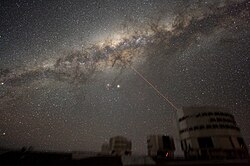
 The Galactic Center as seen from Earth's night sky (featuring the telescope's laser guide star). Listed below is Galactic Center's information. | |
| Observation data (J2000 epoch) | |
| Constellation | Sagittarius |
| Right ascension | 17h 45m 40.03599s[1] |
| Declination | −29° 00′ 28.1699″[1] |
| Distance | 7.935–8.277 kpc (25,881–26,996 ly)[2][3][4][a] |
| Characteristics | |
| Type | Sb; Sbc; SB(rs)bc[5][6] |
| Mass | 1.15×10¹²[7][8][9] M☉ |
| Number of stars | 100–400 billion ((1–4)×1011)[12][13] |
| Size | 26.8 ± 1.1 kpc (87,400 ± 3,600 ly) (diameter; D25 isophote)[10][b] |
| Half-light radius (physical) | 5.75±0.38 kpc[14] |
| H I scale length (physical) | 70 kpc (228,000 ly)[15] |
| Thickness of thin disk | 220–450 pc (718–1,470 ly)[16] |
| Thickness of thick disk | 2.6 ± 0.5 kpc (8,500 ± 1,600 ly)[16] |
| Angular momentum | ~1×1067 J s[17] |
| Sun's Galactic rotation period | 212 Myr[18] |
| Spiral pattern rotation period | 220–360 Myr[19] |
| Bar pattern rotation period | 160–180 Myr[20] |
| Speed relative to CMB rest frame | 552.2±5.5 km/s[21] |
| Escape velocity at Sun's position | 550 km/s[22] |
| Dark matter density at Sun's position | 0.0088+0.0024 −0.0018 M☉pc−3 (0.35+0.08 −0.07 GeV cm−3)[22] |
The Milky Way or Milky Way Galaxy[c] is the galaxy that includes the Solar System, with the name describing the galaxy's appearance from Earth: a hazy band of light seen in the night sky formed from stars in other arms of the galaxy, which are so far away that they cannot be individually distinguished by the naked eye.
The Milky Way is a barred spiral galaxy with a D25 isophotal diameter estimated at 26.8 ± 1.1 kiloparsecs (87,400 ± 3,600 light-years),[10] but only about 1,000 light-years thick at the spiral arms (more at the bulge). Recent simulations suggest that a dark matter area, also containing some visible stars, may extend up to a diameter of almost 2 million light-years (613 kpc).[28][29] The Milky Way has several satellite galaxies and is part of the Local Group of galaxies, forming part of the Virgo Supercluster which is itself a component of the Laniakea Supercluster.[30][31]
It is estimated to contain 100–400 billion stars[32][33] and at least that number of planets.[34][35] The Solar System is located at a radius of about 27,000 light-years (8.3 kpc) from the Galactic Center,[36] on the inner edge of the Orion Arm, one of the spiral-shaped concentrations of gas and dust. The stars in the innermost 10,000 light-years form a bulge and one or more bars that radiate from the bulge. The Galactic Center is an intense radio source known as Sagittarius A*, a supermassive black hole of 4.100 (± 0.034) million solar masses.[37][38] The oldest stars in the Milky Way are nearly as old as the universe itself and thus probably formed shortly after the Dark Ages of the Big Bang.[39]
Galileo Galilei first resolved the band of light into individual stars with his telescope in 1610. Until the early 1920s, most astronomers thought that the Milky Way contained all the stars in the universe.[40] Following the 1920 Great Debate between the astronomers Harlow Shapley and Heber Doust Curtis,[41] observations by Edwin Hubble in 1923 showed that the Milky Way was just one of many galaxies.
Mythology
[edit]In the Babylonian epic poem Enūma Eliš, the Milky Way is created from the severed tail of the primeval salt water dragon Tiamat, set in the sky by Marduk, the Babylonian national god, after slaying her.[42][43] This story was once thought to have been based on an older Sumerian version in which Tiamat is instead slain by Enlil of Nippur,[44][45] but is now thought to be purely an invention of Babylonian propagandists with the intention of showing Marduk as superior to the Sumerian deities.[45]
Etymology
[edit]In Greek mythology, Zeus places Heracles, his infant son born to Alcmene, on Hera's breast while she is asleep so the baby will drink her divine milk and become immortal. Hera wakes up while breastfeeding and then realizes she is nursing an unknown baby: she pushes the baby away, some of her milk spills, and it produces the band of light known as the Milky Way.[46] In another Greek story, the abandoned Heracles is given by Athena to Hera for feeding, but Heracles' forcefulness causes Hera to rip him from her breast in pain.[47][48][49]
In Western culture, the name "Milky Way" is derived from its appearance as a dim unresolved "milky" glowing band arching across the night sky. The term is a translation of the Classical Latin via lactea, in turn derived from the Hellenistic Greek γαλαξίας, short for γαλαξίας κύκλος (galaxías kýklos), meaning "milky circle". The Ancient Greek γαλαξίας (galaxias) – from root γαλακτ-, γάλα ("milk") + -ίας (forming adjectives) – is also the root of "galaxy", the name for our, and later all such, collections of stars.[50][51][52] The Milky Way, or "milk circle", was just one of 11 "circles" the Greeks identified in the sky, others being the zodiac, the meridian, the horizon, the equator, the tropics of Cancer and Capricorn, the Arctic Circle and the Antarctic Circle, and two colure circles passing through both poles.[53] The English term can be traced back to a story by Geoffrey Chaucer c. 1380:
See yonder, lo, the Galaxyë
Which men clepeth the Milky Wey,
For hit is whyt: and somme, parfey,
Common names
[edit]- "Birds' Path" is used in several Uralic and Turkic languages and in the Baltic languages. Northern peoples observed that migratory birds follow the course of the galaxy[55] while migrating at the Northern Hemisphere. The name "Birds' Path" (in Finnish, Estonian, Latvian, Lithuanian, Bashkir and Kazakh) has some variations in other languages, e.g. "Way of the grey (wild) goose" in Chuvash, Mari and Tatar and "Way of the Crane" in Erzya and Moksha.
- House river: The Kaurna people of the Adelaide Plains of South Australia called the Milky Way wodliparri in the Kaurna language, meaning "house river".[56]
- Emu in the Sky: The Gomeroi people between New South Wales and Queensland called the Milky Way Dhinawan, the giant Emu in the Sky that it stretches across the night sky.[57]
- Milky Way: Many European languages have borrowed, directly or indirectly, the Greek name for the Milky Way, including English and Latin.
- Road to Santiago: the Milky Way was traditionally used as a guide by pilgrims traveling to the holy site at Compostela, hence the use of "The Road to Santiago" as a name for the Milky Way.[58] Curiously, La Voje Ladee "The Milky Way" was also used to refer to the pilgrimage road.[59]
- River Ganga of the Sky: this Sanskrit name (आकाशगंगा Ākāśagaṃgā) is used in many Indian languages following a Hindu belief .
- Silver River: this Chinese name "Silver River" (銀河) is used throughout East Asia, including Korea and Vietnam (Ngân hà). In Japan and Korea, "Silver River" (Japanese: 銀河, romanized: ginga; Korean: 은하; RR: eunha) means galaxies in general.
- River of Heaven: The Japanese name for the Milky Way is the "River of Heaven" (天の川, Amanokawa), as well as an alternative name in Chinese (Chinese: 天河; pinyin: Tiānhé). In Vietnamese, "River of Heaven" (Thiên hà) means galaxies in general.
- Straw Way: In West Asia, Central Asia and parts of the Balkans the name for the Milky Way is related to the word for straw. Today, Persians, Pakistanis, and Turks use it in addition to Arabs. It has been suggested that the term was spread by medieval Arabs who in turn borrowed it from Armenians.[60]
- Walsingham Way: In England the Milky Way was called the Walsingham Way in reference to the shrine of Our Lady of Walsingham which is in Norfolk, England. It was understood to be either a guide to the pilgrims who flocked there, or a representation of the pilgrims themselves.[61]
- Winter Street: Scandinavian peoples, such as Swedes, have called the galaxy Winter Street (Vintergatan) as the galaxy is most clearly visible during the winter at the northern hemisphere, especially at high latitudes where the glow of the Sun late at night can obscure it during the summer.
Appearance
[edit]
The Milky Way is visible as a hazy band of white light, some 30° wide, arching in the night sky.[62] Although all the individual naked-eye stars in the entire sky are part of the Milky Way Galaxy, the term "Milky Way" is limited to this band of light.[63][64] The light originates from the accumulation of unresolved stars and other material located in the direction of the galactic plane. Brighter regions around the band appear as soft visual patches known as star clouds. The most conspicuous of these is the Large Sagittarius Star Cloud, a portion of the central bulge of the galaxy.[65] Dark regions within the band, such as the Great Rift and the Coalsack, are areas where interstellar dust blocks light from distant stars. Peoples of the southern hemisphere, including the Inca and Australian Aboriginals, identified these regions as dark cloud constellations.[66] The area of sky that the Milky Way obscures is called the Zone of Avoidance.[67]
The Milky Way has a relatively low surface brightness. Its visibility can be greatly reduced by background light, such as light pollution or moonlight. The sky needs to be darker than about 20.2 magnitude per square arcsecond in order for the Milky Way to be visible.[68] It should be visible if the limiting magnitude is approximately +5.1 or better and shows a great deal of detail at +6.1.[69] This makes the Milky Way difficult to see from brightly lit urban or suburban areas, but very prominent when viewed from rural areas when the Moon is below the horizon.[d] Maps of artificial night sky brightness show that more than one-third of Earth's population cannot see the Milky Way from their homes due to light pollution.[70]
As viewed from Earth, the visible region of the Milky Way's galactic plane occupies an area of the sky that includes 30 constellations.[e] The Galactic Center lies in the direction of Sagittarius, where the Milky Way is brightest. From Sagittarius, the hazy band of white light appears to pass around to the galactic anticenter in Auriga. The band then continues the rest of the way around the sky, back to Sagittarius, dividing the sky into two roughly equal hemispheres.[71]
The galactic plane is inclined by about 60° to the ecliptic (the path of the Sun in the sky). It is tilted at an angle of 63° to the celestial equator.[72]
Astronomical history
[edit]Ancient, naked eye observations
[edit]In Meteorologica, Aristotle (384–322 BC) states that the Greek philosophers Anaxagoras (c. 500–428 BC) and Democritus (460–370 BC) proposed that the Milky Way is the glow of stars not directly visible due to Earth's shadow, while other stars receive their light from the Sun, but have their glow obscured by solar rays.[73] Aristotle himself believed that the Milky Way was part of the Earth's upper atmosphere, along with the stars, and that it was a byproduct of stars burning that did not dissipate because of its outermost location in the atmosphere, composing its great circle. He said that the milky appearance of the Milky Way Galaxy is due to the refraction of the Earth's atmosphere.[74][75][76] The Neoplatonist philosopher Olympiodorus the Younger (c. 495–570 AD) criticized this view, arguing that if the Milky Way were sublunary, it should appear different at different times and places on Earth, and that it should have parallax, which it does not. In his view, the Milky Way is celestial. This idea would be influential later in the Muslim world.[77]
The Persian astronomer Al-Biruni (973–1048) proposed that the Milky Way is "a collection of countless fragments of the nature of nebulous stars".[78] The Andalusian astronomer Avempace (died 1138) proposed that the Milky Way was made up of many stars but appeared to be a continuous image in the Earth's atmosphere, citing his observation of a conjunction of Jupiter and Mars in 1106 or 1107 as evidence.[75] The Persian astronomer Nasir al-Din al-Tusi (1201–1274) in his Tadhkira wrote: "The Milky Way, i.e. the Galaxy, is made up of a very large number of small, tightly clustered stars, which, on account of their concentration and smallness, seem to be cloudy patches. Because of this, it was likened to milk in color."[79] Ibn Qayyim al-Jawziyya (1292–1350) proposed that the Milky Way is "a myriad of tiny stars packed together in the sphere of the fixed stars".[80]
Telescopic observations
[edit]
Proof of the Milky Way consisting of many stars came in 1610 when Galileo Galilei used a telescope to study the Milky Way and discovered that it was composed of a huge number of faint stars. Galileo also concluded that the appearance of the Milky Way was due to refraction of the Earth's atmosphere.[81][82][74] In a treatise in 1755, Immanuel Kant, drawing on earlier work by Thomas Wright,[83] speculated (correctly) that the Milky Way might be a rotating body of a huge number of stars, held together by gravitational forces akin to the Solar System but on much larger scales.[84] The resulting disk of stars would be seen as a band in the sky from our perspective inside the disk. Wright and Kant also conjectured that some of the nebulae visible in the night sky might be separate "galaxies" themselves, similar to our own. Kant referred to both the Milky Way and the "extragalactic nebulae" as "island universes", a term still current up to the 1930s.[85][86][87]
The first attempt to describe the shape of the Milky Way and the position of the Sun within it was carried out by William Herschel in 1785 by carefully counting the number of stars in different regions of the visible sky. He produced a diagram of the shape of the Milky Way with the Solar System close to the center.[88]
In 1845, Lord Rosse constructed a new telescope and was able to distinguish between elliptical and spiral-shaped nebulae. He also managed to make out individual point sources in some of these nebulae, lending credence to Kant's earlier conjecture.[89][90]

In 1904, studying the proper motions of stars, Jacobus Kapteyn reported that these were not random, as it was believed in that time; stars could be divided into two streams, moving in nearly opposite directions.[91] It was later realized that Kapteyn's data had been the first evidence of the rotation of the Milky Way,[92] which ultimately led to the finding of galactic rotation by Bertil Lindblad and Jan Oort.
In 1917, Heber Doust Curtis had observed the nova S Andromedae within the Great Andromeda Nebula (Messier object 31). Searching the photographic record, he found 11 more novae. Curtis noticed that these novae were, on average, 10 magnitudes fainter than those that occurred within the Milky Way. As a result, he was able to come up with a distance estimate of 150,000 parsecs. He became a proponent of the "island universes" hypothesis, which held that the spiral nebulae were independent galaxies.[93][94] In 1920 the Great Debate took place between Harlow Shapley and Heber Curtis, concerning the nature of the Milky Way, spiral nebulae, and the dimensions of the Universe. To support his claim that the Great Andromeda Nebula is an external galaxy, Curtis noted the appearance of dark lanes resembling the dust clouds in the Milky Way, as well as the significant Doppler shift.[95]
The controversy was conclusively settled by Edwin Hubble in the early 1920s using the Mount Wilson observatory 2.5 m (100 in) Hooker telescope. With the light-gathering power of this new telescope, he was able to produce astronomical photographs that resolved the outer parts of some spiral nebulae as collections of individual stars. He was also able to identify some Cepheid variables that he could use as a benchmark to estimate the distance to the nebulae. He found that the Andromeda Nebula is 275,000 parsecs from the Sun, far too distant to be part of the Milky Way.[96][97]
Satellite observations
[edit].png)
The ESA spacecraft Gaia provides distance estimates by determining the parallax of a billion stars and is mapping the Milky Way.[98][99]
Data from Gaia has been described as "transformational". It has been estimated that Gaia has expanded the number of observations of stars from about 2 million stars, as of the 1990s, to 2 billion. It has expanded the measurable volume of space by a factor of 100 in radius and a factor of 1,000 in precision.[100]
A study in 2020 concluded that Gaia detected a wobbling motion of the galaxy, which might be caused by "torques from a misalignment of the disc's rotation axis with respect to the principal axis of a non-spherical halo, or from accreted matter in the halo acquired during late infall, or from nearby, interacting satellite galaxies and their consequent tides".[101] In April 2024, initial studies and related maps, involving the magnetic fields of the Milky Way were reported.[102]
Astrography
[edit]Sun's location and neighborhood
[edit].png)
The Sun is near the inner rim of the Orion Arm, within the Local Fluff of the Local Bubble, between the Radcliffe wave and Split linear structures (formerly Gould Belt).[103] Based upon studies of stellar orbits around Sgr A* by Gillessen et al. (2016), the Sun lies at an estimated distance of 27.14 ± 0.46 kly (8.32 ± 0.14 kpc)[36] from the Galactic Center. Boehle et al. (2016) found a smaller value of 25.64 ± 0.46 kly (7.86 ± 0.14 kpc), also using a star orbit analysis.[104] The Sun is currently 5–30 parsecs (16–98 ly) above, or north of, the central plane of the Galactic disk.[105] The distance between the local arm and the next arm out, the Perseus Arm, is about 2,000 parsecs (6,500 ly).[106] The Sun, and thus the Solar System, is located in the Milky Way's galactic habitable zone.[107][108]
There are about 208 stars brighter than absolute magnitude 8.5 within a sphere with a radius of 15 parsecs (49 ly) from the Sun, giving a density of one star per 69 cubic parsecs, or one star per 2,360 cubic light-years (from List of nearest bright stars). On the other hand, there are 64 known stars (of any magnitude, not counting 4 brown dwarfs) within 5 parsecs (16 ly) of the Sun, giving a density of about one star per 8.2 cubic parsecs, or one per 284 cubic light-years (from List of nearest stars). This illustrates the fact that there are far more faint stars than bright stars: in the entire sky, there are about 500 stars brighter than apparent magnitude 4 but 15.5 million stars brighter than apparent magnitude 14.[109]
The apex of the Sun's way, or the solar apex, is the direction that the Sun travels through the Local standard of rest in the Milky Way. The general direction of the Sun's Galactic motion is towards the star Deneb near the constellation of Cygnus, at an angle of roughly 90 sky degrees to the direction of the Galactic Center. The Sun's orbit about the Milky Way is expected to be roughly elliptical with the addition of perturbations due to the Galactic spiral arms and non-uniform mass distributions. In addition, the Sun passes through the Galactic plane approximately 2.7 times per orbit.[110] This is very similar to how a simple harmonic oscillator works with no drag force (damping) term. These oscillations were until recently thought to coincide with mass lifeform extinction periods on Earth.[111] A reanalysis of the effects of the Sun's transit through the spiral structure based on CO data has failed to find a correlation.[112]
It takes the Solar System about 240 million years to complete one orbit of the Milky Way (a galactic year),[113] so the Sun is thought to have completed 18–20 orbits during its lifetime and 1/1250 of a revolution since the origin of humans. The orbital speed of the Solar System about the center of the Milky Way is approximately 220 km/s (490,000 mph) or 0.073% of the speed of light. The Sun moves through the heliosphere at 84,000 km/h (52,000 mph). At this speed, it takes around 1,400 years for the Solar System to travel a distance of 1 light-year, or 8 days to travel 1 AU (astronomical unit).[114] The Solar System is headed in the direction of the zodiacal constellation Scorpius, which follows the ecliptic.[115]
Galactic quadrants
[edit]
A galactic quadrant, or quadrant of the Milky Way, refers to one of four circular sectors in the division of the Milky Way. In astronomical practice, the delineation of the galactic quadrants is based upon the galactic coordinate system, which places the Sun as the origin of the mapping system.[116]
Quadrants are described using ordinals – for example, "1st galactic quadrant",[117] "second galactic quadrant",[118] or "third quadrant of the Milky Way".[119] Viewing from the north galactic pole with 0° (zero degrees) as the ray that runs starting from the Sun and through the Galactic Center, the quadrants are:
with the galactic longitude (ℓ) increasing in the counter-clockwise direction (positive rotation) as viewed from north of the Galactic Center (a view-point several hundred thousand light-years distant from Earth in the direction of the constellation Coma Berenices); if viewed from south of the Galactic Center (a view-point similarly distant in the constellation Sculptor), ℓ would increase in the clockwise direction (negative rotation).
Size and mass
[edit]Size
[edit]
The Milky Way is one of the two largest galaxies in the Local Group (the other being the Andromeda Galaxy), although the size for its galactic disc and how much it defines the isophotal diameter is not well understood.[11] It is estimated that the significant bulk of stars in the galaxy lies within the 26 kiloparsecs (80,000 light-years) diameter, and that the number of stars beyond the outermost disc dramatically reduces to a very low number, with respect to an extrapolation of the exponential disk with the scale length of the inner disc.[121][11]
There are several methods being used in astronomy in defining the size of a galaxy, and each of them can yield different results with respect to one another. The most commonly employed method is the D25 standard – the isophote where the photometric brightness of a galaxy in the B-band (445 nm wavelength of light, in the blue part of the visible spectrum) reaches 25 mag/arcsec2.[122] An estimate from 1997 by Goodwin and others compared the distribution of Cepheid variable stars in 17 other spiral galaxies to the ones in the Milky Way, and modelling the relationship to their surface brightnesses. This gave an isophotal diameter for the Milky Way at 26.8 ± 1.1 kiloparsecs (87,400 ± 3,600 light-years), by assuming that the galactic disc is well represented by an exponential disc and adopting a central surface brightness of the galaxy (μ0) of 22.1±0.3 B-mag/arcsec−2 and a disk scale length (h) of 5.0 ± 0.5 kpc (16,300 ± 1,600 ly).[123][10][124]
This is significantly smaller than the Andromeda Galaxy's isophotal diameter, and slightly below the mean isophotal sizes of the galaxies being at 28.3 kpc (92,000 ly).[10] The paper concludes that the Milky Way and Andromeda Galaxy were not overly large spiral galaxies, nor were among the largest known (if the former not being the largest) as previously widely believed, but rather average ordinary spiral galaxies.[125] To compare the relative physical scale of the Milky Way, if the Solar System out to Neptune were the size of a US quarter (24.3 mm (0.955 in)), the Milky Way would be approximately at least the greatest north–south line of the contiguous United States.[126] An even older study from 1978 gave a lower diameter for Milky Way of about 23 kpc (75,000 ly).[10]
A 2015 paper discovered that there is a ring-like filament of stars called Triangulum–Andromeda Ring (TriAnd Ring) rippling above and below the relatively flat galactic plane, which alongside Monoceros Ring were both suggested to be primarily the result of disk oscillations and wrapping around the Milky Way, at a diameter of at least 50 kpc (160,000 ly),[127] which may be part of the Milky Way's outer disk itself, hence making the stellar disk larger by increasing to this size.[128] A more recent 2018 paper later somewhat ruled out this hypothesis, and supported a conclusion that the Monoceros Ring, A13 and TriAnd Ring were stellar overdensities rather kicked out from the main stellar disk, with the velocity dispersion of the RR Lyrae stars found to be higher and consistent with halo membership.[129]
Another 2018 study revealed the very probable presence of disk stars at 26–31.5 kpc (84,800–103,000 ly) from the Galactic Center or perhaps even farther, significantly beyond approximately 13–20 kpc (40,000–70,000 ly), in which it was once believed to be the abrupt drop-off of the stellar density of the disk, meaning that few or no stars were expected to be above this limit, save for stars that belong to the old population of the galactic halo.[11][130][131]
A 2020 study predicted the edge of the Milky Way's dark matter halo being around 292 ± 61 kpc (952,000 ± 199,000 ly), which translates to a diameter of 584 ± 122 kpc (1.905 ± 0.3979 Mly).[28][29] The Milky Way's stellar disk is also estimated to be approximately up to 1.35 kpc (4,000 ly) thick.[132][133]
Mass
[edit]
Abbreviations: GNP/GSP: Galactic North and South Poles
The Milky Way is approximately 0.88 trillion times the mass of the Sun in total (8.8×10¹¹ solar masses), using a cutoff of 200kpc to define the galaxy.[134] Estimates of the mass of the Milky Way vary, depending upon the method and data used. The low end of the estimate range is 5.8×10¹¹ solar masses (M☉), somewhat less than that of the Andromeda Galaxy.[135][136][137]
Measurements using the Very Long Baseline Array in 2009 found velocities as large as 254 km/s (570,000 mph) for stars at the outer edge of the Milky Way.[138] Because the orbital velocity depends on the total mass inside the orbital radius, this suggests that the Milky Way is more massive, roughly equaling the mass of Andromeda Galaxy at 7×10¹¹ M☉ within 160,000 ly (49 kpc) of its center.[139] In 2010, a measurement of the radial velocity of halo stars found that the mass enclosed within 80 kiloparsecs is 7×10¹¹ M☉.[140] In a 2014 study, the mass of the entire Milky Way is estimated to be 8.5×10¹¹ M☉,[141] but this is only half the mass of the Andromeda Galaxy.[141] A recent 2019 mass estimate for the Milky Way is 1.29×10¹² M☉.[142]
Much of the mass of the Milky Way seems to be dark matter, an unknown and invisible form of matter that interacts gravitationally with ordinary matter. A dark matter halo is conjectured to spread out relatively uniformly to a distance beyond one hundred kiloparsecs (kpc) from the Galactic Center. Mathematical models of the Milky Way suggest that the mass of dark matter is 1–1.5×10¹² M☉.[143][144][145] 2013 and 2014 studies indicate a range in mass, as large as 4.5×10¹² M☉[146] and as small as 8×10¹¹ M☉.[147] By comparison, the total mass of all the stars in the Milky Way is estimated to be between 4.6×10¹⁰ M☉[148] and 6.43×10¹⁰ M☉.[143]
In addition to the stars, there is also interstellar gas, comprising 90% hydrogen and 10% helium by mass,[149] with two thirds of the hydrogen found in the atomic form and the remaining one-third as molecular hydrogen.[150] The mass of the Milky Way's interstellar gas is equal to between 10%[150] and 15%[149] of the total mass of its stars. Interstellar dust accounts for an additional 1% of the total mass of the gas.[149]
In March 2019, astronomers reported that the virial mass of the Milky Way Galaxy is 1.54×10¹² solar masses within a radius of about 39.5 kpc (130,000 ly), over twice as much as was determined in earlier studies, suggesting that about 90% of the mass of the galaxy is dark matter.[7][8]
In September 2023, astronomers reported that the virial mass of the Milky Way Galaxy is only 2.06×10¹¹ solar masses, only a tenth of the mass of previous studies. The mass was determined from data of the Gaia spacecraft.[151]
Contents
[edit]
The Milky Way contains between 100 and 400 billion stars[12][13] and at least that many planets.[152] An exact figure would depend on counting the number of very-low-mass stars, which are difficult to detect, especially at distances of more than 300 ly (90 pc) from the Sun. As a comparison, the neighboring Andromeda Galaxy contains an estimated one trillion (1012) stars.[153] The Milky Way may contain ten billion white dwarfs, a billion neutron stars, and a hundred million stellar black holes.[f][156][157] Filling the space between the stars is a disk of gas and dust called the interstellar medium. This disk has at least a comparable extent in radius to the stars,[158] whereas the thickness of the gas layer ranges from hundreds of light-years for the colder gas to thousands of light-years for the warmer gas.[159][160]
The disk of stars in the Milky Way does not have a sharp edge beyond which there are no stars. Rather, the concentration of stars decreases with distance from the center of the Milky Way. Beyond a radius of roughly 40,000 light years (13 kpc) from the center, the number of stars per cubic parsec drops much faster with radius.[121] Surrounding the galactic disk is a spherical galactic halo of stars and globular clusters that extends farther outward, but is limited in size by the orbits of two Milky Way satellites, the Large and Small Magellanic Clouds, whose closest approach to the Galactic Center is about 180,000 ly (55 kpc).[161] At this distance or beyond, the orbits of most halo objects would be disrupted by the Magellanic Clouds. Hence, such objects would probably be ejected from the vicinity of the Milky Way. The integrated absolute visual magnitude of the Milky Way is estimated to be around −20.9.[162][163][g]
Both gravitational microlensing and planetary transit observations indicate that there may be at least as many planets bound to stars as there are stars in the Milky Way,[34][164] and microlensing measurements indicate that there are more rogue planets not bound to host stars than there are stars.[165][166] The Milky Way contains an average of at least one planet per star, resulting in 100–400 billion planets, according to a January 2013 study of the five-planet star system Kepler-32 by the Kepler space observatory.[35] A different January 2013 analysis of Kepler data estimated that at least 17 billion Earth-sized exoplanets reside in the Milky Way.[167]
In November 2013, astronomers reported, based on Kepler space mission data, that there could be as many as 40 billion Earth-sized planets orbiting in the habitable zones of Sun-like stars and red dwarfs within the Milky Way.[168][169][170] 11 billion of these estimated planets may be orbiting Sun-like stars.[171] The nearest exoplanet may be 4.2 light-years away, orbiting the red dwarf Proxima Centauri, according to a 2016 study.[172] Such Earth-sized planets may be more numerous than gas giants,[34] though harder to detect at great distances given their small size. Besides exoplanets, "exocomets", comets beyond the Solar System, have also been detected and may be common in the Milky Way.[173] More recently, in November 2020, over 300 million habitable exoplanets are estimated to exist in the Milky Way Galaxy.[174]
When compared to other more distant galaxies in the universe, the Milky Way galaxy has a below average amount of neutrino luminosity making our galaxy a "neutrino desert".[175]
Structure
[edit]
The Milky Way consists of a bar-shaped core region surrounded by a warped disk of gas, dust and stars.[176][177] The mass distribution within the Milky Way closely resembles the type Sbc in the Hubble classification, which represents spiral galaxies with relatively loosely wound arms.[5] Astronomers first began to conjecture that the Milky Way is a barred spiral galaxy, rather than an ordinary spiral galaxy, in the 1960s.[178][179][180] These conjectures were confirmed by the Spitzer Space Telescope observations in 2005 that showed the Milky Way's central bar to be larger than previously thought.[181]
Galactic Center
[edit]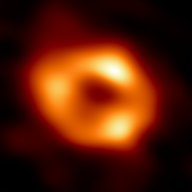

The Sun is 25,000–28,000 ly (7.7–8.6 kpc) from the Galactic Center. This value is estimated using geometric-based methods or by measuring selected astronomical objects that serve as standard candles, with different techniques yielding various values within this approximate range.[183][104][36][184][185][186] In the inner few kiloparsecs (around 10,000 light-years radius) is a dense concentration of mostly old stars in a roughly spheroidal shape called the bulge.[187] It has been proposed that the Milky Way lacks a bulge due to a collision and merger between previous galaxies, and that instead it only has a pseudobulge formed by its central bar.[188] However, confusion in the literature between the (peanut shell)-shaped structure created by instabilities in the bar, versus a possible bulge with an expected half-light radius of 0.5 kpc, abounds.[189]
The Galactic Center is marked by an intense radio source named Sagittarius A* (pronounced Sagittarius A-star). The motion of material around the center indicates that Sagittarius A* harbors a massive, compact object.[190] This concentration of mass is best explained as a supermassive black hole[h][183][191] (SMBH) with an estimated mass of 4.1–4.5 million times the mass of the Sun.[191] The rate of accretion of the SMBH is consistent with an inactive galactic nucleus, being estimated at 1×10⁻⁵ M☉ per year.[192] Observations indicate that there are SMBHs located near the center of most normal galaxies.[193][194]
The nature of the Milky Way's bar is actively debated, with estimates for its half-length and orientation spanning from 1 to 5 kpc (3,000–16,000 ly) and 10–50 degrees relative to the line of sight from Earth to the Galactic Center.[185][186][195] Certain authors advocate that the Milky Way features two distinct bars, one nestled within the other.[196] However, RR Lyrae-type stars do not trace a prominent Galactic bar.[186][197][198] The bar may be surrounded by a ring called the "5 kpc ring" that contains a large fraction of the molecular hydrogen present in the Milky Way, as well as most of the Milky Way's star formation activity. Viewed from the Andromeda Galaxy, it would be the brightest feature of the Milky Way.[199] X-ray emission from the core is aligned with the massive stars surrounding the central bar[192] and the Galactic ridge.[200]
In June 2023, astronomers led by Naoko Kurahashi Neilson reported using a new cascade neutrino technique[201] to detect, for the first time, the release of neutrinos from the galactic plane of the Milky Way galaxy, creating the first neutrino view of the Milky Way.[202][203]
Gamma rays and x-rays
[edit]
Since 1970, various gamma-ray detection missions have discovered 511-keV gamma rays coming from the general direction of the Galactic Center. These gamma rays are produced by positrons (antielectrons) annihilating with electrons. In 2008 it was found that the distribution of the sources of the gamma rays resembles the distribution of low-mass X-ray binaries, seeming to indicate that these X-ray binaries are sending positrons (and electrons) into interstellar space where they slow down and annihilate.[204][205][206] The observations were made by both NASA and ESA's satellites. In 1970 gamma ray detectors found that the emitting region was about 10,000 light-years across with a luminosity of about 10,000 Suns.[205]

In 2010, two gigantic spherical bubbles of high energy gamma-emission were detected to the north and the south of the Milky Way core, using data from the Fermi Gamma-ray Space Telescope. The diameter of each of the bubbles is about 25,000 light-years (7.7 kpc) (or about 1/4 of the galaxy's estimated diameter); they stretch up to Grus and to Virgo on the night-sky of the southern hemisphere.[207][208] Subsequently, observations with the Parkes Telescope at radio frequencies identified polarized emission that is associated with the Fermi bubbles. These observations are best interpreted as a magnetized outflow driven by star formation in the central 640 ly (200 pc) of the Milky Way.[209]
Later, on January 5, 2015, NASA reported observing an X-ray flare 400 times brighter than usual, a record-breaker, from Sagittarius A*. The unusual event may have been caused by the breaking apart of an asteroid falling into the black hole or by the entanglement of magnetic field lines within gas flowing into Sagittarius A*.[182]
Spiral arms
[edit]
Outside the gravitational influence of the Galactic bar, the structure of the interstellar medium and stars in the disk of the Milky Way is organized into four spiral arms.[210] Spiral arms typically contain a higher density of interstellar gas and dust than the Galactic average as well as a greater concentration of star formation, as traced by H II regions[211][212] and molecular clouds.[213]
The Milky Way's spiral structure is uncertain, and there is currently no consensus on the nature of the Milky Way's arms.[214] Perfect logarithmic spiral patterns only crudely describe features near the Sun,[212][215] because galaxies commonly have arms that branch, merge, twist unexpectedly, and feature a degree of irregularity.[186][215][216] The possible scenario of the Sun within a spur / Local arm[212] emphasizes that point and indicates that such features are probably not unique, and exist elsewhere in the Milky Way.[215] Estimates of the pitch angle of the arms range from about 7° to 25°.[158][217] There are thought to be four spiral arms that all start near the Milky Way Galaxy's center.[218] These are named as follows, with the positions of the arms shown in the image:
| Color | Arm(s) |
|---|---|
| turquoise | Near 3 kpc and Perseus Arm |
| blue | Norma and Outer arm (Along with extension discovered in 2004[219]) |
| green | Far 3 kpc and Scutum–Centaurus Arm |
| red | Carina–Sagittarius Arm |
| There are at least two smaller arms or spurs, including: | |
| orange | Orion–Cygnus Arm (which contains the Sun and Solar System) |
Two spiral arms, the Scutum–Centaurus arm and the Carina–Sagittarius arm, have tangent points inside the Sun's orbit about the center of the Milky Way. If these arms contain an overdensity of stars compared to the average density of stars in the Galactic disk, it would be detectable by counting the stars near the tangent point. Two surveys of near-infrared light, which is sensitive primarily to red giants and not affected by dust extinction, detected the predicted overabundance in the Scutum–Centaurus arm but not in the Carina–Sagittarius arm: the Scutum–Centaurus Arm contains approximately 30% more red giants than would be expected in the absence of a spiral arm.[217][220]
This observation suggests that the Milky Way possesses only two major stellar arms: the Perseus arm and the Scutum–Centaurus arm. The rest of the arms contain excess gas but not excess old stars.[214] In December 2013, astronomers found that the distribution of young stars and star-forming regions matches the four-arm spiral description of the Milky Way.[221][222][223] Thus, the Milky Way appears to have two spiral arms as traced by old stars and four spiral arms as traced by gas and young stars. The explanation for this apparent discrepancy is unclear.[223]
The Near 3 kpc Arm (also called the Expanding 3 kpc Arm or simply the 3 kpc Arm) was discovered in the 1950s by astronomer van Woerden and collaborators through 21 centimeter radio measurements of HI (atomic hydrogen).[224][225] It was found to be expanding away from the central bulge at more than 50 km/s. It is located in the fourth galactic quadrant at a distance of about 5.2 kpc from the Sun and 3.3 kpc from the Galactic Center. The Far 3 kpc Arm was discovered in 2008 by astronomer Tom Dame (Center for Astrophysics | Harvard & Smithsonian). It is located in the first galactic quadrant at a distance of 3 kpc (about 10,000 ly) from the Galactic Center.[225][226]
A simulation published in 2011 suggested that the Milky Way may have obtained its spiral arm structure as a result of repeated collisions with the Sagittarius Dwarf Elliptical Galaxy.[227]
It has been suggested that the Milky Way contains two different spiral patterns: an inner one, formed by the Sagittarius arm, that rotates fast and an outer one, formed by the Carina and Perseus arms, whose rotation velocity is slower and whose arms are tightly wound. In this scenario, suggested by numerical simulations of the dynamics of the different spiral arms, the outer pattern would form an outer pseudoring,[228] and the two patterns would be connected by the Cygnus arm.[229]
Outside of the major spiral arms is the Monoceros Ring (or Outer Ring), a ring of gas and stars torn from other galaxies billions of years ago. However, several members of the scientific community recently restated their position affirming the Monoceros structure is nothing more than an over-density produced by the flared and warped thick disk of the Milky Way.[230] The structure of the Milky Way's disk is warped along an "S" curve.[231]
Halo
[edit]The Galactic disk is surrounded by a spheroidal halo of old stars and globular clusters, of which 90% lie within 100,000 light-years (30 kpc) of the Galactic Center.[232] However, a few globular clusters have been found farther, such as PAL 4 and AM 1 at more than 200,000 light-years from the Galactic Center. About 40% of the Milky Way's clusters are on retrograde orbits, which means they move in the opposite direction from the Milky Way rotation.[233] The globular clusters can follow rosette orbits about the Milky Way, in contrast to the elliptical orbit of a planet around a star.[234]
Although the disk contains dust that obscures the view at some wavelengths, the halo component does not. Active star formation takes place in the disk (especially in the spiral arms, which represent areas of high density), but does not take place in the halo, as there is little cool gas to collapse into stars.[113] Open clusters are also located primarily on the disk.[235]
Discoveries in the early 21st century have added dimension to the knowledge of the Milky Way's structure. With the discovery that the disk of the Andromeda Galaxy (M31) extends much farther than previously thought,[236] the possibility of the disk of the Milky Way extending farther is apparent, and this is supported by evidence from the discovery of the Outer Arm extension of the Cygnus Arm[219][237] and of a similar extension of the Scutum–Centaurus Arm.[238] With the discovery of the Sagittarius Dwarf Elliptical Galaxy came the discovery of a ribbon of galactic debris as the polar orbit of the dwarf and its interaction with the Milky Way tears it apart. Upon the 2004 discovery of a ring of galactic debris in an in-plane orbit around the Milky Way, it was initially believed that the debris was the remnant of a system dubbed the Canis Major Dwarf Galaxy.[239] Other scholars believed it to be due to the Galactic warp,[240] a view which has been supported by more recent evidence as of 2021.[241]
The Sloan Digital Sky Survey of the northern sky shows a huge and diffuse structure (spread out across an area around 5,000 times the size of a full moon) within the Milky Way that does not seem to fit within current models. The collection of stars rises close to perpendicular to the plane of the spiral arms of the Milky Way. The proposed likely interpretation is that a dwarf galaxy is merging with the Milky Way. This galaxy is tentatively named the Virgo Stellar Stream and is found in the direction of Virgo about 30,000 light-years (9 kpc) away.[242]
Gaseous halo
[edit]In addition to the stellar halo, the Chandra X-ray Observatory, XMM-Newton, and Suzaku have provided evidence that there is also a gaseous halo containing a large amount of hot gas. This halo extends for hundreds of thousands of light-years, much farther than the stellar halo and close to the distance of the Large and Small Magellanic Clouds. The mass of this hot halo is nearly equivalent to the mass of the Milky Way itself.[243][244][245] The temperature of this halo gas is between 1 and 2.5 million K (1.8 and 4.5 million °F).[246]
Observations of distant galaxies indicate that the Universe had about one-sixth as much baryonic (ordinary) matter as dark matter when it was just a few billion years old. However, only about half of those baryons are accounted for in the modern Universe based on observations of nearby galaxies like the Milky Way.[247] If the finding that the mass of the halo is comparable to the mass of the Milky Way is confirmed, it could be the identity of the missing baryons around the Milky Way.[247]
Galactic rotation
[edit].svg)
The stars and gas in the Milky Way rotate about its center differentially, meaning that the rotation period varies with location. As is typical for spiral galaxies, the orbital speed of most stars in the Milky Way does not depend strongly on their distance from the center. Away from the central bulge or outer rim, the typical stellar orbital speed is between 200 and 220 km/s.[251] Hence the orbital period of the typical star is approximately proportional to the length of the path traveled. This is unlike the situation in the Solar System, where two-body gravitational dynamics dominate, and different orbits have significantly different velocities associated with them. The rotation curve (shown in the figure) describes this rotation.
If the Milky Way contained only the mass observed in stars, gas, and other baryonic (ordinary) matter, the rotational speed would decrease with distance from the center. However, the observed curve is relatively flat, indicating that there is additional mass that cannot be detected directly with electromagnetic radiation. This inconsistency is attributed to dark matter.[248] The rotation curve of the Milky Way agrees with the universal rotation curve of spiral galaxies, the best evidence for the existence of dark matter in galaxies. Alternatively, a minority of astronomers propose that a modification of the law of gravity may explain the observed rotation curve.[252]
Formation
[edit]History
[edit]
The Milky Way began as one or several small overdensities in the mass distribution in the Universe shortly after the Big Bang 13.61 billion years ago.[253][254][255] Some of these overdensities were the seeds of globular clusters in which the oldest remaining stars in what is now the Milky Way formed. Nearly half the matter in the Milky Way may have come from other distant galaxies.[253] These stars and clusters now comprise the stellar halo of the Milky Way. Within a few billion years of the birth of the first stars, the mass of the Milky Way was large enough so that it was spinning relatively quickly. Due to conservation of angular momentum, this led the gaseous interstellar medium to collapse from a roughly spheroidal shape to a disk. Therefore, later generations of stars formed in this spiral disk. Most younger stars, including the Sun, are observed to be in the disk.[256][257]
Since the first stars began to form, the Milky Way has grown through both galaxy mergers (particularly early in the Milky Way's growth) and accretion of gas directly from the Galactic halo.[257] The Milky Way is currently accreting material from several small galaxies, including two of its largest satellite galaxies, the Large and Small Magellanic Clouds, through the Magellanic Stream. Direct accretion of gas is observed in high-velocity clouds like the Smith Cloud.[258][259]
Cosmological simulations indicate that, 11 billion years ago, it merged with a particularly large galaxy that has been labeled the Kraken.[260][261] Properties of the Milky Way such as stellar mass, angular momentum, and metallicity in its outermost regions suggest it has undergone no mergers with large galaxies in the last 10 billion years. This lack of recent major mergers is unusual among similar spiral galaxies. Its neighbour the Andromeda Galaxy appears to have a more typical history shaped by more recent mergers with relatively large galaxies.[262][263]
According to recent studies, the Milky Way as well as the Andromeda Galaxy lie in what in the galaxy color–magnitude diagram is known as the "green valley", a region populated by galaxies in transition from the "blue cloud" (galaxies actively forming new stars) to the "red sequence" (galaxies that lack star formation). Star-formation activity in green valley galaxies is slowing as they run out of star-forming gas in the interstellar medium. In simulated galaxies with similar properties, star formation will typically have been extinguished within about five billion years from now, even accounting for the expected, short-term increase in the rate of star formation due to the collision between both the Milky Way and the Andromeda Galaxy.[264] Measurements of other galaxies similar to the Milky Way suggest it is among the reddest and brightest spiral galaxies that are still forming new stars and it is just slightly bluer than the bluest red sequence galaxies.[265]
Age and cosmological history
[edit]
Globular clusters are among the oldest objects in the Milky Way, which thus set a lower limit on the age of the Milky Way. The ages of individual stars in the Milky Way can be estimated by measuring the abundance of long-lived radioactive elements such as thorium-232 and uranium-238, then comparing the results to estimates of their original abundance, a technique called nucleocosmochronology. These yield values of about 12.5 ± 3 billion years for CS 31082-001[267] and 13.8 ± 4 billion years for BD +17° 3248.[268]
Once a white dwarf is formed, it begins to undergo radiative cooling and the surface temperature steadily drops. By measuring the temperatures of the coolest of these white dwarfs and comparing them to their expected initial temperatures, an age estimate can be made. With this technique, the age of the globular cluster M4 was estimated as 12.7 ± 0.7 billion years. Age estimates of the oldest of these clusters give a best fit estimate of 12.6 billion years, and a 95% confidence upper limit of 16 billion years.[269]
In November 2018, astronomers reported the discovery of one of the oldest stars in the universe. About 13.5 billion-years-old, 2MASS J18082002-5104378 B is a tiny ultra metal-poor (UMP) star made almost entirely of materials released from the Big Bang, and is possibly one of the first stars. The discovery of the star in the Milky Way Galaxy suggests that the galaxy may be at least 3 billion years older than previously thought.[270][271][272]
Several individual stars have been found in the Milky Way's halo with measured ages very close to the 13.80-billion-year age of the Universe. In 2007, a star in the galactic halo, HE 1523-0901, was estimated to be about 13.2 billion years old. As the oldest known object in the Milky Way at that time, this measurement placed a lower limit on the age of the Milky Way.[273] This estimate was made using the UV-Visual Echelle Spectrograph of the Very Large Telescope to measure the relative strengths of spectral lines caused by the presence of thorium and other elements created by the R-process. The line strengths yield abundances of different elemental isotopes, from which an estimate of the age of the star can be derived using nucleocosmochronology.[273] Another star, HD 140283, has been estimated at either 13.7 ± 0.7 billion years, 12.2 ± 0.6 billion years,[274] or 12.0 ± 0.5 billion years.[275]
According to observations utilizing adaptive optics to correct for Earth's atmospheric distortion, stars in the galaxy's bulge date to about 12.8 billion years old.[276]
The age of stars in the galactic thin disk has also been estimated using nucleocosmochronology. Measurements of thin disk stars yield an estimate that the thin disk formed 8.8 ± 1.7 billion years ago. These measurements suggest there was a hiatus of almost 5 billion years between the formation of the galactic halo and the thin disk.[277] Recent analysis of the chemical signatures of thousands of stars suggests that stellar formation might have dropped by an order of magnitude at the time of disk formation, 10 to 8 billion years ago, when interstellar gas was too hot to form new stars at the same rate as before.[278]
The satellite galaxies surrounding the Milky Way are not randomly distributed but seem to be the result of a breakup of some larger system producing a ring structure 500,000 light-years in diameter and 50,000 light-years wide.[279] Close encounters between galaxies, like that expected in 4 billion years with the Andromeda Galaxy, can rip off huge tails of gas, which, over time can coalesce to form dwarf galaxies in a ring at an arbitrary angle to the main disc.[280]
Intergalactic neighborhood
[edit].png)
.png)
The Milky Way and the Andromeda Galaxy are a binary system of giant spiral galaxies belonging to a group of 50 closely bound galaxies known as the Local Group, surrounded by a Local Void, itself being part of the Local Sheet[281] and in turn the Virgo Supercluster. Surrounding the Virgo Supercluster are a number of voids, devoid of many galaxies, the Microscopium Void to the "north", the Sculptor Void to the "left", the Boötes Void to the "right" and the Canes-Major Void to the "south". These voids change shape over time, creating filamentous structures of galaxies. The Virgo Supercluster, for instance, is being drawn towards the Great Attractor,[282] which in turn forms part of a greater structure, called Laniakea.[283]
Two smaller galaxies and a number of dwarf galaxies in the Local Group orbit the Milky Way. The largest of these is the Large Magellanic Cloud with a diameter of 32,200 light-years.[284] It has a close companion, the Small Magellanic Cloud. The Magellanic Stream is a stream of neutral hydrogen gas extending from these two small galaxies across 100° of the sky. The stream is thought to have been dragged from the Magellanic Clouds in tidal interactions with the Milky Way.[285] Some of the dwarf galaxies orbiting the Milky Way are Canis Major Dwarf (the closest), Sagittarius Dwarf Elliptical Galaxy, Ursa Minor Dwarf, Sculptor Dwarf, Sextans Dwarf, Fornax Dwarf, and Leo I Dwarf.[286]
The smallest dwarf galaxies of the Milky Way are only 500 light-years in diameter. These include Carina Dwarf, Draco Dwarf, and Leo II Dwarf. There may still be undetected dwarf galaxies that are dynamically bound to the Milky Way, which is supported by the detection of nine new satellites of the Milky Way in a relatively small patch of the night sky in 2015.[286] There are some dwarf galaxies that have already been absorbed by the Milky Way, such as the progenitor of Omega Centauri.[287]
In 2005[288] with further confirmation in 2012[289] researchers reported that most satellite galaxies of the Milky Way lie in a very large disk and orbit in the same direction. This came as a surprise: according to standard cosmology, satellite galaxies should form in dark matter halos, and they should be widely distributed and moving in random directions. This discrepancy is still not explained.[290]
In January 2006, researchers reported that the heretofore unexplained warp in the disk of the Milky Way has now been mapped and found to be a ripple or vibration set up by the Large and Small Magellanic Clouds as they orbit the Milky Way, causing vibrations when they pass through its edges. Previously, these two galaxies, at around 2% of the mass of the Milky Way, were considered too small to influence the Milky Way. However, in a computer model, the movement of these two galaxies creates a dark matter wake that amplifies their influence on the larger Milky Way.[291]
Current measurements suggest the Andromeda Galaxy is approaching the Milky Way at 100 to 140 km/s (220,000 to 310,000 mph). In 4.3 billion years, there may be an Andromeda–Milky Way collision, depending on the importance of unknown lateral components to the galaxies' relative motion. If they collide, the chance of individual stars colliding with each other is extremely low,[292] but instead the two galaxies will merge to form a single elliptical galaxy or perhaps a large disk galaxy[293] over the course of about six billion years.[294]
Velocity
[edit]Although special relativity states that there is no "preferred" inertial frame of reference in space with which to compare the Milky Way, the Milky Way does have a velocity with respect to cosmological frames of reference.[295]
One such frame of reference is the Hubble flow, the apparent motions of galaxy clusters due to the expansion of space. Individual galaxies, including the Milky Way, have peculiar velocities relative to the average flow. Thus, to compare the Milky Way to the Hubble flow, one must consider a volume large enough so that the expansion of the Universe dominates over local, random motions. A large enough volume means that the mean motion of galaxies within this volume is equal to the Hubble flow. Astronomers believe the Milky Way is moving at approximately 630 km/s (1,400,000 mph) with respect to this local co-moving frame of reference.[296][297]
The Milky Way is moving in the general direction of the Great Attractor and other galaxy clusters, including the Shapley Supercluster, behind it.[298] The Local Group, a cluster of gravitationally bound galaxies containing, among others, the Milky Way and the Andromeda Galaxy, is part of a supercluster called the Local Supercluster, centered near the Virgo Cluster: although they are moving away from each other at 967 km/s (2,160,000 mph) as part of the Hubble flow, this velocity is less than would be expected given the 16.8 million pc distance due to the gravitational attraction between the Local Group and the Virgo Cluster.[299]
Another reference frame is provided by the cosmic microwave background (CMB), in which the CMB temperature is least distorted by Doppler shift (zero dipole moment). The Milky Way is moving at 552 ± 6 km/s (1,235,000 ± 13,000 mph)[21] with respect to this frame, toward 10.5 right ascension, −24° declination (J2000 epoch, near the center of Hydra). This motion is observed by satellites such as the Cosmic Background Explorer (COBE) and the Wilkinson Microwave Anisotropy Probe (WMAP) as a dipole contribution to the CMB, as photons in equilibrium in the CMB frame get blue-shifted in the direction of the motion and red-shifted in the opposite direction.[21]
See also
[edit]


Notes
[edit]- ^ The distance towards its center (Sagittarius A*).
- ^ This is the diameter measured using the D25 standard. It has been recently suggested that there is a presence of disk stars beyond this diameter, although it is not clear how much of this influences the surface brightness profile.[11]
- ^ Some authors use the term Milky Way to refer exclusively to the band of light that the galaxy forms in the night sky, while the galaxy receives the full name Milky Way Galaxy. See for example Laustsen et al.,[23] Pasachoff,[24] Jones,[25] van der Kruit,[26] and Hodge et al.[27]
- ^ See also Bortle Dark-Sky Scale.
- ^ The bright center of the galaxy is located in the constellation Sagittarius. From Sagittarius, the hazy band of white light appears to pass westward through the constellations of Scorpius, Ara, Norma, Triangulum Australe, Circinus, Centaurus, Musca, Crux, Carina, Vela, Puppis, Canis Major, Monoceros, Orion and Gemini, Taurus, to the galactic anticenter in Auriga. From there, it passes through Perseus, Andromeda, Cassiopeia, Cepheus and Lacerta, Cygnus, Vulpecula, Sagitta, Aquila, Ophiuchus, Scutum, and back to Sagittarius.
- ^ These estimates are very uncertain, as most non-star objects are difficult to detect; for example, black hole estimates range from ten million to one billion.[154][155]
- ^ Karachentsev et al. give a blue absolute magnitude of −20.8. Combined with a color index of 0.55 estimated here, an absolute visual magnitude of −21.35 (−20.8 − 0.55 = −21.35) is obtained. Determining the absolute magnitude of the Milky Way is very difficult, because Earth is inside it.
- ^ For a photo see: "Sagittarius A*: Milky Way monster stars in cosmic reality show". Chandra X-ray Observatory. Center for Astrophysics | Harvard & Smithsonian. January 6, 2003. Archived from the original on March 17, 2008. Retrieved May 20, 2012.
References
[edit]- ^ a b Petrov, L.; Kovalev, Y. Y.; Fomalont, E. B.; Gordon, D. (2011). "The Very Long Baseline Array Galactic Plane Survey—VGaPS". The Astronomical Journal. 142 (2): 35. arXiv:1101.1460. Bibcode:2011AJ....142...35P. doi:10.1088/0004-6256/142/2/35. ISSN 0004-6256. S2CID 121762178.
- ^ Event Horizon Telescope Collaboration; et al. (2022). "First Sagittarius A* Event Horizon Telescope Results. VI. Testing the Black Hole Metric". The Astrophysical Journal. 930 (2): L17. arXiv:2311.09484. Bibcode:2022ApJ...930L..17E. doi:10.3847/2041-8213/ac6756. S2CID 248744741.
- ^ Banerjee, Indrani; Sau, Subhadip; SenGupta, Soumitra (2022). "Do shadows of SGR A* and M87* indicate black holes with a magnetic monopole charge?". arXiv:2207.06034 [gr-qc].
- ^ Abuter, R.; et al. (2019). "A geometric distance measurement to the Galactic center black hole with 0.3% uncertainty". Astronomy & Astrophysics. 625: L10. arXiv:1904.05721. Bibcode:2019A&A...625L..10G. doi:10.1051/0004-6361/201935656. S2CID 119190574.
- ^ a b Gerhard, O. (2002). "Mass distribution in our Galaxy". Space Science Reviews. 100 (1/4): 129–138. arXiv:astro-ph/0203110. Bibcode:2002SSRv..100..129G. doi:10.1023/A:1015818111633. S2CID 42162871.
- ^ Frommert, Hartmut; Kronberg, Christine (August 26, 2005). "Classification of the Milky Way Galaxy". SEDS. Archived from the original on May 31, 2015. Retrieved May 30, 2015.
- ^ a b Starr, Michelle (March 8, 2019). "The Latest Calculation of Milky Way's Mass Just Changed What We Know About Our Galaxy". ScienceAlert.com. Archived from the original on March 8, 2019. Retrieved March 8, 2019.
- ^ a b Watkins, Laura L.; et al. (February 2, 2019). "Evidence for an Intermediate-Mass Milky Way from Gaia DR2 Halo Globular Cluster Motions". The Astrophysical Journal. 873 (2): 118. arXiv:1804.11348. Bibcode:2019ApJ...873..118W. doi:10.3847/1538-4357/ab089f. S2CID 85463973.
- ^ Kafle, P.R.; Sharma, S.; Lewis, G.F.; Bland-Hawthorn, J. (2012). "Kinematics of the Stellar Halo and the Mass Distribution of the Milky Way Using Blue Horizontal Branch Stars". The Astrophysical Journal. 761 (2): 17. arXiv:1210.7527. Bibcode:2012ApJ...761...98K. doi:10.1088/0004-637X/761/2/98. S2CID 119303111.
- ^ a b c d e Goodwin, S. P.; Gribbin, J.; Hendry, M. A. (August 1998). "The relative size of the Milky Way". The Observatory. 118: 201–208. Bibcode:1998Obs...118..201G.
- ^ a b c d López-Corredoira, M.; Allende Prieto, C.; Garzón, F.; Wang, H.; Liu, C.; Deng, L. (April 9, 2018). "Disk stars in the Milky Way detected beyond 25 kpc from its center". Astronomy & Astrophysics. 612: L8. arXiv:1804.03064. Bibcode:2018A&A...612L...8L. doi:10.1051/0004-6361/201832880. S2CID 59933365.
- ^ a b Frommert, H.; Kronberg, C. (August 25, 2005). "The Milky Way Galaxy". SEDS. Archived from the original on May 12, 2007. Retrieved May 9, 2007.
- ^ a b Wethington, Nicholos. "How Many Stars are in the Milky Way?". Archived from the original on March 27, 2010. Retrieved April 9, 2010.
- ^ Lian, Jianhui; Zasowski, Gail; Chen, Bingqiu; Imig, Julie; Wang, Tao; Boardman, Nicholas; Liu, Xiaowei (June 28, 2024), The size of the Milky Way galaxy, arXiv:2406.05604
- ^ Kalberla, Peter M.W.; Kerp, Jürgen (September 1, 2009). "The HI Distribution of the Milky Way". Annual Review of Astronomy and Astrophysics. 47 (1): 27–61. Bibcode:2009ARA&A..47...27K. doi:10.1146/annurev-astro-082708-101823. ISSN 0066-4146. Retrieved October 23, 2025.
- ^ a b Bland-Hawthorn, Joss; Gerhard, Ortwin (2016). "The Galaxy in Context: Structural, Kinematic, and Integrated Properties". Annual Review of Astronomy and Astrophysics. 54: 529–596. arXiv:1602.07702. Bibcode:2016ARA&A..54..529B. doi:10.1146/annurev-astro-081915-023441. S2CID 53649594.
- ^ Karachentsev, Igor. "Double Galaxies § 7.1". ned.ipac.caltech.edu. Izdatel'stvo Nauka. Archived from the original on March 4, 2016. Retrieved April 5, 2015.
- ^ "A New Map of the Milky Way". Scientific American. April 1, 2020. Archived from the original on April 27, 2021. Retrieved August 10, 2022.
- ^ Gerhard, O. (2010). "Pattern speeds in the Milky Way". arXiv:1003.2489v1 [astro-ph.GA].
- ^ Shen, Juntai; Zheng, Xing-Wu (2020). "The bar and spiral arms in the Milky Way: Structure and kinematics". Research in Astronomy and Astrophysics. 20 (10): 159. arXiv:2012.10130. Bibcode:2020RAA....20..159S. doi:10.1088/1674-4527/20/10/159. S2CID 229005996.
- ^ a b c Kogut, Alan; et al. (December 10, 1993). "Dipole anisotropy in the COBE differential microwave radiometers first-year sky maps". The Astrophysical Journal. 419: 1–6. arXiv:astro-ph/9312056. Bibcode:1993ApJ...419....1K. doi:10.1086/173453. S2CID 209835274.
- ^ a b Kafle, P.R.; Sharma, S.; Lewis, G.F.; Bland-Hawthorn, J. (2014). "On the Shoulders of Giants: Properties of the Stellar Halo and the Milky Way Mass Distribution". The Astrophysical Journal. 794 (1): 17. arXiv:1408.1787. Bibcode:2014ApJ...794...59K. doi:10.1088/0004-637X/794/1/59. S2CID 119040135.
- ^ Laustsen, Svend; Madsen, Claus; West, Richard M. (1987). Exploring the Southern Sky: a Pictorial Atlas from the European Southern Observatory (ESO). Berlin, Heidelberg: Springer. p. 119. ISBN 978-3-642-61588-7. OCLC 851764943.
- ^ Pasachoff, Jay M. (1994). Astronomy: From the Earth to the Universe. Harcourt School. p. 500. ISBN 978-0-03-001667-7.
- ^ Jones, Barrie William (2008). The Search for Life Continued: Planets Around Other Stars. Berlin: Springer. p. 89. ISBN 978-0-387-76559-4. OCLC 288474262.
- ^ Kruit, Pieter C. van der (2019). Jan Hendrik Oort: Master of the Galactic System. Cham, Switzerland: Springer. pp. 65, 717. ISBN 978-3-030-17801-7. OCLC 1110483488.
- ^ Hodge, Paul W.; et al. (October 13, 2020). "Milky Way Galaxy". Encyclopædia Britannica. Archived from the original on January 19, 2022. Retrieved April 24, 2022.
- ^ a b Croswell, Ken (March 23, 2020). "Astronomers have found the edge of the Milky Way at last". ScienceNews. Archived from the original on March 24, 2020. Retrieved March 27, 2020.
- ^ a b Dearson, Alis J. (2020). "The Edge of the Galaxy". Monthly Notices of the Royal Astronomical Society. 496 (3): 3929–3942. arXiv:2002.09497. Bibcode:2020MNRAS.496.3929D. doi:10.1093/mnras/staa1711. S2CID 211259409.
- ^ "Laniakea: Our home supercluster". YouTube. September 3, 2014. Archived from the original on September 4, 2014.
- ^ Tully, R. Brent; et al. (September 4, 2014). "The Laniakea supercluster of galaxies". Nature. 513 (7516): 71–73. arXiv:1409.0880. Bibcode:2014Natur.513...71T. doi:10.1038/nature13674. PMID 25186900. S2CID 205240232.
- ^ "Milky Way". BBC. Archived from the original on March 2, 2012.
- ^ "How Many Stars in the Milky Way?". NASA Blueshift. Archived from the original on January 25, 2016.
- ^ a b c Cassan, A.; et al. (January 11, 2012). "One or more bound planets per Milky Way star from microlensing observations". Nature. 481 (7380): 167–169. arXiv:1202.0903. Bibcode:2012Natur.481..167C. doi:10.1038/nature10684. PMID 22237108. S2CID 2614136.
- ^ a b "100 Billion Alien Planets Fill Our Milky Way Galaxy: Study". Space.com. January 2, 2013. Archived from the original on January 3, 2013. Retrieved January 3, 2013.
- ^ a b c Gillessen, Stefan; Plewa, Philipp; Eisenhauer, Frank; Sari, Re'em; Waisberg, Idel; Habibi, Maryam; Pfuhl, Oliver; George, Elizabeth; Dexter, Jason; von Fellenberg, Sebastiano; Ott, Thomas; Genzel, Reinhard (November 28, 2016). "An Update on Monitoring Stellar Orbits in the Galactic Center". The Astrophysical Journal. 837 (1): 30. arXiv:1611.09144. Bibcode:2017ApJ...837...30G. doi:10.3847/1538-4357/aa5c41. S2CID 119087402.
- ^ Overbye, Dennis (January 31, 2022). "An Electrifying View of the Heart of the Milky Way – A new radio-wave image of the center of our galaxy reveals all the forms of frenzy that a hundred million or so stars can get up to". The New York Times. Archived from the original on January 31, 2022. Retrieved February 1, 2022.
- ^ Heyood, I.; et al. (January 28, 2022). "The 1.28 GHz MeerKAT Galactic Center Mosaic". The Astrophysical Journal. 925 (2): 165. arXiv:2201.10541. Bibcode:2022ApJ...925..165H. doi:10.3847/1538-4357/ac449a. S2CID 246275657.
- ^ Bond, H.E.; Nelan, E. P.; VandenBerg, D. A.; Schaefer, G. H.; Harmer, D. (February 13, 2013). "HD 140283: A Star in the Solar Neighborhood that Formed Shortly After the Big Bang". The Astrophysical Journal. 765 (1): L12. arXiv:1302.3180. Bibcode:2013ApJ...765L..12B. doi:10.1088/2041-8205/765/1/L12. S2CID 119247629.
- ^ "Milky Way Galaxy: Facts About Our Galactic Home". Space.com. Archived from the original on March 21, 2017. Retrieved April 8, 2017.
- ^ Shapley, H.; Curtis, H. D. (1921). "The Scale of the Universe". Bulletin of the National Research Council. 2 (11): 171–217. Bibcode:1921BuNRC...2..171S.
- ^ Brown, William P. (2010). The Seven Pillars of Creation: The Bible, Science, and the Ecology of Wonder. Oxford, England: Oxford University Press. p. 25. ISBN 978-0-19-973079-7. Archived from the original on March 26, 2023. Retrieved April 24, 2019.
- ^ MacBeath, Alastair (1999). Tiamat's Brood: An Investigation Into the Dragons of Ancient Mesopotamia. Dragon's Head. p. 41. ISBN 978-0-9524387-5-5. Archived from the original on March 26, 2023. Retrieved April 24, 2019.
- ^ James, E. O. (1963). The Worship of the Sky-God: A Comparative Study in Semitic and Indo-European Religion. Jordan Lectures in Comparative Religion. London, England: University of London Press. pp. 24, 27f.
- ^ a b Lambert, W. G. (1964). "E. O. James: The worship of the Skygod: A comparative study in Semitic and Indo-European religion. (School of Oriental and African Studies, University of London. Jordan Lectures in Comparative Religion, vi.) viii, 175 pp. London: University of London, the Athlone Press, 1963. 25s". Bulletin of the School of Oriental and African Studies. 27 (1). London, England: University of London: 157–158. doi:10.1017/S0041977X00100345.
- ^ Waller, William H.; Hodge, Paul W. (2003). Galaxies and the Cosmic Frontier. Harvard University Press. ISBN 978-0-674-01079-6.
- ^ "Myths about the Milky Way". judy-volker.com. Archived from the original on July 1, 2022. Retrieved March 21, 2022.
- ^ Leeming, David Adams (1998). Mythology: The Voyage of the Hero (Third ed.). Oxford, England: Oxford University Press. p. 44. ISBN 978-0-19-511957-2. Archived from the original on March 26, 2023. Retrieved April 24, 2019.
- ^ Pache, Corinne Ondine (2010). "Hercules". In Gargarin, Michael; Fantham, Elaine (eds.). Ancient Greece and Rome. Vol. 1: Academy-Bible. Oxford, England: Oxford University Press. p. 400. ISBN 978-0-19-538839-8. Archived from the original on March 26, 2023. Retrieved April 24, 2019.
- ^ Harper, Douglas. "galaxy". Online Etymology Dictionary. Archived from the original on May 27, 2012. Retrieved May 20, 2012.
- ^ Jankowski, Connie (2010). Pioneers of Light and Sound. Compass Point Books. p. 6. ISBN 978-0-7565-4306-8. Archived from the original on November 20, 2016.
- ^ Simpson, John; Weiner, Edmund, eds. (March 30, 1989). The Oxford English Dictionary (2nd ed.). Oxford University Press. ISBN 978-0-19-861186-8. See the entries for "Milky Way" and "galaxy".
- ^ Eratosthenes (1997). Condos, Theony (ed.). Star Myths of the Greeks and Romans: A Sourcebook Containing the Constellations of Pseudo-Eratosthenes and the Poetic Astronomy of Hyginus. Red Wheel/Weiser. ISBN 978-1-890482-93-0. Archived from the original on November 20, 2016.
- ^ Harper, Douglas. "galaxy". Online Etymology Dictionary. Archived from the original on November 17, 2011. Retrieved November 11, 2011.
- ^ ^ Sauer, EGF (July 1971). "Celestial Rotation and Stellar Orientation in Migratory Warblers". Science 30: 459–461.
- ^ "Reconciliation". Adelaide City Council. Archived from the original on July 12, 2019. Retrieved February 26, 2020.
- ^ Mandow, Rami (May 3, 2021). "Moonhack – Coding the Story of the Emu in the Sky". Space Australia. Retrieved June 5, 2022.
- ^ Macleod, Fiona (1911). Where the forest murmurs. New York: Duffield & Company. Chapter 21: Milky Way. Archived from the original on February 17, 2007.
- ^ "The Pilgrim's Way: El Camino de Santiago". Archived from the original on December 17, 2006. Retrieved January 6, 2007.
- ^ Harutyunyan, Hayk (August 29, 2003). "The Armenian name of the Milky Way". ArAS News. 6. Armenian Astronomical Society (ArAS). Archived from the original on April 29, 2006. Retrieved August 10, 2009.
- ^ Bogle, Joanna (September 16, 2011). "A Pilgrimage to Walsingham, 'England's Nazareth'". National Catholic Register. EWTN. Retrieved November 13, 2013.
- ^ Pasachoff, Jay M. (1994). Astronomy: From the Earth to the Universe. Harcourt School. p. 500. ISBN 978-0-03-001667-7.
- ^ Rey, H. A. (1976). The Stars. Houghton Mifflin Harcourt. p. 145. ISBN 978-0-395-24830-0.
- ^ Pasachoff, Jay M.; Filippenko, Alex (2013). The Cosmos: Astronomy in the New Millennium. Cambridge University Press. p. 384. ISBN 978-1-107-68756-1. Archived from the original on March 26, 2023. Retrieved December 18, 2016.
- ^ Crossen, Craig (July 2013). "Observing the Milky Way, part I: Sagittarius & Scorpius". Sky & Telescope. 126 (1): 24. Bibcode:2013S&T...126a..24C.
- ^ Urton, Gary (1981). At the Crossroads of the Earth and the Sky: An Andean Cosmology. Latin American Monographs. Vol. 55. Austin: Univ. of Texas Pr. pp. 102–4, 109–11. ISBN 0-292-70349-X.
- ^ Starr, Michelle (July 14, 2020). "A Giant 'Wall' of Galaxies Has Been Found Stretching Across The Universe". ScienceAlert. Archived from the original on February 5, 2021. Retrieved May 5, 2022.
- ^ Crumey, Andrew (2014). "Human contrast threshold and astronomical visibility". Monthly Notices of the Royal Astronomical Society. 442 (3): 2600–2619. arXiv:1405.4209. Bibcode:2014MNRAS.442.2600C. doi:10.1093/mnras/stu992. S2CID 119210885.
- ^ Steinicke, Wolfgang; Jakiel, Richard (2007). Galaxies and how to observe them. Astronomers' observing guides. Springer. p. 94. ISBN 978-1-85233-752-0.
- ^ Falchi, Fabio; Cinzano, Pierantonio; Duriscoe, Dan; Kyba, Christopher C. M.; Elvidge, Christopher D.; Baugh, Kimberly; Portnov, Boris A.; Rybnikova, Nataliya A.; Furgoni, Riccardo (June 1, 2016). "The new world atlas of artificial night sky brightness". Science Advances. 2 (6) e1600377. arXiv:1609.01041. Bibcode:2016SciA....2E0377F. doi:10.1126/sciadv.1600377. ISSN 2375-2548. PMC 4928945. PMID 27386582.
- ^ Miller, James (November 14, 2015). "Which Constellations Can Be Seen Along The Milky Way?". Retrieved August 13, 2024.
- ^ "Galactic Plane | COSMOS". astronomy.swin.edu.au. Retrieved July 9, 2025.
- ^ Aristotle with W. D. Ross, ed., The Works of Aristotle ... (Oxford, England: Clarendon Press, 1931), vol. III, Meteorologica, E. W. Webster, trans., Book 1, Part 8, pp. 39–40 Archived April 11, 2016, at the Wayback Machine: "(2) Anaxagoras, Democritus, and their schools say that the milky way is the light of certain stars ... shaded by the earth from the sun's rays."
- ^ a b "What does your image show". mo-www.harvard.edu. Archived from the original on March 15, 2023. Retrieved October 20, 2022.
- ^ a b Montada, Josep Puig (September 28, 2007). "Ibn Bajja". Stanford Encyclopedia of Philosophy. Archived from the original on July 28, 2012. Retrieved July 11, 2008.
- ^ Aristotle (1931). Works. Translated by Ross, William David; Smith, John Alexander. Oxford: Clarendon Press. p. 345.
- ^ Heidarzadeh, Tofigh (2008). A history of physical theories of comets, from Aristotle to Whipple. Springer. pp. 23–25. ISBN 978-1-4020-8322-8.
- ^ O'Connor, John J.; Robertson, Edmund F., "Abu Rayhan Muhammad ibn Ahmad al-Biruni", MacTutor History of Mathematics Archive, University of St Andrews
- ^ Ragep, Jamil (1993). Nasir al-Din al-Tusi's Memoir on Astronomy (al-Tadhkira fi 'ilm al-hay' a). New York: Springer-Verlag. p. 129.
- ^ Livingston, John W. (1971). "Ibn Qayyim al-Jawziyyah: A Fourteenth Century Defense against Astrological Divination and Alchemical Transmutation". Journal of the American Oriental Society. 91 (1): 96–103 [99]. doi:10.2307/600445. JSTOR 600445.
- ^ Galileo Galilei, Sidereus Nuncius (Venice: Thomas Baglioni, 1610), pp. 15–16. Archived March 16, 2016, at the Wayback Machine
English translation: Galileo Galilei with Edward Stafford Carlos, trans., The Sidereal Messenger (London: Rivingtons, 1880), pp. 42–43. Archived December 2, 2012, at the Wayback Machine - ^ O'Connor, J. J.; Robertson, E. F. (November 2002). "Galileo Galilei". University of St. Andrews. Archived from the original on May 30, 2012. Retrieved January 8, 2007.
- ^ Thomas Wright, An Original Theory or New Hypothesis of the Universe (London, England: H. Chapelle, 1750).
- On page 57 Archived November 20, 2016, at the Wayback Machine, Wright stated that despite their mutual gravitational attraction, the stars in the constellations do not collide because they are in orbit, so centrifugal force keeps them separated: "centrifugal force, which not only preserves them in their orbits, but prevents them from rushing all together, by the common universal law of gravity, ..."
- On page 48 Archived November 20, 2016, at the Wayback Machine, Wright stated that the form of the Milky Way is a ring: "the stars are not infinitely dispersed and distributed in a promiscuous manner throughout all the mundane space, without order or design, ... this phænomenon [is] no other than a certain effect arising from the observer's situation, ... To a spectator placed in an indefinite space, ... it [i.e. the Milky Way (Via Lactea)] [is] a vast ring of stars ..."
- On page 65 Archived November 20, 2016, at the Wayback Machine, Wright speculated that the central body of the Milky Way, around which the rest of the galaxy revolves, might not be visible to us: "the central body A, being supposed as incognitum [i.e. an unknown], without [i.e. outside of] the finite view; ..."
- On page 73 Archived November 20, 2016, at the Wayback Machine, Wright called the Milky Way the Vortex Magnus (the great whirlpool) and estimated its diameter to be 8.64×10¹² miles (13.9×10¹² km).
- On page 33 Archived November 20, 2016, at the Wayback Machine, Wright speculated that there are a vast number of inhabited planets in the galaxy: "therefore we may justly suppose, that so many radiant bodies [i.e. stars] were not created barely to enlighten an infinite void, but to ... display an infinite shapeless universe, crowded with myriads of glorious worlds, all variously revolving round them; and ... with an inconceivable variety of beings and states, animate ..."
- ^ Immanuel Kant, Allgemeine Naturgeschichte und Theorie des Himmels Archived November 20, 2016, at the Wayback Machine [General Natural History and Theory of Heaven], (Koenigsberg and Leipzig, (Germany): Johann Friederich Petersen, 1755). On pages 2–3, Kant acknowledged his debt to Thomas Wright: "Dem Herrn Wright von Durham, einen Engeländer, war es vorbehalten, einen glücklichen Schritt zu einer Bemerkung zu thun, welche von ihm selber zu keiner gar zu tüchtigen Absicht gebraucht zu seyn scheinet, und deren nützliche Anwendung er nicht genugsam beobachtet hat. Er betrachtete die Fixsterne nicht als ein ungeordnetes und ohne Absicht zerstreutes Gewimmel, sondern er fand eine systematische Verfassung im Ganzen, und eine allgemeine Beziehung dieser Gestirne gegen einen Hauptplan der Raume, die sie einnehmen." ("To Mr. Wright of Durham, an Englishman, it was reserved to take a happy step towards an observation, which seemed, to him and to no one else, to be needed for a clever idea, the exploitation of which he has not studied sufficiently. He regarded the fixed stars not as a disorganized swarm that was scattered without a design; rather, he found a systematic shape in the whole, and a general relation between these stars and the principal plane of the space that they occupy.")
- ^ Kant (1755), pages xxxiii–xxxvi of the Preface (Vorrede): Archived November 20, 2016, at the Wayback Machine: "Ich betrachtete die Art neblichter Sterne, deren Herr von Maupertuis in der Abhandlung von der Figur der Gestirne gedenket, und die die Figur von mehr oder weniger offenen Ellipsen vorstellen, und versicherte mich leicht, daß sie nichts anders als eine Häufung vieler Fixsterne seyn können. Die jederzeit abgemessene Rundung dieser Figuren belehrte mich, daß hier ein unbegreiflich zahlreiches Sternenheer, und zwar um einen gemeinschaftlichen Mittelpunkt, müste geordnet seyn, weil sonst ihre freye Stellungen gegen einander, wohl irreguläre Gestalten, aber nicht abgemessene Figuren vorstellen würden. Ich sahe auch ein: daß sie in dem System, darinn sie sich vereinigt befinden, vornemlich auf eine Fläche beschränkt seyn müßten, weil sie nicht zirkelrunde, sondern elliptische Figuren abbilden, und daß sie wegen ihres blassen Lichts unbegreiflich weit von uns abstehen." ("I considered the type of nebulous stars, which Mr. de Maupertuis considered in his treatise on the shape of stars, and which present the figures of more or less open ellipses, and I readily assured myself, that they could be nothing else than a cluster of fixed stars. That these figures always measured round informed me that here an inconceivably numerous host of stars, [which were clustered] around a common center, must be orderly, because otherwise their free positions among each other would probably present irregular forms, not measurable figures. I also realized: that in the system in which they find themselves bound, they must be restricted primarily to a plane, because they display not circular, but elliptical figures, and that on account of their faint light, they are located inconceivably far from us.")
- ^ Evans, J. C. (November 24, 1998). "Our Galaxy". George Mason University. Archived from the original on June 30, 2012. Retrieved January 4, 2007.
- ^ The term Weltinsel (world island) appears nowhere in Kant's book of 1755. The term first appeared in 1850, in the third volume of von Humboldt's Kosmos: Alexander von Humboldt, Kosmos, vol. 3 (Stuttgart & Tübingen, (Germany): J. G. Cotta, 1850), pp. 187, 189. From p. 187: Archived November 20, 2016, at the Wayback Machine "Thomas Wright von Durham, Kant, Lambert und zuerst auch William Herschel waren geneigt die Gestalt der Milchstraße und die scheinbare Anhäufung der Sterne in derselben als eine Folge der abgeplatteten Gestalt und ungleichen Dimensionen der Weltinsel (Sternschict) zu betrachten, in welche unser Sonnensystem eingeschlossen ist." ("Thomas Wright of Durham, Kant, Lambert and at first also William Herschel were inclined to regard the shape of the Milky Way and the apparent clustering of stars in it as a consequence of the oblate shape and unequal dimensions of the world island (star stratum), in which our solar system is included.)
In the English translation – Alexander von Humboldt with E. C. Otté, trans., Cosmos ... (New York City: Harper & Brothers, 1897), vols. 3–5. see p. 147 Archived November 6, 2018, at the Wayback Machine. - ^ William Herschel (1785), "On the Construction of the Heavens", Philosophical Transactions of the Royal Society of London, 75: 213–266. Herschel's diagram of the Milky Way appears immediately after the article's last page. See:
- Google Books Archived November 20, 2016, at the Wayback Machine
- The Royal Society of London Archived April 6, 2016, at the Wayback Machine
- ^ Abbey, Lenny. "The Earl of Rosse and the Leviathan of Parsontown". The Compleat Amateur Astronomer. Archived from the original on May 19, 2013. Retrieved January 4, 2007.
- ^ See:
- Rosse revealed the spiral structure of Whirlpool Galaxy (M51) at the 1845 meeting of the British Association for the Advancement of Science. Rosse's illustration of M51 was reproduced in J. P. Nichol's book of 1846.
- Rosse, Earl of (1846). "On the nebula 25 Herschel, or 61 [should read: 51] of Messier's catalogue". Report of the Fifteenth Meeting of the British Association for the Advancement of Science; Held at Cambridge in June 1845 § Notices and Abstracts of Miscellaneous Communications to the Sections. Report of the ... Meeting of the British Association for the Advancement of Science (1833): 4. Archived from the original on March 10, 2021. Retrieved February 17, 2020.
- Nichol, John Pringle (1846). Thoughts on Some Important Points Relating to the System of the World. Edinburgh, Scotland: William Tait. p. 23. Archived from the original on March 8, 2021. Retrieved February 17, 2020. Rosse's illustration of the Whirlpool Galaxy appears on the plate that immediately precedes p. 23.
- South, James (1846). "Auszug aus einem Berichte über Lord Rosse's grosses Telescop, den Sir James South in The Times, Nr. 18899, 1845 April 16 bekannt gemacht hat" [Excerpt from a report about Lord Rosse's great telescope, which Sir James South made known in The Times [of London], no. 18,899, 1845 April 16]. Astronomische Nachrichten (in German). 23 (536): 113–118. doi:10.1002/asna.18460230802. Archived from the original on March 8, 2021. Retrieved February 17, 2020. On March 5, 1845, Rosse observed M51, the Whirlpool Galaxy. From column 115: "The most popularly known nebulæ observed this night were the ring nebulæ in the Canes Venatici, or the 51st of Messier's catalogue, which was resolved into stars with a magnifying power of 548".
- Robinson, T. R. (1845). "On Lord Rosse's telescope". Proceedings of the Royal Irish Academy. 3 (50): 114–133. Archived from the original on June 10, 2020. Retrieved February 17, 2020. Rosse's early observations of nebulae and galaxies are discussed on pp. 127–130.
- Rosse, The Earl of (1850). "Observations on the nebulae". Philosophical Transactions of the Royal Society of London. 140: 499–514. doi:10.1098/rstl.1850.0026. Archived from the original on March 26, 2023. Retrieved February 17, 2020. Rosse's illustrations of nebulae and galaxies appear on the plates that immediately precede the article.
- Bailey, M. E.; Butler, C. J.; McFarland, J. (April 2005). "Unwinding the discovery of spiral nebulae". Astronomy & Geophysics. 46 (2): 2.26 – 2.28. doi:10.1111/j.1468-4004.2005.46226.x.
- Rosse revealed the spiral structure of Whirlpool Galaxy (M51) at the 1845 meeting of the British Association for the Advancement of Science. Rosse's illustration of M51 was reproduced in J. P. Nichol's book of 1846.
- ^ See:
- Kapteyn, Jacobus Cornelius (1906). "Statistical methods in stellar astronomy". In Rogers, Howard J. (ed.). Congress of Arts and Science, Universal Exposition, St. Louis, 1904. Vol. 4. Boston and New York: Houghton, Mifflin and Co. pp. 396–425. Archived from the original on March 8, 2021. Retrieved February 6, 2020. From pp. 419–420: "It follows that the one set of the stars must have a systematic motion relative to the other. ... these two main directions of motion must be in reality diametrically opposite."
- Kapteyn, J. C. (1905). "Star streaming". Report of the Seventy-fifth Meeting of the British Association for the Advancement of Science, South Africa. Report of the ... Meeting of the British Association for the Advancement of Science (1833): 257–265. Archived from the original on March 8, 2021. Retrieved February 6, 2020.
- ^ See:
- Schwarzschild, K. (1907). "Ueber die Eigenbewegungen der Fixsterne" [On the proper motions of the fixed stars]. Nachrichten von der Königlichen Gesellschaft der Wissenschaften zu Göttingen (Reports of the Royal Society of Science at Göttingen) (in German). 5: 614–632. Bibcode:1907NWGot...5..614S. Archived from the original on March 8, 2021. Retrieved February 6, 2020.
- Schwarzschild, K. (1908). "Ueber die Bestimmung von Vertex und Apex nach der Ellipsoidhypothese aus einer geringeren Anzahl beobachteter Eigenbewegungen" [On the determination, according to the ellipsoid hypothesis, of the vertex and apex from a small number of observed proper motions]. Nachrichten von der Königlichen Gesellschaft der Wissenschaften zu Göttingen (in German): 191–200. Archived from the original on March 8, 2021. Retrieved February 6, 2020.
- ^ Curtis, Heber D. (1917). "Novae in spiral nebulae and the island universe theory". Publications of the Astronomical Society of the Pacific. 29 (171): 206–207. Bibcode:1917PASP...29..206C. doi:10.1086/122632.
- ^ Curtis, H. D. (1988). "Novae in spiral nebulae and the Island Universe Theory". Publications of the Astronomical Society of the Pacific. 100: 6–7. Bibcode:1988PASP..100....6C. doi:10.1086/132128.
- ^ Weaver, Harold F. "Robert Julius Trumpler". National Academy of Sciences. Archived from the original on June 4, 2012. Retrieved January 5, 2007.
- ^ Sandage, Allan (1989). "Edwin Hubble, 1889–1953". Journal of the Royal Astronomical Society of Canada. 83 (6): 351. Bibcode:1989JRASC..83..351S.
- ^ Hubble, E. P. (1929). "A spiral nebula as a stellar system, Messier 31". The Astrophysical Journal. 69: 103–158. Bibcode:1929ApJ....69..103H. doi:10.1086/143167.
- ^ "New Milky Way Map Is a Spectacular Billion-Star Atlas". September 14, 2016. Archived from the original on September 15, 2016. Retrieved September 15, 2016.
- ^ "Gaia > Gaia DR1". www.cosmos.esa.int. Archived from the original on September 15, 2016. Retrieved September 15, 2016.
- ^ Skibba, Ramin (June 10, 2021). "A galactic archaeologist digs into the Milky Way's history". Knowable Magazine. doi:10.1146/knowable-060921-1. S2CID 236290725. Archived from the original on August 4, 2022. Retrieved August 4, 2022.
- ^ Poggio, E.; Drimmel, R.; Andrae, R.; Bailer-Jones, C. A. L.; Fouesneau, M.; Lattanzi, M. G.; Smart, R. L.; Spagna, A. (2020). "Evidence of a dynamically evolving Galactic warp". Nature Astronomy. 4 (6): 590–596. arXiv:1912.10471. Bibcode:2020NatAs...4..590P. doi:10.1038/s41550-020-1017-3. S2CID 209444772.
- ^ Overbye, Dennis (April 19, 2024). "The Dusty Magnets of the Milky Way". The New York Times. Archived from the original on April 19, 2024. Retrieved April 19, 2024.
- ^ Alves, João; Zucker, Catherine; Goodman, Alyssa A.; Speagle, Joshua S.; Meingast, Stefan; Robitaille, Thomas; Finkbeiner, Douglas P.; Schlafly, Edward F.; Green, Gregory M. (January 7, 2020). "A Galactic-scale gas wave in the Solar Neighborhood". Nature. 578 (7794): 237–239. arXiv:2001.08748. Bibcode:2020Natur.578..237A. doi:10.1038/s41586-019-1874-z. PMID 31910431. S2CID 210086520.
- ^ a b Boehle, A.; Ghez, A. M.; Schödel, R.; Meyer, L.; Yelda, S.; Albers, S.; Martinez, G. D.; Becklin, E. E.; Do, T.; Lu, J. R.; Matthews, K.; Morris, M. R.; Sitarski, B.; Witzel, G. (October 3, 2016). "An Improved Distance and Mass Estimate for SGR A* from a Multistar Orbit Analysis" (PDF). The Astrophysical Journal. 830 (1): 17. arXiv:1607.05726. Bibcode:2016ApJ...830...17B. doi:10.3847/0004-637X/830/1/17. hdl:10261/147803. S2CID 307657. Archived (PDF) from the original on December 2, 2017. Retrieved July 31, 2018.
- ^ Majaess, D. J.; Turner, D. G.; Lane, D. J. (2009). "Characteristics of the Galaxy according to Cepheids". Monthly Notices of the Royal Astronomical Society. 398 (1): 263–270. arXiv:0903.4206. Bibcode:2009MNRAS.398..263M. doi:10.1111/j.1365-2966.2009.15096.x. S2CID 14316644.
- ^ English, Jayanne (January 14, 2000). "Exposing the Stuff Between the Stars". Hubble News Desk. Archived from the original on July 7, 2007. Retrieved May 10, 2007.
- ^ Mullen, Leslie (May 18, 2001). "Galactic Habitable Zones". NAI Features Archive. Nasa Astrobiology Institute. Archived from the original on April 9, 2013. Retrieved May 9, 2013.
- ^ Sundin, M. (2006). "The galactic habitable zone in barred galaxies". International Journal of Astrobiology. 5 (4): 325–326. Bibcode:2006IJAsB...5..325S. doi:10.1017/S1473550406003065. S2CID 122018103.
- ^ "Magnitude". National Solar Observatory – Sacramento Peak. Archived from the original on February 6, 2008. Retrieved August 9, 2013.
- ^ Moore, Patrick; Rees, Robin (2014). Patrick Moore's Data Book of Astronomy (2nd ed.). Cambridge University Press. p. 4. ISBN 978-1-139-49522-6. Archived from the original on February 15, 2017.
- ^ Gillman, M.; Erenler, H. (2008). "The galactic cycle of extinction" (PDF). International Journal of Astrobiology. 7 (1): 17. Bibcode:2008IJAsB...7...17G. CiteSeerX 10.1.1.384.9224. doi:10.1017/S1473550408004047. S2CID 31391193. Archived (PDF) from the original on June 1, 2019. Retrieved July 31, 2018.
- ^ Overholt, A. C.; Melott, A. L.; Pohl, M. (2009). "Testing the link between terrestrial climate change and galactic spiral arm transit". The Astrophysical Journal. 705 (2): L101 – L103. arXiv:0906.2777. Bibcode:2009ApJ...705L.101O. doi:10.1088/0004-637X/705/2/L101. S2CID 734824.
- ^ a b Sparke, Linda S.; Gallagher, John S. (2007). Galaxies in the Universe: An Introduction. Cambridge University Press. p. 90. ISBN 978-1-139-46238-9.
- ^ Garlick, Mark Antony (2002). The Story of the Solar System. Cambridge University. p. 46. ISBN 978-0-521-80336-6.
- ^ "Solar System's 'Nose' Found; Aimed at Constellation Scorpius". April 8, 2011. Archived from the original on September 7, 2015.
- ^ Blaauw, A.; et al. (1960), "The new I. A. U. system of galactic coordinates (1958 revision)", Monthly Notices of the Royal Astronomical Society, 121 (2): 123–131, Bibcode:1960MNRAS.121..123B, doi:10.1093/mnras/121.2.123
- ^ a b Wilson, Thomas L.; et al. (2009), Tools of Radio Astronomy, Springer Science & Business Media, Bibcode:2009tra..book.....W, ISBN 978-3-540-85121-9, archived from the original on April 26, 2016
- ^ a b Kiss, Cs; Moór, A.; Tóth, L. V. (April 2004). "Far-infrared loops in the 2nd Galactic Quadrant" (PDF). Astronomy and Astrophysics. 418: 131–141. arXiv:astro-ph/0401303. Bibcode:2004A&A...418..131K. doi:10.1051/0004-6361:20034530. S2CID 7825138. Retrieved August 17, 2010.
- ^ a b Lampton, M.; et al. (February 1997). "An All-Sky Catalog of Faint Extreme Ultraviolet Sources". The Astrophysical Journal Supplement Series. 108 (2): 545–557. Bibcode:1997ApJS..108..545L. doi:10.1086/312965.
- ^ van Woerden, Hugo; Strom, Richard G. (June 2006). "The beginnings of radio astronomy in the Netherlands" (PDF). Journal of Astronomical History and Heritage. 9 (1): 3–20. Bibcode:2006JAHH....9....3V. doi:10.3724/SP.J.1440-2807.2006.01.01. S2CID 16816839. Archived from the original (PDF) on September 19, 2010.
- ^ a b Sale, S. E.; et al. (2010). "The structure of the outer Galactic disc as revealed by IPHAS early A stars". Monthly Notices of the Royal Astronomical Society. 402 (2): 713–723. arXiv:0909.3857. Bibcode:2010MNRAS.402..713S. doi:10.1111/j.1365-2966.2009.15746.x. S2CID 12884630.
- ^ "Dimensions of Galaxies". ned.ipac.caltech.edu. Archived from the original on September 27, 2022. Retrieved August 22, 2022.
- ^ Goodwin, S. P.; Gribbin, J.; Hendry, M. A. (April 22, 1997). "The Milky Way is just an average spiral". arXiv:astro-ph/9704216.
- ^ Castro-Rodríguez, N.; López-Corredoira, M.; Sánchez-Saavedra, M. L.; Battaner, E. (2002). "Warps and correlations with intrinsic parameters of galaxies in the visible and radio". Astronomy & Astrophysics. 391 (2): 519–530. arXiv:astro-ph/0205553. Bibcode:2002A&A...391..519C. doi:10.1051/0004-6361:20020895. S2CID 17813024.
- ^ Goodwin, S. P.; Gribbin, J.; Hendry, M. A. (April 30, 1997). "New Determination of the Hubble Parameter Using the Principle of Terrestrial Mediocrity". arXiv:astro-ph/9704289.
- ^ "How Big is Our Universe: How far is it across the Milky Way?". NASA-Smithsonian Education Forum on the Structure and Evolution of the Universe, at the Harvard Smithsonian Center for Astrophysics. Archived from the original on March 5, 2013. Retrieved March 13, 2013.
- ^ Newberg, Heidi Jo; et al. (March 1, 2015). "Rings and Radial Waves in the Disk of the Milky Way". The Astrophysical Journal. 801 (2): 105. arXiv:1503.00257. Bibcode:2015ApJ...801..105X. doi:10.1088/0004-637X/801/2/105. S2CID 119124338.
- ^ Mary L. Martialay (March 11, 2015). "The Corrugated Galaxy – Milky Way May Be Much Larger Than Previously Estimated" (Press release). Rensselaer Polytechnic Institute. Archived from the original on March 13, 2015.
- ^ Sheffield, Allyson A.; Price-Whelan, Adrian M.; Tzanidakis, Anastasios; Johnston, Kathryn V.; Laporte, Chervin F. P.; Sesar, Branimir (2018). "A Disk Origin for the Monoceros Ring and A13 Stellar Overdensities". The Astrophysical Journal. 854 (1): 47. arXiv:1801.01171. Bibcode:2018ApJ...854...47S. doi:10.3847/1538-4357/aaa4b6. S2CID 118932403.
- ^ David Freeman (May 25, 2018). "The Milky Way galaxy may be much bigger than we thought" (Press release). CNBC. Archived from the original on August 13, 2018. Retrieved August 13, 2018.
- ^ Elizabeth Howell (July 2, 2018). "It Would Take 200,000 Years at Light Speed to Cross the Milky Way". Space.com. Archived from the original on April 16, 2020. Retrieved May 31, 2020.
- ^ Coffey, Jeffrey. "How big is the Milky Way?". Universe Today. Archived from the original on September 24, 2013. Retrieved November 28, 2007.
- ^ Rix, Hans-Walter; Bovy, Jo (2013). "The Milky Way's Stellar Disk". The Astronomy and Astrophysics Review. 21 61. arXiv:1301.3168. Bibcode:2013A&ARv..21...61R. doi:10.1007/s00159-013-0061-8. S2CID 117112561.
- ^ Bobylev, V. V.; Baykova, A. T. (August 2023). "Modern Estimates of the Mass of the Milky Way". Astronomy Reports. 67 (8): 812–823. Bibcode:2023ARep...67..812B. doi:10.1134/S1063772923080024. ISSN 1063-7729.
- ^ Karachentsev, I. D.; Kashibadze, O. G. (2006). "Masses of the local group and of the M81 group estimated from distortions in the local velocity field". Astrophysics. 49 (1): 3–18. Bibcode:2006Ap.....49....3K. doi:10.1007/s10511-006-0002-6. S2CID 120973010.
- ^ Vayntrub, Alina (2000). "Mass of the Milky Way". The Physics Factbook. Archived from the original on August 13, 2014. Retrieved May 9, 2007.
- ^ Battaglia, G.; et al. (2005). "The radial velocity dispersion profile of the Galactic halo: Constraining the density profile of the dark halo of the Milky Way". Monthly Notices of the Royal Astronomical Society. 364 (2): 433–442. arXiv:astro-ph/0506102. Bibcode:2005MNRAS.364..433B. doi:10.1111/j.1365-2966.2005.09367.x. S2CID 15562509.
- ^ Finley, Dave; Aguilar, David (January 5, 2009). "Milky Way a Swifter Spinner, More Massive, New Measurements Show" (Press release). National Radio Astronomy Observatory. Archived from the original on August 8, 2014. Retrieved January 20, 2009.
- ^ Reid, M. J.; et al. (2009). "Trigonometric parallaxes of massive star-forming regions. VI. Galactic structure, fundamental parameters, and noncircular motions". The Astrophysical Journal. 700 (1): 137–148. arXiv:0902.3913. Bibcode:2009ApJ...700..137R. doi:10.1088/0004-637X/700/1/137. S2CID 11347166.
- ^ Gnedin, O. Y.; et al. (2010). "The mass profile of the Galaxy to 80 kpc". The Astrophysical Journal. 720 (1): L108 – L112. arXiv:1005.2619. Bibcode:2010ApJ...720L.108G. doi:10.1088/2041-8205/720/1/L108. S2CID 119245657.
- ^ a b Peñarrubia, Jorge; et al. (2014). "A dynamical model of the local cosmic expansion". Monthly Notices of the Royal Astronomical Society. 433 (3): 2204–2222. arXiv:1405.0306. Bibcode:2014MNRAS.443.2204P. doi:10.1093/mnras/stu879. S2CID 119295582.
- ^ Grand, Robert J J.; Deason, Alis J.; White, Simon D M.; Simpson, Christine M.; Gómez, Facundo A.; Marinacci, Federico; Pakmor, Rüdiger (2019). "The effects of dynamical substructure on Milky Way mass estimates from the high-velocity tail of the local stellar halo". Monthly Notices of the Royal Astronomical Society: Letters. 487 (1): L72 – L76. arXiv:1905.09834. Bibcode:2019MNRAS.487L..72G. doi:10.1093/mnrasl/slz092. S2CID 165163524.
- ^ a b McMillan, P. J. (July 2011). "Mass models of the Milky Way". Monthly Notices of the Royal Astronomical Society. 414 (3): 2446–2457. arXiv:1102.4340. Bibcode:2011MNRAS.414.2446M. doi:10.1111/j.1365-2966.2011.18564.x. S2CID 119100616.
- ^ McMillan, Paul J. (February 11, 2017). "The mass distribution and gravitational potential of the Milky Way". Monthly Notices of the Royal Astronomical Society. 465 (1): 76–94. arXiv:1608.00971. Bibcode:2017MNRAS.465...76M. doi:10.1093/mnras/stw2759. S2CID 119183093.
- ^ Slobodan Ninković (April 2017). "Mass Distribution and Gravitational Potential of the Milky Way". Open Astronomy. 26 (1): 1–6. Bibcode:2017OAst...26....1N. doi:10.1515/astro-2017-0002.
- ^ Phelps, Steven; et al. (October 2013). "The Mass of the Milky Way and M31 Using the Method of Least Action". The Astrophysical Journal. 775 (2): 102–113. arXiv:1306.4013. Bibcode:2013ApJ...775..102P. doi:10.1088/0004-637X/775/2/102. S2CID 21656852. 102.
- ^ Kafle, Prajwal Raj; et al. (October 2014). "On the Shoulders of Giants: Properties of the Stellar Halo and the Milky Way Mass Distribution". The Astrophysical Journal. 794 (1): 17. arXiv:1408.1787. Bibcode:2014ApJ...794...59K. doi:10.1088/0004-637X/794/1/59. S2CID 119040135. 59.
- ^ Licquia, Timothy; Newman, J. (2013). "Improved Constraints on the Total Stellar Mass, Color, and Luminosity of the Milky Way". American Astronomical Society, AAS Meeting #221, #254.11. 221: 254.11. Bibcode:2013AAS...22125411L.
- ^ a b c "The Interstellar Medium". Archived from the original on April 19, 2015. Retrieved May 2, 2015.
- ^ a b "Lecture Seven: The Milky Way: Gas" (PDF). Archived from the original (PDF) on July 8, 2015. Retrieved May 2, 2015.
- ^ Jiao, Y.-J.; Hammer, F.; Wang, H.-F.; Wang, J.-L.; Amram, P.; Chemin, L.; Yang, Y.-B. (September 27, 2023). "Detection of the Keplerian decline in the Milky Way rotation curve". Astronomy & Astrophysics. 678. EDP Sciences: A208. arXiv:2309.00048. Bibcode:2023A&A...678A.208J. doi:10.1051/0004-6361/202347513. ISSN 0004-6361.
- ^ Villard, Ray (January 11, 2012). "The Milky Way Contains at Least 100 Billion Planets According to Survey". HubbleSite.org. Archived from the original on July 23, 2014. Retrieved January 11, 2012.
- ^ Young, Kelly (June 6, 2006). "Andromeda Galaxy hosts a trillion stars". New Scientist. Archived from the original on January 5, 2011. Retrieved June 8, 2006.
- ^ "Black Holes | Science Mission Directorate". NASA. Archived from the original on November 17, 2017. Retrieved April 5, 2018.
- ^ Oka, Tomoharu; Tsujimoto, Shiho; Iwata, Yuhei; Nomura, Mariko; Takekawa, Shunya (October 2017). "Millimetre-wave emission from an intermediate-mass black hole candidate in the Milky Way". Nature Astronomy. 1 (10): 709–712. arXiv:1707.07603. Bibcode:2017NatAs...1..709O. doi:10.1038/s41550-017-0224-z. ISSN 2397-3366. S2CID 119400213. Archived from the original on April 24, 2022. Retrieved April 24, 2022.
- ^ Napiwotzki, R. (2009). The galactic population of white dwarfs. In Journal of Physics: Conference Series (Vol. 172, No. 1, p. 012004). IOP Publishing.
- ^ "NASA – Neutron Stars". NASA. Archived from the original on September 8, 2018. Retrieved April 5, 2018.
- ^ a b Levine, E. S.; Blitz, L.; Heiles, C. (2006). "The spiral structure of the outer Milky Way in hydrogen". Science. 312 (5781): 1773–1777. arXiv:astro-ph/0605728. Bibcode:2006Sci...312.1773L. doi:10.1126/science.1128455. PMID 16741076. S2CID 12763199.
- ^ Dickey, J. M.; Lockman, F. J. (1990). "H I in the Galaxy". Annual Review of Astronomy and Astrophysics. 28: 215–259. Bibcode:1990ARA&A..28..215D. doi:10.1146/annurev.aa.28.090190.001243.
- ^ Savage, B. D.; Wakker, B. P. (2009). "The extension of the transition temperature plasma into the lower galactic halo". The Astrophysical Journal. 702 (2): 1472–1489. arXiv:0907.4955. Bibcode:2009ApJ...702.1472S. doi:10.1088/0004-637X/702/2/1472. S2CID 119245570.
- ^ Connors, Tim W.; Kawata, Daisuke; Gibson, Brad K. (2006). "N-body simulations of the Magellanic stream". Monthly Notices of the Royal Astronomical Society. 371 (1): 108–120. arXiv:astro-ph/0508390. Bibcode:2006MNRAS.371..108C. doi:10.1111/j.1365-2966.2006.10659.x. S2CID 15563258.
- ^ Coffey, Jerry (May 11, 2017). "Absolute Magnitude". Archived from the original on September 13, 2011.
- ^ Karachentsev, Igor D.; Karachentseva, Valentina E.; Huchtmeier, Walter K.; Makarov, Dmitry I. (2003). "A Catalog of Neighboring Galaxies". The Astronomical Journal. 127 (4): 2031–2068. Bibcode:2004AJ....127.2031K. doi:10.1086/382905.
- ^ Borenstein, Seth (February 19, 2011). "Cosmic census finds crowd of planets in our galaxy". The Washington Post. Associated Press. Archived from the original on February 22, 2011.
- ^ Sumi, T.; et al. (2011). "Unbound or distant planetary mass population detected by gravitational microlensing". Nature. 473 (7347): 349–352. arXiv:1105.3544. Bibcode:2011Natur.473..349S. doi:10.1038/nature10092. PMID 21593867. S2CID 4422627.
- ^ "Free-Floating Planets May be More Common Than Stars". Pasadena, CA: NASA's Jet Propulsion Laboratory. February 18, 2011. Archived from the original on May 22, 2011.
The team estimates there are about twice as many of them as stars.
- ^ "17 Billion Earth-Size Alien Planets Inhabit Milky Way". Space.com. January 7, 2013. Archived from the original on October 6, 2014. Retrieved January 8, 2013.
- ^ Overbye, Dennis (November 4, 2013). "Far-Off Planets Like the Earth Dot the Galaxy". The New York Times. Archived from the original on November 5, 2013. Retrieved November 5, 2013.
- ^ Petigura, Eric A.; Howard, Andrew W.; Marcy, Geoffrey W. (October 31, 2013). "Prevalence of Earth-size planets orbiting Sun-like stars". Proceedings of the National Academy of Sciences of the United States of America. 110 (48): 19273–19278. arXiv:1311.6806. Bibcode:2013PNAS..11019273P. doi:10.1073/pnas.1319909110. PMC 3845182. PMID 24191033.
- ^ Borenstein, Seth (November 4, 2013). "Milky Way Teeming With Billions Of Earth-Size Planets". The Associated Press. The Huffington Post. Archived from the original on November 4, 2014.
- ^ Khan, Amina (November 4, 2013). "Milky Way may host billions of Earth-size planets". Los Angeles Times. Archived from the original on November 6, 2013. Retrieved November 5, 2013.
- ^ Anglada-Escudé, Guillem; Amado, Pedro J.; Barnes, John; et al. (2016). "A terrestrial planet candidate in a temperate orbit around Proxima Centauri". Nature. 536 (7617): 437–440. arXiv:1609.03449. Bibcode:2016Natur.536..437A. doi:10.1038/nature19106. PMID 27558064. S2CID 4451513. Archived from the original on October 3, 2021. Retrieved September 11, 2021.
- ^ "'Exocomets' Common Across Milky Way Galaxy". Space.com. January 7, 2013. Archived from the original on September 16, 2014. Retrieved January 8, 2013.
- ^ Overbye, Dennis (November 5, 2020). "Looking for Another Earth? Here Are 300 Million, Maybe – A new analysis of data from NASA's Kepler spacecraft increases the number of habitable exoplanets thought to exist in this galaxy". The New York Times. Archived from the original on November 5, 2020. Retrieved November 5, 2020.
- ^ Fang, Ke; Gallagher, John S.; Halzen, Francis (February 2024). "The Milky Way revealed to be a neutrino desert by the IceCube Galactic plane observation". Nature Astronomy. 8 (2): 241–246. arXiv:2306.17275. Bibcode:2024NatAs...8..241F. doi:10.1038/s41550-023-02128-0. ISSN 2397-3366.
- ^ "The Milky Way is warped". phys.org. Archived from the original on February 7, 2019. Retrieved February 22, 2019.
- ^ Chen, Xiaodian; Wang, Shu; Deng, Licai; de Grijs, Richard; Liu, Chao; Tian, Hao (February 4, 2019). "An intuitive 3D map of the Galactic warp's precession traced by classical Cepheids". Nature Astronomy. 3 (4): 320–325. arXiv:1902.00998. Bibcode:2019NatAs...3..320C. doi:10.1038/s41550-018-0686-7. ISSN 2397-3366. S2CID 119290364.
- ^ Gerard de Vaucouleurs (1964), Interpretation of velocity distribution of the inner regions of the Galaxy Archived February 3, 2019, at the Wayback Machine
- ^ Peters, W.L. III. (1975), Models for the inner regions of the Galaxy. I Archived February 3, 2019, at the Wayback Machine
- ^ Hammersley, P. L.; Garzon, F.; Mahoney, T.; Calbet, X. (1994), Infrared Signatures of the Inner Spiral Arms and Bar Archived February 3, 2019, at the Wayback Machine
- ^ McKee, Maggie (August 16, 2005). "Bar at Milky Way's heart revealed". New Scientist. Archived from the original on October 9, 2014. Retrieved June 17, 2009.
- ^ a b Chou, Felicia; Anderson, Janet; Watzke, Megan (January 5, 2015). "Release 15-001 – NASA's Chandra Detects Record-Breaking Outburst from Milky Way's Black Hole". NASA. Archived from the original on January 6, 2015. Retrieved January 6, 2015.
- ^ a b Gillessen, S.; et al. (2009). "Monitoring stellar orbits around the massive black hole in the Galactic Center". Astrophysical Journal. 692 (2): 1075–1109. arXiv:0810.4674. Bibcode:2009ApJ...692.1075G. doi:10.1088/0004-637X/692/2/1075. S2CID 1431308.
- ^ Reid, M. J.; et al. (November 2009). "A trigonometric parallax of Sgr B2". The Astrophysical Journal. 705 (2): 1548–1553. arXiv:0908.3637. Bibcode:2009ApJ...705.1548R. doi:10.1088/0004-637X/705/2/1548. S2CID 1916267.
- ^ a b Vanhollebeke, E.; Groenewegen, M. A. T.; Girardi, L. (April 2009). "Stellar populations in the Galactic bulge. Modelling the Galactic bulge with TRILEGAL". Astronomy and Astrophysics. 498 (1): 95–107. arXiv:0903.0946. Bibcode:2009A&A...498...95V. doi:10.1051/0004-6361/20078472. S2CID 125177722.
- ^ a b c d Majaess, D. (March 2010). "Concerning the Distance to the Center of the Milky Way and Its Structure". Acta Astronomica. 60 (1): 55. arXiv:1002.2743. Bibcode:2010AcA....60...55M.
- ^ Grant, J.; Lin, B. (2000). "The Stars of the Milky Way". Fairfax Public Access Corporation. Archived from the original on June 11, 2007. Retrieved May 9, 2007.
- ^ Shen, J.; Rich, R. M.; Kormendy, J.; Howard, C. D.; De Propris, R.; Kunder, A. (2010). "Our Milky Way As a Pure-Disk Galaxy – A Challenge for Galaxy Formation". The Astrophysical Journal. 720 (1): L72 – L76. arXiv:1005.0385. Bibcode:2010ApJ...720L..72S. doi:10.1088/2041-8205/720/1/L72. S2CID 118470423.
- ^ Ciambur, Bogdan C.; Graham, Alister W.; Bland-Hawthorn, Joss (2017). "Quantifying the (X/peanut)-shaped structure of the Milky Way – new constraints on the bar geometry". Monthly Notices of the Royal Astronomical Society. 471 (4): 3988. arXiv:1706.09902. Bibcode:2017MNRAS.471.3988C. doi:10.1093/mnras/stx1823. S2CID 119376558.
- ^ Jones, Mark H.; Lambourne, Robert J.; Adams, David John (2004). An Introduction to Galaxies and Cosmology. Cambridge University Press. pp. 50–51. ISBN 978-0-521-54623-2. Archived from the original on March 26, 2023. Retrieved August 23, 2020.
- ^ a b Ghez, A. M.; et al. (December 2008). "Measuring distance and properties of the Milky Way's central supermassive black hole with stellar orbits". The Astrophysical Journal. 689 (2): 1044–1062. arXiv:0808.2870. Bibcode:2008ApJ...689.1044G. doi:10.1086/592738. S2CID 18335611.
- ^ a b Wang, Q.D.; Nowak, M.A.; Markoff, S.B.; Baganoff, F.K.; Nayakshin, S.; Yuan, F.; Cuadra, J.; Davis, J.; Dexter, J.; Fabian, A.C.; Grosso, N.; Haggard, D.; Houck, J.; Ji, L.; Li, Z.; Neilsen, J.; Porquet, D.; Ripple, F.; Shcherbakov, R.V. (2013). "Dissecting X-ray-Emitting Gas Around the Center of Our Galaxy". Science. 341 (6149): 981–983. arXiv:1307.5845. Bibcode:2013Sci...341..981W. doi:10.1126/science.1240755. PMID 23990554. S2CID 206550019.
- ^ Blandford, R. D. (August 8–12, 1998). Origin and Evolution of Massive Black Holes in Galactic Nuclei. Galaxy Dynamics, proceedings of a conference held at Rutgers University, ASP Conference Series. Vol. 182. Rutgers University (published August 1999). arXiv:astro-ph/9906025. Bibcode:1999ASPC..182...87B.
- ^ Frolov, Valeri P.; Zelnikov, Andrei (2011). Introduction to Black Hole Physics. Oxford University Press. pp. 11, 36. ISBN 978-0-19-969229-3. Archived from the original on August 10, 2016.
- ^ Cabrera-Lavers, A.; et al. (December 2008). "The long Galactic bar as seen by UKIDSS Galactic plane survey". Astronomy and Astrophysics. 491 (3): 781–787. arXiv:0809.3174. Bibcode:2008A&A...491..781C. doi:10.1051/0004-6361:200810720. S2CID 15040792.
- ^ Nishiyama, S.; et al. (2005). "A distinct structure inside the Galactic bar". The Astrophysical Journal. 621 (2): L105. arXiv:astro-ph/0502058. Bibcode:2005ApJ...621L.105N. doi:10.1086/429291. S2CID 399710.
- ^ Alcock, C.; et al. (1998). "The RR Lyrae population of the Galactic Bulge from the MACHO database: mean colors and magnitudes". The Astrophysical Journal. 492 (2): 190–199. Bibcode:1998ApJ...492..190A. doi:10.1086/305017.
- ^ Kunder, A.; Chaboyer, B. (2008). "Metallicity analysis of Macho Galactic Bulge RR0 Lyrae stars from their light curves". The Astronomical Journal. 136 (6): 2441–2452. arXiv:0809.1645. Bibcode:2008AJ....136.2441K. doi:10.1088/0004-6256/136/6/2441. S2CID 16046532.
- ^ "Introduction: Galactic Ring Survey". Boston University. September 12, 2005. Archived from the original on July 13, 2007. Retrieved May 10, 2007.
- ^ Bhat, C. L.; Kifune, T.; Wolfendale, A. W. (November 21, 1985). "A cosmic-ray explanation of the galactic ridge of cosmic X-rays". Nature. 318 (6043): 267–269. Bibcode:1985Natur.318..267B. doi:10.1038/318267a0. S2CID 4262045.
- ^ Wright, Katherine (2023). "Milky Way Viewed through Neutrinos". Physics. 16 115. Physics 16, 115 (June 29, 2023). Bibcode:2023PhyOJ..16..115W. doi:10.1103/Physics.16.115.
Kurahashi Neilson first came up with the idea to use cascade neutrinos to map the Milky Way in 2015.
- ^ Chang, Kenneth (June 29, 2023). "Neutrinos Build a Ghostly Map of the Milky Way – Astronomers for the first time detected neutrinos that originated within our local galaxy using a new technique". The New York Times. Archived from the original on June 29, 2023. Retrieved June 30, 2023.
- ^ IceCube Collaboration (June 29, 2023). "Observation of high-energy neutrinos from the Galactic plane". Science. 380 (6652): 1338–1343. arXiv:2307.04427. Bibcode:2023Sci...380.1338I. doi:10.1126/science.adc9818. hdl:2013/ULB-DIPOT:oai:dipot.ulb.ac.be:2013/360407. PMID 37384687. S2CID 259287623. Archived from the original on June 30, 2023. Retrieved June 30, 2023.
- ^ Georg Weidenspointner; et al. (January 10, 2008). "An asymmetric distribution of positrons in the Galactic disk revealed by γ-rays". Nature. 451 (7175): 159–162. Bibcode:2008Natur.451..159W. doi:10.1038/nature06490. PMID 18185581. S2CID 4333175.
- ^ a b Naeye, Bob (January 9, 2008). "Satellite Explains Giant Cloud of Antimatter". NASA. Archived from the original on May 6, 2021. Retrieved July 2, 2021.
- ^ "Antimatter Clouds and Fountains – NASA Press Release 97-83". HEASARC. April 28, 1997. Archived from the original on July 9, 2021. Retrieved July 2, 2021.
- ^ Overbye, Dennis (November 9, 2010). "Bubbles of Energy Are Found in Galaxy". The New York Times. Archived from the original on January 10, 2016.
- ^ "NASA's Fermi Telescope Finds Giant Structure in our Galaxyl". NASA. Archived from the original on August 23, 2014. Retrieved November 10, 2010.
- ^ Carretti, E.; Crocker, R. M.; Staveley-Smith, L.; Haverkorn, M.; Purcell, C.; Gaensler, B. M.; Bernardi, G.; Kesteven, M. J.; Poppi, S. (2013). "Giant magnetized outflows from the centre of the Milky Way". Nature. 493 (7430): 66–69. arXiv:1301.0512. Bibcode:2013Natur.493...66C. doi:10.1038/nature11734. PMID 23282363. S2CID 4426371.
- ^ Churchwell, E.; et al. (2009). "The Spitzer/GLIMPSE surveys: a new view of the Milky Way". Publications of the Astronomical Society of the Pacific. 121 (877): 213–230. Bibcode:2009PASP..121..213C. doi:10.1086/597811. S2CID 15529740.
- ^ Taylor, J. H.; Cordes, J. M. (1993). "Pulsar distances and the galactic distribution of free electrons". The Astrophysical Journal. 411: 674. Bibcode:1993ApJ...411..674T. doi:10.1086/172870.
- ^ a b c Russeil, D. (2003). "Star-forming complexes and the spiral structure of our Galaxy". Astronomy and Astrophysics. 397: 133–146. Bibcode:2003A&A...397..133R. doi:10.1051/0004-6361:20021504.
- ^ Dame, T. M.; Hartmann, D.; Thaddeus, P. (2001). "The Milky Way in molecular clouds: A new complete CO survey". The Astrophysical Journal. 547 (2): 792–813. arXiv:astro-ph/0009217. Bibcode:2001ApJ...547..792D. doi:10.1086/318388. S2CID 118888462.
- ^ a b Benjamin, R. A. (2008). Beuther, H.; Linz, H.; Henning, T. (eds.). The Spiral Structure of the Galaxy: Something Old, Something New... Massive Star Formation: Observations Confront Theory. Vol. 387. Astronomical Society of the Pacific Conference Series. p. 375. Bibcode:2008ASPC..387..375B.
See also Bryner, Jeanna (June 3, 2008). "New Images: Milky Way Loses Two Arms". Space.com. Archived from the original on June 4, 2008. Retrieved June 4, 2008. - ^ a b c Majaess, D. J.; Turner, D. G.; Lane, D. J. (2009). "Searching Beyond the Obscuring Dust Between the Cygnus-Aquila Rifts for Cepheid Tracers of the Galaxy's Spiral Arms". The Journal of the American Association of Variable Star Observers. 37 (2): 179. arXiv:0909.0897. Bibcode:2009JAVSO..37..179M.
- ^ Lépine, J. R. D.; et al. (2011). "The spiral structure of the Galaxy revealed by CS sources and evidence for the 4:1 resonance". Monthly Notices of the Royal Astronomical Society. 414 (2): 1607–1616. arXiv:1010.1790. Bibcode:2011MNRAS.414.1607L. doi:10.1111/j.1365-2966.2011.18492.x. S2CID 118477787.
- ^ a b Drimmel, R. (2000). "Evidence for a two-armed spiral in the Milky Way". Astronomy & Astrophysics. 358: L13 – L16. arXiv:astro-ph/0005241. Bibcode:2000A&A...358L..13D.
- ^ Sanna, A.; Reid, M. J.; Dame, T. M.; Menten, K. M.; Brunthaler, A. (2017). "Mapping spiral structure on the far side of the Milky Way". Science. 358 (6360): 227–230. arXiv:1710.06489. Bibcode:2017Sci...358..227S. doi:10.1126/science.aan5452. PMID 29026043. S2CID 206660521.
- ^ a b McClure-Griffiths, N. M.; Dickey, J. M.; Gaensler, B. M.; Green, A. J. (2004). "A Distant Extended Spiral Arm in the Fourth Quadrant of the Milky Way". The Astrophysical Journal. 607 (2): L127. arXiv:astro-ph/0404448. Bibcode:2004ApJ...607L.127M. doi:10.1086/422031. S2CID 119327129.
- ^ Benjamin, R. A.; et al. (2005). "First GLIMPSE results on the stellar structure of the Galaxy". The Astrophysical Journal. 630 (2): L149 – L152. arXiv:astro-ph/0508325. Bibcode:2005ApJ...630L.149B. doi:10.1086/491785. S2CID 14782284.
- ^ "Massive stars mark out Milky Way's 'missing' arms" (Press release). Leeds, UK: University of Leeds. December 17, 2013. Archived from the original on December 18, 2013. Retrieved December 18, 2013.
- ^ Westerholm, Russell (December 18, 2013). "Milky Way Galaxy has four arms, reaffirming old data and contradicting recent research". University Herald. Archived from the original on December 19, 2013. Retrieved December 18, 2013.
- ^ a b Urquhart, J. S.; Figura, C. C.; Moore, T. J. T.; Hoare, M. G.; et al. (January 2014). "The RMS Survey: Galactic distribution of massive star formation". Monthly Notices of the Royal Astronomical Society. 437 (2): 1791–1807. arXiv:1310.4758. Bibcode:2014MNRAS.437.1791U. doi:10.1093/mnras/stt2006. S2CID 14266458.
- ^ van Woerden, H.; et al. (1957). "Expansion d'une structure spirale dans le noyau du Système Galactique, et position de la radiosource Sagittarius A". Comptes Rendus de l'Académie des Sciences (in French). 244: 1691–1695. Bibcode:1957CRAS..244.1691V.
- ^ a b Dame, T. M.; Thaddeus, P. (2008). "A New Spiral Arm of the Galaxy: The Far 3-Kpc Arm". The Astrophysical Journal. 683 (2): L143 – L146. arXiv:0807.1752. Bibcode:2008ApJ...683L.143D. doi:10.1086/591669. S2CID 7450090.
- ^ "Milky Way's Inner Beauty Revealed". Center for Astrophysics | Harvard & Smithsonian. June 3, 2008. Archived from the original on July 5, 2013. Retrieved July 7, 2015.
- ^ Matson, John (September 14, 2011). "Star-Crossed: Milky Way's Spiral Shape May Result from a Smaller Galaxy's Impact". Scientific American. Archived from the original on December 3, 2013. Retrieved July 7, 2015.
- ^ Mel'Nik, A.; Rautiainen, A. (2005). "Kinematics of the outer pseudorings and the spiral structure of the Galaxy". Astronomy Letters. 35 (9): 609–624. arXiv:0902.3353. Bibcode:2009AstL...35..609M. CiteSeerX 10.1.1.247.4658. doi:10.1134/s1063773709090047. S2CID 15989486.
- ^ Mel'Nik, A. (2006). "Outer pseudoring in the galaxy". Astronomische Nachrichten. 326 (7): 589–605. arXiv:astro-ph/0510569. Bibcode:2005AN....326Q.599M. doi:10.1002/asna.200585006. S2CID 117118657.
- ^ Lopez-Corredoira, M.; et al. (July 2012). "Comments on the "Monoceros" affair". arXiv:1207.2749 [astro-ph.GA].
- ^ Byrd, Deborah (February 5, 2019). "The Milky Way is warped". EarthSky. Archived from the original on February 6, 2019. Retrieved February 6, 2019.
- ^ Harris, William E. (February 2003). "Catalog of Parameters for Milky Way Globular Clusters: The Database" (text). SEDS. Archived from the original on March 9, 2012. Retrieved May 10, 2007.
- ^ Dauphole, B.; et al. (September 1996). "The kinematics of globular clusters, apocentric distances and a halo metallicity gradient". Astronomy and Astrophysics. 313: 119–128. Bibcode:1996A&A...313..119D.
- ^ Gnedin, O. Y.; Lee, H. M.; Ostriker, J. P. (1999). "Effects of Tidal Shocks on the Evolution of Globular Clusters". The Astrophysical Journal. 522 (2): 935–949. arXiv:astro-ph/9806245. Bibcode:1999ApJ...522..935G. doi:10.1086/307659. S2CID 11143134.
- ^ Janes, K.A.; Phelps, R.L. (1980). "The galactic system of old star clusters: The development of the galactic disk". The Astronomical Journal. 108: 1773–1785. Bibcode:1994AJ....108.1773J. doi:10.1086/117192.
- ^ Ibata, R.; et al. (2005). "On the accretion origin of a vast extended stellar disk around the Andromeda Galaxy". The Astrophysical Journal. 634 (1): 287–313. arXiv:astro-ph/0504164. Bibcode:2005ApJ...634..287I. doi:10.1086/491727. S2CID 17803544.
- ^ "Outer Disk Ring?". SolStation. Archived from the original on June 2, 2007. Retrieved May 10, 2007.
- ^ T.M. Dame; P. Thaddeus (2011). "A Molecular Spiral Arm in the Far Outer Galaxy". The Astrophysical Journal. 734 (1): L24. arXiv:1105.2523. Bibcode:2011ApJ...734L..24D. doi:10.1088/2041-8205/734/1/l24. S2CID 118301649.
- ^ Martin, N. F.; Ibata, R. A.; Bellazzini, M.; Irwin, M. J.; Lewis, G. F.; Dehnen, W. (2004). "A dwarf galaxy remnant in Canis Major: the fossil of an in-plane accretion on to the Milky Way". Monthly Notices of the Royal Astronomical Society. 348 (1): 12–23. arXiv:astro-ph/0311010. Bibcode:2004MNRAS.348...12M. doi:10.1111/j.1365-2966.2004.07331.x.
- ^ Momany, Y.; Zaggia, S. R.; Bonifacio, P.; Piotto, G.; Angeli, F. De; Bedin, L. R.; Carraro, G. (July 1, 2004). "Probing the Canis Major stellar over-density as due to the Galactic warp". Astronomy & Astrophysics. 421 (2): L29 – L32. arXiv:astro-ph/0405526. Bibcode:2004A&A...421L..29M. doi:10.1051/0004-6361:20040183. hdl:11577/2467288. ISSN 0004-6361.
- ^ Carballo-Bello, Julio A; Martínez-Delgado, David; Corral-Santana, Jesús M; Alfaro, Emilio J; Navarrete, Camila; Vivas, A Katherina; Catelan, Márcio (December 31, 2020). "A revised view of the Canis Major stellar overdensity with DECam and Gaia: new evidence of a stellar warp of blue stars". Monthly Notices of the Royal Astronomical Society. 501 (2): 1690–1700. arXiv:2009.01855. doi:10.1093/mnras/staa2655. ISSN 0035-8711.
- ^ Jurić, M.; et al. (February 2008). "The Milky Way Tomography with SDSS. I. Stellar Number Density Distribution". The Astrophysical Journal. 673 (2): 864–914. arXiv:astro-ph/0510520. Bibcode:2008ApJ...673..864J. doi:10.1086/523619. S2CID 11935446.
- ^ Boen, Brooke. "NASA's Chandra Shows Milky Way is Surrounded by Halo of Hot Gas". Brooke Boen. Archived from the original on October 23, 2012. Retrieved October 28, 2012.
- ^ Gupta, A.; Mathur, S.; Krongold, Y.; Nicastro, F.; Galeazzi, M. (2012). "A Huge Reservoir of Ionized Gas Around the Milky Way: Accounting for the Missing Mass?". The Astrophysical Journal. 756 (1): L8. arXiv:1205.5037. Bibcode:2012ApJ...756L...8G. doi:10.1088/2041-8205/756/1/L8. S2CID 118567708.
- ^ "Galactic Halo: Milky Way is Surrounded by Huge Halo of Hot Gas". Smithsonian Astrophysical Observatory. September 24, 2012. Archived from the original on October 29, 2012.
- ^ Communications, Discovery. "Our Galaxy Swims Inside a Giant Pool of Hot Gas". Discovery News. Discovery Communications. Archived from the original on October 29, 2012. Retrieved October 28, 2012.
- ^ a b J.D. Harrington; Janet Anderson; Peter Edmonds (September 24, 2012). "NASA's Chandra Shows Milky Way is Surrounded by Halo of Hot Gas". NASA. Archived from the original on October 23, 2012.
- ^ a b Koupelis, Theo; Kuhn, Karl F. (2007). In Quest of the Universe. Jones & Bartlett Publishers. p. 492, Fig. 16–13. ISBN 978-0-7637-4387-1.
- ^ Jones, Mark H.; Lambourne, Robert J.; Adams, David John (2004). An Introduction to Galaxies and Cosmology. Cambridge University Press. p. 21; Fig. 1.13. ISBN 978-0-521-54623-2. Archived from the original on March 26, 2023. Retrieved October 27, 2020.
- ^ Peter Schneider (2006). Extragalactic Astronomy and Cosmology. Springer. page 4, Fig. 1.4. ISBN 978-3-540-33174-2. Archived from the original on March 26, 2023. Retrieved October 27, 2020.
- ^ Camarillo, Tia; Dredger, Pauline; Ratra, Bharat (May 4, 2018). "Median Statistics Estimate of the Galactic Rotational Velocity". Astrophysics and Space Science. 363 (12): 268. arXiv:1805.01917. Bibcode:2018Ap&SS.363..268C. doi:10.1007/s10509-018-3486-8. S2CID 55697732.
- ^ Peter Schneider (2006). Extragalactic Astronomy and Cosmology. Springer. p. 413. ISBN 978-3-540-33174-2. Archived from the original on March 26, 2023. Retrieved October 27, 2020.
- ^ a b "Milky Way's origins are not what they seem". Phys.org. July 27, 2017. Archived from the original on July 27, 2017. Retrieved July 27, 2017.
- ^ Borah, Debasish; Dutta, Manoranjan; Mahapatra, Satyabrata; Sahu, Narendra (2022). "Boosted self-interacting dark matter and XENON1T excess". Nuclear Physics B. 979 115787. arXiv:2107.13176. Bibcode:2022NuPhB.97915787B. doi:10.1016/j.nuclphysb.2022.115787. S2CID 236469147.
- ^ Legassick, Daniel (2015). "The Age Distribution of Potential Intelligent Life in the Milky Way". arXiv:1509.02832 [astro-ph.GA].
- ^ Wethington, Nicholas (May 27, 2009). "Formation of the Milky Way". Universe Today. Archived from the original on August 17, 2014.
- ^ a b Buser, R. (2000). "The Formation and Early Evolution of the Milky Way Galaxy". Science. 287 (5450): 69–74. Bibcode:2000Sci...287...69B. doi:10.1126/science.287.5450.69. PMID 10615051.
- ^ Wakker, B. P.; Van Woerden, H. (1997). "High-Velocity Clouds". Annual Review of Astronomy and Astrophysics. 35: 217–266. Bibcode:1997ARA&A..35..217W. doi:10.1146/annurev.astro.35.1.217. S2CID 117861711.
- ^ Lockman, F. J.; et al. (2008). "The Smith Cloud: A High-Velocity Cloud Colliding with the Milky Way". The Astrophysical Journal. 679 (1): L21 – L24. arXiv:0804.4155. Bibcode:2008ApJ...679L..21L. doi:10.1086/588838. S2CID 118393177.
- ^ Kruijssen, J M Diederik; Pfeffer, Joel L; Chevance, Mélanie; Bonaca, Ana; Trujillo-Gomez, Sebastian; Bastian, Nate; Reina-Campos, Marta; Crain, Robert A; Hughes, Meghan E (October 2020). "Kraken reveals itself – the merger history of the Milky Way reconstructed with the E-MOSAICS simulations". Monthly Notices of the Royal Astronomical Society. 498 (2): 2472–2491. arXiv:2003.01119. doi:10.1093/mnras/staa2452. Archived from the original on November 16, 2020. Retrieved November 15, 2020.
- ^ Young, Monica (November 13, 2020). "Star Clusters reveal the "Kraken" in the Milky Way's Past". Sky and Telescope. Archived from the original on November 15, 2020. Retrieved November 15, 2020.
- ^ Yin, J.; Hou, J.L; Prantzos, N.; Boissier, S.; et al. (2009). "Milky Way versus Andromeda: a tale of two disks". Astronomy and Astrophysics. 505 (2): 497–508. arXiv:0906.4821. Bibcode:2009A&A...505..497Y. doi:10.1051/0004-6361/200912316. S2CID 14344453.
- ^ Hammer, F.; Puech, M.; Chemin, L.; Flores, H.; et al. (2007). "The Milky Way, an Exceptionally Quiet Galaxy: Implications for the Formation of Spiral Galaxies". The Astrophysical Journal. 662 (1): 322–334. arXiv:astro-ph/0702585. Bibcode:2007ApJ...662..322H. doi:10.1086/516727. S2CID 18002823.
- ^ Mutch, S.J.; Croton, D.J.; Poole, G.B. (2011). "The Mid-life Crisis of the Milky Way and M31". The Astrophysical Journal. 736 (2): 84. arXiv:1105.2564. Bibcode:2011ApJ...736...84M. doi:10.1088/0004-637X/736/2/84. S2CID 119280671.
- ^ Licquia, T.; Newman, J.A.; Poole, G.B. (2012). "What Is The Color Of The Milky Way?". American Astronomical Society. 219: 252.08. Bibcode:2012AAS...21925208L.
- ^ "A firestorm of star birth (artist's illustration)". www.spacetelescope.org. ESA/Hubble. Archived from the original on April 13, 2015. Retrieved April 14, 2015.
- ^ Cayrel; et al. (2001). "Measurement of stellar age from uranium decay". Nature. 409 (6821): 691–692. arXiv:astro-ph/0104357. Bibcode:2001Natur.409..691C. doi:10.1038/35055507. PMID 11217852. S2CID 17251766.
- ^ Cowan, J. J.; Sneden, C.; Burles, S.; Ivans, I. I.; Beers, T. C.; Truran, J. W.; Lawler, J. E.; Primas, F.; Fuller, G. M.; et al. (2002). "The Chemical Composition and Age of the Metal-poor Halo Star BD +17o3248". The Astrophysical Journal. 572 (2): 861–879. arXiv:astro-ph/0202429. Bibcode:2002ApJ...572..861C. doi:10.1086/340347. S2CID 119503888.
- ^ Krauss, L. M.; Chaboyer, B. (2003). "Age Estimates of Globular Clusters in the Milky Way: Constraints on Cosmology". Science. 299 (5603): 65–69. Bibcode:2003Sci...299...65K. doi:10.1126/science.1075631. PMID 12511641. S2CID 10814581.
- ^ Johns Hopkins University (November 5, 2018). "Johns Hopkins scientist finds elusive star with origins close to Big Bang". EurekAlert!. Archived from the original on November 6, 2018. Retrieved November 5, 2018.
- ^ Rosen, Jill (November 5, 2018). "Johns Hopkins scientist finds elusive star with origins close to Big Bang – The newly discovered star's composition indicates that, in a cosmic family tree, it could be as little as one generation removed from the Big Bang". Johns Hopkins University. Archived from the original on November 6, 2018. Retrieved November 5, 2018.
- ^ Schlaufman, Kevin C.; Thompson, Ian B.; Casey, Andrew R. (November 5, 2018). "An Ultra Metal-poor Star Near the Hydrogen-burning Limit". The Astrophysical Journal. 867 (2): 98. arXiv:1811.00549. Bibcode:2018ApJ...867...98S. doi:10.3847/1538-4357/aadd97. S2CID 54511945.
- ^ a b Frebel, A.; et al. (2007). "Discovery of HE 1523-0901, a strongly r-process-enhanced metal-poor star with detected uranium". The Astrophysical Journal. 660 (2): L117. arXiv:astro-ph/0703414. Bibcode:2007ApJ...660L.117F. doi:10.1086/518122. S2CID 17533424.
- ^ Creevey, O. L.; Thévenin, F.; Berio, P.; Heiter, U.; von Braun, K.; Mourard, D.; Bigot, L.; Boyajian, T.S.; Kervella, P.; Morel, P.; Pichon, B.; Chiavassa, A.; Nardetto, N.; Perraut, K.; Meilland, A.; Mc Alister, H. A.; Ten Brummelaar, T.A.; Farrington, C.; Sturmann, J.; Sturmann, L.; Turner, N. (2015). "Benchmark stars for Gaia Fundamental properties of the Population II star HD 140283 from interferometric, spectroscopic, and photometric data". Astronomy and Astrophysics. 575: A26. arXiv:1410.4780. Bibcode:2015A&A...575A..26C. doi:10.1051/0004-6361/201424310. S2CID 18003446.
- ^ Jiangling Tang; Meredith Joyce (2021). "Revised Best Estimates for the Age and Mass of the Methuselah Star HD 140283 Using MESA and Interferometry and Implications for 1D Convection". Research Notes of the AAS. 5 (5): 117. arXiv:2105.11311. Bibcode:2021RNAAS...5..117T. doi:10.3847/2515-5172/ac01ca. S2CID 235166094. 117.
- ^ Specktor, Brandon (March 23, 2019). "Astronomers Find Fossils of Early Universe Stuffed in Milky Way's Bulge". Live Science. Archived from the original on March 23, 2019. Retrieved March 24, 2019.
- ^ del Peloso, E. F. (2005). "The age of the Galactic thin disk from Th/Eu nucleocosmochronology. III. Extended sample". Astronomy and Astrophysics. 440 (3): 1153–1159. arXiv:astro-ph/0506458. Bibcode:2005A&A...440.1153D. doi:10.1051/0004-6361:20053307. S2CID 16484977.
- ^ Skibba, Ramon (2016), "Milky Way retired early from star making" (New Scientist, March 5, 2016), p.9
- ^ Lynden-Bell, D. (March 1, 1976). "Dwarf Galaxies and Globular Clusters in High Velocity Hydrogen Streams". Monthly Notices of the Royal Astronomical Society. 174 (3): 695–710. Bibcode:1976MNRAS.174..695L. doi:10.1093/mnras/174.3.695. ISSN 0035-8711.
- ^ Kroupa, P.; Theis, C.; Boily, C. M. (2005). "The great disk of Milky-Way satellites and cosmological sub-structures". Astronomy and Astrophysics. 431 (2): 517–521. arXiv:astro-ph/0410421. Bibcode:2005A&A...431..517K. doi:10.1051/0004-6361:20041122.
- ^ Tully, R. Brent; Shaya, Edward J.; Karachentsev, Igor D.; Courtois, Hélène M.; Kocevski, Dale D.; Rizzi, Luca; Peel, Alan (March 2008). "Our Peculiar Motion Away from the Local Void". The Astrophysical Journal. 676 (1): 184–205. arXiv:0705.4139. Bibcode:2008ApJ...676..184T. doi:10.1086/527428. S2CID 14738309.
- ^ Hadhazy, Adam (November 3, 2016). "Why Nothing Really Matters". Discover Magazine. Archived from the original on April 24, 2022. Retrieved April 24, 2022.
- ^ R. Brent Tully; Helene Courtois; Yehuda Hoffman; Daniel Pomarède (September 2, 2014). "The Laniakea supercluster of galaxies". Nature. 513 (7516) (published September 4, 2014): 71–73. arXiv:1409.0880. Bibcode:2014Natur.513...71T. doi:10.1038/nature13674. PMID 25186900. S2CID 205240232.
- ^ De Vaucouleurs, Gerard; De Vaucouleurs, Antoinette; Corwin, Herold G.; Buta, Ronald J.; Paturel, Georges; Fouque, Pascal (1991). Third Reference Catalogue of Bright Galaxies. Bibcode:1991rc3..book.....D. doi:10.1007/978-1-4757-4363-0. ISBN 978-1-4757-4365-4.
- ^ Putman, M. E.; Staveley-Smith, L.; Freeman, K. C.; Gibson, B. K.; Barnes, D. G. (2003). "The Magellanic Stream, High-Velocity Clouds, and the Sculptor Group". The Astrophysical Journal. 586 (1): 170–194. arXiv:astro-ph/0209127. Bibcode:2003ApJ...586..170P. doi:10.1086/344477. S2CID 6911875.
- ^ a b Sergey E. Koposov; Vasily Belokurov; Gabriel Torrealba; N. Wyn Evans (March 10, 2015). "Beasts of the Southern Wild. Discovery of a large number of Ultra Faint satellites in the vicinity of the Magellanic Clouds". The Astrophysical Journal. 805 (2): 130. arXiv:1503.02079. Bibcode:2015ApJ...805..130K. doi:10.1088/0004-637X/805/2/130. S2CID 118267222.
- ^ Noyola, E.; Gebhardt, K.; Bergmann, M. (April 2008). "Gemini and Hubble Space Telescope Evidence for an Intermediate-Mass Black Hole in ω Centauri". The Astrophysical Journal. 676 (2): 1008–1015. arXiv:0801.2782. Bibcode:2008ApJ...676.1008N. doi:10.1086/529002. S2CID 208867075.
- ^ Kroupa, P.; Theis, C.; Boily, C.M. (February 2005). "The great disk of Milky-Way satellites and cosmological sub-structures". Astronomy and Astrophysics. 431 (2): 517–521. arXiv:astro-ph/0410421. Bibcode:2005A&A...431..517K. doi:10.1051/0004-6361:20041122. S2CID 55827105.
- ^ Pawlowski, M.; Pflamm-Altenburg, J.; Kroupa, P. (June 2012). "The VPOS: a vast polar structure of satellite galaxies, globular clusters and streams around the Milky Way". Monthly Notices of the Royal Astronomical Society. 423 (2): 1109–1126. arXiv:1204.5176. Bibcode:2012MNRAS.423.1109P. doi:10.1111/j.1365-2966.2012.20937.x. S2CID 55501752.
- ^ Pawlowski, M.; Famaey, B.; Jerjen, H.; Merritt, D.; Kroupa, P.; Dabringhausen, J.; Lueghausen, F.; Forbes, D.; Hensler, G.; Hammer, F.; Puech, M.; Fouquet, S.; Flores, H.; Yang, Y. (August 2014). "Co-orbiting satellite galaxy structures are still in conflict with the distribution of primordial dwarf galaxies". Monthly Notices of the Royal Astronomical Society. 423 (3): 2362–2380. arXiv:1406.1799. Bibcode:2014MNRAS.442.2362P. doi:10.1093/mnras/stu1005.
- ^ "Milky Way Galaxy is warped and vibrating like a drum" (Press release). University of California, Berkeley. January 9, 2006. Archived from the original on July 16, 2014. Retrieved October 18, 2007.
- ^ Wong, Janet (April 14, 2000). "Astrophysicist maps out our own galaxy's end". University of Toronto. Archived from the original on January 8, 2007. Retrieved January 11, 2007.
- ^ Junko Ueda; et al. (2014). "Cold molecular gas in merger remnants. I. Formation of molecular gas disks". The Astrophysical Journal Supplement Series. 214 (1): 1. arXiv:1407.6873. Bibcode:2014ApJS..214....1U. doi:10.1088/0067-0049/214/1/1. S2CID 716993.
- ^ Schiavi, Riccardo; Capuzzo-Dolcetta, Roberto; Arca-Sedda, Manuel; Spera, Mario (October 2020). "Future merger of the Milky Way with the Andromeda galaxy and the fate of their supermassive black holes". Astronomy & Astrophysics. 642: A30. arXiv:2102.10938. Bibcode:2020A&A...642A..30S. doi:10.1051/0004-6361/202038674. S2CID 224991193.
- ^ "Ned Wright's Cosmology Tutorial pt. 1". www.astro.ucla.edu. July 21, 2017. Retrieved May 19, 2025.
- ^ "The Velocity of Our Galaxy: the End of a 40-Year Mystery". CEA/The Knowledge Factory. January 31, 2017. Archived from the original on June 2, 2022. Retrieved May 5, 2022.
- ^ "The Milky Way is being pushed through space by a void called the Dipole Repeller". Wired UK. Archived from the original on January 6, 2019. Retrieved May 5, 2022.
- ^ Kocevski, D. D.; Ebeling, H. (2006). "On the origin of the Local Group's peculiar velocity". The Astrophysical Journal. 645 (2): 1043–1053. arXiv:astro-ph/0510106. Bibcode:2006ApJ...645.1043K. doi:10.1086/503666. S2CID 2760455.
- ^ Peirani, S; Defreitaspacheco, J (2006). "Mass determination of groups of galaxies: Effects of the cosmological constant". New Astronomy. 11 (4): 325–330. arXiv:astro-ph/0508614. Bibcode:2006NewA...11..325P. doi:10.1016/j.newast.2005.08.008. S2CID 685068.
Further reading
[edit]- Dambeck, Thorsten (March 2008). "Gaia's Mission to the Milky Way". Sky & Telescope. 115 (3): 36–39. Bibcode:2008S&T...115c..36D.
- Chiappini, Cristina (November–December 2001). "The Formation and Evolution of the Milky Way" (PDF). American Scientist. 89 (6): 506–515. doi:10.1511/2001.40.745.
- McTier, Moiya (August 16, 2022). The Milky Way. Grand Central Publishing. ISBN 978-1-5387-5415-3.
- Plait, Phil, "The Milky Way's Secrets: Our galaxy's night-sky spectacle sparked scientific revolutions", Scientific American, vol. 329, no. 4 (November 2023), pp. 86–87.
External links
[edit]

- Milky Way – IRAS (infrared) survey – wikisky.org
- Milky Way – H-Alpha survey – wikisky.org
- Multiwavelength Milky Way – Images and VRML models (NASA)
- Milky Way – Panorama (9 billion pixels) Archived August 6, 2017, at the Wayback Machine.
- Milky Way – SEDS Messier website
- Milky Way – Infrared Images
- Milky Way – Mosaic of galactic plane (March 19, 2021)
- The clickable Milky Way
| Location | Milky Way → Milky Way subgroup → Local Group → Local Sheet → Virgo Supercluster → Laniakea Supercluster → Local Hole → Observable universe → Universe Each arrow (→) may be read as "within" or "part of". |  | |||||
|---|---|---|---|---|---|---|---|
| Structure |
| ||||||
| Satellite galaxies | |||||||
| Related | |||||||


| Included | Earth → Solar System → Local Interstellar Cloud → Local Bubble → Gould Belt → Orion Arm → Milky Way → Milky Way subgroup → Local Group → Local Sheet → Virgo Supercluster → Laniakea Supercluster → Local Hole → Observable universe → Universe Each arrow (→) may be read as "within" or "part of". |
|---|---|
| Related | |


Milky Way
View on GrokipediaCultural Aspects
Etymology
The name "Milky Way" derives from the ancient Greek term galaxías kúklos (γαλαξίας κύκλος), meaning "milky circle," which referred to the faint, hazy band of light spanning the night sky, resembling spilled milk.[5] This descriptor captured the galaxy's unresolved stellar glow before telescopic observations resolved it into individual stars.[6] The Greek term influenced Latin as Via Lactea, literally "milky road" or "milky way," a direct translation that emphasized the luminous path-like appearance.[7] This Latin name shaped nomenclature in Romance languages, such as French voie lactée ("milky path"), Italian via lattea ("milky way"), and Spanish vía láctea ("milky way"), perpetuating the milky imagery across European linguistic traditions. In English, the term evolved as a calque of the Latin Via Lactea, appearing in Middle English as "Milky Wey" around 1400, as seen in Geoffrey Chaucer's writings, and standardizing to "Milky Way" by the early modern period. Outside Western traditions, diverse names reflect local cosmologies; in Chinese, it is yínhé (銀河), translating to "silver river," portraying the galaxy as a shimmering celestial stream documented in ancient texts like the Shijing.[8] Among Indigenous Australian cultures, terms vary by language group, such as the Kaurna wodliparri ("house river"), often connecting the Milky Way to creation narratives through features like the dark "Emu in the Sky" formed by interstellar dust lanes.[9][10]Mythology
In Greek mythology, the Milky Way originated from the spilled breast milk of Hera, the wife of Zeus. According to the legend, Zeus sought to grant immortality to his illegitimate son Heracles by tricking Hera into nursing the infant while she slept; upon awakening, Hera recoiled in disgust, flinging the child away and spraying milk across the heavens, which formed the luminous band visible in the night sky.[11] This narrative, recorded by ancient authors like Eratosthenes, explains both the galaxy's milky appearance and its name, derived from the Greek word galaxias meaning "milky."[5] Roman mythology echoed Greek traditions while portraying the Milky Way as a divine pathway known as the Via Lactea or royal road of the heavens. In Ovid's Metamorphoses, it is described as a bright track through which gods travel to the palaces of the sky, symbolizing a celestial route connecting the divine realms.[12] Similarly, in Babylonian lore, the Milky Way was envisioned as a "Snake-river" or the stream of the abyss, a cosmic waterway linking the earthly and heavenly domains, often associated with the primordial chaos from which the world emerged, as in the creation epic Enūma Eliš where it relates to the severed tail of the dragoness Tiamat flung across the sky.[12] These associations extended to concepts of journeys for souls, portraying the band as a river guiding the departed to the afterlife. Among Indigenous North American cultures, the Milky Way held profound spiritual significance as a path for souls or a site of celestial gatherings. For the Lakota and other Plains tribes, it represented the "Spirit Path" or "Road to the Otherworld," along which deceased spirits traveled to the afterlife, with the stars serving as guiding campfires lit by ancestors.[13] The Anishinaabe viewed it similarly as the route spirits followed post-death, emphasizing its role in the cycle of life and renewal.[14] In the Algonquin tradition, known as the "Pathway of Souls," it symbolized the soul's journey after death, a luminous trail ensuring safe passage to the spirit world.[15] African and Asian folklore further enriched these interpretations with diverse symbolic roles. In /Xam Bushmen traditions of southern Africa, the Milky Way formed when a girl scattered handfuls of fire ashes into the sky, creating a glowing navigational path that also birthed stars from thrown roots, embodying creation and guidance.[16] Among the Venda, Setswana, and Sesotho peoples, it served as a supernatural footpath for ancestor spirits, often called the "Night’s Backbone" supporting the heavens.[16] In Japanese mythology, the Milky Way features prominently in the Tanabata legend as the "River of Heaven" separating the star-crossed lovers Orihime (Vega) and Hikoboshi (Altair); once a year, on the seventh day of the seventh month, magpies form a bridge across it, allowing their brief reunion and inspiring festivals of wishes and romance.[17]Appearance and Visibility
Naked-Eye Appearance
To the unaided eye from Earth, the Milky Way appears as a faint, milky band of light arcing across the night sky, representing the edge-on view of our galaxy's central disk filled with billions of stars too dim to be resolved individually.[1] This irregular, unevenly luminous band is brightest toward the galactic center in the direction of Sagittarius and along the rich star fields in Cygnus, where denser concentrations of stars enhance its glow.[18][19] Its visibility varies seasonally due to Earth's orbit around the Sun, which positions the galactic plane higher in the night sky during summer months in the Northern Hemisphere, allowing clearer views of the bright core after dark.[20] In winter, the band appears fainter and lower, as the night side faces away from the denser regions. Historically, before widespread artificial lighting, ancient cultures perceived this "river of light" as a celestial waterway, such as the Silver River in Chinese mythology or the Heavenly Ganges in Indian lore, symbolizing a pathway across the heavens.[5] Modern visibility is often diminished by atmospheric conditions and human activity; bright moonlight floods the sky, washing out the faint band and reducing contrast, while urban skyglow from artificial lights creates a hazy dome that obscures it for about one-third of the global population (as of 2016).[23][24] Telescopes reveal far more intricate details of this structure, but the naked-eye view captures its ethereal, overarching presence.Telescopic and Instrumental Views
In 1610, Galileo Galilei used his newly invented telescope to observe the Milky Way, resolving what appeared as a hazy band of light into a dense congregation of individual stars, thereby demonstrating its stellar composition rather than a nebulous cloud.[25][26] This observation, detailed in his treatise Sidereus Nuncius, marked the first instrumental confirmation that the Milky Way consists of countless stars too faint to discern with the naked eye.[25] By the 19th century, advancements in astrophotography enabled deeper explorations of the Milky Way's structure through long-exposure photographic plates. These images captured intricate details invisible to optical telescopes, including prominent dark nebulae that appeared as silhouettes against the stellar backdrop. A notable example is the Coalsack Nebula, a dense interstellar dust cloud in the constellation Crux, first prominently imaged in the late 1800s by astronomers like Edward E. Barnard using refracting telescopes at observatories such as Lick, revealing it as an obscuring foreground feature within the galactic plane.[27][28] Barnard's plates, taken between 1892 and 1895, highlighted such dark regions as molecular clouds blocking light from background stars, providing early evidence of the Milky Way's heterogeneous composition.[27] Infrared observations from space telescopes have further unveiled hidden aspects of the Milky Way by penetrating the dust that obscures visible-light views. The Spitzer Space Telescope, operational from 2003 to 2020, produced detailed infrared images of the galactic center and plane, exposing star-forming regions and massive stars embedded in dense dust clouds.[29][30] For instance, Spitzer's Infrared Array Camera captured emissions from polycyclic aromatic hydrocarbons and heated dust in obscured zones, revealing the dynamic processes in areas like the Galactic Center that are impenetrable at optical wavelengths.[29][31] In 2025, ground-based radio arrays produced a high-resolution panoramic image of the Milky Way's galactic plane, doubling the resolution and sky coverage of prior surveys while achieving ten times the sensitivity. This low-frequency radio map, created using the Murchison Widefield Array in Western Australia, highlights synchrotron emissions from cosmic rays and magnetic fields across a vast expanse, offering unprecedented detail on the galaxy's central regions.[32][33]History of Astronomical Study
Pre-Modern Observations
Ancient civilizations in Mesopotamia and Egypt observed the Milky Way as a prominent band of light across the night sky, often interpreting it mythologically as a celestial river. In Babylonian astronomy around 2000 BCE, the Milky Way was known as Nahru tsiri or "River of the Snake," reflecting its linear, flowing appearance linking the stars.[12] Similarly, ancient Egyptian records from the same period associated the Milky Way with the sky goddess Nut, portraying it as a starry river mirroring the Nile on earth, along which divine entities navigated the heavens.[34] Greek philosophers in the 4th century BCE offered early scientific explanations for the Milky Way's nature. Aristotle, in his Meteorology, proposed that it resulted from the ignition of dense exhalations or vapors below the fixed stars, producing a continuous glow rather than individual stellar light; he argued this combustion was caused by friction from the circular motion of the heavens.[35] This view positioned the Milky Way as a sublunary phenomenon, distinct from the stars themselves, emphasizing its hazy, uniform band over resolved points of light. Ptolemy's Almagest in the 2nd century CE provided the most detailed pre-modern catalog of the Milky Way, describing its irregular width, brightness variations, and path through specific constellations as observed from Alexandria. In Book VIII, Chapter 2, he noted its division into brighter and fainter segments, with no individual stars resolvable to the naked eye, treating it as a fixed celestial feature invariant over time.[36] During the Islamic Golden Age, astronomers built upon these traditions with refined observations. Abd al-Rahman al-Sufi, in his 10th-century Book of Fixed Stars, described the Milky Way as a broad, luminous band arching across the sky, detailing the positions of notable stars and nebulous patches within it while illustrating constellations against its backdrop for navigational purposes.[37]19th-20th Century Discoveries
In the late 18th century, William Herschel conducted pioneering star counts, known as star gauges, to probe the three-dimensional structure of the Milky Way. Using his large reflecting telescopes, he systematically observed and tallied stars along various lines of sight from his location in England, aiming to map the galaxy's extent and thickness. His 1785 analysis suggested that the Milky Way formed an oblate spheroidal system approximately 800 times wider than it was thick, with the Sun positioned near its center; however, interstellar dust absorption limited the accuracy of these counts, leading to an underestimate of the galaxy's full dimensions.[38] Advancing into the early 20th century, Harlow Shapley revolutionized our understanding of the Milky Way's scale and the Sun's position within it through his study of globular clusters. In 1918, Shapley measured distances to these clusters using RR Lyrae variable stars as standard candles, revealing that over 100 globulars were concentrated in a halo surrounding the galactic center toward the constellation Sagittarius, rather than being symmetrically distributed around the Sun. This distribution indicated that the Sun lies about 50,000 light-years from the true center, far from the central position assumed in earlier models, and implied a galactic diameter exceeding 300,000 light-years. Edwin Hubble further refined the Milky Way's scale in 1925 by identifying and calibrating Cepheid variable stars in the Andromeda nebula (M31), confirming it as a separate galaxy beyond the Milky Way's boundaries. Applying the period-luminosity relation—calibrated using Milky Way Cepheids—Hubble determined Andromeda's distance to be around 900,000 light-years, which demonstrated that the Milky Way itself must be a comparable but finite "island universe" with a diameter on the order of 100,000 light-years, correcting Shapley's overestimate and establishing the galaxy's immense yet bounded size. In 1927, Jan Oort provided the first empirical evidence for the Milky Way's differential rotation by analyzing the proper motions of nearby stars. Using statistical methods on stellar velocity data from the Boss General Catalogue, Oort detected systematic patterns in radial and tangential motions relative to the Sun, which could only be explained by the galaxy rotating as a flattened disk with the Sun orbiting the center at approximately 220 km/s. This work confirmed theoretical predictions by Bertil Lindblad and laid the foundation for understanding galactic dynamics, including the Oort constants that quantify local rotation parameters.Contemporary Observations
The European Space Agency's Gaia mission delivered its third data release (DR3) on June 13, 2022, cataloging astrometric parameters for approximately 1.8 billion stars with unprecedented precision in positions, parallaxes, and proper motions.[39] This comprehensive dataset has refined distance measurements to outer regions of the Milky Way, enabling astronomers to map stellar distributions with accuracies down to microarcseconds, which is essential for understanding galactic dynamics.[40] Building on earlier indications, DR3 data have confirmed and detailed the warp in the galactic disk—where the outer edges bend upward and downward—and its associated wobble, resembling the precession of a spinning top, likely influenced by interactions with satellite galaxies or dark matter distributions.[41] In May 2022, the Event Horizon Telescope (EHT) collaboration released the first direct image of the shadow cast by Sagittarius A* (Sgr A*), the supermassive black hole residing at the Milky Way's core with a mass of about 4 million solar masses.[42] Captured at millimeter wavelengths, the image reveals a dark central silhouette encircled by a bright ring of orbiting plasma, with a diameter of 51.8 ± 2.3 microarcseconds, consistent with predictions from general relativity for a Kerr black hole. This observation not only validates black hole models in our galaxy but also provides insights into the accretion processes and magnetic fields near Sgr A*, marking a pivotal advancement in probing the galactic center's extreme environment. The James Webb Space Telescope (JWST), launched in 2021, has conducted infrared surveys from 2024 onward that penetrate the dense dust of the galactic plane, revealing previously obscured star-forming regions.[43] In September 2025, JWST's Near-Infrared Camera (NIRCam) and Mid-Infrared Instrument (MIRI) imaged the Sagittarius B2 molecular cloud—the Milky Way's most massive star-forming complex, responsible for roughly half of the stars born in the galactic center—exposing clusters of young, massive stars embedded in glowing dust and gas.[44] These observations highlight active starbirth in infrared wavelengths, where protostars and outflows are visible despite optical obscuration, offering new data on the efficiency and triggers of star formation in the galaxy's inner disk. High-energy neutrino detections by the IceCube Neutrino Observatory have further illuminated the Milky Way's energetic phenomena. In June 2023, IceCube reported the first evidence of diffuse high-energy neutrino emission from the galactic plane, with an excess significance of 4.5σ over atmospheric backgrounds, indicating origins in cosmic-ray interactions with interstellar gas near the galactic center.[45] These TeV-scale neutrinos probe acceleration mechanisms in supernova remnants and potentially the central black hole's surroundings, providing a neutral messenger view of processes opaque to electromagnetic radiation; ongoing analyses as of 2025 continue to refine source localization and flux estimates.Galactic Position and Coordinates
Sun's Position
The Sun is situated approximately 26,000 light-years from the center of the Milky Way, placing it in a relatively outer region of the galaxy's disk.[46] This distance corresponds to about 8 kiloparsecs, positioning the Solar System within the Orion Arm, a minor spiral arm or spur extending between the more prominent Sagittarius and Perseus Arms.[47] Additionally, the Sun lies roughly 50 light-years (about 15 parsecs) north of the galactic plane, a slight offset that influences local stellar dynamics and interstellar medium interactions.[48] The Solar System orbits the galactic center at an average speed of approximately 230 kilometers per second, completing one full revolution—known as a galactic year—every 225 to 250 million years.[49] This orbital motion carries the Sun through the galaxy's structure, with the current path traversing the relatively sparse Orion Arm, which contains a mix of young stars, molecular clouds, and open clusters. The orbital period provides a timescale for understanding long-term galactic evolution and the Sun's exposure to varying environments over billions of years.[50] In its immediate vicinity, the Sun resides within the Local Bubble, a low-density cavity of hot, ionized gas extending to a radius of about 300 to 500 light-years, sculpted by multiple supernova explosions over the past 10 to 20 million years.[51] This bubble surrounds the Solar System with a tenuous plasma at temperatures exceeding 1 million Kelvin, contrasting with the denser interstellar medium beyond its shell and shaping the influx of cosmic rays and the distribution of nearby star-forming regions.[52] The Sun's position introduces observational challenges due to heavy dust obscuration along lines of sight toward the galactic center, which absorbs and scatters visible light, limiting direct views to within a few thousand light-years.[53] Infrared observations, which penetrate this dust more effectively, are essential for probing the central regions, revealing dense star clusters, gas clouds, and the supermassive black hole Sagittarius A*.[54]Galactic Quadrants and Mapping
The galactic coordinate system provides a framework for specifying positions within the Milky Way, using two angular coordinates centered on the Sun: galactic longitude ranging from 0° to 360° and galactic latitude from -90° to +90°. The north galactic pole is positioned in the constellation Coma Berenices at right ascension 12h 49m and declination +27.4° (equatorial coordinates of epoch J1950.0), while the reference direction for points toward the galactic center in Sagittarius.[55] This system, defined by the International Astronomical Union (IAU) in 1958, aligns the fundamental plane with the galactic equator derived from radio observations of neutral hydrogen emission, replacing earlier ad hoc alignments.[56] The adoption of this system in the 1950s marked a significant shift from the traditional equatorial coordinate system, which was oriented toward Earth's celestial poles and ill-suited for mapping the Milky Way's disk-like structure. The new framework, formalized at the IAU's 1958 assembly and refined in 1959, incorporated data from 21-cm hydrogen line surveys to define the galactic plane more accurately, enabling systematic studies of the galaxy's symmetry and distribution of matter.[57] Prior to this, astronomers relied on approximate conversions, but the standardized system facilitated precise cross-referencing with radio and optical catalogs.[58] For broader organization, the Milky Way is divided into four quadrants based on galactic longitude: Quadrant I (0° ≤ ≤ 90°); Quadrant II (90° ≤ ≤ 180°); Quadrant III (180° ≤ ≤ 270°); and Quadrant IV (270° ≤ ≤ 360°).[59] These divisions aid in categorizing observations and modeling the galaxy's azimuthal structure, with each quadrant encompassing distinct sightlines through the disk. Modern 3D mapping of the Milky Way has been advanced by the Gaia mission, launched by the European Space Agency in 2013, which delivers astrometric data for approximately 1.8 billion stars, including positions, parallaxes, and proper motions with uncertainties as low as 0.02 parsecs for stars within 100 parsecs of the Sun. This enables construction of volumetric maps at parsec-scale resolution out to several kiloparsecs, revealing the spatial distribution of stellar populations and interstellar features in galactic coordinates.[60] Gaia's data releases, particularly DR3 in 2022, have refined quadrant-based analyses by providing distance estimates that correct for interstellar extinction and kinematic biases.[61]Physical Properties
Dimensions and Size
The Milky Way's stellar disk is a flattened structure with a diameter estimated at approximately 100,000 light-years (30 kiloparsecs), encompassing the majority of its visible stars and gas.[46] Recent analyses suggest a broader range for the disk's extent, from 100,000 to 180,000 light-years (30 to 50 kiloparsecs), depending on the definition of the edge based on stellar density profiles. The disk's thickness varies, but the thin disk component, dominated by younger stars, has a scale height of about 1,000 light-years (0.3 kiloparsecs) near the Sun's position.[62] At the galaxy's core lies a central bar structure approximately 27,000 light-years (8 kiloparsecs) long, oriented at an angle relative to the line from the Sun to the Galactic Center, as revealed by kinematic mapping of inner stellar populations.[63] Surrounding the bar is the central bulge, a spheroidal concentration of older stars extending to a radius of roughly 10,000 light-years (3 kiloparsecs).[63] These inner components contribute to the galaxy's overall barred spiral morphology. The galactic halo, comprising both stellar and dark matter components, extends far beyond the disk, reaching up to 1 million light-years (300 kiloparsecs) in radius.[64] Measurements of this extent rely on tracers like globular clusters and satellite galaxies, with dark matter models indicating a virial radius around 300 kiloparsecs.[65] Uncertainties in these dimensions arise primarily from challenges in detecting the faint stellar edges and distinguishing components amid interstellar dust. The disk's isophotal diameter is estimated at 26.8 ± 1.1 kiloparsecs. These geometric constraints inform broader assessments of the galaxy's gravitational potential.Mass and Density
The total mass of the Milky Way is estimated to be approximately solar masses (), with the vast majority—around 90%—attributed to dark matter, while the visible baryonic matter accounts for only about 10%.[66] This dynamical mass estimate, derived from the motions of globular clusters and satellite galaxies, encompasses the galaxy out to roughly 200 kpc, reflecting the extended dark matter halo that dominates the gravitational potential. As of 2023, estimates from Hubble and Gaia data confirm this value within uncertainties of 500 billion to 3 trillion solar masses. The baryonic mass is primarily distributed in the stellar components, with the thin and thick stellar disk contributing about and the central bulge adding roughly .[67][68] Gas and dust in the interstellar medium make up a smaller fraction, bringing the total baryonic mass to around . In contrast, the dark matter halo is estimated to contain about , extending far beyond the stellar disk and providing the gravitational binding that maintains the galaxy's structure.[65] The mass distribution implies a density profile for the dark matter halo that decreases with radius, particularly in the outer regions where it falls approximately as . This profile arises from applications of the virial theorem to observed rotation curves and tracer velocities, assuming a quasi-equilibrium state where kinetic energy balances gravitational potential energy, leading to a roughly isothermal distribution in the halo's outskirts.[65] Such models, often parameterized as Navarro-Frenk-White (NFW) profiles in simulations, align with the flat rotation curve observed beyond the solar radius, where dark matter density dominates over baryonic contributions.Internal Structure
Galactic Center
The Galactic Center is the dense, compact core of the Milky Way, located approximately 8 kiloparsecs from the Sun and spanning a region of about 100 parsecs in radius, where extreme gravitational and energetic processes dominate. This region hosts a supermassive black hole and a tightly packed stellar population, contributing to high levels of radiation across multiple wavelengths, from radio to gamma rays. Observations reveal a complex environment shaped by the black hole's influence and past energetic outbursts, making it a key laboratory for studying galactic nuclei. At the heart of the Galactic Center lies Sagittarius A* (Sgr A*), a supermassive black hole with a mass of approximately 4.1 × 10⁶ solar masses, determined through precise measurements of stellar orbits in its vicinity. In 2022, the Event Horizon Telescope (EHT) collaboration captured the first direct image of Sgr A*, revealing a bright ring-like structure with a diameter of 51 microarcseconds, corresponding to the shadow of the event horizon against the surrounding accretion disk. This imaging confirmed general relativity predictions for black hole shadows and provided insights into the sparse, hot gas accreting onto the black hole at rates far below its theoretical maximum.[69] Surrounding Sgr A* is the nuclear star cluster (NSC), a dense aggregation of roughly 10⁷ stars within a 100 parsec radius, including a mix of old giants and surprisingly young, massive stars. The NSC's stellar density increases toward the center, forming a cusp around the black hole, with dynamical studies indicating a total mass of about 3 × 10⁷ solar masses in the innermost regions. Notably, a subset known as the S-stars—young, massive O- and B-type stars with masses exceeding 10 solar masses—orbit Sgr A* in tight, nearly Keplerian paths within 1 parsec, challenging models of star formation in such an extreme environment due to tidal disruption risks. These stars, observed via infrared spectroscopy, suggest in situ formation from a fragmented accretion disk or capture from infalling clusters.[70][71] The Galactic Center exhibits intense high-energy emissions, including gamma-ray and X-ray sources linked to relativistic processes. Prominent features are the Fermi bubbles, vast bipolar structures extending roughly 25,000 light-years above and below the plane, spanning a total of about 50,000 light-years and filled with hot plasma emitting in gamma rays (detected by the Fermi Large Area Telescope) and X-rays (observed by eROSITA and ROSAT). These bubbles, discovered in 2010, likely originate from a past outburst of activity at Sgr A*, such as a jet or starburst event injecting ~10⁵⁴ ergs of energy into the interstellar medium within the last few million years. Recent supercomputer simulations of Milky Way-like galaxies, incorporating mergers and dynamical evolution, suggest that a gamma-ray excess observed at the core—previously attributed to pulsars or other astrophysical sources—could arise from dark matter particle annihilation in a non-spherical, disk-like distribution reshaped by the galaxy's accretion history. These models, using high-resolution N-body and hydrodynamical methods, predict annihilation signals peaking in the inner kiloparsecs, consistent with Fermi-LAT data and reviving dark matter interpretations of the excess.[72]Disk and Spiral Arms
The Milky Way is classified as a barred spiral galaxy of type SBbc or SABbc, featuring a central elongated bar that transitions into prominent spiral arms. This structure is characterized by two major arms—Scutum–Centaurus and Perseus—and two minor arms—Norma and Sagittarius—which wind outward from the bar's ends.[73] These spiral arms exhibit a pitch angle of approximately 12°, representing the angle at which they open relative to a circle centered on the galaxy, and are traced primarily by H II regions and dense molecular clouds that mark sites of active star formation. The arms' logarithmic spiral geometry allows them to extend across the galactic disk, with the major arms hosting higher densities of both young and evolved stars compared to the gas-rich minor arms.[74] The galactic disk itself is notably flattened, with a vertical scale height of about 300 pc for the thin disk component and a radial extent reaching approximately 15 kpc, where the stellar density begins to taper significantly. Recent observations from the Gaia mission's 2025 data release have revealed a warp in the disk, particularly along its southern edge, bent upward by roughly 1 kpc relative to the midplane; this distortion manifests as a propagating "great wave" likely induced by past interactions with satellite galaxies.[75][76]Halo and Outer Regions
The stellar halo of the Milky Way consists of an extended, roughly spherical distribution of old, metal-poor stars that envelops the galactic disk and bulge, extending out to approximately 100 kpc from the center.[77] These stars, primarily Population II objects with metallicities [Fe/H] < -1, formed in the early universe and are characterized by low surface brightness and isotropic velocity distributions, distinguishing them from the more structured disk populations.[78] Observations from surveys like the Sloan Digital Sky Survey (SDSS) and Gaia have revealed that a significant fraction of these stars originate from the tidal disruption of accreted dwarf galaxies, leaving behind prominent streams such as the Sagittarius and Orphan streams.[79] These tidal features trace the hierarchical assembly history of the Milky Way, with models indicating that up to 50% of the stellar halo mass may derive from such mergers over the past 10 billion years.[80] The dark matter halo dominates the gravitational potential in the outer regions, providing the unseen mass that binds the visible components and influences galactic dynamics. It is well-described by the Navarro-Frenk-White (NFW) density profile, ρ(r) = ρ_s / [(r/r_s)(1 + r/r_s)^2], where ρ_s is the characteristic density and r_s the scale radius, a universal form derived from N-body simulations of cold dark matter halos. For the Milky Way, this profile implies a total dark matter mass within the virial radius of approximately 1.5 × 10^{12} M_⊙, with the virial radius r_{200} extending to about 200 kpc, where the average density is 200 times the critical density of the universe.[81] Dynamical tracers such as globular clusters and satellite galaxies confirm this extended structure, with the dark matter density decreasing gradually outward, shaping the galaxy's overall mass distribution without direct luminous counterparts.[82] Surrounding the stellar and dark matter components is a hot gaseous halo, or corona, consisting of ionized plasma at temperatures around 10^6 K, detected primarily through X-ray absorption lines from highly ionized species like O VII and O VIII along extragalactic sightlines.[83] This corona extends to at least 100 kpc, as constrained by Suzaku and Chandra observations of absorption features that trace the column density of hot gas, with an estimated total mass of 10^9–10^{10} M_⊙ contributing to the baryonic budget of the halo.[84] The gas likely originates from infalling intergalactic material and galactic outflows, maintaining pressure equilibrium with the surrounding circumgalactic medium while slowly accreting onto the disk.[85] Recent simulations informed by Gaia data predict the presence of numerous undetected satellite galaxies within the halo, potentially as many as 100 faint "orphan" systems orbiting at distances up to 100 kpc, far exceeding the ~60 known satellites.[86] These ultra-faint dwarfs, with luminosities below 10^5 L_⊙, are remnants of subhalos in the Lambda-CDM model and are expected to be revealed by future Gaia Data Release 4 analyses and Rubin Observatory surveys, providing key tests of dark matter substructure predictions.[87]Stellar and Interstellar Contents
Stellar Populations
The Milky Way's stellar populations are broadly classified into two main categories based on their age, chemical composition, and spatial distribution, a framework originally proposed by Walter Baade in the 1940s to explain color-magnitude diagrams in galaxies. Population II stars are the oldest components, formed in the early universe with low metallicity (typically [Fe/H] < -1), and are predominantly found in the galactic halo and bulge. These stars include red giants, horizontal-branch objects, and members of globular clusters, which orbit the galactic center on eccentric paths with little net rotation. Approximately 150 to 200 globular clusters are known in the Milky Way, each containing 10^4 to 10^6 stars, serving as key tracers of this ancient population.[88] In contrast, Population I stars are younger (ages < 10 billion years) and metal-rich (solar or higher metallicity), concentrated in the galactic disk and spiral arms where ongoing star formation occurs. These include main-sequence dwarfs, blue supergiants, and associations in open clusters, reflecting the enrichment of the interstellar medium by previous generations of stars. While the exact division is not absolute—intermediate populations exist—the disk hosts the majority of the galaxy's luminous stars, with Population I dominating the thin disk layer. Estimates suggest around 10 billion young Population I stars contribute significantly to the galaxy's total stellar content. The Milky Way contains an estimated 100 to 400 billion stars in total, with the wide range arising from uncertainties in the faint-end stellar mass function and dust obscuration in the disk. Brown dwarfs, substellar objects below the hydrogen-burning limit (~0.08 solar masses), add approximately 10% to this count, numbering 25 to 100 billion and distributed similarly to low-mass stars. Observations from missions like Gaia have refined these figures by mapping stellar densities across the galaxy.[89][90][91] Binary systems are prevalent among Milky Way stars, with Gaia data indicating that about 50% of solar-type stars reside in binaries or higher-order multiples, varying by spectral type—higher for massive stars (up to 80%) and lower for M dwarfs (~30%). These binaries provide insights into stellar evolution and formation, with Gaia's astrometric and spectroscopic measurements revealing orbits for over 800,000 systems. Complementing this, TESS and Gaia have detected thousands of exoplanets, supporting an occurrence rate of at least one planet per star across the galaxy, based on microlensing and transit surveys that sample diverse stellar environments.[92][93]Gas, Dust, and Interstellar Medium
The interstellar medium (ISM) of the Milky Way is a complex, multiphase mixture of gas, dust, and plasma that occupies the space between stars, accounting for roughly 10-15% of the galaxy's total mass. This diffuse component plays a crucial role in galactic dynamics, chemical evolution, and star formation by providing the raw material for new stars and regulating energy flows through heating, cooling, and turbulent processes. Observations across radio, infrared, and X-ray wavelengths reveal its heterogeneous structure, with densities spanning over ten orders of magnitude and temperatures from tens to millions of Kelvin. The ISM is primarily divided into several thermal phases, each characterized by distinct temperature, density, and ionization states, maintained in approximate pressure equilibrium by a balance of heating from stellar radiation, cosmic rays, and shocks, alongside radiative cooling. The cold neutral medium (CNM) consists mainly of neutral atomic hydrogen (HI) with temperatures around 50-100 K and typical densities of approximately 100 cm⁻³, occupying about 1-5% of the ISM volume but contributing 20-30% of the neutral gas mass. The warm ionized medium (WIM) features partially ionized gas at temperatures of 5000-10000 K and densities of 0.1-1 cm⁻³, filling 10-20% of the volume and linked to ionization by young, massive stars. The hot ionized medium (HIM), also known as coronal gas, dominates with temperatures exceeding 10⁶ K and very low densities below 0.1 cm⁻³, comprising 30-50% of the volume and originating from supernova remnants and superbubbles. These phases interact dynamically, with transitions driven by shocks and radiative processes, and stellar feedback from supernovae helps sustain the hot phase while compressing cooler gas. Interstellar dust grains, comprising less than 1% of the ISM mass but essential for its opacity and chemistry, are predominantly composed of silicate minerals (such as olivine and pyroxene) and carbonaceous materials including amorphous carbon, graphite, and polycyclic aromatic hydrocarbons, with grain sizes ranging from 0.005 to 1 μm. These grains absorb and scatter ultraviolet and visible light, causing an extinction of about 30% of the stellar radiation in the visible band across the galactic disk, which is subsequently reprocessed and re-emitted as thermal infrared radiation by the warmed grains. This extinction not only reddens starlight but also shields molecular regions from disruptive radiation, facilitating the formation of complex molecules. Dense concentrations of the ISM form molecular clouds, primarily in the galactic disk, where there are approximately 10⁴ such structures identified through carbon monoxide (CO) surveys, with individual masses typically spanning 10⁴ to 10⁶ M_⊙ and sizes of 10-100 pc. These clouds, shielded by dust from external ionization, contain mostly molecular hydrogen (H₂) at densities exceeding 10³ cm⁻³ and temperatures below 50 K, serving as the principal nurseries for star formation where gravitational collapse triggers the birth of stellar clusters. Their total mass reservoir is around 10⁹ M_⊙, representing the primary site for converting ISM gas into stars over galactic timescales. The ISM is threaded by magnetic fields with typical strengths of about 5 μG in the disk, oriented largely parallel to the galactic plane and spiral arms, influencing gas dynamics, cosmic ray propagation, and turbulence. These fields, comprising both ordered (regular) components of ~1-2 μG and turbulent fluctuations, have been mapped using synchrotron polarization, Faraday rotation measures of pulsars and extragalactic sources, and dust grain alignment, with recent 2024 studies integrating Planck satellite data on cosmic microwave background polarization and Gaia astrometry for refined 3D models of field reversals and strengths.Other Celestial Objects
The Milky Way hosts a variety of discrete celestial objects beyond individual stars and pervasive interstellar material, including open clusters, planetary nebulae, supernova remnants, and compact remnants like black holes and neutron stars. These structures provide key insights into stellar evolution and galactic dynamics.[94] Open clusters are loose associations of hundreds to thousands of young stars, typically less than 100 million years old, formed from the same molecular cloud and still bound by gravity while orbiting within the galactic disk. Approximately 3,000 open clusters are cataloged in the Milky Way, with many concentrated in the spiral arms where star formation is active; a prominent example is the Pleiades cluster in the Perseus Arm, containing over 1,000 stars visible to the naked eye and located about 440 light-years from Earth. These clusters serve as laboratories for studying early stellar development, as their stars share similar ages and compositions.[95] Planetary nebulae represent the glowing shells of gas ejected by low- to intermediate-mass stars (0.8 to 8 solar masses) during their late evolutionary stages, after they exhaust core hydrogen and helium fusion, forming a white dwarf remnant at the center. Around 3,000 planetary nebulae are known in the Milky Way, distributed throughout the galactic disk and bulge, with their ionized gas emitting light in characteristic spectral lines due to ultraviolet radiation from the hot central star. These objects, lasting only about 10,000 to 50,000 years, play a role in recycling elements like carbon and nitrogen back into the interstellar medium.[96][97] Supernova remnants are expanding shells of gas and dust from the explosive deaths of massive stars (over 8 solar masses), which blast material outward at thousands of kilometers per second and heat surrounding gas to millions of degrees. About 300 supernova remnants have been identified in the Milky Way, though estimates suggest over 1,000 exist, many obscured by dust; the Crab Nebula (Messier 1), resulting from a supernova observed in 1054 CE, spans 11 light-years and contains a pulsar-powered nebula rich in synchrotron radiation. These remnants accelerate cosmic rays and enrich the galaxy with heavier elements forged in the progenitor stars, contributing to chemical evolution.[98][99][100] Stellar-mass black holes and neutron stars form from the cores of massive stars after supernova explosions, with black holes arising from stars over 20 solar masses and neutron stars from those between 8 and 20 solar masses, the latter compressed to about 20 kilometers in diameter with densities exceeding nuclear matter. The Milky Way is estimated to contain around 10^8 stellar-mass black holes, most isolated and undetectable except through gravitational effects or rare accretion events, alongside a comparable number of neutron stars. Of these neutron stars, approximately 3,700 to 4,300 pulsars—rapidly rotating, magnetized neutron stars emitting beamed radiation—have been detected via radio and gamma-ray observations as of 2025, providing precise tests of general relativity and serving as probes of the galactic magnetic field.[101][102][103]Dynamics and Motion
Galactic Rotation
The Milky Way's galactic disk undergoes differential rotation, characterized by orbital velocities that vary with galactocentric radius , leading to inner regions rotating faster than outer ones. This rotation is primarily measured using the rotation curve , which traces the circular velocity of stars and gas clouds. Observations from radio astronomy, particularly 21-cm hydrogen emission lines, reveal that the rotation curve rises steeply in the inner few kiloparsecs before flattening to approximately 220 km/s beyond about 3 kpc, extending out to at least 20 kpc. This flat profile contrasts with the Keplerian expectation of for a point-mass potential and requires additional unseen mass—attributed to dark matter in a spherical halo—to sustain the gravitational binding, with the local dark matter density estimated at around 0.012 pc.[104][105] Near the Sun, at kpc, the local kinematics of stars provide precise constraints on the rotation via the Oort constants. The constant km s kpc quantifies the shear rate, representing the difference between local circular velocity and the rotation at neighboring radii, while km s kpc measures vorticity, related to the gradient of angular velocity. These values, derived from proper motions and radial velocities of nearby stars, imply a nearly flat local rotation curve with km/s at the solar radius kpc, and satisfy the relation . The differential rotation influences the disk's large-scale structure through non-axisymmetric forces. In the density wave theory, spiral arms emerge as quasi-stationary wave patterns where gravitational instabilities create overdensities propagating at a pattern speed slower than the local rotation. Stars and gas entering these density waves experience temporary radial perturbations, trapped by the Coriolis force (which deflects inward motion) and centrifugal force (opposing radial infall), leading to compression and enhanced star formation along the arms without permanent material accumulation. This mechanism explains the Milky Way's observed four major spiral arms, such as Perseus and Scutum-Centaurus, as transient features amid the shearing flow. Refinements from the Gaia mission's Data Release 3 (2022) have extended the rotation curve to radii up to 30 kpc using millions of stellar proper motions and applying Jeans analysis to map velocity fields. These data confirm the flat inner profile but indicate a slight decline in beginning around 20 kpc, dropping by about 20–30 km/s by 25 kpc, which may reflect a transition to halo dominance or minor asymmetries in the mass distribution without altering the overall dark matter inference. More recent analyses confirm and suggest a sharper decline starting around 19 kpc, consistent with Keplerian behavior in the outermost disk.[106][107]Overall Velocity
The Milky Way galaxy exhibits bulk motion relative to the cosmic microwave background (CMB) rest frame, the preferred reference for large-scale cosmic velocities due to its uniformity and lack of preferred direction. This overall velocity is measured at approximately 627 km/s toward the Great Attractor, a massive overdensity spanning the Norma and Centaurus clusters approximately 150–250 million light-years distant. The Great Attractor exerts gravitational influence, deviating local galaxies from the pure Hubble expansion by inducing peculiar velocities of several hundred km/s.[108] This CMB-relative motion manifests as a dipole anisotropy in the CMB temperature distribution, where one hemisphere appears slightly hotter due to the Doppler boost from forward motion and cooler in the opposite direction. The temperature dipole amplitude, ΔT/T ≈ v/c (with v the velocity and c the speed of light), yields the velocity magnitude and direction (galactic coordinates l ≈ 264°, b ≈ 48°). The Planck Collaboration's 2018 observations refined this measurement for the Local Group, reporting 620 ± 15 km/s in the same direction, incorporating corrections for the Milky Way's position within the group.[109] On the scale of the Local Group, the Milky Way orbits the group's barycenter with a velocity of approximately 110 km/s directed toward the Andromeda Galaxy (M31), driven by their comparable masses and mutual attraction.[110] Locally, the Sun's peculiar velocity relative to the Local Standard of Rest—a frame approximating the average motion of nearby stars—is about 12 km/s toward the galactic center, representing a minor deviation from the galaxy's coherent internal rotation.[111] These components combine vectorially to define the galaxy's net translational velocity across cosmic scales.Formation and Evolution
Origin and Early History
The Milky Way began forming approximately 13.6 billion years ago, shortly after the Big Bang, through the gravitational collapse of primordial gas clouds dominated by hydrogen and helium.[112] This process occurred within the Lambda-CDM cosmological model, where dark matter halos created potential wells that allowed baryonic matter to condense and ignite the first stars, initially populating the proto-galaxy's halo.[4] The earliest structures, including globular clusters, emerged from these dense regions, marking the onset of hierarchical assembly in a universe expanding under cold dark matter dominance.[113] A pivotal phase in the Milky Way's early buildup involved major mergers with dwarf galaxies, which supplied much of the stellar halo. Around 10 billion years ago, the merger with Gaia-Enceladus—a satellite with a stellar mass of about solar masses—delivered stars on highly eccentric orbits, comprising roughly 75% of debris with eccentricities greater than 0.8.[114] This event, identified through kinematic and chemical signatures in Gaia data, enriched the inner halo and influenced subsequent disk dynamics.[115] Approximately 6 billion years ago, the infall of the Sagittarius dwarf galaxy further augmented the halo, stripping stars and globular clusters while interacting with the galactic corona to trigger localized star formation.[116] The galaxy's central bar emerged 8–10 billion years ago from dynamical instabilities in the settling disk, as gas turbulence decreased and the disk became marginally unstable.[117] This bar, a product of in-plane gravitational perturbations rather than direct merger forcing, redistributed angular momentum and funneled gas inward, shaping the inner regions without a classical bulge.[118] Observations from the James Webb Space Telescope in 2024 provide analogs to this formative era, revealing lightweight galaxies at redshift (about 650 million years after the Big Bang) with masses comparable to the young Milky Way and active star formation in clustered regions.[119] These early systems, such as the lensed Firefly Sparkle galaxy, exhibit diverse stellar populations influenced by nearby companions, illustrating the rapid buildup of disk precursors in the high-redshift universe.[120]Age and Current State
The age of the Milky Way is estimated at approximately 13.6 billion years, based on analyses of its oldest stellar populations.[121] Ages of globular clusters, such as M4, are around 12 billion years, while metal-poor halo stars like CS 31082-001 yield ages up to about 12.6 billion years via uranium-thorium dating, providing bounds consistent with the galaxy's formation timeline shortly after the Big Bang in a universe aged 13.8 billion years.[122] The Milky Way exhibits a pronounced metallicity gradient, reflecting its chemical evolution over billions of years. Iron abundances, denoted as [Fe/H], decrease radially outward from roughly -0.1 in the inner disk—near solar metallicity due to repeated enrichment from star formation—to about -2 in the outer halo, where pristine, low-metallicity gas dominated early accretion.[123] This gradient arises from the inward transport of enriched material via dynamical processes, with halo stars averaging [Fe/H] ≈ -1.5, while disk populations show progressive enrichment toward the center.[124] Such patterns underscore the galaxy's maturation, transitioning from metal-poor proto-galactic collapse to a chemically stratified structure. Currently, the Milky Way's star formation rate stands at approximately 1-2 solar masses per year, concentrated primarily in the spiral arms where dense molecular clouds trigger collapse.[125] This rate, derived from surveys of young stellar objects and far-infrared emissions, indicates a quiescent phase compared to peak epochs, sustaining the disk's stellar mass without rapid exhaustion of gas reserves. Star formation peaks in regions like the Orion arm, contributing to ongoing enrichment of heavier elements. Secular evolution in the Milky Way is driven by its central bar, which induces gas inflows that fuel central star formation and black hole activity. The bar's gravitational torques transport angular momentum outward while channeling molecular gas inward, enhancing concentrations in the bulge and circumnuclear regions at rates of several solar masses per year.[126] This process, observed through CO emission maps and dynamical simulations, promotes gradual reshaping of the disk without major mergers, maintaining the galaxy's barred spiral morphology over gigayears.[127]Local Environment
Satellite Galaxies
The Milky Way is orbited by approximately 60 known satellite galaxies, primarily dwarf galaxies that provide insights into the hierarchical assembly of our galaxy through accretion and interactions.[128] These companions range from relatively massive irregular dwarfs to faint, diffuse systems, and their orbits are influenced by the Milky Way's gravitational potential, often leading to ongoing dynamical evolution.[129] Prominent examples include the Large Magellanic Cloud (LMC) and the Small Magellanic Cloud (SMC), both irregular dwarf galaxies visible from the Southern Hemisphere with stellar masses on the order of each.[130] The LMC, in particular, has a stellar mass of about , making it the Milky Way's most massive satellite and a key player in recent accretion events.[130] The SMC, with a stellar mass of roughly , forms part of the Magellanic system connected by a bridge of gas and stars.[131] Tidal interactions between the Milky Way and its satellites frequently result in disruptions, stripping stars and dark matter to form extended stellar streams that trace past accretion history.[132] The GD-1 stream, one of the longest and thinnest known, spans over 60 degrees across the sky and is interpreted as the remnant of a dwarf galaxy progenitor disrupted by the Milky Way's tidal field approximately 10-12 billion years ago.[133][132] Such streams, including GD-1, exhibit gaps and density variations that reveal encounters with dark matter subhalos or other satellites.[132] Ultra-faint dwarf galaxies represent the least luminous satellites, with luminosities below and extremely low metallicities (), positioning them as preserved fossils from the reionization era of the early universe.[134] These metal-poor systems, often containing fewer than 10,000 stars, have been increasingly detected in the 2020s through deep wide-field surveys like the Dark Energy Survey (DES), which identified several new candidates by resolving their resolved stellar populations against foreground contamination.[129] For instance, DES data from 2020 provided a comprehensive census, confirming ultra-faint dwarfs as dark matter-dominated with minimal star formation since the early cosmic epochs.[129] Supercomputer simulations conducted in 2025 predict the existence of dozens more faint satellites beyond the current count of 60, potentially up to 100 additional ultra-diffuse systems stripped of much of their dark matter halos and orbiting within 100 kpc of the Milky Way.[128] These hidden companions, too faint for current optical detection, align with CDM expectations for subhalo abundance and highlight the incompleteness of observational censuses.[128]Place in the Local Group
The Milky Way is a prominent member of the Local Group, a collection of galaxies bound together by gravity and spanning approximately 10 million light-years in diameter.[135] This group contains over 140 confirmed member galaxies as of November 2025, predominantly dwarf galaxies, with recent surveys identifying additional peripheral dwarfs.[136] The total mass of the Local Group is estimated at 2–3 × 10^{12} solar masses, dominated by dark matter contributions from its major components.[137] Among the Local Group's three largest spiral galaxies, the Milky Way ranks second in size and mass after the Andromeda Galaxy (M31), with the Triangulum Galaxy (M33) serving as the third major member.[138] Simulations predict that the Milky Way and Andromeda will eventually merge in approximately 4.5 billion years, forming a single elliptical galaxy, while Triangulum may join this interaction later.[139] The Local Group resides on the outskirts of the much larger Virgo Supercluster, a vast assemblage of thousands of galaxies extending over 100 million light-years.[140] The motion of the Virgo Supercluster, including the Local Group, is influenced by the Great Attractor, a massive gravitational anomaly located about 150–250 million light-years away that draws nearby structures toward it at speeds exceeding 600 km/s.[141] The Local Group occupies a relatively isolated position in intergalactic space, with no major galaxies beyond its members lying within 2 million light-years; the nearest external structures, such as the Sculptor Group, are over 11 million light-years distant.[142]References
- https://science.[nasa](/page/NASA).gov/solar-system/skywatching/night-sky-network/februarys-night-sky-notes-how-can-you-help-curb-light-pollution/
- https://science.[nasa](/page/NASA).gov/skywatching/faq/