


Community hub
Recent from talks
Contribute something
Nothing was collected or created yet.
Oder–Neisse line
View on Wikipedia


| Territorial evolution of Germany in the 20th century |
|---|
| Territorial evolution of Poland in the 20th century |
|---|

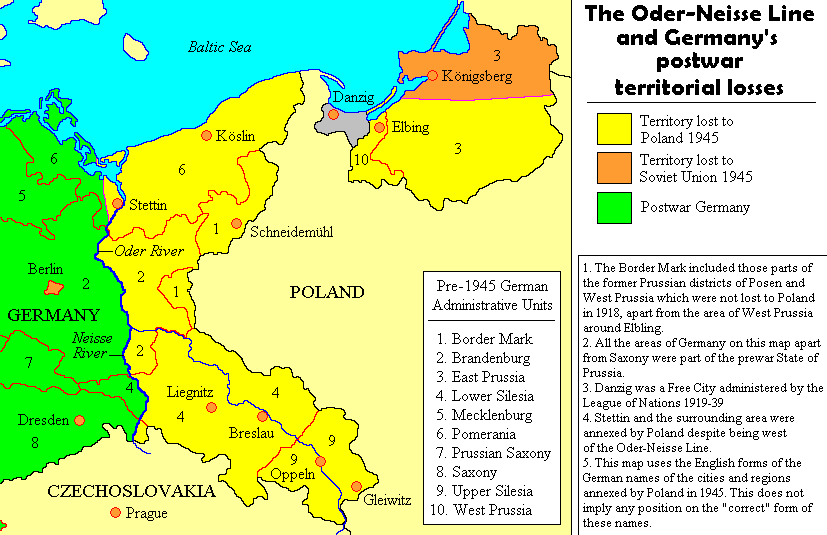
Oder–Neisse line (German: Oder-Neiße-Grenze, Polish: granica na Odrze i Nysie Łużyckiej) is an unofficial term for the modern border between Germany and Poland. The line generally follows the Oder and Lusatian Neisse rivers, meeting the Baltic Sea in the north. A small portion of Polish territory does fall west of the line, including the cities of Szczecin and Świnoujście (German: Stettin and Swinemünde).[1]
In post-war Poland the government described the Oder–Neisse line as the result of tough negotiations between Polish Communists and Stalin.[2] However, according to the modern Institute of National Remembrance, Polish aspirations had no impact on the outcome; rather the idea of a westward shift of the Polish border was adopted synthetically by Stalin, who was the final arbiter in the matter. Stalin's political goals as well as his desire to foment enmity between Poles and Germans influenced his idea of a swap of western for eastern territory, thus ensuring control over both countries.[3] As with before the war, some fringe groups advocated restoring the old border between Poland and Germany.[3][4][5][6][7][8]
All prewar German territories east of the line and within the 1937 German boundaries – comprising nearly one quarter (23.8 percent) of the Weimar Republic's land area – were ceded to Poland and the Soviet Union under the changes decided at the Potsdam Conference. The majority of these territories, including Silesia, Pomerania, and the southern part of East Prussia, were ceded to Poland. The remainder, consisting of northern East Prussia including the German city of Königsberg (renamed Kaliningrad), was allocated to the Soviet Union, as the Kaliningrad Oblast of the Russian SFSR (today Russia). Much of the German population in these territories – estimated at 12 million in autumn 1944 – had fled in the wake of the Soviet Red Army's advance.
The Oder–Neisse line marked the border between East Germany and Poland from 1950 to 1990. The two Communist governments agreed to the border in 1950, while West Germany, after a period of refusal, adhered to the border, with reservations, in 1972 (treaty signed in 1970).[9]
After the revolutions of 1989, newly reunified Germany and Poland accepted the line as their border in the 1990 German–Polish Border Treaty.
History
[edit]Background
[edit]The lower River Oder in Silesia was Piast Poland's western border from the 10th until the 13th century.[10] From around the time of World War I, some proposed restoring this line, in the belief that it would provide protection against Germany. One of the first proposals was made in the Russian Empire. Later, when the Nazis gained power, the German territory to the east of the line was militarised by Germany with a view to a future war, and the Polish population faced Germanisation.[3] The policies of Nazi Germany also encouraged nationalism among the German minority in Poland.
While a process of Germanisation in lands east of the Limes Sorabicus line had already begun to take place between the 12th and 14th centuries, there were many areas in which the German population had hardly settled at all, such that this process of Germanisation extended well into the 19th and 20th centuries.[11] For example, on Rugia Island, the local Slavic culture and language persisted into the 19th century; this was also the case for many areas between the Oder–Neisse and interwar Polish border. About half of what was Farther Pomerania remained plurality Kashubian or Polish until the 18th and 19th centuries, with surviving majority Slavic pockets extending as far west as Dievenow.[11] In 1905, Arnošt Muka observed that "there remained in that land an old Slav national grouping with types and means of settlement, customs and habits unchanged through to this day in the character and outlook of the inhabitants”.[11] The situation was similar in the Western part of Silesia, where Polish and Silesian languages remained dominant by the end of 18th century in areas such as Ohlau, Groß Wartenberg and Namslau.[11]
Before World War II, Poland's western border with Germany had been fixed under the terms of the Treaty of Versailles of 1919. It partially followed the historic border between the Holy Roman Empire and Greater Poland, but with certain adjustments that were intended to reasonably reflect the ethnic compositions of small areas near the traditional provincial borders. The fate of Upper Silesia was to be decided in a plebiscite, which produced 59.8% votes in favour of Germany. The plebiscite took place amidst severe ethnic tensions, as German authorities and Freikorps clashed and persecuted the local Polish population, and the Poles organised massive strikes and protests.[12] The plebiscite allowed both permanent inhabitants of the area but also people born in the region to vote, regardless of their current location or time spent living in Silesia.[13] Voters who participated in the plebiscite despite not living in Upper Silesia were called "migrants", and made up 192,408 (16%) of the total electorate of 1,186,234. As these "migrants" voted overwhelmingly for Germany, the local Polish population considered the plebiscite to be fraudulent, resulting in three Silesian Uprisings.[13] Eventually, the region was divided roughly equally, with some majority Polish regions remaining in Germany, and some German provinces being ceded to Poland.
At the Paris Peace Conference in 1919, the Polish delegation led by Roman Dmowski requested the inclusion of the city of Danzig in the Polish state, arguing that the city was "rightfully part of Poland" because it was Polish until 1793, and that Poland would not be economically viable without it.[14] During the First Partition of Poland in 1772, the inhabitants of Danzig fought fiercely for it to remain a part of Poland,[15] but as a result of the Germanisation process in the 19th century,[16] 90% of the people in Danzig were German by 1919, which made the Entente leaders at the Paris Peace Conference compromise by creating the Free City of Danzig, a city-state in which Poland had certain special rights.[17] The city of Danzig was 90% German and 10% Polish, yet the countryside surrounding Danzig was overwhelmingly Polish, and the ethnically Polish rural areas included in the Free City of Danzig objected, arguing that they wanted to be part of Poland.[14]
The Oder–Neisse line as the concept of a future Polish border appeared among Polish nationalist circles in late 19th century; Jan Ludwik Popławski is considered to be one of the first advocates for the return of "Piast Poland", although his writings mainly focused on Upper Silesia, Opolian Silesia and the southern part of East Prussia, as these regions remained majority Polish.[18] In 1918, Bolesław Jakimiak advocated for a Polish border along the rivers of Oder and Lusatian Neisse, possibly inspired by the proposals of Russian nationalists. He described the German expansion towards the formerly Slavic lands and considered it a "matter of historical justice" to have East Prussia, the entirety of Pomerania, East Brandenburg and both Lower and Upper Silesia become "integral parts" of a future Polish state.[18] At the Paris Peace Conference, Polish commission supervised by Jules Cambon and headed by Roman Dmowski proposed a Polish border that would encompass the entirety of Upper Silesia and most of Opolian Silesia, including cities of Ratibor, Neustadt, Falkenberg, Brieg, Oels and Militsch in Poland. The entirety of Greater Poland was also to be ceded to the Polish state, along with Danzig, Warmia and Masuria. While the postulate of the Polish delegation gained acceptance of the rest of the conference, it was met with vehement protest from David Lloyd George, whose opposition led to border changes in favour of Germany.[18]
Between the wars, the concept of "Western thought" (myśl zachodnia) became popular among some Polish nationalists. The "Polish motherland territories" were defined by scholars, like Zygmunt Wojciechowski, as the areas included in Piast Poland in the 10th century.[4][5][6][7] Some Polish historians called for the "return" of territories up to the river Elbe.[7] The proponents of these ideas, in prewar Poland often described as a "group of fantasists", were organized in the National Party, which was also opposed to the government of Poland, the Sanacja.[8] The proposal to establish the border along the Oder and Neisse was not seriously considered for a long time.[3] After World War II the Polish Communists, lacking their own expertise regarding the Western border[clarification needed], adopted the National Democratic concept of western thought.[19][clarification needed]
After Nazi Germany invaded and occupied Poland, some Polish politicians started to see a need to alter the border with Germany.[3] A secure border[3] was seen as essential, especially in the light of Nazi atrocities. During the war, Nazi Germany committed genocide against Poland's population, especially Jews, whom they classified as Untermenschen ("sub-humans"). Alteration to the western border was seen as a punishment for the Germans for their atrocities and a compensation for Poland.[3][Note 1] The participation in the genocide by German minorities and their paramilitary organizations, such as the Selbstschutz ("self defense"), and support for Nazism among German society also connected the issue of border changes with the idea of population transfers intended to avoid such events in the future.[21]
Initially the Polish government-in-exile envisioned territorial changes after the war which would incorporate East Prussia, Danzig (Gdańsk) and the Oppeln (Opole) Silesian region into post-war Poland, along with a straightening of the Pomeranian border and minor acquisition in the Lauenburg (Lębork) area.[3] The border changes were to provide Poland with a safe border and to prevent the Germans from using Eastern Pomerania and East Prussia as strategic assets against Poland.[Note 2] Only with the changing situation during the war were these territorial proposals modified.[3] In October 1941 the exile newspaper Dziennik Polski postulated a postwar Polish western border that would include East Prussia, Silesia up to the Lusatian Neisse and at least both banks of the Oder's mouth.[22] While these territorial claims were regarded as "megalomaniac" by the Soviet ambassador in London, in October 1941 Stalin announced the "return of East Prussia to Slavdom" after the war. On 16 December 1941 Stalin remarked in a meeting with the British Foreign Minister Anthony Eden, though inconsistent in detail, that Poland should receive all German territory up to the river Oder.[22] In May 1942 General Władysław Sikorski, Prime Minister of the Polish government-in-exile, sent two memoranda to the US government, sketching a postwar Polish western border along the Oder and Neisse (inconsistent about the Eastern Neisse and the Lusatian Neisse). However, the proposal was dropped by the government-in-exile in late 1942.[23]
Tehran Conference
[edit]At the Tehran Conference in late 1943, the Soviet leader Joseph Stalin raised the subject of Poland's western frontier and its extension to the River Oder. While the Americans were not interested in discussing any border changes at that time,[24] Roosevelt agreed that in general the Polish border should be extended west to the Oder, while Polish eastern borders should be shifted westwards; he also admitted that due to elections at home he could not express his position publicly.[25] British Foreign Minister Anthony Eden wrote in his diary that "A difficulty is that the Americans are terrified of the subject which [Roosevelt advisor] Harry [Hopkins] called 'political dynamite' for their elections. But, as I told him, if we cannot get a solution, Polish-Soviet relations six months from now, with Soviet armies in Poland, will be infinitely worse and elections nearer."[26] Winston Churchill compared the westward shift of Poland to soldiers taking two steps "left close" and declared in his memoirs: "If Poland trod on some German toes that could not be helped, but there must be a strong Poland."[27]
The British government formed a clear position on the issue and at the first meeting of the European Advisory Commission on 14 January 1944, recommended "that East Prussia and Danzig, and possibly other areas, will ultimately be given to Poland" as well as agreeing on a Polish "frontier on the Oder".[25][28]
Yalta Conference
[edit]In February 1945, American and British officials met in Yalta and agreed on the basics on Poland's future borders. In the east, the British agreed to the Curzon line but recognised that the US might push for Lwów to be included in post-war Poland. In the west, Poland should receive part of East Prussia, Danzig, the eastern tip of Pomerania and Upper Silesia. President Franklin D. Roosevelt said that it would "make it easier for me at home" if Stalin were generous to Poland with respect to Poland's eastern frontiers.[29] Winston Churchill said a Soviet concession on that point would be admired as "a gesture of magnanimity" and declared that, with respect to Poland's post-war government, the British would "never be content with a solution which did not leave Poland a free and independent state."[30] With respect to Poland's western frontiers, Stalin noted that the Polish Prime Minister in exile, Stanisław Mikołajczyk, had been pleased when Stalin had told him Poland would be granted Stettin/Szczecin and the German territories east of the Western Neisse.[31] Yalta was the first time that the Soviets openly declared support for a German–Polish frontier on the Western as opposed to the Eastern Neisse.[32] Churchill objected to the Western Neisse frontier, saying that "it would be a pity to stuff the Polish goose so full of German food that it got indigestion."[33] He added that many Britons would be shocked if such large numbers of Germans were driven out of these areas, to which Stalin responded that "many Germans" had "already fled before the Red Army."[34] Poland's western frontier was ultimately left to be decided at the Potsdam Conference.

Originally, Germany was to retain Stettin, while the Poles were to annex East Prussia with Königsberg (now Kaliningrad). The Polish government had in fact demanded this since the start of World War II in 1939, because of East Prussia's strategic position that allegedly undermined the defense of Poland.[citation needed] Other territorial changes proposed by the Polish government were the transfer of the Silesian region of Oppeln and the Pomeranian regions of Danzig, Bütow and Lauenburg, and the straightening of the border somewhat in Western Pomerania.[citation needed]
However, Stalin decided that he wanted Königsberg as a year-round warm water port for the Soviet Navy, and he argued that the Poles should receive Stettin instead.[citation needed] The prewar Polish government-in-exile had little to say in these decisions, but insisted on retaining the city of Lwów (Lvov, Lemberg, now Lviv) in Galicia. Stalin refused to concede, and instead proposed that all of Lower Silesia including Breslau (Polish: Wrocław) be given to Poland. Many Poles from Lwów would later be moved to populate the city.[citation needed]

The eventual border was not the most far-reaching territorial change that was proposed. There were suggestions to include areas further west so that Poland could include the small minority population of ethnic Slavic Sorbs who lived near Cottbus and Bautzen.[citation needed]
The precise location of the western border was left open. The western Allies accepted in general that the Oder would be the future western border of Poland. Still in doubt was whether the border should follow the eastern or western Neisse, and whether Stettin, now Szczecin, which lay west of the Oder, should remain German or be placed in Poland (with an expulsion of the German population). Stettin was the traditional seaport of Berlin.[35] It had a dominant German population and a small Polish minority that numbered 2,000 in the interwar period.[36][37] The western Allies sought to place the border on the eastern Neisse at Breslau, but Stalin refused to budge. Suggestions of a border on the Bóbr (Bober) were also rejected by the Soviets.[citation needed]
Nikita Khrushchev in his memoirs said: "I had only one desire – that Poland's borders were moved as far west as possible."[38]
Not satisfied with the Oder–Neisse line, the Polish communists initially wanted to own the entire island of Usedom and push the border west to the Randow river; however they were refused by Stalin.
Potsdam Conference
[edit]
At Potsdam, Stalin argued for the Oder–Neisse line on the grounds that the Polish Government demanded this frontier and that there were no longer any Germans left east of this line.[39] Several Polish Communist leaders appeared at the conference to advance arguments for an Oder–Western Neisse frontier. The port of Stettin was demanded for Eastern European exports. If Stettin was Polish, then "in view of the fact that the supply of water is found between the Oder and the Lausitzer Neisse, if the Oder's tributaries were controlled by someone else the river could be blocked."[40] Soviet forces had initially expelled Polish administrators who tried to seize control of Stettin in May and June, and the city was governed by a German communist-appointed mayor, under the surveillance of the Soviet occupiers, until 5 July 1945.[41]


James Byrnes – who had been appointed as U.S. Secretary of State earlier that month – later advised the Soviets that the U.S. was prepared to concede the area east of the Oder and the Eastern Neisse to Polish administration, and for it not to consider it part of the Soviet occupation zone, in return for a moderation of Soviet demands for reparations from the Western occupation zones.[42] An Eastern Neisse boundary would have left Germany with roughly half of Silesia – including the majority of Wrocław (Breslau), the former provincial capital and the largest city in the region. The Soviets insisted that the Poles would not accept this. The Polish representatives (and Stalin) were in fact willing to concede a line following the Oder–Bober–Queis (Odra–Bóbr–Kwisa) rivers through Żagań (Sagan) and Lubań (Lauban), but even this small concession ultimately proved unnecessary, since on the next day Byrnes told the Soviet Foreign Minister Vyacheslav Molotov that the Americans would reluctantly concede to the Western Neisse.[43]
Byrnes' concession undermined the British position, and although the British Foreign Secretary Ernest Bevin raised objections,[44] the British eventually agreed to the American concession. In response to American and British statements that the Poles were claiming far too much German territory, Stanisław Mikołajczyk argued that "the western lands were needed as a reservoir to absorb the Polish population east of the Curzon Line, Poles who returned from the West, and Polish people who lived in the overcrowded central districts of Poland."[45] The U.S. and the U.K. were also negative towards the idea of giving Poland an occupation zone in Germany. However, on 29 July, President Truman handed Molotov a proposal for a temporary solution whereby the U.S. accepted Polish administration of land as far as the Oder and Eastern Neisse until a final peace conference determined the boundary. In return for this large concession, the U.S. demanded that "each of the occupation powers take its share of reparations from its own [Occupation] Zone and provide for admission of Italy into the United Nations." The Soviets stated that they were not pleased "because it denied Polish administration of the area between the two Neisse rivers."[46]
On 29 July Stalin asked Bolesław Bierut, the head of the Soviet-controlled Polish government, to accept in consideration of the large American concessions. The Polish delegation decided to accept a boundary of the administration zone at "somewhere between the western Neisse and the Kwisa". Later that day the Poles changed their mind: "Bierut, accompanied by Rola-Zymierski, returned to Stalin and argued against any compromise with the Americans. Stalin told his Polish protégés that he would defend their position at the conference."[46]
World War II aftermath
[edit]
Finally on 2 August 1945, the Potsdam Agreement of the United States, the United Kingdom, and the Soviet Union, in anticipation of the final peace treaty, placed the German territories east of the Oder–Neisse line formally under Polish administrative control. It was also decided that all Germans remaining in the new and old Polish territory should be expelled.[citation needed] One reason for this version of the new border was that it was the shortest possible border between Poland and Germany. It is only 472 km (293 miles) long, from one of the northernmost points of the Czech Republic to one of the southernmost points of the Baltic Sea at the Oder estuary.[citation needed]
Winston Churchill was not present at the end of the Conference, since the results of the British elections had made it clear that he had been defeated. Churchill later claimed that he would never have agreed to the Oder–Western Neisse line, and in his famous Iron Curtain speech declared that
The Russian-dominated Polish Government has been encouraged to make enormous and wrongful inroads upon Germany, and mass expulsions of millions of Germans on a scale grievous and undreamed-of are now taking place.[47]

Not only were the German territorial changes of the Nazis reversed, but the border was moved westward, deep into territory which had been in 1937 part of Germany with an almost exclusively German population.[48] The new line placed almost all of Silesia, more than half of Pomerania, the eastern portion of Brandenburg, a small area of Saxony, the former Free City of Danzig and the southern two-thirds of East Prussia (Masuria and Warmia) within Poland (see Former eastern territories of Germany). The northeastern third of East Prussia was directly annexed by the Soviet Union.
These territorial changes were followed by large-scale population transfers, involving 14 million people all together from the whole of Eastern Europe, including many people already shifted during the war. Nearly all remaining Germans from the territory annexed by Poland were expelled, while Polish persons who had been displaced into Germany, usually as slave laborers, returned to settle in the area. In addition to this, the Polish population originating from the eastern half of the former Second Polish Republic, now annexed by the Soviet Union, was mostly expelled and transferred to the newly acquired territories.
Most Poles supported the new border, mostly out of fear of renewed German aggression and German irredentism.[49] The border was also presented as a just consequence for the Nazi German state's initiation of World War II and the subsequent genocide against Poles and the attempt to destroy Polish statehood, as well as for the territorial losses of eastern Poland to the Soviet Union, mainly western Ukraine and Belarus. It has been asserted that resentment towards the expelled German population on the part of the Poles was based on the fact that the majority of that population was loyal to the Nazis during the invasion and occupation, and the active role some of them played in the persecution and mass murder of Poles and Jews.[citation needed] These circumstances allegedly have impeded sensitivity among Poles with respect to the expulsion committed during the aftermath of World War II.[citation needed]
The new order was in Stalin's interests, because it enabled the Soviet Communists to present themselves as the primary maintainer of Poland's new western border.[citation needed] It also provided the Soviet Union with territorial gains from part of East Prussia and the eastern part of the Second Republic of Poland.
United States Secretary of State James F. Byrnes outlined the official position of the U.S. government regarding the Oder–Neisse line in his Stuttgart Speech of 6 September 1946:
At Potsdam specific areas which were part of Germany were provisionally assigned to the Soviet Union and to Poland, subject to the final decisions of the Peace Conference. [...] With regard to Silesia and other eastern German areas, the assignment of this territory to Poland by Russia for administrative purposes had taken place before the Potsdam meeting. The heads of government agreed that, pending the final determination of Poland's western frontier, Silesia and other eastern German areas should be under the administration of the Polish state and for such purposes should not be considered as a part of the Soviet zone of occupation in Germany. However, as the Protocol of the Potsdam Conference makes clear, the heads of government did not agree to support at the peace settlement the cession of this particular area. The Soviets and the Poles suffered greatly at the hands of Hitler's invading armies. As a result of the agreement at Yalta, Poland ceded to the Soviet Union territory east of the Curzon Line. Because of this, Poland asked for revision of her northern and western frontiers. The United States will support revision of these frontiers in Poland's favor. However, the extent of the area to be ceded to Poland must be determined when the final settlement is agreed upon.[50]
The speech was met with shock in Poland and Deputy Prime Minister Mikołajczyk immediately issued a response declaring that retention of Polish territories based on the Oder–Neisse line was matter of life and death.[51]
Byrnes, who accepted the Lusatian Neisse as provisional Polish border,[52][53][54] in fact did not state that such a change would take place (as was read by Germans who hoped for support to regain the lost territories).[54] The purpose of the speech and associated US diplomatic activities was as propaganda aimed at Germany by Western Powers, who could blame the Polish–German border and German expulsions on Moscow alone.[54]
In the late 1950s, by the time of Dwight D. Eisenhower's Presidency, the United States had largely accepted the Oder–Neisse line as final and did not support German demands regarding the border, while officially declaring a need for a final settlement in a peace treaty.[55][56] In the mid-1960s the U.S. government accepted the Oder–Neisse line as binding and agreed that there would be no changes to it in the future.[57] German revisionism regarding the border began to cost West Germany sympathies among its western allies.[55] In 1959, France officially issued a statement supporting the Oder–Neisse line, which created controversy in West Germany.[58]
The Oder–Neisse line was, however, never formally recognized by the United States until the revolutionary changes of 1989 and 1990.[Note 3]
'Recovered territories'
[edit]
Those territories were known in Poland as the Regained or Recovered Territories, a term based on the claim that they were in the past the possession of the Piast dynasty of Polish kings, Polish fiefs or included in the parts lost to Prussia during the Partitions of Poland. The term was widely exploited by Propaganda in the People's Republic of Poland.[60] The creation of a picture of the new territories as an "integral part of historical Poland" in the post-war era had the aim of forging Polish settlers and repatriates arriving there into a coherent community loyal to the new Communist regime.[61] The term was in use immediately following the end of World War II when it was part of the Communist indoctrination of the Polish settlers in those territories.[61] The final agreements in effect compensated Poland with 112,000 km2 (43,000 sq mi) of former German territory in exchange for 187,000 km2 (72,000 sq mi) of land lying east of the Curzon Line – Polish areas occupied by the Soviet Union. Poles and Polish Jews from the Soviet Union were the subject of a process called "repatriation" (settlement within the territory of post-war Poland).
German recognition of the border
[edit]East Germany
[edit]
The East German Socialist Unity Party (SED), founded 1946, originally rejected the Oder–Neisse line.[62] Under Soviet occupation and heavy pressure by Moscow, the official phrase Friedensgrenze (border of peace) was promulgated in March–April 1947 at the Moscow Foreign Ministers Conference. The German Democratic Republic and Poland's Communist government signed the Treaty of Zgorzelec in 1950 recognizing the Oder–Neisse line, officially designated by the Communists as the "Border of Peace and Friendship".[63][64][65]
In 1952 Stalin made recognition of the Oder–Neisse line as a permanent boundary one of the conditions for the Soviet Union to agree to a reunification of Germany (see Stalin Note). The offer was rejected by the West German Chancellor Konrad Adenauer.[citation needed]
West Germany
[edit]
The West German definition of the "de jure" borders of Germany was based on the determinations of the Potsdam Agreement, which placed the German territories (as of 31 December 1937) east of the Oder–Neisse line "under the administration of the Polish State" while "the final delimitation of the western frontier of Poland should await the peace settlement". The recognition of the Oder–Neisse Line as permanent was thus only reserved to a final peace settlement with reunited Germany.[Note 4][Note 5][Note 6][Note 7] In West Germany, where the majority of the displaced refugees found refuge, recognition of the Oder–Neisse line as permanent was long regarded as unacceptable. Right from the beginning of his Chancellorship in 1949, Adenauer refused to accept the Oder–Neisse line as Germany's eastern frontier, and made it quite clear that if Germany ever reunified, the Federal Republic would lay claim to all of the land that had belonged to Germany as at 1 January 1937.[69] Adenauer's rejection of the border adjustments resulting from the Potsdam agreement was viewed critically by some in Poland.[70] Soon after the agreement was signed, both the US and Soviet Union accepted the border as the de facto border of Poland. United States Secretary James Byrnes accepted the Western Neisse as the provisional Polish border.[52] While in his Stuttgart Speech he played around with an idea of modification of borders (in Poland's favor), giving fuel to speculation by German nationalists and revisionists, the State department confessed that the speech was simply intended to "smoke out Molotov's attitude on the eve of elections in Germany".[54] The Adenauer government went to the Constitutional Court to receive a ruling that declared that legally speaking the frontiers of the Federal Republic were those of Germany as at 1 January 1937, that the Potsdam Declaration of 1945 which announced that the Oder–Neisse line was Germany's "provisional" eastern border was invalid, and that as such the Federal Republic considered all of the land east of the Oder–Neisse line to be "illegally" occupied by Poland and the Soviet Union.[71][need quotation to verify] The American historian Gerhard Weinberg pointed out that in claiming the frontiers of 1937, West Germany was in fact claiming the frontiers established by the Treaty of Versailles, which the entire interwar German leadership had claimed to be totally unacceptable from 1919 to 1939, and which perhaps indicated that Versailles was nowhere near as harsh as claimed, especially when compared with the far greater territorial losses imposed by the Oder–Neisse line.[72] Not all in Adenauer's government supported this; politicians like minister Seebohm criticized limiting German territorial demands to the borders of 1937, alluding to pre-Versailles borders,[73] as did the organisation of German expelled BdV.[74] In 1962 a virulent anti-Polish organization called AKON was founded in West Germany which published maps with the borders of 1914.[74]

To Hans Peter Schwarz, Adenauer's refusal to accept the Oder–Neisse line was in large part motivated by domestic politics, especially his desire to win the votes of the domestic lobby of those Germans who had been expelled from areas east of the Oder–Neisse line.[69] 16% of the electorate in 1950 were people who fled or were expelled after the war, forming a powerful political force .[75] As a result, the CDU, the CSU, the FDP and the SPD all issued statements opposing the Oder–Neisse line and supporting Heimatrecht ("right to one's homeland", i.e. that the expellees be allowed to return to their former homes).[76] Adenauer greatly feared the power of the expellee lobby, and told his cabinet in 1950 that he was afraid of "unbearable economic and political unrest" if the government did not champion all of the demands of the expellee lobby.[76] In addition, Adenauer's rejection of the Oder–Neisse line was intended to be a deal-breaker if negotiations ever began to reunite Germany on terms that Adenauer considered unfavorable such as the neutralization of Germany as Adenauer knew well that the Soviets would never consider revising the Oder–Neisse line.[69] Finally Adenauer's biographer, the German historian Hans Peter Schwarz has argued that Adenauer may have genuinely believed that Germany had the right to retake the land lost east of the Oder and Neisse rivers, despite all of the image problems this created for him in the United States and western Europe.[69] By contrast, the Finnish historian Pertti Ahonen—citing numerous private statements made by Adenauer that Germany's eastern provinces were lost forever and expressing contempt for the expellee leaders as delusional in believing that they were actually going to return one day to their former homes—has argued that Adenauer had no interest in really challenging the Oder–Neisse line.[77] Ahonen wrote that Adenauer "saw his life's work in anchoring the Federal Republic irrevocably to the anti-Communist West and no burning interest in East European problems—or even German reunification."[77] Adenauer's stance on the Oder–Neisse line was to create major image problems for him in the Western countries in the 1950s, where many regarded his revanchist views on where Germany's eastern borders ought to be with considerable distaste, and only the fact that East Germany was between the Federal Republic and Poland prevented this from becoming a major issue in relations with the West.[69]

On 1 May 1956, the West German Foreign Minister Heinrich von Brentano admitted during a press conference in London that the Federal Republic's stance on the Oder–Neisse line was "somewhat problematic", and suggested that the Federal Republic should recognize the Oder–Neisse line in exchange for the Soviet Union allowing German reunification.[78] Brentano's remark caused such an uproar with the expellee leaders arguing that he should resign, that Adenauer was forced to disallow his foreign minister, and Brentano only kept his job by claiming that he was misquoted by the British press.[78] In private, Brentano was willing to accept the Oder–Neisse line as the price of reunification, and was not misquoted in London as he claimed afterwards.[78] Away from the public limelight in a conversation with the Canadian ambassador Charles Ritchie in June 1956, Brentano called the leaders of the expellee groups "unteachable nationalists" who had learned nothing from World War II, and who did not have the right to control the Federal Republic's policy towards Eastern Europe by vetoing policy changes they disliked.[78] Brentano's press conference was meant by Adenauer to be a trial balloon to see if the Federal Republic could have a more flexible policy towards Eastern Europe.[78] The furious protests set off by Brentano's press conference convinced Adenauer that he did not have the domestic support for such a policy, and that the current policy of opposing the Oder–Neisse line would have to continue.[79] This caused considerable disappointment with Adenauer's Western allies, who had been applying strong pressure behind the scenes and would continue to apply such pressure for the rest of the 1950s for Bonn to recognize the Oder–Neisse line.[80] This pressure become especially acute after the "Polish October" crisis of 1956 brought to power Władysław Gomułka as Poland's new leader.[80] Gomułka was a Communist, but also a Polish nationalist, and it was believed possible in Washington that a split could be encouraged between Moscow and Warsaw if only Bonn would recognize the Oder–Neisse line.[80] Because the Federal Republic's refusal to recognize the Oder–Neisse line together with the presence of such Nazi-tainted individuals like Theodor Oberländer in Adenauer's cabinet, Gomułka was obsessed with the fear that one day the Germans would invade Poland again, which would mean a return to the horrors of the German occupation.[81]
Gomułka feared the Germans more than he disliked the Russians, and thus he argued in both public and in private that it was necessary to keep Soviet troops in Poland to guard against any future German revanchism.[81] Gomułka felt sincerely threatened by the revanchist statements put out by the Adenauer government, and believed the alliance with the Soviet Union was the only thing stopping the threat of a new German invasion.[82] Gomułka told the 8th Plenum on 19 October 1956 that: "Poland needs friendship with the Soviet Union more than the Soviet Union needs friendship with Poland...Without the Soviet Union we cannot maintain our borders with the West".[83] During his meetings with Nikita Khrushchev during the Polish October crisis, Gomułka stressed that though he wanted Poland to take a more independent line within the Soviet bloc, he would never break with Moscow because of his fears of future German aggression based on their statements rejecting the Oder–Neisse line.[83] Because Gomułka's obsession with the Oder–Neisse line and his reputation as a Polish nationalist who spoke of a "Polish road to socialism" independent of Moscow, it was believed possible by the Americans at the time that Gomułka might follow Tito's example in 1948 if only Adenauer could be persuaded to accept the Oder–Neisse line. One scholar wrote in 1962 that most Poles deeply disliked Communism, but were willing to accept Gomułka's regime as the lesser evil because they believed Gomułka's warnings that if without the Red Army, the Germans would invade again.[84] Such was the extent of Polish fears about German revanchism that as late as February 1990 the Polish Prime Minister Tadeusz Mazowiecki stated in a speech that Red Army might have to stay in Poland until Germany had promised to firmly recognize the Oder–Neisse line as the final frontier between Germany and Poland.[85]
In 1963 the German Social Democratic opposition leader Willy Brandt said that "abnegation is betrayal", but it was Brandt who eventually changed West Germany's attitude with his policy of Ostpolitik. In 1970 West Germany signed treaties with the Soviet Union (Treaty of Moscow) and Poland (Treaty of Warsaw) recognizing Poland's Western border at the Oder–Neisse line as current reality, and not to be changed by force. This had the effect of making family visits by the displaced eastern Germans to their lost homelands now more or less possible. Such visits were still very difficult, however, and permanent resettlement in the homeland, now Poland, remained impossible.[citation needed]
In 1989, another treaty was signed between Poland and East Germany, the sea border was defined, and a dispute from 1985 was settled.[citation needed]
United Germany
[edit]
In March 1990, the West German Chancellor Helmut Kohl caused a storm, when he suggested that a reunified Germany would not accept the Oder–Neisse line, and implied that the Federal Republic might wish to restore the frontier of 1937, by force if necessary.[86] Kohl further added that in a statement of 1 March 1990 that he would only recognize the Oder–Neisse line if Poland promised to pay compensation to the Germans expelled after 1945 and if Poland promised not to seek reparations for the sufferings of Polish slave labourers in Germany and reparations for the damage done by German forces to Poland during World War II.[87] After Kohl's note caused a massive international backlash that threatened to derail the process for German reunification, Kohl hastily changed track, and said that a reunified Germany would accept the Oder–Neisse line after all, and that he would not seek to link recognizing the Oder–Neisse line to talks about compensation. In November 1990, after German reunification, the Federal Republic of Germany and the Republic of Poland signed a treaty confirming the border between them, as requested by the Treaty on the Final Settlement With Respect to Germany. Earlier, Germany had amended its constitution and abolished Article 23 of West Germany's Basic Law (on which reunification was based), which could have been used to claim the former German eastern territories.[citation needed]
The German–Polish Border Treaty, signed 14 November 1990, finalizing the Oder–Neisse line as the German–Polish border[88] came into force on 16 January 1992, together with a second one, a Treaty of Good Neighbourship, signed in June 1991, in which the two countries, among other things, recognized basic political and cultural rights for both the German and the Polish minorities living on either side of the border. After 1990, approximately 150,000 Germans still resided in the areas transferred to Poland, mainly in the Opole Voivodeship, with a smaller presence in regions such as Lower Silesia and Warmia-Masuria. There are 1.5 million Poles or ethnic Poles living in Germany, including both recent immigrants and the descendants of Poles that settled in Germany many generations ago.[citation needed]
Other developments
[edit]Division of cities
[edit]
The border divided several cities into two parts – Görlitz/Zgorzelec, Guben/Gubin, Frankfurt/Słubice and Bad Muskau/Łęknica.[89]
Partially open border 1971–1980
[edit]Millions visited the neighbouring country (either Poland or East Germany) during the years 1971–1980.[90][91] The East German economy was threatened by overconsumption of Polish tourists, who came to East Germany to buy cheaper products that the socialist economy could not provide in abundance on either side of the border; and the Poles also became politically dangerous for the GDR government by the time of the 1980 Solidarity strikes.[92]
See also
[edit]
World War II-related events
[edit]- Vistula-Oder Offensive, from 12 January until 2 February 1945
- Malta Conference, from 30 January to 3 February 1945
- Yalta Conference, from 4 to 11 February 1945
- Battle of Königsberg, from 6 April until 9 April 1945
- Battle of the Oder-Neisse, from 16 April until 19 April 1945
- Potsdam Conference, from 17 July to 2 August 1945
Notes
[edit]- ^ "Przesunięcie granicy zachodniej na korzyść Polski było uważane także za jedną z form ukarania Niemców za popełnione zbrodnie i zadośćuczynienia Polsce."[20]
- ^ "Nowa Granica miała osłabić korzystny dotąd układ strategiczny wykorzystywany przeciwko Polsce (Prusy Wschodnie, Pomorze Zachodnie)."[20]
- ^ "Although the Polish and German governments signed a treaty in 1970..., the United States withheld the formal recognition of the Oder-Neisse until the revolutionary changes of 1989 and 1990, ..."[59]
- ^ Article VIII. B of the Potsdam Agreement: "In conformity with the agreement on Poland reached at the Crimea Conference the three heads of government have sought the opinion of the Polish Provisional Government of National Unity in regard to the accession of territory in the north 'end west which Poland should receive. The President of the National Council of Poland and members of the Polish Provisional Government of National Unity have been received at the Conference and have fully presented their views. The three heads of government reaffirm their opinion that the final delimitation of the western frontier of Poland should await the peace settlement. The three heads of government agree that, pending the final determination of Poland's western frontier, the former German territories cast of a line running from the Baltic Sea immediately west of Swinamunde, and thence along the Oder River to the confluence of the western Neisse River and along the Western Neisse to the Czechoslovak frontier, including that portion of East Prussia not placed under the administration of the Union of Soviet Socialist Republics in accordance with the understanding reached at this conference and including the area of the former free city of Danzig, shall be under the administration of the Polish State and for such purposes should not be considered as part of the Soviet zone of occupation in Germany."
- ^ "In den Verhandlungen mit der polnischen Regierung mußte die Frage der Anerkennung der Oder-Neiße-Linie ausgeklammert warden, denn nach der Entscheidung des Bundesverfassungsgerichts von 1975 bestanden das Deutsche Reich in seinen Grenzen von 1937 und die Viermächteverantwortung für ganz Deutschland solange fort, bis ein förmlicher Friedensvertrag geschlossen worden sei."[66]
- ^ "Politiker und politische Gruppen verwiesen auf die Abmachungen der Potsdamer Konferenz von 1945, denen zufolge die endgültige Regelung der Oder-Neiße-Frage einem endgültigen Friedensvertrag für ganz Deutschland vorbehalten werden sollte."[67]
- ^ "Die Gebiete östlich von Oder und Neiße sind ebenso wie das übrige Reichsgebiet in den Grenzen vom 31. Dezember 1937 von den Siegermächten bei Kriegsende nicht annektiert worden. Im Vorspruch der "Erklärung" vom 5. Juni 1945, welche die Regierungen des Vereinigten Königreichs, der Vereinigten Staaten von Amerika und der Union der Sozialistischen Sowjetrepubliken sowie die provisorische Regierung der Französischen Republik "in Anbetracht der Niederlage Deutschlands und der Übernahme der obersten Regierungsgewalt hinsichtlich Deutschlands" abgegeben haben, heißt es: "Die Übernahme ... der besagten Regierungsgewalt und Befugnisse bewirkt nicht die Annektierung Deutschlands" (Amtsblatt des Kontrollrats in Deutschland, Ergänzungsblatt Nr. 1, S. 7). Auf der Potsdamer Konferenz (Juli/August 1945) kamen Großbritannien, die Sowjetunion und die Vereinigten Staaten von Amerika überein, die deutschen Gebiete östlich von Oder und Neiße einer Sonderregelung zu unterwerfen, die von der im übrigen Reichsgebiet eingerichteten Besatzungsherrschaft deutlich abwich. Nach den Abschnitten VI und IX des als "Mitteilung über die Dreimächtekonferenz von Berlin" bezeichneten Protokolls vom 2. August 1945 (oft Potsdamer Abkommen genannt) wurden die deutschen Ostgebiete "vorbehaltlich der endgültigen Bestimmung der territorialen Fragen bei der Friedensregelung" teilweise unter sowjetische und teilweise unter polnische "Verwaltung" gestellt ... (AmtsblattBVerfGE 40, 141 (157), BVerfGE 40, 141 (158) des Kontrollrats in Deutschland, Ergänzungsblatt Nr. 1 S. 17 f.). Die sich aus dem Vorbehalt der Friedensregelung ergebende Vorläufigkeit dieser Gebietszuweisung wurde nach dem Abschluß der Potsdamer Konferenz von der Sowjetunion und Polen zunächst respektiert. Der sowjetisch-polnische Vertrag vom 16. August 1945, der den Verlauf der sowjetisch-polnischen Grenzlinie in Ostpreußen beschreibt, wiederholt in seinem Art. 3 ausdrücklich den Friedensvertragsvorbehalt unter Bezugnahme auf die Potsdamer Konferenz (United Nations Treaty Series 10 II, Nr. 61, S. 196). 66 Die drei Westmächte haben einer endgültigen Zuweisung der deutschen Ostgebiete an die Sowjetunion und Polen nicht zugestimmt. Nach der Ziffer VI des Protokolls über die Beschlüsse der Potsdamer Konferenz haben Großbritannien und die Vereinigten Staaten lediglich in Aussicht gestellt, den "grundsätzlich" akzeptierten "Vorschlag der Sowjetregierung hinsichtlich der endgültigen Übergabe der Stadt Königsberg und des anliegenden Gebiets an die Sowjetunion" vorbehaltlich einer noch vorzunehmenden Festlegung des "genauen Grenzverlaufs" bei der "bevorstehenden Friedensregelung" zu "unterstützen".[68]
References
[edit]- ^ Eberhardt, Piotr (2015). "The Oder-Neisse Line as Poland's western border: As postulated and made a reality". Geographia Polonica. 88 (1): 77–105. doi:10.7163/GPol.0007.
- ^ Laufer (2009), p. 194
- ^ a b c d e f g h i Biuletyn Instytutu Pamięci Narodowej nr 9-10/2005, "Polski Dziki Zachód" – ze Stanisławem Jankowiakiem, Czesławem Osękowskim i Włodzimierzem Suleją rozmawia Barbara Polak, pages 4–28
- ^ a b Piskorski (2003), p. 102
- ^ a b Hackmann (1996), p. 224
- ^ a b Faraldo (2008), p. 17
- ^ a b c Fahlbusch & Haar (2005), pp. 263, 265
- ^ a b "Myśl zachodnia Ruchu Narodowego w czasie II wojny światowej" dr Tomasz Kenar. Dodatek Specjalny IPN Nowe Państwo 1/2010
- ^ Jessup, John E. (1998). An encyclopedic dictionary of conflict and conflict resolution, 1945–1996. Westport, Conn.: Greenwood Press. p. 543. ISBN 978-0313281129.
- ^ Historical dictionary of Poland, 966–1945 Jan Jerzy Lerski, page 398, Greenwood Publishing Group 1996
- ^ a b c d Kowalski, Mariusz (2020). "The Early Medieval Slav-German border (Limes Sorabicus) in the light of research into Y-chromosome polymorphism in contemporary and historical German populations". Geographia Polonica. 93 (4): 569–596. doi:10.7163/GPol.0190. S2CID 234996265.
- ^ Peter Leśniewski (2001) The 1919 insurrection in upper Silesia, Civil Wars, 4:1, 22–48, DOI: 10.1080/13698240108402462
- ^ a b Machray, Robert (1945). The Problem of Upper Silesia (PDF). Michigan: G. Allen & Unwin Limited. pp. 79–80.
- ^ a b Macmillan, Margaret Paris 1919, New York: Random House page 211.
- ^ Gdańsk i Ziemia Gdańska Franciszek Mamuszka Wiedza Powszechna, 1966 page 83
- ^ Książka polska w Gdańsku w okresie zaboru pruskiego 1793-1919, page 61 Maria Babnis, Ossolineum 1989
- ^ Macmillan, Margaret Paris 1919, New York: Random House page 218.
- ^ a b c Eberhardt, Piotr (2015). "The Oder-Neisse line as Poland's western border: As postulated and made a reality". Geographia Polonica. 88 (1): 77–105. doi:10.7163/GPol.0007.
- ^ Thum (2011), p. 194
- ^ a b Wolff-Powęska (1993), p. 49
- ^ "Polacy – wysiedleni, wypędzeni i wyrugowani przez III Rzeszę", Maria Wardzyńska, Warsaw 2004.
- ^ a b Laufer (2009), pp. 179–180
- ^ Laufer (2009), p. 181
- ^ US State Department, Foreign Relations of the US: The Conference at Cairo and Tehran 1943 Archived 2 December 2008 at the Wayback Machine, "Tripartite Dinner Meeting, 28 November 1943" pp. 509–14
- ^ a b Allen (2003), p. 13
- ^ Anthony Eden, The Reckoning (London, 1965) p. 427.
- ^ Churchill, Winston (1986). Closing the ring. Mariner books. ISBN 9780395410592.
- ^ Foreign Relations of the United States 1944, vol. I, p. 141
- ^ US Dept. of State, Foreign Relations of the US, The Conferences at Malta and Yalta, 1945, Third Plenary Meeting 6 February 1945, Matthews Minutes, p. 77
- ^ US Dept. of State, Foreign Relations of the US, The Conferences at Malta and Yalta, 1945, Third Plenary Meeting 6 February 1945, Bohlen Minutes, p. 669.
- ^ Llewellyn Woodward, British Foreign Policy in the Second World War, (London, 1962) p. 299
- ^ Allen (2003), p. 17
- ^ Winston Churchill and the Soviet Union during the Second World War – The Churchill Centre Archived 4 October 2006 at the Wayback Machine
- ^ Kimball, Warren F., The Cold War Warmed Over The American Historical Review 1974 American Historical Association
- ^ Lebensraum, Time Magazine 13 August 1945
- ^ Tadeusz Białecki, "Historia Szczecina" Zakład Narodowy im. Ossolińskich, 1992 Wrocław. Pages 9, 20–55, 92–95, 258–260, 300–306.
- ^ Polonia szczecińska 1890–1939 Anna Poniatowska Bogusław Drewniak, Poznań 1961
- ^ Sergeĭ Khrushchev, George Shriver, Stephen Shenfield, Memoirs of Nikita Khrushchev, Penn State Press, 2007, p.637, ISBN 0-271-02935-8
- ^ Harry Truman, Year of Decisions, (New York, 1955) p. 296
- ^ US Dept of State, Foreign Relations of the US, The Conference of Berlin (Potsdam) 1945, vol. II pp. 1522–1524.
- ^ "Heitmann, Clemens. Die Stettin-Frage: Die KPD, die Sowjetunion und die deutsch-polnische Grenze 1945. Zeitschrift für Ostmitteleuropa-Forschung, 2002, vol. 51, no1, pp. 25–63". Archived from the original on 14 September 2012. Retrieved 20 September 2009.
- ^ US Dept of State, Foreign Relations of the US, The Conference of Berlin (Potsdam) 1945, vol. II p. 1150
- ^ US Dept of State, Foreign Relations of the US, The Conference of Berlin (Potsdam) 1945, vol. II, p. 480.
- ^ US Dept of State, Foreign Relations of the US, The Conference of Berlin (Potsdam) 1945, vol. II p. 519.
- ^ Lukas (1982), p. 16
- ^ a b Lukas (1982), p. 17
- ^ Churchill's Iron Curtain, On expulsion of ethnic Germans – historyguide.org
- ^ The History of Poland by Mieczysław B. Biskupski, Greenwood Publishing Group, 2000. p. 124
- ^ Allen (2003), p. 4
- ^ Stuttgart Speech
- ^ Allen (2003), p. 52
- ^ a b No exit: America and the German problem, 1943–1954, page 94, James McAllister, Cornell University Press 2002
- ^ Peter H. Merkl, German Unification, 2004. Penn State Press, p. 338.
- ^ a b c d Pertti Ahonen, After the expulsion: West Germany and Eastern Europe, 1945–1990, 2003. Oxford University Press, pp. 26–27
- ^ a b Ingrao & Szabo (2008), p. 406
- ^ Allen (2003), p. 215
- ^ Ingrao & Szabo (2008), p. 407
- ^ Allen (2003), p. 221
- ^ Allen (2003), p. 1
- ^ An explanation note in "The Neighbors Respond: The Controversy Over the Jedwabne Massacre in Poland", ed. by Polonsky and Michlic, p. 466
- ^ a b Martin Åberg, Mikael Sandberg, Social Capital and Democratisation: Roots of Trust in Post-Communist Poland and Ukraine, Ashgate Publishing, Ltd., 2003, ISBN 0-7546-1936-2, Google Print, p. 79
- ^ Timmermann, Heiner; Ihmel-Tuchel, Beate (1997). Potsdam 1945 (in German). Duncker & Humblodt. p. 307. ISBN 3-428-08876-X.
- ^ Ślaski kwartalnik historyczny Sobótka, Volume 60, Wrocławskie Towarzystwo Miłośników Historii, page 249 Zakład im. Ossolińskich, 2005
- ^ Polityka, Issues 44–52, page 84, Wydawnictwo Prasowe "Polityka", 2005
- ^ "Why is the Oder-Neiße Line a Peace Border? (1950)". Archived from the original on 14 October 2012. Retrieved 21 June 2004.
- ^ Stokłosa, Katarzyna (2011). Polen und die deutsche Ostpolitik 1945– 1990 (in German). Vandenhoeck & Ruprecht. p. 494. ISBN 978-3-525-30000-8.
- ^ Lepp, Claudia (2005). Tabu der Einheit – Die Ost-West-Gemeinschaft der evangelischen Christen und die deutsche Teilung (1945–1969) (in German). Vandenhoeck & Ruprecht. p. 436. ISBN 3-525-55743-4.
- ^ Entscheidungen des Bundesverfassungsgerichts, Band 40 (in German). 1975. pp. 157, 158.
- ^ a b c d e Schwarz, Hans Peter Konrad Adenauer: From the German Empire to the Federal Republic, 1876–1952, Oxford: Berghahn Books, 1995 page 638.
- ^ Rocznik Polsko-Niemiecki, Volume 5 Zakład Studiów nad Niemcami ISP PAN, 1996
- ^ Duffy, Christopher Red Storm on the Reich, Routledge: London, 1991 page 302
- ^ Weinberg, Gerhard Germany, Hitler, and World War II: Essays in Modern German and World History, Cambridge: Cambridge University Press, 1996 page 11.
- ^ Guilt, Suffering, and Memory: Germany Remembers Its Dead of World War II By Gilad Margalit page 204
- ^ a b Britain, Germany and the Cold War: The Search for a European Détente 1949–1967 By R. Gerald Hughes page 77
- ^ Ahonen (1998), pp. 41–42
- ^ a b Ahonen (1998), p. 42
- ^ a b Ahonen (1998), p. 48
- ^ a b c d e Ahonen (1998), p. 44
- ^ Ahonen (1998), pp. 44–45
- ^ a b c Ahonen (1998), p. 46
- ^ a b Granville (2003), pp. 284–285
- ^ Granville (2002), pp. 540–541
- ^ a b Granville (2002), p. 541
- ^ Bromke, Adam "Nationalism and Communism in Poland" pages 635–643 from Foreign Affairs, Volume 40, Issue No. 4, July 1962 pages 638–640
- ^ Clemens, Clay (6 March 1990). "Kohl Performs A Balancing Act on German-Polish Boundary Line". Daily Press. Retrieved 22 February 2014.
- ^ Merkl, Peter H. German Unification in the European Context University Park: Penn State Press, 2010 page 132.
- ^ Best, Ulrich Transgression as a Rule: German-Polish Cross-border Cooperation, Border Discourse and EU-enlargement, Munster: LIT Verlag, 2007 page 100
- ^ Treaty between the Federal Republic of Germany and the Republic of Poland on the confirmation of the frontier between them, 14 November 1990(PDF)
- ^ Kimmo Katajala; Maria Lähteenmäki (2012). Imagined, Negotiated, Remembered: Constructing European Borders and Borderlands. LIT Verlag Münster. p. 204. ISBN 978-3-643-90257-3.
- ^ Paul Ganster (1 January 1997). Borders and Border Regions in Europe and North America. SCERP and IRSC publications. p. 178. ISBN 978-0-925613-23-3.
- ^ Sven Tägil (1 January 1999). Regions in Central Europe: The Legacy of History. C. Hurst & Co. Publishers. p. 244. ISBN 978-1-85065-552-7.
- ^ Paulina Bren; Mary Neuburger (8 August 2012). Communism Unwrapped: Consumption in Cold War Eastern Europe. Oxford University Press, USA. pp. 377–385. ISBN 978-0-19-982766-4.
Bibliography
[edit]- Ahonen, Pertti (1998). "Domestic constraints on West German Ostpolitik: the role of the expellee organizations in the Adenauer era". Central European History. 31 (1): 31–63. doi:10.1017/S0008938900016034. JSTOR 4546774.
- Allen, Debra J. (2003). The Oder–Neisse line: the United States, Poland, and Germany in the Cold War. Westport: Praeger. ISBN 978-0-313-32359-1.
- Anderson, Sheldon. "The Oder-Neisse Border and Polish-East German relations, 1945-1949." Polish Review 42.2 (1997): 185-199 online.
- Fahlbusch, Michael; Haar, Ingo (2005). German scholars and ethnic cleansing, 1919–1945. Berghahn Books. ISBN 1-57181-435-3.
- Faraldo, José M. (2008). Europe, nationalism, communism: Essays on Poland. Internationaler Verlag der Wissenschaften. ISBN 9783631567623.
- Granville, Johanna (2002). "From the archives of Warsaw and Budapest: a comparison of the events of 1956". East European Politics and Societies. 16 (2): 521–563. doi:10.1177/088832540201600208. S2CID 143214778.
- Granville, Johanna (2003). "Reactions to the events of 1956: new findings from the Budapest and Warsaw archives". Journal of Contemporary History. 38 (2): 261–290. doi:10.1177/0022009403038002133. JSTOR 3180658. S2CID 154087857.
- Hackmann, Jörg (1996). Ostpreussen und Westpreussen in deutscher und polnischer Sicht (in German). Deutsches Historisches Institut Warschau/Niemiecki Instytut Historyczny w Warszawie. ISBN 3-447-03766-0.
- Ingrao, Charles W.; Szabo, Franz A. J. (2008). The Germans and the East. Purdue University Press. ISBN 978-1-55753-443-9.
- Laufer, Jochen (2009). Pax Sovietica: Stalin, die Westmächte und die deutsche Frage 1941–1945 [Pax Sovietica: Stalin, Western powers and the German question, 1941–1945] (in German). Böhlau. ISBN 978-3-412-20416-7.
- Lukas, Richard C. (1982). Bitter Legacy: Polish–American Relations in the Wake of World War II. University Press of Kentucky. ISBN 9780813114606.
- Piskorski, Jan M. (2003). Traditionen – Visionen: 44. Deutscher Historikertag in Halle an der Saale 2002 (in German). Oldenbourg. ISBN 3-486-56769-1.
- Thum, Gregor (2011). Uprooted: How Breslau became Wroclaw during the century of expulsions. Princeton University Press. ISBN 978-0-691-14024-7.
- Wolff-Powęska, Anna (1993). Polacy wobec Niemców. Instytut Zachodni. ISBN 9788385003670.
External links
[edit]- An East German pamphlet for propagandists entitled "Why is the Oder-Neiße Line a Peace Border?" Archived 14 October 2012 at the Wayback Machine
- Treaty between the Federal Republic of Germany and the Republic of Poland on the confirmation of the frontier between them, 14 November 1990(PDF) (Treaty confirming the border between Germany and Poland (Warsaw, 14 November 1990) in Polish and German)
- The Oder Neisse Line Problem (German) (PDF)
- Closing The Ring Winston Churchill; Excerpt on the Teheran conference, from his memoirs.
- Speaking Frankly James F. Byrnes; Excerpt on the Yalta conference, from his memoirs.
- Triumph and Tragedy Winston Churchill; Excerpt on the Yalta conference, from his memoirs.
- Churchill's statement to the House of Commons 27, February 1945, Describing the outcome of Yalta
- The German-Polish Border Region. A Case of Regional Integration? ARENA Working Papers WP 97/19 Jorunn Sem Fure Department of History, University of Bergen
53°55′34.70″N 14°13′26.50″E / 53.9263056°N 14.2240278°E

| International | |
|---|---|
| National | |
| Other | |

Oder–Neisse line
View on GrokipediaGeography
Definition and course
The Oder–Neisse line constitutes the international border between Germany and Poland, provisionally established by the Potsdam Agreement signed on August 2, 1945, by the leaders of the United States, the United Kingdom, and the Soviet Union.[7] This demarcation defined the eastern limit of postwar Germany by placing the former German territories east of the line under Polish administration pending a final peace settlement.[7] The line specifically follows a path from the Baltic Sea immediately west of Świnoujście (formerly Swinemünde), along the Oder River to its confluence with the Western Neisse (Lusatian Neisse), and then along the Western Neisse to the Czechoslovak frontier.[7] [8] Geographically, the border traces the Oder River northward for roughly 187 kilometers from the confluence point near Gubin/Guben, traversing the Oder Valley and passing key crossings such as those at Frankfurt (Oder)/Słubice, before reaching the Szczecin Lagoon and the Baltic Sea outlet west of Świnoujście. Upstream from the Oder-Neisse confluence, the line follows the Lusatian Neisse River southward approximately 160 kilometers to its headwaters near the German-Czech-Polish tripoint south of Zittau/Ostritz, forming a natural watershed divide in the region.[9] The total length of the border approximates 467 kilometers, predominantly riverine, with minor land adjustments at the northern estuary where the Oder branches into multiple channels entering the lagoon. This configuration leverages the rivers' courses as a defensible and ethnically mixed frontier, though implementation involved delineating the precise thalweg or midline of the waterways for navigational and territorial purposes.[10]Affected territories and cities
The Oder–Neisse line demarcated territories transferred from Germany to Polish administration, encompassing the former Prussian Province of Lower Silesia in its entirety, the majority of the Province of Upper Silesia (excluding areas ceded to Poland after the 1921 plebiscite), eastern portions of the Province of Pomerania (known as Farther Pomerania or Hinterpommern), and the Neumark region of the Province of Brandenburg. These regions, situated east of the rivers Oder and Lusatian Neisse, covered an approximate area of 25,000 square miles (65,000 km²) and supported a pre-war population of about 8.5 million in 1939, predominantly ethnic Germans.[11][12] Key affected cities included Breslau (now Wrocław), the historic capital of Silesia with a 1939 population of 625,000; Stettin (now Szczecin), a major Baltic port in Pomerania with 382,000 residents; and Frankfurt an der Oder (split, with eastern parts to Poland). Other significant urban centers were Liegnitz (Legnica), Glogau (Głogów), and Landsberg an der Warthe (Gorzów Wielkopolski) in the Silesian and Brandenburg border areas.[11]- Lower Silesia: Encompassed cities like Breslau and Liegnitz; area approximately 10,473 square miles with 2.1 million inhabitants in 1939, almost entirely German.[11]
- Upper Silesia (German-held parts): Included industrial hubs such as Gleiwitz (Gliwice) and Hindenburg (Zabrze); pre-war German population around 1.5 million in the Oppeln district alone.[11]
- Eastern Pomerania: Featured Stettin and smaller ports; area of 6,812 square miles with 835,000 residents, noted for its agricultural character.[11]
Pre-World War II Context
Historical borders in the region
The territories along and east of the Oder River, encompassing Silesia and eastern Pomerania, were initially inhabited by West Slavic tribes and incorporated into the early Polish state under the Piast dynasty in the 10th century, with Mieszko I extending control over Silesia by around 990.[14] Following the fragmentation of Poland after the death of Bolesław III in 1138, Silesia splintered into multiple Piast-ruled duchies that gradually oriented toward the Holy Roman Empire, while Pomerania developed semi-independent Slavic duchies that acknowledged Polish suzerainty but resisted full integration.[15] By the 14th century, most Silesian duchies had passed to the Bohemian Crown through inheritance and conquest, and eastern Pomerania fell under the Teutonic Order's control after 1309, establishing borders that placed the Oder as an internal waterway within fragmented polities rather than a fixed international boundary.[16] In the 17th and 18th centuries, Brandenburg-Prussia expanded eastward: it acquired Farther Pomerania in 1648 via the Peace of Westphalia and eastern Pomeranian territories in 1679, shifting the effective border eastward beyond the Oder.[15] The pivotal change came during the War of the Austrian Succession, when Frederick II of Prussia invaded Habsburg-controlled Silesia in December 1740; the 1742 Treaty of Breslau ceded nearly all of Silesia (about 36,000 square kilometers) to Prussia, confirmed by the Treaty of Berlin, establishing Prussian dominance over the region and integrating it into the Kingdom of Prussia with borders extending far east of the Oder and Lusatian Neisse rivers.[17][18] These borders remained stable through the Napoleonic Wars and the 1815 Congress of Vienna, which reinforced Prussian holdings in Silesia and Pomerania, and persisted after German unification in 1871, placing cities like Breslau (Wrocław), Oppeln (Opole), and Stettin (Szczecin) deep within German territory.[19] The Treaty of Versailles, signed on June 28, 1919, redrew Germany's eastern borders to revive Polish statehood, ceding Posen Province and most of West Prussia (creating the Polish Corridor, a 20- to 70-mile-wide strip granting Poland Baltic access via Gdynia) to Poland, while designating Danzig (Gdańsk) as a free city under League of Nations mandate.[20][21] Plebiscites followed: in Allenstein (Olsztyn) and Marienwerder (Kwidzyn) districts in July 1920, over 90% voted for Germany, retaining them; in Upper Silesia, the March 20, 1921, plebiscite saw 59.4% favor Germany and 40.3% Poland out of 1.19 million votes, but Polish uprisings and League of Nations arbitration in 1921-1922 awarded Poland the eastern third (about 3,350 square kilometers, including key industrial areas like Katowice) despite the vote, fracturing the region along a convoluted line east of the Oder.[22] The resulting pre-1939 border totaled 1,912 kilometers, weaving through the Polish Corridor to encircle East Prussia and along the Upper Silesian partition, leaving the Oder-Neisse line as an internal German waterway uncontested until World War II.[23][24]Ethnic composition of eastern German territories
The eastern German territories east of the Oder–Neisse line, encompassing Lower Silesia, the German-administered portion of Upper Silesia, Farther Pomerania (Hinterpommern), and East Prussia (excluding the Memel Territory), were overwhelmingly populated by ethnic Germans during the interwar period. These regions formed part of the German Reich's eastern provinces, where Germans constituted the vast majority, typically exceeding 90% of the population based on language and self-identification in official censuses, reflecting centuries of settlement and assimilation.[25] Small minorities included Poles, concentrated primarily in industrial areas of Upper Silesia; Kashubians (a West Slavic group linguistically related to Poles) in coastal Pomerania; Lithuanians and Masurians (Protestant Poles or Germanized Slavs) in East Prussia; and negligible numbers of Sorbs in Lusatia. Jewish populations, around 1% overall, were urban and dispersed.[26] Censuses conducted by the German authorities, which recorded mother tongue as a proxy for ethnicity, underscored the German dominance. In East Prussia, the 1939 census tallied 2,496,017 inhabitants, with Poles comprising less than 5% (primarily in the southeast near the Polish border) and the remainder overwhelmingly German-speaking.[25] Pomerania's population, approximately 1.9 million in the 1930s, featured over 95% Germans in most districts, with Polish or Kashubian speakers limited to under 5%, mainly in rural enclaves near the Polish Corridor. Lower Silesia, with around 3 million residents, showed similarly high German proportions, exceeding 95%, as industrialization and prior Germanization had minimized Slavic elements.[27] These figures from Reich Statistical Office data likely undercounted Slavic speakers, as discrimination and incentives for assimilation led many bilingual individuals—especially in border zones—to declare German as their primary language, a pattern noted in contemporary analyses.[28] Upper Silesia presented the most mixed profile among these territories, owing to its industrial character and proximity to Poland. The German-administered area post-1921 plebiscite and partition held about 3.5–4 million people in the 1930s, with Polish speakers forming a notable minority estimated at 10–20% in key districts like Oppeln (Opole). The 1925 census recorded roughly 528,000 Polish mother-tongue speakers in this zone, though subsequent German policies of cultural suppression reduced declared numbers to around 400,000 by the 1930s per official tallies.[28] [25] Polish organizations claimed higher figures, up to 1 million permanent residents plus seasonal migrants, arguing that fear of reprisal suppressed self-reporting; however, Reich data consistently showed Germans as 80–90% of the total, supported by voting patterns in the 1921 plebiscite where pro-German majorities prevailed in most rural and urban centers outside core Polish enclaves. Overall, across the affected territories—totaling some 9–10 million inhabitants—the non-German Slavic element hovered below 10%, affirming the regions' deep integration into German society and economy by 1939.[26]Wartime Origins
Allied conferences and proposals
During the Tehran Conference, convened from November 28 to December 1, 1943, Soviet Premier Joseph Stalin proposed compensating Poland for its anticipated eastern territorial losses to the Soviet Union by extending its western border to the Oder River, offering Soviet assistance to secure such a frontier. U.S. President Franklin D. Roosevelt voiced no objection in principle to Poland receiving former German territories as recompense, though he advocated deferring exact boundaries to a postwar peace conference. British Prime Minister Winston Churchill cautioned against the proposal's breadth, emphasizing the risks of excessive German dismemberment to European stability. The leaders reached no binding decision, reflecting Allied hesitancy to preempt final settlements.[29] The Yalta Conference, from February 4 to 11, 1945, advanced discussions by endorsing Poland's eastern frontier along the Curzon Line, with provisions for minor eastward adjustments in ethnically Polish areas, while stipulating "substantial compensation" from German lands to the north and west. Stalin reiterated demands for Poland's border to approximate the Oder River, potentially to the Lusatian Neisse, to bolster Polish security against future German revanchism; however, Roosevelt and Churchill withheld endorsement of specifics, prioritizing reorganization of the Polish government-in-exile and deferral to a comprehensive peace treaty. This ambiguity preserved Allied leverage amid ongoing Soviet advances into eastern Germany, avoiding premature ratification of sweeping territorial changes.[30] At the Potsdam Conference, July 17 to August 2, 1945, the Allies confronted de facto Soviet and Polish control over territories east of the Oder-Neisse line, prompting U.S. President Harry S. Truman and the interim British Prime Minister Clement Attlee to approve provisional Polish administration of these areas—excluding them from the Soviet occupation zone—pending a final German peace settlement. The protocol specified the Oder-Neisse as the temporary boundary, enabling immediate demographic transfers while allowing potential modifications, such as retaining Stettin (Szczecin) for Poland or adjusting southern segments. This compromise balanced Polish compensation needs against concerns over German economic viability and refugee crises, though it sowed seeds for postwar disputes by lacking permanence.[2]Strategic rationales for territorial shifts
The strategic rationales for proposing the Oder–Neisse line as Poland's western border originated in Allied wartime conferences, driven primarily by the need to compensate Poland for territories annexed by the Soviet Union in the east along the Curzon Line, which encompassed approximately 180,000 square kilometers of pre-war Polish land with over 11 million inhabitants. At the Tehran Conference from November 28 to December 1, 1943, Soviet leader Joseph Stalin advocated shifting Poland's borders westward to the Oder and Lusatian Neisse rivers, offering Poland access to German industrial regions like Silesia—producing 80% of Germany's coal pre-war—and Baltic ports such as Stettin (Szczecin), to ensure the new Polish state's economic self-sufficiency and viability. U.S. President Franklin D. Roosevelt and British Prime Minister Winston Churchill endorsed this in principle, seeing it as a means to reconstruct a stronger Poland capable of serving as a buffer against future German expansion while contributing to the broader Allied aim of dismembering and weakening Germany to prevent its resurgence as a threat.[31][32] Security considerations further underpinned the proposal, as the Oder–Neisse line provided Poland with a shorter, more defensible frontier featuring wide, navigable rivers as natural barriers against invasion, contrasting with the elongated and vulnerable pre-war Polish-German border that had facilitated rapid German advances in 1939. Stalin emphasized that this reconfiguration would align Polish territory with areas of historical Polish settlement, such as parts of Upper Silesia where plebiscites in 1921 had favored Polish incorporation, thereby reducing ethnic tensions and enhancing regional stability under Soviet influence. For the Western Allies, acquiescing to the shift supported wartime unity against Nazi Germany, though Churchill expressed reservations about the extent of German territorial losses, preferring a line along the Oder proper without the full Neisse extension to avoid excessive punitive measures absent a formal peace treaty.[31][33] By the Yalta Conference in February 1945, these rationales were reaffirmed, with the Allies agreeing provisionally to the Oder–Neisse as Poland's western boundary pending a final peace settlement, motivated additionally by the desire to facilitate the rapid resettlement of populations and the denazification of former German lands through their transfer to Polish administration under Red Army occupation. This approach aimed to preempt German revanchism by integrating resource-rich areas into Poland, thereby bolstering its capacity to resist communism or external threats, though it effectively rewarded Soviet territorial gains in the east by offsetting them with German lands, aligning with Stalin's strategy to consolidate control over Eastern Europe via a compliant Polish satellite. The economic dimension was critical, as ceding Silesia's heavy industry and East Prussia's agricultural lands addressed Poland's anticipated resource shortages post-war, with estimates suggesting the transferred territories equated roughly in value to the lost eastern regions despite differing in ethnic composition.[32][34]Postwar Establishment
Potsdam Agreement details
The Potsdam Conference convened from July 17 to August 2, 1945, involving U.S. President Harry S. Truman, British Prime Minister Winston Churchill (succeeded by Clement Attlee on July 26), and Soviet Premier Joseph Stalin, to address postwar arrangements for Europe, including the administration of defeated Germany.[35] Among its outcomes, the conference's Protocol on Poland addressed territorial adjustments, stipulating that pending a final peace settlement, the former German territories east of the Oder-Neisse line would be placed under Polish administration.[36] This line was defined as running from the Baltic Sea west of Świnoujście (Swinemünde), along the Oder River to its confluence with the Lusatian Neisse (Nysa Łużycka), with the latter forming Poland's provisional western frontier; additionally, Poland received the southern portion of East Prussia and Danzig (Gdańsk).[36] The agreement explicitly deferred the final delimitation of Poland's western border to a future peace conference, reflecting compromises amid Soviet insistence on territorial compensation for Poland's losses to the USSR under the Yalta accords.[37] Western Allies acquiesced to the provisional arrangement partly due to the Red Army's occupation of the territories and Polish provisional government's de facto control, though U.S. and British delegates expressed reservations about the extent of the shift without broader consultation.[35] The Protocol also endorsed the "orderly and humane" transfer of German populations from these areas to occupy Germany's western zones, estimating up to 6-7 million affected, but tied this to Poland's administrative authority over the ceded regions.[36] Implementation began immediately post-conference, with Soviet forces handing over areas east of the line to Polish administration by late 1945, facilitating settlement by Polish repatriates from the east and expellees from Ukraine.[13] The provisional status underscored the agreement's interim nature, as no peace treaty with Germany materialized until the 1990 Two Plus Four Treaty, leaving the border contested in West German policy for decades.[35]Immediate implementation and administration
The Potsdam Agreement, concluded on August 2, 1945, provisionally placed the administration of territories east of the Oder-Neisse line under Polish control pending a final peace settlement with Germany.[3] This arrangement followed Soviet occupation of the regions during their 1945 offensive, with the Red Army initially maintaining military governance before facilitating handover to Polish authorities.[37] The Polish Provisional Government of National Unity, established in June 1945 under Soviet influence, coordinated the extension of civilian administration into Silesia, Pomerania, and East Brandenburg.[38] Implementation proceeded incrementally from mid-1945, with Polish officials forming local provisional committees and national councils to replace German structures and Soviet military oversight.[39] In regions like Lower Silesia, administrative operations began as early as May 1945, involving the appointment of voivodes (provincial governors) and the establishment of municipal offices to manage infrastructure, resources, and public order amid wartime devastation.[40] Border demarcation started concurrently, with joint Soviet-Polish commissions surveying and marking the riverine boundary using buoys, posts, and signage to delineate the provisional frontier.[2] Administrative priorities included securing industrial assets, such as Silesian coal mines, under Polish state enterprises, while initiating population transfers to consolidate control.[41] The process faced challenges from residual German resistance, Soviet troop withdrawals, and logistical strains, but by year's end, Polish sovereignty was effectively asserted de facto across the territories, without formal recognition from Western Allies.[42] This provisional setup laid the groundwork for long-term integration, emphasizing economic exploitation and demographic reconfiguration.[43]Demographic and Humanitarian Consequences
Flight and expulsion of German populations
As Soviet forces advanced westward in late 1944 and early 1945, particularly during the Vistula–Oder Offensive from January 12 to February 2, 1945, large-scale flight of German civilians commenced from territories east of the prospective Oder–Neisse line, including East Prussia, Pomerania, and Silesia. Fleeing populations, numbering in the millions, endured severe hardships such as treks through snow-covered landscapes, aerial bombings, and assaults by Soviet troops, with evacuation efforts like Operation Hannibal rescuing approximately 2 million by sea from Baltic ports between January and May 1945. Notable incidents included the sinking of the MV Wilhelm Gustloff on January 30, 1945, resulting in an estimated 9,400 deaths, primarily civilians and wounded soldiers.[35] The Potsdam Agreement, signed on August 2, 1945, by the United States, United Kingdom, and Soviet Union, endorsed the transfer of German populations remaining in the Polish-administered areas east of the Oder–Neisse line to occupied Germany, with Article XIII specifying that such transfers "will have to be undertaken" in an "orderly and humane manner" under Allied supervision. In practice, expulsions began prior to formal authorization, featuring "wild expulsions" from May 1945 onward, orchestrated by Polish provisional authorities, militias, and Soviet occupation forces, involving arbitrary arrests, property confiscation, and violence including rapes, beatings, and killings. These actions targeted German communities in Silesia and Pomerania, where local Poles and settlers were prioritized for resettlement.[36] Organized expulsions intensified from late 1945 through 1947, facilitated by rail transports coordinated via the Allied Control Council, though conditions remained brutal: trains were often unheated, overcrowded, and lacking sufficient food or water, especially during winter months, leading to outbreaks of typhus, dysentery, and hypothermia. In Upper Silesia alone, where prewar German populations exceeded 1 million, forced labor camps detained tens of thousands prior to deportation, with reports of systematic mistreatment and high mortality. By 1950, the process largely concluded, though small German minorities persisted under duress.[44] The total number of Germans displaced from the territories ceded to Poland east of the Oder–Neisse line is estimated at around 7 million, encompassing both wartime flight and postwar expulsions, part of the broader 12–14 million affected across Eastern Europe. Death tolls attributable to these events vary widely due to incomplete records and methodological disputes; West German estimates from the 1950s cited up to 2 million civilian deaths overall, while later demographic analyses, such as those by the German Federal Statistical Office, suggest 500,000–600,000 excess deaths from violence, starvation, disease, and exposure specifically linked to flight and expulsion in these regions. These figures exclude wartime combat losses but highlight the demographic catastrophe, with higher claims often critiqued for potential inflation to emphasize victimhood, and lower ones for undercounting indirect causes.[45][46][47]Scale, conditions, and death toll estimates
Approximately 7 to 8 million ethnic Germans were displaced from the former German territories east of the Oder-Neisse line—primarily East Prussia, Pomerania, and Silesia—between late 1944 and 1950, as part of the broader postwar population transfers authorized at the Potsdam Conference. This figure encompasses around 2 to 3 million who fled westward ahead of or during the Soviet Red Army's advance in 1944–1945, driven by fear of reprisals following Nazi occupation policies, and an additional 3 to 5 million subjected to organized expulsions by Polish authorities from 1945 onward, with the process accelerating after a temporary halt ordered by Allied powers in late 1945 to manage reception capacities in Germany.[48][49] Conditions during these displacements were frequently dire, marked by disorganization, violence, and exposure to harsh winter weather, particularly in the initial "wild expulsions" of 1945 before systematic administration. Civilians endured forced marches on foot or overloaded trains lacking food, water, or shelter, leading to widespread hypothermia, disease, and malnutrition; Polish provisional authorities and militias imposed property seizures, internment in camps with inadequate provisions, and instances of summary executions, beatings, and sexual assaults, often as retribution for wartime atrocities.[49][50] From spring 1946, expulsions became more regulated under Polish-Soviet oversight, involving rail transports to the western Allied zones, yet overcrowding, delays at borders, and ongoing requisitions persisted, exacerbating mortality from dysentery, typhus, and starvation.[48] Death toll estimates for these events remain contested, with figures varying based on inclusion of wartime flight casualties, disease versus direct violence, and methodological differences between German, Polish, and international researchers. Early West German government commissions, such as the 1958 Schieder Report, claimed up to 2 million deaths across all eastern expulsions, attributing them to expulsion-related hardships, but these were criticized for inflating totals by incorporating pre-1945 losses; subsequent analyses by the German Federal Archives revised the toll for Polish-administered territories (including East Prussia) to approximately 400,000–600,000, encompassing both flight and expulsion phases through 1950. Independent scholarly assessments, drawing on archival records of missing persons and survivor testimonies, converge on 500,000–600,000 fatalities specifically from the Oder-Neisse territories, primarily from exposure, ship sinkings during Baltic evacuations (e.g., over 9,000 drowned in the Wilhelm Gustloff sinking on January 30, 1945), and camp conditions rather than systematic extermination.[51][52] Polish estimates, emphasizing organized transfers post-1946, report far lower figures under 100,000, often excluding the chaotic 1945 flight and attributing deaths to German disorganization or lingering war effects, though these have been challenged for undercounting verified mass grave evidence and demographic shortfalls.[50][51]Political Recognition Process
East German acceptance
The German Democratic Republic (GDR), established in October 1949 as a Soviet satellite state, became the first German polity to formally recognize the Oder–Neisse line as its eastern border with Poland through the Treaty of Zgorzelec, signed on July 6, 1950.[53] The agreement, also known as the Treaty of Görlitz, was concluded between GDR Prime Minister Otto Grotewohl and Polish Prime Minister Józef Cyrankiewicz in the border town of Zgorzelec (Görlitz), affirming the line established by the 1945 Potsdam Agreement as the definitive boundary.[53] This recognition was implemented following a prior boundary declaration, enabling normalized diplomatic and economic relations between the two communist governments.[53] The GDR's acceptance stemmed from directives issued by the Soviet Union, which sought to legitimize the communist regime in East Germany and counter West German claims to the territories east of the line.[54] By endorsing the border, East German leaders differentiated their state from the Federal Republic of Germany (FRG), which rejected the Oder–Neisse line and maintained irredentist positions regarding the lost eastern provinces.[55] The treaty facilitated practical cooperation, including trade agreements and joint administration of border areas, though underlying tensions persisted due to the forced demographic changes and expulsions that had preceded it.[55] This early recognition bolstered the GDR's standing within the Eastern Bloc, providing a propaganda victory against Western non-recognition policies, but it did not resolve broader German-Polish disputes, which continued to influence intra-German politics and Cold War dynamics until reunification.[54] The treaty's validity was contested by West Germany, which viewed it as provisional and lacking authority over all German lands, reflecting the partitioned state's divided stance on territorial integrity.[55]West German reluctance and partial recognition
The Federal Republic of Germany (FRG), established in 1949, initially refused to recognize the Oder–Neisse line as a permanent border, maintaining that territorial changes from World War II required a final peace treaty involving a united Germany.[4] Under Chancellor Konrad Adenauer (1949–1963), the policy emphasized Western integration via alliances like NATO and the European Economic Community, while treating the line as provisional to preserve claims over the lost eastern territories of Silesia, Pomerania, and parts of East Prussia, home to historic German populations.[4] This stance aligned with the FRG's Basic Law (Grundgesetz), which in its preamble and Article 146 asserted applicability to all German lands, including those east of the line.[5] Official maps and school textbooks through the 1960s depicted these areas as German, reflecting a continuity of national identity rather than endorsement of revanchism.[5] Domestic opposition intensified reluctance, driven by the Federation of Expellees (Bund der Vertriebenen, BdV) representing approximately 9 million displaced Germans from the eastern regions, who formed a significant electoral bloc supporting parties like the Christian Democratic Union (CDU).[4] These groups lobbied against recognition, organizing annual rituals and demonstrations to highlight the expulsions' hardships, including an estimated 500,000 to 2 million deaths during flight and deportation.[56] Political leaders, including CDU/CSU figures, argued that acceptance would legitimize Soviet-imposed borders and betray the expellees' rights, tying policy to voter sentiment in states like Bavaria and Lower Saxony with high concentrations of resettled refugees.[57] The Hallstein Doctrine (1955–1969), which isolated the German Democratic Republic (GDR) diplomatically, further precluded normalization with Poland, as the FRG viewed the GDR's 1950 Zgorzelec Agreement recognizing the line as invalid.[5] A policy shift occurred under Chancellor Willy Brandt's Ostpolitik (1969–1974), aimed at détente with Eastern Bloc states amid Cold War stalemate. On August 12, 1970, the Moscow Treaty with the Soviet Union renounced force in border disputes, followed by the Warsaw Treaty with Poland on December 7, 1970, where the FRG declared the Oder–Neisse line's "inviolability" and renounced territorial claims against Poland.[4][58] This constituted partial recognition: it accepted the line as the de facto border "now existing" for practical purposes, enabling normalized relations and economic ties, but deferred full legal finality to a future peace settlement for a united Germany, avoiding explicit sovereignty acknowledgment.[4][59] Ratification faced fierce domestic backlash, including BdV-led protests drawing hundreds of thousands, such as a May 30, 1970, demonstration against Ostpolitik, and CDU opposition labeling it a concession to communist regimes.[60] Brandt's government defended the move as pragmatic realism to reduce tensions and facilitate German self-determination, though critics contended it undermined legal rights without reciprocity on human issues like expellee property.[61] The partial accord held through the 1970s and 1980s, with subsequent chancellors like Helmut Schmidt maintaining it amid ongoing expellee advocacy, but full confirmation awaited reunification in 1990 via the Two Plus Four Treaty (September 12, 1990), which definitively affirmed the line.[4] This evolution reflected a balance between historical attachment, demographic trauma, and geopolitical necessities, with reluctance rooted in verifiable losses—over 25% of pre-war German territory and 10 million ethnic Germans displaced—rather than unsubstantiated irredentism.[4][6]Unified Germany's final confirmation
The process of German reunification in 1990 necessitated explicit confirmation of the Oder–Neisse line as the permanent German-Polish border to secure international approval, particularly from the Soviet Union and Poland, which conditioned support for unity on border guarantees.[62][63] On June 21, 1990, the Bundestag of the Federal Republic of Germany passed a resolution affirming the Oder–Neisse line as the frontier between a potential unified Germany and Poland, pending formal treaty ratification, as a precondition for advancing reunification talks.[64] The Treaty on the Final Settlement with Respect to Germany, signed on September 12, 1990, by the two German states and the four Allied powers (France, the Soviet Union, the United Kingdom, and the United States), included in Article 1(2) a commitment that "the united Germany and the Republic of Poland shall confirm the existing border between them in a treaty that is binding under international law," thereby embedding the Oder–Neisse line's recognition within the framework of restored German sovereignty.[65][66] This provision addressed Polish security concerns arising from historical territorial disputes and ensured no revanchist claims could undermine post-Cold War stability in Central Europe.[62] Following German unification on October 3, 1990, the Federal Republic of Germany and the Republic of Poland signed the German–Polish Border Treaty on November 14, 1990, in Warsaw, definitively establishing the Oder–Neisse line—running along the Oder and Lusatian Neisse rivers from the Baltic Sea to the Czech border—as the inviolable international boundary, with Germany renouncing all claims to territories east of it, encompassing approximately 114,000 square kilometers formerly part of Germany.[67][68] Signed by German Foreign Minister Hans-Dietrich Genscher and Polish Foreign Minister Krzysztof Skubiszewski, the treaty's 38 articles also outlined commitments to good-neighborly relations, minority rights, and economic cooperation, entering into force on January 16, 1992, after ratification by both parliaments.[69][70] This agreement fulfilled the Two Plus Four stipulations and marked the conclusive legal closure of border uncertainties dating to the 1945 Potsdam Conference, despite domestic German debates over historical losses.[71]Legal and International Status
Challenges to validity under international law
The Oder–Neisse line's establishment via the Potsdam Agreement of August 2, 1945, explicitly designated it as Poland's provisional western frontier, pending a final peace settlement with Germany, which raised foundational questions about its enduring legal force absent such a treaty. The agreement, reached among the United States, United Kingdom, and Soviet Union without German participation, deferred definitive territorial delimitation to a future German peace conference that never materialized until the 1990 Treaty on the Final Settlement with Respect to Germany. This provisional character implied no immediate transfer of sovereignty, as confirmed by Allied interpretations emphasizing that Polish administration east of the line was temporary, not conclusive.[3] A core challenge stemmed from the absence of consent by Germany, the pre-existing sovereign, contravening customary international law principles requiring mutual agreement for territorial cessions or, at minimum, adherence to post-war settlement norms beyond unilateral imposition by victors.[72] German legal scholars and officials contended that the Potsdam Protocol, as an inter-Allied arrangement rather than a binding treaty involving the defeated state, lacked enforceability against Germany, particularly since the 1949 Basic Law of the Federal Republic omitted recognition of eastern territorial losses.[3] This view aligned with arguments that post-World War II border adjustments could not validly derive solely from conquest, given the 1928 Kellogg-Briand Pact's renunciation of aggressive war and the 1945 UN Charter's emphasis on sovereign equality, rendering coercive annexations presumptively irregular without subsequent ratification.[72] Further critiques invoked the principle of self-determination, enshrined in the UN Charter's preamble and Article 1(2), as the transferred territories—encompassing Silesia, Pomerania, and East Prussia—hosted a German-majority population exceeding 90% in key districts per 1939 census data, without plebiscites or consultations akin to those in prior border disputes like Versailles.[73] Proponents of invalidity, including West German policymakers, asserted that endorsing Polish claims ignored demographic realities and ethnic composition, potentially constituting an unlawful demographic engineering prelude, though countered by Allied rationales prioritizing compensation for Poland's eastern losses to the USSR.[3] These doubts persisted, influencing West Germany's Hallstein Doctrine and reluctance to normalize relations until Ostpolitik treaties in the 1970s, which acknowledged but did not fully concede the line's finality.[72] Post-reunification challenges materialized in 1990–1991 Federal Constitutional Court proceedings against the German–Polish Border Treaty of 14 November 1990, where complainants alleged violations of property rights under Basic Law Article 14 and unconstitutional renunciation of historical claims without compensatory mechanisms.[74] The Court upheld the treaty, deeming it compatible with international obligations and Germany's reunification context, yet acknowledged lingering debates over whether Potsdam's provisionality had lapsed into de facto validity through acquiescence or estoppel.[74] Overall, while practical acceptance solidified by 1990, theoretical invalidity arguments—rooted in non-consent, provisionality, and self-determination—highlighted tensions between victors' prerogative and evolving norms against territorial aggrandizement by force.[72]Role in Cold War diplomacy
The Oder–Neisse line emerged as a central diplomatic flashpoint in the Cold War, embodying unresolved postwar territorial settlements and exacerbating East-West divisions in Europe. Following the 1945 Potsdam Agreement, which provisionally fixed the border pending a final German peace treaty, the line divided German claims from Polish administration, with the Soviet Union enforcing its acceptance to secure Polish alignment in the emerging Eastern Bloc. West Germany's policy of non-recognition, codified in the 1949 Basic Law's preamble affirming the integrity of German territories east of the line, served to delegitimize the German Democratic Republic (GDR) and resist Soviet-imposed borders under the Hallstein Doctrine from 1955 to 1969. This refusal hindered normalization with Poland and the USSR, which insisted on border acknowledgment as a prerequisite for détente, thereby perpetuating tensions and limiting West German influence in Eastern Europe.[75] East Germany, conversely, affirmed the line early through the 1950 Treaty of Zgorzelec with Poland, integrating it into bilateral communist diplomacy and using it to bolster legitimacy against West German revanchism claims. The border's militarization along the Iron Curtain underscored its role in containing potential German irredentism, with Soviet propaganda portraying non-recognition as a NATO aggression risk. U.S. policymakers viewed West German reluctance as a barrier to broader stability, advocating de facto acceptance to mitigate Soviet leverage, though official recognition remained tied to German reunification prospects.[5] Chancellor Willy Brandt's Ostpolitik, launched in 1969, pivoted toward pragmatic engagement, yielding the December 7, 1970, Treaty of Warsaw between West Germany and Poland. In this agreement, the Federal Republic declared no territorial claims against Poland and pledged to respect the "inviolability of the present border between [the two states]," effectively acknowledging the Oder–Neisse line de facto while reserving final delimitation for a future all-German peace settlement. Ratified amid domestic controversy, the treaty facilitated consular relations and eased Polish fears of revisionism, marking a thaw in bilateral ties and contributing to reduced Cold War hostilities in Central Europe.[76][77] Building on this, the 1972 Basic Treaty with East Germany implicitly endorsed the line by normalizing inter-German relations without territorial disputes, paving the way for the 1975 Helsinki Final Act, where participating states affirmed postwar frontiers. These steps under Ostpolitik diminished the line's divisive potency, shifting focus from confrontation to coexistence and weakening Soviet narratives of Western revanchism, though full de jure recognition awaited German unification in 1990.[75][78]Controversies and Perspectives
German viewpoints on injustice and revanchism accusations
German political leaders and expellee organizations in the post-war period characterized the Oder–Neisse line as an unjust imposition, arguing that it constituted collective punishment for Nazi aggression without regard for the rights of the affected German populations or principles of self-determination. The Federal Republic of Germany's Basic Law of 1949 explicitly referenced the goal of reuniting all German lands, implicitly rejecting the permanence of the border shift decided at the Potsdam Conference, which had provisionally placed the territories under Polish administration pending a final peace settlement that never materialized.[3] This stance was rooted in the view that the line's establishment facilitated the chaotic expulsion of approximately 12 million ethnic Germans from Silesia, Pomerania, and East Prussia, processes that deviated from the Potsdam Agreement's call for orderly and humane transfers.[6] Expellee groups, particularly the Federation of Expellees (Bund der Vertriebenen, BdV), formed in 1950 to represent those displaced, maintained that accepting the border would equate to endorsing the associated human suffering and property losses, framing it as a moral and legal wrong rather than a fait accompli. The BdV advocated for restitution and cultural preservation of Heimat (homeland) ties without initially demanding territorial revision, but emphasized the provisional nature of the Potsdam decisions and the absence of German consent.[6] Critics within Germany, including conservative politicians from the CDU/CSU, echoed these sentiments, with figures like Chancellor Konrad Adenauer resisting early recognition to avoid legitimizing what they saw as victors' justice that disproportionately burdened civilians.[4] Accusations of revanchism were frequently directed at these viewpoints, particularly by Polish authorities and Western allies during the Cold War, portraying reluctance to accept the line as a veiled intent to reclaim territories through force or revisionism, thereby invoking fears of renewed German expansionism. Such labels were applied to BdV leaders and opposition politicians who opposed Willy Brandt's 1970 Ostpolitik treaty with Poland, which normalized relations while recognizing the border de facto, with detractors like Rainer Barzel arguing it sacrificed legitimate grievances for détente.[3][79] These charges often conflated humanitarian advocacy for expellee rights—such as property claims or memorials—with irredentist aggression, despite evidence that mainstream German discourse post-1950s focused more on reconciliation and legal remedies than military reconquest.[6] In unified Germany, residual criticisms persisted among some expellees, as seen in Erika Steinbach's 1991 vote against the border-confirming treaty, though these were marginalized as outliers amid broader acceptance.[80]Polish security imperatives and nation-building
The establishment of the Oder–Neisse line fulfilled key Polish security imperatives by creating a substantial territorial buffer against potential future German aggression, following invasions in 1914 and 1939 that originated from the west.[81] The rivers themselves served as natural defensive barriers, shortening Poland's exposed western frontier and enhancing strategic depth compared to pre-war borders.[5] Polish authorities, backed by Soviet recognition at the Potsdam Conference on August 2, 1945, viewed the line as essential to prevent revanchist threats, given Germany's repeated violations of Polish sovereignty in the 20th century.[3] This westward shift compensated for the loss of eastern territories to the Soviet Union, incorporating approximately 102,000 square kilometers of former German lands and relocating Poland's demographic and economic center, thereby improving overall strategic viability.[82] By 1947, the expulsion or flight of around 7.6 million Germans from these areas had cleared space for Polish settlement, reducing the risk of internal ethnic divisions that could undermine national defense during conflicts.[83] This homogenization minimized potential fifth columns, aligning with Poland's imperative for a unified, defensible state amid Cold War tensions.[82] In terms of nation-building, the Polish communist government launched extensive resettlement campaigns, directing over two million Poles from Soviet-annexed eastern regions and additional internal migrants to populate the "Recovered Territories" by the late 1940s, achieving near-ethnic homogeneity.[84] These efforts, supported by state incentives and infrastructure projects, integrated the territories through Polonization policies, including the renaming of thousands of places to reflect Polish heritage.[85] The regime promoted the Piast concept, framing the lands as ancestral Polish domains from the medieval Piast dynasty, predating German settlement, to foster loyalty and cultural continuity among settlers.[86] This narrative justified the border's permanence and accelerated economic development, with industrial Silesia and agricultural Pomerania bolstering national self-sufficiency, though initial chaos from displacement strained resources until stabilization in the 1950s.[87] By embedding the territories in Polish identity, the policy countered historical fragmentation, ensuring long-term cohesion despite the coercive methods employed.[85]Debates over ethnic cleansing and reparations
The establishment of the Oder-Neisse line facilitated the mass expulsion of ethnic Germans from territories ceded to Poland, with between 7 and 8 million Germans displaced from these areas between 1945 and 1948 as part of broader population transfers affecting up to 14 million people across Eastern Europe.[88] These actions followed the Potsdam Conference in August 1945, where Allied leaders agreed to the "orderly and humane" transfer of German populations from Poland, Czechoslovakia, and Hungary to reduce future ethnic tensions, though implementation often deviated from this framework due to chaotic conditions and local Polish administration policies.[1] Historians debate the characterization of these events as ethnic cleansing, with some arguing the pre-planned nature and scale align with the term's definition of rendering an area ethnically homogeneous through forced removal, while others emphasize the Allied sanction as distinguishing it from unilateral atrocities.[89] German expellee organizations, such as the Federation of Expellees, have long portrayed the expulsions as a grave injustice involving widespread violence, property confiscation, and an estimated 500,000 to 2 million deaths from hardship, famine, and reprisals, fueling post-war revanchist sentiments that persisted into the 1950s.[46] Polish perspectives frame the expulsions as a necessary security measure to prevent future German irredentism after centuries of territorial conflicts and the Nazi occupation, which killed approximately 6 million Polish citizens, including 3 million Jews, and destroyed much of the country's infrastructure.[90] The transfers aligned with Poland's nation-building efforts to create an ethnically uniform state, reducing minority vulnerabilities exploited in prior partitions and wars, though critics note excesses like unorganized "wild expulsions" in 1945 preceded formal processes and contributed to humanitarian crises.[36] International law scholars point out that while Potsdam provided provisional legitimacy, the failure to achieve "orderly" transfers raised questions about validity under principles like the UN Charter's prohibition on forcible population movements, yet no formal reparations for expellees were mandated, with West Germany integrating them through domestic policies rather than pursuing cross-border claims.[42] Reparations debates intensified in the post-Cold War era, with Poland's communist government in 1953 renouncing further claims against East Germany under Soviet influence, accepting prior payments and territorial gains as settlement.[91] Germany maintains that all obligations were fulfilled through wartime reparations, post-war aid, EU transfers exceeding €100 billion since 2004, and the 1990 border treaty, viewing renewed demands as politically motivated and closed by mutual accords.[92] In contrast, Poland's Law and Justice (PiS) administration from 2015 calculated damages at €1.3 trillion in 2022, citing incomplete accounting of human, material, and cultural losses, and arguing the 1953 waiver lacked sovereignty due to communist coercion.[93] Recent calls by President Karol Nawrocki in 2025 for explicit acknowledgment and compensation underscore ongoing tensions, with Germany rebuffing them as incompatible with reconciliation efforts, including joint memorials for shared WWII traumas.[94] These disputes highlight causal asymmetries—Poland's devastation versus Germany's territorial concessions—but lack resolution, as bilateral ties prioritize EU integration over financial reckonings.[95]Long-Term Impacts
Economic and infrastructural effects
The Oder–Neisse line's demarcation resulted in Germany forfeiting substantial industrial capacity, particularly in Silesia, where coal mining had formed a vital component of the national economy. Upper Silesia's mines, lost to Poland, represented a major share of pre-war German coal output, exacerbating postwar reconstruction challenges amid widespread destruction.[96] Pomerania's agricultural lands further diminished Germany's food production by an estimated 10 to 12 percent relative to its population needs.[81] For Poland, the acquired "recovered territories" provided an industrial foundation, including Silesian heavy industry, which supported postwar nationalization and central planning under communist rule. However, extensive war damage necessitated massive reconstruction, with economic development prioritizing resource extraction and manufacturing integration despite initial labor shortages from population transfers.[97] These territories facilitated Poland's westward expansion of industrialization, compensating partially for eastern losses to the Soviet Union.[38] Infrastructurally, the border severed key rail and river networks, with around 100 bridges over the Oder and Neisse rivers destroyed by war's end, compelling rerouting and limiting connectivity.[98] During the Cold War, the fortified boundary impeded cross-border transport, fostering underdeveloped rail infrastructure and reduced trade flows in adjacent regions.[99] Long-term analyses reveal persistent economic lag in border municipalities, with night-light data indicating slower development compared to national averages until post-1990 liberalization.[100] EU accession later enabled infrastructure upgrades, mitigating some disparities through joint projects.[99]Cultural and demographic legacies
The Oder–Neisse line's demarcation enabled the systematic expulsion of roughly 7-8 million ethnic Germans from Silesia, Pomerania, and other territories east of the border between 1945 and 1949, fundamentally altering regional demographics.[12] These displacements, conducted under Polish administration with Soviet oversight, reduced the German population in these areas from over 90% pre-war to negligible levels by 1950, accompanied by estimates of 400,000 to 600,000 excess deaths from violence, disease, and hardship during transit.[101] In parallel, Poland resettled about 1.5 to 2 million ethnic Poles displaced from the Kresy regions annexed by the Soviet Union, alongside smaller numbers of Ukrainian and Belarusian minorities relocated or assimilated, fostering a more ethnically homogeneous Polish population in the "Recovered Territories."[102] Demographically, post-war Poland achieved near-ethnic uniformity, with non-Polish minorities dropping from around 30% of the population in 1931 to under 3% by the 1950s, as German, Ukrainian, and Jewish communities were decimated or expelled; this shift supported nation-building by minimizing irredentist claims but strained social cohesion amid cultural dislocations.[103] Genetic studies confirm this homogenization, revealing a predominantly Slavic substrate in western Poland due to mass replacements, with limited German paternal lineage persistence east of the line.[104] In Germany, the influx of 8-9 million expellees by 1950 constituted about 12-15% of the West German population, spurring rapid urbanization and labor integration but also elevating mortality risks into subsequent generations from trauma and overcrowding.[105] Expellee communities preserved regional identities through organizations like the Federation of Expellees, influencing conservative politics and Heimat (homeland) cultural narratives centered on lost eastern provinces.[4] Culturally, the border's legacies include the erasure or adaptation of German architectural and linguistic heritage in Poland, where pre-1945 landmarks—such as Silesian Gothic churches and Pomeranian manor houses—were repurposed or neglected, symbolizing Polish reclamation yet evoking debates over "adopted heritage."[106] Polish settlers integrated salvaged German artifacts into daily life, blending material cultures, while systematic renaming of places (e.g., Breslau to Wrocław) reinforced national identity but suppressed bilingual histories.[107] In Germany, expellee literature and museums romanticized agrarian traditions of the lost Ostgebiete, sustaining revanchist undercurrents until the 1970s treaties, though integration diluted distinct dialects like Silesian German over decades.[108] Border regions exhibit hybrid identities today, with cross-border tourism and EU mobility fostering reconciliation, yet persistent property disputes and minority recognitions highlight unresolved demographic scars.[101]Modern Developments
1990 Border Treaty and EU integration
The Treaty between the Federal Republic of Germany and the Republic of Poland on the Confirmation of the Existing Border, signed on 14 November 1990 in Warsaw, definitively established the Oder–Neisse line as the permanent and inviolable frontier between the unified Germany and Poland.[68] Foreign ministers Hans-Dietrich Genscher of Germany and Krzysztof Skubiszewski of Poland executed the agreement, which explicitly affirmed the border's course as delineated in prior provisional arrangements, including the 1950 treaty between Poland and the German Democratic Republic.[109] This step fulfilled Article 1(2) of the Treaty on the Final Settlement with Respect to Germany (Two Plus Four Treaty), concluded on 12 September 1990, mandating that the reunified Germany and Poland confirm their existing border via a binding international instrument.[110] The treaty's ratification process underscored domestic political hurdles in Germany, where the Bundestag approved it on 16 December 1991 following a parliamentary resolution on 21 June 1990 endorsing the border's validity.[64] Poland's Sejm ratified it earlier, on 5 December 1990, with the instrument entering into force on 16 January 1992. By resolving ambiguities inherited from West Germany's prior non-recognition—limited to de facto acceptance via the 1970 Warsaw Treaty—the 1990 accord eliminated legal pretexts for territorial revisionism, stabilizing bilateral relations amid German reunification.[4] This border finality directly supported Poland's post-communist pivot toward Western integration, removing a key geopolitical irritant that had constrained its NATO and EU candidacies. Germany, as a founding EU member and NATO pillar, advocated for Poland's inclusion in Euro-Atlantic structures, with the treaty enabling subsequent pacts like the 17 June 1991 Treaty on Good Neighbourliness and Friendly Cooperation, which deepened economic ties and mutual security commitments.[111] Poland's EU accession treaty, signed in Athens on 16 April 2003 and effective 1 May 2004, presupposed such normalized frontiers, as unresolved disputes would have contravened EU criteria for stable external borders and good-neighborly relations under Article 49 of the Treaty on European Union. The accord thus facilitated cross-border infrastructure projects and labor mobility, integral to the Schengen Area's extension to Poland in 2007, though initial transitional controls reflected lingering sensitivities over migration and economic disparities.[112]Ongoing property claims and border management
Despite the definitive recognition of the Oder–Neisse line in the 1990 German–Polish Border Treaty, limited private efforts by German entities to pursue restitution for properties expropriated during the 1945–1947 expulsions have persisted, though with negligible success. Preussische Treuhand GmbH & Co. KG, established to represent former owners of Prussian assets, initiated lawsuits claiming ownership of over 5,000 properties across Polish-administered territories, alleging violations of property rights under the European Convention on Human Rights.[113] The European Court of Human Rights dismissed these claims as inadmissible in 2008, ruling that the convention's protections do not apply retroactively to events predating its entry into force and affirming the legal finality of post-war territorial adjustments.[113] Subsequent Polish courts have consistently rejected similar suits, citing the irreversible nature of the border settlement and the integration of the territories into Poland since 1945.[113] German expellee organizations, including the Federation of Expellees (Bund der Vertriebenen), continue to document historical losses—estimated at 12–14 million displaced persons and properties valued in billions of contemporary euros—but prioritize commemoration and cultural preservation over legal restitution, aligning with the Federal Republic's policy against reopening claims that could destabilize bilateral relations.[114] The German government has explicitly opposed state-backed restitution, viewing it as incompatible with the 1990 treaty's provisions for mutual non-assertion of further demands.[4] In Poland, restitution frameworks address communist-era seizures but exclude pre-1945 German holdings, reinforcing the barrier to viable claims from former eastern territories like Silesia and Pomerania.[115] Border management along the 1,300-kilometer Oder–Neisse line emphasizes cross-border cooperation through Euroregions such as Neisse-Nisa-Nysa, facilitating joint environmental monitoring of the rivers, infrastructure projects, and economic exchanges under the 1991 Treaty of Good Neighbourship.[116] Over 200 crossings, including bridges and ferries, support daily commuter traffic exceeding 50,000 vehicles.[117] However, irregular migration pressures prompted Poland to reinstate temporary Schengen internal border controls with Germany on July 8, 2025, at 52 land crossings, citing threats to public order from secondary migrant flows.[118] These controls, extended to April 4, 2026, involve random checks and have increased wait times to hours for workers and tourists, straining local economies in border regions like Görlitz–Zgorzelec.[119] [118] Germany had implemented similar measures in 2023–2024, reflecting reciprocal responses under EU temporary reintroduction provisions, which allow up to two years of controls for exceptional circumstances without altering the fixed demarcation.[120]References
- https://en.wikisource.org/wiki/Potsdam_Agreement