Hubbry Logo
Canadian ShieldCanadian ShieldMain
Open search
Canadian Shield
Community hub
Canadian Shield
logo
8 pages, 0 posts
0 subscribers
Be the first to start a discussion here.
Canadian Shield
Canadian Shield
from Wikipedia

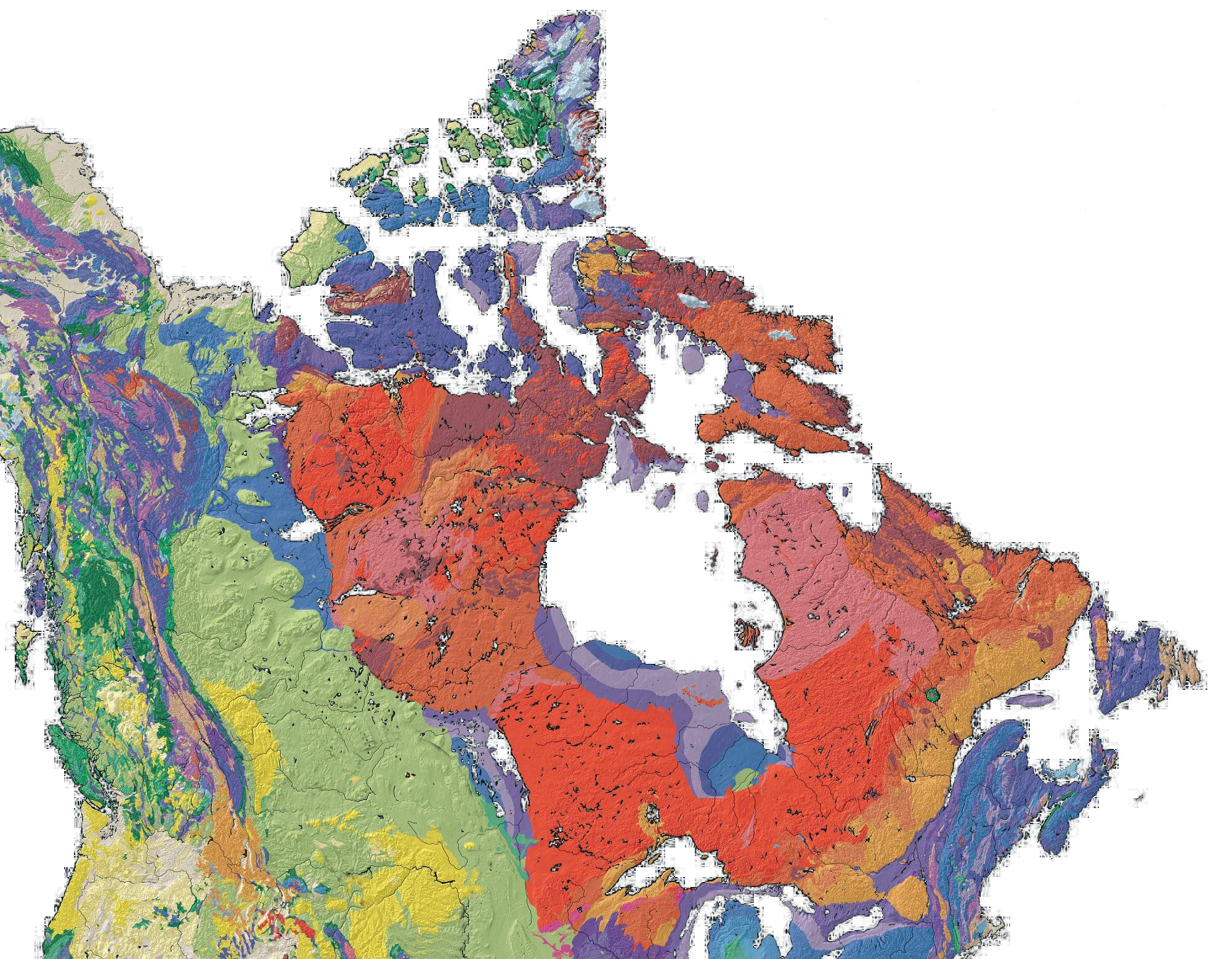
The Canadian Shield (French: Bouclier canadien [buklje kanadjɛ̃]), also called the Laurentian Shield or the Laurentian Plateau, is a geologic shield, a large area of exposed Precambrian igneous and high-grade metamorphic rocks. It forms the North American Craton (or Laurentia), the ancient geologic core of the North American continent. Glaciation has left the area with only a thin layer of soil, through which exposures of igneous bedrock resulting from its long volcanic history are frequently visible.[3] As a deep, common, joined bedrock region in eastern and central Canada, the shield stretches north from the Great Lakes to the Arctic Ocean, covering over half of Canada and most of Greenland; it also extends south into the northern reaches of the continental United States.

Key Information

Geographical extent

[edit]

The Canadian Shield is a physiographic division comprising four smaller physiographic provinces: the Laurentian Upland, Kazan Region, Davis and James.[1] The shield extends into the United States as the Adirondack Mountains (connected by the Frontenac Axis) and the Superior Upland. The Canadian Shield is a U-shaped subsection of the Laurentia craton signifying the area of greatest glacial impact (scraping down to bare rock) creating the thin soils. The age of the Canadian Shield is estimated to be 4.28 Ga (4.28 billion years). The Canadian Shield once had jagged peaks, higher than any of today's mountains, but millions of years of erosion have transformed these mountains to rolling hills.[4]

The Canadian Shield is a collage of Archean plates and accreted juvenile arc terranes and sedimentary basins of the Proterozoic Eon that were progressively amalgamated during the interval 2.45–1.24 Ga, with the most substantial growth period occurring during the Trans-Hudson orogeny, between c. 1.90–1.80 Ga.[5] The Canadian Shield was the first part of North America to be permanently elevated above sea level and has remained almost wholly untouched by successive encroachments of the sea upon the continent. It is the Earth's greatest area of exposed Archean rock. The metamorphic base rocks are mostly from the Precambrian (between 4.5 Ga and 540 Ma) and have been repeatedly uplifted and eroded. Today it consists largely of an area of low relief 300–610 m (980–2,000 ft) above sea level with a few monadnocks and low mountain ranges (including the Laurentian Mountains) probably eroded from the plateau during the Cenozoic Era. During the Pleistocene Epoch, continental ice sheets depressed the land surface (creating Hudson Bay) but also tilted up its northeastern "rim" (the Torngat), scooped out thousands of lake basins, and carried away much of the region's soil. The northeastern portion, however, became tilted up so that, in northern Labrador and Baffin Island, the land rises to more than 1,500 metres (5,000 feet) above sea level.

When the Greenland section is included, the Canadian Shield is approximately circular, bounded on the northeast by the northeast edge of Greenland, with Hudson Bay in the middle. It covers much of Greenland, all of Labrador and the Great Northern Peninsula of Newfoundland, most of Quebec north of the St. Lawrence River, much of Ontario including northern sections of the Ontario Peninsula, the Adirondack Mountains[6] of New York, the northernmost part of Lower Michigan and all of Upper Michigan, northern Wisconsin, northeastern Minnesota, the central and northern portions of Manitoba, northern Saskatchewan, a small portion of northeastern Alberta,[7] mainland Northwest Territories to the east of a line extended north from the Saskatchewan-Alberta border, most of Nunavut's mainland and, of its Arctic Archipelago, Baffin Island and significant bands through Somerset, Southampton, Devon and Ellesmere islands.[2] In total, the exposed area of the shield covers approximately 8,000,000 km2 (3,100,000 sq mi). The true extent of the shield is greater still and stretches from the Western Cordillera in the west to the Appalachians in the east and as far south as Texas, but these regions are overlaid with much younger rocks and sediment.

Panorama of typical Canadian Shield geography in the Flin Flon, Manitoba, region. Big Island Lake is in the background.

Geology

[edit]

The Canadian Shield is among the oldest geologic areas on Earth, with regions dating from 2.5 to 4.2 billion years.[8] The multitude of rivers and lakes in the region is classical example of a deranged drainage system, caused by the watersheds of the area being disturbed by glaciation and the effect of post-glacial rebound.[9] The shield was originally an area of very large, very tall mountains (about 12,000 m or 39,000 ft)[10] with much volcanic activity, but the area was eroded to nearly its current topographic appearance of relatively low relief over 500 Ma.[11][12] Erosion has exposed the roots of the mountains, which take the form of greenstone belts in which belts of volcanic rock that have been altered by metamorphism are surrounded by granitic rock. These belts range in age from 3.6 to 2.7 Ga.[13] Much of the granitic rock belongs to the distinctive tonalite–trondhjemite–granodiorite family of rocks, which are characteristic of Archean continental crust.[14] Many of Canada's major ore deposits are associated with greenstone belts.[15]

The Sturgeon Lake Caldera in Kenora District, Ontario, is one of the world's best preserved mineralized Neoarchean caldera complexes, which is 2.7 Ga.[16] The Canadian Shield also contains the Mackenzie dike swarm, which is the largest dike swarm known on Earth.[17] The North American craton is the bedrock forming the heart of the North American continent, and the Canadian Shield is the largest exposed part of the craton's bedrock. The Canadian Shield is part of an ancient continent called Arctica, which was formed about 2.5 Ga during the Neoarchean era.

Mountains have deep roots and float on the denser mantle much like an iceberg at sea. As mountains erode, their roots rise and are eroded in turn. The rocks that now form the surface of the shield were once far below the Earth's surface. The high pressures and temperatures at those depths provided ideal conditions for mineralization. Although these mountains are now heavily eroded, many large mountains still exist in Canada's far north called the Arctic Cordillera. This is a vast, deeply dissected mountain range, stretching from northernmost Ellesmere Island to the northernmost tip of Labrador. The range's highest peak is Nunavut's Barbeau Peak at 2,616 metres (8,583 ft) above sea level.[18] Precambrian rock is the major component of the bedrock.

Ecology

[edit]
Typical shield landscape in a southern Ontario region with very few old growth trees, due to a history of logging and fires. Black River, Queen Elizabeth II Wildlands Provincial Park.

The current surface expression of the shield is one of very thin soil lying on top of the bedrock, with many bare outcrops. This arrangement was caused by severe glaciation during the ice ages that covered the shield and scraped the rock clean. The lowlands of the Canadian Shield have a very dense soil that is not suitable for forestation; it also contains many marshes and bogs (muskegs). The rest of the region has coarse soil that does not retain moisture well and is frozen with permafrost throughout the year. Forests are not as dense in the north.

The shield is covered in parts by vast boreal forests in the south that support natural ecosystems as well as a major logging industry. The boreal forest area gives way to the Eastern Canadian Shield taiga that covers northern Quebec and most of Labrador. The Midwestern Canadian Shield forests that run westwards from Northwestern Ontario have boreal forests that give way to taiga in the most northerly parts of Manitoba and Saskatchewan. Hydrologic drainage is generally poor, the soil compacting effects of glaciation being one of the many causes. Tundra typically prevails in the northern regions.

Many mammals such as beaver, caribou, white-tailed deer, moose, wolves, wolverines, weasels, mink, otters, grizzly bear, polar bears and black bears are present.[19] In the case of polar bears (Ursus maritimus), the shield area contains many of their denning locations, such as the Wapusk National Park.[20] The many lakes and rivers on the shield contain a plentiful quantity of different sports fish species, including walleye, northern pike, lake trout, yellow perch, whitefish, brook trout, arctic grayling, and many types of baitfish.[21] The water surfaces are also home to many waterfowl, most notably Canada geese, loons and gulls.[22] The vast forests contain a myriad population of other birds, including ravens and crows, predatory birds and many songbirds.

Mining and economics

[edit]

The Canadian Shield is one of the world's richest areas for mineral ores. It is filled with substantial deposits of nickel, gold, silver, and copper. There are many mining towns extracting these minerals. The largest, and one of the best known, is Sudbury, Ontario. Sudbury is an exception to the normal process of forming minerals in the shield since the Sudbury Basin is an ancient meteorite impact crater. Ejecta from the meteorite impact was found in the Rove Formation in May 2007. The nearby but less-known Temagami Magnetic Anomaly has striking similarities to the Sudbury Basin. This suggests it could be a second metal-rich impact crater.[23] In northeastern Quebec, the giant Manicouagan Reservoir is the site of an extensive hydroelectric project (Manic-cinq, or Manic-5). This is one of the largest-known meteorite impact craters on Earth, though not as large as the Sudbury crater.

The Flin Flon greenstone belt in central Manitoba and east-central Saskatchewan "is one of the largest Paleoproterozoic volcanic-hosted massive sulfide (VMS) districts in the world, containing 27 copper-zinc-(gold) deposits from which more than 183 million tonnes of sulfide have been mined."[24] The portion in the Northwest Territories has recently been the site of several major diamond discoveries. The kimberlite pipes in which the diamonds are found are closely associated with cratons, which provide the deep lithospheric mantle required to stabilize diamond as a mineral. The kimberlite eruptions then bring the diamonds from over 150 kilometres (93 mi) depth to the surface. The Diavik mine is actively mining kimberlite diamonds.

See also

[edit]

References

[edit]

Further reading

[edit]
Revisions and contributorsEdit on WikipediaRead on Wikipedia
from Grokipedia
The Canadian Shield, also known as the Laurentian Plateau, is a vast forming the ancient core of the North American , encompassing approximately 8 million square kilometers (3 million square miles) and covering about half of Canada's landmass. It is centered on and extends across eastern and central Canada, including most of , , , and parts of , , the , and , while also reaching into northern portions of the such as , , and . Geologically, the Shield consists predominantly of exposed igneous and metamorphic rocks from the Precambrian era, with formations dating back more than 600 million years and some areas exceeding 4 billion years in age, representing one of Earth's oldest crustal regions. The oldest known rocks, such as those in the Nuvvuagittuq Greenstone Belt in northern Quebec dating to at least 4.16 billion years old, highlight its role as a key archive of early Earth history, shaped by multiple episodes of mountain-building, erosion, and the assembly of ancient continental fragments between 2.5 and 1.25 billion years ago. Divided into several provinces like the Superior and Grenville, the Shield features complex structures including greenstone belts, granitic gneisses, and banded iron formations, with the Superior Province alone spanning Archean rocks from 3.6 to 2.6 billion years old. The landscape of the Canadian Shield has been profoundly influenced by Pleistocene glaciation from the Laurentide Ice Sheet, resulting in a rugged terrain of low-relief hills, exposed bedrock outcrops, thin soils, and over a million lakes that create intricate, "deranged" drainage patterns. This glaciated topography supports boreal forests (taiga) and tundra in the north, with sparse vegetation due to the impermeable granitic bedrock that limits soil development and water retention. Ecologically, the region hosts diverse wildlife and serves as a critical watershed, feeding major rivers like the St. Lawrence and Mackenzie, while its numerous freshwater bodies contribute significantly to Canada's vast freshwater resources, including about 20% of the world's surface freshwater. Economically, the Canadian Shield is renowned for its abundant mineral resources, including , , , , silver, , and base metals, which underpin Canada's sector and have driven industrial development since the . Key deposits, such as gold in the Red Lake and areas of the Superior Province, and base metals in greenstone belts, highlight its metallogenic provinces, with the region producing a significant portion of global and iron. Beyond , the Shield supports generation—providing over half of Canada's electricity through rivers and reservoirs—and industries like for pulp and paper, as well as centered on its scenic lakes and national parks such as and .

Geography

Extent and Location

The Canadian Shield encompasses approximately 8 million square kilometers, representing one of the largest exposed areas of rock on and forming a broad, U-shaped region that encircles . This vast expanse covers over half of Canada's land area, stretching from the in the north to the in the south, and from on the Atlantic coast westward across to the prairies of . Its boundaries are primarily geological, delineated by transitions to younger sedimentary basins such as the Lowland to the south and the to the west, rather than following political divisions. In eastern and central Canada, the Shield dominates landscapes in , much of and , and northern portions of and , with extensions into the and . Southward, it protrudes into the , encompassing the Superior Upland across parts of , , and , as well as the in New York via the Frontenac Axis connection. Minor extensions also reach into northeastern , linking to the broader . Major cities bordering or situated within the Shield include in and in , which lie at its southern fringes near the transition to glaciated lowlands. Geologically, the Shield is subdivided into distinct provinces based on rock age and structure, including the expansive Superior Province in the south-central region, the Churchill Province spanning the north and northwest, and the eastern ; other key divisions encompass the Slave, , Nain, and Grenville provinces. These provinces collectively define the Shield's irregular boundaries, with the overall region approximating coordinates from about 45°N to 83°N and 52°W to 115°W . The area's thin soils and heavily eroded surfaces result from billions of years of exposure and glaciation, underscoring its ancient character.

Physiography and Hydrology

The Canadian Shield exhibits a varied physiography characterized by a generally low-relief landscape shaped by extensive erosion over billions of years, exposing its ancient bedrock. The average elevation ranges from 300 to 500 meters across much of the region, with higher uplands reaching 800 to 1,500 meters in areas like northern Labrador and . Notable peaks include Mont Raoul-Blanchard at 1,166 meters in the of . These elevations reflect the remnants of ancient mountain ranges that formed during orogenic events and were subsequently eroded to their current subdued form. The region's rugged terrain results primarily from Pleistocene glaciations, which sculpted the landscape through advances and retreats between 75,000 and 6,000 years ago. Glacial and deposition created characteristic landforms such as eskers, drumlins, moraines, and U-shaped valleys, particularly evident in areas like Témiscamingue, Quebec, and coastal fjords along the and coast. This glaciation also produced thousands of lakes—over 2 million in total across , with the majority concentrated in the Shield—covering approximately 9-10% of the region's area and forming shallow basins filled by . Major river systems, including the and its continuation into the , drain significant portions of the Shield eastward toward the Atlantic, contributing to broader North American hydrological patterns. Adjacent to the Canadian Shield, the form a low, swampy plain encircling the central depression around , with elevations typically below 200 meters and subdued glacial features like plains and raised beaches. This area, covering about 320,000 square kilometers, influences North American drainage by channeling rivers such as the Attawapiskat and Nelson into , serving as a key sediment trap and complex that moderates water flow from the surrounding Shield uplands.

Geology

Formation and Age

The Canadian Shield constitutes the ancient core of the craton, which forms the stable foundation of the North American tectonic plate. Its geological record spans the vast majority of Earth's history, from approximately 4.16 billion years ago (Ga) to about 540 million years ago (Ma), encompassing and rocks that record the early assembly and stabilization of . The Shield's formation involved the accretion and welding of multiple and cratonic blocks through successive orogenic cycles, primarily between 2.5 Ga and 1.0 Ga. Prominent among these were the Kenoran at around 2.7 Ga, which deformed and intruded early cratonic nuclei in regions like the Superior Province, and the Hudsonian at approximately 1.8 Ga, which further amalgamated blocks across the Churchill and Bear provinces via widespread folding, , and granitic plutonism. These events transformed disparate crustal fragments into a cohesive, stable resistant to later tectonic disruption. Radiometric dating provides critical evidence for these timelines, including U-Pb analyses of crystals and Sm-Nd isotopic systems applied to metamorphic and igneous rocks. Notably, rocks in the of northern yield Sm-Nd isochron ages of approximately 4.16 Ga, indicating preservation of Hadean-era crustal components, with U-Pb dating supporting ages around 4.0 Ga. Over billions of years following stabilization, subaerial and fluvial progressively wore down the orogenic highlands, reducing them to a nearly flat by the late . This long-term , estimated to have removed several kilometers of overlying material in some areas, exposed the Shield's resistant basement with limited sedimentary cover, a feature that distinguishes it from surrounding platforms.

Rock Composition and Structures

The Canadian Shield is predominantly composed of igneous and metamorphic rocks, with granites, gneisses, and schists forming the bulk of the exposed crust. These rocks, primarily of and age, result from repeated episodes of , , and deformation over billions of years. Granitic intrusions are widespread, often intruding into older metamorphic sequences, while gneisses exhibit banded textures from intense regional , and schists display due to aligned minerals like and . Volcanic and sedimentary remnants preserved in , such as the Abitibi greenstone belt in and , include tholeiitic basalts, andesites, and intercalated clastic sediments, representing ancient oceanic or arc environments. Key structural features highlight the Shield's complex tectonic history, including the , a 1.85 Ga elliptical structure interpreted as the eroded remnant of a major approximately 200–250 km in original diameter. This basin features concentric rings of brecciated and shocked rocks, with radial and concentric faults deforming the surrounding and terrains. The Mackenzie dike swarm represents a vast radial dyke system emplaced around 1.27 Ga, extending over 2,000 km from a focal point near , with dykes fanning outward in a pattern indicative of plume-related . These intrusions cut across older lithologies, providing evidence of late extension. The Shield's architecture is further defined by extensive fault lines and shear zones formed during ancient tectonic collisions, such as those associated with the assembly of around 1.85–1.8 Ga. These include mylonitic shear zones up to several kilometers wide, like those in the Trans-Hudson Orogen, where ductile deformation under amphibolite-facies conditions produced foliated gneisses and cataclastic rocks. Some areas exhibit low-grade , particularly in greenstone belts and marginal zones, with greenschist-facies assemblages of , , and reflecting burial depths of 5–10 km and temperatures of 300–500°C. The lack of significant sedimentary cover across much of the Shield allows direct exposure of these basement rocks, with erosion having removed any overlying younger strata in vast regions.

Climate and Ecology

Climate Patterns

The Canadian Shield predominantly features and zones, characterized by long, severe winters and brief summers. Average winter temperatures range from -10°C to -30°C, influenced by persistent polar air masses originating from the and moderated somewhat by the proximity of , which introduces cooler maritime effects in eastern and coastal areas. Summers are short, with average temperatures between 10°C and 20°C, allowing for limited seasonal thawing but often interrupted by cool fronts. In recent decades, has contributed to warmer average temperatures and more frequent events, including wildfires and altered patterns. Annual across the Shield typically falls between 400 mm and 800 mm, with the majority occurring as during winter months, contributing to deep snowpacks that influence spring runoff. Regional variations are notable, with wetter conditions in the eastern portions—often exceeding 600 mm due to cyclonic activity from the Atlantic—contrasted by drier interiors in the west, where totals can dip below 500 mm owing to continental high-pressure systems. These patterns support the Shield's hydrological dynamics, including variable lake and river flows. Latitude and elevation create diverse microclimates within the Shield, with northern latitudes experiencing more extreme cold and shorter growing seasons, while higher elevations amplify cooling effects through increased exposure to winds and reduced solar radiation. In the northern extents, discontinuous is prevalent, covering up to 50% of the land surface in zones and restricting soil drainage and vegetation growth. Historical climate shifts have shaped the Shield's water systems, notably during the (approximately 1300–1850 CE), when cooler temperatures and altered precipitation led to elevated lake levels in regions like the , reflecting reduced evaporation and increased snowfall accumulation. These changes highlight the sensitivity of Shield to broader climatic fluctuations.

Ecosystems and

The Canadian Shield's ecosystems are dominated by the boreal forest, also known as , which covers approximately 80% of the Boreal Shield ecozone within the region. This vast coniferous forest features species-adapted trees such as black spruce (), white spruce (), jack pine (), and balsam fir (), which thrive in the cool, moist conditions and form dense stands interspersed with wetlands and rocky outcrops. In the northern extents and alpine zones of the Shield, shifts to tundra-like landscapes with low shrubs, mosses, and lichens, where tree growth is limited by shorter growing seasons and harsher exposures. These transitions create a mosaic of habitats that support distinct ecological processes, including nutrient cycling tightly linked to the underlying thin, eroded soils. Biodiversity in the Shield reflects its rugged terrain and extensive water bodies, with key wildlife including large herbivores like moose (Alces alces) and woodland caribou (Rangifer tarandus caribou), predators such as gray wolves (Canis lupus), and ecosystem engineers like beavers (Castor canadensis) that shape riparian zones through dam-building. Avian species are prominent, with waterbirds such as common loons (Gavia immer) nesting on lakes and raptors including bald eagles (Haliaeetus leucocephalus) and peregrine falcons (Falco peregrinus) utilizing the open skies and prey-rich environments. Fish populations, notably walleye (Sander vitreus) in oligotrophic lakes, form the base of aquatic food webs, sustaining both resident and migratory species. The region's podzolic soils, formed from glacial till and weathered bedrock, are characteristically acidic and nutrient-poor, with low and high leaching of bases, leading to reduced primary productivity and slow decomposition rates that limit plant growth to resilient . Forest dynamics are heavily influenced by , a natural disturbance that recurs on cycles of 50 to 200 years, clearing understory accumulation, releasing nutrients, and promoting regeneration of fire-adapted while preventing dominance by less resilient hardwoods. Aquatic ecosystems in the Shield's over 2 million lakes and interconnected rivers harbor diverse communities of amphibians, including wood frogs (Lithobates sylvaticus) and boreal chorus frogs (Pseudacris maculata), alongside such as mayflies, , and that serve as indicators of . Isolated habitats, particularly ancient post-glacial lakes, foster localized among certain and microbial communities due to limited dispersal and unique hydrochemical conditions.

Human History and Settlement

Indigenous Peoples and Pre-Colonial Use

The Canadian Shield has been inhabited by for over 11,000 years, with evidence of Paleo-Indian occupation dating back to approximately 11,000–10,500 years ago in regions such as southern and . Archaeological sites in the Shield, including those near and Rice Lake, reveal fluted points, beaked scrapers, and other stone tools associated with early hunter-gatherers who pursued migratory caribou herds across post-glacial landscapes. These early inhabitants, ancestors to later Algonquian-speaking groups, adapted to the Shield's rugged terrain and fluctuating lake levels, with additional sites from the Late Paleo-Indian period (10,500–9,500 years ago) showing lanceolate points made from local materials like . In the Quebec-Labrador portion of the Shield, ancestors similarly occupied the interior for thousands of years, utilizing seasonal campsites tied to caribou migrations and river systems. First Nations such as the Cree, Ojibwe (Anishinaabe), and Innu developed traditional economies centered on hunting, fishing, gathering, and seasonal migrations attuned to the Shield's boreal ecology. The Cree in northern Ontario and Manitoba portions of the Shield relied heavily on caribou, moose, and beaver for meat, hides, and tools, supplementing with fishing in abundant lakes and gathering berries during summer months. Ojibwe communities harvested wild rice from shallow Shield waters, fished species like walleye and trout, and hunted small game while following seasonal rounds that included maple sugaring in spring and berry collection in fall. Innu groups in the eastern Shield pursued caribou herds across the Quebec-Labrador peninsula, fishing salmon in coastal and riverine areas, and gathering plants like berries, with family bands migrating inland in winter for hunting and to the coast in summer for marine resources. These practices ensured sustainable use of the land's resources without agriculture, given the thin soils and short growing seasons. The Shield holds profound spiritual and cultural significance for these Indigenous groups, embodied in sacred sites and oral histories that connect people to the land's ancient . sites, such as pictographs in the area of , serve as spiritual landscapes where Anishinaabeg, , and recorded visions, teachings, and routes through paintings on cliffs, reflecting a that views the Shield's exposed rocks and waters as living entities formed in creation stories. Oral traditions among the describe the earth's emergence from water, mirroring the Shield's glaciated origins, while and narratives emphasize the land's role in guiding migrations and providing spiritual sustenance through ceremonies at outcrops and lakes. These elements underscore a holistic relationship with the territory, where the Shield's informs identity and stewardship. Pre-colonial trade networks across the Shield facilitated exchange of copper and furs among Indigenous groups, enhancing cultural and economic interconnections. from sources was shaped into tools, ornaments, and weapons during the (circa 6000–3000 years ago), traded southward via routes through the and northward into boreal territories by Archaic peoples ancestral to the and . Furs, including beaver and caribou hides, circulated through Algonquian networks linking Shield communities with coastal and plains groups, often bartered alongside flint, shells, and to foster alliances and access diverse resources. These exchanges, spanning thousands of kilometers, highlight the Shield's role as a hub in continent-wide Indigenous commerce long before European involvement.

European Exploration and Modern Settlement

The earliest recorded European exploration of regions adjacent to the Canadian Shield dates to around 1000 CE, when Norse voyagers from established temporary contacts along the northern Atlantic coasts of , potentially including areas near and that border the Shield's northeastern extent. These interactions, documented in Norse sagas, involved brief encounters with but did not lead to sustained presence in the Shield's interior. More direct European penetration into the Canadian Shield began with French explorers in the early 17th century. In 1615, led an expedition up the , reaching and the French River before arriving at on , marking the first documented European traversal of the Shield's southern fringes. This journey facilitated initial mapping of waterways and alliances with Indigenous groups for further navigation. The fur trade soon followed, with the receiving its charter in 1670 and establishing trading posts along James Bay's southern shore, such as Moose Factory and Fort Albany, to exploit the Shield's abundant beaver populations. By the late 17th century, the company expanded inland with outposts like Henley House in 1743, drawing furs from deep within the Shield's boreal forests and rivers. In the , systematic surveys advanced knowledge of the Shield's vast interior. British-Canadian explorer David Thompson, working for the and from 1789 to 1812, conducted extensive traverses across the Shield, mapping rivers, lakes, and portages from the westward toward the Rockies. His work covered over 55,000 miles, including precise astronomical observations that delineated boundaries and trade routes through the region's terrain. Complementing these efforts, the Geological Survey of Canada was founded in 1842 under director William Logan to systematically map the Shield's mineral resources and geology, beginning with surveys in and that identified key ore deposits. These mappings laid the groundwork for resource extraction and continued through the century, revealing the Shield's Laurentian plateau structure. Modern settlement in the Canadian Shield remains sparse, housing less than 10 percent of Canada's total (as of the early ) across its 8 million square kilometers, with an overall density of less than 0.5 people per square kilometer. Population concentrations are limited to urban centers like ( 166,004 as of 2021) and (41,145 as of 2021), which emerged in the late 19th and early 20th centuries around mining operations exploiting and deposits, respectively. These hubs, supported by rail access, contrast with the Shield's predominantly rural and remote character elsewhere. Infrastructure development in the 20th century facilitated limited growth and connectivity. The Canadian Pacific Railway, completed in 1885, pierced the Shield's rugged north shore of with costly blasting and bridging, enabling the transport of minerals and settlers to . Highway networks expanded post-World War II, notably through the system initiated in 1950, which required extensive rock cuts and bridges across the Shield to link isolated communities by the . This infrastructure, combined with brief references to mineral discoveries during surveys, spurred modest settlement patterns tied to resource industries.

Economy and Resource Use

Mining Industry

The Canadian Shield is recognized as one of North America's richest mineral regions, hosting substantial reserves of base and precious metals that have driven industrial development for over a century. Key deposits include and in the , an ancient formed approximately 1.8 billion years ago, which has yielded some of the world's largest concentrations of these metals alongside platinum-group elements. Gold occurs prominently in areas like the Red Lake district in , while was initially extracted from early sites such as Bruce Mines on . Uranium deposits near in the and diamonds from the now-closed Victor Mine (Ontario's first diamond operation) in further highlight the Shield's diverse mineral endowment. Mining in the Canadian Shield began in the 1840s with the discovery of copper at Bruce Mines in 1843 and the opening of the first commercial operations there in 1846, marking the inception of organized extraction in the area. The industry expanded significantly in the late 19th century following the 1883 discovery of nickel-copper ores during Canadian Pacific Railway construction near Sudbury, leading to rapid development of underground operations. The 20th century saw a production peak, particularly in Sudbury, which emerged as a dominant global nickel supplier, accounting for a substantial share of world output during its heyday and establishing the region as a cornerstone of Canada's metallurgical industry. Extraction techniques in the Shield encompass both open-pit and underground methods, adapted to the bedrock's complex geology. Open-pit mining is prevalent for shallower, large-volume deposits like those at the Victor diamond site, involving excavation to depths of up to 200 meters. Underground approaches, such as open stope and cut-and-fill, dominate deeper operations in areas like Sudbury, where miners follow ore veins through igneous and metamorphic formations using drilling, blasting, and trackless equipment for efficiency. The Canadian mining sector, with major operations in the Shield, contributes about 4% to Canada's overall through mineral production ($117 billion as of 2023), underscoring its role as a primary economic driver for metals like , , and . Major operators include Vale, which manages multiple Sudbury nickel-copper mines, and , active in and other base metals across the region, together sustaining a workforce that includes about 11% Indigenous employees in upstream activities. This labor force has historically fueled boomtowns like Sudbury and , transforming remote Shield outposts into industrial hubs with populations swelling around major discoveries. As of 2025, new projects like the Crawford Project in and Matawinie Mine in are advancing, supported by federal investments in critical minerals.

Forestry, Tourism, and Other Activities

Forestry represents the second major economic activity in the Canadian Shield after , with sustainable practices focusing on coniferous such as black spruce () and (Pinus banksiana), which dominate the boreal forests of the region. In key provinces like and , annual timber harvests from Shield areas total approximately 45–50 million cubic meters of industrial roundwood, managed through annual allowable cuts to ensure long-term wood supply sustainability. These operations supply numerous pulp and mills concentrated in and , where the industry processes into products like newsprint and packaging materials, supporting regional employment and export revenues. Tourism in the Canadian Shield attracts millions of visitors annually, drawn to its vast wilderness for including , canoeing, and viewing, with northern areas also popular for aurora borealis observation during winter months. Iconic destinations like in welcome over 800,000 visitors each year, offering extensive trail networks, paddling routes, and educational programs that highlight the region's . These activities generate substantial economic benefits through , guiding services, and equipment rentals, while emphasizing low-impact practices to preserve ecological integrity. Hydroelectric power development harnesses the Shield's numerous rivers and waterfalls, with the in northern —initiated in the 1970s—serving as a landmark example that generates approximately 16 gigawatts and contributes approximately 15% of Canada's total electricity production. This mega-project, comprising multiple generating stations on the La Grande River, exemplifies large-scale extraction from the region's glaciated terrain, powering urban centers across and enabling exports to the . Emerging sectors include initiatives that promote guided nature experiences in protected areas, alongside carbon credit programs where boreal forests are managed for sequestration to generate offsets under Indigenous-led conservation efforts. In the southern fringes of the Canadian Shield, small-scale agriculture persists through mixed farming of crops like hay, potatoes, and on thin, rocky soils, supported by shorter frost-free periods of 120 days or less. technologies, including and , are increasingly employed for resource mapping across the Shield, aiding in , geological surveys, and monitoring of water connectivity in inaccessible terrains.

Conservation and Environmental Challenges

Protected Areas and Management

The Canadian Shield encompasses numerous protected areas that safeguard its ancient geological features, boreal forests, and aquatic ecosystems, with protection levels varying across ecoregions—for instance, 4% in the Central Canadian Shield Forests. Key federal examples include in the , a since 1978 renowned for its canyon landscapes and , and Wood Buffalo National Park, straddling and the , which protects the world's largest intact example of the Great Plains–Boreal grassland ecosystem and herds as a site since 1983. Provincial parks such as in highlight the Shield's rugged terrain and cliff formations, while Pimachiowin Aki, inscribed as a in 2016, represents the largest protected boreal shield landscape in , covering 2.9 million hectares across and . Recent additions include Thaidene Nèné, established in 2022 as a 7,000 km² Indigenous protected area in the , emphasizing and co-management. These areas collectively preserve representative samples of the Shield's unique ecosystems, including and freshwater habitats. Management of these protected zones is primarily overseen by , which administers national parks and reserves under the Canada National Parks Act to maintain ecological integrity and public access. Indigenous co-governance models are increasingly integral, particularly in sites like Pimachiowin Aki and Thaidene Nèné, where First Nations—such as the Pikangikum, Poplar River, and Pauingassi—partner with provincial and federal authorities to apply in decision-making, ensuring cultural and spiritual values guide conservation. corridors and wildlife sanctuaries further enhance connectivity, such as those linking to adjacent habitats, supporting migratory species like caribou and promoting resilience against fragmentation. Restoration initiatives address historical impacts from and , with programs gaining momentum since the 1990s through organizations like Forests Ontario, which have planted over 31 million trees primarily on marginal farmlands in to restore native stands and improve soil stability, achieving success rates above 80% in establishing self-sustaining forests. These efforts emphasize site-specific species like black and . Canada's adherence to the , ratified in 1992, extends to transboundary Shield regions shared with the , fostering cooperative strategies for cross-border conservation of shared and watersheds, such as those in the Great Lakes-St. Lawrence corridor.

Environmental Issues and Sustainability

The Canadian Shield has faced significant environmental degradation from , primarily resulting from emissions from industrial activities in the mid- to late . During the and , transboundary from U.S. and Canadian sources acidified thousands of lakes across the Shield, impairing aquatic ecosystems and populations. The 1991 Canada- Air Quality Agreement addressed this by committing both nations to reduce emissions by about 40% from 1980 levels, leading to substantial recovery in lake chemistry by the and early . These efforts, complemented by Canada's Eastern Program, have stabilized levels in many Shield lakes, though some sensitive areas continue to show lingering effects. Mining activities have also contributed to persistent contamination, particularly through that release into soils and waterways. In , , arsenic from at the , operational from 1948 to 1999, has contaminated local lakes and sediments, affecting and for decades. Remediation efforts, including freezing roaster waste underground, are ongoing— with Phase 4 initiated in 2024 and expected completion in the 2030s—to prevent further dispersal, but in fish and traditional foods poses health risks to nearby communities. Similar issues arise from other Shield mines, where leach metals like and mercury, exacerbating local stress. Climate change poses escalating threats, including permafrost thaw across approximately 40% of the Shield's boreal forest areas, which destabilizes landscapes, releases stored carbon, and alters hydrology. This thaw contributes to thermokarst formation, flooding peatlands and releasing methane, while increasing wildfire vulnerability—as seen in the 2023 wildfires that burned over 18 million hectares across Canada, including significant Shield areas. Forest dieback is evident in regions like the western Shield, where drought and insect outbreaks, intensified by warmer temperatures, have caused widespread conifer mortality. Invasive species, such as purple loosestrife and zebra mussels, further disrupt aquatic habitats by outcompeting natives and altering food webs in Shield lakes. Overharvesting exacerbates pressures on species like lake sturgeon, whose populations have declined due to historical commercial fishing and habitat fragmentation. Transboundary issues compound these challenges, particularly water quality in the , which form the southern boundary of the Shield and receive runoff carrying pollutants from both countries. The 1972 Great Lakes Water Quality Agreement, renewed in 2012, targets phosphorus reductions to combat , but ongoing industrial and agricultural inputs continue to degrade habitats shared across the border. Biodiversity loss in the Shield reflects national trends, with about 20% of assessed wild at some risk of extirpation or potentially at risk as of 2020, driven by habitat alteration and cumulative stressors. Sustainability initiatives are advancing mitigation, including Indigenous-led monitoring programs that integrate traditional knowledge with scientific data to track changes in water and wildlife. For instance, the Indigenous Community-Based Climate Monitoring Program supports projects in Shield communities to assess ecosystem health and inform adaptive strategies. Post-2020 efforts include pilots for zero-emission mining, such as incentives for electric off-road vehicles in northern operations, aiming to cut diesel emissions from remote Shield sites. These align with broader goals under Canada's Critical Minerals Strategy to promote low-carbon extraction while protecting ecosystems.

References

Add your contribution
Related Hubs
User Avatar
No comments yet.