Hubbry Logo
logo
Tindari
Community hub

Tindari

logo
0 subscribers
Read side by side
from Wikipedia

Tindari (Italian: [ˈtindari]; Sicilian: Lu Tìnnaru [lʊ ˈtinnaɾʊ]), ancient Tyndaris (Ancient Greek: Τυνδαρίς, Strab.) or Tyndarion (Τυνδάριον, Ptol.), is a small town, frazione (suburb or municipal component) in the comune of Patti and a Latin Catholic titular see.

Key Information

The monumental ruins of ancient Tyndaris are a main attraction for visitors and excavations are continuing to reveal more parts of the city.

Tindari has a famous sanctuary and is also famous for the poem Vento a Tindari, written by Salvatore Quasimodo.

History

[edit]
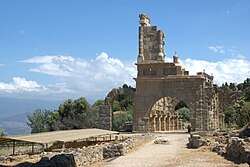
The monumental propylaeum gate from the inside
Roman Domus

Ancient Tyndaris was strategically situated on its prominent hill overlooking the wide bay of the Tyrrhenian Sea bounded by the Capo di Milazzo on the east, and the Capo Calavà on the west.[citation needed] It was connected by a comparatively narrow isthmus with the lower ground inland. It thus commanded views of the summit of Mount Etna and northwards to the Lipari Islands.[1]

It was one of the latest of all the cities in Sicily that could claim a purely Greek origin, having been founded by the elder Dionysius in 396 or 395 BC in Magna Graecia; the site is so strategic that it is a surprise it was not occupied earlier.[1] The original settlers were the remains of the Messenian exiles, who had been driven from Naupactus, Zacynthus, and the Peloponnese by the Spartans after the close of the Peloponnesian War. These had at first been established by Dionysius at Messana, when he repeopled that city; but the Spartans having taken umbrage at this, he transferred them to the site of Tyndaris, which had previously been included in the territory of Abacaenum. The colonists themselves gave to their new city the name of Tyndaris, from their native divinities, the "Tyndaridae" or Dioscuri, and readily admitting fresh citizens from other quarters, soon raised their whole population to the number of 5000 citizens.[2] The new city thus rose at once to be a place of considerable importance.

It is next mentioned in 344 BC, when it was one of the first cities that declared in favor of Timoleon after his landing in Sicily.[1][3] At a later period we find it mentioned as espousing the cause of Hieron, and supporting him during his war against the Mamertines, 269 BC. On that occasion he rested his position upon Tyndaris on the left, and on Tauromenium (modern Taormina) on the right.[4] Indeed, the strong position of Tyndaris made it an important strategic post on the Tyrrhenian sea, as Tauromenium was on the Sicilian sea, and hence we find it frequently mentioned in accounts of subsequent wars. In the First Punic War it was at first dependent upon Carthage; and though the citizens, alarmed at the progress of the Roman armies, were at one time on the point of turning to Rome, they were restrained by the Carthaginians, who carried off all the chief citizens as hostages.[5] In 257 BC, the Battle of Tyndaris took place off the coast of Tyndaris, between the city and the Liparaean islands, in which a Roman fleet under Gaius Atilius Regulus obtained some advantage over the Carthaginian fleet, but without any decisive result.[6] The Roman fleet is described on that occasion as touching at the promontory of Tyndaris, but the city had not yet fallen into their hands, and it was not until after the fall of Panormus (modern Palermo) in 254 BC that Tyndaris expelled the Carthaginian garrison and joined the Roman alliance.[7]

We hear little of Tyndaris under Roman government, but it appears to have been a flourishing and considerable city.[1] Cicero calls it nobilissima civitas[8] and we learn from him that the inhabitants had displayed their zeal and fidelity towards the Romans upon many occasions. Among others they supplied naval forces for the armament of Scipio Africanus the Younger, a service for which he repaid them by restoring to them a statue of Mercury which had been carried off by the Carthaginians and which continued as an object of great veneration in the city, until it was stolen by the rapacious Verres.[9] Tyndaris was also one of seventeen cities selected by the Roman senate, apparently as an honorary distinction, to contribute to certain offerings to the temple of Venus at Eryx.[10] In other respects it had no peculiar privileges, and was in the condition of an ordinary municipal town, with its own magistrates, local senate, etc., but was certainly in the time of Cicero one of the most considerable places in the island. It, however, suffered severely from the exactions of Verres[11] and the inhabitants, to revenge themselves on their oppressor, publicly demolished his statue as soon as he had quit the island.[12]

Tyndaris again bore a considerable part in the Sicilian revolt between Sextus Pompeius and Octavian. It was one of the points occupied and fortified by the former,[1] when preparing for the defence of the Sicilian straits, but was taken by Agrippa after his naval victory at Mylae, and became one of his chief posts, from which he carried on offensive warfare against Pompey.[13] Subsequently, to this we hear nothing more of Tyndaris in history; but there is no doubt of its having continued to subsist throughout the period of the Roman Empire. Strabo speaks of it as one of the places on the north coast of Sicily which, in his time, still deserved the name of cities; and Pliny gives it the title of a Colonia. It is probable that it received a colony under Augustus, as we find it bearing in an inscription the titles of Colonia Augusta Tyndaritanorum.[14] Pliny indeed mentions a great calamity which the city had sustained, when (he tells us) half of it was swallowed up by the sea, probably from an earthquake having caused the fall of part of the hill on which it stands, but we have no clue to the date of this event.[1][15] The Itineraries attest the existence of Tyndaris, apparently still as a considerable place, in the fourth century.[16]

Ecclesiastical history

[edit]
Sanctuary of Tindari.
Lagoon of Tindari included in the nature reserve of Marinello.
  • Established in 498 as Diocese of Tindari (Italian) / Tyndaris (Latin) / Tyndaritan(us) (Latin adjective). In the early 7th century Sicily had no Metropolitan see, so although politically part of the Byzantine empire, all its bishoprics were in the sway of the papal ('Western') Patriarchate of Rome as (exempt) suffragan dioceses of Rome. During the conflict on Iconoclasm, Byzantine emperor Leo III the Isaurian transferred all Sicily to his capital's Patriarchate of Constantinople (circa 732); in the 8th or 9th century, the newly created Metropolitan Archdiocese of Syracuse was given all Sicilian bishoprics as suffragans, including Tindari, where no bishops were recorded since 649.
  • Although the Notitia Episcopatuum under emperor Leo VI (early 10th century) still lists Tindari among the suffragans of Syracuse, that probably was just canonical theory, as in 836 Tindari was conquered for Islam by Arabs and nothing is heard from the diocese.
  • Formally suppressed in 880 without direct successor, but lost (some) territory in 1082 to establish the short-lived Diocese of Troina (suppressed in 1098 to establish the Diocese of Messina). When Sicilia was again conquered and Christianize by the Normans in the 11th century, the bishopric wasn't restored, its territory rather assigned to the new Diocese of Patti.

Titular see

[edit]

The diocese was nominally restored in 1968 as Latin Titular bishopric of Tindari (Curiate Italian) / Tyndaris (Latin) / Tyndaritan(us) (Latin adjective)

Remains

[edit]
Theatre

By the 19th century, the site of Tyndaris was wholly deserted, but the name was retained by a church, which crowned the most elevated point of the hill on which the city formerly stood, and was still called the Madonna di Tindaro. It is c. 180 m above the sea-level, and forms a conspicuous landmark to sailors. Considerable ruins of the ancient city, are also visible. It occupied the whole plateau or summit of the hill, and the remains of the ancient walls may be traced, at intervals, all round the brow of the cliffs, except in one part, facing the sea, where the cliff is now quite precipitous. It is not improbable that it is here that a part of the cliff fell in, in the manner recorded by Pliny[17] Two gates of the city are also still distinctly to be traced.

The chief monuments, of which the ruins are still extant within the circuit of the walls, are:

  • the theatre, of which the remains are in imperfect condition, but sufficient to show that it was not of large size, and apparently of Roman construction, or at least, like that of Tauromenium, rebuilt in Roman times upon the Greek foundations
  • a propylaeum with two handsome stone arches (previously called a Gymnasium)
  • several other edifices of Roman times, but of wholly uncertain character, a mosaic pavement and some Roman tombs.[18]

Numerous inscriptions, fragments of sculpture, and architectural decorations, as well as coins, vases etc. have also been discovered on the site.

Includes vignettes of the British fleet commanded by Admiral John Byng in the Battle of Capo Passero (1718), and landing at Tindari (1719).
The Black Madonna of Tindari celebrated the 7–8 September, inscribed NIGRA SUM SED FORMOSA, meaning "I am black but beautiful".

Legend

[edit]

Local legend tells that the lagoon was created after a pilgrim who came to see the Madonna refused to pray to the Madonna because she was black. The woman accidentally dropped her baby into the ocean and the Madonna made the land rise to save the baby. The sands of Marinello have taken shape of the profile of the Madonna.

Cultural references

[edit]

Accessibility

[edit]

By car, if you come from Falcone, A20 of Autostrada Messina-Palermo take Palermo direction along SS 113.

But Tindari and its Church are reachable by trains run by Trenitalia, including services from Messina with the Oliveri railway station situated on the Palermo–Messina railway. Outside of the station is available an Uber service by app.

Tindari is also served by bus provided from Azienda Siciliana Trasporti.

See also

[edit]

References

[edit]
[edit]
Revisions and contributorsEdit on WikipediaRead on Wikipedia
from Grokipedia
Tindari is a small coastal frazione within the comune of Patti in northeastern Sicily, Italy, perched on a promontory rising 274 meters above the Tyrrhenian Sea and overlooking the Aeolian Islands.[1] With a population of approximately 46 residents, it serves as a historical and religious hub, best known for the archaeological remains of the ancient Greek city of Tyndaris and the Sanctuary of the Black Madonna, a prominent pilgrimage destination.[1] The ancient city of Tyndaris was founded in 396 BCE by Dionysius I, the tyrant of Syracuse, as a Greek colony to house Messenian exiles displaced from the Peloponnese following their defeat by the Spartans.[2] Strategically positioned for defense, it allied with Syracuse against Carthage in the 4th century BCE and came under Roman control in 254 BCE, later becoming a colonia named Colonia Augusta Tyndaritanorum around 20–21 CE.[2] Key architectural features include a Greek theater constructed in the late 4th to 3rd centuries BCE, later adapted by Romans into an arena with a capacity of about 3,000 spectators; a basilica possibly built in the late 1st century BCE using sandstone blocks; a main decumanus road with cross streets; and extensive defensive walls.[3][2] The city thrived through the Roman era but declined after a devastating landslide in the 1st century CE, the Arab conquest in 835–836 CE, and eventual abandonment following the fall of Rome, leaving behind well-preserved ruins that highlight Hellenistic and Roman urban planning.[3][2] Over the ruins of Tyndaris, the Sanctuary of the Blessed Virgin Mary of Tindari emerged as a major religious site, centered on the Black Madonna, a cedarwood statue of the Virgin and Child believed to have originated in the Eastern Mediterranean and arrived in Sicily during the iconoclastic controversies of the 8th century.[4] The statue was reportedly discovered by fishermen in a wooden crate off the coast in the late 8th or early 9th century and initially placed in an abandoned temple to Ceres before the Benedictines constructed an early sanctuary in the 11th century.[4][5] The current basilica, built between 1953 and 1979 on the site of earlier structures destroyed by pirates in 1544, was elevated to minor basilica status by Pope Francis in 2018 and draws pilgrims annually, particularly on September 7–8 for the feast of the Black Madonna, noted for miracles such as healings attributed to her intercession.[4][5]

Geography and Setting

Location and Landscape

Tindari occupies a prominent coastal position on a promontory rising approximately 274 meters above the Tyrrhenian Sea, situated in northeastern Sicily within the Metropolitan City of Messina, adjacent to the town of Patti.[1] This elevated terrain forms part of the dramatic Capo Tindari headland, offering panoramic views of the surrounding bay and contributing to the site's isolation and visual prominence along the coastline.[6] The landscape is characterized by steep cliffs and undulating slopes that descend to the sea, enclosing the Tindari-Marinello Natural Reserve below. Established in 1998, this oriented nature reserve spans about 380 hectares and features a dynamic coastal system, including a series of brackish lagoons, a shifting sandbar known as the Tindari-Marinello spit, and expansive sandy beaches that create a mosaic of marine and terrestrial habitats.[7] The reserve's lagoons, formed by tectonic and marine processes over the past century, provide serene coastal views framed by the promontory's rocky outcrops.[8] Geologically, the promontory consists of metamorphic and carbonatic rocks, marked by Holocene uplifted and submerged tidal notches that record relative sea-level fluctuations and tectonic uplift in the region.[9] These features, along with the site's steep topography, historically offered natural defensive advantages through sheer drops and limited access points. The reserve hosts significant biodiversity, supporting diverse flora such as reed-fringed wetlands and fauna including wading birds like herons and storks, as well as various aquatic and terrestrial species adapted to the brackish environments.[10] However, the area's fragile coastal dynamics expose it to erosion risks, including slope instability and sediment loss from wave action and tectonic activity, which threaten the stability of the overlying archaeological features.[11]

Modern Administrative Context

Tindari serves as a frazione, or hamlet, within the comune of Patti in the Metropolitan City of Messina, Sicily, Italy.[6][12] This administrative status positions it as a small populated place under the governance of Patti, with a resident population estimated at approximately 46 individuals, reflecting its limited permanent habitation.[1] Administratively, Tindari falls within the broader Metropolitan City of Messina and is encompassed by the Parco Naturale Regionale dei Nebrodi, Sicily's largest regional natural park spanning over 85,000 hectares across multiple provinces.[13][14] This inclusion provides environmental oversight and promotes sustainable development in the surrounding Nebrodi mountain range. The site's archaeological significance is safeguarded through its designation as the Parco Archeologico di Tindari, under the management of the Sicilian Region's Department of Cultural Heritage and Sicilian Identity since formal protections and excavations began in the 20th century, including major campaigns in 1938 and post-World War II.[15][2] Demographically, Tindari maintains a stable but minimal year-round population, augmented seasonally by influxes of visitors for tourism and religious pilgrimage, especially to the nearby Sanctuary of the Black Madonna, which draws daily pilgrims and peaks during summer and feast days.[16][17]

Historical Development

Ancient Foundation and Greek Period

Tindari, known in antiquity as Tyndaris, was established in 396 or 395 BC by Dionysius I, tyrant of Syracuse, as a strategic military colony to resettle around 600 Messenian exiles and mercenaries who had fought for Sparta during the Peloponnesian War and fled following their defeat; the settlement quickly grew to around 5,000 inhabitants according to Diodorus Siculus.[18] These settlers were granted the site on a promontory in northeastern Sicily to secure Syracuse's control over the region amid ongoing conflicts with Carthage. The city's foundation reflected Dionysius's policy of using displaced Greek populations to bolster Syracusan influence in Sicily's volatile political landscape.[19] The name Tyndaris derives from Tyndareus, the legendary Spartan king and mythological father of the Dioscuri (Castor and Pollux), honoring the Dorian heritage of the Messenian colonists who traced their lineage to Spartan traditions.[20] This etymological link underscored the colony's identity as a bastion of Greek culture in a frontier position, leveraging its elevated coastal location for defense and oversight of maritime routes, as detailed in the broader geographical context.[17] Tyndaris rapidly emerged as a key Greek stronghold, participating actively in Sicilian politics through alliances that enhanced its autonomy and prosperity. In 344 BC, it was among the first cities to support Timoleon, the Corinthian general invited to liberate Syracuse from tyranny, providing troops and resources that aided his campaigns against Carthaginian forces and internal rivals. This alignment positioned Tyndaris as a pivotal player in the restoration of Greek order on the island, fostering economic growth through trade and agriculture in the surrounding fertile lands. A defining event in Tyndaris's Greek period was the Battle of Tyndaris in 257 BC, a naval engagement during the First Punic War where Roman consul Marcus Atilius Regulus decisively defeated a Carthaginian fleet under Hanno off the city's coast, between Tyndaris and the Aeolian Islands. The victory, involving around 120 Roman quinqueremes against 100 Carthaginian ships, disrupted Punic supply lines and affirmed Tyndaris's role as a strategic ally in the emerging Roman-Greek coalition against Carthage.[21] The city's urban planning exemplified Hellenistic ideals, featuring a Hippodamian grid layout with rectangular insulae approximately 50 by 100 meters, organizing residential and public spaces efficiently on the terraced terrain.[22]

Roman Era and Post-Classical Decline

In 254 BC, during the First Punic War, Tyndaris expelled its Carthaginian garrison and voluntarily allied itself with Rome, becoming a key supporter in the conflict against Carthage.[23] This alliance solidified the city's position within the Roman sphere, providing naval contributions during subsequent phases of the war and earning rewards such as a statue of Mercury restored by Scipio Aemilianus after the Third Punic War.[24] By the late Republic and early Empire, Tyndaris transitioned into a Roman colonia around 21 BC under Augustus, designated as Colonia Augusta Tyndaritanorum, which granted it full citizenship rights and veteran settlements to bolster loyalty and development.[18] The Imperial period marked a phase of prosperity, driven by its strategic coastal location that facilitated trade in goods like grain, wine, and ceramics across the Tyrrhenian Sea; archaeological evidence includes commercial tabernae along the basilica and insulae, indicating active mercantile activity.[9] Residential expansion featured atrium-style villas and houses restructured in the 2nd century AD, while infrastructure improvements encompassed the decumanus maximus road network for efficient urban movement and cistern systems for water supply, reflecting Roman engineering integration.[18] However, around the 1st century CE, a catastrophic landslide caused half the promontory to slide into the sea, severely damaging the city and initiating a period of depopulation and decline.[2] From the 3rd century AD onward, Tyndaris experienced gradual decline amid the broader Crisis of the Third Century, exacerbated by barbarian incursions including Gothic raids in the Balkans and Italy that disrupted Mediterranean trade routes. This instability intensified in the 5th century with Vandal invasions of Sicily under Geiseric, who conducted repeated raids from North Africa starting in the 440s AD, sacking coastal settlements and weakening urban centers like Tyndaris. Further devastation came from seismic activity, with earthquakes contributing to structural damage over centuries. In the post-Roman era, Byzantine forces under Belisarius reconquered Sicily in 535 AD during Justinian's campaigns, briefly restoring imperial control and fortifying the eastern acropolis section.[17] However, Arab raids culminated in the city's near-total destruction in 836 AD, reducing it to its acropolis. Norman conquerors rebuilt a castle in the 11th century amid their Sicilian campaigns, but ongoing threats and a major earthquake led to final abandonment by the 13th century, shifting population to nearby Patti.[23]

Archaeological Site

Key Monuments and Structures

The Greek theater of Tindari, constructed in the late 4th to 3rd century BC during the Hellenistic period, represents one of the site's most prominent public monuments.[2][25] With a cavea diameter of 76 meters and an original orchestra width of 16 meters, it accommodated approximately 3,000 spectators and featured a stage building with Doric columns.[2][26] In the late 2nd or early [3rd century](/page/3rd century) AD, Roman modifications transformed it into an arena for gladiatorial games by removing five lower rows of seats, widening the orchestra to 25 meters, and lowering its floor by 0.9 meters.[2][25] Positioned on the southern slope of the promontory, the theater offers panoramic views of the Tyrrhenian Sea and Aeolian Islands, enhancing its acoustic and scenic qualities.[3] The city's defensive walls, dating to the 4th century BC, enclosed the plateau in a circuit of approximately 3 kilometers, built using ashlar masonry to protect against invasions and landslides.[26][27] Surviving sections of these walls, visible along the perimeter, underscore the strategic layout of the ancient urban grid.[3] A key Roman-era structure is the basilica (also known as the propylaeum), a monumental entrance gate and public building erected at the end of the 1st century BC along the upper decumanus.[25][28] This structure, possibly originally a gymnasium or market hall, adopted Greek architectural traditions with sandstone blocks forming three levels, Doric and Ionic semi-columns, and surrounding porticos that once held statues.[25][3] Nearby, Insula IV, the only fully excavated residential block, consists of four terraced units from the imperial period, initially comprising smaller Greek-style houses that were expanded in the 2nd century AD with features like atriums and impluvia.[15] Tombs from the Roman necropolis, including rock-cut examples, and intricate floor mosaics—such as those depicting the triskelion and Gorgoneion symbols—highlight domestic and funerary artistry.[26][3] Byzantine and medieval layers overlay the ancient remains, particularly on the acropolis, where early church foundations were established atop Greek structures in the 5th-6th centuries AD, incorporating reused materials from the Hellenistic period.[27] These include fortified extensions to the eastern walls, adapting the site for defensive purposes during the transition to early Christian use.[29]

Excavations and Preservation Efforts

The archaeological exploration of Tindari began in the 19th century with initial surveys and limited digs led by prominent Sicilian archaeologists, including Antonino Salinas, who conducted excavations in the ancient necropolis around 1895–1896, uncovering Greek and Roman burial goods such as clay tokens and other artifacts.[30] These early efforts, part of broader post-unification archaeological initiatives in northern Sicily, focused on mapping surface remains and recovering portable finds, laying the groundwork for later systematic work.[30] Systematic excavations commenced in the mid-20th century, starting from 1949 under the direction of archaeologists Luigi Bernabò Brea and Madeleine Cavalier, who revealed the urban layout including streets and insulae through campaigns lasting until 1956.[31] Subsequent 20th- and 21st-century efforts have yielded significant discoveries, including five inhumation burials from the Upper Paleolithic dating to the earliest phases of human occupation in the nearby San Teodoro Cave within the broader Tindari Archaeological Park, providing insights into the physical anthropology of pre-colonial inhabitants.[26] Geoarchaeological studies have also pinpointed the location of the ancient harbor in the Oliveri Bay area through analysis of Holocene sea-level notches and submerged features, with recent investigations in the 2020s integrating hydrogeological data to reconstruct paleoenvironmental conditions around the promontory.[32][33] Preservation at Tindari faces ongoing challenges from coastal erosion due to sediment dynamics in the Tyrrhenian Sea and seismic activity along the Tindari Fault, which has deformed structures like the ancient decumanus maximus, as evidenced by fault offsets and pavement warping documented in geophysical surveys.[31][34] To mitigate these risks, post-2020 enhancement projects have been supported by funding from the European Union’s NextGenerationEU recovery initiatives and the Sicilian regional government, including structural reinforcements, site stabilization measures, and studies on natural radioactivity and radon exhalation in local building materials to protect exposed ruins from weathering and tectonic stress as of 2025. These efforts emphasize non-invasive techniques like geophysical mapping to guide conservation without further disturbing the 90-hectare site.[35][36] The on-site Antiquarium serves as a key repository for preservation, housing artifacts spanning from Neolithic tools to Roman-era sculptures, inscriptions, bronze objects, and glassware recovered during excavations, offering visitors contextual displays of the site's chronological development.[15]

Religious Heritage

Ecclesiastical Evolution

The Christianization of Tindari began in the late Roman period, with archaeological evidence indicating an early Christian presence from the 3rd to 4th centuries, including cemeteries and a sarcophagus dated around 300 AD now housed in the Berlin Museums.[37] The diocese of Tindari (Dioecesis Tyndaritana) was formally established by the late 5th or early 6th century, as attested by the participation of its first known bishop, Severinus, in Roman synods of 501 and 502 under Pope Symmachus (r. 498–514).[37][38] Under Byzantine rule from the 6th to 9th centuries, the diocese flourished as one of ten active Sicilian sees, with bishops actively engaging in ecclesiastical affairs.[37] Key figures included Eutichius, commended by Pope Gregory the Great in 593 for opposing the Angelici sect; Benenatus, authorized in 599 to consecrate an oratory; and Theodorus, who signed the Lateran Council of 649 under Pope Martin I.[38] Churches were constructed on the ancient acropolis, including a cathedral that repurposed earlier structures, reflecting the integration of Christian worship into the site's Greco-Roman heritage.[37] The diocese appeared in Byzantine Notitiae episcopatuum from the 8th to 12th centuries, underscoring its regional importance until the mid-9th century.[37] The Arab conquest of Sicily led to the suppression of the Tindari diocese; the city fell to Muslim forces around 836 AD, resulting in its destruction and the abandonment of the episcopal see.[17] The bishopric was suppressed following the Arab conquest around 836 AD, with no immediate successor, as the Christian community dispersed amid the Islamic occupation of eastern Sicily.[37] The Norman conquest of Sicily in the 11th century brought revival to the region's ecclesiastical structure, though Tindari itself was not immediately reestablished as a diocese. In 1094, Count Roger I founded a new bishopric at Patti, incorporating Tindari's former territory and designating the site as a parish church within the diocese.[37] This arrangement persisted, with Tindari playing a supportive role in the broader Patti diocese, which was confirmed by papal bulls in 1166 and fully autonomous by 1399 under Pope Boniface IX.[37]

Sanctuary of the Black Madonna

The devotion to the Black Madonna at Tindari originated in the late 8th or early 9th century, when legend holds that a cedarwood statue of the Virgin and Child, fleeing iconoclastic persecution in the Eastern Mediterranean, was carried by sea to the site's lagoon and discovered by local fishermen. Initially placed in an abandoned temple to Ceres, the statue became a focal point for veneration amid the Byzantine Christian community. In the 11th century, following the Norman reconquest, Benedictines constructed an early sanctuary on the acropolis ruins to house the icon. This structure was destroyed by Algerian pirates in 1544 but rebuilt between 1552 and 1598.[39][4][40] The Sanctuary of the Black Madonna in Tindari, constructed on the ruins of the ancient Greek acropolis of Tyndaris, serves as the primary Marian shrine in the region. The current basilica, erected from 1957 to 1979 due to the growing number of pilgrims overwhelming the earlier building, incorporates elements of the original site while providing a modern space for worship overlooking the Tyrrhenian Sea.[5][41] This location ties into early Christian roots established by the 8th-9th centuries, when the area first became a center for devotion amid Byzantine influences.[39] At the heart of the sanctuary is the statue of the Black Madonna, known as the Madonna Bruna, a Byzantine wooden icon dating to the 11th-12th centuries, carved from cedar and depicting the Virgin enthroned with the Child Jesus.[42][43][44] The statue bears the inscription "Nigra sum sed formosa" from the Song of Songs (1:5), emphasizing its dark patina as a symbol of beauty and mystery, a feature common in Eastern Marian icons preserved during iconoclastic periods.[43][42] Positioned behind the main altar, the icon has been venerated continuously since its arrival, likely transported from the East to escape persecution.[39] Architecturally, the sanctuary features a basilical plan with three naves divided by octagonal columns on white marble bases, blending Renaissance-inspired elements in its dome and walls with Baroque additions such as stucco reliefs and twisted columns in the side chapels.[45][46] The facade exhibits Baroque decoration with colorful stained-glass windows in the atrium, while the interior includes marble flooring, mosaics depicting key Marian events, and a central transept altar supported by yellow marble pilasters containing a white marble sculpture of the Last Supper.[45][47] In 2018, Pope Francis elevated the site to the status of a minor basilica, recognizing its enduring role as a focal point for Marian devotion.[4][48] As a prominent Marian shrine, the sanctuary draws thousands of pilgrims annually, particularly during the feast of the Nativity of the Blessed Virgin Mary on September 7-8, which features solemn processions, vigils, and pontifical masses culminating in the veneration of the icon.[42][49] This event underscores its significance as a destination for spiritual renewal, with devotees arriving from across Sicily and beyond to participate in rituals that highlight the shrine's protective intercessory role.[42] Recent developments include a major conservation effort on the statue completed in 1996, following a seven-month restoration initiated in 1995, which involved disinfestation, reattachment of original pigments using natural glues, and reconstruction of damaged sections with linden wood to reveal its medieval characteristics, such as open eyes and a 13th-century lapis lazuli table.[44] Post-2018 enhancements for visitors encompass expanded event programming, such as the "La Notte dei Santuari" summer series from June to September, live radio broadcasts of masses via Radio Tindari, and improved accessibility features to accommodate the influx of pilgrims.[5][50]

Legends and Cultural Legacy

Local Folklore and Miracles

The primary legend associated with Tindari revolves around a 16th-century miracle attributed to the Black Madonna, which is said to explain the origins of the nearby Marinello lagoon. According to local tradition, a mother from afar vowed to the Madonna del Tindari for the healing of her gravely ill daughter and, upon the child's recovery, traveled to the sanctuary to give thanks. Upon seeing the dark-skinned statue, however, she expressed disappointment, blaspheming that it was "uglier than her" and departing in search of a more beautiful miraculous Virgin, leaving her daughter unattended. The child then fell from the cliffside sanctuary, plummeting hundreds of meters toward the sea below. In remorse, the mother implored the Madonna for a second miracle, and a sudden mist enveloped the area; when it cleared, the girl was found unharmed on a newly formed strip of sand that created the lagoon, where she was rescued by a passing sailor. Overcome, the mother proclaimed the Black Madonna the "great Miraculous Virgin," affirming her power. Variations of the tale exist, sometimes describing the child as a son.[51] The statue of the Black Madonna itself is steeped in Byzantine folklore, with traditions tracing its arrival to the 8th or 9th century during the Iconoclastic persecutions in the Eastern Roman Empire. Local accounts describe how faithful Christians, fleeing the destruction of religious icons ordered by Emperor Leo III, smuggled the cedarwood sculpture—depicting the Virgin and Child in the Odigitria style—from Constantinople aboard a ship. A fierce storm forced the vessel into Tindari's bay, where sailors, unable to depart with the statue aboard, abandoned it on the shore; locals then recovered the icon and enshrined it on the hilltop, establishing the site's cult.[52] Tindari's folklore also draws connections to ancient Greek mythology through the figure of Tyndareus, the Spartan king after whom the ancient city of Tyndaris was named in the 4th century BCE. The site's elevated position and natural defenses are associated with mythological protectors like the Dioscuri, sons of Tyndareus, who were regarded as guardians of sailors.[23] Additional oral traditions credit the Black Madonna with divine protection during natural disasters, particularly earthquakes that have historically afflicted Sicily. Folklore recounts how devotees interpret the sanctuary's endurance amid seismic events as the Virgin's intervention shielding the faithful, reinforcing her role as a guardian against calamity.[53] These legends continue to shape Tindari's cultural life through annual rituals, most notably the Feast of the Black Madonna on September 7–8, which draws thousands in pilgrimage processions, votive offerings, and communal prayers at the sanctuary. Oral storytelling persists in local families and during festivals, preserving the tales as integral to regional identity and fostering ongoing devotion.[5]

References in Literature and Media

Tindari's evocative landscape and historical ruins have inspired significant works in modern Italian literature, particularly in the hermetic poetry tradition. Salvatore Quasimodo's poem "Vento a Tindari," first published in 1930 as part of his collection Acque e terre, captures the site's wind-swept promontory and ancient remnants, blending themes of exile, melancholy, and a profound connection to Sicilian identity.[54] The unrhymed verses evoke the ruins' isolation amid the sea and hills, symbolizing the poet's internal conflict and estrangement from his homeland during his time as a surveyor in Reggio Calabria.[54] Quasimodo, a Nobel laureate in 1959, drew on Tindari's geography to explore existential displacement, influencing the hermetic style's emphasis on fragmented, symbolic imagery rooted in regional landscapes.[54] The site's sanctuary and archaeological features have also appeared in popular Sicilian detective fiction and its adaptations, highlighting Tindari's role in narratives of mystery and cultural heritage. In Andrea Camilleri's 2000 novel La gita a Tindari (translated as Excursion to Tindari), the protagonist Inspector Montalbano investigates cases linked to an excursion to the ancient theater and sanctuary, using the location to underscore themes of loss and hidden histories in contemporary Sicily.[55] The 2001 television adaptation of the novel, an episode of the RAI series Il commissario Montalbano, was filmed on location at Tindari, including scenes at the sanctuary overlooking the bay, where Montalbano reflects on the site's timeless allure.[56] This portrayal integrates Tindari's ruins and religious iconography into the series' exploration of Sicilian identity, contributing to its widespread appeal in Italian media. Beyond these seminal works, Tindari features in modern travel literature that celebrates Sicily's layered heritage, often portraying the site as a symbol of enduring regional resilience. Authors like Camilleri exemplify how Tindari's ancient Greek theater and medieval sanctuary inspire stories blending history with everyday Sicilian life, reinforcing its influence on literature that shapes perceptions of island identity.[55] In film and television, such as the Montalbano series, the location serves as a backdrop for narratives emphasizing Sicily's archaeological and spiritual depth, drawing international attention to its cultural significance.[56] In contemporary media, Tindari's Black Madonna has gained renewed visibility through documentaries focusing on southern Italy's devotional traditions. The 2025 film Musical Journeys with the Black Madonna in Southern Italy, produced by Alessandra Belloni, explores the icon at the Sanctuary of Tindari as the oldest known Black Madonna, inscribed with "nigra sum sed formosa," and ties it to ancient pilgrimages, drumming rituals, and tarantella dances that preserve Sicilian folklore.[57] This work, premiered at NYU's Casa Italiana Zerilli Marimò on February 6, 2025, with subsequent screenings including one on September 20, 2025, highlights the statue's role in healing journeys and cultural continuity, building on Tindari's legendary miracles as a source of artistic inspiration.[57]

Modern Visitation

Accessibility and Transportation

Tindari is primarily accessible by road via State Road 113 (SS 113), which provides direct connections from nearby cities in Sicily. From Messina, located approximately 59 kilometers to the east, the drive takes about 41 minutes along the SS 113 or the parallel A20 motorway, exiting at Falcone before following signs to the site. From Palermo, roughly 177 kilometers to the west, the journey spans about 2 hours via the A20 motorway to the Falcone exit and then onto the SS 113, offering scenic coastal views en route. Parking facilities are available at the site entrance near the base of the promontory, typically for a fee, from which visitors can proceed on foot or by shuttle bus to the upper archaeological and sanctuary areas.[58][59][60][61] Public transportation options serve Tindari via regional rail and bus networks operated by reputable Sicilian providers. The nearest train station is Oliveri-Tindari on the Trenitalia Messina-Palermo line, situated about 2.8 kilometers from the site, equivalent to a 36-minute walk; trains from Messina arrive in approximately 49 minutes, covering 45 kilometers. Bus services, including those from Azienda Siciliana Trasporti (AST), connect from Messina to nearby Patti (about 15 kilometers west of Tindari), with onward local buses such as those operated by SARI running to the site; from Patti, the trip takes around 25 minutes. Direct buses from Messina to Tindari are available via transfers at Falcone, typically lasting 1.5 to 2 hours.[62][63][64][65] Within the surrounding Riserva Naturale Orientata Laghetti di Marinello, walking and hiking paths provide additional access to the promontory and site. These trails, such as the Coda di Volpe route starting from Patti, lead from the coastal lagoon areas up to the elevated archaeological zone, offering a moderate hike suitable for most visitors and integrating natural exploration with site visits. The reserve's paths emphasize the area's ecological features while connecting directly to Tindari's historical landmarks.[66][67] Nearby accommodations facilitate extended stays for those accessing Tindari, with options concentrated in the adjacent towns of Patti and Oliveri. Patti, 11 kilometers west, hosts several hotels and B&Bs, including the Best Western Plus Hotel Terre di Eolo and various family-run establishments like B&B Sicania, providing convenient bases with sea views. In Oliveri, directly below the site, similar lodging such as Hotel Riviera Azzurra and Eksotika offers proximity to the train station and beaches. Availability is seasonal, peaking during summer months due to heightened tourism in the region.[68][69][70]

Tourism and Events

Tindari attracts visitors through its archaeological park and adjacent sanctuary, offering a blend of ancient ruins and religious sites. The Parco Archeologico di Tindari operates from 9:00 AM to 7:00 PM Tuesday through Sunday in summer (closed Mondays), with entry fees set at €6 per person in 2025, allowing access to the ruins, including the ancient Greek theater and the on-site antiquarium displaying artifacts from prehistoric to Roman eras.[71][72] Guided tours of the ruins and the nearby Sanctuary of the Black Madonna are available, often lasting 2-5 hours and provided by local operators, highlighting the theater's panoramic views over the Tyrrhenian Sea and the sanctuary's historic chapel housing the revered wooden statue.[73][74] Key attractions include combined experiences via park tickets that cover the antiquarium's exhibits—such as bronze objects and inscriptions—and the theater, a 3rd-century BC structure seating 3,000 with sea vistas, alongside the sanctuary's free or nominal-fee access to the Black Madonna chapel. Visitors can also hike in the adjacent Riserva Naturale Orientata Laghetti di Marinello, a protected coastal area featuring trails through dunes, lagoons, and cliffs, ideal for eco-friendly exploration of Sicily's biodiversity.[15][75][76] Annual events draw crowds, particularly the September 7-8 pilgrimage to the Sanctuary of the Black Madonna, featuring solemn processions, masses, and evening fireworks celebrating the statue's feast day, with thousands of devotees participating in rituals tied to local miracles. Summer brings the Tindari Festival from July to August, a multidisciplinary event across nearby towns with theater performances, music, and poetry readings inspired by Salvatore Quasimodo's works, such as his poem "Vento a Tindari," held in evocative settings like the ancient theater.[77][78][79] Tourism significantly bolsters the local economy in Patti and surrounding areas, with the annual pilgrimage alone generating socio-economic benefits through visitor spending on accommodations, food, and services, contributing to regional GDP amid Sicily's agriculture-dependent interior. Eco-tourism initiatives in the Marinello Reserve promote sustainable hiking and nature observation, while post-2020 accessibility improvements, supported by national projects like Turismabile, have enhanced pathways and facilities for visitors with disabilities, fostering inclusive growth.[80][81][82]

References

User Avatar
No comments yet.