Hubbry Logo
Apex predatorApex predatorMain
Open search
Apex predator
Community hub
Apex predator
logo
8 pages, 0 posts
0 subscribers
Be the first to start a discussion here.
Apex predator
Apex predator
from Wikipedia

The lion is the world's second-largest big cat and serves as an apex land predator in Africa.[1][2]

An apex predator, also known as a top predator or superpredator, is a predator[note 1] at the top of a food chain, without natural predators of its own.[4][5]

Apex predators are usually defined in terms of trophic dynamics, meaning that they occupy the highest trophic levels. Food chains are often far shorter on land, usually limited to being secondary consumers – for example, wolves prey mostly upon large herbivores (primary consumers), which eat plants (primary producers). The apex predator concept is applied in wildlife management, conservation, and ecotourism.

Apex predators have a long evolutionary history, dating at least to the Cambrian period when animals such as Anomalocaris and Timorebestia dominated the seas.

Humans have for many centuries interacted with other apex predators including the wolf, birds of prey, and cormorants to hunt game animals, birds, and fish respectively. More recently, humans have started interacting with apex predators in new ways. These include interactions via ecotourism, such as with the tiger shark, and through rewilding efforts, such as the reintroduction of the Iberian lynx.

Ecological roles

[edit]

Effects on community

[edit]
The saltwater crocodile is the largest living reptile and the dominant predator throughout its range.[6][7]

Apex predators affect prey species' population dynamics and populations of other predators, both in aquatic and terrestrial ecosystems. Non-native predatory fish, for instance, have sometimes devastated formerly dominant predators. A lake manipulation study found that when the non-native smallmouth bass was removed, lake trout, the suppressed native apex predator, diversified its prey selection and increased its trophic level.[8] As a terrestrial example, the badger, an apex predator, preys upon and also competes with the hedgehog, a mesopredator, for food such as insects, small mammals, reptiles, amphibians, and the eggs of ground-nesting birds. Removal of badgers (in a trial investigating bovine tuberculosis) caused hedgehog densities to more than double.[9] Predators that exert top-down control on organisms in their community are often considered keystone species.[10]

Effects on ecosystem

[edit]

Apex predators can have profound effects on ecosystems, as the consequences of both controlling prey density and restricting smaller predators, and may be capable of self-regulation.[11] They are central to the functioning of ecosystems, the regulation of disease, and the maintenance of biodiversity.[12] When introduced to subarctic islands, for example, Arctic foxes' predation of seabirds has been shown to turn grassland into the tundra.[13] Such wide-ranging effects on lower levels of an ecosystem are termed trophic cascades. The removal of top-level predators, often through human agency, can cause or disrupt trophic cascades.[14][15][16] For example, a reduction in the population of sperm whales, apex predators with a fractional trophic level of 4.7, by hunting has caused an increase in the population of the large squid, with trophic level over 4 (carnivores that eat other carnivores).[17] This effect, called mesopredator release,[18] occurs in terrestrial and marine ecosystems; for instance, in North America, the ranges of all apex carnivores have contracted whereas those of 60% of mesopredators have grown in the past two centuries.[19]

Conservation

[edit]

Because apex predators have powerful effects on other predators, herbivores, and plants, they can be important in nature conservation.[20] Humans have hunted many apex predators close to extinction, but in some parts of the world, these predators are now returning.[21] They are increasingly threatened by climate change. For example, the polar bear requires extensive areas of sea ice to hunt its prey, typically seals, but climate change is shrinking the sea ice of the Arctic, forcing polar bears to fast on land for increasingly long periods.[22]

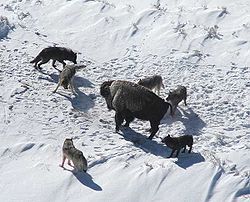
Dramatic changes in the Greater Yellowstone Ecosystem were recorded after the gray wolf, both an apex predator and a keystone species (one with a large effect on its ecosystem), was reintroduced to Yellowstone National Park in 1995 as a conservation measure. Elk, the wolves' primary prey, became less abundant and changed their behavior, freeing riparian zones from constant grazing and allowing willows, aspens, and cottonwoods to flourish, creating habitats for beaver, moose, and scores of other species.[23] In addition to their effect on prey species, the wolves' presence also affected one of the park's vulnerable species, the grizzly bear: emerging from hibernation, having fasted for months, the bears chose to scavenge wolf kills,[24] especially during the autumn as they prepared to hibernate once again.[25] The grizzly bear gives birth during hibernation, so the increased food supply is expected to produce an increase in the number of cubs observed.[26] Dozens of other species, including eagles, ravens, magpies, coyotes, and black bears have also been documented as scavenging from wolf kills within the park.[27]

Human trophic level

[edit]
Humans sometimes live by hunting other animals for food and materials such as fur, sinew, and bone, as in this walrus hunt in the Arctic, but humans' status as apex predators is debated.

Ecologists have debated whether humans are apex predators. For instance, Sylvain Bonhommeau and colleagues argued in 2013 that across the global food web, a fractional human trophic level (HTL) can be calculated as the mean trophic level of every species in the human diet, weighted by the proportion that that species forms in the diet. This analysis gives an average HTL of 2.21, varying between 2.04 (for Burundi, with a 96.7% plant-based diet) and 2.57 (for Iceland, with 50% meat and fish, 50% plants). These values are comparable to those of non-apex predators such as the anchovy or pig.[30]

However, Peter D. Roopnarine criticized Bonhommeau's approach in 2014, arguing that humans are apex predators and that the HTL was based on terrestrial farming where indeed humans have a low trophic level, mainly eating producers (crop plants at level 1) or primary consumers (herbivores at level 2), which as expected places humans at a level slightly above 2. Roopnarine instead calculated the position of humans in two marine ecosystems, a Caribbean coral reef and the Benguela system near South Africa. In these systems, humans mainly eat predatory fish and have a fractional trophic level of 4.65 and 4.5, respectively, which in Roopnarine's view makes those humans apex predators.[note 4][31]

In 2021, Miki Ben-Dor and colleagues compared human biology to that of animals at various trophic levels. Using metrics as diverse as tool use and acidity of the stomach, they concluded that humans evolved as apex predators, diversifying their diets in response to the disappearance of most of the megafauna that had once been their primary source of food.[32]

Evolutionary history

[edit]
Anomalocaris was an apex predator in the Cambrian seas.[33]

Apex predators are thought to have existed since at least the Cambrian period, around 500 million years ago. Extinct species cannot be directly determined to be apex predators as their behavior cannot be observed, and clues to ecological relationships, such as bite marks on bones or shells, do not form a complete picture. However, indirect evidence such as the absence of any discernible predator in an environment is suggestive. Anomalocaris was an aquatic apex predator, in the Cambrian. Its mouthparts are clearly predatory, and there were no larger animals in the seas at that time.[33]

Carnivorous theropod dinosaurs including Allosaurus[34] and Tyrannosaurus[35] are theorized to have been apex predators, based on their size, morphology, and dietary needs.

A Permian shark, Triodus sessilis, was discovered containing two amphibians (Archegosaurus decheni and Cheliderpeton latirostre), one of which had consumed a fish, Acanthodes bronni, showing that the shark had lived at a trophic level of at least 4.[note 5][36]

Among more recent fossils, the saber-tooth cats, like Smilodon, are considered to have been apex predators in the Cenozoic.[37]

Interactions with humans

[edit]
Dogs have been used in hunting for many millennia, as in this 14th century French depiction of a boar hunt.

Hunting

[edit]

Humans hunted with apex predators in the form of wolves, and in turn with domestic dogs, for 40,000 years; this collaboration may have helped modern humans to outcompete the Neanderthals.[38][39] Humans still hunt with dogs, which have often been bred as gun dogs to point to, flush out, or retrieve prey.[40] The Portuguese Water Dog was used to drive fish into nets.[41] Several breeds of dog have been used to chase large prey such as deer and wolves.[42]

Eagles and falcons, which are apex predators, are used in falconry, hunting birds or mammals.[43] Tethered cormorants, also top predators,[44] have been used to catch fish.[45]

Ecotourism

[edit]
Tiger sharks are popular ecotourism subjects, but their ecosystems may be affected by the food provided to attract them.

Ecotourism sometimes relies on apex predators to attract business.[46][47] Tour operators may in consequence decide to intervene in ecosystems, for example by providing food to attract predators to areas that can conveniently be visited.[46] This in turn can have effects on predator population and therefore on the wider ecosystem.[46] As a result, provisioning of species such as the tiger shark is controversial, but its effects are not well established by empirical evidence.[46] Other affected apex predators include big cats and crocodiles.[47]

Rewilding

[edit]
The reintroduction of predators like the lynx is attractive to conservationists, but alarming to farmers.

In some densely populated areas like the British Isles, all the large native predators like the wolf, bear, wolverine and lynx have become extirpated, allowing herbivores such as deer to multiply unchecked except by hunting.[48] In 2015, plans were made to reintroduce lynx to the counties of Norfolk, Cumbria, and Northumberland in England, and Aberdeenshire in Scotland as part of the rewilding movement.[49] The reintroduction of large predators is controversial, in part because of concern among farmers for their livestock.[49] Conservationists such as Paul Lister propose instead to allow wolves and bears to hunt their prey in a "managed environment" on large fenced reserves; however, this undermines the objective of rewilding.[49]

Notes

[edit]

References

[edit]
[edit]
Revisions and contributorsEdit on WikipediaRead on Wikipedia
from Grokipedia
An is a carnivorous positioned at the highest in its , exerting control over prey populations and intermediate predators while lacking natural predators of comparable threat within that . These organisms typically exhibit traits such as large body size, specialized hunting strategies, and low population densities, enabling them to regulate dynamics through direct predation and behavioral modifications in subordinate . By suppressing numbers and abundances, apex predators facilitate trophic cascades that enhance vegetation recovery, , and overall structural stability in food webs. In diverse biomes, apex predators manifest as solitary hunters like tigers in Asian forests, pack-oriented mammals such as gray wolves in temperate woodlands, or ambush specialists including saltwater crocodiles in tropical wetlands, each adapted to dominate their respective niches without significant interspecific predation pressure. Their presence often correlates with resilient ecosystems, as empirical studies demonstrate cascading benefits from predator reintroductions, including reduced overbrowsing and altered prey behaviors that promote heterogeneity. However, human-induced declines have revealed vulnerabilities, with losses triggering release and erosion, underscoring the predators' functional irreplaceability in unmodified systems. Debates persist on precise delineations, particularly whether multiple apex species can stably coexist or if status varies contextually, yet consensus affirms their pivotal role in preventing prey irruptions and sustaining trophic equilibrium.

Definition and Characteristics

Trophic Position and Criteria

Apex predators occupy the highest trophic positions within food webs, typically at levels 4 or above on a scale where primary producers are level 1, herbivores level 2, and secondary consumers level 3. This positioning reflects their role as terminal carnivores that derive nutrition primarily from preying on other predators or large herbivores, with minimal consumption from lower trophic levels. In quantitative terms, fractional trophic levels (FTL) for apex species like lions or great white sharks approach 5, calculated via stable isotope analysis of ratios (δ¹⁵N), which increase predictably by about 3-4‰ per trophic step. Unlike mesopredators, which face predation pressure from above, apex predators exhibit negligible mortality from conspecific or heterospecific predators in natural conditions, enabling population regulation through intrinsic factors like territoriality rather than extrinsic predation. Criteria for classifying an organism as an apex predator emphasize trophic dynamics over size or ferocity alone, prioritizing from analyses. Primary criteria include occupation of the uppermost , evidenced by diet studies showing >90% reliance on animal prey from higher biomass trophic strata, and absence of significant predation upon adults by other species. Secondary indicators involve demonstrated inhibition of prey and subordinate predator populations, often quantified through predator exclusion experiments revealing trophic cascades, such as increased densities in apex-free zones. For instance, in , gray removal led to overpopulation and vegetation shifts, confirming wolves' apex status via before-after-control-impact designs. Contextual factors like type matter; in marine systems, species like tiger sharks qualify if they prey on mesopredators without facing equivalent threats, whereas in shared habitats with multiple large carnivores, pack-hunting behavior (e.g., wolves vs. solo bears) can elevate one to apex via dominance in kill defense and resource access. Debates arise over strict thresholds, as some definitions require "keystone" effects, but core trophic criteria avoid anthropocentric biases by focusing on verifiable interaction webs rather than subjective "top dog" narratives.

Key Traits and Adaptations

Apex predators generally exhibit large body masses exceeding an average of 34 kg, enabling them to overpower sizable prey while minimizing to other predators. This morphological scaling correlates with sparse population densities, as the energetic demands of sustaining top-trophic limit group sizes and territorial ranges. Key physical adaptations include robust skeletal structures with powerful jaws capable of delivering crushing bites, sharp teeth for shearing flesh, and retractile claws in terrestrial species for silent stalking and grip during kills. Sensory enhancements, such as forward-facing eyes providing stereoscopic vision for precise depth judgment and heightened olfactory or auditory acuity, optimize prey location across diverse habitats. Behaviorally, many employ specialized hunting tactics, including ambush predation via stealthy approaches followed by explosive sprints or cooperative pack strategies in social taxa like canids, which facilitate tackling outsized through coordinated . Social mechanisms such as territorial defense by females, , and reproductive suppression further enforce self-regulation, preventing amid fluctuating resources. Physiologically and demographically, apex predators align with K-selected strategies, featuring delayed maturity, protracted , and extended lifespans that prioritize offspring survival over quantity, with weaning ages and independence positively tied to body mass. Broad behavioral plasticity underpins resilience, allowing shifts in tactics or use in response to prey or environmental variability. These traits collectively sustain their trophic dominance, though variations exist across taxa due to habitat-specific pressures.

Evolutionary History

Precambrian and Paleozoic Origins

Evidence for predation in the eon, spanning from Earth's formation approximately 4.6 billion years ago to 541 million years ago, remains sparse due to the predominance of soft-bodied organisms and limited preservation. The earliest potential signs appear in the late period around 550 million years ago, where mineralized tubular s of Cloudina exhibit borings interpreted as predatorial attacks, suggesting the onset of boring predation by unidentified organisms. These traces represent possible direct evidence of metazoan predation, though the attackers were likely small and not demonstrably apex in a complex , as ecosystems were simpler with minimal trophic levels. Perforation traces in similar skeletons, such as those attributed to micro-predators, further indicate early vampiric-style feeding but lack confirmation of top-level predation. The transition to the era, beginning with the period at 541 million years ago, marked a dramatic escalation in predatory complexity following the , which introduced diverse bilaterian animals with hard parts and active locomotion. canadensis, a radiodontan from deposits like the dated to approximately 508 million years ago, exemplifies the era's inaugural apex predator, reaching lengths of up to 60 centimeters with raptorial frontal appendages for grasping prey and compound eyes for hunting. As the largest mobile predator in its marine environment, it occupied the top trophic position, preying primarily on soft-bodied organisms rather than heavily armored trilobites, as evidenced by appendage morphology incapable of crushing fortified shells. This specialization highlights an early , where prey developed defenses like sclerites, prompting predator adaptations in grasping and tearing. Throughout the early , from to periods (485 to 359 million years ago), predation diversified with the rise of shelled mollusks, nautiloids, and early vertebrates, intensifying selective pressures. Cephalopods and eurypterids emerged as significant predators, while the saw the advent of jawed fishes and placoderms, which dominated as active swimmers and shell-crushers, solidifying multi-level food chains. These developments, including increased drill holes in and fossils, underscore predation's role in driving morphological innovations and structuring, though terrestrial apex predation remained absent until late Paleozoic synapsids.

Mesozoic and Cenozoic Developments

During the Era (252 to 66 million years ago), theropod dinosaurs emerged as the primary terrestrial apex predators, evolving specialized adaptations such as serrated teeth, powerful jaws, and for hunting large herbivorous dinosaurs. In the , species like rex reached lengths of up to 12 meters and masses of 7-9 metric tons, dominating North American ecosystems by preying on ceratopsians and hadrosaurs. Earlier in the , allosaurids such as filled similar roles, with body plans emphasizing bipedal pursuit and ambush tactics across supercontinents like . Marine apex predation shifted toward large squamates, with mosasaurs like attaining 15 meters in length and serving as top oceanic hunters through powerful tails and conical teeth suited for grasping fish and ammonites. Aerial niches were occupied by pterosaurs, including giant azhdarchids exceeding 10-meter wingspans, which scavenged or actively hunted in coastal environments. The Cretaceous-Paleogene (K-Pg) extinction event circa 66 million years ago, marked by an asteroid impact and associated , eradicated non-avian theropods, mosasaurs, plesiosaurs, and most large pterosaurs, creating vast ecological vacancies at the top trophic levels. This mass die-off, which eliminated about 75% of globally, stemmed from disrupted food chains, , and a prolonged "impact winter" reducing , thereby favoring smaller, adaptable survivors like birds and early mammals. In the ensuing Cenozoic Era (66 million years ago to present), mammals rapidly diversified into apex roles, developing carnassial dentition—specialized shearing teeth—for processing vertebrate prey amid cooling climates and expanding grasslands. Paleogene predators included oxyaenids and hyaenodontids, which occupied hypercarnivorous niches with robust skulls and saber-like canines, reaching sizes up to 2-3 meters in length before declining by the Miocene. By the Neogene, true Carnivora dominated land predation, with felids evolving cursorial builds for solitary ambushes and canids favoring pack hunting; examples include Miocene bear-dogs (Amphicyon) weighing over 500 kg. In isolated regions like South America, phorusrhacid "terror birds" served as flightless apex predators, standing 3 meters tall with hatchet-like beaks, until the Pliocene Great American Biotic Interchange introduced competing mammals around 3 million years ago. Marine apex predation transitioned to cetaceans, with early archaeocetes like Basilosaurus (15-18 meters) giving way to odontocetes and the Miocene shark Otodus megalodon, which grew to 18 meters and preyed on whales using serrated teeth up to 18 cm long before its extinction around 3.6 million years ago. Giant crocodylians, such as Miocene Purussaurus (up to 12 meters), occasionally rivaled mammals as semiaquatic top predators in fluvial systems. Overall, Cenozoic developments emphasized higher metabolic rates and intelligence in mammalian predators, enabling exploitation of diverse habitats compared to the more ectothermic, gigantothermic Mesozoic forms.

Human Emergence as Apex Predator

Early hominins, such as species dating back approximately 4 million years, primarily relied on scavenging and opportunistic feeding on small animals, remaining vulnerable to predation by large carnivores like and hyenas, as evidenced by fossilized bite marks on bones from sites like in . The transition toward apex status began around 2.6 million years ago with the appearance of and the tool industry, which enabled butchery of scavenged carcasses and initial hunting of small to medium-sized ungulates, though these early Homo species were still occasionally preyed upon by leopards and other predators, challenging claims of immediate top-predator dominance. A pivotal shift occurred with around 2 million years ago, as archaeological evidence from sites across and indicates a diet dominated by large herbivores, positioning early humans at a equivalent to apex predators through systematic of the biggest available prey, including and equids, rather than settling for smaller game. This is supported by stable nitrogen of from hominin remains and , revealing δ15N values consistent with a carnivorous diet at the chain's apex, sustained for nearly 2 million years until the advent of around 12,000 years ago. Key enablers included advanced stone tools like hand axes for processing large carcasses, control of by at least 1 million years ago for cooking and deterring predators, and anatomical adaptations such as increased (from ~600 cm³ in early Homo to over 1,000 cm³ in erectus) facilitating cooperative strategies. The emergence of anatomically modern Homo sapiens around 300,000 years ago in solidified this status through behavioral innovations, including composite tools, weapons like spears evidenced at sites such as Schöningen (dated ~300,000 years ago), and long-distance trade networks for resources, enabling the hunting of like mammoths and bears. Out-of- migrations beginning ~70,000 years ago led to the displacement of competing hominins like Neanderthals and the overhunting of large predators' prey bases, contributing to extinctions in , (by ~46,000 years ago), and the (by ~13,000 years ago), with forensic evidence of human-inflicted wounds on remains confirming direct predation. Unlike physically dominant apex predators reliant on claws or speed, humans achieved supremacy via , , and technological escalation, rendering adult groups effectively free from natural predation in most ecosystems by the . This trajectory underscores a causal progression from vulnerability to dominance driven by iterative adaptations rather than innate physical superiority.

Ecological Roles

Trophic Cascade Mechanisms

Trophic cascades in ecosystems dominated by apex predators arise from top-down forces where these predators exert control over intermediate trophic levels, indirectly influencing basal resources such as vegetation or primary producers. The primary mechanisms include density-mediated indirect interactions (DMIIs), in which predation directly reduces prey population densities, thereby alleviating pressure on lower trophic levels, and trait-mediated indirect interactions (TMIIs), where non-consumptive effects of predators—such as inducing fear responses that alter prey foraging behavior or habitat use—propagate effects downward without significant changes in prey numbers. These processes enable apex predators to regulate herbivore abundances or activities, preventing overexploitation of producers and maintaining biodiversity. In density-mediated cascades, empirical evidence from coastal ecosystems demonstrates how apex predators like sea otters (Enhydra lutris) suppress (Strongylocentrotus spp.) populations, which in turn reduces grazing pressure on macroalgae such as (Macrocystis pyrifera), leading to recovery; post-decline studies in the North Pacific showed urchin barrens transforming back to kelp-dominated habitats following otter recolonization, with biomass increasing by factors of 10 or more in some areas. Trait-mediated mechanisms complement this, as predator presence alone can cause herbivores to shift to less productive sites, further benefiting producers; experiments in terrestrial systems, such as spider-grasshopper-plant interactions, confirm that behavioral changes in herbivores induced by predation risk reduce plant damage comparably to density reductions. Marine apex predators, including large s, illustrate combined mechanisms in pelagic food webs, where their control over mesopredators cascades to filter-feeders and , enhancing primary productivity; modeling and observational data from overfished regions indicate that shark declines correlate with inverted biomass pyramids, reversing upon predator recovery. In terrestrial examples like gray wolf (Canis lupus) reintroduction to in 1995, wolves reduced (Cervus canadensis) densities and altered their browsing behavior, potentially aiding riparian (Salix spp.) and (Alnus spp.) recruitment, though rigorous analyses reveal sampling biases and pre-existing vegetation trends, suggesting weaker or context-dependent cascade strength than initially claimed. These mechanisms underscore causal chains grounded in predator-prey dynamics, with empirical validation varying by ecosystem complexity and human influences.

Community and Ecosystem Impacts

Apex predators shape community structure primarily through top-down control of herbivore and mesopredator populations, exerting both lethal effects via predation and non-lethal effects via induced fear that alters prey behavior and distribution. In systems where apex predators are present, herbivore densities often decline, reducing overgrazing and allowing vegetation recovery, which in turn supports diverse understory communities and associated species. Empirical studies indicate these dynamics prevent shifts to alternative stable states dominated by excessive herbivory, maintaining higher biodiversity at lower trophic levels. In terrestrial ecosystems, the 1995 reintroduction of gray wolves (Canis lupus) to Yellowstone National Park demonstrated community-level impacts, with wolf predation reducing elk (Cervus elaphus) numbers by approximately 50% from 1995 to 2020 and shifting elk foraging to avoid high-risk areas, thereby decreasing browsing on young aspen (Populus tremuloides) and willow (Salix spp.) by up to 80% in some riparian zones. This led to increased recruitment of woody plants, benefiting beaver (Castor canadensis) populations, which rose from near absence to over 10 active colonies by 2010, enhancing wetland habitat complexity and supporting avian and amphibian diversity. However, full riparian ecosystem restoration has been limited, as evidenced by a 2024 analysis showing no significant recovery in northern range plant communities due to confounding factors like drought, fire suppression legacies, and predation by alternative carnivores such as grizzly bears (Ursus arctos) and mountain lions (Puma concolor). Marine apex predators like similarly influence community composition by suppressing abundances and modulating herbivore behaviors. For instance, tiger (Galeocerdo cuvier) in , , induce avoidance behaviors in green sea turtles (Chelonia mydas), limiting consumption and promoting meadow health, with exclusion experiments showing up to 80% reduction in pressure in shark-dominated areas. Declines in large populations, such as those exceeding 90% in some Atlantic fisheries since the 1970s, have correlated with releases, leading to of and small , altering benthic community structures and reducing overall yields. These effects extend to functions, including cycling, as mobile predators transport nutrients across habitats, enhancing primary productivity in oligotrophic waters. Broader ecosystem impacts include stabilization of trophic pyramids and resilience against perturbations; for example, the removal of dingoes (Canis dingo) from Australian grasslands initiated a trophic cascade extending to soil nutrients, with increased kangaroo grazing elevating nitrogen levels by 20-30% in affected areas. In savanna systems, lions (Panthera leo) regulate ungulate herds, preventing bush encroachment and maintaining grassland diversity, though complex interactions with fire and elephants limit the magnitude of vegetation responses. Overall, empirical evidence from exclusion and reintroduction experiments underscores that apex predator presence fosters balanced communities, but impacts vary by context, prey adaptability, and historical contingencies, with restoration often yielding partial rather than complete reversals of degradation.

Evidence from Empirical Studies

The reintroduction of gray wolves (Canis lupus) to Yellowstone National Park in 1995-1996 provided a controlled empirical test of apex predator effects, revealing density-mediated indirect impacts on vegetation through reduced elk (Cervus elaphus) populations and altered foraging behavior. Elk numbers declined from approximately 19,000 in the early 1990s to around 6,000 by the 2000s, correlating with decreased browsing pressure on riparian willows (Salix spp.) and aspens (Populus tremuloides), which experienced height increases of up to 2.5 meters in some areas. This facilitated recovery of beaver (Castor canadensis) populations, whose dams created habitats for songbirds and amphibians, with beaver colony numbers rising from one in the 1990s to nine by 2012. However, subsequent analyses indicate these cascades are weaker and more context-dependent than initially portrayed, influenced by factors like drought, fire suppression, and multiple predators including bears and cougars, rather than wolves alone. A 2024 study modeling wolf restoration in simple food chains found no reciprocal recovery to pre-removal states after 20 years, underscoring that apex predator reintroduction does not universally restore ecosystems. Sea otters (Enhydra lutris) exemplify a marine , where their predation on purple sea urchins (Strongylocentrotus purpuratus) prevents overgrazing of forests along the North American . Empirical surveys from the onward document urchin barrens—areas denuded of giant (Macrocystis pyrifera)—in otter-absent regions like parts of , where urchin densities reached 50-100 per square meter, compared to -dominated sites with otters, where urchin numbers remained below 10 per square meter and exceeded 20 kg per square meter. Relocation experiments in the 1980s-1990s showed localized recovery following otter recolonization, with canopy cover increasing by 50% within five years in some bays. Recent data from confirm otters sustain remnant beds amid urchin barrens, with higher nutritional quality in urchins from areas supporting otter foraging efficiency. Yet, recovery rates vary by location, with slower regrowth in warmer waters affected by heatwaves, highlighting limitations from bottom-up factors like . Experimental removals of apex predators further substantiate cascade mechanisms, as seen in a 20-year terrestrial study where excluding top carnivores led to persistent shifts in and communities, with irruptions reducing grass cover by 30-40%. In African savannas, ( jubatus) reintroduction altered behavior, reducing bush encroachment impacts on lower trophic levels through fear-mediated effects. Critiques emphasize that while cascades occur, their magnitude is often overstated; for instance, loop analysis of food webs reveals trophic cascades as one pathway among many, modulated by human hunting and complexity, with no consistent extension to nutrient cycling in all cases. Multiple studies affirm predator effects are real but require integration with bottom-up drivers for accurate prediction, avoiding mythic attribution of restoration solely to apex reintroduction.

Debates and Controversies

Keystone Species Hypothesis

The hypothesis suggests that apex predators can function as by exerting outsized control over dynamics through top-down trophic cascades, where their predation or induced fear responses regulate and abundances, thereby preserving vegetation, , and overall community structure despite comprising low . This idea builds on Robert Paine's 1966-1969 intertidal experiments with the predatory sea star , which demonstrated that removing a top predator led to dominance by mussels and reduced , establishing the paradigm of disproportionate ecological influence. In apex predator contexts, proponents argue that similar mechanisms operate across food webs, with empirical support from systems where predator removal triggers cascading declines, such as sea otter (Enhydra lutris) extirpation in the North Pacific kelp forests, where urchin (Strongylocentrotus spp.) explosions defoliated beds following otter declines from 0.9 to 0.1 individuals per km² in the 19th-20th centuries. A of 114 experimental studies further indicates that trophic cascades are strongest in systems involving large, mobile predators like apex species, with effect sizes amplified by behavioral fear responses that alter prey without direct kills. Terrestrial examples, such as gray (Canis lupus) reintroduction to in 1995-1996 (14 wolves initially released), are frequently cited as evidence, with observed reductions in (Cervus canadensis) numbers from ~19,000 to ~5,000 by 2020 correlating with decreased browsing pressure on aspen (Populus tremuloides) and (Salix spp.), increased (Castor canadensis) populations (from 1 in 1995 to 9 by 2010s), and subsequent riparian recovery. Proponents attribute these changes to wolves' dual suppressive effects on s via lethal predation and non-consumptive risk effects, which alter elk vigilance and habitat selection, fostering trophic cascades that enhance across multiple levels. Similar patterns appear in other systems, like African lions (Panthera leo) limiting herbivore in savannas, where predator exclusion zones show vegetation degradation. However, the hypothesis faces criticism for lacking universality, as not all apex predators qualify as keystones, and effects vary by ecosystem complexity, historical contingency, and alternative drivers like climate or bottom-up productivity. In Yellowstone's northern range, a 20-year study post-wolf reintroduction found no restoration of riparian plant communities despite predator recovery, with persistent shifts in willow heights and cottonwood recruitment attributed to legacy effects from pre-1995 elk overbrowsing and non-reversible soil compaction or hydrology changes, indicating that apex predator restoration does not always reciprocate removal impacts. Challenges to cascade claims include sampling biases in aspen regrowth data, where pre-wolf browsing relief coincided with multi-decadal climate oscillations (e.g., 1988-1995 drought ending), inflating wolf attribution, and empirical data showing elk population declines began before full wolf establishment due to harsh winters and human hunting. Critics argue that popular narratives overstate deterministic cascades, ignoring contexts where mesopredator release or intraguild competition dominates, or where effects are transient rather than stabilizing, as in systems recovering from long-term predator absence. A 2024 review notes the keystone concept's dilution through inconsistent application in conservation, urging evidence-based delineation over presumptive labeling of all apex predators as keystones. Thus, while supported in select marine and simple webs, the hypothesis requires case-specific validation, with terrestrial applications often confounded by anthropogenic legacies and multifactor causality.

Overstated Effects and Myths

One prominent myth surrounding apex predators is that their reintroduction invariably triggers dramatic trophic cascades that restore entire ecosystems, as exemplified by the narrative of gray wolves (Canis lupus) in Yellowstone National Park. Popular accounts, such as a widely viewed video by environmentalist George Monbiot, claim that wolves reduced elk (Cervus canadensis) populations, leading to decreased browsing on aspens and willows, subsequent vegetation recovery, increased beaver and bird populations, and even altered river courses through reduced erosion. However, empirical analyses indicate these effects are overstated and multifactorial; elk declines began before wolf reintroduction in 1995 due to increased hunting outside the park and favorable conditions for other predators like bears, while vegetation recovery in some areas correlates more strongly with climate variability and reduced snowpack than wolf predation alone. A 2025 study critiqued claims of a "strong" Yellowstone trophic cascade, finding that statistical models supporting widespread indirect effects from wolves fail to account for confounding variables like multi-decadal climate trends and prey behavior shifts independent of predation risk. Another overstated effect is the assumption that apex predators universally act as , exerting disproportionate control over community structure via top-down forcing in all ecosystems. While some predators, like sea otters (Enhydra lutris) preying on urchins to protect kelp forests, demonstrate clear keystone dynamics, this does not generalize; many apex predators exhibit context-dependent influences shaped by prey diversity, habitat complexity, and historical contingencies rather than consistent, ecosystem-wide dominance. For instance, long-term experiments show that removing or restoring predators like wolves or cougars does not reliably reverse herbivore-driven degradation in grasslands, as alternative factors such as fire suppression, soil nutrients, and release often dominate trophic interactions. The keystone label is sometimes applied loosely in conservation advocacy, diluting its original empirical basis—defined by Paine (1969) as species whose removal causes secondary extinctions disproportionate to their —leading to policy claims that overlook cases where top predators coexist with multiple guilds without singular control. Myths also exaggerate the restorative power of apex predator recovery as a panacea for anthropogenic degradation, ignoring that food webs can reorganize irreversibly during predator absences, rendering reintroduction insufficient to "rewind" ecosystems. In marine systems, for example, shark declines have not always produced predictable cascades benefiting lower trophic levels, as compensatory increases in smaller piscivores or nutrient shifts from overfishing confound outcomes. Terrestrial studies similarly reveal that behavioral fear effects from predators—often hyped as non-lethal drivers of prey avoidance and vegetation protection—are transient and diminish over generations as prey adapt or human interventions (e.g., livestock guarding) alter dynamics. These overstatements, frequently amplified in media and rewilding narratives, risk underemphasizing bottom-up drivers like primary productivity and human land use, which empirical meta-analyses show rival or exceed top-down predation in structuring many communities.

Alternative Ecological Models

In contrast to top-down trophic cascade models, bottom-up regulation posits that primary productivity and resource availability primarily constrain populations, rendering apex predators secondary opportunists rather than dominant controllers. Under this framework, nutrient inputs and defenses limit prey densities, with predators exerting density-dependent but non-regulatory effects, as evidenced by fertilization experiments in grasslands where increased boosted biomass independently of predation levels. Empirical studies in subtidal rocky reefs demonstrate this dynamic, where algal traits and bottom-up nutrient fluxes maintained biomass hierarchies despite predator presence, with neither predator density nor trophic position correlating to plant abundance. Similarly, in diverse predator-prey assemblages, emergent among consumers can amplify bottom-up signals, overriding top-down suppression when resource pulses favor prey over predation efficiency. Interactive models reconcile top-down and bottom-up forces, revealing context-specific outcomes; for example, in coastal food webs, predator control dominates during low-productivity phases, but enrichment shifts dominance to basal resources, as shown in structural equation analyses of and dynamics. Marine systems often exhibit weaker cascades, with reviews critiquing overstated top-down claims due to inconsistent predator removal responses and overriding oceanographic drivers like . These alternatives underscore contingency, where apex predator impacts vary by productivity, disturbance regimes, and intraguild interactions, challenging universal keystone narratives with evidence of limited or absent cascades in over half of experimental manipulations across biomes.

Human Interactions

Historical Exploitation and Conflicts

Humans have long viewed apex predators as threats to livestock and human settlements, prompting systematic exploitation through bounties, organized hunts, and retaliatory killings that often bordered on extermination campaigns. In Europe, large carnivores such as wolves (Canis lupus) and brown bears (Ursus arctos) faced persecution dating back to medieval times, driven by pastoralist societies protecting herds; by the 19th century, bounties and state-sponsored drives had eradicated them from much of the continent, with wolves persisting only in remote areas like parts of Scandinavia and the Carpathians until the early 20th century. Similar patterns emerged in colonial expansions, where apex predators were targeted to facilitate agriculture and ranching, reflecting a causal prioritization of human economic interests over ecological roles. In , grey wolf extermination intensified with European settlement; the first recorded bounty was enacted in in 1630, offering payments for scalps to safeguard colonial . By the late 19th and early 20th centuries, federal and state programs escalated, with alone disbursing bounties for 80,000 wolves between 1883 and 1918, and a total of 111,545 wolves claimed from 1883 to 1927, subsidized by governments to support ranching expansion. These efforts, employing traps, poisons like , and professional hunters, reduced wolf populations to near extinction in the by the 1920s, though they failed to eliminate conflicts entirely as surviving packs adapted to human proximity. In , colonial-era tiger (Panthera tigris) in exemplified trophy-driven exploitation intertwined with imperial symbolism; British officials and maharajas organized shikar expeditions that killed tigers by the dozens per event, while bounties incentivized locals to eliminate perceived man-eaters or crop raiders. From 1875 to 1925, sport and retaliatory culls contributed to the slaughter of approximately 80,000 tigers, decimating populations and converting for tea plantations and settlements. Conflicts stemmed from tigers preying on and, rarely, humans, amplifying cultural narratives of predators as despite evidence that habitat encroachment provoked most encounters. Africa's historical human-lion (Panthera leo) conflicts highlight retaliatory dynamics, particularly in pastoral regions; in Kenya's region, two man-eating lions killed at least 28 railway workers (with estimates up to 135) in 1898, halting British colonial and spurring intensive hunts that romanticized such episodes in Western accounts. Broader patterns involved lions depredating amid expanding , leading to poisoned baits and hunts by Maasai warriors; in northwest , European settlers from the onward framed lions as existential threats, justifying culls that intertwined with land dispossession and reinforced human dominance over rangelands. These interactions, while rooted in genuine economic losses—such as annual killings numbering in the thousands across savannas—often escalated due to firearm access and , rather than inherent predator aggression.

Modern Management Approaches

![Gray wolves in Yellowstone National Park, managed through reintroduction and monitoring programs]float-right Modern management of apex predators integrates ecological monitoring, regulated harvesting, reintroduction efforts, and conflict to sustain populations while addressing human needs. These strategies rely on empirical from surveys and impact assessments to set quotas and interventions, preventing both declines from habitat loss and overabundance that could strain prey resources or escalate conflicts. Reintroduction programs exemplify recovery-focused approaches, as demonstrated by the gray wolf restoration in Yellowstone National Park. In 1995, the U.S. Fish and Wildlife Service reintroduced 14 wolves from Canada as an experimental non-essential population under the 1987 Northern Rocky Mountain Wolf Recovery Plan, resulting in a self-sustaining population exceeding 100 individuals by the 2010s through ongoing monitoring of demographics, genetics, and dispersal. Management includes adaptive hunting regulations outside park boundaries and non-lethal deterrents like range riders to reduce livestock depredations, which averaged 1-2% of confirmed wolf packs annually in surrounding states. Regulated and serve as tools for in cases of rapid growth or localized overabundance. In Zimbabwe's Bubye Valley Conservancy, numbers surged from 20 in the early 2000s to over 400 by 2016 due to protection and prey availability, prompting selective of subadult males to curb territorial expansion and prey depletion, maintaining densities at sustainable levels around 0.2-0.3 lions per km². Similarly, in , aerial of bears and wolves since 2004 has targeted up to 40% reductions near caribou calving grounds to bolster declining herds, with evaluations showing temporary prey population rebounds. Compensation schemes mitigate economic losses from predation, promoting coexistence. The Big Life Foundation's Predator Compensation Fund, operational since 2010 in and , verifies kills via community scouts and reimburses 70% of market value for lost to lions, leopards, or , disbursing over $100,000 annually by 2020 while requiring non-lethal preventive measures like corrals. In the U.S., the Fish and Wildlife Service's Wolf Livestock Loss Demonstration Project, funded since 2017, compensates verified depredations at full market value and supports deterrents, though studies indicate such payments alone may not fully enhance tolerance without coupled education. Integrated predator management combines these elements, employing translocation, , and lethal removal judiciously based on site-specific data. U.S. Department of programs emphasize non-lethal tools like guard dogs and lights alongside targeted removal, reducing losses by up to 50% in participating ranches, underscoring that multifaceted approaches outperform singular tactics in balancing predator roles with agricultural viability.

Economic and Cultural Dimensions

Apex predators contribute significantly to global economies, with activities such as African safaris featuring lions and shark-diving expeditions generating substantial revenue; for instance, global directly contributed $120.1 billion to GDP in , often centered on viewing these top carnivores. alone yields high economic value through scuba and , supporting local communities while fostering positive attitudes toward predators otherwise viewed negatively. of species like lions and leopards provides targeted funding for management and in regions such as , though its overall contribution to conservation remains debated and represents a minor fraction of broader hunting revenues. Conversely, apex predators impose direct and indirect economic costs on , particularly through livestock depredation; in , a single wolf's presence can reduce cattle rancher revenues by up to $162,000 annually via lost pregnancies, , and behavioral changes in herds. In , state compensation for wolf-related livestock losses reached $343,000 for two ranches in early 2025, encompassing verified kills and associated impacts. Such conflicts highlight ongoing trade-offs, where predator recovery benefits ecosystems but strains rural economies without adequate mitigation like non-lethal deterrents. Culturally, apex predators embody archetypes of power and cunning across societies, often revered as guardians or deities in indigenous lore; wolves, for example, appear as divine companions or spirits in ancient Egyptian, Roman, and Native American traditions, symbolizing resilience and ancestral . In Mesoamerican mythology, eagles served as aerial apex predators linked to warfare and celestial authority, influencing emblems like national symbols. Tribal narratives in portray tigers as embodiments of bravery and wild sovereignty, while casts wolves as formidable rivals to human hunters, reflecting both admiration and fear rooted in shared predatory niches. This fascination persists in modern media and , where predators inspire narratives of strength but also underscore human dominance as the ultimate apex influence.

Conservation Challenges

Causes of Declines

Direct exploitation by humans, including commercial hunting, , and retaliatory killings due to livestock depredation, has significantly reduced apex predator populations worldwide. For instance, accounts for the primary driver of declines in large carnivores, with human hunting rates often exceeding natural mortality and targeting prime-age adults, leading to skewed age structures and reduced . In marine ecosystems, targeted fisheries and have depleted top predator by up to 90% in some regions since the mid-20th century, as documented in analyses of global and tunny stocks. Habitat loss and fragmentation from , , and development exacerbate these declines by reducing available territory and prey resources, often resulting in isolated subpopulations vulnerable to . Empirical reviews indicate that top predators are disproportionately affected, with species loss occurring first in converted habitats due to their large home ranges and low densities. For terrestrial examples, clearance in tropical regions has contracted tiger habitats by over 90% since 1900, correlating with population crashes from an estimated 100,000 individuals to fewer than 4,000 by 2015. In aquatic systems, coastal development and warming-induced habitat shifts project up to 70% suitable loss for migratory predators like by 2100, though current declines stem more from direct anthropogenic pressures than climatic ones alone. Secondary factors, such as prey base depletion from human harvesting and chemical pollutants bioaccumulating in top carnivores, compound these effects but are typically downstream of primary drivers. Studies of trophic downgrading show that combined stressors amplify instability, with overexploited prey leading to nutritional deficits in surviving predators. While disease outbreaks occur, they rarely act independently without underlying population stress from habitat or exploitation pressures.

Recovery Efforts and Outcomes

Recovery efforts for apex predators have primarily involved legal protections, habitat restoration, reintroductions, and measures, often under frameworks like the U.S. Endangered Species Act or national conservation programs. These initiatives aim to reverse declines driven by historical overhunting and habitat loss, with varying degrees of success depending on context and human pressures. The reintroduction of gray wolves (Canis lupus) to in 1995–1996, involving 14 individuals from and , exemplifies a targeted recovery effort. By 2017, the population had expanded sufficiently for delisting in parts of the northern Rockies, reaching approximately 100 wolves within the park and over 1,700 across the region by the early 2020s, demonstrating demographic recovery. Ecologically, wolves induced trophic cascades, reducing numbers and herbivory, which correlated with increased populations, growth (up to 1,500% in some streamside areas), and aspen recruitment. However, full restoration of pre-wolf riparian plant communities has not occurred, as ecosystems diverged from historical baselines due to factors like fire suppression and climate variability, indicating that apex predator recovery alone does not guarantee complete ecosystem reversion. Human-wolf conflicts persist, with including lethal control outside parks, balancing recovery with . For Bengal tigers (Panthera tigris tigris), India's , launched in 1973, established reserves and intensified patrols, elevating the population from an estimated 268 in 1972 to 3,167 by the 2022 census. Similar gains occurred in , where numbers tripled to 355 by 2022 through protected areas and prey base enhancement. These outcomes stem from habitat corridors, community involvement, and reduced , though challenges like and retaliatory killings remain, with slower progress in densely human-populated areas like . Saltwater crocodiles (Crocodylus porosus) in Australia's recovered after protection in 1971, when fewer than 3,000 remained from pre-1940s abundances. Harvest limits and nesting site monitoring led to population rebound, achieving near-full recovery by the , with sustainable now managing overabundant "problem" individuals that disperse widely and conflict with humans. This case highlights how regulated harvesting post-recovery can sustain populations while mitigating risks, contrasting purely protective approaches. Overall, while recoveries have boosted populations and yielded benefits like maintenance, they require long-term commitment and , as short-term fixes overlook historical contingencies and ongoing anthropogenic influences. Successes underscore the role of apex predators in stabilizing food webs, but exaggerated claims of universal trophic restoration warrant caution, given of partial or context-dependent effects.

Balanced Strategies: Protection and Harvesting

Sustainable harvesting of apex predators, through regulated quotas and seasons, complements protection by controlling densities to avert ecological imbalances such as prey or , while generating funds for habitat security and monitoring. In North American management, states like and establish annual hunting quotas informed by surveys; for example, Montana's 2025-2026 quota targets up to 500 wolves to align with biological and reduce conflicts with ranchers, following recovery from Endangered Species Act protections after the 1995 Yellowstone reintroduction led to packs exceeding 1,500 individuals across the region by 2020. Similarly, Wyoming's seasons from September to March allow controlled takes in trophy areas to maintain and prevent density-dependent declines observed in unmanaged populations. In African ecosystems, trophy hunting of big cats and s under strict quotas funds community-based conservation, where revenues support and land set-asides; Namibia's conservancy model, operational since 1990, has channeled fees to increase numbers from 7,500 to over 22,000 by 2016 through incentives for local stewardship, though sustainability hinges on quotas below 1% of population annually to avoid genetic bottlenecks. Critics argue benefits are overstated if funds leak from communities or if selective removal of prime males disrupts social structures, as evidenced by reduced stability in heavily hunted populations in Tanzania's during the 2010s. Empirical models indicate optimal predator harvest rates of 5-10% yearly can stabilize systems when paired with prey monitoring, preventing cascades from unchecked growth. Protection integrates via legal frameworks like delisting thresholds and no-hunt core zones; for instance, Yellowstone's interior remains off-limits to hunting, buffering while peripheral mitigates like losses exceeding $1 million annually in pre-quota expansions. Adaptive strategies, grounded in census data rather than ideology, show harvesting reduces human-predator conflicts by 20-50% in managed areas without imperiling viability, as in Alaska's long-term control for caribou recovery, where targeted removals since 2004 boosted calf rates by 15-25%. However, demands unbiased , as non-random studies inflate perceived benefits, underscoring the need for randomized controls in future assessments.

References

Add your contribution
Related Hubs
User Avatar
No comments yet.