Altar
Altar
Main page
2303740

Altar

logo
Community Hub0 subscribers
Read side by side
from Wikipedia
Altar in Roskilde Lutheran Cathedral beneath by a carved reredos

An altar is a table or platform for the presentation of religious offerings, for sacrifices, or for other ritualistic purposes. Altars are found at shrines, temples, churches, and other places of worship. They are used particularly in Christianity, Buddhism, Hinduism, and modern paganism. Many historical-medieval faiths also made use of them, including the Roman, Greek, and Norse religions.

Etymology

[edit]

The modern English word altar was derived from Middle English altar, from Old English alter, taken from Latin altare ("altar"), probably related to adolere ("burn"); thus "burning place", influenced by altus ("high"). It displaced the native Old English word wēofod.

Altars in antiquity

[edit]

In antiquity, altars were used for making sacrifices to deities; this could include both libations and animal sacrifice.[1]

In Ancient Roman religion, altars were often inscribed with the donor's name and the deity to whom the altar was dedicated. One of the most important surviving Roman altars is the Ara Pacis, dedicated by Augustus Caesar at the beginning of the Pax Romana to the goddess of peace, Pax.

Judaism

[edit]

Altars[a] in the Hebrew Bible were typically made of earth[3] or unwrought stone.[4] Altars were generally erected in conspicuous places.[5][6][7][8] The first altar recorded in the Hebrew Bible is that erected by Noah.[9] Altars were erected by Abraham,[10] by Isaac,[11] by Jacob,[12] and by Moses.[13]

After the theophany on Mount Sinai, in the Tabernacle—and afterwards in the Temple—only two altars were used: The Altar of Burnt Offering, and the Altar of Incense, both near where the Ark of the Covenant was located.

The remains of three rock-hewn altars were discovered in the Land of Israel: one below Tel Zorah, another at the foot of Sebastia (ancient Samaria), and a third near Shiloh.[14]

Christianity

[edit]
Dedication of an altar

The word altar, in Greek θυσιαστήριον (see:θυσία), appears twenty-four times in the New Testament. In Catholic and Orthodox Christian theology, the Eucharist is a re-presentation, in the literal sense of the one sacrifice of Christ on the cross being made "present again". Hence, the table upon which the Eucharist is consecrated is called an altar.

The altar plays a central role in the celebration of the Eucharist, which takes place at the altar on which the bread and the wine for consecration are placed. Altars occupy a prominent place in most Christian churches, both Eastern[b] and Western[c] branches. Commonly among these churches, altars are placed for permanent use within designated places of communal worship (often called "sanctuaries"). Less often, though nonetheless notable, altars are set in spaces occupied less regularly, such as outdoors in nature, in cemeteries, in mausoleums/crypts, and family dwellings. Personal altars are those placed in a private bedroom, closet, or other space usually occupied by one person. They are used for practices of piety intended for one person (often referred to as a "private devotion"). They are also found in a minority of Protestant worship places; in Reformed and Anabaptist churches, a table, often called a "Communion table", serves an analogous function.

A home altar in a Methodist Christian household, with a cross and candles surrounded by other religious items

The area around the altar is seen as endowed with greater holiness, and is usually physically distinguished from the rest of the church, whether by a permanent structure such as an iconostasis, a rood screen, altar rails, a curtain that can be closed at more solemn moments of the liturgy (as in the Armenian Apostolic Church and Armenian Catholic Church), or simply by the general architectural layout. The altar is often on a higher elevation than the rest of the church.

Churches generally have a single altar, although in the Western branches of Christianity, as a result of the former abandonment of concelebration of Mass, so that priests always celebrated Mass individually, larger churches have had one or more side chapels, each with its own altar. The main altar was also referred to as the "high altar". Since the revival of concelebration in the West, the Roman Missal recommends that in new churches there should be only one altar, "which in the gathering of the faithful will signify the one Christ and the one Eucharist of the Church."[15] This does not exclude altars in distinct side chapels, however, but only separate altars in the main body of the church. But most Western churches of an earlier period, whether Roman Catholic or Anglican, may have a high altar in the main body of the church, with one or more adjoining chapels, each with its own altar, at which the Eucharist may be celebrated on weekdays.

Architecturally, there are two types of altars: Those that are attached to the eastern wall of the chancel, and those that are free-standing and can be walked around, for instance when incensing the altar.[d]

Early Coptic altar carved into the wall of the Temple of Isis on the island Philae in Egypt.

In the earliest days of the Church, the Eucharist appears to have been celebrated on portable altars set up for the purpose. Some historians hold that, during the persecutions, the Eucharist was celebrated among the tombs in the Catacombs of Rome, using the sarcophagi of martyrs as altars on which to celebrate. Other historians dispute this, but it is thought to be the origin of the tradition of placing relics beneath the altar.

When Christianity was legalized under Constantine the Great and Licinius, formal church buildings were built in great numbers, normally with free-standing altars in the middle of the sanctuary, which in all the earliest churches built in Rome was at the west end of the church. "When Christians in fourth-century Rome could first freely begin to build churches, they customarily located the sanctuary towards the west end of the building in imitation of the sanctuary of the Jerusalem Temple. Although in the days of the Jerusalem Temple the High Priest indeed faced east when sacrificing on Yom Kippur, the sanctuary within which he stood was located at the western end of the Temple. The Christian replication of the layout and the orientation of the Jerusalem Temple helped to dramatize the eschatological meaning attached to the sacrificial death of Jesus the High Priest in the Epistle to the Hebrews."[16] The ministers (bishop, priests, deacons, subdeacons, acolytes), celebrated the Eucharist facing east, towards the entrance. Some hold that for the central part of the celebration the congregation faced the same way. After the sixth century the contrary orientation prevailed, with the entrance to the west and the altar at the east end. Then the ministers and congregation all faced east during the whole celebration; and in Western Europe altars began, in the Middle Ages, to be permanently placed against the east wall of the chancel.

In Western Christian churches

[edit]
Altar of Santa Cecilia in Trastevere with ciborium

Most rubrics, even in books of the seventeenth century and later, such as the Pontificale Romanum, continued to envisage the altar as free-standing. The rite of the Dedication of the Church[17] continued to presume that the officiating bishop could circle the altar during the consecration of the church and its altar. Despite this, with the increase in the size and importance of the reredos, most altars were built against the wall or barely separated from it.

In almost all cases, the eastward orientation for prayer was maintained, whether the altar was at the west end of the church, as in all the earliest churches in Rome, in which case the priest celebrating Mass faced the congregation and the church entrance, or whether it was at the east end of the church, in which case the priest faced the eastern apse and had his back to the congregation. This diversity was recognized in the rubrics of the Roman Missal from the 1604 typical edition of Pope Clement VIII to the 1962 edition of Pope John XXIII: "Si altare sit ad orientem, versus populum ..."[18]

When placed close to a wall or touching it, altars were often surmounted by a reredos or altarpiece. If free-standing, they could be placed, as also in Eastern Christianity, within a ciborium (sometimes called a baldachin).

Altar of Newman University Church, Dublin, with an altar ledge occupying the only space between it and the wall

The rules regarding the present-day form of the Roman Rite liturgy declare a free-standing main altar to be "desirable wherever possible".[19] Similarly, in the Anglican Communion, the rubrics of the Book of Common Prayer assumed an altar fixed against the wall, until Prayer Book revision in the twentieth century removed language which assumed any particular form of altar.

As well as altars in the structural sense, it became customary in the West to have what in Latin were referred to as altaria portatilia (portable altars), more commonly referred to in English as altar stones. When travelling, a priest could take one with him and place it on an ordinary table for saying Mass. They were also inserted into the centre of structural altars especially those made of wood. In that case, it was the altar stone that was considered liturgically to be the altar. The Pontificale Romanum contained a rite for blessing at the same time several of these altar stones.[20] In the East the antimension served and continues to serve the same purpose.

The term movable altar or portable altar is now used of a full-scale structural altar, with or without an inserted altar stone, that can be moved.[21](298)

Movable altars include the free-standing wooden tables without altar stone, placed in the choir away from the east wall, favoured by churches in the Reformed tradition. Altars that not only can be moved but are repeatedly moved are found in low church traditions that do not focus worship on the Eucharist, celebrating it rarely. Both Catholics and Protestants celebrate the Eucharist at such altars outside of churches and chapels, as outdoors or in an auditorium.

Catholic Church

[edit]
High altar of Saint Peter's Basilica, Rome

The Eastern Catholic Churches each follow their own traditions, which in general correspond to those of similar Eastern Orthodox or Oriental Orthodox Churches. All Christian Churches see the altar on which the Eucharist is offered as the "table of the Lord" (trapeza Kyriou) mentioned by Saint Paul.[22] The rules indicated here are those of the Latin Church.

The Latin Church distinguishes between fixed altars (those attached to the floor) and movable altars (those that can be displaced), and states: "It is desirable that in every church there be a fixed altar, since this more clearly and permanently signifies Christ Jesus, the Living Stone.[23] In other places set aside for sacred celebrations, the altar may be movable."[21](298)

High altar of St. Michael's Church, Munich, dwarfed by a huge reredos

A fixed altar should in general be topped by a slab of natural stone, thus conforming to tradition and to the significance attributed to the altar, but in many places dignified, well-crafted solid wood is permitted; the supports or base of a fixed altar may be of any dignified solid material. A movable altar may be of any noble solid material suitable for liturgical use.[21](301)[24]

The liturgical norms state:

It is fitting that the tradition of the Roman liturgy should be preserved of placing relics of martyrs or other saints beneath the altar. However, the following should be noted:
(a) Relics intended for deposition should be large enough that they can be recognized as parts of human bodies. Hence excessively small relics of one or more saints must not be deposited.
(b) The greatest care must be taken to determine whether relics intended for deposition are authentic. It is better for an altar to be dedicated without relics than to have relics of doubtful credibility placed beneath it.
(c) A reliquary must not be placed on the altar, or in the table of the altar; it must be beneath the table of the altar, as the design of the altar may allow.[25]
St. Valentine's Church the altar of Our Lady of Sorrows and Child in Osieczna, Poland

This last norm explicitly excludes the practice customary in recent centuries of inserting relics into a specially created cavity within the table of an altar or altar stone. Placing of relics even in the base of a movable altar is also excluded.[26]

"In building new churches, it is preferable for a single altar to be erected, one that in the gathering of the faithful will signify the one Christ and the one Eucharist of the Church. In already existing churches, however, when the old altar is so positioned that it makes the people's participation difficult but cannot be moved without damage to artistic value, another fixed altar, skillfully made and properly dedicated, should be erected and the sacred rites celebrated on it alone. In order that the attention of the faithful not be distracted from the new altar the old altar should not be decorated in any special way."[21](303) The altar, fixed or movable, should as a rule be separate from the wall so as to make it easy to walk around it and to celebrate Mass at it facing the people. It should be positioned so as to be the natural centre of attention of the whole congregation.[21](299)

The altar should be covered by at least one white cloth, and nothing else should be placed upon the altar table other than what is required for the liturgical celebration. Candlesticks and a crucifix, when required, can be either on the altar or near it, and it is desirable that the crucifix remain even outside of liturgical celebrations.[21](304-308)

Protestant churches

[edit]
Altar at the Lutheran Jesus Church in Valby, Copenhagen.
An altar located in the middle of the pulpit, namely the Batak Christian Protestant Church, one of the Lutheran churches in Indonesia located in Tarutung, North Sumatra.

A wide variety of altars exist in various Protestant denominations. Some Churches, such as the Lutheran, have altars very similar to Anglican or Catholic ones keeping with their more sacramental understanding of the Lord's Supper. Calvinist churches from Reformed, Baptist, Congregational, and Non-denominational backgrounds instead have a Communion Table adorned with a linen cloth, as well as an open Bible and a pair of candlesticks; it is not referred to as an altar because they do not see Holy Communion as sacrificial in any way.[27] Such a table may be temporary: Moved into place only when there is a Communion Service.[28] Some nondenominational churches have no altar or communion table, even if they retain the practice of the "altar call" that originated in the Methodist Church.[29][30][31]

Contemporary altar at the Lutheran Bavnehøj Kirke [da].
The Lutheran altar in Bad Doberan Minster

Some Methodist and other evangelical churches practice what is referred to as an altar call, whereby those who wish to make a new spiritual commitment to Jesus Christ are invited to come forward publicly.[e] It is so named because the supplicants, at the end of the sermon, kneel at the altar rails, which are located around the altar within chancel.[f] Those that come forward will often recite a sinner's prayer, which, in evangelical understanding, if truly heart-felt indicates that they are now "saved". They may also be offered religious literature, counselling or other assistance. Many times it is said that those who come forth are going to "be saved". This is a ritual in which the supplicant makes a prayer of penitence (asking for his sins to be forgiven) and faith (called in evangelical Christianity "accepting Jesus Christ as their personal Lord and Saviour").

Lutheran churches
[edit]
Altar of Turku Cathedral

Altars in Lutheran churches are often similar to those in Roman Catholic and Anglican churches. Lutherans believe that the altar represents Christ and should only be used to consecrate and distribute the Eucharist.[34] Lutheran altars are commonly made out of granite, but other materials are also used. A crucifix is to be put above the altar.[34] Sometimes relics are also placed around the altar.[35]

Anglican churches
[edit]
The altar in St. Mary Anglican Church, Redcliffe, Bristol. It is decorated with a frontal in green, a colour typically associated with the seasons after Epiphany and Pentecost. Note the reredos behind the free-standing altar.

Altars in the Anglican Communion vary widely. In the Book of Common Prayer, the basis of doctrine and practice for the Church of England, there is no use of the specific word altar; the item in question is called the Lord's Table or Holy Table. This remains the official terminology, though common usage may call the communion table an altar.

At the time of the Reformation, altars were fixed against the east end of the church, and the priests would celebrate the Mass standing at the front of the altar. Beginning with the rubrics of the Second Prayer Book of Edward VI published in 1552, and through the 1662 Book of Common Prayer (which prevailed for almost 300 years and is still in occasional use), the priest is directed to stand "at the north syde of the Table". This was variously interpreted over the years to mean the north side of the front of a fixed communion table, the north end of a fixed table (i.e., facing south), the north side of a free-standing table (presumably facing those intending to receive the Elements who would be sitting in the quire stalls opposite), or at the north end of a free-standing table lengthwise in the chancel, facing a congregation seated in the nave.[citation needed]

Often, where a celebrant chose to situate himself was meant to convey his churchmanship (that is, more Reformed or more Catholic). The use of candles or tabernacles was banned by canon law, with the only appointed adornment being a white linen cloth.

High altar of St Paul's Cathedral, London

Beginning with the Oxford Movement in the 19th century, the appearance of Anglican altars took a dramatic turn in many churches. Candles and, in some cases, tabernacles were re‑introduced. In some churches two candles, on each end of the altar, were used; in other cases six—three on either side of a tabernacle, typically surmounted by a crucifix or some other image of Christ. When a stone altar was placed in the Church of the Holy Sepulchre, Cambridge after rebuilding works in 1841, a case was brought in the Court of Arches which resulted in an order to remove it and replace it with a wooden communion table.[36]

The "low" altar area at Canterbury Cathedral[g]

In Anglican practice, conformity to a given standard depends on the ecclesiastical province and/or the liturgical sensibilities of a given parish. In the Parson's Handbook, an influential manual for priests popular in the early-to-mid-twentieth century, Percy Dearmer recommends that "All altars should be 3 ft. 3 in. high, and at least deep enough to take a corporal [the square of linen placed underneath the Communion vessels] 20 in. square, with an inch or two to spare." He also recommends that the altar stand upon three steps for each of the three sacred ministers, and that it be decorated with a silk frontal in the seasonal colour. In some cases, other manuals suggest that a stone be set in the top of wooden altars, in the belief that the custom be maintained of consecrating the bread and wine on a stone surface. In many other Anglican parishes, the custom is considerably less rigorous, especially in those parishes which use free-standing altars. Typically, these altars are made of wood, and may or may not have a solid front, which may or may not be ornamented. In many Anglican parishes, the use of frontals has persisted.

When altars are placed away from the wall of the chancel allowing a westward orientation, only two candles are placed on either end of it, since six would obscure the liturgical action, undermining the intent of a westward orientation (i.e., that it be visible to the congregation). In such an arrangement, a tabernacle may stand to one side of or behind the altar, or an aumbry may be used.

Sensibilities concerning the sanctity of the altar are widespread in Anglicanism. In some parishes, the notion that the surface of the altar should only be touched by those in holy orders is maintained. In others, there is considerably less strictness about the communion table. Nonetheless, the continued popularity of communion rails in Anglican church construction suggests that a sense of the sanctity of the altar and its surrounding area persists. In most cases, moreover, the practice of allowing only those items that have been blessed to be placed on the altar is maintained (that is, the linen cloth, candles, missal, and the Eucharistic vessels).

Eastern Christian Rites

[edit]

Byzantine Rite

[edit]
A traditional Russian Orthodox Holy Table (altar), Church of the Saviour on the Blood, St. Petersburg

In Greek, the word βωμός (bômós) can mean an altar of any religion or, in a broader sense, the area surrounding it; that is to say, the entire sanctuary.[37] In an Eastern Orthodox or a Byzantine Rite Eastern Catholic church this sanctuary includes both the area behind the iconostasis, and the soleas (the elevated projection in front of the iconostasis), and the ambo. It is also called the βῆμα (bema). When one enters the sanctuary, one is said to be going into the βωμός or βῆμα. The altar itself in such a church may be referred to as either the “Holy Table” (Greek: Ἁγία Τράπεζα) or the “Throne” (Church Slavonic: Prestól).

For both Eastern Orthodox and Byzantine Eastern Catholics, the Holy Table (altar) is normally free-standing, although in very small sanctuaries it might be flush against the back wall for reasons of space. They are typically about one meter high, and may be made of stone or more often, wood. The exact dimensions may vary, but it is generally square in plan and of reasonable proportion with respect to the size of the sanctuary. It has five legs: one at each corner plus a central pillar for holding the relics placed within it at its consecration.[h]A plain linen covering (Greek: Katasarkion, Slavonic: Strachítsa) is bound to the Holy Table with cords; this is never removed once the altar is consecrated, and is considered to be its “baptismal garment”. The linen covering symbolizes the winding sheet which wrapped the body of Christ he was laid in the tomb. Since the altar is therefore never seen uncovered after this, it tends to be constructed more with sturdiness than aesthetics in mind. Above this first linen cover is a second, ornamented altar cloth (Indítia), often of a brocade in the liturgical color reflecting the feast or changing ecclesiastical season. This outer covering usually reaches the floor and represents the glory of God’s Throne.[38] Many churches place a dust cover on the Holy Table between use, and it is often a simple red cloth or richer material. Sometimes, the cloth covers only the Gospel Book or the front half of the Holy Table, but it may be large enough to cover the entire Holy Table and items on it, including liturgical candlesticks and the seven-branched candelabra.

The Holy Place (sanctuary) in the church of the Saint Vladimir Skete at Valaam Monastery. To the left is the Holy Table (altar) with the Gospel Book, the tabernacle, and the seven-branch candlestand. The Table of Oblation is in the background to the left. To the right is the cathedra (bishop's throne).

Atop the altar is the tabernacle (Kovtchég), a miniature shrine sometimes built in the form of a church, inside of which is a small ark containing the reserved sacrament for use in communing the sick. Also kept on the altar is the Gospel Book, under which is the antimension, a silken cloth imprinted with an icon of Christ being prepared for burial, with a relic sewn into it and the signature of the bishop. The Divine Liturgy must be served on an antimension, even if the altar is consecrated and contains relics. A simpler cloth called the ilitón is wrapped around the antimension to protect it, and symbolizes the “napkin” tied around the face of Jesus when he was laid in the tomb (thus a companion to the strachitsa). When not in use, the antimension is left in the center of the Holy Table, and is never removed unless necessary.

The Holy Table may only be touched by ordained members of the higher clergy[i] and nothing unconsecrated nor the object of veneration should be placed on it. Objects may also be placed on the altar as part of setting them aside for sacred use. For example, icons are usually blessed by laying them on the Holy Table for a period of time or for a certain number of Divine Liturgies before sprinkling them with holy water, and enshrining them wherever they will be venerated. The Epitaphios on Good Friday, and the Cross on the Feasts of the Cross, are also placed on the Holy Table before they are taken to the center of the church to be venerated by the faithful.

In place of a fabric outer covering, some altars have a permanent, solid cover which may be highly ornamented, richly carved, or even plated in precious metals. A smaller brocade cover is placed on this if the colour of the altar decoration is meant to reflect the liturgical season.

A contemporary Byzantine Catholic altar during the Divine Liturgy at St. Joseph Church in Chicago, Illinois.

The Holy Table is the place for offering the Eucharist, where bread and wine are offered to God the Father and the Holy Spirit is invoked to make his Son Jesus Christ present in the Gifts. It is also where presiding clergy stand at any service, even when no Eucharist is being celebrated and no offering is made other than prayer. When the priest reads the Gospel during Matins (or an All-Night Vigil) on Sunday, he reads it standing in front of the Holy Table, because it represents the Tomb of Christ, and the Gospel lessons for Sunday Matins are always one of the Resurrection appearances of Jesus.

On the northern side of the sanctuary stands another, smaller altar, known as the Table of Oblation (Prothesis or Zhértvennik) at which the Liturgy of Preparation takes place. On it are prepared the bread and wine before the Divine Liturgy. The Prothesis symbolizes the cave at Bethlehem and also the Anointing Stone at which the Body of Christ was prepared after the Deposition from the Cross. A new Table of Oblation is also blessed, sprinkled with holy water, and vested at the consecration of a church, but no relics placed within. Nothing other than sacred vessels, veils, etc. used in the Liturgy of Preparation may be placed on the Table of Oblation. The Epitaphios and Cross are also placed on the Table of Oblation before the priest and deacon solemnly transfer these to the Holy Table. In addition to higher clergy, subdeacons are permitted to touch the Table of Oblation, but no one of lesser rank may do so. This is where a deacon will consume any remaining Gifts (Body and Blood of Christ) after the Divine Liturgy and perform the ablutions.

Syro-Maronite Church

[edit]

The Syriac Maronite Church and other Syriac Churches have freestanding altars in most cases, so priests and deacons can circumambulate these with processions and incensations. Traditionally, the Maronite liturgy was offered with the priest and people facing East, but because of modern Liturgical Latinisation, it is common for Maronite liturgies to be offered with the priest on the other side of the altar and facing the people, in imitation of modern practices in the Latin Church.

Oriental Rites

[edit]

Armenian Rite

[edit]
Altar at the Etchmiadzin Cathedral

In the Armenian Rite the altar is placed against the eastern wall of the church, often in an apse. The shape of the altar is usually rectangular, similar to Latin altars, but is unusual in that it will normally have several steps on top of the table, on which are placed the tabernacle, candles, ceremonial fans, a cross, and the Gospel Book. The altar is often located upon a kind of stage above a row of icons.

Alexandrian Rite

[edit]

Altars in the Alexandrian (Coptic Orthodox Church) tradition must have a square face upon which to offer the sacrifice. As the standard Coptic liturgy requires the priest to encircle the altar, it is never attached to any wall. Most Coptic altars are located under a baldachin.

Ethiopic Rite

[edit]

In Ethiopian Orthodox Church tradition an icon is placed upon but towards the rear of the altar. It is away from the wall as in the Coptic tradition.

West Syriac Rite

[edit]
Holy throne (Holy Altar) of Syriac Orthodox Church in India

In the West Syriac Tradition, churches have altars in the eastern part of the sanctuary.

East Syriac

[edit]

Altars of East Syriac Rite are similar in appearance to Armenian altars only they are not placed on a stage.

The Indian Orthodox Church or Malankara Orthodox Syrian Church follows the West Syriac rite combined with Indian traditions and culture, commonly referred to as the Malankara Rite and as such follows a tradition of placing the altar towards the eastern side of the sanctuary. Usually, the altars are paced underneath canopies called Beth' qudisho (transl. Holy House), has steps that houses the tabernacle, 3 to 12 candles (symbolising the 12 Apostles of Christ), a cross in the middle and adorned with exemplary decorations in the form of icons, wooden carvings, distinctly patterned fabrics etc.

The altar in this tradition is referred to as thronose (transl. throne) and the sanctuary is called the Madbaha (transl. sanctuary).

War altar

[edit]

A war altar was a mobile altar on which Mass was celebrated before a battle. The ultimate example is the carroccio of the medieval Italian city states, which was a four-wheeled mobile shrine pulled by oxen and sporting a flagpole and a bell. The carroccio also served as the army standard.

Altar stones were used by army chaplains of the Latin Church in the period leading up to the 20th century.

Hinduism

[edit]
Murugan temple in Roermond, Netherlands

In Hinduism, altars generally contain pictures or statues of deities. Large, ornate altars are found in Hindu temples, while smaller altars are found in homes and sometimes also in Hindu-run shops and restaurants. The word for temple is mandir (Sanskrit: मन्दिर), the altar[j] as hypostatised temple.

Shree Ganesh Mandir, Jhansi

In South Indian temples, often each deity will have a separate shrine, each contained in a miniature house (specifically, a mandir). These shrines are often scattered around the temple compound, with the three main ones being in the main area. The statue of the deity (murti) is placed on a stone pedestal in the shrine, and one or more lamps are hung in the shrine. There is usually a space to put the puja tray (tray with worship offerings). Directly outside the main shrine, there will be a statue of the deity's vahana or vehicle. The shrines have curtains hung over the entrances, and wooden doors which are shut when the deities are sleeping. Some South Indian temples have one main altar, with several statues placed upon it.

A family altar in India

North Indian temples generally have one main altar at the front of the temple room. In some temples, the front of the room is separated with walls and several altars are placed in the alcoves. The statues on the altars are usually in pairs, each deity with their consort (Radha-Krishna, Sita-Rama, Shiva-Parvati). However, some deities, such as Ganesha and Hanuman, are placed alone. Ritual items such as flowers or lamps may be placed on the altar.

Home shrines can be as simple or as elaborate as the householder can afford. Large, ornate shrines can be purchased in India and countries with large Hindu minorities, like Malaysia and Singapore. They are usually made of wood and have tiled floors for statues to be placed upon. Pictures may be hung on the walls of the shrine. The top of the shrine may have a series of levels, like a gopuram tower on a temple. Each Hindu altar will have at least one oil lamp and may contain a tray with puja equipment as well. Hindus with large houses will set aside one room as their puja room, with the altar at one end of it. Some South Indians also place a shrine with pictures of their departed relatives on the right side of the room, and make offerings to them before making offerings to the gods.

See also: Vedi (altar) and Homa (ritual)

Taoism

[edit]
Detail of c. 1700 painting of a Taoist altar during a ritual for the dead, illustrating a scene from The Plum in the Golden Vase. Note the Three Purities plaques at the back of the altar, and the ritual implements, including incense burner and ritual sword on the right. Bowls hold food offerings for the deceased woman.
An Ikuantaoist altar

Taoist altars are erected to honor traditional deities and the spirits of ancestors. Taoist altars may be erected in temples or in private homes. Strict traditions and different sects describe the items offered and the ritual involved in the temples, but folk custom in the homes is much freer.

Imperial dynasties built huge altars called jìtán (祭坛) to perform various offering ceremonies called jìsì (祭祀). The Temple of Heaven in Beijing is one of those.

Nearly all forms of Chinese traditional religion involve baibai (拜拜)--bowing towards an altar, with a stick of incense in one's hand.[39] (Some schools prescribe the use of three sticks of incense in the hand at one time.[40]) This may be done at home, or in a temple, or outdoors; by an ordinary person, or a professional (such as a Taoist priest); and the altar may feature any number of deities or ancestral tablets. Baibai is usually done in accordance with certain dates of the lunar/solar calendar (see Chinese calendar).

At certain dates, food may be set out as a sacrifice to the gods or spirits of the departed. (See, for example, Qingming Festival and Ghost Festival.) This may include rice, slaughtered pigs and ducks, or fruit. Another form of sacrifice involves the burning of Hell Bank Notes, on the assumption that images thus consumed by the fire will reappear—not as a mere image, but as the actual item—in the spirit world, and be available for the departed spirit to use. In Taoist folk religion, sometimes chickens, pigs' feet, and pig heads are given as offerings. But in orthodox Daoist practice, offerings should essentially be incense, candles and vegetarian offerings.[41]

Buddhism

[edit]
A bàn thờ (worship table) is an altar used in ancestral worship and worship of Buddhas and gods in Vietnam
A butsudan at ShinDo Buddhist Temple

In Buddhist-following cultures, structures such as bàn thờ, butsudan, or spirit houses are found in temples or homes. In Japan, the butsudan is a wooden cabinet with doors that enclose and protect a religious image of the Buddha or the Bodhisattvas (typically in the form of a statue) or a mandala scroll, installed in the highest place of honor and centered. The doors are opened to display the image during religious observances. A butsudan usually contains subsidiary religious items—called butsugu—such as candlesticks, incense burners, bells, and platforms for placing offerings such as fruit. Some sects place ihai, memorial tablets for deceased relatives, within or near the butsudan. Butsudans are often decorated with flowers.

The shrine is placed in the temple or home as a place of worship to the Buddha, the Law of the Universe, etc. Scrolls (honzon) or statues are placed in the butsudan and prayed to morning and evening. Zen Buddhists also meditate before the butsudan.

The original design for the butsudan began in India, where people built altars as an offering-place to the Buddha. When Buddhism came to China and Korea statues of the Buddha were placed on pedestals or platforms. The Chinese and Koreans built walls and doors around the statues to shield them from the weather and also adapted elements of their respective indigenous religions. They could then safely offer their prayers, incense, etc. to the statue or scroll without it falling and breaking.

Shinto

[edit]
A Shinto Kamidana (household altar) in Japan. Note the shimenawa, a rope demarking the sanctuary area seen above, along the ceiling.

In Shinto, altars are found in shrines. Originating in ancient times, himorogi are temporarily erected sacred spaces or "altars" used as a locus of worship. A physical area is demarcated with branches of green bamboo or sakaki at the four corners, between which are strung sacred border ropes (shimenawa). In the center of the area a large branch of sakaki festooned with sacred emblems (hei) is erected as a yorishiro, a physical representation of the presence of the kami and toward which rites of worship are performed.

In more elaborate cases, a himorogi may be constructed by placing a rough straw mat upon the ground, then erecting a ceremonial eight-legged stand (hakkyaku an) upon the mat, and decorating the stand with a frame festooned with sacred border ropes and sacred border emblems. Finally the sakaki branch is erected in the center of this stand as the focus of worship.[42]

Norse paganism

[edit]

A basic altar, called a hörgr, was used for sacrifice in Norse paganism. The hörgr was constructed of piled stones, possibly in a wood (harrow), and would be used in sacrifices and perhaps other ceremonies as well.

A possible use of the hörgr during a sacrifice would be to place upon it a bowl of the blood of an animal sacrificed to a Norse deity (e.g. a goat for Thor, a sow for Freyja, a boar for Freyr), then dipping a bundle of fir twigs into it and sprinkling the participants with the blood. This would consecrate the attendees to the ceremony, such as a wedding.

Asatru

[edit]

In Nordic Modern Pagan practice, altars may be set up in the home or in wooded areas in imitation of the hörgr of ancient times. They may be dedicated to Thor, Odin, or other Nordic deities.

Neopaganism

[edit]

In neopaganism there is a wide variety of ritual practice, running the gamut from a very eclectic syncretism to strict polytheistic reconstructionism. Many of these groups make use of altars. Some are constructed merely of rough-hewn or stacked stone, and some are made of fine wood or other finished material.

Wicca

[edit]

Neo-Druidism

[edit]

Modern Neo-Druidism may also make use of altars, often erected in groves. Though little is known of the specific religious beliefs and practices presided over by the ancient Druids, modern people who identify themselves as Druids are free to incorporate their imagination in developing ceremonies and the use of ritual objects in keeping with their belief system. The "Order of Common Worship" of the Reformed Druids of North America' Liturgy of the Druids[43] calls for a fire to be started "in or near the altar" and makes use of various objects such as a chalice, staves, and a plant offering. If no altar is used, the objects may be placed on the ground.

High places

[edit]

High places are elevated areas on which altars have been erected for worship in the belief that, as they were nearer heaven than the plains and valleys, they are more favourable places for prayer. High places were prevalent in almost all ancient cultures as centers of cultic worship.

High places in Israelite (Hebrew: Bamah, or Bama) or Canaanite culture were open-air shrines, usually erected on an elevated site. Prior to the conquest of Canaan by the Israelites in the 12th–11th century BCE, the high places served as shrines of the Canaanite fertility deities, the Baals (Lords) and the Asherot (Semitic goddesses). In addition to an altar, matzevot (stone pillars representing the presence of the divine) were erected.[44]

The practice of worship on these spots became frequent among the Hebrews, though after the temple was built it was forbidden. Such worship was with difficulty abolished, though denounced time after time by the prophets as an affront to God. A closely related example is a "backyard" altar, so to speak. Before there was a set temple and an established altar people built their own altars. After the temple was built use of these altars was forbidden. Unlike the case of high places, "backyard" altar worship was quickly eradicated. In following years, the practice drastically decreased in popularity.

See also

[edit]

Footnotes

[edit]

References

[edit]

Sources

[edit]

Further reading

[edit]
[edit]
Revisions and contributorsEdit on WikipediaRead on Wikipedia
from Grokipedia
An altar is a raised structure or platform, often made of stone, wood, earth, or metal, used in religious contexts for offerings, sacrifices, prayers, or other rituals to honor deities or facilitate communion with the divine.[1] These sacred sites typically feature a flat surface for placing items like incense, food, flowers, or sacrificial animals, and they symbolize a threshold between the earthly and spiritual realms across diverse cultures.[2] In many traditions, altars are consecrated spaces that emphasize reverence, atonement, or thanksgiving, evolving from simple earthen mounds to elaborate architectural elements integrated into temples or homes.[3] The historical use of altars dates back to antiquity, with archaeological evidence revealing their role in early sacrificial practices throughout the ancient Near East. In ancient Israelite religion during the Iron Age (circa 1200–586 B.C.E.), two primary types prevailed: the four-horned altar, a rectangular stone platform with projections at each corner used for binding sacrificial animals, and simpler earthen or uncut stone altars for basic offerings, as prescribed in biblical texts like Exodus 20:24–26 and Deuteronomy 27:1–8.[4] Excavations at sites such as Tel Dan, Arad, and Megiddo have uncovered these structures, highlighting regional variations and the tension between centralized temple worship in Jerusalem and localized practices.[4] In the broader ancient world, similar altars appear in Mesopotamian and Canaanite contexts, often elevated with steps for priestly access, underscoring their function in communal and imperial religious ideologies.[5] In contemporary religions, altars remain central to worship. In Christianity, the altar represents the site of Christ's sacrifice and is the focal point for the Eucharist, transitioning from early references to Jewish temple altars in the New Testament (e.g., Matthew 5:23–24) to a dedicated table in churches, sometimes containing relics and adorned with cloths and candles.[6] Hinduism features both temple and domestic altars, known as puja rooms or shrines, where families perform daily rituals with murtis (divine images), lamps, incense, and offerings to invoke blessings and maintain spiritual harmony, typically positioned in the home's northeast corner for auspiciousness.[7] Across these and other faiths, such as ancient Roman paganism where inscribed altars dedicated to specific gods proliferated in public and private spaces, altars continue to embody devotion, community, and sacred encounter.[8]

Introduction and Etymology

Definition

An altar is fundamentally a raised structure or designated place employed in religious rites, primarily for sacrifices, offerings, or acts of veneration directed toward deities, ancestors, or spiritual entities.[9] This functional essence distinguishes altars as active sites of ritual engagement, where participants perform ceremonies to invoke divine favor, express devotion, or commemorate sacred events, rather than mere static memorials.[9] In contrast to a shrine, which serves as a broader sacred locus for passive veneration—often housing relics, images, or symbols of holy figures and emphasizing remembrance or spiritual renewal—an altar emphasizes dynamic interaction through tangible acts like libations or oblations.[10] Shrines may encompass altars as subsets, but the latter's core role lies in facilitating offerings to seek reciprocity from supernatural forces, underscoring a transactional element absent in shrine-focused piety.[10] Across diverse traditions, altars exhibit universal elements in their construction and symbolism. Materials commonly include durable substances such as stone for permanence, wood for accessibility, or metal for ritual conductivity, chosen to endure repeated use while aligning with cultural aesthetics.[11] Forms vary from flat, table-like platforms suitable for placing offerings to elevated pyramidal or horned designs that evoke ascent toward the divine, all serving the symbolic purpose of bridging the mortal and transcendent realms.[9] Historically, altars have evolved from rudimentary earth mounds or ash accumulations—simple elevations marking holy ground—to sophisticated architectural features integrated into temples or worship spaces, reflecting advancements in ritual complexity and societal organization.[9] This progression highlights their enduring role as mediators in human-divine relations, adapting to technological and theological shifts without losing their foundational ritual intent.[9]

Etymology

The English word "altar" derives from the Latin altāre, meaning a high place or elevated table for sacrifices, which itself stems from altus, signifying "high." This etymological root reflects the physical elevation of such structures in Roman religious practices, where altars served as raised platforms for offerings.[12][1] In Biblical Hebrew, the term for altar is mizbēaḥ (מִזְבֵּחַ), derived from the root zābaḥ (זָבַח), meaning "to slaughter" or "to sacrifice," emphasizing the site's role as a place of ritual killing for offerings. This contrasts with the Greek Septuagint translation thysiastērion (θυσιαστήριον), formed from thysia (sacrifice) and the suffix -tērion (denoting a place), literally indicating a "place of sacrifice" and highlighting a semantic focus on the act of offering rather than slaughter.[13][14] The word entered English through ecclesiastical Latin, appearing in Old English as alter or altare around the pre-1150 period, primarily via Christian liturgical contexts, though native Old English used weofod for similar concepts. By Middle English (c. 1200), it evolved into forms like auter under French influence, with the Latin spelling restored in the 1500s, achieving widespread use by the 14th century in religious and general discourse.[15][12][1] Cross-culturally, the Sanskrit vedī (वेदी), denoting a sacrificial altar or raised platform, originates from the root vid- ("to know" or "to see"), extended with the feminine suffix , suggesting an enlightened or observed sacred space in Vedic rituals, with phonetic shifts over millennia adapting it to ritual contexts. In Japanese Buddhism, the term butsudan (仏壇) for a household altar combines butsu (Buddha) and dan (platform or altar), reflecting a semantic evolution from Chinese influences where tan denoted elevated ritual bases, emphasizing veneration of the Buddha in domestic settings.[16][17]

Ancient Altars

Prehistoric and Near Eastern

The earliest evidence of altar-like structures emerges from the Pre-Pottery Neolithic site of Göbekli Tepe in southeastern Turkey, dated to circa 9600–8800 BCE through radiocarbon analysis of organic remains associated with the enclosures.[18] Excavations directed by Klaus Schmidt from 1995 to 2014 uncovered at least 20 circular enclosures, each featuring pairs of massive T-shaped limestone pillars up to 5.5 meters in height and weighing over 10 tons, arranged in rings and embellished with anthropomorphic details such as arms, belts, and hands, alongside zoomorphic reliefs of foxes, snakes, and birds.[19] These pillars are widely interpreted as proto-altars or ritual foci for communal gatherings among hunter-gatherer groups, potentially hosting feasting or symbolic offerings, as indicated by the absence of domestic structures and the presence of butchered animal bones within the enclosures, suggesting organized ceremonial activities that predated settled agriculture.[18] In Mesopotamian civilization, altars evolved into more formalized platforms by the late fourth millennium BCE, particularly during the Uruk period (c. 4000–3100 BCE), where they served as bases for offerings in temple complexes dedicated to gods like Enki, the deity of fresh water and wisdom associated with the city of Eridu.[20] Ziggurat precursors—massive stepped platforms constructed from mudbrick and sometimes faced with baked bricks—functioned as elevated altars atop which priests placed food, incense, and libations to invoke divine favor, as evidenced by cuneiform inscriptions and archaeological layers at Eridu revealing conical clay objects used in ritual deposits.[21] By the Early Dynastic period (c. 2900–2350 BCE), simpler clay platforms within temple courtyards supplemented these ziggurats, facilitating animal sacrifices and grain offerings, including libations of beer and oil to sustain the gods' presence in urban sanctuaries like those at Uruk, as recorded in temple accounts.[22] Further developments in the early Near East are seen in the Late Bronze Age (c. 1550–1200 BCE) cultures of Ugarit and Canaan, where stone altars were used for animal sacrifices, as documented in ritual texts and physical remains from sites along the Levantine coast. Excavations at Ugarit (modern Ras Shamra, Syria) uncovered evidence of sacrificial practices, accompanied by Ugaritic cuneiform tablets (e.g., KTU 1.40 and 1.41) detailing procedures for slaughtering bulls, sheep, and goats to deities like Baal and El, with meat distributed in communal feasts.[23] Horned stone altars became standard for animal sacrifices at Canaanite sites, such as Megiddo and Hazor, typically rectangular with four protruding corners for securing sacrificial victims; these featured ash layers and cut marks on bones, underscoring their role in expiatory and thanksgiving rituals, while inscriptions on nearby stelae invoke divine protection through these offerings.[24] Archaeological methods at sites like Ebla (Tell Mardikh, Syria), excavated extensively by Paolo Matthiae from 1964 to 2010, have illuminated the material and symbolic aspects of early Near Eastern altars during the Early Bronze Age (c. 3000–2000 BCE).[25] Systematic stratigraphic analysis in Palace P4 and Temple of the Rock revealed low stone altars constructed from unhewn limestone blocks, often paired with basins for collecting libations, as in Locus 8 where a simple rectangular altar (1.2 meters long) showed burn marks from incense or small offerings.[26] The use of unhewn stones symbolized the enduring, natural bond between humans and the divine, with cuneiform archives referencing rituals to gods like Kura that emphasized permanence through unaltered materials, as corroborated by comparative residue studies on altar surfaces.[27] These findings, derived from controlled excavation techniques including geophysical surveys and pottery seriation, highlight how altars transitioned from ad hoc prehistoric arrangements to integral components of state-sponsored religion.

Greco-Roman and Egyptian

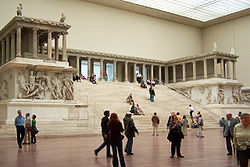
In ancient Egypt, altars primarily took the form of low offering tables situated within temple complexes, designed for presenting food and incense to deities. These structures, often made of stone or wood and elevated slightly on pedestals, facilitated daily rituals where priests placed bread, fruits, meats, and incense burners before gods such as Amun in temples like Karnak during the New Kingdom period around 1500 BCE.[28][29] The tables symbolized abundance and divine nourishment, with scenes in temple reliefs depicting pharaohs or priests performing libations and offerings to sustain the gods' eternal life.[30] Greek altars varied from temporary constructions to monumental permanent ones, serving as sites for public and private sacrifices to Olympian gods. Simple ash altars, built from piled earth, stones, or accumulated sacrificial remains, were common for one-off rituals, allowing blood and burnt offerings to seep into the ground as a connection to the divine.[31] More elaborate examples included stepped platforms, sometimes with horn-like projections for securing victims, as seen in the Pergamon Altar dedicated to Zeus, constructed around 180–160 BCE under King Eumenes II; this massive U-shaped structure, measuring approximately 35 meters wide with a multi-tiered base, hosted large-scale public sacrifices celebrating Attalid victories.[32] Roman altars, known as arae, evolved into sophisticated marble monuments emphasizing state and imperial cult, often enclosed within decorative screens for ceremonial processions. The Ara Pacis Augustae, dedicated in 9 BCE to commemorate Augustus's return from Hispania and Gaul, exemplifies this with its ornate enclosure featuring reliefs of imperial family processions and sacrificial scenes, underscoring themes of peace (pax) and divine favor. These altars supported rituals like libations of wine and milk, burnt offerings, and vows (vota), frequently inscribed with dedications to gods or emperors. Iconography on Greco-Roman and Egyptian altars commonly featured relief carvings and inscriptions depicting ritual acts, evolving from portable, utilitarian forms in earlier periods to fixed, elaborately decorated structures by the Hellenistic and Imperial eras. Egyptian tables bore hieroglyphic labels identifying offerings, while Greek and Roman examples showed priests pouring libations, slaughtering animals, or gods receiving gifts, as on the Pergamon Altar's Gigantomachy frieze symbolizing cosmic order and the Ara Pacis's floral motifs evoking fertility.[33] This visual language highlighted the altar's role as a liminal space between human and divine realms, with portable altars used in military campaigns giving way to permanent temple fixtures for enduring civic piety.[34]

Altars in the Ancient Near East

High Places

High places, referred to as bamot in Hebrew (singular bamah), were elevated outdoor worship sites in the ancient Near East, typically situated on natural hilltops or artificial platforms dedicated to sacrificial rituals for deities. These shrines functioned as decentralized centers of devotion before the establishment of centralized temple worship, often equipped with altars, standing stones (massebot), and sometimes sacred trees or poles representing fertility aspects. In the Hebrew Bible, bamot are described as locations for both legitimate Yahweh worship in early periods and illicit practices associated with Canaanite influences, such as Baal veneration, as seen in 1 Kings 14:23, where they are noted as sites built by the people of Judah under King Rehoboam for burning incense and sacrificing.[35] Archaeological evidence highlights prominent bamot from the Iron Age, particularly in the northern kingdom of Israel during the 10th to 9th centuries BCE. At Tel Dan, excavations uncovered a large raised platform measuring approximately 18 by 19 meters, constructed with finely dressed stones, featuring a central altar area, monumental stairs, and associated standing stones; this site, established around 930 BCE by King Jeroboam I as an alternative to Jerusalem's temple, yielded pottery and burnt layers confirming its use for cultic activities into the mid-9th century BCE. In the Samaria region, similar installations have been identified, including enclosures on ridges like Dhahrat et-Tawileh (the Bull Site) from the 12th century BCE with large standing stones, stone altars for sacrifices, and incense burners (hammanim), reflecting widespread Iron Age practices across northern areas as described in 2 Kings 17:9–12. These sites underscore the bamot's role as open-air complexes blending local Semitic traditions.[36][37] Rituals at bamot centered on open-air sacrifices, including burnt offerings and incense, often tied to fertility rites in Baal worship that involved symbolic elements like sacred poles (asherim). Prophetic figures vehemently condemned these practices for promoting idolatry; notably, the prophet Elijah orchestrated a dramatic confrontation on Mount Carmel, a high place, where he rebuilt a Yahweh altar, offered a bull sacrifice, and invoked divine fire to refute 450 prophets of Baal, leading to their execution and highlighting the tension between decentralized shrines and emerging monotheistic purity (1 Kings 18:21–40). Such events illustrate the bamot's association with both Yahwistic and syncretic rituals, frequently criticized in prophetic literature for deviating from covenantal standards.[38] The prominence of bamot waned with King Josiah's religious reforms in 622 BCE, prompted by the discovery of a Torah scroll in the Jerusalem Temple, which mandated centralized worship. Josiah systematically destroyed high places throughout Judah and the former northern territories, including defiling the altar at Bethel and purging sites in Samaria and Galilee by removing their priests and idols (2 Kings 23:4–20; 2 Chronicles 34:6), thereby shifting Israelite practice toward exclusive temple-based observance and suppressing decentralized outdoor shrines. This reform marked a pivotal transition, effectively dismantling the bamot network by the late 7th century BCE.[39]

Biblical and Pre-Judaic Sites

In the Hebrew Bible, the earliest references to altars appear in the patriarchal narratives, depicting them as simple, improvised structures erected in response to divine encounters and promises of land. According to Genesis 12:7, after arriving at Shechem near the great tree of Moreh around 2000 BCE during the traditional patriarchal period, Abraham built an altar to the Lord following a theophany in which God promised the land to his offspring.[40][41] This altar, likely constructed from local stones or earth, served as a site for worship and thanksgiving, marking the covenantal relationship between the patriarch and God without elaborate design. Similarly, in Genesis 28:18-19, Jacob set up a stone pillar at Bethel—previously known as Luz—after dreaming of a ladder to heaven, anointing it with oil to consecrate it as a memorial to the divine presence and renaming the site "house of God."[42][41] These patriarchal altars emphasized personal, nomadic devotion, contrasting with later centralized practices and reflecting a pre-institutional form of Israelite religion.[43] The Mosaic tradition introduced more formalized altar specifications within the Tabernacle, as detailed in Exodus 27:1-8, where the bronze altar for burnt offerings was prescribed as a square structure five cubits long, five cubits wide, and three cubits high, made of acacia wood overlaid with bronze.[44] Its four corners featured integrated horns of the same material, intended for securing sacrificial animals or applying blood, while utensils such as bronze pots, shovels, basins, forks, and firepans facilitated the rituals.[45] The altar's hollow frame with acacia poles overlaid in bronze allowed for portability, underscoring its role in the wilderness wanderings before the Temple era, and it symbolized atonement through fire and blood sacrifices central to the covenant at Sinai.[46] Pre-Judaic influences from neighboring cultures are evident in archaeological finds that parallel biblical altar features, indicating shared sacrificial traditions in the ancient Near East. The Mesha Stele, erected around 840 BCE by King Mesha of Moab, describes the conquest of Israelite territories and the acquisition of Yahweh's "altar-hearths" from Nebo as spoils dedicated to the Moabite god Chemosh, alongside references to human sacrifices that highlight regional practices of devotion through destruction and offering.[47] Similarly, Philistine altars, such as a horned example unearthed at Tell es-Safi/Gath dating to the 9th century BCE, exhibit two protruding horns and a base groove akin to those in Exodus descriptions, suggesting Aegean-inspired designs adapted for animal sacrifices in Philistia.[48] These artifacts demonstrate how altars functioned across cultures for ritual slaughter, with structural similarities implying cultural exchange or common Levantine origins prior to distinct Judaic centralization.[49] Biblical altars incorporated symbolic elements tied to covenant rituals, such as anointing with blood to signify purification and dedication, as seen in Exodus 29:12 where sacrificial blood was applied to the altar's horns during consecration ceremonies.[50] This act, repeated in Leviticus 8:15 for the Tabernacle's inauguration, underscored the altar's role in mediating between humanity and the divine through atonement, transforming it into a sacred boundary for offerings that ratified covenants like those with Abraham and Moses.[51] Prohibitions against images further emphasized aniconism, as Exodus 20:4-5 forbade graven representations in worship to prevent idolatry, ensuring altars remained unadorned focal points for direct encounter with God rather than mediated through visuals.[52] These elements collectively reinforced the altar's function in pre-Judaic contexts as a conduit for unadulterated covenantal fidelity.

Altars in Judaism

Biblical Altars

In the Hebrew Bible, altars (Hebrew: mizbeach, meaning "place of slaughter") served as central elements in Israelite worship, primarily for offering sacrifices to Yahweh, commemorating divine encounters, and facilitating atonement. These structures varied from simple earthen mounds to elaborate bronze constructions, reflecting evolving religious practices from nomadic to centralized temple-based cultus. Biblical texts describe altars as sites where heaven and earth intersect, with offerings symbolizing devotion, thanksgiving, or propitiation.[53][54] During the patriarchal period, altars were temporary and erected in response to theophanies or acts of deliverance, emphasizing personal piety over institutional ritual. Noah built the first post-flood altar from clean animals to offer burnt sacrifices, eliciting divine approval (Genesis 8:20). Abraham constructed multiple altars, such as at Shechem upon God's promise of land (Genesis 12:7), near Bethel to call on Yahweh's name (Genesis 12:8), and at Hebron with Mamre (Genesis 13:18), often using uncut stones to mark sacred spaces. Isaac followed suit at Beersheba (Genesis 26:25), and Jacob at Bethel after his dream (Genesis 35:1-7), highlighting altars as memorials of covenantal encounters rather than fixed shrines. These early altars contrasted with Canaanite urban cult sites, underscoring Yahweh's initiative in revelation.[53] Mosaic legislation formalized altar construction to prevent idolatry, mandating simple earth altars or those of unhewn stones for burnt offerings and peace offerings wherever God manifested his name (Exodus 20:24-25; Deuteronomy 27:5-6). Prohibitions against hewn stones or steps ensured humility and avoided pagan influences. In the tabernacle, the altar of burnt offering stood in the courtyard: a 5-cubit-square by 3-cubit-high structure of acacia wood overlaid with bronze, featuring projecting horns for blood application and a grating for fire (Exodus 27:1-8; 38:1-7). Adjacent was the golden altar of incense, 1 cubit square by 2 cubits high, placed before the veil in the Holy Place for perpetual priestly offerings symbolizing prayer (Exodus 30:1-10; 37:25-28). These facilitated daily sacrifices, including burnt offerings of herd or flock animals wholly consumed by fire for atonement (Leviticus 1:1-17; 9:23-24). Levites guarded the tabernacle to prevent unauthorized approach (Numbers 1:50-52).[54] Solomon's temple featured a grander altar of burnt offering, 20 cubits square by 10 cubits high, cast in bronze and positioned in the courtyard for national sacrifices during dedications (1 Kings 8:64; 2 Chronicles 4:1). It supported increased offerings, including peace and grain sacrifices, reinforcing Jerusalem as the centralized worship site (1 Kings 9:25). Beyond official altars, bamot (high places) proliferated as elevated shrines with stone altars for sacrifices and incense, often on hills, in cities, or even valleys (1 Kings 3:4; 2 Kings 16:4; Jeremiah 7:31). Archaeological finds, such as the 8th-century BCE horned altar at Beersheba (possibly dismantled in Hezekiah's reforms) and platforms at Megiddo, corroborate biblical descriptions of these sites, which blended Yahwistic and Canaanite elements.[55][56][57] Prophets and Deuteronomistic historians condemned bamot for syncretism, associating them with idolatry and child sacrifice (2 Kings 23:1-20; Amos 7:9), though earlier texts tolerated them pre-temple (1 Samuel 9:12-14). Reforms under kings like Hezekiah and Josiah destroyed these altars to centralize worship at the temple (2 Kings 18:4; 23:8), underscoring the altar's theological role in exclusive devotion to Yahweh. This evolution from decentralized patriarchal markers to a singular, regulated focal point of atonement shaped Israelite identity.[56][57]

Synagogue and Modern Practices

Following the destruction of the Second Temple in 70 CE, Jewish practice shifted away from sacrificial worship, rendering traditional altars obsolete as the Torah mandates sacrifices only at the Temple site in Jerusalem.[58] In synagogues, which emerged as centers of prayer and study, no physical altars are used for offerings, emphasizing instead communal Torah study and ethical observance.[59] The bimah, a raised platform typically located at the center or front of the sanctuary, serves as the functional equivalent for key rituals, where the Torah scroll is read aloud during services.[60][61] The aron ha-kodesh, or holy ark, stands as the primary sacred focal point in the synagogue, housing the Torah scrolls and positioned on the eastern wall facing Jerusalem to symbolize the direction of prayer.[62][63] This ornate cabinet, often veiled and flanked by eternal lights, underscores the sanctity of the Torah without evoking sacrificial elements. Many synagogues also feature memorial tablets or plaques dedicated to Holocaust victims, listing names of those murdered whose graves remain unknown, serving as commemorative elements that honor communal loss rather than ritual sites.[64][65] In modern Jewish denominations, practices vary regarding symbolic structures. Orthodox synagogues strictly avoid any physical altars or altar-like features to prevent emulation of Temple sacrifices, maintaining the bimah solely for Torah reading and leadership during prayer.[59] Reform Judaism, while similarly eschewing sacrificial altars, occasionally incorporates the bimah as a symbolic platform for lifecycle events such as weddings or confirmations, adapting it to contemporary rituals without invoking ancient offerings.[66] Contemporary debates within some Orthodox Jewish circles center on preparations for a potential Third Temple, exemplified by the Temple Institute, an Orthodox organization established in the 1980s in Jerusalem, which has constructed off-site replicas of sacred vessels, including a stone altar, to ready for future rebuilding.[67] As of November 2025, the Institute continues these efforts, including preparations for the red heifer ritual with four candidates at Shiloh, aimed at producing ashes for purification necessary for Temple service.[68] These efforts, aimed at fulfilling biblical prophecies, provoke discussions among Jewish scholars and communities about halakhic permissibility, political implications on the Temple Mount, and the balance between anticipation and current observance.[69]

Altars in Christianity

Early and Western Traditions

In the early Christian era, from the 1st to 4th centuries, altars consisted primarily of wooden tables known as mensa, resembling everyday house tables and used in domestic house churches for the Eucharist amid persecution. These simple, portable structures facilitated the breaking of bread in private homes, as depicted in 2nd-century catacomb frescoes such as the "Fractio Panis" in the Catacomb of Priscilla.[70][71] Following the Edict of Milan in 313 CE, which legalized Christianity, altars evolved into fixed stone constructions in public basilicas, often built over martyrs' tombs to honor relics; by the 6th century, stone had become the norm in the West, as decreed by the Council of Epaon in 517.[70][72] A prominent example is the altar in Constantine's original St. Peter's Basilica, positioned above St. Peter's tomb with a confessio for viewing relics.[70] In the Catholic tradition, the high altar remains the focal point for the Eucharistic sacrifice, typically freestanding and elevated on steps symbolizing ascent to God, with a tabernacle for reserving consecrated hosts to enable adoration and distribution to the sick.[73][74] Reredos, ornate screens or backings emerging around the 12th century, adorn the rear, while side altars in chapels support votive Masses dedicated to saints, as exemplified by the tradition originating from the seven oratories surrounding the Basilica of St. John Lateran in the 5th century.[70][73] Post-Vatican II reforms in the 1960s promoted "noble simplicity" and active participation, leading to freestanding altars separated from walls for versus populum orientation and reduced ornamentation.[74] Canon law specifies fixed altars of natural stone for consecration, though dignified, solid wood is permitted for movable ones in certain contexts like the United States.[74] Liturgically, the altar hosts consecration during Mass—where bread and wine become Christ's body and blood—and reservation in the tabernacle, marked by a perpetual lamp signifying divine presence.[74][73] Western Protestant denominations adapted these forms with varying emphasis on symbolism. Lutheran altars often feature a prominent crucifix above or on the table to recall Christ's atoning sacrifice, paired with a pulpit to unite Word and sacrament in worship.[75] Anglican churches employ a fixed altar table against the east wall, accompanied by a communion rail where communicants kneel to receive the Eucharist, underscoring sacramental grace.[76] In Reformed traditions, the altar manifests as a simple, central, unelevated table to evoke the Lord's Supper as a communal meal rather than a sacrificial site, free from relics or excessive elevation.[77] Unlike Eastern Orthodox rites with icon screens, these Western practices prioritize the altar's direct accessibility and Eucharistic centrality.[71]

Eastern and Oriental Rites

In the Byzantine Rite, predominant in Eastern Orthodox Christianity, the altar is designated as the Holy Table (Greek: Hagion Bēma), a consecrated wooden structure positioned in the sanctuary behind the iconostasis, an elaborate screen adorned with icons that visually and symbolically separates the sacred space from the nave where the laity assemble. This arrangement underscores the mystical boundary between the earthly and divine realms, with the iconostasis evolving from the earlier templon barrier in Byzantine architecture during the 5th and 6th centuries. The Holy Table serves as the focal point for the Divine Liturgy, where the Eucharist is prepared and consecrated; it typically includes embedded relics of saints, a practice formalized by the Seventh Ecumenical Council in 787 to affirm the altar's sanctity through martyrdom's witness. An essential element is the antimension, a silk cloth depicting Christ's entombment with a saint's relic sewn into its corner, upon which the Liturgy is performed to ensure validity even in temporary settings.[78][79][80][81] Among Oriental Orthodox traditions, altar designs reflect regional iconographic and material emphases while maintaining a veiled, inaccessible character. In the Armenian Rite, altars are often constructed from stone, engraved or adorned with crosses symbolizing the faith's foundational role in national identity, as seen in medieval khachkars (cross-stones) integrated into church architecture to evoke transformation through Christ's sacrifice. The Alexandrian Rite, as practiced in the Coptic Orthodox Church, features altars separated from the nave by a curtain rather than a solid iconostasis, emphasizing the veil's role in signifying the chasm between divine holiness and human imperfection, drawn closed during key liturgical moments to heighten the mystery of the Eucharist. Similarly, in the Syriac Orthodox tradition, curtain veils (known as sustoro) enclose the madbaha (altar area), drawn to conceal preparations and consecrations, thereby preserving the sanctity of the space and mirroring the Temple's inner veil. The Ethiopic Rite, part of the Alexandrian family, employs tabots—consecrated wooden or stone slabs representing the Ark of the Covenant—placed upon altars within sanctuaries often designed in a round form divided into three concentric circles imitating the ancient temple of Jerusalem, with the innermost circle reserved exclusively for clergy during the Divine Liturgy.[82][83][84][85][86][87][88] Common across these Eastern and Oriental rites is the eastward orientation of altars, symbolizing the direction of Christ's anticipated Second Coming and the light of resurrection, with the priest facing east during prayers to align worship toward divine eschatology. Preparation rituals, such as the prothesis (Liturgy of Preparation) in the Byzantine tradition, occur at a side table where bread and wine are arranged symbolically as Christ's body and blood, emphasizing aniconic yet profound mystical preparation inaccessible to the laity. Lay access to the sanctuary is strictly prohibited, reserved for ordained clergy to maintain the altar's holiness, a demarcation rooted in early Christian temple symbolism where only priests enter the holy of holies. Variations include the Syro-Maronite Church, an Eastern Catholic rite blending West Syriac elements with Latin influences, where altars remain open without full screening, allowing visual participation while retaining Eastern preparatory veiling. In the East Syriac tradition of the Assyrian Church of the East, altars receive special emphasis through anointing with holy oil during consecration, invoking apostolic continuity and the sanctifying presence of the Holy Spirit in the Eucharistic offering.[89][90][91][81][92][93][94]

Portable and War Altars

Portable altars in Christianity have long facilitated liturgical celebrations in non-traditional settings, particularly during military campaigns where fixed church structures were unavailable. In the medieval period, these altars were essential for bishops and clergy accompanying armies, allowing the Eucharist to be offered on the battlefield or in temporary camps. A notable early example dates to the 8th century, when monks of St. Denis carried a wooden table covered with a linen cloth as a portable altar during Charlemagne's campaign against the Saxons, underscoring the integration of worship into royal expeditions.[95] Such altars were often constructed from lightweight materials like wood or stone slabs, sometimes adorned with precious metals or gems to house relics, ensuring their consecration and portability despite the era's logistical challenges.[96] The tradition of portable altars intensified during the World Wars, evolving into specialized chaplain kits designed for frontline use. In World War I, British Army chaplains employed field Communion sets resembling briefcases, containing a chalice, paten, crucifix, stole, prayer book, ciborium, holy water vials, candles, and chrism oil, which could be arranged on makeshift surfaces for sacraments in trenches or field hospitals.[97] Similarly, U.S. Catholic chaplains received comprehensive Mass kits from the Chaplains’ Aid Association, founded in 1917, each costing about $100 and including a portable altar stone with relics, crucifix, chalice, paten, vestments, and altar linens; over 22 such kits were distributed to priests in France by 1918, blending spiritual support with national patriotism.[98] During World War II, these kits persisted, with foldable wooden or metal altars in compact cases—often lined with fabric and equipped with carrying straps—supplied to Catholic chaplains, enabling Masses in combat zones and aboard ships.[99] For validity in Catholic rites, portable altars required specific consecrated elements, such as an altar stone embedding a saint's relic and a corporal—a linen cloth blessed by a bishop—to transform any surface into a sacred space.[100] In modern contexts, these altars support field Masses in military chapels and deployments, where lightweight designs of oak or aluminum allow quick setup for troops facing extended separations from parishes.[101] Post-2000, portable kits have also aided disaster relief efforts by Catholic chaplains, providing sacraments in devastated areas following events like hurricanes, though specific wartime precedents inform their utilitarian, durable construction.[102]

Altars in Hinduism

Domestic and Vaidic Altars

In the Vedic tradition, the foundational altars were fire-based structures known as vedi, essential for performing yajna sacrifices as described in the Rigveda, composed around 1500–1200 BCE. These outdoor altars served as the ritual ground where offerings, including ghee poured into the consecrated fire, facilitated communication with deities and cosmic order.[103] The construction of elaborate vedi involved precisely layered bricks, symbolizing the universe's structure, particularly in advanced rites like the Agnicayana, where the altar is built in the shape of a bird from 1005 bricks arranged in five layers representing the elements, seasons, and cosmic divisions to invoke divine reciprocity.[104] Domestic altars in Hinduism, often called ghar mandir or home shrines, represent a personal extension of worship practices, typically featuring small platforms or shelves dedicated to deities such as Lakshmi for prosperity or family ishta devata. Daily puja at these shrines involves offerings of flowers, lit lamps (diya), incense, and food items like fruits or sweets, performed by household members to seek blessings and maintain spiritual harmony.[105] These rituals emphasize devotion (bhakti) over elaborate sacrifice, with the altar acting as a focal point for morning and evening prayers that reinforce familial and ethical values.[106] Home altars are commonly constructed from simple materials like clay for temporary setups during rites or durable metal and wood for permanent fixtures, elevated on low platforms to signify sanctity. Orientation toward the east is prescribed in traditional texts like the Vishnu Purana to align with the rising sun and auspicious energies, ensuring the worshipper faces the altar while invoking divine presence.[107] These altars play a key role in samskaras, the life-cycle rites such as birth ceremonies (namakarana) or weddings, where they host simplified yajna elements like fire offerings to mark transitions and purify the individual.[108] The evolution of altars from Vedic vedi to domestic forms occurred gradually during the post-Vedic period (c. 500 BCE onward), shifting from communal, outdoor fire sacrifices to intimate, indoor puja accessible to lay households without priestly mediation. This transition, prominent in the Puranic era (300–750 CE), democratized worship by incorporating iconography and simpler oblations, reducing reliance on animal or large-scale offerings. Tantric influences from the medieval period further enriched domestic practices by integrating esoteric mantras, yantras (geometric diagrams), and energy visualizations (shakti) into home rituals, enhancing personal empowerment and subtle body engagement without altering the altar's core simplicity.[109]

Temple and Ritual Altars

In Hindu temples, known as mandirs, the central altar is located within the garbhagriha, the innermost sanctum sanctorum, which houses the primary murti or consecrated idol of the deity. This altar serves as the focal point for public worship, where devotees offer prayers and receive darshan, or divine vision, of the deity. A prominent example is the Venkateswara Temple in Tirumala, also called Tirupati Balaji, where the murti of Lord Venkateswara stands on a gold-plated platform within the garbhagriha, symbolizing divine opulence and eternal presence; the sanctum's outer walls and the Ananda Nilayam gopuram above it were gold-plated using 12 kilograms of gold donated by devotees in 1958, with further enhancements in the 1960s.[110] Rituals performed at these temple altars emphasize devotion and purification, including abhisheka, the ceremonial anointing and bathing of the murti with substances such as milk, honey, water, and sandalwood paste to invoke the deity's blessings and cleanse negative energies. Aarti, the waving of lamps before the deity accompanied by chants and bells, follows abhisheka during evening worship, creating a mesmerizing display of light and sound that draws thousands of pilgrims. Major sites like the ghats of Varanasi along the Ganges River host elaborate Ganga Aarti rituals, where priests honor the river goddess with synchronized lamp offerings at Dashashwamedh Ghat, blending temple altar practices with riverine worship to affirm the Ganges' sacred status as a purifying force.[111][112] Architecturally, temple altars are integrated into structures featuring multi-tiered vimanas, the towering superstructures over the garbhagriha, which in South Indian Dravida style rise as stepped pyramids with intricate carvings and finials, contrasting with the curvilinear shikhara towers of North Indian Nagara style that evoke a mountain-like ascent to the divine. Consecration follows Agama texts, ancient treatises like the Kamika Agama, which prescribe rituals such as prana pratishta—the infusion of life force into the murti—along with site selection, foundation deposits, and orientation using gnomon shadows to align with cosmic principles, ensuring the altar's spiritual potency. Regional variations reflect climatic and cultural influences: South Indian temples emphasize expansive enclosures with towering gopurams at entrances, as seen in Chola-era structures like Brihadisvara with its 66-meter vimana, while North Indian designs prioritize compact, beehive-shaped shikharas, such as those at Khajuraho.[113][114] Since 1950, Hindu temple construction has expanded globally among diaspora communities, adapting traditional altar designs to new contexts while preserving Agama-guided consecration. Examples include the BAPS Shri Swaminarayan Mandir in London, inaugurated in 1995 as Europe's first traditional Hindu temple with a marble-carved garbhagriha housing murtis of central deities, and similar structures in North America like the Houston mandir opened in 2004. In Southeast Asia, India's Archaeological Survey of India has led post-1950 restorations of ancient Hindu sites, such as Angkor Wat in Cambodia, where efforts since 1986 have reinforced foundations and preserved its towers, revitalizing these altars for contemporary worship and cultural continuity.[115][116]

Altars in East Asian Religions

Buddhism

In Buddhist traditions, altars serve as focal points for meditation, veneration of relics and images, and ritual offerings, evolving from early Indian worship spaces known as chaityas, which date to the 3rd century BCE during the reign of Emperor Ashoka.[117] These rock-cut halls, such as those at Bhaja Caves, centered on stupas as reliquaries symbolizing the Buddha's presence, facilitating circumambulation and communal reflection without anthropomorphic images in the initial Theravada phase.[117] As Buddhism spread along trade routes, it reached China by the late 1st century CE, where altars integrated with ancestral veneration practices; lay households adapted Buddhist icons alongside ancestor tablets, offering vegetarian meals and incense in place of traditional sacrifices to align with non-violent principles.[118] By the 6th century, this syncretism had proliferated, with thousands of temples incorporating such hybrid home shrines across China.[118] In Theravada Buddhism, prevalent in Southeast Asia, altars often manifest as elevated bases or pedestals within temple complexes, housing Buddha images and serving as reliquaries at the foundation of stupas. For instance, at Wat Phra Kaew in Bangkok, Thailand—the most sacred Theravada site—the Emerald Buddha statue rests on an 11-meter-high golden altar-like throne within the ordination hall (ubosot), surrounded by additional royal-commissioned Buddha figures for veneration and offerings.[119] These structures emphasize the Buddha's teachings on impermanence (anicca), with transient floral and incense offerings reminding practitioners of the ephemeral nature of all phenomena.[120] Mahayana and Vajrayana traditions adapt altars for more elaborate devotional practices, incorporating symbolic elements to aid visualization and enlightenment. In Tibetan Vajrayana, altars feature butter lamps—bowls filled with yak butter or oil, lit to represent wisdom dispelling ignorance—positioned among seven offering bowls containing water, flowers, and incense, arranged before central images of Shakyamuni Buddha or deities; these offerings symbolize the four elements, with earth represented by flowers or plants, water by clear water bowls, fire by candles, lamps, or butter lamps (particularly in Tibetan tradition), and air (or wind) by incense or its smoke.[121][122] Japanese Mahayana home altars, known as butsudan, are cabinet shrines containing painted scrolls of the Buddha and ancestral memorial tablets (ihai), where families perform daily rituals like bowing (gassho) and offering rice or fruit to honor both enlightened figures and forebears.[123] These altars underscore anicca through perishable offerings, such as wilting flowers symbolizing life's transience.[124] Across Buddhist altars, functions center on non-violent rituals promoting mindfulness and merit accumulation, including chanting sutras, burning incense to evoke purity, and presenting symbolic gifts like light and fragrance, without animal sacrifices that contradict the first precept against harming life.[125] Such practices reinforce core doctrines like anicca, encouraging contemplation of change and non-attachment during meditation sessions.[120] In Japan, butsudan occasionally blend with Shinto elements in syncretic households, though Buddhist altars remain distinct in their focus on enlightenment over deity propitiation.[123]

Taoism and Shinto

In Taoism, household altars typically feature spirit tablets for ancestors and deities, symbolizing cosmic harmony through the three powers of heaven, earth, and humanity. These tablets serve as focal points for daily offerings, where incense is burned to purify the space and connect the living with spiritual forces across these domains.[126] In temple settings, fumigation rites involve elaborate use of incense to sanctify the altar, invoking deities like the Three Pure Ones and facilitating rituals that align human actions with natural and celestial orders.[127] Shinto altars, particularly the kamidana or god-shelf found in many homes, consist of a raised wooden shelf adorned with a shimenawa rope of twisted straw to demarcate sacred space and a sacred mirror (shinkyo) as the primary shintai, or object housing the kami spirit for invocation and daily worship.[128] This setup allows practitioners to honor local or ancestral kami through simple rituals, emphasizing purity and harmony with nature. During seasonal matsuri festivals, temporary altars at shrines incorporate similar elements, with offerings placed to celebrate agricultural cycles or community events, such as the autumn harvest rites that reinforce communal bonds with divine forces.[129] Taoist and Shinto altars share elements like incense burning for purification and offerings of sake or rice wine to express gratitude and seek blessings, often in portable forms during rituals such as Japan's New Year celebrations, where household kamidana receive special libations alongside temple visits.[130] These practices highlight a mutual emphasis on ancestral and natural harmony, with incense smoke acting as a bridge between the material and spiritual worlds in both traditions.[131] In modern urban settings post-World War II, Taoist altars have adapted through the proliferation of private dao tan in Chinese megacities, simplifying traditional structures to fit apartment spaces while maintaining core rites for personal spiritual balance amid rapid urbanization.[132] Similarly, Shinto kamidana have seen simplifications in compact urban homes, with eco-spiritual revivals integrating environmental themes, such as enhanced nature kami veneration to address contemporary ecological concerns through shrine-based initiatives.[133]

Altars in Revival and Indigenous Traditions

Norse Paganism and Ásatrú

In Norse paganism, sacred sites known as —often groves or enclosures—served as primary locations for altars, where rituals including sacrifices (blót) to deities such as Odin and Thor were conducted to ensure fertility, victory, and divine favor.[134] These altars typically consisted of simple stone heaps called hörgr or turf constructions, upon which offerings like animal blood were placed or poured during ceremonies. A prominent example is the Uppsala temple complex in Sweden, dating to the 9th century, where every nine years large-scale sacrifices of humans, horses, and other animals occurred at a with associated altars, as described by the chronicler Adam of Bremen.[134] Archaeological evidence supports the use of such altars in blót rites, including Gotland picture stones from the 8th-10th centuries that depict sacrificial scenes, such as figures offering victims on raised platforms interpreted as altars to Odin.[135] Additionally, runic inscriptions on stone slabs, like the 7th-century Stentoften Runestone in Sweden, reference blót rituals involving offerings of goats and stallions for land fertility, suggesting these slabs functioned as altar-like memorials or dedicatory surfaces. These artifacts highlight the integration of altars into communal and seasonal worship in Iron Age Scandinavia. The revival of Norse paganism in modern Ásatrú, emerging prominently after the 1970s with organizations like the Ásatrúarfélagið in Iceland (founded 1972), reconstructs these traditions through outdoor vevis—contemporary sites—for blót ceremonies. Many inclusive groups, such as Ásatrúarfélagið and The Troth (founded 1987), emphasize ethical non-violence and reject animal sacrifices, offering mead, bread, or symbolic items in a communal horn-passing ritual to honor the gods, drawing inspiration from Eddic texts like the Poetic Edda for invocations and structure.[136] This approach focuses on reciprocity, often described as the gifting cycle, to foster community and connection to ancestral practices, though some smaller or folkish groups may incorporate animal offerings where legally permissible.[137] Key modern sites include kindred gatherings in the United States, such as those organized by The Troth in various states, and in Europe, like events by the Asatruarfélagið at natural outdoor venues in Iceland, where participants recreate blót to celebrate solstices and honor the Æsir.[138] These assemblies, often in forests or fields to evoke historical , reinforce Ásatrú's emphasis on living in harmony with nature and the gods as described in the Eddas.[139]

Neopaganism and Wicca

In Neopaganism and Wicca, altars serve as focal points for ritual magic, symbolizing the intersection of the mundane and divine realms. Emerging in the mid-20th century, these altars emphasize personal empowerment, elemental balance, and ethical harmony with nature, drawing from revived European folk traditions while adapting to contemporary values.[140] Wiccan altars, particularly in the Gardnerian tradition founded by Gerald Gardner in the 1950s, are typically "working altars" equipped with specific ritual tools to facilitate spellwork and ceremonies. Central items include the athame (a double-edged ritual knife representing masculine energy and used to direct magical intent), the chalice (a cup for libations symbolizing the feminine and the womb of the Goddess), and the pentacle (a disc inscribed with a five-pointed star, invoking protection and the unity of the five elements: earth, air, fire, water, and spirit). These tools are arranged on the altar to reflect a quartered circle layout, dividing the space into four quadrants corresponding to the cardinal directions and elements—East for air (intellect), South for fire (passion), West for water (emotions), and North for earth (stability)—to invoke balance during rituals like circle casting. This setup, detailed in Gardner's foundational text Witchcraft Today (1954), underscores Wicca's duotheistic framework of God and Goddess polarities.[140][141] In Neo-Druidism, a parallel Neopagan movement, altars often manifest as natural or reconstructed stone circles inspired by prehistoric sites, transforming landscapes into sacred spaces for communal rites. Practitioners frequently utilize Avebury's ancient stone circle in Wiltshire, England—Europe's largest Neolithic henge—as an outdoor altar for solstice celebrations, where stones serve as symbolic boundaries and focal points for invoking seasonal energies. During summer solstice rites (Alban Hefin), Druids gather at dawn to perform invocations, drumming, and offerings amid the megaliths, viewing the site as a "Druidical temple" that connects modern practice to ancestral reverence, as interpreted through 18th-century antiquarian influences like William Stukeley's works. This approach emphasizes ecological attunement over permanent fixtures, with temporary altars formed by arranging natural elements like flowers or crystals on the ground.[142] Eclectic Neopaganism extends altar practices into highly personalized, DIY constructions that blend elements from multiple traditions, reflecting the movement's syncretic ethos. These altars might incorporate Wiccan tools alongside Celtic runes, Egyptian symbols, or even Norse motifs (such as briefly honoring deities like Freyja in mixed rituals), assembled from found objects, handmade crafts, or household items to create bespoke sacred spaces. Post-2000, online communities have amplified this trend, with forums and social platforms enabling practitioners to share virtual altar designs—digital collages or photo-shared setups—that adapt physical practices to remote or urban lifestyles, fostering global exchange of ideas. Scholarly examinations highlight how such altars embody "making things whole" through artistic expression, allowing individuals to weave diverse spiritual threads into cohesive personal narratives.[143][144] Ethical considerations in Neopagan and Wiccan altars prioritize non-violence and sustainability, shifting away from historical animal sacrifices toward vegetarian or vegan offerings like fruits, grains, herbs, and incense to honor deities without harm. This aligns with the Wiccan Rede's principle of "harm none," emphasizing energy work—such as raising and directing personal or collective vitality through chants, visualizations, and tool manipulations—over physical bloodshed. Practitioners often consecrate plant-based items on the altar to symbolize abundance and reciprocity with nature, reinforcing a worldview where ritual efficacy stems from intention and ethical alignment rather than material destruction.[145][146][147]

References

User Avatar
No comments yet.