


Community hub
Recent from talks
Contribute something
Nothing was collected or created yet.
Abdul Ghaffar Khan
View on Wikipedia
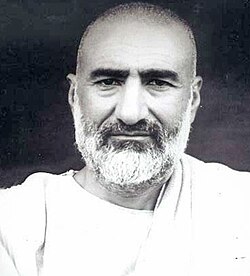
Khan Abdul Ghaffar Khan[a] (6 February 1890 – 20 January 1988), also known as Bacha Khan,[b] was a Pakistani politician and anti-colonial activist from the North-West Frontier Province. He was the founder and leader of the non-violent Khudai Khidmatgar resistance movement and played a significant role in the Indian independence movement against British rule.
Key Information


He was a political and spiritual leader known for his nonviolent opposition and lifelong pacifism; he was a secular Muslim and an advocate for Hindu–Muslim unity in the subcontinent.[2] Because of his similar ideology and close friendship with Mahatma Gandhi, Khan was nicknamed Sarhadi Gandhi ("Frontier Gandhi")[3][4] In 1929, Khan founded the Khudai Khidmatgar, an anti-colonial nonviolent resistance movement.[5] The Khudai Khidmatgar's success and popularity eventually prompted the colonial government to launch numerous crackdowns against Khan and his supporters; the Khudai Khidmatgar experienced some of the most severe repression of the entire Indian independence movement.[6][7]
Khan strongly opposed the proposal for the partition of India into the Muslim-majority Dominion of Pakistan and the Hindu-majority Dominion of India, and consequently sided with the pro-union Indian National Congress and All-India Azad Muslim Conference against the pro-partition All-India Muslim League.[8][9][10] When the Indian National Congress reluctantly declared its acceptance of the partition plan without consulting the Khudai Khidmatgar leaders, he felt deeply betrayed, telling the Congress leaders "you have thrown us to the wolves."[11] In June 1947, Khan and other Khudai Khidmatgar leaders formally issued the Bannu Resolution to the British authorities, demanding that the ethnic Pashtuns be given a choice to have an independent state of Pashtunistan, which was to comprise all of the Pashtun territories of British India and not be included (as almost all other Muslim-majority provinces were) within the state of Pakistan—the creation of which was still underway at the time. However, the British government refused the demands of this resolution.[12][13] In response, Khan and his elder brother, Abdul Jabbar Khan, boycotted the 1947 North-West Frontier Province referendum on whether the province should be merged with India or Pakistan, objecting that it did not offer options for the Pashtun-majority province to become independent.[14][15]
After the partition of India by the British government, Khan pledged allegiance to the newly created nation of Pakistan, and stayed in the now-Pakistani North-West Frontier Province; he was frequently arrested by the Pakistani government between 1948 and 1954.[16][17] In 1956, he was again arrested for his opposition to the One Unit program, under which the government announced its plan to merge all the provinces of West Pakistan into a single unit to match the political structure of erstwhile East Pakistan (present-day Bangladesh). Khan was jailed or in exile during some years of the 1960s and 1970s. He was awarded Bharat Ratna, India's highest civilian award, by the Indian government in 1987.
Following his will upon his death in Peshawar in 1988, he was buried at his house in Jalalabad, Afghanistan. Tens of thousands of mourners attended his funeral including Afghan President Mohammad Najibullah, marching through the Khyber Pass from Peshawar towards Jalalabad. It was marred by two bomb explosions that killed 15 people; despite the heavy fighting at the time due to the Soviet–Afghan War, both sides, namely the Soviet–Afghan government coalition and the Afghan mujahideen, declared an immediate ceasefire to allow Khan's burial. He was given military honours by the Afghan government.
Early years
[edit]Abdul Ghaffar Khan was born on 6 February 1890 into a prosperous Sunni Muslim Muhammadzai Pashtun family from Utmanzai, Hashtnagar; they lived by the Jindee-a, a branch of the Swat River, in what was then British India's Punjab province.[1][8][18] His father, Abdul Bahram Khan, was a land owner in Hashtnagar. Khan was the second son of Bahram to attend the British-run Edward's Mission School, which was the only fully-functioning school in the region and which was administered by Christian missionaries. At school, Khan did well in his studies, and was inspired by his mentor, Reverend Wigram, into seeing the crucial role education played in service to the local community. In his tenth and final year of secondary school, he was offered a highly prestigious commission in the Corps of Guides regiment of the British Indian Army. Khan declined due to his observational feelings that even Guides' Indian officers were still second-class citizens in their own nation. He subsequently followed through with his initial desire to attend university, and Reverend Wigram (Khan's teacher) offered him the opportunity to follow his brother, Abdul Jabbar Khan, to study in London, England. After graduating from Aligarh Muslim University, Khan eventually received permission from his father to travel to London. However, his mother wasn't willing to let another son go to London, so he began working on his father's lands in the process of figuring out his next steps.[19]
At the age of 20 in 1910, Khan opened a madrasa in his hometown of Utmanzai. In 1911, he joined the independence movement of the Pashtun activist Haji Sahib of Turangzai. By 1915, the British colonial authorities had shut down Khan's madrasa, deeming its pro-Indian independence activism to be a threat to their authority.[20] Having witnessed the repeated failure of Indian revolts against British rule, Khan decided that social activism and reform would be more beneficial for the ethnic Pashtuns. This led to the formation of the Anjuman-e Islāh-e Afghānia (Pashto: انجمن اصلاح افاغنه, 'Afghan Reform Society') in 1921, and the youth movement Pax̌tūn Jirga (پښتون جرګه, 'Pashtun Assembly') in 1927. After Khan's return from the Islamic Hajj pilgrimage to Mecca, Hejaz−Nejd (present-day Saudi Arabia) in May 1928, he founded the Pashto-language monthly political journal Pax̌tūn (پښتون, 'Pashtun'). Finally, in November 1929, Khan founded the Khudāyī Khidmatgār (خدايي خدمتګار, 'Servants of God') movement, which would strongly advocate for the end of British colonial rule and establishment of a unified and independent India.[6]
Early career
[edit]

In response to his inability to continue his own education, Bacha Khan turned to helping others start theirs. Like many such regions of the world, the strategic importance of the newly formed North-West Frontier Province (now Khyber Pakhtunkhwa, Pakistan), as a buffer for the British Raj from Russian influence was of little benefit to its residents. Opposition to British colonial rule, the authority of the mullahs, and an ancient culture of violence and vendetta prompted Bacha Khan to want to serve and uplift his fellow men and women by means of education. At 20 years of age, Bacha Khan opened his first school in Utmanzai. It was an instant success and he was soon invited into a larger circle of progressively minded reformers. He opened a series of "Azad" schools which were open to all, including girls. Many of these schools were shut down by British colonial authorities, who feared that revolutionary ideas might spread among the Pakhtuns through education. This was also rooted in their colonial belief that the Pakhtuns of the frontiers did not need education and should remain confined to a simple, traditional way of life.[21][22]
While he faced much opposition and personal difficulties, Bacha Khan worked tirelessly to organise and raise the consciousness of his fellow Pashtuns. Between 1915 and 1918 he visited 500 villages in all part of the settled districts of NWFP. It was in this frenzied activity that he had come to be known as Badshah Khan ("King of Chiefs"), which was later shortened to Bacha Khan.[19][23]
Being a secular Muslim he did not believe in religious divisions. He married his first wife Meharqanda in 1912; she was a daughter of Yar Mohammad Khan of the Kinankhel clan of the Muhammadzai tribe of Razzar, a village adjacent to Utmanzai. They had a son in 1913, Abdul Ghani Khan, who would become a noted artist and poet. Subsequently, they had another son, Abdul Wali Khan (17 January 1917 – 2006), and daughter, Sardaro. Meharqanda died during the 1918 influenza epidemic.[24] In 1920, Bacha Khan remarried; his new wife, Nambata, was a cousin of his first wife and the daughter of Sultan Mohammad Khan of Razzar. They had a daughter, Mehar Taj (25 May 1921 – 29 April 2012),[25] and a son, Abdul Ali Khan (20 August 1922 – 19 February 1997). Tragically, in 1926 Nambata died early as well from a fall down the stairs of the apartment where they were staying in Jerusalem.[18]
Khudai Khidmatgar
[edit]
In time, Bacha Khan's goal came to be the formulation of a united, independent, secular India. To achieve this end, he founded the Khudai Khidmatgar ("Servants of God"), commonly known as the "Red Shirts" (Surkh Pōsh), during the 1920s.
The Khudai Khidmatgar was founded on a belief in the power of Gandhi's notion of Satyagraha, a form of active non-violence as captured in an oath. He told its members:
I am going to give you such a weapon that the police and the army will not be able to stand against it. It is the weapon of the Prophet, but you are not aware of it. That weapon is patience and righteousness. No power on earth can stand against it.[26]
The organisation recruited over 100,000 members and became influential in the independence movement for their resistance to the colonial government. Through strikes, political organisation and non-violent opposition, the Khudai Khidmatgar were able to achieve some success and came to dominate the politics of NWFP. His brother, Dr. Khan Abdul Jabbar Khan (known as Dr. Khan Sahib), led the political wing of the movement, and was the Chief Minister of the province (from 1937 and then until 1947 when his government was dismissed by Mohammad Ali Jinnah of the Muslim League).
Kissa Khwani Massacre
[edit]On 23 April 1930, Bacha Khan was arrested during protests arising out of the Salt Satyagraha. A crowd of Khudai Khidmatgar gathered in Peshawar's Kissa Khwani (Storytellers) Bazaar. The colonial government ordered troops to open fire with machine guns on the unarmed crowd, killing an estimated 200–250.[27] The Khudai Khidmatgar members acted in accord with their training in non-violence under Bacha Khan, facing bullets as the troops fired on them.[28] Two platoons of the Garhwal Rifles regiment under Chandra Singh Garhwali refused to fire on the non-violent crowd. They were later court-martialled and sentenced to a variety of punishments, including life imprisonment.[citation needed]
Bacha Khan and the Indian National Congress
[edit]
Bacha Khan forged a close, spiritual, and uninhibited friendship with Gandhi, the pioneer of non-violent mass civil disobedience in India. The two had a deep admiration towards each other and worked together closely till 1947.
Khudai Khidmatgar (servants of God) agitated and worked cohesively with the Indian National Congress (INC), the leading national organisation fighting for independence, of which Bacha Khan was a senior and respected member. On several occasions when the Congress seemed to disagree with Gandhi on policy, Bacha Khan remained his staunchest ally. In 1931 the Congress offered him the presidency of the party, but he refused saying, "I am a simple soldier and Khudai Khidmatgar, and I only want to serve." He remained a member of the Congress Working Committee for many years, resigning only in 1939 because of his differences with the Party's War Policy. He rejoined the Congress Party when the War Policy was revised.
Bacha Khan was a champion of women's rights [dubious – discuss] and non-violence. He became a hero in a society dominated by violence; notwithstanding his liberal views, his unswerving faith and obvious bravery led to immense respect. Throughout his life, he never lost faith in his non-violent methods or in the compatibility of Islam and non-violence. He recognised as a jihad struggle with only the enemy holding swords. He was closely identified with Gandhi because of his non-violence principles and he is known in India as the 'Frontier Gandhi'. One of his Congress associates was Pandit Amir Chand Boambwal of Peshawar.
O Pathans! Your house has fallen into ruin. Arise and rebuild it, and remember to what race you belong.
— Ghaffar Khan[29]

The Partition
[edit]
Khan strongly opposed the partition of India.[8][9] Accused as being anti-Muslim by some politicians, Khan was physically assaulted in 1946, leading to his hospitalisation in Peshawar.[30] On 21 June 1947, in Bannu, a loya jirga was held consisting of Bacha Khan, the Khudai Khidmatgars, members of the Provincial Assembly, Mirzali Khan (Faqir of Ipi), and other tribal chiefs, just seven weeks before the partition. The loya jirga issueud the Bannu Resolution, which demanded that the Pashtuns be given a choice to have an independent state of Pashtunistan composing all Pashtun territories of British India, instead of being made to join either India or Pakistan. However, the British refused to comply with the demand of this resolution.[12][13]
The Congress Party refused last-ditch compromises to prevent the partition, like the Cabinet Mission Plan and Gandhi's suggestion to offer the position of Prime Minister to Jinnah.
When the July 1947 NWFP Referendum over accession to Pakistan was held, Bacha Khan, the Khudai Khidmatgars, the then Chief Minister Khan Sahib, and the Indian National Congress Party boycotted the referendum. Some have argued that a segment of the population was barred from voting.[14]
Arrest and exile
[edit]Bacha Khan took the oath of allegiance to the new nation of Pakistan on 23 February 1948 at the first session of the Pakistan Constituent Assembly.[16][17]

He pledged full support to the government and attempted to reconcile with the founder of the new state Muhammad Ali Jinnah. Although initial overtures led to a successful meeting in Karachi, a follow-up meeting in the Khudai Khidmatgar HQ never materialised, allegedly due to the role of NWFP Chief Minister, Abdul Qayyum Khan Kashmiri, who told Jinnah that Bacha Khan was plotting his assassination.[31][32]
Following this, Bacha Khan formed Pakistan's first national opposition party, on 8 May 1948, the Pakistan Azad Party. The party pledged to play the role of constructive opposition and would be non-communal in its philosophy.
However, suspicions of his allegiance persisted and under the new Pakistani government, Bacha Khan was placed under house arrest without charge from 1948 till 1954. In 1954, Bacha Khan split with his elder brother Khan Sahib after the latter joined the Central Cabinet of Muhammad Ali Bogra as Minister for Communications. Released from prison, he gave a speech again on the floor of the National Assembly, this time condemning the massacre of his supporters at Babrra.[33]

I had to go to prison many a time in the days of the Britishers. Although we were at loggerheads with them, yet their treatment was to some extent tolerant and polite. But the treatment which was meted out to me in this Islamic state of ours was such that I would not even like to mention it to you.[34]
He was arrested several times after late 1948. In 1956 he was arrested for opposing the One Unit Scheme.[35] The government attempted in 1958 to reconcile with him and offered him a ministry in the government, after the assassination of his brother, but he refused.[36] He remained in prison till 1957 only to be re-arrested in 1958 until an illness in 1964 allowed for his release.[37]
In 1962, Bacha Khan was named an "Amnesty International Prisoner of the Year". Amnesty's statement about him said, "His example symbolizes the suffering of upward of a million people all over the world who are prisoners of conscience."
In September 1964, the Pakistani authorities allowed him to go to the United Kingdom for treatment. During the winter, his doctor advised him to go to United States. He then went into exile to Afghanistan, he returned from exile in December 1972 to popular support, following the establishment of National Awami Party provincial governments in North West Frontier Province and Balochistan.
He was arrested by Prime Minister Zulfiqar Ali Bhutto's government at Multan in November 1973 and described Bhutto's government as "the worst kind of dictatorship".[38]
In 1984, increasingly withdrawing from politics, he was nominated for the Nobel Peace Prize.[39] He visited India and participated in the centennial celebrations of the Indian National Congress in 1985; he was awarded the Jawaharlal Nehru Award for International Understanding in 1967[40] and later Bharat Ratna, India's highest civilian award, in 1987.[41]
His final major political challenge was against the Kalabagh dam project, fearing that the project would damage the Peshawar valley. His hostility would eventually lead to the project being shelved after his death.[citation needed]
Death
[edit]Bacha Khan died in Peshawar in 1988 from complications of a stroke and was buried in his house at Jalalabad, Afghanistan.[42][43] Over 200,000 mourners attended his funeral, including the Afghan president Mohammad Najibullah. The then Indian Prime Minister Rajiv Gandhi went to Peshawar, to pay his tributes to Bacha Khan despite the fact that Zia ul-Haq attempted to stall his attendance citing security reasons. Additionally, the Indian government declared a five-day period of mourning in his honour.[41] Although he had been repeatedly imprisoned and persecuted, tens of thousands of mourners attended his funeral, described by one commentator as "a caravan of peace, carrying a message of love" from Pashtuns east of the Khyber to those on the west,[31] marching through the historic Khyber Pass from Peshawar to Jalalabad. This symbolic march was planned by Bacha Khan, to affirmatively demonstrate his dream of Pashtun unification and to help that dream live on after his death.[citation needed] A cease-fire was announced in the Afghan Civil War to allow the funeral to take place, even though it was marred by bomb explosions killing fifteen people.[43]
Memorial
[edit]The Banaras Flyover in Karachi and the Bacha Khan Chowk it traverses stand as memorials to Abdul Ghaffar Khan.[44] The chowk, named in his honour, was a cultural and political landmark for the local Pashtun community, is now overshadowed by the flyover.
Pashtunistan
[edit]Abdul Ghaffar Khan took an oath of allegiance to Pakistan in 1948 in the legislation assembly. When during his speech he was asked by the PM Liaquat Ali Khan about Pashtunistan, he replied that it was just a name for the Pashtun province in Pakistan, just as Punjab, Bengal, Sindh, and Baluchistan are the names of provinces of Pakistan as ethno-linguistic names,[45] However, this compromise was apparently contrary to what he believed in and strived for before partition: Pashtunistan as an independent state after the failure of the idea of a united India.
Later on in 1980, during an interview with an Indian journalist, Haroon Siddiqui, in Jalalabad, Abdul Ghaffar Khan said
The idea never helped us. In fact, it was never a reality. Successive Afghan governments just exploited it for their own political ends. It was only towards the end of his regime that Daoud Khan had stopped talking about it. And Taraki in the early part of his regime also didn't mention it. So when I met him, I thanked him for not raising the issue. But later, even he raised the issue because he wanted to continue the problem for Pakistan. Our people suffered greatly because of all this.
[46] He also said in the same interview that "I'll live here. I'm now (for all intents and purposes) an Afghan. I'm not even permitting my son, Khan Abdul Wali Khan, political leader of Pakistan's North West Frontier Province, to visit me because he'll insist that I go with him to Pakistan. But I don't want to go."
Family
[edit]
Bacha Khan married his first wife Meharqanda in 1912; she was a daughter of Yar Mohammad Khan of the Kinankhel clan of the Mohammadzai tribe of Razzar, a village adjacent to Utmanzai. They had a son in 1913, Abdul Ghani Khan, who would become a noted artist and poet. Subsequently, they had another son, Abdul Wali Khan (17 January 1917 – 2006), and daughter, Sardaro. Meharqanda died during the 1918 influenza epidemic.
In 1920, Bacha Khan remarried; his new wife, Nambata, was a cousin of his first wife and the daughter of Sultan Mohammad Khan of Razzar. They had a daughter, Mehar Taj (25 May 1921 – 29 April 2012),[25] and a son, Abdul Ali Khan (20 August 1922 – 19 February 1997). Tragically, in 1926 Nambata died early as well from a fall down the stairs of the apartment where they were staying in Jerusalem.[18] Bacha Khan believed in girls' education, so he provided his daughter an education as good as his sons.[22]
Legacy
[edit]
Bacha Khan's political legacy is renowned amongst Pashtuns and those in modern Republic of India as a leader of a non-violent movement. He is often regarded as one of the leading figures of Pashtun nationalism.[47] Within Pakistan, however, the vast majority of society have questioned his stance with the All India Congress over the Muslim League as well as his opposition to the partition of India and Jinnah. In particular, people have questioned where Bacha Khan's patriotism rests.
His eldest son Ghani Khan was a poet. Ghani Khan's wife, Roshan, was from a Parsi family and was the daughter of Nawab Rustam Jang, a prince of Hyderabad.[48] His second son, Abdul Wali Khan, was the founder and leader of the Awami National Party from 1986 to 2006, and was the Leader of the Opposition in the Pakistan National Assembly from 1988 to 1990.
His third son Abdul Ali Khan was non-political and a distinguished educator, and served as Vice-Chancellor of University of Peshawar. Ali Khan was also the head of Aitchison College in Lahore and Fazle Haq College in Mardan.
His niece Mariam married Jaswant Singh in 1939. Jaswant Singh was a young British Indian airforce officer and was Sikh by faith. Mariam later converted to Christianity.[49]
Mohammed Yahya, Education Minister of Khyber Pukhtunkhwa, was the only son-in-law of Bacha Khan.
Asfandyar Wali Khan is the grandson of Abdul Ghaffar Khan, and was the leader of the Awami National Party. The party was in power from 2008 to 2013.
Zarine Khan Walsh, who lives in Mumbai, is the granddaughter of Abdul Ghaffar Khan and was the second daughter of Abdul Ghaffar Khan's eldest son Abdul Ghani Khan.[50]
The All India Pakhtoon Jirga-e-Hind is chaired by Yasmin Nigar Khan, who claims to be the great-granddaughter of Abdul Ghaffar Khan.[51][52] Awami National Party leader Asfandyar Wali Khan rejected the claim, though a cultural ministry official clarified that Yasmin Nigar Khan was a descendant of Abdul Ghaffar Khan's "adopted" son.[50]
Salma Ataullahjan is the great-grandniece of Abdul Ghaffar Khan and a member of the Senate of Canada.
Film, literature and society
[edit].JPG)
In 2008, a documentary, titled The Frontier Gandhi, by film-maker and writer T.C. McLuhan, premiered in New York. The film received the 2009 award for Best Documentary Film at the Middle East International Film Festival (see film page).
In 1990, Abdul Kabeer Siddiqui of Indian National TV made a 30-minute English-language biographical documentary film on Bacha Khan, titled The Majestic Man. It was telecast on Doordarshan.
In Richard Attenborough's 1982 epic Gandhi, Bacha Khan was portrayed by Dilsher Singh.
In his home city of Peshawar, the Bacha Khan International Airport is named after him.
In his hometown Charsadda, the Bacha Khan University is named after him.
Bacha Khan was listed as one of 26 men who changed the world in a recent children's book published in the United States, alongside Tiger Woods and Yo-Yo Ma.[53] He also wrote an autobiography (1969), and has been the subject of biographies by Eknath Easwaran (see article) and Rajmohan Gandhi (see "References" section, below). His philosophy of Islamic pacifism was recognised by US Secretary of State Hillary Clinton, in a speech to American Muslims.[54]
In the Indian city of Delhi, the popular Khan Market is named in his honour, along with Ghaffar market in the Karol Bagh area of New Delhi.[55][56] In Mumbai, a seafront road and promenade in the Worli neighbourhood was named Khan Abdul Ghaffar Khan Marg after him.
Notes
[edit]See also
[edit]Footnotes
[edit]- ^ a b Manishika, Meena (2021). Biography of Khan Abdul Ghaffar Khan: Inspirational Biographies for Children. Prabhat Prakashan.
- ^ An American Witness to India's Partition by Phillips Talbot, (2007), Sage Publications ISBN 978-0-7619-3618-3
- ^ Service, Tribune News. "Uttarakhand journalist gave Frontier Gandhi title to Abdul Gaffar Khan, claims book". Tribuneindia News Service. Retrieved 28 April 2021.
- ^ Raza, Moonis; Ahmad, Aijazuddin (1990). An Atlas of Tribal India: With Computed Tables of District-level Data and Its Geographical Interpretation. Concept Publishing Company. p. 1. ISBN 978-8170222866.
- ^ Burrell, David B. (7 January 2014). Towards a Jewish-Christian-Muslim Theology. John Wiley & Sons. p. 137. ISBN 978-1-118-72411-8.
- ^ a b Zartman, I. William (2007). Peacemaking in International Conflict: Methods & Techniques. US Institute of Peace Press. p. 284. ISBN 978-1929223664. Retrieved 4 February 2013.
- ^ Hamling, Anna (16 October 2019). Contemporary Icons of Nonviolence. Cambridge Scholars Publishing. ISBN 978-1-5275-4173-3.
- ^ a b c "Abdul Ghaffar Khan". Encyclopædia Britannica. Retrieved 24 September 2008.
- ^ a b "Abdul Ghaffar Khan". I Love India. Archived from the original on 6 March 2023. Retrieved 24 September 2008.
- ^ Qasmi, Ali Usman; Robb, Megan Eaton (2017). Muslims against the Muslim League: Critiques of the Idea of Pakistan. Cambridge University Press. p. 2. ISBN 978-1108621236.
- ^ "Partition and Military Succession Documents from the U.S. National Archives".
- ^ a b Ali Shah, Sayyid Vaqar (1993). Marwat, Fazal-ur-Rahim Khan (ed.). Afghanistan and the Frontier. University of Michigan: Emjay Books International. p. 256.
- ^ a b H Johnson, Thomas; Zellen, Barry (2014). Culture, Conflict, and Counterinsurgency. Stanford University Press. p. 154. ISBN 978-0804789219.
- ^ a b Meyer, Karl E. (2008). The Dust of Empire: The Race For Mastery in the Asian Heartland – Karl E. Meyer – Google Boeken. PublicAffairs. ISBN 978-0786724819. Retrieved 10 July 2013.
- ^ "Was Jinnah democratic? — II". Daily Times. 25 December 2011. Retrieved 24 February 2019.
- ^ a b Shah, Sayed Wiqar Ali. "Abdul Ghaffar Khan" (PDF). Baacha Khan Trust. Archived from the original (PDF) on 25 March 2018. Retrieved 10 July 2013.
- ^ a b Christophe Jaffrelot (2015). The Pakistan Paradox: Instability and Resilience. Oxford University Press. p. 153. ISBN 978-0-19-023518-5.
- ^ a b c "Ghani Khan". Kyber Gateway. Archived from the original on 23 August 2007.
- ^ a b Meyer, Karl E. (7 December 2001). "The Peacemaker of the Pashtun Past". The New York Times.
- ^ "Khan Abdul Ghaffar Khan" (PDF). Baacha Khan Trust. Archived from the original (PDF) on 27 August 2018. Retrieved 4 February 2013.
- ^ Khan, Mohammad Sohail (2018). Bacha Khan`s Vision of Alternative Education (First ed.). Bacha Khan Chair. ISBN 9789692325813.
- ^ a b Vinay Lal (21 June 2025). Badshah Khan: A Perfect Muslim Exponent of Nonviolence. Retrieved 22 June 2025 – via YouTube.
- ^ Ahmad, Aijaz (2005). "Frontier Gandhi: Reflections on Muslim Nationalism in India". Social Scientist. 33 (1/2): 22–39. JSTOR 3518159.
- ^ Ghaffar Khan, (1983) Zama Zhwand au Jaddo Jehad (Pashto) Kabul
- ^ a b "Daughter of Bacha Khan passes away". ePeshawar. 27 April 2012. Archived from the original on 1 February 2014.
- ^ Nonviolence in the Islamic Context by Mohammed Abu Nimer 2004 Archived 1 July 2007 at the Wayback Machine
- ^ Habib, p. 56.
- ^ Johansen, p. 62.
- ^ Eknath Easwaran, Nonviolent Soldier of Islam: Badshah Khan: A Man to Match His Mountains (Nilgiri Press, 1984, 1999), p. 25.
- ^ "Abdul Ghaffar Khan, 98, a Follower of Gandhi." The New York Times, 21 January 1988.
- ^ a b Korejo, M.S. (1993) The Frontier Gandhi, his place in history. Karachi : Oxford University Press.
- ^ Azad, Abul Kalam (2005) [First published 1959]. India Wins Freedom: An Autobiographical Narrative. New Delhi: Orient Longman. pp. 213–214. ISBN 81-250-0514-5.
Khan Abdul Ghaffar Khan had several interviews with him at Karachi and at one stage it seemed that an understanding would be reached ... [Jinnah] planned to go to Peshawar to meet him ... This however did not materialise. Soon the political enemies of the Khan brothers poisoned Jinnah's mind against them. Khan Abdul Qayyum Khan ... was naturally opposed to any reconciliation between Jinnah and the Khan brothers. He therefore behaved in a way which made any understanding impossible.
- ^ Hassan, Syed Minhajul (1998). Babra Firing Incident: 12 August 1948. Peshawar: University of Peshawar.
- ^ Badshah Khan, Budget session of Assembly on 20 March 1954.
- ^ Abdul Ghaffar Khan(1958) Pashtun Aw Yoo Unit. Peshawar.
- ^ by Zaidi, Syed Afzaal Husain. "An Old episode recalled" 28 September 2005, Dawn.com
- ^ "Pakistan: The Frontier Gandhi" (18 January 1954). Time.
- ^ Wolpert, Stanley A. (1993) Zulfi Bhutto of Pakistan: His Life and Times. New York: Oxford University Press. ISBN 978-0-19-507661-5
- ^ McKibben, William (24 September 1984). "The Talk of the Town: Notes and Comments". The New Yorker. pp. 39–40.
- ^ "List of the recipients of the Jawaharlal Nehru Award". ICCR website. Archived from the original on 1 September 2013. Retrieved 13 November 2010.
- ^ a b Abdul Ghaffar Khan, 98, a Follower of Gandhi (21 January 1988) The New York Times. Retrieved 21 January 2008
- ^ Ron Tempest (21 June 1988). "Ghaffar Khan: 'Frontier Gandhi' of India". Los Angeles Times. Retrieved 19 July 2024.
- ^ a b "15 Killed at Afghan Rites for Pathan Leader". The New York Times. AP. 23 January 1988. p. Section 1, page 28.
- ^ it has virtually destroyed., People want it named after the Bacha Khan Chowk (13 January 2012). "What's in a name? Everything, says this neighbourhood for new Banaras flyover". The Express Tribune. Retrieved 27 December 2024.
- ^ Bukhari, Farigh (1991). Taḥrīk-i āzādī aur Bācā K̲h̲ān. Fiction House. p. 226.
- ^ "Everything in Afghanistan is done in the name of religion: Khan Abdul Ghaffar Khan". India Today. Archived from the original on 22 December 2019. Retrieved 13 January 2014.
- ^ Ashraf, Syed Irfan (2 November 2021). The Dark Side of News Fixing. Anthem Press. ISBN 978-1-83998-138-8.
- ^ Arbab, Safoora (2016). "Ghani Khan: A Postmodern Humanist Poet-Philosopher" (PDF). Sagar: A South Asia Research Journal. 24: 24–63, 30.
- ^ Banerjee, Mukulika (2001). The Pathan Unarmed: Opposition & Memory in the North West Frontier. James Currey Publishers. p. 185. ISBN 0852552734.
- ^ a b Sharma, Vinod (1 June 2016). "Ministry goofs up on Ghaffar Khan's 'kin'". Hindustan Times. Retrieved 11 June 2020.
- ^ "Frontier Gandhi's granddaughter urges Centre to grant citizenship to Pathans". The News International. 16 February 2018. Retrieved 28 May 2020.
- ^ "Bacha Khan's great-granddaughter says Pakistan was behind attack on university". The Khaama Press News Agency. 23 January 2016.
The great-granddaughter of Khan Abdul Ghaffar Khan or Bacha Khan says that Pakistan was behind the university attack in which students were butchered. She has rejected the claim of Tehreek-i-Taliban Pakistan (TTP) that accepted responsibility for attack on Bacha Khan University, named after her great-grandfather, saying it was done by Islamabad to "vitiate the minds" of Pakistani Pashtuns against the people of Afghanistan. In an interview with Hindustan Times, Yasmin Nigar Khan, 42, who heads the All India Pakhtoon Jirga-e-Hind, has argued that if this is not the cause then, why would the Taliban attack the North West Frontier Province every time, instead of striking in the Punjab or Sindh provinces?
- ^ Cynthia Chin-Lee, Megan Halsey, Sean Addy (2006). Akira to Zoltán: twenty-six men who changed the world. Watertown, MA (US): Charlesbridge. ISBN 978-1-57091-579-6 (Badshah Khan is listed under the letter 'B', p. 5)
- ^ Muslim Media Network. (17 September 2009). Hillary Clinton hosts Iftar at State Department. last accessed 22 March 2010.
- ^ "Khan Abdul Ghaffar Khan Market". Paprika Media Private Ltd. Archived from the original on 16 July 2011. Retrieved 14 November 2008.
- ^ "My visits to Khan Market". Sify News. Archived from the original on 31 May 2009. Retrieved 14 November 2008.
References
[edit]- Habib, Irfan (September–October 1997). "Civil Disobedience 1930–31". Social Scientist. 25 (9–10): 43–66. doi:10.2307/3517680. JSTOR 3517680.
- Johansen, Robert C. (1997). "Radical Islam and Nonviolence: A Case Study of Religious Empowerment and Constraint Among Pashtuns". Journal of Peace Research. 34 (1): 53–71. doi:10.1177/0022343397034001005. S2CID 145684635.
- Caroe, Olaf. 1984. The Pathans: 500 B.C–-A.D. 1957 (Oxford in Asia Historical Reprints)." Oxford University Press. ISBN 0-19-577221-0
- Khan Abdul Ghaffar Khan (1969). My life and struggle: Autobiography of Badshah Khan (as narrated to K.B. Narang). Translated by Helen Bouman. Hind Pocket Books, New Delhi.
- Rajmohan Gandhi (2004). Ghaffar Khan: non-violent Badshah of the Pakhtuns. Viking, New Delhi. ISBN 0-670-05765-7.
- Eknath Easwaran (1999). Nonviolent Soldier of Islam: Ghaffar Khan, a man to match his mountains. Nilgiri Press, Tomales, CA. ISBN 1-888314-00-1
- Khan Abdul Ghaffar Khan: A True Servant of Humanity by Girdhari Lal Puri pp. 188–190.
- Mukulika Banerjee (2000). Pathan Unarmed: Opposition & Memory in the North West Frontier. School of American Research Press. ISBN 0-933452-68-3
- Pilgrimage for Peace: Gandhi and Frontier Gandhi Among N.W.F. Pathans, Pyarelal, Ahmedabad, Navajivan Publishing House, 1950.
- Tah Da Qam Da Zrah Da Raza, Abdul Ghaffar Khan, Mardan [Khyber-Pakhtunkhwa] Ulasi Adabi Tolanah, 1990.
- Thrown to the Wolves: Abdul Ghaffar, Pyarelal, Calcutta, Eastlight Book House, 1966.
- Faraib-e-Natamam , Juma Khan Sufi
External links
[edit] Media from Commons
 News from Wikinews
 Quotations from Wikiquote
 Texts from Wikisource
 Resources from Wikiversity


- Leake, Elisabeth (2015). "ʿAbd al-Ghaffār Khān". In Fleet, Kate; Krämer, Gudrun; Matringe, Denis; Nawas, John; Rowson, Everett (eds.). Encyclopaedia of Islam (3rd ed.). Brill Online. ISSN 1873-9830.
- Interview with Bacha Khan
- Baacha Khan Trust
- Columbia University pictures
- Photograph Collection
| International | |
|---|---|
| National | |
| People | |
| Other | |

Abdul Ghaffar Khan
View on GrokipediaEarly Life and Education
Birth and Family Background
Abdul Ghaffar Khan was born on 6 February 1890 in Utmanzai village, located in the Hashtnagar region of Charsadda District, then part of the North-West Frontier Province under British India (now Khyber Pakhtunkhwa, Pakistan).[1] [10] He belonged to a Pashtun family of the Muhammadzai subtribe, which held landownership in the settled areas around Utmanzai and Peshawar Valley.[11] His father, Bahram Khan (also spelled Behram Khan), was an uneducated landowner who managed family estates but adhered to traditional Pashtun values without formal British collaboration.[12] [13] Khan's older brother, Abdul Jabbar Khan, was eight years his senior and later pursued a career in provincial administration. Little is documented about his mother, though the family's status afforded Khan early exposure to local tribal customs and Islamic teachings amidst the socio-economic challenges of frontier life under colonial rule.[14]Formal Education and Early Influences
Abdul Ghaffar Khan began his formal education at a local mosque-based maktab in Utmanzai, where basic religious instruction was provided in the traditional Pashtun village setting.[1] Around 1892 or 1893, at approximately age two or three, he enrolled at Edwardes Mission School in Peshawar, a British-run institution that was the only accessible formal school in the region, though his father initially resisted due to its Christian missionary affiliation.[1] [1] He performed exceptionally well in his studies there, completing his schooling by his late teens.[1] At Edwardes, Khan was particularly influenced by his mentor, Reverend Wigram, whose teachings highlighted education's potential for societal improvement and service to the community, instilling in him a lifelong dedication to literacy amid the Pashtun region's low educational attainment.[1] Following this, he briefly attended Aligarh Muslim University but left without completing his studies, prioritizing family obligations over further academic pursuits.[1] Upon finishing school, British authorities offered him a scholarship to study in England and a military commission, both of which he declined to care for his ailing mother.[1] Khan's early influences stemmed from his upbringing in a prosperous Muhammadzai Pashtun family, where his father, Bahram Khan, a local landowner and tribal leader, emphasized values of honor and responsibility rooted in Pashtunwali, the Pashtun code of conduct.[1] Islamic teachings, including interpretations of non-violence and social justice from the Quran, further shaped his worldview, contrasting with prevalent tribal feuds and illiteracy rates below 5% in the North-West Frontier Province during his youth.[1] [15] The exposure to disciplined missionary schooling introduced modern organizational ideas, fostering his later efforts to adapt education for Pashtun empowerment without compromising cultural or religious identity.[1]Initial Social Reforms in Pashtun Society
Upon returning to his native Utmanzai after studies in Aligarh, Abdul Ghaffar Khan observed the pervasive illiteracy, tribal feuds, and social vices such as purdah, child marriages, and extravagant customs that hindered Pashtun progress under British colonial rule.[3][8] He concluded that without addressing these internal weaknesses through education and ethical reform rooted in Islamic teachings, external political agitation would fail.[16] In 1921, following the collapse of the mass Hijrat migration to Afghanistan, Khan established the Anjuman-i-Islah-ul-Afghania (Society for the Reformation of Afghans) to foster social upliftment among Pashtuns.[17] The organization focused on eradicating social evils, including blood vendettas and gender discrimination, by promoting unity, temperance, and moral conduct aligned with Pashtunwali's emphasis on honor but tempered by non-revengement.[18] Central to these reforms was Khan's initiative to expand education, rejecting British missionary schools in favor of independent Azad Islamia institutions that integrated religious instruction with modern subjects.[14] By the late 1920s, the Anjuman had established over 100 such schools across settled and tribal areas, modestly raising literacy rates in the North-West Frontier Province from approximately 4% in 1921 to 5.1% by 1931.[19][15] These efforts involved community mobilization, with volunteers conducting lectures, publishing reformist literature, and organizing against superstitions and excessive ceremonial spending.[20][21] Khan's campaigns also targeted women's seclusion and early marriages, advocating for greater female participation in education and society while respecting Islamic norms, though resistance from conservative tribal leaders persisted.[22][23] Through tireless travel and personal example, he sought to instill self-reliance and collective responsibility, laying the groundwork for broader non-violent mobilization.[24]Emergence as a Political Activist
Pre-Khudai Khidmatgar Activities
In 1910, at the age of 20, Abdul Ghaffar Khan established his first school, a mosque-based institution in his hometown of Utmanzai, North-West Frontier Province, to promote literacy and education among Pashtuns amid widespread illiteracy and tribal divisions.[1] This initiative faced opposition from local mullahs and British authorities, who viewed education as a threat to traditional power structures, leading to early arrests for Khan.[25] By April 1, 1921, Khan founded the Azad School in Utmanzai as an expansion of his educational efforts, emphasizing Pashto-language instruction in subjects including mathematics, history, the Qur'an, Hadith, and vocational skills; over time, similar schools proliferated to around 70 across the region, targeting both boys and girls to challenge customs like purdah.[26] Concurrently, he launched the Anjuman-e-Islah-ul-Afghania (Society for the Reform of Afghans) in 1921, an organization dedicated to social, economic, and cultural reforms aimed at fostering Pashtun unity, reducing blood feuds, and uplifting the community through education and ethical reinterpretations of Pashtunwali and Islamic principles.[27][8] Khan supported these reforms by publishing the magazine Pashtoon to disseminate ideas on education, cultural preservation, and anti-colonial awareness to a broader Pashtun audience under British censorship.[27] He toured villages in the Settled Districts, delivering hundreds of speeches that highlighted colonial injustices, the need for literacy, and communal harmony, drawing on Islamic teachings to advocate non-violent social change.[28] During the Khilafat Movement around 1919–1920, Khan engaged in political activism by joining the local Khilafat Committee and later becoming its president, which exposed him to pan-Islamic solidarity efforts and facilitated his first meeting with Mohandas Gandhi, influencing his shift toward organized non-violent resistance.[29][25] These activities laid the groundwork for broader mobilization by addressing Pashtun societal issues like factionalism and economic backwardness without direct confrontation, though they increasingly drew British scrutiny.[28]Development of Non-Violent Ideology from Islamic Roots
Abdul Ghaffar Khan, observing the entrenched culture of vendettas and tribal feuds among Pashtuns governed by Pashtunwali, attributed their propensity for violence to ignorance and deviation from core Islamic teachings rather than inherent traits.[30] In the early 1920s, during his efforts to establish schools and promote literacy through organizations like the Anjuman-i-Islami (Society of Islam) founded in 1921, Khan began emphasizing self-discipline and moral reform as antidotes to cyclical bloodshed, drawing directly from Islamic injunctions against uncontrolled anger and retaliation.[31] He argued that true strength lay in restraint, citing Quranic verses such as Surah Ash-Sharh (94:5-6), which promises relief after hardship, to foster patience over impulsive revenge.[9] Khan reframed jihad—traditionally understood in Pashtun contexts as armed struggle—as primarily an internal battle against one's base impulses, aligning with the Islamic concept of the "greater jihad" (jihad al-nafs), the struggle for self-purification referenced in hadiths where the Prophet Muhammad described returning from battle as a minor jihad compared to the soul's conquest.[32] [33] He taught followers that non-violence demanded superior courage, declaring, "Anyone can do violence but only strong people can practice nonviolence because nonviolence needs courage," positioning it as a rigorous spiritual discipline rooted in submission to God rather than weakness.[30] This interpretation rejected militant distortions of Islam prevalent in frontier regions, insisting that violence in religion's name contradicted the Prophet's examples of forgiveness, such as at the conquest of Mecca in 630 CE, where no reprisals occurred despite prior persecutions.[31] By the mid-1920s, as Khan organized mass literacy campaigns reaching over 100,000 Pashtuns by 1928, he integrated these principles into practical ethics, urging service to humanity as worship (khidmat), inspired by Islamic notions of ummah (community) and brotherhood transcending tribal lines.[34] He critiqued British colonial divide-and-rule tactics that exacerbated Hindu-Muslim tensions but maintained that Islamic non-violence precluded hatred, even toward oppressors, promoting instead active resistance through moral example and self-sacrifice.[16] This foundation preceded his deeper alliance with Gandhi's satyagraha in 1930, serving as an indigenous Islamic scaffold that made non-violence culturally resonant for armed Pashtun warriors, whom he convinced to forswear arms for ethical service.[32]Founding and Growth of Khudai Khidmatgar
Establishment and Organizational Structure
Abdul Ghaffar Khan established the Khudai Khidmatgar, meaning "Servants of God," in 1929 in the Northwest Frontier Province of British India, building on his earlier social reform initiatives such as the Anjuman-i-Islahul Afghania founded in 1921.[16][24] The organization initially focused on uplifting Pashtun society through education, village development projects, and moral reform, while promoting non-violent resistance against colonial rule, drawing inspiration from Khan's interpretation of Islamic principles and Gandhian satyagraha.[16][35] Membership required recruits to swear a formal oath pledging service to humanity as service to God, strict adherence to non-violence even under provocation, abstinence from alcohol and drugs, obedience to leaders, and dedication of at least two hours daily to social service.[16][36] Volunteers underwent training in camps to internalize the movement's goals, emphasizing discipline and self-control amid Pashtun cultural traditions of tribal warfare.[35] By the early 1930s, membership swelled to an estimated 100,000 Pashtuns, identifiable by their red uniforms, which symbolized unity and readiness for selfless action.[16] The structure resembled a disciplined volunteer corps with military-like elements adapted for non-violence, including a hierarchy of ranks, drills, badges, a flag, and even a bagpipe band to foster regimentation without armament.[16] Local units operated through democratic village councils (jirgas) for decision-making, alongside an activist wing for coordinated campaigns such as boycotts and parallel governance institutions like schools.[16] Khan served as the supreme leader, enforcing centralized guidance while decentralizing operations to align with Pashtun communal norms, enabling rapid mobilization for social upliftment and anti-colonial protests.[24]Principles of Non-Violence Adapted to Pashtunwali
Abdul Ghaffar Khan reconciled non-violence with Pashtunwali by redefining core elements of the Pashtun code of honor, such as badal (revenge or reciprocity), to emphasize forgiveness, patience (sabat), and communal justice over retaliation. Traditionally, Pashtunwali valorized martial bravery and vendetta as markers of nang (honor), yet Khan argued that true courage lay in enduring oppression without violent response, thereby channeling the Pashtun warrior ethos into disciplined self-sacrifice and moral restraint. This adaptation portrayed non-violence not as weakness but as a superior form of strength, countering colonial stereotypes of Pashtuns as inherently violent while preserving cultural pride in resilience and hospitality (nanawatai).[37][24][38] Central to this framework was the Khudai Khidmatgar oath, which recruits swore in mosques, pledging lifelong commitment to non-violence, truthfulness, non-retaliation, and service (khidmat) to society without enmity or revenge. This oath integrated Pashtunwali's communal obligations—such as egalitarian assemblies (jirga) and hospitality—into a structured ideology, where volunteers underwent military-style training in discipline and self-regulation but renounced arms, wearing red khaddar uniforms to symbolize readiness for sacrifice akin to bloodshed in battle. Activities like village sweeping, charkha spinning, and education campaigns further embodied honor through selfless labor, fostering unity across tribal factions and promoting women's emancipation to dismantle cycles of patriarchal violence embedded in Pashtun society.[24][37] By rooting non-violence in Pashtunwali's existing values of endurance and justice, Khan's principles enabled the movement to grow to over 100,000 members by the 1930s, demonstrating that Pashtun honor could manifest in non-retaliatory resistance, as evidenced in events like the 1930 Qissa Khwani Bazaar massacre where unarmed protesters maintained discipline amid British gunfire. This approach also leveraged jirga systems for dialogue-based conflict resolution, reforming tribal feuds into opportunities for friendship (malgəray) and pan-Pashtun solidarity, thus adapting the code to decolonization without erasing its cultural foundations.[24][38]Key Events and British Repression, Including Kissa Khwani Massacre
The Khudai Khidmatgar movement, shortly after its founding in 1929, engaged in non-violent actions such as boycotts of British goods and institutions, drawing thousands of Pashtuns into organized protests across the North-West Frontier Province (NWFP).[35] These activities aligned with the Indian National Congress's broader Civil Disobedience campaign launched in 1930, emphasizing salt tax defiance and anti-colonial demonstrations, which prompted British authorities to view the group as a threat to imperial control.[39] British repression escalated in response, involving mass arrests, public floggings, property destruction, and village raids to dismantle the movement's structure.[39] On April 23, 1930, authorities arrested Abdul Ghaffar Khan and several Khudai Khidmatgar leaders in Peshawar for allegedly inciting unrest, triggering widespread protests as supporters demanded their release.[40] [41] The protests culminated in the Kissa Khwani Massacre at Qissa Khwani Bazaar (Storytellers' Market) in Peshawar, where an estimated 5,000 to 10,000 unarmed Khudai Khidmatgars gathered peacefully, sitting on the ground and refusing to disperse despite orders.[40] [41] British forces, including Gurkha and Garhwali riflemen reinforced by armored cars, first attempted to scatter the crowd by ramming vehicles into it; when this failed, troops opened fire with machine guns and rifles on the non-resisting protesters.[42] [35] Casualty figures remain disputed, with British reports claiming 20 to 30 deaths and around 40 wounded, while contemporary Indian and local Pashtun accounts, based on eyewitness testimonies and hospital records, estimate over 200 killed and hundreds injured, many shot while attempting to aid the wounded.[40] [41] Notably, a platoon of Garhwali Rifles soldiers refused direct orders to fire, citing moral opposition to shooting unarmed civilians, which led to their subsequent court-martial and imprisonment.[35] The massacre intensified British countermeasures, including a province-wide ban on public assemblies, further arrests of over 1,000 Khudai Khidmatgars, and punitive actions such as burning crops and livestock seizures in Pashtun villages to suppress support networks.[39] [43] Despite this, the event paradoxically boosted recruitment, swelling membership from about 1,200 before April 1930 to over 25,000 by mid-year, as the non-violent martyrdom narrative resonated deeply within Pashtun society.[4] Abdul Ghaffar Khan, released briefly before rearrest, faced repeated detentions throughout the 1930s, enduring solitary confinement and harsh prison conditions as part of systematic efforts to neutralize his leadership.[16]Partnership with the Indian National Congress
Alignment with Gandhi and INC Policies
Abdul Ghaffar Khan aligned with Mahatma Gandhi and the Indian National Congress (INC) through a profound ideological convergence on non-violence as a means to achieve independence from British rule. Khan, who first encountered Gandhi's philosophy during the 1919 Rowlatt Satyagraha agitations, adapted satyagraha to Pashtun society by emphasizing its compatibility with Islamic principles of peace and Pashtunwali's code of honor, rejecting armed resistance in favor of disciplined civil disobedience.[11] This alignment was formalized after Khan's personal meeting with Gandhi in 1928, which deepened his commitment to Gandhian methods, leading to the Khudai Khidmatgar's active endorsement of INC's non-cooperation and self-rule objectives.[44] The Khudai Khidmatgar's principles mirrored INC policies by promoting Hindu-Muslim unity, social reform, and boycott of British goods and institutions, viewing these as essential for swaraj. Khan's movement pledged loyalty to the INC in 1929, participating in nationwide campaigns that prioritized truth-force over violence, even amid British repression.[45] By August 9, 1931, the Khudai Khidmatgar federated with the INC, with Khan designated as its leader in the North-West Frontier Province, enabling joint strategies against colonial laws like the Frontier Crimes Regulation.[16] This partnership extended to economic self-reliance and education reforms aligned with INC's constructive program, as Khan's schools and cooperatives echoed Gandhi's vision of village-centric development. Despite occasional tensions, such as Khan's 1939 resignation from the INC over its World War II stance, the core alignment persisted, with Khan rejoining efforts like the Quit India Movement in 1942, underscoring a sustained dedication to non-violent nationalism over communal division.[46]Participation in Civil Disobedience Movements
Khan Abdul Ghaffar Khan committed the Khudai Khidmatgar to supporting the Indian National Congress's Civil Disobedience Movement launched by Mahatma Gandhi on March 12, 1930, with the Dandi March, adapting non-violent tactics to the North-West Frontier Province through mass boycotts of British goods, liquor shops, and government institutions, as well as refusals to pay taxes and serve in auxiliary police forces.[35] [16] By early 1930, the organization had mobilized over 100,000 Pashtun volunteers, who wore distinctive red shirts symbolizing their readiness for sacrifice and participated in disciplined satyagraha actions, including peaceful marches and picketing, which peaked in Peshawar as a parallel front to the national salt satyagraha.[47] [48] Following Gandhi's arrest on May 5, 1930, Khan intensified mobilization, delivering a speech on April 23, 1930, in Utmanzai to over 50,000 supporters urging steadfast non-violent resistance, which prompted his immediate arrest by British authorities under sedition charges, alongside thousands of Khudai Khidmatgar members.[35] [49] Released briefly after the Gandhi-Irwin Pact in March 1931, which suspended the movement nationally, Khan faced renewed British crackdowns when sporadic civil disobedience resumed in 1932, leading to his rearrest and the internment of key lieutenants, with the provincial government imposing martial law in parts of the Frontier to suppress ongoing protests.[50] [47] Khan and the Khudai Khidmatgar extended their non-violent commitment to the Quit India Movement of August 8, 1942, endorsing Gandhi's call for immediate British withdrawal through resolutions and volunteer mobilization in the Frontier, despite internal divisions and wartime restrictions, resulting in mass arrests including Khan's detention from October 1942 until June 1945.[51] [52] This participation underscored Khan's alignment with Congress non-cooperation policies, contrasting with Muslim League demands, and sustained Pashtun involvement in the independence struggle amid heavy British repression involving over 20,000 arrests in the province by 1931.[53][35]Electoral and Organizational Successes in NWFP
The Khudai Khidmatgar movement's organizational structure, characterized by oath-bound units of Red Shirts committed to non-violence and social service, enabled widespread mobilization across rural Pashtun areas of the North-West Frontier Province (NWFP). By the 1930s, membership exceeded 100,000, fostering village-level networks that promoted education, dispute resolution, and anti-colonial awareness without reliance on tribal feuds.[16] This disciplined cadre allied with the Indian National Congress in 1931, forming the Frontier Congress to contest elections, leveraging the movement's grassroots influence to challenge British-favored elites and emerging communal parties.[4] In the February 1937 provincial elections under the Government of India Act 1935, the Frontier Congress secured 19 of the 50 seats in the NWFP Legislative Assembly (15 Muslim reserved and 4 general), outperforming rivals including independents and Hindu-Sikh groups.[54] With backing from additional independents, Abdul Ghaffar Khan's brother, Dr. Khan Sahib, assumed the premiership on September 18, 1937, establishing the first non-Muslim League government in the Muslim-majority province.[54] The ministry prioritized tenant land rights, Pashto-medium schooling, and infrastructure development, drawing on Khudai Khidmatgar volunteers for implementation and sustaining public support amid British reprisals.[16] The government resigned in November 1939 alongside the national Congress's protest against unconsulted wartime conscription, yielding to provincial governor's rule until 1945.[54] Reinvigorated by the movement's enduring village committees, the Frontier Congress captured an absolute majority in the January 1946 elections—approximately 30 seats—defying the All-India Muslim League's Pakistan campaign and reflecting voter endorsement of secular nationalism over partition.[55][4] Dr. Khan Sahib reformed the ministry on March 9, 1946, advancing further reforms until its dismissal by the Governor-General in August 1947 following the province's accession to Pakistan. These outcomes underscored the Khudai Khidmatgar's capacity to translate organizational discipline into electoral dominance, bucking communal trends in other Muslim-majority regions.[4]Stance on Partition and Hindu-Muslim Relations
Advocacy for United India and Secularism
Abdul Ghaffar Khan advocated for a united India as a means to preserve territorial integrity and foster inter-communal harmony, rejecting the partition proposed by the All-India Muslim League as divisive and un-Islamic. He argued that Islam's emphasis on universal brotherhood precluded the creation of religiously exclusive states, positioning a composite, secular nation as compatible with Pashtun values and Islamic principles.[56][57] Through the Khudai Khidmatgar movement, Khan promoted Hindu-Muslim unity by organizing joint activities and education campaigns that transcended religious boundaries, aiming to build a pluralistic society where faith remained a personal matter rather than a basis for political separation.[58] Khan's vision of secularism stemmed from his interpretation of Pashtunwali— the Pashtun code of honor—integrated with non-violent resistance, which he extended to advocate for equal rights across religious lines in a federal united India. He supported the Indian National Congress's 1946 Cabinet Mission Plan, which proposed a loose federation preserving unity while granting provincial autonomy, including for the North-West Frontier Province (NWFP).[59] This stance contrasted with the Muslim League's two-nation theory, which Khan criticized for sowing enmity and ignoring the historical coexistence of communities in the subcontinent.[60] His efforts included public speeches and organizational work emphasizing that true independence required solidarity among Hindus, Muslims, Sikhs, and others, rather than fragmentation along confessional lines. Following the Congress's acceptance of partition on June 3, 1947, Khan expressed profound dismay, reportedly lamenting that his people had been "thrown to the wolves" by the division that ignored Pashtun aspirations for autonomy within a united framework. Despite the outcome, he continued to champion secular ideals post-partition, urging reconciliation and warning against the perils of religious nationalism in both India and the newly formed Pakistan.[61] His advocacy highlighted a pragmatic secularism rooted in empirical observation of multi-religious societies, prioritizing causal factors like shared economic interests and cultural ties over ideological separatism.[62]Opposition to Muslim League and Two-Nation Theory
Abdul Ghaffar Khan rejected the Two-Nation Theory, which asserted that Hindus and Muslims constituted separate nations necessitating partition, as fundamentally divisive and contrary to his vision of composite Indian nationalism uniting diverse communities under a secular framework. He argued that such religious separatism undermined Pashtun interests, Hindu-Muslim brotherhood, and the territorial integrity of the North-West Frontier Province (NWFP), advocating instead for Pashtun autonomy within a federated, undivided India. Khan's stance aligned with the Jami‘at ‘Ulama-i-Hind's emphasis on a shared Indian homeland irrespective of faith, viewing Islam as compatible with pluralistic coexistence rather than exclusive Muslim statehood.[63][52] Khan critiqued the All-India Muslim League as a British-engineered entity designed to exacerbate communal tensions against Hindus, lacking authentic grassroots anti-colonial mobilization and prioritizing elite power over non-violent decolonization. After the League rebuffed Pashtun appeals for support during the 1930 Peshawar riots, he described it as "a faction the English have created to oppose the Hindus," highlighting its reluctance to challenge colonial authority directly. He further condemned the League's embrace of coercive tactics and fear-mongering, contrasting these with the non-violent principles of his Khudai Khidmatgar movement, which drew on Pashtunwali codes of honor and intercommunal friendship. Khan refused Muhammad Ali Jinnah's invitations to join the League, citing irreconcilable differences over separatism, and participated in counter-initiatives like the 1940 All-India Azad Muslim Conference, which affirmed India's indivisibility as a common homeland for all citizens regardless of religion.[63][63] This opposition manifested electorally and politically, as the League agitated against Khan's influence in the NWFP, accusing him of forsaking Islamic priorities for Congress alignment—such as in the Shahid Ganj mosque dispute and reductions in Muslim educational funding—while branding him "Sarhadi Gandhi" for adopting non-violent, interfaith strategies. In the 1945–1946 provincial elections, Khan's Khudai Khidmatgar, allied with the Indian National Congress, won a majority (30 of 50 seats) in the Muslim-majority NWFP assembly, defeating the League's 17 seats and underscoring regional resistance to partition amid violent clashes with League supporters. Khan boycotted the 1947 NWFP referendum on joining Pakistan, deeming it undemocratic and a betrayal of Pashtun aspirations for self-determination within India, a position that intensified conflicts with League proponents who viewed his secular universalism as a threat to Muslim homogeneity.[54][64][63]