


Basilicata
View on Wikipedia
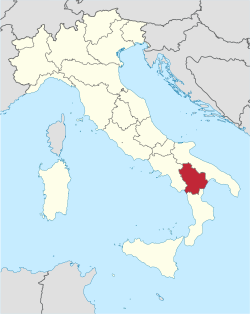
Basilicata (UK: /bəˌsɪlɪˈkɑːtə/ bə-SIL-ih-KAH-tə,[5] US: /-ˌzɪl-/ -ZIL-,[6] Italian: [baziliˈkaːta]), also known by its ancient name Lucania (/luːˈkeɪniə/ loo-KAY-nee-ə, US also /luːˈkɑːnjə/ loo-KAHN-yə,[7][8] Italian: [luˈkaːnja]), is an administrative region in Southern Italy, bordering on Campania to the west, Apulia to the north and east, and Calabria to the south. It has two coastlines: a 30-kilometre stretch on the Gulf of Policastro (Tyrrhenian Sea) between Campania and Calabria, and a longer coastline along the Gulf of Taranto (Ionian Sea) between Calabria and Apulia. The region can be thought of as "the arch" of "the boot" of Italy, with Calabria functioning as "the toe" and Apulia "the heel".
Key Information


The region has a population of 529,897 in an area of 10,073.32 km2 (3,889.33 sq mi).[2][1] The regional capital is Potenza. The region comprises two provinces: Potenza and Matera.[9][10] Its inhabitants are generally known as Lucanians (Italian: lucani), and to a lesser extent as basilicatesi or by other very rare terms.[11]
In ancient times, part of its territory belonged to Magna Graecia, subject to coastal Greek colonies (including Sybaris). Later the region was conquered by the ancient Romans. It was then conquered by the Byzantines, and then by the Normans around the year 1000 with the Hauteville family. Their presence explains the persistence of the Gallo-Italic linguistic enclaves of Basilicata. The area was later dominated by the Aragonese and by the Spanish. Subsequently, it became part of the Kingdom of the Two Sicilies, before annexation to the unified Kingdom of Italy (proclaimed in 1861) after the 1860 Expedition of the Thousand.
Etymology
[edit]The name probably derives from basilikos (Greek: βασιλικός), which refers to the basileus, the Byzantine emperors, who ruled the region for 200 years, from 536/552 to 571/590 and from 879 to 1059.[12] Others argue that the name may refer to the Basilica of Acerenza, which held judicial power in the Middle Ages.[13]
During the ancient Greek and Roman eras, Basilicata was known as Lucania. This was possibly derived from leukos (Greek: λευκός), meaning "white", from lykos (Greek: λύκος), meaning "wolf", or from Latin lūcus, meaning "sacred wood".[14] More probably, the name Lucania derived, like the forename (praenomen) Lucius, from the Latin word Lux (gen. lucis), meaning "light" (from PIE *leuk-, "brightness", also the root of the Latin verb lucere, "to shine"), which is a cognate of the name Lucas. Another proposed etymology is a derivation from the Etruscan word Lauchum (or Lauchme), meaning "king", which passed into Latin as Lucumo.[15]
Geography
[edit] |

Basilicata covers an extensive part of the southern Apennine Mountains, between the Ofanto river in the north and the Pollino massif in the south. It is bordered on the east by a large part of the Bradano river depression, which is traversed by numerous streams and declines to the southeastern coastal plains on the Ionian Sea. [16] The region also has a short coastline to the southwest on the Tyrrhenian Sea side of the peninsula. [17]
Basilicata is the most mountainous region in the south of Italy, with 47% of its area of 9,992 km2 (3,858 sq mi) covered by mountains. Of the remaining area, 45% is hilly, and 8% is made up of plains. Notable mountains and ranges include the Pollino massif, the Dolomiti lucane, Monte Vulture, Monte Alpi, Monte Carmine, Monti Li Foj and Toppa Pizzuta.

Geological features of the region include the volcanic formations of Monte Vulture, and the seismic faults in the Melfi and Potenza areas in the north, and around Pollino in the south. Much of the region was devastated in the 1857 Basilicata earthquake. More recently, the 1980 Irpinia earthquake destroyed many towns in the northwest of the region.
The mountainous terrain combined with weak rock and soil types makes landslides prevalent. The lithological structure of the substratum and its chaotic tectonic deformation predispose the slope to landslides, and this problem is compounded by the lack of forested land. In common with many another Mediterranean region, Basilicata was once rich in forests, but they were largely felled and made barren during the time of Roman rule.
The variable climate is influenced by three coastlines (Adriatic, Ionian and Tyrrhenian) and the complexity of the region's physical features. In general, the climate is continental in the mountains and Mediterranean along the coasts.
History
[edit] | This section needs additional citations for verification. (September 2022) |
Prehistory
[edit]The first traces of human presence in Basilicata date to the late Paleolithic, with findings of Homo erectus. Late Cenozoic fossils, found at Venosa and other locations, include elephants, rhinoceros and species now extinct such as a saber-toothed cat of the genus Machairodus. Examples of rock art from the Mesolithic have been discovered near Filiano. From the fifth millennium, people stopped living in caves and built settlements of huts up to the rivers leading to the interior (Tolve, Tricarico, Aliano, Melfi, Metaponto). In this period, anatomically modern humans lived by cultivating cereals and animal husbandry (Bovinae and Caprinae). Chalcolithic sites include the grottoes of Latronico and the funerary findings of the Cervaro grotto near Lagonegro.
The first known stable market center of the Apennine culture on the sea, consisting of huts on the promontory of Capo la Timpa [it], near to Maratea, dates to the Bronze Age. The first indigenous Iron Age communities lived in large villages in plateaus located at the borders of the plains and the rivers, in places fitting their breeding and agricultural activities. Such settlements include that of Tursi, known at the time as Anglona, located between the fertile valleys of Agri and Sinni, of Siris and, on the coast of the Ionian Sea, of Incoronata-San Teodoro. The first presence of Greek colonists, coming from the Greek islands and Anatolia, date from the late eighth century BC.
There are virtually no traces of survival of the 11th–8th century BC archaeological sites of the settlements (aside from a necropolis at Castelluccio on the coast of the Tyrrhenian Sea): this was perhaps caused by the increasing presence of Greek colonies, which changed the balance of the trades.
Ancient history
[edit]
In ancient historical times, the region was originally known as Lucania, named for the Lucani, an Oscan-speaking population from central Italy.
Starting from the late eighth century BC, the Greeks established a settlement first at Siris, founded by fugitives from Colophon. Then with the foundation of Metaponto from Achaean colonists, they started the conquest of the whole Ionian coast. There were also indigenous Oenotrian foundations on the coast, which exploited the nearby presence of Greek settlements, such as Velia and Pyxous, for their maritime trades. The region became one of the centers of Magna Graecia, with the foundation along its coasts of many Greek city-states (póleis).
The first contacts between the Lucanians and the Romans date from the latter half of the fourth century BC. After the conquest of Taranto in 272, Roman rule was extended to the whole region: the Appian Way reached Brindisi and the colonies of Potentia (modern Potenza) and Grumentum were founded.
Middle Ages
[edit]
After the fall of the Western Roman Empire in 476, Basilicata fell to Germanic rule, which ended in the mid-6th century when the Byzantines reconquered it from the Ostrogoths between 536 and 552 during the apocalyptic Byzantine-Gothic war under the leadership of Byzantine generals Belisarius and Narses. The region, deeply Christianized since as early as the 5th century, became part of the Lombard Duchy of Benevento founded by the invading Lombards between 571 and 590.
In the following centuries, Saracen raids led part of the population to move from the plain and coastal settlements to more protected centers located on hills. The towns of Tricarico and Tursi were under Muslim rule for a short period: later the "Saracen" population would be expelled.[18] The region was conquered once more for Byzantium from the Saracens and the Lombards in the late 9th century, with the campaigns of Nikephoros Phokas the Elder and his successors, and became part of the theme of Longobardia. In 968 the theme of Lucania was established, with the capital at Tursikon (Tursi).
In the 11th century, Basilicata, together with the rest of much of southern Italy, was conquered by the Normans. Melfi became the first capital of the County of Apulia (later County of Apulia and Calabria) in 1043, where Robert Guiscard was named "Duke" by Pope Nicholas II. Inherited by the Hohenstaufen, Frederick II reorganized the administrative structure of his predecessors and the Justiciarate of Basilicata, whose borders coincided almost entirely with the actual region, was created. In Melfi, the Emperor promulgated the Liber Augustalis (commonly known as Constitutions of Melfi), code of laws for the Kingdom of Sicily. The Swabians were ousted in the 13th century by the Capetian House of Anjou. Since then, Basilicata began to lose importance and was marked by an irreversible socio-political decline.
Modern and contemporary times
[edit]
In 1485, Basilicata was the seat of plotters against King Ferdinand I of Naples, the so-called conspiracy of the Barons, which included the Sanseverino of Tricarico, the Caracciolo of Melfi, the Gesualdo of Caggiano, the Orsini Del Balzo [it] of Altamura and Venosa and other anti-Aragonese families. Later, Charles V stripped most of the barons of their lands, replacing them with the Carafa, Revertera, Pignatelli and Colonna among others. After the formation of the Neapolitan Republic (1647), Basilicata also rebelled, but the revolt was suppressed. In 1663 a new province was created in Basilicata with its capital in Matera.
The region came under the dominion of the House of Bourbon in 1735. Basilicata autonomously declared its annexation to the Kingdom of Italy on August 18, 1860, with the Potenza insurrection. It was during this period that the state confiscated and sold off vast tracts of Basilicata's territory formerly owned by the Catholic Church. As the new owners were a handful of wealthy aristocratic families, the average citizen did not see any immediate economic and social improvements after unification, and poverty continued unabated.
This gave rise to the phenomenon of brigandage, which actually turned into a civil war in the form of a guerrilla fighting, whereby the Bourbon in exile and the Church encouraged the peasants to rise up against the Kingdom of Italy. This strong opposition movement continued for many years. The revolt in Basilicata was led by Carmine Crocco, who was the most important chief in the region and the most impressive band leader in southern Italy.[19]
It was only really after World War II that things slowly began to improve thanks to land reform. In 1952, the inhabitants of the Sassi di Matera were rehoused by the state, but many of Basilicata's population had emigrated or were in the process of emigrating, which led to a demographic crisis from which it is still recovering.
Government
[edit]The regional government operates within a framework of a presidential representative democracy, whereby the president is the head of government, and of a pluriform multi-party system. Executive power is exercised by the government. Legislative power is vested in both the government and the regional council.
Administrative divisions
[edit]
Basilicata is divided into two provinces:
| Province | Population | Area (km2) | Density
(inh./km2) |
Capital | Municipalities |
|---|---|---|---|---|---|
| Province of Matera | 189,098 | 3,478.89 | 54.4 | Matera | 31 |
| Province of Potenza | 340,799 | 6,594.44 | 51.7 | Potenza | 100 |
Demographics
[edit]| Year | Pop. | ±% |
|---|---|---|
| 1861 | 509,060 | — |
| 1871 | 524,033 | +2.9% |
| 1881 | 539,258 | +2.9% |
| 1901 | 491,558 | −8.8% |
| 1911 | 485,911 | −1.1% |
| 1921 | 492,132 | +1.3% |
| 1931 | 513,712 | +4.4% |
| 1936 | 543,262 | +5.8% |
| 1951 | 627,586 | +15.5% |
| 1961 | 644,297 | +2.7% |
| 1971 | 603,064 | −6.4% |
| 1981 | 610,186 | +1.2% |
| 1991 | 610,528 | +0.1% |
| 2001 | 597,768 | −2.1% |
| 2011 | 578,036 | −3.3% |
| 2021 | 541,168 | −6.4% |
| Source: ISTAT[20][21] | ||
As of 2025, Basilicata has a population of 529,897, of whom 49.6% are male and 50.4% are female. Minors make up 13.6% of the population, and seniors make up 25.9%, compared to the Italian average of 14.9% and 24.7% respectively.[2]
Although Basilicata has never had a large population, there have nevertheless been quite considerable fluctuations in the demographic pattern of the region. In 1881, there were 539,258 inhabitants but by 1911 the population had decreased by 11% to 485,911, mainly as a result of emigration overseas. There was a slow increase in the population until World War II, after which there was a resurgence of emigration to other countries in Europe, which continued until 1971 and the start of another period of steady increase until the 1980s at 610,000 inhabitants. Since the 1990s the population has been declining again, as a result of low birth rates and high emigration, especially towards northern Italy, the UK, Germany and Switzerland.[22]
The population density is very low compared to that of Italy as a whole: With 52.6 inhabitants per km2 compared to the nationwide density of 195.1, it is the 2nd-least densely populated region of Italy after the Aosta Valley.[23]
Religion, particularly Roman Catholicism still maintains a solid role in the culture and everyday lives of people in Basilicata. Italian National Statistical Institute (ISTAT) in 2018 found that 24.9% of the population went weekly to church, synagogue, mosque, temple or other place of worship, with the share of practicing believers higher in Basilicata (27.9%)[citation needed]
Foreign population
[edit]As of 2024, the foreign-born population is 35,637, equal to 6.7% of the population. The 5 largest foreign nationalities are Romanians (6,618), Swiss (3,110), Albanians (3,083), Germans (2,802) and Moroccans (1,859).[24]
| Country of birth | Population |
|---|---|
 Romania Romania
|
6,618 |
 Switzerland Switzerland
|
3,110 |
 Albania Albania
|
3,083 |
 Germany Germany
|
2,802 |
 Morocco Morocco
|
1,859 |
 Argentina Argentina
|
1,371 |
 Ukraine Ukraine
|
1,286 |
 Bangladesh Bangladesh
|
1,204 |
 Nigeria Nigeria
|
886 |
 India India
|
880 |
 China China
|
821 |
 Pakistan Pakistan
|
737 |
 Tunisia Tunisia
|
706 |
 Venezuela Venezuela
|
696 |
 Brazil Brazil
|
658 |
Economy
[edit]
Cultivation consists mainly of sowables (especially wheat), which represent 46% of the total land. Potatoes and maize are produced in the mountain areas. Olives and wine production is relatively small with about 31,000 hectares (77,000 acres) under cultivation.[25] The terrain is mountainous and hilly with poor transportation routes that hinders harvesting. Most oils are sold unbranded and only 3% is exported. The main olive cultivars are Ogliarola del Vulture, Ogliarola del Bradano, Majatica di Ferrandina and Farasana with only Ogliarola del Vulture having the Protected Designation of Origin (PDO).[26] Other varieties are the Arnasca, Ascolana, Augellina, Cellina, Frantoio, Leccino, Majatica, Nostrale, Ogliarola (Ogliarola Barese), Palmarola or Fasolina, Rapolese di Lavello, and Sargano (Sargano di Fermo and Sargano di San Benedetto).[27]
Among industrial activities, the manufacturing sector contributes to the gross value added of the secondary sector with 64% of the total, while the building sector contributes 24%. Within the services sector, the main activities in terms of gross value added are business activities, distributive trade, education and public administration. In the last few years, new productive sectors have developed: manufacturing, automotive, and especially oil extraction. In 2009, Eni employed 230 people in this area (of whom over 50% were from Basilicata), and about 1,800 were employed in activities directly generated by Eni's operations, distributed in 80 companies of which over 50% were from Basilicata.[28] The region produced about 100,000 bbl/d (16,000 m3/d), meeting 11 percent of Italy's domestic oil demand.[29]
FIAT plant in Melfi has 7,200 employees and manufactured 229,848 Jeep Renegade, Jeep Compass and Fiat 500X in 2020.[30]
The gross domestic product (GDP) of the region was 12.6 billion euros in 2018, accounting for 0.7% of Italy's economic output. GDP per capita adjusted for purchasing power was 22,200 euros or 74% of the EU27 average in the same year. The GDP per employee was 95% of the EU average.[31]
The unemployment rate stood at 8.6% in 2020, the lowest rate in South Italy.[32]
Transport
[edit]The region doesn't have its own airport. However, other airports such as Bari Airport, Lamezia Terme International Airport, and Naples International Airport are also used by air travellers from the region.
Tourism
[edit]Difficult accessibility and lack of extended promotion make Basilicata one of the most remote and least visited regions of Italy. However, tourism is slowly growing since the early 2000s. Matera, once dubbed "national disgrace" by prime minister Alcide De Gasperi who urged to take strict development measures due to its extreme poverty,[33] is now Basilicata's main attraction and has gained fame worldwide for its historical center, the Sassi, designated in 1993 as a UNESCO World Heritage Site.[34] In 2019, Matera was designated as the European Capital of Culture.[35]
Seaside tourism is mainly concentrated in Maratea, nicknamed "The Pearl of Tyrrhenian Sea",[36] but also the Ionian coast (Policoro, Pisticci, Bernalda, Nova Siri) is fairly developed. Naturalistic attractions include Pollino, that hosts the largest national park in Italy,[37] Dolomiti lucane and Vulture. The New York Times ranked Basilicata third in its list of "52 Places to Go in 2018", describing it as "Italy's best-kept secret".[38]


.jpg)
Archeological sites
[edit]
Basilicata has a variety of archeological sites containing traces of Prehistoric, Greek, Roman and Jewish heritage:
- Civita, Tricarico
- Grumentum
- Heraclea
- Metapontum
- Jewish catacombs of Venosa
- Notarchirico
- Petre de la Mola
- Serra di Vaglio
- Venusia
Religious buildings
[edit].jpg)

Basilicata hosts a series of religious structures. The Abbey of Santissima Trinità, Venosa, is one of the most representative, which includes marks of Roman, early Christian, Romanesque, Lombard and Norman origin. It was chosen by Robert Guiscard as the Hauteville family's burial (and he himself will be later buried there too).[39] Other relevant religious buildings are:
- Acerenza Cathedral
- Irsina Cathedral
- Matera Cathedral
- Melfi Cathedral
- Pierno Abbey, San Fele
- Potenza Cathedral
- Rapolla Cathedral
- San Michele Abbey, Monticchio
- San Pietro Caveoso Church, Matera
- Sanctuary of Anglona, Tursi
- Tricarico Cathedral
- Venosa Cathedral
Castles
[edit]
Of many castles that existed in the region, mostly isolated towers and ruins have survived. The Melfi castle is perhaps the most iconic, where important events from the Middle Age took place, such as the five councils between the Normans and the Catholic Church and the constitutions of Melfi promulgated by Frederick II. The Malconsiglio castle, Miglionico, hosted the conspiracy of the Barons against Ferrante of Aragon. Among the other best preserved castles of the region are:
- Bernalda castle
- Lagopesole castle
- Laurenzana Castle
- Muro Lucano castle
- Tramontano Castle
- Venosa castle
Other sights
[edit]

Basilicata has many small and picturesque villages, nine of them have been selected by I Borghi più belli d'Italia (English: The most beautiful Villages of Italy),[40] a non-profit private association of small Italian towns of strong historical and artistic interest,[41] that was founded on the initiative of the Tourism Council of the National Association of Italian Municipalities.[42]
However, they have to face depopulation problems, while others such as Craco and Campomaggiore saw their old sites abandoned due to natural disasters. Nonetheless, filmmakers, writers and musicians have contributed to give a boost to the rebirth of Craco, making it one of the most popular ghost towns in the world.[43]
Other historical and distinctive villages are:
Culture
[edit]Art
[edit]
Cave paintings were found in the Tuppo dei Sassi site (or Ranaldi shelter, after its discoverer Francesco Ranaldi, archaeologist and museum director), a prehistoric site in the Filiano territory, considered the oldest artistic trace in Basilicata. During the Greek colonisation era, artists like the Pisticci Painter and the Amykos Painter operated in the area of Metaponto around the 5th century BC. Metaponto is one of the largest and earliest Greek centres of vase painting in Italy;[44] the Lucanian vase painting began around 430 BC, with the works of the Pisticci Painter. In the Armento area the Kritonios Crown and the Armento Rider were found, now exposed in Munich and London respectively.

The Jewish catacombs of Venosa are cited among the most significant signs of the Jewish presence in southern Italy.[45] Around the 7th century, basilian monks settled in Basilicata, leaving a high concentration of rupestrian churches (155 ascertained today), in Matera, Pollino and the Agri and Sinni Valleys.[46] Frescoes from the Angevin period can be found in the Abbey of the Santissima Trinità of Venosa, the Rupestrian churches of S. Mary of the Valley in Matera, S. Antuono in Oppido Lucano, S. Lucia in Rapolla and S. Margherita in Melfi.
The stone Nativity scene by Altobello Persio (1534) in the Matera Cathedral is an early example of Renaissance art in the region. Later Basilicata saw the imported and imitated art phenomenon with artists such as Giovanni Bellini and Cima da Conegliano, and Flemish painting by Dirck Hendricksz, Guglielmo Borremans, Aert Mijtens among the others. Local painters such as Giovanni De Gregorio, Andrea Miglionico and Carlo Sellitto had a Neapolitan school background. An alleged portrait of Leonardo da Vinci, dating back to the 1500s, was discovered in 2008, today exhibited in the Museo delle Antiche genti di Lucania, Vaglio.
Some artists from the 19th century include Vincenzo Marinelli, Giacomo Di Chirico and Michele Tedesco. Several contemporary artists gained fame outside Italy, among them are worth to mention Marino Di Teana, Eugenio Santoro, Beniamino Bufano and Joseph Stella, sometimes cited as the first futurist painter in America.[47] During his exile under the fascist regime, Carlo Levi, a painting passionate, left many works, today exposed in Matera.
Music
[edit]_p1.192_-_I_VIGGIANESI.jpg)
Although Basilicata hosted classical composers such as Carlo Gesualdo and Egidio Romualdo Duni, the region is primarily identified in popular music, which reflects the humble living conditions of its inhabitants. The arpa viggianese (commonly known as arpicedda) is a typical harp from Viggiano of average size, with a thin and light structure that makes it easier to carry; it was the distinctive instrument of street musicians from the Val d'Agri area in the past centuries, who wandered around the world and many of whom were admitted to symphony orchestras. Today, Viggiano is remembered as the "City of Harp and Music".[48] Other traditional instruments are cupa cupa, zampogna and ciaramella.
During the emigration wave of the late 19th century, some composers gained recognition in North America: Leonardo De Lorenzo, flautist of several American philharmonic orchestras and professor at the Eastman School of Music, regarded as one of the most eminent flute pedagogues of the 1900s; Carlo Curti, who helped to popularize the mandolin in the United States and Mexico, and founder of the Orquestra Típica Mexicana, considered the "predecessor of the Mariachi bands".[49] Comedy duo Lyons and Yosco became popular for their million-selling ragtime piece "Spaghetti Rag".[50]
Pino Mango was the first modern pop artist from the region to achieve success in the Italian music scene. Arisa won both the "Newcomer" and the "Big Artist" section at the 2009 and the 2014 Sanremo Music Festival respectively. Mango's daughter Angelina also won the Sanremo Music Festival in 2024 and was ranked 7th in the Eurovision Song Contest in the same year.[51] Since the mid-1990s, Basilicata hosts the Agglutination Metal Festival, one of the most long-lived heavy metal events in Europe.[52][53]
Cinema
[edit]Since the post–World War II era, Basilicata has become a set for many national and international film productions. Matera is the most coveted film location, especially for biblical-themed movies, being often compared with the ancient Jerusalem.[54] Other locations include the ghost town of Craco, Melfi and Maratea. The region hosted, among the others, the filming of Il Demonio (1963), The Gospel According to St. Matthew (1964), Christ Stopped at Eboli (1979), I'm Not Scared (2003), The Passion of the Christ (2004), The Omen (2006), Quantum of Solace (2008), Wonder Woman (2017), No Time to Die (2021).
Some actors and film directors are from Basilicata, most notably Robert G. Vignola, a prominent figure of the silent era, Pasquale Festa Campanile, associated with the commedia all'italiana genre, Ruggero Deodato, known for his horror films such as the controversial Cannibal Holocaust. Tanio Boccia, Rocco Papaleo, Antonio Gerardi, Antonio Petrocelli, Alessandra Di Sanzo are other notable personalities in the Italian movie industry.
Cuisine
[edit]
The local cuisine is mostly based on pork and sheep meat, legumes, cereals, vegetables and tubers. It is commonly referred to as cucina povera (Italian for 'cuisine of the poor'), deeply anchored in peasant traditions. Bread crumb is considered a poor-man's cheese substitute, sprinkled over pasta dishes and used as a seasoning for meat and vegetables. Horseradish is often used as a spice and condiment, which is referred to as "poor man's truffle".[55] The peperone crusco (PAT) is a specialty of the regional cuisine, sometimes labeled as "the red gold of Basilicata".[56] It is the dried form of the peperone di Senise (PGI), one of the most popular Italian pepper varieties.[57] Traditional recipes include pasta dishes like pasta con i peperoni cruschi and tumact me tulez, and main courses such as rafanata, acquasale. Pastizz and falagone are common street foods.
Basilicata is best known for the Lucanica di Picerno (PGI) pork sausage that derives from lucanica, an ancient recipe originated before the Roman empire.[55] Pane di Matera (PGI) is a type of bread recognizable for its intense flavour and conical shape, as well as long preservation.[58] Other principal products are cheeses like pecorino di Filiano (PDO), canestrato di Moliterno (PGI), padraccio (PAT) and treccia dura (PAT); vegetables like melanzana rossa di Rotonda (PDO); and legumes like fagiolo di Sarconi (PGI) and fagiolo bianco di Rotonda (PDO). The region is also known for its naturally sparkling mineral water that springs from the streams of Mount Vulture.[59] Alcoholic beverages include Aglianico del Vulture, considered one of Italy's top red wines,[60][55] and Amaro Lucano liqueur.
References
[edit]- ^ a b "Superficie di Comuni Province e Regioni italiane al 9 ottobre 2011" (in Italian). ISTAT.
- ^ a b c "Resident population". ISTAT.
- ^ "Population on 1 January by age, sex and NUTS 2 region", www.ec.europa.eu
- ^ "Sub-national HDI – Area Database – Global Data Lab". hdi.globaldatalab.org. Retrieved 5 March 2023.
- ^ "Basilicata". Lexico UK English Dictionary. Oxford University Press. Archived from the original on 22 March 2020.
- ^ "Basilicata". The American Heritage Dictionary of the English Language (5th ed.). HarperCollins. Retrieved 6 May 2019.
- ^ "Basilicata". Merriam-Webster.com Dictionary. Merriam-Webster. Retrieved 6 May 2019.
- ^ "Lucania". Collins English Dictionary. HarperCollins. Retrieved 6 May 2019.
- ^ "Basilicata nell'Enciclopedia Treccani". www.treccani.it.
- ^ "lucano in Vocabolario – Treccani". www.treccani.it.
- ^ "Ci sono solo lucani in Basilicata?". Accademia della Crusca (in Italian). Retrieved 29 October 2021.
- ^ Tommaso Pedìo (1997). La Basilicata dalla caduta dell'impero romano agli Angioini. p. 21.
- ^ Touring Club Italiano (1980). Basilicata - Calabria. p. 46.
- ^ Paola Corti (1976). Inchiesta Zanardelli sulla Basilicata. p. 86.
- ^ Bonfante G., Bonfante L., The Etruscan Language: An Introduction, 1983, p. 59.
- ^ "Portrait of the Regions – Italy: Basilicata – Geography and history". Eurostat. Retrieved 24 November 2025.
- ^ "Geografia Basilicata". Comuni-Italiani.it. Retrieved 24 November 2025.
- ^ Archivio storico per le province napoletane. Società napoletana di storia patria. 1876.
- ^ Eric Hobsbawm, Bandits, Penguin, 1985, p. 25.
- ^ "Popolazione residente dei comuni. Censimenti dal 1861 al 1991" [Resident population of the municipalities. Censuses from 1861 to 1991] (PDF) (in Italian). ISTAT.
- ^ "Resident population - Time series". ISTAT.
- ^ "Migrazioni interne e internazionali della popolazione residente. Anni 2022-2023" (PDF). Istat. Retrieved 27 February 2025.
- ^ Brinkhoff, Thomas. "Italy: Administrative Division (Regions and Provinces) - Population Statistics, Charts and Map". City Population.
- ^ a b "Resident population by sex, municipality and citizenship". ISTAT.
- ^ FAO.org: Olive production: Olive Production: Extension, Consumption, and Exportation (pp.14)- Retrieved 2018-07-03
- ^ Olive oil Times: Basilicata- Retrieved 2018-07-03
- ^ Italian olives- Retrieved 2018=07-03
- ^ [1] Archived 11 April 2012 at the Wayback Machine
- ^ "Oil Exploration in Basilicata, Italy". Fossilfreeeib.org. Archived from the original on 26 July 2011.
- ^ "Stellantis production statistics 2020" (in Italian). 11 January 2021.
- ^ "Regional GDP per capita ranged from 30% to 263% of the EU average in 2018". Eurostat.
- ^ "Unemployment NUTS 2 regions Eurostat".
- ^ "The miracle of Matera: from city of poverty and squalor to hip hub for cave-dwellers". theguardian.com. 18 June 2017. Retrieved 19 November 2020.
- ^ Centre, UNESCO World Heritage. "The Sassi and the Park of the Rupestrian Churches of Matera". whc.unesco.org. Retrieved 4 June 2018.
- ^ "Plovdiv and Matera: European Capitals of Culture in 2019". europarl.europa.eu. 7 January 2019. Retrieved 20 November 2020.
- ^ "Maratea, the Pearl of Tyrrhenian Sea". italiaslowtour.com. 18 June 2017. Retrieved 19 November 2020.
- ^ "Visit Italy's largest park - Parco del Pollino". italymagazine.com. 23 July 2009. Retrieved 19 November 2020.
- ^ "52 Places to Go in 2018". The New York Times. 10 January 2018. Retrieved 21 January 2018.
- ^ "The Most Holy Trinity Complex in Venosa". portacoeli.it. Retrieved 17 November 2020.
- ^ "Basilicata" (in Italian). 10 January 2017. Retrieved 1 August 2023.
- ^ "Borghi più belli d'Italia. Le 14 novità 2023, dal Trentino alla Calabria" (in Italian). 16 January 2023. Retrieved 28 July 2023.
- ^ "I Borghi più belli d'Italia, la guida online ai piccoli centri dell'Italia nascosta" (in Italian). Retrieved 3 May 2018.
- ^ "You're Guaranteed to Get Goosebumps While Visiting the World's 20 Eeriest Ghost Towns". fodors.com. 3 October 2018. Retrieved 26 March 2021.
- ^ "Lucanian red - figure nestoris". mfab.hu. Retrieved 16 November 2020.
- ^ "Jewish Catacombs of Venosa". visitjewishitaly.it. Retrieved 23 February 2021.
- ^ "An Artistic Profile". aptbasilicata.it. Retrieved 23 February 2021.[permanent dead link]
- ^ "Joseph Stella (1877-1946)". sullivangoss.com. Retrieved 16 November 2020.
- ^ "From local traditions to "augmented reality". The MUVIG museum of Viggiano (Italy)" (PDF). core.ac.uk. Archived (PDF) from the original on 12 March 2019. Retrieved 16 November 2020.
- ^ Castillo, Manuel M. (2014). Italian and Spanish works of Mexican composers: Maria Grever, Ignacio Fernandez Esperon "Tata Nacho," and Agustin Lara. Theses and Dissertations--Music (DMA dissertation). The University of Kentucky. p. 20. Retrieved 8 September 2015 – via UKnowledge.
The Orquesta Típica is the predecessor of the Mariachi bands and is the same orchestra that Tata Nacho conducted from 1960-1968.
- ^ Jasen, David A (1986). Ragtime gems: original sheet music for 25 ragtime classics. New York: Dover Publications. p. iii. ISBN 978-0-486-25248-3.
- ^ "Malmö 2024 Scoreboard". Eurovision.tv. European Broadcasting Union. 11 May 2024. Archived from the original on 30 January 2024. Retrieved 12 May 2024.
- ^ "AGGLUTINATION METAL FESTIVAL 2018: meet & greet esclusivo con i DEATH SS". metalitalia.com (in Italian). 19 July 2018. Retrieved 2 November 2018.
- ^ "XXIV AGGLUTINATION METAL FESTIVAL: il programma completo del festival". metalpit.it (in Italian). 12 June 2018. Archived from the original on 1 November 2020. Retrieved 2 November 2018.
- ^ "Basilicata Blockbusters: What To Watch Before Visiting". italymagazine.com. Retrieved 16 November 2020.
- ^ a b c "The complete foodie guide to Basilicata". greatitalianchefs.com. 8 August 2019. Retrieved 16 November 2020.
- ^ "Crusco Peppers: the Red Necklaces of Basilicata Towns". lacucinaitaliana.com. 16 September 2019. Retrieved 30 August 2020.
- ^ "Top 3 most popular Italian peppers". tasteatlas.com. 19 November 2020. Retrieved 19 November 2020.
- ^ "Bread of Matera, a world patrimony". italianfoodexcellence.com. 14 November 2016. Retrieved 16 November 2020.
- ^ "Rionero in Vulture (PZ) - Vulture Mineral Waters". aptbasilicata.it. Archived from the original on 6 June 2016. Retrieved 16 November 2020.
- ^ "Aglianico del Vulture: The Basilicata Region Produces One of the Great Undiscovered Wines of Italy". intowine.com. 22 May 2008. Retrieved 4 March 2016.
External links
[edit]


| International | |
|---|---|
| National | |
| Geographic | |
| Other | |

Basilicata
View on GrokipediaEtymology
Historical derivations and usage
The name Basilicata derives from the Greek term basilikos, meaning "imperial" or "royal," in reference to the basileus, the title of the Byzantine emperor who exerted control over the region from the 6th century onward following the Gothic War (535–554 AD).[7][8] This etymology reflects the administrative structure imposed by Byzantine governors or strategoi in southern Italy, where the territory—previously known as Lucania under Roman rule—was integrated into the theme system of provincial governance.[9] Alternative hypotheses, such as a connection to local basilicas (e.g., the Basilica of Acerenza granting ecclesiastical jurisdiction), lack primary documentary support and are considered less probable by historians, as the term's usage aligns more closely with secular Byzantine nomenclature than ecclesiastical architecture.[10] The earliest documented application of Basilicata appears in 1175 AD, likely denoting a Byzantine provincial administrator titled basilikos, during a period of fluctuating control between Norman and lingering Byzantine influences in the aftermath of the Norman conquest of southern Italy (completed by 1071 AD under Robert Guiscard).[9] By around 1200 AD, the name had gained currency in Latin chronicles to describe the inland territories east of the Tyrrhenian coast, distinguishing them from coastal areas and supplanting the classical Lucania—derived from the Italic Lucani people and retained in Roman administrative divisions until the 6th century.[11] This shift coincided with the consolidation of feudal principalities under the Hohenstaufen dynasty after 1194 AD, when Basilicata denoted a giustizierato (judicial district) encompassing modern Potenza and Matera provinces.[12] Throughout the medieval and early modern periods, Basilicata persisted as the primary toponym in Angevin (1266–1442 AD) and Aragonese records, as well as under Spanish viceregal rule (1504–1713 AD), often paired with Lucania in bilingual usage to evoke classical heritage. The name endured into the Bourbon era (1734–1861 AD), appearing in 19th-century cadastral surveys and unification decrees, though regional identity debates occasionally revived Lucania for its ancient prestige. In the 20th century, Benito Mussolini temporarily redesignated the province as Lucania in 1932 to emphasize Roman roots amid fascist propaganda, but this was reversed post-World War II with the 1948 Italian Constitution, restoring Basilicata as the official regional name.[13][14] Today, locals often self-identify as Lucani, blending both terms in cultural discourse.[15]Geography
Topography and landforms
Basilicata's topography is dominated by the southern Apennine Mountains, which cover approximately 47% of the region, with hilly terrain comprising 45% and flat plains limited to 8%, primarily along the coastlines. The landscape features rugged massifs, deep valleys, and erosional landforms shaped by tectonic uplift and fluvial incision over millions of years. The region borders the Tyrrhenian Sea for about 30 km along the Gulf of Policastro and extends along the Ionian Sea's Gulf of Taranto for a longer stretch, where narrow coastal plains contrast with the inland highlands.[1][16][17] The highest elevations occur in the Pollino Massif, part of the Pollino National Park straddling Basilicata and Calabria, where Serra Dolcedorme reaches 2,267 meters above sea level, marking the tallest peak in the southern Apennines. This carbonate-dominated range includes limestone ramparts, fault scarps, and dolomitic formations, contributing to diverse microclimates and habitats. Further north, the Lucanian Dolomites exhibit steep sandstone outcrops dipping at 45–50 degrees, susceptible to gravitational instabilities such as rockfalls, topples, and slides due to their massive strata and weathering processes.[18][19][20] Erosional features like the calanchi—badlands formed by intense gullying of clay-rich Pliocene-Pleistocene sediments—are prominent in areas such as Aliano, where pinnacles, ravines, and sculpted slopes result from sparse vegetation and heavy seasonal rainfall accelerating soil loss. Major rivers, including the Bradano, Basento, Agri, and Sinni, originate in the mountains and dissect the terrain through incised valleys, such as the upper Basento and Agri valleys, facilitating sediment transport to coastal plains like Metaponto, Basilicata's largest alluvial expanse. These fluvial systems underscore the region's vulnerability to landslides and erosion, with landforms reflecting ongoing geomorphic evolution.[21][22][23]Climate and hydrology
Basilicata's climate varies significantly due to its diverse topography, with Mediterranean characteristics along the Tyrrhenian and Ionian coastlines featuring hot, dry summers and mild, rainy winters, transitioning to continental influences in the inland hills and mountains where summers are warmer and winters colder with greater diurnal temperature swings. In higher elevations, such as the Pollino massif, conditions become subalpine with snowfall in winter. Regional average annual temperatures range from about 11°C in upland areas like Potenza to 15°C in lower-lying Matera, with extremes from -5°C in winter lows to over 35°C in summer highs.[24][25][26] Precipitation averages 600-700 mm annually across the region, concentrated in autumn and winter months, with coastal zones receiving around 500 mm and mountainous interiors up to 1,000 mm or more due to orographic effects; July and August are typically the driest, with less than 30 mm monthly. Long-term data from Matera indicate 593 mm yearly, while Potenza records 718 mm, underscoring the role of elevation in moisture distribution. Recent decades have seen declining precipitation trends, especially in fall and winter, exacerbating drought risks as evidenced by soil water index analyses from 2007-2021 showing persistent dry spells.[25][24][27] The region's hydrology is dominated by eastward-flowing rivers originating in the Apennine highlands, including the Bradano (120 km), Basento (103 km), Cavone (87 km), Agri (111 km), and Sinni (94 km), which drain into the Ionian Sea, alongside the Noce and portions of the Ofanto toward the Adriatic. These waterways, fed by seasonal rainfall and snowmelt, form the backbone of surface water resources, though flow variability is high due to karstic aquifers and episodic flooding in clay-rich valleys. Groundwater extraction and interregional transfers, such as 250 million cubic meters annually to Puglia for potable, agricultural, and industrial needs via the Agri-Sinni aqueduct, strain local supplies amid reduced recharge from lower rainfall.[28][29][30] Water scarcity has intensified, culminating in rationing across municipalities in early 2025, with daily cutoffs of several hours attributed to prolonged dry conditions and overexploitation of reservoirs like those on the Agri River. Hydrogeological studies highlight permeable carbonate aquifers in the east contrasting with low-yield alluvial deposits in coastal plains, complicating sustainable management in this seismically active, erosion-prone landscape.[31][32][33]Biodiversity and protected areas
Basilicata's biodiversity is characterized by a high degree of endemism and species richness, driven by its varied topography encompassing Apennine mountains, karst plateaus, and coastal zones. The region hosts 168 endemic plant species, representing 6.5% of its total flora—one of the highest proportions in Italy.[34] Forests dominated by beech, chestnut, and rare Bosnian pine cover significant areas, alongside Mediterranean maquis and wetlands supporting diverse herbaceous and arboreal communities. Fauna includes emblematic species such as the Apennine wolf (Canis lupus italicus), golden eagle (Aquila chrysaetos), otter (Lutra lutra), and roe deer (Capreolus capreolus), with 12 nesting raptor species in key habitats.[35] Amphibians like the Italian newt (Lissotriton italicus) thrive in aquatic ecosystems, while insects and small mammals contribute to the region's ecological complexity.[36] Protected areas cover more than 20% of Basilicata's land, including national parks, regional reserves, and the Natura 2000 network, which safeguards priority habitats and endangered species such as the otter and golden eagle.[37] [38] Pollino National Park, established in 1993 and Italy's largest at approximately 1,800 km² in Basilicata (part of a 2,000 km² total spanning into Calabria), protects ancient beech forests over 600 years old, thousand-year-old Heldreich's pines (Pinus heldreichii), and rare birds like the middle spotted woodpecker (Dendrocopos medius).[39] Appennino Lucano Val d'Agri Lagonegrese National Park features 136 protected wildlife species across 19 habitat types, including dense beech woodlands and streams hosting Italian newts and crustaceans.[40] [41] Regional nature reserves include Bosco Pantano di Policoro (500 ha of woodland), Lago Pantano di Pignola (155 ha wetland), and Lago Laudemio (25 ha), preserving coastal forests and lacustrine ecosystems.[42] The Natura 2000 sites, integral to the region's network, maintain high habitat conservation levels, with about 94% consistency in key terrestrial habitats as assessed in 2009.[43] These areas mitigate anthropogenic pressures, such as those in Val d'Agri, while supporting endemic flora like Isatis raimondoi in Pollino.[44] Despite coverage, challenges from human activities underscore the need for ongoing monitoring to preserve Basilicata's ecological integrity.[45]History
Prehistory and ancient settlements
Basilicata preserves evidence of early human occupation from the Lower Paleolithic period, with key sites clustered around the extinct Mt. Vulture volcano. The Notarchirico site near Venosa, dated to the Acheulean industry between 600,000 and 300,000 years ago, has yielded lithic tools, faunal remains, and a human ulna fragment approximately 300,000 years old, indicating prolonged hominin activity in lacustrine environments.[46] Additional Lower Paleolithic assemblages at Cimitero di Atella and Loreto Vecchio near Venosa, with artifacts exceeding 450,000 years in age, reflect early tool-making traditions linked to volcanic landscapes and resource exploitation.[47][48][49] Neolithic evidence emerges in cave systems, particularly in Matera, where natural grottoes show continuous habitation from Paleolithic through Neolithic phases, marked by intensified settlement and early agricultural traces around the 6th millennium BCE.[6] These rupestrian habitats, precursors to later rock-cut dwellings, underscore adaptation to karstic terrain and seasonal mobility patterns.[6] Ancient settlements prior to widespread Greek and Roman influence were dominated by Italic tribes, including the Oenotrians in southern Basilicata during the Bronze Age and early Iron Age, followed by the expansion of the Oscan-speaking Lucanians from the 6th century BCE onward.[50] Hillforts and nucleated villages, such as Monte Torretta di Pietragalla at 1,070 meters elevation, exemplify Lucanian pre-Roman strategies of defensible highland occupation, with fortifications, domestic structures, and ritual areas dating to the 7th–3rd centuries BCE.[51] Sites like Monte Croccia further attest to pre-Roman indigenous communities through preserved artifacts and burial practices in mountainous reserves.[52] These settlements highlight a shift toward sedentary pastoralism and proto-urbanism amid interactions with coastal Greek colonies.Classical antiquity and Roman era
The region of Lucania, corresponding to modern Basilicata, was inhabited in classical antiquity by Italic tribes, with the Lucani, an Oscan-speaking people, establishing dominance over the interior by the mid-5th century BC. Originating from Sabellic groups in central Italy, the Lucani expanded southward, assimilating or displacing earlier populations and controlling a territory stretching from the Tyrrhenian to the Ionian seas. Their society was characterized by pastoralism, agriculture, and hilltop settlements, with evidence of warrior elites from tomb goods and inscriptions.[53][54] Coastal zones experienced Greek colonization from the 8th century BC onward, forming part of Magna Graecia, with foundations like Metapontum (c. 700 BC) and Heraclea (433 BC) fostering trade, cultural exchange, and conflict with inland Lucani. The Lucani adopted elements of Greek material culture, including red-figure pottery produced by local workshops such as the Pisticci Painter, while engaging in alliances and raids against Greek cities. Sanctuaries like the Tavole Palatine, dedicated to Hera, highlight this Hellenizing influence amid ongoing tensions.[55][56] Roman military campaigns subdued Lucania starting in the late 4th century BC, with decisive involvement during the Pyrrhic War (280–275 BC), where Lucani forces allied with Pyrrhus of Epirus, contributing to victories like Heraclea (280 BC) but suffering defeat at Beneventum (275 BC). Subsequent Roman operations led to submission by 268 BC, integrating the region into Roman Italy through land confiscations, colonies, and infrastructure. Under Augustus, Lucania formed part of Regio III Lucania et Bruttium, an administrative division of peninsular Italy.[54][57] During the Roman era, Lucania transitioned from a frontier zone to an imperial hinterland, with colonies like Grumentum (refounded 2nd century BC) and Venusia serving as administrative and military centers. Archaeological surveys reveal villas, roads, and aqueducts supporting latifundia-based agriculture and transhumance, while epigraphic evidence attests to local elites' participation in Roman civic life. The region remained relatively rural, contributing troops and resources to the empire, with continuity of Lucanian onomastics into the imperial period.[58][53]Medieval feudalism and Norman rule
Following the decline of Byzantine authority in the 10th century, Lucania experienced instability from Saracen raids and Lombard-Byzantine conflicts, setting the stage for Norman intervention. Norman adventurers from the Hauteville family arrived in southern Italy as mercenaries around 1017, initially aiding Lombards against Byzantines. By 1041, William "Iron Arm" Hauteville had captured Melfi, establishing it as a strategic fortress and the first Norman stronghold in Lucania, from which they expanded control over the surrounding territories.[59] Robert Guiscard, emerging as leader after 1057, intensified the conquest, defeating Byzantine forces and securing papal recognition at the Council of Melfi in 1059, where Pope Nicholas II invested him as Duke of Apulia, Calabria, and Sicily—encompassing Lucania within this domain. This formalized Norman dominance, transitioning the region from fragmented Byzantine themes to centralized feudal governance under the Hautevilles. Guiscard's campaigns, including victories like Civitate in 1053, subdued local resistance and integrated Lucania into the Norman polity by the 1070s.[60][61] The Normans imposed a feudal hierarchy, granting fiefs to vassals in exchange for military service and loyalty, with Melfi serving as the primary county seat. Land was divided among Norman lords who constructed castles for defense and administration, fostering a system of vassalage that bound local populations to agrarian obligations while providing stability absent in prior eras. Prominent feudal centers included Genzano di Lucania and Noepoli under direct Hauteville oversight, exemplifying the enfeoffment of strategic sites to kin and allies.[62] This feudal structure persisted through the reigns of Roger I and Roger II, who further codified customs blending Norman, Lombard, and Byzantine elements, until the line's extinction in 1154 led to Hohenstaufen inheritance via marriage, marking the end of direct Norman rule in 1194. The period brought relative order, economic recovery through fortified agriculture, and cultural patronage, including abbeys like Venosa, though it entrenched serfdom and lordly privileges.[60][63]Early modern period and Bourbon dynasty
Following the consolidation of Spanish Habsburg authority over the Kingdom of Naples after the 1503 Battle of Garigliano, Basilicata—then termed Lucania—operated as a peripheral province within the viceregal system, subject to governance from Naples under appointed Spanish viceroys.[64] This period, spanning roughly 1504 to 1707, preserved a feudal structure inherited from medieval times, with land tenure dominated by absentee barons and ecclesiastical estates, limiting local autonomy and economic innovation.[65] Agricultural output focused on subsistence crops like wheat and barley, supplemented by transhumant pastoralism involving sheep and goats, which accounted for much of the region's exportable wool and cheese to urban centers in Naples and Puglia.[66] Demographic stagnation prevailed, with low population density—estimated at under 20 inhabitants per square kilometer in rural interiors—exacerbated by recurrent plagues, such as the 1656 outbreak that halved southern Italian populations, and seismic events like the 1694 earthquake devastating towns including Potenza.[66] The War of the Spanish Succession transferred Naples, including Basilicata, to Austrian Habsburg control from 1707 to 1734, introducing minor administrative tweaks like enhanced tax collection but yielding little structural change amid ongoing feudal extraction.[65] In 1734, Charles III of Spain, a Bourbon prince, seized the kingdom during the War of the Polish Succession, establishing an independent Bourbon dynasty that ruled Naples (and later unified with Sicily as the Kingdom of the Two Sicilies in 1816) until 1860.[65] Charles's reign (1734–1759), advised by reformer Bernardo Tanucci, pursued enlightened absolutist policies, including partial feudal curtailments via the 1742 abolition of certain baronial jurisdictions and cadastral surveys to rationalize land taxes, though resistance from entrenched nobility confined impacts in Basilicata to marginal improvements in revenue assessment rather than systemic overhaul.[67] Under Ferdinand IV (later I of the Two Sicilies, r. 1759–1825), Bourbon governance emphasized fiscal centralization, with 18th-century state expenditures prioritizing military and infrastructure over rural development; tax burdens on Basilicata's peasantry rose through indirect levies on salt and tobacco monopolies, funding Naples' court while local roads and irrigation lagged.[67] The economy persisted in agrarian feudalism, with latifundia comprising over 70% of arable land by mid-century, fostering social rigidity where contadini (peasant laborers) endured sharecropping ties and periodic famines, such as the 1763–1764 dearth triggered by drought and grain export policies.[68] Sporadic brigandage emerged as a response to seigneurial abuses, though not yet at post-unification scales, reflecting causal tensions between Bourbon extractive policies and the region's isolation—its mountainous terrain hindering integration into nascent commercial networks. By the early 19th century, under Joachim Murat's brief Napoleonic interregnum (1806–1815) and Bourbon restoration, Basilicata's population hovered around 500,000, with negligible urbanization beyond provincial capitals like Potenza and Matera, underscoring the dynasty's failure to catalyze industrialization amid persistent feudal remnants.[69]Unification, brigandage, and fascism
In August 1860, amid Giuseppe Garibaldi's Expedition of the Thousand, insurrections broke out across Basilicata (then Lucania), culminating in the Potenza uprising on August 18, which proclaimed the region's annexation to the Kingdom of Sardinia and facilitated the advance of unification forces against the Bourbon Kingdom of the Two Sicilies.[70] These local revolts, coordinated with Garibaldine agents, contributed to the rapid collapse of Bourbon authority in southern Italy by late 1860.[71] Following plebiscites in the annexed territories, Basilicata formally integrated into the newly proclaimed Kingdom of Italy on March 17, 1861, under King Victor Emmanuel II.[72] The transition to Piedmontese rule, however, provoked widespread discontent among peasants, former Bourbon soldiers, and clergy opposed to secular reforms, heavy taxation, and conscription, igniting a guerrilla insurgency known as brigandage that peaked from 1861 to 1865.[73] Carmine Crocco, born in Rionero in Vulture in 1830 and initially a Bourbon soldier who joined Garibaldi's forces in 1860, emerged as the preeminent brigand leader in Basilicata after becoming disillusioned with the new regime's policies.[74] By 1861, Crocco commanded a band that grew to over 2,000 fighters, controlling swathes of the Vulture area and conducting raids into Campania and Puglia, often framing their actions as defense against northern exploitation.[75] Bands like that of Vincenzo "Totaro" Di Gianni, Crocco's lieutenant operating from San Fele, exemplified the decentralized networks that terrorized landowners and officials while drawing support from rural populations aggrieved by latifundia systems. The Italian government responded with the Pica Law of July 1863, imposing martial law in brigand-prone provinces and deploying up to 100,000 troops under generals like Giuseppe Govone and Antonio Pallavicini, resulting in the deaths of approximately 5,000 brigands and the capture of thousands more by 1865.[76] Crocco evaded capture until April 1864, when he was arrested near Lagonegro; sentenced to death in 1867, his punishment was commuted to life imprisonment, from which he was pardoned in 1902.[75] Brigandage's suppression marked the end of organized Bourbon loyalist resistance but entrenched perceptions of southern Italy as a zone of disorder, exacerbating economic neglect and mass emigration in subsequent decades. During the fascist era from 1922 to 1943, Basilicata fell under Benito Mussolini's centralized dictatorship, with local governance shifted to appointed podestà and the National Fascist Party establishing federations in Potenza and Matera to enforce corporative structures in agriculture and suppress socialist agrarian leagues that had gained traction post-World War I.[77] The regime's "Battle for Grain" campaign, launched in 1925, aimed to boost cereal production through incentives and land improvements, yet Basilicata's arid terrain and fragmented holdings yielded marginal gains, with wheat output rising only modestly amid persistent soil erosion.[78] Mussolini's 1920s pledges to resolve the "Southern Question" included partial land reclamation efforts, such as drainage projects in the Bradano Valley starting in the 1930s, but these were underfunded and incomplete, failing to alleviate rural poverty or stem emigration rates that exceeded 20,000 annually from the region by the late 1930s.[79] Fascist autarky policies prioritized industrial north, leaving Basilicata's economy agrarian and underdeveloped, while wartime requisitions from 1940 onward intensified hardships, culminating in Allied invasion impacts in 1943.[80]Post-World War II development and recent events
Following World War II, Basilicata remained marked by extreme poverty and underdevelopment, as depicted in Carlo Levi's 1945 memoir Christ Stopped at Eboli, which chronicled the author's exile and exposed squalid living conditions in rural areas like Aliano.[81] [82] The Italian government initiated land reform through the Riforma Fondiaria program from 1950 to 1972, redistributing large estates to smallholders to boost agriculture, though implementation in Basilicata yielded limited productivity gains due to fragmented plots and soil challenges.[83] Emigration surged, with hundreds of thousands departing for northern Italy and abroad, exacerbating depopulation and stalling broader economic progress until the late 20th century.[14] The 1980 Irpinia-Basilicata earthquake, a magnitude 6.9 event on November 23, struck southern Apennines, killing over 2,700 people, injuring thousands, and displacing around 280,000 across Basilicata and neighboring Campania, with severe damage to towns like Conza della Campania and Lavello.[84] [85] Reconstruction efforts, funded by national aid exceeding billions of lire, rebuilt infrastructure and housing but faced corruption scandals and uneven recovery, channeling funds into public works that provided temporary jobs yet failed to catalyze sustained industrialization.[86] From the 1980s onward, discovery and exploitation of oil and natural gas reserves in the Val d'Agri and Val Basento valleys drove industrial development, with production ramping up in the 1990s via fields like Tempa Rossa, contributing approximately 10% of Italy's onshore oil output by the 2010s through operators including Eni and TotalEnergies.[87] [88] This sector generated royalties and employment—peaking at thousands of jobs—but sparked environmental contamination concerns, including groundwater pollution and health risks from emissions at facilities like the Centro Olio Val d'Agri, prompting local protests and regulatory scrutiny.[89] Parallel tourism growth, anchored by Matera's Sassi caves—evacuated as slums in the 1950s and later restored—culminated in its designation as a UNESCO World Heritage Site in 1993 and European Capital of Culture in 2019, yielding a tourism surge that reduced unemployment by several percentage points and increased regional GDP through over 200 events attracting millions of visitors.[90] [91] In recent politics, Basilicata's April 21-22, 2024, regional election saw Prime Minister Giorgia Meloni's centre-right coalition retain control, with candidate Vito Bardi securing re-election amid voter priorities on energy royalties and infrastructure, reflecting the region's conservative leanings despite ongoing debates over oil dependency versus green transitions.[92]Demographics
Population trends and depopulation
Basilicata's population experienced early declines driven by international emigration, falling from 539,258 in 1881 to 485,911 by 1911, a reduction of approximately 11% primarily due to overseas migration amid economic hardship and agricultural limitations.[93] Post-World War II, the region saw modest growth, reaching a peak of 610,528 residents in the 1991 census, before resuming a downward trajectory as internal and external emigration intensified alongside stagnating local economies.[94] The following table summarizes key census data illustrating the long-term depopulation:| Census Year | Population | Percentage Change from Previous |
|---|---|---|
| 1881 | 539,258 | - |
| 1911 | 485,911 | -9.9% |
| 1991 | 610,528 | - |
| 2001 | 597,768 | -2.1% |
| 2011 | 578,036 | -3.3% |
| 2021 | 541,168 | -6.4% |
Ethnic and linguistic composition
The population of Basilicata is ethnically homogeneous, predominantly consisting of native Italians of Lucanian descent, with roots tracing to ancient Italic tribes such as the Oscan-speaking Lucani, overlaid by Greek colonists in Magna Graecia and Roman settlers during antiquity.[70] This core group forms over 95% of residents, reflecting limited large-scale ethnic stratification compared to other southern Italian regions, though historical Norman, Lombard, and Byzantine influences contributed minor genetic admixtures documented in regional studies.[100] A notable ethnic minority comprises the Arbëreshë, ethnic Albanians who settled in Basilicata and neighboring areas between the 15th and 18th centuries fleeing Ottoman expansion; these communities, concentrated in municipalities like San Paolo Albanese (population 328, largely Arbëreshë) and Barile, maintain distinct customs and number several thousand regionally within Italy's broader Arbëreshë population of 70,000–100,000.[101] Recent foreign immigration, primarily from Eastern Europe, North Africa, and Asia since the 1990s, accounts for about 4.8% of the resident population (roughly 25,000 individuals as of 2023 estimates derived from ISTAT data), introducing small cohorts of Romanians, Moroccans, and others, though integration remains limited due to the region's depopulation and rural character.[96][3] Linguistically, standard Italian serves as the official and dominant language, used in education, media, and administration. The vernacular Lucanian dialect (Lucano), a southern Italo-Dalmatian variety influenced by Neapolitan and showing phonetic and lexical ties to central-southern Italian speech patterns, prevails in everyday rural and familial contexts across most of the region, with variations between the Potenza and Matera provinces.[102][103] Pockets of Gallo-Italic dialects, remnants of medieval northern Italian migrations, persist in northern highland areas like the Vulture and Pollino zones, including communities in Nemoli and Chiaromonte.[104] Arbëreshë settlements preserve Tosk Albanian dialects (Arbëresh), spoken bilingually by older generations alongside Italian, though younger speakers increasingly favor standard Italian amid assimilation pressures.[105] No other protected linguistic minorities, such as Griko Greek, are significantly present, distinguishing Basilicata from adjacent Calabria.[106]Urban-rural distribution
Basilicata features a near-even split in population between urban and rural designations, with 48.2% of residents living in rural communes as of 2023, per Istat's urban-rural typology that classifies municipalities based on the share of population in rural land cells exceeding 50%.[107] The remaining 51.8% inhabits more densely settled urban areas, reflecting a departure from the region's historically agrarian character but underscoring persistent rural dominance in land use and settlement patterns.[107] The region's 131 municipalities are overwhelmingly small and rural, with over 90% having fewer than 5,000 inhabitants, concentrating nearly half the population in just a dozen larger centers.[108] Potenza, the administrative capital in the Potenza province, holds the largest share at approximately 65,000 residents, serving as the primary hub for services and commerce.[109] Matera, in the eastern province, follows closely with about 60,000 people, its urban fabric defined by the UNESCO-listed Sassi cave districts that blend ancient troglodyte dwellings with modern development.[109] Secondary urban nodes include Melfi (17,000), Pisticci (17,000), and Policoro (18,000), which anchor coastal and inland agricultural zones.[109] This distribution stems from geographic constraints—mountainous terrain and seismic risks limiting large-scale urbanization—coupled with economic reliance on dispersed farming and herding, though recent infrastructure investments have modestly enhanced connectivity between urban cores and rural peripheries.[107] Rural areas encompass vast swathes of the Appennines and Agri Valley, where population density averages under 50 inhabitants per square kilometer, contrasting sharply with urban densities exceeding 300 in Potenza and Matera.[96]Government and politics
Regional institutions and governance
The Regional Council (Consiglio Regionale della Basilicata) constitutes the unicameral legislative assembly of Basilicata, empowered to enact regional laws, approve the annual budget, and scrutinize the executive's activities. It consists of 20 councilors elected by proportional representation via a regional list system, supplemented by the President of the Region, for five-year terms concurrent with the president's mandate. Elections employ a majoritarian premium for the coalition securing the presidency, ensuring stable majorities as demonstrated in the 2024 vote where the centre-right alliance obtained 16 seats. The Council's headquarters are located in Potenza, and it convenes to deliberate on matters within the region's constitutional competencies, including oversight of policy implementation. Marcello Pittella, affiliated with Azione, was elected President of the Council on July 5, 2024, following the assembly's inaugural session after the regional elections.[110] Executive authority resides with the Regional Junta (Giunta Regionale), the collegial body responsible for administering regional policies, proposing legislation to the Council, and managing delegated state functions. Chaired by the President of the Region, the Giunta comprises the president and up to eight assessors (assessori) appointed by the president without Council approval, serving at the president's discretion. The Junta's operations emphasize coordination across sectors like health, transport, and economic development, with decisions formalized through deliberations subject to Council ratification for budgetary impacts. Its offices are also based in Potenza, facilitating proximity to administrative departments. The President of the Region embodies the executive head, directly elected by voters under a first-past-the-post system paired with council elections, with a two-term consecutive limit. The role encompasses representing the region, directing the Giunta, promulgating laws, and appointing department heads, while exercising veto power over Council acts subject to override. Vito Bardi, a former general and Forza Italia member, has held the presidency since April 16, 2019, securing re-election on April 21–22, 2024, with approximately 42% of the vote amid a 49.8% turnout.[111][112] This structure aligns with Basilicata's ordinary statute status, granting exclusive legislative powers in agriculture, forestry, and tourism, alongside concurrent authority in health and education per Article 117 of the Italian Constitution, as codified in the Regional Statute of November 17, 2016.[113] Regional governance emphasizes fiscal accountability, with the Junta submitting program documents to the Council for endorsement, ensuring alignment with national frameworks like EU cohesion funds.[114]Political history and affiliations
Basilicata's regional politics, formalized with autonomy in 1970, were initially dominated by the Christian Democracy (DC) party, which secured governorships through coalitions reflecting the region's conservative, Catholic-influenced electorate. DC presidents, often backed by monarchist and liberal allies, governed amid a clientelist system tied to agricultural subsidies and public works, maintaining power until the party's national collapse in the mid-1990s following the Tangentopoli scandals. This era saw limited ideological contestation, with the Italian Communist Party (PCI) exerting opposition influence through labor mobilization but rarely challenging DC hegemony in executive roles.[115] The post-DC transition ushered in center-left dominance starting in the late 1990s. Antonio Lefebvre, a former DC affiliate aligned with The Daisy (La Margherita), served as president from 2000 to 2005, followed by Vito De Filippo of the same center-left grouping from 2005 to 2013, who focused on European funding integration and infrastructure. Marcello Pittella of the Democratic Party (PD) then held office from 2013 to 2019, emphasizing social policies and anti-corruption measures amid economic stagnation. These administrations relied on PD-led coalitions with smaller leftist and centrist parties, reflecting a shift toward progressive governance in a region plagued by depopulation and underdevelopment.[116] A pivotal rightward turn occurred in the 2019 regional election, where Vito Bardi, a Forza Italia-backed candidate and former military official, defeated Pittella with 42.2% of the vote in a center-right coalition including Lega and Fratelli d'Italia (FdI). Bardi's victory, the first for center-right forces since regional autonomy, capitalized on voter dissatisfaction with national PD governance and promises of administrative efficiency. He was reelected in April 2024 against PD challenger Piero Marrese, securing control for the coalition amid a 49.8% turnout—the lowest since 1970—despite a narrowed margin reflecting fragmented opposition. In the 2024 vote, FdI topped party lists, signaling growing affiliation with national conservative-populist trends under Prime Minister Giorgia Meloni, while PD retained second place but struggled against regional incumbency advantages.[117][111][92][118] Voter affiliations in Basilicata exhibit volatility tied to national cycles, with historical DC loyalty evolving into fragmented support for post-1990s parties; center-right coalitions have since 2019 drawn from rural conservative bases wary of leftist centralism, while urban centers like Matera show moderate PD resilience. Persistent low turnout underscores apathy linked to perceived inefficacy of regional institutions in addressing emigration and unemployment, though Bardi's tenure has prioritized energy sector investments aligning with Italy's right-wing national agenda.[118]Electoral dynamics and voter behavior
Basilicata's electoral landscape has long been shaped by clientelistic exchanges, where voters in rural and agrarian communities traded support for access to public resources, a pattern entrenched by post-war Christian Democratic policies including land reforms that distributed parcels to smallholders, fostering loyalty through patronage networks.[119] This particularism persisted amid weak party ideologies, enabling personalistic voting that prioritized local brokers over programmatic platforms.[120] Following the 1990s tangentopoli scandals and party system realignment, centre-left coalitions—anchored by the Democratic Party—maintained dominance, as seen in Marcello Pittella's 2013 victory with 59.6% of valid votes for the presidency.[121] A pivotal shift occurred in the 2019 regional election, triggered by voter fatigue with long-term incumbents and resonance with national populist critiques of establishment governance; Vito Bardi of the centre-right coalition prevailed with 42.2% of votes (124,716), defeating centre-left and Five Star Movement candidates amid fragmented opposition.[117] This rightward realignment, mirroring southern Italy's broader pivot from Five Star Movement disillusionment to support for Fratelli d'Italia and allies, was reaffirmed in 2024 when Bardi secured re-election with 55.6%, with his coalition capturing a majority as Fratelli d'Italia emerged as the top list ahead of the Democratic Party and Forza Italia.[92][122] Voter turnout reflects deepening disengagement, dropping to 49.8% in 2024 from 53.5% in 2019, attributable to demographic pressures like youth outmigration and perceptions of unresponsive institutions amid persistent underdevelopment.[123][118] Rural electorates, dominant due to urban-rural imbalances, exhibit conservative leanings tied to agricultural subsidies and traditional values, while pockets in Matera and Potenza show marginally stronger progressive residues; overall, preferences increasingly track national dynamics, with economic grievances over oil dependency and depopulation amplifying anti-incumbent swings.[118]Administrative divisions
Provinces and their characteristics
Basilicata is administratively divided into two provinces: Potenza and Matera, which together encompass 156 municipalities.[4] The Province of Potenza, the larger of the two, covers 6,594 square kilometers and had an estimated population of 340,799 in 2025.[124] Its capital, Potenza, sits at 819 meters above sea level amid rugged, mountainous terrain in the upper Basento valley, characterized by forested landscapes and hilltop settlements.[125] This province features dramatic Apennine ridges, including parts of the Lucanian Dolomites, supporting agriculture like wine production alongside limited industry and resource extraction in areas such as the Val d'Agri basin.[126] The Province of Matera spans 3,446 square kilometers with an estimated population of 189,098 in 2025, yielding a density of approximately 55 inhabitants per square kilometer.[127][128] Centered on its capital, Matera, renowned for the ancient Sassi cave dwellings carved into calanchi ravines, the province blends karst topography with arable plains along the Bradano River.[4] Economically, it relies heavily on tourism drawn to Matera's UNESCO-listed historic sites, complemented by agriculture in cereals, olives, and grapes, though depopulation pressures persist in rural interiors.[129]| Province | Area (km²) | Population (2025 est.) | Capital | Key Characteristics |
|---|---|---|---|---|
| Potenza | 6,594 | 340,799 | Potenza | Mountainous, forested, administrative hub with resource extraction |
| Matera | 3,446 | 189,098 | Matera | Karst landscapes, cave dwellings, tourism-driven economy |