


Recent from talks
Contribute something
Nothing was collected or created yet.
Dechristianization of France during the French Revolution
View on Wikipedia

The aim of several policies conducted by various governments of France during the French Revolution ranged from the appropriation by the government of the great landed estates and the large amounts of money held by the Catholic Church to the termination of Christian religious practice and of the religion itself.[1][2] There has been much scholarly debate over whether the movement was popularly motivated or motivated by a small group of revolutionary radicals.[1] These policies, which ended with the Concordat of 1801, formed the basis of the later and less radical laïcité policies.
The French Revolution initially began with attacks on Church corruption and the wealth of the higher clergy, an action with which even many Christians could identify, since the Gallican Church held a dominant role in pre-revolutionary France. During a one-year period known as the Reign of Terror, the episodes of anti-clericalism became some of the most violent of any in modern European history. The revolutionary authorities suppressed the Church, abolished the Catholic monarchy, nationalized Church property, exiled 30,000 priests, and killed hundreds more.[3] In October 1793, the Christian calendar was replaced with one reckoned from the date of the Revolution, and Festivals of Liberty, Reason, and the Supreme Being were scheduled. New forms of moral religion emerged, including the deistic Cult of the Supreme Being and the atheistic Cult of Reason,[4] with the revolutionary government briefly mandating observance of the former in April 1794.[5][6][7][8][1]
Background
[edit]Before 1789
[edit]In 18th-century France, the vast majority of the population adhered to the Catholic Church, the only religion officially allowed in the kingdom since the revocation of the Edict of Nantes in 1685. Small minorities of French Protestants (mostly Huguenots and German Lutherans in Alsace) and Jews still lived in France. The Edict of Versailles,[9] commonly known as the Edict of Tolerance, had been signed by Louis XVI on 7 November 1787. It did not give non-Catholics in France the right to openly practice their religions but only the rights to legal and civil status, which included the right to contract marriages without having to convert to the Catholic faith. At the same time, libertine thinkers had popularized atheism and anti-clericalism.
The ancien régime institutionalised the authority of the clergy in its status as the First Estate of the realm. As the largest landowner in the country, the Catholic Church controlled vast properties and extracted massive revenues from its tenants;[10] the Church also had an enormous income from the collection of compulsory tithes.[10] Since the Church kept the registry of births, deaths, and marriages and was the only institution that provided hospitals and education in most parts of the country, it influenced all citizens.
Between 1789 and 1792
[edit]
A milestone event of the French Revolution was the abolition of the privileges of the First and Second Estate on the night of 4 August 1789. In particular, it abolished the tithes gathered by the Catholic clergy.[11]
The Declaration of the Rights of Man and Citizen of 1789 proclaimed freedom of religion across France in these terms:
Article IV – Liberty consists of doing anything which does not harm others: thus, the exercise of the natural rights of each man has only those borders which assure other members of the society the enjoyment of these same rights. These borders can be determined only by the law.
Article X – No one may be disturbed for his opinions, even religious ones, provided that their manifestation does not trouble the public order established by the law.
On 10 October 1789, the National Constituent Assembly seized the properties and land held by the Catholic Church and decided to sell them to fund the assignat revolutionary currency. On 12 July 1790, the assembly passed the Civil Constitution of the Clergy that subordinated the Catholic Church in France to the French government. It was never accepted by the Pope and other high-ranking clergy in Rome.
Policies of the revolutionary authorities
[edit]The programme of dechristianization waged against Catholicism, and eventually against all forms of Christianity, included:[12][13][2][need quotation to verify]
- destruction of statues, plates and other iconography from places of worship
- destruction of crosses, bells and other external signs of worship
- the institution of revolutionary and civic cults
- the enactment of a law on 21 October 1793 making all nonjuring priests and all persons who harbored them liable to death on sight

An especially notable event that took place in the course of France’s dechristianization was the Festival of Reason, which was held in Notre Dame Cathedral on 10 November 1793. The dechristianization campaign can be seen as the logical extension[14] of the materialist philosophies of some leaders of the Enlightenment such as Voltaire, while for others with more prosaic concerns it provided an opportunity to unleash resentments against the Catholic Church (in the spirit of conventional anti-clericalism) and its clergy.[15]
Civic religions of the French Revolution
[edit]The civic religions of the French Revolution were a series of state-sponsored deistic and atheistic belief systems introduced during the French Revolution and intended to replace Catholicism as the new moral and social framework of the French First Republic. Emerging from the radical policy of dechristianization, these religions sought to ground republican citizenship in rational, civic, and patriotic principles. The most prominent of these were the atheistic Cult of Reason (Culte de la Raison), which was succeeded by the deistic Cult of the Supreme Being (Culte de l'Être suprême) established by Maximilien Robespierre. During the Directory, these were followed by the semi-official Decadary Cult (Culte décadaire) and the private initiative of Theophilanthropy (Théophilanthropie). These movements aimed to inculcate civic virtue through secular morality, public festivals, and symbolic art. None succeeded in displacing established religious practice, and official support was terminated by Napoleon Bonaparte under the Concordat of 1801.[16][17]
Rationale
[edit]The French Revolution's initial religious policy was not to abolish religion but to subordinate the Gallican Church to the state through measures like the 1790 Civil Constitution of the Clergy. Following the overthrow of the monarchy in 1792, a more radical dechristianization campaign emerged, championed by factions such as the Hébertists. This campaign involved closing churches, destroying religious iconography, and persecuting priests. Public life was systematically secularised through the introduction of the French Republican Calendar, which replaced the Gregorian calendar's system of Sundays and Christian feast days with a ten-day week (décade).[17][18] In this context, revolutionaries created civic religions designed to provide a new, shared moral framework for the Republic.[18]
Civic religions
[edit]Cult of Reason
[edit]The Cult of Reason (Culte de la Raison) was an atheistic and anthropocentric civic creed promoted by radical figures like Jacques Hébert, Pierre Gaspard Chaumette, and Antoine-François Momoro. It rejected the existence of a god, venerating instead the abstract concept of Reason as the pinnacle of human achievement. Churches were converted into "Temples of Reason," and its most famous ceremony was the Festival of Reason at Notre-Dame de Paris in November 1793, where an actress personified the Goddess of Reason.[19] The cult was opposed by the deist Maximilien Robespierre, who viewed its atheism as socially destructive and "aristocratic." It was officially suppressed following the execution of its leading proponents in March 1794 and rapidly disappeared from public life.[20][16]
Cult of the Supreme Being
[edit]In response to the Cult of Reason, Maximilien Robespierre introduced the deistic Cult of the Supreme Being (Culte de l'Être suprême). Formally established by the National Convention in May 1794, it was based on the belief in a creator god and the immortality of the soul, which Robespierre considered essential for social order and republican virtue.[21] The cult's sole major celebration was the massive Festival of the Supreme Being, held in Paris on 8 June 1794 and orchestrated by the artist Jacques-Louis David. The event, which prominently featured Robespierre, was seen by his rivals as an attempt to create a personal dictatorship and contributed to his political isolation.[22] The movement was entirely dependent on its founder and was abandoned immediately following his execution in the Thermidorian Reaction in July 1794.[23]
Decadary Cult
[edit]Established under the Directory, the Decadary Cult (Culte décadaire) was a secular civic religion designed to structure republican life around the ten-day week (décade) of the French Republican calendar. Citizens were legally required to observe the tenth day, the décadi, by attending civic festivals that replaced traditional Christian Sunday worship. These events aimed to instill republican virtues through patriotic ceremonies, readings of laws, and speeches on civic duty.[24] Mandated nationally in 1798, the cult was unpopular and widely resisted by the general populace, who remained attached to the traditional seven-day week and Catholic traditions. It was effectively abandoned after the Concordat of 1801 restored Catholicism's status, and the Republican calendar itself was abolished by Napoleon in 1805.[25]
Theophilanthropy
[edit]Theophilanthropy (Théophilanthropie, meaning "Friends of God and Man") was a deistic creed that emerged during the Directory as a private initiative. Founded by Jean-Baptiste Chemin-Dupontès and supported by the Director Louis Marie de La Révellière-Lépeaux, it sought to provide a rational moral framework based on the belief in God, the immortality of the soul, and civic duties. Its simple ceremonies, consisting of moral readings and hymns, often took place during the official décadi observances.[26] As a voluntary, semi-private society, it stood apart from the state-mandated cults. However, it was viewed with suspicion by both Catholics, who saw it as a heretical sect, and radical republicans, who found it bourgeois and sentimental. The movement lost influence after the Concordat of 1801 and was formally prohibited in 1803.[27]
Legacy of the civic religions
[edit]Although the civic religions of the French Revolution were short-lived and failed to displace Catholicism, they represented a key experiment in the creation of secular civic ritual, symbolic politics, and republican pedagogy. Historians such as Mona Ozouf and Michel Vovelle have analyzed them as part of the Revolution's broader attempt to "transfer sacrality" from the traditional monarchy and church to the new republican state.[28][29]
The Revolution and the Church
[edit]In August 1789, the state cancelled the taxing power of the Church. The issue of Church property became central to the policies of the revolutionary government. Declaring that all Church property in France belonged to the nation, confiscations were ordered, and Church properties were sold at public auction. In July 1790 the National Constituent Assembly published the Civil Constitution of the Clergy that stripped clerics of their special rights—the clergy were to be made employees of the state, elected by their parish or bishopric, and the number of bishoprics was to be reduced—and required all priests and bishops to swear an oath of fidelity to the new order or face dismissal, deportation or death. French priests had to receive papal approval to sign such an oath, and Pope Pius VI spent almost eight months deliberating on the issue. On 13 April 1791, Pius denounced the constitution, resulting in a split in the French Catholic Church. Over 50% became abjuring priests ("jurors"), also known as "constitutional clergy", and nonjuring priests as "refractory clergy".

In September 1792, the Legislative Assembly legalized divorce, contrary to Catholic doctrine. At the same time, the state took control of the birth, death, and marriage registers away from the Church. An ever-increasing view that the Church was a counter-revolutionary force exacerbated the social and economic grievances, and violence erupted in towns and cities across France.
In Paris, over a 48-hour period beginning on 2 September 1792, as the Legislative Assembly (successor to the National Constituent Assembly) dissolved into chaos, three Church bishops and more than 200 priests were massacred by angry mobs; this constituted part of what would become known as the September Massacres. Priests were among those drowned in mass executions (noyades) for treason under the direction of Jean-Baptiste Carrier; priests and nuns were among the mass executions at Lyons for separatism, on the orders of Joseph Fouché and Collot d'Herbois. Hundreds more priests were imprisoned and made to suffer in abominable conditions in the port of Rochefort.
Insurrection of 31 May – 2 June 1793
[edit]After the insurrection of 31 May – 2 June 1793, there was a decisive turn away from the revolution's original principles of religious freedom, and in the late summer of 1793 dechristianization evolved into what Johnathan Israel describes as a "repressive, vandalistic, inquisitorial movement".[30] A major spasm of dechristianization broke out during the autumn with many of the acts of dechristianization in 1793 being motivated by the seizure of Church gold and silver to finance the war effort.[31] In November the département council of Indre-et-Loire abolished the word dimanche (English: Sunday).[32] The Gregorian calendar, an instrument decreed by Pope Gregory XIII in 1582, was replaced by the French Republican calendar which abolished the sabbath, saints' days and any references to the Church. The seven-day week became ten days instead.[33] It soon became clear, however, that nine consecutive days of work were too much, and that international relations could not be carried out without reverting to the Gregorian system, which was still in use everywhere outside of France. Consequently, the Gregorian calendar was reimplemented in 1795.[34]
Anti-clerical parades were held, and the Archbishop of Paris, Jean-Baptiste-Joseph Gobel, was forced to resign his duties and made to replace his mitre with the red "Cap of Liberty". Street and place names with any sort of religious connotation were changed, such as the town of Saint-Tropez, which became Héraclée. Religious holidays were banned and replaced with holidays to celebrate the harvest and other non-religious symbols. Many churches were converted into "temples of reason", in which deistic services were held.[35][13][2][1] Local people often resisted this dechristianisation and forced members of the clergy who had resigned to conduct mass again. Maximilien Robespierre and the Committee of Public Safety denounced the dechristianizers as foreign enemies of the revolution and established their own religion. This Cult of the Supreme Being, without the alleged "superstitions" of Catholicism,[36] supplanted both Catholicism and the rival Cult of Reason. Both new religions were short-lived.[37][36] Just six weeks before his arrest, on 8 June 1794, the still-powerful Robespierre personally led a vast procession through Paris to the Tuileries garden in a ceremony to inaugurate the new faith. His execution occurred shortly afterward, on 28 July 1794.[32]
Concordat of 1801
[edit]By early 1795, a return to some form of religion-based faith was beginning to take shape, and a law passed on 21 February 1795 legalized public worship, albeit with strict limitations. The ringing of church bells, religious processions and displays of the Christian cross were still forbidden. As late as 1799, priests were still being imprisoned or deported to penal colonies. Persecution only worsened after the French army led by General Louis Alexandre Berthier captured Rome in early 1798, declared a new Roman Republic, and also imprisoned Pope Pius VI, who died in captivity. However, after Napoleon seized control of the government in late 1799, France entered into year-long negotiations with Pope Pius VII, resulting in the Concordat of 1801. This formally ended the dechristianization period and established the rules for a relationship between the Catholic Church and the French state.
Victims of the Reign of Terror totaled somewhere between 20,000 and 40,000. According to one estimate, among those condemned by the revolutionary tribunals about 8 percent were aristocrats, 6 percent clergy, 14 percent middle class, and 70 percent were workers or peasants accused of hoarding, evading the draft, desertion, rebellion, and other purported crimes.[38] Of these social groupings, the clergy of the Catholic Church suffered proportionately the greatest loss.[38]
Anti-Church laws were passed by the Legislative Assembly and its successor, the National Convention, as well as by département councils throughout the country. The Concordat of 1801 endured for more than a century until it was abrogated by the government of the Third Republic, which established a policy of laïcité on 11 December 1905.
Toll on the Church
[edit]Under threat of death, imprisonment, military conscription, and loss of income, about 20,000 constitutional priests were forced to abdicate and hand over their letters of ordination, and 6,000 to 9,000 of them agreed or were coerced to marry. Many abandoned their pastoral duties altogether.[1] Nonetheless, some of those who had abdicated continued covertly to minister to the people.[1]
By the end of the decade, approximately 30,000 priests had been forced to leave France, and several hundred who did not leave were executed.[39] Most French parishes were left without the services of a priest and deprived of the sacraments. Any non-juring priest faced the guillotine or deportation to French Guiana.[1] By Easter 1794, few of France's 40,000 churches remained open; many had been closed, sold, destroyed, or converted to other uses.[1]
Victims of revolutionary violence, whether religious or not, were popularly treated as Christian martyrs, and the places where they were killed became pilgrimage destinations.[1] Catechising in the home, folk religion, syncretic and heterodox practices all became more common.[1] The long-term effects on religious practice in France were significant. Many who were dissuaded from their traditional religious practices never resumed them.[1]
Destruction of monasteries
[edit]The revolution saw the widespread dissolution and destruction of many French monasteries, as revolutionary authorities sought to suppress religious institutions and confiscate their wealth.[40] Many monastic buildings were seized, looted, repurposed for secular use, or demolished entirely. Orders such as the Benedictines, Cistercians, Franciscans, and Carmelites were particularly affected.[41]
| Letter | Monastery | Order | Fate |
|---|---|---|---|
| A | Arrouaise Abbey | Augustinian Canons | Abandoned and destroyed[42] |
| A | Aulne Abbey | Cistercian | Burned and largely ruined[43] |
| B | Beaupré Abbey (Picardy) | Cistercian | Suppressed, later demolished[44] |
| B | Bœuil Abbey | Benedictine | Destroyed[45] |
| B | Bonneval Abbey (Aveyron) | Cistercian | Seized and sold as national property[46] |
| C | La Cambre Abbey | Cistercian | Converted into a military facility[47] |
| C | Chelles Abbey | Benedictine | Suppressed and repurposed as a school[48] |
| C | Convent of Poor Clares, Gravelines | Poor Clares | Dissolved, nuns expelled[49] |
| C | Couvent des Minimes de Grenoble | Minims | Confiscated and demolished[50] |
| G | Glanfeuil Abbey | Benedictine | Converted into a farm[51] |
| H | Hasnon Abbey | Benedictine | Destroyed[52] |
| H | Holy Cross Abbey (Poitiers) | Benedictine | Used as a prison[53] |
| L | Ligugé Abbey | Benedictine | Suppressed, later restored[54] |
| L | Lyre Abbey | Benedictine | Destroyed[55] |
| M | Maison Coignard | Unknown | Confiscated and sold[56] |
| M | Marmoutier Abbey, Tours | Benedictine | Converted into barracks[57] |
| M | Martyrs of Compiègne | Carmelite | Nuns executed, monastery closed[58] |
| M | Maubeuge Abbey | Benedictine | Demolished[59] |
| M | Monastery of Our Lady of Prouille | Dominican | Suppressed, later restored[60] |
| M | Montmajour Abbey | Benedictine | Confiscated and abandoned[61] |
| O | Oignies Abbey | Augustinian | Converted into a residence[62] |
| R | Romainmôtier Priory | Cluniac | Suppressed[63] |
| S | Abbey of Saint-Evre, Toul | Benedictine | Partially destroyed[64] |
| S | Abbey of Saint Genevieve | Augustinian | Converted into a library[65] |
| W | Wurmsbach Abbey | Cistercian | Dissolved[66] |
| Z | San Zaccaria, Venice | Benedictine | Suppressed[67] |
Gallery
[edit]-
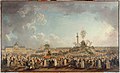 Festival of the Supreme Being, 8 June 1794
 -
 Notre Dame of Strasbourg turned into a Temple of Reason.


See also
[edit]Notes and references
[edit]- ^ a b c d e f g h i j k Tallett 1991, p. 1-17.
- ^ a b c Spielvogel 2006, p. 549.
- ^ Collins, Michael (1999). The Story of Christianity. Mathew A Price. Dorling Kindersley. pp. 176–177. ISBN 978-0-7513-0467-1.
At first the new revolutionary government attacked Church corruption and the wealth of the bishops and abbots who ruled the Church -- causes with which many Christians could identify. Clerical privileges were abolished ...
- ^ Kennedy, Emmet (1989). A Cultural History of the French Revolution. Yale University Press. p. 343. ISBN 9780300044263.
- ^ Helmstadter, Richard J. (1997). Freedom and religion in the nineteenth century. Stanford Univ. Press. p. 251. ISBN 9780804730877.
- ^ Heenan, David Kyle. Deism in France 1789-1799. N.p.: U of Wisconsin--Madison, 1953. Print.
- ^ Ross, David A. Being in Time to the Music. N.p.: Cambridge Scholars Publishing, 2007. Print. "This Cult of Reason or Deism reached its logical conclusion in the French Revolution..."
- ^ Fremont-Barnes, p. 119.
- ^ Encyclopedia of the Age of Political Revolutions and New Ideologies, 1760-1815, p. 212, retrieved July 17, 2016
- ^ a b Betros, Gemma (December 2010). "THE FRENCH REVOLUTION AND THE CATHOLIC CHURCH". History Review (68): 16–21. ISSN 0962-9610.
- ^ Furet, François. "Night of August 4," in François Furet, and Mona Ozouf, eds. A Critical Dictionary of the French Revolution (Harvard University Press, 1989) pp 107-114.
- ^ Compare Tallett (1991): "During the course of the year II much of France was subjected to a campaign of dechristianization, the aim of which was the eradication of Catholic religious practice, and Catholicism itself. The campaign, which was at its most intense in the winter and spring of 1793-94 [...] comprised a number of different activities. These ranged from the removal of plate, statues and other fittings from places of worship, the destruction of crosses, bells, shrines and other 'external signs of worship', the closure of churches, the enforced abdication and, occasionally, the marriage of constitutional priests, the substitution of a Revolutionary calendar for the Gregorian one, the alteration of personal and place names which had any ecclesiastical connotations to more suitably Revolutionary ones, through to the promotion of new cults, notably those of reason and of the Supreme Being."
- ^ a b Latreille, A. (2002). "French revolution". New Catholic Encyclopedia. Vol. v. 5 (Second ed.). Thompson/Gale. pp. 972–973. ISBN 978-0-7876-4004-0.
- ^ Schaeffer, Francis A. (2005). How Should We Then Live (L'Abri 50th Anniversary ed.). pp. 120–122. ISBN 978-1581345360.
- ^ Lewis (1993, p. 96): "Many of the Parisian Sections eagerly joined in the priest-hunt...."
- ^ a b Doyle, William (2002). The Oxford History of the French Revolution. Oxford University Press. pp. 276–277, 320. ISBN 978-0199252985.
- ^ a b Vovelle, Michel (1991). The Revolution Against the Church: From Reason to the Supreme Being. Ohio State University Press. pp. 81–85, 142–144. ISBN 978-0814205776.
- ^ a b Ozouf, Mona (1988). Festivals and the French Revolution. Harvard University Press. pp. 20–26. ISBN 978-0674298842.
- ^ Schama, Simon (1989). Citizens: A Chronicle of the French Revolution. Alfred A. Knopf. pp. 778–780. ISBN 978-0394559483.
- ^ Scurr, Ruth (2006). Fatal Purity: Robespierre and the French Revolution. Metropolitan Books. p. 293. ISBN 978-0805079876.
- ^ Doyle, p. 276.
- ^ Rapport, Mike (3 November 2017). Laughter as a Political Weapon: Humour and the French Revolution. Études. Presses universitaires de Perpignan. pp. 241–255. ISBN 9782354122775.
- ^ Neely, Sylvia (2008). A Concise History of the French Revolution. Rowman & Littlefield. p. 212. ISBN 978-0742534117.
- ^ Palmer, R. R. (2017). The Improvement of Humanity: Education and the French Revolution. Princeton University Press. pp. 192–195. ISBN 978-1400886
- ^ Jainchill, Andrew (2008). Reimagining Politics After the Terror: The Republican Origins of French Liberalism. Cornell University Press. pp. 84–88. ISBN 978-0801446693.
- ^ Mathiez, Albert (1975) [1904]. La Théophilanthropie et le Culte Décadaire, 1796–1801. Slatkine-Megariotis Reprints. pp. 315–320.
- ^ Chantin, Jean-Pierre (15 January 2003). "Les adeptes de la théophilanthropie : pour une autre lecture d'Albert Mathiez". Rives méditerranéennes (in French) (14): 63–73. doi:10.4000/rives.323.
- ^ Ozouf (1988), pp. 270–275.
- ^ Vovelle (1991), pp. 144–147.
- ^ Jonathan Israel, Revolutionary Ideas: An Intellectual History of the French Revolution from the Rights of Man to Robespierre, p. 483.
- ^ Lewis, Gwynne (1993). The French Revolution: Rethinking the Debate. Historical Connections. Routledge. p. 45. ISBN 978-1-134-93741-7. Retrieved 9 May 2017.
- ^ a b Vovelle 1991, p. 180, 182.
- ^ Shaw, Matthew (1 March 2001). "Reactions To The French Republican Calendar". Fr Hist. 15 (1): 6. doi:10.1093/fh/15.1.4. Retrieved 5 March 2017.
- ^ Segura González, Wenceslao (2012). La reforma del calendario (PDF) (in Spanish). EWT Ediciones. p. 42. ISBN 9788461617296. Archived from the original (PDF) on 9 June 2019.
- ^ Horne, Thomas Hartwell; Davidson, Samuel (21 November 2013). An Introduction to the Critical Study and Knowledge of the Holy Scriptures. Cambridge University Press. p. 30. ISBN 978-1-108-06772-0.
- ^ a b Censer and Hunt, Liberty, Equality, Fraternity: Exploring the French Revolution, pp. 92–94.
- ^ Fremont-Barnes, Gregory (2007). Encyclopedia of the Age of Political Revolutions and New Ideologies, 1760-1815: A-L. Greenwood Publishing Group. p. 237. ISBN 9780313334467.
The cult was a deliberate attempt to counter the unsuccessful efforts at dechristianization, and the atheistic Cult of Reason, which reached its high point in the winter of the previous year.
- ^ a b Harvey, Donald Joseph FRENCH REVOLUTION, History.com 2006 (Accessed 27 April 2007) Archived 14 October 2007 at the Wayback Machine
- ^ Lewis 1993, p. 96.
- ^ McManners, John. *The French Revolution and the Church*. Oxford University Press, 1999, p. 104.
- ^ Tackett, Timothy. *Religion, Revolution, and Regional Culture in Eighteenth-Century France*. Princeton University Press, 1986, pp. 183-185.
- ^ Leclercq, Henri. "Arrouaise Abbey." *Catholic Encyclopedia*. 1913.
- ^ Hansen, Eric. *Monasteries of Europe*. Penguin, 2001, p. 219.
- ^ Guillot, Jean. "Les Abbayes Perdues de Picardie." *Revue du Nord*, vol. 72, 1990, p. 310.
- ^ Davis, Michael. *The Destruction of the Monasteries*. Routledge, 2003, p. 95.
- ^ Wright, Patrick. *The French Revolution and its Impact on Religious Orders*. Cambridge University Press, 1995, p. 136.
- ^ Burke, Peter. *Church and State in Revolutionary France*. Harvard University Press, 1982, p. 92.
- ^ Palmer, R.R. *Twelve Who Ruled: The Year of the Terror in the French Revolution*. Princeton University Press, 1941, p. 176.
- ^ Forrest, Alan. *Paris and the Provinces in the French Revolution*. Oxford University Press, 2004, p. 241.
- ^ Andress, David. *The Terror: The Merciless War for Freedom in Revolutionary France*. Farrar, Straus and Giroux, 2006, p. 122.
- ^ Papal, John. *Monastic Life in France before and after the Revolution*. University of Chicago Press, 2002, p. 78.
- ^ Hanson, Paul. *The Jacobin Republic Under Fire*. Penn State Press, 2003, p. 145.
- ^ Harris, Robert. *Monasteries and Secularization in Revolutionary France*. Yale University Press, 2011, p. 94.
- ^ Kennedy, Michael. *The French Revolution and the Church*. Macmillan, 2005, p. 158.
- ^ Stewart, John. *Faith and the French Revolution*. Oxford University Press, 1996, p. 109.
- ^ Taylor, Charles. *The Secular Age*. Harvard University Press, 2007, p. 233.
- ^ Jones, Colin. *The Long Century: France and Modernity, 1750-1950*. Oxford University Press, 2000, p. 172.
- ^ Hemmings, Kevin. *Religious Martyrdom in the French Revolution*. Cambridge University Press, 1997, p. 201.
- ^ Mitchell, Timothy. *Revolution and Religion in France*. Routledge, 1993, p. 90.
- ^ Brown, Thomas. *Religious Orders in France: Before and After 1789*. University of Chicago Press, 1988, p. 147.
- ^ Furet, François. *Revolutionary France: 1770-1880*. Blackwell, 1992, p. 165.
- ^ Hales, James. *The Church and the French Revolution*. Oxford University Press, 2004, p. 119.
- ^ Doyle, William. *The Oxford History of the French Revolution*. Oxford University Press, 1989, p. 135.
- ^ Clark, Linda. *Secularization and the Church in Revolutionary France*. Harvard University Press, 1998, p. 78.
- ^ Bossenga, Gail. *The Politics of Privilege: Old Regime and Revolution in France*. Cambridge University Press, 1991, p. 102.
- ^ Schmidt, Leigh. *Holy Fairs: Religion and Politics in Revolutionary France*. Princeton University Press, 1993, p. 93.
- ^ Gough, Deborah. *Monasteries of Italy*. Yale University Press, 1995, p. 207.
Further reading
[edit]In English
[edit]- Aston, Nigel. Religion and Revolution in France, 1780-1804 (Catholic University of America Press, 2000), pp 259–76
- Byrnes, Joseph F. Priests of the French Revolution: Saints and Renegades in a New Political Era (2014)
- Cooney, Mary Kathryn (2006). "'May the Hatchet and the Hammer Never Damage It!': The Fate of the Cathedral of Chartres during the French Revolution". Catholic Historical Review. 92 (2): 193–214. doi:10.1353/cat.2006.0129. S2CID 159565325.
- Desan, Suzanne (1988). "Redefining Revolutionary Liberty: The Rhetoric of Religious Revival during the French Revolution". Journal of Modern History. 60 (1): 2–27. doi:10.1086/243333. JSTOR 1880404. S2CID 153680938.
- Furet, François and Mona Ozouf, eds. A Critical Dictionary of the French Revolution (1989), pp 21–32
- Gliozzo, Charles A. "The Philosophes and Religion: Intellectual Origins of the Dechristianization Movement in the French Revolution". Church History (1971) 40#3
- Kley, Dale K. Van (2003). "Christianity as casualty and chrysalis of modernity: the problem of dechristianization in the French Revolution". American Historical Review. 108 (4): 1081–1104. doi:10.1086/529789. JSTOR 10.1086/529789.
- Kley, Dale K. Van. The Religious Origins of the French Revolution: From Calvin to the Civil Constitution, 1560-1791 (1996)
- Lewis, Gwynne. Life in Revolutionary France. London : New York : Batsford; Putnam, 1972. ISBN 978-0-7134-1556-8
- McManners, John. The French Revolution and the Church (Greenwood Press, 1969) . ISBN 978-0-313-23074-5
- Spielvogel, J.J. (2006). Western Civilization (Combined Volume ed.). Wadsworth. ISBN 978-0-534-64602-8.
- Tackett, Timothy. Religion, Revolution, and Regional Culture in Eighteenth-Century France: The Ecclesiastical Oath of 1791 (1986)
- Tallett, Frank (1991). "Dechristianizing France: The year II and the revolutionary experience". In Tallett, F.; Atkin, N. (eds.). Religion, Society and Politics in France Since 1789. Bloomsbury Academic. p. 1–28. ISBN 978-1-85285-057-9. Retrieved 9 May 2017.
- Vovelle, Michel (1991) [1988], The revolution against the Church: From reason to the Supreme Being, translated by José, Alan, Columbus, OH: Ohio State University Press, hdl:1811/24812, ISBN 0-8142-0577-1
In French
[edit]- La Gorce, Pierre de, Histoire Religieuse de la Révolution Française. 10. éd. Paris : Plon-Nourrit, 1912–5 v.
- Langlois, Claude, Timothy Tackett, Michel Vovelle and S. Bonin. Atlas de la Révolution française. Religion, 1770–1820, tome 9 (1996)
External links
[edit]

| Bible (Scriptures) | |||||||||
|---|---|---|---|---|---|---|---|---|---|
| Foundations | |||||||||
| History (timeline) (spread) |
| ||||||||
| Denominations (list, members) |
| ||||||||
| Theology |
| ||||||||
| Philosophy | |||||||||
| Other features |
| ||||||||


| |||||||||||||||||||||||||
| |||||||||||||||||||||||||
| |||||||||||||||||||||||||
| |||||||||||||||||||||||||
| |||||||||||||||||||||||||
| |||||||||||||||||||||||||


| By group | |
|---|---|
| Methods |
|
| Events |
|

| National | |
|---|---|
| Other | |
