


Community hub
Recent from talks
Contribute something
Nothing was collected or created yet.
Fissile material
View on Wikipedia
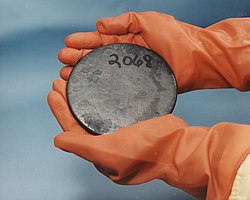
In nuclear engineering, fissile material is material that can undergo nuclear fission when struck by a neutron of low energy.[1] A self-sustaining thermal chain reaction can only be achieved with fissile material. The predominant neutron energy in a system may be typified by either slow neutrons (i.e., a thermal system) or fast neutrons. Fissile material can be used to fuel thermal-neutron reactors, fast-neutron reactors and nuclear explosives.
Fissile vs fissionable
[edit]| 88 | 89 | 90 | 91 | 92 | 93 | 94 | 95 | 96 | 97 | 98 | 99 | |||||||||||||||||||
| 154 |
|
250Cm | 252Cf | 154 | ||||||||||||||||||||||||||
| 153 | 251Cf | 252Es | 153 | |||||||||||||||||||||||||||
| 152 | 248Cm | 250Cf | 152 | |||||||||||||||||||||||||||
| 151 | 247Cm | 248Bk | 249Cf | 151 | ||||||||||||||||||||||||||
| 150 | 244Pu | 246Cm | 247Bk | 150 | ||||||||||||||||||||||||||
| 149 | 245Cm | 149 | ||||||||||||||||||||||||||||
| 148 | 242Pu | 243Am | 244Cm | 148 | ||||||||||||||||||||||||||
| 147 | 241Pu | 242m⁂
|
243Cm | 147 | ||||||||||||||||||||||||||
| 146 | 238U | 240Pu | 241Am | 146 | ||||||||||||||||||||||||||
| 145 | 239Pu | 145 | ||||||||||||||||||||||||||||
| 144 | 236U | 237Np | 238Pu | 144 | ||||||||||||||||||||||||||
| 143 | 235U | 236Np | 143 | |||||||||||||||||||||||||||
| 142 | 232Th | 234U | 235Np | 236Pu | 142 | |||||||||||||||||||||||||
| 141 | 233U | 141 | ||||||||||||||||||||||||||||
| 140 | 228Ra | 230Th | 231Pa | 232U |
|
140 | ||||||||||||||||||||||||
| 139 | 229Th | 139 | ||||||||||||||||||||||||||||
| 138 | 226Ra | 227Ac | 228Th | 138 | ||||||||||||||||||||||||||
| 88 | 89 | 90 | 91 | 92 | 93 | 94 | 95 | 96 | 97 | 98 | 99 | |||||||||||||||||||
| Only nuclides with a half-life of at least one year are shown on this table. | ||||||||||||||||||||||||||||||
The term fissile is distinct from fissionable. A nuclide that can undergo nuclear fission (even with a low probability) after capturing a neutron of high or low energy[2] is referred to as fissionable. A fissionable nuclide that can undergo fission with a high probability after capturing a low-energy thermal neutron is referred to as fissile.[3] Fissionable materials include those (such as uranium-238) for which fission can be induced only by high-energy neutrons. As a result, fissile materials (such as uranium-235) are a subset of fissionable materials.
Uranium-235 fissions with low-energy thermal neutrons because the binding energy resulting from the absorption of a neutron is greater than the threshold required for fission; therefore uranium-235 is fissile. By contrast, the binding energy released by uranium-238 absorbing a thermal neutron is less than the critical energy, so the neutron must possess additional energy for fission to be possible. Consequently, uranium-238 is fissionable but not fissile.[4][5]
An alternative definition defines fissile nuclides as those nuclides that can be made to undergo nuclear fission (i.e., are fissionable) and also produce neutrons from such fission that can sustain a nuclear chain reaction in the correct setting. Under this definition, the only nuclides that are fissionable but not fissile are those nuclides that can be made to undergo nuclear fission but produce insufficient neutrons, in either energy or number, to sustain a nuclear chain reaction. As such, while all fissile isotopes are fissionable, not all fissionable isotopes are fissile. In the arms control context, particularly in proposals for a Fissile Material Cutoff Treaty, the term fissile is often used to describe materials that can be used in the fission primary of a nuclear weapon.[6] These are materials that sustain an explosive fast neutron nuclear fission chain reaction.
Under all definitions above, uranium-238 (238
U) is fissionable, but not fissile. Neutrons produced by fission of 238
U have lower energies than the original neutron (they behave as in an inelastic scattering), usually below 1 MeV (i.e., a speed of about 14,000 km/s), the fission threshold to cause subsequent fission of 238
U, so fission of 238
U does not sustain a nuclear chain reaction.
Fast fission of 238
U in the secondary stage of a thermonuclear weapon, due to the production of high-energy neutrons from nuclear fusion, contributes greatly to the yield and to fallout of such weapons. Fast fission of 238
U tampers has also been evident in pure fission weapons.[7] The fast fission of 238
U also makes a significant contribution to the power output of some fast-neutron reactors.
Fissile nuclides
[edit]| Actinides[8] by decay chain | Half-life range (a) |
Fission products of 235U by yield[9] | ||||||
|---|---|---|---|---|---|---|---|---|
| 4n (Thorium) |
4n + 1 (Neptunium) |
4n + 2 (Radium) |
4n + 3 (Actinium) |
4.5–7% | 0.04–1.25% | <0.001% | ||
| 228Ra№ | 4–6 a | 155Euþ | ||||||
| 248Bk[10] | > 9 a | |||||||
| 244Cmƒ | 241Puƒ | 250Cf | 227Ac№ | 10–29 a | 90Sr | 85Kr | 113mCdþ | |
| 232Uƒ | 238Puƒ | 243Cmƒ | 29–97 a | 137Cs | 151Smþ | 121mSn | ||
| 249Cfƒ | 242mAmƒ | 141–351 a |
No fission products have a half-life | |||||
| 241Amƒ | 251Cfƒ[11] | 430–900 a | ||||||
| 226Ra№ | 247Bk | 1.3–1.6 ka | ||||||
| 240Pu | 229Th | 246Cmƒ | 243Amƒ | 4.7–7.4 ka | ||||
| 245Cmƒ | 250Cm | 8.3–8.5 ka | ||||||
| 239Puƒ | 24.1 ka | |||||||
| 230Th№ | 231Pa№ | 32–76 ka | ||||||
| 236Npƒ | 233Uƒ | 234U№ | 150–250 ka | 99Tc₡ | 126Sn | |||
| 248Cm | 242Pu | 327–375 ka | 79Se₡ | |||||
| 1.33 Ma | 135Cs₡ | |||||||
| 237Npƒ | 1.61–6.5 Ma | 93Zr | 107Pd | |||||
| 236U | 247Cmƒ | 15–24 Ma | 129I₡ | |||||
| 244Pu | 80 Ma |
... nor beyond 15.7 Ma[12] | ||||||
| 232Th№ | 238U№ | 235Uƒ№ | 0.7–14.1 Ga | |||||
| ||||||||
In general, most actinide isotopes with an odd neutron number are fissile. Most nuclear fuels have an odd atomic mass number (A = Z + N = the total number of nucleons), and an even atomic number Z. This implies an odd number of neutrons. Isotopes with an odd number of neutrons gain an extra 1 to 2 MeV of energy from absorbing an extra neutron, from the pairing effect which favors even numbers of both neutrons and protons. This energy is enough to supply the needed extra energy for fission by slower neutrons, which is important for making fissionable isotopes also fissile.
More generally, nuclides with an even number of protons and an even number of neutrons, and located near a well-known curve in nuclear physics of atomic number vs. atomic mass number are more stable than others; hence, they are less likely to undergo fission. They are more likely to "ignore" the neutron and let it go on its way, or else to absorb the neutron but without gaining enough energy from the process to deform the nucleus enough for it to fission. These "even-even" isotopes are also less likely to undergo spontaneous fission, and they also have relatively much longer partial half-lives for alpha or beta decay. Examples of these isotopes are uranium-238 and thorium-232. On the other hand, other than the lightest nuclides, nuclides with an odd number of protons and an odd number of neutrons (odd Z, odd N) are usually short-lived (a notable exception is neptunium-236 with a half-life of 154,000 years) because they readily decay by beta-particle emission to their isobars with an even number of protons and an even number of neutrons (even Z, even N) becoming much more stable. The physical basis for this phenomenon also comes from the pairing effect in nuclear binding energy, but this time from both proton–proton and neutron–neutron pairing. The relatively short half-life of such odd-odd heavy isotopes means that they are not available in quantity and are highly radioactive.
According to the fissility rule proposed by Yigal Ronen, for a heavy element with Z between 90 and 100, an isotope is fissile if and only if 2 × Z − N ∈ {41, 43, 45} (where N = number of neutrons and Z = number of protons), with a few exceptions.[13][14] This rule holds for all but fourteen nuclides – seven that satisfy the criterion but are nonfissile, and seven that are fissile but do not satisfy the criterion.[note 1]
Nuclear fuel
[edit]To be a useful fuel for nuclear fission chain reactions, the material must:
- Be in the region of the binding energy curve where a fission chain reaction is possible (i.e., above radium)
- Have a high probability of fission on neutron capture
- Release more than one neutron on average per neutron capture. (Enough of them on each fission, to compensate for non-fissions and absorptions in non-fuel material)
- Have a reasonably long half-life
- Be available in suitable quantities.
| Thermal neutrons[15] | Epithermal neutrons | |||||
|---|---|---|---|---|---|---|
| σF (b) | σγ (b) | % | σF (b) | σγ (b) | % | |
| 531 | 46 | 8.0% | 233U | 760 | 140 | 16% |
| 585 | 99 | 14.5% | 235U | 275 | 140 | 34% |
| 750 | 271 | 26.5% | 239Pu | 300 | 200 | 40% |
| 1010 | 361 | 26.3% | 241Pu | 570 | 160 | 22% |
Fissile nuclides in nuclear fuels include:
- Uranium-233, bred from thorium-232 by neutron capture with intermediate decays steps omitted.
- Uranium-235, which occurs in natural uranium and enriched uranium
- Plutonium-239, bred from uranium-238 by neutron capture with intermediate decays steps omitted.
- Plutonium-241, bred from plutonium-240 directly by neutron capture.
Fissile nuclides do not have a 100% chance of undergoing fission on absorption of a neutron. The chance is dependent on the nuclide as well as neutron energy. For low and medium-energy neutrons, the neutron capture cross sections for fission (σF), the cross section for neutron capture with emission of a gamma ray (σγ), and the percentage of non-fissions are in the table at right.
Fertile nuclides in nuclear fuels include:
- Thorium-232, which breeds uranium-233 by neutron capture with intermediate decays steps omitted.
- Uranium-238, which breeds plutonium-239 by neutron capture with intermediate decays steps omitted.
- Plutonium-240, which breeds plutonium-241 directly by neutron capture.
See also
[edit]Notes
[edit]- ^ The fissile rule thus formulated indicates 33 isotopes as likely fissile: Th-225, 227, 229; Pa-228, 230, 232; U-231, 233, 235; Np-234, 236, 238; Pu-237, 239, 241; Am-240, 242, 244; Cm-243, 245, 247; Bk-246, 248, 250; Cf-249, 251, 253; Es-252, 254, 256; Fm-255, 257, 259. Only fourteen (including a long-lived metastable nuclear isomer) have half-lives of at least a year: Th-229, U-233, U-235, Np-236, Pu-239, Pu-241, Am-242m, Cm-243, Cm-245, Cm-247, Bk-248, Cf-249, Cf-251 and Es-252. Of these, only U-235 is naturally occurring. It is possible to breed U-233 and Pu-239 from more common naturally occurring isotopes (Th-232 and U-238 respectively) by single neutron capture. The others are typically produced in smaller quantities through further neutron absorption.
References
[edit]- ^ "NRC: Glossary -- Fissile material". www.nrc.gov.
- ^ "NRC: Glossary -- Fissionable material". www.nrc.gov.
- ^ "Slides-Part one: Kinetics". UNENE University Network of Excellence in Nuclear Engineering. Retrieved 3 January 2013.
- ^ James J. Duderstadt and Louis J. Hamilton (1976). Nuclear Reactor Analysis. John Wiley & Sons, Inc. ISBN 0-471-22363-8.
- ^ John R. Lamarsh and Anthony John Baratta (Third Edition) (2001). Introduction to Nuclear Engineering. Prentice Hall. ISBN 0-201-82498-1.
- ^ Fissile Materials and Nuclear Weapons Archived 2012-02-06 at the Wayback Machine, International Panel on Fissile Materials
- ^ Semkow, Thomas; Parekh, Pravin; Haines, Douglas (2006). "Modeling the Effects of the Trinity Test". Applied Modeling and Computations in Nuclear Science. ACS Symposium Series. Vol. ACS Symposium Series. pp. 142–159. doi:10.1021/bk-2007-0945.ch011. ISBN 9780841239821.
- ^ Plus radium (element 88). While actually a sub-actinide, it immediately precedes actinium (89) and follows a three-element gap of instability after polonium (84) where no nuclides have half-lives of at least four years (the longest-lived nuclide in the gap is radon-222 with a half life of less than four days). Radium's longest lived isotope, at 1,600 years, thus merits the element's inclusion here.
- ^ Specifically from thermal neutron fission of uranium-235, e.g. in a typical nuclear reactor.
- ^ Milsted, J.; Friedman, A. M.; Stevens, C. M. (1965). "The alpha half-life of berkelium-247; a new long-lived isomer of berkelium-248". Nuclear Physics. 71 (2): 299. Bibcode:1965NucPh..71..299M. doi:10.1016/0029-5582(65)90719-4.
"The isotopic analyses disclosed a species of mass 248 in constant abundance in three samples analysed over a period of about 10 months. This was ascribed to an isomer of Bk248 with a half-life greater than 9 [years]. No growth of Cf248 was detected, and a lower limit for the β− half-life can be set at about 104 [years]. No alpha activity attributable to the new isomer has been detected; the alpha half-life is probably greater than 300 [years]." - ^ This is the heaviest nuclide with a half-life of at least four years before the "sea of instability".
- ^ Excluding those "classically stable" nuclides with half-lives significantly in excess of 232Th; e.g., while 113mCd has a half-life of only fourteen years, that of 113Cd is eight quadrillion years.
- ^ Ronen Y., 2006. A rule for determining fissile isotopes. Nucl. Sci. Eng., 152:3, pages 334-335. [1]
- ^ Ronen, Y. (2010). "Some remarks on the fissile isotopes". Annals of Nuclear Energy. 37 (12): 1783–1784. Bibcode:2010AnNuE..37.1783R. doi:10.1016/j.anucene.2010.07.006.
- ^ "Interactive Chart of Nuclides". Brookhaven National Laboratory. Archived from the original on 2017-01-24. Retrieved 2013-08-12.
| |||||||||||||||||||||||||||||||||||||||||||||||||||||||
| |||||||||||||||||||||||||||||||||||||||||||||||||||||||


Fissile material
View on GrokipediaFundamental Concepts
Definition and Criteria
Fissile materials are isotopes of certain elements capable of undergoing nuclear fission when absorbing neutrons of low kinetic energy, typically thermal neutrons with energies around 0.025 eV, thereby enabling a self-sustaining chain reaction in appropriately moderated systems.[1] This property distinguishes them from materials that require higher-energy neutrons for fission. The primary fissile isotopes include uranium-233, uranium-235, plutonium-239, and plutonium-241, as these exhibit sufficient fission cross-sections for thermal neutrons to support criticality in nuclear reactors or weapons.[1][7] The key criteria for a nuclide to be classified as fissile involve both its interaction probability with thermal neutrons and the energetics of the resulting fission process. Specifically, the thermal neutron fission cross-section (σ_f) must be large relative to competing absorption processes, ensuring a high likelihood of fission over neutron capture without fission. Additionally, the average number of prompt neutrons emitted per fission (ν) is typically around 2.4–2.9 for common fissiles, and the reproduction factor η—defined as the number of neutrons produced per neutron absorbed, η = ν × (σ_f / (σ_f + σ_γ + σ_c)) where σ_γ is radiative capture and σ_c is other captures—must exceed 1 to permit a multiplying chain reaction under thermal conditions. These parameters ensure that, in a thermal spectrum, the infinite multiplication factor k_∞ > 1, allowing sustained fission without external neutron sources. Nuclides failing these thermal-specific thresholds, such as uranium-238, are fissionable but not fissile, as their fission requires fast neutrons above ~1 MeV.[8] Empirical data from neutronics experiments confirm these criteria, with uranium-235's thermal fission cross-section measured at approximately 582 barns, far exceeding its capture cross-section of 98 barns.Fissile vs. Fissionable Materials
Fissionable materials encompass any atomic nuclides capable of undergoing nuclear fission upon absorption of a neutron, irrespective of the neutron's kinetic energy.[8] This category includes isotopes that require high-energy (fast) neutrons to overcome fission barriers, such as uranium-238, which has a fission threshold around 1 MeV.[8] In contrast, fissile materials represent a subset of fissionable materials defined by their ability to fission efficiently with low-energy thermal neutrons (typically below 1 eV), enabling sustained chain reactions in thermal-spectrum environments.[6][1] The distinction arises from nuclear binding energies and cross-section behaviors: fissile isotopes exhibit high thermal neutron fission cross-sections (e.g., over 500 barns for uranium-235), allowing prompt neutron multiplication factors greater than unity without moderation adjustments.[9] Fissionable but non-fissile isotopes like uranium-238 primarily capture thermal neutrons to form fissile plutonium-239 via neutron irradiation, rather than fissioning directly, due to their low thermal fission probability (cross-section ~0.001 barns).[8] This property underpins fertile material conversion in breeder reactors, where fast neutrons induce fission in non-fissile isotopes to contribute to overall energy yield.[9] Practical implications differentiate reactor designs: thermal reactors rely on fissile fuels like uranium-235 (enriched to 3-5% for power generation) or plutonium-239 for criticality with moderated neutrons, whereas fast reactors exploit fissionable materials' responses to unmoderated spectra, enhancing fuel efficiency by fissioning uranium-238 (contributing ~90% of natural uranium's energy potential).[6][1] Misuse of terminology historically blurred lines, but precise usage avoids conflating chain-reaction sustainability with mere fission inducibility, as clarified in nuclear engineering standards since the 1940s Manhattan Project era.[10] Key fissile nuclides—uranium-233, uranium-235, plutonium-239, and plutonium-241—share odd nucleon numbers favoring low fission barriers for s-wave neutron capture.[1]Related Terms: Fertile and Breedable Materials
Fertile materials are non-fissile isotopes that can absorb neutrons to undergo transmutation into fissile isotopes via beta decay sequences, enabling their conversion into materials capable of sustaining nuclear chain reactions.[11] Unlike fissile materials, fertile isotopes do not fission readily with thermal neutrons but serve as precursors in extended fuel cycles.[11] Prominent examples include uranium-238, which constitutes over 99% of natural uranium and captures a neutron to form uranium-239; this undergoes beta decay to neptunium-239 (half-life 2.36 days) and then to plutonium-239 (half-life 24,110 years), a key fissile isotope. Similarly, thorium-232, abundant in Earth's crust at about 6 parts per million, absorbs a neutron to yield thorium-233, decaying through protactinium-233 (half-life 27 days) to uranium-233, another fissile nuclide.[12] These transformations require neutron fluxes typically provided by operating reactors, highlighting fertile materials' dependence on existing fissile sources for activation. Breedable materials, often synonymous with fertile materials in the context of advanced reactor designs, refer to those utilized in breeding processes where neutron economy allows production of fissile isotopes exceeding consumption, achieving a breeding ratio greater than 1.[13] In breeder reactors, such as fast-spectrum systems, fertile materials like uranium-238 form blankets surrounding the fissile core, capturing high-energy neutrons to generate plutonium-239 at rates that extend fuel resources beyond natural uranium limitations.[13] This capability addresses resource scarcity, as fertile isotopes comprise the majority of mined uranium, potentially multiplying usable fuel by factors of 60 or more through complete thorium or uranium-238 utilization.[3] However, breeding efficiency demands precise control of neutron spectra and losses, with fast reactors outperforming thermal ones due to reduced parasitic capture.[3]Key Fissile Nuclides
Uranium-235
Uranium-235 (^{235}U) is an isotope of uranium with 92 protons and 143 neutrons, distinguished as the primary naturally occurring fissile nuclide capable of sustaining a nuclear chain reaction with thermal neutrons.[3] Its atomic mass is 235.0439299 u, and it constitutes approximately 0.72% of natural uranium deposits.[14] The isotope's half-life is 703.8 million years, decaying primarily via alpha emission to thorium-231.[15]| Property | Value |
|---|---|
| Natural abundance | 0.7204 ± 0.0007 atom % |
| Half-life | 7.038 × 10^8 years |
| Thermal fission cross-section | ~585 barns |
Plutonium-239
Plutonium-239 (^{239}Pu) is an isotope of plutonium with mass number 239 and atomic number 94, recognized as a primary fissile material due to its ability to undergo induced fission with low-energy thermal neutrons, sustaining a nuclear chain reaction.[20] It decays primarily via alpha emission with a half-life of 24,110 years, emitting alpha particles at 5.245 MeV.[21] The bare-sphere critical mass for ^{239}Pu metal is approximately 10 kilograms, lower than that of uranium-235, enabling efficient chain reactions with smaller quantities.[22] Its thermal neutron fission cross-section exceeds 700 barns, roughly 50% higher than that of uranium-235 (approximately 582 barns), which facilitates high reactivity in moderated reactor environments or unmoderated assemblies.[23] This property arises from the even-odd nucleon pairing in ^{239}Pu, enhancing fission probability upon neutron absorption compared to neighboring isotopes like plutonium-240, which has a higher spontaneous fission rate disrupting weapon designs.[24] In fast neutron spectra, ^{239}Pu remains highly fissionable, with cross-sections enabling breeding in fast reactors where it contributes over 60% of energy output in some mixed-oxide fuel cycles.[25] ^{239}Pu is produced artificially in nuclear reactors through successive neutron capture and beta decays starting from uranium-238, the dominant isotope in natural uranium (99.3% abundance).[25] The process begins with ^{238}U capturing a thermal neutron to form ^{239}U, which undergoes beta decay (half-life 23.5 minutes) to neptunium-239, followed by another beta decay (half-life 2.36 days) to ^{239}Pu.[26] Production rates depend on neutron flux and fuel burnup; a typical 1000 MWe light-water reactor generates about 250-300 kilograms of plutonium annually, with ^{239}Pu comprising 50-70% of the mix in low-burnup fuels optimized for weapons-grade material (over 93% ^{239}Pu).[25] Isotopic purity decreases with higher burnup due to competing captures forming higher plutonium isotopes. Discovered in December 1940 by Glenn Seaborg's team at the University of California, Berkeley, through deuteron bombardment of uranium, ^{239}Pu's fissile potential was confirmed in 1941 via cyclotron tests showing it fissioned with neutrons at rates comparable to uranium-235.[24] This breakthrough, building on 1938 uranium fission discovery, underpinned Manhattan Project reactor designs like Chicago Pile-1 (December 1942), which demonstrated controlled chain reactions and plutonium breeding feasibility.[26] Postwar, ^{239}Pu enabled commercial mixed-oxide (MOX) fuels, recycling reactor plutonium to reduce waste, though proliferation risks persist as separated ^{239}Pu can yield weapons with yields exceeding 20 kilotons per kilogram in implosion designs.[25]Other Notable Fissile Isotopes
Uranium-233 (U-233) is a fissile isotope produced through neutron irradiation of thorium-232 in a nuclear reactor, followed by beta decays of thorium-233 and protactinium-233, with a half-life of approximately 159,200 years.[27] It exhibits a high fission cross-section for thermal neutrons, with a capture-to-fission ratio lower than that of U-235 or Pu-239, enabling efficient sustained chain reactions in thermal-spectrum reactors as part of the thorium fuel cycle.[28] U-233 has been tested in nuclear devices, such as during Operation Teapot in 1955, confirming its potential for weapons applications, though proliferation concerns arise from associated U-232 contamination producing high-radiation gamma emitters.[29] Plutonium-241 (Pu-241), with a half-life of 14.35 years, decays via beta emission to americium-241 and is generated in nuclear reactors through successive neutron captures starting from U-238, typically comprising 10-15% of reactor-grade plutonium.[25] It is fissile, possessing a thermal neutron fission cross-section about one-third higher than Pu-239, which enhances reactivity in mixed plutonium fuels but also increases spontaneous fission risks in weapons due to its decay heat and neutron emissions.[1] Pu-241's presence in spent fuel necessitates separation or management in reprocessing to mitigate long-term radiotoxicity from its americium daughter product.[30] Other isotopes, such as neptunium-237 and americium-241, possess fissile properties but are less practical for large-scale energy or weapons use due to lower yields, higher fast-neutron requirements, or production challenges; neptunium-237, for instance, has been explored in specialized fission studies but remains marginal compared to the primary actinide fissiles.[29]Nuclear Physics Underpinnings
Mechanism of Induced Fission
Induced fission in fissile nuclides, such as uranium-235, is initiated by the capture of a thermal neutron, which has kinetic energy on the order of 0.025 eV at room temperature. This absorption forms a compound nucleus, for example ^{236}U^* from ^{235}U + n, with an excitation energy approximately equal to the neutron binding energy of about 6.5 MeV.[31][3] In fissile isotopes, this excitation energy exceeds the fission barrier height, typically 5-6 MeV, enabling the nucleus to deform and split rather than de-excite primarily through neutron emission or gamma decay.[32] The compound nucleus equilibrates rapidly, on timescales of 10^{-14} seconds, distributing the excitation energy across its nucleons according to the compound nucleus model. Deformation proceeds through stretching of the nuclear shape, modeled as overcoming a potential barrier arising from the balance of surface tension (favoring sphericity) and Coulomb repulsion (favoring separation) in the liquid drop approximation. Once the barrier is surmounted, scission occurs, fragmenting the nucleus into two unequal products, such as barium and krypton isotopes, with atomic masses around 95 and 140.[33] The nascent fragments carry significant excitation, leading to the prompt emission of 2-3 neutrons per fission event, with average energies of 1-2 MeV, to reduce their neutron excess.[34][35] The fission fragments accelerate apart due to mutual Coulomb repulsion, converting ~168 MeV of the total ~200 MeV released per fission (primarily from the binding energy difference) into kinetic energy, with the remainder appearing as prompt gamma rays and subsequent beta decays. This asymmetry in fragment masses arises from shell effects stabilizing neutron numbers near 50 and 82, influencing the mass yield distribution observed experimentally. For fissile materials, the thermal neutron fission cross-section is high, exceeding 500 barns for ^{235}U, ensuring efficient chain reaction propagation under moderated conditions./University_Physics_III_-Optics_and_Modern_Physics(OpenStax)/10:_Nuclear_Physics/10.06:_Fission)[3] In contrast, fast neutrons above 1 MeV can induce fission in both fissile and fissionable isotopes but with lower probability for the latter due to higher effective barriers.[35]Neutron Cross-Sections and Chain Reaction Dynamics
The neutron cross-section represents the effective area presented by a nucleus to an incident neutron for a specific interaction, such as fission or radiative capture, quantified in units of barns (1 barn = 10^{-24} cm²). In fissile materials, the fission cross-section σ_f governs the probability of neutron-induced fission, which releases multiple neutrons to potentially sustain a chain reaction. This probability peaks at thermal neutron energies (approximately 0.025 eV, corresponding to a velocity of 2200 m/s), where σ_f for uranium-235 is 582.6 ± 0.7 barns and for plutonium-239 is 748.1 ± 2.0 barns.[36] Radiative capture cross-sections σ_c, which compete with fission by absorbing neutrons without fission, are 98.35 ± 0.06 barns for U-235 and 269.3 ± 2.9 barns for Pu-239 at thermal energies.[36] The fission-to-absorption ratio νσ_f / σ_a, where ν is the average number of neutrons emitted per fission (2.43 for thermal fission of U-235 and 2.87 for Pu-239), exceeds 2 for these isotopes, enabling net neutron gain.[37] Chain reaction dynamics hinge on the effective multiplication factor k_eff, defined as the ratio of neutrons produced in one generation to those absorbed or lost in the preceding generation; supercriticality requires k_eff > 1, criticality k_eff = 1, and subcriticality k_eff < 1.[38] k_eff derives from the six-factor formula: k_eff = (η ε p f P_NL P_TL), where η = ν σ_f / σ_a quantifies neutrons per absorption (≈2.07 for U-235 and ≈2.11 for Pu-239 in thermal spectra), ε accounts for fast fission, p is the resonance escape probability (high for low-absorption moderators), f is the thermal utilization factor, and P_NL, P_TL are non-leakage probabilities for fast and thermal neutrons, respectively.[37] High thermal σ_f in fissile nuclides compensates for parasitic absorptions and leakage, allowing k_eff > 1 in assemblies with sufficient fissile density and moderation, as neutrons thermalize via elastic scattering before interacting.[38] Cross-sections vary with neutron energy: in the epithermal range (1 eV to 10 keV), resonance peaks elevate σ_a, necessitating low-absorption materials to achieve high p; for fast neutrons (>10 keV), σ_f drops sharply (e.g., to ~1-2 barns for U-235 above 1 MeV), favoring fast-spectrum systems only with higher fissile concentrations.[37] Prompt neutrons (emitted within ~10^{-14} s, comprising ~99% of fission neutrons with average energy ~2 MeV) drive rapid multiplication, while delayed neutrons (from fission products, ~0.65% for U-235, effective delayed neutron fraction β ≈ 0.0065) provide seconds-to-minutes timescale for reactivity control, preventing instantaneous runaway.[38] Sustained chains thus demand balanced cross-sections ensuring neutron economy: empirical benchmarks confirm k_eff ≈1.05-1.1 in initial reactor startups with enriched U-235 fuel.[39]| Isotope | Thermal σ_f (barns) | Thermal σ_c (barns) | ν (thermal) | η (thermal) |
|---|---|---|---|---|
| U-233 | 529.1 ± 2.0 | 45.0 ± 0.3 | 2.49 | 2.28 |
| U-235 | 582.6 ± 0.7 | 98.35 ± 0.06 | 2.43 | 2.07 |
| Pu-239 | 748.1 ± 2.0 | 269.3 ± 2.9 | 2.87 | 2.11 |
Historical Context
Discovery of Nuclear Fission (1930s)
In the early 1930s, physicists began exploring neutron-induced reactions in heavy nuclei, building on the discovery of the neutron by James Chadwick in 1932. Enrico Fermi's group in Rome systematically bombarded elements, including uranium, with neutrons starting in 1934, producing artificial radioactivity and initially interpreting uranium reactions as forming new transuranic elements beyond uranium in the periodic table.[40][41] These results, which showed activities in thorium and uranium persisting longer than expected, fueled speculation about element 93 but overlooked alternative interpretations.[40] Ida Noddack, critiquing Fermi's findings in a 1934 paper, proposed that neutron capture by uranium might cause the nucleus to split into several large fragments rather than form a heavier isotope, a mechanism later recognized as fission; however, her hypothesis was dismissed by contemporaries as incompatible with prevailing nuclear models.[42][43] Hahn and Strassmann in Berlin, investigating similar neutron bombardments of uranium from 1936 onward, initially sought transuranics but encountered chemically anomalous lighter elements, such as masurium-like activities that defied transuranic expectations.[44] By late 1938, Hahn and Strassmann's experiments yielded definitive evidence of barium—a much lighter element—in irradiated uranium samples, confirmed through fractional crystallization and spectroscopic analysis on December 17, 1938, indicating uranium nuclei had fragmented into products roughly half its mass.[45][46] Their preliminary report, communicated to Lise Meitner (who had fled Germany for Sweden earlier that year), prompted her and Otto Robert Frisch to apply Niels Bohr's liquid drop model of the nucleus during a December 1938 walk, theorizing asymmetric rupture releasing approximately 200 MeV of energy per fission event—far exceeding previous reaction energies—and predicting detectable fission fragments.[46][47] Hahn and Strassmann published their chemical evidence in Naturwissenschaften on January 6, 1939, cautiously describing the "bursting" of uranium nuclei without fully endorsing the fission mechanism.[48] Meitner and Frisch's explanatory paper, introducing the term "fission" by analogy to biological division and verifying neutron emission for potential chain reactions, appeared on February 11 and February 15, 1939, respectively, in Nature, solidifying the discovery's implications for energy release and nuclear chain reactions.[46][44] This breakthrough, experimentally verified by Frisch and others through ionization chamber detection of fission products in early 1939, marked the identification of a process enabling sustained nuclear reactions in fissile materials like uranium-235.[47]World War II Developments and the Manhattan Project
The urgency to develop nuclear weapons escalated during World War II following intelligence concerns over potential German advances in nuclear fission research, prompting Allied scientists to explore practical chain reactions using fissile isotopes like uranium-235.[49] In response to a 1939 letter from Albert Einstein and Leo Szilard warning of the military potential of atomic energy, President Franklin D. Roosevelt established the Advisory Committee on Uranium in October 1939 to investigate fission-based explosives.[50] British efforts, including the 1941 MAUD Committee report demonstrating the feasibility of a uranium bomb requiring about 25 pounds of highly enriched uranium-235, further influenced U.S. policy by confirming that a supercritical mass could sustain an explosive chain reaction.[51] The Manhattan Project, formally initiated in June 1942 under the U.S. Army Corps of Engineers and directed by General Leslie Groves, centralized efforts to produce weapon-grade fissile materials, allocating over 80% of its $2 billion budget to industrial-scale facilities for uranium enrichment and plutonium breeding.[52] A pivotal milestone occurred on December 2, 1942, when Enrico Fermi's team achieved the world's first controlled, self-sustaining nuclear chain reaction in Chicago Pile-1, a graphite-moderated uranium reactor that validated the production of plutonium-239 via neutron capture in uranium-238, paving the way for reactor-based fissile material generation.[53] This experiment, using natural uranium and graphite, produced a chain reaction with a reproduction factor k=1.006, demonstrating the viability of controlled fission for breeding transuranic fissile isotopes.[54] Production scaled rapidly at dedicated sites: Oak Ridge, Tennessee, hosted electromagnetic separation (Y-12 plant, operational March 1943) and gaseous diffusion (K-25 plant, completed 1945) facilities to enrich uranium to over 80% U-235, yielding the first significant quantities of highly enriched uranium by mid-1945, sufficient for one bomb core of approximately 64 kilograms.[55] Concurrently, Hanford, Washington, deployed water-cooled graphite reactors (B Reactor online September 1944) to irradiate uranium fuel, followed by chemical reprocessing to extract plutonium-239, with initial shipments of bomb-grade Pu (less than 1% Pu-240 impurity) reaching Los Alamos by February 1945.[56] These methods addressed the scarcity of naturally occurring U-235 (0.7% of uranium ore), relying on isotopic separation for uranium paths and neutron-induced transmutation for plutonium, ultimately enabling the assembly of two distinct fissile cores for wartime deployment.Postwar Expansion in Reactors and Stockpiles
The United States significantly expanded its fissile material production capacity in the immediate postwar period to bolster nuclear deterrence amid emerging Cold War tensions. At the Hanford Site in Washington, where plutonium-239 production had begun during World War II with three reactors (B, D, and F), the Atomic Energy Commission authorized construction of six additional reactors by the early 1950s, along with expanded chemical reprocessing facilities, raising annual output from initial wartime levels of several kilograms to tens of kilograms by 1950.[57] The Savannah River Site in South Carolina, established in 1950 and operational by 1953, introduced five heavy-water moderated reactors (R, P, L, K, and C) optimized for plutonium-239 and tritium production, contributing approximately 36 metric tons of plutonium through 1988.[58] Collectively, U.S. plutonium production reactors—14 in total across Hanford and Savannah River—yielded 103.4 metric tons of plutonium-239 from 1944 to 1994, with the vast majority produced postwar as facilities scaled up to support an expanding arsenal.[59] Uranium-235 enrichment efforts similarly intensified through gaseous diffusion plants. The K-25 facility at Oak Ridge, Tennessee, which had pioneered large-scale enrichment during the war, underwent postwar expansions including the K-27 and K-29 buildings in the late 1940s and early 1950s, boosting capacity for highly enriched uranium (HEU) to levels sufficient for naval propulsion and weapons.[60] To further augment output, the Portsmouth Gaseous Diffusion Plant in Ohio commenced operations in 1954, followed by the Paducah plant in Kentucky in 1952, with these sites focusing on HEU production for military applications until the mid-1960s.[61] By the late 1950s, U.S. HEU stocks had grown substantially, enabling the buildup of thousands of warheads, though exact declassified figures remain limited; cumulative production exceeded 500 metric tons of unirradiated HEU by the 1990s, reflecting postwar infrastructure investments.[61] The Soviet Union paralleled U.S. efforts, leveraging captured German scientists and espionage-derived technology to construct plutonium production reactors at sites like Chelyabinsk-40 (Mayak) by 1948, expanding to multiple units that produced comparable quantities of plutonium-239—estimated at over 100 metric tons cumulatively by the 1990s, with rapid postwar growth mirroring U.S. scales.[62] Both superpowers' reactor expansions drove global fissile stockpiles upward; U.S. plutonium inventories alone rose from negligible wartime amounts to over 50 metric tons by 1960, supporting a shift from a handful of bombs in 1945 to hundreds in inventory.[63] This proliferation of production capacity, prioritized for military stockpiles over civilian applications until the late 1950s, underscored the strategic imperative of fissile material accumulation, with total global plutonium stocks increasing steadily from 1945 onward.[62] Other nations, including the United Kingdom with its Calder Hall reactors operational by 1956, began smaller-scale production, but U.S. and Soviet programs dominated the era's expansion.[48]Production Processes
Extraction from Natural Sources
Uranium-235 is the only fissile isotope that occurs naturally in significant quantities, comprising about 0.72% of uranium in ores, with the remainder primarily non-fissile uranium-238 (99.27%) and trace uranium-234.[3][64] Natural uranium deposits form in various geological settings, including sandstone-hosted roll-front deposits, unconformity-related deposits, and vein-type deposits, with concentrations typically ranging from 0.1% to 20% uranium oxide equivalent.[65] Extraction begins with mining, where three principal methods are employed depending on ore depth, grade, and location. Open-pit mining suits shallow, high-grade deposits, involving removal of overburden and excavation of ore using drills, explosives, and haul trucks; this method accounts for roughly 10-20% of global production but generates substantial waste rock.[66] Underground mining targets deeper orebodies via shafts and tunnels, comprising about 30% of output, with higher labor and ventilation demands but lower surface disruption.[67] In-situ leaching (ISL), the dominant method since the 2010s representing over 50% of production, dissolves uranium in groundwater using injected acids or alkalis (e.g., sulfuric acid with oxidants like hydrogen peroxide), then pumps the pregnant solution to the surface; it minimizes surface disturbance and tailings but requires permeable aquifers and risks groundwater contamination if not managed.[68][65] Mined ore undergoes milling to concentrate uranium. The ore is crushed and ground to fine particles, then leached with sulfuric acid (for most deposits) or carbonate solutions (for alkaline conditions), solubilizing uranium as uranyl ions.[66] Ion exchange or solvent extraction purifies the leachate, followed by precipitation with ammonia or hydrogen peroxide to yield ammonium or sodium diuranate, which is calcined into yellowcake (U₃O₈) at 300-500°C, achieving 70-90% uranium recovery efficiency.[69] Yellowcake, a coarse yellow powder containing the natural isotopic ratio, is the initial commercial product before further refining and enrichment. No other fissile isotopes, such as plutonium-239, occur naturally and thus require artificial production.[64]Enrichment Methods for Uranium Isotopes
Uranium enrichment increases the proportion of the fissile isotope uranium-235 (U-235) from its natural abundance of approximately 0.72% in uranium ore to levels suitable for nuclear applications, such as 3-5% for light-water reactor fuel or over 90% for weapons-grade material.[70][71] This separation exploits the 1.26% mass difference between U-235 and the predominant U-238 isotope, typically using uranium hexafluoride (UF6) gas as the working medium due to its sublimation properties at moderate temperatures.[66] The effort required is measured in separative work units (SWU), a derived unit reflecting the thermodynamic work to separate isotopes based on their feed, product, and tails assays; for instance, producing 1 kg of 4% enriched uranium requires about 5 SWU from natural feed with 0.25% depleted tails.[17] Gaseous diffusion, the first large-scale method deployed commercially, operates by forcing UF6 gas through semi-permeable barriers under pressure, leveraging Graham's law where lighter U-235F6 molecules diffuse slightly faster than U-238F6.[72] Cascades of thousands of stages, each providing a small enrichment factor of about 1.0043, accumulate to achieve commercial levels, but the process demands enormous energy—historical U.S. plants like Oak Ridge consumed up to 3,000 kWh per SWU.[73] Developed during World War II at facilities such as K-25, it powered U.S. enrichment until the last plant closed in 2013 due to inefficiency and high costs relative to newer alternatives.[74][75] Gas centrifuge technology, now accounting for nearly all global commercial capacity exceeding 60 million SWU per year, spins UF6 gas within counter-current rotors at speeds up to 90,000 rpm, generating centrifugal accelerations over 100,000 times gravity to radially separate isotopes—heavier U-238 concentrates outward while U-235-enriched gas flows axially to the center.[71][76] Series of centrifuges in cascades, often modular and scalable, achieve enrichment factors per machine of 1.3-1.5, with energy use reduced to around 50-100 kWh per SWU, enabling economic operation in facilities like those operated by Urenco and Rosatom.[66] First commercialized in the 1970s in Europe, it supplanted diffusion worldwide by the 2010s, though proliferation risks arise from its relative simplicity for covert programs.[77] Laser isotope separation methods, under development since the 1970s, selectively excite or ionize U-235 molecules using tuned lasers to enable precise separation via chemical reactions, electrostatic fields, or molecular dissociation, potentially requiring only 1-10 kWh per SWU and minimal waste.[78] Approaches include atomic vapor laser isotope separation (AVLIS, using vaporized uranium metal) and molecular processes like SILEX, which targets UF6 vibrational modes.[79] Despite demonstrations achieving over 99% purity in lab settings, commercialization has lagged due to technical challenges and high capital costs; as of 2025, no full-scale plants operate, though pilot projects aim to address capacity shortfalls and reduce proliferation vulnerabilities through smaller footprints.[80] Historical alternatives like electromagnetic separation (calutrons) were used in the Manhattan Project but abandoned for inefficiency, consuming over 100 times more energy than modern centrifuges.[74]Breeding Techniques for Transuranic Fissile Materials
Breeding of transuranic fissile materials, such as plutonium-239 (Pu-239), occurs through neutron capture by fertile uranium-238 (U-238) in nuclear reactors, followed by successive beta decays: U-238 absorbs a neutron to form U-239, which decays to neptunium-239 (half-life 23.5 minutes) and then to Pu-239 (half-life 24,110 years).[3] This process requires excess neutrons from fission in the reactor core, where the breeding ratio—defined as the number of new fissile atoms produced per fissile atom consumed—must exceed 1.0 for net gain.[81] Fast breeder reactors (FBRs), utilizing unmoderated fast neutrons, are the primary technique for efficient Pu-239 breeding due to the higher fission-to-capture cross-section ratio of Pu-239 in fast spectra (approximately 2.0-2.5 compared to 0.2-0.5 in thermal spectra), minimizing parasitic neutron losses and enabling breeding ratios up to 1.2-1.5.[81] Reactor designs feature a central fissile core (enriched with Pu-239 or U-235) surrounded by a U-238 blanket, where leaked neutrons induce breeding; liquid metal coolants like sodium facilitate heat transfer without moderating neutrons.[82] For instance, Russia's BN-600 FBR, operational since 1980, achieves a breeding ratio of about 1.0 using mixed oxide (MOX) fuel and has produced over 1,000 kg of Pu annually in its blanket.[81] Other transuranic fissiles, such as plutonium-241 (Pu-241) and metastable americium-242m (Am-242m), arise as secondary products during Pu-239 breeding or through targeted irradiation. Pu-241 forms via neutron capture on Pu-240 (a Pu-239 byproduct), with a half-life of 14.35 years and high fission cross-section (1,010 barns thermal). Am-242m, with exceptional fission properties (3,830 barns thermal cross-section), is bred from Am-241 via (n,γ) to Am-242, but requires high neutron fluxes (around 10^15 n/cm²/s) in specialized targets rather than standard breeding blankets, primarily for research or waste transmutation rather than net fissile production.[83] Techniques for higher transuranics like californium-251 remain experimental, relying on successive captures in high-flux reactors without commercial breeding viability.[84] Challenges in these techniques include material degradation from fast neutron damage and sodium coolant reactivity, addressed through advanced alloys like ferritic-martensitic steels.[85] While thermal reactors produce Pu-239 as a byproduct (contributing up to 20% of energy in light-water reactors), their breeding ratios below 1.0 preclude self-sustaining cycles, underscoring FBRs' role in extending uranium resources by a factor of 60 via U-238 utilization.[81]Applications in Civilian Energy
Role in Nuclear Fuel Cycles
Fissile materials, such as uranium-235 and plutonium-239, are essential to nuclear fuel cycles as they provide the isotopes capable of sustaining fission chain reactions, releasing energy through neutron-induced splitting in reactor cores. Natural uranium contains about 0.7% U-235, the primary fissile isotope for initial fuel loading, which must be enriched to 3-5% U-235 for low-enriched uranium (LEU) used in most light water reactors (LWRs) comprising over 90% of global nuclear capacity.[86][86] Enrichment separates U-235 from dominant U-238 via processes like gaseous diffusion or centrifugation, with regulatory limits typically capping civilian fuel at 5% U-235 to balance efficiency and non-proliferation.[87] In reactor operation, fissile isotopes absorb neutrons to fission, producing heat, additional neutrons, and fission products; U-235 dominates initial reactivity in thermal-spectrum LWRs, while Pu-239, formed via neutron capture on U-238 (n,γ) followed by β-decay, contributes increasingly as fuel burns up, comprising up to 1% of spent fuel actinides. Once-through cycles, used in the majority of commercial plants, irradiate fresh fuel to burnup levels of 40-60 GWd/t before disposal, recovering only a fraction of embedded energy since spent fuel retains under 1% U-235 and recoverable Pu.[86][88] This approach minimizes reprocessing but discards over 95% of original uranium, limiting resource efficiency to natural U-235 stocks.[89] Closed fuel cycles incorporate reprocessing to chemically separate unused uranium (96% of spent fuel mass) and plutonium for recycling, often as mixed oxide (MOX) fuel blending PuO₂ with depleted UO₂, thereby extending fissile utilization and reducing waste volume by up to 90% for high-level components. Plutonium-239 recycling in LWRs or advanced reactors recovers energy from transuranics, with France's La Hague facility processing 1,100 tonnes of spent fuel annually to yield 1 tonne of Pu for MOX, demonstrating practical scalability since 1990.[90][90] In fast breeder reactors, high-neutron-flux spectra enable net fissile gain, converting U-238 to Pu-239 at breeding ratios exceeding 1 (e.g., 1.2-1.5 in designs like Russia's BN-800), potentially multiplying fuel resources by 60-fold over once-through U-235 reliance.[81][25] Empirical outcomes from closed cycles, including Japan's Rokkasho program and Russia's Mayak operations, confirm higher burnups (up to 100 GWd/t) and actinide transmutation, though proliferation concerns from separated Pu necessitate safeguards like IAEA monitoring, as pure Pu-239 streams enable diversion risks absent in intact spent fuel.[90][91] Overall, fissile roles optimize energy yield per mined tonne, with closed systems empirically outperforming open ones in uranium efficiency (0.5-1% utilization vs. <0.1%) based on isotopic accounting from operational data.[92]Integration in Reactor Technologies
Fissile materials, primarily uranium-235 and plutonium-239, are integrated into nuclear reactor cores as the essential components for initiating and sustaining controlled fission chain reactions, where neutrons induce splitting of atomic nuclei to release energy. In thermal neutron reactors, such as pressurized water reactors (PWRs) and boiling water reactors (BWRs), which constitute the majority of operational civilian nuclear power plants, fissile uranium-235 is incorporated into low-enriched uranium (LEU) fuel assemblies enriched to 3-5% U-235 by mass. This enrichment level balances neutron economy with moderation by light water, enabling criticality with a typical initial loading of around 100 tonnes of fuel per 1000 MWe reactor, where U-235 atoms capture thermal neutrons to fission and produce approximately 2.4 neutrons per event, one of which sustains the chain while others are absorbed or leak.[3][93] Fuel integration involves fabricating uranium dioxide (UO₂) pellets from enriched UF₆ gas, sintering them into cylindrical form, and stacking them into zircaloy or stainless steel cladding tubes to form fuel rods, which are bundled into assemblies with control rods and spacers for insertion into the reactor core. Burnup progresses as fissile U-235 depletes, supplemented by plutonium-239 bred in situ from uranium-238 neutron capture, yielding a net fissile inventory that supports fuel cycles up to 50-60 GWd/tU before discharge. In mixed-oxide (MOX) fuel variants for LWRs, plutonium-239 recovered from reprocessed spent fuel—typically comprising 50% Pu-239 and 15% other fissile isotopes—is blended with depleted uranium at 5-7% Pu content, enabling recycling of 1% of original fuel's plutonium while maintaining similar neutronic performance to LEU, as demonstrated in operational cycles at plants like those in France since the 1980s.[94][95] Fast neutron reactors, including sodium-cooled fast breeders, integrate higher fissile loadings—often 15-20% Pu-239 in mixed Pu-U oxide or metal fuel—in a core surrounded by a uranium-238 blanket to convert fertile material into additional fissile plutonium via (n,γ) reactions, achieving breeding ratios exceeding 1.0 for net fissile gain. Without moderators, fast spectra (>0.1 MeV neutrons) enhance fission cross-sections for plutonium while minimizing parasitic absorption, allowing efficient utilization of depleted uranium resources; for instance, Russia's BN-800 reactor employs MOX with 21% Pu to operate as a breeder-convertor hybrid. Advanced concepts like molten salt reactors dissolve fissile thorium-233 or uranium-233 directly into fluoride salts as liquid fuel, facilitating online reprocessing to remove fission products and sustain high burnup, though commercial integration remains developmental as of 2024.[81][96]Military and Strategic Uses
Fissile Cores in Nuclear Weapons
In nuclear fission weapons, the fissile core serves as the primary source of the chain reaction, consisting of fissile isotopes such as plutonium-239 (Pu-239) or highly enriched uranium (HEU, typically U-235 enriched to over 90%). These cores are engineered to achieve supercriticality—where neutron production exceeds losses—either through rapid assembly or compression, initiating an exponential fission process that releases enormous energy. The design minimizes the required fissile mass by incorporating neutron reflectors (e.g., beryllium or uranium tamper) and tampers to contain the reacting material longer, reducing the bare critical mass for Pu-239 from approximately 10-16 kg to as low as 4-5 kg with reflectors, and for U-235 from about 50 kg to 15 kg.[97][98] Gun-type designs, exemplified by the Little Boy bomb deployed on Hiroshima on August 6, 1945, utilize HEU cores formed by firing a subcritical "bullet" of U-235 into a subcritical "target" using conventional propellants, achieving supercriticality through simple mechanical assembly. This method required around 64 kg of uranium (about 80% U-235, yielding roughly 51 kg fissile isotope) due to its inefficiency, with only a fraction fissioning before disassembly. Gun-type is unsuitable for Pu-239 because its higher spontaneous fission rate (from Pu-240 impurities or isotopes) risks predetonation during assembly, resulting in a fizzle yield rather than full detonation.[99][4] Implosion-type designs, first tested in the Trinity device on July 16, 1945, dominate modern arsenals and employ a hollow spherical "pit" core of Pu-239 (typically 3-6 kg), surrounded by high explosives lenses that uniformly compress it to densities exceeding twice normal, reducing the effective critical mass and enabling yields up to 20-25 kilotons from the Fat Man bomb's 6.2 kg Pu-239 pit. The pit's hollow geometry allows for levitated designs with an air gap or wire support, improving compression symmetry and efficiency over solid cores; conventional high explosives detonate at 6-8 km/s to implode the pit in microseconds, initiating fission via embedded neutron initiators. Plutonium pits, alloyed with gallium for phase stability, form the primary stage in thermonuclear weapons, where their fission output triggers secondary fusion.[100][101] Postwar developments emphasized Pu-239 pits for their lower mass requirements and producibility via reactors, enabling compact, lightweight warheads for missiles; the U.S. ceased pit production in 1989 but resumed limited manufacturing at Los Alamos National Laboratory, certifying the first new pit for the W87-1 warhead in October 2024 to sustain stockpile reliability amid aging inventories. HEU cores persist in some boosted fission or naval propulsion-derived designs but are phased out due to enrichment costs and proliferation risks. Core fabrication involves casting, machining, and coating Pu-239 (bred in reactors like Hanford) into pits resistant to corrosion and phase changes, with purity exceeding 93% Pu-239 to minimize predetonation.[102][103] Safety features in modern pits include insensitive high explosives and fire-resistant designs to prevent accidental criticality, though historical accidents like the 1966 Palomares incident demonstrated dispersal risks from damaged cores without meltdown due to rapid disassembly. Empirical data from tests show implosion efficiencies of 10-20% fission fraction, far superior to gun-type's 1-2%, enabling gigajoule yields from kilogram-scale cores while causal dynamics—neutron multiplication factor k >1 under compression—dictate explosive power independent of political narratives on disarmament.[99][100]Global Stockpiles and Production Histories
The global stockpile of unirradiated highly enriched uranium (HEU), the primary fissile material for nuclear weapons, stood at approximately 1,240 metric tons as of early 2024, with the vast majority attributable to military programs from Cold War-era production in the United States and Soviet Union.[104] Russia holds the largest national inventory, estimated at 679 tons, followed by the United States with 481 tons; these two nations account for over 90% of the total, including stocks for weapons, naval propulsion, and research reactors.[105] Other nuclear-armed states possess smaller quantities: the United Kingdom around 21 tons, France 30 tons, China 20 tons, Pakistan 5 tons, India 4-6 tons, and North Korea 0.04 tons, with Israel's holdings undisclosed but estimated at under 1 ton based on its limited arsenal size.[106] Military plutonium stocks, derived mainly from dedicated production reactors, total about 140 metric tons globally, excluding civilian separated plutonium from reprocessing spent reactor fuel.[104] The United States maintains roughly 38 tons in weapons-grade form, Russia 70-80 tons (with uncertainties due to incomplete declarations), the United Kingdom 3.2 tons, France 5-6 tons, and China 2.9-4 tons; India, Pakistan, Israel, and North Korea collectively hold 0.7-1 ton.[62] These estimates derive from declassified data, satellite monitoring of facilities, and isotopic analysis of traces, though gaps persist for non-NPT states like India and Pakistan, where production reactors remain active.[107]| Country | HEU Stockpile (metric tons, ~2024) | Weapons-Grade Pu Stockpile (metric tons, ~2024) |
|---|---|---|
| United States | 481 | 38 |
| Russia | 679 | 70-80 |
| United Kingdom | 21 | 3.2 |
| France | 30 | 5-6 |
| China | 20 | 2.9-4 |
| India | 4-6 | 0.6 |
| Pakistan | 5 | 0.4 |
| North Korea | 0.04 | <0.05 |
| Israel | ~0.3 | ~0.2 |