Hubbry Logo
Gefilte fishGefilte fishMain
Open search
Gefilte fish
Community hub
Gefilte fish
logo
8 pages, 0 posts
0 subscribers
Be the first to start a discussion here.
Contribute something
Gefilte fish
Gefilte fish
from Wikipedia

Gefilte fish
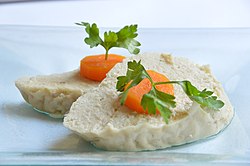
Gefilte fish topped with thin slices of carrot
CourseHors d'oeuvre
Region or stateCentral and Eastern Europe, United States, Israel, Argentina
Created byAshkenazi Jewish communities
Main ingredientsGround fish, matzo meal (sometimes), eggs (sometimes)
  •   Media: Gefilte fish

Gefilte fish (/ɡəˈfɪltə fɪʃ/; from Yiddish: געפֿילטע פֿיש, German: Gefüllter Fisch / Gefüllte Fische, lit. "stuffed fish") is a dish made from a poached mixture of ground deboned fish, such as carp, whitefish, or pike. It is traditionally served as an appetizer by Ashkenazi Jewish households. Popular on Shabbat and Jewish holidays such as Passover, it may be consumed throughout the year. It is typically garnished with a slice of cooked carrot on top.

Historically, gefilte fish was a stuffed whole fish consisting of minced-fish forcemeat stuffed inside the intact fish skin. By the 16th century, cooks had started omitting the labor-intensive stuffing step, and the seasoned fish was most commonly formed into patties similar to quenelles or fish balls.[1]

In Poland, gefilte fish is referred to as karp po żydowsku ("carp Jewish-style").[2]

Origins

[edit]

Gefilte fish likely originated in non-Jewish, German cooking. The earliest historical reference to gefuelten hechden (stuffed pikes) comes from Daz Buoch von Guoter Spise (The Book of Good Food), a Middle High German cookbook dating to circa 1350 CE. Gefuelten hechden consisted of poached and mashed pike that was flavored with herbs and seeds, stuffed back inside the fish skin, and then roasted. This dish was popular with German Catholics during Lent, when it is forbidden to eat meat. By the Middle Ages, stuffed fish had migrated into the cuisine of German and Eastern European Jews.[3][4][5]

Preparation and serving

[edit]
Gefilte fish: whole stuffed and garnished fish with eggs

Gefilte fish was traditionally cooked inside the intact skin of a fish,[6] forming a loaf which is then sliced into portions before serving. More commonly, it is now most often cooked and served as oval patties, like quenelles. In the United Kingdom, gefilte fish is commonly fried.[7] Gefilte fish is typically garnished with a slice of carrot on top, and a horseradish mixture called chrain on the side.

To make the modernized "gefilte fish" fish balls, fish fillets are ground and mixed with eggs (some recipes exclude eggs), breadcrumbs or matza crumbs, spices, salt, onions, carrots, and sometimes potatoes, to produce a paste or dough which is then simmered in fish stock.[8]

Carp, pike, mullet, or whitefish are commonly used to make gefilte fish; more recently, Nile perch and salmon are also used, with gefilte fish made from salmon having a slightly pink hue.[9] Catfish is not used, however, because it is not kosher.[10]

Sweet and savory versions

[edit]

Gefilte fish may be slightly sweet or savory. Different preparations and taste preferences may be a proxy for reflecting Ashkenazi Jews' specific ancestral origins in Europe. The preference for sweet gefilte with sugar was popular among Galician Jews from central Europe, while gefilte fish with black pepper was preferred by the more northern Litvak Jews. The boundary separating the two camps was dubbed "the Gefilte Fish Line" by Yiddish linguist Marvin Herzog in the mid-1960s.[11][12]

Sweet gefilte fish with sugar in Galicia can be traced to the turn of the 19th century, when the first sugar beet factory opened in southern Poland. The sugar industry, which involved many Jews, grew rapidly, and sugar was included in many foods in the region. Culinary historian Gil Marks quipped that, '"Other Jews had savory noodle kugels. You didn't have sweet challah. The idea of putting sugar into anything else was absurd." But Polish Jews began to put sugar into all of these dishes. Previously peppery kugels. The now-sweet-and-sour stuffed cabbage. And gefilte fish.'[12]

Ready-to-serve

[edit]
Jars of gefilte fish in Israel

The late 1930s brought a brand named Mother's from "Sidney Leibner, the son of a fish store owner."[6] This ready-to-serve fish was followed by "Manischewitz, Mrs. Adler’s, Rokeach and others."

The post-WWII method of making gefilte fish commercially takes the form of patties or balls, or utilizes a wax paper casing around a "log" of ground fish, which is then poached or baked. This product is sold in cans and glass jars, and packed in jelly made from fish broth, or the fish broth itself. The sodium content is relatively high at 220–290 mg/serving. Low-salt, low-carbohydrate, low-cholesterol, and sugar-free varieties are available. The patent for this jelly, which allowed mass-market distribution of gefilte fish, was granted on October 29, 1963, to Monroe Nash and Erich G. Freudenstein.[13]

Gefilte fish has been described as "an acquired taste".[14]

Grocery stores also sell frozen "logs" of gefilte fish.[6]

Religious customs and considerations

[edit]

Jewish

[edit]

Among religiously observant Jews, gefilte fish has become a traditional Shabbat food to avoid borer, which is one of the 39 activities prohibited on Shabbat outlined in the Shulchan Aruch. Borer, literally "selection/choosing", would occur when one picks the bones out of the fish, taking "the chaff from within the food".[15]

A less common belief is that fish are not subject to ayin ra'a ("evil eye") because they are submerged while alive, so that a dish prepared from several fish varieties brings good luck. Moreover, because submersion in the water protects the fish from the evil eye, in the Middle East, fish "became popular for amulets and miscellaneous good luck charms. In Eastern Europe, it even became a name, Fishel, an optimistic reflection that the boy would be lucky and protected."[16]

Gefilte fish is often eaten on the Sabbath. However, on Sabbath, separating bones from meat, as well as cooking, are forbidden by rabbinical law. So usually, the dish is prepared the day before and served cold or at room temperature.[16] With gefilte fish being a Sabbath dinner staple, and the commandment in Genesis for fish to be "fruitful and multiply, and fill the waters in the seas",[16] fish at Sabbath meals took on the patina of an aphrodisiac, the sages believing that "the intoxicating [fish] odor on the Sabbath table would encourage couples to 'be fruitful and multiply'—which in Jewish tradition is encouraged on Friday night."[17] Moreover, dag, the Hebrew word for fish, has the numerical value of seven, the day of the Sabbath, further underscoring the serving of fish on that day.[17] However, since Jewish law forbids the separating of the flesh of fish from its bones,[15] pre-made fish cakes such as gefilte fish obviate the need to perform such separation, thus making a preparation such as gefilte fish a regular Sabbath staple, and the perfect vehicle for the requisite fish aphrodisiac.[16][17]

Catholic

[edit]

In some Polish Catholic homes (more commonly in the northern regions near the Baltic Sea), gefilte fish (Polish: karp po żydowsku, lit.'Jewish-style carp') is eaten on Christmas Eve (for twelve-dish supper) and Holy Saturday, as these are traditionally meatless feasts.[2]

See also

[edit]

References

[edit]
[edit]
Revisions and contributorsEdit on WikipediaRead on Wikipedia
from Grokipedia
Gefilte fish is a poached or ball made from ground, deboned such as , whitefish, or pike, combined with eggs, matzo meal or breadcrumbs, finely chopped onions, s, and seasonings like salt, pepper, and sometimes sugar. Traditionally associated with , it originated as a way to stuff the seasoned mixture back into the fish skin before cooking, earning its Yiddish name meaning "stuffed fish," though modern versions are typically formed into loose shapes and simmered in a flavorful . It is most commonly served chilled as an appetizer during and , often garnished with a slice of and accompanied by () for added pungency. The dish's history traces back to medieval , with the earliest known reference appearing in a 14th-century German cookbook as "gefuelten hechden," or stuffed pike, initially as a non-Jewish preparation that later adapted into Jewish culinary traditions. By the , it had become a staple in Ashkenazi communities, evolving from whole stuffed to ground patties due to practical needs like stretching limited supplies for larger families and complying with Jewish laws prohibiting the removal of bones on the . Over time, gefilte transitioned from a labor-intensive homemade food to commercially available forms, such as jarred versions in jellied broth or frozen logs, making it more accessible while preserving its role in festive meals. Preparation involves deboning and grinding the , mixing it with binders and aromatics, shaping it into ovals or balls, and gently them in a made from fish heads, bones, onions, carrots, and sometimes beets for color. Regional variations highlight its cultural depth: in Lithuanian and Polish-Lithuanian communities, it is typically savory with , while Galician and Ukrainian Jews prefer a sweeter version incorporating , a divide humorously termed the "Gefilte Fish Line" that reflects broader Ashkenazi migration patterns and identity markers. These differences persist today, influencing family recipes and debates over authenticity. Beyond its culinary form, gefilte fish holds symbolic importance in Jewish observance, embodying resourcefulness and ritual enjoyment—known as oneg —while its fish base connects to biblical imagery of and the messianic feast. Despite occasional stereotypes portraying it as unappealing, it remains a cherished emblem of Ashkenazi heritage, evoking and continuity across generations.

History and Origins

Etymology and Early References

The term "gefilte fish" derives from the phrase gefulte fisch, literally meaning "stuffed ," which reflects the original preparation method of deboning the fish, grinding its flesh with seasonings, and stuffing the mixture back into the emptied skins before cooking. This nomenclature emphasizes the dish's foundational technique of filling or , distinguishing it from simply poached or whole fish preparations. The linguistic roots trace back to gefüllet, the past participle of vüllen meaning "to fill" or "stuff," which evolved into the Ashkenazi form gefilte through cultural and linguistic exchange in medieval . This adaptation occurred as incorporated German elements, transforming gefüllet into a term specific to fish-based dishes while retaining its core connotation of . The earliest known reference to such a preparation appears in the 14th-century cookbook Daz Buoch von guoter spise (The Book of Good Food), dated around 1350, which includes a for gefuelten hechden—stuffed pike—describing the process of the fish, removing the flesh from the bones, pounding it with eggs, sugar, and salt into a paste, restuffing the skins, and roasting them on a spit. This non-Jewish recipe highlights an early European culinary practice unrelated to religious dietary laws. Initially popular among medieval German Catholics, the stuffed dish served as a valued meatless protein during , when abstinence from animal flesh was required, often utilizing abundant freshwater species like pike and for their firm texture suitable for stuffing and cooking.

Development in

Gefilte fish was adopted by in medieval during the , where it transitioned from a broader European preparation of stuffed pike into a practical dish suited to Jewish socioeconomic conditions. Facing and restrictions on resource use, Jewish communities utilized cheaper cuts of , such as pike, by grinding the flesh and extending it with inexpensive fillers like breadcrumbs or matzo meal to feed entire families during meals. This adaptation allowed limited portions of relatively expensive to be stretched, making it a viable option for observant households in resource-scarce environments. Similar stuffed dishes appeared in medieval French cookbooks, contributing to the technique's dissemination across before its refinement in Ashkenazi communities. By the , the preparation evolved from whole stuffed fish to ground patties or balls, a change that further accommodated religious observance by eliminating bones in advance and complying with the prohibition against borer—the act of selecting or separating, such as removing bones from cooked . This shift simplified preparation for women in busy households, as the pre-ground form could be cooked before the and served without additional work, easing the demands on observant families in and later . The innovation reflected both practical necessity and halakhic considerations, solidifying gefilte as a staple for and holidays. Jewish involvement in the Eastern European fish significantly enhanced the dish's accessibility, particularly through managing fish ponds and live transport systems from the medieval period onward. These communities made —an affordable, scalable already present in the region—widely available for gefilte fish production in regions like the Polish shtetls and Lithuanian villages. This economic niche not only supported Jewish livelihoods but also integrated as a preferred , transforming the dish into a regional mainstay. Originally viewed as a "poor man's food" due to its origins in economic hardship, gefilte fish gained cultural elevation in 19th-century Eastern European shtetls through shared communal recipes passed down among women in tight-knit Jewish communities. These recipes, refined over generations in places like Poland and , turned a humble necessity into a symbol of resilience and tradition, often prepared collectively for holidays to foster social bonds. Despite its modest beginnings, the dish's adaptability and role in observance elevated it to a cherished element of Ashkenazi identity.

Preparation and Ingredients

Traditional Components

Gefilte fish traditionally relies on a of deboned , primarily for its rich fat content that adds moisture and tenderness, pike for its firm texture that helps the mixture hold shape, and whitefish for its mild, delicate flavor that balances the overall profile; these are typically ground together in equal proportions to create a cohesive base. Binders and extenders play a crucial role in achieving the desired consistency, with eggs providing cohesion by binding the ground fish particles during cooking, matzo meal absorbing excess moisture to add bulk and prevent crumbling, and grated onions contributing both moisture to keep the mixture tender and a subtle natural sweetness that enhances savoriness. Seasonings are kept simple to highlight the fish's natural taste, incorporating salt and for basic flavor enhancement, and occasionally a small amount of for mild balancing without overpowering the dish; additionally, the fish heads, bones, and skins are simmered to produce a gelatinous that not only cooks the quenelles but also imparts a rich, collagen-thickened essential for the final jelled texture. In classic recipes, proportions are scaled for practicality, with approximately 2-3 pounds of the combined fish mixture—along with 2-3 eggs, ½ to ¾ cup matzo meal, and 1-2 grated onions—yielding 12-15 quenelles, while the stock is reduced through simmering to concentrate its gelling properties.

Cooking Techniques

The preparation of gefilte fish begins with filleting the fish, typically carp, pike, or whitefish, and reserving the bones, heads, and skin for later use in the poaching liquid. The fillets are then ground, traditionally using a manual hand-cranked grinder clamped to a table in pre-electric eras to ensure thorough processing and removal of any bone fragments for religious purity. In modern practice, a food processor or electric meat grinder is employed to finely grind the fish, often incorporating onions, carrots, and celery in the mixture for added flavor and texture. This grinding step creates a smooth forcemeat base, essential for the dish's characteristic consistency. The ground fish is next combined with binders and seasonings to form the . Eggs are beaten and mixed in to provide structure and moisture, while matzo meal or bread crumbs act as a filler to absorb liquids and help the hold together. Seasonings such as salt, pepper, and sometimes are added by hand, along with a small amount of or oil to achieve a soft, workable that can be easily shaped. The is kneaded thoroughly until uniform, then portioned and formed into ovals, balls, or patties, typically 2-3 inches in size, to facilitate even cooking. This shaping process allows for portion control and aesthetic presentation once cooked. Poaching follows, a method developed for compliance as it requires no further handling or cutting of the during the meal. The reserved fish trimmings are placed in a large pot with sliced onions, carrots, , peppercorns, salt, and enough to cover by about 2 inches, creating a that infuses the with flavor. The liquid is brought to a and simmered for 20-30 minutes to develop the , after which the shaped is gently added to avoid breaking the pieces. The pot is covered and simmered at low heat for 1 to 2 hours, until the is tender and the exterior forms a delicate, gelatinous coating from the natural proteins in the stock. This slow ensures the cooks evenly without disintegrating. Once cooked, the gefilte fish is allowed to cool in the liquid to absorb flavors and promote setting. The pieces are carefully removed and the is strained, then both are refrigerated overnight, during which the from the fish bones firms up the exterior into a jellied layer. Prior to serving, the fish is sliced if formed as a and garnished with rounds of cooked carrots from the for visual appeal. This cooling and setting step is crucial for the dish's texture, transforming the soft into a cohesive, sliceable form.

Variations and Regional Styles

Sweet and Savory Divide

One of the most prominent distinctions in gefilte fish preparation arises from the divide between and savory versions, a culinary deeply rooted in the geographic and cultural landscapes of Ashkenazi Jewish communities in . The savory variant, characterized by the absence of added sugar, is characteristic of northeastern Ashkenazi regions such as () and earlier western traditions like , where flavor profiles rely heavily on ingredients like onions and to enhance the natural taste of the fish. This style gained particular favor among , Jews from and surrounding areas, who viewed the peppery, umami-forward approach as a hallmark of their . Conversely, the sweet version predominates in the cuisines of Polish and Ukrainian , where 1-2 tablespoons of per pound of fish are typically incorporated to temper the inherent fishiness and create a more balanced, mildly caramelized profile. Known as the preference of Polaks, this adaptation not only reflects local taste sensibilities but also practical considerations, such as the relative abundance of affordable in these areas during the . The addition of serves to mellow the dish's intensity, making it a comforting staple in holiday meals. This flavor dichotomy is vividly illustrated by the "Gefilte Fish Line," an informal cultural boundary tracing a north-south path from in the west to the in the east, roughly 40 miles east of . The line delineates regions where sweet gefilte fish prevailed to the west—due to greater access to via trade routes—and savory preparations to the east, influenced by migration patterns and economic factors in the 1800s that limited 's widespread use. Historians note that this divide mirrors broader dialect variations and communal identities within Ashkenazi Jewry. In contemporary settings, the sweet-savory preference often sparks lively family debates and taste tests, functioning as a subtle yet poignant marker of ancestral origins and . These discussions, passed down through generations, underscore how gefilte fish transcends mere to embody personal and heritage, with individuals proudly aligning with their forebears' culinary allegiance.

Other Regional Adaptations

In Eastern European Jewish communities, particularly in Russian and Belarusian traditions, gefilte fish is commonly prepared as flat or oval patties poached in a rich made from fish bones and . These patties often feature a mix of ground including mullet or alongside for a balanced texture and flavor. American Jewish adaptations of gefilte fish, which developed during waves of Eastern European in the early , shifted toward larger loaves or molded forms that are baked rather than poached. These versions frequently incorporate abundant local whitefish from the , reflecting the availability of freshwater species in the Midwest and Northeast . In , gefilte fish has been reimagined in lighter forms since the mid-20th century, often using or to suit Mediterranean tastes and local fisheries. A popular variation includes frying the mixture into cutlets, blending Ashkenazi roots with Middle Eastern culinary techniques for a crisp exterior. In some Eastern European Jewish communities, particularly in (encompassing parts of modern , , and ), gefilte fish often includes for a more aromatic profile.

Cultural and Religious Role

Jewish Traditions and Symbolism

Gefilte fish holds a central place in Jewish observance, traditionally served as the opening appetizer after the to comply with halakhic restrictions. Preparing the by grinding and deboning it in advance eliminates the need to separate bones from during the meal, which would violate the prohibition of borer—one of the 39 forbidden labors on the that involves selecting edible items from non-edible ones. This practice allows families to enjoy , a customary delicacy symbolizing abundance and delight, without transgressing rabbinic laws, and it is typically consumed cold since cooking is also prohibited. The dish is prominently featured in major , peaking in consumption during these periods despite its year-round availability. At seders, gefilte fish is kitniyot-free—lacking legumes or grains forbidden to —making it an ideal starter that aligns with the holiday's dietary rules while providing a light, festive course. For , variations may include fish heads or head-shaped portions to evoke the "let us be a head and not a tail," symbolizing leadership and prosperity in the new year. In , gefilte fish draws from broader motifs of as emblems of , , and messianic anticipation, underscoring resilience amid adversity. multiply prolifically, representing blessings of abundant and divine favor as described in Genesis. Their constant immersion in water parallels scholars immersed in study, with scales evoking the protective layers and the black-on-white contrast of sacred texts, essential for spiritual integrity. The rabbis considered to symbolize the coming of the . Customarily presented chilled with grated (chrein), which mirrors the bitterness of marror to recall enslavement and liberation, gefilte fish often incorporates cherished family recipes that foster nostalgia and intergenerational continuity.

Non-Jewish Influences and Uses

Gefilte fish traces its origins to medieval , where it emerged as a stuffed fish preparation known as gefuelten hechden (stuffed pike), first documented in a 14th-century non-Jewish . This dish gained popularity among Catholics during , when meat consumption was prohibited on Fridays, providing a protein-rich alternative that involved deboning and stuffing with seasoned fillings. In regions like the , where Jewish and Christian communities coexisted and shared markets, this Catholic preparation influenced early Ashkenazi Jewish adaptations, evolving into a poached patty to align with kosher laws while retaining the core technique of grinding and reforming meat. In post-World War II , gefilte saw limited adoption in non-Jewish contexts, occasionally featured in interfaith meals or as part of fusion dishes like the Polish karp po żydowsku (Jewish-style ), a version consumed by Catholic families on and . Today, elements of the dish persist in some Central European recipes, though rarely under the name "gefilte fish," with minimal standalone significance outside niche holiday preparations.

Modern Forms and Innovations

Commercial and Ready-to-Eat Products

The commercialization of gefilte fish began in the United States in the late 1930s, when Sidney Leibner founded Mother's Fish Products and started producing ready-made versions to simplify preparation for Jewish families. Ungar's Gefilte Fish, originally established earlier, was acquired in the early 1990s by surgeons Peter Praeger and Eric Somberg, who expanded its offerings before pivoting the company toward broader sensible foods. By 1954, had opened its first dedicated factory, employing mechanized grinding of fish like , whitefish, and pike, along with processes that achieved shelf-stability for up to several months, making it ideal for holiday stocking. Jarred gefilte fish is commonly sold in twist-off jars containing 5 to 7 oval patties immersed in a jellied derived from poaching liquid, with varieties offering sweet (sugar-added) or savory (pepper-forward) profiles to reflect Ashkenazi regional divides. Products often include or suggest serving with slices for garnish, and they bear kosher from bodies like the to ensure compliance with dietary laws, with demand peaking in the pre-Passover period as families prepare for Seders. Post-1950s market growth saw brands like Rokeach join Mother's and , expanding distribution through supermarkets to serve communities amid and . Nutritional profiles, mandated by labeling regulations since the 1990s, highlight high protein yields—approximately 9 grams per 100 grams from the fish base—while noting elevated sodium content, often around 524 mg per 100 grams, prompting advisories for moderation in diets. The availability of these ready-to-eat products enabled working-class Jewish households to uphold holiday traditions without the time-consuming manual grinding and , fostering broader cultural continuity; as of 2017, annual U.S. sales were about 1.2 million jars, with reported annual declines of 2% in the 2010s reflecting shifting consumer preferences. Despite concerns over declining sales, online orders for gefilte fish surged more than 1,300% during 2025 compared to the previous year, indicating sustained holiday demand.

Contemporary Recipes and Adaptations

In the , vegetarian and vegan adaptations of gefilte fish have emerged to accommodate dietary restrictions and promote inclusivity at events like seders, with recipes dating back to the early that substitute fish with plant-based ingredients such as mushrooms, carrots, , onions, and . These versions often rely on binders like matzo meal or gluten-free alternatives to form patties or loaves, mimicking the texture while providing a low-fat, protein-rich option. For instance, one popular recipe incorporates and pulsed into a with and herbs for flavor, appealing to those seeking meat-free holiday dishes. Gourmet reinterpretations by chefs have elevated gefilte fish through innovative preparations, including herbed baked loaves and accompaniments like carrot-citrus relish and sweet beet , as developed by Jeffrey Yoskowitz and Liz Alpern of The Gefilteria in . Their approach, detailed in their 2016 cookbook The Gefilte Manifesto, emphasizes fresh, high-quality ingredients for upscale dining, transforming the dish from a traditional starter into a refined appetizer served at modern Jewish events. Fried versions, pan-seared for a crispy exterior, and smoked variations using sustainable whitefish have also appeared in contemporary culinary scenes, often incorporating citrus zests or beets for added vibrancy and depth. Health-focused modifications address common concerns by reducing sodium and eliminating , with recipes substituting matzo meal with flour or other grain-free binders to create accessible options for those with dietary needs. Low-sodium preparations, such as those poached in unsalted , maintain flavor through herbs and fresh while supporting heart-healthy eating. Additionally, sustainable sourcing of whitefish or has become a priority in these recipes to mitigate impacts on like and pike traditionally used, aligning with broader conservation efforts promoted by organizations like the . Global fusion adaptations, appearing in 2020s cookbooks and online collections, blend gefilte fish with international flavors to attract younger audiences and counter declining interest in classics, such as Asian-inspired glazes using ginger and soy for a twist or Mexican-influenced versions with mild chilies and lime. These creative takes, often shared by culinary sites like Jamie Geller's platform, experiment with liquids infused with global spices while preserving the poached patty structure, revitalizing the dish for diverse palates.

References

Add your contribution
Related Hubs
Contribute something
User Avatar
No comments yet.