Hubbry Logo
Yellow SeaYellow SeaMain
Open search
Yellow Sea
Community hub
Yellow Sea
logo
8 pages, 0 posts
0 subscribers
Be the first to start a discussion here.
Yellow Sea
Yellow Sea
from Wikipedia

Key Information

Yellow Sea
The yellow sea between Qingdao and South Korea
Chinese name
Simplified Chinese
Traditional Chinese
Literal meaningYellow Sea
Transcriptions
Standard Mandarin
Hanyu PinyinHuáng Hǎi
Wu
RomanizationWaon Hae
Yue: Cantonese
JyutpingWong4 Hoi2
Korean name
Hangul황해 or 서해
Hanja or 西
Literal meaningYellow Sea or West Sea
Transcriptions
Revised RomanizationHwanghae or Seohae
McCune–ReischauerHwanghae or Sŏhae

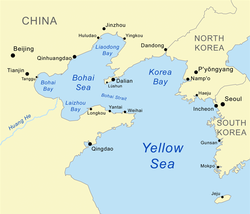
The Yellow Sea (simplified Chinese: 黄海; traditional Chinese: 黃海; pinyin: Huáng Hǎi; Korean황해; Hanja黃海; RRHwanghae), also known as the North Sea, is a marginal sea of the Western Pacific Ocean located between mainland China and the Korean Peninsula, and can be considered the northwestern part of the East China Sea.

Names

[edit]

It is one of four seas named after color terms (the others being the Black Sea, the Red Sea and the White Sea), and its name is descriptive of the golden-yellow color of the silt-ridden water discharged from major rivers.

The innermost bay of northwestern Yellow Sea is called the Bohai Sea (previously Gulf of Zhili / Beizhili), into which flow some of the most important rivers of northern China, such as the Yellow River (through Shandong province and its capital Jinan), the Hai River (through Beijing and Tianjin) and the Liao River (through Liaoning province). The northeastern extension of the Yellow Sea is called the Korea Bay, into which flow the Yalu River, the Chongchon River and the Taedong River.

Geography

[edit]

Extent

[edit]

The International Hydrographic Organization defines the limits of the Yellow Sea ("Hwang Hai") as follows:[1]

The Yellow Sea is separated from the Sea of Japan by the boundary from the southern end of Haenam Peninsula in Jeollanamdo to Jeju Island and divided into the East China Sea by the boundary from the west end of Jeju Island to the Yangtze River estuary.

Physiography

[edit]
Brown sediment spills out into the Yellow Sea from rivers in eastern China and Korea. The nutrients in the sediment may be responsible for the bloom of phytoplankton seen as blue-green swirls.[2]

The Yellow Sea, excluding the Bohai, extends by about 960 km (600 mi) from north to south and about 700 km (430 mi) from east to west; it has an area of approximately 380,000 km2 (150,000 sq mi) and a volume of about 17,000 km3 (4,100 cu mi).[3] Its depth is only 44 m (144 ft) on average, with a maximum of 152 m (499 ft). The sea is a flooded section of continental shelf that formed after the last glacial period (some 10,000 years ago) as sea levels rose 120 m (390 ft) to their current levels. The depth gradually increases from north to south.[3] The sea bottom and shores are dominated by sand and silt brought by the rivers through the Bohai Sea (Liao River, Yellow River, Hai He) and the Korea Bay (Yalu River). These deposits, together with sand storms are responsible for the yellowish colour of the water referenced in the sea's name.[4] The sea annually receives so much sand and silt from rivers such as the Yellow River, that it turns into a golden-yellow colour.[5][6]

Waves crashing at Jeju Island

The seas surrounding Korea, which occupy a corner of Northeast Asia, border the "island nation" from the east, south, and west. Korea has named these the East Sea, South Sea, and West Sea (officially known as the Yellow Sea), respectively.[7]

Major islands of the sea include Anmado, Baengnyeongdo, Daebudo, Deokjeokdo, Gageodo, Ganghwado, Hauido, Heuksando, Hongdo, Jejudo, Jindo, Muuido, Sido, Silmido, Sindo, Wando, Yeongjongdo and Yeonpyeongdo (all in South Korea).

Climate and hydrology

[edit]
Satellite image of a dust storm over the Yellow sea on 2 March 2008[8]

The area has cold, dry winters with strong northernly monsoons blowing from late November to March. Average January temperatures are −10 °C (14 °F) in the north and 3 °C (37 °F) in the south. Summers are wet and warm with frequent typhoons between June and October.[3] Air temperatures range between 10 and 28 °C (50 and 82 °F). The average annual precipitation increases from about 500 mm (20 in) in the north to 1,000 mm (39 in) in the south. Fog is frequent along the coasts, especially in the upwelling cold-water areas.[4]

The sea has a warm cyclone current, forming part of the Kuroshio Current, which diverges near the western part of Japan and flows northward into the Yellow Sea at a speed of less than 0.8 km/h (0.50 mph). Southward currents prevail near the sea coast, especially in the winter monsoon period.[4]

Rocky shore in Dalian, Liaoning, China

The water temperature is close to freezing in the northern part in winter, so drift ice patches and continuous ice fields form and hinder navigation between November and March. The water temperature and salinity are homogeneous across the depth. The southern waters are warmer at 6–8 °C (43–46 °F). In spring and summer, the upper layer is warmed up by the sun and diluted by the fresh water from rivers, while the deeper water remains cold and saline. This deep water stagnates and slowly moves south. Commercial bottom-dwelling fishes are found around this mass of water, especially at its southern part. Summer temperatures range between 22 and 28 °C (72 and 82 °F). The average salinity is relatively low, at 30 in the north to 33–34‰ in the south, dropping to 26‰ or lower near the river deltas. In the southwest monsoon season (June to August) the increased rainfall and runoff further reduce the salinity of the upper sea layer.[4] Water transparency increases from about 10 meters (33 ft) in the north up to 45 meters (148 ft) in the south.[3]

Tides are semidiurnal, i.e. rise twice a day. Their amplitude varies between about 0.9 and 3 meters (3.0 and 9.8 ft) at the coast of China. Tides are higher at the Korean Peninsula, typically ranging between 4 and 8 meters (13 and 26 ft) and reaching the maximum in spring. The tidal system rotates in a counterclockwise direction. The speed of the tidal current is generally less than 1.6 km/h (0.99 mph) in the middle of the sea, but may increase to more than 5.6 km/h (3.5 mph) near the coasts.[4] The fastest tides reaching 20 km/h (12 mph) occur in the Myeongnyang Strait between Jindo Island and the Korean Peninsula.[9]

The tide-related sea level variations result in a land pass 2.9 km (1.8 mi) long and 10–40 meters (33–131 ft) wide opening for approximately an hour between Jindo and Modo islands. The event occurs about twice a year, at the beginning of May and in the middle of June. It had long been celebrated in a local festival called "Jindo Sea Parting Festival", but was largely unknown to the outside world until 1975, when the French ambassador Pierre Randi described the phenomenon in a French newspaper.[10][11][12]

Flora and fauna

[edit]
Migration paths and resting grounds of bar-tailed godwit at the Yellow Sea.[13]

The sea is rich in seaweed (predominantly kelp, Laminaria japonica), cephalopods, crustaceans, shellfish, clams, and especially in blue-green algae which bloom in summer and contribute to the water color (see image above). For example, the seaweed production in the area was as high as 1.5 million tonnes in 1979 for China alone. The abundance of all these plant and animal species increases toward the south and indicates a high sea productivity, accounting for the diversity of fish species and high fish yield from the sea.[14] Several species of goby new to science have been discovered recently[when?] in the Yellow Sea.[15]

The southern part of the Yellow Sea, including the entire west coast of Korea, contains a 10 km-wide (6.2 mi) belt of intertidal mudflats, which has the total area of 2,850 km2 (1,100 sq mi) and is maintained by 4–10 m (13–33 ft). Those flats consist of highly productive sediments with a rich benthic fauna and are of great importance for migratory waders and shorebirds.[16] Surveys show that the area is the single most important site for migratory birds on northward migration in the entire East Asian – Australasian Flyway, with more than 35 species occurring in internationally significant numbers. Two million birds, at minimum, pass through at the time, and about half that number use it on southward migration.[17][18] About 300,000 migrating birds were transiting annually only through the Saemangeum tidal flat area. This estuary was however dammed by South Korea in 1991–2006 that resulted in drying off the land.[19] Land reclamation also took 65% of the intertidal area (of China, North Korea and South Korea) between the 1950s and 2002,[20] and as of 2005 there were plans to reclaim a further 45%.[21]

Populations of oceanic megafauna, such as marine mammals, sea turtles, and larger fish, have decreased in modern times, not only due to pollution but also due to hunting. Japanese industrial whaling[22] and illegal mass operations by the Soviet Union with support from Japan[23] have been major drivers of population decline. Species that reside in the area today include spotted seals, and cetaceans such as minke whales, killer whales,[24] false killer whales, and finless porpoises, but nonetheless all the remnants of species listed could be in very small numbers. Historically, large whales were abundant either for summering and wintering in the Yellow and Bohai Seas. For example, a unique population of resident fin whales and gray whales[25] were historically presented,[26] or possibly hosted some North Pacific right whales[27][28] and Humpback whales (3 whales including a cow calf pair was observed at Changhai County in 2015[29][30]) year-round other than migrating individuals, and many other migratory species such as Baird's beaked whales.[31] Even blue whales, Japanese sea lions, dugongs (in southern regions only),[32] and leatherback turtles used to breed or migrate into Yellow and Bohai seas.[33]

Spotted seals are the only resident species of seal in the Yellow Sea. A sanctuary for these seals is situated at Baengnyeongdo, which is also known for its finless porpoises.[34] Great white sharks have also been known to prey on seals in the area.[35]

Economy

[edit]
A map of population density around the Yellow Sea in East Asia (1994)[36]

The coasts of the Yellow Sea are very densely populated, at approximately 250 inhabitants per square kilometer (650/sq mi).[36] The sea waters had been used for fishing by the Chinese, Korean and Japanese ships for centuries. The bottom layers are especially rich in fish with about 200 fish species exploited commercially, especially sea bream, croakers, lizard fishes, prawns, cutlassfish, horse mackerel, squid, eel, filefish, Pacific herring, chub mackerel, flounder[37] and jellyfish.[38] The intensity of fishing has been gradually increasing for China and Korea and decreasing for Japan. For example, the production volumes for China rose from 619,000 tonnes in 1985 to 1,984,400 tonnes in 1996.[39] All species are overfished, however, and while the total catchments are rising, the fish population is continuously declining for most species.[4][40]

Navigation is another traditional activity in the Yellow Sea. The main Chinese ports are Dalian, Tianjin, Yantai, Qingdao, Tangshan and Qinhuangdao. The major South Korean ports on the Yellow Sea are Incheon, Gunsan and Mokpo, and that for North Korea is Nampho, the outport of Pyongyang. The Bohai Train Ferry provides a shortcut between the Liaodong Peninsula and Shandong.[4] A major naval accident occurred on 24 November 1999 at Yantai, Shandong, China when the 9,000-ton Chinese ferry Dashun caught fire and capsized in rough seas. About 300 people were killed, making it the worst maritime incident in China.[41]

Oil exploration has been successful in the Chinese and North Korean portions of the sea, with the proven and estimated reserves of about 9 and 20 billion tonnes, respectively.[42] However, the study and exploration of the sea is somewhat hindered by insufficient sharing of information between the involved countries. China initiated collaborations with foreign oil companies in 1979, but this initiative declined later.[4]

A major oil spill occurred on 16 July 2010 when a pipeline exploded at the north-east port of Dalian, causing a wide-scale fire and spreading about 1,500 tonnes of oil over the sea area of 430 km2 (170 sq mi). The port had been closed and fishing suspended until the end of August. Eight hundred fishing boats and 40 specialized vessels were mobilized to relieve the environmental damage.[43]

State of the environment

[edit]
Envisat image, 2006

The Yellow Sea is considered among the most degraded marine areas on earth.[44] Loss of natural coastal habitats due to land reclamation has resulted in the destruction of more than 60% of tidal wetlands around the Yellow Sea coastline in approximately 50 years.[20] Rapid coastal development for agriculture, aquaculture and industrial development are considered the primary drivers of coastal destruction in the region.[20] This degree of loss of area, widespread pollution, algal blooms and declines of invertebrate and vertebrate fauna have resulted in the classification of this ecosystem as endangered.[45]

In addition to land reclamation, the Yellow Sea ecosystem is facing several other serious environmental problems. Pollution is widespread[46] and deterioration of pelagic and benthic habitat quality has occurred, and harmful algal blooms frequently occur.[47] Invasion of introduced species are having a detrimental effect on the Yellow Sea environment. There are 25 intentionally introduced species and 9 unintentionally introduced species in the Yellow Sea Large Marine Ecosystem.[44] Declines of biodiversity, fisheries and ecosystem services in the Yellow Sea are widespread.[44]

The tidal flats of the Yellow Sea are considered endangered.[45]

Location of Korean Peace Zones

[edit]

On 1 November 2018, officials from South Korea's Ministry of National Defense confirmed that "peace zones" had been established by the North and South Korean militaries in the Yellow Sea area that touches the North and South Korean demarcation line.[48] A buffer zone was also created in the Yellow Sea's Northern Limit Line (NLL).[citation needed]

See also

[edit]

References

[edit]

Bibliography

[edit]
Revisions and contributorsEdit on WikipediaRead on Wikipedia
from Grokipedia
The Yellow Sea is a shallow, epi-continental marginal sea of the western , bounded by the Chinese mainland to the west and north and the Korean Peninsula to the east, connecting southward to the and southeastward to the Sea of Japan via the . Its area spans approximately 380,000 square kilometers, with an average depth of 44 meters and a maximum depth of around 100 meters near certain islands. The sea's name originates from the yellowish hue of its waters, resulting from massive sediment inputs—primarily fine sands, silts, and muds—discharged by major rivers like the (Huang He), which contribute over 1 billion tons of material annually, rendering the central basin a depositional zone for these particles. This nutrient-rich environment supports one of the world's most productive marine ecosystems, fostering diverse fisheries that yield millions of tons of annually, including finfish, crustaceans, and mollusks, though has led to declining stocks and shifts in community structure since the late . The Yellow Sea serves as a critical migratory corridor for shorebirds and a for marine mammals, with its extensive tidal flats—now rapidly eroding due to reclamation and sea-level rise—historically buffering coastal populations exceeding 600 million in the surrounding catchment. Geopolitically, the region features unresolved maritime boundaries, exemplified by disputes over the Provisional Maritime Zone between and , where Chinese installations for fisheries and resource extraction have prompted standoffs and accusations of territorial encroachment, compounded by illegal and activities amid broader Sino-Korean tensions. These frictions underscore the sea's strategic value for trade routes, energy exploration, and , with empirical data indicating heightened naval patrols and gray-zone operations rather than overt conflict.

Names and Etymology

Historical and Linguistic Origins

The designation "Yellow Sea" derives from the yellowish-brown hue of its waters, caused by vast quantities of and discharged primarily from the (Huang He), which annually transports over 1 billion tons of yellow soil from the Chinese Loess Plateau into the and thence the Yellow Sea proper. This coloration, observable in historical records and , reflects the sea's shallow —averaging 44 meters depth—which allows suspended particles to tint surface waters rather than settle quickly. Linguistically, the name is a direct English translation of the Chinese Huánghǎi (黄海), where huáng denotes "" and hǎi means "," a term rooted in nomenclature tied to directional colors in traditional cosmology, with yellow associated with the center and . Equivalent designations appear in Korean as Hwanghae (황해) and in Japanese as Kii-kai (黄海), reflecting shared Sino-centric linguistic influences from ancient East Asian maritime interactions, though no distinct pre-Han Dynasty (before 221 BCE) names for the sea as a unified body are attested in surviving texts, which instead referenced coastal gulfs or river mouths. The etymology underscores empirical observation over mythic origins, as the sediment load—quantified at 1.6 billion tons annually from multiple rivers including the —has consistently altered water clarity, distinguishing the Yellow Sea from clearer adjacent waters like the . This naming convention parallels other color-designated seas (e.g., , ), prioritizing physical attributes verifiable through sediment core samples and hydrological data rather than arbitrary cultural impositions.

Modern Designations and Variants

In contemporary usage, the Yellow Sea is designated as such in English, reflecting the yellowish hue imparted by silt from rivers like the and , which deposit sediments into the sea. This name has been standard in international maritime charts and scientific literature since the , with the recognizing "Yellow Sea" as the official English term in its 1953 Limits of Oceans and Seas publication. In the , the sea is officially termed 黄海 (Huánghǎi in ), directly translating to "Yellow Sea," a designation rooted in historical Chinese cartography and used in official documents, naval operations, and environmental reports by state agencies such as the State Oceanic Administration. This name aligns with China's assertion of historical primacy over the region, though it does not imply exclusive sovereignty claims in modern treaties. Korean designations vary by polity and context: in the Republic of Korea (), it is commonly called 서해 (Seohae, "West Sea") in domestic media, education, and government statements to emphasize geographic orientation relative to the peninsula, while 황해 (Hwanghae, "Yellow Sea") appears in international communications and joint scientific endeavors. The Democratic People's Republic of Korea () similarly employs 서해 (Seohae) officially, often as "West Sea of Korea" in materials to underscore national claims, but adheres to Hwanghae in technical and bilateral agreements with . This dual usage in Korea stems from post-1945 nationalistic preferences to prioritize directional over color-based terms associated with Chinese , though "Yellow Sea" predominates in global forums like the Convention on the discussions. In Japan, the sea is known as 黄海 (Kihai), mirroring the , and is referenced thus in Japanese nautical maps and fisheries reports, without significant variants or disputes over the name itself. No major international conflicts exist today, unlike territorial delimitations in the region; the name "Yellow Sea" remains the consensus in multilateral bodies such as the .

Geography

Extent and Boundaries

The Yellow Sea is a semi-enclosed marginal sea of the western Pacific Ocean, bounded by the eastern coastline of mainland China to the west and the western coastline of the Korean Peninsula to the east. To the north, it connects to the Bohai Sea via the Bohai Strait, while to the south it opens into the East China Sea. Its geographical extent spans approximately from latitude 31°40' N to 41° N and from longitude 117° E to 126° E. The sea measures roughly 870 kilometers in north-south length and 556 kilometers in east-west width. The southern boundary is not sharply defined but is conventionally considered to lie along a line extending from the southern tip of China's toward the northern margin of South Korea's , beyond which waters transition into the . Maritime boundaries for resource jurisdiction, such as exclusive economic zones, remain unresolved in parts of the Yellow Sea, particularly between and , where a Provisional Measures Zone was agreed in 2001 to manage overlapping claims pending final delimitation. maintains a demarcation along the 124° E meridian based on a 1962 agreement with , though this does not extend undisputed to South Korean waters.

Physiography and Bathymetry

The Yellow Sea exhibits a shallow physiography typical of an epicontinental sea, overlying a broad with minimal tectonic relief and gentle gradients from surrounding landmasses. The seafloor transitions smoothly from nearshore shallows, often under 20 meters deep along the Chinese and Korean coasts, to a central basin that lacks prominent ridges, canyons, or seamounts. This configuration results from sedimentation overlaying older basement rocks, with the overall terrain shaped by post-glacial isostatic adjustments and ongoing fluvial deposition. Bathymetrically, the sea averages 44 meters in depth, with a maximum of 152 meters occurring in the northwest-southeast trending central trough that bisects the basin and connects toward the and . Contours deepen progressively along this axis to 60–100 meters, flanked by shallower platforms under 50 meters, creating a saucer-like profile that amplifies tidal amplification and current dynamics. The trough's morphology, evident in geophysical surveys, reflects erosional channeling by currents rather than structural faulting, though underlying tectonic lineaments from rifting influence sediment distribution. Seafloor composition is dominated by unconsolidated sediments, primarily fine silts and clays up to 100 meters thick in depocenters, sourced from major rivers such as the , , and Haihe, which deliver over 1 billion tons of terrigenous material annually. Coarser sands occur in high-energy nearshore zones and tidal flats, while the central mud belt—extending 500–700 kilometers—exhibits low relief and high organic content, fostering anoxic layers in places due to restricted circulation. These features, mapped via multibeam and seismic profiling, underscore the sea's role as a trap, with minimal to deeper waters.

Climate and Oceanography

The climate of the Yellow Sea is dominated by the East Asian monsoon system, resulting in pronounced seasonal variations in temperature, wind patterns, and precipitation. Winters feature strong northerly winds from the Asian continent, driving cold, dry conditions with air temperatures often below 0°C in northern areas and sea surface temperatures (SST) ranging from 0–10°C. Summers bring southerly winds, warmer and more humid air with temperatures up to 30°C and SSTs averaging 26.5–27.5°C, accompanied by increased precipitation from monsoon rains. Spring dust storms, carrying yellow sand from the Gobi Desert, frequently cross the sea, reducing visibility and depositing sediments, as observed in events like the March 2008 storm. Oceanographic features are shaped by the sea's shallow , with an average depth of 44 m and maximum depths around 80–130 m, amplifying tidal and wind-driven dynamics. The primary circulation includes the Yellow Sea Warm Current (YSWC), a branch of the Kuroshio, which flows northward year-round but intensifies under winter northerly winds, transporting warmer, saline waters into the basin. typically ranges from 32–34 practical salinity units (psu), decreasing northward and in summer due to river runoff and , often falling below 31.5 psu. Tides in the Yellow Sea are predominantly semidiurnal, with macro-tidal ranges reaching up to 8 m along the western Korean coast, driven by the shallow shelf and funneling effects in adjacent straits. Seasonal stratification in summer forms the Yellow Sea Cold Water Mass (YSCWM) in bottom layers, maintained by surface warming and reduced vertical mixing, leading to temperatures as low as 5–10°C at depth while surface waters exceed 25°C. Internal tides, particularly M2 components, exhibit spatial and seasonal variability, influencing nutrient upwelling and ecosystem productivity.

History

Pre-Modern Significance

The Yellow Sea served as a vital maritime corridor for trade and cultural exchange among ancient East Asian polities, particularly facilitating interactions between the Korean kingdoms and from the CE onward. The kingdom of Baekje (18 BCE–660 CE), located along its western shores, developed advanced and navigation techniques, enabling dominance over regional sea routes and long-distance voyages to the . Baekje's maritime prowess supported the export of continental technologies, including ironworking and , to the Yamato court, with diplomatic missions and tribute exchanges documented as early as 372 CE. Following the unification of the Korean Peninsula under (668–935 CE), control of the Yellow Sea's coastline enhanced trade networks with Tang and , providing access to ports for , ceramics, and exchanges while bolstering naval capabilities against rivals. 's deepened ties with the , including joint campaigns, leveraged Yellow Sea access for logistical support in subduing Baekje and , marking the sea's emerging strategic role in peninsula power dynamics. During the subsequent Dynasty (918–1392 CE), the sea remained central to fisheries, piracy suppression, and official tribute voyages to , underscoring its economic importance amid frequent coastal raids. Militarily, the Yellow Sea facilitated Mongol expansion during the 13th century, serving as a conduit for invasions of Korea under the . In 1231, Mongol forces utilized sea routes to approach in the Han River estuary, prolonging resistance until full subjugation by 1270, after which Korean ports became staging grounds for naval campaigns. This control enabled the assembly of fleets for the 1274 and 1281 invasions of , with over 900 ships launching from Bay in 1274 carrying 30,500 troops across adjacent straits, though both efforts failed due to storms and logistical strains, highlighting the sea's perils for amphibious operations. Overall, these pre-modern dynamics positioned the Yellow Sea as a nexus of , migration, and conflict, shaping East Asian interconnections without the dominance of overland paths.

19th and 20th Century Conflicts

The Battle of the , fought on September 17, 1894, marked the largest naval engagement of the and occurred in the Yellow Sea near the mouth of the . The Japanese Combined Fleet, consisting of 12 warships including four cruisers and supported by torpedo boats, decisively defeated the Chinese of 10 ironclads and cruisers under Admiral , sinking five Chinese vessels and damaging others while suffering minimal losses of one cruiser heavily damaged. This victory enabled Japan to secure sea control, facilitating landings in Korea and advancing toward , ultimately contributing to China's defeat and the in 1895. During the , the unfolded on August 10, 1904, as Russian ships from the trapped Port Arthur squadron—six battleships, four cruisers, and eight destroyers—attempted a breakout into open waters under Vice Admiral Vitgeft. Intercepted by the Japanese fleet of four battleships, eight cruisers, and numerous destroyers commanded by Admiral Togo Heihachiro, the engagement lasted over five hours with heavy gunnery exchanges, resulting in the sinking of the Russian flagship and severe damage to others, though most Russian ships escaped southward while Vitgeft was killed. The battle proved tactically inconclusive but strategically bolstered Japanese dominance by preventing Russian reinforcement of Port Arthur, which fell later that year. In the Korean War, United Nations naval forces conducted extensive operations in the Yellow Sea to support amphibious assaults and interdict North Korean supply lines, with the Battle of Inchon (Operation Chromite) on September 15, 1950, serving as a pivotal example. U.S. and allied ships, including battleships USS Missouri and USS New Jersey, bombarded Inchon defenses while minesweepers cleared approaches, enabling the 1st Marine Division's landing of over 70,000 troops that recaptured Seoul within two weeks and reversed North Korean advances. These actions highlighted the Yellow Sea's role in blockade enforcement and close air support, with U.S. Navy carrier strikes and patrols disrupting enemy coastal movements throughout the conflict until the 1953 armistice.

Contemporary Resource Exploitation

Exploration for hydrocarbons in the Yellow Sea commenced in the early , primarily targeting sedimentary basins such as the South Yellow Sea Basin and West Korea Bay province, with efforts involving seismic surveys and drilling by , , and . Despite over 30 wells drilled across the region, no major commercial oil or gas fields have been discovered, attributed to complex , limited source rock maturation, and boundary disputes impeding joint ventures. The U.S. Geological Survey estimated mean undiscovered technically recoverable resources in the West Korea Bay at 1.1 billion barrels of oil, 2.2 trillion cubic feet of , and 37 million barrels of natural gas liquids as of 2017, highlighting untapped potential amid geopolitical tensions. Fisheries represent the dominant form of resource extraction, with the Yellow Sea supporting extensive commercial operations by China, South Korea, and North Korea, yielding millions of tons annually until overexploitation intensified in the late 20th century. By 2022, six key fish stocks, including small yellow croaker and hairtail, were assessed as overexploited, with biomass levels below sustainable thresholds due to high trawling pressure and inadequate enforcement of quotas. China's distant-water fleet has been implicated in illegal incursions into South Korean exclusive economic zones (EEZs), prompting repeated diplomatic protests and coast guard confrontations along the Northern Limit Line since the 1990s. Undelimited maritime boundaries, particularly between and , have fueled unilateral exploitation and escalatory actions, including China's deployment of aquaculture cages, solar-powered buoys, and repurposed in contested zones since 2018. protested these installations in April and June 2025, viewing them as encroachments that could facilitate resource claims or , while asserted compliance with bilateral fisheries agreements from 2001. Such gray-zone tactics have stalled cooperative frameworks for joint development, as proposed in earlier talks, exacerbating risks of without equitable allocation.

Biodiversity

Marine Flora and Habitats

The marine flora of the Yellow Sea consists primarily of macroalgae, including species of brown, red, and green s that form dense beds in shallow coastal waters, supported by nutrient inputs from major rivers such as the and Yellow Rivers. These beds are attached to rocky or mixed substrates in intertidal and subtidal zones, typically at depths less than 15 meters in northern areas, providing foundational habitats for benthic communities through and structural complexity. Mean in surveyed beds reaches approximately 7.29 kg/m² with coverage averaging 41.25%, reflecting high productivity in temperate conditions. Brown algae dominate the flora, with Laminaria japonica (a species) and Undaria pinnatifida () being the most abundant in northern Yellow Sea coasts, such as and provinces in , where they exhibit high coverage and serve as key commercial species. species, including Sargassum horneri and , prevail in warmer southern sectors, with biomass expansions observed from 2000 to 2021 linked to rising sea temperatures and nutrient enrichment, forming drifting rafts that alter local habitats. like and various contribute to diversity, with over 300 macroalgal species recorded in the Korean Yellow Sea, though comprise the majority (217 species in South Korean surveys). These habitats face pressures from and warming, which have promoted blooms of opportunistic like Sargassum horneri, potentially displacing established beds, while aquaculture of and Undaria—accounting for significant production in (66% from Laminaria)—intensifies local substrate competition. Seagrass meadows are not prominently documented in the Yellow Sea, with macroalgal beds serving the primary role in shallow benthic stabilization and as nurseries for associated .

Fauna and Ecosystems

The Yellow Sea hosts diverse marine ecosystems characterized by shallow waters averaging 44 meters in depth, extensive intertidal mudflats, and estuarine habitats that support a mix of marine and freshwater species. These ecosystems form part of the Yellow Sea Large Marine Ecosystem (YSLME), recognized as one of the ecoregions for its distinctive habitat types, including coastal tidal flats and river deltas that facilitate nutrient-rich environments for . Fish populations in the Yellow Sea encompass over 300 species, with South Korean records documenting 339 species and the adjacent supporting 109. Commercially significant demersal species include small yellow croaker () and hairtail, while pelagic species such as (Engraulis japonicus), , and Japanese mackerel dominate fisheries. Invertebrates like prawns, , and also contribute to the trophic structure, inhabiting near-shore and migratory pathways influenced by seasonal currents. Marine mammals, including cetaceans, pinnipeds, and sirenians, utilize the shallow waters for feeding and breeding, though populations have declined due to historical exploitation. Recorded species comprise porpoises, dolphins, seals, otters, and dugongs, with endangered taxa such as the and Kurile present in coastal zones. Whales and dolphins historically frequented the region, but cetacean in the northern Yellow Sea has collapsed, reflecting broader pressures. The Yellow Sea's intertidal mudflats serve as critical stopover sites along the East Asian-Australasian Flyway, supporting millions of migratory shorebirds during biannual migrations. Key species include (Limosa lapponica), great knot (Calidris tenuirostris), (Calidris canutus), and far-eastern curlew (Numenius madagascariensis), which rely on benthic invertebrates in these habitats for refueling. assemblages also feature and terns, with the region's wetlands buffering against for avian . Overall, the totals approximately 1,600 , encompassing marine turtles, flounders, and alongside dominant and groups, sustained by the semi-enclosed basin's productivity but vulnerable to anthropogenic alterations in connectivity.

Conservation Status and Efforts

The Yellow Sea's intertidal wetlands, critical for migratory shorebirds along the East Asian-Australasian Flyway, are classified as an endangered by the IUCN due to ongoing degradation and loss, though the rate of tidal flat disappearance has slowed since 2013 owing to targeted conservation measures. Many associated , such as the , are critically endangered, with populations supported by the region's mudflats facing severe declines from reclamation and disturbance. Cetacean in the northern Yellow Sea has collapsed, attributed to historical and ongoing , rendering habitats functionally lost for like the narrow-ridged , assessed as Endangered by the IUCN. Conservation efforts include the designation of Marine Protected Areas (MPAs), with establishing 32 MPAs totaling significant coverage in the region, and advancing MPA networks encompassing key Yellow Sea sites. In 2019, inscribed the Migratory Bird Sanctuaries along the Coast of Yellow Sea-Bohai Gulf of as a , expanded in 2024 to include additional coastal habitats vital for millions of migratory waterbirds, protecting exceptional intertidal flats that support globally significant populations. Regional cooperation under the Yellow Sea Large (YSLME) project, initiated in the early 2000s by , , and involving , has facilitated transboundary initiatives to combat pollution, restore ecosystems, and enhance monitoring, funded by the and UNDP. The Yellow Sea Partnership, established in 2006, promotes multi-stakeholder actions for sustainable management, including WWF-led efforts for species like the . Despite these advances, challenges persist, including incomplete habitat connectivity in MPAs and geopolitical tensions hindering full , necessitating intensified actions to halt declines in key and ecosystems.

Economy

Fisheries and Aquaculture

The fisheries of the Yellow Sea primarily target demersal such as small yellow croaker (), hairtail (Trichiurus lepturus), large yellow croaker (), flatfishes, and (Gadus macrocephalus), alongside pelagic including (Engraulis japonicus) and (Clupea pallasii). These resources support capture fisheries dominated by and , with the Yellow Sea and adjacent Bohai Sea contributing nearly 30% of 's total domestic marine catch. In , catches from the Yellow Sea and East China Sea have averaged 30% of national fisheries production over the past three decades. Estimated for the Yellow Sea stands at approximately 3.04 million metric tons, though actual harvests have exceeded sustainable levels, leading to declines exceeding 90% for several key demersal stocks since the mid-20th century. Aquaculture in the Yellow Sea has expanded rapidly to offset depleting wild stocks, particularly along coastal zones of and , with operations extending to depths of 20 meters or more. dominate production, accounting for over 70% of output in the Bohai and Yellow Sea regions, followed by (about 10%) and smaller shares of crustaceans and finfish (each around 7%). In , marine aquaculture of yellow croaker surpassed 250,000 metric tons in 2022, reflecting intensive cage and pond systems. 's shallow-sea aquaculture, including key Yellow Sea sites for species like Manila clam (Ruditapes philippinarum), contributed to national totals amid fluctuating wild catches, with production peaking at 558,054 metric tons in the early 2000s before stabilizing under regulatory limits. These activities underpin regional economies but face pressures from encroachment and disease, prompting measures like 's summer fishing moratoriums to aid stock recovery.

Maritime Trade and Shipping

The Yellow Sea serves as a critical maritime corridor for international in , connecting the ports of , , and to a lesser extent with global shipping networks. Its sheltered waters and proximity to major industrial centers facilitate the transport of containerized goods, bulk commodities such as , , and , as well as products via tanker routes. The region's shipping density is among the highest globally, driven by the export-oriented economies of its littoral states. Prominent ports on the Chinese coast, including and , handle substantial cargo volumes. In 2024, processed 25.8 million twenty-foot equivalent units (TEUs) of containers, positioning it as one of the world's top container hubs and reflecting robust growth in regional trade. , located in the Bohai Gulf—a northern extension of the Yellow Sea—supports additional throughput of bulk and container cargo, contributing to the area's status as a sub-regional powerhouse for container terminals. On the Korean Peninsula, serves as the primary Yellow Sea port for , managing diverse cargoes including automobiles and petrochemicals, though specific recent throughput figures emphasize its role in national logistics. Shipping lanes in the Yellow Sea link these facilities to broader routes extending into the and beyond, supporting intra-Asian and trans-Pacific connections. Container throughput from Chinese Yellow Sea coastal ports accounts for approximately 8% of the global total, underscoring the sea's integral role in worldwide supply chains. Historically, nearly 57% of China's volume and over 70% of South Korea's emanated from Yellow Sea-adjacent ports, a pattern sustained by ongoing economic integration despite navigational hazards like dense fog and heavy traffic. These routes are vital for commodities essential to , with disruptions posing risks to global economic stability given the sea's position in key export pathways.

Energy Extraction and Resources

The Bohai Bay basin, located in the northern portion of the Yellow Sea, constitutes China's primary offshore province, with the Bohai Oilfield serving as the country's largest such operation managed by the (CNOOC). In September 2024, this field achieved a record daily crude oil output exceeding 100,000 metric tons, reflecting advancements in enhanced recovery techniques for heavy oil reservoirs. Cumulative production from Bohai fields has contributed substantially to China's offshore output, with CNOOC reporting growth of approximately 180,000 barrels per day between 2019 and 2024, driven by shallow-water amenable to platform-based extraction. Recent discoveries underscore the basin's ongoing potential; the Kenli 10-2 oilfield, initiated in July 2025, features proven in-place reserves of 100 million tonnes of heavy crude and is expected to peak at 19,400 barrels of oil equivalent per day by 2026 using thermal recovery methods. Similarly, the Bozhong 19-6 gas field, announced in 2019, revealed substantial reserves estimated in hundreds of billions of cubic meters, bolstering China's domestic supply amid import dependencies. In contrast, the southern Yellow Sea Basin has seen exploratory drilling by Chinese firms like , but commercial production remains negligible due to geological complexities and limited trap formations, with assessments indicating undiscovered recoverable resources but no major fields online as of 2025. Exploration efforts by in the western Yellow Sea, such as in the Basin, have identified hydrocarbon seeps suggestive of source rocks, yet production is constrained by small-scale finds and geopolitical boundaries, with no fields exceeding exploratory test rates. North Korean claims in the Yellow Sea include minor crude discoveries from the , reportedly yielding around 425 barrels per day in isolated zones, but verifiable output has not scaled commercially. Emerging renewable energy extraction diversifies the region's portfolio, with offshore wind farms proliferating along Chinese and South Korean coasts. China's Yellow Sea installations, including the hybrid wind-solar Yellow Sea No.1 platform operational since 2025, leverage stable winds to generate gigawatt-scale capacity, supporting national targets for carbon reduction. South Korea's Anma project, a 532 MW facility greenlit in 2023, initiated construction in 2024 to harness Yellow Sea breezes exceeding 7 meters per second at hub height. Tidal energy potential is also notable, particularly in straits with currents up to 5 knots; South Korean prototypes, such as those tested since the 2010s, have demonstrated pilot-scale generation but await full commercialization due to high installation costs. These renewables complement fossil fuel dominance, though their expansion raises concerns over marine ecosystem interference absent from hydrocarbon operations.

Environmental Challenges

Pollution Sources and Impacts

The primary sources of pollution in the Yellow Sea include land-based discharges from industrial, urban, and agricultural activities in surrounding regions of and Korea, which introduce , nutrients, and organic contaminants via rivers such as the . like mercury (Hg), lead (Pb), zinc (Zn), copper (Cu), cadmium (Cd), and arsenic (As) enter through these pathways, with dissolved concentrations in nearshore surface waters ranging from Hg at 0.02–0.20 μg/L, Pb at 0.05–1.37 μg/L, and Zn at 4.70–7.01 μg/L, often exceeding safety thresholds for Hg and showing seasonal Pb pollution. Nutrient enrichment from fertilizers and has driven since the 1970s, while originate from plastic breakdown, , and atmospheric deposition, with abundances in marine air reaching 7.20 items/100 m³ on average in summer 2022, primarily transported from continental sources via winds. Accidental oil spills, such as the 2010 Dalian New Port incident releasing approximately 35,000 tonnes of crude oil, contribute persistent petroleum hydrocarbons, with (TPH) in sediments remaining above 1,500 mg/kg in affected bays as of 2021 due to slow degradation and resuspension. These pollutants exert significant ecological and economic impacts, including widespread that fosters harmful algal blooms (HABs), with 119 events recorded in 2003 alone affecting 14,550 km² of coastal waters and causing macroalgal blooms that led to $130 million in aquaculture losses in 2008. Heavy metal accumulation poses moderate to high ecological risks across the Yellow Sea, higher than in adjacent seas like the Bohai, potentially disrupting benthic communities and bioaccumulating in marine organisms. Microplastic affects biota variably, with sea cucumbers accumulating up to 0.39 pieces per gram of tissue, while higher abundances in northern (37.1 ± 42.7 items/kg dry weight) indicate sediment sinks that threaten benthic habitats. declines result from these stressors, evidenced by a regime shift from demersal to pelagic species since the , a drop in mean from 3.5 in 1965 to 2.8 by 1990, and increased jellyfish dominance (e.g., Cyanea capillata rising to 85.47% of in parts of the estuary by 2003), reducing overall ecosystem productivity and resilience. residues continue to elevate TPH in episodically through resuspension during storms, sustaining to and complicating recovery in contaminated bays.

Overexploitation and Habitat Loss

Overexploitation of fisheries in the Yellow Sea has severely depleted marine stocks, driven by high levels from , , , and . More than 80% of in Chinese coastal waters, encompassing the Yellow Sea, are overfished, with limited stock assessments confirming widespread depletion. In a 2020 analysis of 16 exploited in these waters, 27% were classified as fully or overfished, while 7% were severely depleted, reflecting chronic pressure from industrial-scale and illegal, unreported, and unregulated (IUU) fishing. The large yellow croaker (Larimichthys crocea), a key commercial , exemplifies this trend, with over 90% of global fisheries—including those in the Yellow Sea—fully exploited or overfished, leading to collapsed wild populations. Persistent IUU activities, particularly by Chinese vessels, have exacerbated declines, undermining bilateral enforcement efforts between and as recently as 2025. Habitat loss compounds these pressures through extensive coastal reclamation for agriculture, , and infrastructure, reducing critical intertidal zones. Tidal flats, vital for nurseries and , have diminished by 36% since the mid-20th century, equating to 9,700 km² reclaimed at an average rate of 1% annually, with associated losses valued at approximately 8 billion USD per year. Overall, 65% of tidal flats and 60% of salt marshes in the Yellow Sea region have been lost since the 1950s and 1980s, respectively, primarily to land conversion that fragments habitats and disrupts sediment dynamics. In the Delta, such losses have directly contributed to shorebird population declines, with larger-bodied showing heightened vulnerability due to reduced foraging area. Aquaculture expansion has converted additional natural wetlands into ponds, altering hydrological regimes and displacing benthic communities essential for fishery productivity. These combined stressors have triggered broader ecological cascades, including a collapse in cetacean biodiversity, with over 50% species loss in the North Yellow Sea since the 1990s, as evidenced by stranding records dominated by the East Asian finless porpoise. Reclamation-induced eutrophication and pollutant accumulation further degrade remaining habitats, amplifying fishery declines by impairing recruitment and increasing vulnerability to hypoxia. Mudflat wetlands specifically decreased by 337.38 km² per decade from 1983 to 2020, underscoring the ongoing trajectory despite some policy moratoriums on summer fishing, which have shown limited efficacy in stock recovery.

Response Measures and Transboundary Cooperation

The Yellow Sea Large Marine Ecosystem (YSLME) project, initiated in 1996 through collaboration between and the Republic of Korea (ROK) with support from the (GEF) and (UNDP), represents the primary transboundary framework for addressing environmental degradation in the region. The project's first phase (2001–2008) conducted a Transboundary Diagnostic Analysis (TDA) identifying key stressors including nutrient enrichment from land-based , overexploitation of fisheries, and habitat loss, leading to the adoption of a Strategic Action Programme (SAP) in 2008 to guide ecosystem-based management. This initiative emphasizes joint monitoring, data sharing, and policy harmonization between the two nations, though the Democratic People's Republic of Korea (DPRK) has not formally participated due to geopolitical constraints. In the second phase (2017–2023), extended into follow-up activities, response measures have included the establishment of demonstration sites for marine ranching to restore depleted stocks, such as and , with over 1,000 hectares of enhanced habitats created by 2022. and ROK have implemented national action plans under the SAP, focusing on reducing coastal through improved 's efforts reduced nitrogen loads by 15% in key Yellow Sea bays between 2010 and 2020—and enforcing seasonal fishing moratoriums covering 20% of the sea's area annually. Transboundary cooperation mechanisms, such as biennial joint scientific committees, facilitate exchange of environmental and coordinated patrols in shared waters, though enforcement remains challenged by differing regulatory capacities. Supplementary regional efforts under the UNEP Northwest Pacific (NOWPAP, established 1994) complement YSLME by addressing transboundary , including oil spills and plastic waste, through protocols ratified by , ROK, and (with observer status for DPRK). For instance, NOWPAP's Special Monitoring and Coastal Environment Assessment Regional Activity Centre has conducted joint assessments of microplastic since 2018, revealing concentrations up to 0.5 particles per cubic meter in surface waters, prompting shared best practices for . Bilateral fisheries agreements, such as the -ROK Provisional Measures Zone pact, indirectly support environmental goals by regulating catches to prevent , with quotas adjusted annually based on stock assessments showing a 30% decline in key species like hairtail since 2000. Despite these frameworks, cooperation faces limitations from unresolved territorial disputes and DPRK's minimal engagement, as noted in the 2023 IUCN , which recommends expanded multilateral dialogues to integrate all riparian states for holistic recovery. Empirical evaluations indicate partial success, with YSLME reducing indicators in monitored areas by 10–20% over two decades, yet persistent transboundary nutrient flows from major rivers like the underscore the need for binding enforcement mechanisms.

Geopolitical Dynamics

Territorial Claims and Disputes

The Yellow Sea lacks formally delimited maritime boundaries between its bordering states, leading to overlapping (EEZ) claims primarily between and , as well as de facto tensions between North and South Korea. Under the Convention on the (UNCLOS), which both Koreas and have ratified, coastal states are entitled to EEZs extending up to 200 nautical miles, but overlapping claims necessitate bilateral delimitation through equitable principles such as equidistance adjusted for relevant circumstances. Negotiations between and , ongoing since the 1990s, have stalled due to disagreements over baseline measurements, island effects, and historical fishing rights, resulting in the establishment of a Provisional Measures Zone (PMZ) in 2015 for joint pending a final boundary agreement. A focal point of the China-South Korea dispute is (known as Ieodo in and Suyan Rock in ), a submerged located approximately 90 nautical miles southwest of , lying entirely below sea level at 4.6 meters depth and thus ineligible for territorial sovereignty claims under UNCLOS Article 121, which reserves island status for naturally formed elevations above water at high tide. Despite a 2006 understanding that the rock itself generates no territorial sovereignty, both nations assert it falls within their respective EEZs, with constructing the Ieodo Ocean Research Station in 2003 atop the feature to assert presence, prompting repeated Chinese protests and coast guard patrols. Tensions escalated in March 2025 when Chinese vessels blocked inspections of unauthorized steel structures near the rock, interpreted by as attempts to consolidate control over disputed fisheries and potential hydrocarbon resources. China advocates for a maritime boundary aligned with the 124th meridian east, drawing from its 1962 agreement with , which views as disadvantaging its southern projections and cutting into -claimed areas rich in . In response, has protested Chinese installations, including large steel cages and a repurposed in the PMZ detected in early 2025, demanding their relocation to undisputed Chinese waters to avoid of the zone. These actions reflect China's strategy of salami-slicing through incremental infrastructure and patrols, avoiding overt naval clashes while advancing resource claims, as evidenced by enforcement that has disrupted fishing operations. Between North and South Korea, the Northern Limit Line (NLL)—a de facto maritime boundary established unilaterally by the United Nations Command in 1953 following the Korean Armistice Agreement—remains contested, with Pyongyang rejecting it as overly favorable to the South and proposing an "Inter-Korean Agreed Boundary Line" that would grant North Korea control over resource-rich waters near five South Korean-held islands (Baengnyeong, Daecheong, Socheong, Yeonpyeong, and Wollae-do). North Korean incursions and artillery fire, such as the 2010 bombardment of Yeonpyeong Island that killed four South Koreans, underscore the NLL's volatility, driven by competition over fisheries yielding up to 200,000 tons annually and suspected seabed minerals. No formal delimitation exists, exacerbating risks of escalation amid North Korea's rejection of UNCLOS provisions in favor of armistice-era interpretations.

Military Presence and Incidents

The Yellow Sea hosts significant naval forces from bordering states, primarily China's (PLAN) , headquartered in , Province, which maintains operational focus on the region amid Beijing's expanding maritime capabilities. South Korea's (ROKN) deploys substantial assets to patrol the (NLL), a maritime boundary with , including corvettes, destroyers, and marine units defending frontline islands like Yeonpyeong. The maintains a forward presence through on South Korea's west coast, hosting U.S. Air Force squadrons and supporting joint operations, while U.S. Navy vessels occasionally transit for exercises with allies. 's conducts patrols and incursions from bases near the NLL, often challenging the boundary with patrol boats and submarines. Tensions have manifested in numerous incidents, particularly between North and South Korea. On June 29, 1999, during the First Battle of Yeonpyeong, North Korean patrol boats crossed the NLL, leading to a firefight that damaged three ROKN vessels and killed six South Korean sailors, with North Korea suffering heavier losses including sunk ships. The sinking of the ROKS Cheonan corvette on March 26, 2010, near Baengnyeong Island, resulted in 46 South Korean deaths; an international investigation attributed it to a North Korean torpedo, though Pyongyang denied responsibility. On November 23, 2010, North Korean artillery shelled Yeonpyeong Island, killing two South Korean marines and two civilians, prompting retaliatory fire from Seoul; the barrage followed South Korean live-fire drills near the NLL. More recently, on September 26, 2025, South Korean forces fired warning shots at a North Korean merchant vessel that crossed the NLL, marking one of over 100 such incursions repelled annually by Seoul. China-South Korea frictions have escalated through gray-zone activities in the Provisional Measures Zone (PMZ), established in 2015 to manage overlapping exclusive economic zones. has deployed steel platforms, buoys, and large underwater cages in the PMZ since 2020, rejecting 's requests for removal and expanding them despite South Korean protests over potential military dual-use. In February 2025, Chinese coast guard vessels blocked a South Korean inspection near , heightening standoff risks. On May 21, 2025, declared a temporary no-go zone in disputed Yellow Sea waters for military exercises, overlapping areas claimed by . South Korea's naval chief stated on October 23, 2025, that these actions violate , amid reports of Chinese personnel stationed on man-made structures. In a separate May 2024 incident, a Chinese fighter jet performed a dangerous maneuver against an Australian MH-60R helicopter monitoring the Yellow Sea, which deemed unsafe; countered it was a legitimate warning to a "provocative" flight. U.S. operations include joint exercises like those in May 2023 involving the and ROKN for counter-special operations, and transits by surveillance ships such as a U.S. missile-tracking vessel detected off China's coast in June 2025. China's naval buildup, including carrier trials in the Yellow Sea, has prompted allied responses, with a deploying there in 2023—the largest in a decade—amid Beijing's patrols near U.S. bases in . These activities underscore the sea's role as a flashpoint, where routine patrols risk escalation due to contested boundaries and asymmetric capabilities.

Provisional Measures Zone and Recent Escalations

The Provisional Measures Zone (PMZ) in the Yellow Sea was established through a bilateral agreement between and on November 1, 2001, to temporarily manage overlapping (EEZ) claims in an area spanning approximately 82,000 square kilometers north of 35° N and between 124° E and 126° E , pending a final delimitation. The zone facilitates joint resource development, particularly fisheries, while enforcing provisional rules against illegal activities such as unauthorized fishing and oil spills, with both nations conducting patrols and requiring advance notification for exercises or large-scale operations. Tensions in the PMZ escalated in 2024 when constructed at least three fixed steel platforms without prior consultation, the first such installations since the zone's creation, prompting South Korean protests over violations of the agreement's spirit and potential risks. In May 2025, declared multiple temporary no-sail zones within the PMZ to conduct naval exercises involving its Fujian, further blurring distinctions between routine drills and assertive territorial maneuvers, as reported by South Korean defense officials. By October 2025, surveillance detected Chinese personnel on one of these structures for the first time, raising alarms about operational expansion and security implications in the disputed area, with demanding explanations from amid fears of control consolidation. Concurrently, Chinese naval intrusions into -claimed waters in the broader Yellow Sea reached 330 incidents in 2024, a threefold increase from 2017 levels, often involving high-speed approaches during exercises that attributes to coercive gray-zone tactics aimed at normalizing presence. These actions have strained bilateral fisheries cooperation and heightened risks of miscalculation, though no direct armed clashes have occurred as of late 2025.

References

Add your contribution
Related Hubs
User Avatar
No comments yet.