


Community hub
Recent from talks
Contribute something
Nothing was collected or created yet.
Leicester
View on Wikipedia
Leicester (/ˈlɛstər/ ⓘ LES-tər)[7] is a city, unitary authority area, and the county town of Leicestershire in the East Midlands of England. It is the largest city in the East Midlands with a population of 388,348 in 2024.[4] The greater Leicester urban area had a population of 559,017 in 2021, making it the 11th most populous in England,[8] and the 13th most populous in the United Kingdom. For three years running, the annual Good Growth for Cities Index has ranked Leicester as the best place to live and work in the East Midlands. The latest study, which is based on a range of economic factors, rated Leicester as the best performing city in the East Midlands in 2024 and 20th overall out of 52 other UK cities.[9]
Key Information


.jpg)


The city lies on the River Soar and is approximately 90 miles (140 km) north-northwest of London, 33 miles (53 km) east-northeast of Birmingham and 21 miles (34 km) northeast of Coventry. Nottingham and Derby lie around 21 miles (34 km) to the north and northwest respectively, whilst Peterborough is located 37 miles (60 km) to the east. Leicester is close to the eastern end of the National Forest.[10]
Leicester has a long history extending into ancient times. The site of an Iron Age oppidum, it developed into the Roman town of Ratae Corieltauvorum following the conquest. The ruins of Ratae were later settled by the Anglo-Saxons, and then captured by the Vikings who made it one of the Five Boroughs of the Danelaw. After the Norman Conquest the town came under the authority of the Beaumont and De Montfort Earls, most notably the famous rebel Simon de Montfort. After his death in 1265 the town passed to the House of Lancaster and Leicester Castle became one of their strongholds, a royal residence when the family came to the throne in 1399. Leicester therefore became an important town in the wider nation, the meeting place of the parliaments of 1318, 1414, and 1450, and a place frequently visited by the King and his court. Most famously King Richard III spent his last days in the town before his death at the Battle of Bosworth and was buried there in August 1485. In the Early Modern era Puritanism flourished in Leicester and the town was a supporter of the Parliamentarian cause in the Civil War. In the Victorian age the town became known for its hosiery and shoe manufacturing industries. It also rapidly expanded in population and size eventually gaining city status in 1919. Since the mid-20th century, immigration from countries of the British Commonwealth has seen Leicester become an ethnically diverse city, and one of the largest urban centres of the Midlands.
Leicester is at the intersection of two railway lines: the Midland Main Line and the Birmingham to London Stansted Airport line. It is also at the confluence of the M1/M69 motorways and the A6/A46 trunk routes. Leicester Cathedral is home to the new tomb of Richard III who was reburied in the cathedral in 2015 after being discovered nearby in the foundations of the lost Greyfriars chapel, more than 500 years after his death. In sporting terms, the city of Leicester is home to football club Leicester City, rugby club Leicester Tigers, basketball team Leicester Riders, the Leicester City Hockey Club, and the Leicestershire County Cricket Club. In 1996, a statue was erected in the city centre to commemorate the success of the city's sporting teams in this year. In 2016, Leicester was named as the UK's Greatest Sporting City, and in 2008, it was named as a European City of Sport.[11][12]
Name
[edit]The name of Leicester comes from Old English. It is first recorded in Latinised form in the early ninth century as Legorensis civitatis and in Old English itself in an Anglo-Saxon Chronicle entry for 924 as Ligera ceastre (and, in various spellings, frequently thereafter). In the Domesday Book of 1086, it is recorded as Ledecestre.[13]
The first element of the name is the name of a people, the Ligore (whose name appears in Ligera ceastre in the genitive plural form); their name came in turn from the river Ligor (now the River Soar), the origin of whose name is uncertain but thought to be from Brittonic (possibly cognate with the name of the Loire).[13][14][15][16]
The second element of the name is the Old English word ceaster ("(Roman) fort, fortification, town", itself borrowed from Latin castrum).[13]
A list of British cities in the ninth-century History of the Britons includes one Cair Lerion; Leicester has been proposed as the place to which this refers (and the Welsh name for Leicester is Caerlŷr). But this identification is not certain.[17]
Based on the Welsh name (given as Kaerleir), Geoffrey of Monmouth proposed a king Leir of Britain as an eponymous founder in his Historia Regum Britanniae (12th century).[18][a]
History
[edit]

371yds


Prehistory
[edit]Leicester is one of the oldest cities in England, with a history going back at least two millennia.[19] The native Iron Age settlement encountered by the Romans at the site seems to have developed in the 2nd or 1st centuries BC, around a century or so before the arrival of the Romans.[20] Little is known about this settlement or the condition of the River Soar at this time, although roundhouses from this era have been excavated and seem to have clustered along roughly 8 hectares (20 acres) of the east bank of the Soar. This area of the Soar was split into two channels: a main stream to the east and a narrower channel on the west, with a presumably marshy island between. The settlement seems to have controlled a ford across the larger channel. The later Roman name was a latinate form of the Brittonic word for "ramparts" (cf. Gaelic rath and the nearby villages of Ratby and Ratcliffe[21]), suggesting the site was an oppidum. The plural form of the name suggests it was initially composed of several villages.[21] The Celtic tribe holding the area was later recorded as the "Coritanians" but an inscription recovered in 1983 showed this to have been a corruption of the original "Corieltauvians".[22][23] The Corieltauvians are believed to have ruled over roughly the area of the East Midlands.
Roman
[edit]
It is believed that the Romans arrived in the Leicester area around AD 47, during their conquest of southern Britain.[24] The Corieltauvian settlement lay near a bridge on the Fosse Way, a Roman road between the legionary camps at Isca (Exeter) and Lindum (Lincoln). It remains unclear whether the Romans fortified and garrisoned the location, but it slowly developed from around the year 50 onwards as the tribal capital of the Corieltauvians under the name Ratae Corieltauvorum. In the 2nd century, it received a forum and bathhouse. In 2013, the discovery of a Roman cemetery found just outside the old city walls and dating back to AD 300 was announced.[24] The remains of the baths of Roman Leicester can be seen at the Jewry Wall; recovered artifacts are displayed at the adjacent museum.
Medieval
[edit]
Knowledge of the town following the Roman withdrawal from Britain is limited. It seems to have been continually occupied after Roman protection ceased through the 5th and 6th centuries, although with a significantly reduced population. Its memory was preserved as the Cair Lerion[25] of the History of the Britons.[26] Following the Saxon invasion of Britain, Leicester was occupied by the Middle Angles and subsequently administered by the kingdom of Mercia. It was elevated to a bishopric in either 679 or 680; this see survived until the 9th century, when Leicester was captured by Danish Vikings. Their settlement became one of the Five Burghs of the Danelaw, although this position was short-lived. The Saxon bishop, meanwhile, fled to Dorchester-on-Thames and Leicester did not become a bishopric again until the parish church of St Martin became Leicester Cathedral in 1927. The settlement was recorded under the name Ligeraceaster in the early 10th century.[27]
Following the Norman conquest, Leicester was recorded by William's Domesday Book as Ledecestre. It was noted as a city (civitas) but lost this status in the 11th century owing to power struggles between the Church and the aristocracy[citation needed] and did not become a legal city again until 1919.

Geoffrey of Monmouth composed his History of the Kings of Britain around the year 1136, naming a King Leir as an eponymous founder figure.[28] According to Geoffrey's narrative, Cordelia had buried her father beneath the river in a chamber dedicated to Janus and his feast day was an annual celebration.[29]
When Simon de Montfort became Earl of Leicester in 1231, he gave the borough a grant to expel the Jewish population[30] "in my time or in the time of any of my heirs to the end of the world". He justified his action as being "for the good of my soul, and for the souls of my ancestors and successors".[31][32] Leicester's Jews were allowed to move to the eastern suburbs, which were controlled by de Montfort's great-aunt and rival, Margaret, Countess of Winchester, after she took advice from the scholar and cleric Robert Grosseteste, at that time Archdeacon of Leicester.[33] It would appear, however, that the expulsion was largely effective, and there is no evidence of any Jews remaining in Leicester.[32] De Montfort's acts of anti-Jewish persecution in Leicester and elsewhere were part of a wider pattern that led to the expulsion of the Jewish population from England in 1290.[34]

During the 14th century, the earls of Leicester and Lancaster enhanced the prestige of the town. Henry, 3rd Earl of Lancaster and of Leicester founded a hospital for the poor and infirm in the area to the south of the castle now known as The Newarke (the "new work"). Henry's son, the great Henry of Grosmont, 4th Earl of Lancaster and of Leicester, who was made first Duke of Lancaster, enlarged and enhanced his father's foundation, and built the collegiate Church of the Annunciation of Our Lady of The Newarke.[35] This church (a little of which survives in the basement of the Hawthorn Building of De Montfort University) was destroyed during the reign of King Edward VI. It became an important pilgrimage site because it housed a thorn said to be from the Crown of Thorns, given to the Duke by the King of France. The church (described by Leland in the C16th as "not large but exceeding fair") also became, effectively, a Lancastrian mausoleum. Duke Henry's daughter Blanche of Lancaster married John of Gaunt and their son Henry Bolingbroke became King Henry IV when he deposed King Richard II. The Church of the Annunciation was the burial place of Duke Henry, who had earlier had his father re-interred here. Later it became the burial place of Constance of Castile, Duchess of Lancaster (second wife of John of Gaunt) and of Mary de Bohun, first wife of Henry Bolingbroke (Henry IV) and mother of King Henry V (she did not become queen because she died before Bolingbroke became king). John of Gaunt died at Leicester Castle in 1399. When his son became king, the Earldom of Leicester and the Duchy of Lancaster became royal titles (and the latter remains so).

At the end of the War of the Roses, King Richard III was buried in Leicester's Greyfriars Church a Franciscan Friary and Church which was demolished after its dissolution in 1538. The site of that church is now covered by King Richard III Visitor Centre (until 2012 by more modern buildings and a car park). There was a legend his corpse had been cast into the river, while some historians[36] argued his tomb and remains were destroyed during the dissolution of the monasteries under Henry VIII. However, in September 2012, an archaeological investigation of the car park revealed a skeleton[37] which DNA testing helped verify to be related to two descendants of Richard III's sister.[38] It was concluded that the skeleton was that of Richard III because of the DNA evidence and the shape of the spine. In 2015 Richard III was reburied in pride of place near the high altar in Leicester Cathedral.
Modern
[edit]Tudor
[edit]
On 4 November 1530, Cardinal Thomas Wolsey was arrested on charges of treason and taken from Yorkshire. On his way south to face dubious justice at the Tower of London, he fell ill. The group escorting him was concerned enough to stop at Leicester to rest at Leicester Abbey. There, Wolsey's condition quickly worsened. He died on 29 November 1530 and was buried at Leicester Abbey, now Abbey Park.
Lady Jane Grey, who claimed the English throne for nine days in June 1553, was born at Bradgate Park near Leicester around 1536.[39]
Queen Elizabeth I's intimate and former suitor, Robert Dudley, was given the Earldom of Leicester.
Stuart
[edit]After the Union of the Crowns, Anne of Denmark, Prince Henry, and Princess Elizabeth travelled to Leicester on 24 June 1603, after the courtier and usher Thomas Conway was assured that the town was free from infection or plague.[40] Prince Charles, later King Charles I, travelled to London with his guardian Alexander Seton. The royal party stayed at Leicester for three days in August 1604 at the townhouse of William Skipwith.[41]
The Corporation of Leicester opposed the efforts of Charles I to disafforest the nearby Leicester Forest, believing them to be likely to throw many of its residents into poverty and need of relief. Sir Miles Fleetwood was sent to commission the disafforestation and division of lands being used in common.[42] Riots destroyed enclosures in spring 1627 and 1628, following a pattern of anti-enclosure disturbances found elsewhere including the Western Rising.[43]
Petitions challenging the enclosures were presented by the Corporation of Leicester and borough residents to the King and Privy Council. They were unsuccessful so petitioned the House of Lords in June 1628 who however supported Fleetwood but asked for proceedings made by the Crown against the rioters to be dropped. Compensation made to the legal residents of the forest was reasonably generous by comparison with other forests. The Corporation of Leicester received 40 acres (16 ha) for relief of the poor.[44]
Civil War
[edit]Leicester was a Parliamentarian (colloquially called Roundhead) stronghold during the English Civil War. In 1645, King Charles I of England and Prince Rupert decided to attack the (then) town to draw the New Model Army away from the Royalist (colloquially called Cavaliers) headquarters of Oxford. Royalist guns were set up on Raw Dykes and, after an unsatisfactory response to a demand for surrender, the assault began at 3pm on 30 May 1645 by a Royalist battery opposite the Newarke. The town – which only had approximately 2,000 defenders opposed to the Royalist Army of approximately 10,000 combatants – was sacked on 31 May 1645, and hundreds of people were killed by Rupert's cavalry. One witness said, "they fired upon our men out of their windows, from the tops of houses, and threw tiles upon their heads. Finding one house better manned than ordinary, and many shots fired at us out of the windows, I caused my men to attack it, and resolved to make them an example for the rest; which they did. Breaking open the doors, they killed all they found there without distinction". It was reported that 120 houses had been destroyed and that 140 wagons of plunder were sent to the Royalist stronghold of Newark.[45]
Following the Parliamentarian victory over the Royalist Army at the Battle of Naseby on 14 June 1645, Leicester was recovered by Parliament on 18 June 1645.
Industrial era
[edit]
Leicester, Hotel Street
The construction of the Grand Union Canal in the 1790s linked Leicester to London and Birmingham. The first railway station in Leicester opened in 1832, in the form of the Leicester and Swannington Railway which provided a supply of coal to the town from nearby collieries.[46][47] The Midland Counties Railway (running from Derby to Rugby) linked the town to the national network by 1840. A direct link to London St Pancras was established by the Midland Railway in the 1860s. These developments encouraged and accompanied a process of industrialisation which intensified throughout the reign of Queen Victoria. Factories began to appear, particularly along the canal and river, and districts such as Frog Island and Woodgate were the locations of numerous large mills. Between 1861 and 1901, Leicester's population increased from 68,100 to 211,600 [citation needed]and the proportion employed in trade, commerce, building, and the city's new factories and workshops rose steadily. Hosiery, textiles, and footwear became the major industrial employers: manufacturers such as N. Corah & Sons and the Cooperative Boot and Shoe Company were opening some of the largest manufacturing premises in Europe. They were joined, in the latter part of the century, by engineering firms such as Kent Street's Taylor and Hubbard (crane makers and founders[clarification needed]), Vulcan Road's William Gimson & Company (steam boilers and founders), Martin Street's Richards & Company (steel works and founders), and British United Shoe Machinery Co (manufacturer of footwear machinery and materials).
The politics of Victorian Leicester were lively and very often bitter. Years of consistent economic growth meant living standards generally increased, but Leicester was a stronghold of Radicalism. Thomas Cooper, the Chartist, kept a shop in Church Gate. There were serious Chartist riots in the town in 1842 and again six years later.[48] The Leicester Secular Society was founded in 1851 but secularist speakers such as George Holyoake were often denied the use of speaking halls. It was not until 1881 that Leicester Secular Hall was opened. The second half of the 19th century also witnessed the creation of many other institutions, including the town council, the Royal Infirmary, and the Leicester Constabulary. It also benefited from general acceptance (and the Public Health Acts )[citation needed] that municipal organisations had a responsibility to provide for the town's water supply, drainage, and sanitation. In 1853, backed with a guarantee of dividends by the Corporation of Leicester the Leicester Waterworks Company built a reservoir at Thornton for the supply of water to the town. This guarantee was made possible by the Public Health Act 1847 and an amending local Act of Parliament of 1851. In 1866 another amending Act enabled the Corporation of Leicester to take shares in the company to enable the construction of another reservoir at Cropston, completed in 1870. The Corporation of Leicester was later able to buy the waterworks and build another reservoir at Swithland, completed in the 1890s.[49]
Leicester became a county borough in 1889, although it was abolished in 1974 as part of the Local Government Act, and was reformed as a non-metropolitan district and city. The city regained its unitary status, being administered separately from Leicestershire, in 1997. The borough had been expanding throughout the 19th century, but grew most notably when it annexed Belgrave, Aylestone, North Evington, Knighton, and Stoneygate in 1892.
Early 20th century
[edit]
In 1900, the Great Central Railway provided another link to London, but the rapid population growth of the previous decades had already begun to slow by the time of Queen Victoria's death in 1901. World War I and the subsequent epidemics had further impacts. Nonetheless, Leicester was finally recognised as a legal city once more in 1919 in recognition of its contribution to the British war effort. Recruitment to the armed forces was lower in Leicester than in other English cities, partly because of the low level of unemployment and the need for many of its industries, such as clothing and footwear manufacturing, to supply the army. As the war progressed, many of Leicester's factories were given over to arms production; Leicester produced the first batch of Howitzer shells by a British company which was not making ammunition before the war. After the war, the city received a royal visit; the king and queen received a march-past in Victoria Park of thousands of serving and demobilised soldiers. Following the end of the war, a memorial arch—the Arch of Remembrance—was built in Victoria Park and unveiled in 1925. The arch, one of the largest First World War memorials in the UK, was designed by Sir Edwin Lutyens, who also designed the Cenotaph in London and is a grade I listed building. A set of gates and lodges, again by Lutyens, were added in the 1930s, leading to the memorial from the University Road and London Road entrances to Victoria Park.[50][51][52]
_cropped.jpg)
In 1927, Leicester again became a cathedral city on the consecration of St Martin's Church as the cathedral. A second major extension to the boundaries following the changes in 1892 took place in 1935, with the annexation of the remainder of Evington, Humberstone, Beaumont Leys, and part of Braunstone. A third major revision of the boundaries took place in 1966, with the net addition to the city of just over 450 acres (182 ha). The boundary has remained unchanged since that time.
Leicester's diversified economic base and lack of dependence on primary industries meant it was much better placed than many other cities to weather the tariff wars of the 1920s and Great Depression of the 1930s. The Bureau of Statistics of the newly formed League of Nations identified Leicester in 1936 as the second-richest city in Europe[53] and it became an attractive destination for refugees fleeing persecution and political turmoil in continental Europe. Firms such as Corah and Liberty Shoes used their reputation for producing high-quality products to expand their businesses. These years witnessed the growth in the city of trade unionism and particularly the co-operative movement. The Co-op became an important employer and landowner; when Leicester played host to the Jarrow March on its way to London in 1936, the Co-op provided the marchers with a change of boots. In 1938, Leicester was selected as the base for Squadron 1F, the first A.D.C.C (Air Defence Cadet Corp), the predecessor of the Air Training Corps.
World War II
[edit]Leicester was bombed on 19 November 1940. Although only three bombs hit the city, 108 people were killed in Highfields.[54]
Contemporary
[edit]The years after World War II, particularly from the 1960s onwards, brought many social and economic challenges.
Urban expansion; central rapprochement
[edit]
Mass housebuilding continued across Leicester for some 30 years after 1945. Existing housing estates such as Braunstone were expanded, while several completely new estates – of both private and council tenure – were built.[citation needed] The last major development of this era was Beaumont Leys in the north of the city, which was developed in the 1970s as a mix of private and council housing.[citation needed]
There was a steady decline in Leicester's traditional manufacturing industries and, in the city centre, working factories and light industrial premises have now been almost entirely replaced. Many former factories, including some on Frog Island and at Donisthorpe Mill, have been badly damaged by fire. Rail and barge were finally eclipsed by automotive transport in the 1960s and 1970s: the Great Central and the Leicester and Swannington both closed and the northward extension of the M1 motorway linked Leicester into England's growing motorway network. With the loss of much of the city's industry during the 1970s and 1980s, some of the old industrial jobs were replaced by new jobs in the service sector, particularly in retail. The opening of the Haymarket Shopping Centre in 1971 was followed by a number of new shopping centres in the city, including St Martin's Shopping Centre in 1984 and the Shire Shopping Centre in 1992.[55] The Shires was subsequently expanded in September 2008 and rebranded as Highcross.[56] By the 1990s, as well, Leicester's central position and good transport links had established it as a distribution centre; the southwestern area of the city has also attracted new service and manufacturing businesses.
Immigration
[edit]
Since World War II Leicester has experienced large scale immigration from across the world. Many Polish servicemen were prevented from returning to their homeland after the war by the communist regime,[57] and they established a small community in Leicester. Economic migrants from the Irish Republic continued to arrive throughout the post war period. Immigrants from the Indian sub-continent began to arrive in the 1960s, their numbers boosted by Asians arriving from Kenya and Uganda in the early 1970s.[58][59]
In 1972, Idi Amin announced that the entire Asian community in Uganda had 90 days to leave the country.[60] Shortly thereafter, Leicester City Council launched a campaign aimed at dissuading Ugandan Asians from migrating to the city.[61] The adverts did not have their intended effect, instead making more migrants aware of the possibility of settling in Leicester.[62] Nearly a quarter of initial Ugandan refugees (around 5000 to 6000) settled in Leicester, and by the end of the 1970s around another quarter of the initially dispersed refugees had made their way to Leicester.[63] Officially, the adverts were taken out for fear that immigrants to Leicester would place pressure on city services and at least one person who was a city councillor at the time says he believes they were placed for racist reasons.[64] The initial advertisement was widely condemned, and taken as a marker of anti-Asian sentiment throughout Britain as a whole, although the attitudes that resulted in the initial advertisement were changed significantly in subsequent decades,[65] not least because the immigrants included the owners of many of "Uganda's most successful businesses."[66]
Forty years later, Leicester's mayor Sir Peter Soulsby expressed his regret for the behaviour of the council at the time.[64]
In the 1990s, a group of Dutch citizens of Somali origin settled in the city. Since the 2004 enlargement of the European Union a significant number of East European migrants have settled in the city. While some wards in the northeast of the city are more than 70% South Asian, wards in the west and south are all over 70% white. The Commission for Racial Equality (CRE) had estimated that by 2011 Leicester would have approximately a 50% ethnic minority population, making it the first city in Britain not to have a white British majority.[67] This prediction was based on the growth of the ethnic minority populations between 1991 (Census 1991 28% ethnic minority) and 2001 (Census 2001 – 36% ethnic minority). However, Professor Ludi Simpson at the University of Manchester School of Social Sciences said in September 2007 that the CRE had "made unsubstantiated claims and ignored government statistics" and that Leicester's immigrant and minority communities disperse to other places.[68][69][67]
The Leicester Multicultural Advisory Group[70] is a forum, set up in 2001 by the editor of the Leicester Mercury, to co-ordinate community relations with members representing the council, police, schools, community and faith groups, and the media.
Coronavirus
[edit]The COVID-19 pandemic has brought many social and economic challenges across the country and across the world. Leicester has been particularly badly affected in the United Kingdom; from July 2020 during the imposition of the first local lockdown which saw all non-essential retail closed again and businesses such as public houses, restaurants and hairdressers unable to reopen. Businesses such as these in areas such as Glenfield and that part of Braunstone Town which outside of the formal city council area, have since been allowed to reopen following a more tightly defined lockdown area from 18 July 2020.[71][72]
Geography
[edit]Destinations from Leicester | |
|---|---|


The Office for National Statistics has defined a Leicester Urban Area (LUA); broadly the immediate Leicester conurbation, although without administrative status. The LUA contains the unitary authority area and several towns, villages and suburbs outside the city's administrative boundaries.
Areas and suburbs
[edit]
0.6miles


.svg)
Suburbs and districts of Leicester (ancient villages now incorporated into the city are shown in bold)
- Abbey Rise
- Ashton Green
- Aylestone
- Beaumont Leys
- Bede Island
- Belgrave
- Blackfriars
- Braunstone
- Braunstone Frith
- Bradgate Heights
- City Centre
- Clarendon Park
- Crown Hills
- Dane Hills
- Evington
- Evington Valley
- Eyres Monsell
- Frog Island
- Goodwood
- Hamilton
- Highfields
- Horston Hill
- Humberstone
- Humberstone Garden
- Kirby Frith
- Knighton
- Mowmacre Hill
- Netherhall
- Newfoundpool
- New Parks
- North Evington
- Northfields
- Rowlatts Hill
- Rowley Fields
- Rushey Mead
- Saffron
- Southfields
- South Knighton
- Spinney Hills
- Stocking Farm
- Stoneygate
- St. Matthew's
- St. Mark's
- St. Peters
- Thurnby Lodge
- West End
- West Knighton
- Western Park
- Woodgate
Climate
[edit]
Leicester experiences a maritime climate with mild to warm summers and cool winters, rain spread throughout the year, and low sunshine levels. The nearest official Weather Station was Newtown Linford, about 5 miles (8.0 km) northwest of Leicester city centre and just outside the edge of the urban area. However, observations stopped there in 2003.[citation needed] The current nearest weather station is Market Bosworth, about 10 miles (16 km) west of the city centre. [citation needed]
The highest temperature recorded at Newtown Linford was 34.5 °C (94.1 °F) during August 1990,[73] although a temperature of 35.1 °C (95.2 °F) was achieved at Leicester University during August 2003.[74] However, the highest temperature since records began in Leicester is 36.7 °C (98.1 °F) on 15 July 1868.[75] More typically the highest temperature would reach 28.7 °C (83.7 °F) – the average annual maximum.[76] 11.3 days of the year should attain a temperature of 25.1 °C (77.2 °F) or above.[77]
The lowest temperature recorded at Newtown Linford was −16.1 °C (3.0 °F) during January 1963.[78] Typically, 54.9 air frosts will be recorded during the course of the year.
Rainfall averages 684.4 mm per year,[79] with 1 mm or more falling on 120.8 days.[80] All averages refer to the period 1971–2000.
| Climate data for Newtown Linford,[b] elevation: 119 m (390 ft), 1971–2000 normals, extremes 1960–2002 | |||||||||||||
|---|---|---|---|---|---|---|---|---|---|---|---|---|---|
| Month | Jan | Feb | Mar | Apr | May | Jun | Jul | Aug | Sep | Oct | Nov | Dec | Year |
| Record high °C (°F) | 13.6 (56.5) |
16.3 (61.3) |
21.7 (71.1) |
23.9 (75.0) |
26.5 (79.7) |
31.5 (88.7) |
35.0 (95.0) |
34.5 (94.1) |
27.7 (81.9) |
23.3 (73.9) |
16.2 (61.2) |
14.6 (58.3) |
35.0 (95.0) |
| Mean daily maximum °C (°F) | 6.7 (44.1) |
7.0 (44.6) |
9.9 (49.8) |
12.4 (54.3) |
16.2 (61.2) |
18.8 (65.8) |
21.6 (70.9) |
21.2 (70.2) |
17.8 (64.0) |
13.7 (56.7) |
9.3 (48.7) |
7.5 (45.5) |
13.5 (56.3) |
| Daily mean °C (°F) | 3.6 (38.5) |
3.8 (38.8) |
6.1 (43.0) |
7.9 (46.2) |
11.2 (52.2) |
13.9 (57.0) |
16.2 (61.2) |
16.1 (61.0) |
13.4 (56.1) |
9.9 (49.8) |
6.2 (43.2) |
4.3 (39.7) |
9.4 (48.9) |
| Mean daily minimum °C (°F) | 0.5 (32.9) |
0.5 (32.9) |
2.1 (35.8) |
3.3 (37.9) |
6.0 (42.8) |
8.7 (47.7) |
10.8 (51.4) |
10.7 (51.3) |
8.8 (47.8) |
6.0 (42.8) |
2.8 (37.0) |
1.3 (34.3) |
5.1 (41.2) |
| Record low °C (°F) | −16.1 (3.0) |
−11.7 (10.9) |
−11.1 (12.0) |
−6.6 (20.1) |
−3.3 (26.1) |
−0.9 (30.4) |
2.8 (37.0) |
2.8 (37.0) |
0.0 (32.0) |
−6.2 (20.8) |
−7.4 (18.7) |
−14.4 (6.1) |
−16.1 (3.0) |
| Average precipitation mm (inches) | 61.7 (2.43) |
48.9 (1.93) |
51.9 (2.04) |
51.5 (2.03) |
50.8 (2.00) |
63.1 (2.48) |
46.1 (1.81) |
59.3 (2.33) |
61.5 (2.42) |
60.6 (2.39) |
60.3 (2.37) |
68.8 (2.71) |
684.4 (26.94) |
| Average precipitation days (≥ 1.0 mm) | 12.1 | 10.2 | 11.6 | 9.7 | 9.1 | 9.6 | 7.8 | 8.8 | 9.3 | 10.2 | 10.7 | 11.7 | 120.8 |
| Source: KNMI[c][81] | |||||||||||||
Governance
[edit]
On 5 May 2011, the directly elected Mayor of Leicester role came into effect after the inaugural election. This post exists in addition to that of Lord Mayor which goes back to the Middle Ages and is these days a ceremonial role.
The first mayor of Leicester was a Norman knight, Peter fitz Roger ("Peter, son of Roger") in 1251.[82][83] Following the restoration of city status in 1919 this title was elevated to "Lord Mayor." In 1987 the first Asian Mayor of Leicester was indirectly elected by the councillors, Councillor Gordhan Parmar.[84] After institution of a directly elected mayor in 2011 the Lord Mayor of Leicester still exists as a ceremonial role under Leicester City Council.[85]
On 1 April 1997, Leicester City Council became a unitary authority. Previously, local government had been a two-tier system: the city and county councils were responsible for different aspects of local-government services. That system is still in place in the rest of Leicestershire. Leicestershire County Council retained its headquarters at County Hall in Glenfield, just outside the city boundary but within the urban area. The administrative offices of Leicester City Council are in the centre of the city at City Hall in Charles Street, having moved from Welford Place. The 1970s council offices at Welford Place were declared unsafe in 2010 and demolished on 22 February 2015.[86] In 2018 a newly built New Walk Centre was completed as a privately funded mix of offices, shops and flats, alongside tree-lined open spaces.[87] Some services (particularly the police and the ambulance service) still cover the whole of the city and county, but for the most part the councils are independent.
Leicester is divided into 21 electoral wards: Abbey, Aylestone, Beaumont Leys, Belgrave, Braunstone Park & Rowley Fields, Castle, Evington, Eyres Monsell, Fosse, Humberstone & Hamilton, Knighton, North Evington, Rushey Mead, Saffron, Spinney Hills, Stoneygate, Thurncourt, Troon, Westcotes, Western, and Wycliffe.[88]
Political control
[edit]The current directly elected mayor is Sir Peter Soulsby of the Labour Party.[89][90]
After a long period of Labour administration (since 1979), the city council from May 2003 was run by a Liberal Democrat/Conservative coalition under Roger Blackmore, which collapsed in November 2004. The minority Labour group ran the city until May 2005, under Ross Willmott, when the Liberal Democrats and Conservatives formed a new coalition, again under the leadership of Roger Blackmore.
In the local government elections of 3 May 2007, Leicester's Labour Party once again took control of the council in what can be described as a landslide victory. Gaining 18 new councillors, Labour polled on the day 38 councillors, creating a governing majority of +20. Significantly however, the Green Party gained its first councillors in the Castle Ward, after losing on the drawing of lots in 2003, though one of these subsequently resigned and the seat was lost to Labour in a by-election on 10 September 2009.[91] The Conservative Party saw a decrease in their representation. The Liberal Democrat Party was the major loser, dropping from 25 councillors in 2003 to only 6 in 2007. This was in part due to the local party splitting, with a number of councillors standing for the Liberal Party.
In the local government elections of 5 May 2011 and those of May 2015, Labour won 52 of the city's 54 seats, with the Conservatives and Liberal Democrats winning one seat each.[92] In the 2019 local elections, the Labour Party gained the sole Conservative held ward of Knighton leaving Nigel Porter of the Liberal Democrats as the only opposition member on the city council.
The current composition of Leicester City Council is as follows:
| Party | Seats[93] | |
|---|---|---|
| Labour | 31 | |
| Conservative | 14 | |
| Liberal Democrats | 3 | |
| Green | 3 | |
| Independent | 3 | |
There have been four changes in party affiliation since the last full council election in May 2023. Councillor Diane Cank left the Labour group in August 2023. Councillor Sanjay Modhwadia, the Conservative Party candidate in the 2024 Leicester mayoral election, was suspended from the Conservative Party following an argument with group leader Deepak Bajaj in a public car park over who should be the next group leader.[94] Conservative group leader Deepak Bajaj subsequently defected to the Labour Party on 8 April, lambasting a culture of violence, racism, religious divides, threats and bullying within the Conservative Party in Leicester.[95][96][97] The conservative group was further reduced in June 2024 when councillor Nagarjun "Nags" Agath quit the party to stand as an independent candidate in Leicester East in the 2024 United Kingdom general election. Agath cited displeasure in the choice of the Conservative candidate, Shivani Raja, as his reason to stand, branding her as an "inexperienced candidate" that had been "dumped" on the city.[98][99]
Representation at Westminster
[edit]In the 2024 general election, Leicester is divided into three Parliamentary constituencies: Leicester East, represented by Conservative Party MP Shivani Raja, Leicester South, represented by independent MP Shockat Adam, and Leicester West represented by Work and Pensions Secretary Liz Kendall of the Labour Party.
Coat of arms
[edit]

The Corporation of Leicester's coat of arms was first granted to the city at the Heraldic Visitation of 1619, and is based on the arms of the first Earl of Leicester, Robert Beaumont. The charge is a cinquefoil ermine, on a red field, and this emblem is used by the city council. After Leicester became a city again in 1919, the city council applied to add to the arms. Permission for this was granted in 1929, when the supporting lions, from the Lancastrian Earls of Leicester, were added.
The motto "Semper Eadem" was the motto of Queen Elizabeth I, who granted a royal charter to the city. It means "always the same" but with positive overtones meaning unchanging, reliable or dependable, and united. The crest on top of the arms is a white or silver legless wyvern with red and white wounds showing, on a wreath of red and white. The legless wyvern distinguishes it as a Leicester wyvern as opposed to other wyverns. The supporting lions are wearing coronets in the form of collars, with the white cinquefoil hanging from them.
Demography
[edit] | This section needs to be updated. (December 2023) |

Comparing
[edit]In the 2021 census, the population of the Leicester unitary authority area was 368,581, an increase of 11.7% compared to the United Kingdom Census 2011 figure of 329,839. The wider Leicester Urban Area,[101] showed an estimated population of 509,000. The population of the Leicester unitary authority area is marginally higher than that of Nottingham, while Nottingham has a higher urban area population compared to Leicester. Eurostat's Larger Urban Zone lists the population of the Leicester LUZ at 886,673 (2017) below that of Nottingham;[102] metropolitan and city region populations tend to be similar. According to the 2011 census Leicester had the largest proportion of people aged 19-and-under in the East Midlands at 27 per cent. Coventry, to the south west, has a population of 352,900 (2016 est.) compared to Leicester's 348,300 at the same date. Nonetheless, Coventry has an area one third greater than Leicester's, approximately equivalent to a combined 'Leicester + Oadby and Wigston' with a respective population of 404,100 (2016 est.).
The Eurostat regional yearbook 2015 classifies Leicester as one of country's eleven 'Greater Cities', together with Birmingham and Nottingham in the Midlands. Leicester is second only to Bristol as the largest unitary authority city in England (List of English districts by population 2015 estimates), and ninth largest counting both unitary authority cities and cities within metropolitan counties.
In terms of ethnic composition, according to the 2021 census, 40.9% of the population was White (33.2% White British, 0.5% White Irish, 0.1% Gypsy or Irish Traveller, 6.8% Other White), 43.4% Asian (34.3% Indian, 3.4% Pakistani, 1.9% Bangladeshi, 0.7% Chinese, 3.1% Other Asian), 3.8% of mixed race (1.4% White and Black Caribbean, 0.5% White and Black African, 1.0% White and Asian, 0.8% Other Mixed), 7.8% Black (5.8% African, 1.4% Caribbean, 0.8% Other Black), 0.9% Arab and 3.2% of other ethnic heritage.[103]
As of 2015[update], Leicester is the second fastest growing city in the country.[104]
Languages
[edit]A demographic profile of Leicester published by the city council in 2008 noted:
Alongside English, around 70 languages and/or dialects spoken in the city. In addition to English and the primary western and central European languages, eight ethnic languages are sometimes heard: Gujarati is the preferred language of 16% of the city's residents, Punjabi 3%, Somali 4% and Urdu 2%. Other smaller language groups include Hindi and Bengali. With continuing migration into the city, new languages and or dialects from Africa, the Middle East and Eastern Europe are also being spoken in the city. In certain primary schools in Leicester, English may not be the preferred language of 45% of pupils and the proportion of children whose first language is known, or believed to be, other than English, is significantly higher than other cities in the Midlands or the UK as a whole.[105]
Certain European languages such as Polish will undoubtedly feature in current statistics, although their prevalence may reduce subsequently as future generations rapidly assimilate or return to places of origin, given cultural and geographic proximity and changes in the geo-political environment.
Population change
[edit]| Year | 1901 | 1911 | 1921 | 1931 | 1939 | 1951 | 1961 | 1971 | 2001 | 2011 | 2016 | 2021 | 2026 | 2031 | ||
|---|---|---|---|---|---|---|---|---|---|---|---|---|---|---|---|---|
| Population | 211,579 | 227,222 | 234,143 | 239,169 | 261,339 | 285,181 | 273,470 | 284,208 | 279,921 | 329,839 | 348,343 | 362,500 | 376,000 | 390,000 | ||
| Source: A Vision of Britain through Time[106] | ONS[107] | ONS Projections[108] | ||||||||||||||
The ONS 2014 basis population projections indicate the city will be home to 400,000 inhabitants by around 2035.
Tourism
[edit]The city of Leicester is considered to be one of the birthplaces of popular tourism. Visit Leicester, who are based at the King Richard III Visitor Centre, define the city as 'The Place Where Tourism Began.' [109][110][111]
Economy
[edit]
Leicester has the second largest economy in the East Midlands, after Nottingham.[112]
Companies that have their principal offices or significant sites in Leicester and the surrounding area include; Brantano Footwear, Dunelm Mill, Next, Shoe Zone, Everards brewing and associated businesses, KPMG, Mazars, Cambridge & Counties Bank, HSBC and Santander banking, Hastings Insurance, British Gas, British Telecom, Caterpillar (Inc.), Topps Tiles and DHL.[113]
Good Growth for Cities Index
[edit]The city of Leicester is regularly rated as the best place to live and work in the East Midlands. The Good Growth for Cities Index is an annual study which ranks UK cities based on a range of economic factors. In 2022, the Index placed Leicester 14th out of 50 UK cities and the best performing city in the East Midlands.[114] In 2023, the index ranked Leicester first of seven East Midlands cities, and 16th overall across the country.[115] In 2024, the Good Growth for Cities Index again rated Leicester as the best performing city in the East Midlands, and 20th overall out of 52 other UK cities.[9]
Textiles
[edit]The city has historically had a strong association with the production of textiles, clothing and footwear. While important companies such as Corah, Liberty Shoes and Equity Shoes have closed, companies such as Next and Boden are still active and ASOS and New Look manufacture in the city. Moreover, in recent years the higher transport prices and longer lead-times associated with globalised production in Asia has led some textile manufacturers to locate to the city.[116][117]
There have long been concerns about the working conditions in this sector. Leicester's garment district is home to more than 1,000 factories employing as many as 10,000 workers. It has received fewer than 60 health and safety inspections and only 28 fire inspections since October 2017. HMRC has made just 36 visits checking on compliance with minimum wage legislation; it has issued penalties to fewer than 10 textile firms and claimed just over £100,000 in arrears relating to 143 workers.[118] Research at the University of Leicester in 2010 and published in 2015 found there were 11,700 employees in the East Midlands garment industry. 75-90% of them were being paid £3 per hour, which was less than half of the then legal minimum wage.[119] In 2017 Peter Soulsby, Mayor of Leicester called together 40 regulatory organisations to coordinate a response. He aimed to make sure that Leicester had the highest standards of employment; that workers are properly paid, well trained and work in safe environments,[120] In 2020 the HSE was alerted to COVID-19 non-compliance, made inspections and gave advice.[121]
Engineering
[edit] |
Engineering companies include Jones & Shipman (machine tools and control systems), Richards Engineering (foundry equipment), Transmon Engineering (materials handling equipment) and Trelleborg (suspension components for rail, marine, and industrial applications). Local commitment to nurturing British engineers includes apprenticeship schemes with local companies, and academic-industrial connections with the engineering departments at Leicester University, De Montfort University, and nearby Loughborough University. Leicester was also home to the famous Gents' of Leicester clock manufacturers.
Shopping
[edit]
The city centre has two large shopping malls – Highcross Leicester and the Haymarket Shopping Centre. The Haymarket Shopping Centre opened in 1974 and has two levels of shopping, multi-storey parking for up to 500 cars, a bus station and is home to the Haymarket Theatre. Highcross Leicester opened in 2008 after work to redevelop "The Shires Centre" was completed at a cost of £350 million (creating 120 stores, 15 restaurants, a cinema, 110,000 m2 of shopping space).
St Martin's Square and the Leicester Lanes area has numerous designer and specialist shops; several of the city's Victorian arcades are located in the same neighbourhood. Leicester Market is the largest outdoor covered market in Europe.[122] It central feature, the Leicester Corn Exchange, has been converted into a public house.[123]
Central Leicester is the location for several department stores including John Lewis, Debenhams.
The Golden Mile is the name given to a stretch of Belgrave Road renowned for its authentic Indian restaurants, sari shops, and jewellers; the Diwali celebrations in Leicester are focused on this area and are the largest outside the sub-continent.[124]
Food and drink
[edit]
Henry Walker was a successful pork butcher who moved from Mansfield to Leicester in the 1880s to take over an established business in High Street. The first Walker's crisp production line was in the empty upper storey of Walker's Oxford Street factory in Leicester. In the early days the potatoes were sliced by hand and cooked in an ordinary deep fryer. In 1971 the Walker's crisps business was sold to Standard Brands, an American firm, who sold on the company to Frito-Lay. Walker's crisps makes 10 million bags of crisps per day at two factories in Beaumont Leys, and is the UK's largest grocery brand.[125] The Beaumont Leys manufacturing plant is world's largest crisp factory.[126]
Meanwhile, the sausage and pie business was bought out by Samworth Brothers in 1986. Production outgrew the Cobden Street site and pork pies are now manufactured at a meat processing factory and bakery in Beaumont Leys, coincidentally near to the separately owned crisp factories. Sold under the Walker's name and under UK retailers own brands such as Tesco,[127] over three million hot and cold pies are made each week.[128] Henry Walker's butcher shop at 4–6 Cheapside sold Walker's sausages and pork pies until March 2012 when owner Scottish Fife Fine Foods ceased trading, although the shop was temporarily open and selling Walker's pies for the Christmas season of 2012.[129]
Landmarks
[edit]

.jpg)
There are 10 scheduled monuments in Leicester, 13 Grade I listed buildings, and 35 Grade II* listed buildings. Some sites, such as Leicester Castle and the Jewry Wall, are both scheduled monuments and listed buildings.
20th-century architecture: Leicester University Engineering Building (James Stirling & James Gowan : Grd II Listed), Kingstone Department Store, Belgrave Gate (Raymond McGrath : Grd II Listed), National Space Centre tower.
Older architecture:
Historic buildings: Jewry Wall, the Castle, Newarke Magazine Gateway, St Nicholas Church, St Margaret's Church, St Mary de Castro, All Saints, the Cathedral, the Abbey, the Guildhall, the Town Hall, Belgrave Hall, The City Rooms, the Clock Tower, the Secular Hall.
Parks: Abbey Park, Botanic Gardens, Castle Gardens, Grand Union Canal, Knighton Park, Nelson Mandela Park, River Soar, Victoria Park, Watermead Country Park.
Industry: Abbey Pumping Station, National Space Centre, Great Central Railway.
Shopping: Abbey Lane-grandes surfaces, Beaumont Shopping Centre, Belvoir Street/Market Street, Golden Mile, Haymarket Shopping Centre, Highcross, Leicester Lanes, Leicester Market, St Martin's Square, Silver Arcade area.
Sport: King Power Stadium – Leicester City FC, Welford Road – Leicester Tigers, Grace Road – Leicestershire County Cricket Club, Paul Chapman & Sons Arena, Leicester Lions Speedway, Leicester Sports Arena – Leicester Riders, Saffron Lane sports centre – Leicester Coritanian Athletics Club.
Transport
[edit] | This section needs additional citations for verification. (June 2015) |
Air
[edit]East Midlands Airport (EMA), at Castle Donington 20 miles (32 km) north-north-west of the city, is the closest international airport. The airport is a national hub for mail/freight networks.
Leicester Airport (LRC) is a small airport, some 6 miles (9.7 km) east of Leicester city centre; it does not operate scheduled services.
Road
[edit]
Leicester is at the midpoint of the primary English north/south M1 motorway between London and Leeds, served by junctions 21, 21A and 22. This is where the M1 transects with one of the primary north-east to south-west routes, the M69 motorway/A46 corridor linking to the A1 and M6 motorway at Newark-on-Trent and Coventry respectively. The M42 motorway towards Birmingham Airport terminates in north-west Leicestershire, some 12 miles (19 km) west-north-west of the Leicester urban area. Leicester is at the nexus of the A6/(A14), A50, A47 and A607 trunk roads and A426 and A5199 primary routes.
Buses
[edit]Leicester has two main bus stations: St. Margarets and Haymarket, which was recommissioned in May 2016. The main bus operators for Leicester and the surrounding area are Arriva Fox County, Centrebus, First Leicester, Hinckley Bus (Part of Arriva Midlands), Kinchbus, Leicester Bus and Stagecoach Midlands.
The Star trak real time system was introduced in 2000 by Leicester City Council; it allowed bus tracking and the retrieval of bus times by text message or online. The system was discontinued in 2011.
There are three permanent Park and Ride sites at Meynells Gorse (Leicester Forest East), Birstall and Enderby; buses operate every 15 mins from all sites. The park and ride services are branded as quicksilver shuttle and are contracted to Roberts' Coaches from the City Council and County Council; buses use a purpose-built terminal near St. Nicholas Circle.
Leicester has two circular bus services: Hop! which operates anticlockwise in the city centre via the railway station and Haymarket bus station, and the larger 30-mile (48-kilometre) long Orbital which operates in both directions.[130][131]
Cycling
[edit]National Cycle Network Route 6 passes through Leicestershire along with other secondary routes. The Leicester Bike Park is in Town Hall Square. Cycle Works Bike Mechanic Training Centre is in Wellington Street Adult Education Centre and former Central Lending Library.
From 2021 to 2023, the city had an electric bicycle sharing scheme, Santander Cycles Leicester. The scheme was a joint venture between Leicester City Council, the operator Ride On, Enzen Global as delivery partner and additional funding provided through sponsorship with Santander.[132]
Railway
[edit]Mainline rail
[edit]
The rail network is of growing importance in Leicester and, with the start of Eurostar international services from London St Pancras International in November 2007, Leicester railway station has gained connections at St. Pancras station to Lille, Brussels and Paris onwards.
Inter-city services are operated by East Midlands Railway providing connectivity on 'fast' and 'semi-fast' services to London, the south-east and to major locations in the East Midlands and Yorkshire; there are also local services operating within the East Midlands region. Trans-regional services to the West Midlands and East Anglia are provided by CrossCountry, enabling connections at nearby Nuneaton, onto the West Coast Main Line, and at Peterborough to the East Coast Main Line.
The 99 miles (159 km) from Leicester Railway Station to London St Pancras International on the Midland Main Line are covered in an average of 1 hour 25 minutes during the morning peak, with journey times as low as 1 hour 6 minutes later in the day. Transfers onto London Underground or Thameslink train services to London City or West End add another 15 to 25 minutes to the journey time; double that to Canary Wharf. The journey time to Sheffield is around one hour, with Leeds and York taking approximately two. Birmingham is 50 minutes away and Cambridge, via Peterborough, can be reached in around 1 hour 55 minutes with further direct services available onto Stansted Airport in north Essex.
Great Central Railway
[edit]The decommissioned Leicester Central railway station is on the late Victorian Great Central Railway line that ran from London Marylebone northwards. Beeching cuts closed the route in the late 1960s. A preserved section, however, remains operational in the East Midlands centred on Loughborough Central railway station providing tourist services through central Leicestershire, passing Swithland Reservoir on to the Leicester North railway station terminus.
Waterways
[edit]
Two navigable waterways join at Leicester: The Leicester Line of the Grand Union Canal, and the River Soar Navigation. The Grand Union Canal links Leicester with London and Birmingham to the south, and joins the Soar in Leicester, which links the city to the River Trent, and the Trent and Mersey Canal to the north.[133]
Education
[edit]Schools
[edit]Leicester is home to a number of comprehensive schools and independent schools. There are three sixth form colleges, all of which were previously grammar schools.
The Leicester City Local Education Authority initially had a troubled history when formed in 1997 as part of the local government reorganisation – a 1999 Ofsted inspection found "few strengths and many weaknesses", although there has been considerable improvement since then.
Tudor Grange Samworth Academy an academy whose catchment area includes the Saffron and Eyres Monsell estates, was co-sponsored by the Church of England and David Samworth, chairman of Samworth Brothers pasty makers.
Under the "Building Schools for the Future" project, Leicester City Council has contracted with developers Miller Consortium for £315 million to rebuild Beaumont Leys School, Judgemeadow Community College, the City of Leicester College in Evington, and Soar Valley College in Rushey Mead, and to refurbish Fullhurst Community College in Braunstone.[134]
Leicester City Council underwent a major reorganisation of children's services in 2006, creating a new Children and Young People's Services department.
Tertiary
[edit]


Leicester is home to two universities, the University of Leicester, which attained its Royal Charter in 1957 and was ranked 12th by the 2009 Complete University Guide,[135] and De Montfort University, which opened in 1969 as Leicester Polytechnic and achieved university status in 1992. In 2025, the University of Leicester was named as the Daily Mail University of the Year.[136]
It is also home to the National Space Centre off Abbey Lane, due in part to the University of Leicester being one of the few universities in the UK to specialise in space sciences.
Religion
[edit]
The Cathedral Church of Saint Martin, Leicester,[137] usually known as Leicester Cathedral,[138] is the Church of England cathedral and is the seat of the Bishop of Leicester.[139] The church was elevated to a collegiate church in 1922 and made a cathedral in 1927 following the establishment of a new Diocese of Leicester in 1926.[140][141][142]
The Church of England parish church of St Nicholas is the oldest place of worship in the city. Parts of the church certainly date from about 880 AD, and a recent architectural survey suggested possible Roman building work. The tower is Norman. By 1825 the church was in an extremely poor condition, and plans were made for its demolition. Instead, it was extensively renovated between 1875 and 1884, including the building of a new north aisle. Renovation continued into the twentieth century. A fifteenth-century octagonal font. from the redundant Church of St Michael the Greater, Stamford, was transferred to St Nicholas.[143]
St Peter's Lane takes its name from the former medieval church of that name, which closed in the 1570s, its parish having merged with All Saints church.[144]
From the mid 17th century Leicester became a noted centre for Protestant Nonconformity and many sects constructed places of worship in the city including the Baptists, the Congregationalists, the Quakers, the Methodists, and the Unitarians. By the 19th century the Baptist, Methodist, and Congregational presence had grown to include churches in several districts across the city and the Nonconformist conscience did much to impact the city's progressive politics. Many of these congregations are still active. In the aftermath of Catholic Emancipation in the 19th century a number of Roman Catholic churches and schools have been established in the city (see Catholic churches in Leicester).[145][146][147]
In 2011 Christians were the largest religious group in the city at 32.4%, with Muslims next (18.6%), followed by Hindus (15.2%), Sikhs (4.4%), Buddhists (0.4%), and Jews (0.1%). In addition, 0.6% belonged to other religions, 22.8% identified with no religion and 5.6% did not respond to the question.[148] The city is home to places of worship or gathering for all the faith groups mentioned and many of their respective sub-denominations. In the case of Judaism, for example, with only 0.1% declaring it as their faith, the city hosts two active synagogues: one Liberal and one Orthodox.[citation needed]
Places of worship
[edit]Places of worship include: Holy Cross Priory (Roman Catholic), Shree Jalaram Prarthana Mandal (Hindu temple),[149] the Stake Centre of the LDS Church's Stake,[citation needed] four Christadelphian meeting halls,[150] Jain Centre,[151] Leicester Cathedral, Leicester Central Mosque,[152] Masjid Umar[153] (Mosque),[154] Guru Nanak Gurdwara (Sikh), Neve Shalom Synagogue (Progressive Jewish).[citation needed]
Culture
[edit]
The city hosts annually a Caribbean Carnival and parade (the largest in the UK outside London), Diwali celebrations (the largest outside of India),[155] the largest comedy festival in the UK Leicester Comedy Festival and a Pride Parade (Leicester Pride). Belgrave Road, not far from the city centre, is colloquially known as "The Golden Mile" because of the number of Jewellers.
The Leicester International Short Film Festival is an annual event; it commenced in 1996 under the banner title of "Seconds Out". It has become one of the most important short film festivals in the UK and usually runs in early November, with venues including the Phoenix Cinema and Arts Centre.[156][157][158]

Notable arts venues in the city include:
- Curve: Purpose-designed performing arts centre, designed by Rafael Viñoly, opened in Autumn 2008,[159]
- The De Montfort Hall
- The Haymarket Theatre
- The Little Theatre
- The Y Theatre at the YMCA[160]
- The Peepul Centre, Designed by Andrzej Blonski Architects, the £15 million building was opened in 2005 and houses an auditorium, restaurant, cyber café, gym and dance studio for the local people, as well as being used for conferences and events. The centre has even been host to former Prime Minister Gordon Brown and other senior Labour Party figures for hustings during the deputy leadership contest.
- Phoenix Cinema and Arts Centre, in Midland street opened in 2009.[161]
- The Sue Townsend Theatre in Upper Brown Street– which opened in the former Phoenix Arts Centre.
Museums
[edit]-
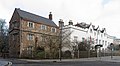 Newarke Houses Museum (Grade II*)
 -

-

-

-
-

-

-


Music
[edit]In popular culture
[edit]Leicester is the setting for the fictional diaries of Adrian Mole, created by Sue Townsend. In the early books he lives in a suburb of Leicester and attends a local school where he first meets "the love of his life", Pandora Braithwaite.
After a period of years spent working in Oxford and London, Mole returns to Leicester and gets a job in a second-hand bookshop and a flat in an "upmarket" development on a swan-infested waterfront, which is a barely disguised representation of the area near to St. Nicholas Circle. Vastly in debt he is forced to move to the fictional village of Mangold Parva. The local (fictional) Member of Parliament (MP) for the town of Ashby de la Zouch is his old flame, Pandora Braithwaite.
Leicester is the setting for Rod Duncan's novels, the Fall of the Gas-Lit Empire series and the Riot trilogy.
Leicester and the surrounding county are settings for several Graham Joyce novels, including Dark Sister, The Limits of Enchantment and Some Kind of Fairy Tale.
The Clarendon Park and New Walk areas of the city, along with an unnamed Charnwood village ("vaguely based upon Cossington", according to the author) are some of the settings of the 2014 novel The Knot of Isis by Chrid McGordon.
Leicester is the setting for the British children book series, The Sleepover Club, by authors Rose Impey, Narinder Dhami, Lorna Read, Fiona Cummings, Louis Catt, Sue Mongredien, Angie Bates, Ginny Deals, Harriet Castor and Jana Novotny Hunter.
Notable feature films made in the city are The Girl with Brains in Her Feet (1997), Jadoo (2013) and Yamla Pagla Deewana 2 (2013).
Sport
[edit]The city of Leicester has a successful record in sport. In 2016, it was named the UK's Greatest Sporting City, and in 2008, it was named as a European City of Sport.[162][163][164][165]
Leicester City are a professional association football club who currently compete in the EFL Championship. The club famously won the Premier League in 2016.[166][167][168]
Leicester Tigers have been the most successful English rugby union football club since the introduction of a league in 1987, winning it a record eleven times, five more than either Bath or Wasps. They won the Premiership title most recently in 2022.[169]

Leicester Riders are the oldest professional basketball team in the country. In 2016, they moved into the new Charter Street Leicester Community Sports Arena.[170]
Leicestershire County Cricket Club who are a professional cricket club based at Grace Road, Leicester, currently play in the second tier of the county championship. They won the County Championship in 1975, 1996 and 1998.[171]
Leicester City Hockey Club was founded in 1894, and a men's team was established in 2018. The women's team is regarded as one of the oldest and most successful teams in England with six league titles.[172]
Greyhound racing took place at two venues in the city; the main venue was the Leicester Stadium which hosted racing from 1928 to 1984, it also hosted speedway.[173] A smaller track existed at Aylestone Road (1927–1929).[174][175]
Public services
[edit]In the public sector, University Hospitals Leicester NHS Trust is one of the larger employers in the city, with over 12,000 employees working for the Trust. Leicester City Primary Care Trust employs over 1,000 full and part-time staff providing healthcare services in the city. Leicestershire Partnership NHS Trust[176] employs 3,000 staff providing mental health and learning disability services in the city and county.
In the private sector are Nuffield Hospital Leicester and the Spire Hospital Leicester.
Notable people
[edit]Local media
[edit]Print and online
[edit]The Leicester Mercury was founded by James Thompson in 1874. Until recently, it was based at 16–18 New Walk, but switched to an almost entirely remote operation after the COVID-19 pandemic.
Pukaar Group, a local media company, publishes the Leicester Times.[177][non-primary source needed]
A co-operative and independent newspaper, the Great Central Gazette, was launched online in March 2023. It was renamed the Leicester Gazette in 2024 and plans to launch a print edition in 2025.[178]
National World has plans to launch online-only Leicester World.[179]
Television
[edit]The Midlands Asian Television channel known as MATV Channel 6 was broadcast in Leicester until late 2009.

Radio
[edit]BBC Radio Leicester was the first BBC Local Radio station in Britain, opening on 8 November 1967. Other analogue FM radio stations are Leicester Community Radio for English speaking over 35's (1449 AM/MW), Demon FM which is Leicester's community and student radio station broadcasting from De Montfort University, Takeover Radio is the first ever children's radio station in the UK to be produced and presented by children, Capital Midlands, Hits Radio East Midlands, Smooth East Midlands and Hindu Sanskar Radio, which only broadcasts during Hindu religious festivals. BBC Asian Network and Sabras Radio broadcast on AM.
The local DAB multiplex includes Capital Midlands, BBC Radio Leicester, Hits Radio East Midlands and Smooth East Midlands.
Leicester's independent radio stations launched a new DAB multiplex in 2023.[180][181]
There are two hospital radio stations in Leicester, Radio Fox and Radio Gwendolen. Leicester University has a radio station, Galaxy Radio.
Twin cities
[edit]Leicester is twinned with six cities.[182]
- Strasbourg, France (1960)[183][184]
- Krefeld, Germany (1969)
- Masaya, Nicaragua (1987)
- Chongqing, China (1993)
- Rajkot, India (1996)
- Haskovo, Bulgaria (2008)
Since 1973, the fire services of Leicester and twin city Krefeld have played each other in an annual 'friendly' football match.[185]
Freedom of the City
[edit]The following people and military units have received the Freedom of the City of Leicester.
 |
Individuals
[edit]- Thomas Wright: 25 October 1892.
- Edward Wood: 25 October 1892.
- Thomas Windley: 31 March 1903.
- Colonel John Edward Sarson: 31 March 1903.
- Alexander Bains: 29 November 1904.
- William Wilkins Vincent: 28 November 1911.
- Thomas Smith: 3 July 1918.
- Jonathan North: 28 January 1919.
- Admiral of the Fleet Lord Beatty: 28 January 1919.
- Thomas Fielding Johnson: 8 July 1919.
- Field Marshal Lord Haig: 28 February 1922.
- Charles John Bond: 28 April 1925.
- Captain Robert Gee: 28 April 1925.
- James Ramsay MacDonald: 29 October 1929.
- Lord Laig of Lambeth: 28 May 1935.
- Walter Ernest Wilford: 26 July 1949.
- Thomas Rowland Hill: 3 January 1956.
- Lieutenant Colonel Sir Robert Martin: 3 January 1961.
- Sir Charles Robert Keene: 31 July 1962.
- Lord Janner of the City of Leicester: 26 October 1971.
- Sir Frederick Ernest Oliver: 26 October 1971.
- Sidney William Bridges: 26 October 1971.
- Mac Goldsmith: 26 October 1971.[186]
- Sir David Attenborough: 30 November 1989.
- Lord Attenborough of Kingston upon Thames: 30 November 1989.
- Professor Sir Alec Jeffreys: 26 November 1992.
- Gary Lineker: 26 November 1992.
- Frank Ephraim May: 12 July 2001.
- Rosemary Conley: 12 July 2001.
- Engelbert Humperdinck: 25 February 2009.
- Susan Lillian Townsend: 25 February 2009.
- Alan Birchenall: 25 February 2009.
Military units
[edit]- The Royal Anglian Regiment: 25 January 1996.[187]
- The 9th/12th Royal Lancers: 30 June 2011.[188]
Notes
[edit]- ^ "After this unhappy fate of Bladud, Leir, his son was advanced to the throne, and nobly governed his country sixty years. He built, upon the river Sore a city, called in the British tongue Kaerleir, in the Saxon, Leircestre."
- ^ Weather station is located 5 miles (8 km) from the Leicester city centre.
- ^ Data calculated from raw monthly term data
References
[edit]- ^ a b "Leicester, City of Leicester". Ordnance Survey. Archived from the original on 2 March 2024. Retrieved 2 March 2024.
- ^ "Your council". Leicester City Council. Archived from the original on 2 March 2024. Retrieved 2 March 2024.
- ^ "Mid-Year Population Estimates, United Kingdom, June 2024". Office for National Statistics. 26 September 2025. Retrieved 26 September 2025.
- ^ a b "Mid-Year Population Estimates, United Kingdom, June 2024". Office for National Statistics. 26 September 2025. Retrieved 26 September 2025.
- ^ a b UK Census (2021). "2021 Census Area Profile – Leicester Local Authority (E06000016)". Nomis. Office for National Statistics. Retrieved 2 March 2024.
- ^ a b Fenton, Trevor (25 April 2023). "Regional gross domestic product: local authorities". Office for National Statistics. Archived from the original on 28 August 2023. Retrieved 2 March 2024.
- ^ "Leicester. Archived 19 September 2015 at the Wayback Machine". Merriam-Webster Dictionary. Retrieved 28 August 2015.
- ^ "UNITED KINGDOM: Urban Areas in England". City Population. Archived from the original on 8 April 2018. Retrieved 26 April 2023.
- ^ a b "Leicester ranked as best city in the East Midlands to live and work".
- ^ "The National forest". The National forest. Archived from the original on 28 December 2016. Retrieved 2 July 2017.
- ^ "Leicester named UK's sporting capital".
- ^ "European Cities of Sport - ACES". September 2017.
- ^ a b c The Cambridge Dictionary of English Place-Names Based on the Collections of the English Place-Name Society, ed. by Victor Watts (Cambridge: Cambridge University Press, 2004), s.v. LEICESTER, LEIRE.
- ^ Stevenson, W. H. (1918). "A note on the derivation of the name 'Leicester'". The Archaeological Journal. 75. Royal Archaeological Institute (London): 30 f. Dudley, John (1848). "Etymology of the Name of Leicester". The Gentleman's Magazine. Vol. 184. pp. 580–582. citing Wilford, Asiatick Researches vol. ii. No. 2 (1812), p. 45: "The learned Somner says that the river which runs by it [Leicester] was formerly called Leir by the same contraction [from Legora], and it is probably the river Liar of the anonymous geographer. Mr. Somner, if I be not mistaken, places the original own of Ligora near the source of the Lear, now the Soar".
- ^ Gelling et al. (eds.), The names of towns and cities in Britain, B. T. Batsford, 1970, p. 122.
- ^ Thompson (1849), Appendix B: Leograceaster—The Saxon Name of Leicester, pp. 448 f. Archived 19 May 2015 at the Wayback Machine; Thompson (1849), pp. 7 f Archived 17 May 2015 at the Wayback Machine.
- ^ Andrew Breeze, 'Historia Brittonum' and Britain’s Twenty-Eight Cities Archived 28 October 2019 at the Wayback Machine', Journal of Literary Onomastics, 5.1 (2016), 1–16 (p. 9).
- ^ Geoffrey, Vol. II, Ch. 11.
- ^ W. G. Hoskins, "Leicester" History Today (Sep 1951) 1#9 pp 48–56.
- ^ "Archaeology Data Service". Archaeologydataservice.ac.uk. Retrieved 27 June 2022.
- ^ a b Thompson (1849), Appendix A: Ratæ—Roman Leicester, pp. 443 ff Archived 19 May 2015 at the Wayback Machine.
- ^ Tomlin, R S O (1983). "Roman Leicester, a Corrigendum: For Coritani should we read Corieltauvi?". Transactions of the Leicester Archaeological and Historical Society. 48.
- ^ Tomlin, R S O (1983). "Non Coritani sed Corieltauvi". The Antiquaries Journal. 63 (2): 353–355. doi:10.1017/s0003581500066579. S2CID 161713854.
- ^ a b "Richard III team makes second Leicester car park find". BBC News Leicester. 4 May 2013. Archived from the original on 7 May 2013. Retrieved 4 May 2013.
- ^ Nennius (attrib.). Theodor Mommsen (ed.). Historia Brittonum, VI. Composed after AD 830. (in Latin) Hosted at Latin Wikisource.
- ^ Ford, David Nash. "The 28 Cities of Britain Archived 15 April 2016 at the Wayback Machine" at Britannia. 2000.
- ^ Mills, A.D. (1991). A Dictionary of English Place-Names. Oxford: Oxford University Press. p. 208. ISBN 0-19-869156-4.
- ^ Galfridus Monemutensis [Geoffrey of Monmouth]. Historia Regum Britanniæ. c. 1136. (in Latin) J.A. Giles & al. (trans.) as History of the Kings of Britain, Vol. II, Ch. 11 in Six Old English Chronicles. 1842. Hosted at Wikisource.
- ^ Geoffrey of Monmouth. Lewis Thorpe (trans.) as The History of the Kings of Britain, pp. 81 & 86. Harmondsworth, 1966. William Shakespeare took the name of his King Lear from Geoffrey; there is now[year needed] a statue of the final scene of Shakespeare's Lear in Watermead Country Park.Paul A. Biggs, Sandra Biggs, Leicestershire & Rutland Walks with Children, Sigma Leisure, 2002, p. 44.
- ^ Mundill (2002), p265
- ^ Maddicott 1996, p.15.
- ^ a b Harris 2008, pp. 128–133.
- ^ Levy 1902, pp. 38–39.
- ^ See Mundill (2002).
- ^ Charles James Billson, Mediaeval Leicester (Leicester, 1920)
- ^ e.g., Williamson, David (1998). The National Portrait Gallery History of the Kings and Queens of England. National Portrait Gallery Publications. p. 81. ISBN 9781855142282.
- ^ "Richard III dig: Have they found their man in Leicester?". BBC News. 12 September 2012. Archived from the original on 31 July 2018. Retrieved 20 June 2018.
- ^ Lawless, Jill (4 February 2013). "Richard III team confirms skeleton found under parking lot is remains of England's king". The Star. Archived from the original on 28 June 2017. Retrieved 2 September 2017.j
- ^ "Official Website of the British Monarchy – Jane". Archived from the original on 1 May 2015.
- ^ William Kelly, Royal Progresses to Leicester (Leicester, 1855), pp. 8–9.
- ^ Walter Seton, 'Early Years of Henry Frederick, Prince of Wales, and Charles, Duke of Albany', Scottish Historical Review, 13:52 (July 1916), pp. 373-4.
- ^ Buchanan Sharp (1980), In contempt of all authority, Berkeley: University of California Press, ISBN 0-520-03681-6, OL 4742314M, 0520036816p70-71
- ^ Sharp, p58-59
- ^ Sharp, p88
- ^ "1645:The Storming of Leicester and the Battle of Naseby". Archived from the original on 9 May 2008. Retrieved 25 March 2008.
- ^ Butt 1995, p. 141.
- ^ Elliott, Malcolm (1979). Victorian Leicester. London and Chichester: Phillimore. p. 26. ISBN 0-85033-327-X.
- ^ "Chartism in Leicestershire". A Web of English History. Dr Marjie Bloy. Archived from the original on 26 August 2014. Retrieved 23 August 2014.
- ^ Elliott, Malcolm.op cit pages 62 -64 and 124–135
- ^ Richardson, p. 63.
- ^ Beazley, pp. 174–175.
- ^ Historic England. "The Arch of Remembrance (1074786)". National Heritage List for England. Retrieved 28 May 2018.
- ^ William, David (13 October 2010). UK Cities: A Look at Life and Major Cities in England, Scotland, Wales and Northern Ireland. New Africa Press. p. 127. ISBN 978-9987160211.
- ^ "The Blitz in Highfields". Story of Leicester. Archived from the original on 16 October 2022. Retrieved 16 October 2022.
- ^ "A History of Leicester". Archived from the original on 4 July 2015. Retrieved 29 June 2015.
- ^ "Highcross - Highcross". Archived from the original on 17 January 2012. Retrieved 8 January 2012.
- ^ "Poles". Encyclopedia.chicagohistory.org. Archived from the original on 10 February 2018. Retrieved 9 February 2018.
- ^ Leicester's Ugandan Asian success story. Archived 1 April 2012 at the Wayback Machine Retrieved 28 November 2010.
- ^ A history of Leicester. Archived 8 November 2011 at the Wayback Machine Retrieved 28 November 2010.
- ^ "From Kampala to Leicester". Leicester City Council. Archived from the original on 19 September 2012. Retrieved 7 April 2013.
- ^ Lowther, Ed (30 January 2013). "Government warned not to repeat 'folly' of Uganda anti-immigration adverts". BBC. Archived from the original on 20 March 2013. Retrieved 7 April 2013.
- ^ "Leicester City Council to thank Indian immigrants". Immigration Matters. 10 September 2012. Archived from the original on 1 November 2012. Retrieved 7 April 2013.
- ^ Huttman, Elizabeth D. (1991). Blauw, Wim; Juliet Saltman (eds.). Urban housing segregation of minorities in Western Europe and the United States. Durham: Duke University Press. ISBN 978-0822310600.
- ^ a b "Ugandan Asians advert 'foolish', says Leicester councillor". BBC News. 8 August 2012. Archived from the original on 24 November 2012. Retrieved 7 April 2013.
- ^ Marett, Valerie (1989). Immigrants settling in the city. Leicester: Leicester University Press. ISBN 978-0718512835.
- ^ [1] [permanent dead link]
- ^ a b "Scoring goals for integration in Leicester: CRE helps kids and coaches use football to bring communities together". 30 September 2007. Archived from the original on 30 September 2007. Retrieved 27 June 2022.
- ^ [2] [permanent dead link]
- ^ "Research2". Archived from the original on 29 November 2007.
- ^ "Media4diversity". Archived from the original on 3 December 2020. Retrieved 30 November 2020.
- ^ "Leicester lockdown: 'I needn't have cancelled our holiday'". BBC News. 18 July 2020.
- ^ "The Health Protection (Coronavirus, Restrictions) (Leicester) (Amendment) Regulations 2020". Legislation.gov.uk. Archived from the original on 9 July 2022. Retrieved 27 June 2022.
- ^ "August 1990 Maximum". Archived from the original on 28 November 2011. Retrieved 26 February 2011.
- ^ "August 2003 Maximum". Archived from the original on 19 August 2003. Retrieved 23 February 2012.
- ^ "Leicestershire experiences hottest July day in more than 150 years - Leicestershire Live". Archived from the original on 26 July 2019. Retrieved 26 July 2019.
- ^ "1971-00 Average annual maximum". Archived from the original on 28 November 2011. Retrieved 26 February 2011.
- ^ "Max > 25 °C days". Archived from the original on 28 November 2011. Retrieved 26 February 2011.
- ^ "Jan 1963 Minimum". Archived from the original on 28 November 2011. Retrieved 26 February 2011.
- ^ "1971-00 average rainfall". Archived from the original on 28 November 2011. Retrieved 26 February 2011.
- ^ "1971-00 average raindays". Archived from the original on 28 November 2011. Retrieved 23 February 2011.
- ^ "Indices Data - Newtown Linford Station 1852". KNMI. Archived from the original on 9 July 2018. Retrieved 10 March 2019.
- ^ Agnes Johnson Glimpses of ancient Leicester – Page 60 1891 "The first Mayor of Leicester, A.D. 1251.
- ^ The history of the boroughs and municipal corporations of the ... – Page 229 Henry Alworth Merewether, Archibald John Stephens – 1835 "The mayor of Leicester and his brethren, having, with the consent of the commonalty, by the last ordinance, placed the town under the government of the aldermen, appear, in the 4th year of the reign of King Henry VII., to have adopted 1488. a ..."
- ^ What participation by foreign residents in public life at local ... – Page 91 Congress of Local and Regional Authorities of Europe – 2000 "In 1981 serious riots broke out in the city that were dubbed "race riots" in Highfields and the City centre. ... In 1987 the first Asian Mayor of Leicester was elected, Councillor Gordhan Parmar and the first Asian Member of Parliament (MP), Keith Vaz
- ^ "Leicester's elected mayor reports lord mayor over parking". BBC. August 2011. Archived from the original on 23 February 2019. Retrieved 20 June 2018.
- ^ Hartley-Parkinson, Richard (22 February 2015). "City's skyline changed as council offices are pulled down". Metro. Archived from the original on 24 January 2022. Retrieved 24 January 2022.
- ^ "Redevelopment of the former Leicester City Council site, New Walk, Leicester". Procon-leicestershire.co.uk. Archived from the original on 24 January 2022. Retrieved 24 January 2022.
- ^ "Leicester City Mayor and Councillors Archived 21 December 2016 at the Wayback Machine", Leicester City Council, July 2016. Retrieved 13 January 2017
- ^ "BBC". 6 May 2011. Archived from the original on 19 July 2011. Retrieved 16 August 2011.
- ^ "Sir Peter Soulsby". Leicester City Council. Archived from the original on 7 November 2018. Retrieved 16 August 2020.
- ^ "Leicester City Council - Elections". Archived from the original on 4 February 2010. Retrieved 17 February 2010.
- ^ "Elections and voting". Archived from the original on 9 May 2011. Retrieved 7 May 2011.
- ^ "Leicester City Council". BBC News. Archived from the original on 14 April 2019. Retrieved 10 May 2023.
- ^ "Councillor suspended after accusations of threatening behaviour". 26 March 2024. Archived from the original on 26 March 2024. Retrieved 26 March 2024.
- ^ "Conservative Group Leader quits party and rejoins Labour amid 'bullying' allegations – Leicester Times | Weekly Newspaper | Leicester News". 8 April 2024.
- ^ "City's Conservative Party leader returns to Labour fold". 8 April 2024. Archived from the original on 12 April 2024. Retrieved 12 April 2024.
- ^ "Leader of Leicester's Conservative Party returns to Labour". 8 April 2024. Archived from the original on 11 April 2024. Retrieved 12 April 2024.
- ^ "Statement of Persons Nominated Notice of Poll Leicester East" (PDF). www.leicester.gov.uk. Archived (PDF) from the original on 7 June 2024. Retrieved 7 June 2024.
- ^ "Tory councillor quits party to run for Leicester East seat". 7 June 2024.
- ^ "How life has changed in Leicester: Census 2021". gov.uk. Archived from the original on 3 April 2024. Retrieved 19 June 2024.
- ^ "Leicester local authority profile 2023" (PDF). ONS. Retrieved 16 April 2025.
- ^ "Population on 1 January by age groups and sex – functional urban areas". Eurostat – Data Explorer. Eurostat. Archived from the original on 3 September 2015. Retrieved 14 February 2019.
- ^ "Ethnic group - Office for National Statistics". www.ons.gov.uk. Retrieved 3 December 2022.
- ^ "Our fast-growing city needs backing from Government". Leicester Mercury. Archived from the original on 23 June 2015. Retrieved 29 June 2015.
- ^ "The Diversity of Leicester May 2008, A Demographic Profile". Leicester City Council. Archived from the original on 8 January 2009. Retrieved 16 November 2008.
- ^ "Leicester Leicestershire through time | Population Statistics | Total Population". Archived from the original on 7 December 2008. Retrieved 28 December 2007.
- ^ mid year estimate
- ^ ONS population projections 2014 base / projections uplifted by '21–1,800/'26-2,100/'36-2,500 given underestimation at 2016 – 2,250/
- ^ "The Story of Leicester".
- ^ "Discover the 'Birthplace of Tourism' at One of England's Oldest and Most Underrated Cities". 2 October 2024.
- ^ "Home - King Richard III Visitor Centre".
- ^ "European Data Tool". Centre for Cities. Archived from the original on 15 February 2019. Retrieved 14 February 2019.
- ^ "Cat – Products & Services – Europe – Caterpillar". Archived from the original on 8 September 2011. Retrieved 30 June 2011.
- ^ "LEICESTER: BEST PLACE TO LIVE AND WORK IN EAST MIDLANDS - Leicester Times". 29 March 2022.
- ^ "City rated best in the region to live and work".
- ^ "Leicester in spotlight for textiles boost". Leicester Mercury. 11 January 2011. Archived from the original on 5 May 2013. Retrieved 14 January 2013.
- ^ "Far Eastern costs boost textile firm". Leicester Mercury. 15 September 2010. Archived from the original on 5 May 2013. Retrieved 14 January 2013.
- ^ Butler, Sarah (30 August 2020). "Revealed: 'shocking' lack of regulation at Leicester garment factories". The Guardian. Retrieved 30 August 2020.
- ^ Hoskins, Tansy (27 February 2015). "Made in Britain: UK textile workers earning £3 per hour". The Guardian. Retrieved 30 August 2020.
- ^ Butler, Sarah (6 October 2017). "Asos and New Look to join anti-slavery event in Leicester". The Guardian. Retrieved 30 August 2020.
- ^ Bland, Archie (3 July 2020). "Police and health officials visit garment factories in Leicester". The Guardian. Retrieved 30 August 2020.
- ^ William, David (2010) Life in the United Kingdom: The Land and the People, New Africa Press, ISBN 978-9987160174, p. 230 [3] Archived 2 October 2023 at the Wayback Machine
- ^ Historic England. "Corn Exchange (1361417)". National Heritage List for England. Retrieved 14 April 2023.
- ^ Panesar, Jeevan (13 October 2006); "Diwali in Leicester Archived 16 October 2011 at the Wayback Machine, BBC, Accessed 25 January 2011.
- ^ Walkers Crisps, Coming to the crunch Archived 12 October 2008 at the Wayback Machine – The Manufacturer, October 2006
- ^ "Our offices, factories and sites | PepsiCo". 22 July 2011. Archived from the original on 22 July 2011. Retrieved 27 June 2022.
- ^ "Walker & Son". Samworth Brothers. Archived from the original on 31 March 2017. Retrieved 30 March 2017.
- ^ Rippon, Matthew J. (2013). "Traditional Foods, Territorial Boundaries and the TRIPS Agreement: The Case of the Melton Mowbray Pork Pie". The Journal of World Intellectual Property. 16 (5–6). Academia: 262–301. doi:10.1002/jwip.12016. S2CID 153781899. Archived from the original on 2 October 2023. Retrieved 9 July 2021.
- ^ Mack, Tom (15 December 2012); "Temporary pop-up Walkers pork pie shop to open in Cheapside, Leicester, for Christmas Archived 17 December 2012 at the Wayback Machine, Leicester Mercury, Accessed 17 December 2012.
- ^ "greenlines". Leicester Buses. Archived from the original on 8 May 2023. Retrieved 8 May 2023.
- ^ "Longest electric circular bus route launches in Leicester". BBC News. 17 October 2022. Retrieved 8 May 2023.
- ^ "Leicester's e-bike share opens to all city residents". Leicester City Council. 14 April 2021. Archived from the original on 13 April 2021. Retrieved 14 April 2021.
- ^ "Grand Union Canal – Leicester Line". Inland Waterways Association. Archived from the original on 26 May 2022. Retrieved 23 May 2022.
- ^ Schools building deal is signed and sealed Archived 13 May 2015 at the Wayback Machine – Leicester Mercury, 19 December 2007
- ^ "The main league table 2009". The Independent. 23 April 2008. Archived from the original on 15 May 2011. Retrieved 2 September 2017.
- ^ "Leicester is named Daily Mail University of the Year 2025 | News". 5 September 2024.
- ^ NA, NA (25 December 2015). The Macmillan Guide to the United Kingdom 1978–79. Springer. ISBN 9781349815111.
- ^ "Leicester Cathedral – A beating heart for City and County". Leicestercathedral.org. Archived from the original on 26 October 2019. Retrieved 26 October 2019.
- ^ "Welcome to Leicester Cathedral – Leicester Cathedral". Leicestercathedral.org. Archived from the original on 26 October 2019. Retrieved 26 October 2019.
- ^ "History of Leicester Cathedral – Leicester Cathedral". Leicestercathedral.org. Archived from the original on 29 December 2021. Retrieved 26 October 2019.
- ^ "Leicester Cathedral, Leicester Cathedral Charitable Trust & Leicester Cathedral Music Foundation - Consolidated Report and Accounts" (PDF). Archived from the original (PDF) on 26 October 2019. Retrieved 1 March 2020.
- ^ "Leicester Cathedral & Richard III Memorial | History & Photos". Britainexpress.com. Archived from the original on 26 October 2019. Retrieved 26 October 2019.
- ^ "20th Century". Welcome to St Nicholas Church in Leicester History Section. Archived from the original on 15 February 2020. Retrieved 15 February 2020.
- ^ "The ancient borough: Lost churches Pages 388-389 A History of the County of Leicester: Volume 4, the City of Leicester". British History Online. Archived from the original on 20 September 2021. Retrieved 20 September 2021.
- ^ Moore, Andre (2008). Where Leicester Has Worshipped. Laurel House. ISBN 978-0-9533628-2-0. Archived from the original on 22 September 2020. Retrieved 14 January 2020.
- ^ "Faith & Belief – Story of Leicester". Storyofleicester.info. Archived from the original on 23 May 2020. Retrieved 14 January 2020.
- ^ "The ancient borough: Protestant Nonconformity: A History of the County of Leicester: Volume 4". Victoria County History. 1958. pp. 390–394. Retrieved 11 January 2020.
1601
- ^ "2011 Census: Religion, local authorities in England and Wales". United Kingdom Census 2011. Office for National Statistics.
- ^ "Leicester 360° Images – 360-degree tour of Shree Jalaram Prathana Mandal". BBC. Archived from the original on 4 October 2009. Retrieved 17 July 2010.
- ^ "Leicester Christadelphians". Leicester Christadelphians. Archived from the original on 26 January 2018. Retrieved 25 January 2018.
- ^ "Leicester 360° Images – 360-degree tour of Jain Centre". BBC. Archived from the original on 18 February 2013. Retrieved 17 July 2010.
- ^ "islamiccentre.org". Archived from the original on 23 June 2015. Retrieved 29 June 2015.
- ^ "Masjid Umar – Leicester". Archived from the original on 21 June 2015. Retrieved 29 June 2015.
- ^ "Leicester – In Pictures – Masjid Umar mosque". BBC. Archived from the original on 20 November 2010. Retrieved 17 July 2010.
- ^ "Diwali Visit Leicester". Leicester city. 8 June 2020. Archived from the original on 23 September 2020. Retrieved 8 June 2020.
- ^ Pascale, Adele (2 November 2005). "Leicester Short Film Festival: CAN 2005". BBC Leicester. Archived from the original on 22 October 2018. Retrieved 23 August 2019.
- ^ Barry Turner. The Screenwriter's Handbook 2010. Palgrave Macmillan. 2009. Page 218. (The Screenwriter's Handbook 2009, p 232).
- ^ Turner, Robin (7 March 2013). "So Where's the Main Threat to the Welsh Bid to Be City of Culture?". Western Mail.[permanent dead link]
- ^ "Curve website". Archived from the original on 14 July 2006.
- ^ "THE y THEATRE - the y Leicester". Archived from the original on 5 December 2021. Retrieved 29 December 2021.
- ^ "Visiting Phoenix". phoenix.org.uk. Retrieved 23 December 2024.
- ^ "European Cities of Sport - ACES EUROPE". September 2017.
- ^ "Leicester named UK's sporting capital".
- ^ "Leicester win Premier League: Have Foxes turned city into UK's sporting capital?". BBC Sport. 4 May 2016.
- ^ "Leicester win Premier League: Have Foxes turned city into UK's sporting capital?". BBC Sport. 4 May 2016.
- ^ "Bookies set to hand over £15m if Leicester win title". ITV News. 2 May 2016. Archived from the original on 2 June 2016. Retrieved 3 May 2016.
- ^ Rayner, Gordon; Brown, Oliver (2 May 2016). "Leicester City win Premier League and cost bookies biggest ever payout". The Daily Telegraph. Archived from the original on 3 May 2016. Retrieved 2 May 2016.
- ^ Wood, Greg (3 May 2016). "The 5,000-1 payouts on Leicester only tell part of Premier League betting story". The Guardian. Archived from the original on 6 May 2016. Retrieved 6 May 2016.
- ^ Newsum, Matt (18 June 2022). "Relive Leicester's last-gasp Premiership final win over Saracens". BBC Sport. Archived from the original on 27 August 2022. Retrieved 27 August 2022.
- ^ Leicester Riders web site club history Archived 13 May 2016 at the Wayback Machine. Retrieved 18 May 2016.
- ^ Leiscestershire County Cricket Club web site Archived 29 October 2005 at the Wayback Machine. Retrieved 18 May 2016.
- ^ "Leicester Hockey Club | TRAIN - PLAY - ENJOY". www.leicesterhc.co.uk. Retrieved 6 September 2025.
- ^ "OS County Series Leicestershire 1929". old-maps.co.uk. Archived from the original on 10 May 2019. Retrieved 10 May 2019.
- ^ Barnes, Julia (1988). Daily Mirror Greyhound Fact File. Ringpress Books. ISBN 0-948955-15-5.
- ^ "Leicester". Greyhound Racing Times. Archived from the original on 10 May 2019. Retrieved 10 May 2019.
- ^ "Leicestershire Partnership NHS Trust – Home". Archived from the original on 23 August 2010. Retrieved 17 July 2010.
- ^ "Leicester Times | Online Newspaper - Leicester News & Publications". 17 May 2012. Archived from the original on 5 June 2024. Retrieved 4 July 2024.
- ^ Sharman, David. "New newspaper Great Central Gazette to launch in Leicester - Journalism News from HoldtheFrontPage". HoldtheFrontPage. Archived from the original on 2 October 2023. Retrieved 3 April 2023.
- ^ Sharman, David. "National World launches in Leicester, Derby and Nottingham - Journalism News from HoldtheFrontPage". HoldtheFrontPage. Archived from the original on 9 February 2023. Retrieved 3 April 2023.
- ^ "Leicester's small-scale DAB digital radio multiplex switched on". RadioToday. 14 March 2023. Archived from the original on 14 March 2023. Retrieved 3 April 2023.
- ^ "New DAB multiplex in Leicester". Great Central Gazette. 30 March 2023. Archived from the original on 16 May 2023. Retrieved 3 April 2023.
- ^ "Twinning". Leicester City council. Archived from the original on 2 October 2010. Retrieved 5 February 2010.
- ^ "Strasbourg, Twin City". Strasbourg.eu & Communauté Urbaine. Archived from the original on 28 July 2013. Retrieved 21 August 2013.
- ^ "British towns twinned with French towns [via WaybackMachine.com]". Archant Community Media Ltd. Archived from the original on 5 July 2013. Retrieved 20 July 2013.
- ^ Brown, Tom (31 July 2013). "Twin towns: Do we still need them?". BBC East Midlands Today. BBC News. Archived from the original on 7 August 2013. Retrieved 7 August 2013.
- ^ "Mac and Ruth GoldsmithInventor and Freeman of the City of Leicester | Jewish Gilroes". Archived from the original on 15 October 2019. Retrieved 15 October 2019.
- ^ a b "Freedom of the City – a Freedom of Information request to Leicester City Council". WhatDoTheyKnow.com. 7 March 2018. Archived from the original on 15 October 2019. Retrieved 30 November 2020.
- ^ "Lancers to get freedom of the city". This is Leicester. 30 June 2011. Archived from the original on 23 September 2012. Retrieved 4 October 2019.
Secondary sources
[edit]- Beazley, Ben (1999). Four Years Remembered: Leicester During the Great War. Derby: The Breedon Books Publishing Company. ISBN 9781859831823.
- Biggs, Paul A.; Biggs, Sandra (2002). Leicestershire & Rutland Walks with Children. Sigma Leisure.
- Butt, R. V. J. (October 1995). The Directory of Railway Stations: details every public and private passenger station, halt, platform and stopping place, past and present (1st ed.). Sparkford: Patrick Stephens Ltd. ISBN 978-1-85260-508-7. OCLC 60251199. OL 11956311M.
- Dudley, John (1848). "Etymology of the name of Leicester". The Gentleman's Magazine. Vol. 184.
- Gelling; et al., eds. (1970). The Names of Towns and Cities in Britain. B. T. Batsford.
- Geoffrey of Monmouth (1966). Thorpe, Lewis (ed.). The History of the Kings of Britain. Harmondsworth. pp. 81, 86.
- Harris, Oliver (2008). "Jews, jurats and the Jewry Wall: a name in context". Transactions of the Leicestershire Archaeological and Historical Society. 82: 113–33.
- Hoskins, W. G. (1957). Leicestershire: an illustrated essay on the history of the landscape. London: Hodder & Stoughton.
{{cite book}}: CS1 maint: location missing publisher (link) - Hoskins, W. G. (September 1951). "Leicester". History Today. 1 (9): 48–56.
- Levy, S. (1902). "Notes on Leicester Jewry". Transactions of the Jewish Historical Society of England. 5: 34–42. JSTOR 29777626.
- Mundill, Robin R. (2002). England's Jewish Solution. Cambridge, United Kingdom: Cambridge University Press. ISBN 978-0-521-52026-3. OL 26454030M.
- Nennius. Mommsen, Theodor (ed.). Historia Brittonum (in Latin). Vol. 6. p. 830.
- Pascale, Adele (2 November 2005). "Leicester Short Film Festival: CAN 2005". BBC Leicester.
- Richardson, Matthew (2014). Leicester in the Great War. Barnsley: Pen and Sword Military. ISBN 9781783032891.
- Sharp, Buchanan (1980). In Contempt of All Authority. Berkeley: University of California Press. pp. 58–59, 70–1, 88. ISBN 0-520-03681-6.
{{cite book}}: CS1 maint: location missing publisher (link) - Stevenson, W. H. (1918). "A note on the derivation of the name 'Leicester'" (PDF). The Archaeological Journal. 75: 30–31.
- Tomlin, R. S. O. (1983). "Roman Leicester, a Corrigendum: For Coritani should we read Corieltauvi?". Transactions of the Leicester Archaeological and Historical Society: 48.
- Tomlin, R. S. O. (1983). "Non Coritani sed Corieltauvi". The Antiquaries Journal. 63 (2): 63. doi:10.1017/s0003581500066579. S2CID 161713854.
- Turner, Barry (2009). The Screenwriter's Handbook 2010. Palgrave Macmillan. p. 218.
- Wilford, J. (1812). "History of Leicester". Asiatick Researches. 2 (2): 45.
- William, David (13 October 2010). UK Cities: A Look at Life and Major Cities in England, Scotland, Wales and Northern Ireland. New Africa Press. ISBN 978-9987160211.
- Williamson, David (1998). The National Portrait Gallery History of the Kings and Queens of England. National Portrait Gallery Publications. ISBN 9781855142282.
Newspapers
[edit]- Turner, Robin (7 March 2013). "So Where's the Main Threat to the Welsh Bid to Be City of Culture?". Western Mail. Archived from the original on 31 March 2002. Retrieved 18 January 2019.
- Martin, Dan J. (21 May 2015). "Ted Cassidy takes the chains as Leicester's new ceremonial lord mayor". Leicester Mercury.
- BBC News Leicester (4 May 2013). "Richard III team makes second Leicester car park find".
External links
[edit]


| International | |
|---|---|
| National | |
| Geographic | |
| Other | |

Leicester
View on GrokipediaLeicester is a city and unitary authority in Leicestershire, in the East Midlands region of England, with a population of 368,600 as recorded in the 2021 census, representing an 11.8% increase from 2011 and establishing it as the ninth-largest city in England.[1][2] Originally founded as the Roman military fort and civilian settlement of Ratae Corieltauvorum around AD 50, it grew into a medieval market town featuring structures like the Magazine Gateway and later experienced explosive population expansion during the Victorian industrial era due to hosiery, textiles, and footwear manufacturing.[3][4] In contemporary times, Leicester stands out for its extreme ethnic diversity—43.4% of residents identified as Asian, Asian British, or Asian Welsh in 2021, contributing to a non-white majority—and as an economic powerhouse in the East Midlands with a £23 billion GVA, driven by sectors including professional services, retail, advanced manufacturing, education via the University of Leicester, and emerging space industry clusters.[5][6] The city has achieved global prominence through Leicester City Football Club's against-all-odds Premier League championship win in the 2015–16 season, defying 5000–1 odds amid financial disparities in elite football, and the University of Leicester-led excavation that uncovered King Richard III's skeletal remains in 2012 under a Greyfriars friary car park, confirmed via DNA and radiocarbon dating, culminating in his 2015 reburial at Leicester Cathedral.[7][8]
Name and Etymology
Historical Development of the Name
The Roman settlement established around AD 43 was designated Ratae Corieltauvorum, with Ratae representing a Latinized form of a Celtic word signifying "ramparts" or earthworks, denoting the site's defensive structures, while Corieltauvorum denoted its status as the principal town of the Corieltauvi tribe.[9][10] This nomenclature first appears in Ptolemy's Geographia, compiled circa AD 150, based on earlier surveys, confirming its use in classical geographic records.[10] After the Roman withdrawal in the early 5th century, the site transitioned to Old English usage as Ligora ceaster or Ligraceaster by the 10th century, where ceaster (from Latin castra, meaning "fort" or "camp") indicated a derelict Roman walled town, and the prefix Ligora or Ligore derived from a pre-English tribal or hydronymic element linked to the River Soar (anciently Legra or Ligor), referring to the "Roman fort of the Ligore people."[11][12][13] The form Ligora ceaster is attested in the Anglo-Saxon Chronicle entry for 942, marking its early medieval continuity.[13] By the Norman Conquest, variants such as Ledecestre emerged, as recorded in the Domesday Book of 1086, reflecting phonetic shifts under Anglo-Norman influence, with the Latin genitive Leicestria or similar forms appearing in medieval charters for the earldom.[13][11] Standardization to the modern spelling Leicester occurred progressively from the late Middle English period onward, solidified in official documents by the 16th century, though pronunciation retained the silent 'c' as /ˈlɛstər/, preserving older phonetic elements without the full etymological ceaster.[13] Archaeological evidence, including Roman inscriptions from the Jewry Wall site referencing local tribal contexts, corroborates the Corieltauvorum association but yields no direct pre-Old English name variants beyond Ptolemaic records.[10]History
Prehistoric and Roman Periods
Archaeological investigations reveal evidence of Bronze Age activity in the Leicestershire region, including barrow sites in the northeast, such as those excavated in the late 20th century yielding urns and associated artifacts dating to circa 2000–800 BC.[14] Iron Age settlements are attested by hillforts like Burrough Hill, approximately 20 miles northeast of Leicester near the River Soar valley, where excavations uncovered extensive metalwork, including cauldrons indicative of feasting rituals and bronze chariot fittings from around 400–100 BC, suggesting organized communities with advanced craftsmanship.[15][16] Following the Roman conquest of Britain in AD 43, a military fort was established at the site of modern Leicester, known as Ratae Corieltauvorum, serving the Corieltauvi tribe; by AD 50–70, it transitioned into a civilian settlement with a grid layout, forum, and basilica.[17][18] Town defenses, including a stone wall and gates, were constructed around AD 150–200, enclosing about 43 hectares. Public amenities included bath complexes, with the Jewry Wall—standing up to 7 meters high—forming part of a structure built circa AD 160, alongside hypocaust systems and mosaics like the Blackfriars pavement discovered in the 19th century.[19][20] By the late 4th century, Ratae experienced economic contraction, evidenced by declining pottery production and imports after AD 400, alongside widespread coin hoards across Roman Britain reflecting instability during the empire's withdrawal.[21][22] Excavations at sites like Leicester Cathedral have recovered over 5,500 Roman pottery sherds spanning the 1st to 4th centuries, but with reduced fineware and amphorae in later layers, indicating abandonments of villas and urban structures by the early 5th century.[21][23]Anglo-Saxon to Medieval Era
Following the withdrawal of Roman administration, Leicester re-emerged as an Anglo-Saxon settlement, recorded as Ligeraceaster in sources from the early 10th century. During the 9th century, Viking incursions led to its capture by the Great Danish Army in 873, after which it became one of the Five Boroughs—a network of fortified Danish strongholds in the Danelaw, including Derby, Lincoln, Nottingham, and Stamford—functioning as administrative and defensive centers under Scandinavian influence.[24] The town was reconquered by West Saxon forces under Edward the Elder around 918, incorporating it into the broader English burh system inspired by Alfred the Great's defensive network against Viking threats, with earthen ramparts and organized street grids enhancing its role as a regional stronghold. By 1086, the Domesday Book entries for Ledecestre describe it as a substantial urban center under the joint lordship of the king and Hugh de Grentemesnil, featuring 17 villagers, 6 smallholders, 5 slaves, 3 priests, multiple ploughlands, meadows, and a mill yielding an annual value of £20—indicating pre-Conquest prosperity under King Edward that had slightly declined post-1066.[25] The Norman Conquest reshaped Leicester's landscape, with William I commissioning a motte-and-bailey castle circa 1068 in the southwest corner of the Roman defenses to consolidate control over the Midlands; this structure, later rebuilt in stone, anchored feudal authority under the Earls of Leicester. Medieval development accelerated with borough privileges, including market rights formalized by royal charters—such as those under Henry II and Henry III confirming weekly markets and fairs—and the construction of the timber-framed Guildhall around 1390 as a venue for the Guild of Corpus Christi, reflecting growing mercantile activity.[26][27][28] The Black Death struck Leicester in 1348–49, causing severe depopulation; local chronicler Henry Knighton of St Mary's Abbey documented the plague's toll, noting in one small parish alone the death of 700 people where previously only 40–50 able-bodied men resided, contributing to England's overall loss of 30–50% of its population and disrupting urban economies.[29] Leicester's strategic position drew it into the Wars of the Roses, though direct combat bypassed the town; in August 1485, Richard III's Yorkist forces assembled and drew provisions from the Honour of Leicester before advancing to the nearby Battle of Bosworth Field, where defeat ended the conflict—Richard's body was then transported back to Leicester for hasty burial in Greyfriars Church.[30]Tudor, Stuart, and Civil War
During the Tudor era, Leicester experienced significant religious upheaval through the Dissolution of the Monasteries initiated by Henry VIII. The town's mendicant friaries, including the Austin, Black, and Grey Friars establishments, were suppressed between 1538 and 1539 as part of the broader campaign against monastic institutions in the Midlands, leading to the seizure of their assets and the dispersal of friars.[31] This process dismantled key religious centers that had shaped local piety and economy, with sites repurposed or demolished, reflecting the crown's fiscal motivations over doctrinal reform alone.[32] Under Elizabeth I, Leicester benefited from expanding cloth and wool trades, fostering economic growth among merchants like former mayor William Wigston, whose fortunes derived from textile commerce.[33] The town's strategic position supported wool processing and export, contributing to relative prosperity amid national stability, though reliant on agricultural inputs from surrounding Leicestershire estates. Robert Dudley, Earl of Leicester and a prominent courtier, exerted influence as a patron of Puritan-leaning clergy, promoting nonconformist preaching while navigating episcopal oversight, which subtly aligned local religious sentiments with reformist currents.[34] In the Stuart period, agrarian changes intensified through enclosures, with approximately 40% of Leicestershire manors converted from open fields to consolidated holdings by the early 17th century, displacing smallholders and sparking protests like the 1607 Midland Revolt against depopulation and loss of commons.[35] Puritan influences persisted, embedding moral rigor in civic life and fostering sympathy for Parliament during escalating tensions with Charles I over taxation and religion. Leicester sided with Parliament in the First English Civil War, prompting Royalist forces under Charles I to besiege the town in late May 1645 despite incomplete fortifications, as civilian authorities had resisted full militarization.[36] On 31 May, Parliamentarian defenders under Lord Grey repelled initial assaults but succumbed to a breach at the Newarke, resulting in a sack where over 600 civilians perished—roughly a fifth of the 2,000-3,000 population—alongside military losses, with burials overwhelming local churchyards.[37] [38] The Royalist victory, though tactically successful, depleted their strength ahead of the decisive defeat at Naseby on 14 June, underscoring the siege's pyrrhic nature based on muster rolls and eyewitness accounts.[39]Industrial Revolution and 19th Century
The completion of the Leicester Navigation canal in 1794 enhanced access to coal and markets, directly stimulating the hosiery trade by enabling efficient transport of wool and finished stockings from domestic frame-knitters to broader networks.[40][41] This infrastructure shift marked the onset of mechanized production, as water-powered mills along the canal supported yarn processing and early factory setups, laying causal groundwork for urbanization tied to export demands rather than mere population influx.[41] The Leicester and Swannington Railway's opening in July 1832 further catalyzed factory expansion by linking the city to coal mines, reducing costs for steam-powered knitting frames and accelerating the shift from cottage industry to centralized workshops.[42] Accompanying this, Leicester's population surged from 17,000 in 1801 to 68,100 by 1861, driven by inward migration for hosiery and emergent boot-and-shoe jobs, with census data revealing over 60% growth in the 1850s alone amid trade booms.[43][44] Hosiery peaked in the 1850s as factories proliferated, employing thousands regionally—around 73,000 frame-workers across Leicestershire and neighbors by 1833—before elastic webbing innovations diversified into boots.[45][46] Parallel engineering growth supplied specialized machinery for hosiery seams and shoe stitching, while the boot sector exploded from 425 makers in 1831 to 2,741 by 1861, positioning Leicestershire as the national hub for women's and children's footwear by century's end through mechanized riveting and lasting processes.[47][48] Yet unchecked expansion bred squalor; cholera epidemics in 1832 and 1849 ravaged slums like Narrow Marsh, with sewage-tainted wells amplifying Vibrio transmission in a city where empirical sanitary surveys linked over 300 local deaths in 1849 to contaminated water, underscoring causal failures in drainage amid density spikes.[49][50] Labor responses crystallized in trade unions, with hosiery knitters reviving 18th-century associations into formal bodies by the 1850s to counter wage cuts, culminating in the Leicester Amalgamated Hosiery Union's precursors amid 1850s depressions.[51][46] The 1870 Education Act prompted Leicester's school board election in 1871, mandating boards to erect facilities for 10,000+ children, boosting attendance from under 50% to near-universal by 1880 via rate-funded buildings that addressed factory child labor's literacy deficits with basic arithmetic for machine operation.[52][53]20th Century Transformations
During the First World War, Leicester's engineering and hosiery industries shifted to munitions production, with local firms manufacturing ammunition shells and other war materials, supporting the national effort alongside the service of approximately 50,000 men from the city and Leicestershire.[54] [55] [56] In the Second World War, the city faced air raids, culminating in its most destructive attack on 19 November 1940 over the Highfields area, where bombs killed over 100 people, injured hundreds more, and damaged buildings including the Freeman, Hardy and Willis shoe factory, though overall bombing remained lighter than in major industrial targets elsewhere.[57] [58] [59] Post-war reconstruction emphasized slum clearance and urban renewal, with programs demolishing over 1,000 substandard Victorian-era terraces and streets from the late 1940s through the 1960s, displacing thousands and enabling the construction of high-rise flats and new estates to address overcrowding and poor sanitation.[60] [61] [62] Manufacturing, particularly hosiery and textiles, experienced a post-war boom, with employment rising steadily from 1945 to the mid-1960s amid export demand, but by the 1970s faced irreversible decline due to foreign competition, mechanization lags, and asset-stripping mergers, reducing the sector's dominance.[63] [64] [65] The 1980s recession exacerbated deindustrialization, with unemployment in the Leicester travel-to-work area climbing to 11.4% by early 1983, driven by factory closures in engineering and apparel amid national economic contraction, though the city fared better than northern counterparts due to diversified light industry.[66] [67]Contemporary History
Leicester's contemporary history, spanning the late 20th and early 21st centuries, reflects ongoing demographic shifts driven by sustained immigration, economic diversification, and landmark cultural events that enhanced its national profile. The city's population grew steadily, reaching a metro area estimate of 575,000 by 2025, fueled by migration and urban development.[68] This period saw Leicester evolve from an industrial base into a service-oriented economy, with expansions in higher education, tourism, and retail, while maintaining its reputation for ethnic diversity, where South Asian communities—rooted in earlier arrivals—now form a significant portion of residents.[69] A defining event was the 2012 archaeological discovery of King Richard III's skeletal remains under a Greyfriars car park in the city centre, excavated by the University of Leicester team. DNA analysis, radiocarbon dating, and historical records confirmed the identity with 99.999% probability, revealing battle wounds and scoliosis consistent with contemporary accounts. The subsequent reburial in Leicester Cathedral in 2015 drew international attention, generating £79 million in economic impact through tourism and related activities, while creating 1,012 jobs by 2015 and bolstering the local heritage sector.[8][70][71] In sports, Leicester City F.C.'s 2015–16 Premier League triumph stands as a improbable milestone, overcoming 5,000–1 preseason odds to secure the title on May 2, 2016, following Tottenham Hotspur's 2–2 draw with Chelsea. Under manager Claudio Ranieri, the club's success—driven by key players like Jamie Vardy and Riyad Mahrez—highlighted tactical cohesion and resilience, injecting vitality into local identity and economy amid broader challenges like financial fair play scrutiny.[72][73] Despite these highs, integration strains surfaced, exemplified by localized unrest in September 2022 amid Hindu-Muslim tensions exacerbated by events in India, marking a rare eruption in a city long noted for relative coexistence among diverse groups. This incident underscored underlying pressures from rapid demographic changes and housing shortages in inner-city wards like Highfields, where post-war migration patterns concentrated newcomers.[74][75]Post-War Immigration Waves
Post-World War II labor shortages in Leicester's textile and hosiery industries prompted recruitment of workers from Commonwealth nations, particularly India, Pakistan, and the Caribbean, leading to initial waves of immigration in the 1950s. The 1951 census recorded only 624 individuals of South Asian heritage in the city, reflecting modest early inflows compared to later decades.[74] Migration intensified in the late 1950s and early 1960s as prospective immigrants arrived ahead of the Commonwealth Immigrants Act 1962, which imposed entry controls, with many settling in established communities to fill manufacturing roles.[76] A pivotal influx occurred in 1972 when Ugandan President Idi Amin expelled approximately 60,000 Asians, many of whom held British passports; around 27,000-28,000 arrived in the UK, with roughly 10,000 resettling in Leicester, where existing South Asian networks facilitated integration into business and retail sectors.[77] [78] This group, predominantly Gujarati-speaking Hindus and Muslims from East Africa, significantly expanded Leicester's ethnic diversity, contributing entrepreneurial skills that revitalized local commerce amid deindustrialization.[79] From the 1990s onward, Leicester saw additional demographic shifts from asylum seekers and EU migrants, particularly following the 2004 enlargement allowing free movement from Eastern European accession states, alongside rising non-EU asylum applications amid global conflicts.[80] These flows accelerated ethnic composition changes, with census data showing South Asians rising to over 20% of the population by 1991 and ethnic minorities collectively approaching half by 2001, straining housing and public services.[81] Foreign-born households in such contexts exhibited higher rates of overcrowding—6% versus 2% for UK-born—correlating with rapid population growth outpacing infrastructure, including school enrollments where migrant children comprised notable shares.[82] Welfare claims data indicate disproportionate reliance among recent arrivals on benefits, exacerbating fiscal pressures in a city with limited capacity for absorption.[83]Key 21st-Century Events
In September 2012, archaeologists excavating beneath a car park in central Leicester uncovered a male skeleton exhibiting severe scoliosis, battle-related injuries including skull trauma consistent with a halberd strike, and perimortem wounds indicative of defensive posture during combat.60804-7/fulltext) The remains, dated to the late 15th century via radiocarbon analysis, were identified as those of King Richard III through mitochondrial DNA matching with living descendants of his sister, Anne of York, and corroborated by osteological evidence of diet and lifestyle aligning with royal status.[84] [85] Confirmation was announced in February 2013 by the University of Leicester team, resolving centuries of debate over the king's burial site following his death at the Battle of Bosworth in 1485.[86] The remains were reinterred on March 26, 2015, in Leicester Cathedral during a service led by the Archbishop of Canterbury, attended by dignitaries and drawing international attention to the city's historical ties.[87] Leicester City Football Club achieved a historic underdog victory by winning the Premier League title in the 2015–16 season, clinching the championship on May 2, 2016, after finishing 10 points ahead of Arsenal in second place.[73] Managed by Claudio Ranieri, the team defied pre-season odds of 5,000–1 for relegation, relying on defensive solidity—conceding just 36 goals—and key contributions from players like Jamie Vardy, who scored 24 league goals.[88] This marked Leicester's first top-flight English title in its 132-year history, highlighting empirical resilience against resource disparities with wealthier clubs.[73] The COVID-19 pandemic prompted Leicester's imposition as the UK's first local lockdown on July 4, 2020, due to surging infection rates exceeding national averages, with garment factories cited for non-compliance including operating despite restrictions and pressuring ill workers to attend.[89] [90] Enforcement actions followed inspections revealing safety breaches in textile sectors, prolonging restrictions amid evidence of exceedance in cases from May to July 2020.00270-X/fulltext) [91] City-wide excess mortality reflected broader pandemic pressures, with weekly death registrations involving COVID-19 tracked locally through 2022, though specific excess figures aligned with England's elevated rates during peaks in 2020–21.[92] Tensions between Hindu and Muslim communities erupted into unrest in September 2022, triggered by a cricket match between India and Pakistan but fueled by imported social media disinformation from India, leading to marches, vandalism, and clashes in east Leicester.[93] Police arrested 47 individuals by late September, with nearly half originating from outside Leicestershire, amid reports of approximately 200 Hindu men marching through Muslim-majority areas on September 17.[94] [95] The incidents, including assaults and property damage, prompted increased patrols and highlighted underlying communal strains in a city with significant Hindu (17.9%) and Muslim (23.5%) populations per 2021 census data.[96]Geography
Physical Features and Administrative Boundaries
Leicester occupies a low-lying position in the broad, flat valley of the River Soar, a major tributary of the River Trent that flows northward through the city center.[97] This valley terrain, characterized by gentle gradients and floodplain deposits, facilitates urban development but heightens vulnerability to fluvial flooding, as water accumulates rapidly during heavy precipitation due to limited natural drainage gradients.[98] The underlying geology comprises the Mercia Mudstone Group, consisting of red-brown silty mudstones from the Triassic period, which form impermeable substrates that exacerbate surface runoff and contribute to localized waterlogging in the Soar catchment.[99][100] Empirical evidence of flood risks includes recurrent inundation along the River Soar floodplain, where overtopping and backwater effects from tributaries have historically impacted riverside properties and infrastructure.[98] The city's administrative boundaries define a compact urban area of 73 km², independent of Leicestershire since achieving unitary authority status in 1997 under the Local Government Changes for England (Area and Membership Proposals) Regulations.[101] This status separates Leicester's governance from the surrounding shire county, enabling focused urban planning amid sprawl into adjacent suburbs such as Oadby and Wigston, which lie within separate borough boundaries but form contiguous built-up zones. Expansion is curtailed by tight administrative confines and designated green wedges—linear open spaces radiating from the city core—that preserve countryside and mitigate urban coalescence with neighboring settlements, as outlined in local planning policies.[102] For electoral purposes, the unitary authority is subdivided into 21 wards, with boundaries delineated using Ordnance Survey mapping to align with natural features like the Soar and major roads, ensuring representation reflects geographic and demographic variations.[103] These wards, such as Aylestone along the western Soar banks and Castle in the historic core, incorporate flood-prone lowlands and elevated fringes, influencing local environmental management priorities.[104]Climate and Environmental Factors
Leicester possesses a temperate oceanic climate, classified as Cfb under the Köppen-Geiger system, characterized by mild temperatures, high humidity, and evenly distributed precipitation without extreme seasonal variations.[105] The annual mean temperature averages approximately 10°C, based on long-term observations from the Met Office, which has maintained records for the region since 1880.[106] Average annual precipitation totals around 660 mm, with October typically the wettest month at over 60 mm, reflecting the influence of prevailing westerly winds carrying moisture from the Atlantic.[107] The urban heat island effect elevates temperatures in built-up areas of Leicester compared to rural surroundings, primarily due to the absorption and re-radiation of heat by concrete, asphalt, and reduced vegetation cover, as quantified through satellite thermal imaging such as Landsat data.[108] This phenomenon results in local temperature differentials of several degrees during calm, clear nights, exacerbating heat stress in densely populated wards.[109] Air quality metrics, monitored via five automatic stations operated in compliance with DEFRA standards, indicate that Leicester meets national objectives for key pollutants including nitrogen dioxide and particulate matter, with 2024 recordings among the lowest historical levels at urban hotspots.[110][111] Prior to the Clean Air Act 1956, pollution arose causally from widespread domestic coal combustion for heating and industrial processes like hosiery and engineering, which generated dense smoke and sulfur emissions; subsequent smoke control areas and regulations shifted sources toward vehicular traffic, though overall concentrations have declined with cleaner fuels and emission controls.[112][113]Demographics
Population Growth and Trends
The population of Leicester grew from 16,785 in the 1801 Census to 368,600 in the 2021 Census, reflecting sustained expansion over two centuries driven by industrialization, urbanization, and later migration. Growth rates varied, with notable acceleration after the 2001 Census (population approximately 279,900), rising 17.9% to 329,800 by 2011 and an additional 11.8% to 368,600 by 2021, outpacing the East Midlands regional increase of 7.7%.[1] This post-2001 uptick was predominantly fueled by net international migration, which accounted for the majority of annual increments in mid-year population estimates. Leicester's urban density stands at approximately 5,091 persons per square kilometer, based on its 73 square kilometer administrative area and 2021 Census figures, making it one of England's more densely populated local authorities.[114] Components of change reveal a reliance on external inflows: while natural change (births minus deaths) contributed positively in the 2010s due to a relatively young age structure, recent national trends in declining fertility have narrowed this margin, with net migration consistently offsetting slower domestic growth and internal outflows. Mid-2022 estimates placed the population at 373,399, indicating ongoing annual gains of around 2,000-3,000 residents.[115] Office for National Statistics subnational projections forecast continued moderate expansion, with a 2% rise anticipated by 2026 and working-age population growth of about 7% across Leicester and surrounding areas by 2030, potentially reaching 390,000-400,000 by the mid-2030s under principal migration assumptions.[2] These projections incorporate assumptions of stable fertility (around 1.6-1.8 total fertility rate locally) and mortality trends, alongside net migration of 4,000-5,000 annually, though they remain sensitive to post-Brexit and global mobility shifts.[116] An increasing share of residents aged 65 and over—projected to rise from 10-12% in 2021 toward 15% by 2030—signals emerging aging pressures amid overall numerical growth.Ethnic Composition and Immigration Patterns
The 2021 Census recorded Leicester's population at 368,600, with White British residents comprising 43.1% of the total, a decline from 45.1% in 2011, while the Asian/Asian British category rose to 43.4% from 37.1%.[5] Within the Asian group, Indian origins accounted for 18.9%, Pakistani for 18.9%, and other Asian for 5.6%, reflecting a predominant South Asian demographic shift driven by post-1960s immigration.[5] Black, Mixed, and Other ethnic groups each represented under 5%, underscoring Leicester as one of the UK's first "no ethnic majority" cities.[117] Immigration patterns have centered on South Asians, beginning with labor recruitment in the 1960s and accelerating via the 1972 expulsion of Ugandan Asians, of whom over 10,000 settled in Leicester, often as entrepreneurs in textiles and retail, contributing to rapid economic integration and low welfare reliance among this cohort.[118] Subsequent growth occurred largely through chain migration under family reunification policies, which amplified inflows from Pakistan, Bangladesh, and India; UK-wide data indicate family visas constituted a significant portion of non-EU migration, with partners and dependents forming 86% of such grants between 2016 and 2024, patterns mirrored in Leicester's rising non-UK born share to 42% by 2021.[119] This mechanism fostered kin networks but also concentrated newcomers in existing communities, exacerbating residential enclaves where South Asians exceed 70% in wards like Belgrave and Spinney Hills.[120] Integration challenges persist due to language barriers, with 2021 Census data showing 11.5% of Leicester residents aged three and over reporting poor or no English proficiency, concentrated in South Asian-heavy areas; for instance, North Evington ward recorded 43% of residents speaking little or no English, limiting labor market access and social cohesion.[121][122] School segregation metrics reveal further parallel structures, with ethnic composition in primary schools showing higher concentration—e.g., some Leicester schools over 90% Asian—than residential patterns, correlating with lower cross-group interaction and perpetuating cultural silos over generations.[123] These dynamics, rooted in preferential settlement and familial ties rather than policy-driven dispersal, have empirically hindered broader assimilation, as evidenced by sustained overrepresentation in low-mobility enclaves despite overall population growth.[124]Religious Affiliations and Cultural Shifts
In the 2021 census, 24.7% of Leicester residents identified as Christian, 23.5% as Muslim, 23.0% as having no religion, 17.9% as Hindu, and 4.5% as Sikh, with Buddhists comprising 0.3%, Jews 0.1%, and adherents of other religions 0.6%.[5][125] These figures reflect a diverse religious landscape shaped by post-war immigration, particularly from South Asia, resulting in Leicester having one of the UK's highest concentrations of Hindu and Muslim populations relative to its size. The Jewish community, though small at approximately 0.1% (around 560 individuals), maintains a synagogue, while the Sikh population supports multiple gurdwaras.[125][5] Compared to earlier censuses, the Christian share has declined sharply—from 66.7% in 2001 to 45.1% in 2011 and 24.7% in 2021—driven by both secularization and demographic replacement through immigration.[126] Meanwhile, the Muslim proportion rose from 11.0% in 2001 to 18.6% in 2011 and 23.5% in 2021, paralleled by Hindu growth from 15.1% to 17.9% over the same period, reflecting sustained influxes from Pakistan, Bangladesh, and India.[5] The "no religion" category expanded from 12.3% in 2011 to 23.0% in 2021, signaling secularization trends among younger and native-born cohorts, though this increase is modest relative to national patterns and offset by rising religious adherence among immigrant-descended groups.[126][127] Post-2001 shifts have manifested in infrastructure changes, with mosque numbers expanding to meet demand from the growing Muslim population—reaching 29 by recent counts—while Christian church attendance and viability have waned, contributing to broader UK trends of closures amid falling congregational sizes. Faith schools, prevalent in Leicester and often state-funded, prioritize admissions based on parental religious observance or baptism records, empirically leading to biased intakes that favor committed adherents and correlate with lower enrollment of disadvantaged or non-religious pupils; national analyses indicate faith schools admit 10-20% fewer pupils eligible for free school meals than comparable non-faith institutions. This selection mechanism, while legally permitted, has been critiqued for fostering parallel communities and reducing interfaith exposure, as evidenced by studies showing religiously selective schools exhibit higher internal homogeneity in pupil demographics.[128][129] These dynamics have occasionally generated tensions, as expansions in faith-based demands—such as calls for halal provisions or Sharia-influenced community norms—clash with secular public spaces, exemplified by localized disputes over religious accommodations in schools and events.[130] Overall, while secularization erodes traditional Christian dominance, Leicester's religious pluralism persists through immigration-fueled growth in minority faiths, challenging assimilation into a historically Christian civic framework.[126]Socioeconomic Metrics and Challenges
Leicester's gross value added (GVA) per capita stood at approximately £27,800 in 2021, below the UK national average of around £32,000, reflecting structural economic limitations including a reliance on lower-value manufacturing and service sectors.[131] Unemployment rates in Leicester averaged about 6% in 2021 for working-age adults, exceeding the national figure of 4.5%, with claimant counts indicating persistent joblessness concentrated in areas with high concentrations of recent immigrants.[132] These disparities are exacerbated in migrant-heavy neighborhoods, where unemployment among ethnic minority groups reached 5.4% regionally in the East Midlands compared to 3% overall, correlating with lower educational attainment and skills mismatches observed in labor surveys of non-EU migrant cohorts.[133][134] The Index of Multiple Deprivation (IMD) 2019 ranks Leicester as the 32nd most deprived local authority out of 317 in England, with over 40% of lower-layer super output areas falling in the top 20% most deprived nationally across domains like income, employment, and education.[135] Child poverty rates after housing costs affected 39.5% of children under 16 in 2023/24, placing Leicester 11th highest in the UK and well above the national rate of 29%, driven by large family sizes and low-wage employment prevalent among immigrant populations with limited English proficiency and qualifications below NVQ Level 2.[136] Housing affordability remains strained, with the median house price to earnings ratio at 8.2 in 2023 per ONS data, higher than pre-2010 levels and contributing to overcrowding in deprived wards where low-skilled immigrant inflows outpace supply.[137] These metrics underscore causal factors beyond transient economic cycles, including skills deficits in immigrant groups—as evidenced by UK-wide surveys showing 25-30% of recent non-EU arrivals lacking basic literacy or numeracy skills, hindering integration into higher-productivity roles and perpetuating deprivation cycles observable in victimization surveys linking low socioeconomic status to elevated community risks.[138] Official data from sources like the ONS, while comprehensive, may understate long-term integration barriers due to methodological focuses on snapshots rather than longitudinal outcomes, though cross-verification with labor market profiles confirms the patterns.Governance
Local Government Structure
Leicester City Council functions as a unitary authority, assuming full responsibility for local services such as education, social care, highways, housing, planning, and waste management since its transition to this status on 1 April 1997 under the Local Government Changes for England (Miscellaneous Provisions) Order 1996. This structure eliminates the previous two-tier system, consolidating powers previously divided between the county and district levels to streamline decision-making and service delivery.[139] The council is led by a directly elected City Mayor, who heads the executive cabinet and holds accountability for major policy decisions, supported by 54 councillors elected across 21 wards for four-year terms.[140] [141] Full Council meetings, chaired by a ceremonial Lord Mayor selected annually from among the councillors, approve key items including the annual budget, which is formulated per the Local Government Finance Act 1992 by estimating expenditures, income, and council tax requirements before precepting on billing authorities.[142] [143] Oversight occurs through a scrutiny framework comprising an Overview Select Committee for cross-cutting reviews and six thematic scrutiny commissions covering areas like adult social care, children and education, and economic development, enabling non-executive councillors to examine executive decisions, performance, and partnerships.[144] In line with devolution initiatives, the council collaborates with Leicestershire partners on proposals for enhanced regional coordination, including potential mayoral combined authority structures, while maintaining its unitary operations amid 2025 government-mandated reorganisation plans that preserve Leicester's distinct boundaries.[145] [146] External audits, including those by Grant Thornton, have consistently issued unqualified opinions on the council's financial statements, affirming robust internal controls and compliance, with internal audit reports highlighting moderate assurance levels over governance and risk management processes as of 2023-24.[147] [148] Efficiency efforts include targeted savings, such as £20 million annually in service costs outlined in recent budgets, amid fiscal pressures from reduced central grants.[149]Political Control and Elections
The Labour Party has maintained control of Leicester City Council since regaining power in 2007, following a brief period of Liberal Democrat administration from 2003 to 2007; prior to that, Labour held uninterrupted dominance from 1979 onward.[150][151] This extended tenure reflects consistent electoral success in a city with diverse demographics, where Labour currently holds 52 of 54 seats as of recent counts.[151] The pattern underscores limited competition, with opposition parties struggling to gain traction despite occasional independent or Green wins in specific wards. In the 2023 all-out election held on 4 May, Labour retained overwhelming control, securing victories across most wards amid voter turnout averaging approximately 28-37% based on ward-level data, with some areas as low as 25%.[152][153] Low participation rates, consistent with national trends in local elections, may entrench incumbency by reducing scrutiny, particularly in wards with high ethnic minority concentrations where Labour benefits from strong, community-aligned support patterns akin to those observed in broader UK voting data.[154] Such dynamics, including potential ethnic bloc tendencies in diverse urban areas like Leicester, contribute to one-party stability but raise questions about representative breadth absent higher engagement.[155] Under Labour's long-term stewardship, fiscal policies have included annual council tax hikes nearing the 5% threshold without triggering referendums, as proposed in the 2024/25 and 2025/26 budgets to address revenue shortfalls.[143][156] Concurrently, the council's borrowing has escalated, with long-term debt reaching £154 million by 2024, primarily from Public Works Loans Board advances, exacerbating annual servicing costs projected to strain budgets further amid capital spending gaps.[157][158] These measures highlight reliance on taxation and debt to sustain services, potentially reinforcing voter apathy in low-turnout environments.National Representation and Symbols
Leicester is represented in the UK House of Commons by three Members of Parliament, corresponding to the constituencies of Leicester East, Leicester South, and Leicester West.[159] Following the July 2024 general election, Shivani Raja of the Conservative Party holds Leicester East, Shockat Adam sitting as an Independent holds Leicester South after being elected as a Labour candidate but subsequently disaffiliating from the party, and Liz Kendall of the Labour Party holds Leicester West.[160] These seats reflect Leicester's position within the East Midlands region, with boundaries redrawn periodically by the Boundary Commission for England to account for population changes. The city's coat of arms consists of a red field bearing an ermine cinquefoil—a five-petalled white flower edged with black ermine spots—symbolizing continuity from the heraldry of the medieval earls of Leicester, such as Robert Beaumont and Simon de Montfort.[161] This design traces back to at least the 13th century, predating formal grants, and was officially incorporated into the civic arms upon Leicester's reattainment of city status in 1919, with adoption confirmed in 1926.[162] The crest includes a wolf's head erased in silver, alluding to local folklore without verified historical specificity, while the motto Semper Eadem ("Always the Same") underscores steadfastness. Leicester confers the Honorary Freedom of the City, its highest civic honor, on individuals or entities for exceptional contributions, granting ceremonial rights such as leading parades. Early 20th-century recipients included local aldermen like Thomas Wright in 1892 and Thomas Windley in 1903.[163] More recently, in 2022, the award extended posthumously to Vichai Srivaddhanaphrabha and to his son Aiyawatt Srivaddhanaphrabha for their roles in Leicester City Football Club's ownership and the 2016 Premier League victory.[164] Historical parliamentary representation from Leicester has occasionally involved defiance, as seen in 19th-century reform agitations where local figures supported radical bills against entrenched interests, though direct MP rebellions remain sparse in records.[165]Economy
Evolution of Key Industries
Leicester's hosiery industry originated in the 17th century with hand-knitting but achieved dominance in the 19th century through mechanization, as framework knitters transitioned to steam-powered factories producing stockings and undergarments on a large scale. By the mid-1800s, the sector had expanded significantly, with Leicester becoming the principal center for hosiery production in Britain, supported by abundant local wool supplies and a skilled workforce drawn from rural areas.[166][167] Employment in the East Midlands hosiery trade, centered on Leicester, grew from approximately 50,000 in 1911 to 77,000 by 1939, reflecting the industry's peak scale before broader economic pressures mounted.[168] World War II prompted diversification into engineering, as hosiery and footwear firms retooled for munitions and precision components, with companies like British United Shoe Machinery allocating substantial capacity to arms production. Post-war reconstruction sustained this shift, elevating engineering alongside textiles; by the 1950s and early 1960s, manufacturing employment remained robust, with hosiery and engineering comprising the core of Leicester's industrial output.[63] From the 1970s to the 1990s, deindustrialization accelerated, driven primarily by global competition from low-wage textile producers in Asia, which undercut British firms through cheaper labor and lax regulations, as evidenced by rising imports and stagnant domestic demand. Hosiery and knitwear factories closed en masse, with the sector's output falling in absolute terms; engineering followed suit amid rationalization and offshoring. Manufacturing employment contracted sharply, losing thousands of jobs—such as 9,000 documented in key reports from the period—contributing to a broader loss exceeding tens of thousands across textiles and related trades by 1990.[169][170][171] This transition reflected causal factors like comparative disadvantage in labor-intensive goods, rather than solely domestic policy, forcing a reorientation toward non-manufacturing activities.[171]Modern Economic Sectors
Leicester's modern economy emphasizes logistics and distribution, with transportation and storage exhibiting a location quotient (LQ) exceeding 1 in 2024, indicating specialization relative to national averages.[172] This sector benefits from strategic access to the M1 and A46 road networks, supporting warehousing and freight management activities.[173] The area's logistics infrastructure underpins e-commerce fulfillment and regional supply chains.[174] The space sector represents an emerging cluster, anchored by Space Park Leicester, which collaborates with the University of Leicester to advance satellite technology and aerospace applications.[175] As of September 2025, the Midlands region, encompassing Leicester, hosts the UK's largest concentration of space sector organizations, totaling 338 entities focused on innovation and economic growth.[176] This cluster leverages local expertise in satellite technology and draws on broader East Midlands capabilities in space-related manufacturing.[177] Creative industries contribute significantly, encompassing digital media, design, and cultural production, with Leicester positioned as a hub for applied creativity in manufacturing and communications.[178] Retail remains a vital sector, centered on shopping hubs such as Highcross Leicester and Leicester Market, which integrate national chains with local independents to serve diverse consumer bases.[179] Food-related enterprises, including ethnic food retail and processing, draw on South Asian diaspora networks along areas like the Golden Mile for product sourcing and market access.[180]Recent Developments and Forecasts
In November 2024, Leicester City Council unveiled the "Leicester Leading" strategy, a five-year plan spanning 2025-2030 to expand the cultural and creative economy by creating thousands of jobs and boosting adult engagement in arts and culture by hundreds annually, focusing on organic sector growth through music festivals, creative clusters, and industry networks rather than subsidized interventions.[181] Commercial and residential property markets signal resilience, with Savills forecasting 3.5% growth in Leicester house prices for 2025, attributed to sustained demand in city-center and suburban segments amid stabilizing interest rates, outpacing broader UK projections of 1-2% national averages. Housing regeneration efforts include consented schemes delivering over 50 affordable units in sustainable mixed-use developments and council acquisitions of 350 properties for temporary housing in 2025, alongside broader allocations targeting 1,500 affordable homes on major brownfield sites to address delivery shortfalls identified in the 2023 Housing Delivery Test. In the PwC Good Growth for Cities Index, Leicester held the top regional position in the East Midlands for 2024, excelling in new business formation and work-life balance metrics, though it slipped nationally due to moderated productivity gains.[182][183][184][185] Countervailing pressures include Leicester City FC's May 2025 referral to an independent commission by the Premier League for alleged breaches of EFL Profit and Sustainability Rules in the 2023-24 season, involving failure to submit accounts by December 31, 2024, and potential overspending, which could result in points deductions and underscore vulnerabilities in sports-related economic spillovers. East Midlands GDP expansion remained subdued at 0.1% in 2023, with 2024 forecasts at 0.9%—below the UK average—reflecting slower industrial recovery and constrained export demand, tempering Leicester's localized upticks.[186][187][188]Culture and Landmarks
Major Historical Sites
The Jewry Wall preserves substantial remnants of a 2nd-century Roman public bath complex in Leicester, constructed primarily from local limestone blocks without mortar, featuring two large archways that originally supported a basilica or gymnasium. Archaeological evidence confirms the structure's dating to the Roman period of Ratae Corielanvorum, with the wall standing approximately 7 meters high and representing one of Britain's tallest surviving Roman civic buildings.[189] The Leicester Guildhall, a Grade I listed timber-framed structure, originated with its Great Hall built around 1390 for the Guild of Corpus Christi, serving as a venue for meetings, banquets, and civic functions; later expansions occurred circa 1450, incorporating elements like the mayor's parlor added in the 16th century. Dendrochronological and architectural analysis supports the late medieval construction, highlighting its role in local governance before the 19th-century Town Hall supplanted it.[190][27] Leicester Castle began as a motte-and-bailey fortification established circa 1068 by William the Conqueror within the Roman town's southwest corner, evolving into a stone keep and hall by the 12th century under the Earls of Leicester; surviving elements include the 12th-century Great Hall and remnants of the motte, reduced in height during 19th-century landscaping. Historical records and excavations verify its Norman origins and subsequent use as a royal residence and administrative center until the 15th century.[26] The Magazine Gateway, constructed around 1410 as the principal entrance to the medieval Newarke precinct—a religious and charitable foundation established by Henry of Grosmont in 1353—features Perpendicular Gothic architecture with a three-story tower, machicolations, and a chapel above the archway. Its structural integrity and heraldic evidence link it directly to early 15th-century defensive and ceremonial purposes, later repurposed for munitions storage during the English Civil War.[191] Leicester Cathedral (formerly St Martin's Church) incorporates fabric from its 11th-century Norman precursor, with major rebuilding phases between the 13th and 15th centuries, including the chancel (late 13th), nave aisles (14th), and a Victorian spire added in 1867 atop a 1861 tower. Architectural surveys confirm the medieval layering, with the site elevated to cathedral status in 1927 following the creation of the Diocese of Leicester.[192] The Newarke Houses comprise two adjacent Tudor-era buildings: the Chantry House, erected circa 1511 by wool merchant William Wigston as part of the Newarke chantry, and the adjacent Skeffington House from the early 17th century, both exemplifying vernacular timber-framing and brickwork typical of post-medieval Leicester elite residences. Building accounts and probate records substantiate their dating and original functions tied to the precinct's charitable legacy.[33]Museums, Arts, and Entertainment
Leicester Museum & Art Gallery, originally opened as New Walk Museum in 1849, houses extensive collections encompassing natural history exhibits such as dinosaur skeletons, wild space displays, and recent temporary installations like a Burmese python skeleton alongside taxidermied snakes and models from June 2024.[193][194] The museum's natural history galleries feature fossils and biodiversity specimens, drawing families with free admission and interactive elements, though maintenance challenges persist for a collection of this regional scale managed under city council policies prioritizing sustainable development.[195][196] Curve Theatre, a leading producing venue in central Leicester, stages bold productions including award-winning musicals and dramas, with its 2023/24 season contributing to touring shows that generated £46 million in domestic box office revenue.[197] The theatre, operated by Leicester Theatre Trust, relies on public funding from Arts Council England and local authorities comprising 15.2% of its income in recent years, supplemented by ticket sales and occasional private bequests like a £1 million share in 2025, highlighting a structural dependence on grants amid warnings of financial struggles to break even.[198][199][200] Entertainment in Leicester includes the annual Diwali celebrations along the Golden Mile, recognized as one of Europe's largest with over 55,000 attendees in 2024, featuring lights, performances, and markets, though scaled back in 2025 by removing fireworks and stages due to overcrowding risks and emergency access concerns.[201][202] The music scene centers on De Montfort Hall, Leicester's premier concert venue adjacent to Victoria Park, accommodating 1,400 to 2,200 patrons for events ranging from rock festivals to orchestral performances by acts like The Australian Pink Floyd Show.[203][204] These offerings underscore a vibrant yet grant-reliant cultural ecosystem, where public subsidies from bodies like Arts Council England dominate over private patronage, potentially limiting innovation tied to market demands rather than bureaucratic priorities.[205][197]Tourism and Local Traditions
Leicester's tourism sector draws substantial visitors, with 35.37 million recorded across the city and Leicestershire in 2019 prior to the COVID-19 pandemic, yielding an economic impact of £1.962 billion and supporting 22,714 jobs per STEAM modelling.[206] Recovery post-pandemic has accelerated, with the regional visitor economy reaching £2.391 billion in 2023, reflecting a 15.5% annual increase and visitor numbers exceeding 30 million, though specific city-only breakdowns remain aggregated in official data.[207] These figures incorporate day trips and overnight stays, where staying visitors average 3.5 nights and contribute notably to local accommodation spend, estimated at £30.7 million annually in baseline analyses.[208] Key attractions include seasonal events like the Light Up Leicester festival, held annually from 12-15 March, which features free light installations, performances, and a cathedral illumination parade, enhancing evening footfall and visitor expenditure in the city centre.[209] Leicester Market, among the UK's largest covered outdoor markets with over 270 stalls, bolsters tourism through its daily trade in fresh produce and goods; ongoing regeneration efforts, revised to £7.5 million in June 2025, aim to modernize facilities with a demountable hall and event space for completion by late 2026, targeting sustained appeal amid archaeological site works.[210] Local traditions emphasize communal festivals with historical roots adapted to multicultural demographics, such as Diwali—the Festival of Lights—celebrated as one of Europe's largest, featuring city-centre parades, fireworks, and cultural performances that draw hundreds of thousands annually and reflect Gujarati and broader South Asian influences since the mid-20th century influx.[211] The Caribbean Carnival, established in the 1980s, parades vibrant music and dance through streets, embodying post-war Commonwealth migration patterns and contributing to summer tourism spikes.[212] Historical customs like Hocktide observances, tied to medieval parish fundraising and possibly commemorating 10th-century Danish expulsion events, lack documented continuity in modern Leicester practice, though Easter Monday processions by civic officials persisted into the 19th century as recorded in local annals.[213] These traditions yield economic multipliers around 1.8-2.0 times direct spend per STEAM benchmarks, amplifying impacts through supply chains without overstating indirect effects.[214]Religion
Dominant Faiths and Demographics
In the 2021 Census, 23.5% of Leicester's residents identified as Muslim, comprising 86,442 individuals, marking an increase from 18.6% in 2011.[5] Hindu affiliation stood at 17.9%, or 65,820 people, while Christians numbered 91,160, or 24.7%, reflecting a decline from 32.4% a decade earlier.[5] Sikhs accounted for 4.5% (16,451 residents), and those reporting no religion rose to 23.0%, up from 16.1% in 2011, with the remainder including smaller groups like Buddhists (0.3%) and those not stating a religion (approximately 6%).[5][125] Overall, 71% of the population affirmed adherence to a religion, underscoring Leicester's status as a city where no single faith holds a majority.[127] These shifts trace to differential growth drivers: Muslim and Hindu populations expanded through higher fertility rates—UK-wide Muslim total fertility rates average 2.9 children per woman versus the national 1.6—and sustained immigration from South Asia and other regions, contributing to net population gains in these communities.[215][216] Christian numbers declined in absolute terms, from higher baselines in prior censuses, amid broader secularization among the white British population, which constitutes a shrinking share of residents.[5] The rise in no religion primarily occurs among native-born groups, with empirical data indicating low rates of religious conversion or switching; adherence patterns persist across generations, driven more by natalist and migratory factors than proselytism.[126] Such demographic trajectories foster faith-based voting blocs, as concentrated communities mobilize along religious lines in local elections; for instance, Hindu-majority areas in Leicester East have influenced outcomes favoring candidates aligned with community priorities, while Muslim voters demonstrate bloc coherence on issues like foreign policy.[217][155] This causal link from population composition to electoral dynamics arises from cultural cohesion within faiths, rather than assimilation into a uniform civic identity.[218]Principal Places of Worship
Leicester Cathedral, the seat of the Bishop of Leicester, originated as the medieval Church of St Martin, elevated to cathedral status in 1922. Its current structure primarily results from a Victorian restoration by architect Raphael Brandon in the 1860s, which included rebuilding the tower and adding a 220-foot spire. Following the 2015 reburial of King Richard III, the cathedral underwent extensive reordering starting in 2022, reopening in November 2023 with modifications such as the removal of obstructing radiators from the nave, resiting of the font, and restoration of Victorian and Arts & Crafts features to enhance spatial flow and liturgical function.[192][219][220] The Leicester Central Mosque, also known as the Islamic Centre Leicester, traces its origins to the 1960s with the conversion of buildings on Sutherland Street as one of the city's earliest mosques. Expanded in phases, its main prayer hall accommodates up to 1,500 worshippers, reflecting adaptations for growing congregations through planning permissions for structural enhancements.[221][222][223] Along Leicester's Golden Mile on Narborough Road, principal Hindu temples include the Shree Hindu Temple and Community Centre, the city's oldest mandir established in the mid-20th century from community efforts. The BAPS Shri Swaminarayan Mandir, a purpose-built structure inaugurated in the early 2000s, features ornate architecture drawing on traditional Swaminarayan design principles. Nearby, the Guru Nanak Dev Ji Gurdwara serves as a key Sikh site, with facilities expanded via local planning approvals to support communal worship and langar services.[224][225][226] The Leicester Hebrew Congregation Synagogue on Highfield Street, a Grade II listed building designed by Arthur Wakerley, opened in 1898 after laying its foundation stone in 1897, funded largely by local Jewish philanthropists like Israel Hart. The structure blends Byzantine and other stylistic elements, with recent additions including a Jewish Heritage Centre completed in 2022 following a £1.1 million refurbishment supported by grants.[227][228][229]Interfaith Dynamics and Conflicts
The influx of approximately 10,000 Ugandan Asians, primarily Hindus of Gujarati origin, to Leicester following their 1972 expulsion by Idi Amin represented a notable success in integration, with the community achieving high levels of economic participation, entrepreneurship, and social cohesion over subsequent decades, often cited as a model for immigrant adaptation.[230][78] In contrast, subsequent waves of immigration, particularly from Pakistan and Bangladesh, have been associated with persistent segregation, where cultural and religious differences have hindered broader assimilation, fostering parallel communities with limited interaction across ethnic lines.[231][232] This divergence underscores causal factors such as policy emphasis on multiculturalism over enforced shared values, leading to enclaves where English proficiency remains low—nearly half of adults in some areas speak little or no English—and traditional practices dominate without reciprocal adaptation to host norms.[233] Perceptions of no-go areas have emerged in neighborhoods like those around Belgrave Road, where non-Muslims report feeling unsafe due to dominance of insular groups importing overseas conflicts, exacerbating divisions between Hindu and Muslim populations that had coexisted uneasily.[234][233] These dynamics reflect failures in causal integration mechanisms, including inadequate enforcement of common civic education and tolerance for practices that prioritize religious separatism over national unity, contrasting sharply with the Ugandan Asians' proactive embrace of British institutions.[231] Tensions boiled over in August and September 2022, triggered by a cricket match between India and Pakistan, resulting in clashes between Hindu and Muslim groups involving property damage, vehicle arson, and street confrontations, with 47 arrests recorded by mid-September, nearly half involving individuals from outside Leicester.[235][236][94] The unrest highlighted imported animosities amplified by local segregation, as online incitement from both sides fueled offline violence in areas like Belgrave Road.[236] In response, Bishop Martyn Snow of Leicester emphasized the need for stronger integration policies in December 2022, arguing that the disorder demonstrated governmental shortcomings in ensuring school-leavers possess a robust understanding of mutual respect and British values, calling for coordinated departmental efforts to address root causes of division.[237] More recently, in August 2025, protests erupted outside a Vaughan Way hotel housing asylum seekers, drawing local demonstrators concerned over resource strain and further erosion of social cohesion, part of a nationwide wave against migrant accommodations that underscored ongoing assimilation challenges amid perceptions of unchecked influxes straining parallel community structures.[238] These events empirically illustrate how unaddressed segregation perpetuates interfaith friction, differing from earlier successes where immigrants prioritized economic and cultural alignment over isolation.[231]Education
Primary and Secondary Education
Leicester operates over 100 state-funded primary and secondary schools, including 109 primary schools for pupils aged 5 to 11.[240] Secondary schools enroll approximately 24,176 pupils as of the 2022/23 academic year.[241] The local authority shifted to a comprehensive system in the 1970s, abolishing selective grammar schools such as Wyggeston Grammar School for Boys, which contributed to broader access but has been critiqued for potentially diminishing high-achieving cohorts' performance relative to selective models.[242] Ofsted inspections from 2023 to 2024 rate many schools as 'Good' or 'Outstanding', with 29 primary schools achieving the latter designation by April 2024.[243] [244] At Key Stage 2 (KS2), attainment varies by ethnicity; in 2022/23, 77% of Black heritage pupils met expected standards in reading, writing, and maths, exceeding national averages, while overall Leicester rates trailed national figures.[245] Key Stage 4 (KS4) outcomes show persistent ethnic gaps, with English Baccalaureate entry at 12.7% in Leicester, lower than national levels, and higher achievement among Indian and other Asian groups compared to Black Caribbean or Pakistani heritage pupils.[246] [245] Attendance remains a challenge, with one in five pupils persistently absent (missing 10% or more sessions) in state schools during 2022/23, exceeding national trends and linked to post-pandemic recovery issues.[247] [248] Suspension rates in secondary schools have quadrupled since pre-pandemic baselines, reaching 8.3 per 100 pupils in autumn 2023/24, with permanent exclusions also rising amid behavioral pressures.[249] [250] Faith schools, comprising a notable portion of Leicester's provision, often secure higher Ofsted ratings and attainment scores than non-faith community schools; for example, Catholic primaries like Christ the King achieve 'Outstanding' status with strong progress tracking across groups.[251] [252] This disparity correlates with admissions prioritizing baptized adherents (e.g., 91% at select Catholic schools), yielding less socioeconomically or ethnically diverse intakes than area averages, which empirical analyses attribute partly to selection effects rather than pedagogical superiority alone.[252] [253]Higher Education Institutions
The University of Leicester, established as Leicestershire and Rutland University College in 1921 and granted a royal charter in 1957, enrolls over 20,000 students across undergraduate and postgraduate programs, with approximately 69% undergraduates and 31% postgraduates.[254][255] The institution emphasizes research-intensive disciplines, including genetics, where Sir Alec Jeffreys developed DNA fingerprinting in 1984, revolutionizing forensic science and paternity testing.[256] De Montfort University (DMU), tracing origins to 1870 and gaining university status in 1992, serves around 25,000-27,000 students, focusing on applied fields such as art and design, business and law, health sciences, and technology.[257][258] These institutions contribute significantly to Leicester's research output, with the University of Leicester's work in space science and planetary studies earning recognition for practical applications in astronomy.[256] However, rapid enrollment growth—exacerbated by international student intake, comprising 27% at Leicester—has fueled studentification, converting residential areas like Clarendon Park into high-density student housing, which elevates rents, disrupts community cohesion, and inflates property prices, straining local housing supply for non-students.[254][259] Graduate outcomes vary: 76.2% of University of Leicester's 2023 graduates achieved positive destinations (employment or further study) 15 months post-graduation, outperforming some national averages in high-skilled roles, particularly in computing (£16,400 above UK median starting salary).[260] At DMU, 60.4% entered full-time employment 15 months after graduating, with overall rates exceeding 97% for work or study within six months, though critics note that expansion prioritizes volume over specialized employability in competitive sectors.[261][262] Such growth, while boosting local GDP by £250 million annually from DMU alone, raises questions about sustaining academic quality amid resource pressures and housing externalities.[258]Transport
Road and Cycling Infrastructure
Leicester's road network is anchored by a series of ring roads designed to manage intra-city and peripheral traffic. The A594 serves as the central ring road, distributing traffic around the city core, while the A563 constitutes the outer ring road, forming a near-complete loop from Humberstone to Oadby and alleviating pressure on radial routes.[263] The city links to the M1 motorway primarily through Junction 21, which connects to the A46 trunk road via a former A46(M) spur, enabling efficient access for north-south travel while the A46 bypass handles much of the orbital flow around western Leicester.) In 2024, total vehicle miles traveled within Leicester reached 1.02 billion, with an average annual daily flow of 1,877 vehicles across 162 Department for Transport count points.[264] Congestion averaged 39% for the year, ranking Leicester 51st globally and adding 97 hours of extra annual travel time per driver relative to uncongested conditions, particularly during rush hours when speeds drop below 20 km/h.[265] Cycling infrastructure has seen targeted expansion since the early 2010s, with major installations of cycle facilities occurring between 2010 and 2012, followed by sustained investment in segregated lanes and networks under the city's Local Cycling and Walking Infrastructure Plan.[266] This plan prioritizes coherent route development to integrate cycling into urban mobility, emphasizing links to key destinations while addressing gaps in the existing network through ongoing schemes like protected lanes on principal arterials.[267] Electric vehicle charging infrastructure has grown in response to national zero-emission mandates, with approximately 150 public points available in council car parks and other sites by 2020, supplemented by residential street trials starting in 2019.[268] Usage surged to 36,135 kWh across council-managed points in 2023, reflecting rising adoption, while private-sector additions, such as a 10-bay ultra-rapid hub on Uppingham Road opened in August 2025, have further accelerated network density to support urban EV integration.[269][270]Rail, Bus, and Waterways
Leicester railway station functions as a major hub on the Midland Main Line, with East Midlands Railway providing direct services to London St Pancras International; typical journey times are around 75 minutes, supported by ongoing electrification upgrades to enhance speed and reliability.[271] Service frequency on this route includes multiple daily trains, with strategic plans targeting up to four trains per hour to accommodate growing demand.[272] Punctuality metrics for East Midlands Railway, tracked via public performance measures, show variability influenced by infrastructure works, with on-time arrival rates detailed in operator reports averaging above 80% for key services in recent periods.[273] [274] The preserved Great Central Railway, the UK's sole double-track main line heritage operation, runs heritage steam and diesel services over an 8-mile stretch from Leicester North station— a modern reconstruction outside the city center—to Loughborough Central, emphasizing historical main line operations with ongoing extension projects to reconnect severed sections.[275] [276] Leicester's bus network is managed by operators including First Leicester, Arriva Midlands, and Centrebus, delivering frequent services on principal routes with minimum daytime intervals of 15 minutes from Monday to Saturday.[277] [278] In the 2022/23 financial year, approximately 21.9 million bus trips commenced within city boundaries, reflecting sustained usage despite post-pandemic recovery challenges. By mid-2024, electric vehicles comprised half the fleet, advancing zero-emission goals through operator partnerships.[279] The Grand Union Canal's Leicester section, historically integral to industrial freight via connections to the national network, underwent sharp tonnage declines from the 1950s onward as road and rail alternatives eroded viability, culminating in minimal commercial traffic by the 1960s following nationalization under the British Transport Commission.[280] Contemporary usage prioritizes leisure navigation, with freight effectively obsolete due to persistent infrastructural and economic disadvantages.[281]Air Connectivity
East Midlands Airport (EMA), situated approximately 25 kilometres northwest of Leicester, provides the city's principal air connectivity, with a driving distance of around 31 kilometres that typically takes 25-30 minutes via the M1 and A453 roads.[282] The airport connects the region to over 90 destinations, primarily in Europe, functioning as a base for low-cost carriers such as Ryanair and Jet2.com, which operate leisure-focused routes alongside charter services from TUI Airways.[283][284][285] Passenger traffic at EMA reached over 4.2 million in 2024, surpassing pre-COVID levels for the first time and reflecting a 7-8% year-on-year increase in early 2025 across its operating group, with peak summer days handling up to 18,500 passengers.[286][287][288] While passenger growth continues, EMA maintains a strong emphasis on cargo operations, ranking as the UK's second-busiest airport for freight by tonnage, driven by express parcel hubs like DHL and recent infrastructure upgrades including additional widebody stands to support nighttime freight flights and projected 50% volume growth by 2043.[289][290] Aircraft noise from EMA's operations, particularly cargo flights, has generated local complaints, prompting the airport to implement a Noise Action Plan for 2024-2028 that incorporates monitoring systems, flight path optimizations, and community engagement; public records indicate structured handling of disturbances via a dedicated hotline and online reporting, though specific annual complaint volumes remain limited in disclosed data, with council-level reports noting relatively few formal issues.[291][292][293]Sport
Association Football
Leicester City Football Club was founded in 1884 as Leicester Fosse and has competed in English football's top tiers since joining the Football League in 1894.[294] The club plays its home matches at the King Power Stadium, a 32,500-capacity venue opened in July 2002 to replace the aging Filbert Street ground.[295] The club's most improbable achievement came in the 2015–16 Premier League season, when it clinched the title with 23 wins, 12 draws, and 3 losses, finishing 10 points ahead of runners-up Arsenal. Preseason odds stood at 5,000–1, implying a success probability of roughly 0.02%, a figure validated by Monte Carlo simulations modeling team performance metrics like expected goals and historical variance, which estimated the event's likelihood at under 0.1% based on prior seasons' data.[296][297] This outcome defied bookmaker models calibrated on wage bills, squad quality, and fixture difficulty, marking it as a statistical outlier equivalent to rarer events like drawing four consecutive royal flushes in poker.[298] Leicester's league trajectory has featured repeated cycles of promotion and relegation, reflecting financial constraints and inconsistent performance relative to larger clubs. Key examples include relegation from the Premier League after finishing 18th in 2003–04, promotion via playoffs in 2008–09, and a nine-year top-flight stint from 2014–15 until relegation as 18th-placed finishers in 2022–23. The club won automatic promotion as Championship champions in 2023–24 but faced immediate relegation again after ending 2024–25 in 18th place with just 25 points from 38 matches.[299]| Season | Competition | Position (Notes) |
|---|---|---|
| 2015–16 | Premier League | 1st (Champions) |
| 2022–23 | Premier League | 18th (Relegated) |
| 2023–24 | Championship | 1st (Promoted) |
| 2024–25 | Premier League | 18th (Relegated) |