Hubbry Logo
SeamountSeamountMain
Open search
Seamount
Community hub
Seamount
logo
8 pages, 0 posts
0 subscribers
Be the first to start a discussion here.
Seamount
Seamount
from Wikipedia
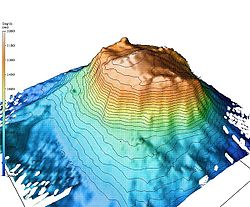
Bear Seamount

A seamount is a large submarine landform that rises from the ocean floor without reaching the water surface (sea level), and thus is not an island, islet, or cliff-rock. Seamounts are typically formed from extinct volcanoes that rise abruptly and are usually found rising from the seafloor to 100–4,000 m (330–13,120 ft) in height. They are defined by oceanographers as independent features that rise to at least 1,000 m (3,281 ft) above the seafloor, characteristically of conical form.[1] The peaks are often found hundreds to thousands of meters below the surface, and are therefore considered to be within the deep sea.[2] During their evolution over geologic time, the largest seamounts may reach the sea surface where wave action erodes the summit to form a flat surface. After they have subsided and sunk below the sea surface, such flat-top seamounts are called "guyots" or "tablemounts".[1]

Earth's oceans contain more than 14,500 identified seamounts,[3] of which 9,951 seamounts and 283 guyots, covering a total area of 8,796,150 km2 (3,396,210 sq mi), have been mapped[4] but only a few have been studied in detail by scientists. Seamounts and guyots are most abundant in the North Pacific Ocean, and follow a distinctive evolutionary pattern of eruption, build-up, subsidence and erosion. In recent years, several active seamounts have been observed, for example Kamaʻehuakanaloa (formerly Lōʻihi) in the Hawaiian Islands.

Because of their abundance, seamounts are one of the most common marine ecosystems in the world. Interactions between seamounts and underwater currents, as well as their elevated position in the water, attract plankton, corals, fish, and marine mammals alike. Their aggregational effect has been noted by the commercial fishing industry, and many seamounts support extensive fisheries. There are ongoing concerns on the negative impact of fishing on seamount ecosystems, and well-documented cases of stock decline, for example with the orange roughy (Hoplostethus atlanticus). 95% of ecological damage is done by bottom trawling, which scrapes whole ecosystems off seamounts.

Because of their large numbers, many seamounts remain to be properly studied, and even mapped. Bathymetry and satellite altimetry are two technologies working to close the gap. There have been instances where naval vessels have collided with uncharted seamounts; for example, Muirfield Seamount is named after the ship that struck it in 1973. However, the greatest danger from seamounts are flank collapses; as they get older, extrusions seeping in the seamounts put pressure on their sides, causing landslides that have the potential to generate massive tsunamis.

Geography

[edit]
Bathymetric mapping of part of Davidson Seamount. The dots indicate significant coral nurseries.

Seamounts can be found in every ocean basin in the world, distributed extremely widely both in space and in age. A seamount is technically defined as an isolated rise in elevation of 1,000 m (3,281 ft) or more from the surrounding seafloor, and with a limited summit area,[5] of conical form.[1] There are more than 14,500 seamounts.[3] In addition to seamounts, there are more than 80,000 small knolls, ridges and hills less than 1,000 m in height in the world's oceans.[4]

Most seamounts are volcanic in origin, and thus tend to be found on oceanic crust near mid-ocean ridges, mantle plumes, and island arcs. Overall, seamount and guyot coverage is greatest as a proportion of seafloor area in the North Pacific Ocean, equal to 4.39% of that ocean region. The Arctic Ocean has only 16 seamounts and no guyots, and the Mediterranean and Black seas together have only 23 seamounts and 2 guyots. The 9,951 seamounts which have been mapped cover an area of 8,088,550 km2 (3,123,010 sq mi). Seamounts have an average area of 790 km2 (310 sq mi), with the smallest seamounts found in the Arctic Ocean and the Mediterranean and Black Seas; whilst the largest mean seamount size, 890 km2 (340 sq mi), occurs in the Indian Ocean. The largest seamount has an area of 15,500 km2 (6,000 sq mi) and it occurs in the North Pacific. Guyots cover a total area of 707,600 km2 (273,200 sq mi) and have an average area of 2,500 km2 (970 sq mi), more than twice the average size of seamounts. Nearly 50% of guyot area and 42% of the number of guyots occur in the North Pacific Ocean, covering 342,070 km2 (132,070 sq mi). The largest three guyots are all in the North Pacific: the Kuko Guyot (estimated 24,600 km2 (9,500 sq mi)), Suiko Guyot (estimated 20,220 km2 (7,810 sq mi)) and the Pallada Guyot (estimated 13,680 km2 (5,280 sq mi)).[4]

Grouping

[edit]

Seamounts are often found in groupings or submerged archipelagos, a classic example being the Emperor Seamounts, an extension of the Hawaiian Islands. Formed millions of years ago by volcanism, they have since subsided far below sea level. This long chain of islands and seamounts extends thousands of kilometers northwest from the island of Hawaii.

Distribution of seamounts and guyots in the North Pacific
Distribution of seamounts and guyots in the North Atlantic

There are more seamounts in the Pacific Ocean than in the Atlantic, and their distribution can be described as comprising several elongate chains of seamounts superimposed on a more or less random background distribution.[6] Seamount chains occur in all three major ocean basins, with the Pacific having the most number and most extensive seamount chains. These include the Hawaiian (Emperor), Mariana, Gilbert, Tuomotu and Austral Seamounts (and island groups) in the north Pacific and the Louisville and Sala y Gomez ridges in the southern Pacific Ocean. In the North Atlantic Ocean, the New England Seamounts extend from the eastern coast of the United States to the mid-ocean ridge. Craig and Sandwell[6] noted that clusters of larger Atlantic seamounts tend to be associated with other evidence of hotspot activity, such as on the Walvis Ridge, Vitória-Trindade Ridge, Bermuda Islands and Cape Verde Islands. The mid-Atlantic ridge and spreading ridges in the Indian Ocean are also associated with abundant seamounts.[7] Otherwise, seamounts tend not to form distinctive chains in the Indian and Southern Oceans, but rather their distribution appears to be more or less random.

Isolated seamounts and those without clear volcanic origins are less common; examples include Bollons Seamount, Eratosthenes Seamount, Axial Seamount and Gorringe Ridge.[8]

If all known seamounts were collected into one area, they would make a landform the size of Europe.[9] Their overall abundance makes them one of the most common, and least understood, marine structures and biomes on Earth,[10] a sort of exploratory frontier.[11]

Geology

[edit]

Geochemistry and evolution

[edit]
Diagram of a submarine eruption (key: 1. Water vapor cloud 2. Water 3. Stratum 4. Lava flow 5. Magma conduit 6. Magma chamber 7. Dike 8. Pillow lava) Click to enlarge

Most seamounts are built by one of two volcanic processes, although some, such as the Christmas Island Seamount Province near Australia, are more enigmatic.[12] Volcanoes near plate boundaries and mid-ocean ridges are built by decompression melting of rock in the upper mantle. The lower density magma rises through the crust to the surface. Volcanoes formed near or above subducting zones are created because the subducting tectonic plate adds volatiles to the overriding plate that lowers its melting point. Which of these two process involved in the formation of a seamount has a profound effect on its eruptive materials. Lava flows from mid-ocean ridge and plate boundary seamounts are mostly basaltic (both tholeiitic and alkalic), whereas flows from subducting ridge volcanoes are mostly calc-alkaline lavas. Compared to mid-ocean ridge seamounts, subduction zone seamounts generally have more sodium, alkali, and volatile abundances, and less magnesium, resulting in more explosive, viscous eruptions.[11]

All volcanic seamounts follow a particular pattern of growth, activity, subsidence and eventual extinction. The first stage of a seamount's evolution is its early activity, building its flanks and core up from the sea floor. This is followed by a period of intense volcanism, during which the new volcano erupts almost all (e.g. 98%) of its total magmatic volume. The seamount may even grow above sea level to become an oceanic island (for example, the 2009 eruption of Hunga Tonga). After a period of explosive activity near the ocean surface, the eruptions slowly die away. With eruptions becoming infrequent and the seamount losing its ability to maintain itself, the volcano starts to erode. After finally becoming extinct (possibly after a brief rejuvenated period), they are ground back down by the waves. Seamounts are built in a far more dynamic oceanic setting than their land counterparts, resulting in horizontal subsidence as the seamount moves with the tectonic plate towards a subduction zone. Here it is subducted under the plate margin and ultimately destroyed, but it may leave evidence of its passage by carving an indentation into the opposing wall of the subduction trench. The majority of seamounts have already completed their eruptive cycle, so access to early flows by researchers is limited by late volcanic activity.[11]

Ocean-ridge volcanoes in particular have been observed to follow a certain pattern in terms of eruptive activity, first observed with Hawaiian seamounts but now shown to be the process followed by all seamounts of the ocean-ridge type. During the first stage the volcano erupts basalt of various types, caused by various degrees of mantle melting. In the second, most active stage of its life, ocean-ridge volcanoes erupt tholeiitic to mildly alkalic basalt as a result of a larger area melting in the mantle. This is finally capped by alkalic flows late in its eruptive history, as the link between the seamount and its source of volcanism is cut by crustal movement. Some seamounts also experience a brief "rejuvenated" period after a hiatus of 1.5 to 10 million years, the flows of which are highly alkalic and produce many xenoliths.[11]

In recent years, geologists have confirmed that a number of seamounts are active undersea volcanoes; two examples are Kamaʻehuakanaloa (formerly Lo'ihi) in the Hawaiian Islands and Vailulu'u in the Manu'a Group (Samoa).[8]

Lava types

[edit]
Pillow lava, a type of basalt flow that originates from lava-water interactions during submarine eruptions[13]

The most apparent lava flows at a seamount are the eruptive flows that cover their flanks, however igneous intrusions, in the forms of dikes and sills, are also an important part of seamount growth. The most common type of flow is pillow lava, named so after its distinctive shape. Less common are sheet flows, which are glassy and marginal, and indicative of larger-scale flows. Volcaniclastic sedimentary rocks dominate shallow-water seamounts. They are the products of the explosive activity of seamounts that are near the water's surface, and can also form from mechanical wear of existing volcanic rock.[11]

Structure

[edit]

Seamounts can form in a wide variety of tectonic settings, resulting in a very diverse structural bank. Seamounts come in a wide variety of structural shapes, from conical to flat-topped to complexly shaped.[11] Some are built very large and very low, such as Koko Guyot[14] and Detroit Seamount;[15] others are built more steeply, such as Kamaʻehuakanaloa Seamount[16] and Bowie Seamount.[17] Some seamounts also have a carbonate or sediment cap.[11]

Many seamounts show signs of intrusive activity, which is likely to lead to inflation, steepening of volcanic slopes, and ultimately, flank collapse.[11] There are also several sub-classes of seamounts. The first are guyots, seamounts with a flat top. These tops must be 200 m (656 ft) or more below the surface of the sea; the diameters of these flat summits can be over 10 km (6.2 mi).[18] Knolls are isolated elevation spikes measuring less than 1,000 meters (3,281 ft).[clarification needed] Lastly, pinnacles are small pillar-like seamounts.[5]

Ecology

[edit]

Ecological role of seamounts

[edit]
Animations depicting current flow over seamounts and ridges.

Seamounts are exceptionally important to their biome ecologically, but their role in their environment is poorly understood. Because they project out above the surrounding sea floor, they disturb standard water flow, causing eddies and associated hydrological phenomena that ultimately result in water movement in an otherwise still ocean bottom. Currents have been measured at up to 0.9 knots, or 48 centimeters per second. Because of this upwelling seamounts often carry above-average plankton populations, seamounts are thus centers where the fish that feed on them aggregate, in turn falling prey to further predation, making seamounts important biological hotspots.[5]

Seamounts provide habitats and spawning grounds for these larger animals, including numerous fish. Some species, including black oreo (Allocyttus niger) and blackstripe cardinalfish (Apogon nigrofasciatus), have been shown to occur more often on seamounts than anywhere else on the ocean floor. Marine mammals, sharks, tuna, and cephalopods all congregate over seamounts to feed, as well as some species of seabirds when the features are particularly shallow.[5]

Grenadier fish (Coryphaenoides sp.) and bubblegum coral (Paragorgia arborea) on the crest of Davidson Seamount. These are two species attracted to the seamount; Paragorgia arborea in particular grows in the surrounding area as well, but nowhere near as profusely.[19]

Seamounts often project upwards into shallower zones more hospitable to sea life, providing habitats for marine species that are not found on or around the surrounding deeper ocean bottom. Because seamounts are isolated from each other they form "undersea islands" creating the same biogeographical interest. As they are formed from volcanic rock, the substrate is much harder than the surrounding sedimentary deep sea floor. This causes a different type of fauna to exist than on the seafloor, and leads to a theoretically higher degree of endemism.[20] However, recent research especially centered at Davidson Seamount suggests that seamounts may not be especially endemic, and discussions are ongoing on the effect of seamounts on endemicity. They have, however, been confidently shown to provide a habitat to species that have difficulty surviving elsewhere.[21][22]

The volcanic rocks on the slopes of seamounts are heavily populated by suspension feeders, particularly corals, which capitalize on the strong currents around the seamount to supply them with food. These coral are therefore host to numerous other organisms in a commensal relationship, for example brittle stars, who climb the coral to get themselves off the seafloor, helping them to catch food particles, or small zooplankton, as they drift by.[23] This is in sharp contrast with the typical deep-sea habitat, where deposit-feeding animals rely on food they get off the ground.[5] In tropical zones extensive coral growth results in the formation of coral atolls late in the seamount's life.[22][24]

In addition soft sediments tend to accumulate on seamounts, which are typically populated by polychaetes (annelid marine worms) oligochaetes (microdrile worms), and gastropod mollusks (sea slugs). Xenophyophores have also been found. They tend to gather small particulates and thus form beds, which alters sediment deposition and creates a habitat for smaller animals.[5] Many seamounts also have hydrothermal vent communities, for example Suiyo[25] and Kamaʻehuakanaloa seamounts.[26] This is helped by geochemical exchange between the seamounts and the ocean water.[11]

Seamounts may thus be vital stopping points for some migratory animals, specifically whales. Some recent research indicates whales may use such features as navigational aids throughout their migration.[27] For a long time it has been surmised that many pelagic animals visit seamounts as well, to gather food, but proof of this aggregating effect has been lacking. The first demonstration of this conjecture was published in 2008.[28]

Fishing

[edit]

The effect that seamounts have on fish populations has not gone unnoticed by the commercial fishing industry. Seamounts were first extensively fished in the second half of the 20th century, due to poor management practices and increased fishing pressure seriously depleting stock numbers on the typical fishing ground, the continental shelf. Seamounts have been the site of targeted fishing since that time.[29]

Nearly 80 species of fish and shellfish are commercially harvested from seamounts, including spiny lobster (Palinuridae), mackerel (Scombridae and others), red king crab (Paralithodes camtschaticus), red snapper (Lutjanus campechanus), tuna (Scombridae), Orange roughy (Hoplostethus atlanticus), and perch (Percidae).[5]

Conservation

[edit]
Because of overfishing at their seamount spawning grounds, stocks of orange roughy (Hoplostethus atlanticus) have plummeted; experts say that it could take decades for the species to restore itself to its former numbers.[29]

The ecological conservation of seamounts is hurt by the simple lack of information available. Seamounts are very poorly studied, with only 350 of the estimated 100,000 seamounts in the world having received sampling, and fewer than 100 in depth.[30] Much of this lack of information can be attributed to a lack of technology,[clarification needed] and to the daunting task of reaching these underwater structures; the technology to fully explore them has only been around the last few decades. Before consistent conservation efforts can begin, the seamounts of the world must first be mapped, a task that is still in progress.[5]

Overfishing is a serious threat to seamount ecological welfare. There are several well-documented cases of fishery exploitation, for example the orange roughy (Hoplostethus atlanticus) off the coasts of Australia and New Zealand and the pelagic armorhead (Pseudopentaceros richardsoni) near Japan and Russia.[5] The reason for this is that the fishes that are targeted over seamounts are typically long-lived, slow-growing, and slow-maturing. The problem is confounded by the dangers of trawling, which damages seamount surface communities, and the fact that many seamounts are located in international waters, making proper monitoring difficult.[29] Bottom trawling in particular is extremely devastating to seamount ecology, and is responsible for as much as 95% of ecological damage to seamounts.[31]

Coral earrings of this type are often made from coral harvested off seamounts.

Corals from seamounts are also vulnerable, as they are highly valued for making jewellery and decorative objects. Significant harvests have been produced from seamounts, often leaving coral beds depleted.[5]

Individual nations are beginning to note the effect of fishing on seamounts, and the European Commission has agreed to fund the OASIS project, a detailed study of the effects of fishing on seamount communities in the North Atlantic.[29] Another project working towards conservation is CenSeam, a Census of Marine Life project formed in 2005. CenSeam is intended to provide the framework needed to prioritise, integrate, expand and facilitate seamount research efforts in order to significantly reduce the unknown and build towards a global understanding of seamount ecosystems, and the roles they have in the biogeography, biodiversity, productivity and evolution of marine organisms.[30][32]

Possibly the best ecologically studied seamount in the world is Davidson Seamount, with six major expeditions recording over 60,000 species observations. The contrast between the seamount and the surrounding area was well-marked.[21] One of the primary ecological havens on the seamount is its deep sea coral garden, and many of the specimens noted were over a century old.[19] Following the expansion of knowledge on the seamount there was extensive support to make it a marine sanctuary, a motion that was granted in 2008 as part of the Monterey Bay National Marine Sanctuary.[33] Much of what is known about seamounts ecologically is based on observations from Davidson.[19][28] Another such seamount is Bowie Seamount, which has also been declared a marine protected area by Canada for its ecological richness.[34]

Exploration

[edit]
Graph showing the rise in global sea level (in mm) as measured by the NASA/CNES oceanic satellite altimeter TOPEX/Poseidon (left) and its follow-on mission Jason-1

The study of seamounts has been hindered for a long time by the lack of technology. Although seamounts have been sampled as far back as the 19th century, their depth and position meant that the technology to explore and sample seamounts in sufficient detail did not exist until the last few decades. Even with the right technology available,[clarification needed] only a scant 1% of the total number have been explored,[9] and sampling and information remains biased towards the top 500 m (1,640 ft).[5] New species are observed or collected and valuable information is obtained on almost every submersible dive at seamounts.[10]

Before seamounts and their oceanographic impact can be fully understood, they must be mapped, a daunting task due to their sheer number.[5] The most detailed seamount mappings are provided by multibeam echosounding (sonar), however after more than 5000 publicly held cruises, the amount of the sea floor that has been mapped remains minuscule. Satellite altimetry is a broader alternative, albeit not as detailed, with 13,000 catalogued seamounts; however this is still only a fraction of the total 100,000. The reason for this is that uncertainties in the technology limit recognition to features 1,500 m (4,921 ft) or larger. In the future, technological advances could allow for a larger and more detailed catalogue.[24]

Observations from CryoSat-2 combined with data from other satellites has shown thousands of previously uncharted seamounts, with more to come as data is interpreted.[35][36][37][38]

Deep-sea mining

[edit]

Seamounts are a possible future source of economically important metals. Even though the ocean makes up 70% of Earth's surface area, technological challenges have severely limited the extent of deep sea mining. But with the constantly decreasing supply on land, some mining specialists see oceanic mining as the destined future, and seamounts stand out as candidates.[39]

Seamounts are abundant, and all have metal resource potential because of various enrichment processes during the seamount's life. An example for epithermal gold mineralization on the seafloor is Conical Seamount, located about 8 km south of Lihir Island in Papua New Guinea. Conical Seamount has a basal diameter of about 2.8 km and rises about 600 m above the seafloor to a water depth of 1050 m. Grab samples from its summit contain the highest gold concentrations yet reported from the modern seafloor (max. 230 g/t Au, avg. 26 g/t, n=40).[40] Iron-manganese, hydrothermal iron oxide, sulfide, sulfate, sulfur, hydrothermal manganese oxide, and phosphorite[41] (the latter especially in parts of Micronesia) are all mineral resources that are deposited upon or within seamounts. However, only the first two have any potential of being targeted by mining in the next few decades.[39]

Dangers

[edit]
USS San Francisco in dry dock in Guam in January 2005, following its collision with an uncharted seamount. The damage was extensive and the submarine was just barely salvaged.[42]

Some seamounts have not been mapped and thus pose a navigational danger. For instance, Muirfield Seamount is named after the ship that hit it in 1973.[43] More recently, the submarine USS San Francisco ran into an uncharted seamount in 2005 at a speed of 35 knots (40.3 mph; 64.8 km/h), sustaining serious damage and killing one seaman.[42]

One major seamount risk is that often, in the late of stages of their life, extrusions begin to seep in the seamount. This activity leads to inflation, over-extension of the volcano's flanks, and ultimately flank collapse, leading to submarine landslides with the potential to start major tsunamis, which can be among the largest natural disasters in the world. In an illustration of the potent power of flank collapses, a summit collapse on the northern edge of Vlinder Seamount resulted in a pronounced headwall scarp and a field of debris up to 6 km (4 mi) away.[11] A catastrophic collapse at Detroit Seamount flattened its whole structure extensively.[15] Lastly, in 2004, scientists found marine fossils 61 m (200 ft) up the flank of Kohala mountain in Hawaii. Subsidation analysis found that at the time of their deposition, this would have been 500 m (1,640 ft) up the flank of the volcano,[44] far too high for a normal wave to reach. The date corresponded with a massive flank collapse at the nearby Mauna Loa, and it was theorized that it was a massive tsunami, generated by the landslide, that deposited the fossils.[45]

See also

[edit]

References

[edit]

Bibliography

[edit]
[edit]
Revisions and contributorsEdit on WikipediaRead on Wikipedia
from Grokipedia
A seamount is an underwater mountain rising abruptly from the deep ocean floor with steep sides and a summit that lies below , typically featuring a vertical exceeding 1,000 above the surrounding seafloor. Primarily formed through volcanic activity at hotspots, mid-ocean ridges, or zones, seamounts consist mainly of basaltic rock and may evolve into guyots—flat-topped features—via when once near the surface. Seamounts are most abundant in the , which hosts approximately 69% of the global total, with scientific estimates placing the worldwide number of seamounts taller than 1,000 at over , though many remain unmapped. These features profoundly influence marine ecosystems by providing hard substrates for sessile organisms like deep-sea corals and sponges, fostering hotspots with high rates of due to isolation and localized that enhances productivity. Seamounts also affect ocean currents and distribution through Taylor columns and vertical mixing, contributing to global biogeochemical cycles, while facing anthropogenic pressures such as bottom trawling that damages fragile habitats. Notable examples include the Hawaiian-Emperor , illustrating hotspot track formation over tectonic plates.

Definition and Characteristics

Physical Morphology

Seamounts constitute isolated submarine elevations exceeding 1,000 meters in height from the surrounding seafloor, featuring comparatively steep slopes and restricted areas relative to their bases. Their morphologies generally approximate cones or shields with circular to elliptical plan views, though deviations arise from progressive slope failures and that yield irregular profiles over time. Flank slopes typically range from 10 to 30 degrees, steeper than many abyssal plains but variable by position, with near- gradients often surpassing 30 degrees due to initial volcanic construction. Summit morphologies encompass volcanic edifices such as calderas, pit craters, and rift zones, reflecting eruptive histories where nested collapses and resurgent uplifts shape nested depressions up to several kilometers across. Linear ridges and parasitic cones may extend from central vents, while guyots exhibit distinctive flat-topped platforms, 5 to 10 kilometers in diameter, resultant from wave and wind during episodic exposure followed by below wave base. Bases broaden to diameters of 10 to 50 kilometers, supporting the overall tapered form that distinguishes seamounts from broader mid-ocean ridges. These physical attributes derive from primary volcanic accumulation of basaltic lavas forming steep-sided piles, subsequently modified by gravitational instabilities and currents, with bathymetric surveys revealing fine-scale features like debris aprons at bases from flank collapses. Smaller variants, termed abyssal hills or knolls under 1,000 meters, share analogous conical traits but lack pronounced summits.

Classification and Types

Seamounts are classified primarily by morphological features, including , , and summit characteristics, with a standard definition requiring elevation of at least 1,000 meters above the surrounding seafloor. Smaller submarine elevations under 1,000 meters are often termed sea knolls or abyssal knolls, distinguishing them from full seamounts despite similar volcanic origins. Typical seamounts exhibit a conical form with steep slopes greater than 25 degrees, circular or elliptical bases, and potential summit features like craters or ridges. Guyots, or tablemounts, represent a distinct type characterized by flat summits, resulting from wave during periods of exposure as islands, followed by tectonic below . These flat tops typically occur at depths of 1,000 to 2,000 meters, contrasting with the peaked summits of uneroded seamounts. Advanced classifications incorporate quantitative variables such as base area, height-to-base , summit depth, and to generate up to 36 morphotypes, aiding in predictions of and habitat suitability. For instance, taller seamounts with narrower bases may promote distinct current interactions compared to broader, flatter ones, influencing ecological classifications over purely geometric ones. Such systems prioritize physical proxies for biological relevance, as direct faunal data remain limited for most of the estimated 100,000 global seamounts.

Geological Origins

Volcanic Formation Processes

Seamounts form primarily through hotspot volcanism driven by mantle plumes, where hot, buoyant material rises from the lower mantle, inducing decompression melting to generate basaltic magma. This magma, less dense than surrounding rock, ascends through the oceanic lithosphere due to buoyancy and erupts on the seafloor, initiating the construction of volcanic edifices. Under high hydrostatic pressures at abyssal depths, eruptions produce non-explosive flows that solidify into pillow lavas and fragmented hyaloclastites, accumulating layer by layer to form conical structures. Intrusive processes, such as the emplacement of dikes and sills, supplement extrusive growth, particularly as edifices exceed 1000 meters in height and develop magma plumbing systems. In the initial growth phase, small seamounts (100–1000 meters tall) are dominated by effusive eruptions of pillow basalts with minimal intrusive activity. As structures enlarge, volcanic output increases, with mid-sized seamounts exhibiting enhanced intrusive inflation and sustained non-explosive at depths greater than 700 meters. Shallower stages, below , may transition to explosive activity if pressures drop sufficiently to allow volatile expansion, producing volcaniclastic deposits. Hotspot plumes remain relatively stationary relative to the overriding tectonic plate, resulting in age-progressive chains; for instance, the Hawaiian-Emperor seamount chain records from less than 0.7 million years ago on the Big Island to approximately 70 million years ago at its northern extent. Secondary formation occurs at mid-ocean ridges, where plate divergence facilitates to fill extensional gaps, or near zones, where descending slabs trigger of the overlying mantle wedge. However, these settings typically yield linear volcanic ridges rather than isolated seamounts, with hotspots accounting for the majority of discrete, intraplate features estimated at over 100,000 globally taller than 1000 meters. Volcanism ceases as plate motion carries edifices away from the plume, leading to at rates such as 2.6 mm per year in the Hawaiian chain due to lithospheric cooling and isostatic adjustment.

Geochemical Composition and Lava Varieties

Seamount lavas are primarily basaltic, with geochemical compositions varying by tectonic setting and mantle source. Hotspot-associated seamounts produce ocean island basalts (OIB) enriched in incompatible elements like Nb, Zr, and light rare earth elements (LREE), showing elevated Nb/Zr and (Ce/Yb)N ratios indicative of recycled or plume-derived components. In contrast, near-ridge seamounts yield normal or enriched basalts (MORB), with lower abundances and ratios such as Zr/Nb closer to depleted mantle values, reflecting ridge-axis mantle heterogeneity. Major oxide contents in western Pacific seamount basalts typically range from SiO₂ 39.9–49.6 wt%, Na₂O 1.5–4.5 wt%, K₂O 0.9–2.5 wt%, CaO 6.1–10.3 wt%, and Al₂O₃ 12.3–16.5 wt%, classifying many as alkaline or transitional types based on ratios like /P, Zr/Nb, and La/Sm. Tholeiitic basalts dominate ridge-proximal settings, while basalts prevail in intraplate chains, with picritic varieties occasionally present from high-temperature melts. Variations arise from degrees, source fertility, and interactions like ridge-hotspot proximity, which can hybridize compositions as seen in the Pacific-Antarctic where lavas near seamounts show enriched signatures. Submarine eruption conditions dictate lava morphologies, with pillow lavas forming the bulk volume through quench fragmentation into bulbous, tube-like structures as molten interacts with cold . Lobate flows, smoother and fan-shaped, develop from lower-viscosity effusions, while sheet flows—lineated or folded—occur in high-effusion-rate events, covering larger areas rapidly. These forms coexist along seamount flanks, with pillows most prevalent due to pervasive underwater , and hyaloclastites forming from shallow-water interactions.

Structural Evolution and Guyots

Seamounts typically evolve through phases of volcanic , erosional modification, and driven by lithospheric cooling. Volcanic edifices form via episodic eruptions that accumulate basaltic material, often reaching elevations of 1,000 to 4,000 meters above the surrounding seafloor, with phases lasting 0.1 to 1 million years depending on hotspot flux. Post-eruptive occurs at rates of 1-5 mm per year initially, accelerating flattening through and along flanks, where slumps and landslides redistribute material and reduce summit relief. This structural progression reflects the transition from dynamic to passive tectonic adjustment, with older seamounts exhibiting truncated profiles and drapes indicative of prolonged exposure to bottom currents. Guyots emerge as a distinct evolutionary endpoint for seamounts that temporarily breach sea level, undergoing intense wave-driven that bevels summits to near-flat platforms typically 5-10 km in . Formation requires initial as volcanic islands, followed by subaerial and marine planation at the wave base, which truncates peaks to depths of 10-50 meters below the contemporaneous before resumes. In hotspot chains like the Hawaiian-Emperor system, this process yields guyots with carbonate caps from coral-algal reefs that keep pace with early , preserving evidence of tropical paleoenvironments; for instance, Emperor Seamount guyots host drowned atolls dated to 40-80 million years old. Unlike conical seamounts, guyots' flattened morphology persists due to minimal post- , with current depths often 1,000-2,000 meters reflecting cumulative of 1-2 km since truncation. Alternative models challenge purely erosional flattening, proposing contributions from syn-eruptive mass wasting triggered by seismic activity or intrusion-induced instability during edifice growth, as observed in Louisville Seamount Chain guyots where caps formed subaerially at low elevations. Empirical bathymetric data from chains like the New England Seamounts confirm that summits align with paleo-sea levels reconstructed from isotopic records, supporting subsidence-dominated evolution over 50-100 million years. These structures thus archive plate motion histories, with guyot distributions tracing hotspot tracks across Pacific basins.

Global Distribution and Inventory

Major Seamount Chains and Hotspots

Seamount chains primarily form through intraplate volcanism driven by hotspots, where buoyant plumes of hot material rise from deep within the Earth's , partially the overlying and generating that erupts to form volcanoes. As the oceanic plate drifts over the relatively stationary hotspot, a linear trail of aging volcanoes emerges, with the youngest features near the active hotspot and progressively older seamounts extending away in the direction opposite to plate motion. This process, evident in of basalts, shows age-distance progressions consistent with plate velocities of 5–10 cm/year for major Pacific chains. The Hawaiian-Emperor seamount chain exemplifies this mechanism, stretching approximately 6,000 km across the Pacific Ocean from the active Hawaiian hotspot northwestward through the Emperor seamounts. Radiometric ages range from recent volcanism at the Big Island of to about 81 million years at the northern end of the Emperor chain, with a pronounced bend at roughly 43 million years marking a change in Pacific plate motion from northward to north-northwestward. This chain comprises over 80 major volcanoes, transitioning from islands to guyots as older features subside and erode below due to lithospheric cooling and isostatic adjustment. In the South Pacific, the Louisville seamount chain extends about 4,300 km northwest from near the Pacific-Antarctic Ridge toward the Tonga-Kermadec Trench, formed by the Louisville hotspot over the past 80 million years. It includes more than 80 seamounts, with basaltic compositions indicating a deep mantle source similar to that of the Hawaiian hotspot, though with distinct trace element ratios suggesting variations in plume dynamics or lithospheric interaction. Drilling expeditions have confirmed ages increasing linearly from young seamounts near the inferred hotspot to older ones subducted at the trench, supporting hotspot fixity relative to the mantle. Other notable chains include the Foundation seamount chain, a 1,400 km feature on the Pacific plate formed over the last 21 million years by a hotspot near the Pacific-Antarctic spreading axis, characterized by relatively low-volume seamounts with tholeiitic basalts. In the northeast Pacific, the Cobb-Eickelberg chain traces the Cobb hotspot, linking to Axial Seamount on the , with volcanism persisting for about 30 million years and influencing ridge-hotspot interactions. These chains, concentrated in the Pacific basin which hosts the majority of global seamounts, highlight hotspots as persistent, deep-seated features driving ~80% of oceanic intraplate volcanism over the .

Estimation and Recent Discoveries

Estimates of the total number of seamounts worldwide have varied based on detection methods, with early inventories relying on ship-based yielding around 14,000 identified features, while broader satellite altimetry analyses predict totals exceeding 100,000, including smaller knolls taller than 1 km. Recent refinements using higher-resolution global grids, such as those from the 2030 initiative, have increased predicted seamount counts to approximately 37,889, incorporating over 4,000 newly anticipated features from enhanced data coverage reaching 27.3% of the ocean floor by mid-2025. These projections emphasize under-sampling in remote basins, where satellite-derived gravity anomalies detect previously unmapped peaks rising over 1 km from the . Advancements in multibeam sonar and autonomous underwater vehicles have accelerated discoveries since , with expeditions mapping dozens of previously unknown seamounts in the Pacific and Atlantic. In 2024, Schmidt Ocean Institute surveys off identified four new seamounts along the Nazca Ridge, the tallest reaching 2,681 meters in height and spanning 450 square kilometers at its base. By August 2024, further exploration in the same region documented an additional seamount in , alongside novel assemblages highlighting isolated evolutionary hotspots. In October 2025, Canadian deep-sea dives expanded knowledge of North Atlantic seamounts, revealing new cold-seep habitats with chemosynthetic communities and carbonate formations on features like those near the . These findings underscore the role of collaborative mapping efforts like Seabed 2030 in refining inventories, which have added millions of square kilometers of high-resolution data annually, enabling predictive models that prioritize unsurveyed hotspots for future targeted exploration. Despite progress, vast unmapped regions—particularly in the and —suggest that actual seamount abundance may surpass current estimates, as less than 25% of the global seafloor meets modern mapping standards.

Oceanographic and Ecological Dynamics

Physical Effects on Currents and Upwelling

Seamounts disrupt prevailing ocean currents through their abrupt topographic relief, inducing flow separation, eddy generation, and enhanced vertical shear. Ambient currents encountering a seamount experience deflection and acceleration around its slopes, producing anticyclonic vorticity upstream and cyclonic eddies in the downstream wake, with eddy diameters often comparable to the seamount's base width of several kilometers. These perturbations scale with flow speed and seamount dimensions, altering regional circulation patterns over distances exceeding 100 km. Under conditions of low (typically Ro < 1, where Ro = U / fL with U as current speed, f the Coriolis parameter, and L the seamount radius), the Coriolis effect dominates, leading to the formation of Taylor columns or caps. In these structures, a column of extending hundreds of meters to kilometers above the seamount rotates rigidly with the , effectively trapping and minimizing relative motion, as observed in density sections showing isopycnal doming. This phenomenon, prominent in steady, stratified flows with speeds below 0.1 m/s, reduces horizontal over the summit while promoting lateral at the base. Upwelling arises primarily from topographic forcing, where impinging currents cause bottom divergence and Ekman suction, drawing deeper waters upward over the seamount crest. Mechanisms include stratified turbulence in turbulent wakes, generating layered vortices and lee waves that mix waters vertically, with diapycnal diffusivities reaching 10^{-2} m² s^{-1}—one to two orders above ambient levels of 10^{-5} m² s^{-1}. Such mixing contributes up to 40% of water mass transformation in deep density classes, recirculating abyssal waters into the upper ocean. Field measurements at specific sites quantify these effects; for instance, around the Aracati Seamount in the North Chain, modeling and observations indicate vertical velocities of approximately 2 × 10^{-3} m s^{-1} (peaking at 8 × 10^{-3} m s^{-1}), driven by the North Brazil Current with speeds of 0.3–1 m s^{-1}. Steeper flanks amplify shear and , enhancing upwelling extent into the euphotic zone during periods of stronger flow. These dynamics underscore seamounts' role in deep-ocean ventilation, independent of wind-driven processes.

Biodiversity Patterns and Endemism

Seamounts host elevated levels of benthic and pelagic biodiversity relative to surrounding deep-sea plains, driven by topographic complexity that fosters habitat heterogeneity and localized upwelling of nutrient-rich waters. Studies indicate that seamount-associated pelagic communities exhibit consistently higher species richness than non-seamount areas in the open ocean, with aggregations of micronekton and fish enhancing trophic support for higher predators. Benthic assemblages, including structure-forming organisms like corals and sponges, contribute to this diversity by providing three-dimensional habitats that increase substrate availability and microhabitat variety. However, variability in biodiversity is high both within individual seamounts—often decreasing with depth and distance from summits—and across seamounts, influenced by regional oceanography and isolation. Endemism on seamounts, defined as species restricted to one or a few seamounts, occurs at moderate rates that vary by taxonomic group and geographic region, challenging earlier views of seamounts as isolated "island-like" systems with exceptionally high uniqueness. For macro- and megafaunal species in the southwest Pacific, surveys have documented over 850 taxa, with endemism estimated at 20-30% for certain , though genetic studies reveal ongoing connectivity via larval dispersal that limits strict isolation. At specific sites like , approximately 12% of identified species are confined to local seamount clusters, primarily among echinoderms and mollusks, while endemism remains low at under 5% due to broader dispersal capabilities. Recent metabarcoding analyses confirm higher eukaryotic richness on seamounts compared to abyssal zones but highlight that many presumed endemics may reflect sampling biases rather than true evolutionary divergence. These patterns underscore seamounts' role as hotspots susceptible to undersampling, with empirical evidence from targeted expeditions showing that is more pronounced in sessile or low-mobility taxa adapted to persistent currents that retain planktonic stages near summits. Causal factors include Taylor column effects stabilizing water masses and promoting retention, yet inter-seamount connectivity via deep currents often results in shared pools rather than discrete faunas. Consequently, while seamounts amplify local diversity through physical retention and habitat provision, their levels—typically 10-25% across studies—do not rival terrestrial islands, emphasizing the need for expanded genomic surveys to distinguish true endemics from range-restricted populations.

Key Species and Trophic Interactions

Seamounts host diverse benthic communities dominated by suspension-feeding organisms, including stony corals (Lophelia pertusa), gorgonians, and antipatharians, which form complex three-dimensional structures supporting associated fauna like , bryozoans, and polychaetes. Glass sponges (Hyalonema spp.) and demosponges also prevail, filtering from upwelled waters to sustain growth in nutrient-poor abyssal environments. These sessile species create microhabitats for mobile , such as squat lobsters (Munida spp.), sea urchins, and galatheids, which exploit the structural complexity for shelter and foraging. Demersal fishes, including (Hoplostethus atlanticus) and (Beryx splendens), aggregate around seamount summits and flanks, preying on smaller fish and crustaceans while residing in coral-sponge matrices. Pelagic species like (Thunnus spp.), billfishes, and (e.g., porbeagles and blue sharks) congregate over seamounts, drawn by enhanced prey densities from current-induced retention. Higher trophic levels include seabirds, sea turtles, and cetaceans, such as sperm whales, utilizing seamounts as foraging or resting sites during migrations. Endemism is pronounced among seamount biota, with estimates of 20-40% of restricted to isolated features; for instance, at , seven new —including the octocoral Anthomastus sp. and sponge Theonella sp.—were described from surveys since 2002, alongside pending identifications. New England seamounts harbor rare endemics like the coral Solenosmilia variabilis variants and fish such as Helicolenus dactylopterus, underscoring isolation-driven . Trophic interactions hinge on seamount-induced and Taylor columns, which concentrate and , fueling primary consumers like copepods and euphausiids that, in turn, support and small fishes. Mesopelagic organisms, including myctophids and , bridge epipelagic production to benthic and demersal levels, forming a five-trophic-tier chain observed at sites like Condor Seamount, where benthic predators rely on vertically migrating prey fluxes. loops generated by seamount efficiently deliver to isolated , enhancing secondary production and sustaining top predators amid oligotrophic surroundings. Higher-order interactions involve predation cascades, with seamount-associated fishes consuming epibenthic , while pelagic apex predators like regulate mid-level populations, maintaining stability despite localized pressures on species such as . These dynamics vary by seamount depth and location, with shallower features exhibiting stronger pelagic-benthic coupling than deeper ones.

Human Utilization and Economic Value

Commercial Fishing Practices

Commercial fishing on seamounts predominantly employs , a method using heavy nets dragged along the seafloor to capture species that congregate at these underwater features due to nutrient and structure. Targeted species include (Hoplostethus atlanticus), alfonsino, and oreo dory, which exploit seamount summits for feeding and spawning aggregations. Orange roughy fisheries emerged in the late 1970s off , expanding globally in the 1980s and 1990s as vessels targeted seamounts in the and elsewhere, yielding peak catches exceeding 30,000 metric tons annually by the mid-1990s. These , which reach at 70-80 years and aggregate in predictable locations, proved vulnerable to rapid depletion; stocks collapsed by the early 2000s, prompting catch reductions to under 4,000 tons per year and closures in depleted areas. Trawling operations on seamounts involve intensive effort, with vessels conducting hundreds to thousands of tows per feature, often at depths of 400-1,500 meters using reinforced gear to navigate rugged . In New Zealand's , bottom trawling persists on select seamounts under quota systems, though proposals advocate closing 89% of features to protect while sustaining limited harvests. Internationally, areas like the Northeast Canyons and Seamounts Marine have banned since 2016, except for limited lobster and crab potting, to preserve ecosystems. Some fisheries have achieved certification through strict quotas maintaining biomass at 40% of unfished levels, demonstrating potential for managed recovery, though global stocks remain pressured by illegal and unregulated fishing in high seas. Alternatives to , such as static lines or traps, are explored but less common due to lower efficiency on seamounts.

Mineral Resources and Extraction Potential

Seamounts host cobalt-rich ferromanganese crusts as their primary mineral resource, forming thin layers of iron and oxides on exposed rock surfaces such as flanks and summits. These crusts precipitate hydrogenetically from over millions of years at rates of 1-5 mm per million years, accumulating where currents inhibit deposition. They occur predominantly at depths of 400 to 5,000 meters, with optimal growth on hard substrates free of thick sediments. The crusts' composition includes 20-30% and 10-20% iron oxides by weight, alongside economically viable grades of (0.5-2%), (0.5-1.5%), (0.1-0.5%), platinum-group elements (up to 1-2 ppm), and rare earth elements (total REEs up to 0.2-0.3%). concentrations often exceed those in terrestrial ores, making crusts a potential source for battery production and high-tech alloys. Global estimates suggest recoverable resources in Pacific seamount crusts alone could exceed 50 million metric tons, though actual mineable reserves depend on thickness (typically 1-25 cm) and coverage (up to 100% on suitable surfaces). Extraction potential centers on deep-sea mining technologies to harvest these crusts, distinct from nodule collection on abyssal plains due to their adherence to . Proposed methods involve towed or autonomous scrapers and cutters to detach crust layers from seamount slopes, followed by hydraulic lifting via riser systems to surface vessels. As of 2025, the has issued five exploration contracts specifically for cobalt-rich crusts, primarily in the Pacific, signaling commercial interest amid terrestrial supply constraints for critical metals. However, full-scale exploitation remains unproven, with challenges including water depths exceeding 4,000 meters, energy-intensive operations, and recovery efficiencies below 80% for thin deposits. Pilot tests indicate viable if cobalt prices remain above $30,000 per metric ton, potentially yielding 1-2% of global demand from select seamount fields.

Exploration and Research History

Early Detection Methods

Early detection of seamounts relied on manual depth soundings conducted from ships using weighted lines or piano wire, which measured seafloor depths at discrete points along survey tracks. These methods, employed since the mid-19th century, occasionally revealed shallower-than-expected depths indicative of submerged peaks in otherwise abyssal terrain. For instance, in 1869, the Swedish corvette Josephine discovered Josephine Seamount approximately 200 nautical miles west of Cape San Vicente, Portugal, after striking bottom at 100 fathoms instead of the anticipated 2,000 fathoms. Similarly, during 1873–1875, the USS Tuscarora utilized Matthew Fontaine Maury's improved sounding techniques and Thomson’s piano-wire machine to identify several Pacific seamounts west of Hawaii, including Erben Seamount, then the largest known at around 1,000 meters in height. The advent of acoustic echo sounders in the early marked a significant advancement, enabling continuous depth profiling via pulses rather than intermittent mechanical drops. The first practical use for seamount detection occurred in 1924 aboard the USS Stewart, equipped with Harvey Hayes' sonic depth finder, which identified Stewart Bank—a flat-topped feature—during a transit from to . By the pre-World War II period, such acoustic systems had cataloged approximately 200 seamounts worldwide, primarily through opportunistic surveys by naval and research vessels crossing deep-ocean routes. World War II accelerated discoveries as U.S. Navy warships, routinely fitted with echo sounders for navigation and submarine evasion, traversed Pacific waters and recorded bathymetric anomalies. Ships including the USS Cape Johnson, Massachusetts, and Pathfinder detected features such as Detroit Seamount and Pensacola Seamount, with oceanographer Harry Hess analyzing records from the Cape Johnson to identify 20 guyots—flat-topped seamounts—and later over 140 additional ones from broader naval data. These wartime transits provided the foundational datasets for recognizing seamount ubiquity, though systematic naming and verification lagged until postwar expeditions like the 1949 survey of Muir Seamount by Maurice Ewing and Ivan Tolstoy aboard the Caryn. Prior to satellite altimetry and multibeam sonar, these ship-based methods thus established the initial global inventory of seamounts, highlighting their prevalence in intraplate oceanic settings.

Modern Technological Advances

Advances in seafloor mapping technologies have enabled high-resolution imaging of seamounts, transitioning from broad-scale ship-based surveys to detailed autonomous and remotely operated systems. Multibeam sonar systems, mounted on hulls, emit fan-shaped arrays of acoustic beams to measure and , mapping depths from 10 to over 7,000 meters and revealing seamount topography, geological features, and anomalies like gas seeps. These systems have been integral to NOAA expeditions, such as those in 2017 around and 2019's Windows to the Deep, where they identified seamount habitats for subsequent vehicle deployments. Autonomous underwater vehicles (AUVs) represent a key modern advance, allowing persistent, low-altitude surveys beyond ship capabilities. MBARI's Dorado-class AUVs, operational since 2004, achieve 1-meter lateral resolution using 400 kHz multibeam sonar (Teledyne SeaBat T50-S) at 50-meter altitudes, alongside for 0.1-meter imaging and subbottom profilers penetrating 50 meters into sediments, all at depths up to 6,000 meters over 95-kilometer missions. For instance, AUV Sentry, rated to 6,000 meters, mapped Vailuluʻu Seamount in 2024 expeditions, integrating multibeam sonar with high-resolution cameras to document volcanic features and biological communities. Remotely operated vehicles (ROVs) equipped with integrated sensor suites further enhance close-range seamount exploration. MBARI's Low-Altitude Survey System (LASS), developed from 2011 and deployed on ROV Doc Ricketts, combines (5 cm resolution), (1 cm resolution), and stereo photography for centimeter-scale 3D models of deep-seafloor habitats, including those near where it quantified over 5,700 nests in a 2.5-hectare area at 3,200 meters depth during 2023 surveys. These technologies, often synergized in missions like NOAA's 2025 explorations targeting seamount corals and volcanoes, have expanded visual coverage of the deep seafloor while addressing biases in prior sampling toward accessible ridges.

Notable Studies and Ongoing Monitoring

One significant study, published in Science Advances in June 2024, demonstrated through modeling and observations that seamount generates lee waves in oceanic currents, creating efficient loops that sustain surface over the seamount summit. This work, conducted at a subtropical Pacific seamount, quantified enhanced vertical transport rates up to 10 times ambient levels, challenging prior assumptions of limited seamount influence on overlying euphotic zones. A 2021 Frontiers in Marine Science paper tested the Seamount Refuge in the Clarion-Clipperton Zone, using remotely operated vehicle surveys to assess whether seamounts shelter abyssal predators from polymetallic nodule mining disturbances; results indicated partial refuge effects for certain but vulnerability for smaller taxa due to limited connectivity. Complementing this, a NOAA study on Cross Seamount examined micronekton aggregation via acoustic and trawl data, revealing seamount-induced flow retention that supports forage bases, with densities 2-5 times higher than surrounding waters. Ongoing monitoring at Axial Seamount, an active off , utilizes the Regional Cabled since , delivering real-time seismic, pressure, and data from seafloor instruments to detect precursory inflation and eruptions, as evidenced by predictions of its 2015 and 2022 events with months of advance notice. The U.S. Geological Survey integrates this with multibeam and arrays to track magmatic unrest, enabling calibration of eruption forecasting models against historical data from 1998, 2011, and 2015. In the Pacific Remote Islands Marine National Monument, NOAA's 2024 Nautilus expeditions continue ROV-based biodiversity assessments at ancient seamounts near , documenting endemic corals and sponges amid climate stressors. Satellite-derived vessel tracking by Global Fishing Watch monitors fishing pressures on remote seamounts, identifying high-risk sites with over 1,000 vessel hours annually, informing targeted conservation without on-site instrumentation.

Risks and Hazards

Geological Instability and Eruptions

Seamounts, formed primarily through prolonged volcanic activity at hotspots or s, exhibit significant geological instability due to the rapid buildup of basaltic material on steep slopes exceeding 20-30 degrees. This instability manifests as large-scale flank collapses and landslides, often triggered by seismic activity, intrusion weakening the edifice, or gravitational loading on unconsolidated volcaniclastic deposits. Such failures are common during the early growth phases of seamounts, with multi-stage debris avalanches displacing volumes up to hundreds of cubic kilometers, as documented in the Hawaiian and Canary archipelagos where individual slides have exceeded 100 km³. Landslide recurrence intervals average 120 ± 20 thousand years for seamounts, with resulting debris flows extending tens to hundreds of kilometers across the seafloor. These collapses pose hazards including submarine tsunamis and sediment remobilization, as evidenced by the on the south flank of volcano, which connects to the Papa`u Seamount and has produced recurrent failures linked to precursory slope instability. Similarly, the Vavilov Seamount in the features morphological evidence of ancient landslides capable of generating basin-wide tsunamis, underscoring the tsunamigenic potential of such events even from dormant structures. Instability is exacerbated by hydrothermal alteration and seismic loading, leading to progressive weakening rather than singular catastrophic failure in many cases. Volcanic eruptions at seamounts occur predominantly as effusive events, extruding pillow basalts and hyaloclastites under high hydrostatic pressure that suppresses explosive activity above depths of about 1 km. The Axial Seamount, located on the off , provides well-documented examples, with eruptions in January 1998 involving seismic swarms and lava flows covering 4-11 km², confirmed by observations. A subsequent event in April 2015 featured over 8,000 earthquakes and a 2.4 m of the seafloor summit due to drainage, marking the first real-time monitored eruption. Eruptions like these are preceded by inflation from influx, detectable via bottom-pressure sensors and seismometers, enabling forecasts for sites such as Axial where cycles repeat every 5-10 years. While most seamount activity remains undetected without instrumentation, ongoing monitoring reveals that such volcanoes contribute significantly to global volcanic flux, with effusive outputs dominating over counterparts. Seamounts present acute navigational hazards to owing to their abrupt from the seafloor, often exceeding 1,000 meters in height with slopes steeper than 20 degrees, rendering them undetectable by standard until perilously close. Incomplete bathymetric surveys in remote ocean basins exacerbate this risk, as many seamounts remain uncharted or inaccurately mapped, leading to high-speed collisions during submerged transits. A prominent example occurred on January 8, 2005, when the U.S. Navy's USS San Francisco (SSN-711), a Los Angeles-class attack submarine, struck an uncharted seamount approximately 350 nautical miles south of Guam while traveling at flank speed—about 35 knots—at a depth of 525 feet. The impact crushed the bow, ruptured forward ballast tanks, and flooded the sonar dome, injuring 98 of the 137 crew members and resulting in the death of Machinist's Mate Second Class Joseph A. Ashley from head trauma six days later. The submarine's reactor remained intact, allowing it to surface and limp to Guam for repairs costing over $100 million, underscoring the vulnerability of nuclear-powered vessels to such unforeseen obstacles. Similar perils materialized on October 2, 2021, when the Seawolf-class USS Connecticut (SSN-22) collided with an undersea seamount in the South China Sea during a submerged transit at high speed, inflicting severe damage to the sail and injuring 11 sailors. Navy investigations attributed the incident to navigational errors compounded by reliance on outdated charts, with the seamount's peak rising unexpectedly from depths exceeding 2,000 meters. These events highlight systemic challenges in undersea domain awareness, where seamount density—estimated at over 100,000 globally, with many in the Pacific—demands advanced multibeam sonar mapping and real-time data integration to mitigate collision probabilities. Beyond direct impacts, seamounts induce localized oceanographic perturbations, including Taylor columns and intensified currents from flow deflection over their summits, which can unpredictably alter trajectories or surface vessel stability in vicinity. For operations targeting seamount-associated fish stocks like , operational dangers include frequent of bottom trawls or longlines on jagged peaks and ridges, leading to gear loss and subsequent that entangles propellers or rudders. Such incidents contribute to economic losses and heightened entanglement risks for other vessels, as lost gear drifts unpredictably across shipping lanes.

Exploitation Controversies and Management

Environmental Impact Assessments

Environmental impact assessments (EIAs) for seamounts primarily evaluate risks from in fisheries and mineral extraction via deep-sea mining, focusing on , , and slow recovery rates in these isolated, endemic-rich ecosystems. Seamounts qualify as vulnerable marine ecosystems (VMEs) under international frameworks like the UN (FAO), due to fragile, long-lived benthic communities including cold-water corals and sponges that exhibit limited resilience to physical disturbance. Assessments highlight that gear, which contacts the seabed across wide swaths, causes quasi-linear erosion of alpha and , with persistent effects on commercial and threatened rays even after cessation. A 15-year towed camera survey on small seamounts post-trawling found negligible benthic community recovery, underscoring vulnerability over short-to-medium timescales. In deep-sea mining contexts, EIAs mandated by the (ISA) for contractors in the Area assess direct impacts like scarring from crust removal and indirect effects such as plumes dispersing toxins and smothering suspension feeders. A 2023 test-mining trial on cobalt-rich ferromanganese crusts at a seamount demonstrated plume propagation affecting nearby biota, providing baseline evidence for exploitation regulations yet revealing gaps in long-term monitoring. By February 2025, six contractors had submitted environmental impact statements (EIS) documenting EIA processes, though critiques identify shortcomings in predictive modeling and baseline ecological , advocating for enhanced empirical validation to inform precautionary thresholds. Fisheries management EIAs, often conducted under regional fisheries management organizations (RFMOs), incorporate encounter protocols to mitigate , but varies, with historic showing widespread irreversible degradation on unprotected seamounts. The IUCN's 2025 resolution urging an end to seamount cites cumulative assessments of crises exacerbated by gear-induced habitat homogenization, though economic analyses in some EIAs weigh protein provision against ecological costs without consensus on net benefits. Overall, seamount EIAs emphasize a precautionary approach given sparse pre-exploitation baselines, with ongoing debates over balancing data-limited models against observed empirical harms from analogous activities.

Regulatory Frameworks and International Debates

The primary regulatory framework for seamount mineral exploitation in falls under Part XI of the Convention on the (UNCLOS), which designates the deep beyond national jurisdiction as "the Area" and entrusts its administration to the (ISA). The ISA, established in 1994 upon UNCLOS's entry into force, issues exploration contracts for resources such as cobalt-rich ferromanganese crusts that precipitate on seamount flanks at depths typically between 400 and 5,000 meters. As of 2025, the ISA has granted at least seven such contracts covering over 1 million square kilometers, primarily in the Pacific Clarion-Clipperton Zone and other seamount-rich regions, but exploitation remains prohibited pending finalization of the Mining Code's draft regulations. These draft exploitation regulations, under negotiation by the ISA Council since 2014 with intensified discussions in 2024-2025, outline requirements for environmental impact assessments (EIAs), benefit-sharing from extracted minerals like (up to 1.7% concentration in some crusts), and mitigation of "serious harm" to marine ecosystems. Within exclusive economic zones (EEZs), coastal states apply national laws aligned with UNCLOS obligations, such as those under the U.S. Deep Seabed Hard Mineral Resources Act for extended claims that may encompass seamounts. Regional fisheries management organizations (RFMOs) supplement this by imposing bottom-trawling bans or quotas on seamounts to curb , as seen in the South Pacific's 2006 vessel monitoring requirements for high-biodiversity features. International debates intensify around the ISA's to promote resource development while protecting environment, with critics arguing that seamounts—hotspots for endemic like corals and sponges—face irreversible damage from sediment plumes and , as evidenced by Japan's 2020 cobalt crust mining test disrupting benthic communities over 500 meters from the site. Pro-mining states, including and (holders of major ISA contracts), advocate accelerating regulations to meet demand for critical minerals amid green energy transitions, projecting global needs to exceed 500,000 tons annually by 2030. Conversely, over 30 nations and organizations like the IUCN have endorsed moratoriums or indefinite pauses, citing insufficient data on recovery times for slow-growing seamount ecosystems ( growth rates often under 1 cm per year) and flaws in ISA's "serious harm" definitions, which rely on predictive models rather than long-term empirical baselines. Geopolitical tensions underscore these divides, with developing island nations pushing for equitable revenue shares under ISA's , while environmental NGOs and scientists from institutions like the Deep Sea Conservation Coalition highlight institutional biases toward extraction in ISA decision-making, potentially undervaluing losses estimated at 80-90% in mined areas based on analog polymetallic nodule studies. Recent 2025 advancements, including proposed EIA enhancements in the draft code, aim to address these by mandating and independent audits, though ratification of the () could impose additional protections overlapping seamount governance.

Balancing Resource Development with Conservation Claims

Seamounts support valuable fisheries, particularly for deep-sea like (Hoplostethus atlanticus), which aggregate around these features due to enhanced productivity from . However, exploitation patterns reveal rapid stock collapses; for instance, many seamount fisheries experienced boom-and-bust cycles within decades of onset, with populations on New Zealand's Chatham Rise declining sharply after intensive targeting from the late . , the primary method, physically disrupts benthic habitats, damaging long-lived s and sponges that recover over centuries, as evidenced by studies showing coral patches on the Chatham Rise requiring more than 100 years for regeneration following fishery impacts. Emerging resource development focuses on seamount cobalt-rich ferromanganese crusts, prized for metals essential to battery production and technologies. Test operations, such as those conducted in 2023 on seamount crusts, demonstrated localized ecological effects, including reductions in and densities near extraction sites due to sediment disturbance and direct removal. Proponents argue that targeted extraction could minimize broader plume dispersion through advanced collector technologies, yet peer-reviewed assessments highlight risks of and altered functions from even small-scale activities, given the slow growth rates of deep-sea biota. Conservation advocates emphasize seamounts as hotspots hosting endemic and serving as aggregation sites for pelagic predators, underscoring their in open-ocean trophic dynamics. Empirical data from trawled versus untrawled seamounts indicate limited , with persistent reductions in megafaunal density and diversity persisting over 15 years post-disturbance in Pacific examples. Protected areas, such as California's within the since 2006, have preserved intact coral gardens and fish assemblages by prohibiting extractive activities, providing baselines for impact assessment. Balancing these interests involves spatial management strategies, including marine protected areas (MPAs) and quotas, though enforcement challenges persist on the high seas where many seamounts lie beyond national jurisdictions. The (ISA) regulates potential in the Area, with exploitation regulations under development but delayed beyond the 2023 target; as of 2025 sessions, consensus holds that no commercial can proceed without finalized rules ensuring environmental safeguards, amid debates over moratoriums pushed by some states and NGOs against industry timelines. Economic valuations suggest fisheries yield short-term gains but long-term depletion costs, while could supply critical minerals without terrestrial trade-offs, provided impact proves effective through ongoing monitoring. Effective frameworks require integrating empirical recovery data with precautionary principles, prioritizing seamounts with high for conservation over uniform exploitation bans.

References

Add your contribution
Related Hubs
User Avatar
No comments yet.