Hubbry Logo
Seti ISeti IMain
Open search
Seti I
Community hub
Seti I
logo
8 pages, 0 posts
0 subscribers
Be the first to start a discussion here.
Seti I
Seti I
from Wikipedia

Menmaatre Seti I (or Sethos I in Greek) was the second pharaoh of the Nineteenth Dynasty of Egypt during the New Kingdom period, ruling c. 1294 or 1290 BC to 1279 BC.[4][5] He was the son of Ramesses I and Sitre, and the father of Ramesses II (commonly known as Ramesses the Great).

Key Information

The name 'Seti' means "of Set", which indicates that he was consecrated to the god Set (also termed "Sutekh" or "Seth"). As with most pharaohs, Seti had several names. Upon his ascension, he took the prenomen "mn-m3't-r' ", usually vocalized in Egyptian as Menmaatre (Established is the Justice of Re).[3] His better known nomen, or birth name, is transliterated as "sty mry-n-ptḥ" or Sety Merenptah, meaning "Man of Set, beloved of Ptah". Manetho incorrectly considered him to be the founder of the 19th Dynasty, and gave him a reign length of 55 years, though no evidence has ever been found for so long a reign.

Reign

[edit]

Background

[edit]

After the enormous social upheavals generated by Akhenaten's religious reform, Horemheb, Ramesses I and Seti I's main priority was to re-establish order in the kingdom and to reaffirm Egypt's sovereignty over Canaan and Syria, which had been compromised by the increasing external pressures from the Hittite state. Seti, with energy and determination, confronted the Hittites several times in battle. Without succeeding in destroying the Hittites as a potential danger to Egypt, he reconquered most of the disputed territories for Egypt and generally concluded his military campaigns with victories. The memory of Seti I's military successes was recorded in some large scenes placed on the front of the temple of Amun, situated in Karnak. A funerary temple for Seti was constructed in what is now known as Qurna (Mortuary Temple of Seti I), on the west bank of the Nile at Thebes while a magnificent temple made of white limestone at Abydos featuring exquisite relief scenes was started by Seti, and later completed by his son. His capital was at Memphis. He was considered a great king by his peers, but his fame has been overshadowed since ancient times by that of his son, Ramesses II.

Reign Length

[edit]
Basalt fragment. Part of a necklace, in relief, is shown together with a cartouche of Seti I. 19th Dynasty. From Egypt. The Petrie Museum of Egyptian Archaeology, London

Seti I's accession date is known to be III Shemu day 24.[6] Seti I's reign length was either 9 or 11 rather than 15 full years. Egyptologist Kenneth Kitchen has estimated that it was 15 years, but there are no dates recorded for Seti I after his Year 11 Gebel Barkal stela. As this king is otherwise quite well documented in historical records, other scholars suggest that a continuous break in the record for his last four years is unlikely, although it is technically possible simply that no records have yet been discovered.

Temple of Seti I at Abydos.

Peter J. Brand noted that the king personally opened new rock quarries at Aswan to build obelisks and colossal statues in his Year 9.[7] This event is commemorated on two rock stelas in Aswan. However, most of Seti's obelisks and statues such as the Flaminian and Luxor obelisks were only partly finished or decorated by the time of his death, since they were completed early under his son's reign based on epigraphic evidence (they bore the early form of Ramesses II's royal prenomen "Usermaatre"). Ramesses II used the prenomen Usermaatre to refer to himself in his first year and did not adopt the final form of his royal title "Usermaatre Setepenre" until late into his second year.[8]

Brand aptly notes that this evidence calls into question the idea of a 15 Year reign for Seti I and suggests that "Seti died after a ten to eleven year reign" because only two years would have passed between the opening of the Rock Quarries and the partial completion and decoration of these monuments.[9] This explanation conforms better with the evidence of the unfinished state of Seti I's monuments and the fact that Ramesses II had to complete the decorations on "many of his father's unfinished monuments, including the southern half of the Great Hypostyle Hall at Karnak and portions of his father's temples at Gurnah and Abydos" during the very first Year of his own reign.[10] Critically, Brand notes that the larger of the two Aswan rock stelas states that Seti I "has ordered the commissioning of multitudinous works for the making of very great obelisks and great and wondrous statues (i.e. colossi) in the name of His Majesty, L.P.H. He made great barges for transporting them, and ships crews to match them for ferrying them from the quarry." (KRI 74:12-14)[11] However, despite this promise, Brand stresses that

There are few obelisks and apparently no colossi inscribed for Seti. Ramesses II, however, was able to complete the two obelisks and four seated colossi from Luxor within the first years of his reign, the two obelisks in particular being partly inscribed before he adopted the final form of his prenomen sometime in [his] year two. This state of affairs strongly implies that Seti died after ten to eleven years. Had he [Seti I] ruled on until his fourteenth or fifteenth year, then surely more of the obelisks and colossi he commissioned in [his] year nine would have been completed, in particular those from Luxor. If he in fact died after little more than a decade on the throne, however, then at most two years would have elapsed since the Aswan quarries were opened in year nine, and only a fraction of the great monoliths would have been complete and inscribed at his death, with others just emerging from the quarries so that Ramesses would be able to decorate them shortly after his accession. ... It now seems clear that a long, fourteen-to fifteen-year reign for Seti I can be rejected for lack of evidence. Rather, a tenure of ten or more likely probably eleven, years appears the most likely scenario.[12]

Astronomical ceiling of Seti I tomb showing the personified representations of stars and constellations

The German Egyptologist Jürgen von Beckerath also accepts that Seti I's reign lasted only 11 Years in a 1997 book.[13] Seti's highest known date is Year 11, IV Shemu day 12 or 13 on a sandstone stela from Gebel Barkal[12] but he would have briefly survived for 2 to 3 days into his Year 12 before dying based on the date of Ramesses II's rise to power. Seti I's accession date has been determined by Wolfgang Helck to be III Shemu day 24, which is very close to Ramesses II's known accession date of III Shemu day 27.[14]

More recently, in 2011, the Dutch Egyptologist Jacobus Van Dijk questioned the "Year 11" date stated in the great temple of Amun on the Gebel Barkal stela—Seti I's previously known highest attested date.[15] This monument is quite badly preserved but still depicts Seti I in erect posture, which is the only case occurring since his Year 4 when he started to be depicted in a stooping posture on his stelae. Furthermore, the glyphs "I ∩" representing the 11 are damaged in the upper part and may just as well be "I I I" instead. Subsequently, Van Dijk proposed that the Gebel Barkal stela should be dated to Year 3 of Seti I, and that Seti's highest date more likely is Year 9 as suggested by the wine jars found in his tomb.[16] In a 2012 paper, David Aston analyzed the wine jars and came to the same conclusion since no wine labels higher than Seti I's 8th regnal year were found in his KV17 tomb.[17]

Military campaigns

[edit]

Seti I fought a series of wars in western Asia, Libya and Nubia in the first decade of his reign. The main source for Seti's military activities are his battle scenes on the north exterior wall of the Karnak Hypostyle Hall, along with several royal stelas with inscriptions mentioning battles in Canaan and Nubia.

Wepwawet wolf-god of war and death, giving scepters to Seti I, bas-relief from the Temple of Seti I

In his first regnal year, he led his armies along the "Horus Military road", the coastal road that led from the Egyptian city of Tjaru (Zarw/Sile) in the northeast corner of the Egyptian Nile Delta along the northern coast of the Sinai peninsula ending in the town of "Canaan" in the modern Gaza strip. The Ways of Horus consisted of a series of military forts, each with a well, that are depicted in detail in the king's war scenes on the north wall of the Karnak Hypostyle Hall. While crossing the Sinai, the king's army fought local Bedouins called the Shasu. In Canaan, he received the tribute of some of the city states he visited. Others, including Beth-Shan and Yenoam, had to be captured but were easily defeated. A stele in Beth-Shan testifies to that reconquest; according to Grdsseloff, Rowe, Albrecht et Albright,[18] Seti defeated Asian nomads in war against the Apirus (Hebrews). Dussaud commented Albright's article: "The interest of Professor Albright's note is mainly due to the fact that he no longer objects to the identification of "Apiru" with "Ibri" (i.e. the Hebrews) provided that we grant him that the vocal change has been driven by a popular etymology that brought the term "eber" (formerly 'ibr), that is to say the man from beyond the river."[19] It seems that Egypt extends beyond the river. The attack on Yenoam is illustrated in his war scenes, while other battles, such as the defeat of Beth-Shan, were not shown because the king himself did not participate, sending a division of his army instead. The year one campaign continued into Lebanon where the king received the submission of its chiefs who were compelled to cut down valuable cedar wood themselves as tribute.

At some unknown point in his reign, Seti I defeated Libyan tribesmen who had invaded Egypt's western border. Although defeated, the Libyans would pose an ever-increasing threat to Egypt during the reigns of Merenptah and Ramesses III. The Egyptian army also put down a minor "rebellion" in Nubia in the 8th year of Seti I. Seti himself did not participate in it although his crown prince, the future Ramesses II, may have.

Stele of Seti I from Tell es Shihab in the Ancient Orient Museum, Istanbul

Capture of Kadesh

[edit]
Victory Stela of Seti I, New Kalabsha, Lake Nasser, Egypt

The greatest achievement of Seti I's foreign policy was the capture of the Syrian town of Kadesh and neighboring territory of Amurru from the Hittite Empire. Egypt had not held Kadesh since the time of Akhenaten. Seti I was successful in defeating a Hittite army that tried to defend the town. He entered the city in triumph together with his son Ramesses II and erected a victory stela at the site which has been found by archaeologists.[20] Kadesh, however, soon reverted to Hittite control because the Egyptians did not or could not maintain a permanent military occupation of Kadesh and Amurru so close to the Hittite homelands. It is unlikely that Seti I made a peace treaty with the Hittites or voluntarily returned Kadesh and Amurru, but he may have reached an informal understanding with the Hittite king Muwatalli on the precise boundaries of their empires. Five years after Seti I's death, however, his son Ramesses II resumed hostilities and made a failed attempt to recapture Kadesh. Kadesh was henceforth effectively held by the Hittites even though Ramesses temporarily occupied the city in his 8th year.

The traditional view of Seti I's wars was that he restored the Egyptian empire after it had been lost in the time of Akhenaten. This was based on the chaotic picture of Egyptian-controlled Syria and Canaan seen in the Amarna letters, a cache of diplomatic correspondence from the time of Akhenaten found at Akhenaten's capital at el-Amarna in Middle Egypt. Recent scholarship, however, indicates that the empire was not lost at this time, except for its northern border provinces of Kadesh and Amurru in Syria and Lebanon. While evidence for the military activities of Akhenaten, Tutankhamun and Horemheb is fragmentary or ambiguous, Seti I left a war monument that glorifies his achievements, along with a number of texts, all of which tend to magnify his prowess on the battlefield.

Burial

[edit]

Mummy

[edit]
Head of the mummy of Seti I

From an examination of Seti's extremely well-preserved mummy, Seti I appears to have been less than forty years old when he died unexpectedly. This is in stark contrast to the situation with Horemheb, Ramesses I and Ramesses II who all lived to an advanced age. The reasons for his relatively early death are uncertain, but there is no evidence of violence on his mummy. His mummy was found decapitated, but this was likely caused by tomb robbers after his death. The Amun priest carefully reattached his head to his body with the use of linen cloths. It has been suggested that he died from a disease which had affected him for years, possibly related to his heart. The latter was found placed in the right part of the body, while the usual practice of the day was to place it in the left part during the mummification process. Opinions vary whether this was a mistake or an attempt to have Seti's heart work better in his afterlife. Seti I's mummy is about 1.7 metres (5 feet 7 inches) tall.[21]

In April 2021, his mummy was moved from the Museum of Egyptian Antiquities to the National Museum of Egyptian Civilization along with those of 17 other kings and 4 queens in an event termed the Pharaohs' Golden Parade.[22]

Tomb

[edit]
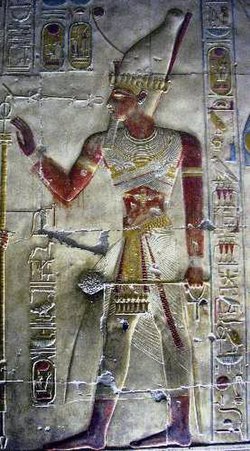
Pharaoh Seti I, detail of a wall painting from the Tomb of Seti I, KV17, at the Valley of the Kings. Neues Museum
Hieroglyphs from the tomb of Seti I

Seti's well-preserved tomb (KV17) was found in 1817 by Giovanni Belzoni, in the Valley of the Kings;[23] it proved to be the longest at 446 feet (136 meters)[24] and deepest of all the New Kingdom royal tombs. It was also the first tomb to feature decorations (including the Book of the Heavenly Cow)[25] on every passageway and chamber with highly refined bas-reliefs and colorful paintings – fragments of which, including a large column depicting Seti I with the goddess Hathor, can be seen in the National Archaeological Museum, Florence. This decorative style set a precedent which was followed in full or in part in the tombs of later New Kingdom kings. Seti's mummy itself was discovered by Émile Brugsch on June 6, 1881, in the Royal Cache (tomb DB320) at Deir el-Bahari and has since been kept at the Egyptian Museum in Cairo.[26]

His huge sarcophagus, carved in one piece and intricately decorated on every surface (including the goddess Nut on the interior base), is in Sir John Soane's Museum.[27] Soane bought it for exhibition in his open collection in 1824, when the British Museum refused to pay the £2,000 demanded.[28] On its arrival at the museum, the alabaster was pure white and inlaid with blue copper sulphate. Years of the London climate and pollution have darkened the alabaster to a buff colour and absorbed moisture has caused the hygroscopic inlay material to fall out and disappear completely. A small watercolour nearby records the appearance, as it was.

The tomb also had an entrance to a secret tunnel hidden behind the sarcophagus, which Belzoni's team estimated to be 100 meters (330 feet) long.[29] However, the tunnel was not truly excavated until 1961, when a team led by Sheikh Ali Abdel-Rasoul began digging in hopes of discovering a secret burial chamber containing hidden treasures.[29] The team failed to follow the original passage in their excavations, and had to call a halt due to instabilities in the tunnel;[30] further issues with permits and finances eventually ended Sheikh Ali's dreams of treasure,[29] though they were at least able to establish that the passage was over 30 meters (98 feet) longer than the original estimate. In June 2010, a team from Egypt's Ministry of Antiquities led by Dr. Zahi Hawass completed excavation of the tunnel, which had begun again after the discovery in 2007 of a downward-sloping passage beginning approximately 136 meters (446 feet) into the previously excavated tunnel. After uncovering two separate staircases, they found that the tunnel ran for 174 meters (571 feet) in total; unfortunately, the last step seemed to have been abandoned prior to completion and no secret burial chamber was found.[30]

Alleged co-regency with Ramesses II

[edit]

Around Year 9 of his reign, Seti appointed his son Ramesses II as the crown prince and his chosen successor, but the evidence for a coregency between the two kings is likely illusory. Peter J. Brand stresses in his thesis[31] that relief decorations at various temple sites at Karnak, Qurna and Abydos, which associate Ramesses II with Seti I, were actually carved after Seti's death by Ramesses II himself and, hence, cannot be used as source material to support a co-regency between the two monarchs. In addition, the late William Murnane, who first endorsed the theory of a co-regency between Seti I and Ramesses II,[32] later revised his view of the proposed co-regency and rejected the idea that Ramesses II had begun to count his own regnal years while Seti I was still alive.[33] Finally, Kenneth Kitchen rejects the term co-regency to describe the relationship between Seti I and Ramesses II; he describes the earliest phase of Ramesses II's career as a "prince regency" where the young Ramesses enjoyed all the trappings of royalty including the use of a royal titulary and harem but did not count his regnal years until after his father's death.[34] This is due to the fact that the evidence for a co-regency between the two kings is vague and highly ambiguous. Two important inscriptions from the first decade of Ramesses' reign, namely the Abydos Dedicatory Inscription and the Kuban Stela of Ramesses II, consistently give the latter titles associated with those of a crown prince only, namely the "king's eldest son and hereditary prince" or "child-heir" to the throne "along with some military titles."[35]

Hence, no clear evidence supports the hypothesis that Ramesses II was a co-regent under his father. Brand stresses that:

Ramesses' claim that he was crowned king by Seti, even as a child in his arms [in the Dedicatory Inscription], is highly self-serving and open to question although his description of his role as crown prince is more accurate...The most reliable and concrete portion of this statement is the enumeration of Ramesses' titles as eldest king's son and heir apparent, well attested in sources contemporary with Seti's reign.[36]

See also

[edit]

References

[edit]

Bibliography

[edit]
[edit]
Revisions and contributorsEdit on WikipediaRead on Wikipedia
from Grokipedia
Seti I (French: Séti Ier; c. 1290–1279 BC) was the second of the Nineteenth Dynasty of , succeeding his father , the short-reigning founder of the dynasty, and fathering his successor . His reign featured aggressive military campaigns aimed at reasserting Egyptian dominance, including expeditions into against nomads and city-states, clashes with Hittite forces near Kadesh, punitive actions against Libyan tribes, and assertions of control in . Seti I also sponsored extensive building projects, such as beginning the decoration of the monumental Hall at and erecting his finely carved at Abydos, which preserves reliefs of royal rituals and an early king list.

Origins and Ascension

Family Background and Parentage

Seti I was the son of , the founder of Egypt's 19th Dynasty, and his wife , as attested by inscriptions in royal monuments and tomb decorations from the period. , originally named Paramessu, rose from a position as a commander and vizier under to become around 1292 BCE, marking the dynasty's inception without prior royal bloodline. Sitre, depicted alongside her husband in early Ramesside reliefs, bore no titles indicating royal descent, such as "King's Daughter," suggesting her origins were non-royal and likely tied to the Delta region's administrative or military elite. This humble parentage underscores the 19th Dynasty's foundation in merit-based military service rather than divine or hereditary aristocracy, a shift that provided pragmatic governance amid the religious and political instability lingering from the Amarna era. The family's paramilitary roots in the , near , equipped Seti I with early exposure to command structures and border defense, fostering the dynasty's emphasis on martial restoration to reassert Egyptian authority after decades of internal upheaval. Inscriptions on stelae erected by Seti I, such as those referencing and lineage continuity, reinforced these ties to , legitimizing his rule through paternal inheritance despite the non-royal start.

Early Career and Military Experience

Seti I entered military service during the reign of (ca. 1319–1292 BCE), holding the title of troop commander (ḥry-pḏt), a position responsible for overseeing units and garrisons such as those at Tjaru. This role positioned him within the army's command structure, focused on maintaining Egyptian control over the northeastern Delta and countering Asiatic incursions amid the post-Amarna restoration of traditional order. Inscriptions from this period, including those referencing military officials under , confirm Seti's involvement in these stabilizing operations, which prioritized hierarchical discipline and logistical readiness over the preceding era's disruptions. Reliefs at Temple depict Seti leading troops in early campaigns against nomadic threats, illustrating his tactical experience in chariot warfare and maneuvers prior to his father's elevation. These scenes, carved in raised , emphasize his command of divisions numbering in the thousands, drawing on empirical frontier defense practices honed during Horemheb's efforts to reassert central authority. His training under this regime equipped him with the administrative acumen for larger-scale operations, as evidenced by seals and minor monuments attributing to him oversight of royal horses and bowmen. As Paramessu (later ) advanced to and , Seti transitioned into advisory roles blending military and civil functions, including vizierial responsibilities documented in pre-coronation artifacts. Scarabs and fragmentary stelae from bear his name alongside titles like "overseer of the army" and administrative epithets, signaling his grooming for succession through proven loyalty and competence in quelling internal unrest. This phase underscored a merit-based ascent rooted in verifiable service records rather than hereditary privilege alone.

Succession to the Throne

Seti I ascended the throne as the second of the Nineteenth Dynasty following the death of his father, , whose reign lasted approximately 17 months from around 1292 to 1290 BCE. This transition was facilitated by 's earlier selection of —then known as Paramessu—as his successor, owing to 's childlessness and the need for continuity in a military-oriented administration. Seti I, already an established figure, had served in key military roles under , including titles indicative of command responsibilities, which provided causal grounding for his legitimacy through proven administrative and competence rather than reliance on unsubstantiated claims of divine . Inscriptions from Seti I's monuments, such as those referencing his pre-ascension titles during Horemheb's rule, highlight this strategic positioning within the Ramesside lineage originating from the . Ramesses I's advanced age at accession—likely over 50—ensured that Seti I, as his capable son and experienced subordinate, was the , enabling a seamless dynastic shift without recorded contestation. This emphasis on familial heritage over ritualistic underscores the pragmatic realism of the succession, prioritizing operational stability amid Egypt's post-Amarna recovery. Coronation rites adhered to traditional Egyptian protocols, involving ritual investiture at key sites like Memphis and Heliopolis, though specific details for Seti I remain sparse in surviving records. Monumental inscriptions dated to his first , including those documenting expeditions against nomads in the Sinai, demonstrate immediate power consolidation via military action, reflecting the causal link between battlefield efficacy and pharaonic authority. These early texts, carved in temples such as , affirm rapid administrative control without evident internal challenges.

Reign and Chronology

Estimated Reign Length

The highest attested for Seti I is , documented on a stela from Gebel Barkal dated to the fourth month of the inundation season (IV Akhet), day 8 or 9, providing from inscriptions for the duration of his rule up to at least that point. Quarrying records and related monumental texts corroborate activity in this late regnal phase, but no unambiguous inscriptions confirm Year 12, leading most scholars to infer that Seti I died shortly thereafter, possibly within months. This limits the verifiable reign to 11 full years, rejecting earlier proposals of 14–15 years due to the absence of supporting dated artifacts beyond . Wine dockets from the Valley of the Kings, primarily associated with tomb provisions and administrative notations, attest dates only up to of Seti I, reflecting routine production likely concentrated in the earlier part of his reign rather than indicating a shorter overall duration. These artifacts, analyzed in conjunction with stelae and temple reliefs, support a consensus estimate of 11 years for the reign length, often placed circa 1290–1279 BC when anchored to broader New Kingdom chronological frameworks. Variations arise from incomplete epigraphic survival, with some estimates extending to 12 years if partial overlaps or undocumented months are assumed. Uncertainties in estimating the precise length stem from methodological challenges in reconciling Egypt's civil with potential lunar observations embedded in certain dated texts, as lunar cycles could shift boundaries by weeks or months. Scholars debating these alignments, including applications of Sothic rising data from nearby reigns, note that solar-based counts favor shorter durations like 11 years, while lunar adjustments might accommodate minor extensions without contradicting inscriptional limits. Such debates underscore the reliance on fragmentary , prioritizing direct regnal attestations over speculative extensions.

Placement in Egyptian Chronology

Seti I served as the second pharaoh of the Nineteenth Dynasty, immediately succeeding his father , the dynasty's founder who acceded after , the final ruler of the Eighteenth Dynasty. This succession is corroborated by contemporary inscriptions on stelae and temple walls, as well as later king lists that consistently position Ramesses I's brief rule as transitional, bridging the post-Amarna stabilization to the Ramesside era. Absolute dating places Seti I's rule circa 1291–1279 BC within the middle chronology, derived from lunar and Sothic astronomical observations cross-referenced with Hittite synchronisms, such as those involving Mursili II. High chronologies propose earlier dates (e.g., shifting Ramesses II's accession to circa 1303 BC, thus Seti I to 1314–1303 BC), while low variants delay them by up to 30 years, primarily differing in interpretations of Eighteenth Dynasty anchors like III's regnal alignments. Empirical validation favors the middle framework, as radiocarbon assays on New Kingdom organic remains (e.g., seeds and wood from dated contexts) align with conventional historical sequences rather than extremes, though sample sizes for the Nineteenth Dynasty remain limited. Dendrochronological evidence from imported timbers offers potential refinement but lacks a continuous master curve for the period, relying instead on relative sequences tied to Levantine cedar imports documented in Seti I's temple records. The post-Amarna context influences dating indirectly, as Nineteenth Dynasty rulers like Seti I restored pre-Amarna monuments with retroactive inscriptions, providing artifactual cross-references that anchor the dynasty amid propagandistic emphases on continuity, which scholars scrutinize for potential exaggeration but affirm for succession order via material overlaps (e.g., quarry marks and unfinished works from Horemheb's era). Uncertainties persist due to incomplete regnal attestations and variant astronomical back-projections, underscoring reliance on multi-method convergence over singular king-list traditions.

Military Campaigns

Campaigns in Libya

In the early years of his reign, Seti I confronted incursions by Libyan tribes into 's western Delta, initiating defensive operations to secure the frontier against nomadic raiders. Reliefs on the northern exterior wall of the Hall depict these engagements, showing the king in his charging Libyan forces, smiting enemies with arrows and mace, and leading processions of bound captives, including women and children, back to . These scenes emphasize the pharaoh's role in repelling invaders who had penetrated the Delta marshes, portraying the conflicts as direct responses to threats rather than proactive expansions into Libyan territory. The campaigns marked the onset of intensified hostilities with Libyan groups during the 19th Dynasty, with Seti I's forces capturing prisoners and livestock to deter further advances. Inscriptions accompanying the reliefs describe the Libyans as subdued foes whose incursions disrupted Egyptian border stability, highlighting tactical victories that restored order without establishing permanent outposts deep in Libyan lands. Archaeological and textual evidence from the period underscores these actions as reactive measures, driven by the need to protect agricultural heartlands from pastoralist pressures, rather than ideologically framed conquests. To bolster long-term defense, Seti I reinforced Delta fortifications and boundary markers, as referenced in royal inscriptions alluding to secured amid ongoing tribal movements. Stelae and texts from his monuments indicate strategic placements to monitor and control access routes, reflecting a pragmatic approach to that prioritized over territorial gain. These efforts laid groundwork for subsequent Ramesside defenses but remained focused on immediate .

Expeditions to Canaan, Phoenicia, and Syria

Seti I launched multiple expeditions into and northern regions during his early reign, primarily to suppress revolts and nomadic incursions that had undermined Egyptian influence since the late 18th Dynasty. Reliefs on the northern exterior wall of the Hall depict these campaigns, showing the defeating Shasu Bedouins in southern and Asiatic forces in fortified towns, with accompanying inscriptions claiming the restoration of order in areas like the "Ways of " route. A key target was the city of Yenoam in northern , portrayed in scenes as besieged and captured after rebellion, corroborated by the Year 1 stela from Beth Shan, which states that Yenoam was reduced to a "trodden underfoot" ruin by Seti's forces. These accounts, while propagandistic, align across multiple monuments and reflect verifiable punitive actions against disloyal vassals, as evidenced by the repeated mention of Yenoam in Ramesside-era texts as a subdued site. Further advances extended into (termed Djahi in Egyptian records) and approached Syrian territories, where inscriptions boast of subduing coastal chiefs and procuring tribute, including cedar from Lebanese forests. Karnak reliefs and name-ring lists enumerate over 100 Asiatic localities allegedly conquered or pacified, including sites in the Phoenician littoral and near the Orontes, though many entries likely recycled Thutmose III-era victories for rhetorical effect. Skirmishes occurred near Kadesh in Amurru against Hittite-aligned forces, with Seti claiming to have repelled invaders, but no monumental evidence supports a or enduring hold on the city itself. These northern forays emphasized and submission extraction over territorial expansion, as Hittite pressure in limited deeper penetration. Archaeological and inscriptional evidence underscores empirical constraints on these expeditions: while Egyptian scarabs and administrative artifacts confirm oversight at outposts like Beth Shan and Gaza, no fortified garrisons or sustained material culture appear in Phoenician or inland Syrian sites attributable to Seti, suggesting campaigns prioritized disruption of rivals and loyalty oaths rather than permanent occupation. The hyperbolic language of victory in temple reliefs—common in royal propaganda—must be weighed against this sparsity of on-site corroboration, indicating reassertion of nominal amid Hittite competition, without the infrastructural commitments of earlier New Kingdom peaks.

Nubian Operations

In the eighth year of his reign, Seti I dispatched an expedition into targeting the land of , a region associated with nomadic or semi-nomadic groups posing threats to Egyptian control south of the Second Cataract. This seven-day , documented on stelae at Sai Island and Amara West, focused on suppressing local unrest rather than territorial expansion, reflecting a to stabilize administrative oversight over viceroys and deputies of Kush. Stelae and rock inscriptions from these sites emphasize the reinstallation of loyal Nubian viceroys and the resumption of resource extraction activities, underscoring economic priorities such as access to gold mines and quarries essential for Egyptian and . At Amara West, founded by Seti I as a fortified administrative hub in Upper , inscriptions record the pacification efforts that facilitated oversight of trade routes carrying , , and minerals northward. Similarly, texts at in Lower detail the fortification's reinforcement and mining expeditions, with notations on extracted materials like and from nearby quarries, prioritizing sustained production over celebratory conquest narratives. These operations consolidated Egyptian influence by realigning local with central , enabling the tallying and transport of Nubian resources without the need for repeated large-scale interventions, as evidenced by the absence of subsequent major rebellions during Seti I's reign. The inscriptions' focus on logistical achievements—such as well-digging and route security—highlights a pragmatic approach to maintaining economic flows from , where production supported Egypt's broader fiscal stability.

Assessment of Military Achievements

Seti I's military endeavors are credited with restoring stability to Egypt's frontiers after the disruptions of the and Horemheb's transitional rule, primarily through reassertion of dominance over Canaanite city-states and repulsion of nomadic threats, as corroborated by the continuity of Egyptian administrative artifacts at Levantine sites like Beth Shean during the early 19th Dynasty. Reliefs on the northern exterior wall of Karnak's Hall depict expanded control over territories from to , aligning with archaeological indications of secured trade and tribute routes that facilitated subsequent economic prosperity under . Critics, however, highlight the propagandistic nature of these depictions, where victories such as the assaults on Kadesh are portrayed as total subjugations despite scant evidence of long-term occupation or matching Hittite recording Egyptian setbacks. The absence of widespread destruction layers or new Egyptian fortresses in northern and Amurru attributable to Seti I's era suggests that claims of annihilating enemies were exaggerated to bolster divine kingship ideology, a common feature in New Kingdom monumental art. Egyptologists debate the net territorial impact, with some emphasizing genuine reconquests that deterred Hittite advances and stabilized borders against and Libyan incursions, while others argue for minimal expansion beyond late 18th Dynasty precedents, prioritizing ideological projection over empirical conquest. This balance reflects causal limitations: Egypt's chariot-based forces excelled in punitive raids but struggled with holding distant highlands without loyalty, evidenced by the need for to revisit Syrian fronts shortly after Seti I's death. Ultimately, Seti's campaigns achieved defensive consolidation and prestige restoration, enabling imperial continuity rather than transformative gains.

Architectural and Cultural Contributions

Temple Constructions and Expansions

Seti I initiated and substantially completed the within the at in Thebes, erecting 134 massive columns arranged in 16 rows, with the 12 central columns rising to heights of about 21 meters and diameters up to 3.6 meters, enclosing an area of roughly 5,000 square meters. This architectural feat, positioned immediately before the temple's inner sanctuaries, exemplified the pharaoh's commitment to enhancing the cult of Amun-Re through monumental scale, requiring the coordinated quarrying, transport, and assembly of thousands of tons of stone by a large workforce. In Abydos, Seti I constructed a new temple complex dedicated to and other deities, comprising an L-shaped layout with two open courtyards leading to a pair of halls and seven contiguous chapels honoring gods including , Ra-Horakhty, Amun-Re, , , , and the deified Seti himself. The structure incorporated six chapels for housing divine processional boats and featured innovative architectural elements such as curved rear walls in the sanctuaries, built primarily from fine sourced locally and from Tura, with excavations confirming the mobilization of extensive resources for its elevation on a raised platform. Seti I also commissioned the construction of a at Heliopolis, intended for the temple of , measuring approximately 21.8 meters in height, though its final erection occurred under . Complementary barque shrines were added in Thebes and Heliopolis to facilitate ritual processions, reinforcing Seti I's patronage of solar and solar-Amun cults across Egypt's primary religious centers through these durable stone additions.

Restoration of Monuments

Seti I systematically repaired monuments vandalized during the , particularly reliefs defaced by Akhenaten's agents to excise depictions of traditional gods and non-Amarna kings. These restorations involved recarving damaged surfaces, reinstating erased cartouches of 18th Dynasty pharaohs such as and , and overlaying Amarna-era alterations with orthodox iconography, as evidenced by stratified inscriptions at sites including and Heliopolis. In Thebes, Seti refurbished elements of earlier 18th Dynasty temples, such as adding to and restoring Thutmose III's reliefs within the 18th Dynasty structure at , where dedicatory texts attribute the work to his efforts in renewing dilapidated shrines. He also usurped and reinscribed statues and blocks from Amarna-period restorations by and Ay, repurposing them to erase lingering heretic associations while claiming credit for broader revivals. Such refurbishments prioritized existing sites over entirely new foundations, reflecting resource-efficient strategies that leveraged pre-existing infrastructure for rapid symbolic restoration of ma'at and dynastic continuity, as implied by the prevalence of in his epigraphic boasts of repairing "what was destroyed" across . This approach contrasted with expansive innovations, underscoring a pragmatic focus on legitimizing rule through tangible links to pre-Amarna prosperity.

Inscriptions and Propaganda

Seti I's inscriptions, carved across temples and stelae, systematically glorified his military endeavors through formulaic narratives that emphasized divine sanction and overwhelming triumph, often employing hyperbolic depictions of enemy slaughter and territorial dominance. In the Hall at , reliefs accompanying battle scenes feature captions and hymns attributing victories to Amun's direct aid, portraying the as an invincible agent of cosmic order who "smites the " in vast numbers, a rooted in traditional Egyptian royal ideology rather than precise casualty counts. These texts, including poetic victory hymns on stelae from sites like Beth Shan, standardize the portrayal of campaigns against Libyans, nomads, and Hittite proxies as divinely ordained routs, serving to legitimize Seti I's restoration of imperial boundaries after the interlude. The so-called "bull lists" and enemy rosters, inscribed on temple walls such as those at and Abydos, catalog subdued peoples and Asiatic toponyms in a repetitive, enumerative format that visually reinforces pharaonic power, though epigraphic analysis reveals selective omissions and idealizations inconsistent with sustained occupation. Comparative study of these records with prior Ramesside precursors indicates a deliberate codification of conquest motifs to propagate ideological continuity, framing Seti I as the renewer of ma'at against chaotic foes, with artistic conventions prioritizing symbolic totality over chronological fidelity. Such , while rooted in factual expeditions evidenced by destruction layers at Canaanite sites, amplifies scale through unsubstantiated claims of total subjugation, as cross-verification with Hittite annals confirms border skirmishes but disputes the finality of Egyptian gains. As self-authored royal documents, these inscriptions constitute biased primary evidence, engineered for domestic consumption to bolster dynastic legitimacy and deter internal rivals, with warnings against defacement underscoring their propagandistic intent; absent corroborative metrics from non-Egyptian sources, the factual core—actual raids and diplomatic pressures—must be parsed from the overlay of theological inevitability, where causal agency resides in logistical and strategic realities rather than omnipotent deities.

Family and Succession

Wives and Royal Women

Tuya held the position of to Seti I, as evidenced by her royal titles including "King's Wife" and "Mistress of the Two Lands" inscribed on monuments and statuary. Surviving artifacts, such as a depicting her in formal pose now in the , affirm her central role in the royal court during the early 19th Dynasty, circa 1290–1279 BCE. These representations highlight Tuya's function in bolstering pharaonic legitimacy through symbolic proximity to the king in official . While polygamous arrangements among New Kingdom rulers served administrative purposes such as securing heirs and political ties, attestations of Seti I's consorts beyond are sparse and lack detailed titular evidence from primary sources like temple inscriptions or tomb reliefs. References to potential secondary wives exist in secondary analyses, but no comparable monumental depictions or named inscriptions substantiate their prominence or specific contributions to dynastic stability. This scarcity underscores 's dominance in the surviving record of royal women associated with Seti I's .

Children and Heirs

Seti I fathered at least four children with his principal wife : two sons, Nebchasetnebet and , and two daughters, Tia and . Nebchasetnebet, the eldest son, died in childhood or young adulthood prior to Seti I's death, as indicated by limited attestations in family records without evidence of adult roles or monuments. Ramesses II, the surviving son and designated heir, appears prominently in Seti I's monuments from early in the reign, depicted as accompanying his father in military and ritual scenes at sites including the Hypostyle Hall and the Abydos temple. These co-appearances underscore his favored status and preparation for rule, with inscriptions portraying him as actively involved in campaigns and temple dedications, ensuring dynastic continuity through direct succession patterns observed in the 19th Dynasty. The daughters' attestations are primarily from burial evidence and later Ramesside monuments. Tia, likely the eldest daughter, married a high-ranking treasury official named Tia (or Tjia), with their joint tomb at providing epigraphic confirmation of her royal parentage. , the youngest, married her brother and is attested on statues and in temple reliefs, including a usurped originally depicting her . The limited number of attested offspring reflects the pharaonic emphasis on viable heirs for regime stability, as multiple sons mitigated risks of early death, enabling 's unchallenged accession around 1279 BC.

Co-Regency with Ramesses II

Evidence Supporting Co-Regency

One key piece of evidence for a co-regency between Seti I and comes from reliefs in the at , where scenes depict both rulers participating jointly in religious processions, such as carrying the of , with shown wearing the and labeled as "king's son" yet bearing royal attributes indicative of shared rule. These bas-reliefs, particularly on the north and south walls, show alongside Seti I in priestly roles during festivals like the Feast of the Valley, suggesting active collaboration in temple rituals before Seti I's death. In the Qurnah Temple of Seti I at West Thebes, a coronation scene portrays being crowned by in the presence of Seti I and the , utilizing the prenomen Wsr-m3c.t-Rc, which scholars identify as specific to the co-regency period before its evolution to Wsr-m3c.t-Rc-stp-n-Rc upon sole rule. Alternating cartouches of both kings in the temple's friezes further imply equal pharaonic status during this overlap, supporting a transitional joint authority estimated at several years. The dedicatory inscription at Abydos records Ramesses II claiming he was crowned king while still a child under Seti I, with reliefs in Seti I's temple there depicting Ramesses as crown prince using the co-regency prenomen and sharing the Horus name K3-n t-mry-m3c.t with his father. Similarly, at Beit el-Wali, incised reliefs show Ramesses II receiving Nubian tribute with the same prenomen, tied to viceroy Imn-m-ip.t's service under both rulers, evidencing early royal activities during Seti I's lifetime. These monuments collectively favor a co-regency of up to a decade, aligning chronologies by allowing 's early dated inscriptions (e.g., Year 1 events in pr.t and smw seasons) to reflect joint rule rather than immediate sole reign, facilitating a smooth dynastic transition.

Evidence Against Co-Regency

In the absence of double-dated inscriptions explicitly linking regnal years of Seti I and , scholars such as William J. Murnane have argued that no significant co-regency occurred, as such joint documentation is characteristic of confirmed overlapping reigns in earlier dynasties but entirely lacking here. Early monuments of , including those from his Year 1 (e.g., dated to III Shomu 10 and Proyet 20), employ his initial praenomen without reference to a living Seti I as co-ruler, and the rapid adoption of his final praenomen "Usermaatre Setepenre" by the end of Year 2 suggests immediate sole rule rather than prolonged shared authority. Epigraphic examination of key sites reinforces this view: at Abydos, 's dedicatory inscription uses his final and portrays Seti I as deceased, while the Beit el-Wali temple's references to refurbishments interpret "four times" as qualitative emphasis ("fourfold") rather than evidence of multiple joint campaigns. Similarly, the Qurna temple's decoration, featuring in sunk with Seti I relegated to , aligns stylistically with 's independent early activities, not collaborative rule. Sequential cartouches in these contexts—Seti I's followed directly by 's without superposition or shared framing—indicate succession rather than overlap. Seti I's tomb KV17 and associated stelae exhibit sole-reign , including burial preparations and royal epithets exclusive to Seti I, with no depictions or texts accommodating a co-regent's or tomb extension. The lack of any dated events overlapping both kings' regnal calendars, combined with Ramesses II's Year 1 military and administrative records omitting Seti I's involvement, supports a model of independent reigns, with ascending promptly upon his father's death around 1279 BCE after Seti I's estimated 11–15-year rule. Murnane concludes that any potential joint period, if existent, was negligible (at most 1–2 years), but the cumulative epigraphic and chronological data favor none.

Current Scholarly Views

Contemporary Egyptologists, drawing on detailed epigraphic examinations of monuments like those at and Abydos, largely reject the notion of a substantial co-regency between Seti I and , viewing earlier interpretations as overstated. Peter Brand's comprehensive analysis of Seti I's reliefs concludes that scenes depicting alongside his father reflect the prince's prominent role under paternal authority rather than joint rule, with no unambiguous evidence of overlapping regnal dating or shared titulary during Seti I's lifetime. Similarly, reviews of the Hall's construction phases, informed by post-1990s fieldwork, attribute initial works to Seti I alone, with Ramesses II's contributions commencing only after his accession, undermining claims of collaborative phases. A minority position allows for a possible brief transitional period of co-rule, invoked to reconcile minor anomalies such as certain dedicatory inscriptions or architectural overlaps, but this lacks decisive epigraphic or archival support and is often critiqued as speculative. Kitchen's chronological framework, incorporating scarab and stela datings, aligns Seti I's reign at approximately 15 years ending without documented extension into Ramesses II's early years, emphasizing the absence of post-Year 11 dates for Seti I as indicative of a straightforward succession rather than overlap. The persistence of debate stems from fragmentary records and interpretive ambiguities in royal , where pharaonic imagery prioritizes dynastic continuity over chronological precision, compelling scholars to prioritize verifiable inscriptions over assumptive reconstructions. This empirical caution highlights how incomplete archaeological data precludes firm resolution, favoring models of independent reigns absent compelling counter-evidence.

Death, Burial, and Mummy

Cause of Death and Physical Condition

The of Seti I, subjected to examinations including computed (CT) scans, reveals no evidence of trauma, , or battle wounds, suggesting death from non-violent causes. Forensic analysis of skeletal features estimates his age at between 40 and 50 years, earlier than typical for pharaohs of his era who often reached advanced age, though precise determination remains challenging due to mummification alterations. No definitive identifies the exact , with possibilities limited to natural ailments like age-related disease or , as soft tissue degradation precludes confirmation of specific conditions such as systemic illnesses without viable tissue samples. Claims of particular diseases lack substantiation from direct evidence and are thus speculative. The absence of gross skeletal deformities or infectious markers visible in imaging supports rejection of unverified hypotheses. Physical condition at death appears robust overall, with the mummy's exceptional preservation—attributable to high-quality involving resins, dehydration, and intricate wrappings—indicating royal resources and skilled embalmers, though this does not reveal health details beyond general implied by length. Dental wear, common in New Kingdom elites from abrasive diets, is noted in analogous mummies but not distinctly here without targeted Seti I studies.

Tomb KV17

KV17, the tomb of Seti I in the Valley of the Kings, extends approximately 137 meters in length and comprises seven principal corridors, ten chambers, and a total area of about 649 square meters, ranking among the longest and most complex royal sepulchers of the New Kingdom. Its architecture employs a joggled axis design typical of the 19th Dynasty, featuring deliberate bends in the corridors and passageways to disrupt straight-line access and thereby deter tomb robbers, as verified by detailed plans from surveys such as those of the Theban Mapping Project. The burial chamber introduces innovative elements, including the first vaulted ceiling in a royal tomb, adorned with a celestial blue expanse dotted by golden stars to evoke the nocturnal sky and facilitate the pharaoh's eternal voyage among the stars. Within this chamber stood an intricately carved with hieroglyphs and vignettes from the Book of the Gates, symbolizing guardianship over the underworld's portals; the , measuring roughly 2.75 meters in length, was extracted during 19th-century explorations and is presently exhibited in the in . Throughout the corridors and chambers, walls bear exceptionally preserved raised-relief decorations and paintings illustrating Seti I's progression through the Duat, incorporating funerary compositions such as the Litany of Re (invoking solar aspects), the Amduat (underworld hours), and the Book of the Gates (nightly solar renewal), which collectively map the pharaoh's ritual triumph over chaos for rebirth. Despite ancient looting that emptied the tomb of most portable contents by the Third Intermediate Period, these artworks endured with vivid pigmentation, as documented in Giovanni Battista Belzoni's 1817 discovery and subsequent 19th-century documentation, supplemented by modern non-invasive spectroscopic analyses and 3D scans confirming material integrity and pigment compositions like Egyptian blue and orpiment.

Mummy Discovery and Preservation

The mummy of Seti I was recovered on June 6, 1881, from the Deir el-Bahri royal cache (DB320), a communal near containing over 50 royal and noble mummies relocated by Twenty-first Dynasty priests around 1069 BCE to safeguard them from tomb robbers. French Egyptologist Émile Brugsch, acting on a tip from locals, entered the shaft with assistant Ahmed Kamal and hastily extracted the contents over two days to prevent looting, transferring the mummies to Cairo's Bulaq Museum (predecessor to the Egyptian Museum). Seti I's mummy exhibited remarkable preservation upon unwrapping, attributed to its original Nineteenth Dynasty techniques—including evisceration, with , and coatings—combined with protective rebandaging and placement in the arid cache environment, which minimized post-discovery degradation. The facial features remained discernible, with intact wrappings preserving the form, distinguishing it among New Kingdom royal remains despite ancient plundering evidenced by displaced bandages. It has been housed in the Egyptian Museum in since the late nineteenth century, where archival photographs from the discovery document its and handling. Conservation efforts have emphasized non-invasive stability assessments, including computed (CT) scans conducted in the early twenty-first century to evaluate structural integrity without further disturbance, confirming the mummy's suitability for long-term display under controlled humidity and temperature conditions typical for Egyptian antiquities. These measures reflect empirical strategies for protecting desiccated organic remains, prioritizing environmental isolation over speculative reburial practices that lack archaeological support.

Legacy and Historical Significance

Restoration of Egyptian Power

Seti I initiated a series of military campaigns aimed at reasserting Egyptian dominance over territories lost or contested during the and its aftermath, marking a decisive reversal of the empire's decline. In his first , approximately 1290 BC, he launched expeditions against the nomads in southern and subdued the city of Yenoam, as depicted in detailed reliefs on the north wing of the Hypostyle Hall at Karnak Temple. These actions secured key trade routes and mining regions in the , facilitating the resumption of and extraction that had lapsed under previous rulers. Further campaigns targeted Libyan incursions in the western Delta, where Seti I repelled invaders and reestablished frontier garrisons, evidenced by stelae recording victories and inflows. A pivotal effort involved confrontations with the Hittite Empire in , where Seti I twice advanced to Kadesh around years 4–5 of his reign, recapturing the city and the Amurru region temporarily before Hittite counteroffensives. Inscriptions at and his Abydos temple enumerate over 20 Asiatic localities brought under Egyptian sway, including Beth-Shan and Gaza, with scenes portraying bound captives and piled spoils symbolizing restored imperial tribute economies. These territorial recoveries expanded Egypt's effective control to its pre-Amarna extent, boosting annual revenues from Levantine vassals and enabling large-scale temple constructions that presupposed fiscal surplus. While Seti I's achievements in military revival were substantial, they built upon foundational restorations by his predecessor , who had already dismantled Amarna-era disruptions, reorganized the , and initiated stabilizations without leaving comparable monumental evidence of foreign conquests. Horemheb's administrative purges and temple repairs provided the internal stability that allowed Seti I to outward, as sequential archaeological layers at sites like show continuity in fortification and quarrying projects. Seti's vice-regal appointments in , continuing Horemheb's model, centralized resource extraction from mines, yielding an estimated increase in state wealth that underpinned his campaigns without evidence of novel systemic reforms. This progression underscores causal reliance on prior order restoration rather than isolated genius, with Seti's inscribed boasts reflecting propagandistic emphasis on personal agency amid inherited frameworks.

Influence on Ramesside Period

Seti I's extensive building campaigns established stylistic and ideological precedents that shaped Ramesside monumental architecture, particularly under , who systematically expanded his father's projects to assert dynastic continuity. The Temple of Seti I at Abydos exemplifies this influence, where completed the unfinished sections, including outer courtyards adorned with reliefs of his and offerings to deities, thereby integrating his own military narrative into Seti I's framework of divine kingship and ritual piety. This continuity preserved Seti I's motifs of precise bas-reliefs depicting pharaonic devotion and conquest, which emphasized the ruler's role in restoring cosmic order through martial and religious acts. In military-themed monuments, Seti I's war scenes at Karnak's Hypostyle Hall introduced a Ramesside standard of refined composition and , portraying victories as pious offerings to gods like , a motif replicated and amplified by successors to legitimize expansionist policies. This ideological focus on the as a warrior-priest bolstered the 19th Dynasty's emphasis on territorial reclamation, contributing to its relative stability amid ongoing Levantine and Nubian campaigns. However, Seti I's propagandistic depictions of conflicts, such as against the nomads, established a for hyperbolic victory narratives that extended, potentially prioritizing monumental glorification over unvarnished historical accuracy.

Modern Egyptological Studies

Modern Egyptological on Seti I has centered on epigraphic analysis of his extensive inscriptions, which document military campaigns, temple dedications, and royal ideology. Kitchen's Ramesside Inscriptions: Historical and Biographical series, particularly Volume I published in 1993 with updates, provides exhaustive transcriptions, translations, and commentaries on Seti I's texts from sites like , Abydos, and the eastern Delta, enabling precise reconstruction of his regnal activities without reliance on speculative interpretations. Kitchen's work, drawing directly from original monuments, has standardized references for Seti I's annals, countering earlier uncertainties in hieroglyphic readings by prioritizing textual fidelity over narrative assumptions. Technological documentation has advanced conservation and analysis of Seti I's monuments, notably through high-resolution of KV17 initiated by the Factum Foundation in 2016, culminating in a complete virtual model released in 2020. This non-invasive approach has facilitated detailed study of wall decorations and structural integrity, revealing subtle pigment layers and erosion patterns previously undetectable, though no major archaeological discoveries have emerged from these efforts in the . Such interdisciplinary tools, combining with traditional , support verification of inscription authenticity amid concerns over modern forgeries or restorations. Debates persist on Seti I's reign length, with arguing for 15 years based on cumulative dated inscriptions up to and inferred extensions from temple sequences, while alternative chronologies propose 11 years, citing lunar data and succession patterns with . These discrepancies highlight the need for cross-verification with of associated organics and astronomical alignments, as unconfirmed extensions risk inflating regnal attributions without material corroboration. Ongoing epigraphic surveys, such as those re-examining reliefs, continue to refine campaign geographies but underscore unresolved causal links between Seti I's victories and broader imperial stability.

References

Add your contribution
Related Hubs
User Avatar
No comments yet.