Hubbry Logo
Sloth bearSloth bearMain
Open search
Sloth bear
community hub

Sloth bear

#Wikipedia

#Grokipedia

Hub updates

Hub contents (all pages)

Talk channels
chitchatchitchat
Sloth bear
Community hub
Sloth bear
logo
8 pages, 0 posts
0 subscribers
2210200

Community hub

Sloth bear

logo
0 subscribers
8 pages, 0 posts
Recent from talks
All channels
​
Be the first to start a discussion here.
Contribute something
Welcome to the community hub built to collect knowledge and have discussions related to Sloth bear.
species of bear common to the Indian subcontinent

From Wikipedia

species of bear common to the Indian subcontinent

Media

Notes
0

  • Respect all members: no insults, harassment, or hate speech.
  • Be tolerant of different viewpoints, cultures, and beliefs. If you do not agree with others, just create separate note, article or collection.
  • Clearly distinguish between personal opinion and fact.
  • Verify facts before posting, especially when writing about history, science, or statistics.
  • Promotional content must be published on the “Related Services and Products” page—no more than one paragraph per service. You can also create subpages under the “Related Services and Products” page and publish longer promotional text there.
  • Do not post materials that infringe on copyright without permission.
  • Always credit sources when sharing information, quotes, or media.
  • Be respectful of the work of others when making changes.
  • Discuss major edits instead of removing others' contributions without reason.
  • If you notice rule-breaking, notify community about it in talks.
  • Do not share personal data of others without their consent.
  • Nothing was collected or created yet.

    Sloth bear
    Sloth bear
    Sloth bear
    View on Wikipedia
    from Wikipedia
    Species of bear

    Sloth bear
    Temporal range: Late Pliocene to Early Pleistocene – recent
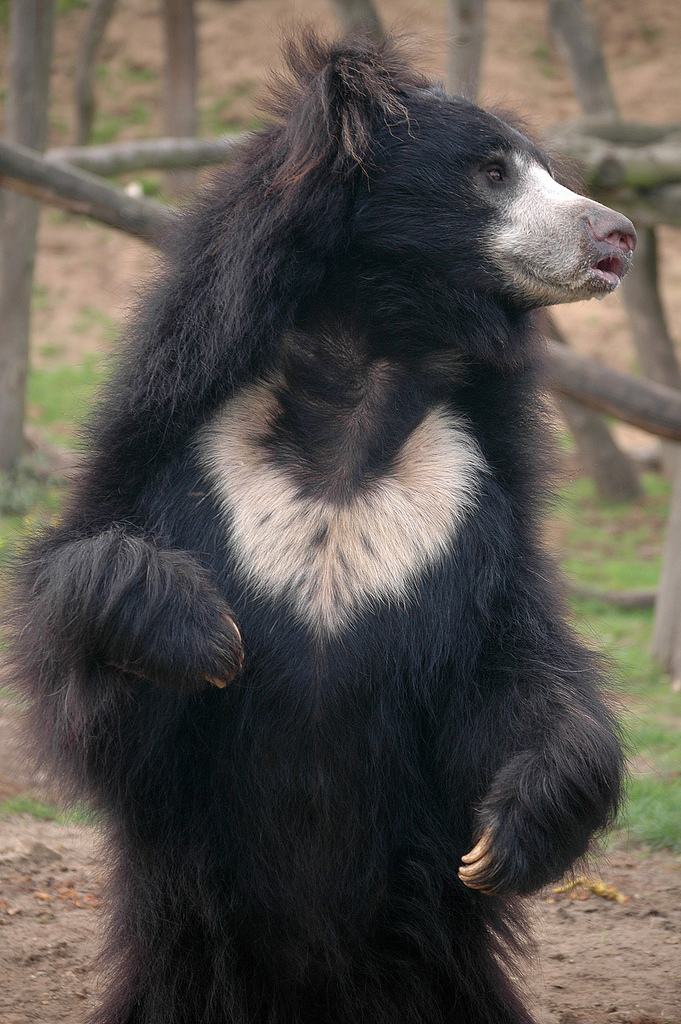
    Standing Melursus ursinus
    Conservation status

    Vulnerable  (IUCN 3.1)[1]
    CITES Appendix I (CITES)[1]
    Scientific classification Edit this classification
    Kingdom: Animalia
    Phylum: Chordata
    Class: Mammalia
    Order: Carnivora
    Suborder: Caniformia
    Family: Ursidae
    Subfamily: Ursinae
    Genus: Melursus
    Meyer, 1793
    Species:
    M. ursinus
    Binomial name
    Melursus ursinus
    (Shaw, 1791)
    Sloth bear range
    (black – former, green – extant)
    Synonyms
    • Bradypus ursinus Shaw, 1791
    • Melursus lybius Meyer, 1793

    The sloth bear (Melursus ursinus), also known as the Indian bear, is a myrmecophagous bear species native to the Indian subcontinent. It feeds on fruits, ants and termites. It is listed as vulnerable on the IUCN Red List, mainly because of habitat loss and degradation.[1] It is the only species in the genus Melursus.

    It has also been called "labiated bear" because of its long lower lip and palate used for sucking up insects.[2] It has long, shaggy fur, a mane around the face, and long, sickle-shaped claws. It is lankier than brown and Asian black bears. It shares features of insectivorous mammals and evolved during the Pleistocene from the ancestral brown bear through divergent evolution.

    Sloth bears breed during spring and early summer and give birth near the beginning of winter. When their territories are encroached upon by humans, they sometimes attack them. Historically, humans have drastically reduced these bears' habitat and diminished their population by hunting them for food and products such as their bacula and claws. Sloth bears have been tamed and used as performing animals and as pets.[3]

    Taxonomy

    [edit]

    George Shaw in 1791 named the species Bradypus ursinus. In 1793, Meyer named it Melursus lybius, and in 1817, de Blainville named it Ursus labiatus because of its long lips. Illiger named it Prochilus hirsutus, the Greek genus name indicating long lips, while the specific name noted its long and coarse hair. Fischer called it Chondrorhynchus hirsutus, while Tiedemann named it Ursus longirostris.[4]

    Subspecies and range

    [edit]
    Name Description Distribution
    Indian sloth bear (M. u. ursinus) (Shaw, 1791)

    This is the nominate subspecies and has a large skull with a condylobasal length of about 290 mm (11 in) in females and about 310 mm (12 in) in males.[5] The sloth bear is the most widespread bear species in India, where it mostly occurs in areas with forest cover, low hills bordering the outer range of the Himalayas from Punjab to Arunachal Pradesh. It is absent in the high mountains of Himachal Pradesh and Jammu and Kashmir, the northwestern deserts of Rajasthan, and a broad unforested swath in the south, where Mount Abu Wildlife Sanctuary is located.[6] Sloth bear occurs in protected areas such as Shoolpaneshwar, Ratanmahal, Jessore,[7] and Balaram Ambaji Sanctuaries.[8][9]

    In Nepal, it is restricted to the Terai.[10]

    Sri Lankan sloth bear (M. u. inornatus) Pucheran, 1855
    The Sri Lankan sloth bear is smaller than the nominate subspecies, has a smaller skull with a condylobasal length of about 250 mm (9.8 in) in females and about 264 mm (10.4 in) in males.[5] It has much shorter body hair, and sometimes lacks the characteristic white chest mark.[11] At the turn of the century, the Sri Lankan sloth bear occurred throughout Sri Lanka. But due to wide-scale conversion of upland forests into tea and coffee plantations, it is now restricted to the northern and eastern lowlands.[12]

    Evolution

    [edit]

    Sloth bears may have reached their current form in the Early Pleistocene, the time when the bear family specialised and dispersed. A fragment of fossilised humerus from the Pleistocene, found in Andhra Pradesh's Kurnool Basin is identical to the humerus of a modern sloth bear. The fossilised skulls of a bear once named Melursus theobaldi found in the Shivaliks from the Early Pleistocene or Early Pliocene are thought by certain authors to represent an intermediate stage between sloth bears and ancestral brown bears. M. theobaldi itself had teeth intermediate in size between sloth bears and other bear species, though its palate was the same size as the former species, leading to the theory that it is the sloth bear's direct ancestor. Sloth bears probably arose during the Middle Pliocene and evolved in the Indian subcontinent. The sloth bear shows evidence of having undergone a convergent evolution similar to that of other ant-eating mammals.[11]

    The sloth bear is one of eight extant species in the bear family Ursidae and of six extant species in the subfamily Ursinae.

    A possible phylogeny based on complete mitochondrial DNA sequences from Yu et al. (2007).[13]
    Ursidae

    Giant panda (Ailuropoda melanoleuca)

    Spectacled bear (Tremarctos ornatus)

    Ursinae

    Sloth bear (Melursus ursinus)

    Sun bear (Helarctos malayanus)

    Asian black bear (Ursus thibetanus)

    American black bear (Ursus americanus)

    Polar bear (Ursus maritimus)

    Brown bear (Ursus arctos)

    The polar bear and the brown bear form a close grouping, while the relationships of the other species are not very well resolved.[14]
    A more recent phylogeny based on the genetic study of Kumar et al. (2017).[15]
    Ursidae

    Giant panda (Ailuropoda melanoleuca)

    Spectacled bear (Tremarctos ornatus)

    Ursinae

    Sloth bear (Melursus ursinus)

    Sun bear (Helarctos malayanus)

    Asian black bear (Ursus thibetanus)

    American black bear (Ursus americanus)

    Polar bear (Ursus maritimus)

    Brown bear (Ursus arctos)

    The study concludes that Ursine bears originated around five million years ago and show extensive hybridization of species in their lineage.[15]


    Characteristics

    [edit]
    Skulls of a Sri Lankan sloth bear (left) and a common sloth bear (right) from the Muséum national d'histoire naturelle

    Sloth bears adults are medium-sized bears. The typical weight range for females is from 55 to 105 kg (121 to 231 lb), and for males is from 80 to 145 kg (176 to 320 lb). Exceptionally large female specimens can reach 124 kg (273 lb) and males up to 192 kg (423 lb).[16][17][18][19] The average weight of sloth bears from the nominate subspecies in Nepal was 95 kg (209 lb) in females and 114 kg (251 lb) in males.[20] Nominate bears in India were found to weigh average 93.2 kg (205 lb) in males and 83.3 kg (184 lb) in female per one study.[21] Specimens from Sri Lanka (M. u. inornatus) may weigh up to 68.2 kg (150 lb) in females and 104.5 kg (230 lb) in males.[22] However six Sri Lankan male sloth bears averaged only 74.8 kg (165 lb), and 57.5 kg (127 lb) was the average for four females, so Sri Lankan bears could be around 30% lighter in body mass than nominate race bears and with more pronounced size sexual dimorphism.[22][23] They are 60–92 cm (2 ft 0 in – 3 ft 0 in) high at the shoulder, and have a body length of 1.4–1.9 m (4 ft 7 in – 6 ft 3 in).[24][25][26][27][28] Besides being smaller than males, females reportedly typically have more fur between their shoulders.[29]

    Sloth bear muzzles are thick and long, with small jaws and bulbous snouts with wide nostrils. They have long lower lips which can be stretched over the outer edge of their noses, and they lack upper incisors, thus allowing them to suck up large numbers of insects. The premolars and molars are smaller than in other bears, as they do not chew as much vegetation. In adults, the teeth are usually in poor condition, due to the amount of soil they suck up and chew when feeding on insects.[24] The back of the palate is long and broad, as is typical in other ant-eating mammals.[11] The paws are disproportionately large, and have highly developed, sickle-shaped, blunt claws which measure 10 cm (4 in) in length. Their toe pads are connected by a hairless web. They have the longest tail in the bear family, which can grow to 15–18 cm (6–7 in).[24] Their back legs are not very strong, though they are knee-jointed, and allow them to assume almost any position.[29] The ears are very large and floppy. The sloth bear is the only bear with long hair on its ears.[7]

    Sloth bear fur is completely black (rusty for some specimens), save for a whitish Y- or V-shaped mark on the chest.[24] This feature is sometimes absent, particularly in Sri Lankan specimens.[11] This feature, which is also present in Asian black bears and sun bears, is thought to serve as a threat display, as all three species are sympatric with tigers (tigers usually do not carry out attacks on an adult bear if the bear is aware or facing the cat).[11] The coat is long, shaggy, and unkempt, despite the relatively warm environment in which the species is found, and is particularly heavy behind the neck and between the shoulders, forming a mane which can be 30 cm (12 in) long.[11][24] The belly and underlegs can be almost bare. Sloth bears are usually about the same size as an Asian black bear but are immediately distinctive for their shaggier coat, whitish claws, as well as their typically rangier build. Their head and mouth is highly distinct from that of a black bear with a longer, narrower skull shape (particularly the snout), loose-looking, flappier lips and paler muzzle colour. In few areas of overlap, sloth bear confusion with sun bears is unlikely, given the latter species considerably smaller size, much shorter fur, wrinkled folding skin (especially around the back), bolder chest marking and drastically different, more compact head structure and appearance.[28][30]

    Distribution and habitat

    [edit]
    Male Sri Lankan sloth bear

    The sloth bear's global range includes India, the Terai of Nepal, temperate climatic zones of Bhutan and Sri Lanka. It occurs in a wide range of habitats including moist and dry tropical forests, savannahs, scrublands and grasslands below 1,500 m (4,900 ft) on the Indian subcontinent, and below 300 m (980 ft) in Sri Lanka's dry forests. It is regionally extinct in Bangladesh.[1]

    Behaviour and ecology

    [edit]

    Adult sloth bears may travel in pairs. Males are often observed to be gentle with cubs. They may fight for food. They walk in a slow, shambling motion, with their feet being set down in a noisy, flapping motion. They are capable of galloping faster than running humans.[31] Although they appear slow and clumsy, both young and adult sloth bears are excellent climbers.[32] They occasionally will climb to feed and to rest, though not to escape enemies, as they prefer to stand their ground. Sloth bear mothers carry their cubs up trees as the primary defense against attacks by predators instead of sending them up trees. The cubs can be threatened by predators such as tigers, leopards, and other bears.[33] They are adequate climbers on more accessible trees but cannot climb as quickly or on as varied surfaces as can black bears due to the sloth species' more elongated claw structure. Given their smaller size and still shorter claws, sloth bear cubs probably climb more proficiently than adults (much as brown bear cubs can climb well but not adults).[24] They are good swimmers, and primarily enter water to play.[24]

    To mark their territories, sloth bears scrape trees with their forepaws, and rub against them with their flanks.[31] Sloth bears are recorded to produce several sounds and vocals. Howls, squeals, screams, barks and trumpet-like calls are made during aggressive encounters while huffing is made as a warning signal. Chuffing calls are made when disturbed. Females keep in contact with their cubs with a grunt-whicker while cubs yelp when separated.[34]

    Sloth bears playing
    A Sri Lankan bear in a tree

    Reproduction

    [edit]
    Seven-day-old bear cubs, rescued from a building site where they had been born
    A mother with a cub on her back at the Daroji Sloth Bear Sanctuary, India

    The breeding season for sloth bears varies according to location: in India, they mate in April, May, and June, and give birth in December and early January, while in Sri Lanka, it occurs all year. Sows gestate for 210 days, and typically give birth in caves or in shelters under boulders. Litters usually consist of one or two cubs, or rarely three.[31] Cubs are born blind, and open their eyes after four weeks.[35] Sloth bear cubs develop quickly compared to most other bear species: they start walking a month after birth, become independent at 24–36 months, and become sexually mature at the age of three years. Young cubs ride on their mother's back when she walks, runs, or climbs trees until they reach a third of her size. Individual riding positions are maintained by cubs through fighting. Intervals between litters can last two to three years.[31]

    Dietary habits

    [edit]

    Sloth bears are expert hunters of termites, ants, and bees, which they locate by smell.[31][36] On arriving at a mound, they scrape at the structure with their claws until they reach the large combs at the bottom of the galleries, and disperse the soil with violent puffs. The termites are then sucked up through the muzzle, producing a sucking sound which can be heard 180 m away.[35] Their sense of smell is strong enough to detect grubs 3 ft below ground. Unlike other bears, they do not congregate in feeding groups.[31] Sloth bears may supplement their diets with fruit, plant matter, carrion, and very rarely other mammals. In March and April, they eat the fallen petals of mowha trees and are partial to mangoes, maize, sugar cane, jackfruit, and the pods of the golden shower tree.[36] Sloth bears are extremely fond of honey.[35] When feeding their cubs, sows are reported to regurgitate a mixture of half-digested jack fruit, wood apples, and pieces of honeycomb. This sticky substance hardens into a dark yellow, circular, bread-like mass which is fed to the cubs. This "bear's bread" is considered a delicacy by some of India's natives.[37] Rarely, Sloth bears can become addicted to sweets in hotel waste, visiting rubbish bins, even inside populated towns, all year long.[38] Their diet includes animal flesh.[39]

    In Neyyar Wildlife Sanctuary, Kerala, seeds of six tree species eaten and excreted by sloth bears (Artocarpus hirsuta, A. integrifolia, Cassia fistula, Mangifera indica, Zizyphus oenoplina) did not see significantly different percentages of germination (appearance of cotyledon) when compared to germinated seeds that had not been passed through the gut of the bears.[40] However, seeds germinated much faster after being ingested by bears for three species, Artocarpus hirsuta, Cassia fistula, and Zizyphus oenoplina. This experiment suggests that sloth bears may play an important role in seed dispersal and germination, with effects varying by tree species.[40]

    Relationships with other animals

    [edit]

    The large canine teeth of sloth bears, relative to both its overall body size and to the size of the canine teeth of other bear species, and the aggressive disposition of sloth bears, may be a defense in interactions with large, dangerous animals, such as the tiger, elephant, and rhinoceros, as well as prehistoric species such as Megantereon.[41]

    Bengal tigers occasionally prey on sloth bears. Tigers usually give sloth bears a wide berth, though some specimens may become habitual bear killers,[42] and it is not uncommon to find sloth bear fur in tiger scats.[43] Tigers typically hunt sloth bears by waiting for them near termite mounds, then creeping behind them and seizing them by the back of their necks and forcing them to the ground with their weight.[44] One tiger was reported to simply break its victim's back with its paw, then wait for the paralysed bear to exhaust itself trying to escape before going in for the kill.[42] When confronted by tigers face to face, sloth bears charge at them, crying loudly. A young or already sated tiger usually retreats from an assertive sloth bear, as the bear's claws can inflict serious wounds, and most tigers end the hunt if the bears become aware of the tiger's presence before the pounce.[44] Sloth bears may scavenge on tiger kills.[45] As tigers are known to mimic the calls of sambar deer to attract them, sloth bears react fearfully even to the sounds made by deer themselves.[44] In 2011, a female bear with cubs was observed to stand her ground and prevail in a confrontation against two tigers (one female, one male) in rapid succession.[46]

    Besides tigers there are few predators of sloth bears. Leopards can also be a threat, as they are able to follow sloth bears up trees.[18] Bear cubs are probably far more vulnerable and healthy adult bears may be avoided by leopards. One leopard killed a three-quarters grown female sloth bear in an apparently lengthy fight that culminated in the trees. Apparently, a sloth bear killed a leopard in a confrontation in Yala National Park, Sri Lanka, but was itself badly injured in the fight and was subsequently put down by park rangers.[47][48] Sloth bears occasionally chase leopards from their kills.[31] Dhole packs may attack sloth bears.[49] When attacking them, dholes try to prevent the bear from retreating into caves.[50] Unlike tigers which prey on sloth bears of all size, there is little evidence that dholes are a threat to fully-grown sloth bears other than exceptionally rare cases.[28][51] In one case, a golden jackal (a species much smaller and less powerful than a sloth bear and not generally a pack hunter as is the dhole) was seen to aggressively displace an adult bear which passively loped away from the snapping canid, indicating the sloth bear does not regard other carnivores as competition.[18]

    Sloth bears are sympatric with Asiatic black bears in northern India, and the two species, along with the sun bear, coexist in some of the national parks and wildlife sanctuaries. They are also found together in Assam, Manipur, and Mizoram, in the hills south of the Brahmaputra River, the only places occupied by all three bear species. The three species do not act aggressively toward each other. This may be because the three species generally differ in habit and dietary preferences.[18]

    Asian elephants apparently do not tolerate sloth bears in their vicinity. The reason for this is unknown, as individual elephants known to maintain their composure near tigers have been reported to charge bears.[35] The Indian rhinoceros has a similar intolerance for sloth bears, and will charge at them.[31]

    Status and conservation

    [edit]

    The sloth bear is listed in Schedule I of the Indian Wildlife Protection Act, 1972, which provides for its legal protection. Commercial international trade of the sloth bear, including parts and derivatives, is prohibited as it is listed in Appendix I of the Convention on International Trade in Endangered Species.[1]

    Fewer than 20,000 sloth bears are estimated to survive in the Indian subcontinent and Sri Lanka. To address the human-bear conflict, people may be educated about the conservation ethics, particularly among locals. To resolve this conflict, the basic issue of deteriorating habitat, which is the reason for the conflict between people and bears, improvements through government or community-based reforestation programmes, may be promoted.[1] Sloth bears have also been found dead in traps, electrocuted, or killed by other means by poachers, with body parts (i.e. canines, claws, gall bladder, paws, etc) usually removed for the illegal wildlife trade.[52] The population of sloth bears grows when they live in high-profile reserves that protect species, such as tigers and elephants. Directly managed reserves could conserve the sloth bear, hence such reserves must be supported.[53] Managing garbage, especially hotel waste with foods, is essential in situations where sloth bears get used to entering towns with an increase in the number of accidental attacks on humans.[38]

    The government of India has banned use of sloth bears for entertainment, and a 'Sloth Bear Welfare Project' in the country has the objective of putting an end to their use for entertainment. However, their number in such activity is still large. Many organisations are helping in the conservation and preservation of sloth bears in safe places. Sloth bears previously used for entertainment are being rehabilitated in facilities like Agra Bear Rescue Facility run by Wildlife SOS and others.[54] Major sloth bear sanctuaries in India include the Daroji Sloth Bear Sanctuary in Karnataka, and Jessore Sloth Bear Sanctuary in Gujarat.[55] A Sloth Bear Conservation Reserve is proposed in Mirzapur district of Uttar Pradesh.[56]

    Relationships with humans

    [edit]

    Attacks on humans

    [edit]
    A fragile co-existence between bears and humans at Ratanmahal Sloth Bear Sanctuary, Dahod district, Gujarat, India

    Sloth bears are one of the most aggressive extant bears and, due to large human populations often closely surrounding reserves that hold bears, aggressive encounters and attacks are relatively frequent, though in some places, attacks appear to be a reaction to encountering people accidentally.[38] In absolute numbers, this is the species of bear that most regularly attacks humans. Only the Himalayan black bear subspecies of Asian black bear is nearly as dangerous.[57][58] Sloth bears likely view humans as potential predators, as their reactions to them (roaring, followed by retreat or charging) are similar to those evoked in the presence of tigers and leopards.[11] Their long claws, which are ideally adapted for digging at termite mounds, make adults less capable of climbing trees to escape danger, as are other bears such as Asian black bears. Therefore, sloth bears have seemingly evolved to deal with threats by behaving aggressively. For the same reason, brown bears can be similarly inclined, accounting for the relatively high incidence of seemingly non-predatory aggression towards humans in these two bear species.[59]

    According to Robert Armitage Sterndale, in his Mammalia of India (1884, p. 62):

    [The sloth bear] is also more inclined to attack man unprovoked than almost any other animal, and casualties inflicted by it are unfortunately very common, the victim being often terribly disfigured even if not killed, as the bear strikes at the head and face. [William Thomas] Blanford was inclined to consider bears more dangerous than tigers...

    Captain Williamson in his Oriental Field Sports wrote of how sloth bears rarely killed their human victims outright, but would suck and chew on their limbs till they were reduced to bloody pulps.[2] One specimen, known as the sloth bear of Mysore, was responsible for the deaths of 12 people and the mutilation of 24 others. It was shot by Kenneth Anderson.[60] Although sloth bears have attacked humans, they rarely become man-eaters. Dunbar-Brander's Wild Animals of Central India mentions a case in which a sow with two cubs began a six-week reign of terror in Chanda, a district of the Central Provinces, during which more than one of their victims had been eaten,[61] while the sloth bear of Mysore partially ate at least three of its victims.[60] R.G. Burton deduced from comparing statistics that sloth bears killed more people than Asian black bears,[61] and Theodore Roosevelt considered them to be more dangerous than American black bears.[62] Unlike some other bear species, which at times make mock charges at humans when surprised or frightened without making physical contact, sloth bears frequently appear to initiate a physical attack almost immediately. When people living near an aggressive population of sloth bears were armed with rifles, it was found that it was an ineffective form of defense, since the bear apparently charges and knocks the victim back (often knocking the rifle away) before the human has the chance to defend themself.[63][64] In Madhya Pradesh, sloth bear attacks accounted for the deaths of 48 people and the injuring of 686 others between 1989 and 1994, probably due in part to the density of population and competition for food sources.[65] A total of 137 attacks (resulting in 11 deaths) occurred between April 1998 and December 2000 in the North Bilaspur Forest Division of Chhattisgarh. The majority of attacks were perpetrated by single bears, and occurred in kitchen gardens, crop fields, and in adjoining forests during the monsoon season.[66] One Mr. Watts Jones wrote a first-hand account of how it feels to be attacked by a sloth bear, recalling when he failed to score a direct hit against a bear he had targeted:

    I do not know exactly what happened next, neither does my hunter who was with me; but I believe, from the marks in the snow, that in his rush the bear knocked me over backwards in fact, knocked me three or four feet away. When next I remember anything, the bear's weight was on me, and he was biting my leg. He bit two or three times. I felt the flesh crush, but I felt no pain at all. It was rather like having a tooth out with gas. I felt no particular terror, though I thought the bear had got me; but in a hazy sort of way I wondered when he would kill me, and thought what a fool I was to get killed by a stupid beast like a bear. The shikari then very pluckily came up and fired a shot into the bear, and he left me. I felt the weight lift off me, and got up. I did not think I was much hurt. ... The main wound was a flap of flesh torn out of the inside of my left thigh and left hanging. It was fairly deep, and I could see all the muscles working underneath when I lifted it up to clean the wound."[67]

    In 2016, according to a forest official, a female bear had killed three people, and hurt five others in Gujarat State's Banaskantha district, near Balaram Ambaji Wildlife Sanctuary, with some of the casualties being colleagues. At first, an attempt was made to trace and cage it, but this failed, costing the life of one official, and so a team of both officials and policemen shot the bear.[9]

    In Karnataka's Bellary district, most of the attacks by sloth bears occurred outside forests, when they entered settlements and farmlands in search of food and water.[68]

    In Mount Abu town in southern Rajasthan, sloth bears attacked people inside towns where they were seeking hotel waste in rubbish bins and encountered people by chance.[38] Though such attacks were concomitant with increasing tourism activity, quite remarkably, local residents have not retaliated against the sloth bears. The absence of retaliation in many locations of India appears related to cultural norms and the dominant religion Hinduism where nature and animals are worshipped as deities.

    Hunting and products

    [edit]
    Illustration of British officers hunting a bear on horseback

    One method of hunting sloth bears involved the use of beaters, in which case, a hunter waiting on a post could either shoot the approaching bear through the shoulder or on the white chest mark if it was moving directly to him. Sloth bears are very resistant to body shots, and can charge hunters if wounded, though someone of steady nerves could score a direct hit from within a few paces of a charging bear. Sloth bears were easy to track during the wet season, as their clear footprints could be followed straight to their lairs. The majority of sloth bears killed in forests were due to chance encounters with them during hunts for other game. In hilly or mountainous regions, two methods were used to hunt them there. One was to lie in wait above the bear's lair at dawn and wait for the bear to return from its nocturnal foraging. Another was to rouse them at daytime by firing flares into the cave to draw them out.[69] Sloth bears were also occasionally speared on horseback.[7] In Sri Lanka, the baculum of a sloth bear was once used as a charm against barrenness.[29]

    Tameability

    [edit]
    A bear and its handler in Pushkar

    Officers in British India often kept sloth bears as pets.[35] The wife of Kenneth Anderson kept an orphaned sloth bear cub from Mysore, which she named "Bruno". The bear was fed all sorts of things and was very affectionate toward people. It was even taught numerous tricks, such as cradling a woodblock like a baby or pointing a bamboo stick like a gun.[1]

    Dancing bears were historically a popular entertainment in India, dating back to the 13th century and the pre-Mughal era. The Kalandars, who practised the tradition of capturing sloth bears for entertainment purposes, were often employed in the courts of Mughal emperors to stage spectacles involving trained bears.[35] They were once common in the towns of Calcutta, where they often disturbed the horses of British officers.[35]

    Despite a ban on the practice that was enacted in 1972, as many as 800 dancing bears were in the streets of India during the latter part of the 20th century, particularly on the highway between Delhi, Agra, and Jaipur. Sloth bear cubs, which were usually purchased at the age of six months from traders and poachers, were trained to dance and follow commands through coercive stimuli and starvation. Males were castrated at an early age, and their teeth were knocked out at the age of one year to prevent them from seriously injuring their handlers. The bears were typically fitted with a nose ring attached to a four-foot leash. Some were found to be blind from malnutrition.[70]

    In 2009, following a seven-year campaign by a coalition of Indian and international animal welfare groups, the last Kalandar dancing bear was set free.[71] The effort to end the practice involved helping the bear handlers find jobs and education, which enabled them to reduce their reliance on dancing-bear income.[72]

    Cultural references

    [edit]

    Charles Catton included the bear in his 1788 book Animals Drawn from Nature and Engraved in Aqua-tinta, describing it as an "animal of the bear-kind" and saying it was properly called the "Petre Bear".[73]

    In Rudyard Kipling's The Jungle Book, Baloo "the sleepy old brown bear" teaches the Law of the Jungle to the wolf cubs of the Seeonee wolf pack, as well as to his most challenging pupil, the "man-cub" Mowgli. Robert Armitage Sterndale, from whom Kipling derived most of his knowledge of Indian fauna, used the Hindustani word bhalu for several bear species, though Daniel Karlin, who edited the Penguin Classics reissue of The Jungle Book in 1989, stated, with the exception of colour, Kipling's descriptions of Baloo are consistent with the sloth bear, as brown bears and Asian black bears do not occur in the Seoni area where the novel takes place. Also, the name "sloth" can be used in the context of sleepiness. Karlin states, however, that Baloo's diet of ".. only roots and nuts and honey" is a trait more common to the Asian black bear than to the sloth bear.[74]

    Local names:

    • Assamese: ভালুক, bhaluk
    • Gujarati: રીંછ, rīn̄ch; also rinchh[35]
    • Hindi: भालू, bhālū; रीछ, rīch[35]
    • Odia: ଭାଲୁ, bhālu
    • Bengali: শ্লথ ভালুক, ślath bhaluk; kālō bhāluk; also bhaluk[35]
    • Sanskrit: ऋक्ष, ṛkṣa; also rikspa[35]
    • Kannada: ಕರಡಿ, karaḍi; kaddi[35]
    • Tamil: கரடி, karaṭi; kaddi[35]
    • Malayalam: കരടി, karaṭi[35]
    • Telugu: ఎలుగుబంటి, elugubaṇṭi; also elugu[35]
    • Marathi: अस्वल, asval; also aswal[35]
    • Gond: yerid, yedjal and asol[35]
    • Kol: bana[35]
    • Oraon: bir mendi[35]
    • Sinhala: වලසා, valasā; also usa[35]
    • Nepali: भालु, bhālu
    • Punjabi: ਰਿੱਛ, richh

    References

    [edit]
    1. ^ a b c d e f Dharaiya, N.; Bargali, H. S. & Sharp, T. (2020) [amended version of 2016 assessment]. "Melursus ursinus". IUCN Red List of Threatened Species. 2020 e.T13143A166519315. doi:10.2305/IUCN.UK.2020-1.RLTS.T13143A166519315.en. Retrieved 16 January 2022.
    2. ^ a b Elliott, A. (1868). The forest, the jungle, and the prairie or, Scenes with the trapper and the hunter in many lands. Edinburgh; and New York: T. Nelson, and Sons.
    3. ^ Servheen
    4. ^ Owen, R. (1833). "The Labiated Bear". The Zoological Magazine (3): 81–85.
    5. ^ a b Pocock, R. I. (1941). "Melursus ursinus Shaw. The Sloth Bear". The Fauna of British India including Ceylon and Burma. Vol. 2. Carnivora. London: Taylor and Francis. pp. 189–200.
    6. ^ Negi, S. S. (2002). Handbook of National Parks, Wildlife Sanctuaries and Biosphere Reserves in India (Third ed.). Indus Publishing. p. 151. ISBN 978-81-7387-128-3.
    7. ^ a b c Servheen, pp. 225–240
    8. ^ "Balaram Ambaji Wild Life Sanctuary". Forests & Environment Department. Archived from the original on 20 January 2016. Retrieved 8 February 2016.
    9. ^ a b "Sloth bear killed in Gujarat". The Hindu. Archived from the original on 12 September 2019. Retrieved 8 February 2016.
    10. ^ Joshi, A. R.; Garshelis, D. L. & Smith, L. D. (1995). "Home ranges of sloth bears in Nepal: Implications for conservation". Journal of Wildlife Management. 59 (2): 204–214. doi:10.2307/3808932. JSTOR 3808932.
    11. ^ a b c d e f g Yoganand, K.; Rice, Clifford G.; Johnsingh, A. J. T. (2013). "Sloth Bear Melursus ursinus" (PDF). In Johnsingh, A. J. T.; Manjrekar, N. (eds.). Mammals of South Asia. Vol. 1. Universities Press (India). pp. 438–456. ISBN 978-81-7371-590-7. Archived from the original (PDF) on 27 January 2007.
    12. ^ Ratnayeke, S.; van Manen, F.T. & Padmalal, U.K.G.K. (2007). "Landscape characteristics of sloth bear range in Sri Lanka". Ursus. 18 (2): 189–202. doi:10.2192/1537-6176(2007)18[189:LCOSBR]2.0.CO;2. S2CID 56031159.
    13. ^ Yu, Li; Li, Yi-Wei; Ryder, Oliver A.; Zhang, Ya-Ping (2007). "Analysis of complete mitochondrial genome sequences increases phylogenetic resolution of bears (Ursidae), a mammalian family that experienced rapid speciation". BMC Evolutionary Biology. 7 (198): 198. Bibcode:2007BMCEE...7..198Y. doi:10.1186/1471-2148-7-198. PMC 2151078. PMID 17956639.
    14. ^ Servheen, C.; Herrero, S.; Peyton, B. (1999). Bears: Status Survey and Conservation Action Plan (PDF). IUCN. pp. 26–30. ISBN 978-2-8317-0462-3. Archived (PDF) from the original on 9 October 2022.
    15. ^ a b Kumar, V.; Lammers, F.; Bidon, T.; Pfenninger, M.; Kolter, L.; Nilsson, M. A.; Janke, A. (2017). "The evolutionary history of bears is characterized by gene flow across species". Scientific Reports. 7 46487. Bibcode:2017NatSR...746487K. doi:10.1038/srep46487. PMC 5395953. PMID 28422140.
    16. ^ McNab, Brian K. (1992). "Rate of Metabolism in the Termite-Eating Sloth Bear (Ursus ursinus)". Journal of Mammalogy. 73 (1): 168–172. doi:10.2307/1381879. JSTOR 1381879.
    17. ^ McNab, Brian K. (1992). "Sloth bear videos, photos and facts – Melursus ursinus". Journal of Mammalogy. 73 (1). ARKive: 168–172. doi:10.2307/1381879. JSTOR 1381879. Archived from the original on 24 March 2011. Retrieved 18 April 2011.
    18. ^ a b c d Hadley, B. (21 December 2008), The Sloth Bear (PDF), Bear Specialist Group, archived from the original (PDF) on 21 December 2008
    19. ^ Johnsingh, A. J. T., & Manjrekar, N. (Eds.). (2013). Mammals of South Asia. Universities Press.
    20. ^ Joshi, A. R., Smith, J. L., & Garshelis, D. L. (1999). Sociobiology of the myrmecophagous sloth bear in Nepal Archived 10 February 2023 at the Wayback Machine. Canadian Journal of Zoology, 77(11), 1690–1704.
    21. ^ Shanmugam, A. A., Kumar, J. K., Selvaraj, I., & Selvaraj, V. (2008). Hematology of sloth bears (Melursus ursinus ursinus) from two locations in India Archived 10 February 2023 at the Wayback Machine. Journal of wildlife Diseases, 44(2), 509–518.
    22. ^ a b de Silva Wijeyeratne, G. (2016). Mammals of Sri Lanka Archived 10 February 2023 at the Wayback Machine. Bloomsbury Publishing.
    23. ^ Ratnayeke, S., Van Manen, F. T., & Padmalal, U. K. G. K. (2007). Home ranges and habitat use of sloth bears Melursus ursinus inornatus in Wasgomuwa National Park, Sri Lanka. Wildlife Biology, 13(3), 272–284.
    24. ^ a b c d e f g Brown, "Bear Anatomy and Physiology"
    25. ^ "Sloth Bear". The Animal Files. Archived from the original on 29 September 2022. Retrieved 18 April 2011.
    26. ^ "Sloth Bear". Arktofile.net. Archived from the original on 31 August 2011. Retrieved 18 April 2011.
    27. ^ "San Diego Zoo's Animal Bytes: Sloth Bear". Sandiegozoo.org. Archived from the original on 12 June 2013. Retrieved 18 April 2011.
    28. ^ a b c Grzimek, B. (1990). Grzimeck's Encyclopedia of mammals (No. 599.03 G7).
    29. ^ a b c Storey, Harry (2008). Hunting and Shooting in Ceylon. Dabney Press. pp. 268–. ISBN 978-1-4097-2852-8. Archived from the original on 10 February 2023. Retrieved 29 October 2016.
    30. ^ WildLifeInformation.org Archived 8 November 2009 at the Wayback Machine, Melursus ursinus – Sloth bear
    31. ^ a b c d e f g h Brown, "Bear Behavior and Activities"
    32. ^ Servheen, p. 219
    33. ^ Servheen, p. 226
    34. ^ Laurie, A.; Seidensticker, J. (1977). "Behavioural ecology of the Sloth bear (Melursus ursinus)". Journal of Zoology. 182 (2): 187–204. doi:10.1111/j.1469-7998.1977.tb04155.x. Archived (PDF) from the original on 27 March 2017. Retrieved 26 March 2017.
    35. ^ a b c d e f g h i j k l m n o p q r s t Finn, F. (1929). Sterndale's Mammalia of India. A New and Abridged Edition, thoroughly revised and with an Appendix on the Reptilia. Calcutta and Simla: Thacker, Spink & Co.
    36. ^ a b "Melursus ursinus (Sloth bear)". Animal Diversity Web.
    37. ^ Anderson, Kenneth (1954). Nine Man-Eaters and One Rogue. John Culler & Sons. p. 131. ISBN 1-887269-11-8. {{cite book}}: ISBN / Date incompatibility (help)
    38. ^ a b c d Prajapati, Utkarsh; Koli, Vijay Kumar; Sundar, K.S. Gopi (2021). "Vulnerable sloth bears are attracted to human food waste: a novel situation in Mount Abu town, India". Oryx. 55 (5): 699–707. doi:10.1017/S0030605320000216. S2CID 233677898.
    39. ^ Frederick H. A. Seymour (1901). Wild Animals I Have Met: A Book of Natural History and Thrilling Hunting. The Ohio State University. Archived from the original on 14 November 2023. Retrieved 30 October 2023. Although they generally subsist entirely on vegetable substances and insects, they will occasionally eat flesh.
    40. ^ a b Sreekumar, P. G.; Balakrishnan, M. (2002). "Seed dispersal by the Sloth Bear (Melursus ursinus) in South India". Biotropica. 34 (3): 474–477. Bibcode:2002Biotr..34..474S. doi:10.1111/j.1744-7429.2002.tb00564.x. S2CID 247666325.
    41. ^ Servheen, pp. 226–7
    42. ^ a b Mills, Stephen (2004). Tiger. Richmond Hill, Ontario: Firefly Books. p. 168. ISBN 1-55297-949-0.
    43. ^ Tigers eat sloth bears, don't they?
    44. ^ a b c Perry, Richard (1965). The World of the Tiger. p. 260. ASIN: B0007DU2IU.
    45. ^ Schaller, George B. (1984) The Deer and the Tiger: A Study of Wildlife in India, Midway Reprint, University of Chicago Press, ISBN 0-226-73631-8
    46. ^ Bear Tiger confrontation – 10 pics that tell a story Archived 27 August 2011 at the Wayback Machine. Dickysingh.com (10 April 2011). Retrieved on 26 September 2011.
    47. ^ Baskaran, N., Sivaganesan, N., & Krishnamoorthy, J. (1997). Food habits of sloth bear in Mudumalai wildlife sanctuary, Tamil Nadu, southern India. JOURNAL-BOMBAY NATURAL HISTORY SOCIETY, 94, 1–9.
    48. ^ Kurt, F., & Jayasuriya, A. (1968). Notes on a dead bear. Loris, 11, 182–183.
    49. ^ Fox, Michael W. (1984). The Whistling Hunters: Field Studies of the Asiatic Wild Dog (Cuon Alpinus). Albany: State University of New York Press. p. 150. ISBN 0-87395-843-8. Archived from the original on 10 February 2023. Retrieved 28 October 2020.
    50. ^ Tiwari, S.K. (1999) Animal Kingdom of the World, Sarup & Sons, ISBN 81-7625-071-6
    51. ^ Gopal, R. (1991). Ethological observations on the sloth bear (Melursus ursinus) Archived 6 July 2017 at the Wayback Machine. Indian Forester, 117(10), 915–920.
    52. ^ Gomez, Lalita; Wright, Belinda; Shepherd, Chris R.; Joseph, Tito (1 June 2021). "An analysis of the illegal bear trade in India". Global Ecology and Conservation. 27 e01552. Bibcode:2021GEcoC..2701552G. doi:10.1016/j.gecco.2021.e01552. ISSN 2351-9894. S2CID 233712111.
    53. ^ "Sloth Bear". Arkive: Images of Life on earth. Archived from the original on 6 April 2009. Retrieved 14 February 2010.
    54. ^ "Agra Bear Rescue Facility". wildlifesos.org. Archived from the original on 28 September 2020. Retrieved 5 October 2020.
    55. ^ Kottur, S. (2012). Daroji, an ecological destination. Hubli, Karnataka, India: Drongo Media. ISBN 978-93-5087-269-7.
    56. ^ "Sloth bear surprise for experts in Mirzapur forests". The Times of India. 2019.
    57. ^ Bargali, H. S., Akhtar, N., & Chauhan, N. P. S. (2005). Characteristics of sloth bear attacks and human casualties in North Bilaspur Forest Division, Chhattisgarh, India. Ursus, 16(2), 263–267.
    58. ^ Quigley, H., & Herrero, S. (2005). Characterization and prevention of attacks on humans. CONSERVATION BIOLOGY SERIES-CAMBRIDGE-, 9, 27.
    59. ^ Brown
    60. ^ a b Anderson, K. (1957). "The Black Bear of Mysore". Man Eaters and Jungle Killers. Allen & Unwin – via archive.org.
    61. ^ a b A Book of Man Eaters by Brigadier General R.G. Burton, Mittal Publications
    62. ^ Roosevelt, Theodore (1983) Ranch Life and the Hunting Trail. University of Nebraska Press, ISBN 0-8032-8913-8]
    63. ^ Ratnayeke, S., Van Manen, F. T., Pieris, R., & Pragash, V. S. (2014). Challenges of large carnivore conservation: sloth bear attacks in Sri Lanka. Human ecology, 42(3), 467–479.
    64. ^ Patil, S. B., Mody, N. B., Kale, S. M., & Ingole, S. D. (2015). A review of 48 patients after bear attacks in Central India: Demographics, management and outcomes. Indian Journal of Plastic Surgery: Official Publication of the Association of Plastic Surgeons of India, 48(1), 60.
    65. ^ Rajpurohit, K. S. & Krausman, P. R. (2000). "Human – sloth-bear conflicts in Madhya Pradesh, India". Wildl. Soc. Bull. 28 (2): 393–9. JSTOR 3783697.
    66. ^ Bargali, H. S.; Akhtar, Naim; Chauhan, N. P. S. (2005). "Characteristics of sloth bear attacks and human casualties in North Bilaspur Forest Division, Chhattisgarh, India" (PDF). Ursus. 16 (2): 263–267. doi:10.2192/1537-6176(2005)016[0263:COSBAA]2.0.CO;2. S2CID 53633653. Archived (PDF) from the original on 3 December 2010. Retrieved 27 November 2009.
    67. ^ Cornish, C. J.; Selous, F. C.; Johnston, H. H.; Maxwell, H. (1902). The living animals of the world; a popular natural history with one thousand illustrations. Vol. 1: Mammals. New York: Dodd, Mead and Company.
    68. ^ Samad, A. K. S.; Hosetti, B. B. (2017). "Sloth Bear Melursus ursinus Human Conflict: A case study of unprotected bear habitat in Kudligi taluk, Ballari district, Karnataka" (PDF). International Journal of Zoology Studies. 2 (6): 255–260. Archived (PDF) from the original on 18 July 2020. Retrieved 25 July 2019.
    69. ^ Russell, C. E. M. (2008). Bullet and Shot in Indian Forest, Plain and Hill – With Hints to Beginners in Indian Shooting. Phillips Press. pp. 197–. ISBN 978-1-4437-6231-1. Archived from the original on 10 February 2023. Retrieved 29 October 2016.
    70. ^ Dancing Bears in India. wildlifesos.org
    71. ^ "Last Indian dancing bear set free". BBC News. 18 December 2009. Archived from the original on 5 January 2011. Retrieved 18 April 2011.
    72. ^ "Katrick Satyanarayan: How we rescued the "dancing" bears". Ted.com. 11 January 2010. Archived from the original on 16 July 2011. Retrieved 18 April 2011.
    73. ^ Catton, Charles (1788). "Animal of the bear-kind, Plate 10". Animals drawn from Nature and engraved in aqua-tinta. I. and J. Taylor. Archived from the original on 13 April 2017. Retrieved 30 November 2017.
    74. ^ Kipling, Rudyard; Karlin, Daniel (1989). The Jungle Books. Penguin. pp. 350–. ISBN 978-0-14-018316-0. Archived from the original on 10 February 2023. Retrieved 29 October 2016.

    Cited sources

    [edit]
    • Brown, Gary (1993). The Great Bear Almanac. Lyons & Burford. ISBN 1-55821-210-8.
    • Garshelis, D. L.; Joshi, A. R.; Smith, J. L. D. & Rice, C. G. (1999). "Sloth Bear Conservation Action Plan". In Servheen, C.; Herrero, S. & Peyton, B. (eds.). Bears: Status Survey and Conservation Action Plan. Gland, Switzerland: IUCN/SSC Bear Specialist Group. ISBN 2-8317-0462-6.

    External links

    [edit]
    Wikispecies has information related to Melursus ursinus.
    Wikimedia Commons has media related to:
    Melursus ursinus (category)
    • PDF1
    • PDF2
    • Field Trip Earth – Field Trip Earth is a conservation education website operated by the North Carolina Zoological Society.
    • Sloth Bear at Animal Diversity Web
    • v
    • t
    • e
    Extant Carnivora species
    • Kingdom: Animalia
    • Phylum: Chordata
    • Class: Mammalia
    • Infraclass: Eutheria
    • Superorder: Laurasiatheria
    Feliformia ("cat-like" carnivorans)
    Feliformia
    • African palm civet (Nandinia binotata)
    Feloidea
    Prionodon (Asiatic linsangs)
    • Banded linsang (P. linsang)
    • Spotted linsang (P. pardicolor)
    Felidae (cats)
    Pantherinae
    Neofelis
    • Sunda clouded leopard (N. diardi)
    • Clouded leopard (N. nebulosa)
    Panthera
    • Snow leopard (P. uncia)
    • Tiger (P. tigris)
    • Jaguar (P. onca)
    • Lion (P. leo)
    • Leopard (P. pardus)
    Felinae sensu stricto
    Bay cat
    lineage
    Pardofelis
    • Marbled cat (P. marmorata)
    Catopuma
    • Bay cat (C. badia)
    • Asian golden cat (C. temminckii)
    Caracal
    lineage
    • Serval (Leptailurus serval)
    Caracal
    • African golden cat (C. aurata)
    • Caracal (C. caracal)
    Leopardus
    • Pampas cat (L. colocola)
    • Geoffroy's cat (L. geoffroyi)
    • Kodkod (L. guigna)
    • Southern tiger cat (L. guttulus)
    • Andean mountain cat (L. jacobita)
    • Ocelot (L. pardalis)
    • Oncilla (L. tigrinus)
    • Margay (L. wiedii)
    Lynx
    • Canada lynx (L. canadensis)
    • Eurasian lynx (L. lynx)
    • Iberian lynx (L. pardinus)
    • Bobcat (L. rufus)
    Puma
    lineage
    Acinonyx
    • Cheetah (A. jubatus)
    • Jaguarundi (Herpailurus yagouaroundi)
    Puma
    • Cougar (P. concolor)
    Leopard cat
    lineage
    • Pallas's cat (Otocolobus manul)
    Prionailurus
    • Leopard cat (P. bengalensis)
    • Sunda leopard cat (P. javanensis)
    • Flat-headed cat (P. planiceps)
    • Rusty-spotted cat (P. rubiginosus)
    • Fishing cat (P. viverrinus)
    Felis
    • Chinese mountain cat (F. bieti)
    • Domestic cat (F. catus)
    • Jungle cat (F. chaus)
    • African wildcat (F. lybica)
    • Sand cat (F. margarita)
    • Black-footed cat (F. nigripes)
    • European wildcat (F. silvestris)
    Viverroidea
      • see below↓
    Viverroidea
    Viverridae
    Palm civets
    Hemigalinae
    • Owston's palm civet (Chrotogale owstoni)
    • Otter civet (Cynogale bennettii)
    • Hose's palm civet (Diplogale hosei)
    • Banded palm civet (Hemigalus derbyanus)
    Paradoxurinae
    • Binturong (Arctictis binturong)
    • Small-toothed palm civet (Arctogalidia trivirgata)
    • Sulawesi palm civet (Macrogalidia musschenbroekii)
    • Masked palm civet (Paguma larvata)
    Paradoxurus
    • Asian palm civet (P. hermaphroditus)
    • Brown palm civet (P. jerdoni)
    • Golden palm civet (P. zeylonensis)
    Viverrinae sensu lato
    Viverrinae
    sensu stricto
    • Small Indian civet (Viverricula indica)
    • African civet (Civettictis civetta)
    Viverra
    • Malabar large-spotted civet (V. civettina)
    • Large-spotted civet (V. megaspila)
    • Malayan civet (V. tangalunga)
    • Large Indian civet (V. zibetha)
    Genettinae
    Poiana
    (African linsangs)
    • Central African oyan (P. richardsonii)
    • West African oyan (P. leightoni)
    Genetta (genets)
    subgenus Genetta
    (paraphyletic)
    • Abyssinian genet (G. abyssinica)
    • Common genet (G. genetta)
    • South African small-spotted genet (G. felina)
    subgenus Eugenetta
    (paraphyletic)
    • Angolan genet (G. angolensis)
    • Cape genet (G. tigrina)
    subgenus Herpailuropoda
    (paraphyletic)
    • Bourlon's genet (G. bourloni)
    • Johnston's genet (G. johnstoni)
    • Hausa genet (G. thierryi)
    • Giant forest genet (G. victoriae)
    subgenus Pardogale
    (paraphyletic)
    • Pardine genet (G. pardina)
    • King genet (G. poensis)
    subgenus Prionailuropoda
    • Letaba genet (G. letabae)
    • Rusty-spotted genet (G. maculata)
    • Schouteden's genet (G. schoutedeni)
    subgenus Leptailuropoda
    (paraphyletic)
    • Crested servaline genet (G. cristata)
    • Servaline genet (G. servalina)
    subgenus Osbornictis
    • Aquatic genet (G. piscivora)
    Herpestoidea
      • see below↓
    Herpestoidea
    Hyaenidae
    (hyenas)
    Proteles
    • Aardwolf (P. cristata)
    Hyaeninae
    (bone-crushing hyenas)
    • Striped hyena (Hyaena hyaena)
    • Brown hyena (Parahyaena brunnea)
    Crocuta
    • Spotted hyena (C. crocuta)
    Herpestidae sensu lato
    Eupleridae
    (Malagasy
    carnivorans)
    Euplerinae
    (Malagasy civets)
    • Fossa (Cryptoprocta ferox)
    • Malagasy civet (Fossa fossana)
    Eupleres (falanoucs)
    • Eastern falanouc (E. goudotii)
    • Western falanouc (E. major)
    Galidiinae
    (vontsira)
    • Ring-tailed vontsira (Galidia elegans)
    Galidictis
    • Broad-striped Malagasy mongoose (G. fasciata)
    • Grandidier's mongoose (G. grandidieri)
    • Narrow-striped mongoose (Mungotictis decemlineata)
    Salanoia
    • Brown-tailed mongoose (S. concolor)
    • Durrell's vontsira (S. durrelli)
    Herpestidae sensu stricto (mongooses)
    Mungotinae
    Suricata
    • Meerkat (S. suricatta)
    • Liberian mongoose (Liberiictus kuhni)
    Mungos
    • Gambian mongoose (M. gambianus)
    • Banded mongoose (M. mungo)
    • Pousargues's mongoose (Dologale dybowskii)
    Helogale
    • Ethiopian dwarf mongoose (H. hirtula)
    • Common dwarf mongoose (H. parvula)
    Crossarchus
    (kusimanses)
    • Alexander's kusimanse (C. alexandri)
    • Angolan kusimanse (C. ansorgei)
    • Common kusimanse (C. obscurus)
    • Flat-headed kusimanse (C. platycephalus)
    Herpestinae
    • Marsh mongoose (Atilax paludinosus)
    • Long-nosed mongoose (Xenogale naso)
    Urva
    (Asian mongooses)
    • Small Indian mongoose (U. auropunctata)
    • Short-tailed mongoose (U. brachyura)
    • Indian grey mongoose (U. edwardsii)
    • Indian brown mongoose (U. fusca)
    • Javan mongoose (U. javanica)
    • Collared mongoose (U. semitorquata)
    • Ruddy mongoose (U. smithii)
    • Crab-eating mongoose (U. urva)
    • Stripe-necked mongoose (U. vitticolla)
    • White-tailed mongoose (Ichneumia albicauda)
    • Yellow mongoose (Cynictis penicillata)
    • Selous's mongoose (Paracynictis selousi)
    • Meller's mongoose (Rhynchogale melleri)
    Bdeogale
    • Bushy-tailed mongoose (B. crassicauda)
    • Jackson's mongoose (B. jacksoni)
    • Black-footed mongoose (B. nigripes)
    Herpestes
    (slender mongooses)
    • Angolan slender mongoose (H. flavescens)
    • Egyptian mongoose (H. ichneumon)
    • Somalian slender mongoose (H. ochracea)
    • Cape gray mongoose (H. pulverulenta)
    • Common slender mongoose (H. sanguinea)
    Caniformia ("dog-like" carnivorans)
    Canidae (dogs)
    Urocyon
    • Gray fox (U. cinereoargenteus)
    • Island fox (U. littoralis)
    Vulpini
    • Bat-eared fox (Otocyon megalotis)
    Nyctereutes
    (raccoon dogs)
    • Common raccoon dog (N. procyonoides)
    • Japanese raccoon dog (N. viverrinus)
    Vulpes
    (true foxes)
    • Bengal fox (V. bengalensis)
    • Blanford's fox (V. cana)
    • Cape fox (V. chama)
    • Corsac fox (V. corsac)
    • Tibetan fox (V. ferrilata)
    • Arctic fox (V. lagopus)
    • Kit fox (V. macrotis)
    • Pale fox (V. pallida)
    • Rüppell's fox (V. rueppelli)
    • Swift fox (V. velox)
    • Red fox (V. vulpes)
    • Fennec fox (V. zerda)
    Canini (true dogs)

    Cerdocyonina
    (zorro)
    • Maned wolf (Chrysocyon brachyurus)
    Speothos
    • Bush dog (S. venaticus)
    • Short-eared dog (Atelocynus microtis)
    • Crab-eating fox (Cerdocyon thous)
    Lycalopex
    (South American foxes)
    • Culpeo (L. culpaeus)
    • Darwin's fox (L. fulvipes)
    • South American gray fox (L. griseus)
    • Pampas fox (L. gymnocercus)
    • Sechuran fox (L. sechurae)
    • Hoary fox (L. vetulus)

    Canina
    (wolf-like canids)
    Lupulella
    • Side-striped jackal (L. adustus)
    • Black-backed jackal (L. mesomelas)
    Lycaon
    • African wild dog (L. pictus)
    • Dhole (Cuon alpinus)
    Canis
    • Golden jackal (C. aureus)
    • Domestic dog (C. familiaris)
    • Coyote (C. latrans)
    • African wolf (C. lupaster)
    • Wolf (C. lupus)
    • Eastern wolf (C. lycaon)
    • Red wolf (C. rufus)
    • Ethiopian wolf (C. simensis)
    Arctoidea
    Ursidae (bears)
    Ailuropoda
    • Giant panda (A. melanoleuca)
    Tremarctos
    • Spectacled bear (T. ornatus)
    Ursinae
    • Sloth bear (Melursus ursinus)
    • Sun bear (Helarctos malayanus)
    Ursus
    • American black bear (U. americanus)
    • Asian black bear (U. thibetanus)
    • Brown bear (U. arctos)
    • Polar bear (U. maritimus)
    Mustelida
    Pinnipedia (seals)
      • see below↓
    Musteloidea
      • see below↓
    Pinnipedia (seals)
    Odobenidae
    • Walrus (Odobenus rosmarus)
    Otariidae (eared seals)
    Callorhinus
    (northern fur seals)
    • Northern fur seal (C. ursinus)
    Otariinae
    (sea lions)
    • Steller sea lion (Eumetopias jubatus)
    Zalophus
    • California sea lion (Z. californianus)
    • Galápagos sea lion (Z. wollebaeki)
    • South American sea lion (Otaria flavescens)
    Neophoca
    • Australian sea lion (N. cinerea)
    • New Zealand sea lion (Phocarctos hookeri)
    Arctocephalus
    (southern fur seals)
    • South American fur seal (A. australis)
    • Australasian fur seal (A. forsteri)
    • Galápagos fur seal (A. galapagoensis)
    • Antarctic fur seal (A. gazella)
    • Juan Fernández fur seal (A. philippii)
    • Brown fur seal (A. pusillus)
    • Guadalupe fur seal (A. townsendi)
    • Subantarctic fur seal (A. tropicalis)
    Phocidae (earless seals or true seals)

    Phocinae
    ("northern seals")
    • Bearded seal (Erignathus barbatus)
    • Hooded seal (Cystophora cristata)
    Phocini
    • Harp seal (Pagophilus groenlandicus)
    • Ribbon seal (Histriophoca fasciata)
    • Grey seal (Halichoerus grypus)
    Phoca
    • Spotted seal (P. largha)
    • Harbor seal (P. vitulina)
    Pusa
    • Caspian seal (P. caspica)
    • Ringed seal (P. hispida)
    • Baikal seal (P. sibirica)

    Monachinae
    ("southern seals")
    Monachini
    (monk seals)
    • Mediterranean monk seal (Monachus monachus)
    Neomonachus
    • Hawaiian monk seal (N. schauinslandi)
    Mirounga
    (elephant seals)
    • Northern elephant seal (M. angustirostris)
    • Southern elephant seal (M. leonina)
    Lobodontini
    (Antarctic seals)
    • Leopard seal (Hydrurga leptonyx)
    • Weddell seal (Leptonychotes weddellii)
    • Crabeater seal (Lobodon carcinophagus)
    • Ross seal (Ommatophoca rossi)
    Musteloidea
    Ailuridae
    • Red panda (Ailurus fulgens)
    Mephitidae (skunks)
    Conepatus
    (hog-nosed skunks)
    • Molina's hog-nosed skunk (C. chinga)
    • Humboldt's hog-nosed skunk (C. humboldtii)
    • American hog-nosed skunk (C. leuconotus)
    • Striped hog-nosed skunk (C. semistriatus)
    Mephitis
    • Hooded skunk (M. macroura)
    • Striped skunk (M. mephitis)
    Mydaus
    (stink badgers)
    • Sunda stink badger (M. javanensis)
    • Palawan stink badger (M. marchei)
    Spilogale
    (spotted skunks)
    • Southern spotted skunk (S. angustifrons)
    • Western spotted skunk (S. gracilis)
    • Eastern spotted skunk (S. putorius)
    • Pygmy spotted skunk (S. pygmaea)
    Procyonidae
    • Kinkajou (Potos flavus)
    Bassariscus
    • Ringtail (B. astutus)
    • Cacomistle (B. sumichrasti)
    Procyon
    (raccoons)
    • Crab-eating raccoon (P. cancrivorus)
    • Raccoon (P. lotor)
    • Cozumel raccoon (P. pygmaeus)
    Bassaricyon
    (olingos)
    • Eastern lowland olingo (B. alleni)
    • Northern olingo (B. gabbii)
    • Western lowland olingo (B. medius)
    • Olinguito (B. neblina)
    Nasuina
    (coatis)
    Nasua
    • White-nosed coati (N. narica)
    • South American coati (N. nasua)
    Nasuella
    (mountain coatis)
    • Eastern mountain coati (N. meridensis)
    • Western mountain coati (N. olivacea)
    Mustelidae
      • see below↓
    Mustelidae
    Mustelidae
    • American badger (Taxidea taxus)
    Mellivora
    • Honey badger (M. capensis)
    Melinae
    Arctonyx
    (hog badgers)
    • Northern hog badger (A. albogularis)
    • Greater hog badger (A. collaris)
    • Sumatran hog badger (A. hoevenii)
    Meles
    (Eurasian badgers)
    • Japanese badger (M. anakuma)
    • Caucasian badger (M. canescens)
    • Asian badger (M. leucurus)
    • European badger (M. meles)
    Melogale
    (ferret-badgers)
    • Vietnam ferret-badger (M. cucphuongensis)
    • Bornean ferret badger (M. everetti)
    • Chinese ferret-badger (M. moschata)
    • Javan ferret-badger (M. orientalis)
    • Burmese ferret-badger (M. personata)
    • Formosan ferret-badger (M. subaurantiaca)
    Guloninae
    • Tayra (Eira barbara)
    Pekania
    • Fisher (P. pennanti)
    Gulo
    • Wolverine (G. gulo)
    Martes
    (martens)
    • American marten (M. americana)
    • Pacific marten (M. caurina)
    • Yellow-throated marten (M. flavigula)
    • Beech marten (M. foina)
    • Nilgiri marten (M. gwatkinsii)
    • European pine marten (M. martes)
    • Japanese marten (M. melampus)
    • Sable (M. zibellina)
    Ictonychinae
    Lyncodontini
    • Patagonian weasel (Lyncodon patagonicus)
    Galictis
    (grisons)
    • Lesser grison (G. cuja)
    • Greater grison (G. vittata)
    Ictonychini
    (African polecats)
    Vormela
    • Marbled polecat (V. peregusna)
    • African striped weasel (Poecilogale albinucha)
    Ictonyx
    • Saharan striped polecat (I. libycus)
    • Striped polecat (I. striatus)
    Lutrinae (otters)
    • Giant otter (Pteronura brasiliensis)
    Lontra
    • North American river otter (L. canadensis)
    • Marine otter (L. felina)
    • Neotropical otter (L. longicaudis)
    • Southern river otter (L. provocax)
    Enhydra
    • Sea otter (E. lutris)
    • Spotted-necked otter (Hydrictis maculicollis)
    Lutra
    • Eurasian otter (L. lutra)
    • Hairy-nosed otter (L. sumatrana)
    Lutrogale
    • Smooth-coated otter (L. perspicillata)
    Aonyx
    • African clawless otter (A. capensis)
    • Asian small-clawed otter (A. cinereus)
    • Congo clawless otter (A. congicus)
    Mustelinae
    Neogale
    (New World weasels)
    • Amazon weasel (N. africana)
    • Colombian weasel (N. felipei)
    • Long-tailed weasel (N. frenata)
    • American mink (N. vison)

    Mustela
    (weasels)
    subgenus Mustela
    (paraphyletic)
    • Sichuan weasel (M. aistoodonnivalis)
    • Mountain weasel (M. altaica)
    • Stoat/Beringian ermine (M. erminea)
    • Haida ermine (M. haidarum)
    • Yellow-bellied weasel (M. kathiah)
    • Least weasel (M. nivalis)
    • American ermine (M. richardsonii)
    subgenus Lutreola
    (paraphyletic)
    • Japanese weasel (M. itatsi)
    • European mink (M. lutreola)
    • Indonesian mountain weasel (M. lutreolina)
    • Malayan weasel (M. nudipes)
    • Siberian weasel (M. sibirica)
    • Back-striped weasel (M. strigidorsa)
    subgenus Putorius
    • Steppe polecat (M. eversmannii)
    • Ferret (M. furo)
    • Black-footed ferret (M. nigripes)
    • European polecat (M. putorius)
    • See also: Mink
    • Polecat
    Taxon identifiers
    Melursus ursinus
    • Wikidata: Q145016
    • Wikispecies: Melursus ursinus
    • ADW: Melursus
    • BOLD: 153581
    • CoL: 6QY9D
    • EoL: 328075
    • GBIF: 2433395
    • iNaturalist: 41651
    • IRMNG: 10223940
    • ITIS: 621848
    • IUCN: 13143
    • MDD: 1005933
    • MSW: 14000947
    • NCBI: 9636
    • Observation.org: 80735
    • Open Tree of Life: 297463
    • Paleobiology Database: 104032
    • Species+: 7567
    • TSA: 10386
    • Xeno-canto: Melursus-ursinus
    Bradypus ursinus
    • Wikidata: Q109646859
    • GBIF: 7767018
    Authority control databases Edit this at Wikidata
    National
    • Czech Republic
    • Israel
    Other
    • Yale LUX
    Revisions and contributorsEdit on WikipediaRead on Wikipedia

    Sloth bear

    View on Grokipedia
    from Grokipedia

    The sloth bear (Melursus ursinus) is a myrmecophagous species of bear endemic to the Indian subcontinent, distinguished by its shaggy black coat, pale Y-shaped facial markings, elongated snout, and specialized adaptations such as the absence of upper incisors and protrusible lips that enable suction feeding on insects.[1][2] Primarily inhabiting tropical dry and moist deciduous forests, grasslands, and scrublands at lower elevations, it forages nocturnally for termites, ants, fruits, and honey, comprising a diet unique among bears for its heavy reliance on insects.[3][2] Classified as vulnerable on the IUCN Red List due to habitat loss, degradation, and poaching, the species faces ongoing population declines exacerbated by expanding human activities.[4] Sloth bears exhibit solitary and territorial behavior, marking ranges by clawing trees, but are notorious for aggressive defensive responses to perceived threats, inflicting more human injuries—often severe facial maulings—than any other bear species despite lacking carnivorous tendencies.[1][5][6] These conflicts arise frequently in human-dominated landscapes, where sloth bears' tolerance for disturbed habitats increases encounters, leading to retaliatory killings that compound conservation challenges.[7][8]

    Taxonomy

    Subspecies and Distribution

    The sloth bear (Melursus ursinus) is classified into two subspecies based on geographic isolation and morphological variation: the nominate subspecies M. u. ursinus, distributed across the Indian mainland, and M. u. inornatus, restricted to Sri Lanka.[2] The mainland form M. u. ursinus is generally larger, with body weights reaching up to 145 kg in males, while the Sri Lankan M. u. inornatus is smaller, averaging 55-80 kg, and exhibits less shaggy fur and a paler coat coloration.[3] These distinctions arise from adaptations to island isolation, though genetic studies indicate limited divergence, supporting their subspecific status over full species separation. Sloth bears inhabit the Indian subcontinent, with approximately 90% of their range in India across 22 states, including fragmented populations in Nepal, Bhutan, and Sri Lanka.[9] Their distribution favors tropical forests, grasslands, and scrublands below 1,700 m elevation, but historical habitat loss from agriculture and human settlement has led to extirpation from regions like Bangladesh, where 2024 surveys found no evidence of presence.[10] Populations are absent from much of central India's intensively farmed areas due to past deforestation, though viable groups persist in protected zones such as Madhya Pradesh reserves.[11] In Nepal, a sloth bear was documented via camera trap on 16 March 2023 in Shuklaphanta National Park, the first confirmed sighting there in over a decade following apparent local extirpation since the 1980s.[12]

    Evolution

    Phylogenetic Origins and Adaptations

    The sloth bear (Melursus ursinus) occupies a distinct position within the bear family Ursidae, specifically in the subfamily Ursinae, as determined by analyses of both mitochondrial and nuclear DNA sequences. Phylogenetic studies consistently place sloth bears in a clade alongside sun bears (Helarctos malayanus) and Asiatic black bears (Ursus thibetanus), though the precise branching order varies; for example, some evidence supports a sister-group relationship between sloth bears and sun bears, while others indicate sloth bears as basal to the remaining ursine bears excluding the spectacled bear (Tremarctos ornatus), which diverged earliest.[13][14][15] Mitochondrial DNA analyses have highlighted potential conflicts with nuclear data, with mtDNA often positioning sloth bears outside the core Ursus group, reflecting ancient divergence patterns potentially influenced by incomplete lineage sorting or historical gene flow across Ursidae.[14][16] The evolutionary lineage of sloth bears traces back to ancestral ursine bears that dispersed into South Asia during the Pliocene or early Pleistocene epochs, approximately 5–2 million years ago, amid climatic shifts that fragmented forests and promoted dietary specialization. Fossil evidence for Melursus specifically is limited, with no confirmed direct ancestors identified, but the genus likely arose from early Ursinae migrants adapting to tropical environments rich in insects yet dominated by large predators; convergent features with other myrmecophagous mammals, such as anteaters, suggest selection pressures from termite and ant abundance in monsoon-influenced habitats.[17][18] Key adaptations in sloth bears reflect natural selection for insectivory and defense in predator-heavy ecosystems. Specialized myrmecophagy is evidenced by elongated, mobile lips forming a tube for vacuuming insects, coupled with a gap between canines and molars to prevent clogging by debris, traits that enhance efficiency in extracting termites from mounds amid competition with species like sun bears.[19] Aggressive defensive behaviors, including standing bipedally and charging threats, evolved as a response to predation by tigers (Panthera tigris), the sloth bear's primary natural enemy; this boldness is linked to morphological constraints from digging-adapted, non-retractile claws (6–8 cm long) that hinder rapid arboreal escape, favoring confrontation over flight in encounters.[5][20] Such traits underscore causal pressures from sympatric carnivores and resource niches, rather than generalized ursid patterns.[5]

    Physical Characteristics

    Morphology and Specialized Features

    Adult sloth bears have a head-body length of 1.4 to 1.9 meters and a tail length of 15 to 20 cm.[21] Males typically weigh 80 to 140 kg, while females weigh 55 to 105 kg, with males being 30 to 40% heavier, indicating pronounced sexual dimorphism.[21] [2] Their coat consists of long, shaggy black fur lacking underfur, often featuring a distinctive white or yellowish "V" or "Y" mark on the chest, with particularly unkempt hair around the ears, neck, and shoulders.[2] [3] The species exhibits specialized anatomical adaptations for insectivory, including an elongated, light-colored snout with reduced hair and highly mobile, protrusible lips that enable probing into crevices and sucking up prey.[3] [21] The dentition features only 40 adult teeth, lacking the upper middle incisors to create a gap in the lower jaw that facilitates vacuum-like suction of termites and ants, complemented by a long, extensible tongue.[3] Front claws are long and slightly curved, measuring 6 to 8 cm, ivory-colored, and suited for digging into hard substrates like termite mounds, while hind claws are shorter.[3] Powerful shoulder muscles support forceful excavation, and the ability to voluntarily close nostrils prevents dust inhalation during feeding.[3] Sloth bears prioritize olfaction over vision, possessing a keen sense of smell but poor eyesight.[21] Unlike other bear species, sloth bears routinely carry cubs on their backs after leaving the den, a practice sustained until approximately 9 months of age, enabled by their robust build and fur.[3] In the wild, their lifespan ranges from 20 to 28 years, with morphological traits like claw length and digging prowess contributing to foraging success amid habitat fragmentation by allowing access to buried insect colonies in disturbed soils.[3] [10]

    Distribution and Habitat

    Geographic Range

    The sloth bear (Melursus ursinus) is endemic to the Indian subcontinent, with its current geographic range spanning India, Nepal, and Sri Lanka, where populations are fragmented across forests and grasslands.[22] India harbors approximately 80–90% of the global population, estimated at 7,000–20,000 mature individuals overall, with the species classified as vulnerable due to ongoing declines driven by habitat loss.[23] Smaller, isolated populations persist in Nepal's Terai region and Sri Lanka's dry zone forests, while vagrant individuals occasionally enter Bhutan from India but no resident population remains there.[22][24] Historically, the sloth bear's distribution extended more continuously across the subcontinent, including into Pakistan and Bangladesh, but has contracted significantly over the past century due to deforestation rates exceeding 1% annually in key areas and conversion to agriculture, reducing contiguous habitat and increasing edge effects from human encroachment.[25] In Nepal, the species occupies roughly 17,000 km² of potential habitat, yet only 17% receives effective protection, correlating with localized extirpations outside protected zones amid agricultural expansion.[26] This fragmentation has isolated subpopulations, with empirical surveys indicating occupancy probabilities drop sharply in disturbed landscapes beyond core reserves.[27]

    Environmental Preferences

    Sloth bears primarily favor tropical dry forests, open grasslands, and scrublands characterized by high termite and ant abundance, which form the core of their diet.[27] These habitats provide essential foraging opportunities, with occupancy probability increasing in areas featuring termite mounds, seasonal fruits, and proximity to water sources amid rugged terrain.[25] [27] Preference for such open, dry environments over dense, wet forests stems from greater insect prey availability in less canopied areas, where soil conditions support termite proliferation.[27] [25] Rugged landscapes within these preferred zones offer denning sites such as rock caves, self-dug burrows, or thicket shelters, facilitating thermoregulation in regions where summer temperatures routinely surpass 38°C.[27] [28] Den selection prioritizes cover for daytime rest, mitigating heat stress through shaded, insulated microhabitats that maintain lower ambient temperatures.[29] While sloth bears demonstrate adaptability to degraded, human-modified habitats adjacent to villages—exploiting edge zones with remnant insect resources—they remain susceptible to fragmentation from agricultural conversion and urbanization.[30] [31] These processes, driven by human population growth and demands for arable land and infrastructure, disrupt contiguous patches of suitable cover and prey, compelling displacement from core areas.[32] Such causal dynamics underscore habitat suitability as contingent on intact mosaics balancing food abundance with protective features amid anthropogenic pressures.[31]

    Behavior and Ecology

    Foraging and Diet

    The sloth bear (Melursus ursinus) exhibits a primarily insectivorous diet, with insects comprising 70–95% of its intake depending on season and location, reflecting adaptations to exploit abundant but patchy arthropod resources in tropical dry forests. Termites and ants dominate this component, often providing over 90% of insect-derived energy during dry periods, supplemented by beetle larvae and other invertebrates.[33][34] Fruits such as figs and Ziziphus species contribute 10–30% overall, serving as carbohydrate sources, while honey, roots, small vertebrates, and eggs form opportunistic supplements less than 5% of the diet.[35][36] This omnivory supports nutritional flexibility in habitats with variable biomass, prioritizing high-volume, low-quality insect matter over energy-dense alternatives.[37] Foraging employs specialized morphological traits, including elongated claws for excavating termite mounds and ant nests up to 20 feet deep, followed by suction feeding via a gap in the lower incisors and mobile lips that form a vacuum seal. Bears close their nostrils to exclude dust while inhaling insects at rates enabling consumption of up to 50,000 individuals daily, minimizing soil ingestion through precise extraction.[38][39] This method yields efficient energy capture from low-density prey, with bears ripping open mounds using forelimb strength before slurping contents.[36] Despite superficial resemblance to arboreal sloths prompting the common name, sloth bears actively forage across ground and low vegetation, debunking notions of lethargy as they traverse 5–15 km nightly in search of colonies.[3] Activity peaks crepuscularly or nocturnally, with foraging spanning day and night but reduced during midday heat; females with cubs favor nocturnal patterns to evade threats. Seasonal shifts emphasize insects (e.g., termites 73%, ants 20% of energy) in winter and dry seasons for protein, transitioning to fruits during monsoons when arthropod availability declines and fleshy produce ripens.[34][40] Low basal metabolic rates—comparable to other myrmecophages—enable survival on insect-fruit diets yielding modest caloric returns, with field estimates around 162 kJ/kg/day supporting persistence in nutrient-poor environments without hyperphagia.[41][33]

    Reproduction and Development

    Sloth bears mate primarily from April to June in India and May through July elsewhere, with mating lasting several days to weeks and characterized by noisy vocalizations.[1][42] Females exhibit delayed implantation, resulting in a gestation period of 4 to 7 months, with embryonic development lasting approximately 2 months.[1] Births typically occur in December to January within rock crevices, hollow trees, or excavated dens, yielding litters of 1 to 2 cubs, rarely 3, each weighing about 0.5 kg and born blind.[1] Cubs open their eyes at 2 to 3 weeks and begin walking at 4 weeks.[1] Cubs emerge from the den at 9 to 12 weeks and remain dependent on the mother for 2 to 3 years, during which they nurse for about 1 year before weaning.[1][42] A distinctive behavior is the mother's carriage of cubs on her back, facilitated by a "saddle" of loose fur, persisting for 6 to 9 months to protect them during foraging and evade threats.[1] Males provide no parental care, and there is no evidence of enduring pair bonds, consistent with the species' solitary nature.[42] Maternal aggression serves as the primary defense mechanism against predators such as leopards, though cub mortality remains high, with approximately 50% failing to survive infancy due to predation and other factors.[1] Sexual maturity is reached at around 3 years, though females often delay first reproduction until later.[1][42] Breeding occurs every 2 to 3 years, more frequently if prior litters are lost, reflecting low overall fecundity that heightens population vulnerability to environmental pressures.[1][42] Cubs disperse just prior to the mother's next breeding cycle, minimizing overlap in resource demands.[1]

    Social Dynamics

    Sloth bears (Melursus ursinus) are predominantly solitary, with field observations in Royal Chitwan National Park recording lone individuals in 72% of 161 encounters between December 1972 and November 1975.[43] The only consistent social unit is the maternal family group, comprising a female and her cubs, which accounts for about 24% of sightings and persists until cubs achieve independence at 2–3 years old; average litter size is 1.6 cubs, with newly independent siblings occasionally remaining together briefly.[43] [2] Adult conspecific interactions are infrequent and generally agonistic, centered on territorial defense and resource competition rather than affiliation or cooperation. Males exhibit territoriality through tree marking and larger home ranges that encompass those of multiple females, with overlaps tolerated but direct encounters often escalating to threats via upright postures, swats, and vocalizations such as huffs, roars, snarls, and yelps.[43] [44] Females' ranges frequently overlap with males' and other females', but aggression arises over food or den sites, with bears defending themselves using canines and claws against intruders.[42] Home range sizes vary by sex, habitat quality, and location, reflecting adaptation to patchy resources; females typically occupy 2–12 km², while males claim 4–58 km² or more, with contraction observed in human-modified landscapes.[45] [46] Group foraging or aggregation beyond maternal units occurs rarely, mainly when insects or fruits abound, but sloth bears form no packs, prides, or hierarchies, favoring spatial separation to reduce conflict in low-density, termite-dependent niches.[1] [2]

    Interactions with Wildlife

    Sloth bears primarily face predation pressure from tigers (Panthera tigris) and leopards (Panthera pardus), with cubs and subadults being the most vulnerable targets, as adults leverage evolved aggressive defenses to deter attacks.[47][48] In protected areas of India, sloth bears constitute approximately 2% of tiger diets, reflecting opportunistic predation near foraging sites like termite mounds where tigers ambush from cover.[47] Adults counter this through vigorous offensive strategies, including explosive charges, bipedal standing to brandish clawed forepaws, and direct confrontation that has been observed to repel even large male tigers, leveraging unpredictability and physical prowess honed by long-term coexistence with felid predators.[5] Leopards exploit arboreal pursuits to threaten juveniles, but encounters with adults often result in bears' bold retaliation rather than submission.[48] Pack hunters like dholes (Cuon alpinus) or jackals pose negligible threats due to the bears' superior size and ferocity, limiting interspecific competition for resources.[5] The sloth bear's predominantly myrmecophagous (ant- and termite-focused) foraging strategy reduces dietary overlap with sympatric carnivores, minimizing competitive exclusion in shared habitats.[47] While occasional scavenging of carrion or predation on small mammals occurs, these behaviors are incidental and do not drive significant trophic conflicts, allowing coexistence with apex predators through niche partitioning.[5] This insect-centric ecology contrasts with more vertebrate-dependent competitors, enabling sloth bears to exploit underutilized invertebrate resources amid predation risks, with their defensive boldness serving as a behavioral adaptation to persist in tiger-dominated landscapes.[47] Sloth bears contribute to ecosystem dynamics via mutualistic seed dispersal, consuming fruits during seasonal peaks and excreting intact seeds that exhibit enhanced germination rates compared to controls.[49] Studies in South India document viable seed passage through their digestive tracts for species like Syzygium cumini, promoting plant recruitment in fragmented forests, though they also inadvertently aid invasive species such as lantana (Lantana camara).[49][50] Such interactions underscore the bears' role in maintaining forest regeneration, with defecation patterns facilitating secondary dispersal away from parent trees, thereby balancing predation pressures with facilitative ecological services.[49]

    Conservation Status

    Population Trends and IUCN Assessment

    The sloth bear (Melursus ursinus) is classified as Vulnerable on the IUCN Red List due to ongoing population declines driven primarily by habitat loss and fragmentation, with no comprehensive global census available but estimates indicating fewer than 20,000 individuals remaining across its range.[51][1] The species' status has been Vulnerable since at least the 2017 global assessment, reflecting a continuing downward trend without evidence of stabilization.[51] Population estimates suggest a 30–49% decline over the past three decades (approximately one generation), equating to a reduction of several thousand individuals, though precise figures remain uncertain due to limited large-scale surveys.[1] India harbors the vast majority, roughly 90% of the total, while Sri Lanka supports fewer than 1,000 individuals, potentially as low as 500, and Nepal fewer than 1,000, with some subpopulations as small as 250–500 adults.[23][52][12] Recent monitoring efforts, including DNA-based surveys in Nepal from 2019–2023 that confirmed 37 individuals and a first-in-a-decade sighting in Shuklaphanta National Park in 2024, highlight patchy resilience in isolated areas but underscore broader range contraction and fragmentation.[53][12] These findings indicate that while local persistence occurs in protected habitats, the overall trend remains negative without intensified data collection.[26]

    Primary Threats

    The primary threat to sloth bears (Melursus ursinus) is habitat loss driven by deforestation for agriculture, urbanization, mining, and infrastructure development, which has fragmented their range across India, Sri Lanka, Nepal, Bhutan, and Bangladesh.[54][3][55] This conversion reduces availability of dry and moist deciduous forests, grasslands, and scrublands essential for foraging on insects and fruits, with indirect effects including destruction of termite mounds central to their diet.[56][57] Over the past three decades, such pressures have contributed to an estimated population decline of 30–49%, exacerbating isolation in protected areas.[1] Human-bear conflict arises predominantly from bears entering agricultural or settled areas due to habitat encroachment and resource scarcity, prompting retaliatory killings by communities perceiving bears as threats to crops, livestock, or safety.[7][6] In regions like India's central highlands and Sri Lanka's dry zone forests, expanding human populations and forest dependency intensify these encounters, where bears' defensive aggression—often in response to surprise proximity—leads to lethal responses rather than vice versa.[8][58] Data indicate that anthropogenic habitat alteration underlies most conflicts, with natural predation playing negligible roles in population declines.[31][59] Poaching for bear parts, such as gallbladders used in traditional medicine or bacula for artifacts, occurs but remains secondary to habitat and conflict pressures, with commercial trade documented yet not driving widespread extirpations.[3][10] Additional factors like roadkills from expanding infrastructure and potential disease transmission from livestock further compound declines, though quantitative data on these are limited compared to land-use changes.[23][60]

    Recent Initiatives (2020–2025)

    In 2024, the Association of Zoos and Aquariums (AZA) Sloth Bear Saving Animals From Extinction (SAFE) program advanced conservation through partnerships with 12 AZA institutions and field collaborators in India and Sri Lanka, securing funding for threat assessments and updated range mapping expeditions that documented habitat fragmentation patterns.[61][62] Between 2018 and 2021, the program disbursed over $441,000 from AZA zoos for in-situ projects, with extensions into 2024–2026 emphasizing research on population viability amid ongoing habitat loss.[63] Wildlife SOS initiated expanded denning research in 2025, deploying camera traps and field studies in eastern Karnataka to analyze sloth bear den site selection, physiology, and maternal behaviors, building on prior data to inform habitat management.[64][65] Concurrently, the Wildlife and Conservation Biology Research Foundation launched a Bears in Mind-funded project in northern Gujarat to map den preferences, aiming to reduce human encroachment risks through targeted protections.[26] In southern India, two new sanctuaries were established between 2023 and 2025 to safeguard remnant populations, supplementing existing reserves like Daroji while addressing localized deforestation.[23] In Nepal, habitat modeling studies from 2022–2024 projected sloth bear suitable areas contracting to 3–4% of national territory by 2050–2070 under climate scenarios, guiding protected area expansions in Chitwan and Shuklaphanta National Parks where occupancy surveys confirmed persistent but fragmented distributions.[66][67] The Indian government initiated a 2025 project for managing sloth bears outside reserves, focusing on corridor connectivity and conflict mitigation via water provisioning in forests to deter village incursions.[68] World Sloth Bear Day, observed for the first time on October 12, 2025, promoted coexistence training programs emphasizing local incentives for habitat stewardship, though empirical data on conflict reductions remains limited, with initiatives often prioritizing bear protections over addressing underlying human population pressures and land-use incentives.[23][69] These efforts have yielded research outputs and minor habitat gains, but without verifiable declines in anthropogenic threats—such as agricultural expansion driving 90% of recorded habitat loss—long-term efficacy hinges on integrating property rights frameworks to align human economic interests with conservation.[63][58]

    Human Interactions

    Attacks and Conflicts: Data and Causes

    Sloth bear attacks on humans are disproportionately frequent compared to other bear species in their range, with data from India indicating approximately 150 attacks annually in central regions during the late 1990s.[5] A compilation of records from multiple states showed 735 attacks in Madhya Pradesh over five years, alongside lower figures in Bihar (47 casualties), Odisha (67 casualties), and Rajasthan (29 incidents).[7] Across broader Indian datasets spanning decades, sloth bears accounted for 1,337 human attacks, exceeding tiger attacks (1,047) and far surpassing those by other bears like wolves (414) or leopards.[70] In Nepal, conflicts were less intense, with 66 incidents recorded from 1990 to 2021, of which 56 resulted in injuries to 59 people and a fatality rate of about 8.5%.[71] Patterns in attacks reveal consistent triggers tied to human encroachment into bear foraging areas. Over two-thirds of incidents in central India occurred near agricultural fields, primarily during midday (1100–1400 hours), when people were working, resting, or fetching water.[72] Victims were predominantly middle-aged males engaged in rural activities, with attacks often involving a single bear charging from the front upon surprise encounter.[73] Injuries frequently targeted the face and upper body, resulting in maulings that caused serious harm in 13–67% of cases across studies, including permanent disfigurement or loss of sight; fatalities, though rarer, stemmed from such defensive charges rather than predatory intent.[6] Regional variations exist, with higher summer incidences in Gujarat linked to increased human presence in dry forests, while eastern India reported 167 conflicts yielding 201 casualties (4 deaths, 104 permanent injuries) over 12 years, often in low-visibility habitats.[74][7] Sloth bears are generally shy and avoid humans when possible, but exhibit intense defensive aggression when surprised, threatened, or protecting cubs. This aggression is rooted in evolutionary adaptations against predators like tigers, which manifests toward humans during perceived threats from proximity. Most attacks arise from unanticipated close-range meetings in dense cover or fields, where bears stand and charge explosively—capable of reaching speeds of up to 20 mph (32 km/h) in short bursts, contrary to myths of slowness associated with their name—if humans fail to detect them first; cub defense accounts for some cases involving females with offspring, but single adults predominate. Sloth bears are not inherently more aggressive than other bears; high incident numbers are driven by their defensive attack style (explosive charges targeting the face/head), habitat overlap, and human encroachment rather than predatory intent. Human behaviors exacerbating risk include solitary travel in bear habitat or ignoring seasonal peaks of activity overlap, underscoring that conflicts stem from habitat compression rather than inherent bear malice, though the species' low flight response prioritizes confrontation over evasion. Attacks are defensive rather than predatory, with low fatality rates of around 8% in documented cases. Data refute notions of rarity by highlighting sustained injury burdens on rural populations, necessitating evidence-based deterrence over minimization.[75][71]

    Exploitation, Hunting, and Products

    Sloth bears have historically been hunted for their claws, skins, teeth, and gall bladders, which are used in traditional medicines and as status symbols in parts of India.[76] Bear fat has been extracted for purported medicinal properties, such as treating ailments like rheumatism, while meat consumption occurs sporadically in rural areas for cultural or nutritional purposes.[77] These practices, often opportunistic rather than large-scale commercial operations, provided limited livelihoods to indigenous communities, though demand remains low compared to Asiatic black bears, which are preferred for bile products.[76] A prominent form of exploitation involved capturing cubs for training as "dancing bears," a tradition among nomadic groups like the Kalbelias in India, where bears were muzzled, poked with hot irons, and forced to perform to music for street entertainment.[78] This practice, outlawed under India's Wildlife Protection Act of 1972, persisted illegally until 2009, when Wildlife SOS and partners rescued the last approximately 600 sloth bears involved, rehabilitating them in sanctuaries.[79] Despite the ban, isolated poaching for cubs continues for potential resale or traditional uses, though enforcement has reduced overt captures.[80] Poaching for commercial parts is curtailed by the species' listing in CITES Appendix I since January 18, 1990, which prohibits international trade in sloth bears and their derivatives.[81] Seizure data from 2006–2019 indicate sporadic incidents involving sloth bear skins and gall bladders in India, but overall poaching rates appear low relative to habitat loss and conflicts.[77] Retaliatory killings dominate exploitation, with villagers often shooting or poisoning bears after crop raids or livestock depredations; for instance, in a central Indian study from 2007–2010, seven sloth bears were killed in retaliation amid frequent human-bear encounters.[8] Such killings, driven by immediate economic losses in agriculture-dependent areas, exceed documented poaching, highlighting tensions between conservation restrictions and rural subsistence needs where alternative protections like fencing are underutilized.[82]

    Captivity and Tameability

    Sloth bears have historically been subjected to coercive training practices in India, where cubs were captured from the wild and trained as "dancing bears" by inserting rings through their sensitive muzzles to control them via pain, a tradition spanning over 400 years until its prohibition in 1972 and subsequent enforcement efforts that largely eradicated it by the early 2000s.[83][84] These methods exploited the bears' tolerance for human proximity when young but did not achieve true domestication, as adult aggression often resurfaced, exemplified by incidents where even "tame" individuals attacked handlers.[85] Empirical observations indicate that sloth bears' inherent wariness and defensive responses—triggered by perceived threats—persist despite early handling, rendering full taming unreliable and domestication infeasible due to their solitary, territorial nature and lack of selective breeding for docility over generations.[86] In modern zoos, sloth bears are maintained under managed breeding programs, such as the Association of Zoos and Aquariums' Species Survival Plan (SSP), which has facilitated successful reproduction across institutions like the San Diego Zoo Wildlife Alliance, where 25 individuals of Indian and Sri Lankan subspecies have been bred since 1957, contributing to ex-situ conservation by preserving genetic diversity amid wild population declines.[87][88] Captive lifespans extend significantly beyond wild estimates, reaching up to 40 years compared to 25–28 years in the wild, attributed to veterinary care, consistent nutrition, and protection from predation and habitat stressors.[3] However, replicating their natural insectivorous and frugivorous diet poses challenges, often leading to supplemented feeding that may alter foraging behaviors, while small enclosures have been linked to stereotypic pacing and reduced agility, though environmental enrichment mitigates some abnormal repetitions.[89][90] Aggression in captivity remains a documented concern, with behavioral studies recording displays toward conspecifics or keepers, uncorrelated with play levels but influenced by enclosure size and social grouping; cohesive groups show lower inter-bear conflict, yet startling or resource competition can provoke defensive attacks more readily than in less irritable bear species.[89][91] These programs support research into welfare and ecology but underscore that captive sloth bears retain wild instincts incompatible with conflict-free human coexistence outside controlled settings, limiting their utility beyond conservation breeding and behavioral observation.[92][93]

    Cultural Significance

    Depictions in Tradition and Media

    In Hindu mythology, the sloth bear is prominently featured as Jambavan, the King of Bears in the epic Ramayana, where he aids Lord Rama in battle against Ravana, embodying strength, wisdom, and loyalty as an immortal bear created by Brahma.[94] This depiction aligns with sloth bears' physical prowess, though ancient texts variably describe Jambavan as a sloth bear or related ursine form, reflecting regional oral traditions rather than precise zoological identification.[95] Culturally, sloth bears hold symbolic value in India as emblems of ferocity and resilience, occasionally invoked in tribal practices among nomadic groups like the Kalandars, who historically exploited them for "dancing" performances spanning over 400 years, training bears with hot irons and nose rings for entertainment before emperors and later roadside shows.[96] Their parts, such as bile, have been used in traditional Ayurvedic medicine for purported healing properties, underscoring a pragmatic rather than reverential role in some indigenous customs.[97] The species' name "sloth bear" derives from European observers' misinterpretation of their shaggy fur and deliberate movements as laziness, akin to sloths. However, this moniker misrepresents their agility, as sloth bears can gallop faster than running humans over short distances, debunking the myth that they are slow like sloths. This contrasts with their actual nocturnal activity and aggressive defense, perpetuating a misleading sedentary image in Western nomenclature.[98] [99] In modern media, sloth bears appear in documentaries emphasizing their elusive, combative nature over anthropomorphic charm, such as BBC's The Real Jungle Book Bear (2011), which tracks a young male named Baloo navigating Karnataka's forests amid threats from predators and scarcity.[98] Films like Sloth Bears: Birth of a Prince (2020) and Wildlife SOS productions portray maternal care and habitat struggles realistically, avoiding romanticization by highlighting defensive behaviors, including rare instances of repelling tigers through facial clawing.[100] [101] World Sloth Bear Day, observed annually on October 12 since its inception in 2022 by Wildlife SOS in collaboration with the IUCN Bear Specialist Group, fosters public engagement through educational campaigns focused on the bears' ecological role and human-wildlife dynamics, drawing on mythological ties like Jambavan to promote factual awareness without endorsing exploitation narratives.[102]

    References

    1. https://nationalzoo.si.edu/animals/sloth-bear
    2. https://animaldiversity.org/accounts/Melursus_ursinus/
    3. https://www.bearbiology.org/the-eight-bear-species/melursus-ursinus-sloth-bear/
    4. https://animalia.bio/sloth-bear
    5. https://pmc.ncbi.nlm.nih.gov/articles/PMC11239324/
    6. https://www.nature.com/articles/s41598-022-07974-y
    7. https://www.sciencedirect.com/science/article/abs/pii/S161713812500055X
    8. https://bioone.org/journalArticle/Download?urlid=10.2192%252FURSUS-D-16-00007.1
    9. https://www.globalbearconservation.org/About/leadership_page/84
    10. http://www.bearconservation.org.uk/sloth-bear/
    11. https://www.researchgate.net/figure/Distribution-of-Sloth-bear-in-Indian-subcontinent-Yoganand-et-al-2006-The_fig1_264240941
    12. https://bioone.org/journals/ursus/volume-2024/issue-35e3/URSUS-D-23-00007/First-sighting-of-a-sloth-bear-in-a-decade-in/10.2192/URSUS-D-23-00007.full
    13. https://www.sciencedirect.com/science/article/abs/pii/S1055790304000788
    14. https://www.nature.com/articles/srep46487
    15. https://bmcecolevol.biomedcentral.com/articles/10.1186/1471-2148-7-198
    16. https://pmc.ncbi.nlm.nih.gov/articles/PMC5737362/
    17. https://www.pnas.org/doi/10.1073/pnas.2120307119
    18. https://pressbooks.library.torontomu.ca/bearguide/chapter/sloth-bear/
    19. https://www.cambridge.org/core/books/bears-of-the-world/adaptations-and-competitive-interactions-of-tropical-asian-bear-species-define-their-biogeography-past-present-and-future/E188A2AB68830C90F1A7AFB0F8BB670A
    20. https://pubmed.ncbi.nlm.nih.gov/39005887/
    21. https://www.iucnredlist.org/species/3787/97218336
    22. https://www.bearconservation.org.uk/sloth-bear/
    23. https://earth.org/world-sloth-bear-day-2025-5-reasons-sloth-bears-have-a-hopeful-future/
    24. https://news.mongabay.com/2023/11/no-safe-space-for-nepals-sloth-bears-outside-protected-areas-study-finds/
    25. https://onlinelibrary.wiley.com/doi/full/10.1002/ece3.8512
    26. https://www.bearsinmind.org/en/project-year/2025-en/
    27. https://pmc.ncbi.nlm.nih.gov/articles/PMC8928908/
    28. https://bioone.org/journals/ursus/volume-2025/issue-36e11/URSUS-D-24-00015R1/Sloth-bear-denning-behavior-in-eastern-Karnataka-India/10.2192/URSUS-D-24-00015R1.full
    29. https://www.researchgate.net/profile/Yoganand-K/publication/262010283_Sloth_Bear_Melursus_ursinus/links/00b7d53653d96a1f7f000000/Sloth-Bear-Melursus-ursinus.pdf
    30. https://onlinelibrary.wiley.com/doi/10.1002/ece3.10587
    31. https://pmc.ncbi.nlm.nih.gov/articles/PMC10547580/
    32. https://www.biorxiv.org/content/10.1101/2025.09.27.678944v1.full-text
    33. https://bioone.org/journals/ursus/volume-2020/issue-31e12/URSUS-D-19-00013.2/Seasonal-variation-in-the-diet-of-sloth-bears-in-Bandhavgarh/10.2192/URSUS-D-19-00013.2.full
    34. https://academic.oup.com/jmammal/article-pdf/78/2/584/2697363/78-2-584.pdf
    35. https://www.nepjol.info/index.php/JIST/article/view/13864/11242
    36. https://threatenedtaxa.org/index.php/JoTT/article/view/8092/8947
    37. https://www.researchgate.net/figure/Diet-composition-of-Sloth-Bear-based-on-the-available-literature-surveyed-in-this-review_fig2_366589542
    38. https://www.tigersafari.net/how-termites-and-sloth-bears-shape-forests/
    39. https://www.brightpathprints.com/post/the-magnificent-sloth-bear-forest-vacuum-cleaner-of-south-asia
    40. https://www.researchgate.net/publication/266554529_Activity_pattern_of_Sloth_Bear_Melursus_ursinus_Mammalia_Ursidae_in_Mudumalai_Tiger_Reserve_Western_Ghats_India
    41. https://academic.oup.com/jmammal/article-pdf/73/1/168/2525123/73-1-168.pdf
    42. https://animals.sandiegozoo.org/animals/sloth-bear
    43. https://zslpublications.onlinelibrary.wiley.com/doi/10.1111/j.1469-7998.1977.tb04155.x
    44. https://www.lionstigersandbears.org/interpreting-the-many-sounds-and-calls-of-bears/
    45. http://www.bearconservation.org.uk/SriLankaHome.pdf
    46. https://news.wildlifesos.org/human-caused-hazards-to-sloth-bears-a-research-study/
    47. https://news.wildlifesos.org/how-do-sloth-bears-and-tigers-coexist/
    48. https://www.researchgate.net/publication/382680366_Are_leopards_sloth_bear_predators
    49. https://www.researchgate.net/publication/227699031_Seed_Dispersal_by_the_Sloth_Bear_Melursus_ursinus_in_South_India1
    50. https://www.researchgate.net/publication/352213925_Study_of_Seed_Dispersal_by_the_Indian_Sloth_Bear_Melursus_ursinus_in_Nawada_Forest_Division_Bihar_India
    51. https://www.researchgate.net/publication/319176814_Sloth_Bear_Global_Assessment_-_THE_IUCN_RED_LIST_OF_THREATENED_SPECIES
    52. http://www.bearconservation.org.uk/sri-lankan-sloth-bear/
    53. https://risingnepaldaily.com/news/59412
    54. https://thinkwildlifefoundation.com/what-threatens-the-survival-of-sloth-bears/
    55. https://news.mongabay.com/2025/03/mysterious-sloth-bear-deaths-raise-alarm-at-sri-lankas-largest-national-park/
    56. https://researchoutreach.org/articles/how-behave-sloth-bear-territory/
    57. https://wildlifenavigator.com/sloth-bear/
    58. https://www.rufford.org/news/saving-the-sloth-bear-the-path-towards-coexistence/
    59. http://www.bearconservation.org.uk/threats-habitatlossconflict/
    60. https://www.worldlandtrust.org/news/2025/06/rare-sloth-bear-sighting-india/
    61. https://www.aza.org/connect-stories/stories/strengthening-relationships-in-a-budding-safe-program
    62. https://littlerockzoo.com/zoo-blog/blog-posts/2025/02/a-journey-for-sloth-bears-our-teams-conservation-expedition/
    63. https://assets.speakcdn.com/assets/2332/sf2024-2026slbearfpp.pdf
    64. https://news.wildlifesos.org/sloth-bear-denning-project-a-unique-research-initiative-by-wildlife-sos/
    65. https://bioone.org/journals/ursus/volume-2025/issue-36e11/URSUS-D-24-00015R1/Sloth-bear-denning-behavior-in-eastern-Karnataka-India/10.2192/URSUS-D-24-00015R1.pdf
    66. https://link.springer.com/article/10.1007/s10661-024-13253-2
    67. https://onlinelibrary.wiley.com/doi/full/10.1002/ece3.8699
    68. https://www.tribuneindia.com/news/india/centre-launches-projects-to-manage-tigers-sloth-bears-outside-reserves/
    69. https://www.iasgyan.in/daily-current-affairs/world-sloth-bear-day
    70. https://www.bbc.com/future/article/20250805-living-with-the-face-clawing-sloth-bear-that-scares-tigers
    71. https://www.biorxiv.org/content/10.1101/2022.08.24.505134v2.full-text
    72. https://digitalcommons.usu.edu/hwi/vol12/iss3/5/
    73. https://pmc.ncbi.nlm.nih.gov/articles/PMC4413493/
    74. https://www.researchgate.net/figure/Number-of-recorded-sloth-bear-attacks-on-humans-by-decade-in-North-Gujarat-India_fig2_304006782
    75. https://a-z-animals.com/blog/sloth-bear-vs-tiger-who-would-win-in-a-fight/
    76. https://www.sciencedirect.com/science/article/pii/S2351989421001025
    77. https://www.researchgate.net/publication/350353255_An_analysis_of_the_illegal_bear_trade_in_India
    78. https://news.wildlifesos.org/putting-an-end-to-the-dancing-bear-practice/
    79. https://www.internationalanimalrescue.org/projects/dancing-bears
    80. https://news.wildlifesos.org/the-sloth-bear-necessities-of-life/
    81. https://cites.org/eng/gallery/species/mammal/sloth_bear.html
    82. https://india.mongabay.com/2020/11/life-and-struggles-of-the-sloth-bear-in-human-dominated-areas/
    83. https://www.internationalanimalrescue.org/animals/indian-sloth-bear
    84. https://wildlifesos.org/conservation/dancing-bear-project/
    85. https://www.youtube.com/watch?v=MjYTRKyEhNA
    86. https://a-z-animals.com/animals/bear/bear-facts/can-bears-be-domesticated/
    87. https://science.sandiegozoo.org/species/sloth-bear
    88. https://www.aza.org/connect-stories/stories/woodland-park-zoo-welcomes-sloth-bear-cub
    89. https://pmc.ncbi.nlm.nih.gov/articles/PMC5447921/
    90. https://www.researchgate.net/publication/307640997_Effects_of_Captive_Environment_on_Sloth_Bear_Welfare
    91. https://pubmed.ncbi.nlm.nih.gov/30465725/
    92. https://onlinelibrary.wiley.com/doi/am-pdf/10.1002/zoo.21455
    93. https://downloads.regulations.gov/APHIS-2012-0106-7125/attachment_2.pdf
    94. https://undyingtales.com/speciesentry.php?sid=158
    95. https://www.downtoearth.org.in/wildlife-biodiversity/in-jambavan-s-land-sloth-bears-mostly-coexist-peacefully-with-humans-in-karnataka-but-conflict-is-not-non-existent-94149
    96. https://www.hinduhumanrights.info/the-hard-life-of-indias-dancing-bears/
    97. https://asianbestiary.org/sloth-bear/
    98. https://www.bbc.co.uk/programmes/b01fllvr
    99. https://www.nationalgeographic.com/animals/article/sloth-bears-are-worlds-deadliest-india-human-conflict
    100. https://tubitv.com/movies/100008759/sloth-bears-birth-of-a-prince
    101. https://www.bbc.com/reel/video/p0lv40wt/watch-the-face-clawing-sloth-bear-that-scares-tigers
    102. https://news.wildlifesos.org/why-we-need-world-sloth-bear-day/
    Add your contribution
    Related Hubs
    Hubbry - a platform of hubs to organize world’s information and connect people.Community hub content is available under the Creative Commons Attribution-ShareAlike 4.0 License; Personal hub content is available under Personal Hub Content License. Additional terms may apply. By using this site, you agree to the Terms of Use and Privacy Policy.
    © 2026 Hubbry
    Privacy Policy
    Terms of Use
    Contact Hubbry
    Contribute something
    User Avatar
    No comments yet.