


Community hub
Recent from talks
Contribute something
Nothing was collected or created yet.
Vinnytsia
View on Wikipedia
Vinnytsia (/ˈvɪnɪts(j)ə, ˈviːn-/ VIN-it-s(y)ə, VEEN-; Ukrainian: Вінниця, IPA: [ˈwinːɪtsʲɐ] ⓘ) is a city in west-central Ukraine,[3] located on the banks of the Southern Bug. It serves as the administrative center of Vinnytsia Oblast. It is the largest city in the historic region of Podillia. It also serves as the administrative center of Vinnytsia Raion, one of the six raions of Vinnytsia Oblast. It has a population of 356 379 (2025).
Key Information


_P1100782.jpg)
_P_20190713_183412.jpg)


The city's roots date back to the Middle Ages. It was under Lithuanian and Polish control for centuries. From 1653 to 1667, Vinnytsia was a regimental city of the Hetman state, and in 1793, it was ceded to the Russian Empire. During the 1930s and early 1940s, the city was the site of massacres, first during Stalin's purges and then during the Holocaust in Ukraine and the Nazi occupation. A Cold War–era airbase was located near the city. Currently, Vinnytsia is developing as one of the most comfortable cities for life in independent Ukraine.[4]
Name
[edit]
- National, BGN/PCGN: Vinnytsia
- ALA-LC: Vinnytsi͡a
- Scholarly: Vinnycja
- DSTU 9112:2021: Vinnycja
The name of Vinnytsia appeared for the first time in 1363. It is assumed that the name is derived from the Proto-Slavic word "*věno" (вѣно), meaning "a bride price." This name can be explained by the fact that Vinnytsia and the surrounding land were captured by Lithuanian Duke Algirdas in the 14th century, and then, they were given to his nephews.[5]
In addition to the Ukrainian Вінниця (Vinnytsia), in other languages of the region, the name of the city is Russian: Винница, romanized: Vinnitsa, Polish: Winnica, Lithuanian: Vinica, German: Winniza, Romanian: Vinița and Yiddish: וויניצע, romanized: Vinitse. English sources used the Russian-derived Vinnitsa from the early 19th century until the 1990s and Winnica or Winnicza (from Polish) before that, reflecting the ultimate political authorities of those respective eras. According to the official transcription of DSTU 9112:2021 (1 April 2022), Вінниця should be rendered as Vinnycja in the Ukrainian Latin alphabet.
Geography
[edit]Location
[edit]Vinnytsia is located about 260 km (160 mi) southwest of the Ukrainian capital, Kyiv, 429 km (267 mi) north-northwest of the Black Sea port city of Odesa, and 369 km (229 mi) east of Lviv.
It is the administrative center of Vinnytsia Oblast (province), as well as the administrative center of the surrounding Vinnytsia Raion within the oblast. The city itself is directly subordinated to the oblast.
Climate
[edit]The city has a warm-summer humid continental climate (Köppen: Dfb).[6][7]
A long-lasting warm summer with a sufficient quantity of moisture and a comparatively short winter is characteristic of Vinnytsia. The average temperature in January is −5.8 °C (21.6 °F) and 18.3 °C (64.9 °F) in July. The average annual precipitation is 638 mm (25 in).
Over the course of a year there are around 6–9 days when snowstorms occur, 37–60 days when mists occur during the cold period, and 3–5 days when thunderstorms with hail occur.
| Climate data for Vinnytsia, Ukraine (1991–2020, extremes 1900–present) | |||||||||||||
|---|---|---|---|---|---|---|---|---|---|---|---|---|---|
| Month | Jan | Feb | Mar | Apr | May | Jun | Jul | Aug | Sep | Oct | Nov | Dec | Year |
| Record high °C (°F) | 15.3 (59.5) |
17.3 (63.1) |
26.7 (80.1) |
29.4 (84.9) |
32.2 (90.0) |
35.0 (95.0) |
39.2 (102.6) |
38.2 (100.8) |
36.5 (97.7) |
28.6 (83.5) |
19.9 (67.8) |
15.4 (59.7) |
39.2 (102.6) |
| Mean daily maximum °C (°F) | −1.4 (29.5) |
0.2 (32.4) |
6.0 (42.8) |
14.3 (57.7) |
20.1 (68.2) |
23.6 (74.5) |
25.6 (78.1) |
25.2 (77.4) |
19.4 (66.9) |
12.7 (54.9) |
5.4 (41.7) |
0.0 (32.0) |
12.6 (54.7) |
| Daily mean °C (°F) | −3.8 (25.2) |
−2.7 (27.1) |
1.9 (35.4) |
9.1 (48.4) |
14.7 (58.5) |
18.2 (64.8) |
20.0 (68.0) |
19.4 (66.9) |
14.1 (57.4) |
8.1 (46.6) |
2.5 (36.5) |
−2.3 (27.9) |
8.3 (46.9) |
| Mean daily minimum °C (°F) | −6.2 (20.8) |
−5.4 (22.3) |
−1.6 (29.1) |
4.3 (39.7) |
9.3 (48.7) |
13.1 (55.6) |
14.8 (58.6) |
13.9 (57.0) |
9.3 (48.7) |
4.3 (39.7) |
0.0 (32.0) |
−4.5 (23.9) |
4.3 (39.7) |
| Record low °C (°F) | −35.5 (−31.9) |
−33.6 (−28.5) |
−24.2 (−11.6) |
−12.7 (9.1) |
−2.8 (27.0) |
2.5 (36.5) |
5.2 (41.4) |
1.5 (34.7) |
−4.5 (23.9) |
−11.4 (11.5) |
−24.6 (−12.3) |
−27.2 (−17.0) |
−35.5 (−31.9) |
| Average precipitation mm (inches) | 29 (1.1) |
31 (1.2) |
32 (1.3) |
40 (1.6) |
54 (2.1) |
87 (3.4) |
73 (2.9) |
54 (2.1) |
61 (2.4) |
35 (1.4) |
35 (1.4) |
35 (1.4) |
566 (22.3) |
| Average extreme snow depth cm (inches) | 12 (4.7) |
12 (4.7) |
9 (3.5) |
0 (0) |
0 (0) |
0 (0) |
0 (0) |
0 (0) |
0 (0) |
0 (0) |
1 (0.4) |
6 (2.4) |
12 (4.7) |
| Average rainy days | 7 | 6 | 10 | 13 | 14 | 15 | 15 | 10 | 12 | 11 | 12 | 9 | 134 |
| Average snowy days | 16 | 16 | 11 | 3 | 0.1 | 0 | 0 | 0 | 0 | 1 | 8 | 14 | 69 |
| Average relative humidity (%) | 85.9 | 83.4 | 76.4 | 65.2 | 65.3 | 69.4 | 70.3 | 68.1 | 73.4 | 79.4 | 86.2 | 87.2 | 75.9 |
| Mean monthly sunshine hours | 53 | 73 | 135 | 198 | 261 | 287 | 293 | 278 | 192 | 135 | 57 | 44 | 2,006 |
| Source 1: Pogoda.ru.net[8] | |||||||||||||
| Source 2: NOAA (humidity and sun 1991–2020)[9] | |||||||||||||
Ecology and climate change
[edit]On 28 January 2022, Vinnytsia City Council announced Vinnytsia Green Deal by signing the Declaration and approving the Roadmap of measures for the implementation of its principles and approaches within the community.[10]
History
[edit]Early history
[edit]
Grand Duchy of Lithuania 1363–1569
Polish–Lithuanian Commonwealth 1569–1649
Cossack Hetmanate 1649-1667
Ottoman Empire 1672–1699
Polish–Lithuanian Commonwealth 1699–1793
Russian Empire 1793–1917
Ukrainian People's Republic 1917–1918
Soviet Ukraine 1919
Soviet Union 1922–1941
Nazi Germany 1941–1944 (occupation)
Soviet Union 1944–1991
Ukraine 1991–present


Vinnytsia has been an important trade and political center since the fourteenth century, when Fyodor Koriatovych, the nephew of the Lithuanian Duke Algirdas, built a fortress (1363) against Tatar raiders on the banks of the Southern Bug. The original settlement was built and populated by Aleksander Hrehorovicz Jelec, a hetman under Lithuanian Prince Švitrigaila. Aleksander Jelec built the fort, which he commanded as starosta afterwards.
In the 15th century, Lithuanian Grand Duke Alexander Jagiellon granted Vinnytsia Magdeburg city rights. In 1566, it became part of the Bracław Voivodeship. Between 1569 and 1793 the town was a part of Poland. In 1648, Vinnytsia found itself at the epicenter of the Cossack uprisings led by Bohdan Khmelnytsky. In February 1651, during the defense of the city, Ivan Bohun's Cossack regiment defeated a 20,000-strong Polish army. Vinnytsia was part of the Hetman state until 1667, and during 1672-1699 was a part of the Ottoman Empire.[11] Under Polish rule, Vinnytsia was a royal city. On 18 March 1783, Antoni Protazy Potocki opened the Polish Trade Company in Vinnytsia. The 1st Infantry Regiment of the Polish Crown Army was stationed in the city in 1788 before it was relocated to Piotrków Trybunalski.[12]
Late modern period
[edit]After the Second Partition of Poland in 1793 the Russian Empire annexed the city and the region. Russia moved to expunge the Roman Catholic religion. Catholic churches in the city, including what is currently the Transfiguration Cathedral, were converted to Russian Orthodox churches.

In the Russian census of 1897, Vinnytsia had a population of 30,563. It was the third largest city in Podolia region after Kamianets-Podilskyi and Uman. After railway connections were completed in 1871, Vinnytsia developed rapidly economically and infrastructurally. The city architect Hryhorii Artynov erected a number of buildings (a water tower, a theater, churches, hotels and mansions), which still shape the city image.
During the Ukrainian Revolution of 1917-1920, Vinnytsia was chosen three times as the seat of government structures of the Ukrainian People's Republic. The residence of the Directory was Savoy Hotel, which turned the city into a de facto capital. On 16 May 1920, a meeting was held in Vinnytsia between the heads of Ukraine and Poland, Symon Petliura and Józef Piłsudski.[13]
Soviet Vinnytsia became an industrial giant with an emphasis on sugar production, but in the shadow of its prosperity it experienced a devastating man-made famine occurred in Soviet Ukraine from 1932 to 1933.[14]
The Vinnytsia massacre was the mass execution of between 9,000 and 11,000 people in Vinnytsia by the Soviet secret police NKVD during the Great Purge in 1937–1938.[15]
World War II
[edit]
Vinnytsia was occupied by German troops on 19 July 1941 during World War II. While Vinnytsia had a pre-war Jewish population of over 34,000, only 17,000 of these Jews remained, with the rest of them successfully being evacuated to the interior of the Soviet Union beforehand.[16] Virtually all of the Jews who remained in Vinnytsia under Nazi occupation were subsequently murdered in the Holocaust.[16] Nazi atrocities were committed in and near Vinnytsia by Einsatzgruppe C. In 1942 a large part of the Jewish quarter of Yerusalimka was destroyed by Germans.[citation needed] Related to that period is one infamous photo, The Last Jew of Vinnytsia.
Adolf Hitler sited his eastern headquarters, Führerhauptquartier Werwolf or Wehrwolf, at the Wehrmacht headquarters[17] near the city. The complex was built in 1941–1942 by Russian prisoners of war. Many of them were subsequently killed.[18] Hitler's accommodation consisted of a log cabin built around a private courtyard with its own concrete bunker.[19] The complex included about 20 other log buildings, a power station, gardens, wells, three bunkers, a swimming pool, and wire and defensive positions.[20]
Hitler spent a number of weeks at Wehrwolf in 1942 and early 1943.[21] The few remains of the Wehrwolf site, described in one report as a "pile of concrete" because it was destroyed by the Nazis in 1944,[22] can be visited. Plans to create a full-fledged museum had not come to fruition as of August 2018.[23][24]
Later Soviet era
[edit]After the end of World War II, Vinnytsia was the home for major Soviet Air Forces base, including an airfield, a hospital, arsenals, and other military installations. The headquarters of the 43rd Rocket Army of the Strategic Rocket Forces was stationed in Vinnytsia from 1960 to the early 1990s.[25] The 2nd Independent Heavy Bomber Aviation Corps, which later became 24th Air Army, was stationed in Vinnytsia from 1960 to 1992.
Independent Ukraine
[edit]The Ukrainian Air Force Command has been based in Vinnytsia since 1992. During the 2022 Russian invasion of Ukraine, the command center was significantly damaged by Russian cruise missiles on 25 March 2022.[26]
On 14 July 2022 the center of the city was attacked with three Russian cruise missiles. Missiles hit the local NeuroMed clinic and House of the Officers, which was currently used as a concert hall. Due to the strike 27 people[27] were killed (three children among them), 80 were hospitalized. The next day the Russian Ministry of defense said that the target was top-ranking Ukrainian military officers and representatives of foreign military industry companies.[28][29]
On 12 October 2022, a pilot Vadym Voroshylov (call sign Karaia) destroyed 5 "Shahed 136" drones near Vinnytsia. Due to damage to the plane, Vadym ejected in Vinnytsia oblast, having previously diverted the fighter jet from the settlement. For this, he was awarded the title of Hero of Ukraine.[30]
In 2023, the city of Vinnytsia opened a representative office to the European Union, becoming the fourth Ukrainian sub-national administration or organisation to take up an offer to use office space in the European Committee of the Regions (CoR).[31]
Population
[edit]| Year | Pop. | ±% |
|---|---|---|
| 1897 | 30,563 | — |
| 1926 | 52,454 | +71.6% |
| 1939 | 93,032 | +77.4% |
| 1959 | 121,854 | +31.0% |
| 1970 | 211,572 | +73.6% |
| 1979 | 314,446 | +48.6% |
| 1989 | 374,304 | +19.0% |
| 2001 | 356,665 | −4.7% |
| 2011 | 369,490 | +3.6% |
| 2022 | 369,739 | +0.1% |
| Source: [32] | ||
As of 1 July 2025, the population of Vinnytsia is 356 379 people.
By population, among cities of Ukraine Vinnytsia ranks among the 10 largest cities (excluding the temporarily occupied territories).
Education and science
[edit]

Educational institutions of the city of Vinnytsia:
- 63 preschool education institutions[33]. Electronic registration is available for enrolling children in communally owned pre-school education institutions;
- 55 institutions of general secondary education[34] (44 communal and 11 private forms of ownership).
- 8 institutions of state-owned professional (vocational and technical) education;
- 3 community-owned out-of-school education institutions:
- Vinnytsia City Palace of Children and Youth;
- Vinnytsia city center of artistic and choreographic education of children and youth "Barvinok";
- Center for Extracurricular Education "School of Success".
There are many universities and research institutions in Vinnytsia:
- Mykola Pirogov Vinnytsia National Medical University;[35]
- Vinnytsia National Agrarian University;
- Vinnytsia National Technical University;
- Mykhailo Kotsiubynskyi Vinnytsia State Pedagogical University;
- Vasyl Stus Donetsk National University, evacuated from Donetsk in 2014 due to Russian armed invasion in eastern Ukraine;
- Vinnytsia European University;
- Vinnytsia Institute of Trade and Economics of Kyiv National University of Trade and Economics;[36]
- Vinnytsia Institute of Economics and Social Sciences.
There is also the Regional Universal Scientific Library named after prominent local historian Valentyn Otamanovskyi in Vinnytsia.[37]
Economy
[edit]
Vinnytsia is a prominent industrial city in Ukraine.
There are Roshen confectionery corporation, Crystal diamond polishing corporation,[38] RPC Fort largest Ukrainian firearms manufacturing corporation, Mayak corporation,[39] Budmash corporation,[40] Pnevmatyka corporation,[41] PlasmaTec corporation,[42] a parquet board manufacturer Barlinek Invest,[43] Vinnytsia Oil and Fat Plant,[44] Vinnytsia Food and Gustatory Factory PJSC,[45] Agrana Food LLC[46] and others.
Industrial parks and investments
[edit]There are 4 industrial parks[47] on the territory of Vinnytsia City Territorial Community that are included in the Register of Industrial Parks of Ukraine: Vinnytsia Industrial Park (with an area of 35.7 ha), Industrial Park Vinnytsia Cluster of Refrigeration Engineering (with an area of 19.27 ha), Industrial Park Winter Sport (with an area of 25 ha), Industrial Park "VinIndustry" (with an area of 26.34 ha). The facilities of UBC Cool[48] (production of refrigeration equipment for food and beverages), KNESS[49] (production of solar panels) are already operating on the basis of industrial parks, HEAD plant[50] (production of equipment for winter sports) is under construction.
Digital economy
[edit]Vinnytsia is among the top five cities in terms of the number of specialists in IT.[51] This sector is represented, in particular, by the following companies: Gemicle, Playtika,[52] Onseo,[53] EPAM Ukraine,[54] Infopulse, Avenga, Ajax System, Sigma Software, Ciklum, N-iX, RIA Internet Group. The main office of LetyShops,[55] the largest cashback service in Ukraine, the leader in this market segment, is located in the city.
The creative economy ecosystem is developing. In recent years, several private and community spaces have emerged in response to a growing demand: Artynov Creative Space, iHub Vinnytsia, M9, the Vinnytsia Regional Youth Center "Kvadrat", Cherdak, and the VNTU Startup School Sikorsky Challenge.
Vinnytsia Innovation and Technology Park “Crystal” is being developed on the premises of the former Crystal Jewelry Factory. Its activities aim to strengthen existing and create new high-tech and creative industries in Vinnytsia and the broader Podillia region. Vinnytsia Innovation and Technology Park “Crystal” is an example of how old industrial facilities can be renovated and transformed into growth points for the creative economy and small businesses. The first phase of construction is being implemented as part of a joint project by the German governmental company GIZ and UNDP — "Support to Rapid Economic Recovery of Ukrainian Municipalities (SRER)" — and is scheduled to be commissioned in early 2025.
Clusters
[edit]As part of the decentralized cooperation program between the city of Vinnytsia and Vinnytsia region with the city of Dijon, the Burgundy-Franche-Comté region, AgroVin agricultural cluster was created in March 2021.[56] The participants of the agrocluster are processing enterprises of the city of Vinnytsia, agricultural producers and specialized scientific institutions (Agrana Fruit Ukraine LLC, Vinnytsia Food and Gustatory Factory PJSC, Agroposluhtransservis LLC, Dibrova LLC, Organik-d LLC, Vinnytsia National Agrarian University, Institute of Fodder and Agriculture of Podillia National Academy of Sciences).
Vinnytsia Instrumentation and Automation Cluster[57] was created in February 2021 by local enterprises (Promavtomatyka-Vinnytsia LLC, Innovinprom LLC, Maitek Plus LLC, Grampis LLC, Tiras LLC, Vinaerogis LLC, and others) that work in the instrument-making industry and are engaged in the automation of production with the aim of creating competitive products, creating jobs for the best local graduates, promoting the definition and implementation of smart specialization of the city territorial community and the region.
In 2021, the public union Vinnytsia Automation and Instrument Making Cluster (Vinnytsia AIM Cluster) was established. Its goal is to boost economic potential and develop the regional ecosystem of high-tech sectors. Currently, it includes 26 members, among them 2 universities, IT companies, and enterprises engaged in alternative energy, robotics, and medical technologies.
IT-Association Vinnytsia was founded in 2018, which has been actively operating for six consecutive years. It includes 18 members and 50 partners.
Military
[edit]The headquarters of the Ukrainian Air Force is situated in Vinnytsia.
Politics
[edit]Vinnytsia is considered the long-time political base for Ukrainian oligarch and former President Petro Poroshenko. He owns a local confectionery (as part of the Roshen Corporation) and was elected member of parliament from the local constituency for several convocations. However, contrary to some speculations, Poroshenko has never lived in the city.
Volodymyr Groysman, the former Ukrainian Prime Minister (2016-2019) is from Vinnytsia.
Parks and squares
[edit]
Central urban park in Vinnytsia[58]
Park of Culture and Recreation named after Mykola Leontovych located in Vinnytsia city between the streets Soborna (center), Mahistratska and Khmelnytske Shose.
The park is 40 hectares.
There are numerous monuments (soldiers in Afghanistan, Sich Riflemen, killed police officers, victims of NKVD's purge), and the Alley of outstanding countrymen are objects of leisure and recreation: a summer theater, a stadium, an ice club, a city planetarium, a fountain, a chess club, Mini-Vinnytsia open air museum, numerous attractions and gaming machines.
For more than 70 years of its history, the Central Park has always been a place of celebrations and recreation for the residents and for holding local/municipal events and holidays. It became a fine tradition to hold folk festivals and all major holidays in the Park, in particular on the City Day, Europe Day, Independence Day, and more.
Buildings and structures
[edit]
- Saint Nicholas Church is considered to be the oldest building in the city — built in 1746 in the place of older one;
- Baroque Transfiguration Cathedral, built in Vinnytsia in 1758 by Italian architect Paolo Fontana;
- Baroque Church of the Holy Virgin Mary Angelic, built in 1748—1761 as Capuchin monastery;
- The National Pirogov's Estate Museum and church where his embalmed body preserved. Built in 1866—1885, opened for visitors as a museum in 1947;[60]
- The Literary and Memorial Museum of a “great Sun Worshiper”, a classical author of Ukrainian literature Mykhailo Kotsiubynsky, built in 1860-1890th and opened for visitors as a museum in 1927;[61]
- Vinnytsia water tower, built in 1912 by city main architect Hryhorii Artynov;
- Savoy Hotel, built in 1912—1913;
- Vaksman family's real estate, built in 1915 in Art Nouveau style. Address: 24, Symona Petliury Street. Built by architect Moisey Aaronovitch Vaksman. Architectural landmark;
- TV Tower Vinnytsia — the tallest guyed tubular steel mast in the world, built in 1961;
- The new Greek Catholic Church at South Bug river, built in 1993—1996;
- Baptist Church ″Evangelical House″– reportedly one of the largest Evangelical Church buildings in Europe, built in 1996;
- Seventh-day Adventist Church, built in 2000th;
- Multimedia Fountain Roshen, built in 2011, it is considered one of the largest floating fountains in Europe.[62] It is the major multimedia attraction in the city.
In the city, numerous historical buildings are being repaired and new ones are being built.
- Architecture in Vinnytsia
-
 Former Jesuit monastery and Transfiguration Cathedral
 -
 Capuchin monastery (est. 1748—1761)
 -
 Vinnytsia water tower (est. 1912)
 -
 Savoy Hotel (est. 1912—1913)
 -
 Main Cathedral Street (nowadays)
 -
 Church of the Intercession (est. 1996)


_corr.jpg)
Transport
[edit]Air
[edit]Havryshivka Vinnytsia International Airport (IATA: VIN, ICAO: UKWW) is situated near Vinnytsia.
Railway
[edit]
There is a railway station in Vinnytsia, Vinnytsia railway station, which is a part of Southwestern Railways. In 2013 it was named among 10 biggest railway stations in Ukraine.[63] The current Vinnytsia railway station was built in 1952 and is the 4th railway building in Vinnytsia. The previous three were destroyed.[63]
Vinnytsia is an important transport hub for internal and external railway connections. Most of the international trains which cross through Ukraine have a stop in Vinnytsia. For example, trains to Przemyśl (Poland) and from Sofia (Bulgaria), Chisinau (Moldova), Bratislava (Slovakia), Belgrade (Serbia), Budapest (Hungary) transit through Vinnytsia.[63] For internal railway connections, Vinnytsia is also an important transport point for trains heading to Western Ukraine (Lviv, Khmelnytskyi, Chernivtsi), the South (Odesa), as well as to Central Ukraine (Kyiv).
Tram
[edit].jpg)

The tram is the most popular public transport in Vinnytsia. There are six tram routes in Vinnytsia:[64]
| Number of the route | Route starting and ending point |
|---|---|
| 1 | The railway station (Zaliznychnyi vokzal) – Elektromerezha. |
| 2 | Barske Shose – Vyshen'ka |
| 3 | Vyshen'ka – Electromerezha |
| 4 | Barske Shose – the Railway station (Zaliznychnyi vokzal) |
| 5 | Barske Shose – Elektromerezha |
| 6 | The railway station (Zaliznychnyi vokzal) – Vyshen'ka. |
The most trams in Vinnytsia are donations from the Verkehrsbetriebe Zürich (VBZ), the public transport operator of Zürich, Switzerland. In the early 2000s, the VBZ donated its 1960s Karpfen and Mirage rolling stock to Vinnytsia, and they will do so again in 2022 with 35 Tram 2000 vehicles. The Swiss trams retain their blue and white liveries in Vinnytsian service.[65]
Since 2015, "Vinnytsia Transport Company" began manufacturing VinWay trams based on Tatra KT4SU wagons and VinLine trolleybuses. As of 2025, 10 modernized trams and 31 trolleybuses are running in the city.[66]
Bus
[edit]There are the Central Bus Station[67] and the Western Bus Station in Vinnytsia.[68][69]
Healthcare
[edit]As for the 2025, the city's healthcare system is represented by more than 40 treatment and preventive medical institutions, 12 of which are communally owned by the city of Vinnytsia. There are more than 49 private medical institutions.
Vinnytsia Regional Clinical Hospital named after Mykola Pirogov of Vinnytsia Regional Council was founded in Vinnytsia in 1805 as the first municipal hospital, and under the name of Mykola Pirogov has been operating since 1917. Today, the hospital is a multidisciplinary, highly specialised, curative and preventive health care institution, whose mandate is to provide medical assistance to patients in 22 specialized areas. 12 clinical departments and cycles of Vinnytsia National Medical University named after Mykola Pirogov are located in the centers and departments of the hospital.
Vinnytsia Regional Clinical Treatment and Diagnostic Center for Cardiovascular Pathology is a specialized medical facility that provides routine and emergency medical care to patients with diseases of the circulatory system. The institution has 5 departments and a clinical diagnostic laboratory, where 186 medical workers work. The operating units of the center provides coronary angiography (diagnostics of heart vessels), stenting of damaged arteries, open heart surgery.[70]
Sport and sportsmen
[edit]_2.jpg)

The sport in the city of Vinnytsia is concentrated around the Tsentralnyi Stadion (Central Stadium), which was built back in 1949. The stadium is built to hold competitions in many sports.
Since establishing the Vinnytsia Oblast in 1932, Vinnytsia became its administrative center. The city became the center of cultural life (including sports) in the whole region formerly known as Podolia.
In 1958, the football team of masters Lokomotiv was established in Vinnytsia, today known as Nyva Vinnytsia. The team was established for the All-Soviet competitions in Class B (tier 2). Initially, it was intended to be located in Kyiv (first owner Southwestern Railways), but, due to politics, it moved to Vinnytsia. It was the only team from the region (Vinnytsia Oblast) that competed at the All-Soviet competitions. While competing at the Soviet competitions, Nyva Vinnytsia won the republican championship of the Ukrainian SSR twice, in 1964 and 1984. On 2 January 2021, Nyva player Artur Zahorulko became the club's president.[71]
Vinnytsia is the base of the Ukrainian field hockey. 2 leading Ukrainian teams are registered here: "Hockey Club Olympia-Kolos-Sequoia" (HC OKS-SHVSM) [72] and "Dynamo-ShVSM-VDPU".
Vinnytsia is known for playing sports such as basketball. There are two professional teams: the women's "Vinnytsia Lightnings"[73] and the men's "Vinnytsia Bisons". "Vinnytsia Bisons" is a fairly well-known brand in Vinnytsia and Ukrainian sports. This men's basketball team twice won silver medals and once - bronze of the higher league of the championship of Ukraine in 2018.[74]
In 2006, the first American football championship of Ukraine took place, in which "Vinnytsia Wolves" took second place. In 2013, 6 "Wolves" players were invited to be selected for the national American football team of Ukraine. Three of them became part of it. In 2014, the team started playing in the higher league, where they played in the group stage with Kyiv "Bandits", Odesa "Pirates" and Kyiv "Vityaz". 2017 — silver medalists of the ULAF Championship of Ukraine. The youth teams of the Vinnytsia Wolves sports club, which formed the basis of two national flag football teams of Ukraine, became participants in the New Generation Bowl 2022 and returned home with achievements. The U15 national team won the silver cup of the tournament, and the U17 team won the bronze.[75]
Vinnytsia Olympians
Pavlo Khnykin — swimmer, two-time silver medalist of the 1992 Summer Olympics;[76] Inna Osypenko-Radomska — sprint kayaker, champion of the Olympic Games in Beijing, silver medalist at the Olympic Games in London in single kayak rowing (distance of 500 and 200 meters) and bronze medalist of the Olympic Games in Athens as part of the women's foursome, world champion in Poznan (Poland) K1 500 meters;[77] Hanna Balabanova — sprint canoeist, bronze medalist of the Olympic Games in Athens.[78]
Vinnytsia boxers
Serhii Bohachuk — Vinnytsia boxer, WBC Continental Americas title holder;[79] Viacheslav Uzielkov — WBA Intercontinental light heavyweight boxing champion, politician and TV-presenter; Roman Holovashchenko — international (2009—2010) and intercontinental champion (2017—2018) according to the IBO version, world champion according to the GBC version (2009—2010), European champion according to the IBF version (2016);
Culture
[edit]Theaters of the city
- Vinnytsia State Academic Music and Drama Theater named after Mykola Sadovskyi, founded in 1910;[80]
- Vinnytsia Academic Regional Puppet Theater "Zolotyi Kliuchyk" — one of the oldest in Ukraine (founded in October 1938);
- Vinnytsia Regional Philharmonic named after Mykola Leontovych, founded in 1937.[81]
List of the museums
- The National Pirogov's Estate Museum;[82]
- Vinnytsia Regional Museum of Local Lore;[83]
- Vinnytsia Regional Art Museum;[84]
- Military-historical Museum of the Air Force of the Armed Forces of Ukraine;
- Vinnytsia Literary and Memorial Museum of Mykhailo Kotsiubynskyi;[85]
- Oleh Lutsyshyn Pottery Museum;
- Vinnytsia Tram Museum;
- AutoMotoVeloFotoTeleRadio Museum;
- Museum of the Ukrainian postage stamp named after Yakiv Balaban;
- Museum of transport models;
- Holocaust Museum in Vinnytsia;
- Museum of Jewish life.
Notable people
[edit]

- Nathan Altman (1889–1970) a Jewish and Soviet avant-garde artist, Cubist painter, stage designer and book illustrator;
- Larysa Artiugina (born 1971) a Ukrainian documentary film director and activist;
- Sam Born (1891–1959) an American businessman, candy maker and inventor of Peeps
- Matvei Petrovich Bronstein (1906–1938) a theoretical physicist, a pioneer of quantum gravity;
- Valeriy Chaly (born 1970) diplomat; Ambassador of Ukraine to the USA from 2015–2019;
- Todros Geller (1889–1949) a Jewish American artist, teacher and master printmaker;
- Volodymyr Groysman (born 1978) politician, Prime Minister of Ukraine 2016-2019;
- Oleg Khoma (born 1966) translator and historian;
- Victoria Koblenko (born 1980) Dutch actress, presenter and columnist;
- Mykhailo Kotsiubynsky (1864–1913) author of novels and short stories. His home is a museum;
- Volodymyr Kozhukhar (1941–2022) conductor and academic teacher;
- Mykola Leontovych (1877–1921) Ukrainian composer who worked here;
- Alexander Lerner (1913–2004) Soviet-Israeli cyberneticist and dissident;
- Yuri Levada (1930–2006) sociologist, political scientist and the founder of the Levada Center;
- Yitzkhok Yoel Linetzky (1839–1915) a Yiddish language author and early Zionist;
- Anatoly Lysenko (1937–2021) a Soviet and Russian TV figure, journalist, director and producer;
- Marina (born 1989) Polish singer of Ukrainian origin;
- Jerzy Niezbrzycki (1902–1968) captain of the Polish Army;
- Alla Pavlova (b. 1952), composer;
- Nikolay Pirogov (1810–1881) originally from Moscow, an Imperial Russian doctor, founder of field surgery, spent his later years in Vinnytsia; his home is a museum;
- Olya Polyakova (born 1979) a Ukrainian singer, actress, TV presenter and comedian;
- Maksym Shapoval (1978–2017) intelligence officer and head of a special forces of the Ukrainian Chief Directorate of Intelligence; assassinated by Russian agents in 2017;
- Vladyslav Skalsky (born 1976) a Ukrainian civil servant and politician;
- Olga Storozhenko (born 1992) Miss Ukraine Universe 2013 & Top 10 Miss Universe 2013;
- Mykola Tochytskyi (born 1967) diplomat, politician and deputy Minister of Foreign Affairs;
- Leonid Isaakovich Vail (1883–1945) a Jewish Painter and art theorist;
- Selman Waksman (1888–1973) American biochemist and microbiologist, Nobel prizewinner, born near Vinnytsia;
- Inna Abramovna Zhvanetskaia (born 1937) composer, piano teacher and lecturer.
Sport
[edit]- Aonishiki Arata (born 2004) sumo wrestler; the second Ukrainian to reach the top division in Japanese Sumo.
- Serhiy Cherniavskiy (born 1976) a cyclist; silver medallist at the 2000 Summer Olympics;
- Sergey Fedorchuk (born 1981) a Ukrainian Grandmaster chess player;
- Pavlo Khnykin (born 1969) freestyle swimmer, team silver medallist at the 1992 Summer Olympics;
- Illia Nyzhnyk (born 1996) a Ukrainian chess grandmaster;
- Sergei Polyakov (born 1968) a Russian sport shooter, silver medallist at the 2004 Summer Olympics.
International relations
[edit]Twin towns – Sister cities
[edit]Vinnytsia is twinned with:[86]


Partner cities
[edit]Vinnytsia also signed the partnership agreements with cities:[88]


Gallery
[edit]-
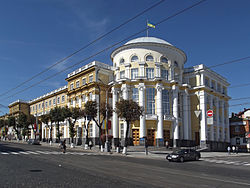 Vinnytsia regional council
 -
 Baptist church
 -
 Art Nouveau building, built by architect V.P. Listovichiy
 -
 Medical University in Vinnytsia
 -
![Mansion-museum[91] of Nikolay Pirogov](//upload.wikimedia.org/wikipedia/commons/thumb/7/74/%D0%A1%D0%B0%D0%B4%D0%B8%D0%B1%D0%B0_%D0%9F%D0%B8%D1%80%D0%BE%D0%B3%D0%BE%D0%B2%D0%B0%21.JPG/250px-%D0%A1%D0%B0%D0%B4%D0%B8%D0%B1%D0%B0_%D0%9F%D0%B8%D1%80%D0%BE%D0%B3%D0%BE%D0%B2%D0%B0%21.JPG) Mansion-museum[91] of Nikolay Pirogov
Mansion-museum[91] of Nikolay Pirogov -
 City hall
 -
 Monuments to the victims of the terror of 1937-1938


,_%D0%B2%D1%83%D0%BB._%D0%9F%D0%B8%D1%80%D0%BE%D0%B3%D0%BE%D0%B2%D0%B0_56.jpg)
![Mansion-museum[91] of Nikolay Pirogov](https://en.wikipedia.org/wiki/File:%D0%A1%D0%B0%D0%B4%D0%B8%D0%B1%D0%B0_%D0%9F%D0%B8%D1%80%D0%BE%D0%B3%D0%BE%D0%B2%D0%B0!.JPG)


See also
[edit]- FC Nyva Vinnytsia
- TIK
- Vinnytsia massacre
- Vinnytsia tram
- Werwolf (Wehrmacht HQ) – the codename used for one of Adolf Hitler's World War II Eastern Front military headquarters. It was one of the most easterly ever used by Hitler in person.
Notes
[edit]References
[edit]- ^ (in Ukrainian) Vinnytsia: Groysman's triumph, "servants" look for the culprit in defeat at elections, The Ukrainian Week (10 November 2020)
- ^ (in Ukrainian) In Vinnytsia, the current mayor Morgunov, the CVU exit poll, is leading with almost 69% of the vote, Ukrinform (25 October 2020)
- ^ "Vinnytsya". www.britannica.com.
- ^ "Moving to Vinnytsia". www.vmr.gov.ua. Archived from the original on 31 March 2023. Retrieved 27 December 2022.
- ^ "Винница / определение слова Винница – город, ц. Винницкой обл., Украина. Впервые упоминается в 1363 г" (in Russian). Diclib.com. Retrieved 1 March 2022.
- ^ "Vinnitsa Climate Vinnitsa Temperatures Vinnitsa Weather Averages". www.vinnitsa.climatemps.com. Retrieved 20 June 2019.
- ^ "Comparison of the Average Weather in Vinnytsya and Forest City – Weather Spark". weatherspark.com. Retrieved 20 June 2019.
- ^ "Климат Винницы" (in Russian). Weather and Climate (Погода и климат). Archived from the original on 13 December 2019. Retrieved 8 November 2021.
- ^ "Vinnytsia Climate Normals 1991–2020". World Meteorological Organization Climatological Standard Normals (1991–2020). National Oceanic and Atmospheric Administration. Archived from the original on 22 April 2025. Retrieved 22 April 2025.
- ^ "Vinnytsia is the First Ukrainian Community to Declare a Green Deal". www.vmr.gov.ua. Archived from the original on 27 December 2022. Retrieved 27 December 2022.
- ^ "Podolia". Jewish Virtual Library. AICE. Retrieved 31 December 2020.
- ^ Gembarzewski, Bronisław (1925). Rodowody pułków polskich i oddziałów równorzędnych od r. 1717 do r. 1831 (in Polish). Warszawa: Towarzystwo Wiedzy Wojskowej. p. 26.
- ^ "Piłsudski and Petliura: Together against the Bolsheviks". Polish History. 21 April 2022. Retrieved 27 December 2022.
- ^ "Historical Photographs of the Holodomor". HREC Education. Retrieved 16 May 2024.
- ^ Valery Vasiliev, Yuriy Shapoval, "Stages of «Great Terror»: The Vinnytsia Tragedy", Zerkalo Nedeli, № 31 (406), 17–23 August 2002, (in Russian Archived 2007-11-28 at the Wayback Machine, in Ukrainian Archived 2009-05-18 at the Wayback Machine)
- ^ a b Arad, Yitzhak (27 May 2020). The Holocaust in the Soviet Union. U of Nebraska Press. ISBN 9781496210791.
- ^ Rathkolb, Oliver (1 August 2004). Revisiting the National Socialist Legacy: Coming to Terms With Forced Labor, Expropriation, Compensation, and Restitution. Transaction. p. 179. ISBN 978-0765805966.
- ^ "Hitler's Ukrainian Bunker Revealed". BBC. 12 March 2012. Retrieved 28 August 2018.
- ^ Felton, Mark (4 August 2014). Guarding Hitler: The Secret World of the Fuhrer. London: Pen and Sword Military. ISBN 978-1781593059.
- ^ Ainsworth-Davis, John; Creighton, Ami de (29 December 2014). The Mountbatten Report, New Edition. Lulu.com. ISBN 9781312749962.
- ^ Speer, Albert (1995). Inside the Third Reich. London: Weidenfeld & Nicolson. pp. 328–329. ISBN 9781842127353.
- ^ "Hitler's headquarters "Werwolf"". The Koz Telegram. 18 August 2018. Archived from the original on 29 August 2018. Retrieved 28 August 2018.
- ^ "Hitler's Ukrainian Bunker Revealed". 12 March 2012. Retrieved 28 August 2018.
- ^ "Hitler's headquarters "Werwolf"". 2018. Retrieved 28 August 2018.
- ^ "43rd Missile Army". Ww2.dk. Retrieved 16 September 2011.
- ^ "Russian cruise missiles strike Ukrainian Air Force command center, according to Ukraine's military". CNN. 25 March 2022. Retrieved 25 March 2022.
- ^ "Ракетний удар по Вінниці: кількість загиблих зросла до 27 людей". Громадське радіо (in Ukrainian). 2 August 2022. Retrieved 27 December 2022.
- ^ "У міноборони РФ прокоментували удар по Вінниці". ua.korrespondent.net (in Russian). Retrieved 15 July 2022.
- ^ "Social media posts chart life and death of girl in Russian strike". the Guardian. 14 July 2022. Retrieved 15 July 2022.
- ^ "УКАЗ ПРЕЗИДЕНТА УКРАЇНИ №829/2022 — Офіційне інтернет-представництво Президента України".
- ^ "Vinnytsia opens office in Brussels". cor.europa.eu. Retrieved 16 May 2024.
- ^ "Cities & towns of Ukraine". pop-stat.mashke.org.
- ^ "Vinnytsia preschool education institutions".
- ^ "Vinnytsia institutions of general secondary education".
- ^ "Official site of National Pirogov Memorial Medical University" (in English and Ukrainian). vnmu.edu.ua. Retrieved 26 December 2022.
- ^ "Official webcite of Vinnytsia Institute of Trade and Economics of State University of Trade and Economics". vtei.com.ua. Archived from the original on 8 March 2023. Retrieved 26 December 2022.
- ^ "У Вінницькій облраді затвердили нову назву для обласної універсальної наукової бібліотеки" (in Ukrainian). vezha.ua. 25 November 2022. Retrieved 26 December 2022.
- ^ "Інтернет магазин ювелірних виробів із золота – ціни, фото – Вінниця Кристал". vinnitsakristall.com. Retrieved 24 May 2019.
- ^ "ЧАО Маяк – производитель обогревательных приборов и радиаторов для систем отопления". termia.com.ua. Retrieved 24 May 2019.
- ^ ""БУДМАШ". Вінниця, Україна". www.budmash.vn.ua. Archived from the original on 25 August 2011. Retrieved 24 May 2019.
- ^ "Пневматика. Винница, Украина". www.pnevmatica.com.ua. Archived from the original on 27 November 2011. Retrieved 24 May 2019.
- ^ "Інтернет магазин зварювальних матеріалів компанії ПлазмаТек".
- ^ "Barlinek -Головна сторінка". Barlinek (in Ukrainian). Retrieved 27 December 2022.
- ^ "ПрАТ «Вінницький ОЖК". vmzhk.vioil.com. Retrieved 27 December 2022.
- ^ "Home". www.vhsvin.com.ua. Retrieved 27 December 2022.
- ^ Beteiligungs-AG, AGRANA. "Home". ua.agrana.com. Retrieved 27 December 2022.
- ^ "Industrial park". Вінницький муніципальний центр інновацій. Retrieved 27 December 2022.
- ^ "UBC Group". beer-co.com. Retrieved 27 December 2022.
- ^ "Home". KNESS. Retrieved 27 December 2022.
- ^ "Companies of HEAD Group – HEAD". www.head.com. Retrieved 27 December 2022.
- ^ "Де в Україні айтішнику жити добре. Рейтинг міст DOU". ДОУ (in Ukrainian). Retrieved 27 December 2022.
- ^ "Playtika – Infinite ways to play". Playtika Ltd. Retrieved 27 December 2022.
- ^ "ONSEO | Full Cycle Digital Production". Retrieved 27 December 2022.
- ^ "EPAM | Software Engineering & Product Development Services". www.epam.com. Archived from the original on 16 May 2021. Retrieved 27 December 2022.
- ^ "LetyShops cashback service". LetyShops. Retrieved 27 December 2022.
- ^ "На Вінниччині створено інноваційний агропромисловий кластер "AgroVin" — Вінницька обласна військова адміністрація". vin.gov.ua. Retrieved 27 December 2022.
- ^ "Головна". AIM Cluster (in Ukrainian). Retrieved 27 December 2022.
- ^ "Достопримечательности Винницы - 10 мест, которые стоит посмотреть". Отпуск Тайм. 3 December 2020.
- ^ "About fountain :: Europe's largest floating fountain". Fountainroshen.com. Retrieved 5 January 2013.
- ^ "Національний музей-садиба М.І. Пирогова. Вінниця, Україна". www.pirogov.com.ua.
- ^ "Про музей – Вінницький літературно-меморіальний музей Михайла Коцюбинського". kotsubinsky.vn.ua.
- ^ "Roshen Fountain in Vinnitsa was opened! :: Confectionery Corporation ROSHEN". roshen.com. Archived from the original on 10 July 2015. Retrieved 25 October 2015.
- ^ a b c "Десять крупнейших ж/д вокзалов Украины 2014 года". cfts.org.ua.
- ^ "Розклад | Вінницький трамвай". depo.vn.ua (in Ukrainian). Retrieved 26 March 2018.
- ^ "Die Zürcher Verkehrsbetriebe mustern die ältesten Trams ihrer Flotte aus. Die Hälfte der Fahrzeuge wird verschrottet". NZZ. 24 August 2021.
- ^ "Питання оновлення тролейбусного парку стоїть гостро" (in Ukrainian). 9 November 2022.
- ^ "ВІННИЦЯ 1 табло автовокзалу: оперативна інформація автовокзалу (автостанції) про розклад руху автобусів та його зміни, наявність вільних місць.в автобусах". bus.com.ua. Retrieved 24 May 2019.
- ^ "Автовокзал Вінниця АС-2 "Західна" — розклад руху автобусів та онлайн табло".
- ^ "ВІННИЦЯ 2 табло автовокзалу: оперативна інформація автовокзалу (автостанції) про розклад руху автобусів та його зміни, наявність вільних місць.в автобусах". bus.com.ua. Retrieved 24 May 2019.
- ^ "Vinnytsia Regional Clinical Medical and Diagnostic Center for Cardiovascular Pathology/. Official webpage". 21 September 2020. Retrieved 27 December 2022.
- ^ "Новим президентом ФК "Нива" став Артур Загорулько.ФОТО" (in Ukrainian). vezha.ua. 21 January 2021. Retrieved 29 December 2022.
- ^ "Profile Field hockey team "HC OKS-SHVSM Vinnitsa"". the-sports.org. Retrieved 29 December 2022.
- ^ "Profile of Basketball team "Vinnitsa lightning (W)"". sportshub.stream. Retrieved 29 December 2022.
- ^ ""Зубри" завершили рік перемогами" (in Ukrainian). noc-vin.org.ua. Retrieved 29 December 2022.
- ^ "Історія клубу "Вінницькі Вовки"" (in Ukrainian). vinwolves.org. Archived from the original on 29 December 2022. Retrieved 29 December 2022.
- ^ "Pavlo Khnykin's Biographical information". olympedia.org. Retrieved 29 December 2022.
- ^ "İnna Osipenko-Radomska's Biographical information". olympedia.org. Retrieved 29 December 2022.
- ^ "Hanna Balabanova's Biography, Olimpic Medals, Records and Age". olympics.com. Retrieved 29 December 2022.
- ^ "Serhii Bohachuk Profile". boxrec.com. Retrieved 29 December 2022.
- ^ "Офіційна сторінка Вінницького обласного академічного муздрам театру імені Садовського" (in Ukrainian). Retrieved 26 December 2022.
- ^ "Офіційна сторінка Вінницької філармонії" (in Ukrainian). Retrieved 26 December 2022.
- ^ "Національний музей-садиба М.І. Пирогова" (in Ukrainian). Retrieved 26 December 2022.
- ^ "Вінницький обласний краєзнавчий музей" (in Ukrainian). Retrieved 26 December 2022.
- ^ "Вінницький обласний художній музей" (in Ukrainian). Retrieved 26 December 2022.
- ^ "Вінницький літературно-меморіальний музей Михайла Коцюбинського". kotsubinsky.vn.ua (in Ukrainian). Retrieved 26 December 2022.
- ^ "Vinnytsia Twin Cities". Archived from the original on 2 February 2023. Retrieved 11 July 2022.
- ^ "Kardeş Şehirler". Bursa Büyükşehir Belediyesi Basın Koordinasyon Merkez. Tüm Hakları Saklıdır. Archived from the original on 23 May 2016. Retrieved 27 July 2013.
- ^ "Міністерство інфраструктури України - Реєстр угод про транскордонне співробітництво". mtu.gov.ua (in Ukrainian). Retrieved 20 November 2023.
- ^ "Німецьке місто Мюнстер офіційно стало містом-партнером Вінниці". decentralization.gov.ua. 11 March 2023. Retrieved 20 November 2023.
- ^ "Вінниця підписала угоду про співдружність з латвійським містом Вентспілс – Сергій Моргунов". misto.vn.ua (in Ukrainian). 15 September 2022. Retrieved 20 November 2023.
- ^ "The national Pirogov's estate museum". Pirogov.com.ua. Retrieved 17 July 2014.
External links
[edit] The dictionary definition of vinnytsia at Wiktionary
 Media related to Vinnytsia at Wikimedia Commons
 Vinnytsia travel guide from Wikivoyage
- Official website (in Ukrainian and English)
- Аn English-language city guide to Vinnytsia


Vinnytsia
View on GrokipediaName
Etymology and historical names
The name Vinnytsia (Ukrainian: Вінниця, romanized: Vínnytsia) first appears in historical records in 1363, referring to a fortress or settlement acquired through purchase.[6][7] The term derives from the Proto-Slavic root věno, denoting "dowry," "bride price," or "ransom" in Old East Slavic usage, likely alluding to the transactional context of the site's establishment or transfer.[8][7] Alternative interpretations link it to the Old Slavic vino, signifying "gift" or possibly evoking winemaking activities in the region, though linguistic evidence favors the dowry etymology as primary.[6][9] Under Polish-Lithuanian rule, the name adapted to Winnica in Polish orthography, reflecting phonetic rendering in that language.[10] During Russian imperial administration from 1793 onward, it became Vínnitsa (Russian: Ви́нница), aligning with Cyrillic conventions of the era.[10] In Yiddish, spoken by the significant Jewish population, variants included Vinits or ויניצע (Vynitse), underscoring the city's multicultural linguistic landscape.[11][10] Following Ukraine's independence in 1991, official usage standardized on the Ukrainian form Vínnytsia, prioritizing native orthography over Russified transliterations prevalent in Soviet times, without altering the underlying name.[8] This shift emphasized linguistic de-Russification in post-Soviet nomenclature.[8]Geography
Location and physical features
Vinnytsia is located in west-central Ukraine on both banks of the Southern Bug River at approximately 49°14′N 28°28′E.[12] The city lies about 260 kilometers southwest of Kyiv and serves as the administrative center of Vinnytsia Oblast.[8] The urban area covers roughly 113 square kilometers, characterized by the river valley of the Southern Bug amid the Podilian Upland's rolling terrain.[8] [13] This upland region features flat to gently undulating plateaus dissected by river incisions, with elevations averaging around 250-300 meters above sea level in the vicinity.[13]
Climate and weather patterns
Vinnytsia has a humid continental climate (Köppen Dfb), marked by distinct seasons, cold winters without extreme aridity, and warm summers influenced by continental air masses.[14] [15] The region's weather derives from interactions between westerly Atlantic flows, northerly Arctic intrusions, and easterly continental highs, resulting in marked temperature swings and variable precipitation patterns over the year.[16] Long-term averages from local meteorological observations indicate an annual mean temperature of 8.9 °C, with January featuring average highs of -1.4 °C and lows of -6.7 °C, often accompanied by snow cover lasting 60-70 days annually.[17] [14] July, the warmest month, records average highs of 24.8 °C and lows of 14.1 °C, driven by southerly air masses.[14] Temperatures typically range from -7 °C in winter lows to 26 °C in summer highs, with extremes rarely falling below -17 °C or exceeding 31 °C based on historical station data.[18] Precipitation averages 665 mm annually, concentrated in convective summer storms (up to 94 mm in June) and more uniform winter snowfall, totaling around 69 snow days per year.[17] [14] Variability arises from cyclonic activity, with wetter periods linked to low-pressure systems from the Mediterranean or Black Sea, and drier spells under high-pressure dominance from Siberia.[14] Local records from Vinnytsia station (established in the early 20th century) confirm these patterns, showing interannual fluctuations of ±20% in precipitation tied to broader Eastern European circulation indices.[19]Environmental conditions and resource management
The Southern Bug River, which flows through Vinnytsia, experiences pollution primarily from municipal wastewater, industrial discharges, and agricultural runoff, with annual wastewater volumes in the Vinnytsia region reaching approximately 60 million cubic meters, of which only 47% receives treatment.[20] Monitoring by Ukrainian agencies indicates elevated levels of nitrogen compounds and other pollutants, exacerbated by untreated effluents from urban centers, contributing to degraded water quality in the upper basin.[21] [22] Efforts to mitigate this include constructed wetlands for nitrogen removal, though anthropogenic pressures persist amid limited enforcement of Soviet-era inherited infrastructure standards.[23] Vinnytsia Oblast maintains a forest cover of about 8.4% natural forest as of 2020, totaling 222,000 hectares, supporting moderate biodiversity through riparian zones and ecological corridors, though annual losses reached 851 hectares in 2024 due to logging and land conversion.[24] Local management practices emphasize protected areas, including 25 urban biocenters and a new 182-hectare landscape reserve established in 2025 within the Tulchyn District, aimed at preserving habitats amid agricultural dominance.[25] [26] Soviet legacies, such as state plantations, continue to influence reforestation, with ongoing projects planting native species to counter deforestation risks in eco-corridors.[27] Groundwater resources in the region, drawn from fractured crystalline rocks of the Ukrainian Shield, serve as a reserve for potable supply, with operational reserves assessed for sustainability despite vulnerabilities to surface contamination.[28] [29] Regional monitoring highlights pollution risks from agricultural nitrates, though crystalline aquifers provide relatively stable yields for Vinnytsia's water intake, supplemented by ponds totaling significant volumes under state oversight.[30] [31] Waste management practices have advanced with the July 2025 launch of Vinnytsia's Municipal Waste Management Center, facilitating sorting and disposal of household and hazardous materials, building on integrated systems analyzed for regional environmental safety.[32] [33] International partnerships, including Swedish initiatives, promote EU-aligned reforms to reduce landfill pollution, addressing Soviet-era deficiencies in municipal solid waste handling that contribute to soil and water contamination.[34] [35]History
Prehistoric and early medieval settlements
Archaeological excavations in the Vinnytsia oblast have uncovered evidence of settlements associated with the Cucuteni–Trypillian culture, dating to approximately 5050–2950 BCE, including the site of Bilyi Kamin in the southeastern part of the region, where geomagnetic surveys and artifact analysis reveal planned structures typical of this Neolithic–Chalcolithic society known for large proto-urban agglomerations and ceramic production.[36] A notable artifact, a clay female figurine referred to as the "Trypillian goddess," was unearthed in the Vinnytsia region in 2009, exemplifying the culture's distinctive anthropomorphic pottery linked to fertility rituals and now housed in the Trypillian Culture Museum.[37] The region also features fortified hillforts from the Early Iron Age, such as Severynivka, with ramparts and moats dated to the late 7th century BCE through excavations revealing defensive earthworks on elevated terrain, likely constructed by local populations to counter incursions from steppe nomads like the Scythians.[38] These structures indicate a continuity of settlement patterns in Podolia, where the Vinnytsia area lies, involving microspatial adaptations for protection amid forested-steppe interfaces.[39] By the early medieval period, East Slavic groups had established settlements in the Podilia region encompassing Vinnytsia, integrating into the Kyivan Rus' polity from the 10th to 12th centuries, as evidenced by regional habitation patterns and annexation to principalities like Galicia-Volhynia, reflecting broader Slavic migrations and agricultural communities vulnerable to nomadic raids from Pechenegs and Cumans.[40] Archaeological monuments in nearby Bar district span up to the 6th century CE, bridging to Slavic phases with pottery and burial sites indicative of cultural transitions, though specific Vinnytsia locales show influences from Rus' trade and defensive needs rather than large-scale urban centers prior to later medieval documentation.[41]Polish-Lithuanian Commonwealth and Cossack era
Vinnytsia was established as a fortress in 1363 by Lithuanian Duke Algirdas to protect against Crimean Tatar raids on the Southern Bug River trade route.[42] The settlement fell under the Grand Duchy of Lithuania, which controlled Podolia amid ongoing conflicts with the Golden Horde remnants. Following the 1569 Union of Lublin, Vinnytsia integrated into the Polish-Lithuanian Commonwealth as part of the Bracław Voivodeship, where Polish magnates developed vast estates and reinforced urban defenses, including stone castles to counter Ottoman and Tatar threats.[43] The region's Cossack population, registered as border guards, chafed under Polish noble dominance and religious policies favoring Catholicism over Orthodox Christianity. In 1648, Bohdan Khmelnytsky's uprising erupted, drawing Vinnytsia into widespread rebellion; Cossack forces under Ivan Bohun seized control, targeting Polish administrators and fortifications. A notable clash occurred in the 1651 Siege of Vinnytsia, where Bohun's defenders repelled Polish assaults led by Marcin Kalinowski, though the broader campaign weakened Commonwealth authority in Podolia.[44] Jewish merchants and leaseholders arrived in Vinnytsia during the 16th century under Polish protection, facilitating trade in grain and cattle across Podolia's markets. The Khmelnytsky Uprising (1648–1657) brought devastation, as Cossack and peasant rebels perpetrated pogroms against Jewish communities, viewing them as economic agents of Polish lords; estimates suggest tens of thousands perished region-wide, disrupting settlement patterns and leading to temporary depopulation.[11][45]Imperial Russian period
Following the Second Partition of Poland on January 23, 1793, Vinnytsia was annexed by the Russian Empire, along with the Right-Bank Ukrainian territories, and integrated into the newly formed Bratslav Vicegerency, which was reorganized into the Podolia Governorate by 1796, with Vinnytsia serving as the administrative center of its namesake uyezd (county).[46][47] Russian imperial policies emphasized Russification, including restrictions on Polish and Ukrainian cultural institutions, while promoting Orthodox Christianity and serf-based agriculture in the region.[8] The 19th century brought economic transformation driven by agricultural processing, with sugar beet refining emerging as the dominant industry due to Podolia's black soil and proximity to raw material sources; by mid-century, local factories processed beets from surrounding estates, contributing to the empire's overall sugar output, which expanded rapidly after tariff protections in the 1840s.[48][49] This industrialization spurred urban infrastructure development, including railways connecting Vinnytsia to Kyiv and Odesa by the 1870s, facilitating trade and migration; the city's population grew steadily, reflecting broader imperial urbanization trends in southwestern borderlands.[50] Tensions culminated in the 1905 Revolution's local manifestations, including worker strikes at sugar plants and agrarian disturbances among peasants demanding land reforms, amid empire-wide unrest following Russia's defeats in the Russo-Japanese War.[51] In October 1905, anti-Jewish pogroms erupted in Vinnytsia, triggered by rumors of revolutionary agitation and economic scapegoating, resulting in deaths, injuries, and widespread property destruction targeting the Jewish community, which comprised a significant portion of merchants and artisans.[11][52] Imperial authorities responded with troops to suppress the violence, but the events underscored underlying ethnic and class frictions in the multi-confessional uyezd.[53]Revolutionary upheavals and early Soviet rule
Following the Bolshevik capture of Kyiv on 5 February 1919, the Directory of the Ukrainian People's Republic relocated its government to Vinnytsia, where it functioned as a temporary seat of power amid ongoing struggles for independence.[54] This marked one of three instances during the 1917–1920 Ukrainian Revolution when Vinnytsia served as a hub for Ukrainian national governance structures, reflecting the chaotic shifts in control during the civil war.[55] The city became a base for Directory leader Symon Petliura, who coordinated military efforts against Bolshevik forces encroaching from the east.[56] Vinnytsia experienced fluctuating occupations as Ukrainian forces, allied intermittently with Polish troops, clashed with Bolshevik armies in the Podilia region. In May 1920, Polish-Ukrainian allied forces under Józef Piłsudski and Petliura operated from Vinnytsia during advances toward Kyiv, but Bolshevik counteroffensives, including those led by Mikhail Tukhachevsky, reclaimed the area by late 1920, solidifying Soviet control.[56] [7] These battles contributed to widespread devastation, with the Ukrainian-Soviet War overall resulting in hundreds of thousands of military and civilian casualties across the contested territories.[57] Under early Soviet rule from 1920, Bolshevik authorities implemented the Red Terror in Ukraine to suppress nationalist elements and consolidate power, executing suspected counter-revolutionaries, former Ukrainian officials, and class enemies through Cheka operations.[58] While specific execution tallies for Vinnytsia remain undocumented in available records, the policy mirrored broader patterns in Soviet Ukraine, where thousands faced summary trials and shootings to eliminate opposition during the civil war's aftermath.[59] The transition to Soviet administration exacerbated economic strains from War Communism's grain requisitions, culminating in the 1921–1923 famine that afflicted Ukraine, including Podilia province encompassing Vinnytsia, due to drought, disrupted agriculture, and export policies prioritizing urban and military needs.[60] This crisis, killing an estimated 200,000 to 935,800 in Ukraine, presaged later collectivization drives as authorities began centralizing agricultural control under the New Economic Policy, though full-scale forced collectivization emerged only in the late 1920s.[61]Stalinist terror and the Vinnytsia massacre
During the Great Purge of 1937–1938, the NKVD orchestrated widespread arrests and summary executions in Vinnytsia, fulfilling quotas for eliminating "enemies of the people" such as kulaks, Ukrainian nationalists, clergy, intellectuals, and members of the Polish minority suspected of espionage or counter-revolutionary activity.[62] Victims were typically shot in the back of the head, often with hands bound, and interred in unmarked mass graves in orchards, fields, and ravines surrounding the city, including sites like the Partizanska and Yerusalimka orchards.[3] Archival evidence from NKVD records later confirmed executions numbering between 9,000 and 11,000 in the Vinnytsia region, with many victims identified through personal documents and effects buried with them.[3] [63] In May 1943, under Nazi occupation, German authorities initiated exhumations at these sites, unearthing over 9,400 bodies across at least nine grave locations, with forensic analysis revealing execution-style wounds, lime used to hasten decomposition, and artifacts dated to 1937–1938 via newspapers, letters, and IDs found on remains.[3] To bolster propaganda against Bolshevism, the Nazis assembled an international medical commission including experts from Belgium, Netherlands, Finland, Hungary, Italy, and Slovakia, alongside Red Cross representatives, which corroborated the Soviet origin of the killings based on ballistic evidence and burial timelines inconsistent with recent German actions.[3] Photographs and reports from the digs, disseminated widely, provoked outrage in neutral and Allied circles, with U.S. congressional hearings in 1955 later referencing Vinnytsia as evidence of Stalinist atrocities comparable in method to Katyn.[3] Soviet authorities vehemently denied responsibility, attributing the graves to Nazi fabrications or wartime executions in official statements, such as a 1943 press release from the Soviet Information Bureau claiming German culpability.[3] Postwar, the massacre was erased from historiography, with no mention in Soviet publications and surviving witnesses intimidated or imprisoned to suppress testimony; discussion remained taboo until Mikhail Gorbachev's perestroika in the late 1980s, when partial admissions emerged amid de-Stalinization efforts.[3] This pattern of denial reflected broader NKVD practices of secret operations under Article 58 of the RSFSR Penal Code, where quotas drove arbitrary targeting without trials, prioritizing class and national enemies in Ukraine's border regions.[62]World War II occupation and atrocities
German forces occupied Vinnytsia on July 19, 1941, as part of the Wehrmacht's rapid advance during Operation Barbarossa.[64] Upon arrival, Einsatzgruppen and local collaborators initiated immediate executions of Jews, including documented shootings at mass graves in July 1941.[65] A ghetto was established in the city, confining the Jewish population under harsh conditions prior to deportations and killings.[47] The Holocaust in Vinnytsia unfolded systematically from 1941 to 1943, with Sonderkommando 4a of Einsatzgruppe C conducting mass shootings, often assisted by Ukrainian auxiliary police.[66] Approximately 25,000 Jews were murdered in the city during this period, primarily through execution pits and anti-partisan reprisals.[67] These actions formed part of the broader extermination policy in Reichskommissariat Ukraine, where Jews were targeted as alleged Bolshevik agents and racial inferiors.[68] From summer 1942 to early 1943, Adolf Hitler relocated his forward headquarters to the Werwolf complex, a fortified bunker site 12 kilometers north of Vinnytsia in the Stryzhavka forest.[69] The facility, constructed by Organisation Todt using forced labor, served as the base for planning Eastern Front operations, including responses to Stalingrad, and hosted high-level meetings despite harsh winter conditions.[70] Hitler visited multiple times, underscoring the site's strategic centrality amid deteriorating German positions. Soviet partisan groups, including hundreds of Jewish fighters operating from nearby forests, conducted sabotage against German supply lines, prompting brutal reprisals that exacerbated civilian suffering.[71] These activities contributed to a cycle of violence, with locals caught between occupiers and resistance. The city saw intense fighting during the Soviet Uman–Botoșani Offensive, leading to its liberation by Red Army forces on March 20, 1944.[64] Overall, the occupation resulted in over 200,000 civilian deaths across Vinnytsia Oblast, with 25,000 in the city alone, reflecting the dual toll of genocidal policies and wartime destruction under Nazi rule.[67] This contrasted with pre-occupation Soviet repressions, though the German phase inflicted the majority of WWII-era losses through deliberate extermination and scorched-earth tactics.[68]Postwar Soviet reconstruction
Following the liberation of Vinnytsia from German occupation in March 1944, Soviet authorities initiated reconstruction efforts to restore the city's war-ravaged infrastructure, which had suffered extensive damage from battles, bombings, and scorched-earth tactics during the 1941–1944 period.[72] Repair work prioritized essential utilities, housing, and transport links, drawing on centralized planning from the Ukrainian SSR's Council of Ministers, with labor mobilized through state directives that included demobilized soldiers and compulsory work assignments.[73] By the late 1940s, basic urban services were partially operational, though full recovery lagged due to resource shortages and the redirection of materials to heavy industry nationwide.[74] A pivotal aspect of postwar development was the militarization of Vinnytsia, transforming it into a strategic Soviet Air Force hub. In the immediate aftermath of 1945, the Soviet Union established a major airbase there, encompassing an airfield, medical facilities, arsenals, and support infrastructure, which served as home to units like the 43rd Rocket Army and reinforced regional defense capabilities amid Cold War tensions. This expansion involved the influx of military personnel and technical specialists, often relocated from other Soviet republics, contributing to demographic shifts that diluted local Ukrainian majorities through Russified administrative and officer cadres.[75] Industrialization drives accelerated in the late 1940s, aligning with the USSR's Fourth Five-Year Plan (1946–1950), which emphasized machine-building and light industry to support agriculture. The Vinnytsia Tool Plant, founded around 1947–1948, exemplified this push, producing precision instruments and machinery components amid broader efforts to revive sugar processing and food production sectors devastated by the war.[76] Factory construction relied on state-funded projects that incorporated forced labor elements, including from Gulag returnees and repressed groups, fostering dependency on Moscow-directed supply chains and eroding prewar local economic autonomy.[77] These initiatives boosted output but enforced cultural assimilation, as Russian-language technical education and cadre deployment suppressed Ukrainian linguistic usage in workplaces, reflecting broader Stalinist policies until the mid-1950s thaw.[78]Late Soviet stagnation and dissent
During the Brezhnev era (1964–1982), Vinnytsia, as a key node in the Ukrainian SSR's industrial and agricultural sectors, experienced the broader Soviet economic slowdown marked by decelerating growth after an early-1970s peak, inefficient resource allocation, and pervasive shortages that spurred black market activities to meet consumer demands unmet by central planning. Heavy industry, including machinery production and food processing, saw marginal output increases but suffered from technological lag and labor inefficiencies, with corruption infiltrating local enterprises as elites exploited shortages for personal gain. The black market, involving pilferage from state supplies and informal trade networks, became integral to daily life, compensating for deficits in goods like clothing and electronics that official distribution failed to provide. State policies promoted demographic shifts through directed migration to bolster urbanization and Russification, drawing Russian-speaking workers to Vinnytsia's factories and collective farms, which contributed to rapid population expansion while aiming to integrate Ukrainian regions more tightly into the Soviet framework. These inflows, part of broader efforts to counter Ukrainian nationalism by altering ethnic balances in urban centers, maintained Ukrainians as the dominant group but increased Russian linguistic influence in administrative and industrial spheres. Underground dissident networks in Ukraine, including pockets in Vinnytsia, resisted these cultural encroachments through samizdat circulation and quiet advocacy for national rights, with local figures like Zionist activist Isaac Shkolnik facing arrests for organizing against suppression. The 1986 Chernobyl nuclear accident amplified regional malaise when radioactive fallout contaminated Vinnytsia oblast, resulting in revised estimates of iodine-131 thyroid activities 10–25% higher than initial assessments, prompting hushed criticism of official secrecy and inadequate response measures. This event eroded trust in Moscow's competence, intersecting with existing dissent by highlighting systemic failures in information control and crisis management, though overt protests remained suppressed until later reforms. Local dissidents leveraged the fallout's health implications—elevated risks of thyroid issues among residents—to underscore broader grievances against Russified governance and environmental neglect.Path to Ukrainian independence
The introduction of Mikhail Gorbachev's perestroika and glasnost policies in 1985 enabled greater openness in the Ukrainian SSR, including Vinnytsia Oblast, where economic stagnation and cultural suppression had long prevailed under centralized Soviet control. These reforms permitted the formation of informal groups focused on environmental issues, historical commemoration, and Ukrainian-language revival, culminating in the emergence of the monthly publication Incognito in the Vinnytsia region—the first such independent periodical in the Soviet Union—as a platform for critiquing official narratives and advocating local autonomy.[79] By 1989, these stirrings aligned with the national founding of the People's Movement of Ukraine (Rukh) on September 6–8, which initially positioned itself as supporting perestroika but evolved to demand sovereignty, drawing regional support in central Ukraine including Vinnytsia through petitions against Russification and for democratic elections.[80] The 1990 elections to local soviets marked a turning point, with Rukh candidates securing seats across Ukraine and contributing to the Verkhovna Rada's adoption of a declaration of state sovereignty on July 16, 1990, which resonated in Vinnytsia amid widespread economic shortages from failed perestroika experiments like partial market reforms that exacerbated supply disruptions in the oblast's agricultural sector.[80] The attempted hardline coup in Moscow on August 19–21, 1991, discredited the Soviet leadership and prompted Ukraine's Verkhovna Rada to declare full independence on August 24, 1991, with 346 deputies voting in favor; this shift decoupled Ukraine's economy from Moscow's failing central planning, as regions like Vinnytsia—dependent on food processing and grain production—began anticipating self-managed trade and resource allocation amid the USSR's unraveling supply chains.[81] Independence was ratified in a nationwide referendum on December 1, 1991, where 92.3% of voters approved the Act of Declaration of Independence.[82] In Vinnytsia Oblast, support was even stronger, with 95.43% voting yes amid a 91.41% turnout, reflecting the oblast's alignment with national aspirations for sovereignty despite initial economic uncertainties from severed Soviet interdependencies.[83] Perestroika-era laws, such as the 1988 measure on cooperatives, had already introduced tentative privatization by allowing small private ventures, but these faced challenges like bureaucratic resistance and inflation precursors, setting the stage for post-Soviet transitions without yet resolving deeper structural inefficiencies in local industries.[84]Post-independence consolidation
Following Ukraine's declaration of independence on August 24, 1991, Vinnytsia experienced the nationwide economic contraction typical of post-Soviet transition, with regional industrial output in sectors like sugar refining and machinery declining sharply amid hyperinflation and disrupted supply chains. The introduction of the hryvnia as national currency on September 2, 1996, stabilized local transactions after years of ruble-based volatility, facilitating initial market-oriented reforms including small-scale privatization of retail and service enterprises under the 1992 Privatization Law. However, large-scale privatization of state factories proceeded unevenly through the 1990s, hampered by bureaucratic delays and insider deals that favored connected local elites, contributing to GDP per capita in Vinnytsia Oblast lagging behind national recovery trends until the early 2000s boom driven by agricultural exports.[85][86] Local governance in Vinnytsia evolved from appointed Soviet-era structures to elected mayoralty post-1991, with Dmytro Dvorkis serving as mayor from 1992 to 2000 amid efforts to maintain basic utilities and municipal services during fiscal austerity. Oleksandr Dombrovskyi's tenure from 2002 to 2005 emphasized administrative continuity, but Volodymyr Groysman's election in 2006 marked a shift toward proactive consolidation, including infrastructure upgrades like modernized public transport and energy efficiency projects funded partly through municipal bonds and international grants. These initiatives positioned Vinnytsia as a relatively stable regional hub, though national oligarchic networks exerted indirect influence via regional energy and agribusiness monopolies, fostering localized corruption in procurement and land allocation despite Groysman's emphasis on transparency.[87][88] Vinnytsia's residents actively participated in the 2004 Orange Revolution, with widespread local rallies protesting electoral fraud in the presidential runoff between Viktor Yushchenko and Viktor Yanukovych, reflecting central Ukraine's pro-reform sentiments against entrenched corruption. In Vinnytsia Oblast, Yushchenko garnered significant support in urban areas, contributing to the nationwide mobilization that forced a revote on December 26, 2004, which he won with 52% nationally. This civic engagement underscored local aspirations for democratic accountability, though subsequent national political reversals limited sustained anti-corruption gains at the regional level until later administrative reforms.[89][90] Alignment with NATO and EU trajectories remained primarily national policy, with Ukraine's 1994 Partnership for Peace accession and 1998 EU Partnership and Cooperation Agreement providing frameworks for local economic diversification in Vinnytsia through trade partnerships in agriculture and light industry. Municipal leaders under Groysman pursued twin-city agreements with European locales, such as Germany's Kaiserslautern since 1991, to attract investment and adopt governance best practices, though oligarchic resistance at higher levels constrained deeper integration until the 2010s. These efforts amid fluctuating GDP—regional growth averaging 5-7% annually from 2000-2008 before the global crisis—highlighted Vinnytsia's focus on pragmatic stability over radical shifts.[91][86]Euromaidan Revolution and regional role
In late November 2013, following President Viktor Yanukovych's suspension of preparations for an association agreement with the European Union on November 21—widely viewed as yielding to Russian pressure amid entrenched corruption in his administration—protests erupted in Vinnytsia on the Maidan Nezalezhnosti square. Demonstrators raised European Union flags on November 28, framing their actions as a stand against systemic graft and authoritarian overreach rather than mere geopolitical alignment.[92] By December 1, hundreds gathered in solidarity with Kyiv, joined by Mayor Volodymyr Groysman and a majority of city council deputies, who publicly endorsed demands for government accountability and the release of detained protesters.[93] Participation intensified in early December, with over 1,000 students from local universities marching on December 2, swelling crowds as regional discontent focused on Yanukovych's oligarchic networks and electoral manipulations. Tensions peaked on January 24, 2014, when thousands occupied the Vinnytsia Oblast administration building, mirroring nationwide actions to oust corrupt local officials aligned with the Party of Regions. These events reflected causal links between Kyiv's crackdowns—such as the November 30 Berkut dispersal—and local mobilization, with empirical turnout data indicating broad civic engagement beyond urban elites.[94] [95] Following Yanukovych's flight on February 22, 2014, Vinnytsia's interim leadership prioritized transparency reforms, building on Groysman's pre-existing municipal initiatives like open budgeting and e-governance platforms, which reduced discretionary spending and enabled public monitoring of tenders. By mid-2014, the region implemented local anti-corruption protocols aligned with national efforts, including asset declarations for officials, though implementation faced resistance from entrenched networks. Russia's annexation of Crimea in March 2014 prompted security recalibrations in Vinnytsia Oblast, including volunteer self-defense units and enhanced border vigilance, as the loss of the peninsula—coupled with unrest in Donbas—shifted regional priorities toward internal resilience against hybrid threats.[96]Russian invasion and wartime impacts (2014–present)
Following Russia's annexation of Crimea and initiation of separatist conflict in Donbas in 2014, Vinnytsia experienced no direct combat or spillover violence, remaining a stable rear area in central Ukraine. Local residents contributed volunteers and logistical support to Ukraine's Anti-Terrorist Operation in the east, with units from Vinnytsia Oblast participating in defensive efforts against Russian-backed forces.[97] Economic strains from national mobilization and sanctions were felt indirectly, but the city avoided disruptions seen in frontline regions.[98] The 2022 full-scale Russian invasion transformed Vinnytsia into a key humanitarian and logistical hub, hosting tens of thousands of internally displaced persons (IDPs) fleeing eastern and southern fronts. By mid-2022, international organizations like the IOM implemented projects to improve IDP living conditions in the region, including shelter and utilities upgrades amid an influx straining local resources.[99] On July 14, 2022, Russian Kalibr cruise missiles struck the city center, killing 23 civilians—including three children—and injuring over 100, with no nearby military targets; the attack used cluster munitions on civilian areas like a playground and administrative buildings.[100] [101] Subsequent Russian aerial campaigns targeted energy infrastructure in Vinnytsia Oblast, exacerbating wartime hardships. Strikes on September 25, 2025, hit critical facilities, causing power outages, halted trains, and widespread blackouts in the region as part of broader efforts to degrade Ukraine's grid.[102] Similar attacks in 2023–2024 damaged substations and generation capacity, forcing adaptations like decentralized power and repairs, though cumulative hits reduced oblast electricity output significantly.[103] Defense mobilization intensified, with Vinnytsia forming territorial defense battalions in early 2022 to secure the area and support national forces. Efforts included training centers and recruitment drives, but by August 2025, protests erupted against aggressive conscription tactics at local sites like stadiums, highlighting public fatigue and manpower strains amid ongoing attrition.[104] Economically, the city adapted through diversified manufacturing and trade resilience, bolstered by microgrants for businesses to maintain operations despite disruptions; industrial output held amid national wartime shifts toward defense-related production.[105]Demographics
Historical population dynamics
The population of Vinnytsia experienced steady growth during the Soviet era, rising from approximately 79,600 in 1950 to 122,000 by the 1959 census, fueled by postwar reconstruction efforts and initial industrialization that drew rural migrants to urban centers.[106] [8] This expansion continued amid broader Soviet policies promoting urban development, with the 1970 census recording about 215,000 residents and the 1979 census around 316,000, reflecting sustained inflows from surrounding agricultural regions seeking employment in expanding manufacturing and administrative sectors.[107] By the 1989 census, the figure peaked at 374,000, marking the height of Soviet-era demographic momentum before systemic economic strains began to erode growth.[8]| Year | Population (city proper or metro area estimate) |
|---|---|
| 1950 | 79,600[106] |
| 1959 | 122,000[8] |
| 1970 | 215,000[107] |
| 1979 | 316,000[107] |
| 1989 | 374,000[8] |
Current ethnic and linguistic composition
According to the 2001 Ukrainian census, ethnic Ukrainians comprised 94.9% of the population in Vinnytsia Oblast, with Russians forming the largest minority at 3.8%, followed by Poles at 0.2% and smaller groups including Belarusians, Jews, and Moldovans.[110] The census recorded representatives of over 133 nationalities in the oblast, though ethnic minorities collectively accounted for less than 6% of the total.[111] In Vinnytsia city, the ethnic composition mirrors the oblast's homogeneity, dominated by Ukrainians, with historical minorities showing assimilation trends into the majority group over decades.[112] The Jewish population in Vinnytsia city, once significant at over 30,000 (around 35% of residents) before World War II, declined sharply post-Holocaust through mass killings, Soviet-era emigration, and assimilation, reaching approximately 1,000 individuals in recent estimates.[47] Other urban minorities, such as Russians and Poles, have integrated linguistically and culturally into the Ukrainian-majority environment without state-mandated policies disrupting daily practices. Linguistically, the 2001 census reported Ukrainian as the native language for 94.8% of the oblast population, a 4.1 percentage point increase from 1989, reflecting partial reversal of prior Russification efforts.[113] Russian native speakers stood at around 4%, aligned with ethnic distributions. Post-2014, following the Euromaidan Revolution and Russian aggression, surveys indicate a marked decline in everyday Russian usage in central Ukraine, including Vinnytsia, with residents increasingly defaulting to Ukrainian in public, education, and media amid heightened national identity reinforcement.[114] Bilingualism persists among older generations, but younger cohorts exhibit near-exclusive Ukrainian proficiency in informal settings.[115]Religious affiliations and cultural shifts
The legacy of Soviet religious suppression profoundly shaped affiliations in Vinnytsia, where Bolshevik policies from the 1920s to 1930s in Podilia targeted Christian institutions through closures, persecutions, and anti-religious campaigns, enforcing state atheism and reducing active practice.[116] By the late Soviet period, religious observance remained subdued due to these decades of institutional dismantling and ideological indoctrination.[117] Post-independence revival established Eastern Orthodoxy as the dominant faith, with the Orthodox Church of Ukraine (OCU) emerging as the primary affiliation in Vinnytsia oblast amid transitions from the Ukrainian Orthodox Church of the Moscow Patriarchate. Between 2022 and 2024, at least 63 religious organizations nationwide switched to the OCU, including multiple parishes in Vinnytsia oblast such as four communities in early 2023 and others in mid-year, driven by national autocephaly granted in 2019 and heightened scrutiny of Moscow ties post-2022 invasion.[118][119] National surveys reflect this Orthodox majority, with 70% of Ukrainians self-identifying as Orthodox in 2024, 56% specifically with the OCU.[120] Catholic minorities, primarily Roman Catholics, persist in smaller numbers, supported by historic sites like Dominican monasteries, though their share remains marginal in central Ukraine compared to western regions.[121] Protestant communities, including evangelicals, have grown steadily since the 1990s, with national identification rising from 1% in 2019 to 2% in 2022, fueled by new registrations and missionary activity amid post-Soviet freedoms.[122] The Jewish community, decimated by pogroms, the Holocaust, and Soviet emigration controls, revived to approximately 1,000 members post-1991 through synagogue restorations and cultural initiatives, though the 2022 invasion prompted significant outflows, halving local numbers in some estimates.[47][123] Secularization endures, with 15.2% of Ukrainians reporting no religious affiliation in 2020 surveys, a holdover from Soviet legacies, yet the ongoing war has reversed trends toward greater piety, as evidenced by heightened faith-seeking, church attendance, and identity reinforcement among civilians and soldiers since 2014 and especially 2022.[124][125] This wartime resurgence counters broader unaffiliated growth, with religiosity increasing with age and regional stability.[121]Government and Politics
Local governance structure
Vinnytsia is administered by the Vinnytsia City Council (Vinnytska miska rada), the primary local self-government body representing the Vinnytsia City Territorial Community under Ukraine's framework for territorial communities established by the 2015 Law on Voluntary Amalgamation of Territorial Communities and subsequent legislation.[126] This structure positions the city council as the legislative authority, responsible for approving local budgets, urban planning, and communal services, while operating independently from higher administrative levels except for oversight on legality.[127] The council consists of 54 elected deputies organized into seven standing commissions covering areas such as finance, housing, education, and social policy, with an executive committee led by a chairman and supported by deputy mayors handling operational implementation.[126] The mayor, currently Serhii Morhunov who has served since his 2020 election, acts as the chief executive official, directing the executive committee and representing the community in inter-municipal relations.[128] [129] As the administrative center of Vinnytsia Oblast, the city council coordinates with the separate oblast council on regional matters but retains direct authority over municipal affairs, including infrastructure and public utilities within city limits.[126] Decentralization reforms initiated in 2014, including fiscal devolution via the 2014 Budget Code amendments, have granted Vinnytsia enhanced budgetary autonomy, allowing retention of local taxes like property and land levies to fund over 70% of expenditures independently as of recent assessments.[130] These reforms consolidated the city's territorial community through amalgamations, expanding its jurisdiction to include surrounding villages and bolstering service delivery capacities amid wartime constraints.[131]Electoral history and key figures
Volodymyr Groysman, elected mayor of Vinnytsia in March 2006 at age 28—the youngest such official for a Ukrainian regional center—was reelected in October 2010 with support from local coalitions emphasizing urban development.[132][133] He served until March 2014, when he transitioned to national roles, including Minister of Regional Development and later Prime Minister from April 2016 to August 2019.[134] His administration marked a period of localized reforms, contributing to Vinnytsia's recognition for efficient municipal management amid national political turbulence.[135] Following the Euromaidan Revolution, acting mayor Serhiy Morhunov—initially appointed after Groysman's departure—won a November 2015 runoff election with 64% of the vote against challengers from national parties, securing the position amid a broader trend of incumbent continuity in regional centers.[136] Morhunov was reelected outright in the October 2020 local elections' first round, receiving over 60% support as a candidate of the Ukrainian Strategy of Groysman, a party rooted in local leadership rather than Kyiv-based factions.[126] This outcome prevailed despite competition from Servant of the People nominee Serhiy Borzov, head of Vinnytsia Oblast State Administration, highlighting voter preference for experienced municipal figures post-2014.[137] Local elections in Vinnytsia have shown patterns of strong incumbent backing and limited national party penetration, with pro-reform local alliances gaining traction after 2014. Voter turnout for the 2020 city council elections reached approximately 30%, with 89,493 ballots cast from 295,102 registered voters, reflecting national trends of moderate participation amid pandemic restrictions and disillusionment.[138] No local elections have occurred since due to martial law imposed after Russia's full-scale invasion in February 2022, suspending electoral processes nationwide.[139]| Election Year | Mayor Elected | Party/Affiliation | Vote Share (First Round/Runoff) |
|---|---|---|---|
| 2006 | Volodymyr Groysman | Independent/Our Ukraine bloc | Won first round[132] |
| 2010 | Volodymyr Groysman (reelection) | Local coalition | Reelected[133] |
| 2015 | Serhiy Morhunov | Vinnytsia European Strategy | 64% (runoff)[136] |
| 2020 | Serhiy Morhunov (reelection) | Ukrainian Strategy of Groysman | >60% (first round)[126] |
Controversies in administration and corruption
In October 2023, the National Anti-Corruption Bureau of Ukraine (NABU) charged two officials with embezzling 10.3 million UAH (approximately $280,000 at the time) from the municipal enterprise Vinnytsiaoblvodokanal through fictitious contracts for unperformed construction and repair works on water supply infrastructure.[140] The scheme involved overpricing services from affiliated companies, with losses uncovered during an audit revealing discrepancies in documentation and executed payments without corresponding deliverables.[140] Bribery schemes persisted in regional agencies, as evidenced by the August 2025 detention of former heads of the State Service of Ukraine on Food Safety and Consumer Protection in Vinnytsia Oblast, suspected of accepting bribes totaling over 100,000 UAH for prioritizing official housing allocations to subordinates and affiliates.[141] Investigations revealed the officials exploited their authority to manipulate waiting lists and documentation, bypassing standard procedures amid a shortage of state-provided accommodations.[141] Wartime administration faced heightened scrutiny for graft related to mobilization evasion and privileges. In August 2023, police in Vinnytsia exposed military recruitment officers operating a scheme to exempt individuals from conscription for bribes ranging from 5,000 to 10,000 USD per case, involving forged medical deferrals and administrative manipulations.[142] By September 2025, a Vinnytsia military commander was charged with similar bribery for issuing unauthorized leave permits to soldiers, demanding payments of up to 2,000 USD amid Russia's invasion, highlighting vulnerabilities in enforcement during national mobilization efforts.[143] In March 2024, the mayor of Tulchyn in Vinnytsia Oblast faced trial for defrauding 3 million UAH in municipal funds through rigged procurement contracts for uncompleted public works.[144] Prosecutors in August 2025 notified 19 individuals in the region of suspicions in a large-scale embezzlement ring targeting budget allocations for infrastructure, involving kickbacks and substandard executions.[145] These probes, primarily driven by NABU and regional law enforcement post-Euromaidan, underscore entrenched patterns of procurement abuse and favoritism despite legislative pushes for transparency.[140][142]Economy
Primary sectors: agriculture and manufacturing
Agriculture constitutes a foundational element of Vinnytsia Oblast's economy, leveraging the region's fertile chernozem soils to contribute approximately 12% of Ukraine's total gross agricultural output.[146] Crop production dominates, accounting for 68.9% of gross agricultural output, with livestock at 31.1%.[146] Key staples include grains such as corn, where production in the region grew 167.5% from 2.55 million tons in 2017 to 4.28 million tons in 2021, reflecting expanded acreage and yields amid favorable conditions.[147] Sugar beets represent another pillar, with Vinnytsia Oblast ranking among Ukraine's top producers; in the 2024/25 season, yields averaged 431 centners per hectare, exceeding the prior year by 29 centners, though total harvest forecasts reached up to 2 million tons due to a 30% reduction in sown area from wartime constraints.[148][149] Overall agricultural volumes in the oblast rose 30% in 2023 compared to 2022, driven by recovery in de-occupied areas and adaptive cropping.[150] Manufacturing in Vinnytsia centers on food processing, building on a Soviet-era industrial foundation that emphasized agro-industrial integration, with many facilities originating from the 1960s–1980s and still operational in preserving regional output. The sector processes local agricultural yields into value-added products, including dairy at facilities like the Roshen plant, which commenced operations in 2014 and supplies raw materials for national confectionery production.[151] Canned goods, particularly horseradish and related preserves, are produced by enterprises such as the Vinnytsia Food & Gustatory Factory, established in 1999 and offering over 50 items from natural ingredients.[152] Sugar refining persists through multiple factories, with five active in the 2025 season, yielding 94,000 tons by mid-October from 19,000 hectares harvested.[153] Complementary manufacturing includes refrigeration equipment at plants like GreenCool, though operations faced disruptions from Russian drone strikes in July 2025.[154] This legacy base supports foodstuffs as the oblast's industrial specialization, comprising a significant portion of Ukraine's related output.[146]Industrial development and foreign investment
Following Ukraine's independence in 1991, Vinnytsia's industrial sector shifted toward market-oriented processing and manufacturing, with expansions in sugar refining and electronics assembly. The region developed specialized facilities, including five operational sugar processing plants that contributed to pre-2022 output volumes exceeding 442,000 metric tons in peak seasons. Investments in modernization, such as Astarta's nearly $6 million in equipment upgrades for beet processing, supported efficiency gains in this subsector.[155] Electronics manufacturing emerged as a growth area, with firms like VTN producing automotive components since 1992 and SoveK specializing in vehicle electronics.[156] [157] Joint ventures, such as Electric Systems (Delphi and Ukroboronprom), integrated foreign technology into local production.[158] The creation of industrial parks post-2010 accelerated FDI inflows, totaling $223.3 million in Vinnytsia Oblast by December 2018.[159] Key facilities include the Vinnytsia Refrigeration Engineering Cluster Industrial Park, established in 2018 by the city council and Ukrainian Beer Company for cooling systems production; Vinnytsia Industrial Park, awarded for investor attractiveness in 2020; and VinIndustri, approved in 2023 for processing enterprises with projected 800 jobs.[160] [161] [162] The Integral Industrial Park spans 17.9 hectares, targeting up to UAH 1 billion in investments and 700 jobs.[163] Pre-2022, industrial sales volumes in Vinnytsia grew dynamically compared to other agrarian regions, with the oblast recording among the highest expansion rates in processing subsectors.[164] [165] These developments positioned Vinnytsia as a hub for EU-oriented partnerships, exemplified by cluster initiatives aligning with European standards for manufacturing efficiency.[160]Digital and service sector growth
Vinnytsia has positioned itself as a secondary IT hub in Ukraine, with the region hosting 475 IT companies and 5,880 individual IT entrepreneurs as of 2021, ranking seventh nationally in IT activity.[166] Local firms, such as EqualTeam Ltd., specialize in software outsourcing and development centers, leveraging a pool of approximately 5,000 IT specialists to serve international clients.[167][168] This growth aligns with Ukraine's national IT export surge of 20.4% in 2020, driven by demand for remote software services before the 2022 invasion.[169] The city's startup ecosystem supports innovation through clusters and educational initiatives, including startup schools established via regional university networks.[170] The IT Association of Vinnytsia, an open community of local tech firms, promotes business sustainability and collaboration, particularly for companies in central Ukraine.[171] These efforts have fostered outsourcing hubs focused on web and mobile app development, contributing to the service sector's expansion amid the early 2020s remote work boom.[172] Government-led digitization has bolstered service delivery, with Vinnytsia among the initial cities to implement the Diia app in February 2020, enabling residents to access digital documents and over 70 online services locally.[173] This integration has streamlined administrative processes, supporting the broader shift toward e-governance in the service economy.[174]Economic challenges from war and sanctions
The Russian invasion beginning February 24, 2022, led to a national GDP contraction of approximately 29% in Ukraine that year, with Vinnytsia Oblast experiencing comparable macroeconomic pressures through supply chain breakdowns, labor displacement, and reduced domestic demand despite its relative distance from frontline combat.[175] Local economic activity in agriculture and light manufacturing, key sectors for the oblast, faced output declines due to logistical constraints and worker mobilization or migration, though precise oblast-level GRP figures remain limited amid wartime data disruptions.[176] Unemployment in Ukraine peaked at around 26% in the second quarter of 2022, reflecting factory shutdowns and service sector halts that similarly affected Vinnytsia, where internal displacement added to labor market strains.[177] Missile and drone strikes targeted Vinnytsia infrastructure repeatedly from 2022 to 2025, causing direct losses estimated in the hundreds of millions of dollars regionally when aggregated with energy sector damage. On July 14, 2022, a Russian missile attack destroyed parts of the regional administration building and nearby civilian structures, killing 24 people and disrupting local governance and utilities.[178] Subsequent incidents included the March 2022 destruction of Vinnytsia airport facilities, August 3, 2024 drone strikes on critical infrastructure, and September 27, 2025 attacks igniting fires at energy sites and residential areas, compounding power outages and repair costs.[179][180] These assaults severed export routes for agricultural goods like grain and sugar, which constitute a significant share of oblast output, exacerbating a national grain production drop of up to 1.6 times in 2022 compared to pre-war levels due to blocked Black Sea ports and mined fields.[181] Inflation in Vinnytsia Oblast surged post-invasion, with monthly consumer price indices reaching 101.5% in March 2022 and sustaining elevated levels through 2025, driven by energy shortages and import dependencies.[182] Unemployment rates, while declining nationally to 11-12% by mid-2025, masked underemployment and informal work amid factory idling in manufacturing hubs. Western financial aid, totaling tens of billions in grants and loans by 2025, bolstered Ukraine's budget and prevented deeper collapse, enabling partial wage subsidies and infrastructure patching in rear areas like Vinnytsia.[183] Western sanctions on Russia indirectly strained Vinnytsia's economy via global energy price spikes, which fueled local inflation and fertilizer costs for agriculture, yet also curtailed Moscow's war funding by reducing its oil revenues post-2022 price caps.[184] These measures weakened Russia's GDP growth potential by several percentage points annually, limiting its offensive sustainment and providing strategic relief to Ukrainian regions, though short-term commodity disruptions outweighed immediate benefits for export-reliant oblasts.[185]Infrastructure
Urban planning and housing
Vinnytsia's urban layout predominantly reflects Soviet-era planning, characterized by expansive residential microdistricts with standardized multi-story apartment blocks designed for rapid population accommodation amid industrialization. The Vyshenka district, initiated in the 1960s, exemplifies this model as the city's largest such area, encompassing roughly 120,000 residents in dense, prefabricated housing clusters integrated with communal services.[186] These planned developments prioritized efficiency over aesthetic variation, contrasting with the more organic pre-Soviet urban fabric. Preservation of the historic center has countered expansive peripheral growth, retaining 19th- and early 20th-century structures, including the Jewish quarter dubbed "Jerusalem," amid infill strategies that revalue existing built environments without wholesale demolition.[8] [187] Post-1991 reforms shifted toward market-driven expansion, with municipal land allocations enabling private individual and developer constructions, particularly in suburbs, though these constitute only about 7% of Ukraine's total housing stock, underscoring the enduring dominance of Soviet inventory.[188] [189] Russia's 2022 invasion introduced acute disruptions, as evidenced by the July 14 missile strikes that damaged adjacent residential structures, killed 23 civilians including three children, and prompted evaluations of war-induced vulnerabilities in housing density and layout for future retrofitting.[100] [101] Ongoing assessments prioritize resilient reconstruction, integrating Soviet-era panels with modern private infills to mitigate blast impacts and support displaced populations.Utilities, energy, and wartime disruptions
Vinnytsia's electricity supply relies on regional distribution networks connected to Ukraine's national grid, operated by entities under the oversight of state-owned Ukrenergo for transmission and local operators for last-mile delivery, while natural gas is distributed through pipelines managed by regional companies affiliated with Naftogaz.[190] These systems have faced recurrent vulnerabilities due to their centralized design, exacerbating disruptions from missile and drone attacks since Russia's full-scale invasion in 2022.[191] Russian forces have repeatedly targeted energy infrastructure in Vinnytsia Oblast, including substations and power facilities, leading to widespread blackouts. On August 27-28, 2025, strikes caused power outages affecting approximately 60,000 consumers across 29 settlements, with residential buildings and critical sites temporarily de-energized before partial restoration.[192] [190] Further attacks on the night of September 24-25, 2025, hit energy facilities, igniting fires and halting rail services temporarily, though power and transport were restored by early morning after emergency interventions.[102] [193] These incidents reflect a pattern of systematic degradation, reducing Ukraine's overall generating capacity to about one-third of pre-war levels by mid-2024, with regional grids like Vinnytsia's strained by cumulative damage.[191] In response, Ukrainian authorities have accelerated decentralization efforts, deploying distributed energy resources such as small-scale solar photovoltaic systems, batteries, and microgrids to enhance resilience against targeted strikes.[194] [195] These measures include hybrid solutions for backup power, prioritizing modular installations over large centralized plants vulnerable to aerial bombardment, with national strategies aiming to install gigawatts of such capacity to offset winter deficits projected at 6 GW.[194] [196] Longer-term, Ukraine's National Energy and Climate Plan targets 27% renewable energy in final consumption by 2030, up from around 10% pre-war, emphasizing solar and wind expansion alongside grid modernization to reduce import dependence and improve regional autonomy, applicable to areas like Vinnytsia through local integration of renewables.[191] This shift supports wartime adaptability by diversifying sources, though implementation in frontline-adjacent regions remains challenged by ongoing hostilities and repair backlogs.[191]Transportation
Air and rail connectivity
Havryshivka International Airport (IATA: VIN), situated about 7.5 kilometers southeast of central Vinnytsia, serves as the city's primary aviation hub but operates with severely restricted civilian capacity amid the ongoing Russian invasion of Ukraine that began in February 2022. Ukrainian airspace closures have limited operations to sporadic domestic charters and military use, with no regular international passenger flights scheduled as of 2025; pre-war services included routes to Istanbul and seasonal European destinations via airlines like Turkish Airlines and SkyUp, but these halted due to safety risks and sanctions.[197][198] The airport's single runway supports small to medium aircraft, handling occasional humanitarian or evacuation flights, though passenger volumes remain negligible compared to Ukraine's main gateways like Boryspil near Kyiv.[197] Vinnytsia's rail connectivity centers on its main station, a critical junction on Ukrzaliznytsia's (Ukrainian Railways) north-south and east-west corridors, linking the city directly to Kyiv (approximately 220 km northeast) via high-frequency intercity trains and to Lviv (about 450 km west) along the key Kyiv-Lviv trunk line. This route forms part of broader plans for high-speed rail integration, including potential upgrades to European-standard 1,435 mm gauge tracks extending from Kyiv toward Poland's border, aiming to enable speeds up to 250-350 km/h for both passenger and freight services to enhance EU connectivity.[199][200] Daily passenger services include electric multiple units covering Kyiv-Vinnytsia in under 2 hours, while freight traffic leverages the line for grain, metals, and container shipments, with Ukrzaliznytsia reporting over 300 million tonnes of annual national freight volume pre-war, a portion transiting central hubs like Vinnytsia.[201] Freight rail activity has intensified post-2022 as alternative export routes amid Black Sea disruptions, exemplified by the September 2024 opening of Lemtrans's container terminal in Vinnytsia, designed for intermodal transfers supporting Ukraine-Poland corridors with projected increases in volume to Odessa and EU markets.[202] These developments underscore the line's role in sustaining economic logistics, though wartime infrastructure damage and electrification efforts—such as Ukrzaliznytsia's 82 km of new electrification in 2022—pose ongoing challenges to capacity and reliability.[203]Road, tram, and bus systems
Vinnytsia's road infrastructure features the E50 European route, integrated into the M-06 international highway, which traverses the city center and links it eastward to Kyiv and westward toward Lviv and the Polish border, supporting both local and long-distance travel.[146] This corridor handles significant freight and passenger volumes, though maintenance challenges persist amid Ukraine's broader road repair initiatives post-2022.[204] The tram network, comprising six lines, utilizes a fleet including over 50-year-old vehicles donated from Swiss cities like Zürich since the late 2000s, which continue to operate reliably as of 2024 due to robust refurbishment and lower maintenance needs compared to Soviet-era models.[205][206] These trams serve key urban corridors, such as from the railway station to residential districts, with services typically running from 5:30 a.m. to midnight, though wartime adjustments have shortened some evening operations to 10:00–11:00 p.m. for safety.[207] Bus operations include approximately 20 fixed routes, supplemented by marshrutka minibuses, providing intra-city and suburban coverage where trams do not extend.[208] In October 2024, six MAN Lion's City buses meeting Euro-6 emissions standards were deployed, marking a step toward fleet modernization and reduced pollution.[209] Electrification and sustainability initiatives align with the 2016–2029 City Transport Strategy, emphasizing low-emission vehicles to accommodate rising passenger demand—over 170 million annually pre-war—while integrating imported electric trams to phase out older diesel buses.[210] The 2022 Russian invasion imposed operational strains, including curfews and infrastructure vulnerabilities from regional strikes, yet Vinnytsia's systems have maintained functionality through adaptive scheduling and minimal direct damage to tram and bus depots.[211][207]Logistics and regional links
Vinnytsia functions as an emerging logistics hub within Ukraine's east-west trade corridors, leveraging its central position to connect agricultural and manufacturing outputs to EU markets via rail and road links to western border crossings like Mostyska. The Vinnytsia Container Terminal, operational since September 2024 on an 8-hectare site, supports intermodal container shipments primarily between Ukraine and Poland, with infrastructure designed for future expansion toward Black Sea ports such as Odesa.[212] A regional dry port development further strengthens rail-based freight flows from central Ukraine to EU integration points and maritime outlets, reducing dependency on eastern routes disrupted by conflict.[213] Expanding warehouse districts underpin these corridors, with modern facilities clustered in industrial zones along key highways like the Nemyrivske route. The FROST HUB project, launched in 2025 with an initial €10 million investment, establishes a class A logistics complex capable of handling high-volume storage and distribution, projected to employ 150 workers and integrate with national supply networks.[214] Additional hubs, such as those operated by PSC "Oblcooppostach," provide dedicated warehousing for regional commodities, enhancing throughput for cross-border trade.[215] Ukraine's 2014 EU Association Agreement, including the Deep and Comprehensive Free Trade Area (DCFTA), amplifies Vinnytsia's role despite its roughly 370 km distance from Polish borders, by suspending tariffs on over 95% of goods and facilitating preferential access to the EU single market for exports routed westward.[216] This proximity via upgraded corridors has driven a surge in EU-oriented shipments, though full realization depends on sustained infrastructure modernization funded by initiatives like the European Investment Bank's €50 million for rail border enhancements in 2025.[217] The Southern Bug River, traversing Vinnytsia, holds untapped potential for supplementary inland waterway logistics, but navigability is constrained upstream, limiting it to auxiliary roles like local barge support rather than major port operations, which concentrate downstream near Mykolaiv.[218] Supply chain vulnerabilities persist amid wartime disruptions, including rail bottlenecks, elevated freight costs from rerouting, and infrastructure damage that inflate logistics expenses by up to 30% in central regions as of 2025.[219] These factors, compounded by low global value chain integration, expose trade flows to delays and reduced competitiveness.[220]Education and Science
Higher education institutions
Vinnytsia hosts several key higher education institutions, primarily focused on technical, medical, agrarian, and comprehensive disciplines, with a combined pre-war enrollment approaching 30,000 students across its main universities.[221] These institutions have historically emphasized practical training aligned with regional economic needs, such as engineering, agriculture, and healthcare. The Vinnytsia National Technical University, established in 1960, specializes in engineering and technology fields and enrolled approximately 7,500 students prior to the 2022 invasion.[222] It maintains a modest international student presence, numbering around 95 undergraduates from abroad.[223] The National Pirogov Memorial Medical University, named after surgeon Nikolai Pirogov, trains physicians and health professionals, with a pre-war enrollment of 6,250 students, including 2,080 international students drawn to its English-medium programs in medicine and dentistry.[224] The Vinnytsia National Agrarian University, oriented toward agricultural sciences and related fields, had an enrollment of about 15,000 students before the war.[225] Additionally, the Vasyl' Stus Donetsk National University, relocated to Vinnytsia following the 2014 conflict in Donbas, enrolled 5,720 students in recent counts, contributing to the city's academic capacity with programs in humanities, sciences, and economics.[226]Research centers and innovations
Vinnytsia National Agrarian University, established in 1982 during the Soviet era, operates three educational-scientific institutes, including the Institute of Agricultural Technologies and Environmental Management, which conducts research in crop production, soil science, and sustainable farming practices tailored to the region's agrarian economy.[227] The university has developed innovations such as the "Socrates" electronic quality management system for optimizing educational and research processes.[227] In the medical domain, National Pirogov Memorial Medical University, founded in 1921 and expanded under Soviet administration, maintains 12 research laboratories and specialized scientific councils focused on clinical and translational medicine, supported by modern equipment and a dedicated research center.[228][224] Complementing this, FutureMeds Vinnytsia serves as a dedicated clinical research site conducting Phase II-IV trials, leveraging a large patient database, advanced storage facilities including -80°C freezers, and collaborations with local healthcare networks to advance therapeutic innovations.[229] Post-1991, VNAU has forged over 50 international partnerships across 30 countries, including joint research internships in Europe and the United States, enhancing agrarian R&D through technology transfer.[227] Amid the ongoing war, Vinnytsia-based firms have adapted innovations for defense, with Vin Bees developing AI-enabled drones featuring swarm intelligence, autonomous navigation, and extended flight capabilities, tested in battlefield conditions to support Ukrainian forces.[230] Similarly, Frendt has pioneered digital farming tools, including sensor-equipped drones for field mapping and explosive detection, integrating AI and GPS to minimize wartime agricultural disruptions.[231]Educational reforms and access
In response to the 2014 Revolution of Dignity, Ukraine enacted language-in-education policies promoting Ukrainian as the primary medium of instruction in secondary schools, with full implementation required by 2020 under the 2017 Law on Education; in Vinnytsia, this Ukrainianization process involved phasing out Russian-language classes, aligning local curricula with national standards to foster linguistic unity amid regional bilingualism.[232][233] The reform emphasized empirical outcomes like improved national cohesion, though critics noted potential disruptions for non-native speakers without adequate transition support.[234] The New Ukrainian School (NUS) initiative, launched in 2018, extended these changes by shifting from rote memorization to competence-based education, incorporating critical thinking, digital literacy, and individualized learning plans in Vinnytsia Oblast schools; by 2024, over 90% of primary grades nationwide adopted NUS standards, with local adaptations including teacher retraining programs funded by international aid to address pre-war quality gaps.[235][236] Digital integration became central post-2022, with initiatives distributing laptops and tablets to bridge access barriers, as seen in regional efforts to sustain hybrid models despite infrastructure strains.[237][238] Access has deteriorated due to the 2022 Russian invasion, causing enrollment drops from emigration and internal displacement; in Vinnytsia, the number of operational schools fell by 40% as of 2024, reflecting a broader demographic decline with student numbers halved in some areas from pre-war levels, exacerbating inequalities for rural and low-income families.[239][240] Reforms like subsidized transport and online platforms aim to restore equity, but persistent challenges include teacher shortages—down 20% nationally—and uneven resource distribution compared to urban centers like Kyiv, where higher funding enables better metric outcomes in standardized testing.[241][242]Healthcare
Medical facilities and services
Vinnytsia serves as a central hub for medical facilities in Vinnytsia Oblast, with a network of municipal and regional hospitals providing inpatient and outpatient care across various specialties. The system includes several city clinical hospitals and specialized centers, many of which trace their origins to Soviet-era expansions that emphasized large-scale inpatient infrastructure with high bed densities to support centralized healthcare delivery.[243] This legacy contributed to a robust but often underutilized capacity, featuring polyclinics for primary care and multi-specialty hospitals for advanced treatment.[244] Key facilities include the Vinnytsia City Clinical Hospital No. 1, a major communal non-commercial enterprise operating 24/7 with departments in general surgery, neurology, and internal medicine.[245] Vinnytsia City Clinical Hospitals No. 2 and No. 3 complement this by handling emergency and specialized inpatient services, while the Vinnytsia Regional Clinical Hospital, affiliated with Pirogov Memorial Medical University, supports broader regional diagnostics and treatment.[246] Pediatric care is anchored at the Vinnytsia Regional Children's Clinical Hospital, focusing on infectious diseases and general child health at its Khmelnytske Highway location.[247] Cardiology stands out as a prominent specialty, led by the Vinnytsia Regional Clinical Medical and Diagnostic Center of Cardiovascular Pathology, established in 1971 as a dedicated division for myocardial infarction and intensive care.[248] This center performs interventional procedures and serves as the primary cardiac facility for the oblast, equipped for expert-level diagnostics and treatment of heart failure and acute conditions.[249] The university's clinical bases, integral to these hospitals, encompass over 10,500 beds, enabling extensive inpatient support for cardiology and other fields through affiliated networks.[228] Rehabilitation options, such as the Harmoniya Centre, further extend post-acute care capabilities.[250]Public health initiatives
Vinnytsia oblast implements national vaccination programs targeting key infectious diseases, including tuberculosis via the BCG vaccine administered to newborns and annual influenza campaigns coordinated with the Ministry of Health. These efforts align with Ukraine's mandatory immunization schedule covering 10 infections, such as hepatitis B, measles, and diphtheria, with regional health authorities ensuring coverage through school-based and community drives.[251] In response to localized outbreaks, such as the 2023 hepatitis A incident affecting at least 207 cases in the region, public health responses have prioritized booster vaccinations and surveillance to curb transmission.[252] Anti-tuberculosis initiatives in Vinnytsia feature regional coordination councils that integrate patient-centered care, including systematic screening, treatment adherence feedback tools, and management of co-infections like TB-HIV and hepatitis C. Organizations such as TBPeople Ukraine collaborate with local authorities to enhance access to diagnostics and therapy, proposing mechanisms for real-time patient input to improve outcomes and reduce multidrug-resistant strains.[253] [254] These programs support Ukraine's national TB strategy, which emphasizes elimination through expanded health service integration and funding for detection.[255] Life expectancy in the region mirrors national trends at approximately 73 years as of 2023, influenced by ongoing public health measures against both communicable and non-communicable diseases. Non-communicable diseases, including cardiovascular conditions and cancers, account for a significant morbidity burden, with national surveys indicating prevalence rates exceeding 20% for conditions like hypertension among adults, prompting regional risk factor interventions such as tobacco cessation and dietary optimization programs.[256] [257] These initiatives aim to mitigate the estimated 25-38% potential reduction in NCD-related disability-adjusted life years through targeted behavioral changes.[258]Impacts of conflict on healthcare delivery
The Russian invasion of Ukraine in February 2022 led to significant strains on Vinnytsia's healthcare system, primarily through an influx of internally displaced persons (IDPs) from frontline regions, which overwhelmed local facilities and contributed to delays in non-emergency care.[259] Although Vinnytsia oblast experienced fewer direct strikes on medical infrastructure compared to eastern areas, the broader national pattern of over 1,000 attacks on healthcare sites since the invasion's onset disrupted supply chains and forced resource reallocation, indirectly affecting regional hospitals treating war-wounded patients transported from combat zones.[260] Staff shortages exacerbated these issues, with healthcare workers facing mobilization into military service, emigration abroad, or reassignment to higher-need areas, resulting in a nationwide crisis that reduced operational capacity in Vinnytsia by compelling remaining personnel to handle increased caseloads amid burnout and mental health challenges.[261][262] To mitigate access barriers, particularly in rural and IDP-heavy southern parts of Vinnytsia oblast, organizations like Médecins Sans Frontières (MSF) deployed mobile clinics providing primary care, psychological support, and rehabilitation services to populations lacking fixed-site options.[259] International aid efforts supplemented this, with groups such as United Help Ukraine delivering over 9 tons of medical supplies, including rehabilitation equipment, to Vinnytsia hospitals as of July 2025, alongside broader humanitarian contributions from entities like the International Medical Corps focusing on mental health and trauma care.[263][264] These adaptations helped sustain basic services but could not fully offset systemic gaps, as evidenced by ongoing reliance on NGO vehicles for outreach in war-affected communities.[265] Disrupted access contributed to elevated mortality risks, particularly for chronic conditions like cardiovascular diseases, where treatment interruptions—due to staff deficits and overburdened facilities—led to higher rates of preventable deaths across Ukraine, with similar causal pressures in rear areas like Vinnytsia handling displaced patients with unmanaged noncommunicable diseases.[266] By late 2024, the war's cumulative effects had escalated overall health needs, including infectious disease outbreaks and mental health crises, straining Vinnytsia's system further despite aid inflows.[267]Culture and Society
Historical landmarks and architecture
The Holy Transfiguration Cathedral, initially established as a Dominican monastery in 1630 and featuring a Baroque church constructed at the end of the 18th century under the design of architect Paolo Fontana, stands as a prominent example of religious architecture in Vinnytsia.[268] The structure replaced an earlier wooden Dominican church dating to 1624 and transitioned to Orthodox use in 1833 following the suppression of Catholic orders.[269] Its facade and interior reflect late Baroque influences, with renovations ordered by Tsar Nicholas I in 1848 after his visit in 1847.[270] Remnants of Vinnytsia's 17th-century fortifications, known as the city walls or "Mury," preserve elements of the defensive architecture erected during the Polish-Lithuanian Commonwealth period to protect against invasions.[271] These brick structures, part of a fortress system dating back to the 16th century but largely destroyed by raids, represent the medieval military heritage of the region, though no intact castles remain within the city proper.[272] Vinnytsia's Jewish architectural legacy includes a neo-Gothic brick synagogue funded by Dr. Raikher and designed by local architect Artinov in the early 20th century, later repurposed as a sports hall in the late 1920s under Soviet rule.[47] This building underscores the significant pre-World War II Jewish community presence in the city. The Multimedia Fountain Roshen, inaugurated on September 4, 2011, along the Southern Bug River, exemplifies contemporary engineering as Europe's largest floating multimedia fountain, featuring synchronized lights, water jets, and music.[273] Memorials related to the Vinnytsia massacre, where Soviet NKVD forces executed approximately 9,000 to 11,000 individuals between 1937 and 1938, mark sites of mass graves exhumed in 1943, serving as landmarks commemorating Stalinist repression victims.[274] The Glory Memorial and associated War Memorial Park also honor World War II events, though distinct from the pre-war killings.[275]Parks, monuments, and public spaces
The Mykola Leontovych Central City Park, covering approximately 40 hectares in central Vinnytsia, functions as the city's principal recreational green space. Established in 1936, it includes diverse garden and park art installations, one of Ukraine's five stationary planetariums, and the Mini-Vinnytsia exhibit showcasing scaled models of local landmarks. Visitors engage in leisurely walks, picnics, and light activities amid its wooded areas and pathways.[276][277][278] The embankments along the Southern Bug River form extensive public promenades, enhanced by pedestrian paths, benches, and lighting for evening strolls and scenic views of the waterway. Reconstructed and officially reopened on September 4, 2011, these areas feature Europe's largest light and music fountain, operational with synchronized water, light, and sound displays spanning 200 meters in length and reaching heights of up to 60 meters. The zone supports casual recreation, including riverside seating and access points for boating, drawing locals for relaxation amid urban surroundings.[279][280] Notable monuments include the Taras Shevchenko statue on Soborna Street, depicting the 19th-century Ukrainian poet and artist in bronze, positioned near the Vinnytsia Art and Local History Museum and the city's oldest structures. Erected in 1964 to mark the 150th anniversary of Shevchenko's birth, the sculpture by artist M. K. Vronsky emphasizes cultural heritage through its central placement in a pedestrian plaza. Additional sites, such as the Glory Memorial within its dedicated park, honor local World War II defenders and other historical figures with obelisks and plaques commemorating sacrifices dating to the 1940s.[281][282][283]Arts, festivals, and traditions
The Vinnytsia Regional Academic Ukrainian Music and Drama Theatre, founded in the early 20th century, functions as a primary hub for Ukrainian theatrical productions, presenting classical dramas, modern interpretations, and family-oriented shows in a venue seating approximately 700 spectators.[284][285] Performances emphasize Ukrainian linguistic and cultural elements, reflecting regional heritage through staged works rooted in national literature and folklore.[286] Vinnytsia's music scene includes the annual international Vinnytsia Jazzfest, initiated in 1996 and occurring each autumn, which has hosted over 700 musicians from 27 countries across editions, with events at the Sadovsky Theatre on October 1 and the local airport on subsequent days.[287][288] The festival promotes jazz as a platform for cross-cultural exchange, featuring Ukrainian and foreign ensembles in concerts that blend improvisation with structured compositions.[289] Folk traditions in Vinnytsia draw from broader Ukrainian customs, including seasonal rituals such as Easter egg decoration and midsummer celebrations, preserved through community events that maintain pre-Christian agrarian practices alongside Orthodox influences.[290] Local observances like World Ukrainian Shawl Day on December 7 highlight embroidered textiles as symbols of identity, combining heritage displays with contemporary solidarity efforts for military personnel.[291] Post-independence revivals since 1991 have emphasized Ukrainian-language cultural activities, countering prior Soviet-era suppressions through grassroots advocacy and institutional support for traditional embroidery and choral ensembles.[292] Contemporary expressions incorporate conflict motifs, as seen in Vinnytsia Regional Museum exhibitions since 2022 that document wartime experiences via visual and performative installations, fostering communal processing of events through artistic media.[293] Regional initiatives also revive folk mural traditions, with artists painting over 300 village houses in Vinnytsia Oblast since 2012 to sustain ornamental patterns tied to rural customs.[294]Sports
Major venues and clubs
The Central City Stadium, also known as Tsentralnyi Stadion, serves as Vinnytsia's principal sports venue, accommodating up to 24,000 spectators primarily for football matches.[295][296] This facility supports local professional and amateur competitions, functioning as the home ground for FC Nyva Vinnytsia, a club founded in 1958 that currently competes in Ukraine's Druga Liga, the third tier of the national football pyramid.[297][298] FC Nyva Vinnytsia represents the city's longstanding involvement in association football, with the team utilizing the stadium for league fixtures and occasional cup games.[299] The club maintains training operations at associated facilities, contributing to grassroots development amid Ukraine's broader football infrastructure.[300] Smaller venues, such as the stadium at School No. 33, provide grounds for youth and community sports including basketball, volleyball, and football, fostering local participation though on a more modest scale than the central stadium.[301] Vinnytsia lacks dedicated major arenas for winter sports, with football remaining the dominant organized activity and no significant reported infrastructure for ice hockey or figure skating as of recent assessments.[302]Notable athletes and achievements
Nina Umanets, a rower born in Tulchyn Raion of Vinnytsia Oblast in 1956, earned a silver medal for the Soviet Union in the women's eight event at the 1980 Summer Olympics in Moscow, finishing 1.14 seconds behind East Germany after a 2,000-meter race on the Krylatskoye Rowing Canal. Her achievement highlighted the strength of Soviet rowing programs, which dominated the event with multiple entries. Umanets' performance contributed to the USSR's haul of four medals in women's rowing that year, underscoring regional talent development in Ukraine during the Soviet era. Serhiy Cherniavskyi, a track cyclist born in Vinnytsia in 1976, secured a silver medal in the men's keirin at the 2004 Summer Olympics in Athens, where he was edged out by Australia's Ryan Bayley in the final sprint. Competing for independent Ukraine, Cherniavskyi's medal marked one of the nation's early successes in cycling post-independence, achieved through intense training in European velodromes despite limited domestic infrastructure. In boxing, Vyacheslav Uzelkov from Vinnytsia represented Ukraine at the 2004 Summer Olympics in Athens, advancing to the light heavyweight quarterfinals before a loss to Cuba's Yordanis Despaigne. Uzelkov later turned professional, capturing the European Boxing Union light heavyweight title in 2011 with a unanimous decision over Dario Socorro, compiling a record of 30 wins, 4 losses, and 1 draw over 35 bouts. Fellow Vinnytsia native Serhii Bohachuk, born in 1995, has built a professional super welterweight record of 24-2 with 23 knockouts as of 2024, including a 2023 technical knockout victory over Brian Mendoza in Las Vegas, establishing him as a knockout specialist in Ukraine's storied boxing tradition. During the ongoing Russo-Ukrainian conflict since 2022, Vinnytsia-area athletes have adapted training amid disruptions, with rowers and boxers relocating to safer western regions or using improvised facilities; for instance, local canoeists secured bronze medals at the 2023 European Games in Kraków through remote preparation and cross-border coaching. These efforts reflect resilience, though participation in international events has been hampered by logistical challenges and security risks.Military Significance
Historical military roles
During the medieval period, Vinnytsia emerged as a fortified settlement along the Southern Bug River, first documented in 1363 as a defensive stronghold amid regional conflicts between Lithuanian, Polish, and Tatar forces.[274] Its position facilitated control over river crossings and trade routes in Podilia, serving as a bulwark against invasions. By the 17th century, the city hosted Cossack garrisons; in February 1651, Colonel Ivan Bohun's regiment repelled a 20,000-strong Polish army during the Khmelnytsky Uprising, leveraging local fortifications to secure a tactical victory.[274] In World War II, Vinnytsia assumed heightened military importance following German occupation in July 1941. The Wehrmacht established airfields in and around the city for Luftwaffe operations, including bomber squadrons supporting the Eastern Front advance. From 1942 to 1943, Adolf Hitler designated the area as the site of Führer Headquarters Wehrwolf, a sprawling complex of bunkers and command facilities approximately 15 kilometers east of the city, used for coordinating operations against Soviet forces until its evacuation amid the Red Army's approach.[303] Postwar, the Soviet Union repurposed Vinnytsia's infrastructure for strategic aviation and missile forces. The city hosted headquarters of the 24th Air Army, which managed regional air defense until reorganization.[304] In September 1960, the 43rd Rocket Army of the Strategic Rocket Forces was activated in Vinnytsia, overseeing intercontinental ballistic missile divisions equipped with systems like the R-16 and UR-100, maintaining nuclear deterrence postures through the Cold War until its inactivation on May 8, 1996.[305] The Southern Bug's navigable course enhanced logistical advantages, enabling rapid troop and supply movements across central Ukraine.[274]Strategic importance in modern conflicts
Vinnytsia, located in central Ukraine, emerged as a strategic rear-area node during the escalation of the Russo-Ukrainian War following Russia's full-scale invasion on February 24, 2022, owing to its position along key rail and road corridors linking western supply routes from Poland and Romania to eastern fronts near Kharkiv and Donetsk. These networks facilitated the movement of Western military aid, including artillery and ammunition, with disruptions to the Kyiv-Vinnytsia-Lviv rail line severely impacting logistics, as evidenced by Russian drone strikes in September 2022 that halted operations on this axis for days.[306][219] Early in the invasion, Russian forces prioritized Vinnytsia for airstrikes against dual-use infrastructure, destroying the city's international airport on March 5, 2022, which had served both civilian flights and potential rapid troop deployments or resupply. Ukrainian President Volodymyr Zelenskyy confirmed the facility's complete demolition, underscoring its role in sustaining operational tempo amid encirclement threats to Kyiv. Subsequent attacks targeted energy and industrial sites, with missile strikes on July 14, 2022, hitting a central business district; Russian officials claimed the operation aimed at a military headquarters meeting involving Ukraine's top generals, though no such casualties were verified, and the assault killed 23 civilians, including three children, using submarine-launched Kalibr missiles.[307][308][309] As a regional administrative center, Vinnytsia hosted Territorial Recruitment and Social Support Centers that coordinated general mobilization decreed on February 24, 2022, processing thousands of reservists for frontline units amid Russia's advance; these facilities supported the formation of new brigades dispatched eastward, though exact enlistment figures remain classified. Russian targeting of such nodes intensified in 2022-2023 to erode Ukraine's manpower replenishment, aligning with broader efforts to fracture logistical depth and internal cohesion, as articulated in analyses of Moscow's attrition strategy. The city's air defense engagements, involving intercepts of incoming missiles and drones, further highlighted its defensive posture, with Ukrainian forces neutralizing threats over Vinnytsia Oblast on multiple occasions, including a barrage on October 16, 2025, that strained but preserved operational continuity.[310][311][312]Bases and defense contributions
The Command of the Air Force of Ukraine maintains its headquarters in Vinnytsia, serving as a central node for air force operations and coordination within the Armed Forces.[313] This facility supports logistics, planning, and command functions, including oversight of air defense and aviation assets amid ongoing hostilities. Additionally, the 137th United Center for Material and Technical Supply, an Air Force unit, operates in the region to manage equipment and provisions for aerial operations.[314] Vinnytsia hosts the 120th Territorial Defense Brigade, a light infantry formation under the Territorial Defense Forces assigned to Vinnytsia Oblast, with the military unit number A7048.[315] Formed to bolster local defense capabilities, the brigade includes subunits such as the 172nd Separate Territorial Defense Battalion and engages in frontline operations, including defensive actions against Russian advances. Community support has supplemented its capabilities, with the Vinnytsia city administration providing 200 FPV drones and an electronic warfare device in October 2024, alongside broader donations of 500 FPV drones and EW systems to frontline troops.[316][317][318] Volunteer formations in Vinnytsia have contributed through organized aid efforts, including the transfer of 2,000 FPV drones to Ukrainian Defense Forces in September 2024 via the Interregional Humanitarian Center. These initiatives reflect local mobilization for equipment provision and sustainment, enhancing territorial units' drone warfare and counter-drone capacities. A Ukrainian Army Recruitment Center, established in January 2025, facilitates enlistment and mobilization, marking the 48th such facility nationwide and supporting brigade manning.[319][320]Notable People
Political and military figures
Volodymyr Groysman, born on January 20, 1978, in Vinnytsia, served as the city's mayor from March 2006 to February 2014. During his tenure, he prioritized infrastructure upgrades, including trolleybus system expansions and energy-efficient public lighting, which contributed to Vinnytsia's recognition as a model for urban development in Ukraine.[135][321] Groysman advanced to national politics, becoming Speaker of the Verkhovna Rada from November 2014 to April 2016, before serving as Prime Minister of Ukraine from April 14, 2016, to August 29, 2019. In this role, he implemented decentralization reforms transferring fiscal powers to local governments and pursued anti-corruption measures, though his administration faced criticism for incomplete implementation amid ongoing economic challenges.[322][132] Vinnytsia served as a temporary capital for the Ukrainian People's Republic during the 1917–1920 revolution, hosting Directory governments in 1919, but no prominent revolutionary leaders were native to the city; figures like Symon Petliura operated from there briefly without local origins. Military figures specifically from Vinnytsia remain limited in historical records, with regional associations like Moshe Dayan (born 1915 in nearby Orativ) achieving prominence in Israeli forces, though not city-born.[323]Cultural and scientific contributors
Mykhailo Kotsiubynsky (1864–1913), a prominent Ukrainian writer known for modernist prose depicting rural life and social issues, was born in Vinnytsia and drew inspiration from Podilia's landscapes and folk traditions in works such as Shadows of the Forgotten Ancestors.[324] His literary contributions emphasized psychological depth and ethnographic realism, influencing Ukrainian literature during the late imperial and revolutionary eras. In visual arts, Nathan Altman (1889–1970), born in Vinnytsia to a Jewish family, emerged as a key figure in early 20th-century avant-garde movements, pioneering Cubist and Constructivist styles in painting, stage design, and book illustration.[325] Altman's works, including portraits and abstract compositions, reflected influences from his Ukrainian roots and Parisian exposure, contributing to Soviet artistic experimentation before stylistic shifts under state directives.[326] Scientifically, Matvei Bronstein (1906–1938), born in Vinnytsia, advanced theoretical physics as a pioneer in quantum gravity, integrating general relativity with quantum mechanics in foundational papers published in the 1930s.[327] His research on gravitational quantization and astrophysical phenomena, conducted amid Soviet academic constraints, anticipated modern unified field theories, though his career ended prematurely due to political repression.[328]Sports personalities
Hanna Balabanova (born December 10, 1969), a canoe sprint specialist, represented Ukraine at the 1996, 2000, and 2004 Summer Olympics, earning a bronze medal in the women's K-4 500 m event at the 2004 Athens Games.[329][330] Pavlo Khnykin (born April 5, 1969), a freestyle swimmer associated with Vinnytsia, competed for the Unified Team and Ukraine across four Olympics (1992–2004), winning a silver medal in the men's 4×100 m freestyle relay at the 1992 Barcelona Games.[331] Oleksandr Kazik, a para-biathlete and Vinnytsia resident, secured two silver medals at the 2018 PyeongChang Winter Paralympics and a gold medal at the 2022 Beijing Winter Paralympics in biathlon events.[332] Anatolii Budiak (born September 29, 1995), a road cyclist born in Vinnytsia, participated in the men's road race at the 2020 Tokyo and 2024 Paris Summer Olympics.[333][334]International Relations
Twin towns and sister cities
Vinnytsia has established formal twin city and sister city partnerships with several foreign municipalities, emphasizing cultural exchanges, economic cooperation, and mutual support, particularly amid the ongoing Russo-Ukrainian War. These relationships often involve joint projects in urban development, education, and humanitarian aid.[335][336] Key partnerships include:- Bat Yam, Israel: Designated as a sister city, with ongoing discussions for enhanced security and management cooperation as of recent delegations.[337]
- Birmingham, Alabama, United States: Formalized in 2003, focusing on medical, cultural, and religious exchanges.[338]
- Karlsruhe, Germany: Initiated in spring 2022 following German outreach for solidarity; officially approved by Vinnytsia City Council on September 30, 2022, with cooperation in urban mobility and spatial planning formalized by May 2023.[336][339]
- Kielce, Poland: An established twin city relationship, involving joint humanitarian efforts such as aid deliveries during wartime.[340]
- Nancy, France: Established as sister cities on December 10, 2023, to promote bilateral cultural and economic ties.[341]
Partnerships and diplomatic ties
Vinnytsia hosts several foreign consular representations, reflecting its regional diplomatic significance. The Consulate General of Poland, operational since at least 2024, is located at ul. Owodowa 51 and provides notarial services, visa processing, and citizen support for Polish nationals in west-central Ukraine.[344][345] Moldova maintains a consulate in the city for consular services to its citizens.[346] Latvia appoints an honorary consul in Vinnytsia, covering the city and oblast for limited diplomatic and trade facilitation functions.[347] In December 2024, Vinnytsia and Vinnytsia Oblast signed a partnership agreement with the European Association for Local Democracy (ALDA) to establish and operate the Local Democracy Agency (LDA) Vinnytsia, aimed at enhancing local governance, civil society engagement, and EU integration.[348] This initiative expanded in October 2025 when Germany's Rhineland-Palatinate and the Berlin Partner for Business and Technology (DIBA) joined via a memorandum of understanding, prioritizing joint projects in education, digitalization, and climate protection.[349][350] Vinnytsia also participates in the EU's U_CAN project, which targets river restoration along the Tyazhylivka to improve biodiversity and mitigate climate impacts, marking an early Ukrainian pilot for such environmental efforts.[351] Additionally, the city benefits from the EU-funded Mayors for Economic Growth Facility's Phase III (2025–2028), supporting inclusive, green economic recovery in secondary cities through UNDP coordination.[352] Beyond EU frameworks, Vinnytsia engages in targeted economic diplomacy. In February 2025, city representatives promoted investment opportunities in Spain, resulting in agreements for collaborative infrastructure, urban planning, and humanitarian projects.[353] A high-level Swiss Confederation delegation visited in April 2025 to explore economic development strategies, investor incentives, and post-war reconstruction support.[354] Vinnytsia's regional development agency further aligns with European networks, as one of six Ukrainian entities signing a 2025 memorandum with EURADA to exchange expertise on innovation and trade promotion.[355] During the ongoing Russia-Ukraine war, these partnerships have facilitated non-military aid inflows, including EU-backed renovations of schools and infrastructure in Vinnytsia Oblast via the European Investment Bank, with two schools reopening in September 2024 to serve displaced families.[356] International foundations like Humanity For Freedom provided millions in hryvnias for social projects targeting war-affected residents in October 2024.[357]References
- https://en.wiktionary.org/wiki/Vinnytsia
- https://en.wikivoyage.org/wiki/Vinnytsia
- https://www.wikidata.org/wiki/Wikidata:WikiProject_Medicine/Hospitals_by_country/Ukraine