



Community hub
0 subscribers7 pages, 0 posts
Recent from talks
All channels
Be the first to start a discussion here.
Be the first to start a discussion here.
Be the first to start a discussion here.
Be the first to start a discussion here.
Contribute something
Welcome to the community hub built to collect knowledge and have discussions related to 1865.
Nothing was collected or created yet.
from Wikipedia
| Years |
|---|
| Millennium |
| 2nd millennium |
| Centuries |
| Decades |
| Years |
| 1865 by topic |
|---|
| Humanities |
| By country |
| Other topics |
| Lists of leaders |
| Birth and death categories |
| Establishments and disestablishments categories |
| Works category |

Wikimedia Commons has media related to 1865.
1865 (MDCCCLXV) was a common year starting on Sunday of the Gregorian calendar and a common year starting on Friday of the Julian calendar, the 1865th year of the Common Era (CE) and Anno Domini (AD) designations, the 865th year of the 2nd millennium, the 65th year of the 19th century, and the 6th year of the 1860s decade. As of the start of 1865, the Gregorian calendar was 12 days ahead of the Julian calendar, which remained in localized use until 1923.
Events
[edit]January
[edit]
- January 4 – The New York Stock Exchange opens its first permanent headquarters at 10-12 Broad near Wall Street, in New York City.
- January 13 – American Civil War: Second Battle of Fort Fisher – Union forces launch a major amphibious assault against the last seaport held by the Confederates, Fort Fisher, North Carolina.
- January 15 – American Civil War: Union forces capture Fort Fisher.
- January 31
- The Thirteenth Amendment to the United States Constitution (conditional prohibition of slavery and involuntary servitude) passes narrowly, in the House of Representatives.
- American Civil War: Confederate General Robert E. Lee becomes general-in-chief.
February
[edit]- February 3 – American Civil War: Hampton Roads Conference: Union and Confederate leaders discuss peace terms.
- February 6 – The municipal administration of Finland is established.[1]
- February 8 & March 8 – Gregor Mendel reads his paper on Experiments on Plant Hybridization at two meetings of the Natural History Society of Brünn in Moravia, subsequently taken to be the origin of the theory of Mendelian inheritance.[2]
- February 21 – John Deere receives a United States patent for ploughs.
- February 22 – Tennessee adopts a new constitution that abolishes slavery.
- February – American Civil War: Columbia, South Carolina burns, as Confederate forces flee from advancing Union forces.
March
[edit]- March 3 – The U.S. Congress authorizes formation of the Bureau of Refugees, Freedmen and Abandoned Lands.
- March 4 – Washington College and Jefferson College are merged to form Washington & Jefferson College in the United States.[3]
- March 13 – American Civil War: The Confederate States of America agrees to the use of African American troops.
- March 18 – American Civil War: The Congress of the Confederate States of America adjourns for the last time.
- March 19–21 – American Civil War : Battle of Bentonville: Union troops compel Confederate forces to retreat from Four Oaks, North Carolina.
- March 25
- The Claywater Meteorite explodes just before reaching ground level in Vernon County, Wisconsin; fragments having a combined mass of 1.5 kg (3.3 lb) are recovered.
- American Civil War: In Virginia, Confederate forces capture Fort Stedman from the Union, although it is retaken the same day. Lee's army suffers heavy casualties: about 2,900, including 1,000 captured in the Union counterattack. Confederate positions are weakened. After the battle, Lee's defeat is only a matter of time.
- March – Hamm's Brewery opens in St. Paul, Minnesota.
April
[edit]


- April 1 – American Civil War – Battle of Five Forks: In Petersburg, Virginia, Confederate General Robert E. Lee begins his final offensive.
- April 2 – American Civil War: Confederate President Jefferson Davis and most of his Cabinet flee the Confederate capital of Richmond, Virginia, which is taken by Union troops the next day.
- April 6 – German chemicals producer Badische Anilin- und Sodafabrik (BASF) is founded in Mannheim.
- April 9 – American Civil War: Confederate States Army General Robert E. Lee surrenders to Union Army General Ulysses S. Grant at Appomattox Court House, effectively ending the war.
- April 14
- Assassination of Abraham Lincoln: President of the United States Abraham Lincoln is shot while attending an evening performance of the farce Our American Cousin at Ford's Theatre in Washington, D.C., by actor and Confederate sympathizer John Wilkes Booth.
- United States Secretary of State William H. Seward and his family are attacked in his home, by Lewis Powell.
- April 15 – President Lincoln dies early this morning from his gunshot wound, aged 56. Vice President Andrew Johnson becomes the 17th President of the United States upon Lincoln's death and is sworn in later that morning.
- April 18 – Confederate President Jefferson Davis and his entire cabinet arrive in Charlotte, North Carolina, with a contingent of 1,000 soldiers.
- April 21 – German chemicals producer BASF moves its headquarters and factories from Mannheim, to the Hemshof District of Ludwigshafen.
- April 26
- American Civil War: Confederate General Joseph E. Johnston surrenders to Union Major General William Tecumseh Sherman, at Durham Station, North Carolina.
- Union cavalry corner John Wilkes Booth in a Virginia barn, and cavalryman Boston Corbett fatally shoots the assassin.
- April 27
- The steamboat Sultana, carrying 2,300 passengers, explodes and sinks in the Mississippi River, killing 1,800, mostly Union survivors of the Andersonville Prison.
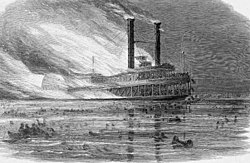
April 27: Steamboat Sultana sinks. - Governor of New York Reuben Fenton signs a bill formally creating Cornell University.
- The steamboat Sultana, carrying 2,300 passengers, explodes and sinks in the Mississippi River, killing 1,800, mostly Union survivors of the Andersonville Prison.

May
[edit]- May 1 – The Treaty of the Triple Alliance of Argentina, Brazil, and Uruguay against Paraguay is formally signed, following the outbreak of the Paraguayan War.
- May 4 – American Civil War: Lieutenant General Richard Taylor, commanding all Confederate forces in Alabama, Mississippi, and eastern Louisiana, surrenders his forces to Union General Edward Canby at Citronelle, Alabama, effectively ending all Confederate resistance east of the Mississippi River.
- May 5 – In the United States:
- In North Bend, Ohio (a suburb of Cincinnati), the first train robbery in the country takes place.
- Jefferson Davis meets with his Confederate Cabinet (14 officials) for the last time, in Washington, Georgia, and the Confederate Government is officially dissolved.
- May 10 – American Civil War: Jefferson Davis is captured by the Union Army near Irwinville, Georgia.
- May 12 – Electric equipment and mobile brand Nokia founded in Tampere, Finland.
- May 12–13 – American Civil War – Battle of Palmito Ranch: In far south Texas, more than a month after Confederate General Lee's surrender, the last land battle of the civil war with casualties, ends with a Confederate victory.
- May 17
- The International Telegraph Union is founded.
- French missionary Father Armand David first observes Père David's deer in Peking, China.[4]
- May 23 – Grand Review of the Armies: Union Army troops parade down Pennsylvania Avenue (Washington, D.C.) to celebrate the end of the American Civil War.
- May 25 – Mobile magazine explosion: 300 are killed in Mobile, Alabama, when an ordnance depot explodes.
- May 28 – The Mimosa sets sail with emigrants from Wales for Patagonia.[5]
- May 29 – American Civil War: President of the United States Andrew Johnson issues a proclamation of general amnesty for most citizens of the former Confederacy.
June
[edit]- June 2 – American Civil War: Confederate forces west of the Mississippi River under General Edmund Kirby Smith surrender at Galveston, Texas, under terms negotiated on May 26, becoming the last to do so.
- June 10 – Richard Wagner's opera Tristan und Isolde debuts at the Munich Court Theatre.
- June 11 – Battle of the Riachuelo: The Brazilian Navy squadron defeats the Paraguayan Navy.

- June 19 – American Civil War: Union Major General Gordon Granger lands at Galveston, Texas, and informs the people of Texas of the Emancipation Proclamation (an event celebrated in modern times each year as Juneteenth).
- June 23 – American Civil War: At Fort Towson in Oklahoma Territory, Confederate General Stand Watie, a Cherokee Indian, surrenders the last significant Rebel army.
- June 25 – James Hudson Taylor founds the China Inland Mission at Brighton, England.
- June 26 – Jumbo, a young male African elephant, arrives at London Zoo and becomes a popular attraction.
- June–August – English polymath Francis Galton first describes eugenics.[6]
July
[edit]- July 2 – The Christian Mission, later renamed The Salvation Army, is founded in Whitechapel, London, by William and Catherine Booth.
- July 4 – Lewis Carroll publishes his children's novel Alice's Adventures in Wonderland in England[7][8] (first trade editions in December).
- July 5
- The U.S. Secret Service is founded.[9]
- The first speed limit is introduced in Britain: 2 mph (3.2 km/h) in town and 4 mph (6.4 km/h) in the country.
- July 7 – Following Abraham Lincoln's assassination on April 14, the four conspirators condemned to death during the trial are hanged, including David Herold, George Atzerodt, Lewis Powell and Mary Surratt. Her son, John Surratt, escapes execution by fleeing to Canada, and ultimately to Egypt.
- July 14 – First ascent of the Matterhorn: The summit of the Matterhorn in the Alps is reached for the first time, by a party of 7 led by the Englishman Edward Whymper; 4 die in a fall during the descent.


- July 21 – Wild Bill Hickok – Davis Tutt shootout: In the market square of Springfield, Missouri, Wild Bill Hickok shoots "Little Dave" Davis Tutt dead over a poker debt, in what is regarded as the first true western fast draw showdown.
- July 23 – The SS Great Eastern departs on a voyage to lay a transatlantic telegraph cable.[7]
- July 26 – The New Zealand Parliament first meets in Wellington on a permanent basis, making it de facto the national capital.[10]
- July 27
- Welsh settlers arrive in Argentina at Chubut Valley.
- Businessman Asa Packer establishes Lehigh University in Bethlehem, Pennsylvania.
- July 30 – The steamer Brother Jonathan sinks off the California coast, killing 225 passengers and crew.
- July 31 – The first narrow gauge mainline railway in the world opens at Grandchester, Australia.
August
[edit]- August 16 – The Dominican Republic regains independence from Spain.
- August 25 – The Shergotty meteorite Mars meteorite falls in Sherghati, Gaya, Bihar in India.
September
[edit]- September 19 – Union Business College (now Peirce College) is founded in Philadelphia.
- September 26 – Champ Ferguson becomes the first person (and one of only two) to be convicted of war crimes for actions taken during the American Civil War, found guilty by a U.S. Army tribunal on 23 charges, arising from the murder of 53 people. He is hanged on October 20, two days after the conviction of Henry Wirz for war crimes.[11]
October
[edit]- October 11 – Morant Bay rebellion: Paul Bogle leads hundreds of black men and women in a march in Jamaica; the rebellion is brutally suppressed by the British governor Edward John Eyre with 400 executed.[8]
- October 25 – Florida drafts its constitution in Tallahassee.
- October 26
- The Standard Oil Company opens.
- The paddlewheel steamer SS Republic sinks off the Georgia coast, with a cargo of $400,000 in coins.
November
[edit]- November 6 – American Civil War: The CSS Shenandoah, last remnant of the Confederate States of America and its military, surrenders in Liverpool after fleeing westward from the Pacific.
- November 10 – Captain Henry Wirz, Confederate superintendent of Andersonville Prison (Camp Sumter) is hanged, becoming the second of two combatants, and only serving regular soldier, to be executed for war crimes committed during the American Civil War.
- November 11 – Duar War between Britain and Bhutan ends with the Treaty of Sinchula, in which Bhutan cedes control of its southern passes to Britain in return for an annual subsidy.[7]
- November 17 – Chincha Islands War: Action of 17 November 1865 – A Spanish gunboat is captured by the Chilean tugboat Independencia off Tomé, in the Bay of Concepción, Chile.
- November 26 – Chincha Islands War: Battle of Papudo – The Spanish ship Covadonga is captured by the Chileans and the Peruvians, north of Valparaíso, Chile.
December
[edit]- December 11 – The United States Congress creates the United States House Committee on Appropriations and the Committee on Banking and Commerce, reducing the tasks of the House Committee on Ways and Means.
- December 17 – Leopold II becomes King of the Belgians, following the death (on December 10) of his father, King Leopold I.
- December 18 – Secretary of State William H. Seward declares the Thirteenth Amendment to the United States Constitution ratified by three-quarters of the states, including those in secession. As of December 6, slavery is legally outlawed in the last two slave states of Kentucky and Delaware, and the remaining 45,000 slaves are freed.
- December 21 – The Kappa Alpha Order is founded at Washington College, Lexington, Virginia.
- December 24 – Jonathan Shank and Barry Ownby form the Ku Klux Klan in the American South, to resist Reconstruction and intimidate carpetbaggers and scalawags, as well as to repress the freedpeople.

Date unknown
[edit]- A forest fire near Silverton, Oregon, destroys about one million acres (4,000 km2) of timber.
- The National Temperance Society and Publishing House is founded by James Black in the U.S.
- Nottingham Forest Football Club, an association football based in West Bridgford, Nottingham, England, is founded.
Births
[edit]January–February
[edit]- January 5 – Julio Garavito Armero, Colombian astronomer (d. 1920)
- January 9 – Leo Ditrichstein, Austrian-born stage actor, playwright (d. 1928)
- January 19 – Valentin Serov, Russian portrait painter (d. 1911)
- January 20 – Yvette Guilbert, French cabaret singer, actress (d. 1944)
- January 27 – Nikolai Pokrovsky, Russian politician, last foreign minister of the Russian Empire (d. 1930)
- January 28
- Lala Lajpat Rai ("The Lion of Punjab"), a leader of the Indian independence movement (d. 1928)
- Kaarlo Juho Ståhlberg, 1st President of Finland (d. 1952)[12]
- January 31 – Henri Desgrange, French cycling enthusiast, founder of the Tour de France (d. 1940)
- February 4 – Ernest Hanbury Hankin, English bacteriologist, naturalist (d. 1939)
- February 9 – Beatrice Stella Tanner, later Mrs. Patrick Campbell, English theatre actress, producer (d. 1940)
- February 12
- Enrico Millo, Italian admiral and politician (d. 1930)[13]
- Kazimierz Tetmajer, Polish writer (d. 1940)
- February 17 – Ernst Troeltsch, German theologian (d. 1923).
- February 19 – Sven Hedin, Swedish scientist, explorer (d. 1952)
- February 21 – John Haden Badley, English author, educator (d. 1967)
- February 28 – Wilfred Grenfell, English medical missionary to Newfoundland and Labrador (d. 1940)
March–April
[edit]
- March 1 – Elma Danielsson, Swedish socialist, journalist (d. 1936)
- March 10 – Tan Sitong, Chinese reformist leader (d. 1898)
- March 15 – Sui Sin Far, English-born writer (d. 1914)
- March 19 – William Morton Wheeler, American entomologist (d. 1937)
- March 30 – Heinrich Rubens, German physicist (d. 1922)
- April – Richard Rushall, British sea captain and businessman (d. 1953)
- April 1 – Richard Adolf Zsigmondy, Austrian-born chemist, Nobel Prize laureate (d. 1929)
- April 2 – Gyorche Petrov, Macedonian and Bulgarian revolutionary (d. 1921)
- April 6 – Victory Bateman, American stage and screen actress (d. 1926)
- April 9
- Violet Nicolson, English poet (d. 1904)
- Erich Ludendorff, German general (d. 1937)
- Charles Proteus Steinmetz, German-American engineer, electrician (d. 1923)
- April 14 – Alfred Hoare Powell, English Arts and Crafts architect, and designer and painter of pottery (d. 1960)
- April 16 – Harry Chauvel, Australian Army general (d. 1945)[14]
- April 18 – Leónidas Plaza, 16th President of Ecuador (d. 1932)
- April 19 – Josephine Hall, American actress and soprano (d. 1920)
- April 26 – Akseli Gallen-Kallela, Finnish artist (d. 1931)[15]
- April 28
- Vital Brazil, Brazilian physician, immunologist (d. 1950)
- Charles W. Woodworth, American entomologist (d. 1940)
May–June
[edit]

- May 2 – Clyde Fitch, American dramatist (d. 1909)
- May 3 – Martha M. Simpson, Australian educationalist ((d. 1948)
- May 23 – Epitácio Pessoa, 11th President of Brazil (d. 1942)
- May 25
- John Mott, American YMCA leader, recipient of the Nobel Peace Prize (d. 1955)
- Pieter Zeeman, Dutch physicist, Nobel Prize laureate (d. 1943)
- May 26 – Robert W. Chambers, American artist (d. 1933)
- June 2 – George Lohmann, English cricketer (d. 1901)
- June 3 – George V of the United Kingdom (d. 1936)
- June 9
- Albéric Magnard, French composer (d. 1914)
- Carl Nielsen, Danish composer (d. 1931)
- June 13 – W. B. Yeats, Irish writer, Nobel Prize laureate (d. 1939)
- June 19
- Alfred Hugenberg, German businessman, politician (d. 1951)
- May Whitty, British stage and screen actress (d. 1948)
- June 21 – Otto Frank, German physiologist (d. 1944)
- June 26 – Bernard Berenson, American art historian (d. 1959)
- June 29 – Shigechiyo Izumi, Japanese supercentenarian (d. 1986)
July–August
[edit]
.jpg)
- July 1 – Granville Ryrie, Australian Army general, politician, and diplomat (d. 1937)[16]
- July 13 – Gérard Encausse, French occultist (d. 1916)
- July 15 – Alfred Harmsworth, 1st Viscount Northcliffe, Irish-born British publisher; founder of the Daily Mail and Daily Mirror (d.1922)
- July 23
- Max Heindel, Danish-born Christian occultist, astrologer, and mystic (d. 1919)
- Edward Terry Sanford, Associate Justice of the Supreme Court of the United States (d. 1930)
- July 26 – Philipp Scheidemann, 11th Chancellor of Germany (d. 1939)
- August 2
- Irving Babbitt, American literary critic (d. 1933)
- John Radecki, Australian stained glass artist (d. 1955)
- August 10 – Alexander Glazunov, Russian composer (d. 1936)
- August 15 – Usui Mikao, Japanese founder of reiki (d. 1926)
- August 17 – Julia Marlowe, English-born American stage actress (d. 1950)
- August 20 – Bernard Tancred, South African cricketer (d. 1911)
- August 22 – Templar Saxe, British actor and singer (d. 1935)
- August 24 – King Ferdinand I of Romania (d. 1927)
- August 27 – James Henry Breasted, American Egyptologist (d. 1935)
September–October
[edit]- September 4 – Maria Karłowska, Polish Roman Catholic religious professed and blessed (d. 1935)
- September 11 – Rainis, Latvian poet, playwright (d. 1929)
- September 13 – William Birdwood, 1st Baron Birdwood, British field marshal (d. 1951)
- September 26 – Mary Russell, Duchess of Bedford, English aviator, ornithologist (d. 1937)


.jpg)
- October 1 – Paul Dukas, French composer (d. 1935)
- October 9 – Arthur Hayes-Sadler, British admiral (d. 1952)
- October 10 – Rafael Merry del Val, Spanish Roman Catholic Cardinal and Secretary of the Congregation of the Holy Office (d. 1930)
- October 12 – Arthur Harden, English chemist, Nobel Prize laureate (d. 1940)
- October 15 – Charles W. Clark, American baritone (d. 1925)
- October 16 – Rudolph Lambart, 10th Earl of Cavan, British field marshal (d. 1946)
- October 17 – James Rudolph Garfield, U.S. politician (d. 1950)
- October 22
- Charles James Briggs, British general (d. 1941)
- Raymond Hitchcock, American actor (d. 1929)
- October 23 – Hovhannes Abelian, Armenian actor (d. 1936)
- October 26 – Benjamin Guggenheim, American businessman (d. 1912)
- October 27 – Tinsley Lindley, English footballer (d. 1940)
November–December
[edit]- November 2 – Warren G. Harding, 29th President of the United States (d. 1923)
- November 11 – Edwin Thanhouser, American actor, businessman, and film producer, founder of the Thanhouser Company (d. 1956)
- December 8
- Rüdiger von der Goltz, German general (d. 1946)
- Jean Sibelius, Finnish composer (d. 1957)
- December 12 – Edwyn Alexander-Sinclair, British admiral (d. 1945)
- December 16 – Olavo Bilac, Brazilian poet (d. 1918)
- December 19 – Minnie Maddern Fiske, American stage actress (d. 1932)
- December 20 – Elsie de Wolfe, American socialite, interior decorator (d. 1950)
- December 23
- Anna Farquhar Bergengren, American author and editor (unknown year of death)
- James M. Canty, American educator, school administrator, and businessperson (d. 1964)[17]
- Albrecht, Duke of Württemberg, German field marshal (d. 1939)
- December 25
- Evangeline Booth, 4th General of The Salvation Army (d. 1950)
- Fay Templeton, American musical comedy star (d. 1939)
- December 28 – Félix Vallotton, Swiss painter, printmaker (d. 1925)
- December 29 – Otis Harlan, American actor and comedian (d. 1940)
- December 30 – Rudyard Kipling, Indian-born English writer, Nobel Prize laureate (d. 1936)
Date unknown
[edit]- Ernest Hogan, African-American dancer, musician, and comedian (d. 1909)
- Habibullah Qurayshi, Bengali Islamic scholar and educationist (d. 1943)[18]
Deaths
[edit]January–June
[edit]

- January 14 – Marie-Anne Libert, Belgian botanist (b. 1782)
- January 19 – Pierre-Joseph Proudhon, French philosopher, anarchist (b. 1809)
- January 28 – Felice Romani, Italian poet, librettist (b. 1788)
- February 6 – Isabella Beeton, British cook, household management expert (b. 1836)[19]
- March 1 – Anna Pavlovna of Russia, queen consort of the Netherlands (b. 1795)
- March 20 – Yamanami Keisuke, Japanese samurai (b. 1833)
- March 30 – Alexander Dukhnovich, Russian priest, writer and social activist (b. 1803
- April 1
- John Milton, Governor of Florida (b. 1807)
- Giuditta Pasta, Italian soprano (b. 1798)
- April 2 – A. P. Hill, American Confederate general (b. 1825)
- April 13 – Achille Valenciennes, French zoologist (b. 1794)
- April 15 – Abraham Lincoln, 16th President of the United States (b. 1809)
- April 18 – Léon Jean Marie Dufour, French medical doctor, naturalist (b. 1780)
- April 24 – Nicholas Alexandrovich, Tsarevich of Russia (b. 1843)
- April 26 – John Wilkes Booth, American actor, assassin of Abraham Lincoln (b. 1838)
- April 28 – Sir Samuel Cunard, Canadian businessman, founder of the Cunard Line (b. 1787)
- May 5 – Ben Hall, Australian bushranger (b. 1837)
- May 10 – William Armstrong, American lawyer, civil servant, politician, and businessperson (b. 1782)[20]
July–December
[edit]

.jpg)
- July – Dimitris Plapoutas, Greek military leader (b. 1786)
- July 6 – Princess Sophie of Sweden, Grand Duchess of Baden (b. 1801)
- July 7 – The Lincoln assassination conspirators (executed)
- Lewis Powell (b. 1844)
- David Herold (b. 1842)
- George Atzerodt (b. 1835)
- Mary Surratt (b. 1823)
- July 25 – James Barry, British military surgeon (b. 1795)
- August 4 – Percival Drayton, United States Navy officer (b. 1812)
- August 12 – William Jackson Hooker, English botanist (b. 1785)
- August 13 – Ignaz Semmelweis, Hungarian physician (b. 1818)
- August 16 – Sir Frederick Stovin, British army general (b. 1783)
- August 27 – Thomas Chandler Haliburton, Canadian author (b. 1796)
- August 29 – Robert Remak, German embryologist, physiologist and neurologist (b. 1815)
- September 2 – William Rowan Hamilton, Irish mathematician (b. 1805)
- September 10 – Maria Silfvan, Finnish actor (b. 1802)
- September 25 – Andrés de Santa Cruz, Peruvian military officer, seventh President of Peru and President of Bolivia (b. 1792)
- October 16 – Andrés Bello, Venezuelan poet, lawmaker, teacher, philosopher and sociologist (b. 1781)
- October 18 – Henry John Temple, 3rd Viscount Palmerston, Prime Minister of the United Kingdom (b. 1784)
- October 24 – Paul Bogle, Jamaican activist, Baptist deacon and leader of the Morant Bay rebellion. (executed) (b. 1820)
- November 10 – Henry Wirz, Swiss-born American Confederate military officer, prisoner-of-war camp commander (executed) (b. 1823)
- November 12 – Elizabeth Gaskell, British novelist, biographer (b. 1810)
- November 28
- José Manuel Pareja, Spanish admiral (suicide) (b. 1813)
- William Machin Stairs, Canadian businessman, statesman (b. 1789)
- November 29 – Isaac A. Van Amburgh, American animal trainer (b. 1811)
- December 6 – Sebastián Iradier, Spanish composer (b. 1809)
- December 10 – King Leopold I of Belgium (b. 1790)
- December 14 – Johan Georg Forchhammer, Danish geologist (b. 1794)
- December 17 – Luigi Ciacchi, Italian cardinal (b. 1788)
References
[edit]- ^ "Kunnallinen itsehallinto 150 vuotta" [150 years of local self-government]. Nopolanews (in Finnish). February 6, 2015. Archived from the original on February 24, 2015. Retrieved February 6, 2024.
- ^ Moore, Randy (May 2001). "The "Rediscovery" of Mendel's Work" (PDF). Bioscene. 27. Archived from the original (PDF) on February 2, 2017. Retrieved December 6, 2016.
- ^ Coleman, Helen Turnbull Waite (1956). Banners in the Wilderness: The Early Years of Washington and Jefferson College. University of Pittsburgh Press. p. 214. OCLC 2191890. Retrieved April 28, 2011.
- ^ "Elaphurus davidianus". Ultimate Ungulate. 2004. Archived from the original on June 5, 2011. Retrieved May 5, 2011.
- ^ Wilkinson, Susan (September 1998). "Welsh immigrants in Patagonia: Mimosa, the old ship that sailed into history". Buenos Aires Herald. Archived from the original on March 5, 2007. Retrieved November 26, 2010.
- ^ Galton, Francis (1865). "Hereditary talent and character" (PDF). Macmillan's Magazine. 12: 157–166, 318–327. Retrieved December 6, 2016.
- ^ a b c Everett, Jason M., ed. (2006). "1865". The People's Chronology. Thomson Gale.
- ^ a b Palmer, Alan; Palmer, Veronica (1992). The Chronology of British History. London: Century Ltd. p. 286. ISBN 0-7126-5616-2.
- ^ "Timeline of Our History". www.secretservice.gov. Retrieved July 18, 2025.
- ^ Levine, Stephen (June 20, 2012). "Capital city – Wellington, capital city". Te Ara: The Encyclopedia of New Zealand. Archived from the original on February 5, 2019. Retrieved May 23, 2019.
- ^ Cartmell, Donald (2001). The Civil War Book of Lists. Career Press. p. 104.
- ^ James Louis Garvin; Franklin Henry Hooper; Warren E. Cox (1929). The Encyclopædia Britannica: A New Survey of Universal Knowledge. Encyclopædia britannica Company, Limited. p. 291.
- ^ Italian Navy website page dedicated to Enrico Millo, 2008 (in Italian).
- ^ Hill, Alec (1979). "'Chauvel, Sir Henry George (Harry) (1865–1945)'". Australian Dictionary of Biography. National Centre of Biography, Australian National University. ISBN 978-0-522-84459-7. ISSN 1833-7538. OCLC 70677943. Retrieved January 11, 2010.
- ^ O'Sullivan, James (April 26, 2015). "An artist's mark on the story of Finland (150th anniversary of Gallen-Kallela's birth)". thisisFINLAND. Retrieved April 26, 2022.
- ^ Serle, Percival (1949). "Ryrie, Granville". Dictionary of Australian Biography. Sydney: Angus & Robertson. Retrieved November 1, 2008.
- ^ "Death Record Detail: James Munroe Canty". West Virginia Archives and History, West Virginia Department of Arts, Culture and History. 2019. Archived from the original on August 2, 2020. Retrieved August 2, 2020.
- ^ Ahmadullah, Mufti (2016). Mashayekh-e-Chatgam. Vol. 1 (3 ed.). Dhaka: Ahmad Publishers. pp. 109–136. ISBN 978-984-92106-4-1.
- ^ "Mrs Beeton". BBC. Retrieved April 22, 2021.
- ^ Munske, Roberta R.; Kerns, Wilmer L., eds. (2004). Hampshire County, West Virginia, 1754–2004. Romney, West Virginia: The Hampshire County 250th Anniversary Committee. p. 46. ISBN 978-0-9715738-2-6. OCLC 55983178.
from Grokipedia
1865 was a year of profound transformation in the United States, culminating in the effective end of the American Civil War through the surrender of General Robert E. Lee's Army of Northern Virginia to Union General Ulysses S. Grant at Appomattox Court House on April 9, which precipitated the collapse of the Confederacy.[1][2][3] Five days later, on April 14, President Abraham Lincoln was assassinated by Confederate sympathizer John Wilkes Booth during a performance at Ford's Theatre in Washington, D.C., dying the following morning and thrusting Vice President Andrew Johnson into the presidency amid national mourning and fears of further instability.[4][5][6] Later that year, on December 6, 1865, the Thirteenth Amendment to the U.S. Constitution was ratified when Georgia became the 27th state to approve it, formally abolishing slavery throughout the nation and codifying the emancipation that had been progressively enacted during the war.[7][8] Beyond the United States, the year saw the first successful ascent of the Matterhorn on July 14 by British mountaineer Edward Whymper's expedition, a milestone in Alpine climbing that ended in tragedy with four deaths on the descent.[9][10] These events underscored 1865 as a hinge point between conflict and reconstruction, with lasting causal impacts on American governance, racial structures, and global exploration endeavors.
Events
January
On January 13–15, 1865, Union forces under Major General Alfred H. Terry launched a successful amphibious assault on Fort Fisher, North Carolina, culminating in its capture on January 15.[11] Supported by a massive naval bombardment from over 60 warships, approximately 8,000 Union troops overwhelmed the Confederate garrison of about 1,700 defenders led by Colonel William Lamb.[12] The fort's fall closed Wilmington, the Confederacy's primary remaining port for blockade runners, severing vital imports of arms, ammunition, and supplies that had sustained Confederate armies.[13] This logistical strangulation intensified attrition on Southern resources, compelling Confederate commanders to ration essentials and weakening field operations across the Eastern Theater.[11] The victory at Fort Fisher demonstrated the efficacy of combined arms tactics in coastal warfare, where naval superiority enabled targeted disruptions far more decisive than inland battles alone.[14] Union casualties exceeded 1,300 killed, wounded, or missing, while Confederates suffered around 500 casualties and over 2,000 captured, including most of the fort's artillery.[11] By eliminating this "Gibraltar of the South," the Union advanced its Anaconda Plan's blockade enforcement, shifting the war's momentum through sustained economic pressure rather than solely decisive field engagements.[12] On January 16, 1865, Union Major General William T. Sherman issued Special Field Orders No. 15 from Savannah, Georgia, authorizing the redistribution of approximately 400,000 acres of confiscated coastal land to freed slaves as a buffer against Confederate reconquest and to foster self-sustaining Black labor communities.[15] This measure aimed to secure Union rear areas, disrupt Southern agricultural recovery, and bind former slaves to the Northern cause amid ongoing campaigns, though its implementation later faced reversals.[15] In late January, Sherman's Army of the Tennessee and Army of Georgia concentrated supplies and conducted preliminary reconnaissance, preparing for the northward thrust into the Carolinas that would commence on February 1.[16] These movements signaled to Confederate leaders the vulnerability of interior South Carolina, eroding morale as thinly stretched forces under General Joseph E. Johnston anticipated dual threats from Sherman and Lieutenant General Ulysses S. Grant in Virginia.[17] On January 31, 1865, the U.S. House of Representatives approved the Thirteenth Amendment to the Constitution by a vote of 119 to 56, prohibiting slavery and involuntary servitude except as punishment for crime.[7] Having passed the Senate in April 1864, the amendment's House success followed targeted recruitment of lame-duck Democrats and reflected Union strategy to dismantle the Confederacy's economic foundation—its slave-based labor system—which generated wealth and manpower for prolonged resistance.[18] Beyond moral imperatives, ratification promised to preclude post-war guerrilla insurgencies reliant on enslaved support and to integrate freed labor into Union-controlled economies, hastening Southern capitulation through institutional collapse.[7] President Abraham Lincoln, though his signature was ceremonial, endorsed the measure as essential to permanent Union victory.[18]February
On February 3, the Hampton Roads Conference convened aboard the Union steamer River Queen at Hampton Roads, Virginia, involving President Abraham Lincoln and Secretary of State William H. Seward representing the United States, and Confederate Vice President Alexander H. Stephens, Senator R.M.T. Hunter, and Assistant Secretary of War John A. Campbell for the Confederacy.[19][20] The discussions, initiated informally by Francis P. Blair Sr., centered on potential peace terms, but foundered on irreconcilable demands: the Union insisted on restoration of federal authority and abolition of slavery, while Confederate representatives sought recognition of independence or armistice allowing separate negotiations.[19] No agreement emerged, highlighting the Confederacy's weakening position amid mounting military defeats and the Union's resolve to prosecute the war to unconditional surrender.[19] On February 6, Confederate President Jefferson Davis appointed General Robert E. Lee as general-in-chief of all Confederate armies, a move formalized by General Orders No. 3 from Adjutant and Inspector General Samuel Cooper.[21][22] This centralization of command, previously fragmented across departmental armies plagued by supply shortages, desertions, and logistical collapse, reflected the Confederacy's desperate bid for unified direction in the war's final stages, with Lee's Army of Northern Virginia already strained by encirclement at Petersburg.[22] Lee's new authority extended over distant forces like those in the Carolinas and Trans-Mississippi, though practical coordination proved elusive due to depleted resources and communication breakdowns.[21] In the U.S. House of Representatives, a committee report on February 2 advanced "An Act to Establish a Bureau of Freedmen's Affairs," laying groundwork for federal assistance to newly freed African Americans and war refugees through provisions for relief, labor contracts, and land management.[23] This precursor legislation, culminating in the Freedmen's Bureau's creation on March 3, prioritized empirical responses to immediate crises—such as food distribution, medical aid, and supervised employment contracts—over abstract social restructuring, addressing the practical realities of labor disruption and vagrancy in Union-occupied territories amid an estimated four million emancipated individuals lacking infrastructure for self-sufficiency.[24][23] The bureau's focus on contractual sharecropping and temporary aid underscored causal links between wartime emancipation and economic instability, rather than presuming rapid integration into market economies without support.[24]March
On March 8, Gregor Mendel, an Augustinian friar and abbot at St. Thomas's Abbey in Brno, presented the second part of his lecture on experiments in plant hybridization to the Natural History Society of Brno, detailing empirical observations from crossing pea plants over eight years.[25][26] His data revealed consistent ratios in hybrid offspring, such as 3:1 dominance-recessive patterns in the first filial generation and 9:3:3:1 in the second, indicating inheritance via discrete, stable factors rather than blending, which laid unobserved groundwork for modern genetics despite initial neglect.[27][28] In the American Civil War, Union Major General William T. Sherman's Army of the Tennessee and Army of Georgia advanced into North Carolina as part of the Carolinas Campaign, crossing the state line on March 7–8 after ravaging South Carolina infrastructure.[29][30] On March 11, Sherman's forces occupied Fayetteville, destroying the Confederate Arsenal—containing 9,000 small arms and ammunition—and the Fayetteville Observer foundry, which had produced cannon, thereby severing key supply lines and manufacturing capacity essential to Confederate logistics.[29] This scorched-earth tactic empirically accelerated economic collapse in the Confederacy by targeting rail depots, mills, and cotton stores, compounding shortages that fueled desertions and states' resistance to centralized requisitions.[31] Confederate responses highlighted internal fractures: states' rights doctrines, which prioritized local autonomy over national draft enforcement, exacerbated manpower deficits, with over 100,000 desertions by early 1865 due to unpaid troops and forage failures.[32] On March 13, the Confederate Congress, facing imminent defeat, enacted legislation authorizing the enlistment of up to 300,000 enslaved African Americans as soldiers, promising emancipation only for those who volunteered and served honorably, a measure debated fiercely as it contradicted the Confederacy's foundational defense of slavery while failing to recruit effectively before collapse.[33][34] Sherman's momentum continued with the Battle of Averasboro on March 15–16, where Confederate Lieutenant General William Hardee's 6,500 troops delayed 60,000 Union soldiers, inflicting 682 casualties at a cost of 865 Confederate losses to buy time for Joseph E. Johnston's concentration.[31][29] The campaign's climax came at the Battle of Bentonville March 19–21, where Johnston's 21,000 Confederates initially surprised Sherman's divided wings, capturing Union earthworks but ultimately retreating after Union reinforcements arrived, suffering 2,600 casualties to Sherman's 1,800, further eroding Confederate cohesion without altering the strategic imbalance.[35][36]April
On April 9, 1865, Confederate General Robert E. Lee surrendered the Army of Northern Virginia to Union General Ulysses S. Grant at Appomattox Court House, Virginia, effectively ending major combat operations in the eastern theater of the American Civil War.[37] The terms allowed Confederate officers to retain their sidearms and personal horses, with enlisted men permitted to keep their horses for spring plowing to support agriculture and reconstruction efforts, reflecting Grant's strategy to facilitate a swift reintegration of Southern society rather than prolong resistance through punitive disarmament.[38] This pragmatic approach aimed to prevent guerrilla warfare by preserving Southerners' means of livelihood, as Grant noted the horses' necessity for farming.[3] The surrender highlighted the war's culmination in military exhaustion rather than total annihilation, with Lee's forces outnumbered and supplies depleted after a prolonged campaign. Empirical analyses of causation emphasize preservation of the Union, disputes over states' rights, and economic frictions such as protective tariffs— which generated over 90% of federal revenue and disproportionately burdened Southern exporters—as key drivers, rather than reducing the conflict to a singular issue.[39] Secession documents from Southern states invoked constitutional principles of sovereignty and opposition to federal overreach, including tariff policies favoring Northern industry, underscoring causal realism in sectional tensions beyond moralistic framings.[40] Four days later, on April 14, 1865, President Abraham Lincoln was assassinated by actor John Wilkes Booth while attending a performance at Ford's Theatre in Washington, D.C. Booth, a Confederate sympathizer motivated by opposition to emancipation and perceived federal tyranny, shot Lincoln in the head, shouting "Sic semper tyrannis" as he fled.[4] His journal and contemporaries' accounts reveal Booth viewed Lincoln as a despot undermining Southern rights, with the plot initially aimed at kidnapping but escalating to murder upon the Confederacy's collapse, aiming to decapitate Union leadership and spark renewed rebellion.[41] [42] The assassination precipitated immediate political upheaval, with Vice President Andrew Johnson assuming the presidency amid chaos, while Booth was pursued and killed on April 26. This event severed potential moderation in postwar policy, as Lincoln had advocated lenient terms toward the South, contrasting with harsher congressional approaches that followed. The war's total death toll, estimated at around 698,000 military personnel from combat and disease, underscored the staggering human cost of unresolved sectional divisions rooted in governance and economic structures.[43] On April 26, 1865, Confederate General Joseph E. Johnston surrendered his remaining forces, approximately 30,000 troops, to Union General William T. Sherman at Bennett Place near Durham, North Carolina, under terms mirroring Appomattox that permitted retention of private horses and negated further hostilities.[44] [45] This capitulation dissolved the last major organized Confederate army east of the Mississippi, achieving de facto national reunification without requiring complete subjugation, as scattered units disbanded under similar paroles.[46]May
On May 10, Confederate President Jefferson Davis was captured by elements of the 4th Michigan Cavalry near Irwinville, Georgia, ending his flight from Richmond that began on April 2.[47] Davis, accompanied by his wife Varina and a small entourage, had traveled through multiple states by various means in an attempt to reach safety or rally remaining Confederate forces, but Union intelligence and cavalry patrols closed in on his camp.[48] Contemporary accounts and later historical analysis indicate that Davis threw on his wife's waterproof raglan overcoat amid the confusion of the dawn raid, fueling exaggerated claims of disguise in women's attire; primary evidence from captors, including Lieutenant Colonel Benjamin Pritchard's report, describes no such elaborate feminization but rather a brief, improvised cover against rain and surprise.[49] He was transported to Fort Monroe, Virginia, for imprisonment, where he endured two years of solitary confinement without formal trial, as Union authorities weighed charges of treason against political considerations for national reconciliation.[50] The Freedmen's Bureau, established by Congress on March 3, initiated field operations across the South in May, focusing on immediate relief for newly freed African Americans through distribution of rations, medical aid, and supervision of labor contracts between former slaves and planters. Agents reported issuing thousands of rations weekly in key districts, such as Virginia and the Carolinas, to address famine risks amid disrupted agriculture, though records show uneven implementation due to limited personnel—only about 900 agents nationwide by mid-1865—and resistance from local whites.[51] Efforts to redistribute confiscated lands under "40 acres and a mule" promises largely faltered by May's end, as President Andrew Johnson's amnesty proclamations beginning in late April restored properties to pardoned Confederates, prioritizing economic stability over permanent land grants; empirical data from Bureau ledgers reveal fewer than 10% of allocated plots retained by freedmen past initial surveys.[24] Labor contracts, intended to formalize wage agreements, often devolved into disputes over terms resembling peonage, with freedmen receiving nominal pay—averaging $10-15 monthly plus rations—while planters enforced coercive clauses amid a cotton economy demanding rapid replanting.[52] The Grand Review of the Armies occurred in Washington, D.C., on May 23 and 24, parading over 145,000 Union troops along Pennsylvania Avenue to commemorate victory and facilitate orderly demobilization.[53] On May 23, approximately 80,000 soldiers from the Army of the Potomac, led by Major General George G. Meade, marched in a six-hour procession featuring infantry, cavalry, and artillery units; the following day saw 65,000 from Major General William T. Sherman's Army of the Tennessee and Army of Georgia, showcasing western theater contingents with captured Confederate banners.[54] This spectacle, attended by President Johnson and cabinet members, symbolized military triumph but underscored reintegration challenges: with the Union Army numbering about 1 million men in May, rapid mustering out—exceeding 700,000 discharges by August—strained transportation networks and veteran welfare, as many returned without pensions or jobs amid a postwar economy shifting from war production.[55] Demobilization data indicate high desertion rates in the South's occupation zones, where troops enforced order while facing disease and pay arrears, complicating early Reconstruction administration.[56]June
On June 2, 1865, Confederate General Edmund Kirby Smith, commanding the Trans-Mississippi Department, formally surrendered his remaining forces to Union naval officers aboard the USS Fort Jackson in Galveston Bay, Texas.[57] This agreement concluded the organized military resistance in the vast western territories encompassing Texas, Arkansas, Louisiana west of the Mississippi, and parts of Missouri, Arizona, and New Mexico, where Confederate forces had operated semi-independently due to the Union's limited penetration beyond the river.[58] The terms mirrored those granted at Appomattox, allowing paroled soldiers to return home without further prosecution for treason, thereby restoring federal territorial authority without additional bloodshed.[59] Desertions had critically undermined Confederate cohesion in the department long before the surrender; of approximately 60,000 troops under Smith's command earlier in 1865, only around 17,000 formally received paroles, as thousands had already scattered amid food shortages, news of eastern defeats, and eroding loyalty to the Confederate government.[46][60] This mass exodus reflected the causal breakdown of Confederate logistics and morale in isolated regions, where Union blockades prevented resupply and local populations increasingly prioritized survival over continued rebellion.[60] Concurrent with land capitulations, the CSS Shenandoah, the Confederacy's last active commerce raider, persisted in disrupting Union shipping in the Arctic Ocean during June, capturing multiple whaling vessels—including the 419-ton William C. Nye on June 26—before learning of the war's end later that summer.[61] Operating far from Confederate ports, the ship's June depredations on American whalers underscored lingering extraterritorial threats to U.S. economic interests, even as Union naval forces maintained unchallenged dominance in home waters and major trade lanes, having captured or sunk over 200 blockade runners and raiders by war's close.[61] These isolated actions strained neutral relations in whaling hubs like Hawaii and illustrated the delayed propagation of surrender news across global distances, delaying full cessation of hostilities until the Shenandoah's August disarmament in England.[61]July
On July 2, 1865, William Booth, a former Methodist preacher, founded the East London Christian Mission in London's impoverished East End to combat urban poverty and moral decay through evangelical outreach and practical aid. This initiative stemmed from Booth's firsthand observations of industrial-era destitution, including widespread alcoholism and unemployment among the working class, independent of prevailing political doctrines and drawing on empirical assessments of social conditions rather than ideological agendas.[62] [63] The mission's formation reflected broader post-war social strains in Europe, where economic disruptions from conflicts like the American Civil War indirectly exacerbated urban hardships by affecting global trade, prompting faith-based responses to fill gaps left by state institutions exhausted by military commitments. Booth's approach emphasized direct intervention, such as soup kitchens and temperance meetings, grounded in revivalist traditions that prioritized personal conversion over systemic reform.[62] In the Pacific, the Confederate cruiser CSS Shenandoah persisted with commerce raiding in July 1865, capturing Union whaling ships in the Bering Sea and Okhotsk Sea regions, unaware of the Confederacy's collapse due to communication lags across vast distances. These operations, which included bonding or destroying vessels to cripple the U.S. whaling industry—a key economic sector—exemplified privateer incentives, where crews shared prize values to sustain prolonged independent actions beyond formal military coordination.[61] [64] Such lingering naval remnants highlighted causal delays in wartime cessation, as the Shenandoah's captains prioritized economic disruption over immediate capitulation, destroying captured ships to evade Union recapture and preserve operational secrecy. The raider's activities inflicted significant losses, with over 20 whalers seized in the summer alone, underscoring the extended global reach of Confederate strategy.[61] In Europe, Prussian-Austrian rivalries intensified through mid-1865 diplomatic exchanges over Schleswig-Holstein's governance, with Prussia initiating covert talks with Italy in July to counter Austrian influence in German affairs. These correspondences, rooted in Bismarck's realpolitik to consolidate Prussian dominance, set precursors for the 1866 war by exposing irreconcilable claims to leadership within the German Confederation, unmitigated by mutual war fatigue from earlier entanglements.[65]August
On August 2, the Confederate cruiser CSS Shenandoah, under Captain James I. Waddell, encountered the British bark Barracouta in the Pacific Ocean near the Bering Strait; the British captain informed Waddell of the Confederate surrender at Appomattox and subsequent capitulations, convincing him the American Civil War had concluded months earlier.[66] Waddell thereupon ordered the ship's guns secured, Confederate flags struck, and further raiding halted, marking the effective end of Confederate naval operations abroad; the vessel had captured or destroyed 38 Union merchant ships since October 1864, including over 30 whalers in the Arctic, inflicting approximately $1.5 million in losses (equivalent to tens of millions in modern terms) on the U.S. whaling industry and contributing to the broader disruption of Union commerce by Confederate raiders, which sank or captured around 200 vessels overall.[61] The crew, facing no viable return to Confederate ports, dispersed after informal decommissioning, with Waddell sailing to Liverpool for formal handover to British authorities in November, underscoring the decentralized closure of peripheral Confederate resistance.[61] In Mexico, Emperor Maximilian's regime contended with persistent guerrilla warfare by Republican forces under Benito Juárez, which empirically constrained imperial control to urban centers and key routes despite French troop reinforcements; by August, liberal insurgents had reclaimed much rural territory through hit-and-run tactics, eroding supply lines and demonstrating the limitations of conventional European-style armies against decentralized asymmetric resistance, as French commanders reported mounting casualties and logistical strains without decisive territorial gains.[67] Early signals of French disengagement emerged amid domestic European pressures and U.S. diplomatic protests post-Civil War, though full withdrawal orders came later; this guerrilla efficacy, rooted in local knowledge and popular support, foreshadowed the empire's vulnerability once French bayonets were removed.[67] On August 20, President Andrew Johnson issued a proclamation declaring the Civil War's insurrection suppressed nationwide, formalizing the conflict's closure for legal and economic purposes after scattered holdouts like the Shenandoah ceased activity. This announcement facilitated initial post-war economic recalibration, with U.S. inflation—peaking at about 75% cumulative rise in consumer prices from 1861—beginning to abate as federal spending contracted and greenback currency resumed partial convertibility expectations, though full stabilization required subsequent monetary reforms.[68] Concurrent reports highlighted the 1865 cotton harvest's shortfall, yielding roughly 2.1 million bales against pre-war norms of over 4 million, attributable to emancipated labor disruptions, field devastation, and planting hesitancy under uncertainty, pressuring Southern trade recovery and global markets reliant on U.S. exports.[69]September
In September 1865, the demobilization of the Union Army accelerated, contributing to the transition from wartime to peacetime economy. Following the Grand Review in May, when over one million troops remained in service, mustering-out processes had discharged hundreds of thousands by summer's end, with the volunteer forces shrinking to approximately 200,000-300,000 effectives by early autumn amid logistical challenges and policy directives from the War Department.[70] This rapid reduction, driven by the cessation of hostilities and fiscal pressures, flooded labor markets with returning veterans, exacerbating short-term unemployment in the North—where industrial sectors absorbed many—but enabling agricultural and reconstruction labor in the South, though causal links to wage suppression and vagrancy laws emerged as former soldiers competed with freedmen.[71] The surrender of the CSS Shenandoah on September 6 in Liverpool, England, marked a key diplomatic milestone, as the Confederate raider—having evaded news of the war's end—formally yielded to British authorities, extinguishing the last organized naval resistance and affirming international acceptance of Union victory without further entanglement in European ports.[72] This event resolved lingering tensions from Britain's wartime neutrality and Alabama claims, facilitating smoother U.S. diplomatic relations and underscoring the causal finality of Appomattox in global perceptions of American sovereignty. Ongoing debates in British North America regarding Confederation drew empirical lessons from the U.S. Civil War's conclusion, with colonial leaders citing the conflict's devastation as evidence for unified defense against potential annexation threats from a consolidated United States. Fears of Manifest Destiny expansionism, heightened by Union military prowess, prompted arguments for federal union to pool resources for military and trade infrastructure, including rail links that promised interprovincial commerce benefits over fragmented colonial tariffs—evidenced by wartime disruptions to Canadian-U.S. trade routes.[73] These influences, rooted in republican excess critiques rather than mere proximity, propelled ratification pushes despite internal divisions.[74] President Andrew Johnson's administration advanced Reconstruction through targeted pardons, issuing special amnesties in September to former Confederates excluded from the May 29 general proclamation, such as officials and large property holders who applied individually. Examples include pardons for figures like J.H. McVeigh on September 29, restoring civil rights and property (excluding enslaved persons) under oath requirements, which enabled provisional governments in states like North Carolina and Alabama to proceed toward constitutional conventions.[75] This policy reflected Johnson's first-principles emphasis on rapid restoration over punitive measures, though realities included uneven enforcement and resistance from Radical Republicans, who viewed it as prematurely legitimizing rebel elites without safeguarding freedmen's rights.[76] By month's end, these efforts had facilitated loyalty oaths from thousands, laying groundwork for state readmissions contingent on ratifying the Thirteenth Amendment, albeit with persistent disputes over disenfranchisement and debt repudiation.[77]October
In October 1865, the U.S. state of Georgia convened a constitutional convention under President Andrew Johnson's reconstruction policy to facilitate readmission to the Union. Meeting from October 12, delegates drafted a new constitution abolishing slavery, repudiating secession, and voiding Confederate debts, thereby fulfilling Johnson's requirements for provisional governments. This paved the way for state elections dominated by conservative unionists, who prioritized reconciliation with former Confederates over radical Republican demands for punitive reforms and black suffrage, reflecting Johnson's lenient approach amid limited white voter turnout under loyalty oath provisions.[78] The French intervention in Mexico persisted, with Emperor Maximilian issuing the Black Decree on October 3, authorizing summary executions of armed rebels without trial to suppress liberal guerrillas challenging imperial authority. Supported by roughly 38,000 French troops under Marshal Bazaine, this escalation aimed to consolidate control in the face of mounting resistance, as Maximilian sought to legitimize his regime through conservative Mexican alliances. The United States, constrained by Civil War aftermath and reconstruction demands, limited its response to diplomatic notes invoking the Monroe Doctrine, avoiding military action due to depleted resources and Seward's assessment that European withdrawal would occur naturally without provocation.[79][67] A minor colonial conflict erupted on October 11 in Jamaica's Morant Bay, where Baptist preacher Paul Bogle mobilized around 200-600 black protesters against British authorities over land disputes, court biases, and post-emancipation poverty, storming the courthouse and killing officials. Governor Edward Eyre's reprisals, including martial law and executions, resulted in over 400 rebel deaths and 600 house burnings, exposing socioeconomic frictions in the British West Indies without broader territorial shifts.[80] Signs of U.S. economic stabilization appeared through infrastructure, as the first underground oil pipeline—spanning 2 miles from Pithole to Miller Farm—was laid on October 9 in Pennsylvania, improving petroleum distribution efficiency amid booming production. The U.S. Patent Office issued patents throughout the month, including 15 on October 24 for devices in manufacturing, agriculture, and mechanics, aligning with broader post-war recovery as inventors shifted from military to civilian applications.[81][82]November
On November 6, 1865, the Confederate States Navy commerce raider CSS Shenandoah surrendered at Liverpool, England, to British authorities, becoming the last organized Confederate military unit to capitulate and symbolizing the complete dissolution of the rebel armed forces nearly seven months after General Robert E. Lee's surrender at Appomattox.[83] The vessel, which had inflicted significant damage on Union merchant shipping in the Pacific, learned of the Confederacy's collapse only after circumnavigating the globe, underscoring the delayed transmission of war's end amid global isolation. By late November 1865, twenty-six of the thirty-six U.S. states had ratified the Thirteenth Amendment, prohibiting slavery except as punishment for crime, advancing constitutional abolition one state short of the required three-fourths threshold amid Reconstruction's early legislative momentum.[84] This progress reflected empirical legislative action in Northern and border states, with vote tallies in assemblies like Michigan's (unanimous, 72-0 in House) and Minnesota's (strong majorities) building on the amendment's House passage earlier in January, though Southern states remained unreconstructed and unratified.[85] On November 26, 1865, mathematician and author Charles Lutwidge Dodgson, under the pseudonym Lewis Carroll, published Alice's Adventures in Wonderland through Macmillan in London, expanding an oral tale from 1862 into a printed narrative featuring 42 illustrations by John Tenniel. Rooted in Carroll's expertise in symbolic logic and Euclidean geometry—as evidenced by his academic works like An Elementary Treatise on Determinants (1867)—the book employs paradoxical puzzles and deductive absurdities, such as the Mad Hatter's riddle ("Why is a raven like a writing-desk?"), to critique rigid Victorian reasoning while appealing to readers beyond children through satirical commentary on authority and identity. Initial print run of 2,000 copies sold steadily, establishing its enduring influence on literature via nonsense verse and anthropomorphic critique, distinct from purely didactic children's fare of the era.December
On December 6, 1865, Georgia became the 27th state to ratify the Thirteenth Amendment to the United States Constitution, achieving the required three-fourths majority of the 36 states and formally abolishing slavery nationwide.[7][84] The amendment's Section 1 prohibited "slavery [or] involuntary servitude" except "as a punishment for crime whereof the party shall have been duly convicted," an exception that preserved legal mechanisms for coerced labor.[7] This ratification certified congressional approval from January 31, 1865, but left unaddressed regional practices like peonage—debt-based bondage in territories such as New Mexico—where involuntary servitude continued under local customs until federal intervention in 1867.[86] The U.S. Congress convened on December 4, 1865, amid postwar fiscal strains, with the national debt exceeding $2.6 billion, driven by war costs that had multiplied it over 40-fold from prewar levels.[87][88] Debates in the Senate highlighted demands for protective tariffs to shield domestic manufacturing, including petitions from Pennsylvania citizens urging high duties on imports to bolster industrial recovery over free-trade alternatives favored by Southern agricultural interests.[89] These discussions underscored a shift toward Republican-led protectionism, contrasting with antebellum tariff reductions, and set the stage for revenue measures to service the debt without immediate repudiation pressures.[90]Date unknown
A massive wildfire known as the Silverton Fire ravaged approximately one million acres of timberland in the Willamette Valley near Silverton, Oregon, sometime during 1865.[91] [92] The blaze produced heavy ashfall, with deposits reaching eight to ten inches deep in affected areas, underscoring the scale of destruction in a region still undergoing early settlement and logging expansion.[93] This event stands as Oregon's largest recorded wildfire until later 20th-century blazes, highlighting the vulnerability of Pacific Northwest forests to uncontrolled fires amid limited firefighting capabilities at the time. No precise ignition cause or suppression efforts are documented, reflecting the rudimentary response infrastructure in frontier territories.[94]Science, technology, and exploration
Key discoveries and advancements
In February and March 1865, Gregor Mendel delivered lectures to the Natural History Society of Brno presenting results from his hybridization experiments with pea plants (Pisum sativum), involving controlled crosses of over 28,000 plants across seven traits, which revealed consistent ratios such as 3:1 for dominant to recessive phenotypes in the F2 generation, providing empirical evidence against blending inheritance and establishing discrete particulate factors as the basis of trait transmission.[95][96] Rudolf Clausius introduced the term "entropy" in his 1865 paper "On Several Convenient Forms of the Fundamental Equations of the Mechanical Theory of Heat," defining it as a measure of energy transformation value and disintegration in thermodynamic processes, which quantified the directional increase of unavailable energy in isolated systems and formalized key aspects of the second law of thermodynamics.[97] On August 12, 1865, Joseph Lister applied carbolic acid (phenol) to treat a compound leg fracture in an 11-year-old boy at Glasgow Royal Infirmary, observing no sepsis development, which marked an initial empirical test of chemical antisepsis to combat wound infection based on germ theory insights from Louis Pasteur, drastically reducing postoperative mortality rates in subsequent applications from prior levels of 45-50%.[98][99] The International Telegraph Union was established in Paris in 1865 through the first International Telegraph Convention, signed by 20 European states, which standardized Morse code, uniform tariffs, and operational protocols for cross-border telegraphy, enabling reliable global message transmission and laying groundwork for coordinated electrical communication networks.[100] By 1865, the United States rail network had expanded to approximately 35,000 miles of track, predominantly east of the Mississippi River, which accelerated freight transport speeds to 15-20 miles per hour and integrated regional markets by reducing shipping times for goods like cotton and iron, thereby driving economic productivity through scalable iron-rail infrastructure.[101][102] Alfred Nobel patented an improved detonator, or blasting cap, in 1865, utilizing mercury fulminate to reliably initiate nitroglycerin explosions, which enhanced safety and precision in mining and construction by allowing controlled remote detonation distant from the volatile explosive charge.[103]Arts, literature, and culture
Publications and creative works
Alice's Adventures in Wonderland, authored by Charles Lutwidge Dodgson under the pseudonym Lewis Carroll, was published on November 26, 1865, by Macmillan in London, with illustrations by John Tenniel. The narrative follows young Alice as she tumbles down a rabbit hole into a fantastical realm populated by anthropomorphic animals and playing cards, where she navigates trials like a nonsensical trial and a mad tea-party. Its structure employs dream-logic and verbal paradoxes—such as the Caterpillar's query "Who are you?" and the Duchess's moralistic absurdities—to probe themes of identity fluidity, linguistic ambiguity, and the limits of rational discourse, satirizing Victorian pedagogical rigidity and adult pretensions without overt didacticism. Initial sales reached 2,000 copies in the first edition, prompting a second printing amid Tenniel's dissatisfaction with the first's quality, though contemporary critics like those in The Times noted its "stiff and overwrought" elements alongside its inventive charm.[104][105] Jules Verne's From the Earth to the Moon (De la Terre à la Lune), published in 1865 by Pierre-Jules Hetzel as part of the Voyages Extraordinaires series, depicts the post-American Civil War Baltimore Gun Club's audacious plan to launch a projectile toward the Moon using a colossal cannon from Florida. The novel blends scientific speculation with satirical commentary on American ingenuity and militarism, accurately forecasting elements like multi-stage rocketry and weightlessness effects, though its ballistic trajectory remains physically implausible. Serialized initially in the Journal des Débats, it sold steadily in book form, contributing to Verne's growing European popularity with over 10,000 copies circulated by decade's end.[106] Walt Whitman's Drum-Taps (1865), a slim volume of 53 poems self-published in New York, chronicles the American Civil War through visceral depictions of battle, hospital nursing, and urban devastation, drawing from Whitman's own experiences as a volunteer aide in Washington, D.C. Poems like "Beat! Beat! Drums!" evoke martial fervor, while later additions in the 1865-1866 sequel address Abraham Lincoln's assassination with elegiac introspection on death and national mourning. The work marked a shift from Whitman's earlier transcendental optimism to raw realism, with initial printings of around 500 copies reflecting modest commercial reception amid wartime sensitivities.[107] In visual arts, Claude Monet, aged 25, debuted at the Paris Salon in 1865 with two seascapes—"The Mouth of the Seine at Honfleur" and "Le Bassin d'Argenteuil"—earning early acclaim for their luminous plein-air effects and loose brushwork, precursors to Impressionist techniques that prioritized transient light over academic finish. These entries, accepted from over 5,000 submissions, signaled Monet's challenge to Salon conventions, though broader Impressionist cohesion emerged later.[108]Religious and social movements
On July 2, 1865, William Booth established the East London Christian Mission in Whitechapel, London, targeting evangelism among the destitute, including thieves, prostitutes, gamblers, and drunkards, with initial converts drawn from these groups through open-air preaching and practical aid like food distribution.[62] This institution, later renamed the Salvation Army in 1878, emphasized poverty alleviation via direct intervention, reflecting causal pressures from urban industrialization that exacerbated vagrancy and vice in London's East End slums, where Booth's efforts yielded early organizational growth from tent meetings to structured missions.[63] In the United States, temperance societies reorganized amid post-Civil War social disruptions, with a national convention at Saratoga Springs, New York, in August 1865, aiming to expand the American Temperance Union's framework by promoting abstinence pledges and legislative curbs on liquor sales, driven by empirical observations of alcohol's role in family breakdown and pauperism.[109] Per capita alcohol consumption had declined from peak levels of approximately 7 gallons of pure spirits annually in the 1830s to around 2 gallons by the mid-1860s, attributable to sustained temperance advocacy that correlated with reduced arrest rates for drunkenness in reforming communities, though enforcement challenges persisted due to entrenched distilling interests. Methodist conferences in 1865, such as those documented in the Minutes of the Annual Conferences of the Methodist Episcopal Church, South, addressed wartime divisions and revival outcomes, with over 100,000 reported conversions during the Civil War revivals (1861–1865) in Union and Confederate armies, where emotional appeals facilitated mass professions of faith but prompted critiques from doctrinal purists favoring rigorous theological instruction over experiential fervor.[110] These gatherings underscored institutional resilience amid secessionist splits, prioritizing reunion efforts and moral reform, as evangelical pressures from battlefield conversions—totaling thousands weekly at peak—spurred membership growth exceeding 20% in some circuits, grounded in causal links between existential crisis and spiritual seeking rather than mere sentimentality.[111]Births
January–March
- January 1 – Giuseppe Ferrata (d. 1934), Italian composer and pianist whose works included operas and chamber music, contributing to the late Romantic tradition in Italy.[112]
- January 10 – Mary Amelia Ingalls (d. 1928), American educator and subject of Laura Ingalls Wilder's Little House series, where her experiences illustrated frontier life challenges like illness leading to blindness from scarlet fever.[113]
- January 20 – Yvette Guilbert (d. 1944), French cabaret singer and actress renowned for her interpretive songs of Parisian street life and appearances in early films like Faust (1926), influencing modern performance art.[114]
- January 30 – Clelia Peronneau Mathewes McGowan (d. 1947), American suffragist, politician, and poet who advocated for women's voting rights in South Carolina and served in local governance post-1920 amendment.[115]
- February 9 – Beatrice Stella Tanner (Mrs. Patrick Campbell) (d. 1940), British actress who created iconic roles such as Eliza Doolittle in George Bernard Shaw's Pygmalion (1914), advancing naturalistic theater techniques.[114]
- February 2 – Thomas Cromwell Corner (d. 1938), American painter based in Baltimore whose landscapes and genre scenes documented urban and rural American life in oil and watercolor.[116]
- March 2 – Théo Ysaÿe (d. 1918), Belgian composer and pianist, brother of violinist Eugène Ysaÿe, known for symphonic works and contributions to Belgian musical nationalism.[117]
- March 3 – Alexander Winkler (d. 1935), Russian composer whose orchestral and piano pieces blended Romanticism with emerging modernism, including the ballet The Song of Triumphant Love.[117]
April–June
- April 11 – Mary White Ovington (d. 1951), American journalist and social reformer who co-founded the National Association for the Advancement of Colored People (NAACP) in 1909, advancing civil rights efforts in the post-Civil War era.
- May 2 – Clyde Fitch (d. 1909), American playwright and dramatist known for over 60 Broadway productions, including The Climbers (1901), influencing early 20th-century theater.
- May 5 – Nellie Bly (d. 1922), American investigative journalist who pioneered stunt reporting, exposing asylum abuses in Ten Days in a Mad-House (1887) and completing a record-breaking global circumnavigation in 72 days (1889–1890).
- May 25 – Pieter Zeeman (d. 1943), Dutch physicist who discovered the Zeeman effect (1896), the splitting of spectral lines in magnetic fields, earning the 1902 Nobel Prize in Physics for contributions to electromagnetism and spectroscopy.
- May 26 – Robert W. Chambers (d. 1933), American artist, illustrator, and author whose works, including The King in Yellow (1895), influenced weird fiction and horror genres, with illustrations appearing in periodicals like Life magazine.
- June 3 – George V (d. 1936), King of the United Kingdom and Emperor of India from 1910, whose reign bridged the Edwardian era to the interwar period, overseeing constitutional changes and the transition from empire to commonwealth amid global upheavals.
- June 13 – William Butler Yeats (d. 1939), Irish poet, dramatist, and mystic awarded the 1923 Nobel Prize in Literature for lyrical poetry inspired by Irish mythology and nationalism, co-founding the Abbey Theatre (1904) to promote national literature.
July–September
- August 9 – Janie Aurora Porter Barrett (d. 1948), born in Athens, Georgia, to Julia Porter, an African American domestic servant; Barrett established the Locust Street Settlement in Hampton, Virginia, in 1890 as a community center for black residents and founded the Virginia Industrial School for Colored Girls in 1897 to provide vocational training and moral education to orphaned and delinquent black girls.[118]
- August 11 – Gifford Pinchot (d. 1946), born in Simsbury, Connecticut, to a family of wealthy merchants, politicians, and landowners; Pinchot studied forestry in Europe and France, returning to apply scientific management to American woodlands, serving as the first chief of the United States Forest Service from 1905 to 1910 under Presidents Roosevelt and Taft, and later as governor of Pennsylvania from 1923 to 1927 and 1931 to 1935, where he advanced progressive reforms including child labor laws and public utilities regulation.[119]
- August 27 – Charles G. Dawes (d. 1951), born in Marietta, Ohio; Dawes built a career in banking and public service, co-authoring the Dawes Plan in 1924 that restructured German World War I reparations to stabilize European economies, earning the Nobel Peace Prize in 1925, and serving as vice president of the United States under Calvin Coolidge from 1925 to 1929.[120]
- September 10 – Oghema Niagara, known as Chief Thunderwater (d. 1950), a Seneca Native American born near Buffalo, New York; he gained prominence as an entertainer in Wild West shows and vaudeville, using his platform to lobby for indigenous rights, founding the North American Indian Defense Association in 1919 to combat land loss and discrimination against Native peoples.[121]
- September 23 – Emmuska Orczy (d. 1947), born Emma Magdalena Rozália Mária Jozefa Borbála Orczy de Orci in Tarnaörs, Hungary, to Baron Felix Orczy, a composer, and Countess Emma Wass; the family fled to Western Europe amid peasant uprisings, settling in London where Orczy trained as an artist before turning to writing, achieving fame with her 1905 adventure novel The Scarlet Pimpernel, which introduced the masked hero rescuing French aristocrats during the Revolution and spawned numerous sequels, plays, and adaptations.[122]
October–December
- 1 October – Paul Dukas, French composer known for the orchestral scherzo The Sorcerer's Apprentice (d. 1935).[123]
- 2 November – Warren G. Harding, 29th President of the United States (1921–1923), born in Blooming Grove, Ohio (d. 1923).[124]
- 8 December – Jean Sibelius, Finnish composer whose works, including symphonies and tone poems like Finlandia, embodied national romanticism (d. 1957).[125]
- 17 November – John Stanley Plaskett, Canadian astronomer who directed the Dominion Astrophysical Observatory and advanced stellar spectroscopy (d. 1941).[126]
- 30 December – Rudyard Kipling, English author of The Jungle Book and Nobel Prize winner in Literature (1907), born in Bombay, British India (d. 1936).[127]
Deaths
January–June
The assassination of U.S. President Abraham Lincoln on April 14, 1865, represented the most consequential death of the period, occurring at Ford's Theatre in Washington, D.C., where actor John Wilkes Booth, a Confederate sympathizer, shot Lincoln in the head during a performance of the play Our American Cousin.[4] Lincoln, whose presidency had preserved the Union through decisive military mobilizations—including the appointment of Ulysses S. Grant as general-in-chief in 1864, enabling total war tactics that empirically depleted Confederate resources—and the Emancipation Proclamation of 1863, which reframed the conflict as a moral crusade against slavery, died from the wound at 7:22 a.m. the next day in the Petersen House across the street.[6] [129] His death triggered Vice President Andrew Johnson's immediate ascension to the presidency later that day, altering Reconstruction policies toward leniency for former Confederates compared to Lincoln's emerging blueprint of limited Black suffrage and rapid reintegration based on loyalty oaths. Booth, who escaped the theater but was tracked to a tobacco barn in Port Royal, Virginia, was fatally shot by Union cavalry on April 26 after refusing surrender, ending his flight as the architect of a failed broader plot targeting Secretary of State William Seward and Vice President Johnson.[5] The assassination's causal ripple effects included heightened national instability, as evidenced by subsequent riots in the North and a shift in Southern amnesty terms under Johnson, who pardoned most ex-rebels by 1868, contrasting Lincoln's data-driven approach of conditioning readmission on quantifiable Union support.[130] Other notable deaths included French philosopher Pierre-Joseph Proudhon on January 19 in Paris, whose mutualist theories critiquing state socialism and capitalism influenced labor movements through works like What is Property? (1840), advocating worker cooperatives over hierarchical authority.[131] American orator Edward Everett died January 15 in Boston at age 70, known for his lengthy address preceding Lincoln's at the 1863 Gettysburg dedication, symbolizing elite Union rhetoric amid the war's 620,000 military fatalities.[131] The Sultana steamboiler explosion on April 27 near Memphis, Tennessee, killed an estimated 1,169 of 2,300 aboard—primarily emaciated Union paroled prisoners from Confederate camps like Andersonville—highlighting postwar logistical failures despite the vessel's capacity of 376. Military casualties persisted post-Appomattox surrender on April 9, with guerrilla leader William Quantrill succumbing to wounds from a May 10 skirmish in Kentucky, his raids having terrorized Kansas since 1861 and foreshadowing irregular warfare patterns. These events underscored 1865's transition from active conflict, where Union strategies leveraging superior railroads and telegraphs secured victory, to uneasy peace amid unresolved sectional animosities.[131]July–December
- '''August 12''' – '''William Jackson Hooker''', English botanist and director of Kew Gardens (b. 1785).
- '''August 13''' – '''Ignaz Semmelweis''', Hungarian physician who advocated hand disinfection to reduce puerperal fever mortality (b. 1818).
- '''September 2''' – '''William Rowan Hamilton''', Irish mathematician and astronomer, inventor of quaternions (b. 1805).[132]
- '''October 18''' – '''Henry John Temple, 3rd Viscount Palmerston''', Prime Minister of the United Kingdom (1855–1858, 1859–1865) (b. 1784).[133]
- '''October 24''' – '''Paul Bogle''', Jamaican Baptist deacon and leader of the Morant Bay rebellion (executed; b. c. 1822).[134]
- '''November 12''' – '''Elizabeth Gaskell''', English novelist known for works depicting industrial life (b. 1810).[135]
- '''November 10''' – '''Henry Wirz''', Confederate commandant of Andersonville prison, executed for war crimes (b. 1823).[136]