


Community hub
Recent from talks
Contribute something
Nothing was collected or created yet.
Eris (mythology)
View on Wikipedia| Eris | |
|---|---|
Goddess of strife and discord | |
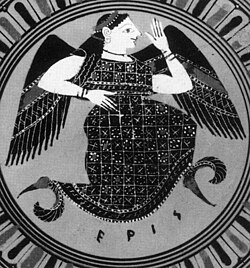
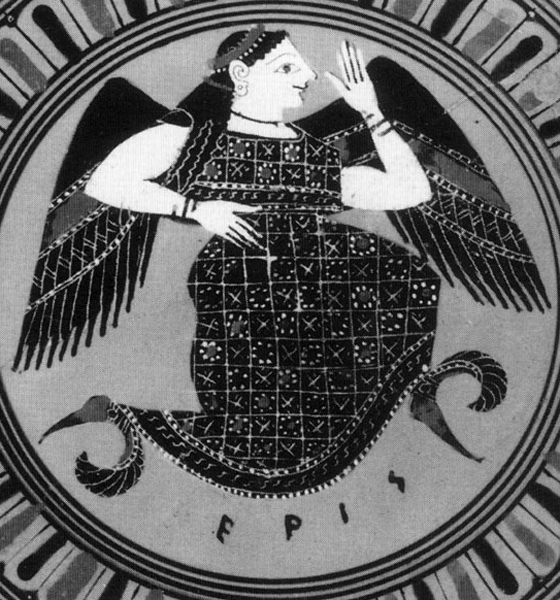
 Winged Eris on an Attic plate, c. 575–525 BC, Antikensammlung Berlin | |
| Genealogy | |
| Parents | Nyx |
| Children | Ponos, Lethe, Limos, Algea, Hysminai, Machai, Phonoi, Androktasiai, Neikea, Pseudea, Logoi, Amphilogiai, Dysnomia, Ate, Horkos |
| Equivalents | |
| Roman | Discordia |
In Greek mythology, Eris (Ancient Greek: Ἔρις, romanized: Eris, lit. 'Strife') is the goddess and personification of strife and discord, particularly in war, and in the Iliad (where she is the "sister" of Ares the god of war). According to Hesiod she was the daughter of primordial Nyx (Night), and the mother of a long list of undesirable personified abstractions, such as Ponos (Toil), Limos (Famine), Algea (Pains) and Ate (Delusion). Eris initiated a quarrel between Hera, Athena and Aphrodite, which led to the Judgement of Paris and ultimately the Trojan War. Eris's Roman equivalent is Discordia. According to Hesiod, there was another Eris, separate and distinct from Eris the daughter of Nyx, who was beneficial to men.[1]
Etymology
[edit]The name derives from the noun eris, with stem erid-, which means "strife, discord" and is of uncertain etymology; connections with the verb ὀρίνειν orínein "to raise, stir, excite" and the proper name Ἐρινύες Erinyes have been suggested. R. S. P. Beekes sees no strong evidence for this relation and excludes the derivation from ἐρείδω ereídō "to prop, to support" due to the name's original ι- stem.[2] Watkins suggested origin from a Proto-Indo-European root ere- meaning "to separate, to adjoin".[3] The name gave several derivatives in Ancient Greek, including ἐρίζω erízō "to fight" and ἔρισμα érisma "object of a quarrel".[2]
Family
[edit]In Homer's Iliad, Eris is described as the "sister and comrade" of Ares,[4] though according to Geoffrey Kirk she is "not fully personified" here, and this genealogy is a "purely ad hoc description".[5] Some scholars interpret this passage as indicating she is the daughter of Zeus and Hera, Ares' parents.[6] However, according to Hesiod's Theogony, Eris is the daughter of Nyx (Night), being among the many children Nyx produced without a partner. These siblings of Eris include personifications—like Eris—of several "loathsome" (στυγερός) things, such as Moros ("Doom"), Thanatos ("Death"), the Moirai ("Fates"), Nemesis ("Indignation"), Apate ("Deceit"), and Geras ("Old Age").[7]
Like her mother Nyx, Hesiod has Eris as the mother—with no father mentioned—of many children (the only child of Nyx with offspring) who are also personifications representing various misfortunes and harmful things which, in Eris' case, might be thought to result from discord and strife.[8] All of Eris' children are little more than allegorizations of the meanings of their names, with virtually no other identity.[9] The following table lists the children of Eris, as given by Hesiod:[10]
| Name | Ancient Greek | Common translations | Remarks | |
|---|---|---|---|---|
| prop. n. | com. n. sg. | |||
| Ponos | Πόνος | πόνος[11] | Toil,[12] Labor,[13] Hardship[14] | Called by Hesiod "painful Ponos" (Πόνον ἀλγινόεντα).[15] Cicero has the equivalent personification of the Latin word labor as the offspring of Erebus and Night (Erebo et Nocte).[16] |
| Lethe | Λήθη | λήθη[17] | Forgetfulness,[18] Oblivion[19] | Associated with Lethe, the river of oblivion in the Underworld. |
| Limos | Λιμός | λιμός[20] | Famine,[21] Hunger,[22] Starvation[23] | Of uncertain sex; held in special regard at Sparta; the equivalent of the Roman Fames. |
| Algea | Ἄλγεα (pl.) | ἄλγος[24] | Pains,[25] Sorrows[26] | Called by Hesiod the "tearful Algae" (Ἄλγεα δακρυόεντα).[27] Not notably personified elsewhere. |
| Hysminai | Ὑσμῖναι (pl.) | ὑσμίνη[28] | Combats,[29] Fights,[30] Battles[31] | The Posthomerica of Quintus Smyrnaeus has an image of the Hysminai decorating Achilles's shield.[32] |
| Machai | Μάχαi (pl.) | μάχη[33] | Battles,[34] Wars[35] | Not notably personified elsewhere |
| Phonoi | Φόνοι (pl.) | φόνος[36] | Murders,[37] Slaughterings[38] | The Shield of Heracles, has an image of Phonos (singular) decorating Heracle's shield.[39] |
| Androktasiai | Ἀνδροκτασίαι (pl.) | ἀνδροκτασία[40] | Manslaughters,[41] Manslayings,[42] Slayings of Men[43] | The Shield of Heracles, has an image of Androktasia (singular) decorating Heracle's shield.[44] |
| Neikea | Νείκεά (pl.) | νεῖκος[45] | Quarrels | Not notably personified elsewhere. |
| Pseudea | Ψεύδεά (pl.) | ψεῦδος[46] | Lies,[47] Falsehoods[48] | Not notably personified elsewhere. |
| Logoi | Λόγοi (pl.) | λόγος[49] | Tales,[50] Stories,[51] Words[52] | Not notably personified elsewhere. |
| Amphillogiai | Ἀμφιλλογίαι (pl.) | ἀμφιλογία[53] | Disputes,[54] Unclear Words[55] | Not notably personified elsewhere. |
| Dysnomia | Δυσνομία | δυσνομία[56] | Lawlessness,[57] Bad Government,[58] Anarchy[59] | The Athenian statesman Solon contrasted Dysnomia with Eunomia, the personification of the ideal government:[60] |
| Ate | Ἄτη | ἄτη[61] | Delusion,[62] Recklessness,[63] Folly,[64] Ruin[65] | She was banished from Olympus by Zeus for blinding him to Hera's trickery denying Heracles his birthright.[66] |
| Horkos | Ὅρκος | ὅρκος[67] | Oath | The curse that is inflicted on any person who swears a false oath.[68] |
Judgement of Paris
[edit]| Trojan War |
|---|
 |

Eris plays a crucial role in one important myth. She was the initiator of the quarrel between the three Greek goddesses, Hera, Athena, and Aphrodite, resolved by the Judgement of Paris, which led to Paris' abduction of Helen of Troy and the outbreak of the Trojan War.[69] As the story came to be told, all the gods were invited to the wedding of Peleus and Thetis except Eris. She came anyway but was refused admission. In anger, she threw a golden apple among the wedding guests inscribed with "For the fairest", which the three goddesses each claimed.[70]
Homer alludes to the Judgement of Paris, but with no mention of Eris.[71] An account of the story, was told in the Cypria, one of the poems in the Epic Cycle, which told the entire story of the Trojan War. The Cypria which is the first poem in the Cycle, describes events preceding those that occur in the Iliad, the second poem in the Cycle. According to a prose summary of the now lost Cypria, Eris, acting according to the plans of Zeus and Themis to bring about the Trojan War, instigates a nekios ('feud') between the three goddesses over "beauty" (presumably over who of the three was the most beautiful), while they were attending the wedding feast of Peleus and Thetis (who would become the parents of Achilles). To settle the dispute, Zeus orders the three goddesses to go to Mount Ida to be judged by Paris. Paris, having been offered Helen by Aphrodite in return for Paris choosing her, does so.[72]
The fifth-century BC playwright Euripides, describes the Judgement of Paris several times with no mention of either Eris, or an apple.[73] Later accounts include details, such as the golden Apple of Discord, which may or may not have come from the Cypria. According to the Fabulae of Hyginus, composed somewhere between the first century BC and the late second century AD, all the gods had been invited to the wedding except Eris. Nevertheless, she came to the wedding feast, and when refused entrance, she threw an apple through the doorway, saying that it was for the "fairest", which started the quarrel.[74] The satirist Lucian (fl. 2nd century AD) tells us that Eris's apple was "solid gold" and that it was inscribed: "For the queen of Beauty" (ἡ καλὴ λαβέτω).[75]
Strife in war
[edit]Eris personifies strife, particularly the strife associated with war.[76] In Homer's Iliad, Eris is described as being depicted on both Athena's battle aegis, and Achilles' shield, where she appears alongside other war-related personifications: Phobos ("Rout"), Alke ("Valor"), and Ioke ("Assault"), on the aegis, and Kydoimos ("Tumult"), and Ker ("Fate"), on the shield.[77] Similarly, the Hesiodic Shield of Heracles has Eris depicted on Heracles' shield, also with Phobos, Kydoimos and Ker, as well as other war-related personifications: Proioxis ("Pursuit"), Palioxis ("Rally"), Homados ("Tumult "), Phonos ("Murder"), and Androktasia ("Slaughter").[78] Here Eris is described as flying over the head of Phobos ("Fear"):
In the middle was Fear, made of adamant, unspeakable, glaring backward with eyes shining like fire. His mouth was full of white teeth, terrible, dreadful; and over his grim forehead flew terrible Strife, preparing for the battle-rout of men—cruel one, she took away the mind and sense of any men who waged open war against Zeus’ son [Heracles].
— Hesiod, Shield of Heracles 144–150; translation by Glenn W. Most
Eris also appears in several battle scenes in the Iliad.[79] However, unlike Apollo, Athena and several other of the Olympians, Eris does not participate in active combat, nor take sides in the war.[80] Her role in the Iliad is that of "the rouser of armies",[81] urging both armies to fight each other. In Book 4, she is one of the divinities (along with Ares, Athena, Deimos ("Terror"), and Phobos ("Rout") urging the armies to battle, with head lowered at first, but soon raised up to the heavens:[82]
And the Trojans were urged on by Ares, and the Achaeans by flashing-eyed Athene, and Terror, and Rout, and Strife who rages incessantly, sister and comrade of man-slaying Ares; she first rears her crest only a little, but then her head is fixed in the heavens while her feet tread on earth. She it was who now cast evil strife into their midst as she went through the throng, making the groanings of men to increase.
She also appears in this "rouser of armies" role in Book 5,[83] and again in Book 11, where Zeus sends Eris to rouse the Greek army by shouting:[84]
Zeus sent Strife to the swift ships of the Achaeans, gruesome Strife, holding in her hands a portent of war. And she stood by Odysseus’ black ship, huge of hull, that was in the middle so that a shout could reach to either end, both to the huts of Aias, son of Telamon, and to those of Achilles; for these had drawn up their shapely ships at the furthermost ends, trusting in their valor and the strength of their hands. There the goddess stood and uttered a great and terrible shout, a shrill cry of war, and in the heart of each man of the Achaeans she roused strength to war and to battle without ceasing. And to them at once war became sweeter than to return in their hollow ships to their dear native land.
Her lust for bloodshed is insatiable. Later in Book 11, she is the last of the gods to leave the battlefield, rejoicing as she watches the fighting she has roused.[85] While in Book 5, she is described as raging unceasingly.[86]
Hesiod also associates Eris with war. In his Works and Days, he says that she "fosters evil war and conflict".[87] And in his Theogony, has the Hysminai (Battles) and the Machai (Wars) as her children.[88]
Another Eris
[edit]In addition to the Eris who was the daughter of Nyx (Night), Hesiod, in his Works and Days, mentions another Eris. He contrasts the two: the former being "blameworthy" who "fosters evil war and conflict", the latter worthy of "praise", have been created by Zeus to foster beneficial competition:[89]
So there was not just one birth of Strifes after all, but upon the earth there are two Strifes. One of these a man would praise once he got to know it, but the other is blameworthy; and they have thoroughly opposed spirits. For the one fosters evil war and conflict—cruel one, no mortal loves that one, but it is by necessity that they honor the oppressive Strife, by the plans of the immortals. But the other one gloomy Night bore first; and Cronus’ high-throned son, who dwells in the aether, set it in the roots of the earth, and it is much better for men. It rouses even the helpless man to work. For a man who is not working but who looks at some other man, a rich one who is hastening to plow and plant and set his house in order, he envies him, one neighbor envying his neighbor who is hastening toward wealth: and this Strife is good for mortals.
— Hesiod, Works and Days 11–24; translation by Glenn W. Most
Other mentions
[edit]Antoninus Liberalis, in his Metamorphoses, involves Eris in the story of Polytechnus and Aëdon, who claimed to love each other more than Hera and Zeus. This angered Hera, so she sent Eris to wreak discord upon them.[90] Eris is mentioned many times in Quintus Smyrnaeus' Posthomerica, which covers the period between the end of the Iliad and the beginning of his Odyssey.[91] Just as in the Iliad, the Posthomerica Eris is the instigator of conflict,[92] does not take sides,[93] shouts,[94] and delights in the carnage of battle.[95] Eris is also mentioned in the Dionysiaca of Nonnus. At the start of the epic confrontation between Zeus and Typhon, Nonnus has Nike (Victory) lead Zeus into battle, and Eris lead Typhon, and in another passage has Eris, with the war-goddess Enyo, bring "Tumult" to both sides of a battle.[96]
Iconography
[edit]There are few certain representations of Eris in art.[97] Her earliest appearances (mid-sixth-century BC) are found on the Chest of Cypselus and in the tondo of a black-figure cup (Berlin F1775).[98] The geographer Pausanias describes seeing Eris depicted on the Chest, as a "most repulsive" [aischistê] woman standing between Ajax and Hector fighting.[99] On the cup she is depicted as a normal woman in appearance apart from having wings and winged-sandals.[100]
From the later part of fifth-century BC, the upper section of a red-figure calyx krater depicts Eris with Themis facing each other, apparently in animated discussion, while the lower section depicts the Judgement of Paris, confirming Eris' role in the events as told in the Cypria.[101]
Gallery
[edit]-
 Golden apple of discord by Jakob Jordaens, 1633
 -
 Manuscript illustration of Eris at the wedding of Peleus and Thetis from Jean Miélot's L'Epître d'Othéa c. 1460
 -
 Das Urteil des Paris by Anton Raphael Mengs, c. 1757


Cultural influences
[edit]The classic fairy tale "Sleeping Beauty" references what appears to be Eris's role in the wedding of Peleus and Thetis. Like Eris, a malevolent fairy curses a princess after not being invited to the princess's christening.[102][103]
Eris is the principal figure of worship in the modern Discordian religion invented as an "absurdist joke" in 1957 by two school friends Gregory Hill and Kerry Wendell Thornley. As mythologized in the religion's satirical text Principia Discordia, written by Hill with Thornely and others, Eris (apparently) spoke to Hill and Thornley in an all-night bowling alley, in the form of a chimpanzee.[104]
Eris, the "Goddess of Discord and Chaos", is a recurring antagonist in the animated television series The Grim Adventures of Billy & Mandy, wherein she is depicted as a spoiled and wealthy woman that wields the "Apple of Discord".
Similarly, Eris, the malevolent "Goddess of Discord and Chaos", is the main antagonist in the DreamWorks 2003 animated movie Sinbad: Legend of the Seven Seas against Sinbad and his allies.
The dwarf planet Eris was named after this Greek goddess in 2006.[105]
In 2019, the New Zealand moth species Ichneutica eris was named in honour of Eris.[106]
See also
[edit]Notes
[edit]- ^ Brown, s.v. Eris; Nünlist, s.v. Eris; Grimal, s.v. Eris; Tripp, s.v. Eris; Smith, s.v. Eris.
- ^ a b R. S. P. Beekes (2009). Etymological Dictionary of Greek. Brill. p. 459.
- ^ Harper, Douglas. "Eris". Online Etymology Dictionary.
- ^ Homer, Iliad 4.440–441.
- ^ Kirk, pp. 380–381. On the use of 'sister' (κασιγνήτη) and 'comrade' (ἑτάρη) alongside one another in this passage, see Coray, Krieter-Spiro, and Visser, pp. 197–198, and on the textual difficulties with this and adjacent passages, see Kirk, pp. 381–382. Nünlist, s.v. Eris, characterises this genealogy as "allegorical", and Gantz, p. 9 cites the passage as an example of Eris being "just a personification of her name".
- ^ Bell, p. 188; Parada, s.v. Eris.
- ^ Gantz, pp. 4–5; Hesiod, Theogony 223–225.
- ^ Hard, pp. 30–31; Gantz, p. 5; Hesiod, Theogony 226–232.
- ^ Gantz, p. 10, which notes the possible exception of Ate.
- ^ Hesiod, Theogony 226–232.
- ^ LSJ s.v. πόνος.
- ^ Most 2018a, p. 21; Hard, p. 31
- ^ Gantz, p. 10.
- ^ Caldwell, p. 40 on 212–232. In ancient Greek the word ponos which meant 'hard work' could also mean 'hardship, 'suffering', 'distress' or 'trouble', see The Cambridge Greek Lexicon, s.v. πόνος 1, 3; compare LSJ, s.v. πόνος. For the ancient Greeks' negative associations regarding ponos, see Millett, s.v. labour; Cartledge, s.v. industry, Greek and Roman.
- ^ Hesiod, Theogony 226.
- ^ Thurmann, s.v. Ponos; Cicero, De Natura Deorum 3.44.
- ^ LSJ s.v. λήθη.
- ^ Most 2018a, p. 21; Gantz, p. 10; Caldwell, p. 40 on 212–232.
- ^ Hard, p. 31.
- ^ LSJ s.v. λιμός.
- ^ Hard, p. 31; Gantz, p. 10.
- ^ Most 2018a, p. 21.
- ^ Caldwell, p. 40 on 212–232.
- ^ LSJ s.v. ἄλγος.
- ^ Most 2018a, p. 21; Gantz, p. 10; Caldwell, p. 40 on 212–232.
- ^ Hard, p. 31.
- ^ Hesiod, Theogony 227.
- ^ LSJ s.v. ὑσμίνη.
- ^ Most 2018a, p. 21; Gantz, p. 10.
- ^ Hard, p. 31.
- ^ Caldwell, p. 40 on 212–232.
- ^ Quintus Smyrnaeus, Posthomerica 5.36.
- ^ LSJ s.v. μάχη.
- ^ Most 2018a, p. 21; Gantz, p. 10; Hard, p. 31.
- ^ Caldwell, p. 40 on 212–232.
- ^ LSJ s.v. φόνος.
- ^ Most 2018a, p. 21; Hard, p. 31; Caldwell, p. 42 on 212–232.
- ^ Gantz, p. 10.
- ^ Hesiod, Shield of Heracles 155.
- ^ LSJ s.v. ἀνδροκτασία.
- ^ Caldwell, p. 42 on 212–232
- ^ Hard, p. 31.
- ^ Gantz, p. 10
- ^ Hesiod, Shield of Heracles 155.
- ^ LSJ s.v. νεῖκος.
- ^ LSJ s.v. ψεῦδος.
- ^ Most 2018a, p. 21; Hard, p. 31; Caldwell, p. 42 on 212–232.
- ^ Gantz, p. 10.
- ^ LSJ s.v. λόγος.
- ^ Most 2018a, p. 21.
- ^ Caldwell, p. 42 on 212–232.
- ^ Gantz, p. 10.
- ^ LSJ s.v. ἀμφιλογία.
- ^ Most 2018a, p. 21; Caldwell, p. 42 on 212–232.
- ^ Gantz, p. 10.
- ^ LSJ s.v. δυσνομία.
- ^ Most 2018a, p. 21; Hard, p. 31.
- ^ Gantz, p. 10.
- ^ Caldwell, p. 42 on 212–232.
- ^ Siewert, s.v. Nomos.
- ^ LSJ s.v. ἄτη.
- ^ Hard, p. 31.
- ^ Most 2018a, p. 21.
- ^ Gantz, p. 10.
- ^ Caldwell, p. 42 on 212–232.
- ^ Hard, p. 31.
- ^ LSJ s.v. ὄρκος.
- ^ Hard, p. 31.
- ^ Hard, p. 30; Gantz, p. 9.
- ^ Tripp, s.v. Eris.
- ^ Gantz, p. 9; Homer, Iliad, 24.27—30.
- ^ Gantz, p. 9; Proclus, Chrestomathy Cypria 1. According to Cypria fr. 1 West (compare with Euripides, Orestes 1639–42, Helen 36–41) Zeus' reason for wanting the war was overpopulation, see Reeves 1966.
- ^ Euripides, Andromache 274–292, Helen 23–30, Iphigenia in Aulis 1300–1308, The Trojan Women 924–931. So also Isocrates, Helen 10.41.
- ^ Gantz, p. 9; Hyginus, Fabulae 92; compare with Apollodorus, E.3.2.
- ^ McCartney, p. 70; Lucian, Dialogues of the Sea-Gods 7 (5); compare Lucian, The Judgement of the Goddesses (Dialogues of the Gods 20) 1; Tzetzes, Chiliades, 5.31 (Story 24), On Lycophron 93; First Vatican Mythographer, 205 (Pepin, p. 89); Second Vatican Mythographer, 249 (Pepin, p. 197).
- ^ Nünlist, s.v. Eris.
- ^ Nünlist, s.v. Eris; Homer, Iliad 5.740 (aegis), 18.535 (shield).
- ^ Hesiod, Shield of Heracles 154–156.
- ^ Brown, s.v. Eris; e.g. Homer, Iliad 4.439–445, 5.517–518, 11.3–14, 11.73—74, 18.535, 20.47—48. For a discussion of the use of the word eris in the Iliad, see Nagler 1988.
- ^ Leaf, on Iliad 440.
- ^ Homer, Iliad 20.47—48: "But when the Olympians had come into the midst of the throng of men, then up leapt mighty Strife, the rouser of armies".
- ^ According to Leaf, on 440, in this passage (and elsewhere), Eris "must not be regarded as siding with either party, but as arousing alike τοὺς μέν and τοὺς δέ", nor as being a combatant.
- ^ Homer, Iliad 5.517–518.
- ^ Hard, p. 30.
- ^ Homer, Iliad 11.73—74.
- ^ Homer, Iliad 5.517–518.
- ^ Hesiod, Works and Days 14–16.
- ^ West 1966, p. 231 on 228; Hesiod, Theogony 228.
- ^ Lecznar, p. 454.
- ^ Antoninus Liberalis, Metamorphoses 11.
- ^ Hopkinson, pp. vii–ix.
- ^ Quintus Smyrnaeus, Posthomerica 1.159, 1.180, 5.31, 6.359, 8.68, 8.186, 9.147, 10.53, 11.8.
- ^ Quintus Smyrnaeus, Posthomerica, 2.460, 6.359.
- ^ Quintus Smyrnaeus, Posthomerica, 6.359, 8.326, 9.147.
- ^ Quintus Smyrnaeus, Posthomerica 2.460, 9.324.
- ^ Nonnus, Dionysiaca 2.358–359, 5.41–42.
- ^ Giroux, p. 849.
- ^ Gantz, p. 9.
- ^ Gantz, p. 9; Giroux, p. 847 (Eris 3); Pausanias, 5.19.2.
- ^ Gantz, p. 9; Giroux, p. 847 (Eris 1); Beazley Archive 207; LIMC III-2, p. 608 (Eris 1); Digital LIMC 33843.
- ^ Gantz, p. 9; Giroux, p. 848 (Eris 7); Beazley Archive 215695; Perseus St. Petersburg St. 1807 (Vase); Digital LIMC 471; LIMC III-2, p. 608 (Eris 7).
- ^ H. J. Rose (2006). A Handbook of Greek Mythology, Including Its Extension to Rome. Kessinger Publishing. ISBN 978-1-4286-4307-9.
- ^ Maria Tatar, ed. (2002). The Annotated Classic Fairy Tales. W. W. Norton & Company. ISBN 978-0-393-05163-6. Retrieved 2007-11-06.
- ^ Mäkelä & Petsche, "Abstract"; Robertson, pp. 421–424; Cusack, pp. 28–30.
- ^ Blue, Jennifer (September 14, 2006). "2003 UB 313 named Eris". USGS Astrogeology Research Program. Archived from the original on October 18, 2006. Retrieved January 3, 2007.
- ^ Hoare, Robert J. B. (9 December 2019). "Noctuinae (Insecta: Lepidoptera: Noctuidae) part 2: Nivetica, Ichneutica" (PDF). Fauna of New Zealand. 80. Illustrator: Birgit E. Rhode: 1–455. doi:10.7931/J2/FNZ.80. ISSN 0111-5383. Wikidata Q94481265. Archived from the original (PDF) on 18 April 2021.
References
[edit]- Apollodorus, Apollodorus, The Library, with an English Translation by Sir James George Frazer, F.B.A., F.R.S. in 2 Volumes, Cambridge, Massachusetts, Harvard University Press, London, William Heinemann Ltd. 1921. ISBN 0-674-99135-4. Online version at the Perseus Digital Library.
- Bell, Robert E., Women of Classical Mythology: A Biographical Dictionary. ABC-Clio. 1991. ISBN 9780874365818, 0874365813.
- Brown, Andrew, s.v. Eris, published online OCD-DATE, in the Oxford Classical Dictionary, edited by Tim Whitmarsh, digital ed, New York, Oxford University Press. ISBN 978-0-19-938113-5.
- Caldwell, Richard (1987). Hesiod's Theogony. Focus Publishing/R. Pullins Company. ISBN 978-0-941051-00-2.
- The Cambridge Greek Lexicon, edited by J. Diggle et al, Cambridge University Press, 2021 ISBN 978-0-521-82680-8.
- Cartledge, Paul, s.v. industry, Greek and Roman, published online 07 March 2016, in the Oxford Classical Dictionary, edited by Tim Whitmarsh, digital ed, New York, Oxford University Press. ISBN 978-0-19-938113-5.
- Celoria, Francis, The Metamorphoses of Antoninus Liberalis: A Translation with a Commentary, Routledge 1992. ISBN 978-0-415-06896-3. Online version at ToposText.
- Cicero, Marcus Tullius, De Natura Deorum in Cicero: On the Nature of the Gods. Academics, translated by H. Rackham, Loeb Classical Library No. 268, Cambridge, Massachusetts, Harvard University Press, first published 1933, revised 1951. ISBN 978-0-674-99296-2. Online version at Harvard University Press. Internet Archive.
- Coray, Marina, Martha Krieter-Spiro, and Edzard Visser, Homer's Iliad. The Basel Commentary: Book IV, Berlin and Boston, De Gruyter, 2020. ISBN 9783110608298. doi:10.1515/9783110610185.
- Cusack, Carole M., Invented Religions: Imagination, Fiction and Faith, Ashgate, 2010. ISBN 978-0-754-66780-3.
- Euripides, Andromache in Euripides: Children of Heracles. Hippolytus. Andromache. Hecuba, edited and translated by David Kovacs, Loeb Classical Library No. 484. Cambridge, Massachusetts, Harvard University Press, 1995. ISBN 978-0-674-99533-8. Online version at Harvard University Press.
- Euripides, Helen, in Euripides: Helen, Phoenician Women, Orestes, edited and translated by David Kovacs, Loeb Classical Library No. 11. Cambridge, Massachusetts, Harvard University Press, 2002. ISBN 978-0-674-99600-7. Online version at Harvard University Press.
- Euripides, Iphigenia in Aulis in Euripides: Bacchae, Iphigenia at Aulis, Rhesus, edited and translated by David Kovacs, Loeb Classical Library No. 495. Cambridge, Massachusetts, Harvard University Press, 2003. ISBN 978-0-674-99601-4. Online version at Harvard University Press.
- Euripides, Orestes, in Euripides: Helen, Phoenician Women, Orestes, edited and translated by David Kovacs, Loeb Classical Library No. 11. Cambridge, Massachusetts, Harvard University Press, 2002. ISBN 978-0-674-99600-7. Online version at Harvard University Press.
- Euripides, The Trojan Women, in Euripides: Trojan Women, Iphigenia among the Taurians, Ion, edited and translated by David Kovacs, Loeb Classical Library No. 10, Cambridge, Massachusetts, Harvard University Press, 1999. ISBN 978-0-674-99574-1. Online version at Harvard University Press.
- Gantz, Timothy, Early Greek Myth: A Guide to Literary and Artistic Sources, Johns Hopkins University Press, 1996. Two volumes: ISBN 978-0-8018-5360-9 (Vol. 1), ISBN 978-0-8018-5362-3 (Vol. 2).
- Grimal, Pierre, The Dictionary of Classical Mythology, Wiley-Blackwell, 1996. ISBN 978-0-631-20102-1. Internet Archive.
- Hard, Robin (2004), The Routledge Handbook of Greek Mythology: Based on H.J. Rose's "Handbook of Greek Mythology", Psychology Press, 2004, ISBN 9780415186360. Google Books.
- Homer (1924). The Iliad with an English Translation by A.T. Murray, Ph.D. in two volumes. Cambridge, Massachusetts / London: Harvard University Press / William Heinemann, Ltd. – via Perseus Digital Library.
- Hyginus, Fabulae, in The Myths of Hyginus, edited and translated by Mary A. Grant, Lawrence: University of Kansas Press, 1960. Online version at ToposText.
- Giroux, Hubert, s.v. Eris, in Lexicon Iconographicum Mythologiae Classicae (LIMC) III.1 ATHERION-EROS, Artemis Verlag, Zürich and Munich, 1981. ISBN 3-7608-8751-1. Internet Archive.
- Isocrates, Helen, in Isocrates, Volume III, translated by La Rue Van Hook, Loeb Classical Library No. 373. Cambridge, Massachusetts, Harvard University Press, 1945. ISBN 978-0-674-99411-9. Online version at Harvard University Press.
- Kirk, Geoffrey Stephen, The Iliad: A Commentary. Volume I: Books 1–4, Cambridge, Cambridge University Press, 1985. ISBN 9780511620263. doi:10.1017/CBO9780511620263.
- Leaf, Walter, The Iliad, Edited, with Apparatus Criticus, Prolegomena, Notes, and Appendices, Vol I, Books I–XII, second edition, London, Macmillan and Co., limited; New York, The Macmillan Company, 1900. Internet Archive. Online version of commentary at the Perseus Digital Library.
- Lecznar, Adam, "Hesiod in the Eighteenth and Nineteenth Centuries", in The Oxford Handbook of Hesiod, edited by Alexander Loney, and Stephen Scully, Oxford University Press, 2018. ISBN 978-0-190-20904-9.
- Lexicon Iconographicum Mythologiae Classicae (LIMC) III.2 ATHERION-EROS, Artemis Verlag, Zürich and Munich, 1981. ISBN 3-7608-8751-1. Internet Archive.
- Liddell, Henry George, Robert Scott, A Greek-English Lexicon, revised and augmented throughout by Sir Henry Stuart Jones with the assistance of Roderick McKenzie, Clarendon Press Oxford, 1940. Online version at the Perseus Digital Library.
- Lucian, Dialogues of the Dead. Dialogues of the Sea-Gods. Dialogues of the Gods. Dialogues of the Courtesans, translated by M. D. MacLeod, Loeb Classical Library No. 431, Cambridge, Massachusetts, Harvard University Press, 1961. ISBN 978-0-674-99475-1. Online version at Harvard University Press. Internet Archive.
- Lucian, The Dead Come to Life or The Fisherman. The Double Indictment or Trials by Jury. On Sacrifices. The Ignorant Book Collector. The Dream or Lucian's Career. The Parasite. The Lover of Lies. The Judgement of the Goddesses. On Salaried Posts in Great Houses, translated by A. M. Harmon, Loeb Classical Library No. 130, Cambridge, Massachusetts, Harvard University Press, 1921, 1960. ISBN 978-0-674-99144-6. Online version at Harvard University Press. Internet Archive.
- Mäkelä, Essi, and Johanna J. M. Petsche, "Serious parody: Discordianism as liquid religion", in Culture and Religion, 14(4), pp. 411–423. doi:10.1080/14755610.2013.841269
- McCartney, Eugene Stock, "How the Apple Became the Token of Love", in Transactions and Proceedings of the American Philological Association, Vol. 56 (1925), pp. 70–81. JSTOR 282885.
- Millett, Paul C., s.v. labour, published online 30 July 2015, in the Oxford Classical Dictionary, edited by Tim Whitmarsh, digital ed, New York, Oxford University Press. ISBN 978-0-19-938113-5.
- Most, G.W. (2018a), Hesiod, Theogony, Works and Days, Testimonia, Edited and translated by Glenn W. Most, Loeb Classical Library No. 57, Cambridge, Massachusetts, Harvard University Press, 2018. ISBN 978-0-674-99720-2. Online version at Harvard University Press.
- Most, G.W. (2018b), Hesiod: The Shield, Catalogue of Women, Other Fragments, Loeb Classical Library, No. 503, Cambridge, Massachusetts, Harvard University Press, 2007, 2018. ISBN 978-0-674-99721-9. Online version at Harvard University Press.
- Nagler, Michael, N., "Toward a Semantics of Ancient Conflict: Eris in the 'Iliad'", in The Classical World, Nov. - Dec., 1988, Vol. 82, No. 2 (Nov. - Dec., 1988), pp. 81-90. JSTOR 4350302.
- Nonnus, Dionysiaca, Volume I: Books 1–15, translated by W. H. D. Rouse, Loeb Classical Library No. 344, Cambridge, Massachusetts, Harvard University Press, 1940 (revised 1984). ISBN 978-0-674-99379-2. Online version at Harvard University Press. Internet Archive (1940).
- Nünlist, Rene, s.v. Eris, in Brill’s New Pauly Online, Antiquity volumes edited by: Hubert Cancik and, Helmuth Schneider, English Edition by: Christine F. Salazar, Classical Tradition volumes edited by: Manfred Landfester, English Edition by: Francis G. Gentry, published online: 2006.
- Parada, Carlos (1993). Genealogical Guide to Greek Mythology. Jonsered: Paul Åströms Förlag. ISBN 978-91-7081-062-6.
- Pausanias, Description of Greece with an English Translation by W.H.S. Jones, Litt.D., and H.A. Ormerod, M.A., in 4 Volumes. Cambridge, Massachusetts, Harvard University Press; London, William Heinemann Ltd. 1918. Online version at the Perseus Digital Library.
- Proclus, The Epic Cycle, translated by Gregory Nagy, revised by Eugenia Lao, Harvard University's Center for Hellenic Studies, Washington DC, November 2, 2020. Online at The Center for Hellenic Studies.
- Pepin, Ronald E., The Vatican Mythographers, Fordham University Press, 2008. ISBN 9780823228928.
- Quintus Smyrnaeus, Posthomerica, edited and translated by Neil Hopkinson, Loeb Classical Library No. 19, Cambridge, Massachusetts, Harvard University Press, 2018. ISBN 978-0-674-99716-5. Online version at Harvard University Press.
- Reeves, John D., "The Cause of the Trojan War: A Forgotten Myth Revived", in The Classical Journal, Feb., 1966, Vol. 61, No. 5 (Feb., 1966), pp. 211-214. JSTOR 3294709.
- Robertson, David G., "Making the Donkey Visible: Discordianism in the Works of Robert Anton Wilson", in Cusack, Carole M.; Norman, Alex (eds.). Handbook of New Religions and Cultural Production. Brill. pp. 421–444. ISBN 978-90-04-22187-1.
- Siewert, Peter, s.v. Nomos, in Brill’s New Pauly Online, Antiquity volumes edited by: Hubert Cancik and, Helmuth Schneider, English Edition by: Christine F. Salazar, Classical Tradition volumes edited by: Manfred Landfester, English Edition by: Francis G. Gentry, published online: 2006.
- Thurmann, Stephanie, s.v. Ponos, in Brill’s New Pauly Online, Antiquity volumes edited by: Hubert Cancik and, Helmuth Schneider, English Edition by: Christine F. Salazar, Classical Tradition volumes edited by: Manfred Landfester, English Edition by: Francis G. Gentry, published online: 2006.
- Tzetzes, John, Chiliades, editor Gottlieb Kiessling, F.C.G. Vogel, 1826. Google Books. (English translation: Book I by Ana Untila; Books II–IV, by Gary Berkowitz; Books V–VI by Konstantino Ramiotis; Books VII–VIII by Vasiliki Dogani; Books IX–X by Jonathan Alexander; Books XII–XIII by Nikolaos Giallousis. Internet Archive).
- Tzetzes, On Lycopron, in Lycophronis Alexandra Vol II, edited by Eduard Scheer, 1908. Internet Archive.
- West, M. L. (1966), Hesiod: Theogony, Oxford University Press. ISBN 0-19-814169-6.
- West, M. L. (2003), Greek Epic Fragments: From the Seventh to the Fifth Centuries BC, edited and translated by Martin L. West, Loeb Classical Library No. 497, Cambridge, Massachusetts, Harvard University Press, 2003. ISBN 978-0-674-99605-2. Online version at Harvard University Press.
External links
[edit] Media related to Eris (mythology) at Wikimedia Commons
| International | |
|---|---|
| National | |
| Other | |

Eris (mythology)
View on GrokipediaEtymology and Nature
Etymology
The name Eris derives from the ancient Greek noun ἔρις (Éris), which means "strife" or "discord."[6] This term is primarily attested in early Greek literature, including the Homeric epics such as the Iliad, where it personifies conflict among warriors, and in Hesiod's Theogony and Works and Days, where it represents both destructive and potentially constructive contention.[5] Linguists have proposed that ἔρις may trace back to a Proto-Indo-European root h₁er- or ere-, connoting "to separate" or "to move," reflecting the disruptive essence of strife as a force that divides or stirs action.[6] Robert Beekes, in his Etymological Dictionary of Greek (2009), explores such connections while noting uncertainties in the derivation, ultimately suggesting a possible pre-Greek substrate influence alongside Indo-European elements.[7] In Greek literature, ἔρις is related to but distinct from terms like νεῖκος (neîkos), which denotes a more personal "quarrel" or feud, whereas ἔρις often implies broader societal or cosmic conflict, as seen in epic poetry where it drives narrative tension without the intimate animosity of νεῖκος.[8] This nuance highlights ἔρις as a multifaceted concept of discord that can encompass rivalry, contention, and even emulation. The term ἔρις persisted in post-classical Greek, retaining its core meaning of strife in Koine and Byzantine texts, often in philosophical or rhetorical contexts discussing social harmony.[9] It influenced Roman mythology through the equivalent goddess Discordia, whose name derives from Latin discordia ("discord"), embodying similar themes of division and embodying the conceptual translation of Greek strife into Latin literature and cult practices.[10]Nature and Distinctions
In Greek mythology, Eris is depicted as a daimōn, or personified spirit, embodying strife, discord, and contention, frequently portrayed in primordial contexts as a destructive and chaotic force that incites violence and rivalry among gods and mortals alike.[5] Her presence often signals the inevitability of conflict, serving as a natural and inexorable element in both human affairs and divine interactions, where she haunts battlefields and delights in the ensuing bloodshed.[5] This characterization underscores eris as an ambient force in the cosmos, compelling contention as an intrinsic aspect of existence rather than a mere accident.[11] Hesiod notably distinguishes between two manifestations of Eris in his Works and Days (lines 11–26), contrasting a malevolent form that fosters cruel rivalry, chaos, and destructive war—unloved by mortals and honored only through necessity—with a beneficial counterpart that promotes emulation, healthy competition, and productive labor, such as inspiring artisans to outdo one another in craftsmanship or farmers to till their fields more diligently.[12] This duality highlights Eris not solely as an agent of harm but also as a catalyst for societal progress, where the "good" strife drives innovation and communal advancement under divine ordinance.[13]Genealogy
Primordial Lineage
In Hesiod's Theogony, Eris, the personification of strife, is depicted as a daughter of Nyx (Night), born without a father or mate, which positions her as one of the primordial deities emerging from the chaotic cosmogony preceding the Olympian order.[14] This parthenogenetic birth aligns with Nyx's generation of other night-born entities directly from her essence, underscoring Eris's autochthonous origins in the poem's account of the universe's foundational forces.[15] Among Nyx's offspring, Eris shares kinship with a host of dark and inevitable spirits, including Moros (Doom), Thanatos (Death), Hypnos (Sleep), and the collective Oneiroi (Dreams), all conceived in solitude and embodying aspects of the nocturnal and inexorable aspects of existence.[15] This lineage emphasizes her integration into the pre-Olympian realm of abstract, personified powers that govern the primal conditions of the world, distinct from the familial ties of later divine generations.[15] Eris herself becomes the mother to a progeny of fourteen personifications representing various forms of hardship and discord, born without mention of a partner and thus perpetuating the parthenogenetic motif of her own origins.[16] These include Ponos (Toil), Lethe (Forgetfulness), Limos (Famine), Algea (Pains), Hysminai (Fightings), Machai (Battles), Phonoi (Murders), Androktasiai (Manslayers), Neikea (Quarrels), Pseudologoi (Lying Words), Amphilogiai (Disputes), Dysnomia (Lawlessness), Ate (Ruin), and Horkos (Oath), each symbolizing afflictions that arise from strife and contribute to the poem's portrayal of cosmic and human turmoil.[16] The implications of Eris's birth and motherhood within the Theogony's framework highlight her role in the progression from primordial chaos to structured divinity, where her unpartnered reproduction mirrors the self-sustaining nature of early cosmic entities and foreshadows the conflicts inherent in the emerging world order.[15] This genealogical detail reinforces the text's emphasis on Nyx's lineage as a source of inevitable, shadowy forces that persist beyond the Titanomachy and Olympian ascendancy.[15]Olympian Lineage
In Homeric tradition, Eris is portrayed as a daughter of Zeus and Hera, integrating her firmly into the Olympian pantheon as a sibling to Ares, the god of war. This lineage aligns her with the core family of the Olympian rulers, emphasizing her role within the divine household rather than as an independent primordial force.[17] A key depiction of this familial tie appears in the Iliad, where Eris is explicitly called the "sister and comrade of man-slaying Ares," serving as his attendant and ally in battle by sowing strife among warriors on both sides. In Book 4, she is shown raging incessantly through the throng, initially rearing her crest slightly before growing to touch the heavens while her feet remain on earth, thereby escalating the conflict under Ares's influence. This companionship underscores her function as an extension of Olympian warfare dynamics, closely bound to her brother's domain.[17] The Olympian version of Eris's genealogy shows potential syncretism with earlier primordial accounts, where she emerges as a daughter of Nyx without paternal origin, but here she lacks any listed offspring, focusing instead on her direct ties to Zeus and Hera. Later compilations of myth, such as those drawing from Homeric and post-Homeric sources, reinforce this parentage without attributing children to her in the Olympian context.[5]Major Myths
The Judgement of Paris
The goddess of discord, Eris, was deliberately excluded from the wedding feast of the mortal hero Peleus and the sea nymph Thetis, an event attended by the other Olympian deities on Mount Pelion.[18] Enraged by the snub, Eris sought revenge by inscribing a golden apple with the words kallistei—meaning "to the fairest"—and hurling it into the midst of the celebration, where it landed among the goddesses.[18] This act, as described in ancient accounts, ignited immediate contention, with no prior indication in the myths of the apple's origin or inherent divine qualities beyond its provocative inscription.[18] The apple sparked a dispute over its intended recipient, claimed by Hera, Athena, and Aphrodite, each asserting her superior beauty.[19] Zeus, refusing to arbitrate, directed Hermes to escort the three goddesses to Mount Ida, where the Trojan prince Paris—also known as Alexander—was tending his flocks and selected as the impartial judge.[20] To sway his decision, the goddesses offered bribes: Hera promised dominion over Asia and Europe, Athena granted unmatched skill in warfare and wisdom, and Aphrodite vowed the love of the world's most beautiful woman, Helen, wife of King Menelaus of Sparta.[19] After deliberation, Paris awarded the apple to Aphrodite, affirming her as the fairest.[20] This judgement set in motion the events leading to the Trojan War, as outlined in the Cypria, the first poem of the Epic Cycle.[20] Emboldened by Aphrodite's promise, Paris journeyed to Sparta, where he abducted Helen, prompting the Greek kings to assemble an expedition against Troy in retribution.[19] The golden apple thus served as a potent symbol of discord (eris), encapsulating themes of vanity and rivalry that Eris exploited to unleash widespread conflict among gods and mortals.[18] Through this incident, Eris established herself as the primordial instigator of the strife that engulfed the world, her vengeful gesture catalyzing the decade-long war without further direct involvement in its battles.[20]Personification in the Trojan War
In Homer's Iliad, Eris embodies the spirit of strife as an active participant in the Trojan War, depicted as the sister and comrade of the war god Ares, whom she accompanies into battle without taking up arms herself. In Book 4, as the conflict intensifies between the Trojans and Achaeans, Eris rouses the warriors by traversing the throng and casting discord among them, her shout amplifying the groanings of the combatants and fueling the chaos. She begins modestly, rearing her crest only slightly, but swiftly grows to tower with her head in the heavens and feet on the earth, symbolizing the escalating nature of strife in warfare. This non-combative role underscores Eris's function as an instigator who heightens aggression indirectly, in stark contrast to Ares's direct, bloodthirsty involvement as the "man-slaying" deity who urges fighters onward with violent fervor.[21][8] Eris's personification extends to the elaborate depiction on the shield forged by Hephaestus for Achilles in Book 18, where she is shown amid a vivid scene of battle tumult, joining Tumult and the deadly Kêres (Fates of death) in the fray. The Kêres grasp one man alive and newly wounded, hold another unwounded, and drag a third dead by the feet through the melee, their shoulders stained red with human blood, evoking the relentless presence of strife that permeates every aspect of war. This artistic representation on the shield encapsulates Eris as an omnipresent force in martial chaos, blurring the line between divine allegory and the raw brutality of combat, and reinforcing her symbolic role in the epic's portrayal of warfare's disorder.[22][23] Throughout the Iliad, Eris operates as a cosmic driver of heroic action and devastation, unleashed by Zeus to propel the narrative of conflict—such as in Book 11, where the god hurls her toward the Achaean ships to reignite the battle and spur warriors to feats of valor amid mounting casualties. Her earlier act of tossing the golden apple, igniting the rivalry that birthed the war, foreshadows this wartime agency, positioning her as the unrelenting catalyst for both individual glory and collective ruin. These invocations of eris portray it not merely as abstract discord but as a personified entity that compels the epic's heroes toward their defining, often tragic, deeds.[24][8]Additional Attestations
In Hesiod's Works
In Hesiod's Theogony, Eris emerges as a primordial daughter of Nyx (Night), embodying strife and discord within the chaotic genealogy of the cosmos.[25] She bears a progeny of destructive abstractions that perpetuate societal ills and underscore the disorder preceding Olympian order, including Ponos (painful Toil), Lethe (Forgetfulness), Limos (Famine), Algē (tearful Sorrows), Hysminai (Fightings), Machai (Battles), Phonoi (Murders), Androktasiai (Manslaughters), Neikea (Quarrels), Pseudologoi (Lying Words), Amphilogiai (Disputes), Dysnomia (Lawlessness), Atē (Ruin), and Horkos (Oath), the latter afflicting mortals with false swearing.[26] This catalog in lines 225–232 positions Eris as a generative force of primordial chaos, her offspring symbolizing the afflictions that plague humanity and the world before Zeus's establishment of justice.[25] Hesiod's Works and Days introduces a nuanced duality to Eris, contrasting her malevolent aspect—which incites cruel wars, battles, and blameworthy quarrels—with a beneficial counterpart that fosters emulation and progress.[27] The destructive Eris, aligned with her Theogonic role, delights in others' misfortunes and drives men toward conflict, earning reluctant honor only through divine decree (lines 11–26).[27] In opposition, the "good" Eris, described as Night's elder daughter and placed in the earth's roots by Cronos, motivates the idle to labor by spurring rivalry: neighbors compete in plowing and planting, potters envy potters, and craftsmen vie with one another, yielding wholesome societal advancement.[27] This distinction reframes Eris not solely as calamity but as a catalyst for productive toil.[13] Through these portrayals, Hesiod integrates Eris into a moral framework that cautions against her harmful discord while harnessing her competitive essence to promote ethical conduct, agricultural diligence, and communal harmony.[28] Absent narrative myths, Eris functions didactically in Hesiod's poetry, serving cosmological origins in the Theogony and practical wisdom in the Works and Days.In Other Ancient Texts
In the second-century AD collection Metamorphoses, Antoninus Liberalis depicts Eris as an agent of divine intervention in mortal affairs, sent by Hera to incite discord between the Theban couple Polytechnus and Aedon, who boasted of their perfect harmony. This leads to a tragic contest of affection, culminating in the murder of their son Itys and the couple's transformation into birds by the gods—a narrative that underscores Eris's role in catalyzing transformative strife through familial rivalry. Quintus Smyrnaeus's fourth-century AD epic Posthomerica extends the Trojan War narrative beyond Homer, portraying Eris as a persistent force in the conflict's aftermath, often likened to a harbinger of battle that tips the scales of fate. In Book 1, she is compared to the Amazon queen Penthesilea as she charges into combat, "flashing far through war-hosts" to awaken shouts of onset, while in Book 2, Eris inclines the "fatal scales of battle" amid divine wrath, amplifying the chaos following Hector's death and the Greeks' struggles. These motifs highlight her evolution from Homeric background figure to an active embodiment of ongoing strife in post-Iliadic events.[29] In the fifth-century AD Dionysiaca, Nonnus presents Eris as a chaotic instigator in Dionysus's campaigns, particularly during the war against the Indians, where she rouses fray and revels in the bloodshed as a "bane of the Indians." She appears urging the god to abandon repose and join battle, as when she visits Dionysus in sleep to spur him against the Assyrian citadel, and later aligns with forces like Nike in cosmic confrontations, such as Zeus's battle with Typhon. This depiction casts Eris as an integral element of Dionysian turmoil, blending her traditional discord with the epic's themes of triumph through conflict.[30] Later compilatory works offer scattered attestations of Eris primarily as a war instigator, without introducing novel myths. Apollodorus's Library (first or second century BC/AD) briefly notes her role in sparking the rivalry among the goddesses that led to the Trojan War, framing her as the originator of martial discord leading to Troy's fall. Similarly, Pausanias's second-century AD Description of Greece describes a repulsive image of Eris on the Chest of Cypselus at Olympia, emphasizing her grim aspect amid scenes of divine and heroic strife. These references reinforce her established role without expansion.[31] Orphic fragments, such as Hymn 66, allude to Eris as the "maiden daughter of darksome Night," preserving her primordial, night-born origins akin to Hesiodic genealogy. Recent scholarship on Orphic theogonies, including analyses of newly identified hexameter fragments from palimpsests, continues to explore these aspects, highlighting her as a cosmic force of contention emerging from Nyx's shadowy domain.[32]Representations
Iconography
Visual representations of Eris in ancient Greek art are notably scarce, reflecting her marginal cult status and primarily literary role as a personification of strife. The earliest known depictions date to the mid-sixth century BCE, appearing in archaic artifacts that emphasize her fierce and unsettling nature. One prominent example is found on the Chest of Cypselus, a cedar wood chest dedicated in the Temple of Hera at Olympia, described in detail by the geographer Pausanias. In Pausanias' account, Eris is portrayed as a "most repulsive" woman standing between the warriors Ajax and Hector during their duel over Patroclus' body; she is depicted with a head reaching to great heights, hands touching the ground, winged feet, and standing on her toes, underscoring her monstrous and dynamic form.[33] Black-figure pottery provides additional early examples of Eris' iconography, often integrating her into battle or conflict scenes. A key artifact is an Attic black-figure lip-cup from circa 575–525 BCE, housed in the Antikensammlung Berlin (catalogue no. F1775), where Eris is shown as a winged goddess in a richly embroidered robe and winged boots, embodying her role in inciting discord during warfare. Such vases typically feature her as an accessory figure alongside deities like Ares, rather than as a central subject, highlighting her function in Trojan War narratives without dedicated worship.[34] Eris' appearances in art remain rare throughout the classical period, with no evidence of major temple dedications or standalone sculptures devoted to her, unlike more revered Olympians. She frequently appears as a subsidiary element in motifs related to war or divine assemblies, such as on a fifth-century BCE red-figure calyx-krater from the State Hermitage Museum depicting her with Themis, or a red-figure hydria in the Badisches Landesmuseum Karlsruhe showing her at the Judgement of Paris. This pattern persists from the archaic black-figure style, characterized by incised details and stark contrasts, to the more fluid red-figure technique of the classical era, where her form evolves toward greater dynamism but retains her winged, menacing attributes.[5]Symbolic Attributes
In ancient Greek depictions, Eris is frequently portrayed as a winged female figure, symbolizing the swift and pervasive nature of discord that spreads rapidly across human affairs and battlefields. This winged form appears in vase paintings, such as an Athenian black-figure kylix from the 6th century BCE, where she is shown with wings and winged boots, emphasizing her role as a daimona capable of inciting strife with aerial speed.[34] The wings also evoke her association with war's chaotic momentum, as described by Pausanias, who notes her as a winged entity in artistic representations.[10] Eris's physical traits often convey repulsion and turmoil, with a snarling or wrathful expression that underscores her delight in conflict. Homer's Iliad describes her as embodying relentless wrath on the battlefield, urging warriors onward with unyielding fury (Iliad 4.441 ff.), while in another passage, she rejoices over the slaughter of men, her presence amplifying the gore and horror of war (Iliad 11.73 ff.).[5] These textual attributes align with visual motifs in art, where her fierce demeanor contrasts sharply with more serene deities, highlighting her as a force of disruption rather than harmony. The golden apple stands as Eris's most emblematic symbol, representing division and the spark of catastrophic rivalry. In the myth of the Judgment of Paris, she inscribes it "to the fairest" and casts it among the goddesses at Peleus and Thetis's wedding, igniting the chain of events leading to the Trojan War, as recounted in Pseudo-Apollodorus's Bibliotheca (E3.2).[5] This apple embodies her essence as the instigator of contention, a tangible emblem of how minor provocations can fracture unity. In battle contexts, Eris is occasionally linked to instruments of violence, such as a two-edged blade, symbolizing the cutting edge of strife that severs alliances and bodies alike, as depicted in Statius's Roman adaptation but rooted in Greek traditions of her warlike nature (Thebaid 7.64 ff.).[5] Color motifs in her representations further evoke chaos, with her form often reddened or stained with gore to signify the bloody outcomes of discord, as in Philostratus's Imagines (10), where her visage reflects the visceral toll of conflict.[5] Eris's symbolism sharply contrasts with that of her sister Harmonia, the goddess of concord, illustrating the duality of strife and unity within the divine family. While Eris fosters destructive rivalry and war, as seen in her role in the Trojan conflict, Harmonia soothes strife and presides over marital and social harmony, born of the same parents Ares and Aphrodite in some accounts (Theogony 933 ff.).[35] This opposition underscores ancient Greek views on discord as the inverse of balanced order, with Eris's dark, fiery-hued depictions in vase paintings—often in stark red-figure contrasts—visually reinforcing her tumultuous essence against Harmonia's peaceful iconography.[10]Cultural Legacy
In Classical Literature and Art
In Roman epic poetry, the Greek goddess Eris was adapted as Discordia, personifying strife and contention within narratives of war and fate. Virgil portrays her in the Aeneid as a savage companion to Mars and the Furies, with snaky hair bound by bloody ribbons, embodying the destructive chaos that fuels conflict (Virgil, Aeneid 6.280; 8.702).[5] This depiction aligns with her Homeric role but amplifies her monstrous aspects to underscore Rome's imperial struggles. Ovid references the Judgment of Paris and its consequences in the Metamorphoses, integrating Discordia's role in sparking the rivalry among the goddesses that leads to the Trojan War and its metamorphic aftermath.[5] Eris's influence extends to classical theater, where her essence as strife permeates dramatic explorations of familial and societal conflict. In Aeschylus' Oresteia trilogy, choral odes evoke her as a motif of unrelenting discord, linking Helen's abduction—tied to Eris's apple—to the cycle of vengeance that engulfs the House of Atreus, ultimately resolved through Athena's trial in the Eumenides.[5] This representation highlights Eris not merely as an instigator but as a force whose chaotic energy demands transformation into ordered justice, a central theme in Aeschylus' portrayal of Athens' emerging legal institutions. During the Renaissance, Eris inspired allegorical depictions in art and literature that bridged classical antiquity with early modern humanism, often symbolizing the perils of rivalry and disorder. Painters like Peter Paul Rubens and Jacob Jordaens illustrated her in scenes of the Judgment of Paris, portraying her as a lurking, disruptive figure amid divine beauty, as in Jordaens' 1633 canvas The Golden Apple of Discord, which draws on Eris's mythic role to allegorize moral and political discord.[36] In literature, William Shakespeare alludes to her legacy in Troilus and Cressida (c. 1602), where the Trojan War's strife is embodied in Ulysses' speech decrying the "discord" that unravels hierarchy and unity among the Greeks, echoing Eris's apple as the origin of endless contention (Shakespeare, Troilus and Cressida 1.3.109–116).[37] Nineteenth-century scholarship further illuminated Eris as an archetype of feminine chaos, interpreting her through the lens of ritual and psychology. Classicist Jane Ellen Harrison, in her seminal Prolegomena to the Study of Greek Religion (1903), examines Eris within the broader context of primitive demonology as a malevolent daimon associated with chthonic forces like the Keres and Erinyes, positioning her as a disruptive power contrasting Olympian order and reflecting primal forces in Greek cosmology.[38] Harrison's analysis underscores Eris's role in embodying the irrational, chaotic undercurrents of myth that challenge patriarchal structures, influencing later feminist readings of Greek divinity.Modern Interpretations
In contemporary astronomy, the dwarf planet Eris, discovered on October 21, 2005, by a team led by Mike Brown at the Palomar Observatory, was officially named by the International Astronomical Union (IAU) on September 13, 2006, after the Greek goddess of discord to symbolize the upheaval it caused in planetary classifications.[39][40] This distant Kuiper Belt object, larger than Pluto at discovery, prompted the IAU to redefine planets and classify both as dwarf planets, highlighting Eris's role in sparking scientific debate. Recent research as of 2024, using geochemical models and data from the James Webb Space Telescope, indicates evidence of past geothermal activity and potential subsurface liquid water oceans beneath its icy surface, suggesting dynamic internal processes in this distant world.[41][42] Eris serves as the central deity in Discordianism, a countercultural parody religion founded in the early 1960s by Greg Hill (under the pseudonym Omar Khayyam Ravenhurst) and Kerry Wendell Thornley (as Malaclypse the Younger) in California.[43] Their seminal text, Principia Discordia (first published in 1965), reimagines Eris as the "Goddess of Chaos," promoting creative disorder, absurdity, and rejection of dogmatic authority to foster personal enlightenment through humor and anarchy. This philosophy has permeated modern internet culture, inspiring memes, online communities, and concepts like "creative chaos" in digital activism and gaming.[44] In popular media, Eris is frequently portrayed as a chaotic antagonist or trickster figure. In the 2003 DreamWorks animated film Sinbad: Legend of the Seven Seas, she is the primary villain, a seductive goddess of discord who manipulates mortals to steal the Book of Peace and unleash strife, voiced by Michelle Pfeiffer.[45] Video games have also adapted her, notably in Smite (released 2014 by Hi-Rez Studios), where Eris appears as a playable mage deity whose abilities, such as "Trouble Maker" and "Chaotic Rift," embody strife by disrupting enemy formations and promoting team discord. These depictions emphasize her mythological essence while amplifying her as a symbol of unpredictable rebellion in entertainment. Recent scholarship from 2020 to 2025 has reframed Eris through feminist lenses, interpreting her as an empowered disruptor challenging patriarchal harmony and exclusion. In analyses like Sarah Varcas's "Eris: The Radical Feminine Awakens" (circa 2020), Eris represents the suppressed feminine rage against systemic injustice, transforming her traditional villainy into a force for societal evolution and gender equity.[46] Similarly, Daniel Fiverson's 2025 book Eris: Sacred Feminine Force of Evolutionary Astrology explores her archetype as a catalyst for awakening marginalized voices, drawing on mythological sources to link her discord to modern calls for radical change in astrology and cultural studies.[47] These interpretations position Eris not as mere chaos but as a vital agent of transformation in contemporary philosophical discourse.References
- https://en.wiktionary.org/wiki/%E1%BC%94%CF%81%CE%B9%CF%82#Etymology