




Binomial theorem
View on Wikipedia
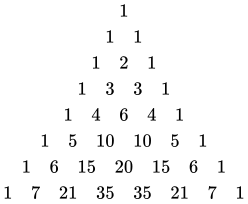


In elementary algebra, the binomial theorem (or binomial expansion) describes the algebraic expansion of powers of a binomial. According to the theorem, the power expands into a polynomial with terms of the form , where the exponents and are nonnegative integers satisfying and the coefficient of each term is a specific positive integer depending on and . For example, for ,



The coefficient in each term is known as the binomial coefficient or (the two have the same value). These coefficients for varying and can be arranged to form Pascal's triangle. These numbers also occur in combinatorics, where gives the number of different combinations (i.e. subsets) of elements that can be chosen from an -element set. Therefore is usually pronounced as " choose ".

Statement
[edit]According to the theorem, the expansion of any nonnegative integer power n of the binomial x + y is a sum of the form where each is a positive integer known as a binomial coefficient, defined as


This formula is also referred to as the binomial formula or the binomial identity. Using summation notation, it can be written more concisely as

The final expression follows from the previous one by the symmetry of x and y in the first expression, and by comparison it follows that the sequence of binomial coefficients in the formula is symmetric,

A simple variant of the binomial formula is obtained by substituting 1 for y, so that it involves only a single variable. In this form, the formula reads
![{\displaystyle {\begin{aligned}(x+1)^{n}&={\binom {n}{0}}x^{0}+{\binom {n}{1}}x^{1}+{\binom {n}{2}}x^{2}+\cdots +{\binom {n}{n}}x^{n}\\[4mu]&=\sum _{k=0}^{n}{\binom {n}{k}}x^{k}.{\vphantom {\Bigg )}}\end{aligned}}}](https://wikimedia.org/api/rest_v1/media/math/render/svg/527c6c963e8f011b107d755d28647e68424c3b90)
Examples
[edit]The first few cases of the binomial theorem are: In general, for the expansion of (x + y)n on the right side in the nth row (numbered so that the top row is the 0th row):
^{1}&=x+y,\\[8pt](x+y)^{2}&=x^{2}+2xy+y^{2},\\[8pt](x+y)^{3}&=x^{3}+3x^{2}y+3xy^{2}+y^{3},\\[8pt](x+y)^{4}&=x^{4}+4x^{3}y+6x^{2}y^{2}+4xy^{3}+y^{4},\end{aligned}}}](https://wikimedia.org/api/rest_v1/media/math/render/svg/9456b0a3fd94edfab2664090b82b9be773a1a8c1)
- the exponents of x in the terms are n, n − 1, ..., 2, 1, 0 (the last term implicitly contains x0 = 1);
- the exponents of y in the terms are 0, 1, 2, ..., n − 1, n (the first term implicitly contains y0 = 1);
- the coefficients form the nth row of Pascal's triangle;
- before combining like terms, there are 2n terms xiyj in the expansion (not shown);
- after combining like terms, there are n + 1 terms, and their coefficients sum to 2n.
An example illustrating the last two points: with .


A simple example with a specific positive value of y:

A simple example with a specific negative value of y:

Geometric explanation
[edit]
For positive values of a and b, the binomial theorem with n = 2 is the geometrically evident fact that a square of side a + b can be cut into a square of side a, a square of side b, and two rectangles with sides a and b. With n = 3, the theorem states that a cube of side a + b can be cut into a cube of side a, a cube of side b, three a × a × b rectangular boxes, and three a × b × b rectangular boxes.
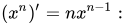
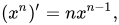
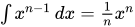
In calculus, this picture also gives a geometric proof of the derivative [1] if one sets and interpreting b as an infinitesimal change in a, then this picture shows the infinitesimal change in the volume of an n-dimensional hypercube, where the coefficient of the linear term (in ) is the area of the n faces, each of dimension n − 1: Substituting this into the definition of the derivative via a difference quotient and taking limits means that the higher order terms, and higher, become negligible, and yields the formula interpreted as "the infinitesimal rate of change in volume of an n-cube as side length varies is the area of n of its (n − 1)-dimensional faces". If one integrates this picture, which corresponds to applying the fundamental theorem of calculus, one obtains Cavalieri's quadrature formula, the integral – see proof of Cavalieri's quadrature formula for details.[1]


Binomial coefficients
[edit]The coefficients that appear in the binomial expansion are called binomial coefficients. These are usually written and pronounced "n choose k".

Formulas
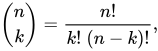
[edit]The coefficient of xn−kyk is given by the formula which is defined in terms of the factorial function n!. Equivalently, this formula can be written with k factors in both the numerator and denominator of the fraction. Although this formula involves a fraction, the binomial coefficient is actually an integer.

Combinatorial interpretation
[edit]The binomial coefficient can be interpreted as the number of ways to choose k elements from an n-element set (a combination). This is related to binomials for the following reason: if we write (x + y)n as a product then, according to the distributive law, there will be one term in the expansion for each choice of either x or y from each of the binomials of the product. For example, there will only be one term xn, corresponding to choosing x from each binomial. However, there will be several terms of the form xn−2y2, one for each way of choosing exactly two binomials to contribute a y. Therefore, after combining like terms, the coefficient of xn−2y2 will be equal to the number of ways to choose exactly 2 elements from an n-element set.

Proofs
[edit]Combinatorial proof
[edit]Expanding (x + y)n yields the sum of the 2n products of the form e1e2 ... en where each ei is x or y. Rearranging factors shows that each product equals xn−kyk for some k between 0 and n. For a given k, the following are proved equal in succession:
- the number of terms equal to xn−kyk in the expansion
- the number of n-character x,y strings having y in exactly k positions
- the number of k-element subsets of {1, 2, ..., n}
- either by definition, or by a short combinatorial argument if one is defining as

This proves the binomial theorem.
Example
[edit]The coefficient of xy2 in equals because there are three x,y strings of length 3 with exactly two y's, namely, corresponding to the three 2-element subsets of {1, 2, 3}, namely, where each subset specifies the positions of the y in a corresponding string.




Inductive proof
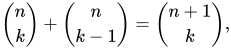
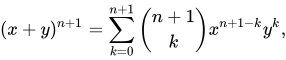
[edit]Induction yields another proof of the binomial theorem. When n = 0, both sides equal 1, since x0 = 1 and Now suppose that the equality holds for a given n; we will prove it for n + 1. For j, k ≥ 0, let [f(x, y)]j,k denote the coefficient of xjyk in the polynomial f(x, y). By the inductive hypothesis, (x + y)n is a polynomial in x and y such that [(x + y)n]j,k is if j + k = n, and 0 otherwise. The identity shows that (x + y)n+1 is also a polynomial in x and y, and since if j + k = n + 1, then (j − 1) + k = n and j + (k − 1) = n. Now, the right hand side is by Pascal's identity.[2] On the other hand, if j + k ≠ n + 1, then (j – 1) + k ≠ n and j + (k – 1) ≠ n, so we get 0 + 0 = 0. Thus which is the inductive hypothesis with n + 1 substituted for n and so completes the inductive step.


![{\displaystyle [(x+y)^{n+1}]_{j,k}=[(x+y)^{n}]_{j-1,k}+[(x+y)^{n}]_{j,k-1},}](https://wikimedia.org/api/rest_v1/media/math/render/svg/518ebfbee0b81ffcd211d9d6bc1bd574da3e1f40)
Generalizations
[edit]Generalized binomial theorem
[edit]The standard binomial theorem, as discussed above, is concerned with where the exponent n is a nonnegative integer. The generalized binomial theorem allows for non-integer, negative, or even complex exponents, at the expense of replacing the finite sum by an infinite series.

In order to do this, one needs to give meaning to binomial coefficients with an arbitrary upper index, which cannot be done using the usual formula with factorials. However, for an arbitrary number r, one can define where the last equation introduces modern notation for the falling factorial. This agrees with the usual definitions when r is a nonnegative integer. Then, if x and y are real numbers with |x| > |y|,[Note 1] and r is any complex number, one has


When r is a nonnegative integer, the binomial coefficients for k > r are zero, so this equation reduces to the usual binomial theorem, and there are at most r + 1 nonzero terms. For other values of r, the series has infinitely many nonzero terms.
For example, r = 1/2 gives the following series for the square root:

With r = −1, the generalized binomial series becomes: which is the geometric series sum formula for the convergent case |x| < 1, whose common ratio is −x.

More generally, with r = −s, we have for |x| < 1:[3]

So, for instance, when s = 1/2,

Replacing x with -x yields:

So, for instance, when s = 1/2, we have for |x| < 1:

Further generalizations
[edit]The generalized binomial theorem can be extended to the case where x and y are complex numbers. For this version, one should again assume |x| > |y|[Note 1] and define the powers of x + y and x using a holomorphic branch of log defined on an open disk of radius |x| centered at x. The generalized binomial theorem is valid also for elements x and y of a Banach algebra as long as xy = yx, and x is invertible, and ‖y/x‖ < 1.
A version of the binomial theorem is valid for the following Pochhammer symbol-like family of polynomials: for a given real constant c, define and for Then[4] The case c = 0 recovers the usual binomial theorem.

![{\displaystyle x^{(n)}=\prod _{k=1}^{n}[x+(k-1)c]}](https://wikimedia.org/api/rest_v1/media/math/render/svg/88fb041571bc1f80d3b23d148bd04e4245ebf4c9)


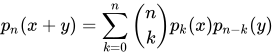
More generally, a sequence of polynomials is said to be of binomial type if

- for all ,
- , and
- for all , , and .




An operator on the space of polynomials is said to be the basis operator of the sequence if and for all . A sequence is binomial if and only if its basis operator is a Delta operator.[5] Writing for the shift by operator, the Delta operators corresponding to the above "Pochhammer" families of polynomials are the backward difference for , the ordinary derivative for , and the forward difference for .





Multinomial theorem
[edit]The binomial theorem can be generalized to include powers of sums with more than two terms. The general version is

where the summation is taken over all sequences of nonnegative integer indices k1 through km such that the sum of all ki is n. (For each term in the expansion, the exponents must add up to n). The coefficients are known as multinomial coefficients, and can be computed by the formula


Combinatorially, the multinomial coefficient counts the number of different ways to partition an n-element set into disjoint subsets of sizes k1, ..., km.
Multi-binomial theorem
[edit]When working in more dimensions, it is often useful to deal with products of binomial expressions. By the binomial theorem this is equal to

This may be written more concisely, by multi-index notation, as
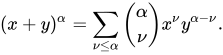
General Leibniz rule
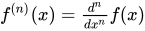
[edit]The general Leibniz rule gives the nth derivative of a product of two functions in a form similar to that of the binomial theorem:[6]

Here, the superscript (n) indicates the nth derivative of a function, . If one sets f(x) = eax and g(x) = ebx, cancelling the common factor of e(a + b)x from each term gives the ordinary binomial theorem.[7]
History
[edit]Special cases of the binomial theorem were known since at least the 4th century BC when Greek mathematician Euclid mentioned the special case of the binomial theorem for exponent .[8] Greek mathematician Diophantus cubed various binomials, including .[8] Indian mathematician Aryabhata's method for finding cube roots, from around 510 AD, suggests that he knew the binomial formula for exponent .[8]


Binomial coefficients, as combinatorial quantities expressing the number of ways of selecting k objects out of n without replacement (combinations), were of interest to ancient Indian mathematicians. The Jain Bhagavati Sutra (c. 300 BC) describes the number of combinations of philosophical categories, senses, or other things, with correct results up through (probably obtained by listing all possibilities and counting them)[9] and a suggestion that higher combinations could likewise be found.[10] The Chandaḥśāstra by the Indian lyricist Piṅgala (3rd or 2nd century BC) somewhat cryptically describes a method of arranging two types of syllables to form metres of various lengths and counting them; as interpreted and elaborated by Piṅgala's 10th-century commentator Halāyudha his "method of pyramidal expansion" (meru-prastāra) for counting metres is equivalent to Pascal's triangle.[11] Varāhamihira (6th century AD) describes another method for computing combination counts by adding numbers in columns.[12] By the 9th century at latest Indian mathematicians learned to express this as a product of fractions , and clear statements of this rule can be found in Śrīdhara's Pāṭīgaṇita (8th–9th century), Mahāvīra's Gaṇita-sāra-saṅgraha (c. 850), and Bhāskara II's Līlāvatī (12th century).[12][9][13]

The Persian mathematician al-Karajī (953–1029) wrote a now-lost book containing the binomial theorem and a table of binomial coefficients, often credited as their first appearance.[14][15][16][17] An explicit statement of the binomial theorem appears in al-Samawʾal's al-Bāhir (12th century), there credited to al-Karajī.[14][15] Al-Samawʾal algebraically expanded the square, cube, and fourth power of a binomial, each in terms of the previous power, and noted that similar proofs could be provided for higher powers, an early form of mathematical induction. He then provided al-Karajī's table of binomial coefficients (Pascal's triangle turned on its side) up to and a rule for generating them equivalent to the recurrence relation .[15][18] The Persian poet and mathematician Omar Khayyam was probably familiar with the formula to higher orders, although many of his mathematical works are lost.[8] The binomial expansions of small degrees were known in the 13th century mathematical works of Yang Hui[19] and also Chu Shih-Chieh.[8] Yang Hui attributes the method to a much earlier 11th century text of Jia Xian, although those writings are now also lost.[20]


In Europe, descriptions of the construction of Pascal's triangle can be found as early as Jordanus de Nemore's De arithmetica (13th century).[21] In 1544, Michael Stifel introduced the term "binomial coefficient" and showed how to use them to express in terms of , via "Pascal's triangle".[22] Other 16th century mathematicians including Niccolò Fontana Tartaglia and Simon Stevin also knew of it.[22] 17th-century mathematician Blaise Pascal studied the eponymous triangle comprehensively in his Traité du triangle arithmétique.[23]


The development of the binomial theorem for positive integer exponents is attributed to Al-Kashi by the year 1427. The first proper proof of the binomial theorem for positive integral index was given by Pascal.[24] By the early 17th century, some specific cases of the generalized binomial theorem, such as for , can be found in the work of Henry Briggs' Arithmetica Logarithmica (1624).[25] Isaac Newton is generally credited with discovering the generalized binomial theorem, valid for any real exponent, in 1665, inspired by the work of John Wallis's Arithmetic Infinitorum and his method of interpolation.[22][26][8][27][25] A logarithmic version of the theorem for fractional exponents was discovered independently by James Gregory who wrote down his formula in 1670.[25]

Applications
[edit]Multiple-angle identities
[edit]For the complex numbers the binomial theorem can be combined with de Moivre's formula to yield multiple-angle formulas for the sine and cosine. According to De Moivre's formula,

Using the binomial theorem, the expression on the right can be expanded, and then the real and imaginary parts can be taken to yield formulas for cos(nx) and sin(nx). For example, since But De Moivre's formula identifies the left side with , so which are the usual double-angle identities. Similarly, since De Moivre's formula yields In general, and There are also similar formulas using Chebyshev polynomials.







Series for e
[edit]The number e is often defined by the formula
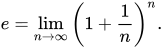
Applying the binomial theorem to this expression yields the usual infinite series for e. In particular:

The kth term of this sum is

As n → ∞, the rational expression on the right approaches 1, and therefore

This indicates that e can be written as a series:

Indeed, since each term of the binomial expansion is an increasing function of n, it follows from the monotone convergence theorem for series that the sum of this infinite series is equal to e.
Probability
[edit]The binomial theorem is closely related to the probability mass function of the negative binomial distribution. The probability of a (countable) collection of independent Bernoulli trials with probability of success all not happening is An upper bound for this quantity is [28]

![{\displaystyle p\in [0,1]}](https://wikimedia.org/api/rest_v1/media/math/render/svg/33c3a52aa7b2d00227e85c641cca67e85583c43c)


In abstract algebra
[edit]The binomial theorem is valid more generally for two elements x and y in a ring, or even a semiring, provided that xy = yx. For example, it holds for two n × n matrices, provided that those matrices commute; this is useful in computing powers of a matrix.[29]
The binomial theorem can be stated by saying that the polynomial sequence {1, x, x2, x3, ...} is of binomial type.
See also
[edit]
Notes
[edit]References
[edit]- ^ a b Barth, Nils R. (2004). "Computing Cavalieri's Quadrature Formula by a Symmetry of the n-Cube". The American Mathematical Monthly. 111 (9): 811–813. doi:10.2307/4145193. JSTOR 4145193.
- ^ Binomial theorem – inductive proofs Archived February 24, 2015, at the Wayback Machine
- ^ Weisstein, Eric W. "Negative Binomial Series". Wolfram MathWorld.
- ^ Sokolowsky, Dan; Rennie, Basil C. (1979). "Problem 352". Crux Mathematicorum. 5 (2): 55–56.
- ^ Aigner, Martin (1979). Combinatorial Theory. Springer. p. 105. ISBN 0-387-90376-3.
- ^ Olver, Peter J. (2000). Applications of Lie Groups to Differential Equations. Springer. pp. 318–319. ISBN 9780387950006.
- ^ Spivey, Michael Z. (2019). The Art of Proving Binomial Identities. CRC Press. p. 71. ISBN 978-1351215800.
- ^ a b c d e f Coolidge, J. L. (1949). "The Story of the Binomial Theorem". The American Mathematical Monthly. 56 (3): 147–157. doi:10.2307/2305028. JSTOR 2305028.
- ^ a b Biggs, Norman L. (1979). "The roots of combinatorics". Historia Mathematica. 6 (2): 109–136. doi:10.1016/0315-0860(79)90074-0.
- ^ Datta, Bibhutibhushan (1929). "The Jaina School of Mathematics". Bulletin of the Calcutta Mathematical Society. 27. 5. 115–145 (esp. 133–134). Reprinted as "The Mathematical Achievements of the Jainas" in Chattopadhyaya, Debiprasad, ed. (1982). Studies in the History of Science in India. Vol. 2. New Delhi: Editorial Enterprises. pp. 684–716.
- ^ Bag, Amulya Kumar (1966). "Binomial theorem in ancient India" (PDF). Indian Journal of History of Science. 1 (1): 68–74. Shah, Jayant (2013). "A History of Piṅgala's Combinatorics". Gaṇita Bhāratī. 35 (1–4): 43–96. ResearchGate:353496244. (Preprint) Survey sources: Edwards, A. W. F. (1987). "The combinatorial numbers in India". Pascal's Arithmetical Triangle. London: Charles Griffin. pp. 27–33. ISBN 0-19-520546-4. Divakaran, P. P. (2018). "Combinatorics". The Mathematics of India: Concepts, Methods, Connections. Springer; Hindustan Book Agency. §5.5 pp. 135–140. doi:10.1007/978-981-13-1774-3_5. ISBN 978-981-13-1773-6. Roy, Ranjan (2021). "The Binomial Theorem". Series and Products in the Development of Mathematics. Vol. 1 (2 ed.). Cambridge University Press. Ch. 4, pp. 77–104. doi:10.1017/9781108709453.005. ISBN 978-1-108-70945-3.
- ^ a b Gupta, Radha Charan (1992). "Varāhamihira's Calculation of and the Discovery of Pascal's Triangle". Gaṇita Bhāratī. 14 (1–4): 45–49. Reprinted in Ramasubramanian, K., ed. (2019). Gaṇitānanda. Springer. pp. 285–289. doi:10.1007/978-981-13-1229-8_29.
- ^ Shukla, Kripa Shankar, ed. (1959). "Combinations of Savours". The Patiganita of Sridharacarya. Lucknow University. Vyavahāras 1.9, p. 97 (text), pp. 58–59 (translation).
- ^ a b Yadegari, Mohammad (1980). "The Binomial Theorem: A Widespread Concept in Medieval Islamic Mathematics". Historia Mathematica. 7 (4): 401–406. doi:10.1016/0315-0860(80)90004-X.
- ^ a b c Rashed, Roshdi (1972). "L'induction mathématique: al-Karajī, al-Samawʾal". Archive for History of Exact Sciences (in French). 9 (1): 1–21. doi:10.1007/BF00348537. JSTOR 41133347. Translated into English by A. F. W. Armstrong in Rashed, Roshdi (1994). "Mathematical Induction: al-Karajī and al-Samawʾal". The Development of Arabic Mathematics: Between Arithmetic and Algebra. Kluwer. §1.4, pp. 62–81. doi:10.1007/978-94-017-3274-1_2. ISBN 0-7923-2565-6.
The first formulation of the binomial and the table of binomial coefficients, to our knowledge, is to be found in a text by al-Karajī, cited by al-Samawʾal in al-Bāhir.
- ^ Sesiano, Jacques (1997). "Al-Karajī". In Selin, Helaine (ed.). Encyclopaedia of the History of Science, Technology, and Medicine in Non-Western Cultures. Springer. pp. 475–476. doi:10.1007/978-94-017-1416-7_11. ISBN 978-94-017-1418-1.
Another [lost work of Karajī's] contained the first known explanation of the arithmetical (Pascal's) triangle; the passage in question survived through al-Samawʾal's Bāhir (twelfth century) which heavily drew from the Badīʿ.
- ^
Berggren, John Lennart (1985). "History of mathematics in the Islamic world: The present state of the art". Review of Middle East Studies. 19 (1): 9–33. doi:10.1017/S0026318400014796. Republished in Sidoli, Nathan; Brummelen, Glen Van, eds. (2014). From Alexandria, Through Baghdad. Springer. pp. 51–71. doi:10.1007/978-3-642-36736-6_4. ISBN 978-3-642-36735-9.
[...] since the table of binomial coefficients had been previously found in such late works as those of al-Kāshī (fifteenth century) and Naṣīr al-Dīn al-Ṭūsī (thirteenth century), some had suggested that the table was a Chinese import. However, the use of the binomial coefficients by Islamic mathematicians of the eleventh century, in a context which had deep roots in Islamic mathematics, suggests strongly that the table was a local discovery – most probably of al-Karajī.
- ^ O'Connor, John J.; Robertson, Edmund F. "Abu Bekr ibn Muhammad ibn al-Husayn Al-Karaji". MacTutor History of Mathematics Archive. University of St Andrews.
- ^ Landau, James A. (1999-05-08). "Historia Matematica Mailing List Archive: Re: [HM] Pascal's Triangle". Archives of Historia Matematica. Archived from the original (mailing list email) on 2021-02-24. Retrieved 2007-04-13.
- ^ Martzloff, Jean-Claude (1997) [French ed. 1987]. "Jia Xian and Liu Yi". A History of Chinese Mathematics. Translated by Wilson, Stephen S. Springer. p. 142. ISBN 3-540-54749-5.
- ^ Hughes, Barnabas (1989). "The arithmetical triangle of Jordanus de Nemore". Historia Mathematica. 16 (3): 213–223. doi:10.1016/0315-0860(89)90018-9.
- ^ a b c Kline, Morris (1972). History of mathematical thought. Oxford University Press. p. 273.
- ^ Katz, Victor (2009) [1993]. "Elementary Probability". A History of Mathematics: An Introduction (3rd ed.). Addison-Wesley. § 14.3, pp. 487–497. ISBN 978-0-321-38700-4.
- ^ Edwards, A. W. F. (2002-07-23). Pascal's Arithmetical Triangle: The Story of a Mathematical Idea. JHU Press. ISBN 978-0-8018-6946-4.
- ^ a b c Stillwell, John (2010). Mathematics and its history (3rd ed.). Springer. p. 186. ISBN 978-1-4419-6052-8.
- ^ Bourbaki, N. (1994). Elements of the History of Mathematics. Translated by J. Meldrum. Springer. ISBN 3-540-19376-6.
- ^ Whiteside, D. T. (1961). "Newton's Discovery of the General Binomial Theorem". The Mathematical Gazette. 45 (353): 175–180. doi:10.2307/3612767. JSTOR 3612767.
- ^ Cover, Thomas M.; Thomas, Joy A. (1991). "Data Compression". Elements of Information Theory. Wiley. Ch. 5, pp. 78–124. doi:10.1002/0471200611.ch5. ISBN 9780471062592.
- ^ Artin, Michael (2011). Algebra (2nd ed.). Pearson. equation (4.7.11).

Further reading
[edit]- Graham, Ronald; Knuth, Donald; Patashnik, Oren (1994). "Binomial Coefficients". Concrete Mathematics (2nd ed.). Addison Wesley. Ch. 5, pp. 153–256. ISBN 978-0-201-55802-9.
External links
[edit]
- Solomentsev, E.D. (2001) [1994]. "Newton binomial". Encyclopedia of Mathematics. EMS Press.
- Binomial Theorem by Stephen Wolfram, and "Binomial Theorem (Step-by-Step)" by Bruce Colletti and Jeff Bryant, Wolfram Demonstrations Project, 2007.
- This article incorporates material from inductive proof of binomial theorem on PlanetMath, which is licensed under the Creative Commons Attribution/Share-Alike License.
| International | |
|---|---|
| National | |
| Other | |

Binomial theorem
View on GrokipediaBasic Formulation
Statement
The binomial theorem states that for any non-negative integer $ n $ and variables $ x $ and $ y $,Examples
The binomial theorem provides a straightforward way to expand expressions of the form for positive integer , as illustrated by the expansion of :Binomial Coefficients
Definitions and Formulas
The binomial coefficient, denoted , is defined for nonnegative integers and with asCombinatorial Interpretation
The binomial coefficient , often denoted , represents the number of ways to select distinct items from a set of items without regard to the order of selection.[10] This combinatorial meaning arises in scenarios such as forming a committee of members from eligible individuals, where the coefficient counts the distinct possible groups.[11] This interpretation directly connects to the binomial theorem, where the expansion of can be viewed as multiplying factors of and choosing, for each term, which of those factors contribute a (with the remaining contributing an ).[10] The number of such choices is precisely , yielding the term .[11] For instance, in lattice path counting, equals the number of paths from the origin to the point using only rightward steps of length 1 and upward steps of length 1, as each path requires exactly upward moves out of total steps.[11] Pascal's triangle provides a visual representation of these binomial coefficients, with each entry in row (starting from row 0) corresponding to for to , illustrating the combinatorial structure through additive relations between adjacent entries.[12] This triangular array highlights how the coefficients emerge from repeated choices, reinforcing their role in counting subsets and paths.[13]Proofs
Combinatorial Proof
The combinatorial proof of the binomial theorem provides an intuitive counting argument that verifies the identity for nonnegative integers and variables . This approach equates the total "weight" or contribution from expanding the left side to the summed terms on the right, without relying on algebraic manipulation or induction. It leverages the combinatorial interpretation of binomial coefficients as the number of ways to choose positions out of .[14][15] Consider the left side, , as the product of identical factors: . When expanding this product, each term arises from selecting either or from each of the factors and multiplying the choices together. The resulting expansion consists of individual terms (before combining like terms), where each term is a product of variables, each being or . To obtain a specific monomial , exactly factors must contribute an and factors must contribute a . The number of distinct ways to choose which of the factors provide the is precisely , so the coefficient of is . Summing over all possible from 0 to yields the right side, equating the two expressions since both count the total weighted contributions from all selections.[14][15] For a concrete illustration with , the expansion of produces eight terms before combining:- ,
- , , ,
- , , ,
- .