


Community hub
Recent from talks
Contribute something
Nothing was collected or created yet.
Cádiz
View on Wikipedia | This article has multiple issues. Please help improve it or discuss these issues on the talk page. (Learn how and when to remove these messages)
|


Cádiz (/kəˈdɪz/ kə-DIZ, US also /ˈkeɪdɪz, ˈkæd-, ˈkɑːd-/ KAY-diz, KA(H)D-iz,[2][3][4] Spanish: [ˈkaðiθ]) is a city in Spain and the capital of the Province of Cádiz in the autonomous community of Andalusia. It is located in the southwest of the Iberian Peninsula off the Atlantic Ocean separated from neighbouring San Fernando by a narrow isthmus. One of the oldest continuously inhabited cities in Western Europe, Cádiz was founded by the Phoenicians as a trading post.[5][6] In the 18th century, the Port in the Bay of Cádiz consolidated as the main harbour of mainland Spain, enjoying the virtual monopoly of trade with the Americas until 1778. It is also the site of the University of Cádiz.
Key Information


.jpg)


.svg)

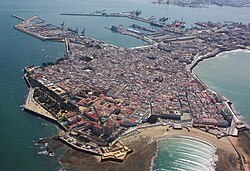
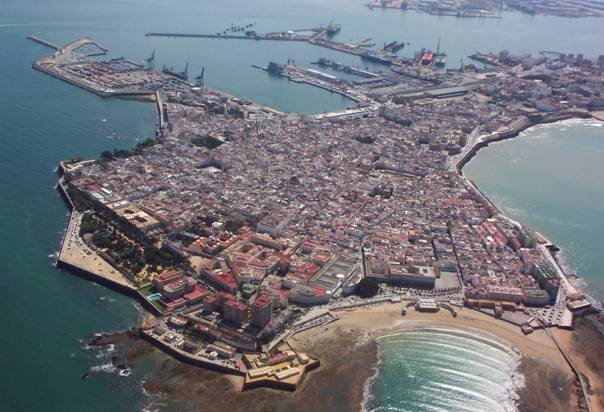
Situated on a narrow slice of land surrounded by the sea‚ Cádiz is, in most respects, a typical Andalusian city with well-preserved historical landmarks. The older part of Cádiz, within the remnants of the city walls, is commonly referred to as the Old Town (Spanish: Casco Antiguo), and represents a large area of the total size of the city. It is characterized by the antiquity of its various quarters (barrios), among them El Pópulo, La Viña, and Santa María, which present a marked contrast to the newer areas of town. While the Old City's street plan consists of narrow winding alleys connecting large plazas, newer areas of Cádiz typically have wide avenues and more modern buildings. The city is dotted with parks where exotic plants flourish, including giant trees supposedly brought to the Iberian Peninsula from the New World. This includes the historic Parque Genovés.
Names and etymology
[edit]_Seville,_Spain_(49104522676)_(cropped).jpg)
Numismatic inscriptions in the Phoenician language record that the Phoenicians knew the site as a Gadir or Agadir (Phoenician: 𐤀𐤂𐤃𐤓, ʾgdr),[7] meaning 'wall', 'compound', or (by metonymy) 'stronghold'.[8] Borrowed by the Berber languages, this became the agadir (Tamazight for 'wall' and Shilha for 'fortified granary') common in North African place names,[9] such as that of the Moroccan city of Agadir. The Carthaginians continued to use this name and all subsequent names have derived from it.
Attic Greek sources hellenized Gadir as tà Gádeira (Ancient Greek: τὰ Γάδειρα), which is neuter plural. Herodotus, using Ionic Greek, transcribed it a little differently, as Gḗdeira (Γήδειρα). Rarely, as in Stephanus of Byzantium's notes on the writings of Eratosthenes, is the name given in the feminine singular form as hè Gadeíra (ἡ Γαδείρα).
In Latin, the city was known as Gādēs and its Roman colony as Augusta Urbs Iulia Gaditana ('The August City of Julia of Cádiz'). In Arabic, the Latin name became Qādis (Arabic: قادس), from which the Spanish Cádiz derives. The Spanish demonym for people and things from Cádiz is gaditano.
The same root also gives the modern Italian Càdice, Catalan Cadis,[10] Portuguese Cádis,[11] and French Cadix, the last also appearing in many English sources before the 20th century.[12]
The name Cales, which usually refers to Calais in France, is also used for Cádiz,[12] especially in the context of the 1596 Capture of Cádiz by the British and Dutch, as Thomas Percy notes in his introduction of the ballad "The Winning of Cales"[13] (and it is also found in the sarcastic rhyme beginning "A gentleman of Wales, a knight of Cales").
In English, the name Cádiz, traditionally spelt without the acute accent mark on the a, is pronounced variously. When the accent is on the second syllable, it is usually pronounced /kəˈdɪz/ but, when the accent is on the first syllable, it may be pronounced as /ˈkeɪdɪz/ ⓘ, /ˈkɑːdɪz/, /ˈkædɪz/, and similar, typically in American English.[2][3][4] In Spanish, the accent is always, as according to the spelling, on the first syllable but, while the usual pronunciation in Spain is [ˈkaðiθ], the local dialect says [ˈkaði] or even [ˈka.i] instead.
History
[edit]
Foundation and early history under the Phoenicians
[edit]Founded as Gadir or Agadir by Phoenicians from Tyre,[16][17][18] Cádiz is often regarded as the most ancient city still standing in Western Europe.[19] The city was an important trading hub founded to access different metals including gold, tin, and especially silver.[6] The Phoenicians established a port in the 7th century BC.[20]
Traditionally, Cádiz's founding is dated to c. 1100 BC,[21] although no archaeological strata on the site can be dated earlier than the 9th century BC. One resolution for this discrepancy has been to assume that Gadir was merely a small seasonal trading post in its earliest days.
Ancient Gadir occupied two small islands—Erytheia, primarily a settlement, and Kotinoussa, hosting cemeteries and sanctuaries outside the urban area—situated near the mouth of River Guadalete.[22] Presently, these islands are interconnected. While the ancient ruins of Gadir beneath modern Cádiz's historical center remain largely unexcavated, excavations have been carried out in the southern cemeteries.
By the 6th century BC, disturbances within Phoenicia itself, notably the fall of Tyre to the Babylonians (573 BC), led to the end of Phoenician control over southern Iberia. This vacuum was later filled by ancient Carthage, which rose as a predominant power in the region during subsequent eras.[23]
Part of the Carthaginian Empire
[edit]The expeditions of Himilco around Spain and France and of Hanno around Western Africa began there. The Phoenician settlement traded with Tartessos, a city-state whose exact location remains unknown but is thought to have been somewhere near the mouth of the Guadalquivir River.
One of the city's notable features during antiquity was the temple on the south end of its island dedicated to the Phoenician god Melqart, who was conflated with Hercules by the Greeks and Romans under the names "Tyrian Hercules" and "Hercules Gaditanus". It had an oracle and was famed for its wealth.[24] In Greek mythology, Hercules was sometimes credited with founding Gadeira after performing his tenth labor, the slaying of Geryon, a monster with three heads and torsos joined to a single pair of legs. (A tumulus near Gadeira was associated with Geryon's final resting-place.[25]) According to the Life of Apollonius of Tyana, the "Heracleum" (i.e., the temple of Melqart) was still standing during the 1st century. Some historians, based in part on this source, believe that the columns of this temple were the origin of the myth of the "pillars of Hercules".[26]

The city fell under the sway of Carthage during Hamilcar Barca's Iberian campaign after the First Punic War. Cádiz became a depot for Hannibal's conquest of southern Iberia, and he sacrificed there to Hercules/Melqart before setting off on his famous journey in 218 BC to cross the Alps and invade Italy.[27] Later the city fell to Romans under Scipio Africanus in 206 BC.[28]
Under Rome's rule
[edit]Under the Roman Republic and Empire, the city flourished as a port and naval base known as Gades. Suetonius relates how Julius Caesar, when visiting Gades as a quaestor (junior senator), saw a statue of Alexander the Great there and was saddened to think that he himself, though the same age, had still achieved nothing memorable.[29]

The people of Gades had an alliance with Rome and Julius Caesar bestowed Roman citizenship on all its inhabitants in 49 BC.[24] By the time of Augustus's census, Cádiz was home to more than five hundred equites (members of the wealthy upper class), a concentration rivaled only by Patavium (Padua) and Rome itself.[30] It was the principal city of the Roman colony of Augusta Urbs Julia Gaditana. An aqueduct provided fresh water to the town, the island's supply being poor, running across open sea for its last leg. However, Roman Gades was never very large. It consisted only of the northwest corner of the present island, and most of its wealthy citizens maintained estates outside of it on the nearby island or on the mainland.[24] The lifestyle maintained on the estates led to the Gaditan dancing girls (the puellae gaditanae) becoming famous throughout the ancient world.[31]
Although it is not in fact the most westerly city in the Spanish peninsula, for the Romans Cádiz had that reputation. The poet Juvenal begins his famous tenth satire with the words: Omnibus in terris quae sunt a Gadibus usque Auroram et Gangen ('In all the lands which exist from Gades as far as Dawn and the Ganges ...').[32]
Switching hands in later antiquity
[edit]The overthrow of Roman power in Hispania Baetica by the Visigoths in the AD 400s saw the destruction of the original city, of which few traces remain today. The site was later reconquered by Justinian in 551 as part of the Byzantine province of Spania.[33] It would remain Byzantine until Leovigild's reconquest in 572 returned it to the Visigothic Kingdom.
Al-Andalus
[edit]Under Moorish rule between 711 and 1262, the city was called Qādis, whence the modern Spanish name was derived. A famous Muslim legend developed concerning an "idol" (sanam Qādis) over 100 cubits tall on the outskirts of Cádiz whose magic blocked the strait of Gibraltar with contrary winds and currents; its destruction by Abd-al-Mumin c. 1145 supposedly permitted ships to sail through the strait once more. It also appeared (as Salamcadis) in the 12th-century Pseudo-Turpin's history of Charlemagne, where it was considered a statue of Muhammad and thought to warn the Muslims of Christian invasion.[34] Classical sources are entirely silent on such a structure, but it has been conjectured that the origin of the legend was the ruins of a navigational aid constructed in late antiquity.[35] Abd-al-Mumin (or Admiral Ali ibn-Isa ibn-Maymun) found that the idol was gilded bronze rather than pure gold, but coined what there was to help fund his revolt.[36] In 1217, according to the De itinere Frisonum the city was raided by a group of Frisian crusaders en route to the Holy Land who burned it and destroyed its congregational mosque.[37] The Moors were ousted by Alphonso X of Castile in 1262.
Historically, there was a Jewish community living in Cádiz under Muslim rule.[38]
Post-1492
[edit]During the Age of Exploration, the city experienced a renaissance. Christopher Columbus sailed from Cádiz on his second and fourth voyages and the city later became the home port of the Spanish treasure fleet. Consequently, it became a major target of Spain's enemies. The 16th century saw a series of failed raids by Barbary corsairs; the greater part of the old town was consumed in a major fire in 1569; and in April 1587 a raid by the Englishman Francis Drake occupied the harbor for three days, captured six ships, and destroyed 31 others (an event which became known in England as the Singeing the King of Spain's Beard. The attack delayed the sailing of the Spanish Armada by a year.[39]

The city suffered a still more serious attack in 1596, when it was captured by an Anglo-Dutch fleet, this time under the Earls of Essex and Nottingham. 32 Spanish ships were destroyed and the city was captured, looted and occupied for almost a month. Finally, when the royal authorities refused to pay a ransom demanded by the English for returning the city intact, they burned much of it before leaving with their booty. A third English raid was mounted against the city in 1625 by George Villiers, 1st Duke of Buckingham, and Edward Cecil, but the attempt was unsuccessful. During the Anglo-Spanish War, Admiral Robert Blake blockaded Cádiz from 1655 to 1657. In the 1702 Battle of Cádiz, the English attacked again under George Rooke and James Butler, 2nd Duke of Ormonde, but they were repelled after a costly siege.
In the 18th century, the sand bars of the Guadalquivir forced the Spanish government to transfer its American trade from Seville to Cádiz, which now commanded better access to the Atlantic. Although the empire itself was declining, Cádiz now experienced another golden age because of its new importance, and many of today's historic buildings in the Old City date from this era. It became one of Spain's greatest and most cosmopolitan cities and home to trading communities from many countries, chief among which were the French and Anglo-Irish.[40] Irish Catholics were prohibited by the penal laws from owning land or entering a profession in Ireland, whereas in Spain they were as Catholics permitted to trade more freely than the English.[41]
On 12 October 1778, the right to trade with the Americas was expanded to most ports of mainland Spain, bringing the monopoly of trade hitherto enjoyed by the Port of the Bay of Cádiz to an end.[42]
During the Napoleonic Wars, Cádiz was blockaded by the British from 1797 until the Peace of Amiens in 1802 and again from 1803 until the outbreak of the Peninsular War in 1808. In that war, it was one of the few Spanish cities to hold out against the invading French and their candidate Joseph Bonaparte. Cádiz then became the seat of Spain's military high command and Cortes (parliament) for the duration of the war. It was here that the liberal Spanish Constitution of 1812 was proclaimed. The citizens revolted in 1820 to secure a renewal of this constitution and the revolution spread successfully until Ferdinand VII was imprisoned in Cádiz. French forces secured the release of Ferdinand in the 1823 Battle of Trocadero and suppressed liberalism for a time. In 1868, Cádiz was once again the seat of a revolution, resulting in the eventual abdication and exile of Queen Isabella II. The Cortes of Cádiz decided to reinstate the monarchy under King Amadeo just two years later.
In recent years[when?], the city has undergone much reconstruction. Many monuments, cathedrals, and landmarks have been cleaned and restored.
Diocese
[edit]The diocese of Cádiz and Ceuta is a suffragan of the Roman Catholic Archdiocese of Seville; that is, it is a diocese within the metropolitan see of Seville. It became a diocese in 1263 after its Reconquista (reconquest) from the Moors. By the Concordat of 1753, in which the Spanish crown also gained the rights to make appointments to church offices and to tax church lands, the Diocese of Cádiz was merged with the Diocese of Ceuta, a Spanish conclave on the northern coast of Africa, and the diocesan bishop became, by virtue of his office, the apostolic administrator of Ceuta.
Main sights
[edit]

Among many landmarks of historical and scenic interest is an unusual cathedral of various architectural styles, a theater, an old municipal building, an 18th-century watchtower, a vestige of the ancient city wall, an ancient Roman theater, and electrical pylons of modern design carrying cables across the Bay of Cádiz. The old town is characterized by narrow streets connecting squares (plazas), bordered by the sea and by the city walls. Most of the landmark buildings are situated in the plazas.
Plazas and their landmark buildings
[edit]The old town of Cádiz is one of the most densely populated urban areas in Europe,[43] and is packed with narrow streets with several plazas. These are the Plaza de Mina, Plaza San Antonio, Plaza de Candelaria, Plaza de San Juan de Dios, and Plaza de España.
Plaza de Mina
[edit]In the centre of the old town, the Plaza de Mina was developed in the first half of the 19th century. The land was previously occupied by the orchard of the convent of San Francisco. The area was converted into a plaza in 1838 by the architect Torcuato Benjumeda and (later) Juan Daura, with its trees being planted in 1861. It was then redeveloped again in 1897, and has remained virtually unchanged since that time. It is named after General Francisco Espoz y Mina, a hero of the war of independence. Manuel de Falla y Matheu was born in Number 3 Plaza de Mina, where a plaque bears his name. The plaza also contains several statues, one of these is a bust of José Macpherson (a pioneer in the development of petrography, stratigraphy and tectonics) who was born in number 12 Plaza de Mina in 1839. The Museum of Cádiz, is to be found at number 5 Plaza de Mina, and contains many objects from Cádiz's 3000-year history as well as works by artists such as Peter Paul Rubens. The houses which face the plaza, many of which can be classified as neo-classical architecture or built in the style of Isabelline Gothic, were originally occupied by the Cádiz bourgeoisie.
The Plaza de la Catedral houses both the Cathedral and the Baroque church of Santiago, built in 1635.
Plaza de San Francisco and San Francisco Church and Convent
[edit]
Located next to Plaza de Mina, this smaller square houses the San Francisco church and convent. Originally built in 1566, it was substantially renovated in the 17th century,[44] when its cloisters were added.[45] Originally, the Plaza de Mina formed the convent's orchard.
Plaza San Antonio
[edit]
In the 19th century Plaza San Antonio was considered to be Cádiz's main square. The square is surrounded by a number of mansions built in neo-classical architecture or Isabelline Gothic style, once occupied by the Cádiz upper classes. San Antonio church, originally built in 1669, is also situated in the plaza.
The plaza was built in the 18th century, and on 19 March 1812 the Spanish Constitution of 1812 was proclaimed here, leading to the plaza to be named Plaza de la Constitución, and then later Plaza San Antonio, after the hermit San Antonio.
In 1954 the city's mayor proclaimed the location a historic site. All construction is prohibited.
Plaza de Candelaria
[edit]The Plaza de Candelaria is named after the Candelaria convent, situated in the square until it was demolished in 1873 under the First Spanish Republic, when its grounds were redeveloped as a plaza. The plaza is notable for a statue in its centre of Emilio Castelar, president of the first Spanish republic, who was born in a house facing the square. A plaque situated on another house, states that Bernardo O'Higgins, an Irish-Chilean adventurer and former dictator of Chile, also lived in the square.
Plaza de la Catedral and the Cathedral
[edit]
One of Cádiz's most famous landmarks is its cathedral. Unlike in many places, the Cathedral of Cádiz, known locally as the "New Cathedral," is officially the Cathedral de "Santa Cruz sobre el mar" or "Santa Cruz sobre las Aguas". It was not built on the site of the original Cathedral de Santa Cruz. The latter was completed in 1263 at the behest of Alfonso X, and burned in the Anglo-Dutch attack on the city in 1596.[46] The reconstruction of the old cathedral started in the early 17th century, but when the city became more prosperous following the move of the Casa de Contratación from Seville to Cádiz in 1717,[47] it was felt that a grander cathedral was needed.[48]
Work on the New Cathedral started in 1722 and was supervised by the architect Vicente Acero, who had also built the Granada Cathedral. Acero resigned from the project and was succeeded by several other architects. As a result, this largely Baroque-style cathedral was built over a period of 116 years, and, due to this drawn-out period of construction, the cathedral underwent several major changes to its original design. Though the cathedral was originally intended to be a baroque edifice with some rococo elements, it was completed in the neoclassical style.[48] Its chapels have many paintings and relics from the old cathedral in Cádiz and as well as from monasteries throughout Spain.
Plaza de San Juan de Dios and the Old Town Hall
[edit]
Construction of this plaza began in the 15th century on lands reclaimed from the sea. With the demolition of the City walls in 1906 the plaza increased in size and a statue of the Cádiz politician Segismundo Moret was unveiled. Overlooking the plaza, the Ayuntamiento is the town hall of Cádiz's Old City. The structure, constructed on the bases and location of the previous Consistorial Houses (1699), was built in two stages. The first stage began in 1799 under the direction of architect Torcuato Benjumeda in the neoclassical style. The second stage was completed in 1861 under the direction of García del Alamo, in the Isabelline Gothic (Spanish: Gótico Isabelino or, simply, the Isabelino) style. Here, in 1936, the flag of Andalusia was hoisted for the first time.
Plaza de España and the monument to the constitution of 1812
[edit] |

The Plaza de España is a large square close to the port. It is dominated by the Monument to the Constitution of 1812, which came into being as a consequence of the demolition of a portion of the old city wall. The plaza is an extension of the old Plazuela del Carbón.
The goal of this demolition was to create a grand new city square to mark the hundredth anniversary of the liberal constitution, which was proclaimed in this city in 1812, and provide a setting for a suitable memorial. The work is by the architect, Modesto Lopez Otero, and of the sculptor, Aniceto Marinas. The work began in 1912 and finished in 1929.
Plaza Fragela and the Gran Teatro Falla (Falla Grand Theater)
[edit]The original Gran Teatro was constructed in 1871 by the architect García del Alamo, and was destroyed by a fire in August 1881. The current theater was built between 1884 and 1905 over the remains of the previous Gran Teatro. The architect was Adolfo Morales de los Rios, and the overseer of construction was Juan Cabrera de la Torre. The outside was covered in red bricks and is of a neo-Mudéjar or Moorish revival style. Following renovations in the 1920s, the theater was renamed the Gran Teatro Falla, in honor of composer Manuel de Falla, who is buried in the crypt of the cathedral. After a period of disrepair in the 1980s, the theater has since undergone extensive renovation.
.jpg)
Other sights
[edit]Tavira tower
[edit]In the 18th century, Cádiz had more than 160 towers from which local merchants could look out to sea to watch for arriving merchant ships from the New World. These towers often formed part of the merchants' houses, but this particular tower was located on a high point in the city, 45 meters above sea level, and was chosen by the Navy as their official lookout in 1787 (after eliminating several other locations previously).[49] The Torre Tavira, was named for its original watchman, Don Antonio Tavira, a lieutenant in the Spanish Navy.[50] Today it is the tallest of the towers which still dot the Cádiz skyline. Since 1994 there is a camera obscura, a room that uses the principle of the pinhole camera and a specially prepared convex lens to project panoramic views of the Old City onto a concave disc. There are also two exhibition rooms and a rooftop terrace.[51]
Admiral's House
[edit]The Casa del Almirante is a palatial house, adjacent to the Plaza San Martín in the Barrio del Pópulo, which was constructed in 1690 with the proceeds of the lucrative trade with the Americas. It was built by the family of the admiral of the Spanish treasure fleet, the so-called Fleet of the Indies, Don Diego de Barrios. The exterior is sheathed in exquisite red and white Genoan marble, prepared in the workshops of Andreoli, and mounted by the master, García Narváez. The colonnaded portico, the grand staircase under the cupola, and the hall on the main floor are architectural features of great nobility and beauty. The shield of the Barrios family appears on the second-floor balcony.
Old customs house
[edit]Situated within the confines of the walls which protect the flank of the port of Cádiz are three identical adjacent buildings: the Customs House, the House of Hiring and the consulate. Of the three, the former had been erected first, built in a sober neo-classical style and of ample and balanced proportions. The works began in 1765 under the direction of Juan Caballero at a cost of 7,717,200 reales.
Palacio de Congresos
[edit]Cádiz's refurbished tobacco factory offers international conference and trade-show facilities.[52] Home to the third annual MAST Conference and trade-show (12 to 14 November 2008).
Pylons of Cádiz
[edit]The Pylons of Cádiz are electricity pylons of unusual design, one on either side of the Bay of Cádiz, used to support huge electric-power cables. The pylons are 158 meters (518 ft) high and designed for two circuits. The very unconventional construction consists of a narrow frustum steel framework with one crossbar at the top of each one for the insulators.
Roman theatre
[edit]The Roman theatre was discovered in 1980, in the El Pópulo district, after a fire had destroyed some old warehouses, revealing a layer of construction that was judged to be the foundations of some medieval buildings; the foundations of these buildings had been built, in turn, upon much more ancient stones, hand-hewn limestone of a Roman character. Systematic excavations have revealed a largely intact Roman theatre.
The theatre, constructed by order of Lucius Cornelius Balbus (minor) during the 1st century BC, is the second-largest Roman theatre in the world, surpassed only by the theatre of Pompeii, south of Rome. Cicero, in his Epistulae ad Familiares ('Letters to his friends'), wrote of its use by Balbus for personal propaganda.
-
 Admiral's House
 -
 Palacio de Congresos (Old tobacco factory)
 -
 Pylons of Cádiz
 -
 Roman theatre

.jpg)


Carranza Bridge
[edit]La Pepa Bridge
[edit]La Pepa Bridge, officially "La Pepa" and also named the second bridge to Cádiz or new access to Cádiz. It opened 24 September 2015. It crosses the Bay of Cádiz linking Cádiz with Puerto Real in mainland Spain. It is the longest bridge in Spain and the longest span cable-stayed in the country.[53]
The Constitution of 1812 Bridge, also known as La Pepa Bridge, is a new bridge across the Bay of Cádiz, linking Cádiz with the town of Puerto Real.
This is one of the highest bridges in Europe, with 5 kilometers in total length. It is the third access to the city, along with the San Fernando road and the Carranza bridge.[citation needed]
.JPG)
City walls and fortifications
[edit]Las Puertas de Tierra originated in the 16th century.[54][55] Once consisting of several layers of walls, only one of these remain today. By the 20th century it was necessary to remodel the entrance to the Old City to accommodate modern traffic. Today, the two side-by-side arches cut into the wall serve as one of the primary entrances to the city.
El Arco de los Blancos is the gate to the Populo district, built around 1300. It was the principal gate to the medieval town. The gate is named after the family of Felipe Blanco who built a chapel (now disappeared) above the gate.
El Arco de la Rosa ("Rose Arch") is a gate carved into the medieval walls next to the cathedral. It is named after captain Gaspar de la Rosa, who lived in the city during the 18th century. The gate was renovated in 1973.
The Baluarte de la Candelaria (fortress or stronghold of Candlemas) is a military fortification. Taking advantage of a natural elevation of land, it was constructed in 1672 at the initiative of the governor, Diego Caballero de Illescas. Protected by a seaward-facing wall that had previously served as a seawall, Candelaria's cannons were in a position to command the channels approaching the port of Cádiz. In more recent times, the edifice has served as a headquarters for the corps of military engineers and as the home to the army's homing pigeons, birds used to carry written messages over hostile terrain. Thoroughly renovated, it is now used as a cultural venue. There has been some discussion of using it to house a maritime museum, [citation needed] but, at present, it is designated for use as a permanent exposition space.
The Castle of San Sebastián is also a military fortification and is situated at the end of a road leading out from the Caleta beach. It was built in 1706. Today the castle remains unused, although its future uses remain much debated.
The Castle of Santa Catalina is also a military fortification, and is situated at the end of the Caleta beach. It was built in 1598 following the English sacking of Cádiz two years earlier. Recently[when?] renovated, today it is used for exhibitions and concerts.
-
 Las puertas de tierra
 -
 Arco de la Rosa
 -
 Inside view of Castillo de Santa Catalina
 -
 1699 plan of Cádiz.
.jpg)


Notable people born in Cádiz
[edit]- Joaquín del Real Alencaster (1761-?), governor of Santa Fe de Nuevo México between 1804 and 1807
- Juan Bautista Aznar (1860–1933), Prime Minister of Spain
- Manuel de Falla (1876-1946), composer
- Josefa Díaz Fernández (1871-1918), flamenco dancer and singer
- Chico Flores (born 1987), professional footballer
- Lucius Cornelius Balbus, consul
- Lucius Cornelius Balbus the Younger, general
- Lucius Junius Moderatus Columella, Roman agronomic writer
- Miguel Martínez de Pinillos Sáenz (1875-1953), ship-owner and politician
- George Meade, Union general of The American Civil War
- José Celestino Mutis (1732-1808), botanist and mathematician
- Esteban Piñero Camacho (born 1981), known as Basty, member of the Spanish band D'NASH
Climate
[edit]Cádiz has a hot-summer Mediterranean climate (Köppen Csa; Trewartha: Csal) with very mild winters and warm to hot summers. The city has significant maritime influences due to its position on a narrow peninsula. Cádiz has one of the warmest winters in Spain and the warmest winter in Europe outside Spain, with an average temperature of 12.9 °C (55.2 °F) in the coldest month.[56] The annual sunshine hours of Cádiz are above 3,000h, being one of the sunniest cities in Europe. Although summer nights are tropical in nature, daytime temperatures are comparatively subdued compared to nearby inland areas such as Jerez and the very hot far inland areas in Andalucía. The average sea temperature is around 16 °C (61 °F) during the winter and around 22 °C (72 °F) during the summer.[57] Snowfall is unknown at least since 1935.[58]
| Climate data for Cádiz WMO ID: 08452; Climate ID: 5973; coordinates 36°29′59″N 06°15′28″W / 36.49972°N 6.25778°W; elevation: 2 m (6 ft 7 in); 1991–2020 provisional normals, extremes 1955–present[59] | |||||||||||||
|---|---|---|---|---|---|---|---|---|---|---|---|---|---|
| Month | Jan | Feb | Mar | Apr | May | Jun | Jul | Aug | Sep | Oct | Nov | Dec | Year |
| Record high °C (°F) | 24.1 (75.4) |
25.3 (77.5) |
29.0 (84.2) |
31.4 (88.5) |
36.5 (97.7) |
37.6 (99.7) |
40.0 (104.0) |
43.0 (109.4) |
37.8 (100.0) |
31.5 (88.7) |
27.6 (81.7) |
23.6 (74.5) |
43.0 (109.4) |
| Mean maximum °C (°F) | 19.5 (67.1) |
20.8 (69.4) |
24.2 (75.6) |
26.1 (79.0) |
29.2 (84.6) |
31.7 (89.1) |
33.9 (93.0) |
33.9 (93.0) |
31.4 (88.5) |
28.2 (82.8) |
23.8 (74.8) |
20.2 (68.4) |
35.1 (95.2) |
| Mean daily maximum °C (°F) | 16.1 (61.0) |
16.8 (62.2) |
18.7 (65.7) |
20.2 (68.4) |
23.0 (73.4) |
25.5 (77.9) |
27.6 (81.7) |
28.2 (82.8) |
26.1 (79.0) |
23.5 (74.3) |
19.6 (67.3) |
17.1 (62.8) |
21.9 (71.4) |
| Daily mean °C (°F) | 12.9 (55.2) |
13.7 (56.7) |
15.5 (59.9) |
17.2 (63.0) |
19.9 (67.8) |
22.6 (72.7) |
24.6 (76.3) |
25.3 (77.5) |
23.3 (73.9) |
20.5 (68.9) |
16.5 (61.7) |
14.0 (57.2) |
18.8 (65.8) |
| Mean daily minimum °C (°F) | 9.6 (49.3) |
10.5 (50.9) |
12.4 (54.3) |
14.1 (57.4) |
16.8 (62.2) |
19.6 (67.3) |
21.5 (70.7) |
22.3 (72.1) |
20.4 (68.7) |
17.5 (63.5) |
13.4 (56.1) |
10.9 (51.6) |
15.8 (60.4) |
| Mean minimum °C (°F) | 5.1 (41.2) |
6.2 (43.2) |
8.1 (46.6) |
10.5 (50.9) |
12.8 (55.0) |
16.7 (62.1) |
18.8 (65.8) |
19.4 (66.9) |
17.1 (62.8) |
13.2 (55.8) |
8.7 (47.7) |
5.8 (42.4) |
3.7 (38.7) |
| Record low °C (°F) | 0.2 (32.4) |
−1.0 (30.2) |
3.0 (37.4) |
6.5 (43.7) |
9.2 (48.6) |
11.0 (51.8) |
16.6 (61.9) |
15.6 (60.1) |
12.6 (54.7) |
8.0 (46.4) |
4.6 (40.3) |
1.5 (34.7) |
−1.0 (30.2) |
| Average precipitation mm (inches) | 59.6 (2.35) |
51.4 (2.02) |
55.0 (2.17) |
42.1 (1.66) |
29.7 (1.17) |
5.9 (0.23) |
0.2 (0.01) |
1.7 (0.07) |
27.6 (1.09) |
75.2 (2.96) |
87.1 (3.43) |
76.6 (3.02) |
512.1 (20.16) |
| Average precipitation days (≥ 0.1 mm) | 8.97 | 8.33 | 8.48 | 7.20 | 4.67 | 1.14 | 0.31 | 0.62 | 3.41 | 8.11 | 8.79 | 9.59 | 69.62 |
| Average relative humidity (%) | 73.7 | 72.6 | 70.7 | 68.3 | 67.2 | 67.3 | 68.0 | 68.4 | 70.9 | 72.6 | 72.9 | 75.4 | 70.8 |
| Percentage possible sunshine | 60.6 | 66.2 | 61.1 | 69.1 | 71.3 | 79.0 | 78.9 | 79.4 | 68.7 | 64.6 | 62.9 | 56.0 | 68.2 |
| Source 1: State Meteorological Agency/AEMET OpenData (Percent possible sunshine 1991-2013)[60][61][62][63] | |||||||||||||
| Source 2: NOAA/NCEI[64] | |||||||||||||
| Climate data for Cádiz, 1981-2010 normals | |||||||||||||
|---|---|---|---|---|---|---|---|---|---|---|---|---|---|
| Month | Jan | Feb | Mar | Apr | May | Jun | Jul | Aug | Sep | Oct | Nov | Dec | Year |
| Mean daily maximum °C (°F) | 16.0 (60.8) |
16.8 (62.2) |
18.8 (65.8) |
19.9 (67.8) |
22.1 (71.8) |
25.3 (77.5) |
27.7 (81.9) |
27.9 (82.2) |
26.3 (79.3) |
23.4 (74.1) |
19.6 (67.3) |
16.9 (62.4) |
21.6 (70.9) |
| Daily mean °C (°F) | 12.7 (54.9) |
13.8 (56.8) |
15.5 (59.9) |
16.8 (62.2) |
19.1 (66.4) |
22.4 (72.3) |
24.6 (76.3) |
25.0 (77.0) |
23.3 (73.9) |
20.3 (68.5) |
16.5 (61.7) |
13.9 (57.0) |
18.6 (65.5) |
| Mean daily minimum °C (°F) | 9.4 (48.9) |
10.7 (51.3) |
12.3 (54.1) |
13.7 (56.7) |
16.2 (61.2) |
19.5 (67.1) |
21.4 (70.5) |
22.0 (71.6) |
20.3 (68.5) |
17.3 (63.1) |
13.4 (56.1) |
10.9 (51.6) |
15.4 (59.7) |
| Average precipitation mm (inches) | 69 (2.7) |
58 (2.3) |
35 (1.4) |
45 (1.8) |
27 (1.1) |
7 (0.3) |
trace | 2 (0.1) |
24 (0.9) |
67 (2.6) |
98 (3.9) |
92 (3.6) |
523 (20.6) |
| Average precipitation days (≥ 1.0 mm) | 6.9 | 6.4 | 4.8 | 5.6 | 3.2 | 0.9 | 0.1 | 0.2 | 2.5 | 5.6 | 7.2 | 8.1 | 50.7 |
| Average relative humidity (%) | 75 | 74 | 71 | 69 | 70 | 69 | 68 | 70 | 71 | 74 | 74 | 76 | 72 |
| Mean monthly sunshine hours | 184 | 197 | 228 | 255 | 307 | 331 | 354 | 335 | 252 | 228 | 187 | 166 | 3,024 |
| Source: Agencia Estatal de Meteorología[65] | |||||||||||||
Beaches
[edit]Cádiz, situated on a peninsula, is home to many beaches.

La Playa de la Caleta is the most popular beach of Cádiz. It has always been in Carnival songs, due to its unequalled beauty and its proximity to the Barrio de la Viña. It is the beach of the Old City, situated between two castles, San Sebastian and Santa Catalina. It is around 400 meters (1,300 ft) long and 30 meters (98 ft) wide at low tide. La Caleta and the boulevard show a lot of resemblance to parts of Havana, the capital city of Cuba, like the malecon. Therefore, it served as the set for several of the Cuban scenes in the beginning of the James Bond movie Die Another Day.
La Playa de la Victoria, in the newer part of Cádiz, is the beach most visited by tourists and natives of Cádiz. It is about three km long, and it has an average width of 50 meters (160 ft) of sand. The moderate swell and the absence of rocks allow family bathing. It is separated from the city by an avenue; on the landward side of the avenue, there are many shops and restaurants.
La Playa de Santa María del Mar or Playita de las Mujeres is a small beach in Cádiz, situated between La Playa de Victoria and La Playa de la Caleta. It features excellent views of the old district of Cádiz.
Other beaches are Torregorda, Cortadura and El Chato.
Culture
[edit]Language
[edit]The Spanish spoken in Cádiz reflects features of Western Andalusian and urban dialects. It is seseante, meaning there is no distinction between the sounds of "s" and "z," and the "s" is pronounced with the front part of the tongue (predorsal s).[66] Key characteristics include:
- Aspiration of /s/ at the end of syllables (e.g., los amigos becomes [loh amigo]).[67]
- Dropping /r/ at the end of syllables and aspirating /r/ when it comes before "n" or "l" (e.g., carne pronounced [kahne]).[67]
- The /x/ sound (as in jamón) is usually pronounced as [h], a softer sound.[68]
- Intervocalic /d/ (e.g., cansado) is often omitted (e.g., cansao).[69]
- Occasionally, "l" is pronounced as "r" (rhotacism), though this is less common.[70]
These features make the Cádiz accent unique, showcasing a strong influence of regional and urban speech patterns.
Carnival
[edit]
The Carnival of Cádiz is one of the best known carnivals in the world. Throughout the year, carnival-related activities are almost constant in the city; there are always rehearsals, public demonstrations, and contests of various kinds.
The Carnival of Cádiz is famous for the satirical groups called chirigotas, who perform comical musical pieces. Typically, a chirigota is composed of seven to twelve performers[71] who sing, act and improvise accompanied by guitars, kazoos, a bass drum, and a variety of noise-makers. Other than the chirigotas, there are many other groups of performers: choruses; ensembles called comparsas, who sing in close harmony much like the barbershop quartets of African-American culture or the mariachis of Mexico; cuartetos, consisting of four (or sometimes three) performers alternating dramatic parodies and humorous songs; and romanceros, storytellers who recite tales in verse. These diverse spectacles turn the city into a colourful and popular open-air theatre for two entire weeks in February.
The Concurso Oficial de Agrupaciones Carnavalescas (the official association of carnival groups) sponsors a contest in the Gran Teatro Falla (see above) each year where chirigotas and other performers compete for prizes. This is the climactic event of the Cádiz carnival.
Cuisine
[edit]
The gastronomy of Cádiz includes stews and sweets typical of the comarca and the city.
|
Demographics
[edit]| Year | Pop. | ±% |
|---|---|---|
| 1842 | 53,922 | — |
| 1857 | 70,811 | +31.3% |
| 1877 | 64,551 | −8.8% |
| 1887 | 63,277 | −2.0% |
| 1900 | 69,191 | +9.3% |
| 1910 | 67,306 | −2.7% |
| 1920 | 76,137 | +13.1% |
| 1930 | 74,367 | −2.3% |
| 1940 | 85,854 | +15.4% |
| 1950 | 98,754 | +15.0% |
| 1960 | 114,951 | +16.4% |
| 1970 | 134,342 | +16.9% |
| 1981 | 156,711 | +16.7% |
| 1991 | 154,347 | −1.5% |
| 2001 | 133,363 | −13.6% |
| 2011 | 124,014 | −7.0% |
| 2021 | 114,442 | −7.7% |
| Source: INE[72] | ||
According to a 2021 census estimate, the population of the city of Cádiz was 114,244 (the third-most-populated city of the province after Jerez de la Frontera, with 212,830 inhabitants, and Algeciras with 122,982). It is the only capital city in Spain that is not the most or second-most populated City on its province. Cádiz is the fifty-seventh-largest Spanish city.[73] In recent years, the city's population has steadily declined; it is the only municipality of the Bay of Cádiz (the comarca composed of Cádiz, Chiclana, El Puerto de Santa María, Puerto Real, and San Fernando), whose population has diminished. There are forecasts that Cádiz may become the fourth or fifth city in the province after losing more than 10,000 inhabitants from 2011 to 2021.[74] Between 1995 and 2006, it lost more than 14,000 residents, a decrease of 9%.
Among the causes of this loss of population is the peculiar geography of Cádiz; the city lies on a narrow spit of land hemmed in by the sea. Consequently, there is a pronounced shortage of land to be developed. [citation needed] The city has very little vacant land, and a high proportion of its housing stock is relatively low in density. [citation needed] (That is to say, many buildings are only two or three stories tall, and they are only able to house a relatively small number of people within their "footprint".) The older quarters of Cádiz are full of buildings that, because of their age and historical significance, are not eligible for urban renewal.[citation needed]
Two other physical factors tend to limit the city's population. It is impossible to increase the amount of land available for building by reclaiming land from the sea; a new national law governing coastal development thwarts this possibility. Also, because Cádiz is built on a sandspit, it is a costly proposition to sink foundations deep enough to support the high-rise buildings that would allow for a higher population density. As it stands, the city's skyline is not substantially different from in the Middle Ages. A 17th-century watchtower, the Tavira Tower, still commands a panoramic view of the city and the bay despite its relatively modest 45 meters (148 ft) height. (See below.)
Cádiz is the provincial capital with the highest rate of unemployment in Spain. This, too, tends to depress the population level. Young Gaditanos, those between 18 and 30 years of age, have been migrating to other places in Spain (Madrid and Castellón, chiefly), as well as to other places in Europe and the Americas. The population younger than twenty years old is only 20.58% of the total, and the population older than sixty-five is 21.67%, making Cádiz one of the most aged cities in all of Spain.[citation needed]
Population density
[edit]The population distribution of the municipality is extremely uneven. In its inhabited areas, Cádiz is one of the most densely populated cities in Europe. The uninhabited Zona Franca industrial area, Bay of Cádiz Port Area, and Bay of Cádiz Natural Park occupy 63.63% of the municipal area. The entire city population lives in the remaining 4.4 square kilometers (1.7 sq mi), at an average density close to 30,000 inhabitants per square kilometer. The city is divided for statistical purposes into 10 divisions, the most densely populated one having 39,592 inhabitants per square kilometer, the least having 20,835.
The table below lists the area, population, and population density of the ten statistical divisions of Cádiz. Divisions 1 to 7, the "stats divisions", belong to the old town; 8, 9 and 10 correspond to the "new city".
| Statistical division | 1 | 2 | 3 | 4 | 5 | 6 | 7 | 8 | 9 | 10 |
|---|---|---|---|---|---|---|---|---|---|---|
| Area | 0.32 | 0.20 | 0.28 | 0.15 | 0.13 | 0.17 | 0.20 | 1.09 | 0.83 | 1.03 |
| Population | 6,794 | 6,315 | 6,989 | 5,752 | 5,147 | 4,637 | 4,167 | 29,936 | 28,487 | 32,157 |
| Density | 21,231.25 | 31,575.00 | 24,960.71 | 38,346.67 | 39,592.31 | 27,276.47 | 20,835.00 | 27,464.22 | 34,321.69 | 31,220.39 |
Area is in km2 and population density in inhabitants per square kilometer.
Transportation
[edit]
Cádiz is connected to European route E5 which connects it with Sevilla, Cordoba and Madrid to the North and Algeciras to the South East, continuing as E15 northbound along the Spanish Mediterranean coast.
The city is served by Jerez Airport, which is approximately 40 km (25 mi) north of the city centre. The airport offers regular domestic flights to Madrid and Barcelona as well as scheduled and seasonal charter flights to the UK, Germany and other European destinations. Cercanías Cádiz line C1 connects the airport to Cádiz main train station in 1hr.[76]
Cádiz railway station is located just outside the old town. It offers suburban, regional and national services. The connection to the Madrid-Seville high-speed rail line was finished in 2015 after 14 years of construction, which extends the high speed Alvia trains to the city. Local services make the outskirts and regional destinations accessible along the line to Jerez and Seville. It is also the terminal of the new Cádiz Bay tram-train.
The port opposite the train station provides weekly ferry services to the Canary Islands (2–3 days travel time)[77] as well as providing a stop for seasonal cruise ships.[78]
Twin towns – sister cities
[edit]Cádiz is twinned with:
 Ambalema, Colombia (2008)[79]
- Bogotá, Colombia (2008)[79]
 Brest, France (1986)[80][79]
 Buenos Aires, Argentina (1975)[79]
 Ceuta, Spain (2007)[79]
 Dakhla, Western Sahara/Morocco (1992)[79]
- A Coruña, Spain (2005)[79]
- Guaduas, Colombia (2008)[79]
 Havana, Cuba (1998)[79]
- Honda, Colombia (2008)[79]
- Huelva, Spain[79]
 Mexico City, Mexico[79]
- Móstoles, Spain (2008)[79]
- Las Palmas de Gran Canaria, Spain[79]
- Puebla, Mexico[79]
- San Pedro Cholula, Mexico[79]

 San Juan, Puerto Rico, USA[79]
- San Sebastián de Mariquita, Colombia (2008)[79]
- Santa Cruz de Tenerife, Spain[79]
- Tangier, Morocco[79]
- Torrevieja, Spain (2003)[79]
- Veracruz, Mexico[79]


See also
[edit]References
[edit]Citations
[edit]- ^ National Statistics Institute (13 December 2024). "Municipal Register of Spain of 2024".
- ^ a b "Cádiz". Collins English Dictionary. HarperCollins. Retrieved 26 September 2014.
- ^ a b "Cádiz". Merriam-Webster.com Dictionary. Merriam-Webster. Retrieved 22 July 2013.
- ^ a b "Cádiz". The American Heritage Dictionary of the English Language (5th ed.). HarperCollins. Retrieved 11 May 2019.
- ^ Strabo, Geographica 3.5.5
- ^ a b Gitin, Seymour (2002). The Phoenicians in Spain: An Archaeological Review of the Eighth-Sixth Centuries B.C.E. | A Collection of Articles Translated from Spanish. Penn State Press. pp. 156–157. ISBN 978-1-57506-529-8.
- ^ Head & al. (1911), p. 3.
- ^ "Phoenician and Punic Inscriptions", p. 141. Journal of the Royal Asiatic Society of Great Britain and Ireland. Accessed 24 July 2013.
- ^ Lipiński, Edward (2002). Semitic Languages: Outline of a Comparative Grammar. Orientalia Lovaniensia Analecta. Vol. 80. Peeters Leeuven (published 2001). p. 575. ISBN 978-90-429-0815-4. Archived from the original on 11 October 2017. Retrieved 28 June 2008.
- ^ "Nomenclàtor mundial - Oficina d'Onomàstica - Secció Filològica - Institut d'Estudis Catalans". Retrieved 5 August 2024.
- ^ Dicionário de Gentílicos e Topónimos. Portal da Língua Portuguesa. portaldalinguaportuguesa.org. 26 November 2022.
- ^ a b Osbeck, Peter (1771). A Voyage to China and the East Indies. Vol. 1. Translated by Forster, Johann Reinhold. London: Benjamin White. p. 13.
Cadiz, or Cadix, or, as the Engliſh ſometimes call it, Cales is the principal ſea-port in Spain
- ^ "The Winning of Cales." at the Ex-Classics project website. "The subject of this ballad is the taking of the city of Cadiz (called by our sailors corruptly Cales)..."
- ^ A. B. Freijeiro, R. Corzo Sánchez, Der neue anthropoide Sarkophag von Cadiz. In: Madrider Mitteilungen 22, 1981.
- ^ "Phoenician anthropoid sarcophagi, male (around 450-400 BC) and female (around 470 BC), Cadiz Museum, Cádiz, Cadiz". Spain is culture. Retrieved 23 December 2018.
- ^ R. Bierling, Marilyn; Gitin, Seymour (2002). The Phoenicians in Spain : An Archaeological Review of the Eighth-sixth Centuries B.C.E. : a Collection of Articles Translated from Spanish. Pennsylvania State University Press. p. 155. ISBN 9781575060569.
- ^ Eugenia Aubet Semmler, María (2022). "Tyre and its colonial expansion". The Oxford Handbook of the Phoenician and Punic Mediterranean. Oxford University Press. p. 77. ISBN 9780197654422.
- ^ Álvarez-Martí-Aguilar, Manuel (2022). "The Gadir-Tyre Axis". The Oxford Handbook of the Phoenician and Punic Mediterranean. Oxford University Press. p. 619. ISBN 9780197654422.
- ^ Espinosa, Pedro (2007). EL PAIS. Hallado en Cádiz un muro de 3.000 años
- ^ Krensky, Stephen (1987). Who Really Discovered America?. Illustrated by Steve Sullivan. Scholastic Inc. p. 30. ISBN 0-590-40854-2.
- ^ Velleius Paterculus, Hist. Rom. I.2.1-3.
- ^ Pérez, Sebastián Celestino; López-Ruiz, Carolina (2016). Tartessos and the Phoenicians in Iberia. Oxford University Press. pp. 140–141. ISBN 978-0-19-967274-5.
- ^ Pérez, Sebastián Celestino; López-Ruiz, Carolina (2016). Tartessos and the Phoenicians in Iberia. Oxford University Press. pp. 147–148. ISBN 978-0-19-967274-5.
- ^ a b c Smith, Philip (1854). "Gades (-ium; also Gadis, and Gaddis)". In William Smith (ed.). Dictionary of Greek and Roman geography. (In two volumes). Vol. 1: ABACAENUM — HYTANIS. Boston: Little, Brown & Co. pp. 923–925.
- ^ Life of Apollonius of Tyana, v. 5.
- ^ From the Life of Apollonius of Tyana: " ... the pillars in the temple were made of gold and silver smelted together so as to be of one color, and they were over a cubit high, of square form, resembling anvils; and their capitals were inscribed with letters which were neither Egyptian nor Indian nor of any kind which he could decipher. But Apollonius, since the priests would tell him nothing, remarked: 'Heracles of Egypt does not permit me not to tell all I know. These pillars are ties between earth and ocean, and they were inscribed by Heracles in the house of the Fates, to prevent any discord arising between the elements, and to save their mutual affection for one another from violation.'"
- ^ Livy, 21.21.
- ^ Livy (epitome) 33.
- ^ Suetonius, Divi Iuli, Vita Divi Iuli 7.
- ^ Strabo. Geography.
- ^ Fear, A. T. (1991). "The Dancing Girls of Cadiz". Greece & Rome. 38 (1): 75–79. doi:10.1017/S0017383500023007. ISSN 0017-3835. JSTOR 643110.
- ^ Juvenal, Satires, 10.1-2.
- ^ Evans, J. A. S. (2003). New Catholic Encyclopedia (2nd ed.). Justinian I, Byzantine Emperor: Gale. pp. 95–102. Retrieved 26 January 2017.
- ^ Archbishop Turpin (ascribed). Thomas Rodd, translator (1812). History of Charles the Great and Orlando, p. 6. London: James Compton. Accessed 23 July 2013.
- ^ Fear, A. T. (1990). "The Tower of Cádiz". Faventia: Revista de Filologia Clàssica. 12–13 (1990–1991): 199–211. ISSN 2014-850X. PDF link
- ^ Ahmed ibn Mohammed al-Makkari. Pascual De Gauangos, ed. & translator (2002). The History of the Mohammadan Dynasties in Spain. Vol. I, p. 78. Routledge Accessed 23 July 2013.
- ^ Villegas-Aristizábal, Lucas, "A Frisian Perspective on Crusading in Iberia as Part of the Sea Journey to the Holy Land, 1217–1218," Studies in Medieval and Renaissance History, 3rd Series 15 (2018, Pub. 2021): 88-149. eISBN 978-0-86698-876-6
- ^ "Cádiz, Spain". Jewish Virtual Library. Retrieved 26 June 2024.
- ^ Wes Ulm. "The Defeat of the English Armada and the 16th-Century Spanish Naval Resurgence". Harvard University personal website. Archived from the original on 7 February 2004. Retrieved 30 December 2016.
- ^ Gamero Rojas, Mercedes; Fernandez Chaves, Manuel Francisco (2007). "A description of the Irish in Seville merchants of the eighteenth century". Irish Migration Studies in Latin America: 106–111. ISSN 1661-6065.
- ^ "The Irish who settled in Cadiz". The Irish Times. The Irish Times DAC. 6 November 2001. Retrieved 21 May 2024.
- ^ Barrientos García, Mª. del Mar (2010). "Cádiz, su puerto y su bahía: la aplicación de las leyes de libre comercio". Trocadero (21–22). Cádiz: Editorial UCA: 238. doi:10.25267/Trocadero.2010.i21.i22.14. hdl:10498/14494.
- ^ "Arrecife to Cadiz ferry tickets, compare times and prices". www.directferries.co.uk.
- ^ "Monastery and Church of San Francisco". Cadiz.es (in Spanish). Ayuntamiento de Cádiz. Retrieved 19 November 2015.
- ^ "Plan your stay in Cádiz". España Fascinante. 2012. Archived from the original on 13 August 2016. Retrieved 13 August 2016.
- ^ "Iglesia de Santa Cruz (Catedral Vieja)". cadiz.es (in Spanish). Ayuntamiento de Cádiz. Retrieved 24 January 2025.
- ^ Alonso Diez, Carlos Simón (1996). "El Traslado de la casa de la contratacion a Cadiz - 1717" (PDF). Revista de la faculdade de letras (in Spanish). Universidade de Porto: 353–364. Retrieved 24 January 2025.
- ^ a b "La Catedral". catedraldecadiz.com (in Spanish). 23 April 2015. Retrieved 24 January 2025.
- ^ "Torre Tavira (Cádiz) - Cadizpedia". cadizpedia.wikanda.es. Retrieved 26 October 2019.
- ^ "Tavira Tower's History - CAMERA OBSCURA (Cádiz)". www.torretavira.com. Retrieved 26 October 2019.
- ^ "Visiting the Tavira Tower - Torre Tavira (Cádiz)". www.torretavira.com. Retrieved 26 October 2019.
- ^ "The palace | Cadiz's Conference Centre". palaciocongresos-Cádiz.com. Retrieved 19 November 2015.
- ^ Pardillo (6 June 2009). "Puente de La Pepa, 3D View in Google Earth". Archived from the original on 5 November 2011. Retrieved 27 November 2011.
- ^ "Cadiz Tourism in the City Center". www.whatcadiz.com.
- ^ "Cadiz Spain: A Great Beach Town on Spains Coast". www.southern-spain-travel.com.
- ^ Capella, Montse (13 January 2017). "15 lugares de España para huir del invierno". Skyscanner España (in Spanish). Retrieved 23 January 2024.
- ^ "Cádiz Sea Temperature". seatemperature.org. Retrieved 30 October 2020.
- ^ Fernando Soto. "¡NIEVE EN CADIZ! ¿CUANDO?". Retrieved 20 October 2020.
- ^ "Weather station data". opendata.aemet.es (in Spanish). AEMET OpenData. Archived from the original on 13 November 2024. Retrieved 13 November 2024.
- ^ "Extreme values. Cádiz". Retrieved 22 October 2020.
- ^ "Extremes". opendata.aemet.es (in Spanish). AEMET OpenData. Archived from the original on 13 December 2024. Retrieved 13 December 2024.
- ^ "Normal". opendata.aemet.es (in Spanish). AEMET OpenData. Archived from the original on 13 December 2024. Retrieved 13 December 2024.
- ^ "AEMET OpeenData". Agencia Estatal de Meteorologia. Retrieved 13 November 2024.
- ^ "Cadiz OBS Climate Normals 1991-2020". NOAA. Archived from the original on 29 March 2024.
- ^ "Standard climate values. Cádiz (1981-2010)". Archived from the original on 29 March 2024. Retrieved 22 October 2020.
- ^ Payán Sotomayor 1988, p. 14.
- ^ a b Payán Sotomayor 1988, pp. 36, 45, 47.
- ^ Payán Sotomayor 1988, p. 40.
- ^ Payán Sotomayor 1988, pp. 51−60.
- ^ Payán Sotomayor 1988, p. 42.
- ^ Fernández Jiménez 2015, p. 67.
- ^ "INEbase. Alterations to the municipalities in the Population Censuses since 1842" (in Spanish). National Statistics Institute.
- ^ "Ciudades con más habitantes España 2022 (ranking población)". ENTERAT.COM.
- ^ "Cádiz ha perdido más de 10.000 habitantes en la última década". lavozdigital. 23 December 2021.
- ^ "Data provided by Cádiz Municipal Authority". Archived from the original on 16 November 2012.
- ^ "Public transport - Jerez Airport - Aena.es". www.aena.es. Retrieved 4 December 2016.
- ^ "Cadiz ferry, compare prices, times and book tickets". www.directferries.co.uk. Retrieved 4 December 2016.
- ^ "Port of Cadiz Bay". www.puertocadiz.com. Archived from the original on 20 December 2016. Retrieved 4 December 2016.
- ^ a b c d e f g h i j k l m n o p q r s t u v Durio, Pablo Manuel (19 September 2009). "Cádiz tiene ya una familia más que numerosa". Diario de Cádiz.
- ^ "Les jumelages de Brest". Mairie-brest.fr. Archived from the original on 3 April 2009. Retrieved 7 July 2009.
Bibliography
[edit] This article incorporates text from a publication now in the public domain: Herbermann, Charles, ed. (1913). "Cadiz". Catholic Encyclopedia. New York: Robert Appleton Company.
- Fernández Jiménez, Estrella (2015). "Acercamiento a la creatividad de las chirigotas gaditanas" (PDF). Creatividad y Sociedad (24): 64–88. ISSN 1578-214X. Archived from the original (PDF) on 13 April 2018.
- Head, Barclay; et al. (1911), "Hispania", Historia Numorum (2nd ed.), Oxford: Clarendon Press, pp. 1–5.
- Payán Sotomayor, Pedro Manuel (1988). La pronunciación del español en Cádiz. Servicio de Publicaciones de la Universidad de Cádiz. ISBN 84-7786-955-3.

External links
[edit]

 Cádiz travel guide from Wikivoyage
- Official website
- Cádiz Province Official Tourism Homepage
- Google Earth view of Cádiz
- Old maps of Cádiz, Eran Laor Cartographic Collection, The National Library of Israel


| International | |
|---|---|
| National | |
| Geographic | |
| Other | |

Cádiz
View on GrokipediaCádiz is a port city and the capital of the Province of Cádiz in the autonomous community of Andalusia, southwestern Spain, situated on a narrow peninsula jutting into the Atlantic Ocean at the entrance to the Bay of Cádiz.[1] Founded by Phoenician traders from Tyre as Gadir around 1100 BCE, it ranks among the oldest continuously inhabited cities in Western Europe, with archaeological evidence supporting settlement continuity through Carthaginian, Roman, Visigothic, and Moorish periods.[2] The city, which had a population of 111,180 residents in 2024, has long served as a vital maritime hub, facilitating trade with the Americas from the 16th century onward and hosting Spain's royal dockyards. Cádiz gained prominence in modern Spanish history as the seat of the Cortes of Cádiz, which promulgated the Spanish Constitution of 1812—the first codified constitution in Spain—amid the Peninsular War against Napoleonic France.[1] Its economy historically revolved around shipping, fishing, and sherry production, while culturally it is renowned for its Carnival, one of Europe's most exuberant festivals, and architectural landmarks like the Baroque Cádiz Cathedral.[3]
Names and Etymology
Historical Names
The Phoenicians established a trading outpost at the site of present-day Cádiz around 1100 BC, naming it Gadir (or Agadir), a term rooted in their language meaning "walled enclosure," "fortress," or "stronghold," which underscored the defensive character of the early settlement.[4] [5] This nomenclature persisted with minor phonetic variations under Carthaginian control, where it appeared as Gades, and later under Roman rule, during which the city—known formally as Gades—served as a key port and was documented in Latin texts and inscriptions reflecting its Punic heritage.[6] With the Muslim conquest of Iberia in 711 AD, the name evolved into Qādis (or Jazīrat Qādis, denoting "Island of Qādis"), an Arabic rendering of the preceding Latin Gades, as the city became integrated into the Umayyad Caliphate's provincial structure.[7] Following the Christian Reconquista of Cádiz by Alfonso X of Castile in 1262, the Arabic form underwent Hispanicization, standardizing as Cádiz in Castilian Spanish by the late 13th century, a spelling and pronunciation that have endured through subsequent linguistic normalization in official documents and maps.[8]Etymological Origins
The Phoenician name for the settlement, Gadir (Phoenician: 𐤂𐤃𐤓, gdr), derives from the Central Semitic root gdr, denoting "to wall" or "build walls," with the noun form gadir- signifying "wall," "enclosure," or "stronghold."[9][10] This etymology reflects the site's function as a fortified trading outpost, as evidenced by Phoenician numismatic inscriptions recording the name ʾgdr in reference to its defensive structures.[5] Subsequent adaptations, such as Latin Gades, preserved this Semitic core without substantive alteration, underscoring the persistence of the original connotation amid cultural overlays.[9] Ancient Greco-Roman accounts, including those by Strabo, attributed the site's foundation to the mythic hero Hercules (equated with the Phoenician deity Melqart), positing Gadir as one of his purported pillars or outposts; however, these narratives constitute non-empirical folklore lacking corroboration from material remains, which instead indicate a pragmatic Phoenician establishment driven by Atlantic trade routes rather than legendary intervention.[11] Archaeological findings, such as early Phoenician artifacts tied to commerce in metals and fish products, align causally with economic incentives over heroic myth, prioritizing verifiable settlement patterns from the late Bronze Age onward.[5] Local substrate languages, including Tartessian and pre-Indo-European Iberian forms, exerted limited phonetic influence on Gadir, as the name's Semitic morphology remained intact in inscriptions and toponymy; any regional adaptations likely arose from bilingual interactions in a mixed trading environment, but the root's integrity points to exogenous Phoenician imposition rather than endogenous evolution.[5] This linguistic stability contrasts with broader Iberian onomastics, where Semitic loans hybridized more extensively with indigenous terms, highlighting Gadir's role as a discrete colonial anchor.[9]Geography
Location and Topography
Cádiz occupies a narrow peninsula extending into the Atlantic Ocean on the southwestern coast of Andalusia, Spain, at geographic coordinates 36°31′N 6°18′W.[12][13] This promontory, approximately 8 km long and 1-2 km wide at its narrowest, partially encloses the Bay of Cádiz to the north and east, forming a natural harbor sheltered from prevailing westerly winds.[14][15] The peninsula's distal position isolates the city from the mainland, connected via a low isthmus near San Fernando, which historically facilitated defensive strategies by limiting landward access.[14][15] The topography features a low-lying isthmus and coastal plain, with average elevations of 10-20 meters above sea level, rising modestly to dunes and ridges in the interior.[16][17] The terrain comprises sandy substrates and marshy hinterlands shaped by tidal influences and sediment deposition, rendering it susceptible to coastal erosion yet buffered by Atlantic longshore currents that transport sediments northward.[18] This configuration has contributed to the site's resilience against invasions, as the surrounding waters and limited approaches deterred large-scale assaults.[14] Geologically, the peninsula derives from Pleistocene coastal dunes and beach ridges, overlain by Holocene marsh and tidal flat deposits in the Bay of Cádiz, which stabilized the landform through aeolian and fluvial processes.[19][18] Early urban expansion leveraged these features, with ancient reclamations exploiting dune stabilization for settlement, though ongoing subsidence and sea-level dynamics pose risks to the low-elevation margins.[20]Urban Structure and Districts
The urban structure of Cádiz is characterized by its historic core, the Casco Antiguo, situated on a narrow peninsula that protrudes into the Atlantic Ocean, featuring a dense network of narrow, winding streets originally designed to facilitate defense within fortified walls.[21] This organic layout evolved from ancient foundations, prioritizing compactness and protection against invasions rather than expansive planning.[22] Within the Casco Antiguo, the Barrio del Pópulo stands as the oldest district, with roots in Roman antiquity and serving as the medieval nucleus of the city, marked by labyrinthine alleys and remnants of early urban layers.[23] Adjacent to it, the Santa María district represents medieval Christian development, integrated into the peninsula's core through narrow cobbled streets that reflect the gradual layering of residential and communal spaces over centuries.[24] Beginning in the 19th century, Cádiz underwent expansion beyond the peninsula's walls toward the mainland, establishing the Nueva Ciudad through connections via the isthmus and early causeways, which supported the growth of industrial zones and suburbs distinct from the fortified historic center.[25] This shift marked a transition from the organic, constrained growth of the old town to more planned extensions accommodating economic activities like shipbuilding and trade.[26] Modern suburbs such as San José developed extramuros around established sites like a church constructed in 1787, forming working-class neighborhoods with grid-like patterns housing industrial workers.[27]Climate
Meteorological Patterns
Cádiz features a Mediterranean climate classified as Csa under the Köppen-Geiger system, characterized by hot, dry summers and mild winters with the majority of precipitation occurring between autumn and spring.[28] Long-term records from the Agencia Estatal de Meteorología (AEMET) indicate an annual mean temperature of 18.6 °C, with monthly averages ranging from 12.7 °C in January to 24.6 °C in July.[29] Maximum temperatures typically reach 27.7 °C in July, while minimums dip to around 10.7 °C in February, reflecting the moderating influence of the Atlantic Ocean.[29] Annual precipitation averages 523 mm, predominantly in winter, with November recording the highest monthly total at 98 mm and July near 0 mm; the city experiences about 50.7 rainy days per year, mostly exceeding 1 mm. Sunshine duration exceeds 3,000 hours annually, with June peaking at 331 hours and December at 166 hours, contributing to the region's high solar exposure.[30] Prevailing wind patterns derive from Atlantic trade influences, dominated by westerly poniente winds that deliver cooler, moist air from the ocean and easterly levante winds, which are warmer, drier, and occasionally gusty up to 50 km/h sustained with peaks over 100 km/h.[31] Sea breezes form regularly under weak synoptic conditions, particularly from July to September, driving onshore flows that mitigate summer heat through enhanced ventilation.[32] Relative humidity fluctuates between 64% and 76%, averaging 68–75% yearly and peaking in winter months like December at 76%.[29][28]Historical and Recent Variations
During the Roman era (c. 1st century BC–5th century AD), proxy evidence from viticulture expansion in the lower Guadalquivir basin, adjacent to Cádiz, indicates regionally warmer conditions that supported grape cultivation beyond modern limits, as documented in Latin agronomists' texts and archaeological sites revealing extensive wine presses and amphorae production.[33] These developments align with broader Mediterranean warming during the Roman Climatic Optimum, driven by solar variability and ocean-atmosphere oscillations rather than anthropogenic factors, enabling agricultural intensification without reliance on contemporary greenhouse gas levels.[34] Medieval records from Al-Andalus highlight recurrent droughts as key natural stressors, with Islamic chronicles detailing severe episodes from 814–822 CE and 867–874 CE that triggered crop failures, famines, and social disruptions across Iberia, including Andalusia.[35] Earlier dry spells, such as 748–754 CE and 812–823 CE, similarly underscore multi-decadal aridity phases linked to North Atlantic circulation patterns, demonstrating pre-industrial variability that parallels later events without elevated CO2 concentrations.[36] Instrumental data from Cádiz and proximal stations like San Fernando show a temperature rise of about 1°C from 1900 to 2005, with spatial analysis attributing a substantial portion—up to 0.5–1°C in coastal urban areas—to localized urban heat island intensification from concrete expansion and population growth, exceeding rural benchmarks.[37] [38] This local forcing, rooted in land-use changes, confounds attribution to global radiative imbalances, as minimum temperatures exhibit amplified urban gradients during calm nights. Precipitation totals in the Cádiz Gulf region have remained stable over the 20th century, with no statistically significant decline amid variable wet-day counts that increased slightly elsewhere in Iberia but stagnated locally.[39] [40] In the 2020s, episodic heavy rainfall has elevated storm impacts, exemplified by November 2024 flooding in Cádiz province locales like Sanlúcar de Barrameda from isolated downpours exceeding 100 mm in hours, yet annual precipitation metrics persist within historical norms without upward trends in frequency or intensity per regional gauges.[41] Such events echo documented medieval and early modern extremes, where causal chains favor transient atmospheric blocking over unsubstantiated escalations from anthropogenic aerosols or emissions, as local paleoclimate reconstructions reveal comparable variability under lower global temperatures.[42] Alarmist linkages to human-induced shifts often amplify isolated incidents while discounting oscillatory drivers like the Atlantic Multidecadal Oscillation, which empirical series confirm as dominant in Iberian hydroclimate.[43]History
Phoenician Foundation and Early Antiquity (c. 1100 BC–206 BC)
Gadir, the ancient Phoenician name for the settlement now known as Cádiz, was established as a trading post by merchants from Tyre to exploit Iberian metal resources, particularly silver from the nearby Rio Tinto region and tin accessed via overland and maritime routes extending northward.[44] Traditional accounts, preserved in classical sources, date the foundation to approximately 1100 BC, aligning with the emergence of Phoenician maritime expansion amid disruptions in eastern Mediterranean trade networks.[5] However, archaeological strata at the site yield the earliest Phoenician pottery and structures from the late 9th to early 8th century BC, suggesting the outpost's operational development followed initial exploratory voyages.[45] Excavations of the insular necropolis, including sites like Calle Hércules, have uncovered chamber tombs with Phoenician burial rites, amphorae for goods transport, and artifacts such as bone and ivory hinges, evidencing direct links to Levantine craftsmanship and elite status among settlers.[46] These finds underscore Gadir's role as a entrepôt rather than a large-scale colony, where small groups of traders and artisans maintained connections to Tyre for resource extraction and exchange of metals, textiles, and ceramics.[47] The settlement's strategic island location provided natural defenses and a sheltered harbor, facilitating voyages to other western outposts like Utica and Lixus while minimizing reliance on local Iberian populations for initial sustenance through imported staples.[48] By the 7th–6th centuries BC, Gadir evolved into a key western Mediterranean hub under Tyrian influence, featuring a prominent temple dedicated to Melqart, equated by Greeks with Heracles, which served both religious and navigational functions as a landmark for approaching ships. Strabo records the temple's bronze pillars and associated oracles, highlighting its cultural significance in anchoring Phoenician identity amid growing interactions with indigenous Tartessian elites, who supplied silver in exchange for luxury imports. Population estimates for this archaic phase remain speculative due to limited skeletal and settlement data, but the scale of necropolis activity and harbor infrastructure implies a community of several thousand inhabitants by 500 BC, sustained by trade surpluses rather than intensive agriculture on the constrained island terrain.[49] As Phoenician homeland cities faced Assyrian and Babylonian pressures, Gadir's autonomy increased, transitioning toward alignment with Carthage by the 6th century BC while preserving its foundational commercial orientation until Roman intervention in the Second Punic War.[50] This period marked the outpost's peak as a nexus for Atlantic-bound traffic, evidenced by standardized weights and measures found in excavations that standardized exchanges across disparate cultural zones.[51]Carthaginian Control and Punic Wars (206 BC–1st century BC)
Following the decline of direct Phoenician oversight around 500 BC, Gadir fell under increasing Carthaginian influence as Carthage asserted control over western Mediterranean trade routes and Iberian outposts.[52] This integration intensified after the First Punic War (264–241 BC), when Hamilcar Barca established a base at Gadir in 237 BC to rebuild Carthaginian military and economic strength in Iberia.[53] From there, the Barcid family launched campaigns subjugating local tribes, using the city's strategic port for logistics, troop movements, and extraction of silver and other metals from nearby mines, which funded further expansion.[54] Gadir's position at the Straits of Gibraltar made it essential for naval operations and supply lines supporting Carthaginian hegemony in southern Iberia. During the Second Punic War (218–201 BC), Gadir remained a key Carthaginian stronghold, aiding Hannibal Barca's Iberian bases despite his primary campaigns in Italy.[55] The city's loyalty to Carthage persisted amid Roman incursions until 206 BC, when, facing Scipio Africanus's advancing forces after the fall of Carthago Nova (209 BC), Gadir's leaders opted for strategic defection to avert siege and destruction.[56] Envoys surrendered the city peacefully to Roman praetor Lucius Marcius, the last major Carthaginian-held port in Iberia to switch sides, contributing to the collapse of Punic resistance before the Battle of Ilipa later that year.[57] In reward for this timely alliance, Rome granted Gadir status as a civitas foederata—a free allied community exempt from tribute and garrisons—ensuring its autonomy while aligning it with Roman interests against lingering Carthaginian threats.[58] Economic activities in Gadir exhibited continuity under Carthaginian rule, with the city sustaining Phoenician-era industries adapted to Punic networks. Purple dye production from murex shellfish persisted as a high-value export, leveraging local coastal resources and archaeological evidence of workshops in Phoenician-Punic Iberia.[59] Similarly, fish-salting operations for garum—a fermented sauce originating in Phoenician and Punic practices—thrived, utilizing the Gulf of Cádiz's fisheries to supply Mediterranean markets, with production techniques unchanged into the post-war period under Roman alliance.[60] These trades underpinned Gadir's resilience, transitioning from Punic logistics hub to Roman-friendly port through the 1st century BC without major disruption.Roman Era and Integration into Empire (1st century BC–5th century AD)
Following the Roman victory in the Second Punic War, Gades (modern Cádiz) was incorporated into the Roman Republic's sphere of influence in 206 BC, but its full integration accelerated in the 1st century BC amid the civil wars. The city's loyalty to Julius Caesar during his conflict with Pompey led to significant privileges; in 49 BC, Caesar granted Roman citizenship to all inhabitants, elevating Gades to municipal status and renaming it Augusta Urbs Julia Gaditana.[2][6] This status facilitated administrative autonomy and economic ties to Rome, with infrastructure developments including a theater constructed around 70 BC under the patronage of Lucius Cornelius Balbus, a Caesarian ally from the city, and an aqueduct system to supply water across the insular urban layout.[61][62] Under the early Empire, particularly by Augustus's reign, Gades prospered as a key Atlantic port in Hispania Baetica, with an estimated population of 60,000, including 500 equites denoting elite Roman integration.[6] Trade volumes boomed in commodities like tin from northern Atlantic routes, minerals, garum (fish sauce), dried fish, and local wines, leveraging its position for maritime exchange beyond the Pillars of Hercules.[6][63] The geographer Strabo, writing in the late 1st century BC, highlighted Gades alongside Corduba as among the most renowned and powerful cities in Baetica due to its overseas commerce, underscoring its wealth from Atlantic access.[64] By the 3rd century AD, Christianity began penetrating Gades amid broader Roman provincial conversions, with archaeological and conciliar evidence suggesting an early bishopric presence in Baetica's coastal centers, though pagan cults like that of Hercules Gaditanus persisted alongside emerging Christian communities until the 4th century.[65] The city's role as a trade nexus sustained its vitality through the 4th century, integrating it deeply into imperial networks before pressures mounted in Late Antiquity.[6]Late Antiquity: Visigoths and Byzantine Interlude (5th–8th centuries)
The Visigoths, having entered Hispania as Roman foederati in the early 5th century, progressively consolidated authority over Baetica amid the fragmentation following the Western Roman Empire's collapse in 476 AD. The region's centralized Roman governance, reliant on extensive fiscal extraction to sustain legions and bureaucracy, faltered under repeated Germanic incursions by Vandals (409–429 AD) and Suebi, compounded by internal decay and supply disruptions that eroded urban economies like Cádiz's port functions.[66] Visigothic rule introduced a more decentralized system, devolving power to local duces and Hispano-Roman elites through personal oaths and assemblies rather than imperial edicts, which allowed adaptation to localized threats but limited large-scale infrastructure maintenance. In 552 AD, Emperor Justinian I's forces, invited by Visigothic king Athanagild amid civil strife, established the short-lived province of Spania in southeastern Hispania, incorporating Baetica and retaining control over Gades (Cádiz) as a coastal stronghold until approximately 572 AD.[67] This Byzantine interlude, part of broader reconquest ambitions, involved fortified enclaves but failed to restore Roman centralization, strained by overextended supply lines and local resistance; archaeological strata in Baetica show minimal Byzantine material culture overlay, indicating limited penetration beyond garrisons. Leovigild's campaigns from 568 AD onward systematically reasserted Visigothic dominance, recapturing Gades in 572 AD through sieges and alliances with dissident locals, thereby expelling Byzantine remnants and securing southern trade routes.[68] The city's episcopal see persisted through these transitions, evidencing institutional continuity despite political upheavals. Economic indicators reflect stagnation across the period, with the Justinianic Plague (arriving circa 541 AD) depopulating urban centers—estimates suggest 25–50% mortality in affected Iberian areas—and disrupting agriculture and commerce.[69] In Cádiz, archaeological evidence from late 5th–7th century layers reveals declining coin hoards, reduced amphorae imports, and contraction of inhabited zones, signaling a shift from Mediterranean trade hubs to subsistence-oriented settlements vulnerable to piracy and raids.[70] Visigothic policies, emphasizing land grants to warriors over state monopolies, further decentralized economic control, fostering resilience in rural estates but accelerating urban decay in ports like Gades, where Roman-era wharves fell into disuse. Cádiz's strategic position in Baetica contributed to Visigothic unification efforts, particularly Leovigild's 585 AD subjugation of the Suebi kingdom in Gallaecia, which integrated northern Hispano-Roman populations and solidified a hybrid identity blending Gothic military ethos with Roman legal traditions, as codified in the Liber Iudiciorum (654 AD). This fusion mitigated earlier ethnic divides, with local elites in Baetica retaining senatorial privileges under Visigothic oversight, though chronic instability from succession disputes underscored the kingdom's reliance on charismatic kings rather than enduring institutions.[71]Islamic Period under Al-Andalus (8th–13th centuries)
Cádiz, known as Qādis during Muslim rule, was conquered in 711 AD as part of the rapid Umayyad expansion into the Iberian Peninsula following Tariq ibn Ziyad's landing near Gibraltar, with coastal settlements like Cádiz falling shortly thereafter to consolidate control over key ports.[72] Integrated into the Umayyad Emirate of Córdoba, the city served as a strategic naval outpost, facilitating trade across the Strait of Gibraltar and supporting the caliphate's fleet for patrols and expeditions, though large-scale shipbuilding was more concentrated in nearby Seville.[73] Surrounding agriculture benefited from introduced irrigation techniques and crops such as rice and citrus, enhancing productivity in the fertile Bay of Cádiz region, which contributed to the local economy through exports of olives, vines, and fisheries.[74] Following the collapse of the Umayyad Caliphate in 1031, Qādis came under the influence of the Taifa of Seville, experiencing brief local autonomy amid fragmented Muslim polities before Almoravid forces from North Africa subdued the taifas around 1091, incorporating the city into their defensive network against Christian advances from the north.[75] Almohad rulers, succeeding the Almoravids by 1147, fortified Qādis with walls and towers to withstand sieges, reflecting heightened militarization as Iberian Muslim territories contracted.[76] The population likely remained modest, supporting a mixed economy of maritime commerce, salt production, and agrarian tribute, with non-Muslims—primarily Christians and Jews—subject to the dhimmi system requiring payment of the jizya poll tax in exchange for nominal protection, often amounting to a heavier burden than the zakat levied on Muslims and entailing social restrictions like distinctive clothing and curtailed public worship.[77] While infrastructural developments such as expanded port facilities and hydraulic works represented pragmatic gains for economic output, these coexisted with cultural impositions including the conversion or demolition of pre-existing churches and the elevation of mosques, some of which—such as the structure underlying the later Church of Santa Cruz—were repurposed into Christian sites after 1262.[78] Claims of harmonious "convivencia" among Muslims, Christians, and Jews in Al-Andalus overlook empirical evidence of underlying tensions, including periodic violence against dhimmis, forced conversions under Almohad orthodoxy, and economic disparities enforced by discriminatory taxation, which prioritized Muslim consolidation over equitable coexistence.[79] Tax assessments from the period indicate that jizya revenues funded military and administrative needs but exacerbated resentments among subject populations, contributing to demographic shifts through emigration or conversion rather than genuine integration.[80]Reconquista and Medieval Christian Rule (1262–15th century)
In 1262, forces under Alfonso X of Castile besieged and captured Cádiz from Muslim control on September 14, ending approximately five centuries of Islamic rule in the city.[81] The conquest, part of the broader Reconquista campaigns against the Almohad Caliphate's remnants, reflected strategic military efforts to secure Andalusia's Atlantic coastline rather than ideological fervor alone, as Alfonso prioritized repopulating frontier ports to consolidate territorial gains.[82] Following the victory, Muslims were expelled, and the city was integrated into the Crown of Castile through repopulation with Christian settlers from northern kingdoms, including grants of privileges akin to municipal fueros that afforded limited local autonomy in governance and trade while subordinating it to royal authority.[83][84] Under Christian rule, Cádiz functioned primarily as a fortified port, with its medieval walls maintained to deter raids by Berber corsairs and European privateers operating in the Strait of Gibraltar during the 13th to 15th centuries.[85] Economic activity revived modestly through exploitation of local resources, including salt evaporation from the bay's marshes—continuing pre-conquest practices—and coastal fisheries, which supported export of preserved fish to inland Castile amid limited overland trade networks.[7] The Black Death of 1348 devastated the region, contributing to Spain's overall population decline of 60-65%, with Cádiz's urban density exacerbating mortality rates among its repopulated inhabitants, though exact local figures remain undocumented. By the late 15th century, religious enforcement intensified with the establishment of the Spanish Inquisition in Andalusia during the 1480s, targeting conversos—Jews forcibly converted to Christianity—suspected of secretly practicing Judaism, as part of Ferdinand and Isabella's centralizing policies to enforce Catholic orthodoxy across newly unified realms.[86] In Cádiz, as a cosmopolitan port with residual Jewish and Muslim convert communities, inquisitorial tribunals prosecuted such cases, aligning with broader campaigns that executed thousands nationwide between 1480 and 1530, primarily conversos, to eliminate perceived internal threats to Christian hegemony.[87] This period marked Cádiz's transition from frontier outpost to a more rigidly confessional bastion within Castile, setting precedents for later imperial defenses.Age of Exploration and Imperial Trade Hub (15th–18th centuries)
Cádiz's strategic position on the Atlantic facilitated its rise as a pivotal hub during Spain's Age of Exploration, serving as a primary outfitting and provisioning center for expeditions following the 1492 voyages of Columbus, whose fleets departed from nearby Palos but relied on Cádiz for supplies and repairs. By the 16th century, as Seville initially dominated American trade under the Casa de Contratación established in 1503, Cádiz increasingly handled outbound convoys and contraband interception, evolving into the de facto Atlantic gateway amid growing imperial volumes of silver, gold, and colonial goods. The treasure fleet system, formalized in 1566 with annual flotas to Veracruz and galeones to Cartagena, funneled returns through Cádiz after 1680, when Seville's inland location proved inefficient, amassing shipments equivalent to over 180,000 tons of registered silver from Potosí and other mines between 1500 and 1800, empirically validating the system's role in generating fiscal revenues that funded Habsburg and Bourbon warfare and infrastructure despite smuggling losses estimated at 30-50% of trade value.[88][89] Bourbon reforms under Philip V culminated in 1717 with Cádiz's designation as the exclusive monopoly port for American commerce, relocating the Casa de Contratación and enforcing convoy protocols to suppress contraband, which had proliferated via foreign interlopers and unregistered vessels; naval arsenals expanded shipbuilding capacity, producing galleons and frigates from imported Baltic timber to sustain the fleets against Dutch and English privateers. This centralization spurred a demographic surge, with population estimates climbing from 25,000 in 1700 to over 70,000 by 1755, fueled by Genoese financiers, merchants, and laborers drawn to the bullion economy that processed annual imports peaking at 10-15 million pesos in the 1720s, countering decolonial interpretations of imperial inefficiency by highlighting causal mechanisms of wealth accumulation through monopolistic control and silver remittances that integrated Spain into global mercantilist circuits.[90][91][92] The 1755 Lisbon earthquake and ensuing tsunami disrupted this prosperity on November 1, when seismic waves up to 6 meters inundated the harbor, damaging docks, warehouses, and over 1,000 structures while causing dozens of drownings, yet sparing the core city from Lisbon-scale devastation. Reconstruction under absolutist Bourbon directives, including fortified walls and a realigned port by 1760, restored trade flows within years, with fleet arrivals resuming by 1756 and silver receipts sustaining fiscal recovery, underscoring the port's resilience and the empire's adaptive mercantilism over narratives of inherent fragility.[93][94]Napoleonic Invasion and 1812 Constitution (1808–1814)
In the wake of Napoleon's invasion of Spain in 1808, which saw the abdication of King Ferdinand VII and the imposition of Joseph Bonaparte as ruler, Cádiz emerged as a stronghold of resistance. The city, a vital naval base, became the seat of the Spanish Supreme Central Junta after the fall of Seville in January 1810. French forces under Marshal Claude Victor initiated the Siege of Cádiz on 5 February 1810, aiming to capture the port and eliminate the last major continental bastion against French control in southern Spain.[95] The siege, lasting until 24 August 1812, involved over 50,000 French troops blockading the city by land while British naval support ensured supply lines from the sea, preventing a French victory despite bombardment and skirmishes like the failed French assault at Barrosa on 5 March 1811.[96] Cádiz's defense, bolstered by Anglo-Spanish forces totaling around 30,000, symbolized persistent Spanish sovereignty amid widespread occupation.[97] Amid the siege, the Cortes of Cádiz convened on 24 September 1810, comprising deputies from Spain's provinces and American territories, marking the first national assembly with colonial representation since the Middle Ages. This body, relocated to the fortified island of León in 1811 for security, drafted the Spanish Constitution of 1812, promulgated on 19 March 1812. The document asserted national sovereignty over divine-right monarchy, designating the king as a mere delegate of the people's will, established a unicameral legislature elected indirectly by literate males over 25, and enshrined freedoms including press liberty under Article 200, which prohibited prior censorship while allowing post-publication accountability for abuses.[98] It also declared equality before the law, abolished feudal privileges like mayorazgos (entailments), and limited royal veto to suspensive powers, aiming to unify the Hispanic Monarchy through liberal reforms. However, these provisions eroded traditional hierarchical authority, substituting monarchical legitimacy with abstract popular will, which overlooked entrenched social orders and regional variances inherent to Spain's composite empire.[99] The constitution's implementation proved ephemeral. Following Napoleon's defeat and Ferdinand VII's restoration in March 1814, the king, influenced by absolutist factions including the "Persian Manifesto" petitioners, rejected the Cortes' framework. On 4 May 1814, via the Valencia Decree, Ferdinand revoked the 1812 Constitution, dissolved the assembly, and reimposed absolute rule, imprisoning or exiling liberal leaders and suppressing dissent through military tribunals.[100] This absolutist restoration addressed the constitution's causal instabilities—its diffusion of sovereignty fragmented executive coherence, fostering factionalism that undermined governance in a society reliant on centralized royal prerogative—but ignited cycles of revolt, as evidenced by the 1820 pronunciamiento that briefly reinstated liberal rule.[101] In the Americas, the Cortes' inclusion of overseas deputies—136 from Spanish America by 1813—exposed colonial elites to participatory governance, inadvertently accelerating independence movements. The constitution's rhetoric of unitary sovereignty clashed with creole aspirations for autonomy, as equal representation belied peninsular dominance in decision-making; post-revocation repressions, including Ferdinand's campaigns to reconquer rebels, empirically linked doctrinal overreach to empire dissolution, with most colonies achieving independence by 1825 amid wars that claimed over 500,000 lives.[98] [102] Cádiz thus catalyzed liberal diffusion but, by prioritizing egalitarian abstractions over pragmatic federalism, contributed to the Hispanic Monarchy's territorial fragmentation.[103]19th-Century Decline and Liberal Instability (1814–1900)
Following the restoration of absolute monarchy under Ferdinand VII in 1814, Cádiz faced acute economic contraction as Spain's American colonies achieved independence between 1810 and 1825, dismantling the city's longstanding position as the primary conduit for transatlantic commerce. The 1778 liberalization of trade, which extended direct access to the Americas to additional Spanish ports beyond Cádiz's near-monopoly since 1717, had already eroded its commercial preeminence, but colonial losses amplified this shift by curtailing silver inflows and export markets that had sustained Cádiz's prosperity into the early 19th century.[104] Local merchants, heavily invested in colonial exchanges, suffered bankruptcies and capital flight, with trade volumes plummeting as alternative ports like Santander gained ground for northern European routes. This structural vulnerability, compounded by prior disruptions such as the 1800 yellow fever epidemic that killed approximately 6,000 residents—reducing the population from over 80,000—left Cádiz ill-equipped for diversification.[105] Political turmoil exacerbated economic woes, as the Cádiz Constitution of 1812—promulgated amid the Peninsular War—left a legacy of ideological polarization between liberals advocating parliamentary sovereignty and absolutists favoring monarchical authority. This manifested in recurrent pronunciamientos, military-led revolts invoking liberal principles, such as Rafael del Riego's 1820 uprising in Cabezas de San Juan near Cádiz, which briefly restored the 1812 charter before French intervention crushed it in 1823. Such volatility persisted through the reign of Isabella II, with Cádiz serving as a flashpoint for liberal agitation due to its role in the 1810–1814 Cortes, fostering cycles of constitutional experimentation and authoritarian backlash that deterred investment and infrastructure development.[106] The Carlist Wars (1833–1840, 1846–1849, 1872–1876), pitting conservative Carlists against liberal-isabeline forces, inflicted direct damage on Andalusian ports like Cádiz through blockades, requisitions, and sieges, further straining municipal finances amid national fiscal exhaustion.[107] Efforts at modernization yielded limited results amid persistent instability. The 1854 railway concession initiated construction of the Seville–Cádiz line, completed in 1861, aiming to integrate Cádiz into inland markets and revive export-oriented agriculture like sherry production, yet uptake remained modest due to gauge incompatibilities and undercapitalization. Population figures reflected stagnation rather than recovery, hovering around 60,000–70,000 by mid-century before edging to 69,000 in 1900, a far cry from early-19th-century peaks sustained by colonial trade. This decline stemmed not from inherent imperial overreliance but from the interplay of exogenous shocks—like epidemics and colonial rupture—with endogenous liberal-absolutist conflicts that prioritized doctrinal strife over pragmatic reforms, as evidenced by repeated fiscal mismanagement in successive regimes.[108][109]20th Century: Civil War, Francoism, and Democratization (1900–1980s)
Cádiz aligned with the Nationalist forces during the Spanish Civil War (1936–1939), as the local military garrison under General José López Pinto rose in support of the July 18, 1936, uprising, securing the city and port against Republican naval threats within days.[110] The port facilitated critical reinforcements, including the arrival of 3,000 Italian Blackshirt troops on August 23, 1936, establishing Cádiz as a secure Nationalist base in southern Spain amid the Republican control of much of the surrounding Andalusian countryside.[111] Post-victory in April 1939, the Franco regime prioritized reconstruction, nationalizing key industries such as the Cádiz shipyards (including Astilleros de El Tinto), which shifted from wartime repairs to state-directed naval and merchant production, employing thousands and anchoring local economic recovery from war damages estimated at over 20% of national infrastructure losses.[112] The Francoist era (1939–1975) enforced autarky until the 1959 Stabilization Plan, after which Cádiz benefited from industrial expansion in shipbuilding and metallurgy, with output rising amid Spain's overall GDP growth averaging 6.6% annually from 1960 to 1973, driven by foreign investment and labor migration to urban centers like the Bahía de Cádiz.[113] State firms, precursors to Navantia (formalized in 1973), centralized shipyard operations, producing vessels for the Spanish Navy and exports, though productivity lagged behind European peers due to technological isolation and over-reliance on protected markets.[112] Tourism emerged as a supplementary sector in the 1960s, with Cádiz's coastal appeal promoted under the regime's "Spain is Different" campaign launched in 1964, attracting over 14 million visitors nationwide by 1965 and spurring hotel construction, yet the regime suppressed labor unrest in shipyards—such as the 1962 strikes—and any nascent regionalist sentiments, maintaining centralized control without significant Andalusian separatist challenges comparable to those in Catalonia or the Basque Country.[114][113] Following Franco's death on November 20, 1975, Cádiz participated in Spain's democratic transition through regional mobilization, joining Andalusia's initiative under the 1978 Constitution to pursue fast-track autonomy via Article 151, bypassing the slower Article 143 process used by other regions. The resulting Statute of Autonomy, ratified by 65% in a October 28, 1981, referendum, devolved competencies in agriculture, fisheries, and urban planning to the Junta de Andalucía, with Cádiz benefiting from port enhancements and agricultural subsidies amid national elections that stabilized the transition despite the 1981 coup attempt. This accelerated devolution, however, imposed fiscal strains on municipalities like Cádiz, as regional governments assumed expenditure powers without full tax autonomy, contributing to budgetary deficits that economists attribute to fragmented revenue collection and inter-regional equalization demands, with Andalusia's public debt rising from 5% of GDP in 1980 to over 15% by the mid-1980s.[115]Contemporary Developments (1980s–present)
Spain's accession to the European Economic Community on January 1, 1986, catalyzed infrastructure upgrades and economic integration for Cádiz, modernizing its port and facilitating a transition from heavy industry toward service-based activities, including logistics and tourism.[116][117] This shift reflected broader deindustrialization trends in the region during the 1980s and 1990s, with manufacturing decline giving way to market-driven service expansion.[118] The city's population stood at approximately 116,000 residents in recent estimates, supporting a compact urban core amid these changes.[119] Cádiz's port has seen a pronounced tourism revival, with 351 cruise ship calls scheduled for 2025, many featuring luxury vessels and emphasizing the city's historical appeal to drive visitor spending over subsidized initiatives.[120] This growth underscores empirical success from private sector incentives and global connectivity rather than centralized planning, though seasonal fluctuations challenge year-round stability. Concurrently, urban sustainability efforts, such as green infrastructure projects, aim to balance development with environmental goals, yet Spain's layered regulatory environment—including stringent EU-derived environmental mandates—has drawn criticism for creating bureaucratic delays that constrain adaptive growth and private investment efficiency.[121][122] Persistent security issues stem from the city's proximity to the Strait of Gibraltar, a conduit for illicit flows. In 2024, authorities seized 1.7 tons of hashish off the Cádiz coast, arresting four traffickers in a speedboat interception, amid ongoing operations targeting narco-clans that have intimidated law enforcement personnel.[123][124] Migrant interdictions in the strait intensified, with Moroccan forces alone halting over 1,100 crossings near borders in early 2024, reflecting causal pressures from regional instability and weak upstream enforcement rather than local policy failures.[125] These dynamics highlight Cádiz's role as a frontline node in broader Mediterranean challenges, where empirical interdiction data reveals high volumes but limited deterrence absent source-country reforms.Government and Administration
Municipal Structure
The Ayuntamiento de Cádiz serves as the primary organ of local government, comprising a mayor (alcalde), elected by the plenary from among its members, and 27 councilors (concejales) directly elected by proportional representation every four years in municipal elections aligned with Spain's national cycle.[126] This structure upholds Spain's tradition of municipal self-governance, emphasizing decentralized decision-making on local matters while adhering to the principles of the Ley de Bases del Régimen Local.[127] The city is administratively divided into 10 districts, primarily for statistical, census, and service coordination purposes, with districts 1 through 7 encompassing the historic intramuros area and the remainder covering extramuros zones. These districts facilitate targeted management of citizen services, though core executive powers reside centrally in the mayor's office and delegated areas. Municipal competencies include urban planning and development, tourism infrastructure, waste management, public lighting, local policing, and cultural promotion, enabling responsive localism without overlapping regional authorities.[128] The annual budget, approved by the plenary, stood at 195.8 million euros for 2025, funding these operations through local taxes, state transfers, and fees, with fiscal autonomy preserved via historical municipal charters dating to the medieval period and reinforced by contemporary statutes that limit regional interference to coordination on shared competencies like environmental standards.[129] This framework balances efficiency with accountability, as councilors oversee delegated portfolios in areas such as housing and mobility.[130]Role in Spanish Autonomy
![Monumento a la Constitución de 1812, Cádiz][float-right]Cádiz functions as the capital of the Province of Cádiz, one of eight provinces comprising the Autonomous Community of Andalusia, whose Statute of Autonomy—approved in a 28 October 1981 referendum and enacted on 30 December 1981—devolved competencies in culture, education, and regional planning from central Spanish authorities to the Junta de Andalucía.[131][132] This framework positions Cádiz's provincial institutions, including its Diputación Provincial, as intermediaries between municipal governance and regional policy execution, though without independent legislative powers beyond those aligned with Andalusian statutes.[133] The city's historical prominence as the site of the 1812 Cortes of Cádiz, which promulgated Spain's first liberal constitution on 19 March 1812, imbues it with symbolic weight in contemporary debates on devolution, often invoked by regionalists to evoke Andalusian contributions to national sovereignty and anti-absolutist traditions rather than ethnic separatism.[134][135] However, this legacy has not translated into aggressive federalist fragmentation akin to Catalonia or the Basque Country; instead, Cádiz exemplifies a moderated regionalism that prioritizes integration within Spain's unitary constitutional framework, avoiding the constitutional crises precipitated by more assertive autonomies.[136] Empirical outcomes of Andalusian devolution, with Cádiz as a key provincial node, reveal structural inefficiencies: the region's unemployment rate stood at 15.5% in the first half of 2025, exceeding the national average of approximately 11% by over 4 percentage points, a disparity linked to decentralized fiscal policies fostering dependency on EU cohesion funds—allocating billions to Andalusia for infrastructure and innovation—over market-oriented reforms that could enhance labor mobility and productivity under centralized oversight.[137][138][139] Such subsidization, while mitigating immediate disparities, dilutes sovereign incentives for uniform economic discipline, perpetuating higher structural unemployment through regionally tailored entitlements rather than national merit-based incentives.[140][141] This pragmatic conservatism in Andalusia's autonomy model—eschewing separatist excesses for negotiated powers—has sustained political stability but at the cost of suboptimal growth trajectories compared to less devolved regions.[142]