


Community hub
Recent from talks
Contribute something
Nothing was collected or created yet.
Hierarchy
View on Wikipedia
A hierarchy (from Greek: ἱεραρχία, hierarkhia, 'rule of a high priest', from hierarkhes, 'president of sacred rites') is an arrangement of items (objects, names, values, categories, etc.) that are represented as being "above", "below", or "at the same level as" one another. Hierarchy is an important concept in a wide variety of fields, such as architecture, philosophy, design, mathematics, computer science, organizational theory, systems theory, systematic biology, and the social sciences (especially political science).
A hierarchy can link entities either directly or indirectly, and either vertically or diagonally. The only direct links in a hierarchy are to one's immediate superior or subordinate. Hierarchical links can extend "vertically" upwards or downwards via multiple links in the same direction, following a path. All parts of the hierarchy that are not linked vertically to one another can also be "horizontally" linked through a path by traveling up the hierarchy to find a common direct or indirect superior, and then down again. This is a system of co-workers or colleagues; each reports to a common superior, but they have the same relative amount of authority. Organizational forms exist that are both alternative and complementary to hierarchy. Heterarchy is one such form.
Nomenclature
[edit]Hierarchies have their own special vocabulary. These terms are easiest to understand when a hierarchy is diagrammed (see below).
In an organizational context, the following terms are often used related to hierarchies:[2][3]
- Object: one entity (e.g., a person, department or concept or element of arrangement or member of a set)
- System: the entire set of objects that are being arranged hierarchically (e.g., an administration)
- Dimension: another word for "system" from on-line analytical processing (e.g. cubes)
- Member: an (element or object) at any (level or rank) in a (class-system, taxonomy or dimension)
- Terms about Positioning
- Rank: the relative value, worth, complexity, power, importance, authority, level etc. of an object
- Level or Tier: a set of objects with the same rank OR importance
- Ordering: the arrangement of the (ranks or levels)
- Hierarchy: the arrangement of a particular set of members into (ranks or levels). Multiple hierarchies are possible per (dimension taxonomy or Classification-system), in which selected levels of the dimension are omitted to flatten the structure
- Terms about Placement
- Hierarch, the apex of the hierarchy, consisting of one single orphan (object or member) in the top level of a dimension. The root of an inverted-tree structure
- Member, a (member or node) in any level of a hierarchy in a dimension to which (superior and subordinate) members are attached
- Orphan, a member in any level of a dimension without a parent member. Often the apex of a disconnected branch. Orphans can be grafted back into the hierarchy by creating a relationship (interaction) with a parent in the immediately superior level
- Leaf, a member in any level of a dimension without subordinates in the hierarchy
- Neighbour: a member adjacent to another member in the same (level or rank). Always a peer.
- Superior: a higher level or an object ranked at a higher level (A parent or an ancestor)
- Subordinate: a lower level or an object ranked at a lower level (A child or a descendant)
- Collection: all of the objects at one level (i.e. Peers)
- Peer: an object with the same rank (and therefore at the same level)
- Interaction: the relationship between an object and its direct superior or subordinate (i.e. a superior/inferior pair)
- a direct interaction occurs when one object is on a level exactly one higher or one lower than the other (i.e., on a tree, the two objects have a line between them)
- Distance: the minimum number of connections between two objects, i.e., one less than the number of objects that need to be "crossed" to trace a path from one object to another
- Span: a qualitative description of the width of a level when diagrammed, i.e., the number of subordinates an object has
- Terms about Nature
- Attribute: a heritable characteristic of (members and their subordinates) in a level (e.g. hair-colour)
- Attribute-value: the specific value of a heritable characteristic (e.g. Auburn)
In a mathematical context (in graph theory), the general terminology used is different.
Most hierarchies use a more specific vocabulary pertaining to their subject, but the idea behind them is the same. For example, with data structures, objects are known as nodes, superiors are called parents and subordinates are called children. In a business setting, a superior is a supervisor/boss and a peer is a colleague.
Degree of branching
[edit]Degree of branching refers to the number of direct subordinates or children an object has (in graph theory, equivalent to the number of other vertices connected to via outgoing arcs, in a directed graph) a node has. Hierarchies can be categorized based on the "maximum degree", the highest degree present in the system as a whole. Categorization in this way yields two broad classes: linear and branching.
In a linear hierarchy, the maximum degree is 1.[2] In other words, all of the objects can be visualized in a line-up, and each object (excluding the top and bottom ones) has exactly one direct subordinate and one direct superior. This is referring to the objects and not the levels; every hierarchy has this property with respect to levels, but normally each level can have an infinite number of objects.
In a branching hierarchy, one or more objects has a degree of 2 or more (and therefore the minimum degree is 2 or higher).[2] For many people, the word "hierarchy" automatically evokes an image of a branching hierarchy.[2] Branching hierarchies are present within numerous systems, including organizations and classification schemes. The broad category of branching hierarchies can be further subdivided based on the degree.
A flat hierarchy (also known for companies as flat organization) is a branching hierarchy in which the maximum degree approaches infinity, i.e., that has a wide span.[3] Most often, systems intuitively regarded as hierarchical have at most a moderate span. Therefore, a flat hierarchy is often not viewed as a hierarchy at all. For example, diamonds and graphite are flat hierarchies of numerous carbon atoms that can be further decomposed into subatomic particles.
An overlapping hierarchy is a branching hierarchy in which at least one object has two parent objects.[2] For example, a graduate student can have two co-supervisors to whom the student reports directly and equally, and who have the same level of authority within the university hierarchy (i.e., they have the same position or tenure status).
Etymology
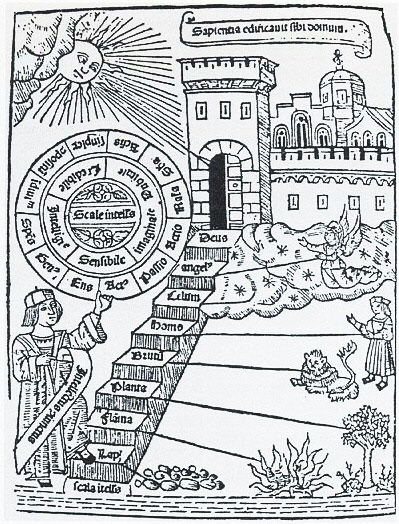
[edit]Possibly the first use of the English word hierarchy cited by the Oxford English Dictionary was in 1881, when it was used in reference to the three orders of three angels as depicted by Pseudo-Dionysius the Areopagite (5th–6th centuries). Pseudo-Dionysius used the related Greek word (ἱεραρχία, hierarchia) both in reference to the celestial hierarchy and the ecclesiastical hierarchy.[4] The Greek term hierarchia means 'rule of a high priest',[5] from hierarches (ἱεράρχης, 'president of sacred rites, high-priest')[6] and that from hiereus (ἱερεύς, 'priest')[7] and arche (ἀρχή, 'first place or power, rule').[8] Dionysius is credited with first use of it as an abstract noun.
Since hierarchical churches, such as the Roman Catholic (see Catholic Church hierarchy) and Eastern Orthodox churches, had tables of organization that were "hierarchical" in the modern sense of the word (traditionally with God as the pinnacle or head of the hierarchy), the term came to refer to similar organizational methods in secular settings.
Representing hierarchies
[edit]
A hierarchy is typically depicted as a pyramid, where the height of a level represents that level's status and width of a level represents the quantity of items at that level relative to the whole.[9] For example, the few Directors of a company could be at the apex, and the base could be thousands of people who have no subordinates.
These pyramids are often diagrammed with a triangle diagram which serves to emphasize the size differences between the levels (but not all triangle/pyramid diagrams are hierarchical; for example, the 1992 USDA food guide pyramid). An example of a triangle diagram appears to the right.
Another common representation of a hierarchical scheme is as a tree diagram. Phylogenetic trees, charts showing the structure of § Organizations, and playoff brackets in sports are often illustrated this way.
More recently, as computers have allowed the storage and navigation of ever larger data sets, various methods have been developed to represent hierarchies in a manner that makes more efficient use of the available space on a computer's screen. Examples include fractal maps, TreeMaps and Radial Trees.
Visual hierarchy
[edit]In the design field, mainly graphic design, successful layouts and formatting of the content on documents are heavily dependent on the rules of visual hierarchy. Visual hierarchy is also important for proper organization of files on computers.
An example of visually representing hierarchy is through nested clusters. Nested clusters represent hierarchical relationships using layers of information. The child element is within the parent element, such as in a Venn diagram. This structure is most effective in representing simple hierarchical relationships. For example, when directing someone to open a file on a computer desktop, one may first direct them towards the main folder, then the subfolders within the main folder. They will keep opening files within the folders until the designated file is located.
For more complicated hierarchies, the stair structure represents hierarchical relationships through the use of visual stacking. Visually imagine the top of a downward staircase beginning at the left and descending on the right. Child elements are towards the bottom of the stairs and parent elements are at the top. This structure represents hierarchical relationships through the use of visual stacking.
Informal representation
[edit]In plain English, a hierarchy can be thought of as a set in which:[2]
- No element is superior to itself, and
- One element, the (apex or hierarch), is superior to all of the other elements in the set.
The first requirement is also interpreted to mean that a hierarchy can have no circular relationships; the association between two objects is always transitive. The second requirement asserts that a hierarchy must have a leader or root that is common to all of the objects.
Mathematical representation
[edit]Mathematically, in its most general form, a hierarchy is a partially ordered set or poset.[10] The system in this case is the entire poset, which is constituted of elements. Within this system, each element shares a particular unambiguous property. Objects with the same property value are grouped together, and each of those resulting levels is referred to as a class.
"Hierarchy" is particularly used to refer to a poset in which the classes are organized in terms of increasing complexity. Operations such as addition, subtraction, multiplication and division are often performed in a certain sequence or order. Usually, addition and subtraction are performed after multiplication and division has already been applied to a problem. The use of parentheses is also a representation of hierarchy, for they show which operation is to be done prior to the following ones. For example: (2 + 5) × (7 - 4). In this problem, typically one would multiply 5 by 7 first, based on the rules of mathematical hierarchy. But when the parentheses are placed, one will know to do the operations within the parentheses first before continuing on with the problem. These rules are largely dominant in algebraic problems, ones that include several steps to solve. The use of hierarchy in mathematics is beneficial to quickly and efficiently solve a problem without having to go through the process of slowly dissecting the problem. Most of these rules are now known as the proper way into solving certain equations.
Subtypes
[edit]Nested hierarchy
[edit]
A nested hierarchy or inclusion hierarchy is a hierarchical ordering of nested sets.[11] The concept of nesting is exemplified in Russian matryoshka dolls. Each doll is encompassed by another doll, all the way to the outer doll. The outer doll holds all of the inner dolls, the next outer doll holds all the remaining inner dolls, and so on. Matryoshkas represent a nested hierarchy where each level contains only one object, i.e., there is only one of each size of doll; a generalized nested hierarchy allows for multiple objects within levels but with each object having only one parent at each level. The general concept is both demonstrated and mathematically formulated in the following example:

A square can always also be referred to as a quadrilateral, polygon or shape. In this way, it is a hierarchy. However, consider the set of polygons using this classification. A square can only be a quadrilateral; it can never be a triangle, hexagon, etc.
Nested hierarchies are the organizational schemes behind taxonomies and systematic classifications. For example, using the original Linnaean taxonomy (the version he laid out in the 10th edition of Systema Naturae), a human can be formulated as:[12]

Taxonomies may change frequently (as seen in biological taxonomy), but the underlying concept of nested hierarchies is always the same.
In many programming taxonomies and syntax models (as well as fractals in mathematics), nested hierarchies, including Russian dolls, are also used to illustrate the properties of self-similarity and recursion. Recursion itself is included as a subset of hierarchical programming, and recursive thinking can be synonymous with a form of hierarchical thinking and logic.[13]
Containment hierarchy
[edit]
A containment hierarchy is a direct extrapolation of the nested hierarchy concept. All of the ordered sets are still nested, but every set must be "strict"—no two sets can be identical. The shapes example above can be modified to demonstrate this:

The notation means x is a subset of y but is not equal to y.

A general example of a containment hierarchy is demonstrated in class inheritance in object-oriented programming.
Two types of containment hierarchies are the subsumptive containment hierarchy and the compositional containment hierarchy. A subsumptive hierarchy "subsumes" its children, and a compositional hierarchy is "composed" of its children. A hierarchy can also be both subsumptive and compositional[example needed].[14]
Subsumptive containment hierarchy
[edit]A subsumptive containment hierarchy is a classification of object classes from the general to the specific. Other names for this type of hierarchy are "taxonomic hierarchy" and "IS-A hierarchy".[10][15][16] The last term describes the relationship between each level—a lower-level object "is a" member of the higher class. The taxonomical structure outlined above is a subsumptive containment hierarchy. Using again the example of Linnaean taxonomy, it can be seen that an object that is a member of the level Mammalia "is a" member of the level Animalia; more specifically, a human "is a" primate, a primate "is a" mammal, and so on. A subsumptive hierarchy can also be defined abstractly as a hierarchy of "concepts".[16] For example, with the Linnaean hierarchy outlined above, an entity name like Animalia is a way to group all the species that fit the conceptualization of an animal.
Compositional containment hierarchy
[edit]A compositional containment hierarchy is an ordering of the parts that make up a system—the system is "composed" of these parts.[17] Most engineered structures, whether natural or artificial, can be broken down in this manner.
The compositional hierarchy that every person encounters at every moment is the hierarchy of life. Every person can be reduced to organ systems, which are composed of organs, which are composed of tissues, which are composed of cells, which are composed of molecules, which are composed of atoms. In fact, the last two levels apply to all matter, at least at the macroscopic scale. Moreover, each of these levels inherit all the properties of their children.
In this particular example, there are also emergent properties—functions that are not seen at the lower level (e.g., cognition is not a property of neurons but is of the brain)—and a scalar quality (molecules are bigger than atoms, cells are bigger than molecules, etc.). Both of these concepts commonly exist in compositional hierarchies, but they are not a required general property. These level hierarchies are characterized by bi-directional causation.[11] Upward causation involves lower-level entities causing some property of a higher level entity; children entities may interact to yield parent entities, and parents are composed at least partly by their children. Downward causation refers to the effect that the incorporation of entity x into a higher-level entity can have on x's properties and interactions. Furthermore, the entities found at each level are autonomous.
Contexts and applications
[edit]Kulish (2002) suggests that almost every system of organization which humans apply to the world is arranged hierarchically.[18][need quotation to verify] Some conventional definitions of the terms "nation"[19][failed verification] and "government"[20][failed verification] suggest that every nation has a government and that every government is hierarchical. Sociologists can analyse socioeconomic systems in terms of stratification into a social hierarchy (the social stratification of societies), and all systematic classification schemes (taxonomies) are hierarchical.[21] Most organized religions, regardless of their internal governance structures, operate as a hierarchy under deities and priesthoods. Many Christian denominations have an autocephalous ecclesiastical hierarchy of leadership. Families can be viewed as hierarchical structures in terms of cousinship (e.g., first cousin once removed, second cousin, etc.), ancestry (as depicted in a family tree) and inheritance (succession and heirship). All the requisites of a well-rounded life and lifestyle can be organized using Maslow's hierarchy of human needs - according to Maslow's hierarchy of human needs. Learning steps often follow a hierarchical scheme—to master differential equations one must first learn calculus; to learn calculus one must first learn elementary algebra; and so on. Nature offers hierarchical structures, as numerous schemes such as Linnaean taxonomy, the organization of life, and biomass pyramids attempt to document.[22][need quotation to verify][23]
While the above examples are often[quantify] clearly depicted in a hierarchical form and are classic examples, hierarchies exist in numerous systems where this branching structure is not immediately apparent. For example, most postal-code systems are hierarchical. Using the Canadian postal code system as an example, the top level's binding concept, the "postal district", consists of 18 objects (letters). The next level down is the "zone", where the objects are the digits 0–9. This is an example of an overlapping hierarchy, because each of these 10 objects has 18 parents. The hierarchy continues downward to generate, in theory, 7,200,000 unique codes of the format A0A 0A0 (the second and third letter positions allow 20 objects each). Most library classification systems such as the Dewey Decimal Classification are also hierarchical.[24]

Organizations
[edit]Organizations can be structured as a dominance hierarchy. In an organizational hierarchy, there is a single person or group with the most power or authority, and each subsequent level represents a lesser authority. Most organizations are structured in this manner,[25] including governments, companies, armed forces, militia and organized religions. The units or persons within an organization may be depicted hierarchically in an organizational chart.
In a reverse hierarchy, the conceptual pyramid of authority is turned upside-down, so that the apex is at the bottom and the base is at the top. This mode represents the idea that members of the higher rankings are responsible for the members of the lower rankings.
Biology
[edit]Empirically, when we observe in nature a large proportion of the (complex) biological systems, they exhibit hierarchic structure.[26] On theoretical grounds we could expect complex systems to be hierarchies in a world in which complexity had to evolve from simplicity.[27] System hierarchies analysis performed in the 1950s,[28][29] laid the empirical foundations for a field that would become, from the 1980s, hierarchical ecology.[30][31][32][33][34]
The theoretical foundations are summarized by thermodynamics. When biological systems are modeled as physical systems, in the most general abstraction, they are thermodynamic open systems that exhibit self-organised behavior, and the set/subset relations between dissipative structures can be characterized[by whom?] in a hierarchy.
Other hierarchical representations related to biology include ecological pyramids which illustrate energy flow or trophic levels in ecosystems, and taxonomic hierarchies, including the Linnean classification scheme and phylogenetic trees that reflect inferred patterns of evolutionary relationship among living and extinct species.
Computer-graphic imaging
[edit]CGI and computer-animation programs mostly use hierarchies for models. On a 3D model of a human for example, the chest is a parent of the upper left arm, which is a parent of the lower left arm, which is a parent of the hand. This pattern is used in modeling and animation for almost everything built as a 3D digital model.
Linguistics
[edit]Many grammatical theories, such as phrase-structure grammar, involve hierarchy.
Direct–inverse languages such as Cree and Mapudungun distinguish subject and object on verbs not by different subject and object markers, but via a hierarchy of persons.
In this system, the three (or four with Algonquian languages) persons occur in a hierarchy of salience. To distinguish which is subject and which object, inverse markers are used if the object outranks the subject.
On the other hand, languages include a variety of phenomena that are not hierarchical. For example, the relationship between a pronoun and a prior noun-phrase to which it refers commonly crosses grammatical boundaries in non-hierarchical ways.
Music
[edit]The structure of a musical composition is often understood hierarchically (for example by Heinrich Schenker (1768–1835, see Schenkerian analysis), and in the (1985) Generative Theory of Tonal Music, by composer Fred Lerdahl and linguist Ray Jackendoff). The sum of all notes in a piece is understood to be an all-inclusive surface, which can be reduced to successively more sparse and more fundamental types of motion. The levels of structure that operate in Schenker's theory are the foreground, which is seen in all the details of the musical score; the middle ground, which is roughly a summary of an essential contrapuntal progression and voice-leading; and the background or Ursatz, which is one of only a few basic "long-range counterpoint" structures that are shared in the gamut of tonal music literature.
The pitches and form of tonal music are organized hierarchically, all pitches deriving their importance from their relationship to a tonic key, and secondary themes in other keys are brought back to the tonic in a recapitulation of the primary theme.
Examples of other applications
[edit]
Information-based[edit] |
City planning-based[edit] |
Linguistics-oriented[edit]
|
Power- or authority-based[edit]
|
Value-related[edit]
|
Perception-based[edit]
|
Religion-related
[edit]- Levels of consciousness
- Levels of spiritual development
- Ages in the evolution of society
- Degrees of communion between various Christian churches
- UFO religions
- Deities
- In Japanese Buddhism
- In Theosophy
- Angels
- In Christianity
- In Islam
- In Judaism
- In Zoroastrianism
- Devils and Demons
- Hells
- Religions in society
- (organizational hierarchies are listed under "Power- or authority-based")
Methods using hierarchy
[edit]- Analytic Hierarchy Process
- Hierarchic Object-Oriented Design
- Hierarchical Bayes model
- Hierarchical clustering
- Hierarchical constraint satisfaction
- Hierarchical linear modeling
- Hierarchical modulation
- Hierarchical proportion
- Hierarchical radial basis function
- Hierarchical storage management
- Hierarchical task network
- Hierarchical temporal memory
- Hierarchical token bucket
- Hierarchical visitor pattern
- Presentation-abstraction-control
Criticisms
[edit] |
In the work of diverse theorists such as William James (1842 to 1910), Michel Foucault (1926 to 1984) and Hayden White (1928 to 2018), important critiques of hierarchical epistemology are advanced. James famously asserts in his work Radical Empiricism that clear distinctions of type and category are a constant but unwritten goal of scientific reasoning, so that when they are discovered, success is declared. But if aspects of the world are organized differently, involving inherent and intractable ambiguities, then scientific questions are often considered unresolved.
Feminists, Marxists, anarchists, communists, critical theorists and others, all of whom have multiple interpretations, criticize the hierarchies commonly found within human society, especially in social relationships. Hierarchies are present in all parts of society: in businesses, schools, families, etc. These relationships are often viewed as necessary. Entities that stand in hierarchical arrangements are animals, humans, plants, etc.
Ethics, behavioral psychology, philosophies of identity
[edit]
In ethics, various virtues are enumerated and sometimes organized hierarchically according to certain brands of virtue theory.
In some of these random examples, there is an asymmetry of 'compositional' significance between levels of structure, so that small parts of the whole hierarchical array depend, for their meaning, on their membership in larger parts. There is a hierarchy of activities in human life: productive activity serves or is guided by the moral life; the moral life is guided by practical reason; practical reason (used in moral and political life) serves contemplative reason (whereby we contemplate God). Practical reason sets aside time and resources for contemplative reason.
See also
[edit]- Anarchy – Society without rulers
- Class browser – Feature of coding platforms
- Forms of government – System or group governing an organized community
- Graph theory – Area of discrete mathematics
- Heterarchy – System of organization where the elements of the organization are unranked
- Hierarchical classifier
- Hierarchical epistemology – Theory of knowledge
- Hierarchical hidden Markov model
- Hierarchical INTegration
- Hierarchical organization – Type of organizational structure
- Hierarchical Music Specification Language – Music programming language
- Hierarchy Open Service Interface Definition
- Hierarchy problem – Unsolved problem in physics
- Holarchy § Different meanings
- Instrumental value – Philosophical concept
- Layer (disambiguation)
- Multilevel model – Type of statistical model
- Multitree – Directed acyclic graph with ≤1 directed paths between any two nodes
- Ordinary (officer) – Ecclesiastical title for local authorities
- Peter Principle – Management concept by Laurence J. Peter
- Ring (computer security) – Layer of protection in computer systems
- Social dominance theory – Theory of intergroup relations
Structure-related concepts
[edit](For example, in § Subtypes)
Footnotes
[edit]- ^ Ruse, Michael (1996). Monad to man: the Concept of Progress in Evolutionary Biology. Harvard University Press. pp. 21–23. ISBN 978-0-674-03248-4.
- ^ a b c d e f Dawkins, Richard (1976). Bateson, Paul Patrick Gordon; Hinde, Robert A. (eds.). Hierarchical organization: a candidate principle for ethology. Growing points in ethology: based on a conference sponsored by St. John's College and King's College, Cambridge. Cambridge, England: Cambridge University Press. pp. 7–54. ISBN 0-521-29086-4.
- ^ a b Simon, Herbert A. (12 December 1962). "The Architecture of Complexity". Proceedings of the American Philosophical Society. 106 (6). Philadelphia, Pennsylvania: American Philosophical Society: 467–482. CiteSeerX 10.1.1.110.961. ISSN 0003-049X. JSTOR 985254.(registration required)
- ^ "Catholic Encyclopedia: Hierarchy". Archived from the original on 2021-01-26. Retrieved 2005-04-27.
- ^ "hierarchy". Online Etymology Dictionary. Archived from the original on 2018-07-04.
- ^ Henry George Liddell; Robert Scott. "ἱεράρχης". A Greek–English Lexicon. Archived from the original on 2021-07-03 – via Perseus Digital Library.
- ^ Henry George Liddell; Robert Scott. "ἱερεύς". A Greek–English Lexicon. Archived from the original on 2020-09-28 – via Perseus Digital Library.
- ^ Henry George Liddell; Robert Scott. "ἀρχή". A Greek–English Lexicon. Archived from the original on 2011-06-06 – via Perseus Digital Library.
- ^ Douglas Lemke (2002). Regions of War and Peace. Cambridge: University of Cambridge. p. 49.
- ^ a b Lehmann, Fritz (1996). Eklund, Peter G.; Ellis, Gerard; Mann, Graham (eds.). Big Posets of Participatings and Thematic Roles. Conceptual structures: knowledge representation as interlingua—4th International Conference on Conceptual Structures, ICCS '96, Sydney, Australia, August 19–22, 1996—proceedings. Lecture Notes in Artificial Intelligence 115. Germany: Springer. pp. 50–74. ISBN 3-540-61534-2.
- ^ a b Lane, David (2006). "Hierarchy, Complexity, Society". In Pumain, Denise (ed.). Hierarchy in Natural and Social Sciences. New York, New York: Springer-Verlag. pp. 81–120. ISBN 978-1-4020-4126-6.
- ^ Linnaei, Carl von (1959). Systema naturae per regna tria naturae :secundum classes, ordines, genera, species, cum characteribus, differentiis, synonymis, locis (in Latin) (10th ed.). Stockholm: Impensis Direct. ISBN 0-665-53008-0. Archived from the original on 2008-10-10. Retrieved 2011-09-24.
{{cite book}}: ISBN / Date incompatibility (help) - ^ Corballis, Michael (2011). The Recursive Mind. Princeton University Press. ISBN 978-0691145471.
- ^ Kopisch, Manfred; Günther, Andreas (1992). "Configuration of a passenger aircraft cabin based on conceptual hierarchy, constraints and flexible control". In Belli, Fevzi (ed.). Industrial and Engineering Applications of Artificial Intelligence and Expert Systems. Industrial and engineering applications of artificial intelligence and expert systems: 5th international conference, IEA/AIE-92, Paderborn, Germany, June 9–12, 1992 : proceedings. Lecture Notes in Computer Science Series. Vol. 602. Springer. pp. 424–427. doi:10.1007/BFb0024994. ISBN 3-540-55601-X. ISSN 0302-9743.
- ^ "Compositional hierarchy". WebSphere Transformation Extender Design Studio. Archived from the original on 3 January 2013. Retrieved 9 October 2009.
- ^ a b Funke, Birger; Sebastian, Hans-Jürgen (1999). "An advanced modeling environment based on a hybrid AI-OR approach". In Polis, Michael P.; Dontchev, Asen L.; Kall, Peter; Lascieka, Irena; Olbrot, Andrzej W. (eds.). Systems modelling and optimization: proceedings of the 18th IFIP TC7 conference. Research notes in mathematics series. Vol. 396. CRC Press. pp. 366–75. ISBN 978-0-8493-0607-5.
- ^ Parsons, David (2002). Object Oriented Programming in C++. Cengage Learning. pp. 110–185. ISBN 0-8264-5428-3.
- ^ Kulish, V. V. (2002). Hierarchical Methods: Hierarchy and hierarchical asymptotic methods in electrodynamics. Vol. 1. Springer. pp. xvii–xx, 49–71. ISBN 1-4020-0757-4.
- ^ Soanes, Catherine; Hawker, Sara (1991). "nation". Compact Oxford English Dictionary. Oxford University Press. ISBN 978-0-19-861022-9. Archived from the original on 2007-09-29. Retrieved 2009-10-08.
- ^ Soanes, Catherine; Hawker, Sara (1991). "government". Compact Oxford English Dictionary. Oxford University Press. ISBN 978-0-19-861022-9. Archived from the original on 2007-09-29. Retrieved 2009-10-08.
- ^ "Social Stratification | Overview, Theories & Examples - Video & Lesson Transcript". study.com. Archived from the original on 2022-06-24. Retrieved 2022-06-24.
- ^ Dawkins, Richard (7 October 1976). "Hierarchical organization: a candidate principle for ethology". In Bateson, P. P. G.; Hinde, R. A. (eds.). Growing Points in Ethology: based on a conference sponsored by St. John's College and King's College, Cambridge. Cambridge: Cambridge University Press (published 1976). ISBN 9780521212878. Retrieved 26 November 2021.
- ^
Kulish, Viktor Vasylevych (11 April 2006) [2002]. Hierarchical Methods: Hierarchy and Hierarchical Asymptotic Methods in Electrodynamics. Volume 123 of Fundamental Theories of Physics. Vol. 1. New York: Springer Science & Business Media (published 2006). p. xviii. ISBN 9780306480614. Retrieved 26 November 2021.
At the same time, it is a trivial phenomenon of everyday life, too. Indeed, one can be convinced that there is a hierarchy in everyday life everywhere. We can affirm once more that a person lives in a completely hierarchical world.
- ^ Mitchell, Joan S. (2001). "Relationships in the Dewey Decimal Classification System". In Bean, Carol A.; Green, Rebecca (eds.). Relationships in the Organization of Knowledge. Information Science and Knowledge Management. Vol. 2. Springer Netherlands. pp. 211–226. doi:10.1007/978-94-015-9696-1_14. ISBN 9789401596961.
- ^ "Organizational Chart and Hierarchy: Definition & Examples - Video & Lesson Transcript". study.com. Archived from the original on 2022-06-24. Retrieved 2022-06-24.
- ^ Simon, Herbert A. (1962). "The Architecture of Complexity". Proceedings of the American Philosophical Society. 106 (6): 467–482. ISSN 0003-049X. JSTOR 985254. Archived from the original on 2022-06-24. Retrieved 2022-06-24.
- ^ "Artificial Intelligence - foundations of computational agents -- 2 Agent Architectures and Hierarchical Control". artint.info. Archived from the original on 2022-07-04. Retrieved 2022-06-24.
- ^ Evans 1951
- ^ Evans 1956
- ^ Margalef 1975
- ^ O'Neill 1986
- ^ Wicken & Ulanowicz 1988
- ^ Pumain 2006
- ^ Jordan & Jørgensen 2012
- ^
Tipton, Frank (January 2003). "Politics, Governance, and Diplomacy between Neoclassicism and Modernism". A History of Modern Germany Since 1815. London: A&C Black (published 2003). p. 239. ISBN 9780826449108. Retrieved 26 November 2021.
Kühne believes the Prussian franchise lasted for over sixty years because it accurately reflected the social realities of the relatively closed, hierarchical, and conformist communities of rural Prussia.
- ^
Compare:
Lee, Stephen J. (12 February 2016) [1987]. "Dictatorship in Germany". European Dictatorships 1918-1945 (4, revised ed.). London: Routledge (published 2016). p. 217. ISBN 9781317294221. Retrieved 26 November 2021.
[...] Nazi administration is now regarded as an overlapping and confusing 'polycracy'. The basis of the criticism is that the multi-layering of agencies and the lack of proper delineation between them generated conflict and hampered efficiency. There was, for example, extensive rivalry between the Four-Year plan Office, the Ministry of Economics, the War ministry and the Plenipotentiary for Economics.
Works cited
[edit]- Evans, F. C. (1951), "Ecology and urban areal research", Scientific Monthly (73)
- Evans, F. C. (1956), "Ecosystem as basic unit in ecology", Science, 123 (3208): 1127–8, Bibcode:1956Sci...123.1127E, doi:10.1126/science.123.3208.1127, PMID 17793430
- Jordan, F.; Jørgensen, S. E. (2012), Models of the Ecological Hierarchy: From Molecules to the Ecosphere, Newnes, ISBN 9780444593962
- Margalef, R. (1975), "External factors and ecosystem stability", Schweizerische Zeitschrift für Hydrologie, 37 (1): 102–117, Bibcode:1975AqSci..37..102M, doi:10.1007/BF02505181, hdl:10261/337692, S2CID 20521602
- O'Neill, R. V. (1986), A Hierarchical Concept of Ecosystems, Princeton University Press, ISBN 0691084378
- Wicken, J. S.; Ulanowicz, R. E. (1988), "On quantifying hierarchical connections in ecology", Journal of Social and Biological Systems, 11 (3): 369–377, doi:10.1016/0140-1750(88)90066-8
Further reading
[edit]- Ahl, Valerie; Allen, Timothy F. H. (1996). Hierarchy Theory. New York: Columbia University Press. ISBN 0-231-08481-1.
- Akl, Selim G.; Taylor, Peter D. (1983). Cryptographic solution to a multilevel security problem (PDF). Advances in Cryptology – Proceedings of CRYPTO '82. New York: Plenum Publishing Corporation. pp. 237–249. ISBN 0-306-41366-3. Archived from the original (PDF) on 2002-12-29.
- Carbone, June; Cahn, Naomi (2013). "Is marriage for rich men?". Nevada Law Journal. 13 (2). William S. Boyd School of Law: 6.
- Ckurshumova, Wenzislava (2007). Regulatory hierarchies in auxin signal transduction and vascular tissue development (PhD thesis). University of Toronto. Section B. hdl:1807/118234. ISBN 978-0-494-27682-2.
- Galindo, Cipriano; Fernández-Madrigal, Juan-Antonio (2007). Kacprzyk, Janusz (ed.). Multiple Abstraction Hierarchies for Mobile Robot Operation in Large Environments. Studies in Computational Intelligence. Berlin: Springer Berlin Heidelberg. ISBN 978-3-540-72688-3.
- Nelson, Julie (1992). "Gender, Metaphor and the Definition of Economics". Economics and Philosophy. 8 (1): 103–25. doi:10.1017/S026626710000050X. S2CID 146493891.
- Petrič, K. (2025). Hierarchology and hierarchography. (2nd. ed.). Karl Petrič. https://doi.org/10.5281/zenodo.16746679.
- Pumain, Denise (2006). Hierarchy in Natural and Social Sciences. New York, New York: Springer-Verlag. ISBN 978-1-4020-4126-6.
- Rosenbaum, A. (2000). Les représentations hiérarchiques en philosophie (in French). Paris: Desclee de Brouwer.
- Shahbaba, Babak (2007). Improving classification models when a class hierarchy is available (PhD thesis). University of Toronto. Section B. hdl:1807/119833. ISBN 978-0-494-28076-8.
- Also includes full copies of:
- Shahbaba, Babak; Neal, Radford M. (2007). "Improving Classification When a Class Hierarchy is Available Using a Hierarchy-Based Prior" (PDF). Bayesian Analysis. 2 (1). Carnegie Mellon University, Pittsburgh, Pennsylvania: International Society for Bayesian Analysis: 221–228. arXiv:math/0510449. Bibcode:2005math.....10449S. doi:10.1214/07-ba209. ISSN 1936-0975. S2CID 10611032. Archived from the original (PDF) on 2015-09-03.
- Shahbaba, Babak; Neal, Radford M. (2006). "Gene function classification using Bayesian models with hierarchy-based priors". BMC Bioinformatics. 7 448. London, England: BioMed Central. arXiv:q-bio/0605015. Bibcode:2006q.bio.....5015S. doi:10.1186/1471-2105-7-448. ISSN 1471-2105. PMC 1618412. PMID 17038174.
External links
[edit]


Hierarchy
View on GrokipediaDefinition and Fundamentals
Core Definition
A hierarchy is a structured arrangement of elements organized into successive levels, where each element (except those at the apex) is subordinate to exactly one superior element, forming chains of command, inclusion, or precedence. This organization implies a partial ordering relation that is asymmetric and transitive, ensuring that relations between non-adjacent levels propagate downward without cycles.[9][10] In practice, hierarchies decompose complex systems into manageable subsystems, with higher levels exerting control or constraint over lower ones, as seen in organizational charts where authority flows vertically from executives to subordinates.[11] Central to hierarchies is the principle of near-decomposability, a property enabling the simplification of complexity: interactions within a given level occur more rapidly and strongly than those spanning levels, allowing subsystems to function semi-independently while aligning with overarching constraints.[1][12] This feature manifests empirically in diverse domains, such as biological food chains where predators dominate prey across trophic levels, or computational models where recursive structures process data layer by layer.[4] Hierarchies thus promote stability and scalability, as evidenced by their prevalence in natural and engineered systems, from neural networks in the brain to corporate decision-making processes.[13] Unlike flat or egalitarian structures, hierarchies enforce differentiation in status or function, often yielding efficient information flow and resource allocation but potentially rigidifying adaptation if levels become insulated. Empirical studies of animal groups, for instance, show dominance hierarchies reducing conflict through predictable submission signals, with rank determined by factors like size or aggression rather than consensus.[4] In human contexts, such as military chains of command established since ancient formations like the Roman legions (circa 100 BCE), hierarchies ensure coordinated action under uncertainty, though they can amplify errors if propagated from the top.[11] This core structure underpins both adaptive advantages and inherent trade-offs in scalability.Etymology and Historical Origins
The term "hierarchy" originates from the Ancient Greek hierarchía (ἱεραρχία), a compound of hierós (ἱερός), meaning "sacred" or "holy," and archḗ (ἀρχή), denoting "rule," "power," or "principle of order."[3][2] This etymological root underscores its initial connotation of sacred governance or dominion over holy matters, distinguishing it from mere ranking by emphasizing divine or ritual authority.[14] The word was systematized and popularized by Pseudo-Dionysius the Areopagite, a Christian Neoplatonist theologian active in the late 5th or early 6th century CE, likely in a Greek-speaking Syrian context.[15] In his treatise De Coelesti Hierarchia (On the Celestial Hierarchy), composed around 500 CE, Pseudo-Dionysius applied hierarchia to describe a triadic, ninefold ordering of angels as intermediaries between God and creation, each rank performing distinct purifying, illuminating, and perfecting functions in a vertical chain of emanation.[16] This framework drew on Neoplatonic ideas of hierarchical procession from the One while adapting them to Christian angelology, influencing medieval scholasticism profoundly.[17] Pseudo-Dionysius extended the concept to ecclesiastical structures in De Ecclesiastica Hierarchia (On the Ecclesiastical Hierarchy), mirroring celestial ranks in the church's sacraments, clergy orders (bishops, priests, deacons), and laity, with the goal of divine participation through ritual ascent.[18] The term entered Latin as hierarchia by the medieval period, denoting angelic or ecclesiastical ranks, and reached Middle English around 1350–1400 via Old French ierarchie, initially limited to theological contexts before broadening to secular uses.[19][2] While proto-hierarchical arrangements—such as dominance orders in primate groups or ancient administrative pyramids—predate the term empirically, the linguistic and conceptual formalization as "hierarchy" remains tethered to this Dionysian theological innovation, which prioritized causal mediation over egalitarian alternatives.[17]Key Properties and Characteristics
A hierarchy is fundamentally characterized by its stratified organization into ranked levels, where elements at higher strata exert authority, encompass, or derive precedence over those at lower strata, facilitating coordinated function across scales. This structure inherently features asymmetry in relational dynamics, with directed influences flowing predominantly top-down, and irreflexivity, as no element dominates itself. In formal representations, such as directed acyclic graphs modeling superior-subordinate ties, hierarchies ensure each non-apex element reports to precisely one superior, promoting unambiguous accountability.[20][21] Central to hierarchical integrity is acyclicity, prohibiting cycles that would introduce paradoxes or instability, such as infinite authority loops, thereby guaranteeing finite paths from any element to the root or apex. Connectedness complements this by ensuring every element links upward to the hierarchy's summit via a unique chain, enabling transitive precedence: if A oversees B and B oversees C, A indirectly oversees C, which underpins scalable decision propagation and conflict resolution. These properties—rooted in graph-theoretic formulations—extend beyond abstract models to yield stability in complex systems, where depth metrics quantify levels from the apex (depth 0) to subordinates.[20] In empirical domains like biology and organizations, hierarchies exhibit self-organization and differentiation, wherein elements cluster into functional networks for transfer, replication, or integration, sustaining steady-state viability through pairwise interactions and boundary isolation. Emergence arises as higher-level traits—such as systemic coherence or adaptive intelligence—manifest from lower-level compositions without full reducibility, a necessity for managing thermodynamic and informational fluxes in living or engineered ensembles. Scalability further distinguishes hierarchies, allowing modular expansion while preserving core relational invariants, as seen in biological escalations from organelles to ecosystems or organizational pyramids with defined spans of control.[22][23][24]Types and Subtypes
Nested Hierarchies
Nested hierarchies are organizational structures in which subordinate elements or groups are contained within superordinate ones, forming recursive layers akin to sets within sets or containers within containers.[25] This pattern manifests as a tree-like arrangement where each level comprises subgroups sharing defining characteristics, enabling the classification and management of complex systems.[26] In biology, nested hierarchies underpin taxonomic classifications, such as the Linnaean system where domains encompass kingdoms, kingdoms contain phyla, and phyla include classes, orders, families, genera, and species—evidenced by shared morphological, genetic, and developmental traits clustering organisms into irreducible groups.[26] For instance, Homo sapiens nests within the genus Homo, family Hominidae, order Primates, class Mammalia, phylum Chordata, kingdom Animalia, and domain Eukarya, reflecting inferred phylogenetic branching from common ancestors.[27] Such structures demonstrate predictive utility, as unobserved traits in newly discovered species can be hypothesized based on their hierarchical position.[28] Mathematically, nested hierarchies appear in set theory as chains of proper subsets, where each element belongs exclusively to one path of inclusions, such as squares ⊂ quadrilaterals ⊂ polygons ⊂ shapes, preserving strict containment without overlap.[26] In organizational contexts, they structure corporations with departments nested in divisions, divisions in business units, and units in the parent company, facilitating scalability and modular control over large-scale operations.[29] Key characteristics include modularity, where higher levels exhibit emergent properties irreducible to lower ones, and exclusivity, preventing elements from belonging to multiple non-adjacent groups, which contrasts with reticulated networks like those influenced by horizontal gene transfer in microbes.[30] This recursive embedding supports efficient information processing and decision-making in hierarchical systems, from cellular organization to ecosystem dynamics.[31]Containment Hierarchies
Containment hierarchies represent organizational structures where lower-level elements are fully enclosed within higher-level elements, forming nested subsets akin to Russian matryoshka dolls.[32] This nesting implies a strict inclusion relation, ensuring that each subordinate level is properly contained without overlap or equality with its container, which maintains acyclic progression from innermost to outermost entities.[33] In formal terms, such hierarchies align with chain structures in partially ordered sets under the subset relation, where for sets , is contained in , which is contained in ./04:_Sets/4.02:_Containment) Two primary variants exist: subsumptive containment hierarchies, where categories subsume subclasses (e.g., "quadrilateral" subsumes "square"), and compositional containment hierarchies, where wholes comprise parts (e.g., an organism contains organs, which contain cells).[34] Subsumptive forms emphasize "is-a" relationships, as in taxonomic classifications like Homo sapiens ⊂ Homo ⊂ Primates ⊂ Mammalia ⊂ Animalia, enabling inference of inherited properties downward.[35] Compositional forms focus on "has-a" assemblies, such as in manufacturing where components nest within assemblies, facilitating modular design and decomposition analysis.[36] In computer science, containment hierarchies model data structures like file directories, where folders contain subfolders and files, or graphical user interfaces where parent containers embed child components.[37] For instance, Java's Swing framework employs a containment tree rooted in top-level containers, allowing hierarchical event propagation and resource management.[37] These structures support efficient querying, such as containment checks in nested set models, which represent hierarchies via left and right values for subtree traversal without recursive joins.[38] Mathematical containment extends to algebraic contexts, like the Chomsky hierarchy of formal languages, where Type-3 languages are strictly contained in Type-2, Type-1, and Type-0, with each level incorporating prior capabilities plus additional generative power.[35] In geometry, simplicial complexes form containment hierarchies via face relations, where lower-dimensional simplices are boundaries of higher ones, influencing asymptotic invariants in ideal theory.[39] Such hierarchies underpin proofs of non-containment, as in symbolic power containment for monomial ideals, verified computationally for specific codimensions up to 2014 data.[40]Compositional and Subsumptive Variants
Compositional hierarchies structure entities through part-whole relations, wherein higher-level wholes emerge from the integration of lower-level parts, often across distinct scales of space and time. These hierarchies, also known as mereological or level hierarchies, feature emergent properties at superior levels that are not reducible to the sum of components, with interactions constrained primarily between adjacent strata. Stanley N. Salthe formalized this variant as involving scalar differences in activities within a single complex system, exemplified by biological organization from quarks to biosphere, where each level composes the next via physical aggregation and functional interdependence.[41][42] In engineering contexts, such as manufacturing, subsystems like circuits compose devices, which in turn form systems like vehicles.[43] Subsumptive hierarchies, in contrast, organize via generalization and inclusion, where subordinate entities fall under encompassing superordinate categories, inheriting properties while permitting additional specifications. This "is-a" relation underpins taxonomic and ontological classifications, such as in Linnaean biology where Homo sapiens is subsumed under Homo, Primates, Mammalia, and Animalia, or in mathematics via subset relations. Salthe describes subsumptive hierarchies as providing alternative viewpoints or models of the same referent, differing from compositional forms by lacking direct physical composition and instead emphasizing abstract encompassment.[41][23] The distinction lies in dependency and emergence: compositional hierarchies exhibit downward causation from wholes constraining parts and upward emergence, whereas subsumptive ones prioritize classificatory breadth over material assembly, though both appear in knowledge representation systems like ontologies combining part-whole with inheritance logics. In natural phenomena, evolutionary processes may entwine them, as genetic compositions at cellular levels support taxonomic diversification.[43][44] Salthe's framework underscores that while compositional hierarchies model dynamic processes within systems, subsumptive variants facilitate comparative analysis across models, enhancing explanatory power in fields from ecology to semantics.[41]Other Formal Subtypes
In order theory, linear hierarchies represent a fundamental formal subtype characterized by total orders, where every pair of distinct elements is comparable under the relation, ensuring a strict ranking without incomparable elements. This structure manifests as a chain, permitting transitive subordination from lower to higher ranks, as exemplified by the ordering of real numbers under the less-than relation, which forms an unending sequence of ranked positions.[45] Such hierarchies enforce completeness in comparability, distinguishing them from partial variants by eliminating branches or parallelism in ranking.[46] Lattice hierarchies extend partial orders by requiring that any two elements possess both a least upper bound (join) and greatest lower bound (meet), enabling formal operations on ranks that model confluence and decision points in hierarchical decision-making. Boolean lattices, for instance, underpin subset hierarchies but generalize to distributive structures where elements combine modularly, as in the power set of a finite set ordered by inclusion with defined unions and intersections.[46] This subtype supports algebraic manipulations within the hierarchy, facilitating applications in logic and optimization where ranks must aggregate coherently.[47] Graded hierarchies impose an additional rank function on posets, partitioning elements into discrete levels where transitions occur only between consecutive grades, quantifying depth and progression. In combinatorics, the graded structure of the Boolean lattice assigns ranks by cardinality, with each level containing binomial coefficients worth of elements, verifiable through Pascal's identity for layer counts.[48] Well-foundedness ensures no infinite descending chains, preventing cycles and grounding the structure in a minimal element, a property formalized in axioms like those of Zermelo-Fraenkel set theory for ordinal constructions.[49] These subtypes prioritize causal precedence and empirical verifiability in ranking, contrasting looser informal arrangements by enforcing transitivity and antisymmetry.[50]Representation Methods
Mathematical Formalisms
In mathematics, a hierarchy is formalized as a partially ordered set (poset), consisting of a set equipped with a binary relation that captures hierarchical precedence, where indicates that is at or below in the structure.[51] The relation must satisfy reflexivity ( for all ), antisymmetry (if and , then ), and transitivity (if and , then ).[52] This framework accommodates both linear chains, where all elements are comparable, and branching structures with incomparable elements, enabling representation of complex, non-total orderings common in hierarchical systems.[14] For strict hierarchies excluding equality, the corresponding strict partial order is defined as if and only if and , yielding an irreflexive and transitive relation that emphasizes asymmetric subordination.[53] Preorders, which relax antisymmetry to allow distinct elements to be equivalent under mutual ordering, occasionally model quasi-hierarchies but are less common for precise stratification due to potential equivalence classes.[14] In set-theoretic contexts, containment hierarchies arise naturally from the subset relation on a power set , forming a complete Boolean lattice poset where every pair of elements has a least upper bound (union) and greatest lower bound (intersection).[51] Ranked or graded posets extend the basic formalism by incorporating a rank function (or integers), such that if covers (i.e., with no satisfying ), then , assigning discrete levels to enforce layered progression.[54] This structure is prevalent in combinatorial hierarchies, such as the subset lattice where rank corresponds to cardinality, ensuring minimal paths between levels differ by unit increments.[53] Tree-like hierarchies, a subclass of posets, impose a single superior for each element (except the root), formalizable via the ancestor relation in a rooted directed acyclic graph, with the partial order derived from path existence.[52] These formalisms underpin applications in order theory, where properties like width (by Dilworth's theorem, the size of the largest antichain) quantify branching complexity in hierarchies.[54]Visual and Graphical Representations
Tree diagrams represent hierarchies through nodes connected by directed edges, illustrating parent-child relationships with a single root element at the top or bottom, commonly applied in computer science for structures like binary search trees and in decision-making processes.[55][56] Organizational charts, a specialized form of tree diagram, depict enterprise authority structures by positioning superiors above subordinates with connecting lines indicating reporting relationships, facilitating clarity in roles and chains of command.[57][58] In mathematical contexts, Hasse diagrams visualize finite partially ordered sets by arranging elements vertically according to order, connecting only immediate successors with upward lines while suppressing transitive relations to emphasize covering relations.[59] Pyramid diagrams convey tapered hierarchies via triangular layers, where section width or height reflects level importance or quantity, often used for foundational relationships or priority rankings.[60][61] Treemaps display complex hierarchies with nested rectangles, where enclosure represents subordination and rectangle size proportional to associated quantitative values, enabling visualization of large datasets like file systems or economic sectors.[62] These methods prioritize clarity in subordination and levels, though choices depend on data complexity and domain, with trees suiting branching structures and Hasse diagrams strict partial orders.[63]Informal and Symbolic Notations
Informal notations for hierarchies rely on simple textual conventions to convey layered relationships, prioritizing accessibility over mathematical rigor. Indentation-based outlines represent subordination by offsetting subordinate elements to the right of superiors, creating a visual cascade that implies depth. This method structures information hierarchically in notes, documents, and plans, as subtopics nest under headings to reflect dependency or inclusion.[64][65] Such outlines often incorporate bullets or numbers for levels, like Roman numerals for top tiers (I.), letters for seconds (A.), and Arabic numerals for thirds (1.), enabling rapid parsing in educational and professional contexts. For example, a project outline might list: I. Objective; A. Strategy; 1. Tactics, where each indent signals refinement or subcomponent. This format's efficacy stems from human pattern recognition of alignment, though it assumes linear reading and can falter with deep nesting beyond four levels due to readability limits.[66][67] ASCII art extends textual notation into pseudo-graphical forms for tree structures, employing characters like vertical bars (|) for continuity, dashes (-) for branches, and spaces for alignment to depict containment or branching hierarchies. The Unix 'tree' command, introduced in 1987, exemplifies this by rendering file system directories as:.
├── folder1
│ └── file.txt
└── folder2
├── subfile1
└── subfile2
.
├── folder1
│   └── file.txt
└── folder2
    ├── subfile1
    └── subfile2