Hubbry Logo
JokhangJokhangMain
Open search
Jokhang
Community hub
Jokhang
logo
8 pages, 0 posts
0 subscribers
Be the first to start a discussion here.
Jokhang
Jokhang
from Wikipedia

Key Information

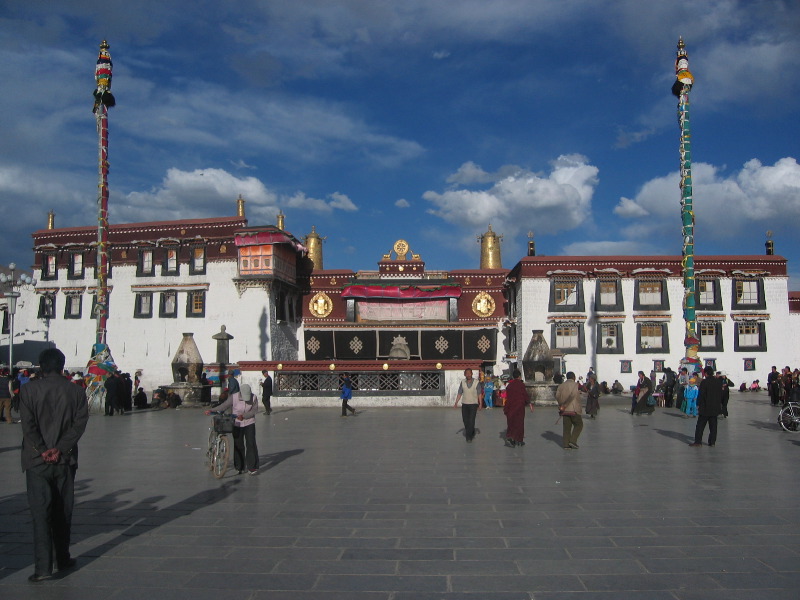
The Jokhang (Tibetan: ཇོ་ཁང།, Chinese: 大昭寺), historically known as the Rasa Trulnang (ra sa 'phrul snang)[1] or Qoikang Monastery or Zuglagkang (Tibetan: གཙུག་ལག་ཁང༌།, Wylie: gtsug-lag-khang, ZYPY: Zuglagkang or Tsuklakang), is considered the "heart of Lhasa".[2] The Jokhang consists of a Tibetan Buddhist temple, its temple complex, and a Gelug school monastery. Located in Barkhor Square, it was built in c.640 by King Songsten Gampo to house the Jowo Mikyo Dorje,[3] a statue of Akshobhya Buddha, brought to Tibet by his Nepalese queen,[2] Bhrikuti. Another statue, the Jowo Shakyamuni, brought by his Tang Chinese queen Wencheng, is currently housed in the temple[2] and the Jowo Mikyo Dorje is housed in the Ramoche, in Lhasa.

Many Nepalese and Indian artists and craftsmen worked on the temple's original design and construction.[4] Around the 14th century, the temple was associated with the Vajrasana in India.[5] In the 18th century the Qianlong Emperor of the Qing dynasty, following the Nepalese Gorkha invasion of Tibet in 1792, did not allow the Nepalese to visit this temple [citation needed] and it became an exclusive place of worship for the Tibetans. Early into the Cultural Revolution, the Red Guards attacked the Jokhang temple in 1966 and for a decade there was no worship. Renovation of the Jokhang took place from 1972 to 1980. In 2000, the Jokhang became a UNESCO World Heritage Site as an extension of the Potala Palace, which has been a World Heritage Site since 1994. After its UNESCO status was conferred, PRC China redeveloped parts of the World Heritage Sites in Lhasa, and the Barkhor Square in front of the temple was partially demolished and encroached upon.[6]

Location

[edit]

The temple, considered the "spiritual heart of the city" and the most sacred in Tibet,[7][8][9] is at the center of an ancient network of Buddhist temples in Lhasa. It is the focal point of commercial activity in the city, with a maze of streets radiating from it.[8] The Jokhang is 1,000 metres (3,300 ft) east of the Potala Palace.[10] Barkhor, the market square in central Lhasa, has a walkway for pilgrims to walk around the temple (which takes about 20 minutes).[11] Barkhor Square is marked by four stone sankang (incense burners), two of which are in front of the temple and two in the rear.[12]

Etymology

[edit]

Rasa Thrulnag Tsuklakhang ("House of Mysteries" or "House of Religious Science") was the Jokhang's ancient name.[13] When King Songtsen Gampo built the temple,[14] his capital city was known as Rasa ("Goats"),[15] since goats were used to move earth during its construction.[16] After the king's death, the city became known as Lhasa (Place of the Gods). Later, the temple was called the Jokhang —"House of the Jowo"— derived from Jowo Mikyo Dorje,[17] its primary image.[18] The Jokhang's Chinese name is Dazhao (Monastery of Great Distinction);[19] it is also known as Zuglagkang, Qoikang Monastery[20] Tsuglakhang (Chapel of Jowo Śākyamuni)[21][22] and Tsuglhakhange.[12]

History

[edit]

King Songtsen Gampo (the first king of a unified Tibet) developed a plan to build twelve temples across the country. The temples were built in three stages. In the first stage central Tibet was covered with four temples, known as the "four horns" (ru bzhi).[23] Four more temples, (mtha'dul), were built in the outer areas in the second stage; the last four, the yang'dul, were built on the country's frontiers. The Jokhang temple was finally built in the heart of Tibet.[24]

Gold-colored statue of Songtsen Gampo wearing a red cloth hat
King Songtsen Gampo

To forge ties with neighboring Nepal, Songtsen Gampo sent envoys to King Amsuvarman seeking his daughter's hand in marriage and the king accepted. His daughter, Bhrikuti, came to Tibet as the king's Nepalese wife (tritsun; belsa in Tibetan). The image of Akshobhya Buddha known as Jowo Mikyo Dorje (or Mikyoba), which she had brought as part of her dowry, was deified in the Jokhang.[25]

Songsten Gampo, wishing to obtain a wife from China, sent his ambassador to Emperor Taizong (627–650) of the Tang dynasty for one of his daughters. Taizong rejected the king's proposal, considering Tibetans "barbarians", and announced the marriage of one of his daughters to the king of Duyu, a Hun. This infuriated Songsten Gampo, who mounted attacks on tribal areas affiliated with the Tang dynasty and then attacked the Tang city of Songzhou. Telling the emperor that he would escalate his aggression unless the emperor agreed to his proposal, Songsten Gampo sent a conciliatory gift of a gold-studded "suit of armour" with another request for marriage. Taizong conceded, giving Princess Wencheng to the Tibetan king.[26] When Wencheng went to Tibet in 640 as the Chinese wife of the king (known as Gyasa in Tibet), she brought an image of Sakyamuni Buddha, as a young prince.[27] The image was deified in Ramoche temple in Lhasa. It was later moved to the Jokhang. The temple remains the holiest shrine in Tibet and the image, known as Jowo Rinpoche, has become the country's most-revered statue.[25]

The oldest part of the temple was built in 652 by Songtsen Gampo. To find a location for the temple, the king reportedly tossed his hat (a ring in another version)[28] ahead of him with a promise to build a temple where the hat landed. It landed in a lake, where a white stupa (memorial monument) suddenly emerged[29] over which the temple was built. In another version of the legend, Queen Bhrikuti founded the temple to install the statue she had brought. The lake was filled, leaving a small pond now visible as a well fed by the ancient lake, and a temple was built on the filled area. Over the next nine centuries, the temple was enlarged; its last renovation was carried out in 1610 by the Fifth Dalai Lama.[29]

The temple's design and construction are attributed to Nepalese craftsmen. After Songtsen Gampo's death, Queen Wencheng reportedly moved the statue of Jowo from the Ramoche temple to the Jokhang temple to secure it from Chinese attack. The part of the temple known as the Chapel was the hiding place of the Jowo Sakyamuni.[30]

During the reign of King Tresang Detsan from 755 to 797, Buddhists were persecuted because the king's minister, Marshang Zongbagyi (a devotee of Bon), was hostile to Buddhism. During this time the image of Akshobya Buddha in the Jokhang temple was hidden underground, reportedly 200 people failed to locate it. The images in the Jokhang and Ramoche temples were moved to Jizong in Ngari, and the monks were persecuted and driven from Jokhang.[31] During the anti-Buddhist activity of the late ninth and early tenth centuries, the Jokhang and Ramoche temples were said to be used as stables.[32] In 1049 Atisha, a renowned teacher of Buddhism from Bengal who taught in Jokhang and died in 1054, found the "Royal Testament of the Pillar" (Bka' chems ka khol ma) in a pillar at Jokhang; the document was said to be the testament of Songtsen Gampo.[32][33]

Early photograph of Jokhang behind a small body of water
Jokhang in the mid-1840s

Beginning in about the 14th century, the temple was associated with the Vajrasana in India. It is said that the image of Buddha deified in the Jokhang is the 12-year-old Buddha earlier located in the Bodh Gaya Temple in India, indicating "historical and ritual" links between India and Tibet. Tibetans call Jokhang the "Vajrasana of Tibet" (Bod yul gyi rDo rje gdani), the "second Vajrasana" (rDo rje gdan pal) and "Vajrasan, the navel of the land of snow" (Gangs can sa yi lte ba rDo rje gdani).[34]

After the occupation of Nepal by the Gorkhas in 1769, during the Gorkha-Tibetan war in 1792 the Qianlong Emperor of the Qing dynasty drove the Gorkhas from Tibet and the Tibetans were isolated from their neighbors.[35] The period, lasting for more than a century, has been called "the Dark Age of Tibet". Pilgrimages outside the country were forbidden for Tibetans, and the Qianlong Emperor suggested that it would be equally effective to worship the Jowo Buddha at the Jokhang.[36]

In Chinese development of Lhasa, Barkhor Square was encroached when the walkway around the temple was destroyed. An inner walkway was converted into a plaza, leaving only a short walkway as a pilgrimage route. In the square, religious objects related to the pilgrimage are sold.[29]

During the Cultural Revolution, Red Guards attacked the Jokhang in 1966, starting on August 24,[37][38] and for a decade there was no worship in Tibetan monasteries. Renovation of the Jokhang began in 1972, and was mostly complete by 1980. After this and the end of persecution, the temple was re-consecrated. It is now visited by a large number of Tibetans, who come to worship Jowo in the temple's inner sanctum.[39] During the Revolution, the temple was spared destruction and was reportedly boarded up until 1979.[29] At that time, portions of the Jokhang reportedly housed pigs, a slaughterhouse and Chinese army barracks.[40] Soldiers burned historic Tibetan scriptures. For a time, it was a hotel.[30]

Two flagstone doring (inscribed pillars) outside the temple, flanking its north and south entrances, are worshiped by Tibetans. The first monument, a March 1794 edict known as the "Forever Following Tablet" in Chinese, records advice on hygiene to prevent smallpox; some has been chiseled out by Tibetans who believed that the stone itself had curative powers.[41] The second, far older, pillar is 5.5 metres (18 ft) high with a crown in the shape of a palace and an inscription dated 821 or 822. The tablet has a number of names; "Number One Tablet in Asia", "Lhasa Alliance Tablet", "Changing Alliance Tablet", "Uncle and Nephew Alliance Tablet" and the "Tang Dynasty-Tubo Peace Alliance Tablet".[42][41] Its inscription, in Tibetan and Chinese, is a treaty between the Tibetan king Ralpacan and the Chinese emperor Muzong delineating the boundary between their countries. Both inscriptions were enclosed by brick walls when Barkhor Square was developed in 1985.[43] The Sino-Tibetan treaty reads, "Tibet and China shall abide by the frontiers of which they are now in occupation. All to the east is the country of Great China; and all to the west is, without question, the country of Great Tibet. Henceforth on neither side shall there be waging of war nor seizing of territory. If any person incurs suspicion he shall be arrested; his business shall be inquired into and he shall be escorted back".[42]

According to the Dalai Lama, among the many images in the temple was an image of Chenrizi, made of clay in the temple, within which the small wooden statue of the Buddha brought from Nepal was hidden. The image was in the temple for 1300 years, and when Songtsen Gampo died his soul was believed to have entered the small wooden statue. During the Cultural Revolution, the clay image was smashed and the smaller Buddha was given by a Tibetan to the Dalai Lama.[30]

In 2000, the Jokhang became a UNESCO World Heritage Site as an extension of the Potala Palace (a World Heritage Site since 1994) to facilitate conservation efforts.[43][44] The temple is listed in the first group of National Cultural Protection Relic Units, and has been categorized as a 4A-level tourist site.[10]

On February 17, 2018, the temple caught fire at 6:40 p.m. (local time), before sunset in Lhasa, with the blaze lasting until late that evening. Although photos and videos about the fire were spread on Chinese social media, which showed the eaved roof of a section of the building lit with roaring yellow flames and emitting a haze of smoke, these images were quickly censored and disappeared. The official newspaper Tibet Daily briefly claimed online that the fire was "quickly extinguished" with "no deaths or injuries" at the late night, while The People's Daily published the same words online and added that there had been "no damage to relics" in the temple; both of these reports contained no photos.[45] The temple was temporarily closed after the fire but were reopened to public on February 18.[46]

Architecture

[edit]
Drawing of the temple complex
Plan of the complex from Journey to Lhasa and Central Tibet by Sarat Chandra Das, 1902
Temple courtyard with potted shrubs
Jokhang temple courtyard, 2013

The Jokhang temple covers an area of 2.51 hectares (6.2 acres). When it was built during the seventh century, it had eight rooms on two floors to house scriptures and sculptures of the Buddha. The temple had brick-lined floors, columns and door frames and carvings made of wood. During the Tubo period, there was conflict between followers of Buddhism and the indigenous Bon religion. Changes in dynastic rule affected the Jokhang Monastery; after 1409, during the Ming dynasty, many improvements were made to the temple. The second and third floors of the Buddha Hall and the annex buildings were built during the 11th century. The main hall is the four-story Buddha Hall.[47]

Decorated golden roof of the temple
Gilt roof of the Jokhang

The temple has an east-west orientation, facing Nepal to the west in honour of Princess Bhrikuti.[7] Additionally, the monastery's main gate faces west. The Jokhang is aligned along an axis, beginning with an arch gate and followed by the Buddha Hall, an enclosed passage, a cloister, atriums and a hostel for the lamas (monks).[10] Inside the entrance are four "Guardian Kings" (Chokyong), two on each side. The main shrine is on the ground floor. On the first floor are murals, residences for the monks and a private room for the Dalai Lama, and there are residences for the monks and chapels on all four sides of the shrine. The temple is made of wood and stone. Its architecture features the Tibetan Buddhist style, with influences from China, Indian vihara design and Nepal.[48][49][50] The roof is covered with gilded bronze tiles, figurines and decorated pavilions.[50]

Temple interior with pillars, resting places and a statue
Temple interior

The central Buddha Hall is tall, with a large, paved courtyard.[51] A porch leads to the open courtyard, which is two concentric circles with two temples: one in the outer circle and another in the inner circle. The outer circle has a circular path, with a number of large prayer wheels (nangkhor); this path leads to the main shrine, which is surrounded by chapels. Only one of the temple murals remains, depicting the arrival of Queen Wencheng and an image of the Buddha. The image, brought by the king's Nepalese wife and initially kept at Ramoche, was moved to Jokhang and kept in the rear center of the inner temple. This Buddha has remained on a platform since the eighth century; on a number of occasions, it was moved for safekeeping. The image, amidst those of the king and his two consorts, has been gilded several times. In the main hall on the ground floor is a gilded bronze statue of Jowo Sakyamuni, 1.5 metres (4 ft 11 in) tall, representing the Buddha at age twelve. The image has a bejeweled crown, cover around its shoulder, a diamond on its forehead and wears a pearl-studded garment.[50] The Buddha is seated in a lotus position on a three-tiered lotus throne, with his left hand on his lap and his right hand touching the earth. A number of chapels surround the Jowo Sakayamuni, dedicated to gods and bodhisattvas. The most important bodhisattva here is the Avalokiteshwara, the patron saint of Tibet,[52] with a thousand eyes and a thousand arms. Flanking the main hall are halls for Amitabha (the Buddha of the past) and Qamba (the Buddha of the future). Incarnations of Sakyamuni are enshrined on either side of a central axis, and the Buddha's warrior guard is in the middle of the halls on the left side.[53]

In addition to the main hall and its adjoining halls, on both sides of the Buddha Hall are dozens of 20-square-metre (220 sq ft) chapels. The Prince of Dharma chapel is on the third floor, including sculptures of Songtsen Gampo, Princess Wencheng, Princess Bhrikuti, Gar Tongtsan (the Tabo minister) and Thonmi Sambhota, the inventor of Tibetan script. The halls are surrounded by enclosed walkways.[54]

Decorations of winged apsaras, human and animal figurines, flowers and grasses are carved on the superstructure. Images of sphinxes with a variety of expressions are carved below the roof.[54]

The temple complex has more than 3,000 images of the Buddha and other deities (including an 85-foot (26 m) image of the Buddha)[55] and historical figures, in addition to manuscripts and other objects. The temple walls are decorated with religious and historical murals.[49]

Pilgrims praying outdoors
Traditional prayers and prostrations in front of the Jokhang

On the rooftop and roof ridges are iconic statues of golden deer flanking a Dharma wheel, victory flags and monstrous fish. The temple interior is a dark labyrinth of chapels, illuminated by votive candles and filled with incense. Although portions of the temple has been rebuilt, original elements remain. The wooden beams and rafters have been shown by carbon dating to be original, and the Newari door frames, columns and finials dating to the seventh and eighth centuries were brought from the Kathmandu Valley of Nepal.[47][56]

In addition to walking around the temple and spinning prayer wheels, pilgrims prostrate themselves before approaching the main deity;[50] some crawl a considerable distance to the main shrine.[28] The prayer chanted during this worship is "Om mani padme hum" (Hail to the jewel in the lotus).[57] Pilgrims queue on both sides of the platform to place a ceremonial scarf (katak) around the Buddha's neck or touch the image's knee.[50] A walled enclosure in front of the Jokhang, near the Tang Dynasty-Tubo Peace Alliance Tablet, contains the stump of a willow known as the "Tang Dynasty Willow" or the "Princess Willow".[58] The willow was reportedly planted by Princess Wencheng.[41]

Large square, with many people
Jokhang Square, the approach to the complex taken by most tourists today

Buddhist scriptures and sculptures

[edit]

The Jokhang has a sizable, significant collection of cultural artifacts, including Tang-dynasty bronze sculptures and finely-sculpted figures in different shapes from the Ming dynasty. The book 108 Buddhist Statues in Tibet by Ulrich von Schroeder, published in 2008, contains a DVD with digital photographs of the 419 most important Buddhist sculptures in the collection of the Jokhang [1]. Among hundreds of thangkas, two notable paintings of Chakrasamvara and Yamantaka date to the reign of the Yongle Emperor; both are embroidered on silk and well-preserved. The collection also has 54 boxes of Tripiṭaka printed in red, 108 carved sandalwood boxes with sutras and a vase (a gift from the Qianlong Emperor) used to select the Dalai Lama and the Panchen Lama.[10]

See also

[edit]

References

[edit]

Bibliography

[edit]

Further reading

[edit]
[edit]
Revisions and contributorsEdit on WikipediaRead on Wikipedia
from Grokipedia
The Jokhang Temple is a seventh-century Buddhist monastery located at the center of Lhasa in the Tibet Autonomous Region, China, regarded as the holiest site in Tibetan Buddhism. Founded circa 647 CE by King Songtsen Gampo to propagate the faith, it was built to house the Jowo Shakyamuni, a gilt statue of Buddha Shakyamuni believed to represent the historical Buddha at age twelve and brought as dowry by his Chinese consort Princess Wencheng, alongside another statue from his Nepalese wife Princess Bhrikuti. Central to Tibetan spiritual life, the Jokhang draws pilgrims who circumambulate its Barkhor circuit and prostrate before the enshrined images, underscoring its role as the symbolic heart of the faith since Buddhism's establishment in Tibet. The temple's multi-storied structure incorporates Tang dynasty Chinese, Nepalese, and Indian architectural elements, evolving through expansions and repairs after repeated fires and conflicts. Inscribed in 2000 as a UNESCO World Heritage Site within the Historic Ensemble of the Potala Palace for its outstanding universal value in preserving early Buddhist heritage, it exemplifies enduring cultural synthesis amid historical upheavals.

Geographical and Cultural Context

Location and Site Description

The Jokhang Temple occupies a central position in Barkhor Square, the historic core of in China's , at an elevation of 3,650 meters above sea level. The site lies approximately 2 kilometers east of the , integrated into the urban fabric of old while surrounded by the Barkhor circuit, an ancient pathway encircling the temple complex. This location underscores its role as a focal point within the city's layout, with the temple's main gate oriented westward toward . The temple grounds span 2.51 hectares, forming a compact yet prominent feature amid the surrounding square and adjacent structures. As an extension of the Historic Ensemble of the , the Jokhang was inscribed on the World Heritage List in 2000, recognizing its contribution to the preserved architectural and of . Traditionally, the foundation is linked to a former lake bed, said in local accounts to have been filled with soil transported by goats, though direct archaeological confirmation remains limited to traditional narratives and residual water features like a central well.

Surrounding Urban Integration

The Jokhang Temple is embedded within the historic urban fabric of Lhasa's old city, serving as its spiritual and spatial core, around which radial patterns of streets and neighborhoods have developed over centuries. Barkhor Street encircles the temple, functioning as a pedestrian pilgrimage circuit and commercial that integrates religious with trade in handicrafts, thangkas, and souvenirs, thereby sustaining local economies while channeling high volumes of foot traffic directly adjacent to the site. This zone attracts approximately 30,000 pilgrims daily, contributing to annual visitor flows in the millions that generate tourism revenue for but exert physical strain on the temple's surroundings through congestion and wear on pathways. The temple's location integrates it into a broader World Heritage ensemble with the approximately 3 kilometers to the west and to the southwest, where a coordinated of 130 hectares was delineated to preserve the interconnected historic landscape against urban encroachment. Established through extensions in 2000 for Jokhang and 2001 for Norbulingka to the original 1994 Potala inscription, this zoning mandates restrictions on development to maintain visual and functional linkages, empirically linking site preservation to controlled expansion in the vicinity. Post-1950s infrastructure developments, including paved roads radiating from central and enhanced security perimeters, have improved vehicular accessibility to the old city while altering traditional pedestrian flows around the Jokhang. Official reports highlight these changes as facilitating increased tourism, with road networks centering on enabling higher visitor throughput, yet independent assessments note resultant pressures, such as expanded retail in Barkhor, which intensify site strain despite revenue for repairs. This contrast underscores causal tensions between enhanced connectivity promoting economic viability and the need for empirical monitoring of cumulative impacts on the temple's immediate urban interface.

Nomenclature and Origins

Etymology and Historical Names

The original Tibetan name of the temple is Rasa 'phrul snang gtsug lag khang, literally denoting the "modelled temple of the magically emanated [appearance] at Ra sa", where ra sa refers to the "goat-earth" site of , alluding to the of goats transporting to level the for construction, as derived from philological analysis of terms in early chronicles. This nomenclature reflects the site's pre-urban designation as Rasa, with ra signifying "" or "ram" and sa meaning "earth" or "" in , corroborated by inscriptions and textual references to the 7th-century foundation. The full form appears in sources like the Old Tibetan Chronicle, a compilation from circa 800–840 CE that documents imperial-era terminology without later hagiographic overlays. Over time, the name abbreviated to Jo khang, or "House of the Jo", deriving from jo bo (a for the principal Śākyamuni Buddha statue, known as Jowo Mikyö Dorjé or "Lord of Compassion and Wisdom"), emphasizing the temple's role as the enshrined image's repository rather than the site's topography. This shift is evident in medieval Tibetan records, where tsug lag khang (temple structure) persists as a , but the prefix prioritizes the relic's centrality, distinguishing it from contemporaneous Bonpo site names that invoked indigenous deities without Buddhist iconographic focus. In Chinese administrative usage, it is transliterated as Dazhaosi (大昭寺), meaning "Great Temple of Radiance", a phonetic rendering adopted in imperial documents to denote its prominence in Tibetan territories, as seen in Qing-era gazetteers that standardize non-Tibetan nomenclature for bureaucratic purposes. These variants underscore a philological progression from locale-specific descriptors to relic-centric and cross-cultural identifiers, without evidence of pre-Buddhist nomenclature dominating post-7th-century usage.

Historical Development

Founding in the 7th Century

The Jokhang Temple was founded by Tibetan King (r. 618–649 CE) in the mid-7th century as part of efforts to establish in Tibet. Construction began around 641 CE to house the Jowo Shakyamuni statue, a life-sized image of the Buddha brought as dowry by of the upon her marriage to . This event is corroborated by records documenting Wencheng's arrival in and the statue's installation, aligning with Tibetan historical traditions attributing the temple's inception to imperial religious patronage. Songtsen Gampo's marriages to Nepalese and Chinese served geopolitical aims, forging alliances with and Tang China while importing Buddhist icons and practices to supplant indigenous shamanism. reportedly introduced an Buddha statue, complementing Wencheng's contribution, and both queens influenced the king's edicts promoting and the development of the by minister Thonmi Sambhota, modeled on Indian systems to translate sutras. These unions provided causal mechanisms for Buddhism's foothold, evidenced by early edicts standardizing religious observances amid empire-building. The initial structure adopted a South Asian vihara layout, featuring a central hall with circumambulatory paths, reflecting Indian monastic influences via Nepalese artisans dispatched with . Timber elements from this period, including beams and supports, indicate a multi-tiered frame possibly up to seven stories, though later modifications obscure exact original dimensions; archaeological assessments confirm 7th-century wooden components predating stone reinforcements. This design facilitated ritual enclosure of relics, tying temple founding to Songtsen Gampo's policy of cultural synthesis for political unification.

Medieval Expansions and Renovations

During the , King Ralpacan (r. 815–838) contributed to the temple's structural enhancement by adding a balustrade and four "sky-bearing" pillars, as recorded in historical Tibetan accounts of imperial patronage. These modifications supported the expansion of interior spaces amid ongoing Buddhist institutionalization following the empire's peak. In the , translator Zangkar Lotsawa (active 1076) undertook renovations to the ground and second floors, including modifications to the Jowo chapel and the addition of the Shey-ré Lha-khang chapel, alongside a large clay statue and associated murals. The 12th century saw restorations following documented damage around 1160, with the addition of the Drolma Lha-khang chapel to bolster devotional areas. By the 13th–14th centuries, under the influence of the Sakya school's alignment with Mongol patrons, the inner courtyard was converted into an assembly hall, a third floor was constructed, and three of the four gilded copper roofs were installed by Nepalese artisans commissioned by rulers of the Yatse Kingdom; Nepali artist Anige (1245–1306) also crafted a sculpted throne for the central Jowo image. Concurrently, the nangkor (inner circumambulation corridor) was formalized around the inner square, and a double-skin wall system was incorporated for enhanced structural stability, a feature common in Tibetan architecture to mitigate seismic risks in the high-altitude Lhasa Valley. Radiocarbon dating of a carved juniper beam from the complex confirms origins traceable to the 7th century (adjusted for growth rings to circa 409–428 CE core material), indicating selective retention of ancient timbers amid periodic replacements necessitated by environmental stresses including earthquakes. In the 17th century, under the Fifth Dalai Lama Ngawang Lobsang Gyatso (r. 1642–1682), major renovations occurred in the 1640s–1650s, extending the courtyard and adding canopy roofs, funded by Gelug governmental resources and pilgrim offerings; these works, continued by regent Desi Sangye Gyatso (1653–1705), are chronicled in contemporary Tibetan records emphasizing consolidation of theocratic authority. By the 14th century's end, under Tsongkhapa's reforming influence, a skylight was installed supported by twelve pillars, further adapting the layout for ritual use while preserving core timber framing elements verified through epigraphic evidence like the 1042 testament of Atisha and 9th-century Karchung inscriptions. These iterative changes reflect pragmatic responses to structural wear, with juniper pillars exhibiting aseismic properties through joint arrangements that distribute loads, as analyzed in studies of ancient Tibetan timber systems.

Imperial Patronage and Alterations

During the (1271–1368), established by (r. 1260–1294), the Mongol rulers extended patronage to as part of integrating it into imperial administration, thereby elevating the Jokhang Temple's prominence within the Tibetan religious landscape. This support facilitated expansions to the temple complex, including the addition of surrounding chapels and residential quarters for monks, which enhanced its functional capacity while subjecting it to oversight from the Yuan court through alliances with Tibetan hierarchs like the lamas. Such imperial funding ensured sustained maintenance but also introduced elements of centralized control, blending local Tibetan practices with broader Mongol administrative influences without fundamentally altering the core structure. In the Qing dynasty (1644–1912), further renovations under imperial edicts incorporated Han Chinese architectural features, such as dougong bracket sets and gilded bronze roof tiles, reflecting the dynasty's oversight of Tibetan affairs. Emperor Qianlong (r. 1735–1796), who actively patronized Tibetan Buddhism through policies like the golden urn system for reincarnations, contributed to this era's enhancements, which added hybrid stylistic elements like Han-influenced carvings to the temple's facade and interiors. These alterations, evidenced by the persistent Chinese Tang-derived motifs in the building's upper stories, stemmed from Qing funding and directives aimed at reinforcing political unity, though they preserved the temple's primary Tibetan Buddhist function. The shift to Gelug school dominance after 1642, when the Fifth Dalai Lama Ngawang Lobsang Gyatso established the government with Mongol backing, placed the Jokhang under centralized administration, ensuring its protection and ritual continuity. This transition solidified imperial-style patronage patterns by aligning temple governance with the 's authority, providing stable resources for upkeep and averting major structural damages prior to the 20th century, as the site's religious prestige deterred internal conflicts from targeting it directly.

Architectural Characteristics

Core Structure and Materials

The Jokhang Temple's core structure comprises a multi-tiered, four-story vihara layout with a central on the ground floor housing the Jowo Shakyamuni statue, surrounded by a cloistered measuring approximately 44.5 meters by 44.5 meters. The foundational employs a timber frame primarily constructed from wood beams and pillars over a stone base, with exterior walls of stone and rare interior baked brick elements, as verified by archaeological of original 7th-century components. Carbon of wooden samples confirms this as Tibet's oldest surviving timber frame, predating most comparable structures and enduring without major foundational alterations for over 1,300 years. The roof system utilizes interlocking wooden beams for seismic resilience, complemented by inclined walls in the central (20–23 feet high) that distribute lateral forces during earthquakes, a feature observed in empirical studies of Tibetan timber structures. tiles, added during 17th–18th-century renovations under imperial patronage, cover the multi-tiered roofs, enhancing durability while maintaining the flexible frame's integrity. Overall building dimensions approximate 97 meters east-west by 82.5 meters north-south, encompassing the core vihara and added support walls. Archaeological evidence supports hypothesized Indian origins for the core , with parallels to 7th-century Gandharan viharas like Jaulian in featuring squared courtyards, columnar supports, and doorway lintels, adapted via Nepalese craftsmanship in techniques that prioritize wood over for longevity in high-altitude conditions. These elements reflect causal adaptations for local seismic and climatic realities, prioritizing empirical stability over ornamental excess in the foundational build.

Stylistic Influences and Layout

The Jokhang Temple's architecture represents a synthesis of Chinese, Nepalese, and Indian influences, blended with Tibetan adaptations to create a distinctive form that prioritizes structural integrity in high-altitude conditions. Upward-curving roofs gilded with bronze tiles evoke Tang aesthetics, introduced through the patronage of , while the foundational stupa-like elements and multi-tiered elevations draw from Nepalese prototypes associated with Princess Bhrikuti's dowry. Indian vihara designs inform the modular hall arrangements, evident in the temple's emphasis on enclosed monastic spaces rather than open pavilions. The layout organizes space hierarchically around a central axis, with the main four-story hall—measuring roughly 25,000 square meters in total complex area—flanked by subsidiary chapels and corridors designed for sequential progression from outer precincts inward. Circumambulation paths encircle the core shrine, enabling directional flow that mirrors vihara processional routes, though scaled for compact urban integration rather than expansive monastic campuses. This radial configuration, with its east-west orientation, facilitates efficient circulation while minimizing exposure to prevailing winds. Functional modifications underscore evolutionary responses to Tibet's extreme diurnal temperature swings and low oxygen levels, including thickened stone-and-wood walls exceeding 1 meter in places for and wind resistance, diverging from lighter Tang or Indian counterparts. These elements retain heat during subzero nights without relying on auxiliary heating, a pragmatic divergence from source models optimized for milder climates. Roof overhangs and recessed doorways further mitigate solar glare and frost ingress, prioritizing endurance over ornamental excess.

Religious and Symbolic Importance

Central Role in Tibetan Buddhism

![Pilgrims prostrating at Jokhang Temple][float-right] The Jokhang Temple holds a preeminent doctrinal position in as the spiritual center of the tradition, revered across sects for enshrining the Jowo Shakyamuni, the most sacred representation of the historical Buddha. Canonical accounts and pilgrimage narratives emphasize its role as the for Tibetan religious life, where devotion converges to affirm shared soteriological commitments rooted in and teachings. This centrality persists despite historical shifts, with the school's dominance from the 17th century onward—following the Fifth Dalai Lama's consolidation of authority—formalizing its administration while maintaining its ecumenical appeal to , , and practitioners. Empirically, the temple's significance manifests in its function as a hub for major initiatory ceremonies, including those for high lamas, underscoring its distinction from regional monasteries that lack comparable doctrinal primacy. Pilgrimage data indicate sustained devotional traffic, with thousands arriving daily for practices that reinforce communal bonds and doctrinal adherence, contributing to a unified Buddhist identity amid diverse sectarian expressions. Pre-COVID estimates suggest annual visitors exceeded several million, reflecting the temple's gravitational pull in sustaining tantric and sutric lineages. This contrasts with peripheral sites, where relic-based sanctity is absent, positioning Jokhang as the causal nexus for empire-wide religious cohesion since its 7th-century founding.

Sacred Artifacts and Relics

The Jowo Shakyamuni, also known as Jowo Rinpoche, is the preeminent sacred artifact in the Jokhang Temple, consisting of a gilded statue approximately 1.5 meters tall depicting Shakyamuni Buddha at age 12, seated in a meditative posture with a begging bowl in his left hand. Traditional accounts attribute its arrival to of the , who transported it to as part of her dowry during her 7th-century marriage to King , with stylistic analysis supporting an origin in northern around the 7th century rather than contemporary Chinese manufacture. The statue's is verified through Tibetan historical texts and its enduring veneration, though exact material composition includes a core overlaid with , potentially incorporating earlier Indian casting techniques adapted in . Accompanying the Jowo Shakyamuni are relics linked to the royal consorts, including statues associated with Nepalese Princess , such as a representation of (Jowo Mikyö Dorje), brought as her contribution to establishing in , and figures of , Wencheng, and housed on upper levels, crafted in metal alloys reflecting 7th- to 8th-century Indo-Tibetan styles. These artifacts' authenticity relies on dynastic records and iconographic consistency with early Tibetan Buddhist iconography, though some have undergone repairs following historical damages, with core elements preserved through and encasement. Later sculptures include 11th- to 18th-century figures and thangka-style murals depicting deities like Vasudhara, executed in mineral pigments on cloth or plaster, many of which exhibit Newari and Central Tibetan influences from medieval expansions. Originals from these periods have suffered losses due to documented thefts and , particularly during 20th-century upheavals, leading to partial replacements or replicas in some cases, as confirmed by conservation assessments noting stylistic discrepancies in restored elements. The current involves ongoing state-supervised maintenance, with reports of 14 ancient statues affected by a 2018 fire, though official claims assert minimal impact to primary relics like the Jowo, amid skepticism from independent observers regarding full transparency on damages and authenticity of post-restoration items.

Pilgrimage Practices and Rituals

Pilgrims at the primarily engage in the Barkhor kora, a of the temple's perimeter, which serves as a core devotional practice in . Participants walk the roughly one-kilometer circuit, often multiple times, while spinning handheld or fixed prayer wheels inscribed with mantras and reciting prayers aloud. Devout individuals may perform full-body prostrations—bowing from standing to and back—covering the route on , a physically demanding act observed to extend for hours or days depending on the pilgrim's commitment. These practices peak during major festivals, particularly Saga Dawa in the fourth Tibetan lunar month (typically May-June), when pilgrim numbers surge as devotees commemorate Shakyamuni's birth, enlightenment, and through intensified koras and temple visits. Similar elevations occur around , the Tibetan New Year in February or March, with circuits filling with families and groups performing rituals en masse. Daily routines include monks leading chanting sessions and butter lamp offerings within the temple halls, where lay pilgrims join by circumambulating inner shrines and depositing donations, fostering observable communal interactions. The Jokhang draws an estimated 30,000 pilgrims daily under normal conditions, accumulating to millions annually, with winter periods alone attracting over one million visitors focused on circuits and offerings. Ethnographic accounts document how these shared rituals, including collective recitation during koras, contribute to social cohesion by uniting diverse ethnic Tibetan groups in synchronized devotion, independent of doctrinal interpretations. Donations from pilgrims, often in cash or butter for lamps, generate tangible economic flows supporting temple upkeep and local vendors, as evidenced by market activity along the Barkhor path.

Periods of Damage and Restoration

Pre-Modern Incidents

During the anti-Buddhist persecution initiated by King (r. 838–842 CE), the Jokhang Temple was vandalized as part of a systematic campaign against monastic institutions, including the closure of temples, destruction of scriptures, and desecration of sacred sites across the . This episode, documented in Tibetan historical chronicles, reflected Langdarma's efforts to revive influences and curb the economic strain of Buddhist establishments, leading to partial structural damage and disruption of religious activities at the Jokhang before his assassination in 842 CE. The persecution's effects were reversed in the late 10th and 11th centuries through the "later dissemination" of , with revival efforts restoring monastic patronage and temple functions under figures like King Yeshe Ö and the translator Rinchen Zangpo. In 1160 CE, during a period of intense religious factionalism and civil unrest in involving rival Buddhist sects, the temple sustained major fire damage, exacerbating vulnerabilities in its timber-framed elements amid localized conflicts. Tibetan records attribute such incidents to the power struggles following the fragmentation of central authority after the imperial era, with the Jokhang caught in broader that targeted symbolic religious centers. Pre-modern damages to the Jokhang were predominantly driven by political instability and seismic activity inherent to the Himalayan region, as evidenced by chronicle accounts of repeated localized repairs using available timber and masonry techniques during dynastic shifts, such as under the Phagmo Drupa regime (1354–1435 CE), which addressed cumulative wear from prior upheavals without comprehensive overhauls. In the , preceding the Fifth Dalai Lama's consolidation of power amid inter-sect , minor looting occurred, as noted in biographical sources on Ngawang Lobsang Gyatso (1617–1682 CE), reflecting opportunistic disruptions during transitional instability rather than systematic destruction. These events underscore patterns of resilience, with causal links to human conflict and natural hazards rather than ideological erasure, contrasting with later ideologically motivated assaults.

Cultural Revolution Destruction (1966–1977)

During the onset of the , in launched assaults on the Jokhang Temple beginning August 24, 1966, as part of the nationwide "Destroy the " campaign aimed at eradicating perceived feudal, capitalist, and traditional elements. These attacks involved the systematic smashing of Buddhist statues, thangkas, and other religious artifacts housed within the temple, with participants including local students mobilized from schools such as Lhasa Middle School. Eyewitness accounts from former and Tibetan residents describe piles of broken statues accumulating inside the temple halls, reflecting the intensity of the . Subsequent phases of destruction included fires that ravaged murals and additional relics, contributing to widespread of the site's sacred contents. The temple was repurposed for secular uses, such as storage, while religious practices were outright banned, halting all worship and monastic activities for approximately a decade until partial reopenings in the late 1970s. Archival photographs and survivor testimonies document the scale of losses, with thousands of Buddhist scriptures and artifacts from homes and temples publicly burned in adjacent courtyards, underscoring the campaign's targeted assault on Tibetan religious heritage. Maoist doctrine framed these actions as necessary to purge "feudal superstition" and advance , with official rhetoric portraying monasteries like the Jokhang as symbols of oppressive . In contrast, Tibetan exiles and local accounts characterize the events as deliberate cultural erasure, akin to against non-Han traditions, citing the disproportionate targeting of irreplaceable artifacts amid broader attacks on over 6,000 Tibetan religious sites nationwide. Chinese state admissions post-1978 acknowledged excesses in the but emphasized ideological motivations over intentional ethnic destruction, though independent verifications remain limited due to archival restrictions. Limited access resumed after 1972 in some areas, but full religious resumption at the Jokhang awaited Mao's death in 1976 and subsequent policy shifts by 1977.

Post-1950 Renovations and State Interventions

Restorative work on the Jokhang Temple commenced in 1972 under the auspices of the Chinese government, following the damages inflicted during the , with major efforts focused on repairing the core structure including walls, pillars, and roofing elements damaged or removed in prior decades. This phase involved reallocating resources to reconstruct essential architectural components, marking a shift from prior neglect and enabling the temple's partial reopening to pilgrims by the late 1970s. By 1980, the renovations were largely completed, allowing for the temple's re-consecration and resumption of religious functions, with government expenditures contributing to the stabilization of foundational elements amid Tibet's seismic environment through reinforcement of existing timber and earthen supports. In the 2000s, following the temple's inclusion in the World Heritage designation in 2000 as part of the Historic Ensemble of the , , additional state-funded projects emphasized infrastructural enhancements, including updates to electrical wiring for safety and periodic facade cleaning to mitigate weathering on exterior murals and gold plating. These efforts, aligned with preservation standards, incorporated technical assessments that verified improvements in the timber frame's , such as joint repairs that enhanced load distribution without altering the original 7th-century configuration, as documented in heritage engineering analyses. Overall, Chinese government investments exceeded 100 million yuan (approximately $13 million USD) across decades for such maintenance, yielding quantifiable structural gains like reduced erosion rates compared to pre-1950 conditions. While state interventions have drawn criticism for introducing commercialization elements, such as mandatory ticket sales for non-local visitors (typically 85-100 CNY per entry), empirical visitor indicates heightened , with annual pilgrim and tourist rising from limited post-1980 access to over 2 million by the mid-2010s, facilitating broader cultural engagement absent during the 1966-1976 destruction period. Preservation metrics, including sustained occupancy of sacred relics and absence of major collapses since 1980, underscore tangible advances in safeguarding the site's physical integrity against prior existential threats.

Contemporary Issues and Debates

2018 Fire and Damage Assessments

A erupted at the Jokhang Temple in on February 17, 2018, coinciding with the second day of the Tibetan New Year festival. The blaze began around 6:41 p.m. local time in the temple's eastern section, producing visible flames and thick smoke over the gilded roof and central hall areas, as captured in videos and photos that circulated briefly before removal. efforts involving 37 vehicles and over 200 personnel extinguished the flames by 8:05 p.m., with no reported casualties. Chinese state media, including Xinhua, reported that the fire damaged approximately 50 square meters of the roof, asserting no structural harm to the , the Jowo , or any of the 6,510 registered cultural relics within the temple. Authorities ruled out and attributed the incident potentially to electrical faults, while releasing two images purportedly showing the intact, though these were later noted for possible mislabeling of locations. In contrast, Tibetan exile organizations and independent analysts expressed concerns over potential compromise to the temple's ancient wooden core and interior artifacts, citing risks from smoke, water, and chemical suppressants used in extinguishing the fire, based on initial footage analysis. Information about the incident faced rapid suppression, with Chinese authorities censoring online posts, warning against spreading "rumors" under threat of punishment, and denying access to foreign journalists and independent experts. A leaked Public Security Bureau document revealed a 30-minute delay in initial response after the fire's detection, fueling skepticism toward official damage minimization. The temple was temporarily closed but reportedly reopened the following day, with initial repairs focusing on roof removal to avert collapse, though critics highlighted risks of hasty, non-traditional methods like cement application that could conceal underlying issues without thorough assessment. No conclusive causal determination beyond speculation of electrical origins has been verified independently, and the absence of transparent, third-party structural evaluations persists, limiting definitive damage quantification.

Recent Constructions and Preservation Efforts

In 2020, the Tibetan regional government launched a preservation project for the with an investment exceeding 40 million yuan (approximately 5.6 million U.S. dollars), subsidized by central and local authorities, focusing on upgrades to security systems, electrical , and fire-fighting capabilities to mitigate risks following prior incidents. Concurrently, renovations to the temple's surrounding square involved installing slabs, underground , and other enhancements, completed by 2020, aimed at improving site accessibility and durability. By 2023, updated conservation plans extending to 2035 were adopted, emphasizing the restoration of traditional timber elements using specialized departments and authentic materials, alongside modernization of fire and electrical systems to sustain the temple's structural integrity. These efforts included protective shelters erected over nearby historic stelae to shield them from environmental degradation, though assessments noted their interference with established view corridors, prompting proposals for rectification. UNESCO monitoring has documented achievements in decay prevention through implemented early warning systems and system upgrades, with ongoing surveillance yielding measurable improvements in tourism management, such as reduced visitor complaints and alleviated physical pressures on the site. State initiatives frame these constructions— including pavilions and enhanced walkways—as essential for heritage protection amid rising , correlating with Lhasa's reception of 37.6 million visitors in 2023, though critics from heritage organizations contend they compromise the temple's visual and historical authenticity.

Political Controversies and Viewpoints

The Chinese government portrays the Jokhang Temple as a vital component of the nation's multicultural heritage, emphasizing state-led preservation efforts since Tibet's incorporation in as essential to preventing structural collapse and safeguarding relics. Official reports indicate that over 700 million yuan (approximately 100 million USD) has been invested since the in restoring more than 1,400 Tibetan temples, including the Jokhang, with specific funding allocated for seismic reinforcements and artifact recovery post-damage events. highlights these interventions as scientifically guided, averting ruin from prior neglect and enabling the site's World Heritage status in 2000, while integrating it into tourism frameworks that generated over 50 million visitors to annually by 2019, boosting local economies through infrastructure like the Jokhang Square redevelopment. Tibetan exile organizations and activists, including the International Campaign for Tibet (ICT), criticize these efforts as vehicles for , alleging the imposition of architectural elements and heightened surveillance erode the temple's authenticity. In , during the , two Chinese-style pavilions were erected adjacent to the Jokhang's entrance, ostensibly for protective shading but viewed by critics as obstructive and stylistically discordant, prompting ICT's June 2025 call at UNESCO's 47th session to place the Historic Ensemble (encompassing Jokhang) on the World Heritage in Danger list due to deliberate heritage alterations and restricted monastic access. These groups attribute such changes to broader policies promoting "Sinicization of Tibetan Buddhism," including bans on traditional smoke offerings outside the temple since to curb environmental impact, which they frame as cultural suppression. Protests underscore these tensions, with the Jokhang serving as a focal point for resistance; on May 27, 2012, two young Tibetan men self-immolated outside the temple—the first such acts in —symbolizing opposition to religious controls and demographic shifts favoring Han migration, amid a wave of over 150 self-immolations across since 2009 documented by monitors. Tourism expansion, while economically beneficial with revenues exceeding 10 billion yuan yearly for by 2023, is faulted by exiles for commodifying sacred spaces, limiting circuits, and prioritizing state narratives over indigenous practices, though Chinese sources credit it with sustaining relic maintenance without eroding core rituals. Historical frictions between indigenous traditions and Buddhist dominance at Jokhang, dating to the 7th-century Tubo era, persist in minor revivalist claims among some Tibetans advocating pluralistic heritage recognition against perceived Buddhist hegemony under state oversight.

References

Add your contribution
Related Hubs
User Avatar
No comments yet.