


Community hub
Recent from talks
Contribute something
Nothing was collected or created yet.
Assam
View on Wikipedia
Assam[b] is a state in northeastern India, south of the eastern Himalayas along the Brahmaputra and Barak River valleys. Assam covers an area of 78,438 km2 (30,285 sq mi). It is the second largest state in northeastern India by area and the largest in terms of population, with more than 31 million inhabitants. The state is bordered by Bhutan and Arunachal Pradesh to the north; Nagaland and Manipur to the east; Meghalaya, Tripura, Mizoram and Bangladesh to the south; and West Bengal to the west via the Siliguri Corridor, a 22-kilometre-wide (14 mi) strip of land that connects the state to the rest of India. Assamese and Bodo are two of the official languages for the entire state and Meitei (Manipuri) is recognised as an additional official language in three districts of Barak Valley and Hojai district.[13] in Hojai district and for the Barak Valley region, alongside Bengali, which is also an official language in the Barak Valley.
Key Information


The state has 35 districts with 5 divisions. Guwahati (containing the state capital Dispur) is the largest city in northeastern India. Assam is known for Assam tea and Assam silk. The state was the first site for oil drilling in Asia.[14] Assam is home to the one-horned Indian rhinoceros, along with the wild water buffalo, pygmy hog, tiger and various species of Asiatic birds, and provides one of the last wild habitats for the Asian elephant. The Assamese economy is aided by wildlife tourism to Kaziranga National Park and Manas National Park, which are World Heritage Sites. Dibru-Saikhowa National Park is famed for its feral horses.[15] Sal tree forests are found in the state which, as a result of abundant rainfall, look green all year round. Assam receives more rainfall than most parts of India; this rain feeds the Brahmaputra River, whose tributaries and oxbow lakes provide the region with a distinctive hydro-geomorphic environment.
Etymology
[edit]The first dated mention of the region comes from Periplus of the Erythraean Sea (1st century) and Ptolemy's Geographia (2nd century), which calls the region Kirrhadia, apparently after the Kirata population.[16][17] In the classical period and up to the 12th century, the region east of the Karatoya River, largely congruent to present-day Assam, was called Kamarupa, and alternatively, Pragjyotisha.[18] Though a western portion of Assam as a region continued to be called Kamrup, the Ahom kingdom that emerged in the east, and which came to dominate the entire Brahmaputra Valley, was called Assam (e.g. Mughals used Asham); and the British province too was called Assam. Though the precise etymology of Assam is not clear, the name Assam is associated with the Ahom people, originally called Shyam (Shan).[19]
History
[edit]Pre-history
[edit]Assam and adjoining regions have evidences of human settlement from the beginning of the Stone Age.[20] The hills at the height of 1,500 to 2,000 feet (460–615 m) were popular habitats probably due to availability of exposed dolerite basalt, useful for tool-making.[21] Ambari site in Guwahati has revealed Shunga-Kushana era artefacts including flight of stairs and a water tank which may date from 1st century BCE and may be 2,000 years old. Experts speculate that another significant find at Ambari is Roman era Roman roulette pottery from the 2nd century BCE. Gupta explains that while Guwahati, formerly known as Pragjyotishpur in ancient times, is mentioned in epics like the Mahabharata and the Puranas, there is a lack of substantial archaeological evidence regarding its ancient history, especially before the 7th century AD.[22][23]
Legend
[edit]According to a late text, Kalika Purana (c. 9th–10th century CE), the earliest ruler of Assam was Mahiranga Danava of the Danava dynasty, which was removed by Narakasura of Mithila and established the Bhauma dynasty. The last of these rulers, also Narakasura, was slain by Krishna. Naraksura's son Bhagadatta became the king, who (it is mentioned in the Mahabharata) fought for the Kauravas in the battle of Kurukshetra with an army of kiratas, chinas and dwellers of the eastern coast. At the same time towards the east in central Assam, Asura kingdom was ruled by another line of kings.[24]
Ancient era
[edit].png)

Evidence indicates presence of civilisation in Assam around 2nd century BCE, a rock cut stupa at Sri Surya Pahar has been dated to 200 BCE contemporary with rock cut Karle and Bhaja caves of Maharashtra. The site is located in a hilly terrain where several rock-cut shivalingas, votive stupas and the deities of Hindu, Buddhist and Jain pantheon are scattered.[25] Samudragupta's 4th-century-CE Allahabad pillar inscription mentions Kamarupa[26] and Davaka (Central Assam)[27] as frontier kingdoms of the Gupta Empire. Davaka was later absorbed by Kamarupa, which grew into a large kingdom that spanned from Karatoya River to near present Sadiya and covered the entire Brahmaputra Valley, North Bengal, parts of Bangladesh and, at times Purnea and parts of West Bengal.[28] The kingdom was ruled by three dynasties who traced their lineage from a mleccha or Kirata Naraka; the Varmanas (c. 350–650 CE), the Mlechchha dynasty (c.655–900 CE) and the Kamarupa-Palas (c. 900–1100 CE), from their capitals in present-day Guwahati (Pragjyotishpura), Tezpur (Haruppeswara) and North Gauhati (Durjaya) respectively. All three dynasties claimed descent from Narakasura. In the reign of the Varman king, Bhaskaravarman (c. 600–650 CE), the Chinese traveller Xuanzang visited the region and recorded his travels. Later, after weakening and disintegration (after the Kamarupa-Palas), the Kamarupa tradition was extended to c. 1255 CE by the Lunar I (c. 1120–1185 CE) and Lunar II (c. 1155–1255 CE) dynasties.[21]
Medieval era
[edit]The Medieval Assam history may have started with the advent of Ahoms in the early part of the 13th century and covers their entire rule of 600 years till 1826. After the Bengal-Kamata War, the Khen dynasty ended, and Alauddin Hussain Shah issued coins in his name to be "Conqueror of Kamarup and Kamata".[29][30] The medieval history of Assam is especially known for its conflict with Muslim powers under Turko-Afghan and Mughals, finally resulting in Assamese victory, however, this military glory was shattered in the early 19th century when it failed to resist the Burmese invasions, which led to its annexation.[31]
Chutia kingdom
[edit]Chutia, a Bodo-Kachari group by origin, held the regions on both the banks of Brahmaputra with its domain in the area eastwards from Vishwanath (north bank) and Buridihing (south bank), in Upper Assam and in the state of Arunachal Pradesh. It was annexed by the Ahoms in the year 1524. The rivalry between the Chutias and Ahoms for the supremacy of eastern Assam led to a series of conflicts between them from the early 16th century.
Kachari kingdom
[edit]The Dimasa, a Bodo-Kachari dynasty that ruled from the 13th century until 1854, controlled territories stretching from the Dikhow River to central and southern Assam, with their capital at Dimapur. By the early 17th century, with the expansion of the Ahom kingdom, the Chutia regions were annexed, and by around 1536, the Kacharis were confined to the areas of Cachar and North Cachar. At this point, they became more of an ally to the Ahoms than a rival force.
Ahom kingdom
[edit]Early period
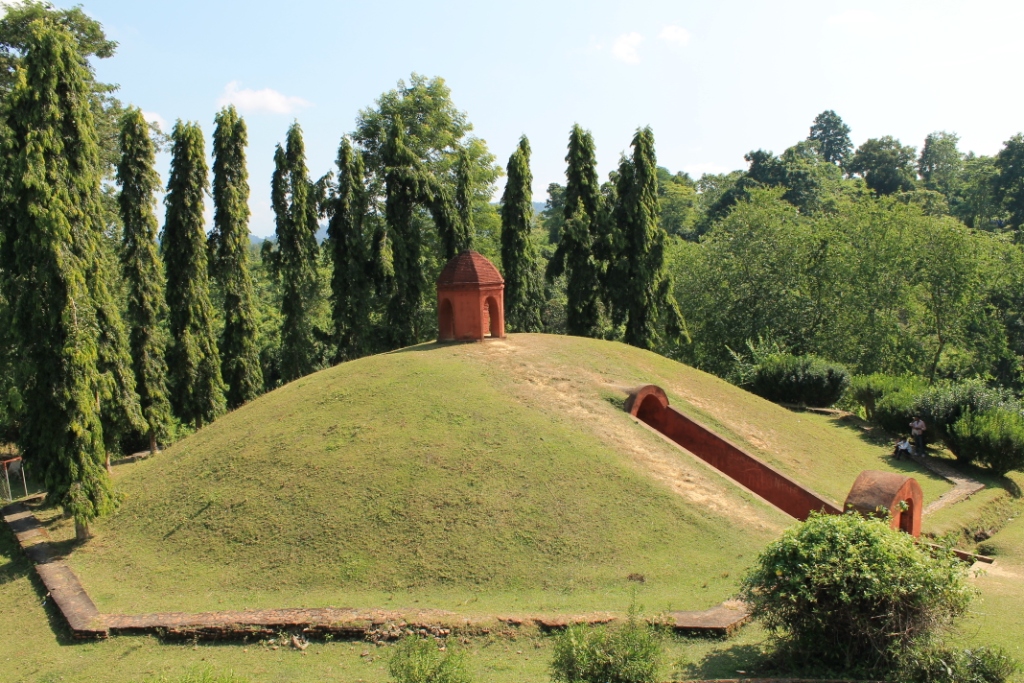
[edit]The Ahoms, a Tai group, ruled Upper Assam for almost 600 years.[32] In the year 1228 the Tai-Ahoms came to the Brahmaputra Valley under the leadership of Sukapha along with 9,000 men from Mong Mao, a Tai state, situated in South-Western Yunnan of China, and established his kingdom in Upper Assam. In 1253, he founded the capital city in a hillock and named it Charaideo. At the time of his advent, the area was inhabited by Morans and Borahis, to the north, to the north-east was the Chutia kingdom and to the south was the Kachari kingdom and to the west on the plains were the Baro-Bhuyans.
For more than two and a half centuries, Sukapha and his descendants, while primarily focused on administering the kingdom, upheld their dominance in the valley through their military prowess.[33]
Expansion
[edit]

The reign of Suhungmung marked the first massive expansion of Ahom kingdom. Besides sending a punitive expeditions against the Nagas, they fought numerous battles with the Bhuyans, Chutias, Kacharis, Turko-Afghans, and the Naras. In 1522–23 the Chutia kingdom was annexed and the captured tract was placed under the administration of Sadiya-Khowa-Gohain. After securing the eastern tract, Suhungmung than expanded his kingdom westwards through conquest and extended it till Marangi to the west of the Dhansiri River. When the Kacharis tried to regain the lost territory they were defeated and their capital Dimapur was sacked. Over the remaining part of the Kachari kingdom, a new king Detsung was placed as a tributary, but Detsung proved disloyal and revolted against the Ahoms. He was subsequently executed. A new dependent king was set up on the Kachari throne with the name of Nirbhaynarayan. Since then the Kachari kings were regarded as 'thapita sanchita' meaning - established and maintained by the Ahom rulers.
Suhungmung's reign also witnessed the first Muslim-invasions of the kingdom. After a series of battle, the invaders were roundly defeated and were chased up to Karatoya River. The Sultan of Bengal, terrified [citation needed] by the approaching army of Suhungmung, made peace with the king.The rising Koch king Biswa Singha also offered his submission, and the Ahom general Ton-Kham granted him all the territories that were received as dowry from the Sultan of Bengal on the condition of annual tribute.[34]
The successors of Suhungmung, Suklenmung and Sukhaamphaa, sent many expeditions against the Bhuyans and Nagas. But were significant with the wars with the Koch. During the reign of Sukhaamphaa, the Ahoms lost to a Koch army led by Chilarai and the Ahoms had to accept Koch supremacy and had to give up the tracts of north of Brahmaputra. However, the lost tract was soon recovered with further military expeditions.[35]
Later Period
[edit]War with Mughals
[edit]

Soon after the death of Nara Narayan, his kingdom was divided between the sons of Nara Narayan and Chilarai as Koch Hajo and Koch Bihar. In 1609, Laxmi Narayan king of Cooch Behar accepted the vassalage of Mughals, and the Koch Hajo king Raghudev, and later his son Parikshit, sought assistance from the Ahoms. In 1612, the Mughals attacked Koch Hajo, and his territory up to Barnadi River was annexed in the Mughal domain. This brought the Mughals into direct contact with the Ahoms. Meanwhile, Parikshit was trying to renew his friendship with the Ahoms, but was captured, and died on his way to his kingdom. Later, Balinarayan, a brother of Parikshit who had taken refugee with the Ahoms, was made the king of Darrang in 1615 by the Ahom king Pratap Singha. From 1616 onwards, many battles were fought with the Mughal without any tangible result, starting with the Battle of Samdhara. After the last battle, the treaty was established in 1639, which fixed the Asurar ali on the south bank and the Barnadi on the north bank of the Brahmaputra as the boundary between the two.
Pratap Singha also enacted the Paik system and created a number of army and civil administration posts such as the Borbarua and Borphukan. Jayadhwaj Singha took advantage of a war of succession between the sons of Shah Jahan, and occupied the imperial territories up to Dhaka. Aurangzeb, after becoming the emperor, appointed Mir Jumla II, to recover the lost territory. After failed negotiations in November 1661, Mir Jumla proceeded with a huge army and fleet to invade the Ahom kingdom. The Ahoms lost at several places, and then captured the Ahom capital Garhgaon. During the rainy season, Mir Jumla and his army suffered immeasurable hardship due to the climatic condition of the valley, in addition to the guerrilla fighting against the invaders. After no noticeable gain, negotiation started and in January 1663, the Treaty of Ghilajharighat was established. According to the treaty, the Ahoms acknowledged Mughal supremacy, ceding the territory west of the Bharali on the north bank and the Kalang on the south bank, along with a huge amount of war indemnity, and handing over the sons of the Gohains as hostages, and two Ahom princesses to the Mughal harem. Soon after the departure of Mir Jumla, Jayadhwaj Singha died and the new king Chakradhwaj Singha began preparations to overthrow Mughal supremacy and to recover the lost territory. After numerous battles, and finally the Battle of Saraighat, the Mughals were forced to retreat.

The period after 1671 was very unstable due to the rivalry among the nobles, who wanted to establish their political power and influence by placing their own choice of prince in the throne. In 1679, Laluksola Borphukan, in hopes of becoming king with the help of the Mughals, surrendered Guwahati without any battle. But after the accession of Gadadhar Singha, at the final Battle of Itakhuli, the Mughals were badly defeated. The border was then fixed at Manah on the north bank, and the Nagarbera hill on the south bank of the Brahmaputra till its annexation by the East India Company in 1826.[36][37]
18th century
[edit]
.jpg)
Rudra Singha succeeded Gadadhar Singha, his reign is notable because of his military achievements and his socio-culture contributions. He had both subjugated the Kachari and Jaintia kingdoms, and had captured their kings and forced to accept Ahom suzerainty and agreed them to pay annual tribute. Other than that, several expeditions were sent against the Miris, the Daflas, the Naga Mishmis and the Nagas of Namsung, Dayang and the Rengma Nagas during late 17th century and early 18th century. Rudra Singha had made extensive preparations for his invasion of Bengal but remained unfulfilled due to his sudden death in 1714.
After Rudra Singha, the Ahoms achieved no notable military achievement. During this period from, Siva Singha to Rajeswar Singha, the kingdom witnessed peace and prosperity and was significant for constructive activities and other development. In the field of religion also, Ekasarana Dharma spread all over the kingdom and started to influence all aspects of people's life. The religious heads of Vaisnavite monastery exalted great influence with royal patronage and established numerous Satras and most of the people became their disciples. So got the Ahom court greatly came under the influence of Sakta Brahman priests and astrologers. The religious policies concluded by Phuleshwari and the persecutions of unfavored Satras, embroiled the situation more along with the pressure of Paik system in the 18th century.[38]
This finally resulted in the Moamoria rebellion (1769–1805), which greatly weakened the Ahom kingdom where the country was greatly depopulated and unorganised. The political rivalry between the nobles made a pathway for a devastating set of invasions by the Burmese, weakening it more and finally leading to its annexation.
Colonial era
[edit]

The discovery of Camellia sinensis in 1834 in Assam was followed by testing in 1836–37 in London.[39] The British allowed companies to rent land from 1839 onwards. Thereafter tea plantations proliferated in Eastern Assam,[40] where the soil and the climate were most suitable. Problems with the imported Han Chinese labourers from China and hostility from native Assamese resulted in the migration of forced labourers from central and eastern parts of India. After initial trial and error with planting the Chinese and the Assamese-Chinese hybrid varieties, the planters later accepted the local Camellia assamica as the most suitable variety for Assam. By the 1850s, the industry started seeing some profits. The industry saw initial growth, when in 1861, investors were allowed to own land in Assam and it saw substantial progress with the invention of new technologies and machinery for preparing processed tea during the 1870s.
Despite the commercial success, tea labourers continued to be exploited, working and living under poor conditions. Fearful of greater government interference, the tea growers formed the Indian Tea Association in 1888 to lobby to retain the status quo. The organisation was successful in this, but even after India's independence, conditions of the labourers have improved very little.[41]
In the later part of the 18th century, religious tensions and atrocities by the nobles led to the Moamoria rebellion (1769–1805), resulting in tremendous casualties of lives and property. The rebellion was suppressed but the kingdom was severely weakened by the civil war. Political rivalry between Prime Minister Purnananda Burhagohain and Badan Chandra Borphukan, the Ahom Viceroy of Western Assam, led to an invitation to the Burmese by the latter,[42][43][44][45] in turn leading to three successive Burmese invasions of Assam. The reigning monarch Chandrakanta Singha tried to check the Burmese invaders but he was defeated after fierce resistance, which led to the Burmese occupation of Assam.[46][47][48]
A reign of terror was unleashed by the Burmese on the Assamese people,[49][50][51][52] who fled to neighbouring kingdoms and British-ruled Bengal.[53][54] The Burmese reached the East India Company's borders, and the First Anglo-Burmese War ensued in 1824. The war ended under the Treaty of Yandabo[55] in 1826, with the Company taking control of Western Assam and installing Purandar Singha as king of Upper Assam in 1833. The arrangement lasted until 1838 and thereafter the British gradually annexed the entire region. Thereafter the court language and medium of instruction in educational institutions of Assam was made Bengali, instead of Assamese. Starting from 1836 until 1873, this imposition of a foreign tongue created greater unemployment among the People of Assam and Assamese literature naturally suffered in its growth.[56][57]

Initially, Assam was made a part of the Bengal Presidency, then in 1906 it was made a part of Eastern Bengal and Assam province, and in 1912 it was reconstituted into a chief commissioners' province. In 1913, a legislative council and, in 1937, the Assam Legislative Assembly, were formed in Shillong, the erstwhile capital of the region. The British tea planters imported labour from central India adding to the demographic canvas.
The Assam territory was first separated from Bengal in 1874 as the 'North-East Frontier' non-regulation province, also known as the Assam Chief-Commissionership. It was incorporated into the new province of Eastern Bengal and Assam in 1905 after the partition of Bengal (1905–1911) and re-established in 1912 as Assam Province.[58]
After a few initially unsuccessful attempts to gain independence for Assam during the 1850s, anti-colonial Assamese joined and actively supported the Indian National Congress against the British from the early 20th century, with Gopinath Bordoloi emerging as the preeminent nationalist leader in the Assam Congress.[citation needed] Bordoloi's major political rival in this time was Sir Saidullah, who was representing the Muslim League, and had the backing of the influential Muslim cleric Maulana Bhasani.[59]
The Assam Postage Circle was established by 1873 under the headship of the Deputy Post Master General.[60]
At the turn of the 20th century, British India consisted of eight provinces that were administered either by a governor or a lieutenant-governor. Assam Province was one among the major eight provinces of British India. The table below shows the major original provinces during British India covering the Assam Province under the Administrative Office of the Chief Commissioner.
With the partition of India in 1947, Assam became a constituent state of India. The Sylhet District of Assam (excluding the Karimganj subdivision) was given up to East Pakistan, which later became Bangladesh.
Modern history
[edit]
The government of India, which has the unilateral powers to change the borders of a state, divided Assam into several states beginning in 1970 within the borders of what was then Assam. In 1963, the Naga Hills district became the 16th state of India under the name of Nagaland. Part of Tuensang was added to Nagaland. In 1970, in response to the demands of the Khasi, Jaintia and Garo people of the Meghalaya Plateau, the districts containing the Khasi Hills, Jaintia Hills, and Garo Hills were formed into an autonomous state within Assam; in 1972 this became a separate state under the name of Meghalaya. In 1972, Arunachal Pradesh (the North East Frontier Agency) and Mizoram (from the Mizo Hills in the south) were separated from Assam as union territories; both became states in 1986.[61]
Since the restructuring of Assam after independence, communal tensions and violence remain. Separatist groups began forming along ethnic lines, and demands for autonomy and sovereignty grew, resulting in the fragmentation of Assam. In 1961, the government of Assam passed legislation making use of the Assamese language compulsory. It was withdrawn later under pressure from Bengali speaking people in Cachar. In the 1980s the Brahmaputra Valley saw a six-year Assam Agitation[62] triggered by the discovery of a sudden rise in registered voters on electoral rolls. It tried to force the government to identify and deport foreigners illegally migrating from neighbouring Bangladesh and to provide constitutional, legislative, administrative and cultural safeguards for the indigenous Assamese majority, which they felt was under threat due to the increase of migration from Bangladesh. The agitation ended after an accord (Assam Accord 1985) between its leaders and the Union Government, which remained unimplemented, causing simmering discontent.[63]
The post 1970s experienced the growth of armed separatist groups such as the United Liberation Front of Asom (ULFA)[62] and the National Democratic Front of Bodoland (NDFB). In November 1990, the Government of India deployed the Indian army, after which low-intensity military conflicts and political homicides have been continuing for more than a decade. In recent times, ethnically based militant groups have grown. The Panchayati Raj Act has been applied in Assam, after agitation of the communities due to the sluggish rate of development and general apathy of successive state governments towards Indigenous Assamese communities.[citation needed]
Geography
[edit]
A significant geographical aspect of Assam is that it contains three of six physiographic divisions of India – The Northern Himalayas (Eastern Hills), The Northern Plains (Brahmaputra plain) and Deccan Plateau (Karbi Anglong). As the Brahmaputra flows in Assam the climate here is cold and there is rainfall most of the month. Geomorphic studies conclude that the Brahmaputra, the life-line of Assam, is an antecedent river older than the Himalayas, which has entrenched itself since they started rising. The river with steep gorges and rapids in Arunachal Pradesh entering Assam, becomes a braided river (at times 10 mi/16 km wide) and with tributaries, creates a flood plain (Brahmaputra Valley: 50–60 mi/80–100 km wide, 600 mi/1000 km long).[65] The hills of Karbi Anglong, North Cachar and those in and close to Guwahati (also Khasi-Garo Hills) now eroded and dissected are originally parts of the South Indian Plateau system.[65] In the south, the Barak River originating in the Barail Range (Assam-Nagaland border) flows through the Cachar district with a 25–30 miles (40–50 km) wide valley and enters Bangladesh with the name Surma River.
Urban centres include Guwahati, one of the 100 fastest growing cities in the world.[66] Guwahati is also referred to as the "Gateway to the North-East India". Silchar, (in the Barak valley) is the second most populous city in Assam and an important centre of business. Other large cities include Dibrugarh, an oil and natural gas industry centre,[67]
Climate
[edit]With the tropical monsoon climate, Assam is temperate (summer max. at 95–100 °F or 35–38 °C and winter min. at 43–46 °F or 6–8 °C) and experiences heavy rainfall and high humidity.[65][68] The climate is characterised by heavy monsoon downpours reducing summer temperatures and affecting foggy nights and mornings in winters, frequent during the afternoons. Spring (March–April) and autumn (September–October) are usually pleasant with moderate rainfall and temperature. Assam's agriculture usually depends on the south-west monsoon rains.
Flooding
[edit]Every year, rivers like the Brahmaputra and Barak overflow due to heavy rainfall, causing widespread flooding across Assam. The rising water levels submerge nearby areas, washing away houses, livestock, and damaging infrastructure such as bridges, railway tracks, and roads, leading to communication breakdowns in many regions. This natural disaster also results in numerous fatalities throughout the state.[69][70]
Fauna
[edit].jpg)

Assam is one of the richest biodiversity zones in the world and consists of tropical rainforests,[71] deciduous forests, riverine grasslands,[72] bamboo[73] orchards and numerous wetland[74] ecosystems; Many are now protected as national parks and reserved forests.
Assam has wildlife sanctuaries, the most prominent of which are two UNESCO World Heritage Sites[75]-the Kaziranga National Park, on the bank of the Brahmaputra River, and the Manas Wildlife Sanctuary, near the border with Bhutan. The Kaziranga is a refuge for the fast-disappearing Indian one-horned rhinoceros. The state is the last refuge for numerous other endangered and threatened species including the white-winged wood duck or deohanh, Bengal florican, black-breasted parrotbill, red-headed vulture, white-rumped vulture, greater adjutant, Jerdon's babbler, rufous-necked hornbill, Bengal tiger, Asian elephant, pygmy hog, gaur, wild water buffalo, Indian hog deer, hoolock gibbon, golden langur, capped langur, barasingha, Ganges river dolphin, Barca snakehead, Ganges shark, Burmese python, Brahminy river turtle, black pond turtle, Asian forest tortoise, and Assam roofed turtle. Threatened species that are extinct in Assam include the gharial, a critically endangered fish-eating crocodilian, and the pink-headed duck (which may be extinct worldwide). For the state bird, the white-winged wood duck, Assam is a globally important area.[76] In addition to the above, there are three other National Parks in Assam namely Dibru Saikhowa National Park, Nameri National Park and the Orang National Park.
Assam has conserved the one-horned Indian rhinoceros from near extinction, along with the pygmy hog, tiger and numerous species of birds, and it provides one of the last wild habitats for the Asian elephant. Kaziranga and Manas are both World Heritage Sites. The state contains Sal tree forests and forest products, much depleted from earlier times. A land of high rainfall, Assam displays greenery. The Brahmaputra River tributaries and oxbow lakes provide the region with hydro-geomorphic environment.[citation needed]
The state has the largest population of the wild water buffalo in the world.[77] The state has the highest diversity of birds in India with around 820 species.[78] With subspecies the number is as high as 946.[79] The mammal diversity in the state is around 190 species.[80]
Flora
[edit]
Assam is remarkably rich in Orchid species and the Foxtail orchid is the state flower of Assam.[81] The recently established Kaziranga National Orchid and Biodiversity Park boasts more than 500 of the estimated 1,314 orchid species found in India.
Geology
[edit]Assam has petroleum, natural gas, coal, limestone and other minor minerals such as magnetic quartzite, kaolin, sillimanites, clay and feldspar.[82] A small quantity of iron ore is available in western districts.[82] Discovered in 1889, all the major petroleum-gas reserves are in Upper parts. A recent USGS estimate shows 399 million barrels (63,400,000 m3) of oil, 1,178 billion cubic feet (3.34×10¹⁰ m3) of gas and 67 million barrels (10,700,000 m3) of natural gas liquids in the Assam Geologic Province.[83][citation needed]
The region is prone to natural disasters like annual floods and frequent mild earthquakes. Strong earthquakes were recorded in 1869, 1897, and 1950.
Demographics
[edit]Population
[edit]| Year | Pop. | ±% |
|---|---|---|
| 1901 | 3,289,680 | — |
| 1911 | 3,848,617 | +17.0% |
| 1921 | 4,636,980 | +20.5% |
| 1931 | 5,560,371 | +19.9% |
| 1941 | 6,694,790 | +20.4% |
| 1951 | 8,028,856 | +19.9% |
| 1961 | 10,837,329 | +35.0% |
| 1971 | 14,625,152 | +35.0% |
| 1981 | 18,041,248 | +23.4% |
| 1991 | 22,414,322 | +24.2% |
| 2001 | 26,655,528 | +18.9% |
| 2011 | 31,205,576 | +17.1% |
| Source: Census of India[84] | ||

The total population of Assam was 26.66 million with 4.91 million households in 2001.[85] Higher population concentration was recorded in the districts of Kamrup, Nagaon, Sonitpur, Barpeta, Dhubri, Darrang, and Cachar. Assam's population was estimated at 28.67 million in 2006 and at 30.57 million in 2011 and is expected to reach 34.18 million by 2021 and 35.60 million by 2026.[86]
As per the 2011 census, the total population of Assam was 31,169,272. The total population of the state has increased from 26,638,407 to 31,169,272 in the last ten years with a growth rate of 16.93%.[87]
Of the 33 districts, Dhubri, Goalpara, Barpeta, Morigaon, Nagaon, and Hailakandi, recorded growth rates ranging from 20 per cent to 24 per cent during the last decade, whereas Sivasagar and Jorhat, registered around 9 per cent population growth. These districts do not have any international border.[88]

In 2011, the literacy rate in the state was 73.18%. The male literacy rate was 78.81% and the female literacy rate was 67.27%.[87] In 2001, the census had recorded literacy in Assam at 63.3% with male literacy at 71.3% and female at 54.6%. The urbanisation rate was recorded at 12.9%.[89]
The growth of population in Assam has increased since the middle decades of the 20th century. The population grew from 3.29 million in 1901 to 6.70 million in 1941. It increased to 14.63 million in 1971 and 22.41 million in 1991.[85] The growth in the Western districts and Southern districts was high primarily due to the influx of large number of illegal immigrants from East Pakistan, now Bangladesh.[63]
The mistrust and clashes between indigenous Assamese people and Bengali Muslims started as early as 1952,[90][91] but is rooted in anti Bengali sentiments of the 1940s.[92] At least 77 people died[93] and 400,000 people were displaced in the 2012 Assam violence between indigenous Bodos and Bengali Muslims.[94]
The People of India project has studied 115 of the ethnic groups in Assam. 79 (69%) identify themselves regionally, 22 (19%) locally, and 3 trans-nationally. The earliest settlers were Austroasiatic, Dravidian followed by Tibeto-Burman, Indo-Aryan, and Tai–Kadai people.[95] Forty-five languages are spoken by different communities, including three major language families: Austroasiatic (5), Sino-Tibetan (24) and Indo-European (12). Three of the spoken languages do not fall in these families. There is a high degree of bilingualism.[citation needed]
According to the World Air Quality Report 2024 by IQAir, Byrnihat located along the Assam-Meghalaya border is the most polluted city in India.[96]
Religions
[edit]

- Hinduism (61.5%)
- Islam (34.2%)
- Christianity (3.70%)
- Buddhism (0.20%)
- Jainism (0.01%)
- Sikhism (0.01%)
- Atheist (0.16%)


According to the 2011 census, 61.47% were Hindus, 34.22% were Muslims.[97][98] Christian minorities (3.7%) are found among the Scheduled Tribe and Castes population.[99]
The Scheduled Tribe population in Assam is around 13%, of which Bodos account for 40%.[100] Other religious groups in Assam include Jainism (0.1%), Buddhism (0.2%), Sikhism (0.1%) and Animism (among Khamti, Phake, Aiton etc. communities).
The three popular sects of Hinduism, namely, Shaivisim, Shaktism, and Vaishnavism are prevalent here. Many Assamese Hindus are also followers of the Ekasarana Dharma sect of Hinduism.[citation needed]
| Religion | Population |
|---|---|
Hindus ( ) )
|
19,180,759 |
Muslims ( ) )
|
10,679,345 |
Christians ( ) )
|
1,165,867 |
Buddhists ( ) )
|
54,993 |
Jains ( ) )
|
25,949 |
Sikhs ( ) )
|
20,672 |
| Other religions | 27,118 |
| Not stated/available | 50,873 |
| Total | 31,205,576 |
Out of 32 districts of Assam, 9 are Muslim majority according to the 2011 census of India: Dhubri, Goalpara, Barpeta, Morigaon, Nagaon, Karimganj, Hailakandi, Darrang and Bongaigaon.[102][103][104]
Languages
[edit].svg)
Assamese

Assamese and Bodo are the official languages of the state, Meitei (Manipuri) is official in Hojai district and all the three districts of Barak Valley, while Bengali is official in the three districts of Barak Valley,[106][6][8] where Sylheti is most commonly spoken.[107]
| Language | Population |
|---|---|
| Assamese | 15,097,257 |
| Bengali | 9,024,652 |
| Bodo | 1,407,371 |
| Hindi | 1,001,698 |
| Sadri | 714,607 |
| Mishing | 617,870 |
| Nepali | 596,026 |
| Karbi | 511,771 |
| Others | 2,234,319 |
| Total | 31,205,576 |

According to the language census of 2011 in Assam, out of a total population of around 31 million, Assamese is spoken by more than 22 million total speakers, with more than 15 million people speaking it as their mother tongue and around 7 million as L2 speakers.[108] Although the number of speakers is growing, the percentage of Assam's population who have it as a mother tongue has fallen slightly. Assamese serves as lingua franca of the region[109] as it is spoken by over 71% of the population (including the one who have listed Assamese as their 2nd language,[108] while 48.38% of them speak it as their mother tongue.[110] According to the 24th Edition of Ethnologue: Languages of the World, Assamese is spoken by 15,327,990 persons as mother tongue across the world as of 2021.[111] However, 2016 Assam Legislative Assembly election results, have found that 10 million people speaks Assamese as their mother tongue in Assam, which is significantly fewer than the census result of 2011.[112] The Assamese speakers constituted 48% of the State population according to the 2011 Census.[113][114][115][116]

The various Bengali dialects and closely related languages are spoken by around 9 million people in Assam, and the portion of the population that speaks these languages has grown slightly as per the census. However, the number of Bengali speakers is estimated to be more than the expected census results, as 30% of the 35% Muslim population in Assam as per 2011 are thought to speak different dialects of Bengali as their native language but during census enumeration, they have reported their mother tongue as Assamese.[117][118][119][120][121] In the Brahmaputra Valley, the main Bengali dialect is that of Mymensingh (now in Bangladesh),[122] while in the Barak Valley and Hojai district, Sylheti is the main language which is also considered to be a dialect of Bengali in census.[123] Bodo is the third most-spoken language followed by Hindi which comes under fourth position.

The population of the Brahmaputra Valley is 27,580,977 according to the 2011 census report by the Assam government. Assamese is the official language of the Brahmaputra Valley and is spoken by 15 million people comprising 55.65% of the valley population. Bengali is spoken by 6.09 million people representing 22.1% of the valley, Hindi is spoken by 2.1 million comprising 7.61% of the region, Bodo is spoken by 1.41 million comprising 5.13% of the valley's population and 2.98 million people speak various indigenous tribal languages of Assam, such as Karbi, Tiwa (Lalung), Hmar, Deori, Rabha, Mishing, Koch, Rajbangshi, Garo, Dimasa, Gorkha, Halam, Ao and Motak.
Traditionally, Assamese was the language of the common folk in the ancient Kamarupa kingdom and in the medieval kingdoms of Dimasa Kachari, Chutiya Kachari, Borahi Kachari, Ahom and Kamata kingdoms. Traces of the language are found in many poems by Luipa, Sarahapa, and others, in Charyapada (c. 7th–8th century CE). Modern dialects such as Kamrupi and Goalpariya are remnants of this language, which blend into the Rajbanshi and Rangpuri lects spoken in North Bengal which have the same origin. Moreover, Assamese in its traditional form was used by the ethno-cultural groups in the region as lingua-franca, which spread during the stronger kingdoms and was required for economic integration. Localised forms of the language still exist in Nagaland and Arunachal Pradesh.
Linguistically modern Assamese traces its roots to the version developed by the American Missionaries based on the local form used near Sivasagar (Xiwôxagôr) district. Assamese (Ôxômiya) is a rich language due to its hybrid nature and unique characteristics of pronunciation and softness. The presence of Voiceless velar fricative in Assamese makes it a unique among other similar Indo-Aryan languages.[126][127]
Bodo is spoken largely in Western Assam. It is official language of the Bodoland territorial region and co-official language of the state of Assam. It is also one of twenty-two languages listed in the Eighth Schedule of the Constitution of India. Spatial distribution patterns of the ethno-cultural groups, cultural traits and the phenomenon of naming all the major rivers in the North East Region with Bodo-Kachari words (e.g. Dihing, Dibru, Dihong, D/Tista, and Dikrai) reveal that it was more widely-spoken in ancient times. Other languages of Tibeto-Burman origin and related to Bodo-Kachari are Deori, Mising, Karbi, Rabha, and Tiwa.[citation needed]
There are approximately 590,000 Nepali speakers spread all over the state forming about 1.98% of Assam's total population according to 2011 census.
There are speakers of Tai languages in Assam. A total of six Tai languages were spoken in Assam. Two are now extinct.[128]
There are also speakers of Dravidian Kurukh[129] and Austroasiatic Khasi speakers scattered across Assam.
Government and politics
[edit]Assam has Governor Lakshman Acharya as the head of the state,[4] the unicameral Assam Legislative Assembly of 126 members, and a government led by the Chief Minister of Assam. The state is divided into five regional divisions.
On 19 May 2016, BJP under the leadership of Sarbananda Sonowal won the Assembly elections, thus forming the first BJP-led government in Assam.[130]
Administrative districts
[edit]
The 35 administrative districts of Assam are delineated based on geographic features such as rivers, hills, and forests.
On 15 August 2015, five new districts were formed:[131][132]
- Part of Sonitpur became the Biswanath district (9 in the nearby map)
- Part of Sivasagar became the Charaideo district (4)
- Part of Nagaon became the Hojai district (14)
- Part of Dhubri became the South Salmara-Mankachar district (33)
- The Karbi Anglong district was divided into East (11) and West (15) districts
On 27 June 2016, an island in the Brahmaputra River was bifurcated from the Jorhat district and declared the Majuli district, India's first district that is a river island.[133]
On 12 January 2021, Bajali was carved out from Barpeta district and formally declared as a district. With the announcement made by Governor Jagdish Mukhi, it has become the 34th district of Assam.[134]
On 31 December 2022, existing four districts Bajali (with Barpeta), Tamulpur(with Udalguri), Biswanath (with Sonitpur) and Hojai(with Nagaon) and number of district came down to 31.
However, after the delimitation exercise was carried out in Assam, the Assam Cabinet reconstituted the 4 new districts (Bajali, Tamulpur, Biswanath and Hojai), taking the number of districts to 35 again.
Subdivisions
[edit]The administrative districts are further subdivided into 54 "Subdivisions" or Mahakuma.[132] Every district is administered from a district headquarters with the office of the Deputy Commissioner, District Magistrate, Office of the District Panchayat and usually with a district court.
The local governance system is organised under the jila-parishad (District Panchayat) for a district, panchayat for group of or individual rural areas and under the urban local bodies for the towns and cities. There are now 2489 village panchayats covering 26247 villages in Assam.[135] The 'town-committee' or nagar-somiti for small towns, 'municipal board' or pouro-sobha for medium towns and municipal corporation or pouro-nigom for the cities consist of the urban local bodies.
For revenue purposes, the districts are divided into revenue circles and mouzas; for the development projects, the districts are divided into 219 'development-blocks' and for law and order these are divided into 206 police stations or thana.
Guwahati is the largest metropolitan area and urban conglomeration administered under the highest form of urban local body – Guwahati Municipal Corporation in Assam. The Corporation administers an area of 216.79 km2 (83.70 sq mi).[136] Apart from Guwahati Municipal Corporation and Dibrugarh Municipal Corporation All other urban centres are managed under Municipal Boards.
A list of 9 oldest, classified and prominent, and constantly inhabited, recognised urban centres based on the earliest years of formation of the civic bodies, before the Indian independence of 1947 is tabulated below:
| Oldest recognised urban centres of Assam[137] | ||||||||
|---|---|---|---|---|---|---|---|---|
| Urban Centres | Civic Body | Year | Airport | Railway Station | Railway Junction | Road Networks | Category† | Notes |
| Guwahati | Guwahati Town Committee | 1853 | Yes | Yes | Yes | Yes | Tier – III | More
Guwahati, the first township of Assam.[138] |
| Guwahati Municipal Board | 1873↑ | Yes | Yes | Yes | Yes | Tier – II | ||
| Guwahati Municipal Corporation | 1974↑ | Yes | Yes | Yes | Yes | Tier – I | More
Establishment of Guwahati Municipal Corporation.[139] | |
| Dibrugarh | Dibrugarh Municipal Board & Dibrugarh Municipal Corporation | 1873 & 2024 | Yes | Yes | Yes | Yes | Tier – II | More
Dibrugarh, the second township of Assam.[140] |
| Goalpara | Goalpara Municipal Board | 1875 | No 1 | Yes | No 2 | Yes | Tier – II | More
Formation of Goalpara Municipality, 1875.[141] |
| Dhubri | Dhubri Municipal Board | 1883 | Yes | Yes | Yes | Yes | Tier – II | More
Formation of Dhubri Municipality, 1883.[142] |
| Nagaon | Nagaon Municipal Board | 1893 | No 3 | Yes | Yes | Yes | Tier – II | More
Formation of Nagaon Municipality, 1893.[143] |
| Tezpur | Tezpur Municipal Board | 1894 | Yes | Yes | Yes | Yes | Tier – II | More
Formation of Tezpur Municipality, 1894.[144] |
| Jorhat | Jorhat Municipal Board | 1909 | Yes | Yes | Yes | Yes | Tier – II | More
Formation of Jorhat Municipality, 1909.[145] |
| Golaghat | Golaghat Municipal Board | 1920 | No 4 | Yes | Yes | Yes | Tier – II | More
Formation of Golaghat Municipality, 1920.[146] |
| Silchar | Silchar Municipal Board | 1922 | Yes | Yes | Yes | Yes | Tier – II | More
Formation of Silchar Municipality, 1922.[147] |
| †Tier – I: a big city with an urban conglomeration (in the true sense) administered by a Municipal corporation. Tier – II: a medium–sized city for an urban agglomeration administered by a Municipal Board. Tier – III: a small town, larger than a township with a sizeable human settlement. ↑Upgraded to the next highest form of civic body. | ||||||||
Autonomous Council
[edit]The state has three autonomous councils under the sixth schedule of the Indian Constitution.
- Bodoland Autonomous Territorial Council
- Karbi Anglong Autonomous Council.
- Dima Hasao Autonomous Council.
The state has further statutory autonomous councils constituted under State Act-
- Tiwa Autonomous Council for ethnic Tiwa people (Lalung)
- Rabha Hasong Autonomous Council
- Mising Autonomous Council for Mising people
- Deori Autonomous Council
- Sonowal Kachari Autonomous Council for Sonowal Kachari people
- Thengal Kachari Autonomous Council
- Moran Autonomous Council for Moran people
- Dudhnoi for ethnic Rabha Kachari
- Mising Autonomous Council for Mising people
- Matak Autonomous Council for Matak people
- Kamatapur Autonomous Council for Rajbongshi people
- Bodo Kachari Welfare Autonomous Council for Bodo-Kachari people living outside the Bodoland Territorial Region
In March 2024, the Assam cabinet had given green signal for 'Kiran Sheikh' development council for the 'Kiran Sheikh' community in Barak Valley.[148]
Social issues
[edit]Inter-state dispute
[edit]
According to Assam Government, Assam has border dispute with four states namely Meghalaya, Mizoram, Nagaland, Arunachal Pradesh.[149]
Assam-Mizoram dispute
[edit]Mizoram used to be a district of Assam as Lushai hills before being carved out as a separate union territory and later, becoming another state in 1987. Because of the history, the district's borders did not really matter for locals for a long time. Mizoram shares a border with the districts Cachar, Hailakandi and Karimganj which comes under Barak valley region of Assam. Over time, the two states started having different perceptions about where the demarcation should be. While Mizoram wants it to be along an Inner Line Permit notified in 1875 to protect tribals from outside influence, which Mizos feel is part of their historical homeland, Assam wants it to be demarcated according to district boundaries drawn up much later.[149][150]
Assam-Meghalaya dispute
[edit]Meghalaya has identified close to a dozen areas on which it has a dispute with Assam about the state's borders. The chief ministers of the two states, Himanta Biswa Sarma and Megahalya's Conrad Sangma, recently held the first-ever meeting on inter-state border dispute. Both the states have agreed to individually assess the claims for all 12 areas flagged by Meghalaya in the past. A second round of discussion between the two state CMs will be held next month of August. On the question of the role the Union Government is playing in redressing the inter-State border dispute in the country, minister of state for home affairs Nityanand Rai said, "The approach of the Central Government has consistently been that inter-state disputes can be resolved only with the cooperation of the State Governments concerned and that the Central Government acts only as a facilitator for amicable settlement of the dispute in the spirit of mutual understanding."[149]
Assam-Nagaland dispute
[edit]The border dispute between the two states has been going on since the formation of Nagaland in 1963. The two states lay claim to Merapani, a small village next to the plains of Assam's Golaghat district. There have been reports of violent clashes in the region since the 1960s.[149][151]
Assam-Arunachal Pradesh dispute
[edit]Assam shares an 804.10 km inter-state boundary with Arunachal Pradesh. The state of Arunachal Pradesh, created in 1987, claims some land that traditionally belonged to its residents has been given to Assam. A tripartite committee had recommended that certain territories be transferred from Assam to Arunachal. The two states have since been battling it out in the Supreme court of India over the issue. Some incidents of local violence have been reported from the borders.[149][152]
Separate statehood demand within Assam
[edit]Ahomland
[edit]
Upper Assam's various Tai-Ahom organisations like "Ahom Tai Mangoliya Rajya Parishad" (ATMRP), has been demanding a separate Ahomland state since 1967, comprising erstwhile Un-divided Sivasagar and Lakhimpur districts (today's Upper Assam and North Assam divisions) respectively.[153] On 2023, "TAI Ahom Yuba Parishad, Assam" (TAYPA) have organised a protest at Chachal and have demanded separate Ahomland state.[154][155]
Barak state
[edit]
The Barak Valley of Assam comprising the present districts of Cachar, Karimganj and Hailakandi is contiguous to Sylhet (Bengal plains), where the Bengalis, according to historian J.B. Bhattacharjee, had settled well before the colonial period, influencing the culture of Dimasa Kacaharis.[156][157] Bhattacharjee describes that the Dimasa kings spoke Bengali, the inscriptions and coins were written in Bengali script and the official language of the court was also Bengali.[157] Migrations to Cachar increased after the British annexation of the region.[157] The native Bengali people of Southern Assam demanded separate state for themselves within the Bengali majority areas of Assam particularly Bengali majority Barak valley comprising three districts: Cachar, Hailakandi, Karimganj along with Dima Hasao and parts of Hojai was also demanded to meet the criteria for creating a separate state for themselves by carving out from Assam's Assamese majority Brahmaputra Valley post NRC.[158][159][160][161] Silchar is the proposed capital of Barak state.[162] Barak valley is the most neglected part of Assam in terms of its infrastructure development, tourism sector, educational institutions, hospitals, IT industries, G.D.P, H.D.I etc. which is still lagging behind in comparison to the Assam's mainland Brahmaputra Valley which have access to all of those facilities mentioned above.[163][164][165][166][167] In fact, the Assam's Southern part have an overall indigenous Bengali majority population, particularly Hojai have overall (54%) Bengali-speaking population,[168] Barak Valley region have an overwhelming Bengali majority of about 80.3%, while Dima Hasao have approximately 30.2% significant Bengali plurality on certain pockets specially in the urban areas of the district.[124]
Bodoland
[edit]
The agitation for the creation of a separate Bodoland state resulted in an agreement between the Indian Government, the Assam state government and the Bodo Liberation Tigers Force. According to the agreement made on 10 February 2003, the Bodoland Territorial Council, an entity subordinate to the government of Assam, was created to govern four districts covering 3082 Bodo Kachari-majority villages in Assam.[169][170] Elections to the council were held on 13 May 2003, and Hagrama Mohilary was sworn in as the chief of the 46-member council on 4 June.[171] Demographic wise, the Indigenous Bodo tribe constitutes half of the region's population, along with the region have also significant large number of other ethnic minorities which includes: Assamese, Koch Rajbangshi, Garo, Rabha tribe, Adivasis, Nepalis, Tea tribes, Bengalis, Biharis, Marwaris and Muslims.[124]
Dimaraji
[edit]
The Dimasa people of northeast India have been demanding a separate state called Dimaraji or "Dimaland" for several decades. It would comprise the Dimasa-Kachari inhabited areas, namely Dima Hasao district, Cachar district, parts of Barak Valley, Nagaon district, Hojai district and Karbi Anglong district in Assam together with part of Dimapur district in Nagaland.
Karbiland
[edit]
Karbi Anglong is one of the 35 districts of Assam. Karbi Anglong was previously known as Mikir Hills. It was part of the Excluded Areas and Partially Excluded Areas (the present North East India) in British India. The British Indian government had never included this area under their government's jurisdiction. Thereby, no government development work or activity were done, nor any tax levied from the hills including Karbi Anglong. The first memorandum for a Karbi homeland was presented to Governor Reid on 28 October 1940 by Semsonsing Ingti and Khorsing Terang at Mohongdijua.[172] The Karbi leaders were then, a part of the All Party Hill Leaders' Conference (APHLC) which was formed on 6 July 1960.[173] The movement again gained momentum when the Karbi Anglong District Council passed a resolution demanding a Separate State in 1981. Then again from 1986 through the leadership of Autonomous State Demand Committee (ASDC), demanded Autonomous statehood of Karbi Anglong and Dima Hasao under Article 244(A). In 2002, the Karbi Anglong Autonomous Council passed another resolution to press for the demand of statehood. Several other memoranda were submitted at different times by several organisations. The demand for a separate state turned violent on 31 July 2013 when student demonstrators set government buildings on fire. Following the incident, the elected leaders of Karbi Anglong jointly submitted a memorandum to the Prime Minister of India demanding a separate State. Demographic wise, more than half of the Karbi Anglong population is made up of Indigenous Karbi tribe with significant migrants from other parts of India.[124]
Migration from Bangladesh
[edit]Assam has been a major site of migration since the Partition of the subcontinent, with the first wave being composed largely of Bengali Hindu refugees arriving during and shortly after the establishment of India and Pakistan (current day Bangladesh was originally part of Pakistan, known as East Pakistan) in 1947–1951. Between the period of first patches (1946–1951), around 274,455 Bengali Hindu refugees have arrived from what is now called Bangladesh (former East Pakistan) in various locations of Assam as permanent settlers and again in second patches between (1952–1958) of the same decade, around 212,545 Bengali Hindus from Bangladesh took shelter in various parts of the state permanently.[174][175] After the 1964 East Pakistan riots many Bengali Hindus have poured into Assam as refugees and the number of Hindu migrants in the state rose to 1,068,455 in 1968 (sharply after 4 years of the riot).[176] The fourth patches numbering around 347,555 have just arrived after Bangladesh liberation war of 1971 as refugees and most of them being Bengali speaking Hindus have decided to stay back in Assam permanently afterwards.[177] Though the governments of India and Bangladesh made agreements for the repatriation of certain groups of refugees after the second and third waves, a large presence of refugees and other migrants and their descendants remained in the state. Nevertheless, still people of Bangladesh have been immigrating to Assam on regular basis. As per reports, about 635 of Bangladeshi people mostly Hindus, use to immigrate to Assam daily.[178][179]
Besides migration caused by displacement, there is also a large and continual unregulated movement between Assam and neighbouring regions of Bangladesh with an exceptionally porous border. The situation is called a risk to Assam's as well as India's security.[180] The continual illegal entry of people into Assam, mostly from Bangladesh, has caused economic upheaval and social and political unrest.[181][182] During the Assam Movement (1979–1985), the All Assam Students Union (AASU) and others demanded that government stop the influx of immigrants and deport those who had already settled.[183] During this period, 855 people (the AASU says 860) died in various conflicts with migrants and police.[184][185] The 1983 Illegal Migrants (Determination by Tribunal) Act, applied only to Assam, decreed that any person who entered the Assam after Bangladesh declared independence from Pakistan in 1971 and without authorisation or travel documents is to be considered a foreigner, with the decision on foreigner status to be carried out by designated tribunals. In 1985, the Indian Government and leaders of the agitation signed the Assam accord to settle the conflict.[183]
The 1991 census made the changing demographics of border districts more visible.[186][183] Since 2010, the Indian Government has undertaken the updating of the National Register of Citizens for Assam, and in 2018 the 32.2 million residents of Assam were subject to a review of their citizenship.[187] In August 2019, India released the names of the 2 million residents of Assam that had been determined to be non-citizens and whose names had therefore been struck off the Register of Citizens, depriving them of rights and making them subject to action, and potentially leaving some of them stateless, and the government has begun deporting non-citizens, while detaining 1,000 others that same year.[188][189][190]
In January 2019, the Assam's peasant organisation Krishak Mukti Sangram Samiti (KMSS) claimed that there are around 20 lakh Hindu Bangladeshis in Assam who would become Indian citizens if the Citizenship (Amendment) Bill is passed. BJP, however claimed that only eight lakh Hindu Bangladeshis will get citizenship.[191][192][193] According to various sources, the total number of illegal Hindu Bangladeshis is hard to ascertain.[194][195] According to the census data, the number of Hindu immigrants have been largely exaggerated.[195]
In February 2020, the Assam Minority Development Board announced plans to segregate illegal Bangladeshi Muslim immigrants from the indigenous Muslims of the state, though some have expressed problems in identifying an indigenous Muslim person. According to the board, there are 1.4 crore Muslims in the state, of which 1 crore are of Bangladeshi origin.[196][197][198] A report reveals that out of total 33 districts in Assam, Bangladeshis dominate almost 15 districts of Assam.[199][200][201]
Floods
[edit]In the rainy season every year, the Brahmaputra and other rivers overflow their banks and flood adjacent land. Flood waters wash away property including houses and livestock. Damage to crops and fields harms the agricultural sector. Bridges, railway tracks, and roads are also damaged, harming transportation and communication, and in some years requiring food to be air-dropped to isolated towns. Some deaths are attributed to the floods.[202][203]
Unemployment
[edit]Unemployment is a chronic problem in Assam. It is variously blamed on poor infrastructure, limited connectivity, and government policy;[204] on a "poor work culture";[205] on failure to advertise vacancies;[206] and on government hiring candidates from outside Assam.[207]
In 2020 a series of violent lynchings occurred in the region.
Education
[edit]-
 School girls in the classroom, Lakhiganj High School, Assam
 -

-
 Academic complex of IIT Guwahati
 -

-
 Entrance of Dibrugarh University
 -


Universities, colleges and institutions include:
Universities
[edit]- Assam University
- Assam Agricultural University, Jorhat
- Assam Don Bosco University,[208]
- Assam down town University,[209]
- Assam Rajiv Gandhi University of Cooperative Management, (ARGUCOM), Sivasagar
- Assam Science and Technology University,[210] Guwahati
- Assam Women's University,[211] Jorhat
- Bodoland University,[212] Kokrajhar
- Cotton University, Guwahati
- Dibrugarh University,[213] Dibrugarh
- Gauhati University,[214] Guwahati
- Kaziranga University,[215] Jorhat
- Krishnaguru Adhyatmik Vishvavidyalaya
- Krishna Kanta Handique State Open University
- Kumar Bhaskar Varma Sanskrit and Ancient Studies University
- Mahapurusha Srimanta Sankaradeva Viswavidyalaya
- National Law University and Judicial Academy, Assam[216]
- Royal Global University
- Srimanta Sankaradeva University of Health Sciences
- Tezpur University,[217] Tezpur
Medical colleges
[edit]- AIIMS, Guwahati
- Assam Medical College, Dibrugarh
- Gauhati Medical College and Hospital, Guwahati
- Jorhat Medical College and Hospital, Jorhat
- Diphu Medical College and Hospital, Diphu
- Lakhimpur Medical college and Hospital, Lakhimpur
- Silchar Medical College and Hospital, Silchar
- Tezpur Medical College & Hospital, Tezpur
- Fakhruddin Ali Ahmed Medical College, Barpeta
- Nagaon Medical College and Hospital, Nagaon
- Kokrajhar Medical College and Hospital, Kokrajhar
- Dhubri Medical College and Hospital, Dhubri
- Regional Dental College, Guwahati
- Government Dental College, Silchar
Assam has 12 medical colleges at present with 4 more scheduled to be completed by 2026–27.
Engineering and technological colleges
[edit]- Indian Institute of Technology in Guwahati[218]
- Indian Institute of Information Technology, Guwahati
- National Institute of Technology, Silchar,[219]
- Assam Engineering College, Guwahati[220]
- Assam Science and Technology University
- Bineswar Brahma Engineering College, Kokrajhar
- Central Institute of Technology, Kokrajhar[221]
- Institute of Engineering and Technology, Dibrugarh University
- Institute of Science and Technology, Guwahati University
- Jorhat Engineering College, Jorhat[222]
- Jorhat Institute of Science & Technology, Jorhat
- NETES Institute of Technology & Science Mirza, [citation needed]
- Barak Valley Engineering College Nirala Karimganj
- Golaghat Engineering College, Golaghat
- Dhemaji Engineering College, Dhemaji
Research institutes present in the state include National Research Centre on Pig, (ICAR) in Guwahati,[223]
Economy
[edit]
Assam's economy is based on agriculture and oil. Assam produces more than half of India's tea.[224] The Assam-Arakan basin holds about a quarter of the country's oil reserves, and produces about 12% of its total petroleum.[225] According to the recent estimates,[226] Assam's per capita GDP is ₹6,157 at constant prices (1993–94) and ₹10,198 at current prices; almost 40% lower than that in India.[227] According to the recent estimates,[226] per capita income in Assam has reached ₹6756 (1993–94 constant prices) in 2004–05, which is still much lower than India's.
Tea plantations
[edit]

Macro-economy
[edit]The economy of Assam today represents a unique juxtaposition of backwardness amidst plenty.[228][full citation needed] Despite its rich natural resources, and supplying of up to 25% of India's petroleum needs, Assam's growth rate has not kept pace with that of India; the difference has increased rapidly since the 1970s.[229] The Indian economy grew at 6% per annum over the period of 1981 to 2000; the growth rate of Assam was only 3.3%.[230] In the Sixth Plan period, Assam experienced a negative growth rate of 3.78% when India's was positive at 6%.[229] In the post-liberalised era (after 1991), the difference widened further.
According to recent analysis, Assam's economy is showing signs of improvement. In 2001–02, the economy grew (at 1993–94 constant prices) at 4.5%, falling to 3.4% in the next financial year.[231] During 2003–04 and 2004–05, the economy grew (at 1993–94 constant prices) at 5.5% and 5.3% respectively.[231] The advanced estimates placed the growth rate for 2005–06 at above 6%.[226] Assam's GDP in 2004 is estimated at $13 billion in current prices. Sectoral analysis again exhibits a dismal picture. The average annual growth rate of agriculture, which was 2.6% per annum over the 1980s, has fallen to 1.6% in the 1990s.[232] The manufacturing sector showed some improvement in the 1990s with a growth rate of 3.4% per annum than 2.4% in the 1980s.[232] For the past five decades, the tertiary sector has registered the highest growth rates of the other sectors, which even has slowed down in the 1990s than in the 1980s.[232]
Employment
[edit]Unemployment is one of the major problems in Assam. This problem can be attributed to overpopulation and a faulty education system. Every year, large numbers of students obtain higher academic degrees but because of non-availability of proportional vacancies, most of these students remain unemployed.[233][234] A number of employers hire over-qualified or efficient, but under-certified, candidates, or candidates with narrowly defined qualifications. The problem is exacerbated by the growth in the number of technical institutes in Assam which increases the unemployed community of the State. The reluctance on the part of the departments concerned to advertise vacancies in vernacular language has also made matters worse for local unemployed youths particularly for the job-seekers of Grade C and D vacancies.[235][236]
Reduction of the unemployed has been threatened by illegal immigration from Bangladesh. This has increased the workforce without a commensurate increase in jobs. Immigrants compete with local workers for jobs at lower wages, particularly in construction, domestics, Rickshaw-pullers, and vegetable sellers.[237][238] The government has been identifying (via NRC) and deporting illegal immigrants. Continued immigration is exceeding deportation.[239][240]
Agriculture
[edit]

In Assam among all the productive sectors, agriculture makes the highest contribution to its domestic sectors, accounting for more than a third of Assam's income and employs 69% of workforce.[241] Assam's biggest contribution to the world is Assam tea. It has its own variety, Camellia sinensis var. assamica. The state produces rice, rapeseed, mustard seed, jute, potato, sweet potato, banana, papaya, areca nut, sugarcane and turmeric.[citation needed]
Assam's agriculture is yet to experience modernisation in a real sense. With implications for food security, per capita food grain production has declined in the past five decades.[242] Productivity has increased marginally, but is still low compared to highly productive regions. For instance, the yield of rice (a staple food of Assam) was just 1531 kg per hectare against India's 1927 kg per hectare in 2000–01[242] (which itself is much lower than Egypt's 9283, US's 7279, South Korea's 6838, Japan's 6635 and China's 6131 kg per hectare in 2001[243]). On the other hand, after having strong domestic demand, and with 1.5 million hectares of inland water bodies, numerous rivers and 165 varieties of fishes,[244] fishing is still in its traditional form and production is not self-sufficient.[245]
Floods in Assam greatly affect the farmers and the families dependent on agriculture because of large-scale damage of agricultural fields and crops by flood water.[69][70] Every year, flooding from the Brahmaputra and other rivers deluges places in Assam. The water levels of the rivers rise because of rainfall resulting in the rivers overflowing their banks and engulfing nearby areas. Apart from houses and livestock being washed away by flood water, bridges, railway tracks and roads are also damaged by the calamity, which causes communication breakdown in many places. Fatalities are also caused by the natural disaster in many places of the state.[246][247]
Infrastructure
[edit]On 30 August 2023, Nilachal Flyover was inaugurated. The flyover is Assam's longest flyover, spanning 2.63 kilometres and connecting Maligaon Chariali to Kamakhya Gate in Guwahati.[248]
Industry
[edit]Handlooms and handicrafts are traditional industries that continue to survive, especially among rural women, in the state.[249]
Assam's proximity to some neighbouring countries such as Bangladesh, Nepal and Bhutan, benefits its trade. The major Border checkpoints through which border trade flows to Bangladesh from Assam are : Sutarkandi (Karimganj), Dhubri, Mankachar (Dhubri) and Golokanj. To facilitate border trade with Bangladesh, Border Trade Centres have been developed at Sutarkandi and Mankachar. It has been proposed in the 11th five-year plan[clarification needed] to set up two more Border Trade Center, one at Ledo connecting China and other at Darrang connecting Bhutan. There are several Land Custom Stations (LCS) in the state bordering Bangladesh and Bhutan to facilitate border trade.[250]
The government of India has identified some thrust areas for industrial development of Assam:[251]
- Petroleum and natural gas-based industries
- Industries based on locally available minerals
- Processing of plantation crops
- Food processing industries
- Agri-Horticulture products
- Herbal products
- Biotech products
- Pharmaceuticals
- Chemical and plastic-based industries
- Export oriented industries
- Electronic and IT base industries including services sector
- Paper making industries
- Textiles and sericulture
- Engineering industries
- Cane and bamboo-based industries
- Other handicrafts industry
Although, the region in the eastern periphery of India is landlocked and is linked to the mainland by the narrow Siliguri Corridor (or the Chicken's Neck) improved transport infrastructure in all the three modes – rail, road and air – and developing urban infrastructure in the cities and towns of Assam are giving a boost to the entire industrial scene. The Lokpriya Gopinath Bordoloi International Airport at Guwahati, with international flights to Bangkok and Singapore offered by Druk Air of Bhutan, was the 12th busiest airport of India in 2012.[252] The cities of Guwahati[253][254] in the west and Dibrugarh[255][256] in the east with good rail,[257][258] road and air connectivity are the two important nerve centres of Assam, to be selected by Asian Development Bank for providing $200 million for improvement of urban infrastructure.[259][260]
Assam is a producer of crude oil and it accounts for about 15% of India's crude output,[261] exploited by the Assam Oil Company Ltd.,[262] and natural gas in India and is the second place in the world (after Titusville in the United States) where petroleum was discovered. Asia's first successful mechanically drilled oil well was drilled in Makum way back in 1867. Most of the oilfields are located in the Eastern Assam region. Assam has four oil refineries in Digboi (Asia's first and world's second refinery), Guwahati, Bongaigaon and Numaligarh and with a total capacity of 7 million metric tonnes (7.7 million short tons) per annum. Asia's first refinery was set up at Digboi and discoverer of Digboi oilfield was the Assam Railways & Trading Company Limited (AR&T Co. Ltd.), a registered company of London in 1881.[263] One of the biggest public sector oil company of the country Oil India Ltd. has its plant and headquarters at Duliajan.
There are several other industries, including a chemical fertiliser plant at Namrup, petrochemical industries in Namrup and Bongaigaon, paper mills at Jagiroad, Hindustan Paper Corporation Ltd. Township Area Panchgram and Jogighopa, sugar mills in Barua Bamun Gaon, Chargola, Kampur, cement plants in Bokajan and Badarpur, and a cosmetics plant of Hindustan Unilever (HUL) at Doom Dooma. Moreover, there are other industries such as jute mill, textile and yarn mills, Assam silk, and silk mills. Many of these industries are facing losses and closure due to lack of infrastructure and improper management practices.[264]
Tourism
[edit]Wildlife, cultural, and historical destinations have attracted visitors.
Culture
[edit]
Assamese Culture is described as a hybrid and syncretic in nature developed due to the assimilation of numerous ethnic groups and cultural practices of Austroasiatic, Tibeto-Burman, Indo-aryan and Tai inhabitants. Therefore, both local elements or the local elements in Sanskritised forms are distinctly found.[265] The major milestones in the evolution of Assamese culture are:

- Assimilation in the Kamarupa kingdom for almost 800 years (Varman dynasty for 300 years, Mlechchha dynasty for 250 years and the Pala dynasty for 200 years.[21]
- Establishment of the Chutia kingdom in the 12th century in eastern Assam and assimilation for next 400 years.[21]
- Establishment of the Ahom kingdom in the 13th century CE and assimilation for next 600 years.[21]
- Assimilation in the Koch kingdom (15th–16th century CE) of western Assam and Kachari kingdom (12th–18th century CE) of central and southern Assam.[21]
- Neo-Vaishanavite (Ekasarana Dharma) Movement led by Srimanta Shankardeva (Xongkordeu) made an enormous impact on the socio-cultural and religious sphere of Assam. This 15th century religio-cultural movement under the leadership of Srimanta Sankardeva (Xonkordeu) and his disciples have provided another dimension to Assamese culture. A renewed Hinduisation in local forms took place, which was initially greatly supported by the Koch and later by the Ahom kingdoms. The resultant social institutions such as namghar and sattra (the Vaishnav Monasteries) have become an integral part of the Assamese way of life. The movement contributed greatly towards language, literature, and performing and fine arts.[citation needed]. It was also an egalitarian reform movement as it broke away with the old caste barriers of Brahmanical Hinduism and converted into its fold people of all castes, ethnicity and religions (including Islam).

The modern culture has been influenced by events in the British and the post-British era. Assamese language was standardised by American Baptist Missionaries such as Nathan Brown, Dr. Miles Bronson and local pundits such as Hemchandra Barua with the dialect spoken in undivided Sibsagar district (the centre of the Ahom kingdom) forming the standardised dialect.[citation needed]
Increasing efforts of standardisation in the 20th century alienated the localised forms present in different areas and with the less-assimilated ethno-cultural groups (many source-cultures). However, Assamese culture in its hybrid form and nature is one of the richest, still developing and in true sense is a 'cultural system' with sub-systems. Many source-cultures of the Assamese cultural-system are still surviving either as sub-systems or as sister entities, e.g. the; Bodo or Karbi or Mishing. It is important to keep the broader system closer to its roots and at the same time focus on development of the sub-systems.
Some of the common and unique cultural traits in the region are peoples' respect towards areca-nut and betel leaves, symbolic (gamosa, arnai, etc.), traditional silk garments (e.g. mekhela chador, traditional dress of Assamese women) and towards forefathers and elderly. Moreover, great hospitality and bamboo culture are common.
Symbols
[edit]

Symbolism is an ancient cultural practice in Assam and is still a very important part of the Assamese way of life. Various elements are used to represent beliefs, feelings, pride, identity, etc.
Tamulpan (areca nut and betel leaves), Xorai and Gamosa are three important symbolic elements in Assamese culture. Tamulpan or guapan (gua from kwa) are considered along with the Gamosa (a typical woven cotton or silk cloth with embroidery) as the offers of devotion, respect and friendship. The Tamulpan-tradition is an ancient one and is being followed since time-immemorial with roots in the aboriginal Austric culture. Xorai is a traditionally manufactured bell-metal article of great respect and is used as a container-medium while performing respectful offers. Moreover, symbolically many ethno-cultural groups use specific clothes to portray respect and pride.

There were many other symbolic elements and designs, but are now only found in literature, art, sculpture, architecture, etc. or in use today for only religious purposes. The typical designs of Assamese-lion, dragon (ngi-ngao-kham), and flying-lion (Naam-singho) are used for symbolising various purposes and occasions. The archaeological sites such as the Madan Kamdev (c. 9th–10th centuries CE) exhibits mass-scale use of lions, dragon-lions and many other figures of demons to show case power and prosperity.

The Vaishnavite monasteries (Sattras) and many other architectural sites of the late medieval period display the use of lions and dragons for symbolic effects.
Festivals and traditions
[edit]


There are diversified important traditional festivals in Assam. Bihu is the most important festival of Assam and is celebrated all over the state.The Assamese new year (Ek Bohag) is celebrated in April of the Gregorian calendar.

Bihu is described as the soul and life of Assam. It is a series of three prominent festivals each associated with a certain stage during the cultivation of paddy. Primarily a secular festival celebrated to mark the seasons and the significant points of a cultivator's life over yearly cycle. Three Bihus, rongali (in the month of bohag), celebrated with the coming of spring and the beginning of the sowing season; kongali or kati, the barren bihu when the fields are lush but the barns are empty and bhogali (in the month of magh), the thanksgiving when the crops have been harvested and the granaries are full. Bihu songs and Bihu dance are associated with rongali and bhogali bihu. The day before the each bihu is known as the day of Uruka. The first day of 'Rongali bihu' is called 'Goru bihu' (the bihu of the cows), when the cows are taken to the nearby rivers or ponds to be bathed with special care. In recent times the form and nature of celebration has changed with the growth of urban centres.

Bwisagu is one of the most popular seasonal festivals of the Bodos. Baisagu is a Boro word which originated from the word "Baisa" which means year or age, and "Agu" meaning starting or beginning. Bwisagu marks the beginning of the new year. It is celebrated at the beginning of the first month of the Boro year, around mid-April in the Gregorian Calendar. It has remarkable similarities to the festival of Rongali Bihu, also celebrated at the same time in Assam. The worship of Bathow is done on the second day of the festival.

Ali-Aye-Ligang or Ali-Ai-Ligang is a spring festivital associated with agriculture celebrated by the indigenous Mising of Assam and other Northeast Indian states. It marks the beginning of the Ahu paddy cultivation in the farms. The term "Ali" denotes legumes, "Aye" means seed and "Ligang" is 'to sow'. The festival is celebrated on a Wednesday of the month of Fagun of the Assamese calendar and in the month of February in English calendar. The gumrag dance is associated with this festival.

Bushu Dima or simply Bushu is a major harvest festival of the Dimasa people. This festival is celebrated during the end of January. Officially 27 January has been declared as the day of Bushu Dima festival. The Dimasa people celebrate by playing musical instruments- khram (a type of drum), muri (a kind of huge long flute). The people dance to the different tunes of "murithai" and each dance has its own unique name, the most prominent being the "Baidima" There are three types of Bushu celebrated by the Dimasas- Jidap, Surem and Hangsou.
Me-Dam-Me-Phi is the day of the veneration of the dead ancestors for the Tai-Ahom community. It bears striking similarity in the concept of ancestor worship that the Tai-Ahoms share with other peoples originating from the Tai stock. The word ‘Me’ means offerings, ‘Dam’ means ancestors and ‘Phi’ means gods. According to the Buranjis, Lengdon (God of thunder), the king of Mong Phi (The heavenly kingdom), sent two of his grandsons Khunlung and Khunlai to Mong Ri Mong Ram (present day Xishuangbanna, China) and at that moment Ye-Cheng-Pha, the God of knowledge, advised them to perform Umpha, Phuralong, Mae Dam Mae Phi and Rik-khwan rituals in different months of the year on different occasions to pay respect to the Phi-Dam (Ancestral Spirit) and Khwan elements. Since that day till now Mae Dam Mae Phi has been observed by the Tai-Ahoms. It is celebrated on 31 January every year according to the Gregorian calendar.

Rongker also called Dehal is an annual winter festival of merriment celebrated by the Karbi people of Assam. It is observed in order to appease the local deities associated with the welfare of the village and the harvest of crops and also to get rid of all evil spirits. Although the festival does have a specific time it is usually observed at the beginning of the Karbi New year (Thang thang) which falls on February of the Gregorian calendar.

Doul Mohutsav, also called Fakuwa or Doul Utsav is a festival of colours and happiness popular in Lower Assam and especially in Barpeta. It is synonymous with the festival of Holi celebrated in Northern India. Holigeets of Barpeta are sung which is incredibly popular and enthralls the heart of every Assamese. These holigeets are the exquisite compositions in praise of Lord Krishna. People from different parts of the state visit Barpeta Satra to experience this colourful and joyful festival.
Chavang Kut is a post harvesting festival of the Kuki people. The festival is celebrated on the first day of November every year. Hence, this particular day has been officially declared as a Restricted Holiday by the Assam government. In the past, the celebration was primarily important in the religio-cultural sense. The rhythmic movements of the dances in the festival were inspired by animals, agricultural techniques and showed their relationship with ecology. Today, the celebration witnesses the shifting of stages and is revamped to suit new contexts and interpretations. The traditional dances which form the core of the festival is now performed in out-of-village settings and are staged in a secular public sphere. In Assam, the Kukis mainly reside in the two autonomous districts of Dima Hasao and Karbi Anglong.
Beshoma is a festival of Deshi people (one of the indigenous Muslim groups of Assam).[266] It is a celebration of sowing crop. The Beshoma starts on the last day of Chaitra and goes on until the sixth of Baisakh. With varying locations it is also called Bishma or Chait-Boishne.[267]
Moreover, there are other important traditional festivals being celebrated every year on different occasions at different places. Many of these are celebrated by different ethno-cultural groups (sub and sister cultures). Some of these are:
- Wanshuwa Festival (by the Tiwas)
- Kherai (by the Bodos)
- Garja
- Bisu (Deori)
- Awnkham Gwrlwi Janai
- Chojun/Swarak
- Deusi Bhailo ( Traditional Nepalese songs that are sung during the festival of light "Dipavali" and also called "Tihar" )
- Sokk-erroi
- Hacha-kekan
- Hapsa Hatarnai
- Porag
- Bathow
- Wangala
- Bohuwa nrityo

Christmas is observed with great merriment by Christians of various denominations, including Catholics, Protestants and Baptists, throughout Assam. Durga Puja is widely celebrated across the state. Muslims celebrate two Eids (Eid ul-Fitr and Eid al-Adha) with much eagerness all over Assam.
Other few yearly celebrations are Brahmaputra Beach Festival, Guwahati, Kaziranga Elephant Festival, Kaziranga and Dehing Patkai Festival, Lekhapani, Karbi Youth Festival of Diphu and International Jatinga Festival, Jatinga can not be forgotten. Few yearly Mela's like Jonbeel Mela, started in the 15th century by the Ahom Kings, Ambubachi Mela, Guwahati etc.
Asom Divas or Sukapha Divas (2 December) is celebrated to commemorate the advent of the first king of the Ahom kingdom in Assam after his journey over the Patkai Hills.
Lachit Divas (24 November) is celebrated on the birth anniversary of the great Ahom general Lachit Borphukan. Sarbananda Sonowal, the chief minister of Assam took part in the Lachit Divas celebration at the statue of Lachit Borphukan at Brahmaputra riverfront on 24 November 2017. He said, the first countrywide celebration of 'Lachit Divas' would take place in New Delhi followed by state capitals such as Hyderabad, Bangalore and Kolkata in a phased manner.
Music, dance, and drama
[edit]-

-
 Bodo dance Bagurumba
 -
 Jhumair dance in Tea garden
 -
 Nagara drums
 -
 Bhupen Hazarika (Music maestro of Assam)
 -
 Assamese youth performing Bihu Dance
 -

-
 Bhaona performance
 -
 Mask making in Majuli


.JPG)


Performing arts include: Ankia Naat (Onkeeya Naat), a traditional Vaishnav dance-drama (Bhaona) popular since the 15th century CE.[citation needed] It makes use of large masks of gods, goddesses, demons and animals and in between the plays a Sutradhar (Xutrodhar) continues to narrate the story.[citation needed]
Besides Bihu dance and Husori performed during the Bohag Bihu, dance forms of tribal minorities such as; Kushan nritra of Rajbongshi's, Bagurumba and Bordoicikhla dance of Bodos, Mishing Bihu, Banjar Kekan performed during Chomangkan by Karbis, Jhumair of Tea-garden community are some of the major folk dances.[268] Sattriya (Sotriya) dance related to Vaishnav tradition is a classical form of dance. Moreover, there are several other age-old dance-forms such as Barpeta's Bhortal Nritya, Deodhani Nritya, Ojapali, Beula Dance, Ka Shad Inglong Kardom, Nimso Kerung, etc. The tradition of modern moving theatres is typical of Assam with immense popularity of many Mobile theatre groups such as Kohinoor, Brindabon, etc.[citation needed]
The indigenous folk music has influenced the growth of a modern idiom, that finds expression in the music of artists like Jyoti Prasad Agarwala, Bishnuprasad Rabha, Parvati Prasad Baruwa, Bhupen Hazarika, Pratima Barua Pandey, Anima Choudhury, Luit Konwar Rudra Baruah, Jayanta Hazarika, Khagen Mahanta, Dipali Barthakur, among many others. Among the new generation, Zubeen Garg, Angaraag Mahanta and Joi Barua.[citation needed] There is an award given in the honour of Bishnu Prasad Rabha for achievements in the cultural/music world of Assam by the state government.[citation needed]
Contemporary Assamese music also saw the rise of Zubeen Garg, one of the most popular modern singers of the region. His Assamese song "Mayabini Raatir Bukut" has achieved iconic status and is widely regarded as an anthem in Assam.[269]
Cuisine
[edit]
Typically, an Assamese meal consists of many things such as bhat (rice) with dayl/ daly (lentils), masor jool (fish stew), mangxô (meat stew) and stir fried greens or herbs and vegetables.[citation needed]

The two main characteristics of a traditional meal in Assam are khar (an Alkali, named after its main ingredient) and tenga (preparations bearing a characteristically rich and tangy flavour). Khorika is the smoked or fire grilled meat eaten with meals. Pitika (mash) is another delicacy of Assam. It includes alu pitika (mashed potatoes), bilahi (tomatoes), bengena (brinjals) or even masor pitika (fish). Commonly consumed varieties of meat include Mutton, fowl, duck/goose, fish, pigeon, pork and beef (among Muslim and Christian indigenous Assamese ethnic groups). Grasshoppers, locusts, silkworms, snails, eels, bat wild fowl, squab and other birds, and venison are also eaten, albeit in moderation.[citation needed]

Khorisa (fermented bamboo shoots) are used at times to flavour curries while they can also be preserved and made into pickles. Koldil (banana flower) and squash are also used in popular culinary preparations.[270]

A variety of different rice cultivars are grown and consumed in different ways, viz., roasted, ground, boiled or just soaked.[citation needed]
Fish curries made of free range wild fish as well as Bôralí, rôu, illish, or sitôl are the most popular.[citation needed]
Another favourite combination is luchi (fried flatbread), a curry which can be vegetarian or non-vegetarian.[citation needed]
Many indigenous Assamese communities households still continue to brew their traditional alcoholic beverages; examples include: Laupani, Xaaj, Paniyo, Jou, Joumai, Hor, Apong, Sujen etc. Such beverages are served during traditional festivities. Declining them is considered socially offensive.[citation needed]
Assamese food is generally served in traditional bell metal dishes and platters like Kanhi, Maihang and so on.[citation needed]
-
 Fish cooked in banana leaves
 -

-


Literature
[edit]

Assamese literature dates back to the composition of Charyapada, and later on works like Saptakanda Ramayana by Madhava Kandali, which is the first translation of the Ramayana into an Indo-Aryan language, contributed to Assamese literature.[272][273][274] Sankardeva's Borgeet, Ankia Naat, Bhaona and Satra tradition backed the 15th-16th century Assamese literature.[275][276][277][278] Written during the Reign of Ahoms, the Buranjis are notable literary works which are prominently historical manuscripts.[279] Most literary works are written in Assamese although other local language such as Bodo and Dimasa are also represented.[citation needed] In the 19th and 20th century, Assamese and other literature was modernised by authors including Lakshminath Bezbaroa, Birinchi Kumar Barua, Hem Barua, Dr. Mamoni Raisom Goswami, Bhabendra Nath Saikia, Birendra Kumar Bhattacharya, Hiren Bhattacharyya, Homen Borgohain, Bhabananda Deka, Rebati Mohan Dutta Choudhury, Mahim Bora, Lil Bahadur Chettri, Syed Abdul Malik, Surendranath Medhi, Hiren Gohain etc.
Fine arts
[edit]The archaic Mauryan Stupas discovered in and around Goalpara district are the earliest examples (c. 300 BCE to c. 100 CE) of ancient art and architectural works. The remains discovered in Daparvatiya (Doporboteeya) archaeological site with a beautiful doorframe in Tezpur are identified as the best examples of artwork in ancient Assam with influence of Sarnath School of Art of the late Gupta period.[citation needed]
Painting is an ancient tradition of Assam. Xuanzang (7th century CE) mentions that among the Kamarupa king Bhaskaravarma's gifts to Harshavardhana there were paintings and painted objects, some of which were on Assamese silk. Many of the manuscripts such as Hastividyarnava (A Treatise on Elephants), the Chitra Bhagawata and in the Gita Govinda from the Middle Ages bear excellent examples of traditional paintings.[citation needed]
Traditional crafts
[edit]Assam has a rich tradition of crafts, Cane and bamboo craft, bell metal and brass craft, silk and cotton weaving, toy and mask making, pottery and terracotta work, wood craft, jewellery making, and musical instruments making have remained as major traditions.[280]
Cane and bamboo craft provide the most commonly used utilities in daily life, ranging from household utilities, weaving accessories, fishing accessories, furniture, musical instruments, construction materials, etc. Utilities and symbolic articles such as Sorai and Bota made from bell metal and brass are found in every Assamese household.[281][282] Hajo and Sarthebari (Sorthebaary) are the most important centres of traditional bell-metal and brass crafts. Assam is the home of several types of silks, the most prestigious are: Muga – the natural golden silk, Pat – a creamy-bright-silver coloured silk and Eri – a variety used for manufacturing warm clothes for winter. Apart from Sualkuchi (Xualkuchi), the centre for the traditional silk industry, in almost every parts of the Brahmaputra Valley, rural households produce silk and silk garments with excellent embroidery designs. Moreover, various ethno-cultural groups in Assam make different types of cotton garments with unique embroidery designs and wonderful colour combinations.
Moreover, Assam possesses unique crafts of toy and mask making mostly concentrated in the Vaishnav Monasteries, pottery and terracotta work in western Assam districts and wood craft, iron craft, jewellery, etc. in many places across the region.
-
 A page of manuscript painting from Assam; The medieval painters used locally manufactured painting materials such as the colours of hangool and haital and papers manufactured from aloewood bark
 -
 Bell metal made sorai and sophura are important parts of culture
 -
 Assam Kahor (Bell metal) Kahi
 -
 Brihat Ushaharan, an 18th-century manuscript illustration of Garhgoan school of painting
 -
 Mayurpokhyi Khel-Nao (Pleasure boat) of medieval Assam, used by Badula Ata of Kamalabari Satra
 -
 18th century Mahisamardini bronze metal sculpture
 -
 A painting from the folio of Hastividyarnava
 -
 Mask art of Assam
 -
 Vrindavani Vastra was woven in the 16th century under the guidance of Mahapurush Shrimanta Shankardev. The large drape illustrates the childhood activities of Lord Krishna in Vrindavan.


_of_Kamalabari_Satra.jpg)


Media
[edit]Print media include Assamese dailies Amar Asom, Asomiya Khabar, Asomiya Pratidin, Dainik Agradoot, Dainik Janambhumi, Dainik Asam, Gana Adhikar, Janasadharan and Niyomiya Barta. Asom Bani, Sadin and Janambhumi are Assamese weekly newspapers. The English dailies of Assam include The Assam Tribune, The Sentinel, The Telegraph, The Times of India, The North East Times, Eastern Chronicle and The Hills Times. Thekar, in the Karbi language has the largest circulation of any daily from Karbi Anglong district. Bodosa has the highest circulation of any Bodo daily from BTR. Dainik Jugasankha is a Bengali daily with editions from Dibrugarh, Guwahati, Silchar and Kolkata. Dainik Samayik Prasanga, Dainik Prantojyoti, Dainik Janakantha and Nababarta Prasanga are other prominent Bengali dailies published in the Barak Valley towns of Karimganj and Silchar. Hindi dailies include Purvanchal Prahari, Pratah Khabar and Dainik Purvoday.
Broadcasting stations of All India Radio have been established in 22 cities across the state. Local news and music are the main priority for those stations. Assam has three public service broadcasting service stations of state-owned Doordarshan at Dibrugarh, Guwahati and Silchar. The Guwahati-based satellite news channels include Assam Talks, DY 365, News Live, News18 Assam North East, North East Live, Prag News and Pratidin Time.
Geographical indications
[edit]Boka Chaul
[edit]Boka Chaul was awarded the Geographical Indication (GI) status tag from the Geographical Indications Registry, under the Union Government of India, on 30 July 2018 and is valid until 24 July 2026.[283][284]
Lotus Progressive Centre (LPC) and Centre for Environment Education (CEE) from Guwahati, proposed the GI registration of Boka Chaul.[285] After filing the application in July 2018, the rice was granted the GI tag in 2023 by the Geographical Indication Registry in Chennai, making the name "Boka Chaul" exclusive to the rice grown in the region. It thus became the second rice variety from Assam after Joha rice and the 7th type of goods from Assam to earn the GI tag.[286]
The GI tag protects the rice from illegal selling and marketing, and gives it legal protection and a unique identity.
See also
[edit] India portal
- Outline of Assam – comprehensive topic guide listing articles about Assam.
- List of people from Assam
- 2022 Silchar Floods
- Emblem of Assam

Notes
[edit]- ^ Barak Valley has three districts. In all the three districts, Meitei language (alias Manipuri language) serves as an official language, besides Bengali language.
- ^ /əˈsɑːm/ ə-SAHM; Assamese: oxom, pronounced [ɔˈxɔm] ⓘ
References
[edit]- ^ "State Symbols | Assam State Portal". Assam.gov.in. 1 December 2020. Archived from the original on 4 July 2022. Retrieved 24 August 2022.
- ^ Baruah, Krishna Dulal (May 2004). "O mor aponar dex". Xongitor byobohari xutro aru guitar (2nd ed.). Ananta Hazarika, Banalata. p. 46.
- ^ Steinberg, S. (2016). The Statesman's Year-Book 1964–65: The One-Volume ENCYCLOPAEDIA of all nations. Springer. p. 412. ISBN 978-0-230-27093-0. Archived from the original on 1 February 2023. Retrieved 3 September 2018.
- ^ a b "President Droupadi Murmu appoints six new Governors, reshuffles three others". The Hindu. 27 July 2024. Retrieved 28 July 2024.
- ^ "Report of the Commissioner for linguistic minorities: 52nd report (July 2014 to June 2015)" (PDF). Commissioner for Linguistic Minorities, Ministry of Minority Affairs, Government of India. pp. 58–59. Archived from the original (PDF) on 28 December 2017. Retrieved 16 February 2016.
- ^ a b c "Govt withdraws Assamese as official language from Barak valley". Business Standard India. Press Trust of India. 9 September 2014. Archived from the original on 29 January 2018. Retrieved 29 January 2018.
- ^ PTI (30 December 2020). "Assam Assembly Accords Associate Official Language Status To Bodo". NDTV. Retrieved 21 February 2022.
- ^ a b Purkayastha, Biswa Kalyan (24 February 2024). "Assam recognises Manipuri as associate official language in four districts". Hindustan Times. Archived from the original on 25 February 2024. Retrieved 26 February 2024.
- ^ Pajnoo, Shirin (8 April 2025). "Assam Budget Analysis 2025-26" (PDF). PRS Legislative Research. Retrieved 17 July 2025.
- ^ "India: Subnational HDI". Global Data Labs. Retrieved 8 June 2025.
- ^ "Appendix-A: Detailed tables, Table (7): Literacy rate (in per cent) of persons of different age groups for each State/UT (persons, age-group (years): 7 & above, rural+urban (column 6))". Annual Report, Periodic Labour Force Survey (PLFS) (July 2023 – June 2024) (PDF). National Sample Survey Office, Ministry of Statistics and Programme Implementation, Government of India. 23 September 2024. pp. A-10.
- ^ "Assam Legislative Assembly - History". Archived from the original on 13 September 2016. Retrieved 14 September 2016.
- ^ Purkayastha, Biswa Kalyan (24 February 2024). "Assam recognises Manipuri as associate official language in four districts". Hindustan Times. Retrieved 17 May 2024.
- ^ "Here is India's oil story". The Financial Express. 3 May 2018. Archived from the original on 21 July 2019. Retrieved 21 July 2019.
- ^ "Dibru Saikhowa national park, Famous for wild horses, Tinsukia, Assam". www.assaminfo.com. Retrieved 29 March 2025.
- ^ Besatia in the Schoff translation and also sometimes used by Ptolemy, they are a people similar to Kirradai and they lived in the region between "Assam and Sichuan" (Casson 1989, pp. 241–243)
- ^ "The Periplus of the Erythraen Sea (last quarter of the first century A.D) and Ptolemy's Geography (middle of the second century A.D) appear to call the land including Assam Kirrhadia after its Kirata population." (Sircar 1990:60–61)
- ^ "Prior to the thirteenth century the present region was called Kāmarūpa or, alternatively, Prāgjyotiṣapur", Lahiri, Nayanjot., Pre-Ahom Assam (Delhi 1991) p. 14
- ^ "Ahoms also gave Assam and its language their name (Ahom and the modern ɒχɒm 'Assam' come from an attested earlier form asam, acam, probably from a Burmese corruption of the word Shan/Shyam, cf. Siam: Kakati 1962; 1-4)." (Masica 1993, p. 50)
- ^ "Protected Archaeological Sites and Monuments | Directorate of Archaeology | Government Of Assam, India". archaeology.assam.gov.in. Archived from the original on 29 March 2025. Retrieved 29 March 2025.
- ^ a b c d e f Sircar, D C (1990), "Pragjyotisha-Kamarupa", in Barpujari, H K (ed.), The Comprehensive History of Assam, vol. I, Guwahati: Publication Board, Assam, pp. 59–78
- ^ "The Assam Tribune Online". www.assamtribune.com. Archived from the original on 27 January 2016. Retrieved 3 January 2019.
- ^ "Relics hold clue to missing history – Sunga-Kushana era terracotta artefacts may say if Guwahati existed before 7th century AD". www.telegraphindia.com. Archived from the original on 4 January 2019. Retrieved 3 January 2019.
- ^ India History Association. Session (2001), Proceedings of North East India History Association North East he came under the 'bad' influence of Banasura, ruler of Sonitapura (identified with Tezpur now under Sonitpur district in central Assam), and ended up sidelining Kamakhya in favour of Siva. Thereafter Naraka forsook the guidance
- ^ Barman, Bratatee (January 2020). "Archaeology of BCE 200 -CE 1200 Assam (Northeast India): Pre-literary to Historical and Early Medieval Periods". Archaeology in Northeast India Recent Trends and Future Prospects Essays Celebrating 150 Years of Research. Archived from the original on 27 April 2022. Retrieved 14 August 2021.
- ^ Tej Ram Sharma,1978, "Personal and geographical names in the Gupta inscriptions. (1.publ.)", Page 254, Kamarupa consisted of the Western districts of the Brahmaputra valley which being the most powerful state.
- ^ Suresh Kant Sharma, Usha Sharma – 2005,"Discovery of North-East India: Geography, History, Culture, ... – Volume 3", Page 248, Davaka (Nowgong) and Kamarupa as separate and submissive friendly kingdoms.
- ^ The eastern border of Kamarupa is given by the temple of the goddess Tamreshvari (Pūrvāte Kāmarūpasya devī Dikkaravasini in Kalika Purana) near present-day Sadiya. "...the temple of the goddess Tameshwari (Dikkaravasini) is now located at modern Sadiya about 100 miles to the northeast of Sibsagar" (Sircar 1990, pp. 63–68).
- ^ Sircar, D. C. (2008). Studies in Indian Coins. Motilal Banarsidass Publishers. ISBN 978-81-208-2973-2. Archived from the original on 5 July 2021. Retrieved 20 September 2021.
- ^ "Husayn Shah Ala al-Din". Encyclopædia Britannica. 22 July 2025.
- ^ (Baruah 1986:36)
- ^ Banikanta Kakati, Assamese:Its formation and development
- ^ (Baruah 1986:220–224)
- ^ (Baruah 1986:224–234)
- ^ (Gogoi 2017:1–17)
- ^ "In the Battle of Itakhuli in September 1682, the Ahom forces chased the defeated Mughals nearly one hundred kilometers back to the Manas river. The Manas then became the Ahom-Mughal boundary until the British occupation." Richards, John F. (1995). The Mughal Empire. Cambridge: Cambridge University Press. p. 247. ISBN 0521566037. Archived from the original on 1 February 2023. Retrieved 26 January 2013.
- ^ (Gogoi 2017:17–20)
- ^ (Gogoi 2017:20–26)
- ^ "Bruce Brothers and Assam Tea". INDIAN CULTURE. Archived from the original on 2 March 2023. Retrieved 29 March 2025.
- ^ Roy, Tirthankar (2012). India in the World Economy: From Antiquity to the Present. Cambridge University Press. p. 202. ISBN 978-1-107-00910-3.
- ^ MacFarlane, Alan; MacFarlane, Iris (2003), Green Gold, The Empire of Tea, Ch. 6–11, Random House, London
- ^ Gait E.A. A History of Assam 1926 Calcutta and Shimla Thacker & Co page 225
- ^ Bhuyan Dr. S.K. Tunkhungia Buranji or A History of Assam (1681–1826) 1968 page 199
- ^ Barbaruah Hiteswar Ahomar-Din or A History of Assam under the Ahoms 1981 page 299
- ^ Barua Gunaviram Assam Buranji or A History of Assam 2008 page 108
- ^ Gait E.A. A History of Assam 1926 Calcutta and Shimla Thacker & Co page 230
- ^ Bhuyan Dr. S.K. Tunkhungia Buranji or A History of Assam (1681–1826) 1968 page 206
- ^ Barbaruah Hiteswar Ahomar-Din or A History of Assam under the Ahoms 1981 page 320
- ^ Gait E.A. A History of Assam 1926 Calcutta and Shimla Thacker & Co page 231
- ^ Bhuyan Dr. S.K. Tunkhungia Buranji or A History of Assam (1681–1826) 1968 page 207
- ^ Barbaruah Hiteswar Ahomar-Din or A History of Assam under the Ahoms 1981 page 318
- ^ Barua Gunaviram Assam Buranji or A History of Assam 2008 page 116-117
- ^ Gait E.A. A History of Assam 1926 Calcutta and Shimla Thacker & Co page 232
- ^ Barua Gunaviram Assam Buranji or A History of Assam 2008 page117
- ^ Aitchison, C. U., ed. (1931), The Treaty of Yandaboo, (A Collection of Treaties, Engagements and Sanads: Relating to India and Neighbouring Countries. Vol. XII.), Calcutta: Projectsouthasia.sdstate.edu, pp. 230–233, archived from the original on 2 December 2008
- ^ Barpujari, H.K. (1998). North-East India, Problem Prospect and Politics. Guwahati: Spectrum Publishers. p. 41.
- ^ Bose, M.L. (1989). Social History of Assam. New Delhi: Ashok Kumar Mittal Concept Publishing Company. p. 91.
- ^ William Cooke Taylor, A Popular History of British India. p. 505
- ^ Nath, Sunil (2001). "The Secessionist Insurgency and the Freedom of Minds". www.satp.org. Institute for Conflict Management. Archived from the original on 17 April 2018. Retrieved 24 January 2014.
- ^ Indian Philatelists Forum (4 June 2011). "Glimpses of Modern Indian Philately: INDIAN POSTAL CIRCLES". Modernindianphilately.blogspot.in. Archived from the original on 8 May 2014. Retrieved 11 June 2014.
- ^ Bhubaneswar Bhattacharyya (1995). The troubled border: some facts about boundary disputes between Assam-Nagaland, Assam-Arunachal Pradesh, Assam-Meghalaya, and Assam-Mizoram. Lawyer's Book Stall. ISBN 9788173310997.
- ^ a b Hazarika, Sanjoy (2003), Strangers of the Mist, Penguin Books Australia Ltd., ISBN 0-14-024052-7
- ^ a b Governor of Assam (8 November 1998). "Report on Illegal Migration into Assam". Archived from the original on 9 June 2007. Retrieved 26 May 2007.
- ^ "Floods kill 25 in India's Assam, displace thousands". Reuters. 24 May 2022. Archived from the original on 3 June 2022. Retrieved 3 June 2022.
- ^ a b c Singh, R. L. (1993), India, A Regional Geography, Varanasi, India: National Geographical Society of India
- ^ "Guwahati's landscape to change with satellite towns, BRT systems". The Assam Tribune. Archived from the original on 3 November 2013. Retrieved 4 August 2013.
- ^ "Dibrugarh – Roing – Mayudia – Anini Tourist Circuit". Arunachal Tourism. Archived from the original on 6 April 2013. Retrieved 4 August 2013.
- ^ Purdue University. "The Köppen Classification of Climates". Archived from the original on 5 June 2007. Retrieved 25 May 2007.
- ^ a b "Assam Flood Toll Rises to 13". NDTV. 23 August 2015. Archived from the original on 24 August 2015. Retrieved 25 August 2015.
- ^ a b "Flood situation in Assam worsens". Hindustan Times. 23 August 2015. Archived from the original on 21 January 2022. Retrieved 25 August 2015.
- ^ Borthakur, Ahir Bhairab (15 January 2002), "Call of the wild", Down to Earth, 419 (6905): 340, Bibcode:2002Natur.419..340H, doi:10.1038/419340a, archived from the original on 28 September 2007
- ^ Birdlife International, UK. "Indo-Gangetic Grasslands" (PDF). Archived (PDF) from the original on 15 June 2007. Retrieved 31 May 2007.
- ^ National Mission on Bamboo Applications 2004
- ^ Sharma, Pradip (April–June 2003), "An Overview on Wetlands in Assam" (PDF), ENVIS Assam, Assam Science Technology and Environment Council, 2: 7, archived from the original (PDF) on 20 May 2006.
- ^ World Heritage Centre, UNESCO. "World Heritage List". Archived from the original on 6 June 2007. Retrieved 30 May 2007.
- ^ Choudhury, A.U.(1996) Survey of the white-winged wood duck and the Bengal florican in Tinsukia district and adjacent areas of Assam and Arunachal Pradesh. The Rhino Foundation for Nature in North East India, Guwahati, India. 82pp+
- ^ Choudhury, A.U. (2010)The vanishing herds : the wild water buffalo. Gibbon Books, Rhino Foundation, CEPF & COA, Taiwan, Guwahati, India
- ^ Choudhury, A.U. (2000)The birds of Assam. Gibbon Books & WWF-India, Guwahati, India
- ^ Choudhury, A.U. (1990). Checklist of the birds of Assam. Sofia Press & Publishers Pvt. Ltd., Guwahati, India. 72 pp+
- ^ Choudhury, A.U. (1997)The check list of the mammals of Assam. Gibbon Books & ASTEC, Guwahati, India
- ^ ENVIS Assam (April–June 2003). "Endemic Orchids of Assam" (PDF). ENVIS Assam, Assam Science Technology and Environment Council. 2: 8. Archived from the original (PDF) on 20 May 2006.
- ^ a b NEDFi & NIC-Assam. "North East India Databank". Archived from the original on 18 April 2007.
- ^ Wandrey 2004, p. 17
- ^ "A - 2 DECADAL VARIATION IN POPULATION SINCE 1901". Office of the Registrar General & Census Commissioner, India. Archived from the original on 8 August 2019. Retrieved 12 January 2020.
- ^ a b "Statistics of Assam 2002-03". Archived from the original on 7 June 2007. Retrieved 3 June 2007.
- ^ National Commission on Population, Census of India (2006). "Population Projections for India and States 2001–2026". Archived from the original on 14 May 2007. Retrieved 15 May 2007.
- ^ a b "Government of Assam Census 2011". onlineassam. Archived from the original on 21 June 2012. Retrieved 6 June 2012.
- ^ cdpsindia. "centre for development and peace studies". Archived from the original on 21 October 2012. Retrieved 6 June 2012.
- ^ Director of Census Operations, Census of India 2001
- ^ "Muslim-Bodo mistrust exists for many decades". The Times of India. 24 July 2012. Archived from the original on 17 October 2015. Retrieved 11 June 2014.
- ^ "Assam govt mulls arming Muslims in Bodo areas". The Times of India. 5 May 2014. Archived from the original on 5 May 2014. Retrieved 11 June 2014.
- ^ Andre, Aletta; Kumar, Abhimanyu (23 December 2016). "Protest poetry: Assam's Bengali Muslims take a stand". Aljazeera. Aljazeera. Archived from the original on 2 February 2017. Retrieved 26 January 2017.
- ^ "Assam violence: Four more bodies found, toll rises to 77". IBN. 8 August 2012. Archived from the original on 26 January 2013. Retrieved 2 November 2013.
- ^ Harris, Gardiner (28 July 2012). "As Tensions in India Turn Deadly, Some Say Officials Ignored Warning Signs". The New York Times. Archived from the original on 1 March 2017. Retrieved 26 February 2017.
- ^ Taher, Mohammad (1993) The Peopling of Assam and contemporary social structure in Ahmad, Aijazuddin (ed) Social Structure and Regional Development, Rawat Publications, New Delhi
- ^ "Delhi is most polluted city globally; 13 of world's 20 most polluted cities in India: report". The Hindu. PTI. 11 March 2025. ISSN 0971-751X. Retrieved 16 March 2025.
- ^ a b "Population by religion community – 2011". Census of India, 2012. The Registrar General & Census Commissioner, India. Archived from the original on 25 August 2015.
- ^ "Census 2011 data rekindles 'demographic invasion' fear in Assam". 26 August 2015. Archived from the original on 5 September 2015. Retrieved 26 August 2015.
- ^ "India's religions by numbers". The Hindu. 26 August 2015. Archived from the original on 10 January 2016. Retrieved 5 August 2016.
- ^ Deka, Kaustubh (12 May 2014). "Bodos and their rights". The Hindu. Archived from the original on 1 December 2016. Retrieved 29 December 2015.
- ^ a b "Census of India Website : Office of the Registrar General & Census Commissioner, India". Archived from the original on 3 June 2020. Retrieved 11 October 2020.
- ^ "Muslim majority districts in Assam up". The Times of India. 26 August 2015. Archived from the original on 4 January 2016. Retrieved 23 December 2015.
- ^ "Assam Muslim growth is higher in districts away from border". 31 August 2015. Archived from the original on 23 December 2015. Retrieved 23 December 2015.
- ^ "Census 2011 data rekindles 'demographic invasion' fear in Assam". Hindustan Times. 26 August 2015. Archived from the original on 4 January 2016. Retrieved 23 December 2015.
- ^ "Distribution of the 22 scheduled languages-India/States/Union Territories - 2011 census" (PDF). Registrar General and Census Commissioner of India. Archived (PDF) from the original on 11 October 2021. Retrieved 23 August 2021.
- ^ PTI (30 December 2020). "Assam Assembly Accords Associate Official Language Status To Bodo". NDTV. Archived from the original on 21 February 2022. Retrieved 21 February 2022.
- ^ "Sylheti". Ethnologue. Archived from the original on 13 March 2018. Retrieved 12 March 2018.
- ^ a b Government of India, Ministry of Home Affairs. "C-17 POPULATION BY BILINGUALISM AND TRILINGUALISM". Archived from the original on 13 November 2019. Retrieved 23 August 2021.
- ^ "Axomiya is the major language spoken in Assam, and serves almost as a lingua franca among the different speech communities in the whole area." (Goswami 2003:394)
- ^ "Scheduled Languages in descending order of speaker's strength - 2011" (PDF). Registrar General and Census Commissioner of India. Archived (PDF) from the original on 14 November 2018. Retrieved 23 August 2021.
- ^ "Assamese". Archived from the original on 24 December 2018. Retrieved 22 August 2021.
- ^ "Assam Assembly Elections 2016: Assamese are minority, Muslims are largest electoral group in this poll battle!". 8 April 2016. Archived from the original on 27 June 2021. Retrieved 19 July 2021.
- ^ "Assamese speakers in Assam: An insecure future?". 10 April 2021. Archived from the original on 29 June 2021. Retrieved 20 July 2021.
- ^ "Assamese language: Asam Sahitya Sabha gives government two-month ultimatum on use of Assamese | Guwahati News". The Times of India. 24 July 2018. Archived from the original on 20 July 2021. Retrieved 20 July 2021.
- ^ "Sabha, Ajmal prod on Assamese". Archived from the original on 20 July 2021. Retrieved 20 July 2021.
- ^ "Take action against 'Chalo Paltai' propagators, Sabha tells government | Guwahati News". The Times of India. 6 June 2019. Archived from the original on 20 July 2021. Retrieved 20 July 2021.
- ^ ""Indigenous Muslims Agreed on Checking Population": Assam Chief Minister". Archived from the original on 19 July 2021. Retrieved 19 July 2021.
- ^ "Declare Assamese our mother tongue | Guwahati News". The Times of India. 6 February 2011. Archived from the original on 1 February 2023. Retrieved 19 July 2021.
- ^ Saikia, Arunabh (2 April 2021). "A new generation of 'Miya' Muslims in Assam may vote for Congress-AIUDF – but only out of compulsion". Scroll.in. Archived from the original on 11 June 2021. Retrieved 16 July 2021.
- ^ X, Samrat (8 January 2018). "National Register of Citizens: Identity issue haunts Assam, again". Newslaundry. Archived from the original on 11 June 2021. Retrieved 16 July 2021.
- ^ "The Economic Basis of Assam's Linguistic Politics and Anti-Immigrant Movements". Archived from the original on 22 June 2021. Retrieved 19 July 2021.
- ^ Choudhury, Sumedha (September 2022). "Denationalisation and discrimination in postcolonial India". International Journal of Discrimination and the Law. 22 (3): 326–342. doi:10.1177/13582291221113517. ISSN 1358-2291. S2CID 250544870.
- ^ Chakrabarti, Angana (27 September 2022). "Sylhetis were separated by Partition. Now, Indo-Bangladesh festival aims to bring them together". ThePrint. Retrieved 5 January 2024.
- ^ a b c d "Reference at censusindia.gov.in". Archived from the original on 20 October 2020. Retrieved 11 October 2020.
- ^ "Battleground Assam a tale of two valleys and the CAA quandary Assam bengal polls 2021 | Opinion News – India TV". 18 February 2021. Archived from the original on 17 October 2021. Retrieved 17 October 2021.
- ^ Das, Ankur; Deka, Tusmita. "The Allophonic Variation of the Assamese voiceless velar fricative /x/". 13th Annual Conference of South Asian Languages (ICOSAL13). Archived from the original on 16 April 2022. Retrieved 21 July 2019.
- ^ "Assamese". www.languagesgulper.com. Archived from the original on 6 December 2019. Retrieved 21 July 2019.
- ^ Morey, Stephen. 2005. The Tai languages of Assam: a grammar and texts. Canberra: Pacific Linguistics.
- ^ "A Brief Note on Kurukh | Modern Endangered Archives Program". meap.library.ucla.edu.
- ^ "North by Northeast: What explains BJP's stunning win in Assam?". 22 May 2016. Archived from the original on 8 August 2016. Retrieved 5 August 2016.
- ^ "Govt announces 5 new districts". Assam Times. 15 August 2015. Archived from the original on 17 August 2015. Retrieved 16 August 2015.
- ^ a b Revenue Department, Government of Assam
- ^ "Assam: Majuli becomes 1st river island district of India". Hindustan Times. Guwahati. 27 June 2016. Archived from the original on 29 August 2016. Retrieved 28 June 2016.
- ^ "'Bajali' Becomes the 34th Full-Fledged District of Assam". Sentinel Digital Desk. www.sentinelassam.com. 13 January 2021. Archived from the original on 13 January 2021. Retrieved 16 January 2021.
- ^ Directorate of Information and Public Relations, Government of Assam. "Area of the National Parks and Wildlife Sanctuaries in Assam, 2002". Archived from the original on 6 October 2007. Retrieved 29 May 2006.
- ^ "GMC Portal". Archived from the original on 5 August 2016. Retrieved 5 August 2016.
- ^ Sharma, Anil Kumar (1 January 2007). Quit India Movement in Assam. Mittal Publications. ISBN 9788183242424. Archived from the original on 24 March 2017. Retrieved 5 August 2016 – via Google Books.
- ^ Saikia, Dr Jugal (8 April 2016). Economics of Informal Milk Producing Units in Assam. Notion Press. ISBN 9789352069385. Archived from the original on 24 March 2017. Retrieved 5 August 2016 – via Google Books.
- ^ "History – GMC Portal". Archived from the original on 29 June 2016. Retrieved 5 August 2016.
- ^ "Municipal Board". Archived from the original on 11 June 2016. Retrieved 5 August 2016.
- ^ "Municipal Board-About Us". Archived from the original on 25 June 2016. Retrieved 5 August 2016.
- ^ "Dhubri Municipal Board". Archived from the original on 7 April 2017. Retrieved 14 April 2017.
- ^ "Nagaon – History". Archived from the original on 18 April 2018. Retrieved 24 May 2016.
- ^ "Municipal Board History". Archived from the original on 24 June 2016. Retrieved 24 May 2016.
- ^ "Jorhat Municipal Board(JBM), Jorhat, Assam". Archived from the original on 27 March 2016. Retrieved 5 August 2016.
- ^ "AGP lists civic poll candidates". Archived from the original on 30 June 2016. Retrieved 5 August 2016.
- ^ "Silchar Municipal Board (Silchar Municipality) Assam – Silchar Karimganj Hailakandi". Archived from the original on 28 July 2016. Retrieved 5 August 2016.
- ^ Singh, Bikash (11 March 2024). "Assam Cabinet greenlights 'Kiran Sheikh' development council". The Economic Times. Archived from the original on 20 March 2024. Retrieved 20 March 2024.
- ^ a b c d e "Total seven inter-state border disputes in country; Assam has dispute with four states: Govt". The Times of India. 29 July 2021. Archived from the original on 1 February 2023. Retrieved 14 August 2021.
- ^ Deb, Debraj (5 August 2021). "Explained: Why did a 150-year-old Assam-Mizoram dispute get violent now?". The Indian Express. Archived from the original on 3 April 2022. Retrieved 25 May 2022.
- ^ "Assam Nagaland border dispute: Assam signs agreement with Nagaland to diffuse stand-off on eastern front". The Times of India. August 2021. Archived from the original on 1 February 2023. Retrieved 14 August 2021.
- ^ "Border dispute with Arunachal at 1,200 places: Himanta Biswa Sarma". The Hindu. 13 August 2021. Archived from the original on 25 May 2022. Retrieved 25 May 2022.
- ^ Sharma, Rittick (20 July 2023). "Assam: Ahomland movement revives over delimitation draft". EastMojo. Archived from the original on 29 September 2023. Retrieved 23 September 2023.
- ^ "TAYPA organized protest in Guwahati; demand ST status and an Ahom land - Sentinelassam". The Sentinel. 4 April 2023. Archived from the original on 29 September 2023. Retrieved 23 September 2023.
- ^ "TAYPA Demands Separate Ahom Land, ST Status For Community - The Hills Times". The Hills Time. 20 July 2023. Archived from the original on 29 September 2023. Retrieved 23 September 2023.
- ^ "Home | Karimganj District | Government Of Assam, India". Archived from the original on 23 July 2021. Retrieved 14 August 2021.
- ^ a b c Baruah, Professor of Political Studies Sanjib; Baruah, Sanjib (29 June 1999). India Against Itself: Assam and the Politics of Nationality. University of Pennsylvania Press. p. 103. ISBN 978-0-8122-3491-6. Archived from the original on 1 February 2023. Retrieved 14 August 2021.
- ^ "Assam NRC LIVE: Not Hindus or Muslims, But Bengalis Being Targeted, Says Mamata". News18. 30 July 2018. Archived from the original on 12 July 2022. Retrieved 25 May 2022.
- ^ "Exclusion of Hindu Bengalis from Assam NRC changing political". Business Standard. PTI. 22 September 2019. Archived from the original on 30 April 2022. Retrieved 25 May 2022.
- ^ "What the NRC reveals about the challenges of being Bengali in Assam". Hindustan Times. 7 September 2018. Archived from the original on 3 April 2022. Retrieved 25 May 2022.
- ^ Daniyal, Shoaib (31 July 2018). "'An expel Bengalis campaign': Opposing NRC in Assam, Mamata makes her strongest identity pitch yet". Scroll.in. Archived from the original on 7 April 2022. Retrieved 25 May 2022.
- ^ "Silchar". Archived from the original on 28 September 2021. Retrieved 14 August 2021.
- ^ Mazumder, Prasanta (12 July 2018). "Statehood demand grows louder in Assam's Barak Valley". New Indian Express. Archived from the original on 4 April 2022. Retrieved 25 May 2022.
- ^ "Barak organization demands creation of separate state - Sentinelassam". The Sentinel. 27 December 2016. Archived from the original on 18 May 2022. Retrieved 25 May 2022.
- ^ "Give up separate Barak state demand: Sonowal to Dutta Roy". Northeast Now. 26 July 2018. Archived from the original on 31 March 2022. Retrieved 25 May 2022.
- ^ Saikia, Arunabh (29 December 2017). "A tale of two valleys: What's behind the demand for a separate Union Territory in southern Assam?". Scroll.in. Archived from the original on 28 June 2022. Retrieved 25 May 2022.
- ^ "Statehood sought for Assam's Barak Valley". The Hindu. 30 October 2018. Archived from the original on 12 April 2022. Retrieved 25 May 2022.
- ^ Saha, Abhishek; Agarwala, Tora (25 August 2019). "Deadline approaching: What it is to be a name on NRC list — or off it". The Indian Express. Archived from the original on 1 February 2023. Retrieved 25 May 2022.
- ^ "The Hindu : Assam: accord and discord". Hinduonnet.com. Archived from the original on 5 September 2012. Retrieved 4 March 2012.
- ^ "Memorandum of Settlement on Bodoland Territorial Council (BTC)". Satp.org. 10 February 2003. Archived from the original on 8 November 2014. Retrieved 4 March 2012.
- ^ "Mahillary sworn in Bodoland council chief". The Hindu. Chennai, India. 4 June 2005. Archived from the original on 15 June 2005.
- ^ Dharamsing Teron, "Opium Curse – A Forgotten Chapter", unpublished.
- ^ J. I. Kathar (IAS Retd), "1971 Aningkan Kilik Kehai Un:e....", Thekar (5 February 2013); available from "Reference at thekararnivang.com". Archived from the original on 16 May 2018. Retrieved 14 August 2021.
- ^ India (1951). "Annual Arrival of Refugees in Assam in 1946–1951". Census of India. XII, Part I (I-A): 353 – via web.archive.org.
- ^ "iussp2005". Archived from the original on 29 June 2021. Retrieved 12 July 2021. › ...PDF The Brahmaputra valley of India can be compared only with the Indus ...
- ^ "iussp2005". iussp2005.princeton.edu. Archived from the original on 22 April 2021. Retrieved 22 April 2021.
- ^ "Adelaide Research & Scholarship: Home". digital.library.adelaide.edu.au. Archived from the original on 19 April 2021. Retrieved 22 April 2021.
- ^ "Bangladeshi people come to Assam regularly: National Hindu Mahasabha - Pratidin Time". Archived from the original on 19 July 2021. Retrieved 25 May 2022.
- ^ "No Hindus will be left in Bangladesh after 30 years: professor". The Hindu. PTI. 22 November 2016. Archived from the original on 31 March 2022. Retrieved 25 May 2022.
- ^ "Illegal immigration from Bangladesh a national problem". India Today. 4 June 2014. Archived from the original on 25 September 2015. Retrieved 25 August 2015.
- ^ "Soon blueprint to deport illegal Bangladeshis in Assam". Hindustan Times. 10 December 2014. Archived from the original on 10 December 2014. Retrieved 25 August 2015.
- ^ "Illegal Migration into Assam". www.satp.org. Archived from the original on 7 February 2012. Retrieved 9 September 2019.
- ^ a b c "Illegal Migration into Assam". www.satp.org. Archived from the original on 7 February 2012. Retrieved 18 August 2019.
- ^ "Martyrs of Assam Agitation | Implementation of Assam Accord | Government of Assam, India". assamaccord.assam.gov.in. Archived from the original on 25 January 2021. Retrieved 18 August 2019.
- ^ "Assam: Prafulla Mahanta not to campaign for AGP to protest alliance with BJP". www.telegraphindia.com. Archived from the original on 5 July 2019. Retrieved 18 August 2019.
- ^ "1. Population Explosion in West Bengal: A Survey". 20 March 2012. Archived from the original on 20 March 2012. Retrieved 18 August 2019.
- ^ "The National Register of Citizens and India's commitment deficit to international law". LSE Human Rights. 10 August 2020. Archived from the original on 14 January 2021. Retrieved 4 December 2020.
- ^ "Leave in 15 days, BJP MPs tell illegal immigrants in Assam". Firstpost. 2 June 2014. Archived from the original on 25 September 2015. Retrieved 25 August 2015.
- ^ "Assam NRC: What next for 1.9 million 'stateless' Indians?". BBC News. 31 August 2019. Archived from the original on 15 November 2020. Retrieved 4 December 2020.
- ^ "India leaves nearly two million people off citizens' list, fate..." Reuters. 31 August 2019. Archived from the original on 1 September 2019. Retrieved 2 September 2019.
- ^ "20 lakh Bangladeshi Hindus to become Indians if Citizenship Bill is passed: Krishak Mukti Sangram Samiti". The Economic Times. 17 January 2019. Archived from the original on 12 November 2020. Retrieved 3 November 2020.
- ^ Saikia, Arunabh (30 August 2020). "Bengali Hindus in this Assam village live the anxious life of 'NRC rejects'". Scroll.in. Archived from the original on 27 October 2020. Retrieved 3 November 2020.
- ^ Tewari, Ruhi (5 September 2019). "Bengali Hindus in Assam look at Citizenship Bill to get out of NRC mess". ThePrint. Archived from the original on 25 October 2020. Retrieved 3 November 2020.
- ^ "Confusion, hope run high among Assam's Hindu Bengalis". Deccan Herald. 17 December 2019. Archived from the original on 25 October 2021. Retrieved 3 November 2020.
- ^ a b "Citizenship Amendment Act: BJP chasing ghosts in Assam; Census data shows number of Hindu immigrants may have been exaggerated". Firstpost. 18 December 2019. Archived from the original on 25 July 2020. Retrieved 3 November 2020.
- ^ Hazarika, Mytithili (12 February 2020). "BJP wants to segregate Assamese Muslims from Bangladeshi Muslims, but some ask how". The Print. Archived from the original on 27 February 2021. Retrieved 4 November 2020.
- ^ PTI (10 February 2020). "Assam plans survey to identify indigenous Muslim population". The Hindu. Archived from the original on 16 April 2021. Retrieved 4 November 2020.
- ^ "Online census of Assamese Muslims launched". The Hindu. 15 April 2021. Archived from the original on 16 May 2021. Retrieved 17 July 2021.
- ^ "Hari Shankar Brahma report reveals illegal Bangladeshis dominates 15 out of 33 Assam districts, massive threats to indigenous people | Indiablooms - First Portal on Digital News Management". 20 September 2017. Archived from the original on 24 May 2021. Retrieved 17 July 2021.
- ^ "Muslim majority districts in Assam up | India News". The Times of India. 26 August 2015. Archived from the original on 2 September 2021. Retrieved 17 July 2021.
- ^ "Assam Elections 2021 | How Muslims of the State, One-third of Electorate, Voted in 2016 and 2019". 31 March 2021. Archived from the original on 24 May 2021. Retrieved 17 July 2021.
- ^ "Assam Flood Toll Rises to 13". NDTV. 23 August 2015. Archived from the original on 24 August 2015. Retrieved 25 August 2015.
- ^ "Flood situation in Assam worsens". Hindustan Times. 23 August 2015. Retrieved 25 August 2015.[dead link]
- ^ "Poor infrastructure, stringent policies bottleneck for Assam's growth". The Economic Times. 9 July 2015. Archived from the original on 26 August 2016. Retrieved 17 November 2019.
- ^ "Panel for study of unemployment problem in Assam". Zee News. 26 October 2012. Archived from the original on 25 September 2015. Retrieved 17 November 2019.
- ^ Thakur, Shivasish (17 October 2013). "Govt inaction deprives local aspirants". The Assam Tribune. Archived from the original on 23 September 2015. Retrieved 17 November 2019.
- ^ "80% of Central jobs occupied by outsiders". The Assam Tribune. 21 January 2014. Archived from the original on 23 September 2015. Retrieved 17 November 2019.
- ^ "Don Bosco University – Azara – Guwahati – Welcome to Don Bosco University". Dbuniversity.ac.in. Archived from the original on 7 August 2011. Retrieved 22 September 2012.
- ^ "Assam Down Town University". adtu.in. Archived from the original on 13 September 2011. Retrieved 22 September 2012.
- ^ "Assam Science and Technology University - Home". Archived from the original on 23 April 2018. Retrieved 23 April 2018.
- ^ "Assam Women's University". Assam Women's University. Archived from the original on 20 December 2015. Retrieved 7 August 2015.
- ^ "Bodoland University website". bodolanduniversity.org.in. Archived from the original on 19 April 2012. Retrieved 22 September 2012.
- ^ "Dibrugarh University". Dibrugarh University. Archived from the original on 10 August 2015. Retrieved 7 August 2015.
- ^ "Gauhati University". Gauhati University. Archived from the original on 10 August 2015. Retrieved 7 August 2015.
- ^ "Kaziranga University". kazirangauniversity.in. Archived from the original on 3 January 2014. Retrieved 22 September 2012.
- ^ "National Law University and Judicial Academy, Assam". National Law University and Judicial Academy, Assam. Archived from the original on 11 May 2019. Retrieved 11 May 2019.
- ^ "Tezpur University". Tezpur University. Archived from the original on 10 August 2015. Retrieved 7 August 2015.
- ^ "Indian Institute of Technology". Archived from the original on 20 October 2021. Retrieved 20 October 2021.
- ^ "National Institute of Technology, Silchar". Archived from the original on 21 August 2015. Retrieved 17 August 2015.
- ^ "Assam Engineering College". Archived from the original on 20 October 2021. Retrieved 20 October 2021.
- ^ "Central Institute of Technology". Archived from the original on 20 October 2021. Retrieved 20 October 2021.
- ^ "Jorhat Engineering College". Archived from the original on 20 October 2021. Retrieved 20 October 2021.
- ^ "National Research Centre on Pig, (ICAR) in Guwahati". Archived from the original on 19 October 2014. Retrieved 16 October 2014.
- ^ Indian Tea Association. "Tea Scenario". Archived from the original on 1 March 2015. Retrieved 19 April 2015.
- ^ U.S. Energy Information Administration. "India – Analysis". Archived from the original on 12 April 2015. Retrieved 19 April 2015.
- ^ a b c Government of Assam. "Economic Survey of Assam 2005–2006 in NEDFi, Assam Profile, NER Databank". Archived from the original on 31 December 2008. Retrieved 6 June 2007.
- ^ Government of Assam. "2, Income, Employment and Poverty". Economic Survey of Assam 2001–2002 in Assam Human Development Report, 2003. p. 25. Archived from the original (PDF) on 20 February 2007. Retrieved 6 June 2007.
- ^ National Commission for Women 2004
- ^ a b UNDP 2004, pp. 22–23
- ^ UNDP 2004, p. 22
- ^ a b Government of Assam (2006). "Economic Survey of Assam 2004–2005 in NEDFi, Assam Profile, NER Databank". Archived from the original on 31 December 2008. Retrieved 6 June 2007.
- ^ a b c UNDP 2004, pp. 24–25
- ^ "Poor infrastructure, stringent policies bottleneck for Assam's growth". The Economic Times. 9 July 2015. Archived from the original on 26 August 2016. Retrieved 25 August 2015.
- ^ "Panel for study of unemployment problem in Assam". Zee News. 26 October 2012. Archived from the original on 25 September 2015. Retrieved 25 August 2015.
- ^ "The Assam Tribune". The Assam Tribune. 17 October 2013. Archived from the original on 23 September 2015. Retrieved 25 August 2015.
- ^ "The Assam Tribune". The Assam Tribune. 21 January 2014. Archived from the original on 23 September 2015. Retrieved 25 August 2015.
- ^ "Centre taking steps to check illegal immigration into Assam". The Economic Times. 5 August 2015. Archived from the original on 25 September 2015. Retrieved 25 August 2015.
- ^ "Soon blueprint to deport illegal Bangladeshis in Assam". Hindustan Times. 10 December 2014. Archived from the original on 16 December 2015. Retrieved 25 August 2015.
- ^ "Illegal immigration from Bangladesh a national problem". India Today. 4 June 2014. Archived from the original on 25 September 2015. Retrieved 25 August 2015.
- ^ "Leave in 15 days, BJP MPs tell illegal immigrants in Assam". Firstpost. 2 June 2014. Archived from the original on 25 September 2015. Retrieved 25 August 2015.
- ^ Government of Assam. "Economic Survey of Assam 2001–2002 in Assam Human Development Report, 2003". p. 32. Archived from the original on 20 February 2007. Retrieved 6 June 2007.
- ^ a b UNDP 2004, p. 33
- ^ "core production data". faostat. Food and Agriculture Organization of the United Nations. 2007. Archived from the original on 11 February 2007. Retrieved 5 June 2006.
- ^ "Fish Species of Assam" (PDF). Assam Small Farmers' Agri-business Consortium. Archived from the original (PDF) on 14 May 2006. Retrieved 5 June 2006.
- ^ UNDP 2004, p. 37
- ^ "Assam Flood Toll Rises to 13". NDTV. 23 August 2015. Archived from the original on 24 August 2015. Retrieved 25 August 2015.
- ^ "Flood situation in Assam worsens". Hindustan Times. 23 August 2015. Retrieved 25 August 2015.[dead link]
- ^ "Assam To Build 1,000 New Bridges By 2026: Himanta Biswa Sarma". NDTV. PTI. 30 August 2023. Archived from the original on 4 September 2023. Retrieved 4 September 2023.
- ^ "National Handloom Day 2022: How self-help groups sustain Indian handicrafts and handlooms". The Indian Express. 7 August 2022. Archived from the original on 27 December 2022. Retrieved 27 December 2022.
- ^ "Indian state: Assam". Ministry of External Affairs, Government of India. Archived from the original on 24 January 2013. Retrieved 1 August 2013.
- ^ "Indian state: Assam, Thrust Areas". Ministry of External Affairs, Govt. of India. Archived from the original on 7 April 2013. Retrieved 1 August 2013.
- ^ List of busiest airports in India by passenger traffic
- ^ "GMC". Guwahati Municipal Corporation. Archived from the original on 4 November 2013.
- ^ "Guwahati". IndiaUnveiled. Archived from the original on 4 November 2013. Retrieved 1 August 2013.
- ^ "Dibrugarh Municipality". Dibrugarh Municipal Board. Archived from the original on 1 September 2014.
- ^ "Dibrugarh". IndiaUnveiled. Archived from the original on 4 November 2013. Retrieved 1 August 2013.
- ^ "New Delhi Dibrugarh Trains". Indiarailinfo. Archived from the original on 22 May 2013. Retrieved 1 August 2013.
- ^ "Trains from Dibrugarh". Indiarailinfo. Archived from the original on 5 October 2013. Retrieved 1 August 2013.
- ^ "ADB $200 Million Loan to Upgrade Services in Key Cities of India's Assam State". Asian Development Bank. 3 October 2011. Archived from the original on 6 October 2014. Retrieved 2 August 2013.
- ^ "$81-million ADB loan for State urban infrastructure". The Assam Tribune. Archived from the original on 3 November 2013. Retrieved 1 August 2013.
- ^ Government of Assam (18 February 2007). "Available Resources in Assam". Government of Assam. Archived from the original on 16 July 2011. Retrieved 18 July 2010.
- ^ "Assamco". assamco.com. Archived from the original on 3 September 2011. Retrieved 22 September 2012.
- ^ "Government of Assam | Department of Industries and Commerce". Investinassam.com. Archived from the original on 16 March 2012. Retrieved 22 September 2012.
- ^ "Assam Economy – Economy of Assam, Business & Economy of Assam India". iloveindia.com. Archived from the original on 10 July 2010. Retrieved 18 July 2010.
- ^ Kakati, Banikanta (1962), Assamese, Its Formation and Development, 2nd edition, Guwahati, India: Lawyer's Book Stall
- ^ "Bihu – Its Myriad Colours". NORTHEAST NOW. 20 April 2018. Archived from the original on 21 September 2019. Retrieved 8 September 2019.
- ^ "Beshoma: The 'Rongali Bihu' of Deshi Muslims | The Thumb Print - A magazine from the East". Archived from the original on 8 September 2019. Retrieved 8 September 2019.
- ^ "Dances of Assam – Folk Dances of Assam, Traditional Dances of Assam". www.bharatonline.com. Archived from the original on 20 June 2018. Retrieved 20 June 2018.
- ^ Das, Yudhajit Shankar (22 September 2025). "A phenomenon called Zubeen Garg and how Mayabini became an anthem". India Today. Retrieved 23 September 2025.
- ^ "khorisa turns natural preservative". Archived from the original on 11 April 2019.
- ^ "Portrait of a poet as an artist". The Telegraph. 13 October 2003. Archived from the original on 26 June 2019. Retrieved 26 June 2019.
- ^ Paniker, K. Ayyappa (1997). Medieval Indian Literature: Surveys and selections. Sahitya Akademi. ISBN 9788126003655. Archived from the original on 1 February 2023. Retrieved 1 October 2020.
- ^ Mukherjee, Prabhat (1981). The History of Medieval Vaishnavism in Orissa. Asian Educational Services. ISBN 9788120602298. Archived from the original on 1 February 2023. Retrieved 3 May 2020.
- ^ "Madhava Kandali Ramayana : Composed in Assamese by Sage Madhava Kandali, the great son of the soil in the Fourteenth Century CE/Translated into English by Shanti Lal Nagar Translated into English by Shanti Lal Nagar Vedams Books 9788121509350". www.vedamsbooks.in. Archived from the original on 3 September 2019. Retrieved 3 September 2019.
- ^ "Bordowa Than – Bordowa Than". Archived from the original on 3 September 2019. Retrieved 3 September 2019.
- ^ Neog, Maheswar (1980). Early history of the Vaiṣṇava faith and movement in Assam : Śaṅkaradeva and his times. Motilal Banarsidass. ISBN 8120800079. OCLC 15304755.
- ^ Stewart, Tony K.; Neog, Maheswar (April 1988). "Early History of the Vaiṣṇava Faith and Movement in Assam: Śaṅkaradeva and His Times". Journal of the American Oriental Society. 108 (2): 334. doi:10.2307/603683. ISSN 0003-0279. JSTOR 603683.
- ^ Sociology, Dibrugarh University Department of; Region, Dibrugarh University Centre for Sociological Study of Frontier; Association, North East India Sociological (1978). North East India: A Sociological Study. Concept Publishing Company. Archived from the original on 1 February 2023. Retrieved 3 May 2020.
- ^ Kakati, Banikanta Ed (1953). Aspects of Early Assamese Literature.
- ^ "Arts and Crafts of Assam in About Assam". Assam Tourism. Government of Assam. 2002. Archived from the original on 7 April 2007. Retrieved 3 June 2007.
- ^ Ranjan, M.P.; Iyer, Nilam; Pandya, Ghanshyam, Bamboo and Cane Crafts of Northeast India, National Institute of Design
- ^ Nath, T.K., Bamboo Cane and Assam, Guwahati, India: Industrial Development Bank of India, Small Industries Development Bank of India
- ^ "Boka Chaul". Intellectual Property India. Retrieved 12 December 2024.
- ^ Borthakur, Anwesha; Singh, Pardeep (2024). Addressing the Climate Crisis in the Indian Himalayas: Can Traditional Ecological Knowledge Help?. Springer Nature. ISBN 978-3-031-50097-8. Retrieved 11 December 2024.
- ^ "Geographical Indication tag sought for Boka Chaul". The Times of India. 19 September 2016. Retrieved 11 December 2024.
- ^ "APEDA launches gluten-free millet products for all age groups at affordable prices". Press Information Bureau. Retrieved 11 December 2024.
Sources
[edit]- Baruah, S L (1986), A Comprehensive History of Assam, Munshiram Manoharlal
- Gogoi, Khagen (2017). Ahom warfare evolution nature and strategy (PhD). Gauhati University. hdl:10603/224778.
- Lahiri, Nayanjot (1984). "The Pre-Ahom Roots of Medieval Assam". Social Scientist. 12 (6): 60–69. doi:10.2307/3517004. ISSN 0970-0293. JSTOR 3517004. Archived from the original on 9 July 2021. Retrieved 1 July 2021.
- Saikia, Yasmin (2004). Fragmented Memories: Struggling to be Tai-Ahom in India. Duke University Press. ISBN 082238616X. Archived from the original on 1 February 2023. Retrieved 30 May 2020.
- Shin, Jae-Eun (2018), "Region Formed and Imagined: Reconsidering temporal, spatial and social context of Kamarupa", in Dzüvichü, Lipokmar; Baruah, Manjeet (eds.), Modern Practices in North East India: History, Culture, Representation, London & New York: Routledge
- Directorate of Information and Public Relations, Government of Assam, Assam at a Glance, archived from the original on 6 October 2007, retrieved 25 May 2007
- Goswami, G. C.; Tamuli, Jyotiprakash (2003). "Asamiya". In Cardona, George; Jain, Dhanesh (eds.). The Indo-Aryan Languages. Routledge. pp. 391–443.
- National Commission for Women (2004), Situational Analysis of Women in Assam (PDF), archived from the original (PDF) on 15 June 2007, retrieved 5 July 2006.
- Masica, Colin P. (1993), Indo-Aryan Languages, Cambridge University Press, ISBN 9780521299442, archived from the original on 1 February 2023, retrieved 24 April 2020
- National Mission on Bamboo Applications, Assam, State Profile, archived from the original on 29 September 2007
- Revenue Department, Government of Assam, Revenue Administration – Districts and Subdivisions, archived from the original on 24 July 2007, retrieved 25 May 2007
- Singh, K. S (ed) (2003) People of India: Assam Vol XV Parts I and II, Anthropological Survey of India, Seagull Books, Calcutta
- Das, Paromita (2005). "The Naraka Legends, Aryanisation and the "varnasramadharma" in the Brahmaputra Valley". Proceedings of the Indian History Congress. 66. Indian History Congress: 224–230. JSTOR 44145840.
- UNDP (2004), Chapter 2, Income, Employment and Poverty in Assam Human Development Report, 2003, Government of Assam, archived from the original on 20 February 2007
- Wandrey, C. J. (2004), "Sylhet-Kopili/Barail-Tipam Composite Total Petroleum System, Assam Geologic Province, India" (PDF), US Geological Survey Bulletin, 2208-D: 5, Bibcode:2004usgs.rept....5W, doi:10.3133/b2208D, archived (PDF) from the original on 5 June 2007, retrieved 30 May 2007
- Casson, Lionel (1989). The Periplus Maris Erythraei: Text With Introduction, Translation, and Commentary. Princeton University Press. ISBN 978-0-691-04060-8. Archived from the original on 1 February 2023. Retrieved 27 September 2020.
Further reading
[edit]- Online books and material
- An account of Assam (1800) by J.P. Wade
- An account of the kingdom of Heerumba Archived 1 February 2023 at the Wayback Machine (1819) by Friend of India
- A statistical account of Assam (1879) by WW Hunter
- Assam Attitude to Federalism (1984)by Girin Phukon
- A Glimpse of Assam (1884) by Susan Ward
- A history of Assam (1906) by Edward Gait
- Physical and political geography of the province of Assam (1896) by Assam Secretariat Printing Office
- Outline Grammar of the Kachári (Bārā) Language as Spoken in District Darrang, Assam(1884) by Sidney Endle
- An outline grammar of the Deori Chutiya language spoken in upper Assam(1895) by William Barclay Brown
- Travels and adventures in the province of Assam, during a residence of fourteen years (1855) by John Butler
- Language and literature
- Bara, Mahendra (1981), The Evolution of the Assamese Script, Jorhat, Assam: Asam Sahitya Sabha
- Barpujari, H. K. (1983), Amerikan Michanerisakal aru Unabimsa Satikar Asam, Jorhat, Assam: Asam Sahitya Sabha
- Barua, Birinchi Kumar (1965), History of Assamese Literature, Guwahati: East-West Centre Press
- Barua, Hem (1965), Assamese Literature, New Delhi: National Book Trust
- Brown, William Barclay (1895), An Outline Grammar of the Deori Chutiya Language Spoken in Upper Assam with an Introduction, Illustrative Sentences, and Short Vocabulary, Shillong: The Assam Secretariat Printing Office
- Deka, Bhabananda (1961), Industrialisation of Assam, Guwahati: Gopal Das
- Dhekial Phukan, Anandaram (1977), Anandaram Dhekiyal Phukanar Racana Samgrah, Guwahati: Lawyer's Book Stall
- Endle, Sidney (1884), Outline of the Kachari (Baro) Language as Spoken in District Darrang, Assam, Shillong: Assam Secretariat Press
- Gogoi, Lila (1972), Sahitya-Samskriti-Buranji, Dibrugarh: New Book Stall
- Gogoi, Lila (1986), The Buranjis, Historical Literature of Assam, New Delhi: Omsons Publications
- Goswami, Praphulladatta (1954), Folk-Literature of Assam, Guwahati: Department of Historical and Antiquarian Studies in Assam
- Gurdon, Philip Richard Thornhagh (2009) [1896], Some Assamese Proverbs (Reprint ed.), Shillong: The Assam Secretariat Printing Office, ISBN 978-1-104-30633-5
- Kakati, Banikanta (1959), Aspects of Early Assamese Literature, Guwahati: Gauhati University
- Kay, S. P. (1904), An English-Mikir Vocabulary, Shillong: The Assam Secretariat Printing Office
- Medhi, Kaliram (1988), Assamese Grammar and Origin of the Assamese Language, Guwahati: Assam Publication Board
- Miles, Bronson (1867), A Dictionary in Assamese and English, Sibsagar, Assam: American Baptist Mission Press
- Morey, Stephen (2005), The Tai languages of Assam : a grammar and texts, Canberra: Pacific Linguistics, ISBN 0-85883-549-5
- History
- Antrobus, H. (1957), A History of the Assam Company, Edinburgh: Private Printing by T. and A. Constable
- Barabaruwa, Hiteswara (1981), Ahomar Din, Guwahati: Assam Publication Board
- Barooah, Nirode K. (1970), David Scott in North-East India, 1802–1831, New Delhi: Munshiram Manoharlal Publishers
- Barua, Harakanta (1962), Asama Buranji, Guwahati: Department of Historical and Antiquarian Studies, Assam
- Barpujari, H. K. (1963), Assam in the Days of the Company, 1826–1858, Guwahati: Lawyer's Book Stall
- Barpujari, H. K. (1977), Political History of Assam. Department for the Preparation of Political History of Assam, Guwahati: Government of Assam
- Barua, Kanak Lal, An Early History of Kamarupa, From the Earliest Time to the Sixteenth Century, Guwahati: Lawyers Book Stall
- Barua, Kanak Lal, Studies in the Early History of Assam, Jorhat, Assam: Asam Sahitya Sabha
- Baruah, Swarna Lata (1993), Last days of Ahom monarchy : a history of Assam from 1769 to 1826, New Delhi: Munshiram Manoharlal Publishers
- Bhuyan, Suryya Kumar (1949), Anglo-Assamese Relations, 1771–1826, Guwahati: Department of Historical and Antiquarian Studies in Assam
- Bhuyan, Suryya Kumar (1947), Annals of the Delhi Badshahate, Guwahati: Department of Historical and Antiquarian Studies, Government of Assam
- Bhuyan, Suryya Kumar (1957), Atan Buragohain and His Times, Guwahati: Lawyer's Book Stall
- Bhuyan, Suryya Kumar (1962), Deodhai Asam Buranji, Guwahati: Department of Historical and Antiquarian Studies
- Bhuyan, Suryya Kumar (1928), Early British Relations with Assam, Shillong: Assam Secretariat Press
- Bhuyan, Suryya Kumar (1947), Lachit Barphukan and His Times, Guwahati: Department of Historical and Antiquarian Studies, Government of Assam
- Bhuyan, Suryya Kumar (1964), Satasari Asama Buranji, Guwahati: Gauhati University
- Bhuyan, Suryya Kumar (1975), Swargadew Rajeswarasimha, Guwahati: Assam Publication Board
- Buchanan, Francis Hamilton (1963), An Account of Assam, Guwahati: Department of Historical and Antiquarian Studies
- Duara Barbarua, Srinath (1933), Tungkhungia Buranji, Bombay: H. Milford, Oxford University Press
- Gait, Edward Albert (1926), A History of Assam, Calcutta: Thacker, Spink & Co.
- Gogoi, Padmeswar (1968), The Tai and the Tai Kingdoms, Guwahati: Gauhati University
- Guha, Amalendu (1983), The Ahom Political System, Calcutta: Centre for Studies in Social Sciences
- Hunter, William Wilson (1879), A Statistical Account of Assam, London: Trubner & Co.
- Tradition and Culture
- Barkath, Sukumar (1976), Hastibidyarnnara Sarasamgraha (English & Assamese), 18th Century, Guwahati: Assam Publication Board
- Barua, Birinchi Kumar (1969), A Cultural History of Assam, Guwahati: Lawyer's Book Stall
- Barua, Birinchi Kumar (1960), Sankardeva, Guwahati: Assam Academy for Cultural Relations
- Gandhiya, Jayakanta (1988), Huncari, Mukali Bihu, aru Bihunac, Dibrugarh: Banalata
- Goswami, Praphulladatta (1960), Ballads and Tales of Assam, Guwahati: Gauhati University
- Goswami, Praphulladatta (1988), Bohag Bihu of Assam and Bihu Songs, Guwahati: Assam Publication Board
- Mahanta, Pona (1985), Western Influence on Modern Assamese Drama, Delhi: Mittal Publications
- Medhi, Kaliram (1978), Studies in the Vaisnava Literature and Culture of Assam, Jorhat, Assam: Asam Sahitya Sabha
External links
[edit] Definitions from Wiktionary
 Media from Commons
 News from Wikinews
 Quotations from Wikiquote
 Texts from Wikisource
 Textbooks from Wikibooks
 Resources from Wikiversity
 Travel information from Wikivoyage


- Government
- General information
 Geographic data related to Assam at OpenStreetMap

Places adjacent to Assam | |
|---|---|


| States | |
|---|---|
| Cities | |
| Legislative Assemblies | |
| Protected Areas |
|
| Mountains | |
| Lakes | |
| Monasteries | |
| Others | |

| International | |
|---|---|
| National | |
| Geographic | |
| Academics | |
| Other | |

Assam
View on GrokipediaEtymology
Origin and Historical Usage of the Name
The name "Assam" originated with the arrival and rule of the Ahom people, who migrated from present-day Myanmar and established their kingdom in the Brahmaputra Valley starting in 1228 AD.[14] The term derives from the Ahom word asama, meaning "peerless" or "unequalled" in their now-extinct Tai language, reflecting the kingdom's perceived supremacy.[15][16] This etymology aligns with the Ahoms' self-designation and their influence on regional nomenclature, as the name spread through interactions with neighboring Tai-Shan groups and medieval Indian polities.[17] Prior to the Ahom era, the region lacked the designation "Assam" and was referenced in ancient Sanskrit texts under names such as Pragjyotisha—meaning "eastern light" or "land of the eastern star"—and Kamarupa, denoting a mythological association with the desire-fulfilling land of Kamadeva.[18] These terms appear in epics like the Mahabharata (circa 400 BCE–400 CE) and Puranas such as the Kalika Purana (10th–11th century AD), where Pragjyotisha describes a kingdom ruled by the asura Naraka, centered around present-day Guwahati.[19] Kamarupa gained prominence from the 4th century AD onward, as evidenced in inscriptions like the Allahabad Pillar Inscription of Samudragupta (circa 350 AD), which records the subjugation of its ruler.[18] Such ancient designations emphasized the area's eastern frontier status relative to the Indo-Gangetic plain, without implying the modern ethnolinguistic connotations of "Assam." An alternative theory posits a Sanskrit root asama, translating to "uneven" or "unequalled," potentially alluding to the region's hilly terrain or unparalleled fertility, though this lacks direct textual linkage to pre-Ahom periods and appears as a later interpretive gloss.[20] The name "Assam" (often spelled Asam or Asom in indigenous scripts) solidified in colonial records by the 17th–18th centuries, as British cartographers adopted it from Persian chronicles like those of the Mughal invasions (1662–1682 AD), which transliterated Ahom-era usages.[21] Post-independence, efforts to revert to Asom in official Assamese orthography reflect phonetic fidelity to the Ahom original, underscoring the name's enduring tie to that dynasty's 600-year legacy.[14]History
Prehistoric and Ancient Periods
Archaeological findings in Assam reveal evidence of Neolithic habitation, with the Daojali Hading site in Dima Hasao district yielding polished double-shouldered celts, cord-marked pottery, mortars, pestles, jadeite stone tools, and signs of early metallurgical activity including furnaces and iron slag.[22] [23] These artifacts date to approximately 2,700 years ago, indicating settled communities engaged in stone tool production and rudimentary metalworking during the late Neolithic period.[23] Paleolithic evidence remains sparse, with limited reports of handaxe-cleaver tools in river valleys showing affinities to broader regional lithic traditions, but without extensive site documentation specific to Assam.[24] The ancient period begins with the emergence of the Kamarupa kingdom in the 4th century CE, marking the first historically attested polity in the Brahmaputra Valley. The Varman dynasty, established by Pushyavarman—a contemporary of Gupta emperor Samudragupta (r. c. 335–375 CE)—ruled from circa 350 to 650 CE, initially as a feudatory before asserting greater independence.[25] [26] Inscriptions and copper plates, such as those referencing royal grants, along with archaeological remains at sites like Ambari in Guwahati, provide evidence of urban development, Gupta stylistic influences in architecture and iconography, and administrative structures under Varman rulers.[27] [28] Successors to the Varman dynasty included the Mlechchha dynasty (c. 650–900 CE), noted for non-Aryan rulers who adopted Brahmanical titles and patronage, followed by the Pala dynasty (c. 900–1100 CE), which maintained continuity in governance and religious endowments.[26] Bhaskaravarman (r. c. 600–650 CE), the last prominent Varman king, expanded Kamarupa's influence through alliances, including with Harshavardhana of Kannauj, and is documented in contemporary accounts like Xuanzang's travel records for fostering Buddhism and Shaivism.[25] The kingdom's extent, centered at Pragjyotishpura (modern Guwahati), encompassed the Brahmaputra Valley and adjacent regions, supported by inscriptions detailing territorial control and military campaigns.[29] Archaeological evidence from Ambari includes kaolin pottery and structural remains linking to this era's material culture.[24]Medieval Kingdoms and Ahom Dynasty
The Pala dynasty governed the kingdom of Kamarupa from circa 990 to 1206 CE, succeeding earlier dynasties amid political fragmentation following ancient periods. Key rulers included Brahmapala (c. 990–1010 CE), acclaimed as a warrior monarch, and Ratnapala (c. 1010–1040 CE), who relocated the capital to Durjaya and repelled invasions from Gauda. Subsequent kings such as Indrapala (c. 1040–1065 CE) forged alliances with the Rashtrakutas, extending influence into Pundravardhana, while Dharmapala (c. 1095–1120 CE) patronized texts like the Kalika Purana. The dynasty's end came around 1205–1206 CE due to raids by Muhammad bin Bakhtiyar Khilji, leading to the dissolution of centralized rule and the emergence of regional powers including the Chutiya kingdom (c. 1187–1524 CE) in the eastern Brahmaputra valley, the Kachari in southern hills, and precursors to the Koch in the west.[30][31][32] In 1228 CE, Sukaphaa, a prince from the Tai kingdom of Mong Mao in present-day Myanmar, crossed the Patkai hills with followers and established the Ahom dynasty in the Brahmaputra Valley, initially basing the capital at Charaideo. The Ahoms, originating as a Shan-Tai group practicing wet-rice agriculture and shamanism, intermarried with local elites, adopted the Assamese language, and developed a multi-ethnic society blending Tai traditions with indigenous and later Hindu elements. Administrative innovations included the paik system, mandating adult male subjects to provide labor or military service in rotation, supporting territorial expansion and defense.[33][34] Ahom expansion accelerated under Suhungmung (r. 1497–1539 CE), who assumed the Hindu title Swarganarayan and annexed the Chutiya kingdom in 1524 CE, incorporating its territories into the realm. The dynasty faced repeated Mughal incursions from 1615 CE onward, suffering temporary losses such as the occupation of Garhgaon by Mir Jumla in 1662 CE, but counterattacked effectively. A decisive victory occurred at the Battle of Saraighat in 1671 CE, where commander Lachit Borphukan repelled Mughal forces from Guwahati, securing Ahom sovereignty until the 18th century. Later rulers like Gadadhar Singha (r. 1681–1696 CE) implemented religious reforms, suppressing Vaishnavite influences to consolidate power, while Rudra Singha (r. 1696–1714 CE) enhanced military capabilities with gunpowder weapons and diplomatic ties.[34][35] The Ahom kingdom reached its zenith in the 17th century, controlling much of the Brahmaputra Valley through a bureaucracy of buragohains and borpatrogohains, chronicled in Buranjis—historical copper-plate and manuscript records. Despite internal challenges like the Moamoria peasant uprising from 1769 CE, the dynasty maintained independence via guerrilla warfare and hydraulic engineering for flood control and irrigation. Its longevity stemmed from adaptive governance and resilience against invasions, though vulnerabilities to succession disputes and external pressures foreshadowed decline by the early 19th century.[33][34]Conflicts with External Powers
The Ahom kingdom of Assam confronted the expanding Mughal Empire in a series of conflicts spanning 1615 to 1682, marking a prolonged defense against imperial incursions from Bengal. The initial Mughal assault launched in 1615 under Emperor Jahangir aimed to subjugate the Brahmaputra Valley but met staunch resistance, setting the stage for intermittent warfare over control of western Assam frontiers.[36][37] A pivotal escalation occurred during the 1662 invasion led by Mir Jumla, the Mughal Subahdar of Bengal, who commanded an army of approximately 12,000 cavalry, 30,000 infantry, and artillery, capturing key Ahom positions including the capital Garhgaon by January 1663 after the Ahom king Jayadhwaj Singha sued for peace. Harsh winter conditions, supply shortages, and Mir Jumla's death from illness in March 1663 compelled Mughal withdrawal, though they retained nominal suzerainty over Guwahati until Ahom resurgence.[38][39] The Ahoms, under regent Momai Tamuli Borborua and commander Lachit Borphukan, mounted a counteroffensive in 1667, reclaiming territories, but Mughal Emperor Aurangzeb dispatched Ram Singh in 1669 with 20,000–40,000 troops, leading to the climactic Battle of Saraighat on the Brahmaputra River in March 1671. Despite numerical inferiority, Ahom naval tactics, including paik infantry and war boats, routed the Mughals, with Lachit famously declaring, "My uncle is greater than my country," prioritizing duty amid personal illness; this victory preserved Ahom sovereignty.[40][41] Final expulsion came in the Battle of Itakhuli in August 1682, where Ahom forces under Gadadhar Singha defeated Mughal faujdar Mansur Khan, dismantling the last Mughal outposts in Assam and restoring full territorial integrity after over six decades of attrition warfare. Ahom success stemmed from adaptive military innovations like wet-rice cultivation for rapid mobilization and terrain mastery, contrasting Mughal overextension.[42][43] In the early 19th century, a debilitated Ahom kingdom—undermined by the Moamoria rebellion's internal strife—faced Burmese incursions from the Konbaung dynasty. The first invasion commenced in 1817, with Burmese forces under Mingimaha Bandula defeating Ahom troops at Ghiladhari on March 27, though they withdrew after extracting tribute.[44][45] A second thrust in 1819 routed Ahom king Purandar Singha from Guwahati, advancing to Jorhat and installing a puppet administration amid Ahom factionalism. The third, most invasive campaign from 1821 to 1826 imposed direct Burmese rule, enforcing conscription and tribute that halved Assam's population through famine, disease, and flight, until British East India Company forces exploited the chaos to annex Assam via the Treaty of Yandabo in 1826 following the First Anglo-Burmese War.[46][47][48] These external clashes underscored Assam's strategic vulnerability as a buffer zone between South and Southeast Asian powers, with Ahom resilience against Mughals yielding to Burmese exploitation of endogenous divisions, ultimately catalyzing colonial incorporation.[37][45]British Colonial Rule
The British East India Company intervened in Assam during the First Anglo-Burmese War (1824–1826), expelling Burmese forces that had occupied the region since 1821, thereby facilitating the initial phase of colonial control.[49] The Treaty of Yandabo, signed on 24 February 1826 between the British and the Kingdom of Burma, formally ceded Assam, along with Manipur and other territories, to the Company, marking the end of Burmese suzerainty and the onset of direct British administration.[50] Initial governance was managed by a British agent under the Governor-General, with Assam integrated into the Bengal Presidency by 1838, though local resistance persisted, including the Singpho uprising of 1830 against revenue demands and land policies.[51] Administrative reforms consolidated British authority, with T.C. Robertson implementing changes in revenue collection and judicial systems during the mid-19th century, transitioning from non-regulation districts to structured provincial oversight.[52] In 1874, Assam was detached from Bengal to form a separate Chief Commissioner's Province, encompassing the Brahmaputra Valley, Cachar, Goalpara, and hill districts, with Shillong as the capital; this separation addressed administrative inefficiencies and facilitated focused exploitation of resources.[14] The province's status evolved further, but colonial policies emphasized revenue extraction through land assessments, often exacerbating peasant hardships via fixed rents and evictions for cash crops. Economic transformation centered on commercial agriculture and extractive industries, with wild tea plants identified by Robert Bruce in 1823 leading to the establishment of the first tea garden at Chabua in 1837 and the Assam Tea Company in 1840; the inaugural shipment of Assam tea reached London in May 1838, spurring plantation expansion under the Wasteland Rules of 1838 and 1855, which allocated vast tracts for European investors.[53] Oil exploration began with the first commercial well at Digboi in 1889, alongside coal mining, forming the backbone of export revenues, though reliant on indentured labor systems that imported workers from central India amid high mortality rates from disease and overwork.[54] Infrastructure like railways and steamer services supported these sectors but primarily served colonial trade interests. Resistance to fiscal impositions culminated in events like the Patharughat peasant uprising on 28 January 1894 in Darrang district, where unarmed farmers protesting a land revenue hike—amid reduced yields from floods—were fired upon by British forces, resulting in over 140 deaths and highlighting grievances over arbitrary taxation without representation.[55] Such incidents underscored the tensions between extractive policies and local agrarian economies, contributing to broader anti-colonial sentiments by the early 20th century, though British rule persisted until India's independence in 1947.[56]Post-Independence Integration and Conflicts
Upon India's independence in 1947, Assam was reconstituted as a constituent state of the union, retaining its core Brahmaputra and Barak valley territories but losing the Sylhet district (except Karimganj subdivision) to East Pakistan via the Radcliffe Line demarcation.[14] The state's boundaries initially encompassed diverse hill districts, including Naga Hills, North-East Frontier Agency (NEFA, later Arunachal Pradesh), and Khasi-Garo-Mizo areas, administered as autonomous regions under the Sixth Schedule of the Constitution to accommodate tribal aspirations.[57] However, ethnic tensions soon emerged, with Naga leaders demanding separation from Assamese-dominated administration, culminating in the creation of Nagaland state on December 1, 1963, carved from the Naga Hills and Tuensang frontier division.[58] Similar pressures led to Meghalaya's formation on January 21, 1972, from the Khasi, Jaintia, and Garo hills, further fragmenting Assam's territory amid assertions of distinct tribal identities and resistance to perceived cultural assimilation.[59] Post-partition influxes of Bengali-speaking migrants from East Pakistan, accelerating after the 1971 Bangladesh Liberation War, exacerbated demographic anxieties among indigenous Assamese, as population growth in border districts outpaced natural rates, with estimates indicating millions entering illegally despite detection efforts.[60] This fueled the Assam Movement (1979–1985), led by the All Assam Students' Union (AASU) and All Assam Gana Sangram Parishad (AAGSP), which protested electoral inclusions of "foreigners" and demanded their deportation, resulting in widespread blockades, strikes, and violence, including the 1983 Nellie massacre where over 2,000 Bengali Muslims were killed in clashes during elections.[61] The agitation's intensity reflected causal fears of resource strain and loss of political control, with official censuses showing Assam's Muslim population rising from 24.68% in 1951 to 30.92% by 1971, attributable in large part to cross-border migration rather than internal factors alone.[62] The tripartite Assam Accord, signed on August 15, 1985, between the Government of India, Assam state government, AASU, and AAGSP, aimed to resolve these issues by updating the National Register of Citizens (NRC) to identify post-March 24, 1971 arrivals as foreigners subject to deportation, while granting citizenship to earlier migrants with safeguards for indigenous rights under Clause 6.[63] Implementation delays and perceived leniency bred disillusionment, spawning the United Liberation Front of Asom (ULFA), founded on April 7, 1979, which escalated to armed insurgency seeking sovereign independence through bombings, extortion, and attacks on security forces, claiming over 10,000 lives in ensuing decades.[64] Concurrently, the Bodo movement, originating in organized demands for a separate state by the Plains Tribals Council of Assam in 1967–1968, turned violent under the Bodo Security Force (later National Democratic Front of Bodoland) from 1986, involving ethnic clashes that displaced thousands and prompted accords in 1993 and 2003 establishing the Bodoland Territorial Council within Assam.[65] These conflicts underscored persistent ethnic fault lines, with insurgent groups exploiting governance vacuums and external influences, though ceasefires and the 2020 Bodo Accord have reduced violence in targeted areas.[66]Contemporary Era and State Formation
Following India's independence on August 15, 1947, the former Assam Province was integrated into the Indian Union, with full statehood granted on January 26, 1950, under the Constitution of India.[14] Initially, the state included the Brahmaputra and Barak valleys along with extensive hill districts inhabited by diverse tribal populations, reflecting colonial administrative boundaries rather than ethnic homogeneities.[67] These hill areas, such as the Naga Hills, Khasi and Garo Hills, and Lushai Hills, harbored distinct ethnic identities and aspirations for self-governance, leading to pressures for reorganization amid post-independence nation-building challenges.[61] The first major reconfiguration occurred with the creation of Nagaland on December 1, 1963, through the State of Nagaland Act, 1962, which carved out the Naga Hills Tuensang Area—previously under Assam's administration and part of the North-East Frontier Agency (NEFA)—to address Naga separatist demands that had escalated into insurgency since the 1950s.[67] Further delineations followed via the North-Eastern Areas (Reorganisation) Act, 1971: Meghalaya emerged as a full state on January 21, 1972, from the Khasi, Jaintia, and Garo Hills districts; Mizoram was designated a union territory in 1972 (achieving statehood in 1987) from the Lushai Hills; and Arunachal Pradesh was separated as a union territory in 1972 (statehood in 1987) from NEFA territories. These changes reduced Assam's land area from approximately 255,000 square kilometers at independence to about 78,438 square kilometers today, prioritizing ethnic territorial claims over a unified Assam identity.[67] [61] Parallel to territorial adjustments, Assam grappled with large-scale illegal immigration from East Pakistan (later Bangladesh), intensified by the 1947 Partition and the 1971 Bangladesh Liberation War, which altered demographics and strained resources.[68] This influx prompted the Assam Movement (1979–1985), spearheaded by the All Assam Students' Union (AASU) and All Assam Gana Sangram Parishad (AAGSP), demanding the identification, disenfranchisement, and deportation of post-1961 immigrants to preserve Assamese cultural and economic primacy.[69] The agitation, marked by widespread protests, economic blockades, and violence—including the Nellie Massacre on February 18, 1983, where over 2,000 people, predominantly Bengali Muslims, were killed in ethnic clashes—culminated in the Assam Accord signed on August 15, 1985, between the Government of India, Assam government, and movement leaders.[69] [70] The Accord set March 25, 1971, as the cutoff for detecting "foreigners," promised safeguards for Assam's cultural identity, and led to constitutional amendments updating the National Register of Citizens, though implementation faced delays and disputes.[71] Amid these tensions, the United Liberation Front of Asom (ULFA) was founded on April 7, 1979, advocating armed secession to establish a sovereign "Asom" free from Indian control, citing historical independence, economic exploitation, and immigration as grievances.[64] ULFA's insurgency, involving bombings, extortion, and abductions, peaked in the 1990s and 2000s, with the group banned as a terrorist organization in 1990; it fragmented into factions, but pro-talks leaders signed a peace agreement in December 2023, committing to disarmament while the hardline Paresh Baruah-led group persists.[64] [72] Subsequent accords, such as the 2003 and 2020 Bodo peace deals, created autonomous councils like the Bodoland Territorial Region, further delineating sub-regions within Assam to mitigate ethnic conflicts without full statehood.[66] These developments underscore Assam's contemporary evolution as a state balancing indigenous Assamese interests against multi-ethnic federalism and external pressures.Geography
Physical Features and Geology
Assam occupies a strategic position in northeastern India, extending from 22°19' to 28°16' N latitude and 89°42' to 96°30' E longitude, covering an area of 78,438 square kilometers at the foothills of the eastern Himalayas.[73] The state's physiography is dominated by the Brahmaputra Valley alluvial plains in the north, which form a broad, fertile trough flanked by the Himalayan foothills to the north and the Karbi Anglong Plateau and Barak Valley to the south.[74] Surrounding hill ranges include the Patkai and Naga hills to the east and southeast, the Mizo hills further south, and the Meghalaya plateau to the west, creating a geomorphic environment where dissected plateau hills abut the Himalayan system.[74] The Brahmaputra River, the lifeline of Assam, traverses the state westward for approximately 670 kilometers through its middle reaches, draining a vast catchment and depositing thick alluvial sediments that define the valley's flat terrain and extensive floodplains.[75] It receives over 100 tributaries, including major northern ones like the Subansiri, Kameng, Manas, and Beki, and southern contributors such as the Kopili, Dhansiri, and Jamuna, fostering dynamic fluvial processes including channel migration and island formation, as exemplified by Majuli, the world's largest river island.[75] In the south, the Barak River parallels the Brahmaputra, draining the narrower valley and supporting similar alluvial deposits before flowing into Bangladesh.[74] Geologically, Assam forms part of the Assam-Arakan Basin, a Tertiary sedimentary province with over 4 kilometers of terrigenous sediments, ranging from Paleocene to Miocene, overlying Precambrian metamorphic and igneous basement rocks.[76] This basin represents the eastern extension of the Indo-Gangetic foreland trough, influenced by tectonic interactions between the Indian Plate and the Burmese Plate, resulting in fold-thrust belts and significant hydrocarbon reserves.[77] The region's position in a highly active seismic zone, bounded by the Himalayan arc to the north and the Indo-Burman ranges to the east, subjects it to frequent earthquakes due to ongoing plate convergence and faulting.[78] Southern hill areas, such as Karbi Anglong, exhibit complex stratigraphy with deformed Precambrian and Paleozoic rocks intruded by igneous bodies.Climate Patterns and Monsoon Dynamics
Assam features a tropical monsoon climate marked by high humidity, pronounced seasonal shifts, and rainfall concentrated in the summer months, with average annual precipitation exceeding 3,000 mm in the Brahmaputra Valley due to southwest monsoon inflows from the Bay of Bengal.[79] Temperatures typically range from winter minima of 5–8°C to summer maxima of 35–39°C, fostering a humid subtropical influence tempered by elevation variations across the state's plains and hills.[80] The southwest monsoon advances into Assam around late May to early June, gaining intensity from the third week of June and persisting until mid-September, delivering 70–80% of annual rainfall through low-pressure systems and convective activity.[81] Rainfall distribution is uneven, with districts like Karbi Anglong recording lower monsoon totals around 885 mm, while orographic uplift from the Garo-Khasi-Jaintia hills amplifies precipitation on windward slopes, often exceeding 300–400 mm monthly during peak events.[82][83] Monsoon dynamics hinge on the monsoon trough's positioning, which draws moist air northward, interacting with the Brahmaputra Valley's topography to produce heavy downpours and synoptic disturbances originating over the Bay of Bengal.[84] This regime drives recurrent flooding, as intensified river discharges from July to September overwhelm embankments, affecting millions annually through Brahmaputra overflows exacerbated by upstream Himalayan snowmelt and local runoff.[85][86] Temporal analyses reveal variability, including decreasing trends in monsoon rainfall over select multi-decadal periods in northeast India, contrasted by post-monsoon increases, attributable to shifts in convective patterns and large-scale circulation rather than uniform long-term intensification.[87] Such fluctuations underscore the primacy of regional geography and atmospheric forcing in Assam's hydrological cycles over broader climatic forcings.[88]Biodiversity and Protected Areas
Assam exhibits exceptional biodiversity as part of the Indo-Burma hotspot, encompassing diverse ecosystems including tropical forests, grasslands, wetlands, and riverine habitats along the Brahmaputra River. The state hosts approximately 3,010 species of flowering plants, including 347 with medicinal properties, 102 endemic or restricted-range plants, and 182 orchid species. Fauna diversity includes 193 mammal species (with 9 primates), over 950 bird species, more than 60 amphibians, 185 fish species (25 endemic), and 116 reptile species.[89] Protected areas constitute a critical framework for conservation, covering national parks, wildlife sanctuaries, tiger reserves, and elephant reserves. Assam maintains seven national parks, which span 2.51% of the state's area, and 17 wildlife sanctuaries covering an additional 98.88% of protected land, alongside four tiger reserves and five elephant reserves. Kaziranga National Park, a UNESCO World Heritage Site since 1985, safeguards the world's largest population of the greater one-horned rhinoceros (approximately 2,413 individuals, or 70% of the global total), alongside tigers, elephants, wild water buffalo, and over 480 bird species. Manas National Park, another UNESCO site inscribed in 1985, protects endangered species such as the Bengal tiger, pygmy hog, Indian rhinoceros, and Asian elephant within its floodplain and forested terrain. Other key parks include Dibru-Saikhowa, Nameri, Orang, Raimona, and Dehing Patkai, each supporting unique assemblages like the hoolock gibbon and feral horses.[90][91][10] Conservation efforts face significant threats from poaching, habitat fragmentation, and annual flooding. Poaching targets high-value species like rhinos for horns and has persisted despite intensified patrols, with incidents reported even in restricted zones. Recurrent Brahmaputra floods, while ecologically vital for nutrient renewal in grasslands, displace wildlife and cause direct mortality; in some years, flood-related rhino deaths have exceeded poaching losses, exacerbating pressures on vulnerable populations. These challenges underscore the need for robust anti-poaching measures, flood-resilient infrastructure, and habitat connectivity initiatives to sustain Assam's biodiversity.[92][93]Natural Hazards and Environmental Challenges
Assam experiences recurrent flooding primarily due to the Brahmaputra River and its tributaries, which swell during the monsoon season from May to September, affecting nearly 40% of the state's land area—approximately four times the national average.[86][94] The total flood-prone area in the Brahmaputra valley spans about 3.2 million hectares, with severe events inundating millions of hectares and displacing populations; for instance, in one recent monsoon, floods impacted 5.69 million people across 30 districts.[94][95] Average annual economic losses from floods exceed Rs. 200 crores, escalating to Rs. 500 crores in extreme years like 1998.[96] Riverbank erosion exacerbates flooding, with the Brahmaputra causing the loss of roughly 100 km² of land over the past 50 years through southward channel migration averaging 109 meters annually.[97] This process has eroded thousands of hectares of agricultural land, particularly in the lower Brahmaputra valley, compounded by seismic activity and heavy siltation that raises riverbeds.[98] Landslides, often triggered by monsoon rains in hilly terrains, further contribute to sediment load and downstream flooding.[99] The state lies in Seismic Zone V, the highest risk category in India, making it vulnerable to major earthquakes that can alter river courses and intensify erosion, as seen in the 1950 Assam earthquake of magnitude 8.6, which reshaped Brahmaputra bed levels and triggered widespread landslides.[100] Assam also faces occasional cyclones and thunderstorms, adding to the multi-hazard profile.[99] Environmental challenges include accelerating deforestation, with Assam losing over 3,400 sq km of tree cover from 2001 to 2024—the highest in India—along with 76,000 ha encroached.[101] In Dibrugarh district, natural forest covered 48,000 ha (14% of land area) in 2020, with 49 ha lost in 2024 emitting 21 kt CO₂.[102] Driven by rapid urbanisation, encroachment, hill-cutting, agricultural expansion, infrastructure development, and erosion, this habitat fragmentation has led to biodiversity declines, including habitat fragmentation for capped langurs and threats to endangered species like the one-horned rhinoceros through habitat loss and human-wildlife conflicts, while promoting soil erosion that increases flooding vulnerability and exacerbating climate change.[102][103][104]Demographics
Population Growth and Density
As of the 2011 Census of India, Assam's population stood at 31,169,272, reflecting a decadal growth rate of 17.07% from the 2001 figure of 26,638,407.[105][106] This growth rate was marginally below the national average of 17.64% for the same period.[107] The state's population has continued to expand post-2011, with projections estimating approximately 36 million residents by 2025, though no official census has been conducted since 2011 to confirm these figures.[108][109] Assam covers a land area of 78,438 square kilometers, yielding a population density of 398 persons per square kilometer as recorded in 2011, which exceeded the national average of 382 persons per square kilometer at that time.[105][110] Density varies significantly within the state, with higher concentrations in the Brahmaputra Valley districts—such as Kamrup Metropolitan at over 1,000 persons per square kilometer—contrasted by sparser populations in hill districts like Karbi Anglong.[111] Urban areas accounted for 14% of the population in 2011, up from 12.9% in 2001, indicating gradual urbanization amid overall rural dominance.[105] Historical census data reveal accelerating population growth in Assam through the 20th century, with decadal rates rising from 13.4% (1901–1911) to peaks above 35% during 1941–1951, influenced by partition-related migrations and natural increase, before moderating to 24.24% (1991–2001) and the lower 17.07% (2001–2011).[112] This trend aligns with broader Northeast India patterns but outpaces national averages in earlier decades due to Assam's specific demographic pressures.[113] Recent fertility declines, with the total fertility rate dropping toward replacement levels, suggest potential deceleration in future growth absent external factors.[114]Linguistic Composition and Diversity
Assam displays substantial linguistic diversity, stemming from its ethnic mosaic of indigenous tribal groups, historical migrations, and colonial-era settlements. The 2011 Census of India recorded 207 mother tongues spoken in the state, with speakers of 14 languages comprising over 0.5% of the population each. Assamese, an Indo-Aryan language with roots traceable to the 7th century AD, functions as the principal official language, mandated for use in government communications, notifications, and orders as per notifications issued in April 2025. It serves as the mother tongue for 15,311,351 individuals, or approximately 48.4% of Assam's 31.2 million residents, predominantly among the ethnic Assamese in the Brahmaputra Valley. Bengali, also Indo-Aryan, ranks second with 9,024,324 speakers (28.9%), concentrated in the Barak Valley districts of Cachar, Karimganj, and Hailakandi, where it holds associate official status alongside Assamese under the Assam Official Language Act of 1960. This proportion rose from 27.5% in 2001, attributable to demographic shifts including post-Partition influxes and subsequent migrations from Bangladesh, which have amplified Bengali's presence beyond historical enclaves.[115] Hindi follows at 6.7% (2,103,000 speakers), spoken mainly by traders, laborers, and descendants of workers from other Indian regions.| Language | Speakers (2011) | Percentage |
|---|---|---|
| Assamese | 15,311,351 | 48.4% |
| Bengali | 9,024,324 | 28.9% |
| Hindi | 2,103,000 | 6.7% |
| Bodo | 1,411,000 | 4.5% |
| Santali | 752,000 | 2.4% |
Religious Demographics and Shifts
According to the 2011 Census of India, Hindus comprise 61.47% of Assam's population, totaling approximately 19.18 million individuals out of a state total of 31.18 million. Muslims account for 34.22%, or about 10.68 million, forming the second-largest group. Christians represent 3.74%, roughly 1.17 million, primarily among tribal communities in the hill districts. Buddhists, Jains, Sikhs, and adherents of other religions or no religion make up the remaining 0.57%.[118][119] Historical census data reveal a marked shift in religious shares since the mid-20th century. In 1951, Hindus constituted about 74.6% of the population, with Muslims at 24.7%. The Muslim share remained relatively stable at 24.6% in 1971, while Hindus were 72.5%. By 2001, Muslims had risen to 30.9% and Hindus fallen to 64.9%. The 2001-2011 decade saw Muslims increase by 29.6% in absolute numbers compared to 10.9% for Hindus, widening the gap further. Christians grew modestly from 3.3% in 2001 to 3.7% in 2011, reflecting conversions among indigenous tribes but at a slower pace.[120][119]| Census Year | Hindu (%) | Muslim (%) | Christian (%) |
|---|---|---|---|
| 1951 | 74.6 | 24.7 | ~0.8 |
| 1971 | 72.5 | 24.6 | 2.3 |
| 2001 | 64.9 | 30.9 | 3.3 |
| 2011 | 61.5 | 34.2 | 3.7 |
Immigration Dynamics
Historical Inflows and Patterns
The Ahom migration in the 13th century marked one of the earliest documented large-scale inflows into Assam, originating from Tai-Shan groups in the regions spanning present-day Yunnan province in China and Upper Burma. Led by the leader Sukaphaa, approximately 9,000 migrants crossed the Patkai hills around 1228 CE, establishing a base in the Brahmaputra Valley and founding the Ahom kingdom at Charaideo. This influx introduced Tai administrative structures, wet-rice cultivation advancements, and military organization, enabling the Ahoms to consolidate power over indigenous Bodo-Kachari and other Tibeto-Burman communities through assimilation and Paik labor systems, ruling until the early 19th century.[7] [14] Pre-colonial patterns were sporadic and elite-driven, with limited demographic shifts beyond the Ahom core, as the kingdom resisted external settlements during conflicts with Mughal forces in the 17th century. Mughal expeditions, such as Mir Jumla's invasion in 1662-1663, resulted in temporary occupations and tribute extraction but few permanent settlers due to Ahom counteroffensives and environmental barriers like malaria-prone terrains. Isolated Bengali trading communities emerged in Goalpara and Kamrup districts, yet overall inflows remained negligible compared to later eras.[123] British colonial rule from 1826 introduced structured economic migrations, primarily for resource extraction and land reclamation. The tea industry's expansion post-1839 necessitated massive labor recruitment; between 1859 and 1866 alone, over 80,000 indentured "coolies"—mainly Adivasi groups from Chota Nagpur, Bihar, and Odisha—were transported to Assam plantations under harsh contracts, with mortality rates exceeding 20% in early shipments due to disease and overwork. By 1901, tea garden laborers comprised about 10% of Assam's population, fostering semi-permanent settlements that integrated marginally with local Assamese society.[124] [125] Parallel to tea labor, agrarian colonization drew Bengali Muslim peasants from densely populated East Bengal districts like Mymensingh and Faridpur, starting systematically in the 1880s to cultivate char lands and fallow wetlands for revenue enhancement. British policies, including the 1920 Line System in Nagaon district, allocated plots to these landless migrants, who applied intensive plow-based farming, boosting rice yields but sparking early resource strains. Inflows peaked in the 1930s under provincial Muslim League-influenced governments, with annual entries estimated at 50,000-70,000, raising the Muslim proportion from 25% in 1921 to 33% by 1941 per census data, primarily in lower Brahmaputra valley areas.[126] [127][128]Post-Partition and Bangladesh Migration
The Partition of India in 1947 triggered substantial migration into Assam from East Bengal, newly designated as East Pakistan, as communal violence and population exchanges displaced millions across the subcontinent. While the majority of cross-border movements involved Hindus fleeing persecution—evidenced by the decline in East Pakistan's Hindu population from 31% in 1947 to 22% by 1951—economic opportunities in Assam's fertile Brahmaputra Valley also drew Muslim settlers from rural East Bengal districts.[129] The 1951 Census of India documented 274,455 recent immigrants settled primarily in Assam's plains districts, altering local demographics and straining resources in areas like Goalpara and Cachar.[130] Subsequent waves intensified post-partition pressures. Migration surged during the 1965 Indo-Pakistani War and peaked amid the 1971 Bangladesh Liberation War, when Pakistan's military crackdown prompted over 10 million refugees to cross into India, with significant numbers entering Assam via porous borders shared with East Pakistan.[131] Many of these arrivals, predominantly Bengali Muslims, remained after Bangladesh's independence on December 16, 1971, transitioning from temporary refuge to permanent settlement due to weak repatriation mechanisms and economic pull factors like land availability and agricultural labor demand.[132] Post-1971 illegal immigration from Bangladesh continued unabated, fueled by Bangladesh's high population density, environmental degradation, and poverty, leading to estimates of 4 million unauthorized entrants in Assam by the late 1990s according to India's Intelligence Bureau and Home Ministry assessments.[133] This influx disproportionately affected border districts such as Dhubri, South Salmara, and Karimganj, where Bengali-speaking Muslims formed rapid majorities; for instance, census data show Assam's overall Muslim population share rising from 24.68% in 1951 to 30.94% by 1971, reflecting the cumulative impact of these migrations alongside higher fertility rates.[134] By 2011, this figure reached 34.22%, with analyses attributing over half the growth to net immigration from Bangladesh rather than natural increase alone, as indigenous Assamese Muslim communities exhibited slower expansion.[135] Independent estimates, including those from academic studies, confirm that direct and indirect migrant flows from Bangladesh accounted for the bulk of non-indigenous population gains, often evading detection through forged documents or remote settlements.[136] These migrations engendered causal tensions by overwhelming Assam's land and job markets, diluting the ethnic Assamese share in lower Brahmaputra Valley districts from over 60% in 1951 to below 40% in some areas by 2001, per residual census place-of-birth data adjusted for underreporting.[137] Government tribunals, such as those under the Immigrants (Expulsion from Assam) Act of 1950, detected thousands of post-1966 entrants but faced implementation hurdles, underscoring systemic border vulnerabilities.[138] The pattern persisted into the 1980s and beyond, with satellite districts like Dhubri recording Muslim majorities exceeding 70% by 2011, driven by chain migration networks rather than isolated events.[139]Policy Responses: NRC and CAA
The National Register of Citizens (NRC) in Assam originated from the Assam Accord signed on August 15, 1985, between the Government of India, the Assam state government, and the All Assam Students' Union (AASU), which mandated the detection and expulsion of foreigners who entered the state after March 25, 1971, while granting citizenship to those arriving between January 1, 1966, and that date upon registration.[140][141] The Accord aimed to address demographic pressures from illegal immigration, primarily from Bangladesh, which had reduced the indigenous Assamese population share from about 62% in 1951 to around 48% by 1981, as per census data, fueling fears of cultural and economic displacement.[141] In 2009, the Supreme Court of India, responding to a petition by Assam Public Works, directed the updating of the NRC to verify citizenship claims against the 1971 cut-off, with the process formally commencing in 2013 under court supervision and Prateek Hajela as state coordinator.[142][143] The exercise involved scrutinizing documents from 3.29 crore applicants, including legacy papers from the 1951 NRC and electoral rolls up to 1971, resulting in a draft list in July 2018 and the final publication on August 31, 2019, which included 3.11 crore names but excluded 19,06,657 individuals—approximately 6% of Assam's 33 million population.[144][145] Exclusions affected both Hindus (about 12 lakh) and Muslims (about 7 lakh), with over half being women often due to discrepancies from post-marriage name changes or missing spousal documentation, though many exclusions stemmed from inadequate proof of pre-1971 residency amid porous borders and historical migrations.[144][145] Those excluded have 120 days to appeal to Foreigners Tribunals, quasi-judicial bodies, but implementation has been stalled by government reluctance on re-verification and concerns over statelessness, with only partial deportations occurring historically.[143] The Citizenship Amendment Act (CAA), enacted on December 12, 2019, amended the 1955 Citizenship Act to expedite naturalization for non-Muslim refugees—Hindus, Sikhs, Buddhists, Jains, Parsis, and Christians—from Pakistan, Bangladesh, and Afghanistan who entered India before December 31, 2014, reducing the residency requirement from 11 to 5 years without altering the illegal entry prohibition.[146] The Act explicitly exempts Assam's Sixth Schedule tribal areas (e.g., Bodoland) and Inner Line Permit-protected regions, preserving safeguards for indigenous groups, yet it applies to non-exempt parts of Assam, prompting widespread protests as indigenous leaders argued it would retroactively validate post-1971 Bengali Hindu migrants excluded from the NRC, potentially diluting the Assam Accord's cut-off and accelerating demographic shifts where Bengali speakers already comprise over 28% of the population per 2011 census data.[146][147] Protests against the CAA in Assam, peaking in December 2019, involved shutdowns, marches by AASU and ethnic organizations, and clashes resulting in at least five deaths, curfews in districts like Guwahati, and internet blackouts, reflecting causal fears that the law—despite targeting persecuted minorities—could incentivize further influxes and prioritize religious criteria over the region's zero-tolerance stance on post-1971 immigration, irrespective of faith.[147][146] By August 2024, rules for CAA implementation were notified, granting citizenship to one Assam applicant—a Pakistani Hindu migrant—but uptake remains low amid ongoing NRC-related uncertainties and Supreme Court validation of the 1971 cut-off in October 2024, underscoring persistent tensions between national refugee protections and Assam's localized citizenship verification to maintain indigenous primacy.[148][149]Demographic Impacts and Security Concerns
The sustained influx of illegal migrants from Bangladesh has profoundly reshaped Assam's demographic landscape, particularly by elevating the share of Bengali-speaking Muslims relative to indigenous Assamese and tribal populations. The 2011 census recorded Muslims at 34.22% of the state's population, an increase from 24.7% in 1951, driven in significant measure by cross-border migration that outpaced natural growth rates in border districts such as Dhubri, South Salmara, and Goalpara, where Muslim proportions exceed 70-80%. Between 1991 and 2011, Assam registered an excess population of approximately 1.93 million over projected figures, with 1.74 million linked to infiltration patterns, straining land availability and diluting the cultural and linguistic dominance of native groups like the Ahoms and Bodos. This has resulted in the displacement of indigenous communities through informal land grabs and electoral shifts favoring migrant-heavy constituencies, as evidenced by higher-than-average decadal growth in Muslim-concentrated areas during 2001-2011, contrasting with Assam's overall state growth of 17.07% against India's 17.64%.[150][120][151] These demographic pressures have heightened security vulnerabilities by fostering ethnic animosities and enabling insurgent mobilization. Illegal settlements along the porous 267-kilometer Indo-Bangladesh border have facilitated not only resource conflicts but also the infiltration of radical elements, with reports linking migrant networks to small arms smuggling and low-level jihadist activities, exacerbating Assam's history of militancy. The perceived existential threat to indigenous identity—manifest in events like the 1979-1985 Assam Agitation—has fueled separatist demands and communal violence, including anti-migrant pogroms such as the 1983 Nellie massacre, where over 2,000 were killed amid fears of electoral swamping. Government assessments, including Intelligence Bureau estimates of 4 million illegal migrants by 1997, underscore how unchecked inflows undermine state sovereignty, promote parallel economies tied to cross-border crime, and strain counter-insurgency efforts against groups exploiting demographic grievances.[137][133][152] In response, measures like the National Register of Citizens (NRC) finalized in 2019—excluding 1.9 million applicants lacking pre-1971 documentation—aim to restore demographic balance, though implementation challenges persist due to judicial backlogs and foreign policy constraints with Bangladesh. Security analyses highlight that without robust border fencing and deportation, these trends risk cascading into broader instability, as seen in neighboring Tripura's own migrant-induced ethnic upheavals, where similar influxes reduced indigenous shares from 56% in 1951 to under 31% by 2011. Empirical data from census extrapolations and satellite mapping of encroachments affirm that causal links between migration volumes and localized overpopulation directly correlate with spikes in inter-community clashes, necessitating prioritized enforcement over humanitarian narratives that downplay infiltration scale.[153][154][155]Government and Politics
State Governance Structure
Assam's state governance adheres to the federal parliamentary framework of the Indian Constitution, featuring distinct executive, legislative, and judicial branches. The executive is nominally led by the Governor, appointed by the President of India under Article 155 for a standard term of five years, serving as the constitutional head of the state.[156] The Governor's roles include appointing the Chief Minister, who must command majority support in the Legislative Assembly, and summoning, proroguing, or dissolving the Assembly on the advice of the Council of Ministers.[157] Actual executive authority resides with the Chief Minister and the Council of Ministers, collectively responsible to the Legislative Assembly under Article 164, handling day-to-day administration, policy formulation, and implementation.[158] The legislative branch is unicameral, consisting of the Assam Legislative Assembly (Vidhan Sabha), which comprises 126 members directly elected by adult suffrage for a five-year term, subject to dissolution.[159] Originating from the provincial legislature provisions of the Government of India Act 1935, the Assembly initially operated bicamerally but transitioned to unicameral status post-independence, enacting state laws on subjects in the State List and Concurrent List, while the Governor holds ordinance-making powers during recesses.[160] Bills require the Governor's assent to become law, with the Assembly exercising budgetary control through demands for grants and no-confidence motions against the ministry.[158] Judicial oversight is provided by the Gauhati High Court, established on April 5, 1948, as the successor to the High Court of Assam, with original and appellate jurisdiction over civil, criminal, and constitutional matters in Assam.[161] Its territorial jurisdiction extends to Assam, Nagaland, Mizoram, and Arunachal Pradesh, functioning as a common high court for these northeastern states under constitutional arrangements, including permanent benches in certain locations to enhance access.[162] Subordinate courts, including district and sessions courts, operate under its supervision, ensuring enforcement of state laws and protection of fundamental rights.[163]Administrative Divisions and Local Bodies
Assam is administratively divided into 35 districts, each headed by a Deputy Commissioner responsible for revenue, law and order, and development administration.[164] These districts are grouped into five regional divisions—Lower Assam (headquartered in Guwahati), North Assam (Tezpur), Upper Assam (Jorhat), Central Assam (Nagaon), and Barak Valley (Silchar)—which facilitate coordinated oversight of multiple districts for planning and supervision.[164] Districts are further subdivided into revenue subdivisions (also known as sub-districts or circles), numbering around 78, each managed by a Sub-Divisional Officer who handles judicial, magisterial, and executive functions.[164] Below this level lie revenue circles, mauzas (revenue villages), and development blocks, which support land revenue collection, rural development, and agricultural extension services.[164] Local governance in Assam operates through a decentralized framework encompassing rural and urban bodies. Rural areas are governed by the three-tier Panchayati Raj Institutions (PRIs) established under the Assam Panchayat Act, 1994: Gaon Panchayats at the village level for basic services like water supply and sanitation; Anchalik Panchayats (or block-level bodies) for intermediate coordination; and Zilla Parishads at the district level for overarching planning and resource allocation.[165] These PRIs cover approximately 80% of Assam's population and receive funds from state and central schemes for infrastructure and poverty alleviation, though implementation faces challenges from flooding and ethnic diversity.[165] Urban local bodies (ULBs), numbering 103 as of recent counts, manage municipal services in towns and cities under the Assam Municipal Act, 1956, amended per the 74th Constitutional Amendment.[166] ULBs include Municipal Corporations (e.g., Guwahati), Municipal Boards, Town Committees, and Census Towns, divided into 1,190 wards for localized decision-making on waste management, urban planning, and taxation.[167] [166] These bodies serve about 9 million urban residents, with larger entities like Guwahati Municipal Corporation handling expanded roles in traffic and public health amid rapid urbanization.[167] Special administrative arrangements exist in autonomous councils, such as the Bodoland Territorial Region, where local bodies integrate tribal customary laws with statutory governance.[165]Political Parties and Elections
The political landscape in Assam is characterized by a contest between national parties, primarily the Bharatiya Janata Party (BJP) and the Indian National Congress (INC), and regional outfits such as the Asom Gana Parishad (AGP), which emerged from the Assam Agitation against illegal immigration in the 1980s, and the All India United Democratic Front (AIUDF), which draws support from Muslim-majority areas.[159] The BJP has consolidated power since 2016 by allying with AGP and the United People's Party Liberal (UPPL), emphasizing indigenous rights and anti-infiltration policies, while the INC has oscillated between solo contests and uneasy coalitions with AIUDF and leftist parties.[168] Regional parties like AGP advocate Assamese sub-nationalism, reflecting historical grievances over demographic changes due to migration.[159] Post-independence, the INC dominated Assam's legislative assembly elections until the late 1970s, securing majorities in 1952, 1957, 1962, 1967, and 1972 amid a fragmented opposition. The 1978 election saw a United Democratic Front coalition, including Janata Party and independents, oust INC, but instability followed with president's rule imposed multiple times. The 1985 poll, held after the Assam Accord addressing illegal migrants, marked AGP's victory with 67 seats in the 126-member assembly, capitalizing on agitation-era sentiment. INC regained control in 1991 and held it through 2001 and 2006, governing until 2016 when BJP-led NDA broke the streak with 86 seats via alliances.[169] In the 2016 assembly elections, BJP secured 60 seats with allies AGP (14) and Bodoland People's Front (BPF, 12), while INC won 26 and AIUDF 13; turnout was approximately 84.7%. The 2021 elections reinforced BJP's position, with the party winning 60 seats independently, allies adding 9 (AGP) and 6 (UPPL), against INC's 29 and AIUDF's 16; voter turnout reached 86.2% across 252 constituencies (later delimited to 126 effective seats post-reorganization).[170][171] BJP's retention stemmed from development promises and NRC implementation appeals, despite opposition critiques of alliance fluidity.[159]| Year | BJP Seats | INC Seats | AIUDF Seats | AGP Seats | Total Seats |
|---|---|---|---|---|---|
| 2016 | 60 | 26 | 13 | 14 | 126 |
| 2021 | 60 | 29 | 16 | 9 | 126 |
Ethnic Autonomy and Insurgency Management
Assam's ethnic autonomy framework primarily operates through autonomous district councils established under the Sixth Schedule of the Indian Constitution, which grants legislative, executive, and judicial powers to tribal-majority areas to address demands for self-governance and cultural preservation. These councils, including the Bodoland Territorial Council (BTC), Karbi Anglong Autonomous Council, and Dima Hasao Autonomous Council, cover approximately 26% of Assam's territory and focus on local development, land rights, and customary laws, with powers to enact regulations on subjects like forests, inheritance, and social customs, subject to state oversight.[177][178] The BTC, governing the Bodoland Territorial Region across four districts (Kokrajhar, Chirang, Baksa, and Udalguri), exemplifies this by managing a population of over 3 million, predominantly Bodo tribals, through 40 elected members and six nominated by the Governor, emphasizing infrastructure and education to mitigate historical marginalization.[179] Insurgency management in these regions has integrated autonomy grants with security measures and negotiations, reducing violence through targeted accords rather than outright suppression. The BTC emerged from the 2003 Bodo Accord, signed on February 10 between the Bodoland Liberation Tigers and the Indian government, which dissolved militant groups like the BLT in exchange for territorial autonomy and a development package exceeding ₹1,000 crore, leading to a sharp decline in Bodo-led militancy; subsequent violence dropped from over 100 incidents annually pre-2003 to sporadic post-accord.[180] Similarly, the National Democratic Front of Bodoland (NDFB) entered a ceasefire in May 2005 after military setbacks, including Bhutan's Operation All Clear in 2003, paving the way for the 2020 Bodo Peace Accord, which integrated remaining factions into mainstream politics with enhanced BTC powers and a ₹1,500 crore package for rehabilitation and development.[181] For broader Assamese separatism, the United Liberation Front of Asom (ULFA), formed in 1979 amid anti-immigration agitations, pursued sovereignty through bombings and extortion, claiming over 10,000 lives in four decades; management involved Suspension of Operations agreements from 2005 and tripartite talks, culminating in a December 29, 2023, accord with the pro-talks ULFA faction under Arabinda Rajkhowa, committing to disarmament of 700 cadres, a ₹1,500 crore development fund, and cultural safeguards, though the anti-talks ULFA-Independent faction led by Paresh Baruah rejected it, sustaining low-level activities.[182][183] Strategies emphasize causal links between ethnic grievances—exacerbated by demographic shifts and resource competition—and militancy, combining coercive operations under the Armed Forces (Special Powers) Act with incentives like vocational training for over 5,000 surrendered militants since 2010, yielding a 70% reduction in insurgency-related fatalities from 2001-2010 peaks to under 50 annually by 2023. Recent efforts include bolstering Sixth Schedule councils, with the central government agreeing in January 2025 to enhance fiscal devolution and administrative autonomy to preempt renewed ethnic demands.[184]Ethnic Conflicts and Separatism
Roots of Ethnic Tensions
Assam's ethnic tensions trace back to its longstanding ethnic diversity, comprising Indo-Aryan Assamese in the Brahmaputra Valley, Tibeto-Burman groups like the Bodos in the northern plains, and various hill tribes, which fostered competition for land and resources even before colonial rule.[185] The Ahom kingdom, established in 1228 by Tai migrants from Southeast Asia, integrated local populations but maintained a hierarchical structure that privileged ruling elites over tribal communities, setting precedents for intra-ethnic hierarchies.[186] These dynamics intensified under British colonial policies from the 19th century, which encouraged large-scale immigration of Bengali Hindu and Muslim peasants from overpopulated East Bengal to clear forests and cultivate wastelands, altering demographics; by the 1901 census, immigrants comprised over 20% of Assam's population in affected districts.[62] Colonial land revenue systems favored these settlers, who received grants for wet-rice cultivation, while indigenous groups, reliant on shifting cultivation (jhum), faced marginalization, sparking early protests like the 1894 petition by Assamese elites against Bengali dominance in administration and land.[187] The 1920 Line System, demarcating settlement boundaries to curb further influx, represented an initial policy response but proved ineffective and was abandoned in 1931 amid economic pressures from the Great Depression, allowing renewed migration that heightened indigenous fears of cultural and economic displacement.[188] Post-1947 Partition of India exacerbated these strains, as an estimated 1 million Hindu refugees from East Pakistan settled in Assam, followed by waves of Muslim economic migrants crossing porous borders; between 1951 and 1971, Assam's Muslim population grew from 24.7% to 30.9%, far outpacing natural growth rates and fueling perceptions of deliberate demographic engineering.[189] Indigenous communities, particularly Bodos and other tribals, viewed this as an existential threat to land ownership—migrants often encroached on tribal belts—and political control, as Bengali speakers gained electoral sway in the Brahmaputra Valley.[190] Resource scarcity in Assam's floodplain ecology amplified grievances, with fertile alluvial lands contested amid population pressures; by the 1960s, per capita cultivable land had declined sharply, pitting settled migrant agriculturists against tribal pastoralists and Assamese smallholders.[191] These tensions manifested in identity-based assertions, where indigenous groups invoked "sons of the soil" rhetoric to claim preferential access to jobs and education, contrasting with migrants' economic adaptability but perceived lack of cultural assimilation.[192] Colonial legacies, including the arbitrary 1935 Government of India Act's separation of Assam from Bengal, left unresolved border ambiguities that facilitated unchecked inflows, while post-colonial central government policies prioritizing national integration over local autonomies ignored these causal frictions, entrenching cycles of mistrust.[193]Major Insurgency Movements
The United Liberation Front of Asom (ULFA), founded on April 7, 1979, by a group of Assamese youth including Arabinda Rajkhowa and Paresh Baruah, emerged as the most prominent separatist outfit in Assam, driven by grievances over illegal immigration from Bangladesh, economic neglect, and demands for an independent "sovereign Asom."[194] The group, initially comprising around 200 cadres, escalated to armed insurgency in the 1980s and 1990s, conducting bombings, kidnappings, and attacks on security forces and infrastructure, with over 10,000 fatalities attributed to ULFA-linked violence between 1979 and 2023.[183] ULFA established training camps in Bangladesh and Myanmar, funded through extortion from tea estates and oil industries, and briefly allied with groups like the Khalistan Liberation Force.[194] By the 2000s, internal splits occurred, with a pro-talks faction led by Rajkhowa signing a ceasefire in 2009 and a tripartite accord in December 2023, committing to disarm over 700 cadres, though the anti-talks ULFA-Independent faction under Paresh Baruah persists with cross-border operations as of 2025.[183] Bodo insurgencies, centered on demands for a separate Bodoland amid perceived Assamese domination and land alienation, began with the Bodo Security Force (BSF) in 1986, which rebranded as the National Democratic Front of Bodoland (NDFB) in 1994 under Ranjan Daimary, advocating armed secession.[195] The NDFB, peaking at thousands of cadres, orchestrated ethnic clashes, including the 2008 bombings killing over 80, and controlled swathes of western Assam through extortion and drug trafficking links.[196] A rival splinter, the Bodo Liberation Tigers (BLT), formed in June 1996 under Hagrama Mohilary, signed the 2003 Bodo Accord, leading to the Bodoland Territorial Area Districts (now Council) and disarming 2,641 cadres, but NDFB factions continued violence until a 2020 accord disbanded all four, integrating over 1,600 militants into mainstream society amid improved infrastructure promises.[195][196] Smaller ethnic insurgencies included the Karbi Longri North Cachar Hills Liberation Front (KLNLF), a 2004 breakaway from the United People's Democratic Solidarity seeking Karbi autonomy in hill districts, which engaged in ambushes and kidnappings until signing a 2021 peace accord with four other groups, resulting in over 1,000 militants surrendering arms.[197] Similarly, Dimasa groups like Dima Halam Daogah (DHD), formed in 1993 for a Dimaraji homeland, splintered into factions conducting extortion and clashes, but ceased operations after ceasefires and a 2019 pact, with the Jewel Garlosa faction surrendering in 2009 following arrests.[198] These movements, often interlinked through arms smuggling and safe havens abroad, collectively caused thousands of deaths and displacements, fueled by tribal identity politics and resource disputes, though sustained military operations and accords have reduced active violence since the 2010s.[199]Statehood Demands and Negotiations
The Bodo community, comprising a significant tribal population in Assam's Brahmaputra Valley, initiated demands for a separate state called Bodoland in the late 1960s, driven by linguistic and cultural marginalization following the imposition of Assamese as the official state language in 1960 and perceived economic neglect.[200] The Plains Tribal Council of Assam (PTCA) launched the movement in 1967, but it escalated into armed insurgency in the 1980s under groups like the Bodo Security Force (later National Democratic Front of Boroland, NDFB) and Bodo Liberation Tigers (BLT), citing influx of immigrants diluting indigenous rights.[201] Negotiations culminated in the 1993 Bodoland Accord, establishing the Bodoland Autonomous Council (BAC) with limited powers over 2,000 villages, but boundary disputes and unmet demands led to its collapse amid renewed violence by 1996.[202] A subsequent 2003 Memorandum of Settlement upgraded the BAC to the Bodoland Territorial Council (BTC), granting greater legislative and executive autonomy over education, land, and forests in four districts (Kokrajhar, Chirang, Baksa, Udalguri), with a development package and 40 seats in the council.[203] Insurgent factions persisted, prompting further talks; the 2020 Bodo Peace Accord, signed on January 27 between the Government of India, Assam, and NDFB factions, enhanced the BTC into the Bodoland Territorial Region (BTR) by adding two districts (Tamulpur and Bajali), allocating ₹1,500 crore for development over three years, and promising constitutional safeguards without full statehood.[204] This accord integrated over 1,600 militants into mainstream society, reducing violence, though implementation challenges like land rights persist.[205] The Karbi people of Karbi Anglong district, already under Sixth Schedule autonomy since 1951, demanded a separate "Hemorang" state in the 1980s to counter perceived domination by valley Assamese and address underdevelopment, fueling insurgencies by groups like the Karbi National Liberation Front (KNLF) and People's Democratic Council of Karbi Longri (PDCK).[203] Ceasefire agreements in the 2000s paved the way for the 2021 Karbi Anglong Peace Accord on September 4, signed with five insurgent groups including KLNLF and PDCK, which expanded the Karbi Autonomous Council (now Karbi Anglong Autonomous Territorial Council) with enhanced powers over 44 subjects, a ₹1,000 crore development package over five years, and rehabilitation for 1,000 militants, while deferring full statehood.[206] The accord aimed at cultural preservation and economic uplift, with the central government committing to a high-powered committee for implementation.[205] Dimasa demands for a separate Dimaraji state emerged in the 1970s in Dima Hasao (formerly North Cachar Hills) district, rooted in ethnic identity preservation amid migration pressures and administrative neglect, leading to militancy by the Dima Halam Daoga (DHD) and its Jewel faction (DHD-J).[60] Negotiations following ceasefires resulted in the 2016 Dimasa Peace Accord, which strengthened the North Cachar Hills Autonomous Council with additional legislative powers and a development fund, integrating 1,500 militants without carving out a new state.[207] Similar patterns mark Koch-Rajbongshi claims for Kamtapur statehood since the 1990s, though negotiations have yielded only advisory councils rather than territorial autonomy due to overlapping claims.[208] Overall, these processes reflect a federal strategy favoring enhanced sub-state autonomy over fragmentation, balancing ethnic aspirations with Assam's territorial integrity, though sporadic violence underscores incomplete resolutions.[203]Recent Developments in Conflict Resolution
In December 2023, the pro-talks faction of the United Liberation Front of Asom (ULFA), led by Arabinda Rajkhowa, signed a tripartite Memorandum of Settlement with the Government of India and the Assam state government, committing to renounce violence, surrender arms, and join the democratic process.[181] [209] The agreement included provisions for socio-economic development in Assam, protection of indigenous rights, and constitutional safeguards for Assamese culture, though the Paresh Baruah-led anti-talks faction rejected participation, maintaining low-level insurgent activities as of mid-2025.[210] [211] The 2021 Karbi Anglong Agreement, involving five insurgent groups such as the People's Democratic Council of Karbi Longri (PDCK) and the United People's Democratic Solidarity (UPDS), marked a resolution to longstanding ethnic demands in the Karbi Anglong region, with over 1,000 cadres surrendering arms and integrating into mainstream society.[212] [213] By September 2025, four years post-accord, implementation had advanced infrastructure, socio-economic projects, and the formation of a Karbi Anglong Autonomous Territorial Council with expanded legislative powers, reducing violence in hill districts though isolated cadre reintegration challenges persisted.[214] [215] Implementation of the 2020 Bodo Peace Accord progressed significantly, with Union Home Minister Amit Shah stating in March 2025 that 82% of its 77 clauses—covering development funds, autonomy enhancements for the Bodoland Territorial Region, and rehabilitation of 1,500 disbanded cadres—had been fulfilled, with the remainder targeted for completion within two years.[216] [217] These efforts contributed to a broader regional trend, where 12 peace accords since 2019 led to over 10,900 insurgents surrendering arms across Northeast India, correlating with reduced insurgency incidents in Assam.[218] However, unresolved inter-ethnic tensions, such as between Bodos and Adivasis, and non-participation by hardline factions underscore ongoing vulnerabilities in sustaining long-term stability. On February 15, 2026, tensions erupted at the Assam-Nagaland border in Golaghat district following an alleged attack on CRPF personnel by Naga youths amid disputes over an unauthorized petrol outlet, illustrating persistent ethnic frictions in border areas.[219]Economy
Macroeconomic Overview and Growth Trends
Assam's Gross State Domestic Product (GSDP) at current prices stood at ₹5.7 trillion in 2023-24, positioning it as the third-largest economy in India's Northeast region and approximately the 17th largest among Indian states, contributing around 1.8% to national GDP.[220] The economy is predominantly driven by agriculture (contributing about 20% to GSDP), services (around 50%), and industry (including oil and gas, at 30%), with tea production, petroleum refining, and natural gas extraction forming key pillars despite vulnerabilities to annual flooding and historical underinvestment.[221] Real GSDP growth averaged 6.3% annually from 2012-13 to 2021-22, surpassing the national average of 5.6%, reflecting recovery from insurgency-related disruptions and improved infrastructure under central and state initiatives.[221] Recent years have marked accelerated expansion, with real GSDP growth reaching 12% in 2023-24—the highest among Indian states—fueled by post-pandemic rebounds in services and industry, alongside investment summits attracting ₹5 lakh crore in commitments.[222] Nominal GSDP surged from ₹1.78 lakh crore in 2013-14 to an estimated ₹6.44 lakh crore in 2024-25, implying compound annual growth exceeding 13%.[223] Over the past decade, sectoral shifts show industry growing at 11.3% annually and services at 5.6%, outpacing agriculture's 3.5%, though the latter remains critical for employment amid rural dependence.[221] Fiscal health supports this trajectory, with debt-to-GSDP ratio at 25% in 2022-23, below the national median, enabling capital outlay increases for roads and power.[221]| Fiscal Year | Real GSDP Growth (%) | Nominal GSDP Growth (%) |
|---|---|---|
| 2020-21 | 4.4 | 20.9 |
| 2021-22 | 4.2 | 20.1 |
| 2022-23 | 12.3 | 18.1 |
| 2023-24 | 12.0 | 17.4 |
| 2024-25 (est.) | 11.7 | 13.1 |
Agriculture, Tea, and Natural Resources
Assam's agriculture sector is predominantly subsistence-based, with rice as the principal crop, covering over 70% of the gross cropped area and supporting food security for its rural population. In 2023-24, rice production reached 5,539 thousand metric tons, alongside 539.9 thousand metric tons of coarse cereals and 167.6 thousand metric tons of pulses.[227] The sector contributes approximately 20% to the state's gross domestic product, reflecting its role as a backbone of the economy despite challenges like flooding and soil erosion from the Brahmaputra River.[228] Tea cultivation, introduced in the 1830s by the British, dominates Assam's cash crop economy and accounts for a substantial portion of agricultural exports. The state produced 627.95 million kilograms of tea in 2024, comprising about 52% of India's total output of 1,203.65 million kilograms, primarily from over 800 tea estates across districts like Dibrugarh and Tinsukia.[229] Production relies on a workforce of around 1 million, mostly migrant laborers from central India, though yields have fluctuated due to climate variability and pests, with a decline noted from prior years.[230] Beyond crops, Assam holds significant natural resources, including petroleum, natural gas, coal, and limestone, which underpin its extractive industries. The Digboi oilfield, operational since 1889 and site of Asia's first refinery, anchors the state's hydrocarbon sector, with Assam contributing notably to India's crude oil output through fields managed by Oil India Limited and ONGC.[231] Coal reserves, primarily tertiary sub-bituminous types, are mined in areas like Margherita, while limestone deposits support cement production; natural gas fields in the Brahmaputra Valley further bolster energy supplies, though extraction faces environmental and infrastructural constraints.[232] Forests, covering about 35% of the land area, provide timber and non-timber products but are increasingly managed for conservation amid biodiversity pressures.[233]Industrial Development and Infrastructure
Assam's industrial base has historically centered on resource extraction and processing, with oil and natural gas comprising key pillars since the discovery of crude oil in the region in 1889. The state hosts major facilities including the Numaligarh Refinery, expanded to 9 million tonnes per annum capacity by Indian Oil Corporation in 2021, and the Bongaigaon Refinery and Petrochemical Limited, which processes 2.35 million tonnes annually.[234][235] Assam ranks as India's third-largest producer of petroleum and natural gas, contributing approximately 12% of the country's crude oil output in fiscal year 2022-23.[236] The cement sector features plants like the Cement Corporation of India at Bokajan, with a capacity of 0.2 million tonnes per year, leveraging local limestone reserves.[235][231] Efforts to diversify beyond extractives include food processing, textiles, and pharmaceuticals, supported by the Assam Industrial Development Corporation, which has facilitated investments totaling over Rs. 1,285 crore in industrial projects as of 2023.[237] The industry's average annual growth rate reached 11.3% from 2013-14 to 2022-23, driven by policy incentives and infrastructure linkages, though it remains modest compared to national manufacturing hubs due to geographic isolation and past insurgencies.[221] Foreign direct investment inflows totaled US$23.21 million from April 2000 to September 2023, primarily in services and manufacturing, reflecting limited external capital absorption amid connectivity challenges.[238] Infrastructure development has accelerated since 2014, with national highways expanding to 3,882.88 km under projects like Bharatmala Pariyojana, aimed at enhancing Northeast connectivity.[239] The state's total road network spans 59,261 km, including 2,540 km of state highways, facilitating intra-regional trade.[240] On February 14, 2026, Prime Minister Narendra Modi inaugurated the ₹3,030 crore Kumar Bhaskar Varma Setu, a six-lane bridge over the Brahmaputra River, unveiled an Indian Institute of Management and a data centre, and witnessed an Indian Air Force aerial show at an emergency landing facility.[241][242] Chief Minister Himanta Biswa Sarma announced plans for four new airports at Majuli, Diphu, Umrangso, and Manas, and highlighted approval for India's first underwater road-cum-rail tunnel under the Brahmaputra.[243][244] Railway infrastructure covers 2,435 km, with over 90% electrification achieved by Northeast Frontier Railway as of 2025, including double-lining of critical sections like Guwahati-Lumding.[245][246] Airports have doubled in the Northeast region, with Guwahati International Airport handling over 6 million passengers annually by 2023, supported by UDAN scheme enhancements.[247] Inland waterways and the Jogighopa Multi-Modal Logistics Park, commissioned in 2023 at Rs. 694 crore, bolster cargo handling along the Brahmaputra.[248] Power infrastructure includes thermal plants like Lakwa (600 MW) and ongoing hydro additions, though per capita consumption lags national averages due to transmission losses.[238] These investments aim to reduce logistical costs, which currently exceed 14% of GDP in the region, by integrating Assam into broader national grids.[249]Tourism and Emerging Sectors
Assam's tourism sector leverages its biodiversity, cultural heritage, and natural landscapes to attract visitors, contributing approximately 5.5% to the state's GDP and supporting 10.5% of total employment.[250][251] Key attractions include Kaziranga National Park, a UNESCO World Heritage Site renowned for hosting two-thirds of the world's greater one-horned rhinoceros population, alongside other wildlife sanctuaries like Manas and Pobitora.[252] Religious sites such as the Kamakhya Temple in Guwahati draw pilgrims for its tantric traditions, while Majuli, the world's largest river island, offers insights into neo-Vaishnavite culture and satras. In 2023-24, Assam recorded over 10 million tourist arrivals, marking a 24% increase from the previous year, with domestic visitors comprising the majority.[253] Tourism infrastructure has expanded with initiatives like eco-resorts, river cruises on the Brahmaputra, and heritage circuits featuring Ahom-era monuments such as Rang Ghar and Charaideo Moidams, the latter a UNESCO tentative list site for its pyramid-like royal burials. Kaziranga alone saw 406,564 visitors in the initial months of 2024-25, up from 327,493 in 2023-24, reflecting growing interest in wildlife safaris and adventure activities.[252] Challenges persist, including seasonal flooding and connectivity issues, but government policies emphasize sustainable development to mitigate environmental impacts while boosting revenue.[254] Emerging sectors in Assam's economy include information technology (IT) and electronics system design and manufacturing (ESDM), supported by the state's ESDM Policy 2025, which provides incentives for investments in semiconductors and digital infrastructure.[255] Handicrafts and handlooms, particularly bamboo products and traditional weaves, capitalize on Assam's artisanal heritage, with the sector contributing to export growth through clusters in Sualkuchi for silk and Jorhat for cane crafts.[223][256] Sericulture, focusing on mulberry, eri, and muga silk, positions Assam as a key producer, accounting for significant shares of India's non-mulberry silk output and fostering rural entrepreneurship.[236] These sectors align with broader diversification efforts under initiatives like Advantage Assam 2.0, aiming to reduce reliance on traditional oil and tea industries by attracting investments in renewables and manufacturing.[257]Education and Human Capital
Higher Education Institutions
Assam's higher education landscape is anchored by Gauhati University, the oldest institution in Northeast India, established on 26 January 1948 under the Gauhati University Act of 1947 as a collegiate public state university in Guwahati.[258] It serves as an affiliating and teaching university, overseeing numerous colleges across the region and offering programs in arts, science, commerce, law, and more, with its campus relocated to Jalukbari in 1955.[258] Dibrugarh University, the second oldest state university, was founded in 1965 under the Dibrugarh University Act as a public institution in Dibrugarh, focusing on undergraduate and postgraduate education in fields like petroleum engineering, management, and humanities.[259] Central universities established in the 1990s expanded access, particularly for underrepresented areas. Assam University, a central public university in Silchar, was created in 1994 via an Act of Parliament, with its 600-acre main campus at Dargakona emphasizing multidisciplinary research and teaching across 35 departments, including sciences, social sciences, and linguistics.[260] Tezpur University, also central and established by parliamentary Act in 1994, operates from a campus in Tezpur, prioritizing integrated programs in engineering, sciences, and social sciences to foster regional development.[261] The Indian Institute of Technology Guwahati (IIT Guwahati), designated an Institute of National Importance, was established in 1994 with academic sessions commencing in 1995, marking it as the sixth IIT and a hub for advanced engineering, technology, and research on its riverside campus.[262] The Indian Institute of Management Guwahati (IIM Guwahati), the second IIM in Northeast India and the 22nd in the country, was approved in 2025. Its temporary campus was inaugurated virtually by Prime Minister Narendra Modi on 14 February 2026. The institute will initially operate from a transit campus at Tech City, Bongora, under the mentorship of IIM Ahmedabad, with a permanent campus planned at Palasbari near Guwahati at a cost of ₹555 crore. It focuses on management education to boost higher education in the region.[263] These institutions collectively affiliate hundreds of colleges, though challenges persist in infrastructure and enrollment equity due to geographic isolation and resource constraints.[264]| Institution | Type | Established | Location |
|---|---|---|---|
| Gauhati University | State Public | 1948 | Guwahati |
| Dibrugarh University | State Public | 1965 | Dibrugarh |
| Assam University | Central Public | 1994 | Silchar |
| Tezpur University | Central Public | 1994 | Tezpur |
| IIT Guwahati | Institute of National Importance | 1994 | Guwahati |
| IIM Guwahati | Institute of National Importance | 2025 | Guwahati |
Technical and Medical Education
The Directorate of Technical Education (DTE), Assam, established in 1960, administers and supervises technical education programs at degree and diploma levels across the state, including engineering colleges and polytechnics.[265] It oversees institutions such as Assam Engineering College in Jalukbari, Guwahati, and Barak Valley Engineering College in Mahakalishahar, Karimganj, focusing on curriculum development, affiliations, and quality control.[266] Polytechnics under DTE and the State Council for Technical Education include the Assam Engineering Institute in Chandmari, Guwahati, and Padmashree Chandraprava Saikiani Girls' Polytechnic in Bamunimaidam, Guwahati, offering diploma courses in engineering and technology trades.[267] The Indian Institute of Technology Guwahati (IIT Guwahati), the premier technical institution in Assam, was established in 1994 as the sixth IIT under an Act of Parliament, with academic programs commencing in 1995 on the northern banks of the Brahmaputra River.[262] It provides undergraduate, postgraduate, and doctoral programs in engineering, sciences, and humanities, emphasizing research in areas like biotechnology and computer science, and plays a pivotal role in fostering innovation in Northeast India.[268] The Assam Science and Technology University (ASTU), created under the 2009 Act, affiliates and coordinates technical education across state engineering colleges and polytechnics to standardize curricula and promote applied research.[269] Medical education in Assam originated in 1947 with the founding of Assam Medical College in Dibrugarh by Dr. John Berry White, followed by Gauhati Medical College in Guwahati in 1960, both serving as foundational institutions for MBBS training and healthcare delivery.[270] As of 2025, the state hosts 14 government medical colleges affiliated with the Directorate of Medical Education, including Silchar Medical College and Jorhat Medical College, collectively offering approximately 1,650 MBBS seats.[271] [272] The All India Institute of Medical Sciences (AIIMS) Guwahati, established as an institute of national importance in 2020, commenced MBBS admissions with an annual intake of 100 students starting January 2021 and introduced B.Sc. Nursing in 2024 with 60 seats, alongside postgraduate MD/MS programs to enhance specialized medical training in the region.[273] [274] These institutions integrate clinical training with attached hospitals, addressing regional healthcare needs amid challenges like infrastructure expansion and faculty recruitment.[275]Literacy Rates and Challenges
As of the 2011 Census, Assam's overall literacy rate stood at 72.19 percent, below the national average of 74.04 percent, with male literacy at 77.85 percent and female literacy at 66.27 percent.[105][276] Rural areas reported 69.34 percent literacy, compared to 88.47 percent in urban regions, reflecting disparities driven by uneven access to schools and economic pressures in agrarian and remote locales.[105] The National Family Health Survey-5 (NFHS-5, 2019-21) indicated progress among adults aged 15-49, with male literacy at 82 percent and female at 72 percent, suggesting incremental gains possibly from expanded primary enrollment under schemes like Sarva Shiksha Abhiyan, though these figures remain lower than national medians of 87.4 percent for men and 71.5 percent for women.[277] District-level variations persist, with Jorhat achieving over 87 percent overall literacy while Dhubri lags at approximately 58 percent, attributable to higher concentrations of underserved Muslim and riverine char (sandbar) populations facing chronic poverty and isolation.[278]| Literacy Category (2011 Census) | Rate (%) |
|---|---|
| Overall | 72.19 |
| Male | 77.85 |
| Female | 66.27 |
| Rural | 69.34 |
| Urban | 88.47 |
Culture
Symbols and Identity Markers
The official emblem of Assam features a circular seal incorporating the Lion Capital of Ashoka at its center, encircled by sheaves of rice symbolizing the state's agricultural abundance, with three wavy lines in the colors of the Indian national flag beneath, representing the Brahmaputra River.[283] This design underscores Assam's integration into the Indian union while highlighting its natural and agrarian heritage.[284] Assam designates several faunal and floral emblems reflective of its biodiversity, particularly tied to protected species in areas like Kaziranga National Park. The state animal is the Indian one-horned rhinoceros (Rhinoceros unicornis), a vulnerable species with over 85% of the global population residing in Assam's grasslands and floodplains.[285] The state bird is the white-winged wood duck (Asarcornis scutulata), an endangered species inhabiting the state's wetlands and forests.[286] The state flower, the foxtail orchid (Rhynchostylis retusa, known locally as kopou phul), blooms during the Bihu festivals and symbolizes cultural festivities.[285] The state tree is the hollong (Dipterocarpus macrocarpus), a dipterocarp species dominant in Assam's tropical wet evergreen forests.[285]| Symbol Category | Common Name | Scientific Name/Local Term | Significance |
|---|---|---|---|
| State Animal | Indian One-Horned Rhinoceros | Rhinoceros unicornis / Gor | Icon of Assam's wildlife conservation efforts, primarily in Kaziranga.[285] |
| State Bird | White-Winged Wood Duck | Asarcornis scutulata / Deo Hanh | Represents wetland biodiversity and rarity in the region's rivers.[286] |
| State Flower | Foxtail Orchid | Rhynchostylis retusa / Kopou Phul | Associated with spring and cultural celebrations.[285] |
| State Tree | Hollong | Dipterocarpus macrocarpus | Key to Assam's forest ecosystems and timber resources.[285] |