


Community hub
Recent from talks
Contribute something
Nothing was collected or created yet.
Paper size
View on Wikipedia


Paper size refers to standardized dimensions for sheets of paper used globally in stationery, printing, and technical drawing. Most countries adhere to the ISO 216 standard, which includes the widely recognized A series (including A4 paper), defined by a consistent aspect ratio of √2. The system, first proposed in the 18th century and formalized in 1975, allows scaling between sizes without distortion. Regional variations exist, such as the North American paper sizes (e.g., Letter, Legal, and Ledger) which are governed by the ANSI and are used in North America and parts of Central and South America.[1]
The standardization of paper sizes emerged from practical needs for efficiency. The ISO 216 system originated in late-18th-century Germany as DIN 476, later adopted internationally for its mathematical precision. The origins of North American sizes are lost in tradition and not well documented, although the Letter size (8.5 in × 11 in (216 mm × 279 mm)) became dominant in the US and Canada due to historical trade practices and governmental adoption in the 20th century. Other historical systems, such as the British Foolscap and Imperial sizes, have largely been phased out in favour of ISO or ANSI standards.
Regional preferences reflect cultural and industrial legacies. In addition to ISO and ANSI standards, Japan uses its JIS P 0138 system, which closely aligns with ISO 216 but includes unique B-series variants commonly used for books and posters. Specialized industries also employ non-standard sizes: newspapers use custom formats like Berliner and broadsheet, while envelopes and business cards follow distinct sizing conventions. The international standard for envelopes is the C series of ISO 269.
International standard paper sizes
[edit]
The international paper size standard is ISO 216. It is based on the German DIN 476 standard for paper sizes. Each ISO paper size is one half of the area of the next larger size in the same series. ISO paper sizes are all based on a single aspect ratio of the square root of 2, or approximately 1:1.41421. There are different series, as well as several extensions.
The following international paper sizes are included in Cascading Style Sheets (CSS): A3, A4, A5, B4, B5.[2]
A series
[edit]
There are 11 sizes in the A series, designated A0–A10, all of which have an aspect ratio of , where a is the long side and b is the short side.
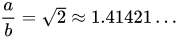
Since A series sizes share the same aspect ratio they can be scaled to other A series sizes without being distorted, and two sheets can be reduced to fit on exactly one sheet without any cutoff or margins.

The A0 base size is defined as having an area of 1 m2; given an aspect ratio of , the dimensions of A0 are:

by .
![{\displaystyle {\sqrt[{4}]{2}}\,\mathrm {m} }](https://wikimedia.org/api/rest_v1/media/math/render/svg/97d82dd8f2645a66bf053172e4268359a245c51c)
![{\displaystyle {\frac {1}{\sqrt[{4}]{2}}}\,\mathrm {m} }](https://wikimedia.org/api/rest_v1/media/math/render/svg/99d750ffbb6d340f78a74dd4aa168cf04b8e12af)
or, rounded to the nearest millimetre, 1,189 mm × 841 mm (46.8 in × 33.1 in).
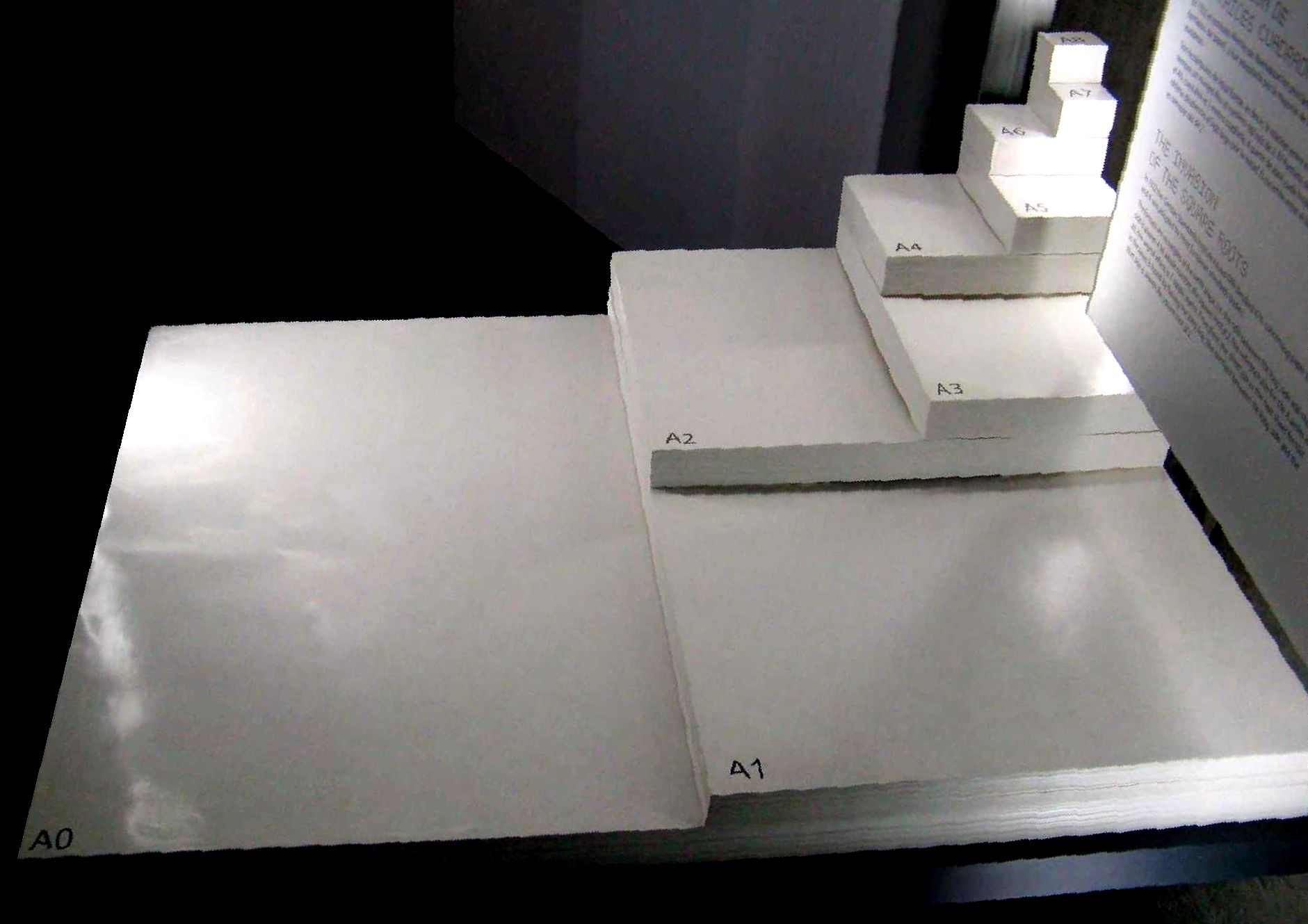
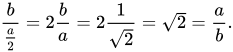
A series sizes are related in that the smaller dimension of a given size is the larger dimension of the next smaller size, and folding an A series sheet in half in its larger dimension—that is, folding it in half parallel to its short edge—results in two halves that are each the size of the next smaller A series size. As such, a folded brochure of a given A-series size can be made by folding sheets of the next larger size in half, e.g. A4 sheets can be folded to make an A5 brochure. The fact that halving a sheet with an aspect ratio of results in two sheets that themselves both have an aspect ratio of is proven as follows:

where a is the long side and b is the short side. The aspect ratio for the new dimensions of the folded paper is:
The advantages of basing a paper size upon an aspect ratio of were noted in 1786 by the German scientist and philosopher Georg Christoph Lichtenberg.[3] He also observed that some raw sizes already adhered to that ratio so that when a sheet is folded, the length to width ratio does not change.
Briefly after the introduction of the metric system, a handful of new paper formats equivalent to modern ones were developed in France, having been proposed by the mathematician Lazare Carnot,[citation needed] and published for judicial purposes in 1798 during the French Revolution:[4]
- Grand registre (A2)
- Moyen papier (A3)
- Grand papier (B3)
- Petit papier (B4)
- Demi feuille (B5)
- Effets de commerce (B6)
These were never widely adopted, however.
Early in the 20th century, the ratio was used to specify the world format starting with 1 cm (0.39 in) as the short edge of the smallest size. Walter Porstmann started with the largest sizes instead, assigning one an area of 1 m2 (11 sq ft) (A0) and the other a short edge of 1 m (3 ft 3 in) (B0). He thereby turned the forgotten French sizes (relatively few in number) into a logically-simple and comprehensive plan for a full range of paper sizes, while introducing systematic alphanumeric monikers for them. Generalized to nothing less than four series, this system was introduced as a DIN standard (DIN 476) in Germany in 1922, replacing a vast variety of other paper formats. Even today, the paper sizes are called "DIN A4" (IPA: [diːn.ʔaː.fiːɐ̯]) in everyday use in Germany and Austria.
The DIN 476 standard spread quickly to other countries. Before the outbreak of World War II, it had been adopted by the following countries in Europe:
- Belgium (1924)
- Netherlands (1925)
- Norway (1926)
- Finland (1927)
- Switzerland (1929)
- Sweden (1930) with later extensions
- Soviet Union (1934) with custom extensions
- Hungary (1938)
- Italy (1939)
During World War II, the standard spread to South America and was adopted by Uruguay (1942), Argentina (1943) and Brazil (1943), and afterwards spread to other countries:
- Australia (1974)
- Austria (1948)
- Bangladesh (1972)
- Barbados (1973)
- Chile (1968)
- Colombia (1975)
- Czechoslovakia (1953)
- Denmark (1953)
- Ecuador (1974)
- France (1967)
- Greece (1970)
- Iceland (1964)
- India (1957) with custom extensions
- Iran (1948)
- Ireland (1959)
- Israel (1954)
- Japan (1951) with different B series
- Kuwait (1975)
- Mexico (1965)
- New Zealand (1963)
- Peru (1967)
- Poland (1957)
- Portugal (1954)
- Rhodesia (1970)
- Romania (1949)
- Singapore (1970)
- South Africa (1966)
- Spain (1947)
- Thailand (1973)
- Turkey (1967)
- United Kingdom (1971)[5]
- Venezuela (1962)
- Yugoslavia(1956)
By 1975, so many countries were using the German system that it was established as an ISO standard, as well as the official United Nations document format. By 1977, A4 was the standard letter format in 88 of 148 countries. Today the standard has been adopted by all countries in the world except the United States and Canada. In Mexico, Costa Rica, Colombia, Venezuela, Chile, and the Philippines, the US letter format is still in common use, despite their official adoption of the ISO standard.
The weight of an A-series sheet of a given paper weight can be calculated by knowing the ratio of its size to the A0 sheet. For example, an A4 sheet is 1⁄16 the size of an A0 sheet, so if it is made from 80 g/m2 paper, it weighs 1⁄16 of 80 g (2.8 oz), which is 5 g (0.18 oz).
B series
[edit]
The B series paper sizes are less common than the A series. They have the same aspect ratio as the A series:

However, they have a different area. The area of B series sheets is in fact the geometric mean of successive A series sheets. B1 is between A0 and A1 in size, with an area of m2, or about 0.707 m2 (7.61 sq ft). As a result, B0 is 1 metre wide, and other sizes of the series are a half, a quarter, or further fractions of a metre wide: in general, every B size has exactly one side of length for . That side is the short side for B0, B2, B4, etc., and the long side for B1, B3, B5, etc.


While less common in office use, the B series is used for a variety of applications in which one A-series size would be too small but the next A-series size is too large, or because they are convenient for a particular purpose.
- B4, B5, and B6 are used for envelopes that will hold C-series envelopes.
- B4 is quite common in printed music sheets.
- B5 is a relatively common choice for books.
- B7 is equal to the passport size ID-3 from ISO/IEC 7810.
- Many posters use B-series paper or a close approximation, such as 50 cm × 70 cm ~ B2.
The B-series is widely used in the printing industry to describe both paper sizes and printing press sizes, including digital presses. B3 paper is used to print two US letter or A4 pages side by side using imposition; four pages would be printed on B2, eight on B1, etc.[need quotation to verify]
C series
[edit]
The C series is defined in ISO 269, which was withdrawn in 2009 without a replacement, but is still specified in several national standards. It is primarily used for envelopes. The area of C series sheets is the geometric mean of the areas of the A and B series sheets of the same number; for instance, the area of a C4 sheet is the geometric mean of the areas of an A4 sheet and a B4 sheet. This means that C4 is slightly larger than A4, and slightly smaller than B4. The practical usage of this is that a letter written on A4 paper fits inside a C4 envelope, and both A4 paper and C4 envelopes fit inside a B4 envelope.
Some envelope formats with mixed sides from adjacent sizes (and thus an approximate aspect ratio of 2:1) are also defined in national adaptations of the ISO standard, e.g. DIN C6/C5 (also known as C65) is 114 mm × 229 mm where the common side to C5 and C6 is 162 mm. This format allows an envelope holding an A-sized paper folded in three, e.g. for the C65, an A4.
Overview of ISO paper sizes
[edit]| Format | A series[6] | B series[7] | C series[8] | ||||||
|---|---|---|---|---|---|---|---|---|---|
| Size | short × long | Notional area | short × long | Notional area | short × long | Notional area | |||
| mm | in | m2 | mm | in | m2 | mm | in | m2 | |
| 0 | 841 × 1189 | 33.1 × 46.8 | 20 = 1 | 1000 × 1414 | 39.4 × 55.7 | 21⁄2 ≈ 1.414 | 917 × 1297 | 36.1 × 51.1 | 21⁄4 ≈ 1.189 |
| 1 | 594 × 841 | 23.4 × 33.1 | 1/2 = 0.5 | 707 × 1000 | 27.8 × 39.4 | 2−1⁄2 ≈ 0.707 | 648 × 917 | 25.5 × 36.1 | 2−3⁄4 ≈ 0.595 |
| 2 | 420 × 594 | 16.5 × 23.4 | 1/22 = 0.25 | 500 × 707 | 19.7 × 27.8 | 2−1+1⁄2 ≈ 0.354 | 458 × 648 | 18.0 × 25.5 | 2−1+3⁄4 ≈ 0.297 |
| 3 | 297 × 420 | 11.7 × 16.5 | 1/23 = 0.125 | 353 × 500 | 13.9 × 19.7 | 2−2+1⁄2 ≈ 0.177 | 324 × 458 | 12.8 × 18.0 | 2−2+3⁄4 ≈ 0.149 |
| 4 | 210 × 297 | 8.3 × 11.7 | 1/24 = 0.0625 | 250 × 353 | 9.8 × 13.9 | 2−3+1⁄2 ≈ 0.088 | 229 × 324 | 9.0 × 12.8 | 2−3+3⁄4 ≈ 0.0743 |
| 5 | 148 × 210 | 5.8 × 8.3 | 1/25 ≈ 0.0313 | 176 × 250 | 6.9 × 9.8 | 2−4+1⁄2 ≈ 0.044 | 162 × 229 | 6.4 × 9.0 | 2−4+3⁄4 ≈ 0.0372 |
| 6 | 105 × 148 | 4.1 × 5.8 | 1/26 ≈ 0.0156 | 125 × 176 | 4.9 × 6.9 | 2−5+1⁄2 ≈ 0.0221 | 114 × 162 | 4.5 × 6.4 | 2−5+3⁄4 ≈ 0.0186 |
| 7 | 74 × 105 | 2.9 × 4.1 | 1/27 ≈ 0.0078 | 88 × 125 | 3.5 × 4.9 | 2−6+1⁄2 ≈ 0.0110 | 81 × 114 | 3.2 × 4.5 | 2−6+3⁄4 ≈ 0.0093 |
| 8 | 52 × 74 | 2.0 × 2.9 | 1/28 ≈ 0.0039 | 62 × 88 | 2.4 × 3.5 | 2−7+1⁄2 ≈ 0.0055 | 57 × 81 | 2.2 × 3.2 | 2−7+3⁄4 ≈ 0.0046 |
| 9 | 37 × 52 | 1.5 × 2.0 | 1/29 ≈ 0.0020 | 44 × 62 | 1.7 × 2.4 | 2−8+1⁄2 ≈ 0.0028 | 40 × 57 | 1.6 × 2.2 | 2−8+3⁄4 ≈ 0.0023 |
| 10 | 26 × 37 | 1.0 × 1.5 | 1/210 ≈ 0.00098 | 31 × 44 | 1.2 × 1.7 | 2−9+1⁄2 ≈ 0.0014 | 28 × 40 | 1.1 × 1.6 | 2−9+3⁄4 ≈ 0.0012 |
| i | where | where | where | ||||||

![{\displaystyle \alpha _{A}={\sqrt[{4}]{2}}\,{\text{m}};r={\tfrac {1}{\sqrt {2}}}}](https://wikimedia.org/api/rest_v1/media/math/render/svg/41cbb32e4305ffacd7c5f2198dcb973dc54a0630)

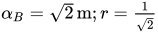

![{\displaystyle \alpha _{C}={\sqrt[{8}]{8}}\,{\text{m}};r={\tfrac {1}{\sqrt {2}}}}](https://wikimedia.org/api/rest_v1/media/math/render/svg/32b4f5b6fe055412c7b2e83414f1d90cdb4d58ac)
The variables are the distinct first terms in the three geometric progressions of the same common ratio equal to the square root of two. Each of the three geometric progressions (corresponding to the three series A, B, and C) is formed by all possible paper dimensions (length and width) of the series arranged in decreasing order. This interesting arrangement of dimensions is also very useful—not only does it form a geometric progression with easy-to-remember formulae, but also each consecutive pair of values (like a sliding window of size 2) will automatically correspond to the dimensions of a standard paper format in the series.

The tolerances specified in the standard are
- ±1.5 mm (0.059 in) for dimensions up to 150 mm (5.9 in),
- ±2 mm (0.079 in) for lengths in the range 150 to 600 mm (5.9 to 23.6 in) and
- ±3 mm (0.12 in) for any dimension above 600 mm (24 in).
Related regional sizes
[edit]German original
[edit]The German standard DIN 476 was published on 18 August 1922 and is the original specification of the A, B and C sizes. In 1991, it was split into DIN 476-1 for the A and B formats and 476-2 for the C series. The former has been withdrawn in 2002 in favour of adopting the international standard as DIN EN ISO 216, but part 2 has been retained and was last updated in 2008.
The first and the second editions of DIN 476 from 1922 and 1925 also included a D series.
| Format | D series | |
|---|---|---|
| Size | mm × mm | inch × inch |
| 0 | 771 × 1090 | 30+3⁄8 × 42+11⁄12 |
| 1 | 545 × 771 | 21+11⁄24 × 30+3⁄8 |
| 2 | 385 × 545 | 15+1⁄6 × 21+11⁄24 |
| 3 | 272 × 385 | 10+17⁄24 × 15+1⁄6 |
| 4 | 192 × 272 | 7+13⁄24 × 10+17⁄24 |
| 5 | 136 × 192 | 5+3⁄8 × 7+13⁄24 |
| 6 | 96 × 136 | 3+19⁄24 × 5+3⁄8 |
| 7 | 68 × 96 | 2+2⁄3 × 3+19⁄24 |
| 8 | 48 × 68 | 1+7⁄8 × 2+2⁄3 |
The smallest formats in the original specifications for each series were A13, B13, C8, and D8. Sizes A11 through A13 were no longer listed in the 1930 edition, nor were B11 through B13. C9 and C10 were added in the 1976 revision for compatibility with photography sizes: C8 closely matches 6×9 photos, and C9 and C10 closely match 7×7 and 5×5 slides, respectively.
| Format | A | B | ||
|---|---|---|---|---|
| Size | mm × mm | inch × inch | mm × mm | inch × inch |
| 11 | 18 × 26 | 17⁄24 × 1+1⁄24 | 22 × 31 | 7⁄8 × 1+5⁄24 |
| 12 | 13 × 18 | 1⁄2 × 17⁄24 | 15 × 22 | 7⁄12 × 7⁄8 |
| 13 | 9 × 13 | 3⁄8 × 1⁄2 | 11 × 15 | 5⁄12 × 7⁄12 |
DIN 476 provides for formats larger than A0, denoted by a prefix factor. In particular, it lists the formats 2A0 and 4A0, which are twice and four times the size of A0 respectively. However, ISO 216:2007 notes 2A0 and 4A0 in the table of Main series of trimmed sizes (ISO A series) as well: "The rarely used sizes [2A0 and 4A0] which follow also belong to this series."
| Name | mm × mm | inch × inch |
|---|---|---|
| 4A0 | 1682 × 2378 | 66+5⁄24 × 93+5⁄8 |
| 2A0 | 1189 × 1682 | 46+19⁄24 × 66+5⁄24 |
DIN 476 also used to specify slightly tighter tolerances than ISO 216:
- ±1 mm (0.039 in) for dimensions up to 150 mm (5.9 in),
- ±1.5 mm (0.059 in) for lengths in the range 150 to 600 mm (5.9 to 23.6 in) and
- ±2 mm (0.079 in) for any dimension above 600 mm (24 in).
There used to be a standard, DIN 198, that was just a table of recommended A series formats for a number of business applications. The 1976 edition of this standard introduced a size 2⁄3 A4 198 mm × 210 mm and suggested it for some forms and slips.[citation needed]
Swedish extensions
[edit]
The Swedish standard SIS 01 47 11[9] generalized the ISO system of A, B, and C formats by adding D, E, F, and G formats to it. Its D format sits between a B format and the next larger A format (just like C sits between A and the next larger B). The remaining formats fit in between all these formats, such that the sequence of formats A4, E4, C4, G4, B4, F4, D4, *H4, A3 is a geometric progression, in which the dimensions grow by a factor from one size to the next. However, this SIS standard does not define any size between a D format and the next larger A format (called *H in the previous example).
![{\displaystyle {\sqrt[{16}]{2}}}](https://wikimedia.org/api/rest_v1/media/math/render/svg/a7dbfd1210c3fbd906c1316b2338b2246caf489e)
Of these additional formats, G5 (169 × 239 mm) and E5 (155 × 220 mm) are popular in Sweden and the Netherlands for printing dissertations,[10] but the other formats have not turned out to be particularly useful in practice. They have not been adopted internationally and the Swedish standard has been withdrawn.
The Swedish and German D series basically contain the same sizes but are offset by one, i.e. DIN D4 equals SIS D5 and so on.
| Designation | Shorter edge | Longer edge |
|---|---|---|
| An | r−4 × sn | r+4 × sn |
| En | r−3 × sn | r+5 × sn |
| Cn | r−2 × sn | r+6 × sn |
| Gn | r−1 × sn | r+7 × sn |
| Bn | r0 × sn | r+8 × sn |
| Fn | r+1 × sn | r+9 × sn |
| Dn | r+2 × sn | r+10 × sn |
| *Hn | r+3 × sn | r+11 × sn |
| A(n-1) | r+4 × sn | r+12 × sn |
![{\textstyle n=0..10,r={\sqrt[{16}]{2}},s={\sqrt {\frac {1}{2}}}}](https://wikimedia.org/api/rest_v1/media/math/render/svg/b25544e90982146c729e387c45766b006db8f746)
| n | E | G | F | D |
|---|---|---|---|---|
| 0 | 878 × 1242 | 958 × 1354 | 1044 × 1477 | 1091 × 1542 |
| 1 | 621 × 878 | 677 × 958 | 738 × 1044 | 771 × 1091 |
| 2 | 439 × 621 | 479 × 677 | 522 × 738 | 545 × 771 |
| 3 | 310 × 439 | 339 × 479 | 369 × 522 | 386 × 545 |
| 4 | 220 × 310 | 239 × 339 | 261 × 369 | 273 × 386 |
| 5 | 155 × 220 | 169 × 239 | 185 × 261 | 193 × 273 |
| 6 | 110 × 155 | 120 × 169 | 131 × 185 | 136 × 193 |
| 7 | 78 × 110 | 85 × 120 | 92 × 131 | 96 × 136 |
| 8 | 55 × 78 | 60 × 85 | 65 × 92 | 68 × 96 |
| 9 | 39 × 55 | 42 × 60 | 46 × 65 | 48 × 68 |
| 10 | 27 × 39 | 30 × 42 | 33 × 46 | 34 × 48 |
Japanese variation
[edit]The Japanese standard JIS P 0138 defines two main series of paper sizes. The JIS A-series is identical to the ISO A-series except that it has slightly different tolerances. The area of B-series paper is 1.5 times that of the corresponding A-paper (instead of the factor for the ISO B-series), so the length ratio is approximately 1.22 times the length of the corresponding A-series paper. The aspect ratio of the paper is the same as for the A-series paper. Both A- and B-series paper are widely available in Japan, Taiwan and China, and most photocopiers are loaded with at least A4 and either one of A3, B4, and B5 paper.
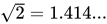
Cascading Style Sheets (CSS) only supports the most popular of the Japanese sizes, JIS-B4 and JIS-B5.[2]
| Size | mm × mm | inch × inch |
|---|---|---|
| 0 | 1030 × 1456 | 40+13⁄24 × 57+1⁄3 |
| 1 | 728 × 1030 | 28+2⁄3 × 40+13⁄24 |
| 2 | 515 × 728 | 20+7⁄24 × 28+2⁄3 |
| 3 | 364 × 515 | 14+1⁄3 × 20+7⁄24 |
| 4 | 257 × 364 | 10+1⁄8 × 14+1⁄3 |
| 5 | 182 × 257 | 7+1⁄6 × 10+1⁄8 |
| 6 | 128 × 182 | 5+1⁄24 × 7+1⁄6 |
| 7 | 91 × 128 | 3+7⁄12 × 5+1⁄24 |
| 8 | 64 × 91 | 2+1⁄2 × 3+7⁄12 |
| 9 | 45 × 64 | 1+19⁄24 × 2+1⁄2 |
| 10 | 32 × 45 | 1+1⁄4 × 1+19⁄24 |
| 11 | 22 × 32 | 7⁄8 × 1+1⁄4 |
| 12 | 16 × 22 | 5⁄8 × 7⁄8 |
| Size | mm × mm | inch × inch | AR | sun × sun |
|---|---|---|---|---|
| A (列本判) | 625 × 880 | 24+5⁄8 × 34+5⁄8 | √2∶1 | 20.6 × 29 |
| B (列本判) | 765 × 1085 | 30+1⁄8 × 42+17⁄24 | √2∶1 | 25.25 × 35.8 |
| Shiroku-ban (四六判) (4-6) | 788 × 1091 | 31+1⁄24 × 42+23⁄24 | 1.38 | 26 × 36 |
| Kiku-ban (菊判, Chrysanthemum) | 636 × 939 | 25+1⁄24 × 36+23⁄24 | 1.48 | 21 × 31 |
| Hattron (ハトロン判) | 900 × 1200 | 35+5⁄12 × 47+1⁄4 | 4∶3 | 29.7 × 39.6 |
A popular size for books, dubbed AB, combines the shorter edges of A4 and B4. Another two with an aspect ratio approximating 16:9 are 20% narrower variants of A6 and B6, respectively, the latter resulting from cutting JIS B1 into 4 × 10 sheets (thus "B40").
There are also a number of traditional paper sizes, which are now used mostly by printers. The most common of these old series is the Shiroku-ban and the Kiku paper sizes.
| Size | mm × mm | inch × inch | AR | sun × sun | Notes |
|---|---|---|---|---|---|
| AB | 210 × 257 | 8+1⁄4 × 10+1⁄8 | 11∶9 | 6.93 × 8.48 | A4/A5 × JIS B4/B5 |
| B40 | 103 × 182 | 4+1⁄24 × 7+1⁄6 | 16∶9 | 3.4 × 6 | JIS B1 height⁄10 × width⁄4 |
| 35 | 84 × 148 | 3+7⁄24 × 5+5⁄6 | 1.76 | 2.77 × 4.88 | Trimmed 3 × 5 |
| Kiku-ban | 227 × 304 | 8+11⁄12 × 11+23⁄24 | 1.34 | 7.5 × 10 | |
| 218 × 304 | 8+7⁄12 × 11+23⁄24 | 1.39 | 7.2 × 10 | ||
| 152 × 227 | 6 × 8+11⁄12 | 1.49 | 5 × 7.5 | ||
| 152 × 218 | 6 × 8+7⁄12 | 10∶7 | 5 × 7.2 |
Chinese extensions
[edit]The Chinese standard GB/T 148–1997,[12] which replaced GB 148–1989, documents the standard ISO series, A and B, but adds a custom D series. This Chinese format originates from the Republic of China (1912–1949). The D series is not identical to the German or Swedish D series. It does not strictly follow the same principles as ISO paper sizes: The aspect ratio is only very roughly . The short side of the size is always 4 mm longer than the long side of the next smaller size. The long side of the size is always exactly – i.e. without further rounding – twice as long as the short side of the next smaller size.
| Format | D series | AR | Alias | Untrimmed sizes | ||
|---|---|---|---|---|---|---|
| Size | mm × mm | inch × inch | mm × mm | inch × inch | ||
| 0 | 764 × 1064 | 30+1⁄12 × 41+7⁄8 | 1.3927 | 1K | 780 × 1080 | 30+17⁄24 × 42+1⁄2 |
| 1 | 532 × 760 | 20+23⁄24 × 29+11⁄12 | 1.4286 | 2K | 540 × 780 | 21+1⁄4 × 30+17⁄24 |
| 2 | 380 × 528 | 14+23⁄24 × 20+19⁄24 | 1.3895 | 4K | 390 × 540 | 15+3⁄8 × 21+1⁄4 |
| 3 | 264 × 376 | 10+3⁄8 × 14+19⁄24 | 1.4242 | 8K | 270 × 390 | 10+5⁄8 × 15+3⁄8 |
| 4 | 188 × 260 | 7+5⁄12 × 10+1⁄4 | 1.3830 | 16K | 195 × 270 | 7+2⁄3 × 10+5⁄8 |
| 5 | 130 × 184 | 5+1⁄8 × 7+1⁄4 | 1.4154 | 32K | 135 × 195 | 5+1⁄3 × 7+2⁄3 |
| 6 | 92 × 126 | 3+5⁄8 × 4+23⁄24 | 1.3696 | 64K | 97 × 135 | 3+5⁄6 × 5+1⁄3 |
Indian variants
[edit]The Bureau of Indian Standards recommends the "ISO-A series" size of drawing sheet for engineering drawing works. The Bureau of Indian Standards specifies all the recommendations for engineering drawing sheets in its bulletin IS 10711: 2001.[13]
The Bureau extended the ISO-A series with a Special Elongated Sizes (Second Choice). These sizes are achieved by increasing the shorter dimensions of a sheet of the ISO A series to lengths that are multiples of the shorter dimensions of the chosen basic sheet; in effect, all of the Indian elongated sizes emulate having several regular-size sheets joined on their long edge.
| Size | mm × mm | in × in | AR |
|---|---|---|---|
| A3 x 3 | 420 × 891 | 16+13⁄24 × 35+1⁄12 | 3∶√2 |
| A3 x 4 | 420 × 1189 | 16+13⁄24 × 46+19⁄24 | 4∶√2 |
| A4 x 3 | 297 × 630 | 11+17⁄24 × 24+19⁄24 | 3∶√2 |
| A4 x 4 | 297 × 841 | 11+17⁄24 × 33+1⁄8 | 4∶√2 |
| A4 x 5 | 297 × 1051 | 11+17⁄24 × 41+3⁄8 | 5∶√2 |
There is also a Exceptional Elongated Sizes (Third Choice). These sizes are obtained by increasing the shorter dimensions of a sheet of the ISO-A series to lengths that are multiples of the shorter dimensions of the chosen basic sheet. These sizes are used when a very large or extra elongated sheet is needed.
| Size | mm × mm | in × in | AR |
|---|---|---|---|
| A0 x 2 | 1189 × 1682 | 46+19⁄24 × 66+5⁄24 | √2∶1 |
| A0 x 3 | 1189 × 2523 | 46+19⁄24 × 99+1⁄3 | 3∶√2 |
| A1 x 3 | 841 × 1783 | 33+1⁄8 × 70+5⁄24 | 3∶√2 |
| A1 x 4 | 841 × 2378 | 33+1⁄8 × 93+5⁄8 | 4∶√2 |
| A2 x 3 | 594 × 1261 | 23+3⁄8 × 49+5⁄8 | 3∶√2 |
| A2 x 4 | 594 × 1682 | 23+3⁄8 × 66+5⁄24 | 4∶√2 |
| A2 x 5 | 594 × 2102 | 23+3⁄8 × 82+3⁄4 | 5∶√2 |
| A3 x 5 | 420 × 1486 | 16+13⁄24 × 58+1⁄2 | 5∶√2 |
| A3 x 6 | 420 × 1783 | 16+13⁄24 × 70+5⁄24 | 6∶√2 |
| A3 x 7 | 420 × 2080 | 16+13⁄24 × 81+7⁄8 | 7∶√2 |
| A4 x 6 | 297 × 1261 | 11+17⁄24 × 49+5⁄8 | 6∶√2 |
| A4 x 7 | 297 × 1471 | 11+17⁄24 × 57+11⁄12 | 7∶√2 |
| A4 x 8 | 297 × 1682 | 11+17⁄24 × 66+5⁄24 | 8∶√2 |
| A4 x 9 | 297 × 1892 | 11+17⁄24 × 74+1⁄2 | 9∶√2 |
Soviet variants
[edit]The first standard of paper size in the Soviet Union was OST 303 in 1926. Six years later, it was replaced by OST 5115 which generally followed DIN 476 principles, but used Cyrillic lowercase letters instead of Latin uppercase, had the second row shifted so that б0 (B0) roughly corresponded to B1 and, more importantly, had slightly different sizes:[14]
| Format | а (A) | б (B) | в (V, C) | |||
|---|---|---|---|---|---|---|
| Size | mm × mm | inch × inch | mm × mm | inch × inch | mm × mm | inch × inch |
| 0 | 814 × 1152 | 32+1⁄24 × 45+3⁄8 | 747 × 1056 | 29+5⁄12 × 41+7⁄12 | ||
| 1 | 576 × 814 | 22+2⁄3 × 32+1⁄24 | 528 × 747 | 20+19⁄24 × 29+5⁄12 | 628 × 888 | 24+17⁄24 × 34+23⁄24 |
| 2 | 407 × 576 | 16+1⁄24 × 22+2⁄3 | 373 × 528 | 14+2⁄3 × 20+19⁄24 | 444 × 628 | 17+1⁄2 × 24+17⁄24 |
| 3 | 288 × 407 | 11+1⁄3 × 16+1⁄24 | 264 × 373 | 10+3⁄8 × 14+2⁄3 | 314 × 444 | 12+3⁄8 × 17+1⁄2 |
| 4 | 203 × 288 | 8 × 11+1⁄3 | 186 × 264 | 7+1⁄3 × 10+3⁄8 | 222 × 314 | 8+3⁄4 × 12+3⁄8 |
| 5 | 144 × 203 | 5+2⁄3 × 8 | 132 × 186 | 5+5⁄24 × 7+1⁄3 | 157 × 222 | 6+1⁄6 × 8+3⁄4 |
| 6 | 101 × 144 | 3+23⁄24 × 5+2⁄3 | 93 × 132 | 3+2⁄3 × 5+5⁄24 | 111 × 157 | 4+3⁄8 × 6+1⁄6 |
| 7 | 72 × 101 | 2+5⁄6 × 3+23⁄24 | 66 × 93 | 2+7⁄12 × 3+2⁄3 | 78 × 111 | 3+1⁄12 × 4+3⁄8 |
| 8 | 50 × 72 | 1+23⁄24 × 2+5⁄6 | 46 × 66 | 1+19⁄24 × 2+7⁄12 | 55 × 78 | 2+1⁄6 × 3+1⁄12 |
| 9 | 36 × 50 | 1+5⁄12 × 1+23⁄24 | 33 × 46 | 1+7⁄24 × 1+19⁄24 | 39 × 55 | 1+13⁄24 × 2+1⁄6 |
| 10 | 25 × 36 | 1 × 1+5⁄12 | 23 × 33 | 11⁄12 × 1+7⁄24 | ||
| 11 | 18 × 25 | 17⁄24 × 1 | 16 × 23 | 5⁄8 × 11⁄12 | ||
| 12 | 12 × 18 | 11⁄24 × 17⁄24 | 11 × 16 | 5⁄12 × 5⁄8 | ||
| 13 | 9 × 12 | 3⁄8 × 11⁄24 | ||||
The general adaptation of ISO 216 in the Soviet Union, which replaced OST 5115, was GOST 9327. In its 1960 version, it lists formats down to A13, B12 and C8 and also specifies 1⁄2, 1⁄4 and 1⁄8 prefixes for halving the shorter side (repeatedly) for stripe formats, e.g. 1⁄2A4 = 105 mm × 297 mm.

A standard for technical drawings from 1960, GOST 3450,[15] introduces alternative numeric format designations to deal with very high or very wide sheets. These 2-digit codes are based upon A4 = "11": The first digit is the factor the longer side (297 mm) is multiplied by and the second digit is the one for the shorter side (210 mm), so "24" is 2×297 mm × 4×210 mm = 594 mm × 840 mm.
| n | (×1) | ×2 | ×3 | ×4 | ×5 | ×6 |
|---|---|---|---|---|---|---|
| 5 | = A0 | = 2A0 | 2523 × 1189 | 3364 × 1189 | 4204 × 1189 | 5045 × 1189 |
| 4 | = A1 | = A0 | 1784 × 841 | 2378 × 841 | 2973 × 841 | 3568 × 841 |
| 3 | = A2 | = A1 | 1261 × 595 | 1682 × 595 | 2102 × 595 | 2523 × 595 |
| 2 | = A3 | = A2 | 892 × 420 | 1189 × 420 | 1487 × 420 | 1784 × 420 |
| 1 | = A4 | = A3 | 631 × 297 | 841 × 297 | 1051 × 297 | 1261 × 297 |
| 0 | = A5 | = A4 | 446 × 210 | 595 × 210 | 743 × 210 | 892 × 210 |

GOST 3450 from 1960 was replaced by ESKD GOST 2301 in 1968,[16] but the numeric designations remained in popular use much longer. The new designations were not purely numeric but consisted of the ISO label followed by an 'x', or possibly the multiplication sign '×', and the factor, e.g. DIN 2A0 = GOST A0×2, but DIN 4A0 ≠ GOST A0×4, also listed are: A0×3, A1×3, A1×4, A2×3–A2×5, A3×3–A3×7, A4×3–A4×9. The formats ...×1 and ...×2 usually would be aliases for existing formats.
Elongated sizes
[edit]ISO 5457, last updated in 1999,[17] introduces elongated sizes that are formed by a combination of the dimensions of the short side of an A-size (e.g. A2) with the dimensions of the long side of another larger A-size (e.g. A0). The result is a new size, for example with the abbreviation A2.0 we would have a 420 × 1189 mm size.

| Size | Short edge | Long edge | mm × mm | in × in | AR |
|---|---|---|---|---|---|
| A1.0 | A1/A2 | A0 | 594 × 1189 | 23+3⁄8 × 46+19⁄24 | 2∶1 |
| A2.0 | A2/A3 | A0 | 420 × 1189 | 16+13⁄24 × 46+19⁄24 | 4∶√2 |
| A2.1 | A1/A0 | 420 × 841 | 16+13⁄24 × 33+1⁄8 | 2∶1 | |
| A3.0 | A3/A4 | A0 | 297 × 1189 | 11+17⁄24 × 46+19⁄24 | 4∶1 |
| A3.1 | A1/A0 | 297 × 841 | 11+17⁄24 × 33+1⁄8 | 4∶√2 | |
| A3.2 | A2/A1 | 297 × 594 | 11+17⁄24 × 23+3⁄8 | 2∶1 |
These drawing paper sizes have been adopted by ANSI/ASME Y14.1M for use in the United States, alongside A0 through A4 and alongside inch-based sizes.
International envelope and insert sizes
[edit]| Name | mm × mm | inch × inch | AR | Notes |
|---|---|---|---|---|
| 1⁄3A4 | 99 × 210 | 3+11⁄12 × 8+1⁄4 | 3∶√2 | common flyer or stripe size |
| unnamed | 105 × 210 | 4+1⁄8 × 8+1⁄4 | 2∶1 | standard folded size of German letters |

DIN 5008 (previously DIN 676) prescribes, among many other things, two variants, A and B, for the location of the address field on the first page of a business letter and how to fold the A4 sheet accordingly, so the only part visible of the main content is the subject line.
| Name | mm × mm | inch × inch | AR | Content | Notes |
|---|---|---|---|---|---|
| DL | 110 × 220 | 4+1⁄3 × 8+2⁄3 | 2∶1 | 1⁄3A4, DIN 5008 A and B | Designated long, "DIN lang" (DIN long); sometimes erroneously instead called "DLE", apparently for envelope; exactly matches Swedish SIS E6/E5 (E6: 110 mm × 155 mm, E5: 155 mm × 220 mm); envelope #5 in China, Chou/N 6 in Japan; fits well enclosed in C6/C5 for the purpose of e.g. reply mail |
| C6/C5 | 114 × 229 | 4+1⁄2 × 9 | 2∶1 | Common edge of C6 and C5 is 161 mm; also known as "Postfix", "DL+" or "DL Max", but those terms are not standardized | |
| Italian | 110 × 230 | 4+1⁄3 × 9+1⁄24 | 2.10∶1 | Centimetre-rounded C6/C5 or slightly wider DL | |
| C7/C6 | 81 × 162 | 3+5⁄24 × 6+3⁄8 | 2∶1 | 1⁄3A5 | Common edge of C7 and C6 is 114 mm |
| B6/C4 | 125 × 324 | 4+11⁄12 × 12+3⁄4 | 2.6 | B6 is 125 mm × 176 mm, C4 is 229 mm × 324 mm | |
| Invite | 220 × 220 | 8+2⁄3 × 8+2⁄3 | 1∶1 | Square card with edge of A4 and A5, 210 mm | |
| DIN E4 | 280 × 400 | 11+1⁄24 × 15+3⁄4 | 10∶7 | Listed in DIN 476–2, but not part of a series proper; SIS E4 is 220 mm × 310 mm |
International raw sizes
[edit]| Raw | mm × mm | inch × inch | Special raw | mm × mm | inch × inch | Untrimmed | mm × mm | inch × inch | Trimmed | mm × mm | inch × inch | mm × mm | inch × inch |
|---|---|---|---|---|---|---|---|---|---|---|---|---|---|
| RA0 | 860 × 1220 | 33+3⁄4 × 48 | SRA0 | 900 × 1280 | 35+1⁄2 × 50+1⁄2 | A0U | 880 × 1230 | 34+3⁄4 × 48+1⁄2 | A0T | 841 × 1189 | 33 × 46+3⁄4 | 821 × 1159 | 32+1⁄4 × 45+3⁄4 |
| RA1 | 610 × 860 | 24 × 33+3⁄4 | SRA1 | 640 × 900 | 25+1⁄4 × 35+1⁄2 | A1U | 625 × 880 | 24+1⁄2 × 34+3⁄4 | A1T | 594 × 841 | 23+1⁄2 × 33 | 574 × 811 | 22+1⁄2 × 32 |
| RA2 | 430 × 610 | 17 × 24 | SRA2 | 450 × 640 | 17+3⁄4 × 25+1⁄4 | A2U | 450 × 625 | 17+3⁄4 × 24+1⁄2 | A2T | 420 × 594 | 16+1⁄2 × 23+1⁄2 | 400 × 564 | 15+3⁄4 × 22+1⁄4 |
| RA3 | 305 × 430 | 12 × 17 | SRA3 | 320 × 450 | 12+1⁄2 × 17+3⁄4 | A3U | 330 × 450 | 13 × 17+3⁄4 | A3T | 297 × 420 | 11+3⁄4 × 16+1⁄2 | 277 × 390 | 11 × 15+1⁄4 |
| RA4 | 215 × 305 | 8+1⁄2 × 12 | SRA4 | 225 × 320 | 8+3⁄4 × 12+1⁄2 | A4U | 240 × 330 | 9+1⁄2 × 13 | A4T | 210 × 297 | 8+1⁄4 × 11+3⁄4 | 180 × 277 | 7 × 11 |
ISO 5457 specifies drawing paper sizes with a trimmed size equal to the A series sizes from A4 upward. The untrimmed sizes are 3 to 4 cm larger and rounded to the nearest centimetre. A0 through A3 are used in landscape orientation, while A4 is used in portrait orientation. Designations for pre-printed drawing paper include the base sizes and a suffix, either T for trimmed or U for untrimmed sheets.
The withdrawn standard ISO 2784 did specify sizes of continuous, fan-fold forms based upon whole inches as was common for paper in continuous lengths in automatic data processing (ADP) equipment. Specifically, 12 inches (300 mm) was considered an untrimmed variant of the A4 height of 297 mm.
| Size | Acceptable equivalent | Direct equivalent | Exact size | Gross size | |||||
|---|---|---|---|---|---|---|---|---|---|
| inch × inch | mm × mm | AR | inch × inch | mm × mm | AR | mm × mm | mm × mm | inch × inch | |
| A4 | 8 × 12 | 203.2 × 304.8 | 3∶2 | 8+1⁄3 × 11+2⁄3 | 211.7 × 296.3 | 7∶5 | 210 × 297 | 250 × 340 | 9+4⁄5 × 13+2⁄5 |
| A5 | 6 × 8 | 152.4 × 203.2 | 4∶3 | 5+5⁄6 × 8+1⁄3 | 148.2 × 211.7 | 10∶7 | 148 × 210 | 180 × 250 | 7+1⁄10 × 9+4⁄5 |
| A6 | 4 × 6 | 101.6 × 152.4 | 3∶2 | 4+1⁄6 × 5+5⁄6 | 105.8 × 148.2 | 7∶5 | 105 × 148 | — | — |
| A7 | 3 × 4 | 76.20 × 101.6 | 4∶3 | — | — | — | 74 × 105 | — | — |
Transitional paper sizes
[edit]PA4 or L4
[edit]| Name | mm × mm | inch × inch | AR |
|---|---|---|---|
| PA0 | 840 × 1120 | 33+1⁄8 × 44+1⁄8 | 4∶3 |
| PA1 | 560 × 840 | 22 × 33+1⁄8 | 3∶2 |
| PA2 | 420 × 560 | 16+1⁄2 × 22 | 4∶3 |
| PA3 | 280 × 420 | 11 × 16+1⁄2 | 3∶2 |
| PA4 | 210 × 280 | 8+1⁄4 × 11 | 4∶3 |
| PA5 | 140 × 210 | 5+1⁄2 × 8+1⁄4 | 3∶2 |
| PA6 | 105 × 140 | 4+1⁄8 × 5+1⁄2 | 4∶3 |
| PA7 | 70 × 105 | 2+3⁄4 × 4+1⁄8 | 3∶2 |
| PA8 | 52 × 70 | 2 × 2+3⁄4 | 1.35 |
| PA9 | 35 × 52 | 1+3⁄8 × 2 | 1.49 |
| PA10 | 26 × 35 | 1 × 1+3⁄8 | 1.35 |
A transitional size called PA4 (210 mm × 280 mm or 8.27 in × 11.02 in), sometimes dubbed L4, was proposed for inclusion into the ISO 216 standard in 1975. It has the height of Canadian P4 paper (215 mm × 280 mm, about 8+1⁄2 in × 11 in) and the width of international A4 paper (210 mm × 297 mm or 8.27 in × 11.69 in), i.e. it uses the smaller value among the two for each side. The table shows how this format can be generalized into an entire format series.
The PA formats did not end up in ISO 216, because the committee decided that the set of standardized paper formats should be kept to the minimum necessary.[citation needed] However, PA4 remains of practical use today. In landscape orientation, it has the same 4:3 aspect ratio as the displays of traditional TV sets, some computer displays (e.g. the iPad) and data projectors. PA4, with appropriate margins is, therefore, a good choice as the format of presentation slides.
As a compromise between the two most popular paper sizes globally, PA4 is used today by many international magazines, because it can be printed easily on equipment designed for either A4 or US Letter. That means (in practice) it has turned out to be not so much a paper size as a page format. Apple, for instance, requires this format for digital music album booklets.[18]
The size 210 mm × 280 mm was documented in the Canadian standard CAN2-200.2-M79 "Common Image Area for Paper Sizes P4 and A4".[19]
F4
[edit]| Name | mm × mm | inch × inch | AR |
|---|---|---|---|
| F0 | 841 × 1321 | 33+1⁄8 × 52 | 1.57 |
| F1 | 660 × 841 | 26 × 33+1⁄8 | 1.27 |
| F2 | 420 × 660 | 16+1⁄2 × 26 | 1.57 |
| F3 | 330 × 420 | 13 × 16+1⁄2 | 1.27 |
| F4 | 210 × 330 | 8+1⁄4 × 13 | 1.57 |
| F5 | 165 × 210 | 6+1⁄2 × 8+1⁄4 | 1.27 |
| F6 | 105 × 165 | 4+1⁄8 × 6+1⁄2 | 1.57 |
| F7 | 82 × 105 | 3+1⁄4 × 4+1⁄8 | 32∶25 |
| F8 | 52 × 82 | 2 × 3+1⁄4 | 1.58 |
| F9 | 41 × 52 | 1+5⁄8 × 2 | 1.27 |
| F10 | 26 × 41 | 1 × 1+5⁄8 | 1.58 |
A non-standard F4 paper size is common in Southeast Asia. It is a transitional size with the shorter side of ISO A4 (210 mm, 8+1⁄4 inch) and the longer side of British Foolscap (13-inch (330 mm). ISO A4 is exactly 90% the height of F4. This size is sometimes also known as (metric) 'foolscap' or 'folio'.
In Indonesia, where F4 is the legally-mandated paper size for use in the printing of national legislation, it is sometimes called Folio or HVS (from Dutch: houtvrij schrijfpapier, "wood-free writing paper").
A sheet of F4 can be cut from a sheet of SRA4 with very little wastage. The size is also smaller than its Swedish equivalent SIS F4 at 239 mm × 338 mm.
In some countries, the narrow side of F4 is slightly broader: 8.5 inches (216 mm) or 215 mm. It is then equivalent to the US Government Legal and Foolscap Folio sizes. In India, an amendment to the national standard IS 1064 from 2022[20] records two metricated, originally inch-based sizes: FS at 215 mm × 345 mm (8.46 in × 13.58 in) and Legal with the same width and a height of either 335 millimetres (13.2 in) or 355 millimetres (14.0 in), i.e. 1 cm less or more than FS. Due to their predominant use, printer manufacturers and vendors have dubbed these sizes Indian Legal or Legal (India).[21] In Mexico, the length of a similar size, likewise known as Mexican Legal or Legal (Mexico), has been rounded to 340 mm.[21]
Weltformat
[edit]The Weltformat ('world format') was developed by German chemist Wilhelm Ostwald in 1911 as part of Die Brücke, around the same time DIN 476 was first discussed. It shares the same design primitives, especially the aspect ratio, but is based upon 1 cm as the short edge of the smallest size. Sizes were designated by roman numerals. The result, for the fourth through fourteenth size, is close to the DIN/ISO C series.[22][23]
| Weltformat | mm × mm | inch × inch | DIN |
|---|---|---|---|
| I | 10 × 14 | 3⁄8 × 1⁄2 | |
| II | 14 × 20 | 1⁄2 × 3⁄4 | |
| III | 20 × 28 | 3⁄4 × 1+1⁄8 | |
| IV | 28 × 40 | 1+1⁄8 × 1+5⁄8 | C10 |
| V | 40 × 57 | 1+5⁄8 × 2+1⁄4 | C9 |
| VI | 57 × 80 | 2+1⁄4 × 3+1⁄8 | C8 |
| VII | 80 × 113 | 3+1⁄8 × 4+1⁄2 | C7 |
| VIII | 113 × 160 | 4+1⁄2 × 6+1⁄4 | C6 |
| IX | 160 × 226 | 6+1⁄4 × 8+7⁄8 | C5 |
| X | 226 × 320 | 8+7⁄8 × 12+5⁄8 | C4 |
| XI | 320 × 453 | 12+5⁄8 × 17+7⁄8 | C3 |
| XII | 453 × 640 | 17+7⁄8 × 25+1⁄4 | C2 |
| XIII | 640 × 905 | 25+1⁄4 × 35+5⁄8 | C1 |
| XIV | 905 × 1280 | 35+5⁄8 × 50+3⁄8 | C0 |
| XV | 1280 × 1810 | 50+3⁄8 × 71+1⁄4 | |
| XVI | 1810 × 2560 | 71+1⁄4 × 100+3⁄4 |
The sizes have been used for some print products in the early 20th century in central Europe but got replaced by DIN sizes almost entirely. However, it was successfully adopted from 1913 onwards for posters and placards in Switzerland. Even today, the default size for posters in Swiss advertisements, F4, is colloquially known as Weltformat, although it measures 895 mm × 1280 mm, i.e. 1 cm less than size XIV.[24] This poster size goes alongside F12 Breitformat 2685 mm × 1280 mm (3 × F4) and F24 Großformat 2685 mm × 2560 mm (2 × 3 × F4), as well as F200 "Cityformat" 1165 mm × 1700 mm.
A0a
[edit]Though many countries have moved towards adopting ISO metric paper sizes, the transition towards this has led to at least one new paper size that differs slightly to those used internationally. British architects and industrial designers once used a size called "Antiquarian", 31 in × 53 in (787 mm × 1,346 mm), as listed above, but given in the New Metric Handbook (Tutt & Adler 1981) as 813 mm × 1,372 mm (32 in × 54 in) for board size. This size is a little larger than ISO A0 (841 mm x 1189 mm), and for a short time, a size called A0a of 1,000 by 1,370 millimetres (39.4 in × 53.9 in) was used in Britain, which was in reality a slightly shorter version of ISO B0 (1414 mm).
Pliego
[edit]| Size | mm × mm | inch × inch | AR |
|---|---|---|---|
| Pliego | 700 × 1000 | 27+1⁄2 × 39+1⁄4 | 10∶7 |
| 1⁄2 pliego | 500 × 700 | 19+3⁄4 × 27+1⁄2 | 7∶5 |
| 1⁄4 pliego | 350 × 500 | 13+3⁄4 × 19+3⁄4 | 10∶7 |
| 1⁄8 pliego | 250 × 350 | 9+3⁄4 × 13+3⁄4 | 7∶5 |
The most common paper sizes used for commercial and industrial printing in Colombia are based upon a size referred to as pliego that is ISO B1 (707 mm × 1000 mm) cut to full decimetres. Smaller sizes are derived by halving, and are indicated by a vulgar fraction prefix, such as 1⁄2 pliego and 1⁄4 pliego.
K
[edit] | This section needs additional citations for verification. (May 2021) |
In East Asia – Japan, Taiwan, and China in particular – there are a number of similar paper sizes in common use for book-making and other purposes. A single designation is often used with slightly different edge measurements: the base sheet is labelled 1K (or 1开, where K standards for Chinese: 开本; pinyin: kāiběn; lit. 'folio', or 1切/1取 in Japanese); all smaller sizes are derived by halving the power of 2 number, i = 2n, in front of the uppercase letter K. The number in ISO designations, in contrast, is the exponent n that would yield the number of sheets cut from the base sizes.
The sizes of such folios depend on the base sheet. Pre-metric standards include:
- The imperial kiku-ban (菊判), named after the Chrysanthemum watermark on imperial paper, measuring 636 mm × 939 mm.
- The four-by-six shiroku-ban (四六判) (4×6 or 4/6), where the final size at 32K was measured 4 by 6 sun in Japan, roughly 121 × 181 mm, or slightly more, 127 or 130 × 188 mm i.e. 4.2 or 4.3 × 6.2 sun.
- In Taiwan, the traditional base size 1K inherited from Japan is sometimes quoted as measuring 31 × 43 inches exactly, which is off by roughly 1 millimetre from the commonly quoted metric base size of 788 × 1091 mm, which is directly derived from 26 × 36 sun or 2.6 × 3.6 shaku.
- The three-by-five 三五判 (3×5 or 3/5), where the final size at 32K is slightly less than 3 by 5 sun, often given as 84 × 148 mm which would be approximately 2.8 × 4.9 sun.
The 4/6 standard has given rise to newer metric book-size standards, including:
- The modern Japanese size for books, simply labeled B and is specified as 765 × 1085 millimetres. It is not directly related to the similar JIS B series, where B1 is slightly smaller.
- The Chinese SAC D series.
 | This section may require cleanup to meet Wikipedia's quality standards. The specific problem is: Table is overly focused on 4/6 and similar sizes. Makes for a "uniform" comparison, but is not exactly right. (August 2021) |
| 4/6 | Taiwanese finishes (trimmed 4/6) | Japan Kai | Japanese finishes | JIS B | JIS P 0138 | SAC | |||||||
|---|---|---|---|---|---|---|---|---|---|---|---|---|---|
| Shaku-based | Inch-based | Trimmed | Untrimmed | ||||||||||
| 1K | 788 × 1091 | 787 × 1092 | 758 × 1060 | 760 × 1040 | — | — | — | 765 × 1085 | B1 | 728 × 1030 | D0 | 764 × 1064 | 780 × 1080 |
| 2K | 545 × 788 | 546 × 787 | 530 × 758 | 520 × 760 | — | — | — | (542 × 765) | B2 | 515 × 728 | D1 | 532 × 760 | 540 × 780 |
| 4K | 394 × 545 | 394 × 546 | 379 × 530 | 380 × 520 | — | — | — | (382 × 542) | B3 | 364 × 515 | D2 | 380 × 532 | 390 × 540 |
| 8K | 272 × 394 | 273 × 394 | 265 × 379 | 260 × 380 | 267 × 389 | 275 × 395 | 264 × 379 | (271 × 382) | B4 | 257 × 364 | D3 | 264 × 376 | 270 × 390 |
| 16K | 197 × 272 | 197 × 273 | 189 × 265 | 190 × 260 | — | 198 × 275 | 189 × 262 | (191 × 271) | B5 | 182 × 257 | D4 | 188 × 260 | 195 × 270 |
| 32K | 136 × 197 | 137 × 197 | 132 × 189 | 130 × 190 | 130 × 188 | — | 127 × 188 | (135 × 191) | B6 | 128 × 182 | D5 | 130 × 184 | 135 × 195 |
| 64K | 98 × 136 | 98 × 137 | 94 × 132 | 95 × 130 | — | — | — | — | B7 | 91 × 128 | D6 | 92 × 130 | 97 × 135 |
| 128K | 68 × 98 | 66 × 94 | 65 × 95 | — | — | — | — | B8 | 64 × 91 | — | (65 × 92) | (67 × 97) | |
North American paper sizes
[edit]Inch-based loose sizes
[edit]| Size | inch × inch | mm × mm | AR |
|---|---|---|---|
| Ledger[27] | 17 × 11 | 432 × 279 | 0.65 |
| Tabloid Extra | 12 × 18 | 305 × 457 | 3∶2 |
| European EDP | 12 × 14 | 305 × 356 | 1.17 |
| Tabloid | 11 × 17 | 279 × 432 | 1.55 |
| 11 × 15 | 11 × 15 | 279 × 381 | 1.36 |
| Fanfold | 11 × 14+7⁄8 | 279 × 378 | 1.35 |
| EDP | 11 × 14 | 279 × 356 | 1.27 |
| 11 × 12 | 11 × 12 | 279 × 305 | 12∶11 |
| 10 × 14 | 10 × 14 | 254 × 356 | 7∶5 |
| 10 × 13 | 10 × 13 | 254 × 330 | 1.3 |
| 10 × 11 | 10 × 11 | 254 × 279 | 11∶10 |
| Legal Extra | 9+1⁄2 × 15 | 241 × 381 | 1.58 |
| Letter Extra | 9+1⁄2 × 12 | 241 × 305 | 1.26 |
| Letter Tab | 9 × 11 | 229 × 279 | 11∶9 |
| Legal | 8+1⁄2 × 14 | 216 × 356 | 1.65 |
| Foolscap folio | 8+1⁄2 × 13+1⁄2 | 216 × 343 | 1.59 |
| Oficio | 8+1⁄2 × 13+2⁄5 | 216 × 340 | 1.58 |
| Government Legal;[28] Foolscap[26] | 8+1⁄2 × 13 | 216 × 330 | 1.53 |
| Letter Plus | 8+1⁄2 × 12+2⁄3 | 216 × 322 | 1.49 |
| European Fanfold | 8+1⁄2 × 12 | 216 × 305 | √2∶1 |
| Letter | 8+1⁄2 × 11 | 216 × 279 | 1.29 |
| Quarto | 8+1⁄2 × 10+5⁄6 | 216 × 275 | 1.27 |
| Government Legal[26] (Foolscap Folio) | 8 × 13 | 203 × 330 | 1.63 |
| Demitab (Government Letter) | 8 × 10+1⁄2 | 203 × 267 | 1.31 |
| Government Letter | 8 × 10 | 203 × 254 | 5∶4 |
| Executive | 7+1⁄4 × 10+1⁄2 | 184 × 267 | 1.45 |
| 7 × 9 | 7 × 9 | 178 × 229 | 1.29 |
| Memo, Statement, Mini, Invoice; Stationery, Half Letter |
5+1⁄2 × 8+1⁄2 | 140 × 216 | 1.55 |
| Junior Legal | 5 × 8 | 127 × 203 | 8∶5 |
| 5 × 7 | 5 × 7 | 127 × 178 | 7∶5 |
The United States, Canada, and the Philippines[1] primarily use a different system of paper sizes from the rest of the world. The current standard sizes are unique to those countries, although due to the size of the North American market and proliferation of both software and printing hardware from the region, other parts of the world have become increasingly familiar with these sizes (though not necessarily the paper itself). Some traditional North American inch-based sizes differ from the Imperial British sizes described below.
Common American loose sizes
[edit]Letter, Legal and Ledger/Tabloid are by far the most commonly used of these for everyday activities, and the only North American paper sizes included in Cascading Style Sheets (CSS).[2]
The origins of the exact dimensions of Letter size paper are lost in tradition and not well documented. The American Forest and Paper Association argues that the dimension originates from the days of manual papermaking and that the 11-inch length of the page is about a quarter of "the average maximum stretch of an experienced vatman's arms."[29] However, this does not explain the width or aspect ratio.
Outside of North America, Letter size may also be known as "American Quarto".[30] If one accepts some trimming, the size is indeed one quarter of the old Imperial paper size known as Demy, 17+1⁄2 in × 22+1⁄2 in (444 mm × 572 mm).[31]
Manufacturers of computer printers, however, recognize inch-based Quarto as 10+5⁄6 or 10.83 in (275 mm) long.[26]
Usage and adoption
[edit]US paper sizes are currently standard in the United States and are the most commonly used formats at least in the Philippines, most of Mesoamerica[32] and Chile. The latter use US Letter, but their Legal size is 13 inches tall (recognized as Foolscap by printer manufacturers),[26] i.e. one inch shorter than its US equivalent.[33]
Mexico and Colombia, for instance, have adopted the ISO standard, but the US Letter format is still the system in use throughout the country. It is rare to encounter ISO standard papers in day-to-day uses, with Carta (letter), oficio (government-legal), and doble carta (ledger/tabloid) being nearly universal. Printer manufacturers, however, recognize oficio as 13.4 in (340 mm) long.[26]
In Canada, some US paper sizes are de facto standard.
Variant American loose sizes
[edit]There is an additional paper size, 8 in × 10+1⁄2 in (203 mm × 267 mm), to which the name Government-Letter was given by the IEEE Printer Working Group (PWG).[26] It was prescribed by Herbert Hoover when he was Secretary of Commerce to be used for US government forms, apparently to enable discounts from the purchase of paper for schools, but more likely due to the standard use of trimming books (after binding) and paper from the standard letter size paper to produce consistency and allow "bleed" printing. In later years, as photocopy machines proliferated, citizens wanted to make photocopies of the forms, but the machines did not generally have this size of paper in their bins. Ronald Reagan therefore had the US government switch to regular Letter size, which is half an inch both longer and wider.[29] The former government size is still commonly used in spiral-bound notebooks, for children's writing and the like, a result of trimming from the current Letter dimensions.
By extension of the American standards, the halved Letter size, 5+1⁄2 in × 8+1⁄2 in (140 mm × 216 mm), meets the needs of many applications. It is variably known as Statement, Stationery, Memo, Half Letter, Half A (from ANSI sizes) or simply Half Size, and as Invoice by printer manufacturers.[26] Like the similar-sized ISO A5, it is used for everything from personal letter writing to official aeronautical maps. Organizers, notepads, and diaries also often use this size of paper; thus 3-ring binders are also available in this size. Booklets of this size are created using word processing tools with landscape printing in two columns on letter paper which are then cut or folded into the final size.
A foot-long sheet with the common width of Letter and (Government) Legal, i.e. 8+1⁄2 in × 12 in (216 mm × 305 mm), would have an aspect ratio very close to the square root of two as used by international paper sizes and would actually almost exactly match ISO RA4 (215 mm × 305 mm). This size is sometimes known as European Fanfold.[26]
While Executive refers to 7+1⁄4 in × 10+1⁄2 in (184 mm × 267 mm) in America, the Japanese organization for standardization specified it as 216 mm × 330 mm (8.5 in × 13.0 in), which is elsewhere known as Government Legal or Foolscap.
Standardized American paper sizes
[edit]
In 1996, the American National Standards Institute adopted ANSI/ASME Y14.1 which defined a regular series of paper sizes based upon the de facto standard 8+1⁄2 in × 11 in (216 mm × 279 mm) Letter size which it assigned "ANSI A", intended for technical drawings, hence sometimes labeled "Engineering". This series is somewhat similar to the ISO standard in that cutting a sheet in half would produce two sheets of the next smaller size and therefore also includes Ledger/Tabloid[27] as "ANSI B". Unlike the ISO standard, however, the arbitrary base sides forces this series to have two alternating aspect ratios. For example, ANSI A is less elongated than A4, while ANSI B is more elongated than A3.
The Canadian standard CAN2-9.60-M76 and its successor, CAN/CGSB-9.60-94, both titled "Paper Sizes for Correspondence", specified paper sizes P1 through P6, which are the U.S. paper sizes rounded to the nearest 5 mm.[34] All custom Canadian paper size standards were withdrawn in 2012.[35]
With care, documents can be prepared so that the text and images fit on either ANSI or their equivalent ISO sheets at a 1:1 reproduction scale.
| US size | inch × inch | mm × mm | AR | Canadian size (mm × mm) | Similar size (mm × mm) | ||
|---|---|---|---|---|---|---|---|
| — | CAN P6 | 107 × 140 | ISO A6 | 105 × 148 | |||
| — | CAN P5 | 140 × 215 | ISO A5 | 148 × 210 | |||
| ANSI A | 8+1⁄2 × 11 | 216 × 279 | 17:22 | CAN P4 | 215 × 280 | ISO A4 | 210 × 297 |
| ANSI B | 11 × 17 | 279 × 432 | 11:17 | CAN P3 | 280 × 430 | ISO A3 | 297 × 420 |
| ANSI C | 17 × 22 | 432 × 559 | 17:22 | CAN P2 | 430 × 560 | ISO A2 | 420 × 594 |
| ANSI D | 22 × 34 | 559 × 864 | 11:17 | CAN P1 | 560 × 860 | ISO A1 | 594 × 841 |
| ANSI E | 34 × 44 | 864 × 1118 | 17:22 | — | ISO A0 | 841 × 1187 | |
Other, informal, larger sizes continuing the alphabetic series illustrated above exist, but they are not part of the series per se, because they do not exhibit the same aspect ratios. For example, Engineering F size is 28 in × 40 in or 711 mm × 1,016 mm with approximately 1.4286:1; it is commonly required for NAVFAC drawings, but is generally less commonly used. Engineering G size is 22+1⁄2 in (572 mm) high, but it is a roll format with a variable width up to 90 in (2.3 m) in increments of 8+1⁄2 in (216 mm). Engineering H through N sizes are also roll formats.
Such huge sheets were at one time used for full-scale layouts of aircraft parts, automotive parts, wiring harnesses, and the like, but are slowly being phased out, due to widespread use of computer-aided design (CAD) and computer-aided manufacturing (CAM). Some visual arts fields also continue to use these paper formats for large-scale printouts, such as for displaying digitally painted character renderings at life-size as references for makeup artists and costume designers or to provide an immersive landscape reference.
Architectural sizes
[edit]
In addition to the system as listed above, there is a corresponding series of paper sizes used for architectural purposes defined in the same standard, ANSI/ASME Y14.1, which is usually abbreviated "Arch". This series also shares the property that bisecting each size produces two of the size below, with alternating aspect ratios. It may be preferred by North American architects because the aspect ratios (4:3 and 3:2) are ratios of small integers, unlike their ANSI (or ISO) counterparts. Furthermore, the aspect ratio 4:3 matches the traditional aspect ratio for computer displays.
The size Arch E1 has a different aspect ratio because it derives from adding 6 inches to each side of Arch D or subtracting the same amount from Arch E. Printer manufacturer recognize it as wide-format.[26] An intermediate size between Arch C and D with a long side of 30 inches (760 mm) does not exist.
| Names | inch × inch | mm × mm | AR | |
|---|---|---|---|---|
| Arch A | Arch 1 | 9 × 12 | 229 × 305 | 4∶3 |
| Arch B | Arch 2 | 12 × 18 | 305 × 457 | 3∶2 |
| Arch C | Arch 3 | 18 × 24 | 457 × 610 | 4∶3 |
| Arch D | Arch 4 | 24 × 36 | 610 × 914 | 3∶2 |
| Arch E1 | Arch 5 | 30 × 42 | 762 × 1070 | 7∶5 |
| Arch E2[26] | 26 × 38 | 660 × 965 | 1.46 | |
| Arch E3[26] | 27 × 39 | 686 × 991 | 13∶9 | |
| Arch E | Arch 6 | 36 × 48 | 914 × 1220 | 4∶3 |
Demitab
[edit]The demitab or demi-tab (a portmanteau of the French word demi ('half') and 'tabloid') is 8 in × 10+1⁄2 in (203 mm × 267 mm), i.e. roughly one half of a sheet of 11 in × 17 in (279 mm × 432 mm) tabloid-size paper.[37]
"Demitab", "broadsheet" or "tabloid" format newspapers are not necessarily printed on paper measuring exactly their nominal size.
Notebook sizes
[edit]The sizes listed above are for paper sold loose in reams. There are many sizes of tablets of paper, that is, sheets of paper bound at one edge, usually by a strip of plastic or hardened PVA adhesive. Often there is a pad of cardboard (also known as paperboard or greyboard) at the bottom of the stack. Such a tablet serves as a portable writing surface, and the sheets often have lines printed on them, usually in non-repro blue, to make writing in a line easier. An older means of binding is to have the sheets stapled to the cardboard along the top of the tablet; there is a line of perforated holes across every page just below the top edge from which any page may be torn off. Lastly, a pad of sheets each weakly stuck with adhesive to the sheet below, trademarked as "Post-It" or "Stick-Em" and available in various sizes, serve as a sort of tablet.
"Letter pads" are 8+1⁄2 in × 11 in (216 mm × 279 mm), while the term "legal pad" is often used by laymen to refer to pads of various sizes including those of 8+1⁄2 in × 14 in (216 mm × 356 mm). Stenographers use "steno pads" of 6 in × 9 in (152 mm × 229 mm). The steno pad size is also used by Scholastic Corporation as the text block size of their hardcover editions of the Harry Potter novels, with paperback editions using DIN D6.
Envelope sizes
[edit]| Name | inch × inch | mm × mm | AR |
|---|---|---|---|
| Personal | 3+5⁄8 × 6+1⁄2 | 92.1 × 165 | 1.79 |
| Monarch | 3+7⁄8 × 7+1⁄2 | 98.4 × 191 | 1.94 |
| A2 | 4+3⁄8 × 5+3⁄4 | 111 × 146 | 1.31 |
| #9 | 3+7⁄8 × 8+7⁄8 | 98.4 × 225 | 2.29 |
| #10, Commercial | 4+1⁄8 × 9+1⁄2 | 105 × 241 | 2.3 |
| #11 | 4+1⁄2 × 10+3⁄8 | 114 × 264 | 2.31 |
| #12 | 4+3⁄4 × 11 | 121 × 279 | 2.32 |
| #14 | 5 × 11+1⁄2 | 127 × 292 | 2.3 |
| Mail piece | inch × inch × inch | mm × mm × mm |
|---|---|---|
| Minimum | 3+1⁄2 × 5 × 0.009 | 88.9 × 127 × 0.229 |
| Postcard maximum | 4+1⁄4 × 6 × 0.016 | 108 × 152 × 0.406 |
| Letter maximum | 6+1⁄8 × 11+1⁄2 × 1⁄4 | 156 × 292 × 6.35 |
| Flat-size maximum | 12 × 15 × 3⁄4 | 305 × 381 × 19.1 |
This implies that all postcards have an aspect ratio in the range from 20∶17 = 1.18 to 12∶7 = 1.71, but the machinable aspect ratio is further restricted to a minimum of 1.30. The only ISO 216 size in the US postcard range is A6. The theoretical maximum aspect ratio for enveloped letters is 23∶7 = 3.29, but is explicitly limited to 2.50.
Personal organizer sizes
[edit]| Company | Name | inch × inch | mm × mm | Holes |
|---|---|---|---|---|
| Filofax[39] | M2 | 2+1⁄2 × 4 | 63.5 × 10² | 3 holes |
| Mini | (2+5⁄8 × 4+1⁄8) | 67 × 105 | 5 holes | |
| (3+1⁄6 × 4+3⁄4) | 81 × 120[40] | 6 holes | ||
| Personal, Slimline | (3+3⁄4 x 6+3⁄4) | 95 × 171 [41] | 6 holes | |
| A5 | (5+13⁄16 × 8+9⁄32) | 148 × 210 | 6 holes | |
| Deskfax (B5) | (6+15⁄16 × 9+27⁄32) | 176 × 250 | 9 holes | |
| A4 | (8+9⁄32 × 11+11⁄16) | 210 × 297 | 4 holes | |
| Franklin Planner[42] | Micro (1⁄8-Letter) | 2+5⁄8 × 4+1⁄4 | 66.7 × 10⁸ | |
| 3+1⁄2 × 6 | 88.9 × 152 | |||
| Compact | 4+1⁄4 × 6+3⁄4 | 108 × 171 | ||
| Classic (1⁄2-Letter) | 5+1⁄2 × 8+1⁄2 | 140 × 216 | ||
| Monarch (Letter) | 8+1⁄2 × 11 | 216 × 279 | ||
| Jeppesen | Aeronautical Chart (1⁄2-Letter) | 5+1⁄2 × 8+1⁄2 | 140 × 216 | 7 holes; FAA: 3 holes at top |
Index card sizes
[edit]| inch × inch | mm × mm | AR |
|---|---|---|
| 3 × 5 | 76.2 × 127 | 5∶3 |
| 4 × 6 | 102 × 152 | 3∶2 |
| 5 × 8 | 127 × 203 | 8∶5 |
| 6 × 8 | 152 × 203 | 4∶3 |
Photography sizes
[edit] | This table may require cleanup to meet Wikipedia's quality standards. The specific problem is: Names need explanation, i.e. expansion of acronyms. (November 2015) |
| Name | inch × inch | mm × mm | AR |
|---|---|---|---|
| 2R | 2+1⁄2 × 3+1⁄2 | 63.5 × 88.9 | 7∶5 |
| - | 3 × 5 | 76.2 × 127 | 5∶3 |
| LD, DSC | 3+1⁄2 × 4+2⁄3 | 88.9 × 119 | 4∶3 |
| 3R, L | 3+1⁄2 × 5 | 88.9 × 127 | 10∶7 |
| LW | 3+1⁄2 × 5+1⁄4 | 88.9 × 133 | 3∶2 |
| KGD | 4 × 5+1⁄3 | 102 × 135 | 4∶3 |
| 4R, KG | 4 × 6 | 102 × 152 | 3∶2 |
| 2LD, DSCW | 5 × 6+2⁄3 | 127 × 169 | 4∶3 |
| 5R, 2L | 5 × 7 | 127 × 178 | 7∶5 |
| 2LW | 5 × 7+1⁄2 | 127 × 191 | 3∶2 |
| 6R | 6 × 8 | 152 × 203 | 4∶3 |
| 8R, 6P | 8 × 10 | 203 × 254 | 5∶4 |
| S8R, 6PW | 8 × 12 | 203 × 305 | 3∶2 |
| 11R | 11 × 14 | 279 × 356 | 1.27 |
| A3+, Super B | 13 × 19 | 330 × 483 | 1.46 |
Grain
[edit]Most industry standards express the direction of the grain last when giving dimensions (that is, 17 × 11 inches is short grain paper and 11 × 17 inches is long grain paper), although alternatively the grain alignment can be explicitly indicated with an underline (11 × 17 is a short grain) or the letter "M" for "machine" (11M × 17 is a short grain). Grain is important because the paper will crack if folded across the grain: for example, if a sheet 17 × 11 inches is to be folded to divide the sheet into two 8.5 × 11 halves, then the grain will be along the 11-inch side.[43] Paper intended to be fed into a machine that will bend the paper around rollers, such as a printing press, photocopier or typewriter, should be fed grain edge first so that the axis of the rollers is along the grain.
Traditional inch-based paper sizes
[edit]
Traditionally, a number of different sizes were defined for large sheets of paper, and paper sizes were defined by the sheet name and the number of times it had been folded. Thus a full sheet of "royal" paper was 25 × 20 inches, and "royal octavo" was this size folded three times, so as to make eight sheets, and was thus 10 × 6+1⁄4 inches. Royal sizes were used for posters and billboards.
| Name | Abbr. | Folds | Leaves | Pages |
|---|---|---|---|---|
| Folio | fo, f | 1 | 2 | 4 |
| Quarto | 4to | 2 | 4 | 8 |
| Sexto, sixmo | 6to, 6mo | 3 | 6 | 12 |
| Octavo | 8vo | 3 | 8 | 16 |
| Duodecimo, twelvemo | 12mo | 4 | 12 | 24 |
| Sextodecimo, sixteenmo | 16mo | 4 | 16 | 32 |
| This table may require cleanup to meet Wikipedia's quality standards. The specific problem is: Badly sourced collection of sizes, correct values may vary, variation through trimming is ignored and some designations are confusing, in short: it is probably full of mistakes. (January 2020) |
Imperial sizes were used in the United Kingdom and its territories and some survived in US book printing.
| Name | Variant | inch × inch | mm × mm | AR |
|---|---|---|---|---|
| Emperor | UK | 48 × 72 | 1220 × 1830 | 1.5 |
| Quad Royal | US | 40 × 50 | 1020 × 1270 | 1.25 |
| Quad Demy | US | 35 × 45 | 889 × 1140 | 1.2857 |
| Antiquarian | UK | 31 × 53 | 787 × 1350 | 1.7097 |
| Grand Eagle | UK | 28+3⁄4 × 42 | 730 × 1070 | 1.4609 |
| Double Elephant | UK | 26+3⁄4 × 40 | 679 × 1020 | 1.4984 |
| Atlas | UK | 26 × 34 | 660 × 864 | 1.3077 |
| Double Royal | US | 25 × 40 | 635 × 1020 | 1.6 |
| Colombier | UK | 23+1⁄2 × 34+1⁄2 | 597 × 876 | 1.4681 |
| Double Demy | UK | 22+1⁄2 × 35+1⁄2 | 572 × 902 | 1.57 |
| US | 22+1⁄2 × 35 | 572 × 889 | 1.5 | |
| Imperial | UK | 22 × 30 | 559 × 762 | 1.3636 |
| Double Large Post | UK | 21 × 33 | 533 × 838 | 1.5713 |
| Elephant | both | 23 × 28 | 584 × 711 | 1.2174 |
| Princess | UK | 22+1⁄2 × 28 | 572 × 711 | 1.3023 |
| Cartridge | UK | 21 × 26 | 533 × 660 | 1.2381 |
| Royal | both | 20 × 25 | 508 × 635 | 1.25 |
| Sheet, Half Post | UK | 19+1⁄2 × 23+1⁄2 | 495 × 597 | 1.2051 |
| Double Post | UK | 19 × 30+1⁄2 | 483 × 775 | 1.6052 |
| Super Royal | UK | 19 × 27 | 483 × 686 | 1.4203 |
| Broadsheet | US | 18 × 24 | 457 × 610 | 1.3 |
| Medium | UK | 17+1⁄2 × 23 | 444 × 584 | 1.2425 |
| US | 18 × 23 | 457 × 584 | 1.27 | |
| Demy | both | 17+1⁄2 × 22+1⁄2 | 444 × 572 | 1.2857 |
| Copy Draught | UK | 16 × 20 | 406 × 508 | 1.25 |
| Large Post | UK | 15+1⁄2 × 20 | 394 × 508 | 1.2903 |
| US | 16+1⁄2 × 21 | 419 × 533 | 1.27 | |
| Post | UK | 15+1⁄2 × 19+1⁄4 | 394 × 489 | 1.2419 |
| US | 15+1⁄2 × 19+1⁄2 | 394 × 495 | 1.2581 | |
| Crown | both | 15 × 20 | 381 × 508 | 1.3 |
| Pinched Post | UK | 14+3⁄4 × 18+1⁄2 | 375 × 470 | 1.2533 |
| Foolscap | UK | 13 × 16 | 330 × 406 | 1.2303 |
| US | 13+1⁄2 × 17 | 343 × 432 | 1.2595 | |
| Foolscap Folio | UK | 13 × 8 | 330 × 203 | 1.6256 |
| US | 13+1⁄2 × 8+1⁄2 | 343 × 216 | 1.5880 | |
| Small Foolscap | UK | 13+1⁄4 × 16+1⁄2 | 337 × 419 | 1.2453 |
| Brief | UK | 13+1⁄2 × 16 | 343 × 406 | 1.1852 |
| Pott | UK | 12+1⁄2 × 15 | 317 × 381 | 1.2 |
| Quarto | US | 9 × 11 | 229 × 279 | 1.2 |
| Executive, Monarch | US | 7+1⁄4 × 10+1⁄2 | 184 × 267 | 1.4483 |
Traditional British paper sizes
[edit]Traditional British sizes of cut paper, commonly used as stationery paper, are often referred to by the number of sheets that can be cut from a larger sheet of uncut paper.[44] The standard British imperial uncut paper sizes used in offices and schools were "foolscap", "post", and "copy". Each uncut sheet can then be halved into folios, quartered into quartos, or eighthed into octavos.
| Albert | 37/8″ × 6″ |
| Copy octavo | 45/8″ × 71/4″ |
| Copy quarto | 73/4″ × 95/8″ |
| Czarina | 41/2″ × 6″ |
| Demy octavo | 43/4″ × 71/4″ |
| Demy quarto | 73/8″ × 93/8″ |
| Duchess | 41/4″ × 6″ |
| Duke | 43/4″ × 63/4″ |
| Emperor | 51/2″ × 71/4″ |
| Empire | 41/4″ × 61/4″ |
| Foolscap folio (commonly shortened to 'foolscap') | 8″ × 13″ |
| Foolscap quarto (commonly called 'sixmo') | 61/2″ × 8″ |
| Large post octavo (commonly shortened to 'octavo') | 5″ × 8″ |
| Large post quarto (commonly shortened to 'quarto') | 8″ × 10″ |
| Medium octavo | 53/8″ × 83/8″ |
| Medium quarto | 83/8″ × 103/4″ |
| Post octavo | 41/2″ × 7 |
| Post quarto | 73/8″ × 9 |
| Prince of Wales | 3″ × 41/2″ |
| Princeps | 41/4″ × 55/8″ |
| Princess | 41/8″ × 55/8″ |
| Queen | 31/2″ × 53/8″ |
| Regina | 43/4″ × 65/8″ |
| Viscount | 5″ × 61/2″ |
A traditional British paper size in the British legal industry is brief (13″ × 16″): this size was used by solicitors to write their briefs (court‑case instructions) for barristers.[47][48]
Uncut paper, on the other hand, is referred to by names only, not by the number of sheets that can be cut from a larger sheet of paper.
| Writing paper | |
|---|---|
| Double elephant | 27″ × 40″ |
| Double imperial | 30″ × 44″ |
| Double large post | 21″ × 33″ |
| Double post | 19″ × 30″ |
| Double small demy | 20″ × 31″ |
| Double small foolscap('foolscap' is sometimes shortened to ''cap' or 'cap') | 161/2″ × 261/2″ |
| Imperial | 22″ × 30″ |
| Large post | 161/2″ × 21″ |
| Oblong double small foolscap('foolscap' is sometimes shortened to ''cap' or 'cap') | 131/4″ × 33″ |
| Post | 15″ × 19″ |
| Quad small demy | 31″ × 40″ |
| Quad small foolscap('foolscap' is sometimes shortened to ''cap' or 'cap') | 261/2″ × 33″ |
| Sheet‑and‑a‑half imperial | 22″ × 45″ |
| Sheet‑and‑a‑half small foolscap('foolscap' is sometimes shortened to ''cap' or 'cap') | 131/4″ × 243/4″ |
| Sheet‑and‑a‑third small foolscap('foolscap' is sometimes shortened to ''cap' or 'cap') | 131/4″ × 22″ |
| Small demy | 151/2″ × 20″ |
| Small foolscap('foolscap' is sometimes shortened to ''cap' or 'cap') | 131/4″ × 161/2″ |
| Small royal | 19″ × 24″ |
| Printing paper | |
| Demy | 171/2″ × 221/2″ |
| Double crown | 20″ × 30″ |
| Double demy | 221/2″ × 35″ |
| Double elephant | 27″ × 40″ |
| Double imperial | 30″ × 44″ |
| Double foolscap('foolscap' is sometimes shortened to ''cap' or 'cap') | 17″ × 27″ |
| Double large post | 21″ × 33″ |
| Double large royal | 27″ × 41″ |
| Double medium | 23″ × 36″ |
| Double post | 19″ × 30″ |
| Double royal | 25″ × 40″ |
| Foolscap('foolscap' is sometimes shortened to ''cap' or 'cap') | 131/2″ × 17″ |
| Imperial | 22″ × 30″ |
| Large post | 161/2″ × 21″ |
| Large royal | 201/2″ × 27″ |
| Medium | 18″ × 23″ |
| Post | 15″ × 19″ |
| Quad crown | 30″ × 40″ |
| Quad demy | 35″ × 45″ |
| Quad foolscap('foolscap' is sometimes shortened to ''cap' or 'cap') | 27″ × 34″ |
| Royal | 20″ × 25″ |
| Sheet‑and‑a‑half foolscap('foolscap' is sometimes shortened to ''cap' or 'cap') | 131/2″ × 251/2″ |
| Sheet‑and‑a‑half imperial | 22″ × 45″ |
| Sheet‑and‑a‑third foolscap('foolscap' is sometimes shortened to ''cap' or 'cap') | 131/2″ × 221/2″ |
| Wrapping paper | |
| Bag cap | 20″ × 24″ |
| Casing(the definition across the island of Great Britain) | 36″ × 46″ |
| Casing(the definition across the island of Ireland) | 36″ × 48″ |
| Double crown | 20″ × 30″ |
| Double double imperial | 45″ × 58″ |
| Double imperial | 29″ × 45″ |
| Double medium | 23″ × 36″ |
| Extra large casing | 40″ × 48″ |
| Imperial | 221/2″ × 29″ |
| Quad crown | 30″ × 40″ |
| Saddleback | 36″ × 45″ |
| Writing paper | |
|---|---|
| Double imperial | 30″ × 44″ |
| Double large post | 21″ × 33″ |
| Double small demy | 20″ × 31″ |
| Double foolscap('foolscap' is sometimes shortened to ''cap' or 'cap') | 161/2″ × 261/2″ |
| Double small royal | 24″ × 38″ |
| Foolscap('foolscap' is sometimes shortened to ''cap' or 'cap') | 131/4″ × 161/2″ |
| Imperial | 22″ × 30″ |
| Large post | 161/2″ × 21″ |
| Sheet‑and‑a‑half foolscap('foolscap' is sometimes shortened to ''cap' or 'cap') | 131/4″ × 243/4″ |
| Sheet‑and‑a‑third foolscap('foolscap' is sometimes shortened to ''cap' or 'cap') | 131/4″ × 22″ |
| Small demy | 151/2″ × 20″ |
| Small medium | 171/2″ × 22″ |
| Small post | 141/2″ × 181/2″ |
| Small royal | 19″ × 24″ |
| Super royal | 19″ × 27″ |
| Printing paper | |
| Crown | 15″ × 20″ |
| Demy | 171/2″ × 221/2″ |
| Double crown | 20″ × 30″ |
| Double demy | 221/2″ × 35″ |
| Double imperial | 30″ × 44″ |
| Double large foolscap('foolscap' is sometimes shortened to ''cap' or 'cap') | 17″ × 27″ |
| Double large post | 21″ × 33″ |
| Double medium | 23″ × 36″ |
| Double royal | 25″ × 40″ |
| Imperial | 22″ × 30″ |
| Large foolscap('foolscap' is sometimes shortened to ''cap' or 'cap') | 131/2″ × 17″ |
| Large post | 161/2″ × 21″ |
| Large royal | 20″ × 27″ |
| Medium | 18″ × 23″ |
| Quad crown | 30″ × 40″ |
| Quad demy | 35″ × 45″ |
| Quad large foolscap('foolscap' is sometimes shortened to ''cap' or 'cap') | 27″ × 34″ |
| Quad royal | 40″ × 50″ |
| Royal | 20″ × 25″ |
| Under the 1925 standardisation scheme, all 'double' and 'quad' sizes were required to be exact multiples of the 'single' sizes. | |
| Writing paper | |
|---|---|
| Antiquarian | 31″ × 53″ |
| Atlas | 26″ × 34″ |
| Columbier | 231/2″ × 341/2″ |
| Copy | 161/2″ × 20″ |
| Demy | 151/2″ × 20″ |
| Double demy | 20″ × 31″ |
| Double elephant | 27″ × 40″ |
| Double foolscap('foolscap' is sometimes shortened to ''cap' or 'cap') | 161/2″ × 261/2″ |
| Double imperial | 30″ × 44″ |
| Double large post | 21″ × 33″ |
| Double post | 19″ × 301/2″ |
| Double pott | 15″ × 25″ |
| Double royal | 24″ × 38″ |
| Elephant | 23″ × 28″ |
| Foolscap('foolscap' is sometimes shortened to ''cap' or 'cap') | 131/4″ × 161/2″ |
| Imperial | 22″ × 30″ |
| Large post | 161/2″ × 21″ |
| Medium | 171/2″ × 22″ |
| Pinched post | 143/4″ × 181/2″ |
| Post | 151/4″ ×19″ |
| Pott | 121/2″ × 15″ |
| Royal | 19″ × 24″ |
| Sheet‑and‑a‑half foolscap('foolscap' is sometimes shortened to ''cap' or 'cap') | 131/4″ × 241/2″ |
| Super royal | 191/4″ × 27″ |
| Printing paper | |
| Copy | 161/2″ × 20″ |
| Crown | 15″ × 20″ |
| Demy | 171/2″ × 221/2″ |
| Double crown | 20″ × 30″ |
| Double demy | 221/2″ × 35″ |
| Double elephant | 27″ × 40″ |
| Double globe | 28″ × 38″ |
| Double imperial | 30″ × 44″ |
| Double foolscap('foolscap' is sometimes shortened to ''cap' or 'cap') | 17″ × 27″ |
| Double large post | 21″ × 33″ |
| Double medium | 23″ × 36″ |
| Double post | 191/4″ × 311/2″ |
| Double pott | 15″ × 25″ |
| Double royal | 25″ × 40″ |
| Elephant | 23″ × 28″ |
| Foolscap('foolscap' is sometimes shortened to ''cap' or 'cap') | 131/2″ × 17″ |
| Imperial | 22″ × 30″ |
| Large post | 161/2″ × 21″ |
| Medium | 18″ × 23″ |
| Music demy | 143/8″ × 203/4″ |
| Post | 151/2″ × 191/4″ |
| Pott | 121/2″ × 15″ |
| Quad crown | 30″ × 40″ |
| Quad demy | 35″ × 45″ |
| Quad foolscap('foolscap' is sometimes shortened to ''cap' or 'cap') | 27″ × 34″ |
| Quad globe | 38″ × 56″ |
| Quad pott | 25″ × 30″ |
| Quad royal | 40″ × 50″ |
| Royal | 20″ × 25″ |
| Super royal | 201/2″ × 271/2″ |
| Wrapping paper | |
| Bag cap | 191/2″ × 24″ |
| Casing | 36″ × 46″ |
| Double bag cap | 24″ × 39″ |
| Double crown | 20″ × 30″ |
| Double elephant | 31″ × 46″ |
| Double imperial | 29″ × 45″ |
| Double small cap | 25″ × 34″ |
| Double small hand | 20″ × 29″ |
| Elephant | 24″ × 32″ |
| Haven cap(sometimes called 'havon cap') | 21″ × 26″ |
| Imperial | 221/2″ × 29″ |
| Kent cap | 18″ × 21″ |
| Lumber hand | 171/2″ × 221/2″ |
| Quad small hand | 30″ × 40″ |
| Small cap | 17″ × 25″ |
| Small hand | 15″ × 20″ |
Boards, mill boards, and cards are also referred to by names only.
| Imperial | 221/2″ × 30″ |
| Index | 251/2″ × 301/2″ |
| Large imperial | 221/2″ × 32″ |
| Postal | 221/2″ × 281/2″ |
| Royal | 20″ × 25″ |
| Imperial | 22″ × 30″ |
| Index | 251/2″ × 301/2″ |
| Large imperial | 22″ × 32″ |
| Postal | 221/2″ × 281/2″ |
| Royal | 20″ × 25″ |
| Before the 1925 standardisation, the standard size for all types of board was royal (20″ × 25″).[55] | |
| Crown | 161/4″ × 20″ |
| Extra royal | 211/2″ × 281/2″ |
| Foolscap | 141/2″ × 181/2″ |
| Half imperial | 161/2″ × 231/2″ |
| Large (also called 'medium') |
19″ × 24″ |
| Large half royal | 14″ × 21″ |
| Large middle demy(also called 'large demy') | 181/2″ × 233/4″ |
| Large whole royal | 203/4″ × 263/4″ |
| Middle demy(also called 'small demy') | 181/2″ × 221/2″ |
| Pott | 141/4″ × 171/4″ |
| Short | 17″ × 21″ |
| Small half imperial | 15″ × 221/4″ |
| Small half royal | 13″ × 201/4″ |
| Small whole royal | 191/2″ × 251/2″ |
| Whole imperial | 221/2″ × 32″ |
| Cabinet | 41/4″ × 61/2″ |
| Carte‑de‑viste | 21/2″ × 41/8″ |
| Court | 31/2″ × 41/2″ |
| Double large | 41/2″ × 6″ |
| Double small | 35/8″ × 43/4″ |
| Extra thirds | 13/4″ × 3″ |
| Large | 3″ × 41/2″ |
| Postcard | 31/2″ × 51/2″ |
| Quad small | 43/4″ × 71/4″ |
| Quad large | 6″ × 9″ |
| Small | 23/8″ × 35/8″ |
| Thirds | 11/2″ × 3″ |
| Cabinet | 41/4″ × 61/2″ |
| Carte‑de‑viste | 21/2″ × 41/8″ |
| Correspondence and square postcard | 31/2″ × 41/2″ |
| Double large | 41/2″ × 6″ |
| Double small | 35/8″ × 43/4″ |
| Extra third | 13/4″ × 3″ |
| Half large | 21/4″ × 3″ |
| Half small | 113/16″ × 23/8″ |
| Intimation | 35/8″ × 6″ |
| Large | 3″ × 41/2″ |
| Large court octavo | 4″ × 47/8″ |
| Postcard | 31/2″ × 51/2″ |
| Quad small | 43/4″ × 71/4″ |
| Quad large | 6″ × 9″ |
| Reduced small | 21/8″ × 31/2″ |
| Small | 23/8″ × 35/8″ |
| Third large | 11/2″ × 3″ |
| Town | 2″ × 3″ |
The usual British imperial sizes of straw boards are 22″‑by‑32″ and 25″‑by‑30″.[60][61]
Traditional French paper sizes
[edit]Before the adoption of the ISO standard system in 1967, France had its own paper size system. Raisin format is still in use today for artistic paper. All are standardized by the AFNOR.[62] Their names come from the watermarks that the papers were branded with when they were handcrafted, which is still the case for certain art papers. They also generally exist in double versions where the smallest measure is multiplied by two, or in quadruple versions where both measures have been doubled.
| Name | Format (cm × cm) | Use |
|---|---|---|
| Cloche | 30 × 40 | |
| Pot, écolier | 31 × 40 | |
| Tellière | 34 × 44 | Old French administration |
| Couronne écriture | 36 × 46 | |
| Couronne édition | 37 × 47 | |
| Roberto | 39 × 50 | anatomic drawing |
| Écu | 40 × 52 | |
| Coquille | 44 × 56 | |
| Carré | 45 × 56 | |
| Cavalier | 46 × 62 | |
| Demi-raisin | 32,5 × 50 | drawing |
| Raisin | 50 × 65 | drawing |
| Double raisin | 65 × 100 | |
| Jésus | 56 × 76 | Atlas des sentiers et chemins vicinaux |
| Soleil | 60 × 80 | |
| Colombier affiche | 60 × 80 | |
| Colombier commercial | 63 × 90 | |
| Petit Aigle | 70 × 94 | |
| Grand Aigle | 75 × 105 | Plans cadastraux primitifs (Napoleonic land registry) |
| 75 × 106[63] | ||
| 75 × 110[64] | ||
| Grand Monde | 90 × 126 | |
| Univers | 100 × 130 |
Business card sizes
[edit]| Origin | mm × mm | inch × inch | AR |
|---|---|---|---|
| A8 | 74 × 52 | 2+15⁄16 × 2+1⁄16 | √2 |
| B8 | 88 × 62 | 3+4⁄9 × 2+4⁄9 | √2 |
| Western Europe | 85 × 55 | 3+1⁄3 × 2+1⁄6 | 17∶11 |
| International | 86 × 54 | 3+3⁄8 × 2+1⁄8 | 27∶17 |
| North America | 89 × 51 | 3+1⁄2 × 2 | 7∶4 |
| Eastern Europe, Asia, Africa, South America | 90 × 50 | 3+9⁄16 × 2 | 9∶5 |
| East Asia | 90 × 54 | 3+9⁄16 × 2+1⁄8 | 5∶3 |
| Scandinavia, Southeast Asia, Oceania | 90 × 55 | 3+9⁄16 × 2+1⁄6 | 18∶11 |
| Japan | 91 × 55 | 3+7⁄12 × 2+1⁄6 | 1.654 |
The international business card has the size of the smallest rectangle containing a credit card rounded to full millimetres, but in Western Europe, it is rounded to half centimetres (rounded up in Northern Europe), in Eastern Europe to full centimetres, in North America to half inches. However, credit card size, as defined in ISO/IEC 7810, also specifies rounded corners and thickness.
Newspaper sizes
[edit]
Newspapers have a separate set of sizes.
- Compact: AR 1.54
- Berliner: aspect ratio is 1.5
- Rhenish: AR 1.4–1.5
- Tabloid 1.34
- Broadsheet: aspect ratio 1.25, height 22.5 inches (57 cm)
In a recent trend,[65] many newspapers have been undergoing what is known as "web cut down", in which the publication is redesigned to print using a narrower (and less expensive) roll of paper. In extreme examples, some broadsheet papers are nearly as narrow as traditional tabloids.
See also
[edit]
- Book size
- Continuous stationery
- Hole punch – filing holes
- Margin
- PC LOAD LETTER
- Paper density
- Photo print sizes
- Tiled printing
- Toilet paper § Sheet size
- Units of paper quantity – ream, quire etc.
References
[edit]- ^ a b Belize, Canada, Chile, Colombia, Costa Rica, El Salvador, Guatemala, Mexico, Nicaragua, Panama, Philippines, Puerto Rico, United States, Venezuela according to "Territory Information". CLDR. 31. Archived from the original on 2018-06-20. Retrieved 2018-03-24., which is a data collection used by almost all software manufacturers.
- ^ a b c "size". Archived from the original on 2017-02-02. Retrieved 2017-01-25.
- ^ "Lichtenberg's letter to Johann Beckmann". Markus Kuhn. 2006-02-07. Archived from the original on 2011-12-31. Retrieved 2023-04-03.
- ^ "Loi sur le timbre (Nº 2136)" [Stamp Act (No. 2136)]. Bulletin des Lois de la République (in French) (237). Paris: Republic of France: 1–2. 1798-11-03. Archived from the original on 2009-04-26. Retrieved 2024-01-20 – via Markus Kuhn.
- ^ Metrication Board (1980). "Final report of the Metrication Board" (PDF). Department of Trade and Industry Consumer and Competition Policy Directorate. p. 17. Archived from the original (PDF) on 2013-05-01. Retrieved 2021-09-29.
- ^ "A Paper Sizes - A0, A1, A2, A3, A4, A5, A6, A7, A8, A9, A10". Archived from the original on 2016-10-29. Retrieved 2017-01-25.
- ^ "B Paper Sizes - B0, B1, B2, B3, B4, B5, B6, B7, B8, B9, B10". Archived from the original on 2016-12-04. Retrieved 2017-01-25.
- ^ "Envelope Sizes - ISO C Series & DL Envelopes". Archived from the original on 2016-12-04. Retrieved 2017-01-25.
- ^ "Papper—Formatserier A-G". Svensk standard SS 01 47 11 Utgåva 2. Swedish Standards Institute. Page 2 Figur 1 - Serieformaten exemplifierade. Archived from the original on 2013-11-01. Retrieved 2019-12-25.(subscription required)
- ^ "Typography and readability – a guideline" (PDF). Karolinska University Press. Archived from the original (PDF) on 2013-11-01. Retrieved 2012-10-19.
- ^ Barber, Dave (2012-05-08). "International paper sizes. A, B, C and D series". Archived from the original on 2014-07-01.
- ^ 国家标准 | GB/T 148-1997. Standardization Administration of China. 1997-05-26. Archived from the original on 2017-04-13. Retrieved 2017-04-13.
- ^ SP 46 (2003): Engineering Drawing Practice for Schools and Colleges (PDF). Bureau of Indian Standards. Jul 2003. ISBN 81-7061-019-2. Archived (PDF) from the original on 2023-09-09.
- ^ Митяев, К. Г. (1946). "Теория и практика архивного дела" [Theory and practice of archiving] (PDF). Archived from the original (PDF) on 2020-02-08. Retrieved 2022-07-15.
- ^ "Formaty" Форматы [Formats]. Мир Сварки (in Russian). Archived from the original on 2017-12-02. Retrieved 2017-12-02.
- ^ "Formaty (ESKD GOST 2.301-68)" Форматы (ЕСКД ГОСТ 2.301-68) [Formats]. Единая Система Конструкторской Документации (in Russian). Archived from the original on 2016-12-01. Retrieved 2017-12-02.
- ^ "ISO 5457:1999". ISO.
- ^ Apple iTunes Store (2019). "Music Digital Booklet Profile". iTunes Video and Audio Asset Guide.
- ^ "CAN2-200.2-M79: "Common Image Area for Paper Sizes P4 and A4"". 1979-04-01. Archived from the original on 2017-09-07. (NB. Withdrawn 1 March 2012.)
- ^ "IS 1064 (Second Revision)". 1980.
- ^ a b "Paper Type and Size for Each Operation". Brother.
- ^ Wilhelm Ostwald (1911-10-18). "Die Weltformate: I. Für Drucksachen". Börsenblatt für den Deutschen Buchhandel. No. 243. Ansbach: Seybold. p. 12330. OCLC 255038683.
- ^ Karl Wilhelm Bührer (1912). Raumnot und Weltformat: Schriften über Die Brücke. Vol. Band 2. München / Ansbach: Seybold. OCLC 253384402.
- ^ APG|SGA: Templates and specifications
- ^ Consuegra, David (1992). En busca del cuadrado. Bogotá: Editorial Universidad Nacional de Colombia. pp. 84–85. ISBN 9789581700882. Retrieved 2023-04-19.
- ^ a b c d e f g h i j k l m "IEEE-ISTO PWG 5101.1-2013 "PWG Media Standardized Names 2.0"" (PDF). Alt URL
- ^ a b Adobe Systems Incorporated (1996-02-09). "PostScript Printer Description File Format Specification" (PDF) (4.3 ed.). San Jose, California. p. 191. Archived from the original (PDF) on 2008-07-23. Retrieved 2008-03-06.[better source needed]
- ^ "Government Legal Size". mainthebest.
- ^ a b "Why is the standard paper size in the U.S. 8 1/2" x 11"?". American Forest and Paper Association. Archived from the original on 2012-02-20. Retrieved 2009-08-04.
- ^ "Junior Legal Paper Size". Dimensions Guide. Archived from the original on 2010-07-04. Retrieved 2010-02-21.
- ^ Fyffe, Charles (1969). Basic Copyfitting. London: Studio Vista. p. 74. ISBN 978-0-289-79705-1.
- ^ "Armada mil". Archived from the original on 2011-05-24. Retrieved 2010-12-12.
- ^ de Leon, Rally. "Request for inclusion of Page Size 8.5"×13"". Retrieved 2008-08-11.
- ^ Kuhn, Markus. "International standard paper sizes". Archived from the original on 2008-01-15. Retrieved 2008-03-06.
- ^
Canadian custom paper size standards Number Title Original CAN2 release CAN/CGSB replacement Withdrawal 9.60 Paper Sizes for Correspondence 1976-04 1994-07 2012-04 9.61 Paper Sizes for Printing 1976-04 1994-07 9.62 Paper Sizes for Single Part Continuous Business Forms 1981-12 1994-07 9.64 Drawing Sheet Sizes 1979-04 1994-07 200.2 Common Image Area for Paper Sizes P4 and A4 1979-04 2012-03 - ^ "Technical drawing paper sizes in the United States". Archived from the original on 2016-10-08. at sizes.com
- ^ "Maximum Image Area for printing at Horizon Publications". Horizon Publications. Archived from the original on 2008-10-09. Retrieved 2009-08-28.
- ^ "Section 6.3.2: Postcard Dimensions". DMM 101: Physical Standards. United States Postal Service. Archived from the original on 2014-04-26. Retrieved 2014-04-26.
- ^ "Filofax". Archived from the original on 2010-09-27.
- ^ "Organiser Sizes".
- ^ "Organiser Sizes".
- ^ "Franklin Planner". Archived from the original on 2018-08-01. Retrieved 2019-04-28.
- ^ "Paper Grain & Smoothness: Don't Go Against the Grain". Xerox Corp. Archived from the original on 2013-04-25. Retrieved 2013-05-10.
A paper mill may indicate paper grain on carton and ream labels, product brochures, swatch books and price lists in several ways: # You may see the words Grain Long or Grain Short. # The dimension parallel to the grain may be underscored. For example, 8.5x11 indicates long grain, while 11x17 indicates short grain. # 'M' may be used to indicate machine direction, for example, 11xM17 indicates short grain. Fold paper parallel to the grain direction. Paper folded against the grain may be rough and crack along the folded edge. The heavier the paper, the more likely roughness and cracking will occur.
- ^ "British Imperial Paper Sizes". PaperSizes.org. Retrieved 2022-08-08.
- ^ Page 135, Paper and Its Uses (1919 edition)
- ^ Page 147, Paper and Its Uses (1939 edition)
- ^ a b 'Traditional Paper Sizes', David Lister
- ^ a b 'Origins of Paper Sizes', David Lister
- ^ Pages 172 and 173, Paper and Its Uses (1939 edition)
- ^ Pages 148, 150, and 171, Paper and Its Uses (1939 edition)
- ^ Pages 136, 138, and 142, Paper and Its Uses (1919 edition)
- ^ 'An Explanation of Book Sizes and Terms', Adrian Harrington Rare Books
- ^ Page 174, Paper and Its Uses (1939 edition)
- ^ Page 171, Paper and Its Uses (1939 edition)
- ^ Page 60, Paper and Its Uses (1919 edition)
- ^ Page 143, Paper and Its Uses (1919 edition)
- ^ Page 155, Paper and Its Uses (1939 edition)
- ^ Page 170, Paper and Its Uses (1939 edition)
- ^ Page 140, Paper and Its Uses (1919 edition)
- ^ Page 132, Paper and Its Uses (1919 edition)
- ^ Page 83, Paper and Its Uses (1939 edition)
- ^ Norme NF Q 02-000: Dimensions des papiers d'écriture et de certaines catégories de papiers d'impression (in French). Association française de normalisation.
- ^ "AIGLE: Définition de AIGLE" (in French). Centre national de ressources textuelles et lexicales (CNRTL). Archived from the original on 2015-05-22. Retrieved 2015-05-22.
- ^ "L'origine des noms de papier" (in French). Archived from the original on 2006-03-19.
- ^ "Press web". Naa.org. Archived from the original on 2008-07-04. Retrieved 2010-12-12.
Further reading
[edit]- Dunn, Arthur D. (1972). Notes on the standardization of paper sizes (PDF). Ottawa, Canada: Canada National Library. (54 pages)
- Helbig, Max; Hennig, Winfried (1998). DIN-Format A4—Ein Erfolgssystem in Gefahr. Beuth-Kommentare (in German). Berlin: Beuth Verlag. ISBN 3-410-11878-0.
- International standard ISO 216, Writing paper and certain classes of printed matter—Trimmed sizes—A and B series. International Organization for Standardization, Geneva, 1975.
- International standard ISO 217: Paper—Untrimmed sizes—Designation and tolerances for primary and supplementary ranges, and an indication of machine direction. International Organization for Standardization, Geneva, 1995.
External links
[edit]
- Palme, Jacob (May 1998). Making Postscript and PDF International. IETF. doi:10.17487/RFC2346. RFC 2346. Retrieved 2012-06-22. Notably: About margin settings for using just the space common to both A4 and US Letter.
- "IEEE-ISTO PWG 5101.1-2013 'PWG Media Standardized Names 2.0'" (PDF).
- Parker, Matt (2013-11-05). "Paper Sizes Explained" (YouTube video). BBC Number Hub. Archived from the original on 2021-11-03.

| History |
| ||||||||
|---|---|---|---|---|---|---|---|---|---|
| Types of paper |
| ||||||||
| Materials | |||||||||
| Specifications | |||||||||
| Manufacture and process | |||||||||
| Paper industry | |||||||||
| Uses | |||||||||
 | Division and ratio |  | |
|---|---|---|---|
| Fraction |
| ||
| Page | |||||||||||
|---|---|---|---|---|---|---|---|---|---|---|---|
| Paragraph | |||||||||||
| Character |
| ||||||||||
| Typeface classifications |
| ||||||||||
| Punctuation (List) | |||||||||||
| Typesetting | |||||||||||
| Typographic units | |||||||||||
| Digital typography | |||||||||||
| Typography in other writing systems | |||||||||||
| Related articles | |||||||||||
| Related template | |||||||||||

Paper size
View on GrokipediaInternational Standard Paper Sizes
ISO 216 Overview
ISO 216 is an international standard for trimmed paper sizes, certain classes of untrimmed paper sizes, and the corresponding rationalized envelope sizes, adopted by the International Organization for Standardization (ISO) in 1975.[6] It is based on the earlier German standard DIN 476, which was first published in 1922 to replace a variety of inconsistent paper formats in use at the time.[4] The origins of the ISO 216 system trace back to the late 18th century, when German physicist and philosopher Georg Christoph Lichtenberg proposed the concept of a paper size with a √2 aspect ratio in a letter dated October 25, 1786.[4] This idea was later formalized in the 1920s by German engineer Walter Porstmann, who developed the A, B, and C series specifications as part of DIN 476 to ensure compatibility in printing, filing, and scaling across Europe.[7] At the core of ISO 216 is the principle of a constant aspect ratio of √2 (approximately 1:1.414), which allows sheets to be scaled by halving or doubling their area without distortion or white borders when folding or cutting parallel to the shorter edge.[4] This geometric property ensures that the long side of one size becomes the short side of the next larger size, promoting efficient use of materials and uniformity in document handling. The standard implements this through the A series (primary formats), B series (intermediate sizes), and C series (envelopes).[8] The side lengths in the A series are mathematically defined to maintain the √2 ratio and a total area of 1 square meter for A0, with the short side of An given by the formula short side = 2^{-(n/2 + 1/4)} meters (for example, the A0 short side is approximately 0.841 meters). Production tolerances specified in ISO 216 ensure precision: ±1.5 mm for dimensions up to 150 mm, ±2 mm for lengths between 150 mm and 600 mm, and ±3 mm for dimensions between 600 mm and 1200 mm.[9] ISO 216 has achieved widespread global adoption, serving as the basis for paper sizes in over 150 countries, primarily excluding the United States and Canada, which continue to favor inch-based formats like Letter.[10]A Series Dimensions and Uses
The A series of paper sizes, as specified in the ISO 216 standard, forms the core of international paper formatting, with each size derived from the larger predecessor by folding or cutting along the midline parallel to the shorter edge. This results in a consistent aspect ratio across the series, enabling seamless scaling and reproduction without distortion. The base size, A0, measures 841 mm by 1189 mm, yielding an area of exactly 1 m², while subsequent sizes halve this area progressively.[1] The dimensions for the primary A series sizes are outlined in the table below, covering A0 through A7, which represent the most commonly referenced formats for printing and design applications; smaller sizes extend down to A10 at 26 mm by 37 mm.[1]| Size | Dimensions (mm, width × height) | Approximate Area (m²) |
|---|---|---|
| A0 | 841 × 1189 | 1.00 |
| A1 | 594 × 841 | 0.50 |
| A2 | 420 × 594 | 0.25 |
| A3 | 297 × 420 | 0.125 |
| A4 | 210 × 297 | 0.0625 |
| A5 | 148 × 210 | 0.03125 |
| A6 | 105 × 148 | 0.015625 |
| A7 | 74 × 105 | 0.0078125 |
B Series Dimensions and Uses
The B series within the ISO 216 standard provides intermediate paper sizes that bridge the gaps between corresponding A series formats, offering options for applications where the A sizes may be insufficiently large or small.[5] These sizes maintain the same aspect ratio of 1:√2 as the A series, ensuring scalability and compatibility in printing and folding processes.[4] The series begins with B0 and progresses by halving the area with each subsequent size, making it particularly useful in publishing and graphic design for accommodating multiple smaller sheets or providing extra margin space.[13] The dimensions of the B series are precisely defined as follows:| Size | Dimensions (mm) |
|---|---|
| B0 | 1000 × 1414 |
| B1 | 707 × 1000 |
| B2 | 500 × 707 |
| B3 | 353 × 500 |
| B4 | 250 × 353 |
| B5 | 176 × 250 |
| B6 | 125 × 176 |
C Series and Envelope Sizes
The C series of paper sizes, defined under ISO 216 and ISO 269 standards, is specifically designed for envelopes to accommodate unfolded or folded sheets from the A series without excessive empty space.[4][2] These formats maintain the same aspect ratio of 1:√2 as the A and B series, ensuring scalability, and their dimensions are calculated as the geometric mean between the corresponding A(n) and B(n) sizes.[4] This principle allows each C envelope to fit an A series sheet of the same number unfolded, promoting efficient mailing practices in international correspondence.[8] Key dimensions for common C series envelopes are as follows, with tolerances of ±1.5 mm for lengths up to 150 mm and ±2 mm for longer sides, per ISO 216 specifications:| Format | Dimensions (mm) | Fits A Series Insert |
|---|---|---|
| C3 | 324 × 458 | Unfolded A3 |
| C4 | 229 × 324 | Unfolded A4 |
| C5 | 162 × 229 | Folded A4 (to A5) |
| C6 | 114 × 162 | Folded A4 (to A6) |
Raw and Elongated Variants
The RA series consists of untrimmed raw paper formats derived from the ISO A series, providing additional margins for printing processes before final trimming to standard dimensions. Defined in ISO 217, these sizes incorporate approximately 20-30 mm of extra material along the edges to accommodate bleed, crop marks, and gripper allowances in commercial presses. For instance, RA0 measures 860 × 1220 mm, which unfolds from a base of 610 × 860 mm (RA1) and trims down to A0 (841 × 1189 mm), while RA1 is 610 × 860 mm, trimming to A1 (594 × 841 mm). Subsequent sizes follow similarly: RA2 at 430 × 610 mm for A2, RA3 at 305 × 430 mm for A3, and RA4 at 215 × 305 mm for A4. These formats are primarily used in offset lithography and other high-volume printing where edge-to-edge color is required, ensuring no white borders after trimming.[4][20] The SRA series serves as a supplementary raw format under ISO 217, particularly adopted in the UK and parts of Europe for similar untrimmed applications but with greater allowances for larger bleeds and production tolerances. SRA0, for example, measures 900 × 1280 mm, allowing trimming to A0 with up to 59 mm and 91 mm of excess respectively, while SRA1 is 640 × 900 mm for A1, SRA2 is 450 × 640 mm for A2, SRA3 is 320 × 450 mm for A3, and SRA4 is 225 × 320 mm for A4. Trimming specifications typically include 3-5 mm bleeds beyond the crop marks, with total raw excesses of 20-30 mm or more depending on the press setup, enabling full-bleed printing without compromising the final sheet integrity. Like the RA series, SRA sizes are standard for commercial printing presses handling posters, brochures, and packaging.[4][20] Elongated variants of ISO A series sizes extend the longer dimension while retaining the shorter side, creating non-square formats suited to specialized applications requiring vertical or horizontal emphasis. For example, A4 elongated measures 210 × 330 mm, extending the standard A4 (210 × 297 mm) by 33 mm for uses such as calendars, menus, and forms that benefit from added length without altering width. Similar elongations apply across the series, such as A3 elongated at 297 × 660 mm or A5 elongated at 148 × 420 mm, maintaining compatibility with ISO trimming workflows but adapted for non-standard aspect ratios in digital and offset printing. These formats address needs in hospitality printing (e.g., table tents) and promotional materials where the base ISO ratio of √2:1 is modified for aesthetic or functional purposes.[21]| Series | Size | Dimensions (mm) | Trims To (A Series) | Typical Excess (mm) |
|---|---|---|---|---|
| RA | RA0 | 860 × 1220 | A0 (841 × 1189) | 19 × 31 |
| RA | RA1 | 610 × 860 | A1 (594 × 841) | 16 × 19 |
| SRA | SRA0 | 900 × 1280 | A0 (841 × 1189) | 59 × 91 |
| SRA | SRA1 | 640 × 900 | A1 (594 × 841) | 46 × 59 |
Regional Variations of ISO Sizes
European and German Origins
The standardization of paper sizes in Europe originated in Germany with the publication of DIN 476 by the Deutsches Institut für Normung (DIN) on August 18, 1922. Titled "Trimmed sizes of paper," this standard introduced the foundational A, B, and C series, designed to replace the inconsistent array of formats previously in use across the region.[22] The system was developed by engineer Walter Porstmann, who proposed the aspect ratio of √2:1 to ensure efficient scaling, where each successive size halves the area of the prior one while maintaining proportions suitable for folding and printing.[4] DIN 476 quickly gained traction beyond Germany, serving as the basis for national standards in several European countries prior to its internationalization as ISO 216 in 1975. Sweden adopted the system in 1930 through its national standards body, followed by France in 1967, and Italy in 1939.[23] In the United Kingdom, partial implementation occurred in the late 1950s via British Standard BS 1959, with fuller integration in the 1980s as ISO-aligned practices became widespread in printing and office use.[4] These early adoptions by DIN committees, including contributions from Porstmann and collaborators, facilitated uniformity in document handling and reduced waste in paper production across borders.[24] The original DIN 476 specification included core A, B, and C formats alongside supplementary variants to meet diverse industrial needs, such as elongated or raw-edged sheets for technical drawings and publishing. These variants reflected the standard's flexibility, allowing German manufacturers to transition from legacy formats without immediate disruption. Over time, the DIN evolved through committee revisions, emphasizing precision tolerances—such as ±1 mm for smaller dimensions—to support high-quality reproduction.[24] Post-1975, the European Committee for Standardization (CEN) advanced harmonization by integrating ISO 216 into European norms, culminating in the adoption of EN ISO 216:2007, which aligned national practices under a unified framework.[25] This effort, building on DIN's foundational work, ensured seamless interoperability for trade and documentation across the European Economic Community, with CEN's technical committees refining tolerances and applications to suit regional printing infrastructures.[26]Swedish and Japanese Extensions
Sweden adopted extensions to the ISO 216 standard through the national SIS 01 47 11 specification, which introduced additional series—D, E, F, and G—to provide finer granularity in paper formats beyond the core A, B, and C series.[27] These extensions maintain the geometric progression based on the square root of 2 aspect ratio but insert intermediate sizes; for instance, the E series includes E5 at 155 × 220 mm, commonly used for printing dissertations alongside the similar G5 at 185 × 261 mm.[27] The D series, such as D4 at 273 × 386 mm, aligns closely with German DIN formats but serves general printing needs in Sweden.[27] Although the SIS standard has been withdrawn and not adopted internationally, these variants remain in limited use for specialized applications like academic publishing.[27] Swedish printing practices also incorporate the SRA series from ISO 217 as untrimmed raw formats, providing extra margins for bleed and trimming; for example, SRA4 measures 225 × 320 mm, allowing conversion to standard A4 after processing.[28] For envelopes, variants like the LC4 (långa C4), at 229 × 324 mm, are used to accommodate unfolded A4 sheets in postal and business correspondence.[27] In Japan, the JIS P 0138 standard, established in the 1990s by the Japanese Industrial Standards Committee, defines paper sizes that largely mirror ISO 216 for the A series but diverge in the B series to better suit local manufacturing and printing equipment.[29] The JIS B series is slightly larger than its ISO counterpart, with dimensions optimized for traditional Japanese presses; a representative example is JIS B4 at 257 × 364 mm compared to ISO B4 at 250 × 353 mm, ensuring compatibility with folding and cutting machinery.[30] This adjustment maintains the 1.5:1 area ratio relative to the A series but enhances practicality for high-volume production.[31] Japan employs a hybrid system where the JIS A series (identical to ISO A) dominates office and general use, while the JIS B series prevails in printing and manufacturing due to its tailored dimensions.[30] Specialized formats like You4, measuring 105 × 235 mm, are designated for business cards and small folded inserts, accepting A4 sheets divided into thirds for compact mailing.[32] Standard business cards in Japan measure 91 × 55 mm, fitting neatly within You4 envelopes.[33] This hybrid adoption reflects Japan's balance between international compatibility and domestic industrial efficiency, with JIS B sizes particularly embedded in the printing sector.[31]| Series | Example Size | Dimensions (mm) | Primary Use |
|---|---|---|---|
| Swedish E | E5 | 155 × 220 | Dissertations |
| Swedish SRA | SRA4 | 225 × 320 | Printing with bleed |
| JIS B | B4 | 257 × 364 | Printing and manufacturing |
| Japanese You | You4 | 105 × 235 | Business cards and inserts |
Chinese, Indian, and Soviet Adaptations
In China, the national standard GB/T 148-1997 defines paper sizes for writing, copying, and printing, adopting the A and B series dimensions directly from ISO 216 while introducing a supplementary D series for raw and untrimmed formats. For instance, A4 measures 210 × 297 mm, matching the international standard, whereas the D series features sizes like D4 at 188 × 260 mm, designed for local manufacturing and printing applications where larger raw sheets are processed into standard formats. This adaptation supports widespread use in printing and office stationery, though the D series addresses practical needs for domestic paper production equipment.[34][35] In India, the Bureau of Indian Standards' IS 1064:1980 establishes the A series as the primary format, with A4 at 210 × 297 mm serving as the default for most commercial, educational, and administrative purposes, aligning partially with ISO 216 while designating B and C series as supplementary. Despite this, the legacy foolscap size of 216 × 343 mm continues to be used in government offices and educational institutions for official documents and notebooks, reflecting incomplete transition due to entrenched equipment and traditions. This dual system poses challenges in standardization, as legacy machinery limits full ISO adoption in public sectors.[36][37] The Soviet Union's GOST 9327-60 standard (revised as GOST 9327-75) adapted ISO 216 principles, defining the A series with the √2:1 aspect ratio, such as A4 at 210 × 297 mm, to suit typewriters and office machines. Following the USSR's dissolution in the 1990s, most former Soviet states transitioned to full ISO 216 compliance, though GOST formats persist as legacy standards in some Commonwealth of Independent States (CIS) countries for archival printing and specialized industrial uses. Incomplete adoption remains evident in regions with outdated equipment, hindering seamless integration with global norms.[38]Transitional and Legacy Sizes
PA4, F4, and Weltformat
During the adoption of the ISO 216 standard in the 1970s, several transitional paper sizes emerged to bridge legacy imperial formats and the new metric system, particularly in regions transitioning from non-standard dimensions to the A series. These formats, including PA4, F4, and Weltformat, facilitated compatibility in printing, legal, and trade applications while Europe and other areas phased out older sizes by the 1980s. They represented hybrid metrics that aligned partially with emerging ISO proportions, aiding the shift toward global uniformity without immediate equipment overhauls.[4][39] PA4, also known as L4, measures 210 × 280 mm, featuring the width of ISO A4 and a height close to the former U.S. Letter size of 216 × 279 mm. Proposed in an early 1975 draft of ISO 216, it served as an interim format to ease the transition for countries using near-metric but non-ISO sizes, such as in parts of Europe including the Netherlands and Scandinavia, where DIN-inspired standards had been in place since the 1920s but required adjustment for full ISO compliance. Its 3:4 aspect ratio made it suitable for magazines and print products compatible with both A4 and legacy presses, though it was ultimately not included in the final ISO standard and continues to be used in some applications, such as magazines and presentation slides, particularly in Europe.[4][39][40] F4, or Folio, dimensions at 210 × 330 mm, retains the A4 width but extends the height beyond A4's 297 mm, creating a transitional alternative often equated to foolscap variants. Originating as a hybrid during metric standardization efforts, it gained prevalence in Southeast Asia as a practical substitute for longer legal formats, accommodating documents without fully adopting ISO lengths. In countries like Indonesia and the Philippines, F4 remains in use for official legal papers and forms, even as broader ISO adoption progresses.[39][40] Weltformat, developed by German chemist Wilhelm Ostwald in 1911 as part of the "Die Brücke" initiative for international standardization, proposed a "world format" system to promote global trade compatibility, with a key small size of 105 × 148 mm—equivalent to half an A5 sheet. This pre-ISO German format aimed to rationalize diverse European sizes for export and communication, influencing later DIN 476 developments by Walter Porstmann, but was largely superseded by the 1922 DIN standard and fully phased out in Europe by the 1980s in favor of ISO equivalents.[41] These sizes collectively served as temporary bridges during the ISO 216 rollout, enabling smoother integration of metric systems while A4 emerged as the enduring successor for general use.[4]A0a, Pliego, and K Formats
The A0a format, measuring 1,000 × 1,370 mm, emerged as a transitional size in Britain and parts of Europe for technical drawings and architectural plans, providing additional space beyond the standard A0 sheet. This larger variant allowed for more detailed layouts in engineering and design work during the pre-ISO era, when national variations were common. It was particularly useful for industrial applications where extra length on the longer side facilitated better scaling and annotation.[40] Pliego formats represent traditional Spanish folding sizes rooted in historical printing and bookbinding practices, optimized for efficient paper use through successive folds. The full pliego sheet, often based on approximately 700 × 1,000 mm (close to ISO B1), could be halved or quartered to yield smaller sizes for pamphlets, books, and manuscripts, with 1/8 pliego measuring about 250 × 350 mm after multiple folds. These sizes originated in Spain to support the production of cultural and literary materials, influencing printing in Latin America and preserving historical book restoration techniques.[42][40] The K series, employed in Denmark and Norway, consisted of legacy sizes for technical and printing tasks, with K0 at 765 × 1082 mm approximating an unfolded A1 for large documents like posters and drawings. This series supported Scandinavian industries in creating scalable layouts before standardization, maintaining proportions similar to the A series for compatibility with folding and reproduction processes. These transitional formats—A0a and K—were phased out across Europe in favor of the ISO 216 standard during the 1970s to 1990s, while Pliego remains a legacy format in Spanish-speaking countries. However, remnants persist in architecture and legacy printing, where specialized equipment and historical references continue to reference them for compatibility with older blueprints and bindings.[40]| Format | Dimensions (mm) | Notes/Folding Equivalent |
|---|---|---|
| A0a | 1,000 × 1,370 | Transitional extension of A0 for technical drawings |
| Pliego | 700 × 1,000 | Base sheet; folds to ½ (500 × 700 mm), ¼ (350 × 500 mm), 1/8 (250 × 350 mm) for bookbinding |
| K0 | 765 × 1082 | Approx. unfolded A1; used for large Scandinavian prints |
North American Paper Sizes
Loose and Architectural Inch-Based Sizes
In North America, including Mexico, the United States, and Canada, inch-based paper sizes dominate office, printing, and technical applications, with "loose" sizes referring to unbound sheets commonly used for documents and correspondence. The most prevalent loose size is Letter, measuring 8.5 × 11 inches (216 × 279 mm), which serves as the de facto standard for business letters, reports, and general printing. In Mexico, despite the official adoption of the ISO 216 standard, inch-based sizes such as Letter (known locally as "carta") remain prevalent in practice, along with the half-size variant "media carta" (also known as half letter or invoice size), measuring 139.7 × 215.9 mm (5.5 × 8.5 inches, often rounded to 140 × 216 mm), which is half the size of Letter and is commonly used in offices, schools, and stationery.[43][40] Legal paper, at 8.5 × 14 inches (216 × 356 mm), is specifically designed for legal documents and forms requiring additional length for margins and signatures. Tabloid, also known as Ledger, measures 11 × 17 inches (279 × 432 mm) and is favored for larger presentations, spreadsheets, or folded brochures that fit within Letter dimensions when halved. Executive paper, sized 7.25 × 10.5 inches (184 × 267 mm), is less common but used for executive correspondence, memos, and personal stationery due to its compact proportions. These sizes feature varied aspect ratios, such as Letter's approximately 1:1.294 (height to width in portrait orientation), which prevents uniform scaling unlike the ISO series.[6] Architectural sizes, tailored for construction drawings and blueprints, follow a distinct progression starting from smaller formats and doubling in area for larger ones, often used in computer-aided design (CAD) software. The series begins with ARCH A at 9 × 12 inches (229 × 305 mm), suitable for preliminary sketches, progressing to ARCH B (12 × 18 inches or 305 × 457 mm) for detailed plans, ARCH C (18 × 24 inches or 457 × 610 mm) for site layouts, ARCH D (24 × 36 inches or 610 × 914 mm) for full building elevations, and ARCH E (36 × 48 inches or 914 × 1219 mm) for comprehensive project overviews.[44] These formats prioritize horizontal orientation for technical illustrations and are printed on rolls or large sheets to accommodate engineering scales.[45] In 1995, the American National Standards Institute (ANSI) formalized a series of engineering paper sizes through the ANSI/ASME Y14.1 standard, aiming to standardize technical documentation while aligning with existing office practices. ANSI A matches Letter at 8.5 × 11 inches (216 × 279 mm), ANSI B is 11 × 17 inches (279 × 432 mm) equivalent to Tabloid, ANSI C measures 17 × 22 inches (432 × 559 mm), ANSI D is 22 × 34 inches (559 × 864 mm), and ANSI E is 34 × 44 inches (864 × 1118 mm).[6] This standard was developed to support decimal-inch drawings and related practices, ensuring compatibility with architectural workflows while distinguishing from metric-based ISO sizes—such as Letter being slightly shorter and wider than A4.[46]| Size Designation | Dimensions (inches) | Dimensions (mm) | Common Uses |
|---|---|---|---|
| Letter (ANSI A) | 8.5 × 11 | 216 × 279 | Office documents, printing |
| Legal | 8.5 × 14 | 216 × 356 | Legal forms, contracts |
| Tabloid/Ledger (ANSI B) | 11 × 17 | 279 × 432 | Presentations, large printouts |
| Executive | 7.25 × 10.5 | 184 × 267 | Correspondence, memos |
| ARCH A | 9 × 12 | 229 × 305 | Sketches, details |
| ARCH B | 12 × 18 | 305 × 457 | Floor plans |
| ARCH C | 18 × 24 | 457 × 610 | Site drawings |
| ARCH D | 24 × 36 | 610 × 914 | Building elevations |
| ARCH E | 36 × 48 | 914 × 1219 | Full blueprints |
Envelope, Notebook, and Index Card Sizes
In North American paper standards, envelope sizes are primarily defined in inches and tailored for compatibility with common letter-sized documents, which measure 8.5 × 11 inches. The #10 envelope, measuring 4.125 × 9.5 inches, is the most widely used for business correspondence, as it accommodates a single sheet of letter paper folded into thirds.[47][48] The #9 envelope, at 3.875 × 8.875 inches, serves as a return envelope often inserted within a #10, suitable for smaller inserts like payment stubs or reply forms.[47] Catalog envelopes, typically 6 × 9 inches, are designed for bulkier items such as brochures or unfolded documents up to that dimension, featuring an open-end style for easier insertion.[49] Notebook sizes in the United States follow inch-based conventions, emphasizing portability and alignment with letter paper for school and professional use. The standard notebook size of 6 × 9 inches is common for spiral-bound or pocket formats, ideal for on-the-go note-taking without requiring full letter dimensions.[50] Composition notebooks, measuring 9.75 × 7.5 inches, are a staple in educational settings for their durable covers and wide-ruled pages, accommodating extensive writing while remaining compact.[51] Lab notebooks, at 8.5 × 11 inches, match letter paper exactly to facilitate data recording, diagrams, and integration with printed forms in scientific environments.[52] A variant, the junior legal notebook sized 5 × 8 inches, offers a reduced footprint for quick notes or legal briefs, fitting neatly into briefcases or pockets.[53] Index cards, used for organization, flashcards, and filing systems, adhere to simple rectangular inch formats that promote stackability and easy handling. The 3 × 5 inch card is the most prevalent, favored for its balance of space for notes and portability in study aids or Rolodex-style databases.[54] Larger options include 4 × 6 inches for detailed entries like recipes or contacts, and 5 × 8 inches for expanded filing in professional or library systems.[55] These sizes ensure compatibility with standard card holders and sorters, enabling efficient information retrieval in analog databases.[56]| Category | Common Sizes (inches) | Primary Use |
|---|---|---|
| Envelopes | #10: 4.125 × 9.5 #9: 3.875 × 8.875 Catalog: 6 × 9 | Business letters, returns, bulk mailings |
| Notebooks | Standard: 6 × 9 Composition: 9.75 × 7.5 Lab: 8.5 × 11 Junior Legal: 5 × 8 | Note-taking, education, scientific records, quick pads |
| Index Cards | 3 × 5 4 × 6 5 × 8 | Flashcards, filing, organization |
Photography and Traditional Inch Sizes
In North American photography, standard print sizes have historically been defined in inches, evolving from early 20th-century film negative dimensions to facilitate efficient processing and framing. Common formats include 4 × 6 in for postcard-sized snapshots, 5 × 7 in for portraits and invitations, 8 × 10 in for standard framed prints, 11 × 14 in for larger displays, and 16 × 20 in for gallery or wall art. These sizes, often denoted in the "nR" nomenclature where "n" indicates the shorter dimension in inches, originated from sheet film standards like 4 × 5 in and 8 × 10 in negatives, which were prevalent in view cameras and darkroom practices during the early 1900s. By the mid-20th century, de facto standardization emerged through silver gelatin paper production, with manufacturers adopting these dimensions to streamline cutting and packaging, reducing waste in commercial labs.[57][58][59][60] Traditional inch-based formats, such as foolscap at 8.5 × 13 in, were widely used in pre-1980s North American printing and stationery before the dominance of letter size (8.5 × 11 in), particularly for legal documents and early photographic proofs due to their compatibility with typewriters and folding mechanisms. Another legacy size, parchment at 17 × 22 in, served as a full-sheet standard for artistic applications, including drawing, watercolor, and printmaking, where its proportions allowed for easy trimming to smaller formats without excessive waste. These sizes reflect a shift from bespoke, hand-cut sheets in the 19th century to machine-optimized standards by the 1920s, driven by industrial papermaking advancements that prioritized aspect ratios for halving and scaling.[61] Grain direction plays a key role in these formats' functionality, with long grain—where fibers run parallel to the longer dimension—preferred for applications requiring folding, such as booklets or multi-panel prints, as it allows cleaner creases and reduces cracking. Conversely, short grain, with fibers aligned parallel to the shorter side, enhances rigidity and dimensional stability, making it ideal for standalone photography prints to minimize warping or curling under humidity changes. In modern digital labs, these inch-based sizes remain standard for inkjet and laser outputs, supporting consumer demands for consistent framing options, while traditional formats like foolscap and parchment persist in crafts such as scrapbooking, journaling, and fine art reproduction. Tabloid (11 × 17 in) occasionally relates as an intermediate size for proofing larger photo layouts.[62][63][64][57]Traditional European Paper Sizes
British Imperial Formats
British Imperial paper formats originated in the 18th century within the printing and papermaking trades, where sizes were determined by the dimensions of handmade sheets and subsequent folding for books and documents.[65] These formats relied on imperial measurements, reflecting the UK's pre-metrication system, and were shaped by practical needs such as watermarking, folding efficiency, and regional papermaking traditions.[66] By the early 20th century, these sizes had become more uniform through industry practices, though formal standardization efforts aligned with broader metric discussions in the 1920s.[4] Key standard sizes included Foolscap at 8.5 × 13.5 inches (216 × 343 mm), commonly used for office stationery and legal documents due to its compatibility with fool's cap watermarks;[67] Brief at 13.5 × 16 inches (343 × 406 mm), favored for legal briefs and correspondence; Crown at 15 × 20 inches (381 × 508 mm), a versatile printing size for posters and broadsheets; and Demy at 17.5 × 22.5 inches (445 × 571 mm), widely employed in book production for its balanced proportions.[65] These dimensions allowed for efficient cutting from larger uncut sheets, minimizing waste in traditional mills.[68] In bookbinding, imperial formats emphasized folding techniques to produce smaller leaves from larger parent sheets. For instance, Octavo (approximately 6 × 9 inches or 152 × 229 mm) resulted from folding a standard sheet eight times, yielding eight leaves suitable for novels and texts, while Quarto (approximately 9 × 12 inches or 229 × 305 mm) involved four folds for four leaves, ideal for illustrated works or quartos in early printing.[66] These derived sizes prioritized readability and binding durability over strict uniformity, evolving from 18th-century practices where sheet proportions approximated the golden ratio for aesthetic appeal.[65] Following the UK's metrication in the 1960s and 1970s, imperial formats saw partial retention in niche publishing sectors, such as art books and specialist printing, where traditional proportions persisted for compatibility with legacy equipment.[69] However, ISO A-series sizes became dominant by the 1980s, streamlining international trade and production.[66] The transition to ISO standards marked a brief overlap, with imperial sizes influencing early adaptations in British design.[4]| Size Name | Imperial Dimensions (inches) | Metric Equivalent (mm) | Primary Use |
|---|---|---|---|
| Foolscap | 8.5 × 13.5 | 216 × 343 | Stationery, legal |
| Brief | 13.5 × 16 | 343 × 406 | Correspondence, briefs |
| Crown | 15 × 20 | 381 × 508 | Printing, broadsheets |
| Demy | 17.5 × 22.5 | 445 × 571 | Books, publishing |
| Octavo | 6 × 9 | 152 × 229 | Folded books, novels |
| Quarto | 9 × 12 | 229 × 305 | Illustrated quartos |
French and Other Continental Formats
Traditional French paper sizes emerged as key standards in the 18th and 19th centuries, reflecting artisanal practices among papermakers and printers who crafted sheets by hand and folded them to create books, prints, and documents. These formats prioritized practicality for folding and binding, with dimensions derived from the physical constraints of mold sizes and regional customs rather than a unified metric system. The Écu (40 × 52 cm), Colombier (63 × 90 cm), and Grand Aigle (75 × 105 cm) were particularly prominent for printing applications, allowing efficient production of folios and quartos from larger uncut sheets.[70] Beyond France, other continental European countries developed analogous sizes rooted in similar craft traditions. The Dutch Royal (52 × 62 cm) was a staple in the Netherlands for book production and drawing, while the Italian Forra is a lesser-documented format with approximate dimensions around 31 × 44 cm supporting regional printing needs. These formats varied slightly by locale but shared an emphasis on proportions that facilitated halving or quartering without excessive waste.[71] By the early 20th century, these artisanal standards waned as industrialization demanded uniformity; they were largely supplanted by the German DIN 476 specification in the 1920s, which evolved into the ISO 216 standard adopted across Europe, including France in 1967. Remnants endure in artistic printmaking, architectural drafting, and heritage bookbinding, where their irregular aspect ratios offer unique aesthetic qualities.[70]| Format | Dimensions (cm) |
|---|---|
| Écu | 40 × 52 |
| Colombier | 63 × 90 |
| Grand Aigle | 75 × 105 |
| Dutch Royal | 52 × 62 |
| Italian Forra | 31 × 44 |
Specialized and Modern Paper Sizes
Business Card and Personal Organizer Sizes
Business cards, essential for professional networking, adhere to standardized dimensions that vary by region to ensure compatibility with wallets, holders, and printing equipment. The International Organization for Standardization (ISO) defines the ID-1 format in ISO/IEC 7810 as 85.6 mm × 53.98 mm with a nominal thickness of 0.76 mm, a size widely adopted globally for business cards due to its alignment with credit and identification cards, facilitating easy storage.[73] In the United States and Canada, the conventional size is 3.5 inches × 2 inches (88.9 mm × 50.8 mm), which provides a slightly wider and shorter profile compared to the ISO standard, reflecting preferences for landscape orientation in North American printing practices.[74] European standards typically use 85 mm × 55 mm, a dimension that accommodates vertical text layouts common in countries like Germany and the UK, ensuring cards fit standard European cardholders.[75] In Japan, business cards known as meishi measure 91 mm × 55 mm, designed to emphasize vertical presentation and cultural etiquette during exchanges, with the taller format allowing for hierarchical information display.[76] These standard sizes often incorporate variants for enhanced durability and functionality, such as rounded corners to prevent wear in pockets or magnetic backing for attachment to metal surfaces. Business card thickness generally ranges from 0.25 mm to 0.4 mm, corresponding to 14-point to 16-point cardstock (approximately 250–350 gsm), which balances rigidity for handling without excessive bulk; thicker options up to 0.76 mm align with ISO/IEC 7810 for premium or ID-integrated cards.[77] The ISO/IEC 7810 standard not only specifies ID-1 dimensions but also ensures interoperability for machine-readable features, influencing business card production worldwide.[73] Personal organizers, such as those from Filofax, utilize paper sizes derived from ISO A-series formats but customized for portability and ring-binding systems. The Filofax A5 size measures 148 mm × 210 mm, matching the ISO A5 sheet for compatibility with standard printing and allowing inserts like diaries and calendars in a compact binder format.[78] The Personal size, often used for daily planners, is 95 mm × 171 mm (3.75 inches × 6.75 inches), providing a pocket-friendly option for notes and contacts while maintaining legibility for handwriting.[78] Filofax's Pocket size is smaller at 81 mm × 120 mm (3.19 inches × 4.72 inches), ideal for on-the-go use with reduced page capacity. In regions favoring inch-based systems, personal organizers may incorporate US Letter variants (8.5 inches × 11 inches or trimmed sections thereof), enabling compatibility with American office supplies like hole punches and printers.[78] Modern trends in business cards emphasize branding through non-standard adaptations, such as die-cut shapes that conform to logos or product outlines, moving beyond rectangular formats to create memorable, tactile impressions while adhering to core dimensional standards for practicality. These customizations, often produced via digital printing, enhance visual appeal without compromising the ISO/IEC 7810-inspired portability.[79]| Region/Standard | Dimensions (mm) | Dimensions (inches) | Notes |
|---|---|---|---|
| ISO/IEC 7810 ID-1 (Global) | 85.6 × 53.98 | 3.37 × 2.13 | Credit card size; thickness 0.76 mm nominal.[73] |
| US/Canada | 88.9 × 50.8 | 3.5 × 2 | Landscape orientation common.[74] |
| Europe | 85 × 55 | 3.35 × 2.17 | Vertical layout preferred.[75] |
| Japan (Meishi) | 91 × 55 | 3.58 × 2.17 | Taller for etiquette display.[76] |
| Filofax A5 (Organizer) | 148 × 210 | 5.83 × 8.27 | ISO A5 compatible.[78] |
| Filofax Personal (Organizer) | 95 × 171 | 3.74 × 6.73 | Portable planner size.[78] |
| Filofax Pocket (Organizer) | 81 × 120 | 3.19 × 4.72 | Ultra-compact.[78] |