


Community hub
Recent from talks
Contribute something
Nothing was collected or created yet.
Times Square
View on Wikipedia
Times Square is a major commercial intersection, tourist destination, entertainment hub, and neighborhood in the Midtown Manhattan section of New York City. It is formed by the junction of Broadway, Seventh Avenue, and 42nd Street. Together with adjacent Duffy Square, Times Square is a bowtie-shaped plaza five blocks long between 42nd and 47th Streets.[2]
Key Information


Times Square is brightly lit by numerous digital billboards and advertisements as well as businesses offering 24/7 service. One of the world's busiest pedestrian intersections,[3] it is also the hub of the Theater District,[4] where most Broadway theatres are located, and a major center of the world's entertainment industry.[5] Times Square is one of the world's most visited tourist attractions, drawing an estimated 50 million visitors annually.[6] Approximately 330,000 people pass through Times Square daily,[7] many of them tourists,[8] while over 460,000 pedestrians walk through Times Square on its busiest days.[2] The Times Square–42nd Street and 42nd Street–Port Authority Bus Terminal stations have consistently ranked as the busiest in the New York City Subway system, transporting more than 200,000 passengers daily.[9]
Formerly known as Longacre Square, Times Square was renamed in 1904 after The New York Times moved its headquarters to the then newly erected Times Building, now One Times Square.[10] It is the site of the annual New Year's Eve ball drop, which began on December 31, 1907, and continues to attract over a million visitors to Times Square every year,[11] in addition to a worldwide audience of one billion or more on various digital media platforms.[12]
Times Square, specifically the intersection of Broadway and 42nd Street, is the eastern terminus of the Lincoln Highway, the first road across the United States for motorized vehicles.[13] Times Square is sometimes referred to as "the Crossroads of the World",[14] "the Center of the Universe",[15] and "the heart of the Great White Way".[16][17][18]
Geography
[edit]Times Square functions as a town square, but is not geometrically a square. It is closer in shape to a bowtie, with two triangles emanating roughly north and south from 45th Street,[19] where Seventh Avenue intersects Broadway. Broadway similarly intersects other north–south avenues at Union Square, Madison Square, Herald Square, and Verdi Square, none of which are squares.[20] The area is bounded by West 42nd Street, West 47th Street, 7th Avenue, and Broadway. Broadway runs diagonally, crossing through the horizontal and vertical street grid of Manhattan laid down by the Commissioners' Plan of 1811, and that intersection creates the "bowtie" shape of Times Square.[21][22]
Times Square is the official name of the southern triangle, below 45th Street.[23] The northern triangle is officially known as Duffy Square[24] and was dedicated in June 1939 to honor World War I chaplain Father Francis P. Duffy of the 69th New York Infantry Regiment.[25] A statue by Charles Keck was dedicated in May 1937 as a memorial to Duffy.[26] There is also a statue of composer and entertainer George M. Cohan,[27][28] and the TKTS discount ticket booth for same-day Broadway and off-Broadway theaters that has been at the site since June 1973.[29][30]
History
[edit]

Early history
[edit]When Manhattan Island was first settled by the Dutch colonists, three small streams united near what is now the intersection of 10th Avenue and 40th Street. These three streams formed the "Great Kill" (Dutch: Grote Kil). From there the Great Kill wound through the low-lying Reed Valley, known for fish and waterfowl,[31] and emptied into a deep bay in the Hudson River at the present 42nd Street.[32] The name was retained in a tiny hamlet, Great Kill, that became a center for carriage-making, as the upland to the south and east became known as Longacre.[33]
Before and after the American Revolution, the area belonged to John Morin Scott, a general of the New York militia, in which he served under George Washington. Scott's manor house was at what is currently 43rd Street, surrounded by countryside used for farming and breeding horses. In the first half of the 19th century, it became one of the prized possessions of John Jacob Astor, who made a second fortune selling off lots to hotels and other real estate concerns as the city rapidly spread uptown.[34]
By 1872, the area had become the center of New York's horse carriage industry. The locality had not previously been given a name, and city authorities called it Longacre Square after Long Acre in London, where the horse and carriage trade was centered in that city.[35] William Henry Vanderbilt owned and ran the American Horse Exchange there. In 1910, it became the Winter Garden Theatre.[36]
As more profitable commerce and industrialization of Lower Manhattan pushed homes, theaters, and prostitution northward from the Tenderloin District, Longacre Square became nicknamed the Thieves Lair for its increasingly prominent reputation as a low entertainment district. The first theater on the square, the Olympia, was built by cigar manufacturer and impresario Oscar Hammerstein I.[37] According to Gotham: A History of New York City to 1898, "By the early 1890s this once sparsely settled stretch of Broadway was ablaze with electric light and thronged by crowds of middle- and upper-class theatre, restaurant and cafe patrons."[38]
1900s–1930s
[edit]In 1904, New York Times publisher Adolph S. Ochs moved the newspaper's operations to a new skyscraper on 42nd Street at Longacre Square, on the site of the former Pabst Hotel, which had existed on the site for less than a decade since it opened in November 1899.[39] Ochs persuaded Mayor George B. McClellan Jr. to construct a subway station there, and the area was renamed "Times Square" on April 8, 1904.[40] Just three weeks later, the first electrified advertisement appeared on the side of a bank at the corner of 46th Street and Broadway.[41] The north end later became Duffy Square, and the former Horse Exchange became the Winter Garden Theatre, constructed in 1911.[42]
The New York Times moved to more spacious offices one block west of the square in 1913 and sold the building in 1961.[40] The old Times Building was later named the Allied Chemical Building in 1963.[43] Now known simply as One Times Square, it is famed for the Times Square Ball drop on its roof every New Year's Eve.
In 1913, the Lincoln Highway Association, headed by entrepreneur Carl G. Fisher, chose the intersection of 42nd Street and Broadway (at the southeast corner of Times Square) to be the Eastern Terminus of the Lincoln Highway. This was the first road across the United States, which originally ran 3,389 mi (5,454 km) coast to coast through 13 states to its western terminus in Lincoln Park in San Francisco.[44][45]
Times Square grew dramatically after World War I.[46] It became a cultural hub full of theatres, music halls, and upscale hotels.[46]
Times Square quickly became New York's agora, a place to gather to await great tidings and to celebrate them, whether a World Series or a presidential election.
— James Traub, The Devil's Playground: A Century of Pleasure and Profit in Times Square
Advertising also grew significantly in the 1920s, growing from $25 million to $85 million over the decade.[47] For example, the Wrigley Spearmint Gum sign, possibly the biggest electric sign "in the world," cost $9,000 per month to rent.[48] Some contemporary critics, such as Thorstein Veblen[49] and G. K. Chesterton,[50] disliked the advertising at Times Square. Fritz Lang, after seeing Times Square in 1923, used it as inspiration for his dark industrial film Metropolis.[49]
Entertainment icons such as Irving Berlin, Charlie Chaplin, and Fred Astaire were closely associated with Times Square in the 1910s, 1920s, and 1930s. However, it was also during this period that the area began to be besieged by crime and corruption, in the form of gambling and prostitution; one case that garnered huge attention was the arrest and subsequent execution of police officer Charles Becker.[51]
1930s–1950s
[edit]
The general atmosphere of Times Square changed with the onset of the Great Depression in the early 1930s. City residents moved uptown to cheaper neighborhoods, and many popular theaters closed, replaced by saloons, brothels, "burlesque halls, vaudeville stages, and dime houses".[52] The area acquired a reputation as a dangerous and seedy neighborhood in the following decades.[53]
Nevertheless, Times Square continued to be the site of the annual ball drop on New Year's Eve. The ball drop was placed on hiatus for New Year's Eve in 1942 and 1943 due to lighting restrictions during World War II, replaced by a moment of silence that was observed at midnight in Times Square, accompanied by the sound of chimes played from sound trucks.[54]
On May 8, 1945, a massive crowd celebrated Victory in Europe Day in Times Square;[55] and on August 15, 1945, the largest crowd in the history of Times Square gathered to celebrate Victory over Japan Day, reaching an estimated two million.[56] The victory itself was announced by a headline on the "zipper" news ticker at One Times Square, which read "OFFICIAL ***TRUMAN ANNOUNCES JAPANESE SURRENDER ***".[57]
1960s–1990s
[edit]Decline
[edit]

From the 1960s to the early 1990s, the seediness of the area, especially due to its go-go bars, sex shops, peep shows, and adult theaters, became an infamous symbol of the city's decline.[58] As early as 1960, 42nd Street between Seventh and Eighth avenues was described by The New York Times as "the 'worst' [block] in town".[59] Later that decade, Times Square was depicted in Midnight Cowboy as gritty, depraved, and desperate.[60] Conditions only worsened in the 1970s and 1980s, as did the crime in the rest of the city, with a 1981 article in Rolling Stone magazine calling 42nd Street in Times Square the "sleaziest block in America".[61] In the mid-1980s, the area bounded by 40th and 50th Streets and Seventh and Ninth Avenues saw over 15,000 crime complaints per year.[62] The block of 42nd Street between Seventh and Eighth avenues had 2,300 crimes per year in 1984, of which 20% were felonies.[63][64]
Times Square was known in the 1970s-80s as the most notorious area for prostitution. In this era, formerly elegant movie theaters began to show x-rated films, and peep shows hustlers were common.[65] In 1984, the area was so derelict and dilapidated, that the entire Times Square area paid the city only $6 million in property taxes (equivalent to $18.2 million in 2024).[66]
1980s building boom
[edit]
In the 1980s, a commercial building boom began in the western parts of Midtown as part of a long-term development plan developed under mayors Ed Koch and David Dinkins. These included office buildings such as 1540 Broadway, 1585 Broadway, and 750 Seventh Avenue, as well as hotels such as the Macklowe Hotel, Marriott Marquis, Crowne Plaza, and DoubleTree Suites.[67] By 1986, New York City Planning Commission (CPC) was considering enacting regulations that would have forced new buildings along Times Square to include bright signage as well as deep setbacks.[68] The CPC adopted a planning regulation in 1987, which required large new developments in Times Square to set aside about 5 percent of their space for "entertainment uses".[69][a] The regulation also required new buildings on Times Square to include large, bright signs.[69] The buildings at 1540 Broadway, 1585 Broadway, and 750 Seventh Avenue were completed at the beginning of the early 1990s recession, when 14.5 percent of Manhattan office space was vacant.[70] Furthermore, some 9×10⁶ sq ft (840,000 m2) of office space in the western section of Midtown had been developed in the 1980s, of which only half had been leased.[71][72] Consequently, 1540 Broadway was completely empty, while 1585 Broadway and 750 Seventh Avenue had one tenant each, despite the buildings having over 2×10⁶ sq ft (190,000 m2) of office space between them.[70][73] Entertainment conglomerate Bertelsmann bought 1540 Broadway in 1992,[74][75] spurring a revival of Times Square in the early 1990s.[76][77] This was hastened when financial firm Morgan Stanley bought 1585 Broadway in 1993,[78] followed by 750 Seventh Avenue in 1994.[79]
42nd Street Redevelopment, further revitalization
[edit]
The Empire State Development Corporation (ESDC), an agency of the New York state government, had proposed redeveloping the area around a portion of West 42nd Street in 1981.[80] Four towers designed by Philip Johnson and John Burgee were to be built around 42nd Street's intersections with Broadway and Seventh Avenue.[81][82] These towers would have been redeveloped by George Klein of Park Tower Realty, though the Prudential Insurance Company of America joined the project in 1986.[83][84][85] Furthermore, as part of the West Midtown special zoning district created in 1982, the New York City government had allowed new buildings in Times Square to be developed with an increased floor area ratio. To ensure the area would not be darkened at nightfall, the city passed zoning regulations that encouraged developers to add large, bright signs on their buildings.[81][86]
In 1990, the State of New York took possession of six of the nine historic theaters on 42nd Street, and the New 42nd Street non-profit organization was appointed to oversee their restoration and maintenance. The theaters underwent renovation for Broadway shows, conversion for commercial purposes, or demolition.[87] Opposition to the towers on Times Square, along with Prudential and Park Tower's inability to secure tenants for the proposed buildings,[88] led government officials to allow Prudential and Park Tower to postpone the project in 1992.[82][89] By then, Prudential had spent $300 million on condemning the sites through eminent domain.[90] The partners retained the right to develop the sites in the future,[91] and the ESDC's zoning guidelines remained in effect.[81] In exchange for being permitted to delay construction of the sites until 2002, Prudential and Park Tower were compelled to add stores and install large signage on the existing buildings.[92]
In 1992, the Times Square Alliance (formerly the Times Square Business Improvement District, or "BID" for short), a coalition of city government and local businesses dedicated to improving the quality of commerce and cleanliness in the district, started operations in the area.[93] In 1998, the alliance opened a tourist information center in the former Embassy Theatre at 1560 Broadway;[94] the information center operated until 2014.[95]

In the mid-1990s, Mayor Rudolph Giuliani led an effort to clean up the area, an effort that is described by Steve Macek in Urban Nightmares: The Media, the Right, and the Moral Panic Over the City: Security was increased, pornographic theatres were closed, and "undesirable" low-rent residents were pressured to relocate, and then more tourist-friendly attractions and upscale establishments were opened. Advocates of the remodeling claim that the neighborhood is safer and cleaner. Detractors have countered that the changes have homogenized or "Disneyfied" the character of Times Square and have unfairly targeted lower-income New Yorkers from nearby neighborhoods such as Hell's Kitchen.[96][97] The changes were shaped in large part by the actions of The Walt Disney Company, which bought and restored the New Amsterdam Theatre after several attempts at redevelopment had failed. As part of a contract with Disney, officials from the city and state evicted the pornographic theaters and contracted with Madame Tussauds and AMC Theatres to move onto 42nd Street. This spurred the construction of new office towers, hotels, and tourist attractions in the area.[98]
Prudential and Klein dissolved their partnership for the four office-building sites at Times Square's southern end in 1996.[99][100] The same year, Douglas Durst acquired the site at the northeast corner of Broadway and 42nd Street,[101] and he developed 4 Times Square there.[102] The northwest corner of Seventh Avenue and 42nd Street was taken by Reuters, which enlisted Rudin Management as its development partner and built 3 Times Square on that corner;[103][104] that building opened in 2001.[105] In 1998, a joint venture of Klein, The Blackstone Group, and Boston Properties won the right to acquire the sites at the southwest and southeast corners of 42nd Street and Seventh Avenue for $330 million.[106][107] 5 Times Square was completed on the southwest-corner site in 2002,[108][109] and Times Square Tower opened on the southeast-corner site in 2004.[110]
Effects
[edit]Times Square now boasts attractions such as ABC's Times Square Studios, where Good Morning America is broadcast live; competing Hershey's and M&M's stores across the street from each other, and multiple multiplex movie theaters. Additionally, the area contains restaurants such as the Bubba Gump Shrimp Company, a seafood establishment; Planet Hollywood Restaurant and Bar, a theme restaurant; and Carmine's, serving Italian cuisine. It has also attracted several large financial, publishing, and media firms to set up headquarters in the area. A larger presence of police has improved the safety of the area.[87]
The theatres of Broadway and the huge number of animated neon and LED signs have been one of New York's iconic images as well as a symbol of the intensely urban aspects of Manhattan. Since 1987 such signage has been mandated by zoning ordinances that require building owners to display illuminated signs, the only district in New York City with this requirement.[111][112] The neighborhood has a minimum limit for lighting instead of the standard maximum limit.[113] The density of illuminated signs in Times Square rivals that in Las Vegas. Officially, signs in Times Square are called "spectaculars", and the largest of them are called "jumbotrons". This signage ordinance was implemented in accordance with guidelines set in a revitalization program that New York Governor Mario Cuomo implemented in 1993.[87]

Notable signage includes the Toshiba billboard directly under the NYE ball drop, the curved seven-story NASDAQ sign at the NASDAQ MarketSite at 4 Times Square on 43rd Street, and the curved Coca-Cola sign located underneath another large LED display owned and operated by Samsung. Both the Coca-Cola sign and Samsung LED displays were built by LED display manufacturer Daktronics. Times Square's first environmentally friendly billboard powered by wind and solar energy was first lit on December 4, 2008.[114] The new 20 Times Square development hosts the largest LED signage in Times Square at 18,000 square feet.[115] The display is 1,000 square feet larger than the Times Square Walgreens display and one of the largest video-capable screens in the world.[116]
2000s–present
[edit]In 2002, New York City mayor Rudy Giuliani administered the oath of office to the city's next mayor, Michael Bloomberg, at Times Square after midnight on January 1 as part of the 2001–02 New Year's celebration. Approximately 500,000 revelers attended. Security was high following the September 11 terrorist attacks in 2001, with more than 7,000 New York City police officers on duty in the Square, twice the number for an ordinary year.[117]

Times Square
Times Square started hosting other major annual events in the 2000s. Since 2002, the summer solstice has been marked by "Mind over Madness", a mass yoga event involving up to 15,000 people. Tim Tompkins, a co-founder of the event, said part of its appeal was "finding stillness and calm amid the city rush on the longest day of the year".[118][119] Architect Mark Foster Gage proposed and designed the original Times Square Valentine's Day heart in 2009. Since then, designing the heart has become an annual competition.[120][121]
In February 2011, Times Square became smoke-free as New York extended the outdoors smoking ban to the area. The measure imposed a $50 fine for any person caught smoking within the area.[122] From January 29 to February 1, 2014, a "Super Bowl Boulevard" was held on Broadway, especially in Times Square, between 34th and 47th Streets, as part of Super Bowl XLVIII. The boulevard contained activities such as autographs, a 60 ft (18 m)-high toboggan run, and photographs with the Vince Lombardi Trophy.[123][124][125] The area was under increased security and witnessed over 400,000 people during the period.[126]
In October 2022, casino operator Caesars Entertainment and commercial property developer SL Green submitted a joint proposal to open a casino at 1515 Broadway, along Times Square.[127][128] The community advisory committee rejected the proposal in September of 2025, therefore ending the prospects of a casino hotel in Times Square.[129]
Pedestrian plaza
[edit]


On February 26, 2009, Mayor Michael Bloomberg announced that traffic lanes along Broadway from 42nd Street to 47th Street would be de-mapped starting Memorial Day 2009 and transformed into pedestrian plazas as a trial until at least the end of the year. The same was done in Herald Square from 33rd to 35th Street. The results were to be closely monitored to determine if the project was successful and should be extended.[130] Bloomberg also stated that he believed the street shutdown would make New York more livable by reducing pollution, cutting down on pedestrian-vehicle accidents, and helping traffic flow more smoothly through the Midtown street grid.[131]
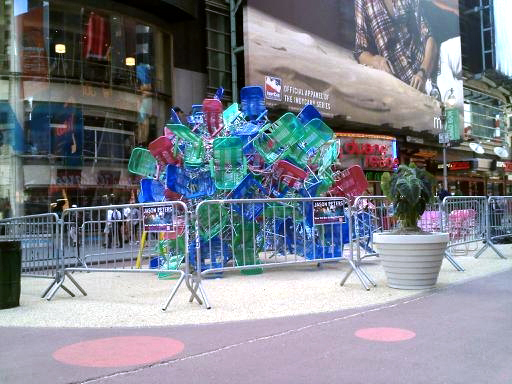
The pedestrian plaza project was originally opposed by local businesses, who thought that closing the street to cars would hurt business.[132] The original seats put out for pedestrians were inexpensive multicolored plastic lawn chairs, a source of amusement to many New Yorkers; they lasted from the onset of the plaza transformation until August 14, 2009, when they were ceremoniously bundled together in an installation christened Now You See It, Now You Don't by the artist Jason Peters, and shortly afterward were replaced by sturdier metal furniture.[133] Although the plaza had mixed results on traffic in the area, injuries to motorists and pedestrians decreased, fewer pedestrians were walking in the road, and the number of pedestrians in Times Square increased.[134] On February 11, 2010, Bloomberg announced that the pedestrian plazas would become permanent.[135]
The city started rebuilding the plaza in 2010, hiring the design and landscaping firm Snøhetta to permanently replace Broadway's roadway with custom-made granite pavers and benches.[136] By December 2013, the first phase of the Times Square pedestrian plaza had been completed at the southern end of the square in time for the Times Square Ball drop on New Year's Eve.[137] The project was originally intended to be completed by the end of 2015.[137] The entire project was finally completed just before New Year's Eve 2016.[138] Some safety bollards were also installed as part of the renovation to prevent vehicular attacks or collisions on the sidewalk.[139] After a 2017 vehicle-ramming attack, there were calls to install more bollards along Times Square.[140]
Times Square's pedestrian plaza is frequented by topless women (with painted breasts) called "desnudas", as well as costumed characters, who typically panhandle for tips.[141] The pedestrian plaza became a source of controversy in the summer of 2015 because of a large number of complaints about the topless women and panhandling characters.[142] Although neither of these activities are illegal, opponents believed that the panhandlers' presence was detrimental to the quality of life in the area.[143] There were calls from Police Commissioner Bratton and Mayor Bill de Blasio to remove the plaza, although Manhattan Borough President Gale Brewer opposed the proposal.[143] In June 2016, work started on "pedestrian flow zones" where no one was allowed to loiter, as well as "activity zones" where costumed characters were allowed to perform.[144]
Incidents
[edit]There have been several incidents in Times Square:
- On the morning of March 6, 2008, a small bomb caused minor damage, but there were no reported injuries.[145]
- On May 1, 2010, Times Square was evacuated from 43rd to 46th Streets following the discovery of a car bomb. It was found to be a failed bombing.[146]
- On May 18, 2017, a vehicle-ramming attack at Times Square killed one person and injured 22 others.[147][148]
- On August 7, 2019, shortly after consecutive mass shootings in El Paso, Texas, and Dayton, Ohio, a backfiring motorcycle resulted in a stampede due to the sound being mistaken for gunfire; the stampede injured at least twelve people.[149]
- On May 8, 2021, a dispute between a group of men led to a shooting in which three bystanders were wounded, including a four-year-old girl.[150]
- On June 27, 2021, a dispute between a group of street vendors led to a shooting in which a 21-year-old bystander was wounded.[151][152]
- On December 31, 2022, a 19-year-old man from Maine injured three officers with the New York City Police Department in a machete attack that occurred during New Year's Eve celebrations in Times Square.[153]
- On February 8, 2024, a teenager shot and injured a Brazilian tourist, and he shot at a police officer and security guard after being confronted for shoplifting.[154] The shooter, a Venezuelan migrant, fled the area but was apprehended just outside the city.[155]
- Shooting occurred at the intersection of West 44th Street and Seventh Ave., during 1:30 a.m. on August 9, 2025, wounding three; the attack occurred outside a Raising Cane's restaurant, and was possibly a verbal altercation escalating to gunshots. A teenager was among those wounded; no injuries were life-threatening, although they ranged from serious to lesser serious wounds. A 17-year-old was arrested and faces charges of attempted murder.[156]
Number of visitors
[edit]Times Square is the most visited place globally with 360,000 pedestrian visitors a day, amounting to over 131 million a year.[157] As of 2013[update], it had a greater attendance than each of the Disney theme parks worldwide, with 128,794,000 visitors between March 2012 and February 2013, versus 126,479,000 for the Walt Disney World theme parks in Bay Lake, Florida, in 2012.[157][158] Even excluding residents from the visitor count, Times Square is the world's second most visited tourist attraction, behind the Las Vegas Strip.[159] The high level of pedestrian traffic has resulted in $4.8 billion in annual retail, entertainment, and hotel sales,[160] with 22 cents out of every dollar spent by visitors in New York City being spent within Times Square.[160][161]
New Year's Eve celebrations
[edit]
Times Square is the site of the annual New Year's Eve ball drop. About one million revelers crowd Times Square for the New Year's Eve celebrations, more than twice the usual number of visitors the area usually receives daily.[162] However, for the millennium celebration on December 31, 1999, published reports stated approximately two million people overflowed Times Square, flowing from Sixth Avenue to Eighth Avenue and back on Broadway and Seventh Avenue to 59th Street, making it the largest gathering in Times Square since August 1945 during celebrations marking the end of World War II.[163]
On December 31, 1907, a ball signifying New Year's Day was first dropped at Times Square,[164] and the Square has held the main New Year's celebration in New York City ever since. On that night, hundreds of thousands of people congregate to watch the Waterford Crystal ball being lowered on a pole atop the building, marking the start of the new year. It replaced a lavish fireworks display from the top of the building that was held from 1904 to 1906 but stopped by city officials because of the danger of fire. Beginning in 1908, and for more than eighty years thereafter, Times Square sign maker Artkraft Strauss was responsible for the ball-lowering. During World War II, a minute of silence, followed by a recording of church bells pealing, replaced the ball drop because of wartime blackout restrictions. Today, Countdown Entertainment and One Times Square handle the New Year's Eve event in conjunction with the Times Square Alliance.[164] A new energy-efficient LED ball debuted for the arrival of 2008, which was the centennial of the Times Square ball drop. The 2008–09 ball is larger and has become a permanent installation as a year-round attraction, being used for celebrations on days such as Valentine's Day and Halloween.[164]
The New Year's Eve celebrations are usually overseen by thousands of police officers. Aluminum barriers are erected to accommodate spectators; for the 2020 celebration, attended by a million people, barriers were erected from 38th to 59th Street and from Sixth to Eighth Avenue.[165] Typically, the celebrations create large amounts of waste. The waste includes the 3,000 pounds of biodegradable confetti dropped at midnight, a tradition of which started in 1992.[166] The New York City Department of Sanitation estimated that by 8 a.m. on New Year's Day 2014, it had cleared over 50 short tons (45 long tons; 45 t) of trash from the New Year's celebration, using 190 workers from their crews and the Times Square Alliance.[167]
Impact of COVID-19
[edit]
The onset of the COVID-19 pandemic in New York City during 2020 reduced the number of people traveling to Times Square. About 108,000 pedestrians visited Times Square each day in late 2020 compared to the 380,000 before the pandemic. From March to October 2020, 26 of the area's 46 hotels closed, as well as 39 of 151 stores and 84 of 162 restaurants.[168] Times Square was closed to the public for New Year's Day 2021 and observers were dispersed into enclosures measuring 8 by 8 ft (2.4 by 2.4 m).[165][169]
Notable landmarks
[edit]

Times Square is a busy intersection of art and commerce, where scores of advertisements – electric, neon and illuminated signs and "zipper" news crawls – vie for viewers' attention. Notable examples include:
- Coca-Cola sign
- Disney Store Times Square
- Fashion One
- FashionTV
- Forever 21 (formerly Virgin Megastores)
- Hard Rock Cafe New York
- M&M's World
- Hershey's Chocolate World
- Planet Hollywood
- Palladium Times Square
- Revlon
- Times Square Studios – used primarily for selected ABC News and ESPN programs, such as Good Morning America
- TKTS – the Theatre Development Fund's reduced-price ticket booth has, since 2008, been backed by a red, sloped, triangular set of bleacher-like stairs, which is frequented by residents and tourists.
- Times Square – a permanently installed sound art piece by Max Neuhaus between 45th and 46th Streets.
Contemporary artists regularly perform on Times Square. Examples include test pattern [times square] by Ryoji Ikeda[176] and Continuum by Krista Kim.[177]
In popular culture
[edit]
An immediately recognizable location, Times Square has been featured countless times in literature, films, video games, music videos, and on television.
The seediness of the area was featured prominently in such films as Midnight Cowboy (1969),[178] Born to Win (1971),[179] and Taxi Driver (1976).[180] The area was shown in the 1980 film Times Square, which featured a punk rock/new wave soundtrack.[181] It was also depicted in the 2011 movie New Year's Eve.[182] The area also appeared on The Amazing Race as the starting location in a race around the world in the first episode of the show's 25th season,[183] as well as on the sixth season of the Israeli edition of The Amazing Race with teams finishing their second leg in Times Square.[184]
Times Square has been fictionally attacked and destroyed in several movies, including Knowing, when a solar flare destroys New York City;[185] Deep Impact, when a tsunami created from a meteor impact destroys New York City; the 1998 film Godzilla, where Godzilla is chased through Times Square; the Ghostbusters movies; Stephen King's The Stand, where the intersection is overcome by total anarchy; Transformers: Revenge of the Fallen, Cloudy with a Chance of Meatballs, and 2012. It was also seen in the festival battle scene in the 2002 film Spider-Man, and a stand-off in the later film The Amazing Spider-Man 2.[186]
Films and TV shows have also employed the opposite tactic, depicting the typically bustling area as eerily still, such as in Vanilla Sky,[187] as well as the post-apocalyptic I Am Legend, in which Will Smith and his dog go hunting for deer in the deserted urban canyon.[185] In the pilot episode of the TV series Blindspot, Times Square is completely emptied due to an abandoned bag being suspected to be a bomb.[188]
Times Square also has featured prominently in video games. For instance, in Grand Theft Auto IV, a recreation of the Times Square area referred to in-game as "Star Junction", is included in the game's fictional "Liberty City" setting.[185] Times Square is also shown in Battlefield 3, where the final fight with the main antagonist takes place, where the player must stop him from detonating a nuclear bomb in the square; and Crysis 2, in which player must fight off attacking alien forces to assist U.S. Marines in evacuating the area.[189] Gran Turismo 4 also features Times Square both as a photo spot and as a part of the New York city circuit which also includes Central Park.

See also
[edit]
- Good Riddance Day, an unofficial holiday celebrated at Times Square since 2007[190]
- Midtown Community Court, a branch of the New York City Criminal Court that primarily focuses on quality of life around Times Square[191]
- Naked Cowboy, New York City street performer and prominent fixture of Times Square[192]
- Piccadilly Circus
- Lincoln Highway, the terminus of which was in Times Square
- Tourism in New York City
References
[edit]Notes
[edit]- ^ Any development under 60,000 sq ft (5,600 m2) was exempt from the rule; for larger buildings, the first 50,000 sq ft (4,600 m2) of a development was exempt from the bonus calculation. For example, in a building with 500,000 sq ft (46,000 m2), the bonus calculation was derived from 5 percent of 450,000 sq ft (42,000 m2), so the space to be set aside for entertainment uses was 22,500 sq ft (2,090 m2).[69]
Citations
[edit]- ^ "NYC Planning | Community Profiles". communityprofiles.planning.nyc.gov. New York City Department of City Planning. Archived from the original on November 10, 2021. Retrieved March 18, 2019.
- ^ a b Noah Remnick and Tatiana Schlossberg (August 24, 2015). "New York Today:Transforming Times Square". The New York Times. Archived from the original on August 24, 2015. Retrieved August 24, 2015.
- ^ "The Most Jivin' Streetscapes in the World". Luigi Di Serio. 2010. Archived from the original on September 21, 2014. Retrieved January 21, 2012.
- ^ "Times Square". Encyclopædia Britannica. Retrieved January 21, 2012.
- ^ "New York Architecture Images- Midtown Times Square". 2011 nyc-architecture. Archived from the original on January 25, 2017. Retrieved January 21, 2012.
- ^ Ann Shields (November 10, 2014). "The World's 50 Most Visited Tourist Attractions – No. 3: Times Square, New York City – Annual Visitors: 50,000,000". Travel+Leisure. Archived from the original on April 17, 2019. Retrieved May 6, 2015.
- ^ Owen, David (January 21, 2013). "The Psychology of Space". The New Yorker. Archived from the original on October 10, 2022. Retrieved February 21, 2022.
- ^ Hellman, Peter (May 19, 1997). "Bright Lights, Big Money". New York Magazine. Vol. 30, no. 19. New York Media, LLC. p. 48. ISSN 0028-7369.
- ^ "Annual Subway Ridership (2018–2023)". Metropolitan Transportation Authority. 2023. Retrieved April 20, 2024.
- ^ Times Square History, NYC Tourist. Accessed February 26, 2017. "Times Square is a major commercial intersection in central Manhattan at the junction of Broadway and Seventh Avenue. It acquired its name in 1904 when Albert Ochs, publisher of The New York Times, moved the newspaper's headquarters to a new skyscraper on what was then known as Longacre Square."
- ^ Dunlap, David W. "1907-8 | The Times Drops the Ball" Archived December 13, 2021, at the Wayback Machine, The New York Times, January 1, 2015. Accessed November 1, 2016. "After two more years of pyrotechnics, The Times found a less flammable way to signal the moment of midnight: an iron-and-wood ball, five feet in diameter, on which 100 25-watt bulbs were mounted. It was to be lowered down a flagstaff at midnight on Dec. 31, 1907."
- ^ "Times Square – The Official Website". Times Square District Management Association, Inc. May 10, 2017. Archived from the original on October 23, 2022. Retrieved August 4, 2022.
- ^ Chan, Sewell. "A Lincoln Highway Marker in Times Square" Archived November 19, 2021, at the Wayback Machine, The New York Times, February 12, 2009. Accessed January 9, 2022. "Nevertheless, Times Square is indeed the eastern terminus of the Lincoln Highway, the nation's first coast-to-coast road, which was formed in 1913, its 3,389 miles stretching from New York City to San Francisco."
- ^ Allan Tannenbaum. "New York in the 70s: A Remembrance". The Digital Journalist. Archived from the original on March 20, 2012. Retrieved January 21, 2012.
- ^ William R. Taylor. "Inventing Times Square Commerce and Culture at the Crossroads of the World". Russell Sage Foundation. Archived from the original on July 11, 2025. Retrieved June 8, 2025.
Times Square as the "center of the universe" had its darker sides as well, for it was the testing ground for a new morality.
- ^ Federal Writers' Project (1939). New York City Guide. New York: Random House. p. 170. (Reprinted by Scholarly Press, 1976, ISBN 040302921X; often referred to as WPA Guide to New York City.) "The phrase 'Great White Way' is supposed to have been coined in 1901 by O. J. Gude, an advertising man, who is said also to have been the first to see the tremendous possibilities of electric display."
- ^ Tell, Darcy. Times Square spectacular: lighting up Broadway Archived December 31, 2022, at the Wayback Machine New York: HarperCollins, 2007
- ^ Allen, Irving Lewis. The City in Slang: New York Life and Popular Speech Archived December 31, 2022, at the Wayback Machine. New York: Oxford University Press, 1995. Quote: "By 1910, the blocks of Broadway just above 42nd Street were at the very heart of the Great White Way. The glow of Times Square symbolized the center of New York, if not of the world."
- ^ "Times Square is not a square," Archived June 8, 2022, at the Wayback Machine Urban Magazine (May 9, 2011).
- ^ Kimmelman, Michael (January 3, 2012). "The Grid at 200: Lines That Shaped Manhattan". The New York Times. ISSN 0362-4331. Archived from the original on March 21, 2022. Retrieved March 21, 2022.
- ^ Rybczynski, Witold. City Life: Urban Expectations in a New World New York: Scribner, 1995. p.27. ISBN 0-684-81302-5. Quote: "...despite its name [Times Square] is really a street intersection, not a square."
- ^ Dunlap, David W. "COMMERCIAL PROPERTY: Times Square Novelty; North of Duffy Sq., a Butler-on-Every-Floor Hotel" Archived December 13, 2021, at the Wayback Machine, The New York Times, June 10, 1990. Accessed February 26, 2017. "With its hot nightclubs, dazzling signs and sprawling showrooms, the block at the northern end of the 'bowtie' formed by Broadway and Seventh Avenue was always an important part of old Times Square."
- ^ "Times Square" Archived January 10, 2022, at the Wayback Machine New York City Geographic Information Service map
- ^ Father Duffy Square Archived January 12, 2017, at the Wayback Machine, New York City Department of Parks and Recreation. Accessed January 10, 2017. "Dominated in 1909 by a temporary eight-ton, fifty-foot statue by Leo Lentelli entitled Purity (Defeat of Slander), today this square—so central to the theater district—is defined by statues of George M. Cohan and Father Duffy, as well as a large public viewing grandstand along the north side."
- ^ "Duffy Sq. Signs To Be Put Up Today; Area Surrounding Statue of Chaplain of Old 69th to Be Separate From Times Sq.", The New York Times, June 13, 1939. Accessed January 2, 2024. "A new honor will be accorded today to the Rev. Francis P. Duffy, famed chaplain of the 'fighting Sixty-ninth,' when that section of Times Square immediately surrounding his statue between Forty-sixth and Forty-seventh Streets will be designated as Duffy Square by a change of street signs... The change to Duffy Square was authorized March 29, when Mayor La Guardia signed the local law passed by the City Council."
- ^ Father Duffy Square, New York City Department of Parks and Recreation. Accessed January 2, 2024. "At the apex of the triangle defining the north end of Times Square, the massive statue of Father Francis Patrick Duffy (1871–1932) by Charles Keck (1875–1951) has stood sentinel since it was unveiled May 2, 1937."
- ^ Father Duffy Square: George M. Cohan, New York City Department of Parks and Recreation. Accessed January 2, 2024. "This bronze statue depicts the American composer, playwright, actor, and producer George M. Cohan (1878–1942). The statue was designed by Georg John Lober (1892–1961) and dedicated in 1959."
- ^ Harris, Stephen L. Duffy's War: Fr. Francis Duffy, Wild Bill Donovan, and the Irish Fighting 69th in World War I, Potomac Books, 2006
- ^ TKTS Times Square Archived January 2, 2024, at the Wayback Machine, TimesSquareNYC.org. Accessed January 2, 2024. "Buy discounted tickets "under the red steps" in Father Duffy Square at Broadway and 47th St. TDF is a not-for-profit organization that has been dedicated to bringing the power of the performing arts to everyone since 1968."
- ^ "TKTS® Turns 50 in Times Square", Theatre Development Fund, press release dated June 8, 2023. Accessed January 2, 2024. "'TDF approached me and my business partner John Schiff to design a temporary structure around a trailer for $5,000,' said Bob Mayers, partner at Mayers & Schiff, the architectural firm hired to design the original half-price ticket booth in Duffy Square in 1973.... Operated by TDF, a not-for-profit service organization for the performing arts, TKTS Times Square opened for business on June 25, 1973, and quickly became a mecca for theatregoers from all over the world."
- ^ Gerard T. Koeppel, Water for Gotham: A History, 2001:10.
- ^ Sanderson, Eric W. Mannahatta: A Natural History of New York City, 2009: Appendix A p 253; refs. G.E. Hill and G.E. Waring Jr, "Old wells and water-courses on the isle of Manhattan", in Historic New York, M.W. Goodwin, A.C. Royce, and R. Putnam, 1897; and others.
- ^ Edwin G. Burrows and Mike Wallace, Gotham: A History of New York City to 1898, 1999, p.721.
- ^ Ulam, Alex (June 2, 2008). "John Jacob Astor: The making of a hardnosed speculator | The Real Deal | New York Real Estate News". The Real Deal. Archived from the original on February 15, 2010. Retrieved April 21, 2010.
- ^ Kelly, Frank Bergen. Historical Guide to the City of New York Archived December 31, 2022, at the Wayback Machine New York: Frederick A. Stokes Co., 1909
- ^ Stavrou, Gene. "Where was the American Horse Exchange? – TreebaseNYC". www.treebase.com. Archived from the original on February 3, 2016. Retrieved January 25, 2016.
- ^ Dunning, Jennifer. "A Walking Tour of the Past and Present on Broadway" Archived August 11, 2018, at the Wayback Machine, The New York Times, July 13, 1979. Accessed November 1, 2016. "The old stock and repertory company system made way for the Broadway hit and greater profits for the theater manager and owner, which, in turn, led to the rise of such theatrical entrepreneurs as Oscar Hammerstein, who struck out into the wilds of 44th and 45th Streets in 1895 to build his huge Olympia Theater in the 'Thieves Lair' area of Broadway."
- ^ Burrows and Wallace 1999:1149.
- ^ Gray, Christopher. "Streetscapes: A Small Hotel, a Mock Battleship and the Titanic" Archived November 3, 2016, at the Wayback Machine, The New York Times, December 1, 1996. Accessed November 1, 2016. "Q The Pabst Hotel was on the site of the old New York Times Tower, at the northwest corner of 42d and Broadway. Was it owned and operated by Pabst Brewing? . . . David Steigerwald, Fanwood, N.J.A Yes. The Pabst opened in November 1899, in the middle of the first wave of theater construction to arrive in the area, then known as Longacre Square."
- ^ a b Barron, James. "100 Years Ago, an Intersection's New Name: Times Square" Archived September 9, 2017, at the Wayback Machine, The New York Times, April 8, 2004. Accessed May 26, 2017.
- ^ "Times Square – New York, New York – Scenic at Night on". Waymarking.com. Archived from the original on June 6, 2011. Retrieved April 21, 2010.
- ^ WINTER GARDEN, Theatre District Archived January 20, 2017, at the Wayback Machine, Forgotten New York, February 2, 2016. Accessed May 26, 2017.
- ^ Ennis, Thomas W. "OLD TIMES TOWER TO GET NEW FACE" Archived February 21, 2022, at the Wayback Machine, The New York Times, April 17, 1963. Accessed February 21, 2022.
- ^ "The Lincoln Highway Marker". Hmdb.org. Archived from the original on March 8, 2012. Retrieved April 21, 2010.
- ^ Pollak, Michael. "A Highway's Starting Line, and a Flemish Firehouse" Archived March 8, 2017, at the Wayback Machine, The New York Times, July 8, 2016. Accessed November 1, 2016. "The sign, which has been restored to the northeast corner of 42nd Street and Broadway, is quite authentic. It was placed there on Feb. 12, 2009, the 200th anniversary of Abraham Lincoln's birth, to mark the Lincoln Highway, which was created in 1913 and was the nation's first coast-to-coast road."
- ^ a b Leach, William R. Land of Desire: Merchants, Power, and the Rise of a New American Culture, p. 339, Knopf Doubleday Publishing Group, 2011, ISBN 9780307761149. Accessed May 26, 2017.
- ^ Leach (1993), p.340
- ^ Leach (1993), p.341
- ^ a b Leach (1993), p.345
- ^ Leach (1993), p.346
- ^ "Killer Cop: Charles Becker – Crime Library on". TruTV. Archived from the original on December 12, 2013. Retrieved April 21, 2010.
- ^ Macbeth, VR (May 1, 2012). "The Great White Way". Timessquare.com. Archived from the original on May 4, 2011.
- ^ "From Dazzling to Dirty and Back Again: A Brief History of Times Square". History of Times Square. Times Square District Management Association. May 17, 2017. Archived from the original on September 24, 2017. Retrieved July 23, 2021.
- ^ Moench, Mallory. "10 Surprising Facts About the Times Square New Year's Eve Ball Drop", Time, December 31, 2023. Accessed January 2, 2024. "The ball went out of commission for two years, in 1942 and 1943, during World War II, Times Square's website said. Crowds still gathered for a minute of silence followed by chimes ringing from trucks parked at the Times Tower."
- ^ "V-E Day". University of San Diego. Archived from the original on May 15, 2008. Retrieved May 9, 2016.
- ^ "Victory Celebrations". Life. August 27, 1945. p. 21. Retrieved November 25, 2011.
- ^ "No Matter The Reason, Celebration In Times Square", New-York Historical Society, December 27, 2012. Accessed January 2, 2024. "On August 14, 1945 at 7:03 pm the Times Tower zipper delivered the news: 'Official—Truman Announces Japanese Surrender.' The excited crowd, already 500,000 strong, soared to 2 million by 10 pm."
- ^ "Times Square New York City". Streetdirectory.com. Archived from the original on March 14, 2012. Retrieved April 21, 2010.
- ^ Bracker, Milton (March 14, 1960). "Life on W. 42d St. A Study in Decay". The New York Times. ISSN 0362-4331. Archived from the original on April 8, 2022. Retrieved April 8, 2022.
- ^ Bailey, Jason. "10 Great 'Accidental Documentaries' of New York City's Sketchiest Era", Flavorwire, July 5, 2017. Accessed January 2, 2024. "Midnight Cowboy – It's become a cliché of New York attitude, but nicely captures the defiance of city-dwellers in this period – and is one of many achingly accurate period touches in Cowboy, one of the first wide releases to capture the rot of the city in general and its once-glam Times Square district in particular."
- ^ Chakraborty, Deblina. "When Times Square was sleazy", CNN, April 18, 2016. Accessed January 2, 2024. "The sex market and drug trade thrived in the area, and homeless encampments dotted its streets. Many local theaters – once legitimate operations showcasing the performances of renowned actors like Lionel Barrymore – had become home to peep shows and porn movies.... In 1981, Rolling Stone magazine called West 42nd Street, located in the heart of Times Square, the 'sleaziest block in America.'"
- ^ "Sex Business in Times Square Said to Decrease". The New York Times. May 31, 1984. ISSN 0362-4331. Archived from the original on April 8, 2022. Retrieved April 8, 2022.
- ^ Farley, David (June 25, 2018). "The curious history of Times Square – and why you should visit, despite the chaos". The Telegraph. Archived from the original on April 8, 2022. Retrieved April 8, 2022.
- ^ Stern, William J. (December 23, 2015). "The Unexpected Lessons of Times Square's Comeback". City Journal. Archived from the original on June 30, 2022. Retrieved April 8, 2022.
- ^ Traub, James. The Devil's Playground: A Century of Pleasure and Profit in Times Square, New York: Random House, 2004. ISBN 0375759786.
- ^ Stern, William J. Perspectives on Eminent Domain Abuse: The Truth About Times Square, Institute for Justice, April 2009. Accessed January 2, 2024. "In 1984, the entire 13-acre area identified in our eventual redevelopment plan employed only 3,000 people in legal businesses and paid the city only $6 million in property taxes —less than what a medium-size office building in Manhattan typically produced in tax revenue."
- ^ Gottlieb, Martin (November 1, 1986). "Surge of Times Sq. Projects Raises Questions on Effects". The New York Times. ISSN 0362-4331. Archived from the original on February 10, 2022. Retrieved February 14, 2022.
- ^ Oser, Alan S. (December 14, 1986). "Perspectives: Great White Way; Planning for a Brighter Times Sq". The New York Times. ISSN 0362-4331. Archived from the original on February 14, 2022. Retrieved February 14, 2022.
- ^ a b c Dunlap, David W. (September 3, 1987). "New Rule for Times Sq. Space". The New York Times. ISSN 0362-4331. Archived from the original on February 10, 2022. Retrieved February 10, 2022.
- ^ a b Light, Larry; Meehan, John (July 2, 1990). "Finance: real estate: the walls keep closing in on New York developers". Bloomberg Businessweek. No. 3167. p. 72. ProQuest 236695270.
- ^ Stern, Fishman & Tilove 2006, p. 663.
- ^ Lueck, Thomas J. (March 4, 1990). "Battling for Tenants in a Slow Market". The New York Times. ISSN 0362-4331. Archived from the original on February 11, 2022. Retrieved February 11, 2022.
- ^ Dunlap, David W. (August 26, 1990). "Commercial Property: Vacancy Rates; Black Monday's Fallout: An Emptiness Downtown". The New York Times. ISSN 0362-4331. Archived from the original on August 21, 2021. Retrieved February 10, 2022.
- ^ Bartlett, Sarah (March 4, 1992). "Media Group Makes a Deal For Building". The New York Times. ISSN 0362-4331. Archived from the original on December 17, 2019. Retrieved February 10, 2022.
- ^ Henry, David (March 4, 1992). "A New Player on Times Square". Newsday. pp. 52, 55. Archived from the original on February 10, 2022. Retrieved February 10, 2022 – via newspapers.com.
- ^ Gelbtuch, Howard (February 19, 1996). "The ground floor: The times they are a changin' in Times Square and early investors get bargains". Barron's. Vol. 76, no. 8. p. 48.1. ProQuest 200987811.
- ^ Grant, Peter (September 6, 1993). "Times Square's time has come". Crain's New York Business. Vol. 9, no. 36. p. 11. ProQuest 219117979.
- ^ Pinder, Jeanne B. (August 12, 1993). "Midtown Building Is Sold for Lofty $176 Million". The New York Times. ISSN 0362-4331. Archived from the original on February 15, 2022. Retrieved February 15, 2022.
- ^ Grant, Peter (May 9, 1994). "IBM gets record price for NY headquarters". Crain's New York Business. Vol. 10, no. 19. p. 1. ProQuest 219127068.
- ^ Lueck, Thomas J. (February 14, 1988). "The Region: Redevelopment; Times Square Plan Takes A Shaky Step Forward". The New York Times. ISSN 0362-4331. Archived from the original on September 17, 2021. Retrieved September 17, 2021.
- ^ a b c Stephens, Suzanne (March 2000). "Four Times Square" (PDF). Architectural Record. Vol. 188. p. 92. Archived (PDF) from the original on September 29, 2021. Retrieved October 1, 2021.
- ^ a b Dunlap, David W. (August 3, 1992). "Long Delay Likely in Rebuilding Plan for Times Square". The New York Times. ISSN 0362-4331. Archived from the original on September 17, 2021. Retrieved September 17, 2021.
- ^ Stern, Fishman & Tilove 2006, pp. 690–691.
- ^ "Metro Datelines; Times Sq. Gets New Partner". The New York Times. October 8, 1986. ISSN 0362-4331. Archived from the original on September 17, 2021. Retrieved September 17, 2021.
- ^ Polsky, Carol (October 8, 1986). "Prudential Company Joins Times Square". Newsday. p. 20. Archived from the original on September 17, 2021. Retrieved September 17, 2021 – via newspapers.com.
- ^ Stern, Fishman & Tilove 2006, p. 645.
- ^ a b c David W. Dunlap (January 7, 2015). "With a Friendlier 42nd Street, Mario Cuomo Left His Mark on Times Square". The New York Times. Archived from the original on January 8, 2015. Retrieved January 8, 2015.
- ^ Dunlap, David W. (November 9, 1991). "Times Square Redevelopers Seek Delay in Project". The New York Times. ISSN 0362-4331. Archived from the original on September 17, 2021. Retrieved September 17, 2021.
- ^ Henry, David (August 4, 1992). "Remodeling Times Square, Part IV". Newsday. p. 27. Archived from the original on September 17, 2021. Retrieved September 17, 2021 – via newspapers.com.
- ^ Pulley, Brett (November 21, 1995). "Key Developer Seeks a Role In Times Sq". The New York Times. ISSN 0362-4331. Archived from the original on September 17, 2021. Retrieved September 17, 2021.
- ^ Dunlap, David W. (September 16, 1993). "Choreographing Times Sq. Into 21st Century". The New York Times. ISSN 0362-4331. Archived from the original on September 17, 2021. Retrieved September 17, 2021.
- ^ Bagli, Charles V.; Kennedy, Randy (April 5, 1998). "Disney Wished Upon Times Sq. And Rescued a Stalled Dream". The New York Times. ISSN 0362-4331. Archived from the original on September 25, 2021. Retrieved September 25, 2021.
- ^ "Times Square Alliance". Archived from the original on March 4, 2010.
- ^ "Times Square BID Unveils New Visitors Center; Opens to Public Sept. 2". Playbill. December 30, 1997. Archived from the original on January 2, 2022. Retrieved January 2, 2022.
- ^ "Embassy 1 Theatre in New York, NY". Cinema Treasures. August 26, 1925. Archived from the original on January 2, 2022. Retrieved January 2, 2022.
- ^ Macek, Steve (2006). Urban Nightmares: The Media, the Right, And the Moral Panic Over the City. Minneapolis: University of Minnesota Press. p. 111. ISBN 9780816643608.
- ^ Rofes, Eric E. (2001). "Imperial New York: Destruction and Disneyfication under Emperor Giuliani. Review of Times Square Red, Times Square Blue. Samuel R. Delany. New York: New York University Press, 1999". GLQ: A Journal of Lesbian and Gay Studies. 7 (1): 101–09. doi:10.1215/10642684-7-1-101. S2CID 144081737. Archived from the original on February 4, 2016. Retrieved April 30, 2014.
- ^ Bagli, Charles V.; Kennedy, Randy (April 5, 1998). "Disney Wished Upon Times Sq. and Rescued a Stalled Dream". The New York Times. ISSN 0362-4331. Archived from the original on September 25, 2021. Retrieved May 15, 2017.
- ^ Stern, Fishman & Tilove 2006, p. 719.
- ^ Bagli, Charles V. (March 31, 1998). "2 Developers Bid Top Dollar For What's Left in Times Sq". The New York Times. ISSN 0362-4331. Archived from the original on September 27, 2021. Retrieved September 27, 2021.
- ^ Lueck, Thomas J. (April 12, 1996). "Developer Buys the Rights to Build a Times Square Tower". The New York Times. ISSN 0362-4331. Archived from the original on September 17, 2021. Retrieved September 17, 2021.
- ^ Lueck, Thomas J. (May 8, 1996). "Conde Nast Is to Move to a New Times Square Tower, Officials Say". The New York Times. ISSN 0362-4331. Archived from the original on September 18, 2021. Retrieved September 25, 2021.
- ^ Bagli, Charles V. (September 6, 1997). "Reuters to Build 32-Story Headquarters in Times Sq". The New York Times. ISSN 0362-4331. Archived from the original on September 25, 2021. Retrieved September 25, 2021.
- ^ Grant, Peter (September 8, 1997). "Reuters' new tower will get Rudin byline". New York Daily News. p. 27. Archived from the original on September 25, 2021. Retrieved September 25, 2021 – via newspapers.com.
- ^ "Reuters Opens New HQ in Heart of City". Newsday. June 5, 2001. p. 47. Archived from the original on September 27, 2021. Retrieved September 27, 2021 – via newspapers.com.
- ^ "Blackstone Partnership To Buy Times Square Sites". The Wall Street Journal. April 1, 1998. p. C22. ISSN 0099-9660. ProQuest 398611537.
- ^ Standora, Leo (March 31, 1998). "Last 2 major Times Sq. sites go in 300M deal". New York Daily News. p. 6. Archived from the original on September 28, 2021. Retrieved September 28, 2021 – via newspapers.com.
- ^ "Leasing". Real Estate Forum. Vol. 58, no. 2. February 2003. p. 22. ProQuest 216569107.
- ^ Boss, Shira J. (June 24, 2002). "Moving industry packs punch". Crain's New York Business. Vol. 18, no. 25. p. 1. ProQuest 219202175.
- ^ Elliott, Stuart (July 1, 2004). "The Media Business: Advertising; Target is putting its bull's-eyes on Times Square Tower". The New York Times. ISSN 0362-4331. Archived from the original on September 29, 2021. Retrieved September 29, 2021.
- ^ "Zoning Resolution 81–732". City of New York. Archived from the original on October 8, 2021. Retrieved October 8, 2021.
- ^ Oser, Alan S. (December 14, 1986). "Great White Way; Planning for a Brighter Times Sq". The New York Times. Archived from the original on February 14, 2022. Retrieved August 22, 2009.
- ^ "Architect Robert A.M. Stern: Presence of the Past" (PBS video) Archived March 20, 2015, at the Wayback Machine on the Arch Daily website
- ^ Collins, Glenn (November 14, 2008). "In Times Square, a Company's Name in (Wind- and Solar-Powered) Lights". The New York Times. Archived from the original on July 1, 2017. Retrieved August 22, 2009.
- ^ Barbarino, Al. "Ian Schrager Taps CBRE for 20 Times Square Retail". Commercial Observer. Archived from the original on June 6, 2014. Retrieved June 11, 2014. (May 21, 2014)
- ^ Collins, Glenn (May 24, 2008). "How to Stand Out in Times Square? Build a Bigger and Brighter Billboard". The New York Times. Archived from the original on December 25, 2013. Retrieved January 14, 2013.
- ^ "Text of Bloomberg's Inaugural Address". The New York Times. January 1, 2002. Archived from the original on February 21, 2022. Retrieved April 21, 2010.
- ^ "Times Square takes yoga time-out on summer solstice at BBC News". BBC News. June 21, 2013. Archived from the original on December 29, 2013. Retrieved October 4, 2014.
- ^ "Solstice in Times Square: Athleta Mind Over Madness Yoga". Archived from the original on October 6, 2014. Retrieved October 4, 2014.
- ^ Lee, Jennifer (February 10, 2009). "The Pulsing Heart of Times Square". New York Times. Archived from the original on April 1, 2019. Retrieved March 19, 2019.
- ^ Johnson, Sara (February 13, 2014). "6 Years of Times Square Valentines". Architect. Archived from the original on April 1, 2019. Retrieved March 19, 2019.
- ^ Pilkington, Ed (February 3, 2011). "Times Square becomes smoke free as New York extends ban outdoors". Guardian. London. Archived from the original on September 21, 2013. Retrieved February 3, 2011.
- ^ "Times Square Alliance : Super Bowl Boulevard". Times Square Alliance. Archived from the original on November 10, 2013. Retrieved January 28, 2014.
- ^ "Finishing Touches Being Put on Super Bowl Boulevard". NY1. Archived from the original on January 29, 2014. Retrieved January 28, 2014.
- ^ "Super Bowl Blvd. starting to take shape – New York News". WNYW. Archived from the original on January 29, 2014. Retrieved January 28, 2014.
- ^ Celona, Larry (January 27, 2014). "NYPD plans high security on Super Bowl Boulevard". New York Post. Archived from the original on January 27, 2014. Retrieved January 28, 2014.
- ^ Brachfeld, Ben (October 20, 2022). "Real estate and gaming giants eye new casino in Times Square". amNewYork. Archived from the original on October 30, 2022. Retrieved October 30, 2022.
- ^ Rubinstein, Dana; Hong, Nicole; Paulson, Michael (October 19, 2022). "Times Square May Get One of the Few Spectacles It Lacks: A Casino". The New York Times. ISSN 0362-4331. Archived from the original on October 21, 2022. Retrieved October 30, 2022.
- ^ Huston, Caitlin (September 17, 2025). "Times Square Casino Proposal, Backed By Caesars and Jay-Z, Denied By Advisory Committee". Hollywood Reporter. Retrieved September 17, 2025.
- ^ Seifman, David (February 26, 2009). "Broadway Cars Can Take A Walk". New York Post. Archived from the original on February 21, 2022. Retrieved February 21, 2022.
- ^ Vanderford, Richard; Goldsmith, Samuel (May 25, 2009). "Walk, bike or sit, car-free, in Times Square and Herald Square". New York Daily News. Archived from the original on May 26, 2009. Retrieved February 21, 2022.
- ^ Citing "Livability and Mobility," Bloomberg Declares Broadway Plazas a Success Archived April 9, 2022, at the Wayback Machine. Next City Retrieved on February 21, 2022.
- ^ Noel Y.C. (August 16, 2009). "Jason Peters' Now You See It, Now You Don't – Lawn Chair Sculpture". NYC ♥ NYC. Archived from the original on March 30, 2022. Retrieved February 21, 2022.. See also: Media:NowYouSeeIt-TimesSq2009.JPG.
- ^ Nyc Dot Archived February 16, 2015, at the Wayback Machine. Nyc.gov. Retrieved on August 17, 2013.
- ^ "Pedestrian Plaza To Remain Permanent Fixture of Times Square". NY1.com. March 30, 2010. Archived from the original on February 14, 2010. Retrieved April 21, 2010.
- ^ "Times Square Reconstruction". Snøhetta. Archived from the original on December 8, 2013. Retrieved December 29, 2016.
- ^ a b "Snohetta Makes Times Square Permanently Pedestrian". ArchDaily. January 9, 2014. Archived from the original on February 18, 2015. Retrieved December 29, 2016.
- ^ Evans, Dave (December 28, 2016). "Times Square reconstruction finished just before New Year's Eve". ABC7 New York. Archived from the original on October 19, 2021. Retrieved December 29, 2016.
- ^ Blumenthal, Eli (May 18, 2017). "What stopped the car in Times Square? A closer look at bollards". USA TODAY. Archived from the original on August 19, 2022. Retrieved May 20, 2017.
- ^ "Times Square mayhem raises question about recent redesign". Reuters. May 19, 2017. Archived from the original on May 9, 2022. Retrieved May 20, 2017.
- ^ Blitzer, Jonathan (June 26, 2014). "Being a Times Square Elmo". The New Yorker. Retrieved May 15, 2017.
- ^ Dunlap, David W. (August 23, 2015). "Debating Value of Pedestrian Plazas Beyond New York City". The New York Times. Archived from the original on August 19, 2022. Retrieved August 24, 2015.
- ^ a b Barkan, Ross (August 24, 2015). "Manhattan Beep Calls Plan to Tear Up Times Square Pedestrian Plaza 'Preposterous'". Observer. Archived from the original on August 19, 2022. Retrieved August 24, 2015.
- ^ "Elvis, Elmo Bummed by City's New Times Square Flow Zones". NBC New York. Archived from the original on March 9, 2022. Retrieved February 21, 2022.
- ^ BBC News March 6, 2008
- ^ Baker, Al; Rashbaum, William K. (May 1, 2010). "Police Find Car Bomb in Times Square". The New York Times. Archived from the original on May 8, 2010. Retrieved February 20, 2017.
- ^ Sanchez, Ray (May 18, 2017). "Times Square car incident: 1 dead, 22 injured; driver in custody". CNN. Archived from the original on May 18, 2017. Retrieved May 18, 2017.
- ^ Rosenberg, Eli; Rashbaum, William K. (May 18, 2017). "One Dead and 22 Injured as Car Rams into Pedestrians in Times Square". The New York Times. Archived from the original on May 18, 2017. Retrieved May 18, 2017.
- ^ Gajanan, Mahita (August 7, 2019). "Mistaking Motorcycles Backfiring as Gunshots, Crowds Flee Times Square Causing Stampede, Injuries". Time. Retrieved August 9, 2019.
- ^ Ly, Laura; Waldrop, Theresa; Snyder, Alec (May 9, 2021). "Two women and a 4-year-old girl wounded in Times Square shooting, NYPD says". CNN. Archived from the original on May 9, 2021. Retrieved May 9, 2021.
- ^ Watkins, Ali; Wong, Ashley (June 28, 2021). "Police Officers Will 'Flood' Times Square After Another Bystander Is Shot". The New York Times. ISSN 0362-4331. Archived from the original on February 10, 2023. Retrieved July 1, 2021.
- ^ Chapman, Ben; Honan, Katie (June 28, 2021). "NYPD Adds Patrols in Times Square After Tourist Is Shot". The Wall Street Journal. ISSN 0099-9660. Archived from the original on February 10, 2023. Retrieved July 1, 2021.
- ^ Aggarwal, Mithil; Winter, Tom; Dienst, Jonathan; Miller, Myles. "3 officers injured in New Year's Eve machete attack near Times Square, officials say". NBC News. Archived from the original on January 1, 2023. Retrieved January 1, 2023.
- ^ "Teen arrested in connection to Times Square shooting that injured tourist". The Guardian. February 10, 2024. Retrieved February 10, 2024.
- ^ Fahy, Claire (February 9, 2024). "15-Year-Old Is Arrested in Shooting of a Tourist in Times Square". The New York Times. The New York Times. Retrieved February 10, 2024.
- ^ "Three wounded in Times Square, NYC shooting". BBC News. August 9, 2025.
- ^ a b "Times Square Pedestrian Counts, Times Square Alliance". Archived from the original on October 6, 2014. Retrieved October 4, 2014.
- ^ Global Attractions Attendance Report, TEA/AECOM[permanent dead link], Published June 10, 2013.
- ^ "The World's 50 Most Visited Tourist Attractions". HuffPost. February 26, 2014. Archived from the original on February 21, 2022. Retrieved February 21, 2022.
- ^ a b Times Square Economic Impact Update, Times Square Alliance / HRA, March 2012
- ^ "New York City Tourism: A Model for Success, NYC and Company, 2013" (PDF). Archived (PDF) from the original on August 22, 2014. Retrieved May 16, 2014.
- ^ "Times Square Alliance – New Year's Eve". Timessquarenyc.org. Archived from the original on January 14, 2013. Retrieved April 21, 2010.
- ^ "Times Square New York City, New York City Times Square". Timessquare.nyctourist.com. Archived from the original on February 17, 2010. Retrieved April 21, 2010.
- ^ a b c "Times Square Alliance – New Year's Eve – About The Ball". Timessquarenyc.org. November 11, 2008. Archived from the original on October 11, 2011. Retrieved April 21, 2010.
- ^ a b Gold, Michael (December 30, 2020). "No Crowds, but Times Square Ball Drop Is Still Happening. Here's How". The New York Times. ISSN 0362-4331. Archived from the original on April 23, 2022. Retrieved March 27, 2021.
- ^ Mestel, Spenser (December 28, 2018). "How to Dump 3,000 Pounds of Confetti on Times Square". The New York Times. Retrieved February 6, 2024.
- ^ "Crews Clean Up Times Square After New Year's Celebration". CBS New York. January 1, 2014. Archived from the original on December 31, 2014. Retrieved December 30, 2014.
- ^ Kilgannon, Corey (December 1, 2020). "Without Crowds, Is Times Square Really Times Square? Take a Look". The New York Times. ISSN 0362-4331. Archived from the original on August 19, 2022. Retrieved July 1, 2021.
- ^ Fastenberg, Dan; Allen, Jonathan (December 31, 2020). "After a year like no other, New York's Times Square empties out on New Year's Eve". Reuters. Archived from the original on August 26, 2022. Retrieved March 27, 2021.
- ^ White, Norval & Willensky, Elliot (2000). AIA Guide to New York City (4th ed.). New York: Three Rivers Press. ISBN 978-0-8129-3107-5.
- ^ "One Times Square". CTBUH Skyscraper Database. Council on Tall Buildings and Urban Habitat. 2016. Archived from the original on November 17, 2016.
- ^ "The Reuters Building". Wired New York. Archived from the original on December 2, 2010. Retrieved April 21, 2010.
- ^ "4 Times Square – The Skyscraper Center". Council on Tall Buildings and Urban Habitat. Archived from the original on June 12, 2020. Retrieved September 18, 2021.
- ^ "5 Times Square – The Skyscraper Center". The Skyscraper Center. April 7, 2016. Archived from the original on September 28, 2021. Retrieved September 28, 2021.
- ^ Muto, Sheila (September 5, 2001). "What's in an Address? Sometimes, a Better Image: Office Buildings Take On Street Names, Numbers With Greater Appeal". The Wall Street Journal. p. B14. ISSN 0099-9660. ProQuest 2074372587.
- ^ "Ryoji Ikeda Presents: test pattern". Fact Magazine. May 4, 2021. Archived from the original on April 30, 2022. Retrieved April 30, 2022.
- ^ "Daily digest: Nick Cave will project onto theMART, waves of soothing color in Times Square, and more". The Architect's Newspaper. February 25, 2022. Archived from the original on May 13, 2022. Retrieved April 30, 2022.
- ^ "Midnight Cowboy Film Locations". On the Set of New York. Archived from the original on January 7, 2015. Retrieved February 14, 2015.
- ^ Tucker, Ken (June 13, 2004). "Times Square at 100; It Outta Be in Pictures". The New York Times. Archived from the original on December 25, 2019. Retrieved December 24, 2019.
- ^ Nigro, Carmen. "The Changing Face of Times Square," Archived June 10, 2016, at the Wayback Machine New York Public Library: Stephen A. Schwarzman Building, Milstein Division of United States History, Local History and Genealogy (January 12, 2015).
- ^ Ebert, Roger (November 17, 1980). "Times Square". Archived October 6, 2016, at the Wayback Machine. RogerEbert.com. Accessed October 5, 2016. "The story involves two teen-age runaway girls, an all-night disk jockey and the inhabitants of the Times Square jungle of New York."
- ^ Ebert, Roger (December 7, 2011). "New Year's Eve". Archived October 7, 2016, at the Wayback Machine. RogerEbert.com. Accessed October 5, 2016. "What sins did poor Hilary Swank commit, that after winning two Oscars, she has to play the role of the woman in charge of the New Year's Eve ball in Times Square?"
- ^ "The Next Season of Amazing Race". CBS. June 1, 2014. Archived from the original on November 11, 2020. Retrieved January 8, 2020.
- ^ Hayun, Omri (May 17, 2017). בלעדי! משתתפי "המירוץ למיליון" נחתו בניו יורק הישר לטיימס סקוור [Exclusive! "Race for a Million" landed in New York straight to Times Square]. Omritv (in Hebrew). Archived from the original on August 3, 2020. Retrieved January 8, 2020.
- ^ a b c Knight, Gladys L. Pop Culture Places: An Encyclopedia of Places in American Popular Culture Archived December 31, 2022, at the Wayback Machine, p. 870. Accessed October 5, 2016. "In Knowing (2009), the area is one of several iconic places ravaged by a solar flare."
- ^ Giardina, Carolyn. "Amazing Spider-Man 2: An Exclusive Look at the Times Square Battle (Photos)" Archived February 21, 2022, at the Wayback Machine, The Hollywood Reporter, May 2, 2014. Accessed February 21, 2022. "Some of the most complicated visual effects work in Sony's The Amazing Spider-Man 2 can be seen in the action sequence set in Times Square, according to the film's VFX supervisor, Sony Pictures Imageworks.' Jerome Chen."
- ^ Vanilla Sky – Entertainment Tonight Archived October 27, 2016, at the Wayback Machine, The Uncool. Accessed October 5, 2016. "New York has never shut down Times Square for anything, much less a film crew.... But with the help of the New York Mayor's office, the city's film commission and the New York police Department, the Vanilla Sky crew actually pulled off a total Times Square closure, arranging to clear the entire area for 90 minutes on a Sunday morning in November of 2000."
- ^ Raferty, Liz. "How the Creators of Blindspot 'Shut Down Times Square' for That Crazy Opening Scene" Archived October 11, 2016, at the Wayback Machine, TV Guide, September 21, 2015. Accessed October 5. 2016. "Fast-forward five years, and Gero's vision has come to life in the form of Blindspot, NBC's new drama about a Jane Doe (Jaimie Alexander) who's discovered in a duffel bag in the middle of an evacuated Times Square, covered in tattoos and with no memory of how she got there, who she is, or what's going on in the world around her."
- ^ "Crysis 2 – Mission 14 Power Out – Walkthrough". YouTube. October 22, 2012. Archived from the original on December 11, 2021. Retrieved July 23, 2021.
- ^ Good Riddance Day, Times Square Alliance. Accessed January 10, 2017. "Good Riddance Day is inspired by a Latin American tradition in which New Year's revelers stuffed dolls with objects representing bad memories before setting them on fire."
- ^ Midtown Community Court Archived January 10, 2017, at the Wayback Machine, Center for Court Innovation. Accessed January 10, 2017.
- ^ Cowan, Alison Leigh. "Naked Cowboy Drops Out: No Singing Mayor in Briefs" Archived April 17, 2016, at the Wayback Machine, The New York Times, September 4, 2009. Accessed January 10, 2017. "Running for mayor of New York City must have struck Robert Burck, the so-called Naked Cowboy of Times Square, as a good idea back in July."
Bibliography
[edit]- Brown, H. (1922) Valentine's Manual of Old New York. Valentine.
- Fazio, W. (2000) Times Square, Children's Press. ISBN 0-516-26530-X
- Friedman, J. (1993) Tales of Times Square Feral House. ISBN 0-922915-17-2
- Leach, William (1993). Land of Desire. New York: Pantheon Books. ISBN 978-0307761149.
- Stern, Robert A. M.; Fishman, David; Tilove, Jacob (2006). New York 2000: Architecture and Urbanism Between the Bicentennial and the Millennium. New York: Monacelli Press. ISBN 978-1-58093-177-9. OCLC 70267065. OL 22741487M.
- Taylor, W. (1996) Inventing Times Square, Johns Hopkins U. Press. ISBN 0-8018-5337-0
- Traub, James (2004) The Devil's Playground: A Century of Pleasure and Profit in Times Square New York: Random House. ISBN 0-375-50788-4
External links
[edit] Media from Commons
 News from Wikinews
 Travel information from Wikivoyage
 Data from Wikidata


- Times Square live camera
- The Times Square Alliance and Events Listing
- Times Square 360 panorama Archived March 20, 2018, at the Wayback Machine
- "The Changing Face of Times Square" at the New York Public Library website
- Times Square Arts Center Archived June 27, 2019, at the Wayback Machine
- NYC-Architecture.com
- New York City Tourist
| International | |
|---|---|
| National | |
| Geographic | |
| Other | |

Times Square
View on GrokipediaGeography and Physical Layout
Location and Boundaries
Times Square occupies a central position in Midtown Manhattan, New York City, precisely at the intersection of Broadway, Seventh Avenue, and West 42nd Street, where Broadway crosses Seventh Avenue at an acute angle, forming a distinctive bowtie-shaped plaza. This core area extends northward along Broadway to approximately West 47th Street, including the adjacent Duffy Square to the north. The site's geographic coordinates center around 40.7589°N, 73.9851°W.[5] The broader Times Square district, managed as a business improvement district by the nonprofit Times Square Alliance, spans from West 40th Street to West 53rd Street, bounded eastward by Sixth Avenue and westward by Eighth Avenue. This delineation encompasses over 39 theaters and numerous commercial establishments, with an extension to include historic Restaurant Row along West 46th Street between Eighth and Ninth Avenues.[6][7] These boundaries reflect the area's operational focus on sanitation, safety, and promotion rather than a rigid municipal definition, as variations exist in official mappings, such as slightly expanded zones in some city planning documents.[8]Infrastructure and Urban Design
Times Square's urban layout features the diagonal path of Broadway intersecting the orthogonal Manhattan street grid at Seventh Avenue, forming a distinctive bowtie-shaped area between West 42nd and 47th Streets. This configuration, resulting from the grid's imposition on earlier irregular paths, creates multiple triangular blocks and wide intersections that accommodate heavy vehicular and pedestrian flows. Seventh Avenue serves as the primary north-south thoroughfare, while 42nd Street provides east-west connectivity, with traffic signals and crosswalks managing the convergence of routes in this high-density zone.[9] Subsurface infrastructure centers on the Times Square–42nd Street station complex, a critical New York City Subway hub connecting the IRT Broadway–Seventh Avenue Line (1, 2, 3 trains), the IRT Flushing Line (7 and <7> trains), the BMT Broadway Line (N, Q, R, W trains), and the 42nd Street Shuttle (S train), with passageways linking to the nearby Port Authority Bus Terminal station for A, C, and E trains. The complex handles massive daily ridership, underscoring its role in regional transit, though it has faced capacity constraints and accessibility challenges addressed in ongoing renovations like the 42nd Street Connection project, which includes new elevators and redesigned platforms.[10][11] In response to chronic congestion and safety issues, the New York City Department of Transportation initiated temporary closures of Broadway to vehicular traffic in May 2009, converting segments into pedestrian plazas using simple barriers and furnishings; prior to this, pedestrian-vehicle collisions in the area exceeded those on adjacent avenues by 137 percent. The experiment's success in boosting foot traffic and reducing incidents prompted a permanent redesign by Snøhetta, completed in phases by 2017, which carved out 2.5 acres of car-free space, added 110,000 square feet of pedestrian area, and incorporated custom granite paving, 50-foot benches, and activity zones.[12][13][14] These modifications doubled open pedestrian space, rearranged adjacent traffic flows for efficiency, and yielded measurable safety gains, including a 40 percent drop in pedestrian injuries and a 20 percent reduction in crime rates post-reconstruction. The design prioritizes durable, low-maintenance materials suited to intense use, while integrating digital billboards and lighting infrastructure that define Times Square's visual identity without compromising spatial functionality.[14][15][16]Historical Development
Origins as Longacre Square (19th Century)
Longacre Square encompassed the intersection of Broadway and Seventh Avenue near 42nd Street in Midtown Manhattan, an area that developed amid the city's northward expansion in the mid-19th century.[17] Initially featuring sparse brownstone residences built by developers anticipating uptown growth, the district transitioned into a commercial zone as population and economic pressures pushed industry outward from Lower Manhattan.[18] By the 1860s, light manufacturing, including wagon factories and harness shops, clustered along Broadway north of 42nd Street to serve the burgeoning demand for horse-drawn vehicles essential to urban transport.[19] The name "Longacre Square," in use by the 1870s, directly referenced London's Long Acre district, a longstanding hub for carriage makers and horse traders since the 17th century.[20] This analogy reflected New York's emulation of British commercial patterns, as the neighborhood became the epicenter of the American horse-and-carriage trade, hosting stables, dealers, blacksmiths, and repair shops.[21] The area's strategic location facilitated access to both downtown markets and emerging residential zones further north, concentrating over 200 carriage-related businesses by the late 19th century and mirroring the specialized industrial districts that drove Manhattan's grid-based development.[17] In the 1880s and 1890s, Longacre Square remained characterized by open lots amid drab apartments and trade-oriented structures, with the carriage industry's dominance underscoring the era's reliance on equine power before widespread mechanization.[22] Economic incentives, including lower land costs compared to congested southern wards, attracted these enterprises, fostering a self-reinforcing cluster where proximity reduced transaction costs for buyers, sellers, and service providers.[19] This phase laid the infrastructural groundwork for subsequent transformations, as the district's commercial vitality persisted even as technological shifts loomed.[1]Emergence as Theater and Commercial Hub (1900s–1930s)
The early 1900s marked the solidification of Times Square as New York City's premier theater district, with the Republic Theatre—built in 1900 by Oscar Hammerstein I on West 42nd Street—playing a key role in shifting focus from downtown venues to this uptown area.[23] By the onset of World War I, most legitimate theaters had migrated to Times Square, facilitated by the opening of the IRT subway's Times Square station in 1904, which initially handled nearly 5 million passengers annually and enhanced accessibility.[1] Between 1900 and 1928, approximately 80 theaters were constructed along Broadway from 39th to 54th Streets, concentrating live performances in the vicinity.[24] The 1920s witnessed a construction boom, adding over 30 new theaters in the Times Square area amid rising demand for musicals and dramas.[25] This theatrical expansion intertwined with commercial growth, as luxury hotels like the Astor and Knickerbocker opened to accommodate patrons, alongside upscale restaurants that catered to pre- and post-show crowds.[1] Electrification accelerated the district's allure, dubbing it "The Great White Way" by 1907 for the blaze of electric marquees and signs illuminating Broadway.[26] Commercial vibrancy intensified in the interwar period with proliferating illuminated billboards and neon displays, transforming the square into an advertising mecca; the 1928 debut of an electric news ticker on the Times Tower drew billions of viewers over time, underscoring its role as an information and entertainment nexus.[1] The subway's expansion, combined with elevated trains and buses by the late 1920s, further entrenched Times Square as a transportation and commercial crossroads, supporting retail and hospitality enterprises that capitalized on theater-driven foot traffic.[1]Postwar Decline into Vice District (1940s–1970s)
Following World War II, Times Square transitioned into a "honky-tonk" district characterized by carnivalesque amusements, penny arcades, and increased erotic entertainment sought by soldiers on leave, which accelerated the influx of vice activities.[27][1] Wartime construction restrictions and postwar economic pressures further eroded the area's legitimate theater scene, as many venues shifted to cheaper, bawdier forms of entertainment to survive.[1] In the 1950s, despite zoning efforts to curb disreputable growth, Times Square saw rising prostitution, drug activity, and burlesque shows, with police graft enabling vice operations in brothels and theaters.[28][21] By 1960, The New York Times described 42nd Street as the city's "worst" block, marked by escalating street-level crime and the early proliferation of adult-oriented businesses.[29] The 1960s brought legal changes that facilitated adult theaters, including relaxed obscenity laws and the 1968 introduction of X-rated films in Times Square venues.[30][31] Peep shows and strip clubs expanded, transforming former legitimate theaters into pornographic outlets, with one notable example becoming the area's first dedicated porn theater in the early 1970s.[32] By the 1970s, Times Square epitomized urban decay as a vice district, lined with over a dozen adult theaters, sex shops, and peep show establishments on 42nd Street alone, alongside rampant prostitution and drug trafficking.[33][34] The area recorded the city's highest felony and net crime complaints by the late 1970s, reflecting broader New York City crime surges driven by socioeconomic factors including population shifts and enforcement lapses.[35][36] This concentration of illicit activities stemmed from failed regulatory attempts and economic incentives favoring low-rent vice over cultural redevelopment.[21][31]Revitalization and Redevelopment (1980s–1990s)
In the 1980s, New York City mayors Ed Koch and David Dinkins initiated redevelopment efforts for Midtown Manhattan, targeting Times Square's decay through zoning changes and incentives to replace adult entertainment venues with commercial and theatrical uses.[37] On February 11, 1981, the 42nd Street Development Project was announced, aiming to transform the area's seedy reputation by restoring historic theaters and attracting investment amid high crime and urban blight.[38] This $2.6 billion plan included tax abatements for developers to erect office towers and redevelop properties along 42nd Street, marking an early shift from vice to economic viability.[39] The early 1990s saw acceleration via public-private partnerships, including the formation of the Times Square Business Improvement District (now Times Square Alliance) in 1992, which coordinated sanitation, security, and marketing to foster business growth.[40] A pivotal catalyst was the Walt Disney Company's 1993 signing of a 99-year lease for the New Amsterdam Theatre, followed by a $36 million restoration completed by 1997, which symbolized a pivot toward family-oriented entertainment and lured other corporate tenants like Morgan Stanley.[41] These efforts, building on 1980s planning, reduced peep shows and adult bookstores by over 80% through targeted enforcement and incentives, though critics noted displacement of vice rather than eradication.[42] Mayor Rudy Giuliani, taking office in 1994, amplified revitalization via "broken windows" policing under Commissioner William Bratton, emphasizing misdemeanor arrests and quality-of-life offenses that correlated with a 50% drop in reported felonies citywide by 1998, including in Times Square.[43] Combined with prior infrastructure investments, these measures facilitated pedestrian plazas and retail influx, boosting daily foot traffic from under 20,000 in the late 1980s to over 300,000 by decade's end, though empirical analyses attribute success to multifaceted policies rather than any single administration.[39]Contemporary Transformations (2000s–Present)
In the 2000s, Times Square underwent further enhancements to its pedestrian infrastructure, building on 1990s revitalization efforts. In 2009, Mayor Michael Bloomberg initiated the closure of Broadway to vehicular traffic between 42nd and 47th Streets, and between 47th and 51st Streets, creating open-air pedestrian plazas to prioritize foot traffic over cars.[44] This experimental measure, aimed at reducing congestion and enhancing public space, was made permanent on February 11, 2010, following positive economic feedback including increased property values and retail activity.[45] The redesign, executed by Snøhetta, removed outdated street elements and expanded usable pedestrian area by over 10,000 square feet, resulting in a 40% drop in pedestrian-vehicle collisions compared to pre-closure rates on adjacent avenues.[46][12] Parallel to spatial changes, the district's visual landscape evolved with the proliferation of digital signage. The transition from static billboards to LED displays accelerated in the early 2000s, following the 1999 installation of the first major LED screen by Kodak, enabling dynamic, high-resolution advertising.[47] By the 2010s, massive installations like the 2014 full-block digital screen and subsequent 3D LED spectacles transformed Times Square into a hub for immersive visual media, with companies such as Daktronics upgrading older displays for brighter, more energy-efficient operations.[48][49] One Times Square exemplifies this shift, completing a 300-foot-long LED facade in the 2010s to support the annual New Year's Eve ball drop and continuous advertising. Security infrastructure saw significant upgrades in response to specific threats. The failed 2010 car bomb attempt by Faisal Shahzad prompted heightened NYPD vigilance, while the 2017 vehicle ramming attack—halted by existing bollards—accelerated the deployment of permanent barriers citywide to counter vehicular assaults.[50][51] These measures, including reinforced posts and restricted access zones, balanced openness with protection against low-tech terrorism tactics observed globally post-2000.[52] The COVID-19 pandemic disrupted Times Square's operations in 2020, emptying streets during lockdowns and slashing foot traffic by over 90% at peaks.[53] Recovery has been gradual, with midtown areas like Times Square lagging at 33% below pre-pandemic levels by late 2023 due to remote work trends and tourism hesitancy, though holiday spending and seasonal jobs rebounded toward 2019 norms by 2024.[54][55] Despite challenges, the district's adaptability—evident in sustained digital advertising revenue and event hosting—underscores its resilience as a commercial engine.[56]Economic Role and Visitor Dynamics
Annual and Daily Visitor Metrics
Times Square experiences substantial pedestrian traffic, serving as a key metric for visitor volume given its role as a commercial and entertainment hub. Pre-pandemic data from the Times Square Alliance reported an average of 360,000 pedestrians entering the area daily, implying an annual total exceeding 130 million passages through the district. This figure encompasses both tourists and local commuters, with estimates suggesting around 50 million annual visitors, many drawn by its theaters, billboards, and events.[57][58] Daily metrics fluctuate by season, day of the week, and external factors. Peak periods, such as weekends and holidays, can see up to 450,000 pedestrians, while nighttime hours (7 p.m. to 1 a.m.) consistently exceed 85,000. Post-2020 recovery has shown variability: 2020 averages dropped to 125,000 daily amid COVID-19 restrictions, rising to approximately 283,000 in 2023—a 65% increase from 2021—and stabilizing at 218,000 in 2024, with December peaks reflecting holiday surges. These counts are derived from automated camera systems monitoring 35 locations in the Times Square Bowtie area.[57][4]| Year | Average Daily Pedestrians | Notes |
|---|---|---|
| Pre-2020 (typical) | 360,000 | Busiest days up to 450,000[57] |
| 2020 | 125,000 | COVID-19 impact[57] |
| 2023 | 283,000 | 65% increase from 2021 |
| 2024 | 218,000 | 4.9% increase from 2023; strong end-of-year[4][59] |