
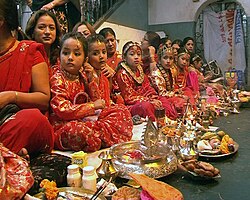


Community hub
Recent from talks
Contribute something
Nothing was collected or created yet.
Newar people
View on Wikipedia
Newar (/nɪˈwɑːr/;[8] Newar: नेवार, endonym: Newa; Newar: नेवा, Pracalit script: 𑐣𑐾𑐰𑐵𑑅), or Nepami,[9] are primarily inhabitants in Kathmandu Valley of Nepal and its surrounding areas, and the creators of its historic heritage and civilisation.[10][11] Newars are a distinct linguistic and cultural group, primarily Indo-Aryan[12][13][14] and Tibeto-Burman[15][16] ethnicities, who share a common language, Nepal Bhasa, and predominantly practice Newar Hinduism[17][18][19][20] and Newar Buddhism. Newars have developed a division of labour and a sophisticated urban civilisation not seen elsewhere in the Himalayan foothills.[7] Newars have continued their age-old traditions and practices and pride themselves as the true custodians of the religion, culture and civilisation of Nepal.[21] Newars are known for their contributions to culture, art and literature, trade, agriculture and cuisine. Today, they consistently rank as the most economically and socially advanced community in Nepal, according to the annual Human Development Index published by UNDP. Newars are ranked the 8th largest ethnic group in Nepal according to the 2021 Nepal census numbering 1,341,363 people constituting 4.6% of the total population.[22]
Key Information


.svg)


The Kathmandu Valley and surrounding territories constituted the former Newar kingdom of the Nepal Mandala. Unlike other common-origin ethnic or caste groups in Nepal, the Newars are regarded as an example of a nation community with a relict identity, derived from an ethnically diverse, previously existing polity. The Newar community within it consists of various strands of ethnic, racial, caste and religious heterogeneity, as they are the descendants of the diverse group of people that have lived in Nepal Mandala since prehistoric times. Indo-Aryan tribes like Maithils of Madhesh Province, the Licchavis, Kosala, and Mallas (N) from respective Indian Mahajanapada (i.e. Licchavis of Vajji, Kosala, and Malla (I)) that arrived at different periods eventually merged with the local native population by marriage as well as adopting their language and customs. These tribes however retained their Vedic culture and brought with them their Sanskritic languages, social structure, Hindu religion and culture, which were assimilated with local cultures and gave rise to the current Newar civilisation. Newar rule in Nepal Mandala ended with its conquest by the Gorkha Kingdom in 1768.
Origin, Etymology
[edit]The terms "Nepāl", "Newār", "Newāl" and "Nepār" are phonetically different forms of the same word, and instances of the various forms appear in texts in different times in history. Nepal is the literary (Sanskrit) form and Newar is the colloquial (Prakrit) form.[23] A Sanskrit inscription dated to 512 in Tistung, a valley to the west of Kathmandu, contains the phrase "greetings to the Nepals" indicating that the term "Nepal" was used to refer to both the country and the people.[24][25]
The term "Newar" or "Newa:" referring to "inhabitant of Nepal" appeared for the first time in an inscription dated 1654 in Kathmandu.[26] Italian Jesuit priest Ippolito Desideri (1684–1733) who traveled to Nepal in 1721 has written that the natives of Nepal are called Newars.[27] It has been suggested that "Nepal" may be a sanskritization of "Newar", or "Newar" may be a later form of "Nepal".[28] According to another explanation, the words "Newar" and "Newari" are colloquial forms arising from the mutation of P to W, and L to R.[29] There are regarded as the Adivasi of Kathmandu Valley.
As a result of the phonological process of dropping the last consonant and lengthening the vowel, "Newā" for Newār or Newāl, and "Nepā" for Nepāl are used in ordinary speech.[30][31]
History
[edit]
For over two millennia, the Newa civilization in Central Nepal preserved a microcosm of classical North Indian culture in which Brahmanic and Buddhist elements enjoyed equal status.[32] Snellgrove and Richardson (1968) speak of 'the direct heritage of pre-Islamic India'. The Malla dynasty was noted for their patronisation of the Maithili language (the language of the Mithila region) which was afforded equal status to that of Sanskrit in the Malla court.[33] Maithil Brahmin priests were invited to Kathmandu and many Maithil families settled in Kathmandu during Malla rule.[34] The influx of people from both the north (Tibet) and south (Tirhut) increased not only Nepal's genetic and racial diversity but also greatly moulded the dominant culture and tradition of the Newars.
The divisions of the Newars had different historical developments. The common identity of the Newar was formed in the Kathmandu Valley. Until the conquest of the valley by the Gorkha Kingdom in 1769,[35] all the people who had inhabited the valley at any point in time were either Newar or progenitors of Newar. So, the history of Newar correlates to the history of the Kathmandu Valley (or Nepala Mandala) prior to the establishment of the modern state of Nepal.
The earliest known history of Newar and the Kathmandu Valley blends with mythology recorded in historical chronicles. One such text, which recounts the creation of the valley, is the Swayambhu Purana. According to this Buddhist scripture, the Kathmandu Valley was a giant lake until the Bodhisattva Manjusri, with the aid of a holy sword, cut a gap in the surrounding hills and let the water out.[36] This legend is supported by geological evidence of an ancient lakebed, and it provides an explanation for the high fertility of the Kathmandu Valley soil.[37]
According to the "Swayambhu inscription", Manjusri then established a city called Manjupattan (Sanskrit "Land Established by Manjusri"), now called Manjipā, and made Dharmākara its king.[38] A shrine dedicated to Manjusri is still present in Majipā. No historical documents have been found after this era until the advent of the Gopal era. A genealogy of kings is recorded in a chronicle called Gopalarajavamsavali.[39] According to this manuscript, the Gopal kings were followed by the Mahispals and the Kirats before the Licchavis entered from the south. Some claim Buddha visited Nepal during the reign of Kirat King Jitedasti.[40] The Newars reign over the valley and their sovereignty and influence over neighboring territories ended with the conquest of the Kathmandu Valley in 1769 by the Gorkhali Shah dynasty founded by Prithvi Narayan Shah.[35][41]
Prior to the Gorkha conquest, which began with the Battle of Kirtipur in 1767, the borders of Nepal Mandala extended to Tibet in the north, the nation of the Kirata in the east, the kingdom of Makwanpur in the south[42] and the Trishuli River in the west which separated it from the kingdom of Gorkha.[43]
Economic History
[edit]
Trade, industry and agriculture have been the mainstay of the economy of the Newars. They are made up of social groups associated with hereditary professions that provide ritual and economic services. Merchants, craftsmen, artists, potters, weavers, dyers, farmers and other castes all played their part in creating a flourishing economic system. Elaborate cultural traditions which required the use of varied objects and services also fueled the economy. Towns and villages in the Kathmandu Valley specialized in producing particular products, and rich agriculture produced a surplus for export.[citation needed]
For centuries, Newar merchants have handled trade between Tibet and India as well as exporting locally manufactured products to Tibet. Rice was another major export. Porters and pack mules transported merchandise over mountain tracks that formed the old trade routes. Since the 18th century, Newars have spread out across Nepal and established trading towns dotting the mid hills. They are known as jewelry makers and shopkeepers. Today, they are engaged in modern industry, business and service sectors.[44][45]
Castes and Communities
[edit]Newars forms an ethnolinguistic community distinct from all the other ethnic groups of Nepal. Newars are divided into various endogamous clans or groups on the basis of their ancient hereditary occupations, deriving its roots in the classic late-Vedic Varna model. Although first introduced in the time of the Licchavis, the present Newar caste system assumed its present shape during the medieval Malla period.
- Artisan castes: "Ritually pure" occupational castes (Sat-Shudra): Balami (field workers and farmers), Bha/Karanjit (death ritual specialists), Chipā/Ranjitkar (dyers), Duhim/Putwar/Dali (carriers), Gathu/Mālākār/Mali (gardeners), Khusa/Tandukar (palanquin bearers/farmers), Pahari (farmers from Valley outskirts), Kau/Nakarmī (blacksmiths), Nau/Napit (barbers), Puñ/Chitrakar (painters), Sayami/Mānandhar (oilpressers and engineer), etc.
- Jyapu: Traditionally farmers; majority of Newar population inside Kathmandu Valley. Includes Maharjan and (Farmers and Landowners). Also includes Suwāl, Basukala, etc. (Bhaktapur Hindu Jyapus), Kumhā/Prajapati (potterers and clay workers), Awalé (brickmakers), Sāpu (descendants of Gopāl dynasty), etc.
- Shakya: Descendants of Lord Buddha's Shakya clan, Buddhist temple priests and also traditionally goldsmiths. They are also one of the few castes that can audition for being Kumari, a form of Taleju Goddess.
- Brahmin: The two main groups are: Kanyakubja Brahmin or Rajopadhyaya (Dyabhāju Brāhman) who are purohits for Hindu Newars and temple priests of important national shrines like Changu Narayan Temple, Taleju Bhawani, Kumbheshwar Temple, among others, and Maithil Brahmin (Jhā Bajé) who are mostly temple priests of smaller Hindu shrines and are lower in numbers than Rajopadhyayas.
- Chyamé/Chamaha: Traditionally fishermen, sweepers, and toilet cleaners. A Scheduled Caste.
- Dhobi: Traditionally washermen. A Scheduled Caste.
- Dyahla/Podé: Traditionally temple cleaners, fishermen, sweepers. A Scheduled Caste.
- Gubhāju/Bajracharya: Buddhist purohits and temple priests of Kathmandu's various Buddhist shrines. They can be auditioned as Kumari, a form of Taleju Goddess
- Jogi/Kapali (Newar caste): A caste associated as being descendants of the Kanphata Yogi sect. Also traditionally tailors, musicians (plays Mwaali baja). Previously, a Scheduled Caste.
- Chathariya Srēṣṭha: Kshatriya aristocratic bloc which includes Malla descendants, their numerous Hindu courtier clans Pradhan and Pradhananga (chief ministers and army chiefs), Amātya (ministers), Maskey (courtiers), Hada, Mathema, etc. and Kshatriya-status specialists like Joshi (astrologers), Vaidya (Ayurvedic practitioners), Rajbhandārī (royal treasurers), Rajvanshi (landed gentry) Karmāchārya (Tantric priests), Kayastha (scribes), among others.
- Kulu/Dom: Traditionally leather workers. A Scheduled Caste.
- Nayé/Khadgi/Shahi: Traditionally traders of vegetables, meat and musicians. Previously, a Scheduled Caste, and the discrimination is slowly ending.
- Panchthariya Srēṣṭha: Chief Hindu trader and administrative class including Shrestha (administrators and traders).
- Rajkarnikar or Halwai: Traditional confectioners and sweetmakers.
- Shilpakar: Wood carvers.
- Tamrakar: Trader and merchant group from Lalitpur; traditionally involved as coppersmiths.
- Urāya/Udās: Chief Buddhist trader, merchant and artisan group including Tuladhar and Bania (merchants), Kansakar (bronzesmiths), Sthapit, Kasthakar (architects/carpenters), and many more.
Culture
[edit]Language
[edit]Nepal Bhasa, also known as Newar, belongs to the Tibeto-Burman branch of the Sino-Tibetan language family and is predominantly spoken by Newars in Nepal's Katmandu Valley.[46][47] Newars are bound together by a common language and culture.[48] Their common language is Nepal Bhasa or the linguistic progenitor of that language. Nepal Bhasa is the term recognised by the government.[49]
Nepal Bhasa already existed as a spoken language during the Licchavi period and is believed to have developed from the language spoken in Nepal during the Kirati period.[50] Inscriptions in Nepal Bhasa emerged from the 12th century, the palm-leaf manuscript from Uku Bahah being the first example.[51] Nepal Bhasa developed from the 14th to the late 18th centuries as the court and state language.[52] It was used universally in stone and copper inscriptions, sacred manuscripts, official documents, journals, title deeds, correspondence and creative writing.
In 2011, there were approximately 846,000 native speakers of Nepal Bhasa.[53] Many Newar communities within Nepal also speak their own dialects of Nepal Bhasa, such as the Dolakha Newar Language.[54]
Literature
[edit]Newar Bhasa is one of the five languages in the Sino-Tibetan family with an ancient literary tradition. Literature in Newar Bhasa began as translation and commentary in prose in the 14th century AD.[55] The earliest known document in Newar Bhasa is called "The Palmleaf from Uku Bahal" which dates from 1114 AD during the Thakuri period.[56]
Classical Newar Bhasa literature is represented by all the three major forms—prose, poetry, and drama. Most of the writings consist of prose including chronicles, popular stories and scientific manuals. Poetry consists of love songs, ballads, work songs, and religious poetry. The earliest poems date from the 1570s. Epic poetry describing historical events and tragedies are very popular. The ballads Sitala Maju, about the expulsion of children from Kathmandu, Silu, about an ill-fated pilgrimage to Gosaikunda, and Ji Waya La Lachhi Maduni, about a luckless Tibet trader, are sung as seasonal songs.
The dramas are based on stories from the epics, and almost all of them were written during the 17th and 18th centuries.[57] Nepal Bhasa literature flourished for five centuries until 1850.[58] Since then, it suffered a period of decline due to political oppression. The period 1909–1941 is known as the Nepal Bhasa renaissance period when writers defied official censure and braved imprisonment to create literary works. Modern Nepal Bhasa literature began in the 1940s with the emergence of new genres like short stories, poems, essays, novels and plays.[59]
Scripts
[edit]Nepal Bhasa script is a group of scripts that developed from the Brahmi script and are used primarily to write Nepal Bhasa. Among the different scripts, Ranjana Lipi is the most common. Nepal script is also known as Nepal Lipi and Nepal Akhala.[60]
Nepal Bhasa scripts appeared in the 10th century. For a thousand years, it was used on stone and copper plate inscriptions, coins (Nepalese mohar), palm-leaf documents and Buddhist manuscripts. Devanagari began to be used to write Nepal Bhasa in the beginning of the 20th century, and Nepal script has limited usage today.[61]
Politics
[edit]Newa Autonomous State
[edit]Newa Autonomous State is a proposed federal state of Nepal which establishes the historical native homeland of Newa people as a federal state.[62][63] The historical territories of Newars is called Nepal Mandala. The Newa Autonomous State mandates to reconstruct the district division and create an autonomous Newa province. It includes historically Newa residing settlements and Newa dominant zones of Kathmandu, Bhaktapur, Lalitpur, Newa towns of Dolakha, Newa settlements of Nuwakot, Newa settlements of Makwanpur, Newa settlements of Ramechhap, Newa settlements of Sindupalchok, Newa settlements of Kavre West.[64][65][66]
Dance
[edit]
Masked dance
[edit]The Newar dance consists of sacred masked dance,[67] religious dance without the use of masks known as Dyah Pyakhan, dance performed as part of a ritual and meditation practice known as Chachaa Pyakhan (Newar: चचा प्याखं) (Charya Nritya in Sanskrit)[68] and folk dance. There are also masked dance dramas known as Daboo Pyakhan which enact religious stories to the accompaniment of music.
Dhime dance
[edit]The dance done in the tune of Dhime are Dhime dance.
Music
[edit]Traditional Newa music consists of sacred music, devotional songs, seasonal songs, ballads and folk songs.[69] One of the most well-known seasonal songs is Sitala Maju. The ballad describes the expulsion of children from Kathmandu in the early 19th century. Another seasonal song Silu is about a pilgrimage to Gosaikunda that went wrong. Ji Waya La Lachhi Maduni is a tragedy song about a newly married couple. The ballad Rajamati about unlucky lovers is widely popular. In 1908, maestro Seturam Shrestha made the first recording of the song on gramophone disc in Kolkata.
Common percussion instruments consist of the dhimay,[70] khin, naykhin and dhaa. Wind instruments include the bansuri (flute), payntah (long trumpet) and mwahali (short trumpet), chhusya, bhusya, taa (cymbals), and gongs are other popular instruments. String instruments are very rare. Newa people call their music Dhime Baja.
The musical style and musical instruments are still in use today. Musical bands accompany religious processions in which an idol of a deity is placed in a chariot or portable shrine and taken around the city. Devotional songs are known as bhajan may be sung daily in community houses. Hymn societies like Gyanmala Bhajan Khala hold regular recitals. Dapa songs are sung during hymn singing seasons at Temple squares and sacred courtyards.
Gunla Bajan musical bands parade through the streets during Gunla, the 10th month of the Nepal Sambat calendar which is a holy month for Newar Buddhists.[71] Musical performances start with an overture which is a salutation to the gods.
Seasonal songs and ballads are associated with particular seasons and festivals. Music is also played during wedding processions, life-cycle ceremonies and funeral processions.[72]
Popular traditional songs
[edit]- Ghātu (summer music, this seasonal melody is played during Pahan Charhe festival)
- Ji Wayā Lā Lachhi Maduni (the tragedy of a merchant)
- Mohani (festive joy, this seasonal tune is played during Mohani festival)
- Rājamati (about young lovers)
- Silu (about a couple who get separated during a pilgrimage, this seasonal music is played during the monsoon)
- Sitālā Māju (lament for children expelled from the Kathmandu Valley)
- Swey Dhaka Swaigu Makhu (a song about love)
- Holi ya Mela (About theholi.)
- Wala Wala Pulu Kishi (Sung in Indra jatra)
- Yo Sing Tyo
- Yomari Maku
- Dhanga maru ni bhamcha (song to complain about the laziness of daughter-in-law by man's father.)
- Sirsaya Hegu
Religious music
[edit]Art
[edit]

The Newars are the creators of most examples of art and architecture in Nepal.[73] Traditional Newar art is basically religious art. Newar devotional paubha painting, sculpture and metal craftsmanship are world-renowned for their exquisite beauty.[74] The earliest dated paubha discovered so far is Vasudhara Mandala which was painted in 1365 AD (Nepal Sambat 485).[75] The murals on the walls of two 15th-century monasteries in the former kingdom of Mustang in the Nepal Himalaya provide illustrations of Newar works outside the Kathmandu Valley.[76] Stone sculpture, wood carving, repoussé art and metal statues of Buddhist and Hindu deities made by the lost-wax casting process[77] are specimens of Newar artistry.[78] The Peacock Window of Bhaktapur and Desay Madu Jhya of Kathmandu are known for their wood carving.
Building elements like the carved Newar window, roof struts on temples and the tympanum of temples and shrine houses exhibit traditional creativity. From as early as the seventh century, visitors have noted the skill of Newar artists and craftsmen who left their influence on the art of Tibet and China.[79] Newars introduced the lost-wax technique into Bhutan and they were commissioned to paint murals on the walls of monasteries there.[80][81] Sandpainting of mandala made during festivals and death rituals is another specialty of Newar art.
Besides exhibiting a high level of skill in the traditional religious art, Newar artists have been at the forefront of introducing Western art styles in Nepal. Raj Man Singh Chitrakar (1797–1865) is credited with starting watercolor painting in the country. Bhaju Man Chitrakar (1817–1874), Tej Bahadur Chitrakar (1898–1971) and Chandra Man Singh Maskey were other pioneer artists who introduced modern style paintings incorporating concepts of lighting and perspective.[82]
Traditional painting
[edit]Architecture
[edit]

There are seven UNESCO World Heritage Sites and 2,500 temples and shrines in the Kathmandu Valley that illustrate the skill and aesthetic sense of Newar artisans. Fine brickwork and woodcarving are the marks of Newar architecture.[83] Residential houses, monastic courtyards known as baha and bahi, rest houses, temples, stupas, priest houses and palaces are the various architectural structures found in the valley. Most of the chief monuments are located in the Durbar Squares of Kathmandu, Lalitpur and Bhaktapur, the old royal palace complexes built between the 12th and 18th centuries.[84]
Newa architecture consists of the pagoda, stupa, shikhara, chaitya and other styles. The valley's trademark is the multiple-roofed pagoda which may have originated in this area and spread to India, China, Indochina and Japan.[85][86] The most famous artisan who influenced stylistic developments in China and Tibet was Arniko, a Newar youth who traveled to the court of Kublai Khan in the 13th century AD.[85] He is known for building the white stupa at the Miaoying Temple in Beijing.
Settlements
[edit]Durbar squares, temple squares, sacred courtyards, stupas, open-air shrines, dance platforms, sunken water fountains, public rest houses, bazaars, multistoried houses with elaborately carved windows and compact streets are the characteristics of traditional planning. Besides the historical cities of Kathmandu, Lalitpur, Bhaktapur, Madhyapur Thimi, Chovar, Bungamati, Thankot and Kirtipur, small towns with a similar artistic heritage (like Panga in Kirtipur municipality) dot the Kathmandu Valley where almost half of the Newar population lives.[87]
Outside the valley, historical Newar settlements include Nuwakot,[88] Nala, Banepa, Dhulikhel, Panauti, Dolakha, Chitlang and Bhimphedi.[89] The Newars of Kathmandu founded Pokhara in 1752 at the invitation of the rulers of Kaski.[90] Over the last two centuries, Newars have fanned out of the Kathmandu Valley and established trade centers and settled in various parts of Nepal. Bandipur, Baglung, Silgadhi and Tansen in west Nepal and Chainpur and Bhojpur in east Nepal contain large Newar populations.
Outside Nepal, many Newars have settled in Darjeeling and Kalimpong[91] in West Bengal, Assam, Manipur and Sikkim, India.[92] In Sikkim, many Newars became Taksaris helping the former kingdom in establishing coinage system. Later they were made Thikadars or Sikkimese feudal lords with judicial and administrative powers within their respective estates.[93]
Newars have also settled in Bhutan. Colonies of expatriate Newar merchants and artisans existed in Lhasa, Shigatse and Gyantse in Tibet till the mid-1960s when the traditional trade came to an end after the Sino-Indian War.[94] In recent times, Newars have moved to different parts of Asia, Europe and America.[95][96][97]
Festivals
[edit]
Newar religious culture is rich in ceremony and is marked by frequent festivals throughout the year.[98] Many festivals are tied to Hindu and Buddhist holidays and the harvest cycle. Street celebrations include pageants, jatras or processions in which a car or portable shrine is paraded through the streets and sacred masked dances. Other festivals are marked by family feasts and worship. The celebrations are held according to the lunar calendar, so the dates are changeable.
Mohani is one of the greatest annual celebrations which is observed for several days with feasts, religious services, and processions. During Swanti, Newars celebrate New Year's Day of Nepal Sambat by doing Mha Puja, a ritual in which our own body is worshipped, which is believed to purifies and strengthens one spiritually for the coming year. Similarly, Bhai Tika is also done during Swanti. It is a ritual observed to worship and respect a woman's brothers, with or without blood relation. Another major festival is Sā Pāru when people who have lost a family member in the past year dress up as cows and saints, and parade through town, following a specific route. In some cases, a real cow may also be a part of the parade. People give such participants money, food and other gifts as a donation. Usually, children are the participants of the parade.
In Kathmandu, the biggest street festival is Yenya (Indra Jatra) when three cars bearing the living goddess Kumari and two other child gods are pulled through the streets and masked dance performances are held. The two godchildren are Ganesh and Bhairav. Another major celebration is Pahan Charhe when portable shrines bearing images of mother goddesses are paraded through Kathmandu. During the festival of Jana Baha Dyah Jatra, a temple car with an image of Karunamaya is drawn through central Kathmandu for three days. A similar procession is held in Lalitpur known as Bunga Dyah Jatra[99] which continues for a month and climaxes with Bhoto Jatra, the display of the sacred vest.[100] The biggest outdoor celebration in Bhaktapur is Biska Jatra (Bisket Jatra) which is marked by chariot processions and lasts for nine days.[101] Sithi Nakha is another big festival when worship is offered and natural water sources are cleaned.[102] In addition, all Newar towns and villages have their particular festival which is celebrated by holding a chariot or palanquin procession.
Paanch Chare is one of the many occasions or festivals celebrated by the Newa community, natives from Kathmandu Valley, Nepal. This is celebrated on the Chaturdasi (Pisach Chaturdashi) day according to new lunar calendar on the month of Chaitra.
And also the longest jatra of Nepal Rato Machindra Nath Janka is celebrated by Newars mostly on Patan. This Jatra is one month long and contains various celebrations.
Clothing
[edit]
Western wear is the norm as in urban areas in the rest of the country. Traditionally men wear tapuli (cap), long shirt (tapālan) and trousers (suruwā), also called Daura-Suruwal. Woman wear cheeparsi (sari) and gaa (long length shawl) while younger girls wear ankle-length gowns (bhāntānlan). Ritual dresses consist of pleated gowns, coats and a variety of headresses. Jyapu women have a distinctive sari called Hāku Patāsi which is a black sari with distinctive red border. Jyapu men also have a distinctive version of the tapālan suruwā. Similarly, a shawl (gā) is worn by men and women. Traditionally, Newar women wear a shoe made out of red cloth, Kapa lakaan. It is decorated with glitters and colorful beads (potya). One of the major parts of Newar dress ups is bracelets (chūra) and mala (necklaces).
Cuisine
[edit]Meals can be classified into three main categories: the daily meal, the afternoon snack and festival food. The daily meal consists of boiled rice, lentil soup, vegetable curry, relish and Meat are served. The snack generally consists of beaten rice, roasted and curried soybeans, curried potato and roasted meat mixed with spices.
Food is also an important part of the ritual and religious life of the Newars, and the dishes served during festivals and feasts have symbolic significance.[103] Different sets of ritual dishes are placed in a circle around the staple Bawji (rice flakes or Flattened) to represent and honour different sets of deities depending on the festival or life-cycle ceremony.[104]
Kwāti (क्वाति soup of different beans), kachilā (कचिला spiced minced meat), chhoyalā (छोयला water buffalo meat marinated in spices and grilled over the flames of dried wheat stalks), pukālā (पुकाला fried meat), wo (वः lentil cake), paun kwā (पाउँक्वा sour soup), swan pukā (स्वँपुका stuffed lungs), syen (स्येँ fried liver), mye (म्ये boiled and fried tongue), sapu mhichā (सःपू म्हिचा leaf tripe stuffed with bone marrow), sanyā khunā (सन्या खुना jellied fish soup) and takhā (तःखा jellied meat) are some of the popular festival foods. Dessert consists of dhau (धौ yogurt), sisābusā (सिसाबुसा fruits) and mari (मरि sweets). Thwon (थ्वँ rice beer) and aylā (अयला local alcohol) are the common alcoholic liquors that Newars make at home.
Traditionally, at meals, festivals and gatherings, Newars sit on long mats in rows. Typically, the sitting arrangement is hierarchical with the eldest sitting at the top and the youngest at the end. Newar cuisine makes use of mustard oil and a host of spices such as cumin, sesame seeds, turmeric, garlic, ginger, mint, bay leaves, cloves, cinnamon, pepper, chilli and mustard seeds. Food is served in laptya (लप्त्य plates made of special leaves, held together by sticks). Similarly, any soups are served in botā (बोटा bowls made of leaves). Liquors are served in Salinchā (सलिंचाः bowls made of clay) and Kholchā (खोल्चाः small metal bowls).
Newar people are very innovative in terms of cuisine. They have a tradition to prepare various foods according to the festivals. Some of the popular cuisines that are prepared with the festivals are:

Life-cycle ceremonies
[edit]
Elaborate ceremonies chronicle the life cycle of a Newar from birth till death.[105][106] Newars consider life-cycle rituals as a preparation for death and the life after it. Hindus and Buddhists alike perform the "Sorha Sanskaar Karma" or the 16 sacred rites of passage, unavoidable in a Hindu person's life. The 16 rites have been shortened to 10 and called "10 Karma Sanskar" (Newar: दश कर्म संस्कार). These include important events of a person's life like "Jatakarma" (Newar: जातकर्म) (Childbirth), "Namakaran" (Newar: नामकरण) (Naming the child), "Annapraasan" (Newar: अन्नप्राशन) (First rice feeding ceremony), "Chudakarma" or "Kaeta Puja" (first hair shaving and loin cloth ceremony), "Vivaaha" (Newar: विवाह) (Wedding), among others.
- Chudakarma ceremony and (Bare Chuyegu/Acharyabhisheka or Bratabandha/Upanayana)
Once such important rite of passage ceremony among the male Newars is performing the loin-cloth and head-shaving ceremony called Chudākarma (Newar: चुडाकर्म) followed by the Bratabandha or Kaeta Puja (Newar: काएत पूजा) which is traditionally performed for boys aged five to thirteen according to the religious affiliation Newars identify with.[107]
In this ceremony, Buddhist Newars – Gubhāju-Baré (Bajracharya-Shakya), Urāy, Jyapu and few artisan castes like Chitrakār – perform their Pravrajyā (Sanskrit: प्रवराज्या) ceremony by mimicking Gautama Buddha's ascetic and medicant lifestyle and the steps to attain monkhood and nirvana where the boy stays in a Buddhist monastery, Vihara, for three days, living the life of a monk and abandoning all material pleasures. On the fourth day, he disrobes and returns to his family and henceforth becomes a householder Buddhist for the rest of his life.[108] The Buddhist priestly clan Gubhāju-Baré (Bajracharya and Shakya) go through an additional initiation ceremony called Bare Chuyegu (becoming a Baré) while Bajracharya boys are further required to go through Acharyabhisheka (Sanskrit: आचार्याभिषेक) which is a Tantric initiation rite that qualifies a Bajracharya to perform as a purohita.[109]
Hindu Newars perform the male initiation ceremony called Kaeta Puja as a ritual observance of the brahmachārya – the first stage in the traditional four stages of life. During the ritual, the young boy renounces family and lineage for the celibate religious life. His head is fully shaved except a tuft in the top, he must don yellow/orange robes of the mendicant, he must beg rice from his relatives and prepare to wander out into the world. Having this symbolically fulfilled the ascetic ideal, he can be called back by his family to assume the life of a householder and his eventual duty as a husband and a father. Twice-born (Brahmin and Kshatriya) Newars – Rajopādhyāyas and Chatharīyas – additionally perform the Upanayana initiation where the boy receives his sacred thread (Sanskrit: यज्ञोपवीत) and the secret Vedic mantras – RV.3.62.10 (Gāyatrī mantra) for Brahmins and RV.1.35.2 (Shiva mantra) for Chatharīyas.[110] The boy is then fully inducted into his caste status as a Dvija with the obligation to observe henceforth all commensal rules and other caste obligations(Newar: कर्म चलेको).[108]
- Macha Janku
This is the rice feeding ceremony, "Annapraasan" (Newar: अन्नप्राशन). It is performed at the age of six or eight months for boys and at the age of five or seven months for girls.
For a female child, Ihi (Ehee)(Newar: ईहि) short for Ihipaa (Eheepā)(Newar: ईहिपा) (Marriage) is performed between the ages of five and nine. It is a ceremony in which pre-adolescent girls are "married" to the bael fruit (wood apple), which is a symbol of the god Shiva. It is believed that if the girl's husband dies later in her life, she is not considered a widow because she is married to Shiva, and so already has a husband that is believed to be still alive.
- Bahra
Girls have yet another ceremonial ritual called Bahra Chuyegu(Newar: बराह चुयेगु) when a girl approaches puberty. This is done in her odd number year like 7,9 or 11 before menstruation. She is kept in a room for 12 days hidden and is ceremonially married to the sun god Surya.
Jankwa or Janku is an old-age ceremony which is conducted when a person reaches the age of 77 years, seven months, seven days, seven hours, seven minutes, seven-quarter.[111] Three further Janku ceremonies are performed at similar auspicious milestones at age 83, 88 and 99. The first Janwa is called "Bhimratharohan", the second "Chandraratharohan", the third "Devaratharohan", and the fourth "Divyaratharohan". After the second Jankwa, the person is accorded deified status.
- Vivaaha (Wedding)
The next ceremony common to both men and women is marriage. The Newar custom, similar to that of Hindus, is that the bride almost always leaves home at marriage and moves into her husband's home and adopts her husband's family name as her own. Cross-cousin and parallel-cousin marriage is forbidden. Marriage is usually arranged by parents who use a gobetween(lamee). Marriage by elopement is popular in some peripheral villages.
- The Sagan ceremony where auspicious food items are presented is an important part of life-cycle rituals.
- All Newars, except the Laakumi and Jogi caste, cremate their dead. The Jogis bury their dead. As part of the funeral, offerings are made to the spirit of the deceased, the crow and the dog. The crow and the dog represent ancestors and the god of death. Subsequently, offerings and rituals are conducted four, seven, eight, 13 and 45 days following death and monthly for a year and then annually.[107]
- Buddhist Newars also make a mandala (sand painting) depicting the Buddha on the third day after death which is preserved for four days.
Newa Games
[edit]The games which had been played by prasanga people from their ancient time can be classified as Newa games.
Kana kana picha (Blindfold game), Piyah (a game played with stone by pushing stone within the marks drawn in the ground), Gatti ( another game played with stone by hand), pasa are some games played by Newar people since ancient time.[citation needed]
The Kirantas settled in different places of Nepal, especially in the eastern Himalayas in the seventh century B.C. They were brave. They attacked Kathmandu during the reign of King Bhuwan Singh and defeated him. They founded the Kiranti rule in the Kathmandu Valley. Yalambar was the first Kiranti King. The seventh Kiranti King, Jitedasit and the fourteenth King, Sthunko were very famous. During the rule of Jitedasti, Gautam Buddha Visited Nepal. During the rule of Sthunko, Indian Emperor Ashok visited Kathmandu.
About 32 kings of Kirant dynasty continued their rule in the valley. During that period, Nepal made great progress. Trade and industry developed. Wool, wood and herbs were sent from Nepal to other countries. Nepali blandets were very famous in pataliputra (patina). Kautily, an Indian economist, has written this. The laws were very strict. There were justice courts in the country. The kirantas worshipped kiranteshwar Mahadev, serpents and trees. They made stupas and chaityas. They had their own culture. They made several settlements like matatirtha, Shankhmul, Thankot, Khopung, Kurpasi, Sanga, Tenkhu etc. these settlements still exist with a little change in their names.
Lichchhavi kings, After the downfall of the Kiranti rule, Som dynasty came into power. Only five kings of this dynasty ruled over Nepal. Bhaskerverma was the last king. After that, Lichchhavi rule began in Nepal. The Lichchhavis had come to Nepal from India.
Religion
[edit]- Hinduism (84.3%)
- Buddhism (15.3%)
- Christianity (0.40%)
According to the 2011 Nepal Census, 87.38% of the Newars were Hindu and 10.74% were Buddhist.[113] A minority are Christian.[114]

Out of the three main cities of the Kathmandu Valley which are historically Newar, the city of Patan is the most Buddhist containing the four stupas built by Indian emperor Ashoka. Bhaktapur is primarily Hindu, while Kathmandu is a mix of both. Generally, both Hindu and Buddhist deities are worshiped and festivals are celebrated by both religious groups. However, for ritual activities, Hindu and Buddhist Newars have their own priests (Rajopadhyaya Brahmins for Hindus and Vajracharyas for Buddhists) and varying amounts of cultural differences.

Religiously, the majority of Newars can be classified as both Hindu and Buddhist. The major cults are Vajrayana Buddhism and Tantric Hinduism. The former is referred to as Buddhamarga, the latter as Sivamarga. Both creeds have been established since antiquity in the valley. Both Buddhamargi and Sivamargi Newars are Tantricists, Within the Newar community, many different esoteric Tantric followers of Buddhist, Shaiva, and Vaishnava denominations are practiced.[115] In this regard, followers of the Mother Goddesses and their consorts, the Bhairavas, are particularly important.

The most important shrines in the Valley are Swayambhu Maha Chaitya or Swayambhunath (Buddhist) and Pashupatinath (Hindu). Different castes worship different deities at different occasions, and more or less intensively. Only the higher echelons in the caste system claim to be exclusively Buddhist or Hindu. The Vajracharyas, Buddhist priests, will adamantly maintain that they are Buddhists, and so will the Bare (Shakya). Kathmandu Uray (Tuladhars, tc.) as well as the Sayamis (Manandhars) will also strongly maintain their Buddhist heritage. On the other hand, the Dyabhāju Brāhman, the Jha Brāhman, and the dominant Shresthas will maintain that they are Hindus. Further down in the caste hierarchy no distinction is made between Buddhists and Hindus, although preponderance towards Hinduism and worship of Hindu gods is much more prevalent among these castes. Hindu and Buddhist alike always worship Ganesh first in every ritual, and every locality has its local Ganesh shrine (Ganesh Than).[116]
Although Newar Buddhism (Vajrayana) had been traditionally practiced in the Kathmandu Valley,[117] Theravada Buddhism made a comeback in Nepal in the 1920s and now is a common form of Buddhism among Buddhamargi Newars.[111][118]
From the 17th century onwards, Catholic Christian missionaries of the Jesuit and Capuchin religious orders "established hospices at Kathmandu, Patan and Bhatgoan, the capitals of the three Malla Kings of Nepal who had permitted them to preach Christianity."[114] An indigenous Newar Christian community thus became established.[114] When the Mallas were overthrown by the Gurkhas, the Newar Christians took refuge in India, settling first in the city of Bettiah and then later moving eleven kilometres north to Chuhari.[114]
Notable Newar people
[edit]- Sankhadhar Sakhwa (879 AD) philanthropist, related to Nepal Sambat
- Jogbir Sthapit (1838–1926), Architect and designer of Narayanhiti Royal Palace
- Bhaju Ratna Kansakar (1882–1956), Prominent trader and philanthropist
- Pushpa Sundar Tuladhar (1885–1935), Prominent merchant and philanthropist
- Yogbir Singh Kansakar (1885–1942), Poet and one of the Four Pillars of Nepal Bhasa
- Nhuchhe Ratna Tuladhar (1888–1950), Democracy activist and martyr
- Dhammalok Mahasthavir (1890–1966), who worked to revive Nepali Theravada Buddhism in the 1930s and 1940s
- Shukra Raj Shastri (1894–1941), Freedom fighter and martyr
- Dharmachari Guruma (1898–1978), Founder of the first nunnery in Nepal
- Pragyananda Mahasthavir (1900–1993), First Patriarch of Theravada Order in Nepal
- Mandas Tuladhar (1900–1975), Pioneer publisher and renowned for ancient hymns collection
- Ashapatti Tamrakar (1904–1942), Pioneer optician and herbalist
- Kashiraj Pradhan (1905–1990), Pro-democracy leader in erstwhile Kingdom of Sikkim
- Triratna Man Tuladhar (1905–1986), President of the Nepalese Chamber of Commerce
- Chittadhar Hridaya (1906–1982), Prominent poet, aka Kavi Keshari or Chittadhar Tuladhar
- Vidyabati Kansakar (1906–1976), Pioneer nurse and was awarded Order of Gorkha Dakshina Bahu
- Dharma Bhakta Mathema (1908–1941), Freedom fighter and martyr
- Moti Laxmi Upasika (1909–1997), poet and first short story writer
- Daya Bir Singh Kansakar (1911–2001), Social worker and founder of Paropakar Organization
- Bhakta Bir Singh Tuladhar (1912–1989), Merchant and sponsor of Samyak festival in 1952
- Siddhicharan Shrestha (1912–1992), Poet, aka Yug Kavi
- Aniruddha Mahathera (1915–2003), Patriarch of Theravada Order (1998–2003)
- Dharma Ratna Yami (1915–1975), Freedom fighter and social reformer
- Siddartha Gautam Shakya (563 BCE-483 BCE), Buddha
- Ganesh Man Singh (1915–1997) Freedom fighter and leader
- Prem Bahadur Kansakar (1918–1991), Writer and founder of Asa Archives
- Kul Ratna Tuladhar (1918–1984), First chief engineer of Nepal's Public Works Department
- Lupau Ratna Tuladhar (1918-1993), Pioneer of Nepalese public transport and writer
- Gangalal Shrestha (1919–1941), Freedom fighter and martyr
- Purna Kaji Tamrakar (1920–2009), Trader and author
- Karuna Ratna Tuladhar (1920–2008), Pioneer of Nepalese public transport and proprietor of Nepal Transport Service
- Satya Mohan Joshi (1920–2022), Scholar of history and culture
- Pushpa Ratna Sagar (1922–2011), Merchant, grammarian, lexicographer and pioneer pressman
- Pratek Man Tuladhar (1924–1991), Trader and philatelist
- Pushpa Lal Shrestha (1924–1978), Founder of Communist Party of Nepal
- Sahana Pradhan (1927–2014), Leader of CPN-ML, Ex. Deputy PM
- Tara Devi Tuladhar (1931–2012), Dedicated social worker and first female blood donor
- Hari Prasad Pradhan Former Chief Justice of Nepal
- Narayan Gopal (1939–1990), Singer, aka Swar Samrat
- Padma Ratna Tuladhar (1940–2018), Politician and human rights activist
- Marich Man Singh Shrestha (1942–2013) Former Prime Minister
- Tara Bir Singh Tuladhar (b. 1943), artist and music composer
- Prem Man Chitrakar (1944–2020), Artist and poet
- Tara Devi (1945–2006), Singer, aka Swar Samragi
- Baikuntha Manandhar (b. 1951), Fastest Runner who competed at four consecutive Olympic Games, from 1976 to 1988.
- Nirgun Sthapit (1968-1990), Democracy fighter, Martyr during 1990 People's Movement
- Sujan Chitrakar (b. 1974), Academic Program Coordinator, Assistant Professor in Kathmandu University
- Phatteman Rajbhandari, Singer
- Nahakul Pradhan, the pro-democracy leader in the erstwhile kingdom of Sikkim
- Prem Dhoj Pradhan (1938–2021), singer
- Ganga Prasad Pradhan, main translator of the Nepali Bible
- Madan Krishna Shrestha (b.1950), Actor
- Shiv Shrestha, Actor
- Kumar Pradhan, Historian
- Shree Krishna Shrestha, (19 April 1967 – 10 August 2014), Actor
- Durga Lal Shrestha, (b. July 1935), The People's Poet of Nepal Bhasa and Nepali.
- Poornima Shrestha, (b. 6 September 1960), Bollywood film playback singer
- Narayan Man Bijukchhe, (b. 9 March 1939), writer, Member of the Legislature-Parliament of Nepal
- Binod Pradhan, Cinematographer
- Adrian Pradhan, Vocalist and Drummer 1974 AD
- Namrata Shrestha, famous Nepali actress
- Ashishma Nakarmi, famous Nepali actress
- Karna Shakya, environmentalist, conservationist, hotel entrepreneur, writer, and philanthropist
- Aashirman DS Joshi, Actor
- Ayushman Joshi, Actor
- Sanju Pradhan, Football Player
- Jharana Bajracharya - Miss Nepal 1997
- Usha Khadgi - Miss Nepal 2000
- Payal Shakya - Miss Nepal 2004
- Sahana Bajracharya - Miss Nepal Earth 2010
- Malina Joshi - Miss Nepal World 2011
- Sarina Maskey - Miss Nepal International 2011
- Shristi Shrestha - Miss Nepal World 2012 & Miss World 2012 - Top 20 finalist
- Ishani Shrestha - Miss Nepal World 2013 & Miss World 2013 - Beauty With A Purpose | Top 10 finalist
- Prinsha Shrestha - Miss Nepal Earth 2014
- Sonie Rajbhandari - Miss Nepal International 2014
- Evana Manandhar - Miss Nepal 2015
- Asmi Shrestha - Miss Nepal 2016
- Ronali Amatya - Miss Nepal International 2018
- Anushka Shrestha - Miss Nepal World 2019 & Miss World 2019- Beauty With A Purpose | Miss Multimedia | Top 12 finalist
- Priyanka Rani Joshi - Miss Nepal 2022
- Srichchha Pradhan - Miss Nepal 2023
- Nitesh R Pradhan – Journalist & singer
- Ashish Pradhan – Football player
- Gautama V. Vajracharya - Sanskrit scholar and art historian
- Asmi Shrestha
Gallery
[edit]-
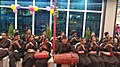 Newar people playing musical instruments
 -
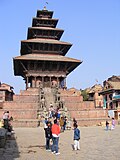
-
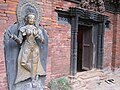 Statue in Lalitpur
 -
 Swayambhunath in Dallu, Kathmandu
 -
 The world-famous Golden Gate of Bhaktapur, also known as Guheshwor Mandir
 -
 Toys on Newari dress (Hakupatashi)


See also
[edit]- Lhasa Newar (trans-Himalayan traders)
- Newa Rastriya Mukti Morcha, Nepal
- Yalamber (Kirat King who went to Mahabharat)
- Yela (Lalitpur)
- Khopa (Bhaktapur)
- Ye (Kathmandu)
- Kippu, Kipoo (Kirtipur)
- Taksari Newars
References
[edit]- ^ National Statistics Office (2021). National Population and Housing Census 2021, Caste/Ethnicity Report. Government of Nepal (Report).
- ^ a b "Newar". Ethnologue. Retrieved 28 September 2023.
- ^ National Statistics Office (2021). National Population and Housing Census 2021, Caste/Ethnicity Report. Government of Nepal (Report).
- ^ "National Population Census of Nepal 2021 Religion by Caste and Ethnicity" (PDF). Retrieved 17 October 2025.
- ^ Manandhar, Razen (28 May 2024). "Religions of the Newars: A Short Observation". Medium. Retrieved 14 July 2025.
- ^ Drechsler, Wolfgang; Chafik, Salah; Kattel, Rainer (14 May 2025). Islamic Public Value: Theory, Practice, and Administration of Indigenous Cooperative Institutions. Edward Elgar Publishing. pp. 227–229. ISBN 978-1-0353-3364-6.
- ^ a b Gellner, David N. (1986). "Language, Caste, Religion and Territory: Newar Identity Ancient and Modern". European Journal of Sociology. Retrieved 2 May 2011.
- ^ "Newar". Random House Webster's Unabridged Dictionary.
- ^ (Mrigendra Lal Singh. Nepami: An Idol of Yalambar. 2016)
- ^ von Fürer-Haimendorf, Christoph (1956). "Elements of Newar Social Structure". Journal of the Royal Anthropological Institute. 86 (2). Royal Anthropological Institute of Great Britain and Ireland: 15–38. doi:10.2307/2843991. JSTOR 2843991. Page 15.
- ^ Basnet, Rajdip; Rai, Niraj; Tamang, Rakesh; Awasthi, Nagendra Prasad; Pradhan, Isha; Parajuli, Pawan; Kashyap, Deepak; Reddy, Alla Govardhan; Chaubey, Gyaneshwer; Das Manandhar, Krishna; Shrestha, Tilak Ram; Thangaraj, Kumarasamy (15 October 2022). "The matrilineal ancestry of Nepali populations". Human Genetics. 142 (2): 167–180. doi:10.1007/s00439-022-02488-z. ISSN 0340-6717. PMID 36242641. S2CID 252904281.
- ^ Acharya, Baburam. Nepal, Newar Ra Newari Bhasha (in Nepali). Nepal Sanskritik Parishad. p. 21. Retrieved 31 May 2024." किरातीय वा तिब्बती-बर्मी बोली मातृभाषा भए तापनि नेवारहरूमा मधेशी-नेपाली तथा मैथिली आर्यकै जस्तो जात-भात र हाउभाउ, स्वरुप, भेद-भाव मौजूद छ। यिनका रंग-रूपमा आर्य नस्लका लक्षण मौजूद छन्। यस कारणले यी किरात वा तिब्बती-बर्मीवर्गका होइनन् भन्ने निश्वय गर्न सकिन्छ । यो आर्य नस्ल को जनसमुदाय कसरी नेपालका केन्द्रस्थलमा आएर श्राफ्नो भाषा छोडी नेवारी भाषा लिएर नेवार कहलायो। "
- ^ Shrestha, Tulsi N. नेपालका नेवारहरू पहिचान र पृष्ठभूमि (in Nepali). Institute for Research and Development. p. 21. Retrieved 31 May 2024." नेवारहरू मूलत: आर्य जातिका हुन् भन्ने कुराको पुष्ट्याई गर्ने धेरै आधारहरू छन्। नेवारहरू मूलत: आर्य जातिको भएता पनि तिब्बतबाट विभिन्न समयमा आएका मंगोलियन जातिका जनसमुदायहरू पनि नेवार समुदायमा मिसिन पुगेका छन् । तिनीहरूको संख्या अधिक नभएपनि तिनीहरूले नेवार समुदाय भित्र मंगोलियन नश्लको अस्तित्वको पनि विकास गरेका छन् । अतः नेवार समुदायमा आर्य र मंगोलियन नश्ल दुवै पाइने भएकोले यस समुदायलाई बेहुनश्लीय समुदायकै रूपमा स्वीकार गर्नुपर्ने हुन्छ "
- ^ Regmi, Jagadish C. नेवारी संस्कृतिको रूपरेखा (in Nepali). Sevak Printing Press. p. 3. Retrieved 30 May 2024." जुन-जुन वर्गले आफ्नो मातृभाषा नेवारी स्वीकार्दै आए ति-तिनले नै नेवार समाजको संरचना गरेका छन् । अर्थात् उक्त भाषा तिब्बती-बर्मी खलकको भए पनि यसको क्रमशः उपयोग बढाउँदै जाने आर्य-वर्गहरूका सन्तानहरू नै आजसम्म अधिसंख्य नेवारका रूपमा रहेका छन् । केही निम्न मानिसहरूमा मंगोलायड तिब्बती-बर्मी पुरानो तह शुद्ध रूपमा बाँकी भए होता नत्र प्राय वर्गमा कतै पनि रहन गएको छैन। "
- ^ "Varanasi: Cultural ties of Nepal with country, Tibet reflect in genomic ancestry, says Gyaneshwer Chaubey". The Times of India. 19 October 2022. ISSN 0971-8257. Retrieved 27 May 2024."Tibeto-Burman communities like Newar and Magar revealed a distinct population history than contemporary high-altitude Tibetans/Sherpas."
- ^ "Newar - My Holiday Nepal". www.myholidaynepal.com. Retrieved 27 May 2024."The rich culture or Newars have given Kathmandu its identity as cultural capital of the country. "Shrestha" are also called or knows as "Pradhan." They are equal they are Shrestha also and Pradhan also. Kathmandu has been the homeland of Newar community. The Newars are inhabitants of a Tibeto-Burman origin who speak in Newari as well as Nepali."
- ^ Levy, Robert I. (19 May 2020). Mesocosm Hinduism And The Organization Of A Traditional Newar City In Nepal. p. 36."The modern inhabitants of the valley, the Newars, are believed to be an intermixture of Indo Aryan and Mongoloid strains resulting from the unions between the Kiratas and the Indo Aryans migrating from the plains of India. "
- ^ "Newar Buddhist culture". Retrieved 30 May 2024."Newar community constitutes of primarily Indo-Aryan and Tibeto-Burman ethnicities."
- ^ "The Newari People of Nepal – a short background". Retrieved 21 June 2024."Newars are descendants of indo-aryan and tibeto-Burman ethnicities."
- ^ Gellner, David N. (1986)
- ^ Tree, Isabella. "Living Goddesses of Nepal". nationalgeographic.com. National Geographic. Archived from the original on 10 May 2015.
- ^ National Statistics Office (2021). National Population and Housing Census 2021, Caste/Ethnicity Report. Government of Nepal (Report).
- ^ Malla, Kamal P. "Nepala: Archaeology of the Word" (PDF). Archived from the original on 22 March 2012. Retrieved 5 May 2011. Page 7.
- ^ Malla, Kamal P. "Nepala: Archaeology of the Word" (PDF). Archived from the original on 22 March 2012. Retrieved 5 May 2011. Page 1.
- ^ Majupuria, Trilok Chandra; Majupuria, Indra (1979). Glimpses of Nepal. Maha Devi. p. 8. Retrieved 2 December 2013.
- ^ "The Newars". Archived from the original on 17 April 2015. Retrieved 5 May 2011.
- ^ Desideri, Ippolito and Sweet, Michael Jay (2010). Mission to Tibet: The Extraordinary Eighteenth-Century Account of Father Ippolito Desideri, S.J.. Wisdom Publications. ISBN 978-0861716760. Page 463.
- ^ Turner, Ralph L. (1931). "A Comparative and Etymological Dictionary of the Nepali Language". London: Routledge and Kegan Paul. Archived from the original on 14 July 2012. Retrieved 8 May 2011. Page 353.
- ^ Hodgson, Brian H. (1874). "Essays on the Languages, Literature and Religion of Nepal and Tibet". London: Trübner & Co. Retrieved 8 May 2011. Page 51.
- ^ Shakya, Daya R. (1998–1999). "In Naming a Language" (PDF). Newāh Vijñāna (2). Portland, Oregon: International Newah Bhasha Sevā Samiti: 40. Retrieved 2 December 2013.
- ^ Joshi, Sundar Krishna (2003). Nepal Bhasa Vyakarana [Nepal Bhasa Grammar] (in Nepali). Kathmandu: Royal Nepal Academy. p. 26.
- ^ George Campbell,Compendium of the World's Languages: Ladakhi to Zuni, Volume 2
- ^ Ayyappappanikkar; Akademi, Sahitya (January 1999). Medieval Indian literature: an anthology, Volume 3. Sahitya Akademi. p. 69. ISBN 9788126007882. Retrieved 19 February 2017.
- ^ Gellner, D.; Pfaff-Czarnecka, J.; Whelpton, J. (6 December 2012). Nationalism and Ethnicity in a Hindu Kingdom: The Politics and Culture of ... Routledge. p. 243. ISBN 9781136649561. Retrieved 19 February 2017.
- ^ a b Giuseppe, Father (1799). "Account of the Kingdom of Nepal". Asiatick Researches. London: Vernor and Hood. Retrieved 29 May 2011. Pages 320–322.
- ^ "History". Kathmandu Metropolitan City. Retrieved 18 May 2011.
- ^ Dixit, Kunda (6 August 2010). "The lake that was once Kathmandu". Nepali Times. Retrieved 27 April 2011.
- ^ Sanskrit: संक्षिप्त स्वयम्भू पुराण, राजेन्द्रमान बज्राचार्य
- ^ Vajracharya, Dhanavajra and Malla, Kamal P. (1985) The Gopalarajavamsavali. Franz Steiner Verlag Wiesbaden GmbH.
- ^ Shakya, Kedar (1998). "Status of Newar Buddhist Culture". Archived from the original on 20 July 2012. Retrieved 1 May 2011.
- ^ Vergati, Anne (July 1982). "Social Consequences of Marrying Visnu Nārāyana: Primary Marriage among the Newars of Kathmandu Valley". Contributions to Indian Sociology. 16 (2): 271–287. doi:10.1177/006996678201600206. Retrieved 2 June 2011. Page 271.
- ^ Giuseppe, Father (1799). "Account of the Kingdom of Nepal". Asiatick Researches. London: Vernor and Hood. Retrieved 29 May 2011. Page 308.
- ^ Kirkpatrick, Colonel (1811). An Account of the Kingdom of Nepaul. London: William Miller. Retrieved 29 May 2011.
{{cite book}}: CS1 maint: publisher location (link) Page 123. - ^ Hamilton, Francis Buchanan (1819). "An Account of the Kingdom of Nepal and of the Territories Annexed to this Dominion by the House of Gorkha". Edinburgh: A. Constable. p. 232. Retrieved 7 December 2013.
- ^ Lewis, Todd T. "Buddhism, Himalayan Trade, and Newar Merchants". Buddhist Himalaya: A Journal of Nagarjuna Institute of Exact Methods. Retrieved 5 December 2013.
- ^ danielle (25 June 2019). "International Year Of Indigenous Languages -Newar, Nepal". Indigenous Rights Radio. Retrieved 28 May 2024."Newar Indigenous Language which is called, Nepal-Bhasa. The Newar are one of the 59 Indigenous Peoples recognized so far by the government of Nepal. They are the original inhabitants of Kathmandu valley, the capital city of modern Nepal. The Newar people have diversity in terms of religion, rituals and culture, but share one common language."
- ^ "Newar language and alphabet". www.omniglot.com. Retrieved 28 May 2024."Newar is a member of the Central Himalayan branch of the Tibeto-Burman language family. It is spoken mainly in the Kathmandu Valley in the Bagmati zone of Nepal."
- ^ Malla, Kamal P. (1981). "Linguistic Archaeology of the Nepal Valley: A Preliminary Report". Kailash – Journal of Himalayan Studies. Ratna Pustak Bhandar. Retrieved 4 May 2011. Volume 8, Number 1 and 2, Page 18.
- ^ "It's Nepal Bhasa". The Rising Nepal. 9 September 1995.
- ^ Tuladhar, Prem Shanti (2000). Nepal Bhasa Sahityaya Itihas: The History of Nepalbhasa Literature. Kathmandu: Nepal Bhasa Academy. ISBN 99933-56-00-X. Pages 19–20.
- ^ Malla, Kamal P. "The Earliest Dated Document in Nepal Bhasa: The Palmleaf from Uku Bahah NS 234/AD 1114". Kailash. Archived from the original (PDF) on 8 January 2016. Retrieved 9 February 2012. Pages 15–25.
- ^ Lienhard, Siegfried (1992). Songs of Nepal: An Anthology of Nevar Folksongs and Hymns. New Delhi: Motilal Banarsidas. ISBN 81-208-0963-7. Page 3.
- ^ "Population Classified by First Language Spoken" (PDF). UNESCO Kathmandu Series of Monographs and Working Papers: No 14. UNESCO Kathmandu Office. 2007. Retrieved 4 May 2011. Page 48.
- ^ Genetti, Carol (2007). A Grammar or Dolakha Newar. Berlin: Walter de Gruyter GmbH & Co. ISBN 978-3-11-019303-9. Page 11.
- ^ "Classical Nepal Bhasa Literature" (PDF). Retrieved 3 May 2011.
- ^ Malla, Kamal P. "The Earliest Dated Document in Nepal Bhasa: The Palmleaf from Uku Bahah NS 234/AD 1114". Kailash. Archived from the original (PDF) on 8 January 2016. Retrieved 3 May 2011. Pages 15–25.
- ^ Prajapati, Subhash Ram (2006). Pulangu Nepal Bhasa Natak Ya Sangeet Pakshya. newatech. ISBN 979-9994699925.
{{cite book}}: CS1 maint: ignored ISBN errors (link) - ^ Lienhard, Siegfried (1992). Songs of Nepal: An Anthology of Nevar Folksongs and Hymns. New Delhi: Motilal Banarsidas. ISBN 81-208-0963-7. Page 1.
- ^ Lienhard, Siegfried (1992). Songs of Nepal: An Anthology of Nevar Folksongs and Hymns. New Delhi: Motilal Banarsidas. ISBN 81-208-0963-7. Page 4.
- ^ Lienhard, Siegfried (1992). Songs of Nepal: An Anthology of Nevar Folksongs and Hymns. New Delhi: Motilal Banarsidas. ISBN 81-208-0963-7. Page 2.
- ^ Tuladhar, Prem Shanti (2000). Nepal Bhasa Sahityaya Itihas: The History of Nepalbhasa Literature. Kathmandu: Nepal Bhasa Academy. ISBN 99933-56-00-X. Pages 14 and 306.
- ^ Newars assert Newa Autonomous State Himalayan Times
- ^ Nepal govt urged to give autonomy to Newa state The Daily Star
- ^ Restructure Districts of Nepal
- ^ Newars assert Newa Autonomous State The Himalayan Times
- ^ The need of Newa Autonomous State The demand of Newa Autonomous State also means to re-structure the districts. The territory of the State would consist every historical Newa settlement, spread East to Dapcha, Panauti, Dhulikhel, etc.; spread north to Tibet and the Newa towns of Dolakha; the Bajrabarahi, Kulekhani, Tistung and Chitlang of Makawanpur district; Nuwakot district up to the Trishuli(Sangu Khusi); Villages like Tauthali and other Newa villages of Sindupalchok.
- ^ Prajapati, Subhash Ram (ed.) (2006) The Masked Dances of Nepal Mandal. Thimi: Madhyapur Art Council. ISBN 99946-707-0-0.
- ^ "Charya Nritya and Charya Giti". Dance Mandal: Foundation for Sacred Buddhist Arts of Nepal. Retrieved 28 April 2011.
- ^ Lienhard, Siegfried (1992). Songs of Nepal: An Anthology of Nevar Folksongs and Hymns. New Delhi: Motilal Banarsidas. ISBN 81-208-0963-7. Page 9.
- ^ Wegner, Gert-Matthias (1986). The Dhimaybaja of Bhaktapur: Studies in Newar Drumming I. Wiesbaden: Franz Steiner. Nepal Research Center Publications No. 12. ISBN 3-515-04623-2.
- ^ Vajracharya, Madansen (1998). "Lokabaja in Newar Buddhist Culture". Archived from the original on 23 July 2011. Retrieved 9 February 2011.
- ^ Grandin, Ingemar (1989). Music and Media in Local Life: Music Practice in a Newar Neighbourhood in Nepal. Linköping University. ISBN 978-91-7870-480-4. Page 67.
- ^ Pal, Pratapaditya (1985). Art of Nepal: A Catalogue of the Los Angeles County Museum of Art Collection. University of California Press. p. 16. ISBN 978-0520054073. Retrieved 28 March 2014.
- ^ American University (May 1964). "Sculpture, Painting and Handicrafts". Area Handbook for Nepal (with Sikkim and Bhutan). Washington, D.C.: U.S. Government Printing Office. Retrieved 28 April 2011. Page 105.
- ^ "The Stuart Cary Welch Collection". Sotheby's. Retrieved 3 June 2011.
- ^ "History". Tibetan Buddhist Wall Paintings. 2003. Retrieved 28 March 2014.
- ^ "Newar Casters of Nepal". The Huntington Photographic Archive of Buddhist and Related Art at The Ohio State University. Archived from the original on 14 June 2011. Retrieved 2 June 2011.
- ^ Bangdel, Lain S. (1989) Stolen Images of Nepal. Kathmandu: Royal Nepal Academy. Page 22.
- ^ Lieberman, Marcia R. (9 April 1995). "The Artistry of the Newars". The New York Times. Retrieved 18 May 2011.
- ^ Pommaret, Françoise (1994) Bhutan. Hong Kong: Twin Age. ISBN 978-962-217-341-5. Page 80.
- ^ Alberge, Dalya (2 January 2011). "Bhutan's Endangered Temple Art Treasures". The Observer. Retrieved 18 May 2011.
- ^ van der Heide, Susanne. "Traditional Art In Upheaval: The Development Of Modern Contemporary Art In Nepal". Arts of Nepal. Retrieved 15 December 2013.
- ^ "Architectural jewels lost in haphazard urbanisation". The Himalayan Times. 27 January 2012. Retrieved 30 January 2012.
- ^ "Kathmandu Valley: Long Description". United Nations Educational, Scientific and Cultural Organization. Retrieved 15 May 2011.
- ^ a b American University (May 1964). "Architecture". Area Handbook for Nepal (with Sikkim and Bhutan). Washington, D.C.: U.S. Government Printing Office. Retrieved 28 April 2011. Pages 105–106.
- ^ Hutt, Michael et al. (1994) Nepal: A Guide to the Art and Architecture of the Kathmandu Valley. Kiscadale Publications. ISBN 1-870838-76-9. Page 50.
- ^ "Caste Ethnicity Population". Government of Nepal, National Planning Commission Secretariat, Central Bureau of Statistics. Archived from the original on 13 April 2011. Retrieved 8 May 2011. Pages 92–97.
- ^ Hamilton, Francis Buchanan (1819). "An Account of the Kingdom of Nepal and of the Territories Annexed to this Dominion by the House of Gorkha". Edinburgh: A. Constable. Retrieved 27 May 2011. Page 194.
- ^ Oliphant, Laurence (1852). "A Journey to Katmandu". London: John Murray. Retrieved 19 May 2011. Chapter VI.
- ^ Vinding, Michael (1998). The Thakali: A Himalayan ethnography. Serindia Publications. p. 362. ISBN 978-0906026502.
- ^ Hilker, D. S. Kansakar (2005) Syamukapu: The Lhasa Newars of Kalimpong and Kathmandu. Kathmandu: Vajra Publications. ISBN 99946-644-6-8.
- ^ "Newars in Sikkim". Archived from the original on 20 April 2011. Retrieved 29 April 2011.
- ^ Naqvi, Syed Shuja Ali (30 November 2017). "Ritual and Identity in the Diaspora: The Newars in Sikkim". International Journal of Information Systems and Engineering. 5 (2): 1–12. doi:10.24924/ijise/2017.04/v5.iss2/1.12. ISSN 2289-7615.
- ^ Tuladhar, Kamal Ratna (2011) Caravan to Lhasa: A Merchant of Kathmandu in Traditional Tibet. Kathmandu: Lijala & Tisa. ISBN 99946-58-91-3. Page 112.
- ^ "Newa International Forum Japan". Retrieved 8 May 2011.
- ^ "Pasa Puchah Guthi UK". Retrieved 8 May 2011.
- ^ "Newah Organization of America". Archived from the original on 28 April 2011. Retrieved 8 May 2011.
- ^ Anderson, Mary M. (1971) The Festivals of Nepal. Allen and Unwin. ISBN 978-0-04-394001-3.
- ^ Vajracharya, Munindraratna (1998). "Karunamaya Jatra in Newar Buddhist Culture". Archived from the original on 3 September 2011. Retrieved 20 May 2011.
- ^ "Bhoto Jatra". Retrieved 22 May 2011.
- ^ Levy, Robert I. (1991). "Biska: The Solar New Year Festival". Mesocosm: Hinduism and the Organization of a Traditional Newar City in Nepal. University of California Press. Retrieved 22 May 2011.
- ^ Manandhar, Asmita (3 June 2011). "Sithi Nakha: The Newar Environment Festival". Republica. Retrieved 3 June 2011. Page 14.
- ^ Löwdin, Per (July 2002). "Food, Ritual and Society: A Study of Social Structure and Food Symbolism among the Newars". Archived from the original on 30 June 2012. Retrieved 1 May 2011. Doctoral dissertation, Department of Cultural Anthropology, University of Uppsala, Sweden.
- ^ Tuladhar, Tara Devi (2011). Thaybhu: A Description of Feast Materials. Kathmandu: Chhusingsyar. ISBN 978-9937-2-3219-7.
- ^ Shrestha, Bal Gopal (July 2006). "The Svanti Festival: Victory over Death and the Renewal of the Ritual Cycle in Nepal" (PDF). Contributions to Nepalese Studies. 33 (2). CNAS/TU: 206–221. Retrieved 8 December 2013.
- ^ Lewis, Todd T. "A Modern Newar Guide for Vajrayana Life-Cycle Rites". Archived from the original on 12 December 2013. Retrieved 8 December 2013.
- ^ a b Pradhan, Rajendra (1996). "Sacrifice, Regeneration and Gifts: Mortuary Rituals among Hindu Newars of Kathmandu" (PDF). CNAS Journal. Retrieved 23 May 2011.
- ^ a b Fisher, James F. (1978). Himalayan Anthropology: The Indo-Tibetan Interface. Great Britain: Mouton Publishers. p. 123. ISBN 90-279-7700-3.
- ^ Bajracharya, Ratnakaji (1993). "Traditions of Newar Buddhist Culture". Archived from the original on 20 March 2011. Retrieved 23 May 2011.
- ^ ROSPATT, ALEXANDER VON (2005). "The Transformation of the Monastic Ordination (pravrajyā)".
{{cite journal}}: Cite journal requires|journal=(help) - ^ a b Vergati, Anne (2009). "Image and Rituals in Newar Buddhism". Société Européenne pour l'Etude des Civilisations de l'Himalaya et de l'Asie Centrale. Retrieved 30 May 2011.
- ^ Central Bureau of Statistics (2014). Population monograph of Nepal (PDF) (Report). Vol. II. Government of Nepal.
- ^ "Population Monograph of Nepal" (PDF). Archived from the original (PDF) on 18 September 2017. Retrieved 17 May 2020.
- ^ a b c d John, Jose Kalapura (2000). Proceedings of the Indian History Congress, Vol. 61. Indian History Congress. p. 1016.
- ^ Dyczkowski, Mark. "Goddess Kubjika and Her Immense Depth". The Trika Shaivism of Kashmir. Retrieved 7 September 2018.
- ^ At the Indo-Tibetan Interface http://web.comhem.se/~u18515267/CHAPTERII.htm#_ftn49 Archived 17 April 2015 at the Wayback Machine
- ^ Novak, Charles M. (1992). "A Portrait of Buddhism in Licchavi Nepal". Buddhist Himalaya: A Journal of Nagarjuna Institute of Exact Methods. 4 (1, 2). Nagarjuna Institute of Exact Methods. Retrieved 20 March 2014.
- ^ Diwasa, Tulasi; Bandhu, Chura Mani; Nepal, Bhim (2007). "The Intangible Cultural Heritage of Nepal: Future Directions" (PDF). UNESCO Kathmandu Series of Monographs and Working Papers: No 14. UNESCO Kathmandu Office. Retrieved 4 May 2011. Page 7.
Further reading
[edit]- Bista, Dor Bahadur (2004). People of Nepal. Kathmandu: Ratna Pustak Bhandar.
- Encyclopædia Britannica (2011). Newar.
- Kayastha, Chhatra Bahadur (2003). Nepal Sanskriti: Samanyajnan. Nepal Sanskriti. ISBN 99933-34-84-7.
- Toffin, Gérard, "Newar Society", Kathmandu, Socia Science Baha/Himal Books, 2009.
- Löwdin, Per (2002) [1986]. "Food, Ritual and Society: A Study of Social Structure and Food Symbolism among the Newars". Archived from the original (Ph.D. dissertation, Department of Cultural Anthropology, University of Uppsala, Sweden) on 30 June 2012. Retrieved 17 November 2013.
- Scofield, John. Kathmandu's Remarkable Newars, in National Geographic, February 1979.
- Vajracharya, Gautama V. Elements of Newar Buddhist Art:Circle of Bliss – a review article.
External links
[edit]- A Window to Newar Culture (archived)
- Nepal Ethnographic Museum (archived)
- Art of Newar Buddhism (archived)
- Rashtriya Janajati Bikas Samiti (archived)
- An authentic source of information on Madhyapur Thimi, a rich Newar town
- Importance Of Wine In Newar Culture[dead link]
- Journal of Newar Studies
- Newa Bigyan Journal of Newar Studies (archived)
- Newah Organization of America
- Newah Site Pasa Puchah Guthi, United Kingdom
- Amar Chitrakar (archived)
- Chitrakars
- Newars, new and old French scholar Gérard Toffin's work on Newars
- Newar Society: City, Village and Periphery. By Gérard Toffin's book review
| Music | |
|---|---|
| Cuisine | |
| Festival | |
| Rituals | |
| Architecture | |
| Language | |
| Deities | |
| Castes | |
| Misc | |
| Religion | |

| Sino-Tibetan (Trans-Himalayan) |
| ||||||||
|---|---|---|---|---|---|---|---|---|---|
| Indo-Aryan |
| ||||||||
| Indo-Aryan of a distinct origin | |||||||||
| Other peoples (M, D, i) of Indus-Ganga |
| ||||||||
| Other basis |
| ||||||||
| Immigrants | |||||||||

Newar people
View on GrokipediaThe Newar people, also known as Newah, are the indigenous ethnic group traditionally inhabiting Nepal's Kathmandu Valley, where they form the core of the region's urban civilization and have maintained a distinct identity despite historical migrations and conquests.[1][2] Numbering 1,341,363 individuals or 4.6% of Nepal's total population according to the 2021 national census, they primarily reside in the valley's historic cities of Kathmandu, Lalitpur, and Bhaktapur.[3] Their language, Newari (Nepal Bhasa), belongs to the Tibeto-Burman branch of the Sino-Tibetan family, reflecting ancient linguistic roots with significant Indic loanwords from prolonged cultural interactions.[4] Religiously, Newars practice a unique syncretism of Hinduism and Vajrayana Buddhism, where castes often specialize in rituals for both traditions without rigid sectarian divides, sustaining elaborate festivals, monastic institutions, and deity worship that integrate tantric and devotional elements.[5] Culturally, they are distinguished by a hierarchical caste system encompassing artisans, merchants, farmers, and priests, which historically supported a mercantile economy and mastery in crafts such as wood carving, metalwork, and paubha painting.[6] Newars' most notable achievements lie in architecture and urban design, pioneering multi-tiered pagoda temples, courtyard houses, and sculptural ensembles that exemplify seismic-resistant engineering and aesthetic symmetry, influencing broader South Asian styles and preserving the valley's UNESCO-listed heritage amid modern urbanization pressures.[7]
Origins and Etymology
Etymology of "Newar"
The term "Newar" is etymologically linked to the place name "Nepal," with the Sanskrit Nepāla (attested from the fourth century CE) deriving from an older proto-form nepa or ŋepa, which corresponds to the autonym Nevāh used by the people to refer to themselves as inhabitants of the Nepal Valley.[8] This suggests the ethnic designation preceded or co-evolved with the toponym, following patterns in Sanskrit nomenclature where ethnic names adapt to form place names (e.g., by analogy with Himāla). The modern exonym "Newar" (or Nevār in earlier forms) represents a Prakrit-derived spoken variant of Nepāla, first appearing in local Newar sources during Nepal Samvat 772 (1652 CE).[9] In the Newar language (Nepal Bhasa), the endonym remains Newāh (नेवा), literally denoting "those of Nepal," underscoring the group's historical self-identification with the Kathmandu Valley as the core of Nepal proper before the kingdom's expansion under the Shah dynasty in 1768.[10] Written attestations of "Newar" specifically denoting the valley's inhabitants and society date to the seventeenth century, as noted in historical analyses of medieval and early modern records, distinguishing it from broader uses of "Nepal" for the region.[11] Alternative theories, such as a derivation from South Indian "Nayar" warrior castes via Chalukya migrations, lack robust linguistic or epigraphic support and appear in non-peer-reviewed commentary rather than primary sources or comparative philology.[12] The consensus in linguistic scholarship privileges the Nepal-Nevāh root, reflecting the Newars' indigenous ties to the valley's ancient settlements rather than external impositions.Theories of Ethnic Origins
The ethnic origins of the Newar people are debated among anthropologists and historians, with consensus pointing to a complex ethnogenesis involving the fusion of indigenous valley dwellers and successive waves of migrants in the Kathmandu Valley over millennia. Scholarly accounts describe Newars as emerging from a synthesis of local Tibeto-Burman-speaking groups, potentially including Kirati or proto-Newar populations predating recorded history, and Indo-Aryan settlers who arrived during the Licchavi period (c. 400–750 CE). This admixture is evidenced by linguistic, cultural, and genetic markers, where Nepal Bhasa (Newari) exhibits Tibeto-Burman grammatical structure overlaid with Indo-Aryan vocabulary, reflecting prolonged interaction rather than wholesale replacement.[10][13] Genetic analyses support this hybrid model, positioning Newars as the most admixed population among Nepalese ethnic groups, with ancestry components intermediate between South Asian (Indo-European-linked) and East Asian (Tibeto-Burman) clusters. A 2017 study using autosomal STR loci found Newars clustering distinctly due to elevated heterozygosity from intermixing, with sub-ethnic groups like Shakyas and Bajracharyas showing affinities to both northern Indian and Himalayan lineages. Y-chromosome haplogroups further indicate diverse paternal origins, including R1a (prevalent in Indo-Aryan populations) and O3 (East Asian), alongside local variants, underscoring a valley-specific melting pot rather than a singular ethnic progenitor. These findings counter earlier notions of Newars as purely "Mongoloid" or indigenous isolates, highlighting instead a dynamic process of assimilation.[14][15][16] Alternative theories invoke specific historical migrations, such as Licchavi rulers from Vaishali (modern Bihar, India) intermarrying with local elites, or later Malla-era influxes from Bengal and Karnataka, contributing to caste endogamy and occupational specialization. Some Newar castes, like the Vajracharyas, self-identify with Indian Buddhist lineages tracing to figures like Vajrapani, though these claims blend mythology with archaeology, as evidenced by Licchavi inscriptions (c. 5th century CE) attesting to mixed governance. Critics of diffusionist models emphasize endogenous development, arguing that valley ecology and trade hubs fostered unique cultural consolidation by the 12th century, independent of external dominance. Overall, no single theory dominates, as archaeological evidence from sites like Ananda Devi (pre-400 CE) reveals continuity in material culture amid demographic shifts.[12][17]History
Prehistoric and Ancient Foundations
The Kathmandu Valley, ancestral homeland of the Newar people, exhibits limited archaeological evidence of prehistoric human activity, with early explorations in 1961 producing no substantial artifacts predating the common era. Subsequent excavations, such as those by the Nepalese-Italian mission starting in 1984, have focused on sites like Dhumbavara and Hadigaun but primarily reveal structures and artifacts from the early centuries CE, indicating gradual settlement intensification rather than discrete prehistoric phases.[18][19][20] Ancient foundations of Newar society derive from traditional chronicles like the Gopalarajavamsavali, which recount the Gopal dynasty—pastoralists herding cows—as the valley's inaugural rulers, establishing centralized authority over rudimentary agrarian communities for roughly 500 years. Succeeding them, the Mahispala (or Abhira) dynasty, associated with buffalo herding and originating from regions like Madhya Pradesh, governed for 161 to 200 years until displaced around 800 BCE. These sequences portray proto-urban pastoral economies but rest on medieval manuscripts without supporting inscriptions or material correlates, rendering their historicity conjectural.[21][22][23] The Kirati dynasty, spanning circa 800 BCE to 300 CE with 29 to 32 monarchs commencing under Yalamber, forms the pivotal ancient stratum in these narratives, introducing Tibeto-Burman elements that underpin Newar ethnogenesis through fusion with incoming Indo-Aryan groups. Credited with foundational governance and cultural continuity—evident in enduring valley-centric identity and syncretic practices—the Kiratis transitioned the region toward structured polities, though archaeological validation remains absent, with earliest datable evidence confined to post-300 CE strata. This era's legacy manifests in Newar occupational hierarchies and religious pluralism, predating Licchavi Sanskritization.[24][25][11][10]Licchavi Dynasty (c. 400–750 CE)
The Licchavi dynasty ruled the Kathmandu Valley from approximately the mid-5th to mid-8th century CE, establishing the earliest phase of verifiable centralized governance based on over 200 surviving inscriptions primarily in Sanskrit using Gupta-derived scripts. These epigraphic records, dating from Śaka Saṃvat 107 (185 CE) for the earliest putative king Jaya Varma but more reliably from Śaka Saṃvat 386 (464 CE), document royal grants, victories, and administrative acts, forming the primary empirical basis for chronology over later chronicles like the Gopālarāja Vaṃśāvalī.[26] The dynasty's rulers traced descent from the Licchavi clan of Vaishali in northern India, migrating northward possibly after defeats by Indo-Scythians or local powers, integrating with or supplanting indigenous populations such as the Kiratas.[27] Key early rulers included Mānadeva I (r. 464–c. 505 CE), whose Changu Narayan pillar inscription eulogizes conquests over rival kings in the region and introduces the Mānadeva Saṃvat dating system, signaling military consolidation and cultural patronage influenced by Gupta India.[26] Subsequent monarchs like Vasantadeva (r. 506–532 CE), Gaṇadeva (r. 560–565 CE), Śivadeva I (r. 590–604 CE), and Narendradeva (r. 643–679 CE) expanded infrastructure, with inscriptions recording land endowments to Brahmins, temples, and Buddhist viharas, fostering an economy reliant on irrigated agriculture, trade routes to India and Tibet, and proto-guild organizations (mahajans) that prefigured Newar guthi systems.[26] Narendradeva's era notably involved alliances with Tibetan king Songtsen Gampo, evidenced by shared artistic motifs and his portrayal in Tibetan annals, though Licchavi power waned after Tang Chinese incursions into Nepal around 648 CE.[26] In relation to the Newar people, the Licchavi period represents the ethnolinguistic fusion of Indo-Aryan migrant elites with a pre-existing valley substrate population, whose non-Sanskrit lexical elements in inscriptions—likely reflecting Kirati or other Tibeto-Burman substrates—persist in Nepal Bhasa, the Newar language.[28] This era saw the Indianization of local society through royal sponsorship of Shaivism and Vaishnavism, alongside Mahayana Buddhism, yielding hybrid iconography in stone sculptures and torana gateways at sites like Changu Narayan, which blend Gupta realism with indigenous stylization. Social structures evidenced in grants indicate emerging varna hierarchies, with Brahmin settlements and occupational specialization, though inscriptions reveal no rigid enforcement on non-élite groups, allowing continuity of local customs that shaped Newar caste fluidity and religious syncretism.[28] The dynasty's decline around 750 CE, marked by fragmented records and the rise of Thakuri interlopers like Aṃśuvarmā (r. 605–621 CE, often transitional), transitioned power without disrupting the valley's demographic core, preserving Licchavi administrative and cultural legacies in proto-Newar society.[26]Transitional Period and Early Malla (8th–12th centuries)
Following the decline of the Licchavi dynasty around 750 CE, marked by the cessation of royal inscriptions, the Kathmandu Valley entered a transitional era of political instability and sparse records from approximately 879 to 1200 CE, often associated with Thakuri rulers who succeeded Licchavi lineages.[29] This period saw the institution of the Nepal Samvat calendar in 879 CE, possibly linked to debt relief under a ruler like Raghavadeva, signaling a shift from centralized governance to fragmented city-states and fiefdoms dominated by hereditary lords.[29] Thakuri kings, potentially of mixed Licchavi-Tibetan descent, ruled amid weak authority, with notable figures including Sahkaradeva (ca. 920 CE) and Narendradeva I (ca. 998 CE), who regulated festivals at sites like Vugma-Lokesvara.[29] Gunakamadeva I (ca. 987–990 CE), credited with founding the city of Kathmandu by amalgamating villages and digging wells to combat drought via rituals involving naga deities, also established key traditions such as the Indra Jatra festival and early Kumari worship.[29] The valley's inhabitants, precursors to the Newar people, sustained a mixed Hindu-Buddhist society rooted in Licchavi foundations, with emerging caste hierarchies among artisans, traders, and priestly groups. Buddhist viharas transitioned toward secular use, as monastic lineages like the Vajracharyas and Shakyas adopted hereditary priesthood with married clergy performing tantric rituals, including initiations and copying texts such as the Prajñāpāramitā (998 CE) and Saddharmapuṇḍarīka (1039 CE). Hindu influences grew through royal patronage, evident in donations to Pashupati and the revival of cults like Navadurgi under Anandadeva I (ca. 1147–1166 CE), who shifted the capital to Bhaktapur and built the Tripura palace.[29] Later rulers like Simhadeva (ca. 1099–1122 CE) and Ninyadeva (ca. 1097 CE), who founded Simraongarh outside the valley, professed Buddhism while overseeing palace constructions and image unveilings, such as the Vanakili deity.[29] By the late 12th century, external pressures including Muslim incursions into neighboring Mithila spurred migrations of Maithili Brahmans, accelerating Hinduization and caste rigidification among valley dwellers, who maintained occupational guilds in craftsmanship and trade.[29] The era culminated in the rise of early Malla rule around 1200 CE with Arimalla (ca. 1200–1216 CE), the first king to adopt the "Malla" title—denoting wrestler or strong ruler—amid ongoing fragmentation into the tripartite urban cores of Yambu (Kathmandu), Yangala (Patan), and Bhaktapur.[29] Architectural continuity from Licchavi styles persisted in structures like potential precursors to the Kasthamandapa, while religious sites such as the Svayambhu stupa underwent restorations by 1129 CE, reflecting the Newars' enduring syncretic practices despite political flux.[29]High Malla Period (13th–18th centuries)
The High Malla period, from the early 13th century to 1769, represented the peak of Newar political autonomy and cultural development in the Kathmandu Valley, under Malla kings who formed a Newar-speaking ruling class.[30] The dynasty began around 1200 with rulers like Ari Deva Malla, transitioning from earlier fragmented principalities to more consolidated city-states.[2] By the 15th century, the valley divided into three rival kingdoms—Kathmandu, Patan (Lalitpur), and Bhaktapur—each governed independently, with competition driving advancements in governance, economy, and arts.[2] [30] Jayasthiti Malla, reigning from 1382 to 1395 primarily in Bhaktapur, played a pivotal role in standardizing social structures across the valley, codifying laws that organized Newar society into roughly 64 castes stratified by occupation, ritual purity, and varna categories (Brahmin, Kshatriya, Vaishya, Shudra, plus untouchables).[31] These reforms assigned specific guilds and roles, such as farmers (Jyapu), artisans (Shrestha subgroups), and priests, enhancing economic efficiency through specialization while reinforcing hierarchical order.[31] The guthi system, hereditary trusts managing land endowments for religious, funerary, and communal functions, became integral to caste-based self-governance, sustaining festivals, temple maintenance, and social welfare without state intervention.[32] /7_Sipoy%20Sarveswar.pdf) Economically, Newars dominated trans-Himalayan trade routes linking India and Tibet, exporting textiles, metalware, and agricultural surplus while importing salt, wool, and borax; trade duties provided substantial royal revenue, supporting urban growth and artisanal production.[33] Agriculture thrived on valley terraces, supplemented by crafts like wood carving and bronze casting, with guilds regulating quality and markets.[2] This era's cultural zenith featured royal patronage of syncretic Hindu-Buddhist institutions, yielding pagoda-roofed temples (e.g., Nyatapola in Bhaktapur, completed 1702), multi-tiered toranas, gilt copper repoussé, and paubha scroll paintings depicting deities and narratives.[30] Rival kingdoms vied in commissioning monumental architecture and sculptures, elevating Newar aesthetics to regional prominence.[30] Persistent internecine warfare eroded military strength, enabling Gorkha unification under Prithvi Narayan Shah, who captured the valley kingdoms between 1768 and 1769.[30]Gorkha Conquest and Integration into Shah Nepal (1768–1951)
Prithvi Narayan Shah, ruler of the Gorkha Kingdom, launched a series of military campaigns that culminated in the conquest of the Newar-dominated Malla kingdoms in the Kathmandu Valley. After earlier victories such as the capture of Nuwakot in 1744 and Makwanpur in 1762, Shah's forces defeated the kingdom of Kathmandu on November 25, 1768, following a siege and internal divisions among the Malla rulers. Patan fell shortly thereafter, and Bhaktapur was subdued in 1769, marking the end of Newar political independence in the valley and the incorporation of its territories into the nascent Kingdom of Nepal.[34][35] Following the conquest, Shah relocated the capital to Kathmandu and installed Gorkhali administrators and military personnel in key positions, displacing Newar elites from governance while retaining some as advisors and in subordinate roles to leverage their administrative expertise and trade networks. Newars, comprising the valley's artisan, merchant, and scholarly classes, were integrated into the expanding state apparatus, contributing to revenue collection, craftsmanship, and diplomacy, though real power resided with Shah loyalists who enforced loyalty through land grants and taxation systems favoring hill migrants. The conquest involved reported atrocities, such as the mutilation of Kirtipur residents after its 1766 fall, signaling a harsh approach to resistance, yet Newar societal structures, including guilds and caste-based occupations, persisted under the new order.[36][37] Culturally, the Shah regime promoted a unified Hindu identity aligned with Gorkhali norms, leading to the exile of approximately 100 Christian Newar families to India in 1769 to eliminate perceived foreign influences in the newly consolidated kingdom. Despite this, core Newar religious practices—encompassing syncretic Hindu-Buddhist rituals, festivals, and temple maintenance—endured, as the valley's sacred sites and priesthoods were too embedded to eradicate without disrupting the state's legitimacy. Prithvi Narayan Shah's Dibya Upadesh (Divine Counsel) emphasized pragmatic governance over cultural homogenization, advising rulers to respect local customs while centralizing authority, which allowed Newars to sustain their linguistic and artistic traditions amid Gorkhali dominance.[10][37] Under subsequent Shah kings and the Rana oligarchy from 1846 to 1951, Newars experienced further marginalization in military and high administration, with Ranas prioritizing Khas-Parbatiya elites, yet they retained economic influence through urban trades and inter-regional commerce. The period saw incremental modernization, including legal codification under the Muluki Ain of 1854, which integrated Newar castes into a broader Hindu varna framework, reinforcing social hierarchies but also enabling some upward mobility for mercantile groups. By 1951, as the Rana regime collapsed amid popular uprisings, Newars had adapted to over 180 years of incorporation, preserving a distinct identity while contributing to Nepal's administrative and cultural continuity.[38][39]Rana Rule and Modernization Pressures (1846–1951)
The Rana regime, established following Jung Bahadur Kunwar's consolidation of power after the Kot Massacre on September 14, 1846, marginalized the Newar elite who had previously held administrative and cultural influence in the Kathmandu Valley under the Shah dynasty.[40] Newars, once rulers during the Malla period, were largely excluded from high military and political positions, with Ranas—originating from the Chhetri Kunwar family—favoring their own kin and hill-origin administrators, reducing Newar representation to subordinate roles in valley governance.[41] This shift intensified after the early Rana period, as policies emphasized loyalty to the regime over ethnic autonomy, leading to the demotion of Newar gentry from landholding elites to dependent courtiers.[39] Cultural suppression targeted Newar linguistic and literary expression, with Nepal Bhasa (Newar language) facing systematic restrictions to promote Nepali as the administrative lingua franca. In 1905, Prime Minister Chandra Shumsher Rana decreed a ban on Nepal Bhasa in official courts and documents, confining its use to private spheres and accelerating a shift toward Nepali proficiency among Newar families for socioeconomic survival.[41] Under Juddha Shumsher Rana (1932–1945), further edicts censored Newar publications, resulting in arrests and exiles of intellectuals; for instance, writer Sukraraj Shastri was executed on November 1, 1941, for promoting literacy and social reforms in Nepal Bhasa.[41] This linguistic policy eroded Newar identity, as parents increasingly prioritized Nepali education for children to access limited bureaucratic opportunities, fostering bilingualism that diminished native fluency over generations.[39] Modernization under the Ranas imposed selective Western influences amid isolationism, pressuring Newars to adapt to centralized state structures while preserving traditional roles in trade and craftsmanship. The regime introduced rudimentary infrastructure, such as the first motorable road from Kathmandu to Thankot in the 1920s and elite schooling modeled on British patterns, but access was restricted to Rana loyalists, excluding most Newars from technological or educational advancements.[42] Economic pressures arose from land revenue systems favoring Rana estates, compelling Newar artisans and merchants to navigate monopolies on valley commerce, though some retained guild-based occupations like woodcarving and metallurgy.[10] By the late 1940s, exposure to Indian independence movements via cross-border ties fueled Newar participation in anti-Rana activism, culminating in the 1951 revolution that dismantled hereditary prime ministership and reopened Nepal, alleviating but not reversing prior cultural erosions.[41]Democratic Era and Federalism (1951–present)
The overthrow of the Rana regime in February 1951 marked the advent of multiparty democracy in Nepal, enabling Newars to engage more openly in political and cultural activities, including the resurgence of Nepal Bhasa publications and advocacy for linguistic rights through the Nepal Bhasa movement.[10] This period initially allowed Newar intellectuals and elites, previously restricted under Rana autocracy, to participate in national institutions, though systemic favoritism toward Khas-dominated groups persisted.[10] The subsequent Panchayat system, imposed by King Mahendra in 1960, centralized power under a partyless structure promoting "one nation, one language" ideology, which suppressed Nepal Bhasa and other ethnic tongues in official use, relegating them to private domains.[43] A notable escalation occurred on April 14, 1965 (1st Baisakh), when authorities banned Nepal Bhasa events and publications, leading to arrests of activists and underground resistance among Newars to preserve literary and cultural output.[43] Despite these constraints, Newars maintained influence in urban economies and administration in the Kathmandu Valley, adapting through guilds and family networks while facing demographic pressures from highland migration. The Jana Andolan I of 1990 restored multiparty democracy, fostering ethnic mobilization; Newars capitalized on this by pushing for Nepal Bhasa recognition as a national language and inclusion in education, with partial successes like its third-language status in schools by the mid-1990s.[10] The Maoist insurgency (1996–2006) disrupted valley life through urban bombings and economic strain, yet Newars largely remained neutral, focusing on cultural preservation amid national turmoil.[2] Post-2006, amid the Second People's Movement and abolition of the monarchy in 2008, Newar organizations demanded ethnic federalism, specifically an autonomous "Newa State" for the Kathmandu Valley to safeguard historical sovereignty and institutions like guthi trusts managing religious endowments.[44] In January 2009, leaders urged declaring the valley a Newar autonomous region during state restructuring debates.[44] Similar protests encircled the Constituent Assembly in April 2010, insisting on recognition of Newar identity and a dedicated province.[45] The 2015 Constitution established a federal republic with seven provinces, integrating the Kathmandu Valley into Bagmati Province without ethnic designation, which Newar activists criticized for overlooking indigenous claims and enabling further central interference in local affairs.[46] This structure devolved some powers to local levels, allowing Newar-majority municipalities like Kathmandu and Lalitpur to prioritize heritage conservation, though broader challenges persist from rapid urbanization, out-migration of youth, and competition with influxes of other groups diluting demographic dominance (Newars comprising about 20-25% of valley residents by 2021 census data).[2] Cultural resistance intensified in 2019 when the government introduced a Guthi Bill to nationalize trusts overseeing temples, festivals, and lands—core to Newar social organization since medieval times—prompting mass protests by tens of thousands, primarily Newars, that forced its withdrawal on June 25 after sustained rallies emphasizing threats to autonomy and tradition.[47] Such events underscore Newars' strategic use of democratic mechanisms to defend syncretic practices against state homogenization, while political representation remains modest: as of 2023, Newars hold disproportionate urban seats but face underrepresentation in federal bodies relative to hill castes.[47] Ongoing advocacy includes calendar recognition (Nepal Sambat) and valley-specific policies, reflecting adaptation to federalism's mixed outcomes of empowerment and erosion.[48]Social Structure
Caste Hierarchy and Varna System
The Newar caste hierarchy draws from the Hindu varna framework of Brahmana, Kshatriya, Vaishya, and Shudra but adapts it through syncretic Hindu-Buddhist influences and occupational specializations, resulting in a system that is not rigidly varna-bound and includes parallel Buddhist priestly ranks equivalent to Brahmins.[49] Among Hindu Newars, castes align with the four varnas—Brahmana, Chetri (Kshatriya), Vaishya, and Shudra—though Buddhist Newars maintain distinct hierarchies emphasizing ritual roles over strict varna classifications.[50] At the apex are the priestly castes: Rajopadhyaya Brahmins for Hindus, who serve as purohits in royal and temple rituals, and Vajracarya (Vajra-acharyas) for Buddhists, hereditary priests conducting Vajrayana ceremonies and ranked comparably high due to their ritual purity.[49] These groups enforce purity norms, avoiding direct contact with lower castes in food and marriage. The next tier comprises the Shrestha (Śreṣṭha) castes, known as Syasyaḥ, including subgroups like Chathariya (four original clans claiming Rajput descent), Panchthariya, Joshi, Pradhan, Rajbhandari, and Malla; they traditionally held administrative, mercantile, and landowning roles, often mapping to Kshatriya or Vaishya varna in Hindu contexts, though internal fragmentation exists with debates over precise rankings.[49] Shresthas control significant resources, such as 67.3% of farmland in some settlements like Sankhu as of mid-20th-century surveys.[49] Mid-level castes include Vaishya-equivalent occupational groups like Jyapu (farmers, the largest Newar demographic), Uray (goldsmiths), and Tuladhar (merchants), alongside artisans such as Prajapati (potters) and Nau (barbers).[49] Jyapu, in particular, sustain agriculture in the Kathmandu Valley but face hierarchical subordination to urban elites. Lower strata encompass service castes deemed unclean or untouchable, including Nay (butchers), Pode (musicians and sweepers), and Dyolā (scavengers), who perform essential but polluting tasks and endure commensality taboos, such as higher castes rejecting cooked rice from them.[49] Endogamy predominates across castes, with inter-caste unions stigmatizing higher groups and limited evidence of upward mobility, contrary to some early claims of Jyapu-to-Shrestha advancement; hierarchies remain contested, especially within Shrestha subgroups and between Hindu-Buddhist parallels, as documented in ethnographic studies from the 1970s onward.[49] Guthi associations, kin-based guilds tied to castes, regulate rituals and interactions, reinforcing but occasionally challenging these divisions.Occupational Specialization and Guilds
The Newar caste system exhibits pronounced occupational specialization, with endogamous groups historically tied to hereditary professions formalized under King Jayasthiti Malla (r. c. 1382–1395 CE), who reorganized society into 64 castes aligned with varnas and inherited lineages.[51] These castes encompass roles such as Jyapu (farmers and agricultural laborers, forming the largest group in the Kathmandu Valley), Shrestha and Uray (merchants and administrators), Bajracharya and Shakya (Buddhist priests), and artisan specialists including Sikarmī (carpenters, masons, and woodworkers), Tamrakar (coppersmiths), and Sunar (goldsmiths).[49] This division supported the valley's urban economy, where castes like weavers (Kullu), potters (Kumha), and dyers contributed to trade in crafts, textiles, and metalwork, often supplying temples and royal courts.[52] Guild-like institutions, primarily guthi, regulated these occupational groups by managing ritual, social, and economic functions within castes. Guthi associations, derived from ancient goṣṭhi assemblies, oversaw professional training, quality standards, and communal resources for artisans, musicians, and service providers; for example, artisan guthi coordinated festivals and craft production, while musician guthi recruited and trained performers for processions.[53][54] Early precursors, such as Licchavi-era gausthikas (guilds of incense makers, lamp makers, and wrestlers), evolved into these caste-specific bodies, enforcing endogamy and skill transmission while providing mutual aid like funeral rites via sī guthi.[51][49]| Caste Group | Traditional Occupation |
|---|---|
| Jyapu | Farming and land labor |
| Shrestha | Trade, administration |
| Sikarmī | Woodworking, masonry |
| Tamrakar | Metalworking (copper) |