Hubbry Logo
LootingLootingMain
Open search
Looting
Community hub
Looting
logo
8 pages, 0 posts
0 subscribers
Be the first to start a discussion here.
Looting
Looting
from Wikipedia
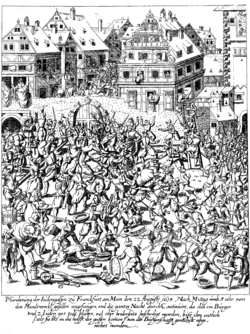
The plundering of the Frankfurter Judengasse, 22 August 1614

Looting is the act of stealing, or the taking of goods by force, typically in the midst of a military, political, or other social crisis, such as war,[1] natural disasters (where law and civil enforcement are temporarily ineffective),[2] or rioting.[3] The proceeds of all these activities can be described as booty, loot, plunder, spoils, or pillage.[4][5]

Throughout history, the practice of war looting was often considered a customary right of victorious armies until the development of modern international humanitarian law.[6]

Looting by a victorious army during war has been a common practice throughout recorded history.[7] In the wake of the Napoleonic Wars and particularly after World War II, norms against wartime plunder became widely accepted.[7] In modern armed conflicts, looting is prohibited by international law, and constitutes a war crime.[8][9] The Hague Conventions of 1899 and 1907 explicitly prohibited pillage and looting, codifying earlier efforts to restrain the practice in European warfare.[10]

After disasters

[edit]

During a disaster, police and military forces are sometimes unable to prevent looting when they are overwhelmed by humanitarian or combat concerns, or they cannot be summoned because of damaged communications infrastructure. Especially during natural disasters, many civilians may find themselves forced to take what does not belong to them in order to survive.[11] How to respond to that and where the line between unnecessary "looting" and necessary "scavenging" lies are often dilemmas for governments.[12][13] In other cases, looting may be tolerated or even encouraged by governments for political or other reasons, including religious, social or economic ones.

History

[edit]

In armed conflict

[edit]
The sacking and looting of Mechelen by Spanish troops led by the Duke of Alba, 2 October 1572

Looting by a victorious army during war has been a common practice throughout recorded history.[7] Foot soldiers viewed plunder as a way to supplement an often-meagre income[14] and transferred wealth became part of the celebration of victory. In the wake of the Napoleonic Wars and particularly after World War II, norms against wartime plunder became widely accepted.[7]

In the upper ranks, the proud exhibition of the loot plundered formed an integral part of the typical Roman triumph, and Genghis Khan was not unusual in proclaiming that the greatest happiness was "to vanquish your enemies ... to rob them of their wealth".[15]

In ancient times, looting was sometimes prohibited due to religious concerns. For example, King Clovis I of the Franks, forbade his soldiers to loot when they campaigned near St Martin's shrine in Tours, for fear of offending the saint.[16]

In warfare in ancient times, the spoils of war included the defeated populations, which were often enslaved. Women and children might become absorbed into the victorious country's population, as concubines, eunuchs and slaves.[17][18] In other pre-modern societies, objects made of precious metals were the preferred target of war looting, largely because of their ease of portability. In many cases, looting offered an opportunity to obtain treasures and works of art that otherwise would not have been obtainable. Beginning in the early modern period and reaching its peak in the New Imperialism era, European colonial powers frequently looted areas they captured during military campaigns against non-European states.[19] In the 1930s, and even more so during the Second World War, Nazi Germany engaged in large-scale and organized looting of art and property, particularly in Nazi-occupied Poland.[20][21] Soviet Union did likewise.[22] On the smaller level, looting was done by other Allied forces too.[23]

Looting, combined with poor military discipline, has occasionally been an army's downfall[citation needed] since troops who have dispersed to ransack an area may become vulnerable to counter-attack, a good example being during the 1967 First Invasion of Onitsha, where the victorious Nigerian troops were encircled and annihilated while looting. In other cases, for example, the Wahhabi sack of Karbala in 1801 or 1802, loot has contributed to further victories for an army.[24] Not all looters in wartime are conquerors; the looting of Vistula Land by the retreating Imperial Russian Army in 1915[25] was among the factors sapping the loyalty of Poles to Russia. Local civilians can also take advantage of a breakdown of order to loot public and private property, as took place at the Iraq Museum in the course of the Iraq War in 2003.[26] Lev Nikolayevich Tolstoy's novel War and Peace describes widespread looting by Moscow's citizens before Napoleon's troops entered the city in 1812, along with looting by French troops elsewhere.

In 1990 and 1991, during the Gulf War, Saddam Hussein's soldiers caused significant damage to both Kuwaiti and Saudi infrastructure. They also stole from private companies and homes.[27][28] In April 2003, looters broke into the National Museum of Iraq, and thousands of artefacts remain missing.[29][30]

Syrian conservation sites and museums were looted during the Syrian Civil War, with items being sold on the international black market.[31][32] Reports from 2012 suggested that the antiquities were being traded for weapons by the various combatants.[33][34]

Prohibition under international law

[edit]

Both customary international law and international treaties prohibit pillage in armed conflict.[8] The Lieber Code, the Brussels Declaration (1874), and the Oxford Manual have recognized the prohibition against pillage.[8] The Hague Conventions of 1899 and 1907 (modified in 1954) obliges military forces not only to avoid the destruction of enemy property but also to provide for its protection.[35] Article 8 of the Statute of the International Criminal Court provides that in international warfare, "pillaging a town or place, even when taken by assault", is a war crime.[8] In the aftermath of World War II, a number of war criminals were prosecuted for pillage. The International Criminal Tribunal for the Former Yugoslavia (1993–2017) brought several prosecutions for pillage.[8]

The Fourth Geneva Convention of 1949 explicitly prohibits the looting of civilian property during wartime.[8][36]

Theoretically, to prevent such looting, unclaimed property is moved to the custody of the Custodian of Enemy Property, to be handled until returned to its owners.

The International Criminal Court has prosecuted acts of pillage and looting as war crimes, including during conflicts in the Democratic Republic of Congo.[37]

Modern conflicts

[edit]
Vandalized and looted Aldi store during the George Floyd protests in Minneapolis, May 28, 2020

Despite international prohibitions against the practice of looting, the ease with which it can be done means that it remains relatively common, particularly during outbreaks of civil unrest during which rules of war may not yet apply. The 2011 Egyptian Revolution, for example, caused a significant increase in the looting of antiquities from archaeological sites in Egypt, as the government lost the ability to protect the sites.[38] Other acts of modern looting, such as the looting and destruction of artifacts from the National Museum of Iraq by Islamic State militants, can be used as an easy way to express contempt for the concept of rules of war altogether.[39]

In the case of a sudden change in a country or region's government, it can be difficult to determine what constitutes looting as opposed to a new government taking custody of the property in question. This can be especially difficult if the new government is only partially recognized at the time the property is moved, as was the case during the 2021 Taliban offensive, during which a number of artifacts and a large amount of property of former government officials who had fled the country fell into the hands of the Taliban before they were recognized as the legitimate government of Afghanistan by other countries. Further looting and burning of civilian homes and villages has been defended by the Taliban as within their right as the legitimate government of Afghanistan.[40]

Looting can also be common in cases where civil unrest is contained largely within the borders of a country or during peacetime. Riots in the wake of the 2020 George Floyd protests in numerous American cities led to increased amounts of looting, as looters took advantage of the delicate political situation and civil unrest surrounding the riots themselves.[41][42][43] Up to 175 Target stores closed Nationwide during the disturbances.[44][45]

During the ongoing Kashmir conflict, looting of Kashmiris trapped between the Indian and Pakistani militarized zones is common and widespread.[46]

In 2022, international observers accused Russia of engaging in large scale looting during the Russo-Ukrainian War, reporting the widespread looting of everything from food to industrial equipment.[47] Despite the publication of numerous photos and videos by Ukrainian journalists and civilians, numerous Russian commanders have denied these claims. International observers have theorized that this looting is either the result of direct orders, despite to Russia's claims to the contrary, or due to Russian soldiers not being issued with adequate food and other resources by their commanders.[48] On 18 November 2022, the University of Miami estimated that Russian forces in Ukraine had destroyed, pillaged, and looted at least 40 museums in Ukraine.[49]

Archaeological removals

[edit]

The term "looting" is also sometimes used to refer to antiquities being removed from countries by unauthorized people, either domestic people breaking the law seeking monetary gain or foreign nations, which are usually more interested in prestige or previously, "scientific discovery". An example might be the removal of the contents of Egyptian tombs that were transported to museums across the West.[50]

Looting of industry

[edit]

As part of World War II reparations, Soviet forces systematically plundered the Soviet occupation zone of Germany, including the Recovered Territories, which later transferred to Poland. The Soviets sent valuable industrial equipment, infrastructure and whole factories to the Soviet Union.[51][52]

Many factories in the rebels' zone of Aleppo during the Syrian Civil War were reported as being plundered and their assets transferred abroad.[53][54] Agricultural products and electronic power plants were also seized, to be sold elsewhere.[55][56]

[edit]

See also

[edit]

References

[edit]

Sources

[edit]
  • Abudu, Margaret, et al., "Black Ghetto Violence: A Case Study Inquiry into the Spatial Pattern of Four Los Angeles Riot Event-Types", 44 Social Problems 483 (1997)
  • Curvin, Robert and Bruce Porter (1979), Blackout Looting
  • Dynes, Russell & Enrico L. Quarantelli, "What Looting in Civil Disturbances Really Means", in Modern Criminals 177 (James F. Short Jr., ed., 1970)
  • Green, Stuart P., "Looting, Law, and Lawlessness", 81 Tulane Law Review 1129 (2007)
  • Mac Ginty, Roger, "Looting in the Context of Violent Conflict: A Conceptualisation and Typology", 25 Third World Quarterly 857 (2004). JSTOR 3993697.
  • Stewart, James, "Corporate War Crimes: Prosecuting Pillage of Natural Resources", 2010
  • Kończal, Kornelia (2017), Politics of Plunder. Post-German Property and the Reconstruction of East Central Europe after the Second World War. EUI Florence.
  • Kończal, Kornelia (2014), Das Schreiben und das Schweigen über die Plünderung des deutschen Eigentums. Die identitätsstiftende Figur des szabrownik im Nachkriegspolen, in: Włodzimierz Bialik, Czesław Karolak und Maria Wojtczak (ed.): Ungeduld der Erkenntnis. Eine klischeewidrige Festschrift für Hubert Orłowski, Peter Lang, Frankfurt a. M., p. 155–170.
  • Kończal, Kornelia (2017), The Quest for German Property in East Central Europe after 1945: The Semantics of Plunder and the Sense of Reconstruction, in: Yvonne Kleinmann among others (ed.): Imaginations and Configurations of Polish Society. From the Middle Ages through the Twentieth Century, Göttingen: Wallstein, p. 291–312.
  • Kończal, Kornelia (2021), German Property and the Reconstruction of East Central Europe after 1945: Politics, Practices and Pitfalls of Confiscation, in: European Review of History. Revue européenne d’histoire 28 (2), p. 278–300.
[edit]
Revisions and contributorsEdit on WikipediaRead on Wikipedia
from Grokipedia
Looting is the act of stealing goods or property, typically by force or during periods of chaos such as emergencies, riots, wars, or natural disasters, distinguishing it from routine theft through the context of disrupted law enforcement. In most jurisdictions, it constitutes a serious criminal offense, often penalized more harshly than standard larceny due to the associated risks to public safety and order, with examples including misdemeanor or felony charges carrying jail time ranging from months to years. Historically, looting has manifested in military conquests where victorious forces seized assets from defeated populations, as seen in events like the sack of cities during conflicts, though international laws such as the Hague Conventions now classify it as a war crime when targeting civilian property. Empirically, systematic reviews of post-disaster behavior reveal that organized or widespread looting is rare in natural calamities characterized by community cooperation, occurring more frequently in scenarios of civil unrest or violent conflict where social norms erode and enforcement weakens. Key characteristics include its opportunistic nature, driven by perceived low risks of apprehension, often escalating to vandalism or violence that inflicts broader economic losses—estimated in billions during major urban disturbances—and undermines recovery efforts by deterring investment and eroding trust in institutions. Controversies frequently surround looting during protests or upheavals, where causal analyses point to breakdowns in deterrence rather than underlying grievances alone, challenging narratives that downplay it as incidental or justified redistribution.

Definition and Terminology

Core Definition and Distinctions

Looting constitutes the unlawful of without compensation, typically occurring amid disruptions to public order such as riots, , or emergencies, where the act exploits a temporary breakdown in of laws protecting . This offense centers on the direct infringement of rights, as recognized in legal frameworks that uphold private against unauthorized dispossession, often involving , , or stealth to overcome resistance. Unlike isolated criminal acts, looting frequently manifests in group settings, with perpetrators capitalizing on collective disorder to target commercial or private assets indiscriminately. Looting differs from ordinary primarily in its contextual dependence on conditions that erode immediate legal oversight, whereas encompasses any unauthorized taking irrespective of surrounding stability. Standard lacks the opportunistic escalation tied to widespread chaos, where looters may vandalize non-targeted items or escalate to beyond mere acquisition, amplifying the to societal order and individual . In contrast to , which involves organized appropriation of goods as wartime spoils often under command and codified as a potential in , looting remains unauthorized and sporadic, lacking formal belligerent privileges. Requisition, meanwhile, denotes state-sanctioned temporary seizure for imperative public needs, such as , subject to legal protocols including potential compensation, thereby preserving a veneer of legitimacy absent in looting. These distinctions hinge on and intent: looting erodes property norms through ad hoc predation, while and requisition operate within hierarchies of command or necessity.

Etymology and Evolving Usage

The term "loot" entered the English language in the late 18th century, derived from the Hindi word lūṭ (लूट), meaning "plunder" or "booty," which traces back to the Sanskrit root luṇṭh- or loptram, denoting robbery or seizure of goods. This borrowing occurred through Anglo-Indian usage during British colonial expansion in India, where British soldiers and administrators adopted the word to describe the seizure of valuables, often in military contexts akin to spoils of war. The noun form first appeared around 1788, initially referring to stolen goods or prizes taken by force, while the verb "to loot" emerged shortly thereafter, emphasizing the act itself. By the mid-19th century, "looting" as a solidified around 1842, extending beyond strictly colonial military applications to denote plundering in various chaotic scenarios, reflecting a semantic broadening from organized wartime acquisition to opportunistic seizure amid disorder. This shift aligned with evolving European attitudes toward property rights, where "loot" carried connotations of illegitimate taking, distinct from sanctioned spoils, influenced by post-Napoleonic legal norms that increasingly stigmatized indiscriminate pillage. In the , particularly after 1945, the term's usage intensified in international legal discourse, such as under the , which explicitly prohibited pillage in armed conflicts and extended prohibitions to civilian acts during occupations, framing looting as a war crime rather than a mere incidental gain. Contemporary English usage retains the core sense of forcible, unauthorized taking of , often during breakdowns in , as codified in legal definitions distinguishing it from by its association with or — for instance, U.S. statutes like California's Penal Code § 463 define looting as amid declared emergencies. While metaphorical extensions exist, such as "corporate looting" for asset-stripping in failures, the primary prioritizes the literal act of seizing without consent in tumultuous conditions, underscoring cultural emphasis on order and inviolability.

Historical Overview

Ancient and Pre-Modern Looting

In ancient , the Assyrian king orchestrated the sack of in 689 BCE, during which his forces systematically looted the city's treasures, including temple valuables, as part of a punitive campaign to reassert dominance after Babylonian revolts. This act not only enriched the Assyrian military but also aimed to demoralize the population by destroying symbols of Babylonian power, such as partial devastation of religious sites, though wholesale structural ruin of major edifices like the is deemed implausible given the scale of operations. Archaeological evidence from records and reliefs corroborates the extraction of gold, silver, and cult objects, which were transported back to to fund further conquests and adorn Assyrian palaces. Roman legions institutionalized looting as a core incentive in warfare from the through the , with spoils divided among soldiers after a city's fall to compensate for modest salaries and sustain campaign . Upon breaching defenses, commanders often permitted controlled pillage—typically by half the force while the other maintained security—targeting portable wealth like coinage, slaves, and artworks to motivate troops and weaken enemy resolve by incentivizing rapid surrender. Historical accounts, such as those of , detail how this practice funded professional armies, with examples including the sack of in 146 BCE yielding vast booty auctioned to enrich the state treasury and legionaries alike. Such tactics reflected the era's low external enforcement of restraints, where plunder served as both economic necessity and , though internal disciplina limited indiscriminate excess to preserve unit cohesion. During the Viking Age (c. 793–1066 CE), Norse raiders conducted targeted coastal assaults across Europe, looting monasteries and settlements for silver, slaves, and livestock, as evidenced by contemporary annals like the recording the 793 CE raid that stripped the island priory of its ecclesiastical treasures. Archaeological finds, including hacked silver hoards from and totaling thousands of coins and ingots, quantify the scale, with sites like the (c. 900 CE) comprising over 600 items indicative of systematic plunder redistribution. These operations funded long-distance voyages and kin-based warbands, exploiting weak centralized defenses, yet reciprocity norms in Scandinavian tribal structures often curbed total annihilation to allow future trades or alliances, as over-raiding risked retaliatory coalitions. The Mongol invasions of the 13th century exemplified looting on a continental scale, with armies under and successors extracting immense wealth from sacked cities like the Khwarazmian capitals in 1219–1221 CE, where chroniclers report the seizure of silks, gems, and metalwork sufficient to pay warriors for years. Persian and Chinese sources, corroborated by dispersed artifacts in Eurasian hoards, describe the systematic melting of looted gold and silver to finance nomadic hordes, demoralizing foes through terror tactics that prompted preemptive submissions. In low-accountability warfare, this plunder incentivized mobility and loyalty, though eventual empire-building introduced self-limits via administrative integration to sustain flows over one-off depredations.

Looting in Colonial, Imperial, and World War Eras

During the colonial period, European powers institutionalized looting as a mechanism for empire-building and revenue extraction. The British East India Company, following its victory at the on June 23, 1757, seized control of Bengal's revenues through the 1765 diwani grant, enabling systematic transfers of wealth that funded Company operations and British trade. Economic analyses estimate that Britain extracted resources equivalent to tens of trillions in present-day value from over nearly two centuries, though such figures derive from tax and trade data interpretations contested for overstating unilateral plunder versus market dynamics. In the , King Leopold II's regime from 1885 to 1908 enforced forced labor quotas for rubber and , generating personal profits of approximately 70 million Belgian francs—equivalent to over $1 billion in modern terms—through direct resource plunder and export monopolies. Imperial transitions in the early amplified looting amid collapsing empires, often rationalized as compensation for wartime losses. As the fragmented after its 1918 defeat in , ethnic conflicts during the 1919–1922 Greco-Turkish War involved mutual plunder, with Greek forces seizing goods in and Turkish nationalists confiscating Armenian and Greek properties en masse, driven by economic desperation rather than alone. Similarly, Japanese occupations in from the 1931 Manchurian Incident onward prioritized resource extraction to alleviate domestic shortages, with the Imperial Army seizing Chinese industrial assets, bank reserves, and raw materials during the 1937 invasion, yielding billions in yen-equivalent value to support wartime industry. In the World Wars, industrialized scale elevated looting to state policy, with victors justifying reprisals as reparations. Nazi Germany plundered around 650,000 artworks and vast cultural assets across occupied Europe from 1939 to 1945, systematically cataloged by units like the Einsatzstab Reichsleiter Rosenberg for ideological and economic gain. Archival records confirm Allied participation, including American troops' appropriation of German artworks from castles in 1945—later partially restituted—and British line-of-communication units' small-scale seizures in towns like and during 1944 advances, reflecting opportunistic motives amid combat chaos rather than centralized directives. These actions underscore that plunder occurred across belligerents, countering portrayals of unilateral aggression by emphasizing shared economic incentives in .

Post-World War II Conflicts and Decolonization

In the (1950-1953), U.S. forces experienced significant theft of military supplies, with records documenting losses of $5,114,420.25 in goods stolen between January 1, 1951, and February 9, 1952, much of which fueled a burgeoning in . These thefts involved subsidized war materials redirected into local commodity exchanges, driven by economic disparities and vulnerabilities rather than systematic plunder, though individual soldiers faced courts-martial for black marketeering. North Korean and Chinese forces similarly seized resources from captured areas, but declassified U.S. military audits emphasize internal U.S. losses as a primary concern, highlighting how wartime enabled opportunistic resource diversion over ideologically motivated looting. During the (1955-1975), activities proliferated among U.S. personnel, with post-exchange (PX) goods routinely sold to Vietnamese intermediaries, creating a persistent wartime of diversion estimated to involve billions in flows when factoring international aid and military procurement. Investigations revealed servicemen profiting from inferior goods sales and black marketeering, including watches and meat, amid broader that undermined South Vietnamese governance. insurgents, conversely, conducted targeted seizures of U.S.-supplied rice, fuel, and weapons from villages and supply lines, using these to sustain guerrilla operations, though empirical data from military reports indicate such actions were tactical necessities in rather than gratuitous . This bilateral pattern underscores looting's role as a symptom of prolonged conflict's economic pressures, with U.S. audits confirming widespread but decentralized involvement across ranks. In struggles, the of (1954-1962) saw French forces and retreating settlers loot state treasuries and cultural artifacts, including the emirate's palace in , as part of efforts to deny resources to the Front de Libération Nationale (FLN). FLN fighters responded with raids on French infrastructure, seizing arms and funds, but French colonial records and post-war Algerian claims document systematic extraction of gold and valuables estimated in millions of francs, reflecting causal incentives for victors to preempt asset transfer. Similarly, in Portugal's Colonial Wars in and (1961-1974), both Portuguese troops and independence movements like the and targeted plantations, mines, and ports for resource appropriation; as Portuguese forces withdrew in 1974-1975, infrastructure sabotage and looting accelerated, with rebels seizing coffee estates and diamond operations to finance operations amid collapsing colonial authority. These cases reveal looting as a dual-edged tool in power vacuums, where empirical patterns from military dispatches show both sides prioritizing economic denial over destruction, countering narratives of one-sided barbarity. The Soviet-Afghan War (1979-1989), a proxy conflict, intertwined looting with narcotics economies, as groups expanded cultivation from modest pre-invasion levels to dominate global supply by the late 1980s, using proceeds to fund seizures of Soviet convoys and rural assets. Soviet forces, facing attrition, conducted punitive raids stripping villages of livestock and grain, per declassified reports, while resistance funding via —estimated to yield hundreds of millions annually by war's end—enabled sustained resource predation, illustrating how illicit economies amplified looting's scale in ideologically driven insurgencies. This dynamic, corroborated by UN drug assessments, debunks portrayals of unilateral predation by highlighting mutual incentives in resource-scarce terrains.

Looting in Armed Conflicts

The prohibition against pillage in armed conflict originated with the , which explicitly banned the looting of or places, even when captured by assault. Article 28 of the Regulations annexed to the 1907 Hague Convention IV states: "The pillage of a or place, even when taken by assault, is prohibited," codifying a customary norm against the appropriation of for personal gain. This provision built on earlier efforts to limit wartime depredations, reflecting recognition that unchecked looting undermines civilian protections and prolongs hostilities by incentivizing indiscipline among troops. These rules were reinforced and expanded by the Geneva Conventions of 1949 and their Additional Protocols of 1977. Article 33(2) of the Fourth Geneva Convention prohibits "pillage" outright, defining it as the violent taking of property without legal basis, while common Article 3 extends basic safeguards against such acts in non-international conflicts. Additional Protocol I (Article 52) protects objects indispensable to civilian survival from seizure or destruction, and Additional Protocol II (Article 4(2)(g)) explicitly bans pillage against non-combatants in internal armed conflicts. These instruments, ratified by nearly all states, integrate pillage into broader prohibitions on reprisals and collective punishments, emphasizing individual accountability over collective military necessity. The of the , adopted in 1998 and entering into force in 2002, classifies pillaging as a war crime under Article 8(2)(b)(xvi) for international conflicts and Article 8(2)(e)(v) for non-international ones, encompassing both public and private property appropriations without military justification. The ICC has pursued prosecutions incorporating this charge, such as in the of Congo cases following conflicts post-2000, where systematic looting of minerals and goods fueled rebel groups; convictions have hinged on evidence of organized appropriation rather than incidental . However, enforcement remains empirically limited, as prohibitions are frequently disregarded in where weaker parties lack means or incentives for compliance, and victorious forces—often shielded by or geopolitical alliances—face negligible prosecution risks. Historical patterns, including post-colonial insurgencies and recent interventions, demonstrate that legal norms deter only marginally without robust monitoring and impartial , underscoring the causal primacy of power imbalances over adherence.

Motivations and Tactics in Warfare

In historical warfare, a primary motivation for looting has been to compensate soldiers for the risks of , serving as an informal wage system when formal pay was unreliable or insufficient. Armies from to medieval often relied on spoils of war to incentivize enlistment and sustain , with loot distributed among ranks after victories to offset low or delayed salaries. This practice aligned individual incentives with military objectives, as soldiers bore the direct costs of battle while governments minimized fiscal burdens. Strategic motivations include disrupting enemy and demoralizing populations, transforming looting into a tool for resource denial. By seizing or destroying supplies, invading forces aimed to weaken adversaries' sustainment capabilities, as seen in tactics that targeted granaries and to force capitulation through . Revenge also drove indiscriminate sacking after prolonged sieges, where exhausted troops exacted retribution on holdings to recoup losses and deter future resistance. Such actions, while providing short-term gains, could prolong conflicts by fostering and hardening enemy resolve through perceived injustices. Tactics varied between targeted extraction and wholesale , depending on operational context. In rural campaigns, forces focused on mobile assets like herds and provisions to maintain their own supply lines while denying the enemy's, enhancing mobility without encumbering advances. Urban assaults often employed indiscriminate looting to accelerate surrenders, with commanders granting "sack rights" for fixed durations—typically three days—to motivate assaults on fortified positions. This approach exploited post-breach, allowing rapid wealth transfer at low enforcement cost, though it risked operational inefficiency if troops prioritized plunder over pursuit. From a rational perspective, looting emerges as a low-risk mechanism for personal enrichment amid wartime uncertainty, where state enforcement of contracts weakens and property rights dissolve. Soldiers, facing high mortality risks without guaranteed pay, rationally prioritize immediate gains, viewing spoils as for hazard. However, unchecked looting undermines by diverting focus from collective goals, fostering infighting over shares and eroding discipline, which historically led to mutinies or defeats when armies fragmented into plunder-seeking bands. Commanders mitigated this by regulating distribution, balancing incentives to prevent cohesion collapse while harnessing looting's motivational power.

Case Studies from 20th and 21st Century Wars

In the , following the U.S.-led invasion and the fall of on April 9, 2003, looters targeted the National Museum of Iraq starting April 10, with an estimated 15,000 artifacts stolen over 48 hours amid the collapse of state security. Museum staff and international archaeologists reported that the thefts included tablets, cylinder seals, and statues from Mesopotamian civilizations, facilitated by insiders who provided access to storage vaults. Concurrently, oil infrastructure suffered extensive looting and , with pipelines punctured, pump stations stripped of valves and cables, and control rooms ransacked, reducing exports by up to 50% in the immediate aftermath. These acts were primarily opportunistic, exploiting the power vacuum, though later insurgent groups escalated targeted attacks on pipelines, with nearly 300 bombings recorded by mid-2006. The Islamic State of Iraq and Syria (ISIS), controlling territories from 2014 to 2019, systematized antiquities looting as a revenue stream, taxing illicit digs and auctioning artifacts through intermediaries in Turkey and Europe. In Syria and Iraq, ISIS oversaw excavations at sites like Apamea and Dura-Europos, destroying some heritage while profiting from sales estimated at tens of millions of dollars, with U.S. government assessments highlighting the trade's role in funding weapons and operations. The group's propaganda even documented controlled demolitions juxtaposed with licensed looting, underscoring a dual strategy of cultural erasure and economic exploitation. In the ongoing since February 2022, Russian forces in occupied regions have seized Ukrainian grain stocks, with from May 2022 capturing Russian-flagged ships loading suspected stolen harvests at Crimean ports like . Eyewitness accounts from farmers and local officials, corroborated by export data discrepancies, indicate systematic appropriation of millions of tons from silos in and oblasts, redirecting them to Russian markets or allies. Reports also document looting of industrial technology, including machinery from factories in and , though grain theft predominates due to Ukraine's role as a global exporter, with volumes exceeding 1 million tons by mid-2022 per agricultural ministry tracking. These seizures reflect state-directed resource extraction to bolster Russia's economy amid sanctions, distinct from civilian looting.

Looting in Civil Unrest

Dynamics in Riots and Protests

Looting frequently intensifies during riots and protests triggered by perceived social or political grievances, manifesting as spikes in theft amid crowd dispersal and reduced enforcement. In the 1965 Watts riots in Los Angeles, triggered by a traffic stop, participants caused over $40 million in property damage, with extensive looting of stores alongside arson and violence over six days. Similar dynamics appeared in multiple U.S. urban disturbances of the 1960s, where looting targeted consumer goods in commercial districts, contributing to billions in cumulative damages adjusted for inflation. The 2020 unrest following George Floyd's death in exemplified these patterns nationally, with insured property losses exceeding $1 billion—the highest for in U.S. history—concentrated in cities like Minneapolis-Saint Paul, where damages reached at least $500 million from widespread store break-ins and . Crowd dynamics play a central role, as initial gatherings erode into copycat looting when authority wanes, with empirical analyses of protest violence showing that only a minority—around 5% or less of demonstrations—involve destructive acts like , yet these amplify overall chaos. Psychological factors, including in large groups, facilitate this shift, where participants rationalize as normalized amid the disorder. Arrest records distinguish looting from core protest aims, revealing opportunism as the primary driver: many detained for theft were individuals with prior non-political criminal histories, rather than organized ideologues, as confirmed by federal assessments attributing violence to ad-hoc actors exploiting unrest. In Minneapolis, over 2,000 looting incidents occurred, often by repeat offenders unrelated to initial grievances, underscoring how riots create windows for personal gain over collective expression. This pattern holds across events, where looting correlates more with accessible targets and low deterrence than with protest ideology, per analyses of participant behaviors.

Opportunistic vs. Ideologically Motivated Looting

Opportunistic looting during civil unrest primarily involves individuals exploiting disorder for personal gain, such as acquiring goods or seeking thrills, rather than advancing a coherent . Empirical assessments, including those from U.S. intelligence agencies in , identify "violent opportunists" as the main drivers of looting amid protests, distinguishing them from organized ideological actors. Similarly, Department of Homeland Security warnings highlighted infiltrators motivated by chaos rather than . In the 2011 England riots, surveys of young participants revealed motivations centered on perceived opportunities for gain, with many citing the chance to obtain free items amid weak immediate enforcement. A study by DMSS Research found that decisions to loot hinged on anticipated personal benefits, such as consumer goods, rather than structured ideological grievances, though some expressed general dissatisfaction with policing. Arrest records from the events showed widespread targeting of retail outlets for and , indicative of self-interested behavior over symbolic political targets. Claims of ideologically motivated looting, such as "reparations" for historical injustices during 2020 U.S. unrest, often rely on post-hoc justifications from activists or media narratives but lack support from looter actions or self-reports. Evidence from court records and federal investigations in cities like revealed many arrestees as repeat offenders focused on high-value thefts from unrelated businesses, including pharmacies and supermarkets, rather than institutions emblematic of systemic . Opportunistic patterns persisted despite ideological rhetoric, with protesters themselves condemning looting as disconnected from core demands for . Causal analysis points to breakdowns in as the primary enabler of looting, enabling self-interested to act with , rather than pervasive ideological fervor or systemic inequities alone. Cross-event comparisons, such as rapid arrests curbing escalation in some 2020 locales versus unchecked spread elsewhere, underscore deterrence's role over abstract injustices. This aligns with patterns in unrest where initial police restraint or overload creates vacuums filled by opportunists, as seen in both U.S. and U.K. cases, prioritizing immediate incentives over long-term political narratives.

Looting After Natural Disasters

Empirical Patterns and Rarity

Empirical research from disaster sociology, including field studies by the Disaster Research Center (DRC) at the , consistently demonstrates that looting is rare following , often limited to isolated incidents or misinterpretations of survival-oriented scavenging. Across dozens of events examined since the , such as floods, earthquakes, and hurricanes, verified cases involve fewer than 1% of evacuees or displaced persons, with most reports stemming from rumors amplified by media and officials rather than systematic observation. A of 28 studies on antisocial behavior post-, published in 2025, reinforces this pattern, finding scant evidence of widespread looting in natural events; where it occurs, it is typically opportunistic and small-scale, contrasting sharply with the extensive, organized property crimes seen in civil disturbances. In civil unrest, historical analyses document looting participation rates of 15-30% among crowds in major urban events, driven by absent in disaster contexts. The 2005 Hurricane Katrina provides a prominent case: initial media narratives of chaos and mass looting in New Orleans were debunked by DRC post-event surveys and on-site verifications, revealing most "looting" as residents accessing abandoned stores for food, water, and medicine amid delayed aid, with deliberate theft confined to a tiny fraction of the population. This aligns with broader patterns where disaster-induced community solidarity—manifesting in mutual aid and norm enforcement—suppresses predation, unlike the factional animosities that incite it during social conflicts.

Triggers and Exaggerated Narratives

Looting following typically arises in isolated instances amid significant power vacuums, such as the breakdown of and infrastructure collapse, rather than as a widespread response to the event itself. In the , for example, the destruction of the Civil Prison in released thousands of inmates, contributing to sporadic looting in commercial districts where damaged warehouses exposed goods, though these acts were opportunistic and limited to specific urban pockets delayed by bottlenecks. Systematic reviews of behavior confirm that such triggers are rare, with looting confined to small groups exploiting temporary rather than emerging from disaster-induced desperation among the general . Media and preemptive rumors often exaggerate these incidents, fostering narratives of imminent chaos through confirmation bias that prioritizes anecdotal reports over aggregate data. For instance, following Hurricane Harvey in 2017, social media amplified unsubstantiated claims of widespread looting and armed criminals in Houston, despite official records showing minimal verified cases, which distorted public perception and echoed patterns seen in prior events like the minimal actual disorder in New York City post-9/11 despite heightened fears of breakdown. Empirical analyses highlight how such amplification stems from selective framing, where isolated acts are portrayed as harbingers of societal collapse, overlooking evidence of community pro-sociality that suppresses opportunism. These distorted perceptions causally influence , prompting over-policing or diversion that can hinder effective response and erode institutional trust when realities diverge from hyped threats. Fears of looting have led to fortified aid convoys and delayed distributions in scenarios like , where security preoccupations slowed humanitarian access amid sparse actual threats, per post-event assessments. reviews recommend integrating behavioral data into planning to counter such biases, avoiding knee-jerk militarization that alienates survivors and undermines confidence in governance when exaggerated risks prove unfounded.

Specialized Forms

Archaeological and Cultural Heritage Looting

Archaeological and cultural heritage looting involves the systematic illicit excavation and removal of artifacts from unprotected sites, primarily driven by profit motives within global black markets. This activity destroys archaeological context, rendering artifacts scientifically valueless by severing them from stratigraphic layers, associated remains, and provenience data essential for historical reconstruction. Estimates of the annual value of this trade vary widely, with upper figures from organizations like UNESCO reaching $10 billion, though academic critiques highlight these as inflated and unsubstantiated, with more conservative assessments placing it in the hundreds of millions based on seizure data and market analyses. The irreplaceable loss extends beyond monetary terms, as looted sites like ancient Mesopotamian tells in Iraq suffer irreversible damage to cumulative human knowledge, far outweighing any localized economic gains claimed by participants. Methods typically include subsurface digging with basic tools such as shovels and picks, often conducted at night to evade detection, followed by rapid networks that launder artifacts through intermediaries. In , organized huaqueros (tomb robbers) target huacas—pre-Columbian temple mounds—employing teams with or mechanical diggers for efficiency, as seen in the extensive raids on sites like Batán Grande since the early 1900s, where gold artifacts fueled transnational trade. Similarly, post-2003 witnessed opportunistic yet widespread pit-digging across unprotected southern sites following the collapse of state control, devastating areas like and contributing to the dispersal of thousands of tablets and cylinder seals into private collections. These operations, frequently coordinated by local syndicates linked to international buyers, prioritize high-value portable items, leaving behind fragmented remains that preclude future scholarly recovery. In during the , looting escalated to industrial scales at sites like Apamea, where documented thousands of fresh craters from mechanized excavations between 2011 and 2012, generating funds for armed groups through artifact sales estimated in millions. This contrasts with historical cases like the , removed from the in the early 1800s under an Ottoman permitting export, which some view as legally sanctioned acquisition rather than theft, preserving pieces now at risk in origin contexts. Modern demands often overlook market dynamics, where prohibiting trade drives artifacts underground without curbing demand, potentially endangering holdings in unstable source nations prone to further destruction or neglect, as evidenced by repeated thefts from under-resourced local museums. Such critiques emphasize that retention in secure institutions better safeguards universal access against ongoing illicit incentives.

Economic Looting in Industry and Finance

Economic looting in industry and refers to the systematic extraction of value by insiders or controlling parties from firms or assets, often eroding the underlying enterprise's viability through mechanisms like excessive risk-taking, fraudulent accounting, or exploitative , ultimately shifting losses to external stakeholders such as taxpayers, shareholders, or the public. This phenomenon arises from moral hazards in systems with , weak oversight, or incentives misaligned with long-term value preservation, where actors prioritize short-term gains over sustainable operations. Unlike overt physical , it frequently operates under legal pretexts, masking the violation of implicit contracts with investors and society. A foundational model of this process was articulated by economists and in their 1993 analysis, which posits that looting thrives when firms can profit from via high-risk strategies, particularly under government-backed that socializes downside risks while privatizing upside gains. They illustrate this with the U.S. savings and loan (S&L) crisis of the 1980s, where in 1982 allowed thrifts to pursue speculative commercial real estate loans and insider transactions; over 1,000 institutions failed, necessitating a federal estimated at $160 billion, with $132 billion borne by taxpayers through the established in 1989. Empirical evidence from the crisis, including cases of executives siphoning funds via related-party loans and asset flips, demonstrated how decoupled prudent management from survival incentives, enabling widespread value extraction. The Corporation's collapse in December exemplifies looting through accounting manipulation, where executives and authorized the creation of over 3,000 special purpose entities to hide approximately $13 billion in off-balance-sheet, inflating reported profits via mark-to-market valuation of projected future revenues. This enabled insiders to sell $1.2 billion in between 1999 and while reassuring investors, culminating in with $63.4 billion in assets against $31.8 billion in liabilities revealed; and were later convicted in 2006 on charges including and conspiracy, underscoring how such schemes prioritize executive enrichment over firm integrity. In post-Soviet Russia, the 1990s privatization drive, particularly the 1995 "loans-for-shares" program under President , facilitated oligarchic looting by collateralizing state shares in lucrative enterprises—like oil giant and nickel producer —for loans from select banks controlled by insiders, who acquired controlling stakes at auctions rigged with minimal competition when the government defaulted on repayments. Valued at billions, these assets were obtained for pennies on the , concentrating control over 70% of Russia's wealth among seven oligarchs by 1996 and contributing to economic contraction of 40% in GDP from 1991 to 1998, as public holdings were effectively seized under the veneer of market transition. These cases highlight a core distinction from forcible takings: economic looting leverages institutional asymmetries—such as regulatory or opaque transactions—to legitimize transfers that diminish collective value, fostering systemic distrust and calls for stricter without addressing root incentives for .

Causes and Rationales

Economic Incentives and Rational Choice

In economic terms, looting represents a rational decision by individuals when the expected utility of appropriation exceeds that of lawful alternatives, particularly in environments of diminished . This framework draws from Gary Becker's 1968 model of , which treats criminal acts as utility-maximizing choices where offenders compare the monetary and psychic benefits of gains—such as the resale or consumption value of looted items—against the expected costs of detection and . The probability of apprehension multiplies the severity of penalties (fines, incarceration, or injury), but in low-accountability settings like riots or conflict zones, this probability plummets due to overwhelmed authorities and diffused responsibility, tilting the calculus toward participation. The of looting can be formalized as EV=psVpcCEV = p_s \cdot V - p_c \cdot C, where psp_s is the probability of successful , VV is the net of the loot (after any resale discount), pcp_c is the probability of capture, and CC is the of consequences. Chaos maximizes psp_s by exposing unguarded assets while minimizing pcp_c through overcrowding and evasion opportunities, often rendering EV>0EV > 0 even for modest VV. For consumer goods in urban riots, VV includes immediate personal utility or quick at 20-50% of retail value, sufficient incentive when pcp_c approaches zero. In specialized cases like looting, VV escalates due to black-market demand; the global illicit trade in generates billions annually, with organized networks absorbing high-value items despite risks. This individual-level optimization ignores externalities, such as depleted community resources or heightened future , as focus on private returns absent collective deterrents. Empirical observations align: looting surges correlate with enforcement breakdowns, as in urban disturbances where property crimes detached from protests exploit the risk-reward imbalance. Without elevating detection probabilities or penalties, such incentives persist, explaining looting's recurrence in transient over sustained equilibrium.

Psychological and Sociological Explanations

theory posits that immersion in a fosters and diffuses personal responsibility, diminishing and inhibitions, thereby enabling behaviors such as looting that individuals typically restrain in isolation. identified key antecedents including group arousal, altered time perspectives, and reduced accountability, which align with conditions where participants don or blend into masses, lowering the perceived of identification and punishment. This process explains why ordinarily law-abiding persons engage in during unrest, as the collective setting erodes internal moral constraints and amplifies impulsive contagion over deliberate choice. Parallels exist with obedience dynamics observed in Stanley Milgram's experiments, where ordinary subjects administered simulated lethal shocks under cues, mirroring how mob participants conform to emergent group imperatives during looting episodes. In crowds, the shifts from formal figures to the collective momentum or peer signals, compelling adherence to antisocial norms like property seizure, as absolves individuals of culpability. Empirical reviews of underscore this, noting that hypnotic-like spread of behavior in riots overrides personal ethics, distinct from premeditated crime. Sociologically, Émile Durkheim's concept of describes a deregulation of norms amid rapid societal shifts or crises, fostering deviance including riotous looting as actors navigate unclear moral boundaries. Yet, this framework highlights looting's empirical scarcity in tightly knit communities, where enduring social bonds and shared expectations sustain order even under strain, contrasting with fragmented urban settings prone to norm collapse. Analyses of events like the 2011 riots apply to explain outbursts, but emphasize that cohesion in stable groups mitigates such breakdowns, prioritizing relational ties over abstract deregulation. Critiques of poverty-centric interpretations note their inadequacy, as riot data reveal participants from middle-class origins, underscoring situational contagion—via —over chronic deprivation as the proximal driver. For instance, riot inquiries documented looters from affluent suburbs, challenging dispositional explanations and affirming ' causal primacy in drawing diverse actors into . This counters toward victimhood narratives in academic accounts, which often amplify structural excuses while underplaying empirical patterns of broad socioeconomic involvement.

Contested Justifications and Critiques

Proponents of looting in the aftermath of have argued that it constitutes a necessary act of when official is delayed or insufficient, citing instances where individuals sought , , or supplies from abandoned stores. Empirical reviews, however, indicate such is rare and often overstated in media narratives, with field studies post-Hurricane Katrina revealing that most reported "looting" involved communal sharing or procurement of essentials rather than widespread predation. In contexts of civil unrest, such as the 2020 protests following George Floyd's death, certain activists framed looting as a form of redistribution or reparations, with organizer describing it as "reparations" and affirming support for those who engaged in it during Chicago disturbances. Writer Vicky Osterweil, in her 2020 book In Defense of Looting, contended that the act disrupts capitalist property norms and serves as a tactic against systemic inequality, drawing parallels to historical rebellions where seizure of goods challenged elite control. Critics counter that these justifications fail under scrutiny of causal mechanisms and evidence, as looting erodes the foundational incentives for productive labor and societal cooperation. John Locke's , articulated in his Second Treatise of Government (1689), posits that individuals acquire rightful ownership by mixing their labor with unowned resources, making unconsented seizure a direct violation of personal extension into material goods and undermining the mutual trust required for economic order. This entitlement-based defense overlooks how such acts disincentivize and , as owners anticipate predation rather than reward for effort, leading to reduced overall wealth creation without achieving equitable redistribution. Empirically, areas affected by 2020 unrest experienced measurable economic fallout, with St. Paul, Minnesota, reporting that one year post-riots, 35 of 270 impacted businesses remained shuttered, reflecting approximately 13% permanent closure amid and damages estimated in billions nationwide. Studies on prior disturbances, including the 2011 London riots, demonstrate elevated post-event crime rates, including property offenses, as weakened enforcement norms persist and signal permissiveness for future violations. Analyses of protest-linked spikes confirm that while immediate violence may subside, underlying antisocial patterns endure, contradicting claims of net societal benefit from "" looting. Thus, rather than redressing grievances, perpetuates cycles of deprivation by deterring commerce and amplifying disorder, with no verifiable causal pathway to systemic reform.

Impacts and Consequences

Direct Economic and Material Losses

![Graffiti outside looted Aldi store on May 28, 2020 in Minneapolis (51237052782](./assets/Graffiti_outside_looted_Aldi_store_on_May_28%252C_2020_in_Minneapolis_(51237052782) Looting during civil unrest imposes immediate economic burdens through and stolen goods, often captured partially via claims. In the United States, the riots following George Floyd's death in May 2020 generated insured losses exceeding $1 billion, marking the costliest event in the nation's history and surpassing the . Estimates place total insured damages up to $2 billion, though uninsured losses—prevalent among small businesses—and underreported claims likely inflate the full figure substantially. Wartime looting amplifies these direct costs to national scales, with assets seized en masse contributing to war financing and economic disruption. During , Nazi forces plundered gold reserves from occupied European countries, valued at approximately $19 billion in contemporary dollars, excluding broader seizures of art, businesses, and estimated in the hundreds of thousands of items. Such appropriations represented immediate transfers of material wealth, often liquidated to fund military efforts, while physical destruction during looting rendered recovery impossible for significant portions of targeted inventories. Material losses from looting frequently involve irreversible destruction beyond mere theft, as goods are vandalized, consumed, or dispersed into black markets. In conflict zones, up to 30% or more of looted artifacts from sites may suffer permanent damage or vanish entirely due to hasty extraction techniques, complicating valuation but underscoring the non-recoverable nature of these assets. Opportunity costs compound the impact, as resources earmarked for reconstruction—such as labor, capital, and materials—are diverted to remediation and heightened security, delaying productive reinvestment in affected economies.

Social Disruption and Moral Hazards

Looting episodes precipitate acute social disruptions, including among victims who report elevated levels of , , depression, and loss of , comparable to effects observed in domestic studies. In the , triggered by the acquittal of officers in the beating on April 29, Korean-American merchants—facing overwhelmed police response—resorted to armed , stationing themselves on rooftops with rifles to safeguard stores in from and over six days of unrest. This self-organized defense, involving thousands of participants, underscored a rapid erosion of reliance on state protection, compelling communities to enforce order independently amid institutional failure. Visible looting fosters moral hazards by normalizing antisocial behavior, aligning with broken windows theory's premise that unchecked minor disorders signal permissiveness, escalating broader criminality. Empirical sequences in civil unrest reveal copycat dynamics, as in the originating in on August 6 and propagating nationwide through imitation, with police noting waves of opportunistic detached from initial grievances. Similarly, during 2020 U.S. disturbances following George Floyd's death on May 25, criminals exploited as cover for premeditated looting in distant commercial districts, amplifying disorder beyond protest zones. These patterns erode interpersonal trust and reciprocal norms, as pervasive in affected areas diminishes cohesion and incentivizes further deviance through diminished expectations of mutual restraint. Social proximity amplifies this decay, where witnessed violations prompt conformity to breaches rather than adherence to standards, perpetuating cycles of noncompliance. Consequently, recurrent disruptions shift societal preferences toward coercive enforcement by strong authorities, supplanting voluntary with enforced deterrence to reimpose stability.

Broader Societal and Long-Term Effects

Looting episodes contribute to sustained capital disinvestment and economic stagnation in affected urban areas, as evidenced by longitudinal analyses of U.S. riots, which showed depressed property values for -owned homes persisting into the 1970s and beyond, alongside reduced employment opportunities for workers due to firm relocations and household flight. These disturbances prompted suburban migration and exodus, amplifying and hindering central-city recovery, with cities like experiencing decades of and fiscal strain traceable to riot-induced capital outflows. Post-2020 civil unrest in U.S. cities led to double-digit increases in commercial insurance premiums for and civil commotion coverage, elevating operational costs for businesses and deterring reinvestment in high-risk zones, as insurers recalibrated rates based on escalated claims exceeding $1 billion in insured losses. Such hikes, compounded by heightened perceived fragility, signal broader investor aversion; empirical reviews indicate social unrest prompts negative responses and reduced , as conflicts elevate risk premiums and erode confidence in institutional stability. Archaeological looting inflicts enduring cultural deficits by obliterating contextual data essential for historical reconstruction, yielding no scholarly record while financing networks that perpetuate instability. This irrecoverable loss severs societal ties to heritage, diminishing and sustainable tourism potential in source regions, with global illicit trade sustaining organized groups beyond immediate conflict zones. Recurrent looting erodes deterrence mechanisms, fostering cycles of where initial correlates with elevated future and unrest incidence, as observed in riot-affected cities exhibiting prolonged traps and diminished civic trust. These patterns underscore causal links from unchecked disorder to institutional skepticism, where populations anticipate inefficacy in , further impeding long-term social cohesion and economic revitalization.

Domestic Laws, Penalties, and Enforcement

In the United States, looting is typically prosecuted under state laws governing , , or specific statutes, with penalties varying by and circumstances such as the value of stolen goods or occurrence during declared emergencies. In § 463 defines looting as entering an inhabited structure without consent to commit or any during a natural disaster, , or , punishable as a with up to one year in county jail and fines up to $1,000, or as a with up to three years in state prison, fines up to $10,000, and potential enhancements for aggravating factors like involvement. Similar enhancements apply nationally; for instance, during states of , can escalate to first-degree felonies in states like , carrying sentences of up to 30 years. Federal involvement may occur under statutes like 18 U.S.C. § 2112 for interstate robberies, with penalties up to 10 years imprisonment for high-value thefts. Enforcement in the U.S. often intensifies during mass unrest, with the Department of Justice pursuing federal charges for coordinated looting amid riots, as seen in over 300 indictments related to 2020 nationwide demonstrations involving and property destruction. However, conviction rates remain challenged by evidentiary hurdles in chaotic events, prioritizing violent crimes, and resource constraints; Department of Justice data from civil unrest cases indicate that while charges are filed aggressively, sustained convictions frequently fall below 50% due to plea bargains, dismissals for insufficient identification, or overwhelmed local courts. In the , looting falls under the , which criminalizes dishonest appropriation of property with intent to permanently deprive the owner, triable as an either-way offense with maximum penalties of seven years' imprisonment and unlimited fines for or . Post-disaster or riot-specific applications, such as during the , invoke provisions under Section 9, escalating sentences for aggravated cases, though no standalone "looting" statute exists; enforcement post-2011 resulted in over 3,000 arrests but highlighted variable outcomes, with conviction rates around 70-80% for charged offenses due to evidence, contrasted by lower rates in less-documented disasters. Sentencing guidelines emphasize deterrence, with custodial terms for repeat or commercial-scale looting, yet critics note lenient dispositions in under-resourced areas undermine efficacy. Across jurisdictions, enforcement efficacy is hampered by systemic issues like delayed prosecutions and political influences on charging decisions, particularly in weak institutional contexts where rates drop below 40% during widespread disorder, per comparative analyses of responses; this underscores deterrence limits when rapid identification and resource allocation falter.

International Conventions and Challenges

The 1954 Convention for the Protection of in the Event of Armed Conflict, adopted on May 14, 1954, and entering into force on August 7, 1956, represents the first international dedicated exclusively to safeguarding during wartime, obligating signatories to respect and protect such property from , , or destruction. Its two protocols, from 1954 and 1999, extend protections to peacetime precautions and enhanced criminalization of violations, respectively, with 137 states parties as of recent records. Complementing this, the 1970 Convention on the Means of Prohibiting and Preventing the Illicit and Transfer of of , adopted November 14, 1970, and effective from April 24, 1972, targets peacetime illicit trafficking by requiring states to prevent transfers promoting illegal trade, control exports, and promote restitution, ratified by 147 states as of 2025. mechanisms include cooperation via Interpol's Stolen Works of database, which facilitates international alerts and recoveries, though empirical data indicate recoveries remain limited, with illegal excavations driving much of the supply undetected by such systems. Implementation faces systemic challenges rooted in national and divergent incentives. Numerous countries, including several in and major market nations with delayed or partial adherence like the (implemented via domestic law in 1983 without full ), have not fully ratified or enforced these instruments, undermining uniform application. Economic drivers exacerbate gaps, as profits—estimated in billions annually—often exceed penalties, with traffickers exploiting porous borders and weak institutional capacity in source countries. Non-compliance persists in conflict zones, where looting funds insurgencies despite convention prohibitions, as seen in ongoing illicit flows from regions like the and . Overall effectiveness remains marginal, with post-1970 artifact trafficking enduring at scale, driven by clandestine excavations that evade inventories and international monitoring. While operations recover thousands of items annually—such as over 6,400 in a 2024 Europol-led effort—systemic underreporting and the predominance of looted goods suggest recovery rates below 10% for documented cases, highlighting causal failures in deterrence over . These conventions provide frameworks but falter against entrenched incentives, necessitating stronger bilateral enforcement absent binding supranational authority.

Strategies for Mitigation and Response

Immediate responses to outbreaks of looting emphasize rapid deployment of reinforcements and imposition of curfews to curtail opportunistic during civil unrest. In the 2020 disturbances across U.S. cities following George Floyd's death on May 25, governors activated the in over 20 states, mobilizing thousands of troops to protect property and disperse crowds amid widespread , , and ; for instance, deployed 700 personnel specifically trained for such scenarios to address rioting in . Curfews, enacted in cities including New York, , and starting late May 2020, restricted nighttime movement after initial looting surges, with enforcement targeting violations that exacerbated disorder. These measures prioritize physical presence to disrupt ongoing criminal acts, as empirical patterns from unrest events indicate that unchecked escalation correlates with prolonged . Preventive tactics leverage technology and private initiatives to elevate perceived risks for potential looters. (CCTV) systems yield consistent reductions in property offenses, including and ; a of 40 years of studies found modest overall drops, with effects strongest for vehicle-related property crimes (up to 51% in monitored areas) due to enhanced detection and evidence collection. Private deployments, such as perimeter patrols and visible guards, deter intrusions by signaling active defense, as evidenced in 2020 riot preparations where businesses fortified sites against and through uniformed presence. Community watch programs further bolster vigilance, with program evaluations reporting 16% average declines in neighborhood property crimes via resident reporting and informal . Long-term deterrence hinges on bolstering the of apprehension over mere penalty harshness, aligning with consensus from meta-analyses that perceived of detection—rather than severity—most reliably suppresses opportunistic crimes like looting. Strategies amplifying enforcement reliability, including sustained surveillance integration and , thus exhibit greater causal impact than escalatory sentencing alone, as uncertainty in capture undermines rational avoidance of high-reward, low-risk predation.

References

Add your contribution
Related Hubs
User Avatar
No comments yet.