Hubbry Logo
CarnivoreCarnivoreMain
Open search
Carnivore
Community hub
Carnivore
logo
8 pages, 0 posts
0 subscribers
Be the first to start a discussion here.
Carnivore
Carnivore
from Wikipedia

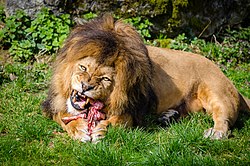
Lions are obligate carnivores consuming only animal flesh for their nutritional requirements.

A carnivore /ˈkɑːrnɪvɔːr/, or meat-eater (Latin, caro, genitive carnis, meaning meat or flesh and vorare meaning "to devour"), is an animal or plant whose nutrition and energy requirements are met by consumption of animal tissues (mainly muscle, fat and other soft tissues) as food, whether through predation or scavenging.[1][2]

Nomenclature

[edit]

Mammal order

[edit]

The technical term for mammals in the order Carnivora is carnivoran, and they are so-named because most member species in the group have a carnivorous diet, but the similarity of the name of the order and the name of the diet causes confusion.

Many but not all carnivorans are meat eaters; a few, such as the large and small cats (Felidae) are obligate carnivores whose diet requires nutrients found only in animal flesh. Other classes of carnivore are highly variable. The ursids (bears), for example: while the Arctic polar bear eats meat almost exclusively (more than 90% of its diet is meat), almost all other bear species are omnivorous, and one species, the giant panda, is nearly exclusively herbivorous.[3]

Dietary carnivory is not a distinguishing trait of the order. Many mammals with highly carnivorous diets are not members of the order Carnivora. Cetaceans, for example, all eat other animals, but are paradoxically members of the almost exclusively plant-eating hooved mammals.

Carnivorous diet

[edit]

Animals that depend solely on animal flesh for their nutrient requirements in nature are called hypercarnivores or obligate carnivores, whilst those that also consume non-animal food are called mesocarnivores, or facultative carnivores, or omnivores (there are no clear distinctions).[2] A carnivore at the top of the food chain (adults not preyed upon by other animals) is termed an apex predator, regardless of whether it is an obligate or facultative carnivore. In captivity or domestic settings, obligate carnivores like cats and crocodiles can, in principle, get all their required nutrients from processed food made from plant and synthetic sources.[4][5]

Members of the plant kingdom can live on meat too, such as the Venus flytrap, a carnivorous plant.

Outside the animal kingdom, there are several genera containing carnivorous plants (predominantly insectivores), several phyla containing carnivorous fungi (preying mostly on microscopic invertebrates, such as nematodes, amoebae, and springtails) and carnivorous protists.

Subcategories of carnivory

[edit]

Carnivores are sometimes characterized by their type of prey. For example, animals that eat mainly insects and similar terrestrial arthropods are called insectivores, while those that eat mainly soft-bodied invertebrates are called vermivores. Those that eat mainly fish are called piscivores.

Carnivores may alternatively be classified according to the percentage of meat in their diet. The diet of a hypercarnivore consists of more than 70% meat, that of a mesocarnivore 30–70%, and that of a hypocarnivore less than 30%, with the balance consisting of non-animal foods, such as fruit, other plant material, or fungi.

Omnivores also consume both animal and non-animal food, and apart from their more general definition, there is no clearly defined ratio of plant vs. animal material that distinguishes a facultative carnivore from an omnivore.[6]

Obligate carnivores

[edit]
The Bengal tiger's large canines and strong jaws reveal its place as an apex predator.
Lions are voracious carnivores; they require more than 7 kilograms of meat daily. A major component of their diet is the meat of large mammals, such as this buffalo.

Obligate or "true" carnivores are those whose diet in the wild requires nutrients found only in animal flesh. While obligate carnivores might be able to ingest small amounts of plant matter, they lack the necessary physiology required to fully digest it. Some obligate carnivorous mammals will ingest vegetation as an emetic, a food that upsets their stomachs, to self-induce vomiting.[7]

Obligate carnivores are diverse. The amphibian axolotl consumes mainly worms and larvae in its environment, but if necessary will consume algae. All wild felids, including feral domestic cats, require a diet of primarily animal flesh and organs.[8] Specifically, cats have high protein requirements and their metabolisms appear unable to synthesize essential nutrients such as retinol, arginine, taurine, and arachidonic acid; thus, in nature, they must consume flesh to supply these nutrients.[9]

Characteristics of carnivores

[edit]
This king cobra is preying on a smaller snake. Such snakes as king cobras use venom to kill prey.

Characteristics commonly associated with carnivores include strength, speed, and keen senses for hunting, as well as teeth and claws for capturing and tearing prey. However, some carnivores do not hunt and are scavengers, lacking the physical characteristics to bring down prey; in addition, most hunting carnivores will scavenge when the opportunity arises. Carnivores have comparatively short digestive systems, as they are not required to break down the tough cellulose found in plants.

Many hunting animals have evolved eyes facing forward, enabling depth perception. This is almost universal among mammalian predators, while most reptile and amphibian predators have eyes facing sideways.

Some carnivores use powerful venom to immobilize and kill prey. Such animals include snakes, spiders, scorpions, and some wasps.

Prehistory of carnivory

[edit]

Predation (the eating of one living organism by another for nutrition) predates the rise of commonly recognized carnivores by hundreds of millions (perhaps billions) of years. It began with single-celled organisms that phagocytozed and digested other cells, and later evolved into multicellular organisms with specialized cells that were dedicated to breaking down other organisms. Incomplete digestion of the prey organisms, some of which survived inside the predators in a form of endosymbiosis, might have led to symbiogenesis that gave rise to eukaryotes and eukaryotic autotrophs such as green and red algae.

Proterozoic origin

[edit]

The earliest predators were microorganisms, which engulfed and "swallowed" other smaller cells (i.e. phagocytosis) and digested them internally. Because the earliest fossil record is poor, these first predators could date back anywhere between 1 and over 2.7 bya (billion years ago).[10]

The rise of eukaryotic cells at around 2.7 bya, the rise of multicellular organisms at about 2 bya, and the rise of motile predators (around 600 Mya – 2 bya, probably around 1 bya) have all been attributed to early predatory behavior, and many very early remains show evidence of boreholes or other markings attributed to small predator species.[10]

The sudden disappearance of the precambrian Ediacaran biota at the end-Ediacaran extinction, who were mostly bottom-dwelling filter feeders and grazers, has been hypothetized to be partly caused by increased predation by newer animals with hardened skeleton and mouthparts.[11]

Paleozoic

[edit]

The degradation of seafloor microbial mats due to the Cambrian substrate revolution led to increased active predation among animals, likely triggering various evolutionary arms races that contributed to the rapid diversification during the Cambrian explosion. Radiodont arthropods, which produced the first apex predators such as Anomalocaris, quickly became the dominant carnivores of the Cambrian sea. After their decline due to the Cambrian-Ordovician extinction event, the niches of large carnivores were taken over by nautiloid cephalopods such as Cameroceras and later eurypterids such as Jaekelopterus during the Ordovician and Silurian periods.

The first vertebrate carnivores appeared after the evolution of jawed fish, especially armored placoderms such as the massive Dunkleosteus. The dominance of placoderms in the Devonian ocean forced other fish to venture into other niches, and one clade of bony fish, the lobe-finned fish, became the dominant carnivores of freshwater wetlands formed by early land plants. Some of these fish became better adapted for breathing air and eventually giving rise to amphibian tetrapods. These early tetrapods were large semi-aquatic piscivores and riparian ambush predators that hunt terrestrial arthropods (mainly arachnids and myriopods), and one group in particular, the temnospondyls, became terrestrial apex predators that hunt other tetrapods.[12]

The dominance of temnospondyls around the wetland habitats throughout the Carboniferous forced other amphibians to evolve into amniotes that had adaptations that allowed them to live farther away from water bodies. These amniotes began to evolve both carnivory, which was a natural transition from insectivory requiring minimal adaptation; and herbivory, which took advantage of the abundance of coal forest foliage but in contrast required a complex set of adaptations that was necessary for digesting on the cellulose- and lignin-rich plant materials.[12] After the Carboniferous rainforest collapse, both synapsid and sauropsid amniotes quickly gained dominance as the top terrestrial animals during the subsequent Permian period. Some scientists assert that sphenacodontoid synapsids such as Dimetrodon "were the first terrestrial vertebrate to develop the curved, serrated teeth that enable a predator to eat prey much larger than itself".[13]

Mesozoic

[edit]

In the Mesozoic, some theropod dinosaurs such as Tyrannosaurus rex are thought probably to have been obligate carnivores.

Though the theropods were the larger carnivores, several carnivorous mammal groups were already present. Most notable are the gobiconodontids, the triconodontid Jugulator, the deltatheroidans and Cimolestes. Many of these, such as Repenomamus, Jugulator and Cimolestes, were among the largest mammals in their faunal assemblages, capable of attacking dinosaurs.[14][15][16]

Cenozoic

[edit]

In the early-to-mid-Cenozoic, the dominant predator forms were mammals: hyaenodonts, oxyaenids, entelodonts, ptolemaiidans, arctocyonids and mesonychians, representing a great diversity of eutherian carnivores in the northern continents and Africa. In South America, sparassodonts were dominant, while Australia saw the presence of several marsupial predators, such as the dasyuromorphs and thylacoleonids. From the Miocene to the present, the dominant carnivorous mammals have been carnivoramorphs.

Most carnivorous mammals, from dogs to deltatheridiums, share several dental adaptations, such as carnassial teeth, long canines and even similar tooth replacement patterns.[17] Most aberrant are thylacoleonids, with a diprodontan dentition completely unlike that of any other mammal; and eutriconodonts like gobiconodontids and Jugulator, with a three-cusp anatomy which nevertheless functioned similarly to carnassials.[14][18]

See also

[edit]

References

[edit]

Further reading

[edit]
Revisions and contributorsEdit on WikipediaRead on Wikipedia
from Grokipedia
A carnivore is an , most commonly an , that obtains the majority of its and nutrients by consuming the , tissues, or products of other animals, such as , organs, or even . The term originates from the Latin words carnis () and vorare (to devour), reflecting its focus on animal-based sustenance. While often associated with mammals, carnivores exist across various taxa, including birds like eagles and , reptiles such as snakes and crocodiles, and even some and that prey on smaller animals. Carnivores are classified based on the proportion of in their diet, with obligate carnivores (also known as hypercarnivores) deriving over 70% of their from animal sources and unable to survive on matter alone due to physiological adaptations, such as the inability to process certain plant compounds. Examples include felids like lions (Panthera leo) and domestic cats (Felis catus), which possess specialized digestive systems optimized for high-protein, low-carbohydrate intake. In contrast, facultative carnivores or mesocarnivores consume as a primary but not exclusive source, supplementing with or other items when available, as seen in like bears (Ursidae family). Ecologically, carnivores serve as apex or mesopredators in food webs, regulating prey populations to maintain and prevent or by herbivores. Their presence influences dynamics, such as trophic cascades where the removal of carnivores leads to imbalances, as documented in studies of in . Adaptations common among carnivores include sharp, pointed teeth for tearing flesh—such as canines and in mammals—powerful jaws, keen senses for hunting (e.g., and acute smell), and claws or talons for capturing prey. However, not all carnivores belong to the mammalian order , which comprises about 280 like dogs, seals, and weasels; instead, the term "carnivore" broadly applies to any meat-dependent predator regardless of taxonomic group. Many carnivore species face threats from , human-wildlife conflict, and , leading to conservation efforts focused on protected areas and conflict mitigation strategies. Notable examples include the endangered ( tigris tigris), with an estimated 3,200–5,600 individuals remaining in the wild as of 2025, and the vulnerable ( leo), with approximately 20,000–25,000 individuals, whose populations have declined due to these pressures.

Nomenclature and Definitions

Etymology and General Usage

The term "carnivore" derives from the Latin carnivorus, meaning "flesh-eating," a compound of caro (genitive carnis, "") and vorare ("to devour"). The related adjective "" entered English usage in the 1640s to describe organisms that consume flesh. English naturalist popularized the term in scientific writing during the late 17th century, applying "carnivorous" to birds and other animals that feed on flesh in his 1691 publication The Wisdom of God Manifested in the Works of the Creation. During the Enlightenment, the concept gained broader traction in biological as naturalists emphasized dietary habits alongside morphology. For instance, incorporated carnivorous traits into his 1758 by grouping meat-eating mammals under the order , reflecting a growing interest in ecological roles within . This period marked the term's integration into systematic , influencing how scientists categorized organisms based on feeding strategies. In contemporary biology, "carnivore" broadly denotes any organism whose diet consists primarily or exclusively of animal tissue, extending beyond vertebrates to diverse taxa. This usage applies to predatory insects, such as the praying mantis (Mantis religiosa), which actively hunts and consumes other arthropods. Carnivorous plants, taxonomically within the kingdom Plantae, include species like the Venus flytrap (Dionaea muscipula) that capture small animals for nutrients. Certain fungi, termed carnivorous or predaceous, derive nutrients by trapping nematodes and other minute animals. Predatory protists, including some dinoflagellates, similarly exhibit carnivory by engulfing microbial prey.30422-X) This dietary definition contrasts with the narrower taxonomic application to the mammalian order Carnivora.

Distinction Between Dietary and Taxonomic Meanings

In and , the term "carnivore" refers to any whose diet consists primarily of animal matter, such as from other animals, though it may include some non-animal foods depending on the degree of carnivory. This dietary category encompasses a wide array of taxa across kingdoms and phyla, including but not limited to , birds, reptiles, , and mammals, where the consumption of animal tissue serves as the main energy source. For instance, (class ) and eagles (family ) are classic examples of non-mammalian carnivores that rely predominantly on or scavenging animal prey. In contrast, "" denotes a specific taxonomic order within the class Mammalia, comprising placental mammals that share a common evolutionary ancestry characterized by specialized adaptations for processing animal-derived foods, though not all members are strictly carnivorous in diet. This order includes 16 families, such as (cats, e.g., lions and domestic cats) and (dogs, e.g., wolves and foxes), and encompasses approximately 296 extant distributed globally across diverse habitats. Notably, while many Carnivora exhibit carnivorous diets, others, like bears (family Ursidae) and raccoons (family ), are omnivorous, incorporating significant plant matter, highlighting that membership in the order is phylogenetic rather than strictly dietary. The primary distinction lies in scope and basis: dietary carnivory is a functional descriptor applicable to any animal prioritizing animal-based , transcending taxonomic boundaries and including thousands of from various lineages, whereas the order Carnivora is a monophyletic limited to about 296 defined by shared evolutionary history rather than uniform feeding habits. This separation addresses common misconceptions where the term "carnivore" is ambiguously used interchangeably, potentially overlooking that non-mammalian predators like sharks or eagles fall outside the mammalian order despite their carnivorous diets. Historically, early taxonomic systems exacerbated these confusions by conflating dietary traits with phylogenetic relationships; for example, in the , grouped carnivorous mammals—such as cats, dogs, bears, weasels, and seals—into the artificial order based primarily on their flesh-eating habits and , without regard for deeper evolutionary affinities. This approach reflected the era's reliance on observable morphology and over cladistic principles, leading to polyphyletic groupings that mixed unrelated lineages under dietary rubrics. The modern order was formally established later, in 1821 by Thomas Edward Bowdich, emphasizing and resolving such nomenclature issues through fossil and genetic evidence.

Classifications of Carnivory

Degrees of Carnivory by Diet Proportion

Carnivores are classified into degrees of carnivory based on the proportion of matter in their diet, forming a continuum from strict meat-eaters to those with substantial non-animal intake. This ecological categorization, often termed hypercarnivory, mesocarnivory, and hypocarnivory, reflects adaptations to resource availability and helps delineate trophic roles within ecosystems. Hypercarnivores derive more than 70% of their diet from animal tissue, primarily , which provides high and supports efficient acquisition for predation-focused lifestyles. This dietary specialization confers evolutionary advantages in energy efficiency, as offers concentrated calories compared to material, enabling sustained high metabolic rates in apex predators. Examples include lions (Panthera leo), which consume nearly exclusively large ungulates, and sharks (Carcharodon carcharias), reliant on marine mammals and . Mesocarnivores consume 30-70% animal matter, balancing prey with , fruits, and to exploit varied food sources. This intermediate proportion allows flexibility in opportunistic foraging, reducing reliance on unpredictable prey populations. Representative species are raccoons (Procyon lotor), which incorporate , , and , and red foxes (Vulpes vulpes), supplementing small mammals with berries and carrion. Hypocarnivores obtain less than 30% of their diet from animal sources, with the majority from plants, fungi, or non-vertebrate matter, positioning them as primarily herbivorous yet capable of occasional carnivory. This low proportion supports survival in resource-scarce environments through generalist feeding. Notable examples include giant pandas (Ailuropoda melanoleuca), whose diet is over 99% , and brown bears (Ursus arctos), which favor and seasonally but opportunistically hunt. Diet proportions are quantified in ecological research using stable isotope analysis, which traces carbon and ratios in tissues to infer long-term trophic levels, and fecal (scat) studies, which identify consumed items via macroscopic and genetic methods. These techniques provide precise estimates of animal matter percentages, accounting for digestion biases and seasonal variations. Ecologically, diet proportion influences niche specialization and ; hypercarnivores occupy narrow, prey-dependent niches, heightening vulnerability to fluctuations and rivalry among specialists, while mesocarnivores and hypocarnivores exhibit broader niches, promoting coexistence through resource partitioning. This spectrum overlaps with but differs from physiological classifications like carnivory, which emphasize nutritional requirements over proportional intake.

Obligate Versus Facultative Carnivores

Obligate carnivores are animals whose requires them to derive essential s exclusively from tissues, as they lack the metabolic pathways to synthesize these from -based sources. In contrast, facultative carnivores possess greater metabolic flexibility, allowing them to obtain necessary nutrients from both and materials, though they typically prefer . This distinction arises from evolutionary adaptations in nutrient processing, where carnivores cannot efficiently convert precursors found in into vital compounds. Key examples of essential nutrients include and preformed (). Obligate carnivores, such as domestic cats (Felis catus), require —an crucial for salt conjugation, function, and cardiac health—directly from sources, as they cannot synthesize it from precursors like due to the absence of key s, including cysteine decarboxylase. Similarly, they depend on dietary because they lack the beta-carotene 15,15'-dioxygenase needed to convert plant-derived beta-carotene into usable . In hawks (Accipiter spp.), these requirements mirror those in felids, with tissues providing indispensable and other polyunsaturated fatty acids that cannot be adequately produced from plant lipids. Deficiencies in these nutrients lead to severe health issues in carnivores. For instance, deficiency in cats causes feline central retinal degeneration, characterized by photoreceptor loss and lesions in the central , potentially progressing to blindness if untreated. This condition arises from depleted retinal levels below 50% of normal, triggering progressive . Facultative carnivores, however, avoid such risks through enzymatic capabilities; dogs ( familiaris), for example, express -synthesizing enzymes like those in the sulfinic acid pathway, enabling supplementation from plant proteins or mixed diets. Across taxa, obligate carnivory predominates in felids, where all species exhibit these strict dependencies, and in most reptiles, such as snakes (Serpentes) and crocodilians (Crocodylia), which rely solely on animal prey for and other sulfur-containing . Facultative carnivory is evident in ursids, like grizzly bears (Ursus arctos), which can metabolize plant carbohydrates and synthesize essential nutrients during periods of vegetable foraging. These differences underscore the physiological imperatives shaping dietary needs beyond mere ecological diet proportions like hypercarnivory.

Physiological and Behavioral Adaptations

Anatomical Features for Predation and Digestion

Carnivores across various animal groups exhibit specialized dental structures optimized for capturing, killing, and processing prey. In mammals, particularly within the order , carnassial teeth—specialized shearing blades formed by the upper and lower molar—enable efficient slicing of flesh and tendons, facilitating the consumption of meat-heavy diets. These teeth, positioned posteriorly in the jaw at approximately 50% of its length, provide biomechanical leverage for powerful cutting actions, a feature conserved in both placental and carnivores. In reptiles such as snakes and , teeth are typically simple and conical, designed primarily for gripping and preventing escape of slippery or struggling prey rather than mastication. Similarly, predatory fish like pike possess fang-like, conical oral teeth adapted for piercing and impaling victims, often complemented by for further processing. Skeletal adaptations in carnivores enhance their ability to subdue and dispatch prey through enhanced bite force and limb functionality. Strong, robust jaws supported by reinforced zygomatic arches and crested skulls allow for high bite forces, as seen in felids and canids where mandibular morphology enables crushing of bones or holding large . Powerful forelimbs and hindlimbs, often with flexible joints, aid in pouncing and restraining prey, a trait evident in the multipurpose limb of terrestrial carnivores. Retractable claws, particularly in feliform carnivores, provide sharp, protected weapons for slashing and gripping, sharpening during extension to maintain lethality. These features show between theropod dinosaurs— with serrated teeth, strong jaws, and clawed limbs for predation—and placental mammals, reflecting similar selective pressures for active . The digestive systems of carnivores are streamlined for rapid breakdown of protein-rich, nutrient-dense foods like , minimizing needs. A short , often 3-6 times body length in carnivores such as felids, accelerates nutrient absorption while reducing energy expenditure on fiber processing. Highly acidic stomachs, with levels of 1-2 even in the presence of food, facilitate rapid protein denaturation and killing, contrasting sharply with the near-neutral in herbivores. This acidity, driven by elevated secretion, supports the activation of for enzymatic of animal tissues. Specialized anatomical examples further illustrate predation enhancements. In venomous snakes, paired oral venom glands connect via ducts to enlarged, canaliculated fangs, enabling high-pressure injection of toxins that immobilize prey through neurotoxic or hemotoxic effects. Among , raptors possess sharp, hooked beaks with reinforced tomia (cutting edges) for ripping flesh and, in species like eagles, occasionally crushing small bones or skulls post-capture. These structures collectively underscore the diverse yet functionally convergent anatomical solutions carnivores have evolved for efficient predation and processing.

Sensory and Hunting Strategies

Carnivores exhibit a range of specialized sensory adaptations that enhance their ability to detect and track prey in diverse environments. In canids, such as dogs and wolves, olfaction is particularly acute, with counts ranging from 125 to 300 million, far exceeding the 5-6 million in humans, enabling them to detect scents at concentrations as low as parts per trillion. Felids, including cats and lions, possess forward-facing eyes that provide a binocular overlapping by about 140 degrees, facilitating precise essential for pouncing on prey from distances up to several meters. , as aquatic carnivores, utilize electroreception through the , gel-filled pores on their snouts that detect bioelectric fields generated by prey muscle contractions, allowing location of hidden or buried targets even in murky waters. Hunting strategies among carnivores vary to optimize energy use and success rates, often tailored to morphology and . predators like crocodiles lie motionless in or , relying on cryptic coloration and sudden lunges to capture passing prey, with attack speeds reaching 30 km/h over short distances. In contrast, pursuit hunters such as employ high-speed chases, accelerating to 100-120 km/h in bursts of 20-30 seconds to overtake gazelles on open plains, though this limits endurance to under a minute. Pack coordination is evident in wolves, which use relay tactics during pursuits, where individuals take turns harassing and tiring large ungulates like over distances of several kilometers, increasing capture efficiency through collective stamina rather than individual speed. Many carnivores display nocturnal behavioral adaptations to exploit prey vulnerabilities and reduce competition, such as enhanced low-light vision via a reflective layer behind the , which amplifies available light in species like and foxes. integrates with these tactics, as seen in the , which uses a bioluminescent lure (esca) dangling from its dorsal spine to mimic prey and attract within striking range of its expansive jaws. Such strategies reflect broader , where timing and deception minimize detection risks. These approaches involve significant energy trade-offs, with active pursuit hunters like incurring metabolic costs up to 10 times their resting rate during chases, necessitating long recovery periods and contributing to lower overall hunting success rates of around 40-50%. Ambush strategies, conversely, conserve energy through prolonged inactivity, aligning with lower basal metabolic rates in species like crocodiles, though they demand precise timing to offset infrequent feeding opportunities.

The Mammalian Order

Taxonomy and Major Families

The order belongs to the class Mammalia and comprises a diverse group of predominantly carnivorous mammals, unified by specialized teeth adapted for shearing meat. It is phylogenetically divided into two monophyletic suborders: ("cat-like" forms, including families with agile, solitary predators) and ("dog-like" forms, encompassing a broader range of social and semi-aquatic species). This division reflects deep evolutionary branches supported by molecular and morphological analyses. The basal cladistic split between and occurred approximately 60 million years ago during the early , marking the crown-group radiation of modern carnivorans. This divergence is corroborated by fossil records of early miacids—small, tree-dwelling carnivoramorphans from the late to Eocene that represent stem-group ancestors to the order—and by extensive DNA sequence data from nuclear and mitochondrial genes. Phylogenetic trees constructed from such molecular evidence, including concatenated sequences from multiple loci, consistently recover this topology with high support. Within , the family stands out with 39 species of strict carnivores, such as lions and tigers, characterized by retractile claws and solitary hunting behaviors. In , major families include (38 species, exemplified by wolves and foxes as pack hunters), Ursidae (8 species, including omnivorous bears like the grizzly that supplement meat with plant matter), and (64 species, ranging from weasels in temperate forests to otters in aquatic environments). also incorporates the pinnipeds—seals, sea lions, and walruses in the families Phocidae, Otariidae, and —fully marine groups that evolved from terrestrial ancestors despite their specialized aquatic lifestyles. These relationships are refined in molecular phylogenies, which highlight 's basal position within and the nested placement of pinnipeds.

Diversity, Distribution, and Notable Examples

The order comprises approximately 296 extant (as of 2021), with peaking in tropical regions, particularly East and , where diverse support a high concentration of feliform and caniform families. loss and fragmentation pose major threats, rendering about 27% of carnivoran threatened with according to IUCN assessments (as of 2022). Carnivorans exhibit a nearly , occupying habitats across every major landmass except , from the ice packs to hyper-arid deserts like the . This broad range is exemplified by the (Ursus maritimus), an confined to sea ice and coastal areas, and the (Panthera tigris), which inhabits forests, swamps, and grasslands across mainland . Among notable species, (Panthera leo) stands out for its , living in prides of related females and a few males that cooperatively defend territories and hunt in African savannas and woodlands. (Ailuropoda melanoleuca), a member of the Ursidae family, deviates from typical carnivoran diets as a bamboo specialist, consuming nearly exclusively this fibrous plant despite retaining a carnivore-like gut . Similarly, the (Enhydra lutris) functions as a keystone predator in North Pacific kelp forests, where it preys on sea urchins to prevent overgrazing and sustain algal ecosystems. Conservation efforts are critical, as IUCN data reveal widespread declines driven by , , and retaliatory killings; for instance, nearly half of all felid are classified as threatened (as of ), with large cats like lions and tigers facing acute risks from these human-induced pressures.

Evolutionary History of Carnivory

Proterozoic and Origins

The Eon, spanning approximately 2.5 billion to 541 million years ago, provides the earliest hints of carnivorous interactions among multicellular organisms, particularly during the Period (635–541 million years ago). While most Ediacaran biota, such as the disc-shaped , appear to have engaged in grazing on microbial mats or absorptive feeding, evidence of proto-carnivory emerges from tube-dwelling metazoans like Cloudina, whose mineralized tubes bear small boreholes interpreted as predatory drillings. These borings, often circular and penetrating the shell walls, suggest attacks by unidentified predators, possibly using radula-like structures or chemical dissolution, marking one of the oldest records of metazoan predation and indicating a shift toward more complex ecological dynamics. The onset of the Paleozoic Era (541–252 million years ago) witnessed a dramatic escalation in carnivory, beginning with the around 541–521 million years ago, when diverse metazoan body plans proliferated and active predation became prominent. canadensis, a radiodont reaching up to 1 meter in length, exemplifies the first clear apex predators, equipped with frontal appendages for grasping soft-bodied prey and a circular mouth for tearing. This era's fossils reveal a transition from predominantly filter-feeding and deposit-feeding strategies in metazoans to active hunting, facilitated by the of specialized appendages and improved locomotion in early bilaterians. Further diversification occurred in the Period (485–443 million years ago), with the emergence and radiation of jawed vertebrates (gnathostomes), including putative early forms like thelodonts and heterostracans that exhibited predatory behaviors through biting and shell-crushing. Trace fossils, such as boreholes in and bivalve shells, provide key evidence of drilling predation by gastropods and other invertebrates, with drilling frequencies increasing from less than 1% in the to over 5% by the Late , signaling intensified selective pressures. Biochemical markers, including preserved chitin-protein complexes in exoskeletons, confirm the prevalence of carnivorous forms like eurypterids, whose robust cuticles supported predatory lifestyles in marine environments.

Mesozoic Developments

The Era, from approximately 252 to 66 million years ago, marked a period of profound expansion in carnivorous adaptations among archosaurian reptiles, with theropod dinosaurs emerging as dominant terrestrial hypercarnivores. Originating in the from early lineages, theropods diversified into a wide array of predatory forms, evolving serrated, blade-like teeth and robust skulls to facilitate slicing and piercing of flesh.01646-8) By the , apex predators like Tyrannosaurus rex had developed exceptionally powerful jaws, capable of exerting bite forces estimated at 35,000–57,000 N, enabling bone-crushing osteophagy that pulverized skeletal elements of large prey. This era's predatory archosaurs, including pseudosuchians and early theropods, filled ecological niches as active, bipedal hunters following the recovery from the Permian-Triassic extinction. Aerial and marine realms saw parallel carnivorous radiations, with pterosaurs and ichthyosaurs occupying key predatory roles. Pterosaurs, the earliest vertebrates to achieve powered flight, began with diets dominated by in the but shifted toward piscivory and carnivory in later and forms, as evidenced by dental microwear and gastric residues indicating consumption of and small vertebrates. In oceanic environments, ichthyosaurs—streamlined, fish-like reptiles—thrived as pursuit predators throughout the , specializing in fast-swimming prey such as and cephalopods, with conical teeth suited for grasping slippery targets. These groups exemplified the era's reptilian carnivory, contrasting with the smaller, more marginal roles of other clades. Early mammals during the remained subordinate to reptilian predators, evolving as small, nocturnal forms adapted to insectivory. Species like , from the and , possessed multicusped teeth with microwear patterns matching those of modern insectivores, suggesting a diet focused on hard-shelled arthropods such as beetles. These shrew-sized mammals likely foraged at night to avoid diurnal reptilian competitors, representing a conservative carnivorous strategy amid the dominance of larger predators. Key evolutionary events included the diversification of predatory lines, which set the stage for theropod dominance, and the Terrestrial Revolution, where the proliferation of angiosperms (flowering plants) from around 125 million years ago enhanced terrestrial productivity, indirectly boosting abundance and prey diversity for carnivores—though direct links to evolution are not conclusively established. evidence underscores these diets: coprolites from theropods and related forms often contain bone fragments, fish scales, and insect remains, directly confirming carnivorous habits and trophic interactions. Additionally, trackways, such as those of multiple juvenile tyrannosaurids moving in parallel during the , provide indirect evidence of gregarious or pack-hunting behavior in some theropods, suggesting coordinated predation strategies.

Cenozoic Expansion and Modern Forms

The era, spanning from approximately 66 million years ago to the present, marked a pivotal phase in the evolution of carnivory among mammals following the Cretaceous-Paleogene extinction event, which eliminated non-avian dinosaurs and opened ecological niches for mammalian radiation. The order emerged from small, tree-dwelling miacid ancestors in the early , with fossil evidence from the early Eocene Clarkforkian and Wasatchian stages indicating primitive carnivorous adaptations such as enlarged carnassial teeth for shearing meat. analyses, calibrated using multiple nuclear genes and fossil constraints, estimate the crown-group divergence around 58–59 million years ago, initiating a rapid diversification that led to the establishment of 16 extant families across feliform and caniform clades. This "explosive" radiation, particularly in the late Eocene to early , involved adaptations to varied terrestrial and aquatic environments, with early lineages like Uintacyon and giving rise to more specialized predators. During the Miocene epoch (23–5.3 million years ago), expanding grasslands driven by global cooling prompted further refinements in carnivoran morphology and , favoring hypercarnivores suited to open habitats and pursuit hunting. Bone-crushing adaptations in borophagine canids, such as , and the rise of felids like Nimravides exemplified these shifts, enabling efficient exploitation of large prey in savanna-like ecosystems. Saber-toothed forms, including Miocene barbourofelids and later machairodonts, evolved elongated canines for subduing sizable ungulates, reflecting convergent predatory strategies amid climatic drying that reduced forest cover and increased prey mobility. Key climatic transitions, notably the Eocene-Oligocene boundary around 34 million years ago, accelerated carnivoran diversification through and , which altered vegetation and prey dynamics to favor agile, meat-specialized hunters over generalists. This event coincided with the extinction of archaic creodont competitors and the proliferation of nimravids and early amphicyonids, enhancing carnivory's dominance in northern continents. In the Pleistocene (2.6 million–11,700 years ago), intensified glacial cycles supported megafaunal hunters like fatalis, a machairodont felid that ambushed large herbivores such as mammoths and using powerful forelimbs and saber-like teeth for throat incisions. Fossil assemblages from sites like the in reveal intense predation dynamics, with overabundant carnivore remains— including dire wolves and —indicating scavenged traps that preserved evidence of bite marks, dietary competition, and ecological stress from climate fluctuations. Contemporary carnivory exhibits convergences across vertebrate lineages, where mammals, birds, and reptiles independently evolved similar predatory traits like hooked beaks in raptors paralleling mammalian carnassials for tearing flesh, or ambush tactics in crocodilians akin to those in felids, driven by shared selective pressures for efficient meat acquisition. Human activities have profoundly shaped modern carnivore evolution, most notably through the domestication of dogs (Canis familiaris) from Pleistocene wolves around 23,000 years ago in Siberia, fostering traits like reduced aggression and enhanced social bonding that integrated them into human societies and facilitated joint hunting. Molecular clock studies continue to refine these timelines, dating major family divergences—such as Felidae around 10–11 million years ago and Canidae at the Oligocene-Miocene boundary—to post-Paleogene expansions, underscoring carnivory's adaptive resilience in shaping today's ecosystems.

References

Add your contribution
Related Hubs
User Avatar
No comments yet.