


Community hub
Recent from talks
Contribute something
Nothing was collected or created yet.
Protestantism in the United States
View on Wikipedia

Protestantism is the largest grouping of Christians in the United States, with its combined denominations collectively comprising about 43% of the country's population (or 141 million people) in 2019.[1] Other estimates suggest that 48.5% of the U.S. population (or 157 million people) is Protestant.[2] Simultaneously, this corresponds to around 20% of the world's total Protestant population. The U.S. contains the largest Protestant population of any country in the world. Baptists comprise about one-third of American Protestants. The Southern Baptist Convention is the largest single Protestant denomination in the U.S., comprising one-tenth of American Protestants. Twelve of the original Thirteen Colonies were Protestant, with only Maryland having a sizable Catholic population due to Lord Baltimore's religious tolerance.[3]
The country's history is often traced back to the Pilgrim Fathers whose Brownist beliefs motivated their move from England to the New World. These English Dissenters, who also happened to be Puritans—and therefore Calvinists—, were first to settle in what was to become the Plymouth Colony. America's Calvinist heritage is often underlined by various experts, researchers and authors, prompting some to declare that the United States was "founded on Calvinism", while also underlining its exceptional foundation as a Protestant majority nation.[4][5] American Protestantism has been diverse from the very beginning with large numbers of early immigrants being Anglican, various Reformed, Lutheran, and Anabaptist. In the next centuries, it diversified even more with the Great Awakenings throughout the country.
Protestants are divided into many different denominations, which are generally classified as either "mainline" or "evangelical", although some may not fit easily into either category. Some historically African-American denominations are also classified as Black churches. Protestantism had undergone an unprecedented development on American soil, diversifying into multiple branches, denominations, several interdenominational and related movements, as well as many other developments. All have since expanded on a worldwide scale mainly through missionary work.
Statistics
[edit]
Protestantism
- Evangelical Protestant (55.0%)
- Mainline Protestant (32.0%)
- Black church (14.0%)
- Baptist (33.0%)
- Nondenominational Protestant (13.0%)
- Methodist (10.0%)
- Pentecostal (10.0%)
- Unspecified Protestant (8.00%)
- Lutheran (8.00%)
- Presbyterian (5.00%)
- Restorationist (4.00%)
- Episcopalian/Anglican (3.00%)
- Holiness (2.00%)
- Congregationalist (1.00%)
- Adventist (1.00%)
- Anabaptist (1.00%)
- Other evangelical or fundamentalist, other Reformed, Pietist, Quaker (1.00%)
- Other denomination (55.0%)
- Southern Baptist Convention (11.0%)
- United Methodist Church (8.00%)
- American Baptist Churches USA (3.00%)
- Churches of Christ (3.00%)
- Evangelical Lutheran Church in America (3.00%)
- National Baptist Convention, USA, Inc. (3.00%)
- Assemblies of God USA (3.00%)
- Lutheran Church-Missouri Synod (2.00%)
- Presbyterian Church (USA) (2.00%)
- Episcopal Church (2.00%)
- Church of God in Christ (1.00%)
- Seventh-day Adventist Church (1.00%)
- United Church of Christ (1.00%)
- Presbyterian Church in America (1.00%)
- Church of God (Cleveland, Tennessee) (1.00%)
| Affiliation | % of U.S. population | |
|---|---|---|
| Protestant | 46.5 | |
| Evangelical Protestant | 25.4 | |
| Mainline Protestant | 14.7 | |
| Black church | 6.5 | |
| Affiliation | % of U.S. population | |
|---|---|---|
| Protestant | 46.5 | |
| Born-again or evangelical | 30 | |
| Not born-again or evangelical | 16.5 | |
| Affiliation | % of U.S. population | |
|---|---|---|
| Protestant | 46.5 | |
| Baptist | 15.4 | |
| Nondenominational Protestant | 6.2 | |
| Methodist | 4.6 | |
| Pentecostal | 4.6 | |
| Unspecified Protestant | 3.8 | |
| Lutheran | 3.5 | |
| Presbyterian | 2.2 | |
| Restorationist | 1.9 | |
| Episcopalian/Anglican | 1.3 | |
| Holiness | 0.8 | |
| Congregationalist | 0.6 | |
| Adventist | 0.6 | |
| Anabaptist | 0.3 | |
| Other evangelical/fundamentalist | 0.3 | |
| other Reformed | 0.3 | |
| Pietist | 0.3 | |
| Quaker | 0.3 | |
| Affiliation | % of U.S. population | |
|---|---|---|
| Protestant | 46.5 | |
| Other denomination | 25.2 | |
| Southern Baptist Convention | 5.3 | |
| United Methodist Church | 3.6 | |
| American Baptist Churches USA | 1.5 | |
| Churches of Christ | 1.5 | |
| Evangelical Lutheran Church in America | 1.4 | |
| National Baptist Convention, USA, Inc. | 1.4 | |
| Assemblies of God USA | 1.4 | |
| Lutheran Church-Missouri Synod | 1.1 | |
| Presbyterian Church (USA) | 0.9 | |
| Episcopal Church | 0.9 | |
| Church of God in Christ | 0.6 | |
| Seventh-day Adventist Church | 0.5 | |
| United Church of Christ | 0.4 | |
| Presbyterian Church in America | 0.4 | |
| Church of God (Cleveland, Tennessee) | 0.4 | |

Branches
[edit]Calvinism (Reformed Christianity)
[edit]Baptists
[edit]| Part of a series on |
| Baptists |
|---|
_(cropped).jpg) |
 Christianity portal Christianity portal |
Baptists are the largest Protestant grouping in the United States accounting for one-third of all American Protestants.[8]
Baptist churches were organized, starting in 1814, as the Triennial Convention. In 1845, most southern congregations split, founding the Southern Baptist Convention, which is now the largest Protestant denomination in the U.S., with 13.2 million members as of 2023.[9] The Triennial Convention was reorganized into what is now American Baptist Churches USA and includes 1.1 million members and 5,057 congregations.[10]
African American Baptists, excluded from full participation in white Baptist organizations, have formed several denominations, of which the largest are the National Baptist Convention, and the more liberal Progressive National Baptist Convention.
There are numerous smaller bodies, some recently organized and others with long histories, such as the two original strands: the Particular Baptists and General Baptists, and the Free Will Baptists, Primitive Baptists, Strict Baptists, Old Regular Baptists, Two-Seed-in-the-Spirit Predestinarian Baptists, Independent Baptists, Seventh Day Baptists and others.[11]
Baptists have been present in the part of North America that is now the United States since the early 17th century. Both Roger Williams and John Clarke, his compatriot in working for religious freedom, are credited with founding the Baptist faith in North America.[12] In 1639, Williams established a Baptist church in Providence, Rhode Island (First Baptist Church in America) and Clarke began a Baptist church in Newport, Rhode Island (First Baptist Church in Newport). According to a Baptist historian who has researched the matter, "There is much debate over the centuries as to whether the Providence or Newport church deserved the place of 'first' Baptist congregation in America. Exact records for both congregations are lacking."[13]
Largest Baptist denominations
[edit]The Handbook of Denominations in the United States identifies and describes 31 Baptist groups or conventions in the United States.[14] A partial list follows. (Unless otherwise noted, statistics are taken from the Baptist World Alliance website, and reflect 2006 data.)[15]
- Southern Baptist Convention: 47,198 congregations, 13.2 million members (2022)[9]
- National Baptist Convention, USA, Inc.: 31,000 congregations, 7.5 million members (African-American)[16] (2013)
- National Baptist Convention of America, Inc.: 12,000 congregations, 3.1 million members (African-American)
- Progressive National Baptist Convention: 1,200 congregations, 2.5 million members (African-American)
- Baptist General Convention of Texas: 4,200 congregations, 1.7 million members[17]
- Baptist Bible Fellowship International: 3,400 congregations, 1.4 million members
- American Baptist Churches USA: 5,100 congregations, 1.1 million members[10]
Presbyterian
[edit]Presbyterians largely came from Scotland or Ulster (Northern Ireland today) to the Middle Colonies, most commonly Pennsylvania. Princeton University was established in 1746 by Presbyterians (Particularly Jonathan Dickinson and Aaron Burr Sr.) to rigorously educate clergymen in alignment to the theology pioneered by William Tennent, and later went on to produce the "Princeton Theologians" such as Charles Hodge.[18]
Under the influence of Scottish theologians like Samuel Rutherford and John Knox, Presbyterians largely believed in the idea that "Resistance to tyranny is obedience to God." Vastly in fervent support of the American Revolution, the Revolutionary War was dubbed the "Presbyterian Rebellion" by King George III and other loyalists.[19]
The first ministers were recruited from Northern Ireland.[20] While several Presbyterian churches had been established by the late 1600s, they were not yet organized into presbyteries and synods until the early 1700s.[21]
- Presbyterian Church (U.S.A.) mainline church has approximately 1,141,000 members and 8,700 congregations.[22] It adopted the Book of Confessions which include the Westminster Confession. Headquarters is in Louisville, Kentucky.
- Presbyterian Church in America Evangelical, Calvinist church, adheres to the Westminster Confession of Faith. The denomination has 374,000 members and 1912 congregations and several congregation outside the United States, in Germany, Japan, Cayman Islands, etc. Headquarters is located in Lawrenceville, Georgia.
- Evangelical Presbyterian Church (United States) has more than 600 congregations and 145,000 members. Adhere to the Westminster Confession.
- Evangelical Reformed Church in America
- Orthodox Presbyterian Church was formed in 1936 under the influence of John Gresham Machen, has 31,000 members.
- Evangelical Covenant Order, 60,000 members in 357 congregations.
- Bible Presbyterian Church
- Associate Reformed Presbyterian Church
- Free Presbyterian Church in North America
- Reformed Presbyterian Church in North America
- Cumberland Presbyterian Church
- Cumberland Presbyterian Church in America
- Free Reformed Church in North America
- Reformed Church in America
- Christian Reformed Church in North America
- Netherlands Reformed Congregations
- Hungarian Reformed Church in America
Lutheranism
[edit]| Part of a series on |
| Lutheranism |
|---|
 |

With 2.7 million members, the Evangelical Lutheran Church in America (ELCA) is the largest American Lutheran denomination,[23] followed by the Lutheran Church–Missouri Synod (LCMS) with 1.7 million members,[24] and the Wisconsin Evangelical Lutheran Synod (WELS) with 344,000 members.[25] The differences between the Evangelical Lutheran Church in America (ELCA) and the Lutheran Church–Missouri Synod (LCMS) largely arise from historical and cultural factors, although some are theological in character. The ELCA tends to be more involved in ecumenical endeavors than the LCMS.
When Lutherans came to North America, they started church bodies that reflected, to some degree, the churches left behind. Many maintained their immigrant languages until the early 20th century. They sought pastors from the "old country" until patterns for the education of clergy could be developed in America. Eventually, seminaries and church colleges were established in many places to serve the Lutheran churches in North America and, initially, especially to prepare pastors to serve congregations.
The LCMS sprang from German immigrants fleeing the forced Prussian Union, who settled in the St. Louis area and has a continuous history since it was established in 1847. The LCMS is the second largest Lutheran church body in North America (1.7 million). It identifies itself as a church with an emphasis on biblical doctrine and faithful adherence to the historic Lutheran confessions. Insistence by some LCMS leaders on a strict reading of all passages of Scripture led to a rupture in the mid-1970s, which in turn resulted in the formation of the Association of Evangelical Lutheran Churches, now part of the ELCA.
Although its strongly conservative views on theology and ethics might seem to make the LCMS politically compatible with other Evangelicals in the U.S., the LCMS as an organization largely eschews political activity, partly out of its strict understanding of the Lutheran distinction between the Two Kingdoms. It does, however, encourage its members to be politically active, and LCMS members are often involved in political organizations such as Lutherans for Life.
The earliest predecessor synod of the Evangelical Lutheran Church in America was constituted on August 25, 1748, in Philadelphia. It was known as the Ministerium of Pennsylvania and Adjacent States. The ELCA is the product of a series of mergers and represents the largest (3.0 million members) Lutheran church body in North America. The ELCA was created in 1988 by the uniting of the 2.85-million-member Lutheran Church in America, 2.25-million-member American Lutheran Church, and the 100,000-member Association of Evangelical Lutheran Churches. The ALC and LCA had come into being in the early 1960s, as a result of mergers of eight smaller ethnically based Lutheran bodies.
The ELCA, through predecessor church bodies, is a founding member of the Lutheran World Federation, World Council of Churches and the National Council of Churches USA. The LCMS, maintaining its position as a confessional church body emphasizing the importance of full agreement in the teachings of the Bible, does not belong to any of these. However, it is a member of the International Lutheran Council, made up of over 30 Lutheran Churches worldwide that support the confessional doctrines of the Bible and the Book of Concord. The WELS, along with the Evangelical Lutheran Synod (ELS), are part of the international Confessional Evangelical Lutheran Conference (CELC).
Pentecostalism
[edit]| Part of a series on |
| Pentecostalism |
|---|
 |
|
Christianity portal |
Pentecostalism is a renewalist religious movement within Protestantism, that places special emphasis on a direct personal experience of God through the baptism of the Holy Spirit.[26] The term Pentecostal is derived from Pentecost, a Greek term describing the Jewish Feast of Weeks. For Christians, this event commemorates the descent of the Holy Spirit and Pentecostals tend to see their movement as reflecting the same kind of spiritual power, worship styles and teachings that were found in the early church.
Pentecostalism is an umbrella term that includes a wide range of different theological and organizational perspectives. As a result, there is no single central organization or church that directs the movement. Most Pentecostals consider themselves to be part of broader Christian groups; for example, most Pentecostals identify as Protestants. Many embrace the term Evangelical, while others prefer Restorationist. Pentecostalism is theologically and historically close to the Charismatic Movement, as it significantly influenced that movement; some Pentecostals use the two terms interchangeably.
Within classical Pentecostalism there are three major orientations: Wesleyan-Holiness, Higher Life, and Oneness.[27] Examples of Wesleyan-Holiness denominations include the Church of God in Christ (COGIC) and the International Pentecostal Holiness Church (IPHC). The International Church of the Foursquare Gospel is an example of the Higher Life branch, while the Assemblies of God (AG) was influenced by both groups.[27][28] Some Oneness Pentecostal (Nontrinitarian) churches include the United Pentecostal Church International (UPCI) and Pentecostal Assemblies of the World (PAW). Many Pentecostal sects are affiliated with the Pentecostal World Conference.
- Assemblies of God, Evangelical
Mainline vs. evangelical
[edit] | This section may be unbalanced towards certain viewpoints. (November 2021) |
In typical usage, the term mainline is contrasted with evangelical. The distinction between the two can be due as much to sociopolitical attitude as to theological doctrine, although doctrinal differences may exist as well. Theologically conservative critics accuse the mainline churches of "the substitution of leftist social action for Christian evangelizing, and the disappearance of biblical theology", and maintain that "All the Mainline churches have become essentially the same church: their histories, their theologies, and even much of their practice lost to a uniform vision of social progress."[29]
The Association of Religion Data Archives (ARDA) counts 26,344,933 members of mainline churches versus 39,930,869 members of evangelical Protestant churches.[30] There is evidence of a shift in membership from mainline denominations to evangelical churches.[31]
As shown in the table below, some denominations with similar names and historical ties to evangelical groups are considered mainline. For example, while the American Baptist Churches, the Evangelical Lutheran Church in America, and the Presbyterian Church (USA) are mainline, the Southern Baptist Convention, Lutheran Church–Missouri Synod, and the Presbyterian Church in America are grouped as evangelical. However, many confessional denominations within the Magisterial Protestant traditions (such as the LCMS for Lutheranism) do not accurately fit under either categorization.
| Family | Total:[32] | US%[32] | Examples | Type |
|---|---|---|---|---|
| Baptist | 38,662,005 | 25.3% | Southern Baptist Convention | Evangelical |
| American Baptist Churches U.S.A. | Mainline | |||
| Pentecostal | 13,673,149 | 8.9% | Assemblies of God | Evangelical |
| Lutheran | 7,860,683 | 5.1% | Evangelical Lutheran Church in America | Mainline |
| Lutheran Church–Missouri Synod | Evangelical (Confessing Movement and Confessional Church) | |||
| Presbyterian/ Reformed |
5,844,855 | 3.8% | Presbyterian Church (U.S.A.) | Mainline |
| Presbyterian Church in America | Evangelical | |||
| Methodist | 5,473,129 | 3.6% | United Methodist Church | Mainline |
| Free Methodist Church | Evangelical | |||
| Anglican | 2,323,100 | 1.5% | Episcopal Church | Mainline |
| Anglican Church in North America | Evangelical (Confessing Movement and Confessional Church) | |||
| Adventist | 2,203,600 | 1.4% | Seventh-day Adventist Church | Evangelical |
| Holiness | 2,135,602 | 1.4% | Church of the Nazarene | Evangelical |
| Other Groups | 1,366,678 | 0.9% | Church of the Brethren | Evangelical |
| Friends General Conference | Mainline |
Mainline Protestantism
[edit]Mainline Protestant Christian denominations are those Protestant denominations that were brought to the United States by its historic immigrant groups; for this reason they are sometimes referred to as heritage churches.[29] The largest are the Episcopal (English), Presbyterian (Scottish), Methodist (English and Welsh), and Lutheran (German and Scandinavian) churches.
Many mainline denominations teach that the Bible is God's word in function, but tend to be open to new ideas and societal changes.[33] They have been increasingly open to the ordination of women. Mainline churches tend to belong to organizations such as the National Council of Churches and World Council of Churches.
Mainline Protestant denominations, such as the Episcopal Church (76%),[34] the Presbyterian Church (U.S.A.) (64%),[34] and the United Church of Christ (46%),[35][36] have the highest number of graduate and post-graduate degrees per capita of any other Christian denomination in the United States,[37] as well as the most high-income earners.[38]
Episcopalians and Presbyterians tend to be considerably wealthier[39] and better educated than most other religious groups in Americans,[40] and are disproportionately represented in the upper reaches of American business,[41] law and politics, especially the Republican Party.[42] Numbers of the most wealthy and affluent American families as the Vanderbilts and Astors, Rockefeller, Du Pont, Roosevelt, Forbes, Whitneys, Morgans and Harrimans are Mainline Protestantism families.[39]
The seven largest U.S. mainline denominations were called by William Hutchison the "Seven Sisters of American Protestantism."[43][44] in reference to the major liberal groups during the period between 1900 and 1960.
- United Methodist Church 7,931,733 members (2008)[45]
- Evangelical Lutheran Church in America 4,709,956 members (2008)[45]
- Presbyterian Church (USA) 2,209,546 members (2007)[46]
- Episcopal Church in the United States of America (2008) 2,116,749 members[45]
- American Baptist Churches in the USA 1,358,351 members (2008)[45]
- United Church of Christ 1,145,281 members (2008)[45]
- Christian Church (Disciples of Christ) 691,160 (2008)
The Association of Religion Data Archives also considers these denominations to be mainline:[30]
- Religious Society of Friends (Quakers) 350,000 members
- Reformed Church in America 269,815 members (2005)[47]
- International Council of Community Churches 108,806 members (2005)[48]
- National Association of Congregational Christian Churches 65,569 members (2000)[49]
- North American Baptist Conference 64,565 members (2002)
- Universal Fellowship of Metropolitan Community Churches 44,000 members (1998)[50]
- Moravian Church in America, Northern Province 24,650 members (2003)[51]
- Moravian Church in America, Southern Province 21,513 members (1991)[52]
- Latvian Evangelical Lutheran Church in America 12,000 members (2007)
- Congregational Christian Churches, (not part of any national CCC body)
- Moravian Church in America, Alaska Province
The Association of Religion Data Archives has difficulties collecting data on traditionally African American denominations. Those churches most likely to be identified as mainline include these Methodist groups:
Evangelicalism
[edit]Evangelicalism is a Protestant Christian movement in which adherents consider its key characteristics to be a belief in the need for personal conversion (or being "born again"), some expression of the gospel in effort, a high regard for Biblical authority and an emphasis on the death and resurrection of Jesus.[53] David Bebbington has termed these four distinctive aspects "conversionism", "activism", "biblicism", and "crucicentrism", saying, "Together they form a quadrilateral of priorities that is the basis of Evangelicalism."[54]
Note that the term "evangelical" does not equal Christian fundamentalism, although the latter is sometimes regarded simply as the most theologically conservative subset of the former. The major differences largely hinge upon views of how to regard and approach scripture ("Theology of Scripture"), as well as construing its broader world-view implications. While most conservative evangelicals believe the label has broadened too much beyond its more limiting traditional distinctives, this trend is nonetheless strong enough to create significant ambiguity in the term.[55] As a result, the dichotomy between "evangelical" vs. "mainline" denominations is increasingly complex (particularly with such innovations as the "emergent church" movement).
The contemporary North American usage of the term is influenced by the evangelical/fundamentalist controversy of the early 20th century. Evangelicalism may sometimes be perceived as the middle ground between the theological liberalism of the mainline denominations and the cultural separatism of fundamentalist Christianity.[56] Evangelicalism has therefore been described as "the third of the leading strands in American Protestantism, straddl[ing] the divide between fundamentalists and liberals."[57] While the North American perception is important to understand the usage of the term, it by no means dominates a wider global view, where the fundamentalist debate was not so influential.
Evangelicals held the view that the modernist and liberal parties in the Protestant churches had surrendered their heritage as evangelicals by accommodating the views and values of the world. At the same time, they criticized their fellow fundamentalists for their separatism and their rejection of the Social Gospel as it had been developed by Protestant activists of the previous century. They charged the modernists with having lost their identity as evangelicals and the fundamentalists with having lost the Christ-like heart of evangelicalism. They argued that the Gospel needed to be reasserted to distinguish it from the innovations of the liberals and the fundamentalists.
They sought allies in denominational churches and liturgical traditions, disregarding views of eschatology and other "non-essentials," and joined also with Trinitarian varieties of Pentecostalism. They believed that in doing so, they were simply re-acquainting Protestantism with its own recent tradition. The movement's aim at the outset was to reclaim the evangelical heritage in their respective churches, not to begin something new; and for this reason, following their separation from fundamentalists, the same movement has been better known merely as "Evangelicalism." By the end of the 20th century, this was the most influential development in American Protestant Christianity.[citation needed]
The National Association of Evangelicals is a U.S. agency which coordinates cooperative ministry for its member denominations.
Other themes
[edit]Protestantism and American education
[edit]According to Scientific Elite: Nobel Laureates in the United States by Harriet Zuckerman, a review of American Nobel prizes winners awarded between 1901 and 1972, 72% of American Nobel Prize laureates have identified from Protestant background.[58] Overall, 84.2% of all the Nobel Prizes awarded to Americans in Chemistry,[58] 60% in Medicine,[58] and 58.6% in Physics[58] between 1901 and 1972 were won by Protestants.
Some of the first colleges and universities in America, including Harvard,[59] Yale,[60] Princeton,[61] Columbia,[62] Brown, Dartmouth, Rutgers,[63] Williams, Bowdoin, Middlebury, and Amherst, were founded by Protestants, as were later Carleton, Duke,[64] Oberlin, Beloit, Pomona, Rollins and Colorado College.
See also
[edit]


References
[edit]- ^ "In U.S., Decline of Christianity Continues at Rapid Pace". Pew Research Center. October 17, 2019.
- ^ Gallup. "2017 Update on Americans and Religion". Gallup.
- ^ "The Lords Baltimore, Who Established Religious Freedom". ThoughtCo. Retrieved April 18, 2022.
- ^ The Calvinist Roots of the Modern Era by Aliki Barnstone, Michael Tomasek Manson, Carol J. Singley
- ^ David L. Holmes. The Faiths of the Founding Fathers.
- ^ a b c d "America's Changing Religious Landscape". Pew Research Center: Religion & Public Life. May 12, 2015.
- ^ a b c "America's Changing Religious Landscape, Appendix B: Classification of Protestant Denominations". Pew Research Center. May 12, 2015. Retrieved May 15, 2018.
- ^ "2020 Congregational Membership Reports | US Religion". www.thearda.com. Retrieved December 4, 2024.
- ^ a b Aaron Earls, Southern Baptists grow in attendance and baptisms, decline in membership, baptistpress.com, USA, May 9, 2023.
- ^ a b SBC Summary of denominational statistics American Baptist Churches U.S.A.
- ^ Sanford, Don A. (1992). A Choosing People: The History of Seventh Day Baptists. Nashville, Tennessee: Broadman Press. pp. 127–286. ISBN 0-8054-6055-1.
- ^ Newport Notables Archived September 27, 2007, at the Wayback Machine
- ^ Brackney, William H. (Baylor University, Texas). Baptists in North America: an historical perspective. Blackwell Publishing, 2006, p. 23. ISBN 1-4051-1865-2
- ^ Atwood, Craig D., Frank S. Mead, and Samuel S. Hill. Handbook of Denominations in the United States, 12th ed. Nashville, Tennessee: Abingdon Press, 2005.
- ^ [1] Archived April 15, 2009, at the Wayback Machine
- ^ "National Baptist Convention - Envisioning the Future Exceptionally - About Us". www.nationalbaptist.com. Archived from the original on September 7, 2017. Retrieved July 3, 2016.
- ^ 2019 Texas baptists annual meeting
- ^ Gerber, Jacob. "A Brief History of Presbyterianism". www.twopathways.org. Retrieved May 12, 2025.
- ^ AHEF (May 19, 2018). "The American Revolution was sometimes called the "Presbyterian Rebellion"". American Heritage Education Foundation, Inc. Retrieved May 12, 2025.
- ^ Balmer & Fitzmier 1994, pp. 23–24.
- ^ Longfield 2013, pp. 1–2.
- ^ Church (U.S.A.), Presbyterian (May 1, 2023). "PC(USA) church membership still in decline". www.pcusa.org.
- ^ "Summary of Congregational Statistics as of 12/31/2024" (PDF). Evangelical Lutheran Church in America. June 12, 2025. p. 261. Retrieved July 23, 2025.
- ^ "LCMS Inc. Annual Report – 2023". Retrieved January 13, 2025.
- ^ "WELS annual report". Retrieved January 20, 2022.
- ^ Pew Forum on Religion and Public Life. "Pentecostalism". Retrieved September 24, 2008.
- ^ a b Patterson, Eric; Rybarczyk, Edmund (2007). The Future of Pentecostalism in the United States. New York: Lexington Books. p. 4. ISBN 978-0-7391-2102-3.
- ^ Blumhofer, Edith (1989). The Assemblies of God: A Chapter in the Story of America Pentecostalism Volume 1 – To 1941. Springfield, Missouri: Gospel Publishing House. pp. 198, 199. ISBN 0-88243-457-8.
- ^ a b Bottum, Joseph (2008). "The Death of Protestant America: A Political Theory of the Protestant Mainline". First Things.
- ^ a b Mainline protestant denominations
- ^ "The U.S. Church Finance Market: 2005-2010" Non-denominational membership doubled between 1990 and 2001. (April 1, 2006, report)
- ^ a b From a 2007 Statistical Abstract of the United States, based on a 2001 study of the self-described religious identification of the adult population for 1990 and 2001; Kosmin, Barry A.; Egon Mayer; Ariela Keysar (2001). "American Religious Identification Survey" (PDF). City University of New York.; Graduate School and University Center. Archived from the original (PDF) on June 14, 2007. Retrieved April 4, 2007.
- ^ The Decline of Mainline Protestantism. Archived March 21, 2009, at the Wayback Machine.
- ^ a b Faith, Education and Income
- ^ Pew Research Center 2015b, p. 133.
- ^ Pew Research Center 2008, p. 85.
- ^ US Religious Landscape Survey: Diverse and Dynamic (PDF), The Pew Forum, February 2008, p. 85, retrieved September 17, 2012
- ^ Leonhardt, David (May 13, 2011). "Faith, Education and Income". The New York Times. Retrieved May 13, 2011.
- ^ a b Ayres Jr., B. Drummond (December 19, 2011). "The Episcopalians: An American Elite With Roots Going Back to Jamestown". New York Times. Retrieved August 17, 2012.
- ^ Irving Lewis Allen, "WASP—From Sociological Concept to Epithet," Ethnicity, 1975 154+
- ^ Hacker, Andrew (1957). "Liberal Democracy and Social Control". American Political Science Review. 51 (4): 1009–1026 [p. 1011]. doi:10.2307/1952449. JSTOR 1952449. S2CID 146933599.
- ^ Baltzell (1964). The Protestant Establishment. p. 9.
- ^ Protestant Establishment I (Craigville Conference) Archived September 28, 2007, at the Wayback Machine
- ^ Hutchison, William. Between the Times: The Travail of the Protestant Establishment in America, 1900-1960(1989), Cambridge U. Press, ISBN 0-521-40601-3
- ^ a b c d e "NCC -2009 Yearbook of American & Canadian Churches". Archived from the original on June 15, 2011. Retrieved February 8, 2011.
- ^ PC(USA) Congregations and Membership — 1997-2007
- ^ Reformed membership
- ^ ICCC membership
- ^ membership
- ^ UFMCC membership
- ^ Moravian Northern Province membership
- ^ Moravian Southern Province membership
- ^ Eskridge, Larry (1995). "Defining Evangelicalism". Institute for the Study of American Evangelicals. Retrieved March 4, 2008.
- ^ Bebbington, p. 3.
- ^ George Marsden, Understanding Fundamentalism and Evangelicalism, Eerdmans, 1991.
- ^ Luo, Michael (April 16, 2006). "Evangelicals Debate the Meaning of 'Evangelical'". The New York Times.
- ^ Mead, Walter Russell (2006). "God's Country?". Foreign Affairs. Council on Foreign Relations. Archived from the original on July 4, 2008. Retrieved March 27, 2008.
- ^ a b c d Harriet Zuckerman, Scientific Elite: Nobel Laureates in the United States New York, The Free Press, 1977, p. 68: Protestants turn up among the American-reared laureates in slightly greater proportion to their numbers in the general population. Thus 72 percent of the seventy-one laureates but about two thirds of the American population were reared in one or another Protestant denomination.
- ^ "The Harvard Guide: The Early History of Harvard University". News.harvard.edu. Archived from the original on July 22, 2010. Retrieved August 29, 2010.
- ^ "Increase Mather"., Encyclopædia Britannica Eleventh Edition, Encyclopædia Britannica
- ^ Princeton University Office of Communications. "Princeton in the American Revolution". Retrieved May 24, 2011. The original Trustees of Princeton University "were acting in behalf of the evangelical or New Light wing of the Presbyterian Church, but the College had no legal or constitutional identification with that denomination. Its doors were to be open to all students, 'any different sentiments in religion notwithstanding.'"
- ^ McCaughey, Robert (2003). Stand, Columbia : A History of Columbia University in the City of New York. New York, New York: Columbia University Press. p. 1. ISBN 0231130082.
- ^ "A Historical Sketch of Rutgers University".
- ^ "Duke University's Relation to the Methodist Church: the basics". Duke University. 2002. Retrieved March 27, 2010.
Duke University has historical, formal, on-going, and symbolic ties with Methodism, but is an independent and non-sectarian institution ... Duke would not be the institution it is today without its ties to the Methodist Church. However, the Methodist Church does not own or direct the University. Duke is and has developed as a private non-profit corporation which is owned and governed by an autonomous and self-perpetuating Board of Trustees.
Further reading
[edit]- General
- Backman, Milton V. Jr. (1983). Christian Churches of America: Origins and Beliefs (2nd, rev. ed.). New York: Charles Scribner's Sons. ISBN 0-02-305090-X.
- Balmer, Randall Herbert; Winner, Lauren F. (2002). Protestantism in America. New York: Columbia University Press. ISBN 9780231111300.
- Melton, J. Gordon (2012) [2003]. Protestant Faith in America (2nd ed.). New York: Chelsea House/Infobase Learning. ISBN 978-1-4381-4039-1.
- Olson, Roger E.; Mead, Frank S.; Hill, Samuel S.; Atwood, Craig D. (2018) [1951]. Handbook of Denominations in the United States (14th [expand. and updated] ed.). Nashville, Tn: Abingdon Press. ISBN 9781501822513.
- Particular
- Alexander, Estrelda Y., ed. (2018). The Dictionary of Pan-African Pentecostalism. Volume One: North America. Eugene, Oregon: Cascade Books. ISBN 978-1-4982-8477-6.
- Ammerman, Nancy T. (1991). "North American Protestant Fundamentalism". In Marty, Martin E.; Appleby, R. Scott (eds.). Fundamentalisms Observed. The Fundamentalism Project, 1. Chicago, Illinois; London, England: University of Chicago Press. pp. 1–65. ISBN 0-226-50878-1.
- Beale, David (2021). Christian Fundamentalism in America: The Story of the Rest from 1857 to 2020.
- Brackney, William H. (2006). Baptists in North America: An Historical Perspective. Blackwell Publ. ISBN 1-4051-1865-2.
- Baltzell, E. Digby (1964). The Protestant Establishment: Aristocracy and Caste in America. New York: Random House.
- DuPree, Sherry Sherrod (1996). African-American Holiness Pentecostal Movement: An Annotated Bibliography. Religious Information Systems, 4. New York; London: Garland Publ. ISBN 0-8240-1449-9.
- Ingersoll, Julie (2003). Baptist and Methodist Faiths in America. Faith in America. J. Gordon Melton, series editor. New York: Facts On File. ISBN 0-8160-4992-0.
- Marsden, George M. (1980). Fundamentalism and American Culture: The Shaping of Twentieth Century Evangelicalism, 1870–1925. Oxford University Press.
- Marty, Martin E. (1986) [1970]. Protestantism in the United States: Righteous Empire (Rev. ed.). New York; London: Charles Scribner's Sons; Collier Macmillan Pub. ISBN 0-02-376500-3.
- Marty, Martin E. (1981). The Public Church: Mainline-Evangelical-Catholic. New York: Crossroads. ISBN 0-8245-0019-9
- Marty, Martin E. (2004). The Protestant Voice in American Pluralism. Aphens, Georgia; London, England: University of Georgia Press. ISBN 0-8203-2580-5.
- Morgan, Douglas (2001). Adventism and the American Republic: The Public Involvement of a Major Apocalyptic Movement. University of Tennessee Press. ISBN 1-57233-111-9.
- Sanders, Cheryl J. (1999). Saints in Exile: The Holiness-Pentecostal Experience in African American Religion and Culture. Oxford University Press.
- Sarna, Jonathan D., ed. (1998). Minority Faiths and the American Protestant Mainstream. Urbana, Illinois; Chicago, Illinois: University of Illinois Press. ISBN 0-252-02293-9.
- Schofield, Charles E., ed. (1933). The Church Looks Ahead: American Protestant Christianity, an Analysis and a Forecast. New York: Macmillan Company. OCLC 02829092.
- Stephens, Randall J. (2008) The Fire Spreads: Holiness and Pentecostalism in the American South. Cambridge, Massachusetts: Harvard University Press.
External links
[edit]
Protestantism in the United States
View on GrokipediaHistorical Development
Colonial Era and Early Settlement (1607–1776)
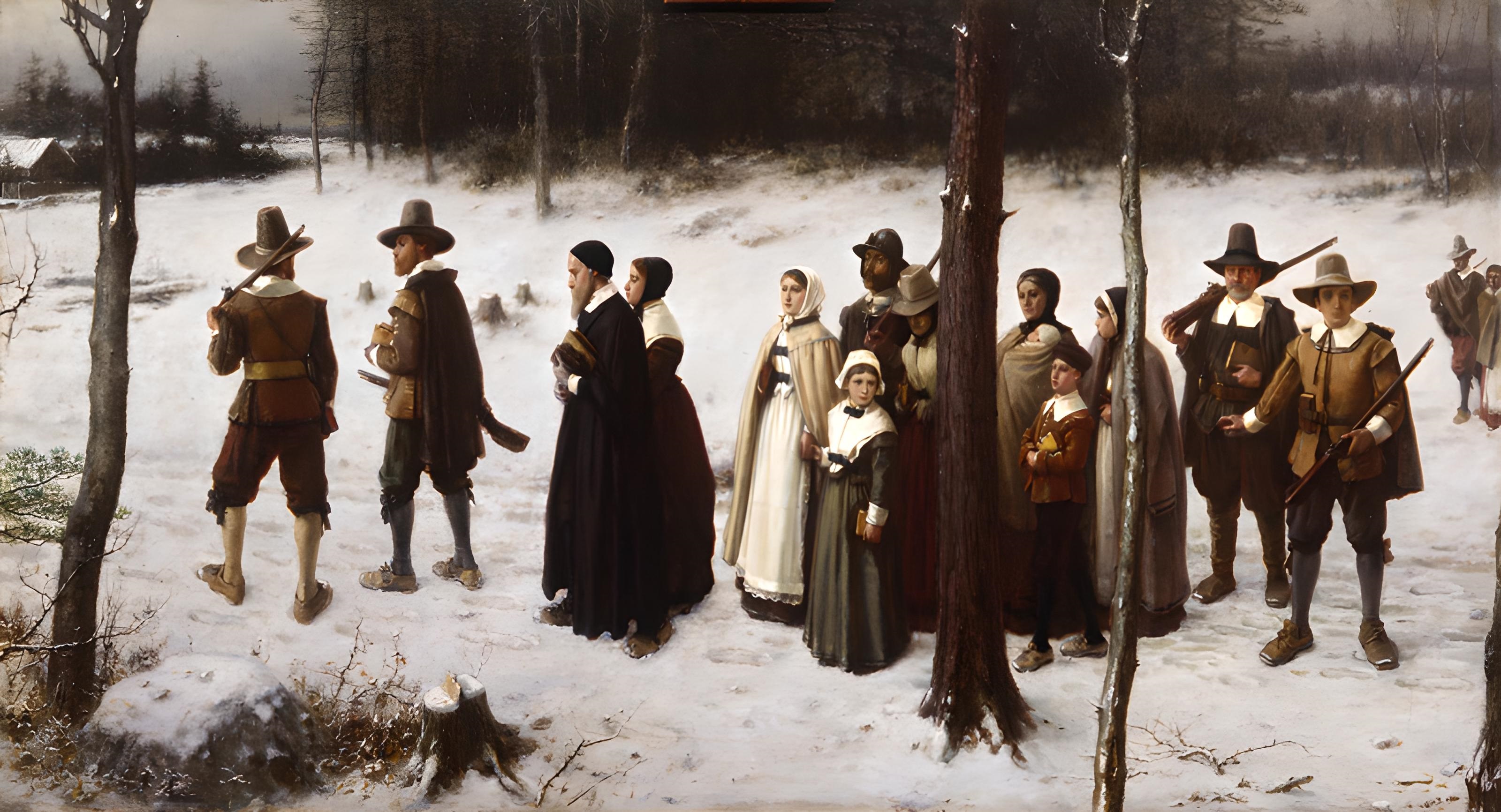
![George Henry Boughton - Pilgrims Going to Church][float-right] The founding of Jamestown in 1607 marked the beginning of permanent English settlement in North America, with the Virginia Company establishing the Church of England as the official religion among the initial 104 colonists, most of whom adhered to Anglican practices despite limited early ecclesiastical infrastructure.[8] This Anglican dominance extended southward, becoming the established church in Virginia by 1619 through legislative action by the House of Burgesses, which mandated attendance and funded clergy via taxes, shaping social and political life for nearly two centuries.[9] Similar establishments occurred in the Carolinas and Georgia, where Anglicanism served as a tool for colonial governance amid sparse settlement and tolerance for nonconformists in practice, though dissenters like Baptists faced occasional persecution.[10] In New England, Protestant dissent from the Church of England drove separatist and reformist migrations. The Pilgrims, a group of English Separatists numbering 102 aboard the Mayflower, arrived at Plymouth in 1620, enduring a harsh first winter that reduced their population before growth to approximately 160 by 1627; they organized autonomous congregational churches emphasizing covenant theology and biblical authority over episcopal hierarchy.[11][12] The subsequent Great Migration saw non-separatist Puritans found the Massachusetts Bay Colony in 1630 under John Winthrop, who envisioned it as a "city upon a hill" exemplifying reformed Protestantism; between 1629 and 1640, around 20,000 Puritans emigrated, establishing Congregationalist theocracies with strict enforcement of moral codes, church membership requirements for suffrage, and suppression of sects like Quakers and Antinomians.[13][14] Connecticut and New Haven colonies extended this Puritan model, prioritizing communal piety and education, as evidenced by Harvard College's founding in 1636 to train ministers.[10] Middle colonies reflected greater denominational pluralism rooted in non-English origins. New Netherland, settled by the Dutch from 1624, centered on the Reformed Church, a Calvinist body that dominated religious life through state support until English conquest in 1664, after which Dutch congregations persisted alongside emerging Presbyterians and Quakers.[15] William Penn, granted Pennsylvania in 1681, established a "holy experiment" for Quakers—Protestants emphasizing inner light and pacifism—promoting broad toleration for other Protestant groups while attracting 8,000 settlers by 1683, though proprietary governance balanced religious liberty with Quaker moral oversight.[16] Rhode Island, founded in 1636 by exiles Roger Williams and Anne Hutchinson, pioneered separation of church and state, hosting Baptists and diverse Protestants fleeing New England intolerance.[17] By 1776, Protestants comprised the overwhelming majority of the estimated 2.4 million colonists, with Anglican, Congregationalist, and Presbyterian adherents forming established communions that influenced law, education, and resistance to British policies, though regional variations fostered tensions between high-church Anglicans and low-church dissenters.[10][18] This era's settlements embedded Protestant voluntarism and covenantalism, precursors to disestablishment, amid empirical patterns of migration driven by European confessional conflicts rather than abstract ideals of universal tolerance.[19]Revivals and Institutional Growth (1776–1900)
Following the American Revolution, Protestant churches transitioned from established state religions to voluntary associations, prompting initial challenges in membership and funding amid secularizing influences and frontier expansion. Church affiliation stood at approximately 17% of the population in 1776, with Congregationalists, Presbyterians, Baptists, and Anglicans comprising the primary denominations, totaling around 3,228 congregations.[20][21] This low adherence reflected deism's appeal among elites and the disruptions of war, yet laid groundwork for revivalist resurgence as denominations adapted through itinerant preaching and lay involvement. The Second Great Awakening, spanning roughly 1795 to 1835, marked a pivotal revival wave, igniting mass conversions particularly among Methodists and Baptists in frontier regions like Kentucky and Tennessee. Early sparks included Presbyterian-led meetings under James McGready, culminating in the massive Cane Ridge Revival of August 1801, which drew over 10,000 attendees and featured emotional preaching, bodily manifestations, and camp meetings that popularized outdoor gatherings.[22] This movement emphasized personal conversion, free will, and moral reform, contrasting Calvinist predestination and fueling denominational expansion; Methodist membership surged from fewer than 5,000 in 1776 to over 250,000 by 1820, driven by circuit riders like Francis Asbury.[23] Overall church membership doubled between 1800 and 1835, with Baptists similarly proliferating through congregational autonomy and anti-establishment appeals.[23] Subsequent revivals sustained momentum into the mid-19th century. Charles Grandison Finney's campaigns from 1824 onward, centered in New York's "burned-over district," employed systematic techniques like prolonged meetings and anxious benches to provoke decisions for Christ, yielding an estimated 100,000 conversions in 1830 alone and influencing urban centers.[24] A nationwide prayer revival in 1857–1858, sparked by lay-led urban prayer unions, reportedly added 300,000 to 500,000 converts amid economic panic, reinforcing evangelical vigor without formal leadership. Later, Dwight L. Moody's urban crusades from the 1870s, including Chicago meetings drawing millions, integrated music by Ira Sankey and targeted working classes, converting hundreds of thousands and establishing institutions like the Moody Bible Institute in 1886.[25][26] Institutional growth paralleled these revivals, as denominations formalized structures to support expansion. Theological seminaries proliferated, including Princeton Theological Seminary (1812) for Presbyterians and Union Theological Seminary (1836) for interdenominational training, producing educated clergy amid rising literacy.[27] Missionary societies emerged, such as the American Board of Commissioners for Foreign Missions (1810), which by 1900 oversaw thousands of Protestant missionaries abroad, reflecting postmillennial optimism for global evangelization.[28] Domestic benevolence agencies, like the American Bible Society (1816), distributed millions of Scriptures, while voluntary associations funded church plants, reaching frontier settlements and industrial cities; by 1900, Protestant adherents exceeded 20 million, dominating the religious landscape.[29] This era's causal drivers—democratic access to scripture, anti-authoritarian ethos, and westward migration—propelled Protestantism from marginal post-revolutionary status to cultural hegemony, though schisms over slavery foreshadowed future fragmentations.Modernization and Diversification (1900–1945)
The period from 1900 to 1945 witnessed profound transformations in American Protestantism amid rapid industrialization, urbanization, and scientific advancements, prompting adaptations in theology, worship, and social engagement. Mainline denominations increasingly embraced modernist approaches, reconciling faith with higher criticism of the Bible and evolutionary theory, while evangelicals resisted these shifts, leading to internal divisions. Church membership across Protestant bodies expanded significantly, with the U.S. Census of Religious Bodies in 1906 recording approximately 20 million adherents, a figure that grew steadily through denominational mergers and missionary efforts despite immigration patterns favoring non-Protestant groups.[30][31] The Social Gospel movement exemplified Protestant modernization, urging clergy to address industrial-era ills like poverty, labor exploitation, and urban squalor through ethical reforms rather than solely personal conversion. Proponents, including figures like Walter Rauschenbusch, argued that realizing the kingdom of God required societal restructuring, influencing mainline leaders in Methodist, Baptist, and Presbyterian circles to advocate for progressive legislation such as child labor laws and workers' rights. This emphasis on immanent divine action over supernatural intervention marked a departure from earlier revivalist priorities, though critics contended it diluted doctrinal orthodoxy in favor of secular humanism.[32][33] Theological tensions culminated in the Fundamentalist-Modernist Controversy of the 1920s and 1930s, fracturing denominations like the Presbyterian Church in the United States of America over issues of biblical inerrancy, the virgin birth, and Darwinian evolution. Fundamentalists, defending core doctrines outlined in a 1910–1915 pamphlet series The Fundamentals, formed networks such as the World's Christian Fundamentals Association in 1919, while modernists gained institutional control in seminaries and boards, prompting fundamentalist withdrawals and the establishment of independent Bible institutes. High-profile events, including the 1925 Scopes Trial in Tennessee, highlighted these rifts, with modernists portraying fundamentalism as anti-intellectual, though fundamentalists viewed modernism as capitulation to cultural relativism.[34][35][36] Diversification accelerated with the emergence of Pentecostalism, ignited by the Azusa Street Revival in Los Angeles from 1906 to 1909 under African American preacher William J. Seymour, which emphasized glossolalia, healing, and Spirit baptism. This interracial, experiential movement spawned denominations like the Assemblies of God, organized in 1914 with initial growth from 300 to over 50,000 members by 1925, appealing to working-class and immigrant communities amid mainline formalism. By 1945, Pentecostal adherents numbered in the hundreds of thousands, fostering further fragmentation through Holiness offshoots and independent churches.[37][38] World War I (1917–1918) and World War II (1941–1945) influenced Protestant trajectories, with wartime mobilization promoting interfaith unity and boosting chapel attendance among troops, yet also exposing evangelicals to global missions and reinforcing premillennial eschatology amid perceived apocalyptic signs. Fundamentalists leveraged the conflicts to critique liberal pacifism and ecumenism, while mainline bodies supported federal chaplaincy programs and relief efforts, solidifying Protestantism's civic role without resolving underlying schisms. Overall, these decades entrenched a dual trajectory: modernist accommodation yielding institutional stability but membership stagnation in some mainline groups, contrasted by evangelical and Pentecostal vitality through doctrinal rigor and adaptive outreach.[39][40][41]Postwar Expansion and Fragmentation (1945–2000)
Following World War II, Protestant church membership in the United States experienced significant expansion, driven by a postwar religious revival amid economic prosperity, suburbanization, and the baby boom. Between 1945 and 1949 alone, the Southern Baptist Convention added 300,000 members, reflecting broader trends in evangelical growth fueled by migration to the Sun Belt states like California.[42] By the 1950s, mainline denominations such as Methodists, Lutherans, Presbyterians, and Episcopalians accounted for over 60% of Protestant affiliation, with overall church adherence peaking at around 60% of the population in 1958 according to Gallup polls.[43] This era saw a surge in church construction, with Protestant congregations building thousands of new facilities to accommodate suburban families, often supported by denominational funds and federal housing policies.[44] Evangelical Protestantism, in particular, expanded through mass evangelism and media outreach, exemplified by Billy Graham's crusades, which began in earnest after 1949 and drew millions to stadium events across the country. Graham's events, organized with interdenominational Protestant councils, resulted in over 2.2 million recorded conversions by the end of the century, modernizing evangelical outreach by integrating radio, television, and celebrity endorsements while distancing from fundamentalist isolationism.[45] This "new evangelicalism" fostered solidarity among conservatives, leading to institutions like the National Association of Evangelicals (founded 1942 but expanding postwar) and publications such as Christianity Today (launched 1956), which promoted doctrinal orthodoxy amid perceived mainline theological drift.[46] Pentecostal and charismatic movements also gained traction, with Assemblies of God membership rising from about 300,000 in 1945 to over 2 million by 2000, emphasizing spiritual gifts like glossolalia and healing, which appealed to working-class and immigrant communities.[47] Fragmentation accelerated from the 1960s onward, as theological divides over biblical inerrancy, social issues, and ecumenism prompted splits and membership shifts. Mainline denominations, adopting liberal theology on topics like scriptural criticism and civil rights, began declining sharply; for instance, the Presbyterian Church (U.S.A.) lost 30% of its members since 1960, while United Methodists saw similar drops attributed to internal debates over ordination and doctrine.[48] Conservatives often exited to form or join evangelical bodies, such as the Orthodox Presbyterian Church (splitting from mainline Presbyterians in the 1930s but gaining postwar adherents) or independent Bible churches, exacerbating denominational balkanization.[49] The rise of non-denominational congregations, which grew from niche post-1940s independents to thousands by century's end, reflected dissatisfaction with bureaucratic structures and a preference for autonomous, seeker-sensitive models often blending evangelical and charismatic elements. By 2000, these dynamics had reshaped Protestantism: evangelicals and Pentecostals comprised a growing share, with conservative Protestants outpacing mainline groups in adherence rates, while overall fragmentation led to over 200 distinct denominations and a proliferation of megachurches. This shift correlated with cultural upheavals—the 1960s counterculture eroded mainline cultural influence, while the 1970s "born-again" movement under figures like Graham bolstered evangelical visibility.[44] Empirical data from the period indicate that while total Protestant identification remained above 50% through the 1980s, internal realignments favored orthodox-leaning groups resistant to secular accommodations.[43] ![U.S. religious landscape trends from 1972 to 2010][center]Demographic Profile
Current Statistics and Composition (as of 2025)
As of the 2023-24 Pew Research Center Religious Landscape Study, Protestants comprise approximately 39% of U.S. adults, encompassing evangelical Protestants (23%), mainline Protestants (11%), and historically Black Protestants (5%).[50] This figure reflects a stabilization in the broader Christian population share, which has hovered around 60% since 2019 after prior declines.[1] Among Protestants, evangelicals form the largest subgroup, characterized by emphasis on biblical inerrancy and personal conversion experiences, while mainline groups tend toward more liberal theological orientations, and historically Black traditions maintain distinct cultural and historical roots tied to African American communities.[51] Demographic composition varies significantly across Protestant traditions. Evangelical Protestants are 70% White, 12% Hispanic, and 7% Black, with higher concentrations in the South (52%) and Midwest (21%).[52][53] Mainline Protestants are predominantly White (79%), with smaller Black (6%) and Hispanic (6%) shares, and are more evenly distributed regionally, though still elevated in the Midwest and Northeast.[52] Historically Black Protestants, comprising churches like the National Baptist Convention and Church of God in Christ, are overwhelmingly Black (over 90%) and concentrated in the South.[54] Baptists represent the largest denominational family overall, accounting for 12% of U.S. adults, followed by Methodists, Lutherans, and Presbyterians, though exact membership figures for individual bodies like the Southern Baptist Convention (the largest single Protestant denomination) have seen modest declines or stability amid broader non-denominational shifts often aligned with evangelicalism.[54][55]| Protestant Tradition | Share of U.S. Adults (%) | Key Demographic Notes |
|---|---|---|
| Evangelical | 23 | 70% White; 52% in South; includes many non-denominational congregations |
| Mainline | 11 | 79% White; more urban and educated |
| Historically Black | 5 | >90% Black; rooted in post-slavery institutions |
Longitudinal Trends and Causal Factors
Protestants constituted approximately 51% of the U.S. adult population in 2007, declining to 40% by 2023-2024, reflecting a broader contraction in Christian affiliation from about 78% in 2007 to 62% in the same period.[1] Within Protestantism, mainline denominations experienced sharper losses, falling from 18% to 11% of adults, while evangelicals decreased more modestly from 26% to 23%.[1] This trajectory marks the end of Protestant numerical dominance, which had persisted since the colonial era, with the share dropping below 50% around 2012.[4] Historical data indicate Protestants comprised over half of the population in the early 20th century, bolstered by high native birth rates and cultural establishment, but post-1960s shifts accelerated the downturn.[57] Causal factors include differential fertility rates, with mainline Protestants exhibiting 30-50% fewer births per woman compared to evangelicals, contributing to generational attrition.[58] Immigration since the 1965 Hart-Celler Act has disproportionately increased Catholic and non-Christian populations, as many newcomers from Latin America identify as Catholic and fewer as Protestant relative to historical European inflows.[59] Christian immigrants tend to be more Catholic or Orthodox and less Protestant than the native-born, diluting the overall Protestant proportion amid rising unaffiliated ("nones") at 7.3% growth from 2008-2018.[60] [61] Theological adaptation plays a key role in mainline decline, as accommodation to secular norms on issues like sexuality and biblical authority has eroded doctrinal distinctiveness, prompting member exodus to evangelical or non-denominational groups. Evangelicals, emphasizing biblical inerrancy, have shown higher retention (76% in 2023) despite overall decline, though white evangelicals fell from 33% in 1999 to 21% in 2021 due to aging demographics and cultural polarization.[7] [62] Secularization pressures—intensified by urbanization, education, and media—have unevenly affected groups, with mainline churches suffering from reduced authority as they aligned with progressive cultural shifts, while evangelical resilience stems from counter-cultural stances.[63] Recent data suggest the pace of Christian decline has slowed since 2014, potentially stabilizing Protestant shares amid persistent unaffiliated growth.[1]Denominational Branches
Reformed Traditions (Presbyterians, Reformed, Baptists)
The Reformed tradition within American Protestantism derives from the theology of John Calvin and the Swiss Reformation, stressing God's absolute sovereignty, total depravity, unconditional election, limited atonement, irresistible grace, and perseverance of the saints—collectively known as the five points of Calvinism, formalized at the Synod of Dort in 1618–1619.[64] Early adherents arrived with Scottish, Irish, and Dutch settlers in the colonial period; Presbyterians influenced education and governance through figures like John Witherspoon, a signer of the Declaration of Independence who served as Princeton's president from 1768 to 1794 and advocated republican principles rooted in covenant theology.[65] This tradition shaped American civic ideals, including federalism mirroring presbyterian assemblies, but faced fragmentation over slavery, modernism, and biblical inerrancy, leading to conservative-liberal divides in the 20th century. Presbyterianism, characterized by government through elected elders in regional presbyteries and synods, traces its organized U.S. presence to the 1706 formation of the Presbytery of Philadelphia from Scots-Irish immigrants. The Presbyterian Church in the United States of America (PCUSA), formed by mergers including the 1983 union of northern and southern branches, represents the mainline liberal strand with 1,094,733 members as of 2024, reflecting a 4% decline of 45,932 from prior years amid aging congregations (25% aged 56–70) and theological shifts toward progressive stances on ordination and social issues.[66] In contrast, the Presbyterian Church in America (PCA), founded in 1973 by conservatives departing the PCUS over perceived doctrinal erosion, reported 1.84% membership growth in 2024, reaching approximately 400,000 adherents across nearly 1,700 congregations, with increases in baptisms and giving signaling vitality in evangelical circles.[67][68] Continental Reformed churches, primarily of Dutch heritage, emphasize confessional standards like the Heidelberg Catechism (1563) and Belgic Confession (1561). The Reformed Church in America (RCA), established among New Netherland colonists in 1628 and formally incorporated in 1819, underwent a 2021 restructuring amid debates over biblical authority and LGBTQ+ inclusion, resulting in departures to form the Alliance of Reformed Churches; its membership has contracted from historical peaks, aligning with broader mainline trends.[69] The Christian Reformed Church in North America (CRCNA), splintered from the RCA in 1857 by stricter Calvinist immigrants opposing perceived leniency on issues like Masonic membership, maintains conservative orthodoxy with roots in the Dutch Secession of 1834, operating about 1,000 congregations focused on missions and education.[70][71] Baptist denominations within the Reformed orbit, often termed Particular or Reformed Baptists, affirm Calvinistic soteriology while practicing believer's baptism by immersion and congregational autonomy, diverging from paedobaptist Presbyterians and Reformed. Emerging from 17th-century English Separatists, the first U.S. Baptist church formed in Rhode Island in 1638 under Roger Williams, emphasizing religious liberty.[72] The Southern Baptist Convention (SBC), the largest U.S. Protestant body with under 13 million members in 2024, originated in 1845 from a split with northern Baptists over missionary support for slaveholders but reclaimed Calvinist emphases during the 1979–1990s Conservative Resurgence, prioritizing biblical inerrancy and evangelism.[73] The American Baptist Churches USA (ABCUSA), more moderate with roots in the 1907 Northern Baptist Convention, numbers around 1.1 million but exhibits slower growth compared to SBC counterparts adhering to Reformed doctrines.[64] These groups collectively wield influence in Southern and Midwestern strongholds, fostering institutions like seminaries and publishers that sustain confessional orthodoxy against secular pressures.Lutheran and Episcopal Traditions
The Lutheran tradition in the United States traces its origins to small German settlements in the 17th century, such as those in New York and Pennsylvania, but experienced significant growth through 19th-century immigration waves from Germany and Scandinavia.[74] The Lutheran Church–Missouri Synod (LCMS), founded in 1847 by conservative German immigrants emphasizing confessional orthodoxy, adheres to the inerrancy of Scripture, rejects women's ordination, and practices closed communion limited to those affirming Lutheran doctrine.[75] In contrast, the Evangelical Lutheran Church in America (ELCA), formed in 1987 through mergers of more moderate synods, permits women's ordination, interprets Scripture through historical-critical lenses, and engages in ecumenical partnerships that include doctrinal variances with non-Lutheran bodies.[76] As of 2025, the LCMS reports approximately 2 million baptized members across 6,000 congregations, while the ELCA claims about 2.68 million members in 8,386 congregations, though the latter has declined by over 40% since 1988 amid broader mainline Protestant trends.[74] Lutheran bodies have historically concentrated in the Midwest, with LCMS strongholds in Missouri and Wisconsin reflecting immigrant settlement patterns, and ELCA presence among Scandinavian-descended communities in Minnesota and the Dakotas. Theological divergences have led to separation: LCMS maintains fellowship only with confessional partners like the Wisconsin Evangelical Lutheran Synod, viewing ELCA's positions on issues such as homosexuality—affirmed for rostered leaders since 2009—as incompatible with biblical authority.[75] [77] ELCA's liberal trajectory correlates with accelerated membership loss, dropping over 2 million since formation, attributable to secularization, internal schisms, and reduced emphasis on doctrinal exclusivity.[78] The Episcopal tradition descends from the Church of England established in colonial Virginia in 1607, evolving into the Protestant Episcopal Church in the United States of America after the Revolutionary War severed ties with the British crown in 1789.[79] Positioned historically as a via media between Roman Catholicism and continental Protestantism, it retained liturgical and episcopal structures while adopting Reformation doctrines, though 20th-century shifts toward broad-church liberalism included ordaining women in 1976 and consecrating an openly gay bishop in 2003, prompting conservative departures to bodies like the Anglican Church in North America.[80] As of 2023, the Episcopal Church reports 1.55 million members in 6,754 congregations, reflecting a decline from over 3 million in the 1960s, with annual losses averaging 40,000 in recent years exacerbated by theological accommodation to cultural progressivism, diminished evangelism, and aging demographics.[81] [82] These patterns mirror mainline declines, where progressive stances on sexuality and authority have alienated traditionalists without offsetting gains from broader societal shifts.[83]| Denomination | Baptized Members (Recent) | Congregations | Key Theological Stance |
|---|---|---|---|
| LCMS | ~2 million (2025) | ~6,000 | Confessional, inerrantist |
| ELCA | ~2.68 million (2024) | 8,386 | Historical-critical, ecumenical |
| Episcopal | 1.55 million (2023) | 6,754 | Broad church, progressive |
Methodist, Wesleyan, and Holiness Movements
Methodism arrived in the American colonies through the efforts of John and Charles Wesley in the 1730s, but its organized growth accelerated after Francis Asbury's arrival from England in 1771, where he remained for 45 years, organizing circuits, appointing preachers, and presiding over annual conferences despite the Revolutionary War's disruptions.[84] Asbury, often called the father of American Methodism, traveled over 270,000 miles on horseback, adapting Wesley's itinerant system to frontier conditions and emphasizing lay preaching and class meetings, which fueled rapid expansion from fewer than 1,000 adherents in 1770 to more than 250,000 by 1820.[85] [86] The 1784 Christmas Conference in Baltimore formally established the Methodist Episcopal Church as independent from British oversight, with Asbury elected as one of two superintendents (later bishops), marking Methodism's institutionalization amid the new republic.[87] The denomination split in 1844 over slavery, forming the Methodist Episcopal Church, South, while the northern branch retained the original name; post-Civil War reunification efforts culminated in the 1939 merger creating The Methodist Church, which united with the Evangelical United Brethren in 1968 to form the United Methodist Church (UMC), the largest Methodist body in the U.S.[88] By the mid-19th century, Methodism's emphasis on personal piety, Arminian theology, and social reform—rooted in Wesley's doctrines of prevenient grace and sanctification—positioned it as a dominant Protestant force, peaking at around 11 million U.S. members in the 1960s before declines linked to theological liberalization and cultural shifts.[89] As of 2023, UMC U.S. membership stood at approximately 5.4 million, reflecting a 21.9% drop that year amid disaffiliations by over 7,600 congregations—about one-quarter of its churches—primarily over disputes regarding biblical authority on human sexuality and ordination standards.[90] [91] Parallel to mainline Methodism, the Wesleyan and Holiness movements emerged as conservative renewals emphasizing Wesley's teaching of "entire sanctification" or Christian perfection—a second work of grace eradicating the sin nature post-conversion. The Holiness movement gained traction in the 1830s through Phoebe Palmer's "altar theology" and New York Tuesday Meetings, spreading via camp meetings and promoting a crisis experience of holiness amid perceived doctrinal laxity in mainstream Methodism.[92] By the 1880s, it prompted schisms, birthing denominations like the Free Methodist Church (1860), which opposed Freemasonry and pew rents, and the Church of the Nazarene (1908), focused on urban missions and global evangelism.[93] The Wesleyan Methodist Church, founded in 1843 by abolitionists Orange Scott and Luther Lee as a protest against slavery and episcopal hierarchy, upheld holiness standards and rejected secret societies, merging in 1968 with the Pilgrim Holiness Church—itself a 1897 offshoot emphasizing premillennialism and divine healing—to form The Wesleyan Church, which maintains about 120,000 U.S. members today and prioritizes scriptural holiness over ecumenical compromise.[94] These movements collectively preserved Methodist distinctives like assurance of salvation and holy living, influencing later Pentecostal developments while critiquing mainline drifts toward social gospel emphases at the expense of personal regeneration.[95]Pentecostal, Charismatic, and Non-Denominational Growth
The Pentecostal movement originated in the United States with the Azusa Street Revival, which began on April 9, 1906, in Los Angeles under the leadership of William J. Seymour, an African American preacher. This event, characterized by speaking in tongues, healing, and interracial worship, marked the birth of modern Pentecostalism, spreading rapidly through Holiness networks and establishing denominations like the Assemblies of God in 1914.[96][97] By the mid-20th century, Pentecostals numbered in the millions, emphasizing the baptism of the Holy Spirit evidenced by glossolalia as a post-conversion experience distinct from classical Pentecostalism's Wesleyan roots.[98] The Charismatic Renewal emerged in the 1960s, extending Pentecostal experiences into mainline Protestant and Catholic churches, beginning with Episcopalian Dennis Bennett's announcement of his Spirit baptism in 1960. This movement, peaking in the 1970s and 1980s, fostered neo-charismatic groups outside strict Pentecostal denominations, with U.S. Pentecostals and Charismatics growing from 13.8 million in 1970 to 65 million by 2020, comprising about 25% of American Christians.[99][100] Despite overall Protestant declines, Pentecostal and charismatic churches reported continued attendance growth post-2020, attributed to experiential worship and adaptability to cultural shifts.[101] Non-denominational churches, often evangelical with charismatic influences, have surged since the 1990s, reflecting dissatisfaction with bureaucratic denominations and a preference for autonomous, market-driven congregations. By 2020, non-denominational attendance rose by 6.5 million from 2010 levels, representing 7% of U.S. adults in 2025 per Pew Research, many aligning with Pentecostal emphases on personal encounter and prosperity teachings.[102][54] This growth correlates with the fastest-expanding U.S. churches being non-denominational megachurches, sustaining evangelical Protestantism at 23% of adults amid broader Christian erosion.[103][1]Theological and Ideological Divisions
Mainline Protestantism: Liberal Theology and Ecumenism
Mainline Protestantism encompasses historic denominations such as the United Methodist Church, Presbyterian Church (USA), Episcopal Church, Evangelical Lutheran Church in America, and American Baptist Churches USA, which by the mid-20th century had largely embraced liberal theology as a response to modern intellectual challenges.[104] Liberal theology, emerging in the United States during the late 19th century, sought to reconcile Christianity with scientific advancements like Darwinian evolution and biblical higher criticism, prioritizing religious experience and ethical imperatives over supernatural doctrines and scriptural inerrancy.[105] This shift was influenced by figures such as Horace Bushnell, who in the 1840s emphasized Christian nurture over abrupt conversion experiences, and later Harry Emerson Fosdick, whose 1920s sermons advocated adapting doctrine to contemporary knowledge while questioning traditional views of miracles and hell.[106] By the 1930s, liberal theologians had gained control of mainline seminaries and denominational structures, promoting a "Social Gospel" that focused on societal reform—such as labor rights and anti-poverty efforts—over personal salvation or eschatology.[104] Reinhold Niebuhr, a prominent mid-20th-century thinker in this tradition, critiqued naive optimism in liberal Protestantism but reinforced its emphasis on realism in ethics and politics, influencing mainline engagement with issues like civil rights.[107] These developments often involved demythologizing biblical narratives, viewing them as symbolic rather than historical, which eroded doctrinal distinctiveness and appealed to educated urban elites but alienated those seeking orthodox certainties.[108] Ecumenism became a hallmark of mainline Protestantism, aiming to transcend denominational divisions through cooperative structures. The Federal Council of Churches, formed in 1908 by uniting 33 denominations, laid groundwork for broader unity, evolving into the National Council of Churches in 1950, which included most mainline bodies and focused on joint social witness.[109] This movement facilitated mergers, such as the 1988 formation of the United Church of Christ from Congregational and Evangelical Reformed traditions, and emphasized interfaith dialogue, though it sometimes prioritized institutional harmony over theological rigor.[110] Ecumenical efforts peaked post-World War II, with mainline leaders advocating global cooperation via the World Council of Churches (joined by many U.S. denominations in the 1940s-1950s), but critics argue it fostered relativism, diluting Protestant identity amid rising pluralism.[111] The adoption of liberal theology correlates with mainline decline, as membership in these denominations fell from a 1965 peak of approximately 31 million adherents—about 15-18% of the U.S. population—to around 11% by 2024, per Pew Research data.[112] [113] Specific drops include the United Methodist Church, which lost 31% of members from 1990 to 2020, and the Episcopal Church, down 36% in the same period.[114] Empirical analyses attribute this not merely to broader secularization but to theological accommodation: by mirroring cultural shifts on issues like sexuality and biblical authority, mainline churches forfeited evangelistic appeal, contrasting with evangelical growth through doctrinal fidelity.[115] [116] While some studies cite fertility rates or suburbanization as factors, causal evidence points to liberalism's erosion of supernatural claims and exclusivity, rendering it less compelling in a competitive religious marketplace.[117] Mainline responses, such as progressive stances on ordination and social justice, have accelerated exits to conservative alternatives, underscoring how prioritizing relevance over transcendence undermines institutional vitality.[118]Evangelicalism: Biblical Inerrancy and Personal Conversion
Evangelicalism in the United States, emerging prominently in the post-World War II era, prioritizes the authority of Scripture as the inerrant word of God and insists on a transformative personal conversion experience as essential to authentic Christian faith. This dual emphasis distinguishes evangelicals from mainline Protestants, who often adopt more flexible interpretive approaches to the Bible and a gradualist view of spiritual growth. Biblical inerrancy holds that the original autographs of Scripture contain no errors in matters of history, science, theology, or morality, serving as the unchanging foundation for doctrine and conduct.[119] Personal conversion, often termed the "born again" experience, involves a decisive, supernatural encounter with Christ through the Holy Spirit, marking a shift from spiritual death to new life in faith, repentance, and obedience.[120] The doctrine of biblical inerrancy gained formal articulation in American evangelical circles amid 20th-century challenges from modernism and higher criticism, which questioned scriptural reliability. In response, over 200 evangelical scholars and leaders convened in Chicago in October 1978 for the International Council on Biblical Inerrancy summit, producing the Chicago Statement on Biblical Inerrancy. This document affirms that "Scripture in its entirety is inerrant, being free from falsehood, fraud, or deceit" and denies any limitation of inerrancy to merely redemptive themes, extending it to all propositional claims.[121] Signatories, including J.I. Packer and R.C. Sproul, viewed inerrancy as a recovery of historic Protestant orthodoxy, countering trends toward biblical errancy within seminaries like those affiliated with the National Association of Evangelicals.[122] By the 1980s, adherence to inerrancy became a litmus test for evangelical institutions, influencing organizations such as the Southern Baptist Convention's 2000 Baptist Faith and Message revision, which explicitly endorses the Bible's truthfulness without error.[123] Complementing inerrancy, the evangelical commitment to personal conversion underscores an individualistic piety rooted in passages like John 3:3, where Jesus declares one must be "born again" to see the kingdom of God. This conversionism, as historian David Bebbington identifies in his quadrilateral framework for evangelicalism, entails the belief that individuals require a definite turning from sin to Christ, often accompanied by a crisis moment of conviction and assurance rather than mere cultural affiliation or infant baptism.[124] In the U.S. context, this emphasis fueled revival movements, with figures like Billy Graham preaching to millions in the 1950s–1970s, urging hearers to make a public decision for Christ; Graham's crusades resulted in over 3 million recorded conversions by 2005.[125] Evangelicals maintain that true conversion produces visible fruit, such as ethical transformation and evangelism, distinguishing it from nominal Christianity prevalent in some Protestant traditions.[126] These tenets interconnect causally: inerrancy provides the authoritative basis for evangelism's call to repentance, as evangelicals derive the necessity of personal regeneration directly from unerring biblical texts like Romans 10:9–10 and Ephesians 2:8–9. Surveys indicate that among U.S. evangelicals, 90% affirm the Bible's total accuracy, correlating with high rates of reported born-again experiences—55% of white evangelicals in a 2020 Pew study described such a pivotal spiritual moment.[127] This framework has sustained evangelical growth, comprising about 25% of the U.S. population in recent estimates, though internal debates persist over interpretive methods like accommodation to cultural shifts.[119]Fundamentalism: Separation from Modernity and Cultural Engagement
Fundamentalism emerged within American Protestantism in the late 19th and early 20th centuries as a defensive response to theological modernism, which included higher biblical criticism, Darwinian evolution, and liberal adaptations of doctrine to contemporary culture. Proponents, drawing from conservative evangelical roots, emphasized the absolute authority and inerrancy of Scripture against perceived dilutions in mainline denominations. This movement coalesced around key affirmations articulated at conferences like the Niagara Bible Conference (1878–1897), which outlined five "fundamentals": the inerrancy of the Bible, the deity of Jesus Christ, his virgin birth, his substitutionary atonement for sin, and his bodily resurrection and second coming. These tenets were further popularized through The Fundamentals, a 12-volume series published between 1910 and 1915, funded by oil magnate Lyman Stewart and distributed free to clergy and educators to counter modernist encroachments.[128][129][130] Central to fundamentalism was a commitment to separation from modernist influences, encompassing doctrinal purity, ecclesiastical independence, and personal holiness. Theologically, fundamentalists rejected higher criticism's view of the Bible as a human document subject to error, insisting instead on its divine inspiration and literal historicity. Ecclesiastically, this led to schisms in the 1920s and 1930s, such as the formation of the Orthodox Presbyterian Church in 1936 under J. Gresham Machen, who opposed liberal control of Princeton Theological Seminary. Fundamentalists advocated "secondary separation"—withdrawing not only from overt apostasy but also from fellow evangelicals deemed insufficiently militant against compromise. Personally, this manifested in cultural separatism, prohibiting practices like dancing, theater attendance, and alcohol consumption to avoid worldly corruption, as outlined in institutional codes at Bible colleges like Bob Jones University, founded in 1927. By the 1930s, amid defeats like the Scopes Trial (1925), many fundamentalists adopted a separatist posture, establishing independent churches, missions agencies, and institutions to preserve orthodoxy insulated from broader Protestant ecumenism.[128][131][130] Despite this separatist ethos, fundamentalism involved selective cultural engagement to contend for biblical truth in public spheres. Early militants like William Bell Riley, through the World's Christian Fundamentals Association (founded 1919), actively opposed evolution in schools and promoted prohibition, reflecting a view of Christianity as a force against societal moral decay. Post-World War II, while some retreated into isolationism, others engaged via evangelism and anti-communist efforts, with figures like Billy James Hargis mobilizing against perceived secular threats in the 1950s–1960s. This tension—separation for purity versus confrontation to reclaim culture—distinguished fundamentalism from neo-evangelicalism, which, under leaders like Carl F. H. Henry, sought broader alliances and intellectual dialogue starting in the 1940s. Fundamentalists critiqued such engagement as compromising, prioritizing visible separation as the biblical mandate for witness, as articulated in 2 Corinthians 6:14–18. Yet, their establishment of over 100 Bible institutes and seminaries by the mid-20th century facilitated indirect influence on education and missions, training thousands for ministry outside modernist structures.[132][128][133]Cultural and Institutional Impacts
Foundations of American Civic Life and Liberty
![George Henry Boughton - Pilgrims Going to Church][float-right] The Mayflower Compact of November 11, 1620, signed by 41 male passengers aboard the ship, established the first framework for self-government in the English colonies by forming a "civil body politic" through mutual covenant, deriving authority from the consent of the governed and divine sanction rather than monarchical grant.[134] This document reflected Separatist Protestant principles of voluntary association and congregational autonomy, modeling political governance on ecclesiastical covenants where authority stemmed from the people under God.[135] Puritan settlers in New England extended these ideas, enacting covenant-based constitutions in Massachusetts (1629) and Connecticut (1639), which emphasized limited government, rule of law, and communal obligations rooted in biblical federal theology.[136] These Protestant foundations influenced the ideological underpinnings of American independence, as covenant theology paralleled social contract theory by positing that legitimate authority required explicit agreement and accountability to higher moral law.[137] During the American Revolution, Protestant clergy, particularly from Reformed traditions, provided scriptural justification for resistance to perceived tyranny, framing liberty as a divine endowment and the rejection of arbitrary rule as a religious duty, with sermons invoking Old Testament covenants and the Reformation's emphasis on individual conscience.[138] By 1776, this rhetoric permeated the Declaration of Independence, which asserted natural rights endowed by the Creator, echoing Protestant views of human dignity derived from God's image rather than state conferral.[139] Dissenting Protestant groups, including Baptists and Quakers, advanced religious liberty by advocating disestablishment of state churches, arguing that coerced faith corrupted true piety and that voluntary profession of belief was essential to civic virtue.[140] Their experiences of persecution in England and early colonies fostered demands for separation of ecclesiastical and civil powers, culminating in the First Amendment's prohibitions on federal establishment of religion and infringement on free exercise, ratified in 1791.[141] This framework preserved Protestant pluralism, enabling diverse denominations to contribute to a civic order grounded in moral accountability to God over human rulers, thereby sustaining liberties against both ecclesiastical overreach and governmental absolutism.[142]Influence on Education, Work Ethic, and Innovation
Protestant settlers, particularly Puritans in New England, prioritized literacy to enable personal Bible reading and interpretation, establishing early educational systems grounded in religious imperatives. The Massachusetts Bay Colony's 1647 Old Deluder Satan Act mandated that towns with 50 or more families hire a reading instructor for youth, explicitly to counteract Satan's strategy of biblical ignorance and ensure scriptural comprehension for moral guidance.[143] This reflected a causal link between sola scriptura doctrine and mass education, as Puritans viewed direct access to scripture as essential for salvation and societal order, resulting in New England literacy rates of approximately 60-70% by 1660, surpassing contemporaneous European averages.[144] Colonial colleges reinforced this: Harvard, founded in 1636 by Congregationalists, aimed to train clergy and prevent doctrinal apostasy, while subsequent institutions like Yale (1701) and Princeton (1746) followed suit under Presbyterian influence, embedding Protestant theology in curricula until the 19th century.[145] Of the nine pre-Revolutionary colleges, eight were Protestant-founded, fostering a tradition where education served religious ends but laid foundations for broader intellectual inquiry.[146] The Protestant work ethic, as theorized by Max Weber in The Protestant Ethic and the Spirit of Capitalism (1905), posited that Calvinist doctrines of predestination and worldly asceticism transformed labor into a divine calling, promoting disciplined accumulation and reinvestment over consumption.[147] In the American context, this manifested among Puritan and Reformed communities, where success in vocation signaled potential election, evidenced by higher savings rates and entrepreneurial activity in Protestant-dominated regions; for instance, 19th-century New England textile mills and Midwestern farms exhibited productivity tied to these values, contributing to U.S. GDP growth from $1.1 billion in 1800 to $13.3 billion by 1860 (in 1830 dollars).[148] Empirical analyses, such as those revisiting Weber's hypothesis, confirm a positive association between Protestant adherence and economic outcomes in historical U.S. data, though mediated partly by education rather than ethic alone—Protestant counties in 1900 showed 10-15% higher per capita income linked to schooling emphasis.[149] Critics note that Catholic regions later converged, suggesting cultural transmission over inherent doctrine, yet the initial Protestant impetus shaped America's ethic of industriousness, with surveys indicating self-identified Protestants reporting stronger work orientations into the 20th century.[150] This dual foundation in education and diligence spurred innovation, as Protestant individualism—rooted in personal accountability to God—encouraged empirical questioning and application of knowledge. Studies attribute 20-30% of cross-regional variation in U.S. patent rates (1850-1920) to Protestant human capital advantages, with New England issuing over 40% of national patents despite comprising 10% of population, driven by literacy-fueled technical education and risk-tolerant entrepreneurship.[151] For example, the rise of mechanized agriculture and manufacturing in Protestant heartlands correlated with theological views valuing dominion over creation through rational mastery, as seen in inventors like Cyrus McCormick (Presbyterian), whose 1831 reaper revolutionized farming output.[152] While secularization diluted direct ties post-1900, residual effects persist: econometric models show Protestant cultural legacies explaining up to 15% of state-level innovation disparities today, underscoring causal realism in how doctrinal priors seeded institutional habits favoring experimentation over tradition.[153] Mainline Protestant decline has not erased this, as evangelical subsets maintain emphases on stewardship and progress aligning with inventive pursuits.[154]Social Reforms: Moral Progress versus Doctrinal Compromise
Protestant-led movements in the 19th century, fueled by the Second Great Awakening from the 1790s to the 1840s, drove key social reforms grounded in evangelical interpretations of scripture emphasizing personal morality and communal righteousness. Abolitionism, propelled by Protestant denominations including Methodists, Baptists, and Quakers, mobilized against slavery as a moral evil, with organizations like the American Anti-Slavery Society—founded in 1833 by evangelical reformers—petitioning Congress and influencing public opinion toward the 13th Amendment's ratification in 1865.[155] The temperance movement, similarly rooted in Protestant moral suasion, saw the American Temperance Society form in 1826, enlisting over 1 million members by 1835 to combat intemperance as a societal sin, ultimately contributing to the 18th Amendment's enactment in 1919 despite its later repeal.[156] These efforts advanced moral progress by curbing vices and expanding human dignity, aligning American institutions more closely with biblically derived ethics of justice and self-control. The Social Gospel movement emerging in the late 19th century among urban mainline Protestants reframed reform as collective redemption through social engineering, prioritizing systemic inequities over individual sin and atonement. Proponents like Walter Rauschenbusch, in his 1907 work Christianity and the Social Crisis, advocated applying Christian ethics to industrial capitalism and urbanization, influencing Progressive Era policies such as child labor laws and settlement houses.[157] This shift yielded tangible gains, including labor protections and urban sanitation improvements, but often subordinated doctrinal orthodoxy to pragmatic adaptation, incorporating secular tools like sociological analysis and evolutionary optimism about human perfectibility. This emphasis on moral evolution precipitated doctrinal compromise, as mainline theologians embraced higher criticism—questioning biblical historicity—and theistic evolution, viewing scripture as inspirational rather than infallible. The 1920s modernist-fundamentalist schism highlighted the rift, with liberals in denominations like the Presbyterians and Northern Baptists defending doctrinal flexibility to engage modernity, while fundamentalists insisted on scriptural inerrancy and separated to safeguard purity.[158] [159] Evangelicals, by contrast, sustained social engagement—such as anti-communist efforts post-World War II—without yielding core tenets like substitutionary atonement, demonstrating that moral advocacy need not entail theological dilution. Mainline accommodations, however, correlated with eroded adherence to historic creeds, as evidenced by lower endorsement of doctrines like the virgin birth among their clergy compared to evangelicals.[160][161]Political Dimensions
Historical Role in Nation-Building and Governance
Protestant settlers played a foundational role in establishing the American colonies, with groups such as the Pilgrims arriving in Plymouth in 1620 and Puritans founding the Massachusetts Bay Colony in 1630, driven by desires for religious liberty from European persecution and to build societies governed by biblical principles.[17] These early communities implemented governance structures like the Mayflower Compact of 1620, which reflected covenantal theology derived from Reformed Protestant traditions, emphasizing self-government and consent of the governed among male church members.[162] By the mid-17th century, Protestant denominations including Anglicans in Virginia (from 1607) and Congregationalists dominated colonial religious life, enforcing laws aligned with Protestant moral codes, such as Sabbath observance and restrictions on non-Protestants, which shaped local civic institutions.[10] During the American Revolution (1775–1783), Protestant clergy and congregations provided ideological and material support, framing resistance to British rule through sermons invoking Protestant concepts of tyranny's opposition as a divine duty, with over 2,000 ministers preaching on the conflict's religious dimensions.[163] This contributed to nation-building by fostering a unified Protestant-infused national identity, evident in state constitutions post-1776 that often required Protestant oaths for officeholders, such as in Pennsylvania and Massachusetts.[164] At the federal level, the 1787 Constitutional Convention saw one-third of signers affiliated with Presbyterian churches and many others influenced by Anglicanism, embedding Protestant-derived principles like limited government and individual rights rooted in Reformation emphases on personal responsibility before God.[165] In early U.S. governance, Protestantism dominated leadership, with nearly all presidents from George Washington (Episcopalian, 1789–1797) through the 19th century identifying as Protestant, including major denominations like Episcopalians (11 presidents) and Presbyterians (7 by 1900), reflecting the faith's numerical and cultural preponderance in Congress where Protestant representatives held supermajorities.[166] [167] This influence extended to policies promoting moral governance, such as the 1782 Northwest Ordinance's encouragement of "religion, morality, and knowledge" as essential to good government, drawing directly from Protestant educational and ethical frameworks that prioritized literacy for Bible reading and civic virtue.[168] While the First Amendment (1791) prohibited federal establishment of religion to accommodate diverse Protestant sects, the absence of state churches until the 1830s in places like Massachusetts underscored Protestantism's de facto role in sustaining republican institutions through voluntary associations and ethical norms, rather than coercive theocracy.[169]20th-Century Mobilization: Prohibition, Civil Rights, and Anti-Communism
Protestants spearheaded the Prohibition movement as a moral crusade against alcohol's perceived role in societal decay, culminating in the ratification of the 18th Amendment on January 16, 1919, which banned the manufacture, sale, and transportation of intoxicating liquors nationwide effective January 17, 1920.[170] The Anti-Saloon League, established in 1893 and backed by evangelical and mainline Protestant churches including Methodists, Baptists, and Presbyterians, employed nonpartisan pressure politics to lobby legislators, framing saloons as hubs of vice that undermined family stability and Christian virtue.[170] [171] This mobilization drew on 19th-century temperance societies and revivalism, uniting diverse Protestant factions in a rare ecumenical effort despite underlying theological differences.[172] Protestant engagement with the Civil Rights Movement of the 1950s and 1960s revealed sharp denominational divides. Mainline Protestants, shaped by Social Gospel theology emphasizing structural reform, endorsed desegregation; for instance, clergy from denominations like the United Church of Christ and Episcopal Church joined marches in Selma, Alabama, in 1965 and lobbied for the Civil Rights Act of 1964.[173] In opposition, the majority of white evangelical Protestants, especially Southern Baptists and independents, resisted federal intervention, maintaining segregated churches and schools while arguing that racial issues required voluntary change rooted in personal conversion rather than government mandates, often citing biblical interpretations favoring separation.[174] [175] This stance reflected evangelical prioritization of individual salvation and doctrinal separation over collective social action, contributing to limited institutional support despite isolated figures like Billy Graham desegregating crusades by 1953.[174] Amid Cold War tensions, conservative Protestants framed anti-communism as a spiritual defense against atheistic totalitarianism, mobilizing through preaching, publications, and organizations that equated Soviet ideology with Antichrist forces.[176] Evangelist Billy Graham, in his 1949 Los Angeles crusade and subsequent sermons, condemned communism as inherently anti-Christian, declaring it a battle between Christ and anti-Christ, which amplified evangelical alignment with U.S. foreign policy against the USSR.[177] The Christian Anti-Communism Crusade, launched in 1956 by Australian-born physician Fred Schwarz, hosted annual schools attended by thousands, including politicians, to dissect communist strategies and promote Christian alternatives, peaking with events like the 1964 Dallas rally featuring Ronald Reagan.[178] This effort, rooted in fundamentalist networks, bolstered Protestant influence in conservative coalitions by linking faith, patriotism, and vigilance against perceived internal subversion.[179]Contemporary Alliances: Culture Wars, Elections, and Policy Influence
In the late 20th and early 21st centuries, conservative Protestants, particularly white evangelicals comprising about 14% of the U.S. population, formed enduring alliances with the Republican Party, prioritizing opposition to abortion, same-sex marriage, and perceived encroachments on religious liberty in the culture wars.[180] This coalition, solidified during Ronald Reagan's 1980 campaign through organizations like the Moral Majority, emphasized judicial appointments and legislative protections for traditional family structures over candidates' personal moral conduct.[181] By the 2010s, evangelical leaders such as Franklin Graham and Robert Jeffress endorsed Republican platforms explicitly linking biblical inerrancy to policy stances against gender ideology in schools and federal mandates on contraception.[182] Electoral data underscores this alignment's potency. In the 2020 presidential election, 80% of white evangelicals voted for Donald Trump, a figure rising to approximately 81% in 2024, contributing to his victory as Christians overall formed 72% of the electorate and favored him by wide margins.[183] Exit polls from NBC News confirmed white evangelical support for Trump at 82% in 2024, driven by priorities like restoring Roe v. Wade's overturn via Dobbs v. Jackson (2022) and countering secular curricula.[184] Mainline Protestants, by contrast, leaned Democratic, with only 38% supporting Trump in 2024, highlighting intra-Protestant divides where evangelicals' bloc voting amplified influence despite demographic decline.[185] Post-2024 analyses from Pew Research indicate sustained evangelical backing into Trump's second term, with 70% of Republicans identifying as white Christians.[186][187] Policy influence manifests through advocacy groups like the Family Research Council and Alliance Defending Freedom, which lobbied for state-level abortion restrictions post-Dobbs, resulting in 14 states enacting near-total bans by 2023.[188] Evangelicals also shaped Republican platforms on education, securing expansions of school choice vouchers in 10 states by 2024 to counter public school teachings on sexual orientation and gender identity, as evidenced by Florida's 2022 Parental Rights in Education law.[189] On religious liberty, Protestant coalitions influenced the 2017 Tax Cuts and Jobs Act's protections for faith-based organizations and Supreme Court rulings like Fulton v. City of Philadelphia (2021), prioritizing exemptions from LGBTQ nondiscrimination mandates.[190] These efforts reflect a strategic focus on institutional power, with evangelicals crediting GOP alliances for three conservative Supreme Court justices appointed 2017-2020, enabling Dobbs.[191] Despite criticisms from secular sources of authoritarian tendencies, empirical outcomes demonstrate causal efficacy in policy shifts toward restricting elective abortions and affirming binary sex definitions in law.[192]Challenges, Controversies, and Future Trajectories
Internal Schisms: Doctrinal Purity versus Inclusivism
The Fundamentalist–Modernist Controversy of the 1920s and 1930s marked a pivotal internal schism in American Protestantism, pitting advocates of doctrinal purity—emphasizing biblical inerrancy, the virgin birth of Christ, substitutionary atonement, and miracles—against modernists who sought greater inclusivism by accommodating higher biblical criticism, evolutionary theory, and social gospel priorities over strict orthodoxy.[35] This conflict led to enduring denominational fractures, such as the 1936 formation of the Orthodox Presbyterian Church from the Presbyterian Church in the USA, where J. Gresham Machen and others prioritized confessional fidelity amid perceived liberal encroachments.[130] Similarly, Northern Baptists experienced divisions, with conservatives forming the General Association of Regular Baptist Churches in 1932 to preserve fundamentalist tenets against modernist influences in seminaries and missions boards.[36] These early schisms established a pattern where groups upholding doctrinal purity often separated to maintain theological boundaries, while inclusivist factions retained institutional structures but faced subsequent membership erosion. In the Presbyterian tradition, the 1973 split birthed the Presbyterian Church in America (PCA) from the Presbyterian Church in the United States (PCUS), driven by disputes over biblical authority, women's ordination, and ecumenical ties; the PCA grew to over 1,900 congregations by 2023, contrasting with steeper declines in the merged Presbyterian Church (USA).[193] Evangelical denominations emphasizing purity, such as the Lutheran Church–Missouri Synod (LCMS), have similarly resisted inclusivist shifts, rejecting higher criticism and maintaining separation from liberal bodies like the Evangelical Lutheran Church in America (ELCA).[194] Contemporary manifestations center on sexuality and ordination, exacerbating divides between purity-oriented conservatives and inclusivist progressives. The United Methodist Church (UMC) underwent a major schism from 2019 to 2024, with over 7,500 conservative congregations departing after the 2024 General Conference lifted bans on gay clergy and same-sex marriages, forming the Global Methodist Church or independents to uphold traditional doctrines on marriage and sexuality.[195][196] Prior UMC membership stood at 6.4 million in the US by 2023, down from 7.7 million a decade earlier, with exits accelerating amid these policy reversals.[195] Analogous tensions in the Episcopal Church prompted the 2008 Anglican Church in North America formation, rejecting same-sex blessings affirmed by the more inclusive Episcopal body since 2003.[197] Empirical trends underscore the schism's consequences: mainline Protestant denominations, often aligned with inclusivism, declined from 18% of US adults in 2007 to 11% in 2024, per Pew Research Center data, while evangelical Protestants—prioritizing doctrinal rigor—held at 23%, comprising a larger Protestant share despite overall Christian shrinkage.[54][4] This divergence suggests that inclusivist adaptations correlate with retention challenges, as conservative bodies like the Southern Baptist Convention (peaking at 16.3 million members in 2006 but stabilizing post-purity-focused reforms) exhibit greater resilience against secular drift compared to mainline peers.[1] Such patterns reflect causal pressures from cultural accommodation eroding core identity, though both sides invoke scriptural fidelity to justify positions.[112]External Pressures: Secularism, Immigration, and Interfaith Dynamics
Secularism has exerted significant pressure on Protestantism in the United States through rising rates of religious disaffiliation, particularly among younger generations. According to Pew Research Center's 2023-24 Religious Landscape Study, evangelical Protestants comprise 23% of U.S. adults, down from 26% in 2007, while mainline Protestants account for 11%, a decline from 18% over the same period.[50] This shift correlates with the growth of the religiously unaffiliated, or "nones," reaching 22% in Gallup's 2024 polling, up from lower figures in prior decades, as individuals increasingly cite secular influences like scientific education and cultural individualism as reasons for leaving Protestant traditions.[198] Although the pace of Christianity's overall decline has slowed since around 2020, with Protestant identification stabilizing at approximately 40% including nondenominational Christians, sustained secular trends challenge institutional vitality and doctrinal adherence.[1] Immigration has further altered the religious demographics, reducing Protestantism's relative dominance by introducing larger proportions of Catholics and non-Christians. The 1965 Immigration and Nationality Act facilitated inflows from Latin America, Asia, and the Middle East, where Pew data indicate nearly half of foreign-born U.S. residents are Catholic, compared to one-fourth Protestant, with 16% unaffiliated or from other faiths.[59] Christian immigrants tend to be more Catholic or Orthodox and less Protestant than native-born Christians, contributing to a dilution of Protestant market share despite 68% of recent immigrants identifying as Christian overall.[199] This demographic reconfiguration pressures Protestant congregations to adapt to multicultural contexts, often competing for adherents in urban areas with growing Catholic and Muslim populations, as evidenced by shifts in state-level religious pluralities.[1] Interfaith dynamics present additional challenges, fostering dialogues but also exposing doctrinal tensions and risks of syncretism within Protestant communities. Over one-third of U.S. marriages now involve partners from different faiths, complicating intergenerational transmission of Protestant beliefs and leading to higher rates of religious switching or disaffiliation among children of such unions.[200] Mainline Protestant congregations report elevated participation in interfaith worship (30%) compared to evangelical groups (17%), yet these engagements often provoke internal debates over proselytizing versus accommodation, with some Protestant leaders expressing concerns about diluting core tenets like sola scriptura in pluralistic settings.[201][202] Amid rising non-Christian immigration, interfaith initiatives have proliferated, but evangelical Protestants, who prioritize exclusive truth claims, frequently view them as compromising evangelism efforts, contributing to schisms between inclusive mainline and conservative factions.[203]Empirical Decline Patterns and Resilience Indicators
![U.S. religious landscape trends from 1972 to 2010][float-right] The proportion of U.S. adults identifying as Protestant has declined substantially over recent decades, falling from approximately 51% in 2007 to 40% in 2023-2024 according to Pew Research Center's Religious Landscape Study.[54] This overall Protestant decline mirrors broader trends in Christian affiliation, which dropped from about 90% of adults in the early 1990s to roughly two-thirds by the early 2020s.[204] Within Protestantism, mainline denominations have experienced steeper losses, shrinking from 18% of the population in 2007 to 11% in recent surveys, driven by factors including lower retention rates and generational shifts away from institutional religion.[1] In contrast, evangelical Protestants have shown relative stability, declining only from 26% to 23% over the same period.[1] Church attendance patterns further illustrate decline disparities, with Gallup data indicating that regular service participation among Protestants (including nondenominational) stands at 44%, though overall U.S. weekly attendance has fallen to 30% from higher levels a decade prior.[205] Mainline Protestant congregations have faced more pronounced attendance drops compared to evangelical ones, partly attributable to differing doctrinal emphases and cultural engagement strategies.[112] PRRI surveys corroborate the accelerated mainline erosion, noting a 3 percentage point drop in white evangelical Protestants over the past decade, but highlighting their continued numerical prominence relative to other Protestant subgroups.[7] Resilience indicators include a recent slowing in the pace of Christian disaffiliation overall, with Pew observing that declines may have leveled off by 2023-2024 after years of steady erosion.[1] Evangelical stability persists amid broader losses, supported by higher birth rates, immigration from Protestant-majority regions, and effective retention among younger adherents.[206] Non-denominational Protestant churches, often evangelical in orientation, demonstrate growth vitality, expanding from less than 3% of the population in the early 1970s to nearly 13% by 2022, with over 4,000 additional congregations reported between 2010 and 2020.[207][208] This shift toward independent, biblically focused assemblies underscores adaptive resilience within Protestantism, counterbalancing mainline institutional declines.[209]| Protestant Subgroup | 2007 Share (%) | 2023-2024 Share (%) | Source |
|---|---|---|---|
| Evangelical | 26 | 23 | Pew Research[1] |
| Mainline | 18 | 11 | Pew Research[1] |
| Overall Protestant | 51 | 40 | Pew Research[54] |