


Amulet
View on Wikipedia
An amulet is a spiritual object believed to confer protection or grace upon its possessor. The word "amulet" comes from the Latin word amuletum, which Pliny's Natural History describes as "an object that protects a person from trouble". Anything can function as an amulet; items commonly so used include statues, coins, drawings, plant parts, animal parts, and written words.[1] The word phylactery is sometimes used as a general synonym likewise referring to any unspecified amulet, but also has a specific definition within Judaism. Certain amulets may also qualify more specifically as a devotional article, good luck charm, or even both in rare circumstances, but those categories represent only subsets of amulets (the proper, inclusive term).
Amulets are sometimes subdivided into two classes: those purported to carry extraordinary properties or impart fortune (these are typically part of folk religion including shades of paganism) and those that are not believed to have any inherent properties of their own without a qualifying faith or lifestyle (these are most common within Catholicism and usually involve a formal blessing by a clergyman). Lines in this area blur almost from the immediate outset: many from the latter group are not officially described as providing any preternatural benefit to a bearer who does not have an appropriate disposition or sacred objects of formalised mainstream religion as in Christianity, but the very text inscribed on others (such as the Brown Scapular) appear in conflict with this sanctioned definition (as do early practices involving the Green Scapular, which was believed to gain favor for someone of any faith if it was planted in their home by a member of the Catholic faithful, even secretly).[2]
Talismans and amulets have interchangeable meanings. Amulets refer to any object which has the power to avert evil influences or ill luck. An amulet is an object that is generally worn for protection and made from a durable material (metal or hard-stone). Both amulets and talismans can be applied to paper examples as well.[3] Amulets are sometimes confused with pendants, small aesthetic objects that hang from necklaces. Any given pendant may indeed be an amulet but so may any other object that purportedly protects its holder from danger.
Ancient Egypt
[edit]
The use of amulets (meket) was widespread among both living and dead ancient Egyptians.[4][5]: 66 They were used for protection and as a means of "...reaffirming the fundamental fairness of the universe".[6] The oldest amulets found are from the predynastic Badarian Period, and they persisted all the way through to Roman times.[7]
Pregnant women would wear amulets depicting Taweret, the goddess of childbirth, to protect against miscarriage.[5]: 44 The god Bes, who had the head of a lion and the body of a dwarf, was believed to be the protector of children.[5]: 44 After giving birth, a mother would remove her Taweret amulet and put on a new amulet representing Bes.[5]: 44
Amulets depicted specific symbols, among the most common are the ankh and the Eye of Horus, which represented the new eye given to Horus by the god Thoth as a replacement for his old eye, which had been destroyed during a battle with Horus's uncle Seth.[5]: 67 Amulets were often made to represent gods, animals or hieroglyphs.[4][8][5]: 67 For example, the common amulet shape the scarab beetle is the emblem of the god Khepri.[4][5]: 67
The most common material for such amulets was a kind of ceramic known as Egyptian faience or tjehenet, but amulets were also made of stone, metal, bone, wood and gold.[5]: 66 [8] Phylacteries containing texts were another common form of amulet.[9]
Like the Mesopotamians, the ancient Egyptians had no distinction between the categories magic and medicine. Indeed for them "...religion was a potent and legitimate tool for affecting magical cures".[10] Each treatment was a complementary combination of practical medicine and magical spells. Magical spells against snakebite are the oldest magical remedies known from Egypt.[11]
The Egyptians believed that diseases stemmed from both supernatural and natural causes.[12] The symptoms of the disease determined which deity the doctor needed to invoke in order to cure it.[12]
Doctors were extremely expensive, therefore, for most everyday purposes, the average Egyptian would have relied on individuals who were not professional doctors, but who possessed some form of medical training or knowledge.[12] Among these individuals were folk healers and seers, who could set broken bones, aid mothers in giving birth, prescribe herbal remedies for common ailments, and interpret dreams. If a doctor or seer was unavailable, then everyday people would simply cast their spells on their own without assistance. It was likely commonplace for individuals to memorize spells and incantations for later use.[12]
Ancient Greece and Rome
[edit]
Amulets were particularly prevalent in ancient Roman society, being the inheritor of the ancient Greek tradition, and inextricably linked to Roman religion and magic (see magic in the Graeco-Roman world). Amulets are usually outside of the normal sphere of religious experience, though associations between certain gemstones and gods has been suggested. For example, Jupiter is represented on milky chalcedony, Sol on heliotrope, Mars on red jasper, Ceres on green jasper, and Bacchus on amethyst.[13] Amulets are worn to imbue the wearer with the associated powers of the gods rather than for any reasons of piety. The intrinsic power of the amulet is also evident from others bearing inscriptions, such as vterfexix (utere fexix) or "good luck to the user."[14] Amulet boxes could also be used, such as the example from part of the Thetford treasure, Norfolk, UK, where a gold box intended for suspension around the neck was found to contain sulphur for its apotropaic (evil-repelling) qualities.[15] Children wore bullas and lunulas, and could be protected by amulet-chains known as Crepundia.[16][17]
Near Eastern amulets
[edit]Metal amulets in the form of flat sheets made of silver, gold, copper, and lead were also popular in Late Antiquity in Palestine and Syria as well as their adjacent countries (Mesopotamia, Asia Minor, and Iran). Usually, they were rolled up and placed in a metal container with loops[18] to be carried by a necklace. They were incised with a needle with manifold incantation formulars and citations and references to the name of God (Tetragrammaton).[19] Most of them are composed in various kinds of Aramaic (Jewish Aramaic, Samaritan Aramaic, Christian Palestinian Aramaic, Mandaic, Syriac) and Hebrew,[20][21] but there exist also sometimes combinations with Greek.[22][23]
China, Korea, and Japan
[edit]
In China, Taoist specialists developed a special style of calligraphy called fulu, which they say is able to protect against evil spirits.[24] The equivalent type of amulet in Japan is called an ofuda. Mamorifuda are gofu amulets. In Korea, where they are called bujeok (부적) even usually in the tradition of Korean Taoist rituals, they are talismans encased inside in small brocade bags that are carried on the person.[25]
Abrahamic religions
[edit]In antiquity and the Middle Ages, most Jews, Christians, and Muslims in the Orient believed in the protective and healing power of amulets or blessed objects. Many pagan religions also believe in stone worship. Talismans used by these peoples can be broken down into three main categories: talismans carried or worn on the body, talismans hung upon or above the bed of an infirm person, and medicinal talismans. This third category can be further divided into external and internal talismans. For example, an external amulet can be placed in a bath.
Jews, Christians, and Muslims have also at times used their holy books in a talisman-like manner in grave situations. For example, a bedridden and seriously ill person would have a holy book placed under part of the bed or cushion.[26]
Judaism
[edit]


Amulets are plentiful in the Jewish tradition, with examples of Solomon-era amulets existing in many museums.[citation needed] Due to the proscription of idols and other graven images in Judaism, Jewish amulets emphasize text and names. The shape, material, and color of a Jewish amulet makes no difference. Examples of textual amulets include the Silver Scroll (c. 630 BCE), the Chai necklace (though this is also worn simply to indicate Jewish identity), and inscriptions of one of the names of the god of Judaism - such as ה (He), יה (YaH), or שדי (Shaddai) - on a piece of parchment or metal, usually silver.[27] Counter-examples, however, include the Hamsa (an outline of a human hand) and the Seal of Solomon.

During the Middle Ages, Maimonides and Sherira Gaon (and his son Hai Gaon) opposed the use of amulets and derided the "folly of amulet writers."[28] Other rabbis, however, approved the use of amulets.[29]

Regional traditions surrounding the birth of children often included amulets to ward off the devil, the evil eye, or demons such as Lilith. So-called miracle rabbi (Ba’al Shem) would be responsible for writing text amulets and conjuring up the names of God and protective angels. Midwives would also create amulets, often filled with herbs, to protect mothers and their young children.[30] In Southern Germany, Alsace and areas of Switzerland, young Jewish boys wore textile neckbands or collars for their Brit Milah. Coins or coral stones on these neckbands were meant to distract the evil eye away from the boys, thus serving as a form of protection. This practice continued until the early 20th century.[30]
The mezuzah[31] and tefillin[32][33] have been interpreted by some to be forms of amulet, but others disagree.[34]
Rabbi and kabbalist Naphtali Cohen (1645–1719) was said to be an expert in the magical use of amulets. He was accused of causing a fire that broke out in his house and then destroyed the whole Jewish quarter of Frankfurt, and of preventing the extinguishing of the fire by conventional means because he wanted to test the power of his amulets; he was imprisoned and forced to resign his post and leave the city.[35]
Christianity
[edit].jpg)

In Christianity, regularly attending church, frequently receiving Holy Communion, Bible study, and a consistent prayer life are taught as being among the best ways to ward against demonic influence.[36] The Catholic, Oriental Orthodox, Eastern Orthodox, Lutheran, Anglican and Pentecostal denominations of Christianity hold that the use of sacramentals in its proper disposition is encouraged only by a firm faith and devotion to the Triune God, and not by any magical or superstitious belief bestowed on the sacramental. In this regard, prayer cloths, holy oil, prayer beads, cords, scapulars, medals, and other devotional religious paraphernalia derive their power, not simply from the symbolism displayed in the object, but rather from the blessing of the Church in the name of Jesus.[37][38] Using an amulet to represent a commitment, remind oneself or others of a greater concept, or glorify a greater power is, however, not original (or unique) to Christianity.
The crucifix, and the associated sign of the cross, is one of the key sacramentals used by Christians to ward off evil since the time of the Early Church Fathers; as such, many Christians wear a cross necklace.[39][40][41] The imperial cross of Conrad II (1024–1039) referred to the power of the cross against evil.[42]
A well-known amulet associated with Benedictine spirituality present in Christianity of the Catholic, Lutheran and Anglican traditions is the Saint Benedict medal which includes the Vade Retro Satana formula to ward off Satan. This medal has been in use at least since the 1700s, and in 1742 it received the approval of Pope Benedict XIV. It later became part of the Roman Ritual.[43]
Several Christian saints have written about the power of holy water as a force that repels evil; as such in Christianity (especially in the Catholic, Orthodox, Lutheran, and Anglican denominations), holy water is used in the dominical sacrament of baptism, as well as for devotional use in the home.[44][45] Saint Teresa of Avila, a Doctor of the Church who reported visions of Jesus and Mary, was a strong believer in the power of holy water and wrote that she used it with success to repel evil and temptations.[46]
Lay Catholics are not permitted to perform solemn exorcisms, but they can use holy water, blessed salt, and other sacramentals, such as the Saint Benedict medal or the crucifix, for warding off evil.[47]
Some Catholic sacramentals are believed to defend against evil, by virtue of their association with a specific saint or archangel. The scapular of St. Michael the Archangel is a Roman Catholic devotional scapular associated with Archangel Michael, the chief enemy of Satan. Pope Pius IX gave this scapular his blessing, but it was first formally approved under Pope Leo XIII. The form of this scapular is somewhat distinct, in that the two segments of cloth that constitute it have the form of a small shield; one is made of blue and the other of black cloth, and one of the bands likewise is blue and the other black. Both portions of the scapular bear the well-known representation of the Archangel St. Michael slaying the dragon and the inscription "Quis ut Deus?" meaning "Who is like God?".[48]
Since the 19th century, devout Spanish soldiers, especially Carlist units, have worn a patch with an image of the Sacred Heart of Jesus and the inscription detente bala ("stop, bullet").[49]
Early Egyptian Christians made textual amulets with scriptural incipits, especially the opening words of the Gospels, the Lord's Prayer and Psalm 91. These amulets have survived from late antiquity (c. 300–700 C.E.), mostly from Egypt. They were written in Greek and Coptic on strips of papyrus, parchment and other materials in order to cure bodily illnesses and/or to protect individuals from demons.[50]
Some believers, especially those of the Greek Orthodox tradition, wear the filakto, an Eastern Christian sacramental that is pinned to one's clothing to ward off Satan.[51][52]
Islam
[edit]| Place | Wear amulets | Believe evil eye exists |
Have objects against the evil eye |
|---|---|---|---|
| Southeast Europe | 24
|
47
|
35
|
| Central Asia | 20
|
49
|
41
|
| Southeast Asia | 3
|
29
|
4
|
| South Asia | 26
|
53
|
40
|
| Middle East/North Africa | 25
|
65
|
18
|
| Sub-Saharan Africa | no data
|
36
|
no data
|


There is a long cultural tradition of using amulets in Islam,[54] and in many Muslim-majority countries, ten percent of the population use them.[53] Some hadith condemn the wearing of talismans,[53] and some Muslims (notably Salafis) believe that amulets and talismans are forbidden in Islam, and using them is an act of shirk (idolatry).[citation needed] Other hadith support the use of talismans with some Muslim denominations considering it 'permissible magic', usually under some conditions (for instance, that the wearer believes that the talisman only helps through God's will).[55][56][57] Many Muslims do not consider items used against the evil eye to be talismans; these are often kept in the home rather than worn.[53] Examples of worn amulets are necklaces, rings, bracelets, coins, armbands and talismanic shirts. In the Islamic context they can also be referred to as hafiz or protector or himala meaning pendant.[57]
Amulet is interchangeable with the term talisman. An amulet is an object that is generally worn for protection and most often made from a durable material such as metal or a hard-stone. Amulet can also be applied to paper examples, although talisman is often used to describe these less robust and usually individualized forms. [58] In Muslim cultures, amulets often include texts, particularly prayers, texts from the Quran, hadiths (recorded oral histories of early Islam) and religious narratives, and religious names. The word "Allah" (God) is especially popular, as many believe that touching or seeing it wards off evil. The ninety-nine names of God, and the names of the Islamic prophet Muhammad and his companions, are also used. The names of prophets and religious figures are felt to connect the wearer to the named person, protecting the wearer. The written stories of these people are also considered effective, and are sometimes illustrated with images of the religious figure or omens associated with them. Favoured figures include Solomon, Ali ibn Abi Talib and his sons Hasan and Husain, and the Seven Sleepers of Ephesus. Devotional manuals sometimes also promise that those reading them will be protected from demons and jinn. Apotropaic texts may even be incorporated into clothing.[54] Weapons might also be inscribed with religious texts thought to confer protective powers.[59] Scrolls with Qur'anic quotations, prophetic references and sacred symbols were common during war in the Ottoman Empire with Qur'anic verses such as 'victory is from God and conquest is near' (Qur. 6I:13) found on ta'wiz (or taʿwīdh; Arabic: تعويذ)) worn in combat.[57][60] Texts packaged in tawiz ((Urdu: تعویز, Hindi: तावीज़)) were most often pre-made when used by the public, but literate wearers could change the verse upon their discretion. A tawiz may be a pendant, carvings on metal, or even framed duas.[61] While criticized by some denominations, Sunni Muslims are permitted to wear ta'wiz as long as it consciously strengthens their bond with Allah and does not come from a belief the ta'wiz itself cures or protects.

The word ta'wiz, used in Urdu and Hindi comes from the Arabic.[62][63] The Arabic word taʿwīdh, meaning "amulet" or "charm" is formed from the verb ʿawwadha, which means "to fortify someone with an amulet or incantation".[64]
Astrological symbols were also used,[54] especially in the Medieval period. These included symbols of the Zodiac, derived from Greek representations of constellations, and especially popular in the Middle East in the twelfth to the fourteenth centuries. Muslim artists also developed personifications of the planets, based on their astrological traits, and of a hypothetical invisible planet named Al Tinnin or Jauzahr. It was believed that objects decorated with these astrological signs developed talismanic power to protect.[65]
Abstract symbols are also common in Muslim amulets, such as the Seal of Solomon and the Zulfiqar (sword of the aforementioned Ali).[54] Another popular amulet often used to avert the evil gaze is the hamsa (meaning five) or "Hand of Fatima". The symbol is pre-Islamic, known from Punic times.[66]
In Central and West Asia, amulets (often in the form of triangular packages containing a sacred verse) were traditionally attached to the clothing of babies and young children to give them protection from forces such as the evil eye.[67][68][unreliable source?][69][unreliable source?] Triangular amulet motifs were often also woven into oriental carpets such as kilims. The carpet expert Jon Thompson explains that such an amulet woven into a rug is not a theme: it actually is an amulet, conferring protection by its presence. In his words, "the device in the rug has a materiality, it generates a field of force able to interact with other unseen forces and is not merely an intellectual abstraction."[70][unreliable source?]
Materiality of Islamic amulets
[edit]
In the Islamic world, material composition and graphic content are important in determining the apotropaic forces of the amulets. The preferred materials employed by amulets are precious and semi-precious materials, because the inherent protective values of these materials depend hugely upon their natural rarity, monetary value, and symbolic implications.[72] Among the semi-precious materials, carnelian ('aqiq) is often favoured because it was considered as the stone of Muhammad, who was said to have worn a carnelian seal set in silver on the little finger of his right hand.[73][74] Besides, materials such as jade and jasper are regarded as to possess protective and medicinal properties, including assuring victory in battles, protection from lightning and treating diseases of the internal organs.[75][76] Sometimes, amulets combine different materials to achieve multiple protective effects. A combination of jade and carnelian, for instance, connotes fertility and embryogenesis. The reddish, transcalent quality of the cornelian resembles blood, which echoes the clot of congealed blood from which Allah created human (Qur. 96:2). Additionally, recurring apotropaic Qur'anic verses are often inscribed on the amulet, praising Allah as the ultimate bestower of security and power and as the provider of the Qur'an and Muhammad.[77]
Diminutive Islamic amulets
[edit]
Diminutive amulets made in the medieval Mediterranean Islamic world include prayers executed with a block print or die (tarsh). Through folding, these miniature paper amulets are often even further reduced in size in order to fit into a tiny wearable box or tubular pendant cases.[77] In other cases, however, these protective objects remain fully loyal to the book format as miniature Qur'ans, protected by illuminated metal cases.[78]
In the Aga Khan Museum, Toronto, rests an example of an Egyptian block printed amulet, made during the tenth or eleventh century. Here, one can notice the minuscule ink on paper script of the size of 7.2 x 5.5 cm.[78] Its text's final line is a verse from the Qur'an that proclaims: 'So God will safeguard you from them. He is All-Hearing and All-Knowing' (Qur. 20:46). A tension is therefore created between the idea of Allah as protector and the amulet as a material item that encapsulates and transmits this divine energy.[78] Amulets and talismanic objects were used by early Muslims to appeal to God in the first instance. In this respect, these early Islamic amulets differ substantially from Byzantine, Roman, early Iranian, and other pre-Islamic magic which addressed demonic forces or spirits of the dead. The main function of amulets was to ward off misfortune, "evil eye", and the jinn. They were meant to promote health, longevity, fertility, and potency. Despite regional variations, what unites these objects is that they are characterized by the use of particular and distinctive vocabulary of writings and symbols. These can appear in a multitude of combinations. The important elements to these amulets are the 'magic'vocabulary used and the heavy implementation of the Qur'an. The regional variations of these amulets each are unique; however, they are tied together through the Quranic inscriptions, images of Muhammad, astrological signs, and religious narratives.[79] Such text amulets were originally housed within a lead case imprinted with surat al-Ikhlas (Qur. n2: 1-4), a verse that instructs the worshipper to proclaim God's sanctity.[78] As seen in a diverse range of block printed amulets, the lead case should include lugs, which allowed the tiny package to be either sewn onto clothing or suspended from the owner's body. These modest containers were, most likely, kept sealed shut, their printed contents therefore invisible to a possessor who perhaps was not wealthy enough to purchase a non-serialised, handwritten amulet.[78]
Hinduism
[edit]Buddhism
[edit]Tibet
[edit] |
The Tibetan Buddhists have many kinds of talismanic and shamanistic amulets and ritual tools, including the dorje, the bell, and many kinds of portable amulets. The Tibetan Buddhists enclose prayers on a parchment scroll within a prayer wheel, which is then spun around, each rotation being one recitation of all of the stanzas within the prayer wheel.
Thailand
[edit]The people of Thailand, with Buddhist and animist beliefs, also have a vast pantheon of amulets, which are still popular and in common use by most people even in the present day. The belief in magic is impregnated into Thai culture and religious beliefs and folk superstitions, and this is reflected in the fact that we can still see commonplace use of amulets and magical rituals in everyday life. Some of the more commonly known amulets are of course the Buddhist votive tablets, such as the Pra Somdej Buddha image, and guru monk coins. But Thailand has an immensely large number of magical traditions, and thousands of different types of amulet and occult charm can be found in use, ranging from the takrut scroll spell, to the necromantic Ban Neng Chin Aathan, which uses the bones or flesh of the corpse of a 'hoeng prai' ghost (a person who died unnaturally, screaming, or in other strange premature circumstances), to reanimate the spirit of the dead, to dwell within the bone as a spirit, and assist the owner to achieve their goals. The list of Thai Buddhist amulets in existence is a lifetime study in its own right, and indeed, many people devote their lives to the study of them, and collection. Thai amulets are still immensely popular both with Thai folk as well as with foreigners, and in recent years, a massive increase in foreign interest has caused the subject of Thai Buddhist amulets to become a commonly known topic around the world. Amulets can fetch prices ranging from a few dollars right up to millions of dollars for a single amulet. Due to the money that can be made with sorcery services, and with rare collector amulets of the master class, there is also a forgery market in existence, which ensures that the experts of the scene maintain a monopoly on the market. With so many fakes, experts are needed for collectors to trust for obtaining authentic amulets, and not selling them fakes.[80]
Other cultures
[edit]Amulets vary considerably according to their time and place of origin. In many societies, religious objects serve as amulets, e.g. deriving from the ancient Celts, the clover, if it has four leaves, symbolizes good luck (not the Irish shamrock, which symbolizes the Christian Trinity).[81]
In Bolivia, the god Ekeko furnishes a standard amulet, to whom one should offer at least one banknote or a cigarette to obtain fortune and welfare.[82]
In certain areas of India, Nepal, and Sri Lanka, it is traditionally believed that the jackal's horn can grant wishes and reappear to its owner at its own accord when lost. Some Sinhalese believe that the horn can grant the holder invulnerability in any lawsuit.[83]
The Native American movement of the Ghost Dance wore ghost shirts to protect them from bullets.
In the Philippines, amulets are called agimat or anting-anting. According to folklore, the most powerful anting-anting is the hiyas ng saging (directly translated as pearl or gem of the banana). The hiyas must come from a mature banana and only comes out during midnight. Before the person can fully possess this agimat, he must fight a supernatural creature called kapre. Only then will he be its true owner. During Holy Week, devotees travel to Mount Banahaw to recharge their amulets.[84][unreliable source?]
Gallery
[edit]-

-
 Scapular of Our Lady of Mount Carmel or "Brown Scapular"
 -
 Sator Square, an ancient Roman amulet in the form of a palindromic word square
 -

-

-
 A fascinus, an ancient Roman amulet in the form of a phallus that served as a ritual feature of Roman wind chimes, from Pompeii
 -
 A mezuzah
 -
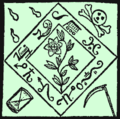 An amulet from the Black Pullet grimoire
 -
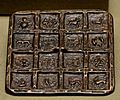 Magical mirror with Zodiac signs
 -

-
 Afro-Surinamese Winti amulet
 -

-


See also
[edit]- Apotropaic magic - protective magic
- Charm - an incantation or spell
- Charm bracelet
- Charmstone
- Evil eye
- Fetishism
- Hamsa
- List of good-luck charms
- Nazar (amulet)
- Sigil
- Talisman
- Tefillin (or phylacteries) of the Jewish faith
Notes
[edit]- ^ Gonzalez-Wippler 1991, p. 1.
- ^ "Sister Justine Bisqueyburu and the Green Scapular: History, Meaning, and Graces". FamVin News English. The Vincentian Family. 27 January 2025. Retrieved 1 September 2025.
- ^ Campo, Juan Eduardo, ed. (2009). "amulets and talismans". Encyclopedia of Islam. Encyclopedia of World Religions: Facts on File Library of Religion and Mythology. Infobase Publishing. pp. 40–1. ISBN 978-1-4381-2696-8.
- ^ a b c Teeter, E., (2011), Religion and Ritual in Ancient Egypt, Cambridge University Press, p170
- ^ a b c d e f g h Brier, Bob; Hobbs, Hoyt (2009). Ancient Egypt: Everyday Life in the Land of the Nile. New York City, New York: Sterling. ISBN 978-1-4549-0907-1.
- ^ Teeter, E., (2011), Religion and Ritual in Ancient Egypt, Cambridge University Press, p118
- ^ Andrews, C., (1994), Amulets of Ancient Egypt, University of Texas Press, p1.
- ^ a b Andrews, C., (1994), Amulets of Ancient Egypt, University of Texas Press, p2.
- ^ Ritner, R. K., Magic in Medicine in Redford, D. B., Oxford Encyclopedia Of Ancient Egypt, Oxford University Press, (2001), p 328
- ^ Teeter, E., (2011), Religion and Ritual in Ancient Egypt, Cambridge University Press, p171
- ^ Ritner, R.K., Magic: An Overview in Redford, D.B., Oxford Encyclopedia Of Ancient Egypt, Oxford University Press, 2001, p 326
- ^ a b c d Mark, Joshua (2017). "Magic in Ancient Egypt". World History Encyclopedia.
- ^ Henig, Martin (1984). Religion in Roman Britain. London: B.T. Batsford. ISBN 978-0-7134-1220-8.[full citation needed]
- ^ Collingwood, Robin G.; Wright, Richard P. (1991). Roman Inscriptions of Britain (RIB). Vol. II, Fascicule 3. Stround: Alan Sutton. RIB 2421.56–8.
- ^ Henig 1984, p. 187.
- ^ Parker, A. (2018). "'The Bells! The Bells! Approaching tintinnabula in Roman Britain and beyond". In Parker, A.; McKie, S (eds.). Material Approaches to Roman Magic: Occult Objects and Supernatural Substances. Oxbow. pp. 57–68.
- ^ Martin-Kilcher, S. (2000). "Mors immatura in the Roman world – a mirror of society and tradition". In Pearce, J.; Millet, M.; Struck, M. (eds.). Burials, Society and Context in the Roman World. Oxbow. pp. 63–77.
- ^ Karlheinz Kessler. 2008. Das wahre Ende Babylons – Die Tradition der Aramäer, Mandäer, Juden und Manichäer. In Joachim Marzahn and Günther Schauerte (eds.). Babylon. Wahrheit: Eine Ausstellung des Vorderasiatischen Museums Staatliche Museen zu Berlin mit Unterstützung der Staatsbibliothek zu Berlin. München: Hirmer. Pp. 467–486, fig. 338. ISBN 978-3-7774-4295-2
- ^ Christa Müller-Kessler, Trence C. Mitchell, Marilyn I. Hockey. 2007. An Inscribed Silver Amulet from Samaria. Palestine Exploration Quarterly 139 pp. 5–19.
- ^ Joseph Naveh, Shaul Shaked. 1985. Amulets and Magic Bowls. Aramaic Incantattion of Late Antiquity. Jerusalem: Magness Press. ISBN 965-223-531-8
- ^ Joseph Naveh, Shaul Shaked. 1993. Magic Spells and Formulae. Aramaic Incantattion of Late Antiquity. Jerusalem: Magness Press. Pp. 43–109, pls. 1–18. ISBN 965-223-841-4
- ^ Roy Kotansky, Joseph Naveh, and Shaul Shaked. 1992. A Greek-Aramaic silver amulet from Egypt in the Ashmolean Museum. Le Muséon 105, pp. 5–25.
- ^ Roy Kotansky. 1994. Greek Magical Amulets. The Inscribed Gold, Silver, Copper, and Bronze Lamellae. Part I. Published Texts of Known Provenance. Opladen: Westdeutscher Verlag.ISBN 3-531-09936-1
- ^ Wen, Benenell (2016). The Tao of Craft: Fu Talismans and Casting Sigils in the Eastern Esoteric Tradition. North Atlantic Books. ISBN 978-1623170660.
- ^ "Shinsatsu, Mamorifuda". Encyclopedia of Shinto. Retrieved 20 July 2020.
- ^ Canaan, Tewfik (2004). "The Decipherment of Arabic Talismans". In Savage-Smith, Emilie (ed.). Magic and Divination in Early Islam. The Formation of the Classical Islamic World. Vol. 42. Ashgate. pp. 125–49. ISBN 978-0-86078-715-0.
- ^ Encyclopedia Judaica: Amulet.
- ^ Guide to the Perplexed, 1:61; Mishneh Torah, Tefillin 5:4.
- ^ For example, Shlomo ben Aderet ("Rashba," 1235–1310, Spain) and Nahmanides ("Ramban," 1194-1270, Spain). Ency. Jud., op. cit.
- ^ a b Lubrich, Naomi, ed. (2022). Birth Culture. Jewish Testimonies from Rural Switzerland and Environs (in German and English). Basel. pp. 27–35. ISBN 978-3796546075.
{{cite book}}: CS1 maint: location missing publisher (link) - ^ Kosior, Wojciech (September 2014). ""It Will Not Let the Destroying [One] Enter". The Mezuzah as an Apotropaic Device according to Biblical and Rabbinic Sources". Polish Journal of Arts and Culture: 127–144. Retrieved 2016-07-30.
- ^ Conder, C.R. (1889). Syrian Stone-lore; or, The Monumental History of Palestine. London: Alexander P. Watt. p. 201. OCLC 751757461., with a correction made for errata on page 455
- ^ Kosior, Wojciech (2 May 2015). ""The Name of Yahveh is Called Upon You". Deuteronomy 28:10 and the Apotropaic Qualities of Tefillin in the Early Rabbinic Literature". Studia Religiologica. 2 (48/2015): 143–154. doi:10.4467/20844077SR.15.011.3557. Retrieved 2016-07-30.
- ^ Landsberger, Franz (1960). "The Origin of the Decorated Mezuzah". Hebrew Union College Annual. 31: 149–166. JSTOR 23506541.
- ^ Ency. Jud.: Katz, Naphtali ben Isaac. See also Naphtali Cohen#Biography.
- ^ Kazlas, Laura (1 February 2015). "The Best Protection Against Demons and Evil Spirits". A Catholic Moment. Retrieved 27 March 2022.
- ^ Armentrout, Don S. (1 January 2000). An Episcopal Dictionary of the Church: A User-Friendly Reference for Episcopalians. Church Publishing, Inc. p. 541. ISBN 978-0-89869-701-8. Retrieved 9 April 2014.
- ^ Lang, Bernhard (1997). Sacred Games: A History of Christian Worship. Yale University Press. p. 403. ISBN 9780300172263.
If the person who needs to be healed is not present, prayer may be said over a piece of cloth; consecrated through communal prayer (and perhaps the additional touch of a particularly gifted healer), the cloth is believed to carry a healing power. The Foundations of Pentecostal Theology quotes the scriptural basis of the "prayer cloth": "And God wrought special miracles by the hand of Paul: so that from his body were brought unto the sick handkerchiefs or belts, and the diseases departed from them, and the evil spirits went out of them" (Acts 19:11-12).
- ^ "Why do Lutherans make the sign of the cross?" (PDF). Evangelical Lutheran Church in America. 2013. p. 2. Retrieved 25 July 2020.
- ^ Samaan, Moses (25 August 2010). "Who wears the Cross and when?". Coptic Orthodox Diocese of Los Angeles, Southern California, and Hawaii. Retrieved 18 August 2020.
- ^ Liz James (30 April 2008). Supernaturalism in Christianity: Its Growth and Cure. Mercer University Press. ISBN 9780881460940.
From the fifth century onward, the cross has been widely worn as an amulet, and the novel Dracula treats it as a protection against vampires. Many Christians continue to hang polished miniatures of the cross around their necks.
- ^ Fahlbusch, Erwin; Lochman, Jan Milič; Mbiti, John; Pelikan, Jaroslav; Vischer, Lukas, eds. (1999). The Encyclopedia of Christianity. Translator and English language editor: Bromiley, Geoffrey W. Boston: Eerdmans. p. 737. ISBN 978-0-8028-2413-4.
- ^ Lea, Henry Charles (1896). "Chapter 12: Indulged Objects". A History of Auricular Confession and Indulgences in the Latin Church. Vol. 3: Indulgences. Philadelphia: Lea Brothers & Co. p. 520. OCLC 162534206.
- ^ Bertacchini, E. (1 January 2014). A New Perspective on the Production and Evolution of Cultures. Content Publishers. p. 183. ISBN 9781490272306.
A holy water font is a vessel containing holy water generally placed near the entrance of a church. It is used in Roman Catholic and Lutheran churches, as well as some Anglican churches to make the sign of the cross using the holy water upon entrance and exit.
- ^ Getz, Keith (February 2013). "Where is the Baptismal Font?" (PDF). Evangelical Lutheran Church in America. Archived from the original (PDF) on 5 May 2014. Retrieved 5 May 2014.
By having the font at the entrance of the church, and using the font every Sunday, we are intentionally and dramatically revealing the importance of Holy Baptism and highlighting it as foundational to our life in Christ. It symbolically reminds us that we enter into the life of the church, into the life of Christ's body, through the birthing waters of the baptismal font, where we are born again from above. Dipping our fingers in the holy water of the font and making the sign of the cross, reinforces who and whose we are. We are reminded that we have been baptized; daily we die to sin and rise to new life in the Spirit. The font is also positioned so that from the font there is a direct and central path leading to the altar, highlighting how these two Holy Sacraments are intimately connected. As we leave the church, we see the baptismal font, reminding us that we have been baptized, named and claimed, to serve others in proclamation and service to others.
- ^ Teresa of Ávila (2007). "Chapter 21: Holy Water". The Book of My Life. Translated by Starr, Mirabai. Boston: Shambhala Publications. pp. 238–41. ISBN 978-0-8348-2303-7.
- ^ Scott, Rosemarie (2006). "Meditation 26: The Weapons of Our Warfare". Clean of Heart. R.A.G.E. Media. p. 63. ISBN 978-0-9772234-5-9.
- ^ Ball, Ann (2003). Encyclopedia of Catholic Devotions and Practices. Our Sunday Visitor. p. 520. ISBN 978-0-87973-910-2.
- ^ "El Regimiento "Príncipe" n.º 3 se presenta a su Patrona". ejercito.defensa.gob.es (in Spanish). Regimiento de Infantería 'Principe' nº 3. 24 October 2018. Retrieved 10 December 2020.
- ^ Sanzo, Joseph E. (6 January 2018). "Ancient Amulets with Incipits Early Christian amulets". biblicalarchaeology.org. Retrieved 5 August 2018.
- ^ Franklin, Rosalind (2005). Baby Lore: Superstitions & Old Wives Tales from the World Over Related to Pregnancy, Birth & Babycare. Diggory Press. p. 160. ISBN 978-0-9515655-4-4.
- ^ Papastergiadis, Nikos (1998). Dialogues in the Diasporas: Essays and Conversations on Cultural Identity. Rivers Oram Press. p. 223. ISBN 978-1-85489-094-8.
- ^ a b c d "Chapter 4: Other Beliefs and Practices". Pew Research Center's Religion & Public Life Project. 2012-08-09. Archived from the original on 2018-08-11. Retrieved 2018-08-11.
Islamic tradition also holds that Muslims should rely on God alone to keep them safe from sorcery and malicious spirits rather than resorting to talismans, which are charms or amulets bearing symbols or precious stones believed to have magical powers, or other means of protection. Perhaps reflecting the influence of this Islamic teaching, a large majority of Muslims in most countries say they do not possess talismans or other protective objects. The use of talismans is most widespread in Pakistan (41%) and Albania (39%), while in other countries fewer than three-in-ten Muslims say they wear talismans or precious stones for protection. Although using objects specifically to ward off the evil eye is somewhat more common, only in Azerbaijan (74%) and Kazakhstan (54%) do more than half the Muslims surveyed say they rely on objects for this purpose. ...Although the survey finds that most Muslims do not wear talismans, a substantial number of Muslims appear to make an exception for charms kept at home to ward off the evil eye
- ^ a b c d Al-Saleh, Yasmine (November 2010). "Amulets and Talismans from the Islamic World". www.metmuseum.org. Metropolitan Museum of Art.
- ^ Mufti Muhammad Taqi Usmani (May 1, 2010). "On the Permissibility of Writing Ta'widhat".
- ^ "is wearing a taweez shirk or not ? | Islam.com - The Islamic community news, discussion, and Question & Answer forum". qa.islam.com.
- ^ a b c Leoni, Francesca, 1974- (2016). Power and protection : Islamic art and the supernatural. Lory, Pierre, Gruber, Christiane, 1956-, Yahya, Farouk, Porter, Venetia, Ashmolean Museum. Oxford. ISBN 978-1-910807-09-5. OCLC 944474907.
{{cite book}}: CS1 maint: location missing publisher (link) CS1 maint: multiple names: authors list (link) CS1 maint: numeric names: authors list (link) - ^ Porter, Said, Savage-Smith, Venetia, Liana, Emilie. Medieval Islamic Amulets, Talismans, and Magic.
{{cite book}}: CS1 maint: multiple names: authors list (link) - ^ "Islamic Arms and Armor". www.metmuseum.org. Department of Arms and Armour. October 2004.
- ^ Chalmers, Beverley; Meyer, Denny (1993). "Adherence to traditional Indian customs surrounding birth". South African Medical Journal. 83 (3): 206. PMID 8511690.
- ^ Olwig, Karen Fog; Rytter, Mikkel (2011-06-10). Mobile Bodies, Mobile Souls: Family, Religion and Migration in a Global World. ISD LLC. ISBN 978-87-7124-435-9.
- ^ a b Alī, Saiyada Asad (2000). Influence of Islam on Hindi Literature. Idarah-i-Adabiyat-Delli.
- ^ Moberley, A. N. (1907). "Amulets as agents in the prevention of disease in Bengal". In Asiatic Society of Bengal (ed.). Memoirs of the Asiatic Society of Bengal, Volume 1. Calcutta: The Asiatic Society. pp. 223–248. page 224.
- ^ "Ta'wiz or Talisman's origin, preparation, and permissibility". furzan.com. Retrieved 2022-12-06.
- ^ Sardar, Marika (August 2011). "Astronomy and Astrology in the Medieval Islamic World". www.metmuseum.org.
- ^ Achrati, Ahmed (2003). "Hand and Foot Symbolism: From Rock Art to the Qur'an" (PDF). Arabica. 50 (4): 463–500 (see p. 477). doi:10.1163/157005803322616911. Archived from the original (PDF) on 15 November 2017.
- ^ "Amulet - Taweez, origins, preparation, and permissibility". furzan.com. Retrieved 2022-12-10.
- ^ Erbek, Güran (1998). Kilim Catalogue No. 1. May Selçuk A. S. Edition=1st. pp. 4–30.
- ^ "Kilim Motifs". Kilim.com. Retrieved 28 January 2016.
- ^ Thompson, Jon (1988). Carpets from the Tents, Cottages and Workshops of Asia. Barrie & Jenkins. p. 156. ISBN 0-7126-2501-1.
- ^ rockandmineralplanet.com
- ^ Leoni, Francesca (2016). Power and Protection: Islamic Art and the Supernatural. Oxford: Ashmolean Museum. p. 35. ISBN 978-1910807095.
{{cite book}}: CS1 maint: publisher location (link) - ^ Blair, S. (2001). An Amulet from Afsharid Iran. The Journal of the Walters Art Museum 59, pp.85–102, and Vesel (2012) p.265.
- ^ Vesel, Živa, 'Talismans from the Iranian World: A Millenary Tradition', in ed., Pedram Khosronejad, The Art and Material Culture of Iranian Shi'ism: Iconography and Religious Devotion in Shi'i Islam (London and New York, 2012) pp.254–75.
- ^ Keene, M. (n.d.). JADE i. Introduction – Encyclopaedia Iranica. iranicaonline.org. Available at: https://iranicaonline.org/articles/jade-i.
- ^ Melikian-Chirvani, A.S. (1997). Precious and Semi-Precious Stones in Iranian Culture, Chapter I. Early Iranian Jade. Bulletin of the Asia Institute 11, pp.123–73.
- ^ a b Leoni, Francesca (2016). Power and protection : Islamic art and the supernatural. Oxford: Ashmolean Museum. pp. 33–52. ISBN 978-1910807095.
{{cite book}}: CS1 maint: publisher location (link) - ^ a b c d e Leoni, Francesca (2016). Power and protection : Islamic art and the supernatural. Oxford: Oxford: Ashmolean. pp. 33–52. ISBN 978-1910807095.
{{cite book}}: CS1 maint: publisher location (link) - ^ Porter, Said, Savage-Smith, Venetia, Liana, Emilie. Medieval Islamic Amulets, Talisman, and Magic.
{{cite book}}: CS1 maint: multiple names: authors list (link) - ^ Littlewood, Ajarn Spencer (2016). The Book of Thai Lanna Sorcery (PDF). Thailand: Buddha Magic Multimedia & Publications. pp. 1–2.
- ^ Cleene, Marcel; Lejeune, Marie Claire (2003). Compendium of Symbolic and Ritual Plants in Europe. Man & Culture. p. 178. ISBN 978-90-77135-04-4.
- ^ Fanthorpe, R. Lionel; Fanthorpe, Patricia (2008). Mysteries and Secrets of Voodoo, Santeria, and Obeah. Mysteries and Secrets Series. Vol. 12. Dundurn Group. p. 183–4. ISBN 978-1-55002-784-6.
- ^ Tennent, Sir, James Emerson (1999) [1861]. Sketches of the Natural History of Ceylon with Narratives and Anecdotes Illustrative of the Habits and Instincts of the Mammalia, Birds, Reptiles, Fishes, Insects, Including a Monograph of the Elephant and a Description of the Modes of Capturing and Training it with Engravings from Original Drawings (reprint ed.). Asian Educational Services. p. 37. ISBN 978-81-206-1246-4.
- ^ "The Agimat and Anting-Anting: Amulet and Talisman of the Philippines". amuletandtalisman.com. 2012. Archived from the original on 2016-09-24.
References
[edit]- Budge, E. A. Wallis (1961). Amulets and Talismans. New Hyde Park, NY: University Books.
- Gonzalez-Wippler, Migene (1991). Complete Book Of Amulets & Talismans. Sourcebook Series. St. Paul, MN: Lewellyn Publications. ISBN 978-0-87542-287-9.
- Buddha Magic Buddha Magic (Thai Occult Practices, Amulets and Talismans)
- Plinius, S.C. (1964) [c. 77-79]. Natural History. London.
{{cite book}}: CS1 maint: location missing publisher (link)
External links
[edit]

- Armenian scroll-shaped amulets Armenian prayer scrolls
| Lists of scribes |  | |
|---|---|---|
| Ktav Stam | ||
| Documents | ||
| Related articles | ||
