Hubbry Logo
BagelBagelMain
Open search
Bagel
Community hub
Bagel
logo
8 pages, 0 posts
0 subscribers
Be the first to start a discussion here.
Bagel
Bagel
from Wikipedia

Bagel
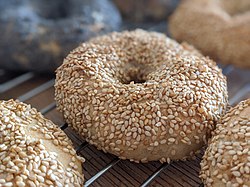
Sesame bagel
Alternative namesBajgiel, beigel, beygl
TypeBread
Place of originPoland
Region or stateEurope, North America
Associated cuisineJewish, Polish, American, Canadian
Created byJewish communities of Poland
Serving temperatureRoom temperature
Main ingredientsWheat dough
VariationsMontreal-style bagel, pizza bagel, bagel toast
  •   Media: Bagel

A bagel (Yiddish: בײגל, romanizedbeygl; Polish: bajgiel [ˈbajɡʲɛl] ; also spelled beigel)[1] is a bread roll originating in the Jewish communities of Poland.[2] Bagels are traditionally made from yeasted wheat dough that is shaped by hand into a torus or ring, briefly boiled in water, and then baked. The result is a dense, chewy, doughy interior with a browned and sometimes crisp exterior.

Bagels are often topped with seeds baked on the outer crust—traditional choices include poppy and sesame seeds—or with salt grains. Different dough types include whole-grain and rye.[3][4] The basic roll-with-a-hole design, hundreds of years old, allows even cooking and baking of the dough; it also allows groups of bagels to be gathered on a string or dowel for handling, transportation, and retail display.[5][6]

The earliest known mention of a boiled-then-baked ring-shaped bread can be found in a 13th-century Syrian cookbook, where they are referred to as ka'ak.[7] Bagel-like bread known as obwarzanek was common earlier in Poland as seen in royal family accounts from 1394.[8] Bagels have been widely associated with Ashkenazi Jews since the 17th century; they were first mentioned in 1610 in Jewish community ordinances in Kraków, Poland.[2]

Bagels are now a popular bread product in North America and Poland, especially in cities with a large Jewish population.[2] Bagels are also sold (fresh or frozen, often in many flavors) in supermarkets.

History

[edit]

Linguist Leo Rosten wrote in The Joys of Yiddish about the first known mention of the Polish word bajgiel derived from the Yiddish word bagel in the "Community Regulations" of the city of Kraków in 1610, which stated that the food was given as a gift to women in childbirth.[9] There is some evidence that the bagel may have been derived from pretzels made in Germany brought by immigrants to Poland.[2][10]

In the 16th and first half of the 17th centuries, the bajgiel became a staple of Polish cuisine.[11] The name derives from the Yiddish word beygal, from the German dialect word beugel, meaning "ring" or "bracelet".[12]

In the Brick Lane district and surrounding area of London, England, bagels (locally spelled "beigels") have been sold since the middle of the 19th century. They were often displayed in the windows of bakeries on vertical wooden dowels, up to a metre in length, on racks.[citation needed]

Bagels with cream cheese and lox (cured salmon) are considered a traditional part of American Jewish cuisine (colloquially known as "lox and a schmear").

Bagels were brought to the United States by immigrant Polish Jews, with a thriving business developing in New York City that was controlled for decades by Bagel Bakers Local 338. They had contracts with nearly all bagel bakeries in and around the city for its workers, who prepared all their bagels by hand.[13]

The bagel came into more general use throughout North America in the last quarter of the 20th century with automation. Daniel Thompson started work on the first commercially viable bagel machine in 1958; bagel baker Harry Lender, his son, Murray Lender, and Florence Sender leased this technology and pioneered automated production and distribution of frozen bagels in the 1960s.[14][15][16] Murray also invented pre-slicing the bagel.[17]

Around 1900, the "bagel brunch" became popular in New York City.[18] The bagel brunch consists of a bagel topped with lox, cream cheese, capers, tomato, and red onion.[18] This and similar combinations of toppings have remained associated with bagels into the 21st century in the United States.[19][20][21]

In Japan, the first kosher bagels were brought by BagelK [ja] from New York in 1989. BagelK created green tea, chocolate, maple-nut, and banana-nut flavors for the market in Japan. Some Japanese bagels, such as those sold by BAGEL & BAGEL [ja], are soft and sweet; others, such as Einstein Bros. bagels sold by Costco in Japan, are the same as in the U.S.[citation needed]

Size change over time

[edit]

Bagels in the U.S. have increased in size over time. Starting at around 2 ounces (60 g),[22] by 1915, the average bagel weighed 3 ounces (90 g);[13] the size began to increase further in the 1960s.[22] By 2003, the average bagel sold on a Manhattan coffee cart weighed around 6 ounces (170 g).[13]

Preparation and preservation

[edit]
Saturday morning bagel queue at St-Viateur Bagel, Montreal, Quebec

At its most basic, traditional bagel dough contains wheat flour (without germ or bran), salt, water, and yeast leavening. Bread flour or other high gluten flours are preferred to create the firm, dense but spongy bagel shape and chewy texture.[3] With a dough hydration of around 50–57%, bagel dough is among the stiffest bread doughs.[23] Most bagel recipes call for the addition of a sweetener to the dough, often barley malt (syrup or crystals), honey, high fructose corn syrup, or sugar, with or without eggs, milk or butter.[3] Leavening can be accomplished using a sourdough technique or a commercially produced yeast.

Bagels are traditionally made by:

  • mixing and kneading the ingredients to form the dough
  • shaping the dough into the traditional bagel shape, round with a hole in the middle, from a long thin piece of dough
  • proofing the bagels for at least 12 hours at low temperature (40–50 °F (4–10 °C))
  • boiling each bagel for 60–90 seconds in water that may contain additives such as lye, baking soda, barley malt syrup, or honey
  • baking at a temperature between 347–599 °F (175–315 °C)

This production method gives bagels their distinctive taste, chewy texture, and shiny appearance.

In recent years, a variant has emerged, producing what is sometimes called the steam bagel. To make a steam bagel, the boiling is skipped, and the bagels are instead baked in an oven equipped with a steam injection system.[24] In commercial bagel production, the steam bagel process requires less labor, since bagels need only be directly handled once, at the shaping stage. Thereafter, the bagels need never be removed from their pans as they are refrigerated and then steam-baked. The steam bagel results in a fluffier, softer, less chewy product more akin to a finger roll that happens to be shaped like a bagel. The dough used is intentionally more alkaline to aid browning, because the steam injection process uses neutral water steam instead of an alkaline solution bath.[citation needed]

Bagels can be frozen for up to six months.[25]

Quality

[edit]

According to a 2012 Consumer Reports article, the ideal bagel should have a slightly crispy crust, a distinct "pull" when a piece is separated from the whole by biting or pinching, a chewy inside, and the flavor of bread freshly baked. The taste may be complemented by additions cooked on the bagel, such as onion, garlic, sesame seeds, or poppy seeds. The appeal of a bagel may change upon being toasted. Toasting can have the effect of bringing or removing desirable chewiness, softening the crust, and moderating off-flavors.[26]

Traditionally New Yorkers do not toast bagels; they argue that if a bagel is well made and fresh it should never be toasted.[27][28][29] Some New York City bagel shops, like Murray's in Chelsea and Ess-a-Bagel at 21st and Third Avenue, have had no-toasting policies.[28][27] Toasting of bagels in New York City is considered a bastardization[28] and sacrilege.[29] Former New York Times food critic Mimi Sheraton called the practice of eating toasted bagels obscene.[30]

A typical[clarification needed] bagel has 260–350 kcal (1,100–1,500 kJ), 1.0–4.5 grams of fat, 330–660 milligrams of sodium, and 2–5 grams of fiber. Gluten-free bagels have much more fat, often 9 grams, because of ingredients in the dough to supplant the wheat flour of the original.[26]

Varieties

[edit]

New York style

[edit]
Storefront of H&H Bagel, awning at door and signage above reads "H&H Bagel - Like no other in the world."
H&H Bagel, Broadway and W 80th St, New York City.

The New York bagel contains malt, is cold-fermented for several days to develop the flavors and enhance the crust, and is boiled in salted water before baking in a standard oven.[31] The resulting bagel has a fluffy interior and a chewy crust. According to CNN, Brooklynites believe New York bagels are the best due to the quality of the local water.[32] According to Brooklyn Water Bagels CEO Steven Fassberg, the characteristics of a New York bagel are the result of the recipe formula and preparation method.[32]

Montreal style

[edit]
Three Montreal-style bagels: one poppy and two sesame bagels

Different from the New York style, the Montreal-style bagel contains malt and sugar with no salt; it is boiled in honey-sweetened water before baking in a wood-fired oven. It is predominantly of the sesame "white" seeds variety (bagels in Toronto are similar to those made in New York in that they are less sweet, generally are coated with poppy seeds and are baked in a standard oven).[citation needed]

St. Louis style

[edit]

The St. Louis style bagel refers not to composition, but to a particular method of slicing the bagel.[33] The St. Louis style bagels are sliced vertically multiple times, instead of the traditional single horizontal slice.[33] The slices range from 3 to 6 mm (0.12 to 0.24 in) thick.[34] This style of bagel was popularized by the St. Louis Bread Company, now known as Panera Bread.[33] Generally, the bagels are sliced into eight pieces using a bread slicer, which produces characteristically precise cuts (the bagel is not torn or crushed while slicing).[34] This particular method of preparation increases the surface area available for spreads (e.g., cream cheese, butter).[33] However, it decreases the portability of the bagel and prevents formation of sandwiches.[35]

Other bagel styles

[edit]

Other bagel styles can be found elsewhere; Chicago-style bagels are baked with steam. American chef John Mitzewich has a recipe for what he calls San Francisco-style bagels which yields bagels flatter than New York-style bagels, characterized by a rough-textured crust. The traditional London bagel (or beigel as it is sometimes spelled and pronounced) is chewier and has a denser texture.

In Austria, beigl (often also spelled beigerl or beugerl in its diminutive form) are a traditional Lenten food. The rings are made from a yeasted dough, rolled out very thin and briefly boiled in salted water before topped with salt and caraway seeds and then baked. Depending on the region, they are sometimes baked to a very hard consistency, making them relatively brittle. Connected with it is the tradition of Beiglreißen (lit.'ripping/tearing the beigl') at Easter where two people pull on opposite ends of a beigl until it breaks into two pieces. Tearing off the larger piece is meant to bring good luck.[36] In Vienna, Eastern Lower Austria and Burgenland, beugerl has taken on the meaning of certain types of kipferl.[37]

Non-traditional doughs and types

[edit]

While normally and traditionally made of yeasted wheat, in the late 20th century variations on the bagel flourished. Non-traditional versions that change the dough recipe include pumpernickel, rye, sourdough, bran, whole wheat, and multigrain. Other variations change the flavor of the dough, often using blueberry, salt, onion, garlic, egg, cinnamon, raisin, chocolate chip, cheese, or some combination of the above. Green bagels are sometimes created for St. Patrick's Day.[38]

A flat bagel, known as a 'flagel', can be found in a few locations in and around New York City, Long Island, and Toronto. According to a review attributed to New York's Village Voice food critic Robert Seitsema, the flagel was first created by Brooklyn's 'Tasty Bagels' deli in the early 1990s.[39]

Large scale commercial sales

[edit]

United States supermarket sales

[edit]
Mass-produced steamed bagel purchased from a grocery store.

According to the American Institute of Baking (AIB), 2008 supermarket sales (52-week period ending January 27, 2009) of the top eight leading commercial fresh (not frozen) bagel brands in the United States:

Further, AIB-provided statistics for the 52-week period ending May 18, 2008, for refrigerated/frozen supermarket bagel sales for the top 10 brand names totaled US$50,737,860, based on 36,719,977 unit package sales.[41]

The AIB reported US$626.9 million fresh bagel US supermarket sales (excluding Wal-Mart) for the 52 weeks ending 11 April 2012.[42] Fresh/frozen supermarket sales (excluding Wal-Mart) for the 52 weeks ending 13 May 2012 was US$592.7 million.[42] The average price for a bag of fresh bagels was $3.27; for frozen it was $1.23.[citation needed]

Similar breads

[edit]
Ukrainian bublik

Many cultures developed similar breads and preparations, such as bubliki in Russia, Ukraine and Belarus, and obwarzanek (in particular obwarzanek krakowski) in Poland. Somewhat similar in appearance to bagels, these breads are usually topped with sesame and poppy seeds. The ingredients in these breads and bagels somewhat differ, as these breads are made with a different dough using butter,[43] and sometimes also with milk.[44]

In Italy, taralli and friselle [it] are breads similar to bagels.

In Turkey, a salty and fattier form is called açma. The ring-shaped simit is sometimes marketed today as a Turkish bagel. Archival sources show that the simit has been produced in Istanbul since 1525.[45] Based on Üsküdar court records (Şer’iyye Sicili) dated 1593,[46] the weight and price of simit was standardized for the first time. Noted 17th-century traveler Evliya Çelebi wrote that there were 70 simit bakeries in Istanbul during the 1630s.[47]

Jean Brindesi's early 19th-century oil paintings about Istanbul daily life show simit sellers on the streets.[48] Warwick Goble made an illustration of the simit sellers of Istanbul in 1906.[49] Simit is very similar to the twisted sesame-sprinkled bagels pictured being sold in early 20th century Poland. Simit are also sold on the street in baskets or carts, as bagels were then.[citation needed]

The Uyghurs of Xinjiang, China enjoy girdeh nan (from Persian, meaning round bread), a type of nan, the local bread.[50]

Another bagel-like type of bread is the traditional German Dortmunder Salzkuchen from the 19th century.[51]

Ka'ak al-Quds (better known in English as the Jerusalem bagel) is an oblong ring bread, usually topped with sesame seeds, with its origins in Jerusalem. Unlike the bagel, it is not boiled prior to baking.[52]

Cultural references

[edit]

See also

[edit]

References

[edit]
Revisions and contributorsEdit on WikipediaRead on Wikipedia
from Grokipedia
A bagel is a dense, ring-shaped bread product traditionally made from yeasted wheat dough that is hand-formed into a torus shape, briefly boiled in water, and then baked, yielding a chewy interior, shiny crust, and slightly tangy flavor. This preparation method distinguishes it from other breads, with the boiling step creating a gelatinized starch layer that contributes to its signature texture and ability to hold toppings like sesame seeds or poppy seeds. Originating in the Jewish communities of Poland during the 13th to 17th centuries, the bagel evolved from earlier ring-shaped breads like the obwarzanek, a Lenten treat influenced by German pretzels, and was first documented in records from 1610 as "beugel." Jewish bakers in shaped it by hand and boiled it possibly to comply with restrictions on kneading during religious observances, making it a portable and durable food used in rituals such as celebrations and mourning. Polish Jewish immigrants brought the bagel to the in the late 19th century, where it flourished in New York City's , leading to over 70 bakeries by 1900 and the formation of the union in 1907 to regulate production and quality. In the , innovations like the 1918 invention of a bagel-making machine and the introduction of flash-freezing by Lender's Bagels in transformed it from an artisanal Jewish staple into a mass-produced American icon, often enjoyed with (invented in New York in the late 1800s) and . Regional variations emerged, such as the smaller, sweeter baked in wood-fired ovens and the larger, softer New York-style influenced by the city's soft water, which enhances dough elasticity. Today, bagels symbolize Jewish-American culture and are consumed worldwide, with New York often called the "bagel capital of the world."

History

Origins in

The bagel originated in the Jewish communities of and surrounding Eastern European regions during the , emerging as a distinctive ring-shaped product adapted from local traditions. The term "bagel" derives from the beygl (also spelled beigel), which itself comes from the bouc or boug, meaning "ring" or "," reflecting the bread's characteristic toroidal shape. This etymology underscores the bagel's evolution from simpler ring breads like the German or the Polish obwarzanek, which were boiled before to create a chewy texture, a technique that Jewish bakers refined for everyday consumption. The earliest documented reference to the bagel appears in the 1610 community regulations issued by the Jewish Council of , written in , which regulated its production and distribution to maintain social harmony and economic stability within the community. These ordinances prohibited bagel bakers from selling their wares on Sundays and Christian holidays to avoid competing with non-Jewish vendors, while also limiting the number of bagels that could be served at celebrations (brisses) to prevent extravagance that might provoke envy from neighbors. The regulations further specified that bagels were to be provided as gifts to women after , symbolizing the circle of and good fortune for the newborn, thereby embedding the bread in Jewish lifecycle rituals. In its original form, the bagel was a small, dense loaf weighing approximately 2 ounces (60 grams), crafted from a simple yeasted wheat flour dough with minimal ingredients like water, salt, and sometimes malt for flavor. This unadorned recipe yielded a compact, chewy bread ideal for laborers and the working poor in urban Jewish enclaves, as its boiled-then-baked preparation ensured longevity without preservatives, making it a practical staple for daily sustenance. The bagel's modest size and hearty texture distinguished it as an accessible food in 17th-century Poland, where wheat was prized but often reserved for special occasions among Ashkenazi Jews. These early bagels were deeply intertwined with Jewish religious and communal life, often prepared or gifted during holidays and milestones to evoke continuity and blessing, a practice that persisted as Jewish immigrants carried the tradition westward in the late .

Introduction and Popularization in North America

The bagel was introduced to by waves of Eastern European Jewish immigrants fleeing , with significant migration to occurring between the 1880s and 1920s. These immigrants, primarily from and surrounding regions, brought the traditional hand-rolled and boiled bread ring as a familiar staple from their homelands, initially producing and selling it in small quantities within urban Jewish enclaves like Manhattan's . By the early 1900s, bagel baking had become a specialized trade among these communities, with pushcarts and modest bakeries emerging to meet local demand. One of the earliest notable establishments was Russ & Daughters, founded in 1914 by Polish Jewish immigrant Joel Russ as an appetizing store on the , where bagels were sold alongside smoked fish and other traditional accompaniments. The trade formalized further in 1907 with the establishment of the International Beigel Bakers Union (later known as ), which organized approximately 300 Jewish immigrant bakers to regulate production standards, enforce hand-rolling techniques, and negotiate better wages and conditions in vermin-infested, steam-filled bakeries. This union exerted near-monopolistic control over New York City's bagel industry for decades, representing workers in up to 36 major bakeries by the 1930s and staging strikes that could halt production citywide, such as the 1951 walkout that closed 32 of 34 shops. Its influence waned in the late 1960s due to automation and legal challenges, culminating in a 1970 National Labor Relations Board ruling against restrictive practices and a merger with Local 3 in 1971, effectively ending its dominance. Early commercialization accelerated in the as bagel production shifted from artisanal to mechanized methods, with innovators like the Goldstein brothers introducing automated equipment that enabled larger-scale output and distribution beyond ethnic neighborhoods. This transition, building on earlier experiments, allowed bagels to enter mainstream American markets through frozen and pre-packaged forms, dramatically increasing accessibility. Meanwhile, in , bagels arrived via similar Eastern European Jewish to in the late , where immigrants established baking traditions that integrated into the city's growing Jewish community by the early .

Evolution of Size, Production, and Standardization

In the mid-20th century, particularly from the onward, bagels underwent a significant transformation in size, driven by shifting consumer preferences for larger portions and the rise of . Traditionally, bagels in the 1960s weighed approximately 2-3 ounces, maintaining a compact, chewy profile suited to handheld consumption. By the , average bagel weights had increased to 5-6 ounces, reflecting broader American trends toward supersized foods that accommodated sandwiches and emphasized abundance, as suburban markets demanded more substantial items. This enlargement was facilitated by automated machinery that allowed for uniform scaling, though it often resulted in denser, less artisanal textures compared to earlier handmade versions. The 1960s marked a pivotal shift in bagel production through automation, which enabled nationwide distribution and dramatically expanded accessibility. Innovators like Daniel Thompson introduced the first automatic bagel-making machine in 1963, capable of producing bagels four times faster than manual methods by mechanically forming, boiling, and shaping dough. This technology, combined with advancements in freezing, was pioneered by Lender's Bagels, which began mass-producing and distributing frozen bagels in 1960 following the death of founder Harry Lender, allowing supermarkets across the U.S. to offer pre-packaged bagels without local bakeries. By the 1980s, Lender's had scaled to multiple factories, with fully automated facilities producing millions of units annually, transforming bagels from a regional delicacy into a staple of the frozen food aisle. Standardization of bagel production was initially enforced by powerful labor unions in New York, which briefly referenced in their early history established rigorous norms for quality and process in the 1930s through Local 338 of the Bakery and Confectionery Workers International Union. This union, comprising around 300 skilled bakers, mandated traditional techniques such as hand-rolling at least 832 bagels per hour, in water, and baking on coal-fired ovens to ensure consistency and authenticity across member bakeries. While no specific FDA guidelines exist for bagel authenticity regarding and baking, these union standards influenced industry practices, resisting deviations like over until the late . The decline of union control after 1971 accelerated but ignited ongoing debates about bagel authenticity. By 1971, Local 338's membership had dwindled to 152 due to automation's erosion of skilled labor demands and the influx of non-union, frozen products from out-of-state producers, leading to the union's merger with Local 3 and eventual dissolution. This shift enabled unchecked scaling by companies like Lender's, which by 1984 operated four factories and dominated the market, but it also sparked criticism that machine-made bagels lacked the crisp exterior and dense crumb of union-era standards, fueling purist arguments over what constitutes a "true" bagel.

Preparation and Production

Traditional Handmade Methods

The traditional handmade method for producing bagels originates from Eastern European Jewish baking practices, where artisans meticulously craft each bagel to achieve its signature dense, chewy texture. This labor-intensive process relies on simple ingredients and manual techniques, emphasizing development without additives like or preservatives. Dough preparation begins with combining high-gluten , water, , salt, and or powder, typically in proportions that yield a stiff, low-hydration around 50-55% . The mixture is vigorously by hand for 10-20 minutes on a clean surface until it forms a smooth, elastic ball that passes the windowpane test, indicating strong networks essential for the bagel's chewiness. This extended kneading, often performed in small batches, allows the high protein content of the (12-14%) to fully develop without mechanical aid. Once prepared, the dough is divided into portions weighing about 3-4 ounces each and hand-rolled into long ropes, approximately 8-10 inches in length. Each rope is then shaped into a ring by wrapping it around the hand and rolling the overlapping ends on the work surface to seal, ensuring uniform thickness and a centered hole. The shaped bagels are placed on a lightly floured board or cloth and proofed at room temperature for 1-2 hours, covered with a cloth to prevent drying, until slightly puffed but not doubled in size; this controlled rise maintains density while allowing subtle fermentation flavors to emerge. The defining step follows: boiling the proofed bagels in a large pot of water sweetened with , typically for 30-60 seconds total (15-30 seconds per side), with 3-4 bagels immersed at a time to avoid overcrowding. This brief immersion gelatinizes the starches on the surface, forming a shiny, glossy crust upon and contributing to the chewy, dense interior by halting further expansion and setting the structure. Regional variations may incorporate in the boiling solution for subtle flavor differences, as in early Polish practices, though remains the standard in Eastern European traditions. Finally, the boiled bagels are drained, optionally topped with or salt, and transferred to a wood-fired or stone preheated to 400-450°F (204-232°C) for . They are arranged directly on the oven floor or a wooden peel for 20-25 minutes, rotated midway for even browning, until the exterior achieves a crisp, golden crust while the interior remains soft and chewy. This high-heat, dry environment from traditional s enhances Maillard reactions for flavor and texture without , distinguishing handmade bagels from softer, steamed varieties.

Commercial Manufacturing Processes

Commercial bagel production relies on automated systems to achieve high-volume output while maintaining consistency in shape and quality. Industrial facilities begin with large-scale dough mixing using high-capacity planetary or spiral mixers that incorporate high-gluten , water, , salt, and into a stiff , often processed in batches of hundreds of pounds. This is then fed into automated dividers that portion it precisely before passing it to forming machines, which extrude and the portions into uniform rings. For instance, dual-bank rotary dividers and formers can produce up to 11,600 bagels per hour, depending on size, enabling factories to scale operations efficiently. Following forming and a brief proofing period, the bagels undergo a continuous process on automated lines where they are immersed in a malt-sweetened bath for 30 to 60 seconds per side, a step that gelatinizes the on the surface for the characteristic chewiness—similar to traditional methods but mechanized for throughput. The boiled bagels are then transferred via conveyor belts to gas-fired ovens, where they at temperatures around 450–500°F (232–260°C) for 15–25 minutes, with multiple zones allowing precise control over top and bottom heat for even browning and crust development. These conveyor systems ensure uninterrupted flow, supporting production rates of thousands per hour in large facilities. Post-baking, many commercial bagels are flash-frozen shortly after cooling to preserve freshness for distribution, a technique pioneered by in the mid-1960s to align production with weekend demand spikes and enable sales. By installing walk-in freezers in 1954 and introducing automatic molders by 1962, Lender's shifted to freezing fully baked bagels, which were then shipped nationwide through expanded broker networks, reaching 30 million packages annually by 1977. This innovation transformed bagels from a local into a mass-market product. Packaging advancements, such as vacuum-sealing in or multi-layer films, further extend the frozen of bagels to 3–6 months or more by minimizing air exposure and preventing , allowing for efficient nationwide shipping and retail storage without quality loss.

Physical and Sensory Characteristics

Texture, Appearance, and Baking Techniques

The texture of a traditional bagel is characterized by a dense, chewy crumb interior and a crisp, shiny exterior crust. This chewiness arises from the dough's relatively low hydration level, typically ranging from 55% to 65% relative to weight, which results in a stiff dough that yields a tight, fine crumb structure upon . The pre-baking in —often 1 to 2 minutes per side—further contributes to this texture by gelatinizing the surface starches, creating a chewy, leathery barrier that prevents excessive expansion during and enhances the overall . The addition of malt, such as or non-diastatic malt powder to the water, promotes a glossy sheen on the crust through Maillard browning reactions during subsequent baking, while also imparting subtle flavor and aiding in crispness. In terms of appearance, authentic bagels exhibit a toroidal (ring) shape, achieved by hand-rolling or machine-forming the dough into a compact circle with a central , followed by proofing to maintain plumpness. The baked surface displays a golden-brown color from high-heat exposure at 450°F to 600°F, with optional toppings like or seeds adhering directly after due to the moistened surface or via a light for better retention. Baking techniques vary to influence crust characteristics: dry heat in a conventional deck produces a crunchier, more blistered crust ideal for traditional styles, while steam injection during the initial phase softens the exterior for a tender yet chewy result, often used in commercial settings to control and uniformity. Sensorially, the bagel's texture stands out for its pronounced chew, requiring deliberate biting effort that contrasts with the softer, airier crumb of typical breads, emphasizing its distinct elastic resilience.

Indicators of Quality and Authenticity

A hallmark of an authentic bagel is the requirement that the be prior to , a step that sets the exterior and distinguishes it from mere rolls; without this process, the product lacks the characteristic chewy texture and shiny crust. High-quality bagels exhibit even, crispy micro-bubbles or blisters on the surface, signaling proper development and , while the crust remains intact without cracks or blowouts from weak seams. A fresh, malty aroma, derived from in the and boiling solution, indicates quality ingredients and avoids off-putting chemical odors from preservatives or poor storage. Common flaws include soggy interiors, often resulting from insufficient boiling temperature or duration that fails to properly set the , and overly dense crumb from inadequate formation due to under-kneading or overworking the . Historically, the union in New York enforced standards requiring hand-rolling of bagels until its disbandment in the , preserving traditional craftsmanship amid industrialization. In modern contexts, authenticity is often affirmed through practices like hand-rolling and kettle-, as upheld by artisanal bakeries claiming adherence to New York-style traditions without formal certification bodies.

Nutritional Profile

Ingredient Composition and Basic Nutrients

The primary ingredients in a traditional bagel are enriched , , , salt, and syrup or powder. Enriched serves as the base, typically comprising the majority of the dough and contributing 60-70% carbohydrates to the final product due to its high content. is added at 45-52% of the flour weight to the dough, while facilitates and rising. Salt is incorporated at 1-2% to enhance flavor and strengthen the structure, and provides subtle sweetness, promotes enzymatic activity for better browning during baking, and aids in flavor development. A standard 4 oz (113 g) plain bagel provides approximately 290 calories, with macronutrients including 57 g carbohydrates (primarily from the ), 11 g protein, 1.8 g total , and 2 g . It is also enriched with essential micronutrients such as iron (about 3 mg, or 17% of the daily value) and including thiamin (0.3 mg), (0.2 mg), niacin (4 mg), and folic acid (75 µg), which are added to the to compensate for processing losses. Toppings such as or seeds introduce variations in nutrient composition, adding healthy unsaturated fats; for example, seeds contribute small amounts of omega-3 fatty acids like alpha-linolenic acid (less than 0.02 g per typical topping serving of 3-5 g). The primary in bagels is from , which can trigger sensitivities or celiac disease; however, some formulations substitute flour, an ancient variety with a distinct structure that may be more digestible for individuals with .

Health Considerations and Caloric Content

Bagels are calorically dense foods, with a medium-sized plain bagel (approximately 100 grams) typically containing 260 to 350 calories, while oversized varieties can exceed 400 calories per serving. This density arises primarily from their content, which contributes to a high of 70 to 80, leading to rapid blood sugar spikes that may pose challenges for individuals managing or insulin sensitivity. Despite these concerns, bagels offer sustained energy through complex carbohydrates and moderate protein (around 10-14 grams per medium bagel), making them a viable option for active lifestyles when consumed mindfully. However, traditional refined bagels are low in fruits and , limiting their diversity and content to about 2-3 grams per serving, which can affect digestive and . Opting for whole-grain versions addresses this by increasing to 4-5 grams per medium bagel, supporting better management and gut as per general whole-grain benefits. In 2025, the rise of high-protein bagels reflects fitness market demands, with commercial products like Thomas' High Protein Bagels delivering 20 grams of protein per serving through added plant-based sources such as (though not gluten-free); gluten-free high-protein formulations using similar plant-based proteins are also available and suitable for those with celiac disease. These innovations aim to enhance and muscle support without significantly altering caloric profiles. Dietary guidance emphasizes portion control, such as halving a bagel to manage intake, and pairing it with nutrient-dense toppings like or lean proteins for balance; for instance, one of adds about 100 calories but can complement the meal when used sparingly. Gluten-free alternatives ensure accessibility for celiacs, maintaining similar caloric and glycemic considerations while avoiding gluten-related health risks.

Regional and Stylistic Varieties

North American Regional Styles

The New York-style bagel, originating from Jewish immigrant bakers in early 20th-century , is characterized by its dense, chewy interior and a shiny, slightly hard crust achieved through in a malt syrup solution before baking. Traditionally baked in coal-fired ovens, these bagels weigh about 3 to 4 ounces, resulting in a compact size with a rich caramel color and glossy exterior from the process. In contrast, the , developed by Eastern European Jewish immigrants in the 1910s, features a sweeter profile due to added to the boiling water, yielding a denser yet thinner and flatter shape compared to its New York counterpart. These bagels are baked in wood-fired ovens, imparting a subtle smoky flavor, and are typically smaller and chewier, often topped with seeds for added texture. The -style bagel, popularized through local chains like St. Louis Bread Co. (now ), is defined by its post-baking vertical slicing method that cuts the bagel like a loaf of bread, facilitating easier sandwich assembly and dipping into spreads like . Bagels associated with this style, such as those from Panera, often have a softer texture compared to traditional boiled varieties. Other regional U.S. styles diverge further from the Eastern boiling tradition. Chicago bagels, a style that emerged in the 2020s, are generally larger and softer with a fluffy interior and crisp exterior, incorporating a starter that contributes to a tangy flavor, suited to the city's hearty sandwich . In San Francisco, bagels often feature a technique of warm proofing before , which creates larger air pockets and an open, chewy interior, reflecting the city's heritage; some variations incorporate for added tanginess.

International and Emerging Global Styles

Outside North America, bagel-like breads have evolved into distinct regional styles that share the toroidal shape but diverge in preparation and flavor profiles. In Poland, the obwarzanek krakowski, dating back to the late 14th century, features a larger ring formed from twisted dough strands, baked directly without the traditional bagel boiling process, resulting in a lighter, crispier texture often enjoyed as a street food in Krakow. Unlike the dense chew of boiled bagels, this variant emphasizes simplicity with minimal toppings, such as poppy seeds or salt, and has been a staple since its mention in royal records from 1394. In Austria, water-boiled bagels, sometimes referred to locally as wasserbageln, produce a softer interior compared to the firmer New York-style counterparts, reflecting adaptations in Viennese bakeries that prioritize a tender crumb through extended boiling in plain water. These are often hand-rolled and baked at moderate temperatures to enhance fluffiness, aligning with Central European bread traditions that favor milder densities. Middle Eastern influences appear in Turkey's , a -encrusted ring bread that mirrors the bagel's form but is prepared by dipping the dough in diluted grape molasses (pekmez) before coating in and baking, yielding a crunchy exterior without . This , popular across the and , offers a nutty, slightly sweet profile and is typically thinner and lighter than traditional bagels, serving as a base for toppings like cheese or olives. Asian adaptations have gained traction since the 2010s, particularly in , where bagels fuse with local ingredients for innovative flavors. bagels incorporate powder into the dough for an earthy, vibrant hue and subtle bitterness, often paired with anko (sweet ) fillings, as seen in recipes from Shizuoka-based tea producers. Similarly, miso-infused bagels, emerging in bakeries, add depth through fermented soybean paste mixed into the dough or as a sandwich spread, appealing to Japan's savory breakfast culture and boosting popularity in urban cafes. By 2025, global bagel trends emphasize high-protein variants and cross-cultural fusions, showcased at events like New York BagelFest, where international artisans compete with innovative doughs. For instance, Madrid's Si Si Bagels, inspired by New York traditions but adapted for European palates, feature bold Spanish flavors in hand-rolled, kettle-boiled rings, contributing to the event's lineup of over 25 global competitors and highlighting the shift toward nutrient-dense, fusion-style bagels. These developments underscore the bagel's spread from North American roots into diverse, health-conscious international forms.

Innovative and Non-Traditional Bagels

Alternative Doughs and Ingredients

While traditional bagels rely on for their characteristic chew and structure, alternative doughs substitute other flours and ingredients to accommodate dietary restrictions or enhance nutritional profiles. Gluten-free bagels address celiac disease and sensitivities by using blends of , almond flour, or cassava flour combined with starches like or for binding and structure. These flours lack gluten's elasticity, resulting in challenges to achieving the dense, chewy texture of conventional bagels, but adding or husk as binders helps mimic that chewiness by improving dough cohesion and rise. For instance, commercial gluten-free blends like Better Batter incorporate these elements to produce bagels that hold shape during and . Whole grain and ancient grain bagels incorporate , , or (whole rye) flours to provide a nuttier flavor and increased compared to refined versions. , an ancient wheat relative, offers a milder taste and higher protein content, while imparts a tangy depth and boosts fiber to support . Pumpernickel doughs, often mixed with whole for balance, yield denser bagels with elevated soluble fiber levels, contributing to better and gut health. These variations maintain the process but require adjustments in hydration due to the grains' lower content. Vegan adaptations ensure bagels remain plant-based by omitting any animal-derived elements, such as egg washes for toppings or honey in the dough or boiling bath. Traditional recipes may use an egg wash for shine, but vegan versions substitute aquafaba (chickpea brine) or plant milks like soy or almond for a similar glossy finish without compromising adhesion of seeds or seasonings. For sweetness in the boil, barley malt syrup—a plant-derived option—is standard and vegan, but alternatives like rice malt syrup or maple syrup provide comparable caramelization while avoiding potential non-vegan additives in some commercial malts. Low-carb bagels cater to ketogenic or low-glycemic diets by replacing high-starch with rice or bases, significantly reducing net carbohydrates to around 3-5 grams per serving. provides a neutral base with moisture and structure, while adds fat and nuttiness; psyllium husk is key for mimicking the chewy, bread-like texture by absorbing water and forming a gel that binds the during . These doughs often skip the traditional or use a quick simmer to prevent sogginess, resulting in a crisp exterior and tender interior suitable for high-protein toppings.

Flavored, Shaped, and Fusion Variations

Bagels have evolved beyond their traditional plain form through the incorporation of various flavors directly into the , enhancing their appeal as versatile breakfast and snack options. Common flavored varieties include the bagel, which features dried or fresh blueberries folded into the for a subtle fruity , and the -raisin bagel, where ground and plump raisins are mixed in to create a warm, spiced profile reminiscent of breads. These innovations emerged in the mid-20th century as American bakers adapted the Eastern European staple for broader tastes. The stands out as a savory staple, topped and sometimes infused with a blend of seeds, seeds, dried , dried , and salt, offering a crunchy, umami-rich exterior that complements or spreads. Its origins trace to the 1970s or early 1980s in New York-area bakeries, where it arose from resourceful use of seasoning scraps or as a deliberate creation by young bakers experimenting with toppings. By the late , everything bagels had become ubiquitous in delis and supermarkets, reflecting the bagel's shift toward bold, multifaceted flavors. Shaped variations expand the bagel's form while retaining its boiled-and-baked essence, catering to portion preferences and textures. Mini bagels, typically weighing around 1 each, are scaled-down versions ideal for snacking or appetizers, maintaining the chewy interior and crisp crust in a bite-sized package. Flagels, or flat bagels, are pressed thinner after but before , resulting in a crispier, less doughy profile that maximizes crust-to-interior ratio—trademarked in 1999 by Bagel Boss in New York. Fusion variations blend bagels with contemporary dietary trends and global influences, often building on alternative dough bases like those incorporating Greek yogurt for added nutrition. High-protein everything bagels, a viral trend peaking in 2024–2025, incorporate protein-rich ingredients such as or Greek yogurt into the dough, achieving up to 21 grams of protein per serving while preserving the signature seed topping and chewiness. These appeal to fitness-focused consumers seeking carb-protein balance without sacrificing flavor. Rainbow bagels, introduced in 2014 by Scot Rossillo at The Bagel Store in Brooklyn's Williamsburg neighborhood, layer vibrantly colored dough—tinted with dyes—for a swirled, Instagram-worthy appearance, gaining explosive popularity in 2015–2016 through virality that drew crowds and inspired copycats nationwide.

Commercial Market and Economics

The global bagel market was valued at USD 5.58 billion in 2024 and is projected to reach USD 7.35 billion by 2030, growing at a (CAGR) of 4.8% from 2025 to 2030. In the United States, which dominates the n segment, the market is expected to expand at a CAGR of 5.1% over the same period, driven by sustained consumer demand for convenient options. accounted for 62.1% of the global market share in 2024, underscoring the region's leadership due to established production and cultural affinity for bagels. A key trend in the bagel industry is the increasing popularity of frozen and pre-packaged products, which enhance for busy consumers and extend shelf life without compromising quality. The global frozen bagels market reached USD 1.98 billion in 2024, representing a substantial portion of overall sales as retailers prioritize ready-to-bake formats. This shift has been particularly evident since the early , with innovations like Thomas' High Protein Bagels—launched in April 2025 with nationwide distribution by October—catering to the premium segment by offering 20-21 grams of protein per bagel through plant-based blends. Such products have boosted the health-oriented subcategory, with the protein bagel market valued at USD 262.3 million in 2024 and projected to grow at a CAGR of 6.9%. Post-2020 health consciousness has further propelled demand for nutritious variants, including bagels, contributing to overall category resilience amid fluctuating consumer preferences. platforms like Amazon and have accelerated this growth by facilitating access, with online grocery sales supporting broader market expansion through targeted promotions and subscriptions. Historically, U.S. sales of fresh bagels peaked at approximately USD 627 million for the 52 weeks ending in May 2012, reflecting a high point in traditional retail channels before diversification into cafes, specialty outlets, and international exports sustained long-term momentum.

Distribution, Preservation, and Large-Scale Production

Bagels are preserved primarily through freezing to extend their beyond the short freshness period of fresh-baked products. Freezing at 0°F (-18°C) effectively halts the process by slowing retrogradation and microbial activity, allowing bagels to maintain best quality for about 12 months. Vacuum-packing before freezing removes air from the packaging, preventing caused by moisture sublimation and oxidation, which can otherwise lead to dry, discolored surfaces. Distribution of bagels relies on temperature-controlled to preserve freshness during . Fresh bagels, with a typical of 2-3 days at , are shipped domestically using refrigerated trucks to maintain cool conditions and minimize spoilage from mold or drying out. For international markets, air freight is often employed to expedite delivery and reduce transit time, particularly for premium or fresh varieties destined for export. In the United States, represent a significant channel, accounting for approximately 40% of bagel distribution volume due to their role in nationwide retail networks. Large-scale bagel production occurs in automated factories equipped with continuous processing lines that handle mixing, shaping, boiling, baking, and cooling in a seamless flow. These facilities can output over 100,000 bagels daily, with some lines achieving capacities of 1,500 to 3,000 units per hour through high-efficiency machinery that ensures uniform quality at industrial volumes. Since 2023, the industry has increasingly adopted eco-friendly packaging solutions, such as recyclable materials and reduced use, aligning with broader goals in to lower environmental impact while complying with commitments like 100% targets. A key challenge in bagel distribution, especially for exports, involves maintaining the authenticity of the traditional boiling process, which imparts the characteristic chewy texture and glossy crust, while navigating long-distance shipping that can compromise product integrity. Modified atmosphere packaging (), which adjusts gas compositions like reducing oxygen and increasing within sealed environments, has helped address spoilage issues in transit by inhibiting microbial growth without altering flavor.

Cultural and Social Impact

Role in Jewish and Immigrant Traditions

The bagel's round shape, with no beginning or end, has long symbolized the eternal cycle of life in Jewish tradition, serving as a protective against and in Eastern European communities. In 17th-century , where the bagel originated among Jewish bakers in Krakow, it was commonly given as a to women after , reflecting its role in rituals of continuity and blessing. These practices underscored the bagel's integration into daily and ceremonial Jewish life. Upon arriving in the United States with waves of Eastern European Jewish immigrants in the late 19th and early 20th centuries, the bagel became central to New York City's Jewish delis, which functioned as vital social hubs for newcomers navigating urban life and cultural transition. These delis, often family-run establishments on the , offered not just bagels with and but also spaces for community gatherings, storytelling, and mutual support among Yiddish-speaking immigrants. By the 1970s, as second-generation Jews assimilated into mainstream American society, the bagel symbolized this shift through marketing like Lender's Bagels' television advertisements, which playfully dubbed it the "Jewish " to appeal to broader audiences and supermarket shelves. In modern Jewish traditions, bagels are sometimes featured in brunches. Globally, Jewish communities have adapted bagels to local flavors, such as za'atar-seasoned versions in or sesame-infused styles in other diasporas, blending Ashkenazi roots with regional ingredients while maintaining cultural ties. The bagel's production also marked key moments in immigrant labor history, particularly through the strikes of in 1960s New York, where mostly Jewish workers demanded better wages and conditions against automation and employer cuts. The 1962 strike, lasting 29 days and slashing city supplies by 85%, and the 1967 action highlighted the union's role in securing high pay—equivalent to skilled trades—and benefits for these immigrant descendants, cementing the bagel as a emblem of collective resilience before the union's decline in 1971. In the 2022 film , directed by Daniel Kwan and Daniel Scheinert, the "" emerges as a pivotal symbol, depicted as a swirling of infinite matter that embodies , creation, and the overwhelming chaos of existence, central to the protagonist Evelyn Wang's journey across parallel realities. The bagel's form, with its void-like center, visually represents the film's exploration of despair and redemption, drawing on its everyday familiarity to contrast cosmic stakes. The sitcom prominently features bagels in its ninth-season episode "The Strike" (1997), where Kramer reluctantly returns to his job at after a 12-year , leading to comedic confrontations over withheld wages and shop policies, including the iconic chant "No bagel! No bagel!" by striking workers. This portrayal satirizes New York City's bagel industry tensions, using the to underscore themes of everyday absurdities and labor conflicts. In sports, "bagel" has become enduring slang for a decisive shutout victory, originating in tennis during the 1980s when American player Harold Solomon and peers like Eddie Dibbs popularized it to describe a 6-0 set win, likening the zero to the bread's round shape. The term, rooted in Jewish-American tennis circles, has since extended to squash, where it denotes an 11-0 game triumph, emphasizing total dominance in racket sports. Yiddish folklore incorporates bagels into tales of tribute and resilience, such as the legend of Viennese Jewish bakers crafting the bread in the 17th century to honor the king of Poland's victory over Ottoman invaders, symbolizing the community's ingenuity amid persecution. This narrative reflects the bagel's traditional Jewish symbolism of the life cycle, with its hole evoking continuity from birth to eternity. Contemporary events like BagelFest 2025, scheduled for November 16 at Citi Field in New York, further integrate these cultural motifs into pop culture through artisan competitions, tastings, and media tie-ins that celebrate bagel heritage. Post-2020, rainbow bagels have surged in social media virality, originating from Brooklyn's The Bagel Store but reigniting as a colorful, Instagram-worthy trend that appeals to Gen Z's preference for visually striking, shareable foods, often customized with vibrant fillings to drive online engagement and youth consumption patterns.

References

Add your contribution
Related Hubs
User Avatar
No comments yet.