Hubbry Logo
logo
Battlefield
Community hub

Battlefield

logo
0 subscribers
Read side by side
from Wikipedia
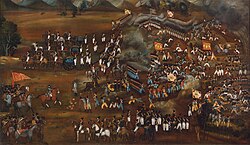
The Battle of Alexander at Issus by Albrecht Altdorfer, depicting the Battle of Issus, in 333 BC. Here, the battlefield is depicted as unlevel ground between mountains, in front of the walled city of Issus, Cilicia. The actual location of the battle is debated by historians.

A battlefield, battleground, or field of battle is the location of a present or historic battle involving ground warfare. It is commonly understood to be limited to the point of contact between opposing forces, though battles may involve troops covering broad geographic areas. Although the term implies that battles are typically fought in a field – an open stretch of level ground – it applies to any type of terrain on which a battle is fought. The term can also have legal significance, and battlefields may have substantial historical and cultural value—the battlefield has been described as "a place where ideals and loyalties are put to the test".[1] Various acts and treaties restrict certain belligerent conduct to an identified battlefield. Other legal regimes promote the preservation of certain battlefields as sites of historic importance.

Modern military theory and doctrine has, with technological advances in warfare, evolved the understanding of a battlefield from one defined by terrain to a more multifaceted perception of all of the factors affecting the conduct of a battle and is conceptualised as the battlespace.

Choice of battlefields

[edit]

The occurrence of a battle at a particular location may be entirely accidental, if an encounter between hostile forces occurs with neither side having expected the encounter. Typically, however, the location is chosen deliberately, either by agreement of the two sides or, more commonly, by the commander of one side, who attempts to either initiate an attack on terrain favorable to the attack, or position forces on ground favorable to defense, if anticipating an attack.

Agreed battlefields

[edit]

Although many battlefields arise in the course of military operations, there have been a number of occasions where formal conventions have ordained the nature and site of the battlefield. It has been suggested, on the basis of anthropological research, that ritual warfare involving battles on traditional "fighting grounds", bound by rules to minimise casualties, may have been common among early societies.[2]

In the European Middle Ages, formal pre-arrangement of a battlefield occasionally occurred. The Vikings had the concept of the "hazelled field", where an agreed site was marked out with hazel rods in advance of the battle.[3]

Formal arrangements by armies to meet one another on a certain day and date were a feature of Western Medieval warfare, often related to the conventions of siege warfare. This arrangement was known as a journée. Conventionally, the battlefield had to be considered a fair one, not greatly advantaging one side or the other. Arrangements could be very specific about where the battle should take place. For example, at the siege of Grancey in 1434, it was agreed that the armies would meet at "the place above Guiot Rigoigne's house on the right side towards Sentenorges, where there are two trees".[4]

In a pitched battle, although the battlefield is not formally agreed upon, either side can choose to withdraw rather than engaging in the battle. The occurrence of the battle therefore generally reflects the belief by both sides that the battlefield and other circumstances are advantageous for their side.

Geography and the choice of battlefield

[edit]
Painting of the Battle of Marston Moor during the First English Civil War, 1644. The location and scope of the battlefield were dictated by previous chance decisions on the part of the combatants.
Field Marshal Lord Kitchener and Lieutenant-General William Birdwood viewing the Anzac battlefield from Russell's Top during the Battle of Gallipoli, 15 November 1915

Some locations are chosen for certain features giving advantage to one side or another.

In the 1820s, General Joseph Rogiat, of Napoleon Bonaparte's Grande Armée, spoke at great length of the circumstances that make for a good battlefield. He divided the battlefield in two: one favorable for attack and one for defense, and argued that the greater the benefit of one over the other, the stronger a position was.[5] He went on to say that easy movement of troops to the front, and distribution of forces across the front, was also important, since this allowed support and reinforcement as needed. He mentions the high ground as a means of observing the enemy, and concealing friendly forces;[5] while this has been mitigated by aerial reconnaissance, improved communication (field telephones, radio), and indirect fire, it remains important. (For instance, "hull down" firing positions for tanks were desired well into World War II.)

Rogiat also discussed cover, in reference to exposure to cannon fire; in earlier times, it would have been to slingers (in Ancient Greek and Roman times) or archers (such as the Welsh longbowmen or Mongol horse archers) from ancient times well into the 1400s, while slightly later, it would be to riflemen.)

Rogniat describes a "disadvantageous field of battle" as one:

which is everywhere seen and commanded from heights within cannon and musket shot, and which is encumbered with marshes, rivers, ravines, and defiles of every kind. The enemy moves upon it with difficulty, even in column; he cannot deploy for the contest, and is made to suffer under a shower of projectiles without being able to return evil for evil.[5]

This may be called an ideal defensive position, however. He then advises that troops should be situated so that the ground they defend is favorable, while the ground through which the enemy must advance is unfavorable:

A position which combines these two kinds of fields of battle is doubly strong, both by its situation, and by the obstacles which cover it. But if it fulfils only one of these conditions, it ceases to be easy of defence. Suppose that a position, for instance, offers to the defenders a field of battle well situated, but admitting of easy access upon all points; the assailants, finding no obstacle to their deployment for the contest, will be able to force it in a tolerably short time. Suppose another position presents to the assailants a field of battle abounding with obstacles and defiles, but without offering at the same time, in the rear, favourable ground for the deployment of the defenders; these could then only act upon it with difficulty, and would be forced to fight the assailants in the defiles themselves, without any advantage. In general, the best positions are those, the flanks of which are inaccessible, and which command from their front a gently inclined ground, favourable for attack as well as defence; farther, if the lines lean on villages and woods, each of which forms, by its saliency, a sort of defensive bastion, the army becomes almost impregnable, without being reduced to inaction.[5]

During World War I, for instance, the An Nafud behind Aqaba seemed impassible, until a force of Arab rebels led by T. E. Lawrence successfully crossed it to capture the town. In World War II, the Pripyat Marsh was an obstacle to vehicles, and the Red Army successfully employed cavalry there specifically because of that, while in North Africa, the Qattara Depression was used as an "anchor" for a defensive line.

The belief that a location is impregnable will lead to it being chosen for a defensive position, but may produce complacency. During the Jewish Rebellion in 70 AD, Masada was thought to be unassailable; determined Roman military engineering showed it was not. In World War I, Aqaba was considered safe. During World War II, Monte la Difensa was revealed to be vulnerable by the First Special Service Force. (All three instances would later be used in films.)

Crossing obstacles remains a problem. Even a seemingly open field, such as that faced by George Pickett at Gettysburg, was broken by fences which had to be climbed—while his division was constantly exposed to fire from the moment it left the trees. On modern battlefields, introducing obstacles to slow an advance has risen to an art form: everything from anti-tank ditches to barbed wire to dragon's teeth to improvised devices, have been employed, in addition to minefields.[citation needed] The nature of the battlefield influences the tactics used; in Vietnam, heavy jungle favored ambush.

Historically, military forces have sometimes trained using methods suitable for a level battlefield, but not for the terrain in which they were likely to end up fighting. Mardonius illustrated the problem for the Ancient Greeks, whose phalanges were ill-suited for combat except on level ground without trees, watercourses, ditches, or other obstacles that might break up its files,[6] a perfection rarely obtained. Rome had the same preference.[6] By the 20th Century, many military organizations had specialist units, trained to fight in particular geographic areas, like mountains (Alpine units), desert (such as the LRDG), or jungle (such as Britain's Chindits and later U.S. Special Forces), or on skis. Others were trained for delivery by aircraft (air portable), glider, or parachute (airborne); after the development of helicopters, airmobile forces developed. The increasing number of amphibious assaults, and their particular hazards and problems, led to the development of frogmen (and later SeALs). These specialist forces opened up new fields of battle, and added new complexities to both attack and defense: when the battlefield ceased to be physically connected to the supply base, as at Arnhem, or in Burma, or in Vietnam, the geography of the battlefield could not only dictate how a battle was fought, but with what weapons, and both reinforcement and logistics could be critical. At Arnhem, for instance, there were failures in both, while in Burma, aerial supply deliveries enabled the Chindits to do something that would otherwise have been impossible. Armies generally avoided fighting in cities, when possible, and modern armies dislike giving up the freedom of maneuver; as a result, when compelled to fight for control of a city, such as Stalingrad or Ortona, weapons, tactics, and training are ill-suited for the environment. Urban combat is the one specialty that has not yet arisen.

Technology and the choice of battlefield

[edit]

New technologies also affect where battles are fought. The adoption of chariots makes flat, open battlefields desirable, and larger fields than for infantry alone, as well as offering opportunities to engage an enemy sooner.

During the American Civil War, rail transport influenced where and how battles would be, could be, fought, as did telegraphic communication. This was a major factor in the execution of the German invasion of France in WW1: German forces could only travel as far from railheads as their ability to transport fodder allowed; the ambitious plan was doomed before it launched. Single battles, such as Cambrai, can depend on the inception of new technology, such as (in this instance) tanks.[citation needed]

The synergy between technologies can also affect where battles take place. The arrival of aerial reconnaissance has been credited with the development of trench warfare, while the combination of high explosives in ammunition and hydraulic recoil mechanisms in artillery, added to aircraft observation, made its subsequent spread necessary, and contributed to the stalemate of WW1. The proliferation of tanks and aircraft changed the dynamics again in WW2.

UH-1D helicopters airlift members of the 2nd Battalion, 14th Infantry Regiment from the Filhol Rubber Plantation area... - NARA - 530610

In both Burma in World War II, and in Vietnam, air supply played an important part in where battles took place. Some, such as Arnhem or the A Sầu, would not have happened at all, absent the development of aircraft and helicopters.[citation needed] So, too, has the introduction of landing craft; combined with naval gunfire support, they have made beach landings the site of battles, where, in ancient times, the very idea of contesting a landing was unheard of.

The Vietnamese preference for ambush against a more sophisticated opponent was a function of less access to sophisticated technology.

As much as technology has changed, terrain still cannot be ignored, because it not only affects movement on the battlefield, but movement to and from it, and logistics are critical: a battlefield, in the industrial age, may be a railway line or a highway As technology grows more sophisticated, the length of the "tail", upon which the troops at the front depend, gets longer, and the number of places a battle can be decided (beyond the immediate point of contact) grows.

[edit]

The concept of the battlefield arises at various points in the law of war, the international law and custom governing geographic restrictions on the use of force, taking of prisoners of war and the treatment afforded to them, and seizure of enemy property. With respect to the seizure of property, it has been noted that in ancient times it was understood that a prevailing enemy was free to take whatever was left on the battlefield by a fleeing enemy—weapons, armor, equipment, food, treasure—although, customarily, "capture of booty may take place some distance from the battlefield; it may transpire a few days after the battle, and it may even occur in the total absence of any pitched battle".[7]

Historic battlefields

[edit]
Location of the World War II Battle of Edson's Ridge in the Solomon Islands, 12–14 September 1942, as seen when toured by U.S. Secretary of State John Kerry, 13 August 2014

Location

[edit]

The locations of ancient battles can be apocryphal. In England, this information has been more reliably recorded since the time of the Norman conquest.[1] Battles are usually named after some feature of the battlefield geography, such as the name of a town, forest or river, commonly prefixed "Battle of...", but the name may poorly reflect the actual location of the event. Where documentary sources describe a battle, "whether such references are contemporary or reliable needs to be assessed with care".[1] Locating battlefields is important in attempts to recreate the events of the battles:

The battlefield is a historical source demanding attention, interpretation and understanding like any written or other account. To understand a battle, one has to understand the battlefield.[8]

Some maps may indicate battlefield sites with a crossed-sword signifier (⚔).[9]

Battlefield preservation

[edit]

Many battlefields from specific historic battles are preserved as historic landmarks.[10]

The study area of a battlefield includes all places related to contributing to the battle event: where troops deployed and maneuvered before, during, and after the engagement; it is the maximum delineation of the historical site and provides more of the tactical context of a battle than does the core area. The core area of a battlefield is within the study area and includes only those places where the combat engagement and key associated actions and features were located; the core area includes, among other things, what often is described as "hallowed ground".[11]

A battlefield is typically the location of large numbers of deaths. Given the intensity of combat, it may not be possible to easily retrieve bodies from the battlefield leading to the observation that "[a] battlefield is a graveyard without the gravestones".[12]

Dangerous remains from World War I found during demining on Monte Piana in the Dolomites

Ammunition remains and war material are still found today on battlefields and front lines from World War I and World War II. In particular, the battlefields and positions in the Alps from World War I, which were often exposed, were only partially cleared and fatal accidents continue to happen because mountaineers and climbers collect ammunition.[13][14]

Monuments at the Gettysburg Battlefield
Viking re-enactors at the Battle of Clontarf millennium commemoration. Dublin, 2014.

Battlefield commemoration

[edit]

Battlefields can host memorials to the battles that took place there. These might commemorate the event itself or those who fell in the battle. This practice has a long history. It was common among the Ancient Greeks and Romans to raise a trophy on the field of battle, initially of arms stripped from the defeated enemy. Later these trophies might be replaced by more permanent memorials in stone or bronze.[15]

Another means by which historic battles are commemorated is historical reenactment. Such events are typically held at the location of the original battle, but if circumstances make that inconvenient, reenactors may replicate the battle in an entirely different location. For example, in 1895, members of the Gloucestershire Engineer Volunteers reenacted their famous stand at Rorke's Drift in Africa, 18 years earlier, with the reenactment occurring at the Cheltenham Winter Gardens in England.[16] The first documented Korean War reenactment was held in North Vernon, Indiana, by members of the 20th Century Tactical Studies Group portraying Canadian and North Korean troops, on March 15, 1997.[17]

[edit]

See also

[edit]

References

[edit]
Revisions and contributorsEdit on WikipediaRead on Wikipedia
from Grokipedia
A battlefield is the geographic terrain where opposing military forces engage in direct ground combat during a battle, encompassing the immediate area of contact and often extending to adjacent features influencing maneuver and fire support.[1][2] The nature of this terrain—ranging from open plains to rugged mountains—fundamentally shapes operational dynamics through factors like elevation for observation, vegetation for concealment, and ground conditions for vehicular or infantry mobility, with empirical analyses of historical engagements demonstrating that advantageous terrain correlates strongly with tactical success by enabling superior positioning and restricting enemy options.[3][4][5] Commanders historically prioritize seizure or denial of decisive terrain, such as hilltops or river crossings, to amplify firepower or disrupt adversary cohesion, as evidenced in battles from antiquity to the 20th century where terrain exploitation amplified force multipliers like artillery or flanking maneuvers.[6][7] In contemporary conflicts, despite advancements in precision-guided munitions and aerial dominance, terrain retains causal primacy by dictating lines of sight, concealment from sensors, and sustainment challenges, compelling forces to adapt formations and logistics accordingly.[8][9] Battlefield remnants, including unexploded ordnance and altered landscapes, persist as hazards long after combat, underscoring the enduring physical legacy of these engagements.[10]

Definition and Fundamentals

Core Definition

A battlefield is the geographic area, typically terrestrial, where opposing military forces conduct direct combat operations during a battle.[11] This locale serves as the immediate spatial framework for tactical maneuvers, weapon employment, and force confrontations aimed at achieving localized military objectives.[12] Unlike broader theaters of operations or areas of interest, which encompass strategic rear areas and logistical zones, the battlefield focuses on the zone of active engagement where friction between combatants manifests through fire, movement, and attrition.[13] In military doctrine, the battlefield is not merely passive terrain but an interactive environment shaped by human agency, geography, and technology, where commanders exploit advantages in observation, cover, and mobility to impose costs on adversaries.[8] For instance, U.S. Army analyses emphasize that battlefield conditions—encompassing visibility, soil composition, and weather—directly dictate unit effectiveness and decision cycles, as evidenced in preparations for high-intensity conflicts involving armored penetrations and rear-area disruptions.[12] Historically, this has favored open or semi-open landscapes for massed formations, though urban or forested settings introduce complexities like restricted lines of sight and civilian intermingling, altering causal dynamics of combat outcomes.[8] The term originates from early 18th-century English usage, evolving to denote the "field" or open ground of battle by the 19th century, reflecting a causal link between terrain control and victory in pre-industrial warfare.[14] In contemporary contexts, while precision-guided munitions and networked sensors expand effective engagement ranges—effectively "extending" the battlefield—the core remains the locus of kinetic effects where forces close to destroy or degrade enemy capabilities.[15] This evolution underscores that battlefields are dynamic constructs, determined by the interplay of offensive intent, defensive preparations, and environmental constraints rather than fixed boundaries.[16]

Etymology and Terminology

The term "battlefield" originated as a compound of "battle" and "field" in English, referring to the terrain on which armed forces engage in combat.[14] The earliest documented use dates to 1715, in the writings of John Charles Whitelock, where it denoted the site of military fighting.[14] By 1812, it had solidified in meaning as the "scene of a battle," reflecting the literal expanse of land involved in such engagements.[17] An analogous Old English concept appeared as wælstow, translating to "slaughter-place," which emphasized the lethal consequences of conflict on a given area rather than the action itself.[17] The root "battle" derives from Old French bataille (circa 1300), signifying a fight or combat, which traces further to Latin battualia or battuere, meaning "to beat" or "strike," originally linked to gladiatorial exercises or soldierly drills.[18] "Field," in this context, retained its basic sense of open, level ground suitable for maneuver, as opposed to enclosed or urban spaces, underscoring how early terminological evolution privileged natural landscapes for large-scale clashes.[11] This compounding highlights a causal progression from individual strikes to organized warfare on expansive terrain, where visibility, mobility, and positioning determined outcomes. In military terminology, "battlefield" strictly denotes the geographic locale of a specific battle involving ground forces, encompassing the immediate zone of direct combat and adjacent areas influencing tactics.[2] It contrasts with broader concepts like "theater of operations," which spans entire campaigns, or "front line," limited to forward combat positions.[19] Synonyms include "battleground" and "field of battle," though "battleground" often extends to prolonged or recurring contest sites, such as politically contested regions, and carries less emphasis on a single, decisive event.[20] For instance, U.S. military doctrine, as outlined in field manuals, uses "battlefield" to describe dynamic spaces shaped by fire support, maneuver, and logistics, evolving with technology from open plains to integrated air-ground domains.[19] These terms avoid metaphorical dilution in doctrinal contexts, prioritizing empirical delineation of combat zones for planning and analysis.[2]

Key Characteristics

A battlefield constitutes the terrestrial locale of direct ground combat between opposing military forces, distinguished by its inherent dynamism and environmental variables that profoundly shape operational outcomes. Military doctrine emphasizes terrain as a foundational characteristic, categorized into elements such as observation and fields of fire, avenues of approach, cover and concealment, obstacles, and key terrain (OAKOC framework), which commanders analyze to exploit advantages or mitigate disadvantages in maneuver, positioning, and firepower application.[21] These features causally determine combat efficacy; for example, elevated key terrain like hills has historically afforded superior observation and defensive positions, as seen in battles where control of high ground correlated with victory rates exceeding 70% in pre-modern engagements analyzed through terrain-centric studies.[22] Weather emerges as another critical modifier, influencing visibility, mobility, and logistics across the battlefield's expanse, which U.S. Army intelligence preparation protocols define in terms of width (lateral boundaries of engagement), depth (forward extent of operations), and height (airspace integration).[23] Adverse conditions, such as heavy precipitation reducing vehicle speeds by up to 50% or fog impairing targeting accuracy, compel adaptive tactics, underscoring the battlefield's non-static nature where real-time environmental shifts demand continuous reassessment.[8] In modern contexts, battlespaces extend beyond immediate combat zones to encompass areas of interest for reconnaissance and sustainment, though the core remains the zone of lethal contact marked by concentrated force densities often surpassing 1,000 troops per square kilometer in decisive clashes.[22] Battlefields exhibit temporal brevity relative to broader campaigns, typically spanning hours to days of peak intensity before resolving into aftermath phases characterized by high casualty concentrations—averaging 10-20% force losses in historical field battles—and persistent hazards like unexploded ordnance, which contaminate sites for decades, as documented in demining operations recovering over 12 million tons of debris from World War I fields alone.[21] This lethality stems from the convergence of infantry, armor, and artillery within confined spaces, fostering chaos where friction—delays, miscommunications, and unforeseen variables—amplifies causal risks, per Clausewitzian principles validated in empirical reviews of over 600 battles showing friction correlating with 30-40% deviations from planned outcomes.[13] Unlike static fronts, true battlefields arise from maneuver clashes rather than prolonged occupations, rendering them ephemeral arenas of decision where terrain and human factors interplay to yield irreversible results.

Historical Evolution

Ancient and Classical Battlefields

Ancient and classical battlefields were selected primarily for terrain that supported massed infantry formations, such as the hoplite phalanx in Greece or the manipular legion in Rome, often featuring open plains, valleys, or constrained passes that allowed commanders to anchor flanks on natural obstacles like hills, rivers, or coastlines to limit enemy maneuverability.[24] These sites emphasized the clash of heavy infantry, with cavalry playing secondary roles on the wings, and battles typically unfolding in a single day of direct confrontation rather than prolonged engagements.[25] In ancient Greece, the phalanx formation dictated preferences for relatively level ground amid hilly landscapes, enabling tight-knit advances while exploiting local elevations for defensive advantages or ambushes.[26] The Battle of Marathon, fought on August 12, 490 BC, on a broad coastal plain about 42 kilometers from Athens, allowed approximately 10,000 Greek hoplites from Athens and Plataea to execute a rapid charge against a Persian landing force of similar size, covering roughly 1.5 kilometers in minutes to disrupt archer and light infantry dispositions before they could fully form.[27] Conversely, the Battle of Thermopylae in September 480 BC occurred in a narrow defile, just 15 meters wide at points, flanked by steep cliffs and the sea, where King Leonidas' 7,000 Greeks (including 300 Spartans) delayed Xerxes' 100,000–300,000 Persians for three days by funneling attacks into a kill zone neutralized by superior hoplite armor and spears.[27] Roman battlefields evolved to accommodate flexible legion tactics, favoring open fields for cohort deployments but incorporating terrain for ambushes or flanking, as seen in the Battle of Cannae on August 2, 216 BC, across flat Apulian plains spanning several kilometers, where Hannibal's 50,000 Carthaginians surrounded and annihilated 86,000 Romans in a double envelopment, exploiting the Roman commander's insistence on frontal assault without securing flanks.[28] Archaeological surveys of such sites, like those near Kalkriese (9 AD Teutoburg Forest ambush), reveal artifacts scattered over 1.6 kilometers of wooded, uneven terrain, indicating how forests and marshes disrupted Roman columns, leading to the loss of three legions under Varus.[29] These engagements highlight causal factors: terrain amplified tactical discipline and unit cohesion, with open expanses enabling envelopments but defiles favoring defenders, shaping outcomes through geometry of forces rather than sheer numbers.[30]

Medieval and Early Modern Battlefields

Medieval battlefields were typically selected for their suitability to heavy cavalry charges, favoring open plains or gently rolling terrain that permitted mounted knights to maneuver effectively while allowing defenders to exploit natural features like hills or woodlands for advantage. Pitched field battles remained rare throughout the period, comprising only a small fraction of military engagements, which more commonly involved sieges, raids, or ravaging to compel submission without direct confrontation.[31] [32] When decisive clashes occurred, terrain often determined outcomes; for instance, at the Battle of Hastings on October 14, 1066, the English under Harold Godwinson positioned their shield wall atop Senlac Hill, a ridge providing a defensive elevation that forced William of Normandy's Norman forces to attack uphill, complicating their cavalry assaults amid a mix of marshy ground and open fields.[33] Similarly, the Battle of Agincourt on October 25, 1415, unfolded on a narrow, mud-soaked strip of land between dense woods, which constricted the larger French army's numerical superiority and channeled their advances into English longbow volleys, resulting in heavy French casualties estimated at 6,000-10,000 against fewer than 1,600 English losses.[34] [35] The transition to early modern battlefields, beginning in the late 15th century with the proliferation of gunpowder weapons, shifted emphasis from pure cavalry dominance to combined-arms tactics integrating infantry pike squares, arquebusiers, and field artillery, necessitating broader, more level expanses for deploying linear formations and maximizing firepower ranges of up to 200-300 yards for early muskets. This era saw larger armies—often 20,000-40,000 troops—requiring logistical support and terrain that facilitated artillery positioning on slight rises while avoiding enclosures that could expose flanks to enfilading fire. Advances in hand-held firearms responded to gunpowder refinements, altering battlefield geometry to prioritize visibility and depth for volley fire over medieval melee charges.[36] [37] In the early modern period, exemplified by the Thirty Years' War, battlefields like that of Breitenfeld on September 17, 1631, near Leipzig, featured open heathlands ideal for Swedish King Gustavus Adolphus's innovative tactics, including mobile artillery and regimental infantry maneuvers in the oblique order, which outflanked the larger Imperial army of 35,000, inflicting approximately 7,600 killed and wounded plus 6,000 captured against 4,000-5,500 Protestant losses. Such sites underscored causal shifts toward firepower over shock, with terrain enabling rapid redeployments rather than static defenses, though woods and villages still served to anchor flanks or disrupt enemy cohesion.[38][39] Decisive victories on these fields often hinged on exploiting elevation for cannon enfilade or flat ground for disciplined musket salvos, marking a departure from medieval reliance on armored knights toward professionalized forces capable of sustained engagements.[36]

Industrial Age and World Wars

The Industrial Age transformed battlefields through mass production of firearms, rifled barrels increasing range and accuracy, and logistical innovations like railroads and telegraphs, enabling larger armies and faster mobilization. In the Crimean War (1853–1856), railroads facilitated supply transport while telegraphs allowed real-time command from distant headquarters, marking the first widespread use of these technologies in conflict. The American Civil War (1861–1865) saw railroads move troops and supplies rapidly, with over 20,000 miles of track influencing strategy; for instance, Union forces targeted Confederate rails to disrupt logistics, while trenches emerged in prolonged engagements like the Petersburg Siege (1864–1865), foreshadowing static defenses against improved firepower. The Franco-Prussian War (1870–1871) highlighted Prussian advantages in breech-loading rifles (Dreyse needle gun) and artillery, with railroads enabling swift concentration of 1.2 million troops, though tactics retained linear formations vulnerable to modern ranged weapons. World War I (1914–1918) epitomized industrialized stalemate on the Western Front, where machine guns, quick-firing artillery, and barbed wire compelled extensive trench networks spanning 250 miles from the North Sea to Switzerland. Trenches, zig-zagged to reduce enfilade fire, incorporated sandbags, wooden revetments, and dugouts, but conditions included mud, rats, disease, and constant shelling, with battles like the Somme (1916) causing over 1 million casualties amid minimal territorial gains due to defensive superiority. Artillery dominated, with millions of shells fired; for example, the British barrage at the Somme involved 1.5 million shells, yet infantry advances faltered against entrenched positions. This era's battlefields expanded in depth and lethality, prioritizing cover over maneuver, as offensive tactics lagged behind defensive technologies. World War II (1939–1945) shifted battlefields toward mobility via mechanized combined arms, exemplified by German Blitzkrieg tactics employing tanks, motorized infantry, and air support for rapid breakthroughs, as in the 1940 invasion of France where panzer divisions advanced 200 miles in days, bypassing Maginot Line fortifications. Eastern Front engagements featured vast, fluid fronts with tanks like the T-34 enabling Soviet counteroffensives, while Pacific theaters involved amphibious assaults on island battlefields, such as Guadalcanal (1942–1943), blending jungle terrain with naval gunfire support. Urban battles, like Stalingrad (1942–1943), devolved into house-to-house fighting amid ruins, with over 1.1 million Soviet casualties reflecting the grind of attrition despite mechanization. Air power extended battlefields vertically, with strategic bombing altering rear areas, though ground dominance remained decisive. These wars underscored industrialization's dual legacy: unprecedented scale and destruction, with battlefields evolving from confined trenches to dynamic, multi-domain spaces driven by technological integration.[40][41][42][43][44][45][46][47][48][49][50]

Post-World War II to Contemporary

The period following World War II marked a shift in battlefield dynamics due to nuclear deterrence, which constrained direct superpower confrontations and fostered proxy wars and limited conflicts. The Korean War (1950–1953) featured conventional engagements across hilly and mountainous terrain, where North Korean and Chinese forces exploited ridges for defensive positions, as seen in the Pusan Perimeter defense from August to September 1950, involving over 100,000 U.S. and South Korean troops holding against numerically superior attackers.[51] Extreme weather, including freezing conditions during the Chosin Reservoir campaign in November–December 1950, caused non-battle injuries exceeding combat losses, with temperatures dropping to -30°F (-34°C) and complicating mechanized advances.[51] In the Vietnam War (1955–1975), battlefields shifted to dense jungle environments and intricate tunnel systems, such as the Củ Chi network spanning over 250 km, which allowed North Vietnamese and Viet Cong forces to launch ambushes and evade detection.[52] U.S. forces relied on helicopter air mobility for insertions, as in the Ia Drang Valley battle (November 1965), where 450 helicopters transported troops into triple-canopy jungle, but terrain limited visibility to 50 meters and favored close-quarters guerrilla tactics over open maneuvers.[53] The 1991 Persian Gulf War demonstrated high-mobility desert battlefields, where coalition armored thrusts, supported by 100-hour ground campaign following a 38-day air phase, destroyed 4,000 Iraqi tanks and vehicles using GPS-guided artillery and thermal sights, enabling night operations and reducing fratricide.[54] Open terrain facilitated rapid advances, like the Battle of 73 Easting on February 26, 1991, where U.S. Abrams tanks engaged Iraqi T-72s at 2–3 km ranges, showcasing the dominance of combined arms over static defenses. Post-2001 conflicts in Iraq and Afghanistan emphasized urban and irregular warfare; the Second Battle of Fallujah (November 2004) involved 10,000 U.S. and Iraqi troops clearing 50,000 structures amid sniper fire, IEDs, and booby-trapped rooms, resulting in over 1,200 insurgent deaths but high collateral damage in a city of concrete barricades and narrow alleys.[55] In Afghanistan's Helmand Province, mountainous and rural terrains amplified ambush risks, with Taliban forces using ridgelines for hit-and-run attacks, as during Operation Panther's Claw (2009), where British and U.S. units navigated irrigation canals and compounds under constant mortar fire.[56] Contemporary battlefields, exemplified by the Russia-Ukraine war since February 2022, integrate trench networks, minefields covering thousands of square kilometers, and drone swarms for targeting, as in the Donbas region where artillery duels at 20–40 km ranges dominate, reviving positional warfare but with real-time video feeds and electronic warfare disrupting communications.[9] Urban fights like Bakhmut (2022–2023) featured house-to-house assaults amid rubble, with both sides employing cheap FPV drones for precision strikes, extending lethality while contested airspace limits massed air support.[57] These environments underscore multi-domain operations, where cyber intrusions and satellite denial complement kinetic fires, dispersing forces to mitigate precision threats and prioritizing resilience over concentration.[58]

Factors Influencing Battlefield Selection

Geographical and Environmental Factors

Geographical features profoundly shape the selection and utilization of battlefields by dictating troop mobility, defensive positions, and lines of sight. Terrain such as mountains, rivers, and forests can confer defensive advantages by restricting enemy maneuverability and providing natural cover, while open plains facilitate offensive operations, particularly for cavalry or armored units. Military planners historically prioritize terrains that amplify their forces' strengths, such as elevated positions for artillery dominance or chokepoints like passes to neutralize numerical inferiority.[59][3] In restricted terrains like hilly or forested areas, attackers face heightened risks due to reduced visibility and fragmented cohesion, often resulting in higher casualties; for instance, karst regions in World War I Alpine fronts enabled Austrian fortifications in caves and trenches, yielding tactical edges through geological features. Conversely, flat, unobstructed landscapes minimize such hindrances, allowing rapid advances but exposing forces to enfilading fire. Rivers and coasts serve dual roles as barriers or avenues for amphibious approaches, influencing operational choices by complicating logistics or enabling flanking maneuvers.[7][4] Environmental conditions, including weather and climate, further modulate battlefield efficacy by impacting equipment performance, soldier endurance, and operational tempo. Adverse weather like heavy rain or fog can delay advances, degrade visibility for ranged weapons, and mire wheeled or tracked vehicles, prompting commanders to select or avoid sites based on seasonal forecasts. Extreme temperatures exacerbate fatigue and logistical strains, as evidenced in desert campaigns where heat diminishes combat effectiveness, while winter campaigns in temperate zones amplify attrition through frostbite and supply disruptions. These factors compel adaptations in force composition and timing to mitigate vulnerabilities inherent to the locale.[4][60]

Technological and Logistical Influences

Advancements in military technology have historically constrained battlefield selection to terrains compatible with dominant weapon systems and mobility platforms. In the Late Bronze Age, chariot warfare necessitated flat, open plains to maximize speed and maneuverability, as evidenced by the Battle of Kadesh in 1275 BCE, where Egyptian Pharaoh Ramesses II deployed around 2,000 chariots against Hittite forces on the Orontes River plain suitable for such vehicles.[61] Similarly, the introduction of stirrups in Europe by the 8th century CE enabled effective cavalry charges by heavy knights, favoring open fields over forested or mountainous areas, as demonstrated in the Battle of Poitiers in 732 CE where Frankish forces under Charles Martel leveraged mounted shock tactics.[61] The Industrial Revolution amplified these effects through railroads, which dictated concentrations of force near railheads and junctions, compelling commanders to position armies accordingly. During the American Civil War (1861–1865), the Union's superior 22,000 miles of track compared to the Confederacy's 9,000 miles facilitated rapid troop reinforcements, influencing campaigns like the Peninsula Campaign of 1862 where General George McClellan's advance on Richmond was shaped by rail logistics for supply and mobility.[62] In the 20th century, mechanized warfare with tanks and aircraft required firm, unobstructed ground for operations; World War II battles such as those in the North African desert (1940–1943) exploited vast open expanses for armored maneuvers, while dense European hedgerows initially hindered Allied tank advances post-Normandy until specialized engineering adaptations.[63] Logistical imperatives further limit viable battlefields to locations ensuring sustainable supply chains, often prioritizing proximity to ports, roads, or depots to minimize vulnerability to interdiction. In the American Civil War, Confederate General Robert E. Lee's 1863 invasion culminating at Gettysburg was curtailed by elongated supply lines from Virginia, forcing tactical decisions to forage locally and exposing flanks to Union raids on rail infrastructure.[64] World War II's Operation Torch in North Africa (1942) illustrated logistical overextension risks, with Allied shipping constraints dictating phased landings and theater prioritization over simultaneous Pacific commitments.[63] The 1944 Normandy invasion similarly hinged on artificial Mulberry harbors and proximity to English Channel ports to sustain the buildup of over 2 million tons of supplies, underscoring how amphibious logistics selected coastal sites despite defensive fortifications.[63] In contemporary conflicts, such as Operation Desert Storm (1991), coalition forces targeted Iraqi positions along Euphrates Valley roads to exploit air and ground interdiction of elongated enemy supply convoys in open desert terrain.[65]

Strategic and Tactical Considerations

Strategic considerations in battlefield selection prioritize alignment with overarching military objectives, such as enabling decisive engagements that disrupt enemy centers of gravity or protect critical assets. Commanders evaluate terrain to support sustained operations, ensuring adequate avenues for reinforcement and resupply while denying the same to adversaries. This involves assessing how geographic features influence operational tempo and force concentration, as outlined in military doctrine emphasizing the integration of terrain into campaign planning.[66] Tactical considerations focus on immediate combat dynamics, where terrain shapes engagement outcomes through advantages in firepower, mobility, and protection. The U.S. Army's Intelligence Preparation of the Battlefield (IPB) process, formalized in ATP 2-01.3 (2019), mandates analysis of terrain using the OAKOC framework: observation and fields of fire, avenues of approach, key terrain, obstacles, and cover and concealment. Elevated positions, for instance, enhance observation ranges—up to several kilometers for line-of-sight weapons—and provide plunging fire trajectories that increase lethality against approaching forces.[23] Key terrain features, such as chokepoints or dominating heights, compel enemy forces into predictable paths, facilitating ambushes or defensive stands with minimal manpower. Obstacles like rivers or dense forests restrict enemy maneuver, amplifying the defender's relative strength; historical doctrine notes that such natural barriers can multiply defensive effectiveness by factors of 3:1 or greater in favorable conditions. Cover and concealment mitigate detection and casualties, with concealed approaches reducing exposure to artillery or air strikes by up to 50% in open engagements.[67][22] These elements interlink strategically and tactically, as poor selection can negate numerical superiority; doctrine stresses that terrain favoring the attacker—open plains for armored advances—must be weighed against risks of overextension. Modern adaptations incorporate digital mapping for predictive modeling, yet core principles remain grounded in empirical observation of how terrain causality dictates combat friction and initiative.[68] International humanitarian law, particularly the Geneva Conventions of 1949 and their Additional Protocols, imposes significant constraints on battlefield selection by mandating the principles of distinction and proportionality, which require parties to differentiate between military objectives and civilians or civilian objects while ensuring that anticipated civilian harm does not exceed the concrete military advantage anticipated.[69] These rules effectively discourage engagements in densely populated urban areas or near protected sites such as hospitals, schools, or cultural heritage locations unless military necessity overrides, as excessive civilian casualties can constitute war crimes prosecutable by bodies like the International Criminal Court. For instance, in modern counterinsurgency operations, targeting processes incorporate legal reviews to assess "reasonable certainty" of striking valid military targets, often steering operations away from contested zones with high collateral risk to comply with these standards.[70] Political dimensions further shape battlefield choices through domestic imperatives, where leaders weigh public tolerance for casualties, electoral cycles, and national morale against strategic gains, often favoring terrains that promise decisive, low-cost victories to sustain support. In the U.S. intervention in Iraq in 2003, initial thrusts toward Baghdad prioritized symbolically and politically resonant urban centers to demonstrate rapid regime change, aligning with administration goals to bolster domestic approval amid pre-invasion debates, though subsequent urban fighting in Fallujah highlighted the risks of politically untenable prolonged engagements. Civil-military dynamics also play a role, as elected officials impose rules of engagement influenced by political risk assessments, such as minimizing operations in areas likely to generate adverse media coverage or alliance strains.[71] Diplomatic factors influence selection by enforcing neutrality, alliances, or negotiated boundaries that delimit permissible theaters of operation, preventing escalation into neutral or allied territories to preserve international coalitions. Historical precedents include the Korean Armistice Agreement of 1953, which confined hostilities to the peninsula via a demilitarized zone, reflecting U.S.-led diplomatic efforts to contain Chinese intervention and avoid broader Asian theaters.[72] In the 1991 Gulf War, coalition diplomacy under UN Security Council Resolution 678 authorized force only in Kuwait and Iraq, constraining ground operations to southern invasion routes rather than northern alternatives that might provoke Turkish or Iranian complications. Such constraints underscore how diplomatic pacts prioritize de-escalation and burden-sharing, often overriding tactically preferable sites to maintain legitimacy and post-conflict stability.[73]

Notable Battlefields and Their Lessons

Pivotal Ancient Engagements

The Battle of Marathon in 490 BCE exemplified the strategic use of open terrain by outnumbered Greek forces against a Persian invasion. Fought on the coastal plain of Marathon, approximately 40 kilometers northeast of Athens, a combined Athenian and Plataean army of about 10,000 hoplites confronted a Persian force estimated at 20,000-25,000 infantry and cavalry under Datis and Artaphernes. The Greeks exploited the flat, marshy edges of the plain to neutralize Persian cavalry advantages, launching a rapid infantry charge that caught the Persians off-guard during deployment, resulting in roughly 6,400 Persian deaths versus 192 Greek losses. This victory halted the initial Persian push into Greece, preserving Athenian independence and inspiring subsequent resistance that shaped Western democratic traditions.[74] In 480 BCE, the Battle of Thermopylae demonstrated the defensive potential of constricted terrain against vastly superior numbers. At the narrow pass between Mount Oeta and the Malian Gulf, King Leonidas I of Sparta led 300 Spartans, supported by around 7,000 Greek allies, to delay Xerxes I's Persian army of over 100,000. The phalanx formation, bolstered by the pass's width of mere dozens of meters at points, inflicted heavy casualties—estimated at 20,000 Persian dead over three days—before betrayal by Ephialtes revealed a mountain path, leading to the Spartans' annihilation. Though a tactical defeat, the engagement bought time for Greek naval repositioning at Salamis and evacuation of Athens, underscoring terrain's role in asymmetric warfare and the value of sacrificial stands in broader campaigns.[75][76] Alexander the Great's triumph at Gaugamela in 331 BCE highlighted tactical innovation on prepared open ground. On a deliberately leveled plain near modern Mosul, Iraq, Alexander's 47,000 Macedonians faced Darius III's 100,000-plus Persians, including scythed chariots. Alexander employed an oblique order, feinting rightward to draw Persian forces while his Companion Cavalry pierced the center gap created by the retreat, routing the enemy and killing or capturing tens of thousands. The battlefield's flatness favored Persian numbers but allowed Alexander's mobility and phalanx-cavalry coordination to dismantle the Achaemenid command structure, accelerating the empire's collapse and enabling Hellenistic expansion across Persia.[77] The Battle of Cannae in 216 BCE showcased envelopment tactics exploiting flat agricultural terrain in southern Italy. Hannibal's 50,000 Carthaginians, with 40,000 infantry and 10,000 cavalry, faced 86,000 Romans under Lucius Aemilius Paullus and Gaius Terentius Varro. Forming a crescent-shaped center of weaker troops to induce Roman overcommitment, Hannibal's African veterans and Numidian cavalry executed a double envelopment, encircling and annihilating up to 70,000 Romans in one of history's costliest defeats. The open plain near the Aufidus River permitted fluid cavalry maneuvers, illustrating how deliberate weakness in the line could convert numerical inferiority into annihilation, influencing later doctrines like those of Frederick the Great.[78][79]

Defining Medieval Conflicts

Medieval conflicts, spanning roughly from the 5th to the 15th century, often unfolded on open battlefields selected for tactical advantages like elevation, water access, or proximity to supply lines, where feudal armies of knights, infantry, and archers clashed in pitched battles. These engagements emphasized cavalry charges, melee combat, and emerging missile tactics, with terrain playing a pivotal role in outcomes; for instance, defensive positions on hills or in constrained spaces could neutralize numerical superiority.[80] Defining battles exemplified shifts in warfare, such as the transition from tribal skirmishes to organized feudal hosts, and highlighted the interplay of leadership, technology, and environment in determining control of the field. The Battle of Hastings on October 14, 1066, near present-day Battle, England, marked a seminal conquest that reshaped European power dynamics, as William, Duke of Normandy, defeated King Harold Godwinson's Anglo-Saxon forces on a ridge providing defensive high ground. Harold's housecarls formed a shield wall atop the slope, resisting initial Norman assaults, but feigned retreats lured English troops downhill, fracturing their formation and allowing cavalry exploitation of the flanks. This victory facilitated Norman feudalism's imposition, including castle-building to secure battlefields and territories, fundamentally altering England's military and social structure.[81] [82] The Battle of Agincourt on October 25, 1415, in northern France during the Hundred Years' War, demonstrated the efficacy of longbowmen and terrain manipulation against armored knights, with King Henry V's outnumbered English army positioning between woodlands in a muddy, narrowing field that funneled French charges into disarray. English archers, discharging up to 12 arrows per minute from yew longbows capable of penetrating plate armor at range, decimated advancing cavalry and infantry, whose heavy equipment bogged in the rain-soaked ground, leading to close-quarters slaughter. This engagement underscored the declining dominance of feudal cavalry and the rising importance of infantry with ranged weapons, influencing subsequent tactics across Europe.[83] [84] The Battle of Tours in October 732 near Poitiers, France, halted Umayyad Caliphate expansion into Western Europe, as Frankish leader Charles Martel deployed infantry in a phalanx formation on wooded, hilly terrain to counter Muslim light cavalry raids. Martel's forces withstood repeated assaults, exploiting the battlefield's cover to protect against archery and maneuvers, ultimately routing the invaders and securing Frankish dominance. This defensive stand preserved Christian Europe's core territories and exemplified early medieval reliance on disciplined foot soldiers over mobile horsemen in forested environments.[85]

Transformative Modern Battles

The Battle of Britain, fought from July 10 to October 31, 1940, represented a pivotal shift toward air-centric warfare, as the Royal Air Force (RAF) successfully defended against the German Luftwaffe's attempt to achieve air superiority prior to Operation Sea Lion. Employing an integrated air defense system that combined radar early warning, command-and-control networks, and fighter intercepts, the RAF inflicted unsustainable losses on the Luftwaffe, with German aircraft losses estimated at 1,733 compared to 915 British fighters. This engagement underscored the doctrine of air superiority as essential for enabling subsequent operations, influencing post-war military strategies that prioritized denying adversaries control of the airspace.[86][87] The Battle of Stalingrad, from August 23, 1942, to February 2, 1943, exemplified the brutal dynamics of urban combat, where Soviet forces adapted to house-to-house fighting, using rubble for cover and small-unit tactics to attrit the German 6th Army. German casualties exceeded 800,000, including encircled troops who surrendered en masse, highlighting the defender's advantages in cities through improvised fortifications and close-quarters engagements that neutralized mechanized advantages. Lessons from Stalingrad prompted tactical evolutions, such as the German development of assault rifles for suppressive fire in confined spaces, and informed Soviet doctrines emphasizing urban defense to prolong attrition against superior mobility.[88][89] Operation Desert Storm's ground campaign, culminating in the Battle of 73 Easting on February 26, 1991, demonstrated the transformative impact of precision-guided munitions (PGMs) and combined arms integration, where U.S.-led coalition forces destroyed Iraqi Republican Guard units with minimal losses—seven coalition tanks versus hundreds of Iraqi armored vehicles. PGMs, including laser-guided bombs and GPS-aided artillery, achieved hit rates over 90% in some strikes, enabling rapid dominance while reducing unintended damage compared to unguided ordnance. This 100-hour ground phase validated network-centric warfare, shifting doctrines toward technology-enabled precision to compress battlefields temporally and spatially, influencing subsequent conflicts' emphasis on standoff capabilities.[90][91]

Preservation and Management

Preservation Techniques and Initiatives

Preservation techniques for battlefields emphasize protecting both the physical landscape and archaeological integrity to maintain historical authenticity. Primary methods include fee-simple land acquisition, where organizations purchase properties outright to prevent development, and conservation easements, which restrict land use while allowing private ownership.[92] [93] The American Battlefield Trust has utilized these approaches to safeguard over 50,000 acres of battlefield land since its founding, prioritizing parcels with direct historical significance based on primary accounts and terrain analysis.[92] Archaeological techniques form a cornerstone of battlefield conservation, employing non-invasive surveys such as geophysical prospection, LiDAR mapping, and systematic metal detecting to identify artifact concentrations without disturbing the site.[94] These methods document topography, weapon scatters, and human remains, enabling precise reconstruction of combat dynamics while adhering to standards outlined in the National Park Service's Battlefield Survey Manual, which standardizes identification and assessment protocols for state historic preservation offices.[95] Artifact conservation involves controlled excavation followed by laboratory stabilization, reburial of non-museum items to prevent degradation, and integration with landscape restoration to mimic pre-battle conditions.[96] Key initiatives include the U.S. National Park Service's American Battlefield Protection Program (ABPP), established in 1996, which administers grants for planning, acquisition, restoration, and interpretation of Revolutionary War through Korean War sites.[97] The ABPP has funded over 200 projects, supporting partnerships that assess battlefield conditions and prioritize protection through federal, state, and nonprofit collaboration.[98] Complementing this, state-level plans, such as Virginia's Battlefield Preservation Grant Program, facilitate local acquisitions and enhancements, emphasizing best practices like easement monitoring and public-private funding models.[99] Internationally, frameworks like the 1954 Hague Convention provide guidelines for protecting cultural properties, including battlefields, during and after conflicts, though implementation varies and focuses more on immovable heritage than systematic battlefield surveys.[100]

Commemoration and Educational Uses

Battlefields serve as sites for formal commemoration through monuments, memorials, and annual ceremonies honoring participants and casualties. Veterans and states have erected numerous monuments on sites like Antietam National Battlefield, positioned at key fighting locations to mark troop positions and sacrifices, often funded by post-war commemorative efforts.[101] Visitor centers, such as the Gettysburg National Military Park Museum and Visitor Center, facilitate remembrance by housing artifacts and exhibits that contextualize events, drawing millions of visitors annually as places of pilgrimage.[102] [103] Recent upgrades to centers at battlefields including Franklin and Vicksburg enhance interpretive displays for public reflection on military history.[104] Educational programs leverage battlefields for immersive learning, emphasizing primary sources and terrain analysis. The U.S. National Park Service offers curricula where students examine George Washington's writings, maps, and timelines from campaigns like Fort Necessity to understand leadership and strategy.[105] At Manassas National Battlefield Park, interactive mapping activities teach the role of geography in battle outcomes.[106] Gettysburg's History Labs provide field kits for hands-on exploration of the site, enabling direct engagement with landscape features that influenced tactics.[107] Organizations like the American Battlefield Trust conduct youth-focused events on preserved lands to foster historical appreciation and preservation awareness.[108] [109] Historical reenactments contribute to education by simulating tactics and conditions, promoting critical thinking about warfare's realities despite debates over potential glorification. Scholarly analysis indicates reenactments enhance historical inquiry by allowing participants to experience spatial dynamics and decision-making unavailable in texts alone.[110] Programs at sites like Monocacy National Battlefield include ranger-led tours, hikes, and talks on specific topics such as battle tactics, extending learning beyond static exhibits.[111] The American Battlefield Protection Program supports grants for interpretive planning, including archaeological surveys and outreach that integrate battlefields into broader educational frameworks.[112] These initiatives underscore battlefields' value in conveying experiential insights into conflicts, grounded in verifiable terrain and documents.[113]

Threats to Integrity and Responses

Historical battlefields face multiple threats to their physical and archaeological integrity, primarily from human development, hazardous military remnants, and environmental degradation. Urban sprawl and commercial expansion, particularly in regions like Northern Virginia, have encroached on American Civil War sites, with data centers and warehouses posing acute risks to battlefields such as Wilderness, where proposals for large-scale infrastructure threatened core areas as of 2024. Preservationists report that development has historically consumed an acre of Civil War battlefield land every 10 minutes, leading to the loss of entire sites in places like Franklin, Tennessee, and Atlanta.[114][115][116] Unexploded ordnance (UXO) from World War I continues to endanger European battlefields, particularly in France and Belgium, where annual "iron harvests" yield thousands of shells, grenades, and bombs plowed up by farmers or uncovered by erosion. Sites like Verdun and the Somme remain partially uninhabitable due to contaminated soil with heavy metals and chemicals, with "Red Zones" restricted for safety; incidents of accidental detonations persist, claiming lives into the 21st century.[117][118][119] Climate change exacerbates these vulnerabilities through intensified erosion, flooding, droughts, and permafrost thaw, which damage archaeological features at sites like Gettysburg National Military Park and coastal fortifications. Rising sea levels and storms threaten low-lying battlefields, while altered weather patterns accelerate vegetation overgrowth and soil instability, potentially exposing or destroying artifacts.[120][121][122] Neglect, vandalism, and natural hazards like wildfires further compromise integrity, with under-maintained sites suffering from unchecked invasive species or structural decay.[123] Responses to these threats emphasize legal protections, land acquisition, and specialized remediation. In the United States, the American Battlefield Protection Program (ABPP), administered by the National Park Service, provides grants for planning, land acquisition, and restoration at Revolutionary War, War of 1812, and Civil War sites, enabling nonprofits and tribes to secure threatened acreage. Section 106 of the National Historic Preservation Act mandates federal review of projects impacting historic sites, averting damage from infrastructure developments.[124][125][126] Conservation organizations like the American Battlefield Trust partner with landowners for easements and purchases, preserving ecosystems alongside historical value, while annual "most endangered" lists from groups such as Preservation Virginia raise awareness and mobilize opposition to projects like data centers near Bristoe Station and other Virginia fields in 2025.[92][127][123] For UXO, ongoing demining operations in Western Europe involve specialized teams using detectors and controlled detonations, with Belgian and French authorities managing annual collections exceeding 100,000 items in some years to mitigate risks and reclaim land.[117] Climate adaptation strategies include National Park Service initiatives for vulnerability assessments and resilient landscaping at battlefield parks, alongside international efforts under UNESCO to monitor and fortify sites against erosion and flooding. Local zoning and strategic planning further buffer against development, though enforcement varies by jurisdiction.[120][121]

Controversies and Critical Perspectives

Development Versus Historical Protection

The tension between modern land development and the preservation of historical battlefields arises primarily from competing economic and cultural priorities, with urban expansion often encroaching on sites of significant military engagements. In the United States, Civil War battlefields exemplify this conflict, as suburban sprawl has consumed portions of these landscapes since the late 20th century; a 1993 Civil War Sites Advisory Commission report identified 384 priority battlefields, of which more than 20 percent had been lost to development by 2001, at a rate of approximately one acre per day.[115] Preservation advocates argue that intact terrain allows for accurate reconstruction of tactical decisions and casualties, essential for historical analysis and public education, while developers prioritize housing, commercial projects, and infrastructure to meet population growth and generate jobs.[128] Gettysburg National Military Park, site of the 1863 battle that resulted in over 50,000 casualties, faces ongoing threats from proposed retail centers, warehouses, and data facilities adjacent to core battlefield areas. In 2016, the Gettysburg Battlefield Preservation Association opposed a shopping center plan near the site, citing its potential to obliterate hallowed ground where Confederate forces engaged Union lines.[129] [130] By 2008, a study revealed that 1,054 acres—one-fifth of the park's boundary—remained unprotected from development.[131] Counterefforts include acquisitions by the American Battlefield Trust, which secured nearly 49 acres at Gettysburg in one initiative, contributing to over 58,000 acres preserved nationwide across American wars by 2024 through partnerships, easements, and purchases.[132] [133] Similar pressures affect other sites, such as the 1781 Yorktown Battlefield, where urban growth threatens Revolutionary War artillery positions, and the Williamsburg Battlefield in Virginia, deemed "At Risk" by the Civil War Trust in 2010 due to residential and commercial proposals.[134] Preservation strategies emphasize conservation easements that restrict incompatible uses while permitting limited visitor infrastructure, as absolute bans on development could hinder accessibility; however, critics of expansive preservation contend it limits local economic opportunities in rural areas now facing housing shortages.[135] The National Park Service supports off-site preservation programs to mitigate losses, recognizing that preserved battlefields sustain tourism economies—Gettysburg alone draws millions annually—outweighing short-term development gains through long-term heritage value.[98][136]

Debates on Interpretation and Memorials

Debates over the historical interpretation of battlefields often center on balancing military tactics with broader causal factors, such as economic motivations or ideological conflicts driving the engagements. For instance, at American Civil War sites like Gettysburg, early 20th-century interpretations emphasized tactical maneuvers and heroic sacrifices by both Union and Confederate forces, reflecting a post-war reconciliation narrative that downplayed slavery as the war's primary cause.[137] However, subsequent historiographical shifts, influenced by archival evidence from secession ordinances and Confederate vice-presidential speeches explicitly linking the conflict to preserving slavery, have prompted the National Park Service (NPS) to incorporate these elements into site narratives since the 1990s.[138] Critics argue this evolution risks retrofitting modern ideological lenses onto primary military events, potentially overshadowing empirical analyses of command decisions, such as General Robert E. Lee's tactical errors on July 3, 1863, which contributed to Confederate defeat regardless of underlying causes.[139] Memorials on battlefields have sparked controversies regarding their representational accuracy and placement, particularly when they commemorate defeated or controversial forces. At Gettysburg National Military Park, over 800 Confederate monuments erected between 1865 and the 1910s were intended to honor fallen soldiers and foster national healing, yet debates intensified in the 2010s over their perceived endorsement of the "Lost Cause" mythology, which minimized slavery's role based on selective post-war accounts rather than contemporaneous documents.[140] The NPS responded by installing contextual markers beside key monuments, such as the 1917 Virginia Memorial depicting Robert E. Lee, to note enslaved laborers' contributions to Confederate logistics, drawing from muster rolls and diaries verifying their coerced involvement.[141] Proponents of retention emphasize that these structures mark precise combat positions verified by archaeological surveys and veteran eyewitnesses, arguing removal would erase spatial evidence of the battle's dynamics rather than address interpretive biases in inscriptions.[142] Similar tensions arise at sites involving indigenous conflicts, exemplified by the Little Bighorn Battlefield National Monument, where the 1881 granite memorial to Lt. Col. George Custer's 7th Cavalry—commemorating 268 killed on June 25-26, 1876—clashed with Native American narratives emphasizing resistance to U.S. territorial expansion. Archaeological digs in the 1980s and 1990s, uncovering cartridge casings and skeletal remains aligned with Lakota and Cheyenne oral histories, challenged earlier U.S. Army reports blaming tactical hubris alone, revealing instead coordinated multi-front assaults enabled by superior numbers (estimated 1,500-2,500 warriors vs. 700 soldiers).[143] Congress mandated a balancing Indian Memorial in 1991, dedicated in 2003 to honor 30-100 Native casualties, but debates persist over its abstract design versus literal depictions, with some tribal representatives viewing it as insufficiently acknowledging verified scalping and mutilation of U.S. troops per forensic evidence, while others criticize it for politicizing a site preserved for tactical study.[144] In World War I contexts like the Somme battlefields, interpretive debates focus on memorials' portrayal of strategic necessity versus perceived futility, with the Thiepval Memorial (unveiled 1932) listing 72,000 British and South African dead from July 1-November 18, 1916, without graves, symbolizing industrialized warfare's scale—over 1 million total casualties for 6-mile gains.[145] Revisionist analyses, supported by declassified German intercepts and Allied artillery logs, affirm the offensive's role in relieving Verdun pressure and inflicting 500,000 German losses, countering interwar pacifist narratives derived from selective veteran memoirs that ignored empirical attrition data.[146] Recent commemorations, including 2016 centenary listings of 14 UK memorials under heritage protection, have avoided major removal pushes but face critiques for underemphasizing colonial troops' contributions, as evidenced by battalion records showing over 100,000 non-white Empire soldiers engaged.[147]

Ethical and Strategic Reassessments

The application of contemporary just war theory to historical battles has prompted ethical reassessments emphasizing principles of proportionality and discrimination, revealing how earlier conflicts often blurred lines between military necessity and excessive harm. For example, the Allied strategic bombing of Dresden from February 13 to 15, 1945, resulted in an estimated 22,700 to 25,000 civilian deaths amid the destruction of the city's historic center, leading postwar ethicists to question whether the raid's contribution to overall victory justified the disproportionate civilian toll under jus in bello standards.[148] Similar scrutiny applies to the firebombing of Tokyo on March 9-10, 1945, which killed over 100,000 civilians in a single night, as analysts now debate if such area bombing deviated from targeted strikes feasible with available technology, prioritizing terror over precision despite wartime rationales of hastening enemy collapse.[148] These evaluations draw from historical trends in Western ethics, where medieval just war doctrines evolved into modern frameworks critiquing indiscriminate tactics once normalized in total war paradigms. The atomic bombings of Hiroshima on August 6, 1945, and Nagasaki on August 9, 1945, exemplify enduring ethical debates, with immediate deaths exceeding 100,000 and long-term radiation effects pushing totals toward 200,000; while U.S. leaders cited avoidance of Operation Downfall's projected 500,000 to 1 million Allied casualties, critics argue the weapons' indiscriminate nature violated discrimination principles, especially given Japan's near-surrender signals via Soviet mediation attempts.[149] Proponents, including some military historians, maintain the bombings' strategic shock value compelled unconditional surrender on August 15, 1945, shortening the war and preventing further conventional battles like Okinawa's 200,000+ deaths, but reassessments highlight alternative ethics-focused paths such as intensified naval blockade or demonstration blasts.[149] Academic sources, often influenced by post-1960s pacifist trends, tend to emphasize victim narratives over operational imperatives, underscoring the need to weigh primary military records against ideologically skewed interpretations.[150] Strategically, reassessments of World War I battles like the Somme offensive (July 1 to November 18, 1916), which incurred over 1 million casualties for a five-mile advance, have shifted views from glorification of heroism to recognition of doctrinal failures in mass infantry assaults against entrenched machine guns and artillery, influencing interwar theories favoring mobility over attrition.[151] In the Vietnam War, General Creighton Abrams's 1968 pivot from Westmoreland's search-and-destroy tactics—yielding high body counts but alienating populations—to pacification and rural security reassessed attrition's unsustainability, correlating with temporary enemy setbacks but ultimate strategic defeat due to political constraints.[152] The Korean War's 1951 reassessment under Truman, expanding aims beyond rollback to stabilization after Chinese intervention, exemplifies adaptive strategy amid misjudged enemy resolve, preventing escalation while securing armistice on July 27, 1953, though at 2.5 million total deaths.[153] These analyses, grounded in declassified documents, reveal how initial tactical successes often mask broader strategic myopia, informing doctrines like AirLand Battle that prioritize operational depth over linear advances.[16]

References

User Avatar
No comments yet.