


Community hub
Recent from talks
Contribute something
Nothing was collected or created yet.
Copenhagen
View on Wikipedia
Copenhagen[a] (Danish: København [kʰøpm̩ˈhɑwˀn] ⓘ) is the capital and most populous city in the Kingdom of Denmark, with a population of 1.4 million in the urban area.[8][9] The city is situated mainly on the island of Zealand (Sjælland), with a smaller part on the island of Amager. Copenhagen is separated from Malmö, Sweden, by the Øresund strait. The Øresund Bridge connects the two cities by rail and road.
Key Information


.jpg)

.jpg)


Originally a Viking fishing village established in the 10th century in the vicinity of what is now Gammel Strand, Copenhagen became the capital of Denmark in the early 15th century. During the 16th century, the city served as the de facto capital of the Kalmar Union and the seat of the Union's monarchy, which governed most of the modern-day Nordic region as part of a Danish confederation with Sweden and Norway. The city flourished as the cultural and economic centre of Scandinavia during the Renaissance. By the 17th century, it had become a regional centre of power, serving as the heart of the Danish government and military. During the 18th century, Copenhagen suffered from a devastating plague outbreak and urban conflagrations. Major redevelopment efforts included the construction of the prestigious district of Frederiksstaden and the establishment of cultural institutions such as the Royal Theatre and the Royal Academy of Fine Arts. The city also became the centre of the Danish slave trade during this period. In 1807, the city was bombarded by a British fleet during the Napoleonic Wars, before the Danish Golden Age brought a Neoclassical look to Copenhagen's architecture. After World War II, the Finger Plan fostered the development of housing and businesses along the five urban railway routes emanating from the city centre.
Since the turn of the 21st century, Copenhagen has seen strong urban and cultural development, facilitated by investment in its institutions and infrastructure. The city is the cultural, economic, and governmental centre of Denmark; it is one of the major financial centres of Northern Europe with the Copenhagen Stock Exchange. Copenhagen's economy has developed rapidly in the service sector, especially through initiatives in information technology, pharmaceuticals, and clean technology. Since the completion of the Øresund Bridge, Copenhagen has increasingly integrated with the Swedish province of Scania and its largest city, Malmö, forming the Øresund Region. With several bridges connecting the various districts, the cityscape is characterised by parks, promenades, and waterfronts. Copenhagen's landmarks, such as Tivoli Gardens, The Little Mermaid statue, the Amalienborg and Christiansborg palaces, Rosenborg Castle, Frederik's Church, Børsen, and many museums, restaurants, and nightclubs are significant tourist attractions.
Copenhagen is home to the University of Copenhagen, the Technical University of Denmark, Copenhagen Business School, and the IT University of Copenhagen. The University of Copenhagen, founded in 1479, is the oldest university in Denmark. Copenhagen is home to the football clubs F.C. Copenhagen and Brøndby IF. The annual Copenhagen Marathon was established in 1980. Copenhagen is one of the most bicycle-friendly cities in the world. Movia is a public mass transit company serving all of eastern Denmark except Bornholm. The Copenhagen Metro, launched in 2002, serves central Copenhagen. Additionally, the Copenhagen S-train, the Lokaltog (private railway), and the Coast Line network serve and connect central Copenhagen to outlying boroughs. Serving roughly 2.5 million passengers a month, Copenhagen Airport, Kastrup, is the busiest airport in the Nordic countries.
Etymology
[edit]Copenhagen's name (København in Danish), reflects its origin as a harbour and a place of commerce. The original designation in Old Norse, from which Danish descends, was Kaupmannahǫfn [ˈkɔupˌmɑnːɑˌhɔvn] (cf. modern Icelandic: Kaupmannahöfn [ˈkʰœipˌmanːaˌhœpn̥], Faroese: Keypmannahavn [ˈtʃʰɛʰpmanːaˌhavn]), meaning 'merchants' harbour' (merchant in plural). By the time Old Danish was spoken, the capital was called Køpmannæhafn, with the current name deriving from centuries of subsequent regular sound change. The stemm-syllable has an au - o change as we see in Asbjörn - Osborn, Austrie etc, and this change in pronunciation happened sometime around 1400.
The English cognates of the original name would be "chapman's haven".[10] The English chapman, German Kaufmann, Dutch koopman, Swedish köpman, Danish købmand, and Icelandic kaupmaður share a derivation from Latin caupo, meaning 'tradesman'. However, the English term for the city was adapted from its Low German name, Kopenhagen. Copenhagen's Swedish name is Köpenhamn, a direct translation of the mutually intelligible Danish name.
The city's Latin name, Hafnia, is the namesake of the element hafnium.[11]
History
[edit]
Early history
[edit]Substantial discoveries of flint tools in the area provide evidence of human settlements dating to the Stone Age.[12] Many historians believe the town dates to the late Viking Age, and was possibly founded by Sweyn I Forkbeard.[13]
Multiple finds indicate that Copenhagen's origins as a city go back at least to the 11th century. The natural harbour and good herring stocks seem to have attracted fishermen and merchants to the area on a seasonal basis from the 11th century and more permanently in the 13th century.[14] The first habitations were probably centred on Gammel Strand (literally 'old shore') in the 11th century or even earlier.[15] Recent archaeological finds in connection with work on the city's metropolitan rail system, revealed the remains of a large merchant's mansion near today's Kongens Nytorv from c. 1020. The remains of an ancient church, with graves dating to the 11th century, have been unearthed near where Strøget meets Rådhuspladsen. Excavations in Pilestræde have also led to the discovery of a well from the late 12th century.
However, the earliest written mention of the town was in the 12th century when Saxo Grammaticus in Gesta Danorum referred to it as Portus Mercatorum, meaning 'Merchants' Harbour' or, in the Danish of the time, Købmannahavn.[16] Traditionally, Copenhagen's founding has been dated to Bishop Absalon's construction of a modest fortress on the little island of Slotsholmen in 1167 where Christiansborg Palace stands today.[17] The construction of the fortress was in response to attacks by Wendish pirates who plagued the coastline during the 12th century.[18] Defensive ramparts and moats were completed, and by 1177 St. Clemens Church had been built. Attacks by the Wends continued, and after the original fortress was eventually destroyed by the marauders, islanders replaced it with Copenhagen Castle.[19]
Middle Ages
[edit]In 1186, a letter from Pope Urban III states that the castle of Hafn (Copenhagen) and its surrounding lands, including the town of Hafn, were given to Absalon, Bishop of Roskilde (1158–1191) and Archbishop of Lund (1177–1201), by King Valdemar I. Upon Absalon's death, the property was to come into the ownership of the Bishopric of Roskilde.[14] Around 1200, the Church of Our Lady was constructed on higher ground to the northeast of the town, which began to develop around it.[14]
As the town became more prominent, it was repeatedly attacked by the Hanseatic League. In 1368, it was successfully invaded during the Second Danish-Hanseatic War. As the fishing industry thrived in Copenhagen, particularly in the trade of herring, the city began expanding to the north of Slotsholmen.[18] In 1254, it received a charter as a city under Bishop Jakob Erlandsen[20] who garnered support from the local fishing merchants against the king by granting them special privileges.[21] In the mid 1330s, the first land assessment of the city was published.[21]
With the establishment of the Kalmar Union (1397–1523) between Denmark, Norway and Sweden, by about 1416 Copenhagen had emerged as the capital of Denmark when Eric of Pomerania moved his seat to Copenhagen Castle.[22][19] The University of Copenhagen was inaugurated on 1 June 1479 by King Christian I, following approval from Pope Sixtus IV.[23] This makes it the oldest university in Denmark and one of the oldest in Europe. Originally controlled by the Catholic Church, the university's role in society was forced to change during the Reformation in Denmark in the late 1530s.[23]
16th and 17th centuries
[edit]

In disputes prior to the Reformation of 1536, the city which had been faithful to Christian II, who was Catholic, was successfully besieged in 1523 by the forces of Frederik I, who supported Lutheranism. Copenhagen's defences were reinforced with a series of towers along the city wall. After an extended siege from July 1535 to July 1536, during which the city supported Christian II's alliance with Malmö and Lübeck, it was finally forced to capitulate to Christian III. During the second half of the century, the city prospered from increased trade across the Baltic supported by Dutch shipping. Christoffer Valkendorff, a high-ranking statesman, defended the city's interests and contributed to its development.[14] The Netherlands had also become primarily Protestant, as were northern German states.
During the reign of Christian IV between 1588 and 1648, Copenhagen had dramatic growth as a city. On his initiative at the beginning of the 17th century, two important buildings were completed on Slotsholmen: the Tøjhus Arsenal and Børsen, the stock exchange. To foster international trade, the East India Company was founded in 1616. To the east of the city, inspired by Dutch planning, the king developed the district of Christianshavn with canals and ramparts. It was initially intended to be a fortified trading centre but ultimately became part of Copenhagen.[24] Christian IV also sponsored an array of ambitious building projects including Rosenborg Slot and the Rundetårn.[18] In 1658–1659, the city withstood a siege by the Swedes under Charles X and successfully repelled a major assault.[24]
By 1661, Copenhagen had asserted its position as capital of Denmark and Norway. All the major institutions were located there, as was the fleet and most of the army. The defences were further enhanced with the completion of the Citadel in 1664 and the extension of Christianshavns Vold with its bastions in 1692, leading to the creation of a new base for the fleet at Nyholm.[24][25]
18th century
[edit].jpg)
Copenhagen lost around 22,000 of its population of 65,000 to the plague in 1711.[26] The city was also struck by two major fires that destroyed much of its infrastructure.[19] The Copenhagen Fire of 1728 was the largest in the history of Copenhagen. It began on the evening of 20 October, and continued to burn until the morning of 23 October, destroying approximately 28% of the city, leaving some 20% of the population homeless. No less than 47% of the medieval section of the city was completely lost. Along with the 1795 fire, it is the main reason that few traces of the old town can be found in the modern city.[27][28]
A substantial amount of rebuilding followed. In 1733, work began on the royal residence of Christiansborg Palace, which was completed in 1745. In 1749, development of the prestigious district of Frederiksstaden was initiated. Designed by Nicolai Eigtved in the Rococo style, its centre contained the mansions which now form Amalienborg Palace.[29] Major extensions to the naval base of Holmen were undertaken while the city's cultural importance was enhanced with the Royal Theatre and the Royal Academy of Fine Arts.[30]
During the 18th century, the Danish slave trade, which began during the 17th century, underwent a rapid expansion. Between 1660 and 1806, Danish merchants, many of them based out of Copenhagen, transported approximately 120,000 enslaved Africans to the Danish West Indies. These merchants were mostly affiliated with the slave-trading Danish West India Company and Danish Asiatic Company, both of which were headquartered in Copenhagen. Many buildings in Copenhagen, such as the Moltke Mansion, Yellow Palace and the Vestindisk Pakhus were funded with profits made from the Danish slave trade.[31][32] In the second half of the 18th century, Copenhagen benefited from Denmark's neutrality during the wars between Europe's main powers, allowing it to play an important role in trade between the states around the Baltic Sea. After Christiansborg was destroyed by fire in 1794 and another fire caused serious damage to the city in 1795, work began on the classical Copenhagen landmark of Højbro Plads while Nytorv and Gammel Torv were converged.[30]
19th century
[edit]As a result of British fears that Denmark would ally with France, a Royal Navy fleet under the command of Admiral Sir Hyde Parker was dispatched to neutralize the Royal Dano-Norwegian Navy. On 2 April 1801, Parker's fleet encountered the Dano-Norwegian navy anchored near Copenhagen. Vice-Admiral Horatio Nelson led the main attack.[33] The Dano-Norwegian fleet put up heavy resistance, and the battle is often considered to be Nelson's hardest-fought battle, surpassing even the heavy fighting at Trafalgar.[34] It was during this battle that Lord Nelson was said to have "put the telescope to the blind eye" in order not to see Admiral Parker's signal to cease fire. The British ultimately won the battle, sinking or capturing most of Dano-Norwegian fleet, which led Denmark to agree not to ally with France.[35]


In 1807, as a result of continued British fears that Denmark would ally with France, another British fleet led by Admiral James Gambier was dispatched to Copenhagen with orders to seize or destroy the Dano-Norwegian navy. The British published a proclamation demanding the surrender of the Dano-Norwegian fleet, and the Danish responded with "what amounted to a declaration of war".[36] Gambier's forces responded by carrying out a naval bombardment of Copenhagen from 2 to 5 September. The bombardment, which saw the deployment of Congreve rockets, killed 195 civilians and wounded 768, along with burning approximately 1,000 structures, including the Church of Our Lady. Copenhagen's defenders were unable to respond to the bombardment effectively due to relying on an old defence-line whose limited range could not reach the British ships and their longer-range artillery. A British landing force of 30,000 men entered and occupied Copenhagen; during the battle, the British suffered almost 200 casualties, while the Danish suffered 3,000. Virtually the entire Dano-Norwegian fleet was surrendered to the British, who either burnt them or brought them back to Britain. Denmark declared war on Britain, leading to the outbreak of the Gunboat War, which lasted until the 1814 Treaty of Kiel.[37][38][39]

Despite the turmoil the Napoleonic Wars brought to the city, Copenhagen soon experienced a period of intense cultural creativity known as the Danish Golden Age. Painting prospered under C.W. Eckersberg and his students while C.F. Hansen and Gottlieb Bindesbøll brought a Neoclassical look to the city's architecture.[40] In the early 1850s, the ramparts of the city were opened to allow new housing to be built around The Lakes (Danish: Søerne) that bordered the old defences to the west. By the 1880s, the districts of Nørrebro and Vesterbro developed to accommodate those who came from the provinces to participate in the city's industrialization. This dramatic increase of space was long overdue, as not only were the old ramparts out of date as a defence system but bad sanitation in the old city had to be overcome. From 1886, the west rampart (Vestvolden) was flattened, allowing major extensions to the harbour leading to the establishment of the Freeport of Copenhagen 1892–94.[41] Electricity came in 1892 with electric trams in 1897. The spread of housing to areas outside the old ramparts brought about a huge increase in the population. In 1840, Copenhagen was inhabited by approximately 120,000 people. By 1901, it had some 400,000 inhabitants.[30]
20th century
[edit]
By the beginning of the 20th century, Copenhagen had become a thriving industrial and administrative city. With its new city hall and railway station, its centre was drawn towards the west.[30] New housing developments grew up in Brønshøj and Valby while Frederiksberg became an enclave within the city of Copenhagen.[42] The northern part of Amager and Valby were also incorporated into the City of Copenhagen in 1901–02.[43]
As a result of Denmark's neutrality in the First World War, Copenhagen prospered from trade with both Britain and Germany while the city's defences were kept fully manned by some 40,000 soldiers for the duration of the war.[44]
In the 1920s there were serious shortages of goods and housing. Plans were drawn up to demolish the old part of Christianshavn and to get rid of the worst of the city's slum areas.[45] However, it was not until the 1930s that substantial housing developments ensued,[46] with the demolition of one side of Christianhavn's Torvegade to build five large blocks of flats.[45]
World War II
[edit]

In Denmark during World War II, Copenhagen was occupied by German troops along with the rest of the country from 9 April 1940 until 4 May 1945. German leader Adolf Hitler hoped that Denmark would be "a model protectorate"[47] and initially the Nazi authorities sought to arrive at an understanding with the Danish government. The 1943 Danish parliamentary election was also allowed to take place, with only the Communist Party excluded. But in August 1943, after the government's collaboration with the occupation forces collapsed, several ships were sunk in Copenhagen Harbor by the Royal Danish Navy to prevent their use by the Germans. Around that time the Nazis started to arrest Jews, although most managed to escape to Sweden.[48]
In 1945 Ole Lippman, leader of the Danish section of the Special Operations Executive, invited the British Royal Air Force to assist their operations by attacking Nazi headquarters in Copenhagen. Accordingly, air vice-marshal Sir Basil Embry drew up plans for a spectacular precision attack on the Sicherheitsdienst and Gestapo building, the former offices of the Shell Oil Company. Political prisoners were kept in the attic to prevent an air raid, so the RAF had to bomb the lower levels of the building.[49]
The attack, known as "Operation Carthage", came on 22 March 1945, in three small waves. In the first wave, all six planes (carrying one bomb each) hit their target, but one of the aircraft crashed near Frederiksberg Girls School. Because of this crash, four of the planes in the two following waves assumed the school was the military target and aimed their bombs at the school, leading to the death of 123 civilians (of which 87 were schoolchildren).[49] However, 18 of the 26 political prisoners in the Shell Building managed to escape while the Gestapo archives were completely destroyed.[49]
On 8 May 1945 Copenhagen was officially liberated by British troops commanded by Field Marshal Bernard Montgomery who supervised the surrender of 30,000 Germans situated around the capital.[50]
Post-war decades
[edit]Shortly after the end of the war, an innovative urban development project known as the Finger Plan was introduced in 1947, encouraging the creation of new housing and businesses interspersed with large green areas along five "fingers" stretching out from the city centre along the S-train routes.[51][52] With the expansion of the welfare state and women entering the work force, schools, nurseries, sports facilities and hospitals were established across the city. As a result of student unrest in the late 1960s, the former Bådsmandsstræde Barracks in Christianshavn was occupied, leading to the establishment of Freetown Christiania in September 1971.[53]
Motor traffic in the city grew significantly and in 1972 the trams were replaced by buses. From the 1960s, on the initiative of the young architect Jan Gehl, pedestrian streets and cycle tracks were created in the city centre.[54] Activity in the port of Copenhagen declined with the closure of the Holmen Naval Base. Copenhagen Airport underwent considerable expansion, becoming a hub for the Nordic countries. In the 1990s, large-scale housing developments were realised in the harbour area and in the west of Amager.[46] The national library's Black Diamond building on the waterfront was completed in 1999.[55]
Gallery
[edit]-
 The Black Diamond
 -
 Freetown Christiania – entrance
 -


21st century
[edit]
Since the summer of 2000, Copenhagen and the Swedish city of Malmö have been connected by the Øresund Bridge, which carries rail and road traffic. As a result, Copenhagen has become the centre of a larger metropolitan area spanning both nations. The bridge has brought about considerable changes in the public transport system and has led to the extensive redevelopment of Amager.[53] The city's service and trade sectors have developed while a number of banking and financial institutions have been established. Educational institutions have also gained importance, especially the University of Copenhagen with its 35,000 students.[56]
An important development for the city has been the opening of the Copenhagen Metro railway system in 2002. The Copenhagen Metro was extended until 2007, transporting some 54 million passengers by 2011.[57] The Copenhagen Opera House, a gift to the city from the shipping magnate Mærsk Mc-Kinney Møller on behalf of the A.P. Møller foundation, was completed in 2004.[58]

In December 2009 Copenhagen gained international prominence when it hosted the worldwide climate meeting COP15.[59] In 2019 Copenhagen was crowned the best swimming city by CNN and Copenhagen harbour now has 13 official swimming zones and three harbour baths. Illegal bathers are fined by the police.[60]
On 3 July 2022, three people were killed in a shooting at Field's mall in Copenhagen. Police chief inspector Søren Thomassen announced the arrest of a 22-year-old man and said that the police cannot rule out an act of terrorism.[61][62]
Geography
[edit]


Copenhagen is part of the Øresund Region, which consists of Zealand, Lolland-Falster and Bornholm in Denmark and Scania in Sweden.[63] It is located on the eastern shore of the island of Zealand, partly on the island of Amager and on a number of natural and artificial islets between the two. Copenhagen faces the Øresund to the east, the strait of water that separates Denmark from Sweden, and which connects the North Sea with the Baltic Sea. The Swedish city of Malmö and the town of Landskrona lie on the Swedish side of the sound directly across from Copenhagen.[64] By road, Copenhagen is 42 kilometres (26 mi) northwest of Malmö, Sweden, 85 kilometres (53 mi) northeast of Næstved, 164 kilometres (102 mi) northeast of Odense, 295 kilometres (183 mi) east of Esbjerg and 188 kilometres (117 mi) southeast of Aarhus by sea and road via Sjællands Odde.[65]
The city centre lies in the area originally defined by the old ramparts, which are still referred to as the Fortification Ring (Fæstningsringen) and kept as a partial green band around it.[66] Then come the late-19th- and early-20th-century residential neighbourhoods of Østerbro, Nørrebro, Vesterbro and Amagerbro. The outlying areas of Kongens Enghave, Valby, Vigerslev, Vanløse, Brønshøj, Utterslev and Sundby followed from 1920 to 1960. They consist mainly of residential housing and apartments often enhanced with parks and greenery.[67]
Topography
[edit]The central area of the city consists of relatively low-lying flat ground formed by moraines from the last ice age while the hilly areas to the north and west frequently rise to 50 m (160 ft) above sea level. The slopes of Valby and Brønshøj reach heights of over 30 m (98 ft), divided by valleys running from the northeast to the southwest. Close to the centre are the Copenhagen lakes of Sortedams Sø, Peblinge Sø and Sankt Jørgens Sø.[67]
Copenhagen rests on a subsoil of flint-layered limestone deposited in the Danian period some 60 to 66 million years ago. Some greensand from the Selandian is also present. There are a few faults in the area, the most important of which is the Carlsberg fault which runs northwest to southeast through the centre of the city.[68] During the last ice age, glaciers eroded the surface leaving a layer of moraines up to 15 m (49 ft) thick.[69]
Geologically, Copenhagen lies in the northern part of Denmark where the land is rising because of post-glacial rebound.
Beaches
[edit]

Amager Strandpark, which opened in 2005, is a 2 km (1 mi) long artificial island, with a total of 4.6 km (2.9 mi) of beaches. It is located just 15 minutes by bicycle or a few minutes by metro from the city centre.[70] In Klampenborg, about 10 kilometres (6.2 mi) from downtown Copenhagen, is Bellevue Beach. It is 700 metres (2,300 ft) long and has both lifeguards and freshwater showers on the beach.[71]
The beaches are supplemented by a system of Harbour Baths along the Copenhagen waterfront. The first and most popular of these is located at Islands Brygge, literally meaning Iceland's Quay, and has won international acclaim for its design.[72]
Climate
[edit].JPG)
Copenhagen is in the oceanic climate zone (Köppen: Cfb).[73] Its weather is subject to low-pressure systems from the Atlantic which result in unstable conditions throughout the year. Apart from slightly higher rainfall from July to September, precipitation is moderate. While snowfall occurs mainly from late December to early March, there can also be rain, with average temperatures around the freezing point.[74]
July is the sunniest month of the year with an average of over seven hours of sunshine a day. July is the warmest month with an average daytime high of 21 °C. By contrast, the average hours of sunshine are less than two per day in November and only one and a half per day from December to February. In the spring, it gets warmer again with four to six hours of sunshine per day from March to May. February is the driest month of the year.[75] Exceptional weather conditions can bring as much as 50 cm of snow to Copenhagen in a 24-hour period during the winter months[76] while summer temperatures have been known to rise to heights of 33 °C (91 °F).[77]
Because of Copenhagen's northern latitude, the number of daylight hours varies considerably between summer and winter. On the summer solstice, the sun rises at 04:26 and sets at 21:58, providing 17 hours 32 minutes of daylight. On the winter solstice, it rises at 08:37 and sets at 15:39 with 7 hours and 1 minute of daylight. There is therefore a difference of 10 hours and 31 minutes in the length of days and nights between the summer and winter solstices.[78]
| Climate data for Copenhagen, Denmark (1981–2010 normals, extremes 1768–present) | |||||||||||||
|---|---|---|---|---|---|---|---|---|---|---|---|---|---|
| Month | Jan | Feb | Mar | Apr | May | Jun | Jul | Aug | Sep | Oct | Nov | Dec | Year |
| Record high °C (°F) | 11.2 (52.2) |
15.8 (60.4) |
20.8 (69.4) |
28.0 (82.4) |
32.4 (90.3) |
34.8 (94.6) |
35.6 (96.1) |
34.8 (94.6) |
32.4 (90.3) |
24.4 (75.9) |
17.2 (63.0) |
12.1 (53.8) |
35.6 (96.1) |
| Mean daily maximum °C (°F) | 3.4 (38.1) |
3.6 (38.5) |
6.5 (43.7) |
11.8 (53.2) |
16.7 (62.1) |
19.6 (67.3) |
22.2 (72.0) |
21.8 (71.2) |
17.5 (63.5) |
12.6 (54.7) |
7.6 (45.7) |
4.4 (39.9) |
12.3 (54.2) |
| Daily mean °C (°F) | 1.4 (34.5) |
1.4 (34.5) |
3.5 (38.3) |
7.7 (45.9) |
12.5 (54.5) |
15.6 (60.1) |
18.1 (64.6) |
17.7 (63.9) |
13.9 (57.0) |
9.8 (49.6) |
5.5 (41.9) |
2.5 (36.5) |
9.1 (48.4) |
| Mean daily minimum °C (°F) | −0.7 (30.7) |
−0.8 (30.6) |
0.7 (33.3) |
4.2 (39.6) |
8.6 (47.5) |
11.9 (53.4) |
14.3 (57.7) |
14.1 (57.4) |
10.8 (51.4) |
7.1 (44.8) |
3.3 (37.9) |
0.5 (32.9) |
6.2 (43.1) |
| Record low °C (°F) | −27.6 (−17.7) |
−25.5 (−13.9) |
−21.0 (−5.8) |
−16.5 (2.3) |
−6.6 (20.1) |
0.4 (32.7) |
0.1 (32.2) |
0.0 (32.0) |
−2.5 (27.5) |
−8.8 (16.2) |
−18.4 (−1.1) |
−22.9 (−9.2) |
−27.6 (−17.7) |
| Average precipitation mm (inches) | 53.0 (2.09) |
36.9 (1.45) |
42.3 (1.67) |
35.8 (1.41) |
47.2 (1.86) |
63.9 (2.52) |
60.9 (2.40) |
67.5 (2.66) |
61.0 (2.40) |
63.3 (2.49) |
56.4 (2.22) |
57.4 (2.26) |
645.6 (25.43) |
| Average precipitation days (≥ 0.1 mm) | 14.9 | 11.4 | 13.5 | 11.5 | 10.8 | 12.0 | 12.4 | 12.0 | 13.6 | 14.5 | 15.4 | 15.4 | 157.4 |
| Average snowy days | 5.9 | 4.4 | 4.1 | 1.3 | 0.0 | 0.0 | 0.0 | 0.0 | 0.0 | 0.2 | 1.7 | 3.9 | 21.5 |
| Average relative humidity (%) | 86 | 84 | 82 | 76 | 72 | 72 | 73 | 75 | 78 | 83 | 84 | 85 | 79 |
| Mean monthly sunshine hours | 51.5 | 68.1 | 119.7 | 180.9 | 230.2 | 213.3 | 228.1 | 198.9 | 141.9 | 100.9 | 55.3 | 40.6 | 1,629.4 |
| Percentage possible sunshine | 21 | 25 | 33 | 43 | 46 | 41 | 44 | 43 | 37 | 31 | 22 | 18 | 34 |
| Source: DMI (precipitation days and snowy days 1971–2000, humidity 1961–1990),[79][80][81] Meteo Climat (record highs and lows)[82] | |||||||||||||
| Climate data for Copenhagen (Copenhagen Airport) (1991–2020 normals, extremes 1971–2000) | |||||||||||||
|---|---|---|---|---|---|---|---|---|---|---|---|---|---|
| Month | Jan | Feb | Mar | Apr | May | Jun | Jul | Aug | Sep | Oct | Nov | Dec | Year |
| Record high °C (°F) | 10.4 (50.7) |
12.8 (55.0) |
15.9 (60.6) |
25.7 (78.3) |
26.4 (79.5) |
30.2 (86.4) |
31.2 (88.2) |
31.1 (88.0) |
26.2 (79.2) |
20.7 (69.3) |
14.7 (58.5) |
12.4 (54.3) |
31.2 (88.2) |
| Mean daily maximum °C (°F) | 3.3 (37.9) |
3.4 (38.1) |
6.3 (43.3) |
11.3 (52.3) |
15.8 (60.4) |
19.2 (66.6) |
21.7 (71.1) |
21.4 (70.5) |
17.4 (63.3) |
12.2 (54.0) |
7.6 (45.7) |
4.6 (40.3) |
12.0 (53.6) |
| Daily mean °C (°F) | 1.3 (34.3) |
1.3 (34.3) |
3.3 (37.9) |
7.7 (45.9) |
11.9 (53.4) |
15.4 (59.7) |
17.9 (64.2) |
17.7 (63.9) |
14.2 (57.6) |
9.7 (49.5) |
5.6 (42.1) |
2.7 (36.9) |
9.1 (48.3) |
| Mean daily minimum °C (°F) | −0.7 (30.7) |
−0.8 (30.6) |
0.4 (32.7) |
4.0 (39.2) |
7.9 (46.2) |
11.7 (53.1) |
14.0 (57.2) |
14.0 (57.2) |
11.0 (51.8) |
7.2 (45.0) |
3.7 (38.7) |
0.8 (33.4) |
6.1 (43.0) |
| Record low °C (°F) | −17.8 (0.0) |
−16.2 (2.8) |
−13.9 (7.0) |
−5.2 (22.6) |
−2.0 (28.4) |
3.4 (38.1) |
6.0 (42.8) |
5.2 (41.4) |
0.9 (33.6) |
−4.1 (24.6) |
−9.5 (14.9) |
−15.9 (3.4) |
−17.8 (0.0) |
| Average precipitation mm (inches) | 37.3 (1.47) |
22.7 (0.89) |
35.0 (1.38) |
32.5 (1.28) |
40.5 (1.59) |
50.0 (1.97) |
51.4 (2.02) |
50.1 (1.97) |
58.9 (2.32) |
50.2 (1.98) |
48.0 (1.89) |
46.0 (1.81) |
522.6 (20.57) |
| Average precipitation days (≥ 1.0 mm) | 9.0 | 6.4 | 8.2 | 7.0 | 7.0 | 8.8 | 8.5 | 8.0 | 9.6 | 9.4 | 9.8 | 9.9 | 101.6 |
| Average snowy days | 5.9 | 4.4 | 4.1 | 1.3 | 0 | 0 | 0 | 0 | 0 | 0.2 | 1.7 | 3.9 | 21.4 |
| Average relative humidity (%) | 86 | 84 | 82 | 76 | 72 | 72 | 73 | 75 | 78 | 83 | 84 | 85 | 79 |
| Mean monthly sunshine hours | 46 | 65 | 117 | 188 | 262 | 247 | 260 | 241 | 154 | 103 | 58 | 38 | 1,779 |
| Source 1: Danish Meteorological Institute (precipitation, sun and snow 1971–2000, humidity 1961–1990)[84][85] | |||||||||||||
| Source 2: IEM[86] | |||||||||||||
Administration
[edit].jpg)
According to Statistics Denmark, the urban area of Copenhagen (Hovedstadsområdet) consists of the municipalities of Copenhagen, Frederiksberg, Albertslund, Brøndby, Gentofte, Gladsaxe, Glostrup, Herlev, Hvidovre, Lyngby-Taarbæk, Rødovre, Tårnby and Vallensbæk as well as parts of Ballerup, Rudersdal and Furesø municipalities, along with the cities of Ishøj and Greve Strand.[4][87] They are located in the Capital Region (Region Hovedstaden). Municipalities are responsible for a wide variety of public services, which include land-use planning, environmental planning, public housing, management and maintenance of local roads, and social security. Municipal administration is also conducted by a mayor, a council, and an executive.[88]
Copenhagen Municipality is by far the largest municipality, with the historic city at its core. The seat of Copenhagen's municipal council is the Copenhagen City Hall (Rådhus), which is situated on City Hall Square. The second largest municipality is Frederiksberg, an enclave within Copenhagen Municipality.
Copenhagen Municipality is divided into ten districts (bydele):[89] Indre By, Østerbro, Nørrebro, Vesterbro/Kongens Enghave, Valby, Vanløse, Brønshøj-Husum, Bispebjerg, Amager Øst, and Amager Vest. Neighbourhoods of Copenhagen include Slotsholmen, Frederiksstaden, Islands Brygge, Holmen, Christiania, Carlsberg, Sluseholmen, Sydhavn, Amagerbro, Ørestad, Nordhavnen, Bellahøj, Brønshøj, Ryparken, and Vigerslev.
Law and order
[edit]Most of Denmark's top legal courts and institutions are based in Copenhagen. A modern-style court of justice, Hof- og Stadsretten, was introduced in Denmark, specifically for Copenhagen, by Johann Friedrich Struensee in 1771.[90] Now known as the City Court of Copenhagen (Københavns Byret), it is the largest of the 24 city courts in Denmark with jurisdiction over the municipalities of Copenhagen, Dragør and Tårnby. With its 42 judges, it has a Probate Division, an Enforcement Division and a Registration and Notorial Acts Division while bankruptcy is handled by the Maritime and Commercial Court of Copenhagen.[91] Established in 1862, the Maritime and Commercial Court (Sø- og Handelsretten) also hears commercial cases including those relating to trade marks, marketing practices and competition for the whole of Denmark.[92] Denmark's Supreme Court (Højesteret), located in Christiansborg Palace on Prins Jørgens Gård in the centre of Copenhagen, is the country's final court of appeal. Handling civil and criminal cases from the subordinate courts, it has two chambers which each hear all types of cases.[93]
The Danish National Police and Copenhagen Police headquarters is situated in the Neoclassical-inspired Politigården building built in 1918–1924 under architects Hack Kampmann and Holger Alfred Jacobsen. The building also contains administration, management, emergency department and radio service offices.[94]
The Copenhagen Fire Department forms the largest municipal fire brigade in Denmark with some 500 fire and ambulance personnel, 150 administration and service workers, and 35 workers in prevention.[95] The brigade began as the Copenhagen Royal Fire Brigade on 9 July 1687 under King Christian V. After the passing of the Copenhagen Fire Act on 18 May 1868, on 1 August 1870 the Copenhagen Fire Brigade became a municipal institution in its own right.[96] The fire department has its headquarters in the Copenhagen Central Fire Station which was designed by Ludvig Fenger in the Historicist style and inaugurated in 1892.[97]


Environmental planning
[edit]
Copenhagen is recognised as one of the most environmentally friendly cities in the world.[98] As a result of its commitment to high environmental standards, Copenhagen has been praised for its green economy, ranked as the top green city for the second time in the 2014 Global Green Economy Index (GGEI).[99][100] In 2001 a large offshore wind farm was built just off the coast of Copenhagen at Middelgrunden. It produces about 4% of the city's energy.[101] Years of substantial investment in sewage treatment have improved water quality in the harbour to an extent that the Inner Harbour can be used for swimming with facilities at a number of locations.[102]

Copenhagen aims to be carbon-neutral by 2025. Commercial and residential buildings are to reduce electricity consumption by 20 per cent and 10 per cent respectively, and total heat consumption is to fall by 20 per cent by 2025. Renewable energy features such as solar panels are becoming increasingly common in the newest buildings in Copenhagen. District heating will be carbon-neutral by 2025, by waste incineration and biomass. New buildings must now be constructed according to Low Energy Class ratings and in 2020 near net-zero energy buildings. By 2025, 75% of trips should be made on foot, by bike, or by using public transit. The city plans that 20–30% of cars will run on electricity or biofuel by 2025. The investment is estimated at $472 million public funds and $4.78 billion private funds.[103]
The city's urban planning authorities continue to take full account of these priorities. Special attention is given both to climate issues and efforts to ensure maximum application of low-energy standards. Priorities include sustainable drainage systems,[104] recycling rainwater, green roofs and efficient waste management solutions. In city planning, streets and squares are to be designed to encourage cycling and walking rather than driving.[105]
Demographics
[edit]
- Danish (73.7%)
- Other European (12.9%)
- Asian (8.20%)
- African (3.00%)
- Others (2.20%)
| Nationality | Population |
|---|---|
 Greenland Greenland |
5,333 |
| Nationality | Population | ||||||||||||||||||||||||||||||||||||||||||||||||||||||||
|---|---|---|---|---|---|---|---|---|---|---|---|---|---|---|---|---|---|---|---|---|---|---|---|---|---|---|---|---|---|---|---|---|---|---|---|---|---|---|---|---|---|---|---|---|---|---|---|---|---|---|---|---|---|---|---|---|---|
 Pakistan Pakistan |
8,139 | ||||||||||||||||||||||||||||||||||||||||||||||||||||||||
 Germany Germany |
7,614 | ||||||||||||||||||||||||||||||||||||||||||||||||||||||||
 Turkey Turkey |
7,378 | ||||||||||||||||||||||||||||||||||||||||||||||||||||||||
 Poland Poland |
6,793 | ||||||||||||||||||||||||||||||||||||||||||||||||||||||||
 Iraq Iraq |
6,689 | ||||||||||||||||||||||||||||||||||||||||||||||||||||||||
 Italy Italy |
5,739 | ||||||||||||||||||||||||||||||||||||||||||||||||||||||||
 Sweden Sweden |
5,622 | ||||||||||||||||||||||||||||||||||||||||||||||||||||||||
 United Kingdom United Kingdom |
5,576 | ||||||||||||||||||||||||||||||||||||||||||||||||||||||||
 Somalia Somalia |
5,491 | ||||||||||||||||||||||||||||||||||||||||||||||||||||||||
 Morocco Morocco |
5,247 | ||||||||||||||||||||||||||||||||||||||||||||||||||||||||
 Lebanon Lebanon |
4,936 | ||||||||||||||||||||||||||||||||||||||||||||||||||||||||
 Norway Norway |
4,844 | ||||||||||||||||||||||||||||||||||||||||||||||||||||||||
 India India |
4,818 | ||||||||||||||||||||||||||||||||||||||||||||||||||||||||
| {{flag icon|Iceland}} Iceland | |||||||||||||||||||||||||||||||||||||||||||||||||||||||||
 Iran Iran |
4,665 | ||||||||||||||||||||||||||||||||||||||||||||||||||||||||
 United States United States |
4,547 | ||||||||||||||||||||||||||||||||||||||||||||||||||||||||
 China China |
4,513 | ||||||||||||||||||||||||||||||||||||||||||||||||||||||||
 Ukraine Ukraine |
4,379 | ||||||||||||||||||||||||||||||||||||||||||||||||||||||||
 France France |
4,076 | ||||||||||||||||||||||||||||||||||||||||||||||||||||||||
 Spain Spain |
3,967 | ||||||||||||||||||||||||||||||||||||||||||||||||||||||||
 Romania Romania |
3,798 | ||||||||||||||||||||||||||||||||||||||||||||||||||||||||
| |||||||||||||||||||||||||||||||||||||||||||||||||||||||||


Copenhagen is the most populous city in Denmark and one of the most populous in the Nordic countries. For statistical purposes, Statistics Denmark considers the City of Copenhagen (Byen København) to consist of the Municipality of Copenhagen plus three adjacent municipalities: Dragør, Frederiksberg, and Tårnby.[108] Their combined population stands at 763,908 (as of December 2016[update]).[9]
The Municipality of Copenhagen is by far the most populous in the country and one of the most populous Nordic municipalities with 644,431 inhabitants (as of 2022).[4] There was a demographic boom in the 1990s and first decades of the 21st century, largely due to immigration to Denmark. According to figures from the first quarter of 2022, 73.7% of the municipality's population was of Danish descent,[107] defined as having at least one parent who was born in Denmark and has Danish citizenship. Much of the remaining 26.3% were of a foreign background, defined as immigrants (20.3%) or descendants of recent immigrants (6%).[107] There are no official statistics on ethnic groups. The adjacent table shows the most common countries of origin of Copenhagen residents. Largest foreign groups are Pakistanis (1.3%), Turks (1.2%), Iraqis (1.1%), Germans (1.0%) and Poles (1.0%).
According to Statistics Denmark, Copenhagen's urban area has a larger population of 1,280,371 (as of 1 January 2016[update]).[4] The urban area consists of the municipalities of Copenhagen and Frederiksberg plus 16 of the 20 municipalities of the former counties Copenhagen and Roskilde, though five of them only partially.[87] Metropolitan Copenhagen has a total of 2,016,285 inhabitants (as of 2016[update]).[4] The area of Metropolitan Copenhagen is defined by the Finger Plan.[109] Since the opening of the Øresund Bridge in 2000, commuting between Zealand and Scania in Sweden has increased rapidly, leading to a wider, integrated area. Known as the Øresund Region, it has 4.1 million inhabitants—of whom 2.7 million (August 2021) live in the Danish part of the region.[110] In Copenhagen, more than 50% of the households consist of only one adult.[111]
|
| ||||||||||||||||||||||||||||||||||||||||||||||||||||||||||||||||||||||||
| Source: [112] | |||||||||||||||||||||||||||||||||||||||||||||||||||||||||||||||||||||||||
Religion
[edit]
A majority (56.9%) of those living in Copenhagen are members of the Lutheran Church of Denmark which is 0.6% lower than one year earlier according to 2019 figures.[113] The National Cathedral, the Church of Our Lady, is one of the dozens of churches in Copenhagen. There are also several other Christian communities in the city, of which the largest is Roman Catholic.[114]
Foreign migration to Copenhagen, rising over the last three decades, has contributed to increasing religious diversity; the Grand Mosque of Copenhagen, the first in Denmark, opened in 2014.[115] Islam is the second largest religion in Copenhagen, accounting for approximately 10% of the population.[116][117][118] While there are no official statistics, a significant portion of the estimated 175,000–200,000 Muslims in the country live in the Copenhagen urban area, with the highest concentration in Nørrebro and the Vestegnen.[119] There are also some 7,000 Jews in Denmark, most of them in the Copenhagen area where there are several synagogues.[120] It has a membership of 1,800 members.[121] There is a long history of Jews in the city, and the first synagogue in Copenhagen was built in 1684.[122] Today, the history of the Jews of Denmark can be explored at the Danish Jewish Museum in Copenhagen.
Quality of living
[edit]For a number of years, Copenhagen has ranked high in international surveys for its quality of life. Its stable economy together with its education services and level of social safety make it attractive for locals and visitors alike. Although it is one of the world's most expensive cities, it is also one of the most liveable with its public transport, facilities for cyclists and its environmental policies.[123] In elevating Copenhagen to "most liveable city" in 2013, Monocle pointed to its open spaces, increasing activity on the streets, city planning in favour of cyclists and pedestrians, and features to encourage inhabitants to enjoy city life with an emphasis on community, culture and cuisine.[124] The city is voted 2024 second most liveable city by Economist Intelligence Unit.[125] Other sources have ranked Copenhagen high for its business environment, accessibility, restaurants and environmental planning.[126] However, Copenhagen ranks only 39th for student friendliness in 2012. Despite a top score for quality of living, its scores were low for employer activity and affordability.[127]
Economy
[edit]Copenhagen is the major economic and financial centre of Denmark. The city's economy is based largely on services and commerce. Statistics for 2010 show that the vast majority of the 350,000 workers in Copenhagen are employed in the service sector, especially transport and communications, trade, and finance, while less than 10,000 work in the manufacturing industries. The public sector workforce is around 110,000, including education and healthcare.[128] From 2006 to 2011, the economy grew by 2.5% in Copenhagen, while it fell by some 4% in the rest of Denmark.[129] In 2017, the wider Capital Region of Denmark had a gross domestic product (GDP) of €120 billion, and the 15th largest GDP per capita of regions in the European Union.[130] As of Copenhagen Green Economy Leader Report made by London School of Economics and Political Science – Copenhagen is widely recognised as a leader in the global green economy. The Copenhagen region accounts for almost 40% of Denmark's output and has enjoyed long-term stable growth. At a national level, Danish GDP per capita is ranked among the top 10 countries in the world. At the same time, the city's growth has been delivered while improving environmental performance and transitioning to a low-carbon economy.
.jpg)
Several financial institutions and banks have headquarters in Copenhagen, including Alm. Brand, Danske Bank, Nykredit and Nordea Bank Danmark. The Copenhagen Stock Exchange (CSE) was founded in 1620 and is now owned by Nasdaq, Inc. Copenhagen is also home to a number of international companies including A.P. Møller-Mærsk, Novo Nordisk, Carlsberg and Novozymes.[131] City authorities have encouraged the development of business clusters in several innovative sectors, which include information technology, biotechnology, pharmaceuticals, clean technology and smart city solutions.[132][133]
.jpg)
Life science is a key sector with extensive research and development activities. Medicon Valley is a leading bi-national life sciences cluster in Europe, spanning the Øresund Region. Copenhagen is rich in companies and institutions with a focus on research and development within the field of biotechnology,[134] and the Medicon Valley initiative aims to strengthen this position and to promote cooperation between companies and academia. Many major Danish companies like Novo Nordisk and Lundbeck, both of which are among the 50 largest pharmaceutical and biotech companies in the world, are located in this business cluster.[135]
Shipping is another important sector with Maersk, the world's largest shipping company, having their world headquarters in Copenhagen. The city has an industrial harbour, Copenhagen Port. Following decades of stagnation, it has experienced a resurgence since 1990 following a merger with Malmö harbour. Both ports are operated by Copenhagen Malmö Port (CMP). The central location in the Øresund Region allows the ports to act as a hub for freight that is transported onward to the Baltic countries. CMP annually receives about 8,000 ships and handled some 148,000 TEU in 2012.[136]
Copenhagen has some of the highest gross wages in the world.[137] High taxes mean that wages are reduced after mandatory deduction. A beneficial researcher scheme with low taxation of foreign specialists has made Denmark an attractive location for foreign labour. It is, however, also among the most expensive cities in Europe.[138][139]
Denmark's Flexicurity model features some of the most flexible hiring and firing legislation in Europe, providing attractive conditions for foreign investment and international companies looking to locate in Copenhagen.[140] In Dansk Industri's 2013 survey of employment factors in the ninety-six municipalities of Denmark, Copenhagen came in first place for educational qualifications and for the development of private companies in recent years, but fell to 86th place in local companies' assessment of the employment climate. The survey revealed considerable dissatisfaction in the level of dialogue companies enjoyed with the municipal authorities.[141]
Tourism
[edit]Tourism is a major contributor to Copenhagen's economy, attracting visitors due to the city's harbour, cultural attractions and award-winning restaurants. Since 2009, Copenhagen has been one of the fastest growing metropolitan destinations in Europe.[142] Hotel capacity in the city is growing significantly. From 2009 to 2013, it experienced a 42% growth in international bed nights (total number of nights spent by tourists), tallying a rise of nearly 70% for Chinese visitors.[142] The total number of bed nights in the Capital Region surpassed 9 million in 2013, while international bed nights reached 5 million.[142]
In 2010, it is estimated that city break tourism contributed to DKK 2 billion in turnover. However, 2010 was an exceptional year for city break tourism and turnover increased with 29% in that one year.[143] 680,000 cruise passengers visited the port in 2015.[144] In 2019 Copenhagen was ranked first among Lonely Planet's top ten cities to visit.[145] In October 2021, Copenhagen was shortlisted for the European Commission's 2022 European Capital of Smart Tourism award along with Bordeaux, Dublin, Florence, Ljubljana, Palma de Mallorca and Valencia.[146]
Cityscape
[edit]
The city's appearance today is shaped by the key role it has played as a regional centre for centuries. Copenhagen has a multitude of districts, each with its distinctive character and representing its own period. Other distinctive features of Copenhagen include the abundance of water, its many parks, and the bicycle paths that line most streets.[147]
Architecture
[edit]


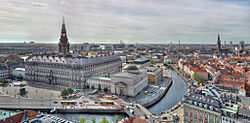
The oldest section of Copenhagen's inner city is often referred to as Middelalderbyen (the medieval city).[148] However, the city's most distinctive district is Frederiksstaden, developed during the reign of Frederick V. It has the Amalienborg Palace at its centre and is dominated by the dome of Frederik's Church (or the Marble Church) and several elegant 18th-century Rococo mansions.[149] The inner city includes Slotsholmen, a little island on which Christiansborg Palace stands and Christianshavn with its canals.[150] Børsen on Slotsholmen and Frederiksborg Palace in Hillerød are prominent examples of the Dutch Renaissance style in Copenhagen. Around the historical city centre lies a band of congenial residential boroughs (Vesterbro, Inner Nørrebro, Inner Østerbro) dating mainly from late 19th century. They were built outside the old ramparts when the city was finally allowed to expand beyond its fortifications.[151]
Sometimes referred to as "the City of Spires", Copenhagen is known for its horizontal skyline, broken only by the spires and towers of its churches and castles. Most characteristic of all is the Baroque spire of the Church of Our Saviour with its narrowing external spiral stairway that visitors can climb to the top.[152] Other important spires are those of Christiansborg Palace, the City Hall and the former Church of St. Nikolaj that now houses a modern art venue. Not quite so high are the Renaissance spires of Rosenborg Castle and the "dragon spire" of Christian IV's former stock exchange, so named because it resembles the intertwined tails of four dragons.[153]
Copenhagen is recognised globally as an exemplar of best practice urban planning.[154] Its thriving mixed use city centre is defined by striking contemporary architecture, engaging public spaces and an abundance of human activity. These design outcomes have been deliberately achieved through careful replanning in the second half of the 20th century.
Recent years have seen a boom in modern architecture in Copenhagen[155] both for Danish architecture and for works by international architects. For a few hundred years, virtually no foreign architects had worked in Copenhagen, but since the turn of the millennium the city and its immediate surroundings have seen buildings and projects designed by top international architects. British design magazine Monocle named Copenhagen the World's best design city 2008.[156]
Copenhagen's urban development in the first half of the 20th century was heavily influenced by industrialisation. After World War II, Copenhagen Municipality adopted Fordism and repurposed its medieval centre to facilitate private automobile infrastructure in response to innovations in transport, trade and communication.[157] Copenhagen's spatial planning in this time frame was characterised by the separation of land uses: an approach which requires residents to travel by car to access facilities of different uses.[158]
The boom in urban development and modern architecture has brought some changes to the city's skyline. A political majority has decided to keep the historical centre free of high-rise buildings, but several areas will see or have already seen massive urban development. Ørestad now has seen most of the recent development. Located near Copenhagen Airport, it currently boasts one of the largest malls in Scandinavia and a variety of office and residential buildings as well as the IT University and a high school.[159]
Parks, gardens and zoo
[edit]
Copenhagen is a green city with many parks, both large and small. King's Garden (Kongens Have), the garden of Rosenborg Castle, is the oldest and most frequented of them all.[160] It was Christian IV who first developed its landscaping in 1606. Every year it sees more than 2.5 million visitors[161] and in the summer months it is packed with sunbathers, picnickers and ballplayers. It serves as a sculpture garden with both a permanent display and temporary exhibits during the summer months.[160] Also located in the city centre are the Botanical Gardens noted for their large complex of 19th-century greenhouses donated by Carlsberg founder J. C. Jacobsen.[162] Fælledparken at 58 ha (140 acres) is the largest park in Copenhagen.[163]
It is popular for sports fixtures and hosts several annual events including a free opera concert at the opening of the opera season, other open-air concerts, carnival and Labour Day celebrations, and the Copenhagen Historic Grand Prix, a race for antique cars. A historical green space in the northeastern part of the city is Kastellet, a well-preserved Renaissance citadel that now serves mainly as a park.[164] Another popular park is the Frederiksberg Gardens, a 32-hectare romantic landscape park. It houses a colony of tame grey herons and other waterfowl.[165] The park offers views of the elephant house of the adjacent Copenhagen Zoo, designed by world-famous British architect Norman Foster.[166] Langelinie, a park and promenade along the inner Øresund coast, is home to one of Copenhagen's most-visited tourist attractions, the Little Mermaid statue.[167]
In Copenhagen, many cemeteries double as parks, though only for the more quiet activities such as sunbathing, reading and meditation. Assistens Cemetery, the burial place of Hans Christian Andersen, is an important green space for the district of Inner Nørrebro and a Copenhagen institution. The lesser known Vestre Kirkegaard is the largest cemetery in Denmark (54 ha (130 acres)) and offers a maze of dense groves, open lawns, winding paths, hedges, overgrown tombs, monuments, tree-lined avenues, lakes and other garden features.[168]
It is official municipal policy in Copenhagen that by 2015 all citizens must be able to reach a park or beach on foot in less than 15 minutes.[169] In line with this policy, several new parks, including the innovative Superkilen in the Nørrebro district, have been completed or are under development in areas lacking green spaces.[170]
Landmarks by district
[edit]Indre By
[edit]The historic centre of the city, Indre By or the Inner City, features many of Copenhagen's most popular monuments and attractions. The area known as Frederiksstaden, developed by Frederik V in the second half of the 18th century in the Rococo style, has the four mansions of Amalienborg, the royal residence, and the wide-domed Marble Church at its centre.[171] Directly across the water from Amalienborg, the 21st-century Copenhagen Opera House stands on the island of Holmen.[172] To the south of Frederiksstaden, the Nyhavn canal is lined with colourful houses from the 17th and 18th centuries, many now with lively restaurants and bars.[173] The canal runs from the harbour front to the spacious square of Kongens Nytorv which was laid out by Christian V in 1670. Important buildings include Charlottenborg Palace, famous for its art exhibitions, the Thott Palace (now the French embassy), the Royal Danish Theatre and the Hotel D'Angleterre, dated to 1755.[174] Other landmarks in Indre By include the parliament building of Christiansborg, the City Hall and Rundetårn, originally an observatory. There are also several museums in the area including Thorvaldsen Museum dedicated to the 18th-century sculptor Bertel Thorvaldsen.[175] Closed to traffic since 1964, Strøget, one of the world's oldest and longest pedestrian streets, runs the 3.2 km (2.0 mi) from Rådhuspladsen to Kongens Nytorv. With its speciality shops, cafés, restaurants, and buskers, it is always full of life and includes the old squares of Gammel Torv and Amagertorv, each with a fountain.[176] Rosenborg Castle on Øster Voldgade was built by Christian IV in 1606 as a summer residence in the Renaissance style. It houses the Danish crown jewels and crown regalia, the coronation throne and tapestries illustrating Christian V's victories in the Scanian War.[177]
Christianshavn
[edit]
Christianshavn lies to the southeast of Indre By on the other side of the harbour. The area was developed by Christian IV in the early 17th century. Impressed by the city of Amsterdam, he employed Dutch architects to create canals within its ramparts which are still well preserved today.[24] The canals themselves, branching off the central Christianshavn Canal and lined with house boats and pleasure craft are one of the area's attractions.[178] Another interesting feature is Freetown Christiania, a fairly large area which was initially occupied by squatters during student unrest in 1971. Today it still maintains a measure of autonomy. The inhabitants openly sell drugs on "Pusher Street" as well as their arts and crafts. Other buildings of interest in Christianshavn include the Church of Our Saviour with its spiralling steeple and the magnificent Rococo Christian's Church. Once a warehouse, the North Atlantic House now displays culture from Iceland and Greenland and houses the Noma restaurant, known for its Nordic cuisine.[179][180]
Vesterbro
[edit]
Vesterbro, to the southwest of Indre By, begins with the Tivoli Gardens, the city's top tourist attraction with its fairground atmosphere, its Pantomime Theatre, its Concert Hall and its many rides and restaurants.[181] The Carlsberg neighbourhood has some interesting vestiges of the old brewery of the same name including the Elephant Gate and the Ny Carlsberg Brewhouse.[182] The Tycho Brahe Planetarium is located on the edge of Skt. Jørgens Sø, one of the Copenhagen lakes.[183] Halmtorvet, the old hay market behind the Central Station, is an increasingly popular area with its cafés and restaurants. The former cattle market Øksnehallen has been converted into a modern exhibition centre for art and photography.[184] Radisson Blu Royal Hotel, built by Danish architect and designer Arne Jacobsen for the airline Scandinavian Airlines System (SAS) between 1956 and 1960 was once the tallest hotel in Denmark with a height of 69.60 m (228.3 ft) and the city's only skyscraper until 1969.[185] Completed in 1908, Det Ny Teater (the New Theatre) located in a passage between Vesterbrogade and Gammel Kongevej has become a popular venue for musicals since its reopening in 1994, attracting the largest audiences in the country.[186]
Nørrebro
[edit]
Nørrebro to the northwest of the city centre has recently developed from a working-class district into a colourful cosmopolitan area with antique shops, non-Danish food stores and restaurants. Much of the activity is centred on Sankt Hans Torv[187] and around Rantzausgade. Copenhagen's historic cemetery, Assistens Kirkegård halfway up Nørrebrogade, is the resting place of many famous figures including Søren Kierkegaard, Niels Bohr, and Hans Christian Andersen but is also used by locals as a park and recreation area.[188]
Østerbro
[edit]
Just north of the city centre, Østerbro is an upper middle-class district with a number of fine mansions, some now serving as embassies.[189] The district stretches from Nørrebro to the waterfront where The Little Mermaid statue can be seen from the promenade known as Langelinie. Inspired by Hans Christian Andersen's fairy tale, it was created by Edvard Eriksen and unveiled in 1913.[190] Not far from the Little Mermaid, the old Citadel (Kastellet) can be seen. Built by Christian IV, it is one of northern Europe's best preserved fortifications. There is also a windmill in the area.[191] The large Gefion Fountain (Gefionspringvandet) designed by Anders Bundgaard and completed in 1908 stands close to the southeast corner of Kastellet. Its figures illustrate a Nordic legend.[192]
Frederiksberg
[edit]
Frederiksberg, a separate municipality within the urban area of Copenhagen, lies to the west of Nørrebro and Indre By and north of Vesterbro. Its landmarks include Copenhagen Zoo founded in 1869 with over 250 species from all over the world and Frederiksberg Palace built as a summer residence by Frederick IV who was inspired by Italian architecture. Now a military academy, it overlooks the extensive landscaped Frederiksberg Gardens with its follies, waterfalls, lakes and decorative buildings.[193] The wide tree-lined avenue of Frederiksberg Allé connecting Vesterbrogade with the Frederiksberg Gardens has long been associated with theatres and entertainment. While a number of the earlier theatres are now closed, the Betty Nansen Theatre and Aveny-T are still active.[194]
Amagerbro
[edit]Amagerbro (also known as Sønderbro) is the district located immediately south-east of Christianshavn at northernmost Amager. The old city moats and their surrounding parks constitute a clear border between these districts. The main street is Amagerbrogade which after the harbour bridge Langebro, is an extension of H. C. Andersens Boulevard and has a number of various stores and shops as well as restaurants and pubs.[195] Amagerbro was built up during the two first decades of the twentieth century and is the city's southernmost block built area with typically 4–7 floors. Further south follows the Sundbyøster and Sundbyvester districts.[196]
Other districts
[edit]Not far from Copenhagen Airport on the Kastrup coast, The Blue Planet completed in March 2013 now houses the national aquarium. With its 53 aquariums, it is the largest facility of its kind in Scandinavia.[197] Grundtvig's Church, located in the northern suburb of Bispebjerg, was designed by P.V. Jensen Klint and completed in 1940. A rare example of Expressionist church architecture, its striking west façade is reminiscent of a church organ.[198]
Culture
[edit]
Apart from being the national capital, Copenhagen also serves as the cultural hub of Denmark and one of the major hubs in wider Scandinavia. Since the late 1990s, it has undergone a transformation from a modest Scandinavian capital into a metropolitan city of international appeal, in the same league as cities such as Barcelona and Amsterdam.[199] This is a result of huge investments in infrastructure and culture as well as the work of successful new Danish architects, designers and chefs.[155][200] Copenhagen Fashion Week takes place every year in February and August.[201][202]
Museums
[edit]Copenhagen has a wide array of museums of international standing. The National Museum, Nationalmuseet, is Denmark's largest museum of archaeology and cultural history, comprising the histories of Danish and foreign cultures alike.[203] Denmark's National Gallery (Statens Museum for Kunst) is the national art museum with collections dating from the 12th century to the present. In addition to Danish painters, artists represented in the collections include Rubens, Rembrandt, Picasso, Braque, Léger, Matisse, Emil Nolde, Olafur Eliasson, Elmgreen & Dragset, Superflex, and Jens Haaning.[204]

Another important Copenhagen art museum is the Ny Carlsberg Glyptotek founded by second generation Carlsberg philanthropist Carl Jacobsen and built around his personal collections. Its main focus is classical Egyptian, Roman and Greek sculptures and antiquities and a collection of Rodin sculptures, the largest outside France. Besides its sculpture collections, the museum also holds a comprehensive collection of paintings of Impressionist and Post-Impressionist painters such as Monet, Renoir, Cézanne, van Gogh and Toulouse-Lautrec as well as works by the Danish Golden Age painters.[205]
Louisiana is a Museum of Modern Art situated on the coast just north of Copenhagen. It is located in the middle of a sculpture garden on a cliff overlooking Øresund. Its collection of over 3,000 items includes works by Picasso, Giacometti and Dubuffet.[206] The Danish Design Museum is housed in the 18th-century former Frederiks Hospital and displays Danish design as well as international design and crafts.[207]
Other museums include: the Thorvaldsens Museum, dedicated to the oeuvre of romantic Danish sculptor Bertel Thorvaldsen who lived and worked in Rome;[208] the Cisternerne museum, an exhibition space for contemporary art, located in former cisterns that come complete with stalactites formed by the changing water levels;[209] and the Ordrupgaard Museum, located just north of Copenhagen, which features 19th-century French and Danish art and is noted for its works by Paul Gauguin.[210]
Entertainment and performing arts
[edit]
The new Copenhagen Concert Hall opened in January 2009. Designed by Jean Nouvel, it has four halls with the main auditorium seating 1,800 people. It serves as the home of the Danish National Symphony Orchestra and along with the Walt Disney Concert Hall in Los Angeles is the most expensive concert hall ever built.[211] Another important venue for classical music is the Tivoli Concert Hall located in the Tivoli Gardens.[212] Designed by Henning Larsen, the Copenhagen Opera House (Operaen) opened in 2005. It is among the most modern opera houses in the world.[213] The Royal Danish Theatre also stages opera in addition to its drama productions. It is also home to the Royal Danish Ballet. Founded in 1748 along with the theatre, it is one of the oldest ballet troupes in Europe, and is noted for its Bournonville style of ballet.[214]

Copenhagen has a significant jazz scene that has existed for many years. It developed when a number of American jazz musicians such as Ben Webster, Thad Jones, Richard Boone, Ernie Wilkins, Kenny Drew, Ed Thigpen, Bob Rockwell, Dexter Gordon, and others such as rock guitarist Link Wray came to live in Copenhagen during the 1960s. Every year in early July, Copenhagen's streets, squares, parks as well as cafés and concert halls fill up with big and small jazz concerts during the Copenhagen Jazz Festival. One of Europe's top jazz festivals, the annual event features around 900 concerts at 100 venues with over 200,000 guests from Denmark and around the world.[215]
The largest venue for popular music in Copenhagen is Vega in the Vesterbro district. It was chosen as "best concert venue in Europe" by international music magazine Live. The venue has three concert halls: the great hall, Store Vega, accommodates audiences of 1,550, the middle hall, Lille Vega, has space for 500 and Ideal Bar Live has a capacity of 250.[216] Every September since 2006, the Festival of Endless Gratitude (FOEG) has taken place in Copenhagen. This festival focuses on indie counterculture, experimental pop music and left field music combined with visual arts exhibitions.[217]
For free entertainment one can stroll along Strøget, especially between Nytorv and Højbro Plads, which in the late afternoon and evening is a bit like an impromptu three-ring circus with musicians, magicians, jugglers and other street performers.[218]
Literature
[edit]
Most of Denmarks's major publishing houses are based in Copenhagen. These include the book publishers Gyldendal and Akademisk Forlag and newspaper publishers Berlingske and Politiken (the latter also publishing books).[219][220] Many of the most important contributors to Danish literature such as Hans Christian Andersen (1805–1875) with his fairy tales, the philosopher Søren Kierkegaard (1813–1855) and playwright Ludvig Holberg (1684–1754) spent much of their lives in Copenhagen. Novels set in Copenhagen include Baby (1973) by Kirsten Thorup, The Copenhagen Connection (1982) by Barbara Mertz, Number the Stars (1989) by Lois Lowry, Miss Smilla's Feeling for Snow (1992) and Borderliners (1993) by Peter Høeg, Music and Silence (1999) by Rose Tremain, The Danish Girl (2000) by David Ebershoff, and Sharpe's Prey (2001) by Bernard Cornwell. Michael Frayn's 1998 play Copenhagen about the meeting between the physicists Niels Bohr and Werner Heisenberg in 1941 is also set in the city. On 15–18 August 1973, an oral literature conference took place in Copenhagen as part of the 9th International Congress of Anthropological and Ethnological Sciences.[221]
The Royal Library, belonging to the University of Copenhagen, is the largest library in the Nordic countries with an almost complete collection of all printed Danish books since 1482. Founded in 1648, the Royal Library is located at four sites in the city, the main one being on the Slotsholmen waterfront.[222] Copenhagen's public library network has over 20 outlets, the largest being the Central Library (Københavns Hovedbibliotek) on Krystalgade in the inner city.[223]
Art
[edit]
Copenhagen has a wide selection of art museums and galleries displaying both historic works and more modern contributions. They include Statens Museum for Kunst, i.e. the Danish national art gallery, in the Østre Anlæg park, and the adjacent Hirschsprung Collection specialising in the 19th and early 20th century. Kunsthal Charlottenborg in the city centre exhibits national and international contemporary art. Den Frie Udstilling near the Østerport Station exhibits paintings created and selected by contemporary artists themselves rather than by the official authorities. The Arken Museum of Modern Art is located in southwestern Ishøj.[224] Among artists who have painted scenes of Copenhagen are Martinus Rørbye (1803–1848),[225] Christen Købke (1810–1848)[226] and the prolific Paul Gustav Fischer (1860–1934).[227]
A number of notable sculptures can be seen in the city. In addition to The Little Mermaid on the waterfront, there are two historic equestrian statues in the city centre: Jacques Saly's Frederik V on Horseback (1771) in Amalienborg Square[228] and the statue of Christian V on Kongens Nytorv created by Abraham-César Lamoureux in 1688 who was inspired by the statue of Louis XIII in Paris.[229] Rosenborg Castle Gardens contains several sculptures and monuments including August Saabye's Hans Christian Andersen, Aksel Hansen's Echo, and Vilhelm Bissen's Dowager Queen Caroline Amalie.[230]
Copenhagen is believed to have invented the photomarathon photography competition, which has been held in the City each year since 1989.[231][232]
Cuisine
[edit]
As of 2014[update], Copenhagen has 15 Michelin-starred restaurants, the most of any Scandinavian city.[233] The city is increasingly recognized internationally as a gourmet destination.[234] These include Den Røde Cottage, Formel B Restaurant, Grønbech & Churchill, Søllerød Kro, Kadeau, Kiin Kiin (Denmark's first Michelin-starred Asian gourmet restaurant), the French restaurant Kong Hans Kælder, Relæ, Restaurant AOC with two Stars, and Noma (short for Danish: nordisk mad, English: Nordic food) as well as Geranium with three. Noma was ranked as the Best Restaurant in the World by Restaurant in 2010, 2011, 2012, and again in 2014,[235] sparking interest in the New Nordic Cuisine.[236]
Apart from the selection of upmarket restaurants, Copenhagen offers a great variety of Danish, ethnic and experimental restaurants. It is possible to find modest eateries serving open sandwiches, known as smørrebrød – a traditional, Danish lunch dish; however, most restaurants serve international dishes.[237] Danish pastry can be sampled from any of numerous bakeries found in all parts of the city. The Copenhagen Bakers' Association (Danish: Københavns Bagerlaug) dates back to the 1290s and Denmark's oldest confectioner's shop still operating, Conditori La Glace, was founded in 1870 in Skoubogade by Nicolaus Henningsen, a trained master baker from Flensburg.[238]
Copenhagen has long been associated with beer. Carlsberg beer has been brewed at the brewery's premises on the border between the Vesterbro and Valby districts since 1847 and has long been almost synonymous with Danish beer production. However, recent years have seen an explosive growth in the number of microbreweries so that Denmark today has more than 100 breweries, many of which are located in Copenhagen. Some like Nørrebro Bryghus also act as brewpubs where it is also possible to eat on the premises.[239][240]
Nightlife and festivals
[edit]
Copenhagen has one of the highest number of restaurants and bars per capita in the world.[241] The nightclubs and bars stay open until 5 or 6 in the morning, some even longer. Denmark has a very liberal alcohol culture and a strong tradition for beer breweries, although binge drinking is frowned upon and the Danish Police take driving under the influence very seriously.[242] Inner city areas such as Istedgade and Enghave Plads in Vesterbro, Sankt Hans Torv in Nørrebro and certain places in Frederiksberg are especially noted for their nightlife. Notable nightclubs include Bakken Kbh, ARCH (previously ZEN), Jolene, The Jane, Chateau Motel, KB3, At Dolores (previously Sunday Club), Rust, Vega Nightclub and Culture Box.[243][244]
Copenhagen has several recurring community festivals, mainly in the summer. Copenhagen Carnival has taken place every year since 1982 during the Whitsun Holiday in Fælledparken and around the city with the participation of 120 bands, 2,000 dancers and 100,000 spectators.[245] Since 2010, the old B&W Shipyard at Refshaleøen in the harbour has been the location for Copenhell, a heavy metal rock music festival. Copenhagen Pride is a LGBT pride festival taking place every year in August. The Pride has a series of different activities all over Copenhagen, but it is at the City Hall Square that most of the celebration takes place. During the Pride the square is renamed Pride Square.[246] Copenhagen Distortion has emerged to be one of the biggest street festivals in Europe with 100,000 people joining to parties in the beginning of June every year.[247]
Amusement parks
[edit]
Copenhagen has the oldest and third-oldest amusement parks in the world.[248][249]
Dyrehavsbakken, a fair-ground and pleasure-park established in 1583, is located in Klampenborg just north of Copenhagen in a forested area known as Dyrehaven. Created as an amusement park complete with rides, games and restaurants by Christian IV, it is the oldest surviving amusement park in the world.[248] Pierrot (Danish: Pjerrot), a nitwit dressed in white with a scarlet grin wearing a boat-like hat while entertaining children, remains one of the park's key attractions. In Danish, Dyrehavsbakken is often abbreviated as Bakken. There is no entrance fee to pay and Klampenborg Station on the C-line, is situated nearby.[250]
The Tivoli Gardens is an amusement park and pleasure garden located in central Copenhagen between the City Hall Square and the Central Station. It opened in 1843, making it the third-oldest amusement park in the world, the second being Wurstelprater in Vienna. Among its rides are the oldest still operating rollercoaster Rutschebanen from 1915 and the oldest ferris wheel still in use, opened in 1943.[251] Tivoli Gardens also serves as a venue for various performing arts and as an active part of the cultural scene in Copenhagen.[252]
Education
[edit]
Copenhagen has over 94,000 students enrolled in its largest universities and institutions: University of Copenhagen (38,867 students),[253] Copenhagen Business School (20,000 students),[254] Metropolitan University College and University College Capital (10,000 students each),[255] Technical University of Denmark (7,000 students),[256] KEA (c. 4,500 students),[257] IT University of Copenhagen (2,000 students) and the Copenhagen campus of Aalborg University (2,300 students).[258]
The University of Copenhagen is Denmark's oldest university founded in 1479. It attracts some 1,500 international and exchange students every year. The Academic Ranking of World Universities placed it 30th in the world in 2016.[259]
The Technical University of Denmark is located in Lyngby in the northern outskirts of Copenhagen. In 2013, it was ranked as one of the leading technical universities in Northern Europe.[260] The IT University is Denmark's youngest university, a mono-faculty institution focusing on technical, societal and business aspects of information technology.[261]
The Danish Academy of Fine Arts has provided education in the arts for more than 250 years. It includes the historic School of Visual Arts, and has in later years come to include a School of Architecture, a School of Design and a School of Conservation.[262] Copenhagen Business School (CBS) is an EQUIS-accredited business school located in Frederiksberg.[263] There are also branches of both University College Capital and Metropolitan University College inside and outside Copenhagen.[264][265]
Sport
[edit]The city has a variety of sporting teams. The major football teams are the historically successful FC København[266] and Brøndby. FC København plays at Parken in Østerbro. Formed in 1992, it is a merger of two older Copenhagen clubs, B 1903 (from the inner suburb Gentofte) and KB (from Frederiksberg).[267] Brøndby plays at Brøndby Stadion in the inner suburb of Brøndbyvester. BK Frem is based in the southern part of Copenhagen (Sydhavnen, Valby). Other teams of more significant stature are FC Nordsjælland (from suburban Farum), Fremad Amager, B93, AB, Lyngby and Hvidovre IF.[268]

Copenhagen has several handball teams—a sport which is particularly popular in Denmark. Clubs playing in the "highest" leagues include Ajax, Ydun, and HIK (Hellerup).[268] The København Håndbold women's club has recently been established.[269] Copenhagen also has ice hockey teams, of which three play in the top league, Rødovre Mighty Bulls, Herlev Eagles and Hvidovre Ligahockey all inner suburban clubs. Copenhagen Ice Skating Club founded in 1869 is the oldest ice hockey team in Denmark but is no longer in the top league.[270]
Rugby union is also played in the Danish capital with teams such as CSR-Nanok, Copenhagen Business School Sport Rugby, Frederiksberg RK, Exiles RUFC and Rugbyklubben Speed. Rugby league is now played in Copenhagen, with the national team playing out of Gentofte Stadion. The Danish Australian Football League, based in Copenhagen is the largest Australian rules football competition outside of the English-speaking world.[268][271]
Copenhagen Marathon, Copenhagen's annual marathon event, was established in 1980.[272] Round Christiansborg Open Water Swim Race is a 2-kilometre (1.2-mile) open water swimming competition taking place each year in late August.[273] This amateur event is combined with a 10-kilometre (6-mile) Danish championship.[274] In 2009 the event included a 10-kilometre (6-mile) FINA World Cup competition in the morning. Copenhagen hosted the 2011 UCI Road World Championships in September 2011, taking advantage of its bicycle-friendly infrastructure. It was the first time that Denmark had hosted the event since 1956, when it was also held in Copenhagen.[275]
Transport
[edit]
Airport
[edit]The greater Copenhagen area has a very well established transportation infrastructure making it a hub in Northern Europe. Copenhagen Airport, opened in 1925, is Scandinavia's largest airport, located in Kastrup on the island of Amager. It is connected to the city centre by metro and main line railway services.[276] October 2013 was a record month with 2.2 million passengers, and November 2013 figures reveal that the number of passengers is increasing by some 3% annually, about 50% more than the European average.[277]
Road, rail and ferry
[edit]Copenhagen has an extensive road network including motorways connecting the city to other parts of Denmark and to Sweden over the Øresund Bridge.[278] The car is still the most popular form of transport within the city itself, representing two-thirds of all distances travelled. This can however lead to serious congestion in rush hour traffic.[279] The Øresund train links Copenhagen with Malmö 24 hours a day, 7 days a week. Copenhagen is also served by a daily ferry connection to Oslo in Norway.[280] In 2012, Copenhagen Harbour handled 372 cruise ships and 840,000 passengers.[280]
The Copenhagen S-Train, Copenhagen Metro and the regional train networks are used by about half of the city's passengers, the remainder using bus services. Nørreport Station near the city centre serves passengers travelling by main-line rail, S-train, regional train, metro and bus. Some 750,000 passengers make use of public transport facilities every day.[278] Copenhagen Central Station is the hub of the DSB railway network serving Denmark and international destinations.[281]
The Copenhagen Metro expanded radically with the opening of the City Circle Line (M3) on 29 September 2019.[282] The new line connects all inner boroughs of the city by metro, including the Central Station, and opens up 17 new stations[283] for Copenhageners. On 28 March 2020, the 2.2 km (1.4 mi) Nordhavn extension of the Harbour Line (M4) opened.[284] Running from Copenhagen Central Station, the new extension is a branch line of M3 Cityring to Østerport.[285] The new metro lines are part of the city's strategy to transform mobility towards sustainable modes of transport such as public transport and cycling as opposed to automobility.[286]
Copenhagen is cited by urban planners for its exemplary integration of public transport and urban development. In implementing its Finger Plan, Copenhagen is considered the world's first example of a transit metropolis,[52] and areas around S-Train stations like Ballerup and Brøndby Strand are among the earliest examples of transit-oriented development.[287]
Cycling
[edit]
Copenhagen has been rated as one of the most bicycle-friendly cities in the world since 2015, with bicycles outnumbering its inhabitants.[288][289][290] In 2012 some 36% of all working or studying city-dwellers cycled to work, school, or university. With 1.27 million km (790,000 mi) covered every working day by Copenhagen's cyclists (including both residents and commuters), and 75% of Copenhageners cycling throughout the year.[291] The city's bicycle paths are extensive and well used, boasting 400 kilometres (250 miles) of cycle lanes not shared with cars or pedestrians, and sometimes equipped with their own signal systems – giving the cyclists a lead of a couple of seconds to accelerate.[290][292]
Healthcare
[edit]
Promoting health is an important issue for Copenhagen's municipal authorities. Central to its sustainability mission is its "Long Live Copenhagen" (Længe Leve København) scheme in which it has the goal of increasing the life expectancy of citizens, improving quality of life through better standards of health, and encouraging more productive lives and equal opportunities.[293] The city has targets to encourage people to exercise regularly and to reduce the number of people who smoke and consume alcohol.[293]
Copenhagen University Hospital forms a conglomerate of several hospitals in Region Hovedstaden and Region Sjælland, together with the faculty of health sciences at the University of Copenhagen; Rigshospitalet and Bispebjerg Hospital in Copenhagen belong to this group of university hospitals.[294] Rigshospitalet began operating in March 1757 as Frederiks Hospital,[295] and became state-owned in 1903. With 1,120 beds, Rigshospitalet has responsibility for 65,000 inpatients and approximately 420,000 outpatients annually. It seeks to be the number one specialist hospital in the country, with an extensive team of researchers into cancer treatment, surgery and radiotherapy.[296] In addition to its 8,000 personnel, the hospital has training and hosting functions. It benefits from the presence of in-service students of medicine and other healthcare sciences, as well as scientists working under a variety of research grants. The hospital became internationally famous as the location of Lars von Trier's television horror mini-series The Kingdom. Bispebjerg Hospital was built in 1913, and serves about 400,000 people in the Greater Copenhagen area, with some 3,000 employees.[297] Other large hospitals in the city include Amager Hospital (1997),[298] Herlev Hospital (1976),[299] Hvidovre Hospital (1970),[300] and Gentofte Hospital (1927).[301]
Media
[edit]
Many Danish media corporations are located in Copenhagen. DR, the major Danish public service broadcasting corporation consolidated its activities in a new headquarters, DR Byen, in 2006 and 2007. Similarly TV2, which is based in Odense, has concentrated its Copenhagen activities in a modern media house in Teglholmen.[302] The two national daily newspapers Politiken and Berlingske and the two tabloids Ekstra Bladet and BT are based in Copenhagen.[303] Kristeligt Dagblad is based in Copenhagen and is published six days a week.[304] Other important media corporations include Aller Media which is the largest publisher of weekly and monthly magazines in Scandinavia,[305] the Egmont media group[306] and Gyldendal, the largest Danish publisher of books.[307]
Copenhagen has a large film and television industry. Nordisk Film, established in Valby, Copenhagen in 1906 is the oldest continuously operating film production company in the world.[245] In 1992 it merged with the Egmont media group and currently runs the 17-screen Palads Cinema in Copenhagen. Filmbyen (movie city), located in a former military camp in the suburb of Hvidovre, houses several movie companies and studios. Zentropa is a film company, co-owned by Danish director Lars von Trier. He is behind several international movie productions as well and founded the Dogme Movement.[308] CPH:PIX is Copenhagen's international feature film festival, established in 2009 as a fusion of the 20-year-old NatFilm Festival and the four-year-old CIFF. The CPH:PIX festival takes place in mid-April. CPH:DOX is Copenhagen's international documentary film festival, every year in November. In addition to a documentary film programme of over 100 films, CPH:DOX includes a wide event programme with dozens of events, concerts, exhibitions and parties all over town.[309]
Twin towns – sister cities
[edit]Honorary citizens
[edit]People awarded the honorary citizenship of Copenhagen are:
| Date | Name | Notes |
|---|---|---|
| 21 November 1838 | Bertel Thorvaldsen (1770–1844) | Danish sculptor[313] |
While honorary citizenship is no longer granted in Copenhagen, three people have been awarded the title of honorary Copenhageners (æreskøbenhavnere).
| Date | Name | Notes |
|---|---|---|
| 16 June 1967 | Poul Reumert (1883–1968) | Danish actor |
| 16 June 1967 | Victor Borge (1909–2000) | Danish comedian |
| 16 June 1967 | Steen Eiler Rasmussen (1898–1990) | Danish architect |
See also
[edit]

- Category: People from Copenhagen
- United Nations Climate Change Conference in Copenhagen
- Architecture of Copenhagen
- Carlsberg Fault zone, a concealed tectonic formation that runs across the city
- Copenhagen Climate Council
- List of urban areas in Denmark by population
- Outline of Denmark
- Ports of the Baltic Sea
Footnotes
[edit]Citations
[edit]- ^ "Statistikbanken". Archived from the original on 2 July 2022. Retrieved 27 August 2022.
- ^ "Befolkningstal". Archived from the original on 14 August 2022. Retrieved 27 August 2022.
- ^ "Folketal den 1. I kvartalet efter område, køn, alder og civilstand – Statistikbanken – data og tal". Archived from the original on 27 August 2022. Retrieved 27 August 2022.
- ^ a b c d e "Population at the first day of the quarter by urban areas, age and sex". statbank.dk. Statistics Denmark. 1 January 2016. Archived from the original on 25 February 2021. Retrieved 18 April 2016.
- ^ "Four regions over double the EU average…". Archived from the original on 2 April 2017. Retrieved 6 August 2017.
- ^ "Copenhagen"
- ^ "Archived copy". Archived from the original on 22 January 2018. Retrieved 21 December 2017.
{{cite web}}: CS1 maint: archived copy as title (link) CS1 maint: bot: original URL status unknown (link) - ^ "Nyt fra Danmarks Statistik – Byopgørelsen 1. januar 2020" (PDF). Archived (PDF) from the original on 30 September 2022. Retrieved 29 October 2022.
- ^ a b "The average Dane". dst.dk. Archived from the original on 8 February 2017. Retrieved 16 October 2018.
- ^ Nielsen, Oluf (1877). "Kjøbenhavn i Middelalderen" (in Danish). G.E.C. Gad. Archived from the original on 19 July 2011. Retrieved 23 November 2013.
- ^ Authier, André (2013). Early Days of X-ray Crystallography. Oxford: Oxford University Press. p. 153. ISBN 978-0-19-163501-4.
- ^ "Arkæologer graver ny teori om København op af mulden" (in Danish). Videnskab.dk. 5 November 2008. Archived from the original on 25 February 2021. Retrieved 12 November 2013.
- ^ Cunningham 2013, p. 35.
- ^ a b c d "København – historie". Den Store Danske (in Danish). Archived from the original on 22 October 2013. Retrieved 12 November 2013.
- ^ "Gammel Strand" (in Danish). Københavns Museum. Archived from the original on 24 November 2013. Retrieved 24 November 2013.
- ^ Skaarup; Jensen (2002), pp. 14–15
- ^ Davies 1944, p. 365.
- ^ a b c Harding 2009, p. 38.
- ^ a b c Christopher 2006, p. 78.
- ^ Copenhagen, Dansk turistforening (1898). Copenhagen, the Capital of Denmark. p. 49. Archived from the original on 29 May 2016. Retrieved 29 October 2015.
- ^ a b Booth 2003, p. 9.
- ^ Ingebritsen, Christine (1 January 2006). Scandinavia in World Politics. Rowman & Littlefield. pp. 7–. ISBN 978-0-7425-0966-5. Archived from the original on 29 May 2016. Retrieved 29 October 2015.
- ^ a b "History of the University". University of Copenhagen. Archived from the original on 23 October 2012. Retrieved 12 November 2013.
- ^ a b c d "Københavns historie efter Reformationen". Den Store Danske (in Danish). Archived from the original on 9 January 2014. Retrieved 14 November 2013.
- ^ "Holmen". Den Store Danske (in Danish). Archived from the original on 30 December 2013. Retrieved 23 November 2013.
- ^ Woodward 1998, p. 10.
- ^ Raabyemagle, p. 16.
- ^ Lauring, Kåre. Byen brænder. pp. 86–88.
- ^ "Frederiksstaden, København" (in Danish). arkark.dk. Archived from the original on 10 April 2014. Retrieved 14 November 2013.
- ^ a b c d "Københavns historie 1728–1914". Den Store Danske (in Danish). Archived from the original on 29 December 2013. Retrieved 14 November 2013.
- ^ The Danish Slave Trade and Its Abolition. BRILL. 7 September 2016. ISBN 978-90-04-33056-6.
- ^ "10 Places in Copenhagen Linked to Colonialism". Archived from the original on 3 May 2024. Retrieved 3 May 2024.
- ^ Nelson 2005, p. 247.
- ^ Pocock 1994, p. 229.
- ^ Davies, Peter (3 September 2007). "Copenhagen's second battle remembered – 200 years on". The Times. Archived from the original on 29 May 2010. Retrieved 13 January 2010.
- ^ Smith 1998, p. 204.
- ^ Glenthj̜, Rasmus (2014). Experiences of war and nationality in Denmark-Norway, 1807–1815. New York City: Springer. ISBN 978-1-137-31389-8. OCLC 912332684.
- ^ "Københavns bombardement". Den Store Danske (in Danish). Archived from the original on 10 December 2013. Retrieved 15 November 2013.
- ^ Hinde 1973, p. 168.
- ^ "Guide til Dansk Guldalder" (in Danish). Golden Days. Archived from the original on 27 January 2002. Retrieved 15 November 2013.
- ^ "Københavns Havn". Den Store Danske (in Danish). Archived from the original on 3 April 2015. Retrieved 24 November 2013.
- ^ "Frederiksberg Kommune – historie". Den Store Danske (in Danish). 23 January 2013. Archived from the original on 22 December 2013. Retrieved 15 November 2013.
- ^ Linvald, Steffen. "Københavns hvornår skete det" (in Danish). København. Archived from the original on 2 December 2013. Retrieved 24 November 2013.
- ^ Baltzersen, Jan. "Denmark and Southern Jutland during the First World War". Dansk Center for Byhistorie. Archived from the original on 3 December 2013. Retrieved 1 November 2013.
- ^ a b Schaldemose 2005, p. 161.
- ^ a b "Københavns historie siden 1914". Den Store Danske (in Danish). Archived from the original on 30 December 2013. Retrieved 15 November 2013.
- ^ Henning Poulsen, "Dansk Modstand og Tysk Politik" ("Danish opposition and German Politics") in Jyske Historiker 71(1995), p.10.
- ^ "The Occupation of Denmark" (in Danish). Denmark.dk. Archived from the original on 19 November 2013. Retrieved 15 November 2013.
- ^ a b c Velschow, Klaus (21 March 1945). "The Bombing of the Shellhus on March 21, 1945". Dansk Militærhistorie. Archived from the original on 10 April 2014. Retrieved 9 March 2013.
- ^ "The Occupation of Denmark". Denmark.dk. Archived from the original on 26 April 2014. Retrieved 10 May 2014.
- ^ Regional Development Policies in OECD Countries. OECD Publishing. 4 November 2010. p. 357. ISBN 978-92-64-08722-4. Archived from the original on 30 May 2016. Retrieved 29 October 2015.
- ^ a b Cervero 1998, p. 132.
- ^ a b "Københavns historie" (in Danish). Københavns Kommune. Archived from the original on 2 December 2013. Retrieved 15 November 2013.
- ^ Beacom, Elise (10 November 2012). "'Copenhagenizing' the world, one city at a time". the Copenhagen post. Archived from the original on 27 July 2013. Retrieved 24 November 2013.
- ^ "The Black Diamond" (in Danish). Danish architecture guide. Archived from the original on 2 December 2013. Retrieved 15 November 2013.
- ^ "København" (in Danish). Danmarkshistorien.dk. Archived from the original on 13 April 2012. Retrieved 15 November 2013.
- ^ "Copenhagen Metro, Denmark". railwaytechnology.com. Archived from the original on 2 December 2013. Retrieved 23 November 2013.
- ^ "The Opera in Copenhagen". Henning Larsen Architects. Archived from the original on 31 December 2013. Retrieved 16 November 2013.
- ^ "Copenhagen Climate Change Conference – December 2009". United Nations. Archived from the original on 14 November 2013. Retrieved 15 November 2013.
- ^ Julia Schenner (6 June 2023). "Copenhagen Harbour once again expanding its swimming facilities". The Copenhagen Post. Retrieved 9 March 2025.
- ^ "Several killed in Copenhagen shopping mall shooting". BBC News. 3 July 2022. Archived from the original on 3 July 2022. Retrieved 3 July 2022.
- ^ "Several killed in shooting at Copenhagen shopping centre". The Guardian. 3 July 2022. Archived from the original on 3 July 2022. Retrieved 3 July 2022.
- ^ "What is the Øresund Region?" (in Danish). Øresund. Archived from the original on 17 November 2013. Retrieved 17 November 2013.
- ^ "Copenhagen (København), Denmark". Danishnet.com. Archived from the original on 2 December 2013. Retrieved 16 November 2013.
- ^ "Copenhagen" (Map). Google Maps. Retrieved 24 November 2013.
- ^ "Parker I Indre By" (in Danish). Copenhagen Municipality. Archived from the original on 23 October 2013. Retrieved 25 November 2013.
- ^ a b "København – geografi". Den Store Danske (in Danish). Archived from the original on 22 October 2013. Retrieved 16 November 2013.
- ^ Lars Nielsen; Alexander Lassen; Hans Thybo (2005). "Carlsbergforkastningen" (PDF) (in Danish). Geoviden. pp. 8–11. Archived (PDF) from the original on 25 October 2006. Retrieved 17 November 2013.
- ^ "København – geologi". Den Store Danske (in Danish). Archived from the original on 22 October 2013. Retrieved 17 November 2013.
- ^ "Stranden" (in Danish). Amagerstrand. Archived from the original on 15 September 2013. Retrieved 21 November 2013.
- ^ "Bellevue Beach". visitcopenhagen.com. Wonderful Copenhagen. Archived from the original on 14 April 2016. Retrieved 16 April 2016.
- ^ "2007 IOC Honorable Mention". ap architecture-page. Archived from the original on 29 December 2008. Retrieved 5 January 2009.
- ^ "Denmark". Weather Online. Archived from the original on 12 September 2015. Retrieved 17 November 2013.
- ^ "Average weather in Copenhagen, Denmark" (in Danish). World Weather and Climate Information. Archived from the original on 16 September 2013. Retrieved 17 November 2013.
- ^ "Klimanormaler" (in Danish). Danmarks Meteorologiske Institut. Archived from the original on 4 August 2013. Retrieved 1 February 2014.
- ^ "Københavns Lufthavn er klædt på til vinteren" (in Danish). CPH. Archived from the original on 11 November 2013. Retrieved 17 November 2013.
- ^ "Exceptionel varm sommerdag i København" (in Danish). BT. 21 September 2012. Archived from the original on 23 September 2015. Retrieved 17 November 2013.
- ^ "Sol op/ned" (in Danish). Almanak. Archived from the original on 5 October 2015. Retrieved 17 November 2013.
- ^ "DMI Report 18–19: Climatological Standard Normals 1981–2010 Denmark, The Faroe Islands and Greenland Based on Data Published in DMI Reports 18–08, 18–04 and 18–05" (PDF). Danish Meteorological Institute. Archived from the original (PDF) on 10 February 2019. Retrieved 9 February 2019.
- ^ "Danish Climatological Normals 1971–2000 for selected stations" (PDF). Danish Meteorological Institute. Archived (PDF) from the original on 15 March 2018. Retrieved 17 November 2015.
- ^ "Observed Air Temperature, Humidity, Pressure, Cloud Cover and Weather in Denmark with Climatological Standard Normals, 1961–90" (PDF). Danish Meteorological Institute. Archived (PDF) from the original on 14 July 2018. Retrieved 17 November 2015.
- ^ "Station Copenhague" (in French). Météo Climat. Archived from the original on 30 November 2020. Retrieved 9 February 2019.
- ^ "Vejrekstremer Danmark". Archived from the original on 25 January 2023. Retrieved 25 November 2023.
- ^ "Danish Climatological Normals 1971–2000 for selected stations" (PDF). Danish Meteorological Institute. Archived from the original (PDF) on 15 March 2018. Retrieved 11 July 2025.
- ^ "Observed Air Temperature, Humidity, Pressure, Cloud Cover and Weather in Denmark with Climatological Standard Normals, 1961–90" (PDF). Danish Meteorological Institute. Retrieved 17 November 2015.
- ^ "[EKAH] Aarhus [1972-] Monthly Summaries". The Iowa Environmental Mesonet. Retrieved 11 July 2025.
- ^ a b "Byopgørelse 1. januar 2007 (Largest cities of Denmark 2007)" (PDF) (in Danish). Danmarks Statistik. Archived (PDF) from the original on 22 March 2011. Retrieved 31 December 2012.
- ^ "The Danish Local Government System" (PDF). kl.dk. Local Government Denmark. February 2009. Archived (PDF) from the original on 2 April 2016. Retrieved 22 April 2016.
- ^ "Københavns bydele". Københavns Kommune. Archived from the original on 4 September 2013. Retrieved 31 December 2012.
- ^ "Hof- og Stadsretten". Gyldendal. Archived from the original on 5 February 2020. Retrieved 28 November 2013.
- ^ "The City Court of Copenhagen". Danmarks Domstole: Københavns Byret. Archived from the original on 3 December 2013. Retrieved 29 November 2013.
- ^ "The Copenhagen Maritime and Commercial Court". Danmarks Domstole. Archived from the original on 3 December 2013. Retrieved 29 November 2013.
- ^ "Højesteret". Den Store Danske (in Danish). Archived from the original on 8 January 2014. Retrieved 29 November 2013.
- ^ "Police headquarters". Visitcopenhagen.com. Archived from the original on 3 December 2013. Retrieved 28 November 2013.
- ^ "Copenhagen Fire Brigade". Københavns Kommune. Archived from the original on 5 November 2013. Retrieved 28 November 2013.
- ^ "History of the Copenhagen Fire Brigade". Københavns Kommune. Archived from the original on 2 December 2013. Retrieved 28 November 2013.
- ^ "Hovedbrandstationen" (in Danish). Københavns Bransvæsen. Archived from the original on 10 December 2013. Retrieved 7 December 2013.
- ^ "10 World's Greenest Cities". 27 April 2011. Archived from the original on 24 November 2012. Retrieved 29 November 2012.
- ^ "2014 Global Green Economy Index" (PDF). Dual Citizen LLC. 19 October 2014. Archived (PDF) from the original on 28 October 2014. Retrieved 19 October 2014.
- ^ "New green city survey ranks Copenhagen No. 1". MeetinCopenhagen. 12 September 2012. Archived from the original on 2 December 2013. Retrieved 17 November 2013.
- ^ "Environmental Capital of Europe". Copenhagen, Environmental Capital of Europe. Archived from the original on 6 July 2007. Retrieved 5 January 2009.
- ^ "Copenhagen: From sewer to harbour bath". DAC & Cities. Archived from the original on 2 December 2013. Retrieved 27 November 2013.
- ^ Copenhagen's ambitious push to be carbon-neutral by 2025 Archived 15 February 2017 at the Wayback Machine Guardian 12 April 2013
- ^ We make room for the rainwater Archived 29 July 2015 at the Wayback Machine
- ^ "Copenhagen City of Architecture: The architecture policy of the City of Copenhagen" (PDF). Technical and Environmental Administration, City of Copenhagen. 2010. Archived (PDF) from the original on 3 December 2013. Retrieved 2 December 2013.
- ^ "Grønlænderebosiddende i Danmark" (PDF). The North Atlantic Group in the Danish Parliament. 1 January 2006. Archived (PDF) from the original on 30 October 2020. Retrieved 3 October 2020.
- ^ a b c "Population and Elections (See: POPULATION AT THE FIRST DAY OF THE QUARTER BY REGION, SEX, AGE (5 YEARS AGE GROUPS), ANCESTRY AND COUNTRY OF ORIGIN)". Statistics Denmark. 29 September 2024. Archived from the original on 14 September 2024. Retrieved 29 September 2024.
- ^ "Regioner, landsdele og kommuner. v 1.0: 2007–". dst.dk. Archived from the original on 25 June 2017. Retrieved 25 July 2021.
- ^ "The Finger Plan: A Strategy for the Development of the Greater Copenhagen Area" (PDF). Danish Ministry of the Environment. Archived (PDF) from the original on 4 August 2016. Retrieved 22 April 2016.
- ^ "Befolkning: Befolkningsvækst" (in Danish). ÖresundsStatistik och analyser. Archived from the original on 4 January 2014. Retrieved 6 December 2013.
- ^ "How Many People Live Alone in Copenhagen?". The Danish Dream. 20 January 2025. Retrieved 11 May 2025.
- ^ "Population from the censuses - Statistics Denmark".
- ^ "Folkekirkens medlemstal" (in Danish). Kirkeministeriet. Archived from the original on 13 April 2016. Retrieved 3 June 2019.
- ^ "Nøgletal for sognene" (PDF). Katolsk.dk. Archived (PDF) from the original on 26 September 2013. Retrieved 26 November 2013.
- ^ Hooper, Simon (22 June 2014). "Denmark's first mosque opens amid controversy". Al Jazeera. Archived from the original on 28 April 2016. Retrieved 15 April 2016.
- ^ Nydell, Margaret K. (23 March 2012). Understanding Arabs: a contemporary guide to Arab society. Boston, MA: Intercultural Press. p. 132. ISBN 978-0-9839558-0-1.
In 2011 they constituted 25 percent of Rotterdam, Marseilles, and Amsterdam; 20% of Malmö; 15 percent of Brussels and Birmingham; and 10 percent of London, Paris, Copenhagen, and Vienna.
Muslims in Western Europe originate from both Arab and non-Arab countries. Those in the United Kingdom are primarily from South Asia, in France from North and West Africa, in Germany from Turkey, in Belgium from Morocco, and in the Netherlands from Morocco and Turkey. - ^ Farmer, Brian R. (2010). Radical Islam in the West: ideology and challenge. Jefferson, N.C.: McFarland & Co. p. 8. ISBN 978-0-7864-5953-7.
Muslims living in the West are also concentrated in urban area. Muslims are currently estimated to compose almost one-fourth of the population of Amsterdam. one-fifth of Marseilles, and 15 percent of Paris, Brussels, and Birmingham. Muslims are currently make up approximately 10 percent of the populations in London and Copenhagen.
- ^ Micklethwait, John; Wooldridge, Adrian (2009). God is back how the global revival of faith is changing the world. New York: Penguin Press. ISBN 978-1-101-03241-1.
Muslims are highly concentrated—they make up 24 percent of the population in Amsterdam; 20 percent in Malmö and Marseille; 15 percent in Paris, Brussels, Bradford, and Birmingham; and 10 percent or more in London and Copenhagen.
- ^ Muslimer i København (PDF) (in Danish). Open Society Foundations. 2011. pp. 24, 33–38. ISBN 978-1-936133-10-9. Archived (PDF) from the original on 2 December 2013. Retrieved 26 November 2013.
- ^ "Jødedom i Danmark" (in Danish). Religion-dk. Archived from the original on 15 October 2013. Retrieved 26 November 2013.
- ^ "About the Jewish Community in Denmark". Mosaiske. Archived from the original on 10 August 2023. Retrieved 16 October 2022.
- ^ "The Jewish Community of Copenhagen". The Museum of the Jewish People at Beit Hatfutsot. Archived from the original on 17 June 2018. Retrieved 17 June 2018.
- ^ Flint, Sunshine (September 2011). "Living in Copenhagen". BBC. Archived from the original on 29 November 2013. Retrieved 30 November 2013.
- ^ "Most liveable city: Copenhagen". Monocle. Archived from the original on 3 December 2013. Retrieved 30 November 2013.
- ^ Hardingham-Gill, Tamara (27 June 2024). "The world's most liveable cities for 2024". CNN. Archived from the original on 16 July 2024. Retrieved 18 December 2024.
- ^ "Prestigious titles and rankings to Copenhagen". Visit Copenhagen. 6 September 2013. Archived from the original on 3 December 2013. Retrieved 30 November 2013.
- ^ Chebotareva, Polina (15 February 2012). "Copenhagen is high quality of life, but at a price". University Post. Archived from the original on 3 December 2013. Retrieved 30 November 2013.
- ^ "Workplaces in Copenhagen by industry and residence of the employed, 1 January 2010". City of Copenhagen. Archived from the original on 2 December 2013. Retrieved 25 November 2013.
- ^ "Udvalgte indikatorer for Københavns erhvervsmæssige præstationer og rammevilkår" (PDF) (in Danish). DAMVAD. 14 November 2013. Archived from the original (PDF) on 3 December 2013. Retrieved 26 November 2013.
- ^ "Regional GDP per capita in the EU in 2010" (PDF). Eurostat. 21 March 2013. Archived from the original (PDF) on 3 April 2013. Retrieved 14 April 2016.
- ^ "The World's Biggest Public Companies". Forbes. 18 April 2012. Archived from the original on 26 March 2013. Retrieved 18 November 2013.
- ^ "Copenhagen – Open for Business" (in Danish). New European Economy. Archived from the original on 18 November 2013. Retrieved 18 November 2013.
- ^ "Turning Denmark into a leader in Smart Cities". arup.com. Arup Group. 28 January 2016. Archived from the original on 15 April 2016. Retrieved 16 April 2016.
- ^ "Life Science in the Øresund Region". Copenhagen Capacity. Archived from the original on 12 January 2014. Retrieved 23 January 2014.
- ^ "Copenhagen – Overview". USA Today. 19 May 2009. Archived from the original on 11 May 2012. Retrieved 9 March 2013.
- ^ "Copenhagen Malmö Port Annual Report 2012". Copenhagen Malmö Port. Archived from the original on 17 October 2016. Retrieved 15 April 2016.
- ^ "World's richest cities". City Mayors. Archived from the original on 3 September 2011. Retrieved 5 May 2009.
- ^ "World's most expensive cities (EIU)". City Mayors. Archived from the original on 16 March 2010. Retrieved 5 May 2009.
- ^ "World's most expensive cities – Ranking". City Mayors. Archived from the original on 17 March 2011. Retrieved 5 May 2009.
- ^ "Reasons to invest in Greater Copenhagen". Copenhagen Capacity. Archived from the original on 10 April 2016. Retrieved 13 April 2016.
- ^ "Pressemeddelelse: Københavns virksomheder efterlyser bedre erhvervsklima" (in Danish). Dansk Industri. 4 September 2013. Archived from the original on 10 December 2013. Retrieved 18 November 2013.
- ^ a b c "Copenhagen – a city of growth". Wonderful Copenhagen / Global Connected. Archived from the original on 6 May 2016. Retrieved 15 April 2016.
- ^ "Copenhagen City Break Strategy 2012–2014" (PDF). VisitDenmark / Wonderful Copenhagen. Archived from the original (PDF) on 24 April 2016. Retrieved 15 April 2016.
- ^ "Press room". Cruise Copenhagen Network. Archived from the original on 6 May 2016. Retrieved 15 April 2016.
- ^ Hetter, Katia (22 October 2018). "Lonely Planet's top 10 cities to visit in 2019". CNN. Archived from the original on 17 December 2018. Retrieved 17 December 2018.
- ^ "Winners of the European Capitals of Smart Tourism 2022 competition". European Commission. Archived from the original on 7 November 2022. Retrieved 7 November 2022.
- ^ "Københavns forskellige bydele" (in Danish). Visit Denmark. Archived from the original on 13 December 2013. Retrieved 18 November 2013.
- ^ "København – byen ved vandet ..." (in Danish). Guides.dk. Archived from the original on 12 December 2013. Retrieved 20 November 2013.
- ^ "Frederiksstad with Amalienborg". Kultur Styrelsen. Archived from the original on 14 December 2013. Retrieved 20 November 2013.
- ^ "Copenhagen city centre". Visit Copenhagen. Archived from the original on 9 November 2013. Retrieved 20 November 2013.
- ^ "Lidt Nørrebro-historie" (in Danish). Nørrebro Lokalhistoriske Forening og Arkiv. Archived from the original on 5 October 2018. Retrieved 21 November 2013.
- ^ "Vor Frelsers Kirke (København)". Den Store Danske (in Danish). Archived from the original on 9 January 2014. Retrieved 21 November 2013.
- ^ Knud Kapper Hansen (1995). Tårne, spir og kupler: om Københavns og Frederiksbergs karakteristiske tårnlandskab. Tårngruppen. Archived from the original on 30 May 2016. Retrieved 29 October 2015.
- ^ "A Brief History of Urban Planning in Copenhagen". Scandinavia Standard. 19 April 2015. Archived from the original on 14 May 2017. Retrieved 9 May 2017.
- ^ a b "B1 Kopenhagen entdecken" (in German). Baumeister – Zeitschrift für Architektur. 2009. Archived from the original on 6 January 2021. Retrieved 12 February 2016.
- ^ Dugan, Emily (9 June 2008). "World's best design city 2008". The Independent. UK. Archived from the original on 21 June 2017. Retrieved 26 August 2017.
- ^ Gehl, Jan (2000). New City Spaces. Copenhagen: Danish Architectural Press. p. 13.
- ^ Gehl, Jan (2000). New City Spaces. Copenhagen: Danish Architectural Press. p. 17.
- ^ "Copenhagen growing". By&Havn. Archived from the original on 26 March 2014. Retrieved 21 November 2013.
- ^ a b "King's Garden". Slots- og Ejeondomsstyrelsen. Archived from the original on 29 March 2008.
- ^ Else Marie Brakchi (15 November 2007). "Kongens Have". AOK. Archived from the original on 16 March 2010. Retrieved 22 December 2008.
- ^ "Botanisk Have". Carlsberg.[permanent dead link]
- ^ Af Kasper Olsen (15 November 2007). "Fælledparken". AOK. Archived from the original on 18 January 2011. Retrieved 22 December 2008.
- ^ "Kastellets historie" (in Danish). Kastellets Venner & Historiske Sampling. Archived from the original on 3 December 2013. Retrieved 21 November 2013.
- ^ "Frederiksberg Have" (in Danish). Slotte & Kulture-Ejendomme. Archived from the original on 2 December 2013. Retrieved 21 November 2013.
- ^ "Elephant House: Norman Foster & Partners". arcspace-com. Archived from the original on 8 July 2017.
- ^ "Langelinie". Visit Copenhagen. Archived from the original on 2 December 2013. Retrieved 21 November 2013.
- ^ "Kirkegårde" (in Danish). Københavns Kommune. Archived from the original on 23 October 2013. Retrieved 21 November 2013.
- ^ "København: Lommeparker – Grønne Åndehuller i Byen" (in Danish). DAC & Cities. Archived from the original on 31 October 2013. Retrieved 21 November 2013.
- ^ "Superkilen by Bjarke Ingels Group". Dezeen. 5 October 2008. Archived from the original on 5 July 2009. Retrieved 5 January 2009.
- ^ "Frederiksstaden". Den Store Danske (in Danish). Archived from the original on 30 December 2013. Retrieved 27 November 2013.
- ^ Charlotte Haase; Susanne Nørgaard. "Operaen" (in Danish). Faktalink. Archived from the original on 2 December 2013. Retrieved 27 November 2013.
- ^ "Nyhavn". Copenhagenet.dk. Archived from the original on 2 December 2013. Retrieved 27 November 2013.
- ^ "King's New Square". Visit Copenhagen. Archived from the original on 29 November 2013. Retrieved 27 November 2013.
- ^ "Copenhagen Neighborhoods and Towns". U.S. News Travel. Archived from the original on 2 December 2013. Retrieved 27 November 2013.
- ^ "The Pedestrian Street -'Strøget'". Copenhagenet.dk. Archived from the original on 22 August 2009. Retrieved 1 December 2013.
- ^ "Rosenborg Castle". Visit Copenhagen. Archived from the original on 11 December 2013. Retrieved 6 December 2013.
- ^ "5 Days in Copenhagen Itinerary & What To Do". Archived from the original on 9 December 2019. Retrieved 15 September 2019.
- ^ "Maritime Christianshavn & Holmen". Visit Copenhagen. Archived from the original on 3 December 2013. Retrieved 27 November 2013.
- ^ "Guide to Christianshavn". AOK. Archived from the original on 3 December 2013. Retrieved 27 November 2013.
- ^ "Tivoli". Copanhagenet.dk. Archived from the original on 2 November 2013. Retrieved 27 November 2013.
- ^ "In the Footprints of Carlsberg's founders". Carlsberg Group. Archived from the original on 2 December 2013. Retrieved 27 November 2013.
- ^ "About the Planetarium". Tycho Brahe Planetarium. Archived from the original on 26 November 2013. Retrieved 27 November 2013.
- ^ "Vesterbro". Visit Copenhagen. Archived from the original on 3 December 2013.
- ^ "SAS-hotellet". Den Store Danske (in Danish). Archived from the original on 9 January 2014. Retrieved 7 December 2013.
- ^ "Det Ny Teater". Visit Copenhagen. Archived from the original on 11 December 2013. Retrieved 8 December 2013.
- ^ "Guide to: Nørrebro". AOK. Archived from the original on 3 December 2013. Retrieved 28 November 2013.
- ^ "Assistens Kirkegård" (in Danish). Københavns Kommune. Archived from the original on 23 October 2013. Retrieved 28 November 2013.
- ^ "Østerbro". Den Store Danske (in Danish). Archived from the original on 7 January 2014. Retrieved 28 November 2013.
- ^ "The Little Mermaid". Copenhagen Pictures. Archived from the original on 28 November 1999. Retrieved 28 November 2013.
- ^ Lange, Henrik (26 September 2013). "Kastellet ved Langelinie – Københavns smukke fæstningsanlæg" (in Danish). Highways.dk. Archived from the original on 3 December 2013. Retrieved 30 November 2013.
- ^ Fleischer, Jens (1985). "Gefionspringvandet" (in Danish). Selskabet for Københavns Historie. Archived from the original on 4 March 2016. Retrieved 30 November 2013.
- ^ "Frederiksberg Tourist Attractions". Danishnet.com. Archived from the original on 3 December 2013. Retrieved 1 December 2013.
- ^ "Museer og teatre på Frederiksberg" (in Danish). Oplev Frederiksberg. Archived from the original on 3 December 2013. Retrieved 2 December 2013.
- ^ "Amager Centret Butikker – Se alle butikker og spisesteder her!". Archived from the original on 27 November 2018. Retrieved 27 November 2018.
- ^ "Amagerbro – KEND KØBENHAVN". Archived from the original on 28 November 2018. Retrieved 27 November 2018.
- ^ "About The Blue Planet". Den Blå Planet. 6 July 2013. Archived from the original on 11 December 2013. Retrieved 7 December 2013.
- ^ Tyznik, Michael. "Grundtvigs Kirke". Web Archive: Michael Tyznik design portfolio. Archived from the original on 17 July 2011. Retrieved 7 December 2013.
- ^ "Cool Boom Towns". Spiegel Special. Archived from the original on 30 December 2011. Retrieved 9 January 2009.
- ^ Husband, Stuart (19 June 2007). "Copenhagen is Scandinavia's most desirable city". The New York Times. Archived from the original on 18 July 2016. Retrieved 21 November 2013.
- ^ Pia Catton (6 November 2007). "An Unexpected Fashion Capital". New York Sun. Archived from the original on 12 December 2012. Retrieved 9 March 2013.
- ^ "Copenhagen Fashion Week". Archived from the original on 3 February 2009. Retrieved 9 March 2013.
- ^ "Nationalmuseet: National Museum of Denmark". Nationalmuseet. Archived from the original on 13 November 2013. Retrieved 21 November 2013.
- ^ "Who are we?". SMK. Archived from the original on 30 October 2013. Retrieved 21 November 2013.
- ^ "Ny Carlsberg Glyptotek" (in Danish). AOK. Archived from the original on 2 December 2013. Retrieved 21 November 2013.
- ^ "Louisiana". Louisiana. Archived from the original on 3 December 2013. Retrieved 21 November 2013.
- ^ "Design Museum". Design Museum Danmark. Archived from the original on 16 November 2013. Retrieved 21 November 2013.
- ^ "Thorvaldsens Museum". Thorvaldsens Museum. Archived from the original on 12 December 2013. Retrieved 21 November 2013.
- ^ "Cisternerne -Museum of Modern Glass Art". Visit Denmark. Archived from the original on 13 December 2013. Retrieved 21 November 2013.
- ^ "Collection and Architecture". Ordrupgaard. Archived from the original on 12 December 2013. Retrieved 21 November 2013.
- ^ "DRs koncerthus – et af verdens dyreste". Berlingske Tidende. Archived from the original on 9 May 2012. Retrieved 9 January 2009.
- ^ "Tivoli Concert Hall". Visit Copenhagen. Archived from the original on 3 December 2013. Retrieved 21 November 2013.
- ^ "The Opera in Copenhagen". Henning Larsen Architects. Archived from the original on 31 December 2013. Retrieved 21 November 2013.
- ^ "History". Det Kongelige Teater. Archived from the original on 3 December 2013. Retrieved 21 November 2013.
- ^ O'Brien 2005, p. 20.
- ^ "Præsentation af VEGA" (in Danish). vega.dk. Archived from the original on 9 December 2013. Retrieved 22 November 2013.
- ^ "Festival of Endless Gratitude" (in Danish). Festival of Endless Gratitude. Archived from the original on 3 December 2013. Retrieved 22 November 2013.
- ^ "Strøget". Visit Copenhagen. Archived from the original on 2 April 2019. Retrieved 22 November 2013.
- ^ "Scandinavian Book Trade, Publishers, etc". Wess Web. Archived from the original on 8 November 2013. Retrieved 30 November 2013.
- ^ "JP/Politikens Hus A/S". Den Store Danske (in Danish). Archived from the original on 7 January 2014. Retrieved 30 November 2013.
- ^ Jason & Segal 1977, p. 7.
- ^ "Det Kongelige Bibliotek". Den Store Danske (in Danish). Archived from the original on 24 September 2015. Retrieved 30 November 2013.
- ^ "Københavns Hovedbibliotek" (in Danish). Folkebibliotekerne. Archived from the original on 1 September 2013. Retrieved 30 November 2013.
- ^ "Top 10 art museums". Visit Copenhagen. Archived from the original on 7 December 2013. Retrieved 3 December 2013.
- ^ "Martinus Rørbye (1803–48), The Prison of Copenhagen, 1831". Statens Museum for Kunst. Archived from the original on 8 February 2018. Retrieved 3 December 2013.
- ^ "Christen Købke's View of a Street in Østerbro outside Copenhagen. Morning light, 1836". Statens Museum for Kunst. Archived from the original on 7 December 2013. Retrieved 3 December 2013.
- ^ Sandberg, Jane. "Paul Fischer – A Danish painter of the Grand Salon". Nimb. Archived from the original on 7 December 2013. Retrieved 3 December 2013.
- ^ Louise Straarup-Hansen. "Saly's Equestrian Statue". Kurturarv. Archived from the original on 10 April 2014. Retrieved 4 November 2013.
- ^ Hans Edvard Nørregård-Nielsen (2009). Dansk kunst: tusind års kunsthistorie. Gyldendal A/S. pp. 137–. ISBN 978-87-02-08873-1. Archived from the original on 7 May 2016. Retrieved 29 October 2015.
- ^ "Rosenborg Slot". Den Store Danske (in Danish). Archived from the original on 8 March 2014. Retrieved 4 December 2013.
- ^ Photomarathons: Using New Technologies to Support Student Learning and Assessment Archived 28 July 2014 at the Wayback Machine, Dr Simon Jones, Leeds Metropolitan University. Retrieved 28 July 2014
- ^ About us, FotoMarathon.dk. Retrieved 28 July 2014 Archived 12 August 2014 at the Wayback Machine
- ^ "Michelin-starred restaurants". Visit Copenhagen. Archived from the original on 21 September 2015. Retrieved 14 May 2014.
- ^ "The Top 10 cities to visit in 2009". The Times. n.d. Archived from the original on 12 October 2011. Retrieved 30 December 2008.
- ^ "noma". Visit Copenhagen. Archived from the original on 20 September 2015. Retrieved 14 May 2014.
- ^ Harry Wallop (26 April 2010). "Noma in Copenhagen named best restaurant in the world". The Telegraph. Archived from the original on 24 November 2020. Retrieved 2 April 2018.
- ^ "Top 10 traditional Danish lunch". Visit Copenhagen. Archived from the original on 11 December 2013. Retrieved 22 November 2013.
- ^ "Historien om Københavns bagerlaug" (in Danish). Kbh-bagerlaug.dk. Archived from the original on 29 September 2013. Retrieved 9 March 2013.
- ^ "Nyeste artikler fra Bryggeriforeningen" (in Danish). Dev-bryggeriforeningen.dk. Archived from the original on 15 October 2012. Retrieved 9 March 2013.
- ^ "Top 10 beer". Visit Copenhagen. Archived from the original on 11 December 2013. Retrieved 22 November 2013.
- ^ "Scandinavia: Copenhagen, the alternative side". worldhotels.com. Worldhotels. Archived from the original on 4 May 2016. Retrieved 16 April 2016.
- ^ "Færdselsloven – Bekendtgørelse af færdselsloven". retsinformation.dk. Archived from the original on 28 December 2019. Retrieved 9 March 2013.
- ^ "Top 10 nightclubs". Visit Copenhagen. Archived from the original on 3 December 2013. Retrieved 22 November 2013.
- ^ "The World's Finest Clubs & Events in Copenhagen". finestclubs.com. Archived from the original on 16 October 2018. Retrieved 16 October 2018.
- ^ a b "History of Copenhagen-In Brief". Copenhagan Portal.dk. Archived from the original on 23 April 2011. Retrieved 30 May 2009.
- ^ "Copenhagen pride". Denmark.dk. Ministry of Foreign Affairs of Denmark. Archived from the original on 31 July 2016. Retrieved 26 July 2016.
- ^ "The Biggest Danish Music Festivals Ranked by Attendance". Crescat. Retrieved 6 June 2025.
- ^ a b "Dyrehavsbakken". AOK. Archived from the original on 19 December 2008. Retrieved 5 January 2009.
- ^ Tourist Press Travel Trade Meeting Planner. "Tivoli Gardens" (in Lingala). VisitDenmark. Archived from the original on 15 March 2013. Retrieved 9 March 2013.
- ^ "The history of Dyrehavsbakken". Bakken. Archived from the original on 5 November 2013. Retrieved 22 November 2013.
- ^ Holte, Anders (2013). "Tivoli Gardens Copenhagen – The Rides". Welcome to My Copenhagan. Archived from the original on 16 May 2013. Retrieved 9 March 2013.
- ^ "Tivoli". Den Store Danske (in Danish). Archived from the original on 9 January 2014. Retrieved 22 November 2013.
- ^ "Introduction: Students". University of Copenhagen. Archived from the original on 8 September 2015. Retrieved 22 November 2013.
- ^ "Nøgletal, rapporter og regler". CBS. 7 February 2012. Archived from the original on 9 November 2013. Retrieved 22 November 2013.
- ^ "Studerende på UCC" (in Danish). UCC. Archived from the original on 17 October 2013. Retrieved 22 November 2013.
- ^ "About the IT University of Copenhagen". ITU. Archived from the original on 22 November 2013. Retrieved 22 November 2013.
- ^ "Velkommen til KEA" (in Danish). KEA. Archived from the original on 1 August 2017. Retrieved 22 November 2013.
- ^ "About Aalborg University Copenhagen". Aalborg University. Archived from the original on 7 November 2013. Retrieved 22 November 2013.
- ^ "Academic Ranking of World Universities 2016". Shanghai Ranking Consultancy. 2016. Archived from the original on 1 June 2020. Retrieved 3 April 2017.
- ^ "Technical University of Denmark". QS. Archived from the original on 16 October 2013. Retrieved 8 December 2013.
- ^ "IT University of Copenhagen". QS. Archived from the original on 16 November 2013. Retrieved 8 December 2013.
- ^ "Det Kongelige Danske Kunstakademi". Den Store Danske (in Danish). Archived from the original on 20 November 2013. Retrieved 8 December 2013.
- ^ "Copenhagen Business School". QS. Archived from the original on 5 January 2014. Retrieved 8 December 2013.
- ^ "University College Capital (UCC)". Study in Denmark. Archived from the original on 3 February 2014. Retrieved 22 January 2014.
- ^ "Metropolitan University College". Study in Denmark. Archived from the original on 3 February 2014. Retrieved 22 January 2014.
- ^ "FC København". UEFA. Archived from the original on 12 December 2013. Retrieved 2 December 2013.
- ^ "FC København". Den Store Danske (in Danish). Archived from the original on 7 January 2014. Retrieved 2 December 2013.
- ^ a b c "Sportsklubber i København Kommune" (in Danish). Nysport.dk. Archived from the original on 3 December 2013. Retrieved 2 December 2013.
- ^ "København Håndbold er en realitet" (in Danish). DR. 28 February 2013. Archived from the original on 3 March 2013. Retrieved 2 December 2013.
- ^ "Klubbens historie" (in Danish). KSF. Archived from the original on 14 March 2016. Retrieved 2 December 2013.
- ^ "Klubber" (in Danish). Dansk Rugby Union. Archived from the original on 3 December 2013. Retrieved 2 December 2013.
- ^ "Copenhagen Marathon". Archived from the original on 16 February 2013. Retrieved 18 February 2013.
- ^ "Round Christiansborg competition 2013" (in Danish). Dansk Svømmeunion. Archived from the original on 3 December 2013. Retrieved 2 December 2013.
- ^ "Open Water Swimming: World's Top 100 Open Water Swims". Open Water Swimming. Archived from the original on 11 April 2009. Retrieved 1 May 2009.
- ^ "Information". Copenhagen 2011 – UCI Road World Championship. Archived from the original on 16 April 2013. Retrieved 19 February 2013.
- ^ "CPH Copenhagen Airport". FlightStats.com. Archived from the original on 3 December 2013. Retrieved 25 November 2013.
- ^ Davitt, Dermot. "Copenhagen Airport posts solid increase in passenger traffic". The Moodie Report. Archived from the original on 3 December 2013. Retrieved 25 November 2013.
- ^ a b Tørsløv, Niels (May 2010). "Traffic in Copenhagen 2009". Copenhagen Traffic Department. Archived from the original on 2 December 2013. Retrieved 25 November 2013.
- ^ Stanners, Peter. "Committee presents ideas for reducing Copenhagen's congestion". The Copenhagen Post. Archived from the original on 27 May 2013. Retrieved 25 November 2013.
- ^ a b "DFDS Seaways". AOK. Archived from the original on 19 December 2009. Retrieved 25 November 2013.
- ^ "Travelling in Denmark". DSB. Archived from the original on 29 May 2016. Retrieved 25 November 2013.
- ^ *"M3 Cityringen – The Copenhagen Metro". intl.m.dk. Archived from the original on 17 April 2020. Retrieved 18 April 2020.
- "New metro line opens – Copenhagen's largest construction project in 400 years". State of Green. Archived from the original on 28 July 2020. Retrieved 18 April 2020.
- ^ "M3 Cityringen – Metroen". m.dk. Archived from the original on 21 June 2019. Retrieved 27 June 2019.
- ^ "Copenhagen opens Nordhavn metro extension". International Railway Journal. 31 March 2020. Archived from the original on 6 April 2020. Retrieved 18 April 2020.
- ^ "Den nye metrolinje M4 Nordhavn åbner 28. marts". m.dk (in Danish). Archived from the original on 12 May 2020. Retrieved 18 April 2020.
- ^ "Mobilitet i København". byudvikling.kk.dk (in Danish). Archived from the original on 27 June 2019. Retrieved 27 June 2019.
- ^ "Transit-oriented development in the Greater Copenhagen Region". pub.nordregio.org. Archived from the original on 18 May 2022. Retrieved 19 December 2021.
- ^ "2019 Copenhagenize Index – Copenhagenize". copenhagenizeindex.eu. Archived from the original on 28 May 2020. Retrieved 29 May 2020.
- ^ "11 most bicycle-friendly cities in the world". Virgin Vacations. Archived from the original on 1 January 2010. Retrieved 5 January 2009.
- ^ a b "Copenhagen's piles of bicycles". BBC News. 13 October 2014. Archived from the original on 17 October 2014. Retrieved 18 October 2014.
- ^ "Bicycle statistics". subsite.kk.dk. City of Copenhagen. Archived from the original on 12 December 2013. Retrieved 18 October 2014.
- ^ Lindholm, Lasse. "Cycling in Copenhagen – the easy way". Denmark. Archived from the original on 30 November 2013. Retrieved 24 November 2013.
- ^ a b "Vi vil forbedre københavnernes sundhed" (in Danish). Københavns Kommune. Archived from the original on 21 January 2014. Retrieved 17 January 2014.
- ^ Kjaer et al. 2008, p. 11.
- ^ Schaldemose 2005, p. 107.
- ^ "Research". Rigshospitalet. Archived from the original on 3 December 2013. Retrieved 24 November 2013.
- ^ "About Bispebjerg Hospital". Bispebjerg Hospital. Archived from the original on 2 December 2013. Retrieved 24 November 2013.
- ^ "Amager Hospitals historie" (in Danish). Amager Hospital. Archived from the original on 3 December 2013. Retrieved 25 November 2013.
- ^ GmbH, Emporis (n.d.). "Herlev Hospital, Herlev – 136661 – EMPORIS". Emporis. Archived from the original on 2 December 2015. Retrieved 2 December 2015.
- ^ "Historie" (in Danish). Hvidovre Hospital. Archived from the original on 3 December 2013. Retrieved 25 November 2013.
- ^ "Gentofte Hospital eller Amtssygehuset i Gentofte" (in Danish). Gentofte Historie. Archived from the original on 2 December 2013. Retrieved 25 November 2013.
- ^ "TV2 samles på Teglholmen". Berlingske Tidende. Archived from the original on 19 July 2011. Retrieved 10 January 2009.
- ^ Jauert, Per; Ghita Nørby. "Media Landscapes: Denmark". European Journalism Centre. Archived from the original on 30 October 2013. Retrieved 26 November 2013.
- ^ "Kristeligt Dagblad – Vælg din gave her!". director.dk. n.d. Archived from the original on 6 October 2014. Retrieved 4 October 2014.
- ^ "Aller". Den Store Danske (in Danish). Archived from the original on 18 December 2013. Retrieved 26 November 2013.
- ^ "Egmont Gruppen". Den Store Danske (in Danish). 8 October 2013. Archived from the original on 22 December 2013. Retrieved 26 November 2013.
- ^ "Gyldendal". Den Store Danske (in Danish). Archived from the original on 29 December 2013. Retrieved 26 November 2013.
- ^ Schepelern, Peter. "Internationalist med rejsefobi" (in Danish). Kulturarv. Archived from the original on 2 December 2013. Retrieved 26 November 2013.
- ^ "Cph:Pix". Cphpix.dk. Archived from the original on 23 February 2016. Retrieved 5 May 2009.
- ^ "Sister Cities". beijing.gov.cn. Beijing. Archived from the original on 4 March 2021. Retrieved 14 April 2021.
- ^ "Marseille open on the world". marseille.fr (in French). Marseille. Archived from the original on 15 April 2021. Retrieved 14 April 2021.
- ^ "København vedtager venskabsaftale med Kyiv". Archived from the original on 29 March 2023. Retrieved 23 March 2023.
- ^ "Diploma as Honorary Citizen from the City of Copenhagen N36 – Thorvaldsensmuseum". thorvaldsensmuseum.dk. Archived from the original on 23 September 2018. Retrieved 16 October 2018.
References
[edit]- Schaldemose, Anne Prytz (2005). Copenhagen, People and Places. Gyldendal A/S. ISBN 978-87-02-02751-8. Archived from the original on 17 May 2016. Retrieved 29 October 2015.
- Booth, Michael (1 January 2003). Time Out Copenhagen. Penguin Group USA. ISBN 978-0-14-100839-4. Archived from the original on 3 May 2016. Retrieved 29 October 2015.
- Brebbia, C. A. (1 May 2013). Sustainable Development and Planning VI. WIT Press. ISBN 978-1-84564-714-8. Archived from the original on 6 May 2016. Retrieved 29 October 2015.
- Cardarelli, François (19 March 2008). Materials Handbook: A Concise Desktop Reference. Springer. ISBN 978-1-84628-669-8. Archived from the original on 30 May 2016. Retrieved 29 October 2015.
- Cervero, Robert (1 October 1998). The Transit Metropolis: A Global Inquiry. Island Press. ISBN 978-1-59726-931-5. Archived from the original on 17 May 2016. Retrieved 29 October 2015.
- Chisholm, Hugh, ed. (1911). . Encyclopædia Britannica. Vol. 7 (11th ed.). Cambridge University Press. pp. 96–100.
- Christopher, Paul J. (31 July 2006). Greatest Cities in the World You Should Visit. Encouragement Press, LLC. ISBN 978-1-933766-01-0. Archived from the original on 6 May 2016. Retrieved 29 October 2015.
- Cowie, Leonard W. (1 September 1990). Lord Nelson, 1758–1805: A Bibliography. Greenwood Publishing Group. ISBN 978-0-313-28082-5. Archived from the original on 13 May 2016. Retrieved 29 October 2015.
- Cunningham, Antonia (2 April 2013). DK Eyewitness Top 10 Travel Guide: Copenhagen. Dorling Kindersley Limited. ISBN 978-1-4093-2964-0. Archived from the original on 27 April 2016. Retrieved 29 October 2015.
- Davies, Elwyn (1944). Denmark. Naval Intelligence Division. Archived from the original on 21 May 2016. Retrieved 29 October 2015.
- Fountain, Jane; Korf, Dirk J. (1 January 2007). Drugs in Society: European Perspectives. Radcliffe Publishing. ISBN 978-1-84619-093-3. Archived from the original on 30 May 2016. Retrieved 29 October 2015.
- Harding, Paul (2009). Scandinavian Europe. Lonely Planet. ISBN 978-1-74104-928-2. Archived from the original on 27 May 2016. Retrieved 29 October 2015.
- Hinde, Wendy (1973). George Canning. Collins. ISBN 978-0-00-211122-5. Archived from the original on 30 May 2016. Retrieved 29 October 2015.
- Jason, Heda; Segal, Dimitri (1 January 1977). Patterns in Oral Literature. Walter de Gruyter. ISBN 978-3-11-081002-8. Archived from the original on 18 May 2016. Retrieved 29 October 2015.
- Kjaer, Michael; Krogsgaard, Michael; Magnusson, Peter; Lars Engebretsen; Harald Roos; Timo Takala; Savio L-Y. Woo (15 April 2008). Textbook of Sports Medicine: Basic Science and Clinical Aspects of Sports Injury and Physical Activity. John Wiley & Sons. ISBN 978-1-4051-4057-7. Archived from the original on 27 April 2016. Retrieved 29 October 2015.
- Lauring, Kåre (2003). Byen brænder – den store brand i København 1728 (in Danish). Copenhagen: Gyldendal. ISBN 87-02-01895-0.
- Nelson, Viscount Horatio Nelson (2005). Nelson, the New Letters. Boydell Press. ISBN 978-1-84383-130-3. Archived from the original on 30 May 2016. Retrieved 29 October 2015.
- O'Brien, Sally (2005). Copenaghen. Ediz. Inglese. Lonely Planet. ISBN 978-1-74104-035-7. Archived from the original on 24 April 2016. Retrieved 29 October 2015.
- Phillips, Ron (January 2011). Arts Entrepreneurship and Economic Development: Can Every City be "Austintatious"?. Now Publishers Inc. ISBN 978-1-60198-412-8. Archived from the original on 11 May 2016. Retrieved 29 October 2015.
- Pocock, Tom (1994). Horatio Nelson. Pimlico. ISBN 978-0-7126-6123-2.
- Raabyemagle, Hanne (1998). "Harsdorff shows the way". In Raabyemagle, H.; Smidt, C. (eds.). Classicism in Copenhagen. Denmark: Gyldendal. ISBN 87-00-34356-0.
- Schaldemose, Anne Prytz (2005). Copenhagen, People and Places. Gyldendal A/S. ISBN 978-87-02-02751-8. Archived from the original on 17 May 2016. Retrieved 29 October 2015.
- Skaarup, Bi; Jensen, Johan R. M. (2002). Arkæologien i metroens spor — The archaeology in the tracks of the metro (in Danish and English). The Orestad Development Corporation and Copenhagen City Museum. ISBN 87-90143-15-9.
- Smith, Digby George (1998). The Greenhill Napoleonic wars data book. Greenhill Books. ISBN 978-1-85367-276-7. Archived from the original on 10 May 2016. Retrieved 29 October 2015.
- Woodward, Christopher (1998). Copenhagen. Manchester University Press. ISBN 978-0-7190-5193-7. Archived from the original on 17 May 2016. Retrieved 29 October 2015.
Further reading
[edit]External links
[edit] Media related to Copenhagen at Wikimedia Commons
- City of Copenhagen
- Visit Copenhagen – Official tourism website


| ||||||||||||||||||||||||||||||||||||||||||||||||||||||||||||||||||||||||||||||||||||||||||||||||||||||


| International | |
|---|---|
| National | |
| Geographic | |
| Other | |

Copenhagen
View on GrokipediaCopenhagen is the capital and largest city of Denmark, situated primarily on the eastern shore of the island of Zealand and extending to the island of Amager in the Øresund strait, which connects the North Sea to the Baltic Sea.[1] The Copenhagen Municipality encompasses approximately 650,000 residents, while the broader metropolitan area includes over 1.3 million inhabitants as of recent estimates.[1] Serving as the political, economic, and cultural hub of the nation, it hosts key institutions such as the Danish Parliament at Christiansborg Palace and major global companies in finance, pharmaceuticals, and information technology.[2]
The city's economy thrives on a service-oriented model with low unemployment and emphasis on innovation, particularly in sustainable technologies, though it grapples with one of the world's highest costs of living.[1] Renowned for its extensive bicycle network, canal-lined historic districts like Nyhavn, and green urban initiatives, Copenhagen exemplifies Nordic design and welfare principles, contributing to its reputation for high livability amid Denmark's mixed-market framework.[3] Despite these strengths, empirical data highlight challenges in housing affordability and urban density pressures from population growth.[4]
Etymology
Name Origins and Linguistic Evolution
The name of Copenhagen originates from the Danish København, which derives from Old Danish Køpmannæhafn, literally translating to "merchants' harbor" or "merchants' port," underscoring the site's early significance as a trading hub.[5] This compound name combines køpmann (merchant, from Old Norse kaupmaðr) and hafn (harbor), reflecting the linguistic heritage of Old Norse spoken in medieval Scandinavia.[6] The term first appears in written records in 1253, indicating its established use by the mid-13th century.[5] Linguistically, Køpmannæhafn evolved through Middle Danish forms into the modern København, with orthographic shifts such as the transition from Kjøbenhavn to København formalized in 1906 as part of Danish spelling reforms.[6] The English exonym "Copenhagen" stems from the Low German Kopenhagen, influenced by Hanseatic League merchants who adapted the name during extensive trade interactions with the Baltic region from the 13th to 17th centuries.[6] This Germanized variant, featuring the "-pen" syllable approximating the Danish b, became prevalent in international contexts, diverging from the native pronunciation. Etymological analysis confirms the mercantile connotation without direct ties to specific founders like Bishop Absalon, whose 1167 fortress construction predates the earliest attestation but aligns with the harbor's pre-existing commercial role; debates persist on whether køpmannæ strictly denotes "merchants" or more broadly "buyers," though primary sources favor the former based on cognate terms in related Germanic languages.[5][6] The name's persistence highlights causal links between geography—a sheltered natural harbor—and economic function, rather than arbitrary designation.History
Early Settlement and Viking Era
Archaeological excavations in the Copenhagen region, particularly those associated with urban infrastructure projects like the Metro Cityring, have uncovered traces of human activity dating back approximately 12,000 years to the Mesolithic period, including tools and remains indicative of coastal hunter-gatherer exploitation of marine resources.[7] These findings suggest intermittent use of the area's sheltered inlets for fishing and seasonal camps, but no evidence of permanent structures or villages from this era has been identified, consistent with broader patterns in southern Scandinavia where post-glacial rebound and rising sea levels influenced early habitation.[8] Earlier claims of structured fishing villages around 10,000 BCE lack substantiation in site-specific data for Copenhagen, as Mesolithic sites emphasize transient foraging rather than sedentary communities. The establishment of a permanent settlement occurred during the Viking Age, around the 10th century CE, when the site developed as a small fishing village and harbor known as Havn (meaning "harbor"), leveraging its strategic position at the Øresund strait for trade in fish, amber, and furs.[9] This Viking-era outpost facilitated exchange networks across the Baltic and North Seas, with artifacts such as pottery, iron tools, and trade goods recovered from layers beneath modern Gammel Strand attesting to its role as a modest nodal point in regional commerce, though not a major emporium like Hedeby or Birka.[10] The absence of large-scale Viking fortifications or ship burials in central Copenhagen excavations indicates it remained a peripheral settlement until later consolidation, amid Denmark's broader Viking expansion from roughly 800 to 1050 CE.[11] A pivotal development came in 1167, when Bishop Absalon of Roskilde, co-founder of the Danish archbishopric, erected a stone fortress on the islet of Slotsholmen to defend the nascent settlement against Slavic Wendish pirate raids that threatened Baltic trade routes.[12] This wooden-and-stone structure, later confirmed by 20th-century excavations beneath Christiansborg Palace, included defensive walls and a strategic harbor, transforming the site into a fortified economic hub that attracted merchants and solidified its growth beyond mere subsistence fishing.[13] Absalon's initiative, documented in Saxo Grammaticus's chronicles and corroborated by archaeological remains of ramparts and foundations, marked the transition from Viking-age informality to organized urban defense, predating Copenhagen's first written mention in 1043 but accelerating its prominence under ecclesiastical patronage.[10]Medieval Development and Hanseatic Influence
Copenhagen received its municipal charter in 1254 from Bishop Jakob Erlandsen of Roskilde, formalizing its status as a trading settlement and port on the Øresund strait.[14][15] This charter granted privileges for commerce and self-governance, spurring urban development amid the broader economic expansion of northern European ports.[16] By the mid-14th century, the city undertook significant fortifications, including walls and ramparts, to defend against regional conflicts, particularly during the Danish-Hanseatic War of 1361–1370.[17] In 1361, Hanseatic fleets sacked Copenhagen, severely damaging its harbor and underscoring the vulnerabilities of its strategic position controlling Baltic access.[17] Despite recurrent plagues, including the Black Death, the population grew to approximately 10,000 inhabitants by the late medieval period, driven by trade recovery and immigration of merchants and artisans.[18] The Hanseatic League exerted substantial influence on Copenhagen's economy through dominance in Baltic grain, fish, and timber trades, with league members establishing warehouses and enjoying extraterritorial rights in Danish ports.[19] This commercial integration boosted Copenhagen's role as a transit hub, though it often led to tensions over tolls and monopolies, culminating in naval blockades and the league's temporary control over Øresund duties post-1370.[20] Denmark's entry into the Kalmar Union in 1397, uniting it with Sweden and Norway under a single monarch until 1523, further elevated Copenhagen's prominence as the Danish royal seat and a key node in union-wide commerce.[21] Early royal residences, such as fortified manors near the port, hosted monarchs overseeing trade and defense, solidifying the city's administrative functions.[14]Reformation, Absolutism, and Fires (16th-17th Centuries)
In October 1536, Christian III convened the first diet of his reign in Copenhagen following the end of the Count's War, where the assembly formally established the Danish Lutheran Church as the state religion, supplanting Roman Catholicism and removing bishops from office.[22][23] This Reformation placed the king as supreme head of the church, with authority to appoint new bishops drawn largely from the burgher class, thereby consolidating royal power and aligning ecclesiastical structures with state administration centered in the capital.[24] The confiscation of former church properties enriched the crown's coffers, funding fortifications and infrastructure in Copenhagen while diminishing the independent influence of the pre-Reformation clergy.[23] The 17th century brought military strains from conflicts with Sweden, including the devastating invasions of the 1650s, which exposed weaknesses in the noble-dominated council system and paved the way for Frederick III to declare absolute monarchy in late 1660 amid national crisis.[25][26] This shift, codified in the King's Law of 1665, abolished elective kingship in favor of hereditary absolutism, granting the sovereign plenary legislative, executive, and judicial powers without noble or clerical checks.[26] Copenhagen, as the royal seat, became the focal point for centralizing bureaucracy, with new administrative bodies and legal reforms enhancing state control over urban life and trade.[27] Christian V, succeeding in 1670, advanced absolutist governance through the Danish Code of 1683, a comprehensive legal compilation that standardized laws, reduced noble privileges, and promoted merit-based officialdom, including the introduction of titles like etatsråd.[28] Naval priorities under absolutism spurred dockyard expansions and arsenal construction in Copenhagen, bolstering defenses and commerce amid ongoing Sound Toll revenues.[27] The city's population reached approximately 60,000 by 1660, demonstrating recovery from earlier wars and plagues, though timber-dominated building exacerbated risks from fires that periodically razed districts, as in the 1625 conflagration destroying much of the old town and prompting ad hoc rebuilding efforts.[29]Enlightenment Expansion and Naval Power (18th Century)
The 18th century marked a period of recovery and structured growth for Copenhagen following the devastations of plague and fire in the prior decades, with the city expanding through deliberate urban planning influenced by Enlightenment principles of order and rationality. The Frederiksstaden district, initiated in the 1740s under the direction of architect Nicolai Eigtved, exemplified this approach, featuring symmetrical rococo architecture and open spaces designed to house nobility and promote civic harmony. Central to this development was Amalienborg Square, where four identical palaces were erected between 1750 and 1760 to commemorate the tercentenary of the House of Oldenburg, initially intended as residences for aristocratic families rather than the monarchy.[30] Intellectual advancements paralleled physical expansion, as Copenhagen emerged as a hub for Enlightenment thought amid Denmark's absolutist monarchy. The Royal Danish Academy of Fine Arts was established on March 31, 1754, by royal charter, focusing on painting, sculpture, and architecture to elevate artistic standards and foster innovation, drawing on continental influences like those from France and Italy. This institution supported urban projects and cultural patronage, contributing to a burgeoning middle-class interest in science, education, and reform, though constrained by state control and occasional censorship.[31] Naval power underpinned Copenhagen's strategic importance, serving as the primary base for the Danish-Norwegian fleet, which expanded significantly during the century to protect Baltic trade routes and assert maritime interests. Following setbacks in the Great Northern War (1700–1721), where initial Danish naval offensives against Sweden faltered despite figures like Admiral Peter Tordenskjold's victories at Dynekilen in 1716, Denmark invested in shipbuilding at the Nyholm naval yard, amassing a fleet that rivaled regional powers by mid-century.[32] This buildup emphasized neutrality in conflicts like the Seven Years' War (1756–1763), prioritizing merchant marine growth and Sound Toll revenues over aggressive expansion, yet Copenhagen's population doubled from approximately 60,000 in the 1720s to over 100,000 by 1800, fueled by immigration and economic activity tied to naval and commercial enterprises.[33] Despite these gains, the era closed with vulnerabilities exposed by the 1794 Christiansborg Palace fire, which later shifted royal residence to Amalienborg, and looming threats from Anglo-Danish naval rivalries.[30]Industrialization, Wars, and Urban Renewal (19th Century)
The adoption of Denmark's Constitution on June 5, 1849, marked the end of absolute monarchy and established a constitutional framework with a bicameral parliament, granting voting rights to propertied males and shifting political power toward representative governance.[34] This democratization, amid rising nationalist sentiments, intertwined with the First Schleswig War (1848–1851), where Danish forces defended against Prussian intervention in the Schleswig-Holstein duchies, fostering a sense of national unity centered in Copenhagen as the capital.[35] The Second Schleswig War in 1864 proved catastrophic, with Prussian and Austrian forces overwhelming Danish defenses, resulting in the loss of Schleswig, Holstein, and Lauenburg—approximately one-third of Denmark's territory and 40 percent of its population.[36] Copenhagen, spared direct invasion, became the focal point of national recovery, as the defeat redirected domestic priorities toward internal consolidation and economic resilience, diminishing irredentist claims and reinforcing the city's administrative centrality.[37] Industrialization accelerated from the 1840s, propelled by the opening of Denmark's first railway line from Copenhagen to Roskilde in 1847, which facilitated goods transport and spurred urban expansion.[38] Copenhagen emerged as the industrial hub, hosting ironworks, textile factories, and burgeoning worker districts, with modern sectors like brewing—exemplified by Carlsberg Brewery's founding in 1847—driving employment growth amid a population surge from 129,000 in 1850 to over 200,000 by 1880.[39] Trade liberalization in 1857 dismantled mercantilist barriers, boosting exports and integrating Copenhagen into broader European markets, though agriculture remained dominant nationally.[40] Urban challenges arose from rapid influxes, leading to overcrowded slums and health crises, including the 1853 cholera epidemic that killed thousands and prompted sanitation reforms.[41] Authorities initiated slum clearances and infrastructure upgrades, such as improved water systems and the development of peripheral neighborhoods like Nørrebro and Vesterbro for worker housing, transitioning from medieval confines to a more expansive, industrialized layout.[42] Workers' movements gained traction in the late 19th century, with local unions forming in Copenhagen's factories from the 1870s, advocating for better wages and conditions amid mechanization and three phases of industrial deepening (1840–1865, 1866–1895, 1896–1914).[43] These efforts, rooted in self-organization rather than centralized socialism initially, influenced reforms like reduced working hours and laid groundwork for collective bargaining, reflecting causal links between industrial density and labor activism in the capital.[44]World War II Occupation and Resistance
Germany invaded Denmark on April 9, 1940, rapidly occupying Copenhagen with minimal armed resistance from Danish forces, leading to the surrender of King Christian X and the government within hours.[45] The occupation initially allowed Denmark to retain nominal sovereignty, with the Danish administration, police, and military intact, fostering a policy of pragmatic cooperation that preserved daily life and limited immediate destruction in Copenhagen compared to other occupied cities.[46] This "model protectorate" approach, driven by German interest in stable food supplies and industrial output from Denmark, resulted in relatively low levels of urban devastation, though German troops maintained a visible presence in the capital.[47] Resistance in Copenhagen intensified after 1942, fueled by reports of Nazi atrocities elsewhere, evolving into organized sabotage by groups such as Holger Danske and BOPA (Bourgeois Partisans).[48] Key actions included the 1943 explosion at Forum Copenhagen, a major exhibition hall used for German storage, and the 1944 sabotage of the Dansk Riffelsyndikatet arms factory in the city's Frihavn district, which halted production of rifle components for the Wehrmacht. Strikes paralyzed Copenhagen in 1943-1944, prompting German reprisals like cutting off water, gas, and electricity to the city, while resistance fighters assassinated around 200 collaborators and informers by 1944.[49] On March 21, 1945, British RAF Mosquito bombers executed Operation Carthage, targeting the Gestapo headquarters at Shell House in central Copenhagen to free Danish prisoners, destroying the building but accidentally bombing a nearby school and killing 125 civilians, including 87 children. The most prominent resistance effort centered on the rescue of Denmark's Jews following the German dissolution of the Danish government on August 29, 1943, and the subsequent order for mass arrests.[46] Alerted by leaks from German officials, Danish civilians, clergy, and resistance networks evacuated approximately 7,200 Jews—over 95% of the community—from Copenhagen and surrounding areas to Sweden via fishing boats across the Øresund strait between October 1 and mid-October 1943.[50] This operation, involving broad societal participation including police who often looked the other way, contrasted with deportations elsewhere; only about 475 Jews were captured and sent to Theresienstadt, where roughly 60 perished.[51] Economic hardships plagued occupied Copenhagen, with strict rationing of food, fuel, and goods enforced by German demands for agricultural exports, leading to widespread black market activity despite official stamps and controls.[52] Cooperation under the initial policy mitigated total collapse by allowing Danish firms to continue operations, but sabotage and strikes exacerbated shortages, contributing to public unrest that pressured the occupiers.[46] German forces in Denmark capitulated on May 5, 1945, liberating Copenhagen without street fighting, as British troops arrived to accept the surrender. Post-liberation, Danish authorities conducted trials against over 10,000 accused collaborators in Copenhagen courts from 1945 onward, resulting in executions carried out between 1947 and 1950 at sites like Gladsaxe, targeting those deemed to have aided the Nazis through economic dealings or intelligence provision.[53] These proceedings reflected a societal reckoning, though they spared the broader population that had engaged in passive resistance or initial accommodation for survival.[46]Post-War Welfare State Boom and Urban Planning
Following World War II, Denmark received approximately $273 million in aid through the Marshall Plan from 1948 to 1952, which supported economic recovery and infrastructure modernization, including urban housing projects in Copenhagen.[54] This funding complemented the expanding social democratic welfare state, which prioritized universal access to housing, education, and healthcare, driving state-led reconstruction efforts separate from wartime damages. In Copenhagen, the aid facilitated the development of modernist high-rise neighborhoods, such as Tingbjerg, initiated in 1950 under architect Steen Eiler Rasmussen as principal planner for the Copenhagen County Council.[55] Construction at Tingbjerg began in 1956 and continued into the 1970s, yielding around 3,000 apartments in low- to mid-rise blocks designed for community cohesion and green integration, reflecting welfare ideals of affordable, state-subsidized family housing.[56] The 1960s and 1970s saw the Danish welfare model solidify amid rapid economic growth, with GDP per capita rising over 4% annually on average, enabling extensive public investments in suburban expansion around Copenhagen.[57] Population in the greater Copenhagen area surged from about 1 million in 1950 to over 1.8 million by 1980, prompting suburbanization as rising car ownership and single-family housing preferences shifted residents outward from the dense inner city.[58] Urban planning adhered to the 1947 Finger Plan, which directed linear development along radial transport corridors—fingers—while reserving intervening wedges for agriculture and recreation, thus channeling growth without unchecked sprawl.[59] This framework, reinforced in post-war policies, supported state-financed cooperatives and public housing estates in peripheral areas like Brøndby and Albertslund, housing tens of thousands in prefabricated units to meet demand from industrial workers and young families.[60] By the 1970s, environmental considerations emerged in Copenhagen's planning, with the Finger Plan's green wedges functioning as de facto barriers to contain urban fingers and preserve open spaces amid suburban pressures.[61] These undeveloped zones, totaling thousands of hectares, prioritized recreational access and biodiversity over further building, aligning with early welfare-state goals of equitable nature provision; for instance, policies halted ribbon development between fingers to maintain separation.[59] However, implementation faced challenges from political decentralization and local resistance, as municipal autonomy grew under 1970 reforms, sometimes fragmenting cohesive regional oversight.[57] Overall, this era embedded Copenhagen's urban form in welfare priorities, balancing density with dispersal while laying groundwork for later sustainability adaptations.Late 20th Century Globalization and Immigration
Denmark's accession to the European Economic Community in 1973 facilitated greater trade integration, particularly safeguarding agricultural exports and opening markets, which positioned Copenhagen as a key Nordic hub for European commerce despite initial domestic opposition focused on sovereignty concerns.[62] By the 1980s, amid a severe economic crisis with unemployment peaking and fiscal strains, Danish policies shifted toward liberalization, including financial deregulation and structural reforms that emphasized market forces and international competitiveness, aiding Copenhagen's recovery through port expansions and urban revitalization efforts.[63][40] These changes, including the Copenhagen City and Port Development Corporation's initiatives in the late 1980s, transformed derelict waterfront areas into commercial zones, aligning the city with global economic flows while addressing inner-city decline.[64] Immigration to Copenhagen accelerated in the 1980s through family reunification of earlier Turkish guest workers and inflows of refugees fleeing conflicts in Iran, Iraq, Lebanon, and later the Balkans in the 1990s, marking a shift from labor migration to humanitarian drivers.[65][66] Non-Western immigrant numbers in Denmark surged over 500% from 1980 to the mid-2000s, with Copenhagen experiencing concentrated settlement in peripheral neighborhoods, contributing to ethnic segregation patterns observable by the 1990s.[65] By 2000, foreign-born residents comprised approximately 10% of Copenhagen's population, reflecting these waves amid Denmark's first comprehensive Aliens Act in 1983, which initially permitted broader entries before subsequent tightenings.[67][68] Parallel to globalization's economic pressures, cultural experimentation persisted, exemplified by Freetown Christiania, established in 1971 but emblematic of 1980s-1990s alternative scenes fostering anarchist communities, street art, and countercultural hubs amid urban renewal debates.[69] Christiania's self-governance and open cannabis trade drew international attention, symbolizing resistance to homogenization while intersecting with immigrant enclaves in fostering diverse, if contentious, social fabrics in Copenhagen's evolving landscape.[70] These dynamics highlighted tensions between global integration and local autonomy, with renewal projects in the 1990s prioritizing mixed-use developments over preservation of radical spaces.[71]21st Century Challenges, Climate Initiatives, and Policy Shifts
The 2009 United Nations Climate Change Conference (COP15), hosted in Copenhagen, produced the Copenhagen Accord, a non-binding political agreement among major economies to limit global temperature rise to below 2°C above pre-industrial levels, accompanied by voluntary emission reduction pledges and commitments to mobilize $100 billion annually by 2020 for developing nations' climate actions.[72][73] However, the summit failed to yield a legally binding treaty, with critics noting insufficient ambition and enforcement mechanisms amid procedural disputes and walkouts by developing countries.[74] In response, Copenhagen adopted the CPH 2025 Climate Plan in 2012, targeting city-wide carbon neutrality by 2025 through energy efficiency, district heating transitions from fossil fuels, and expanded renewables, achieving a 75% emissions reduction from 2005 levels by 2024.[75] Delays emerged due to setbacks in biomass conversion and heat supply infrastructure, prompting projections of neutrality slipping to 2026–2028, underscoring challenges in aligning urban-scale ambitions with technical and supply-chain realities.[76][77] To address intensified cloudburst flooding linked to climate variability, Copenhagen implemented the 2012 Cloudburst Management Plan following a 2011 deluge that caused over DKK 17 billion in damages, investing DKK 10 billion in gray-green infrastructure including seven underground rain tunnels capable of storing billions of liters during extreme events, alongside sponge parks and permeable surfaces to detain and infiltrate water.[78][79] These adaptations, roughly halfway complete by 2025, prioritize causal flood mitigation over symbolic gestures, with tunnels diverting excess runoff to prevent urban paralysis, as demonstrated in handling 2024–2025 downpours.[80] Complementing this, Denmark's electric vehicle adoption surged, reaching 500,000 registered EVs by March 2025—over 10% of the national fleet—driven by tax incentives and infrastructure, with battery electrics comprising 51.5% of 2024 new car sales, reducing transport emissions in Copenhagen's dense urban core.[81][82] Policy shifts in the 2010s targeted integration in immigrant-dense neighborhoods, with Denmark's 2018 "ghetto package"—expanding on 2010 vulnerable area designations—imposing doubled penalties for crimes, mandatory Danish-language kindergarten for children over one, and caps on non-Western residents exceeding 30% in social housing to dismantle parallel societies characterized by high unemployment (over 40%), crime rates double the national average, and low educational attainment.[83][84] In Copenhagen, these measures affected areas like Gellerup and Mjølnerparken, enabling demolitions and dispersals to foster assimilation, though contested in EU courts for potential discrimination, empirical data supports their intent to counter self-segregation's causal links to social exclusion.[85] Housing challenges compounded pressures, with national completions falling 27% to 27,613 units in 2024 amid rising interest rates and construction costs, exacerbating shortages in Copenhagen where demand outpaces supply by tens of thousands annually.[86] A stark illustration of infrastructural vulnerability occurred on April 16, 2024, when fire gutted the 17th-century Old Stock Exchange (Børsen), collapsing its iconic dragon spire and destroying the copper roof; reconstruction advanced rapidly, with King Frederik X laying the foundation stone in September 2024 and a new roof installed by July 2025, minimizing downtime through prioritized heritage restoration.[87][88]Geography and Environment
Topography, Geology, and Coastal Features
Copenhagen is situated on the eastern coast of Zealand island, featuring a flat topography with an average elevation of about 9 to 14 meters above sea level. The landscape exhibits minimal relief, shaped primarily by glacial processes during the Pleistocene, including the deposition of end moraines and ground moraines from the Weichselian ice age. These glacial features contribute to the subtle hills and lowlands characteristic of the area, with the highest points reaching no more than 90 meters in the broader Zealand region but remaining under 30 meters within the city limits.[89][90][91] Geologically, the region rests on Danian limestone bedrock from the Paleocene epoch, overlain by Quaternary deposits of glacial till, meltwater sands, and clays accumulated during repeated Scandinavian ice sheet advances. This sedimentary sequence, up to several tens of meters thick, underlies the urban expanse and reflects Denmark's position on the stable northwestern margin of the European plate, distant from active tectonic boundaries.[92][93] Copenhagen's coastal profile aligns with the Øresund Strait, a geologically recent waterway averaging 4 kilometers wide near the city and formed around 8,000 years ago through post-glacial marine transgression following the retreat of the Fennoscandian ice sheet. The strait features shallow depths of 7 meters in places, with tidal currents up to 6 kilometers per hour, and borders reclaimed coastal zones such as parts of Amager island, where historical land reclamation has extended the shoreline. The area maintains high geological stability, experiencing rare seismic events limited to magnitudes below 3.0, with no significant historical earthquakes recorded in the vicinity.[94][95]Climate Patterns and Seasonal Variations
Copenhagen features a temperate oceanic climate (Köppen Cfb), characterized by mild temperatures moderated by the North Atlantic Drift and frequent precipitation throughout the year.[96] The annual average temperature stands at 8.6 °C (47.5 °F), with total precipitation averaging 600 mm (23.6 in) across roughly 170 days featuring at least 0.1 mm of rain, reflecting the region's consistent maritime influence rather than extreme seasonal aridity or drought.[96][97] This pattern yields short, mild summers and extended, overcast winters, with daylight varying dramatically from about 7 hours in December to 17 hours in June due to the city's latitude near 55.7° N.[98] Seasonal temperatures show a narrow range: winter months (December–February) average highs of 3–5 °C (37–41 °F) and lows near 0 °C (32 °F) or below, often accompanied by wind and occasional snow, though accumulation rarely exceeds 10–20 cm due to thawing cycles.[99] Summer (June–August) brings average highs of 20–22 °C (68–72 °F) and lows of 12–14 °C (54–57 °F), with July marking the warmest month at a mean of 17.5 °C (63.5 °F); heatwaves above 25 °C occur sporadically but have intensified in frequency since the 1990s.[100] Precipitation peaks in late summer and autumn, with August–October averaging 50–60 mm (2–2.4 in) monthly and up to 10 rainy days, while winter sees lighter but more persistent drizzle.[101] Extreme records underscore the climate's variability within oceanic bounds: the highest temperature reached 36.4 °C (97.5 °F) during a heatwave in 2018, while the lowest was -24.6 °C (-12.3 °F) at the university botanical garden, reflecting rare continental air intrusions.[100] Instrumental data from the Danish Meteorological Institute indicate a warming trend of approximately 1.5 °C since pre-industrial baselines, with annual precipitation rising 15–20% over the past century, driven by increased atmospheric moisture capacity from elevated temperatures.[102][103] Projections based on regional climate models anticipate further shifts, including a 2–4 °C rise in annual mean temperature by 2100 under moderate emissions scenarios and a 30% increase in precipitation, particularly in winter, exacerbating the already wet conditions without altering the core oceanic classification.[104] These trends align with observed empirical patterns of more frequent heavy rain events (exceeding 20 mm/day) since 1950, though summer drying relative to winter remains a causal feature of the Gulf Stream's persistent warming effect.[105]| Month | Avg. High (°C) | Avg. Low (°C) | Precipitation (mm) | Rainy Days |
|---|---|---|---|---|
| Jan | 3.2 | -0.7 | 50 | 8–10 |
| Feb | 3.6 | 0.2 | 39 | 7–9 |
| Mar | 6.5 | 1.8 | 42 | 7–9 |
| Apr | 11.3 | 4.5 | 41 | 6–8 |
| May | 16.5 | 9.2 | 46 | 6–8 |
| Jun | 19.7 | 12.8 | 58 | 6–8 |
| Jul | 21.8 | 13.7 | 55 | 7–9 |
| Aug | 21.5 | 13.5 | 59 | 7–9 |
| Sep | 17.5 | 10.6 | 62 | 8–10 |
| Oct | 12.6 | 7.1 | 61 | 8–10 |
| Nov | 7.6 | 3.3 | 61 | 9–11 |
| Dec | 4.2 | 0.8 | 55 | 9–11 |
| Annual | 10.5 | 6.7 | 600 | ~170 |
Beaches, Water Management, and Flood Adaptation
Amager Strandpark, Copenhagen's largest urban beach park spanning approximately 4.6 kilometers, features a northern natural section with dunes and winding paths alongside a southern "city beach" designed for easy access, attracting locals for swimming, sunbathing, and watersports; it was artificially created in the 1930s by enclosing a lagoon with a causeway, providing recreational space within biking or metro distance from the city center.[106] Bellevue Beach, located 12 kilometers north in Klampenborg, consists of a 700-meter sandy stretch with adjacent lawns, distinctive blue-striped lifeguard towers, and kiosks, serving as a family-friendly site reachable by a 20-minute train ride from central Copenhagen and equipped with freshwater showers.[107] [108] These beaches support coastal recreation amid Denmark's low-lying topography, where historical land reclamation efforts, including causeways and enclosures rather than extensive polders, have expanded usable waterfront since the early 20th century.[109] Copenhagen's water management has evolved to address recurrent flooding from heavy rains and storm surges, with historical data from tide gauges dating to 1888 documenting events that informed early defenses like harbor barriers.[110] Following the 2011 cloudburst that caused widespread inundation, the city adopted the Cloudburst Management Plan in 2012, integrating "sponge" infrastructure such as permeable surfaces, retention basins, and underground tunnels to detain and redirect stormwater, aiming to mitigate risks from projected increases in extreme precipitation.[111] [78] By 2025, implementations including over 250 projects have reduced flood vulnerability in targeted areas by up to 50%, combining green elements like bioswales with gray infrastructure to handle runoff without overwhelming sewers.[112] Key adaptations include the Kalvebod Brygge Cloudburst Tunnel, a 1.5-kilometer underground conduit nearly completed by mid-2025, designed to capture excess rainwater during intense storms and release it post-peak, addressing models forecasting 30% more annual rainfall by 2100 from warmer atmospheric capacity.[104] [79] These measures respond to causal factors like sea-level rise, where empirical projections indicate a 10 cm increase could elevate 100-year storm surge damages to €3.1 billion without protection, escalating 60% to €4.7 billion under a 50 cm scenario due to deeper inundation and higher velocities eroding defenses.[113] Adaptation costs, such as coastal barriers estimated at hundreds of millions of euros, yield net benefits by averting disproportionate damage growth, as unmitigated rises amplify flood volumes through compound effects with rainfall.[114] [115]Government and Politics
Municipal Governance and Administrative Structure
Copenhagen Municipality, encompassing the core urban area of Denmark's capital, is administered by a unicameral city council (Børne- og Kulturudvalget, or simply the City Council) consisting of 55 members elected every four years through proportional representation. The council serves as the supreme legislative body, responsible for local policies on education, social services, infrastructure, and urban development within its jurisdiction of approximately 88 square kilometers. The Lord Mayor, elected by the council from among its members, chairs the Finance Committee and oversees executive functions, including coordination with seven standing committees that handle specialized areas such as health, employment, and technical administration. This structure aligns with Denmark's decentralized municipal system, where local authorities manage a significant portion of public services independently of national oversight.[116] The municipality is subdivided into 10 administrative districts (bydeler), including Indre By, Østerbro, Nørrebro, Vesterbro/Kongens Enghave, Valby, Amager Øst, Amager Vest, Bispebjerg, Vanløse, and Brønshøj-Husum, which facilitate localized service delivery, planning, and community engagement while maintaining unified municipal governance. These districts do not possess independent councils but support decentralized decision-making through district committees and local offices. Copenhagen's administrative framework emerged from the 1970 Danish municipal reform, which consolidated smaller units into larger entities to enhance efficiency and service provision, reducing the national number of municipalities from over 1,000 to 275 and establishing a mayor-council model that persists today. Adjacent enclaves like Frederiksberg Municipality operate as separate entities with their own councils, complicating unified metropolitan coordination.[116] Fiscal operations exhibit substantial autonomy, with the municipality deriving revenue primarily from local property taxes, municipal income taxes (shared with the state), and block grants from the national government, which accounted for a balanced funding model allowing flexibility in budgeting for expenditures exceeding 50 billion Danish kroner annually. This autonomy is tempered by national regulations on tax caps and equalization schemes to mitigate disparities across municipalities. In September 2025, a political agreement between the Danish government, Copenhagen Municipality, the University of Copenhagen, and partners established Innovation District Copenhagen, a dedicated zone aimed at concentrating life sciences, biotech, and innovation activities to generate thousands of high-skilled jobs and position the city as a European hub, involving coordinated land use and investment planning.[117][118]Law Enforcement, Crime Rates, and Public Safety
Copenhagen maintains relatively low overall crime rates compared to many European capitals, with Denmark's national intentional homicide rate standing at 0.8 per 100,000 population as of recent years.[119] Violent crime remains infrequent, though property offenses like theft predominate among reported incidents.[120] In 2022, the crime rate per 100,000 inhabitants in Denmark declined from prior years, reflecting effective deterrence mechanisms despite urban pressures.[120] Gang-related violence has spiked in the 2020s, contributing to localized escalations in Copenhagen. Organized crime groups have driven a marked rise in targeted shootings and retaliatory attacks, with incidents worsening progressively over the decade and intensifying in 2024.[121] These events often stem from narcotics disputes and inter-group vendettas, straining public safety in specific neighborhoods. Empirical data indicate non-Western immigrants and their descendants are overrepresented in crime statistics, with conviction rates for violent offenses 3-4 times higher than among native Danes, even after adjusting for socioeconomic variables; such disparities persist across official records and peer-reviewed analyses.[122][123] The Copenhagen Police, operating under the Danish National Police framework, emphasize community-oriented policing to foster trust and prevent escalation. Initiatives include localized engagement, such as informal resident interactions and non-criminalizing patrols in high-risk areas, aimed at building rapport with communities while addressing root causes like youth recruitment into gangs.[124] Recent integrations of technology enhance operational capacity, including deployment of facial recognition systems for serious crime investigations by late 2024 and advanced data analytics platforms like POL-INTEL for predictive intelligence on organized threats.[125][126] These tools support rapid response without supplanting traditional foot patrols, though their efficacy depends on balanced application to avoid overreach.Urban Planning, Sustainability Goals, and Carbon Neutrality Efforts
Copenhagen's urban planning has emphasized compact development and green infrastructure to support sustainability objectives, guided by the longstanding Finger Plan, which directs growth along radial transport corridors to limit sprawl and preserve green wedges. This approach has empirically constrained metropolitan expansion, with urban density concentrated in the city center while maintaining accessible natural areas, contributing to lower per capita emissions compared to sprawling counterparts. However, implementation has faced challenges in balancing density with housing supply, exacerbating shortages amid population growth.[59] The CPH 2025 Climate Plan, adopted in 2012, structures Copenhagen's sustainability efforts around four pillars: reducing energy consumption in buildings, shifting to low-carbon energy production, promoting low-emission mobility, and integrating administrative measures to cut municipal emissions. The plan targeted a 50% reduction in city-wide CO2 emissions from 2005 levels by 2025 relative to the municipal area, alongside full carbon neutrality when accounting for consumption-based emissions through offsets. By 2022, emissions had fallen approximately 75% from 2005 baselines in some metrics, driven by electrification and efficiency gains, yet the absolute carbon-neutrality goal for 2025 was not achieved, with delays attributed to slower-than-expected biomass integration and external dependencies like national grid decarbonization. Official assessments revised the timeline to 2026–2028, highlighting shortfalls in verifiable offsets and over-reliance on projected technological advances.[127][128][129][130] Mobility initiatives under the plan prioritize cycling infrastructure, achieving a 62% bicycle modal share for Copenhagen residents' commutes to work or education as of recent counts, surpassing the 50% target for such trips and reducing car dependency in the inner city where bikes outnumber vehicles. Extensive bike lanes and traffic calming measures have empirically lowered transport emissions, though overall city-wide modal share for all trips stands at 41%, indicating uneven adoption outside core areas. District heating systems cover 98% of buildings, forming one of Europe's largest networks and enabling efficient heat distribution with current 85% CO2-neutral sources, primarily biomass and waste, en route to full renewables by the 2030s; this has cut heating-related emissions significantly but requires ongoing fuel shifts to meet neutrality claims without offsets.[131][132] Housing policies intersect with planning goals through mandates requiring 25% of new developments to be affordable units, aimed at sustaining mixed-income neighborhoods amid a 2024 shortage of over 10,000 units driven by demand pressures and regulatory delays. Empirical outcomes show rising construction in designated zones, yet critics note that zoning restrictions and subsidy dependencies have slowed supply responsiveness, contributing to price escalations exceeding 40% in the decade prior despite sustainability-focused densification. These efforts reflect causal trade-offs: sustainability gains in emissions via density contrast with affordability strains, underscoring the limits of top-down planning without broader market incentives.[133]Immigration Policies, Integration Laws, and Ghetto Reforms
In 2018, the Danish government enacted the "Ghetto Package," a series of laws aimed at dismantling designated "parallel society" or ghetto areas by 2030, with Copenhagen featuring prominently among affected municipalities due to neighborhoods like those in Nørrebro and Vesterbro meeting criteria such as over 50% non-Western immigrant or descendant residents, unemployment rates twice the national average, low educational attainment, and elevated crime levels.[134][135] Key provisions included mandatory relocation of convicted criminals from these areas, with housing associations required to evict residents sentenced to over four months in prison, and caps on non-profit housing stock to diversify populations through demolitions or sales.[136][137] These reforms extended nationally but targeted Copenhagen's high-density immigrant enclaves, where implementation involved municipal oversight of resident dispersals and new housing quotas limiting non-Western proportions to under 40% in affected zones.[138] Integration mandates formed a core component, requiring children aged one and older in ghetto areas to attend state-approved daycare or preschool for at least 25 hours weekly to foster Danish language proficiency and cultural norms, building on earlier 2011-2016 rules for bilingual toddlers.[139][140] Non-compliance risked parental fines or loss of benefits, with programs emphasizing democratic values, Christmas traditions, and separation from family influence during early years to counteract segregation.[141][142] In Copenhagen, these applied to over a dozen sites, correlating with empirical data indicating non-Western immigrants and descendants exhibit 2-3 times higher conviction rates for violent crimes compared to native Danes, underscoring policies' focus on early intervention to mitigate risks observed in register-based studies.[123][143][144] Broader immigration tightening from 2018 onward reduced net non-Western inflows, with asylum grants dropping to the lowest in four decades by May 2025 amid stricter family reunification rules, temporary protections, and a 2021 law enabling outsourcing of asylum processing to third countries like Rwanda, though implementation paused in 2023.[145][146][147] Denmark's approach yielded lower organized gang penetration than Sweden's, where laxer policies fostered higher youth involvement (11% vs. Denmark's lower rates) and cross-border violence, with Danish authorities reporting fewer domestic "no-go" zones and attributing containment to proactive evictions and penalties.[148][149][150] Human rights organizations, including Amnesty International, criticized the package as racially discriminatory for targeting non-Western demographics explicitly, prompting EU Court of Justice review in 2024-2025 where advisers deemed housing quotas a breach of anti-discrimination law.[151][85] Danish officials countered that measures address verifiable socioeconomic failures causally linked to concentrated immigration, evidenced by sustained crime disparities despite adjustments for age and socioeconomic factors.[152][123] By 2025, partial successes included ghetto list reductions, though legal challenges persisted.[136]Demographics
Population Size, Density, and Growth Trends
The population of Copenhagen Municipality was 653,992 as of January 1, 2023, with projections estimating 667,099 residents by 2025, reflecting a recent annual growth rate of approximately 1.1% from 2021 onward. The broader urban area of Copenhagen, encompassing contiguous built-up zones across multiple municipalities, is estimated at 1,400,740 inhabitants in 2025.[154] The metropolitan area, including the Capital Region, reaches about 1,911,067 people as of January 1, 2024. These figures highlight Copenhagen's role as Denmark's primary population center, accounting for roughly 11% of the national total. Copenhagen Municipality covers a land area of 90.90 km², yielding a population density of 7,339 inhabitants per km² in the 2025 projection, among the highest in Northern Europe for a capital city core. This density has intensified due to constrained urban expansion within historic boundaries and greenbelt policies, concentrating residential and commercial development in inner districts. Since 2000, the urban area's population has expanded from 1,077,000 to 1,401,000 by 2025, driven by consistent net positive migration averaging around 10,000 annually in recent years.[155] Natural increase has remained subdued, with births lagging deaths amid an aging demographic structure characterized by low fertility rates below replacement level (approximately 1.5 children per woman in Denmark overall) and a median age exceeding 40 years.[156] Projections from Statistics Denmark incorporate these dynamics, forecasting continued modest growth through net inflows offsetting demographic stagnation, with the municipality's population rising 2% from 2023 to 2025.[157][158]Ethnic Composition, Immigration Waves, and Native-Immigrant Dynamics
In Copenhagen, immigrants and their descendants comprise approximately 23% of the Capital Region's population as of 2024, with concentrations reaching higher levels in the municipality itself due to urban clustering. Among these, non-Western immigrants—primarily from the Middle East, Africa, and South Asia—account for the majority, estimated at around 15% of the city's total residents in 2025, reflecting national trends where third-country origins dominate immigrant inflows. Western immigrants, mainly from Europe, form a smaller share, often tied to labor mobility rather than asylum. These figures stem from register-based tracking of origin countries and descent, highlighting a demographic shift from the predominantly ethnic Danish baseline of prior decades.[159][160][145] Immigration waves to Copenhagen trace back to the 1960s, when labor shortages drew guest workers from Turkey, Pakistan, and Yugoslavia to fill industrial roles in the city's manufacturing and service sectors, numbering in the thousands annually by the late decade. Family reunification in the 1970s and 1980s amplified these communities, followed by asylum inflows from Lebanon (post-1982 civil war), Somalia (1990s famine and conflict), and Iraq (1990s sanctions era), concentrating in urban enclaves. The 2000s saw Eastern European labor migrants post-EU enlargement, but non-Western refugee peaks recurred with 21,000 Syrian arrivals in Denmark in 2015 alone, many settling in Copenhagen's social housing districts. These sequential influxes, totaling over 100,000 non-Western entries to the capital region since 2000, have layered diverse ethnic subgroups, with limited intermixing.[161][66][162] Native-immigrant dynamics in Copenhagen exhibit marked segregation, particularly in districts like Nørrebro, where immigrant densities exceed 25% and ethnic Danes report lower daily interactions across groups despite proximity. Empirical studies document persistent residential clustering, with non-Western households overrepresented in low-income areas featuring unemployment rates double the city average and educational attainment gaps spanning generations. Integration challenges manifest in elevated crime involvement, as register data consistently show immigrants and descendants committing violent offenses at rates 2-3 times higher than natives, adjusted for age and socioeconomic factors—attributable to factors like family structure, cultural norms favoring group loyalty, and weakened deterrence in insular communities. Gang formation among second-generation non-Western youth, often in "migrant gangs" drawing from Middle Eastern or African origins, exacerbates tensions, with neighborhood gang presence correlating to 10-20% higher individual criminality and spillovers like increased assaults on native residents. While some second-generation cohorts achieve upward mobility through education, overall patterns reveal causal links between rapid demographic change, parallel social norms (e.g., honor-based conflict resolution clashing with Danish individualism), and eroded trust, evidenced by native exodus from high-immigrant zones and public surveys indicating 40-50% of Danes perceiving cultural incompatibility. Proponents of assimilation highlight isolated successes in employment gaps narrowing to historic lows by 2025, yet segregation indices remain high, underscoring unresolved frictions over shared civic space.[163][164][123][165][166][167]Religious Affiliations and Secular Trends
The Evangelical Lutheran Church of Denmark maintains the largest religious affiliation in Copenhagen, with approximately 62% of residents registered as members, lower than the national average of 72% as of 2023. This formal membership, often tied to cultural traditions and church taxes, does not reflect high levels of active practice, as weekly attendance hovers around 3-5% nationally and is similarly subdued in the capital.[154][168][169] Secularization trends dominate, with surveys showing fewer than 20% of Danes identifying as very religious and a growing segment—estimated at around 40% in urban areas—professing no religious belief. Church membership has declined steadily, dropping from 73.2% nationally in 2021 to 72.1% in 2022, with Copenhagen exhibiting even steeper disaffiliation rates due to its cosmopolitan population. Life-cycle events like baptisms, confirmations, and funerals sustain nominal ties, but daily religiosity remains minimal, prioritizing secular welfare and individualism over doctrinal adherence.[168][170][171] Islam constitutes the primary minority faith, accounting for 5-7% of Copenhagen's population, concentrated in immigrant-heavy neighborhoods and supported by over 100 mosques citywide. Other groups, such as Catholics (around 1%) and Jews (primarily in Copenhagen, numbering 6,000-8,000 nationally), form small communities with limited broader influence. The historical role of the state-supported Lutheran Church, established post-Reformation, underscores Denmark's cultural Protestantism, yet contemporary surveys reveal widespread agnosticism or atheism, with only occasional participation in religious services.[169][172] Islamist extremism has generated tensions, as evidenced by the February 2015 Copenhagen attacks, where a radical Islamist gunman killed two civilians—one at a free speech event honoring Charlie Hebdo victims and another guarding a synagogue—before being neutralized by police. Denmark's intelligence service, PET, continues to monitor jihadist threats, assessing them as elevated amid plots and foreign fighter returns, though broader religious harmony prevails under legal protections for free expression.[173][174][175]Quality of Life Indicators, Happiness Rankings, and Underlying Critiques
Copenhagen ranks first in the Economist Intelligence Unit's Global Liveability Index for 2025, achieving a score of 98 out of 100 with perfect marks in stability, healthcare, education, and infrastructure, surpassing Vienna's prior dominance due to strong urban planning and public services.[176] In Mercer's 2024 Quality of Living Ranking, the city placed fourth globally, behind Zurich, Vienna, and Geneva, reflecting evaluations of socioeconomic environment, housing, and recreational options.[177] These assessments emphasize tangible factors like efficient public transport and low pollution levels as contributors to perceived liveability. The city also leads the 2025 Happy City Index with 1039 points, attributed to residents' high ratings of community support and environmental quality, while Denmark as a whole secured second place in the World Happiness Report 2025, scoring 7.583 out of 10 based on life satisfaction surveys.[178][179] Proponents link these outcomes to elevated social trust and institutional reliability, where extensive welfare provisions foster security and equality, enabling lower corruption and stronger community bonds as measured by Gallup polls integrated into the reports.[180] Critics contend that such rankings, reliant on subjective self-reports from sources like the World Happiness Report—which draw from potentially biased academic and UN-affiliated data—overstate wellbeing by conflating state-provided security with intrinsic satisfaction. Denmark records elevated antidepressant usage, with the prevalence of medically treated depression rising from 2.0% to 4.9% between 2000 and 2006, and ongoing high consumption rates among adults, suggesting undercurrents of mental health strain not captured in happiness metrics.[181][182] Further scrutiny highlights causal drawbacks in the welfare framework: generous benefits, funded by marginal tax rates exceeding 55%, may incentivize dependency over self-reliance, eroding personal agency and productivity incentives, as argued in analyses of Nordic models where high government spending correlates with reduced work motivation despite formal short hours (averaging 37 per week).[183] This dynamic, per libertarian-leaning critiques, masks latent dissatisfaction through cultural norms of conformity, where reported "hygge" contentment reflects resignation rather than robust flourishing, evidenced by stagnant real income growth post-taxes and rising sick leave for stress-related issues.[184] Empirical gaps in these indices, such as limited weighting for motivational erosion from redistributive policies, underscore how high rankings prioritize aggregate security over individual causal drivers of fulfillment.Economy
Major Industries, Innovation Hubs, and Labor Market Flexibility
Copenhagen's economy is anchored in high-value sectors such as pharmaceuticals, biotechnology, shipping, and green technologies. The pharmaceutical industry, exemplified by Novo Nordisk, a global leader in diabetes care and obesity treatments, maintains its corporate headquarters in Bagsværd within the Greater Copenhagen area, employing thousands and driving research-intensive production.[185] Shipping remains a cornerstone, with A.P. Moller-Maersk, the world's largest container shipping company, headquartered in Copenhagen and facilitating extensive logistics operations from the Port of Copenhagen.[186] Green technologies and cleantech also thrive, supported by clusters focused on renewable energy, sustainability, and bioresources, positioning the city as a European leader in these fields.[187][188] The Greater Copenhagen region contributes approximately 40% to Denmark's total economic output, underscoring the capital's role in national productivity through these specialized industries.[189] Innovation hubs amplify this strength, with Medicon Valley serving as a cross-border life sciences cluster spanning Copenhagen and southern Sweden, hosting nearly 600 companies and nine universities dedicated to biotech and medtech advancements.[188] In 2025, Innovation District Copenhagen emerged as a key development, with a vision plan emphasizing life sciences and quantum technologies, backed by political agreements to create thousands of jobs and attract billions in investments as a national epicenter for smart solutions.[118][190] Denmark's labor market, including Copenhagen, operates under the flexicurity model, which balances numerical flexibility—permitting straightforward hiring and dismissal—with robust income security, active labor market policies, and comprehensive social safety nets to minimize long-term unemployment.[191][192] This framework has sustained high employment rates, with empirical evidence indicating that the combination of market adaptability and activation measures enables efficient resource allocation while supporting worker transitions, as demonstrated by resilience to economic shocks.[193][194] In Copenhagen's dynamic sectors, flexicurity facilitates rapid scaling in innovation-driven fields like biotech and green tech, where firms adjust workforces to technological shifts without rigid barriers.[195]Tourism, Trade, and Port Economy
Copenhagen functions as Denmark's principal tourist gateway, contributing substantially to the national record of 34.1 million foreign overnight stays in 2024.[196] Attractions such as Tivoli Gardens, established in 1843 as one of the world's oldest amusement parks, and the Nyhavn waterfront with its 17th-century facades draw crowds year-round, amplifying seasonal peaks in summer. The city's cruise sector further bolsters visitor influx, with the Port of Copenhagen expecting around 850,000 passengers across 295 calls in 2025.[197] The Port of Copenhagen handles millions of tons of cargo annually, serving as a vital node for Baltic Sea freight and supporting regional logistics.[198] Its integration with Malmö via the Copenhagen Malmö Port operator enhances efficiency in container and bulk handling. The Øresund Bridge, operational since July 1, 2000, has catalyzed cross-border trade, with regional Danish-Swedish commerce 25% higher than counterfactual estimates, driven by increased truck traffic exceeding 684,000 crossings in 2024 alone.[199][200] Tourism and port activities impose strains from overtourism, including public space congestion and waste increases, prompting discussions of a tourist tax and initiatives like CopenPay, which incentivize eco-friendly actions among 70% of participants to mitigate impacts without broad restrictions.[201][202] These measures address causal pressures from visitor volume on infrastructure while preserving economic benefits from trade and maritime throughput.[203]Housing Shortages, Rising Costs, and Real Estate Pressures
Copenhagen has experienced a persistent housing shortage exacerbated by declining new construction amid steady population growth, resulting in upward pressure on rental and purchase prices. In 2024, national housing completions totaled 27,613 units, reflecting a 27.18% decline from the prior year, with Copenhagen's metropolitan area bearing a disproportionate share of the shortfall due to concentrated demand.[86] Building permit levels in the city have fallen sharply, limiting supply despite ongoing urbanization, and forecasts indicate only modest recovery in 2025.[204] This constriction has driven residential rents in Copenhagen to rise by 5-7% in 2024 alone, following a 6.7% increase for new homes in the same period and over 10% in 2023.[205] [206] Stringent zoning and land-use regulations form a primary causal factor in the supply bottleneck, as Danish law restricts urban expansion to predefined zones, elevating land costs and delaying approvals for residential projects.[207] [208] Housing starts in the greater Copenhagen area have plummeted in recent years, with regulatory hurdles— including environmental mandates and inclusionary zoning requirements for affordable units—further impeding development pace.[209] [133] These constraints persist despite evident demand signals, as evidenced by rising vacancies in non-residential sectors but persistent residential tightness, underscoring how policy-induced supply inelasticity amplifies price escalation over pure market dynamics.[210] The affordability squeeze disproportionately affects younger residents, fostering displacement patterns where low-income and early-career individuals are pushed to peripheral municipalities or face prolonged shared living arrangements. In rent-regulated segments, younger tenants often incur premiums or yield units to higher-bidding seniors, with city-center two-room apartments commanding up to 29% higher effective costs for those under 30 compared to older occupants as of 2023 data.[211] Co-living spaces surged by 12% in 2024, signaling adaptive responses to unaffordability among youth amid central rents climbing 5-10% annually in recent cycles.[212] This dynamic risks eroding Copenhagen's appeal as a hub for talent retention, as regulatory rigidity prioritizes preservation over expansion, perpetuating a cycle of scarcity-driven costs.[213]Taxation Burdens, Welfare State Mechanics, and Fiscal Sustainability Debates
Denmark's tax system imposes a high burden on residents, with the overall tax-to-GDP ratio reaching 46.9% in 2021, among the highest in the OECD.[214] Personal income tax rates culminate at 55.9%, comprising state taxes up to 52.07% (including labor market contributions) plus municipal taxes averaging 25.18% nationally in 2024, though Copenhagen's municipal rate stands at 23.5% for 2025.[215][216][217] This structure funds universal welfare benefits, including free healthcare, education, child allowances, and state pensions available to all residents regardless of prior contributions or income.[218][219] The welfare state's mechanics rely on tax-financed transfers and services, with activation policies requiring job search or training for unemployment benefits to counter dependency risks.[220] High marginal tax rates, however, create incentive distortions by reducing net returns on additional labor, potentially fostering reliance on benefits, as evidenced by analyses linking generous safety nets to lower work effort among low-skilled groups despite overall high employment rates.[221][222] Proponents argue that Denmark's "flexicurity" model—combining flexible hiring/firing with active labor market policies—offsets these effects, maintaining youth employment at 68.5% in 2008.[220] Critics, including economic studies, contend that such distortions exacerbate fiscal strains by limiting labor supply growth amid rising benefit claims.[223] Reforms in the 2010s addressed these pressures, including the 2010 tax overhaul that lowered marginal rates to boost work incentives and a 2013 adjustment raising the top tax threshold while enhancing employment deductions.[224][225] Youth-specific measures emphasized activation over passive support, tightening eligibility for early retirement and integrating immigrants into the workforce to sustain contributions.[226][227] Fiscal sustainability debates intensify due to demographic shifts, with an aging population projected to shrink the working-age cohort relative to retirees, straining tax revenues against escalating pension and healthcare costs.[228][229] The IMF highlights risks from rising defense and aging expenditures, urging prudent fiscal rules, while domestic analyses warn of intergenerational inequities without further reforms like pension adjustments.[230][231] Advocates for the model emphasize adaptability through labor market reforms and high trust in institutions, yet skeptics argue over-reliance on high taxes undermines long-term viability, citing persistent budget pressures and dependency traps as causal factors in potential decline.[232][233][234]Cityscape and Architecture
Historic Core and Architectural Styles
Copenhagen's historic core, encompassing the Indre By district, originated in the 12th century with fortifications established by Bishop Absalon around 1167, though little medieval architecture survives due to recurrent fires.[235] Major conflagrations in 1623, 1728, and 1795 destroyed large portions, prompting systematic rebuilding that introduced wider streets, stone construction over timber, and influences from Dutch Renaissance and French Baroque styles to mitigate future risks.[236] The Renaissance period marked early expansions, exemplified by the Old Stock Exchange (Børsen), constructed between 1619 and 1640 in Dutch Renaissance style with its distinctive green spire formed by four entwined dragon tails symbolizing protection.[237] Following the devastating 1728 fire, which razed much of the city, reconstruction emphasized Baroque grandeur under royal directive, as seen in the first Christiansborg Palace initiated in 1733 by architect Elias David Häusser in opulent Baroque form before its own destruction in 1794.[238] The current Christiansborg, completed in 1928, adopts a Neo-Baroque historicist style to evoke parliamentary solidity, incorporating salvaged elements from prior iterations.[238] Rococo elements flourished in the mid-18th century within Frederiksstaden, a planned district featuring the Amalienborg Palace complex, erected 1749–1799 as four symmetrical pavilions around an octagonal plaza in elegant Rococo design adapted from French models.[239] Neoclassical influences emerged post-1795 fire, with structures like the Yellow Palace (1758) pioneering this shift through simplified forms and classical motifs, influencing later royal commissions.[240] Preservation efforts prioritize the core's cohesion amid development pressures, enforced by municipal regulations mandating harmony with surrounding facades; however, renovations pose fire risks, as evidenced by the 2024 blaze at Børsen that collapsed its spire, underscoring causal vulnerabilities in aging timber roofs despite modern safeguards.[241] Reconstruction initiatives, such as Børsen's ongoing restoration using original materials where feasible, balance authenticity with seismic updates, reflecting tensions between historical fidelity and contemporary safety imperatives.[88]Parks, Gardens, Zoos, and Green Infrastructure
Copenhagen maintains extensive green spaces, with approximately 25 percent of its urban area dedicated to parks and gardens, contributing to high resident accessibility where at least 80 percent of the population lives within 300 meters of such areas.[242][243] These spaces support recreational activities, biodiversity, and urban climate adaptation through blue-green infrastructure, including bioswales and water-retaining parks designed to mitigate flooding by detaining rainwater and replenishing aquifers.[78] Municipal policies mandate biodiverse elements in all urban planning projects to enhance ecological resilience.[244] The King's Garden (Kongens Have), Copenhagen's oldest park, originated in the early 17th century under King Christian IV as a royal vegetable garden and pleasure ground adjacent to Rosenborg Castle, covering 12 hectares with formal layouts, tree-lined avenues, statues, and herbaceous borders.[245] It opened to the public in the early 18th century and remains a central recreational site for picnics and relaxation. Frederiksberg Gardens (Frederiksberg Have), established in the 18th century as part of a royal summer residence, features Baroque landscaping with lakes, woodlands, canals, and exotic trees across one of the city's largest greenspaces, attracting visitors for its serene paths and pavilion structures. The Botanical Garden (Botanisk Have), affiliated with the University of Copenhagen and the Natural History Museum of Denmark, houses the nation's largest living plant collection with around 13,000 species across diverse habitats including rock gardens and greenhouses, serving both scientific and public educational purposes.[246][247] Copenhagen Zoo, founded in 1859 by ornithologist Niels Kjærbølling in the former summer garden of Princess Vilhelmina, spans 11 hectares and houses over 4,000 animals from more than 250 species, making it one of Europe's oldest zoos and a member of the European Association of Zoos and Aquaria.[248] It received 1.35 million visitors in 2023, reflecting strong public engagement despite controversies over animal management practices such as culling for genetic diversity.[249] The zoo contributes to conservation through breeding programs for rare species while operating under partial Danish government funding.[250]District-Specific Landmarks and Urban Districts
Indre By, the historic core of Copenhagen, encompasses landmarks such as the Round Tower (Rundetårn), a 17th-century observatory constructed in 1642 that provides elevated views over the city center.[251] [252] This district concentrates many central sites, including pedestrian zones like Strøget, Europe's longest continuous shopping street spanning 1.1 kilometers. Nearby along the Langelinie promenade in the harbor area stands The Little Mermaid, a 1.25-meter bronze statue sculpted by Edvard Eriksen in 1913 inspired by Hans Christian Andersen's fairy tale, serving as an iconic symbol of Copenhagen's maritime heritage and cultural significance.[253][254] Christianshavn, an island district adjacent to the inner harbor, features the Copenhagen Opera House, a contemporary structure opened in 2005 with 41,000 square meters of space, including a 1,400-seat auditorium clad in limestone and marble.[255] The area also includes Freetown Christiania, a self-proclaimed autonomous community established in 1971 on former military grounds, known for its alternative culture and resident-managed governance.[256] Nørrebro, Copenhagen's most populous and multicultural district, reflects demographic diversity with over 25% of residents from non-Western backgrounds, hosting landmarks like Assistens Cemetery, a 19th-century burial ground for notable figures, and Superkilen, an urban park designed in 2012 to symbolize cultural integration through global motifs.[257] [258] Amager, comprising island areas south of the city center, connects via structures like the 250-meter Inner Harbour Bridge, facilitating access to developing zones such as Ørestad, a planned extension with mixed-use high-rises.[259] Gentrification trends across districts like Nørrebro and Vesterbro have driven socioeconomic shifts since the 1990s, with public-led renewals modernizing former working-class zones, elevating property values by up to 50% in some areas, and displacing lower-income households amid rising international influx.[260] [261] These changes, often state-supported, prioritize urban upgrading but correlate with increased housing unaffordability, as median rents in gentrifying pockets rose 30-40% from 2010 to 2020.[262]Culture
Museums, Art Collections, and Cultural Institutions
The National Museum of Denmark, located in central Copenhagen, houses the country's primary collections of cultural history artifacts, spanning from prehistoric times through the Viking era to modern Denmark, including ethnographic items from former colonies. Its exhibits feature over 2 million objects, with highlights such as the Gundestrup cauldron and royal regalia, drawing visitors interested in empirical archaeological evidence of Scandinavian development. Statens Museum for Kunst (SMK), the National Gallery of Denmark, maintains the largest public art collection in the country, encompassing Danish Golden Age paintings, European masters from the Renaissance to the 20th century, and contemporary works, with approximately 617,315 visitors in 2023.[263] The Ny Carlsberg Glyptotek specializes in ancient Egyptian, Greek, and Roman antiquities alongside 19th-century French and Danish sculptures, including works by Rodin and Degas, attracting around 350,000-450,000 annual visitors based on historical data. Thorvaldsens Museum, dedicated to neoclassical sculptor Bertel Thorvaldsen, displays his plaster models, marbles, and personal collection of antiquities and paintings in a purpose-built neoclassical structure completed in 1848. The Louisiana Museum of Modern Art, situated 35 km north of Copenhagen in Humlebæk, focuses on international contemporary art and design, hosting temporary exhibitions alongside its permanent collection; it recorded over 700,000 visitors in 2023, the highest among Danish museums.[264] Danish state-recognized museums, including these institutions, receive primary funding through government subsidies allocated via a model emphasizing collection value and visitor numbers, with annual state support rising to DKK 565 million under a 2024 reform to enhance operational efficiency and public access.[265] Supplementary revenues derive from admissions, private donations, and commercial activities, reducing reliance on taxes amid rising attendance totals exceeding 17 million nationwide in 2023.[266] Repatriation debates have arisen concerning artifacts acquired during Denmark's colonial engagements, particularly with Greenland, where the National Museum implemented the Utimut framework in 1997 to return Inuit cultural items for local safekeeping while retaining duplicates or fragile pieces in Copenhagen for preservation and research.[267] This cooperative approach, yielding returns of thousands of objects since 2000, prioritizes causal continuity of cultural access over outright divestment, though critics argue it insufficiently addresses historical power imbalances; unregistered Native American holdings in various Danish collections highlight ongoing inventory challenges without widespread repatriation pressures.[268] Institutions maintain that many acquisitions involved trade or legal purchases, underscoring the evidentiary value of artifacts in global historical context against politicized decolonization narratives.[269]Literature, Performing Arts, and Entertainment
Copenhagen has long been a hub for Danish literary production, with authors drawing on the city's urban dynamics and social contrasts. Hans Christian Andersen, though born in Odense in 1805, resided extensively in Copenhagen from the 1820s onward, publishing his first fairy tale collection Eventyr, fortalte for Børn in 1835, which included stories like "The Tinderbox" and laid the foundation for his 168 tales exploring themes of transformation and human frailty.[270] Søren Kierkegaard, active in mid-19th-century Copenhagen, produced philosophical-literary works such as Either/Or (1843), critiquing aesthetic and ethical existence amid the city's bourgeois life.[271] In the 20th century, Tove Ditlevsen chronicled working-class Copenhagen in her Copenhagen Trilogy (1967–1971), detailing personal struggles with addiction and domesticity in Vesterbro and Nørrebro districts.[272] The city's performing arts scene centers on the Royal Danish Theatre, established in 1748 at Kongens Nytorv as the national venue for opera, drama, and ballet.[273] Its ballet company, formalized in 1771, gained international renown under choreographer August Bournonville (1805–1879), who created over 50 ballets emphasizing mime, quick footwork, and narrative clarity, with staples like La Sylphide (1836) still performed annually.[274] The theatre receives substantial public funding, hosting around 300 performances yearly across its venues. Contemporary festivals like CPH STAGE, held biennially since 2010, feature over 100 international and local theatre productions in Copenhagen and Frederiksberg, focusing on experimental and site-specific works.[275] Danish cinema, often produced in Copenhagen studios, emerged as a global force through the Dogme 95 movement, launched in 1995 by directors Lars von Trier and Thomas Vinterberg via a manifesto rejecting special effects and prioritizing handheld cameras and natural lighting for authenticity.[276] The first Dogme film, Vinterberg's Festen (1998), filmed in a Copenhagen-area manor, exposed family secrets and won acclaim at Cannes, spawning 35 films by 2005 that challenged Hollywood conventions but faced criticism for technical limitations amid advancing digital tools.[277] Public subsidies underpin these sectors, with Denmark allocating approximately 70% of national performing arts funding to the Greater Copenhagen area, supporting institutions like the Royal Theatre but drawing critiques for regional disparities and potential stifling of market-driven innovation, as funds prioritize established venues over emerging talent outside the capital. Proponents argue subsidies preserve cultural heritage, with surveys showing 36% of Danes favoring priority for professional arts over amateur initiatives.[278]Cuisine, Nightlife, and Festivals
Copenhagen's cuisine emphasizes traditional staples like smørrebrød, open-faced sandwiches constructed on dense rye bread (rugbrød) topped with ingredients such as pickled herring, liver pâté, or smoked fish, reflecting Denmark's historical reliance on preserved seafood and meats for long winters.[279][280] These dishes, dating back centuries, prioritize simplicity and seasonality, with consumption norms tied to midday meals where up to 20 toppings might feature in a single sitting.[281] The New Nordic movement, pioneered in Copenhagen, shifted focus to hyper-local, foraged ingredients and fermentation techniques, elevating the city's global gastronomic profile. Noma, led by chef René Redzepi since 2003, exemplifies this with its three Michelin stars and emphasis on Nordic terroir, though it announced a transition to a full-time food lab by 2024 after seasonal operations.[282][283] This approach influenced dozens of restaurants, fostering innovation amid Denmark's high culinary density—over 20 Michelin-starred venues in the capital as of 2023—but critics note its exclusivity limits accessibility for average residents.[284] Nightlife centers in districts like Vesterbro and Nørrebro, where converted warehouses host bars, craft breweries, and clubs emphasizing casual socializing. Vesterbro features venues like VEGA for live music and Mikkeller Bar for experimental beers, drawing crowds for its gritty, post-industrial vibe.[285][286] Nørrebro offers diverse spots along streets like Blågårdsgade, blending hipster cafes with late-night DJ sets, though petty crime in these areas has prompted local debates on urban safety.[287] Denmark's alcohol culture normalizes high per-capita consumption—around 9.6 liters of pure alcohol annually per adult in recent data—often integrated into "hygge" (cozy gatherings), yet surveys show 42% of Danes abstaining periodically in 2025, signaling health-driven moderation amid rising liver disease rates.[288][289] Festivals underscore Copenhagen's cultural vibrancy, with the Copenhagen Jazz Festival, held annually in July since 1979, featuring over 600 concerts across 150 venues citywide, attracting international acts like Norah Jones.[290][291] Nearby, the Roskilde Festival—30 km west of Copenhagen—draws 130,000 attendees since 1972 as Europe's largest non-profit music event, spanning rock, electronic, and hip-hop over eight days in late June to early July.[292] These events boost tourism but strain local infrastructure, with Roskilde's 2023 edition reporting €50 million in economic impact while facing criticism for environmental waste from camping.[293]Amusement Parks and Recreational Culture
Tivoli Gardens, established on August 15, 1843, in central Copenhagen, operates as an 8-hectare amusement park featuring rides, gardens, and cultural venues.[294] The park includes over 30 attractions, such as the wooden roller coaster Rutschebanen from 1914 and the Star Flyer observation ride, alongside concert halls and theaters hosting seasonal performances.[295] Annual attendance reached approximately 4.03 million visitors in recent years, contributing to its status as Scandinavia's most visited amusement park.[296] Safety protocols involve regular ride approvals, risk analyses, and staff training to minimize incidents.[297] Dyrehavsbakken, commonly known as Bakken, located in the Dyrehaven forest north of Copenhagen, claims origins in 1583 as the world's oldest continuously operating amusement park.[298] Spanning a wooded area, it offers free admission with pay-per-ride access to around 32 attractions, including a historic wooden rollercoaster and family-oriented games, attracting 1.88 million visitors annually.[296] Regulations prohibit neon signage and major brands to preserve its traditional, colorful aesthetic amid the natural setting.[298] The park emphasizes controlled spending for families, with gentle rides and play areas contrasting urban thrill parks.[299] These parks embody Copenhagen's recreational culture through distinct approaches: Tivoli integrates high-energy amusements with city accessibility, drawing urban crowds for combined leisure and entertainment, while Bakken promotes low-cost, nature-immersed outings fostering extended family visits in a rustic environment.[300][301] Both maintain strong safety records via inspections and operational standards, reflecting Denmark's priority on reliable public leisure infrastructure without reported systemic failures.[297]Education and Healthcare
Universities, Schools, and Research Institutions
The University of Copenhagen, established in 1479, serves as Denmark's oldest and largest higher education institution, enrolling approximately 40,000 students across its six faculties and maintaining around 9,000 employees focused on research and teaching.[302] It consistently ranks in the top 100 globally, achieving #41 in the U.S. News Best Global Universities and #38 in the CWUR 2025 rankings, with strengths in natural sciences, life sciences, and social sciences driven by over 200 research centers.[303][304] The institution's Niels Bohr Institute, affiliated since 1921, has produced multiple Nobel laureates and leads in quantum physics and astrophysics research outputs.[305] The Technical University of Denmark (DTU), founded in 1829 and situated in Kongens Lyngby within the Copenhagen metropolitan area, emphasizes engineering, technology, and natural sciences, with a student body exceeding 11,000 and a focus on applied innovation.[306] DTU ranks #107 in the QS World University Rankings 2026 and #1 among EU technical universities per EngiRank 2024, excelling in industry collaborations that yield high patent filings—placing it third nationally behind only major corporations like Vestas and Novozymes in 2025.[307][308][309] Its research centers, such as the National Centre for Sustainable Composites, support Denmark's innovation ecosystem, contributing to the country's top-10 Global Innovation Index position through efficient public funding models that prioritize output metrics like patents per researcher.[310] Other key institutions include Copenhagen Business School (CBS), a specialized business university with roughly 20,000 students in programs on economics, management, and social sciences, and the IT University of Copenhagen (ITU), established in 1999 with over 2,500 students dedicated to digital technology and informatics education.[311] These complement Copenhagen's academic landscape, where universities account for over 40% of national higher education enrollment and drive regional innovation hubs, evidenced by high research publication shares in Nature and Science indices.[312][313] Denmark's tertiary participation rate among 25-34-year-olds exceeds the OECD average at around 50%, with Copenhagen's institutions benefiting from streamlined state funding that emphasizes measurable impacts like commercialization over administrative overhead.[314]Healthcare Delivery, Access, and System Strain Points
Denmark's healthcare system, encompassing Copenhagen as the capital within the Capital Region of Denmark, operates as a universal, tax-financed model providing comprehensive coverage for primary care, specialist consultations, hospital treatments, mental health services, and preventive care to all residents without direct user fees at the point of service. [315] [316] The system is decentralized across five regions, with the Capital Region managing major facilities such as Rigshospitalet, the largest university hospital, serving over 2 million inhabitants including Copenhagen's urban population. [317] Funding derives primarily from general taxation, amounting to approximately 10% of GDP in recent years, supporting high-quality outcomes reflected in Denmark's life expectancy of 81.3 years as of 2022. [318] Access to care remains robust, with fewer than 2% of the population reporting unmet medical needs due to cost, distance, or waiting times in 2022, bolstered by free choice of providers and digital tools like electronic health records for seamless referrals. [317] Primary care physicians act as gatekeepers, with patients typically seen within days, while emergency services operate 24/7 across Copenhagen's network of clinics and hospitals. [319] Patient satisfaction rates exceed 80% for most services, attributed to equitable geographic distribution and low out-of-pocket costs, though rural-urban disparities persist marginally in the broader region. [315] System strains have intensified in the 2020s due to an aging population—over 20% of Danes aged 65+ by 2023—and post-pandemic backlogs, leading to elevated waiting times for elective procedures despite government guarantees capping them at 30 days for diagnosis and 60-90 days for treatment. [320] [315] Average waits for planned operations fell from 90 days historically to around 57 days by recent measures, with a further reduction of four days reported in 2024, yet elective care queues remain a pressure point amid rising demand from chronic conditions. [321] [320] Demographic shifts, including low fertility rates sustaining fewer workers per retiree, exacerbate resource allocation challenges in Copenhagen's dense setting. [322] Private healthcare supplements the public system, with about one-third of Danes holding supplemental insurance for faster access or non-reimbursed services; private clinics in Copenhagen handle roughly 10-15% of elective surgeries, often partially funded publicly to alleviate public sector overload. [322] [323] Debates on efficiency center on the public model's incentives, where tax funding and regional monopolies contribute to queues despite high spending per capita (over $6,000 USD annually), prompting calls for greater privatization to enhance productivity without compromising universality. [324] [316] Critics argue that while outcomes like low avoidable hospitalizations (varying two-fold by municipality) demonstrate strengths, persistent strains from underinvestment in workforce—exacerbated by emigration of specialists—undermine long-term sustainability. [319]Transportation
Cycling Infrastructure and Modal Share Dominance
Copenhagen maintains an extensive network of approximately 400 kilometers of dedicated bicycle lanes, including segregated cycle tracks that separate cyclists from motorized traffic to enhance safety and efficiency.[325] These paths, often equipped with synchronized traffic signals favoring bicycles, support daily cycling volumes exceeding 1.2 million kilometers within the city.[326] The infrastructure's design prioritizes direct routes and priority at intersections, enabling average speeds comparable to cars in congested urban conditions. Cycling dominates modal share for commuting, with more than 62% of residents using bicycles for work trips as of 2024.[327] This figure reflects a sustained increase from 31% in 1995, driven by policy emphasis on work and education journeys, where bicycles account for nearly 50% of such trips citywide.[328] The high share stems from flat terrain, compact urban layout, and cultural normalization, though it applies primarily to inner-city residents and excludes longer regional commutes. Safety metrics underscore the system's effectiveness, with serious cyclist accidents occurring after an average of 5.7 million kilometers traveled.[326] Injury rates per kilometer cycled remain low relative to car travel, bolstered by infrastructure separation and lower speed environments; police-reported bicycle crashes from 2017-2020 show weather and time-of-day influences but overall declining severity trends.[329] Public subsidies reinforce this, including a record DKK 602 million allocated in 2025 for lane expansions and safety enhancements, alongside potential tax incentives like mileage allowances to offset commuting costs.[330][331] Empirical data links regular cycling to causal health gains, including 11-18% reduced heart disease risk from weekly sessions, alongside lower all-cause mortality and type 2 diabetes incidence in active commuters.[332] Economic valuations quantify these at approximately 4.72 DKK per kilometer cycled in net health benefits, exceeding accident-related costs and yielding societal savings in healthcare expenditures.[333] These outcomes derive from physiological effects of sustained aerobic exercise, independent of selection bias in cyclist populations. Weather imposes seasonal constraints, with precipitation and cold reducing trip volumes despite infrastructure adaptations like snow clearance.[334] Approximately 80% of regular cyclists persist through winter, but overall modal share dips in adverse conditions, highlighting limits to year-round dominance without further incentives like covered paths.[335]Rail, Road, Ferry, and Public Transit Networks
The S-train network, operated by Danish State Railways (DSB), functions as Copenhagen's primary suburban rail system, linking the city center with surrounding municipalities via multiple radial lines spanning approximately 170 kilometers of track and serving over 350,000 passengers daily. In the first quarter of 2025, S-train journeys increased by 512,000 compared to the prior year, reflecting sustained demand growth, with punctuality rates at 98.2% for arrivals within 2 minutes 59 seconds of schedule. DSB also provides regional and intercity rail services from Copenhagen Central Station, connecting the capital to destinations across Denmark, including Aarhus and Odense, as part of a national network emphasizing reliable interurban travel.[336][337] The Copenhagen Metro, managed by Metroselskabet, comprises four driverless lines—M1, M2, M3, and M4—totaling 38.1 kilometers with 39 stations, designed for high-frequency urban service up to every 2 minutes during peak hours. Trains, 39 meters long and capable of 80 km/h, carry 280-306 passengers each, handling 125.6 million riders in 2024, with M3/M4 lines contributing 54.7 million amid ongoing network expansion. This automated system integrates with S-trains at key interchanges like Nørreport, supporting efficient inner-city mobility.[338][339] Public bus services, coordinated by Movia across the Capital Region, complement rail networks with extensive routes covering urban and suburban areas, aiming for full zero-emission operations by 2025 to reduce CO2 emissions by 17,000 tons annually. Ticketing integrates across modes via the Rejsekort contactless system, enabling seamless transfers, though peak-hour overcrowding on buses and rails highlights capacity constraints in high-density corridors. Movia has improved network data quality by 15% through integrated planning tools, enhancing operational efficiency.[340][341] Harbor buses, operated as part of the public transit fleet, provide ferry services along Copenhagen's waterfront with three routes and 11 stops zigzagging between Zealand-side and Amager locations such as the Royal Library and Teglholmen, accessible via standard fares including Rejsekort or Copenhagen Card. These electric vessels, charged in as little as 6 minutes, facilitate cross-harbor travel for passengers, bicycles, and wheelchairs, serving practical commuting needs without dedicated tour functions.[342][343] Copenhagen's road network features arterial roads like the E20 motorway and urban boulevards managed by municipal and state authorities, but persistent congestion in the inner city has prompted evaluations of road pricing as a mitigation tool. A 2025 analysis indicated pricing could best curb traffic volumes and noise, while the transport minister endorsed long-term implementation in 2023 to address rising vehicle numbers without current zonal charges in place. Integration challenges persist, including modal silos in real-time data sharing, though unified planning under regional authorities aims to optimize overall network performance amid growing commuter volumes.[344][345][341]Airports, Ports, and International Connectivity
Copenhagen Airport (CPH), situated on the island of Amager approximately 8 kilometers southeast of the city center, functions as Denmark's principal international aviation hub and the largest airport in the Nordic region. In 2024, it accommodated 29.9 million passengers, reflecting a recovery from pandemic disruptions with a 12% rise in European routes compared to the prior year. Projections indicate growth to around 32 million passengers in 2025, supported by expanded route networks including new long-haul destinations and record monthly traffic, such as 3.33 million passengers in July 2025. The airport handles substantial air cargo, with 182,785 tons processed year-to-date through July 2024, underscoring its role in facilitating international trade links beyond passenger services.[346][347][348][349][350] The Port of Copenhagen, operating as part of the Copenhagen Malmö Port (CMP) authority since 2001, serves as a key Baltic Sea gateway for containerized, bulk, and general cargo, with facilities spanning multiple terminals including Prøvestenen and Frihavnen. Cargo handling volumes have expanded post-2010, driven by infrastructure upgrades; for instance, a new green container terminal in Ydre Nordhavn, featuring a 550-meter quay and depths up to 12.5 meters, became operational around 2023 to accommodate larger vessels and rising throughput. The general cargo terminal offers 10 berths and 200,000 square meters of storage, while liquid bulk operations support annual capacities exceeding several million tons, contributing to Denmark's export-oriented economy in sectors like manufacturing and agriculture. CMP's integration has streamlined cross-border logistics with Sweden, handling millions of metric tons annually amid steady post-COVID volume rebounds.[351][352][353] International connectivity is bolstered by the Øresund Fixed Link, a 16-kilometer engineering project comprising bridge, artificial island, and tunnel that opened in July 2000, providing seamless rail and road access between Copenhagen and Malmö, Sweden. This infrastructure carries dual two-lane motorway traffic and high-speed rail services, enabling commutes in as little as 35 minutes by train and fostering economic integration across the Øresund region, often termed "Greater Copenhagen," with daily cross-border passenger flows exceeding 70,000 vehicles and trains. The link has sustained robust utilization post-COVID, enhancing Copenhagen's ties to southern Sweden's labor markets and ports while complementing air and sea gateways for broader European and global reach.[354][355][356][357]Media and International Ties
Local Media Landscape and Press Freedom
Denmark ranks second globally in the 2024 World Press Freedom Index by Reporters Without Borders, underscoring strong legal safeguards against censorship, minimal political interference in editorial decisions, and effective protections for journalists' safety.[358] [359] This position reflects empirical indicators such as low self-censorship rates and high judicial independence in media-related cases, though isolated incidents of online harassment targeting reporters persist.[360] Copenhagen's media ecosystem centers on national outlets based in the city, with public broadcaster Danmarks Radio (DR) exerting dominance through its radio, TV, and digital platforms, reaching over 80% of Danes weekly via publicly allocated funds totaling approximately 3.5 billion Danish kroner annually as of recent agreements.[361] [362] Complementing DR, Politiken—a center-left newspaper under JP/Politiken Hus—commands significant influence among urban readers with daily circulations exceeding 100,000, alongside competitors like Berlingske and Jyllands-Posten, which offer more centrist to right-leaning perspectives.[363] Commercial TV2, partially state-supported in regional news, further consolidates audience share, while tabloids such as Ekstra Bladet prioritize sensationalism in print and online formats.[364] State subsidies, including €43 million yearly distributed proportionally to editorial staff in qualifying "publicistic media," sustain these entities but invite scrutiny over potential alignment with government priorities, as funding criteria emphasize journalistic output without explicit ideological tests.[365] Trust in Danish news media stands at about 58%—with respondents trusting most coverage most of the time—placing the country among Europe's leaders per Reuters Institute surveys, attributable to cultural norms of transparency and low corruption perceptions rather than uniform ideological neutrality.[366] [367] Yet, analyses reveal biases in immigration reporting, where non-Western migrants are disproportionately framed as economic burdens, cultural incompatibilities, or security risks, based on content reviews of major outlets from 2010–2020 showing negative depictions in over 70% of relevant articles.[368] [369] This pattern, while echoing empirical data on integration challenges like higher welfare dependency rates (e.g., 60% for non-Western immigrants versus 10% for natives per 2023 statistics), has drawn criticism for amplifying threats over successes, potentially influenced by audience demands and policy shifts toward restriction under both left- and right-leaning governments.[146] Mainstream outlets like Politiken exhibit left-leaning tendencies on social issues, per ownership and editorial stances, contrasting with Jyllands-Posten's skepticism toward multiculturalism, though systemic convergence on immigration toughness mitigates overt partisan distortion.[370] Digital transformation has reshaped consumption, with internet platforms overtaking linear TV and print by 2023—Danes averaging over 6 hours daily on digital media versus declining 2 hours for broadcast—driving outlets to pivot toward online subscriptions and podcasts amid print revenue drops of 20–30% since 2015.[371] [372] DR and Politiken have adapted via apps and data-driven personalization, yet face challenges from global tech ad dominance (e.g., Google and Meta capturing 40% of Danish digital spend), exacerbating vulnerabilities for local journalism without diversified funding.[373] Press freedom endures these pressures through self-regulatory bodies like the Danish Press Council, which handled 500+ complaints in 2023 mostly upholding ethical standards without state overreach.[360]Twin Cities, Honorary Citizens, and Global Partnerships
Copenhagen maintains formal sister city partnerships with select international cities, emphasizing cultural, educational, and environmental exchanges rather than economic ties. A notable agreement exists with Beijing, China, recognizing both as capital cities and promoting mutual collaboration in urban sustainability and heritage preservation.[374] Similarly, cultural exchanges with Hamburg, Germany, have been active since at least 2014, including joint programs in arts and theater through initiatives like Manusarts.[375] These relationships facilitate events such as artist residencies and festivals, fostering people-to-people connections without formal twinning designations for all partners. Honorary citizenship in Copenhagen Municipality is rarely conferred and typically reserved for individuals with exceptional contributions to the city's cultural or scientific legacy. Historical records indicate awards to figures like Danish sculptor Bertel Thorvaldsen, whose works are housed in the Thorvaldsens Museum, reflecting recognition of artistic impact on the city's identity. No comprehensive public list exists, and recent grants appear limited, aligning with Denmark's restrained approach to such honors compared to other European capitals. As Denmark's capital, Copenhagen plays a key role in global partnerships, particularly in EU and NATO-aligned diplomacy. In October 2025, the city hosted the European Political Community summit on October 2, attended by NATO Secretary General Mark Rutte and Ukrainian President Volodymyr Zelenskyy, focusing on defense cooperation, EU integration, and security against regional threats like Russian aggression.[376] [377] These events underscore Copenhagen's function as a venue for transatlantic coordination during Denmark's 2025 EU Presidency, which prioritizes strengthened climate diplomacy and international alliances.[378] Such gatherings complement national commitments, with the city providing infrastructure for high-level discussions on collective security.References
- https://www.[statista](/page/Statista).com/topics/9488/copenhagen/