


Community hub
Recent from talks
Contribute something
Nothing was collected or created yet.
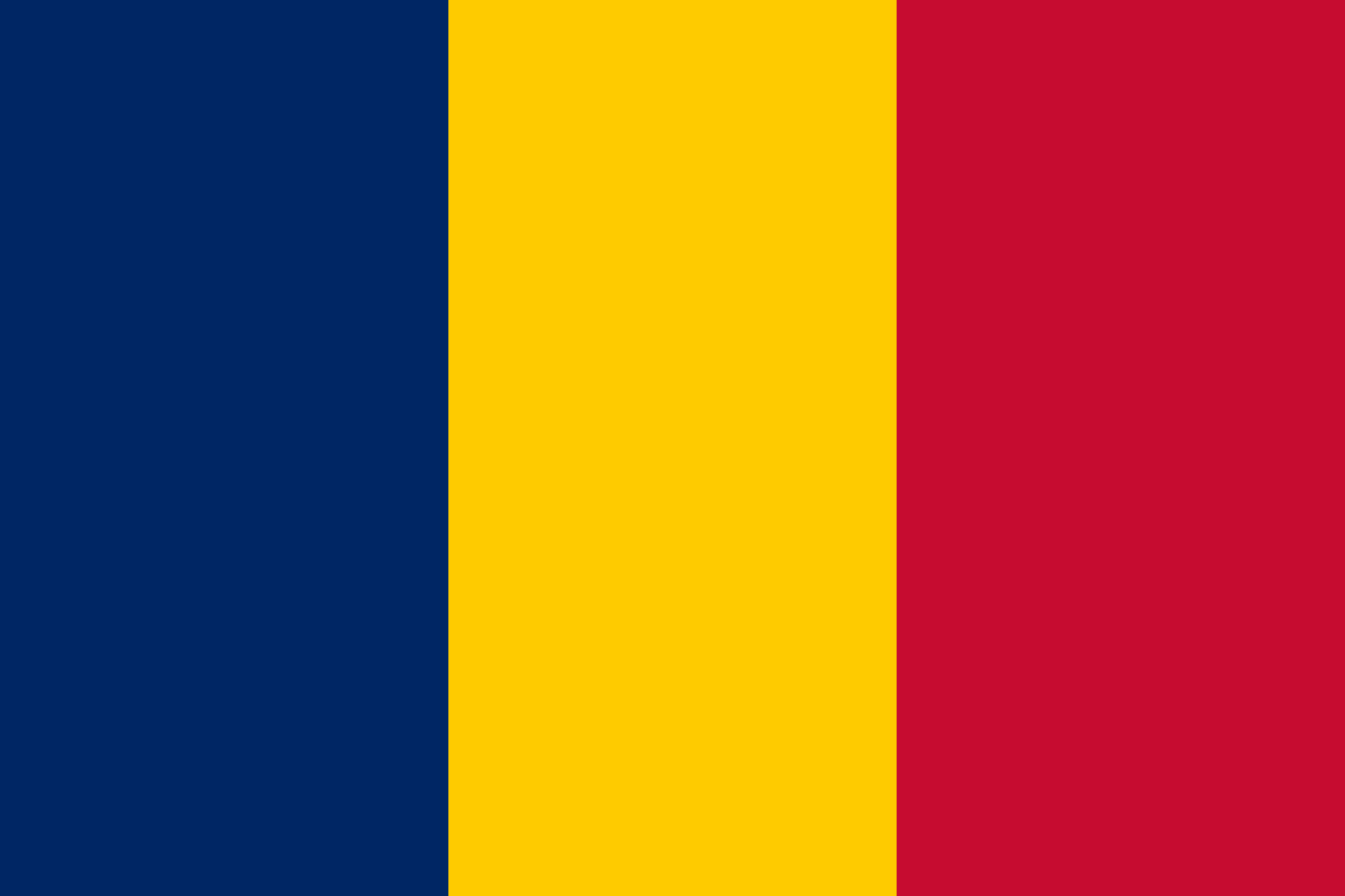
Chad,[a] officially the Republic of Chad,[b] is a landlocked country in Central Africa. It is bordered by Libya to the north, Sudan to the east, the Central African Republic to the south, Cameroon to the southwest, Nigeria to the southwest (at Lake Chad), and Niger to the west. Chad has a population of 19 million, of which 1.6 million live in the capital and largest city of N'Djamena. With a total area of around 1,300,000 km2 (500,000 sq mi), Chad is the fifth-largest country in Africa and the twentieth largest nation by area.
Key Information


.svg)


Chad has several regions: the Sahara desert in the north, an arid zone in the centre known as the Sahel, and a more fertile Sudanian Savanna zone in the south. Lake Chad, after which the country is named, is the second-largest wetland in Africa. Chad's official languages are Arabic and French with most education and state documents being in French.[8][9] It is home to over 200 ethnic and linguistic groups. Islam (55.1%) and Christianity (41.1%) are the main religions practiced in Chad.[1][10]
Beginning in the 7th millennium BC, human populations moved into the Chadian basin in great numbers. By the end of the 1st millennium AD, a series of states and empires had risen and fallen in Chad's Sahelian strip, each focused on controlling the trans-Saharan trade routes that passed through the region. France conquered the territory by 1920 and incorporated it as part of French Equatorial Africa. In 1960, Chad obtained independence under the leadership of François Tombalbaye. Resentment towards his policies in the Muslim north culminated in the eruption of a long-lasting civil war in 1965. In 1979 the rebels conquered the capital and put an end to the South's hegemony. The rebel commanders then fought amongst themselves until Hissène Habré defeated his rivals. The Chadian–Libyan conflict erupted in 1978 by the Libyan invasion which stopped in 1987 with a French military intervention (Operation Épervier). Hissène Habré was overthrown in turn in 1990 by his general Idriss Déby. With French support, a modernisation of the Chad National Army was initiated in 1991. From 2003, the Darfur crisis in Sudan spilled over the border and destabilised the nation. Already poor, the nation struggled to accommodate the hundreds of thousands of Sudanese refugees in eastern Chad.
While many political parties participated in Chad's legislature, the National Assembly, power laid firmly in the hands of the Patriotic Salvation Movement during the presidency of Idriss Déby, whose rule was described as authoritarian. After President Déby was killed by FACT rebels in April 2021, the Transitional Military Council led by his son Mahamat Déby assumed control of the government and dissolved the Assembly.[11] One of the world's least developed countries, Chad remains plagued by political violence and recurrent attempted coups d'état. Chad ranks the 4th lowest in the Human Development Index and is among the poorest and most corrupt countries. Most of its inhabitants live in poverty as subsistence herders and farmers. Since 2003 crude oil has become the country's primary source of export earnings. Chad has a poor human rights record.
History
[edit]Early history
[edit]In the 7th millennium BC, ecological conditions in the northern half of Chadian territory favoured human settlement, and its population increased considerably. Some of the most important African archaeological sites are found in Chad, mainly in the Borkou-Ennedi-Tibesti Region; some date to earlier than 2000 BC.[12][13]

For more than 2,000 years, the Chadian Basin has been inhabited by agricultural and sedentary people. The region became a crossroads of civilisations. The earliest of these was the legendary Sao, known from artifacts and oral histories. The Sao fell to the Kanem Empire,[14][15] the first and longest-lasting of the empires that developed in Chad's Sahelian strip by the end of the 1st millennium AD. Two other states in the region, Sultanate of Bagirmi and Wadai Empire, emerged in the 16th and 17th centuries. The power of Kanem and its successors was based on control of the trans-Saharan trade routes that passed through the region.[13] These states, at least tacitly Muslim, never extended their control to the southern grasslands except to raid for slaves.[16] In Kanem, about a third of the population were slaves.[17]
French colonial period (1900–1960)
[edit]French colonial expansion led to the creation of the Territoire Militaire des Pays et Protectorats du Tchad in 1900. By 1920, France had secured full control of the colony and incorporated it as part of French Equatorial Africa.[18] French rule in Chad was characterised by an absence of policies to unify the territory and sluggish modernisation compared to other French colonies.[19]
The French primarily viewed the colony as an unimportant source of untrained labour and raw cotton; France introduced large-scale cotton production in 1929. The colonial administration in Chad was critically understaffed and had to rely on the dregs of the French civil service. Only the Sara of the south was governed effectively; French presence in the Islamic north and east was nominal. The educational system was affected by this neglect.[13][19]
The French administration's focus on cotton led to the formation of a precarious underclass of poorly-paid rural workers, a decrease in food production and even to famines in some areas.[20] Tensions between farmers and elites culminated in the 1952 Bébalem massacre by colonial authorities.[21][22]

After World War II, France granted Chad the status of overseas territory and its inhabitants the right to elect representatives to the National Assembly and a Chadian assembly. The largest political party was the Chadian Progressive Party (French: Parti Progressiste Tchadien, PPT), based in the southern half of the colony. Chad was granted independence on 11 August 1960 with the PPT's leader, François Tombalbaye, an ethnic Sara, as its first president.[13][24][25]
Tombalbaye rule (1960–1979)
[edit]Two years later, Tombalbaye banned opposition parties and established a one-party system. Tombalbaye's autocratic rule and insensitive mismanagement exacerbated inter-ethnic tensions. In 1965, Muslims in the north, led by the National Liberation Front of Chad (French: Front de libération nationale du Tchad, FRONILAT), began a civil war. Becoming gradually more erratic, Tombalbaye's regime alienated even his southern base of support, notably through the forced introduction of yondo (ritual scarring) for public servants and the 1973 assassination of expatriate dissident Outel Bono in Paris.[26] Tombalbaye was overthrown and killed in 1975,[27] but the insurgency continued. In 1979 the rebel factions led by Hissène Habré took the capital, and all central authority in the country collapsed. Armed factions, many from the north's rebellion, contended for power.[28][29]
Chad's first civil war (1979–1987)
[edit]The disintegration of Chad caused the collapse of France's position in the country. Libya moved to fill the power vacuum and became involved in Chad's civil war.[30] Libya's adventure ended in disaster in 1987; the French-supported president, Hissène Habré, evoked a united response from Chadians of a kind never seen before[31] and forced the Libyan army off Chadian soil.[32]
Dictatorship of Habré (1987–1990)
[edit]Habré consolidated his dictatorship through a power system that relied on corruption and violence with thousands of people estimated to have been killed under his rule.[33][34] The president favoured his own Toubou ethnic group and discriminated against his former allies, the Zaghawa. His general, Idriss Déby, overthrew him in 1990.[35] Attempts to prosecute Habré led to his placement under house arrest in Senegal in 2005; in 2013, Habré was formally charged with war crimes committed during his rule.[36] In May 2016, he was found guilty of human-rights abuses, including rape, sexual slavery, and ordering the killing of 40,000 people, and sentenced to life in prison.[37]
Déby dynasty and democracy with second Civil War (1990–present)
[edit]
Déby attempted to reconcile the rebel groups and reintroduced multiparty politics. Chadians approved a new constitution by referendum, and in 1996, Déby easily won a competitive presidential election. He won a second term five years later.[38] Oil exploitation began in Chad in 2003, bringing with it hopes that Chad would, at last, have some chances of peace and prosperity. Instead, internal dissent worsened, and a new civil war broke out. Déby unilaterally modified the constitution to remove the two-term limit on the presidency; this caused an uproar among the civil society and opposition parties.[39]
In 2006 Déby won a third mandate in elections that the opposition boycotted. Ethnic violence in eastern Chad has increased; the United Nations High Commissioner for Refugees has warned that a genocide like that in Darfur may yet occur in Chad.[40] In 2006 and in 2008 rebel forces attempted to take the capital by force, but failed on both occasions.[41] An agreement for the restoration of harmony between Chad and Sudan, signed 15 January 2010, marked the end of a five-year war.[42] The fix in relations led to the Chadian rebels from Sudan returning home, the opening of the border between the two countries after seven years of closure, and the deployment of a joint force to secure the border. In May 2013, security forces in Chad foiled a coup against President Idriss Déby that had been in preparation for several months.[43]
Chad is one of the leading partners in a West African coalition in the fight against Boko Haram and other Islamist militants.[44] Chad's army announced the death of Déby on 20 April 2021, following an incursion in the northern region by the FACT group, during which the president was killed amid fighting on the front lines.[44][45][46][47] Déby's son, Mahamat Déby, has been named interim president by a Transitional Council of military officers. That transitional council has replaced the Constitution with a new charter, granting Mahamat Déby the powers of the presidency and naming him head of the armed forces.[11] On 23 May 2024, Mahamat Idriss Déby was sworn in as President of Chad after the disputed 6 May election.[48]
Geography
[edit]
Chad is a large landlocked country spanning north-central Africa. It covers an area of 1,284,000 square kilometres (496,000 sq mi),[49] lying between latitudes 7° and 24°N, and 13° and 24°E,[50] and is the twentieth-largest country in the world. Chad is, by size, slightly smaller than Peru and slightly larger than South Africa.[51][52]
Chad is bounded to the north by Libya, to the east by Sudan, to the west by Niger, Nigeria and Cameroon, and to the south by the Central African Republic. The country's capital is 1,060 kilometres (660 mi) from the nearest seaport, Douala, Cameroon.[50][53] Because of this distance from the sea and the country's largely desert climate, Chad is sometimes referred to as the "Dead Heart of Africa".[54]
The dominant physical structure is a wide basin bounded to the north and east by the Ennedi Plateau and Tibesti Mountains, which include Emi Koussi, a dormant volcano that reaches 3,414 metres (11,201 ft) above sea level. Lake Chad, after which the country is named (and which in turn takes its name from the Kanuri word for "lake"[55]), is the remains of an immense lake that occupied 330,000 square kilometres (130,000 sq mi) of the Chad Basin 7,000 years ago.[50] Although in the 21st century it covers only 17,806 square kilometres (6,875 sq mi), and its surface area is subject to heavy seasonal fluctuations,[56] the lake is Africa's second largest wetland.[57]

Chad is home to six terrestrial ecoregions: East Sudanian savanna, Sahelian Acacia savanna, Lake Chad flooded savanna, East Saharan montane xeric woodlands, South Saharan steppe and woodlands, and Tibesti-Jebel Uweinat montane xeric woodlands.[58] The region's tall grasses and extensive marshes make it favourable for birds, reptiles, and large mammals. Chad's major rivers—the Chari, Logone and their tributaries—flow through the southern savannas from the southeast into Lake Chad.[50][59]
Each year a tropical weather system known as the intertropical front crosses Chad from south to north, bringing a wet season that lasts from May to October in the south, and from June to September in the Sahel.[60] Variations in local rainfall create three major geographical zones. The Sahara lies in the country's northern third. Yearly precipitations throughout this belt are under 50 millimetres (2.0 in); only occasional spontaneous palm groves survive, all of them south of the Tropic of Cancer.[53]
The Sahara gives way to a Sahelian belt in Chad's centre; precipitation there varies from 300 to 600 mm (11.8 to 23.6 in) per year. In the Sahel, a steppe of thorny bushes (mostly acacias) gradually gives way to the south to East Sudanian savanna in Chad's Sudanese zone. Yearly rainfall in this belt is over 900 mm (35.4 in).[53]
Wildlife
[edit]
Chad's animal and plant life correspond to the three climatic zones. In the Saharan region, the only flora is the date-palm groves of the oasis. Palms and acacia trees grow in the Sahelian region. The southern, or Sudanic, zone consists of broad grasslands or prairies suitable for grazing. As of 2002,[update] there were at least 134 species of mammals, 509 species of birds (354 species of residents and 155 migrants), and over 1,600 species of plants throughout the country.[61][62]
Elephants, lions, buffalo, hippopotamuses, rhinoceroses, giraffes, antelopes, leopards, cheetahs, hyenas, and many species of snakes are found here, although most large carnivore populations have been drastically reduced since the early 20th century.[61][63] Elephant poaching, particularly in the south of the country in areas such as Zakouma National Park, is a severe problem. The small group of surviving West African crocodiles in the Ennedi Plateau represents one of the last colonies known in the Sahara today.[64]
In Chad forest cover is around 3% of the total land area, equivalent to 4,313,000 hectares (ha) of forest in 2020, down from 6,730,000 hectares (ha) in 1990. In 2020, naturally regenerating forest covered 4,293,000 hectares (ha) and planted forest covered 19,800 hectares (ha). For the year 2015, 100% of the forest area was reported to be under public ownership.[65][66]

Chad had a 2018 Forest Landscape Integrity Index mean score of 6.18/10, ranking it 83rd globally out of 172 countries.[67] Extensive deforestation has resulted in loss of trees such as acacias, baobab, dates and palm trees. This has also caused loss of natural habitat for wild animals; one of the main reasons for this is also hunting and livestock farming by increasing human settlements. Populations of animals like lions, leopards and rhino have fallen significantly.[68]
Efforts have been made by the Food and Agriculture Organization to improve relations between farmers, agro-pastoralists and pastoralists in the Zakouma National Park (ZNP), Siniaka-Minia, and Aouk reserve in southeastern Chad to promote sustainable development.[69] As part of the national conservation effort, more than 1.2 million trees have been replanted to check the advancement of the desert, which incidentally also helps the local economy by way of financial return from acacia trees, which produce gum arabic, and also from fruit trees.[68]
Poaching is a serious problem in the country, particularly of elephants for the profitable ivory industry and a threat to lives of rangers even in the national parks such as Zakouma. Elephants are often massacred in herds in and around the parks by organised poaching.[70] The problem is worsened by the fact that the parks are understaffed and that a number of wardens have been murdered by poachers.[71]
Demographics
[edit]

Chad's national statistical agency projected the country's 2015 population between 13,630,252 and 13,679,203, with 13,670,084 as its medium projection; based on the medium projection, 3,212,470 people lived in urban areas and 10,457,614 people lived in rural areas.[72] The country's population is young: an estimated 47% is under 15. The birth rate is estimated at 42.35 births per 1,000 people, and the mortality rate at 16.69. The life expectancy is 52 years.[73] The agency assessed the population as at mid 2017 at 15,775,400, of whom just over 1.5 million were in N'Djaména.
Chad's population is unevenly distributed. Density is 0.1/km2 (0.26/sq mi) in the Saharan Borkou-Ennedi-Tibesti Region but 52.4/km2 (136/sq mi) in the Logone Occidental Region. In the capital, it is even higher.[53] About half of the nation's population lives in the southern fifth of its territory, making this the most densely populated region.[74]
Urban life is concentrated in the capital, whose population is mostly engaged in commerce. The other major towns are Sarh, Moundou, Abéché and Doba, which are considerably smaller but growing rapidly in population and economic activity.[50] Since 2003, 230,000 Sudanese refugees have fled to eastern Chad from war-ridden Darfur. With the 172,600 Chadians displaced by the civil war in the east, this has generated increased tensions among the region's communities.[75][76]
Polygamy is common, with 39% of women living in such unions. This is sanctioned by law, which automatically permits polygamy unless spouses specify that this is unacceptable upon marriage.[77] Although violence against women is prohibited, domestic violence is common. Female genital mutilation is also prohibited, but the practice is widespread and deeply rooted in tradition; 45% of Chadian women undergo the procedure, with the highest rates among Arabs, Hadjarai, and Ouaddaians (90% or more). Lower percentages were reported among the Sara (38%) and the Toubou (2%). Women lack equal opportunities in education and training, making it difficult for them to compete for the relatively few formal-sector jobs. Although property and inheritance laws based on the French code do not discriminate against women, local leaders adjudicate most inheritance cases in favour of men, according to traditional practice.[78]
Largest cities, towns, and municipalities
[edit]| Rank | City | Population | Region | |
|---|---|---|---|---|
| 1993 census[79] | 2009 census[79] | |||
| 1. | N'Djamena | 530,965 | 951,418 | N'Djamena |
| 2. | Moundou | 99,530 | 137,251 | Logone Occidental |
| 3. | Abéché | 54,628 | 97,963 | Ouaddaï |
| 4. | Sarh | 75,496 | 97,224 | Moyen-Chari |
| 5. | Kélo | 31,319 | 57,859 | Tandjilé |
| 6. | Am Timan | 21,269 | 52,270 | Salamat |
| 7. | Doba | 17,920 | 49,647 | Logone Oriental |
| 8. | Pala | 26,116 | 49,461 | Mayo-Kebbi Ouest |
| 9. | Bongor | 20,448 | 44,578 | Mayo-Kebbi Est |
| 10. | Goz Beïda | 3,083 | 41,248 | Sila |
In the 2024 Global Hunger Index, Chad ranks 125th out of the 127 countries with sufficient data to calculate 2024 GHI scores, having a score of 36.4.[80]
Ethnic groups
[edit]
The peoples of Chad carry significant ancestry from Eastern, Central, Western, and Northern Africa.[81] Chad has more than 200 distinct ethnic groups,[82] which create diverse social structures. The colonial administration and independent governments have attempted to impose a national society, but for most Chadians the local or regional society remains the most important influence outside the immediate family. Nevertheless, Chad's people may be classified according to the geographical region in which they live.[13][50]
In the south live sedentary people such as the Sara, the nation's main ethnic group, whose essential social unit is the lineage. In the Sahel, sedentary peoples live side by side with nomadic ones, such as the Arabs, the country's second major ethnic group. The north is inhabited by nomads, mostly Toubous.[13][50]
Languages
[edit]Chad's official languages are Arabic and French, with over a 100 regional languages being spoken in the country. The Chadic branch of the Afroasiatic language family gets its name from Chad, and is represented by dozens of languages native to the country. Chad is also home to Central Sudanic, Maban, and several Niger-Congo languages.
Due to the important role played by itinerant Arab traders and settled merchants in local communities, Chadian Arabic has become a lingua franca for 12–40% of the population.[13] However, French remains the language of the government and education.[83][84]
Religion
[edit]
Chad is a religiously diverse country. Various estimates, including from Pew Research in 2010, found that 52–58% of the population was Muslim, while 39–44% were Christian,[10] with 22% being Catholic and a further 17% being Protestant.[85][86] According to a 2012 Pew Research survey, 48% of Muslim Chadians professed to be Sunni, 21% Shia, 4% Ahmadi[citation needed] and 23% non-denominational Muslim. Islam is expressed in diverse ways; for example, 55% of Muslim Chadians belong to Sufi orders. Its most common expression is the Tijaniyah, an order followed by the 35% of Chadian Muslims which incorporates some local African religious elements.[87] In 2020, the ARDA estimated the vast majority of Muslims Chadians to be Sunni belonging to the Sufi brotherhood Tijaniyah.[88] A small minority of the country's Muslims (5–10%) hold more fundamentalist practices, which, in some cases, may be associated with Saudi-oriented Wahhabism.[88][89]
- Islam 55.1 (53.7%)
- Christianity 41.1 (40.0%)
- No Religion 2.4 (2.34%)
- Animism 4 (3.89%)
- Others 0.1 (0.10%)
Catholics represent the largest Christian denomination in the country.[88] Most Protestants, including the Nigeria-based "Winners' Chapel", are affiliated with various evangelical Christian groups. Members of the Baháʼí and Jehovah's Witnesses religious communities also are present in the country. Both faiths were introduced after independence in 1960 and therefore are considered to be "new" religions in the country.[90][89]
A small proportion of the population continues to practice indigenous religions. Animism includes a variety of ancestor and place-oriented religions whose expression is highly specific. Christianity arrived in Chad with the French and American missionaries; as with Chadian Islam, it syncretises aspects of pre-Christian religious beliefs.[13]
Muslims are largely concentrated in northern and eastern Chad, and animists and Christians live primarily in southern Chad and Guéra.[50] Many Muslims also reside in southern Chad but the Christian presence in the north is minimal.[90] The constitution provides for a secular state and guarantees religious freedom; different religious communities generally co-exist without problems.[88][89]
Chad is home to foreign missionaries representing both Christian and Islamic groups. Itinerant Muslim preachers, primarily from Sudan, Saudi Arabia, and Pakistan, also visit. Saudi Arabian funding generally supports social and educational projects and extensive mosque construction.[89]
Education
[edit]Educators face considerable challenges due to the nation's dispersed population and a certain degree of reluctance on the part of parents to send their children to school. Although attendance is compulsory, only 68 percent of boys attend primary school, and more than half of the population is illiterate. Higher education is provided at the University of N'Djamena.[50][82] At 33 percent, Chad has one of the lowest literacy rates of Sub-Saharan Africa.[92]
In 2013, the U.S. Department of Labor's Findings on the Worst Forms of Child Labor[93] in Chad reported that school attendance of children aged 5 to 14 was as low as 39%. This can also be related to the issue of child labor as the report also stated that 53% of children aged 5 to 14 were working, and that 30% of children aged 7 to 14 combined work and school. A more recent DOL report listed cattle herding as a major agricultural activity that employed underage children.[94]
Government and politics
[edit] | This section needs to be updated. (January 2024) |

Chad's constitution provides for a strong executive branch headed by a president who dominates the political system. The president has the power to appoint the prime minister and the cabinet, and exercises considerable influence over appointments of judges, generals, provincial officials and heads of Chad's para-statal firms.[95] In cases of grave and immediate threat, the president, in consultation with the National Assembly, may declare a state of emergency. The president is directly elected by popular vote for a five-year term; in 2005, constitutional term limits were removed,[96] allowing a president to remain in power beyond the previous two-term limit.[96] Most of Déby's key advisers are members of the Zaghawa ethnic group, although southern and opposition personalities are represented in government.[82][97]
Chad's legal system is based on French civil law and Chadian customary law where the latter does not interfere with public order or constitutional guarantees of equality. Despite the constitution's guarantee of judicial independence, the president names most key judicial officials. The legal system's highest jurisdictions, the Supreme Court and the Constitutional Council, have become fully operational since 2000. The Supreme Court is made up of a chief justice, named by the president, and 15 councillors, appointed for life by the president and the National Assembly. The Constitutional Court is headed by nine judges elected to nine-year terms. It has the power to review legislation, treaties and international agreements prior to their adoption.[82][97]
The National Assembly makes legislation. The body consists of 155 members elected for four-year terms who meet three times per year. The Assembly holds regular sessions twice a year and can hold special sessions when called by the prime minister. Deputies elect a National Assembly president every two years. The president must sign or reject newly passed laws within 15 days. The National Assembly must approve the prime minister's plan of government and may force the prime minister to resign through a majority vote of no confidence. However, if the National Assembly rejects the executive branch's programme twice in one year, the president may disband the Assembly and call for new legislative elections. In practice, the president exercises considerable influence over the National Assembly through his party, the Patriotic Salvation Movement (MPS), which holds a large majority.[82]
.png)
Until the legalisation of opposition parties in 1992, Déby's MPS was the sole legal party in Chad.[82] Since then, 78 registered political parties have become active.[78] In 2005, opposition parties and human rights organisations supported the boycott of the constitutional referendum that allowed Déby to stand for re-election for a third term[98] amid reports of widespread irregularities in voter registration and government censorship of independent media outlets during the campaign.[99] Correspondents judged the 2006 presidential elections a mere formality, as the opposition deemed the polls a farce and boycotted them.[100]
Chad is listed as a failed state by the Fund for Peace (FFP). Chad had the seventh-highest rank in the Fragile States Index in 2021.[101] Corruption is rife at all levels; Transparency International's Corruption Perceptions Index for 2021 ranked Chad 164th among the 180 countries listed.[102] Critics of former President Déby had accused him of cronyism and tribalism.[103]
In southern Chad, bitter conflicts over land are becoming more common. They frequently turn violent. Long-standing community culture is being eroded – and so are the livelihoods of many farmers.[104]
Longtime Chad President Idriss Déby's death on 20 April 2021 resulted in both the nation's National Assembly and government being dissolved and national leadership being replaced with a transitional military council consisting of military officers and led by his son Mahamat Kaka.[105][106][107] The constitution is currently suspended, pending replacement with one drafted by a civilian National Transitional Council, yet to be appointed. The military council has stated that elections will be held at the end of an 18-month transitional period.[108][needs update] In October 2022, Déby extended his rule and was sworn in as transitional president after dissolving the Transitional Military Council. This caused the 2022 Chadian protests, which became one of the most violent in Chadian history. The protests however, were suppressed with several opposition parties being banned by the government.[109][110] According to 2023 V-Dem Democracy indices Chad is 16th lowest ranked electoral democracy worldwide and 4th lowest ranked electoral democracy in Africa.[111]
Internal opposition and foreign relations
[edit].JPG)
Late President Idriss Déby faced armed opposition from groups who are deeply divided by leadership clashes but were united in their intention to overthrow him.[112] These forces stormed the capital on 13 April 2006, but were ultimately repelled. Chad's greatest foreign influence is France, which maintains 1,000 soldiers in the country. Déby relied on the French to help repel the rebels, and France gives the Chadian army logistical and intelligence support for fear of a complete collapse of regional stability.[113] Nevertheless, Franco-Chadian relations were soured by the granting of oil drilling rights to the American Exxon company in 1999.[114] In 2025, the French military handed over its last base in Chad to the Chadian military, ending its presence in the country, which it had since 1960.[115]
There have been numerous rebel groups in Chad throughout the last few decades. In 2007, a peace treaty was signed that integrated United Front for Democratic Change soldiers into the Chadian Army.[116] The Movement for Justice and Democracy in Chad also clashed with government forces in 2003 in an attempt to overthrow President Idriss Déby. In addition, there have been various conflicts with Khartoum's Janjaweed rebels in eastern Chad, who killed civilians by use of helicopter gunships.[117] Presently, the Union of Resistance Forces (UFR) are a rebel group that continues to battle with the government of Chad. In 2010, the UFR reportedly had a force estimating 6,000 men and 300 vehicles.[118]
The UAE foreign aid was inaugurated in the Chadian city of Amdjarass on 3 August 2023. The UAE's continuous efforts to provide assistance to the Chadian people and support endeavours to provide humanitarian and relief aid through the UAE's humanitarian institutions to Sudanese refugees in Chad.[119][120]
Military
[edit].jpg)
As of 2024 Chad was estimated to have 33,250 active military personnel, including 27,500 in the Ground Forces, 350 in the Air Force, and 5,400 in the General Directorate of the Security Services of State Institutions (DGSSIE). There are also 4,500 in the National Gendarmerie and 7,400 in the National and Nomadic Guard. The Ground Forces are organised into seven military regions and twelve battalions, including one armored, seven infantry, one artillery, and three logistical. Chad is a member of the G5 Sahel and the Multinational Joint Task Force, which were formed to fight against Islamic insurgent groups in the region,[121] and has contributed troops to the MINUSMA mission in Mali before it was dissolved. As of 2023, its last year in the mission, 1,449 Chadian soldiers were deployed there.[122] France has been Chad's main security partner for years, including in training the Chadian military.[122] Chad ended its military cooperation agreement with France in 2024.[123]
The CIA World Factbook estimates the military budget of Chad to be 4.2% of GDP as of 2006.[124] Given the then GDP ($7.095 bln) of the country, military spending was estimated to be about $300 million. This estimate however dropped after the end of the Civil war in Chad (2005–2010) to 2.0%[125] as estimated by the World Bank for 2011.
Administrative divisions
[edit]Since 2018 Chad has been divided into 23 provinces.[126] The subdivision of Chad in regions came about in 2003 as part of the decentralisation process, when the government abolished the previous 14 prefectures; however, in 2018, the government renamed the former regions to become provinces.[126] Each region is headed by a presidentially appointed governor. Prefects administer the provinces' 120 departments which are divided into 454 sub-prefectures.[127]
The constitution provides for decentralised government to compel local populations to play an active role in their own development.[128] To this end, the constitution declares that each administrative subdivision be governed by elected local assemblies,[129] but no local elections have taken place,[130] and communal elections scheduled for 2005 have been repeatedly postponed.[78]
Economy
[edit]
The United Nations' Human Development Index ranks Chad as the seventh poorest country in the world, with 80% of the population living below the poverty line. The GDP (purchasing power parity) per capita was estimated as US$1,651 in 2009.[5] Chad is part of the Bank of Central African States, the Customs and Economic Union of Central Africa (UDEAC) and the Organization for the Harmonization of Business Law in Africa (OHADA).[131]
Chad's currency is the CFA franc. In the 1960s, the mining industry of Chad produced sodium carbonate, or natron. There have also been reports of gold-bearing quartz in the Biltine Prefecture. However, years of civil war have scared away foreign investors; those who left Chad between 1979 and 1982 have only recently begun to regain confidence in the country's future. In 2000, major direct foreign investment in the oil sector began, boosting the country's economic prospects.[51][82]

Uneven inclusion in the global political economy as a site for colonial resource extraction (primarily cotton and crude oil), a global economic system that does not promote nor encourage the development of Chadian industrialisation,[132] and the failure to support local agricultural production has meant that the majority of Chadians live in daily uncertainty and hunger.[133][134] Over 80% of Chad's population relies on subsistence farming and livestock raising for its livelihood.[51] The crops grown and the locations of herds are determined by the local climate. In the southernmost 10% of the territory lies the nation's most fertile cropland, with rich yields of sorghum and millet. In the Sahel only the hardier varieties of millet grow, and with much lower yields than in the south. On the other hand, the Sahel is ideal pastureland for large herds of commercial cattle and for goats, sheep, donkeys and horses. The Sahara's scattered oases support only some dates and legumes.[13] Chad's cities face serious difficulties of municipal infrastructure; only 48% of urban residents have access to potable water and only 2% to basic sanitation.[50][135]
Before the development of the oil industry, cotton dominated industry and the labour market accounted for approximately 80% of export earnings.[136] Cotton remains a primary export, although exact figures are not available. Rehabilitation of Cotontchad, a major cotton company weakened by a decline in world cotton prices, has been financed by France, the Netherlands, the European Union, and the International Bank for Reconstruction and Development (IBRD). The parastatal is now expected to be privatised.[82] Other than cotton, cattle and gum arabic are dominant.

According to the United Nations, Chad has been affected by a humanitarian crisis since at least 2001. As of 2008[update], the country of Chad hosts over 280,000 refugees from the Sudan's Darfur region, over 55,000 from the Central African Republic, as well as over 170,000 internally displaced persons.[137] In February 2008 in the aftermath of the Battle of N'Djamena, UN Under-Secretary-General for Humanitarian Affairs John Holmes expressed "extreme concern" that the crisis would have a negative effect on the ability of humanitarians to deliver life-saving assistance to half a million beneficiaries, most of whom – according to him – heavily rely on humanitarian aid for their survival.[138] UN spokesperson Maurizio Giuliano stated to The Washington Post: "If we do not manage to provide aid at sufficient levels, the humanitarian crisis might become a humanitarian catastrophe".[139] In addition, organisations such as Save the Children have suspended activities due to killings of aid workers.[140]
Chad has made some progress in reducing poverty, there was a decline in the national poverty rate from 55% to 47% between 2003 and 2011. However, the number of poor people increased from 4.7 million (2011) to 6.5 million (2019) in absolute numbers. By 2018, 4.2 out of 10 people still live below the poverty line.[141]
Infrastructure
[edit]Transport
[edit]
Three trans-African automobile routes pass through Chad:
- the Tripoli-Cape Town Highway (3)
- the Dakar-Ndjamena Highway (5)
- the Ndjamena-Djibouti Highway (6)
Civil war crippled the development of transport infrastructure; in 1987, Chad had only 30 kilometres (19 mi) of paved roads. Successive road rehabilitation projects improved the network[142] to 550 kilometres (340 mi) by 2004.[143] Nevertheless, the road network is limited; roads are often unusable for several months of the year. With no railways of its own, Chad depends heavily on Cameroon's rail system for the transport of Chadian exports and imports to and from the seaport of Douala.[144]
As of 2013[update] Chad had an estimated 59 airports, only 9 of which had paved runways.[145] An international airport serves the capital and provides regular nonstop flights to Paris and several African cities.
Energy
[edit]Chad's energy sector has had years of mismanagement by the parastatal Chad Water and Electric Society (STEE), which provides power for 15% of the capital's citizens and covers only 1.5% of the national population.[146] Most Chadians burn biomass fuels such as wood and animal manure for power.[147]
ExxonMobil leads a consortium of Chevron and Petronas that has invested $3.7 billion to develop oil reserves estimated at one billion barrels in southern Chad. Oil production began in 2003 with the completion of a pipeline (financed in part by the World Bank) that links the southern oilfields to terminals on the Atlantic coast of Cameroon. As a condition of its assistance, the World Bank insisted that 80% of oil revenues be spent on development projects. In January 2006 the World Bank suspended its loan programme when the Chadian government passed laws reducing this amount.[82][130] On 14 July 2006, the World Bank and Chad signed a memorandum of understanding under which the Government of Chad commits 70% of its spending to priority poverty reduction programmes.[148]
Telecommunications
[edit]The telecommunication system is basic and expensive, with fixed telephone services provided by the state telephone company SotelTchad. In 2000, there were only 14 fixed telephone lines per 10,000 inhabitants in the country, one of the lowest telephone densities in the world.[146]
Gateway Communications, a pan-African wholesale connectivity and telecommunications provider also has a presence in Chad.[149] In September 2013, Chad's Ministry for Posts and Information & Communication Technologies (PNTIC) announced that the country will be seeking a partner for fiber optic technology.[needs update]
Chad is ranked last in the World Economic Forum's Network Readiness Index (NRI) – an indicator for determining the development level of a country's information and communication technologies.[150] In September 2010 the mobile phone penetration rate was estimated at 24.3% over a population estimate of 10.7 million.[151]
Culture
[edit]Because of its great variety of peoples and languages, Chad possesses a rich cultural heritage. The Chadian government has actively promoted Chadian culture and national traditions by opening the Chad National Museum and the Chad Cultural Centre.[50] Six national holidays are observed throughout the year, and movable holidays include the Christian holiday of Easter Monday and the Muslim holidays of Eid al-Fitr, Eid al-Adha, and Mawlid.[146]

Cuisine
[edit]Millet is the staple food of Chadian cuisine. It is used to make balls of paste that are dipped in sauces. In the north this dish is known as alysh; in the south, as biya. Fish is popular, which is generally prepared and sold either as salanga (sun-dried and lightly smoked Alestes and Hydrocynus) or as banda (smoked large fish).[152] Carcaje is a popular sweet red tea extracted from hibiscus leaves. Alcoholic beverages, though absent in the north, are popular in the south, where people drink millet beer, known as billi-billi when brewed from red millet, and as coshate when from white millet.[153]
Music
[edit]
The music of Chad includes a number of instruments such as the kinde, a type of bow harp; the kakaki, a long tin horn; and the hu hu, a stringed instrument that uses calabashes as loudspeakers. Other instruments and their combinations are more linked to specific ethnic groups: the Sara prefer whistles, balafons, harps and kodjo drums; and the Kanembu combine the sounds of drums with those of flute-like instruments.[153]
The music group Chari Jazz formed in 1964 and initiated Chad's modern music scene. Later, more renowned groups such as African Melody and International Challal attempted to mix modernity and tradition. Popular groups such as Tibesti have clung faster to their heritage by drawing on sai, a traditional style of music from southern Chad. The people of Chad have customarily disdained modern music. However, in 1995 greater interest has developed and fostered the distribution of CDs and audio cassettes featuring Chadian artists. Piracy and a lack of legal protections for artists' rights remain problems to further development of the Chadian music industry.[153][154]
Literature
[edit]
As in other Sahelian countries, literature in Chad has seen an economic, political and spiritual drought that has affected its best known writers. Chadian authors have been forced to write from exile or expatriate status and have generated literature dominated by themes of political oppression and historical discourse. Since 1962, 20 Chadian authors have written some 60 works of fiction. Among the most internationally renowned writers are Joseph Brahim Seïd, Baba Moustapha, Antoine Bangui and Koulsy Lamko. In 2003 Chad's sole literary critic, Ahmat Taboye, published his Anthologie de la littérature tchadienne to further knowledge of Chad's literature.[153][155][156]
Media and cinema
[edit]Chad's television audience is limited to N'Djamena. The only television station is the state-owned Télé Tchad. Radio has a far greater reach, with 13 private radio stations.[157] Newspapers are limited in quantity and distribution, and circulation figures are small due to transportation costs, low literacy rates, and poverty.[99][147][158] While the constitution defends liberty of expression, the government has regularly restricted this right, and at the end of 2006 began to enact a system of prior censorship on the media.[159]
The development of a Chadian film industry, which began with the short films of Edouard Sailly in the 1960s, was hampered by the devastations of civil wars and from the lack of cinemas, of which there is currently only one in the whole country.[160][161] The Chadian feature film industry began growing again in the 1990s, with the work of directors Mahamat-Saleh Haroun, Issa Serge Coelo and Abakar Chene Massar.[162] Haroun's film Abouna was critically acclaimed, and his Daratt won the Grand Special Jury Prize at the 63rd Venice International Film Festival. The 2010 feature film A Screaming Man won the Jury Prize at the 2010 Cannes Film Festival, making Haroun the first Chadian director to enter, as well as win, an award in the main Cannes competition.[163] Issa Serge Coelo directed the films Daresalam and DP75: Tartina City.[164][165][166][167]
Sports
[edit]Football is Chad's most popular sport.[168] The country's national team is closely followed during international competitions[153] and Chadian footballers have played for French teams. Basketball and freestyle wrestling are widely practiced, the latter in a form in which the wrestlers put on traditional animal hides and cover themselves with dust.[153]
See also
[edit].svg)
Notes
[edit]References
[edit]Citations
[edit]- ^ a b "Religions in Chad | PEW-GRF". Archived from the original on 8 October 2022. Retrieved 11 August 2022.
- ^ Ngarbe, Eluard (4 February 2025). "Le MPS lance sa campagne pour le Sénat". Manara Radio Télévision (in French).
- ^ "Chad". The World Factbook (2025 ed.). Central Intelligence Agency. Retrieved 22 June 2023. (Archived 2023 edition.)
- ^ "Chad". The World Factbook (2025 ed.). Central Intelligence Agency. Retrieved 22 June 2023. (Archived 2023 edition.)
- ^ a b c d e "World Economic Outlook Database, October 2023 Edition. (Chad)". IMF.org. International Monetary Fund. 10 October 2023. Archived from the original on 4 November 2023. Retrieved 18 October 2023.
- ^ "Gini Index coefficient". The World Factbook. Retrieved 24 September 2024.
- ^ "Human Development Reports 2023/24".
- ^ "International Schools in Chad".
- ^ "Glottolog 4.8 – Languages of Chad". glottolog.org. Archived from the original on 15 August 2023. Retrieved 15 August 2023.
- ^ a b "Enquête Démographique et de Santé 1996–1997" (PDF). Archived (PDF) from the original on 9 October 2022.
- ^ a b Ramadane, Madjiasra Nako, Mahamat (21 April 2021). "Chad in turmoil after Deby death as rebels, opposition challenge military". Reuters. Archived from the original on 21 April 2021. Retrieved 21 April 2021.
{{cite news}}: CS1 maint: multiple names: authors list (link) - ^ Decalo, pp. 44–45
- ^ a b c d e f g h i S. Collelo, Chad
- ^ D. Lange 1988
- ^ Decalo, p. 6
- ^ Decalo, pp. 7–8
- ^ "Welcome to Encyclopædia Britannica's Guide to Black History". Encyclopædia Britannica. Archived from the original on 6 October 2014. Retrieved 29 August 2010.
- ^ Decalo, pp. 8, 309
- ^ a b Decalo, pp. 8–9
- ^ Lemarchand, René (1980). "The Politics of Sara Ethnicity: A Note on the Origins of the Civil War in Chad". Cahiers d'études africaines. 20 (80): 455–456. doi:10.3406/cea.1980.2328. Retrieved 25 February 2025.
- ^ Debos, Marielle (2009). "Chad 1900-1960" (PDF). Online Encyclopedia of Mass Violence. pp. 8–9. Retrieved 25 February 2025.
- ^ Lanne, Bernard. Histoire politique du Tchad de 1945 à 1958. Administration, partis, élections. Paris: Karthala. pp. 197–218. ISBN 978-2-86537-883-8.
- ^ Decalo, p. 53
- ^ Decalo, pp. 248–249
- ^ Nolutshungu, p. 17
- ^ Whiteman, Kaye (September 1988). "Chad. Report N° 80" (PDF). Minority Rights Group. London. Retrieved 17 August 2025.
- ^ "Death of a Dictator", Time, (28 April 1975). Accessed on 3 September 2007.
- ^ Decalo, pp. 12–16
- ^ Nolutshungu, p. 268
- ^ Nolutshungu, p. 150
- ^ Nolutshungu, p. 230
- ^ Pollack, Kenneth M. (2002); Arabs at War: Military Effectiveness, 1948–1991. Lincoln: University of Nebraska Press. ISBN 0-8032-3733-2, pp. 391–397
- ^ Macedo, Stephen (2006); Universal Jurisdiction: National Courts and the Prosecution of Serious Crimes Under International Law. University of Pennsylvania Press. ISBN 0-8122-1950-3, pp. 133–134
- ^ "Chad: the Habré Legacy" Archived 13 January 2015 at the Wayback Machine. Amnesty International. 16 October 2001.
- ^ Nolutshungu, pp. 234–237
- ^ "Chad ex-leader Habre charged in Senegal with war crimes". BBC. 2 July 2013. Archived from the original on 3 July 2013. Retrieved 2 July 2013.
- ^ "Hissène Habré: Chad's ex-ruler convicted of crimes against humanity". BBC. 2016. Archived from the original on 12 July 2018. Retrieved 21 July 2018.
- ^ East, Roger & Richard J. Thomas (2003); Profiles of People in Power: The World's Government Leaders. Routledge. ISBN 1-85743-126-X, p. 100
- ^ IPS, "Le pétrole au cœur des nouveaux soubresauts au Tchad"
- ^ Chad may face genocide, UN warns Archived 21 June 2022 at the Wayback Machine. BBC News, 16 February 2007
- ^ "Chad's leader asserts he controls". USA Today. Associated Press. 6 February 2008.
- ^ World Report 2011: Chad. Human Rights Watch. 24 January 2011. Archived from the original on 28 August 2012. Retrieved 6 June 2011.
- ^ "Chad government foils coup attempt – minister". Reuters. 2013. Archived from the original on 6 March 2016.
- ^ a b "Chad's president Idriss Déby dies 'in clashes with rebels'". BBC News. 20 April 2021. Archived from the original on 20 April 2021. Retrieved 20 April 2021.
- ^ "Chad's authoritarian Deby unwilling to quit". Deutsche Welle. 8 April 2016. Archived from the original on 8 November 2020. Retrieved 4 August 2020.
- ^ Haynes, Suyin (28 March 2019). "This African Country Has Had a Yearlong Ban on Social Media. Here's What's Behind the Blackout". Time. Archived from the original on 8 August 2020. Retrieved 4 August 2020.
- ^ Werman, Marco (5 June 2012). "ExxonMobil and Chad's Authoritarian Regime: An 'Unholy Bargain'". The World. Public Radio International. Archived from the original on 22 October 2020. Retrieved 4 August 2020.
- ^ "Chad transitional ruler inaugurated amid legitimacy concerns". Voice of America. 23 May 2024.
- ^ "Le TCHAD en bref" (in French). INSEED. 22 July 2013. Archived from the original on 22 December 2015. Retrieved 18 December 2015.
- ^ a b c d e f g h i j k "Chad". Encyclopædia Britannica. (2000)
- ^ a b c d CIA, "Chad", 2009
- ^ "Rank Order – Area Archived 9 February 2014 at the Wayback Machine". The World Factbook. United States Central Intelligence Agency.
- ^ a b c d "Chad Archived 29 September 2007 at the Wayback Machine". Human Rights Instruments. United Nations Commission on Human Rights. 12 December 1997.
- ^ Botha, D.J.J. (December 1992). "S.H. Frankel: Reminiscences of an Economist (Review Article)". South African Journal of Economics. 60 (4): 246–255. doi:10.1111/j.1813-6982.1992.tb01049.x. ISSN 0038-2280.
- ^ Kperogi, F.A. (2015) Glocal English: The Changing Face and Forms of Nigerian English in a Global World. Peter Lang, ISBN 978-1-4331-2926-1, p. 59.
- ^ "Chad, Lake". Encyclopædia Britannica. (2000).
- ^ Dinar, Ariel (1995); Restoring and Protecting the World's Lakes and Reservoirs. World Bank Publications. ISBN 0-8213-3321-6, p. 57
- ^ Dinerstein, Eric; Olson, David; Joshi, Anup; Vynne, Carly; Burgess, Neil D.; Wikramanayake, Eric; Hahn, Nathan; Palminteri, Suzanne; Hedao, Prashant; Noss, Reed; Hansen, Matt; Locke, Harvey; Ellis, Erle C; Jones, Benjamin; Barber, Charles Victor; Hayes, Randy; Kormos, Cyril; Martin, Vance; Crist, Eileen; Sechrest, Wes; Price, Lori; Baillie, Jonathan E. M.; Weeden, Don; Suckling, Kierán; Davis, Crystal; Sizer, Nigel; Moore, Rebecca; Thau, David; Birch, Tanya; Potapov, Peter; Turubanova, Svetlana; Tyukavina, Alexandra; de Souza, Nadia; Pintea, Lilian; Brito, José C.; Llewellyn, Othman A.; Miller, Anthony G.; Patzelt, Annette; Ghazanfar, Shahina A.; Timberlake, Jonathan; Klöser, Heinz; Shennan-Farpón, Yara; Kindt, Roeland; Lillesø, Jens-Peter Barnekow; van Breugel, Paulo; Graudal, Lars; Voge, Maianna; Al-Shammari, Khalaf F.; Saleem, Muhammad (2017). "An Ecoregion-Based Approach to Protecting Half the Terrestrial Realm". BioScience. 67 (6): 534–545. doi:10.1093/biosci/bix014. ISSN 0006-3568. PMC 5451287. PMID 28608869.
- ^ (in French) Chapelle, Jean (1981) Le Peuple Tchadien: ses racines et sa vie quotidienne. Paris: L'Harmattan. ISBN 2-85802-169-4, pp. 10–16
- ^ Decalo, p. 3
- ^ a b "Important Bird Areas in Africa and associated islands – Chad" (PDF). Birdlife International Organization. Archived from the original (PDF) on 11 September 2016. Retrieved 16 October 2013.
- ^ Brundu, Giuseppe; Camarda, Ignazio (2013). "The Flora of Chad: a checklist and brief analysis". PhytoKeys (23). Pensoft.net: 1–18. Bibcode:2013PhytK..23....1B. doi:10.3897/phytokeys.23.4752. PMC 3690977. PMID 23805051. Archived from the original on 11 December 2019. Retrieved 17 October 2013.
- ^ "Plant and Animal Life". The Living Africa. Archived from the original on 28 December 2013. Retrieved 17 October 2013.
- ^ Brito, José C.; Martínez-Freiría, Fernando; Sierra, Pablo; Sillero, Neftalí; Tarroso, Pedro; Fenton, Brock (25 February 2011). "Crocodiles in the Sahara Desert: An Update of Distribution, Habitats and Population Status for Conservation Planning in Mauritania". PLOS ONE. 6 (2) e14734. Bibcode:2011PLoSO...614734B. doi:10.1371/journal.pone.0014734. PMC 3045445. PMID 21364897.
- ^ Terms and Definitions FRA 2025 Forest Resources Assessment, Working Paper 194. Food and Agriculture Organization of the United Nations. 2023.
- ^ "Global Forest Resources Assessment 2020, Chad". Food Agriculture Organization of the United Nations.
- ^ Grantham, H. S.; Duncan, A.; Evans, T. D.; Jones, K. R.; Beyer, H. L.; Schuster, R.; Walston, J.; Ray, J. C.; Robinson, J. G.; Callow, M.; Clements, T.; Costa, H. M.; DeGemmis, A.; Elsen, P. R.; Ervin, J.; Franco, P.; Goldman, E.; Goetz, S.; Hansen, A.; Hofsvang, E.; Jantz, P.; Jupiter, S.; Kang, A.; Langhammer, P.; Laurance, W. F.; Lieberman, S.; Linkie, M.; Malhi, Y.; Maxwell, S.; Mendez, M.; Mittermeier, R.; Murray, N. J.; Possingham, H.; Radachowsky, J.; Saatchi, S.; Samper, C.; Silverman, J.; Shapiro, A.; Strassburg, B.; Stevens, T.; Stokes, E.; Taylor, R.; Tear, T.; Tizard, R.; Venter, O.; Visconti, P.; Wang, S.; Watson, J. E. M. (2020). "Anthropogenic modification of forests means only 40% of remaining forests have high ecosystem integrity – Supplementary Material". Nature Communications. 11 (1): 5978. Bibcode:2020NatCo..11.5978G. doi:10.1038/s41467-020-19493-3. ISSN 2041-1723. PMC 7723057. PMID 33293507.
- ^ a b "Our Africa". Our Africa organization. Archived from the original on 17 October 2013. Retrieved 17 October 2013.
- ^ "Livestock-wildlife-environment interactions in Chad". Food and Agriculture Organization. Archived from the original on 19 October 2013. Retrieved 17 October 2013.
- ^ "African Elephants Slaughtered in Herds Near Chad Wildlife Park". National Geographic. 30 August 2006. Archived from the original on 17 October 2013. Retrieved 17 October 2013.
- ^ "Rangers in Isolated Central Africa Uncover Grim Cost of Protecting Wildlife". The New York Times. 31 December 2012. Archived from the original on 17 July 2016. Retrieved 17 October 2013.
- ^ Projections demographiques 2009–2050 Tome 1: Niveau national (PDF) (Report) (in French). INSEED. July 2014. p. 7. Archived from the original (PDF) on 22 December 2015. Retrieved 18 December 2015.
- ^ "Life expectancy at birth, total (years) Archived 10 October 2017 at the Wayback Machine". October 2016. World Bank
- ^ "Chad Livelihood Profiles Archived 4 May 2012 at the Wayback Machine" (PDF). March 2005. United States Agency for International Development.
- ^ "COMMISSION DECISION of on the financing of a Global Plan for humanitarian operations from the budget of the European Union in CHAD" (PDF). European Commission. 2008. Archived (PDF) from the original on 9 October 2022.
- ^ "Chad: Humanitarian Profile – 2006/2007 Archived 14 July 2007 at the Wayback Machine" (PDF). 8 January 2007. Office for the Coordination of Humanitarian Affairs.
- ^ "Chad Archived 14 June 2007 at the Wayback Machine" (PDF). Women of the World: Laws and Policies Affecting Their Reproductive Lives – Francophone Africa. Center for Reproductive Rights. 2000
- ^ a b c "Chad Archived 16 October 2019 at the Wayback Machine". Country Reports on Human Rights Practices 2006, 6 March 2007. Bureau of Democracy, Human Rights, and Labor, U.S. Department of State.
- ^ a b "INSEED-TCHAD – Document". Inseed-td.net. 24 April 2018. Archived from the original on 28 December 2019. Retrieved 24 May 2020.
- ^ "Global Hunger Index Scores by 2024 GHI Rank". Global Hunger Index (GHI) – peer-reviewed annual publication designed to comprehensively measure and track hunger at the global, regional, and country levels. Retrieved 13 December 2024.
- ^ Haber, Marc; Mezzavilla, Massimo; Bergström, Anders; Prado-Martinez, Javier; Hallast, Pille; Saif-Ali, Riyadh; Al-Habori, Molham; Dedoussis, George; Zeggini, Eleftheria; Blue-Smith, Jason; Wells, R. Spencer; Xue, Yali; Zalloua, Pierre A.; Tyler-Smith, Chris (1 December 2016). "Chad Genetic Diversity Reveals an African History Marked by Multiple Holocene Eurasian Migrations". The American Journal of Human Genetics. 99 (6): 1316–1324. doi:10.1016/j.ajhg.2016.10.012. ISSN 0002-9297. PMC 5142112. PMID 27889059.
- ^ a b c d e f g h i "Background Note: Chad Archived 22 December 2019 at the Wayback Machine ". September 2006. United States Department of State.
- ^ Society, Amber Pariona in (1 August 2017). "What Languages Are Spoken in Chad?". WorldAtlas. Retrieved 1 November 2025.
- ^ "International Schools in Chad".
- ^ "Table: Christian Population as Percentages of Total Population by Country". Pew Research Center. 19 December 2011. Archived from the original on 11 May 2017. Retrieved 16 April 2018.
- ^ "Table: Muslim Population by Country". Pew Research Center. 27 January 2011. Archived from the original on 6 April 2018. Retrieved 16 April 2018.
- ^ "The World's Muslims: Unity and Diversity" (PDF). Pew Forum on Religious & Public life. 9 August 2012. pp. 128–129. Archived from the original (PDF) on 24 October 2012. Retrieved 2 June 2014.
- ^ a b c d "Religious demographics (Chad)". Association of Religion Data Archives. 2020. Archived from the original on 29 September 2022. Retrieved 29 September 2022.
- ^ a b c d "Chad Archived 23 December 2019 at the Wayback Machine". International Religious Freedom Report 2006. 15 September 2006. Bureau of Democracy, Human Rights, and Labor, U.S. Department of State.
- ^ a b "2021 Report on International Religious Freedom: Chad". United States Department of State. Retrieved 29 September 2022.
- ^ Pew Research Center's Religion & Public Life Project: Chad Archived 16 December 2013 at the Wayback Machine. Pew Research Center. 2010.
- ^ "50 Things You Didn't Know About Africa" (PDF). World Bank. Archived from the original (PDF) on 25 July 2013. Retrieved 7 May 2012.
- ^ "Findings on the Worst Forms of Child Labor – Chad". Archived from the original on 25 April 2015. Retrieved 29 June 2015.
- ^ "List of Goods Produced by Child Labor or Forced Labor". Archived from the original on 10 June 2015. Retrieved 29 June 2015.
- ^ "Chad 1996 (rev. 2005)". Constitute. Archived from the original on 5 September 2015. Retrieved 22 April 2015.
- ^ a b "Chad votes to end two-term limit". BBC News. 22 June 2005. Archived from the original on 8 April 2008. Retrieved 20 September 2007.
- ^ a b "Republic of Chad – Public Administration Country Profile Archived 14 June 2007 at the Wayback Machine" (PDF). United Nations, Department of Economic and Social Affairs. November 2004.
- ^ "Chad" Archived 13 January 2015 at the Wayback Machine. Amnesty International Report 2006. Amnesty International Publications.
- ^ a b "Chad (2006)". Archived from the original on 4 June 2011. Retrieved 19 June 2007.. Freedom of the Press: 2007 Edition. Freedom House, Inc.
- ^ "Chad leader's victory confirmed Archived 31 March 2007 at the Wayback Machine", BBC News, 14 May 2006.
- ^ "Fragile States Index | The Fund for Peace". fragilestatesindex.org. Archived from the original on 30 July 2014. Retrieved 11 August 2021.
- ^ "Corruption Perceptions Index (latest)". Transparency International. Archived from the original on 24 July 2013. Retrieved 11 August 2022.
- ^ "Isolated Deby clings to power". BBC News. 13 April 2006. Archived from the original on 5 September 2007. Retrieved 4 September 2007.
- ^ Djeralar Miankeol (17 June 2017). "Commercialisation is destroying community rules". D+C, development and cooperation. Archived from the original on 15 August 2017. Retrieved 15 August 2017.
- ^ "Chad President Idriss Deby killed on frontline, son to take over". Thomas Reuters News. Reuters. 20 April 2021. Archived from the original on 22 April 2021. Retrieved 20 April 2021.
- ^ "Chad Sets Up Transitional Military Council Headed By Son Of Late President – Reports". UrduPoint. Archived from the original on 20 April 2021. Retrieved 20 April 2021.
- ^ "Chad President Idriss Deby dies on front lines, according to an army statement". Deutsche Welle. 20 April 2021. Archived from the original on 20 April 2021. Retrieved 20 April 2021.
- ^ "Calm and order in Chad three months after Idriss Déby's death". Africanews. 19 July 2021. Archived from the original on 10 August 2021. Retrieved 10 August 2021.
- ^ "Chad junta accused of executions, torture after protests". www.euractiv.com. 25 October 2022. Retrieved 12 April 2023.
- ^ Ramadane, Mahamat (20 October 2022). "About 50 People Killed in Chad Protests, Government Says". US News. Retrieved 12 April 2023.
- ^ V-Dem Institute (2023). "The V-Dem Dataset". Archived from the original on 8 December 2022. Retrieved 14 October 2023.
- ^ (in French) "Tchad: vers le retour de la guerre? Archived 5 September 2011 at the Wayback Machine" (PDF). International Crisis Group. 1 June 2006.
- ^ Wolfe, Adam; "Instability on the March in Sudan, Chad and Central African Republic". Archived from the original on 5 January 2007. Retrieved 19 June 2007., PINR, 6 December 2006.
- ^ Manley, Andrew; "Chad's vulnerable president Archived 19 February 2007 at the Wayback Machine", BBC News, 15 March 2006.
- ^ Roger, Benjamin; Vincent, Elise (2 February 2025). "Departure of last French soldiers from Chad brings an end to a 'special relationship'". Le Monde.
- ^ Human Rights Watch (2007). Early to War: Child Soldiers in the Chad Conflict. Human Rights Watch. pp. 13–.
- ^ Reeves, Eric (9 August 2008) Victims of Genocide in Darfur: Past, Present, and Future – Sudan Tribune: Plural news and views on Sudan Archived 22 April 2014 at the Wayback Machine. Sudan Tribune. Retrieved on 28 September 2013.
- ^ Chad rebels say to resume fight, Deby's promises unmet Archived 24 September 2015 at the Wayback Machine. Reuters. 21 March 2013
- ^ "United Arab Emirates (UAE) Opens Coordination Office for Foreign Aid in Chad". 3 August 2023. Archived from the original on 4 August 2023. Retrieved 4 August 2023.
- ^ "UAE opens coordination office for foreign aid in Chad". 3 August 2023. Archived from the original on 4 August 2023. Retrieved 4 August 2023.
- ^ IISS (2024). The Military Balance 2024. London: Routledge. pp. 481–482. ISBN 978-1-032-78004-7.
- ^ a b IISS (2023). The Military Balance 2023. London: Routledge. pp. 442–443. ISBN 978-1-032-50895-5.
- ^ Njie, Paul (29 November 2024). "Chad cuts military agreement with France". BBC.
- ^ "Chad". The World Factbook (2025 ed.). Central Intelligence Agency. 29 September 2021. (Archived 2021 edition.)
- ^ "Military expenditure (% of GDP) | Data". data.worldbank.org. Archived from the original on 25 April 2010. Retrieved 1 January 2020.
- ^ a b "Tchad – Organisation administrative: 23 provinces, 95 départements et 365 communes" (in French). Tchadinfos. 8 August 2018. Retrieved 28 May 2025.
- ^ Le Secrétariat Général du Gouvernement du Tchad (4 July 2024). "PRÉSIDENCE DE LA RÉPUBLIQUE — Ordonnance N°001/PR/2024 du 04 juillet 2024, Portant restructuration des Unités Administratives". Facebook (in French). Retrieved 28 May 2025.
- ^ (in French) "Tchad Archived 15 May 2007 at the Wayback Machine". L'évaluation de l'éducation pour tous à l'an 2000: Rapport des pays. UNESCO, Education for All.
- ^ (in French) Dadnaji, Dimrangar (1999); "La decentralisation au Tchad". Archived from the original on 8 March 2008. Retrieved 19 June 2007.
- ^ a b "Chad Archived 14 June 2007 at the Wayback Machine" (PDF). African Economic Outlook 2007. OECD. May 2007. ISBN 978-92-64-02510-3
- ^ "OHADA.com: The business law portal in Africa". Archived from the original on 26 March 2009. Retrieved 22 March 2009.
- ^ Bush, Ray (2007). Poverty and neoliberalism: persistence and reproduction in the global south. Pluto Press. ISBN 978-0-7453-1960-5.
- ^ Amin, Samir (1990). Maldevelopment: Anatomy of a Global Failure. United Nations University Press. ISBN 978-0-86232-931-0.
- ^ Bond, Patrick (2006). Looting Africa: The Economics of Exploitation. Zed Books. ISBN 978-1-84277-811-1.
- ^ "Chad – Community Based Integrated Ecosystem Management Project Archived 14 June 2007 at the Wayback Machine" (PDF). 24 September 2002. World Bank.
- ^ Decalo, p. 11
- ^ Humanitarian Action in Chad: Facts and Figures – Snapshot Report, UN, 6 March 2008
- ^ Eastern Chad: Concerns over vital humanitarian needs (press release), UN, 7 February 2008
- ^ Timberg, Craig (6 February 2008) Chadian Rebels Urge Cease-Fire As Push Falters Archived 14 October 2017 at the Wayback Machine, The Washington Post
- ^ Crisis in Chad | Save the Children UK Archived 22 April 2014 at the Wayback Machine. Savethechildren.org.uk. Retrieved on 28 September 2013.
- ^ "The World Bank in Chad". The World Bank. 2022. Archived from the original on 27 May 2022. Retrieved 25 May 2022.
- ^ "Chad Poverty Assessment: Constraints to Rural Development Archived 14 June 2007 at the Wayback Machine" (PDF). World Bank. 21 October 1997.
- ^ (in French) Lettre d'information Archived 24 October 2007 at the Wayback Machine (PDF). Délégation de la Commission Européenne au Tchad. N. 3. September 2004
- ^ Chowdhury, Anwarul Karim & Sandagdorj Erdenbileg (2006); "Geography Against Development: A Case for Landlocked Developing Countries" (PDF). Archived from the original on 5 February 2009. Retrieved 19 June 2007.. New York: United Nations. ISBN 92-1-104540-1
- ^ "Chad". The World Factbook (2025 ed.). Central Intelligence Agency. Retrieved 16 April 2017. (Archived 2017 edition.)
- ^ a b c Spera, Vincent (8 February 2004); "Chad Country Commercial Guide – FY 2005". Archived from the original on 15 October 2007. Retrieved 6 May 2007.. United States Department of Commerce.
- ^ a b "Chad and Cameroon". Archived from the original on 13 January 2009. Retrieved 19 June 2007.. Country Analysis Briefs. January 2007. Energy Information Administration.
- ^ World Bank (14 July 2006). World Bank, Govt. of Chad Sign Memorandum of Understanding on Poverty Reduction Archived 12 October 2007 at the Wayback Machine
- ^ Gateway expands presence in Guinea and Senegal Archived 29 October 2013 at the Wayback Machine. IT News Africa. 22 April 2010.
- ^ "NRI Overall Ranking 2014" (PDF). World Economic Forum. Archived (PDF) from the original on 9 October 2022. Retrieved 28 June 2014.
- ^ "Chad Mobile Market (Q1 2008 – Q3 2010)". mnodirectory.com. Archived from the original on 4 December 2011.
- ^ "Symposium on the evaluation of fishery resources in the development and management of inland fisheries Archived 22 December 2007 at the Wayback Machine". CIFA Technical Paper No. 2. FAO. 29 November – 1 December 1972.
- ^ a b c d e f "Chad: A Cultural Profile" (PDF). Archived from the original (PDF) on 1 October 2006. Retrieved 19 June 2007. (PDF). Cultural Profiles Project. Citizenship and Immigration Canada. ISBN 0-7727-9102-3
- ^ * (in French) Gondjé, Laoro (2003); "La musique recherche son identité Archived 22 April 2014 at the Wayback Machine", Tchad et Culture 214.
- ^ (in French) Malo, Nestor H. (2003); "Littérature tchadienne : Jeune mais riche Archived 28 September 2013 at archive.today", Tchad et Culture 214.
- ^ Boyd-Buggs, Debra & Joyce Hope Scott (1999); Camel Tracks: Critical Perspectives on Sahelian Literatures. Lawrenceville: Africa World Press. ISBN 0-86543-757-2, pp. 12, 132, 135
- ^ Radio Stations | Embassy of the United States Ndjamena, Chad Archived 17 July 2007 at the Wayback Machine. Ndjamena.usembassy.gov (25 February 2013). Retrieved on 28 September 2013.
- ^ Newspapers | Embassy of the United States Ndjamena, Chad Archived 17 September 2013 at the Wayback Machine. Ndjamena.usembassy.gov (25 February 2013). Retrieved on 28 September 2013.
- ^ "Chad – 2006". Freedom Press Institute.
- ^ Dawn – Chad's only cinema dusts off its silver screen, 9 April 2011, archived from the original on 7 October 2020, retrieved 8 October 2019
- ^ Praveen, S. r. (9 December 2017), "The Hindu The man who brought cinema to war-hit Chad", The Hindu, archived from the original on 7 October 2020, retrieved 8 October 2019
- ^ White, Jerry, Vertigo – Fatherlands: On Mahamat-Saleh Haroun, Africa and an Evolving Political Cinema, archived from the original on 7 October 2020, retrieved 8 October 2019
- ^ Chang, Justin (23 May 2010). "'Uncle Boonmee' wins Palme d'Or". Variety. Archived from the original on 3 December 2012. Retrieved 23 May 2010.
- ^ (in French) Bambé, Naygotimti (April 2007); "Issa Serge Coelo, cinéaste tchadien: On a encore du travail à faire Archived 30 May 2013 at the Wayback Machine", Tchad et Culture 256.
- ^ Young, Neil (23 March 2004) An interview with Mahamet-Saleh Haroun, writer and director of Abouna ("Our Father") Archived 4 March 2007 at the Wayback Machine. jigsawlounge.co.uk
- ^ "Mirren crowned 'queen' at Venice Archived 8 April 2008 at the Wayback Machine", BBC News, 9 September 2006.
- ^ (in French) Alphonse, Dokalyo (2003) "Cinéma: un avenir plein d'espoir" Archived 28 September 2013 at archive.today, Tchad et Culture 214.
- ^ Staff (2 July 2007). "Chad". FIFA, Goal Programme. Archived from the original on 29 June 2007. Retrieved 10 August 2006.
Sources
[edit]- (in French) Alphonse, Dokalyo (2003) "Cinéma: un avenir plein d'espoir" Archived 28 September 2013 at archive.today, Tchad et Culture 214.
- "Background Note: Chad Archived 22 December 2019 at the Wayback Machine". September 2006. United States Department of State.
- (in French) Bambé, Naygotimti (April 2007); "Issa Serge Coelo, cinéaste tchadien: On a encore du travail à faire", Tchad et Culture 256.
- Botha, D.J.J. (December 1992); "S.H. Frankel: Reminiscences of an Economist", The South African Journal of Economics 60 (4): 246–255.
- Boyd-Buggs, Debra & Joyce Hope Scott (1999); Camel Tracks: Critical Perspectives on Sahelian Literatures. Lawrenceville: Africa World Press. ISBN 0-86543-757-2
- "Chad". The World Factbook (2025 ed.). Central Intelligence Agency. Retrieved 28 January 2010. (Archived 2010 edition.)
- "Chad Archived 16 October 2019 at the Wayback Machine". Country Reports on Human Rights Practices 2006, 6 March 2007. Bureau of Democracy, Human Rights, and Labor, U.S. Department of State.
- "Chad Archived 28 December 2019 at the Wayback Machine". Country Reports on Human Rights Practices 2004, 28 February 2005. Bureau of Democracy, Human Rights, and Labor, U.S. Department of State.
- "Chad". International Monetary Fund. Archived from the original on 4 July 2014. Retrieved 18 April 2012.
- "Chad Archived 23 December 2019 at the Wayback Machine". International Religious Freedom Report 2006. 15 September 2006. Bureau of Democracy, Human Rights, and Labor, U.S. Department of State.
- "Amnesty International Report 2006 Archived 13 January 2015 at the Wayback Machine". Amnesty International Publications.
- "Chad Archived 14 June 2007 at the Wayback Machine" (PDF). African Economic Outlook 2007. OECD. May 2007. ISBN 978-92-64-02510-3
- "Chad Archived 26 January 2021 at the Wayback Machine". The World Factbook. United States Central Intelligence Agency. 15 May 2007.
- "Chad" (PDF). Women of the World: Laws and Policies Affecting Their Reproductive Lives – Francophone Africa. Center for Reproductive Rights. 2000
- "Chad (2006)". Archived from the original on 4 June 2011. Retrieved 6 May 2007.. Freedom of the Press: 2007 Edition. Freedom House, Inc.
- "Chad Archived 29 September 2007 at the Wayback Machine". Human Rights Instruments. United Nations Commission on Human Rights. 12 December 1997.
- "Chad". Encyclopædia Britannica. (2000). Chicago: Encyclopædia Britannica, Inc.
- "Chad, Lake". Encyclopædia Britannica. (2000).
- "Chad – Community Based Integrated Ecosystem Management Project Archived 14 June 2007 at the Wayback Machine" (PDF). 24 September 2002. World Bank.
- "Chad: A Cultural Profile" (PDF). Archived from the original (PDF) on 1 October 2006. Retrieved 4 June 2007. (PDF). Cultural Profiles Project. Citizenship and Immigration Canada. ISBN 0-7727-9102-3
- "Chad Urban Development Project Archived 26 February 2008 at the Wayback Machine" (PDF). 21 October 2004. World Bank.
- "Chad: Humanitarian Profile – 2006/2007 Archived 14 July 2007 at the Wayback Machine" (PDF). 8 January 2007. Office for the Coordination of Humanitarian Affairs.
- "Chad Livelihood Profiles Archived 4 May 2012 at the Wayback Machine" (PDF). March 2005. United States Agency for International Development.
- "Chad Poverty Assessment: Constraints to Rural Development Archived 14 June 2007 at the Wayback Machine" (PDF). World Bank. 21 October 1997.
- "Chad (2006) Archived 12 October 2007 at the Wayback Machine". Country Report: 2006 Edition. Freedom House, Inc.
- "Chad and Cameroon". Archived from the original on 13 January 2009. Retrieved 17 May 2007.. Country Analysis Briefs. January 2007. Energy Information Administration.
- "Chad leader's victory confirmed Archived 31 March 2007 at the Wayback Machine", BBC News, 14 May 2006.
- "Chad may face genocide, UN warns Archived 17 February 2008 at the Wayback Machine", BBC News, 16 February 2007.
- (in French) Chapelle, Jean (1981); Le Peuple Tchadien: ses racines et sa vie quotidienne. Paris: L'Harmattan. ISBN 2-85802-169-4
- Chowdhury, Anwarul Karim & Sandagdorj Erdenbileg (2006); "Geography Against Development: A Case for Landlocked Developing Countries" (PDF). Archived from the original (PDF) on 5 February 2009. Retrieved 5 May 2007.. New York: United Nations. ISBN 92-1-104540-1
- Collelo, Thomas (1990); Chad: A Country Study Archived 17 January 1999 at the Wayback Machine, 2d ed. Washington: U.S. GPO. ISBN 0-16-024770-5
- (in French) Dadnaji, Dimrangar (1999); "La decentralisation au Tchad". Archived from the original on 8 March 2008. Retrieved 19 June 2007.
- Decalo, Samuel (1987). Historical Dictionary of Chad (2 ed.). Metuchen: The Scarecrow Press. ISBN 978-0-8108-1937-5.
{{cite book}}: CS1 maint: publisher location (link) - East, Roger & Richard J. Thomas (2003); Profiles of People in Power: The World's Government Leaders. Routledge. ISBN 1-85743-126-X
- Dinar, Ariel (1995); Restoring and Protecting the World's Lakes and Reservoirs. World Bank Publications. ISBN 0-8213-3321-6
- (in French) Gondjé, Laoro (2003); "La musique recherche son identité", Tchad et Culture 214.
- "Chad: the Habré Legacy" Archived 13 January 2015 at the Wayback Machine. Amnesty International. 16 October 2001.
- Lange, Dierk (1988). "The Chad region as a crossroad Archived 1 March 2008 at the Wayback Machine" (PDF), in UNESCO General History of Africa – Africa from the Seventh to the Eleventh Century, vol. 3: 436–460. University of California Press. ISBN 978-0-520-03914-8
- (in French) Lettre d'information (PDF). Délégation de la Commission Européenne au Tchad. N. 3. September 2004.
- Macedo, Stephen (2006); Universal Jurisdiction: National Courts and the Prosecution of Serious Crimes Under International Law. University of Pennsylvania Press. ISBN 0-8122-1950-3
- (in French) Malo, Nestor H. (2003); "Littérature tchadienne : Jeune mais riche", Tchad et Culture 214.
- Manley, Andrew; "Chad's vulnerable president Archived 19 February 2007 at the Wayback Machine", BBC News, 15 March 2006.
- "Mirren crowned 'queen' at Venice Archived 8 April 2008 at the Wayback Machine", BBC News, 9 September 2006.
- (in French) Ndang, Tabo Symphorien (2005); "A qui Profitent les Dépenses Sociales au Tchad? Une Analyse d'Incidence à Partir des Données d'Enquête Archived 12 May 2012 at the Wayback Machine" (PDF). 4th PEP Research Network General Meeting. Poverty and Economic Policy.
- Nolutshungu, Sam C. (1995). Limits of Anarchy: Intervention and State Formation in Chad. Charlottesville: University of Virginia Press. ISBN 978-0-8139-1628-6.
{{cite book}}: CS1 maint: publisher location (link) - Pollack, Kenneth M. (2002); Arabs at War: Military Effectiveness, 1948–1991. Lincoln: University of Nebraska Press. ISBN 0-8032-3733-2
- "Rank Order – Area Archived 9 February 2014 at the Wayback Machine". The World Factbook. United States Central Intelligence Agency. 10 May 2007.
- "Republic of Chad – Public Administration Country Profile Archived 14 June 2007 at the Wayback Machine" (PDF). United Nations, Department of Economic and Social Affairs. November 2004.
- "Circonscriptions Administratives" (PDF) (in French). Government of Chad. 3 July 2007. Archived from the original (PDF) on 3 July 2007.
- Spera, Vincent (8 February 2004); "Chad Country Commercial Guide – FY 2005". Archived from the original on 15 October 2007. Retrieved 6 May 2007.. United States Department of Commerce.
- "Symposium on the evaluation of fishery resources in the development and management of inland fisheries Archived 22 December 2007 at the Wayback Machine". CIFA Technical Paper No. 2. FAO. 29 November – 1 December 1972.
- (in French) "Tchad Archived 15 May 2007 at the Wayback Machine". L'évaluation de l'éducation pour tous à l'an 2000: Rapport des pays. UNESCO, Education for All.
- (in French) "Tchad: vers le retour de la guerre?" (PDF). International Crisis Group. 1 June 2006.
- Wolfe, Adam; "Instability on the March in Sudan, Chad and Central African Republic". Archived from the original on 5 January 2007. Retrieved 3 May 2007., PINR, 6 December 2006.
- World Bank (14 July 2006). World Bank, Govt. of Chad Sign Memorandum of Understanding on Poverty Reduction Archived 12 October 2007 at the Wayback Machine. Press release.
- World Population Prospects: The 2006 Revision Population Database. 2006. United Nations Population Division.
- "Worst corruption offenders named Archived 1 September 2007 at the Wayback Machine", BBC News, 18 November 2005.
- Young, Neil (August 2002); An interview with Mahamet-Saleh Haroun, writer and director of Abouna ("Our Father") Archived 4 March 2007 at the Wayback Machine.
External links
[edit] Definitions from Wiktionary
 Media from Commons
 News from Wikinews
 Quotations from Wikiquote
 Texts from Wikisource
 Textbooks from Wikibooks
 Resources from Wikiversity
 Travel information from Wikivoyage


- Chad. The World Factbook. Central Intelligence Agency.
- Chad country study from Library of Congress
- Chad web resources provided by GovPubs at the University of Colorado Boulder Libraries
- Chad profile from the BBC News
 Wikimedia Atlas of Chad
 Geographic data related to Chad at OpenStreetMap
- Key Development Forecasts for Chad from International Futures


| International | |
|---|---|
| National | |
| Geographic | |
| Artists | |
| People | |
| Other | |

History
Early history
The region encompassing modern Chad exhibits evidence of human habitation dating back to the Paleolithic period, with Neolithic settlements emerging around Lake Chad by approximately 500 BCE, characterized by fishing, herding, and early agriculture.[6] These early societies laid the groundwork for more complex polities, including the Sao civilization, which flourished from the 6th century BCE to the 16th century CE along the Chari River south of Lake Chad.[7] The Sao people developed advanced ironworking techniques, constructed urban settlements with brick houses, and produced distinctive terracotta figurines depicting warriors and animals, indicating a stratified society with specialized crafts and trade networks extending to North Africa.[8] Archaeological excavations, primarily conducted in the 20th century, have uncovered burial sites and artifacts confirming their cultural continuity and influence on later ethnic groups like the Kotoko.[9] By the 8th to 9th centuries CE, nomadic groups such as the Zaghawa established the foundations of the Kanem Empire northeast of Lake Chad, initially under the Duguwa dynasty before transitioning to the Sayfawa (Sef) rulers around 1075 CE.[10] [11] The empire, first documented in Arab sources like al-Ya'qubi's account from 872 CE, expanded through military conquests and control of trans-Saharan trade routes in slaves, ivory, and ostrich feathers, reaching its zenith under mai (kings) like Dunama Dabbalemi in the 13th century, who undertook pilgrimages to Mecca and enforced Islamic law.[12] Kanem's adoption of Islam in the late 11th century bolstered diplomatic ties with North African states, facilitating cultural exchanges and administrative centralization, though internal dynastic strife and Bulala invasions in the late 14th century forced the capital's relocation westward to Bornu around Lake Chad's western shores.[13] This shift marked the evolution into the Kanem-Bornu Empire, which maintained dominance over the Chad Basin until the 19th century, influencing ethnic compositions and governance structures in the region.[11]French colonial period (1900–1960)
French military forces established control over Chad beginning in 1900 following the defeat of the Sudanese conqueror Rabah Fadlallah at the Battle of Kousséri on April 22, 1900, which enabled the creation of the Military Territory of Chad. [14] [15] The conquest faced significant resistance, particularly from the Sanusiyyah order in the northern regions, where French invasions from 1900 onward provoked organized opposition allied with Ottoman and later Italian influences, leading to prolonged guerrilla warfare until around 1917. [16] Military campaigns caused extensive casualties, with estimates suggesting more deaths from disease and famine than direct combat, devastating livestock and populations in the arid north. [17] By 1913, French authority had nominally extended across the territory, though full pacification required additional efforts into the 1920s. [15] In 1910, Chad was incorporated into the federation of French Equatorial Africa (AEF), administered from Brazzaville with a governor-general overseeing the territories of Chad, Ubangi-Shari, Gabon, and Middle Congo. [18] A decree on March 17, 1920, formalized Chad as a separate colony directly attached to the AEF's general government, emphasizing indirect rule through local sultans and chiefs in the Muslim north while imposing direct administration in the south. [16] Colonial governance relied heavily on force, with administrators often inexperienced or punitive, extracting taxes in kind and labor for minimal infrastructure like roads and posts, as Chad was viewed as economically marginal and logistically challenging. [19] Economic activity centered on subsistence agriculture and limited cotton production introduced in the south from 1929, but overall development remained stagnant, with forced labor requisitions fueling resentment and sporadic revolts into the 1930s. [18] [20] During World War II, Chadian troops, recruited as part of the Tirailleurs Sénégalais, played a key role in rallying to Free French forces under Félix Éboué in 1940, contributing to campaigns in North Africa and Europe, which elevated Chad's strategic value despite its peripheral status. [16] Post-war reforms under the Fourth Republic introduced limited political representation via the 1946 territorial assembly and organic law, fostering trade unions and parties like the Parti Progressiste Tchadien (PPT). [21] The 1956 loi-cadre framework devolved powers, allowing elections in 1957 where the PPT, led by François Tombalbaye, gained dominance, transforming Chad into an autonomous republic within the French Community by 1958. [16] Full independence was achieved on August 11, 1960, with Tombalbaye as the first president, marking the end of direct French rule amid growing nationalist pressures and decolonization trends. [22] [23]Tombalbaye rule (1960–1975)
Chad achieved independence from France on August 11, 1960, with François Tombalbaye, a Sara tribesman from the south and leader of the Parti Progressiste Tchadien (PPT), assuming the role of prime minister before transitioning to president under a new constitution.[14] Tombalbaye's administration initially focused on consolidating power, banning opposition parties by 1962 and establishing a one-party state dominated by the PPT, which favored southern Christian and animist groups while marginalizing northern Muslim populations.[24] This regional favoritism exacerbated ethnic tensions, as Tombalbaye prioritized Sara cultural practices, including mandatory Yondo initiations imposed nationwide in 1966–1967 to promote indigenous traditions over Islamic customs, alienating northern communities and contributing to perceptions of southern hegemony.[25] Early governance saw efforts at "Africanization," replacing French civil servants with Chadians regardless of qualifications, which led to administrative inefficiencies and economic stagnation amid reliance on French aid—constituting about 30% of Chad's budget from 1960 to 1973.[26] By 1963, anti-government riots erupted in the north, met with harsh military repression that deepened resentment.[27] These tensions escalated into civil unrest, culminating in the 1965 Mangalmé tax riots in the Guéra region, which sparked broader rebellion; the Front de Libération Nationale du Tchad (FROLINAT) formed in 1966 to challenge the regime from northern bases, initiating a low-intensity civil war.[25] Tombalbaye responded by requesting French military intervention, with Operation Limousin deploying troops from 1968 to combat insurgents, though this external support failed to resolve underlying ethnic and regional grievances.[28] Economic woes compounded political instability, including droughts, cotton crop failures, and a financial crisis by the early 1970s, prompting Tombalbaye to purge military officers and arrest critics, further eroding support within the armed forces.[29] On April 13, 1975, a coup led by General Noël Odingar overthrew and killed Tombalbaye, ending his rule amid widespread discontent; power briefly passed to a Supreme Military Council before Félix Malloum assumed control, marking the regime's collapse due to its inability to bridge north-south divides or manage resources effectively.[30][31]Civil wars and instability (1975–1990)
On April 13, 1975, a bloodless military coup led by General Félix Malloum overthrew and killed President François Tombalbaye, establishing the Supreme Military Council and marking the onset of intensified factional strife.[32][30] Malloum, a southern Sara officer, attempted national reconciliation by releasing around 175 political prisoners, abolishing Tombalbaye's one-party system, and appointing a mixed civilian-military government, but underlying ethnic and regional tensions—particularly between the Christian south and Muslim north—fueled ongoing rebellion by the Front de Libération Nationale du Tchad (FROLINAT), a northern-dominated insurgent coalition formed in 1966.[28][33] FROLINAT, splintered into factions like Hissène Habré's Forces Armées du Nord (FAN) and Goukouni Oueddei's Conseil de Commandement Populaire pour la Libération et le Développement (CCPD), received increasing Libyan support after 1971, exacerbating the civil war as Muammar Gaddafi sought influence over northern Chad, including the annexation of the Aouzou Strip in 1977.[32][34] By 1978, Libyan-backed FROLINAT forces captured key northern outposts like Faya-Largeau, prompting Malloum to ally with Habré's FAN against the common threat, though internal divisions persisted; this uneasy partnership collapsed amid clashes in N'Djamena, forcing Malloum's resignation in March 1979 and leading to the short-lived GUNT (Gouvernement d'Union Nationale de Transition) under Goukouni, with Habré as defense minister.[32][35] Habré was ousted in a coup later that year, fleeing to eastern Chad to rebuild FAN with covert U.S. and French aid aimed at countering Libyan expansionism, while Goukouni signed the 1981 Tripoli Accord, effectively ceding northern territories to Libya in exchange for support.[33][36] In June 1982, Habré's FAN forces seized N'Djamena, installing him as president and fracturing GUNT, which regrouped under Goukouni with Libyan troops—estimated at up to 10,000—occupying much of the north and advancing toward the capital by late 1983.[32][33] French intervention via Operation Manta (1983–1984) and subsequent U.S. logistical support enabled Habré to repel Libyan advances, culminating in the 1987 "Toyota War," where lightly armed Chadian forces using Toyota pickups inflicted heavy losses on Libya's conventional army, forcing a withdrawal from most occupied territories except Aouzou.[33][35] Despite military gains, Habré's regime, reliant on the brutal Documentation and Security Directorate (DDS), oversaw systematic atrocities including an estimated 40,000 political killings, thousands of tortures, and arbitrary detentions targeting perceived opponents, particularly from ethnic groups like the Hadjerai and Zaghawa, undermining internal stability amid persistent low-level GUNT raids and ethnic militias.[36][37] Libyan meddling and Habré's repressive countermeasures perpetuated a cycle of violence, with over 100,000 deaths attributed to the civil war by 1990, setting the stage for further upheaval.[32][35]Déby paternal rule (1990–2021)
Idriss Déby Itno, a Zaghawa military officer, seized power in Chad through a coup d'état on December 4, 1990, overthrowing President Hissène Habré after leading an invasion from bases in Sudan.[38][39] Déby's Patriotic Salvation Movement (MPS) forces capitalized on Habré's weakening grip amid internal dissent and rebel threats, ending a period of intense civil strife that had persisted since 1975.[33] Upon assuming power, Déby promised democratic reforms, including a multi-party system, and gradually restored government functions while facing ongoing challenges from ethnic divisions and external incursions.[33] Déby's regime introduced a new constitution in 1996, approved by referendum, which established a presidential system with term limits initially set at two five-year terms.[40] He won the inaugural multi-party presidential election that year with approximately 77% of the vote, followed by re-elections in 2001, 2006 (after amending the constitution in 2005 to remove term limits), 2011, and 2016, where he secured 61.6% amid opposition boycotts and allegations of fraud.[41] These elections, while formally competitive, were criticized by international observers for irregularities, intimidation of opponents, and control of state media by the MPS, which dominated parliament.[41] Déby's governance relied heavily on patronage networks, particularly among northern ethnic groups like the Zaghawa, fostering accusations of nepotism and cronyism within his family and inner circle. The discovery of commercially viable oil reserves in the Doba Basin during the late 1960s led to production commencing in late 2003, with exports via a pipeline to Cameroon, marking Chad's entry as an oil exporter producing around 160,000 barrels per day.[40] A 1999 revenue management law aimed to allocate funds transparently—80% for poverty reduction, 10% for future generations, and 10% for the government—but Déby redirected revenues toward military spending in 2005, prompting World Bank suspension of loans and highlighting rampant corruption, as Chad ranked among the world's most corrupt nations per Transparency International in 2005.[40] Despite initial GDP surges (e.g., 29.7% growth in 2004), oil wealth failed to alleviate widespread poverty affecting 80% of the population, with life expectancy below 44 years and revenues often diverted to elite enrichment rather than infrastructure or social services.[40] Under Déby, Chad's military expanded significantly, funded partly by oil, transforming it into a regional security actor; Chadian forces played key roles in stabilizing the Central African Republic, combating Boko Haram in the Lake Chad Basin, and contributing to UN missions in Mali.[42][43] This bolstered relative domestic stability compared to the pre-1990 era of fragmented warlordism, though punctuated by eastern rebel offensives (2005–2008, including a failed assault on N'Djamena in 2006 and 2008) and spillover from Darfur conflicts.[40] Human rights concerns persisted, including suppression of opposition protests, arbitrary arrests, and extrajudicial killings, with security forces exhibiting impunity amid corruption and poor discipline.[44] Déby's rule ended on April 20, 2021, when he succumbed to wounds sustained fighting Front for Change and Concord in Chad (FACT) rebels in the northern Kanem region, shortly after claiming victory in a disputed election for a sixth term.[43] His death, while leading troops—a hallmark of his hands-on military style—exposed the fragility of his patronage-based system, which had prioritized personal loyalty and force over institutional development, leaving Chad vulnerable to succession struggles despite three decades of centralized control.[45]Transitional military rule and recent politics (2021–present)
On April 20, 2021, President Idriss Déby Itno died from wounds sustained in combat against Fact rebels near the Libya border, ending his 30-year rule.[46] His son, General Mahamat Idriss Déby Itno, led the military in announcing the death and immediately formed the Transitional Military Council (TMC), dissolving the National Assembly and suspending the constitution to oversee an 18-month transition culminating in elections by October 2022.[47] The TMC justified the coup as necessary to maintain stability amid ongoing insurgencies and political unrest.[48] Protests erupted in October 2021 against the military takeover, met with lethal force from security services that killed at least 40 demonstrators in N'Djamena, according to human rights monitors.[49] In April 2022, the TMC dissolved itself, appointing Mahamat Déby as interim president and extending the transition to 24 months from that point, pushing elections to 2024 amid dialogue with opposition and civil society that yielded a new charter.[46] This extension drew criticism from regional bodies like the African Union, which suspended Chad's membership until constitutional order was restored.[50] A constitutional referendum on December 17, 2023, approved a new constitution with 85.9% voting yes on a 62.8% turnout, establishing a presidential system with two-term limits of five years each and paving the way for elections.[51] Presidential elections followed on May 6, 2024, where Mahamat Déby secured 61% of votes against 18.5% for opposition leader Succès Masra, per official results validated by the Supreme Court despite fraud allegations and Masra's parallel claim of victory.[50][52] Local elections occurred in December 2024, and parliamentary polls in January 2025 granted Déby's Patriotic Salvation Movement an absolute majority, formalizing the end of the four-year transition in February 2025.[53][54] In August 2025, Succès Masra received a 20-year prison sentence on charges including incitement, viewed by analysts as an effort to neutralize opposition ahead of consolidating power.[55] On October 4, 2025, parliament amended the constitution to eliminate presidential term limits and extend terms to seven years without renewal restrictions, a move ratified swiftly and criticized by Human Rights Watch as undermining democratic prospects.[56][57] This dynastic shift from father to son has prioritized military control and family loyalty over rapid civilian rule, amid persistent intercommunal violence in eastern and southern regions that slightly declined in 2024 but remains a stability threat.[58][49]Geography
Physical features and climate
Chad occupies 1,284,000 square kilometers in north-central Africa, featuring a predominantly flat terrain shaped by a central depression that forms the basin of Lake Chad in the west.[1] The country's elevation averages 543 meters above sea level, with the lowest point at Djourab Depression (160 meters) and the highest at Emi Koussi in the Tibesti Mountains (3,445 meters).[1] Broad plains dominate the south, transitioning northward to the Sahel's semi-arid scrublands, while the north encompasses the Sahara Desert's dunes and plateaus.[59] Volcanic Tibesti Mountains rise in the northwest along the Libya border, the Ennedi Plateau features sandstone arches and canyons in the northeast, and the Ouaddai highlands mark the southeast near Sudan.[60] Lake Chad, shared with Nigeria, Niger, and Cameroon, anchors the western landscape as a shallow endorheic lake with surface area fluctuating seasonally between 1,350 and 10,000 square kilometers due to variable inflows from the Chari and Logone rivers.[59] The Bodélé Depression, once part of the ancient Mega-Chad lake system, lies east of Lake Chad and serves as a major dust source for the region.[61] These features divide Chad into four bioclimatic zones, influencing sparse population distribution with higher density in the fertile southwest.[1] Chad's climate varies sharply across zones, from arid desert in the north to tropical savanna in the south, with extreme temperatures ranging from -12°C to 50°C.[62] Northern Saharan areas receive under 200 millimeters of annual rainfall, supporting nomadic pastoralism amid frequent sandstorms (haboobs).[63] The central Sahel zone experiences semi-arid conditions with 300–600 millimeters of rain concentrated in a May–October wet season, prone to droughts that exacerbate food insecurity.[64] Southern regions, benefiting from 800–1,200 millimeters of monsoon rains, feature wet summers (May–October) and dry harmattan winters (November–April), though daytime highs often exceed 35°C year-round.[65] Climate variability, including erratic rainfall and rising temperatures, has intensified desertification and lake shrinkage beyond historical norms.[66]Natural resources and environmental challenges
Chad's principal natural resources include hydrocarbons and various minerals. Proven oil reserves stand at 1.5 billion barrels, with commercial production initiating in 2003 after the completion of a pipeline exporting crude to Cameroon.[67] [68] In 2020, crude petroleum constituted the dominant mineral output, though oil sector growth contracted by 0.7% in 2025 amid fluctuating global prices and domestic infrastructure constraints.[69] [4] Gold deposits, primarily alluvial and exploited through artisanal mining, generated $137 million in exports in 2018, underscoring an emerging sector with potential for formalization.[70] Uranium reserves exist in the northern regions, alongside natron—utilized in soap and pharmaceutical production—and trona (soda ash), though large-scale extraction remains underdeveloped due to limited investment and technical capacity.[71] [72] Other minerals encompass limestone, clay, and salt, supporting rudimentary construction and industrial uses.[72] Environmental degradation poses profound threats, driven by climatic variability and anthropogenic pressures in the Sahel zone. Desertification progresses as the southern boundary of low-rainfall areas advances 60 kilometers per decade, eroding arable land and amplifying food insecurity for the agrarian majority.[73] Deforestation, fueled by firewood collection and subsistence farming amid population pressures and poverty, accelerates soil erosion and biodiversity loss.[74] The Lake Chad Basin exemplifies these crises, with the lake's surface area contracting by roughly 90% since the 1960s—from approximately 25,000 square kilometers to under 2,500—due to diminished inflows from reduced precipitation, heightened evaporation from warming temperatures, upstream damming in contributing rivers, and intensified irrigation withdrawals.[75] [76] This retreat has curtailed fisheries yielding up to 100,000 tons annually in prior decades, displaced communities, and heightened resource-based conflicts among herders, farmers, and fishers.[76] While interannual fluctuations occur—linked to variable Sahelian rains—long-term trends reflect compounded effects of climate change and overuse, with recent floods in 2022 and 2024 underscoring vulnerability rather than reversal.[77] [78] Recurrent extremes, including droughts, floods, locust invasions, and bushfires, further strain ecosystems and livelihoods, with overgrazing by expansive livestock herds exacerbating land degradation across pastoral zones.[79] Efforts to mitigate include community-led reforestation and irrigation initiatives, though constrained by governance gaps and insecurity.[80]Wildlife and biodiversity
Chad's wildlife encompasses a range of ecosystems from the arid Sahara in the north to Sahelian savannas and the shrinking Lake Chad basin in the west, fostering significant faunal diversity including approximately 134 mammal species, 532 bird species, and 179 fish species as documented in surveys up to the early 2000s.[81] Large mammals such as African bush elephants (Loxodonta africana), Kordofan giraffes (Giraffa camelopardalis antiquorum), lions (Panthera leo), African leopards (Panthera pardus), and Cape buffaloes (Syncerus caffer) persist, particularly in protected areas, alongside antelopes, hippopotamuses, and Nile crocodiles.[82] The country hosts few strictly endemic mammals or birds, but reptiles like Mocquard's writhing skink (Heliobolus mutabilis) are native and limited in distribution.[83] Zakouma National Park in southeastern Chad stands as a critical biodiversity stronghold, harboring around 66 mammal species including 16 large ones and over 700 plant species.[82] It protects about 50% of the remaining Kordofan giraffe population, a critically endangered subspecies, and has seen African bush elephant numbers recover from poaching lows of fewer than 400 in the early 2010s to 636 individuals by 2021 through intensive anti-poaching measures implemented since 2010 by African Parks.[82] Black rhinoceroses (Diceros bicornis), locally extinct since 1972, were reintroduced starting in 2018 with six individuals from South Africa, followed by five more in 2023, aiming to restore viable populations in a "Big Five" landscape that also includes lions, leopards, and buffaloes.[84] Other reserves like Siniaka Minia National Park maintain wildlife corridors essential for migratory species and broader ecosystem connectivity.[85] The Lake Chad basin supports rich aquatic and avian biodiversity, with 176 fish species, numerous migratory birds such as African fish eagles (Haliaeetus vocifer) and marabou storks (Leptoptilos crumenifer), plus hippos and crocodiles dependent on seasonal floods.[86] In the northern Sahara, reintroduction efforts have brought back Sahelo-Saharan antelopes like the critically endangered addax (Addax nasomaculatus), with fewer than 100 wild individuals globally, and scimitar-horned oryx, both previously extirpated from Chad.[87] Conservation faces severe pressures from poaching, habitat degradation due to desertification and overgrazing, and the Lake Chad's 90% shrinkage since 1960, which has reduced wetland habitats and fish stocks while exacerbating human-wildlife conflicts.[86] Chad's protected area network includes three national parks, seven wildlife reserves, and ten classified forests, but enforcement challenges persist amid political instability; successes in Zakouma demonstrate that armed ranger patrols and tourism revenue can stabilize populations of high-value species like elephants.[88] Overall, while Chad ranks high in Sahelo-Sudanian mammalian diversity, ongoing threats underscore the need for sustained international support to prevent further losses.[89]Demographics
Population dynamics and urbanization
Chad's population growth rate stood at 4.22% in 2024, among the highest globally, propelled by a total fertility rate of 5.23 children per woman and a crude birth rate of 39.41 per 1,000 inhabitants.[90][91][92] This results in a youthful demographic structure, with a median age of 15.8 years and over half the population under 15, straining resources amid limited access to education and healthcare.[93] Life expectancy at birth is 55.4 years, reflecting high infant mortality (62.4 deaths per 1,000 live births) and disease burdens like malaria and malnutrition.[93] Net migration remains marginally negative at -0.1 migrant per 1,000 population, as economic hardships and conflicts drive modest outflows, though inflows from neighboring conflict zones like Sudan and Nigeria occur.[94] Population density is sparse at 17 people per square kilometer, concentrated in the fertile Sahel and Lake Chad regions, with vast arid areas sparsely inhabited.[93] Urbanization levels are low, with 24.37% of the population urban in 2023, up from 6.7% in 1960, driven by rural-to-urban migration amid agricultural failures, insecurity from insurgencies, and perceived opportunities in administrative centers.[95] Urban growth rates exceed national averages, averaging 4.4% annually in recent estimates, fostering informal economies but overwhelming sanitation, housing, and water systems in expanding peri-urban slums.[1] N'Djamena, the primate city, dominates with a 2023 metropolitan population of 1.59 million, growing at 3.85% yearly, housing over a third of urban residents and serving as a hub for trade and government.[96] Secondary cities like Moundou (135,000 inhabitants) and Sarh (102,000) exhibit similar dynamics, with populations reliant on cotton processing and markets, yet lacking proportional infrastructure investment.[97] This uneven urbanization perpetuates regional disparities, as rural areas depopulate, exacerbating food insecurity and conflict over scarce resources.[98]Ethnic groups and tribal structures
Chad hosts over 200 distinct ethnic groups, shaped by its location at the intersection of Saharan, Sahelian, and Sudanese cultural zones, with northern populations predominantly pastoralist and Muslim, while southern groups are largely sedentary agriculturalists following Christian or animist traditions.[99][100] The Sara constitute the largest ethnic group, accounting for approximately 30% of the population, concentrated in the fertile southern regions where they practice farming and fishing.[101][102] Arabs, comprising about 10% , dominate northern trade and nomadic herding, often organized into tribal confederations that trace descent from ancient Arabian migrations.[103][102] Other significant groups include the Kanembu (around 10%), historically linked to the Kanem-Bornu empire and residing near Lake Chad, and the Toubou (Gorane, about 6%), Saharan nomads divided into Teda and Daza subgroups with strong clan-based governance.[101][103] The Zaghawa (2-3%), Fulani pastoralists, and Maba (7%) further diversify the central and eastern areas, with many smaller groups like the Hadjarai and Ouaddai filling regional niches.[101][103] Tribal structures in Chad emphasize kinship, clan loyalty, and segmentary lineage systems, particularly among northern and pastoralist peoples, where authority derives from elders, chiefs, or sultans within hierarchical clans rather than centralized state institutions.[104] These structures foster resilience in arid environments but exacerbate conflicts, as inter-clan raids over resources like water and grazing lands persist, often drawing in national politics.[101] For instance, Toubou society operates through democratic councils of clan heads, balancing autonomy with alliances against external threats, while Arab tribes maintain Bedouin-style shaykh-led clans that prioritize endogamy and hospitality codes.[105] In the south, Sara clans are more village-oriented, with councils resolving disputes via customary law, though colonial and post-independence favoritism toward southern groups has strained north-south tribal relations.[104] Overall, ethnic and tribal affiliations remain primary identifiers, influencing military recruitment, political alliances, and rebellion dynamics, with clans like the Zaghawa pivotal in recent power structures despite formal national unity efforts.[100][101]Languages
Chad's official languages are French and Modern Standard Arabic, established as such upon independence from France in 1960, with Arabic's status formalized in the 1996 constitution to reflect the country's Islamic northern heritage.[106][107] French serves primarily in administration, education, and international relations, though proficiency is limited, with estimates indicating that only about 10-12% of the population speaks it fluently, concentrated among urban elites and the educated class.[108][107] Standard Arabic functions in formal religious and legal contexts but is not widely spoken colloquially, overshadowed by vernacular forms. The country exhibits extreme linguistic diversity, with approximately 123 living indigenous languages spoken by its population of over 18 million, belonging to multiple families that underscore Chad's position as a crossroads of African linguistic zones.[109] These include the Afro-Asiatic family (55 languages, predominantly Chadic languages like those of the Sara-Bagirmi and East Chadic groups, which form the basis for many northern and central dialects), Nilo-Saharan (46 languages, such as Kanuri and Zaghawa in the east), and Niger-Congo (23 languages, including Sara varieties in the south).[109][110] This fragmentation reflects ethnic heterogeneity, with no single indigenous language dominating nationally; for instance, Ngambay (a Sara language) is prominent in the southwest, spoken by around 10-15% of Chadians, while Chadian Arabic—a creolized dialect blending Classical Arabic with local substrates—acts as a widespread lingua franca for trade and interethnic communication, used by 40-60% of the populace, particularly in urban and nomadic settings.[110][107] Language use varies regionally: French and Chadian Arabic prevail in northern and central commercial hubs like N'Djamena, while southern rural areas favor Niger-Congo tongues like Sara, often alongside French in schools.[111] Multilingualism is common, with many individuals navigating home dialects, Arabic for markets, and French for officialdom, though low literacy rates (around 22% overall as of recent surveys) hinder broader standardization efforts.[106] Government policies promote bilingual education in French and Arabic, but indigenous languages receive limited institutional support, contributing to their vulnerability; Ethnologue classifies several as endangered due to urbanization and Arabic's expansion.[109]Religion
Chad's religious landscape features a near-even split between Islam and Christianity, with Muslims constituting 52.1% of the population and Christians 44.1%, based on 2014-15 estimates.[1] Protestants account for 23.9% and Roman Catholics 20% of the total, while animists represent 0.3%, other Christians 0.2%, those with no religion 2.8%, and unspecified 0.7%.[1] Muslims predominate in the northern and eastern regions, while Christians are concentrated in the south, reflecting historical patterns of Arab-Muslim influence from the north and European missionary activity from the south.[112] Islam arrived in Chad around the 11th century through the Kanem-Bornu Empire, where early conversions occurred among ruling elites, spreading gradually southward.[112] The majority of Chadian Muslims follow Sunni Islam, predominantly the Sufi Tijaniyyah order, with smaller Salafi influences emerging in recent decades.[113] Christianity was introduced in the late 19th century by French colonial authorities and Catholic missionaries, followed by Protestant groups in the 20th century; it remains strongest among Sara and other southern ethnic groups.[112] Traditional African religions, involving ancestor veneration and spirit beliefs, persist in syncretic forms, particularly in rural areas, though their adherents have declined due to conversions to Abrahamic faiths.[1] The Chadian constitution establishes a secular state with no official religion and guarantees freedom of religion, prohibiting discrimination based on faith.[114] In practice, interfaith relations are generally tolerant, promoted by government initiatives, though sporadic violence occurs, including attacks by Islamist groups like Boko Haram on Christian communities and occasional Muslim-Christian clashes over resources.[114] The government has banned certain extremist Muslim sects for security reasons, while Christian churches face registration hurdles in Muslim-majority areas.[114]Education and health indicators
Chad exhibits some of the lowest education indicators globally, with an adult literacy rate of 27.28% in 2022, reflecting a decline from 30.63% in 2019; this figure masks stark gender differences, at 35.4% for males and 18.2% for females.[115][116] Primary school gross enrollment reached 91.77% in 2023, up from prior years, yet net enrollment lags, with female primary net enrollment at 64.96% as of 2019; completion rates for primary education stood at 38% for girls and 49% for boys in 2021.[117][118][119] Secondary gross enrollment remains limited at 25.24% in 2023.[120] These outcomes stem from structural barriers including poverty affecting 44.8% of the population, recurrent conflict displacing families, inadequate school infrastructure, and teacher shortages, resulting in youth illiteracy rates near 70% and over half of school-age children—approximately 2.3 million—lacking access to quality education.[4][121] Gender disparities persist, with girls facing higher dropout risks due to early marriage and household labor demands, while nearly 90% of primary students struggle with basic mathematics proficiency.[122][123]| Education Indicator | Value | Year |
|---|---|---|
| Adult Literacy Rate (Total) | 27.28% | 2022 [115] |
| Primary Gross Enrollment | 91.77% | 2023 [117] |
| Secondary Gross Enrollment | 25.24% | 2023 [120] |
| Primary Completion (Girls) | 38% | 2021 [119] |
| Health Indicator | Value | Year |
|---|---|---|
| Life Expectancy at Birth | 55.07 years | 2023 [124] |
| Infant Mortality Rate | 58.7 per 1,000 | 2023 [126] |
| Maternal Mortality Ratio | 1,140 per 100,000 | Latest available [128] |
| Malaria Deaths per 100,000 | 72.5 | Recent WHO [129] |
Major cities and settlements
N'Djamena serves as Chad's capital and largest city, situated on the southwestern border with Cameroon at the confluence of the Chari and Logone rivers, functioning as the primary hub for administration, commerce, and transportation.[131] Its estimated population exceeds 1.3 million residents, reflecting rapid growth driven by rural-urban migration amid national challenges like conflict and poverty.[93] The city hosts key infrastructure, including the international airport, major markets, and government institutions, though it faces persistent issues such as inadequate water supply, power outages, and vulnerability to flooding from the Chari River.[4] Moundou, the second-largest city with approximately 196,000 inhabitants, lies in southwestern Chad along the Logone River and acts as a regional center for cotton processing, agriculture, and trade in the fertile Logone Occidental region.[93][132] It supports industries like peanut cultivation and livestock rearing, contributing to southern Chad's economic output, though development lags due to poor road connectivity and seasonal flooding.[132] Sarh, ranking third with around 139,000 residents, is positioned in southern Chad on the Chari River, serving as a vital node for cotton ginning, fishing, and regional transport in the Moyen-Chari prefecture.[93] The city's economy revolves around agricultural exports and markets, bolstered by its proximity to fertile floodplains, yet it contends with recurrent inundations during the rainy season that disrupt infrastructure.[133] Abéché, the fourth-largest urban area with an estimated 140,000 people, is located in eastern Chad and historically anchored the Ouaddaï sultanate as its capital, preserving Islamic architectural remnants like palaces and mosques amid savanna terrain.[93][134] Today, it functions as a commercial outpost for trans-Saharan trade routes and a base for humanitarian aid distribution to Darfur refugees, though insecurity from regional conflicts hampers growth.[134] Other notable settlements include Kelo and Am Timan, with populations around 83,000 and 75,000 respectively, primarily supporting local agriculture and serving as sub-regional administrative points, but Chad's overall urbanization rate remains low at under 25%, with the majority of the populace in rural villages.[93]| City | Estimated Population | Region/Prefecture | Primary Role |
|---|---|---|---|
| N'Djamena | 1,359,526 | N'Djamena | National capital, commerce |
| Moundou | 196,124 | Logone Occidental | Cotton processing, agriculture |
| Sarh | 138,928 | Moyen-Chari | Fishing, transport hub |
| Abéché | 139,983 | Ouaddaï | Trade, historical center |
Government and politics
Political system and governance structure
Chad functions as a unitary presidential republic, with power concentrated in the executive branch under the framework established by a new constitution approved via referendum on December 17, 2023, which replaced the 1996 charter suspended after the 2021 military transition.[135] The president holds authority as both head of state and head of government, wielding extensive powers including appointment of the prime minister, cabinet ministers, and key judicial and military officials, alongside command of the armed forces.[136] In the May 6, 2024, presidential election, Mahamat Idriss Déby Itno, son of the late president Idriss Déby, secured 61.3% of the vote in a first-round victory, as certified by the Constitutional Council despite opposition challenges alleging irregularities.[137] [138] The legislature consists of a unicameral National Assembly with 188 seats, elected by popular vote for four-year terms to handle lawmaking, budget approval, and oversight, though executive dominance limits its independence in practice.[139] In parliamentary elections held in December 2024, Déby's Patriotic Salvation Movement secured 124 seats amid a boycott by major opposition parties, granting the ruling coalition control and facilitating subsequent constitutional changes.[140] The prime minister, currently appointed by the president, leads the Council of Ministers responsible for day-to-day administration and policy implementation.[136] The judiciary comprises the Supreme Court as the highest appellate body, alongside lower courts and a constitutional council tasked with electoral disputes and constitutional review, but its autonomy is undermined by executive appointments and reported political interference.[49] Governance is centralized, with the president delegating authority to 23 provincial governors and local councils, though subnational entities hold limited fiscal or legislative powers. In September 2025, the National Assembly passed amendments extending the presidential term from five to seven years and eliminating term limits, moves criticized by human rights observers as entrenching indefinite rule.[57] [141]Leadership transitions and authoritarian tendencies
Chad's post-independence leadership has been marked by frequent military coups and extended tenures by strongmen, beginning with François Tombalbaye's presidency from 1960 until his ouster in a 1975 coup led by southern officers amid ethnic tensions and economic decline. Subsequent transitions involved rival northern factions, including Félix Malloum's interim rule (1975–1979), Goukouni Oueddei's presidency (1979–1982), and Hissène Habré's seizure of power in 1982, characterized by brutal repression that later led to his 2016 conviction for crimes against humanity by an international tribunal. In December 1990, Idriss Déby overthrew Habré in a coup backed by Libyan and French support, initiating a 30-year rule dominated by his Zaghawa ethnic group and the military.[142] Déby's regime exhibited authoritarian consolidation through manipulated elections, such as the 1996 vote he won amid fraud allegations, and constitutional changes extending term limits, including a 2005 referendum allowing three terms and a 2018 reversal after public backlash. Power was maintained via neopatrimonial networks of patronage, corruption, and elite co-optation, while opposition faced arrests, exiles, and violence; for instance, over 100 opponents were detained before the 2011 election, which Déby won with 88.7% amid low turnout and irregularities. The regime's reliance on military loyalty, drawn heavily from Déby's subfamily, suppressed dissent but fostered dependency on French military aid against regional threats.[48][45] On April 20, 2021, Déby died from wounds sustained fighting Front for Change and Concord in Chad (FACT) rebels near the Libyan border, ending his tenure without a clear succession plan beyond informal grooming of family members. His son, General Mahamat Idriss Déby Itno, immediately assumed control as president of the Transitional Military Council (TMC) on April 21, dissolving the government and parliament while promising an 18-month transition to civilian rule with elections. This dynastic handoff, endorsed by the military elite, averted immediate chaos but drew international criticism for bypassing constitutional processes and perpetuating Déby family dominance, with Mahamat leveraging his father's alliances, including French support, to stabilize power.[143][144][145] Under Mahamat's TMC, authoritarian patterns persisted through extended timelines—elections delayed from 2022 to May 6, 2024—suppression of protests, and exclusion of opposition voices, exemplified by the February 2024 killing of opposition leader Yaya Dillo during an alleged coup attempt. A 2022 national dialogue extended the transition to 2024, leading to a new constitution ratified in 2023 that reinstated term limits but was criticized for lacking inclusivity. Mahamat won the 2024 presidential election with 61.3% of votes in a contest boycotted by major opposition parties over fraud concerns and uneven playing fields, including state media dominance and arrests of critics. On October 16, 2025, a constitutional amendment abolished presidential term limits, enabling indefinite rule and prompting accusations of entrenching dictatorship, as opposition figures like Albert Pahimi Padacké decried it as unconstitutional.[146][57][147]Human rights records and internal dissent
Chad's human rights record under the transitional military government led by Mahamat Idriss Déby Itno, which assumed power following the death of President Idriss Déby Itno in April 2021, is characterized by systematic restrictions on freedoms of expression, assembly, and association, alongside widespread impunity for security forces. According to Freedom House's 2025 assessment, Chad scores 15 out of 100, classifying it as "Not Free," with political rights rated at 2 out of 40 and civil liberties at 13 out of 60, reflecting authoritarian consolidation rather than democratic transition.[50] The U.S. Department of State's 2023 Country Report on Human Rights Practices notes credible reports of arbitrary arrests, detentions, and torture by security forces, particularly targeting opposition figures and protesters, though it highlights limited positive steps such as draft legislative reforms.[148] Internal dissent has primarily manifested through protests against the prolongation of military rule and delayed elections, met with lethal force. On October 20, 2022, security forces violently suppressed nationwide demonstrations opposing a proposed two-year extension of the transition period, resulting in at least 40 deaths and hundreds of arrests across cities including N'Djamena and Moundou, according to Human Rights Watch documentation of eyewitness accounts and medical reports.[49] No independent investigations or prosecutions followed, exacerbating impunity, as authorities refused to pursue accountability for these violations.[149] Opposition leaders faced targeted repression, exemplified by the February 2024 killing of Yaya Dillo Djerou, a prominent critic and cousin of Mahamat Déby, during a raid on his party's headquarters, which opposition groups described as extrajudicial execution to eliminate electoral rivals ahead of the May 2024 presidential vote.[150] The regime has further entrenched control through legal mechanisms shielding perpetrators. In November 2023, the Transitional National Legislative Council passed an amnesty law granting blanket immunity to security forces for abuses committed during the 2022 crackdown and prior unrest, effectively barring victims from justice and reinforcing a pattern of unpunished violence against dissidents.[151] Media and civil society face censorship and harassment; journalists reporting on protests or corruption have been detained, and internet restrictions were imposed during dissent peaks to curb information flow.[49] The May 2024 election, which extended Mahamat Déby's rule amid opposition boycotts and allegations of fraud, drew international criticism for lacking credibility, with pre-vote intimidation fracturing opposition coalitions and prompting fears of renewed mass atrocities.[152] Armed dissent persists in peripheral regions, where ethnic militias and rebels exploit governance vacuums, but urban political opposition remains suppressed through arrests and exile.[50]Administrative divisions
Chad is divided into 23 regions, also referred to as provinces, which serve as the primary administrative units for local governance and development.[153][154] This structure emerged from decentralization reforms initiated in the early 2000s, replacing earlier prefectural systems; at independence in 1960, the country had 14 prefectures, expanded to 28 by 1999, before consolidating into 23 regions around 2008 to enhance administrative efficiency and regional autonomy.[155] Each region is headed by a governor appointed by the central government, responsible for coordinating security, infrastructure projects, and resource allocation, though implementation has been uneven due to limited fiscal transfers and capacity constraints.[156] Regions are further subdivided into departments (approximately 120 nationwide), sub-prefectures (454), and communes, forming a hierarchical framework that extends to local levels for service delivery in areas like education and health.[157] The capital, N'Djamena, functions as an autonomous region without sub-regional departments, directly administering its urban and peri-urban areas under special status to manage its population of over 1.5 million.[158] Recent decentralization efforts, formalized in a December 2023 constitutional referendum, aim to devolve greater powers to regional and local authorities, including revenue collection and planning, with President Mahamat Idriss Déby pledging smooth implementation in July 2025 to address governance gaps exacerbated by conflict and poverty.[159][160][161] The regions, listed alphabetically, include:- Barh el Gazel
- Batha
- Borkou
- Chari-Baguirmi
- Ennedi-Est
- Ennedi-Ouest
- Guéra
- Hadjer-Lamis
- Kanem
- Lac
- Logone Occidental
- Logone Oriental
- Mandoul
- Mayo-Kebbi Est
- Mayo-Kebbi Ouest
- Moyen-Chari
- N'Djamena
- Ouaddaï
- Salamat
- Sila
- Tandjilé
- Tibesti
- Wadi Fira[154][153]
Armed forces and security
Military organization and capabilities
The Chadian National Army (ANT) constitutes the unified armed forces of Chad, operating under the Ministry of National Defense and comprising primarily the ground forces (Armée de Terre), air force (Armée de l'Air Tchadienne), gendarmerie, Republican Guard, and rapid intervention units.[162][163] As a landlocked nation, Chad maintains no naval branch. The ANT is organized into several military regions for operational control, emphasizing mobile infantry and light armored units suited to desert and Sahelian terrain.[162] Active personnel number approximately 33,250, supplemented by 5,000 paramilitary forces, yielding a total strength of around 38,250.[164] Defense expenditures reached $557.7 million in 2024, representing a 43% increase from prior years amid heightened regional threats, though estimates vary with Global Firepower citing $381 million for 2025 projections.[165][164] The force draws from a population of over 19 million, with an estimated 3.8 million fit for service annually reaching military age.[164] Chad's military capabilities emphasize counterinsurgency and rapid desert maneuvers, honed through operations against Boko Haram in the Lake Chad Basin and border skirmishes.[166] The Global Firepower Index ranks Chad 84th out of 145 nations in 2025, with a Power Index score of 1.8712, reflecting strengths in ground mobility but limitations in fixed-wing airpower and sustainment logistics.[164] Equipment inventories feature older Soviet-era and secondhand Western systems, augmented by recent acquisitions including Chinese Type 59G tanks (30 delivered in 2024) and Turkish Aksungur UAVs operational since 2024.[167][168]| Category | Inventory | Notes |
|---|---|---|
| Tanks | 90 | Includes modernized T-55s and new Type 59G variants; ~50 operational.[164][167] |
| Armored Vehicles | 3,316 | Primarily light wheeled types for mobility in arid conditions; ~1,824 ready.[164] |
| Artillery (Self-Propelled/Towed) | 20 | Limited heavy firepower; supplemented by rocket projectors (20 units).[164] |
| Total Aircraft | 40 | No dedicated fighters; 16 helicopters (3 attack variants) for close support.[164][169] |