


Community hub
Recent from talks
Contribute something
Nothing was collected or created yet.
| Hair | |
|---|---|
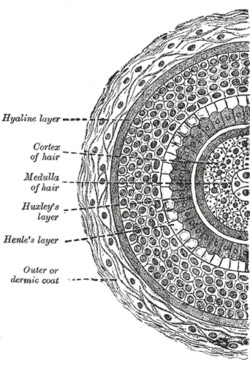
 Cross section of a human hair strand | |
 Scanning electron microscopy image of Merino wool (top) and human hair (bottom) showing keratin scales | |
| Details | |
| System | Integumentary system |
| Identifiers | |
| Latin | capillum |
| MeSH | D006197 |
| TA98 | A16.0.00.014 |
| TA2 | 7053 |
| TH | H3.12.00.3.02001 |
| FMA | 53667 |
| Anatomical terminology | |
Hair is a protein filament that grows from follicles found in the dermis. Hair is one of the defining characteristics of mammals. The human body, apart from areas of glabrous skin, is covered in follicles which produce thick terminal and fine vellus hair. Most common interest in hair is focused on hair growth, hair types, and hair care, but hair is also an important biomaterial primarily composed of protein, notably alpha-keratin.
Attitudes towards different forms of hair, such as hairstyles and hair removal, vary widely across different cultures and historical periods, but it is often used to indicate a person's personal beliefs or social position, such as their age, gender, or religion.[1]
Overview
[edit]Meaning
[edit]
The word "hair" usually refers to two distinct structures:
- the part beneath the skin, called the hair follicle, or, when pulled from the skin, the bulb or root. This organ is located in the dermis and maintains stem cells, which not only re-grow the hair after it falls out, but also are recruited to regrow skin after a wound.[2]
- the hair shaft, which is the hard filamentous part that extends above the skin surface. It is made of multi-layered keratinized (dead) flat cells whose rope-like filaments provide structure and strength to it. The protein called keratin makes up most of its volume. A cross section of the hair shaft may be divided roughly into three zones.
Hair fibers have a structure consisting of several layers, starting from the outside:
- the cuticle, which consists of several layers of flat, thin cells laid out overlapping one another as roof shingles
- the cortex, which contains the keratin bundles in cell structures that remain roughly rod-like
- the medulla, a disorganized and open area at the fiber's center[3]
Etymology
[edit]The word "hair" is derived from Middle English: heer and hêr, in turn derived from Old English: hǽr and hér, with influence from Old Norse: hár. Both the Old English and Old Norse words derive from Proto-Germanic: *hēran and are related to terms for hair in other Germanic languages such as Swedish: hår, Dutch and German: haar, and Old Frisian: her.[4][5] The now broadly obsolete word "fax" refers specifically to head hair and is found in compounds such as Fairfax and Halifax. It is derived from Old English: feax and is cognate with terms such as Old Norse and Norwegian: fax.[6]
Description
[edit]
Each strand of hair is made up of the medulla, cortex, and cuticle.[7] The innermost region, the medulla, is an open and unstructured region that is not always present.[8] The highly structural and organized cortex, or second of three layers of the hair, is the primary source of mechanical strength and water uptake. The cortex contains melanin, which colors the fiber based on the number, distribution and types of melanin granules. The melanin may be evenly spaced or cluster around the edges of the hair.[9] The shape of the follicle determines the shape of the cortex, and the shape of the fiber is related to how straight or curly the hair is. People with straight hair have round hair fibers. Oval and other shaped fibers are generally more wavy or curly. The cuticle is the outer covering. Its complex structure slides as the hair swells and is covered with a single molecular layer of lipid that makes the hair repel water.[7] The diameter of human hair varies from 0.017 to 0.18 millimeters (0.00067 to 0.00709 in).[10] Some of these characteristics in humans' head hair vary by race: people of mostly African ancestry tend to have hair with a diameter of 60–90 μm and a flat cross-section, while people of mostly European or Middle Eastern ancestry tend to have hair with a diameter of 70–100 μm and an oval cross-section, and people of mostly Asian or Native American ancestry tend to have hair with a diameter of 90–120 μm and a round cross-section.[9] There are roughly two million small, tubular glands and sweat glands that produce watery fluids that cool the body by evaporation. The glands at the opening of the hair produce a fatty secretion that lubricates the hair.[11]
Hair growth begins inside the hair follicle. The only "living" portion of the hair is found in the follicle. The hair that is visible is the hair shaft, which exhibits no biochemical activity and is considered "dead". The base of a hair's root (the "bulb") contains the cells that produce the hair shaft.[12] Other structures of the hair follicle include the oil producing sebaceous gland which lubricates the hair and the arrector pili muscles, which are responsible for causing hairs to stand up. In humans with little body hair, the effect results in goose bumps.
Root of the hair
[edit]| Root of the hair | |
|---|---|
 Section of skin, showing the epidermis and dermis; a hair in its follicle; the arrector pili muscle; sebaceous glands. | |
| Details | |
| Identifiers | |
| Latin | radix pili |
| MeSH | D006197 |
| TA98 | A16.0.00.014 |
| TA2 | 7053 |
| TH | H3.12.00.3.02001 |
| FMA | 53667 |
| Anatomical terminology | |
The root of the hair ends in an enlargement, the hair bulb, which is whiter in color and softer in texture than the shaft and is lodged in a follicular involution of the epidermis called the hair follicle. The bulb of hair consists of fibrous connective tissue, glassy membrane, external root sheath, internal root sheath composed of epithelium stratum (Henle's layer) and granular stratum (Huxley's layer), cuticle, cortex and medulla.[13]
Natural color
[edit]

All natural hair colors are the result of two types of hair pigments. Both of these pigments are melanin types, produced inside the hair follicle and packed into granules found in the fibers. Eumelanin is the dominant pigment in brown hair and black hair, while pheomelanin is dominant in red hair. Blond hair is the result of having little pigmentation in the hair strand. Gray hair occurs when melanin production decreases or stops, while poliosis is white hair (and often the skin to which the hair is attached), typically in spots that never possessed melanin at all, or ceased for natural reasons, generally genetic, in the first years of life.
Human hair growth
[edit]Hair grows everywhere on the external body except for mucous membranes and glabrous skin, such as that found on the palms of the hands, soles of the feet, and lips. The body has different types of hair, including vellus hair and androgenic hair, each with its own type of cellular construction. The different construction gives the hair unique characteristics, serving specific purposes, mainly, warmth and protection.


The three stages of hair growth are the anagen, catagen, and telogen phases. Each strand of hair on the human body is at its own stage of development. Once the cycle is complete, it restarts and a new strand of hair begins to form. The growth rate of hair varies from individual to individual depending on their age, genetic predisposition and a number of environmental factors.[14] It is commonly stated that hair grows about 1 cm per month on average; however reality is more complex, since not all hair grows at once. Scalp hair was reported to grow between 0.6 cm and 3.36 cm per month. The growth rate of scalp hair somewhat depends on age (hair tends to grow more slowly with age), sex, and ethnicity.[15] Thicker hair (>60 μm) grows generally faster (11.4 mm per month) than thinner (20-30 μm) hair (7.6 mm per month).[16][17]
It was previously thought that Caucasian hair grew more quickly than Asian hair and that the growth rate of women's hair was faster than that of men.[15] However, more recent research has shown that the growth rate of hair in men and women does not significantly differ[18] and that the hair of Chinese people grew more quickly than the hair of French Caucasians and West and Central Africans.[19] The quantity of hair hovers in a certain range depends on hair colour.[20][21] An average blonde person has 150,000 hairs, a brown-haired person has 110,000, a black-haired person has 100,000, and a redhead has 90,000.[22] Hair growth stops after a human's death. Visible growth of hair on the dead body happens only because of skin drying out due to water loss.[23][24]
The world record for longest hair on a living person stands with Smita Srivastava of Uttar Pradesh, India. At 7 feet and 9 inches long, she broke a Guinness World Record in November 2023, having grown her hair for 32 years.[25]
Texture
[edit]
Hair exists in a variety of textures. Three main aspects of hair texture are the curl pattern, volume, and consistency. All mammalian hair is composed of keratin, so the make-up of hair follicles is not the source of varying hair patterns. There are a range of theories pertaining to the curl patterns of hair. Scientists have come to believe that the shape of the hair shaft has an effect on the curliness of the individual's hair. A very round shaft allows for fewer disulfide bonds to be present in the hair strand. This means the bonds present are directly in line with one another, resulting in straight hair.[26]

The flatter the hair shaft becomes, the curlier hair gets, because the shape allows more cysteines to become compacted together resulting in a bent shape that, with every additional disulfide bond, becomes curlier in form.[26] As the hair follicle shape determines curl pattern, the hair follicle size determines thickness. While the circumference of the hair follicle expands, so does the thickness of the hair follicle. An individual's hair volume, as a result, can be thin, normal, or thick. The consistency of hair can almost always be grouped into three categories: fine, medium, and coarse. This trait is determined by the hair follicle volume and the condition of the strand.[27] Fine hair has the smallest circumference, coarse hair has the largest circumference, and medium hair is anywhere between the other two.[27] Coarse hair has a more open cuticle than thin or medium hair, causing it to be the most porous.[27]
Classification systems
[edit]There are various systems that people use to classify their curl patterns. Being knowledgeable of an individual's hair type is a good start to knowing how to take care of one's hair. There is not just one method to discovering one's hair type. Additionally, it is possible and quite normal to have more than one kind of hair type, for instance having a mixture of both type 3a and 3b curls.
Andre Walker system
[edit]The Andre Walker Hair Typing System is the most widely used system to classify hair. The system was created by Oprah Winfrey's hairstylist, Andre Walker. According to this system there are four types of hair: straight, wavy, curly, and kinky.
- Type 1 is straight hair, which reflects the most sheen and also the most resilient hair of all of the hair types. It is hard to damage and immensely difficult to curl this hair texture. Because the sebum easily spreads from the scalp to the ends without curls or kinks to interrupt its path, it is the most oily hair texture of all.
- Type 2 is wavy hair, whose texture and sheen ranges somewhere between straight and curly hair. Wavy hair is also more likely to become frizzy than straight hair. While type A waves can easily alternate between straight and curly styles, type B and C wavy hair is resistant to styling.
- Type 3 is curly hair known to have an S-shape. The curl pattern may resemble a lowercase "s", uppercase "S", or sometimes an uppercase "Z" or lowercase "z".[citation needed] Lack of proper care causes less defined curls.
- Type 4 is kinky hair, which features a tightly coiled curl pattern (or no discernible curl pattern at all) that is often fragile with a very high density. This type of hair shrinks when wet, and because it has fewer cuticle layers than other hair types, it is more susceptible to damage.
| Type 1: Straight | ||
|---|---|---|
| 1a | Straight (Fine/Thin) | Hair tends to be very soft, thin, shiny, oily, poor at holding curls, difficult to damage. |
| 1b | Straight (Medium) | Hair characterized by volume and body. |
| 1c | Straight (Coarse) | Hair tends to be bone-straight, coarse, difficult to curl. |
| Type 2: Wavy | ||
| 2a | Wavy (Fine/Thin) | Hair has definite "S" pattern, can easily be straightened or curled, usually receptive to a variety of styles. |
| 2b | Wavy (Medium) | Can tend to be frizzy and a little resistant to styling. |
| 2c | Wavy (Coarse) | Fairly coarse, frizzy or very frizzy with thicker waves, often more resistant to styling. |
| Type 3: Curly | ||
| 3a | Curly (Loose) | Presents a definite "S" pattern, tends to combine thickness, volume, and/or frizziness. |
| 3b | Curly (Tight) | Presents a definite "S" pattern, curls ranging from spirals to spiral-shaped corkscrews. |
| Type 4: Kinky | ||
| 4a | Kinky (Soft) | Hair tends to be very wiry and fragile, tightly coiled and can feature curly patterning. |
| 4b | Kinky (Wiry) | As 4a but with less defined pattern of curls, looks more like a "Z" with sharp angles. |
FIA system
[edit]This is a method which classifies the hair by curl pattern, hair-strand thickness and overall hair volume.
|
Curliness | ||
|---|---|---|
| Straight | ||
| 1a | Stick-straight. | |
| 1b | Straight but with a slight body wave adding some volume. | |
| 1c | Straight with body wave and one or two visible S-waves (e.g. at nape of neck or temples). | |
| Wavy | ||
| 2a | Loose with stretched S-waves throughout. | |
| 2b | Shorter with more distinct S-waves (resembling e.g. braided damp hair). | |
| 2c | Distinct S-waves, some spiral curling. | |
| Curly | ||
| 3a | Big, loose spiral curls. | |
| 3b | Bouncy ringlets. | |
| 3c | Tight corkscrews. | |
| Very ("Really") curly | ||
| 4a | Tightly coiled S-curls. | |
| 4b | Z-patterned (tightly coiled, sharply angled) | |
| 4c | Mostly Z-patterned (tightly kinked, less definition) | |
|
Strands | ||
| F | Fine
Thin strands that sometimes are almost translucent when held up to the light. | |
| M | Medium
Strands are neither fine nor coarse. | |
| C | Coarse
Thick strands whose shed strands usually are easily identified. | |
| Volume by circumference of full-hair ponytail | ||
| i | Thin | Circumference less than 2 inches (5.1 centimetres) |
| ii | Normal | ... from 2 to 4 inches (5.1 to 10.2 centimetres) |
| iii | Thick | ... more than 4 inches (10 centimetres) |
Composition
[edit]Hair is mainly composed of keratin proteins and keratin-associated proteins (KRTAPs). The human genome encodes 54 different keratin proteins which are present in various amounts in hair. Similarly, humans encode more than 100 different KRTAPs which crosslink keratins in hair. The content of KRTAPs ranges from less than 3% in human hair to 30–40% in echidna quill.[28]
Functions
[edit]Many mammals have fur and other hairs that serve different functions. Hair provides thermal regulation and camouflage for many animals; for others it provides signals to other animals such as warnings, mating, or other communicative displays; and for some animals hair provides defensive functions and, rarely, even offensive protection. Hair also has a sensory function, extending the sense of touch beyond the surface of the skin. Guard hairs give warnings that may trigger a recoiling reaction.
Warmth
[edit]
While humans have developed clothing and other means of keeping warm, the hair found on the head serves primarily as a source of heat insulation and cooling (when sweat evaporates from soaked hair) as well as protection from ultra-violet radiation exposure. The function of hair in other locations is debated. Hats and coats are still required while doing outdoor activities in cold weather to prevent frostbite and hypothermia, but the hair on the human body does help to keep the internal temperature regulated. When the body is too cold, the arrector pili muscles found attached to hair follicles stand up, causing the hair in these follicles to do the same. These hairs then form a heat-trapping layer above the epidermis. This process is formally called piloerection, derived from the Latin words 'pilus' ('hair') and 'erectio' ('rising up'), but is more commonly known as 'having goose bumps' in English.[29] This is more effective in other mammals whose fur fluffs up to create air pockets between hairs that insulate the body from the cold. The opposite actions occur when the body is too warm; the arrector muscles make the hair lie flat on the skin which allows heat to leave.
Protection
[edit]In some mammals, such as hedgehogs and porcupines, the hairs have been modified into hard spines or quills. These are covered with thick plates of keratin and serve as protection against predators. Thick hair such as that of the lion's mane and grizzly bear's fur do offer some protection from physical damages such as bites and scratches.
Touch sense
[edit]Displacement and vibration of hair shafts are detected by hair follicle nerve receptors and nerve receptors within the skin. Hairs can sense movements of air as well as touch by physical objects and they provide sensory awareness of the presence of ectoparasites.[30] Some hairs, such as eyelashes, are especially sensitive to the presence of potentially harmful matter.[31][32][33][34]


Eyebrows and eyelashes
[edit]The eyebrows provide moderate protection to the eyes from dirt, sweat and rain. They also play a key role in non-verbal communication by displaying emotions such as sadness, anger, surprise and excitement. In many other mammals, they contain much longer, whisker-like hairs that act as tactile sensors.
The eyelash grows at the edges of the eyelid and protects the eye from dirt. The eyelash is to humans, camels, horses, ostriches etc., what whiskers are to cats; they are used to sense when dirt, dust, or any other potentially harmful object is too close to the eye.[35] The eye reflexively closes as a result of this sensation.
Eyebrows and eyelashes do not grow beyond a certain length (eyelashes are rarely more than 10 mm long). However, trichomegaly can cause the lashes to grow remarkably long and prominent (in some cases the upper lashes grow to 15 mm long).
Evolution
[edit]Hair has its origins in the common ancestor of mammals, the synapsids, about 300 million years ago. It is currently unknown at what stage the synapsids acquired mammalian characteristics such as body hair and mammary glands, as the fossils only rarely provide direct evidence for soft tissues. Skin impression of the belly and lower tail of a pelycosaur, possibly Haptodus shows the basal synapsid stock bore transverse rows of rectangular scutes, similar to those of a modern crocodile, so the age of acquirement of hair logically could not have been earlier than ≈299 ma, based on the current understanding of the animal's phylogeny.[36] An exceptionally well-preserved skull of Estemmenosuchus, a therapsid from the Upper Permian, shows smooth, hairless skin with what appears to be glandular depressions,[37] though as a semi-aquatic species it might not have been particularly useful to determine the integument of terrestrial species. The oldest undisputed known fossils showing unambiguous imprints of hair are the Callovian (late middle Jurassic) Castorocauda and several contemporary haramiyidans, both near-mammal cynodonts, giving the age as no later than ≈220 ma based on the modern phylogenetic understanding of these clades.[38][39][40] More recently, studies on terminal Permian Russian coprolites may suggest that non-mammalian synapsids from that era had fur.[41] If this is the case, these are the oldest hair remnants known, showcasing that fur occurred as far back as the latest Paleozoic.
Some modern mammals have a special gland in front of each orbit used to preen the fur, called the harderian gland. Imprints of this structure are found in the skull of the small early mammals like Morganucodon, but not in their cynodont ancestors like Thrinaxodon.[42]
The hairs of the fur in modern animals are all connected to nerves, and so the fur also serves as a transmitter for sensory input. Fur could have evolved from sensory hair (whiskers). The signals from this sensory apparatus is interpreted in the neocortex, a section of the brain that expanded markedly in animals like Morganucodon and Hadrocodium.[43] The more advanced therapsids could have had a combination of naked skin, whiskers, and scutes. A full pelage likely did not evolve until the therapsid-mammal transition.[44] The more advanced, smaller therapsids could have had a combination of hair and scutes, a combination still found in some modern mammals, such as rodents and the opossum.[45]
The high interspecific variability of the size, color, and microstructure of hair often enables the identification of species based on single hair filaments.[46][47]

In varying degrees most mammals have some skin areas without natural hair. On the human body, glabrous skin is found on the ventral portion of the fingers, palms, soles of feet and lips, which are all parts of the body most closely associated with interacting with the world around us,[48] as are the labia minora and glans penis.[49] There are four main types of mechanoreceptors in the glabrous skin of humans: Pacinian corpuscles, Meissner's corpuscles, Merkel's discs, and Ruffini corpuscles.
The naked mole-rat (Heterocephalus glaber) has evolved skin lacking in general, pelagic hair covering, yet has retained long, very sparsely scattered tactile hairs over its body.[48] Glabrousness is a trait that may be associated with neoteny.[50]

Evolutionary variation
[edit]Primates are relatively hairless compared to other mammals, and Hominini such as chimpanzees, have less dense hair than would be expected given their body size for a primate.[51] Evolutionary biologists suggest that the genus Homo arose in East Africa approximately 2 million years ago.[52] Part of this evolution was the development of endurance running[53] and venturing out during the hot times of the day[54] that required efficient thermoregulation through perspiration. The loss of heat through heat of evaporation by means of sweat glands is aided by air currents next to the skin surface, which are facilitated by the loss of body hair.[55]
Another factor in human evolution that also occurred in the prehistoric past was a preferential selection for neoteny, particularly in females. The idea that adult humans exhibit certain neotenous (juvenile) features, not evinced in the other great apes, is about a century old. Louis Bolk made a long list of such traits,[56] and Stephen Jay Gould published a short list in Ontogeny and Phylogeny.[57] In addition, paedomorphic characteristics in women are often acknowledged as desirable by men in developed countries.[58] For instance, vellus hair is a juvenile characteristic. However, while men develop longer, coarser, thicker, and darker terminal hair through sexual differentiation, women do not, leaving their vellus hair visible.
Texture
[edit]Curly hair
[edit]


 | This section needs additional citations for verification. (August 2016) |
Jablonski[55] asserts head hair was evolutionarily advantageous for pre-humans to retain because it protected the scalp as they walked upright in the intense African (equatorial) UV light. While some might argue that, by this logic, humans should also express hairy shoulders because these body parts would putatively be exposed to similar conditions, the protection of the head, the seat of the brain that enabled humanity to become one of the most successful species on the planet (and which also is very vulnerable at birth) was arguably a more urgent issue (axillary hair in the underarms and groin were also retained as signs of sexual maturity). Sometime during the gradual process by which Homo erectus began a transition from furry skin to the naked skin expressed by Homo sapiens, hair texture putatively gradually changed from straight hair[citation needed] (the condition of most mammals, including humanity's closest cousins—chimpanzees) to Afro-textured hair or 'kinky' (i.e. tightly coiled). This argument assumes that curly hair better impedes the passage of UV light into the body relative to straight hair (thus curly or coiled hair would be particularly advantageous for light-skinned hominids living at the equator).
It is substantiated by Iyengar's findings [citation needed](1998) that UV light can enter into straight human hair roots (and thus into the body through the skin) via the hair shaft. Specifically, the results of that study suggest that this phenomenon resembles the passage of light through fiber optic tubes (which do not function as effectively when kinked or sharply curved or coiled). In this sense, when hominids (i.e. Homo erectus) were gradually losing their straight body hair and thereby exposing the initially pale skin underneath their fur to the sun, straight hair would have been an adaptive liability. By inverse logic, later, as humans traveled farther from Africa and/or the equator, straight hair may have (initially) evolved to aid the entry of UV light into the body during the transition from dark, UV-protected skin to paler skin.
Jablonski's assertions[55] suggest that the adjective "woolly" in reference to Afro-hair is a misnomer in connoting the high heat insulation derivable from the true wool of sheep. Instead, the relatively sparse density of Afro-hair, combined with its springy coils actually results in an airy, almost sponge-like structure that in turn, Jablonski argues,[55] more likely facilitates an increase in the circulation of cool air onto the scalp. Further, wet Afro-hair does not stick to the neck and scalp unless totally drenched and instead tends to retain its basic springy puffiness because it less easily responds to moisture and sweat than straight hair does. In this sense, the trait may enhance comfort levels in intense equatorial climates more than straight hair (which, on the other hand, tends to naturally fall over the ears and neck to a degree that provides slightly enhanced comfort levels in cold climates relative to tightly coiled hair).
Further, it is notable that the most pervasive expression of this hair texture can be found in sub-Saharan Africa; a region of the world that abundant genetic and paleo-anthropological evidence suggests, was the relatively recent (≈200,000-year-old) point of origin for modern humanity. In fact, although genetic findings (Tishkoff, 2009) suggest that sub-Saharan Africans are the most genetically diverse continental group on Earth, Afro-textured hair approaches ubiquity in this region. This points to a strong, long-term selective pressure that, in stark contrast to most other regions of the genomes of sub-Saharan groups, left little room for genetic variation at the determining loci. Such a pattern, again, does not seem to support human sexual aesthetics as being the sole or primary cause of this distribution.

The EDAR locus
[edit]A group of studies have recently shown that genetic patterns at the EDAR locus, a region of the modern human genome that contributes to hair texture variation among most individuals of East Asian descent, support the hypothesis that (East Asian) straight hair likely developed in this branch of the modern human lineage subsequent to the original expression of tightly coiled natural afro-hair.[59][60][61] Specifically, the relevant findings indicate that the EDAR mutation coding for the predominant East Asian 'coarse' or thick, straight hair texture arose within the past ≈65,000 years, which is a time frame that covers from the earliest of the 'Out of Africa' migrations up to now.
Disease
[edit]Ringworm is a fungal disease that targets hairy skin.[62]
Premature greying of hair is another condition that results in greying before the age of 20 years in Europeans, before 25 years in Asians, and before 30 years in Africans.[63]
Hair care
[edit]Hair care involves the hygiene and cosmetology of hair including hair on the scalp, facial hair (beard and moustache), pubic hair and other body hair. Hair care routines differ according to an individual's culture and the physical characteristics of one's hair. Hair may be colored, trimmed, shaved, plucked, or otherwise removed with treatments such as waxing, sugaring, and threading.
Removal practices
[edit]Depilation is the removal of hair from the surface of the skin. This can be achieved through methods such as shaving. Epilation is the removal of the entire hair strand, including the part of the hair that has not yet left the follicle. A popular way to epilate hair is through waxing.
Shaving
[edit]
Shaving is accomplished with bladed instruments, such as razors. The blade is brought close to the skin and stroked over the hair in the desired area to cut the terminal hairs and leave the skin feeling smooth. Depending upon the rate of growth, one can begin to feel the hair growing back within hours of shaving. This is especially evident in men who develop a five o'clock shadow after having shaved their faces. This new growth is called stubble. Stubble typically appears to grow back thicker because the shaved hairs are blunted instead of tapered off at the end, although the hair never actually grows back thicker.
Waxing
[edit]Waxing involves using a sticky wax and strip of paper or cloth to pull hair from the root. Waxing is the ideal hair removal technique to keep an area hair-free for long periods of time. It can take three to five weeks for waxed hair to begin to resurface again. Hair in areas that have been waxed consistently is known to grow back finer and thinner, especially compared to hair that has been shaved with a razor[citation needed].
Laser removal
[edit]Laser hair removal is a cosmetic method where a small laser beam pulses selective heat on dark target matter in the area that causes hair growth without harming the skin tissue. This process is repeated several times over the course of many months to a couple of years with hair regrowing less frequently until it finally stops; this is used as a more permanent solution to waxing or shaving. Laser removal is practiced in many clinics along with many at-home products.
Cutting and trimming
[edit]Because the hair on one's head is normally longer than other types of body hair, it is cut with scissors or clippers. People with longer hair will most often use scissors to cut their hair, whereas shorter hair is maintained using a trimmer. Depending on the desired length and overall health of the hair, periods without cutting or trimming the hair can vary.
Cut hair may be used in wigs. Global imports of hair in 2010 was worth $US 1.24 billion.[64]
Social role
[edit]
Hair has great social significance for human beings.[65][66] It can grow on most external areas of the human body, except on the palms of the hands and the soles of the feet (among other areas). Hair is most noticeable on most people in a small number of areas, which are also the ones that are most commonly trimmed, plucked, or shaved. These include the face, ears, head, eyebrows, legs, and armpits, as well as the pubic region. The highly visible differences between male and female body and facial hair are a notable secondary sex characteristic.
The world's longest documented hair belongs to Xie Qiuping (in China), at 5.627 m (18 ft 5.5 in) when measured on 8 May 2004. She has been growing her hair since 1973, from the age of 13.[67]
Indication of status
[edit]Healthy hair indicates health and youth (important in evolutionary biology). Hair color and texture can be a sign of ethnic ancestry. Facial hair is a sign of puberty in men. White or gray hair is a sign of age or genetics, which may be concealed with hair dye (not easily for some), although many prefer to assume it (especially if it is a poliosis characteristic of the person since childhood). Pattern baldness in men is usually seen as a sign of aging that may be concealed with a toupee, hats, or religious and cultural adornments; however, the condition can be triggered by various hormonal factors at any age following puberty and is not uncommon in younger men. Although pattern baldness can be slowed down by drugs such as Finasteride and Minoxidil or treated with hair transplants, many men see this as unnecessary effort for the sake of vanity and instead shave their heads. In early modern China, the queue was a male hairstyle in which the hair at the front and top was shaved every 10 days in a style mimicking pattern baldness, while the remaining hair at the back was braided into a long pigtail.
A hairstyle may be an indicator of group membership. During the English Civil War, followers of Oliver Cromwell cropped their hair close to their head in an act of defiance against the curls and ringlets of the king's men, which led to them being nicknamed Roundheads.[68] Recent isotopic analysis of hair is helping to shed further light on sociocultural interaction, giving information on food procurement and consumption in the 19th century.[69] Having bobbed hair was popular among the flappers in the 1920s as a sign of rebellion against traditional roles for women. Female art students known as the Cropheads also adopted the style, notably at the Slade School in London. Regional variations in hirsutism has caused practices regarding hair on the arms and legs to differ. Some religious groups may follow certain rules regarding hair as part of religious observance. The rules often differ for men and women.
Many subcultures have hairstyles which may indicate an unofficial membership. Many hippies, metalheads, and Indian sadhus have long hair, as well many older hipsters. Many punks wear a hairstyle known as a mohawk or other spiked and dyed hairstyles, while skinheads have short-cropped or completely shaved heads. Long stylized bangs were very common for emos, scene kids, and younger hipsters in the 2000s and early 2010s.
Heads were shaved in concentration camps, and head-shaving has been used as punishment, especially for women with long hair. The shaven head is common in military haircuts, while Western monks are known for the tonsure. By contrast, among some Indian holy men, the hair is worn extremely long.[70][71][72][73]
In the time of Confucius (5th century BCE), the Chinese grew out their hair and often tied it, as a symbol of filial piety. Regular hairdressing in some cultures is considered a sign of wealth or status. The dreadlocks of the Rastafari movement were despised early in the movement's history. In some cultures, having one's hair cut can symbolize a liberation from one's past, usually after a trying time in one's life. Cutting the hair also may be a sign of mourning.
Tightly coiled hair in its natural state may be worn in an Afro. This hairstyle was once worn among African Americans as a symbol of racial pride. Given that the coiled texture is the natural state of some African Americans' hair, or perceived as being more "African", this simple style is now often seen as a sign of self-acceptance and an affirmation that the beauty norms of the (eurocentric) dominant culture are not absolute. African Americans as a whole have a variety of hair textures, as they are not an ethnically homogeneous group, but an ad-hoc of different racial admixtures.
The film Easy Rider (1969) includes the assumption that the two main characters could have their long hairs forcibly shaved with a rusty razor when jailed, symbolizing the intolerance of some conservative groups toward members of the counterculture. At the conclusion of England's 1971 Oz trials, the defendants had their heads shaved by the police, causing public outcry. During the appeal trial, they appeared in the dock wearing wigs.[74] A case where a 14-year-old student was expelled from school in Brazil in the mid-2000s, allegedly because of his fauxhawk haircut, sparked national debate and legal action resulting in compensation.[75][76]
Religious practices
[edit]Women's hair may be hidden using headscarves, a common part of the hijab in Islam and a symbol of modesty required for certain religious rituals in Eastern Orthodoxy. The Russian Orthodox Church requires all married women to wear headscarves inside the church; this tradition is often extended to all women, regardless of marital status. Orthodox Judaism also commands the use of scarves and other head coverings for married women for modesty reasons. Certain Hindu sects also wear head scarves for religious reasons. Sikhs have an obligation not to cut hair (a Sikh cutting hair becomes 'apostate' which means fallen from religion)[77] and men keep it tied in a bun on the head, which is then covered appropriately using a turban. Multiple religions, both ancient and contemporary, require or advise one to allow their hair to become dreadlocks, though people also wear them for fashion. For men, Islam, Orthodox Judaism, Orthodox Christianity, Roman Catholicism, and other religious groups have at various times recommended or required the covering of the head and sections of the hair of men, and some have dictates relating to the cutting of men's facial and head hair. Some Christian sects throughout history and up to modern times have also religiously proscribed the cutting of women's hair. For some Sunni madhabs, the donning of a kufi or topi is a form of sunnah.[78] Brahmin males are prescribed to shave their heads, but leave a tuft of hair unshaved, worn in the form of a topknot.[79]
In Arabic poetry
[edit]Since ancient times, women's long, thick, wavy hair has featured prominently in Arabic poetry.[80] Pre-Islamic poets used only limited imagery to describe women's hair.[80] For example, al-A'sha wrote a verse comparing a lover's hair to "a garden whose grapes dangle down upon me", but Bashshar ibn Burd considered this unusual.[80] One comparison used by early poets, such as Imru al-Qays, was to bunches of dates.[80] In Abbasid times, however, the imagery for hair expanded significantly - particularly for the then-fashionable "love-locks" (sudgh) framing the temples, which came into style at the court of the caliph al-Amin.[80] Hair curls were compared to hooks and chains, letters (such as fa, waw, lam, and nun), scorpions, annelids, and polo sticks.[80] An example was the poet Ibn al-Mu'tazz, who compared a lock of hair and a birthmark to a polo stick driving a ball.[80]
See also
[edit]- Body hair
- Bristle sensilla – tactile hairs in insects
- Chaetophobia – the fear of hair
- Hair analysis (alternative medicine)
- Hypertrichosis – the state of having an excess of hair on the head or body
- Hypotrichosis – the state of having a less than normal amount of hair on the head or body
- Lanugo
- List of hairstyles
- Mane (horse)
- Prehistory of nakedness and clothing - how humans lost most of their body hair
- Seta – hair-like structures in insects
- Trichotillomania – hair pulling
References
[edit]Citations
[edit]- ^ Sherrow, Victoria (2006). Encyclopedia of Hair: A Cultural History. Westport, CT: Greenwood Press. p. iv. ISBN 978-0-313-33145-9.
- ^ Krause, K; Foitzik, K (2006). "Biology of the Hair Follicle: The Basics". Seminars in Cutaneous Medicine and Surgery. 25 (1): 2–10. doi:10.1016/j.sder.2006.01.002 (inactive 12 July 2025). ISSN 1085-5629. PMID 16616298.
{{cite journal}}: CS1 maint: DOI inactive as of July 2025 (link) - ^ Feughelman, Max (1997). Mechanical Properties and Structure of Alpha-keratin Fibres: Wool, Human Hair and Related Fibres. UNSW Press. ISBN 978-0-86840-359-5. Retrieved 27 January 2016.
- ^ "hair - Etymology of hair by etymonline". www.etymonline.com. Retrieved 20 July 2024.
- ^ "hair". OED. Retrieved 20 July 2024.
- ^ "fax". OED. Retrieved 20 July 2024.
- ^ a b Hair Structure and Hair Life Cycle. follicle.com
- ^ "Topic 2". Texascollaborative.org. Archived from the original on 15 April 2013. Retrieved 18 February 2015.
- ^ a b Bisbing, Richard E. "3. The Forensic Identification and Association of Human Hair". In Saferstein, Richard; Hall, Adam B. (eds.). Forensic Science Handbook. Vol. 1 (3rd ed.). CRC Press. pp. 165-166. Archived (pp. 165, 166) on 18 April 2023.
- ^ Ley, Brian (1999). "Diameter of a Human Hair". Retrieved 28 June 2010.
- ^ Councilman, W. T. (1913). "Ch. 1". Disease and Its Causes. United States: New York Henry Holt and Company London Williams and Norgate The University Press, Cambridge, USA.
- ^ Freinkel, R.K.; Woodley, D.T., eds. (15 March 2001). The Biology of the Skin. CRC Press. p. 80. ISBN 9781850700067.
- ^ Histology Guide | Skin Histology.leeds.ac.uk. Retrieved on 18 May 2016.
- ^ Schneider, Marlon R.; Schmidt-Ullrich, Ruth; Paus, Ralf (10 February 2009). "The hair follicle as a dynamic miniorgan". Current Biology. 19 (3): R132–142. Bibcode:2009CBio...19.R132S. doi:10.1016/j.cub.2008.12.005. ISSN 1879-0445. PMID 19211055.
- ^ a b Harkey, M. R. (December 1993). "Anatomy and physiology of hair". Forensic Science International. Hair Analysis as a Diagnostic Tool for Drugs of Abuse Investigation. 63 (1): 9–18. doi:10.1016/0379-0738(93)90255-9. ISSN 0379-0738. PMID 8138238.
- ^ Van Neste DJ, Rushton DH (2016). "Gender differences in scalp hair growth rates are maintained but reduced in pattern hair loss compared to controls". Skin Res Technol. 22 (3): 363–9. doi:10.1111/srt.12274. PMID 26526232. S2CID 19060270.
- ^ Buffoli, Barbara; Rinaldi, Fabio; Labanca, Mauro; Sorbellini, Elisabetta; Trink, Anna; Guanziroli, Elena; Rezzani, Rita; Rodella, Luigi F. (2014). "The human hair: from anatomy to physiology". International Journal of Dermatology. 53 (3): 331–341. doi:10.1111/ijd.12362. PMID 24372228. S2CID 1310059.
- ^ Joseph Castro (27 January 2014). "How Fast Does Hair Grow?". Live Science. Retrieved 3 July 2020.
- ^ Loussouarn, Geneviève; El Rawadi, Charles; Genain, Gilles (2005). "Diversity of hair growth profiles". International Journal of Dermatology. 44 (s1): 6–9. doi:10.1111/j.1365-4632.2005.02800.x. PMID 16187948. S2CID 39103960.
- ^ "How many hairs are on a human head in total and per square inch?". curlcentric.com. Retrieved 18 April 2022.
- ^ "Number of hairs on human head". harvard.edu. Archived from the original on 14 December 2021. Retrieved 18 April 2022.
- ^ "How much hair does a human have on their head?". mevolife.com. Archived from the original on 7 March 2023. Retrieved 18 April 2022.
- ^ "Do your hair and fingernails grow after death?". bbc.com. Retrieved 18 April 2022.
- ^ Ruszczak, Zbigniew (2012). "Hair Disorders and Alopecia". In Elzouki, Abdelaziz Y.; Harfi, Harb A.; Nazer, Hisham M.; Stapleton, F. Bruder; Oh, William; Whitley, Richard J. (eds.). Textbook of Clinical Pediatrics. pp. 1489–508. doi:10.1007/978-3-642-02202-9_146. ISBN 978-3-642-02201-2.
- ^ "UP woman, 46, sets world record with 7 ft 9 in long hair". Hindustan Times. 30 November 2023. Retrieved 30 November 2023.
- ^ a b "Curly Hair Gene". Bio.davidson.edu. Retrieved 28 January 2015.
- ^ a b c "Hair type, texture and density | Hairdressing Training". Hairdressing.ac.uk. Archived from the original on 12 February 2015. Retrieved 28 January 2015.
- ^ Wu, Dong-Dong; Irwin, David M. (2018), Plowman, Jeffrey E.; Harland, Duane P.; Deb-Choudhury, Santanu (eds.), "Evolution of Trichocyte Keratin Associated Proteins", The Hair Fibre: Proteins, Structure and Development, Advances in Experimental Medicine and Biology, vol. 1054, Singapore: Springer, pp. 47–56, doi:10.1007/978-981-10-8195-8_5, ISBN 978-981-10-8195-8, PMID 29797267, retrieved 4 March 2023
- ^ Bubenik, George A. (1 September 2003). "Why do humans get "goosebumps" when they are cold, or under other circumstances?". Scientific American. Retrieved 4 May 2010.
- ^ Dean, I.; Siva-Jothy, M. T. (2011). "Human fine body hair enhances ectoparasite detection". Biology Letters. 8 (3): 358–61. doi:10.1098/rsbl.2011.0987. PMC 3367735. PMID 22171023.
- ^ "Neuroscience for Kids – Receptors". Faculty.washington.edu. Retrieved 18 February 2015.
- ^ "hair biology – functions of the hair fiber and hair follicle". Keratin.com. Archived from the original on 30 March 2017. Retrieved 18 February 2015.
- ^ Sabah, NH (1974). "Controlled stimulation of hair follicle receptors". Journal of Applied Physiology. 36 (2): 256–7. doi:10.1152/jappl.1974.36.2.256. PMID 4811387.
- ^ Montagna, W. (1985). "The evolution of human skin(?)". Journal of Human Evolution. 14 (1): 3–22. Bibcode:1985JHumE..14....3M. doi:10.1016/S0047-2484(85)80090-7.
- ^ "Images of Nature". Ion.asu.edu. Archived from the original on 8 May 2006. Retrieved 18 February 2015.
- ^ Niedźwiedzki, Grzegorz; Bojanowski, Maciej (July 2012). "A Supposed Eupelycosaur Body Impression from the Early Permian of the Intra-Sudetic Basin, Poland". Ichnos. 19 (3): 150–155. Bibcode:2012Ichno..19..150N. doi:10.1080/10420940.2012.702549. S2CID 129567176.
- ^ Kardong, K.V. (2002): Vertebrates: Comparative anatomy, function, evolution. 3rd Edition. McGraw-Hill, New York
- ^ Q. Ji; Z-X Luo; C-X Yuan; Tabrum, A. R. (February 2006). "A Swimming Mammaliaform from the Middle Jurassic and Ecomorphological Diversification of Early Mammals" (PDF). Science. 311 (5764): 1123–7. Bibcode:2006Sci...311.1123J. doi:10.1126/science.1123026. PMID 16497926. S2CID 46067702. See also the news item at "Jurassic "Beaver" Found; Rewrites History of Mammals". Archived from the original on 22 September 2012. Retrieved 12 August 2012.
- ^ "Jurassic squirrel's secret is out". The Hindu. 9 August 2013. Retrieved 29 June 2016.
- ^ Meng, Qing-Jin; Grossnickle, David M.; Di, Liu; Zhang, Yu-Guang; Neander, April I.; Ji, Qiang; Luo, Zhe-Xi (2017). "New gliding mammaliaforms from the Jurassic". Nature. 548 (7667): 291–296. Bibcode:2017Natur.548..291M. doi:10.1038/nature23476. PMID 28792929. S2CID 205259206.
- ^ Bajdek, Piotr (2015). "Microbiota and food residues including possible evidence of pre-mammalian hair in Upper Permian coprolites from Russia". Lethaia. 49 (4): 455–477. doi:10.1111/let.12156.
- ^ Lingham-Soliar, Theagarten (2014). The vertebrate integument, Vol I. Berlin, Heidelberg: Springer Berlin Heidelberg. pp. 211–212. ISBN 978-3-642-53748-6.
- ^ Rowe, T. B.; Macrini, T. E.; Luo, Z.-X. (19 May 2011). "Fossil Evidence on Origin of the Mammalian Brain". Science. 332 (6032): 955–957. Bibcode:2011Sci...332..955R. doi:10.1126/science.1203117. PMID 21596988. S2CID 940501.
- ^ Ruben, J.A.; Jones, T.D. (2000). "Selective Factors Associated with the Origin of Fur and Feathers". Am. Zool. 40 (4): 585–596. doi:10.1093/icb/40.4.585.
- ^ Plower, R.P. (1897). An introduction to the study of mammals living and extinct. New York: Cornell University Library. p. 11. Retrieved 8 June 2012.
Flat scutes, with the edges in apposition, and not overlaid, clothe both surfaces of the tail of the beaver, rats, and others of the same order, and also of some insectivores and marsupials.
- ^ Teerink, BJ (2003). Hair of West European Mammals: Atlas and Identification Key. Cambridge University Press. p. 224. ISBN 9780521545778.
- ^ Toth, Maria (29 December 2017). Hair and fur atlas of Central European mammals. Pars Ltd. p. 307. ISBN 978-963-88339-7-6. Retrieved 8 July 2019.
- ^ a b Prescott, Tony; Ahissar, Ehud; Izhikevich, Eugene (21 November 2015). Scholarpedia of touch. Paris. ISBN 978-94-6239-133-8. OCLC 932171320.
{{cite book}}: CS1 maint: location missing publisher (link) - ^ Linden, David, J. (March 2015). "Chapter 2". Touch: The Science of Hand, Heart and Mind. Viking. ISBN 978-0241184035.
{{cite book}}: CS1 maint: multiple names: authors list (link) - ^ Rebora, Alfredo (2010). "Lucy's pelt: when we became hairless and how we managed to survive". International Journal of Dermatology. 49 (1): 17–20. doi:10.1111/j.1365-4632.2009.04266.x. ISSN 1365-4632. PMID 20465604. S2CID 21484729.
- ^ Sandel, Aaron A. (30 July 2013). "Brief communication: Hair density and body mass in mammals and the evolution of human hairlessness". American Journal of Physical Anthropology. 152 (1): 145–150. doi:10.1002/ajpa.22333. hdl:2027.42/99654. ISSN 0002-9483. PMID 23900811.
- ^ Herries, Andy I. R.; Martin, Jesse M.; Leece, A. B.; Adams, Justin W.; Boschian, Giovanni; Joannes-Boyau, Renaud; Edwards, Tara R.; Mallett, Tom; Massey, Jason; Murszewski, Ashleigh; Neubauer, Simon; Pickering, Robyn; Strait, David S.; Armstrong, Brian J.; Baker, Stephanie; Caruana, Matthew V.; Denham, Tim; Hellstrom, John; Moggi-Cecchi, Jacopo; Mokobane, Simon; Penzo-Kajewski, Paul; Rovinsky, Douglass S.; Schwartz, Gary T.; Stammers, Rhiannon C.; Wilson, Coen; Woodhead, Jon; Menter, Colin (3 April 2020). "Contemporaneity of Australopithecus, Paranthropus, and early Homo erectus in South Africa". Science. 368 (6486). doi:10.1126/science.aaw7293. hdl:11568/1040368. ISSN 0036-8075. PMID 32241925.
- ^ Ruxton, Graeme D.; Wilkinson, David M. (2011). "Thermoregulation and endurance running in extinct hominins: Wheeler's models revisited". Journal of Human Evolution. 61 (2): 169–175. Bibcode:2011JHumE..61..169R. doi:10.1016/j.jhevol.2011.02.012. ISSN 0047-2484. PMID 21489604.
- ^ Ruxton, Graeme D.; Wilkinson, David M. (12 December 2011). "Avoidance of overheating and selection for both hair loss and bipedality in hominins". Proceedings of the National Academy of Sciences. 108 (52): 20965–20969. Bibcode:2011PNAS..10820965R. doi:10.1073/pnas.1113915108. ISSN 0027-8424. PMC 3248486. PMID 22160694.
- ^ a b c d Jablonski, Nina G. (1 May 2008). Skin: A Natural History. University of California Press. pp. 13–. ISBN 978-0-520-94170-0. Retrieved 27 January 2016.
- ^ Bolk, L. (1926). Das Problem der Menschwerdung (in German). Jena: Fischer.
- ^ short-list of 25 characters reprinted in Gould, Stephen Jay (1977). Ontogeny and phylogeny. Harvard University Press. p. 357. ISBN 0674639413.
- ^ Scott, Isabel M. (7 October 2014). "Human preferences for sexually dimorphic faces may be evolutionarily novel". Proceedings of the National Academy of Sciences of the United States of America. 111 (40): 14388–14393. Bibcode:2014PNAS..11114388S. doi:10.1073/pnas.1409643111. PMC 4210032. PMID 25246593.
- ^ Fujimoto, A; Kimura, R; Ohashi, J; Omi, K; Yuliwulandari, R; Batubara, L; Mustofa, MS; Samakkarn, U; et al. (2008). "A scan for genetic determinants of human hair morphology: EDAR is associated with Asian hair thickness". Human Molecular Genetics. 17 (6): 835–43. doi:10.1093/hmg/ddm355. PMID 18065779.
- ^ Fujimoto, A; Ohashi, J; Nishida, N; Miyagawa, T; Morishita, Y; Tsunoda, T; Kimura, R; Tokunaga, K (2008). "A replication study confirmed the EDAR gene to be a major contributor to population differentiation regarding head hair thickness in Asia" (PDF). Human Genetics. 124 (2): 179–85. doi:10.1007/s00439-008-0537-1. hdl:2241/103672. PMID 18704500. S2CID 20084816. Archived from the original (PDF) on 5 February 2011. Retrieved 14 December 2010.
- ^ Mou, C; Thomason, HA; Willan, PM; Clowes, C; Harris, WE; Drew, CF; Dixon, J; Dixon, MJ; Headon, DJ (2008). "Enhanced ectodysplasin-A receptor (EDAR) signaling alters multiple fiber characteristics to produce the East Asian hair form" (PDF). Human Mutation. 29 (12): 1405–11. doi:10.1002/humu.20795. hdl:20.500.11820/0b35a959-86c8-44e5-b100-20639dd6bbf1. PMID 18561327. S2CID 37696013. Retrieved 30 January 2019.
- ^ "Dermatologyinfo.net". Dermatologyinfo.net. Retrieved 21 May 2012.
- ^ Pandhi, D.; Khanna, D. (31 August 2013). "Premature graying of hair". Indian Journal of Dermatology, Venereology and Leprology. 79 (5): 641–653. doi:10.4103/0378-6323.116733. PMID 23974581. Retrieved 15 November 2017.
- ^ Gupta, Ankush (27 April 2014). "Human Hair "Waste" and Its Utilization: Gaps and Possibilities". Journal of Waste Management. 2014: 1–17. doi:10.1155/2014/498018.
- ^ Ashby, Steven P. (2016). "Archaeologies of Hair: the head and its grooming in ancient and contemporary societies". Internet Archaeology (42). doi:10.11141/ia.42.6.
- ^ Hielscher, Sabine (2016). "Because You're Worth It: Women's daily hair care routines in contemporary Britain". Internet Archaeology (42). doi:10.11141/ia.42.6.13.
- ^ Glenday, Craig (2010). Guinness World Records 2011. Guinness World Records. ISBN 9781904994572.
- ^ Olmert, Michael (1996). Milton's Teeth and Ovid's Umbrella: Curiouser & Curiouser Adventures in History, p. 53. Simon & Schuster, New York. ISBN 0-684-80164-7
- ^ Brown, Chloe; Alexander, Michelle (2016). "Hair as a Window on Diet and Health in Post-Medieval London: an isotopic analysis". Internet Archaeology (42). doi:10.11141/ia.42.6.12.
- ^ Berger, Arthur Asa (2020). USA Pop. Newcastle upon Tyne. ISBN 978-1-5275-5998-1. OCLC 1199967093.
{{cite book}}: CS1 maint: location missing publisher (link) - ^ Innes, William C. (2021). Religious hair display and its meanings. Cham, Switzerland. ISBN 978-3-030-69974-1. OCLC 1249505982.
{{cite book}}: CS1 maint: location missing publisher (link) - ^ Cultural History of Hair in the Modern Age. Bloomsbury Academic. 2021. ISBN 978-1-350-12283-3. OCLC 1223027644.
- ^ Hair : its power and meaning in Asian cultures. Alf Hiltebeitel, Barbara D. Miller. Albany: State University of New York Press. 1998. ISBN 0-7914-3741-8. OCLC 37254408.
{{cite book}}: CS1 maint: others (link) - ^ Green, Jonathon, (1999). All Dressed Up: The Sixties and the Counterculture. London: Pimlico. ISBN 0-7126-6523-4.
- ^ "G1 – Justiça do CE condena escola por barrar aluno com cabelo 'moicano' – notícias em Ceará" [G1 - CE court condemns school for barring student with 'mohawk' hair - news in Ceara]. G1.globo.com. 28 September 2011. Retrieved 18 February 2015.
- ^ "G1 – Aluno diz que jogador inspirou 'corte moicano' alvo de ação judicial no CE – notícias em Ceará" [G1 says student inspired 'Mohawk court' subject to legal action in CE - news in Ceara]. G1.globo.com. 30 September 2011. Retrieved 18 February 2015.
- ^ Dilgeer, Harjinder Singh (2005) Dictionary of Sikh Philosophy, Sikh University Press.
- ^ The War Within Our Hearts – Page 65 Sa'ad Quadri – 2013
- ^ Hiltebeitel, Alf; Miller, Barbara D.; Miller, Professor of Anthropology and Director of the Women's Studies Program Barbara D. (1 January 1998). Hair: Its Power and Meaning in Asian Cultures. SUNY Press. p. 15. ISBN 978-0-7914-3741-4.
- ^ a b c d e f g Sadan, J.; Reinhart, A.K.; Reinert, B. (1997). "SHA'R". In Bosworth, C.E.; van Donzel, E.; Heinrichs, W.P.; Lecomte, G. (eds.). The Encyclopaedia of Islam, Vol. IX (SAN-SZE) (PDF). Leiden: Brill. pp. 311–3. ISBN 90-04-10422-4. Retrieved 13 June 2022.
Sources
[edit]- Iyengar, B. (1998). "The hair follicle is a specialized UV receptor in human skin?". Bio Signals Recep. 7 (3): 188–194. doi:10.1159/000014544. PMID 9672761. S2CID 46864921.
- Jablonski, N.G. (2006). Skin: a natural history. Berkeley, CA: University of California Press.
- Rogers, Alan R.; Iltis, David; Wooding, Stephen (2004). "Genetic variation at the MC1R locus and the time since loss of human body hair". Current Anthropology. 45 (1): 105–108. doi:10.1086/381006. S2CID 224795768.
- Tishkoff, S. A.; Dietzsch, E.; Speed, W.; Pakstis, A. J.; Kidd, J. R.; Cheung, K.; Bonne-Tamir, B.; Santachiara-Benerecetti, A. S.; et al. (1996). "Global patterns of linkage disequilibrium at the CD4 locus and modern human origins". Science. 271 (5254): 1380–1387. Bibcode:1996Sci...271.1380T. doi:10.1126/science.271.5254.1380. PMID 8596909. S2CID 4266475.
External links
[edit]


- How to measure the diameter of your own hair using a laser pointer
- Instant insight outlining the chemistry of hair from the Royal Society of Chemistry
- PUIU, TIBI (23 August 2018). "How fast hair grows, and other hairy science". ZME Science. Retrieved 30 August 2018.
| Taxonomy (Hominins) |
| ||||||||||||||||||||||||||
|---|---|---|---|---|---|---|---|---|---|---|---|---|---|---|---|---|---|---|---|---|---|---|---|---|---|---|---|
| Ancestors |
| ||||||||||||||||||||||||||
| Models |
| ||||||||||||||||||||||||||
| Timelines | |||||||||||||||||||||||||||
| Others | |||||||||||||||||||||||||||


| International | |
|---|---|
| National | |
| Other | |

Definition and Basics
Definition and Etymology
Hair is a filamentous appendage composed primarily of the protein keratin, originating from hair follicles embedded in the dermis of mammalian skin. It consists of a visible shaft projecting above the skin surface and an underlying root anchored within the follicle, which extends into the dermal layer of the integumentary system.[3][6] The structure is formed by tightly packed, keratinized dead cells derived from keratinocytes in the follicle, distinguishing it from other epidermal derivatives like scales or feathers.[7][8] As one of the defining synapomorphies of mammals, hair evolved in the common ancestor of the group, providing thermoregulatory insulation by trapping air and aiding in sensory functions through specialized forms like vibrissae.[9][10] All mammals produce hair at some life stage, though density and distribution vary widely across species and body regions.[11][12] The English noun "hair" originates from Old English hǣr, denoting a single strand or collective growth on the head or body.[13] This term derives from Proto-Germanic *hērą, shared with cognates such as Old Norse hár, Old High German hār, Dutch haar, and modern German Haar.[14] The Proto-Indo-European root is reconstructed as *ghers-, connoting "to bristle" or "stand out," reflecting the erect, protruding nature of the filament, with possible links to terms for stiff projections in other Indo-European languages.[14] The word's usage predates the 12th century in Germanic traditions, evolving without significant semantic shifts related to modern contexts like artificial fibers.[15]Anatomy and Composition
Hair Follicle Structure
The hair follicle constitutes the pilosebaceous unit, integrating the follicle itself with an associated sebaceous gland and arrector pili muscle, forming a multifunctional skin appendage embedded within the dermis and extending into the subcutaneous tissue.[16] This structure originates from ectodermal invaginations during embryogenesis, with the epithelial compartment derived from epidermal keratinocytes and the mesenchymal elements from dermal fibroblasts.[16] The follicle's architecture supports cyclic hair production through interactions between epithelial progenitors and mesenchymal signaling centers.[3] Vertically, the follicle divides into the infundibulum, isthmus, and inferior segment; the infundibulum represents the uppermost portion opening to the skin surface, lined by stratified squamous epithelium continuous with the epidermis, while the isthmus transitions to the bulge region housing epithelial stem cells marked by keratin 15 expression.[16] The inferior segment encompasses the hair bulb, comprising proliferative matrix cells surrounding the dermal papilla, a cluster of specialized mesenchymal cells that provide inductive signals via factors such as Wnt and BMP pathways to regulate follicle morphogenesis and cycling.[17] The dermal papilla, cup-shaped and avascular, interfaces directly with the matrix, influencing hair fiber caliber through cell number variations, as evidenced by studies showing larger papillae correlate with thicker hairs.[18] The epithelial layers include the outer root sheath (ORS), contiguous with the epidermis and expressing keratins K5 and K14, and the inner root sheath (IRS) comprising three sublayers—Henle's layer, Huxley's layer, and the inner root sheath cuticle—that guide hair shaft formation and degrade during emergence.[19] The hair shaft, produced by matrix cell differentiation, consists of an outer cuticle of overlapping scales, a cortex forming the bulk with keratin filaments for strength, and an optional medulla of loosely packed cells in coarser hairs.[20] Enveloping the epithelial components, the dermal sheath provides structural support and a source of myofibroblast-like cells, maintaining follicle integrity during regression phases.[21] Associated structures enhance functionality: the sebaceous gland, attached at the infundibulum junction, secretes sebum via holocrine mechanisms to lubricate the shaft, while the arrector pili muscle, a smooth muscle bundle innervated by sympathetic fibers, contracts to erect hairs in response to cold or stress, facilitating thermoregulation.[16] Blood supply derives from the dermal plexus, with capillaries penetrating the papilla to nourish matrix proliferation, underscoring the follicle's vascular dependence for active growth.[16] Histological examination reveals these components' precise organization, with trichohyalin granules in IRS Henle's layer aiding structural rigidity.[19]Chemical Composition
Human hair primarily consists of keratin proteins, which account for 65–95% of its dry weight, forming a fibrous structure that provides mechanical strength and resilience.[22] These keratins belong to the intermediate filament family, specifically alpha-keratins characterized by their alpha-helical coiled-coil dimers that assemble into 10-nm protofilaments and further into higher-order structures stabilized by disulfide cross-links.[2] The cortex, comprising the bulk of the hair shaft, contains these keratin filaments embedded in a matrix of keratin-associated proteins (KAPs), which are rich in cysteine and contribute to the hair's hardness and elasticity.[23] Keratin's amino acid profile is dominated by cysteine (up to 10–14% as cystine in disulfide form), alongside high levels of proline, serine, glutamic acid, and arginine, enabling extensive intra- and intermolecular disulfide bonds (approximately 1 per 10–12 amino acids) that confer resistance to tensile forces and environmental degradation.[24] Evolutionarily conserved signatures include elevated cysteine and proline in hard keratins like those in hair, distinguishing them from softer epidermal keratins.[24] The cuticle layer, composed of overlapping keratin scales, and the optional medulla feature similar but less densely packed keratin variants, with the cell membrane complex binding layers via lipid-protein interactions.[25] Beyond proteins, hair contains 1–9% lipids, primarily 18-methyl eicosanoic acid (18-MEA) covalently bound to the cuticle surface for hydrophobicity, alongside free fatty acids, cholesterol, and ceramides that influence surface properties and water retention.[26] Melanin granules in the cortex provide pigmentation via eumelanin (black-brown) and pheomelanin (red-yellow), comprising 1–3% by weight in pigmented hair.[27] Water content varies from 6–12% in dry conditions to higher levels when hydrated, affecting flexibility. Trace elements, analyzed via techniques like energy-dispersive X-ray spectroscopy, include zinc, iron, and copper at parts-per-million levels, reflecting dietary intake but varying by ethnicity and environment (e.g., higher zinc in urban residents).[28] [29] The elemental composition, on a dry basis, approximates: These values derive from keratin's polypeptide backbone (C, H, O, N) augmented by sulfur from cystine.[30] [29] Variations occur due to processing (e.g., bleaching reduces cystine) or individual factors, but the core keratin matrix remains the determinant of hair's chemical stability.[31]Growth Cycle and Regulation
The hair growth cycle consists of three primary phases: anagen, the active growth phase; catagen, the transitional regression phase; and telogen, the resting phase.[3] This cyclic process occurs asynchronously in human scalp follicles, with approximately 85-90% of follicles in anagen at any time, ensuring continuous hair coverage.[32] The cycle is regulated by intrinsic molecular mechanisms and extrinsic factors such as hormones and environmental influences, with dysregulation linked to conditions like alopecia.[33] During anagen, matrix keratinocytes in the hair bulb proliferate rapidly, elongating the hair shaft at rates of about 0.3-0.4 mm per day on the scalp.[3] This phase lasts 2-7 years for scalp hair, varying by individual genetics and site, with follicle stem cells in the bulge region activated by signaling pathways including Wnt/β-catenin.[32] [33] Anagen induction involves bone morphogenetic proteins (BMPs) and fibroblast growth factors (FGFs), which promote dermal papilla signaling to sustain growth.[34] Catagen follows, a brief involution phase lasting 2-3 weeks, characterized by apoptosis of the lower follicle epithelium and cessation of proliferation, reducing the follicle to a club hair structure.[3] [33] TGF-β signaling triggers this regression, detaching the follicle from the dermal papilla and forming the secondary hair germ.[33] Only about 1-2% of follicles enter catagen simultaneously under normal conditions.[35] Telogen persists for 3-4 months, during which the club hair remains anchored until exogen, the shedding phase, when it is released to allow new anagen initiation.[3] [35] Approximately 50-100 hairs enter telogen daily, leading to normal shedding of 100-150 hairs per day.[36] Transition to the next anagen is governed by stem cell reactivation, influenced by factors like decreased BMP inhibition.[34] Regulation integrates genetic, hormonal, and local paracrine signals. Androgens, via androgen receptors in the dermal papilla, shorten anagen in androgenetic alopecia-prone follicles but promote growth in others, demonstrating site-specific effects.[37] Thyroid hormones and insulin-like growth factor-1 (IGF-1) extend anagen, while glucocorticoids induce catagen.[38] Circadian clock genes such as Per1 and Cry1 modulate cycle timing, with mutations disrupting synchrony in animal models.[39] Genetic variants in genes like HR influence postnatal cycling, as evidenced by mutations causing congenital hair loss.[40] Nutritional deficiencies, stress-induced cortisol, and aging progressively shorten anagen duration, reducing hair density.[41]Pigmentation and Color Variation
Human hair pigmentation arises from melanin granules produced by melanocytes within the hair follicle bulb, with color determined by the ratio of two primary types: eumelanin, which imparts black to brown hues, and pheomelanin, which contributes yellow to red tones. High concentrations of eumelanin result in dark hair, while lower levels combined with pheomelanin yield lighter shades such as blonde or red; black hair contains the highest eumelanin content, often exceeding 100 pg per hair shaft, whereas blonde hair has minimal amounts, around 10-20 pg. [42] [43] [44] Genetic factors govern melanin synthesis, primarily through variants in the melanocortin 1 receptor (MC1R) gene on chromosome 16, which regulates the switch between eumelanin and pheomelanin production. Individuals with two loss-of-function MC1R alleles, such as R151C, R160W, or D294H, exhibit reduced eumelanin and elevated pheomelanin, leading to red hair as a recessive trait; this occurs in approximately 1-2% of the global population, with prevalence reaching 10% in Ireland and 13% in Scotland due to founder effects in Northern European ancestry. Blonde hair, characterized by sparse eumelanin, involves multiple loci beyond MC1R, including variants associated with lighter pigmentation in over 200 genetic sites, predominantly in European-descended groups where it comprises up to 2% worldwide but higher locally, such as in Finland. Black and brown hair dominate globally, affecting 75-85% of people, reflecting default eumelanin-dominant pathways conserved across populations. [45] [46] [47] Hair color changes with age through the progressive loss of functional melanocyte stem cells (McSCs) in the follicle niche, driven by factors including oxidative stress, DNA damage, and failure of McSCs to migrate and differentiate properly during the hair growth cycle. This depletion reduces melanin transfer to keratinocytes, resulting in unpigmented or gray hairs; studies show McSC exhaustion begins in the third decade of life, with full graying typically by age 50 in Caucasians, earlier in darker-haired populations due to higher baseline melanocyte demands. Premature graying before age 20 affects 20-30% in some groups and links to genetic predispositions like IRF4 variants, alongside environmental stressors such as smoking, which accelerate McSC senescence via hydrogen peroxide accumulation. [48] [49] [50]Physical Properties
Texture and Curl Patterns
Hair texture refers to the diameter of individual hair shafts, which affects tactile properties such as smoothness and volume. Human hair diameters typically range from 20 to 180 micrometers, though most fall between 50 and 100 micrometers depending on genetics and ethnicity.[1][51] Strands are categorized as fine (under 60 micrometers), medium (60-80 micrometers), or coarse (over 80 micrometers), with finer textures often appearing silkier but less resilient to breakage, while coarser strands provide greater durability but may feel rougher.[52][53] Curl patterns encompass the three-dimensional configuration of hair fibers, from straight to tightly coiled, arising primarily from the shape and asymmetry of the hair follicle. Straight hair forms in symmetric, round follicles oriented perpendicular to the scalp, yielding cylindrical fibers with uniform cortical cell lengths. In contrast, wavy, curly, and coily patterns emerge from curved or elliptical follicles, where differential proliferation rates in inner root sheath layers and uneven keratin expression (e.g., higher in concave regions) generate helical twists or flattened ellipses during fiber elongation.[54] This asymmetry is evident in vivo, with curly follicles showing angular emergence and mechanical stresses that reinforce the coil.[54] Genetic variants underpin these patterns, with genes such as TCHH (encoding trichohyalin, which structures inner root sheath proteins), EDAR (linked to straighter follicles in East Asian ancestries via a 370A allele), and PRSS53 modulating follicle curvature and fiber shape.[55][54] Genome-wide association studies confirm polygenic inheritance, where combinations of alleles determine curl degree, explaining population-level differences like higher coily prevalence in African ancestries.[55] Scientific classifications, such as the STAM index, quantify patterns across eight types (I: straight to VIII: tightly coiled) based on curl radius and ellipticity, offering empirical metrics over subjective systems.[54]Growth Rates and Density
Human scalp hair grows at an average rate of 0.35 mm per day, corresponding to approximately 1 cm per month or 15 cm per year in healthy adults. For example, growing hair from 10 cm to 20-30 cm requires 10-20 cm of growth, which at average rates of 1-1.5 cm per month takes approximately 6-20 months.[4] This rate can vary between 0.6 and 3.36 cm per month depending on individual factors such as follicle activity and measurement conditions.[56] Growth occurs primarily during the anagen phase of the hair cycle, with terminal scalp hairs maintaining this phase for 2-6 years, allowing for extended length compared to shorter-cycled body hairs.[3] Hair growth rates differ modestly across body regions, though the linear extension speed is similar (around 0.3-0.4 mm/day); differences arise mainly from varying anagen durations. Scalp and beard hair exhibit the longest growth phases, while axillary and pubic hair grow at comparable daily rates but enter catagen sooner, limiting length. Eyelashes and eyebrows grow more slowly at about 0.16 mm per day.[56] Thicker terminal hairs (>60 μm diameter) tend to elongate faster than finer vellus hairs.[57] Several factors influence growth rates, including genetics, which set baseline potential; sex, with males often experiencing slightly faster rates due to androgens; and age, with growth generally fastest between 15–30 years and gradual slowing after 40–50 due to shortened anagen phases and hormonal shifts.[58][59] Nutrition (e.g., deficiencies in iron, zinc, or protein), thyroid function, and stress can reduce rates via disruptions to follicle metabolism or cycle synchronization, while seasonal variations show peaks in spring for some populations.[3][57] Scalp hair density averages 120-200 follicles per square centimeter, yielding 80,000-120,000 total scalp hairs in adults, with follicular units (groups of 1-4 hairs) numbering 65-85 per cm².[4][60] Density correlates with apparent thickness, as multi-hair units enhance coverage. Variations occur by ethnicity, with African-descent individuals showing lower average density (e.g., fewer follicles per cm²) than Caucasian or Asian groups, alongside finer diameters that affect perceived fullness.[61] Sex differences are minimal on the scalp, though males typically have higher overall body hair density due to androgen sensitivity. Age-related decline in density stems from follicle miniaturization and increased telogen shedding, reducing effective coverage by 10-20% per decade after 30.[62] Genetics and hormones primarily drive these baselines, with environmental factors like UV exposure or inflammation accelerating loss.[3]| Body Region | Average Growth Rate (mm/day) | Notes |
|---|---|---|
| Scalp | 0.35 | Longest anagen; terminal hairs[4] |
| Beard/Facial | ~0.3-0.4 | Androgen-driven; seasonal peaks[57] |
| Axillary/Pubic | ~0.3 | Shorter cycle limits length[56] |
| Eyebrow/Eyelash | 0.16 | Brief anagen; replacement-focused[56] |
Biological Functions
Thermoregulation and Protection
In mammals, including humans, hair functions primarily as an insulator by trapping a layer of still air close to the skin, thereby minimizing convective and radiative heat loss in cooler environments.[63] This mechanism is particularly evident in the retention of scalp hair among humans, which reduces heat dissipation from the head by up to 20-30% compared to a bald scalp under controlled conditions simulating cold exposure.[64] Experimental studies using thermal imaging have confirmed that scalp hair, irrespective of texture, acts as a thermal barrier, with denser or longer hair enhancing insulation efficacy.[65] The evolutionary reduction of body hair in humans, estimated to have occurred around 1-2 million years ago in Homo erectus ancestors, facilitated thermoregulation in hot, arid savanna environments by enabling efficient evaporative cooling through sweat evaporation across glabrous skin.[66] Unlike furred primates, hairless skin allows sweat to spread freely without wicking or insulation interference, increasing heat loss rates by 10-fold during exertion; computational models of hominid foraging show this adaptation extended daily activity windows by several hours under equatorial solar loads.[67] However, this loss compromises cold tolerance, as evidenced by higher metabolic costs for thermoregulation in hairless individuals during exposure to temperatures below 20°C.[68] Scalp hair also mitigates solar overheating, with tightly curled variants providing superior protection by increasing the optical path length for infrared radiation, reducing absorbed heat by approximately 50% more than straight hair under simulated sunlight.[69] Field experiments during prolonged solar exposure demonstrate that head hair lowers scalp temperature by 2-5°C and reduces sweat production by 25-40%, conserving water and electrolytes during physical activity.[70] Beyond thermoregulation, hair offers mechanical protection by cushioning the scalp against impacts and abrasions, distributing forces that could otherwise cause trauma to underlying tissues.[3] It further shields against ultraviolet (UV) radiation, with eumelanin-rich hair absorbing up to 90% of UVB rays and mitigating oxidative damage from free radicals, thereby lowering risks of scalp burns and photocarcinogenesis.[71] These protective roles are amplified in populations with higher hair density or pigmentation, correlating with reduced incidence of UV-induced skin disorders in sun-exposed regions.[3]Sensory and Signaling Roles
Hair functions as a peripheral mechanosensory structure, with sensory nerve fibers densely innervating the hair follicle bulb and outer root sheath. Deflection or bending of the hair shaft stimulates these mechanoreceptors, converting mechanical stimuli into neural signals transmitted to the central nervous system for tactile perception, such as detecting light touch, air movement, or insect contact on the skin.[72][73] This innervation includes low-threshold mechanoreceptors, particularly C-tactile afferents associated with vellus and terminal hairs, which mediate pleasurable or affective touch sensations, as evidenced by correlations between hair follicle density and touch sensitivity thresholds in human experiments.[74] Upon mechanical stimulation, hair follicle outer root sheath cells release neurotransmitters including ATP, histamine, and serotonin, which further activate adjacent sensory nerve endings and amplify the tactile signal to the brain, independent of direct nerve-hair contact.[75] Specialized facial hairs exemplify enhanced sensory roles: eyebrows provide somatosensory feedback from innervation around the follicles, contributing to detection of sweat or debris near the eyes, while eyelashes possess abundant nociceptive and mechanosensitive nerve fibers at their base, enabling rapid detection of approaching objects or irritants within millimeters of the corneal surface to trigger protective blinks.[76][77] In signaling capacities, hair participates in autonomic responses via piloerection, where sympathetic activation contracts arrector pili muscles to erect hairs, facilitating thermoregulatory fluffing or, in vestigial form, visual displays of emotional states such as fear or arousal; in humans, this produces goosebumps, a response observable across individuals during intense stimuli like cold exposure or music-induced chills, potentially originating from ancestral signaling to deter predators by increasing apparent size.[66][78] Beyond intra-individual neural signaling, hair shaft properties indirectly aid chemical communication by trapping volatile compounds, including potential pheromones, on the scalp and body, though empirical quantification of such olfactive roles in humans remains limited compared to other mammals.[66]Evolutionary Origins
Primate Ancestors and Adaptations
In non-human primates, body hair forms a dense pelage that primarily functions in thermoregulation by retaining heat in cooler environments and deflecting solar radiation in hotter ones, an adaptation suited to the variable microclimates of ancestral arboreal habitats.[66] This pelage also provides mechanical protection against physical trauma, ultraviolet exposure, and ectoparasites, while specialized vibrissae—equipped with over 2,000 sensory nerve endings in some species—enhance tactile detection for foraging and navigation in forested settings.[66] Piloerection of hairs enables rapid visual signaling of emotional states, such as aggression or submission, facilitating social interactions within groups.[66] Hair coloration and patterning in ancestral primates likely evolved for crypsis amid foliage or aposematic displays, with elongated structures like manes in certain males serving sexual selection roles by indicating health or dominance.[66] In basal lineages such as lemurs, empirical studies of wild populations reveal hair traits varying with body size, climate, and trichromatic vision capabilities, where denser or lighter fur correlates with thermoregulatory demands and predation risks in open versus shaded habitats.[79] These patterns suggest that early primate hair adapted to ecological niches post-divergence from other mammals around 65–85 million years ago, prioritizing insulation and sensory utility over the sparse vellus-like hairs seen in later hominoid reductions.[80] Phylogenetic reconstructions indicate that ancestral primates maintained higher follicle densities than observed in the hominoid clade, with quantitative skin biopsies showing macaques possessing 2–21 times more hairs per square centimeter across body regions compared to chimpanzees or humans.[81] This denser coverage, inherited from synapsid forebears, supported increased body mass and arboreal locomotion without the compensatory eccrine gland proliferation that later decoupled hair and sweat traits in primate evolution.[81] In prosimians and platyrrhines, hair additionally aids neonatal clinging to mothers, underscoring its role in reproductive success amid high-infant-mortality ancestral conditions.[66]Development of Modern Human Hair Traits
Modern human hair traits, including reduced body hair density, prolonged scalp hair growth, and regional variations in texture, diverged significantly from those of other primates during the Pliocene and Pleistocene epochs. Ancestral hominins, such as Australopithecus species around 4-2 million years ago, likely retained denser pelage similar to chimpanzees, but selective pressures in open savanna environments favored hair reduction for enhanced thermoregulation via sweating, as hairy skin impedes evaporative cooling during endurance activities like persistence hunting.[82][66] By the emergence of Homo erectus approximately 2 million years ago, body hair had substantially diminished, coinciding with bipedalism, increased metabolic demands, and migration into varied climates, though direct fossil evidence is limited to indirect proxies like skin impressions and genetic reconstructions.[83] The retention and specialization of scalp hair in modern humans (Homo sapiens, originating ~300,000 years ago in Africa) represent an adaptive contrast to body hair loss, with follicles entering a prolonged anagen (growth) phase lasting 2-7 years compared to months in most primates. This elongation, potentially driven by genes like FGF5, which inhibits premature transition to catagen (resting phase), allowed scalp hair to reach lengths exceeding 1 meter, aiding solar protection and convective cooling of the brain in equatorial heat without impeding overall ectothermy.[84][32] Thermoregulatory models suggest that long, possibly wavy scalp hair formed an insulating barrier against ultraviolet radiation and midday overheating, a trait advantageous for diurnal foragers in high-insolation environments, with simulations showing up to 20% reduction in solar heat gain.[85] Genetic evidence indicates that modern hair traits stabilized through relaxed selection on body hair genes and positive selection on scalp-specific regulators post-Homo sapiens dispersal. Mutations in EDAR, prevalent in East Asian populations since ~30,000 years ago, increased hair thickness and straightness, likely adapting to colder, drier climates by enhancing insulation and reducing breakage.[86] Meanwhile, diverse curl patterns in sub-Saharan African lineages may reflect neutral drift or subtle advantages in moisture retention and parasite resistance, though empirical data prioritize thermoregulation over sexual selection hypotheses lacking direct genetic support.[66] These traits, while functional relics, persist amid minimal ongoing selection pressure in clothed societies.[32]Genetic and Population Variations
Key Genes Influencing Hair Traits
Human hair traits, including color, shape, texture, and thickness, are primarily polygenic, with multiple genetic variants contributing to phenotypic variation through interactions with environmental factors. Genome-wide association studies (GWAS) have identified numerous loci influencing these traits, often overlapping with pathways involved in ectodermal development and pigmentation.[87] Key genes such as MC1R, EDAR, and TCHH play prominent roles, with effects varying by ancestry due to allele frequency differences.[54] For hair color, the MC1R gene on chromosome 16 encodes the melanocortin 1 receptor, which regulates melanin production in hair follicles; loss-of-function variants lead to increased pheomelanin (red pigment) and reduced eumelanin (brown-black), resulting in red hair and fair skin when homozygous or compound heterozygous. These variants explain most cases of red hair, occurring in approximately 1-2% of global populations but up to 10-13% in northern and western Europe.[88][46] Other genes like TYR and OCA2 influence blond and brown shades by modulating eumelanin levels, with GWAS identifying over 100 loci collectively accounting for much of pigmentation heritability.[87] Hair shape and curliness involve genes affecting follicle structure and keratin organization. The EDAR gene, encoding ectodysplasin A receptor, harbors the V370A variant prevalent in East Asian populations (frequency >80% in Han Chinese), promoting straight, thick hair shafts via altered ectodermal signaling; this allele arose around 30,000 years ago and underwent positive selection.[89] In contrast, TCHH (trichohyalin) variants correlate with wavy or curly hair in European and mixed-ancestry groups, influencing trichocyte differentiation and fiber ellipticity.[90] No single gene dominates curliness globally, as it arises from polygenic interactions shaping cross-sectional follicle asymmetry.[91]| Gene | Primary Trait Influenced | Key Variant/Effect | Associated Populations | Source |
|---|---|---|---|---|
| MC1R | Red hair color | Loss-of-function SNPs (e.g., R151C, R160W) increase pheomelanin | Higher frequency in Europeans | [88] |
| EDAR | Straightness, thickness | V370A enhances shaft rigidity and diameter | East Asians (e.g., Han, Japanese) | [89] |
| TCHH | Curliness/waviness | SNPs altering keratin binding | Europeans, Uyghurs | [90] |
| AR | Density (via baldness risk) | CAG repeat expansions sensitize follicles to androgens | Males across ancestries | [92] |