


Community hub
Hangul
View on Wikipedia | This article has multiple issues. Please help improve it or discuss these issues on the talk page. (Learn how and when to remove these messages)
|


| Korean alphabet | |
|---|---|
 Chosŏn'gŭl written (top) for North Korean and Hangul written (bottom) for South Korean, when referring to the alphabet | |
| Script type | Featural |
| Creator | Sejong the Great |
Period | 1443–present |
| Direction |
|
| Languages | |
| ISO 15924 | |
| ISO 15924 | Hang (286), Hangul (Hangŭl, Hangeul) Jamo (for the jamo subset) |
| Unicode | |
Unicode alias | Hangul |
| North Korean name | |
| Hangul | 조선글 |
| Hanja | 朝鮮글 |
| RR | Joseongeul |
| MR | Chosŏn'gŭl |
| IPA | [tsʰo.sʰɔn.ɡɯɭ] |
| South Korean name | |
| Hangul | 한글 |
| RR | Hangeul |
| MR | Han'gŭl |
| IPA | [ha(ː)n.ɡɯɭ] |

.jpg) |
| Korean writing systems |
|---|
| Hangul |
| Hanja |
|
| Mixed script |
| Braille |
| Transcription |
| Transliteration |
|
The Korean alphabet is the modern writing system for the Korean language. In North Korea, the alphabet is known as Chosŏn'gŭl[a] (North Korean: 조선글), and in South Korea, it is known as Hangul[b] (South Korean: 한글[c]).[2][3][4] The letters for the five basic consonants reflect the shape of the speech organs used to pronounce them. They are systematically modified to indicate phonetic features. The vowel letters are systematically modified for related sounds, making Hangul a possible featural writing system.[5][6][7] It has been described as a syllabic alphabet or alphabetic syllabary as it combines the features of alphabetic and syllabic writing systems,[6][8] though it is not technically an abugida.
Hangul was created in 1443 by Sejong the Great, the fourth king of the Joseon dynasty. The alphabet was made as an attempt to increase literacy by serving as a complement to Hanja, which were Chinese characters used to write Literary Chinese in Korea by the 2nd century BCE, and had been adapted to write Korean by the 6th century CE.[9]
Modern Hangul orthography uses 24 basic letters: 14 consonant letters[d] and 10 vowel letters.[e] There are also 27 complex letters that are formed by combining the basic letters: five tense consonant letters,[f] 11 complex consonant letters,[g] and 11 complex vowel letters.[h] Four basic letters in the original alphabet are no longer used: one vowel letter[i] and three consonant letters.[j] Korean letters are written in syllabic blocks with the alphabetic letters arranged in two dimensions. For example, Seoul is written as 서울, not ㅅㅓㅇㅜㄹ.[10] The syllables begin with a consonant letter, then a vowel letter, and then potentially another consonant letter called a batchim (받침). If the syllable begins with a vowel sound, the consonant ㅇ (ng) acts as a silent placeholder. However, when ㅇ starts a sentence or is placed after a long pause, it marks a glottal stop. Syllables may begin with basic or tense consonants but not complex ones. The vowel can be basic or complex, and the second consonant can be basic, complex or a limited number of tense consonants. How the syllables are structured depends solely if the baseline of the vowel symbol is horizontal or vertical. If the baseline is vertical, the first consonant and vowel are written above the second consonant (if present), but all components are written individually from top to bottom in the case of a horizontal baseline.[10]
As in traditional Chinese and Japanese writing, as well as many other texts in East and Southeast Asia, Korean texts were traditionally written top to bottom, right to left, as is occasionally still the way for stylistic purposes. However, Korean is now typically written from left to right with spaces between words serving as dividers, unlike in Japanese and Chinese.[7] Hangul/Chosŏn'gŭl is the official writing system throughout both North and South Korea. It is a co-official writing system in the Yanbian Korean Autonomous Prefecture and Changbai Korean Autonomous County in Jilin Province, China. Hangul has also seen limited use by speakers of the Cia-Cia language in Buton, Indonesia.[11]
Names
[edit]Official names
[edit]
The Korean alphabet was originally named Hunminjeongeum (훈민정음; 訓民正音) by King Sejong the Great in 1443.[12] Hunminjeongeum is also the document that explained logic and science behind the script in 1446.[citation needed]
The name hangeul (한글) was coined by Korean linguist Ju Si-gyeong in 1912. The name combines the ancient Korean word han (한), meaning great, and geul (글), meaning script. The word han is used to refer to Korea in general, so the name also means Korean script.[13] It has been romanized in multiple ways:
- Hangeul or Han-geul in the Revised Romanization of Korean, which the South Korean government uses in English publications and encourages for all purposes.
- Han'gŭl in the McCune–Reischauer system, is often capitalized and rendered without the diacritics when used as an English word, Hangul, as it appears in many English dictionaries.
- Hān kul in the Yale romanization, a system recommended for technical linguistic studies.[citation needed]
After the division of Korea, North Koreans call the alphabet Chosŏn'gŭl (조선글), after Chosŏn, the North Korean name for Korea.[14] A variant of the McCune–Reischauer system is used there for romanization.[citation needed]
Other names
[edit]Until the mid-20th century, the Korean elite preferred to write using Chinese characters called Hanja. They referred to Hanja as jinseo (진서; 眞書) meaning true letters. Some accounts say the elite referred to the Korean alphabet derisively as amkeul (암클) meaning women's script, and ahaetgeul (아햇글) meaning children's script, though there is no written evidence of this.[15]
Supporters of the Korean alphabet referred to it as jeongeum (정음; 正音) meaning correct pronunciation, gungmun (국문; 國文) meaning national script, and eonmun (언문; 諺文) meaning vernacular script.[15]
History
[edit]Creation
[edit]Koreans primarily wrote using Literary Chinese alongside native phonetic writing systems that predate Hangul by hundreds of years, including Idu script, Hyangchal, Gugyeol and Gakpil.[16][17][18][19] However, much lower-class uneducated Koreans were illiterate due to the difficulty of learning the Korean and Chinese languages, as well as the large number of Chinese characters that are used.[20] To promote literacy among the common people, the fourth king of the Joseon dynasty, Sejong the Great, personally created and promulgated a new alphabet.[3][20][21] Although it is widely assumed that King Sejong ordered the Hall of Worthies to invent Hangul, contemporary records such as the Veritable Records of King Sejong and Chŏng Inji's preface to the Hunminjeongeum Haerye emphasize that he invented it himself.[22]
The project was completed sometime between December 1443 and January 1444, and described in a 1446 document titled Hunminjeongeum (The Proper Sounds for the Education of the People), after which the alphabet itself was originally named.[15] The publication date of the Hunminjeongeum, 9 October, became Hangul Day in South Korea. Its North Korean equivalent, Chosŏn'gŭl Day, is on 15 January.[citation needed]
Another document published in 1446 and titled Hunminjeongeum Haerye (Hunminjeongeum Explanation and Examples) was discovered in 1940. This document explains that the design of the consonant letters is based on articulatory phonetics and the design of the vowel letters is based on the principles of yin and yang and vowel harmony.[23] After the creation of Hangul, people from the lower class or the commoners had a chance to be literate. They learned how to read and write Korean, not just the upper classes and literary elite. They learn Hangul independently without formal schooling or such.[24]
The Korean alphabet was designed so that people with little education could learn to read and write.[25] According to Hunminjeongeum Haerye, King Sejong expressed his intention to understand the language of the people in his country and to express their meanings more conveniently in writing. He noted that the shapes of the traditional Chinese characters, as well as factors such as the thickness, stroke count, and order of strokes in calligraphy, were extremely complex, making it difficult for people to recognize and understand them individually. A popular saying about the alphabet is, "A wise man can acquaint himself with them before the morning is over; even a stupid man can learn them in the space of ten days."[26][27]
The opening page of Hunminjeongeum Haerye and its printed form, Hunminjeongeum Haeryebon, contains King Sejong's foreword written in Literary Chinese, which reads:

國之語音。異乎中國。與文字不相流通。故愚民。有所欲言而終不得伸其情者。多矣。予。爲此憫然。新制二十八字。欲使人人易習。便於日用矣。[k]
[Because] the spoken language of this country is different from that of China, it does not flow well with [Chinese] characters. Therefore, even if the ignorant want to communicate, many of them in the end cannot state their concerns. Saddened by this, I have [had] 28 letters newly made. It is my wish that all the people may easily learn these letters and that [they] be convenient for daily use.

Another document titled Dongguk Jeongun was published on September 1446, which is a rhyme dictionary that sets out standard phonetics for the Sino-Korean pronunciations of Chinese characters.[28][29]
Opposition
[edit]The Korean alphabet faced opposition in the 1440s by the literary elite, including Choe Manri and other Korean Confucian scholars. They believed Hanja was the only legitimate writing system. They also saw the circulation of the Korean alphabet as a road to break away from the Sinosphere as well as a threat to their status.[20][30][31] However, the Korean alphabet entered popular culture as King Sejong had intended, used especially by women and writers of popular fiction.[32]
Prince Yeonsan banned the study and publication of the Korean alphabet in 1504 during his kingship, after a document criticizing him was published.[33] Similarly, King Jungjong abolished the Ministry of Eonmun, a governmental institution related to Hangul research, in 1506.[34]
Revival
[edit]The late 16th century, however, saw a revival of the Korean alphabet as gasa and sijo poetry flourished. In the 17th century, the Korean alphabet novels became a major genre.[35] However, the use of the Korean alphabet had gone without orthographical standardization for so long that spelling had become quite irregular.[32]

In 1796, the Dutch scholar Isaac Titsingh became the first person to bring a book written in Korean to the Western world. His collection of books included the Japanese book Sangoku Tsūran Zusetsu (An Illustrated Description of Three Countries) by Hayashi Shihei.[36] This book, which was published in 1785, described the Joseon Kingdom[37] and the Korean alphabet.[38] In 1832, the Oriental Translation Fund of Great Britain and Ireland supported the posthumous abridged publication of Titsingh's French translation.[39]
Thanks to growing Korean nationalism, the Kabo Reformists' push, and Western missionaries' promotion of the Korean alphabet in schools and literature,[40] the Hangul Korean alphabet was adopted in official documents for the first time in 1894.[33] Elementary school texts began using the Korean alphabet in 1895, and Tongnip sinmun, established in 1896, was the first newspaper printed in both Korean and English.[41]
Reforms and suppression under Japanese rule
[edit]After the Japanese annexation, which occurred in 1910, Japanese was made the official language of Korea. However, the Korean alphabet was still taught in Korean-established schools built after the annexation and Korean was written in a mixed Hanja-Hangul script, where most lexical roots were written in Hanja and grammatical forms in the Korean alphabet. Japan banned earlier Korean literature from public schooling, which became mandatory for children.[42]
The orthography of the Korean alphabet was partially standardized in 1912, when the vowel arae-a (ㆍ) — was restricted to Sino-Korean roots: the emphatic consonants were standardized to ㅺ, ㅼ, ㅽ, ㅆ, ㅾ, and final consonants restricted to ㄱ, ㄴ, ㄹ, ㅁ, ㅂ, ㅅ, ㅇ, ㄺ, ㄻ, and ㄼ. Long vowels were marked by a diacritic dot to the left of the syllable, but this was dropped in 1921.[32]
A second colonial reform occurred in 1930. The arae-a was abolished: the emphatic consonants were changed to ㄲ, ㄸ, ㅃ, ㅆ, ㅉ, and more final consonants ㄷ, ㅈ, ㅌ, ㅊ, ㅍ, ㄲ, ㄳ, ㄵ, ㄾ, ㄿ, and ㅄ were allowed, making the orthography more morphophonemic. The double consonant ㅆ was written alone (without a vowel) when it occurred between nouns, and the nominative particle 가 was introduced after vowels, replacing 이.[32]
The arae-a, in any case, began to be merged with other vowels starting from the 15th century and the merging process was mostly complete by the 16th century.[43] In the 21st century it only survives in the Jeju language which is mutually unintelligible with mainland South Korean varieties.[44]
Ju Si-gyeong, the linguist who had coined the term Hangul to replace Eonmun or Vulgar Script in 1912, established the Korean Language Research Society (later renamed the Hangul Society), which further reformed orthography with the Standardized System of Hangul in 1933. The principal change was to make the Korean alphabet as morphophonemically practical as possible given the existing letters.[32] A system for transliterating foreign orthographies was published in 1940.[citation needed]
Japan banned the Korean language from schools and public offices in 1938 and excluded Korean courses from elementary education in 1941 as part of a policy of cultural assimilation and genocide.[45][46]
Further reforms
[edit]The definitive modern Korean alphabet orthography was published in 1946, just after Korean independence from Japanese rule. In 1948, North Korea attempted to make the script perfectly morphophonemic through the addition of new letters, and, in 1953, Syngman Rhee in South Korea attempted to simplify the orthography by returning to the colonial orthography of 1921, but both reforms were abandoned after only a few years.[32]
Both North Korea and South Korea have used the Korean alphabet or mixed script as their official writing system, with ever-decreasing use of Hanja especially in the North.
In South Korea
[edit]Beginning in the 1970s, Hanja began to experience a gradual decline in commercial or unofficial writing in the South due to government intervention, chiefly with President Park Chung Hee's 5 Year Plan for Hangul Exclusivity,[47] with some South Korean newspapers now only using Hanja as abbreviations or disambiguation of homonyms. However, as Korean documents, history, literature and records throughout its history until the contemporary period were written primarily in Literary Chinese using Hanja as its primary script, a good working knowledge of Chinese characters especially in academia is still important for anyone who wishes to interpret and study older texts from Korea, or anyone who wishes to read scholarly texts in the humanities.[48]
A high proficiency in Hanja is also useful for understanding the etymology of Sino-Korean words as well as for enlarging one's Korean vocabulary.[48]
In North Korea
[edit]North Korea instated Hangul as its exclusive writing system in 1949 on the orders of Kim Il Sung of the Workers' Party of Korea, and officially banned the use of Hanja.[49]
Non-Korean languages
[edit]Systems that employed Hangul letters with modified rules were attempted by linguists such as Hsu Tsao-te and Ang Ui-jin to transcribe Taiwanese Hokkien, a Sinitic language, but the usage of Chinese characters ultimately ended up being the most practical solution and was endorsed by the Ministry of Education of Taiwan.[50][51][52]
The Hunminjeong'eum Society in Seoul attempted to spread the use of Hangul to unwritten languages of Asia.[53] In 2009, it was unofficially adopted by the town of Baubau, in Southeast Sulawesi, Indonesia, to write the Cia-Cia language.[54][55][56][57]
A number of Indonesian Cia-Cia speakers who visited Seoul generated large media attention in South Korea, and they were greeted on their arrival by Oh Se-hoon, the mayor of Seoul.[58]
Letters
[edit]Letters in the Korean alphabet are called jamo (자모; 字母). There are 14 consonants (자음; 子音; jaeum) and 10 vowels (모음; 母音; moeum) used in the modern alphabet. There are 27 complex letters that are formed by combining the basic letters: 5 tense consonant letters, 11 complex consonant letters, and 11 complex vowel letters.[citation needed]
Consonants
[edit]-
 The shape of tongue when pronouncing ㄱ (g, k)
 -
 The shape of tongue when pronouncing ㄴ (n)
 -
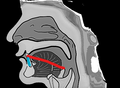 The shape of teeth and tongue when pronouncing ㅅ (s)
 -
 ㅇ (ng) is similar to the throat hole.
 -
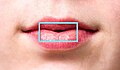 ㅁ (m) is similar to a closed mouth.


The chart below shows all 19 consonants in South Korean alphabetic order with Revised Romanization equivalents for each letter and pronunciation in IPA (see Korean phonology for more).
| Hangul | ㄱ | ㄲ | ㄴ | ㄷ | ㄸ | ㄹ | ㅁ | ㅂ | ㅃ | ㅅ | ㅆ | ㅇ | ㅈ | ㅉ | ㅊ | ㅋ | ㅌ | ㅍ | ㅎ | |
|---|---|---|---|---|---|---|---|---|---|---|---|---|---|---|---|---|---|---|---|---|
| Initial | RR | g | kk | n | d | tt | r | m | b | pp | s | ss | –[l] | j | jj | ch | k | t | p | h |
| IPA | /k/ | /k͈/ | /n/ | /t/ | /t͈/ | /ɾ/ | /m/ | /p/ | /p͈/ | /s/ | /s͈/ | silent | /t͡ɕ/ | /t͈͡ɕ͈/ | /t͡ɕʰ/ | /kʰ/ | /tʰ/ | /pʰ/ | /h/ | |
| Final | RR | k | k | n | t | – | l | m | p | – | t | t | ng | t | – | t | k | t | p | t |
| g | kk | n | d | l | m | b | s | ss | ng | j | ch | k | t | p | h | |||||
| IPA | /k̚/ | /n/ | /t̚/ | /ɭ/ | /m/ | /p̚/ | /t̚/ | /ŋ/ | /t̚/ | /t̚/ | /k̚/ | /t̚/ | /p̚/ | /t̚/ | ||||||
| "—" denotes characters that are never used syllable-finally. | ||||||||||||||||||||
The consonants are broadly categorized into two categories:
- obstruents: sounds produced when airflow either completely stops (i.e., a plosive consonant) or passes through a narrow opening (i.e., a fricative).
- sonorants: sounds produced when air flows out with little to no obstruction through the mouth, nose, or both.[59]
The chart below lists the Korean consonants by their respective categories and subcategories.
| Bilabial | Alveolar | Alveolo-palatal | Velar | Glottal | |||
|---|---|---|---|---|---|---|---|
| Obstruent | Plosive | Lax | p (ㅂ) | t (ㄷ) | k (ㄱ) | ||
| Tense | p͈ (ㅃ) | t͈ (ㄸ) | k͈ (ㄲ) | ||||
| Aspirated | pʰ (ㅍ) | tʰ (ㅌ) | kʰ (ㅋ) | ||||
| Fricative | Lax | s (ㅅ) | h (ㅎ) | ||||
| Tense | s͈ (ㅆ) | ||||||
| Affricate | Lax | t͡ɕ (ㅈ) | |||||
| Tense | t͈͡ɕ͈ (ㅉ) | ||||||
| Aspirated | t͡ɕʰ (ㅊ) | ||||||
| Sonorant | Nasal | m (ㅁ) | n (ㄴ) | ŋ (ㅇ) | |||
| Liquid | l (ㄹ) | ||||||
All Korean obstruents are voiceless in that the larynx does not vibrate when producing those sounds and are further distinguished by degree of aspiration and tenseness. The tensed consonants are produced by constricting the vocal cords while heavily aspirated consonants (such as the Korean ㅍ, /pʰ/) are produced by opening them.[59]
Korean sonorants are voiced.
Vowels
[edit]The chart below shows the 21 vowels used in the modern Korean alphabet in South Korean alphabetic order with Revised Romanization equivalents for each letter and pronunciation in IPA (see Korean phonology for more).
| Hangul | ㅏ | ㅐ | ㅑ | ㅒ | ㅓ | ㅔ | ㅕ | ㅖ | ㅗ | ㅘ | ㅙ | ㅚ | ㅛ | ㅜ | ㅝ | ㅞ | ㅟ | ㅠ | ㅡ | ㅢ | ㅣ |
|---|---|---|---|---|---|---|---|---|---|---|---|---|---|---|---|---|---|---|---|---|---|
| Transcription | |a| | |ai| | |ja| | |jai| | |ʌ| | |ʌi| | |jʌ| | |jʌi| | |o| | |oa| | |oai| | |oi| | |jo| | |u| | |uʌ| | |uʌi| | |ui| | |ju| | |ɯ| | |ɯi| | |i| |
| Revised Romanization | a | ae | ya | yae | eo | e | yeo | ye | o | wa | wae | oe | yo | u | wo | we | wi | yu | eu | ui / yi | i |
| IPA | /a/ | /ɛ/ | /ja/ | /jɛ/ | /ʌ/ | /e/ | /jʌ/ | /je/ | /o/ | /wa/ | /wɛ/ | /ø/ ~ [we] | /jo/ | /u/ | /wʌ/ | /we/ | /y/ ~ /ɥi/ | /ju/ | /ɯ/ | /ɰi/ | /i/ |
The vowels are generally separated into two categories: monophthongs and diphthongs. Monophthongs are produced with a single articulatory movement (hence the prefix mono), while diphthongs feature an articulatory change. Diphthongs have two constituents: a glide (or a semivowel) and a monophthong. There is some disagreement about exactly how many vowels are considered Korean's monophthongs;[citation needed] the largest inventory features ten, while some scholars[who?] have proposed eight or nine. This divergence reveals two issues: whether Korean has two front rounded vowels (i.e. /ø/ and /y/); and, secondly, whether Korean has three levels of front vowels in terms of vowel height (i.e. whether /e/ and /ɛ/ are distinctive).[60] Actual phonological studies done by studying formant data show that current speakers of Standard Korean do not differentiate between the vowels ㅔ and ㅐ in pronunciation.[61]
Letter names
[edit] | This section needs additional citations for verification. (November 2021) |

Letters in the Korean alphabet were named by Korean linguist Choe Sejin in 1527. South Korea uses Choe's traditional names, most of which follow the format of letter + i + eu + letter. Choe described these names by listing Hanja characters with similar pronunciations. However, as the syllables 윽 euk, 읃 eut, and 읏 eut did not occur in Hanja, Choe gave those letters the modified names 기역 giyeok, 디귿 digeut, and 시옷 siot, using Hanja that did not fit the pattern (for 기역) or native Korean syllables (for 디귿 and 시옷).[62]
Originally, Choe gave ㅈ, ㅊ, ㅋ, ㅌ, ㅍ, and ㅎ the irregular one-syllable names of ji, chi, ḳi, ṭi, p̣i, and hi, because they should not be used as final consonants, as specified in Hunminjeongeum. However, after establishment of the new orthography in 1933, which let all consonants be used as finals, the names changed to the present forms.
In North Korea
[edit]The chart below shows names used in North Korea for consonants in the Korean alphabet. The letters are arranged in North Korean alphabetic order, and the letter names are romanised with the McCune–Reischauer system, which is widely used in North Korea. The tense consonants are described with the word 된 toen meaning hard.
| Consonant | ㄱ | ㄴ | ㄷ | ㄹ | ㅁ | ㅂ | ㅅ | ㅈ | ㅊ | ㅋ | ㅌ | ㅍ | ㅎ | ㄲ | ㄸ | ㅃ | ㅆ | ㅉ | ㅇ |
|---|---|---|---|---|---|---|---|---|---|---|---|---|---|---|---|---|---|---|---|
| Name | 기윽 | 니은 | 디읃 | 리을 | 미음 | 비읍 | 시읏 | 지읒 | 치읓 | 키읔 | 티읕 | 피읖 | 히읗 | 된기윽 | 된디읃 | 된비읍 | 된시읏 | 된지읒 | 이응 |
| MR | kiŭk | niŭn | tiŭt | riŭl | miŭm | piŭp | siŭt | jiŭt | chiŭt | ḳiŭk | ṭiŭt | p̣iŭp | hiŭt | toen'giŭk | toendiŭt | toenbiŭp | toensiŭt | toenjiŭt | 'iŭng |
In North Korea, an alternative way to refer to a consonant is letter + ŭ (ㅡ), for example, gŭ (그) for the letter ㄱ, and ssŭ (쓰) for the letter ㅆ.
As in South Korea, the names of vowels in the Korean alphabet are the same as the sound of each vowel.
In South Korea
[edit]The chart below shows names used in South Korea for consonants of the Korean alphabet. The letters are arranged in the South Korean alphabetic order, and the letter names are romanised in the Revised Romanization system, which is the official romanization system of South Korea. The tense consonants are described with the word 쌍 ssang meaning double.
| Consonant | ㄱ | ㄲ | ㄴ | ㄷ | ㄸ | ㄹ | ㅁ | ㅂ | ㅃ | ㅅ | ㅆ | ㅇ | ㅈ | ㅉ | ㅊ | ㅋ | ㅌ | ㅍ | ㅎ |
|---|---|---|---|---|---|---|---|---|---|---|---|---|---|---|---|---|---|---|---|
| Name (Hangul) | 기역 | 쌍기역 | 니은 | 디귿 | 쌍디귿 | 리을 | 미음 | 비읍 | 쌍비읍 | 시옷 | 쌍시옷 | 이응 | 지읒 | 쌍지읒 | 치읓 | 키읔 | 티읕 | 피읖 | 히읗 |
| Name (RR) | giyeok | ssanggiyeok | nieun | digeut | ssangdigeut | rieul | mieum | bieup | ssangbieup | siot | ssangsiot | ieung | jieut | ssangjieut | chieut | kieuk | tieut | pieup | hieut |
Alphabetic order
[edit]Alphabetic order in the Korean alphabet is called the ganada order (가나다순), after the first three letters of the alphabet. The order differs between North and South Korea, and between modern and historical standards, though consistently begins with consonants and follows with vowels.[63]
The collation order of Korean in Unicode is based on the South Korean order.
Historical orders
[edit]The order from the Hunminjeongeum in 1446 was:[64]
- ㄱ ㄲ ㅋ ㆁ ㄷ ㄸ ㅌ ㄴ ㅥ ㅂ ㅃ ㅍ ㅁ ㅈ ㅉ ㅊ ㅅ ㅆ ㆆ ㅎ ㆅ ㅇ ㄹ ㅿ
- ㆍ ㅡ ㅣ ㅗ ㅏ ㅜ ㅓ ㅛ ㅑ ㅠ ㅕ
This is the basis of the modern alphabetic orders. It was before the development of the Korean tense consonants and the double letters that represent them, and before the conflation of the letters ㅇ (null) and ㆁ (ng). Thus, when the North Korean and South Korean governments implemented full use of the Korean alphabet, they ordered these letters differently, with North Korea placing new letters at the end of the alphabet and South Korea grouping similar letters together.[65][66]
North Korean order
[edit]The double letters are placed after all the single letters (except the null initial ㅇ, which goes at the end).
- ㄱ ㄴ ㄷ ㄹ ㅁ ㅂ ㅅ ㅈ ㅊ ㅋ ㅌ ㅍ ㅎ ㄲ ㄸ ㅃ ㅆ ㅉ ㅇ
- ㅏ ㅑ ㅓ ㅕ ㅗ ㅛ ㅜ ㅠ ㅡ ㅣ ㅐ ㅒ ㅔ ㅖ ㅚ ㅟ ㅢ ㅘ ㅝ ㅙ ㅞ
All digraphs and trigraphs, including the old diphthongs ㅐ and ㅔ, are placed after the simple vowels, again maintaining Choe's alphabetic order.
The order of the final letters (받침) is:
- ㄱ ㄳ ㄴ ㄵ ㄶ ㄷ ㄹ ㄺ ㄻ ㄼ ㄽ ㄾ ㄿ ㅀ ㅁ ㅂ ㅄ ㅅ ㅇ ㅈ ㅊ ㅋ ㅌ ㅍ ㅎ ㄲ ㅆ
Unlike when it is initial, this ㅇ is pronounced, as the nasal ㅇ; ng which occurs only as a final in the modern language. The double letters are placed to the very end, as in the initial order, but the combined consonants are ordered immediately after their first element.[65]
South Korean order
[edit]In the South Korean order, double letters are placed immediately after their single counterparts:
- ㄱ ㄲ ㄴ ㄷ ㄸ ㄹ ㅁ ㅂ ㅃ ㅅ ㅆ ㅇ ㅈ ㅉ ㅊ ㅋ ㅌ ㅍ ㅎ
- ㅏ ㅐ ㅑ ㅒ ㅓ ㅔ ㅕ ㅖ ㅗ ㅘ ㅙ ㅚ ㅛ ㅜ ㅝ ㅞ ㅟ ㅠ ㅡ ㅢ ㅣ
The modern monophthongal vowels come first, with the derived forms interspersed according to their form: i is added first, then iotated, then iotated with added i. Diphthongs beginning with w are ordered according to their spelling, as ㅗ or ㅜ plus a second vowel, not as separate digraphs.
The order of the final letters is:
- ㄱ ㄲ ㄳ ㄴ ㄵ ㄶ ㄷ ㄹ ㄺ ㄻ ㄼ ㄽ ㄾ ㄿ ㅀ ㅁ ㅂ ㅄ ㅅ ㅆ ㅇ ㅈ ㅊ ㅋ ㅌ ㅍ ㅎ
Every syllable begins with a consonant (or the silent ㅇ) that is followed by a vowel (e.g. ㄷ + ㅏ = 다). Some syllables such as 달 and 닭 have a final consonant or final consonant cluster (받침). Thus, 399 combinations are possible for two-letter syllables and 10,773 possible combinations for syllables with more than two letters (27 possible final endings), for a total of 11,172 possible combinations of Korean alphabet letters to form syllables.[65]
The sort order including obsolete characters defined in the South Korean national standard KS X 1026-1 is:[67]
- Initial consonants: ᄀ ᄁ ᅚ ᄂ ᄓ ᄔ ᄕ ᄖ ᅛ ᅜ ᅝ ᄃ ᄗ ᄄ ᅞ ꥠ ꥡ ꥢ ꥣ ᄅ ꥤ ꥥ ᄘ ꥦ ꥧ ᄙ ꥨ ꥩ ꥪ ꥫ ꥬ ꥭ ꥮ ᄚ ᄛ ᄆ ꥯ ꥰ ᄜ ꥱ ᄝ ᄇ ᄞ ᄟ ᄠ ᄈ ᄡ ᄢ ᄣ ᄤ ᄥ ᄦ ꥲ ᄧ ᄨ ꥳ ᄩ ᄪ ꥴ ᄫ ᄬ ᄉ ᄭ ᄮ ᄯ ᄰ ᄱ ᄲ ᄳ ᄊ ꥵ ᄴ ᄵ ᄶ ᄷ ᄸ ᄹ ᄺ ᄻ ᄼ ᄽ ᄾ ᄿ ᅀ ᄋ ᅁ ᅂ ꥶ ᅃ ᅄ ᅅ ᅆ ᅇ ᅈ ᅉ ᅊ ᅋ ꥷ ᅌ ᄌ ᅍ ᄍ ꥸ ᅎ ᅏ ᅐ ᅑ ᄎ ᅒ ᅓ ᅔ ᅕ ᄏ ᄐ ꥹ ᄑ ᅖ ꥺ ᅗ ᄒ ꥻ ᅘ ᅙ ꥼ (filler;
U+115F) - Medial vowels: (filler;
U+1160) ᅡ ᅶ ᅷ ᆣ ᅢ ᅣ ᅸ ᅹ ᆤ ᅤ ᅥ ᅺ ᅻ ᅼ ᅦ ᅧ ᆥ ᅽ ᅾ ᅨ ᅩ ᅪ ᅫ ᆦ ᆧ ᅿ ᆀ ힰ ᆁ ᆂ ힱ ᆃ ᅬ ᅭ ힲ ힳ ᆄ ᆅ ힴ ᆆ ᆇ ᆈ ᅮ ᆉ ᆊ ᅯ ᆋ ᅰ ힵ ᆌ ᆍ ᅱ ힶ ᅲ ᆎ ힷ ᆏ ᆐ ᆑ ᆒ ힸ ᆓ ᆔ ᅳ ힹ ힺ ힻ ힼ ᆕ ᆖ ᅴ ᆗ ᅵ ᆘ ᆙ ힽ ힾ ힿ ퟀ ᆚ ퟁ ퟂ ᆛ ퟃ ᆜ ퟄ ᆝ ᆞ ퟅ ᆟ ퟆ ᆠ ᆡ ᆢ - Final consonants: ᆨ ᆩ ᇺ ᇃ ᇻ ᆪ ᇄ ᇼ ᇽ ᇾ ᆫ ᇅ ᇿ ᇆ ퟋ ᇇ ᇈ ᆬ ퟌ ᇉ ᆭ ᆮ ᇊ ퟍ ퟎ ᇋ ퟏ ퟐ ퟑ ퟒ ퟓ ퟔ ᆯ ᆰ ퟕ ᇌ ퟖ ᇍ ᇎ ᇏ ᇐ ퟗ ᆱ ᇑ ᇒ ퟘ ᆲ ퟙ ᇓ ퟚ ᇔ ᇕ ᆳ ᇖ ᇗ ퟛ ᇘ ᆴ ᆵ ᆶ ᇙ ퟜ ퟝ ᆷ ᇚ ퟞ ퟟ ᇛ ퟠ ᇜ ퟡ ᇝ ᇞ ᇟ ퟢ ᇠ ᇡ ᇢ ᆸ ퟣ ᇣ ퟤ ퟥ ퟦ ᆹ ퟧ ퟨ ퟩ ᇤ ᇥ ᇦ ᆺ ᇧ ᇨ ᇩ ퟪ ᇪ ퟫ ᆻ ퟬ ퟭ ퟮ ퟯ ퟰ ퟱ ퟲ ᇫ ퟳ ퟴ ᆼ ᇰ ᇬ ᇭ ퟵ ᇱ ᇲ ᇮ ᇯ ퟶ ᆽ ퟷ ퟸ ퟹ ᆾ ᆿ ᇀ ᇁ ᇳ ퟺ ퟻ ᇴ ᇂ ᇵ ᇶ ᇷ ᇸ ᇹ
Stroke order
[edit]Letters in the Korean alphabet have adopted certain rules of Chinese calligraphy, although ㅇ and ㅎ use a circle, which is not used in printed Chinese characters.[68][69]
-
 ㄱ (giyeok 기역)
 -
 ㄴ (nieun 니은)
 -
 ㄷ (digeut 디귿)
 -
 ㄹ (rieul 리을)
 -
 ㅁ (mieum 미음)
 -
 ㅂ (bieup 비읍)
 -
 ㅅ (siot 시옷)
 -
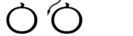 ㅇ (ieung 이응)
 -
 ㅈ (jieut 지읒)
 -
 ㅊ (chieut 치읓)
 -
 ㅋ (ḳieuk 키읔)
 -
 ㅌ (ṭieut 티읕)
 -
 ㅍ (p̣ieup 피읖)
 -
 ㅎ (hieut 히읗)
 -
 ㅏ (a)
ㅏ (a) -
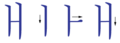 ㅐ (ae)
 -
 ㅓ (eo)
 -
 ㅔ (e)
ㅔ (e) -
 ㅗ (o)
ㅗ (o) -
 ㅜ (u)
ㅜ (u) -
 ㅡ (eu)
 -
 ㅣ (i)
ㅣ (i)
_stroke_order.png)
_stroke_order.png)
_stroke_order.png)
_stroke_order.png)
_stroke_order.png)
_stroke_order.png)
_stroke_order.png)
_stroke_order.png)
_stroke_order.png)
_stroke_order.png)
_stroke_order.png)
_stroke_order.png)
_stroke_order.png)
_stroke_order.png)
_stroke_order.png)
_stroke_order.png)
_stroke_order.png)
_stroke_order.png)
_stroke_order-2.png)
_stroke_order.png)
_stroke_order.png)
_stroke_order.png)
For the iotated vowels, which are not shown, the short stroke is simply doubled.
Letter design
[edit]| Part of a series on |
| Calligraphy |
|---|
 |
Scripts typically transcribe languages at the level of morphemes (logographic scripts like Hanja), of syllables (syllabaries like kana), of segments (alphabetic scripts like the Latin script used to write English and many other languages), or, on occasion, of distinctive features. The Korean alphabet incorporates aspects of the latter three, grouping sounds into syllables, using distinct symbols for segments, and in some cases using distinct strokes to indicate distinctive features such as place of articulation (labial, coronal, velar, or glottal) and manner of articulation (plosive, nasal, sibilant, aspiration) for consonants, and iotation (a preceding i-sound), harmonic class and i-mutation for vowels.
For instance, the consonant ㅌ ṭ [tʰ] is composed of three strokes, each one meaningful: the top stroke indicates ㅌ is a plosive, like ㆆ ʔ, ㄱ g, ㄷ d, ㅈ j, which have the same stroke (the last is an affricate, a plosive–fricative sequence); the middle stroke indicates that ㅌ is aspirated, like ㅎ h, ㅋ ḳ, ㅊ ch, which also have this stroke; and the bottom stroke indicates that ㅌ is alveolar, like ㄴ n, ㄷ d, and ㄹ l. (It is said to represent the shape of the tongue when pronouncing coronal consonants, though this is not certain.) Two obsolete consonants, ㆁ and ㅱ, have dual pronunciations, and appear to be composed of two elements corresponding to these two pronunciations: [ŋ]~silence for ㆁ and [m]~[w] for ㅱ.
With vowel letters, a short stroke connected to the main line of the letter indicates that this is one of the vowels that can be iotated; this stroke is then doubled when the vowel is iotated. The position of the stroke indicates which harmonic class the vowel belongs to, light (top or right) or dark (bottom or left). In the modern alphabet, an additional vertical stroke indicates i mutation, deriving ㅐ [ɛ], ㅚ [ø], and ㅟ [y] from ㅏ [a], ㅗ [o], and ㅜ [u]. However, this is not part of the intentional design of the script, but rather a natural development from what were originally diphthongs ending in the vowel ㅣ [i]. Indeed, in many Korean dialects,[citation needed] including the standard dialect of Seoul, some of these may still be diphthongs. For example, in the Seoul dialect, ㅚ may alternatively be pronounced [we̞], and ㅟ [ɥi]. (ㅔ [e] as a morpheme is ㅓ combined with ㅣ as a vertical stroke. As a phoneme, its sound is not by i mutation of ㅓ [ʌ].)
Besides the letters, the Korean alphabet originally employed diacritic marks to indicate pitch accent. A syllable with a high pitch (거성) was marked with a dot (〮) to the left of it (when writing vertically); a syllable with a rising pitch (상성) was marked with a double dot, like a colon (〯). These are no longer used, as modern Seoul Korean has lost tonality. Vowel length has also been neutralized in Modern Korean[70] and is no longer written.
Consonant design
[edit] |
The consonant letters fall into five homorganic groups, each with a basic shape, and one or more letters derived from this shape by means of additional strokes. In the Hunmin Jeong-eum Haerye account, the basic shapes iconically represent the articulations the tongue, palate, teeth, and throat take when making these sounds.
| Simple | Aspirated | Tense | |
|---|---|---|---|
| velar | ㄱ | ㅋ | ㄲ |
| fricatives | ㅅ | ㅆ | |
| palatal | ㅈ | ㅊ | ㅉ |
| coronal | ㄷ | ㅌ | ㄸ |
| bilabial | ㅂ | ㅍ | ㅃ |
- Velar consonants (아음; 牙音; aeum; lit. 'molar sounds')
- ㄱ g [k], ㅋ ḳ [kʰ]
- Basic shape: ㄱ is a side view of the back of the tongue raised toward the velum (soft palate). (For illustration, access the external link below.) ㅋ is derived from ㄱ with a stroke for the burst of aspiration.
- Sibilant consonants (fricative or palatal) (치음; 齒音; chieum; lit. 'dental sounds'):
- ㅅ s [s], ㅈ j [tɕ], ㅊ ch [tɕʰ]
- Basic shape: ㅅ was originally shaped like a wedge (∧), without the serif on top. It represents a side view of the teeth.[citation needed] The line topping ㅈ represents firm contact with the roof of the mouth. The stroke topping ㅊ represents an additional burst of aspiration.
- Coronal consonants (설음; 舌音; seoreum; lit. 'lingual sounds'):
- ㄴ n [n], ㄷ d [t], ㅌ ṭ [tʰ], ㄹ r [ɾ, ɭ]
- Basic shape: ㄴ is a side view of the tip of the tongue raised toward the alveolar ridge (gum ridge). The letters derived from ㄴ are pronounced with the same basic articulation. The line topping ㄷ represents firm contact with the roof of the mouth. The middle stroke of ㅌ represents the burst of aspiration. The top of ㄹ represents a flap of the tongue.
- Bilabial consonants (순음; 唇音; suneum; lit. 'labial sounds'):
- ㅁ m [m], ㅂ b [p], ㅍ p̣ [pʰ]
- Basic shape: ㅁ represents the outline of the lips in contact with each other. The top of ㅂ represents the release burst of the b. The top stroke of ㅍ is for the burst of aspiration.
- Dorsal consonants (후음; 喉音; hueum; lit. 'throat sounds'):
- ㅇ '/ng [ŋ], ㅎ h [h]
- Basic shape: ㅇ is an outline of the throat. Originally ㅇ was two letters, a simple circle for silence (null consonant), and a circle topped by a vertical line, ㆁ, for the nasal ng. A now obsolete letter, ㆆ, represented a glottal stop, which is pronounced in the throat and had closure represented by the top line, like ㄱㄷㅈ. Derived from ㆆ is ㅎ, in which the extra stroke represents a burst of aspiration.
Vowel design
[edit] |

Vowel letters are based on three elements:
- A horizontal line representing the flat Earth, the essence of yin.
- A point for the Sun in the heavens, the essence of yang. (This becomes a short stroke when written with a brush.)
- A vertical line for the upright Human, the neutral mediator between the Heaven and Earth.
Short strokes (dots in the earliest documents) were added to these three basic elements to derive the vowel letter:
Simple vowels
[edit]- Horizontal letters: these are mid-high back vowels.
- bright ㅗ o
- dark ㅜ u
- dark ㅡ eu (ŭ)
- Vertical letters: these were once low vowels.
- bright ㅏ a
- dark ㅓ eo (ŏ)
- bright ㆍ
- neutral ㅣ i
Compound vowels
[edit]The Korean alphabet does not have a letter for w sound. Since an o or u before an a or eo became a [w] sound, and [w] occurred nowhere else, [w] could always be analyzed as a phonemic o or u, and no letter for [w] was needed. However, vowel harmony is observed: dark ㅜ u with dark ㅓ eo for ㅝ wo; bright ㅗ o with bright ㅏ a for ㅘ wa:
- ㅘ wa = ㅗ o + ㅏ a
- ㅝ wo = ㅜ u + ㅓ eo
- ㅙ wae = ㅗ o + ㅐ ae
- ㅞ we = ㅜ u + ㅔ e
The compound vowels ending in ㅣ i were originally diphthongs. However, several have since evolved into pure vowels:
- ㅐ ae = ㅏ a + ㅣ i (pronounced [ɛ])
- ㅔ e = ㅓ eo + ㅣ i (pronounced [e])
- ㅙ wae = ㅘ wa + ㅣ i
- ㅚ oe = ㅗ o + ㅣ i (formerly pronounced [ø], see Korean phonology)
- ㅞ we = ㅝ wo + ㅣ i
- ㅟ wi = ㅜ u + ㅣ i (formerly pronounced [y], see Korean phonology)
- ㅢ ui = ㅡ eu + ㅣ i
Iotated vowels
[edit]There is no letter for y. Instead, this sound is indicated by doubling the stroke attached to the baseline of the vowel letter. Of the seven basic vowels, four could be preceded by a y sound, and these four were written as a dot next to a line. (Through the influence of Chinese calligraphy, the dots soon became connected to the line: ㅓㅏㅜㅗ.) A preceding y sound, called iotation, was indicated by doubling this dot: ㅕㅑㅠㅛ yeo, ya, yu, yo. The three vowels that could not be iotated were written with a single stroke: ㅡ, ㆍ, and ㅣ eu, (arae a), i.
| Simple | Iotated |
|---|---|
| ㅏ | ㅑ |
| ㅓ | ㅕ |
| ㅗ | ㅛ |
| ㅜ | ㅠ |
| ㅡ | |
| ㅣ |
The simple iotated vowels are:
- ㅑ ya from ㅏ a
- ㅕ yeo from ㅓ eo
- ㅛ yo from ㅗ o
- ㅠ yu from ㅜ u
There are also two iotated diphthongs:
- ㅒ yae from ㅐ ae
- ㅖ ye from ㅔ e
The Korean language of the 15th century had vowel harmony to a greater extent than it does today. Vowels in grammatical morphemes changed according to their environment, falling into groups that "harmonized" with each other. This affected the morphology of the language, and Korean phonology described it in terms of yin and yang: If a root word had yang ('bright') vowels, then most suffixes attached to it also had to have yang vowels; conversely, if the root had yin ('dark') vowels, the suffixes had to be yin as well. There was a third harmonic group called mediating (neutral in Western terminology) that could coexist with either yin or yang vowels.
The Korean neutral vowel was ㅣ i. The yin vowels were ㅡ, ㅜ, ㅓ eu, u, eo; the dots are in the yin directions of down and left. The yang vowels were ㆍㅗㅏ ə, o, a, with the dots in the yang directions of up and right. The Hunmin Jeong-eum Haerye states that the shapes of the non-dotted letters ㅡ, ㆍ, and ㅣ were chosen to represent the concepts of yin, yang, and mediation: Earth, Heaven, and Human. (The letter ㆍ ə is now obsolete except in the Jeju language.)
The third parameter in designing the vowel letters was choosing ㅡ as the graphic base of ㅜ and ㅗ, and ㅣ as the graphic base of ㅓ and ㅏ. A full understanding of what these horizontal and vertical groups had in common would require knowing the exact sound values these vowels had in the 15th century.
The uncertainty is primarily with the three letters ㆍㅓㅏ. Some linguists reconstruct these as *a, *ɤ, and *e, respectively; others as *ə, *e, and *a. A third reconstruction is to make them all middle vowels as *ʌ, *ɤ, and *a.[71] With the third reconstruction, Middle Korean vowels line up in a vowel harmony pattern, but with only one front vowel and four middle vowels:
| ㅣ *i | ㅡ *ɯ | ㅜ *u |
| ㅓ *ɤ | ||
| ㆍ *ʌ | ㅗ *o | |
| ㅏ *a |
However, the horizontal letters ㅡㅜㅗ eu, u, o do all appear to have been mid to high back vowels, [*ɯ, *u, *o], and thus to have formed a coherent group phonetically in every reconstruction.
Traditional account
[edit]The traditionally accepted account[m][72][unreliable source?] on the design of the letters is that the vowels are derived from various combinations of the following three components: ㆍ ㅡ ㅣ. Here, ㆍ symbolically stands for the (sun in) heaven, ㅡ stands for the (flat) earth, and ㅣ stands for an (upright) human. The original sequence of the Korean vowels, as stated in Hunminjeongeum, listed these three vowels first, followed by various combinations. Thus, the original order of the vowels was: ㆍ ㅡ ㅣ ㅗ ㅏ ㅜ ㅓ ㅛ ㅑ ㅠ ㅕ. Two positive vowels (ㅗ ㅏ) including one ㆍ are followed by two negative vowels including one ㆍ, then by two positive vowels each including two of ㆍ, and then by two negative vowels each including two of ㆍ.
The same theory provides the most simple explanation of the shapes of the consonants as an approximation of the shapes of the most representative organ needed to form that sound. The original order of the consonants in Hunminjeong'eum was: ㄱ ㅋ ㆁ ㄷ ㅌ ㄴ ㅂ ㅍ ㅁ ㅈ ㅊ ㅅ ㆆ ㅎ ㅇ ㄹ ㅿ.
- ㄱ representing the [k] sound geometrically describes its tongue back raised.
- ㅋ representing the [kʰ] sound is derived from ㄱ by adding another stroke.
- ㆁ representing the [ŋ] sound may have been derived from ㅇ by addition of a stroke.
- ㄷ representing the [t] sound is derived from ㄴ by adding a stroke.
- ㅌ representing the [tʰ] sound is derived from ㄷ by adding another stroke.
- ㄴ representing the [n] sound geometrically describes a tongue making contact with an upper palate.
- ㅂ representing the [p] sound is derived from ㅁ by adding a stroke.
- ㅍ representing the [pʰ] sound is a variant of ㅂ by adding another stroke.
- ㅁ representing the [m] sound geometrically describes a closed mouth.
- ㅈ representing the [t͡ɕ] sound is derived from ㅅ by adding a stroke.
- ㅊ representing the [t͡ɕʰ] sound is derived from ㅈ by adding another stroke.
- ㅅ representing the [s] sound geometrically describes the sharp teeth.[citation needed]
- ㆆ representing the [ʔ] sound is derived from ㅇ by adding a stroke.
- ㅎ representing the [h] sound is derived from ㆆ by adding another stroke.
- ㅇ representing the absence of a consonant geometrically describes the throat.
- ㄹ representing the [ɾ] and [ɭ] sounds geometrically describes the bending tongue.
- ㅿ representing a weak ㅅ sound describes the sharp teeth, but has a different origin than ㅅ.[clarification needed]
Ledyard's theory of consonant design
[edit]

(Bottom) Derivation of 'Phags-pa w, v, f from variants of the letter [h] (left) plus a subscript [w], and analogous composition of the Korean alphabet w, v, f from variants of the basic letter [p] plus a circle.
Although the Hunminjeong'eum Haerye explains the design of the consonantal letters in terms of articulatory phonetics as a purely innovative creation, it also states that King Sejong adapted the 古篆 (gojeon, Gǔ Seal Script) in creating the Korean alphabet,[citation needed] leading to the development of several theories suggesting which external sources may have inspired or influenced King Sejong's creation. The 古篆 has never been identified; the primary meaning of 古 gǔ is old (Old Seal Script), frustrating philologists because the Korean alphabet bears no functional similarity to Chinese 篆字 zhuànzì seal scripts. It has been documented that Sejong and his researchers thoroughly researched writing systems in Asia at the time, including Indic scripts such as Tibetan and ʼPhags-pa,[73] and several theories revolve around certain Indic scripts as sources of inspiration in the graphical development of Hangul. Homer Hulbert, for instance, believed that Tibetan was the graphical inspiration for some of Hangul.[74]
Professor Gari Ledyard of Columbia University studied possible connections between Hangul and the Mongol 'Phags-pa script of the Yuan dynasty; he suggested that 古 gǔ may be a pun on 蒙古 Měnggǔ "Mongol", and that 古篆 is an abbreviation of 蒙古篆字 "Mongol Seal Script", that is, the formal variant of the 'Phags-pa alphabet written to look like the Chinese seal script.[75] He, however, also believed that the role of 'Phags-pa script in the creation of the Korean alphabet was quite limited, stating it should not be assumed that Hangul was derived from 'Phags-pa script based on his theory:
It should be clear to any reader that in the total picture, that ['Phags-pa script's] role was quite limited ... Nothing would disturb me more, after this study is published, than to discover in a work on the history of writing a statement like the following: "According to recent investigations, the Korean alphabet was derived from the Mongol's phags-pa script."[76]
Ledyard posits that five of the Korean consonants have shapes inspired by 'Phags-pa; a sixth basic letter, the null initial ㅇ, was invented by Sejong. The rest of the letters were derived internally from these six, essentially as described in the Hunmin Jeong-eum Haerye. However, the five borrowed consonants were not the graphically simplest letters considered basic by the Hunmin Jeong-eum Haerye, but instead the consonants basic to Chinese phonology: ㄱ, ㄷ, ㅂ, ㅈ, and ㄹ.[75]
According to Ledyard, the five borrowed letters were graphically simplified, which allowed for consonant clusters and left room to add a stroke to derive the aspirate plosives, ㅋㅌㅍㅊ. But in contrast to the traditional account, the non-plosives (ㆁ ㄴ ㅁ ㅅ) were derived by removing the top of the basic letters. He points out that while it is easy to derive ㅁ from ㅂ by removing the top, it is not clear how to derive ㅂ from ㅁ in the traditional account, since the shape of ㅂ is not analogous to those of the other plosives.[75]
The explanation of the letter ng also differs from the methodology described in the Hunminjeong'eum Haerye. Many Chinese words began with ng, but by King Sejong's day, initial ng was either silent or pronounced [ŋ] in China, and was silent when these words were borrowed into Korean. Also, the expected shape of ng (the short vertical line left by removing the top stroke of ㄱ) would have looked almost identical to the vowel ㅣ [i]. Sejong's solution solved both problems: The vertical stroke left from ㄱ was added to the null symbol ㅇ to create ㆁ (a circle with a vertical line on top), iconically capturing both the pronunciation [ŋ] in the middle or end of a word, and the usual silence at the beginning.[75] (The graphic distinction between null ㅇ and ng ㆁ was eventually lost.)
Another letter composed of two elements to represent two regional pronunciations was ㅱ, which transcribed the Chinese initial 微. This represented either m or w in various Chinese dialects, and was composed of ㅁ [m] plus ㅇ (from 'Phags-pa [w]). In 'Phags-pa, a loop under a letter represented w after vowels, and Ledyard hypothesized that this became the loop at the bottom of ㅱ. In 'Phags-pa the Chinese initial 微 is also transcribed as a compound with w, but in its case the w is placed under an h. Actually, the Chinese consonant series 微非敷 w, v, f is transcribed in 'Phags-pa by the addition of a w under three graphic variants of the letter for h, and the Korean alphabet parallels this convention by adding the w loop to the labial series ㅁㅂㅍ m, b, p, producing now-obsolete ㅱㅸㆄ w, v, f.[75] (Phonetic values in Korean are uncertain, as these consonants were only used to transcribe Chinese.)
As a final piece of evidence, Ledyard notes that most of the borrowed Korean letters were simple geometric shapes, at least originally, but that ㄷ d [t] always had a small lip protruding from the upper left corner, just as the 'Phags-pa ꡊ d [t] did. This lip can be traced back to the Tibetan letter ད d.[n][75]
Obsolete letters
[edit] | This section has multiple issues. Please help improve it or discuss these issues on the talk page. (Learn how and when to remove these messages)
|


Numerous obsolete Korean letters and sequences are no longer used in Korean. Some of these letters were only used to represent the sounds of Chinese rime tables. Some of the Korean sounds represented by these obsolete letters still exist in dialects.
| Jamo | ᄛ | ㅱ | ㅸ | ᄼ | ᄾ | ㅿ | ㆁ | ㅇ | ᅎ | ᅐ | ᅔ | ᅕ | ㆄ | ㆆ | |
|---|---|---|---|---|---|---|---|---|---|---|---|---|---|---|---|
| IPA | /ɾ/ | first:/ɱ/ last:/w/ |
/β/ | /s/ | /ɕ/ | /z/ | /ŋ/ | /∅/ | /t͡s/ | /t͡ɕ/ | /t͡sʰ/ | /t͡ɕʰ/ | /f/ | /ʔ/ | |
| Identified Chinese character (Hanzi) | 微(미) /ɱ/ |
非(비) /f/ |
心(심) /s/ |
審(심) /ɕ/ |
日 (ᅀᅵᇙ>일) /z/ |
final position: 業 /ŋ/ |
initial position: 欲 /∅/ |
精(정) /t͡s/ |
照(조) /t͡ɕ/ |
淸(청) /t͡sʰ/ |
穿(천) /t͡ɕʰ/ |
敷(부) /fʰ/ |
挹(읍)
/ʔ/ | ||
| Toneme | falling | mid to falling | mid to falling | mid | mid to falling | dipping/ mid | mid | mid to falling | mid (aspirated) | high (aspirated) | mid to falling (aspirated) | high/mid | |||
| Remark | lenis voiceless dental affricate/ voiced dental affricate | lenis voiceless retroflex affricate/ voiced retroflex affricate | aspirated /t͡s/ | aspirated /t͡ɕ/ | glottal stop | ||||||||||
| Equivalents | Standard Chinese Pinyin: 子 z [tsɨ]; English: z in zoo or zebra; strong z in English zip | identical to the initial position of ng in Cantonese | German pf | "읗" = "euh" in pronunciation | |||||||||||
| Jamo | ㅥ | ᄙ | ㅹ | ᄽ | ᄿ | ᅇ | ᇮ | ᅏ | ᅑ | ㆅ |
|---|---|---|---|---|---|---|---|---|---|---|
| IPA | /nː/ | /v/ | /sˁ/ | /ɕˁ/ | /j/ | /ŋː/ | /t͡s/ | /t͡ɕˁ/ | /hˁ/ | |
| Middle Chinese | hn/nn | hl/ll | bh, bhh | sh | zh | hngw/gh or gr | hng | dz, ds | dzh | hh or xh |
| Identified Chinese character (Hanzi) | 邪(사)
/z/ |
禪(선)
/ʑ/ |
從(종)
/d͡z/ |
牀(상)
/d͡ʑ/ |
洪(홍)
/ɦ/ | |||||
| Remark | aspirated | aspirated | unaspirated fortis voiceless dental affricate | unaspirated fortis voiceless retroflex affricate | guttural |
- 66 obsolete clusters of two consonants: ᇃ, ᄓ /ng/ (like English think), ㅦ /nd/ (as English Monday), ᄖ, ㅧ /ns/ (as English Pennsylvania), ㅨ, ᇉ /tʰ/ (as ㅌ; nt in the language Esperanto), ᄗ /dg/ (similar to ㄲ; equivalent to the word 밖 in Korean), ᇋ /dr/ (like English in drive), ᄘ /ɭ/ (similar to French Belle), ㅪ, ㅬ /lz/ (similar to English tall zebra), ᇘ, ㅭ /t͡ɬ/ (tl or ll; as in Nahuatl), ᇚ /ṃ/ (mh or mg, mm in English hammer, Middle Korean: pronounced as 목 mog with the ㄱ in the word almost silent), ᇛ, ㅮ, ㅯ (similar to ㅂ in Korean 없다), ㅰ, ᇠ, ᇡ, ㅲ, ᄟ, ㅳ bd (assimilated later into ㄸ), ᇣ, ㅶ bj (assimilated later into ㅉ), ᄨ /bj/ (similar to 비추 in Korean verb 비추다 bit-chu-da but without the vowel), ㅷ, ᄪ, ᇥ /ph/ (pha similar to Korean word 돌입하지 dol ip-haji), ㅺ sk (assimilated later into ㄲ; English: pick), ㅻ sn (assimilated later into nn in English annal), ㅼ sd (initial position; assimilated later into ㄸ), ᄰ, ᄱ sm (assimilated later into nm), ㅽ sb (initial position; similar sound to ㅃ), ᄵ, ㅾ assimilated later into ㅉ), ᄷ, ᄸ, ᄹ /θ/, ᄺ/ɸ/, ᄻ, ᅁ, ᅂ /ð/, ᅃ, ᅄ /v/, ᅅ (assimilated later into ㅿ; English z), ᅆ, ᅈ, ᅉ, ᅊ, ᅋ, ᇬ, ᇭ, ㆂ, ㆃ, ᇯ, ᅍ, ᅒ, ᅓ, ᅖ, ᇵ, ᇶ, ᇷ, ᇸ
- 17 obsolete clusters of three consonants: ᇄ, ㅩ /rgs/ (similar to "rx" in English name Marx), ᇏ, ᇑ /lmg/ (similar to English Pullman), ᇒ, ㅫ, ᇔ, ᇕ, ᇖ, ᇞ, ㅴ, ㅵ, ᄤ, ᄥ, ᄦ, ᄳ, ᄴ
| Jamo | ㆍ |
|---|---|
| IPA | /ʌ/
(also commonly found in the Jeju language: /ɒ/, closely similar to vowel:ㅓeo) |
| Letter name | 아래아 (arae-a) |
| Remarks | formerly the base vowel ㅡ eu in the early development of Hangul when it was considered vowelless, later development into different base vowels for clarification; acts also as a mark that indicates the consonant is pronounced on its own, e.g. s-va-ha → ᄉᆞᄫᅡ 하 |
| Toneme | low |
- 44 obsolete diphthongs and vowel sequences: ᆜ (/j/ or /jɯ/ or /jɤ/, yeu or ehyu); closest similarity to ㅢ, when follow by ㄱ on initial position, pronunciation does not produce any difference: ᄀᆜ /gj/),ᆝ (/jɒ/; closest similarity to ㅛ,ㅑ, ㅠ, ㅕ, when follow by ㄱ on initial position, pronunciation does not produce any difference: ᄀᆝ /gj/), ᆢ(/j/; closest similarity to ㅢ, see former example inᆝ (/j/), ᅷ (/au̯/; Icelandic Á, aw/ow in English allow), ᅸ (/jau̯/; yao or iao; Chinese diphthong iao), ᅹ, ᅺ, ᅻ, ᅼ, ᅽ /ōu/ (紬 ᄎᅽ, ch-ieou; like Chinese: chōu), ᅾ, ᅿ, ᆀ, ᆁ, ᆂ (/w/, wo or wh, hw), ᆃ /ow/ (English window), ㆇ, ㆈ, ᆆ, ᆇ, ㆉ (/jø/; yue), ᆉ /wʌ/ or /oɐ/ (pronounced like u'a, in English suave), ᆊ, ᆋ, ᆌ, ᆍ (wu in English would), ᆎ /juə/ or /yua/ (like Chinese: 元 yuán), ᆏ /ū/ (like Chinese: 軍 jūn), ᆐ, ㆊ /ué/ jujə (ɥe; like Chinese: 瘸 qué), ㆋ jujəj (ɥej; iyye), ᆓ, ㆌ /jü/ or /juj/ (/jy/ or ɥi; yu.i; like German Jürgen), ᆕ, ᆖ (the same as ᆜ in pronunciation, since there is no distinction due to it extreme similarity in pronunciation), ᆗ ɰju (ehyu or eyyu; like English news), ᆘ, ᆙ /ià/ (like Chinese: 墊 diàn), ᆚ, ᆛ, ᆟ, ᆠ (/ʔu/), ㆎ (ʌj; oi or oy, similar to English boy).
In the original Korean alphabet system, double letters were used to represent Chinese voiced (濁音) consonants, which survive in the Shanghainese slack consonants and were not used for Korean words. It was only later that a similar convention was used to represent the modern tense (faucalized) consonants of Korean.
The sibilant (dental) consonants were modified to represent the two series of Chinese sibilants, alveolar and retroflex, a round vs. sharp distinction (analogous to s vs sh) which was never made in Korean, and was even being lost from southern Chinese. The alveolar letters had longer left stems, while retroflexes had longer right stems:
| Tenuis 전청 (全淸) |
Aspirate 차청 (次淸) |
Voiced 전탁 (全濁) |
Sonorant 차탁 (次濁) | ||
|---|---|---|---|---|---|
| Sibilants 치음 (齒音) |
치두음 (齒頭音) "tooth-head" |
ᅎ 精(정) /t͡s/ |
ᅔ 淸(청) /t͡sʰ/ |
ᅏ 從(종) /d͡z/ |
|
| ᄼ 心(심) /s/ |
ᄽ 邪(사) /z/ |
||||
| 정치음 (正齒音) "true front-tooth" |
ᅐ 照(조) /t͡ɕ/ |
ᅕ 穿(천) /t͡ɕʰ/ |
ᅑ 牀(상) /d͡ʑ/ |
||
| ᄾ 審(심) /ɕ/ |
ᄿ 禪(선) /ʑ/ |
||||
| Coronals 설음 (舌音) |
설상음 (舌上音) "tongue up" |
ᅐ 知(지) /ʈ/ |
ᅕ 徹(철) /ʈʰ/ |
ᅑ
澄(징) /ɖ/ |
ㄴ 娘(낭) /ɳ/ |
Most common
[edit]- ㆍ ə (in Modern Korean called arae-a 아래아 "lower a"): Presumably pronounced [ʌ], similar to modern ㅓ (eo). It is written as a dot, positioned beneath the consonant. The arae-a is not entirely obsolete, as it can be found in various brand names, and in the Jeju language, where it is pronounced [ɒ]. The ə formed a medial of its own, or was found in the diphthong ㆎ əy, written with the dot under the consonant and ㅣ (i) to its right, in the same fashion as ㅚ or ㅢ.
- ㅿ z (bansiot 반시옷 "half s", banchieum 반치음): An unusual sound, perhaps IPA [ʝ̃] (a nasalized palatal fricative). Modern Korean words previously spelled with ㅿ substitute ㅅ or ㅇ.
- ㆆ ʔ (yeorinhieut 여린히읗 "light hieut" or doenieung 된이응 "strong ieung"): A glottal stop, lighter than ㅎ and harsher than ㅇ.
- ㆁ ŋ (yedieung 옛이응) "old ieung" : The original letter for [ŋ]; now conflated with ㅇ ieung. (With some computer fonts such as Arial Unicode MS, yesieung is shown as a flattened version of ieung, but the correct form is with a long peak, longer than what one would see on a serif version of ieung.)
- ㅸ β (gabyeounbieup 가벼운비읍, sungyeongeumbieup 순경음비읍): IPA [f]. This letter appears to be a digraph of bieup and ieung, but it may be more complicated than that—the circle appears to be only coincidentally similar to ieung. There were three other, less-common letters for sounds in this section of the Chinese rime tables, ㅱ w ([w] or [m]), ㆄ f, and ㅹ ff [v̤]. It operates slightly like a following h in the Latin alphabet (one may think of these letters as bh, mh, ph, and pph respectively). Koreans do not distinguish these sounds now, if they ever did, conflating the fricatives with the corresponding plosives.
Orthography
[edit] | This section needs additional citations for verification. (February 2025) |
Until the 20th century, no official orthography of the Korean alphabet had been established. Due to liaison, heavy consonant assimilation, dialectal variants and other reasons, a Korean word can potentially be spelled in multiple ways. Sejong seemed to prefer morphophonemic spelling (representing the underlying root forms) rather than a phonemic one (representing the actual sounds). However, early in its history the Korean alphabet was dominated by phonemic spelling. Over the centuries the orthography became partially morphophonemic, first in nouns and later in verbs. The modern Korean alphabet is as morphophonemic as is practical. The difference between phonetic romanization, phonemic orthography and morphophonemic orthography can be illustrated with the phrase motaneun sarami:
- Phonetic transcription and translation:
motaneun sarami
[mo.tʰa.nɯn.sa.ɾa.mi]
a person who cannot do it - Phonemic transcription:
모타는사라미
/mo.tʰa.nɯn.sa.la.mi/ - Morphophonemic transcription:
못하는사람이
|mot-ha-nɯn-sa.lam-i| - Morpheme-by-morpheme gloss:
못–하–는 사람=이 mot-ha-neun saram=i cannot-do-[attributive] person=[subject]
After the Kabo Reform in 1894, Joseon and later the Korean Empire started to write all official documents in the Korean alphabet. Under the government's management, proper usage of the Korean alphabet and Hanja, including orthography, was discussed, until the Korean Empire was annexed by Japan in 1910.
The Government-General of Korea popularised a writing style that mixed Hanja and the Korean alphabet, and was used in the later Joseon dynasty. The government revised the spelling rules in 1912 with Orthographic Rules for Vernacular Writing for Normal Schools (普通學校用諺文綴字法), 1921 with Summary of Orthographic Rules for Vernacular Writing for Normal Schools (普通學校用諺文綴字法大要), and again in 1930 with Orthographic Rules for Vernacular Writing (諺文綴字法), to be relatively phonemic.[77]
The Hangul Society, founded by Ju Si-gyeong, announced a proposal for a new, strongly morphophonemic orthography in 1933, titled Proposal for a Unified Hangul Orthography (한글 맞춤법 통일안),[78] which became the prototype of the contemporary orthographies in both North and South Korea.[how?] After Korea was divided, the North and South revised orthographies separately. The guiding text for orthography of the Korean alphabet is called Hangeul Matchumbeop (Spelling System of Hangul/The Rules of Korean Spelling), whose last South Korean enactment was published in 1988 by the Ministry of Education and whose last revision was published in 2017 by the Ministry of Culture, Sports and Tourism.[79]
Mixed scripts
[edit]Since the late Joseon period, various Hanja–Hangul mixed systems were used. In these systems, Hanja were used for lexical roots, and the Korean alphabet for grammatical words and inflections, much as kanji and kana are used in Japanese. Hanja have been almost entirely phased out of daily use in North Korea, and in South Korea they are mostly restricted to parenthetical glosses for proper names and for disambiguating homonyms.
Indo-Arabic numerals are mixed in with the Korean alphabet, e.g. Korean: 2007년 3월 22일; Hanja: 2007年 3月 22日; lit. 22 March 2007.
New Korean Orthography
[edit]
To make the Korean alphabet a better morphophonological fit to the Korean language, North Korea introduced six new letters, which were published in the New Orthography for the Korean Language and used officially from 1948 to 1954.[80]
Two obsolete letters were restored: ⟨ㅿ⟩ (리읃), which was used to indicate an alternation in pronunciation between the initial /l/ and final /d/; and ⟨ㆆ⟩ (히으), which was only pronounced between vowels.
Two modifications of the letter ㄹ were introduced, one which was silent finally, and one which doubled between vowels. A hybrid ㅂ-ㅜ letter was introduced for words that alternated between those two sounds (that is, a /b/, which became /w/ before a vowel).
Finally, a vowel ⟨1⟩ was introduced for variable iotation.
| Letter | Pronunciation | |
|---|---|---|
| before a vowel |
before a consonant | |

|
/l/ | —α |

|
/l.l/ | /ɾ/ |
| ㅿ | /l/ | /t/ |
| ㆆ | —α | /◌͈/β |

|
/w/γ | /p/ |

|
/j/δ | /i/ |
- ^ ^α Silence
- ^β Makes the following consonant tense, as a final ㅅ does
- ^γ In standard orthography, combines with a following vowel as ㅘ, ㅙ, ㅚ, ㅝ, ㅞ, ㅟ
- ^δ In standard orthography, combines with a following vowel as ㅑ, ㅒ, ㅕ, ㅖ, ㅛ, ㅠ
Morpho-syllabic blocks
[edit]Except for a few grammatical morphemes prior to the twentieth century, no letter stands alone to represent elements of the Korean language. Instead, letters are grouped into syllabic or morphemic blocks of at least two and often three: a consonant or a doubled consonant called the initial (초성; 初聲; choseong syllable onset), a vowel or diphthong called the medial (중성; 中聲; jungseong syllable nucleus), and, optionally, a consonant or consonant cluster at the end of the syllable, called the final (종성; 終聲; jongseong syllable coda). When a syllable has no actual initial consonant, the null initial ㅇ ieung is used as a placeholder. (In the modern Korean alphabet, placeholders are not used for the final position.) Thus, a block contains a minimum of two letters, an initial and a medial. Although the Korean alphabet had historically been organized into syllables, in the modern orthography it is first organized into morphemes, and only secondarily into syllables within those morphemes, with the exception that single-consonant morphemes may not be written alone.
The sets of initial and final consonants are not the same. For instance, ㅇ ng only occurs in final position, while the doubled letters that can occur in final position are limited to ㅆ ss and ㄲ kk.
Not including obsolete letters, 11,172 blocks are possible in the Korean alphabet.[81]
Letter placement within a block
[edit]The placement or stacking of letters in the block follows set patterns based on the shape of the medial.
Consonant and vowel sequences such as ㅄ bs, ㅝ wo, or obsolete ㅵ bsd, ㆋ üye are written left to right.
Vowels (medials) are written under the initial consonant, to the right, or wrap around the initial from bottom to right, depending on their shape: If the vowel has a horizontal axis like ㅡ eu, then it is written under the initial; if it has a vertical axis like ㅣ i, then it is written to the right of the initial; and if it combines both orientations, like ㅢ ui, then it wraps around the initial from the bottom to the right:
|
|
|
A final consonant, if present, is always written at the bottom, under the vowel. This is called 받침 batchim "supporting floor":
|
|
| ||||||||||||
A complex final is written left to right:
|
|
| |||||||||||||||||||
Blocks are always written in phonetic order, initial-medial-final. Therefore:
- Syllables with a horizontal medial are written downward: 읍 eup;
- Syllables with a vertical medial and simple final are written clockwise: 쌍 ssang;
- Syllables with a wrapping medial switch direction (down-right-down): 된 doen;
- Syllables with a complex final are written left to right at the bottom: 밟 balp.
Block shape
[edit]Normally the resulting block is written within a square. Some recent fonts (for example Eun,[82] HY깊은샘물M,[citation needed] and UnJamo[citation needed]) move towards the European practice of letters whose relative size is fixed, and use whitespace to fill letter positions not used in a particular block, and away from the East Asian tradition of square block characters (方块字). They break one or more of the traditional rules:[clarification needed]
- Do not stretch the initial consonant vertically, but leave whitespace below if no lower vowel or no final consonant.
- Do not stretch right-hand vowel vertically, but leave whitespace below if no final consonant. (Often the right-hand vowel extends farther down than the left-hand consonant, like a descender in European typography.)
- Do not stretch the final consonant horizontally, but leave whitespace to its left.
- Do not stretch or pad each block to a fixed width, but allow kerning (variable width) where syllable blocks with no right-hand vowel and no double final consonant can be narrower than blocks that do have a right-hand vowel or double final consonant.
In Korean, typefaces that do not have a fixed block boundary size are called 탈네모 글꼴 (tallemo geulkkol, 'out of square typeface'). If horizontal text in the typeface ends up looking top-aligned with a ragged bottom edge, the typeface can be called 빨랫줄 글꼴 (ppallaetjul geulkkol, 'clothesline typeface').[citation needed]
These fonts have been used as design accents on signs or headings, rather than for typesetting large volumes of body text.
Linear Korean
[edit] | You can help expand this section with text translated from the corresponding article in Korean. (September 2020) Click [show] for important translation instructions.
|

There was a minor and unsuccessful movement in the early twentieth century to abolish syllabic blocks and write the letters individually and in a row, in the fashion of writing the Latin alphabets, instead of the standard convention of 모아쓰기 (moa-sseugi 'assembled writing'). For example, ㅎㅏㄴㄱㅡㄹ would be written for 한글 (Hangeul).[83] It is called 풀어쓰기 (pureo-sseugi 'unassembled writing').
Avant-garde typographer Ahn Sang-soo created a font for the Hangul Dada exposition that disassembled the syllable blocks; but while it strings out the letters horizontally, it retains the distinctive vertical position each letter would normally have within a block, unlike the older linear writing proposals.[84]
Readability
[edit]Because of syllable clustering, words are shorter on the page than their linear counterparts would be, and the boundaries between syllables are easily visible (which may aid reading, if segmenting words into syllables is more natural for the reader than dividing them into phonemes).[85] Because the component parts of the syllable are relatively simple phonemic characters, the number of strokes per character on average is lower than in Chinese characters. Unlike syllabaries, such as Japanese kana, or Chinese logographs, none of which encode the constituent phonemes within a syllable, the graphic complexity of Korean syllabic blocks varies in direct proportion with the phonemic complexity of the syllable.[86] Like Japanese kana or Chinese characters, and unlike linear alphabets such as those derived from Latin, Korean orthography allows the reader to utilize both the horizontal and vertical visual fields.[87] Since Korean syllables are represented both as collections of phonemes and as unique-looking graphs, they may allow for both visual and aural retrieval of words from the lexicon. Similar syllabic blocks, when written in small size, can be hard to distinguish from, and therefore sometimes confused with, each other. Examples include 홋/훗/흣 (hot/hut/heut), 퀼/퀄 (kwil/kwol), 홍/흥 (hong/heung), and 핥/핣/핢 (halt/halp/halm).
Style
[edit]
In Hunminjeongeum, the Korean alphabet was printed in sans-serif angular lines of even thickness. This style is found in books published before about 1900, and can be found in stone carvings (on statues, for example).[88] Over the centuries, an ink-brush style of calligraphy developed, employing the same style of lines and angles as traditional Korean calligraphy. This brush style is called gungche (궁체; 宮體), meaning "palace style", because the style was mostly developed and used by the maidservants (궁녀; 宮女; gungnyeo) of the Joseon court.[89]
Modern styles that are more suited for printed media were developed in the 20th century. In 1993, new names for both Myeongjo (明朝) and Gothic styles were introduced when Ministry of Culture initiated an effort to standardize typographic terms, and the names Batang (바탕, meaning background) and Dotum (돋움, meaning "stand out") replaced Myeongjo and Gothic respectively. These names are also used in Microsoft Windows. A sans-serif style with lines of equal width is popular with pencil and pen writing and is often the default typeface of Web browsers. A minor advantage of this style is that it makes it easier to distinguish -eung from -ung even in small or untidy print, as the jongseong ieung (ㅇ) of such fonts usually lacks a serif that could be mistaken for the short vertical line of the letter ㅜ.[90]
Unicode
[edit]

Hangul Jamo (U+1100–U+11FF) and Hangul Compatibility Jamo (U+3130–U+318F) blocks were added to the Unicode Standard in June 1993 with the release of version 1.1. A separate Hangul Syllables block (not shown below due to its length) contains pre-composed syllable block characters, which were first added at the same time, although they were relocated to their present locations in July 1996 with the release of version 2.0.[91]
Hangul Jamo Extended-A (U+A960–U+A97F) and Hangul Jamo Extended-B (U+D7B0–U+D7FF) blocks were added to the Unicode Standard in October 2009 with the release of version 5.2.
| Hangul Jamo[1] Official Unicode Consortium code chart (PDF) | ||||||||||||||||
| 0 | 1 | 2 | 3 | 4 | 5 | 6 | 7 | 8 | 9 | A | B | C | D | E | F | |
| U+110x | ᄀ | ᄁ | ᄂ | ᄃ | ᄄ | ᄅ | ᄆ | ᄇ | ᄈ | ᄉ | ᄊ | ᄋ | ᄌ | ᄍ | ᄎ | ᄏ |
| U+111x | ᄐ | ᄑ | ᄒ | ᄓ | ᄔ | ᄕ | ᄖ | ᄗ | ᄘ | ᄙ | ᄚ | ᄛ | ᄜ | ᄝ | ᄞ | ᄟ |
| U+112x | ᄠ | ᄡ | ᄢ | ᄣ | ᄤ | ᄥ | ᄦ | ᄧ | ᄨ | ᄩ | ᄪ | ᄫ | ᄬ | ᄭ | ᄮ | ᄯ |
| U+113x | ᄰ | ᄱ | ᄲ | ᄳ | ᄴ | ᄵ | ᄶ | ᄷ | ᄸ | ᄹ | ᄺ | ᄻ | ᄼ | ᄽ | ᄾ | ᄿ |
| U+114x | ᅀ | ᅁ | ᅂ | ᅃ | ᅄ | ᅅ | ᅆ | ᅇ | ᅈ | ᅉ | ᅊ | ᅋ | ᅌ | ᅍ | ᅎ | ᅏ |
| U+115x | ᅐ | ᅑ | ᅒ | ᅓ | ᅔ | ᅕ | ᅖ | ᅗ | ᅘ | ᅙ | ᅚ | ᅛ | ᅜ | ᅝ | ᅞ | HC F |
| U+116x | HJ F |
ᅡ | ᅢ | ᅣ | ᅤ | ᅥ | ᅦ | ᅧ | ᅨ | ᅩ | ᅪ | ᅫ | ᅬ | ᅭ | ᅮ | ᅯ |
| U+117x | ᅰ | ᅱ | ᅲ | ᅳ | ᅴ | ᅵ | ᅶ | ᅷ | ᅸ | ᅹ | ᅺ | ᅻ | ᅼ | ᅽ | ᅾ | ᅿ |
| U+118x | ᆀ | ᆁ | ᆂ | ᆃ | ᆄ | ᆅ | ᆆ | ᆇ | ᆈ | ᆉ | ᆊ | ᆋ | ᆌ | ᆍ | ᆎ | ᆏ |
| U+119x | ᆐ | ᆑ | ᆒ | ᆓ | ᆔ | ᆕ | ᆖ | ᆗ | ᆘ | ᆙ | ᆚ | ᆛ | ᆜ | ᆝ | ᆞ | ᆟ |
| U+11Ax | ᆠ | ᆡ | ᆢ | ᆣ | ᆤ | ᆥ | ᆦ | ᆧ | ᆨ | ᆩ | ᆪ | ᆫ | ᆬ | ᆭ | ᆮ | ᆯ |
| U+11Bx | ᆰ | ᆱ | ᆲ | ᆳ | ᆴ | ᆵ | ᆶ | ᆷ | ᆸ | ᆹ | ᆺ | ᆻ | ᆼ | ᆽ | ᆾ | ᆿ |
| U+11Cx | ᇀ | ᇁ | ᇂ | ᇃ | ᇄ | ᇅ | ᇆ | ᇇ | ᇈ | ᇉ | ᇊ | ᇋ | ᇌ | ᇍ | ᇎ | ᇏ |
| U+11Dx | ᇐ | ᇑ | ᇒ | ᇓ | ᇔ | ᇕ | ᇖ | ᇗ | ᇘ | ᇙ | ᇚ | ᇛ | ᇜ | ᇝ | ᇞ | ᇟ |
| U+11Ex | ᇠ | ᇡ | ᇢ | ᇣ | ᇤ | ᇥ | ᇦ | ᇧ | ᇨ | ᇩ | ᇪ | ᇫ | ᇬ | ᇭ | ᇮ | ᇯ |
| U+11Fx | ᇰ | ᇱ | ᇲ | ᇳ | ᇴ | ᇵ | ᇶ | ᇷ | ᇸ | ᇹ | ᇺ | ᇻ | ᇼ | ᇽ | ᇾ | ᇿ |
Notes
| ||||||||||||||||
| Hangul Jamo Extended-A[1][2] Official Unicode Consortium code chart (PDF) | ||||||||||||||||
| 0 | 1 | 2 | 3 | 4 | 5 | 6 | 7 | 8 | 9 | A | B | C | D | E | F | |
| U+A96x | ꥠ | ꥡ | ꥢ | ꥣ | ꥤ | ꥥ | ꥦ | ꥧ | ꥨ | ꥩ | ꥪ | ꥫ | ꥬ | ꥭ | ꥮ | ꥯ |
| U+A97x | ꥰ | ꥱ | ꥲ | ꥳ | ꥴ | ꥵ | ꥶ | ꥷ | ꥸ | ꥹ | ꥺ | ꥻ | ꥼ | |||
| Notes | ||||||||||||||||
| Hangul Jamo Extended-B[1][2] Official Unicode Consortium code chart (PDF) | ||||||||||||||||
| 0 | 1 | 2 | 3 | 4 | 5 | 6 | 7 | 8 | 9 | A | B | C | D | E | F | |
| U+D7Bx | ힰ | ힱ | ힲ | ힳ | ힴ | ힵ | ힶ | ힷ | ힸ | ힹ | ힺ | ힻ | ힼ | ힽ | ힾ | ힿ |
| U+D7Cx | ퟀ | ퟁ | ퟂ | ퟃ | ퟄ | ퟅ | ퟆ | ퟋ | ퟌ | ퟍ | ퟎ | ퟏ | ||||
| U+D7Dx | ퟐ | ퟑ | ퟒ | ퟓ | ퟔ | ퟕ | ퟖ | ퟗ | ퟘ | ퟙ | ퟚ | ퟛ | ퟜ | ퟝ | ퟞ | ퟟ |
| U+D7Ex | ퟠ | ퟡ | ퟢ | ퟣ | ퟤ | ퟥ | ퟦ | ퟧ | ퟨ | ퟩ | ퟪ | ퟫ | ퟬ | ퟭ | ퟮ | ퟯ |
| U+D7Fx | ퟰ | ퟱ | ퟲ | ퟳ | ퟴ | ퟵ | ퟶ | ퟷ | ퟸ | ퟹ | ퟺ | ퟻ | ||||
| Notes | ||||||||||||||||
| Hangul Compatibility Jamo[1][2] Official Unicode Consortium code chart (PDF) | ||||||||||||||||
| 0 | 1 | 2 | 3 | 4 | 5 | 6 | 7 | 8 | 9 | A | B | C | D | E | F | |
| U+313x | ㄱ | ㄲ | ㄳ | ㄴ | ㄵ | ㄶ | ㄷ | ㄸ | ㄹ | ㄺ | ㄻ | ㄼ | ㄽ | ㄾ | ㄿ | |
| U+314x | ㅀ | ㅁ | ㅂ | ㅃ | ㅄ | ㅅ | ㅆ | ㅇ | ㅈ | ㅉ | ㅊ | ㅋ | ㅌ | ㅍ | ㅎ | ㅏ |
| U+315x | ㅐ | ㅑ | ㅒ | ㅓ | ㅔ | ㅕ | ㅖ | ㅗ | ㅘ | ㅙ | ㅚ | ㅛ | ㅜ | ㅝ | ㅞ | ㅟ |
| U+316x | ㅠ | ㅡ | ㅢ | ㅣ | HF | ㅥ | ㅦ | ㅧ | ㅨ | ㅩ | ㅪ | ㅫ | ㅬ | ㅭ | ㅮ | ㅯ |
| U+317x | ㅰ | ㅱ | ㅲ | ㅳ | ㅴ | ㅵ | ㅶ | ㅷ | ㅸ | ㅹ | ㅺ | ㅻ | ㅼ | ㅽ | ㅾ | ㅿ |
| U+318x | ㆀ | ㆁ | ㆂ | ㆃ | ㆄ | ㆅ | ㆆ | ㆇ | ㆈ | ㆉ | ㆊ | ㆋ | ㆌ | ㆍ | ㆎ | |
| Notes | ||||||||||||||||

Parenthesised (U+3200–U+321E) and circled (U+3260–U+327E) Hangul compatibility characters are in the Enclosed CJK Letters and Months block:
| Hangul subset of Enclosed CJK Letters and Months[1][2] Official Unicode Consortium code chart (PDF) | ||||||||||||||||
| 0 | 1 | 2 | 3 | 4 | 5 | 6 | 7 | 8 | 9 | A | B | C | D | E | F | |
| U+320x | ㈀ | ㈁ | ㈂ | ㈃ | ㈄ | ㈅ | ㈆ | ㈇ | ㈈ | ㈉ | ㈊ | ㈋ | ㈌ | ㈍ | ㈎ | ㈏ |
| U+321x | ㈐ | ㈑ | ㈒ | ㈓ | ㈔ | ㈕ | ㈖ | ㈗ | ㈘ | ㈙ | ㈚ | ㈛ | ㈜ | ㈝ | ㈞ | |
| ... | (U+3220–U+325F omitted) | |||||||||||||||
| U+326x | ㉠ | ㉡ | ㉢ | ㉣ | ㉤ | ㉥ | ㉦ | ㉧ | ㉨ | ㉩ | ㉪ | ㉫ | ㉬ | ㉭ | ㉮ | ㉯ |
| U+327x | ㉰ | ㉱ | ㉲ | ㉳ | ㉴ | ㉵ | ㉶ | ㉷ | ㉸ | ㉹ | ㉺ | ㉻ | ㉼ | ㉽ | ㉾ | |
| ... | (U+3280–U+32FF omitted) | |||||||||||||||
| Notes | ||||||||||||||||

Half-width Hangul compatibility characters (U+FFA0–U+FFDC) are in the Halfwidth and Fullwidth Forms block:
| Hangul subset of Halfwidth and Fullwidth Forms[1][2] Official Unicode Consortium code chart (PDF) | ||||||||||||||||
| 0 | 1 | 2 | 3 | 4 | 5 | 6 | 7 | 8 | 9 | A | B | C | D | E | F | |
| ... | (U+FF00–U+FF9F omitted) | |||||||||||||||
| U+FFAx | HW HF |
ᄀ | ᄁ | ᆪ | ᄂ | ᆬ | ᆭ | ᄃ | ᄄ | ᄅ | ᆰ | ᆱ | ᆲ | ᆳ | ᆴ | ᆵ |
| U+FFBx | ᄚ | ᄆ | ᄇ | ᄈ | ᄡ | ᄉ | ᄊ | ᄋ | ᄌ | ᄍ | ᄎ | ᄏ | ᄐ | ᄑ | ᄒ | |
| U+FFCx | ᅡ | ᅢ | ᅣ | ᅤ | ᅥ | ᅦ | ᅧ | ᅨ | ᅩ | ᅪ | ᅫ | ᅬ | ||||
| U+FFDx | ᅭ | ᅮ | ᅯ | ᅰ | ᅱ | ᅲ | ᅳ | ᅴ | ᅵ | |||||||
| ... | (U+FFE0–U+FFEF omitted) | |||||||||||||||
| Notes | ||||||||||||||||
The Korean alphabet in other Unicode blocks:
- Tone marks for Middle Korean[92][93][94] are in the CJK Symbols and Punctuation block: 〮 (
U+302E), 〯 (U+302F) - 11,172 precomposed syllables in the Korean alphabet make up the Hangul Syllables block (
U+AC00–U+D7A3)
See also
[edit]
- Cyrillization of Korean (Kontsevich System)
- Hangul consonant and vowel tables
- Hangul orthography
- Korean Braille
- Korean language and computers – methods to type the language
- Korean manual alphabet
- Korean mixed script
- Debate on mixed script and Hangul exclusivity
- Korean phonology
- Korean spelling alphabet
- Myongjo
- Romanization of Korean
- Yale romanization of Korean
Notes
[edit]- ^ Korean pronunciation: [tsʰo.sʰɔn.ɡɯɭ]
- ^ McCune–Reischauer: han'gŭl
- ^ Revised Romanization of Korean: Hangeul; English: /ˈhɑːnɡuːl/ ⓘ HAHN-gool[1]
- ^ ㄱ ㄴ ㄷ ㄹ ㅁ ㅂ ㅅ ㅇ ㅈ ㅊ ㅋ ㅌ ㅍ ㅎ
- ^ ㅏ ㅑ ㅓ ㅕ ㅗ ㅛ ㅜ ㅠ ㅡ ㅣ
- ^ ㄲ ㄸ ㅃ ㅆ ㅉ
- ^ ㄳ ㄵ ㄶ ㄺ ㄻ ㄼ ㄽ ㄾ ㄿ ㅀ ㅄ
- ^ ㅐ ㅒ ㅔ ㅖ ㅘ ㅙ ㅚ ㅝ ㅞ ㅟ ㅢ
- ^ ㆍ
- ^ ㅿ ㆁ ㆆ
- ^ In this last line, some digital transcriptions including the one by the Academy of Korean Studies replaces 矣 with 耳.[26]
- ^ ㅇ is silent syllable-initially and is used as a placeholder when the syllable starts with a vowel.
- ^ The explanation of the origin of the shapes of the letters is provided within a section of Hunminjeongeum itself, a manuscript introducing the script.
- ^ ㅌ t [tʰ] and ㄸ dd [d] also had this lip, but ㄹ l [l], which Ledyard posits had a separate source in ʼPhags-pa ꡙ l, did not.
References
[edit]- ^ "Hangul". Merriam-Webster.com Dictionary. Merriam-Webster. Archived from the original on 18 February 2022. Retrieved 15 August 2017.
- ^ 알고 싶은 한글. National Institute of Korean Language. Archived from the original on 5 November 2019. Retrieved 4 December 2017.
- ^ a b Kim-Renaud 1997, p. 15.
- ^ Cock, Joe (28 June 2016). "A linguist explains why Korean is the best written language". Business Insider. Archived from the original on 7 February 2020. Retrieved 2 December 2017.
- ^ Sampson 1990, p. 120.
- ^ a b Taylor 1980, pp. 67–82.
- ^ a b "How was Hangul invented?". The Economist. 8 October 2013. Archived from the original on 5 December 2013. Retrieved 2 December 2017.
- ^ Pae, Hye K. (1 January 2011). "Is Korean a syllabic alphabet or an alphabetic syllabary". Writing Systems Research. 3 (2): 103–115. doi:10.1093/wsr/wsr002. ISSN 1758-6801. S2CID 144290565.
- ^ "Hangul". Encyclopædia Britannica. 13 October 2023. Archived from the original on 16 January 2024. Retrieved 28 November 2023.
- ^ a b "Individual Letters of Hangul and its Principles". National Institute of Korean Language. 2008. Archived from the original on 24 October 2018. Retrieved 2 December 2017.
- ^ Anya, Agnes (20 December 2023). "Indigenous Indonesians use Korean letters to save dialect". The Japan Times. Retrieved 5 June 2024.
- ^ "Hunminjeongeum Manuscript". Korean Cultural Heritage Administration. 2006. Archived from the original on 3 December 2017. Retrieved 2 December 2017.
- ^ Lee & Ramsey 2000, p. 13.
- ^ Kim-Renaud 1997, p. 2.
- ^ a b c "Different Names for Hangeul". National Institute of Korean Language. 2008. Archived from the original on 22 November 2020. Retrieved 3 December 2017.
- ^ Hannas 1997, p. 57.
- ^ Chen, Jiangping (18 January 2016). Multilingual Access and Services for Digital Collections. ABC-CLIO. p. 66. ISBN 9781440839559. Retrieved 20 September 2016.
- ^ Invest Korea Journal. Vol. 23. Korea Trade-Investment Promotion Agency. 1 January 2005. Retrieved 20 September 2016.
They later devised three different systems for writing Korean with Chinese characters: Hyangchal, Gukyeol and Idu. These systems were similar to those developed later in Japan and were probably used as models by the Japanese.
- ^ "Korea Now". The Korea Herald. Vol. 29. 1 July 2000. Retrieved 20 September 2016.
- ^ a b c "The Background of the invention of Hangeul". National Institute of Korean Language. National Academy of the Korean Language. 2008. Archived from the original on 5 November 2020. Retrieved 3 December 2017.
- ^ Koerner, E. F. K.; Asher, R. E. (28 June 2014). Concise History of the Language Sciences: From the Sumerians to the Cognitivists. Elsevier. p. 54. ISBN 9781483297545. Retrieved 13 October 2016.
- ^ "Want to know about Hangeul?". National Institute of Korean Language. Archived from the original on 18 October 2018. Retrieved 25 May 2020.
- ^ Kim, Man-Tae (2 April 2009). "A Study on the Principle of Character Combination and the Ideology of Science of I Ching in Hunminjeongeum: Focusing on the Principles of Yin-yang and Five Elements & the Principles of Three Components of the Universe" (PDF) (in Korean). p. 39. Archived (PDF) from the original on 6 May 2023. Retrieved 17 April 2023.
- ^ "History Of Hangul 101: A Fascinating Throwback - Ling App". ling-app.com. 25 January 2023. Archived from the original on 9 December 2023. Retrieved 28 November 2023.
- ^ Kim-Renaud, Young-Key (25 May 2021), "The Korean Alphabet: Its History and Structure", The Korean Alphabet, University of Hawaii Press, doi:10.1515/9780824845278, ISBN 978-0-8248-4527-8, retrieved 7 December 2023
- ^ a b 한국고전원문자료관. kostma.aks.ac.kr. Archived from the original on 27 November 2024. Retrieved 3 November 2024.
- ^ Hunminjeongeum Haerye, postface of Chŏng Inji, p. 27a, translation from Gari K. Ledyard, The Korean Language Reform of 1446, p. 258
- ^ "Standard Rhymes of the Eastern State". Korea JoongAng Daily. 11 January 2015. Retrieved 21 April 2025.
- ^ "Dongguk jeongun (Standard Rhymes of the Eastern State), Volumes 1 and 6". Cultural Heritage Administration. Retrieved 21 April 2025.
- ^ Lee, Sang-baek (1957). Hangul: The Origin of Korean Alphabet. Seoul: Tong-Mun Kwan.
- ^ "漢字文化圈的脫漢運動". Archived from the original on 4 February 2020. Retrieved 10 August 2024.
- ^ a b c d e f Pratt, Rutt, Hoare, 1999. Korea: A Historical and Cultural Dictionary. Routledge.
- ^ a b "4. The providing process of Hangeul". National Academy of the Korean Language. January 2004. Archived from the original on 22 November 2020. Retrieved 19 May 2008.
- ^ "Jeongeumcheong, synonymous with Eonmuncheong (정음청 正音廳, 동의어: 언문청)" (in Korean). Nate / Encyclopedia of Korean Culture. Archived from the original on 29 May 2008. Retrieved 19 May 2008.
- ^ "Korea Britannica article" (in Korean). Enc.daum.net. Archived from the original on 18 August 2007. Retrieved 13 April 2012.
- ^ WorldCat, Sangoku Tsūran Zusetsu Archived 4 February 2016 at the Wayback Machine; alternate romaji Sankoku Tsūran Zusetsu Archived 6 October 2018 at the Wayback Machine
- ^ Cullen, Louis M. (2003). A History of Japan, 1582–1941: Internal and External Worlds, p. 137., p. 137, at Google Books
- ^ Vos, Ken. "Accidental acquisitions: The nineteenth-century Korean collections in the National Museum of Ethnology, Part 1", Archived 22 June 2012 at the Wayback Machine p. 6 (pdf p. 7); Klaproth, Julius. (1832). San kokf tsou ran to sets, ou Aperçu général des trois royaumes, pp. 19 n1., p. 19, at Google Books
- ^ Klaproth, pp. 1–168., p. 1, at Google Books
- ^ Silva, David J. (2008). "Missionary Contributions toward the Revaluation of Han'geul in Late 19th Century Korea". International Journal of the Sociology of Language (192): 57–74. CiteSeerX 10.1.1.527.8160. doi:10.1515/ijsl.2008.035. S2CID 43569773.
- ^ "Korean History". Korea.assembly.go.kr. Archived from the original on 4 February 2016. Retrieved 13 April 2012.
- ^ Park, Jung Hwan (29 September 2019). 한글, 고종황제 드높이고 주시경 지켜내다 [Hangul, raise the status of Emperor Gojong and protect Ju Si-geong]. news1 (in Korean). Retrieved 29 September 2019.
- ^ Son 2008, p. 17.
- ^ Stonham 2011, p. 97.
- ^ "Hangul 한글". The modern and contemporary history of Hangul (한글의 근·현대사) (in Korean). Daum / Britannica. 26 June 2002. Archived from the original on 16 September 2020. Retrieved 19 May 2008.
1937년 7월 중일전쟁을 도발한 일본은 한민족 말살정책을 노골적으로 드러내, 1938년 4월에는 조선어과 폐지와 조선어 금지 및 일본어 상용을 강요했다.
- ^ LEE, Hyong Cheol (28 December 2016). "植民地支配下の朝鮮語" [Korean Language under the rule of Japanese Colony]. Journal of the Faculty of Global and Media Studies (in Japanese). 1 (University of Nagasaki): 7–19. Retrieved 17 August 2022.
- ^ 문자 생활과 한글 (PDF). Archived (PDF) from the original on 25 March 2023.
- ^ a b Byon, Andrew Sangpil (2017). Modern Korean Grammar: A Practical Guide. Taylor & Francis. pp. 3–18. ISBN 978-1351741293.
- ^ Miyake, Marc Hideo (1998). "Review of Asia's Orthographic Dilemma". Korean Studies. 22: 114–121. ISSN 0145-840X. JSTOR 23719388.
- ^ 洪惟仁 (2010). "閩南語書寫法的理想與現實" [Idealism vs. Reality: Writing Systems for Taiwanese Southern Min] (PDF). 臺灣語文研究 (in Chinese). 5 (1): 89, 101–105. Archived from the original (PDF) on 8 March 2017. Retrieved 14 January 2022.
- ^ 楊允言; 張學謙; 呂美親 (2008). 台語文運動訪談暨史料彙編 [Compilation of Historical Materials and Interviews on the Written Taiwanese Movement] (in Chinese). Taiwan: 國史館. pp. 284–285. ISBN 9789860132946. Archived from the original on 26 September 2022. Retrieved 14 January 2022.
- ^ Dong Zhongsi (董忠司), 「台灣閩南語槪論」講授資料彙編, Taiwan Languages and Literature Society
- ^ "Linguistics Scholar Seeks to Globalize Korean Alphabet". The Korea Times. 15 October 2008. Archived from the original on 8 April 2023. Retrieved 21 March 2016.
- ^ Choe, Sang-Hun (11 September 2009). "South Korea's Latest Export - Its Alphabet". The New York Times.
- ^ "Hangeul didn't become Cia Cia's official writing". The Korea Times. 6 October 2010. Archived from the original on 4 November 2020. Retrieved 21 March 2016.
- ^ Indonesian tribe to use Korean alphabet Archived 12 August 2009 at the Wayback Machine
- ^ Park, Si-soo (6 August 2009). "Indonesian Tribe Picks Hangeul as Writing System". The Korea Times. Archived from the original on 16 November 2020. Retrieved 21 March 2016.
- ^ Kurt Achin (29 January 2010). "Indonesian Tribe Learns to Write with Korean Alphabet". Voice of America. Archived from the original on 17 January 2012. Retrieved 29 January 2010.
- ^ a b Kim-Renaud, Young-Key. (2009). Korean : an essential grammar. London: Routledge. ISBN 978-0-415-38513-8. OCLC 245598979.
- ^ a b Shin, Jiyoung (15 June 2015). "Vowels and Consonants". In Brown, Lucien; Yeon, Jaehoon (eds.). The Handbook of Korean Linguistics. Hoboken, NJ: John Wiley & Sons, Inc. doi:10.1002/9781118371008. ISBN 978-1-118-37100-8.
- ^ 한글 맞춤법[시행 2017. 3. 28.] 문화체육관광부 고시 제2017-12호(2017. 3. 28.) [Hangul Spelling [Enforcement 2017. 3. 28.] Ministry of Culture, Sports and Tourism Notice No. 2017-12 (2017. 3. 28.)]. ko: 국립국어원, (The National Institute of the Korean Language). 28 March 2017. Archived from the original on 6 March 2021. Retrieved 5 April 2021.
- ^ "Letter Names (Hangul 한글) | Taekwondo Preschool". www.taekwondopreschool.com. Archived from the original on 17 September 2021. Retrieved 17 September 2021.
- ^ "A Quick Guide to Hangul, the Korean Alphabet – Pronunciation and Rules". Mondly Blog. 25 May 2020. Archived from the original on 17 September 2021. Retrieved 17 September 2021.
- ^ "The Hunmin Chongum Manuscript | United Nations Educational, Scientific and Cultural Organization". UNESCO. Retrieved 17 September 2021.
- ^ a b c "Korean Language in North and South Korea: The Differences". Day Translations Blog. 1 May 2018. Retrieved 17 September 2021.
- ^ "The Korean Language: The Key Differences Between North and South". Legal Translations. 16 March 2020. Archived from the original on 17 September 2021. Retrieved 17 September 2021.
- ^ "An introduction to Korean Standard KS X 1026-1:2007, Hangul processing guide for information interchange" (PDF). Unicode Consortium. 2008. Archived (PDF) from the original on 21 September 2021. Retrieved 17 September 2021.
- ^ "Korean Alphabet". thinkzone.wlonk.com. Archived from the original on 17 September 2021. Retrieved 17 September 2021.
- ^ "Korean alphabet, pronunciation and language". www.omniglot.com. Archived from the original on 14 January 2021. Retrieved 17 September 2021.
- ^ Kim-Renaud, Young-Key (2012). Tranter, Nicolas (ed.). The Languages of Japan and Korea. Oxon, UK: Routledge. p. 127. ISBN 9780415462877.
- ^ The Japanese/Korean Vowel Correspondences Archived 2 January 2018 at the Wayback Machine by Bjarke Frellesvig and John Whitman. Section 3 deals with Middle Korean vowels.
- ^ Korean orthography rules Archived 18 July 2011 at the Wayback Machine
- ^ Yeon, Jaehoon (2010). "Was the Korean alphabet a sole invention of King Sejong?". Journal of Korean Culture (Go'lyeo Daehag'gyo). 14: 183–216. Retrieved 30 June 2025.
- ^ Hulbert, Homer (1892). "The Korean Alphabet". The Korean Repository. 1.
- ^ a b c d e f Ledyard, Gari K. (1997). "The International Linguistic Background of the Correct Sounds for the Instruction of the People". In Young-Key Kim-Renaud (ed.). The Korean Alphabet: Its History and Structure. Honolulu: University of Hawai'i Press. ISBN 0-8248-1723-0.
- ^ The Korean language reform of 1446: the origin, background, and Early History of the Korean Alphabet, Gari Keith Ledyard. University of California, 1966, p. 367–368.
- ^ Choi, Yong-gi (2006). "The Korean language policy in the period of Japan's colonial rule of Korea". 동악어문학. 46: 9–32. Archived from the original on 24 February 2025. Retrieved 24 February 2025.
- ^ "한글맞춤법통일안 (한글맞춤法統一案)". Archived from the original on 11 March 2025. Retrieved 24 February 2025.
- ^ "한글맞춤법". 28 March 2017. Archived from the original on 26 February 2025. Retrieved 24 February 2025.
- ^ Fishman, Joshua; Garcia, Ofelia (2011). Handbook of Language and Ethnic Identity: The Success-Failure Continuum in Language and Ethnic Identity Efforts. Vol. 2. Oxford University Press. pp. 156–158.
- ^ Park, ChangHo (2009). Lee, Chungmin; Simpson, Greg B; Kim, Youngjin; Li, Ping (eds.). "Visual processing of Hangul, the Korean script". The Handbook of East Asian Psycholinguistics. III: 379–389. doi:10.1017/CBO9780511596865.030. ISBN 9780511596865 – via Google Books.
- ^ Welch, Craig. "Korean Unicode Fonts". www.wazu.jp. Archived from the original on 14 August 2012. Retrieved 27 July 2008.
- ^ Pratt, Keith L.; Rutt, Richard (13 September 1999). Korea: A Historical and Cultural Dictionary – Keith L. Pratt, Richard Rutt, James Hoare – Google Boeken. Psychology Press. ISBN 9780700704637. Retrieved 13 April 2012.
- ^ Ezer, Oded (9 December 2006). "Hangul Dada, Seoul, Korea". Flickr. Archived from the original on 24 June 2011. Retrieved 13 April 2012.
- ^ Taylor 1980, p. 71.
- ^ Taylor 1980, p. 73.
- ^ Taylor 1980, p. 70.
- ^ "Koreana Autumn 2007 (English)". Koreana Autumn 2007 (English). 3 February 2017. Archived from the original on 27 October 2021. Retrieved 13 October 2021.
- ^ Camacho Perez, Ana Paula. "Discovering Korea's storied alphabet at Hangeul museum". korea.net.
- ^ Suh, Jinny. "Legal font matters!: A story from Korea". McKinsey & Company. Retrieved 16 June 2025.
- ^ F. Yergeau (January 1998). UTF-8, a transformation format of ISO 10646. Network Working Group. doi:10.17487/RFC2279. RFC 2279. Draft Standard. sec. 3. Versions of the standards. Obsoleted by RFC 3629. Obsoletes RFC 2044.
- ^ Ho-Min Sohn (29 March 2001). The Korean Language. Cambridge University Press. pp. 48–. ISBN 978-0-521-36943-5.
- ^ Iksop Lee; S. Robert Ramsey (2000). The Korean Language. SUNY Press. pp. 315–. ISBN 978-0-7914-4832-8.
- ^ Ki-Moon Lee; S. Robert Ramsey (3 March 2011). A History of the Korean Language. Cambridge University Press. pp. 168–. ISBN 978-1-139-49448-9.
Bibliography
[edit]- Chang, Suk-jin (1996). "Scripts and Sounds". Korean. Philadelphia: John Benjamins Publishing Company. ISBN 978-1-55619-728-4. (Volume 4 of the London Oriental and African Language Library).
- "Hangeul Matchumbeop". Ministry of Education (South Korea). 1988.
- Hannas, W[illia]m C. (1997). Asia's Orthographic Dilemma. University of Hawaiʻi Press. ISBN 978-0-8248-1892-0.
- Kim-Renaud, Young-Key, ed. (1997). The Korean Alphabet: Its History and Structure. University of Hawaiʻi Press. ISBN 978-0-8248-1723-7.
- Lee, Iksop; Ramsey, Samuel Robert (2000). The Korean Language. SUNY Press. ISBN 978-0-7914-9130-0.
- McCune, G[eorge] M.; Reischauer, E[dwin] O. (1939). "The Romanization of the Korean Language: Based upon Its Phonetic Structure" (PDF). Transactions of the Korea Branch of the Royal Asiatic Society. XXIX: 1–55. Archived from the original (PDF) on 12 July 2015. Retrieved 12 August 2015.
- Sampson, Geoffrey (1990). Writing Systems. Stanford University Press. ISBN 978-0-8047-1756-4.
- Silva, David J. (2002). "Western attitudes toward the Korean language: An Overview of Late Nineteenth and Early Twentieth-Century Mission Literature" (PDF). Korean Studies. 26 (2): 270–286. doi:10.1353/ks.2004.0013. hdl:10106/11257. S2CID 55677193.
- Sohn, Ho-Min (2001). The Korean Language. Cambridge Language Surveys. Cambridge University Press. ISBN 978-0-521-36943-5.
- Son, Jeonghye (2008). Korean residents in Japan and their Korean language in multiple language contacts (M.A. thesis). Vancouver: University of British Columbia. Archived from the original on 9 April 2025. Retrieved 12 March 2025.
- Song, Jae Jung (2005). The Korean Language: Structure, Use and Context. Routledge. ISBN 978-0-203-39082-5.
- Stonham, John (2011). "Middle Korean Δ and the Cheju dialect". Bulletin of the School of Oriental & African Studies. 74 (1): 97–118. doi:10.1017/S0041977X10000741. JSTOR 41287927.
- Taylor, Insup (1980). "The Korean writing system: An alphabet? A syllabary? A logography?". In Kolers, P.A.; Wrolstad, M. E.; Bouma, Herman (eds.). Processing of Visual Language. Vol. 2. New York: Plenum Press. pp. 67–82. doi:10.1007/978-1-4684-1068-6_5. ISBN 978-0306405761. OCLC 7099393.
External links
[edit]

- Korean alphabet and pronunciation by Omniglot
- Online Hangul tutorial at Langintro.com
- Hangul table with Audio Slideshow
- Technical information on Hangul and Unicode
- Hangul Sound Keyboard Archived 21 June 2021 at the Wayback Machine at Kmaru.com
- Learn Hangul at Korean Wiki Project

| International | |
|---|---|
| National | |
| Other | |

Hangul
View on GrokipediaNames
Official designations
In South Korea, the official designation for the Korean alphabet is Hangeul (한글), derived from han ("great" or "Korean") and geul ("script" or "letters"), a term that emerged in the early 20th century and became standardized in governmental and educational contexts after the Republic's founding on August 15, 1948.[4][5] This naming emphasized national identity distinct from classical Sino-Korean influences, with October 9 designated as Hangeul Day in 1945 to commemorate its promotion as the primary script.[6] In North Korea, the script is officially called Chosŏn'gŭl (조선글), incorporating "Chosŏn" (referencing the historical Joseon dynasty) and gŭl ("script"), a designation aligned with the Democratic People's Republic's establishment in 1948 and formalized by 1949 to reinforce ideological continuity with pre-colonial heritage.[7][8] Both modern terms trace etymological roots to the script's inaugural 1446 promulgation under the name Hunmin Jeongeum (훈민정음), meaning "the correct sounds to teach the people," as outlined in King Sejong's original document aimed at enabling widespread literacy.[9][10]Informal and historical terms
The yangban aristocracy, favoring Classical Chinese (hanmun, 漢文), derogatorily termed Hangul eonmun (諺文, "vernacular script") to emphasize its simplicity and association with commoners, thereby deeming it inferior for scholarly or official use.[11] This label implied vulgarity, distinguishing it from the prestige of logographic hanja.[12] Another pejorative appellation, amgeul (암글, "women's script" or "hidden script"), underscored elite perceptions of the system as suitable only for women, the illiterate, and non-aristocrats, reinforcing gender and class-based dismissal.[11] During the Japanese colonial period (1910–1945), colonial authorities suppressed Hangul through bans on its use in education and publications by the late 1930s, promoting Japanese kana and kanji instead, which indirectly marginalized it as a proxy for cultural assimilation without adopting a specific alternative nomenclature in official policy. In some Japanese-language contexts, it was transliterated but not formally renamed, aligning with broader efforts to erode Korean linguistic identity.[13]Historical Development
Creation under King Sejong
King Sejong the Great, ruling the Joseon Dynasty from 1418 to 1450, directly commissioned the invention of a native Korean script through the Hall of Worthies (Jiphyeonjeon), a royal academy he established in 1420 to foster scholarly research and policy development.[14] The project began around 1443, with Sejong overseeing scholars in crafting a phonetic alphabet to precisely capture Korean speech sounds, which were inadequately represented by the logographic Hanja system borrowed from China.[9] This effort addressed the empirical barrier posed by Hanja's complexity, as Korean's agglutinative grammar and unique phonemes resisted direct transcription in a character set optimized for monosyllabic Chinese morphology.[15] The script was officially promulgated on October 9, 1446, via the document Hunminjeongeum ("The Proper Sounds for the Instruction of the People"), which included a preface authored by Sejong explaining the causal rationale: after more than 2,000 years of relying on Chinese characters, the Korean populace—especially illiterate commoners and women—remained unable to express their native language's sounds and ideas effectively, hindering personal and societal communication.[16] The initial system featured 28 letters—17 consonants and 11 vowels—structured to mirror articulatory positions of the vocal tract, enabling learners to master writing through observation of speech production rather than rote memorization of thousands of characters.[17] Verifiable records in the Sejong Sillok (Annals of King Sejong), the dynasty's official chronicles, document Sejong's personal authorship of the letters, with entries from 1443 consistently attributing the design to him rather than solely to his scholars, countering interpretations that diminish royal initiative.[18] This direct involvement ensured the script's alignment with practical utility, prioritizing empirical phonemic fidelity to promote widespread literacy and reduce dependency on elite-controlled Hanja for administrative, legal, and cultural documentation.[19]Early opposition from elites
Upon the promulgation of Hunminjeongeum in 1446, yangban scholars, who dominated the Joseon bureaucracy through mastery of Hanja, mounted immediate resistance, viewing the new script's phonetic simplicity as a direct threat to their intellectual monopoly and social privilege.[20] Confucian elites like Ch'oe Malli submitted formal petitions arguing that Hangul's ease of learning would erode the rigorous discipline required for Hanja proficiency, which they regarded as indispensable for preserving moral cultivation, civilizational ties to China, and the hierarchical order where scholarly expertise conferred elite status.[21][22] This opposition stemmed from a causal preservation of class power: Hanja's complexity served as a barrier to entry, restricting literacy and administrative access to the aristocracy, thereby maintaining their dominance over governance and knowledge dissemination.[23] King Sejong countered these objections by issuing a preface in Hunminjeongeum emphasizing the script's alignment with Confucian benevolence, asserting that enabling the "vulgar" populace—estimated at over 99% unable to read Hanja—to express themselves phonetically would fulfill a ruler's duty to alleviate the ignorant masses' hardships without compromising scholarly depth.[24][25] He mandated its use in official documents alongside Hanja and commissioned early works like Yongbi eocheonga (1447), a dynastic epic composed partly in Hangul to demonstrate its capacity for profound content, thereby challenging claims of inherent vulgarity.[25] Despite these measures, elite control over education and court practices ensured practical suppression; historical analyses indicate Hangul's adoption remained marginal among yangban circles through the 15th and 16th centuries, confined largely to women, commoners, and vernacular literature, with broader elite integration not occurring until the late 19th century amid social upheavals.[26][27]Suppression and underground use during Japanese colonial era
During Japanese colonial rule from 1910 to 1945, policies aimed at cultural assimilation prioritized the Japanese language, written in kanji and kana, over Korean vernacular scripts including Hangul, viewing the latter as an obstacle to administrative efficiency and imperial loyalty.[28] Official edicts mandated Japanese as the medium of instruction in schools by 1937, prohibiting spoken Korean in classrooms and closing many private Korean-language institutions that did not comply with Japanese standards.[29] By the 1940s, intensified measures included a 1944 campaign mobilizing educators and youth to eradicate Hangul from public signage and documents, replacing it with Japanese scripts to streamline governance and foster subjecthood.[30] Publication restrictions severely curtailed Hangul's visibility: Korean newspapers were outright banned from 1910 to 1920, with subsequent allowances under heavy censorship leading to frequent seizures, effectively limiting Hangul-based journalism to sporadic, underground circulation.[31] These measures stemmed from a causal intent to unify communication under Japanese for loyalty enforcement, as colonial records indicate, though Japanese administrators argued it modernized education amid low baseline literacy.[32] Despite suppression, Hangul persisted underground through resistance networks and private literacy efforts. The 1919 March 1st Movement featured manifestos like the Korean Declaration of Independence drafted and disseminated in Hangul, galvanizing protests against colonial rule and demonstrating the script's role in nationalist mobilization.[33] Samizdat-style pamphlets and novels circulated covertly among intellectuals, while Christian communities maintained Hangul via Bible translations, which the Korean Bible Society advanced despite Japanese persecution of printing presses, sustaining vernacular reading among an estimated 20-22% adult literacy rate by 1945—much of it Hangul-based in non-official spheres.[34][35] This retention reflected causal resilience in familial and religious transmission, countering assimilation without achieving total eradication, as colonial policies focused more on public displacement than private prohibition.[36]Revival and state promotion post-1945
Following liberation from Japanese colonial rule in August 1945, Hangul saw renewed promotion in both occupation zones as a marker of Korean sovereignty and linguistic independence. In the southern zone under the United States Army Military Government in Korea (USAMGIK) from 1945 to 1948, education policies prioritized Korean-language instruction over Japanese, reinstating Hangul in schools and public signage to address widespread illiteracy estimated at 78% among the population.[37][38] These efforts aligned with broader reforms modeling American systems, including compulsory primary education that emphasized phonetic Hangul primers for rapid literacy gains.[38] In the northern zone under Soviet influence, the Provisional People's Committee of North Korea, established in February 1946, accelerated Hangul's adoption through campaigns purging Japanese loanwords and Hanja from official use, framing the script as a tool for proletarian enlightenment.[39][40] Literacy drives were integrated with 1946 land reforms, distributing mass-produced Hangul textbooks to peasants and workers, with compulsory adult classes achieving near-universal enrollment by linking script mastery to ideological participation and state loyalty.[41][42] South Korea's 1948 constitution, promulgated on July 17, enshrined the national language in education and governance, implicitly elevating Hangul through policies mandating its use in schools and administration post-USAMGIK.[43] North Korea formalized Hangul as the sole script in 1949, following 1946 orthographic adjustments to simplify it further for ideological texts.[44] Empirical data reflect the impact: pre-1945 literacy hovered around 22%, surging to 96% by 1958 in South Korea via state-driven Hangul programs, with similar rates in the North by the early 1950s.[37][45] This rise stemmed from Hangul's featural phonetics enabling quicker acquisition than Hanja's thousands of characters, though promotion relied on coercive mechanisms like enforced attendance and political quotas.[37] Nonetheless, the script's design facilitated efficient propagation of technical and scientific knowledge during industrialization.[41]Orthographic reforms in divided Korea
In the years following Korea's division in 1945, both North and South Korea built upon the 1933 Unified Draft for Hangul Orthography, which had already streamlined the system by eliminating redundant and archaic elements, including digraphs like ㅿ (Banchieum) and other obsolete consonants no longer in common use, to promote efficiency in mechanical printing and typing. This pre-division reform reduced the total number of regularly employed jamo, facilitating compatibility with early typewriters developed shortly after liberation.[46][47] South Korea pursued pragmatic adjustments emphasizing readability and technological adaptation. In 1988, the Ministry of Education issued official guidelines standardizing spacing between words and particles, effective from 1989 after a grace period, which addressed inconsistencies in compounding and improved legibility for both print and emerging digital formats. These changes enhanced machine processing of Hangul blocks but sparked debates among linguists over potential erosion of morphological fidelity in representing underlying word roots, particularly in Sino-Korean terms.[48][49] North Korea, by contrast, implemented ideologically driven shifts toward phonetic purity aligned with the Pyongyang dialect as the standard. The 1948 New Korean Orthography temporarily expanded the alphabet with five new consonants and one vowel to capture northern dialectal distinctions, but this was abandoned by 1954 in favor of simplified rules under the Korean Orthography Law, prioritizing uniform pronunciation over etymological preservation and purging extensions deemed unnecessary. This approach yielded fewer variable syllable forms but drew criticism for oversimplifying dialectal nuances and enforcing a centralized norm that disregarded regional phonological diversity.[48] Divergences persist in orthographic principles: South Korea favors a morphophonemic system, spelling morphemes consistently regardless of surface pronunciation shifts, while North Korea adheres more strictly to phonemic representation, treating certain vowel combinations as atomic units. Reformers in both contexts justified simplifications for literacy and efficiency, yet purists argue North's rigidity limits expressive depth, with South's adaptability evidenced by its broader international utility in media and computing despite ongoing spacing disputes.[50][49]Extension to minority languages
In the mid-20th century, North Korea experimented with extending Hangul to ethnic minority languages within its borders, such as adaptations for Chinese and Russian speakers among border communities, aiming to standardize literacy under socialist policies; however, these efforts achieved only rudimentary results before being phased out by the 1960s due to phonological incompatibilities, including inadequate representation of non-Korean tones and consonants, leading to high error rates in transcription.[48] A prominent modern adaptation occurred in 2009 when the Cia-Cia language, spoken by approximately 40,000 Bungaya people on Buton Island in Indonesia, officially adopted a modified Hangul script following Korean government aid initiatives that included textbook development and teacher training. This marked the first non-Korean language to designate Hangul as its primary orthography, leveraging the script's featural consonants and vowel harmony to approximate Austronesian syllable structures; empirical assessments from 2010-2015 literacy programs reported initial gains in basic reading proficiency, with learners mastering core phonemes faster than with Latin-based alternatives due to Hangul's visual logic. Nonetheless, dialectal variations across Cia-Cia subgroups and the script's limitations in marking lexical tones—requiring ad hoc diacritics—resulted in inconsistent orthographic standardization, with usage declining to supplementary roles by 2020 amid competition from Indonesian Latin script.[51][52] In 2023, Korean linguists developed Chitembo Jeongeum, an extension of Hangul for the Chitembo language spoken by the Chitembo ethnic group in Angola's Bantu-speaking regions, incorporating additional jamo clusters to denote implosive stops and nasal vowels absent in Korean phonology. Pilot literacy trials in rural communities demonstrated feasibility for syllable-based encoding, enabling over 500 learners to transcribe oral traditions within six months, but causal analyses highlight persistent mismatches, such as imprecise tone contour representation, which inflate ambiguity in polysyllabic words and hinder full phonetic fidelity compared to purpose-built scripts. Proponents of these extensions emphasize Hangul's modular design, which permits systematic additions for new phonemes without overhauling the system, as evidenced by its success in partial literacy boosts for CV-structured languages like Cia-Cia. Critics, including field linguists, contend that the script's optimization for Korean's SOV syntax and lack of native support for clicks, ejectives, or complex tone systems—features in many minority languages—necessitates extensive modifications that undermine efficiency, often reverting communities to Latin or indigenous systems for practical use. The syllabic block format, while intuitive for agglutinative tongues, proves cumbersome for non-syllabifying or isolating languages, paralleling historical shifts like Vietnam's abandonment of character-based scripts for Latin quoc ngu to better accommodate monosyllabic morphology.Core Components
Consonant inventory
The Hangul consonant inventory consists of 14 basic consonants and 5 doubled consonants, yielding 19 distinct letters used in modern Korean orthography.[53] These consonants encode key phonological contrasts in Korean, including lenis (lax unaspirated), aspirated, and tense (geminated) stops and affricates, as well as nasals, fricatives, and the approximant /l~ɾ/.[54] The basic set captures the core inventory of Middle Korean sounds, with allophones determined by position (e.g., word-initial voiceless vs. intervocalic voiced for lenis stops).[55] The basic consonants are as follows:| Consonant | Romanization | Primary IPA | Phonetic Role |
|---|---|---|---|
| ㄱ | g/k | [k~g] | Velar lenis stop (voiceless unaspirated [k] initially or finally; voiced [g] intervocalically)[56] |
| ㄴ | n | [n] | Alveolar nasal[57] |
| ㄷ | d/t | [t~d] | Alveolar lenis stop (voiceless unaspirated [t] initially or finally; voiced [d] intervocalically)[56] |
| ㄹ | r/l | [ɾ~l] | Alveolar flap [ɾ] intervocalically or finally; lateral [l] in clusters or syllable-finally before nasals[54] |
| ㅁ | m | [m] | Bilabial nasal[57] |
| ㅂ | b/p | [p~b] | Bilabial lenis stop (voiceless unaspirated [p] initially or finally; voiced [b] intervocalically)[56] |
| ㅅ | s | [s] | Alveolar fricative (plain [s]; tense form distinguishes contrast)[53] |
| ㅇ | ng | [ŋ] | Velar nasal (silent initially; [ŋ] finally)[57] |
| ㅈ | j | [tɕ~dʑ] | Alveolar affricate lenis stop (voiceless unaspirated [tɕ] initially; voiced [dʑ] intervocalically)[56] |
| ㅊ | ch | [tɕʰ] | Alveolar aspirated affricate[54] |
| ㅋ | k | [kʰ] | Velar aspirated stop[56] |
| ㅌ | t | [tʰ] | Alveolar aspirated stop[56] |
| ㅍ | p | [pʰ] | Bilabial aspirated stop[56] |
| ㅎ | h | [h] | Glottal fricative (often deleted in certain clusters)[53] |
| Doubled Consonant | Romanization | IPA | Phonetic Role |
|---|---|---|---|
| ㄲ | kk | [k͈] | Tense velar stop[56] |
| ㄸ | tt | [t͈] | Tense alveolar stop[56] |
| ㅃ | pp | [p͈] | Tense bilabial stop[56] |
| ㅆ | ss | [s͈] | Tense alveolar fricative[53] |
| ㅉ | jj | [t͈ɕ] | Tense alveolar affricate[54] |
Vowel structures
Hangul employs 10 basic vowel letters, representing monophthongs: ㅏ (/a/), ㅓ (/ʌ/), ㅗ (/o/), ㅜ (/u/), ㅡ (/ɯ/), ㅣ (/i/), ㅐ (/ɛ/), ㅔ (/e/), ㅚ (/ø/ or /we/), and ㅢ (/ɰi/).[58] These form the core inventory, with ㅐ, ㅔ, ㅚ, and ㅢ derived by adding a vertical stroke (representing ㅣ) to simpler forms, yielding iotized variants that approximate diphthongs in pronunciation.[59] Compound vowels expand the system to 21 distinct symbols in modern usage, incorporating digraphs that combine basic elements: ㅘ (/wa/), ㅙ (/wɛ/), ㅝ (/wʌ/), ㅞ (/we/), ㅟ (/wi/), along with y-glide prefixed forms such as ㅑ (/ja/), ㅕ (/jʌ/), ㅛ (/jo/), ㅠ (/ju/), ㅒ (/jɛ/), and ㅖ (/je/).[60] Among these, iotated compounds like ㅟ function phonologically as sequences involving a semi-vowel glide (/w/), facilitating smooth transitions in syllable structure without altering the alphabetic principle.[58] Vowel harmony in Korean divides letters into bright (yang) and dark (yin) classes, rooted in the language's agglutinative morphology where stem vowels influence suffix assimilation for phonetic naturalness.[61] Bright vowels—primarily ㅏ, ㅗ, and derivatives like ㅘ, ㅙ, ㅚ—pair with suffixes echoing openness (e.g., -a/-o in informal imperatives), while dark vowels—ㅓ, ㅜ, ㅡ, and compounds like ㅝ, ㅟ, ㅢ—trigger closed variants (e.g., -e/-u).[62] ㅣ often acts as neutral, permitting flexibility, though harmony applies most rigorously in mimetic expressions and select verbal paradigms, as evidenced by alternations in dictionaries like the Standard Korean Language Dictionary (표준국어대사전).[63] This system, while weakened in contemporary speech, persists empirically in compounding and derivation, reducing articulatory effort across morpheme boundaries.[61]| Class | Examples | Phonological Role |
|---|---|---|
| Bright (Yang) | ㅏ, ㅗ, ㅘ, ㅙ, ㅚ, ㅑ, ㅛ | Open timbre; attracts open suffixes (e.g., 가다 "go" → 가-아)[62] |
| Dark (Yin) | ㅓ, ㅜ, ㅡ, ㅝ, ㅟ, ㅢ, ㅕ, ㅠ | Closed timbre; attracts closed suffixes (e.g., 먹다 "eat" → 먹어)[63] |
| Neutral | ㅣ, ㅐ, ㅔ | Minimal influence; defaults to context[61] |
Letter nomenclature
The nomenclature of Hangul letters derives from their phonetic values, embedding pronunciation cues to aid learner recall, unlike the largely arbitrary designations in abjads such as Phoenician or Hebrew. Consonant names generally incorporate the letter's initial sound followed by a descriptive classifier denoting consonantal articulation, a system traceable to 16th-century standardizations by scholars like Choe Sejin.[64] This phonetic anchoring contrasts with logographic influences in earlier Korean scripts, prioritizing empirical sound-shape mapping for accessibility. In South Korea, the traditional nomenclature persists for most of the 14 basic consonants, employing bisyllabic forms like giyeok (기역) for ㄱ (/kAlphabetic sequencing
The alphabetic sequencing of Hangul jamo (individual letters) traditionally prioritizes consonants before vowels, a structure originating from their presentation in the Hunminjeongeum of 1446, where basic consonants are listed in order of increasing articulatory complexity (e.g., ㄱ, ㄴ, ㄷ, ㄹ, ㅁ, ㅂ, ㅅ, ㅇ, ㅈ, ㅊ, ㅋ, ㅌ, ㅍ, ㅎ) followed by vowels grouped by harmony classes (e.g., ㅏ, ㅑ, ㅓ, ㅕ, ㅗ, ㅛ, ㅜ, ㅠ, ㅡ, ㅣ).[70] This consonant-primary approach influenced early systems like Idu, which integrated Hangul elements with Hanja for Korean readings, maintaining a similar logical progression for indexing texts. In dictionary and logical sorting, Hangul syllables are collated by decomposing into components: initial consonant first (using the jamo sequence), then medial vowel, then final consonant (with null finals treated as a base position).[71] In South Korea, the modern standard, established through orthographic guidelines from the Ministry of Education, integrates doubled (tense) consonants directly after their plain counterparts within the consonant sequence—e.g., ㄱ then ㄲ, ㄷ then ㄸ, ㅂ then ㅃ, ㅅ then ㅆ, ㅈ then ㅉ—before proceeding to subsequent singles like ㄴ or ㅁ. This grouped ordering, refined in post-liberation reforms and persisting into contemporary usage, facilitates intuitive recall tied to basic letter forms and underpins computational collation standards, such as those in Unicode, which default to the South Korean scheme for compatibility in sorting algorithms and search functions.[72][71] North Korea adopted a divergent sequence post-1949, as part of broader Hangul-exclusive reforms under Kim Il-sung's directives to eliminate Hanja influence and promote phonetic "scientificality," treating doubled consonants not as variants but as independent "new" letters appended after the full basic set (e.g., all 14 singles concluding with ㅎ, followed by ㄲ, ㄸ, ㅃ, ㅆ, ㅉ). This rearrangement, justified by regime linguists as reflecting progressive sound evolution from plain to tense forms, alters syllable collation accordingly and complicates cross-border data processing, requiring custom mappings in computing environments to align with southern norms.[71][73]Writing stroke sequences
Hangul employs standardized stroke orders for its jamo (basic letters) to promote consistent handwriting, enhance legibility in cursive forms, and aid in optical character recognition for digital input methods. These rules, derived from principles of directional writing common in East Asian scripts, dictate that horizontal strokes proceed from left to right, vertical strokes from top to bottom, left elements before right ones, and outer strokes before inner components.[74][75] This systematic approach minimizes variations in individual letter formation, such as the consonant ㄱ (giyeok), which consists of two strokes: an initial short horizontal line extending rightward, followed by a downward vertical stroke connecting from its left endpoint with a slight curve.[75] Similarly, vowels like ㅏ (a) begin with a vertical stroke downward, succeeded by a horizontal crossbar to the right.[74] The adoption of these conventions gained prominence in formal education during the 20th century, aligning with broader orthographic reforms that emphasized phonetic accuracy and uniformity following Hangul's revival. Prior to widespread literacy campaigns, stroke sequences were less rigidly enforced, but modern curricula in both Koreas mandate their instruction to reduce ambiguities in handwriting interpretation, particularly for complex jamo like ㅎ (hieut), written top-to-bottom with the horizontal cap first, then the vertical stem, and finally the enclosing circle.[76] This practice supports empirical goals, as consistent ordering facilitates faster writing speeds and lower error rates in automated recognition systems trained on standardized datasets.[77] Minor divergences exist between North and South Korean conventions, primarily in stroke curvature rather than sequence; for instance, the aspirated consonant ㅌ (tieut) features a straighter final horizontal line in North Korean handwriting, contrasted with a more curved rendition in the South, reflecting subtle orthographic preferences codified post-division.[78] Such differences do not alter core rules but highlight localized adaptations for aesthetic or practical handwriting flow, with overall standardization ensuring cross-border intelligibility.Design Rationale
Consonant morphology
The consonant letters in Hangul's original inventory of 17 symbols (14 basic plus three derived) were crafted as stylized diagrams of the speech organs' configurations during articulation, prioritizing phonetic accuracy over abstract symbolism. This approach, detailed in the 1446 Hunminjeongeum preface attributed to King Sejong, links glyph shapes directly to causal mechanisms of sound production: vertical or curved lines evoke tongue positioning against the palate or throat, while blocks or points indicate obstruction sites. For velars, ㄱ (g/k) mimics a gun-like barrier at the tongue root blocking airflow, derived from an angular form representing velar closure; ㅇ (ng) forms a circular outline of the open throat for glottal or velar nasals. Coronal stops like ㄴ (n) depict the tongue tip extended to the alveolar ridge, with a curved line suggesting contact, while ㄷ (d/t) adds a horizontal base for reinforced dental blockage. Labials such as ㅁ (m) outline closed lips, and ㅂ (b/p) a mouth partially obstructed by lips. Sibilants incorporate dots or verticals for fricative turbulence, as in ㅅ (s) evoking teeth-tongue friction.[79][80] This articulatory morphology extends featurally to derived consonants, where modifications systematically encode manner distinctions without altering place cues. Plain stops gain a short horizontal stroke for aspiration (e.g., ㅋ from ㄱ, ㅌ from ㄷ, ㅍ from ㅂ), visually suggesting prolonged breath release tied to subglottal pressure buildup in voiceless aspirates. Tense variants double the primary stroke or element (e.g., ㄲ, ㄸ, ㅃ, ㅆ, ㅉ), reflecting glottal tension and stiffened articulators that inhibit vibration, as confirmed by acoustic studies showing shorter voice onset times. Affricates combine stop and fricative traits, with ㅈ (j) adding a vertical to a coronal base for alveolar affrication, and ㅊ aspirating it similarly. Such derivations enable intuitive decomposition: learners reconstruct features from shared components, fostering rapid acquisition via direct mapping to physiological causation rather than rote memorization of arbitrary icons. Comparative phonetics validates this, as shapes correlate with MRI-visualized tongue contours for Middle Korean inventories.[81][82] Scholarly analysis attributes the angular base forms of stops and fricatives to potential influence from the 'Phags-pa script, a vertical Mongolian alphabet devised in 1269 for Kublai Khan's empire from Tibetan models. Gari Ledyard's 1966 thesis argues that Joseon scholars, exposed via Yuan tributaries, adapted 'Phags-pa's rectilinear strokes—suited for engraving—into Hangul's initials, retaining curves only for uniquely Korean glottals like ㅇ. Graphic overlays reveal alignments, such as 'Phags-pa's velar resembling ㄱ's crook, verified through stroke-count and direction matches in surviving Yuan artifacts versus Hunminjeongeum samples. While the traditional organ-iconic rationale persists in Joseon records, Ledyard's featural reinterpretation explains non-curved efficiencies for brushless carving and systematicity, without contradicting Sejong's phonetic intent; empirical linguistics supports hybrid origins, as pure iconicity falters for abstract features like aspiration, better explained by script evolution.[83]| Articulation Place | Plain | Aspirated | Tense |
|---|---|---|---|
| Velar | ㄱ | ㅋ | ㄲ |
| Dental | ㄷ | ㅌ | ㄸ |
| Bilabial | ㅂ | ㅍ | ㅃ |
| Alveolar affricate | ㅈ | ㅊ | ㅉ |
| Alveolar fricative | ㅅ/ㅆ | — | ㅆ |