


Community hub
Recent from talks
Contribute something
Nothing was collected or created yet.
First Epistle to the Corinthians
View on Wikipedia_fol._79v_1_Cor_2,_11%E2%80%933,_5.jpg)
| Part of a series on |
| Books of the New Testament |
|---|
_fol._142r_-_2_Corinthians_11,33-12,9.jpg) |


| Part of a series of articles on |
| Paul in the Bible |
|---|
 |
The First Epistle to the Corinthians[a] (Ancient Greek: Α΄ ᾽Επιστολὴ πρὸς Κορινθίους) is one of the Pauline epistles, part of the New Testament of the Christian Bible. The epistle is attributed to Paul the Apostle and a co-author, Sosthenes, and is addressed to the Christian church in Corinth.[4] Scholars believe that Sosthenes was the amanuensis who wrote down the text of the letter at Paul's direction.[5] It addresses various issues which had arisen in the Christian community at Corinth and is composed in a form of Koine Greek.[6] Despite the name, it is not believed to be the first such letter written to the Corinthian church.
Authorship
[edit]There is a consensus among historians and theologians that Paul is the author of the First Epistle to the Corinthians,[7] with Sosthenes as its co-author. Protestant commentator Heinrich Meyer notes that Sosthenes' inclusion in the opening wording shows that he made a greater contribution to the letter than being a "mere amanuensis". Meyer observes that "in a subordinate sense", its recipients "were to regard the letter of the apostle as at the same time a letter of Sosthenes, who thereby signified his desire to impress upon them the same doctrines, admonitions, etc. This presupposes that Paul had previously considered and discussed with this friend of his the contents of the letter to be issued."[5]
The letter is quoted or mentioned by the earliest of sources and is included in every ancient canon, including that of Marcion of Sinope.[8] Some scholars point to the epistle's potentially embarrassing references to the existence of sexual immorality in the church as strengthening the case for the authenticity of the letter.[9][10] However, the epistle does contain a passage which is widely believed to have been interpolated into the text by a later scribe:[11]
Women should be silent in the churches. For they are not permitted to speak but should be subordinate, as the law also says. If there is something they want to learn, let them ask their husbands at home. For it is shameful for a woman to speak in church.
— 1 Corinthians 14:34–35, the New Standard Revised Version Updated Edition
Verses 34–35 are included in all extant manuscripts. Part of the reason for suspecting that this passage is an interpolation is that in several manuscripts in the Western tradition, it is placed at the end of chapter 14 instead of at its canonical location. This kind of variability is generally considered by textual critics to be a sign that a note, initially placed in the margins of the document, has been copied into the body of the text by a scribe.[12] As E. Earle Ellis and Daniel B. Wallace note, however, a marginal note may well have been written by Paul himself. The loss of marginal arrows or other directional devices could explain why the scribe of the Western Vorlage placed it at the end of the chapter. The absence of an asterisk or obelisk in the margin of any manuscript – a common way of indicating doubt of authenticity – they argue, a strong argument that Paul wrote the passage and intended it in its traditional place.[11] The passage has also been taken to contradict 11:5, where women are described as praying and prophesying in church.[12]
Furthermore, some scholars believe that the passage 1 Corinthians 10:1–22[13] constitutes a separate letter fragment or scribal interpolation because it equates the consumption of meat sacrificed to idols with idolatry, while Paul seems to be more lenient on this issue in 8:1–13[14] and 10:23–11:1.[15][16] Such views are rejected by other scholars who give arguments for the unity of 8:1–11:1.[17][18]
Composition
[edit]About the year AD 50, towards the end of his second missionary journey, Paul founded the church in Corinth before moving on to Ephesus, a city on the west coast of today's Turkey, about 290 kilometres (180 mi) by sea from Corinth. From there he traveled to Caesarea and Antioch. Paul returned to Ephesus on his third missionary journey and spent approximately three years there.[19] It was while staying in Ephesus that he received disconcerting news of the community in Corinth regarding jealousies, rivalry, and immoral behavior.[20] It also appears that, based on a letter the Corinthians sent Paul,[21] the congregation was requesting clarification on a number of matters, such as marriage and the consumption of meat previously offered to idols.
By comparing Acts of the Apostles 18:1–17[22] and the references to Ephesus in the Corinthian correspondence, scholars suggest that the letter was written during Paul's stay in Ephesus, which is usually dated as being in the range of AD 53–57.[23][24]
Anthony C. Thiselton suggests that it is possible that 1 Corinthians was written during Paul's first (brief) stay in Ephesus, at the end of his second journey, usually dated to early AD 54.[25] However, it is more likely that it was written during his extended stay in Ephesus, where he refers to sending Timothy to them.[26][20]
Despite the attributed title "1 Corinthians", this letter was not the first written by Paul to the church in Corinth, only the first canonical letter. 1 Corinthians is the second known letter of four from Paul to the church in Corinth, as evidenced by Paul's mention of his previous letter in 1 Corinthians 5:9.[27] The other two being what is called the Second Epistle to the Corinthians and a "tearful, severe" letter mentioned in 2 Corinthians 2:3–4.[27] The book called the Third Epistle to the Corinthians is generally not believed by scholars to have been written by Paul, as the text claims.
Surviving early manuscripts
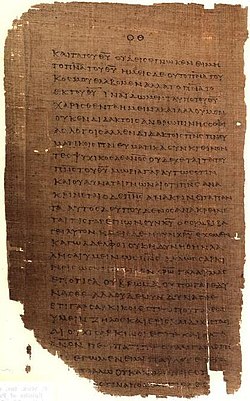
[edit]The original manuscript of this book is lost, and the text of surviving manuscripts varies. The oldest manuscripts containing some or all of the text of this book include:
- Papyrus 46 (AD 175–225)
- Codex Vaticanus (AD 325–350)
- Codex Sinaiticus (330–360)
- Papyrus 123 (4th century)[28]
- Codex Alexandrinus (400–440)
- Codex Ephraemi Rescriptus (~450)
- Codex Freerianus (~450)[29]
- Codex Claromontanus (~550)
- Codex Coislinianus (~550)
- Papyrus 14 (6th century)
- Papyrus 11 (7th century).[30]
Structure
[edit].jpg)
_f150v.jpg)
The epistle is generally divided into a number of sections. In addition to the opening salutation and thanksgiving, and the closing comments, John Barclay argues for five main parts.[12] Robertson and Plummer divide the letter into two parts: one part (chapters 1-6) deals with issues raised by "Chloe's people" (see 1 Corinthians 1:11) and the other part (chapters 7-16) addresses issues raised by a delegation (see 1 Corinthians 7:1).[31]: Footnote 20 Daniel B. Wallace sets out six main sections:[31]
- Salutation (1:1–3) and Thanksgiving (1:4–9)
- Paul addresses the issue regarding challenges to his apostleship and defends the issue by claiming that it was given to him through a revelation from Christ. The salutation (the first section of the letter) reinforces the legitimacy of Paul's apostolic claim. The thanksgiving part of the letter is typical of Hellenistic letter writing. In a thanksgiving recitation the writer thanks God for health, a safe journey, deliverance from danger, or good fortune.
- In this letter, the thanksgiving "introduces charismata and gnosis, topics to which Paul will return and that he will discuss at greater length later in the letter".[32]
- Division in Corinth (1:10–4:21)
- Facts of division
- Causes of division
- Cure for division
- Immorality in Corinth (5:1–6:20)
- Discipline an immoral Brother
- Resolving personal disputes
- Sexual purity
- Difficulties in Corinth (7:1–14:40)
- Doctrine of Resurrection (15:1–58)
- Closing (16:1–24).
Content
[edit]

Some time before 2 Corinthians was written, Paul paid the church at Corinth a second visit[33] to check some rising disorder,[34] and wrote them a letter, now lost.[35] The church had also been visited by Apollos,[36] perhaps by Peter,[37] and by some Jewish Christians who brought with them letters of commendation from Jerusalem.[38]
Paul wrote 1 Corinthians letter to correct what he saw as erroneous views in the Corinthian church. Several sources informed Paul of conflicts within the church at Corinth: Apollos,[39] a letter from the Corinthians, "those of Chloe", and finally Stephanas and his two friends who had visited Paul.[40] Paul then wrote this letter to the Corinthians, urging uniformity of belief ("that ye all speak the same thing and that there be no divisions among you", 1:10) and expounding Christian doctrine. Titus and a brother whose name is not given were probably the bearers of the letter to the church at Corinth.[41]
In general, divisions within the church at Corinth seem to be a problem, and Paul makes it a point to mention these conflicts in the beginning. Specifically, pagan roots still hold sway within their community. Paul wants to bring them back to what he sees as correct doctrine, stating that God has given him the opportunity to be a "skilled master builder" to lay the foundation and let others build upon it.[42]
1 Corinthians 6:9–10 contains a notable condemnation of idolatry, thievery, drunkenness, slandering, swindling, adultery, and other acts the authors consider sexually immoral.
The majority of early manuscripts end chapter 6 with the words δοξάσατε δὴ τὸν Θεὸν ἐν τῷ σώματι ὑμῶν, doxasate de ton theon en tō sōmati humōn, 'therefore glorify God in your body'. The Textus Receptus adds καὶ ἐν τῷ πνεύματι ὑμῶν, ἅτινά ἐστι τοῦ Θεοῦ, kai en to pneumati humōn, hatina esti tou theou, which the New King James Version translates as "and in your spirit, which are (i.e. body and spirit) God's".[43] J. J. Lias, in the Cambridge Bible for Schools and Colleges, notes that "these words are not found in many of the best MSS. and versions, and they somewhat weaken the force of the argument, which is intended to assert the dignity of the body. They were perhaps inserted by some who, missing the point of the Apostle's argument, thought that the worship of the spirit was unduly passed over."[44]
Later, Paul wrote about immorality in Corinth by discussing an immoral brother, how to resolve personal disputes, and sexual purity. Regarding marriage, Paul states that it is better for Christians to remain unmarried, but that if they lacked self-control, it is better to marry than "burn" (πυροῦσθαι). The epistle may include marriage as an apostolic practice in 1 Corinthians 9:5, "Do we not have the right to be accompanied by a believing wife, as do the other apostles and the brothers of the Lord and Cephas (Peter)?" (In the last case, the letter concurs with Matthew 8:14, which mentions Peter having a mother-in-law and thus, by inference, a wife.) However, the Greek word for 'wife' is the same word for 'woman'. The Early Church Fathers, including Tertullian, Jerome, and Augustine state the Greek word is ambiguous and the women in 1 Corinthians 9:5 were women ministering to the Apostles as women ministered to Christ,[45] and were not wives,[46] and assert they left their "offices of marriage" to follow Christ.[47] Paul also argues that married people must please their spouses, just as every Christian must please God.
Throughout the letter, Paul presents issues that are troubling the community in Corinth and offers ways to resolve them. Paul states that this letter serves to "admonish" them as beloved children. They are expected to become imitators of Jesus and follow the ways in Christ as he, Paul, teaches in all his churches.[48]
Paul's closing remarks in his letters usually contain his intentions and efforts to improve the community. He would first conclude with his paraenesis and wish the community peace by including a prayer request, greet them with his name and his friends with a holy kiss, and offer final grace and benediction:
1 Now concerning the collection for the saints: you should follow the directions I gave to the churches of Galatia [...] 14 Let all that you do be done in love... 20 Greet one another with a holy kiss. [...] 21 I, Paul, write this greeting with my own hand. 22 Let anyone be accursed who has no love for the Lord. Our Lord, come! 23 The grace of the Lord Jesus be with you. 24 My love be with all of you in Christ Jesus.
— Selected verses from 1 Corinthians 16:1–24[49]
This epistle contains some well-known phrases, including: "all things to all men",[50] "through a glass, darkly",[51] and:
When I was a child, I spoke as a child, I understood as a child, I thought as a child: but when I became a man, I put away childish things.
— 1 Corinthians 13:11, King James Version.[52]
"Through a glass, darkly"
[edit]1 Corinthians 13:12 contains the phrase βλέπομεν γὰρ ἄρτι δι' ἐσόπτρου ἐν αἰνίγματι, blepomen gar arti di esoptrou en ainigmati, which was translated in the 1560 Geneva Bible as "For now we see through a glass darkly" (without a comma). This wording was used in the 1611 KJV, which added a comma before "darkly".[53] This passage has inspired the titles of many works, with and without the comma.

The Greek word ἐσόπτρου, esoptrou (genitive; nominative: ἔσοπτρον, esoptron), here translated "glass", is ambiguous, possibly referring to a mirror or a lens. Influenced by Strong's Concordance, many modern translations conclude that this word refers specifically to a mirror.[54] Example English language translations include:
- "Now we see but a poor reflection as in a mirror" (New International Version)
- "What we see now is like a dim image in a mirror" (Good News Bible)
Paul's usage is in keeping with rabbinic use of the term אספקלריה, aspaklaria, a borrowing from the Latin specularia. This has the same ambiguous meaning, although Adam Clarke concluded that it was a reference to specularibus lapidibus, clear polished stones used as lenses or windows.[55] One way to preserve this ambiguity is to use the English cognate, speculum.[56] Rabbi Judah ben Ilai (2nd century) was quoted as saying "All the prophets had a vision of God as He appeared through nine specula" while "Moses saw God through one speculum."[57] The Babylonian Talmud states similarly "All the prophets gazed through a speculum that does not shine, while Moses our teacher gazed through a speculum that shines."[58]
Women must remain silent
[edit]The letter is also notable for its discussion of Paul's view of the role of women the church. In 1 Corinthians 14:34–35, it is stated that women must remain silent in the churches, and yet in 1 Corinthians 11:2–16 it states they have a role of prophecy and apparently speaking tongues in churches. Many scholars believe that verses 14:34–35 are an interpolation.[59][60][61][62][63][64][65] The passage interrupts the flow of Paul's argument; it follows language from the First Epistle to Timothy, which was probably not written by Paul; it contradicts Paul's neutral or positive mention of women prophesying, praying, and taking other speaking and leadership roles in the church; the passage is alternatively found at different locations in some manuscripts, which may indicate it was originally inserted as a marginal note and then unstably inserted into the text itself.[59][60] Moreover, some manuscripts give evidence of a prior record of its absence from the text.[59]
If verse 14:34–35 is not an interpolation, certain scholars resolve the tension between these texts by positing that wives were either contesting their husband's inspired speeches at church, or the wives/women were chatting and asking questions in a disorderly manner when others were giving inspired utterances. Their silence was unique to the particular situation in the Corinthian gatherings at that time, and on this reading, Paul did not intend his words to be universalized for all women of all churches of all eras.[66]
Other scholars including Joseph Fitzmyer suggest that in verses 34–35, Paul may be quoting the position of some native Corinthian Christians regarding women who have been speaking out in cultic assemblies in order that he can then argue against it.[67] According to Craig Keener, "When Paul suggests that husbands should teach their wives at home, his point is not to belittle women's ability to learn. To the contrary, Paul is advocating the most progressive view of his day: despite the possibility that she is less educated than himself, the husband should recognize his wife's intellectual capability and therefore make himself responsible for her education..."[68]
Head covering
[edit]
1 Corinthians 11:2–16 contains an admonishment that Christian women cover their hair while praying and that Christian men leave their heads uncovered while praying. These practices were countercultural; the surrounding pagan Greek women prayed unveiled and Jewish men prayed with their heads covered.[69][70]
The King James Version of 1 Corinthians 11:10 reads "For this cause ought the woman to have power on her head because of the angels." Other versions translate exousia as "authority" . In many early biblical manuscripts (such as certain Vulgate, Coptic, and Armenian manuscripts), is rendered with the word "veil" (κάλυμμα, kalumma) rather than the word "authority" (ἐξουσία, exousia); the Revised Standard Version reflects this, displaying 1 Corinthians 11:10[71] as follows: "That is why a woman ought to have a veil on her head, because of the angels."[72] Similarly, a scholarly footnote in the New American Bible notes that presence of the word "authority (exousia) may possibly be due to mistranslation of an Aramaic word for veil".[73] This mistranslation may be due to "the fact that in Aramaic the roots of the word power and veil are spelled the same."[74] The last-known living connection to the apostles, Irenaeus, penned verse 10 using the word "veil" (κάλυμμα, kalumma) instead of "authority" (ἐξουσία, exousia) in Against Heresies, as did other Church Fathers in their writings, including Hippolytus, Origen, Chrysostom, Jerome, Epiphanius, Augustine, and Bede.[72][75]
Scholars are divided on the meaning of the phrase "because of the angels" in v. 10. According to Dale Martin, Paul is concerned that angels may look lustfully at beautiful women, as the "sons of God" in Genesis 6 apparently did. Noting the similarity between the Greek word translated "veil" and the Greek word for a seal or cork of a wine jug, Martin theorizes that the veil acted not only to conceal the beauty of a woman's hair, but also as a symbolic protective barrier that "sealed" the woman against the influence of fallen angels.[76] Other scholars, such as Joseph Fitzmyer, believe the angels spoken of here are not fallen angels looking lustfully at women, but good angels who watch over church services. Notably, the author of Hebrews mentions "entertaining angels" and evidence from the Dead Sea Scrolls suggests some Second Temple era Jews believed angels attended synagogue services. According to this view, Paul's concern is not that an angel looks lustfully, but simply that the appearance of an inappropriately dressed women might offend the heavenly guardians.[77] A third interpretation comes from Bruce Winter, who theorizes that the "angels" spoken of are not heavenly beings at all, but simply human visitors. Winter notes that the Greek word translated "angels" literally means "messengers" and could refer to a visitor carrying a letter from afar, possibly even the epistle itself. In this view, Paul is concerned that if a visitor to a church service sees a married woman with her head uncovered, he may judge that woman to be promiscuous. Thus, Paul seeks to protect the church community's honor by ensuring that all members appear above reproach.[78]
The head covering ordinance continued to be handed down after the apostolic era to the next generations of Christians; writing 150 years after Paul, the early Christian apologist Tertullian stated that the women of the church in Corinth – both virgins and married – practiced veiling, given that Paul the Apostle delivered the teaching to them: "the Corinthians themselves understood him in this manner. In fact, at this very day, the Corinthians do veil their virgins. What the apostles taught, their disciples approve."[79] From the period of the early Church to the late modern period, 1 Corinthians 11 was universally understood to enjoin the wearing of the headcovering throughout the day – a practice that has since waned in Western Europe but has continued in certain parts of the world, such as in the Middle East, Eastern Europe, Northern Africa and the Indian subcontinent,[80][81][82][83][84][85] as well as everywhere by Conservative Anabaptists (such as the Conservative Mennonite Churches and the Dunkard Brethren Church), who count veiling as being one of the ordinances of the Church.[86][87] The early Church Father John Chrysostom explicates that 1 Corinthians 11 enjoins the continual wearing the headcovering by referencing Paul the Apostle's view that being shaven is always dishonourable and his pointing to the angels.[88]
Agape
[edit]Chapter 13 of 1 Corinthians is one of many definitional sources for the original Greek word ἀγάπη, agape.[89] In the original Greek, the word ἀγάπη, agape is used throughout chapter 13. This is translated into English as "charity" in the King James version; but the word "love" is preferred by most other translations, both earlier and more recent.[90]
1 Corinthians 11:17-34 contains a condemnation of what the authors consider inappropriate behavior at Corinthian gatherings that appeared to be agape feasts.
Resurrection
[edit]
After discussing his views on worshipping idols, Paul ends the letter with his views on resurrection and the Resurrection of Jesus.
The text of First Corinthians has been interpreted as evidence of existing dualistic beliefs among the Corinthians. Scholars point to 1 Cor 6:12:[91]
'Everything is lawful for me,' but I will not let myself be dominated by anything...whoever is joined to the Lord becomes one spirit with him.
Based on interpretations of the text, it appears that Corinthians did not believe that the soul would return to its physical prison after death. Paul is critical of the Corinthian denial of the resurrection of the dead in 15:12 asking: "Now if Christ is preached as raised from the dead, how can some of you say that there is no resurrection of the dead?"[92] Richard Horsley has argued that use of contrasting terms like corruption/incorruption in a polemic about resurrection supports a theory that Paul is using the "language of the Corinthians" in these verses. Multiple academic theories have been proposed for the source of this language including Greek philosophical influence, Gnosticism and the teachings of Philo of Alexandria.[91][93]
Most scholars agree that Paul was reinforcing earlier tradition about resurrection noting that he describes the kerygma as "received".[91][b]
3 For I handed on to you as of first importance what I in turn had received: that Christ died for our sins in accordance with the scriptures 4 and that he was buried and that he was raised on the third day in accordance with the scriptures 5 and that he appeared to Cephas, then to the twelve. 6 Then he appeared to more than five hundred brothers and sisters at one time, most of whom are still alive, though some have died. 7 Then he appeared to James, then to all the apostles.
— 1 Corinthians 15:3–7, New Revised Standard Version[94]
Paul represents the kerygma to the Corinthians "as a sacred tradition" that Christ was "raised on the third day in accordance with the scriptures".[95] James P. Ware notes that the original Greek word ἐγείρω, translated as "raised", always refers to the reanimation of the corpse when used with reference to the dead. He states that "[i]t is thus beyond doubt that the apostolic formula of 1 Cor 15 affirms that Jesus arose on the third day in his crucified body, leaving behind an empty tomb."[96]
Kirk MacGregor notes the textual evidence from the kerygma as stated in 15:3-7 is cited by modern scholars as evidence "that Jesus' earliest disciples believed in a spiritual resurrection which did not necessarily vacate his tomb".[97] Dale Moody says the tradition of the appearances of the resurrected Christ and the tradition of the empty tomb "remain separate in the oldest strata of tradition".[98]
Geza Vermes states that the words of Paul are "a tradition he has inherited from his seniors in the faith concerning the death, burial and resurrection of Jesus".[99][100] The kerygma was possibly transmitted from the Jerusalem apostolic community[c] though the core formula may have originated in Damascus.[101]
It may be one of the earliest kerygmas about Jesus' death and resurrection, though it is also possible that Paul himself joined the various statements, as proposed by Urich Wilckens.[102] It is also possible that "he appeared" was not specified in the core formula, and that the specific appearances are additions.[103] According to Hannack, line 3b-4 form the original core, while line 5 and line 7 contain competing statements from two different factions.[104] Prive also argues that line 5 and line 7 reflect the tensions between Petrus and James.[105]
The kerygma has often been dated to no more than five years after Jesus' death by Biblical scholars.[c] Bart Ehrman dissents, saying that "Among scholars I personally know, except for evangelicals, I don't now[sic] anyone who thinks this at all."[106][d] Gerd Lüdemann however, maintains that "the elements in the tradition are to be dated to the first two years after the crucifixion of Jesus [...] not later than three years".[107]
According to Gary R. Habermas, in "Corinthians 15:3–8, Paul records an ancient oral tradition(s) that summarizes the content of the Christian gospel."[108] N.T Wright describes it as "the very early tradition that was common to all Christians".[109]
In dissent from the majority view, Robert M. Price,[110] Hermann Detering,[111] John V. M. Sturdy,[112] and David Oliver Smith[113] have each argued that 1 Corinthians 15:3–7 is a later interpolation. According to Price, the text is not an early Christian creed written within five years of Jesus' death, nor did Paul write these verses. In his assessment, this was an Interpolation possibly dating to the beginning of the 2nd century. Price states that "The pair of words in verse 3a, "received / delivered" (paralambanein / paradidonai) is, as has often been pointed out, technical language for the handing on of rabbinical tradition", so it would contradict Paul's account of his conversion given in Galatians 1:13–24, which explicitly says that he had been taught the gospel of Christ by Jesus himself, not by any other man.[105][e]
Chapter 15 closes with an account of the nature of the resurrection, claiming that in the Last Judgement the dead will be raised and both the living and the dead transformed into "spiritual bodies" (verse 44).[115]
Psalm 8 reference
[edit]1 Corinthians 15:27[116] refers to Psalm 8:6.[117] Ephesians 1:22 also refers to this verse of Psalm 8.[117]
Evil company corrupts good habits
[edit]1 Corinthians 15:33 contains the aphorism "evil company corrupts good habits", from classical Greek literature. According to the church historian Socrates of Constantinople[118] it is taken from a Greek tragedy of Euripides, but modern scholarship, following Jerome,[119] attributes it to the comedy Thaĩs by Menander, or Menander quoting Euripides. Hans Conzelmann remarks that the quotation was widely known.[120] Whatever the proximate source, this quote does appear in one of the fragments of Euripides' works.[121]
Baptism of the dead
[edit]1 Corinthians 15:29 argues it would be pointless to baptise the dead if people are not raised from the dead. This verse suggests that there existed a practice at Corinth whereby a living person would be baptized in the stead of some convert who had recently died.[122] Teignmouth Shore, writing in Ellicott's Commentary for Modern Readers, notes that among the "numerous and ingenious conjectures" about this passage, the only tenable interpretation is that there existed a practice of baptising a living person to substitute those who had died before that sacrament could have been administered in Corinth, as also existed among the Marcionites in the second century, or still earlier than that, among a sect called "the Corinthians".[123] The Jerusalem Bible states that "What this practice was is unknown. Paul does not say if he approved of it or not: he uses it merely for an ad hominem argument".[124]
The Latter Day Saint movement interprets this passage to support the practice of baptism for the dead. This principle of vicarious work for the dead is an important work of the Church of Jesus Christ of Latter-day Saints in the dispensation of the fulness of times. This interpretation is rejected by other Christians.[125][126][127]
Commentaries
[edit]John Chrysostom, an early Church Father and archbishop of Constantinople, wrote a commentary on 1 Corinthians, formed by 44 homilies.[128]
See also
[edit]Notes
[edit]- ^ The book is sometimes called the First Letter of Paul to the Corinthians, or simply 1 Corinthians.[2] It is most commonly abbreviated as "1 Cor."[3]
- ^ Early kerygma:
- Neufeld, The Earliest Christian Confessions (Grand Rapids: Eerdmans, 1964) p. 47;
- Reginald Fuller, The Formation of the Resurrection Narratives (New York: Macmillan, 1971) p. 10 (ISBN 0-281-02475-8)
- Wolfhart Pannenberg, Jesus – God and Man translated Lewis Wilkins and Duane Pribe (Philadelphia: Westminster, 1968) p. 90 (ISBN 0-664-20818-5);
- Oscar Cullmann, The Early Church: Studies in Early Christian History and Theology, ed. A. J. B. Higgins (Philadelphia: Westminster, 1966) p. 64;
- Hans Conzelmann, 1 Corinthians, translated James W. Leitch (Philadelphia: Fortress 1975) p. 251 (ISBN 0-8006-6005-6);
- Bultmann, Theology of the New Testament vol. 1 pp. 45, 80–82, 293;
- R. E. Brown, The Virginal Conception and Bodily Resurrection of Jesus (New York: Paulist Press, 1973) pp. 81, 92 (ISBN 0-8091-1768-1);
- Goulder, Michael, The Baseless Fabric of a Vision (as quoted in Gavin D'Costa's Resurrection Reconsidered), p. 48, 1996
- ^ a b Ancient creed:
- Wolfhart Pannenberg, Jesus – God and Man translated Lewis Wilkins and Duane Pribe (Philadelphia: Westminster, 1968) p. 90;
- Oscar Cullmann, The Early church: Studies in Early Christian History and Theology, ed. A. J. B. Higgins (Philadelphia: Westminster, 1966) p. 66;
- R. E. Brown, The Virginal Conception and Bodily Resurrection of Jesus (New York: Paulist Press, 1973) p. 81;
- Thomas Sheehan, First Coming: How the Kingdom of God Became Christianity (New York: Random House, 1986) pp. 110, 118;
- Ulrich Wilckens, Resurrection translated A. M. Stewart (Edinburgh: Saint Andrew, 1977) p. 2
- ^ Bart Ehrman: "Among scholars I personally know, except for evangelicals, I don't now anyone who thinks this at all. And for a good reason: Paul never says he got this creed from Peter and James three years after his conversion. Doesn't even suggest it."[106]
- ^ Robert Jamieson, A. R. Fausset, and David Brown (1871) comment: "which I ... received – from Christ Himself by special revelation (compare 1Co 11:23)."[114] 1 Corinthians 11:23: "For I have received of the Lord that which also I delivered unto you, That the Lord Jesus the same night in which he was betrayed took bread..."
References
[edit]- ^ Aland, Kurt; Aland, Barbara (1995). The Text of the New Testament: An Introduction to the Critical Editions and to the Theory and Practice of Modern Textual Criticism. Translated by Rhodes, Erroll F. (2nd ed.). Grand Rapids, MI: Wm. B. Eerdmans Publishing Co. p. 159. ISBN 978-0-8028-4098-1. Archived from the original on October 5, 2023.
- ^ ESV Pew Bible. Wheaton, IL: Crossway. 2018. p. 952. ISBN 978-1-4335-6343-0. Archived from the original on June 3, 2021.
- ^ "Bible Book Abbreviations". Logos Bible Software. Archived from the original on April 21, 2022. Retrieved April 21, 2022.
- ^ 1 Corinthians 1:1–2
- ^ a b Meyer, H. A. W. (1880), Meyer's NT Commentary on 1 Corinthians 1, translated from the German sixth edition, BibleHub, accessed May 17, 2022
- ^ Kurt Aland, Barbara Aland (1995), The Text of the New Testament: an introduction to the Critical Editions and to the Theory and Practice of Modern Textual Criticism, p. 52: "The New Testament was written in Koine Greek, the Greek of daily conversation. The fact that from the first all the New Testament writings were written in Greek is conclusively demonstrated by their citations from the Old Testament..."
- ^ Robert Wall, New Interpreter's Bible Vol. X (Abingdon Press, 2002), p. 373
- ^ Gucker, Jacob. "LibGuides: Ancient Biblical Manuscripts Online: Uncials". bmats.libguides.com.
- ^ Gench, Frances Taylor (18 May 2015). Encountering God in Tyrannical Texts: Reflections on Paul, Women, and the Authority of Scripture. Presbyterian Publishing Corp. p. 97. ISBN 9780664259525. Retrieved May 15, 2022.
- ^ 1 Corinthians 5:1ff
- ^ a b Daniel B. Wallace: The Textual Problem of 1 Corinthians 14:34–35 Bible.org, June 26th 2004.
- ^ a b c Barclay, John (2001). "65. I Corinthians". In John Barton; John Muddiman (eds.). The Oxford Bible Commentary. New York: Oxford University Press. p. 1130. ISBN 978-0-19-875500-5.
- ^ 1 Corinthians 10:1–22
- ^ 1 Corinthians 8:1–13
- ^ 1 Corinthians 10:23–11:1
- ^ Walter Schmithals, Gnosticism in Corinth (Nashville: Abingdon, 1971), 14, 92–95; Lamar Cope, "First Corinthians 8–10: Continuity or Contradiction?" Anglican Theological Review: Supplementary Series II. Christ and His Communities (Mar. 1990) 114–23.
- ^ 1 Corinthians 8:1–11:1
- ^ Joop F. M. Smit, About the Idol Offerings (Leuven: Peeters, 2000); B. J. Oropeza, "Laying to Rest the Midrash," Biblica 79 (1998) 57–68.
- ^ Acts 19:8, Acts 19:10, Acts 20:31
- ^ a b "1 Corinthians, The First Letter to the Corinthians | USCCB". bible.usccb.org.
- ^ See 1 Corinthians 7:1
- ^ Acts 18:1–17
- ^ Corinthians, First Epistle to the, "The International Standard Bible Encyclopedia", Ed. James Orr, 1915.
- ^ Pauline Chronology: His Life and Missionary Work, from Catholic Resources by Felix Just, S.J.
- ^ Anthony C. Thiselton, The First Epistle to the Corinthians (Eerdmans, 2000), 31.
- ^ Acts 19:22, 1 Corinthians 4:17
- ^ a b "Introduction to the Book of 2 Corinthians". ESV Study Bible. Crossway. 2008. ISBN 978-1433502415.
- ^ "P123 (P. Oxy. 4844). Liste Handschriften DocID: 10123". Münster: Institute for New Testament Textual Research. Retrieved 29 March 2019.
- ^ "016 (Smithsonian Institution, Freer Gallery of Art F1906.275). Liste Handschriften DocID: 20016". Münster: Institute for New Testament Textual Research. Retrieved 29 March 2019.
- ^ Gregory, Caspar René (1908). Die griechischen Handschriften des Neuen Testament. Leipzig: J.C. Hinrichs'sche Buchhandlung. p. 46.
- ^ a b Wallace, D. B., 7. 1 Corinthians: Introduction, Argument, and Outline, from the series "New Testament: Introductions and Outlines", Bible.org, accessed on 4 February 2025
- ^ Roetzel, Calvin J. (1999). Paul: The Man and the Myth. Fortress. ISBN 978-0-56722938-0.
- ^ 2 Corinthians 12:14; 2 Corinthians 13:1
- ^ 2 Corinthians 2:1; 2 Corinthians 13:2
- ^ 1 Corinthians 5:9
- ^ Acts 18:27
- ^ 1 Corinthians 1:12
- ^ 1 Corinthians 1:12; 2 Corinthians 3:1; 2 Corinthians 5:16; 2 Corinthians 11:23
- ^ Acts 19:1; 1 Corinthians 16:12
- ^ 1 Corinthians 1:11; 1 Corinthians 16:17
- ^ 2 Corinthians 2:13; 8:6, 16–18.
- ^ 1 Corinthians 3:10
- ^ 1 Corinthians 6:20 NKJV
- ^ Lias, J. J., Cambridge Bible for Schools and Colleges on 1 Corinthians 6, accessed on 26 March 2017
- ^ cf. Matthew 27:55, Luke 8:1–3
- ^ Tertullian, On Monogamy "For have we not the power of eating and drinking?" he does not demonstrate that "wives" were led about by the apostles, whom even such as have not still have the power of eating and drinking; but simply "women", who used to minister to them in the stone way (as they did) when accompanying the Lord."
- ^ Jerome, Against Jovinianus, Book I "In accordance with this rule Peter and the other Apostles (I must give Jovinianus something now and then out of my abundance) had indeed wives, but those which they had taken before they knew the Gospel. But once they were received into the Apostolate, they forsook the offices of marriage."
- ^ 1 Corinthians 4:14–16
- ^ 1 Corinthians 16:1–24:NRSVA: NRSV
- ^ 1 Corinthians 9:22
- ^ 1 Corinthians 13:12: Douai-Rheims Version
- ^ 1 Corinthians 13:11
- ^ 1 Corinthians 13:12 KJV
- ^ "εσοπτρον" [espotron]. Strong's Greek Lexicon – via Blue Letter Bible.
- ^ Clarke, Adam (1817). "Commentary on 1 Corinthians 12". Commentary on the New Testament. Vol. II. London: J. Butterworth & Son.
- ^ Gordon Tucker, translator's footnote to Abraham Joshua Heschel, 'Heavenly Torah as Refracted Through the Generations,' Continuum, New York, 2008; p. 308.
- ^ Leviticus Rabbah 1:14.
- ^ B.T. Yevamot 49B
- ^ a b c Payne, Philip Barton (October 15, 2009). "Why would 1 Cor 14:34–35 be an interpolation?". Zondervan Academic. Zondervan. Retrieved 21 September 2024.
- ^ a b Ehrman, Bart (May 21, 2024). "The Silencing of Women: 1 Cor. 14:34-35 as an Interpolation". The Bart Ehrman Blog. Retrieved 21 September 2024.
- ^ Siqueira, Júlio César Piffero. "The Text-Critical Problem of 1 Corinthians 14:34–35 and the Evidences of its Origin". Concordia Seminary Scholarship. Concordia Seminary of St. Louis. Retrieved 21 September 2024.
- ^ Fellows, Richard G (April 30, 2024). "The Interpolation of 1 Cor. 14.34–35 and the Reversal of the Name Order of Prisca and Aquila at 1 Cor. 16.19". Journal for the Study of the New Testament. 47 (2): 179–217. doi:10.1177/0142064X231226165.
- ^ "Leonhard O.S.F., Barbara. "St. Paul and Women: A Mixed Record", St. Anthony Messenger, Franciscan Media". Archived from the original on 2006-07-12. Retrieved 2014-08-11.
- ^ "New American Bible". The Holy See. Libreria Editrice Vaticana. 2009. p. Note 10. Retrieved 21 September 2024.
- ^ Murphy-O'Connor, Jerome (1990). Brown, Raymond E; Fitzmyer, Joseph A; Murphy, Roland E (eds.). 'New Jerome Biblical Commentary. Englewood Cliffs, NJ: Prentice Hall. pp. 811–812.
- ^ B. J. Oropeza, 1 Corinthians. New Covenant Commentary (Eugene: Cascade, 2017), 187–94; Philip B. Payne, Man and Woman: One in Christ (Grand Rapids: Zondervan, 2009); Ben Witherington, Women in the Earliest Churches (Cambridge: Cambridge University Press, 1988);
- ^ Fitzmyer, Joseph (2008). First Corinthians: A New Translation with Introduction and Commentary. New Haven: Yale University Press. pp. 531–33. ISBN 9780300140446.
- ^ Keener, Craig (1992). Paul, Women, and Wives. Peabody, MA: Hendrickson. p. 84.
- ^ Payne, Philip Barton (2015). Man and Woman, One in Christ: An Exegetical and Theological Study of Paul's Letters. Zondervan Academic. ISBN 978-0-310-52532-5.
Furthermore, Greek women, including women in prayer, were usually depicted without a garment covering the head. It does not make sense that Paul would assert something was disgraceful that in their culture was not considered disgraceful. Concerning Greek customs A. Oepke observes: [...] It is quite wrong [to assert] that Greek women were under some kind of compulsion to wear a veil. [...] Passages to the contrary are so numerous and unequivocally that they cannot be offset. [...] Empresses and goddesses, even those who maintain their dignity, like Hera and Demeter, are portrayed without veils.
- ^ Shank, Tom (1992). "...Let Her Be Veiled.": An in-depth study of 1 Corinthians 11:1–16. Eureka: Torch Publications. p. 8.
The [male] Jews of this era worshipped and prayed with a covering called a tallith on their heads.
- ^ 1 Corinthians 11:10
- ^ a b Garland, David E. (2003). 1 Corinthians (Baker Exegetical Commentary on the New Testament). Baker Academic. ISBN 978-1-58558-322-5.
- ^ The Catholic Study Bible. Oxford University Press. 2016. ISBN 978-0-19-026726-1.
- ^ Farrell, Heather (2014). Walking with the Women of the New Testament. Cedar Fort Publishing. ISBN 978-1-4621-0872-5.
...that the word translated in verses 5 and 13 as "uncovered" is akatakaluptos and means "unveiled" and the word translated in verse 6 as "covered" is katakalupto which means to "cover wholly, [or] veil". The word power in verse 10 may have also been mistranslated because the fact that in Aramaic the roots of the word power and veil are spelled the same.
- ^ Williams, Frank, ed. (2009). The Panarion of Epiphanius of Salamis: Book I (Sects 1-46). Brill Academic Publishers. p. 196. ISBN 978-90-04-17017-9.
- ^ Martin, Dale (1995). The Corinthian Body. New Haven, CT: Yale University. pp. 234, 243.
- ^ Fitzmyer, Joseph. First Corinthians, vol. 32. New Haven, CT: Yale University Press. pp. 418–419.
- ^ Winter, Bruce (2003). Woman Wives, Roman Widows: The Appearance of New Women and the Pauline Communities. Grand Rapids, MI: Eerdmans. p. 90.
- ^ Bercot, David W. (18 April 2021). Dictionary of Early Christian Beliefs: A Reference Guide to More Than 700 Topics Discussed by the Early Church Fathers. Hendrickson. p. 667. ISBN 978-1-61970-168-7.
- ^ Hunt, Margaret (2014). Women in Eighteenth Century Europe. Taylor & Francis. p. 58. ISBN 9781317883876.
Today many people associate rules about veiling and headscarves with the Muslim world, but in the eighteenth century they were common among Christians as well, in line with 1 Corinthians 11:4–13 which appears not only to prescribe headcoverings for any women who prays or goes to church, but explicitly to associate it with female subordination, which Islamic veiling traditions do not typically do. Many Christian women wore a head-covering all the time, and certainly when they went outside; those who did not would have been barred from church and likely harassed on the street. [...] Veils were, of course, required for Catholic nuns, and a veil that actually obscured the face was also a mark of elite status throughout most of Europe. Spanish noblewomen wore them well into the eighteenth century, and so did Venetian women, both elites and non-elites. Across Europe almost any woman who could afford them also wore them to travel.
- ^ Balzani, Marzia; Besnier, Niko (2021). Social and Cultural Anthropology for the 21st Century: Connected Worlds. Routledge. ISBN 978-1-317-57178-0.
Head covers are generally associated with Islam, but until recently Christian women in Mediterranean countries also covered their heads in public, and some still do, particularly in religious contexts such as attending mass.
- ^ Hammond, Laura C. (2018). This Place Will Become Home: Refugee Repatriation to Ethiopia. Cornell University Press. p. 92. ISBN 978-1-5017-2725-2.
Inside her house a Christian woman usually did not cover hear head and only wore a netsela (ነጠላ, a shawl made from white, usually homespun cotton and often with a colorful banner woven into its edges) when working in the sun or going out of her compound.
- ^ Ramdin, Ron (2000). Arising from Bondage: A History of the Indo-Caribbean People. New York University Press. p. 222. ISBN 978-0-8147-7548-6.
As a mark of respect, Indian women were expected to cover their heads. And over the years, most rural Hindu, Muslim and Christian women have done so with the Orhni, a thin shawl-like head covering.
- ^ Mitchell, Laurence (2007). Serbia. Bradt Travel Guides. ISBN 978-1-84162-203-3.
Further north, in Vojvodina, some older Slovak women still regularly wear the headscarf, pleated skirt and embroidered apron that is their national dress. All across Serbia, as elsewhere in eastern Europe, many older women wear headscarves
- ^ Walsh, Harper (2019). Saudi Arabia Undercover: Includes Bahrain, Bangkok and Cairo. Monsoon Books. ISBN 978-1-912049-61-5.
There are Christian women in the Middle East who cover their hair and heads daily. Some wear burkas too.
- ^ Hartzler, Rachel Nafziger (2013). No Strings Attached: Boundary Lines in Pleasant Places: A History of Warren Street / Pleasant Oaks Mennonite Church. Wipf and Stock Publishers. ISBN 978-1-62189-635-7.
- ^ Kauffman, Daniel (1898). Manual of Bible Doctrines. Elkhart: Mennonite Publishing Co. pp. 160–168.
- ^ Schaff, Philip (1889). A Select Library of the Nicene and Post-Nicene Fathers of the Christian Church: St. Chrysostom: Homilies on the Epistles of Paul to the Corinthians. The Christian Literature Company. p. 152.
- ^ "Strong's Greek: 26. ἀγάπη (agapé) – love, goodwill". biblehub.com.
- ^ "1 Corinthians 13:1". Bible Gateway.
- ^ a b c The First Theologians: A Study in Early Christian Prophecy. Eerdmans. 1994. pp. 199–208.
- ^ 1 Corinthians 15:12
- ^ Christian Origins and the Establishment of the Early Jesus Movement. Brill. 2018. p. 62.
- ^ 1 Corinthians 15:3–7, NRSV
- ^ Larry W. Hurtado (2005). Lord Jesus Christ: Devotion to Jesus in Earliest Christianity. Wm. B. Eerdmans Publishing. p. 71. ISBN 978-0-8028-3167-5.
- ^ Ware, James P. (2025). The Final Triumph of God: Jesus, the Eyewitnesses, and the Resurrection of the Body in 1 Corinthians 15. Wm. B. Eerdmans Publishing. p. PT118. ISBN 978-1-4674-6306-5.
- ^ MacGregor, Kirk R. (2006). "1 Corinthians 15:3b–6a, 7 and the Bodily Resurrection of Jesus". Journal of the Evangelical Theological Society. 49 (2): 225–34.
- ^ Dale Moody (1987). Robert L. Perkins (ed.). Perspectives on Scripture and Tradition: Essays in Honor of Dale Moody. Mercer University Press. p. 109. ISBN 978-0-86554-305-8.
- ^ Geza Vermes (2008) The Resurrection. London, Penguin: 121–22 (ISBN 0-7394-9969-6; ISBN 978-0-14-103005-0)
- ^ Donald Hagner (2012). "Part 2.7. The Origin and Reliability of the Gospel Tradition". The New Testament: A Historical and Theological Introduction. Baker Books. ISBN 978-1-4412-4040-8.
- ^ Hans Grass, Ostergeschen und Osterberichte, Second Edition (Göttingen: Vandenhoeck und Ruprecht, 1962) p. 96; Grass favors the origin in Damascus.
- ^ Wolfhart Pannenberg, Jesus – God and Man translated Lewis Wilkins and Duane Pribe (Philadelphia: Westminster, 1968) p. 90
- ^ R. E. Brown, The Virginal Conception and Bodily Resurrection of Jesus (New York: Paulist Press, 1973) pp. 81, 92 (ISBN 0-8091-1768-1)
- ^ Hans Conzelmann, 1 Corinthians, translated James W. Leitch (Philadelphia: Fortress 1975) p. 251 (ISBN 0-8006-6005-6)
- ^ a b Price (1995).
- ^ a b Bart Ehrman, as quoted at Bart Ehrman: Most Scholars Doubt the Early Creed Was Written Within 3-6 Years of Jesus' Death
- ^ Gerd Lüdemann (1994). The Resurrection of Jesus. p. 38.
- ^ Francis J. Beckwith; William Lane Craig; J. P. Moreland, eds. (2009). To Everyone an Answer: A Case for the Christian Worldview. InterVarsity Press. p. 182. ISBN 978-0-8308-7750-8.
- ^ N.T. Wright (5 April 2016). "Early Traditions and the Origins of Christianity". NTWrightPage.
- ^ Price, Robert M. (1995). "Apocryphal Apparitions: 1 Corinthians 15:3–11 as a Post-Pauline Interpolation". Journal of Higher Criticism. 2 (2): 69–99.
- ^ Detering, Hermann (2003). "The Falsified Paul" (PDF). Journal of Higher Criticism. 10 (2). Translated by Darrell Daughty: 3–199.
- ^ Sturdy, John (2007). Redrawing the Boundaries: The Date of Early Christian Literature. Equinox Pub. Limited. p. 64.
- ^ Smith, David Oliver (2022). The Pauline Letters: A Rhetorical Analysis. Wipf and Stock Publishers. p. 176.
- ^ Robert Jamieson; Andrew Robert Fausset; David Brown (1871). Commentary Critical and Explanatory on the Whole Bible.
- ^ E.P. Sanders (1991) Paul. Oxford University Press: 29–30 (ISBN 0-19-287679-1). For a homiletic application, see "When I Get to the End of the Way" (References).
- ^ 1 Corinthians 15:27
- ^ a b Kirkpatrick, A. F. (1901). The Book of Psalms: with Introduction and Notes. The Cambridge Bible for Schools and Colleges. Vol. Book IV and V: Psalms XC-CL. Cambridge: At the University Press. p. 838. Retrieved February 28, 2019.
- ^ The Ecclesiastical History of Socrates ... , London: George Bell, 1897. book III, chapter 16, verse 114, p. 194. See also the introductory essay to Samson Agonistes by John Milton, Of that sort of Dramatic Poem which is call'd Tragedy Archived 2015-12-08 at the Wayback Machine.
- ^ Commentarium ad Titum 100.1
- ^ Hans Conzelmann (1975). 1 Corinthians: A Commentary on the First Epistle to the Corinthians. James W. Leach (translator). Philadelphia: Fortress Press. pp. 278–279 fn 132. ISBN 0-8006-6005-6.
- ^ Loeb Classical Library Euripides VIII, fragment 1024
- ^ "What does 1 Corinthians 15:29 mean?". BibleRef.com. Retrieved 2023-01-18.
- ^ Teignmouth Shore, Ellicott's Commentary for Modern Readers on 1 Corinthians 15, accessed 12 April 2017
- ^ Jerusalem Bible (1966), note at 1 Corinthians 15:29
- ^ LCMS Frequently Asked Questions: Other Denominations, Lutheran Church, Missouri Synod
- ^ Vatican Warns of Mormon 'Baptism of the Dead', Catholic Online, retrieved July 3, 2016
- ^ "Receive Guidelines for Ministering to Mormons Who Seek to Become United Methodists". United Methodist Church. Archived from the original on 2016-08-19. Retrieved July 3, 2016.
- ^ "John Chrysostom's homilies on 1 Corinthians" (in English and Latin). Clerus. Archived from the original on April 12, 2019. Retrieved April 12, 2019.
Further reading
[edit]- Blenkinsopp, Joseph, The Corinthian Mirror: a Study of Contemporary Themes in a Pauline Epistle [i.e. in First Corinthians], Sheed and Ward, London, 1964.
- Erdman, Charles R., The First Epistle of Paul to the Corinthians, Philadelphia: Westminster Press, 1966.
- Conzelmann, Hans Der erste Brief an die Korinther, KEK V, Göttingen 1969.
- Fitzmyer, Joseph A., First Corinthians : new translation with introduction and commentary, Anchor Yale Bible, Yale University Press, 2008.
- Oropeza, B. J. (2017). 1 Corinthians. New Covenant Commentary. Eugene: Cascade. ISBN 9781610971041.
- Robertson, Archibald and Alfred Plummer, A Critical and Exegetical Commentary on the First Epistle of St. Paul to the Corinthians (Edinburgh 1961).
- Thiselton, Anthony C., The First Epistle to the Corinthians: a commentary on the Greek text NIGTC, Wm. B. Eerdmans Publishing Co., Grand Rapids 2000.
- Yung Suk Kim. Christ's Body in Corinth: The Politics of a Metaphor (Fortress, 2008).
External links
[edit]

- Multiple bible versions at Bible Gateway (NKJV, NIV, NRSV etc.)
- English Translation with Parallel Latin Vulgate
- International Standard Bible Encyclopedia: 1 Corinthians
 1 Corinthians public domain audiobook at LibriVox Various versions


First Epistle to the Corinthians
View on GrokipediaAuthorship and Dating
Attribution to Paul
The First Epistle to the Corinthians opens with a direct claim of authorship by Paul, identifying him as "called to be an apostle of Christ Jesus by the will of God" alongside Sosthenes, and addressed to the church in Corinth.[3] This self-attribution aligns with the epistle's references to Paul's personal founding of the Corinthian church during his second missionary journey around 50–51 CE, including details of his eighteen-month stay and interactions with local figures like Aquila and Priscilla.[11] Internally, the letter's vocabulary, rhetorical style, and theological emphases—such as justification by faith, the body of Christ metaphor, and critiques of factionalism—match those in undisputed Pauline writings like Romans and Galatians, with over 200 shared terms and no linguistic anomalies suggesting pseudonymity.[3] External attestation begins early, with Clement of Rome quoting 1 Corinthians extensively in his own letter to the Corinthian church around 96 CE, treating it as authoritative Pauline teaching without question.[11] Subsequent second-century figures, including Ignatius of Antioch (c. 110 CE) and Polycarp of Smyrna (c. 135 CE), reference the epistle's content in ways implying its circulation and acceptance as Paul's work.[3] Manuscript evidence supports this, as the Chester Beatty Papyrus P46 (c. 200 CE) includes 1 Corinthians among seven Pauline letters in a collection affirming their apostolic origin.[11] Scholarly consensus across critical and confessional divides holds 1 Corinthians as authentically Pauline, with virtually no modern challenges to its attribution due to the strength of both internal coherence and early external witnesses, distinguishing it from disputed epistles like the Pastorals.[3] This unanimity persists despite broader debates in New Testament studies, as the epistle's historical fit with Paul's biography in Acts 18 and its resolution of Corinthian issues via oral reports align causally with a mid-50s CE composition by the apostle himself.[1]Internal and External Evidence for Authenticity
The internal evidence for Pauline authorship of 1 Corinthians includes the epistle's explicit self-attribution to "Paul, called to be an apostle of Christ Jesus by the will of God" in its opening verse, consistent with the formulaic openings of other undisputed Pauline letters such as Romans and Galatians.[3] The letter's linguistic style, vocabulary, and syntax align closely with Paul's authenticated epistles, featuring characteristic rhetorical patterns like diatribe and personal appeals, as analyzed through statistical models of Pauline corpus stylometry that classify 1 Corinthians as authentically Pauline.[12] Theologically, it reflects core Pauline motifs, including justification by faith, the body of Christ metaphor for the church, and a high Christology, without introducing doctrines foreign to Paul's known writings, such as those in Romans or 1 Thessalonians.[3] Autobiographical details further corroborate authenticity, such as Paul's reference to baptizing only a few Corinthians (1:14-16), his "fear and trembling" upon arriving in the city (2:3), and his refusal of financial support from the Corinthian church (9:15), elements that match the timeline and circumstances described in Acts 18 without internal contradictions.[11] External evidence bolsters this attribution through early patristic citations treating 1 Corinthians as Pauline. Clement of Rome, writing around 96 CE in his Epistle to the Corinthians, extensively alludes to and quotes from 1 Corinthians (e.g., chapters 32-36 echoing 1 Cor 15 on resurrection), explicitly referencing Paul's letter to the Corinthians as authoritative.[11] Polycarp of Smyrna, in his Epistle to the Philippians (c. 110-140 CE), cites 1 Corinthians alongside other Pauline texts, affirming Paul's authorship.[11] Additional attestation comes from Ignatius of Antioch (c. 107 CE) and later figures like Marcion (c. 140 CE), whose canon included 1 Corinthians among ten Pauline epistles without dispute over its origin.[13] The earliest surviving manuscript evidence, Papyrus 46 (P46, dated to circa 175-225 CE), contains 1 Corinthians as part of a Pauline collection, with no variant attributions or interpolations questioning its Pauline status in the extant fragments.[14] This manuscript tradition, preserved in a codex format typical of early Christian Pauline compilations, shows uniform ascription to Paul across subsequent copies, reinforcing the epistle's authenticity from the second century onward.[15] No ancient sources prior to modern critical scholarship challenge its Pauline provenance, distinguishing it from disputed texts like the Pastorals.[3]Scholarly Challenges and Responses
The authenticity of the First Epistle to the Corinthians as a work of the Apostle Paul is affirmed by the overwhelming majority of New Testament scholars, who classify it among the seven undisputed Pauline letters based on consistent linguistic, stylistic, and theological features matching Paul's known corpus.[3] This consensus rests on internal evidence, such as the letter's abrupt, personal tone, use of characteristic Pauline phrases like "I thank God" in openings and eschatological urgency, and direct references to Paul's apostolic authority and personal history (e.g., 1 Corinthians 9:1–6, recalling his interactions with the Corinthian church).[11] External corroboration comes from early patristic citations, including Clement of Rome's To the Corinthians (ca. 96 CE), which quotes 1 Corinthians 1:12 and attributes it to Paul, and Polycarp's To the Philippians (ca. 110–140 CE), referencing passages like 1 Corinthians 15:25.[11] Challenges to full Pauline authorship are rare and typically marginal, often confined to 19th-century radical critics like the Dutch school (e.g., W.C. van Manen), who argued for pseudepigraphy across much of the Pauline corpus on ideological grounds, positing later composition to fit evolving church doctrines rather than empirical textual analysis.[16] More targeted scholarly debates focus on potential interpolations in specific passages, such as 1 Corinthians 14:34–35 (instructing women to be silent in churches), which some propose as a non-Pauline insertion due to its abrupt placement, stylistic discontinuity with surrounding verses on prophecy, and absence in early manuscripts like Codex Vaticanus (where it appears as a marginal note transposed).[17] Proponents of interpolation, including Philip Payne, cite manuscript variants and argue the verses contradict Paul's allowance of women's prayer and prophecy in 1 Corinthians 11:5, suggesting scribal addition to align with later ecclesiastical norms.[18] Similarly, isolated questions arise about 1 Corinthians 13 (the "love chapter") for its poetic elevation potentially diverging from Paul's pragmatic style, though linguistic analysis identifies over twenty distinctively Pauline usages, undermining such claims.[19] Responses to these challenges emphasize the epistle's overall integrity, with textual critics noting that proposed interpolations lack decisive manuscript support—1 Corinthians 14:34–35 appears in the majority of Greek witnesses, including early papyri like 𝔓46 (ca. 200 CE), and its thematic fit with Paul's concerns for orderly worship (1 Corinthians 14:33, 40).[1] Defenders argue that apparent tensions, such as in gender roles, reflect contextual application rather than contradiction, as Paul qualifies silence to specific disruptive scenarios amid Corinthian chaos, consistent with his adaptive rhetoric elsewhere (e.g., Galatians 3:28's equality in Christ versus situational instructions).[20] Broader pseudepigraphy theories falter against the letter's self-identification (1 Corinthians 1:1; 16:21, with Paul's handwritten greeting), rapid early reception as Pauline, and absence of ancient doubts, unlike disputed epistles like the Pastorals.[3] Empirical scrutiny, including stylometric studies, reinforces unity, attributing variations to the epistle's composite reporting of oral reports and letters (1 Corinthians 1:11; 7:1) rather than multiple authors.[1] Thus, while textual criticism invites scrutiny of variants, the evidence sustains traditional attribution without requiring dismissal of the whole.Composition and Historical Context
Occasion and Purpose
Paul composed the First Epistle to the Corinthians circa AD 55 while residing in Ephesus during his extended ministry there on the third missionary journey, shortly before planning to travel to Macedonia (1 Corinthians 16:5–9).[6] [21] The letter responds to oral reports conveyed by members of Chloe's household about severe divisions in the Corinthian assembly, where factions formed around allegiances to Paul, Apollos, Cephas (Peter), or Christ, undermining communal unity (1 Corinthians 1:11–12).[5] [22] These reports likely arrived via travelers or delegates, as Corinth's strategic port location facilitated frequent communication with Ephesus, approximately 250 miles away by sea.[23] Compounding the factionalism, Paul addressed a written inquiry from the Corinthians themselves (1 Corinthians 7:1), which raised practical questions amid their immersion in a pluralistic, pagan environment rife with idolatry, prostitution, and social stratification. Key issues included toleration of an incestuous union within the church (1 Corinthians 5:1–2), believers resorting to secular courts for intra-community disputes (1 Corinthians 6:1–8), confusion over marital roles, celibacy, divorce, and sexual ethics (1 Corinthians 7), and debates on consuming meat sacrificed to idols, which risked compromising Christian witness (1 Corinthians 8:1–13; 10:14–22).[24] [23] Further disorders involved abuses during communal meals and the Lord's Supper, where social divisions manifested in unequal sharing (1 Corinthians 11:17–22), and chaotic expressions of spiritual gifts that prioritized individual display over edification (1 Corinthians 12–14).[25] [5] The epistle's overarching purpose was corrective: to restore unity by reorienting the church around Christ's cross rather than human leaders or worldly wisdom (1 Corinthians 1:18–2:5; 3:1–23), to enforce ethical discipline aligned with kingdom holiness amid Corinth's moral laxity, and to instruct on orderly worship and doctrine, culminating in a defense of bodily resurrection against apparent skepticism (1 Corinthians 15).[24] [22] Paul aimed not merely to resolve immediate crises but to foster maturity, urging the Corinthians to embody gospel ethics in a cosmopolitan setting where imperial cults and philosophical elitism tempted compromise.[26] This dual response to external reports and internal queries underscores the letter's pastoral intent, blending rebuke with affirmation of the church's calling as God's temple (1 Corinthians 3:16–17).[23]Corinthian Church Dynamics
The church in Corinth was founded by Paul during his second missionary journey, approximately AD 50–52, following his departure from Athens, with Paul residing there for about 18 months and supported by fellow tentmakers Aquila and Priscilla.[22][27] The congregation comprised a diverse group of converts, predominantly from Gentile pagan backgrounds including Greeks and Romans, alongside a smaller Jewish element, drawn from Corinth's cosmopolitan population of merchants, artisans, slaves, and freedmen in a Roman colony rebuilt after its destruction in 146 BC.[28] This social mix, spanning low-status laborers to some patrons of moderate wealth, fostered tensions exacerbated by the city's reputation for commercial vitality and vice, including temple prostitution linked to Aphrodite worship.[5][29] Internal divisions fragmented the assembly into factions aligned with apostolic figures—some claiming loyalty to Paul, others to Apollos, Cephas (Peter), or Christ—prompting reports from Chloe's household and prompting Paul's call for unity centered on Christ's crucifixion rather than human leaders.[30][31] These schisms reflected status competitions and patronage networks, where influential members vied for influence, mirroring broader Greco-Roman social hierarchies rather than egalitarian Christian ideals.[32] Moral laxity persisted, exemplified by tolerated sexual immorality such as a man's union with his stepmother, deemed unprecedented even among pagans, which Paul condemned as leaven corrupting the whole batch and urged expulsion for purification.[33][34] Believers resorting to civil lawsuits against one another before unbelieving judges indicated deficient internal arbitration, defiling God's temple and inverting kingdom ethics.[35][36] Liturgical and ethical disorders compounded issues: social distinctions during the Lord's Supper humiliated poorer members while wealthier ones feasted separately, violating communal equality; participation in idol feasts risked stumbling weaker consciences amid Corinth's pervasive pagan rituals; and charismatic gifts like tongues caused chaos without prophecy or interpretation dominating for edification.[23][37] Theological confusion culminated in some denying bodily resurrection, undermining gospel foundations and apostolic preaching.[38] These dynamics, arising roughly 3–5 years post-founding, stemmed from incomplete doctrinal assimilation amid cultural pressures, necessitating Paul's corrective epistle from Ephesus circa AD 54–55.[9][6]Cultural and Social Background
Corinth occupied a strategic position on the Isthmus of Corinth, linking central Greece to the Peloponnese and facilitating overland trade between its ports of Lechaion on the Corinthian Gulf and Cenchreae on the Saronic Gulf, which enhanced its role as a commercial hub in the Roman Empire.[39] Destroyed by Roman forces in 146 BC for supporting anti-Roman alliances, the city lay abandoned until refounded in 44 BC by Julius Caesar as the Roman colony Colonia Julia Corinthiensis (later augmented under Augustus), initially populated by about 16,000 settlers comprising veterans, freed slaves, and other Roman elements.[40] This colonial status imposed a Roman grid layout on the urban plan, diverging from prior Greek patterns, while incorporating imperial architecture such as a temple to the emperor overlooking the forum.[39] Socially, first-century Corinth featured a diverse, cosmopolitan population drawn from across the Mediterranean, including Greeks, Romans, Jews, Syrians, Egyptians, and Asians, fueled by economic opportunities in trade, manufacturing (e.g., pottery, lamps, and textiles), and spectacles like the Isthmian Games revived around 7 BC to honor Roman rulers.[39] Estimates of the populace suggest a composition of roughly one-third freemen, one-third slaves, and one-third freedmen, with the latter group enabling upward mobility through manumission and commerce in this non-aristocratic colony lacking a native elite.[41] Housing archaeology reveals variability beyond elite villas and slums, indicating a middling class of artisans, merchants, and small property owners that complicated traditional elite-poor dichotomies and reflected Roman emphasis on individual achievement over hereditary status.[42] Culturally, the city blended persisting Greek traditions—such as cults of Apollo, Asclepius, and philosophical currents like Stoicism, which devalued the physical body—with Roman overlays including the imperial cult and patronage networks that structured social relations.[39] Its pre-Roman reputation for immorality, epitomized in Strabo's first-century BC account of over a thousand temple prostitutes serving Aphrodite, likely exaggerated classical-era practices and found no substantiation in Roman-period archaeology or inscriptions for sacred prostitution.[43] Vice in Corinth mirrored that of comparable ports like Ephesus or Rome, encompassing secular prostitution, adulterous liaisons, and pagan festivals with ritual meals and idolatry, rather than exceptional depravity, though the influx of transient traders and athletes amplified such activities.[43]Textual Transmission
Earliest Surviving Manuscripts
The earliest substantial surviving manuscript containing significant portions of the First Epistle to the Corinthians is Papyrus 46 (P⁴⁶), a codex of Pauline epistles dated to approximately 200 CE.[44] This papyrus manuscript preserves nearly all of 1 Corinthians, along with other epistles including 2 Corinthians, and originally comprised around 104 leaves, of which 86 survive today, split between the Chester Beatty Library in Dublin and the University of Michigan Library.[45] Paleographic analysis places its production in the late second or early third century, making it the oldest known collection of Paul's letters in a single volume.[14] Smaller fragments predate or are contemporaneous but cover limited verses; for instance, Papyrus 11 (P¹¹), dated to the third century, includes 1 Corinthians 1:17–23 and 2:9–12,14, providing early attestation to introductory sections of the epistle. No complete manuscripts of 1 Corinthians survive from before the fourth century, though uncial codices like Codex Sinaiticus (ℵ, c. 330–360 CE) and Codex Vaticanus (B, c. 325–350 CE) transmit the full text alongside broader New Testament content.[46] These early witnesses demonstrate textual stability, with P⁴⁶ aligning closely to later Alexandrian-type manuscripts in its readings of 1 Corinthians.[47] Scholarly dating of P⁴⁶ relies on handwriting style and material analysis, with estimates ranging from 175–225 CE based on comparisons to dated papyri, though some propose slightly later into the third century due to script evolution. Its discovery in the 1930s via antiquities markets underscores challenges in provenance but confirms its authenticity through carbon dating proxies and scribal characteristics.[48] Overall, these manuscripts affirm early circulation and copying of 1 Corinthians within decades of its composition around 53–54 CE.Key Textual Variants and Criticisms
The textual tradition of the First Epistle to the Corinthians is preserved in numerous Greek manuscripts, with the earliest substantial witness being Papyrus 46 (circa 200 CE), which includes most of chapters 1–16 and aligns closely with the Alexandrian text-type. Significant variants are infrequent compared to other Pauline epistles, but several have drawn scholarly attention due to their doctrinal implications or manuscript support. Textual critics evaluate these based on external evidence (manuscript age, quality, and geographical distribution) and internal criteria (such as transcriptional probability and intrinsic likelihood).[49] One prominent variant occurs in 1 Corinthians 10:9, where some manuscripts read "Christ" (supported by 𝔓46, Codex Freerianus, and certain Western witnesses) while the majority, including Codex Sinaiticus (א) and Codex Vaticanus (B), attest "the Lord." Proponents of "Christ" argue it reflects an early high Christology, potentially echoing the wilderness temptation narrative in Numbers 21, but critics note that "Lord" better harmonizes with Septuagintal usage in Exodus 17:7 and Deuteronomy 6:16, suggesting "Christ" as a later theological clarification. Bruce Metzger's committee favored "Lord" as the original reading, citing its prevalence in high-quality early uncials.[50] In 1 Corinthians 13:3, the phrase describing self-sacrifice reads "that I may boast" (καυχήσωμαι, supported by א, B, and Alexandrian witnesses) versus "to be burned" (καυθήσομαι, favored in Byzantine manuscripts and quoted by early church fathers like Chrysostom). The "boast" variant is deemed more difficult and thus preferable under lectio difficilior principles, as Paul's epistles frequently discuss boasting (e.g., 1 Cor 1:29–31; 2 Cor 11–12), whereas self-immolation lacks contextual parallel; "burned" likely arose via dittography or assimilation to martyrdom traditions. Modern critical editions, such as the Nestle-Aland 28th, adopt "boast."[51] The most debated variant involves 1 Corinthians 14:34–35, enjoining women to silence in churches, which appears in its traditional position in most manuscripts but is relocated after verse 40 in Western texts like Codex Claromontanus (D, 6th century) and some Old Latin versions, prompting interpolation theories. Codex Vaticanus features a distigme-obelos (umlaut-like marks) before verse 34, interpreted by scholars like Philip Payne as indicating scribal awareness of non-original text, possibly a marginal gloss inserted due to rising patriarchal norms. Conversely, analyses of patristic citations (e.g., Tertullian, Ambrosiaster) and the passage's stylistic fit argue for authenticity, viewing relocation as a Western scribal rearrangement for emphasis. While some, like Gordon Fee, excise it as anti-Pauline given 1 Cor 11:5, the majority scholarly consensus retains it as original, attributing relocation to early copyist error.[52][53] Criticisms of these variants often center on ideological biases in interpretation, with egalitarian scholars more inclined to view 14:34–35 as interpolated despite limited manuscript support for excision, while traditionalists emphasize the weight of the majority text and internal coherence. Overall, no variant substantially alters core Pauline theology in 1 Corinthians, as reconstructions converge on a stable archetype across text-types.[54]Literary Structure and Style
Overall Organization
The First Epistle to the Corinthians follows the conventional Greco-Roman epistolary form of an opening salutation and thanksgiving, a body addressing specific issues, and a closing with practical instructions and greetings, while organizing its content thematically around reported problems in the church and questions from a Corinthian letter.[7] The epistle's body (1:10–15:58) responds first to oral reports of discord and immorality conveyed by Chloe's household and others (1:11; cf. 5:1), then transitions via the phrase "now concerning" (7:1; Greek peri de) to topics raised in writing by the Corinthians themselves, such as marriage, idol food, and worship practices.[5] This bipartite division—issues from reports (chs. 1–6) and from correspondence (chs. 7–16, with ch. 15 as a doctrinal capstone)—reflects Paul's pastoral strategy of correcting disruptions to unity and doctrine before concluding with eschatological hope.[55] Chapters 1–4 confront factionalism, where members aligned with leaders like Paul, Apollos, or Cephas (1:12), undermining church cohesion; Paul counters with the cross's folly as the true wisdom (1:18–2:5) and apostolic stewardship (3:5–4:7), culminating in fatherly exhortation (4:14–21).[7] Moral failings follow in chapters 5–6: expulsion of an incestuous member to preserve purity (5:1–13), rebuke of intra-church lawsuits as a scandal (6:1–11), and rejection of sexual license under the guise of freedom, emphasizing bodily union with Christ (6:12–20).[5] Chapter 7 shifts to marital questions, advocating singleness for undivided devotion amid eschatological urgency (7:25–35) while permitting divorce only in cases of abandonment by unbelievers (7:15).[55] Subsequent sections (8:1–11:1) tackle food sacrificed to idols, prioritizing love over knowledge to avoid stumbling weaker consciences (8:9–13; 10:23–11:1), with Paul's personal example of self-denial (9:1–27) and warnings against idolatry (10:1–22).[7] Worship order receives attention in 11:2–14:40: propriety in head coverings symbolizing creation order (11:2–16), equitable Lord's Supper without class divisions (11:17–34), and regulated spiritual gifts for edification, with prophecy preferred over tongues (12–14; cf. 14:1–5, 39).[5] Chapter 15 defends bodily resurrection against denials (15:12), grounding it in Christ's appearances (15:3–8) and logical consequences for faith (15:12–19), envisioning transformed existence (15:42–58).[55] The epistle closes with the collection for Jerusalem saints (16:1–4), travel plans (16:5–12), and imperatives for steadfastness amid final greetings (16:13–24).[7] This organization prioritizes unity as a recurring motif, framing diverse topics under Christ's lordship and the gospel's transformative power, though scholarly views vary on precise subunit boundaries or overarching patterns like chiastic arrangements.[7] The letter's cohesion stems from its occasional nature, adapting rhetorical persuasion to Corinth's pluralistic context without rigid chronology.[55]Rhetorical Devices and Unity
Paul employs a range of rhetorical devices drawn from Hellenistic traditions, adapted to subvert conventional wisdom and emphasize the "foolishness" of the cross as divine power. Central to his strategy is the rhetoric of reversal, which inverts societal values—such as status, eloquence, and human wisdom—by highlighting God's choice of the weak and lowly to shame the strong.[56] This approach avoids elaborate Greco-Roman oratory, favoring a simple, direct style that Paul himself practiced in Corinth to prioritize the gospel's content over persuasive form.[57] Specific techniques include rhetorical questions, as in 1 Corinthians 1:20 ("Where is the one who is wise?"), which dismantle claims of human wisdom through interrogation; repetition, such as the epanaphora of "God chose" in 1:27-28 to underscore divine election; and antitheses contrasting perishing and saved (1:18) or folly of God versus wisdom of the world (1:25).[58] Paul also integrates scriptural quotations (e.g., Isaiah 29:14 in 1:19; Jeremiah 9:24 in 1:31) as authoritative proofs, arguments from the Corinthians' own experience (1:26), and metaphors like the body of Christ (12:12-27) to argue for interdependence amid diversity.[59] These micro-rhetorical elements—oxymorons, chiasms, and shifts in expectancy—permeate the letter, fostering persuasion without adhering to classical macro-structures like exordium or peroratio.[58][60] The epistle's unity as a single composition, written circa 53-54 CE during Paul's Ephesian ministry, is affirmed by its consistent theological voice, vocabulary, and application of the cross-resurrection motif to disparate issues from factionalism (chs. 1-4) to idolatry (chs. 8-10) and resurrection (ch. 15).[7] Earlier partition theories, such as those positing editorial stitching of multiple letters due to abrupt shifts (e.g., from lawsuits in ch. 6 to marriage in ch. 7), have largely been rejected in favor of rhetorical coherence, where topical variety serves an overarching kerygmatic purpose: correcting Corinthian excesses through gospel-centered reversal.[61] Objections of incoherence overlook how Paul's appeals to tradition, ethos via apostolic imitation, and pathos in communal harmony bind the sections, evidencing deliberate design rather than fragmentation.[61][59] Contemporary scholarship concurs that no compelling textual or stylistic evidence supports disunity, attributing apparent discontinuities to Paul's responsive style addressing a report and letter from Corinth (1:11; 7:1).[7]Core Theological Themes
Ecclesiology and Church Unity
In 1 Corinthians, Paul addresses the Corinthian church's internal divisions, which stemmed from allegiances to different apostolic figures such as Paul, Apollos, Cephas (Peter), or Christ himself, as reported by Chloe's household (1 Corinthians 1:11-12). These factions reflected a competitive, status-driven mindset influenced by Greco-Roman rhetorical culture, where followers boasted of their teachers' eloquence. Paul rebukes this by asserting that such divisions undermine the gospel's singular foundation in Christ crucified, urging the church to be "united in mind and judgment" (1 Corinthians 1:10). He emphasizes that apostolic leaders are mere servants—Paul as planter, Apollos as waterer—while God alone gives growth (1 Corinthians 3:5-7), thereby subordinating human authority to divine agency.[62] Paul's ecclesiology portrays the church as a unified body under Christ's headship, incorporating diverse members with complementary functions to illustrate organic interdependence rather than hierarchical uniformity. In chapter 12, he employs the metaphor of the human body, where "the body is one and has many members," warning against envy or division: "If one member suffers, all suffer together; if one member is honored, all rejoice together" (1 Corinthians 12:12, 26). This counters Corinthian elitism, where some prized certain spiritual gifts (e.g., tongues) over others, by insisting that God sovereignly appoints each part's role for the common good (1 Corinthians 12:18). Scholarly analysis highlights this as Paul's corrective to individualistic tendencies, fostering mutual edification over self-promotion, as evidenced in his later discourse on love's supremacy (1 Corinthians 13).[63] The church is also depicted as God's temple, indwelt by the Holy Spirit, demanding purity and collective accountability to avert destruction (1 Corinthians 3:16-17). Paul warns leaders against building with inferior materials—human wisdom or immorality—since the Day of judgment will test works by fire, rewarding only what aligns with Christ's foundation (1 Corinthians 3:10-15). This underscores ecclesial holiness as corporate, not merely individual, with immorality (e.g., the incest case in chapter 5) requiring communal discipline to preserve unity (1 Corinthians 5:4-5). Exegetes note that Paul's approach integrates Jewish temple theology with emerging Christian community ethics, prioritizing doctrinal fidelity over factional loyalty.[64] Ultimately, Paul's vision of unity transcends ethnic, social, or gender barriers, uniting Jews and Greeks, slaves and free in one baptismal reality (1 Corinthians 12:13), while maintaining order through submission to apostolic teaching. He instructs the church to "be imitators of me, as I am of Christ" (1 Corinthians 11:1), modeling humility to heal rifts. This framework influenced early Christian self-understanding, as seen in later patristic writings, though Corinth's persistent issues (e.g., lawsuits in chapter 6) reveal the practical challenges of implementing such ideals amid cultural pluralism.[65]Eschatology and Resurrection
In 1 Corinthians 15, Paul addresses reports that some members of the Corinthian church denied the future resurrection of the dead, asserting instead "there is no resurrection of the dead" (15:12). This skepticism likely stemmed from a combination of Hellenistic philosophical influences, which often viewed the body as a prison for the immortal soul and devalued physical resurrection, and an over-realized eschatology among believers who equated their current spiritual experiences—such as possession of the Holy Spirit—with the final transformed state, rendering future bodily change unnecessary.[66][67] Paul counters by grounding the doctrine in the historical reality of Christ's resurrection, which he lists as witnessed by Cephas, the Twelve, over 500 brethren (most of whom were still alive circa 20–25 years after the resurrection, when Paul wrote around AD 55, emphasizing that the testimony could be verified by consulting them directly), James, all apostles, and finally himself as one untimely born (15:3-8), emphasizing empirical attestation over abstract denial.[68] Paul argues deductively that Christ's resurrection guarantees the general resurrection: if Christ has not been raised, the apostolic preaching is false, faith is futile, believers remain in sins, the dead in Christ are lost, and Christian hope is confined to this life, making Paul's Ephesian struggles meaningless (15:12-19, 32). He affirms a sequential eschatological order—Christ as "firstfruits," followed by "those who belong to Christ" at his parousia (coming), and finally "the end" when Christ abolishes all rule, hands the kingdom to God the Father after subduing enemies including death (15:20-28)—portraying resurrection as the consummation of God's reign rather than immediate spiritual ascent.[69] This framework reflects Paul's "already/not yet" eschatology, where the age to come has invaded the present through Christ's victory but awaits full realization in bodily transformation.[70] The apostle describes the resurrected body using agricultural and cosmic analogies: sown in corruption, it is raised incorruptible; sown in dishonor and weakness, raised in glory and power; a natural (psychikon) body becomes spiritual (pneumatikon), akin to a seed yielding a superior form, with distinctions among earthly fleshes and celestial glories varying like sun, moon, and stars (15:35-44). Drawing from Genesis, Paul contrasts Adam as the first man, a living soul from dust, with Christ as the last Adam, a life-giving spirit from heaven, insisting believers will bear the latter's image post-resurrection (15:45-49). A "mystery" reveals that not all will die ("sleep"), but at the last trumpet—signaling the parousia—all will be instantly changed, the mortal donning immortality (15:50-53).[71][72] This culminates in triumph: "Death is swallowed up in victory" (15:54, echoing Isaiah 25:8), with death's sting as sin empowered by the law, but thanks to God through Christ for the decisive defeat (15:55-57). Paul's exhortation to stand firm underscores resurrection's ethical motivation, linking eschatological hope to persevering labor not in vain (15:58). Scholarly analyses note this chapter as the capstone of Pauline eschatology in the epistle, integrating resurrection with kingdom consummation and refuting Corinthian spiritualization of the afterlife.[69][73]Soteriology and Moral Conduct
In the First Epistle to the Corinthians, Paul articulates soteriology primarily through the proclamation of Christ's atoning death and bodily resurrection as the core gospel message, stating that he delivered to the Corinthians what he also received: "that Christ died for our sins in accordance with the Scriptures, that he was buried, that he was raised on the third day in accordance with the Scriptures" (1 Corinthians 15:3–4). This event constitutes the power of God for salvation, inverting worldly wisdom by presenting the cross—foolishness to Gentiles and a stumbling block to Jews—as divine wisdom and strength (1 Corinthians 1:18–25). Specifically, 1 Corinthians 1:21 states: "For since in the wisdom of God the world through its wisdom did not know him, God was pleased through the foolishness of what was preached to save those who believe" (NIV), indicating that human wisdom failed to attain knowledge of God, so God elected to save believers through the gospel's proclamation—which appears foolish to the world but serves as His effective instrument of salvation for those who believe. Believers are positioned in union with Christ, who becomes "righteousness and sanctification and redemption" for them (1 Corinthians 1:30), underscoring a salvation that encompasses forensic justification, initial consecration to holiness, and ultimate deliverance from sin's dominion. Paul links this soteriological reality to the Corinthians' past transformation, declaring that despite their former immersion in vices such as immorality, idolatry, adultery, and greed, they have been "washed," "sanctified," and "justified in the name of the Lord Jesus Christ and by the Spirit of our God" (1 Corinthians 6:11). These aorist verbs indicate completed actions at conversion, marking a decisive break from pre-Christian identity and an entry into a holy status before God, though progressive ethical growth follows. Salvation thus entails not mere assent but incorporation into Christ's redemptive work, with eschatological consummation awaiting the resurrection body (1 Corinthians 15:42–58), where perishable humanity is raised imperishable through Christ's victory over death. Moral conduct flows causally from this salvific foundation, as Paul insists that grace does not license sin but demands purity and communal accountability to reflect the gospel's transformative power. He catalogs behaviors disqualifying one from God's kingdom—such as sexual immorality (porneia), idolatry, adultery, male prostitution, and homosexuality—warning that the unrighteous will not inherit it, yet the Corinthian believers' washing confirms their potential for righteous living (1 Corinthians 6:9–11). In response to reported incest, Paul mandates expulsion of the offender to purge moral leaven from the community, drawing on Deuteronomy 17:7 and Exodus 12 motifs of unleavened purity, so the church may celebrate the true Passover in Christ without corruption (1 Corinthians 5:1–8). This discipline aims at the sinner's potential restoration and the church's holiness, prioritizing corporate witness over tolerance of evil. Further, Paul grounds sexual ethics in the body's union with Christ and indwelling Spirit, prohibiting prostitution as defiling the temple of God and urging flight from porneia, since every sin except this is external to the body, but the sexually immoral sins against their own flesh, now Christ's member (1 Corinthians 6:15–20). He emphasizes that believers' bodies are temples of the Holy Spirit, stating: "Do you not know that your bodies are temples of the Holy Spirit, who is in you, whom you have received from God? You are not your own; you were bought at a price. Therefore honor God with your bodies" (1 Corinthians 6:19–20, NIV). This passage underscores that believers' bodies belong to God, purchased through Christ's sacrifice, and thus should be used to honor Him. Daily conduct must glorify God, as the purchased body belongs to Him, echoing Leviticus 26:12's covenantal presence. Builders on Christ's foundation face judgment by fire testing works—gold, silver yielding reward; wood, hay, stubble resulting in loss yet salvation "as through fire" (1 Corinthians 3:10–15)—affirming eternal security for true believers while holding them accountable for stewardship. Paul's ethic thus integrates soteriology with praxis: salvation initiates ethical separation, evidenced by fleeing idolatry, pursuing love over knowledge (1 Corinthians 10:14–11:1), and imitating Christ's self-emptying, countering Corinthian factionalism and libertinism with cruciform holiness.[74][75]Specific Doctrinal Teachings
Spiritual Gifts and Prophecy
In 1 Corinthians 12, Paul instructs the Corinthian church on the nature and purpose of spiritual gifts, emphasizing their diversity yet common origin from the Holy Spirit to promote unity and edification within the body of Christ.[76] He lists specific manifestations including the word of wisdom, word of knowledge, faith, gifts of healing, working of miracles, prophecy, distinguishing between spirits, various kinds of tongues, and interpretation of tongues, all distributed by the same Spirit as the Spirit determines for the common good.[77] [78] Paul employs the analogy of the human body to illustrate that no single gift is superior, as each member contributes uniquely to the whole, countering the Corinthians' apparent elevation of certain gifts like tongues for personal status.[79] [80] Paul prioritizes prophecy over uninterpreted tongues in chapter 14, arguing that prophecy edifies the entire assembly by conveying intelligible revelation, encouragement, and consolation, whereas tongues primarily edify the speaker unless interpreted.[81] [82] He urges believers to earnestly desire spiritual gifts, especially prophecy, to build up the church, and provides guidelines for orderly use: tongues speakers should pray for interpretation, limit speakers to two or three, and prophets similarly, with others weighing the prophecies. In this context of promoting maturity and order, Paul exhorts the Corinthians in 1 Corinthians 14:20 to be infants in regard to evil but mature in their thinking (e.g., "Brothers, do not be children in your thinking. Be infants in evil, but in your thinking be mature," ESV), countering immature or malicious misuse of gifts.[83][84] [85] This teaching addresses Corinthian abuses where chaotic displays of gifts, particularly tongues, disrupted worship and fostered division, underscoring that God is a God of peace, not disorder.[86] [87] Scholarly analyses note that Paul's framework rejects hierarchical rankings among gifts while subordinating ecstatic experiences to communal benefit, with prophecy functioning as Spirit-enabled proclamation aligned with apostolic teaching rather than infallible prediction.[88] [89] The passage reflects first-century pneumatic practices influenced by Greco-Roman oracles but redirected toward Christ-centered edification, as evidenced by the integration of gifts within the metaphor of mutual interdependence.[90] Debates persist on whether these gifts, including prophecy, continue today, but Paul's text prioritizes love as their proper context and cessation of partial revelations at Christ's return.[91]Agape Love and Order in Worship
In 1 Corinthians 13, commonly known as the "Hymn of Love" or "Paul's Hymn of Love," Paul interposes a discourse on agape love amid his discussion of spiritual gifts, emphasizing its preeminence over tongues, prophecy, and knowledge, which are temporary and partial. He asserts that without love, even the exercise of extraordinary gifts profits nothing, as they lack eternal value.[92] Paul delineates agape as patient and kind, devoid of envy, boasting, or arrogance; it avoids dishonor, selfishness, and irritability, while rejoicing in truth rather than iniquity.[93]4 Charity suffereth long, and is kind; charity envieth not; charity vaunteth not itself, is not puffed up,This love bears, believes, hopes, and endures all things, never failing even as prophecies cease, tongues are stilled, and knowledge passes away, since these gifts reflect incomplete human understanding that will yield to fuller eschatological perfection.[93]
5 Doth not behave itself unseemly, seeketh not her own, is not easily provoked, thinketh no evil;
6 Rejoiceth not in iniquity, but rejoiceth in the truth;
7 Beareth all things, believeth all things, hopeth all things, endureth all things.
8 Charity never faileth: but whether there be prophecies, they shall fail; whether there be tongues, they shall cease; whether there be knowledge, it shall vanish away.[94]
1 If I speak in the tongues of men and of angels, but have not love, I am a noisy gong or a clanging cymbal.Ultimately, Paul concludes that faith, hope, and love remain, but love is the greatest, serving as the enduring foundation for Christian conduct and community life.[95] Transitioning to worship practices in chapters 11–14, Paul addresses disorders in Corinthian assemblies, advocating for love-motivated order to ensure edification over chaos. In chapter 11, he critiques divisions during the Lord's Supper, where social distinctions led to humiliation of the poor, urging discernment of the body to avoid judgment.[96] He further instructs on propriety in prayer and prophecy, linking headship relations—Christ to man, man to woman, God to Christ—to creation order, with women covering heads as a symbol of authority in worship settings.[97] Chapters 12–14 frame gifts as diverse manifestations of one Spirit for the common good, but Paul prioritizes prophecy over uninterpreted tongues in public worship, as the latter edifies only the speaker unless rendered intelligible for the church's building up.[98] He mandates sequential participation: two or three speakers in tongues with interpretation, similarly for prophets, with others weighing revelations; women to remain silent on disruptive questions, learning quietly at home to maintain order.[17] God is not a God of disorder but of peace (1 Corinthians 14:33, with translations varying in phrasing such as "God is not the author of confusion" in the KJV versus "God is not a God of disorder/confusion" in modern versions like the NIV, ESV, and NASB, and differences in the closing clause like "as in all churches of the saints" [KJV, NKJV] versus "as in all the congregations of the Lord’s people" [NIV]; key renderings include: KJV: "For God is not the author of confusion, but of peace, as in all churches of the saints."; NIV: "For God is not a God of disorder but of peace—as in all the congregations of the Lord’s people."; ESV: "For God is not a God of confusion but of peace. As in all the churches of the saints,"; NASB: "for God is not a God of confusion, but of peace, as in all the churches of the saints."; NLT: "For God is not a God of disorder but of peace, as in all the meetings of God’s holy people."; NKJV: "For God is not the author of confusion but of peace, as in all the churches of the saints."—reflecting interpretive choices for the Greek akatastasia and clarity),[99] so all things must be done decently and in order, subordinating personal expression to communal intelligibility and love's edification.[5] This framework counters Corinthian excesses, where enthusiasm for gifts risked pagan perceptions of madness, ensuring worship reflects divine harmony.
2 And if I have prophetic powers, and understand all mysteries and all knowledge, and if I have all faith, so as to remove mountains, but have not love, I am nothing.
3 If I give away all I have, and if I deliver up my body to be burned, but have not love, I gain nothing.
4 Love is patient and kind; love does not envy or boast; it is not arrogant 5 or rude. It does not insist on its own way; it is not irritable or resentful; 6 it does not rejoice at wrongdoing, but rejoices with the truth. 7 Love bears all things, believes all things, hopes all things, endures all things.
8 Love never ends. As for prophecies, they will pass away; as for tongues, they will cease; as for knowledge, it will pass away.